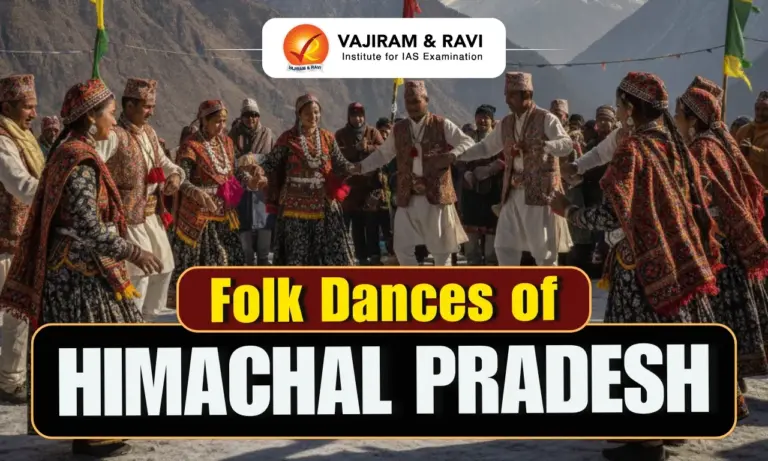
Himachal Pradesh is known for its diverse folk traditions shaped by hill communities, festivals, tribal life and religious practices. Folk Dances of Himachal Pradesh are performed during fairs, weddings, harvest celebrations and religious occasions. Nati is the most famous Himachali Dance and has a Guinness World Record as the largest folk dance. Other important forms include Dangi, Chham, Dandras, Rakshasa, Kayang Mala and Thoda.
Folk Dances of Himachal Pradesh 2026
The Folk Dances of Himachal Pradesh reflect regional customs, mythology, agriculture, tribal traditions and Buddhist practices. Their music uses instruments, songs, clapping, masks and traditional costumes. Different communities including Gaddis, Kinnauras, Lahaulas, Spitians, Pangwals and Gujjars preserve distinct dance traditions. These forms are performed collectively by men and women or by specific community groups. The famous folk dance of Himachal Pradesh is Nati, while several dances have strong district level associations.
Folk Dances of Himachal Pradesh Features
The major highlights and features of the famous Folk Dances of Himachal Pradesh are:
- Famous Himachali Dances: The Himachal Pradesh folk dance name list includes Nati, Dangi, Chhanak Chham, Dandras, Rakshasa, Kayang Mala, Losar Shona Chuksam, Cholamba, Dhure, Shan, Shabu, Laaldi, Ghughti, Swaangtegi, Thoda, Luddi, Bakayang, Jataru Kayang, Chohara, Jhanjhar, Jhora, Gi, Rasa and Lang-Dar-Ma.
- District wise Tradition: A folk dance of Himachal Pradesh district wise study shows strong regional diversity. Kinnaur is linked with Rakshasa and Kayang, Lahaul-Spiti with Buddhist dances, Chamba with Dangi and Jhanjhar, Sirmaur with Jhora and Mandi with Luddi.
- Cultural Significance: These dances preserve folklore, religious beliefs, community memory and traditional lifestyles. They are performed at festivals, weddings, fairs, harvest events and occasions connected with the arrival or honouring of deities.


Famous Folk Dances of Himachal Pradesh List
The list of Major Famous Folk Dances of Himachal Pradesh (Himachali Dance) has been provided below:
Nati
- Nati is the most famous folk dance of Himachal Pradesh and is widely performed at fairs, festivals, weddings and cultural programmes.
- It originated mainly in Shimla, Mandi, Solan, Sirmaur, Kinnaur and Kullu.
- Nati was officially recognised in January 2016 as the largest folk dance in the world based on the number of dancers and registered under Guinness World Record.
- It is also popular in Chandigarh and across Himachali cultural programmes.
- Major forms include Kulvi Nati, Gaddi Nati, Mahasuvi Nati, Jaunsari Nati, Sirmauri Nati, Kinnauri Nati, Barada Nati, Lahauli Nathi, Seraji Nathi, Karsogi Nathi and Chauhari Nathi.
- Nati uses instruments such as Dhol, Nagara, Narsingha, Karnal, Shennai, Flute, Ranasingha and Dholak. Traditional clothing includes caps, Cholas, churidars, ghagra, Pattu and silver or gold ornaments.
Dangi Folk Dance
- Dangi folk dance of Himachal Pradesh is associated with the Chamba region.
- It is performed at Naina Devi temple during the harvest season and also features during festivals, weddings and Jataras.
Chhanak Chham
- Chhanak Chham is a sacred masked dance performed by Buddhist Lamas in Lahaul-Spiti.
- It is performed every three years during the Chakhar festival in monastery courtyards to honour Lord Buddha.
- Chham Tradition: Chham uses elaborate masks, headgear and costumes decorated with traditional motifs.
- Dancers make slow circular movements, while musicians use Tangchim, long pipes and Ghhan drums during the performance.
Dandras Dance
- Dandras is traditionally performed by men of the Gaddi community from Bharmaur in Chamba district.
- Dancers use small sticks and perform graceful movements that can continue for several hours.
Rakshasa Dance
- Rakshasa or Demon Dance is strongly associated with Kinnaur.
- Dancers wear demon masks and depict evil forces attacking crops before being driven away by the forces of good.
- Rakshasa Dance is performed during occasions such as Chaitol, Bishu and Diwali.
- Men and women may dance together in circles while following the lead dancer known as Ghure.
Kayang Mala
- Kayang Mala is one of the most popular traditional dances of Kinnaur.
- Dancers hold hands in a crossed formation resembling a garland and gradually move into a circular pattern.
Kayang Mala Forms
- The three recognised forms mentioned in the tradition are Nagas Kyang, Clumsy Kyang and Shuna Kyang.
- The dance is associated with communities and areas including Kinnaur, Chamba, Lahaul and Una.
Losar Shona Chuksam
- Losar Shona Chuksam belongs to the Kinnaur region and is associated with Losar, the New Year festival.
- Dhol, Bugjal, Karnal and Ransingha provide its musical accompaniment.
Bakayang Dance
- Bakayang is associated with Kinnaur and is mainly performed by women arranged in rows of two or three.
- The dancers move forward and backward during agricultural, harvest related and festive occasions.
Jataru Kayang
- Jataru Kayang is performed during festivals and special celebrations.
- Dancers follow the Ghure or lead dancer while using a chamar as a performance prop as the music increases in tempo.
Dalshon and Cholamba
- Dalshon and Cholamba belong to the Ropa Valley.
- Their formation resembles coiled serpents.
- Cholamba is traditionally associated with celebrations following a tiger hunt, involving a stuffed animal skin and a gold ornament.
Dhure Dance
- Dhure is popular in Lahaul and uses mainly singing instead of musical instruments.
- Performers create semicircular and circular formations, while themes may draw from the Ramayana and Mahabharata.
Shan and Shabu
- Shan and Shabu are important dances of the Lahaul Valley and are performed in Buddhist Gompas in memory of Buddha.
- Shan is particularly connected with songs of praise and post harvest celebrations.
Laaldi and Ghughti
- Laaldi is a women’s dance in which clapping provides the rhythm instead of Dhol, Nagada, or Shehnai.
- In Ghughti, dancers form a chain while the leading performers sing and others respond together.
Swaangtegi, Dhakheni and Drodi
- Swaangtegi uses lion and garden wooden masks and is performed during Diwali.
- Dhakheni and Drodi depict themes involving warriors, invaders, temples and stupas during celebrations such as Jagar and Shant.
Thoda Dance
- Thoda has historical links with battle traditions and was used as a pre battle ritual.
- Its movements were designed to represent the speed and intensity associated with actual battlefield actions.
Luddi Dance
- Luddi is associated with Mandi and was historically performed in royal courts.
- It later became part of social gatherings and is performed by men and women using quick circular movements, clapping and chanting.
Kikli and Bhangra
- Kikli is performed by young girls who hold hands crosswise and rotate rapidly on their toes.
- Bhangra originated in Punjab but is also performed in some areas of Una.
Lang-Dar-Ma Dance
- Lang-Dar-Ma is a masked dance associated with Lahaul-Spiti.
- It narrates the killing of the anti Buddhist Tibetan ruler Lang Dar-Ma, who ruled from 838 to 841 CE.
Chohara Dance
- Chohara is performed by both men and women during auspicious occasions, fairs and festivals.
- It is particularly associated with Shimla district and remains a visible part of local celebrations.
Jhanjhar Dance
- Jhanjhar is associated with Chamba and is performed by men and women during festive occasions.
- The performance begins slowly and gradually increases in speed and rhythmic intensity.
Jhora Dance
- Jhora is an important dance of Sirmaur and often serves as an opening performance.
- Dancers use musical question and answer exchanges, with lines traditionally ending in the joyful sound “Hoo Hoo.”
Gi Dance
- Gi is performed in a circular formation with a main or lead dancer positioned at the centre.
- Different regional forms have developed according to local communities and changing traditions.
Rasa Dance
- Rasa combines elements of local culture including deities, crops, harvesting tools and traditional musical instruments.
- Men and women participate in colourful traditional clothing and perform simple rhythmic hand and foot movements.

 Last updated on Oct, 2026
→ UPSC 2027 Notification will be released on 13 January 2027 at upsconline.nic.in.
→ Check Nobel Prize 2026 Winners List here.
→ Download PIB PRiSM Monthly Magazine 2026 here.
→ Check UPSC Monthly Current Affairs Magazine The Recitals here.
→ Check out the latest UPSC Syllabus here.
→ Download UPSC Model Answers for Mains 2026
→ UPSC Mains Question Paper 2026 is out now for Essay & GS Paper 1, 2, 3 & 4.
→ UPSC Calendar 2027 has been released.
→ Enroll in Vajiram & Ravi’s UPSC Mains Test Series 2027 for structured answer writing practice, expert evaluation, and exam-oriented feedback.
→ Join Vajiram & Ravi’s UPSC Mentorship Program 2027 for personalized guidance, strategy planning, and one-to-one support from experienced mentors.
→ Go through the UPSC Mains Previous Year Papers to enhance your preparation.
→ UPSC has released UPSC Toppers List 2025 with the Civil Services final result on its official website.
→ Also check Best UPSC Coaching in India
Folk Dances of Himachal Pradesh FAQs
Q1. What are the Major Folk Dances of Himachal Pradesh?+
Q2. Which is the state dance of Himachal Pradesh?+
Q3. What is the Himachali dance called?+
Q4. What is the most famous folk dance of Himachal Pradesh?+
Q5. Which folk dance of Himachal Pradesh is associated with Kinnaur?+
Q6. What is Dangi folk dance of Himachal Pradesh?+
Q7. Dangi is a traditional dance associated with the Chamba region and is performed during harvest celebrations, festivals, weddings and Jataras.+
Q8. Chhanak Chham, Shan, Shabu, Dhure and Lang-Dar-Ma are important traditional dances associated with Lahaul-Spiti and its Buddhist cultural traditions.+
Tags: folk dances of himachal pradesh folk dances of india