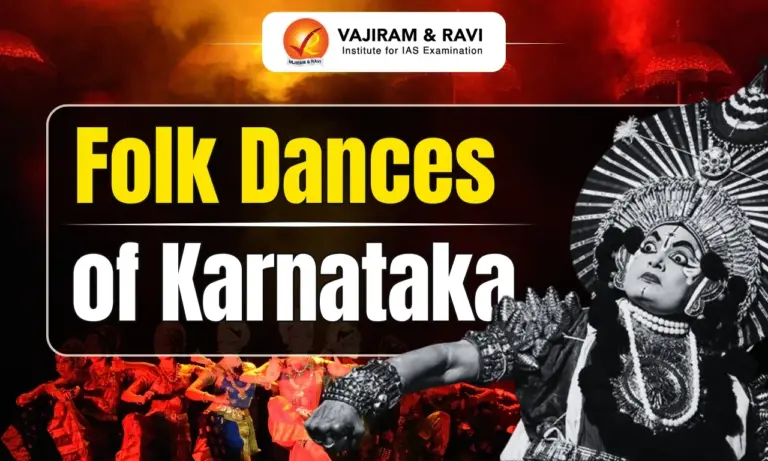
Folk Dances of Karnataka reflect the State’s rich cultural diversity and are closely linked with religious traditions, village festivals, agricultural activities, community life and local beliefs. These traditions vary across Coastal Karnataka, North Karnataka, the Old Mysuru region and Kodagu, making them an important part of Karnataka’s intangible cultural heritage.
Major Folk Dances of Karnataka
Folk dances are community-based traditional performances preserved largely through practice and oral traditions. Major folk dances of Karnataka include Dollu Kunitha, Veeragase, Kamsale, Kolata, Pata Kunitha, Suggi Kunitha, Puja Kunitha, Nagamandala, Bhootha Kola, Bengaluru Karaga, Goravara Kunitha and Somana Kunitha.
Also Read: Folk Dances of Telangana
Dollu Kunitha
- Dollu Kunitha is a vigorous drum dance in which performers carry large dollu drums and perform coordinated movements to rhythmic beats.
- It is traditionally associated with the Kuruba Gowda community.
- The dance has a strong devotional association with Beereshwara or Beeralingeshwara, a form of Lord Shiva.
- It is performed during temple festivals, religious occasions and cultural celebrations.
Veeragase
- Veeragase is a vigorous Shaivite devotional and martial folk dance associated with Veerabhadra.
- It is performed exclusively by the Jangama (also called Maheshwara) clan of the Veerashaiva/Lingayat community.
- It is particularly associated with North and Central Karnataka.
- It is commonly performed during religious festivals, the Mysuru Dasara procession, and household functions of the Lingayat community.
Kamsale
- Kamsale, also known as Beesu Kamsale, is a devotional folk dance associated with devotees of Male Mahadeshwara.
- Performers use a pair of metallic percussion instruments called kamsale while dancing to devotional songs.
- It is particularly associated with the Mysuru-Chamarajanagar-Mandya region, centred on the Male Mahadeshwara Hills temple.
Kolata
- Kolata is a traditional group stick dance. Dancers move in coordinated patterns while rhythmically striking short wooden sticks against one another
- It is performed by communities such as the Vokkaliga, Nayaka and Golla of the Mysuru-Mandya-Hassan belt, the Hallakki Gowda community of North Karnataka, and the Kodavas of Kodagu, during social and festive occasions.
Pata Kunitha
Pata Kunitha is particularly associated with Mysuru district. Male performers traditionally carry and balance tall decorated bamboo poles while performing rhythmic movements. The decorated poles give the dance its distinctive visual character.
Suggi Kunitha
Suggi Kunitha is a harvest dance associated with the Halakki Vokkaliga community of coastal Uttara Kannada. It is performed during the harvest season as an expression of joy and gratitude for agricultural abundance. The dance uses colourful costumes and traditional musical instruments.
Puja Kunitha
Puja Kunitha is a ritual dance associated with Shakti or Mother Goddess worship. It is particularly associated with the Mandya and Old Mysuru region. The performer carries a decorated structure representing the deity on the head while performing.
Nagamandala
- Nagamandala is a ritual performance associated with the worship of serpent spirits or Nagas.
- It is particularly practised in Coastal Karnataka, especially the Tulu-speaking region of Dakshina Kannada and Udupi districts.
- An elaborate serpent design is created on the ground as part of the ritual, around which the performance takes place.
Bhootha Kola
Bhootha Kola, also known as Bhootha Aradhane or Daiva Kola, is a major ritual tradition of Coastal Karnataka, especially the Tulu-speaking region. It involves the worship of local spirits or Daivas. Performers use distinctive costumes, make-up, music and ritual movements.
Bengaluru Karaga
- Bengaluru Karaga is an important traditional ritual associated with the Dharmaraya Swamy Temple in Bengaluru. It is closely associated with the Thigala community.
- The central ritual involves carrying the Karaga, a decorated pot, on the head during a night procession.
- The tradition has a strong association with Goddess Draupadi and Shakti worship.
Goravara Kunitha
- Goravara Kunitha is a devotional dance performed by the Gorava community, drawn from the Kuruba Gowda tradition.
- It is practised in two regional forms: in North Karnataka, Goravas worship Mailara Linga; in the Old Mysuru/South Karnataka region, Goravas worship Mudukutore Mallikarjuna. Both are regarded as forms of Lord Shiva.
- Performers use distinctive traditional costumes including a bearskin headgear and black woollen rug and perform trance-like devotional movements.
Somana Kunitha
- Somana Kunitha is a ritual masked dance associated with worship of the village deity (Grama Devate).
- Performers wear large ceremonial masks (somas) representing deities, made from red sandalwood.
- It is particularly associated with the Old Mysuru/South Karnataka region – districts such as Mandya, Hassan, Tumakuru, Mysuru, Chitradurga and Bengaluru.
- The dance reflects the close connection between folk performance and local religious beliefs.
Also Read: Folk Dances of Andhra Pradesh
Folk Dances of Karnataka Cultural Significance
The folk dances of Karnataka show how religion, community identity, agriculture and regional traditions have shaped the State’s cultural heritage.
- Religious traditions: Many forms are linked with Shiva, Shakti, local deities, serpent worship and spirit traditions.
- Community identity: Several dances are closely associated with particular communities such as the Kuruba Gowda, Halakki Vokkaliga, Gorava, Jangama, and Thigala communities.
- Agricultural traditions: Forms such as Suggi Kunitha reflect the importance of the harvest cycle in rural life.
- Regional diversity: Coastal Karnataka, North Karnataka, Old Mysuru and Kodagu have developed distinctive performance traditions.
- Living heritage: Their continued performance during festivals and community occasions helps preserve oral traditions, local beliefs and collective cultural memory.


 Last updated on Oct, 2026
→ UPSC 2027 Notification will be released on 13 January 2027 at upsconline.nic.in.
→ Check Nobel Prize 2026 Winners List here.
→ Download PIB PRiSM Monthly Magazine 2026 here.
→ Check UPSC Monthly Current Affairs Magazine The Recitals here.
→ Check out the latest UPSC Syllabus here.
→ Download UPSC Model Answers for Mains 2026
→ UPSC Mains Question Paper 2026 is out now for Essay & GS Paper 1, 2, 3 & 4.
→ UPSC Calendar 2027 has been released.
→ Enroll in Vajiram & Ravi’s UPSC Mains Test Series 2027 for structured answer writing practice, expert evaluation, and exam-oriented feedback.
→ Join Vajiram & Ravi’s UPSC Mentorship Program 2027 for personalized guidance, strategy planning, and one-to-one support from experienced mentors.
→ Go through the UPSC Mains Previous Year Papers to enhance your preparation.
→ UPSC has released UPSC Toppers List 2025 with the Civil Services final result on its official website.
→ Also check Best UPSC Coaching in India
Folk Dances of Karnataka FAQs
Q1. What are the major folk dances of Karnataka?+
Q2. Which folk dance of Karnataka is associated with drums?+
Q3. Which Karnataka folk dance is associated with Male Mahadeshwara? +
Q4. Which folk tradition of Karnataka is associated with serpent worship? +
Q5. Which folk dance of Karnataka is associated with Goddess Draupadi?+
Tags: folk dances of karnataka