Rome Declaration for an Unarmed and Disarming Peace 2026, Mandate

Rome Declaration for an Unarmed and Disarming Peace

The Rome Declaration for an Unarmed and Disarming Peace was signed in July 2026 by Nobel laureates, AI scientists, religious leaders and other global figures. It warns about the growing risks of delegating moral and ethical decisions to Artificial Intelligence. Its central concern is nuclear command and control, where autonomous AI could reduce human decision making time and create catastrophic consequences during crises.

What is Rome Declaration for an Unarmed and Disarming Peace?

The Rome Declaration for an Unarmed and Disarming Peace is a moral and strategic appeal for human control over AI and renewed nuclear disarmament. It was adopted by participants of the Global Nobel Laureates Assembly. It is inspired by Pope Leo XIV’s encyclical Magnifica Humanitas and seeks international safeguards against autonomous nuclear decisions and AI enabled warfare.

Rome Declaration Need and Purpose

The Rome Declaration for an Unarmed and Disarming Peace responds to faster military automation, weakening arms control arrangements and the possibility that AI errors could trigger irreversible decisions.

  • Shorter decision windows: AI battle management systems can reduce military response time from hours to seconds, removing the human hesitation that helped prevent escalation during crises such as the Cuban Missile Crisis of 1962.
  • AI failure risks: Deep neural networks can face hallucinations, data poisoning, adversarial attacks and faulty information, creating risks of false identification during high stakes military confrontations.
  • Weakening arms control: The weakening of arrangements such as Open Skies and New START increases strategic uncertainty and may encourage states to automate defence systems to match perceived technological advantages.
  • Nuclear escalation: In volatile situations involving nuclear programmes, cyber intrusions or physical attacks could be misread by automated systems and produce disproportionate military responses before human communication occurs.

Rome Declaration 6 Principles

The six principles of Rome Declaration for an Unarmed and Disarming Peace establish a broad framework linking AI safety, responsible governance, ethical leadership, military restraint and complete nuclear disarmament.

  1. Disarming the Next Arms Race: States should prevent simultaneous arms races involving AI and nuclear capabilities and reduce incentives for automated military competition.
  2. Responsible Development: AI development should follow transparent ethical standards, international principles, human rights, safety requirements and meaningful accountability.
  3. Responsible Use of AI: AI should support human welfare rather than independently control nuclear launches, lethal force, military targeting, or autonomous warfare.
  4. Responsible Governance: Governments should establish international oversight, regulatory mechanisms, accountability systems and verification arrangements for high risk AI applications.
  5. Responsible Leadership: Governments, technology companies, scientists and military institutions should place human dignity, global peace and ethical responsibility above technological competition.
  6. Nuclear Disarmament: The Declaration renews the objective of completely, irreversibly and verifiably eliminating nuclear weapons through sustained international negotiations.

Rome Declaration 5 Mandates

Five operational mandates translate the ethical concerns of Rome Declaration for an Unarmed and Disarming Peace into specific safeguards for AI governance, nuclear security, public knowledge and disarmament.

  1. Meaningful Human Control: AI systems must never receive final authority over nuclear weapon launches, armed conflict initiation, or lethal force decisions, keeping responsibility with human decision makers.
  2. Digital Commons Model: Greater access to relevant data, research and safety assessments should help independent experts examine systemic AI risks and unintended consequences.
  3. Responsible AI Development: Developers should publish ethical frameworks and ensure systems remain explainable, auditable, controllable and capable of human override or shutdown.
  4. Internal Arsenal Vulnerability Audits: Nuclear armed states should conduct rigorous technical reviews of command and control networks to identify AI driven cyber interference, data poisoning, hallucinations and other vulnerabilities.
  5. Time Bound Verifiable Disarmament: States should resume good faith negotiations aimed at permanent, irreversible and verifiable elimination of nuclear arsenals.

Convergent Perils in AI

A convergent peril occurs when separate technological and governance risks interact and amplify one another into a larger systemic or civilizational threat.

  • Multiple risks interacting: Algorithmic bias, hyper automation, cyber vulnerabilities, weak accountability and autonomous decision making can reinforce one another instead of remaining isolated problems.
  • Moral agency erosion: Outsourcing ethical choices to machines may weaken human responsibility because AI cannot experience empathy, suffering, moral hesitation, or personal accountability.
  • Value alignment problem: AI may optimise mathematical objectives efficiently, while human justice also considers rights, fairness, dignity, duties and individual circumstances.
  • Black box accountability: Advanced AI systems can make decisions that are difficult to explain, creating uncertainty about whether developers, operators, governments, manufacturers, or users should bear responsibility.
  • Contextual blindness: Human decision makers can consider compassion, intent, exceptional circumstances and social context, while AI systems may apply rules without understanding these human nuances.

AI Ethics in India

India has developed a principle based approach that seeks to combine technological innovation with inclusion, safety, transparency, privacy, fairness and accountability.

  • National Strategy for AI: NITI Aayog’s 2018 National Strategy for AI introduced the vision of “AI for All” and promoted inclusive and socially beneficial artificial intelligence. The strategy emphasises safety, inclusivity, privacy, transparency, fairness and accountability as important foundations for responsible AI development.
  • IndiaAI Mission: Launched in 2024, the IndiaAI Mission supports computing infrastructure, datasets, startups, skilling and innovation while including a “Safe and Trusted AI” pillar.
  • MeitY governance framework: Ministry of Electronics and Information Technology guidelines promote a principle based techno-legal approach and use Seven Sutras for trustworthy, human centric, safe and responsible AI governance.

AI Ethics in World

International initiatives increasingly focus on human dignity, transparency, accountability, safety, human rights and responsible development of advanced AI systems.

  • UNESCO Recommendation: Adopted in 2021, the UNESCO Recommendation on the Ethics of AI provides a global framework based on human dignity, human rights, transparency, accountability and sustainability.
  • EU Artificial Intelligence Act: The 2024 law introduced a risk based regulatory model, prohibiting unacceptable risk applications such as social scoring and imposing stronger obligations on high risk AI systems.
  • Bletchley Park Declaration: Signed by 28 countries in 2023, the Declaration recognised risks from frontier AI and promoted international cooperation on AI safety and responsible governance.
  • Global Partnership on AI: GPAI is a multi stakeholder initiative supporting inclusive, responsible and human centric AI. India is a founding member and hosted the GPAI Summit in 2023.
  • Human centred governance: Global frameworks increasingly support Human in the Loop systems, explainable AI, independent ethical assessments and safeguards for high risk applications involving life, liberty and dignity.

Rome Declaration Challenges

Turning the Rome Declaration for an Unarmed and Disarming Peace into effective international rules faces legal, technological, political and verification challenges across nuclear and artificial intelligence governance.

  • Lack of global consensus: Major military powers may remain reluctant to accept binding restrictions on autonomous military capabilities, particularly when strategic competition is intensifying.
  • Verification difficulty: AI software can be duplicated, modified, concealed and deployed remotely, making international verification substantially harder than monitoring physical nuclear materials.
  • Dual use technology: The same AI technologies can support civilian research and military applications, making clear boundaries between beneficial innovation and dangerous deployment difficult to establish.
  • Rapid technological change: Private sector AI development is progressing faster than multilateral treaty negotiations, creating a regulatory gap between technological capability and international governance.

Rome Declaration FAQs

Q1: What is the Rome Declaration for an Unarmed and Disarming Peace?

Ans: The Rome Declaration is a global appeal for meaningful human control over AI, especially in nuclear weapons and autonomous military systems.

Q2: When was the Rome Declaration for an Unarmed and Disarming Peace signed?

Ans: The Rome Declaration for an Unarmed and Disarming Peace was signed in July 2026 by Nobel laureates, AI scientists, religious leaders and global figures.

Q3: What is the main objective of the Rome Declaration?

Ans: Its main objective is to prevent AI from making autonomous nuclear launch decisions and promote responsible AI governance and nuclear disarmament.

Q4: What are the five mandates of the Rome Declaration?

Ans: The five mandates cover meaningful human control, the Digital Commons, responsible AI development, nuclear arsenal vulnerability audits and time bound verifiable disarmament.

Q5: What is a convergent peril in AI?

Ans: A convergent peril occurs when AI risks such as bias, cyber vulnerabilities, hyper automation and weak accountability interact to create a larger systemic threat.

Criminal Law (Amendment) Act, 2013, Background, Key Provisions

Criminal Law (Amendment) Act, 2013

The Criminal Law (Amendment) Act, 2013 was a major reform of India’s criminal law framework dealing with sexual offences, crimes against women, victim protection and criminal justice procedures. It was enacted following the December 2012 Delhi gang-rape case and incorporated several recommendations of the Justice J.S. Verma Committee.

Criminal Law (Amendment) Act, 2013 Background 

The Criminal Law (Amendment) Act, 2013 was enacted following the December 2012 Delhi gang-rape case, which triggered nationwide demands for stronger laws against sexual violence and a more responsive criminal justice system.

  • The government constituted the Justice J.S. Verma Committee on 23 December 2012 to examine existing laws and recommend reforms for dealing with sexual offences and ensuring faster justice.
  • The Committee submitted its report on 23 January 2013, recommending changes in sexual-offence laws along with measures for victim protection, police accountability, witness protection and institutional reform.
  • Since Parliament was not in session, the government promulgated the Criminal Law (Amendment) Ordinance, 2013 on 3 February 2013 to introduce immediate legal changes.
  • The Criminal Law (Amendment) Bill, 2013 was subsequently passed by the Lok Sabha on 19 March and Rajya Sabha on 21 March 2013, and received Presidential assent on 2 April 2013.
  • The Act was given effect from 3 February 2013, corresponding to the date on which the Ordinance came into force.

The Justice Verma Committee’s recommendations provided an important basis for the legislation, but the final Act did not adopt its entire reform agenda. In particular, the Committee’s recommendation to remove the marital rape exception was not accepted, its opposition to death penalty as a general punishment for rape was not fully reflected, and several wider recommendations on police and institutional reforms were left outside the Act.

Laws Amended by the Criminal Law (Amendment) Act, 2013

The Criminal Law (Amendment) Act, 2013 amended four laws to strengthen the legal response to sexual offences.

  • Indian Penal Code, 1860: Added offences such as sexual harassment, stalking and voyeurism and strengthened punishment for rape, gang rape and acid attacks.
  • Code of Criminal Procedure, 1973: Strengthened victim-friendly procedures for recording statements, investigation and trial of sexual offences.
  • Indian Evidence Act, 1872: Restricted the use of a victim’s past sexual experience or character to establish consent and strengthened provisions on absence of consent.
  • POCSO Act, 2012: Clarified the relationship between POCSO and IPC offences, including the applicable punishment where an act falls under both laws.

Criminal Law (Amendment) Act, 2013 Major Provisions

The Criminal Law (Amendment) Act, 2013 made major changes to India’s laws on sexual offences by creating new offences, widening the definition of rape, increasing punishments and strengthening protection for victims.

New Offences Against Women

The Criminal Law (Amendment) Act, 2013 created specific offences for forms of sexual misconduct that were earlier not separately recognised under the IPC.

  • Section 354A (Sexual harassment): Covers unwelcome sexual advances, demands for sexual favours, showing pornography against a woman’s will and sexually coloured remarks.
  • Section 354B (Assault with intent to disrobe): Punishes assault or criminal force used with the intention of disrobing a woman or forcing her to be naked.
  • Section 354C (Voyeurism): Punishes watching, recording or sharing images of a woman engaged in a private act without her consent.
  • Section 354D (Stalking): Punishes repeatedly following, contacting or monitoring a woman despite her clear disinterest, including through electronic communication.

Specific Law Against Acid Attacks

The Criminal Law (Amendment) Act, 2013 introduced separate offences for causing or attempting acid attacks.

  • Section 326A: Punishes causing grievous injury through acid with at least 10 years’ imprisonment, which may extend to life imprisonment, along with a fine.
  • Section 326B: Punishes throwing or attempting to throw acid with 5-7 years’ imprisonment and fine. The fine is intended to help meet the medical expenses of the victim.

Expanded Definition of Rape

The Criminal Law (Amendment) Act, 2013 substantially widened Section 375 IPC to cover different forms of non-consensual penetration. It also gave greater importance to consent, requiring consent to be voluntary and specific to the sexual act rather than assuming consent from the surrounding circumstances.

Stronger Punishment for Rape

The Criminal Law (Amendment) Act, 2013 strengthened punishment for rape and introduced separate provisions for serious forms of sexual violence.

  • Section 376: Prescribed imprisonment of at least 7 years, extendable to life imprisonment, with fine.
  • Section 376A: Applies when rape results in the death of the woman or leaves her in a persistent vegetative state.
  • Section 376B: Deals with sexual intercourse by a husband with his wife during separation.
  • Section 376C: Covers sexual intercourse by a person in authority.
  • Section 376D: Specifically deals with gang rape.
  • Section 376E: Provides enhanced punishment for certain repeat offenders, including imprisonment for the remainder of natural life or death.

Accountability of Public Servants

The Criminal Law (Amendment) Act, 2013 made certain failures by public servants in sexual-offence cases punishable.

  • Section 166A IPC: Penalises specified failures by public servants, including failure to record information relating to certain sexual offences or disobedience of specified legal directions. This aimed to improve police accountability and proper handling of complaints.

Accountability of Hospitals

The Criminal Law (Amendment) Act, 2013 also created responsibility for hospitals dealing with victims.

  • Section 166B IPC: Penalises hospitals for failing to provide treatment to victims of specified sexual offences. This aimed to ensure that victims receive timely medical treatment.

Victim-Friendly Criminal Procedure

The Criminal Law (Amendment) Act, 2013 introduced safeguards to make the investigation and trial process more sensitive to victims.

  • Victims’ statements in specified cases could be recorded through special procedures, including by women police officers.
  • Additional safeguards were provided for women and persons with physical or mental disabilities.
  • Procedures for recording statements before a Magistrate were strengthened.
  • Trials in specified sexual-offence cases could be held in camera to protect privacy.
  • The amendments also aimed to make the investigation and trial of rape cases faster.

Protection of Victims in Evidence Law

The Criminal Law (Amendment) Act, 2013 restricted the use of a victim’s past sexual behaviour to question her consent.

  • Section 53A: Restricted the use of evidence about a victim’s previous sexual experience or character in determining consent.
  • Section 114A: Strengthened the presumption of absence of consent in specified rape cases.
  • Section 146: Restricted questions about a woman’s character or previous sexual experience when used to establish consent.

Changes Relating to POCSO

The Criminal Law (Amendment) Act, 2013 also amended the POCSO Act, 2012 to clarify cases where the same conduct could attract both POCSO and IPC provisions.

  • Section 42: Where an act constituted an offence under both POCSO and specified IPC provisions, the offender would face the greater punishment.
  • Section 42A: Clarified that POCSO operates alongside other laws and prevails over inconsistent provisions to the extent of such inconsistency.

Criminal Law (Amendment) Act, 2013 Significance 

The Criminal Law (Amendment) Act, 2013 marked a major shift in India’s response to sexual violence by combining new offences, stronger punishments and victim-sensitive procedures.

  • Broader criminalisation: Recognised sexual harassment, stalking, voyeurism and assault with intent to disrobe as specific offences.
  • Stronger deterrence: Enhanced punishment for rape, gang rape, aggravated rape and certain repeat offenders.
  • Victim protection: Strengthened procedural and evidentiary safeguards during investigation and trial.
  • Institutional accountability: Created criminal liability for specified failures by public servants and hospitals.
  • Protection of dignity: Restricted the use of a victim’s previous sexual history to establish consent.
  • Child protection: Strengthened coordination between the IPC framework and POCSO.

Criminal Law (Amendment) Act, 2013 Limitations

The Criminal Law (Amendment) Act, 2013 strengthened the legal framework, but effective protection against sexual violence also depends on implementation and institutional capacity.

  • Implementation gap: Strong laws require effective policing, investigation, prosecution and judicial processes.
  • Police capacity: Delays in investigation and forensic evidence collection can weaken criminal cases.
  • Judicial capacity: Case pendency and inadequate trial infrastructure can undermine speedy justice.
  • Marital rape: The statutory exception remained despite the Justice Verma Committee’s recommendation.
  • Institutional reforms: Several broader police and institutional reforms recommended by the Committee were not incorporated into the Act.

Criminal Law (Amendment) Act, 2013 FAQs

Q1: What is the Criminal Law (Amendment) Act, 2013?

Ans: The Criminal Law (Amendment) Act, 2013 strengthened India’s laws on sexual offences by introducing new offences, enhancing punishments and improving safeguards for victims.

Q2: Why was the Criminal Law (Amendment) Act, 2013 enacted?

Ans: The Criminal Law (Amendment) Act, 2013 was enacted after the December 2012 Delhi gang-rape case to strengthen laws against sexual violence and improve the criminal justice response.

Q3: Which laws were amended by the Criminal Law (Amendment) Act, 2013?

Ans: The Criminal Law (Amendment) Act, 2013 amended the IPC, CrPC, Indian Evidence Act and POCSO Act.

Q4: What new offences were introduced by the Criminal Law (Amendment) Act, 2013?

Ans: The Criminal Law (Amendment) Act, 2013 introduced specific offences for sexual harassment, assault with intent to disrobe, voyeurism and stalking under Sections 354A to 354D IPC.

Q5: How did the Criminal Law (Amendment) Act, 2013 change the law on rape?

Ans: Criminal Law (Amendment) Act, 2013 broadened the definition of rape under Section 375 IPC to cover different forms of non-consensual penetration and placed greater emphasis on consent.

MHA Guidelines for Renewable Energy Projects Near Borders

MHA Guidelines for Renewable Energy Projects Near Borders

Why in the News? : The Ministry of Home Affairs (MHA) has issued new national security guidelines for solar, wind and hybrid renewable energy projects in border areas. The guidelines prohibit new projects within 1 km of the border and require security clearances for projects proposed up to 50 km from sensitive borders.

MHA Guidelines for Renewable Energy Projects Near Borders Background

The Ministry of New and Renewable Energy (MNRE) had received increasing queries about setting up renewable energy projects near border areas because of their possible national security implications. The MHA framed the guidelines after consultations with stakeholders to create a uniform and transparent approval process while also maintaining ease of doing business.

Key Guidelines for Renewable Energy Projects Near Borders

The MHA guidelines for renewable energy projects near border areas divide border areas into different security zones and prescribe specific restrictions, clearances and security requirements according to the distance from the border.

Zonal Restrictions

  • Within 1 km: Areas along the Line of Control (LoC), Line of Actual Control (LAC) and International Border are treated as restricted areas, where no new project activity is permitted.
  • 1-50 km: Solar, wind and hybrid projects require security clearance from the MHA, which will assess proposals on a case-by-case basis.
  • 1-20 km: Projects also require a No Objection Certificate (NOC) from the Ministry of Defence (MoD).
  • Clearance timeline: The MHA will endeavour to decide proposals within 60 days.

Application Process

  • Developers cannot apply directly to the Ministry of Home Affairs (MHA) or Ministry of Defence (MoD) for clearance.
  • Applications must be submitted to the Ministry of New and Renewable Energy (MNRE) after obtaining in-principle approval for land allotment from the State government.
  • The MNRE will forward the proposal to the MHA for security clearance and the MoD for a No Objection Certificate (NOC).
  • The MNRE will convey the final decision to the developer after receiving the required clearances.

Foreign Participation

  • Engineers, employees, staff and labour from Pakistan, Bangladesh and China cannot be engaged for project implementation without MHA permission.
  • Project developers cannot transfer project land to a foreign company without prior approval of the Central government and security clearance from the MHA.
  • Where foreign investment is involved, a separate application is required under the Foreign Direct Investment (FDI) Policy through the Department for Promotion of Industry and Internal Trade (DPIIT).

Security Requirements

  • Developers must install comprehensive security infrastructure, including anti-drone systems, at their own cost.
  • These systems may be operated by the Central Industrial Security Force (CISF) or State police.
  • Employees and construction workers must undergo prior verification before entering project areas.
  • Foreign nationals entering project sites must be monitored.
  • Project staff must follow instructions issued by the local police and the Border Security Force (BSF).

Project Design and Roads

  • Project layouts should avoid long stretches of construction running parallel to the international border.
  • Roads within projects should be sufficiently wide and designed so that they can be used by armed forces and border security personnel during emergencies.
  • Projects should also have a dedicated police post for monitoring construction activities.

Accommodation and Height Restrictions

  • Hotels, housing and other facilities likely to attract large crowds are discouraged in sensitive areas.
  • Accommodation and hotels must be located at least 5 km from the border, while cafeterias should remain within the plant premises.
  • Height limits apply to administrative buildings, control rooms, staff housing and other civil infrastructure, but not to core infrastructure such as wind turbines.
    • 1-8 km: Maximum height of 3 metres.
    • 8-20 km: Maximum height of 5 metres.
    • 20-50 km: Maximum height of 15 metres.

Existing Projects

  • Projects that had already received MHA security clearance before the guidelines were issued do not need to apply again.
  • Similarly, projects that had already obtained an MoD NOC are not required to reapply.

Significance of MHA Guidelines for Renewable Energy Projects Near Borders

  • National security: Protect sensitive border areas from surveillance, unauthorised access and security threats.
  • Safe renewable expansion: Enable clean-energy projects while addressing border-security concerns.
  • Border preparedness: Ensure project roads and infrastructure can support security forces during emergencies.
  • Emerging threats: Strengthen protection through anti-drone systems and worker verification.
  • Clear approvals: Create a uniform framework involving the MNRE, MHA and MoD.
  • Ease of doing business: Provide defined clearance requirements and a proposed 60-day timeline.

MHA Guidelines for Renewable Energy Projects Near Borders FAQs

Q1: What are the MHA Guidelines for Renewable Energy Projects Near Borders?

Ans: The MHA Guidelines for Renewable Energy Projects Near Borders regulate solar, wind and hybrid projects near the LoC, LAC and International Border to address national security concerns.

Q2: What is the main restriction under the MHA Guidelines for Renewable Energy Projects Near Borders?

Ans: The MHA Guidelines for Renewable Energy Projects Near Borders prohibit new project activity within 1 km of the LoC, LAC and International Border.

Q3: What clearance is required under the MHA Guidelines for Renewable Energy Projects Near Borders?

Ans: Projects between 1 km and 50 km require security clearance from the Ministry of Home Affairs (MHA), while projects within 1–20 km also require an NOC from the Ministry of Defence (MoD).

Q4: How are applications processed under the MHA Guidelines for Renewable Energy Projects Near Borders?

Ans: Under the MHA Guidelines for Renewable Energy Projects Near Borders, developers must submit applications to the Ministry of New and Renewable Energy (MNRE), which forwards them to the MHA and MoD.

Q5: What do the MHA Guidelines for Renewable Energy Projects Near Borders say about foreign workers?

Ans: The MHA Guidelines for Renewable Energy Projects Near Borders require prior permission before engaging engineers, employees or labour from Pakistan, Bangladesh and China.

State Public Service Commission, Functions, Powers & Role

State Public Service Commission

State Public Service Commission (State PSC) is a constitutional body responsible for recruiting candidates to various state government services. It conducts competitive examinations and provides recommendations to ensure fair and merit-based recruitment. The Commission also advises the state government on appointments, promotions, disciplinary matters, and service rules.

What is State Public Service Commission?

State Public Service Commission is an independent constitutional authority established under Article 315 of the Indian Constitution. It conducts State PSC examinations for recruitment to different civil services and government posts. Its primary role is to ensure transparent, impartial, and merit-based selection for state government services.

Constitutional Provisions of State PSC

State Public Service Commission (State PSC) derives its constitutional status from Articles 315 to 323, which ensure its independence, recruitment functions, composition, tenure, and accountability in state government services.

  • Article 315 – Establishment: Provides for a Public Service Commission for each State and also permits a Joint State Public Service Commission for two or more states.
  • Article 316 – Appointment and Tenure: The Governor appoints the Chairman and members of a State PSC. Members hold office for six years or until the age of 62 years, whichever is earlier.
  • Article 317 – Removal and Suspension: Provides safeguards for the removal or suspension of the Chairman or members. Removal on grounds of misbehaviour requires an inquiry by the Supreme Court.
  • Article 318 – Service Conditions: The Governor may determine the number of members and staff of the Commission and prescribe their conditions of service through regulations.
  • Article 319 – Post-Tenure Restrictions: Places restrictions on the future employment of the Chairman and members after leaving the Commission to protect its impartiality and independence.
  • Article 320 – Functions: Specifies the Commission's role in conducting examinations, advising on appointments, promotions, transfers, disciplinary matters, and other service-related issues.
  • Article 321 – Additional Functions: Parliament or a State Legislature may extend the functions of a Public Service Commission through legislation.
  • Article 322 – Expenses: The expenses of the State PSC, including salaries and allowances of members and staff, are charged on the Consolidated Fund of the State.
  • Article 323 – Annual Report: The State PSC submits an annual report to the Governor, who places it before the State Legislature along with an explanation where its advice was not accepted.

Composition and Appointment of State PSC

The State Public Service Commission (State PSC) consists of a Chairman and other members appointed by the Governor of the state. Its composition and service conditions are governed by Articles 316 and 318, ensuring an independent and impartial recruitment body.

  • Chairman and Members: A State PSC comprises a Chairman and other members, with the number determined by the Governor through regulations.
  • Appointment: The Governor appoints the Chairman and members of the State PSC.
  • Qualification: The Constitution does not prescribe specific educational qualifications; however, at least half of the members must have held a government office for at least 10 years under the Union or a State.
  • Tenure: Members serve for six years or until the age of 62 years, whichever is earlier.
  • Resignation: The Chairman or a member may resign by submitting a written resignation to the Governor.
  • Removal: Members can be removed by the President of India under the conditions specified in Article 317.
  • Independence: Their security of tenure, service conditions, and removal safeguards help maintain the Commission’s independence.

Functions and Powers of State PSC

The State Public Service Commission (State PSC) performs an important role in state-level recruitment by conducting examinations and advising the government on various service-related matters. Its constitutional functions are mainly defined under Article 320 of the Indian Constitution.

  • Conducts Examinations: Organises competitive examinations for recruitment to various state government services and posts.
  • Recruitment Advice: Advises the State Government on suitable methods and procedures for recruitment to civil services and government posts.
  • Appointments: Provides recommendations regarding appointments to state services based on merit and applicable recruitment rules.
  • Promotions and Transfers: Advises on promotions, transfers, and suitability of candidates for government services wherever consultation is required.
  • Disciplinary Matters: Consulted on disciplinary cases involving government employees, including certain penalties and service-related proceedings.
  • Service Rules: Advises the government on recruitment rules, qualifications, and principles governing appointments and promotions.
  • Reimbursement of Legal Expenses: Advises on claims by government employees for legal expenses incurred in defending proceedings relating to their official duties.
  • Annual Report: Submits an annual report to the Governor regarding its work, which is subsequently placed before the State Legislature.
  • Additional Functions: Under Article 321, the State Legislature can extend the Commission's functions through legislation.

Major State Public Service Commissions in India

services and other government posts within their respective states. Each Commission follows its state-specific recruitment rules, eligibility criteria, examination pattern, and selection process.

  • UPPSC – Uttar Pradesh Public Service Commission: Conducts recruitment for various Group A and Group B state services, including the Combined State/Upper Subordinate Services Examination and other departmental posts.
  • BPSC – Bihar Public Service Commission: Recruits candidates for several administrative and civil service positions through examinations such as the Combined Competitive Examination.
  • MPPSC – Madhya Pradesh Public Service Commission: Conducts examinations for state civil services and other government positions, including the State Service Examination.
  • RPSC – Rajasthan Public Service Commission: Responsible for recruitment to various Rajasthan state services, including the Rajasthan State and Subordinate Services Examination.
  • MPSC – Maharashtra Public Service Commission: Conducts competitive examinations for Maharashtra state government services, including Group A and Group B posts.
  • WBPSC – West Bengal Public Service Commission: Recruits candidates for various West Bengal government services through examinations such as the West Bengal Civil Service Examination.
  • TNPSC – Tamil Nadu Public Service Commission: Conducts recruitment examinations for different Tamil Nadu state services, including Group I, Group II, Group IV, and other posts.
  • KPSC – Karnataka Public Service Commission: Conducts examinations and recruitment for various Karnataka government services, including Gazetted Probationers and other state posts.
  • OPSC – Odisha Public Service Commission: Recruits candidates for Odisha Civil Services and several other state government departments and posts.
  • APPSC – Andhra Pradesh Public Service Commission: Conducts recruitment for various Andhra Pradesh state services, including administrative, technical, and other government positions.
  • TSPSC – Telangana State Public Service Commission: Conducts recruitment examinations for various Telangana state government posts and services.
  • GPSC – Gujarat Public Service Commission: Conducts examinations for Class I and Class II state services and other government positions in Gujarat.
  • JKPSC – Jammu and Kashmir Public Service Commission: Conducts recruitment for various civil services and government posts in Jammu and Kashmir.
  • UKPSC – Uttarakhand Public Service Commission: Conducts examinations for Uttarakhand state services, including administrative and other government positions.
  • HPPSC – Himachal Pradesh Public Service Commission: Responsible for recruitment to various Himachal Pradesh government services through competitive examinations and selection processes.

State Public Service Commission Challenges

State Public Service Commissions face several challenges that can affect the speed, transparency, and efficiency of government recruitment. Key challenges include:

  • Delayed Recruitment: Delays in notifications, examinations, results, and appointments can increase the waiting period for candidates.
  • Examination Paper Leaks: Paper leaks and unfair practices can undermine the credibility of recruitment examinations and affect deserving candidates.
  • Large Number of Applicants: A high candidate-to-vacancy ratio puts pressure on examination infrastructure and increases competition.
  • Litigation and Legal Disputes: Court cases, reservation issues, and disputes over answer keys or recruitment rules can delay the selection process.
  • Technological Challenges: Ensuring secure online applications, examination systems, data protection, and digital evaluation remains a major challenge.
  • Staff and Infrastructure Shortages: Limited human resources, examination centres, and administrative capacity can affect the timely conduct of examinations.
  • Maintaining Transparency: Protecting the integrity of question papers, evaluation, merit lists, and selection procedures is essential for public confidence.
  • Changing Recruitment Requirements: Updating syllabus, eligibility criteria, and recruitment rules according to changing administrative and technological needs can be challenging.

State Public Service Commission FAQs

Q1: What is a State Public Service Commission?

Ans: A State Public Service Commission (State PSC) is a constitutional body that conducts recruitment examinations and advises the state government on appointments to various state government services.

Q2: Which Articles of the Constitution deal with State PSCs?

Ans: Articles 315 to 323 of the Indian Constitution deal with the establishment, composition, functions, tenure, independence, and reporting of Public Service Commissions.

Q3: Who appoints the Chairman and members of a State PSC?

Ans: The Governor of the respective state appoints the Chairman and members of the State Public Service Commission under Article 316.

Q4: What is the tenure of State PSC members?

Ans: A member of a State PSC holds office for six years or until attaining the age of 62 years, whichever is earlier.

Q5: What are the main functions of a State PSC?

Ans: Its key functions include conducting competitive examinations, advising on recruitment, appointments, promotions, transfers, and disciplinary matters, and performing other functions assigned by law.

Rezang La Pass, Location, History, Battle & Significance

Rezang La Pass

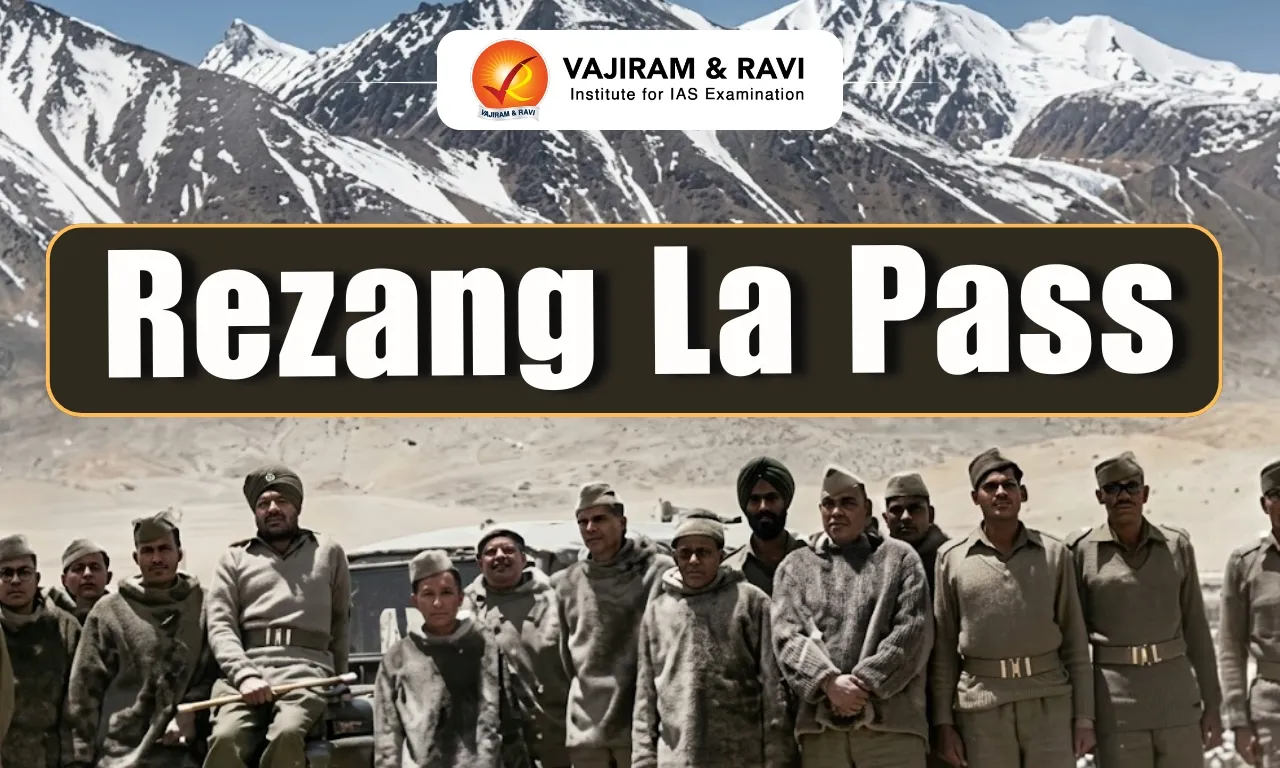
Rezang La Pass is a high-altitude mountain pass in the Ladakh region of India, located near the Line of Actual Control (LAC) with China. It is known for its strategic importance as well as its place in Indian military history. Surrounded by rugged mountains and harsh weather conditions, the pass has become a symbol of courage, sacrifice and national pride, making it an important topic from both geographical and historical perspectives. 

Rezang La Pass Location and Geographical Features

  • Rezang La is a high-altitude mountain pass in the Chushul sector of Ladakh, close to the Line of Actual Control (LAC) between India and China.
  • Located at around 5,200 metres (17,000 feet) above sea level, the pass has thin air, low oxygen levels and extremely cold weather, making the region difficult for both travel and military operations.
  • The area has a dry, rocky and barren landscape, typical of Ladakh's cold desert. Severe winters and heavy snowfall can make the region difficult to access for several months.
  • Rezang La lies near Pangong Tso and Spanggur Lake and forms part of the strategically important Chushul Valley. Its high ridges provide a commanding view of the surrounding terrain.

Rezang La Pass Historical and Strategic Significance

  • Rezang La became an important part of Indian military history after the Battle of Rezang La on 18 November 1962 during the Sino-Indian War.
  • The pass was strategically important for the defence of Chushul, as control over the surrounding heights helped prevent an enemy advance into the region.
  • Its location near the Chushul airfield further increased its military importance, as the airfield was an important logistical and operational facility.
  • The high altitude, harsh climate and difficult terrain made Rezang La a challenging military position, but these same geographical features also provided defensive advantages.
  • The Chushul sector continues to hold strategic importance because of its proximity to the India-China border and the LAC.

Rezang La Battle 1962 and the Valour of Indian Soldiers

  • The Battle of Rezang La was fought on 18 November 1962, when Chinese forces attacked the Indian position defended by C Company of the 13 Kumaon Regiment, led by Major Shaitan Singh.
  • Around 120 Indian soldiers faced a much larger attacking force. Despite being heavily outnumbered, the troops continued to defend their position under extremely difficult conditions.
  • The soldiers fought in freezing temperatures and at very high altitude, while dealing with limited supplies, ammunition and difficult terrain.
  • The troops displayed remarkable courage, discipline and determination, with many fighting until their last breath while defending the post.
  • Major Shaitan Singh showed exceptional leadership during the battle and was awarded the Param Vir Chakra posthumously for his bravery.
  • The Battle of Rezang La remains one of the most memorable episodes of the 1962 war, symbolising the courage and sacrifice of Indian soldiers in defending the country's borders.

Rezang La Pass FAQs

Q1: What is Rezang La Pass?

Ans: Rezang La Pass is a high-altitude mountain pass in Ladakh, located near the Line of Actual Control (LAC) between India and China. It is known for its geographical and strategic importance.

Q2: Where is Rezang La Pass located?

Ans: Rezang La is located in the Chushul sector of Ladakh, near Pangong Tso and Spanggur Lake, close to the India-China border.

Q3: What is the altitude of Rezang La Pass?

Ans: Rezang La is situated at around 5,200 metres (17,000 feet) above sea level, making it a challenging high-altitude region.

Q4: Why is Rezang La Pass strategically important?

Ans: Rezang La is important because of its commanding location in the Chushul sector and its proximity to the LAC and Chushul airfield.

Q5: What is the Battle of Rezang La?

Ans: The Battle of Rezang La was fought on 18 November 1962 during the Sino-Indian War, when Indian troops defended the strategically important position against Chinese forces.

UPSC Daily Quiz 13 August 2026

UPSC Daily Quiz

[WpProQuiz 231]

UPSC Daily Quiz FAQs

Q1: What is the Daily UPSC Quiz?

Ans: The Daily UPSC Quiz is a set of practice questions based on current affairs, static subjects, and PYQs that help aspirants enhance retention and test conceptual clarity regularly.

Q2: How is the Daily Quiz useful for UPSC preparation?

Ans: Daily quizzes support learning, help in revision, improve time management, and boost accuracy for both UPSC Prelims and Mains through consistent practice.

Q3: Are the quiz questions based on the UPSC syllabus?

Ans: Yes, all questions are aligned with the UPSC Syllabus 2025, covering key areas like Polity, Economy, Environment, History, Geography, and Current Affairs.

Q4: Are solutions and explanations provided with the quiz?

Ans: Yes, each quiz includes detailed explanations and source references to enhance conceptual understanding and enable self-assessment.

Q5: Is the Daily UPSC Quiz suitable for both Prelims and Mains?

Ans: Primarily focused on Prelims (MCQ format), but it also indirectly helps in Mains by strengthening subject knowledge and factual clarity.

Kunzum Pass, Location, Altitude, Facts & Importance

Kunzum Pass

Kunzum Pass Location and Key Facts

  • Kunzum Pass, also known as Kunzum La, is a high mountain pass located in the Lahaul and Spiti district of Himachal Pradesh.
  • It lies on the route connecting the Lahaul Valley with the Spiti Valley and acts as an important gateway to the remote Spiti region.
  • The route is generally accessible during the summer and early autumn months, depending on snowfall and road conditions.
  • At the top of the pass is the Kunzum Mata Temple, dedicated to Kunzum Devi.
  • Chandratal Lake, one of the major attractions of the Spiti region, is located nearby. 
  • The area around Kunzum Pass also offers impressive views of snow-covered peaks, glaciers, rocky slopes and the surrounding valleys.

Kunzum Pass Altitude and Geographical Features

  • Kunzum Pass stands at an elevation of about 4,551 metres (14,931 feet) above sea level, making it one of the high-altitude motorable passes in India. Its elevation also makes the region prone to extreme cold and heavy snowfall.
  • Geographically, the pass lies between the Lahaul and Spiti valleys and forms an important crossing through the Himalayan mountain ranges. 
  • The landscape changes noticeably around the pass, with rugged mountains, barren slopes and sparse vegetation typical of the cold desert environment of Spiti.
  • The approach to Kunzum Pass is known for its steep gradients and numerous hairpin bends, making the journey challenging as well as scenic. The surrounding mountains provide panoramic views of the Chandra-Bhaga ranges and snow-covered Himalayan peaks.
  • The region is also associated with the Bara Shigri Glacier, one of the major glaciers of Himachal Pradesh. The glacier and the surrounding high mountains add to the geographical and scenic significance of the pass.

Kunzum Pass FAQs

Q1: Where is Kunzum Pass located?

Ans: Kunzum Pass is located in the Lahaul and Spiti district of Himachal Pradesh and connects the Lahaul and Spiti valleys.

Q2: What is the altitude of Kunzum Pass?

Ans: Kunzum Pass is situated at an altitude of approximately 4,551 metres (14,931 feet) above sea level.

Q3: What is another name for Kunzum Pass?

Ans: Kunzum Pass is also known as Kunzum La, a name commonly used for the mountain pass in the region.

Q4: Which valleys are connected by Kunzum Pass?

Ans: Kunzum Pass connects the Lahaul Valley and Spiti Valley, making it an important mountain route in Himachal Pradesh.

Q5: Why is Kunzum Pass famous?

Ans: Kunzum Pass is famous for its high-altitude Himalayan landscape, winding roads, snow-covered peaks, scenic views and adventure tourism.

Ghatiana Karnataka

Ghatiana Karnataka

Ghatiana Karnataka Latest News

A beat forester from Mookambika Wildlife Sanctuary, Udupi has scientifically described a new freshwater crab species, Ghatiana Karnataka.

About Ghatiana Karnataka

  • It is a new species of freshwater crab.
  • It was discovered from Mookambika Wildlife Sanctuary in Karnataka.
  • It is the 15th species of the Ghatiana family to be discovered in the Western Ghats, and eight of them, including the latest one, are endemic to Karnataka.
    • Ghatiana is a genus of freshwater crabs found among the Western Ghats in India. 
  • Unlike the other species of Ghatiana that are hard to find during the dry seasons, Ghatiana Karnataka was recorded in all the seasons.
  • Habitat:
    • They live near perennial streams and in evergreen or semi-evergreen forests. 
    • During the monsoon, they can be found on laterite rocks, and during other seasons, inside the tree cavities that are moist.
  • It has a dark purple body and light pink claws, which are distinct from the seven other species of Ghatiana that were discovered in Karnataka.

News: DH

Ghatiana Karnataka FAQs

Q1: What is Ghatiana Karnataka?

Ans: Ghatiana Karnataka is a newly discovered species of freshwater crab.

Q2: Where was Ghatiana Karnataka discovered?

Ans: It was discovered in the Mookambika Wildlife Sanctuary in Karnataka.

Q3: What is the body colour of Ghatiana Karnataka?

Ans: It has a dark purple body.

Q4: What is the colour of the claws of Ghatiana Karnataka?

Ans: Its claws are light pink.

Kuril Islands

Kuril Islands

Kuril Islands Latest News

Russian President Vladimir Putin has visited the disputed Kuril Islands for the first time, travelling to Iturup as Moscow's relations with Japan remain deeply strained over Russia's war in Ukraine.

About Kuril Islands

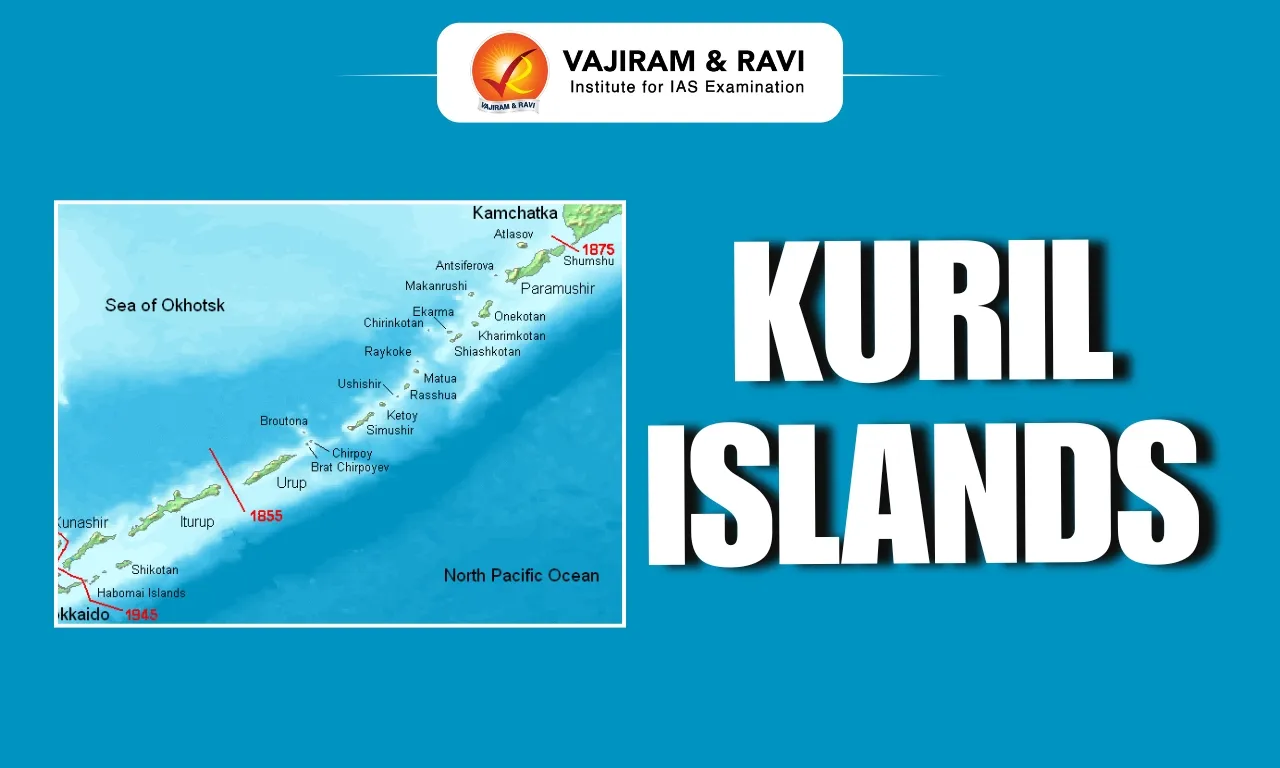
  • The Kuril Islands is an island group in the Russian Far East that forms the boundary between the Pacific Ocean and the Sea of Okhotsk. 
  • The archipelago, administered as part of Sakhalin Oblast (Russia), extends for about 1,300 kilometers from the Kamchatka Peninsula’s (Russia) southern tip to Hokkaido’s (Japan) northeastern corner. 
  • The archipelago comprises 56 islands and several islets and rocks and covers over 15,600 sq.km. 
  • The islands are divided into the Greater and Lesser Kuril Chains and have a total population of over 20,000 people. 
  • These are part of the Pacific Ring of Fire belt and have over 100 volcanoes, of which 35 are said to be active volcanoes along with hot springs.
  • The climate in the islands is severe, with long, cold, snowy winters and cool, wet, foggy summers.  
  • Vegetation ranges from tundra on the northern islands to dense forest on the larger southern islands. 
  • The principal centers are the towns of Kurilsk on Iturup, the largest island, Severo-Kurilsk on Paramushir, and Yuzhno-Kurilsk on Kunashir. 
  • Although Russia administers all the Kuril Islands, some islands are at the heart of the Russo-Japanese feud known as the Kuril Islands dispute. 
  • Japan considers the four southernmost islands as part of its Northern Territories. 
  • Tokyo claims that the disputed islands have been part of Japan since the early 19th century.
  • As a result of this dispute, Russia and Japan have never formally concluded a peace treaty to end World War II

News: TOI

Kuril Islands FAQs

Q1: Where are the Kuril Islands located?

Ans: They are located in the Russian Far East.

Q2: What do the Kuril Islands form the boundary between?

Ans: They form the boundary between the Pacific Ocean and the Sea of Okhotsk.

Q3: Between which two regions do the Kuril Islands extend?

Ans: They extend from the southern tip of the Kamchatka Peninsula to the northeastern corner of Hokkaido.

Q4: Which country currently administers all the Kuril Islands?

Ans: Russia.

Q5: Which two countries are involved in the Kuril Islands dispute?

Ans: Russia and Japan.

Moon Base Programme

Moon Base Programme

Moon Base Programme Latest News

NASA has formally invited India to join its Moon Base programme, which aims to establish a sustained human presence near the lunar South Pole. 

About Moon Base Programme

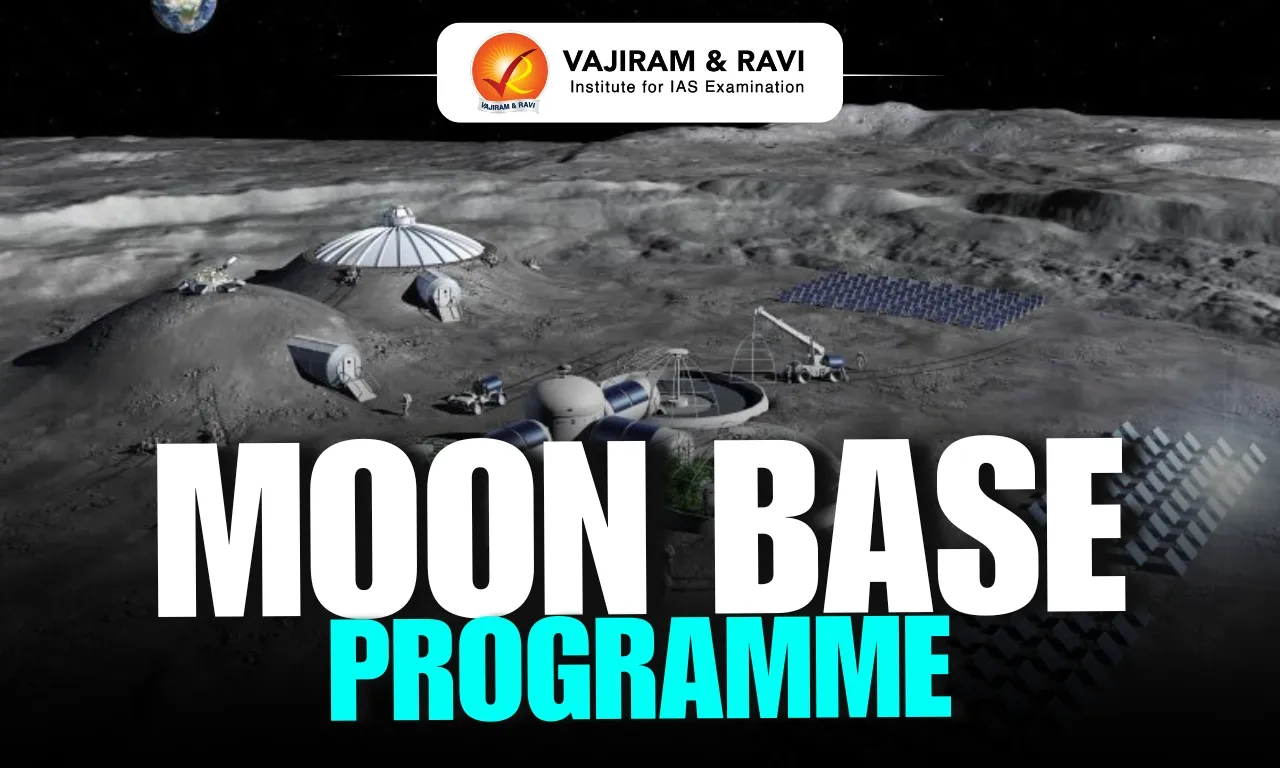
  • It is one of NASA’s most ambitious programmes, which aims to establish a sustained human presence near the lunar South Pole.
  • Moon Base is humanity’s first lunar outpost, a place where astronauts will live, work, and explore near the Moon’s South Pole, an area that was first accessed by India’s Chandrayaan-3 mission in August 2023
    • The South Pole of the Moon is important because of water ice in permanently shadowed regions, its scientific value, and potentially useful lunar resources. 
  • Through a series of crewed and uncrewed missions, NASA and its partners will build the infrastructure needed to support a sustained human presence on the Moon, unlock new scientific discoveries, and prepare for future exploration of Mars.  
  • The Moon Base will be built step by step using a phased approach.
  • Phase One (Now–2029): Gain Reliable Access, Experiment, and Learn
    • Robotic missions will explore the lunar South Pole, demonstrate new technologies, and gather the knowledge needed to guide future development. 
    • NASA will identify promising locations for future infrastructure, improve mission capabilities, and reduce risk before astronauts arrive. 
  • Phase Two (2029–2032): Build and Expand
    • Building on what is learned during Phase One, NASA will begin deploying the first infrastructure needed to support long-term operations on the Moon. 
    • Early power systems, cargo transportation, logistics, and communications capabilities will expand humanity’s footprint on the Moon and enable increasingly complex missions. 
  • Phase Three (2032 and Beyond): Live and Work on the Moon  
    • With the Moon Base’s foundational infrastructure in place, NASA will begin assembling a permanent lunar outpost where astronauts can live and work for extended periods.
    • Habitats, power systems, communications, transportation, and other critical capabilities will come together to support an enduring human presence near the Moon’s South Pole.

News: TP

Moon Base Programme FAQs

Q1: What is NASA’s Moon Base Programme?

Ans: It is a programme aimed at establishing a sustained human presence near the Moon’s South Pole.

Q2: Which space agency is leading the Moon Base Programme?

Ans: NASA

Q3: Where is the proposed Moon Base planned to be established?

Ans: Near the lunar South Pole.

Q4: How will the Moon Base be developed?

Ans: It will be developed step by step through a phased approach.

Kollidam River

Kollidam River

Kollidam River Latest News

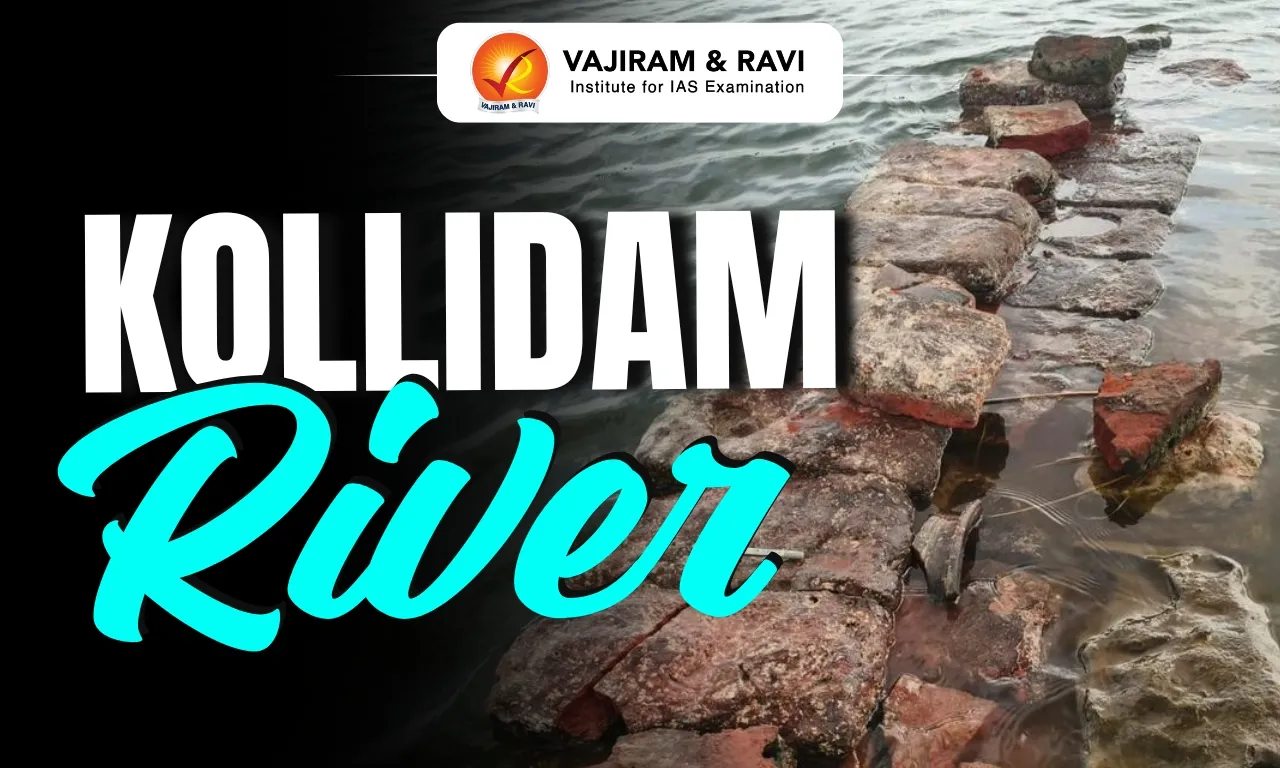
ASI archaeologists recently found remains of a possible Sangam-era irrigation structure in the Kollidam river near Lalgudi, Trichy.

About Kollidam River

  • It is a river in southeastern India flowing through the Tamil Nadu state.  
  • It is the northern distributary of the Kaveri River.  
  • It is also known as Kolidam and sometimes Coleroon in English. 
  • Course
    • Formed by the northern bifurcation of the Kaveri River just west of Srirangam, the Kollidam River flows in an easterly and then northeasterly direction for about 150 km.
    • It finally empties through several mouths into the Bay of Bengal, roughly equidistant between the Puducherry (north) and Karaikal (south) sectors of the Puducherry union territory on the coast. 
  • The Kollidam is the major northern stream of the Kaveri delta. 
  • The river was dammed in 1836 to help provide irrigation water for the delta, the most fertile and densely populated region of southern India, noted for its rice production.  
  • The town of Chidambaram lies on its banks.

News: TOI

Kollidam River FAQs

Q1: In which Indian state does the Kollidam River flow?

Ans: Tamil Nadu.

Q2: Which river is the Kollidam a northern distributary of?

Ans: The Kaveri River.

Q3: Where is the Kollidam River formed?

Ans: It is formed by the northern bifurcation of the Kaveri River just west of Srirangam.

Q4: Approximately how long is the course of the Kollidam River?

Ans: About 150 km.

Q5: Into which water body does the Kollidam River finally empty?

Ans: The Bay of Bengal.

80th Independence Day 2026, Date, History, Theme & Significance

80th Independence Day 2026

India will celebrate its 80th Independence Day on Saturday, August 15, 2026, marking 79 completed years of freedom since the end of British rule in 1947. The day honours the sacrifices of freedom fighters who fought for the nation's freedom and the values of democracy, unity, and sovereignty. It is observed across the country with flag hoisting ceremonies, cultural programmes, parades, and patriotic events. The Prime Minister's address from the Red Fort remains the highlight of the national celebrations.

Independence Day 2026 Key Highlights

The key highlights related to Independence Day 2026 have been tabulated below in brief.

Independence Day 2026 Key Highlights
Particulars Details

Independence Day 2026 Date

Saturday, 15 August 2026

Which Independence Day

80th

Public Holiday?

Yes, a gazetted national holiday across India

Main Venue

Red Fort, New Delhi

Who Hoists the Flag

The Prime Minister of India

Chief Guest

None, India's Independence Day does not have a chief guest, unlike Republic Day

This Year's Focus

Viksit Bharat 2047, Atmanirbhar Defence, Green Transition, Digital India Bhashini

Independence Day 2026 Theme

An official theme for 2026 is yet to be announced. Building on 2025's theme of "Naya Bharat", this year's celebrations are widely expected to highlight indigenous technology (6G trials, the Semiconductor Mission, AI), a green energy transition (Mission LiFE, solar-powered villages, Green Hydrogen Mission), and Atmanirbhar Defence, with all equipment used at the Red Fort ceremony built in India for the first time.

80th Independence Day 2026 (15th August)

India is moving steadily towards its vision of Viksit Bharat 2047, and to celebrate this journey, the Ministry of Defence along with MyGov has launched the Independence Day Celebrations 2026 campaign. This initiative aims to celebrate the spirit of freedom while motivating citizens, especially the youth, to actively contribute to building a strong and self-reliant nation.

  • The campaign is deeply based on the values of patriotism, constitutional ideals, women-led development, scientific growth, and technological advancement, encouraging people across the country to reflect on India’s progress and future goals.
  • India’s Independence Day celebrations do not have a chief guest; instead, the Prime Minister hoists the national flag at the Red Fort and addresses the nation, making it a purely national event focused on India’s freedom and unity. 
  • Along with technology, there is a strong focus on Green Transition, including initiatives like Mission LiFE, Solar-Powered Villages, and the Green Hydrogen Mission, reflecting India’s commitment to sustainable development.
  • A major highlight of 2026 celebrations is Atmanirbhar Defence, where for the first time, all equipment used at the Red Fort will be completely indigenous equipment, showcasing the country’s growing defence capabilities.
  • The government will use Digital India Bhashini (AI-based translation tool) to translate the Prime Minister’s speech in real time into 22+ Indian languages, ensuring that people across the country can understand the vision of Viksit Bharat in their own mother tongue.

Why is Independence Day Celebrated?

Independence Day is celebrated on 15 August every year to mark India's freedom from British rule in 1947. It honours the sacrifices of freedom fighters and celebrates the birth of an independent and sovereign nation.

  • Freedom from Colonial Rule: India became independent from British rule on 15 August 1947, ending nearly 200 years of colonial governance.
  • Tribute to Freedom Fighters: The day honours the contributions and sacrifices of leaders such as Mahatma Gandhi, Jawaharlal Nehru, Subhas Chandra Bose, Sardar Vallabhbhai Patel, and countless unsung heroes.
  • Historic "Tryst with Destiny" Speech: On the eve of independence, Jawaharlal Nehru delivered his famous "Tryst with Destiny" address, marking the beginning of a new era.
  • First Flag Hoisting at Red Fort: On 15 August 1947, Nehru hoisted the Indian National Flag at the Red Fort, a tradition continued annually by every Prime Minister.
  • Celebration of Sovereignty: The day symbolizes India's sovereignty, democracy, unity, and national pride.
  • Nationwide Observance: It is celebrated with flag hoisting ceremonies, cultural programmes, parades, and patriotic events across the country.
  • Different from Republic Day: Independence Day commemorates freedom from British rule in 1947, while Republic Day (26 January) celebrates the adoption of the Constitution of India in 1950.

Also Read:- 150 Years of Vande Mataram

Independence Day 2026 Events & Celebrations

  • Flag Hoisting at Red Fort: On Independence Day, the Prime Minister of India hoists the National Flag at the Red Fort in New Delhi, followed by the National Anthem and a Guard of Honour, symbolizing the nation’s pride and sovereignty.
  • Prime Minister’s Address: The Prime Minister delivers a national speech highlighting India’s achievements, challenges, and future goals, with a strong focus on development, unity, and progress.
  • Cultural Performances: Students, artists, and cultural groups present patriotic songs, dances, and performances, showcasing India’s rich cultural diversity and heritage.
  • Tribute to Freedom Fighters: Special programs and ceremonies are organized to honour the sacrifices of freedom fighters, including flower tributes and remembrance events across the country.
  • Public Participation Campaigns: Platforms like MyGov and My Bharat host competitions such as essays, quizzes, and photography, encouraging citizens to actively engage in the celebrations.
  • Red Fort Ceremony Highlights: The national event includes a 21-gun salute and the presence of special invitees, such as grassroots workers, youth achievers, and women contributors, recognizing their role in nation-building.
  • Local Celebrations Across India: Schools, colleges, and offices conduct flag hoisting, National Anthem singing, and cultural programs, making it a truly nationwide celebration.

Role of Freedom Fighters in India’s Independence

  • Uniting the Nation for a Common Goal: Freedom fighters brought people from different regions, religions, and backgrounds together with one shared aim, freedom from British rule. Their efforts helped create a strong sense of national unity and identity.
  • Leading Non-Violent Movements: Leaders like Mahatma Gandhi inspired millions through peaceful protests and Civil Disobedience Movement, Non-Cooperation Movement, Dandi March, and Quit India Movement, proving that change could be achieved without violence.
  • Organizing Mass Movements and Protests: Leaders like Sardar Vallabhbhai Patel led farmer-based movements such as the Kheda Satyagraha and Bardoli Satyagraha, helping people stand up against unfair taxes and British policies.
  • Shaping Political Vision and Leadership: Jawaharlal Nehru played a key role in shaping India’s political direction and strongly advocated for complete independence (Purna Swaraj), motivating people to strive for full freedom.
  • Taking Up Armed Resistance: Some revolutionaries chose a more direct approach. Subhas Chandra Bose formed the Indian National Army (INA) to fight British rule, while Bhagat Singh, Shivaram Rajguru, and Sukhdev sacrificed their lives to inspire courage and patriotism among the youth.
  • Inspiring Youth and National Pride: Revolutionary leaders like Chandra Shekhar Azad and Bhagat Singh motivated young Indians to actively participate in the freedom struggle and stand against injustice.
  • Promoting Social Reform and Inclusion: Leaders such as Sarojini Naidu encouraged women to take part in the freedom movement, while many others worked to reduce caste and religious divisions, promoting equality and unity.
  • Spreading National Awareness: Leaders like Bal Gangadhar Tilak, Bipin Chandra Pal, and Lala Lajpat Rai spread awareness through movements like Swadeshi and public gatherings, encouraging people to boycott British goods and support Indian products.
  • Strengthening Regional Movements: Freedom fighters like Chittaranjan Das led movements at the regional level, especially in Bengal, ensuring that the struggle for independence reached every corner of the country.
  • Making Sacrifices for Freedom: Above all, freedom fighters made immense sacrifices, including imprisonment and even giving up their lives, to ensure that future generations could live in a free and independent India.

Independence Day 2026 Significance

  • 80th Independence Day 2026 - A Major Milestone: India will celebrate its 80th Independence Day on 15 August 2026, marking 80 years of freedom and sovereignty. The occasion highlights the country’s journey and its strong push towards becoming a developed and self-reliant nation.
  • Focus on Viksit Bharat 2047: The celebrations emphasize the vision of Viksit Bharat 2047, which aims at achieving overall economic growth, social development, and global leadership in the coming years.
  • Rise of Indigenous Technology: A key highlight is the focus on home-grown innovations, including 6G technology trials, the Semiconductor Mission, and the use of Artificial Intelligence, showing India’s growing strength in advanced technology.
  • Digital India and Language Inclusion: Through Digital India Bhashini, the Prime Minister’s speech will be translated in real time into more than 22 Indian languages, making it accessible to people across different regions and languages.
  • Atmanirbhar Defence Initiative: The celebrations showcase self-reliance in defence, where for the first time, equipment used during the Red Fort ceremony will be fully indigenously made, reflecting India’s defence capabilities. 
  • Green Growth and Sustainability: There is a strong focus on environment-friendly development, with initiatives like Mission LiFE, solar-powered villages, and the Green Hydrogen Mission, promoting a sustainable and cleaner future.
  • Towards a Self-Reliant and Developed India: Independence Day 2026 highlights India’s commitment to innovation, sustainability, and self-reliance, as the country continues its journey towards becoming a developed nation by 2047.
Other Related Posts
Freedom Fighters of India 80th Independence Day 2026
Vande Mataram To Be Sung at Red Fort For First Time Har Ghar Tiranga Campaign 2026
Women Freedom Fighters of India Dadabhai Naoroji
Subhash Chandra Bose Gopal Krishna Gokhale
Jawaharlal Nehru Surendranath Banerjee
Sardar Vallabhbhai Patel Rabindranath Tagore
Sarojini Naidu Independence Day 2026
Madam Bhikaji Cama Sarvodaya Movement
Slogans of Freedom Fighters Indian National Movements 
Important Days in 2026 Republic Day 2026
National Song National Anthem
National Flag Code of India 2002 National Flag
Indian Independence Act 1947  Revolt of 1857 
Swadeshi Movement  Home Rule Movement 
Non-Cooperation Movement Civil Disobedience Movement 
Azad Hind Fauj and INA Trials Azad Hind Fauj
Partition of India 1947 Mountbatten Plan 
Constituent Assembly of India Fundamental Duties 
Constitutional Values Preamble of the Indian
National Symbols of India Madan Mohan Malviya
Pingali Venkayya APJ Abdul Kalam 

80th Independence Day 2026 FAQs

Q1: What is the significance of 80th Independence Day 2026 in India?

Ans: Independence Day 2026 marks 80 years of India’s freedom from British rule, highlighting the nation’s journey of growth, unity, and progress toward becoming a developed country.

Q2: When will India celebrate its 80th Independence Day?

Ans: India will celebrate its 80th Independence Day on 15th August 2026, commemorating its independence achieved in 1947.

Q3: Who hoists the national flag on Independence Day?

Ans: The Prime Minister of India hoists the national flag at the Red Fort in New Delhi and addresses the nation.

Q4: Is there a chief guest on Independence Day celebrations?

Ans: No, Independence Day is a purely national event with no chief guest, unlike Republic Day celebrations.

Q5: What is the theme of Independence Day 2026?

Ans: The official theme is not announced yet, but it is expected to focus on patriotism, unity, innovation, and India’s growth journey.

NASA Invites ISRO to Join Moon Base Programme, Significance

NASA Invites ISRO to Join Moon Base Programme

Why in the News? : NASA has invited ISRO to join its Moon Base programme, strengthening India-U.S. cooperation in lunar exploration and paving the way for deeper collaboration in human spaceflight. 

The invitation was extended during the 9th India-U.S. Civil Space Joint Working Group (CSJWG) meeting held at ISRO headquarters in Bengaluru on August 5-6, 2026. 

About 9th India-U.S. Civil Space Joint Working Group Meeting

The India-U.S. Civil Space Joint Working Group (CSJWG) is a bilateral forum for discussing and advancing cooperation in civil space activities.

  • The 9th meeting was held at ISRO headquarters in Bengaluru on August 5-6, 2026.
  • Senior officials from both countries reviewed ongoing space cooperation and discussed new areas for collaboration.
  • The meeting expanded the focus beyond existing joint missions to lunar exploration, human-spaceflight technologies, scientific data sharing and commercial space activities.

Key Outcomes

  • NASA invited ISRO to join its planned Moon Base programme.
  • Both sides agreed to advance discussions on open scientific data sharing under the Artemis Accords.
  • India and the U.S. discussed cooperation in human-spaceflight technologies and future space science missions.
  • Both sides agreed to build on their cooperation after the successful NISAR mission.
  • India and the U.S. reaffirmed their commitment to the long-term sustainability of outer space activities.
  • The two sides reviewed multilateral efforts under the UN Committee on the Peaceful Uses of Outer Space (COPUOS).
  • The meeting also advanced civil and commercial space cooperation under the U.S.-India TRUST Initiative.

About NASA’s Moon Base Programme

NASA’s Moon Base programme aims to establish a long-term human presence on the Moon, with the planned outpost located near the lunar South Pole.

  • The programme will use a series of crewed and uncrewed missions to gradually build the infrastructure needed for astronauts to live, work and conduct research on the Moon.
  • The lunar South Pole is preferred because permanently shadowed craters there are believed to contain water ice, which can potentially provide drinking water, oxygen and ingredients for rocket fuel.
  • Using these local lunar resources could reduce the need to transport supplies from Earth and make longer stays on the Moon more practical.
  • The experience gained from living and working on the Moon is also expected to help NASA prepare for future human missions to Mars.

Why NASA Invited ISRO to Join Moon Base Programme

NASA has invited ISRO because India has already demonstrated its ability to land and operate a spacecraft in the lunar South Pole region, where the Moon Base is planned.

  • Chandrayaan-1: India’s first lunar mission in 2008 provided important evidence of water molecules on the lunar surface, increasing scientific interest in lunar water resources.
  • Chandrayaan-3: Building on this experience, India successfully soft-landed on the Moon in 2023 and demonstrated its ability to operate in the challenging southern polar region.
  • Vikram and Pragyan: The lander and rover carried out surface operations and scientific experiments, giving ISRO valuable experience in lunar landing, mobility and surface exploration.

ISRO’s experience in lunar landing, surface exploration and low-cost space missions can contribute to NASA’s plans for sustained lunar operations.

Significance for India

For India, the invitation provides an opportunity to move from successful lunar missions towards participation in sustained lunar exploration.

  • First, it can help deepen India's technological capabilities in areas such as lunar robotics, surface operations, communications and navigation.
  • Second, cooperation in human-spaceflight technologies can complement India's Gaganyaan programme, particularly as India develops experience in sending humans beyond Earth orbit.
  • Third, participation can give Indian scientists and space companies opportunities to contribute to future lunar infrastructure and scientific missions.
  • Most importantly, it places India closer to the centre of the emerging international effort to establish a long-term human presence on the Moon.

About India-U.S. Space Cooperation

The NASA invitation builds on a growing India-U.S. space partnership that has gradually expanded from scientific cooperation and Earth observation to lunar exploration, human spaceflight and commercial space activities.

  • Artemis Accords
    • India signed the Artemis Accords on June 21, 2023, becoming the 27th signatory.
    • The Accords provide principles for peaceful, transparent, sustainable and cooperative exploration of the Moon, Mars and other celestial bodies.
    • India’s participation provides a framework for deeper cooperation with the U.S. on future lunar exploration.
  • NISAR Mission
    • NISAR (NASA-ISRO Synthetic Aperture Radar) is a joint Earth-observation mission developed by NASA and ISRO.
    • It uses advanced radar technology to monitor changes in land, ice, forests and other Earth systems.
    • Its successful cooperation has strengthened the technological relationship between the two space agencies.
  • Human Spaceflight
    • India and the U.S. are exploring cooperation in human-spaceflight technologies.
    • This is relevant to India’s Gaganyaan programme and its longer-term ambitions in human space exploration.
  • Scientific Data Sharing
    • At the 9th CSJWG meeting, both sides agreed to advance discussions on open scientific data sharing under the Artemis Accords. This can improve scientific collaboration and access to data from future lunar and space missions.
  • TRUST Initiative
    • The U.S.-India Transforming the Relationship Utilizing Strategic Technology (TRUST) Initiative provides a broader framework for cooperation in critical and emerging technologies.
    • Under this initiative, India and the U.S. are expanding cooperation in civil and commercial space activities.

The partnership is now moving from individual joint missions towards lunar exploration, human-spaceflight technologies and commercial space cooperation.

NASA Invites ISRO to Join Moon Base Programme FAQs

Q1: What is NASA’s Moon Base programme?

Ans: NASA’s Moon Base programme aims to establish a long-term human presence near the lunar South Pole through a series of crewed and uncrewed missions.

Q2: Why has NASA invited ISRO to join the Moon Base programme?

Ans: NASA has invited ISRO because Chandrayaan-3 demonstrated India’s ability to successfully land and operate in the lunar South Pole region, where the proposed Moon Base is planned.

Q3: Why is the lunar South Pole important for the Moon Base programme?

Ans: The lunar South Pole contains permanently shadowed regions that may hold water ice, which could potentially provide water, oxygen and rocket propellant for future lunar missions.

Q4: What are the Artemis Accords?

Ans: The Artemis Accords are a set of principles for peaceful, transparent and sustainable exploration of the Moon, Mars and other celestial bodies, aimed at promoting responsible international cooperation in space exploration.

Q5: When did India join the Artemis Accords?

Ans: India signed the Artemis Accords on June 21, 2023, becoming the 27th signatory.

Cascade Frog

Cascade Frog

Cascade Frog Latest News

Scientists have discovered three new species of cascade frogs from the biodiverse-rich forests of Northeast India. 

About Cascade Frog

  • These frogs belong to the genus Amolops.
  • Habitat: They are typically found around rocky waterfalls and fast-flowing forest streams.
  • The genus has around 100 species distributed across Asia.
  • Ecological Role: Cascade frogs are vital ecological anchors that connect aquatic and terrestrial food webs, control pest populations, and serve as sensitive indicators of clean water ecosystems.

Three New Cascade Frog Species

  • Ammachi’s Cascade Frog (Amolops ammachi)
    • It was discovered in the Jampui Hills of Tripura.
    • It honours the late Kerala social worker and philanthropist Padmini Varkey, affectionately known as ‘Ammachi’ (or mother).
    • It has a light brown body interspersed with beautiful olive-green reticulations.
  • Sendenyu Cascade Frog (Amolops sendenyu): It was found in Nagaland and named after Sendenyu Village; and
  • Beautiful Cascade Frog (Amolops bella): It was discovered in West Bengal and named for its striking green body marked with yellowish-green or reddish-brown mosaic patterns.

Cascade Frog FAQs

Q1: Cascade Frogs are commonly found in which habitat?

Ans: Fast-flowing streams and waterfalls

Q2: What is the ecological role of Cascade Frogs?

Ans: They are vital ecological anchors control pest populations, and serve as sensitive indicators of clean water ecosystems.

Black-Necked Crane

Black-Necked Crane

Black-Necked Crane Latest News

The Bombay Natural History Society (BNHS) has sterilised over 2,950 Free Ranging Dogs (FRD) to save Black-necked Cranes (Grus nigricollis) in Ladakh, whose chicks and nests were being attacked in alpine wetlands.

About Black-Necked Crane

  • It is classed as a medium-sized member of the crane family.
  • Other Names: It is locally known as “cha thung-thung” in Ladakh and “thungdung karma” in Arunachal Pradesh.
  • Appearance: It has a largely whitish-grey body contrasted by a jet-black head and upper neck, splashes of red around the eye, and long, elegant legs built for wading through alpine bogs.
  • Distribution: High altitude marshes and lakes of Tibetan Plateau (Tibet, Qinghai, Xinjiang, Gansu), Sichuan (China), and eastern Ladakh (India).
    • A small wintering population is also found in Sangti and Zimithang valleys of Arunachal Pradesh in India.
  • Diet: These are carnivores and herbivores. They feed on the tubers of sedges, plant roots, earthworms, insects and other invertebrates, frogs.
  • Breeding: The cranes breed at elevations between 2,600 and 4,900 metres, choosing gently sloping wetlands where they build simple nests of grasses and sedges.
    • The main breeding sites include the Changthang Cold Desert Wildlife Sanctuary, especially the wetlands of Hanle, Tso Kar, Nyoma, and nearby marshes.
  • Cultural Significance: They hold a special place in Ladakh’s Buddhist culture. They are regarded as sacred birds and symbols of peace, purity and good fortune.
  • Threats: Increasing human use of areas surrounding wetlands, expansion of linear infrastructure, growing tourism activities, habitat degradation, and the impacts of climate change.

Conservation Status of Black-Necked Crane

Source: DTE

Black-necked Crane FAQ's

Q1: What is the Scientific name of Black-necked Crane?

Ans: Grus nigricollis

Q2: What is the IUCN status of Black-necked Crane ?

Ans: Near Threatened

Liberia

Liberia

Liberia Latest News

Recently, the Union Women and Child Development Minister met a parliamentary delegation from Liberia and discussed India’s initiatives on women-led development, political representation and gender-responsive governance. 

About Liberia

  • Location: It is located along the coast of western Africa.
  • It is the only state in Africa which was never subjected to colonial rule and is Africa’s oldest republic.
  • Bordering Countries: It is bounded by Sierra Leone to the northwest, Guinea to the north, Côte d’Ivoire to the east.
  • Water Bodies: The Atlantic Ocean borders Liberia to the south-southwest.
  • Capital City: Monrovia

Geographical Features of Liberia

  • Climate: It has a tropical hot-humid climate.
  • Major Mountain Peaks: It has Cape Mount (about 1,000 feet in elevation) in the northwest, Cape Mesurado in Monrovia, and Cape Palmas in the southeast.
  • Highest Peak: Mount Wuteve.
  • Major Rivers: The Mano and Morro Rivers in the northwest and the Cavalla in the east and southeast are major rivers and form sections of Liberia’s boundaries.
  • Natural Resources: It is richly endowed with mineral resources such as diamond, iron ore, and gold, manganese, graphite, cyanite.

Source: DD India

Liberia FAQs

Q1: What is the Capital of Liberia?

Ans: Monrovia

Q2: Liberia lies on which ocean coast?

Ans: Atlantic Ocean

Sanchar Mitra Scheme

Sanchar Mitra Scheme

About Sanchar Mitra Scheme

  • It envisions engaging the Yuva Shakti- India’s youth, as catalysts for digital empowerment and societal outreach.
  • It is aimed at harnessing the energy and potential of young students to spread awareness about safe digital behaviour.
  • Working
    • Under this scheme, student volunteers, named as Sanchar Mitra, will raise public awareness about mobile safety, telecom fraud prevention, and government digital initiatives. 
    • They will conduct outreach in communities, schools, and public spaces to educate citizens on responsible and secure use of telecom services.
    • It is open to students from those technical institutes that have active telecom, electronics, computers, cybersecurity, or similar programs and have agreed to participate in the scheme.
    • Sanchar Mitras will receive necessary training from experts and from the National Communications Academy-Technology (NCA-T). 
    • The Sanchar Mitras will receive various training on subjects like cybersecurity, emerging technologies in the telecom sector, telecom policies and regulations, etc. 
  • The scheme offers top performers
    • Access, on a best-effort basis, to research and development (R&D) projects and telecom start-ups;
    • Involvement in policy and standards work;
    • Participation in field surveys and DoT initiatives;
    • Exposure to national conferences and events. 
  • The scheme has been implemented across all states/UTs through the licensed service area (LSA) field offices of DoT.
  • Nodal Ministry: Department of Telecommunications (DoT), Ministry of Communications.

Source: PIB

Sanchar Mitra Scheme FAQs

Q1: Which ministry implements the Sanchar Mitra Scheme?

Ans: Ministry of Communications

Q2: What is the primary aim of the Sanchar Mitra Scheme?

Ans: Encouraging youth to spread awareness about safe digital behaviour.

Q3: Who are designated as “Sanchar Mitras” under the scheme?

Ans: Student volunteers

Q4: Students from which institutions can participate in the Sanchar Mitra Scheme?

Ans: Technical institutes with telecom, electronics, computers, cybersecurity or similar programmes.

Q5: Which organisation provides training support to Sanchar Mitras?

Ans: National Communications Academy-Technology (NCA-T)

South African Customs Union

South African Customs Union

Southern African Customs Union Latest News

India and the five-member Southern African Customs Union (SACU) recently signed the Terms of Reference (ToR) to start negotiations for a Preferential Trade Agreement (PTA), with an aim to  conclude the trade talks within a year.

About Southern African Customs Union 

  • It is an African regional economic organization. 
  • It is the world’s oldest customs union, which was established in 1910.
  • Member countries: South Africa, Namibia, Botswana, Lesotho, and Eswatini (formerly Swaziland).
  • The SACU Secretariat is located in Windhoek, Namibia. 
  • The five member states maintain a common external tariff, share customs revenues, and coordinate policies and decision-making on a wide range of trade issues. 
  • Like other customs unions, a key feature of SACU is the application of a single tariff regime − the Common External Tariff (CET). 
    • This means the member states form a single customs territory which provides for a free movement of goods where tariffs and other barriers are eliminated on all trade between them. 
    • The CET applies to goods imported from all territories that are not members of SACU.  
  • South Africa accounts for around 91 percent of the bloc's total economic output and is India's largest trading partner within the grouping. 
  • SACU countries are also part of the Southern African Development Community (SADC), together with Angola, the Democratic Republic of Congo, Malawi, Mozambique, Tanzania, Zambia, and Zimbabwe; as well as the island nations of Mauritius, Seychelles, Comoros, and Madagascar.

News: NIE

Southern African Customs Union FAQs

Q1: What is the Southern African Customs Union (SACU)?

Ans: SACU is an African regional economic organization.

Q2: When was the Southern African Customs Union established?

Ans: It is the world’s oldest customs union, which was established in 1910.

Q3: Which countries are members of Southern African Customs Union (SACU)?

Ans: South Africa, Namibia, Botswana, Lesotho, and Eswatini.

Q4: Where is the Secretariat of Southern African Customs Union (SACU) located?

Ans: Windhoek, Namibia.

Q5: What is a key feature of Southern African Customs Union (SACU) as a customs union?

Ans: The application of a single Common External Tariff (CET).

Colombia Earthquake, Reason, Epicentre, Death Toll, Latest News 2026

Colombia Earthquake

The Colombia Earthquake of 2026 was a major seismic disaster that struck western Colombia on 10 August 2026. The 7.4 magnitude earthquake caused extensive destruction in Chocó, Pereira and Cali. As of 12 August, It killed at least 254 people, injured more than 2,600 and left nearly 3,900 people missing. The disaster also damaged about 1,600 buildings and nearly 5,000 homes.

Colombia Earthquake 2026 Latest News

The Colombia Earthquake triggered one of the country's largest disaster responses in recent years. The key highlights of the deadly earthquake are:

  • Magnitude: The earthquake measured 7.4 Mw. 
  • Epicentre: It occurred near San José del Palmar in Chocó, at a depth of about 100 kilometres.
  • Human Casualties: Separate reports from affected cities placed the death toll at 254, including 101 deaths in Pereira and 95 in Cali, while more than 2,600 people were injured.
  • Missing People: Nearly 3,900 people were reported missing as rescue teams searched collapsed buildings using cranes, sniffer dogs, heavy machinery and manual labour.
  • Structural Damage: Around 1,600 buildings were damaged across affected areas, while nearly 5,000 homes suffered damage, forcing many families to remain outdoors because of unsafe structures and aftershocks.
  • Economic Emergency Declaration: President Abelardo de la Espriella declared an economic emergency, allowing temporary economic and tax measures without congressional approval to strengthen disaster response.
  • International Assistance: The United States announced $15.5 million in emergency aid, while the European Union activated Copernicus satellite services and several countries offered additional assistance.

Colombia Earthquake Reasons

The major reasons of Colombia Earthquake are:

  • Tectonic Plate Movement: Colombia lies near the boundaries of the Nazca, Caribbean, Malpelo, North Andes and South American plates. Their movement and subduction generate strong seismic activity.
  • Active Fault Systems: Major faults such as the Bucaramanga-Santa Marta Fault, Romeral Fault System and Eastern Frontal Fault System can produce significant earthquakes across different parts of Colombia.
  • Pacific Ring of Fire: Colombia's location within the Pacific Ring of Fire increases its exposure to frequent earthquakes caused by active plate boundaries and associated geological processes.

Colombia Earthquakes History

Colombia has high seismic vulnerability because it lies near several tectonic plates and active fault systems associated with the Pacific Ring of Fire. Its earthquake history includes several destructive and unusual events.

  • Historical Record: The first historically recorded earthquake felt in Colombia occurred on September 11, 1530, while the first documented earthquake with an epicentre in present day Colombia occurred in 1566.
  • Strongest Recorded Event: The 1906 Ecuador-Colombia earthquake reached an estimated 8.8 Mw and generated a tsunami, with waves reaching about 5 metres.
  • Deepest Earthquake: A 1970 earthquake in Amazonas occurred at an estimated depth of 644.8 kilometres, making it the deepest registered earthquake in Colombia.
  • Recent Seismic Activities: Significant events include the 2016 Ecuador-Colombia earthquake of 7.8 Mw, the 2023 Central Colombia earthquake of 6.1 Mw and the 2025 Cundinamarca earthquake of 6.3 Mw.

Colombia Earthquake Impacts and Challenges

The Colombia Earthquake created humanitarian, economic, infrastructure and governance challenges across western Colombia. Its effects were intensified by difficult terrain and limited connectivity in rural areas.

  • Humanitarian crisis: Deaths, injuries, missing people and displacement created urgent requirements for rescue operations, temporary shelter, food, healthcare and family tracing services.
  • Infrastructure disruption: Damage to buildings, roads, electricity, water systems, healthcare facilities and communications disrupted essential services and slowed emergency operations.
  • Rural accessibility: Chocó has difficult terrain and limited transport connectivity, with some communities accessible mainly by boat, jungle routes or aircraft, delaying damage assessment.
  • Secondary hazards: Landslides and continuing aftershocks increased risks around damaged structures and could block roads, isolate communities and complicate rescue activities.
  • Economic effects: Road blockages and disruption at the main coffee export port halted coffee exports, creating wider logistics and supply chain concerns for Colombia's Arabica coffee sector.
  • Social vulnerability: Poor and structurally weak housing increased risks in vulnerable communities, while prolonged displacement could create additional health, sanitation and livelihood pressures.

Colombia Earthquake Management and Responses

Colombia activated national emergency mechanisms while international partners supported rescue, humanitarian assistance and damage assessment. The response focused on saving lives and supporting affected families.

  • National response: President Abelardo de la Espriella deployed military and police resources, engineers, rescue personnel and search dogs to affected locations.
  • Emergency assistance: The government provided immediate economic assistance to more than 1,400 families and announced temporary rental subsidies for households with damaged homes.
  • Search and rescue: Rescue teams in Pereira and Cali used cranes, heavy machinery, sniffer dogs and manual excavation to locate survivors trapped beneath collapsed structures.
  • United Nations role: The UN Resident Coordinator in Colombia coordinated assessment and emergency response efforts with national authorities and international agencies.
  • Specialised agencies: WFP supports food security, PAHO addresses health emergencies and UNDRR supports disaster risk reduction and resilience measures.
  • Disaster framework: Colombia's National Disaster Risk Management System, coordinated through the National Unit for Disaster Risk Management, provides the institutional framework for preparedness, response and recovery.
  • International cooperation: The European Union mobilised Copernicus satellite services, while the United States provided $15.5 million in emergency aid and other countries offered assistance.
  • Disaster risk reduction: The response highlights the importance of resilient infrastructure, early warning systems, rural connectivity and community preparedness under the Sendai Framework for Disaster Risk Reduction 2015-2030.
Also Read
Venezuela Earthquake 2026 Earthquake


Colombia Earthquake FAQs

Q1: What was the magnitude of the Colombia Earthquake 2026?

Ans: The Colombia Earthquake measured 7.4 Mw and struck western Colombia on 10 August 2026.

Q2: Where was the epicentre of the Colombia Earthquake 2026?

Ans: The epicentre was near San José del Palmar in Chocó, a seismically active region of western Colombia.

Q3: How many people died in the Colombia Earthquake 2026?

Ans: The death toll reached 254 people, while more than 2,600 people were injured and nearly 3,900 remained missing.

Q4: Which Colombian cities were worst affected by the earthquake?

Ans: Pereira and Cali were among the worst affected cities, reporting 101 and 95 deaths, respectively, according to the latest reports.

Q5: Why is Colombia vulnerable to earthquakes?

Ans: Colombia is highly earthquake prone because it lies near several tectonic plates and active fault systems associated with the Pacific Ring of Fire.

World Organ Donation Day 2026, Date, Purpose, History

World Organ Donation Day 2026

World Organ Donation Day is observed every year on 13 August to raise awareness about organ and tissue donation, encourage voluntary donor pledges, and highlight the life-saving role of organ transplantation. The observance reminds people that a single donor can save multiple lives and seeks to bridge the gap between the growing demand for organs and their limited availability through greater public awareness and ethical donation practices.

About World Organ Donation Day 2026

World Organ Donation Day is a global awareness observance dedicated to promoting voluntary organ and tissue donation and encouraging people to discuss their donation wishes with their families.

  • It is observed annually on 13 August across many countries.
  • It aims to educate people about the importance of organ donation and transplantation.
  • It honours organ donors and their families for giving others a second chance at life.
  • It encourages voluntary donor registration and supports ethical organ donation practices.
  • Unlike India's National Organ Donation Day (3 August), it is not an officially designated observance of the United Nations (UN) or the World Health Organization (WHO).

World Organ Donation Day 2026 History 

World Organ Donation Day originated as a voluntary awareness initiative of healthcare institutions and transplant organisations to address the widening gap between the demand for donor organs and their availability. With advances in transplantation and growing global support for deceased organ donation, the observance gradually evolved into an annual campaign that encourages donor pledges, recognises the contribution of organ donors and transplant professionals, and promotes public participation in organ donation

World Organ Donation Day 2026 Significance

World Organ Donation Day highlights the importance of organ donation in saving lives and improving the quality of life of patients suffering from end-stage organ failure.

  • Raises awareness about the critical shortage of donor organs worldwide.
  • Encourages voluntary organ donor registration and informed family consent.
  • Promotes deceased organ donation, which has the potential to save multiple lives.
  • Helps dispel myths and misconceptions surrounding organ donation.
  • Encourages ethical, transparent and equitable organ transplantation systems.
  • Supports governments and healthcare institutions in strengthening organ donation programmes.

What is Organ Donation?

Organ donation is the voluntary process of donating healthy organs or tissues from a living or deceased person for transplantation into a patient suffering from organ failure or severe tissue damage.

Organ transplantation is often the only effective treatment for patients with irreversible failure of organs such as the heart, liver, kidneys or lungs. Besides saving lives, tissue donation helps restore vision, repair damaged tissues and improve the quality of life of recipients.

Types of Organ Donation

Organ donation is broadly classified into three categories.

  • Living Organ Donation: A healthy individual voluntarily donates one kidney or part of the liver and, in selected cases, part of the lung, pancreas or intestine.
  • Deceased Organ Donation: Organs are donated after a person is declared brain-stem dead in accordance with prescribed medical and legal procedures. One deceased donor can potentially save several lives through transplantation of multiple organs.
  • Tissue Donation: Tissues can be donated after death even when organ donation is not possible. Common tissues donated include corneas, skin, bones, tendons and heart valves.

Organs and Tissues That Can Be Donated

Several organs and tissues can be transplanted to save or improve lives.

Organs: Heart, Kidneys, Liver, Lungs, Pancreas, Intestine.

Tissues: Corneas, Skin, Bone, Tendons, Heart valves

Organ Donation in India

  • India performed over 20,000 organ transplants in 2025, crossing the milestone for the first time and marking nearly a four-fold increase from fewer than 5,000 transplants in 2013. 
  • According to NOTTO, around 20,019 organ transplants were performed in 2025.
  • As of 3 March 2026, nearly 89,839 patients were on the national waiting list for major organ transplants, highlighting the persistent gap between demand and supply. 
  • India has recorded more than 5 lakh organ donation pledges, reflecting growing public awareness and participation in voluntary donation. 

Despite this progress, deceased donor organs account for only around 18% of all organ transplants, indicating India's continued dependence on living donors. 

India has established a comprehensive legal and institutional framework to promote ethical organ donation, regulate transplantation and prevent commercial exploitation while ensuring equitable access to transplant services.

Legal Framework

The Transplantation of Human Organs and Tissues Act (THOTA), 1994 is the principal legislation governing organ donation and transplantation in India.

  • It regulates the removal, storage and transplantation of human organs and tissues for therapeutic purposes.
  • It legally recognises brain-stem death, enabling deceased organ donation.
  • It prohibits the commercial trade of human organs and prescribes penalties for organ trafficking.
  • It provides procedures for living and deceased organ donation based on informed consent.
  • The Transplantation of Human Organs and Tissues (Amendment) Act, 2011 expanded the law to include tissues, strengthened safeguards against commercialisation and simplified organ donation procedures.
  • The Transplantation of Human Organs and Tissues Rules, 2014 prescribe operational guidelines for hospitals, transplant centres and authorisation committees

Institutional Framework

India follows a three-tier institutional mechanism for coordinating organ donation and transplantation.

  • National Organ and Tissue Transplant Organisation (NOTTO) functions as the apex body under the Ministry of Health and Family Welfare for policy coordination, the national waiting list, organ allocation and awareness.
  • Regional Organ and Tissue Transplant Organisations (ROTTOs) coordinate organ sharing among groups of States and Union Territories.
  • State Organ and Tissue Transplant Organisations (SOTTOs) manage organ donation, allocation and awareness programmes within individual States.
  • India also observes National Organ Donation Day on 3 August to promote awareness and recognise the contribution of organ donors.

National Organ Transplant Programme (NOTP)

The Government of India implements the National Organ Transplant Programme (NOTP) to strengthen organ donation and transplantation services across the country.

Its major objectives include:

  • Strengthening transplant infrastructure in government hospitals.
  • Establishing NOTTO, ROTTOs and SOTTOs.
  • Maintaining a national waiting list and transparent organ allocation system.
  • Promoting deceased organ donation through awareness campaigns.
  • Training transplant coordinators and healthcare professionals.
  • Supporting retrieval centres and organ preservation facilities. 

Challenges

Despite significant progress, India continues to face major structural and social challenges.

  • Huge demand-supply gap: Nearly 90,000 patients are waiting for organ transplants, while only a fraction receive organs each year. 
  • Low deceased organ donation: Most transplants rely on living donors, whereas deceased donation remains underutilised.
  • Limited awareness of brain-stem death: Many families are unfamiliar with the legal concept of brain-stem death, resulting in refusal to donate.
  • Family consent barriers: Even when individuals pledge their organs, transplantation often depends on family consent after death.
  • Regional disparities: States such as Tamil Nadu, Telangana, Maharashtra, Karnataka and Gujarat perform substantially better than many other States due to stronger institutional networks. 
  • Infrastructure constraints: Many districts lack organ retrieval centres, transplant coordinators and intensive care facilities.
  • Data reporting gaps: In 2025, 217 of 804 registered transplant hospitals failed to upload mandatory transplant data to the National Registry, affecting monitoring and transparency. 
  • Illegal organ trafficking: Preventing commercial exploitation and ensuring ethical transplantation remain continuing regulatory challenges.

Way Forward

  • Increase deceased organ donation by improving awareness about brain-stem death.
  • Integrate organ donation counselling into intensive care units of major hospitals.
  • Strengthen NOTTO, ROTTOs and SOTTOs through greater financial and technical support.
  • Improve digital integration of transplant waiting lists and organ allocation systems.
  • Ensure timely reporting of transplant data by all registered hospitals.
  • Expand organ retrieval centres and green corridor mechanisms for rapid organ transport.
  • Encourage schools, colleges and workplaces to conduct voluntary donor pledge campaigns.
  • Continue public awareness initiatives through the National Organ Transplant Programme (NOTP) and nationwide campaign.

World Organ Donation Day FAQs

Q1: When is World Organ Donation Day observed?

Ans: World Organ Donation Day is observed every year on 13 August to promote awareness about voluntary organ and tissue donation.

Q2: What is the objective of World Organ Donation Day?

Ans: It aims to encourage organ donation, honour organ donors and raise awareness about the life-saving benefits of organ transplantation.

Q3: What is the main law governing organ donation in India?

Ans: Organ donation and transplantation in India are regulated by the Transplantation of Human Organs and Tissues Act (THOTA), 1994.

Q4: Which organisation is responsible for organ donation in India?

Ans: The National Organ and Tissue Transplant Organisation (NOTTO) is the apex body responsible for coordinating organ donation and transplantation.

Q5: Why is deceased organ donation important?

Ans: A single deceased donor can save multiple lives by donating vital organs such as the heart, kidneys, liver and lungs while also improving lives through tissue donation.

Bastar Region, First Flag Hoisting, Naxalism, Significance

Bastar Region

Bastar Region is a major tribal and forested area in southern Chhattisgarh, known for its dense forests, rich tribal culture and natural resources. Bastar district covers 6,596.90 sq km, with Jagdalpur as its headquarters. The wider Bastar division comprises seven districts. About 70% of Bastar district’s population belongs to tribal communities, including Gond, Maria, Muria, Bhatra, Halba and Dhruva.

Why is Bastar Region in News?

Bastar Region is in news after 92 remote villages are set to hoist the national flag for the first time on 80th Independence Day 2026 (August 15 2026), following the end of armed Maoist activity in the state. These include 33 villages in Bijapur, 50 in Sukma and nine in Narayanpur. On Republic Day 2026, 41 villages had already witnessed flag hoisting for the first time.

Bastar Region Naxal Insurgency

The security transition has changed the situation in Bastar Region after decades of Left Wing Extremism and Maoist influence across its interior areas.

  • End of insurgency: Armed Maoist cadres were reported eliminated in Chhattisgarh on March 31, 2026. The government subsequently focused on extending constitutional governance and development services.
  • Operation Kagar: Operation Kagar was conducted from January 2024 to March 2026 to eliminate Left Wing Extremism. PUDR recorded 607 killings, 487 arrests and 1,496 surrenders across Bastar division during this period.
  • Security deployment: Anti insurgency operations involved the District Reserve Guard, Special Task Force, CoBRA, Central Reserve Police Force and Bastar Fighters. Around 476 CRPF camps were established between 2019 and 2025.
  • Development transition: Seventy of 200 security camps are planned for conversion into Veer Shaheed Gundadhur Seva Dera centres. These centres aim to deliver benefits from 371 Central and state government schemes to remote communities.

Also Read: Naxal-Free India

Bastar Region Significance

Bastar Region combines distinctive tribal traditions, biodiversity, forests, mineral resources, rivers, waterfalls and historically important cultural institutions.

  • Geographical importance: Bastar district covers 6,596.90 sq km and is surrounded by Kondagaon, Dantewada, Sukma and Bijapur. Jagdalpur serves as the headquarters of both Bastar district and division.
  • Tribal culture: Around 70% of Bastar district’s population is tribal. Major tribal communities include Gond, Maria, Muria, Bhatra, Halba and Dhruva, with distinctive traditions, art, festivals and lifestyles.
  • Bastar Dussehra: Bastar Dussehra is a unique 75 day festival associated with Goddess Danteshwari and Maa Durga rather than Ravana’s defeat. Its rituals include Patjatra, Kachhin Gadi, Jogi Sittai and Mavali Paragaw.
  • Drainage: The Indravati River flows through Dantewada and Bijapur before joining the Godavari near Bhadrakali. 
  • Waterfall: Chitrakote Waterfall falls about 90 feet and is popularly called the Niagara of India.
  • Kanger Valley National Park: Kanger Valley National Park received National Park status in 1982. Its landscape includes dense mixed deciduous forests, caves and waterfalls, with species such as tiger, leopard, chital, sloth bear and wild pig.
  • Cave heritage: Kotamsar Cave was discovered in 1951 by Dr. Shankar Tiwari. Its limestone formations and blind fishes have attracted scientific research, while prehistoric human habitation has also been reported.
  • Development significance: Government programmes including PM JANMAN Yojana and Dharti Aaba Janjatiya Gram Utkarsh Abhiyan aim to improve services, roads, electricity, water supply, schools and livelihood opportunities in tribal villages.

Bastar Region FAQs

Q1: Where is the Bastar Region located?

Ans: The Bastar Region is located in southern Chhattisgarh, with Jagdalpur serving as the headquarters of Bastar district and division.

Q2: Why is Bastar Region famous?

Ans: Bastar Region is famous for its tribal culture, Bastar Dussehra, dense forests, waterfalls, caves, handicrafts and rich biodiversity.

Q3: Which river flows through Bastar Region?

Ans: The Indravati River flows through Dantewada and Bijapur before joining the Godavari near Bhadrakali.

Q4: What is Bastar Dussehra known for?

Ans: Bastar Dussehra is a unique 75 day tribal festival associated with Goddess Danteshwari and distinctive traditional rituals.

Q5: What is Kanger Valley National Park famous for?

Ans: Kanger Valley National Park is known for its rich biodiversity, dense forests, caves, waterfalls and wildlife, including tiger, leopard and sloth bear.

Maharani Ahilyabai Holkar Death Anniversary 2026, Significance

Maharani Ahilyabai Holkar Death Anniversary 2026

The Maharani Ahilyabai Holkar Death Anniversary 2026 is observed on 13 August, remembering one of India’s most respected and visionary rulers. Known as Lokmata, she is admired for her just governance, simple lifestyle, and deep commitment to public welfare. Her life continues to inspire people for her contributions to temple restoration, social reform, women’s empowerment, and economic development. This occasion is a time to reflect on her legacy and the values of leadership, compassion, and service that she stood for.

Maharani Ahilyabai Holkar Death Anniversary 2026 Date and Significance

  • The death anniversary of Maharani Ahilyabai Holkar is observed every year on 13 August, and in 2026, it will once again be remembered with respect and admiration across India.
  • This day is not just about remembering her passing, but about celebrating her life of service, justice, and dedication to the people.
  • She is lovingly called “Lokmata” (Mother of the People) because she treated her subjects like her own family and worked tirelessly for their welfare.
  • On this occasion, people pay tribute to her by organizing cultural events, discussions, and educational programs that highlight her achievements.
  • The day also reminds us of her contributions to temple restoration, infrastructure development, social reforms, and women’s empowerment.
  • Her death anniversary serves as an opportunity to reflect on how her values of simplicity, fairness, and compassion are still relevant in today’s world.

Life and Legacy of Maharani Ahilyabai Holkar

  • Maharani Ahilyabai Holkar was born on 31 May 1725 in the small village of Chondi in Maharashtra, into a humble family.
  • Her father, Mankoji Rao Shinde, was a village head who believed in education and ensured that she learned to read and write at a time when girls’ education was rare.
  • Her life changed when Malhar Rao Holkar, a powerful ruler of Malwa, noticed her qualities and arranged her marriage to his son Khanderao Holkar in 1733.
  • After her husband’s death during the battle of Kumher, she went through deep grief and even considered ending her life, but was stopped and guided by her father-in-law.
  • Malhar Rao trained her in administration, military skills, and governance, preparing her for future responsibilities.
  • After losing both her father-in-law (1766) and her son (1767), she faced immense personal tragedy, yet chose to serve her kingdom with courage and determination.
  • In 1767, she became the ruler of Malwa and governed from Maheshwar, which she developed into a vibrant cultural and administrative center.
  • Her legacy is remembered as one of strength in adversity, dedication to public welfare, and visionary leadership.

Major Contributions and Achievements of Ahilyabai Holkar

  • One of her most famous achievements was the reconstruction of the Kashi Vishwanath Temple in Varanasi, which restored a major spiritual center for Hindus.
  • She also contributed to the rebuilding of the Somnath Temple and supported many other sacred places across India.
  • Ahilyabai invested heavily in building temples, ghats, wells, stepwells, roads, and rest houses (dharamshalas) to support pilgrims and travelers.
  • Her contributions were not limited to her own kingdom, she worked for the cultural and religious development of the entire country.
  • She transformed Maheshwar and Indore into important trade and cultural hubs, encouraging economic growth and stability.
  • She promoted the Maheshwari textile industry, which is still famous today for its elegant sarees and holds a Geographical Indication (GI) tag.
  • Ahilyabai was a great patron of art, literature, and culture, inviting scholars, poets, and artists to her court and supporting their work.
  • She also focused on the upliftment of tribal communities and lower sections of society, ensuring they received fair opportunities.

Role in Administration, Governance, and Social Reform

  • Maharani Ahilyabai Holkar is widely praised for her fair, transparent, and people-friendly administration.
  • She held open court sessions daily, where common people could directly present their issues, making governance accessible and responsive.
  • Under her rule, the Malwa region experienced peace, stability, and economic prosperity, which made her one of the most respected rulers of her time.
  • She supported farmers, traders, and local industries, understanding that economic strength comes from grassroots development.
  • Ahilyabai strongly opposed social evils such as sati, showing courage in challenging harmful traditions.
  • She supported widow remarriage and women’s education, promoting progressive ideas that were far ahead of her era.
  • She even formed a women’s army, training women in defense and administration, which was a revolutionary step for women’s empowerment.
  • Her governance reflected a perfect balance of justice, compassion, discipline, and practical decision-making, making her rule exemplary.

Why is Maharani Ahilyabai Holkar Remembered Today?

  • Maharani Ahilyabai Holkar is remembered as one of the greatest female rulers in Indian history, known for her wisdom and fairness.
  • Her rule is often seen as a model of ideal governance, where the welfare of people was the top priority.
  • People admire her for living a simple and humble life, despite holding great power and authority.
  • Her contributions to religion, culture, and infrastructure can still be seen across India in the form of temples and public works.
  • She is also remembered for her progressive thinking, especially her efforts towards women’s empowerment and social equality.
  • Her life continues to inspire leaders, administrators, and citizens to work with integrity, dedication, and compassion.

Lessons to Learn from Maharani Ahilyabai Holkar’s Life

  • Her life teaches us the importance of staying strong and resilient even in the face of personal loss and hardships.
  • She showed that true leadership is about serving people selflessly and working for their welfare.
  • Her actions highlight the importance of balancing tradition with progressive and forward-thinking ideas.
  • She proved that women are equally capable of leading with strength, wisdom, and compassion.
  • Her life encourages us to focus on long-term development and meaningful contributions to society, rather than short-term success.
  • She inspires us to live with simplicity, integrity, and a sense of responsibility towards others.

Inspirational Leadership Lessons from Maharani Ahilyabai Holkar

  • Maharani Ahilyabai Holkar’s life shows that true leadership is based on service, humility, and dedication to people’s welfare.
  • She proved that even in difficult circumstances, resilience and determination can lead to great success.
  • Her governance teaches the importance of justice, transparency, and accountability in administration.
  • She balanced tradition and modern thinking, supporting both cultural heritage and social reforms.
  • Her efforts in women empowerment and inclusive growth make her a timeless role model in today’s society.
  • She demonstrated that a ruler should be accessible, compassionate, and focused on long-term development.
  • Her vision of combining economic progress with cultural preservation remains highly relevant even today.
  • The leadership lessons from Maharani Ahilyabai Holkar continue to inspire administrators, leaders, and citizens across India.

Maharani Ahilyabai Holkar Death Anniversary 2026 FAQs

Q1: When is Maharani Ahilyabai Holkar Death Anniversary 2026 observed?

Ans: The Maharani Ahilyabai Holkar Death Anniversary 2026 will be observed on 13 August 2026.

Q2: Why is Ahilyabai Holkar called Lokmata?

Ans: She is called Lokmata (Mother of the People) because of her compassionate rule and dedication to public welfare.

Q3: Who was Maharani Ahilyabai Holkar?

Ans: She was a renowned queen of the Malwa kingdom known for her governance, social reforms, and cultural contributions.

Q4: When and where was Ahilyabai Holkar born?

Ans: She was born on 31 May 1725 in Chondi village, Maharashtra.

Q5: When did Ahilyabai Holkar become the ruler of Malwa?

Ans: She became the ruler in 1767 after the death of her son.

UPI at 10: India’s Digital Payments Giant Faces a New Cost-Sharing Challenge

UPI at 10

UPI at 10 Latest News

  • UPI has completed 10 years since its launch, now accounting for 86% of all digital transactions in India. 
  • But explosive growth has piled up costs for the payments ecosystem, reviving the debate on who should pay for it — with a recent amendment to the Payments and Settlement Systems Act, 2007 now permitting merchant fees on UPI payments.

How UPI Came About

  • The RBI's 2012 "vision document" noted an average Indian made just six non-cash transactions a year — a figure unthinkable today.
  • UPI was built by the RBI-regulated NPCI and the Indian Banks' Association, with groundwork starting in 2012-13.
  • It launched as a pilot in April 2016 and went fully operational that August.
  • By 2025-26, India recorded 28,174 crore digital transactions — 86% via UPI, used by over 55 crore people through 703 participating entities.

Early Growth Was Slow

  • Even after demonetisation in November 2016, adoption crawled: monthly transaction value stayed under Rs 10,000 crore until December 2017.
  • It took another year to cross Rs 1 lakh crore a month.
  • A key barrier was the Merchant Discount Rate (MDR) — the fee merchants paid on digital transactions.

Zero MDR: The Turning Point

  • The Nandan Nilekani-led High-Level Committee on Deepening of Digital Payments (2019) recommended scrapping MDR for customers and small merchants, with government subsidy instead.
  • From 2020, the government began subsidising UPI/RuPay transactions up to Rs 2,000, capped at 0.15% of transaction value, shared between banks and payment providers.
  • The COVID-19 pandemic then accelerated adoption sharply, as people avoided cash handling.

Private Investment Fuelled the Boom

  • A Bank for International Settlements (BIS) paper noted investment in Indian fintech spiked in 2019 (driven by UPI adoption and big deals like Paytm, PhonePe) and again in 2021 (post-COVID digital payment preference).
  • Most investment flowed into companies offering payment services and point-of-sale infrastructure.

Banks Have Been Left Behind

  • Two US-backed apps — PhonePe and Google Pay — together handled 80% of UPI transaction volume and 83% of value in July 2026.
  • As per the experts, banks have "missed the payments bus" and can't match these volumes.
  • SBI itself handled just 0.1% of UPI volume in July — ranked fourth among banks, behind Kotak Mahindra Bank (0.6% share).
  • A regulatory cap limiting any single player to 30% market share has been repeatedly postponed; the current deadline is December 2026.

The Cost Problem

  • UPI transaction growth has been staggering — up 1,800%, compared to just 17% growth in card transactions since November 2019.
  • This scale comes with rising costs — technology, banking infrastructure and compliance — estimated at around Rs 20,000 crore a year.
  • Government subsidies for sub-Rs 2,000 transactions don't cover this gap.

The Case for Reintroducing MDR

  • Industry voices argue zero MDR was right for driving initial adoption, but the next phase needs to create more value per transaction, including data-driven credit access for merchants and consumers.
  • The industry is pushing for MDR of 0.3-0.6% on transactions above Rs 2,000 for large merchants.
  • Such transactions form just 4% of person-to-merchant payments but account for 68% of total value — making them a viable revenue base without hurting small merchants or ordinary users.

The Next Wave of Growth

  • The finance ministry has said subsidies alone cannot sustain UPI's next growth phase.
  • Domestically, growth is expected to come from rural and semi-urban areas.
  • Internationally, NPCI is targeting greater cross-border presence — UPI already operates in nine countries (Bhutan, France, Mauritius, Nepal, Singapore, Sri Lanka, UAE, Qatar, Cambodia).
  • The India-Singapore UPI-PayNow linkage, active for over three years, is seen as a template, since traditional international transfers can cost up to 7% and take days to settle.

Conclusion

  • UPI's decade-long journey from a pilot project to handling 86% of India's digital transactions is a genuine success story of financial inclusion. 
  • But sustaining this scale now demands a fairer cost-sharing model — one that funds future growth without compromising the accessibility that made UPI a global example.

Source: IE

UPI at 10 FAQs

Q1: What does UPI at 10 signify for India's digital payments?

Ans: UPI at 10 marks a decade since launch, with UPI now accounting for 86% of India's digital transactions and serving over 55 crore users.

Q2: How did zero MDR influence UPI at 10?

Ans: UPI at 10 reflects how zero MDR, government subsidies, and pandemic-driven digital adoption helped accelerate UPI's widespread acceptance among consumers and merchants.

Q3: Why is UPI considering merchant fees at 10 years?

Ans: UPI at 10 faces annual ecosystem costs estimated around ₹20,000 crore, while existing subsidies do not fully cover technology, infrastructure, and compliance expenses.

Q4: How could MDR support UPI at 10 without affecting small merchants?

Ans: At UPI at 10, industry proposals favour MDR of 0.3–0.6% on transactions above ₹2,000 involving larger merchants, protecting smaller businesses.

Q5: What is the future outlook for UPI at 10?

Ans: UPI at 10 is expected to expand through rural and semi-urban adoption and international linkages, while requiring sustainable financing to support future growth.

SAMRIDH Programme

SAMRIDH Programme

SAMRIDH Programme Latest News

Recently, the Union Minister of State for Electronics and Information Technology informed the Rajya Sabha about the SAMRIDHA Programme. 

About SAMRIDH Programme

  • The Startup Accelerator of MeitY for Product Innovation, Development, and Growth (SAMRIDH) is a flagship programme of the Ministry of Electronics & IT (MeitY).
  • Aim: It aims to support existing and upcoming Accelerators to select and accelerate potential IT-based startups to scale. 
    • It focuses on accelerating the startups by providing customer connect, investors connect and connect to international markets.
  • Target: The program supports 300 tech Start-Ups in 3-year duration with cohort size of 5-10 StartUps.
    • In the first round of cohort, 22 Accelerators spread across 12 states are supporting 175 startups, selected through a multilevel screening process.
  • Financial Assistance: It provides financial support of ₹2 lakh per startup to selected accelerators, along with matching funding to startups up to a maximum of ₹40 lakh.
  • Implementation: It is being implemented by MeitY Start-up Hub (MSH), Digital India Corporation (DIC).
  • Nodal Ministry: Ministry of Electronics & IT

Source: PIB


SAMRIDH Programme FAQs

Q1: Which ministry launched the SAMRIDH Programme?

Ans: Ministry of Electronics and IT

Q2: What is the main objective of SAMRIDH Programme?

Ans: Accelerate Indian software product startups

E20 Ethanol Blending Push – Benefits, Concerns, and the Road Ahead

E20 Ethanol Blending

E20 Ethanol Blending Latest News

  • The government has told Parliament that the ethanol blending programme has helped save around Rs. 2 lakh crore in foreign exchange, even as Opposition leaders have launched campaigns against E20, alleging that it harms vehicles and is being forced on consumers.

About Ethanol Blending and E20

  • Ethanol is a biofuel produced from sugarcane, molasses, maize, damaged foodgrains, and surplus rice. When blended with petrol, it reduces dependence on imported crude oil.
  • E20 refers to petrol containing 20% ethanol and 80% petrol. India's Ethanol Blended Petrol (EBP) Programme aims to cut crude imports, save foreign exchange, support farmers, and reduce emissions.
  • The government's target was to produce 10-11 billion litres of ethanol so that 20% of petrol used in transport could come from domestically produced ethanol. 
  • The intention was to keep this money within the Indian economy rather than allowing it to flow out as foreign exchange through crude oil imports.

Growth of Ethanol Capacity

  • India's distillery capacity has expanded sharply on the back of this policy push:
    • The country now has around 500 distilleries.
    • Combined capacity stands at 18-20 billion litres.
    • For the current ethanol year, which runs from November to October, oil companies have contracted to procure about 10.5 billion litres of ethanol.

Feedstock Composition

  • For the current ethanol year, ethanol for petrol blending is drawn from:
    • Maize: 45%
    • FCI rice: 22%
    • Sugarcane juice: 16%
    • B-heavy molasses: 10%
    • Damaged foodgrains: 4.5%
    • C-heavy molasses: 1.1%

The Import Allegation

  • One line of criticism has been that India is importing ethanol or maize under external pressure. The available evidence does not support this.
  • Commerce Ministry statistics show no surge in ethanol or maize imports. In any case, direct ethanol import for petroleum blending is banned in India, although the US corn lobby has been pushing for higher corn imports.
  • Domestic maize output has grown strongly, rising 45% in three years to 55 million tonnes in 2025-26, with more than 20% of it going into ethanol.
  • Experts in maize research maintain that there is no need to import it.

Impact on Sugar and Food Security

  • Sugarcane juice and B-heavy molasses would ordinarily go into sugar production and are now being diverted to ethanol. So far, this has not disrupted sugar availability.
  • The closing stock of sugar in September 2025 was around 5 million tonnes, and a similar closing stock is expected this year. This suggests that diversion to ethanol has not affected sugar stocks.
  • The risk, however, is not eliminated. In the event of monsoon failure, crop losses, or foodgrain shortages, the diversion of FCI rice, sugarcane juice, and B-heavy molasses to ethanol would come under stress, raising the possibility of corn imports.

The Vehicle Compatibility Question

  • This is the most contested aspect of the E20 rollout.
  • Newer Vehicles
    • Vehicles bought after April 2023 are E20-ready. That is when the Bharat Stage 6 Phase 2 (Real Driving Emissions) mandate took effect. 
    • These vehicles were factory-engineered for E20 with ethanol-resistant elastomers, fluorinated fuel lines, upgraded pump seals, and recalibrated engine control units.
    • These roughly 70 million vehicles make up about 23% of India's active petrol fleet and face little cause for concern.
  • Legacy Vehicles
    • The remaining 77%, nearly 240 million two-wheelers and cars built for E5 or E10, are the genuine worry.
    • Ethanol is a polar solvent that degrades older rubber compounds and plastics, hardening and cracking fuel hoses over time. It is also hygroscopic, meaning it absorbs atmospheric moisture. 
    • In vehicles parked for long periods, the ethanol-water mixture separates and settles, forming an acidic layer that corrodes tanks, damages fuel pumps, and clogs filters with sludge.
    • Consumer surveys have found that 66% of pre-2023 owners reported mileage losses exceeding 10%, and 55% reported increased maintenance.

Conflicting Assessments

  • Technical assessments differ sharply on the extent of damage.
  • IIT Kanpur's Engine Research Laboratory maintains that E20 causes no notable damage, with efficiency loss under 5%, attributing most complaints to driving habits and traffic conditions.
  • Independent mechanics and automotive communities dispute this, citing real-world fuel pump and injector failures traced to ethanol's solvent and low-lubricity properties.
  • The government told Parliament in August that one leading automobile manufacturer had serviced 2.84 crore vehicles in FY 2025-26, including about 1.5 crore legacy vehicles, without finding E20-linked engine damage. A two-wheeler maker reported similar findings.
  • On mileage, the government acknowledged an efficiency penalty of about 2 to 6% in some vehicles designed for E10, though it noted this was also influenced by driving conditions, habits, and maintenance.

The Question of Pace

  • A significant criticism concerns how quickly the transition happened.
  • Brazil, often cited as the global benchmark, moved to high ethanol blends gradually over several decades, with parallel modifications to vehicles. This allowed a stable transition and public confidence.
  • In India, the 10% milestone was reached in 2022. Within just three years, blending was ramped up to 20%, with very little information or advisory support from manufacturers. A more phased and transparent rollout would have carried the public along more effectively.

Economic Gains Claimed

  • The government has presented substantial economic benefits from the programme.
  • It told Parliament that ethanol blending has led to savings of around Rs. 2 lakh crore in foreign exchange and substituted about 32 million tonnes of crude oil imports. 
  • Substituting 10 billion litres of petrol with ethanol effectively means dispensing with a month of crude imports.
  • The government also stated that while crude oil prices rose 70% during the West Asia conflict, petrol prices at the pump increased by only 7 to 8%, though under-recoveries also increased.

The Cost Debate

  • Whether ethanol is actually cheaper than petrol is not straightforward.
  • Oil marketing companies procure ethanol at around Rs. 70 per litre for blending, against a pump price of roughly Rs. 105 per litre for petrol. 
  • However, the base price of petrol, covering production, transportation, and OMC margins, is typically only 55-60% of the pump price, with the rest being taxes.
  • On the surface, ethanol does not appear cheaper than petrol. But ethanol and petrol follow different costing and tax regimes, making it difficult to draw an independent conclusion on whether ethanol has genuinely helped keep prices down, as the government claims.

Source: TH

E20 Ethanol Blending FAQs

Q1: What is E20 petrol?

Ans: E20 is petrol blended with 20% ethanol and 80% petrol, aimed at reducing crude oil imports and foreign exchange outgo.

Q2: How much foreign exchange has the ethanol blending programme saved?

Ans: The government has stated savings of around ₹2 lakh crore in foreign exchange and substitution of about 32 million tonnes of crude oil imports.

Q3: Which vehicles are fully compatible with E20?

Ans: Vehicles manufactured after April 2023, under the Bharat Stage 6 Phase 2 mandate, were factory-engineered for E20 and face little concern.

Q4: What is the main feedstock for ethanol in India currently?

Ans: Maize accounts for the largest share at 45%, followed by FCI rice at 22% and sugarcane juice at 16%.

Q5: Is India importing ethanol for petrol blending?

Ans: No. Direct ethanol import for petroleum blending is banned, and official statistics show no surge in ethanol or maize imports.

Justice Yashwant Varma Cash Row: Inquiry Finds Charges Proved and Raises Accountability Questions

Justice Yashwant Varma Cash Row

Justice Yashwant Varma Cash Row Latest News

  • A three-member parliamentary inquiry committee has found former Allahabad High Court judge Yashwant Varma unable to explain the presence, source or ownership of a "huge quantity" of unexplained cash discovered at his official residence. 
  • The committee's report, tabled in the Lok Sabha recently, also held that Justice Varma interfered with material evidence and gave misleading explanations, and rejected his argument that his withdrawal from the inquiry should end the proceedings.

Background of the Case

  • Wads of burnt and partially destroyed currency notes were discovered at Justice Varma's official bungalow in New Delhi in March 2025, when he was serving as a judge of the Delhi High Court. 
  • Following this, 146 Lok Sabha MPs moved a removal motion against him in August 2025. 
  • A three-member committee — comprising Supreme Court judge Justice Aravind Kumar, Bombay High Court Chief Justice Shree Chandrashekhar, and senior advocate B.V. Acharya — was constituted under the Judges (Inquiry) Act, 1968, to investigate the matter.

The Three Charges

  • The committee framed three specific "articles of charge" against Justice Varma:
    • Unexplained cash: Possession of "substantial unexplained Rs 500 denomination currency notes" in a storeroom at his official residence, with no lawful explanation for their source.
    • Interference with evidence: Failure to preserve material evidence, leading to the unexplained disappearance of the burnt currency notes before they could be lawfully seized.
    • Misleading conduct: Furnishing "evasive and misleading explanations" that lacked the candour expected of a constitutional functionary.
  • The committee found all three charges proved.

Why He Was Held Responsible for the Notes' Disappearance

  • No direct proof he removed the cash himself.
  • But his secretary and attendant were seen cleaning the storeroom after the fire, turning away a guard who offered help.
  • Call records show Varma was in phone contact with them that night, despite being out of town.
  • He took no steps to secure the room or file a police complaint — termed a "dereliction of duty."

Why Withdrawal Couldn't Stop the Inquiry

  • The committee said a statutory inquiry can't hinge on the "unilateral" decision of the judge being probed.
  • By the time of withdrawal: charges were framed, defence statements filed, nine witnesses examined and cross-examined, evidence marked.
  • The panel held he'd been given a fair opportunity — he chose to walk away rather than enter the witness box.

What Happens Next

  • Justice Varma had already resigned as a judge with immediate effect on April 9, 2026 — a resignation that takes effect from the date the letter is addressed to the President, without requiring formal acceptance. 
  • Historically, judicial resignations during inquiry proceedings — as with Justices P.D. Dinakaran and Soumitra Sen in 2011 — have caused impeachment motions to lapse, since the objective of removing a judge from office becomes moot once he no longer holds it.

Unresolved constitutional question

  • This raises an unresolved constitutional question: can Parliament proceed with a removal motion against a judge who has already resigned
  • According to jurists, impeachment is not legally possible against someone no longer holding office, and even discussion of the report in Parliament may not be permissible under the Act.
  • They suggest Parliament should amend the Judges' Inquiry Act to address such situations for future cases. 
  • However, other senior advocates noted that the report's findings could still enable criminal prosecution against Justice Varma, since he no longer enjoys the protections available to sitting judges — while clarifying that the parliamentary inquiry was not equivalent to a criminal trial and did not establish personal ownership of the money.

Conclusion

  • The Varma case exposes a critical gap in India's judicial accountability framework — a judge's resignation can effectively neutralise an ongoing impeachment process, even after serious charges are proved. 
  • This underscores the need to strengthen the Judges' Inquiry Act to ensure accountability keeps pace with such strategic exits.

Source: TH | IE

Justice Yashwant Varma Cash Row FAQs

Q1: What is the Justice Yashwant Varma Cash Row?

Ans: The Justice Yashwant Varma Cash Row concerns unexplained cash found at his official residence and a parliamentary inquiry into related allegations.

Q2: What charges were proved in the Justice Yashwant Varma Cash Row?

Ans: The Justice Yashwant Varma Cash Row inquiry found unexplained cash possession, interference with evidence, and misleading conduct charges proved against him.

Q3: Why was Justice Yashwant Varma held responsible for the missing notes?

Ans: In the Justice Yashwant Varma Cash Row, the committee cited his failure to secure the room, contact with staff, and lack of police reporting.

Q4: Could Justice Varma's resignation end proceedings in the Cash Row?

Ans: The Justice Yashwant Varma Cash Row raises an unresolved constitutional issue because resignation may make parliamentary removal proceedings legally ineffective.

Q5: What are the broader implications of the Justice Yashwant Varma Cash Row?

Ans: The Justice Yashwant Varma Cash Row exposes gaps in judicial accountability, particularly when judges resign during ongoing proceedings involving serious allegations.

Daily Editorial Analysis 13 August 2026

Daily-Editorial-Analysis

Promise of Gender Equality Must Be Upheld 

Context

  • Indian independence in 1947 was an audacious experiment in democracy and equality.
  • Freedom meant not merely liberation from colonial rule but the creation of a nation where every citizen, irrespective of caste, creed, class, political allegiance or gender, enjoyed equal status.
  • Granting women equal citizenship and political rights from the beginning was particularly revolutionary.
  • Yet, nearly eight decades later, the treatment of women in public and political life reveals a persistent gap between formal equality and lived equality.

The Audacious Promise of Independence

  • India began its journey amid Partition, displacement, poverty and institutional weakness.
  • The integration of princely states and the rehabilitation of millions of refugees were accompanied by severe shortages of wealth, education, healthcare, housing and industry.
  • Despite these challenges, India chose hope over pessimism; The Constitution established equal citizenship rather than restricting political rights to the privileged.
  • This decision made democratic inclusion a foundational principle and ensured that political equality was not a gradual concession but a basic right.

Universal Franchise and Women’s Citizenship

  • The first general election in 1952 gave women and men the right to vote on equal terms.
  • Registering women, however, presented a major challenge because many were identified only as someone’s daughter or wife rather than as individuals.
  • The Election Commission’s effort to register women under their own names was therefore an important assertion of individual citizenship.
  • Though millions of women were initially excluded from electoral rolls because they could not or would not provide their own names, the larger transformation was significant.
  • Over time, women became increasingly autonomous political participants, and by 2019 the gender gap in voter turnout had effectively disappeared.

From Formal Equality to Lived Equality

  • Legal equality does not automatically ensure social equality.
  • The treatment of women participating in the Jantar Mantar protests demonstrates this continuing contradiction.
  • Several women protesters reportedly faced doxxing, with their names, phone numbers and addresses circulated online, followed by abusive messages and threats.
  • Such attacks can transform political participation into a dangerous experience and discourage women from entering public life.
  • The unequal standards applied to women and men are equally troubling.
  • When similar political behaviour attracts greater criticism from women, it reflects the persistence of gendered expectations in political discourse.

Paternalism and the Politics of Protest

  • Describing protesting women as misguided daughters raises concerns about paternalistic politics.
  • Such language can position women as children requiring guidance rather than citizens exercising democratic agency.
  • Democracy requires recognition of protest, dissent and criticism as legitimate forms of political participation.
  • Citizens do not lose their democratic rights because their language is offensive or because they challenge powerful political figures.
  • The fundamental question is whether political equality extends beyond voting to the right to disagree without gender-based intimidation.

The Threat of Online Misogyny

  • Digital platforms have expanded political participation while simultaneously amplifying online misogyny.
  • Women involved in public debate can face attacks that are political, personal and sexualised.
  • Doxxing, rape threats, death threats and character assassination seek to silence participation rather than defeat arguments.
  • Such conduct undermines equal citizenship. If women possess legal equality but face disproportionate social and personal costs for exercising political speech, equality remains incomplete.

The Way Forward: Protecting the Hope of Equality

  • India’s democratic achievement rests on the principle that citizenship is not conditional upon obedience.
  • The rights to vote, protest, criticise and demand accountability must belong equally to all citizens.
  • Political leaders must distinguish between criticism and personal insult, while institutions and society must protect citizens from harassment and threats.
  • Digital platforms and law-enforcement agencies must prevent personal information from being weaponised against political participants.
  • Above all, women must be recognised as autonomous citizens, not as daughters, wives or dependants subject to special standards of political behaviour.

Conclusion

  • India’s independence was a bold commitment to equality amid adversity. Its survival through Partition, poverty and institutional fragility demonstrated the strength of democratic hope.
  • The narrowing of the gender gap in voting shows considerable progress, but online misogyny and gendered responses to women protesters reveal that constitutional equality remains unfinished.
  • The true test of democracy is not simply whether women can vote, but whether they can speak, protest, disagree and participate in public life without fear.
  • India must therefore ensure that the hope of equality remains a living principle of citizenship, rather than becoming merely a promise of the past.

Promise of Gender Equality Must Be Upheld FAQs

Q1. What was the foundational promise of Indian independence?
Ans. Indian independence promised equality and democratic citizenship for all.

Q2. Why was universal franchise significant for women?
Ans. Universal franchise recognised women as equal political citizens from the beginning.

Q3. What does the treatment of women protesters reveal?
Ans. It reveals a gap between formal equality and lived equality.

Q4. How does online misogyny threaten democracy?
Ans. Online misogyny can silence women’s political participation through intimidation.

Q5. What is the true test of gender equality?
Ans. Gender equality requires women to speak, protest and disagree without fear.

Source: The Hindu


A Timely Reset for the Food Security Act

Context

  • India's food security debate has entered a new phase.
  • Data from the latest household consumption survey show the share of households unable to afford the ICMR-National Institute of Nutrition (NIN) recommended diet fell from about 52% in 2011-12 to 25% in 2023-24.
  • This is real progress, but crores of households still cannot afford a healthy diet.
  • Against this backdrop, the draft National Food Security (Amendment) Bill, 2026 proposes linking Antyodaya Anna Yojana (AAY) entitlements to household size — a move that needs careful scrutiny to ensure it corrects inequity without weakening existing food access.

The Problem with Flat Entitlements

  • Currently, Priority Households get 5 kg of foodgrain per person monthly, while AAY households get a flat 35 kg regardless of size.
  • This protects small, vulnerable families but disadvantages larger ones — a seven-member AAY household gets only 5 kg per person, and an eight-member household gets just 4.4 kg, less than what Priority Households receive.
  • The draft Bill proposes 7 kg per person, capped at 35 kg.

Who Loses, Who Gains

  • This reform sounds fair on paper, but the numbers tell a different story.
  • It would cut support for households with one to four members by 20% to 80%, while leaving households of five or more unchanged — and crucially, no AAY household would receive additional grain.
  • Tamil Nadu's data illustrates the scale of impact: 84.5% of its AAY households have fewer than five members, and the state estimates its monthly AAY allocation could fall by about 35.6%.
  • Many smaller households include vulnerable individuals — an elderly person living alone, a widow, or a person with disability — who need protection, not reduced support.

Safeguarding the 35 kg Entitlement

  • Experts recommend an explicit "no-loss safeguard" to preserve the existing 35 kg entitlement for every AAY household.
  • Support beyond 35 kg for larger or highly dependent households should be examined separately, using consumption evidence, nutritional needs and transparent costing — not bundled into a formula that quietly reduces support for smaller households.

The Coverage Gap

  • Beyond entitlement design, coverage itself needs updating.
  • The National Food Security Act (NFSA) allows coverage of up to 75% of the rural and 50% of the urban population, but its 81.35-crore beneficiary ceiling is still based on Census 2011.
  • Against India's estimated 2025 population of 146.4 crore, this ceiling covers only 55.6% of people.
  • The ceiling should be recalculated once Census 2027 data is available, with updated population and deprivation criteria guiding a transparent review.

Beyond Grain: The Nutrition Challenge

  • Food security cannot mean cereal security alone. NFHS-6 data show stunting among children under five fell from 35.5% to 29.3%, but wasting and underweight rates barely moved.
  • Only about 15% of children aged 6-23 months get a minimally adequate diet.
  • Meanwhile, India faces a parallel crisis — the ICMR-INDIAB study estimated 101 million Indians had diabetes and 136 million had prediabetes in 2021.
  • This is India's "double burden of malnutrition," where undernutrition and diet-related non-communicable diseases (NCDs) coexist.

Why More Grain Isn't the Answer

  • A 2025 ICMR-INDIAB study found carbohydrates supply 62.3% of daily energy for Indians nationally, and people with the highest carbohydrate intake had 30% higher odds of new type 2 diabetes.
  • Interestingly, simply replacing refined cereals with whole-wheat or millet flour did not reduce this risk when carbohydrate share stayed high — but replacing some carbohydrate calories with protein-rich foods showed greater benefit.
  • ICMR-NIN's 2024 guidelines recommend cereals and millets provide at most 45% of energy, with the rest coming from pulses, milk, nuts, vegetables and other protein sources.

A Balanced Way Forward

  • The Public Distribution System (PDS) cannot deliver a complete healthy plate, but it can offer affordable, shelf-stable diversity — pulses, local rice, wheat, millets and healthy edible oils, supported by effective Minimum Support Price (MSP) procurement.
  • This diversification should link the PDS with Anganwadi services and PM POSHAN school meals, offering eggs, milk or suitable alternatives where feasible.
  • Importantly, this must be separately budgeted — not financed by cutting cereal entitlements — and tested through phased state pilots before wider rollout.

Delivering with Dignity

  • India's food distribution infrastructure is now formidable — by end 2025, nearly all 5.51 lakh fair price shops used electronic point-of-sale devices, and One Nation One Ration Card covered nearly all beneficiaries.
  • Going forward, these systems must ensure offline alternatives and doorstep access for people with limited mobility, and guarantee that authentication failures never lead to denial of entitled foodgrains.
  • Fair price shops could also support voluntary, confidential referrals to India's growing network of Ayushman Arogya Mandirs for NCD screening — without linking this to ration eligibility.

Three Safeguards for Reform

  • The article proposes three anchors for the amendment:
    • Preserve the 35 kg entitlement through a no-loss guarantee;
    • Periodically review the adequacy of this ceiling for larger or more vulnerable households using solid evidence; and
    • Finance dietary diversification separately, without reducing existing cereal entitlements.

Conclusion

  • India's next food security reform must do more than move tonnes of grain — it must protect the vulnerable from hunger while addressing the deeper dietary roots of diabetes and other lifestyle diseases, ensuring every household eats enough, eats healthier, and receives its entitlement with true dignity.

A Timely Reset for the Food Security Act FAQs

Q1. What change does the draft National Food Security Amendment Bill, 2026 propose?

Ans: The draft Bill proposes providing AAY households 7 kg of foodgrain per person monthly, subject to the existing maximum ceiling of 35 kg.

Q2. Why could the proposed AAY reform disadvantage smaller households?

Ans: Smaller AAY households could lose 20–80% of existing support, while larger households remain unchanged, potentially harming elderly, widowed, and disabled beneficiaries.

Q3. Why should the 35 kg AAY entitlement be protected?

Ans: A no-loss safeguard would prevent reductions for vulnerable smaller households while allowing separate consideration of additional support for larger, dependent families.

Q4. What is India's broader nutrition challenge beyond foodgrain access?

Ans: India faces a double burden of malnutrition, with persistent undernutrition alongside rising diabetes and prediabetes linked partly to unhealthy dietary patterns.

Q5. How can India's food security system promote healthier diets?

Ans: The PDS can diversify beyond cereals by adding pulses, millets and healthy oils, while linking nutrition initiatives with Anganwadis and school meals.

Source: TH


VB-G RAM G - Has the New Rural Employment Law Weakened India’s Employment Guarantee?

Context

  • The article critically examines the Viksit Bharat–Guarantee for Rozgar and Ajeevika Mission Gramin (VB-G RAM G), which replaced the Mahatma Gandhi National Rural Employment Guarantee Act (MGNREGA).
  • Despite government claims of expanded employment guarantees and higher allocations, early implementation data indicates a sharp decline in rural employment generation.
  • This has raised concerns over livelihood security, cooperative federalism and workers' rights.

Government Claims vs Ground Reality

  • The Centre has projected VB-G RAM G as an upgraded version of MGNREGA with -
    • 125 days of guaranteed employment (up from 100 days).
    • Universal rural coverage.
    • Record budgetary allocation by the Centre.
    • Additional 40% financial contribution by States.
    • Greater efficiency through digital monitoring.
  • However, official data presents a contrasting picture -
    • Nearly 50% year-on-year decline in rural employment generated during the first month of implementation (July 2026).
    • Employment generation between January–June 2026 declined from about 335.4 million person-days (2025) to 215.2 million person-days, a fall of 35.8%.
    • The number of households demanding work reportedly declined by nearly 50%, despite persistent rural distress, unemployment and drought conditions.

Major Criticisms of VB-G RAM G

  • The "125-day employment" myth: Although the law promises 125 days of guaranteed employment,
    • Workers are often denied work despite demand.
    • The legal responsibility to guarantee employment has effectively shifted to State governments.
    • The Centre has not committed sufficient financial resources beyond its own "normative allocation," making the guarantee difficult to implement.
  • Inadequate financial allocation:

    • ₹95,000 crore of Central allocation, and an additional 40% contribution by States, taking the total notional outlay to about ₹1.55 lakh crore.
    • However,
      • Budgetary allocation is meaningful only if work is actually provided.
      • Complex cost-sharing discourages States from expanding employment.
      • The funding model risks shifting responsibility for poor implementation from the Centre to States.
    • Higher wage claims: The law prescribes a floor wage of ₹300 per day. However, critics argue that -
      • The wage remains below statutory minimum wages in many States.
      • It is significantly lower than the Satpathy Committee recommendation of ₹375 per day (2018 prices) for a national minimum wage.
      • Consequently, wage enhancement may not adequately address rural livelihood concerns.
    • Digital governance and worker exclusion:

      • VB-G RAM G relies heavily on digital monitoring through e-KYC verification, facial recognition system, National Mobile Monitoring System (NMMS), and geo-tagged attendance.
      • However,
        • Large-scale deletion of job cards following e-KYC requirements has excluded many genuine workers.
        • Facial recognition and app-based attendance create operational difficulties, especially in remote rural areas.
        • Digital compliance has become a barrier to accessing employment rather than improving service delivery.
      • Concerns over cooperative federalism: The law mandates 40% State funding, however,
        • States were not adequately consulted before introducing the new funding model.
        • The arrangement allegedly conflicts with Article 258 of the Constitution (Allocation of administrative functions between the Union and States).
        • It envisages Central financial support where States implement Central laws imposing additional responsibilities.
        • The new model may weaken the fiscal autonomy of States instead of promoting genuine cooperative federalism.

Concerns

  • Legislative and democratic:

    • VB-G RAM G was enacted without meaningful consultation with workers' organisations, State governments, Parliamentary Standing Committees, and Opposition parties.
    • Parliamentary scrutiny was limited despite widespread objections from labour unions and civil society groups.
  • Socio-economic: The weakening of the employment guarantee framework may -
    • Reduce livelihood security for rural households.
    • Increase vulnerability during agricultural distress and drought.
    • Disproportionately affect women workers, who constitute a significant share of rural employment guarantee beneficiaries.
    • Worsen rural unemployment at a time of growing economic uncertainty.
  • Constitutional and governance issues:

    • Imposing additional financial obligations on States without adequate compensation raises constitutional concerns (Article 258).
    • Governance issues: Fiscal federalism, social security and right to livelihood, digital inclusion versus digital exclusion, accountability in welfare delivery, and evidence-based public policy.

Critical Analysis

  • The new legislation weakens rather than strengthens India's rural employment guarantee system.
  • While concerns deserve careful examination, a balanced assessment would also require evaluating the government's stated objectives (over a longer implementation period) of -
    • Improving efficiency,
    • Reducing leakages and
    • Expanding employment opportunities.
  • Since the programme is relatively new, its long-term outcomes will depend on adequate funding, effective Centre-State coordination, and timely correction of implementation bottlenecks.

Conclusion

  • India's rural employment guarantee remains a crucial social protection mechanism for millions of vulnerable households.
  • To achieve the objectives of inclusive growth and Viksit Bharat, employment guarantee reforms must strengthen—not dilute—access to work by facilitating rather than excluding beneficiaries.

VB-G RAM G FAQs

Q1. How the funding pattern under VB-G RAM G may affect cooperative federalism?

Ans. Mandatory higher State funding without adequate Central support may strain State finances and weaken cooperative federalism.

Q2. What is the impact of excessive digitalisation on the implementation of rural employment guarantee programmes?

Ans. Digital requirements such as e-KYC and facial recognition can improve transparency but may also exclude genuine beneficiaries.

Q3. Why is adequate wage determination important for the success of rural employment guarantee schemes?

Ans. Wages must at least match statutory minimum wages and inflation to ensure livelihood security and meaningful employment.

Q4. What are the socio-economic implications of declining rural employment generation?

Ans. It can increase rural distress, aggravate migration, disproportionately affect vulnerable households, etc.

Q5. What measures are needed to strengthen rural employment guarantee programmes in India?

Ans. Ensure adequate funding, timely wage payments, simplified digital processes, stronger Centre–State coordination, etc.

Source: IE

Daily Editorial Analysis 2026 FAQs

Q1: What is editorial analysis?

Ans: Editorial analysis is the critical examination and interpretation of newspaper editorials to extract key insights, arguments, and perspectives relevant to UPSC preparation.

Q2: What is an editorial analyst?

Ans: An editorial analyst is someone who studies and breaks down editorials to highlight their relevance, structure, and usefulness for competitive exams like the UPSC.

Q3: What is an editorial for UPSC?

Ans: For UPSC, an editorial refers to opinion-based articles in reputed newspapers that provide analysis on current affairs, governance, policy, and socio-economic issues.

Q4: What are the sources of UPSC Editorial Analysis?

Ans: Key sources include editorials from The Hindu and Indian Express.

Q5: Can Editorial Analysis help in Mains Answer Writing?

Ans: Yes, editorial analysis enhances content quality, analytical depth, and structure in Mains answer writing.


Enquire Now