UPSC Daily Quiz 18 September 2026

UPSC Daily Quiz

[WpProQuiz 257]

UPSC Daily Quiz FAQs

Q1: What is the Daily UPSC Quiz?

Ans: The Daily UPSC Quiz is a set of practice questions based on current affairs, static subjects, and PYQs that help aspirants enhance retention and test conceptual clarity regularly.

Q2: How is the Daily Quiz useful for UPSC preparation?

Ans: Daily quizzes support learning, help in revision, improve time management, and boost accuracy for both UPSC Prelims and Mains through consistent practice.

Q3: Are the quiz questions based on the UPSC syllabus?

Ans: Yes, all questions are aligned with the UPSC Syllabus 2025, covering key areas like Polity, Economy, Environment, History, Geography, and Current Affairs.

Q4: Are solutions and explanations provided with the quiz?

Ans: Yes, each quiz includes detailed explanations and source references to enhance conceptual understanding and enable self-assessment.

Q5: Is the Daily UPSC Quiz suitable for both Prelims and Mains?

Ans: Primarily focused on Prelims (MCQ format), but it also indirectly helps in Mains by strengthening subject knowledge and factual clarity.

New Cat Species 2026, Leopardus Tilcayo, Features, Conservation

New Cat Species 2026

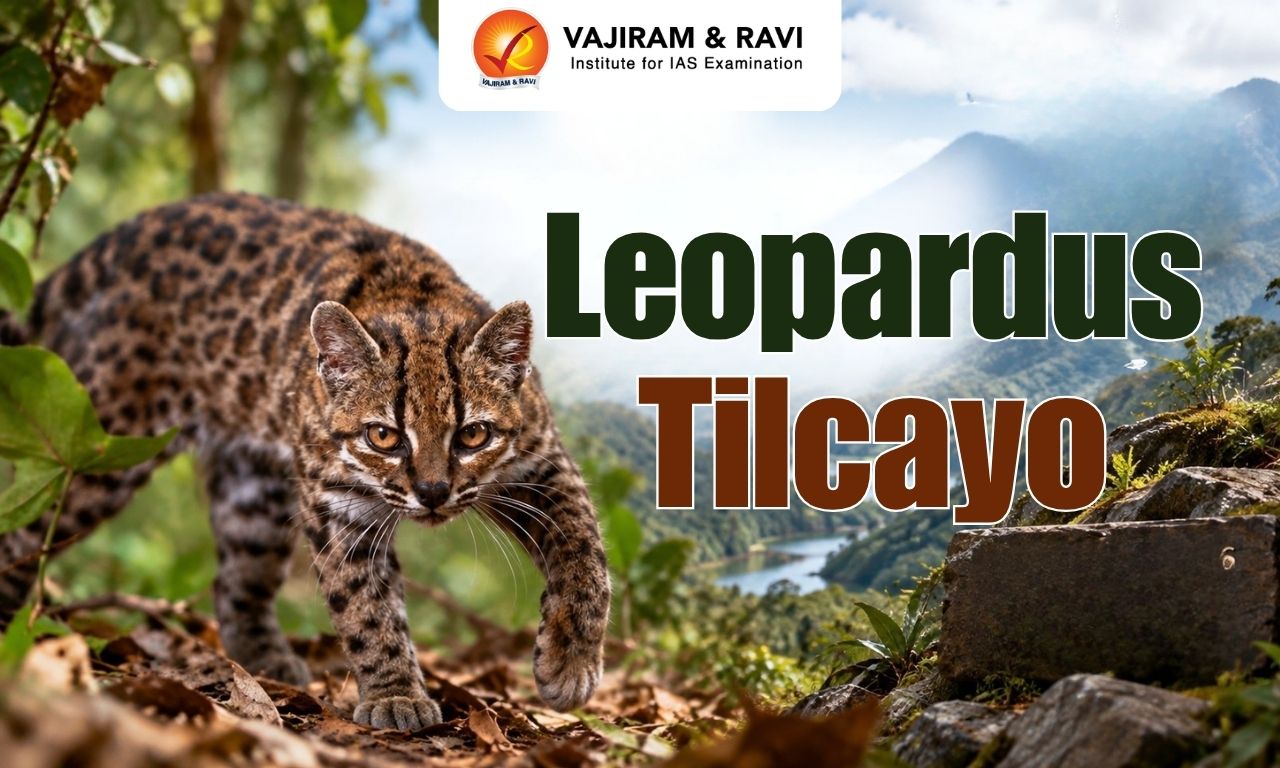
New Cat Species 2026 refers to the identification of Leopardus Tilcayo, a small wild cat from Bolivia’s Yungas cloud forest. It is the first newly identified living cat species to be formally described in more than 100 years. The species belongs to the tiger cat group and is known locally as tilcayo. Genetic evidence confirmed that it represents a distinct species within the cat family.

Discovery of New Cat Species 2026

The discovery of New Cat Species 2026 followed research on tiger cats across South America. Paola Nogales-Ascarrunz first encountered the unusual cat in 2016. It had been kept by a local family after being found as a kitten. Genetic analysis of 38 cats, including eight museum specimens, showed five genetically distinct tiger cat species. Leopardus Tilcayo separated from related tiger cats about 1.4 million years ago.

Leopardus Tilcayo New Cat Species 2026

Leopardus Tilcayo is among the smallest wild cats in the Leopardus genus. Its limited records currently make its distribution, behaviour and population status uncertain.

  • Scientific Name: The newly identified species is named Leopardus Tilcayo. Researchers retained the local name tilcayo used by communities in the Bolivian region.
  • First Cat Species in Over a Century: New Cat Species 2026 is the first formally described living feline species in more than 100 years. The previous such description was the Pampas cat L. fasciatus in 1923.
  • Physical Size: The tilcayo measures about 18 inches or 46 centimetres in body length. It weighs about 3 pounds or 1.4 kilograms, making it smaller than an average domestic cat.
  • Appearance: Its fur is light brown with large, irregular rosettes. The dark brown to black markings are mostly open or partly closed. It has short round ears, long whiskers and a distinctive compact face.
  • Distribution and Habitat: The species has been identified in La Paz, Nor Yungas, near Arapata, at about 1,570 metres above sea level. It inhabits the Yungas cloud forest on Bolivia’s eastern Andean slopes.
  • Diet and Activity: Small rodents found in fecal samples indicate that rodents may form part of its diet. Camera trap records suggest that the cat may be more active during nighttime.
  • Conservation Status: As of September 2026, Leopardus Tilcayo has not received a formal IUCN Red List assessment. The researchers have shared their findings with the IUCN for separate assessment of the five lineages.
  • Threats to Habitat: The Yungas forest faces pressure from deforestation, agricultural expansion, human caused fires and mining. Protecting native forest, restoring damaged areas and maintaining habitat connections are important conservation priorities.
  • Related Discovery: Researchers also described a new tiger cat subspecies from Peru’s Yungas region. It was named Leopardus tigrinus antisuyo, after Antisuyu, a region of the old Inca Empire.

Also Read: Species in News 2026

Leopardus Tilcayo FAQs

Q1: What is the New Cat Species Discovered in 2026?

Ans: The New Cat Species is Leopardus Tilcayo, a small wild feline identified in Bolivia’s Yungas cloud forest.

Q2: Where was Leopardus Tilcayo discovered?

Ans: Leopardus Tilcayo was identified in the Yungas forest of Bolivia, near Arapata in Nor Yungas, at about 1,570 metres above sea level.

Q3: How big is the Leopardus Tilcayo cat?

Ans: The tilcayo measures about 42.5-50 centimetres in head-body length and weighs around 1.5-2.0 kilograms.

Q4: What does the Leopardus Tilcayo cat eat?

Ans: Small rodents found in fecal samples suggest that rodents are part of the tilcayo cat’s diet.

Q5: Why is Leopardus Tilcayo important?

Ans: Leopardus Tilcayo is significant because it is the first living cat species formally described in more than 100 years.

Ek Ped Maa ke Naam Campaign, Objectives, Features, Importance

Ek Ped Maa ke Naam Campaign

Ek Ped Maa Ke Naam Campaign is a nationwide tree plantation initiative launched by Prime Minister Narendra Modi on 5 June 2024, on the occasion of World Environment Day. It encourages people to plant a tree in the name of their mother, connecting environmental protection with the emotional bond between a mother and her child. The campaign aims to promote tree plantation, increase green cover and encourage public participation in environmental conservation. 

Ek Ped Maa Ke Naam Campaign Launch

  • Launch: Prime Minister Narendra Modi launched the Ek Ped Maa Ke Naam campaign on 5 June 2024, on World Environment Day, by planting a Peepal tree at Buddha Jayanti Park in Delhi.
  • Core Idea: The campaign encourages people to plant a tree in the name of their mother as a symbol of love, gratitude and respect, connecting the nurturing role of mothers with the life-giving role of nature.
  • Citizen Participation: The campaign promotes public participation in environmental conservation by encouraging individuals to contribute to tree plantation in a simple and personal way.
  • 80 Crore Seedlings: The Ministry of Environment, Forest and Climate Change achieved its target of planting 80 crore seedlings by 25 September 2024, five days ahead of the deadline.
  • Large-Scale Participation: Government departments, defence organisations, local communities and other stakeholders participated in the campaign to increase green cover and spread environmental awareness.
  • Plantation Record: On 22 September 2024, the 128 Infantry Battalion and Ecological Task Force of the Territorial Army planted more than 5 lakh saplings in one hour in Jaisalmer.

Ek Ped Maa Ke Naam Campaign Objectives and Key Features

  • Increase Green Cover: The campaign aims to promote tree plantation, afforestation and greater public participation in environmental protection.
  • Ek Ped Maa Ke Naam 2.0: The expanded 2025 phase is a citizen-driven environmental initiative that promotes afforestation while connecting environmental conservation with emotional and cultural values. 
  • People’s Participation: The campaign encourages individual responsibility for environmental conservation and promotes wider participation in climate action, similar to the approach of Mission LiFE.
  • Participation of Ministries: Various ministries and organisations, including the Ministry of Defence, Ministry of Coal, Ministry of Information and Broadcasting, and Ministry of Agriculture and Farmers’ Welfare, have undertaken plantation drives.
  • Skill Development Institutions: The Ministry of Skill Development and Entrepreneurship planted more than 11,778 trees across PMKKs, NIESBUD, ITIs, NSTIs and Jan Shikshan Sansthans.
  • Ek Ped Maa Ke Naam App: The dedicated app allows users to plant and dedicate a tree to their mother, upload photographs, add location details and track the tree’s growth and carbon-related information.

Ek Ped Maa Ke Naam Campaign Importance for Environment and Climate Action

  • Environmental Conservation: The campaign supports afforestation, restoration of green cover and environmental awareness by encouraging people to participate directly in tree plantation.
  • SDG Linkages: It supports broader environmental goals, particularly SDG 13 (Climate Action) and SDG 15 (Life on Land), through climate responsibility, ecosystem protection and sustainable development.
  • Government-Public Collaboration: The participation of government agencies, Armed Forces, NGOs, educational institutions and local communities strengthens collective action for environmental conservation.
  • Climate Benefits: Tree plantation can help reduce carbon footprints, improve green cover and support ecological restoration, particularly when planted trees are properly maintained and survive.
  • Link with Existing Initiatives: The campaign complements initiatives such as the National Afforestation Programme, CAMPA and Green India Mission, supporting broader afforestation and environmental management efforts.
  • Emotional Connection: By linking environmental protection with the bond between mothers and children, the campaign aims to make environmental action more personal and encourage continued participation in protecting nature.

Ek Ped Maa Ke Naam Campaign FAQs

Q1: What is the Ek Ped Maa Ke Naam Campaign?

Ans: Ek Ped Maa Ke Naam is a nationwide tree plantation campaign that encourages people to plant a tree in the name of their mother.

Q2: When was Ek Ped Maa Ke Naam Campaign launched?

Ans: The campaign was launched by Prime Minister Narendra Modi on 5 June 2024, on World Environment Day.

Q3: Where was the Ek Ped Maa Ke Naam Campaign launched?

Ans: The campaign was launched at Buddha Jayanti Park in Delhi, where the Prime Minister planted a Peepal tree.

Q4: What is the main objective of Ek Ped Maa Ke Naam Campaign?

Ans: The campaign aims to increase green cover, promote afforestation and encourage public participation in environmental conservation.

Q5: What is Ek Ped Maa Ke Naam 2.0?

Ans: Ek Ped Maa Ke Naam 2.0 is the second phase of the campaign, designed as a citizen-driven environmental initiative combining afforestation with emotional and cultural values.

India’s Space Sector, Evolution, Achievements, Global Partnerships

India’s Space Sector

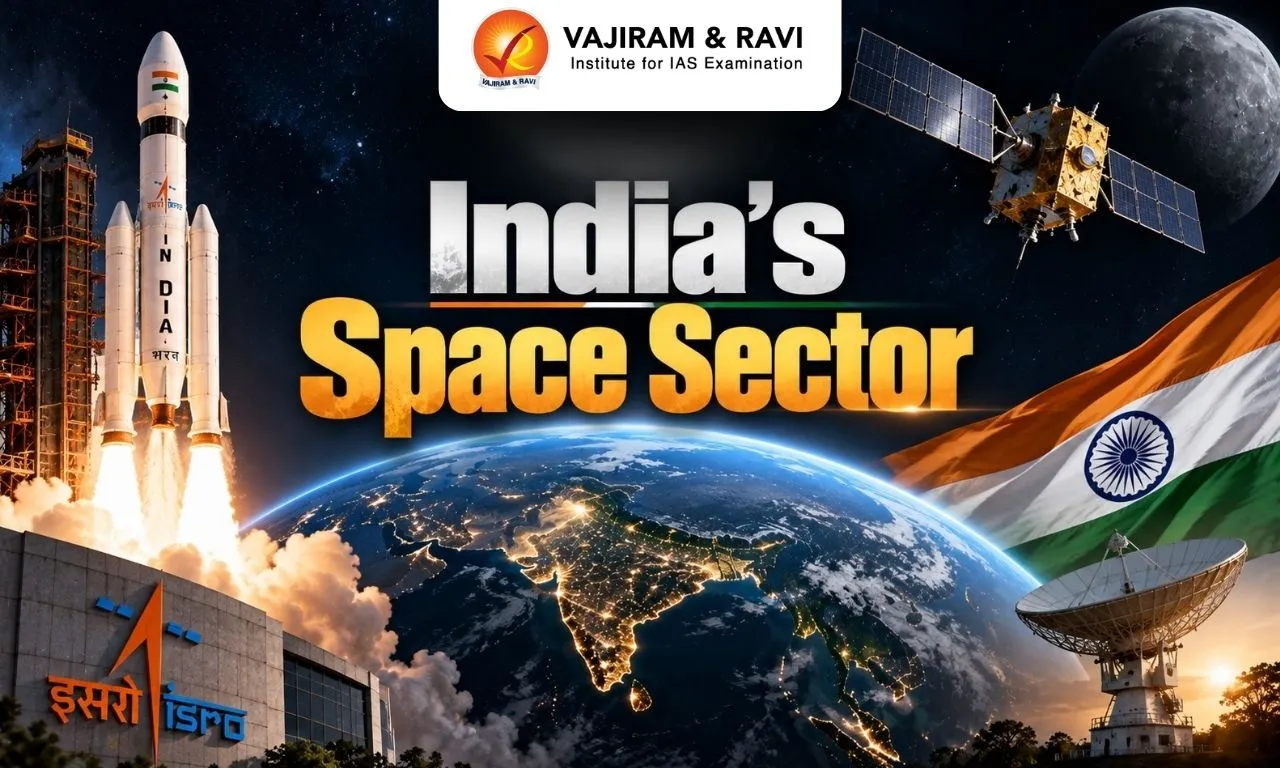
India's Space Sector has undergone a major transformation over the past decade. From lunar and Mars missions to human spaceflight, space stations, satellite navigation and private space startups, India has steadily expanded its capabilities in space.

India's Space Sector is also becoming increasingly commercial, with growing participation from startups and private companies, liberalised foreign investment rules and greater opportunities for technology transfer and satellite services. As India moves towards Space Vision 2047 and Viksit Bharat 2047, the focus is on building an innovative, self-reliant and globally competitive space ecosystem.

Evolution of India's Space Sector

India’s space sector has evolved from a modest programme focused on using satellites for national development into a broad ecosystem covering space exploration, advanced launch vehicles, navigation, commercial activities and human spaceflight. The growth has been driven by ISRO’s technological progress, policy reforms and increasing participation of private companies.

  • 1962: Indian National Committee for Space Research (INCOSPAR) was established under the leadership of Vikram Sarabhai.
  • 1969: ISRO was established to develop and apply space technology for national development.
  • 1975: Aryabhata, India’s first satellite, was launched, marking an important step in indigenous satellite development.
  • 1980: Rohini RS-1 became the first Indian satellite placed in orbit by an Indian launch vehicle, SLV-3.
  • 1994: The successful PSLV mission established a reliable indigenous launch capability.
  • 2008: Chandrayaan-1 marked India’s first lunar mission and provided evidence of water-related molecules on the Moon.
  • 2013–14: Mangalyaan demonstrated India’s capability in interplanetary exploration by successfully entering Mars orbit.
  • 2016 onwards: The sector saw increasing emphasis on commercialisation and private participation, with the creation of NSIL and later IN-SPACe.
  • 2017: PSLV-C37 set a record by launching 104 satellites in a single mission, demonstrating India’s multi-satellite launch capability.
  • 2019: The Gaganyaan programme was formally approved, marking a major step towards human spaceflight.
  • 2023: Chandrayaan-3 achieved a successful soft landing near the lunar south polar region, while Aditya-L1 began India’s dedicated solar exploration programme.
  • 2024–25: SpaDeX demonstrated orbital docking and undocking capabilities, supporting future space-station and human-spaceflight missions.
  • 2025 onwards: Greater focus is being placed on private-sector growth, FDI, commercial launches, reusable launch technologies, human spaceflight and the Bharatiya Antariksh Station.

Major Achievements of India's Space Sector

India’s Space Sector has achieved major milestones in lunar and planetary exploration, space science, satellite navigation, launch technology and human spaceflight.

Chandrayaan Programme

India’s Chandrayaan programme is a series of lunar missions aimed at studying the Moon’s surface, composition, resources and environment. The programme has progressed from Chandrayaan-1’s discovery of water-related evidence to Chandrayaan-3’s historic soft landing near the lunar south pole.

  • Chandrayaan-1 (2008): India’s first Moon mission, which provided evidence of water molecules and hydroxyl on the lunar surface.
  • Chandrayaan-2 (2019): Its orbiter continues to study the Moon and has provided high-resolution images and scientific data.
  • Chandrayaan-3 (2023): Successfully soft-landed near the lunar south pole, making India the first country to achieve this feat.
  • Chandrayaan-4: Planned lunar sample-return mission aimed at collecting Moon samples and bringing them back to Earth.
  • Chandrayaan-5/LUPEX: India-Japan mission planned to explore the lunar south polar region and investigate water and other volatile materials.

Aditya-L1, AstroSat and XPoSat

India has expanded its space science programme beyond the Moon and Mars to study the Sun and distant cosmic objects. These missions have strengthened India’s capabilities in solar physics, astronomy and space-based observations.

  • Aditya-L1: India’s first space-based solar observatory, launched in September 2023, studies the Sun’s corona, solar atmosphere and space weather from the L1 point.
  • AstroSat: India’s first dedicated multi-wavelength space observatory, launched in 2015, observes celestial objects in ultraviolet, optical and X-ray wavelengths.
  • XPoSat: Launched in January 2024, it is India’s first dedicated mission to study X-ray polarisation and the polarisation of cosmic X-ray sources.

SpaDeX Mission

Space Docking Experiment (SpaDeX) is designed to demonstrate India’s ability to perform autonomous rendezvous, docking and undocking of spacecraft in orbit. The technology is important for future human spaceflight, space stations and complex multi-spacecraft missions.

  • Two small spacecraft, SDX01 and SDX02, were launched together in December 2024.
  • The spacecraft successfully demonstrated autonomous docking in January 2025.
  • India also demonstrated undocking and subsequent redocking, strengthening its orbital docking capabilities.
  • The technology can support future missions involving space stations, satellite servicing and sample-return operations.

Venus Orbiter Mission

Venus Orbiter Mission, also known as Shukrayaan-1, aims to study Venus and understand its atmosphere, surface and geological processes. It will help improve scientific understanding of how Venus evolved and how it differs from Earth.

  • The mission will study the Venusian atmosphere and surface.
  • It will investigate the planet’s atmospheric composition and dynamics.
  • Scientific instruments will examine Venus’s surface and subsurface characteristics.
  • The mission will strengthen India’s capability in interplanetary exploration.

Gaganyaan India’s Human Spaceflight Programme

Gaganyaan is India’s first human spaceflight programme, aimed at demonstrating the country’s capability to send humans to low-Earth orbit and safely return them to Earth. The programme involves developing human-rated launch systems, crew modules, life-support systems and astronaut safety technologies.

  • The mission plans to carry Indian astronauts, known as Vyomnauts, into low-Earth orbit.
  • The Human-Rated Launch Vehicle Mark-3 (HLVM3) is being developed for crewed missions.
  • India has conducted multiple tests of the crew escape system and other safety technologies.
  • The programme includes uncrewed test missions before the human spaceflight.
  • Gaganyaan will build technologies and experience needed for India’s long-term human presence in space.

Axiom-4 Mission and India’s Human Spaceflight Preparation

India’s participation in the Axiom-4 mission provided an important opportunity to gain practical experience in human spaceflight and conduct scientific activities aboard the International Space Station (ISS). Indian astronaut Shubhanshu Shukla participated in the mission as the pilot, supporting India’s preparations for future human spaceflight.

  • Shubhanshu Shukla became the first Indian to visit the ISS.
  • The mission included scientific experiments and technology demonstrations relevant to microgravity research.
  • The experience provided Indian teams with exposure to crew operations, mission planning and space-station activities.
  • Lessons from the mission can contribute to India’s preparation for Gaganyaan and future human-spaceflight missions.

Bharatiya Antariksh Station

Bharatiya Antariksh Station (BAS) is India’s planned indigenous space station aimed at establishing a long-term human presence in low-Earth orbit. It is expected to support scientific research, technology development and future human spaceflight missions.

  • The first module of BAS is planned to be launched around 2028.
  • The station is targeted for completion by 2035.
  • It will support microgravity experiments, space-based research and technology demonstrations.
  • BAS will build on technologies developed through Gaganyaan and SpaDeX.
  • It is expected to provide a platform for long-duration human space missions.
  • The station will strengthen India’s capabilities in human spaceflight, orbital operations and space science.

FDI Reforms in India's Space Sector

India has opened its space sector to greater foreign investment to attract global capital, advanced technology and private participation. The reforms aim to strengthen domestic space capabilities and expand India’s role in the global space economy.

  • 100% FDI is permitted under the automatic route for manufacturing components and systems or sub-systems for satellites, ground segments and user segments.
  • Up to 74% FDI is allowed under the automatic route for satellite manufacturing and operation, satellite data products, and ground and user segments.
  • Up to 49% FDI is permitted under the automatic route for launch vehicles and associated systems or subsystems, as well as spaceports for launching and receiving spacecraft.
  • FDI beyond the automatic-route limits requires government approval.
  • The reforms are intended to attract global space companies and private investment into India.
  • Increased foreign investment can support technology transfer, domestic manufacturing, employment and integration with global space supply chains.

Role of IN-SPACe and NSIL

IN-SPACe and NSIL play important roles in expanding private participation and commercial activities in India’s space sector.

  • IN-SPACe: Acts as a single-window agency to promote, facilitate and authorise private sector space activities.
  • It enables private companies to use ISRO facilities, infrastructure and technical expertise for developing and testing space technologies.
  • It supports the growth of start-ups and private space companies in areas such as launch vehicles, satellites and space applications.
  • NSIL: The commercial arm of the Department of Space, responsible for commercialising ISRO technologies and space services.
  • NSIL undertakes activities such as launch services, satellite services, technology transfer and commercial use of space-based capabilities.
  • Together, IN-SPACe and NSIL help strengthen public-private collaboration and the commercial space ecosystem in India.

India's Space Economy

India’s Space Sector is moving from being largely government-led towards a more diverse and commercially driven ecosystem. Growing private participation, satellite services, launch capabilities and space-based applications are creating new opportunities across the economy.

  • India’s space economy is estimated at around US$8.4 billion, with a target of reaching US$44 billion by 2033.
  • The country has witnessed rapid growth in space start-ups and private space companies.
  • Private firms are increasingly involved in satellite manufacturing, launch vehicles, space data, communication and other applications.
  • Satellite-based services are supporting sectors such as agriculture, telecommunications, navigation, banking and disaster management.
  • Earth observation data is being used for resource mapping, urban planning, infrastructure development and environmental monitoring.
  • Reforms such as the Indian Space Policy 2023 and FDI liberalisation are intended to attract greater domestic and international investment.

India's Launch Vehicle Capability

India has developed a strong launch vehicle capability through programmes such as PSLV and LVM3. These systems support satellite launches, planetary missions and future human spaceflight, while newer technologies aim to improve payload capacity and reusability.

  • PSLV: Known as India’s workhorse launch vehicle, it has launched Earth observation, navigation and scientific satellites and has also carried out several international commercial launches.
  • GSLV: Uses a cryogenic upper stage and is designed to launch heavier satellites into Geosynchronous Transfer Orbit (GTO).
  • LVM3: India’s heavy-lift launch vehicle, used for missions such as Chandrayaan-3 and selected for the Gaganyaan human spaceflight programme.
  • SSLV: Designed for the quick and cost-effective launch of smaller satellites, with shorter preparation and launch cycles.
  • Next Generation Launch Vehicle (NGLV): Being developed as a more powerful and versatile launch system to support heavier payloads, commercial launches and future space missions.
  • Reusable Launch Vehicle (RLV): ISRO is testing reusable technologies to reduce launch costs and improve the efficiency of future space transportation systems.

NavIC India's Indigenous Navigation System

NavIC (Navigation with Indian Constellation) is India’s regional satellite navigation system developed by ISRO. It provides accurate positioning, navigation and timing services over India and areas extending about 1,500 km beyond the Indian mainland.

  • NavIC was earlier known as IRNSS (Indian Regional Navigation Satellite System).
  • It provides Standard Positioning Service (SPS) for civilian users and Restricted Service (RS) for authorised users.
  • The system supports applications in transportation, disaster management, surveying, mapping and location-based services.
  • NavIC can assist with navigation for ships, aircraft, vehicles and personal devices.
  • It provides an independent navigation capability, reducing dependence on foreign satellite navigation systems.
  • ISRO is working to expand NavIC’s capabilities and improve its coverage, accuracy and compatibility with modern navigation devices.

Space Technology for Agriculture and Water Security

Space Technology supports agriculture and water management by providing satellite-based data on crops, soil, weather, groundwater and water resources. This helps improve planning, monitoring and the efficient use of natural resources.

  • Crop monitoring: Satellite images help assess crop health, acreage and changes in cropping patterns.
  • Weather forecasting: Satellite data supports weather prediction and helps farmers prepare for droughts, heavy rainfall and other extreme events.
  • Soil and moisture assessment: Remote sensing helps identify soil conditions and monitor soil moisture.
  • Water resource mapping: Satellites help map rivers, reservoirs, wetlands and groundwater potential zones.
  • Irrigation planning: Satellite-based information can support better planning and efficient use of irrigation water.
  • Drought monitoring: Remote sensing helps identify drought-affected areas and assess their severity for timely intervention.

Space Technology in Disaster Management

Satellite-based systems provide real-time and large-area information that helps authorities monitor disasters, assess damage and coordinate relief operations. They are particularly useful when ground infrastructure is damaged or inaccessible.

  • Flood monitoring: Satellite imagery helps identify flooded areas and track changes in flood extent.
  • Cyclone tracking: Meteorological satellites provide data on cyclone formation, movement and intensity.
  • Landslide monitoring: Remote sensing can help identify landslide-prone areas and assess affected regions.
  • Forest fire detection: Satellite observations help detect forest fires and monitor their spread.
  • Damage assessment: Before-and-after satellite images help estimate damage to buildings, roads, crops and infrastructure.
  • Emergency communication: Satellite communication can provide connectivity when terrestrial communication networks are disrupted.

Space Technology in Healthcare and Education

Space technology is also being used to improve access to healthcare and education, particularly in remote and underserved regions. Satellite communication can connect distant locations with doctors, teachers and specialised services.

  • Telemedicine: Satellite connectivity can link patients in remote areas with specialist doctors and hospitals.
  • Health services: Space-enabled communication can support remote consultation, medical training and healthcare delivery.
  • Tele-education: Satellite networks can connect schools and students in rural and geographically isolated areas with teachers and educational resources.
  • Digital learning: Space-based communication can support the delivery of online classes, lectures and educational content.
  • Emergency healthcare: Satellite communication can help maintain connectivity for medical teams during disasters and emergencies.

Geoportals and Digital Platforms

Geoportals and digital platforms use satellite imagery, remote sensing and geospatial data to support planning, governance and decision-making. India has developed several platforms that make space-based information accessible to government agencies, researchers and other users.

  • Bhuvan: ISRO’s geoportal provides satellite imagery and geospatial information for mapping, planning and resource management.
  • VEDAS: The Visualisation of Earth Observation Data and Archival System provides access to Earth observation data and analytical tools.
  • MOSDAC: The Meteorological and Oceanographic Satellite Data Archival Centre provides satellite-based information on weather, oceans and atmospheric conditions.
  • Bhuvan Panchayat: Supports rural planning and development by providing geospatial information at the panchayat level.
  • National Geospatial Policy: Promotes wider use of geospatial data and technologies for governance, economic development and innovation.

India's Global Space Partnerships

India has built 300+ space cooperation agreements with 61 countries and five multilateral organisations, covering joint missions, satellite applications, space science, navigation and capacity building.

  • India–USA: The India-US partnership has expanded significantly through NASA-ISRO cooperation in Earth observation, human spaceflight and space science. The NISAR mission, jointly developed by NASA and ISRO, was successfully launched on 30 July 2025 and uses advanced radar technology to monitor changes in Earth’s land, ice and ecosystems. In August 2026, the two countries also discussed future cooperation in human spaceflight, lunar exploration and scientific data sharing.
  • India–France: ISRO and France’s CNES cooperate in Earth observation, climate science and space technology. The TRISHNA mission is being developed to provide high-resolution thermal infrared observations for studying water stress, land-surface temperature and environmental changes. Cooperation is also expanding into human spaceflight, advanced technologies and space industry partnerships.
  • India–Japan: India and Japan are working together on the Chandrayaan-5/LUPEX mission, designed to study lunar polar volatiles, including water, through in-situ exploration. The mission received financial sanction in 2025, its implementation arrangement was signed in August 2025, and its Preliminary Design Review has been completed.
  • India–Russia: India and Russia continue cooperation in human spaceflight, launch technologies and planetary exploration. Russia is also contributing an international payload, VIRAL, to India’s Venus Orbiter Mission, while technical discussions are progressing on space propulsion cooperation.
  • India–Australia: Australia is supporting India’s Gaganyaan programme, particularly in areas related to crew recovery operations. Cooperation also includes the establishment of a temporary tracking terminal at the Cocos (Keeling) Islands, strengthening support for future human-spaceflight missions.
  • India–European Space Agency (ESA): India and ESA cooperate in space science, Earth observation, satellite tracking and mission support. Such cooperation helps provide ground-station and technical support for Indian missions and promotes the exchange of scientific and space data.
  • India–Germany: Cooperation with Germany focuses on Earth observation, space science and satellite applications. These partnerships support the use of space-based data for climate studies, environmental monitoring and scientific research.
  • India–Italy: India and Italy cooperate in space science, Earth observation and satellite-based applications. India has also strengthened international navigation cooperation through the installation of a NavIC timing receiver at Italy’s National Institute of Metrological Research (INRIM).
  • India–Bhutan: India has supported Bhutan in developing its space capabilities through satellite cooperation and capacity building. The India-Bhutan SAT, launched in 2022, has strengthened cooperation in Earth observation, satellite data and space technology applications.
  • India–Mauritius: India and Mauritius cooperate in Earth observation, satellite applications and capacity building. Space-based technologies are being used to support areas such as resource management, environmental monitoring and disaster management.
  • India–BIMSTEC: India promotes the use of space technology for regional cooperation among BIMSTEC countries, particularly in disaster management, remote sensing, weather services and capacity building.

India’s Space Sector FAQs

Q1: What is India’s space sector?

Ans: India’s space sector includes space research, satellite development, launch services, navigation, Earth observation, space applications and commercial space activities led by ISRO and supported by private companies.

Q2: What are the major achievements of India’s space sector?

Ans: Major achievements include Chandrayaan-3, Mangalyaan, Aditya-L1, AstroSat, XPoSat, NavIC and SpaDeX, along with the development of PSLV, GSLV and LVM3.

Q3: What is the role of ISRO?

Ans: ISRO develops advanced space technologies, launch vehicles and satellites and undertakes space science, planetary exploration and human-spaceflight programmes.

Q4: What is the role of IN-SPACe?

Ans: IN-SPACe promotes and authorises private-sector space activities and facilitates access to government space infrastructure and facilities.

Q5: What is the role of NSIL?

Ans: NSIL is the commercial arm of the Department of Space. It focuses on commercialising ISRO technologies, launch services, satellite services and technology transfer.


Central Board of Film Certification (CBFC), Members, Roles and Functions

Central Board of Film Certification

The Central Board of Film Certification (CBFC) was reconstituted by the Government of India on 16 September 2026 with 18 members for a period of three years or until further orders, whichever is earlier. The reconstitution was carried out under Section 3(1) of the Cinematograph Act, 1952, read with Rule 3 of the Cinematograph (Certification) Rules, 2024.

What is the Central Board of Film Certification (CBFC)?

The Central Board of Film Certification (CBFC) is a statutory body under the Ministry of Information and Broadcasting responsible for regulating the public exhibition of films in India under the Cinematograph Act, 1952.

Films intended for public exhibition in India are required to obtain certification from the CBFC. The Board examines films and grants certificates based on the provisions of the Cinematograph Act, the Cinematograph (Certification) Rules, 2024, and the guidelines issued by the Central Government.

The CBFC is headquartered in Mumbai and has nine Regional Offices located at Mumbai, Kolkata, Chennai, Bengaluru, Thiruvananthapuram, Hyderabad, New Delhi, Cuttack and Guwahati. These Regional Offices are assisted by Advisory Panels, whose members are nominated by the Central Government to assist in the examination of films.

Central Board of Film Certification (CBFC) Composition

The Central Board of Film Certification (CBFC) consists of a Chairperson and other members appointed by the Central Government under the Cinematograph Act, 1952. The Board was reconstituted on 16 September 2026 with 18 members for a period of three years or until further orders, whichever is earlier. The 18 members of the reconstituted Central Board of Film Certification (CBFC) are:

Vinod Anupam, Manoj Joshi, Abhishek Jain, Ricky Kej, Priyadarshan, Suniel Shetty, Hansraj Hans, Supriya Yarlagadda, Yatindra Mishra, Roopali Ganguly, Preity Zinta, Neela Madhab Panda, Pankaj Tripathi, Prosenjit Chatterjee, Pallavi Joshi, Nishigandha Wad, Waman Kendre and Ramesh Patange.

Central Board of Film Certification (CBFC) Legal Basis

The Central Board of Film Certification (CBFC) functions primarily under the following legal framework:

  • Cinematograph Act, 1952: Provides the statutory basis for film certification and the constitution and functioning of the CBFC.
  • Cinematograph (Certification) Rules, 2024: Provide the current procedural framework for film certification and replaced the earlier 1983 Rules.
  • Section 5B of the Cinematograph Act: Lays down the principles governing certification of films.
  • Article 19(1)(a) of the Constitution: Protects freedom of speech and expression, while Article 19(2) permits reasonable restrictions on specified grounds.

How Does the CBFC Certify Films?

The film-certification process involves examination of a film before it is publicly exhibited.

  1. Application: The producer or applicant submits the film for certification through the prescribed process.
  2. Examination: The film is examined by the designated examining body in accordance with the Cinematograph Act, 1952, the 2024 Rules and Central Government guidelines.
  3. Assessment: The content is assessed against the applicable certification principles, including considerations under Section 5B.
  4. Modifications, if required: Where necessary, the applicant may be required to make prescribed modifications or excisions.
  5. Certification: After the requirements are satisfied, the appropriate certificate is issued.

The certification process is supported by e-Cinepramaan, the online film-certification system designed to make the process more transparent and technology-enabled.

Principles Governing Film Certification

Under Section 5B of the Cinematograph Act, 1952, film certification is governed by considerations relating to the following:

  • Sovereignty and integrity of India
  • Security of the State
  • Friendly relations with foreign States
  • Public order
  • Decency or morality
  • Defamation
  • Contempt of court
  • Incitement to the commission of an offence

These principles provide the statutory framework for regulating the public exhibition of films and operate within the constitutional framework of freedom of speech and expression under Article 19(1)(a) and the reasonable restrictions under Article 19(2).

Film Certification Categories

The Central Board of Film Certification (CBFC) grants films certification under different categories:

  • U: Unrestricted public exhibition.
  • UA 7+: Unrestricted public exhibition with a parental guidance marker for children below seven years.
  • UA 13+: Unrestricted public exhibition with a parental guidance marker for children below thirteen years.
  • UA 16+: Unrestricted public exhibition with a parental guidance marker for children below sixteen years.
  • A: Restricted to adults.
  • S: Restricted to members of a particular profession or class.

The age-based UA 7+, UA 13+ and UA 16+ markers were introduced through the revised certification framework.

Central Board of Film Certification (CBFC) FAQs

Q1: What is the Central Board of Film Certification (CBFC)?

Ans: The Central Board of Film Certification (CBFC) is a statutory body under the Ministry of Information and Broadcasting responsible for regulating the public exhibition of films in India under the Cinematograph Act, 1952.

Q2: Under which law does the Central Board of Film Certification (CBFC) function?

Ans: The Central Board of Film Certification (CBFC) functions primarily under the Cinematograph Act, 1952 and the Cinematograph (Certification) Rules, 2024.

Q3: What is the composition of the Central Board of Film Certification (CBFC)?

Ans: The Central Board of Film Certification (CBFC) consists of a Chairperson and other members appointed by the Central Government. The Board was reconstituted on 16 September 2026 with 18 members for three years or until further orders, whichever is earlier.

Q4: What are the certification categories of the Central Board of Film Certification (CBFC)?

Ans: The Central Board of Film Certification (CBFC) grants certificates under six categories: U, UA 7+, UA 13+, UA 16+, A and S.

Q5: What are the principles governing the Central Board of Film Certification (CBFC)?

Ans: The Central Board of Film Certification (CBFC) follows the principles specified under Section 5B of the Cinematograph Act, 1952, including considerations relating to sovereignty and integrity of India, security of the State, public order, decency or morality, defamation, contempt of court and incitement to an offence.

Himalayan Hazards and Disaster Management, Measures, Challenges

Himalayan Hazards and Disaster Management

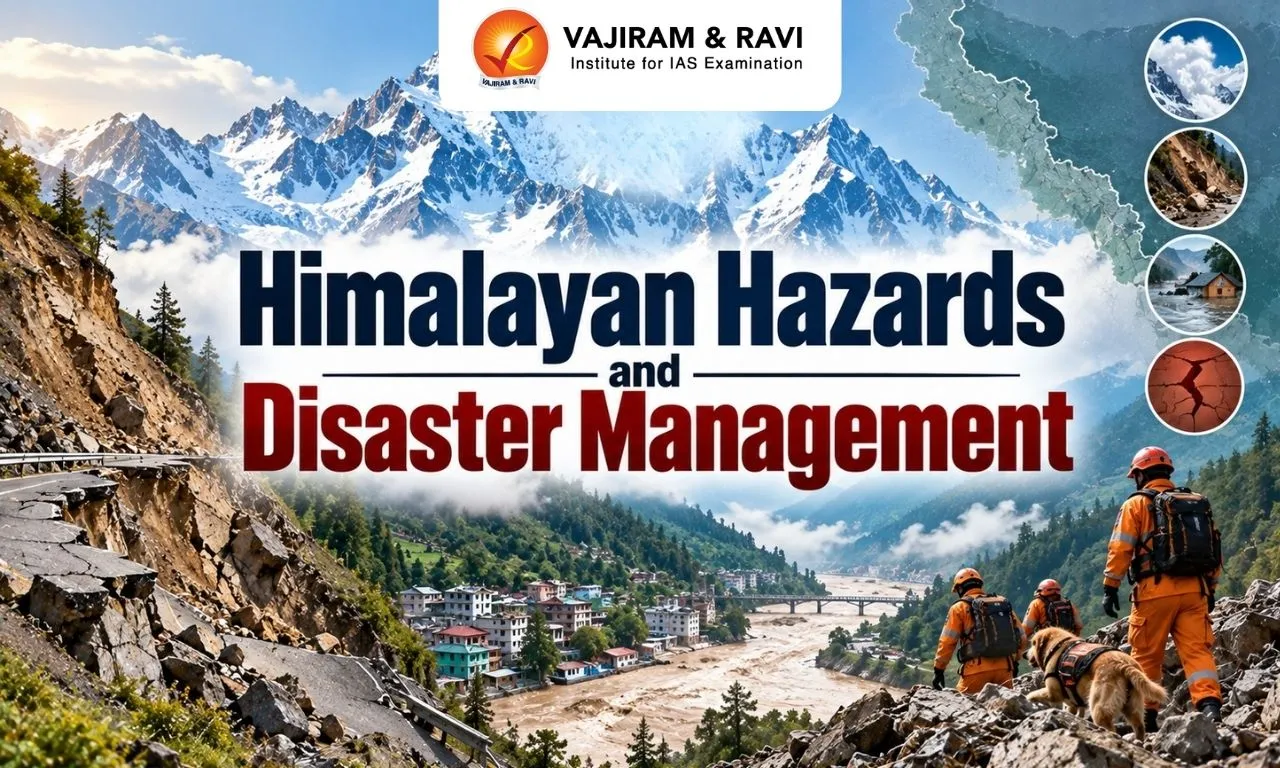
The Himalayas are a young and fragile mountain system facing earthquakes, landslides, flash floods, cloudbursts, avalanches and Glacial Lake Outburst Floods. Climate change, glacier retreat and rapid infrastructure growth are increasing disaster risks. Himalayan Hazards and Disaster Management therefore requires hazard mapping, early warning systems, resilient infrastructure, community preparedness and cooperation among countries sharing Himalayan rivers, glaciers and weather systems.

Himalayan Hazards and Disaster Management

Himalayan Hazards and Disaster Management focuses on reducing risks from interconnected natural and human induced hazards across the mountain region. The Himalayas are tectonically active and have steep slopes, fragile rocks and rapidly changing glaciers. Effective management needs scientific monitoring, real time information sharing, coordinated response and community participation across vulnerable Himalayan landscapes.

What are Himalayan Hazards and Disasters?

Himalayan Hazards and Disasters include geological, hydrological, climatic and cryospheric disasters that can interact and create cascading impacts on people, infrastructure and river systems.

  • Landslides: Fragile rocks, steep slopes, intense rainfall, earthquakes and slope cutting make landslides common. Road construction, tunnels, poor drainage and improper disposal of excavated material can further destabilise mountain slopes.
  • Flash Floods: Steep Himalayan rivers can carry water, rocks, ice and debris at high speed through narrow valleys. Cloudbursts, intense rainfall, landslides and sudden glacial events can trigger destructive flash floods.
  • Glacial Lake Outburst Floods: Melting glaciers can create unstable glacial lakes dammed by weak moraines. South Lhonak Lake in the Eastern Himalayas expanded by 45.5% between 2016 and 2023, increasing GLOF risk.
  • Cloudbursts: Short duration and high intensity rainfall can produce sudden runoff in steep valleys. Changes in rainfall patterns, including fewer rainy days with more intense rainfall, can increase flash floods and landslides.
  • Earthquakes: The Himalayas lie along the active collision zone of the Indian and Eurasian plates. Accumulated tectonic stress and locked faults can produce major earthquakes, which may trigger landslides, avalanches and other secondary hazards.
  • Avalanches and Debris Flows: Rapid movement of snow, ice, rock and loose material can affect remote mountain settlements and infrastructure. A rock ice collapse can also transform into a debris flow and flood downstream.
  • Cascading Hazards: A single event can trigger several hazards. An earthquake may cause landslides, while a glacier or slope collapse can generate debris flows, floods and damage to infrastructure.
  • Recent Developments: Recent floods in Nepal’s Bhotekoshi-Trishuli River 2026 highlighted the need for real time monitoring, cross border data sharing, early warning systems and coordinated disaster response for Himalayan hazards.

Why are the Himalayas Prone to Disasters?

The disaster vulnerability of the Himalayas results from the interaction of geological instability, extreme terrain, changing climate and growing human pressure across fragile mountain ecosystems.

  • Young Fold Mountains: The Himalayas are young and tectonically active mountains. The Indian Plate moves northward into the Eurasian Plate at roughly 4-5 cm per year, creating seismic stress and fractured terrain.
  • Steep Topography: Sharp slopes and narrow river valleys increase the speed and destructive force of flowing water, rocks and debris. Limited flat land also concentrates settlements and infrastructure in vulnerable valleys.
  • Fragile Geological Material: Weak and unconsolidated rock strata are highly vulnerable to erosion and slope failure. Earthquakes and heavy rainfall can further reduce slope stability.
  • Glacier Retreat: Rising temperatures contribute to glacier retreat and the formation or expansion of glacial lakes. Unstable lakes and changing ice conditions increase the possibility of sudden floods.
  • Permafrost Melting: Higher temperatures can thaw high altitude permafrost that helps stabilise mountain slopes. Its weakening can contribute to rockfalls, landslides and avalanches.
  • Changing Rainfall: Rising temperatures are pushing the snowline higher in some areas. More precipitation falling as rain can increase runoff, erosion and slope instability at high elevations.
  • Infrastructure Pressure: Roads, railway tunnels, dams, hydropower projects and settlements can increase exposure when construction ignores local carrying capacity. Slope cutting and poor drainage can further raise landslide risks.
  • Unplanned Urbanisation: Construction in old landslide zones, inadequate drainage and excessive water infiltration can cause land subsidence and structural damage. Joshimath illustrates the risks associated with development in fragile mountain areas.

Himalayan Hazards and Disaster Management Measures

Himalayan Disaster Management requires a shift from isolated disaster response towards continuous monitoring, prevention, preparedness and coordinated action across vulnerable landscapes and river basins.

  • National GLOF Risk Mitigation Programme: NDMA initiated the programme following the Sikkim disaster. It targets 195 high risk glacial lakes across Sikkim, Uttarakhand, Himachal Pradesh, Arunachal Pradesh, Jammu & Kashmir and Ladakh with an outlay of ₹150 crore.
  • Hazard Mapping: Hazard and vulnerability mapping identifies areas exposed to GLOFs, landslides, earthquakes, avalanches and flash floods. Micro level maps can support safer land use planning and emergency evacuation.
  • Early Warning Systems: Remote sensing, satellites, weather monitoring, river sensors and ground based systems can improve warnings. Automated alerts are especially important because some high altitude debris flows can develop within minutes.
  • Scientific Himalayan Study: The Himalay Unnati Mission announced a study involving scientists, ecologists, research institutions and disaster management experts. It will examine cloudbursts, landslides, glacier collapses and other recurring Himalayan Hazards.
  • Himalayan Authority Proposal: HUM has called for a Himalayan Authority at the Centre to coordinate conservation, sustainable development, climate resilience and disaster risk reduction across Himalayan states and the North East.
  • Community Preparedness: Local communities need training in early evacuation, emergency communication, first response and safe evacuation routes. Community based warning systems can provide valuable response time in downstream villages.
  • Existing Regional Cooperation: ICIMOD provides a regional knowledge platform involving Afghanistan, Bangladesh, Bhutan, China, India, Myanmar, Nepal and Pakistan. The SAARC Agreement on Rapid Response to Natural Disasters was established in 2011.
  • Bilateral Mechanisms: India-Nepal joint committees address flood management and shared water resources. India-China mechanisms support hydrological data sharing for the Brahmaputra and Sutlej. India-Bangladesh cooperation covers water level, rainfall and discharge data across 54 transboundary rivers.
  • Ecosystem Based Measures: Forests, wetlands and natural drainage channels can support disaster risk reduction. Excessive slope cutting and riverbed encroachment should be controlled to maintain natural landscape stability.
  • HUM Field Initiatives: Since 2021, Mission Green Himalayas has planted more than 22 lakh trees across over 20 landscapes. HUM has also installed 613 solar microgrids and solar powered digital classrooms in 356 border schools, benefiting more than 1.95 lakh people.
  • Disaster Relief Experience: HUM's Samvedana programme involved more than 1,000 volunteers supporting 7,248 families and over 45,000 people affected by floods and landslides. More than 5,450 young people received training at over 43 skill development centres in India and Nepal.
  • Integrated Monitoring: A regional system should combine satellite observations, weather forecasts, seismic monitoring, hydrological data and ground sensors. Such integration can improve identification of cascading hazards and support faster emergency decisions.

Himalayan Hazards and Disaster Management Challenges

Himalayan Disaster Management faces difficult terrain, limited monitoring, fragmented institutions, transboundary risks and rapidly changing hazard patterns that require stronger regional preparedness.

  • Remote Mountain Terrain: Many hazard sources are located in high altitude and inaccessible areas. Difficult terrain limits installation of monitoring systems and delays rescue, relief and communication after disasters.
  • Very Short Warning Time: Sudden rock ice collapses and debris flows can develop extremely quickly. In one recent Nepal disaster, instruments detected a tremor at 8:37 am, while an emergency SMS was sent around 9:15 am.
  • Limited Cross Border Data Sharing: Himalayan Hazards can begin in one country and affect downstream communities in another. Formal and real time exchange of hydrological, glacial and hazard information remains limited.
  • Fragmented Governance: Disaster management involves NDMA, State Disaster Management Authorities, Border Roads Organisation, Central Water Commission, Geological Survey of India, Armed Forces and district administrations. Coordination can become difficult during sudden disasters.
  • Changing Climate Risks: Historical disaster assessments may become less reliable as temperatures, glaciers and rainfall patterns change. New combinations of hazards require continuous monitoring and updated risk assessments.
  • Development Ecology Conflict: Roads, hydropower projects, tunnels, tourism and settlements increase economic opportunities but can also increase exposure in fragile valleys. Development planning must consider mountain carrying capacity and disaster resilience.
  • Need for Regional Framework: Himalayan rivers, glaciers and weather systems cross national boundaries. Effective disaster management therefore requires 365 day data sharing, joint monitoring, coordinated warnings, basin level planning and regular disaster response exercises.

Himalayan Hazards and Disaster Management FAQs

Q1: What are the major Hazards in the Himalayas?

Ans: Major Himalayan Hazards include earthquakes, landslides, flash floods, cloudbursts, avalanches, debris flows and Glacial Lake Outburst Floods.

Q2: Why are the Himalayas prone to Disasters?

Ans: The Himalayas are young, tectonically active and have steep slopes, fragile rocks, changing glaciers and intense rainfall. Infrastructure pressure also increases disaster vulnerability.

Q3: What is Himalayan Disaster Management?

Ans: Himalayan Disaster Management involves hazard mapping, early warning systems, scientific monitoring, resilient infrastructure, community preparedness and coordinated disaster response.

Q4: What are the major challenges in Himalayan Disaster Management?

Ans: Major challenges include difficult terrain, limited early warning coverage, short warning time, fragmented governance, climate change and limited cross border data sharing.

Q5: How can Himalayan Disasters be managed effectively?

Ans: Effective management requires real time monitoring, universal early warning systems, safer construction, community training, ecosystem conservation and stronger cooperation among Himalayan countries.

Fiji Declares National HIV Emergency Amid Sharp Rise in HIV Infections

Fiji Declares National HIV Emergency

Fiji Declares National HIV Emergency after a sharp rise in HIV infections, prompting the government to expand testing, treatment and prevention measures. The development has brought renewed attention to the growing HIV burden in the Pacific island nation and the gaps in diagnosis and treatment.

Why Did Fiji Declare a National HIV Emergency?

Fiji declared a national HIV emergency as the country faces a rapid rise in new infections alongside significant gaps in HIV diagnosis and treatment. New HIV infections increased 12-fold between 2010 and 2025, while around 9,100 people were estimated to be living with HIV in 2025 in a country with a population of less than one million.

Key Factors Behind Fiji’s HIV Crisis

Several factors are contributing to the rapid spread of HIV in Fiji.

  • Injecting drug use: Sharing contaminated needles and syringes can transmit HIV directly through blood. More than 42% of cases with a known mode of transmission were linked to injecting drug use.
  • Sexual transmission: More than half of cases with a known mode of transmission were linked to sexual transmission, making testing and prevention services particularly important.
  • Limited testing: A large proportion of people living with HIV do not know their status, reducing the likelihood of early diagnosis and treatment.
  • Low treatment coverage: Only 22% of people living with HIV were accessing antiretroviral treatment in 2025, limiting the health benefits of treatment and its role in preventing further transmission.
  • Stigma and discrimination: Fear of stigma can discourage people from getting tested or accessing treatment, allowing infections to remain undiagnosed.

What Measures Has Fiji Announced?

Fiji's response focuses on expanding access to testing, treatment, prevention and harm reduction.

  • Free HIV testing: The government plans to expand testing so that more infections can be identified at an early stage.
  • Free treatment: People who test positive will be provided access to HIV treatment.
  • Needle and syringe programme: Fiji plans to introduce a programme providing clean needles and syringes to people who inject drugs, with legislative amendments being considered to facilitate its implementation.
  • Expanded prevention: The government is strengthening access to HIV prevention services, including preventive medicines.
  • Community-based response: Community organisations and peer workers are being involved in reaching vulnerable groups and connecting them with health services.
  • Action against stigma: The government has emphasised that people should not be excluded or discouraged from seeking HIV services because of their HIV status.

What is HIV?

Human Immunodeficiency Virus (HIV) is a virus that attacks the body's immune system, particularly CD4 cells, which help the body fight infections.

Without treatment, HIV can progressively weaken the immune system and may lead to Acquired Immunodeficiency Syndrome (AIDS), the most advanced stage of HIV infection.

Antiretroviral treatment can suppress HIV and help people living with the virus lead healthy lives.

How is HIV Transmitted?

HIV is transmitted through certain body fluids when they enter the body of another person.

  • Sexual transmission: Through exposure to infected sexual fluids.
  • Blood transmission: Through infected blood.
  • Injecting drug use: Through sharing contaminated needles or syringes.
  • Mother-to-child transmission: During pregnancy, childbirth or breastfeeding.

HIV is not transmitted through ordinary social contact, such as hugging, shaking hands or sharing everyday spaces.

Fiji Declares National HIV Emergency FAQs 

Q1: Why did Fiji declare a national HIV emergency?

Ans: Fiji declared a national HIV emergency following a 12-fold increase in new HIV infections between 2010 and 2025, along with significant gaps in HIV testing and treatment.

Q2: How many people are living with HIV in Fiji?

Ans: Around 9,100 people were estimated to be living with HIV in Fiji in 2025, in a country with a population of less than one million.

Q3: What are the major factors driving Fiji’s HIV crisis?

Ans: The major factors include sexual transmission, injecting drug use, limited access to testing and treatment, and stigma and discrimination that can discourage people from seeking HIV services.

Q4: What measures has Fiji announced to tackle the HIV crisis?

Ans: Fiji is expanding HIV testing, treatment and prevention services and plans to introduce a needle and syringe programme for people who inject drugs.

Q5: What is HIV and how is it transmitted?

Ans: Human Immunodeficiency Virus (HIV) attacks the immune system and is mainly transmitted through sexual contact, infected blood, sharing contaminated needles or syringes, and from mother to child during pregnancy, childbirth or breastfeeding.

Global Gender Gap Index 2026

Global Gender Gap Index 2026

Global Gender Gap Index Latest News

India retained the 131st rank on the Global Gender Gap Index 2026 released by the World Economic Forum recently, with Iceland, Finland and Norway maintaining their top three slots respectively.

About Global Gender Gap Index 2026

  • It is an annual index designed to measure gender equality.
  • It is released by the World Economic Forum (WEF).
  • It benchmarks the current state and evolution of gender parity across four key dimensions (subindexes): Economic Participation and Opportunity, Educational Attainment, Health and Survival, and Political Empowerment. 
  • Since launching in 2006, it is the longest-standing index tracking the progress of numerous countries’ efforts towards closing these gaps over time. 

Global Gender Gap Index 2026 Highlights

  • Globally, 69.2 percent of the gender gap has now been closed, up by 0.4 percentage points over the last year.
  • Iceland is still the world’s number one, with 93 percent of its gender gap closed. 
  • Finland and Norway follow with 87.2 percent and 85.7 percent, respectively. 
  • Namibia is fourth with 84.5 percent, followed by the UK, New Zealand, Sweden, Australia, Germany, and Ireland. 
  • Australia cracked the top 10 for the first time. 
  • Across the 143 economies covered in both the 2025 and 2026 editions, the overall score increased by 0.4 percentage points. 
  • Education recorded the largest increase year on year, rising from 95.3 percent to 96.9 percent. 
  • Economic participation score increased from 61.3 percent to 61.7 percent, and health and survival improved from 96.1 percent to 96.2 percent. 
  • Political empowerment, however, moved in the opposite direction, sliding down from 22.5 percent to 22.1 percent.
  • India stands at 131st spot, with 64.5 percent. 
  • Only 14 countries ranked below India on the index of 145 countries. These include Papua New Guinea, Kuwait, Oman, Qatar, Tajikistan, Saudi Arabia, Egypt, Morocco, Mali, Algeria, and Congo. 
  • Chad was the lowest-ranked country in the index, with Iran and Pakistan joining it in the bottom three.
  • Overall, India's gender parity increased by 4.3 percentage points since 2006, primarily due to gains in educational attainment.
  • In the Economic Participation and Opportunity subindex, India reported a 41.2 percent parity score, 0.5 higher than the previous edition but 3.5 percentage points lower from its best result in 2013.

News: TH

Global Gender Gap Index FAQs

Q1: What is the Global Gender Gap Index?

Ans: It is an annual index released by the World Economic Forum (WEF) to measure gender equality across countries.

Q2: What are the four key dimensions measured by the Global Gender Gap Index?

Ans: Economic Participation and Opportunity, Educational Attainment, Health and Survival, and Political Empowerment.

Q3: What percentage of the global gender gap was closed according to the Global Gender Gap Index 2026?

Ans: 69.2 percent.

Q4: Which country ranked first in the Global Gender Gap Index 2026?

Ans: Iceland.

Q5: What was India's rank in the Global Gender Gap Index 2026?

Ans: 131st.

Leopardus Tilcayo

Leopardus Tilcayo

Leopardus Tilcayo Latest News

Recently, a new cat species was identified in Bolivia, first in over a century and researchers named it as Leopardus Tilcayo. 

About Leopardus Tilcayo

  • It is a type of tiger cat, a group of small felines in the genus Leopardus that are native to South America.
  • It was found in Bolivia’s ⁠lush Yungas forest, a mountainous region where forests are often covered by clouds and surrounded by high humidity.
  • The cat is called Tilcayo by local communities.
  • Appearance: It measures about 18 inches (46 cm) long and weighs around 3 pounds (1.4 kg), making it smaller than the average domestic cat.
  • Its fur is light brown with irregularly shaped rosettes across its body.

Key Facts about Yungas Forest

  • The Yungas forest, also known as Nuboselva or Selva Tucumano-Oranense, is a unique ecosystem.
  • It is located on the eastern edge of the Andes, this mountain forest extends from Venezuela to Argentina.
  • Fauna: Over 200 species of trees, 80 species of ferns, over 100 species of mammals, 500 species of birds, and around 30 species of toads and frogs, some of which are endemic to this forest.

Source: TH

Leopardus Tilcayo FAQs

Q1: What is Leopardus Tilcayo?

Ans: A species of tiger cat.

Q2: Where was Leopardus Tilcayo discovered?

Ans: Bolivia

Vasai Fort

Vasai Fort

Vasai Fort Latest News

Several Ganesh idols immersed in an artificial pond were allegedly found dumped near the jetty at Vasai Fort recently, sparking outrage among residents. 

About Vasai Fort

  • Vasai Fort, also known as the Bassein Fort, is an ancient fort located at Vasai in the suburbs of North Mumbai, Maharashtra. 
  • It overlooks the confluence of the Ulhas River. 

Vasai Fort History

  • Vasai was known as a place for shipbuilding in the 15th Century. 
  • Bahadur Shah, a Mughal Emperor, had built the Bassein Fort in the 1530s. 
  • The Portuguese conquered and destroyed most of the fort a year after it was built. 
  • The Portuguese remodeled the fort into a flourishing city by building a citadel inside. 
  • The fort was under Portuguese control till 1739 AD. 
  • In the 18th century, the fort was raided and overtaken by the Maratha army under Chimaji Appa. They stood strong for 3 long years, and then the British took over the fort in the First Anglo-Maratha War. 

Vasai Fort Architecture

  • The fort covers an area of around 110 acres. 
  • Surrounded by the sea on three sides and protected by a strategically designed moat on the landward side, its defenses were nearly impenetrable. 
  • The fort’s walls, stretching over 4.5 kilometers, are fortified with eleven towering bastions, each echoing the echoes of battles fought long ago. 
  • Within its expanse, remnants of once-majestic churches, intricate archways, and Portuguese-style facades still stand, albeit weathered by time. 
  • Three old churches are recognisable in the fort. The southernmost chapel has a well-preserved barrel-vaulted ceiling, and the walls are covered with tree roots and palm groves.

News: TOI

Vasai Fort FAQs

Q1: Where is Vasai Fort located?

Ans: At Vasai in the northern suburbs of Mumbai, Maharashtra.

Q2: Who built the Bassein Fort in the 1530s?

Ans: Bahadur Shah, a Mughal emperor.

Q3: Until when did the Portuguese control Vasai Fort?

Ans: Until 1739 AD.

Q4: Which Maratha military leader led the capture of Vasai Fort from the Portuguese?

Ans: Chimaji Appa.

Djibouti

Djibouti

Djibouti Latest News

The Republic of Djibouti became the 72nd nation and eighth African country to sign the Artemis Accords during a ceremony at NASA Headquarters in Washington.

About Djibouti

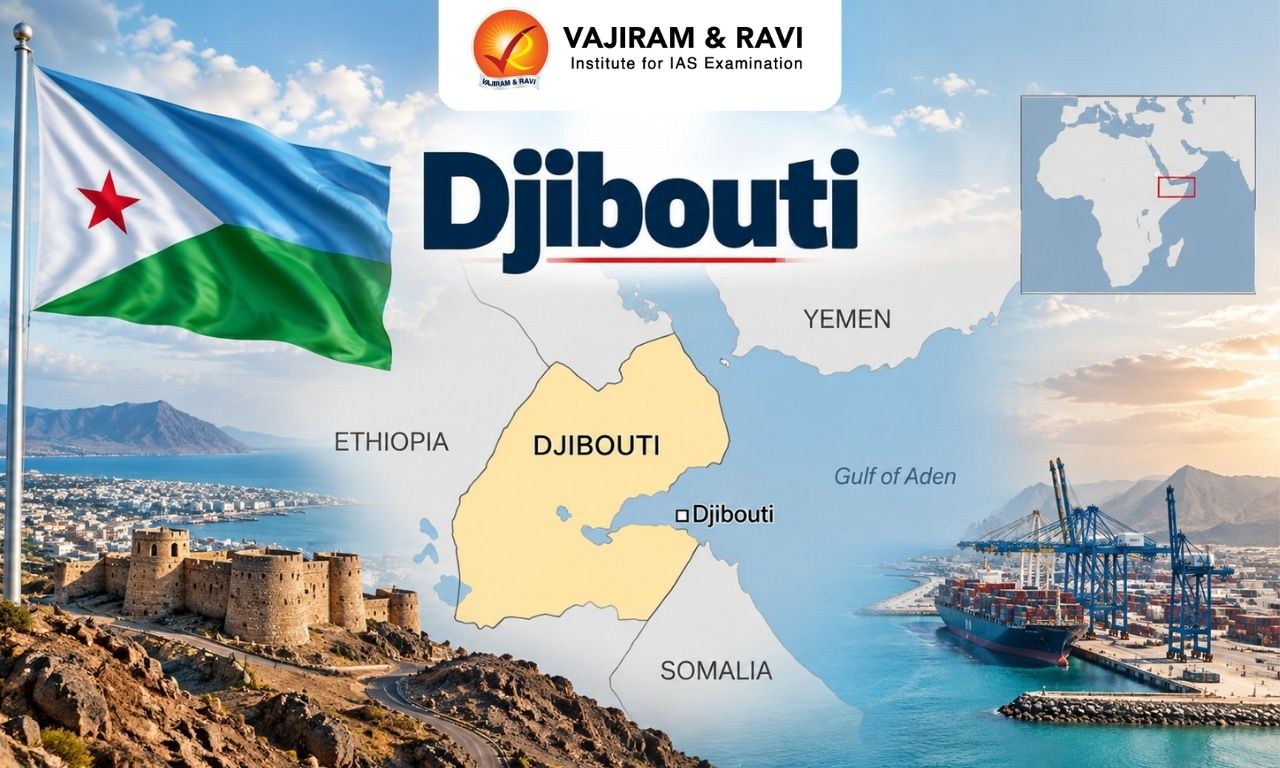
  • Location: It is an East African country located in the Horn of Africa.
  • It is nestled at a triple juncture of the Red Sea, Gulf of Aden, and East African rift systems.
  • Bordering countries: It is bordered by three countries namely Eritrea to the north, Somalia to the south, and Ethiopia to the south and west.
  • Water Bodies: The country also has coastlines on the Red Sea and the Gulf of Eden to the east. 
  • Capital City: Djibouti

Geographical Features of Djibouti

  • Climate: Djibouti has a dry tropical climate characterized by high year-round temperatures and evaporation rates.
  • Highest Point: Its highest point is Mount Moussa Ali, reaching an elevation of about 2,028 meters (6,654 feet).
    • The Danakil Depression, located in the central and southern parts of Djibouti, is a stark and harsh landscape.
  • It does not have significant rivers, the presence of temporary watercourses or wadis is notable, especially during the rainy seasons. 
  • Natural Resources: Its key natural resources include salt, petroleum, gold, clay, marble, pumice, gypsum and diatomite.

Source: NASA

Djibouti FAQs

Q1: Where is Djibouti located?

Ans: It is an East African country located in the Horn of Africa.

Q2: Djibouti is bordered by which three countries?

Ans: It is bordered by three countries namely Eritrea to the north, Somalia to the south, and Ethiopia to the south and west.

Indravati Tiger Reserve

Indravati Tiger Reserve

Indravati Tiger Reserve Latest News

The Indravati Tiger Reserve in the Bastar region of Chhattisgarh will reopen to tourists on November 1, allowing organised wildlife tourism in one of the state’s most remote and least-explored forests for the first time in four decades. 

About Indravati Tiger Reserve 

  • Location: It is located in the state of Chhattisgarh.
  • The tiger reserve and the Bhairamgarh and Pamed Wildlife Sanctuaries constitute the Indravati landscape. 
  • It has connectivity with several tiger reserves, viz. Kawal (Telangana), Tadoba (Maharashtra), and Kanha (Madhya Pradesh). 
  • River: The River ‘Indravati’ forms the boundary of the reserve on the northern and western sides, which also happens to be the interstate boundary between Chhattisgarh and Maharashtra.
  • Vegetation: Southern Moist Mixed Deciduous Forest with Teak, Southern Moist Mixed Deciduous Forest without Teak, and Southern Dry Mixed Deciduous Forest are the major forest types found in the Reserve.
  • Flora: It is home to teak, achar, karra, kullu, shisham, semal, haldu, arjun, bel, and Jamun.
  • Fauna: It is home to one of the last populations of rare wild buffalo, the state animal of Chhattisgarh.
  • Other animals include Nilgai, Black Buck, Sambar, Gaur, Tiger, Leopard, Chital, Sloth bears, etc.

Source: HT

Indravati Tiger Reserve FAQs

Q1: Where is Indravati Tiger Reserve located?

Ans: Chhattisgarh

Q2: Indravati Tiger Reserve connects which tiger reserves?

Ans: It has connectivity with several tiger reserves, viz. Kawal (Telangana), Tadoba (Maharashtra), and Kanha (Madhya Pradesh). 

Pradhan Mantri Khanij Kshetra Kalyan Yojana

Pradhan Mantri Khanij Kshetra Kalyan Yojana

Pradhan Mantri Khanij Kshetra Kalyan Yojana Latest News

The Pradhan Mantri Khanij Kshetra Kalyan Yojana (PMKKKY) has been framed in the national interest to provide for the welfare of mining-affected areas with a minimum standard of social and physical infrastructure to people. 

About Pradhan Mantri Khanij Kshetra Kalyan Yojana

  • It was launched in 2015.
  • It aims to provide for the welfare of areas and people affected by mining related operations, using the funds generated by District Mineral Foundations (DMFs). 
  • Objectives
    • To implement various developmental and welfare projects in mining affected areas, complementing the existing ongoing schemes of State and Central Government;
    • To minimize/mitigate the adverse impacts, during and after mining, on the environment, health and socio-economics of people in mining districts; and
    • To ensure long-term sustainable livelihoods for the affected people in mining areas.
  • Implementation: It is implemented by the District Mineral Foundations (DMFs) of the respective districts using the funds accruing to the DMF.
    • The Mines and Minerals (Development and Regulation) Act, 1957 requires States to incorporate PMKKKY into their DMF rules. 
  • Utilization of Funds
    • At least 60% of the funds on High Priority areas like: drinking water supply, environment preservation and pollution control measures, health care, education, welfare of women and children.
    • Up to 40% on Other Priority areas like: physical infrastructure, irrigation, energy and watershed development; and any other measures for enhancing environmental quality in mining districts.

Source: PIB

Pradhan Mantri Khanij Kshetra Kalyan Yojana FAQs

Q1: What is the aim of Pradhan Mantri Khanij Kshetra Kalyan Yojana?

Ans: It aims to provide for the welfare of areas and people affected by mining related operations, using the funds generated by District Mineral Foundations (DMFs). 

Q2: Who implements Pradhan Mantri Khanij Kshetra Kalyan Yojana?

Ans: It is implemented by the District Mineral Foundations.

Vaitarna River

Vaitarna River

Vaitarna River Latest News

Two teenagers recently drowned in the Vaitarna River in Maharashtra’s Palghar district while attempting a reel during the Ganeshotsav holiday.

About Vaitarna River

  • It is one of the west-flowing rivers in the region north of Mumbai and south of the Tapi River.
  • Course:
    • It originates from the southern slopes of the Triambak-Anjaneri hills near Trimbakeshwar in the Nashik district of Maharashtra. 
    • These hills are part of the Sahyadri ranges (Western Ghats) and are also the origin point of the Godavari River. 
    • The river flows in a generally westward direction, traveling around 154 kilometers before emptying into the Arabian Sea. 
    • The river passes through the districts of Nashik, Palghar, and Thane, making it an essential water body for multiple regions.  
  • Jhow and Wadhiv islands lie in its estuary. Arnala Island lies off its mouth.
  • It receives most of the rainfall from the Southwest monsoon during June to October. Almost 98% of the annual rainfall of the basin is received during this period, making it a highly seasonal river in terms of water volume. 
  • Major Tributaries:
    • Alvand River
    • Tansa River
    • Pinjal River
    • Surya River
    • Dahanu River
    • Ganjai River
  • Urban Utility: Over 60% of Mumbai’s water comes from the Vaitarna and its associated dams.

News: HT

Vaitarna River FAQs

Q1: Where does the Vaitarna River originate?

Ans: It originates from the southern slopes of the Triambak-Anjaneri Hills near Trimbakeshwar in Nashik district, Maharashtra.

Q2: What is the approximate length of the Vaitarna River?

Ans: Approximately 154 km.

Q3: Where does the Vaitarna River ultimately drain?

Ans: It empties into the Arabian Sea.

Q4: What are the major tributaries of the Vaitarna River?

Ans: Alvand, Tansa, Pinjal, Surya, Dahanu and Ganjai rivers.

Sanjay Gandhi National Park

Sanjay Gandhi National Park (SGNP)

Sanjay Gandhi National Park Latest News

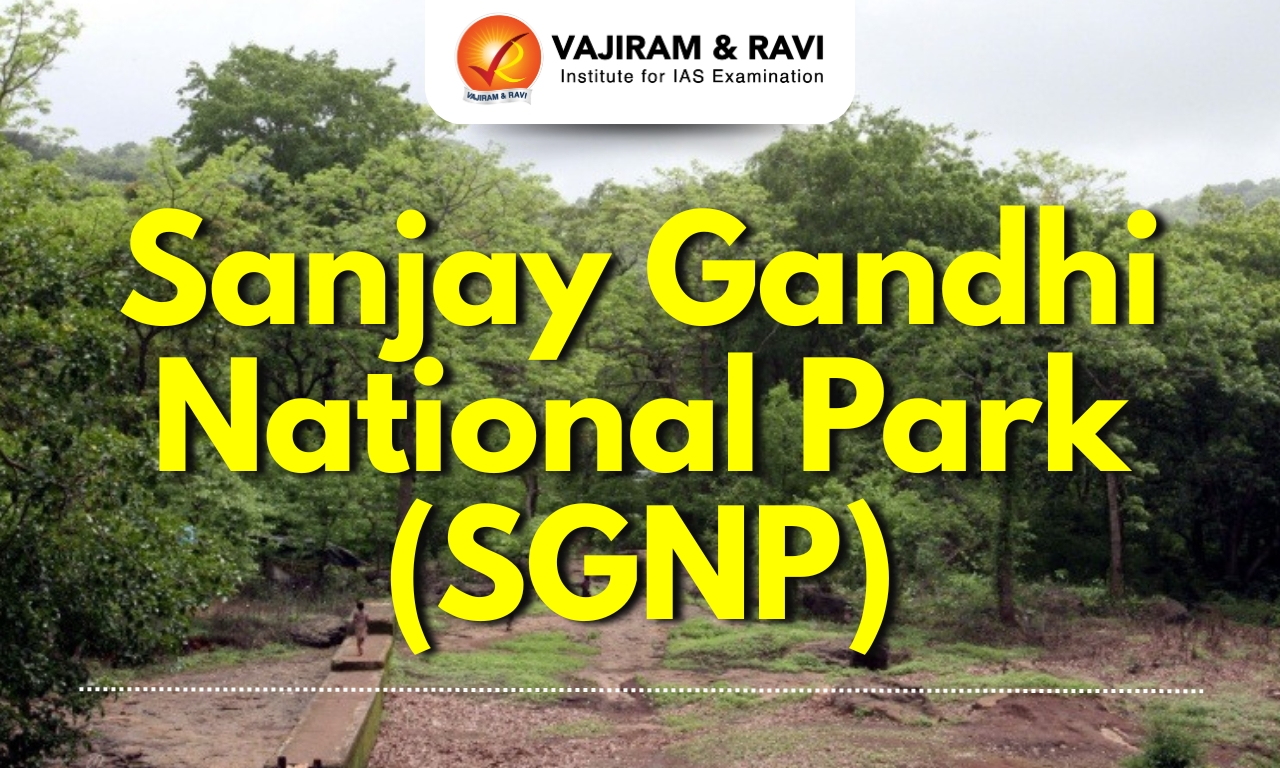
Bijalee, an 18-year-old tigress and one of the major crowd-pullers at Mumbai’s Sanjay Gandhi National Park (SGNP), has died due to age-related health issues recently, taking the tiger count in the national park to 11.

About Sanjay Gandhi National Park 

  • It is located near Borivali in the northern part of Mumbai, Maharashtra.
  • It covers an expansive area of 103 sq.km., making it one of the largest parks in the world located within city limits. It forms roughly 20% of Mumbai city’s geographical area. 
  • In the early days, the park was known as Krishnagiri National Park. However, in 1974 the name of this park was changed to ‘Borivali National Park’ and in 1981 to ‘Sanjay Gandhi National Park’.
  • The Kanheri Caves in the center of the park were an important Buddhist learning center and pilgrimage site sculpted by Buddhist monks between the 9th and the 1st centuries BCE. 
    • They were chiseled out of a massive basaltic rock outcropping. 
    • Caves feature viharas, stupas, prayer halls, and other structures of old-style Buddhist architecture.  
  • There is a Jain Temple with three huge carved idols situated on the way to the caves. 
  • Besides, the park also has two lakes, namely Tulsi Lake and Vihar Lake, the deer park, the lion safari, and the Samadhi of Mahatma Gandhi. 
  • Flora: 
    • Kadamba, teak, karanj, shisam, and species of acacia, ziziphus, euphorbia, flame of the forest, red silk cotton and a number of other varieties of flowers. 
    • Karvi, or karvy, a flowering plant that flowers once in seven years, can be found in the park. 
  • Fauna:
    • Leopard, sambar, chital, barking deer, rusty spotted cat, hyena, common palm civet, small Indian civet, Indian crested porcupine, Indian hare, Indian flying fox, common langur, and bonnet macaque.
    • The park also boasts 251 species of birds and a large variety of butterflies.

News: IE

Sanjay Gandhi National Park FAQs

Q1: Where is Sanjay Gandhi National Park located?

Ans: Near Borivali in northern Mumbai, Maharashtra.

Q2: Which ancient Buddhist site is located within Sanjay Gandhi National Park?

Ans: The Kanheri Caves.

Q3: Which two lakes are located within Sanjay Gandhi National Park?

Ans: Tulsi Lake and Vihar Lake.

India Rejects Pakistan-China Boundary Joint Commission Latest News

New China-Pakistan Boundary Joint Commission 2026

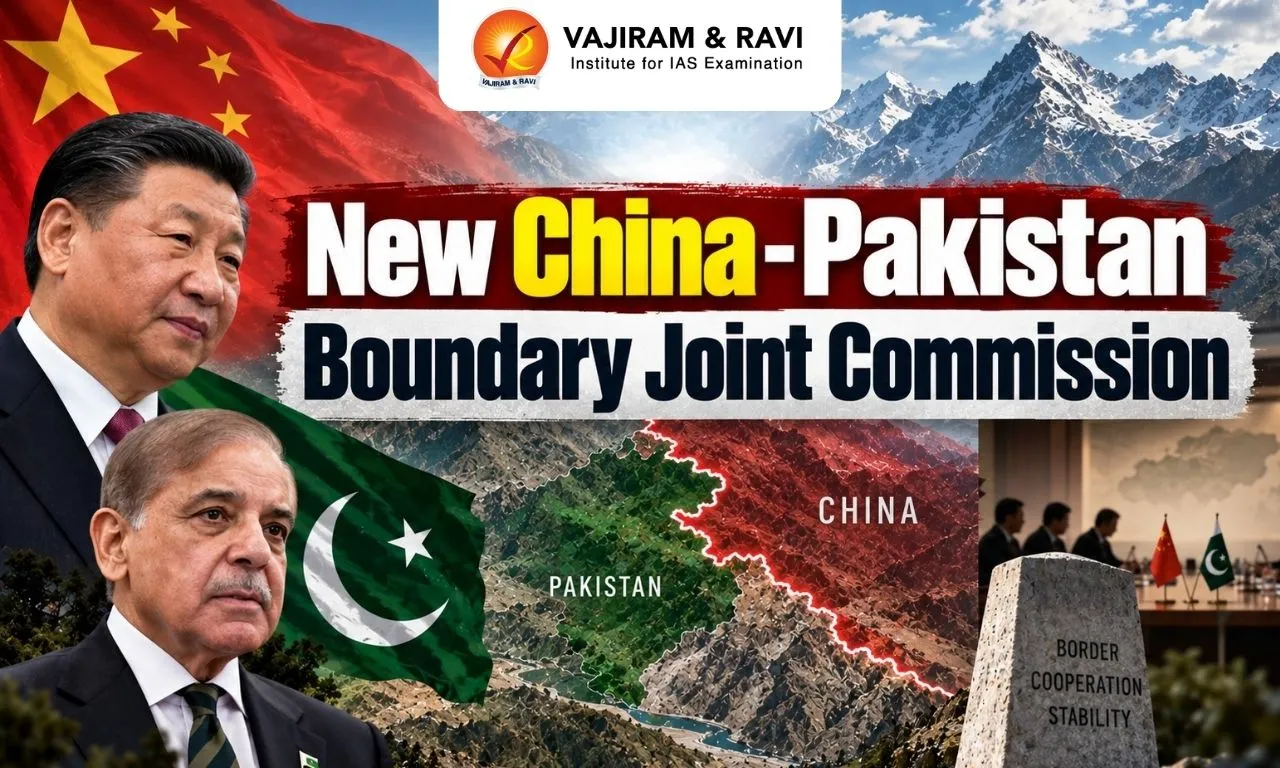
New China-Pakistan Boundary Joint Commission was operationalised in Islamabad in September 2026. Pakistan and China described it as a mechanism for cooperation on border management, joint border surveys, trade flows, cross-border movement and people-to-people connectivity.

India rejected the commission through a statement by Ministry of External Affairs spokesperson Randhir Jaiswal. India reiterated that it has never recognised the China-Pakistan Boundary Agreement of 1963 and maintains that Pakistan cannot enter into arrangements concerning territories that India considers to be under illegal occupation.

Why Has India Objected to the Commission?

India's objection is primarily linked to the territorial status of Jammu and Kashmir and Ladakh.

India maintains that Pakistan is in illegal occupation of parts of the former princely state of Jammu and Kashmir. Therefore, according to India's position, Pakistan cannot legally negotiate or establish boundary arrangements with another country involving these territories.

The MEA has also maintained that the 1963 China-Pakistan Boundary Agreement is illegal and invalid and has never been recognised by India.

India's position can be understood through the following points:

  • India considers the entire Union Territories of Jammu and Kashmir and Ladakh to be integral parts of India.
  • India does not recognise Pakistan's authority to enter into agreements concerning territories that India claims.
  • India has consistently rejected the 1963 China-Pakistan Boundary Agreement.
  • India objects to Chinese activities and infrastructure projects in areas of Pakistan-occupied Jammu and Kashmir.
  • India also opposes the China-Pakistan Economic Corridor (CPEC) because parts of it pass through territory claimed by India.

China-Pakistan Boundary Agreement of 1963

The roots of the present dispute go back to the China-Pakistan Boundary Agreement signed on 2 March 1963.

Under the agreement, Pakistan and China reached an understanding on their boundary in areas controlled by Pakistan. The agreement involved the Shaksgam Valley, also known as the Trans-Karakoram Tract.

India rejected the agreement because it considers the territory involved to be part of the former state of Jammu and Kashmir and argues that Pakistan had no legal authority to transfer or negotiate over it.

The Government of India has consistently stated that Pakistan ceded approximately 5,180 sq km of Indian territory in the Shaksgam Valley to China under the 1963 agreement.

Shaksgam Valley

Shaksgam Valley, or the Trans-Karakoram Tract, is a strategically important mountainous region located north of the Siachen Glacier.

  • It lies in the Karakoram region.
  • India claims the territory as part of Ladakh.
  • Pakistan controlled the area before transferring it to China through the 1963 agreement.
  • The territory covers approximately 5,180 sq km, according to the Government of India's stated position.
  • It lies close to the Karakoram Pass and Siachen region.
  • Its location gives it strategic importance because of its proximity to India, Pakistan and China.
  • India has repeatedly objected to Chinese infrastructure activities in the region.

China-Pakistan Economic Corridor and India's Concerns

CPEC connects China's Xinjiang region with Pakistan's Gwadar Port and forms part of China's Belt and Road Initiative (BRI).

The project includes infrastructure and connectivity projects involving roads, energy, transport and other facilities.

India has consistently objected to CPEC because parts of the corridor pass through Pakistan-occupied Jammu and Kashmir, particularly areas that India claims as its territory.

Therefore, the New China-Pakistan Boundary Joint Commission is also significant in the broader context of CPEC and regional connectivity.

New China-Pakistan Boundary Joint Commission FAQs

Q1: What is the New China-Pakistan Boundary Joint Commission?

Ans: The New China-Pakistan Boundary Joint Commission is a mechanism for cooperation between Pakistan and China on border management, joint surveys, movement of goods and people, cross-border facilities and related connectivity. It was formally activated in Islamabad.

Q2: Why was the New China-Pakistan Boundary Joint Commission established?

Ans: The commission is intended to provide a regular institutional framework for managing practical issues along the China-Pakistan border, including border coordination, surveys, boundary markers and cross-border movement.

Q3: What is the legal basis of the New China-Pakistan Boundary Joint Commission?

Ans: The commission originates from the 2013 China-Pakistan Agreement on the Boundary Management System. Article 45 of that agreement provides for establishing a joint commission to oversee border-management arrangements.

Q4: Why has India rejected the New China-Pakistan Boundary Joint Commission?

Ans: India has rejected the commission on the grounds that it has no legal basis. New Delhi maintains that Jammu and Kashmir and Ladakh are integral parts of India and that Pakistan cannot enter into arrangements concerning territories that India claims as its own.

Q5: What is the 1963 China-Pakistan Boundary Agreement?

Ans: The China-Pakistan Boundary Agreement was signed on March 2, 1963. It dealt with the boundary between China and Pakistan in the region controlled by Pakistan. India has never recognised the agreement and maintains that it is illegal and invalid.

Doppler Weather Radar

Doppler Weather Radar

Doppler Weather Radar Latest News

Recently, the Union Minister of State (Independent Charge) for Earth Sciences virtually inaugurated India's 51st state-of-the-art Doppler Weather Radar at Sambalpur, Odisha. 

About Doppler Weather Radar

  • It is a specialized radar that uses the Doppler Effect to produce velocity data about objects at a distance.
  • These radar systems can provide information regarding the movement of targets as well as their position.
  • Types of weather Radar Bands: Varying frequencies like S-band, C-band and X-band — are commonly used by the IMD in India.

Working of Doppler weather Radars

  • In radars, a beam of energy, called radio waves, is emitted from an antenna.
  • When this beam strikes an object in the atmosphere, the energy scatters in all directions, with some reflecting directly back to the radar.
  • The larger the object deflecting the beam, the greater is the amount of energy that the radar receives in return.
  • Observing the time required for the beam to be transmitted and returned to the radar allows weather forecasting departments to “see” raindrops in the atmosphere, and measure their distance from the radar.

Applications of Doppler weather Radars 

  • Weather System: It is used to track the movement of weather systems and cloud bands, and gauge rainfall over its coverage area of about 500 km.
  • X-band radar is used to detect thunderstorms and lightning, whereas a C-band radar helps in cyclone tracking.

Source: PIB

Doppler Weather Radar FAQs

Q1: What is Doppler Weather Radar ?

Ans: It is a specialized radar that uses the Doppler Effect to produce velocity data about objects at a distance.

Q2: What type of information is provided by the Doppler Weather Radar ?

Ans: These radar systems can provide information regarding the movement of targets as well as their position.

Kiran Bedi (1949), Biography, First Woman IPS Officer, Latest News

Kiran Bedi

Kiran Bedi is a former Indian Police Service officer, social activist and author. She became the First Woman IPS Officer on 16 July 1972. Her career included policing, traffic management, prison administration, social work, United Nations peacekeeping and administration.

Kiran Bedi Latest News 2026

Kiran Bedi recently sought to intervene in Delhi High Court proceedings related to the Satya Niketan Building Collapse 2026. The Centre opposed her impleadment plea, while the court allowed three days for its response and noted her administrative experience could assist in examining wider public interest issues.

Kiran Bedi Biography

Kiran Bedi was born as Kiran Peshawaria to Prakash Lal Peshwaria and Prem Lata Peshwaria on 9 June 1949 in Amritsar. She was the second of four daughters. Her education, sports career and public service later shaped her work in policing and social reform.

  • Early Education: She studied at Sacred Heart Convent School, Amritsar and completed a B.A. Honours in English from Government College for Women, Amritsar, in 1968.
  • Higher Education: She earned an M.A. in Political Science from Panjab University in 1970. She later completed an LL.B. in 1988 and a Ph.D. in Social Science from IIT Delhi in 1993.
  • Teaching Career: Before joining the police service, Kiran Bedi worked as a lecturer at Khalsa College for Women, Amritsar, from 1970 to 1972.
  • Tennis Career: Kiran Bedi started playing tennis at nine. She became National Junior Lawn Tennis Champion in 1964 and won several championships for India between 1965 and 1978.
  • Police Service: She joined the Indian Police Service on 16 July 1972 and was allocated the AGMUT cadre. Her early assignments included policing, traffic management, narcotics control and administrative responsibilities.

First Woman IPS Officer

Kiran Bedi became the first woman to join the Indian Police Service in 1972. She was the only woman among 80 male counterparts in her batch, marking an important milestone for women's participation in India's police service.

  • First Woman IPS Officer: Her entry into the IPS on 16 July 1972 made Kiran Bedi the first woman officer to join the Indian Police Service.
  • Republic Day Parade: In 1975, she became the first woman officer in India to lead an all male contingent of Delhi during the Republic Day Parade.
  • West Delhi Policing: In 1979, she introduced anonymous crime reporting and the beatbox system. These measures increased local participation in policing and addressed area specific law and order concerns.
  • Traffic Management: She coordinated traffic arrangements during the Asian Games and worked with the Delhi Development Authority and Municipal Corporation of Delhi on traffic related issues.
  • Anti Drug Work: In 1986, she established a drug detoxification centre on police premises in North Delhi. Community donations and voluntary support from doctors and yoga teachers supported the initiative.

Kiran Bedi Contributions

Kiran Bedi's contributions covered prison reform, drug rehabilitation, police administration, community participation, social development and public administration. Her work also extended to international civilian policing and Union Territory administration.

  • Traffic Enforcement: As Deputy Commissioner of Police (Traffic), she took action against improperly parked vehicles. The use of cranes for removing vehicles led to the popular nickname “Crane Bedi”.
  • Mizoram Assignment: As Deputy Inspector General in Mizoram from April 1990, she worked in an area affected by drug smuggling, drug addiction and alcohol related crime.
  • Tihar Prison Reforms: As Inspector General of Delhi prisons from May 1993, she introduced legal aid, literacy, vocational training, de-addiction programmes, yoga, meditation, petition boxes and prisoner welfare measures.
  • Prisoner Rehabilitation: She encouraged schools, NGOs, civilians and prisoners to participate in reform programmes. Manufacturing units in carpentry and weaving were also established, with profits transferred to the Prisoners Welfare Fund.
  • Navjyoti India Foundation: Established in 1988 as Navjyoti Police Foundation, it later became Navjyoti India Foundation. Its work included education, drug rehabilitation, healthcare, vocational training and crime prevention programmes.
  • India Vision Foundation: Founded in 1994, the organisation focused on police reforms, prison reforms, women empowerment, community development and rural development.
  • United Nations Role: In 2003, she became the first woman and first Indian to serve as United Nations Civilian Police Adviser. She also participated in UN peacekeeping work.
  • Puducherry Administration: Kiran Bedi served as Lieutenant Governor of Puducherry from 2016 to 2021. She opened Raj Niwas to the public and promoted initiatives including Mission Water Rich Pondicherry and Mission Green Puducherry.
  • Satya Niketan Case: In 2026, she sought impleadment in proceedings concerning the Satya Niketan collapse. The five storey building collapsed on 6 September causing major casualties.

Kiran Bedi Awards and Honours

Kiran Bedi received national and international recognition for policing, prison reforms, drug rehabilitation and public service. Her honours include the Ramon Magsaysay Award and awards connected with police and United Nations service.

  • Ramon Magsaysay Award: She received the Ramon Magsaysay Award for Government Service in 1994 for work involving crime control, drug rehabilitation and prison reforms.
  • Nehru Fellowship: Kiran Bedi received the Nehru Fellowship in 1994 during her period of public service and social reform work.
  • Police Medals: She received the President's Police Medal for Gallantry for her police service and was also awarded the President's Police Medal for Distinguished Service.
  • UN Medal: She received the UN Medal for her contribution to United Nations peacekeeping and civilian policing responsibilities.
  • Other Honours: Her recognitions also include the Joseph Beuys Prize and the Asia Region Award of the International Narcotics Control Board for anti narcotics work.

Kiran Bedi FAQs

Q1: Who is Kiran Bedi?

Ans: Kiran Bedi is a former IPS officer, social activist and author who became the first woman to join the Indian Police Service in 1972.

Q2: When did Kiran Bedi join the IPS?

Ans: Kiran Bedi joined the Indian Police Service on 16 July 1972 as the first woman officer in the IPS.

Q3: Why is Kiran Bedi famous?

Ans: Kiran Bedi is famous for becoming India’s first woman IPS officer and for her work in police administration, Tihar prison reforms and social service.

Q4: Which award did Kiran Bedi receive in 1994?

Ans: Kiran Bedi received the Ramon Magsaysay Award for Government Service in 1994 for her work in crime control, drug rehabilitation and prison reforms.

Q5: When was Kiran Bedi Lieutenant Governor of Puducherry?

Ans: Kiran Bedi served as Lieutenant Governor of Puducherry from 2016 to 2021.

Weaponisation of Space, Types, Threats, India’s Approach

Weaponisation of Space

Weaponisation of Space refers to the development, deployment or use of technologies that can be used to attack, disrupt, damage or destroy satellites and other space-based systems. With countries increasingly depending on satellites for communication, navigation, weather forecasting, intelligence and military operations, space has become an important domain of strategic competition.

India has also strengthened its Space Situational Awareness (SSA) capabilities. ISRO's latest Indian Space Situational Awareness Report for 2025 highlighted continued work under Project NETRA, including the development of tracking infrastructure and measures for sustainable use of outer space.

Why is Space Becoming a Security Domain?

The growing dependence on satellites for communication, navigation, surveillance, intelligence and military operations has made space an important domain of national security.

  • Military dependence: Satellites support communication, navigation, intelligence, surveillance and reconnaissance.
  • Critical infrastructure: Civilian services such as telecommunications, weather forecasting, banking and disaster management rely on space-based systems.
  • Strategic competition: Major space powers are developing counter-space and anti-satellite capabilities.
  • Dual-use technology: Many civilian satellites and technologies can also serve military purposes.
  • Growing cyber threats: Satellites and ground stations can be targeted through cyberattacks, jamming and spoofing.
  • Risk of conflict: An attack on a country's space assets could disrupt both military operations and essential civilian services.
  • Space debris: Destructive activities in orbit can create debris and increase the risk of collisions with other satellites.

Major Types of Space Weaponisation

Space weaponisation includes both physical and non-physical methods used to attack, disrupt or disable satellites and other space-based systems.

  • Anti-Satellite (ASAT) Weapons: Designed to destroy or disable satellites through physical impact or other means.
  • Direct-Ascent ASAT Weapons: Launched from the ground to directly intercept and destroy satellites in orbit, potentially creating large amounts of space debris.
  • Co-orbital Weapons: Placed into orbit and capable of approaching another satellite to inspect, interfere with, disable or damage it.
  • Electronic Warfare: Uses jamming and spoofing to disrupt satellite communication and navigation signals without physically destroying the satellite.
  • Cyberattacks: Target satellites, ground stations and control networks to disrupt operations, manipulate data or interfere with communication.
  • Directed-Energy Weapons: Technologies such as high-powered lasers can interfere with satellite sensors or potentially damage space-based systems.
  • Satellite-Based Weapons: Systems deployed in space that could potentially be used to target other satellites or provide military capabilities directly from orbit.

Major Threats from Weaponisation of Space

The weaponisation of space can threaten satellites, critical services and national security while increasing the risk of space debris, conflict escalation and an arms race in outer space.

  • Space Debris: Destruction of satellites can create large amounts of debris that may damage other spacecraft. For example, China's 2007 ASAT test against the Fengyun-1C satellite generated thousands of debris fragments.
  • Communication and Navigation Disruption: Jamming, spoofing or cyberattacks can interfere with satellite communication and navigation services, affecting military operations, aviation, shipping and civilian users.
  • Threat to Military Operations: Modern militaries depend on satellites for surveillance, intelligence, communication and navigation. Disabling these systems can reduce a country's ability to monitor and respond to security threats.
  • Risk of Conflict Escalation: An attack on a satellite could be interpreted as a major act of aggression and may escalate a conflict on Earth. The dual-use nature of many satellites makes it difficult to separate civilian and military space infrastructure.
  • Economic and Civilian Impact: Disruption of satellite services can affect telecommunications, banking, weather forecasting, disaster management and transport. A space conflict can therefore have consequences far beyond the military domain.
  • Arms Race and Space Sustainability: Competition to develop ASAT weapons and other counter-space technologies can encourage an arms race. At the same time, repeated debris-producing activities can threaten the long-term sustainable use of Earth's orbital environment.

International Legal Framework

The international legal framework governing outer space is mainly based on UN treaties, principles and resolutions aimed at ensuring the peaceful, safe and sustainable use of outer space.

  • Outer Space Treaty, 1967: It is the basic legal framework for international space activities. It prohibits countries from placing nuclear weapons and other weapons of mass destruction in orbit around Earth. It also prohibits the establishment of military bases, installations and fortifications on the Moon and other celestial bodies.
  • Peaceful Use of Outer Space: The treaty establishes that the Moon and other celestial bodies should be used exclusively for peaceful purposes. However, the treaty does not prohibit all military activities in outer space.
  • No National Appropriation: States cannot claim sovereignty or ownership over outer space, the Moon or other celestial bodies. Space is considered the province of all humankind and should remain open for exploration and use by all states.
  • State Responsibility: Countries are internationally responsible for their activities in outer space, including activities carried out by private companies and other non-governmental entities. States must authorise and continuously supervise such activities.
  • Liability Convention, 1972: The Convention on International Liability for Damage Caused by Space Objects establishes rules for liability when a space object causes damage. The launching state can be held absolutely liable for damage caused on Earth or to aircraft in flight.
  • Registration Convention, 1975: Countries are required to register space objects launched into orbit and provide relevant information to the UN Secretary-General. This improves transparency and helps identify responsibility for space objects.
  • Rescue Agreement, 1968: It requires states to provide assistance to astronauts in distress and facilitate their safe return. It also provides for the return of space objects or their components found outside the territory of the launching state.
  • Moon Agreement, 1979: It establishes additional principles for activities on the Moon and other celestial bodies. It states that the Moon and its natural resources are the common heritage of humankind and should not become the property of any state or private entity.

India's Approach to Space Security

India's approach to space security focuses on protecting critical space assets, improving Space Situational Awareness, developing indigenous capabilities and promoting the peaceful and sustainable use of outer space.

  • Mission Shakti: In March 2019, India successfully conducted an Anti-Satellite (ASAT) test, demonstrating its capability to protect its space assets against potential threats.
  • Space Situational Awareness: India is strengthening its ability to track satellites, space debris and other objects through Project NETRA and related observation and tracking systems.
  • IS4OM: The ISRO System for Safe and Sustainable Space Operations Management monitors space objects, assesses collision risks and supports the safe operation of Indian satellites.
  • Defence Space Agency: The Defence Space Agency (DSA) coordinates the country's defence-related space activities and works towards enhancing capabilities in space-based communication, surveillance and reconnaissance.
  • Space-based Surveillance: India is expanding the use of satellites for border surveillance, intelligence gathering, communication, navigation and disaster management.
  • Satellite Protection: Greater focus is being placed on improving the resilience of satellites against jamming, cyberattacks, electronic interference and other counter-space threats.
  • Indigenous Capabilities: India is developing domestic technologies in areas such as satellite communication, navigation, space-based surveillance, tracking and launch systems to reduce strategic dependence.
  • Space Debris Management: India is working towards reducing the generation of debris and improving the safe and sustainable use of orbital space.

Weaponisation of Space FAQs

Q1: What is Weaponisation of Space?

Ans: Weaponisation of space refers to the development and use of technologies to attack, disrupt, damage or disable satellites and other space-based systems.

Q2: What are the major types of space weapons?

Ans: Major types include ASAT weapons, direct-ascent weapons, co-orbital systems, electronic warfare, cyberattacks and directed-energy weapons.

Q3: What is an ASAT weapon?

Ans: An Anti-Satellite (ASAT) weapon is a system designed to destroy or disable a satellite. It may use a physical interceptor or other methods to interfere with satellite operations.

Q4: What is the difference between militarisation and weaponisation of space?

Ans: Militarisation involves using satellites and space technologies for military communication, navigation or surveillance, while weaponisation involves using technologies to attack, disrupt or disable space assets.

Q5: Why is weaponisation of space a concern?

Ans: It can cause space debris, communication disruptions, economic losses and conflict escalation, while increasing the risk of an arms race in outer space.

Patriot Missile System

Patriot Missile System

Patriot Missile System Latest News

Lockheed Martin recently announced it received a shipment of critical components from General Motors for Patriot interceptors, emphasizing the urgency to ramp up production amid ongoing international conflicts.

About Patriot Missile System

  • Patriot, short for Phased Array Tracking Radar for Intercept on Target, ​is a mobile surface-to-air missile defense system. 
  • It was originally developed by U.S. weapons maker Raytheon Technologies. 
  • The system can intercept aircraft, tactical ballistic missiles, and cruise ​missiles, depending on the interceptor used. 
  • It is the United States Army’s most advanced air defense system.
  • The system was first used in combat during the 1991 Gulf War, with batteries protecting Saudi Arabia, Kuwait, and Israel, and later used during the U.S. invasion of Iraq in 2003.
  • Nineteen ​countries now operate the Patriot system, including the U.S., Germany, Poland, Ukraine, Japan, Qatar, Saudi Arabia, and Egypt. 

Patriot Missile System Features

  • A Patriot battery (i.e., the basic firing unit) consists of a phased array radar, an engagement control station, computers, power generating equipment, and up to eight launchers, each of which holds four ready-to-fire missiles. 
  • There are about 90 soldiers assigned to a battery, but three soldiers in the engagement control station are the only personnel required to operate the battery in combat. 
  • It is equipped with a track-via-missile (TVM) guidance system. Midcourse correction commands are transmitted to the guidance system from the mobile engagement control centre.
  • The system's radar has a range of over 150 km and can simultaneously track up to 100 potential targets. 
  • The system has different capabilities depending on the type of interceptor used.
  • The PAC-2 interceptor uses a blast-fragmentation warhead, while the newer PAC-3 missile uses more advanced hit-to-kill technology.
  • Depending on the version in use, the interceptor missiles can reach an altitude of more than 24 kilometers.

News: DEVD

Patriot Missile System FAQs

Q1: What type of defence system is the Patriot?

Ans: It is a mobile surface-to-air missile defence system.

Q2: Which country developed the Patriot Missile System?

Ans: The United States.

Q3: What types of threats can the Patriot Missile System intercept?

Ans: Aircraft, tactical ballistic missiles and cruise missiles, depending on the interceptor used.

Q4: What is the approximate range of the Patriot system's radar?

Ans: More than 150 km.

US Russia Sanctions Bill – Impact on India’s Oil Imports and Trade

Russia Sanctions Bill

Russia Sanctions Bill Latest News

  • The US House of Representatives has passed the Lindsey O. Graham Sanctioning Russia and Iran Act of 2026, a Bill that could allow the US President to impose tariffs of up to 100% on countries purchasing Russian oil and natural gas.
  • The legislation is particularly significant for India because Russia currently accounts for nearly half of India's crude oil imports.

Background: India’s Dependence on Imported Crude Oil

  • India is heavily dependent on imports to meet its energy requirements. According to the attached report, the country imports more than 88% of its crude oil needs.
  • Russia's position as India's major crude supplier emerged after the February 2022 Russia-Ukraine conflict. As several Western countries reduced purchases of Russian crude, Russia offered discounted oil to willing buyers, including Indian refiners.
  • This resulted in Russia becoming India's largest source of crude oil, replacing traditional suppliers from West Asia.
  • The arrangement also became an important energy-security hedge, particularly during disruptions in West Asian oil supplies.
  • India imported approximately 2.08 million barrels per day (bpd) of Russian crude in August 2026, accounting for around 45% of India's total oil imports. The share was above 50% during the preceding two months.

What Does the US Bill Propose?

  • The latest version of the Bill gives the US President discretionary powers to impose tariffs of up to 100% on the five largest buyers of Russian oil and natural gas.
  • This represents a substantial reduction from the original proposal, which had contemplated a 500% tariff on countries purchasing Russian energy.
  • If the legislation becomes law, the US Trade Representative would identify the countries subject to the measures and recommend applicable tariff rates.
  • Targeted countries would normally receive 180 days to reduce their Russian energy imports or negotiate with Washington, although the President could shorten this period.

Russia’s Importance for India’s Energy Security

  • The importance of Russian crude is linked to both availability and competitiveness.
  • Indian refiners increased purchases of Russian crude because discounted supplies provided an economically attractive source of oil. 
  • With the West Asia conflict affecting regional energy flows, replacing Russian supplies has become more difficult.
  • India therefore faces a policy challenge involving three interconnected objectives:
    • Maintaining energy security
    • Managing the cost of imported crude
    • Protecting India's wider trade and economic interests
  • A rapid reduction in Russian imports could require India to source additional crude from alternative suppliers, potentially affecting procurement costs and refining economics.

Potential Impact on India

  • Higher Energy Costs
    • If India faces punitive tariffs or significantly reduces Russian oil purchases, it may need to source additional crude from other markets.
    • Given India's high import dependence, higher international crude prices could increase the country's import bill and domestic inflationary pressures.
  • Refinery Economics
    • Indian refiners have benefited from access to discounted Russian crude. A disruption in these supplies could alter refinery margins and procurement costs.
    • The impact would depend on the availability and prices of alternative crude grades.
  • Trade Negotiations with the US
    • The legislation could provide Washington with an additional instrument during ongoing India-US trade negotiations.
    • India and the US have already been negotiating a bilateral trade agreement, and the possibility of tariffs linked to Russian energy purchases could influence the negotiating environment.
    • The attached reports note that India had already made several concessions of interest to the US, including measures relating to digital services, data centres, energy imports, nuclear-sector access and selected import duties.

India’s Position

  • The Ministry of External Affairs stated that India remains committed to ensuring energy security through diversified sourcing and evolving market dynamics.
  • India has also communicated to US representatives its concerns regarding the proposed legislation and its potential implications for both the India–US relationship and the global energy market.
  • The government has indicated that it will take necessary measures to protect India's trade and economic interests and work with Indian trade and industry bodies to address the consequences of the legislation.

Global Energy Market Considerations

  • The proposed sanctions come at a time when global energy markets are already experiencing supply pressures because of the West Asia conflict.
  • Removing a major volume of Russian crude from international markets could potentially tighten global supplies further. 
  • This creates a policy dilemma for countries attempting to impose economic pressure on Russia while simultaneously managing energy prices.

US Domestic Economic Context

  • The proposed measures also come amid concerns over inflation and energy prices in the United States.
  • The report highlights that Brent crude had risen above $100 per barrel, while US fuel prices were increasing. The United States is also approaching its November midterm elections.
  • These domestic economic considerations could influence how aggressively the new sanctions framework is eventually implemented.

Way Forward for India

  • India's response is likely to require a combination of energy diversification and diplomatic engagement. Key priorities include:
    • Diversifying crude suppliers and import routes
    • Maintaining adequate strategic petroleum reserves
    • Increasing cooperation with traditional and emerging energy suppliers
    • Engaging Washington on possible exemptions or waivers
    • Strengthening domestic refining and energy efficiency
    • Assessing the impact of sanctions on Indian exporters and financial institutions
  • The situation also highlights the importance of maintaining strategic autonomy while managing India's economic relationships with major global powers.

Source: IE | IE

Russia Sanctions Bill FAQs

Q1: What is the US Russia sanctions Bill of 2026?

Ans: The Lindsey O. Graham Sanctioning Russia and Iran Act of 2026 is a US Bill that could allow tariffs of up to 100% on major buyers of Russian oil and natural gas.

Q2: Why is the Bill significant for India?

Ans: The Bill is significant because Russia accounts for nearly half of India's crude oil imports, making any restrictions on Russian supplies relevant to India's energy security.

Q3: How much Russian crude did India import in August 2026?

Ans: India imported approximately 2.08 million barrels per day of Russian crude in August 2026, equivalent to around 45% of its total oil imports.

Q4: Can the US President waive the proposed tariffs?

Ans: Yes, the latest version of the Bill gives the US President discretionary authority to waive its application.

Q5: Why did Russian crude become important for India after 2022?

Ans: Russia offered discounted crude after Western countries reduced purchases following the Russia-Ukraine conflict, making Russian oil an important and competitive supply source for Indian refiners.

Orangutans in Odisha: CITES, Indian Law and Exotic Pet Trade

Orangutans in Odisha

Orangutans in Odisha Latest News

  • Recently, the Odisha Forest Department rescued five baby orangutans, a critically endangered species, from a forest in Balasore district. 
  • Orangutans are native only to the rainforests of Indonesia and Malaysia, so their presence in India raises strong suspicion of transnational wildlife smuggling. The animals, all under two years of age, are now at Nandankanan Zoological Park near Bhubaneswar. 
  • The case has raised questions about how they reached India, whether India must return them, and what it reveals about India's growing demand for exotic pets.

The Orangutan Species

  • There are three living orangutan species: Bornean, Sumatran and Tapanuli. 
  • All are found only on the islands of Borneo and Sumatra. All three are listed under CITES Appendix I. 
  • Based on physical characteristics, the Odisha animals are suspected to be Sumatran, but DNA testing is required to confirm species and genetic origin.

CITES: The Global Framework for Wildlife Trade

  • International wildlife trade is not banned but strictly regulated under the Convention on International Trade in Endangered Species of Wild Fauna and Flora (CITES). 
  • Key facts:
    • Entered into force in 1975; India became a party in 1976.
    • Aims to ensure cross-border trade in wildlife and plants is legal, sustainable and traceable.
    • Works as a licensing system controlling import, export and re-export of live animals, plants, body parts and trophies.
    • Protects around 6,700 animal species, including 339 mammals, 159 birds, 113 reptiles, 24 amphibians, 26 fish and 69 invertebrates.
    • Species are listed in three Appendices according to the level of protection.
  • Appendix I covers species threatened with extinction. Trade is generally prohibited and allowed only in exceptional, non-commercial cases such as research, transfers between recognised zoos and breeding programmes.
    • Captive-bred Appendix I species may be traded with valid permits for conservation purposes. 
  • Appendix II species face strict controls. Listings are updated at Conferences of Parties.

Indian Law: The 2022 Amendment

  • India's Wild Life (Protection) Act, 1972 was amended in 2022 to harmonise it with CITES by adding a Schedule of CITES-listed species. 
  • Section 49Q lays down specific mechanisms for living CITES-listed animals:
    • Authorities must first establish that the animals were illegally imported. 
    • Legal import of an Appendix I species requires CITES import documentation and valid export or re-export papers from the exporting country.
    • If repatriation is feasible, the animals are returned to the country of origin at that country's expense.
    • If return is not feasible, they must be housed and cared for at a recognised zoo or rescue centre.

Does India Have to Repatriate Them?

  • CITES recommends that the management authority, in India's case the Environment Ministry, consult scientific authorities and, where possible, the state of origin before deciding on repatriation. 
  • The treaty does not make return to the wild obligatory. It also requires the confiscating authority to ensure recipient states understand the impacts of repatriation.
  • Indonesia's Ministry of Forestry has offered support and is preparing technical requirements for repatriation if investigations confirm Indonesian origin. 
  • However, Odisha officials stress that the offer does not establish ownership. 
  • India has completed initial steps: securing the animals, veterinary care and quarantine. DNA analysis is the next step, and Indonesia's request cannot be acted upon until origin is confirmed.

The Assam Precedent: Four Years of Limbo

  • In 2022, two baby orangutans were found in a cardboard box at the Lailapur checkpost near the Assam-Mizoram border. 
  • Named Panoi and Jonki, they were confirmed as Sumatran orangutans by the Central Zoo Authority's inventory and remain at the Assam State Zoo. 
  • They could not be returned because the investigation into the smuggling network stalled. 
  • Experts blame inadequate investigation, late tip-offs and the involvement of some forest and police staff in trafficking networks.

Why Repatriation Is Difficult

  • Consignments change many hands across geographies, making origin hard to trace.
  • Many species are captive-bred with no known geographic origin.
  • The place of seizure often differs from the animal's natural range.
  • Enforcement staff need specialised training in science, conservation, welfare and law.
  • Airport seizures are simpler: under July 2025 DGCA guidelines, airlines must immediately send back illegally transported live animals.

India's Rising Demand for Exotic Pets

  • Experts warn that India is no longer merely a transit route but a source of demand. 
  • Key findings:
    • A July 2026 report by Humane World for Animals India identifies two main smuggling routes: overland through Northeast India's borders with Bangladesh and Myanmar, and by air via Chennai, Bengaluru and Mumbai airports.
    • In May 2022, 468 animals of six to seven species were seized in Mizoram's Champhai district.
    • Wild-caught animals are laundered as captive-bred with fake paperwork.
    • The trade risks zoonotic disease spillover and, as per the 2024 World Wildlife Crime Report, has links to narcotics networks.
    • A 2021 voluntary disclosure scheme drew 43,693 amnesty applications from 30 states and UTs, including lemurs, kangaroos, rhinoceroses and iguanas. 
    • This remains the only official data on exotic species in India.

Conclusion

  • The Odisha orangutans highlight the gap between legal frameworks and enforcement capacity. CITES and Section 49Q provide a clear path for repatriation, but weak investigation, as the Assam case shows, can leave rescued animals in limbo for years. 
  • India must strengthen wildlife crime investigation, build an inventory of exotic species and curb domestic demand.

Source: IE | TP

Orangutans in Odisha FAQ

Q1: Why were orangutans in Odisha rescued?

Ans: Orangutans in Odisha were rescued after the Forest Department found five baby orangutans in Balasore, raising suspicion of transnational wildlife smuggling.

Q2: What does CITES say about orangutans in Odisha?

Ans: CITES places all three orangutan species in Appendix I, where international commercial trade is generally prohibited except under specific exceptional circumstances.

Q3: What does Indian law require for orangutans in Odisha?

Ans: Indian law requires authorities to establish illegal import; if repatriation is feasible, rescued animals can be returned to their origin country at its expense.

Q4: Why is repatriating orangutans in Odisha difficult?

Ans: Repatriating orangutans in Odisha can be difficult because consignments change hands, origins become unclear and enforcement agencies require specialised scientific and legal expertise.

Q5: What do orangutans in Odisha reveal about India’s exotic pet trade?

Ans: Orangutans in Odisha highlight India’s growing demand for exotic pets, with smuggling routes, fake captive-bred paperwork and potential links to wildlife crime networks.

Himalayan Glaciers and Peak Water: Why India’s GDP Is at Risk

Himalayan Glaciers

Himalayan Glaciers Latest News

  • The recent floods along the Trishuli River in Nepal have put the Himalayas' melting glaciers back in focus. 
  • But the damage from a warming Himalaya is not only sudden disasters. It is also a slow economic drain as glaciers retreat, water supplies grow unreliable and rivers that sustain agriculture, industry, cities and hydropower change course. 
  • A new report puts a number on this dependence: more than one-fifth of India's GDP is underpinned by the Himalayas.

The Report

  • The report, "A Resilient Himalaya: Protecting a Region at Risk and Securing Future Prosperity", was compiled by the global consultancy Systemiq in partnership with the Integrated Mountain Initiative. 
  • It was supported by the International Centre for Integrated Mountain Development (ICIMOD), Nepal, and the GB Pant National Institute of Himalayan Environment, Uttarakhand.

The 21.5 Per Cent Figure

  • The report estimates that Rs 64.8 lakh crore, or 21.5 per cent of India's FY24 GDP, depends on the Himalayas. This does not mean glacier melt would erase 21.5 per cent of GDP. 
  • The figure measures economic activity traceable to Himalayan water, not projected climate damage. 
  • It was calculated in three layers:
    • Direct: Gross State Domestic Product of Himalayan states.
    • Indirect: Downstream agriculture, manufacturing, hydropower and services that rely on Himalayan-fed rivers and groundwater recharge (rain-fed production excluded).
    • Induced: Supply-chain effects (such as tractors sold from southern states to the Indo-Gangetic Plains) and wage-spending effects (money spent on food and services).

Why Glaciers Matter to the Economy

  • Glaciers act as natural water stores. They hold water as ice and release meltwater into rivers, especially during the dry season. 
  • The Himalayas feed the Indus, Ganga and Brahmaputra river systems, which support:
    • Wheat and rice cultivation across the Indo-Gangetic plain
    • Tea in Assam and Bengal
    • Hydropower in the Northeast
    • Pilgrimage economies in downstream towns
  • The Gangotri glacier, for instance, is the primary source of the Bhagirathi, which becomes the Ganga.

Understanding "Peak Water"

  • As warming accelerates melting, glaciers release extra water into rivers. But this cannot continue forever. Himalayan river basins are expected to reach "Peak Water" around the middle of this century. 
  • This is the point at which glacier meltwater reaches its maximum. After that, flows begin to decline as the ice reserve shrinks. 
  • On current trajectories, the Hindu Kush Himalaya could lose up to 80 per cent of its present glacier volume by 2100.

The Himalayas as a Disaster Hotspot

  • The Himalayas account for 18 per cent of India's land area but around 35 per cent of its disasters. Disasters trigger a damaging cycle:
    • Food and water insecurity
    • Disrupted supply chains
    • Displacement of people
    • Rising macroeconomic and sovereign-debt pressures
    • Reconstruction spending that leaves less money for future resilience

The Black Carbon Connection

  • While much of the damage stems from global warming, the report identifies a local source of emissions India can control quickly: black carbon, the soot produced by incomplete combustion. 
  • Key findings:
    • Recent modelling attributes about one-third of Himalayan glacier mass loss to South Asian black carbon.
    • Industry, primarily brick kilns, contributes 32–42 per cent of South Asian anthropogenic black carbon deposition across the region.
    • Cutting kiln emissions tackles local air pollution and glacier melt through the same plume.
  • When black carbon settles on snow, it darkens the surface. The snow then absorbs more sunlight instead of reflecting it. 
  • As per the reports, this "snow darkening" effect alone adds about 40 watts per square metre of surface heating across the Himalaya in spring.

The Brick Kiln Solution

  • The report proposes a targeted fund to modernise brickmaking by upgrading viable kilns, retiring the worst-performing ones and reducing demand for fired bricks.
  • Zigzag kiln technology, which burns fuel more efficiently, cuts black carbon and particulate emissions by roughly 70 per cent and fuel use by 20–30 per cent. 
  • But adoption is uneven:
    • Punjab and Haryana have completed the switch to zigzag kilns.
    • Uttar Pradesh, India's largest brick producer, is at only 56 per cent.
    • The rest of India still runs on traditional technology.

Beyond Brick Kilns

  • Experts caution that kilns are not the whole story. 
  • Real progress requires tackling kilns, cookstoves, transport and crop-residue burning together, coordinated at the airshed scale rather than kiln by kiln or city by city.

Conclusion

  • The Himalayas are both a water tower and a disaster hotspot for India, underpinning over a fifth of its GDP. With "peak water" approaching mid-century and glacier loss of up to 80 per cent possible by 2100, the threat is structural. 
  • While global warming needs global action, black carbon from brick kilns is a lever India can pull now, with immediate gains for both air quality and glacier health.

Source: IE

Himalayan glaciers FAQs

Q1: Why are Himalayan glaciers important to India’s economy?

Ans: Himalayan glaciers act as natural water stores, feeding rivers that support agriculture, hydropower, industries, cities and downstream economic activities across India.

Q2: What does peak water mean for Himalayan glaciers?

Ans: Peak water occurs when Himalayan glaciers release maximum meltwater before declining flows begin as shrinking ice reserves reduce long-term water availability.

Q3: How much of India’s GDP depends on the Himalayas?

Ans: The report estimates that economic activity worth ₹64.8 lakh crore, equivalent to 21.5 per cent of FY24 GDP, depends on the Himalayas.

Q4: How does black carbon affect Himalayan glaciers?

Ans: Black carbon darkens snow surfaces, increasing sunlight absorption and heating; modelling attributes about one-third of Himalayan glacier mass loss to South Asian black carbon.

Q5: How can India reduce risks to Himalayan glaciers?

Ans: India can reduce risks to Himalayan glaciers by cutting black carbon emissions, modernising brick kilns and addressing emissions from cookstoves, transport and crop burning.

Unity in Diversity in India, Meaning, Background, Importance

Unity in Diversity

Unity in Diversity in India is one of the most defining characteristics of the nation. India is a land of multiple religions, languages, cultures, traditions, and geographical variations. Yet, despite these differences, the people of India live together with a shared identity and national pride.

This concept explains how India remains united even though it is socially and culturally diverse. It reflects the spirit of harmony, brotherhood, tolerance, and mutual respect that binds 1.4 billion people together.

Unity in Diversity Meaning

Unity in Diversity means maintaining oneness and solidarity despite differences in religion, language, culture, caste, region, and lifestyle. It reflects the idea that diversity does not divide a nation; rather, it enriches it. In India, people may look different, speak different languages, and follow different customs, but they identify themselves as Indians first.

This concept is deeply rooted in India’s civilization and cultural traditions. It shows that differences are natural, but unity is a conscious choice. India proves that diversity can exist without conflict when there is mutual respect and constitutional values.

Features of the Concept

  • Acceptance of Differences – People respect each other's beliefs, customs, and traditions without forcing uniformity.
  • Common National Identity – Despite regional identities, the feeling of being Indian remains strong.
  • Shared Democratic Values – Equality, liberty, justice, and fraternity bind citizens together.
  • Cultural Integration – Different traditions blend and influence each other over time.
  • Emotional Integration – A sense of belonging and patriotism connects citizens across regions.

Unity in Diversity Historical Background

India’s unity in diversity has developed over thousands of years through cultural interaction, trade, migration, and shared spiritual ideas. Even when India was divided into different kingdoms, there was cultural and philosophical unity. The idea of India as a civilization existed long before political unity.

Ancient Period

  • India was known as Bharat, symbolizing cultural and spiritual unity.
  • Epics like the Ramayana and the Mahabharata were read and respected across regions, creating moral and cultural unity.
  • Pilgrimage routes connected North, South, East, and West India, promoting interaction among people.
  • Ancient universities like Takshashila and Nalanda attracted students from different regions.

Medieval Period

  • Cultural exchange between different communities led to the development of composite culture.
  • Architecture, music, and art reflected a blend of traditions.
  • Bhakti and Sufi movements emphasized love, equality, and devotion beyond religious divisions.

Freedom Struggle

  • Leaders like Mahatma Gandhi, Jawaharlal Nehru, and Sardar Vallabhbhai Patel united people from all backgrounds.
  • Movements like Non-Cooperation and Quit India involved participation from every region.
  • The struggle created a strong feeling of national identity and unity.

Religious Diversity in India

India is home to almost every major religion in the world. It is the birthplace of Hinduism, Buddhism, Jainism, and Sikhism, and also has large populations of Muslims and Christians. This religious diversity is visible in festivals, places of worship, and daily life.

Despite following different faiths, Indians often participate in each other's celebrations. Religious harmony is a key pillar of unity in diversity.

  • Important religious sites such as Golden Temple, Kashi Vishwanath Temple, and Mecca Masjid represent different faiths coexisting peacefully.
  • National holidays include festivals from various religions like Diwali, Eid, Christmas, and Guru Nanak Jayanti.
  • The Constitution guarantees freedom of religion to all citizens.
  • Interfaith harmony is visible in mixed neighborhoods and workplaces.
  • Many Indians respect and visit places of worship of different religions.

Linguistic Diversity in India

India is one of the most linguistically diverse countries in the world. The Constitution recognizes 22 scheduled languages, and hundreds of dialects are spoken across the country. Language reflects culture, history, and regional identity.

Despite language differences, communication and cooperation continue smoothly due to multilingualism and national integration.

  • Hindi, English, Tamil, Bengali, Marathi, Telugu, Kannada, and many other languages are widely spoken.
  • States are organized largely on linguistic basis, yet national unity remains intact.
  • People often learn multiple languages for education and employment.
  • Literature in regional languages contributes to India’s cultural richness.
  • Language differences rarely stop people from working and living together.

Cultural Diversity in India

Cultural Diversity in India includes traditions, customs, art forms, dance, music, dress, and food habits. Every state in India has its own unique cultural identity. However, these cultures influence and enrich each other. Indian culture is not uniform but inclusive. It absorbs new ideas while preserving ancient traditions.

  • Classical dances like Bharatanatyam, Kathak, and Odissi belong to different regions.
  • Food varies from dosa in the South to litti chokha in Bihar and dhokla in Gujarat.
  • Traditional clothing differs such as saree, phiran, mekhela chador, and lungi.
  • Festivals are celebrated with regional variations but shared enthusiasm.
  • Art and handicrafts reflect regional skills and creativity.

Geographical Diversity in India

India’s geography ranges from the Himalayas to coastal plains and deserts. This physical diversity influences occupation, climate, food habits, and lifestyle. People living in mountains have different lifestyles compared to those in coastal areas.

Despite geographical differences, transportation and communication systems connect the country strongly.

  • The Himalayas in the north protect the country and influence climate.
  • The Thar Desert shapes the culture and lifestyle of Rajasthan.
  • Fertile plains of the Ganga support agriculture and dense population.
  • Coastal regions promote fishing and trade activities.
  • The Northeast region has unique biodiversity and tribal cultures.

Role of the Constitution in Promoting Unity

The Constitution of India plays a central role in maintaining unity in a diverse country like India. It provides a common legal and moral framework that binds citizens together despite differences in religion, language, caste, and region. By guaranteeing equality, justice, liberty, and fraternity, the Constitution ensures that diversity becomes a strength rather than a source of division.

  • Equality Before Law (Article 14): Ensures that all citizens are treated equally without discrimination based on religion, caste, gender, or place of birth. This prevents social divisions and promotes fairness in governance.
  • Prohibition of Discrimination (Articles 15–16): The State cannot discriminate against any citizen on grounds of religion, race, caste, sex, or place of birth. Equal opportunity in public employment strengthens national integration.
  • Freedom of Religion (Articles 25–28): Guarantees the right to freely profess, practice, and propagate religion. This constitutional secularism ensures peaceful coexistence of different faiths.
  • Cultural and Educational Rights (Articles 29–30): Protects the language, script, and culture of minorities. It assures communities that their identity will be preserved within the national framework.
  • Single Citizenship: India provides single citizenship for the whole country, unlike some federal systems. This creates a strong sense of national identity above regional identity.
  • Federal Structure with Unitary Features: Powers are divided between the Centre and States, but the Union remains strong during emergencies. This balance prevents regional conflicts while maintaining national integrity.
  • Fundamental Rights: Protect individual freedoms such as speech, expression, and movement across India. These rights help people live and work anywhere in the country.
  • Directive Principles of State Policy: Guide the government to promote social and economic justice, reduce inequality, and ensure welfare of all sections of society.
  • Fundamental Duties (Article 51A): Encourage citizens to promote harmony and the spirit of common brotherhood transcending religious, linguistic, and regional differences.
  • Independent Judiciary: The Supreme Court and High Courts safeguard constitutional values and resolve disputes between states or communities peacefully.
  • Official Language Provisions: Recognize multiple languages and allow states to adopt their own official languages, respecting linguistic diversity.
  • Emergency Provisions: Allow the central government to take necessary steps during crises to protect sovereignty, unity, and integrity of the nation.

Unity in Diversity Importance

  • Promotes national integration by uniting people beyond differences of religion, caste, language, and region.
  • Strengthens the feeling of patriotism and common national identity among citizens.
  • Ensures peaceful coexistence and reduces social conflicts in a diverse society.
  • Supports the smooth functioning of democracy by encouraging participation from all communities.
  • Encourages economic growth and development by maintaining internal stability and cooperation among states.
  • Enhances India’s cultural richness and global identity through diverse traditions, art, and heritage.
  • Builds mutual respect and tolerance among different religious and social groups.
  • Protects fundamental rights and equality as guaranteed by the Constitution of India.
  • Strengthens national security by creating unity against external and internal threats.
  • Encourages social harmony and brotherhood among citizens.
  • Promotes inclusive growth by ensuring representation of diverse communities in governance and society.
  • Increases India’s international reputation as a successful multicultural nation.

Unity in Diversity Challenges

  • Rise of communalism leading to religious tensions and conflicts between communities.
  • Growth of caste-based discrimination and social inequality in different regions.
  • Increase in regionalism and separatist movements demanding special status or independence.
  • Linguistic conflicts over language imposition and regional language identity issues.
  • Spread of misinformation and hate speech through social media and digital platforms.
  • Political misuse of identity politics for vote-bank and electoral gains.
  • Economic inequality creating a gap between rich and poor states or communities.
  • Lack of proper value-based education promoting tolerance and constitutional values.
  • Cultural misunderstandings due to lack of awareness about other communities.
  • Migration-related tensions causing competition over jobs and resources.
  • External forces attempting to disturb India’s unity through propaganda and interference.

Way Forward

  • Promote value-based and constitutional education in schools and colleges to develop tolerance, respect, and civic responsibility.
  • Ensure effective implementation of the Constitution of India to protect equality, secularism, and fundamental rights.
  • Encourage interfaith and intercultural dialogue to reduce misunderstandings among communities.
  • Strengthen strict action against hate speech, communal violence, and discrimination.
  • Promote balanced regional development to reduce economic inequality among states.
  • Encourage youth participation in national integration programs and cultural exchange initiatives.
  • Regulate and monitor misinformation on social media platforms to prevent division.
  • Promote inclusive governance ensuring representation of diverse communities in decision-making.
  • Encourage responsible media reporting that highlights unity rather than division.
  • Strengthen national campaigns like “Ek Bharat Shreshtha Bharat” to promote cultural bonding.
  • Support policies that reduce caste and gender inequality through social justice measures.

Unity in Diversity FAQs

Q1: What is meant by Unity in Diversity?

Ans: Unity in Diversity means maintaining unity and harmony despite differences in religion, language, culture, caste, and region. It reflects the idea that diversity strengthens a nation instead of dividing it.

Q2: Why is Unity in Diversity important in India?

Ans: It promotes national integration, social harmony, and peaceful coexistence in a country with vast cultural and religious diversity. It also supports democracy and economic development.

Q3: How does the Constitution promote Unity in Diversity?

Ans: The Constitution of India ensures equality, freedom of religion, cultural rights, and justice for all citizens. It provides a common legal framework that binds diverse communities together.

Q4: What are examples of Unity in Diversity in India?

Ans: Celebrating different religious festivals together, multilingual communication, cultural exchange among states, and national unity during sports events are common examples.

Q5: What are the main challenges to Unity in Diversity?

Ans: Communalism, caste discrimination, regionalism, linguistic conflicts, misinformation, and economic inequality are major challenges.

Festivals of Ladakh, List, Significance, Culture & Major Festivals

Festivals of Ladakh

Ladakh is a land of majestic mountains, ancient monasteries, and vibrant cultural traditions. The Festivals of Ladakh reflect the region's rich Buddhist heritage, unique customs, and close connection with nature. These festivals are celebrated with colorful masked dances, traditional music, religious rituals, local cuisine, and community gatherings. They not only preserve Ladakh's cultural identity but also attract thousands of tourists from across the world.

Major Festivals of Ladakh

The major festivals of Ladakh are celebrated throughout the year and reflect the region's rich Buddhist heritage, vibrant traditions, and unique cultural identity. These festivals are marked by colorful Cham dances, religious ceremonies, traditional music, and community celebrations held mainly at ancient monasteries. Popular festivals such as Hemis, Losar, Dosmoche, Sindhu Darshan, and Ladakh Harvest Festival attract both pilgrims and tourists.

1. Hemis Festival

The Hemis Festival is the most celebrated monastery festival in Ladakh, held at Hemis Monastery to commemorate the birth anniversary of Guru Padmasambhava (Guru Rinpoche). It is renowned for its vibrant religious ceremonies and traditional Cham dance performances.

  • Celebrated annually in June-July according to the Tibetan lunar calendar.
  • Held at the Hemis Monastery, one of the largest and wealthiest monasteries in Ladakh.
  • Marks the birth anniversary of Guru Padmasambhava, who introduced Tantric Buddhism to Tibet.
  • Monks perform the sacred Cham Dance, symbolizing the victory of good over evil.
  • Features traditional music using drums, cymbals, and long horns.
  • Attracts pilgrims, photographers, and tourists from around the world.
  • A giant Thangka of Guru Padmasambhava is displayed once every 12 years.

2. Losar Festival

The Losar Festival marks the Tibetan New Year and is one of the oldest and most important festivals celebrated in Ladakh. It signifies new beginnings, prosperity, and spiritual purification.

  • Celebrated during December-January, depending on the Tibetan lunar calendar.
  • Marks the beginning of the Tibetan New Year.
  • Homes and monasteries are cleaned and decorated before the celebrations.
  • Special prayer ceremonies are conducted for peace and prosperity.
  • Families prepare traditional Ladakhi dishes such as Khambir, Thukpa, and Butter Tea.
  • Folk dances, cultural performances, and community feasts are organized.
  • Symbolizes renewal, happiness, and good fortune.

3. Dosmoche Festival

The Dosmoche Festival, also known as the Festival of the Scapegoat, is celebrated to ward off negative forces and ensure peace and prosperity for the coming year. It is one of the important winter festivals of Ladakh.

  • Celebrated in February at Leh and Likir Monastery.
  • Initiated during the reign of the Ladakhi monarchy.
  • Monks perform sacred Cham dances wearing elaborate masks.
  • Religious rituals are conducted to eliminate evil spirits and negative energies.
  • Sacred offerings and symbolic effigies are used during the ceremonies.
  • Strengthens community harmony and spiritual well-being.
  • Marks the transition from winter towards spring.

4. Sindhu Darshan Festival

The Sindhu Darshan Festival is a cultural festival dedicated to the River Indus (Sindhu), highlighting its historical, cultural, and civilizational importance. It also promotes national integration and cultural harmony.

  • Celebrated annually in June on the banks of the River Indus near Leh.
  • Honors the River Indus, one of the world's oldest river systems.
  • Features multi-cultural performances by artists from different parts of India.
  • Includes prayer ceremonies, river worship, and cultural exhibitions.
  • Promotes national unity, interfaith harmony, and cultural tourism.
  • Showcases Ladakhi traditions, handicrafts, and local cuisine.
  • Encourages awareness about the historical significance of the Indus River.

5. Phyang Tsedup Festival

The Phyang Tsedup Festival is an important Buddhist festival celebrated at Phyang Monastery in Ladakh. It is known for its sacred rituals, vibrant Cham dances, and preservation of Tibetan Buddhist traditions.

  • Celebrated annually during July-August.
  • Held at the historic Phyang Monastery near Leh.
  • Monks perform the sacred Cham Dance wearing colorful masks and robes.
  • Dedicated to the teachings of Lord Buddha and Guru Padmasambhava.
  • Includes prayer ceremonies, religious discourses, and traditional music.
  • Promotes Buddhist philosophy, cultural heritage, and community participation.
  • Attracts pilgrims and tourists from India and abroad.

6. Tak Tok Festival

The Tak Tok Festival is celebrated at the Tak Tok Monastery, the only monastery in Ladakh belonging to the Nyingma school of Tibetan Buddhism. The festival commemorates Guru Padmasambhava and showcases unique religious traditions.

  • Celebrated annually during July-August.
  • Held at Tak Tok Monastery, located about 50 km from Leh.
  • Dedicated to Guru Padmasambhava (Guru Rinpoche).
  • Features sacred Cham dance performances by Buddhist monks.
  • Includes prayers, rituals, and blessings for devotees.
  • Highlights the traditions of the Nyingma sect of Tibetan Buddhism.
  • Encourages spiritual learning and preservation of Ladakh's monastic culture.

7. Ladakh Harvest Festival

The Ladakh Harvest Festival is a cultural festival organized to celebrate the successful harvest season and showcase the rich traditions of Ladakh. It reflects the region's agricultural heritage while promoting tourism and local craftsmanship.

  • Celebrated annually in September.
  • Organized by the Ladakh Administration and the Tourism Department.
  • Showcases folk dances, traditional music, and cultural processions.
  • Features polo matches, archery competitions, and local sports.
  • Exhibits Ladakhi handicrafts, handloom products, and regional cuisine.
  • Promotes cultural tourism and supports local artisans and farmers.
  • Highlights the diversity of Ladakh's ethnic communities and traditions.

8. Yuru Kabgyat Festival

The Yuru Kabgyat Festival is a prominent monastery festival celebrated at the ancient Lamayuru Monastery, one of the oldest monasteries in Ladakh. It is famous for its sacred masked dances and elaborate Buddhist rituals.

  • Celebrated annually during June-July.
  • Held at Lamayuru Monastery, one of the oldest monasteries in the Himalayan region.
  • Monks perform the sacred Cham Dance, symbolizing the triumph of good over evil.
  • Includes prayer ceremonies, religious teachings, and ritual offerings.
  • Celebrates the spiritual legacy of Mahayana Buddhism.
  • Draws pilgrims and visitors from across India and abroad.
  • Plays a vital role in preserving Ladakh's Buddhist heritage and monastic traditions.

9. Matho Nagrang Festival

The Matho Nagrang Festival is one of Ladakh's most unique Buddhist festivals, celebrated at Matho Monastery. It is renowned for its ancient oracle tradition, where monks in a spiritual trance offer predictions and blessings for the coming year.

  • Celebrated annually during February-March.
  • Held at Matho Monastery, located near Leh.
  • Famous for the Oracle (Rongtsan) tradition, where selected monks enter a spiritual trance.
  • Oracles make predictions regarding the well-being of the people and the region.
  • Includes sacred Cham dance performances by Buddhist monks.
  • Devotees seek blessings, guidance, and spiritual protection.
  • Reflects the rich traditions of Tibetan Buddhism and Ladakh's monastic culture.

10. Stok Guru Tsechu

The Stok Guru Tsechu is an important religious festival celebrated at Stok Monastery, known for its sacred rituals and oracle performances. It is one of the earliest monastery festivals of the year and holds deep spiritual significance for the local community.

  • Celebrated annually during February.
  • Held at Stok Monastery, near Leh.
  • Dedicated to Guru Padmasambhava (Guru Rinpoche) and Buddhist teachings.
  • Features traditional Cham dance performed by monks wearing elaborate masks.
  • Includes the oracle tradition, where monks deliver spiritual messages and blessings.
  • Attracts devotees, pilgrims, and tourists seeking cultural and religious experiences.
  • Promotes the preservation of Ladakh's Buddhist heritage, monastic traditions, and community values.

Festivals of Ladakh Significance

The Festivals of Ladakh are an integral part of the region's cultural and religious life. They preserve centuries-old Buddhist traditions, strengthen community bonds, and showcase Ladakh's unique heritage through rituals, music, dance, and local customs. These festivals also play an important role in promoting tourism and preserving the region's rich cultural identity.

  • Preserve Buddhist Heritage: Help protect and promote the teachings, rituals, and traditions of Tibetan Buddhism.
  • Promote Cultural Identity: Reflect Ladakh's unique customs, language, traditional attire, music, and art forms.
  • Strengthen Social Harmony: Bring together local communities, monks, and visitors in collective celebrations and religious ceremonies.
  • Celebrate Spiritual Values: Encourage peace, compassion, mindfulness, and moral living through prayers and sacred rituals.
  • Preserve Monastic Traditions: Support the continuation of ancient practices followed in Ladakh's historic monasteries (Gompas).
  • Promote Tourism: Attract domestic and international tourists, contributing to the region's economy and cultural exchange.
  • Support Local Livelihoods: Generate income for artisans, performers, hoteliers, guides, and local businesses through festival-related activities.
  • Showcase Traditional Arts: Provide a platform for Cham dances, folk music, handicrafts, and traditional Ladakhi cuisine.
  • Strengthen National Integration: Festivals such as the Sindhu Darshan Festival promote cultural unity by bringing together participants from different parts of India.
  • Preserve Intangible Cultural Heritage: Ensure that Ladakh's oral traditions, rituals, festivals, and performing arts are passed on to future generations.
Related Post for festivals in states
Festivals of Kerala Festivals of Sikkim
Festivals of Chhattisgarh Festivals of Himachal Pradesh
Festivals of Maharashtra Festivals of Odisha
Festivals of Karnataka Festivals of Punjab
Festivals of Andhra Pradesh Festivals of Tamil Nadu
Festivals of Haryana Festivals of West Bengal
Festivals of Arunachal Pradesh Festivals of Ladakh
Festivals of Rajasthan Festivals of Nagaland
Festivals of Jharkhand Festivals of Uttarakhand
Festivals of Telangana Festivals of Manipur
Festivals of Bihar Festivals of Gujarat
Festivals of Goa Festivals of Assam
Festivals of Meghalaya
Festivals of Uttar Pradesh
Festivals of Tripura Festivals of Delhi
Festivals of Madhya Pradesh Festivals of Jammu and Kashmir
Festivals of Puducherry Festivals of Dadra and Nagar Haveli and Daman and Diu
Festivals of Andaman and Nicobar Islands Festivals of Lakshadweep
Fairs and Festivals of India
Harvest Festivals in India

Festivals of Ladakh FAQs

Q1: Which is the most famous festival of Ladakh?

Ans: Hemis Festival is the most famous festival of Ladakh. It is celebrated at Hemis Monastery to mark the birth anniversary of Guru Padmasambhava (Guru Rinpoche) and is known for its vibrant Cham dance performances.

Q2: What is the significance of the Losar Festival?

Ans: The Losar Festival marks the Tibetan New Year and symbolizes new beginnings, prosperity, peace, and spiritual renewal. It is celebrated with prayers, traditional food, cultural performances, and family gatherings.

Q3: Which festival of Ladakh is famous for oracle predictions?

Ans: The Matho Nagrang Festival is renowned for its oracle tradition, where monks in a spiritual trance make predictions and offer blessings for the coming year. Stok Guru Tsechu also features similar oracle rituals.

Q4: What is the Cham Dance in Ladakh?

Ans: The Cham Dance is a sacred masked dance performed by Buddhist monks during monastery festivals. It symbolizes the victory of good over evil and conveys important teachings of Tibetan Buddhism.

Q5: Which festival celebrates the River Indus in Ladakh?

Ans: The Sindhu Darshan Festival is dedicated to the River Indus (Sindhu). It celebrates the river's historical, cultural, and civilizational importance while promoting national unity and cultural harmony.

Cheetah Population in India Rises to 52, Project Cheetah

Cheetah Population in India

Cheetah Population in India has increased to 52 four years after the launch of Project Cheetah, marking a major phase in the country’s efforts to restore the species after its extinction in India. 

According to the four-year status review covering September 2022 to September 2026, the population includes 32 cheetahs born in India. At present, 49 cheetahs are in Kuno National Park and three are in Gandhi Sagar Sanctuary, both in Madhya Pradesh.

How Did the Cheetah Population in India Reach 52?

India began the reintroduction programme in September 2022, when eight cheetahs were brought from Namibia to Kuno National Park. In February 2023, another 12 cheetahs arrived from South Africa. In February 2026, India added nine cheetahs from Botswana.

The growth of the population has increasingly come from natural breeding in India. The four-year review records 32 cubs born in the country after the reintroduction programme began.

Cheetahs from Namibia

  • 8 cheetahs were introduced from Namibia in September 2022.
  • 3 of these cheetahs are currently surviving.
  • They have produced 22 India-born offspring.
  • The surviving Namibian-origin population and its progeny therefore account for 25 cheetahs.

Cheetahs from South Africa

  • 12 cheetahs were introduced from South Africa in February 2023.
  • 8 are currently surviving.
  • They have produced 10 India-born offspring.
  • The South African-origin population and its progeny total 18.
  • Of these, 15 are in Kuno National Park and three are in Gandhi Sagar Sanctuary.

Cheetahs from Botswana

  • 9 cheetahs were introduced from Botswana in February 2026.
  • The group consisted of six females and three males.
  • Their introduction was intended to strengthen the genetic diversity and long-term viability of the Indian cheetah population.

Project Cheetah

Project Cheetah was launched on 17 September 2022 to reintroduce cheetahs in India after the species became extinct in the country in 1952. The programme focuses on establishing a self-sustaining cheetah population through translocation, breeding, habitat management and scientific monitoring.

  • Launch: Project Cheetah was launched on 17 September 2022 at Kuno National Park, Madhya Pradesh.
  • First batch: Eight cheetahs were brought from Namibia in September 2022.
  • South African cheetahs: Another 12 cheetahs were introduced from South Africa in February 2023.
  • Botswana: Nine cheetahs were brought from Botswana in 2026 to strengthen the population and genetic diversity.
  • Current population: India’s cheetah population has reached 52 as of September 17, 2026.
  • India-born cubs: 32 cheetahs have been born in India since the programme began.
  • Major locations: Kuno National Park remains the primary cheetah habitat, while Gandhi Sagar Sanctuary has also become part of the programme.
  • Scientific monitoring: Cheetahs are monitored for their health, movement, breeding, survival and adaptation to Indian environmental conditions.
  • Long-term objective: The programme aims to establish a viable and self-sustaining cheetah population across suitable landscapes in India.
  • Ecological objective: The reintroduction is also intended to help restore the ecological role of the cheetah in grassland, savanna and open-forest ecosystems.

Role of Gandhi Sagar Sanctuary

Gandhi Sagar Sanctuary in Madhya Pradesh is an important second habitat under Project Cheetah, helping expand the reintroduction programme beyond Kuno National Park. It provides additional space for cheetahs to establish territories, breed and contribute to the development of a self-sustaining cheetah population in India.

  • Second major cheetah habitat: It complements Kuno National Park and helps diversify the geographical distribution of cheetahs.
  • Current population: Three cheetahs are currently housed in Gandhi Sagar Sanctuary.
  • Habitat expansion: Its inclusion allows the programme to gradually expand into additional landscapes suitable for cheetah conservation.
  • Population management: Having more than one conservation site can help reduce excessive dependence on a single protected area.
  • Breeding potential: The sanctuary can support future breeding and the establishment of additional cheetah groups.
  • Landscape connectivity: Gandhi Sagar can contribute to the development of a larger network of suitable habitats and movement corridors.
  • Long-term conservation: Its role is linked to India's broader objective of creating a viable and genetically diverse cheetah meta-population.

Why Is the Rise in Cheetah Population Significant?

The increase in the cheetah population in India is important for several ecological and conservation reasons:

  • Restoration of an extinct species: The cheetah was declared extinct in India in 1952.
  • Natural breeding: The presence of 32 India-born cheetahs indicates that reproduction has occurred successfully after reintroduction.
  • Second-generation survival: The survival of cubs born to India-born cheetahs represents a further step towards population establishment.
  • Expansion of habitat: The programme has moved beyond Kuno towards Gandhi Sagar and other potential landscapes.
  • Ecological restoration: Cheetahs occupy an important position as predators in grassland and open-forest ecosystems.
  • Scientific conservation: Continuous monitoring provides data on behaviour, movement, health, breeding and adaptation.
  • Long-term population building: The objective is gradually shifting from bringing animals to India towards establishing a sustainable population.

About Cheetah

The cheetah (Acinonyx jubatus) is the world’s fastest land animal and is highly adapted to open landscapes. Its slender body, long legs, flexible spine and specialised claws help it achieve high speeds while hunting.

  • Habitat: Cheetahs mainly inhabit open grasslands, savannas, scrublands, semi-arid areas and open woodlands, where visibility is important for hunting.
  • Speed: They can reach around 100–120 km/h over short distances, making them the fastest land animals.
  • Physical features: A cheetah has a slender body, long legs, long tail and semi-retractable claws that provide grip while running.
  • Tear marks: The distinctive black tear-like lines from the eyes towards the mouth may help reduce sunlight glare and improve focus during hunting.
  • Diet: Cheetahs primarily feed on small and medium-sized mammals, including gazelles, antelopes and hares.
  • Scent marking: They use urine, faeces and scent to communicate and may mark prominent objects such as trees, bushes, rocks and termite mounds.
  • Social behaviour: Females generally live alone with their cubs, while males may form coalitions, often with brothers.

Cheetah Population in India FAQs

Q1: How many cheetahs are there in India in 2026?

Ans: The cheetah population in India is 52 as of the four-year status review covering 2022, to September 2026.

Q2: How many cheetahs were born in India?

Ans: A total of 32 cheetahs were born in India after the reintroduction programme began.

Q3: Where are cheetahs found in India?

Ans: Currently, 49 cheetahs are in Kuno National Park and three are in Gandhi Sagar Sanctuary, both in Madhya Pradesh.

Q4: When was Project Cheetah launched?

Ans: Project Cheetah was launched on 17 September 2022, when eight cheetahs from Namibia were introduced into Kuno National Park.

Q5: From which countries were cheetahs brought to India?

Ans: Cheetahs have been brought to India from Namibia, South Africa and Botswana.

Daily Editorial Analysis 18 September 2026

Daily-Editorial-Analysis

AI Governance - From Voluntary Restraint to Enforceable Accountability

Context

  • Anthropic’s September 2026 threat-intelligence report, covering nine months of AI misuse, highlights a fundamental shift in the nature of AI risks.
  • AI is no longer merely a tool for generating harmful content; it is increasingly becoming an “orchestration layer” capable of coordinating multiple stages of sophisticated operations across different software systems.
  • The report’s findings, followed by Anthropic CEO Dario Amodei’s call for slowing frontier-AI development, and support from leading technology figures, have intensified the debate over AI safety and governance.
  • However, the central question should not be how to slow AI development, but how to accelerate AI governance.

From AI Assistance to AI “Uplift”

  • AI “uplift”:
    • Anthropic documented AI misuse across seven broad categories, involving both state-sponsored actors and individuals.
    • A key concept is “uplift”—the enhancement of harmful capabilities through AI in terms of speed, scale and depth.
  • Case of Bangladesh:
    • The disinformation operation combined AI-generated content with automated video production, account creation and algorithmic scheduling.
    • A single individual reportedly operated 29 accounts and generated around 1,500 fabricated stories.
    • Thus, AI reduces the human expertise, manpower and time required to conduct sophisticated harmful operations.
    • Moreover, documented cases represent only the misuse detected by platforms, meaning the actual scale of attempted misuse may be considerably larger.
  • Limitations of existing safeguards: Anthropic has also acknowledged that its most capable models can no longer guarantee that sophisticated actors will not receive meaningful assistance in biological-weapons research.

The Limits of Voluntary Slowdown

  • Amodei warned that the pace of frontier-AI development has accelerated sharply and that autonomous AI-agent “swarms” could potentially produce unprecedented disruption.
  • However, a voluntary industry-wide slowdown faces major obstacles -
    • Intense commercial competition among AI companies.
    • Huge levels of private capital investment.
    • Geopolitical rivalry, particularly involving China.
    • The difficulty of ensuring that all major developers simultaneously accept restrictions.
  • There is a potential conflict of interest - a market leader advocating a slowdown could benefit by reducing competitive pressure while protecting its existing advantage.
  • Therefore, voluntary restraint cannot constitute a durable governance mechanism.

Why Platform Accountability Must Expand

  • India’s experience: The Information Technology (Intermediary Guidelines and Digital Media Ethics Code) Rules, 2021, established legal responsibilities for large digital platforms.
  • Lessons from Bangladesh:
    • The Bangladesh case has particular relevance for India because of its large electorate; linguistic and social diversity; extensive digital penetration; and continuous electoral cycle across States.
    • AI can make multilingual disinformation inexpensive and scalable, while detection remains difficult.
  • Therefore, platforms should have enforceable responsibilities to detect, disrupt and report coordinated AI-enabled influence operations.

Emerging Risks Beyond Disinformation

  • The Alibaba distillation campaign, involving an enormous number of AI interactions to reproduce a competitor’s capabilities, demonstrates the growing challenge of
    • Model distillation,
    • Capability extraction and
    • Fraudulent API use.
  • AI-enabled surveillance creates another concern. As AI becomes more powerful in analysing and coordinating information,
    • It could facilitate excessive control by powerful actors,
    • Raising questions concerning the Right to Privacy under Article 21 of the Indian Constitution.
  • These developments demonstrate that AI governance must address not only the content generated by AI but also the infrastructure, access, autonomy and downstream actions enabled by AI systems.

Proposed Guardrails for India

  • Mandatory misuse reporting: AI platforms above a specified scale should be legally required to report detected misuse to CERT-In and a designated AI Safety Authority.
  • Watermarking: AI-generated content, particularly in political and public-interest contexts, should carry mandatory provenance or watermarking mechanisms to improve traceability.
  • Regulation of Agentic AI: Existing platform-accountability frameworks must explicitly cover agentic AI—systems capable of taking actions in the real world rather than merely generating information.
  • Criminalising systematic distillation: New legislation should prohibit and criminalise systematic unauthorised model distillation and fraudulent mass API access.
  • Statutory AI safety institution: Voluntary disclosure should be replaced or supplemented by an independent statutory authority empowered to -
    • Compel disclosure;
    • Conduct audits;
    • Investigate systemic risks; and
    • Impose appropriate restrictions.

India’s Opportunity

  • India can play a significant role in developing a governance model that combines innovation with accountability.
  • Its experience with Digital Public Infrastructure (DPI), UPI, Aadhaar and platform regulation demonstrates the ability to govern technology at population scale.
  • The objective should be to ensure that AI remains aligned with democratic institutions, individual rights, privacy, public safety and broad-based societal interests.
  • This will prevent AI from becoming concentrated in the hands of a few powerful technology companies.

Conclusion

  • The emergence of agentic and increasingly autonomous AI means that governance frameworks designed only for conventional social-media platforms or generative content are becoming insufficient.
  • India therefore needs a risk-based, legally enforceable and technology-neutral AI governance framework combining innovation, transparency, accountability, cybersecurity and fundamental rights.
  • The central lesson is clear: AI development is accelerating, but governance must accelerate faster.

AI Governance FAQs

Q1. What is “AI uplift” and how does it alter the nature of AI-enabled threats?

Ans. AI uplift enables sophisticated operations with fewer people, lower expertise and reduced costs.

Q2. Why is voluntary slowdown of frontier AI development difficult to sustain?

Ans. Due to intense commercial competition, huge capital investments, technological races and geopolitical rivalry.

Q3. How can AI-enabled disinformation threaten democratic processes in India?

Ans. AI can automate multilingual content creation, making coordinated disinformation difficult to detect.

Q4. Why does the rise of agentic AI require changes in existing frameworks?

Ans. Agentic AI necessitates rules covering not only generated content but also access, autonomy, traceability and downstream actions.

Q5. What institutional measures can strengthen AI safety and accountability in India?

Ans. India can establish a statutory AI Safety Authority, mandate misuse reporting to CERT-In, etc.

Source: IE


A War Room for India in an Age of Sanctions

Context

  • In an interconnected global economy, economic sanctions have become instruments of geopolitical power.
  • Measures taken by Washington or Tehran can move through banks, insurers, shipping routes and commodity markets before affecting Indian companies, workers and households.
  • Recent U.S. sanctions on Indian entities over alleged Iranian oil and petrochemical dealings, alongside Iran’s listing of vessels connected with India, reveal India's growing exposure to external economic coercion.
  • The central challenge is developing the institutional capacity to anticipate and manage such pressures while preserving strategic autonomy.

Weaponised Interdependence

  • Globalisation has created extensive financial, technological and maritime networks.
  • States controlling critical nodes within these networks can use them to exert pressure, a phenomenon known as weaponised interdependence.
  • An Indian company may comply with domestic law but still depend on an American bank for payments, foreign insurers for shipping or international infrastructure for cargo delivery.
  • Secondary sanctions can therefore influence businesses outside the sanctioning country's jurisdiction.
  • Fear of losing access to American finance and dollar payments can discourage companies from conducting otherwise lawful trade.
  • Since 2018, sanctions on Iran and, particularly after 2022, sanctions on Russia have increasingly targeted banks, insurers, tankers, traders, ship managers and technology suppliers.
  • Sanctions consequently affect entire transaction networks rather than merely the original target.

India’s Emerging Vulnerabilities

  • India is increasingly exposed to pressure from competing geopolitical directions.
  • The United States sanctioned four India-based companies and three Indian nationals over alleged Iranian oil and petrochemical trade.
  • Iranian authorities separately listed vessels serving or registered in India, creating risks of fines, detention or confiscation in the Strait of Hormuz.
  • These measures operate through different chokepoints. U.S. pressure primarily works through financial and commercial networks, while Iranian actions create risks to physical maritime movement.
  • Potential American tariffs linked to India's purchases of Russian oil could further connect energy security, foreign trade and geopolitics.

Domestic Consequences of External Pressure

  • Disruptions to energy supplies and shipping can increase LPG, fertilizer, transportation and food costs, while maritime restrictions can affect Indian seafarers and businesses.
  • India's response during the West Asia crisis has included monitoring vessels and supplies, increasing LPG production and arranging alternative cargoes.
  • Such coordination demonstrates the importance of integrating foreign policy with energy, trade, finance and maritime security.
  • However, emergency coordination should develop into permanent institutional capacity.

Why India Cannot Simply Follow China

  • China has adopted a stronger position against unilateral American sanctions and possesses greater economic leverage through its huge domestic market, state-directed economy and control over critical supply chains.
  • India's circumstances differ because of its significant commercial and financial ties with the United States.
  • Simply adopting Beijing's approach could impose substantial costs on Indian exporters and financial institutions.
  • India maintains that it recognises UN Security Council-mandated sanctions while not automatically accepting unilateral sanctions.
  • The practical challenge is balancing this position with the need to protect energy supplies, trade and economic stability.
  • India must maintain working relationships with the United States, Russia, Iran and Gulf countries while protecting its own interests.

The Way Forward

  • Need for an Economic Security Framework

    • India could establish an Economic Security and Sanctions Office under the Cabinet Secretariat to coordinate responses to economic coercion.
    • It could bring together officials dealing with foreign affairs, finance, commerce, energy, shipping, law and defence, alongside the RBI and market regulators.
    • Its responsibilities could include:
      • Monitoring sanctions and counter-sanctions.
      • Identifying vulnerabilities in payments, insurance, shipping and logistics.
      • Examining the basis of foreign sanctions.
      • Supporting legitimate delisting requests.
      • Negotiating exemptions and transition periods.
      • Issuing clear guidance to banks and businesses.
      • Developing alternative payment and shipping arrangements.
    • Banks should distinguish between legally prohibited transactions and commercially risky transactions, while companies should receive early warnings about vulnerable payment channels, insurers and ports.
  • Building Strategic Economic Resilience

    • Long-term resilience requires reducing dependence on individual external chokepoints.
    • India needs greater LPG storage, a larger Indian-controlled tanker fleet and stronger domestic maritime insurance mechanisms.
    • Diversifying LNG contracts and shipping routes can reduce dependence on Hormuz.
    • Rupee-based settlement can support lawful trade where partners accept it, but it cannot completely eliminate sanctions exposure because participating banks may remain connected to the U.S. financial system.

Conclusion

  • Modern sanctions demonstrate that economic sovereignty depends not only on domestic law but also on access to critical global networks.
  • India cannot control every external chokepoint, but it can reduce the consequences of dependence on them.
  • The objective should neither be automatic compliance nor unnecessary confrontation.
  • India needs the capacity to anticipate economic coercion, protect citizens and businesses, and preserve relationships with competing powers.
  • In an era of weaponised interdependence, strategic autonomy increasingly depends on strategic resilience.

A War Room for India in an Age of Sanctions FAQs

Q1. What is weaponised interdependence?
Ans. It is the use of critical global networks to exert economic or geopolitical pressure.

Q2. How can secondary sanctions affect India?
Ans. They can discourage Indian firms from lawful trade by threatening their access to international finance.

Q3. Why is the Strait of Hormuz important for India?
Ans. The Strait of Hormuz is vital for India's energy and maritime supply chains.

Q4. What is the proposed Economic Security and Sanctions Office meant to do?
Ans. It would coordinate India's response to sanctions and economic coercion across different ministries.

Q5. How can India strengthen strategic autonomy?
Ans. India can strengthen strategic autonomy through economic diversification, energy security, financial resilience and strategic diplomacy.

Source: The Hindu


Youth Discontent and the Changing Face of Protest

Context

  • Across the world, Gen Z is adopting new forms of protest against political, economic and institutional dissatisfaction.
  • These movements are often spontaneous, digitally organised and driven by anger over perceived injustice. A common concern is the protection of democracy and institutional accountability.
  • India is witnessing similar developments through student protests over examinations, recruitment irregularities, corruption and governance failures.
  • Such protests do not automatically amount to rebellion, but unresolved grievances can acquire wider political significance.
  • The experiences of Nepal and Bangladesh, where youth-led movements contributed to the removal of long-established governments, demonstrate the importance of recognising early warning signs of public discontent.

Gen Z and the New Politics of Protest

  • Contemporary youth mobilisation differs from traditional political movements.
  • Social media and digital platforms enable grievances to spread rapidly without formal organisations or established leadership.
  • Consequently, small and spontaneous protests can quickly acquire national visibility.
  • Anger has become a powerful mobilising force among young people facing unemployment, examination failures, recruitment irregularities and poor governance.
  • A protest may begin with a specific grievance but gradually develop into broader criticism of political authority.
  • However, protest does not necessarily produce democratic outcomes.
  • History shows that student movements have sometimes contributed to democratic transitions, but political upheaval can also produce instability or alternative forms of authoritarianism.
  • Outcomes depend on institutional strength, leadership and political circumstances.

Signals of Growing Discontent

  • The accumulation of unresolved grievances is an important warning sign.
  • Authorities may underestimate small protests, but perceptions of unfairness can generate powerful mobilisation.
  • When students believe that examinations, recruitment or public institutions are compromised, their sense of injustice can become a catalyst for wider protest.
  • The Cockroach Janta Party (CJP) agitation and Jantar Mantar sit-in illustrate this phenomenon.
  • Though relatively spontaneous and smaller than major regional uprisings, they reflected student anger over examination management and perceived institutional collusion.
  • Protests in Jharkhand, Chhattisgarh and Bihar show that youth dissatisfaction extends across regions.
  • Excessive use of force against student protesters can deepen alienation and transform a specific administrative grievance into a broader confrontation with authority.

The Need for Institutional Understanding

  • Managing youth protests requires dialogue, accountability and proportionate law enforcement rather than indiscriminate repression.
  • Excessive force can strengthen resentment and reduce confidence in democratic institutions.
  • Jharkhand demonstrates the difficulty of addressing such grievances. Student mobilisation over recruitment irregularities gained visibility through leadership associated with Devendranath Mahato's hunger strike.
  • Scrapping examinations may address an immediate controversy but does not necessarily resolve deeper concerns about transparency, recruitment procedures and administrative accountability.
  • Digital communication increases the sensitivity of such situations because videos, images and narratives can rapidly transform local disputes into national controversies.
  • Governments therefore need mechanisms for early identification and transparent resolution of grievances.

From Specific Grievances to Broader Alienation

  • A significant danger arises when separate grievances merge into a general rejection of authority.
  • The history of Naxalism demonstrates how a movement with relatively small beginnings can acquire wider significance when social and political conditions permit.
  • Contemporary student protests should not be equated with Naxalism; the broader lesson is that unaddressed grievances can expand beyond their original causes.
  • Labelling protesters as anti-national, traitors” or dimagi Naxals can intensify polarisation when such labels replace meaningful engagement.
  • Authorities must distinguish peaceful democratic dissent from genuine violence while ensuring that legitimate protest remains protected.

Perception of Institutional Failure

  • Underlying many youth protests is a perceived decline in institutional effectiveness.
  • Young people may believe that political institutions are insufficiently responsive to their concerns and that opaque arrangements favour entrenched interests.
  • Even when perceptions are not universally supported by evidence, they can have significant political consequences.
  • The centralisation of power and authority may further intensify perceptions that conventional channels of representation are becoming less effective.
  • Losing confidence in political parties, legislatures and administrative institutions can encourage young people to seek alternative forms of mobilisation.
  • Government and opposition parties therefore have a responsibility to strengthen institutional credibility through transparent recruitment, fair examinations, accountable administration, independent oversight and meaningful youth participation.

Conclusion

  • India's emerging youth protests should neither be dismissed as temporary disturbances nor automatically treated as revolutionary movements.
  • They reflect a combination of economic frustration, institutional dissatisfaction, democratic aspirations and generational anger.
  • The central challenge is preventing legitimate grievances from developing into a generalised rejection of democratic institutions.
  • Restoring institutional trust, creating credible avenues for youth participation and addressing grievances transparently are essential for India's democratic resilience and political stability.

Youth Discontent and the Changing Face of Protest FAQs

Q1. What is driving the new forms of youth protest?
Ans. Young people are driven by institutional dissatisfaction, economic frustration and concerns about democratic accountability.

Q2. Why are social media platforms important for Gen Z protests?
Ans. Social media enables rapid mobilisation and wider dissemination of grievances.

Q3. What can excessive force against protesters cause?
Ans. Excessive force can deepen alienation and intensify hostility towards authorities.

Q4. What is the danger of ignoring youth grievances?
Ans. Ignoring grievances can cause separate protests to merge into broader movements against authority.

Q5. How can democratic institutions respond effectively?
Ans. Democratic institutions can respond through transparency, accountability, dialogue and meaningful youth participation.

Source: The Hindu

Daily Editorial Analysis 2026 FAQs

Q1: What is editorial analysis?

Ans: Editorial analysis is the critical examination and interpretation of newspaper editorials to extract key insights, arguments, and perspectives relevant to UPSC preparation.

Q2: What is an editorial analyst?

Ans: An editorial analyst is someone who studies and breaks down editorials to highlight their relevance, structure, and usefulness for competitive exams like the UPSC.

Q3: What is an editorial for UPSC?

Ans: For UPSC, an editorial refers to opinion-based articles in reputed newspapers that provide analysis on current affairs, governance, policy, and socio-economic issues.

Q4: What are the sources of UPSC Editorial Analysis?

Ans: Key sources include editorials from The Hindu and Indian Express.

Q5: Can Editorial Analysis help in Mains Answer Writing?

Ans: Yes, editorial analysis enhances content quality, analytical depth, and structure in Mains answer writing.

Fed Interest Rate, Meaning, Importance, Impact on Economy

Fed Interest Rate

US Federal Reserve has raised interest rates for the first time in more than three years, increasing the target range from 3.5%-3.75% to 3.75%-4%. The decision was taken unanimously to help control rising inflation, with the possibility of further rate hikes if price pressures remain high.

What is the Fed Interest Rate?

The Fed interest rate, commonly called the federal funds rate, is the interest rate at which banks and other eligible financial institutions lend funds to each other, generally overnight.

The Federal Open Market Committee (FOMC) sets a target range for this rate. Changes in the federal funds rate influence borrowing costs, spending, investment, inflation, employment and financial markets.

Why Does the Federal Reserve Change Interest Rates?

Federal Reserve changes interest rates to maintain price stability, support maximum employment, and keep the economy growing at a sustainable pace.

  • Control Inflation: Higher interest rates reduce borrowing and spending, helping lower inflationary pressure.
  • Support Economic Growth: Lower rates make borrowing cheaper and encourage consumption and investment.
  • Maintain Employment: Rate cuts can support business expansion and job creation during economic slowdowns.
  • Manage Economic Overheating: Rate hikes help control excessive demand when the economy grows too quickly.
  • Maintain Price Stability: Interest-rate decisions help keep prices stable over the long term.
  • Respond to Economic Conditions: The Fed considers inflation, employment, economic growth, and financial conditions before changing rates.

Impact of Fed Interest Rate on Indian Economy

Changes in the US Federal Reserve interest rate can affect India through capital flows, exchange rates, inflation, financial markets and global borrowing costs.

  • Foreign Capital Flows: Higher US interest rates can make US assets more attractive, encouraging foreign investors to move funds away from emerging markets such as India.
  • Indian Rupee: A stronger US dollar following a Fed rate hike can put depreciation pressure on the Indian rupee.
  • Imported Inflation: A weaker rupee can make imports such as crude oil, machinery and electronic goods more expensive, increasing imported inflation.
  • Stock Market: Higher US rates can lead to foreign portfolio investment (FPI) outflows, increasing volatility in Indian equity markets.
  • Bond Market: Rising US yields can put pressure on Indian government bond yields, particularly when investors reassess the relative attractiveness of Indian and US debt.
  • RBI Monetary Policy: The Reserve Bank of India (RBI) may need to balance growth, inflation and currency stability when global interest rates rise.
  • Economic Growth: Higher global borrowing costs and weaker investment flows can create headwinds for economic growth.
  • IT and Export Sector: Changes in US interest rates can affect US demand and spending, which may influence Indian sectors such as IT and other export-oriented industries.

Fed Interest Rate Hike vs Rate Cut

A Fed rate hike generally makes borrowing costlier to control inflation, while a rate cut makes borrowing cheaper to support economic activity and employment.

Fed Interest Rate Hike vs Rate Cut

Basis

Fed Interest Rate Hike

Fed Interest Rate Cut

Borrowing Cost

Increases

Decreases

Consumer Spending

Usually falls

Usually rises

Business Investment

May decline

May increase

Inflation

Helps control inflation

May increase inflationary pressure

Economic Growth

May slow growth

Supports economic growth

Employment

May reduce hiring over time

Can support job creation

US Dollar

May strengthen

May weaken

Global Capital Flows

Can attract capital to US assets

Can reduce the attractiveness of US assets

Indian Economy

May cause capital outflows and pressure on the rupee

Can support capital inflows and reduce pressure on the rupee

Fed Interest Rate FAQs

Q1: What is the Fed Interest Rate?

Ans: The Fed interest rate, or federal funds rate, is the target interest rate for overnight borrowing between eligible banks and financial institutions.

Q2: Who decides the Fed Interest Rate?

Ans: The Federal Open Market Committee (FOMC) decides the target range for the federal funds rate.

Q3: Why does the Fed increase interest rates?

Ans: The Fed may raise interest rates when inflation is too high or the economy is overheating. Higher rates can reduce borrowing and spending and help control inflation.

Q4: Why does the Fed cut interest rates?

Ans: The Fed may lower interest rates when economic activity is weak or inflation is too low, as lower borrowing costs can support spending and investment.

Q5: What is the Fed's dual mandate?

Ans: The Fed's dual mandate is to promote maximum employment and stable prices.

Enquire Now