Koraput Coffee, Features, Tribal Livelihoods and Government Support

Koraput Coffee

Koraput Coffee from Odisha was featured in kits distributed to delegates and journalists at the 18th BRICS Summit held in New Delhi in September 2026. Marketed under the Tiger Bright brand, the coffee brought attention to tribal farmers and the potential of locally produced agricultural products to reach wider markets.

What Is Koraput Coffee?

Koraput Coffee is a specialty coffee cultivated by tribal farmers in Koraput district of Odisha, in the Eastern Ghats. The region's coffee cultivation provides livelihood opportunities for local communities and supports the development of a market for regionally produced coffee.

  • Coffee is grown mainly in the Nandapur and Machhkund areas of Koraput district.
  • The region predominantly cultivates Arabica coffee at elevations of approximately 920-950 metres.
  • Coffee plants are grown under the shade of trees such as mango, jackfruit and citrus.
  • Ripe coffee cherries are handpicked, processed, dried on raised beds, graded and prepared for marketing.

The Koraput Coffee brand was launched on 11 September 2019 to promote locally grown coffee and improve market access for tribal farmers. In 2024, Koraput Coffee won two Fine Cup Awards under the Coffee Board of India's Know Your Kaapi programme, in the washed and natural processing categories.

Role of TDCCOL in Koraput Coffee

The Tribal Development Co-operative Corporation of Odisha Ltd. (TDCCOL) supports tribal coffee farmers through:

  • Procurement: Collecting coffee from tribal growers.
  • Fair prices: Supporting better returns for farmers.
  • Direct payments: Facilitating payments into farmers’ bank accounts.
  • Value addition: Supporting processing, grading, branding and marketing.

The Coffee Board of India supports post-harvest facilities, including drying yards and pulping units.

Koraput Coffee and Tribal Livelihoods

  • Koraput Coffee is a source of livelihood for tribal farmers in Odisha.
  • The Tribal Development Co-operative Corporation of Odisha Ltd. (TDCCOL) supports its procurement and marketing.
  • During the 2025-26 season, TDCCOL procured 102.54 metric tonnes of coffee fruit, benefiting around 360 tribal families.

Also Read:- BRICS Summit 2026

Challenges and Way Forward

The long-term development of Koraput Coffee will depend on improving market access, maintaining quality and supporting farmers against agricultural risks.

  • Market access: Wider distribution networks and stronger links with domestic and export markets can help farmers reach more buyers.
  • Processing infrastructure: Better access to processing, storage and quality-control facilities can reduce post-harvest losses and improve product quality.
  • Climate resilience: Sustainable cultivation practices and appropriate technical support can help farmers respond to changing rainfall, temperatures and pest risks.
  • Reliable farmer support: Timely procurement, fair prices, access to finance and technical guidance are important for sustaining smallholder participation.

Koraput Coffee FAQs

Q1: Where is Koraput Coffee grown?

Ans: Koraput Coffee is grown in Koraput district of Odisha.

Q2: Which variety of coffee is mainly grown in Koraput?

Ans: Arabica is the main variety grown in Koraput.

Q3: When was the Koraput Coffee brand launched?

Ans: The Koraput Coffee brand was launched on 11 September 2019.

Q4: Which organisation supports the procurement and marketing of Koraput Coffee?

Ans: The Tribal Development Co-operative Corporation of Odisha Ltd. (TDCCOL) supports its procurement and marketing.

Q5: Why is Koraput Coffee important for tribal communities?

Ans: It provides livelihood opportunities and helps improve the income of tribal farmers.

UPSC Daily Quiz 21 October 2026

UPSC Daily Quiz

[WpProQuiz 283]

UPSC Daily Quiz FAQs

Q1: What is the Daily UPSC Quiz?

Ans: The Daily UPSC Quiz is a set of practice questions based on current affairs, static subjects, and PYQs that help aspirants enhance retention and test conceptual clarity regularly.

Q2: How is the Daily Quiz useful for UPSC preparation?

Ans: Daily quizzes support learning, help in revision, improve time management, and boost accuracy for both UPSC Prelims and Mains through consistent practice.

Q3: Are the quiz questions based on the UPSC syllabus?

Ans: Yes, all questions are aligned with the UPSC Syllabus 2025, covering key areas like Polity, Economy, Environment, History, Geography, and Current Affairs.

Q4: Are solutions and explanations provided with the quiz?

Ans: Yes, each quiz includes detailed explanations and source references to enhance conceptual understanding and enable self-assessment.

Q5: Is the Daily UPSC Quiz suitable for both Prelims and Mains?

Ans: Primarily focused on Prelims (MCQ format), but it also indirectly helps in Mains by strengthening subject knowledge and factual clarity.

Solid Waste Management in India, Process, Types, Methods

Solid Waste Management Rules 2026

Solid Waste Management in India has increased due to increasing urbanisation, industrialisation and changing lifestyles all over the world. Wrong and improper management makes waste a source of environmental pollution, public health hazards and urban management challenges. In this article, we are going to cover solid waste management, its categories, its types and methods. 

What is Solid Waste Management?

Solid waste management is just the collection and dumping of waste but also adoption of a systematic approach that covers generation, segregation, transportation, processing, recycling and safe disposal. 

Solid Waste Management Process

The Solid Waste Management Process involves a systematic series of activities to handle discarded materials from households, businesses and industries, minimise pollution, protect public health and recover useful resources.

  • Source Reduction: Waste generation is reduced at the initial stage by designing products efficiently and selecting packaging that uses fewer materials, thereby limiting the amount of waste requiring further treatment.
  • Waste Segregation and Storage: Waste is separated at its place of origin into suitable categories, such as wet, dry and hazardous waste, and stored in appropriately labelled bins for safe handling.
  • Collection of Waste: Segregated waste is collected from households, commercial establishments and industrial areas through an organised collection system to prevent accumulation and maintain hygienic surroundings.
  • Transportation of Waste: Collected materials are transported using suitable vehicles to designated processing facilities. Efficient transportation routes help move waste systematically and support timely treatment.
  • Treatment and Resource Recovery: Waste undergoes suitable treatment methods, including recycling, biological composting and waste-to-energy conversion, to recover useful materials, produce compost or generate energy.
  • Final Disposal: Residual waste that cannot be recycled or recovered is disposed of in engineered sanitary landfills, helping reduce environmental contamination and the risks associated with uncontrolled dumping.

What is Solid Waste?

Solid waste is the unwanted or useless solid material generated from human activities in residential, commercial, industrial, agricultural and institutional sectors. According to the US Environment Protection Agency, solid waste includes:

  • Household garbage
  • Industrial, commercial, and agricultural discards
  • Residues from treatment plants and pollution control facilities

Solid Waste Categories 

Solid waste can be classified into many categories:  

  • Based on Source: 
    • Residential waste: food leftovers, plastics, paper, etc.
    • Commercial & industrial waste: metals, glass, packaging, chemicals.
    • Agricultural waste: stubble, food grains, husk, litter.
  • Based on Content:
    • Organic waste:  biodegradable, mainly from households & agriculture.
    • Plastic waste: non-biodegradable, difficult to manage.
    • Metallic waste:  hazardous industrial by-products, often carcinogenic.
  • Based on Hazard Potential:
    • Toxic waste: dangerous to health (chemicals, radioactive substances).
    • Flammable waste:  prone to causing fire outbreaks in landfills.

Solid Waste Types

Solid waste has the following types: 

  1. Municipal Solid Waste (MSW): Generated in daily life from homes, schools, shops, and hospitals (includes plastics, food waste, packaging).
  2. Hazardous Waste: Industrial by-products, e-waste, pesticides, paints, and chemicals that pose long-term health and environmental risks.
  3. Biomedical Waste: Waste from hospitals and labs (syringes, bandages, pharmaceutical residues). WHO classifies it into 8 categories including sharps, infectious, radioactive, and pharmaceutical wastes.

Harmful Effects of Solid Waste

Improper Solid Waste Management has serious consequences:

  • Water Pollution: Leaching contaminates groundwater; run-off pollutes rivers/lakes.
  • Air Pollution: Methane and toxic gases from landfills contribute to climate change.
  • Health Hazards: Epidemics spread due to rodents, pests, and stray animals.
  • Fire Risks: Frequent landfill fires (e.g., Bhalswa landfill in Delhi).
  • Aviation Hazards: Bird menace near dumping sites causes threats to flights.

Methods of Solid Waste Disposal

  • Open Dumping: Primitive method; causes foul smell, groundwater pollution, and spread of diseases.
  • Landfills: Common disposal method; however, leaching and methane emissions are major issues.
  • Sanitary Landfills: Engineered with liners to prevent contamination; more eco-friendly, often later converted into parks.
  • Incineration: Burning waste; reduces volume, destroys pathogens, and can generate electricity. However, it releases toxic gases and carcinogenic heavy metals.
  • Pyrolysis: Decomposition of organic waste at high temperatures in absence of oxygen; eco-friendly and energy-yielding.
  • Composting: Decomposing organic matter into natural fertilizer, improving soil quality.
  • Vermi-Composting: Using earthworms to produce nutrient-rich organic manure.

Solid Waste Management in India 

India has been generating ~ 1,60,000 tonnes of municipal solid waste per day but only 20-25% of this waste gets scientifically processed. Many cities rely heavily on landfills, fire incidents, air pollution and groundwater contamination. These challenges included: 

  • Poor segregation at source
  • Over-dependence on landfills
  • Lack of modern waste treatment facilities
  • Informal waste pickers not fully integrated into waste management systems

Solid Waste Management Rules 2026

The Solid Waste Management Rules 2026, effective from 1 April 2026, replace the 2016 framework and strengthen waste segregation, resource recovery, accountability and circular economy practices across India.

  • Four Category Waste Segregation: Waste generators must separate waste at its source into four categories: wet waste, dry waste, sanitary waste and special care waste, enabling appropriate treatment and disposal.
    • Wet Waste Management: Food scraps and other wet waste should be processed through composting or bio methanation to support resource recovery and reduce the burden on landfills.
    • Dry Waste Recovery: Paper, plastic, glass and metal waste should be directed to Material Recovery Facilities, supporting recycling and the reuse of valuable materials.
    • Sanitary Waste Disposal: Diapers and sanitary products must be securely wrapped before disposal to ensure safer handling and reduce risks associated with improper waste management.
    • Special Care Waste Handling: Batteries, bulbs and medicines require appropriate handling through authorised agencies to prevent unsafe disposal and ensure proper management.
  • Bulk Waste Generator Criteria: The rules cover entities with a built up area of at least 20,000 square metres, water consumption of 40,000 litres per day or more, or waste generation of at least 100 kg daily.
  • Extended Bulk Waste Generator Responsibility: Bulk Waste Generators must process wet waste on site or obtain Extended Bulk Waste Generator Responsibility certificates through local bodies, strengthening accountability for waste management.
  • Restrictions on Landfills: Sanitary landfills are intended only for inert waste that cannot be recycled or used for energy recovery. Mixed or unsegregated waste can attract substantial financial penalties.
  • Polluter Pays Principle: State Pollution Control Boards can impose environmental compensation for violations, including inaccurate reporting and improper waste handling, making waste generators more accountable for non compliance.
  • Centralised Online Portal: The Centralized Online Portal for Solid Waste Management supports the implementation of the rules, including compliance requirements applicable to Bulk Waste Generators.
  • Circular Economy Approach: The framework moves beyond simple waste collection and dumping towards segregation, processing, recycling and resource recovery, supporting the broader principles of the 7R approach.
  • Stronger Environmental Accountability: By combining segregation requirements, landfill restrictions and financial consequences for violations, the rules encourage responsible waste management by institutions and other waste generators.

Solid Waste Management Rules 2016 vs 2026

The Solid Waste Management Rules 2016 focused on waste collection and municipal management, while the 2026 framework strengthens source segregation, digital monitoring, resource recovery and accountability. The main difference between SWM Rules 2026 and 2016 are:

  • Waste Segregation: The 2016 Rules prescribed three waste streams: biodegradable, non-biodegradable and domestic hazardous waste. The 2026 Rules introduce four streams: wet, dry, sanitary and special-care or hazardous waste.
  • Waste Management Approach: The 2016 framework emphasised municipal infrastructure and waste collection. The 2026 Rules formally establish a hierarchy of prevention, reduction, reuse, recycling, recovery and disposal, promoting a circular economy.
  • Digital Monitoring and Tracking: The 2016 Rules relied largely on manual reporting and physical records. The 2026 Rules introduce a centralised CPCB online portal and GPS tracking of waste transport vehicles in larger cities.
  • Compliance and Financial Penalties: The 2016 framework relied on general or locally determined fines. The 2026 Rules strengthen enforcement through environmental compensation under the Polluter Pays Principle for non-compliance, improper waste disposal and false reporting.

Solid Waste Management FAQs

Q1: What is solid waste management?

Ans: Solid Waste Management (SWM) is the process of collecting, treating, and disposing of solid waste in a safe, efficient, and environmentally sustainable manner.

Q2: What are the 4 types of solid waste management?

Ans: The four types are landfills, incineration, recycling, and composting.

Q3: What are 7 types of solid wastes?

Ans: The seven types are municipal, industrial, agricultural, hazardous, biomedical, e-waste, and construction/demolition waste.

Q4: What are the objectives of solid waste management?

Ans: To reduce, reuse, recycle, and safely dispose of waste, ensuring environmental protection and public health.

Q5: What are rules to control solid waste management?

Ans: The Solid Waste Management Rules, 2016 mandate source segregation, Extended Producer Responsibility (EPR), scientific processing, municipal accountability, and integration of waste pickers.

Folk Dances of India 2026, State Wise List, Pictures, Features

Folk Dances of India

India is a land of diverse cultures, with each region showcasing unique traditions, languages, and art forms. Among these, Folk Dances of India play a significant role in reflecting the country's cultural richness. From the classical to regional folk performances, dance is an essential part of India's heritage. For candidates preparing for government exams, understanding List of Folk Dances of India is crucial. This article covers the most commonly asked folk dances, focusing on those that have appeared in past exams and those likely to feature in future ones, ensuring thorough exam preparation.

Folk Dances of India 2026

Folk dances in India are dance forms which represent different communities and are performed during celebrations such as births, festivals, weddings, and other special occasions. These dances aren’t performed by professionals but by people who carry forward age-old traditions, showcasing the cultural identity and values passed down through generations. Unique to each region, these dances showcase the cultural identity and narrates tales of heritage, joy, and the shared history of the community.

Folk Dances of India Historical Background

The history of Indian folk dances goes back to ancient agricultural communities. Early human settlements performed group dances to thank nature, celebrate good harvest, pray for rain and mark important events. As kingdoms, trade routes and communities evolved, these dances absorbed new cultural influences such as tribal customs, local mythology, regional music and craftsmanship. Over time, folk dances became part of community identity and were performed during festivals, fairs and seasonal rituals. Many dances also served social purposes such as community coordination, storytelling or strengthening unity within villages.

Major Folk Dances of India By Region 2026

To understand them better, folk dances can be studied region-wise or theme-wise. Below are the major categories.

1. North Indian Folk Dances

These dances are energetic, vibrant and often linked with agriculture and festivals. Major Examples:

[my_image src="https://vajiramias.sgp1.cdn.digitaloceanspaces.com/wp/current-affairs/2026/06/Bhangra-Dance.webp?v=1781955742" size="full" align="center" width="auto" height="371px" alt="Bhangra Dance" title="Bhangra Dance"]

  • Bhangra (Punjab): Performed during Baisakhi; celebrates harvest.
  • Gidda (Punjab): Women’s dance expressing folk stories and humor.
  • Rouf (Jammu and Kashmir): Slow, graceful steps performed during Ramadan and spring season.
  • Kud (Jammu): Performed by villages to thank local deities.
  • Features: Use of drums like dhol, colorful attire, group movements, and strong community participation.

2. West Indian Folk Dances

These dances highlight desert culture, royal traditions and festive celebrations. Major Examples:

[my_image src="https://vajiramias.sgp1.cdn.digitaloceanspaces.com/wp/current-affairs/2026/06/Dandiya-Dance.webp?v=1781955734" size="full" align="center" width="auto" height="427px" alt="Dandiya Dance" title="Dandiya Dance"]

  • Garba (Gujarat): Performed in circles during Navratri with clapping patterns.
  • Dandiya Raas (Gujarat): Stick dance performed in pairs.
  • Ghoomar (Rajasthan): Graceful circular movements performed by women.
  • Kachhi Ghodi (Rajasthan): Mock horse dance narrating heroic tales.
  • Features: Rich costumes, mirror-work dresses, use of traditional instruments like dhol, nagada, shehnai.

3. East Indian Folk Dances

These dances are deeply influenced by nature, harvest rituals and tribal life. Major Examples:

[my_image src="https://vajiramias.sgp1.cdn.digitaloceanspaces.com/wp/current-affairs/2026/06/Bihu-Dance.webp?v=1781955710" size="full" align="center" width="auto" height="394px" alt="Bihu Dance" title="Bihu Dance"]

  • Bihu (Assam): Celebrates Assamese New Year and spring; involves fast beats.
  • Chhau (Odisha, West Bengal, Jharkhand): Martial art-based dance with masks.
  • Santhali Dance (Jharkhand/West Bengal): Tribal dance celebrating community unity.
  • Jhumur (Bengal region): Rhythmic dance expressing daily rural life.
  • Features: Bamboo instruments, rhythmic footwork, storytelling through movements.

4. South Indian Folk Dances

These dances focus on temple traditions, local myths and agricultural celebrations. Major Examples:

[my_image src="https://vajiramias.sgp1.cdn.digitaloceanspaces.com/wp/current-affairs/2026/06/Kummi-Dance.webp?v=1781955726" size="full" align="center" width="auto" height="347px" alt="Kummi Dance" title="Kummi Dance"]

  • Kummi (Tamil Nadu): Simple clapping dance by women.
  • Karagattam (Tamil Nadu): Balancing pots decorated as temple offerings.
  • Theyyam (Kerala): Ritual dance where performers take the form of deities.
  • Dollu Kunitha (Karnataka): Drum-based vigorous dance by men.
  • Oggu Katha (Telangana): Storytelling dance glorifying local heroes and Gods.
  • Features: Strong devotional links, colorful makeup, ritual elements and fast rhythms.

5. Central Indian Folk Dances

Central India has a strong tribal cultural base and most dances here connect with forests, festivals and local beliefs. Major Examples:

[my_image src="https://vajiramias.sgp1.cdn.digitaloceanspaces.com/wp/current-affairs/2026/06/Matki-Dance.webp?v=1781955718" size="full" align="center" width="auto" height="366px" alt="Matki Dance" title="Matki Dance"]

  • Gaur Dance (Madhya Pradesh/ Chhattisgarh): Tribal dance honoring hunting traditions.
  • Saila Dance (Chhattisgarh): Performed during post-harvest season.
  • Matki Dance (Madhya Pradesh): Women perform balancing acts with pots.
  • Features: Use of natural materials, vibrant group movements and symbolic animal or nature-inspired steps.

List of Folk Dances of India State Wise 2026

The State Wise List of the Folk Dances of India has been provided below. The list contains the names of all major Folk Dances in Indian States:

  • Andhra Pradesh: Kuchipudi, Dappu, Dhimsa, Kolattam, Vilasini Natyam, Andhra Natyam, Bhamakalapam, Veeranatyam, Dappu, Tappeta Gullu, Lambadi, Dhimsa, Kolattam, Butta Bommalu.
  • Assam: Bihu, Gamocha, Tabal Chongli, Natpuja, Bichhua, Maharas, Kaligopal, Bagurumba, Naga dance, Khel Gopal, Tabal Chongli, Canoe, Jhumura Hobjanai.
  • Bihar: Jata-Jatin, Bakho-Bakhain, Panwariya, Sama Chakwa, Bidesia, Jhijhiya
  • Gujarat: Garba, Dangi, Hallisaka, Gheriya Nritya, Dandia (On Navratri), Rathwa ni Gher (On Holi by Rathwa Tribe), Dandiya Ras, Tippani Juriun, Bhavai
  • Haryana: Jhumar, Phag, Daph, Dhamal, Loor (by Women), Ratvai (By Mewati Tribes), Gugga, Khor, Gagor
  • Himachal Pradesh: Jhora, Chharhi, Thoda (Sports Dance/ Martial Art form), Chham (By Buddhist to ward off evil spirit), Nati ( Guiness Book of World), Jhali, Dhaman, Chhapeli, Mahasu, Dangi
  • Jammu and Kashmir: Rauf, Dhumal, Hafiza, Bhand Pather, Hikat, Mandjas, Kud Dandi Nach, Damali
  • Karnataka: Yakshagana, Bolak-aat, Ummatt-aat, Dollu Kunitha, Hampi, Bayalata, Veeragase (During Dussehra), Bhootada Kola (Walking on bed of hot coal), Huttari, Suggi, Kunitha, Karga, Lambi
  • Kerala: Kathakali (Classical), Kummattikali (Mask dance), Kolkali, Padayani, Ottamthullal, Mohiniattam, Kaikottikali
  • Maharashtra: Lavani, Povada, Dhangari Gaja, Lezim (During Ganesh Festival), Nakata, Koli, Gafa, Dahikala, Dashavatar or Bohada
  • Odisha: Mayurbhanj Chhau (Martial Art form derived from Tribal), Savari, Ghumara, Munari, Chhau, Odissi (Classical), Dalkhai, Sakhi Kandhei (Puppet Dance), Paika, Gotipua, Tiger Nach (Bagh Nach on Chatra month), Ranapa (Enacting Chapters from life of Lord Krishna)
  • West Bengal: Jatra, Baul, Marasia, Mahal, Kathi, Gambhira, Dhali, Bhatiyali Geet, Gambira (Using Wooden Masks), Alkam (Famous Dancing, Singing), Keertan
  • Punjab: Dhaman, Bhand, Naqual, Baga (Martial Dance), Heer Geet, Tappa (Often shows soreness of a lover), Viyahula Giddha (During Marriage), Bhangra (Bhangra word derived from Hemp), Daff
  • Rajasthan: Ghumar, Chakri, Bhavai, Jhulan, Gangaur, Terah Taali, Suisini, Kalbelia (UNESCO Recognised dance form), Ghoomar (State Dance of Rajasthan), Khayal (By Bhawai Tribe), Jhulan Leela, Jhuma, Suisini, Ghapal, Kalbeliya
  • Tamil Nadu: Bharatanatyam (classical), Kummi, Karagam, Natyanjali (Tribute to Lord Shiva), Kolattam, Kavadi
  • Uttar Pradesh: Nautanki, Raslila, Kajri, Jhora, Chappeli, Jaita
  • Uttarakhand: Garhwali, Kumayuni, Kajari, Jhora, Raslila, Choliya (Martial art/ Sword Dance), Hurka Baul, Chappeli
  • Goa: Tarangamel, Dhalo, Kunbi (Tribal Dance), Dhangar (Shepherd Community during Navratri), Koli, Dekhni, Fugdi, Shigmo, Ghode Modni, Samayi nrutya, Jagar, Ranmale, Gonph, Tonnya mell
  • Madhya Pradesh: Jawara, Matki, Phulpati (By unmarried girls of Malwa Community), Aada, Khada Nach, Phulpati, Grida Dance, Selalarki, Selabhadoni, Maanch
  • Chhattisgarh: Gaur Maria, Panthi, Gaur, Saila (By Boys after harvest Season), Sua (Tribal Dance Women dance like a Parrot), Raut Nacha, Pandwani, Vedamati, Kapalik, Bharthari Charit, Chandaini
  • Jharkhand: Alkap, Karma Munda, Agni, Jhumar, Janani Jhumar, Mardana Jhumar, Paika, Karma (During Autumn Season), Birhor (By Tribe Birhor), Kadsa (Carrying Kalasha), Phagua, Hunta Dance, Mundari Dance, Sarhul, Barao, Jhitka, Danga, Domkach, Ghora Naach
  • Arunachal Pradesh: Buiya, Rikhampada, Ponu Yoksi, Bardo Chham, Ponung, Popir, Chalo, Wancho, Pasi Kongki, Ponung, Popir, Bardo Chham
  • Manipur: Dol Cholam, Thang Ta, Lai Haraoba, Pung Cholom, Khamba Thaibi, Nupa Dance, Raslila, Jagoi, Khubak Ishei, Lhou Sha
  • Meghalaya: Ka Shad Suk Mynsiem, Laho, Nongkrem (By Khasi Tribes during Wangla Festival), Chad Sukra (Celebrate as a sowing festival), Behdienkhlam
  • Mizoram: Cheraw Dance, Khuallam, Chailam, Sawlakin, Cheraw (Traditional Bamboo Dance), Khullam (Performed by village Guests), Chawnglaizawn, Zangtalam, Par Lam, Sarlamkai/Solakia, Tlanglam
  • Nagaland: Rangma, Bamboo Dance, Zeliang, Nsuirolians, Gethinglim, Temangnetin, Hetaleulee, Leshalaptu, Aaluyattu (By konyak tribe)
  • Tripura: Hojagiri, Maimata (By Kaloi Community)
  • Sikkim: Chu Faat Dance, Sikmari, Singhi Chaam or the Snow Lion Dance, Yak Chaam, Denzong Gnenha, Tashi Yangku Dance, Khukuri Naach, Chutkey Naach, Maruni Dance, Chu Faat (By Lepcha Community, in honour of Mount Khangchendzonga), Maruni, Limbo or Subba (Chyap Brung music instrument is used), Lama or Chham (Masked Dance by buddhist lamas during Pong Lhabsol Festival)
  • Ladakh: Spao
  • Lakshadweep: Lava, Kolkali, Chakali, Parichakali

What are Classical Dances?

India's classical dance forms are a significant part of its cultural and religious heritage. These dances hold deep connections to Hindu mythology, often symbolizing devotion to Hindu deities. Here is a List of Classical Dances of India, each with its own unique style and cultural significance:

List of Classical Dances in India
Dance Form

State

Bharatnatyam

Tamil Nadu

Kathak

Uttar Pradesh

Kuchipudi

Andhra Pradesh

Odissi

Odisha

Kathakali

Kerala

Sattriya

Assam

Manipuri

Manipur

Mohiniyattam

Kerala

Folk Dances of India Significance

Folk dances play an important role in shaping cultural identity and social harmony. They preserve ancient customs and provide a platform for storytelling and expression. Many folk dances strengthen unity within communities, promote physical coordination and help transmit values and history to younger generations. They also attract tourism, support local artisans, and generate economic opportunities for performers, musicians and costume makers. In modern times, folk dances are performed in schools, cultural festivals, national events and international platforms to showcase India’s cultural diversity.

Folk Dances of India Challenges

Several Challenges faced in Preserving the Folk Dances of India:

  • Urbanization and modernization have reduced community participation.
  • Youth migration to cities leads to loss of performers in rural areas.
  • Decline in traditional instruments affects authenticity.
  • Commercialization sometimes modifies original forms.
  • Lack of documentation leads to disappearance of many tribal dances.
  • Insufficient government funding for local artists prevents regular performances.

Folk Dances of India Government Initiatives

Various national and state-level initiatives aim to preserve folk dances. These efforts help maintain the continuity of folk traditions and create new platforms for artists.

  • Sangeet Natak Akademi documents and promotes traditional performing arts.
  • Zonal Cultural Centres (ZCCs) conduct fairs and cultural festivals.
  • Ministry of Culture’s schemes support folk artists financially.
  • Tribal Research Institutes record tribal dances and customs.
  • Republic Day cultural segments regularly showcase dances from different states.

Folk Dances of India 2026 FAQs

Q1: Which is the National Dance of India?

Ans: India does not have an officially declared national dance, but Bharatanatyam is among the most revered classical dance forms.

Q2: Which is the Oldest Dance of India?

Ans: Odissi is the Oldest Dance of India.

Q3: Bihu is Folk Dance of which State in India?

Ans: Bihu is Folk Dance of Assam.

Q4: What is Kashmiri Folk Dance called?

Ans: Bacha Nagma is one of the major folk dance forms found in the Kashmir valley. It is also referred to as Bacha Gyavaun in certain parts of Kashmir.

Q5: What is Folk Dance of Gujarat?

Ans: The dance form of Dandiya.

Ghoomar Dance, Origin, Costume, Features, Tribe, Folk Dance

Ghoomar Dance

Ghoomar Dance is a traditional folk dance of Rajasthan, India, known for its graceful circular movements and colourful costumes. Originating among the Bhil tribe, it later became popular among Rajput royalty and evolved into an important symbol of Rajasthan’s cultural identity, performed during weddings, festivals and auspicious occasions.

Ghoomar Dance

Ghoomar Folk Dance of Rajasthan is a traditional women’s dance form associated with joy, grace and community celebrations. Its name comes from the Hindi word ‘ghoomna’, meaning to twirl or spin.

The dance is characterised by the following features:

  • Origin: Ghoomar originated with the Bhil tribe, which performed it to worship Goddess Saraswati and local deities.
  • Historical Development: The dance was later adopted and refined by Rajput royal households, becoming an important part of Rajasthan’s cultural traditions.
  • Performance Style: Women perform graceful twirls and move in circles, creating a distinctive visual effect through their flowing skirts.
  • Traditional Occasions: It is performed during weddings, festivals of India such as Teej, Gangaur and Diwali and other auspicious events.
  • Cultural Significance: Ghoomar symbolises joy, womanhood, prosperity, good fortune and communal harmony.
  • Cultural Heritage: Recognised as an important part of Rajasthan’s intangible cultural heritage, it represents the rich folk traditions of the State.

Ghoomar Dance Features

Ghoomar Dance reflects Rajasthan’s traditional culture through its colourful attire, graceful movements and ceremonial significance, making it a distinctive Folk Dance of India.

  • Costume: Dancers wear colourful ghaghara cholis, embroidered skirts with mirror work, blouses and odhnis or dupattas, complemented by heavy traditional jewellery.
  • Circular Movements: The signature twirling movement, known as ghoomna, makes the skirts flare out beautifully as dancers move in and out of circles.
  • Performers: Ghoomar is traditionally performed by women, particularly during social gatherings, weddings and celebrations associated with family and community life.
  • Ritual Significance: The dance is associated with auspicious occasions and is traditionally performed by newlywed brides to mark their acceptance into a new household.
  • Cultural Identity: As the Folk Dance of Rajasthan, Ghoomar expresses the region’s customs, traditions and collective cultural identity through music, movement and attire.
  • Occasions: There is no fixed date for its performance. It is celebrated throughout the year during marriages, festivals of Rajasthan and community gatherings.

Ghoomar Dance Music and Instruments

Ghoomar Dance combines traditional Rajasthani folk songs with rhythmic instruments, creating a lively musical setting that complements the dancers’ graceful circular movements.

  • Dhol: The dhol provides rhythmic beats that support the dancers’ movements and maintain the flow of the performance.
  • Dholak: The dholak contributes traditional percussion rhythms, helping create the musical pattern accompanying the dance.
  • Shehnai: The shehnai adds a distinctive melodic sound to the performance, particularly suited to ceremonial and festive occasions.
  • Harmonium: The harmonium supports the accompanying folk songs and contributes to the overall musical arrangement.
  • Sarangi: The sarangi adds a traditional string instrument sound, enriching the musical accompaniment of Ghoomar.
  • Folk Songs: Traditional folk songs accompany the dance, connecting its movements with Rajasthan’s cultural expressions and festive traditions.
  • Musical Rhythm: The combination of percussion, melodies and singing complements the circular movements and graceful twirls that define the dance form.

Ghoomar Dance FAQs

Q1: What is Ghoomar Dance?

Ans: Ghoomar is a traditional folk dance of Rajasthan performed by women through graceful circular movements and twirls. It is commonly associated with weddings, festivals and auspicious celebrations.

Q2: What is the origin of Ghoomar Dance?

Ans: Ghoomar originated among the Bhil tribe of Rajasthan, which performed it to worship Goddess Saraswati and local deities. It was later adopted by Rajput royal households.

Q3: Why is Ghoomar Dance important in Rajasthan?

Ans: Ghoomar is an important part of Rajasthan’s intangible cultural heritage. It symbolises joy, womanhood, prosperity and communal harmony while preserving the region’s traditional customs.

Q4: Which instruments are used in Ghoomar Dance?

Ans: The traditional musical accompaniment includes the dhol, dholak, shehnai, harmonium and sarangi, along with folk songs.

Q5: On which occasions is Ghoomar Dance performed?

Ans: Ghoomar is performed during weddings, festivals such as Teej, Gangaur and Diwali, community gatherings and other auspicious occasions. It is also traditionally associated with the arrival of a newlywed bride in her new home.

Archaeological Survey of India (ASI), Full Form, History, Functions

Archaeological Survey of India

Archaeological Survey of India (ASI) is the premier organisation responsible for archaeological research and the conservation of ancient monuments and archaeological sites of national importance in India. It functions under the Ministry of Culture, Government of India.

Archaeological Survey of India (ASI)

Established in 1861 under Sir Alexander Cunningham, the Archaeological Survey of India works to protect India's historical heritage, including ancient temples, forts, tombs, sculptures and archaeological remains. It conducts scientific excavations, studies inscriptions, maintains protected monuments and helps preserve evidence of India's past.

The headquarters of the Archaeological Survey of India is in New Delhi. Its work is governed by important laws, including the Ancient Monuments and Archaeological Sites and Remains Act, 1958, and the Antiquities and Art Treasures Act, 1972.

Archaeological Survey of India (ASI) History

Archaeological Survey of India (ASI) was established in 1861 under Sir Alexander Cunningham to study and preserve India's ancient monuments and archaeological remains. Over time, it developed into the country's main organisation for archaeological research and the protection of historical monuments.

  • Early Archaeological Studies (1784): The Asiatic Society was established in Calcutta by Sir William Jones. It encouraged the study of India's history, ancient buildings, inscriptions and cultural heritage.
  • Establishment in 1861: Sir Alexander Cunningham established the Archaeological Survey and became its first Archaeological Surveyor. He studied ancient sites, inscriptions and historical remains.
  • Temporary Closure (1866): The Archaeological Survey's work was temporarily stopped due to administrative and financial difficulties.
  • Revival in 1871: The Archaeological Survey was revived as a separate government department, with Alexander Cunningham as its first Director-General. Its work expanded to cover more historical sites across India.
  • Development under John Marshall (1902-1928): Sir John Marshall strengthened archaeological research and conservation. During this period, excavations at Harappa and Mohenjo-daro helped reveal the importance of the Indus Valley Civilisation.
  • Scientific Excavations (1944-1948): Sir Mortimer Wheeler introduced more systematic excavation methods and improved archaeological training and research practices.
  • After Independence (1947 onwards): The ASI expanded its work to protect historical monuments, conduct excavations and preserve India's archaeological heritage.
  • Present Role: Today, the ASI functions under the Ministry of Culture, Government of India. It protects centrally protected monuments, conducts archaeological research, studies ancient inscriptions and manages site museums across the country.

Archaeological Survey of India (ASI) Functions

Archaeological Survey of India (ASI) is responsible for studying, protecting and preserving India's archaeological and historical heritage. Its major functions include:

  • Conservation of Monuments: Protects and maintains ancient temples, forts, tombs, palaces and other historical structures.
  • Archaeological Excavations: Conducts scientific excavations to discover ancient settlements, artefacts and remains of past civilisations.
  • Historical Research: Studies archaeological evidence to understand India's history, culture and ancient civilisations.
  • Protection of Archaeological Sites: Maintains centrally protected archaeological sites and monuments of national importance.
  • Study of Inscriptions: Examines ancient inscriptions on stones, pillars, copper plates and temple walls to understand historical events, rulers and languages.
  • Protection of Antiquities: Supports the identification, documentation and preservation of historical objects such as coins, sculptures, paintings and pottery.
  • Maintenance of Site Museums: Manages museums at selected archaeological sites to preserve and display artefacts discovered during excavations.
  • Scientific Conservation: Uses scientific methods to repair damaged monuments and protect historical structures from pollution, weather and ageing.
  • Documentation of Heritage: Records archaeological discoveries, historical buildings and ancient remains for research and future reference.
  • Regulation of Activities Near Protected Monuments: Implements relevant legal provisions concerning construction and other activities around centrally protected monuments.
  • Public Awareness: Encourages people to understand the importance of historical monuments and participate in heritage protection.
  • Promotion of Cultural Tourism: Helps preserve historical sites that attract visitors, researchers and students from India and abroad.

Important Laws Related to the Archaeological Survey of India

Archaeological Survey of India (ASI) works under important laws that help protect India's historical monuments, archaeological sites and antiquities. These laws regulate conservation activities and help prevent the illegal trade and export of historical objects.

  • Ancient Monuments and Archaeological Sites and Remains Act, 1958: Provides for the preservation of ancient monuments and archaeological sites declared to be of national importance. It also regulates certain activities around protected monuments.
  • Ancient Monuments and Archaeological Sites and Remains (Amendment and Validation) Act, 2010: Introduced changes to the 1958 Act, including provisions for regulating construction and development around protected monuments through prohibited and regulated areas.
  • Antiquities and Art Treasures Act, 1972: Regulates the trade in antiquities and art treasures and restricts their export from India, helping prevent the illegal movement of historically important objects.
  • Indian Treasure Trove Act, 1878: Deals with the discovery and reporting of certain valuable objects found buried in the ground, subject to the Act's provisions. It is relevant to the legal handling of some historical finds.

Importance of the Archaeological Survey of India

The ASI plays an important role in preserving India's history and making archaeological knowledge available to researchers and the public.

  • Heritage conservation: Protects monuments and archaeological sites of national importance.
  • Historical research: Provides evidence for understanding ancient civilisations and historical developments.
  • Cultural identity: Preserves structures and artefacts associated with India's diverse history.
  • Education: Helps students, researchers and historians study the country's past.
  • Tourism: Well-maintained monuments attract visitors and support local economic activities.
  • Scientific research: Encourages archaeological investigation and the documentation of historical remains.
  • International heritage: Supports the preservation of India's cultural legacy and its recognition worldwide.

Archaeological Survey of India FAQs

Q1: What is the Archaeological Survey of India (ASI)?

Ans: The Archaeological Survey of India (ASI) is the government organisation responsible for archaeological research and the conservation of centrally protected monuments and archaeological sites of national importance.

Q2: When was the Archaeological Survey of India established?

Ans: The ASI was established in 1861 under the leadership of Sir Alexander Cunningham, who became its first Archaeological Surveyor.

Q3: Where is the headquarters of the ASI?

Ans: The headquarters of the Archaeological Survey of India is located in New Delhi, India.

Q4: Under which ministry does the ASI function?

Ans: The ASI functions under the Ministry of Culture, Government of India.

Q5: What are the main functions of the ASI?

Ans: Its main functions include archaeological excavations, historical research, conservation of protected monuments, study of ancient inscriptions, preservation of antiquities and management of site museums.

Poonch River, Origin, Course, Tributaries, Hydropower Projects

Poonch River

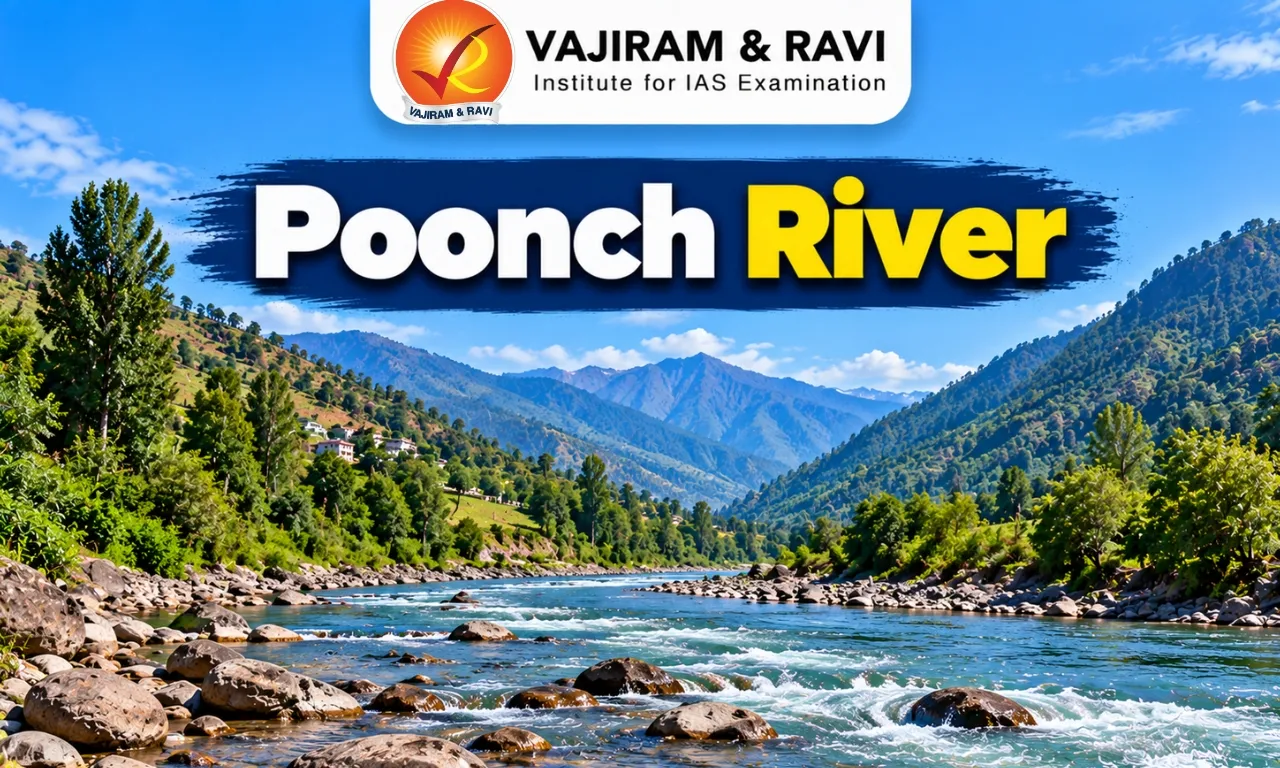
Poonch River, also known as the Punch River, Punch Tohi or Tohi of Punch, is a snow-fed perennial river that flows through Jammu and Kashmir in India and Pakistan-administered Kashmir. It originates in the foothills of the Pir Panjal Range and flows through mountainous valleys before entering Pakistan-administered Kashmir. The river is an important tributary of the Jhelum River and supports local ecosystems, fisheries and hydropower generation.

Poonch River Origin

The Poonch River originates in the south-facing foothills of the Pir Panjal Range, around Neel-Kanth Gali and Jamian Gali. In its upper reaches, the river is locally known as the Suran River or Siran.

The river receives water from snowmelt, springs and precipitation in the surrounding mountains. Its perennial nature makes it an important source of freshwater for settlements and ecosystems along its course.

  • Source region: Foothills of the Pir Panjal Range.
  • Local name: Suran or Siran in the upper reaches.
  • Water source: Snowmelt, rainfall and mountain streams.
  • Geographical setting: Mountain valleys of the western Himalayas.

Course of the Poonch River

The Poonch River flows through the mountainous terrain of Jammu and Kashmir before crossing into Pakistan-administered Kashmir and joining the Jhelum river system.

  • Upper course: The river originates near Neel-Kanth Gali and Jamian Gali in the Pir Panjal foothills.
  • Poonch town: It flows southward and westward towards Poonch town in Jammu and Kashmir.
  • Southwestern course: After passing Poonch, the river bends towards the southwest and continues into Pakistan-administered Kashmir.
  • Downstream settlements: The river passes through areas associated with Sehra, Tatta Pani, Kotli and Mirpur.
  • Final destination: Its waters drain into the Mangla Reservoir, which is associated with the Jhelum River system.

The river has an approximate length of 150 km, although measurements may vary depending on the source and the section included.

Tributaries of the Poonch River

The Poonch River receives water from several tributaries and mountain streams that contribute to its flow.

  • Mandi River: Drains parts of the mountainous region around Mandi.
  • Nimbal Katha: A tributary that contributes water to the river system.
  • Darungli River: Adds runoff from the surrounding hills.
  • Betaar River: An important stream within the Poonch drainage network.
  • Ranguri River: Contributes water from the surrounding catchment.
  • Rangar River: Forms part of the tributary network associated with the river.

These tributaries collect water from the Pir Panjal region and help sustain the Poonch River throughout the year.

Hydropower Projects on the Poonch River

The Poonch River has hydropower potential because of its mountainous course and flowing water. Hydropower projects use the river's water to generate electricity for regional energy needs.

Gulpur Hydropower Project

The Gulpur Hydropower Project is an important infrastructure project located on the Poonch River in Pakistan-administered Kashmir.

  • Purpose: Generate electricity using the river's flow.
  • Regional importance: Contributes to the local and regional power supply.
  • Water management: Uses river water as part of its hydropower operations.
  • Environmental consideration: Hydropower development requires attention to river flow, fish migration, aquatic habitats and downstream ecological needs.

Parnai Hydropower Project

The Parnai Hydropower Project is another project associated with the wider water and energy infrastructure of Jammu and Kashmir. Its relationship to the Poonch River should be distinguished from projects directly located on the river.

Ecological Importance of the Poonch River

Poonch River plays an important role in maintaining aquatic biodiversity and supporting freshwater ecosystems in the western Himalayan region.

  • Mahseer Conservation: Provides habitat for the endangered Golden Mahseer (Tor putitora), an important freshwater fish species.
  • Aquatic Biodiversity: Supports indigenous and other fish species that depend on healthy river habitats.
  • Breeding Grounds: Provides suitable conditions for fish feeding, reproduction and growth.
  • Wildlife Habitat: Sustains aquatic organisms and supports the broader biodiversity of the surrounding river ecosystem.
  • Protected Areas: An approximately 85-km stretch in Pakistan-administered Kashmir is associated with the Poonch River Mahaseer National Park, which aims to protect aquatic biodiversity.
  • River Flow and Ecosystem Health: Snowmelt and mountain runoff help maintain freshwater habitats and support aquatic life.
  • Ecological Balance: Healthy river conditions help sustain food chains and preserve the natural functioning of the river ecosystem.

Poonch River FAQs

Q1: Where does the Poonch River originate?

Ans: The Poonch River originates in the south-facing foothills of the Pir Panjal Range, near Neel-Kanth Gali and Jamian Gali in Jammu and Kashmir.

Q2: What are the other names of the Poonch River?

Ans: The Poonch River is also known as the Punch River, Punch Tohi and Tohi of Punch. Its upper reaches are locally called the Suran or Siran River.

Q3: What is the total length of the Poonch River?

Ans: The Poonch River is approximately 150 km long.

Q4: Which river is the Poonch River a tributary of?

Ans: The Poonch River is a tributary of the Jhelum River.

Q5: What are the major tributaries of the Poonch River?

Ans: The major tributaries include the Mandi, Nimbal Katha, Darungli, Betaar, Ranguri and Rangar rivers.

Rani Avantibai Lodhi, Biography, Contributions, Revolt of 1857

Rani Avantibai Lodhi

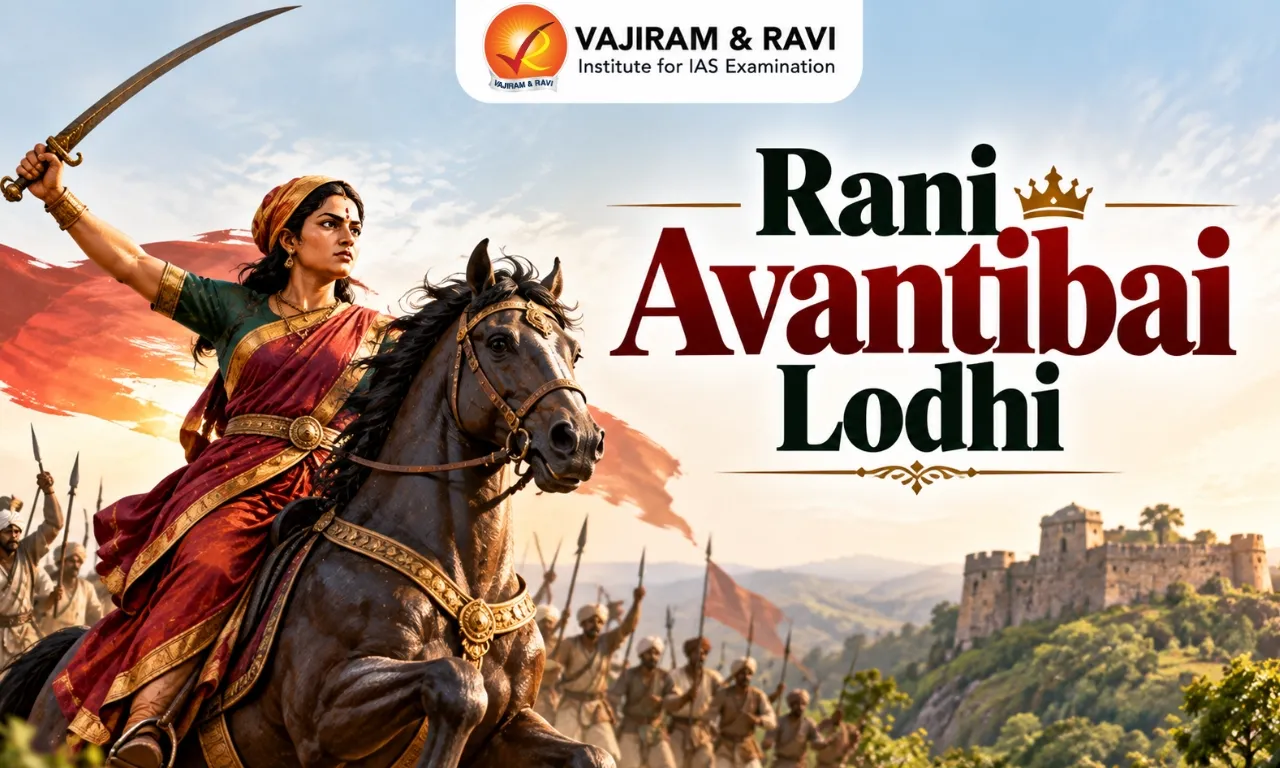
Rani Avantibai Lodhi was a queen of Ramgarh in present day Madhya Pradesh who fought against British rule during the Revolt of 1857. Remembered as a courageous Freedom Fighter, she opposed British interference in her kingdom, mobilised local rulers and people and led an armed resistance. Her life represents the contribution of regional leaders and women to India's struggle against colonial rule.

Rani Avantibai Lodhi Biography

Rani Avantibai Lodhi was born on 16 August 1831 in Mankehadi village, Seoni district, Madhya Pradesh. Her early life and royal responsibilities shaped her leadership.

  • Birth and Family: Avanti bai Lodhi was born into a Lodhi family to Zamindar Rao Jujhar Singh. Her birthplace was Mankehadi village in present day Madhya Pradesh.
  • Marriage: She married Vikramaditya Singh Lodhi, son of Raja Laxman Singh of Ramgarh. The couple had two sons, Aman Singh and Sher Singh.
  • Queen of Ramgarh: After Raja Laxman Singh's death in 1850, Vikramaditya Singh became the ruler. However, his illness and the young age of their sons placed responsibility for governance on Avantibai.
  • Role as Regent: She managed state affairs and protected the interests of her family and kingdom. Her administrative responsibilities strengthened her position as a regional leader.
  • Opposition to British Interference: The British placed Ramgarh under the Court of Wards and appointed officials to administer the state. Avantibai opposed this intervention and expelled the appointed administrators.
  • Support for Farmers: She instructed farmers not to follow British orders, challenging colonial administrative control and increasing her popularity among the people of Ramgarh.

Rani Avantibai Lodhi Contributions

Rani Avantibai Lodhi contributed to the resistance against colonial rule through administration, military leadership, local mobilisation and the defence of Ramgarh's political authority.

  • Defence of Ramgarh: She resisted British interference in the kingdom and challenged the Court of Wards arrangement, seeking to preserve the authority of the ruling family.
  • Leadership in Administration: As queen regent, she managed state affairs during her husband's illness and took responsibility for governance when he could no longer rule.
  • Mobilisation of Local Rulers: She encouraged neighbouring kings, landlords and chiefs to unite against the British through letters and a symbolic appeal involving glass bangles.
  • Organisation of Armed Resistance: During the Revolt of 1857, she raised and led an army of approximately 4,000 soldiers to fight British forces.
  • Support from Local Communities: Her resistance involved regional rulers and local people, including farmers, reflecting the wider participation of rural communities in the uprising.
  • Guerrilla Warfare: After British forces attacked Ramgarh, she continued resistance from the hills of Devharigarh and used guerrilla warfare against the advancing army.
  • Inspiration for Women: As a Veerangana Avantibai Lodhi, she remains associated with courage, leadership and the participation of women in the struggle against colonial rule.

Rani Avantibai Lodhi Role in Revolt of 1857

Rani Avantibai Lodhi emerged as a regional leader during the Revolt of 1857, organising armed resistance and bringing neighbouring rulers together against British authority.

  • Resistance to British Administration: She opposed British control over Ramgarh, expelled appointed officials and reclaimed administrative authority, making colonial interference a central source of conflict.
  • Call for Unity: She sent letters accompanied by glass bangles to neighbouring rulers and landlords, urging them to join the struggle rather than remain inactive.
  • Formation of an Army: She raised a force of around 4,000 soldiers, demonstrating her ability to organise military resistance during the uprising.
  • Battle of Khairi: Her forces fought British troops near Khairi village in the Mandla region and defeated the forces led by Deputy Commissioner Waddington, compelling them to retreat.
  • British Attack on Ramgarh: Following their defeat, British forces returned with support from the ruler of Rewa, attacked Ramgarh and set fire to the settlement.
  • Resistance from Devharigarh: Avantibai moved towards the hills of Devharigarh and continued fighting through guerrilla tactics as British forces pursued her.
  • Regional Significance: Her role demonstrates that the 1857 uprising extended beyond major centres to the rural and forested regions of Central India, where local leaders resisted colonial authority.

Rani Avantibai Lodhi Death

Rani Avantibai Lodhi died on 20 March 1858 while resisting British forces near Devharigarh. Facing near certain defeat, she chose self sacrifice rather than capture and pierced herself with her sword. She attained martyrdom at Sukhi Talaiya, between Balapur and Ramgarh. Following her death, the resistance in the area was suppressed and Ramgarh came under British control. Her sacrifice remains an important part of regional memories of the Revolt of 1857.

Rani Avantibai Lodhi Recognitions

Rani Avantibai Lodhi is remembered through public memorials, commemorative stamps, educational references and institutions that preserve her legacy as a regional freedom fighter.

  • Commemorative Postal Stamps: India Post issued stamps in her honour on 20 March 1988 and 19 September 2001, recognising her contribution to the resistance against British rule.
  • Statue at Ramgarh: A park was developed near the remains of the palace and temple in 1988-1989. A large white statue depicting her riding a horse was installed there.
  • Bargi Dam Project: The Narmada Valley Development Authority named a part of the Bargi Dam project in Jabalpur in her honour, preserving her name in a public development project.
  • History Textbooks: Her participation in the Revolt of 1857 received a brief place in NCERT history textbooks from 2012, bringing her story to wider educational attention.
  • Folk Songs and Traditions: Regional folklore and performances continue to remember her resistance. Folk songs associated with the Gond community celebrate her leadership and opposition to British forces.
  • Women’s Battalion: Her name is associated with the Rani Avanti Bai Lodhi Women’s Battalion of the Uttar Pradesh Provincial Armed Constabulary at Badaun, reflecting her continuing public legacy.
  • Historical Legacy: Often remembered as the Jhansi Ki Rani of Ramgarh, she represents the contribution of regional women leaders to the Revolt of 1857 and India's resistance to colonial rule.

Rani Avantibai Lodhi FAQs

Q1: Who was Rani Avantibai Lodhi?

Ans: Rani Avantibai Lodhi was the queen regent of Ramgarh in present day Madhya Pradesh and a freedom fighter who led armed resistance against British rule during the Revolt of 1857.

Q2: When and where was Rani Avantibai Lodhi born?

Ans: Rani Avantibai Lodhi was born on 16 August 1831 in Mankehadi village in Seoni district, Madhya Pradesh.

Q3: What was Rani Avantibai Lodhi's role in the Revolt of 1857?

Ans: She mobilised neighbouring rulers, raised an army of approximately 4,000 soldiers, defeated British forces near Khairi and continued resistance from the hills of Devharigarh.

Q4: How did Rani Avantibai Lodhi die?

Ans: She died on 20 March 1858 after piercing herself with her sword rather than face capture by British forces. She attained martyrdom at Sukhi Talaiya between Balapur and Ramgarh.

Q5: How is Rani Avantibai Lodhi remembered today?

Ans: She is remembered through postal stamps, statues, folk songs, educational references and public institutions named in her honour. Her legacy highlights women's leadership and regional resistance during the Revolt of 1857.

Budhabalanga River, Origin, Tributaries, Basin and Irrigation Projects

Budhabalanga River

The Budhabalanga River is an important river of northern Odisha. It originates from Similipal Hills, course through Mayurbhanj and Balasore districts, tributaries, drainage basin and mouth near Balaramgadi in Odisha.

What is the Budhabalanga River?

The Budhabalanga River, also known as the Balanga River, is an east-flowing river in Odisha. It drains parts of Mayurbhanj and Balasore districts before emptying into the Bay of Bengal.

  • Origin: Similipal hills in Mayurbhanj district, Odisha.
  • Length: Approximately 175-199 km, depending on the source and measurement.
  • Mouth: Bay of Bengal near Balaramgadi in Balasore district.
  • Major cities and towns along its course: Baripada and surrounding settlements in Mayurbhanj.
  • Major associated waterfall: Barehipani Falls in Similipal.

Course of the Budhabalanga River

The Budhabalanga originates in the Similipal hills and flows through the uplands of Mayurbhanj before entering the coastal plains of Balasore district.

  • The upper course passes through the hilly region associated with Similipal.
  • The river flows towards the Baripada region, the headquarters of Mayurbhanj district.
  • It then crosses the plains of Balasore district.
  • Finally, it drains into the Bay of Bengal near Balaramgadi.

Tributaries of the Budhabalanga River

The Budhabalanga is joined by several streams that drain the Similipal hills and surrounding uplands.

  • Sone (Sono): An important tributary in the lower basin.
  • Katra: A tributary associated with the middle course.
  • Gangahar: Drains parts of the region around Baripada.
  • Palpala and Chipat: Streams associated with the Similipal hills.
  • Sunei and Kalo: Rivers associated with irrigation and water-resource development in the wider basin.

Budhabalanga River Basin

The Odisha Department of Water Resources groups the Budhabalanga and Jambhira river systems into a combined basin for water-resource planning.

  • Total area of the combined basin: Approximately 6,691 sq. km.
  • Area within Odisha: Approximately 6,354 sq. km.
  • Major districts covered: Mayurbhanj and Balasore.
  • Combined length of the Budhabalanga and Jambhira rivers: Approximately 289 km.

The Budhabalanga catchment is characterised by the forested Similipal uplands, the agricultural plains around Baripada and the low-lying coastal plains of Balasore.

Barehipani Falls and Similipal

The Budhabalanga River is associated with Similipal, an important forested region in Mayurbhanj district, Odisha. Barehipani Falls, a spectacular two-tiered waterfall approximately 399 metres high, is located within the Similipal landscape. The region includes the Similipal Tiger Reserve and Similipal Biosphere Reserve. Its forested hills form an important catchment area, supplying streams that contribute to the river system.

Irrigation Projects

The Budhabalanga basin supports agriculture through irrigation infrastructure and water-management projects.

  • Sunei Irrigation Project: Associated with the Sunei River.
  • Kalo Irrigation Project: Associated with the Kalo River.
  • Baladiha Irrigation Project: A medium irrigation project in the region.
  • Budhabalanga and Sono projects: Included in basin-level irrigation planning.

Project completion and operational status should be verified against the latest Odisha government records before publication.

Economic Importance

The Budhabalanga River supports the economy of northern Odisha in several ways.

  • Agriculture: River water and irrigation infrastructure support paddy cultivation and other crops.
  • Fisheries: The river supports local fishing activities.
  • Water supply: Surface water and groundwater contribute to domestic and agricultural needs.
  • Local livelihoods: Agriculture and other water-dependent activities support communities in Mayurbhanj and Balasore.

Floods and Environmental Concerns

The Budhabalanga can experience flooding during periods of intense monsoon rainfall.

  • Heavy rainfall: Runoff from the Similipal hills can increase river discharge rapidly.
  • Coastal flooding: The flat lower course can slow the drainage of floodwater.
  • Soil erosion: Catchment degradation can increase erosion and sediment movement.
  • Water pollution: Urban wastewater and agricultural runoff can affect river water quality.
  • Seasonal water stress: Reduced flow during the dry season can affect irrigation and other water uses.

Catchment conservation, flood forecasting, embankment maintenance and improved wastewater treatment are important for sustainable river management.

Budhabalanga River FAQs

Q1: Where does the Budhabalanga River originate?

Ans: Budhabalanga River originates in the Similipal hills of Mayurbhanj district, Odisha.

Q2: Which districts are mainly associated with the Budhabalanga River?

Ans: Mayurbhanj and Balasore districts of Odisha.

Q3: Where does the Budhabalanga River drain?

Ans: Budhabalanga River drains into the Bay of Bengal near Balaramgadi in Balasore district.

Q4: Which are the major tributaries of the Budhabalanga River?

Ans: Its tributaries include the Sone, Katra, Gangahar, Palpala and other streams of the basin.

Q5: Which waterfall is associated with the Budhabalanga River?

Ans: Barehipani Falls in Similipal is associated with the Budhabalanga River.

Subic Bay, Location, History and Strategic Significance

Subic Bay

Subic Bay is a strategically located natural harbour in the Philippines. It was once a major United States naval base supporting military operations across the western Pacific and Southeast Asia. Following the withdrawal of US forces in 1992, the area was transformed into a commercial and industrial hub. Today, Subic Bay is significant for maritime trade, regional economic development and Indo-Pacific security.

What is Subic Bay?

Subic Bay is a natural embayment on the western coast of Luzon, the largest island of the Philippines. It opens into the South China Sea and lies approximately 55 km northwest of the entrance to Manila Bay. Olongapo is the principal city near the head of the bay.

Its deep, sheltered waters provide favourable conditions for port operations, ship repair and maritime logistics. The bay's geographical position has shaped its historical military role and continues to support its commercial importance.

History of Subic Bay

Subic Bay's history reflects successive changes in colonial and military control before its transformation into a commercial and industrial hub.

  • Spanish rule: Spain controlled the Philippines and recognised Subic Bay's sheltered waters as suitable for naval operations, developing it as a naval facility.
  • Transfer to the United States: Following the Spanish-American War, Spain ceded the Philippines to the United States under the Treaty of Paris in 1898. The United States subsequently developed Subic Bay into a major naval base.
  • Japanese occupation during World War II: Japanese forces occupied the Philippines, including the Subic Bay area, during the war. Allied forces returned in 1944–1945, and the United States re-established its naval presence after the war.
  • Cold War and Vietnam War: Under American control, Subic Bay became a major logistics, supply and ship-repair centre supporting US naval operations across Southeast Asia and the western Pacific.
  • Transfer to the Philippines (1992): After the Philippine Senate rejected the proposed extension of the US military bases agreement in 1991, US forces withdrew. The naval facility was formally turned over to the Philippine government in 1992.
  • Economic transformation (1992 onwards): The Philippine government converted the former military installation into the Subic Bay Freeport Zone under the Bases Conversion and Development Act of 1992 (Republic Act No. 7227), encouraging trade, manufacturing, investment and tourism.

Significance of Subic Bay

Subic Bay is significant not only for its strategic location near the South China Sea but also for its role in maritime trade, regional economic development and the conversion of former military infrastructure into productive civilian assets.

1. Strategic and Maritime Significance

  • South China Sea access: Its location provides access to a major international shipping corridor.
  • Naval logistics: Its port and ship-repair facilities can support vessel maintenance, resupply and logistical activities.
  • Philippines-US defence cooperation: The bay's infrastructure and location are relevant to maritime cooperation between the two countries.
  • Indo-Pacific security: Its proximity to the South China Sea makes it significant to regional maritime security and strategic planning.

2. Economic Significance

  • International trade: Port facilities support shipping, cargo handling and logistics.
  • Industrial development: The Freeport Zone hosts manufacturing, shipbuilding, ship repair and other commercial activities.
  • Employment and investment: Infrastructure and business incentives encourage investment and generate employment.
  • Tourism: Coastal attractions and recreational facilities contribute to the regional economy.

3. Significance of Military Base Conversion

The transformation of Subic Bay demonstrates how former military installations can be repurposed for civilian economic development. The Subic Bay Freeport Zone supports commercial activity, investment, industrial development and employment, illustrating the potential benefits of converting defence infrastructure into productive economic assets.

Subic Bay FAQs

Q1: Where is Subic Bay located?

Ans: Subic Bay is on the western coast of Luzon in the Philippines and opens into the South China Sea.

Q2: Why was Subic Bay important during the Cold War?

Ans: It served as a major US naval supply, maintenance and logistics centre supporting military operations across the western Pacific and Southeast Asia.

Q3: When did the United States withdraw from Subic Bay?

Ans: The US naval facility was handed over to the Philippine government in 1992, and the last US Navy ship departed on 24 November that year.

Q4: What is the Subic Bay Freeport Zone?

Ans: It is a special economic and free-port area developed from the former naval installation to promote trade, manufacturing, logistics, investment and tourism.

Q5: Why is Subic Bay strategically important today?

Ans: Its location near the South China Sea, port infrastructure and relevance to regional maritime cooperation make it important to Philippine security and Indo-Pacific geopolitics.

Ramganga River, Origin, Length, Tributaries, Importance

Ramganga River

Ramganga River is an important Himalayan river that flows through Uttarakhand and Uttar Pradesh. The river flowing near Masi in Almora district, Uttarakhand, is part of the region's beautiful mountain landscape and supports local ecosystems, agriculture and communities. The Ramganga is a major spring-fed tributary of the Ganga River, originating in the Dudhatoli ranges of Uttarakhand and flowing for approximately 596 km before joining the Ganga near Kannauj in Uttar Pradesh.

Origin of the Ramganga River

The Ramganga River originates near Diwali Khal in the Dudhatoli ranges of Uttarakhand, in the Himalayan region. Its source lies in the Gairsain area, and the river descends through mountain valleys before entering the plains.

  • Source: Dudhatoli ranges, Uttarakhand.
  • Elevation: Approximately 2,900 metres above sea level.
  • River type: Himalayan river supported by springs and seasonal rainfall.
  • Drainage basin: Part of the larger Ganga river basin.

Tributaries of the Ramganga River

The Ramganga River receives water from several tributaries and smaller streams that contribute to its flow across Uttarakhand.

  • Gagas River: An important tributary that joins the Ramganga near Bhikiyasain in Almora district.
  • Bino River: A tributary that contributes water to the Ramganga river system.
  • Mandal River: A stream in the upper Ramganga river network.
  • Nayar River: Another tributary identified in descriptions of the Ramganga drainage system.
  • Khoh River: An important tributary in the lower river basin.

Importance of the Ramganga River

The Ramganga River has ecological, agricultural and economic importance in Uttarakhand and Uttar Pradesh.

  • Agriculture and irrigation: River water supports agricultural activities in mountain valleys and downstream plains.
  • Biodiversity: The river provides freshwater habitats for fish and other aquatic organisms.
  • Wildlife conservation: It is an important source of water for wildlife in the Corbett landscape.
  • Water management: The river supports irrigation and water-resource management through infrastructure such as the Kalagarh Dam.
  • Local livelihoods: Communities along the river depend on its water resources for farming and other daily needs.

Ramganga River and Jim Corbett National Park

The Ramganga River plays an important role in the ecosystem of Jim Corbett National Park and the surrounding tiger reserve. Its water supports aquatic life and provides drinking water for animals, including elephants and tigers.

The river and its associated wetlands also contribute to the ecological diversity of the forest landscape. Maintaining water quality and protecting river habitats are therefore important for wildlife conservation.

Kalagarh Dam on the Ramganga River

The Kalagarh Dam, also known as the Ramganga Dam, is a major water-resource project built across the river in Uttarakhand. It is associated with the Ramganga multipurpose project and helps regulate water for irrigation and hydroelectric power generation.

The project supports water management in downstream areas, particularly in the agricultural regions of western Uttar Pradesh.

Ramganga River FAQs

Q1: Where does the Ramganga River originate?

Ans: The Ramganga River originates near Diwali Khal in the Dudhatoli ranges of Uttarakhand, in the Himalayan region.

Q2: Does the Ramganga River flow near Masi, Almora?

Ans: Yes, the Ramganga River flows through the Masi region of Almora district, Uttarakhand, passing through mountain valleys and agricultural areas. 

Q3: What is the total length of the Ramganga River?

Ans: The Ramganga River is approximately 596 km long, from its source in the Himalayas to its confluence with the Ganga River. 

Q4: Which river joins the Ramganga near Bhikiyasain?

Ans: The Gagas River joins the Ramganga near Bhikiyasain in Almora district.

Q5: Which states does the Ramganga River flow through?

Ans: The Ramganga River flows through Uttarakhand and Uttar Pradesh before joining the Ganga. 

List of National Symbols of India 2026 with Names and Images

National Symbols of India

National Symbols of India are an essential part of any nation's identity, reflecting its cultural values and historical significance. For Indians, these 17 national symbols are not only a source of pride but also a representation of India's diverse heritage. These symbols are integral to the country's identity and are significant in the context of national importance, making it essential for every citizen to be familiar with them. This article will include each of these symbols and explore their cultural and national relevance.

What are National Symbols of India?

National Symbols of India serve as an important representation of our country’s values, history, and identity. India, with its rich cultural heritage and diverse traditions, has a set of national symbols that evoke pride, patriotism, and a deep sense of unity among its citizens. These symbols go beyond representations; they embody the collective spirit and heritage of the nation.

List of National Symbols of India 2026

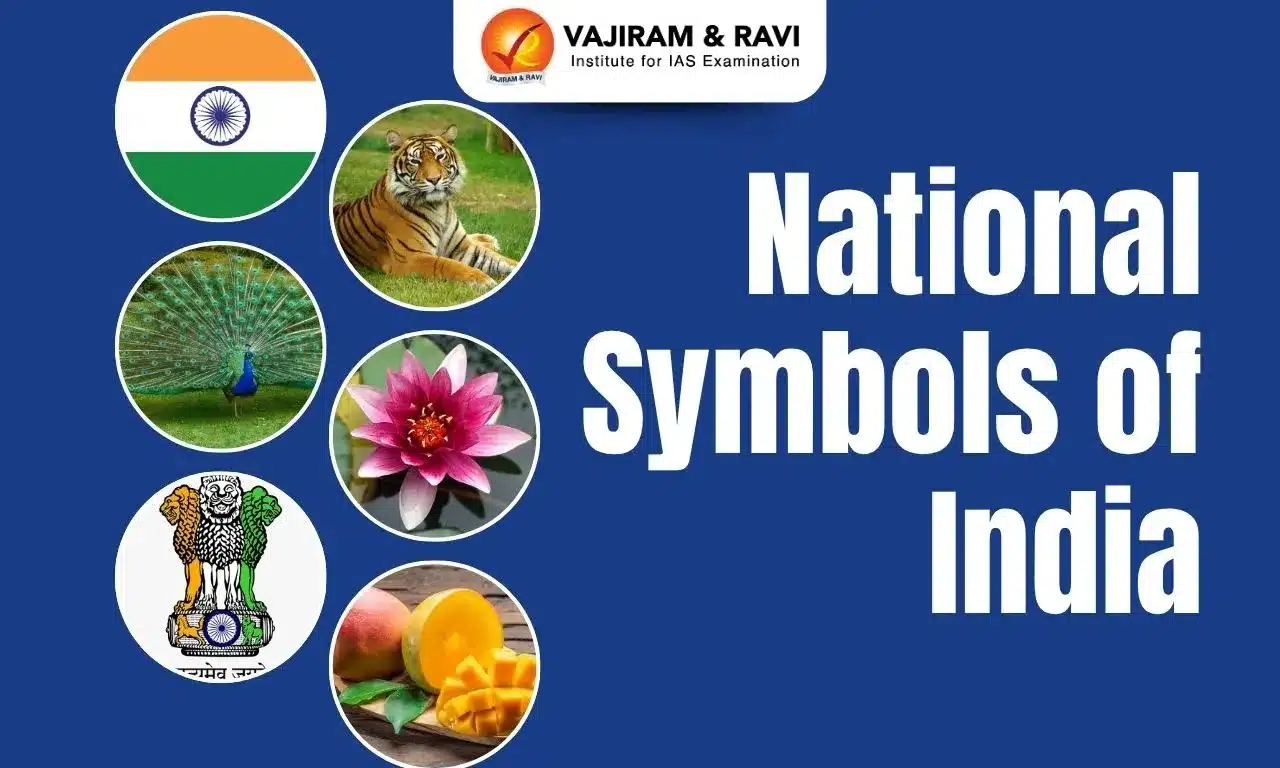
Check out the List of National Symbols of India below, which includes key symbols like the National Flag, Emblem, Anthem, along with the Bengal Tiger, Lotus, and the Ganges River. These symbols embody India's cultural heritage, evoking patriotism, pride, and unity, while reflecting the country's rich diversity and identity.

List of National Symbols of India 2026

S No

Symbol

Name

1

National Flag

Tiranga

2

National Emblem

National Emblem of India

3

National Currency

Indian Rupees

4

National Calendar

Saka Calendar

5

Oath of Allegiance

National Pledge

6

National River

Ganga

7

National Heritage Animal

Indian Elephant

8

National Animal

Royal Bengal Tiger

9

National Bird

Indian Peacock

10

National Tree

Indian Banyan

11

National Song

Vande Mataram

12

National Anthem

Jana Gana Mana

13

National Reptile

King Cobra

14

National Aquatic Animal

Ganges River Dolphin

15

National Vegetable

Pumpkin

16

National Fruit

Mango

17

National Flower

Lotus

National Symbols of India with Names List

The major List of National Symbols of India 2026 has been provided below along with their pictures:

[my_image src="https://vajiramias.sgp1.cdn.digitaloceanspaces.com/wp/current-affairs/2026/07/Indian-National-Flag.webp?v=1783421107" size="full" align="right" width="auto" height="218px" alt="Indian National Flag" title="Indian National Flag"]

Indian National Flag

The National Flag of India, popularly known as the Tiranga, was designed by Pingali Venkayya and adopted on 22 July 1947. It consists of three horizontal stripes: saffron, white, and green, with the navy-blue Ashoka Chakra at the center. The saffron color symbolizes courage and sacrifice, white represents peace and truth, while green signifies faith and prosperity. The flag stands as a powerful symbol of India's sovereignty, unity, and democratic values. It is proudly displayed during national celebrations and important government events.

[my_image src="https://vajiramias.sgp1.cdn.digitaloceanspaces.com/wp/current-affairs/2026/07/Lotus.webp?v=1783422375" size="full" align="left" width="auto" height="240px" alt="Lotus" title="Lotus"]

National Flower of India

The Lotus is the National Flower of India and symbolizes purity, beauty, and spiritual enlightenment. Despite growing in muddy waters, the lotus blooms beautifully, representing the triumph of goodness over adversity. It holds immense significance in Indian culture and is closely associated with deities such as Goddess Lakshmi and Goddess Saraswati. The flower frequently appears in Indian art, literature, and religious practices. Its ability to remain untouched by impurities makes it a symbol of inner strength and wisdom.

National Emblem

India's National Emblem is adapted from the Lion Capital of Ashoka at Sarnath and was adopted on 26 January 1950. It features four Asiatic lions standing back-to-back, symbolizing power, courage, confidence, and pride. Below the lions appears the national motto, "Satyameva Jayate", meaning "Truth Alone Triumphs." The emblem is used on official government documents, currency, passports, and national institutions. It reflects India's rich historical heritage and commitment to truth and justice.

National Currency

[my_image src="https://vajiramias.sgp1.cdn.digitaloceanspaces.com/wp/current-affairs/2026/07/Indian-Rupee.webp?v=1783422367" size="full" align="right" width="auto" height="184px" alt="Indian Rupee" title="Indian Rupee"]

The Indian Rupee (₹) is the official currency of India and is regulated by the Reserve Bank of India (RBI). The rupee symbol was designed by D. Udaya Kumar and officially adopted in 2010. Combining elements of the Devanagari letter "र" and the Roman letter "R," it represents India's cultural and economic identity. The Indian Rupee plays a vital role in domestic and international trade. It symbolizes the country's financial sovereignty and growing economic influence.

Also Read:- 150 Years of Vande Mataram

National Calendar

The Saka Calendar is India's National Calendar and has been used for official purposes since 1957. It begins with the month of Chaitra and aligns closely with the Gregorian calendar. Developed to provide a standardized system for government communication, it reflects India's scientific and cultural traditions. The calendar is used alongside the Gregorian calendar in official gazettes and government publications. It represents India's rich historical and astronomical knowledge.

Oath of Allegiance (National Pledge)

The National Pledge of India is a declaration of loyalty and commitment to the nation. It emphasizes unity, discipline, brotherhood, and respect for the country's diversity. Commonly recited in schools and educational institutions, the pledge instills patriotism among young citizens. It encourages individuals to work for the progress and prosperity of the nation. The pledge serves as a reminder of the duties and responsibilities of every Indian citizen.

[my_image src="https://vajiramias.sgp1.cdn.digitaloceanspaces.com/wp/current-affairs/2026/07/Mango.webp?v=1783422360" size="full" align="right" width="auto" height="148px" alt="Mango" title="Mango"]

National Fruit of India

The Mango is recognized as the National Fruit of India and is often called the "King of Fruits." It has been cultivated in India for thousands of years and holds cultural, historical, and economic importance. The fruit is known for its rich taste, nutritional value, and numerous varieties. Mangoes are featured in Indian literature, art, and festivals, symbolizing abundance and prosperity. India is also one of the world's largest producers of mangoes.

[my_image src="https://vajiramias.sgp1.cdn.digitaloceanspaces.com/wp/current-affairs/2026/07/Royal-Bengal-Tiger.webp?v=1783422354" size="full" align="left" width="auto" height="174px" alt="Royal Bengal Tiger" title="Royal Bengal Tiger"]

National Animal of India

The Royal Bengal Tiger is the National Animal of India and symbolizes strength, courage, and majesty. It was chosen in 1973 to replace the lion and to promote wildlife conservation through Project Tiger. Found mainly in India's forests and national parks, the tiger plays a crucial role in maintaining ecological balance. Despite conservation efforts, it remains vulnerable due to habitat loss and poaching. The tiger represents India's commitment to protecting its rich biodiversity.

Also Read: Tiger Reserves in India 2026

National Bird of India

The Indian Peacock was declared the National Bird of India in 1963. Known for its vibrant plumage and graceful appearance, the peacock occupies a special place in Indian culture and mythology. It is associated with several deities and is frequently depicted in traditional art and folklore. The bird symbolizes beauty, pride, and elegance. Its widespread presence across the country made it an ideal choice as a national symbol.

National Anthem of India

"Jana Gana Mana" is the National Anthem of India, composed by Rabindranath Tagore. It was officially adopted on 24 January 1950 and reflects the unity and diversity of the nation. The anthem celebrates India's cultural richness and geographical vastness. Sung during national ceremonies and important events, it inspires feelings of patriotism and national pride. The full rendition of the anthem takes approximately 52 seconds.

National Song of India

"Vande Mataram", written by Bankim Chandra Chatterjee, is India's National Song. It was originally composed in Sanskrit and gained prominence during the freedom movement. The song personifies India as a mother figure and inspired countless freedom fighters. It was officially accorded national song status in 1950. Even today, it remains a powerful symbol of patriotism and devotion to the nation.

National Tree of India

The Banyan Tree is India's National Tree and symbolizes longevity, resilience, and immortality. Known for its extensive aerial roots and vast canopy, it can survive for centuries. The banyan holds a sacred place in Indian culture and is often associated with wisdom and spiritual growth. Traditionally, village gatherings and community meetings were held under its shade. Its enduring nature reflects the strength and continuity of Indian civilization.

National Vegetable of India

[my_image src="https://vajiramias.sgp1.cdn.digitaloceanspaces.com/wp/current-affairs/2026/07/Pumpkin.webp?v=1783422349" size="full" align="right" width="auto" height="158px" alt="Pumpkin" title="Pumpkin"]

The Pumpkin is often regarded as India's National Vegetable due to its widespread cultivation and importance in Indian cuisine. It is grown across diverse climatic regions and is valued for its nutritional benefits. Pumpkin is used in a variety of traditional dishes and festive preparations. Its ability to grow with relatively few resources makes it an important crop for farmers. The vegetable symbolizes agricultural abundance and food security.

National Heritage Animal

The Indian Elephant was declared the National Heritage Animal of India in 2010. Revered in Indian culture and religion, it is associated with wisdom, strength, and prosperity. Elephants have played significant roles in Indian history, warfare, and religious traditions. However, habitat loss and human-animal conflict threaten their survival. Recognizing the elephant as a heritage animal highlights the need for its conservation and protection.

National Aquatic Animal of India

The Ganges River Dolphin is India's National Aquatic Animal. Found primarily in the Ganga-Brahmaputra river system, it is an indicator of a healthy freshwater ecosystem. The species is endangered due to pollution, habitat degradation, and human activities. Its designation as a national symbol aims to increase awareness about river conservation. Protecting the dolphin is essential for maintaining the ecological health of India's river systems.

National River of India

The Ganga (Ganges) was declared the National River of India in 2008 due to its immense cultural, historical, and spiritual significance. Flowing through several states, it supports millions of people through agriculture, drinking water, and livelihoods. The river is revered as sacred in Hinduism and is central to numerous religious practices. Various government initiatives, including the Namami Gange Programme, focus on its conservation and rejuvenation. The Ganga symbolizes India's civilization, heritage, and spiritual traditions.

National Symbols of India Significance

National Symbols of India represent the country's identity, cultural heritage, sovereignty, unity, and values, fostering a sense of patriotism and national pride among citizens.

  • Reflect the history, traditions, and cultural diversity of the nation.
  • Promote national unity and integrity among people from different backgrounds.
  • Represent India's sovereignty and independent status on global platforms.
  • Instill a sense of patriotism and national pride among citizens.
  • Serve as official symbols in government institutions, documents, and ceremonies.
  • Showcase India's unique heritage, values, and achievements to the world.
  • Strengthen the feeling of belongingness and collective identity among Indians.
  • Act as symbols of respect, honor, and constitutional values.
  • Help preserve and promote India's cultural and natural legacy.
  • Play an important role in national celebrations, educational activities, and international representation.

Also Read: UNESCO World Heritage Sites in India

Other Related Posts
Freedom Fighters of India 80th Independence Day 2026
Vande Mataram To Be Sung at Red Fort For First Time Har Ghar Tiranga Campaign 2026
Women Freedom Fighters of India Dadabhai Naoroji
Subhash Chandra Bose Gopal Krishna Gokhale
Jawaharlal Nehru Surendranath Banerjee
Sardar Vallabhbhai Patel Rabindranath Tagore
Sarojini Naidu Independence Day 2026
Madam Bhikaji Cama Sarvodaya Movement
Slogans of Freedom Fighters Indian National Movements 
Important Days in 2026 Republic Day 2026
National Song National Anthem
National Flag Code of India 2002 National Flag
Indian Independence Act 1947  Revolt of 1857 
Swadeshi Movement  Home Rule Movement 
Non-Cooperation Movement Civil Disobedience Movement 
Azad Hind Fauj and INA Trials Azad Hind Fauj
Partition of India 1947 Mountbatten Plan 
Constituent Assembly of India Fundamental Duties 
Constitutional Values Preamble of the Indian
National Symbols of India Madan Mohan Malviya
Pingali Venkayya APJ Abdul Kalam 
 

National Symbols of India 2026 FAQs

Q1: What are the 17 National Symbols of India?

Ans: There are 17 national symbols of India namely Tiranga, Jana Gana Mana, Saka Calendar, Vande Mataram, National Emblem of India, Mango, Ganga, Royal Bengal Tiger, Indian Banyan, Ganges River Dolphin, Indian Peacock, Indian Rupee, King Cobra, Indian Elephant, Lotus, Pumpkin and National Pledge.

Q2: What is the name of the National Symbol?

Ans: India's National Symbols, such as the lotus (spirituality and purity), the tiger (strength and courage), the peacock (grace and beauty), the banyan tree (immortality), and the mango (tropical climate), were chosen to reflect the nation's rich heritage, cultural values, and natural beauty.

Q3: What do the National Symbols of India represent?

Ans: The national animal, Tiger symbolizes power; the national flower, Lotus symbolizes purity; the national tree, Banyan symbolizes immortality, the national bird, the Peacock symbolizes elegance and the national fruit, Mango symbolizes the tropical climate of India.

Q4: What are the names of 5 of the National Symbols?

Ans: The five symbols include King Protea, Real Yellowwoods, Springbok, Galjoen Fish, and Blue Crane. In addition, is the meaning of each symbol.

Q5: Which is the National Tree?

Ans: Ficus bengalensis, an Indian fig tree, spreads its branches out like young trees across a wide region. The roots then give rise to more trunks and branches. Because of this characteristic and its longevity, this tree is considered immortal and is an integral part of the myths and legends of India.

Ayad River (Ahar River), Origin, Course, Tributaries, Significance

Ayad River

Ayad River, also known as the Ahar River, is a seasonal river that flows through Udaipur in Rajasthan. It originates in the Gogunda Hills in the north-western part of Udaipur district and plays an important role in the city's lake system. The river receives water from Lake Pichola and Fateh Sagar Lake, feeds Udaisagar Lake, and eventually joins the Berach River. The Ayad River is also important for its archaeological heritage, as it is associated with the ancient Ahar-Banas Chalcolithic culture. 

Origin of the Ayad River

The Ayad River originates in the Gogunda Hills in north-western Udaipur district of Rajasthan. These hills form part of the Aravalli landscape, which influences the drainage patterns of the region.

  • Source: Gogunda Hills, Rajasthan.
  • River type: Seasonal river.
  • Rainfall pattern: The basin receives around 90% of its annual rainfall from the southwest monsoon between July and mid-October.
  • Importance: It forms part of the natural drainage system connected to Udaipur's lakes.

Course of the Ayad River

The Ayad River flows through Udaipur city and connects several important lakes before continuing towards the Berach River.

  • Lake Pichola: The river system receives water discharged from Lake Pichola.
  • Fateh Sagar Lake: Water from Fateh Sagar Lake also contributes to the river's flow.
  • Udaipur city: The river passes through the urban landscape, where it is affected by drainage, construction and human activities.
  • Udaisagar Lake: The river feeds Udaisagar Lake, an important water body in the region.
  • Berach River: The Ayad eventually joins the Berach River, linking it to the wider river network of Rajasthan.

Tributaries and Drainage System of the Ayad River

The Ayad River forms part of the larger drainage network of northern and eastern Rajasthan. Its connection with the Berach River links it to the Ganga river system.

The river system follows this broad drainage sequence:

  • Ayad River: Flows through Udaipur and feeds Udaisagar Lake.
  • Berach River: Receives the Ayad River's flow.
  • Banas River: The Berach joins the Banas river system.
  • Chambal River: The Banas drains into the Chambal River.
  • Yamuna River: The Chambal joins the Yamuna.
  • Ganga River: The Yamuna eventually joins the Ganga.

Archaeological Significance of the Ayad River

The Ayad River is historically important because of its association with the Ahar-Banas Chalcolithic culture, an ancient archaeological culture of south-eastern Rajasthan.

The culture is generally dated to approximately 3000 BC–1500 BC and is associated with early settled communities that used copper tools and practised agriculture.

  • Ancient settlements: The Ayad region is associated with archaeological remains of early human settlements.
  • Chalcolithic culture: The Ahar-Banas culture represents an important phase in the development of early communities in Rajasthan.
  • Agriculture and water: Access to water and fertile land helped support settled life in the region.
  • Historical importance: Archaeological evidence from the area helps researchers understand ancient technology, pottery, farming and settlement patterns.

Ayad River FAQs

Q1: What is another name for the Ayad River?

Ans: The Ayad River is also known as the Ahar River.

Q2: Where does the Ayad River originate?

Ans: The Ayad River originates in the Gogunda Hills in north-western Udaipur district of Rajasthan.

Q3: Which river does the Ayad River join?

Ans: The Ayad River joins the Berach River, which forms part of the Banas–Chambal–Yamuna–Ganga drainage system.

Q4: Which lakes are associated with the Ayad River?

Ans: The river system is connected with Lake Pichola, Fateh Sagar Lake and Udaisagar Lake. It receives water from the first two and feeds Udaisagar Lake.

Q5: Why is the Ayad River historically important?

Ans: The river is associated with the Ahar-Banas Chalcolithic culture, which provides evidence of ancient settlements and early copper-using communities in Rajasthan.

Water Resources in India, Types, Distribution, Challenges

Water Resources

Water is a fundamental and cyclic natural resource, vital for life, agriculture, industry, and ecosystems. Despite its global abundance covering approximately 71 % of the earth’s surface, only a small fraction, about 3% constitutes freshwater suitable for human use. India, accounting for 2.45 % of the world’s land area and housing 16 % of the global population, has 4 % of the world’s water resources. Effective management of these resources is critical for sustaining livelihoods, food production, and economic growth in a rapidly developing country. In this article, we are going to cover water resources in India.

Water Resources in India

The total annual water availability in India from precipitation is estimated to be 4,000 cubic kilometers, with an average annual precipitation of 1,170 mm. Of this, the total availability from surface water and replenishable groundwater is approximately 1,869 cubic kilometers, but only about 60 % of this water is potentially utilizable for beneficial purposes. Consequently, India’s total utilizable water resources amount to 1,122 cubic kilometers per year, highlighting the gap between natural abundance and practical availability.

Water resources in India can be broadly classified into:

  • Surface water resources
  • Groundwater resources

Surface Water Resources in India

Surface water resources primarily include rivers, lakes, ponds, and tanks. India’s rivers, fed by the monsoon and Himalayan snowmelt, account for most of the country’s surface water. The mean annual flow in all river basins is estimated at 1,869 cubic kilometers, yet only approximately 690 cubic kilometers (37 %) can be effectively harnessed.

Challenges in Surface Water Utilization:

  • Seasonal Concentration: Over 90 % of the annual flow of Himalayan rivers occurs during the four monsoon months, limiting capture potential.
  • Storage Limitations: Suitable sites for reservoirs and dams are scarce, especially in hilly and flood-prone regions.
  • Geographical Constraints: Surface water in many regions is unevenly distributed, with northern and northeastern states enjoying abundant flow, while western and southern regions experience deficits.

India has constructed nearly 5,000 major and medium dams, barrages, and reservoirs to store river water, support irrigation, generate hydropower, and replenish groundwater.

Groundwater Resources in India

The total replenishable groundwater resources of India are estimated at 432 cubic kilometers, with Ganga and Brahmaputra basins accounting for approximately 46 % of the total potential. Groundwater plays a critical role in Indian agriculture, providing water for over 50 % of irrigated areas, supported by about 20 million tube wells nationwide.

  • High Utilization: States like Punjab, Haryana, Rajasthan, and Tamil Nadu exploit groundwater intensively for irrigation and industrial purposes.
  • Low Utilization: States such as Chhattisgarh, Odisha, and Kerala use only a small proportion of their groundwater potential due to abundant surface water and lower irrigation demands.
  • Overreliance on groundwater has led to aquifer depletion, declining water tables, and quality deterioration. To address this, the government emphasizes groundwater recharging through reservoirs, rainwater harvesting, and integrated water resource management.

Water Use and Sectoral Distribution

Agriculture dominates water usage in India, consuming 89 % of surface water and 92 % of groundwater. By contrast, the industrial sector accounts for only 2 % of surface water and 5 % of groundwater, while the domestic sector consumes 9 % of surface water.

This skewed distribution highlights the importance of efficient irrigation techniques and water-saving technologies to ensure sustainable allocation among sectors.

Factors Contributing to Water Quality Deterioration

Many anthropogenic and natural factors have led to water quality deterioration in India:

  1. Water Scarcity: Limited availability increases dependency on contaminated sources.
  2. Pathogenic Pollution: Presence of bacteria and viruses from untreated sewage and surface runoff.
  3. Chemical Leaching: Pesticides, fertilizers, and industrial effluents seep into groundwater.
  4. Oxygen Depletion & Eutrophication: Excess nutrients from fertilizers trigger algal blooms and reduce oxygen levels in water bodies.
  5. Salinity and Alkalinity: Improper irrigation and seawater intrusion increase soil and water salinity.
  6. Toxic Contaminants: Heavy metals like arsenic, lead, and mercury pose significant health risks.

The Central Ground Water Board (CGWB), under the Ministry of Jal Shakti, monitors and manages groundwater resources through scientific assessment, exploration, augmentation, and regulation. Established in 1970, CGWB serves as India’s apex agency for groundwater governance.

Types of Pollution Sources

  1. Point Source Pollution: Sources are identifiable, such as domestic sewage and industrial effluents.
  2. Non-Point Source Pollution: Sources are diffuse, including agricultural runoff, stormwater, rural waste, open defecation, and air deposition.

Other contaminants include heavy metals and biochemical oxygen demand (BOD) or chemical oxygen demand (COD), which impact aquatic ecosystems. Monsoon flooding further exacerbates pollution spread.

Global Water Scarcity

Water scarcity arises when freshwater availability is insufficient to meet demand. It manifests in:

  • Unmet water needs for households, agriculture, or industry
  • Economic competition for limited water resources
  • Environmental degradation
  • Groundwater depletion

Currently, one-third of the global population (2 billion people) faces severe water scarcity for at least one month per year.

Measuring Water Scarcity

The Falkenmark Indicator or Water Stress Index is widely used to assess water scarcity:

  • Below 1,700 m³ per capita per year: Water stress
  • Below 1,000 m³: Water scarcity
  • Below 500 m³: Absolute water scarcity

India is currently water-stressed, with declining per capita availability due to population growth, overexploitation, and regional imbalances in distribution.

Water Scarcity in India

The causes and stress factors leading to water scarcity in India are: 

  1. Population Growth: Rising demand from households and agriculture.
  2. Agricultural Dominance: Over 70 % of water resources are consumed by irrigation.
  3. Rapid Urbanization: High urban demand strains surface and groundwater.
  4. Climate Change: Altered monsoon patterns, melting glaciers, and temperature rises affect water availability.
  5. Aquifer Depletion: Excessive extraction for irrigation and domestic use lowers groundwater levels.
  6. Pollution: Discharge of untreated sewage, industrial waste, and agricultural runoff deteriorates water quality.

Projections indicate India’s population may reach 1.6 billion by 2050, further intensifying water stress.

Consequences of Water Scarcity

Water scarcity can lead to the following consequences for the human population: 

  1. International Conflicts: Shared river basins with neighboring countries like Pakistan, Nepal, Bangladesh, and Myanmar may trigger disputes.
  2. Health Impacts: Limited access to clean water causes water-borne diseases and limits educational and economic opportunities.
  3. Food Shortages: Reduced water availability threatens agriculture, potentially leading to food insecurity and social unrest.
  4. Energy Shortages: Water-intensive thermoelectric plants and hydropower require adequate water for energy security.
  5. Economic Slowdown: Industrial production and urban growth are constrained by water shortages, affecting GDP growth and livelihoods.

Solutions for Water Scarcity 

In order to tackle the problem of water scarcity, the following methods can be adopted: 

  1. CO₂ Cleaning: Use of carbon dioxide in solid form as a cleaning agent reduces water consumption in industries.
  2. Realistic Pricing: Pricing water to reflect true costs encourages conservation and infrastructure maintenance.
  3. Education and Awareness: Behavioural changes in water usage are vital for sustainable consumption.
  4. Water Conservation Technologies: Including rainwater harvesting, drip irrigation, solar-powered purifiers, and wastewater recycling.
  5. Desalination Plants: Energy-efficient and solar-powered plants can augment freshwater supply in coastal regions.
  6. Improved Irrigation Practices: Use of drip or sprinkler systems to reduce water wastage.
  7. Community Governance: Localized management and participation ensure sustainable water use.
  8. Distribution Infrastructure: Repairing pipelines, reservoirs, and treatment plants to reduce losses and improve quality.
  9. Pollution Control: Establishment of STPs, water treatment facilities, and bioremediation techniques.
  10. Research & Development: Innovation in water conservation, wastewater treatment, and sustainable aquifer management.

Government Initiatives to Manage Water Scarcity

The Government of India has adopted the following schemes and initiatives to manage the problem of water scarcity: 

  1. Jal Shakti Abhiyan: Focuses on water conservation in water-stressed districts, promoting citizen participation.
  2. Pradhan Mantri Krishi Sinchay Yojana (PMKSY): Aims at "Har Khet Ko Pani" and "More Crop per Drop", enhancing irrigation efficiency.
  3. National Water Mission: Promotes conservation, efficient use, and equitable distribution of water, targeting a 20 % improvement in water use efficiency.
  4. Atal Bhujal Yojana: Encourages sustainable groundwater management with community involvement.
  5. Jal Jeevan Mission (JJM): Ensures functional household tap connections (FHTC) for all rural households by 2024.
  6. National Rural Drinking Water Programme (NRDWP): Enhances rural water supply coverage and quality.
  7. Jal Kranti Abhiyan: Aims to transform water-scarce villages into water-surplus villages through integrated conservation and management.

Sustainable Approaches for Water Resource Augmentation

  1. Enhancing Water Availability: Protect ecosystems, increase green cover, manage riparian buffers, and implement diversified agriculture and recycling.
  2. Improving Water Quality: Enforce regulations, control pollution, establish treatment plants, and adopt bioremediation.
  3. Reducing Water-Related Risks: Implement integrated watershed management, flood control, climate-resilient agriculture, and sustainable livelihoods.

Mihir Shah Committee Recommendations

The committee recommended restructuring the Central Water Commission (CWC) and Central Ground Water Board (CGWB) into a National Water Commission (NWC) as India’s apex body for water policy, data management, and governance, enabling coordinated and strategic management of water resources at the national level.

Sustainable Management of Water Resources in Indian States

Water is an essential resource for human survival, agriculture, industry, and ecosystems. India, despite being endowed with abundant water resources, faces significant challenges in ensuring equitable distribution, sustainable utilization, and conservation. Various states in India have developed innovative programmes, traditional practices, and modern governance mechanisms to manage water resources sustainably. Understanding these strategies, along with challenges and solutions, is vital for ensuring water security for present and future generations.

Water Resources State-Level Water Management Initiatives 

Different states have launched different schemes and initiatives to ensure water resources are available for all. These include: 

Rajasthan: Mukhya Mantri Jal Swavlamban Abhiyan

Rajasthan, one of the driest states in India, launched the ‘Mukhya Mantri Jal Swavlamban Abhiyan’ to promote water conservation and harvesting activities in rural areas. The scheme focuses on:

  • Construction and restoration of check dams, ponds, and traditional water bodies.
  • Encouraging community participation in maintaining irrigation infrastructure.
  • Ensuring sustainable groundwater recharge to combat water scarcity.

The programme has successfully mobilized local communities, particularly women, to actively participate in pre-monsoon desilting, water body cleaning, and maintenance activities

Maharashtra: Jalyukt Shivar Abhiyan

Maharashtra’s Jalyukt Shivar programme aims to make 5,000 villages free of water scarcity every year. Key features include:

  • Restoration of minor irrigation structures, such as check dams and percolation tanks.
  • Promotion of rainwater harvesting and soil moisture conservation techniques.
  • Strengthening village-level water governance systems to manage irrigation and drinking water needs effectively.

The programme has also contributed to improved agricultural productivity by ensuring water availability during critical cropping seasons.

Telangana: Mission Kakatiya

The Telangana government initiated Mission Kakatiya with the objective of enhancing agriculture-based income for small and marginal farmers. The programme focuses on:

  • Renovation and restoration of ancient tanks and minor irrigation structures.
  • Promoting community-based irrigation management.
  • Facilitating water availability for irrigation, livestock, and domestic use.

By restoring nearly 46,000 tanks, the mission has increased groundwater levels, reduced irrigation dependence on monsoon rainfall, and improved cropping intensity.

Distribution and Challenges of India’s Water Resources

India receives an average annual rainfall of about 1,170 mm, corresponding to 4,000 BCM (Billion Cubic Meters) of precipitation, including snowfall. However, water distribution is highly uneven:

  • Water Surplus States: Uttar Pradesh, Himachal Pradesh, Assam, and northeastern states receive abundant rainfall.
  • Water-Scarce States: Maharashtra (especially Vidarbha and Beed), Karnataka, Tamil Nadu, Rajasthan, and parts of Gujarat face recurring water stress.

Groundwater in northwestern India is now available at depths of nearly 100 meters, reflecting over-extraction and declining aquifer levels.

Institutional Mechanisms for Water Governance 

The following mechanisms have been adopted for water governance: 

Central Water Commission (CWC)

The CWC is India’s premier technical organization in the field of water resources. Its responsibilities include:

  • Initiating and coordinating water resource schemes in consultation with state governments.
  • Conservation and utilization of water for flood control, irrigation, drinking water supply, navigation, and hydropower development.
  • Monitoring water infrastructure and advising on policy and management.

NITI Aayog Composite Water Management Index (CWMI)

To encourage efficient water use and management, NITI Aayog developed the Composite Water Management Index, which benchmarks state-level performance across key water indicators.

Key Focus Areas and Weights:

Theme Weight (%)

Source augmentation and restoration of water bodies

5

Source augmentation (Groundwater)

15

Major & medium irrigation – supply-side management

15

Watershed development – supply-side management

10

Participatory irrigation practices – demand-side

10

Sustainable on-farm water use practices – demand-side

10

Rural drinking water

10

Urban water supply and sanitation

10

Policy and governance

15

Total

100

The index evaluates states on water availability, consumption efficiency, equitable access, and governance, facilitating data-driven decision-making.

Interlinking of Rivers Project

The government has identified four priority links for detailed project reports under the Peninsular Component:

  1. Ken-Betwa Link: Uttar Pradesh and Madhya Pradesh

  2. Damanganga-Pinjal Link: Maharashtra and Gujarat

  3. Par-Tapi-Narmada Link: Maharashtra and Gujarat

  4. Godavari-Cauvery Link: Andhra Pradesh and Tamil Nadu

  • Arguments in Favor:

    • Optimizes water utilization across regions.
    • Addresses water stress and improves irrigation coverage.
    • Enhances power generation and disaster management capabilities.
  • Arguments Against:

    • Artificially alters river courses and affects dryland areas.
    • May have negative environmental impacts, including shoreline erosion and disruption of monsoon patterns.
    • Raises federal disputes over water sharing between states.

Dam Rehabilitation and Improvement Project

Started in 2010 with World Bank assistance, this project aims to:

  • Rehabilitate dams and appurtenant structures.
  • Strengthen institutional capacity and project management.
  • Enhance flood control, irrigation, and water security.
  • The project was scheduled for completion in 2020 and continues to support water storage and safety improvements nationwide.

Groundwater Management and Extraction Rules

India is the largest user of groundwater globally, accounting for 25% of global extraction:

  • 90% is used for agriculture.
  • 10% is used for drinking, domestic, and industrial purposes.
  • Industrial use contributes only 5% of total groundwater extraction.
  • The Central Ground Water Authority (CGWA), constituted in 1997 under the Environment Protection Act, 1986, regulates groundwater extraction and promotes sustainable management practices.

Challenges in Water Resources Governance

  • Lack of credible water information and comprehensive data.
  • Presence of multiple institutions with overlapping mandates.
  • Unsustainable extraction and depletion of aquifers.
  • Absence of an overarching National Water Policy in some regions.
  • Suboptimal water infrastructure performance and deteriorating soil moisture.
  • Increasing water footprint due to agriculture, industry, and urbanization.

The National Aquifer Mapping and Management Program (NAQUIM) by CGWB addresses these challenges by mapping aquifers, characterizing water-bearing formations, and developing Aquifer Management Plans for sustainable groundwater use.

Day Zero Instances in India

Day Zero refers to a situation when taps in a region run dry due to prolonged drought or excessive extraction. Global examples include:

  • Cape Town, South Africa: Countdown due to a three-year drought.
  • Sao Paulo, Brazil (2015): Water supply cut for 12 hours daily.
  • Barcelona, Spain (2008): Water imported from France.
  • In India, cities like Shimla (Himachal Pradesh), Udupi, and Mangaluru (Karnataka) are at risk of similar crises due to unsustainable water use and depletion of local sources.

Traditional Water Conservation Practices in India

India’s rich cultural heritage offers valuable lessons for water management:

  • Building water structures: Stepwells (e.g., Rani Ki Vav, Patan), ponds, and tanks.
  • Maintenance and cleaning of local water bodies.
  • Cultural performances: Songs, dances, and rituals like Ganga Geet, Bhawai, Jal Yatras, and Jal Yagya celebrated water’s sacred value.

Tribal and Rural Practices

  • Ziro Valley, Arunachal Pradesh: Community-managed irrigation canals.
  • Spiti Valley: Khuls channel glacial water to villages with regulated distribution.
  • Thar Desert, Rajasthan: Rituals like Lasipa and community desilting maintain water structures.

Traditional Conservation System 

There are many traditional conservation systems for conserving water: 

System Location/Description Function

Phad

Tapi basin, Maharashtra

Community-managed irrigation with check dams and canals.

Zing

Ladakh

Small tanks collecting glacier meltwater.

Kuhls

Himachal Pradesh

Channels carrying glacial water to fields.

Zabo/Ruza

Nagaland

Terraced hill structures for rainwater collection.

Jackwells

Great Nicobar

Bamboo tubes collecting leaf runoff into pits.

Pat System

Madhya Pradesh

Diverts hill stream water via bunds for irrigation.

Eri

Tamil Nadu

Tank system controlling floods, preventing soil erosion, recharging groundwater.

Johads

Rajasthan

Earthen check dams for groundwater recharge.

Panam Keni

Wayanad

Wooden cylinders capturing groundwater from springs.

Ahar Pynes

South Bihar

Reservoirs and artificial rivulets for irrigation.

Jhalara/Bawari

Rajasthan

Stepwells for storage and access to groundwater.

Taanka

Thar Desert

Cylindrical underground pits capturing rooftop rainwater.

Khadin

Jaisalmer

Long earthen embankments across hill slopes for runoff irrigation.

Kund
Western Rajasthan/Gujarat
Saucer-shaped catchments directing water to central wells.

These systems combine traditional engineering, community participation, and ecological knowledge, providing sustainable solutions for water management in diverse terrains.

Modern Integration with Traditional Practices

Modern initiatives like rainwater harvesting, check dams, and minor irrigation projects often integrate traditional knowledge systems, ensuring:

  • Improved water availability and groundwater recharge.
  • Reduced soil erosion and flooding.
  • Increased community ownership and participation.
  • Preservation of cultural heritage and biodiversity.
Also Check Other Posts
Geomorphology Major Dams in India
Composition and Structure of Atmosphere Major Ports in India
Types of Forests in India Coastal States of India
Ocean Acidification Migration in India
Deep Ocean Mission Natural Vegetation of India

Water Resources FAQs

Q1: What is called water resources?

Ans: Water resources are sources of water, both surface and underground, that are useful for human consumption, agriculture, industry, and ecological purposes.

Q2: What are the five types of water resources?

Ans: The five types of water resources are surface water, groundwater, rainwater, atmospheric water, and artificial water resources.

Q3: What are the 10 natural resources of water?

Ans: The ten natural water resources include rivers, lakes, ponds, glaciers, springs, wetlands, groundwater, rainwater, snow, and estuaries.

Q4: What is Jal Shakti Abhiyan?

Ans: Jal Shakti Abhiyan is a nationwide campaign launched by the Indian government for water conservation, rainwater harvesting, and improving water use efficiency, especially in water-stressed districts.

Q5: What is Jal Kranti Abhiyan?

Ans: Jal Kranti Abhiyan is a government initiative aimed at transforming villages and cities through integrated water conservation and management practices to make water-scarce regions water-surplus.

Taleju Bhawani Temple

Taleju Bhawani Temple

Taleju Bhawani Temple Latest News

On the occasion of Maha Navami, the ninth day of the festival, the historic Taleju Bhawani Temple in Kathmandu recently opened its doors to devotees.

About Taleju Bhawani Temple

  • It is a Hindu temple located in Kathmandu, Nepal. 
  • The temple lies within Kathmandu Durbar Square, part of the Kathmandu Valley UNESCO World Heritage property.
  • It is dedicated to Goddess Taleju Bhawani, regarded as a form of Goddess Durga.
  • The temple was constructed in the 16th century by King Mahendra Malla.
  • The Malla dynasty, which ruled the Kathmandu Valley from the 12th to the 18th century, is deeply intertwined with the worship of Goddess Taleju Bhawani.
  • For the general public, the temple opens its doors just once a year during Maha Navami (the ninth day of Dashain).  

Taleju Bhawani Temple Architecture

  • It is a masterpiece of Newar pagoda architecture. Key architectural features include:
    • Three-tiered pagoda roof with elaborately carved eaves and gilded finials.
    • 12-stage plinth representing the layers of the universe and spiritual ascent.
    • Four main decorative gateways, each guarded by stone lions.
    • Golden statues of the ten-armed goddess inside the inner sanctum.
    • Elaborately carved wooden windows and torana (ornamental arches above doorways).
    • The overall layout is modeled on the Shri Yantra, the sacred geometric diagram believed to embody the goddess herself.

News: NOA

Taleju Bhawani Temple FAQ's

Q1: Where is Taleju Bhawani Temple located?

Ans: Taleju Bhawani Temple is located in Kathmandu, Nepal.

Q2: Who constructed Taleju Bhawani Temple in the 16th century?

Ans: The temple was constructed in the 16th century by King Mahendra Malla.

Q3: Which architectural style is associated with Taleju Bhawani Temple?

Ans: Newar pagoda architecture.

Puzhal Lake

Puzhal Lake

Puzhal Lake Latest News

The bodies of two 14-year-old schoolboys who drowned in Puzhal Lake near Murugambedu were recovered recently.

About Puzhal Lake

  • Puzhal Lake, also known as Red Hills Lake, is a manmade freshwater lake located in Red Hills, Thiruvallur district, Tamil Nadu. 
  • It was built in the 19th century, during the British Period. 
  • It is one of the three main rain-fed reservoirs from where water is being drawn to be supplied in the city of Chennai, the other two being the Chembarambakkam Lake and Porur Lake.  
  • It's like a giant natural storage tank that collects rainwater and water from other sources. 
  • It can hold a huge amount of water, about 3300 million cubic feet. 
  • This water is then treated and sent through pipes to homes and businesses across the city. 
  • At the lake, there is a tower esteemed as Jone Tower, which is used to calculate the depth of the water level in the lake. 
    • This tower was built in the year 1881 and is the main attraction of the lake. 
  • It provides critical refuge for resident waterbirds and long-distance migratory avifauna. 
  • During autumn and winter, trans-continental migrants arrive across the Central Asian Flyway (CAF), seeking open water and abundant foraging grounds.

News: TH

Puzhal Lake FAQs

Q1: Where is Puzhal Lake located?

Ans: It is located in Red Hills, Tiruvallur district, Tamil Nadu.

Q2: What type of lake is Puzhal Lake?

Ans: It is a man-made freshwater lake.

Q3: During which period was Puzhal Lake built?

Ans: It was built during the British period in the 19th century.

Q4: Which city receives water from Puzhal Lake?

Ans: Chennai, Tamil Nadu.

Virli Khandar Excavation, Location, Timeline, Findings, Significance

Virli Khandar Excavation

Virli Khandar Excavation in Maharashtra is bringing new insights into ancient megalithic culture and funerary practices in the Vidarbha region. Located in Pauni tehsil of Bhandara district, the site features stone circles, menhirs, burial remains and valuable artefacts. The discovery of copper ornaments, iron implements, semi precious stone beads, a gold earring and an unusual arrangement of nearly 50 pottery vessels highlights its archaeological importance. These findings can help explain ancient burial traditions, material culture and social practices.

Virli Khandar Excavation Latest News

The Virli Khandar Excavation in Maharashtra has revealed distinctive burial patterns and artefacts associated with ancient megalithic communities. Archaeologists have documented 69 megalithic burials, of which four have been selected for detailed excavation. The site has attracted attention because of its composite structure of stone circles and menhirs, along with a unique arrangement of nearly 50 inverted pottery vessels. Preliminary observations suggest a date around 500 BCE, while radiocarbon dating indicates a broader period between 1000 BCE and 300 CE.

Virli Khandar Excavation

Virli Khandar is an important megalithic burial site in Maharashtra that provides evidence of ancient funerary practices, burial architecture and material culture in the Vidarbha region.

  • Location: The archaeological site is situated in Pauni tehsil of Bhandara district, Maharashtra. Its discoveries contribute to the understanding of prehistoric and early historic cultural practices in the region.
  • Excavation Details: The excavation was being conducted under the leadership of Dr. Prabash Sahu. Archaeologists have documented 69 megalithic burials, with four selected for detailed investigation.
  • Timeline: Preliminary observations suggest a timeline of approximately 500 BCE, while radiocarbon dating indicates a broader range from 1000 BCE to 300 CE.

Virli Khandar Excavation Findings

The key findings that have been discovered in the Virli Khandar Excavation are:

  • Composite Megalithic Structure: The site contains stone circles and menhirs together, forming a composite megalithic structure. This pattern distinguishes it from nearby sites such as Pimpalgaon Nipani and Tirota Kheri, which primarily feature dolmen burials.
  • Important Artefacts: Excavations have recovered a copper necklace, iron implements such as axes, chisels, ladles and arrowheads, etched carnelian beads, a gold earring and bone remains. These objects provide evidence of ancient material culture and burial practices.
  • Unique Pottery Arrangement: Nearly 50 pottery vessels were found systematically arranged in one burial. Larger bowls were covered with inverted bowls and almost all the vessels were placed upside down, a practice not previously reported in the Vidarbha region.
  • Soil Engineering: The pottery vessels were placed over a layer of black cotton soil above the natural lateritic, or murum, base. The sticky soil helped stabilise the vessels and kept them largely in position despite pressure from the overlying soil.

What is Menhir?

A Menhir is a large, human made upright stone, generally tapered at the top, associated with prehistoric megalithic structures and sometimes with burial or ceremonial practices.

  • Meaning and Origin: The word menhir comes from Brittonic terms meaning “long stone” and was introduced into archaeological terminology in the 18th century.
  • Physical Features: Menhirs are large stones deliberately erected by humans. They may stand individually or form part of a larger megalithic complex containing other monumental structures.
  • Purpose: Menhirs may have served as grave markers, ceremonial monuments or landmarks. Some megalithic arrangements are also associated with astronomical observations, although the precise purpose varies across sites.
  • Role in Megalithic Burials: Menhirs are among the different forms of megalithic structures found in India. Other types include stone circles, dolmens, cists and cairn circles, which provide evidence of ancient burial traditions.
  • Example in India: The Mudumal Megalithic Menhirs in Telangana's Narayanpet district date back approximately 3,500-4,000 years. The site is included in India's tentative UNESCO World Heritage list and is described as a megalithic astronomical observatory, with some stones aligned with solar events.
  • International Example: The Grand Menhir Brisé, or Great Broken Menhir, in Brittany, France, is notable for its original height of approximately 20.6 metres, making it a significant example of prehistoric monumental stone construction.

Virli Khandar Excavation Significance

The Virli Khandar Excavation is significant because it provides fresh archaeological evidence of ancient burial traditions, technological practices and cultural patterns in Vidarbha.

  • Understanding Funerary Practices: The combination of stone circles and menhirs reveals a distinctive burial arrangement. It helps archaeologists examine how ancient communities organised burial spaces and commemorated the dead.
  • Evidence of Material Culture: Copper ornaments, iron implements, beads and gold jewellery provide insights into the objects used by ancient communities and their practices of placing artefacts alongside burials.
  • Understanding Ancient Technology: Iron tools such as axes, chisels and arrowheads indicate knowledge of iron technology. These finds contribute to understanding technological practices during the Iron Age and subsequent periods represented at the site.
  • Evidence of Social Differentiation: The presence of objects made from copper, gold and semi precious stones suggests differences in access to valuable materials. Such grave goods can help researchers investigate possible social distinctions within ancient communities.
  • Distinctive Pottery Practices: The discovery of nearly 50 systematically arranged, inverted pottery vessels is particularly important. This unusual pattern provides new evidence for investigating burial related customs in the Vidarbha region.
  • Regional Archaeological Importance: The site differs from nearby dolmen burial sites such as Pimpalgaon Nipani and Tirota Kheri. Its distinctive architecture broadens the understanding of regional variations in megalithic burial traditions.
  • Understanding Megalithic Culture: The findings contribute to the study of India's Iron Age megalithic culture, which is associated with iron technology and distinctive stone based burial practices across the Deccan Plateau, South India, Vidarbha and parts of Eastern India.
  • Scope for Further Research: Continued excavation and scientific dating can help clarify the chronology, purpose of the burial arrangements and cultural practices represented at Virli Khandar.

Virli Khandar Excavation FAQs

Q1: Where is the Virli Khandar archaeological site located?

Ans: The Virli Khandar archaeological site is located in Pauni tehsil of Bhandara district in Maharashtra, in the Vidarbha region.

Q2: What are the major findings of the Virli Khandar Excavation?

Ans: Major findings include 69 documented megalithic burials, stone circles, menhirs, copper ornaments, iron tools, etched carnelian beads, a gold earring and nearly 50 systematically arranged inverted pottery vessels.

Q3: What is the estimated period timeline of the Virli Khandar archaeological site?

Ans: Preliminary observations suggest a date around 500 BCE, while radiocarbon dating indicates a broader range between 1000 BCE and 300 CE.

Q4: What is a menhir and what is its significance at Virli Khandar?

Ans: A menhir is a large, human made upright stone, usually tapered at the top. At Virli Khandar, menhirs form part of a composite megalithic structure containing stone circles, providing evidence of distinctive ancient burial architecture.

Q5: Why is the Virli Khandar Excavation important for understanding ancient India?

Ans: The excavation provides evidence of ancient funerary practices, iron technology, pottery traditions and the use of valuable ornaments in burials. Its distinctive structures and unusual pottery arrangement contribute to understanding megalithic culture in the Vidarbha region.

Nanjarayan Bird Sanctuary

Nanjarayan Bird Sanctuary

Nanjarayan Bird Sanctuary Latest News

Recently, it was observed that even after more than four years of notification, Nanjarayan Bird Sanctuary is yet to get through transformation befitting Ramsar Site.

About Nanjarayan Bird Sanctuary

  • Location: It is a large shallow wetland situated along the north-eastern region of Uthukuli Taluk of Tiruppur District in Tamil Nadu.
  • It was repaired and restored by King Nanjarayan who ruled the region many centuries ago.
  • It is centered on a fresh water lake, fed by Nallar River, a tributary of the Noyyal River that runs through Tirupur city.
  • It is the 17th bird sanctuary of the state of Tamil Nadu owing to its rich avifaunal diversity. 
  • It is also a Ramsar site of International importance. 
  • It lies in the Central Asian Flyway and is an important breeding and foraging site for both resident and migratory birds.
  • Fauna: About 191 species of birds, 87 species of butterflies, 7 species of amphibians, 21 species of reptiles, 11 species of small mammals and 77 species of plants have been recorded in and around the lake.

Source: TH

Nanjarayan Bird Sanctuary FAQs

Q1: Where is Nanjarayan Bird Sanctuary located?

Ans: Tamil Nadu

Bharatendu Harishchandra, Biography, Contributions, Awards

Bharatendu Harishchandra

Bharatendu Harishchandra (9 September 1850-6 January 1885) was a pioneering Hindi poet, writer, playwright and journalist, widely regarded as the father of modern Hindi literature and theatre. Writing under the pen name Rasa, he used poetry, prose and drama to highlight colonial exploitation, poverty and social problems. His efforts promoted Hindi as a modern literary language and encouraged public awareness, cultural revival and social reform during nineteenth century India.

Bharatendu Harishchandra Biography

Bharatendu Harishchandra was born in Banaras in 1850 and became a leading figure in the development of modern Hindi literature, journalism and theatre.

  • Birth and Family: He was born on 9 September 1850 in Banaras into a wealthy Bania family. His father, Girdhar Das, was a poet who influenced his early literary interests.
  • Early Influences: The death of his parents at a young age and his exposure to contemporary intellectual developments shaped his outlook. His 1865 visit to the Jagannath temple introduced him to the influence of the Bengal Renaissance.
  • Literary Beginnings: Harishchandra demonstrated literary talent during his teenage years. In 1868, he translated the Bengali drama Vidyasundar into Hindi, reflecting his interest in expanding Hindi literature through translation.
  • Pen Name: He wrote under the pen name Rasa and explored poverty, colonial exploitation, social inequality and the need for progress through his literary works.
  • Journalism and Editing: He edited periodicals such as Kavi Vachan Sudha, Harishchandra Magazine and Bala Bodhini. These publications helped develop Hindi journalism and provided space for public discussion.
  • Promotion of Hindi: He advocated the wider use of Hindi in literature and public life. His efforts helped strengthen the position of Khari Boli Hindi as a modern literary medium in North India.
  • Literary Leadership: His work combined literary innovation with social awareness and cultural revival. He encouraged writers and intellectuals and contributed to the emergence of a new phase in Hindi literature.
  • Death: Bharatendu Harishchandra died on 6 January 1885 at the age of 34. Despite his short life, his literary and cultural influence continued to shape modern Hindi writing.

Bharatendu Harishchandra Contributions

Bharatendu Harishchandra transformed Hindi literary expression through poetry, prose, drama, journalism and translation, connecting literature with social awareness and contemporary political realities.

  • Modern Hindi Literature: He is regarded as the father of modern Hindi literature because he introduced contemporary social concerns, linguistic clarity and new literary forms into Hindi writing.
  • Hindi Poetry: His poems explored devotion, patriotism, social conditions and human suffering. Important works include Prem Malika, Prem Tarang, Madhumukul, Varsha Vinod and Nij Bhasha.
  • Hindi Drama and Theatre: He pioneered modern Hindi drama by combining satire, social criticism and moral themes. His major plays include Andher Nagari, Bharat Durdasha, Satya Harishchandra and Niladevi.
  • Criticism of Colonial Rule: Through works such as Bharat Durdasha, he portrayed India's suffering under colonial exploitation and highlighted economic hardship, political subordination and the need for national regeneration.
  • Prose and Journalism: His essays, travel accounts and periodicals expanded the scope of Hindi prose. His editorial work helped establish journalism as a medium for public awareness and social discussion.
  • Translation and Literary Innovation: He translated and adapted works from Bengali, Sanskrit, Prakrit and English, including Vidyasundar, Mudrarakshasa and The Merchant of Venice, which he adapted as Durlabh Bandhu.
  • Language and Cultural Revival: He promoted Hindi and encouraged its use in public communication and literary expression. His efforts contributed to the development of modern Hindi and the growth of linguistic consciousness.
  • Social and Religious Thought: His writings challenged social problems and conventional orthodoxy while drawing upon Vaishnava devotion. He also promoted Swadeshi and used publications to influence public opinion.

Bharatendu Harishchandra Awards and Recognitions

Bharatendu Harishchandra received recognition for his literary contributions, while the awards established in his name continue to honour original Hindi writing in mass communication.

  • Title of Bharatendu: In 1880, scholars at a public meeting in Kashi conferred the title Bharatendu, meaning “Moon of India”, in recognition of his literary services and cultural leadership.
  • Father of Modern Hindi Literature: He is widely remembered for transforming Hindi literature and theatre through modern themes, accessible language and the integration of social criticism into creative writing.
  • Bharatendu Harishchandra Awards: The Ministry of Information and Broadcasting, Government of India, has presented these awards since 1983 to promote original Hindi writings in mass communication.
  • Literary Yug: His leadership contributed to the Bharatendu Yug, the first phase in the period of modern Hindi literature. His influence extended to poetry, drama, journalism and the development of Hindi prose.
  • Contribution to Hindi Theatre: His plays, particularly Andher Nagari, remain significant for their satirical treatment of poor administration, arbitrary authority and social disorder.

Bharatendu Harishchandra FAQs

Q1: Who was Bharatendu Harishchandra?

Ans: Bharatendu Harishchandra was a nineteenth century Hindi poet, writer, playwright and journalist, widely regarded as the father of modern Hindi literature and theatre.

Q2: Who is called the father of modern Hindi literature?

Ans: Bharatendu Harishchandra is called as the father of modern Hindi literature as he modernised Hindi literature through poetry, prose, drama, journalism and translation while addressing colonial exploitation, social problems and cultural revival.

Q3: What were the major literary works of Bharatendu Harishchandra?

Ans: His major works include Andher Nagari, Bharat Durdasha, Satya Harishchandra, Niladevi, Prem Malika and Madhumukul.

Q4: What was the contribution of Bharatendu Harishchandra to Hindi journalism?

Ans: He edited publications such as Kavi Vachan Sudha, Harishchandra Magazine and Bala Bodhini, helping develop Hindi journalism as a platform for public awareness and social debate.

Q5: What are the Bharatendu Harishchandra Awards?

Ans: The Bharatendu Harishchandra Awards are presented by the Ministry of Information and Broadcasting, Government of India, to promote original Hindi writings in mass communication. They have been awarded since 1983.

European Bee-Eater

European Bee-Eater

European Bee-Eater Latest News

Recently, for the first time recorded sightings of European Bee-eater in Chennai.

About European Bee-Eater

  • It is a near passerine bird in the bee-eater family, Meropidae. 
  • These brightly-colored birds predominantly eat flying insects, especially bees and wasps
  • It is also known as Golden Bee-eaters because of their beautiful coloration.
  • Appearance: It has dark, thick, and slightly downward curved bills.
  • Habitat: They are commonly found near freshwater systems and inhabit a variety of habitat types such as forest, savanna, shrubland, grassland, and agricultural areas.
  • Distribution: The have a broad distribution covering much of Europe and Africa.
  • Behavior: These are migratory, diurnal birds that spend most of their time foraging for food. 
  • Diet: They are carnivores (insectivores) and mainly eat insects, especially bees, wasps, and hornets.
  • Conservation Status
    • IUCN Red List: Least Concern

Source: TH

European Bee-Eater FAQs

Q1: Where do we find European Bee-Eater?

Ans: The have a broad distribution covering much of Europe and Africa.

Q2: What is the IUCN status of European Bee-Eater?

Ans: Least Concern

E-Waste Management in India, Rules, Challenges and Solutions

E-Waste Management in India

E-Waste Management in India has become an important environmental concern as the country is the third-largest generator of e-waste globally. India generates around 13.98 lakh tonnes (1.4 million tonnes) of e-waste annually, according to the figure provided in the source data. The growing use of electronic devices and improper disposal methods have increased the need for safe collection, recycling, and disposal of electronic waste.

What is E-Waste?

E-waste (electronic waste) refers to discarded electrical and electronic equipment that is no longer wanted, used, or suitable for its original purpose. It includes old mobile phones, computers, laptops, televisions, refrigerators, washing machines, and other electronic devices.

These products contain valuable materials such as copper, gold, silver, and other metals. However, they may also contain hazardous substances like lead, mercury, and cadmium.

Current Status of E-Waste Management in India

India is facing a growing challenge in managing electronic waste because of rising electronic consumption, rapid digitalisation, and frequent replacement of devices.

  • Global position: India is the third-largest generator of e-waste globally, after China and the United States, according to commonly cited rankings.
  • E-waste generation: The supplied data reports annual generation of approximately 13.98 lakh tonnes. Broader estimates vary depending on the reporting year and the types of electronic waste included.
  • Rapid growth: Increased use of smartphones, computers, household appliances, and other electronic products is adding to the volume of discarded equipment.
  • Major contributing states: Maharashtra, Tamil Nadu, Uttar Pradesh, and Karnataka are among the important contributors to India's e-waste generation.
  • Major urban centres: Mumbai, Delhi-NCR, and Bengaluru generate substantial amounts of e-waste because of their large populations, business activities, and technology industries.
  • Formal and informal recycling: Both registered recyclers and informal workers handle electronic waste. However, unsafe dismantling and recovery practices remain a concern.
  • Government action: The government has introduced rules, producer responsibilities, registration systems, and recycling targets to improve the collection and processing of e-waste.

Major Sources of E-Waste in India

Electronic waste comes from households, offices, industries, educational institutions, hospitals, and government organisations. The major sources include:

  • IT equipment: Old computers, laptops, printers, keyboards, servers, and other computer accessories.
  • Mobile phones and communication devices: Discarded smartphones, landline phones, routers, and communication equipment.
  • Household appliances: Refrigerators, washing machines, air conditioners, and microwave ovens.
  • Consumer electronics: Televisions, cameras, audio systems, and other electronic gadgets.
  • Electrical equipment: Cables, electronic components, and other covered electrical products.
  • Commercial and industrial equipment: Electronic devices used in offices, factories, laboratories, and other workplaces.

E-Waste Management Rules, 2022

E-Waste (Management) Rules, 2022 are the main regulatory framework for managing e-waste in India. They came into effect on 1 April 2023 and introduced a strengthened system based on Extended Producer Responsibility (EPR).

These rules aim to ensure that electronic waste is collected and recycled through authorised systems rather than being dumped in landfills or processed using unsafe methods.

Key Features of E-Waste Management Rules, 2022

  • Extended Producer Responsibility (EPR): Producers are responsible for meeting the prescribed recycling obligations for covered electronic products.
  • Mandatory registration: Producers, manufacturers, refurbishers, and recyclers covered by the rules must register through the designated online system.
  • Recycling targets: Producers must meet prescribed recycling obligations according to the applicable schedule. For covered products, the targets are 70% in FY 2025-26 and FY 2026-27, increasing to 80% from FY 2027-28.
  • EPR certificates: Registered recyclers generate certificates based on eligible recycling activities. Producers can use these certificates to meet their prescribed obligations under the rules.
  • Digital monitoring: The online portal helps track registrations, recycling obligations, and compliance.

What is Extended Producer Responsibility (EPR)?

Extended Producer Responsibility (EPR) is a system that makes producers responsible for managing the waste generated by their products after consumers discard them.

Under the E-Waste (Management) Rules, 2022, producers of covered electronic equipment must fulfil their prescribed recycling obligations through the registered system.

Objectives of EPR

  • Increase recycling: Ensure that more discarded electronic products reach authorised recycling facilities.
  • Reduce pollution: Prevent unsafe disposal and reduce the release of hazardous substances.
  • Improve accountability: Make producers responsible for meeting their recycling obligations.
  • Recover valuable materials: Encourage the recovery of metals and other reusable resources from electronic waste.
  • Promote a circular economy: Support the reuse, repair, refurbishment, and recycling of electronic products.
  • Improve monitoring: Use digital records and recycling certificates to track compliance.

International Conventions Related to E-waste Management

International conventions help regulate the transboundary movement of electronic waste, prevent hazardous waste dumping, and promote environmentally sound waste management.

  • Basel Convention (1989): Controls the transboundary movement of hazardous waste and its disposal, including relevant electronic waste shipments.
  • Stockholm Convention (2001): Aims to eliminate or restrict persistent organic pollutants (POPs), some of which may be present in electronic equipment and its waste.
  • Rotterdam Convention (1998): Promotes shared responsibility and information exchange in international trade involving certain hazardous chemicals and pesticides.
  • Minamata Convention on Mercury (2013): Aims to protect human health and the environment from mercury pollution, including risks associated with mercury-containing electronic waste.

Major Challenges of E-Waste Management in India

E-Waste Management in India faces several challenges due to improper disposal, unsafe recycling practices, and limited collection facilities. These issues affect human health, damage the environment, and lead to the loss of valuable resources.

  • Informal Recycling: Unsafe methods such as open burning and acid leaching release toxic substances into the environment.
  • Health and Environmental Risks: Hazardous materials like lead, mercury, and cadmium can pollute air, soil, and water and harm human health.
  • Loss of Valuable Resources: Poor recycling leads to the loss of valuable metals such as copper, gold, and silver.
  • Low Public Awareness: Many people dispose of old electronic devices with regular household waste instead of using authorised collection centres.
  • Inadequate Collection Facilities: Limited access to authorised collection and recycling centres makes safe disposal difficult, especially in smaller towns and rural areas.
  • Informal Sector Integration: Many informal workers lack safety equipment, technical training, and access to modern recycling technologies.

Importance of Proper E-Waste Management in India

Proper e-waste management is necessary to protect the environment, conserve resources, and reduce the health risks associated with unsafe recycling.

  • Environmental protection: Prevents hazardous substances from contaminating air, soil, and water.
  • Public health: Reduces exposure to toxic chemicals among workers and nearby communities.
  • Resource recovery: Helps recover valuable metals and reusable materials from discarded electronics.
  • Circular economy: Encourages the repair, reuse, refurbishment, and recycling of electronic products.
  • Employment generation: Creates opportunities in formal collection, repair, refurbishment, and recycling.
  • Reduced import dependence: Recovery of valuable materials can lower the need for imported raw materials.
  • Energy conservation: Recycling metals can reduce the energy required to extract and process new materials.
  • Sustainable development: Supports responsible production and consumption while reducing waste.

Measures to Improve E-Waste Management in India

India needs stronger implementation of existing rules, better recycling facilities, public participation, and safer technology to manage its growing electronic waste.

  • Strengthen EPR enforcement: Improve monitoring of producers and recyclers to ensure that recycling obligations are met and certificates are properly accounted for.
  • Expand collection facilities: Establish more authorised collection centres and convenient take-back systems in cities, towns, and rural areas.
  • Increase public awareness: Educate consumers about the harmful effects of improper disposal and the importance of recycling electronic products.
  • Formalise the informal sector: Provide training, protective equipment, and opportunities for informal workers to collaborate with registered recyclers.
  • Use modern recycling technology: Adopt safer and more efficient methods to recover metals and other valuable materials.
  • Promote repair and refurbishment: Encourage people to repair and reuse electronic products instead of replacing them unnecessarily.
  • Encourage sustainable product design: Support durable, repairable, and recyclable electronic products.
  • Strengthen institutional collection: Organise e-waste collection drives in schools, colleges, offices, hospitals, and government departments.

Conclusion

E-Waste Management in India is becoming increasingly important as electronic consumption continues to grow. The E-Waste (Management) Rules, 2022, and the Extended Producer Responsibility framework provide a foundation for improving recycling, strengthening producer accountability, and reducing unsafe disposal.

E-Waste Management in India FAQs

Q1: What is e-waste management in India?

Ans: E-waste management in India refers to the collection, segregation, transportation, refurbishment, recycling, and environmentally sound handling of discarded electrical and electronic equipment under the applicable regulatory framework.

Q2: What is India's rank in global e-waste generation?

Ans: India is commonly ranked as the third-largest generator of e-waste globally, after China and the United States.

Q3: How much e-waste does India generate annually?

Ans: The supplied CPCB-linked figure is approximately 13.98 lakh tonnes (1.4 million tonnes) annually. Reported estimates vary by year, data source, and methodology.

Q4: Which rules govern e-waste management in India?

Ans: The E-Waste (Management) Rules, 2022, which came into effect on 1 April 2023, provide the main regulatory framework for e-waste management in India.

Q5: What is Extended Producer Responsibility in e-waste management?

Ans: Extended Producer Responsibility makes producers responsible for meeting prescribed recycling obligations for covered electronic products placed on the market.

People for the Ethical Treatment of Animals

People for the Ethical Treatment of Animals (PETA)

People for the Ethical Treatment of Animals Latest News

Animal rights organisation PETA India recently called for withdrawal of the Centre's proposed rules on animal experimentation, claiming it could weaken existing protections for animals.

About People for the Ethical Treatment of Animals 

  • It is a nongovernmental organization (NGO) committed to ending abusive treatment of animals in business and society and promoting consideration of animal interests in everyday decision-making and general policies and practices.
  • It is the largest animal rights organization in the world.
  • PETA was founded in 1980 by Ingrid Newkirk and Alex Pacheco, who were influenced by Australian ethicist Peter Singer’s book Animal Liberation (1975). 
  • It is based in Norfolk, Virginia, United States, with entities worldwide.
  • Initially recognized for exposing cruelty in research laboratories, PETA has grown into a global entity with over ten million members and considerable annual expenditures. 
  • The very heart of all of PETA’s actions is the idea that it is the right of all beings—human and nonhuman alike—to be free from harm.  
  • PETA advocates that animals should not be used for human benefit and promotes alternatives made possible by technological advancements. 
  • PETA opposes speciesism, a human-supremacist worldview, and focuses on the four areas in which the largest numbers of animals suffer the most intensely for the longest periods of time: 
    • in laboratories; 
    • in the food industry;
    • in the clothing trade; and 
    • in the entertainment business.
  • PETA also works on a variety of other issues, including the cruel killing of rodents, birds, and other animals who are often considered “pests” and cruelty to domesticated animals.
  • PETA works through public education, investigations, research, animal rescue, legislation, protests, and negotiations with companies and regulatory agencies.

News: NIE

People for the Ethical Treatment of Animals FAQs

Q1: What is People for the Ethical Treatment of Animals (PETA)?

Ans: PETA is a non-governmental organisation (NGO) committed to ending the abusive treatment of animals in business and society.

Q2: When was People for the Ethical Treatment of Animals (PETA) founded?

Ans: PETA was founded in 1980.

Q3: Where is the People for the Ethical Treatment of Animals (PETA) headquartered?

Ans: Norfolk, Virginia, United States.

Q4: What is the central principle underlying People for the Ethical Treatment of Animals (PETA)'s activities?

Ans: All beings, both human and nonhuman, have the right to be free from harm.

Q5: What methods does People for the Ethical Treatment of Animals (PETA) use to promote animal rights?

Ans: Public education, investigations, research, animal rescue, legislation, protests and negotiations with companies and regulatory agencies.

GSAT-7B

GSAT-7B

GSAT-7B Latest News

In a major leap for India's military communication infrastructure, the ISRO is slated to launch the Indian Army’s first dedicated communications satellite, the GSAT-7B, by mid-2028.

About GSAT-7B

  • It is the Indian Army’s first dedicated communications satellite. 
  • It is part of the GSAT-7 series satellites.
  • It is expected to be launched by the Indian Space Research Organisation (ISRO) around mid-2028. 
  • At five tonnes, or 5,000 kilograms, it will be the heaviest communication satellite India has ever built. 
  • It will sit in a geostationary orbit.
  • Till now, the Indian Army has been dependent on GSAT-7A and other surveillance satellites like the RISAT 2BR1 imaging satellite for communication and surveillance operations.
  • GSAT-7B is designed to provide Indian Army beyond-line-of-sight communications for deployed troops and military formations, as well as weapon systems, airborne platforms, and other mission-critical assets. 
  • It will provide the army with secure, round-the-clock connectivity across remote border areas and challenging terrain, supporting day-to-day military operations and effective battlefield command and control.

GSAT 7 Series Satellites

  • They are advanced communication satellites developed by the ISRO to meet the communication needs of the Indian defence services.
  • GSAT-7 (Rukmini):
    • It is an advanced communication satellite developed by ISRO and primarily provides communication services to the Indian Navy.
    • It is India’s first military satellite.
    • It was launched in August 2013 from an Ariane 5 ECA rocket from Kourou in French Guiana.
  • GSAT 7A:
    • It was launched on December 19, 2018.
    • It primarily provides communication services to the Indian Air Force.
    • It also helps in satellite-controlled operations of UAVs.
  • GSAT-7R (CMS-03):
    • It was launched on November 2, 2025, a replacement for the Rukmini satellite. 
    • The homegrown satellite enables seamless and secure communications between warships, aircraft, submarines, and maritime operations centres. 

News: DEF

GSAT-7B FAQs

Q1: What is GSAT-7B?

Ans: GSAT-7B is the Indian Army’s first dedicated communications satellite.

Q2: When is GSAT-7B expected to be launched?

Ans: Around mid-2028.

Q3: In which type of orbit will GSAT-7B be placed?

Ans: A geostationary orbit.

Q4: What is the primary purpose of GSAT-7B?

Ans: To provide dedicated, beyond-line-of-sight communications for the Indian Army.

Kharg Island

Kharg Island

Kharg Island Latest News

Trump is reportedly considering strikes on Iran's strategic Kharg Island oil hub to pressure Tehran over its nuclear programme and the Strait of Hormuz, although the claims remain unconfirmed.

About Kharg Island

  • It is a small coral island in Iran located in the northern Persian Gulf.
  • It lies about 30 km from the Iranian mainland.
  • Its area is 25 sq.km., its length is 8 km, and its width is 4.5 km.
  • It is one of relatively few Persian Gulf islands with natural freshwater resources, making it suitable for settlement by small populations. 
  • The island experiences hot and humid summers, and its highest point, Mount Didehban, stands at 87 meters above sea level.
  • The discovery of an offshore oil field in the waters around Kharg in the early 1960s stimulated the development of the island as a site for major petroleum and petrochemical installations. 
  • Connection by pipelines to the underwater oil fields, as well as to the oil fields in Khuzistan province, transformed Kharg into Iran’s largest oil-loading terminal by the early 1970s. 
  • Although it is close to the coast, it is surrounded by deep waters, allowing large oil tankers to dock.
  • During the Iran–Iraq war (1980–1988), Kharg repeatedly was bombed, and its oil facilities suffered extensive damage, but they were reconstructed in the early 1990s.
  • It facilitates as much as 90 percent of the country’s oil exports and is vital for Iran’s economy.
  • It boasts a massive storage capacity of 28 million barrels and loading infrastructure capable of handling VLCCs and ULCCs.
  • It has the ability to load 10 supertankers simultaneously and about 7 million barrels of oil per day.
  • Its strategic significance lies in its proximity to the Strait of Hormuz, a crucial global oil passage.

News: MC

Kharg Island FAQs

Q1: Where is Kharg Island located?

Ans: It is located in the northern Persian Gulf, off the coast of Iran.

Q2: Which Iranian province’s oil fields are connected to Kharg Island by pipelines?

Ans: Khuzestan Province.

Q3: What is the strategic economic role of Kharg Island?

Ans: It serves as Iran’s largest oil-loading terminal.

Q4: What is the stated oil-loading capacity of Kharg Island per day?

Ans: Approximately 7 million barrels per day.

Q5: Why is Kharg Island strategically important to global energy security?

Ans: It handles a major share of Iran’s oil exports and is located near the Strait of Hormuz, a crucial global oil transit route.

Cheer Pheasant

Cheer Pheasant

Cheer Pheasant Latest News

Recently, it was observed that Himachal Pradesh raised the survival rate of reintroduced cheer pheasants from 11.11% in 2019-20 to 100% in 2024-25. 

About Cheer Pheasant    

  • It is also known as Wallich’s pheasant or chir pheasant, belonging to the pheasant family, Phasianidae.
  • Habitat: It is found in steep, rocky hillsides studded with scrub, stunted trees and grassy slopes between 1,200 and 3,350 metres.
  • Distribution: It is mainly found in Western Himalaya from northern Pakistan through Kashmir, Himachal Pradesh and Uttarakhand, to central Nepal.
  • Characteristics of Cheer Pheasant
    • The cheer pheasant’s nest is a simple ground scrape, tucked beneath undergrowth or sheltered by rocks.
    • It exhibits high natal philopatry­—individuals often return to, or remain near, the area where they were born to breed.
    • It depends on early successional grasslands created by traditional grass cutting and burning—practices.
    • Diet: It depends on items such as roots, tubers, bulbs, buried seeds and possibly insect larvae and earthworms.

Conservation Status of Cheer Pheasant

Source: TOI

Cheer Pheasant FAQs

Q1: Where do we find Cheer Pheasant?

Ans: It is mainly found in Western Himalaya from northern Pakistan through Kashmir, Himachal Pradesh and Uttarakhand, to central Nepal.

Q2: What is the conservation status of IUCN Red List of Cheer Pheasant?

Ans: Vulnerable

Rajiv Gandhi National Park, Location, Flora and Fauna, Challenges

Rajiv Gandhi National Park

Rajiv Gandhi National Park, also known as Rameswaram National Park, is located in Rameswaram in Kadapa district, Andhra Pradesh, India. It is situated on the northern bank of the Penna River. This protected area covers approximately 2.4 square kilometres and supports tropical dry deciduous vegetation. The park is known for its diverse flora and fauna, including several bird species, reptiles and mammals. Its geographical location and biodiversity make it important for understanding forest ecosystems and wildlife conservation in southern India.

Rajiv Gandhi National Park

Rajiv Gandhi National Park is a protected area in the central plains of Andhra Pradesh, associated with the hill ranges of Veligondas, Palakondas, Lankamallais and Yerramalais. It was initially named Rameshvaram National Park before being renamed in December 2005. The park comprises a sandy soil ecosystem with tropical dry deciduous forest vegetation. Its location along the Penna River and the presence of diverse plant and animal species highlight its ecological significance.

Rajiv Gandhi National Park Features

Rajiv Gandhi National Park has a distinct geographical setting, a documented establishment history and a defined eco-zone that contribute to its conservation importance.

  • Location: The park is situated in Rameswaram, Kadapa district, Andhra Pradesh, on the northern bank of the Penna River, within the central plains of the region.
  • Area: Covering approximately 2.4 square kilometres, the park represents a relatively small protected forest ecosystem with diverse vegetation and wildlife.
  • Forest Type: The park is primarily characterised by tropical dry deciduous forest growing on sandy soil, supporting plant and animal species adapted to these conditions.
  • History: The area was designated as a National Park in India under the name Rameshvaram National Park on 19 November 2005. Its name was changed to Rajiv Gandhi National Park on 26 December 2005.
  • Eco-Zone: A 500 metre eco-zone surrounding the park was notified on 15 May 2017, extending the designated area of ecological consideration around the protected forest.
  • River System: The park lies along the Penna River, also called the Penner River, which flows through Karnataka and Andhra Pradesh before draining into the Bay of Bengal.

Rajiv Gandhi National Park Biodiversity

Rajiv Gandhi National Park supports diverse plant and animal life, including trees, climbers, birds, mammals, reptiles, amphibians and invertebrates.

Flora

The park's vegetation includes tree species and climbing plants adapted to its tropical dry deciduous forest and sandy soil environment.

  • Dalbergia sissoo: Also known as sissoo or Indian rosewood, this tree is valued for its durable timber and is one of the recorded plant species in the park.
  • Grewia villosa: This deciduous plant is known for its yellow flowers and edible fruits and contributes to the park's native vegetation.
  • Gymnema sylvestre: This woody climbing shrub is recognised for its medicinal uses and forms part of the plant diversity recorded in the forest.
  • Eucalyptus: Eucalyptus has also been mentioned among the trees associated with the park's vegetation, although the principal species list identifies Dalbergia sissoo, Grewia villosa and Gymnema sylvestre.

Fauna

The park provides habitat for a range of wildlife, including birds, mammals, reptiles, amphibians and invertebrates within its sandy soil forest ecosystem.

  • Birds: More than 50 bird species are reported in the forest, including peacocks, little egrets and parakeets, contributing to its avian diversity.
  • Mammals: Spotted deer, common mongoose and black napped hare are among the mammals recorded in the park's ecosystem.
  • Reptiles: Reptilian fauna includes Russell's earth boa, Russell's viper and common skink, reflecting the diversity of reptiles inhabiting the forest.
  • Amphibians: Bullfrogs and common Indian toads represent the amphibian fauna associated with the park.
  • Invertebrates: Scorpions, spiders, butterflies, grasshoppers and crickets are found in the forest, forming an important component of its biodiversity.

Rajiv Gandhi National Park Environmental Challenges

The Rajiv Gandhi National Park's small area, sandy soil ecosystem and diverse wildlife make habitat protection, ecological monitoring and responsible management important for long term conservation.

  • Habitat Protection: Protecting the tropical dry deciduous forest is essential for maintaining suitable habitats for the park's mammals, birds, reptiles and other wildlife.
  • Eco Zone Management: Effective management of the 500 metre eco zone can support conservation planning around the park and help protect the surrounding ecological landscape.
  • Biodiversity Monitoring: Regular monitoring of plant and animal species can help identify changes in biodiversity and support evidence based forest management.
  • Native Vegetation Conservation: Conserving recorded plant species such as Dalbergia sissoo, Grewia villosa and Gymnema sylvestre can help maintain the ecological character of the forest.
  • Wildlife Protection: Protecting habitats used by spotted deer, black napped hare, birds, reptiles and amphibians can contribute to the survival of diverse animal populations.
  • Ecological Awareness: Promoting awareness of the park's biodiversity and conservation importance can encourage responsible behaviour among visitors and communities in the surrounding region.

Rajiv Gandhi National Park FAQs

Q1: Where is Rajiv Gandhi National Park located?

Ans: Rajiv Gandhi National Park is located in Rameswaram, Kadapa district, Andhra Pradesh, India. It lies on the northern bank of the Penna River.

Q2: What is the other name of Rajiv Gandhi National Park?

Ans: Rajiv Gandhi National Park in Andhra Pradesh is also known as Rameswaram National Park. It was initially notified as a National Park in India under this name in November 2005.

Q3: What is the total area of Rajiv Gandhi National Park?

Ans: Rajiv Gandhi National Park covers approximately 2.4 square kilometres and consists mainly of tropical dry deciduous forest growing on sandy soil.

Q4: Which river flows near Rajiv Gandhi National Park?

Ans: The Penna River, also known as the Penner River, flows along the northern boundary of Rajiv Gandhi National Park.

Q5: Which animals are found in Rajiv Gandhi National Park?

Ans: The park supports spotted deer, common mongoose, black napped hare, peacocks, little egrets, parakeets, Russell's earth boa, Russell's viper and common skink.

Police Commemoration Day 2026, Theme, History, Events, Parade

Police Commemoration Day 2026

Police Commemoration Day 2026 is observed on 21 October to honour police personnel who sacrificed their lives in the line of duty. The day commemorates the bravery of ten Central Reserve Police Force (CRPF) personnel martyred in 1959 at Hot Springs, Ladakh. It recognises the contribution of police forces in protecting national security, maintaining law and order and safeguarding citizens, while reminding the nation of the courage and dedication of its police personnel.

Police Commemoration Day 2026

Police Commemoration Day 2026 falls on Wednesday, 21 October. The annual observance pays tribute to police martyrs across India and acknowledges their contribution to national security and public safety. Union Home Minister Amit Shah will lead the commemorative programme at the National Police Memorial in New Delhi, where senior officials and representatives of Central Armed Police Forces and Central Police Organisations will pay homage through wreath laying and other ceremonial activities.

Police Commemoration Day Theme 2026

The nationwide motorcycle rally associated with Police Commemoration Day 2026 carries the theme ‘Fight Against Drugs’. The initiative highlights the role of police forces in tackling narcotics and protecting future generations from drug abuse. Around 90 police riders will participate in the rally, with riders from different states, Union Territories and central forces travelling towards Ekta Nagar, Gujarat, to join the Ekta Parade on 31 October 2026.

Police Commemoration Day History

Police Commemoration Day 2026 traces its origin to the sacrifice of ten Indian policemen during a border patrol at Hot Springs, Ladakh, in 1959.

  • Hot Springs Incident: On 21 October 1959, ten Indian police personnel were martyred in an ambush by heavily armed Chinese troops while performing duty near the Indo-China border.
  • Annual Observance: Since the incident, 21 October has been observed every year to honour the ten martyrs and all police personnel who have sacrificed their lives in the line of duty.
  • National Recognition: The observance recognises the contribution of police forces to national security, public order and the protection of citizens across the country.
  • National Police Memorial: Prime Minister Narendra Modi dedicated the National Police Memorial in Chanakyapuri, New Delhi, to the nation on Police Commemoration Day in 2018, providing a permanent site to honour police martyrs.

Police Commemoration Day 2026 Events

Police Commemoration Day 2026 features a national ceremony in New Delhi alongside commemorative activities organised by police forces across the country.

  • National Commemorative Ceremony: A joint parade of Central Armed Police Forces and Delhi Police will be held at the National Police Memorial, with senior government officials and police representatives paying tribute to the martyrs.
  • Wreath Laying Ceremony: Union Home Minister Amit Shah and other dignitaries laid wreaths at the memorial to honour police personnel who sacrificed their lives in service.
  • Motorcycle Rally: Around 90 police riders will participate in the ‘Fight Against Drugs’ rally, which forms part of a nationwide initiative culminating in the Ekta Parade at Ekta Nagar, Gujarat, on 31 October 2026.
  • Commemorative Activities: From 22 to 30 October, Central Armed Police Forces and Central Police Organisations will organise police band displays, motorcycle rallies, Run for Martyrs events, blood donation camps and activities for children.
  • Public Broadcast: The main commemorative programme will be telecast live on Doordarshan and webcast on police websites, allowing people across India to witness the proceedings.

Police Commemoration Day 2026 Significance

Police Commemoration Day highlights the sacrifices of police personnel and their essential role in maintaining security, public order and national integrity.

  • Honouring Police Martyrs: The day pays tribute to personnel who lost their lives while performing their duties and preserves the memory of their courage and sacrifice.
  • Recognising National Security: It highlights the contribution of police forces in addressing security challenges, combating crime, responding to emergencies and protecting the country's territorial and internal security.
  • Promoting Public Awareness: The observance encourages citizens to understand the risks faced by police personnel and recognise their contribution to public safety and social stability.
  • Supporting Police Families: Commemorative activities acknowledge the sacrifices made by the families of police martyrs and the lasting impact of losing loved ones in public service.
  • Strengthening Drug Prevention Efforts: The ‘Fight Against Drugs’ rally draws attention to the dangers of narcotics and encourages coordinated action by police forces to protect society from drug related harm.

National Police Memorial

The National Police Memorial (NPM), located in Chanakyapuri, New Delhi, honours police personnel who have sacrificed their lives in the service of the nation. Dedicated to the nation in 2018, it represents the courage, unity and commitment of police forces and serves as a place of remembrance for personnel and citizens.

  • Central Sculpture: The memorial features a 30 foot high granite monolith cenotaph symbolising the strength, resilience and selfless service of police personnel.
  • Wall of Valour: The wall carries the names of police martyrs who lost their lives in the line of duty since Independence, recognising their sacrifice and bravery.
  • National Police Museum: The museum presents a historical and evolving exhibition on policing in India, helping visitors understand the development and contribution of police forces.
  • Public Access: The memorial is open to the public, providing citizens with an opportunity to pay their respects and learn about police service.
  • Regular Ceremonial Events: Central Armed Police Forces organise band displays, parades and retreat ceremonies at the memorial on Saturdays and Sundays in the evening, beginning one hour before sunset.

Police Commemoration Day 2026 FAQs

Q1: When is Police Commemoration Day 2026 observed?

Ans: Police Commemoration Day 2026 is observed on Wednesday, 21 October 2026, across India to honour police personnel who sacrificed their lives in the line of duty.

Q2: Why is Police Commemoration Day celebrated on 21 October?

Ans: The day commemorates ten Indian police personnel who were martyred in an ambush by heavily armed Chinese troops at Hot Springs, Ladakh, on 21 October 1959.

Q3: What is the theme of Police Commemoration Day 2026?

Ans: The nationwide motorcycle rally associated with Police Commemoration Day 2026 carries the theme ‘Fight Against Drugs’, highlighting efforts to combat narcotics and protect future generations.

Q4: Where is the main Police Commemoration Day 2026 ceremony held?

Ans: The main ceremony is held at the National Police Memorial in Chanakyapuri, New Delhi, with a joint parade, wreath laying and tributes by senior government and police officials.

Q5: What is the significance of the National Police Memorial?

Ans: The National Police Memorial honours police personnel who sacrificed their lives in service. Its Central Sculpture, Wall of Valour and National Police Museum commemorate their bravery and highlight the history of policing in India.

International Energy Agency

International Energy Agency

International Energy Agency Latest News

The head of the International Energy Agency said there is little chance of a return to normal oil market conditions next year, as the ongoing West Asia war keeps prices high. 

About International Energy Agency

  • It is an autonomous intergovernmental organisation within the OECD framework.
  • It works with governments and industry to shape a secure and sustainable energy future for all.
  • Historical Background: It was established in 1974, in the wake of the 1973-1974 oil crisis, to help its members respond to major oil supply disruptions, a role it continues to fulfill today.
  • Mandate: Tracking and analyzing global key energy trends, promoting sound energy policy, and fostering multinational energy technology cooperation.
  • Focus Area: It focuses on four main areas: energy security, economic development, environmental awareness, and engagement worldwide.
  • Headquarters: Paris, France.
  • Member Countries: It consists of 32 member countries and 14 association countries.
  • India joined this organization in 2017 as an Associate member.
  • Reports Published by IEA: World Energy Outlook, World Energy Balances, Energy Technology Perspectives, World Energy Statistics and Net Zero by 2050.

Source: TH

International Energy Agency FAQs

Q1: What is International Energy Agency?

Ans: It is an autonomous intergovernmental organisation within the OECD framework.

Q2: Where is the headquarter of International Energy Agency located?

Ans: Paris, France.

China’s TBM Export Curbs: Impact on India’s Infrastructure

China’s TBM Export Curbs

China’s TBM Export Curbs Latest News

  • China has introduced fresh global export restrictions on tunnel boring machines (TBMs) — critical equipment for metro rail and highway construction — adding to earlier curbs on rare earth magnets that have already hurt Indian automobile manufacturers. 
  • These 3,000-tonne machines are vital for several Indian infrastructure projects, most notably the 508-km Mumbai-Ahmedabad High-Speed Rail (bullet train) Corridor, which includes a 7-km undersea tunnel. 
  • The restrictions, announced by China’s Commerce and Industry Ministry, will take effect from November 18, 2026.

Why TBMs Matter

  • TBMs ensure safer excavation compared to conventional blasting methods — crucial for India’s bullet train project, where the tunnel passes through densely populated areas.
  • Widely used across Europe, Canada, the US, and Australia, TBMs are essential for modern underground transit infrastructure.
  • China’s new rule requires export operators to apply for a licence under provisions of its export control law governing dual-use items.

India’s Ongoing TBM Troubles

  • India has faced TBM import delays since 2024, though shipments resumed in March 2026 as bilateral tensions eased somewhat.
  • In a widely-noted 2024 incident, India raised the issue with Germany’s then Vice-Chancellor during a Delhi Metro ride.
  • It flagged that machines made in China by German TBM leader Herrenknecht for delivery to India were being blocked.

Impact Depends on How China Uses Its Leverage

  • The new licensing mechanism gives China greater bargaining power in trade negotiations — but the actual impact on India depends on how selectively it is applied.
  • Union Commerce Minister noted that India is working to develop the relationship with China once again, though “the last word has not yet been scripted.
  • Meanwhile, EAM S. Jaishankar and FM Nirmala Sitharaman have flagged concerns over the “one-sided” and “tilted” India-China trade balance.

The Trade Deficit Backdrop

  • India’s trade deficit with China in the first half of 2026-27 stood at $69 billion — 27% higher than the same period last year.
  • India has simultaneously: 
    • Opened doors to Chinese investment in select strategic sectors like power.
    • Ramped up anti-dumping measures against Chinese goods.
  • As per a report, India opened 18 anti-dumping and anti-subsidy investigations in the July–September quarter — more than any other country, with China as the single largest target.

The Bigger Picture: China’s Global Trade Strategy

  • China’s restrictions arrive amid high-stakes negotiations with both the US (currently in a two-month trade truce) and the EU (engaged in talks after EU curbs on Chinese EVs, EV batteries, and steel-protection measures).
  • China’s global trade surplus hit $1.2 trillion in 2025, expected to exceed $1 trillion again in 2026.
  • A Rhodium Group report (September 2026) found that China’s rising export share comes at others’ expense: 
    • By 2030, the US is projected to lose 1.2 percentage points of global trade share.
    • Indonesia (-0.8pp), Canada (-0.5pp), Germany (-0.4pp), Netherlands (-0.4pp).
    • Rest of the world combined: -4.6pp — roughly matching China’s estimated +8pp gain.

Conclusion

  • China’s TBM export curbs, following earlier restrictions on rare earth magnets, reveal a recurring pattern — Beijing’s willingness to leverage its dominance over critical technologies and equipment as a tool in broader trade diplomacy. 
  • For India, this exposes a strategic vulnerability: dependence on Chinese-manufactured or Chinese-routed machinery for flagship infrastructure projects like the bullet train corridor. 
  • As India balances the dual imperatives of engaging economically with China while protecting its domestic industry and trade interests through anti-dumping action, episodes like this underscore the urgent need for diversifying supply chains and building indigenous capacity in critical construction technology.

Source: IE | TH

China’s TBM Export Curbs FAQs

Q1: What are China’s TBM export curbs?

Ans: China’s TBM export curbs require exporters to obtain licences for tunnel boring machines under its export control law, potentially affecting infrastructure equipment supplies to India.

Q2: Why are China’s TBM export curbs important for India?

Ans: China’s TBM export curbs matter because India depends on these specialised machines for major infrastructure projects, including the Mumbai–Ahmedabad High-Speed Rail corridor and its undersea tunnel.

Q3: How could China’s TBM export curbs affect the bullet train project?

Ans: China’s TBM export curbs could delay equipment deliveries, disrupt tunnel construction schedules, and increase uncertainty for the Mumbai–Ahmedabad bullet train project, depending on licensing decisions.

Q4: How do China’s TBM export curbs affect India-China trade relations?

Ans: China’s TBM export curbs could strengthen Beijing’s bargaining leverage amid an uneven trade relationship, while intensifying Indian concerns about strategic dependencies and supply-chain vulnerabilities.

Q5: How can India reduce the risks from China’s TBM export curbs?

Ans: India can mitigate risks from China’s TBM export curbs by diversifying suppliers, developing indigenous tunnel boring technology, strengthening domestic manufacturing, and building resilient infrastructure supply chains.

International Day of the Snow Leopard 2026, Key Facts & Conservation

International Day of the Snow Leopard 2026

The International Day of the Snow Leopard is observed every year on 23 October to raise awareness about snow leopard conservation and encourage international cooperation to protect the species and its mountain habitats.

The United Nations General Assembly proclaimed the day through Resolution A/RES/79/143, adopted on 12 December 2024. In 2026, the day will be observed on Friday, 23 October.

About Snow Leopard?

The snow leopard (Panthera uncia) is a large wild cat adapted to the cold, rugged and high-altitude mountain ecosystems of Central and South Asia. Its key features and conservation status are important for UPSC Prelims and Mains.

  • Scientific Name: Panthera uncia
  • Family: Felidae.
  • Common Name: Ghost of the mountains, due to its ability to blend into rocky and snowy landscapes.
  • Habitat: High-altitude mountain ranges of Central and South Asia, including the Himalayas and the Trans-Himalayan region.
  • Global Distribution: Found in 12 countries — Afghanistan, Bhutan, China, India, Kazakhstan, Kyrgyzstan, Mongolia, Nepal, Pakistan, Russia, Tajikistan and Uzbekistan.
  • Physical Adaptations: Thick fur provides insulation against extreme cold, broad paws help movement over snow, and a long tail aids balance on steep terrain and helps conserve body heat.
  • Ecological Role: As a predator, it helps regulate wild prey populations, including blue sheep and ibex, and contributes to maintaining ecological balance in mountain ecosystems.

Significance of International Day of the Snow Leopard

International Day of the Snow Leopard highlights the need to conserve this threatened mountain species and protect the fragile ecosystems on which wildlife and local communities depend.

  • Biodiversity Conservation: Promotes the protection of snow leopards, their natural prey and high-altitude habitats.
  • Ecological Balance: Highlights the role of snow leopards as predators in maintaining mountain food webs.
  • Mountain Ecosystem Protection: Raises awareness about conserving mountain habitats that support freshwater sources and other ecosystem services.
  • Climate Change Awareness: Draws attention to the impact of changing temperatures and habitat conditions on mountain biodiversity.
  • International Cooperation: Encourages collaboration among the 12 snow leopard range countries for habitat protection, scientific monitoring and tackling illegal wildlife trade.
  • Community Participation: Promotes coexistence between local communities and snow leopards by addressing livestock losses and supporting sustainable livelihoods.
  • Global Conservation Goals: Supports biodiversity conservation under Sustainable Development Goal (SDG) 15, Life on Land, and complements efforts related to climate action and sustainable mountain ecosystems.

Major Threats to Snow Leopards

Despite their adaptation to harsh environments, snow leopards face several threats.

  • Habitat loss and fragmentation: Roads, infrastructure development, mining and other human activities can disturb habitats and restrict movement between populations.
  • Poaching and illegal wildlife trade: Snow leopards may be killed for their skins, bones and other body parts.
  • Decline in natural prey: Reduced availability of wild prey can increase livestock depredation.
  • Human-wildlife conflict: Livestock losses can create economic hardship for herders and may lead to retaliatory killing.
  • Climate change: Changes in temperature, snow cover and vegetation can affect habitat suitability and prey distribution.

Addressing these threats requires scientific monitoring, habitat protection, effective enforcement and the participation of local communities.

Conservation Measures for Snow Leopards in India and Worldwide

Snow leopard conservation requires scientific population monitoring, habitat protection, community participation and international cooperation to address threats across the species' range.

Conservation Measures in India

  • Project Snow Leopard: Introduced in 2009, it promotes a landscape-based approach to conserving snow leopards and other wildlife in India's high-altitude regions.
  • Snow Leopard Population Assessment in India (SPAI): India's first nationwide assessment, covering 2019–2023, estimated 718 snow leopards. Its findings provide a baseline for future population monitoring and conservation planning.
  • Snow Leopard Population Assessment India 2.0: Launched during Wildlife Week 2025, the second assessment cycle aims to strengthen scientific monitoring and improve population data.
  • Community Participation: Livestock protection, compensation mechanisms, awareness programmes and community-based monitoring can reduce human-wildlife conflict and encourage local support for conservation.

International Conservation Measures

  • Global Snow Leopard and Ecosystem Protection Programme (GSLEP): Brings together snow leopard range countries and conservation partners to coordinate protection of the species and its mountain ecosystems.
  • Convention on International Trade in Endangered Species of Wild Fauna and Flora (CITES): The snow leopard has been listed in Appendix I since 1975, subjecting international commercial trade in its specimens to strict restrictions.
  • Convention on the Conservation of Migratory Species of Wild Animals (CMS): The snow leopard has been listed in Appendix I since 1986, supporting international cooperation for its conservation.

Way Forward

Long-term snow leopard conservation requires coordinated action at local, national and international levels.

  • Strengthen population monitoring through regular assessments, camera trapping and habitat studies.
  • Protect connected habitats by reducing fragmentation and integrating wildlife needs into infrastructure planning.
  • Reduce human-wildlife conflict through livestock protection, compensation mechanisms and community participation.
  • Control illegal wildlife trade through effective enforcement and cross-border cooperation.
  • Address climate-related threats by incorporating changing habitat conditions into conservation planning.
  • Support local livelihoods through responsible tourism and sustainable livelihood opportunities.

International Day of the Snow Leopard 2026 FAQs

Q1: When is International Day of the Snow Leopard observed?

Ans: International Day of the Snow Leopard is observed annually on 23 October. In 2026, it falls on Friday, 23 October.

Q2: When did the United Nations proclaim International Day of the Snow Leopard?

Ans: The United Nations General Assembly proclaimed the day through Resolution A/RES/79/143, adopted on 12 December 2024.

Q3: What is the scientific name of the snow leopard?

Ans: The scientific name of the snow leopard is Panthera uncia.

Q4: What is the IUCN status of the snow leopard?

Ans: The snow leopard is classified as Vulnerable on the International Union for Conservation of Nature (IUCN) Red List.

Q5: What is Project Snow Leopard?

Ans: Introduced in India in 2009, Project Snow Leopard promotes landscape-based conservation in high-altitude regions.

Marco Rubio’s Jamnagar Visit: India-US Energy Diplomacy

Marco Rubio’s Jamnagar Visit

Marco Rubio’s Jamnagar Visit Latest News

  • US Secretary of State Marco Rubio visited Reliance Industries Limited’s (RIL) Jamnagar refinery complex in Gujarat — the world’s largest single-location refinery — as part of his second India trip in six months. 
  • The visit, following meetings with EAM S. Jaishankar in Mumbai, highlights RIL’s growing strategic importance in US energy policy, amid ongoing India-US trade deal negotiations and persistent friction over India’s Russian oil imports.

Jamnagar Refinery: Key Facts

  • Scale and Capacity
    • World’s largest single-site oil-refining complex.
    • Combined crude-processing capacity: 1.4 million barrels per day (bpd) — nearly 1.5% of global refining capacity.
  • Two-Refinery Structure
    • Original refinery — commissioned 1999; capacity 660,000 bpd.
    • Second, export-oriented refinery — commissioned 2008; adds 580,000 bpd; operates within a Special Economic Zone (SEZ).
    • Imports crude internationally and exports refined products to global markets.
  • Technical Strength
    • Capable of processing heavy, sulphur-rich crude that many other refineries cannot handle efficiently — converting it into higher-value products.
    • Has processed over 216 crude grades, a feat Reliance claims “perhaps” no other refinery has matched.

Why Jamnagar Matters to Washington

  • Jamnagar’s refining capacity stands at 68.2 million tonnes per annum (mtpa), with 35.2 mtpa dedicated to exports — making RIL India’s largest exporter of refined petroleum products (diesel, jet fuel).
  • RIL acts as a major swing supplier in global fuel markets, especially valuable amid disruptions in West Asia and Russia.
  • With US midterm elections approaching next month, the Trump administration faces pressure over fuel prices, particularly diesel — making India’s refining capacity strategically relevant to Washington.
  • Notably, Trump eased sanctions on Russian diesel exports (including to the US) to control global price surges — showing how energy security concerns override ideological consistency.

The Texas Refinery Connection

  • RIL is a partner in a proposed $300-billion refinery project in Brownsville, Texas, led by America First Refining — billed as the first new US refinery in five decades.
  • Deal Structure: 
    • 1.2 billion barrels of US light shale oil (worth ~$125 billion) to be processed.
    • 50 billion gallons of refined products (worth ~$175 billion) to be produced.
    • Refinery capacity: 60 million barrels/year.
  • For the US, this showcases foreign investment in American energy infrastructure; for RIL, it offers a strategic foothold in the world’s largest oil-consuming economy.

The Russian Oil Friction Point

  • RIL is a major Indian buyer of Russian crude — a key irritant in US-India ties.
  • Last month, Trump signed legislation enabling up to 100% tariffs on major buyers of Russian energy (including India) — but waived its application just before taking effect.
  • Rubio explicitly stated the waiver decision “took into account the India-US trade deal,” which is nearing conclusion.
  • Background: India’s Russian oil imports surged after Russia’s February 2022 invasion of Ukraine, when Western buyers shunned Russian crude and Moscow offered steep discounts. Russia has since become India’s largest crude supplier, overtaking traditional West Asian sources.
  • Washington’s Argument: Indian purchases indirectly fund Russia’s war effort.
  • India’s position: Oil imports are matters of energy security and affordability — India depends on imports for over 88% of its crude requirement.

Scope for More American and Venezuelan Oil

  • Discussions may explore increasing American energy exports to India, especially via RIL, as the US is currently India’s fifth-largest crude supplier (behind Russia, Iraq, Saudi Arabia, UAE).
  • Washington has repeatedly pushed India to buy more American energy to rebalance bilateral trade.
  • Venezuelan crude is another area of interest — the US effectively controls monetisation of Venezuelan oil, and RIL, with its high-complexity refineries, is well-suited to process heavy Venezuelan crude. 
  • Washington wants higher Venezuelan oil flows, benefiting from increased global demand for Venezuelan exports.

Conclusion

  • Rubio’s Jamnagar visit encapsulates the complex interplay of commerce, geopolitics, and energy security shaping India-US relations today. 
  • RIL’s dual role — as a critical investor in American refining infrastructure and a major buyer of sanctioned Russian crude — places it at the heart of a delicate diplomatic balancing act. 
  • As Washington softens its stance on Russian oil to protect its own fuel markets ahead of the midterms, and as the India-US trade deal nears completion, Jamnagar’s significance goes beyond business: it symbolises how private energy conglomerates now double as instruments of strategic diplomacy between the world’s two largest democracies.

Source: IE | AJ

Marco Rubio’s Jamnagar visit FAQs

Q1: Why did Marco Rubio visit Reliance’s Jamnagar refinery?

Ans: Marco Rubio’s Jamnagar visit highlighted Reliance’s strategic importance in US energy policy amid India-US trade negotiations, Russian oil tensions, and global fuel-market uncertainties.

Q2: Why is the Jamnagar refinery important for US energy diplomacy?

Ans: Marco Rubio’s Jamnagar visit underscored the refinery’s importance because its large processing capacity and refined-fuel exports help supply global markets during energy disruptions.

Q3: How does Reliance influence India-US energy relations?

Ans: Marco Rubio’s Jamnagar visit highlighted Reliance’s dual role as a major buyer of Russian crude and a potential channel for expanding American energy exports to India.

Q4: Why is Russian oil a source of tension between India and the United States?

Ans: Marco Rubio’s Jamnagar visit occurred amid US concerns that Indian purchases support Russia’s war effort, while India prioritises energy security, affordability, and reliable crude supplies.

Q5: What opportunities exist for expanding India-US energy cooperation?

Ans: Marco Rubio’s Jamnagar visit highlighted opportunities to increase American oil exports, explore Venezuelan crude supplies, strengthen refining investments, and support broader India-US trade cooperation.

Religious Conversion and Reservation – Constitutional Provisions and Supreme Court Ruling

Religious Conversion and Reservation

Religious Conversion and Reservation Latest News

  • Recently, the Supreme Court upheld the Madras High Court's decision invalidating a Tamil Nadu government order that allowed persons converting to Islam from specified Hindu social categories to obtain Backward Class Muslim certificates without establishing eligibility for the notified communities.

Supreme Court Ruling on Conversion and Reservation

  • In The Secretary to Government v. Sameer Ahamed N., the Supreme Court upheld the invalidation of Tamil Nadu's Government Order dated March 9, 2024. 
  • The order sought to enable persons converting to Islam from Backward Classes (BC), Most Backward Classes (MBC), Denotified Communities (DNC) and Scheduled Castes (SC) to obtain Backward Class Muslim certificates and access the state's 3.5% reservation for BC Muslims.
  • The Court held that religious conversion does not automatically establish membership of a different notified backward community. 
  • A person does not become a member of a particular Muslim community merely by converting to Islam, and a community certificate cannot independently create legal eligibility.
  • The ruling does not mean that Muslims cannot qualify as a backward class. Rather, the State must establish eligibility through a constitutionally valid classification supported by relevant evidence.

Constitutional Framework for Reservation

  • The Constitution provides distinct legal frameworks for Scheduled Caste status and backward-class identification.
  • Scheduled Castes
    • Article 341: Empowers the President to specify Scheduled Castes for each State or Union Territory. Under Article 341(2), Parliament may subsequently include or exclude communities by law.
    • Constitution (Scheduled Castes) Order, 1950: Paragraph 3 currently restricts Scheduled Caste status to persons professing Hinduism, Sikhism or Buddhism. Conversion to Islam or Christianity does not preserve SC status under the existing Order merely because of a person's former caste identity.
  • Socially and educationally backward classes
    • Article 15(4): Enables special provisions for the advancement of socially and educationally backward classes and Scheduled Castes and Scheduled Tribes.
    • Article 16(4): Permits reservation in public employment for backward classes that, in the State's opinion, are not adequately represented in public services.
    • Article 342A: Provides the constitutional framework for identifying socially and educationally backward classes, while recognising States' authority to maintain their own lists for State purposes following the 105th Constitutional Amendment.
  • Unlike the Scheduled Caste framework, backward-class identification is not restricted exclusively to Hindu caste identities. Non-Hindu communities may qualify if they satisfy the relevant constitutional criteria.

Evidence-Based Identification of Backward Classes

  • The ruling highlights the importance of establishing a defensible basis for identifying a backward class rather than assuming that a person's previous classification automatically determines their eligibility after conversion.
  • Mandal Commission framework
    • The Second Backward Classes Commission, chaired by B.P. Mandal used 11 indicators covering social, educational and economic disadvantage. 
    • Social indicators carried three points each, educational indicators two and economic indicators one, with a maximum score of 22.
    • The framework sought to identify communities experiencing multiple forms of disadvantage. Its broader principle remains relevant: backward-class identification requires a reasoned assessment of disadvantage rather than reliance on labels alone.
  • Tamil Nadu Backward Classes Commission
    • The Tamil Nadu Government Order followed a letter dated February 6, 2024, from the Chairman of the State Backward Classes Commission. The letter recorded a view that quantifiable data could be collected to assess how many converts had previously benefited from reservation.
    • However, no empirical inquiry established that converts from different Hindu classifications shared relevant social characteristics with Tamil Nadu's seven notified Muslim communities: Ansar, Dekkani Muslims, Dubekula, Labbais (including Rowthar and Marakayar), Mapilla, Sheik and Syed.

Evidence of Social Disadvantage Among Muslims

  • The Sachar Committee, constituted in 2005 under Justice Rajindar Sachar, examined the social, economic and educational status of Muslims in India. 
  • Its 2006 report documented disadvantages in areas such as education, employment and access to credit.
  • Such evidence demonstrates the importance of examining social disadvantage through empirical research. However, evidence of disadvantage among Muslims generally does not automatically establish that converts from particular Hindu BC or MBC communities belong to one of Tamil Nadu's notified backward Muslim communities.

Religious Conversion and Scheduled Caste Status

  • The question of Scheduled Caste status after conversion remains distinct from the eligibility of converts for backward-class reservation.
  • The National Commission for Religious and Linguistic Minorities, chaired by Justice Ranganath Misra, recommended in 2007 that Scheduled Caste status be delinked from religion by removing Paragraph 3 of the Constitution (Scheduled Castes) Order, 1950. This recommendation did not itself amend the existing legal framework.
  • In October 2022, a commission headed by former Chief Justice of India K.G. Balakrishnan was constituted to examine whether Scheduled Caste status could be extended to persons claiming historical SC origins who converted to religions outside those specified in the Presidential Order.
  • The two questions involve different constitutional inquiries:
    • Scheduled Caste status: Governed by Article 341 and the Constitution (Scheduled Castes) Order, 1950.
    • Backward-class status: Governed by the framework under Articles 15(4) and 16(4), requiring identification of a socially and educationally backward class under the applicable State framework.
  • The findings or recommendations concerning one category cannot automatically determine eligibility under the other.

Source: TH

Conversion and Reservation FAQs

Q1: What did the Supreme Court rule in the Tamil Nadu conversion case?

Ans: The Court upheld the invalidation of a government order that allowed converts from specified Hindu social categories to obtain Backward Class Muslim certificates without establishing eligibility for a notified community.

Q2: Which constitutional provision governs Scheduled Caste identification?

Ans: Article 341 empowers the President to specify Scheduled Castes, with subsequent changes to the list requiring parliamentary legislation.

Q3: Can Muslims be recognised as a backward class?

Ans: Yes, Muslim communities may qualify as backward classes if they meet the applicable constitutional criteria and are identified through a lawful process.

Q4: What was the role of the Mandal Commission?

Ans: The Mandal Commission developed social, educational and economic indicators to identify communities experiencing backwardness.

Q5: Does the ruling prevent the State from recognising converts as a new backward class?

Ans: No, it does not rule out a fresh classification, provided the State establishes continuing disadvantage and meets the relevant constitutional requirements.

Baltic Sea

Baltic Sea

Baltic Sea Latest News 

The Nordic Council Committee for a Sustainable Nordic Region announced a new initiative to combat pollution and to protect the marine environment of the Baltic Sea. 

About Baltic Sea  

  • It is a semi-enclosed inland sea of the Atlantic Ocean, situated in Northern Europe.
  • It is often cited as the world’s largest brackish inland water body. 
  • It is the youngest sea on our planet, emerging some 10,000-15,000 years ago as the glaciers retreated at the end of the last Ice Age.
  • Surrounding Countries: It is bordered by Sweden, Poland, Lithuania, Latvia, Finland, Estonia, Germany, Denmark, and Russia. 
  • Key Branches and Basin
    • It comprises several branches and basins, which include, from northeast to southwest, the Gulf of Bothnia, the Gulf of Finland, and the Gulf of Riga; the central-southern area known as the Baltic Proper; and the Danish straits of Kattegat and Skagerrak, which connect to the North Sea, an arm of the Atlantic Ocean.
  • Its water salinity levels are lower than that of the world's oceans due to the inflow of fresh water from the surrounding land and the sea’s shallowness. 
  • Islands: It is home to over 20 islands and archipelagos. Gotland, located off the coast of Sweden, is the largest island in the Baltic Sea.
  • Issues: Algal Harmful Blooms are also one of the issues that affect the Baltic Sea.

Source: NC

Baltic Sea FAQs

Q1: How many countries shares border with Baltic Sea ?

Ans: It is bordered by Sweden, Poland, Lithuania, Latvia, Finland, Estonia, Germany, Denmark, and Russia. 

Q2: Where is Gotland Island is located?

Ans: Baltic Sea

Usha Mehta, Biography, Contributions, Secret Congress Radio

Usha Mehta

Usha Mehta was an Indian freedom fighter and dedicated follower of Mahatma Gandhi, remembered for establishing the Secret Congress Radio during the Quit India Movement of 1942. She used underground broadcasting to spread uncensored news, share messages from national leaders and keep the public informed despite British censorship. Her courage, commitment to Gandhian principles and refusal to betray the freedom movement made her an important figure in India's struggle for independence. She received the Padma Vibhushan in 1998.

Usha Mehta Biography

Usha Mehta was born in March 1920 in Surat, Gujarat. Her early association with Gandhi shaped her commitment to India's freedom struggle.

  • Birth and Early Life: Usha Mehta was born on 25 March 1920 in Saras, a village near Surat in Gujarat. She developed an interest in India's independence movement during childhood.
  • First Meeting with Gandhi: At the age of five, she visited Mahatma Gandhi's ashram in Ahmedabad. This early experience influenced her thinking and encouraged her to follow Gandhian principles.
  • Participation in Protests: In 1928, at the age of eight, she participated in a protest against the Simon Commission and raised the slogan "Simon Go Back" against British rule.
  • Family Background: Her father served as a judge under British rule and initially discouraged her political participation. After his retirement in 1930, she gained greater freedom to join nationalist activities.
  • Education: She studied at Chandaramji High School in Bombay and graduated from Wilson College in 1939 with a first class degree in philosophy. She later began studying law.
  • Gandhian Lifestyle: Deeply influenced by Gandhi, Usha adopted an austere lifestyle, wore Khadi clothes and avoided luxuries. She also decided to remain celibate and devoted herself to Gandhian ideals.
  • Joining the Freedom Struggle: In 1942, she discontinued her law studies to participate full time in the Quit India Movement. She was then around 22 years old and actively supported underground nationalist activities.
  • Death: After a lifetime devoted to public service and Gandhian thought, Usha Mehta died on 11 August 2000 at the age of 80, shortly after attending Quit India Movement anniversary celebrations.

Usha Mehta Contributions

Usha Mehta contributed to India's independence through underground communication, nationalist activities and the promotion of Gandhian philosophy, both during colonial rule and after independence.

  • Establishment of Secret Congress Radio: She helped establish the Secret Congress Radio in August 1942. The underground station became an important medium for sharing uncensored information during the Quit India Movement.
  • Countering British Censorship: The radio broadcast news and information restricted by British authorities. It helped Indians access alternative accounts of the freedom struggle when official communication was controlled by the colonial government.
  • Broadcasting National Leaders' Messages: Congress Radio transmitted recorded messages from Gandhi and other prominent leaders. These broadcasts helped communicate nationalist ideas when several senior leaders were imprisoned.
  • Strengthening Public Awareness: Through underground broadcasting, Usha helped spread information about developments across the country. The station enabled people to remain informed despite restrictions on newspapers and other communication channels.
  • Supporting Underground Activities: Before and during the Quit India Movement, she participated in distributing secret bulletins and publications. She also carried messages to prisoners and supported the wider network of freedom activists.
  • Maintaining Public Contact: Following the arrest of senior Congress leaders, Secret Congress Radio helped maintain communication between the freedom movement and the public, strengthening the connection between nationalist leaders and ordinary Indians.
  • Demonstrating Courage: Despite interrogation, solitary confinement and imprisonment, Usha refused to disclose information about the movement. Her conduct demonstrated determination and commitment to India's independence.
  • Promoting Gandhian Philosophy: After independence, she continued spreading Gandhi's political and social ideas through academic work, public activities and writing. Her lifestyle reflected simplicity, discipline and dedication to public service.
  • University Teaching and Research: She worked at the University of Bombay as a research assistant, lecturer and professor before becoming head of the Department of Civics and Politics. She retired in 1980.
  • Writing and Publications: Usha authored articles, essays and books in English and Gujarati. Through these writings, she contributed to discussions on Gandhian thought, political ideas and the values associated with India's freedom struggle.
  • Organizations: She served as president of Gandhi Smarak Nidhi, an organisation dedicated to preserving Gandhi's legacy. The trust acquired Mani Bhavan in Mumbai and developed it into a Gandhi memorial.
  • Leadership in Peace Initiatives: Usha served as president of the Gandhi Peace Foundation in New Delhi. Her involvement reflected her continued commitment to Gandhian values and the promotion of peace after independence.

Usha Mehta Recognitions

Usha Mehta received national recognition for her role in the independence movement, her work with Congress Radio and her continued commitment to Gandhian principles.

  • Padma Vibhushan 1998: The Government of India conferred the Padma Vibhushan on Usha Mehta in 1998. It is India's second highest civilian award and recognised her contribution to the nation.
  • Recognition as a Freedom Fighter: She is remembered for her active participation in the freedom struggle, particularly her underground activities and efforts to circulate nationalist information during the Quit India Movement.
  • Popularly Known as Radio ben: Usha Mehta was remembered as "Radio ben" for her pioneering role in operating Secret Congress Radio. The name reflects her association with underground broadcasting during British rule.
  • Legacy of Secret Congress Radio: Her work in establishing the underground station remains an important example of how communication helped sustain nationalist activities despite censorship and the arrest of senior leaders.

Secret Congress Radio

Secret Congress Radio, also known as Congress Radio, was an underground broadcasting station established during the Quit India Movement in 1942. It helped circulate uncensored news when British authorities restricted nationalist communication.

  • Background and Purpose: Following the outbreak of the Second World War, British authorities suspended amateur radio licences across the Empire. Congress Radio emerged as an underground means of communicating nationalist messages despite restrictions.
  • Establishment in 1942: Usha Mehta and her associates began organising the clandestine station on 14 August 1942. Its broadcasts started later that month during the intensifying Quit India Movement.
  • First Broadcast: One of its best known opening announcements was, "This is the Congress radio calling on 42.34 meters from somewhere in India." The announcement highlighted its secret location and nationalist purpose.
  • Key Organisers: Usha Mehta worked with Vithalbhai Jhaveri, Chandrakant Jhaveri, Babubhai Thakkar and Nanka Motwani. Their combined efforts helped organise the station and secure the equipment needed for broadcasting.
  • Technical Assistance: Nanka Motwani, associated with Chicago Radio, supplied equipment and technicians. Other supporters, including Nariman Printer, contributed technical assistance to the underground broadcasting effort.
  • Broadcasting Nationalist Information: The station transmitted uncensored news, recorded messages from Gandhi and other leaders, and information about the freedom movement. It offered an alternative to reports controlled by colonial authorities.
  • Changing Locations: To avoid detection, the organisers shifted the station between locations. These movements were essential to keeping the underground operation active while the British police attempted to identify its source.
  • Arrest and Closure: On 12 November 1942, British authorities discovered the station and arrested Usha Mehta and several associates. Its closure ended a short but significant chapter in underground communication during the independence struggle.

Role of Usha Mehta in Quit India Movement

Usha Mehta played a significant role in the Quit India Movement by supporting underground activities and establishing a radio station that helped spread information after the British arrested senior Congress leaders.

  • Background: The Quit India Movement began in August 1942 following the Congress resolution and Gandhi's call for an end to British rule. Usha left her law studies to participate actively in the struggle.
  • Continuing the Movement After Arrests: British authorities arrested Gandhi and several senior Congress leaders around the beginning of the movement. Usha and other activists helped sustain nationalist efforts despite the loss of established leadership.
  • Establishing Underground Communication: Recognising the importance of communication, Usha helped establish Secret Congress Radio. It enabled the freedom movement to circulate information beyond the reach of colonial censorship.
  • Broadcasting Messages from Leaders: The station transmitted recorded messages from Gandhi and other prominent nationalists. These broadcasts helped communicate their views and maintain public awareness while many leaders remained in prison.
  • Disseminating Uncensored News: Congress Radio circulated information that the British controlled administration restricted. By providing alternative news, it helped people understand developments in the movement and the broader struggle against colonial rule.
  • Coordinating Nationalist Awareness: The station helped keep freedom movement leaders connected with the public. Its broadcasts supported the flow of information at a time when arrests and censorship disrupted ordinary channels of communication.
  • Working with Fellow Activists: Usha collaborated with associates who contributed equipment, technical skills and organisational support. Their collective efforts demonstrate the importance of cooperation in maintaining underground activities during the movement.
  • Facing Arrest and Imprisonment: British authorities arrested Usha and her associates in November 1942. After interrogation and trial, she received a four year prison sentence and was confined at Yerawada Jail in Pune.
  • Refusing to Betray the Movement: Despite prolonged interrogation, solitary confinement and offers of inducements, Usha refused to disclose information about her associates. Her decision reflected her commitment to the freedom struggle.

Usha Mehta FAQs

Q1: Who was Usha Mehta?

Ans: Usha Mehta was an Indian freedom fighter and follower of Mahatma Gandhi, best known for helping establish Secret Congress Radio during the Quit India Movement of 1942.

Q2: What was the role of Usha Mehta in the Quit India Movement?

Ans: Usha Mehta helped establish an underground radio station that broadcast uncensored news and messages from national leaders after British authorities arrested several senior Congress leaders.

Q3: What was Secret Congress Radio?

Ans: Secret Congress Radio was an underground broadcasting station established in August 1942 during the Quit India Movement. It circulated nationalist messages and uncensored news despite British censorship.

Q4: When did Usha Mehta receive the Padma Vibhushan?

Ans: Usha Mehta received the Padma Vibhushan in 1998 from the Government of India. It is the country's second highest civilian award.

Q5: When did Usha Mehta die?

Ans: Usha Mehta died on 11 August 2000 at the age of 80. She is remembered for her contribution to India's freedom struggle and her efforts to preserve Gandhian philosophy.

Flying Car, Technology, Role of AI, Benefits, Challenges, Future

Flying Car

Why in News?

Elon Musk, CEO of Tesla and SpaceX, was in the news in October 2026 after unveiling the next-generation Tesla Roadster 2 at a SpaceX testing facility in Texas, United States, on 15 October 2026. The demonstration showed the electric sports car using SpaceX-developed rocket-style thrusters to lift briefly into the air, perform mid-air manoeuvres and land. Musk described it as a flying car and said the vehicle was expected to enter production in 2028.

What Is a Flying Car?

A flying car is a vehicle designed to travel through the air, and in some designs, also move on roads. It combines ideas from the automobile and aviation industries to offer a new form of personal or public transportation.

Modern flying vehicles are not all traditional cars that can drive on roads and then take off. Many are electric aircraft designed mainly for short-distance air travel. These include electric vertical take-off and landing (eVTOL) aircraft, which can take off and land vertically without needing a conventional long runway.

How Does a Flying Car Work?

Flying cars use a combination of aviation engineering, electric propulsion, sensors, software and navigation systems to operate safely.

  • Electric propulsion: Electric motors power the rotors or propellers that generate the thrust required for flight.
  • Vertical take-off and landing: Multiple rotors or other lifting systems allow an eVTOL aircraft to rise and land vertically.
  • Flight control systems: Computers process information from sensors and help maintain balance, direction, altitude and speed.
  • Navigation technology: Satellite navigation, digital maps and onboard sensors help determine the aircraft's position and route.
  • Battery systems: Rechargeable batteries supply electricity to the motors and other onboard systems.
  • Communication systems: Connected systems help pilots and operators exchange information about routes, weather and flight conditions.

What Is eVTOL Technology?

eVTOL stands for Electric Vertical Take-Off and Landing. It refers to aircraft that use electric power and can take off and land vertically, making them suitable for certain urban transportation applications.

Unlike conventional aeroplanes, which generally require runways, eVTOL aircraft may operate from specially designed compact landing areas called vertiports.

Their main features include:

  • Electric motors: Reduce direct emissions during operation compared with conventional fuel-powered aircraft.
  • Multiple rotors: Provide lift and, in some designs, additional redundancy.
  • Advanced flight software: Helps control the aircraft and coordinate its different systems.
  • Compact infrastructure: May allow operations from rooftops or dedicated urban landing facilities, subject to safety requirements.
  • Short-distance travel: Designed for applications such as airport transfers, medical transport and travel between nearby urban locations.

Role of Artificial Intelligence in Flying Cars

Artificial Intelligence (AI) plays an important role in the development of flying cars by improving navigation, safety, automation and flight management.

  • Smart Navigation: AI analyses location, weather and traffic data to identify suitable routes.
  • Obstacle Detection: AI-powered sensors help detect obstacles and reduce collision risks.
  • Autonomous Flight: AI can support automated take-off, landing and flight control.
  • Predictive Maintenance: AI monitors vehicle components to identify potential faults before they cause failures.
  • Air Traffic Management: AI helps coordinate aircraft movements and manage airspace efficiently.
  • Energy Management: AI can optimise battery use and energy consumption based on flight conditions.
  • Enhanced Safety: AI analyses real-time sensor data to identify hazards and support timely responses.

Flying Car FAQs

Q1: What is a flying car?

Ans: A flying car is a vehicle designed to travel through the air, with some designs also capable of road travel. Modern developments include electric aircraft and eVTOL vehicles for short-distance transportation.

Q2: What is eVTOL technology?

Ans: eVTOL stands for Electric Vertical Take-Off and Landing. It allows electrically powered aircraft to take off and land vertically without requiring a conventional runway.

Q3: How is AI used in flying cars?

Ans: AI can support navigation, obstacle detection, flight control, predictive maintenance and air traffic coordination. Safety-critical applications require extensive testing and regulatory approval.

Q4: What are the major benefits of flying cars?

Ans: Potential benefits include faster travel on selected routes, improved emergency medical transportation, connectivity to remote areas and growth in aerospace and AI-related industries.

Q5: What are the main challenges of flying cars?

Ans: The main challenges include safety, high costs, limited battery range, noise pollution, infrastructure requirements, cybersecurity risks and regulatory uncertainty.

Daily Editorial Analysis 21 October 2026

Daily-Editorial-Analysis

Moves by the North of England to Unlock India Trade 

Context

  • The India–United Kingdom Comprehensive Economic and Trade Agreement (CETA) marks a new phase in bilateral economic relations.
  • Its success will depend on translating negotiated commitments into tangible benefits for businesses, workers, universities and regional communities.
  • The Great North delegation’s visit to India reflects this shift towards practical implementation, regional partnerships and sustainable economic growth.

Beyond Headlines: Converting Agreements into Opportunities

  • Trade agreements create opportunities through tariff reductions, regulatory alignment and mobility provisions.
  • However, businesses must understand how to access these benefits and fulfil the relevant requirements.
  • Northern England and India share strong economic and cultural connections.
  • Nearly 5,40,000 people of Indian origin live across the region, while Indian companies have invested over £1 billion in northwest England, supporting more than 6,700 jobs.
  • Nearly 200 delegates, including mayors, businesses, universities and representatives from tourism, culture and sport, participated in the Great North delegation.
  • Their objective was to strengthen trade, investment and academic collaboration.
  • Former U.K. Foreign Secretary David Lammy described the trade pact as the floor, not the ceiling of bilateral relations.
  • After 14 negotiation rounds, both countries must build on this foundation.
  • India can become a strategic partner in research and development, technology, talent and supply chains, rather than merely a market for British goods.

From Visits to Action: Building Long-Term Partnerships

  • High-level visits have maintained diplomatic momentum, but the present phase requires implementation, measurable outcomes and sustained business engagement.
  • Government meetings, university partnerships, research collaborations and cultural exchanges can establish long-term connections.
  • According to Grant Thornton UK's India Meets Britain Tracker, the number of Indian-owned companies in Britain increased by nearly 60% over the previous year, with combined revenues exceeding £105 billion.
  • Bilateral trade reached £47.4 billion in 2025, registering 11.7% annual growth. Advanced manufacturing, clean energy and technology contributed to this expansion.
  • CETA can accelerate trade and investment by improving market access and providing greater predictability.
  • Its success should be measured through export growth, employment generation, investment flows and technology transfer, rather than the number of meetings conducted or commitments announced.

Regional Collaboration: Connecting India's Strengths with Britain's Industrial Heartlands

  • A regional approach can connect the complementary strengths of Indian States and British industrial regions.
  • India's economic diversity offers opportunities for targeted cooperation:
    • Maharashtra: Aerospace development and manufacturing.
    • Gujarat: Chemical exports and industrial collaboration.
    • Karnataka: Information technology and digital innovation.
  • Tamil Nadu: Pharmaceutical manufacturing.
  • These partnerships can connect Indian industries with British research institutions, technology clusters and innovation-driven businesses.
  • Northern England offers opportunities in manufacturing, education, research, tourism and culture, extending engagement beyond London.
  • Regional cooperation can promote technology transfer, skill development, research partnerships and supply-chain integration.
  • It can also distribute the benefits of international trade more widely among industries and communities.

Empowering Micro, Small and Medium Enterprises

  • Micro, small and medium enterprises (MSMEs) are vital for employment, industrial development and export diversification.
  • However, limited information, administrative capacity and financial resources often prevent them from fully utilising trade agreements.
  • Businesses must determine whether their products qualify for preferential tariffs, comply with rules of origin, obtain appropriate documentation and manage administrative costs.
  • These requirements can be particularly challenging for smaller exporters.
  • Therefore, accessible information, simplified procedures, targeted training and institutional support are essential.
  • MSMEs must also assess whether tariff preferences offer genuine commercial advantages.
  • Greater participation by smaller enterprises can diversify exports, strengthen domestic supply chains and broaden the benefits of international trade.

Conclusion

  • CETA offers significant opportunities to deepen India–U.K. economic cooperation.
  • Rising bilateral trade, expanding Indian investment in Britain and stronger regional partnerships provide a promising foundation.
  • The next phase must prioritise effective implementation, MSME participation, regional collaboration and business awareness.
  • Ultimately, CETA should be judged by its ability to generate sustainable investment, employment, innovation, export growth and shared prosperity.

Moves by the North of England to Unlock India Trade FAQs

Q1. What is the main objective of CETA?

Ans. CETA aims to strengthen trade, investment and economic cooperation between India and the U.K.

Q2. What did bilateral trade reach in 2025?

Ans. Bilateral trade reached £47.4 billion in 2025.

Q3. How can regional collaboration benefit both countries?

Ans. Regional collaboration can promote investment, innovation, technology transfer and employment.

Q4. Why do MSMEs need support under CETA?

Ans. MSMEs need support to understand tariff preferences, rules of origin and documentation requirements.

Q5. What is the purpose of the CETA Business Utilisation Manual?

Ans. The manual helps businesses understand and utilise the benefits of CETA.

Source: The Hindu


The ECI’s Unfinished Lessons

Context

  • India’s electoral system has evolved to make elections more inclusive, accessible and credible.
  • However, mass revisions of electoral rolls, suspicious voter deletions, discrepancies in polling data and restrictions on access to election records have raised concerns about the Election Commission of India’s (ECI) effectiveness.
  • The central challenge is to balance accurate electoral rolls with the constitutional right to vote.
  • Transparency, accountability and institutional independence are essential to maintaining public confidence in elections.

Historical Lessons in Electoral Inclusion

  • During the preparation of India’s first electoral roll, nearly 28 lakh women were excluded because they were identified through their relationships with men rather than registered in their own names.
  • Sukumar Sen, India’s first Chief Election Commissioner, worked to register women as independent voters.
  • By the 1957 elections, approximately 85% of the affected women had been registered under their own names.
  • This experience established that every eligible citizen must be recognised as an independent political participant.
  • Electoral administration must uphold universal adult suffrage and prevent procedural requirements from becoming instruments of exclusion.

Special Intensive Revision: Accuracy versus Exclusion

  • The Bihar Experience

    • In Bihar, approximately 65 lakh names were missing from the draft electoral roll published in August 2025.
    • The ECI cited deaths, migration and duplicate entries as reasons for exclusion. Although accurate rolls are necessary, voters must be informed of the reasons for deletion and allowed to challenge mistakes.
    • The Supreme Court directed the ECI to publish excluded voters’ names along with the reasons for their exclusion.
    • Transparent verification and accessible appeals are essential to ensure that electoral revision does not result in wrongful disenfranchisement.
  • The West Bengal Experience

    • In West Bengal, more than 27 lakh names were deleted during adjudication, leading to approximately 22 lakh appeals.
    • Tribunal judges reported technical problems with the appeals portal, including difficulties issuing notices, conducting hearings and restoring names.
    • These challenges demonstrate the importance of timely grievance redressal. An appeal decided after an election cannot restore a voter’s lost opportunity.
    • Electoral administration must therefore ensure that appeals are processed efficiently and eligible voters are not denied participation because of administrative failures.

The Form 7 Question

  • Form 7 allows electors to request deletion of names from electoral rolls. In Aland, Karnataka, 6,018 online deletion applications were submitted.
  • The ECI rejected 5,994 applications as incorrect and accepted only 24 after verification. An inquiry followed, and an FIR was registered.
  • Although the rejection of incorrect applications demonstrates that safeguards can work, concentrated applications raise concerns about identity misuse and fraudulent deletions.
  • Every request must undergo proper verification, supported by a traceable audit trail recording the applicant’s identity, evidence and final decision.
  • Such safeguards can prevent electoral manipulation while protecting legitimate voters.

Transparency in Polling Data

  • During Maharashtra’s 2024 Assembly election, reported turnout increased from 58.22% at 5 p.m. to 66.05% in the final figure.
  • The ECI explained that the earlier figure was provisional and that updates continued as polling parties returned and records were scrutinised.
  • The difference does not automatically establish malpractice, but substantial changes require clear explanations.
  • Transparent data disclosure, documented updates and verifiable reconciliation procedures would enable citizens and independent observers to assess electoral claims objectively.

Public Access to Election Records

  • In December 2024, following a Punjab and Haryana High Court order concerning election records in a Haryana Assembly election case, the government amended Rule 93 of the Conduct of Elections Rules.
  • The change raised concerns about public access to electronic records, including CCTV footage and webcasting material.
  • While voter privacy and data security deserve protection, restrictions must not prevent legitimate scrutiny.
  • A balanced framework should establish clear rules for preserving, accessing and disclosing records while protecting sensitive information.
  • Independent examination of election records is vital for accountability.

Institutional Independence of the Election Commission

  • In Anoop Baranwal v. Union of India (2023), the Supreme Court prescribed an interim selection committee comprising the Prime Minister, the Leader of the Opposition and the Chief Justice of India for appointing election commissioners.
  • Parliament subsequently replaced the Chief Justice with a Union Cabinet Minister.
  • The government consequently has two representatives on the three-member selection committee, raising concerns about executive influence over appointments.
  • A transparent and impartial selection mechanism is necessary to strengthen the ECI’s credibility and perceived independence.
  • Institutional autonomy is essential for ensuring that electoral rules are enforced fairly, regardless of political interests.

Conclusion

  • India’s electoral democracy requires accurate electoral rolls, fair deletion procedures, timely appeals, transparent polling data and accessible election records.
  • The ECI must combine administrative efficiency with accountability and institutional independence.
  • Constitutional authority alone cannot replace verifiable evidence.
  • Public confidence grows when decisions are explained, mistakes are corrected promptly and electoral processes remain open to legitimate scrutiny.
  • Ultimately, the right to vote must be protected in both law and practice, ensuring that every eligible citizen can participate freely and equally in India’s democracy.

The ECI’s Unfinished Lessons FAQs

Q1. What is the main objective of electoral roll revision?

Ans. The main objective is to maintain accurate electoral rolls while protecting eligible voters.

Q2. What was the major issue in Bihar’s SIR?

Ans. Approximately 65 lakh names were missing from Bihar’s draft electoral roll.

Q3. What is the purpose of Form 7?

Ans. Form 7 allows an elector to request the deletion of a name from the electoral roll.

Q4. Why is transparency in polling data important?

Ans. Transparency enables citizens to verify election figures and strengthens public confidence.

Q5. Why is the ECI’s institutional independence important?

Ans. Institutional independence helps the ECI conduct elections impartially and fairly.

Source: The Hindu


Demography, Data and the Politics of Population

Context

  • Demography is the systematic study of human populations, including fertility, mortality, migration, population structure and spatial distribution. The term combines the Greek demos (people) and graphia (description/writing).
  • Over time, demography developed into an important social science supporting public policy, planning and resource allocation.

Demographic Studies in India

  • India has a long tradition of demographic research. Scholars such as Chandrasekhar, Ashish Bose and P.N. Mari Bhat, along with institutions, have contributed significantly to population studies.
  • Institutions such as the International Institute for Population Sciences (IIPS, Mumbai) conduct key studies including the National Family Health Survey (NFHS).
  • Demographic databases draw upon Census data, vital statistics, surveys and international datasets, supporting policy formulation in areas such as health, education, fertility, mortality and gender.

India’s Established Demographic Infrastructure

  • India already possesses extensive mechanisms for collecting and analysing population data.
  • For example,
    • Census: Provides comprehensive information on population size, composition, socio-economic characteristics and housing.
    • Civil Registration System: Generates vital statistics relating to births and deaths.
    • NFHS: Provides extensive data on fertility, mortality, health and family-related indicators.
    • IIPS and university population centres: Provide demographic research and analytical capacity.
    • Administrative databases: Aadhaar, ration cards, voter rolls, etc., can provide additional population-related information.

Need for Creating Another Body:

  • The necessity and purpose of creating another body called the High-Level Committee on Demographic Change is questioned, particularly when India already possesses substantial demographic expertise and datasets.
  • Composition raises concerns

    • The Committee reportedly contains a retired SC judge as chairperson, an economist associated with the PMEAC, a former R&AW officer, a former bureaucrat, and senior government officials as ex-officio members.
    • A major concern is the absence of professional demographers despite the Committee’s explicit focus on demographic change.
    • Therefore, a body dealing with population dynamics should ideally be grounded in established demographic methodology and expertise.

From Demography to “Theo-Ethnography”?

  • The Committee has reportedly been asked to conduct a religion-wise comparative study of birth registration, school enrolment, vehicle registrations, property transactions, ration cards, voter registration, Aadhaar enrolment, etc.
  • The stated objective is to identify demographic “imbalances” arising from illegal immigration and detect possible forged documentation or unusual population patterns.
  • This represents a departure from conventional demography. Demography normally studies population characteristics and processes, rather than treating religion as the primary organising category.
  • It therefore describes the proposed approach as potentially creating a new form of “theo-ethnography” — studying population patterns primarily through religious identity.

Overlap with Existing Exercises

  • The proposed Committee raises questions because several other exercises are already collecting overlapping information.
  • For example,
    • Special Intensive Revision (SIR): The electoral-roll revision exercise seeks to verify voter eligibility and identify potentially ineligible entries.
    • Census: The Census is already collecting extensive demographic and socio-economic information that can help identify population changes and migration patterns.
    • National Register of Citizens (NRC): The possibility of reviving the NRC, would further overlap with efforts to establish citizenship and population status.

  • The key question, therefore, is: What additional purpose does the new Committee serve that existing databases and exercises cannot fulfil?

Migration, Surveillance and Data Convergence

  • The Committee may ultimately seek to identify organised migration, abnormal settlements and alleged infiltration, potentially using highly granular geographical and administrative data.
  • The simultaneous collection of information through the Census, SIR and the Demography Committee could create an extensive database linking citizenship/voter status, religious identity, migration and settlement patterns, etc.
  • This raises a broader governance issue: the balance between legitimate population management and safeguards against excessive profiling, discrimination and misuse of personal data.

Census and the Timing Question

  • The timing of India’s upcoming Census departs from the traditional decennial cycle because of the COVID-19
  • The proposed timeline for the Demography Committee reportedly coincides with the expected publication of Census data in December 2027. This creates questions about how the datasets may eventually interact.
  • The addition of questions such as the name of the spouse could generate information relevant to analysing family structures and interfaith marriages.

Social and Constitutional Concerns

  • The demographic data could become intertwined with politically charged narratives such as “infiltration”, “love jihad”, etc.
  • If population data is used to construct communities as demographic threats, it could deepen social polarisation.
  • This may create conditions in which non-state actors or vigilante groups could interpret government-generated data as justification for targeting particular communities.
  • This raises concerns relating to Article 14 (equality), Article 15 (non-discrimination), privacy under Article 21, constitutional morality, secularism and responsible use of state data.

Way Forward

  • Ensure professional demographic expertise in population-related committees.
  • Clearly define the Committee’s mandate and necessity to avoid duplication.
  • Establish strong data-protection, privacy and accountability safeguards.
  • Distinguish legitimate action against illegal immigration from religious profiling.
  • Ensure demographic data is used for evidence-based welfare and development, not political or communal mobilisation.
  • Maintain institutional separation between population science, electoral administration and law-enforcement functions.

Conclusion

  • Demographic data is essential for effective governance, but its value depends on scientific methodology, institutional credibility and constitutional safeguards.
  • The challenge is to ensure that population data strengthens planning and social development without becoming an instrument for religious profiling, exclusion or social polarisation.

Politics of Population FAQs

Q1. What is the primary concern regarding the proposed High-Level Committee on Demographic Change?

Ans. Its mandate may shift demography from scientific population analysis towards religion-based profiling.

Q2. Why has the composition of the Demography Committee been questioned?

Ans. The Committee reportedly lacks professional demographers, raising concerns about methodological credibility.

Q3. How can the Census, SIR and Demography Committee create governance concerns?

Ans. Their overlapping data collection could enable extensive profiling of individuals based on citizenship, religion, etc.

Q4. What constitutional concerns may arise from religion-based demographic profiling?

Ans. It may raise concerns regarding equality, non-discrimination, privacy, secularism and constitutional morality.

Q5. What should be the guiding principle for using demographic data in governance?

Ans. It should support evidence-based development and welfare while ensuring privacy, scientific integrity, etc.

Source: IE

Daily Editorial Analysis 2026 FAQs

Q1: What is editorial analysis?

Ans: Editorial analysis is the critical examination and interpretation of newspaper editorials to extract key insights, arguments, and perspectives relevant to UPSC preparation.

Q2: What is an editorial analyst?

Ans: An editorial analyst is someone who studies and breaks down editorials to highlight their relevance, structure, and usefulness for competitive exams like the UPSC.

Q3: What is an editorial for UPSC?

Ans: For UPSC, an editorial refers to opinion-based articles in reputed newspapers that provide analysis on current affairs, governance, policy, and socio-economic issues.

Q4: What are the sources of UPSC Editorial Analysis?

Ans: Key sources include editorials from The Hindu and Indian Express.

Q5: Can Editorial Analysis help in Mains Answer Writing?

Ans: Yes, editorial analysis enhances content quality, analytical depth, and structure in Mains answer writing.

Enquire Now