Pteris madhusoodananii

Pteris madhusoodananii

Pteris madhusoodananii Latest News

A team of Indian botanists recently discovered a rare new species of fern named Pteris madhusoodananii within the misty Kolli hills of the Eastern Ghats.

About Pteris madhusoodananii

  • It is a new species of fern.
  • It was discovered within the misty Kolli hills of the Eastern Ghats in Tamil Nadu
  • It is currently known to exist in only two small sites covering just 8 sq.km.
  • It has been immediately classified as ‘Critically Endangered’ due to its extremely small habitat and the threat of human encroachment. 
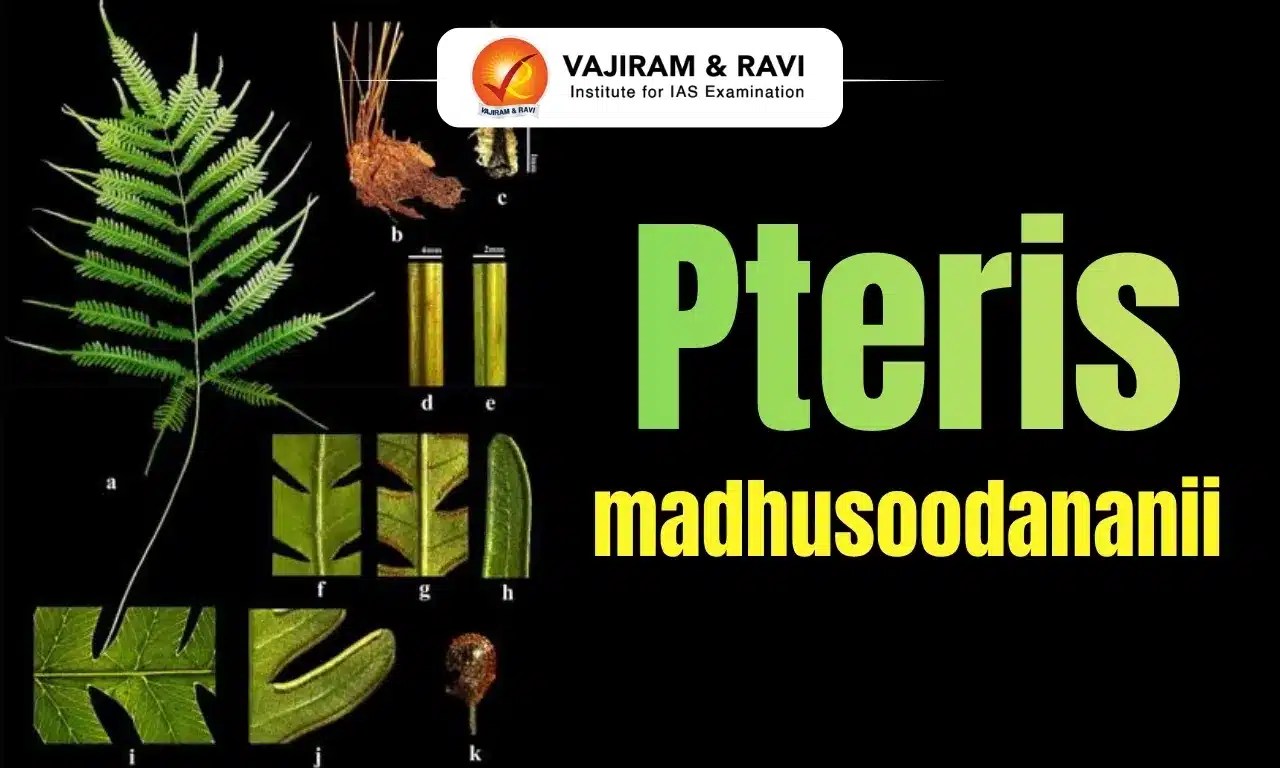
  • While it looks similar to other ferns in the Pteris family, Pteris madhusoodananii is characterised by stiff, leathery leaves with a lustrous, deep green colour. 
  • Unlike its closest relatives, it features a very prominent lobe at the base of its lower segments and a unique pinna-pinnule architecture, in which its smaller leaflets are arranged along the stem. 
  • At a microscopic level, its spores possess a narrow, wavy-edged belt called a cingulum, a feature distinct from the smooth, wider belts found on similar species.

News: RM

Pteris madhusoodananii FAQs

Q1: What is Pteris madhusoodananii?

Ans: It is a newly discovered species of fern.

Q2: Where was Pteris madhusoodananii discovered?

Ans: It was discovered in the Kolli Hills of the Eastern Ghats in Tamil Nadu.

Q3: What is the conservation status of Pteris madhusoodananii?

Ans: It has been classified as Critically Endangered.

Q4: What type of leaves does Pteris madhusoodananii possess?

Ans: It has stiff, leathery leaves with a lustrous, deep green colour.

Dirac Medal

Dirac Medal

Dirac Medal Latest News

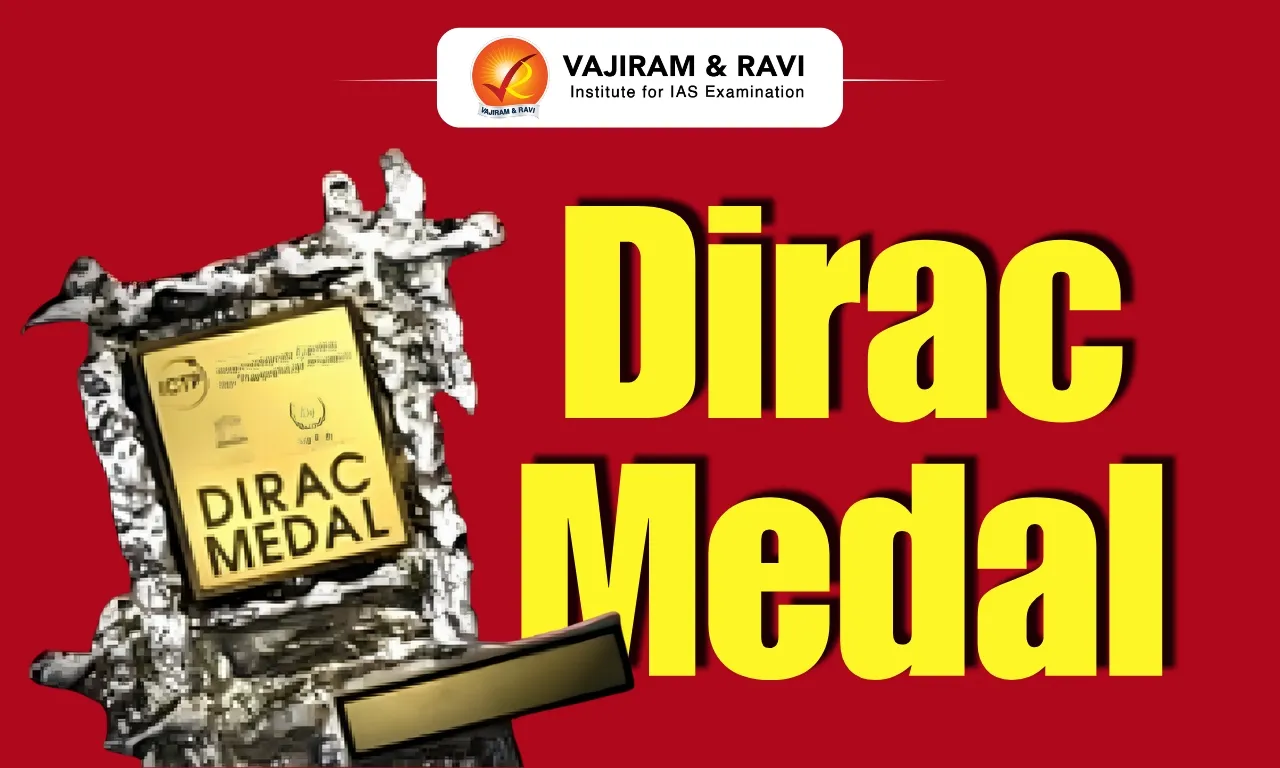
Recently, Deepak Dhar, a theoretical physicist from Uttar Pradesh has been named the co-recipient of Dirac Medal.  

About Dirac Medal

  • It was first awarded in 1985.
  • It is given in honor of P.A.M. Dirac, one of the greatest physicists of the 20th century.
  • It is awarded annually on Dirac's birthday (August 8), to scientists who have made significant contributions to theoretical physics.
  • It is awarded by the International Centre for Theoretical Physics (ICTP).
  • Selection Process: An international committee of distinguished scientists selects the winners from a list of nominated candidates.
  • The Dirac Medal is not awarded to Nobel Laureates, Fields Medallists, or Wolf Foundation Prize winners, although several past Dirac medallists later went on to receive those honours.
  • Cash Prize: The Medalist also receives a prize of US $5,000.

What is the International Centre for Theoretical Physics?

  • It is an international research institute for physical and mathematical sciences.
  • The centre was founded in 1964.
  • It operates under a tripartite agreement between the Italian Government, United Nations Educational, Scientific and Cultural Organization (UNESCO), and International Atomic Energy Agency (IAEA).
  • ICTP is a UNESCO Category 1 Institute.
  • It is located in Trieste, Italy.

Source: IE

Dirac Medal FAQs

Q1: Dirac Medal is awarded by which organisation?

Ans: International Centre for Theoretical Physics

Q2: Dirac Medal is given for contributions in which field?

Ans: Theoretical Physics

Eco-Educational Hub

Eco-Educational Hub

Eco-Educational Hub Latest News

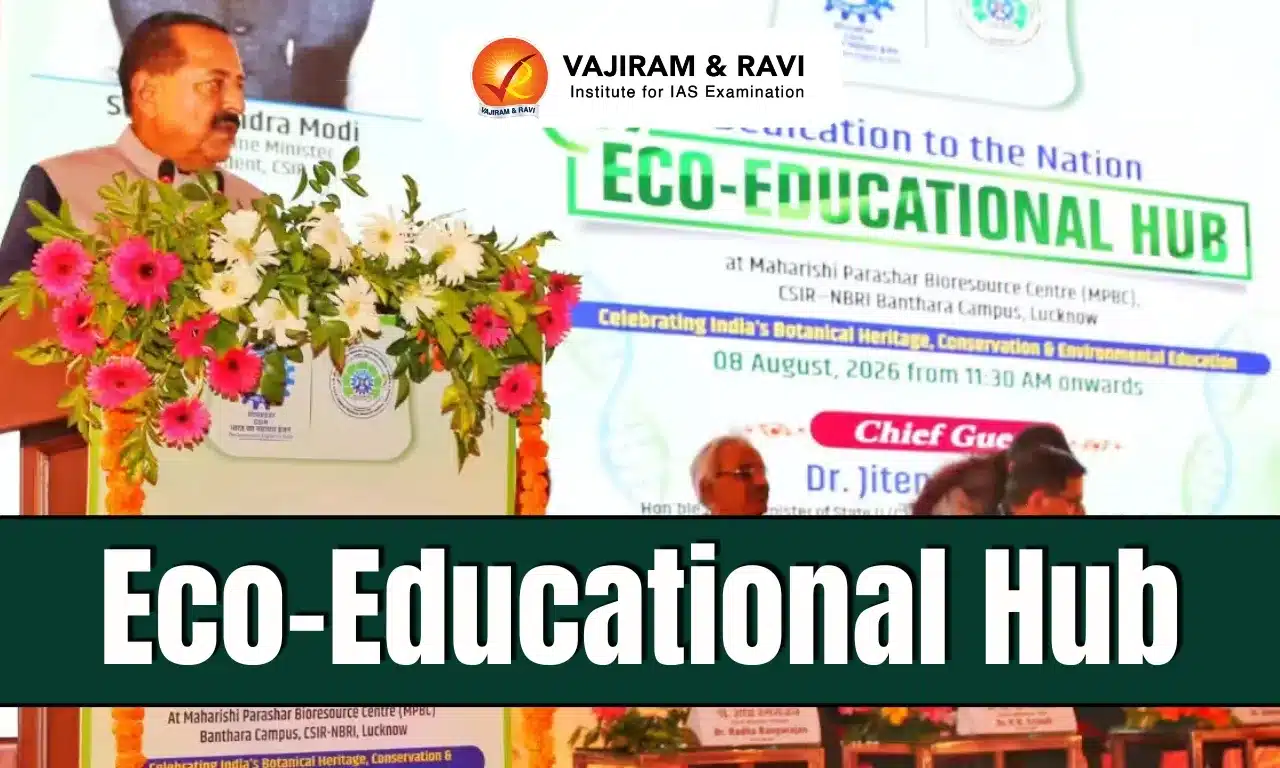
Recently, the Union Minister of State for Science and Technology dedicated the first-of-its-kind eco-educational hub ‘Prakriti Gyan Dham’.

About Eco-Educational Hub

  • It is developed by the CSIR-National Botanical Research Institute (CSIR-NBRI). 
  • It provides a direct interface between scientific knowledge and public engagement, by making it accessible through experiential and interactive learning.
  • Features of the Eco-Educational Hub
    • PAaVan Path (Plants and Associated Vegetations for Appreciating Nature): It is an interpretive heritage trail. The trail takes visitors through curated plant collections representing diverse ecological regions and associated vegetation.
    • Vibhav Enclave: It is a Threatened Plants of India Garden provides a dedicated space for rare, endangered and threatened plant species
      • It promotes awareness about biodiversity loss, habitat degradation, climate change and the need to conserve plant genetic resources.
    • Bhairav Enclave: State Plants of India Garden brings together officially designated State Plants of States and Union Territories, presenting their ecological, cultural and symbolic significance.

Source: PIB

Eco-Educational Hub FAQs

Q1: What is the Main objective of Eco-Educational Hub?

Ans: Environmental education and sustainability awareness

Q2: What is Prakriti Gyan Dham?

Ans: India’s first Eco-Educational Hub

Explosive Ordnance Disposal Exercise

Explosive Ordnance Disposal Exercise

Explosive Ordnance Disposal Exercise Latest News

The Indian Navy–US Navy Explosive Ordnance Disposal (EOD) Exercise 2026 is scheduled to be conducted at Southern Naval Command, Kochi till the 14th of this month.

About Explosive Ordnance Disposal Exercise

  • It is a bilateral exercise conducted between the Indian Navy and US Navy.
  • It aims to enhance interoperability and strengthen professional cooperation between the specialist diving and EOD teams of the two navies.
  • It has been conducted by both countries since 2005.
  • The forthcoming engagement marks the eighth edition of this specialised bilateral training exercise.
  • Features
    • It will comprise Subject Matter Expert Exchanges (SMEEs), cross-training, equipment demonstrations and scenario-based practical exercises.
    • It will facilitate the exchange of contemporary EOD methodologies, emerging technologies and Best Practices.
    • It is designed to promote collaborative learning and operational synergy, enabling personnel from both navies to refine procedures, enhance mutual understanding and strengthen their ability to respond effectively to complex and evolving EOD challenges.
  • Significance: It underscores the enduring commitment of the two navies towards enhancing interoperability, sharing operational expertise and strengthening cooperation in specialised maritime operations.
Source: PIB

Explosive Ordnance Disposal Exercise FAQs

Q1: Explosive Ordnance Disposal Exercise is conducted between which countries?

Ans: Indian Navy and US Navy

Q2: What is the main objective of India-US EOD Exercise?

Ans: Interoperability in explosive ordnance disposal

Philippines

Philippines

Philippines Latest News

The enhanced southwest monsoon and tropical cyclones have affected more than 3.8 lakh people across eight regions in the Philippines. 

About Philippines

  • Location: It is an island country of Southeast Asia in the western Pacific Ocean.
  • Water Bodies: It is surrounded by the South China (north and west); Philippine Sea (east); Celebes Sea (south); and by the Sulu Sea to the (southwest). 
  • Capital city: Manila.

Geographical Features of Philippines

  • Climate: It majorly consists of tropical and monsoonal types of climate.
  • Highest Point: Mount Apo.
  • Major Rivers: Cagayan River (Philippines’ longest river), Mindanao, Agusan etc.
  • Major Lake: Laguna de Bay
  • Volcano: Mayon Volcano, one of the most active in the country. Other volcanoes are Bulusan and Kanlaon.
  • Natural resources: It mainly consists of Timber, petroleum, nickel, cobalt, silver, gold, salt, copper
    • The Philippines is the third-largest producer of geothermal energy globally, after the United States and Indonesia.

Source: New On Air

Philippines FAQs

Q1: What is the Capital of Philippines?

Ans: Manila

Q2: Mount Mayon is a famous volcano located in which country?

Ans: Philippines

Independence Day 2026, 15 August, Theme, History, Celebrations

Independence Day 2026

Independence Day 2026 will be celebrated on 15 August 2026, marking India's 80th Independence Day and remembering the country's freedom from British rule in 1947. The day honours the sacrifices of freedom fighters and celebrates India's journey as an independent and democratic nation.
Independence Day 2026 also provides an opportunity to look ahead towards Viksit Bharat 2047, with focus on self-reliance, technology, green development and youth participation.

Independence Day 2026

Independence Day 2026 is celebrated to remember the historic moment when India gained freedom and began its journey as a sovereign nation. It is a day to recognise the importance of freedom, self-governance and national unity. The occasion also brings people together to express their patriotism, respect for the nation and commitment to its future.

Independence Day 2026 Theme

The Independence Day 2026 theme has not been officially announced by the Government of India yet. Therefore, phrases such as “Honoring Freedom, Inspiring the Future” should not be described as the official theme unless the government formally confirms them.

When Did India Become Independent?

India became independent on 15 August 1947, bringing an end to nearly two centuries of British colonial rule.

The Indian independence movement developed over several decades and involved people from different regions, communities and social backgrounds. Leaders such as Mahatma Gandhi, Jawaharlal Nehru, Sardar Vallabhbhai Patel, Subhas Chandra Bose, Bhagat Singh, Bal Gangadhar Tilak, Sarojini Naidu and many others played important roles in India's freedom struggle.

The movement included several forms of resistance, from mass civil disobedience and non-cooperation to revolutionary activities and political negotiations.
The final transfer of power came in 1947 against the backdrop of growing political tensions and communal violence. The Indian Independence Act 1947, passed by the British Parliament, provided for the creation of two independent dominions, India and Pakistan.

Power was formally transferred around midnight between 14 and 15 August 1947. India thus entered a new phase as an independent nation.

Why is Independence Day Celebrated on 15 August?

15 August is celebrated as Independence Day because India became independent from British rule on 15 August 1947.

The date became an important symbol of India's freedom and the sacrifices made during the independence movement. Every year, Indians across the country remember the freedom fighters and celebrate the country's sovereignty. The patriotic spirit of the occasion is also reflected in Vande Mataram,” a powerful symbol of India’s national movement and love for the motherland.

The day is also different from Republic Day, which is celebrated on 26 January. Independence Day marks India's freedom from British rule, while Republic Day commemorates the day the Constitution of India came into effect in 1950.

History of India's Independence

India’s independence was the result of a long and determined freedom struggle against British colonial rule, involving mass movements, political negotiations, revolutionary activities and the sacrifices of thousands of freedom fighters.

  • British Rule: The British gradually established political and economic control over India, which continued for nearly 200 years.
  • Revolt of 1857: The Revolt of 1857 became one of the earliest major armed challenges to British rule.
  • Indian National Congress: Founded in 1885, the INC became an important platform for India's political and national movement.
  • Gandhian Era: Mahatma Gandhi brought mass participation into the freedom struggle through Satyagraha, Non-Cooperation and Civil Disobedience.
  • Quit India Movement: Launched in 1942, the movement demanded an immediate end to British rule with the slogan Do or Die.”
  • Role of Revolutionaries: Freedom fighters such as Bhagat Singh, Subhas Chandra Bose and Chandrashekhar Azad inspired people through revolutionary and nationalist activities.
  • Mountbatten Plan: In 1947, Lord Mountbatten's plan paved the way for the Partition of British India and transfer of power.
  • Indian Independence Act 1947: The British Parliament passed the Act, creating the two independent dominions of India and Pakistan.
  • 15 August 1947: India finally achieved independence from British rule, marking the beginning of a new chapter in the country's history.

Independence Day 2026 Celebrations at Red Fort

The Red Fort in New Delhi will remain the centre of the national Independence Day 2026 celebrations, featuring the Prime Minister’s flag hoisting, ceremonial honours and an address highlighting India’s achievements, challenges and future vision.

  • Flag Hoisting: The Prime Minister of India will hoist the National Flag at the Red Fort.
  • National Anthem: The National Anthem will be played during the flag-hoisting ceremony.
  • Guard of Honour: The Prime Minister will receive a ceremonial Guard of Honour from the armed forces.
  • 21-Gun Salute: A traditional 21-gun salute will mark the national ceremony.
  • Prime Minister’s Address: The Prime Minister will address the nation and highlight India’s development journey and future priorities.
  • Cultural Programmes: Students and cultural groups will present patriotic performances reflecting India's diverse heritage.
  • Tribute to Freedom Fighters: The celebrations will honour the freedom fighters and their sacrifices for India's independence.
  • Youth Participation: Students, young leaders and citizens are expected to participate in various Independence Day activities.

Independence Day 2026 and Atmanirbhar Bharat

Independence Day 2026 highlights the vision of Atmanirbhar Bharat, where self-reliance, indigenous technology, green development, innovation and youth participation play an important role in building a stronger and more developed India.

  • Atmanirbhar Bharat: Promotes self-reliance by strengthening domestic manufacturing, innovation and India's capabilities in strategic sectors.
  • Indigenous Technology: Focuses on developing and using Indian technologies in areas such as artificial intelligence, semiconductors, telecommunications and defence.
  • Atmanirbhar Defence: Encourages the production of defence equipment in India, reducing dependence on imports and strengthening national security.
  • Green Development: Promotes renewable energy, green hydrogen, solar power, Mission LiFE and sustainable development for an environmentally responsible India.
  • Green Transition: The shift towards clean energy, energy efficiency and low-carbon technologies is important for achieving long-term economic and environmental goals.
  • Importance of Youth: Young Indians, entrepreneurs, innovators and students are key drivers of India's future through skills, startups, research, technology and social initiatives.
  • Youth Participation: Greater involvement of youth in nation-building, entrepreneurship, agriculture, fitness, innovation and startups can accelerate India's development.
  • Viksit Bharat 2047: Atmanirbhar Bharat, green development, technological innovation and youth empowerment support India's broader vision of becoming a developed India by 2047.
Other Related Posts
Freedom Fighters of India 80th Independence Day 2026
Subhash Chandra Bose Har Ghar Tiranga Campaign 2026
Forward Bloc Dadabhai Naoroji
Azad Hind Fauj Gopal Krishna Gokhale
Jawaharlal Nehru Surendranath Banerjee
Sardar Vallabhbhai Patel Rabindranath Tagore
Sarojini Naidu Acharya Vinoba Bhave
Madam Bhikaji Cama Sarvodaya Movement
Slogans of Freedom Fighters Indian National Movements 
Important Days in 2026 Republic Day 2026
National Song National Anthem
National Flag Code of India 2002 National Flag
Indian Independence Act 1947  Revolt of 1857 
Swadeshi Movement  Home Rule Movement 
Non-Cooperation Movement Civil Disobedience Movement 
Azad Hind Fauj and INA Trials Cabinet Mission Plan 
Partition of India 1947 Mountbatten Plan 
Constituent Assembly of India Fundamental Duties 
Constitutional Values Preamble of the Indian
National Symbols of India Madan Mohan Malviya
Pingali Venkayya APJ Abdul Kalam 

Independence Day 2026 FAQs

Q1: When is Independence Day 2026?

Ans: Independence Day 2026 will be celebrated on Saturday, 15 August 2026.

Q2: Which Independence Day will India celebrate in 2026?

Ans: India will celebrate its 80th Independence Day in 2026. Since independence was achieved in 1947, the country will complete 79 years of independence on 15 August 2026 while observing the 80th Independence Day celebration.

Q3: What is the theme of Independence Day 2026?

Ans: The official theme for Independence Day 2026 had not been announced yet. The broader national vision continues to focus on Viksit Bharat 2047, self-reliance, innovation, sustainable development and inclusive growth.

Q4: Why is Independence Day celebrated on 15 August?

Ans: India became independent from British rule on 15 August 1947. Therefore, 15 August is observed every year as India's Independence Day.

Q5: Where is the main Independence Day celebration held?

Ans: The main national Independence Day ceremony is held at the Red Fort in New Delhi.

H1N1 Virus, Swine Flu, Symptoms, Prevention, Latest News 2026

H1N1 Virus | Swine Flu

H1N1 Virus is a subtype of Influenza A that causes an acute respiratory infection commonly known as Swine flu. It can affect people of all ages. Most infections remain mild and improve within about a week. However, severe cases can cause pneumonia, respiratory failure, hospitalisation and death, especially among high risk groups.

Why is H1N1 Virus in News?

Delhi has reported 1,344 H1N1 Virus (influenza) cases this season, compared with 229 during the corresponding period last year. This is nearly a six fold increase. The rise has again focused attention on seasonal Influenza, its transmission, symptoms and risk of severe disease.

H1N1 Virus

H1N1 Virus is an Influenza A subtype. The virus responsible for the 2009 pandemic is called A(H1N1)pdm09 and continues to circulate as a seasonal virus.

  • Full Form: H1N1 refers to Hemagglutinin 1 and Neuraminidase 1. These names identify two surface proteins used to classify Influenza A virus subtypes.
  • H1N1 Disease: H1N1 causes an acute respiratory infection commonly called Swine flu. Influenza has four types, A, B, C and D, while A and B cause seasonal epidemics in humans.
  • 2009 Pandemic: The new A(H1N1) virus was first reported in North America in April 2009. WHO declared a pandemic in June 2009 after infections were confirmed in 74 countries and territories.
  • Origin: Genetic analysis showed that the 2009 virus originated from animal Influenza viruses. It was different from human seasonal H1N1 viruses circulating since 1977.
  • First Case in India: India reported its first confirmed H1N1 case in May 2009. The virus has since caused several outbreaks, with significant cases reported in 2021, 2022 and 2023.
  • Transmission: Swine Flu mainly spreads through respiratory droplets released during coughing and sneezing. Infection can also occur after touching contaminated surfaces and then touching the mouth or nose.
  • Incubation: Symptoms generally appear about two days after infection. The incubation period can range from one to four days, allowing transmission before symptoms become clearly noticeable.
  • Diagnosis: Most cases are identified clinically. Laboratory testing of respiratory samples can confirm infection. RT PCR can detect Influenza specific RNA and generally has better sensitivity than rapid diagnostic tests.

Also Read: Difference Between Pandemic and Epidemic

H1N1 Virus Symptoms

H1N1 Virus symptoms usually begin suddenly and resemble those of ordinary seasonal flu, with fever, cough, body pain and marked tiredness being common features.

  • Common Symptoms: Fever, dry cough, sore throat, headache, muscle and joint pain, runny nose, chills and severe tiredness are common symptoms of Swine Flu infection.
  • Other Symptoms: Some infected people may experience vomiting or diarrhoea. Symptoms generally improve within about a week, although cough and weakness can continue for two weeks or longer.
  • Severe Illness: H1N1 can sometimes cause serious complications. Pneumonia, respiratory failure and sepsis have been reported in severe infections requiring medical attention.
  • High Risk Groups: Pregnant women, children below five years, adults aged 65 years and above and people with chronic diseases face a higher risk of severe Influenza.

H1N1 Virus Prevention and Treatment

Prevention of the H1N1 Virus focuses on vaccination, hygiene and limiting exposure, while treatment depends on disease severity and the person's risk of complications.
  • Vaccination: WHO considers vaccination the best protection against seasonal Influenza. Annual vaccination is recommended because immunity declines over time and circulating viruses continually change.
  • Hygiene: Regular handwashing, proper disposal of tissues, covering the mouth and nose while coughing or sneezing and avoiding unnecessary contact with infected people can reduce the spread of Swine Flu.
  • Isolation: This helps limit transmission, particularly during the infectious period.
  • Antiviral Treatment: WHO recommends antiviral medicines as soon as possible for high risk patients and people with severe Influenza. Treatment within 48 hours may reduce severe complications and deaths.
  • Public Health Measures: Effective control requires adequate vaccination, diagnostic facilities, disease surveillance and awareness, particularly for pregnant women, young children, older adults and people with chronic illnesses.
H1N1 Virus FAQs

Q1: What is H1N1 Virus?

Ans: H1N1 Virus is a subtype of Influenza A that causes respiratory infection and is commonly known as Swine flu.

Q2: How does H1N1 Virus spread?

Ans: H1N1 spreads mainly through respiratory droplets from coughing or sneezing and through contaminated hands or surfaces.

Q3: What are the main symptoms of H1N1 Virus?

Ans: Common symptoms include fever, cough, sore throat, headache, body aches, chills, runny nose and fatigue.

Q4: Is H1N1 Virus a serious disease?

Ans: H1N1 can cause severe illness, pneumonia and respiratory failure, particularly among high-risk groups such as older adults and young children.

Q5: Can antibiotics treat H1N1 Virus?

Ans: No. Antibiotics do not treat H1N1 because it is caused by a virus, while antiviral medicines may be used for severe or high-risk cases.

Export Promotion Capital Goods Scheme

Export Promotion Capital Goods Scheme

Export Promotion Capital Goods Scheme Latest News

Recently, the Directorate General of Foreign Trade (DGFT) has removed the requirement of submitting physical duty payment challans while applying for Export Obligation Discharge Certificates (EODC) under the Advance Authorisation and Export Promotion Capital Goods (EPCG) Schemes. 

About Export Promotion Capital Goods Scheme

  • It is a trade promotion scheme implemented by the Indian government.
  • It allows the duty-free import of capital goods for the purpose of export production in India.
  • It was first operationalized on 1 April 2015.
  • Objective: The objective of the scheme is to facilitate import of capital goods for producing quality goods and services and enhance India's manufacturing competitiveness. 
  • The EPCG scheme is administered by the Directorate General of Foreign Trade (DGFT) and is governed by the Foreign Trade Policy of India.
  • Features
    • EPCG Scheme allows import of capital goods for pre-production, production and post-production at zero customs duty.
    • It covers manufacturer exporters with or without supporting manufacturer(s), merchant exporters tied to supporting manufacturer(s) and service providers.
    • Second-hand goods of any nature will not be permitted under the EPCG scheme.

Source: PIB

Export Promotion Capital Goods Scheme FAQs

Q1: Export Promotion Capital Goods scheme covers which sectors?

Ans: Both Goods and Services

Q2: EPCG scheme is implemented by which ministry?

Ans: Ministry of Commerce & Industry

Handloom Sector in India – Economic Significance, Challenges, and the Road Ahead

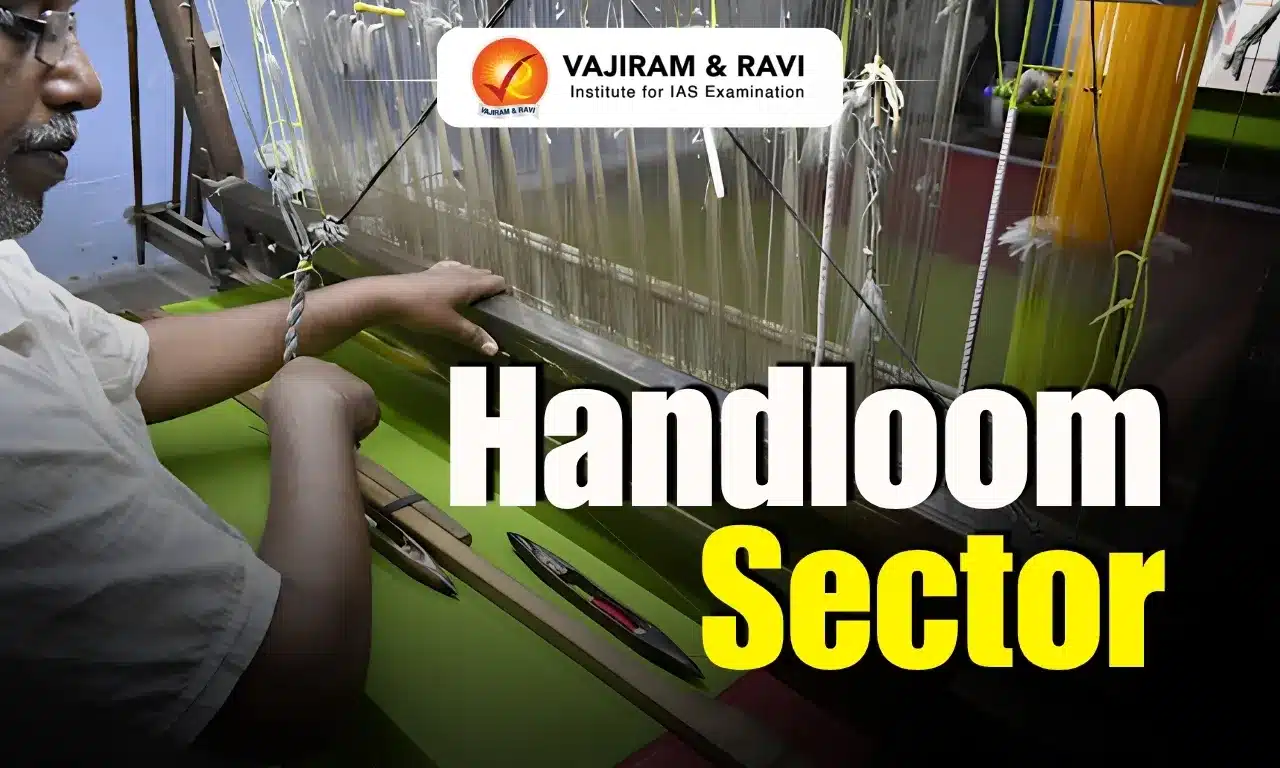
Handloom Sector

Handloom Sector Latest News

  • National Handloom Day, observed on August 7, has drawn attention to the continuing economic significance of India's handloom sector and the challenges of declining returns, fragmented markets, and vanishing weaving traditions.

Historical Background

  • Handloom weaving in India has a legacy that stretches far beyond craft. Long before the Industrial Revolution transformed manufacturing in Europe, Indian handlooms were among the world's greatest industrial enterprises. 
  • Indian textiles travelled across continents, powered global trade, and established India's reputation as one of history's foremost manufacturing economies.
  • During the freedom struggle, weaving became an instrument of economic resistance and national identity. 
  • The Swadeshi Movement of 1905 called for a boycott of British textiles, and Mahatma Gandhi adopted the spinning wheel as a symbol of self-reliance. 
  • National Handloom Day, marked on August 7, commemorates the launch of the Swadeshi Movement and honours generations of Indian weavers.

Economic Significance of Handloom

  • The handloom sector is often viewed as a small artisanal activity, culturally important but economically peripheral. The data suggests otherwise.
    • It provides livelihoods to more than 35 lakh weavers and allied workers.
    • These workers belong to over 31 lakh households.
    • Women constitute nearly 70% of the workforce.
    • It remains one of rural India's largest sources of non-farm employment.
    • It produces nearly 15% of the country's cloth, despite relying largely on manual technology.
  • This makes handloom particularly valuable in a country where employment generation remains a central policy challenge.

Challenges Facing the Sector

  • While a few celebrated weaving traditions continue to enjoy strong recognition, hundreds of lesser-known traditions face gradual extinction.
  • The main pressures include declining returns for weavers, fragmented markets that limit access to buyers, and the breakdown of skill transmission within families. 
  • Younger generations are leaving the profession as incomes fall and the work is no longer seen as viable or aspirational.
  • Every disappearing weave represents more than the loss of a product. It marks the disappearance of centuries of accumulated knowledge, a distinctive design vocabulary, and a form of cultural identity. 
  • Protecting handloom heritage is therefore both an economic necessity and a civilisational responsibility.

Government Support and Recent Progress

  • Policy and programme support appears to be making a difference.
  • The National Handloom Development Programme has focused on skill development, design innovation, technology adoption, branding, and improved market access. 
  • Greater integration with e-commerce platforms and expanding export opportunities have enabled many artisan clusters to reach consumers who were previously inaccessible.
  • The Office of the Development Commissioner for Handlooms, in collaboration with UNESCO, has begun identifying and documenting India's languishing and endangered weaves. There is a case for extending this documentation across every region of the country.
  • Alongside this, there is a policy focus on promoting Geographical Indication (GI)-tagged handloom and handicraft products and strengthening their presence in both domestic and international markets.

Success Stories

  • The revival of Tangaliya weaving in Gujarat shows how a near-forgotten tradition can be brought back into circulation. 
  • The transformation of Badturang village in Odisha's Sambalpur district demonstrates the impact of cluster-level support. 
  • The growing popularity of Siddipet Gollabhama sarees reflects how design and market access can create fresh demand.
  • These cases share a common pattern: traditional crafts thrive when design, market access, and institutional support converge.
  • The global visibility of Indian weaves has also grown. When a handcrafted shirt in the traditional Tangaliya weave appeared in an international film, it was more than a fashion statement, it signalled the global appeal such crafts can command.

Making Handloom Aspirational

  • The next phase of policy must shift from preservation to aspiration.
  • For younger consumers, particularly Gen Z, handloom needs to be seen as contemporary, fashionable, and aspirational rather than merely traditional. 
  • Celebrity ambassadors, collaborations with leading designers, limited-edition collections, digital storytelling, and partnerships with influencers can reposition India's weaves as premium lifestyle products.
  • The objective should not be to celebrate handloom because it is old, but because it represents craftsmanship, sustainability, and exclusivity. 
  • Limited production, often treated as a constraint, should be repositioned as a premium feature.

Expanding Global Reach

  • India must also think beyond domestic markets. Global consumers increasingly value authenticity, sustainability, and handcrafted luxury, all areas where Indian handlooms enjoy a natural competitive advantage.
  • Expanding exports, however, will require consistent quality standards, stronger branding, better GI protection, and vigilant action against cultural misappropriation. 
  • India can also leverage its traditional weaves, which for some global markets are ancient imports, to build its soft power.

Need for Better Measurement

  • Unlike most manufacturing sectors, India's handloom economy is inadequately measured.
  • Policymakers need reliable data on its contribution to GDP, exports, tax revenues, employment, and household incomes. 
  • Better measurement will enable better policy and allow the sector to be recognised for the economic value it already creates.
  • Establishing a national platform through which States, producer organisations, and cooperatives can exchange successful practices would also accelerate innovation across the sector.

Source: TH

Handloom Sector FAQs

Q1: When is National Handloom Day observed and why?

Ans: It is observed on August 7 to commemorate the launch of the Swadeshi Movement in 1905 and to honour Indian weavers.

Q2: How many people depend on the handloom sector for livelihood?

Ans: More than 35 lakh weavers and allied workers across over 31 lakh households depend on the sector.

Q3: What share of India's cloth production comes from handloom?

Ans: The handloom sector produces nearly 15% of the country's cloth.

Q4: What is the share of women in the handloom workforce?

Ans: Women constitute nearly 70% of the handloom workforce.

Q5: Which programme supports handloom development in India?

Ans: The National Handloom Development Programme supports skill development, design innovation, technology adoption, branding, and market access.

Mecca Agreement: Saudi Arabia, Turkey and Pakistan’s New Defence Pact and India

Mecca Agreement

Mecca Agreement Latest News

  • Recently, Saudi Arabia, Turkey and Pakistan signed the Mecca (Makkah) Joint Defence Agreement in the presence of Crown Prince Mohammed bin Salman.
  • The pact declares that an armed attack on any one of the three states will be treated as an attack on all three, marking a significant new trilateral security arrangement in West Asia with direct implications for India.

Background: From Bilateral Pact to Trilateral Compact

  • The agreement builds on the September 2025 Saudi-Pakistan Strategic Mutual Defence Agreement (SMDA), now widened to include Turkey's NATO-integrated military capabilities and defence-industrial base.
  • Notably, as with the original Saudi-Pakistan pact, the full text of the Mecca Agreement has not been made public — only a joint press release describing its collective-deterrence intent has been issued.

What the Pact Actually Covers

  • According to officials, the agreement rests on four pillars:
    • a collective-deterrence clause modelled on Article 51 of the UN Charter,
    • joint training and military exercises,
    • intelligence-sharing mechanisms, and
    • defence-industrial integration — particularly Turkish drone production feeding into Saudi capacity.
  • Equally significant is what is missing: there is no integrated command headquarters, no standing joint force, no common budget, and crucially, no explicit nuclear-sharing clause.
  • A reported exclusionary clause also denies protection to any member that initiates aggression or allows its territory to be used to attack another state, underlining the pact's defensive character.

Why Now: Three Converging Pressures

  • The timing reflects three factors.
  • First, the widening US-Israel-Iran confrontation since late February 2026 exposed the limits of relying solely on US security guarantees, especially after Saudi Arabia reportedly depleted a large share of its Patriot missile interceptor stockpile defending against Iranian and Houthi strikes.
  • Second, post-October 7 regional recalibration pushed Riyadh to diversify its security partners.
  •  Third, the three states bring complementary strengths:
    • Saudi financial depth and geography astride the Hormuz and Bab el-Mandeb chokepoints,
    • Turkish NATO-standard doctrine and drone/naval industry (Baykar's Akinci drones, the KAAN fighter programme), and
    • Pakistan's manpower and status as the only nuclear-armed Muslim-majority state.

Not Quite a "NATO of the East"

  • Comparisons with NATO's Article 5 are analytically weak. NATO's guarantee rests on a standing treaty organisation, integrated command, and decades of tested doctrine.
  • The Mecca pact instead relies on Article 51 self-defence logic, leaves geographic scope and response triggers undefined, and gives each signatory full discretion over whether to respond at all.
  • Historically, mutual defence pacts are rarely invoked militarily — Pakistan did not act when Saudi Arabia came under missile and drone attack during the SMDA's first year, choosing mediation over military response.

 Who Is It Really Aimed At?

  • While the pact is framed as deterrence against Iran, its deeper subtext may be directed at Israel.
  • Turkey views Israel as a greater long-term security threat than Iran, especially given clashing interests in post-Assad Syria.
  • Israeli figures, including former PM Naftali Bennett, have already labelled Turkey "the new Iran" and accused it of building a "hostile Sunni axis" with nuclear-armed Pakistan.

Global Reactions

  • China has responded with calculated silence, seeing benefit in a stabilised Pakistan-Gulf security architecture that protects its Belt and Road investments without cost.
  • Russia is watching with pragmatic neutrality, balancing its Iran partnership against interest in reduced US centrality in the Gulf.
  • India has adopted a non-committal closely following" posture.

Implications for India

  • For India, the pact signals deeper strategic integration between Saudi Arabia and the Pakistan-Turkey-China axis.
  • Turkey has historically been diplomatically hostile to India and has already demonstrated military cooperation with Pakistan, including during the India-Pakistan conflict of April/May 2025.
  • Saudi Arabia, in contrast, has invested significantly in ties with India over the past decade despite its closeness to Pakistan.
  • However, growing Saudi security dependence may now give Islamabad greater leverage in that relationship, potentially straining India's long-term strategic partnership with Riyadh.
  • Three imperatives follow for India to prevent this grouping from consolidating into a coordinated front against Indian interests:
    • Insulating its bilateral relationship with Saudi Arabia (built on energy, expatriate welfare and counterterrorism cooperation) from spillover effects;
    • Intensifying bilateral defence engagement with Gulf states to prevent diplomatic isolation on Kashmir-related narratives; and
    • Calibrating its own extended-neighbourhood posture — Quad engagement, Indian Ocean naval presence, and defence diplomacy with Israel and moderate Arab states.

Conclusion

  • The Mecca Agreement reflects eroding confidence in single-power security guarantees rather than a fully realised alliance.
  • For India, the sensible course lies not in alarm but in sustained, calibrated diplomatic engagement — ensuring the pact reshapes West Asia's security map without reshaping India's strategic space.

Source: IE | FP | TP 

Mecca Agreement FAQs

Q1: What is the Mecca Agreement?

Ans: The Mecca Agreement is a trilateral defence pact between Saudi Arabia, Turkey and Pakistan treating an armed attack on one member as an attack on all.

Q2: What does the Mecca Agreement cover?

Ans: The Mecca Agreement covers collective deterrence, joint military exercises, intelligence sharing, and defence-industrial cooperation, particularly involving Turkish drone capabilities.

Q3: Why was the Mecca Agreement signed now?

Ans: The Mecca Agreement reflects regional security pressures, concerns over US guarantees, post-October 7 recalibration, and complementary military and strategic capabilities among its members.

Q4: Is the Mecca Agreement similar to NATO?

Ans: The Mecca Agreement is not equivalent to NATO because it lacks integrated command, standing forces, common funding, and clearly defined collective military response mechanisms.

Q5: What are the implications of the Mecca Agreement for India?

Ans: The Mecca Agreement could increase Pakistan's leverage with Saudi Arabia, requiring India to strengthen Gulf defence ties and carefully manage its wider regional partnerships.

Creamy Layer for SC/ST Reservations: Centre Opposes Extension Beyond OBCs

Creamy Layer for SC/ST Reservations

Creamy Layer for SC/ST Reservations Latest News

  • The Union government has filed a counter-affidavit in the Supreme Court opposing petitions that seek to extend the "creamy layer" exclusion — currently applicable to Other Backward Classes (OBCs) — to Scheduled Caste (SC) and Scheduled Tribe (ST) reservations. 
  • The government has argued that historical disadvantage suffered by SCs and STs cannot be equated with the economic backwardness criterion used for OBCs.

Background: How the Issue Arose

  • The current round of litigation traces back to the Supreme Court's August 2024 Davinder Singh judgment, delivered by a seven-judge Bench headed by then Chief Justice D.Y. Chandrachud. 
  • That verdict recognised the heterogeneity within SC and ST communities and permitted State governments to sub-categorise within these lists so that more backward groups are not crowded out by relatively advanced ones. 
  • In his opinion, Justice B.R. Gavai went further, suggesting the government seriously consider a creamy layer exclusion for SC/STs too, similar to what exists for OBCs.
  • This observation triggered a debate around this issue.

The Present Petition Before the Court

  • The present petition, filed by advocate Ashwini Kumar Upadhyay, alleges "elite capture" of SC/ST reservation benefits by affluent families, seeking income-based exclusions across all reserved categories. 
  • It cites four of seven Davinder Singh judges who favoured extending the creamy layer principle to SC/STs.

Understanding the Concepts: Sub-Categorisation vs Creamy Layer

  • These two tools are often discussed together but serve different purposes:
    • Sub-categorisation divides an existing reservation quota into smaller shares within a category, ensuring more backward groups get guaranteed representation. It does not deny reservation to anyone; it only redistributes the existing pie.
    • Creamy layer exclusion identifies individuals or families who have already achieved sufficient social and economic advancement and excludes them entirely from availing reservation benefits.
  • The creamy layer concept originated in the 1992 Indra Sawhney judgment, which upheld OBC reservations based on the Mandal Commission report. 
  • Crucially, that judgment explicitly stated the creamy layer test has no relevance for SCs and STs, since their backwardness stems from untouchability and social exclusion rather than economic status alone.

The Centre's Legal Arguments

  • The government's affidavit rests on several strands of reasoning. 
  • First, it draws a distinction in the basis of identification: SCs are marked by "historical disadvantage" from untouchability, while STs are identified by distinct culture, geographical isolation and backwardness — neither is an economic classification like OBC status. 
  • Second, it cites settled precedent: the 2008 Ashoka Kumar Thakur case confirmed creamy layer does not apply to SC/STs, and the 2005 E.V. Chinnaiah judgment held that any such exclusion, if ever required, could only be introduced by Parliament, not the courts.
  • Third, the Centre invokes separation of powers. Under Articles 341 and 342, only the President notifies SC/ST lists, and any inclusion or exclusion requires an Act of Parliament — no other authority, including State governments or courts, can alter these lists. 
  • On this basis, the government contends that the petition effectively seeks a writ of mandamus asking courts to direct executive policy, which is impermissible since reservation policy requires a holistic review and empirical data, not judicial intervention. 
  • It has also questioned the petition's maintainability under Article 32, arguing no fundamental right violation has been shown.
  • Notably, the Centre has left open a conditional pathway: any change to reservation policy would require a "holistic review and thorough empirical study" of socio-economic data — but such a review must be initiated by the government, not ordered by the judiciary.

Where Sub-Categorisation Has Actually Been Used

  • Unlike creamy layer, sub-categorisation has already been implemented at the State level — for instance, Telangana, Haryana and Punjab have sub-classified their SC category, while Mizoram has done so for STs. 
  • At the Central level, the clearest example is the sub-division of the ST quota in Eklavya Model Residential Schools to ensure representation for Particularly Vulnerable Tribal Groups (PVTGs). 
  • Meanwhile, the Centre has still not acted on the 2017 G. Rohini Commission report on OBC sub-categorisation, nor made its national stance clear.

Conclusion

  • The debate underscores a fundamental distinction between economic and historical-social backwardness in India's reservation framework. 
  • While sub-categorisation strengthens equitable distribution within categories, the Centre insists creamy layer exclusion is constitutionally and legally confined to OBCs, leaving any change to Parliament's exclusive domain.

Source: IE | TH

Creamy Layer for SC/ST Reservations FAQs

Q1: What is the Centre's position on Creamy Layer for SC/ST Reservations?

Ans: The Centre opposes Creamy Layer for SC/ST Reservations, arguing that SC/ST disadvantage is rooted in historical social exclusion rather than economic backwardness.

Q2: How does Creamy Layer for SC/ST Reservations differ from OBC reservations?

Ans: Creamy Layer for SC/ST Reservations differs because SC/ST status reflects historical and social disadvantage, while the OBC creamy layer addresses economic and social advancement.

Q3: What is the difference between sub-categorisation and Creamy Layer for SC/ST Reservations?

Ans: Sub-categorisation redistributes existing quotas among groups, whereas Creamy Layer for SC/ST Reservations would exclude socially and economically advanced individuals from reservation benefits.

Q4: What did the Davinder Singh judgment say about SC/ST reservations?

Ans: The Davinder Singh judgment permitted SC/ST sub-categorisation, while Justice B.R. Gavai suggested considering Creamy Layer for SC/ST Reservations to address unequal benefit distribution.

Q5: Who can change the rules concerning Creamy Layer for SC/ST Reservations?

Ans: The Centre argues that changes involving Creamy Layer for SC/ST Reservations require Parliament's action following comprehensive empirical study, rather than judicial intervention.

Har Ghar Tiranga Campaign 2026, Theme, History, Flag Code

Har Ghar Tiranga Campaign 2026

The Har Ghar Tiranga Campaign 2026 is a nationwide initiative by the Government of India that encourages citizens to proudly hoist the Indian National Flag (Tiranga) at their homes, workplaces, and institutions. The fifth edition of the campaign started on 9th August and will continue until 17 August 2026 as part of the Independence Day celebrations. Dedicated to the Spirit of Vande Mataram, it aims to strengthen patriotism, national unity, and citizens' emotional connection with the Tiranga.

What is Har Ghar Tiranga Campaign 2026?

The Har Ghar Tiranga Campaign 2026 is a nationwide initiative by the Government of India that encourages citizens to proudly hoist the Indian National Flag (Tiranga) at their homes, workplaces, and institutions from 9 August to 17 August 2026. The campaign is being organized as part of the celebrations of India's 80th Independence Day, which will be observed on 15 August 2026.

Har Ghar Tiranga Theme 2026

The theme of Har Ghar Tiranga Campaign 2026 is "Spirit of Vande Mataram." The campaign celebrates India's unity, patriotism, and national pride by encouraging every citizen to proudly hoist the National Flag. It also pays tribute to the nation's freedom struggle and inspires people to reaffirm their commitment to the values of unity, sovereignty, and nation-building through active public participation.

Har Ghar Tiranga Campaign History

The Har Ghar Tiranga Campaign was launched by the Government of India in 2022 under the Azadi Ka Amrit Mahotsav initiative to strengthen citizens' emotional connection with the Indian National Flag and encourage mass participation in celebrating Independence Day.

  • Har Ghar Tiranga Movement was launched in 2022 as part of the Azadi Ka Amrit Mahotsav, commemorating 75 years of India's Independence.
  • Introduced to encourage every citizen to bring the Tiranga home and proudly hoist it during Independence Day celebrations.
  • Aimed to transform the National Flag from a symbol seen mainly at official institutions into a personal symbol of patriotism for every household.
  • The campaign seeks to promote awareness about the history, significance, and proper display of the Indian National Flag.
  • It is coordinated by the Ministry of Culture, Government of India, which serves as the nodal ministry.
  • The initiative has witnessed millions of participants across villages, towns, and cities through flag-hoisting drives and public events.
  • Citizens actively participate by uploading selfies with the Tiranga on the official campaign portal and becoming Har Ghar Tiranga Ambassadors.
  • Educational institutions, government offices, public sector organizations, and community groups organize awareness programmes, rallies, and cultural events during the campaign.
  • Since its launch, Har Ghar Tiranga has evolved into an annual nationwide movement, reinforcing patriotism, national unity, and citizens' commitment to nation-building.

Har Ghar Tiranga Campaign 2026 Objectives

The Har Ghar Tiranga Movement 2026 aims to strengthen every citizen's emotional connection with the Indian National Flag, promote patriotism, and encourage active public participation in celebrating India's independence.

  • Encourage every household to proudly hoist the Tiranga during the campaign period.
  • Foster a deeper sense of patriotism and national pride among citizens.
  • Strengthen the emotional bond between people and the Indian National Flag.
  • Promote awareness about the history, significance, and symbolism of the Tiranga.
  • Educate citizens about the Flag Code of India and the proper display of the National Flag.
  • Honor the sacrifices and contributions of India's freedom fighters.
  • Encourage Jan Bhagidari (people's participation) in national celebrations.
  • Promote the values of unity, integrity, and social harmony across the country.
  • Inspire young people to actively contribute to nation-building.
  • Reinforce respect for constitutional values and democratic ideals.
  • Encourage schools, colleges, government offices, and organizations to organize patriotic activities.
  • Celebrate India's cultural diversity under the shared identity of the National Flag.

Who Organizes Har Ghar Tiranga Campaign?

The Har Ghar Tiranga Campaign is organized by the Ministry of Culture, Government of India, which serves as the nodal ministry for its nationwide implementation. The campaign is conducted in collaboration with state governments, educational institutions, government departments, local bodies, and various public organizations.

Flag Code Guidelines for Har Ghar Tiranga Campaign 2026

The Indian National Flag (Tiranga) is the foremost symbol of India's sovereignty, unity, and national pride. It reflects the sacrifices of countless freedom fighters, the values of the Constitution, and the aspirations of every Indian citizen. To preserve its dignity and honor, the display and use of the National Flag are governed by the Prevention of Insults to National Honour Act, 1971 and the Flag Code of India, 2002, along with its subsequent amendments.

  • National Flag Material: Following the amendments to the Flag Code of India, 2002 (December 2021), the National Flag may be made of hand-spun, handwoven, or machine-made cotton, polyester, wool, silk, or khadi bunting.
  • Who Can Hoist the Flag: Every citizen, private organization, educational institution, and government body may hoist or display the National Flag on all days and occasions, provided it is done with dignity and respect.
  • Day and Night Display: As per the July 2022 amendment, citizens are permitted to fly the National Flag both during the day and at night, provided it is displayed in a respectful manner.
  • Correct Dimensions: The National Flag must always be rectangular in shape, with the length-to-width ratio maintained at 3:2.
  • Position of Honour: Whenever displayed, the Tiranga should always occupy the highest position of honor and be clearly visible.
  • Damaged Flags: A torn, faded, dirty, or damaged National Flag should never be hoisted or displayed.
  • No Simultaneous Hoisting: The National Flag should not be flown on the same flagpole with any other flag at the same time.
  • Display on Vehicles: The Tiranga may only be displayed on the vehicles of dignitaries authorized under the Flag Code of India, such as the President, Vice-President, Prime Minister, Governors, and other specified constitutional authorities.
  • No Flag Above the Tiranga: No other flag, banner, or decorative bunting should be placed above, higher than, or alongside the National Flag in a manner that diminishes its dignity.
  • Respectful Handling: The National Flag should never touch the ground, floor, or water, nor should it be used as clothing, table covers, drapery, packaging material, or decoration.
  • Proper Disposal: When the National Flag becomes damaged or unfit for display, it should be disposed of respectfully, preferably by private burning or another dignified method in accordance with the Flag Code.

Har Ghar Tiranga Campaign 2026 and Nation Building

The Har Ghar Tiranga Campaign 2026 encourages every citizen to actively participate in strengthening the nation by proudly hoisting the Indian National Flag. It promotes patriotism, unity, and respect for the values enshrined in the Constitution. The campaign reminds people that nation-building is a shared responsibility and that every individual has a role in India's progress. By bringing the Tiranga into every home, the initiative reinforces the spirit of unity, civic responsibility, and national pride.

Other Related Posts
Freedom Fighters of India 80th Independence Day 2026
Subhash Chandra Bose Har Ghar Tiranga Campaign 2026
Forward Bloc Dadabhai Naoroji
Azad Hind Fauj Gopal Krishna Gokhale
Jawaharlal Nehru Surendranath Banerjee
Sardar Vallabhbhai Patel Rabindranath Tagore
Sarojini Naidu Acharya Vinoba Bhave
Madam Bhikaji Cama Sarvodaya Movement
Slogans of Freedom Fighters Indian National Movements 
Important Days in 2026 Republic Day 2026
National Song National Anthem
National Flag Code of India 2002 National Flag
Indian Independence Act 1947  Revolt of 1857 
Swadeshi Movement  Home Rule Movement 
Non-Cooperation Movement Civil Disobedience Movement 
Azad Hind Fauj and INA Trials Cabinet Mission Plan 
Partition of India 1947 Mountbatten Plan 
Constituent Assembly of India Fundamental Duties 
Constitutional Values Preamble of the Indian
National Symbols of India Madan Mohan Malviya
Pingali Venkayya  
 

Har Ghar Tiranga Campaign 2026 FAQs

Q1: What is the Har Ghar Tiranga Campaign 2026?

Ans: The Har Ghar Tiranga Campaign 2026 is a nationwide initiative by the Government of India that encourages citizens to hoist the Indian National Flag at their homes, workplaces, and institutions to celebrate Independence Day and promote patriotism.

Q2: When will the Har Ghar Tiranga Campaign 2026 be held?

Ans: The campaign will be observed from 9 August to 17 August 2026 across India.

Q3: What is the theme of Har Ghar Tiranga Campaign 2026?

Ans: The official theme of the campaign is "Spirit of Vande Mataram."

Q4: Which ministry organizes the Har Ghar Tiranga Campaign?

Ans: The Ministry of Culture, Government of India, is the nodal ministry responsible for organizing and coordinating the campaign.

Q5: When was the Har Ghar Tiranga Campaign first launched?

Ans: The campaign was first launched in 2022 under the Azadi Ka Amrit Mahotsav initiative to commemorate 75 years of India's Independence.

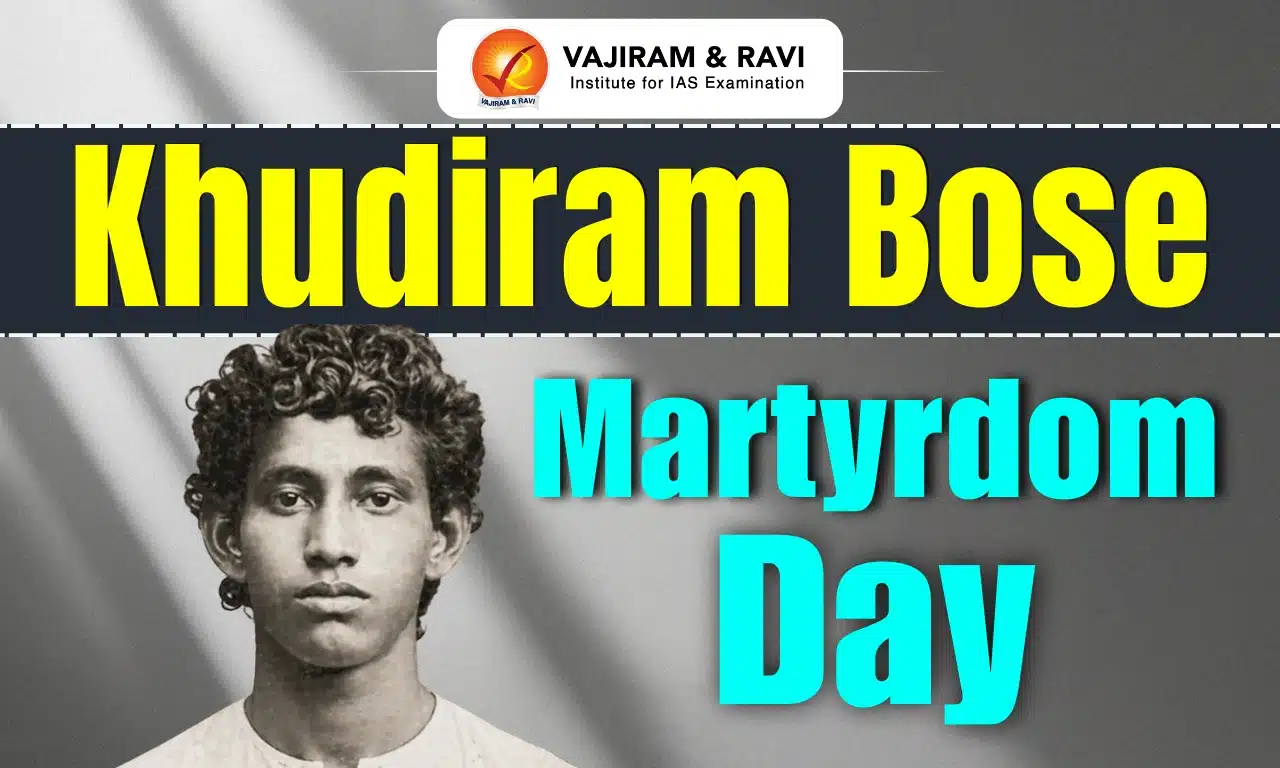
Khudiram Bose Martyrdom Day 2026, Date, History, Legacy

Khudiram Bose Martyrdom Day

Khudiram Bose Martyrdom Day 2026 will be observed on August 11, 2026, to commemorate the sacrifice of one of India's youngest revolutionary freedom fighters. Khudiram Bose was executed by the British colonial government on August 11, 1908, at the age of just 18 years, making him a timeless symbol of courage, patriotism, and youthful resistance against British rule.

His fearless commitment to India's freedom inspired generations of revolutionaries and continues to remind the nation of the immense sacrifices made during the Indian independence movement.

Khudiram Bose Martyrdom Day 2026

Khudiram Bose Martyrdom Day is observed every year on August 11 to pay tribute to the extraordinary courage and sacrifice of Khudiram Bose. He became one of the earliest revolutionary martyrs of India's freedom struggle after being executed by the British for his role in an attempted assassination of a British judge. 

Also Read:- Important Days in August 2026

Khudiram Bose Biography

Khudiram Bose was one of the youngest revolutionary freedom fighters of the Indian independence movement, whose extraordinary courage and supreme sacrifice at the age of 18 made him a lasting symbol of patriotism, youthful bravery, and resistance against British colonial rule.

  • Date of Birth: 3 December 1889, during the period of British colonial administration in India.
  • Birthplace: Habibpur village, Midnapore district (now Paschim Medinipur, West Bengal).
  • Parents: Born to Trailokyanath Bose, a revenue official, and Lakshmipriya Devi. He lost both parents at a young age and was raised by his elder sister.
  • Early Life: Deeply influenced by the growing nationalist movement, the slogan "Vande Mataram," and the widespread resentment against British policies following the Partition of Bengal (1905).
  • Education: Studied at Hamilton High School, Tamluk, but left formal education to dedicate himself to the cause of India's freedom.
  • Revolutionary Organization: Joined the Jugantar revolutionary group, where he received training in secret operations, arms handling, and anti-colonial activities.
  • Role in the Freedom Movement: Participated in distributing revolutionary pamphlets, organizing nationalist campaigns, and supporting revolutionary efforts against oppressive British officials.
  • Famous Mission: Along with fellow revolutionary Prafulla Chaki, he attempted to assassinate British Magistrate Douglas Kingsford on 30 April 1908 in Muzaffarpur, Bihar, due to Kingsford's harsh treatment of Indian nationalists.
  • Muzaffarpur Bomb Incident: The bomb accidentally struck a different carriage, leading to the deaths of Mrs. and Miss Kennedy, while Kingsford escaped unharmed.
  • Arrest: After the incident, Khudiram fled on foot for several kilometers before being arrested near Waini Railway Station on 1 May 1908. He reportedly remained calm and fearless during his arrest.
  • Trial: Faced trial under the British judicial system for murder and waging revolutionary activities against the colonial government. Despite appeals, the death sentence was upheld.
  • Execution: Executed by hanging on 11 August 1908 at Muzaffarpur Jail, Bihar, at the age of just 18 years, becoming one of the youngest martyrs of India's freedom struggle.
  • Fearless Personality: Historical accounts describe that he walked to the gallows with a smile, displaying exceptional courage and unwavering commitment to the cause of India's independence.
  • Contribution to Indian Independence: His sacrifice strengthened the revolutionary movement in Bengal and inspired many young Indians to join the struggle against British rule.

Legacy of Khudiram Bose

The legacy of Khudiram Bose lives on as a symbol of courage, patriotism, and selfless sacrifice in India's freedom struggle. His fearless martyrdom at the age of 18 inspired countless young revolutionaries to join the fight against British rule. He remains one of the youngest martyrs of India, remembered through memorials, educational institutions, and annual tributes. His life continues to motivate generations to uphold the values of nationalism, bravery, and dedication to the nation.

Khudiram Bose Martyrdom Day 2026 FAQs

Q1: When is Khudiram Bose Martyrdom Day 2026 observed?

Ans: Khudiram Bose Martyrdom Day 2026 will be observed on 11 August 2026 (Tuesday) to commemorate the 118th anniversary of his martyrdom.

Q2: Why is Khudiram Bose Martyrdom Day celebrated?

Ans: The day is observed to honor Khudiram Bose's supreme sacrifice and to remember his contribution to India's freedom struggle against British colonial rule.

Q3: Who was Khudiram Bose?

Ans: Khudiram Bose was one of India's youngest revolutionary freedom fighters, associated with the Jugantar organization, who was executed by the British at the age of 18.

Q4: How old was Khudiram Bose when he was executed?

Ans: Khudiram Bose was 18 years old when he was hanged on 11 August 1908 at Muzaffarpur Jail in Bihar.

Q5: What was the Muzaffarpur Bomb Incident?

Ans: The Muzaffarpur Bomb Incident took place on 30 April 1908, when Khudiram Bose and Prafulla Chaki attempted to assassinate British Magistrate Douglas Kingsford, but the bomb mistakenly hit another carriage.

Daily Editorial Analysis 11 August 2026

Daily-Editorial-Analysis

Do Not Write the Obituary of International Law Yet

Context

  • Recurring conflicts in Ukraine, Gaza and West Asia have revived an old debate: is international law losing its relevance?
  • Critics point to the failure of international institutions to stop these wars as proof that legal norms no longer restrain state behaviour.
  • This article argues that such a conclusion is premature, and that international law continues to function quietly even as headline conflicts suggest otherwise.

Why Wars Do Not Disprove International Law

  • Even states accused of violating international law rarely say the law itself is meaningless.
  • Instead, they justify their actions using the very vocabulary of international law — the UN Charter, sovereignty, territorial integrity, self-defence and humanitarian law.
  • This tendency to seek legal justification, rather than reject legality altogether, shows that the framework still commands authority.
  • UN Secretary-General António Guterres captured this in July 2026 when he told the International Law Commission that international law is under pressure but will prevail.
  • Scholars offered a useful explanation for this behaviour: states often comply with international law not out of fear of punishment, but because of the pull created by the treaty regimes they belong to.
    • Compliance is thus less about coercion and more about embedded expectations.

The Quiet, Unnoticed Successes

  • Compliance rarely makes news, while violations dominate it. Yet ordinary international life depends on legal cooperation working smoothly:
    • Aircraft cross borders safely because of international aviation regulations;
    • Ships sail the seas under international maritime law;
    • Diplomacy, trade and travel function through thousands of routine legal obligations;
    • Individuals rely on international law daily — passports, consular assistance, air travel and refugee protection are all governed by it.
  • Even amid conflict, states keep negotiating new multilateral agreements — the High Seas Treaty, pandemic preparedness efforts and the UN Convention against Cybercrime are recent examples of continued faith in a rules-based system.

Relevance for India and the Global South

  • Peace itself is built through legal instruments — ceasefires, peace agreements and negotiated settlements all rest on legal commitments.
  • India's Indus Waters Treaty shows that legal frameworks can sustain engagement between states even during political discord.
  • For India and the wider Global South, international law matters because it offers smaller and developing states a way to protect their interests through negotiation rather than raw power.
  • Shared global challenges — climate change, pandemics, cyberattacks and economic instability — cannot be solved unilaterally and require cooperation rooted in agreed rules.

Acknowledging the Flaws

  • International law was never a perfect system. It has long coexisted with power politics and has been criticised for reflecting unequal structures, including the limitations of the UN Security Council.
  • But imperfection is not the same as irrelevance — no legal system guarantees full compliance.
  • Its real value lies in providing standards against which state conduct can be judged.
  • Historically, crises have driven the adaptation of international law, not its collapse.

Conclusion

  • International law is strained but not extinguished.
  • Its true strength lies not in preventing every violation, but in remaining the shared language states use to justify, contest and eventually resolve their conduct — a framework still indispensable for a just, cooperative world order.

Do Not Write the Obituary of International Law Yet FAQs

Q1. Why does the article argue that international law remains relevant despite ongoing wars?

Ans: States accused of violations still invoke sovereignty, self-defence, territorial integrity, and humanitarian law, showing that international law continues to command authority.

Q2. What are the quiet successes of international law?

Ans: International law enables safe aviation, maritime navigation, diplomacy, trade, travel, consular assistance, refugee protection, and routine cooperation that rarely receives public attention.

Q3. Why is international law important for India and the Global South?

Ans: International law allows smaller and developing states to protect interests through negotiation and agreed rules rather than relying solely on economic or military power.

Q4. What does India's Indus Waters Treaty demonstrate about international law?

Ans: India's Indus Waters Treaty demonstrates that legal frameworks can sustain cooperation and engagement between states even when broader political relations remain strained.

Q5. Does the imperfection of international law make it irrelevant?

Ans: No. International law need not guarantee complete compliance; its value lies in establishing standards against which state conduct can be assessed and contested.

Source: TH


GeM at 10 - Transforming Public Procurement through Transparency and Digital Governance

Context

  • The Government e-Marketplace (GeM), launched on 9 August 2016, has completed a decade of operations.
  • It has emerged as India's flagship digital public procurement platform, replacing the erstwhile Directorate General of Supplies and Disposals (DGS&D).
  • There is the need to highlight GeM's contribution to transparent governance, Ease of Doing Business (EoDB), MSME promotion, and Viksit Bharat 2047.

Government e-Marketplace (GeM) - An Overview

  • GeM is a one-stop digital platform for public procurement by Central and State governments, PSUs and autonomous bodies.
  • It connects 1.37 lakh government buyers with 25 lakh sellers and service providers.
  • It integrates the entire procurement cycle, for example, product discovery, e-bidding, contract award, digital payments, and audit trail.
  • The erstwhile DGS&D was criticised for opaque and non-competitive procurement practices.

Key Achievements in a Decade

  • Enhancing transparency and accountability:
    • The entire procurement process has been digitised, reducing human discretion.
    • Every transaction leaves a traceable digital audit trail, strengthening accountability.
    • It minimises corruption, favouritism and procedural delays in government procurement.
  • Promoting EoDB:
    • Introduced a single-window digital marketplace for procurement, simplifying registration and standardised procurement procedures.
    • Policy reforms include: Removal of Caution Money Deposit, rationalisation of transaction charges, and lower compliance costs have widened participation.
  • Boosting inclusive economic growth:
    • GeM has expanded market access for traditionally underrepresented groups, for example, MSMEs; Start-ups; women entrepreneurs; and businesses from Tier-II, Tier-III cities and rural areas.
    • These enterprises can directly sell to government buyers without intermediaries, creating a more level playing field.

Performance Indicators

  • Contribution to 'Make in India' and Atmanirbhar Bharat:
    • Preference for domestic manufacturers and service providers strengthens indigenous production.
    • Reinforces local value chains and reduces dependence on imports.
    • MSEs account for nearly 60% of total orders (by volume) and over 45% of Gross Merchandise Value (GMV) on GeM.
  • Other indicators:
    • Annual GMV has crossed ₹5 lakh crore in each of the last two financial years.
    • Cumulative procurement value has reached around ₹20 lakh crore.
    • The platform now hosts approximately 10,644 product categories, and 350 service categories.
    • These figures reflect GeM's growing role in India's public procurement ecosystem.

Improving Public Service Delivery and its Impact

  • Efficient procurement through GeM:
    • It has enhanced delivery across critical sectors, including healthcare (medicines and vaccines), defence procurement (including drones), infrastructure development, and rural public services.
    • Transparent procurement ensures better utilisation of taxpayer funds while improving the quality and timeliness of public services.
  • Economic impact:
    • According to an IIT Delhi study, GeM generated an estimated ₹86,571.69 crore in monetised benefits over the last three financial years.
    • Gains arose from lower procurement prices, greater process efficiency, reduced transaction costs and delays.
  • GeM and digital governance:
    • GeM exemplifies India's expanding Digital Public Infrastructure (DPI) model by combining e-governance, transparency, data-driven decision-making, competitive procurement, and inclusive participation.
    • It advances constitutional principles of good governance, accountability and efficient utilisation of public resources.

Future Vision

  • Priorities as GeM enters its 2nd decade:
    • Adoption of emerging technologies for smarter procurement.
    • Building a globally benchmarked digital procurement platform.
    • Promoting green and sustainable procurement.
    • Expanding participation of Start-ups, innovators, women entrepreneurs, youth, MSMEs, and entrepreneurs from smaller towns and disadvantaged communities.
    • These objectives align with the broader vision of Viksit Bharat 2047.
  • Way forward: Despite its achievements, sustained reforms are necessary for -
    • Improve digital accessibility and awareness among small suppliers.
    • Strengthen cybersecurity and data privacy safeguards.
    • Enhance procurement capacity at State and local government levels.
    • Ensure timely payments to vendors.
    • Expand green procurement standards and AI-enabled procurement analytics.

Conclusion

  • GeM has transformed India's public procurement system by making it transparent, competitive, technology-driven and inclusive.
  • Its success demonstrates how digital governance can simultaneously improve public service delivery, promote entrepreneurship, empower MSMEs, and ensure efficient use of public resources.
  • Continued innovation and wider stakeholder participation will be crucial for making GeM a global benchmark in digital public procurement and advancing the vision of Viksit Bharat 2047.

GeM at 10 FAQs

Q1. How has the GeM enhanced transparency in public procurement?

Ans. By digitising the entire procurement lifecycle, creating auditable digital trails, etc.

Q2. What is the role of GeM in promoting inclusive economic growth in India?

Ans. GeM empowers MSMEs, startups, women entrepreneurs and businesses from smaller towns.

Q3. What is the contribution of GeM to the objectives of Atmanirbhar Bharat?

Ans. GeM prioritises domestic manufacturers, strengthens local value chains, and expands market opportunities for MSEs.

Q4. What are the major economic benefits of the GeM?

Ans. GeM reduces procurement costs, improves process efficiency, ensures better utilisation of public funds, etc.

Q5. Why is GeM regarded as an important DPI initiative?

Ans. It integrates end-to-end public procurement on a single digital platform.

Source: IE

Daily Editorial Analysis 2026 FAQs

Q1: What is editorial analysis?

Ans: Editorial analysis is the critical examination and interpretation of newspaper editorials to extract key insights, arguments, and perspectives relevant to UPSC preparation.

Q2: What is an editorial analyst?

Ans: An editorial analyst is someone who studies and breaks down editorials to highlight their relevance, structure, and usefulness for competitive exams like the UPSC.

Q3: What is an editorial for UPSC?

Ans: For UPSC, an editorial refers to opinion-based articles in reputed newspapers that provide analysis on current affairs, governance, policy, and socio-economic issues.

Q4: What are the sources of UPSC Editorial Analysis?

Ans: Key sources include editorials from The Hindu and Indian Express.

Q5: Can Editorial Analysis help in Mains Answer Writing?

Ans: Yes, editorial analysis enhances content quality, analytical depth, and structure in Mains answer writing.

Enquire Now