Dhabaleswar Temple

Dhabaleswar Temple

Dhabaleswar Temple Latest News

The president recently offered prayers at the Dhabaleswar Temple near Berhampur, marking the final engagement of her three-day visit to Odisha.

About Dhabaleswar Temple

  • It is a Hindu temple dedicated to Lord Shiva.
  • It is located on an island on River Mahanadi near Cuttack, Odisha
  • It is one of the oldest temples in Odisha. It dates back to the early 10th and 11th century. 
  • The temple structure was constructed during the rule of the Somavamshi dynasty by King Yayati Keshari.
  • The present-day temple was constructed by King Bir Kishore of Khurda around 1232 AD. 

Dhabaleswar Temple Architecture

  • It is built in the Kalinga style of architecture.
  • The main temple structure is built of sandstone. It has a square plan with a pyramidal roof. 
  • Several smaller shrines of various deities surround the main temple. 
  • The temple has three main chambers, with the central chamber housing the idol of Shiva. 
  • The temple has a beautiful entrance known as Jagamohan. Intricate carvings of animals, birds, and mythological figures decorate it. 
  • Around the temple, there is a marble-covered raised platform.  
  • The temple contains multiple sculptures of deities on its walls.  
  • The distinctive feature of the Dhabaleswar Temple is its two-tiered roof, which is made of terracotta tiles. 

News: NOA

Dhabaleswar Temple FAQs

Q1: Where is the Dhabaleswar Temple located?

Ans: It is located on an island in the Mahanadi River near Cuttack, Odisha.

Q2: To which Hindu deity is the Dhabaleswar Temple dedicated?

Ans: It is dedicated to Lord Shiva.

Q3: Which architectural style is followed by the Dhabaleswar Temple?

Ans: The Kalinga style of architecture.

Q4: Who constructed the present-day Dhabaleswar Temple?

Ans: The present-day temple was constructed by King Bir Kishore of Khurda around 1232 AD.

H-1B Visa, Eligibility, Features, Recent Changes

H1B Visa

H1B Visa is a non-immigrant Visa that allows US based companies to provide employment to foreign workers in speciality occupations that also requires theoretical and technical expertise for specified period. In this article, we are going to look at the features, eligibility and benefits of the H1B Visa and its impact on India. 

H1B Visa Overview

  • The H1B Visa is given to help employers obtain required business skills and abilities from the US workforce by authorizing temporary employment of qualified individuals who are not otherwise authorized to work in the United States.
  • Occupations that qualify for the H-1B visa are typically in fields such as technology, finance, engineering, architecture, or more.
  • A specialty occupation is one that requires the application of a body of highly specialized knowledge and the attainment of at least a bachelor’s degree or its equivalent.

H1B Visa Eligibility Criteria

In order to be eligible for the H1B visa, you will need:

  • A valid job offer from a U.S. employer for a role that requires specialty knowledge
  • Proof of a bachelor’s degree or equivalent experience in that field
  • The US employer must show that there is a lack of qualified U.S. applicants for the role. 

Also Read:- Global Passport Index

H1B Visa Features

The features of H1B Visa includes: 

  • The annual H-1B visa limit is 85,000. There are 65,000 regular H-1B visas each year, and an additional 20,000 visas are reserved for applicants with advanced degrees. 
  • Some exceptions to the H-1B visa cap include people entering the U.S. to work in higher education or affiliated research/non-profit organizations.
  • Applicants are selected for adjudication via lottery system.
  • The H-1B visa is valid for three years and can be extended one time for an additional three years. In general, the H-1B is valid for a maximum of six years.
  • There is no limit to the number of H1-B Visas that an individual can have in his or her lifetime.
  • H1-B holders can seek Green Card or Lawful Permanent Residency for themselves and their family.
  • If the H1-B holder is changing jobs, he or she must reapply for a new visa. 

Also Read:- India-US Relations

Recent Changes in H1B Visa 

Former President Donald Trump highlighted the importance of striking a balance in the H-1B visa program, emphasizing its role in attracting global talent while supporting American workers.

Key Points:

  • Balanced Approach: Trump recognized the need to bring in skilled professionals while also investing in training domestic talent, addressing concerns from both sides of the debate.
  • Beyond Engineering: He advocated for broadening the program’s scope to include skilled roles beyond engineers, such as maître d’s, wine experts, and high-caliber waitstaff, focusing on excellence across industries.
  • Support from Industry Leaders: Influential figures like Oracle’s Larry Ellison, Softbank’s Masayoshi Son, and OpenAI’s Sam Altman joined Trump in emphasizing the demand for skilled workers in tech and other fields.
  • Tech Sector's Demand: Trump acknowledged the critical need for skilled professionals, particularly in the technology industry, aligning with business leaders' priorities.
  • Quality-Driven Immigration: He stressed the importance of maintaining high standards in immigration to fuel economic growth and meet the evolving needs of diverse sectors.

This balanced perspective reflects a vision for immigration that fosters both innovation and domestic workforce development.

H1B Visa FAQs

Q1: Who is eligible for H1B visa?

Ans: Individuals with a job offer in the U.S. requiring specialized skills and at least a bachelor's degree or equivalent experience.

Q2: What does an H1B visa mean?

Ans: It is a non-immigrant visa allowing U.S. companies to employ foreign workers in specialized occupations.

Q3: How long is an H1B visa valid for?

Ans: Initially for 3 years, extendable up to a maximum of 6 years.

Q4: Does an H1B visa lead to a green card?

Ans: Yes, H1B visa holders can transition to a green card through employer sponsorship.

Q5: What happens after 6 years of H-1B visa?

Ans: Holders must leave the U.S. for at least one year or transition to another visa/status unless applying for a green card.

Rabindranath Tagore Death Anniversary 2026, Contributions, Legacy

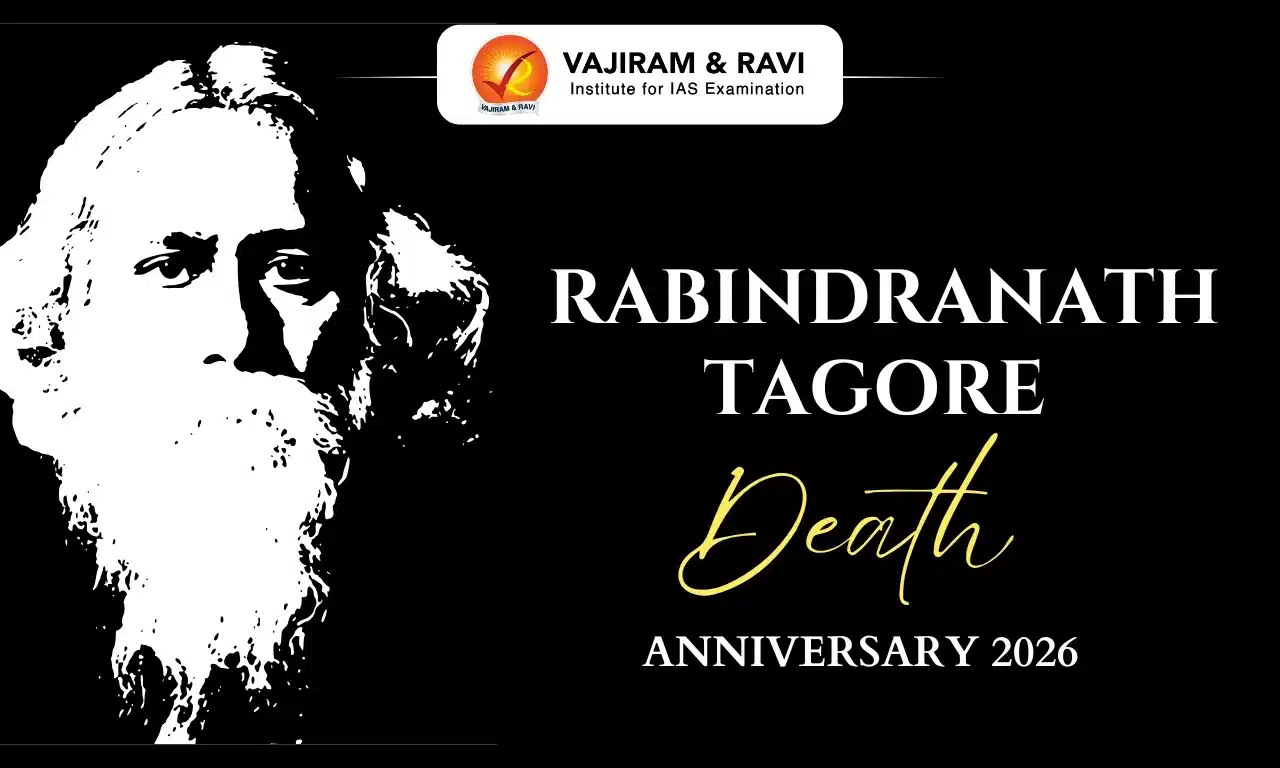
Rabindranath Tagore Death Anniversary 2026

Rabindranath Tagore Death Anniversary 2026 is a day to remember and honor one of India’s greatest literary and cultural figures. Observed every year on August 7, this occasion gives people an opportunity to reflect on Tagore’s remarkable contributions to literature, music, education, and philosophy. He was not just a poet, but a thinker who shaped modern ideas of humanity, creativity, and unity. On this day, people across different regions pay tribute to his legacy through various cultural and literary activities, celebrating the timeless values he shared with the world.

Rabindranath Tagore Death Anniversary 2026 Date and Significance

  • Rabindranath Tagore’s Death Anniversary is observed every year on August 7, and 2026 marks his 85th death anniversary, making it a significant day of remembrance across India and around the world
  • He passed away in 1941 at the age of 80 at his ancestral home, Jorasanko Thakur Bari in Kolkata, marking the end of an era in Indian cultural history.
  • In the Bengali calendar, this day falls on the 22nd of Srabon, which holds deep emotional and cultural importance, especially in West Bengal and Bangladesh.
  • The day is observed by paying tribute to his literary genius, artistic brilliance, and philosophical ideas that shaped modern India.
  • Schools, cultural institutions, and literary groups organize poetry recitations, Rabindra Sangeet performances, and discussions to celebrate his legacy.
  • It is not just a day of remembrance but also a moment to reflect on his ideals of humanism, harmony, and universal brotherhood.

Rabindranath Tagore: Life, Legacy and Contributions

  • Rabindranath Tagore (1861-1941) was a poet, philosopher, artist, educationist, and social reformer, often called Gurudev, Kabiguru, and Biswakabi.
  • He became the first non-European to win the Nobel Prize in Literature (1913) for his famous work Gitanjali, bringing global recognition to Indian literature.
  • Tagore made a lasting impact on Bengali literature, transforming it with his simple yet deeply emotional and philosophical writing style.
  • He composed the national anthems of two nations - “Jana Gana Mana” (India) and “Amar Shonar Bangla” (Bangladesh), reflecting his cultural influence.
  • In the field of education, he founded Visva-Bharati University at Shantiniketan, promoting a holistic and nature-based learning system.
  • Tagore was also a prolific artist, creating over 2,500 paintings and sketches, exploring themes of nature, spirituality, and human emotions.
  • Though he supported India’s freedom struggle, he believed in inclusive nationalism and strongly opposed narrow and aggressive nationalism.
  • His philosophy of universal humanism continues to inspire ideas of peace, unity, and global cooperation even today.

Major Works of Rabindranath Tagore

  • Poetry: His poetic works like Gitanjali, Manasi, Sonar Tari, Gitimalya, and Balaka are known for their lyrical beauty, spirituality, and deep emotions.
  • Novels: Famous novels such as Gora, Ghare-Baire, and Chokher Bali explore themes of identity, society, and nationalism in a simple yet powerful way.
  • Short Stories: His collection Galpaguchchha reflects the lives of ordinary people, highlighting social issues with sensitivity and realism.
  • Dramas: Plays like Visarjan, Chitrangada, Muktadhara, and Valmiki-Pratibha combine music, poetry, and social messages.
  • Songs: He composed over 2,000 songs, known as Rabindra Sangeet, which remain popular for their emotional depth and cultural richness.
  • Essays and Lectures: His works such as Nationalism (1917) and The Religion of Man present his ideas on society, spirituality, and global harmony.
  • Rabindranath Tagore’s writings stand out for their simplicity, human touch, and universal appeal, making them relevant even in modern times.

Also Read:- Rabindranath Tagore Jayanti 2026

Rabindranath Tagore’s Role in Freedom Struggle

  • Rabindranath Tagore strongly opposed British imperialism and supported India’s freedom, but he believed that true independence should be based on moral values and human dignity, not just political power.
  • He had a balanced view of nationalism, while he wanted India to be free, he also warned against extreme and narrow nationalism, stressing the importance of learning from other cultures.
  • Tagore openly criticized certain aspects of the Swadeshi Movement, especially in his essay “The Cult of the Charkha” (1925), where he questioned blind practices and emphasized rational thinking.
  • Through his poetry and songs, he inspired people during the freedom struggle; works like “Chitto Jetha Bhayshunyo” (Where the Mind is Without Fear) and “Ekla Chalo Re” encouraged courage, self-reliance, and fearless action.
  • Although he had differences with Mahatma Gandhi’s methods, the two shared mutual respect, and Tagore even played a role in reducing differences between Gandhi and B.R. Ambedkar on important social issues.
  • One of his most powerful acts of protest came after the Jallianwala Bagh Massacre (1919), when he renounced his knighthood, sending a strong message against British injustice.
  • Rabindranath Tagore’s contribution to the freedom struggle was more intellectual and moral than political, as he focused on shaping ideas of freedom, unity, and universal human values.

Rabindranath Tagore Death Anniversary 2026 FAQs

Q1: When is Rabindranath Tagore’s Death Anniversary observed?

Ans: Rabindranath Tagore’s death anniversary is observed every year on August 7.

Q2: Why is August 7 important for Rabindranath Tagore?

Ans: It marks the day he passed away in 1941, making it a day to remember his life and contributions.

Q3: How is Tagore’s death anniversary observed in 2026?

Ans: People organize poetry recitations, Rabindra Sangeet, cultural events, and discussions to honor him.

Q4: What is the Bengali date of Tagore’s death anniversary?

Ans: It is observed on the 22nd of Srabon in the Bengali calendar.

Q5: Where did Rabindranath Tagore die?

Ans: He passed away at Jorasanko Thakur Bari in Kolkata.

Scheme for Promotion of Culture of Science

Scheme for Promotion of Culture of Science

Scheme for Promotion of Culture of Science Latest News

The Union Minister for Culture and Tourism informed Rajya Sabha about the Scheme for Promotion of Culture of Science.

About Scheme for Promotion of Culture of Science

  • It is a flagship initiative of the Ministry of Culture, Government of India.
  • It is aimed at fostering scientific temper and awareness across the country for the public in general and students in particular.
  • The scheme supports the establishment of Science Cities, Science Centres, Innovation Hubs, and Digital Planetariums in various regions.
  • Nodal Agency: The National Council of Science Museums (NCSM), an autonomous body under the Ministry of Culture, serves as the nodal agency for implementation of the scheme.
  • Under this Scheme Science Centres/Digital Planetariums (Category-III) are set up in areas with a population of less than 5 lakhs.
  • As of July 2025, a total of 27 Science Centres have been established across the country under the Scheme for Promotion of Culture of Science (SPoCS) of the Ministry of Culture.
  • Significance: These institutions have significantly contributed to enhancing scientific awareness and informal science education through hands-on exhibits, innovation hubs, digital planetariums, and outreach programmes.

Source: PIB

Scheme for Promotion of Culture of Science FAQs

Q1: Is NCSM Government or private?

Ans: National Council of Science Museums (NCSM) is an autonomous society under the Ministry of Culture, Government of India.

Q2: What is the main purpose of a planetarium?

Ans: To popularise education and entertainment in astronomy and related fields, especially space science

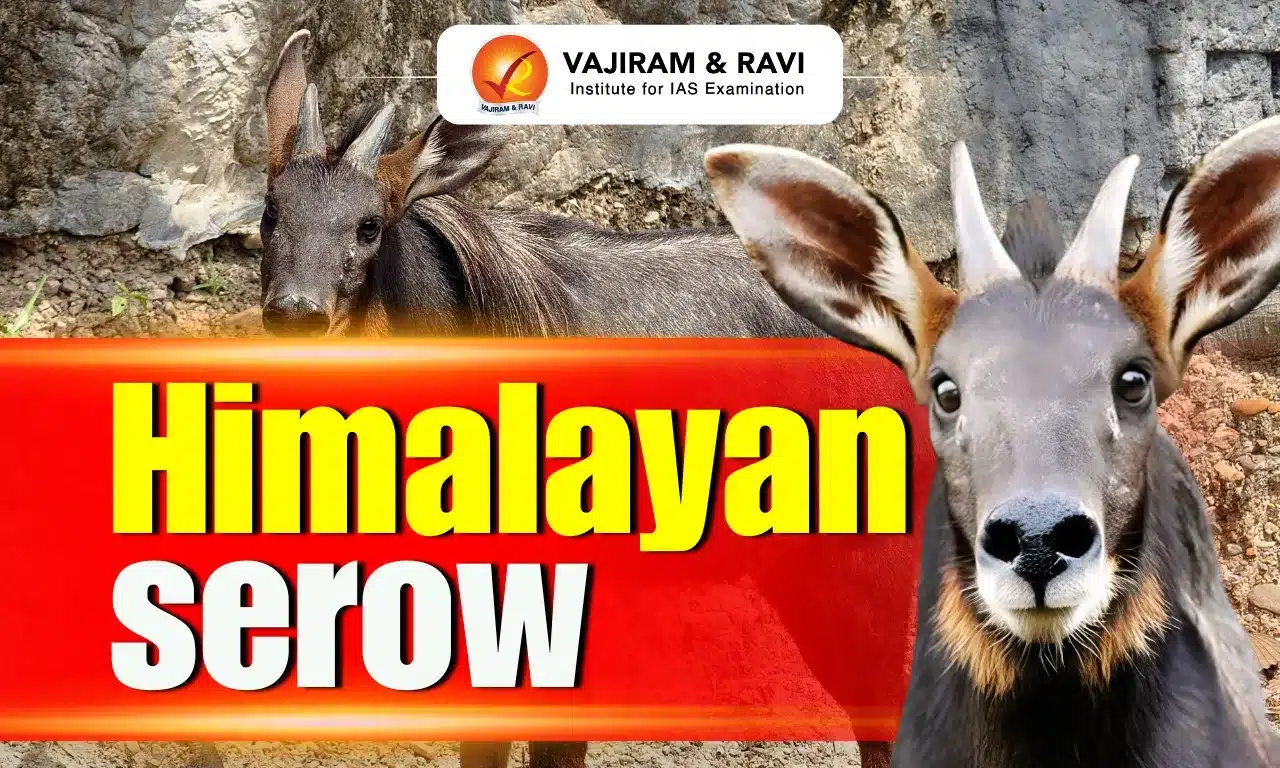
Himalayan serow

Himalayan serow

Himalayan serow Latest News

Recently, Himalayan serow has been recorded in the Dalhousie forest division of Himachal Pradesh for the first time in nearly two decades.

About Himalayan serow

  • It resembles a cross between a goat, a donkey, a cow, and a pig.
  • It is a shy, forest-dwelling mountain ungulate found in steep Himalayan terrain.
  • Types: There are several species of serows, and all of them are found in Asia.
  • Habitat: The Himalayan serow, or Capricornis sumatraensis thar, is restricted to the Himalayan region. Taxonomically, it is a subspecies of the mainland serow (Capricornis sumatraensis).
  • Distribution: These are typically found at altitudes between 2,000 metres and 4,000 metres (6,500 to 13,000 feet). They are known to be found in eastern, central, and western Himalayas, but not in the Trans Himalayan region.
  • Diet: These are herbivore species.
  • Threats: Habitat degradation, Fragmentation and hunting pressure.

Conservation Status of Himalayan serow

Source: TOI

Himalayan serow FAQs

Q1: Himalayan Serow is primarily found in which region of India?

Ans: Himalayan Region

Q2: Himalayan Serow is listed in which appendix of CITES?

Ans: Appendix I

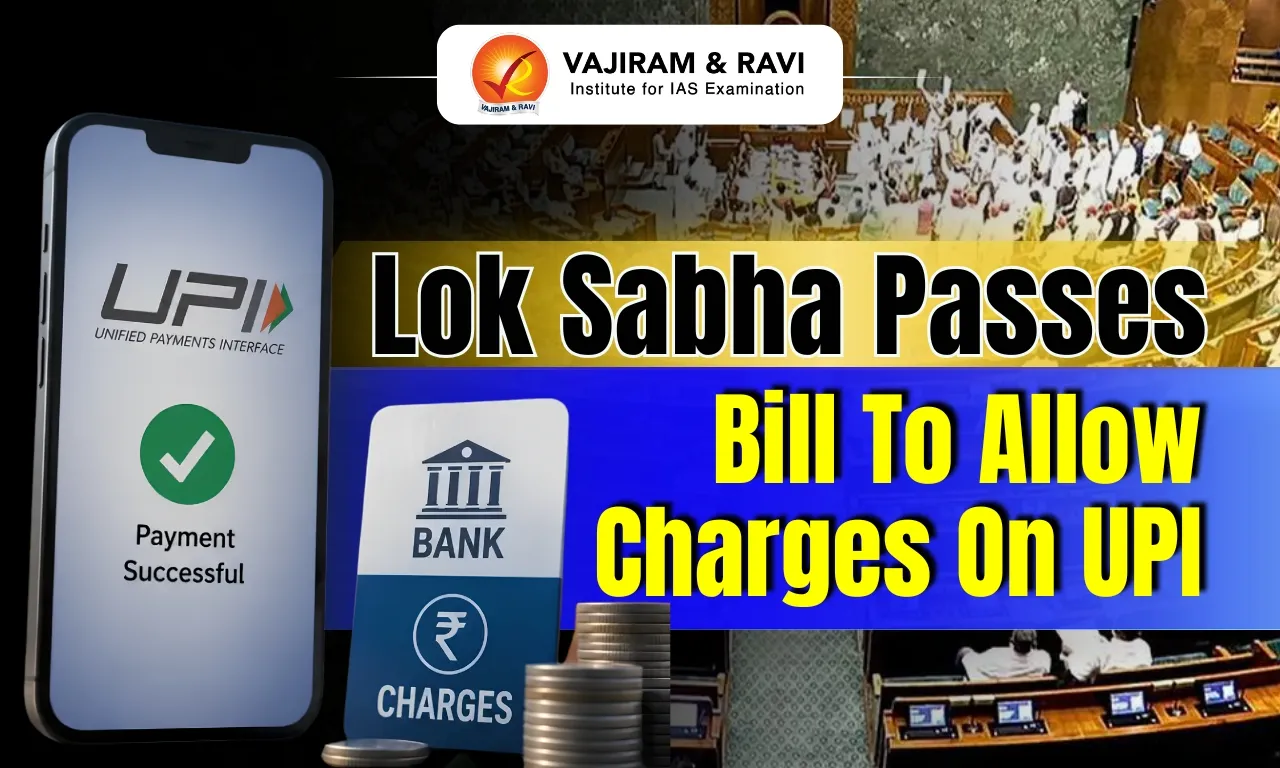
Lok Sabha Passes Bill To Allow Charges On UPI, Latest News

Lok Sabha Passes Bill To Allow Charges On UPI

The Lok Sabha Passes Bill To Allow Charges On UPI. The Taxation and Other Laws (Amendment) Bill 2026 was passed on 6 August 2026. It empowered the Central Government to allow banks and payment service providers to levy charges on Unified Payments Interface (UPI) and other notified electronic payment modes. The amendment changes the Payment and Settlement Systems Act 2007 by removing the legal restriction on charging Merchant Discount Rate (MDR). The move aims to build a financially sustainable digital payments ecosystem while keeping future charges under government notification.

Why Transaction Charges on UPI in News?

The Taxation and Other Laws (Amendment) Bill 2026 marks a major policy shift by allowing the government to notify electronic payment modes on which banks and payment service providers may levy charges.

  • Lok Sabha Approval: The Lok Sabha passed the Taxation and Other Laws (Amendment) Bill 2026 on 6 August 2026 through a voice vote without debate due to continuous Opposition sloganeering during the Monsoon Session.
  • UPI Charge Provision: The amendment authorises the Central Government to permit charges on UPI and other notified electronic payment modes by removing the existing legal prohibition under the Payment and Settlement Systems Act 2007.
  • Policy Objective: The government stated that a small user charge could help create a sustainable revenue model for banks, payment service providers (PSPs) and digital payment infrastructure companies.

Lok Sabha Passes Bill To Allow Charges On UPI

UPI has operated as a zero cost digital payment platform because of legal protection under the existing payment law.

  • Legal Framework: Section 10A of the Payment and Settlement Systems Act 2007 prohibited banks and payment system providers from directly or indirectly charging users on specified electronic payment modes.
  • Income Tax Link: The earlier provision referred to Section 269SU of the Income Tax Act which required businesses with annual turnover above ₹50 crore to provide prescribed electronic payment options such as BHIM UPI QR and RuPay debit cards.
  • Existing Payment Charges: While RTGS and NEFT transactions already carry service charges, UPI remained free despite being a real time payment system, creating a different treatment among digital payment platforms.
  • Rapid UPI Growth: Since its launch in 2016, UPI has become India's leading retail digital payment platform, recording over 140 billion transactions with transaction value exceeding ₹200 lakh crore during FY 2025-26.

Taxation and Other Laws (Amendment) Bill 2026

The Taxation and Other Laws (Amendment) Bill 2026 proposes changes in digital payments and taxation. It gives the government greater powers over electronic payment charges and introduces tax reforms to promote investment, electronics manufacturing, offshore funds, data centres and global business operations in India. 

The key features of the Bill has been provided below:

  • UPI Charge Framework: The Bill amends Section 10A of the Payment and Settlement Systems Act, 2007. It allows the Central Government to notify electronic payment modes on which banks and payment service providers may levy charges.
  • Merchant Discount Rate (MDR): The Bill removes the legal restriction on charging Merchant Discount Rate (MDR) for notified electronic payment modes. However, it does not fix any charge amount or impose fees immediately.
  • Offshore Fund Reforms: The Bill reduces compliance for Eligible Investment Funds (EIFs) by removing 8 of the existing 13 conditions. Offshore funds will mainly need to satisfy only five key conditions, making India more attractive for global fund management.
  • Electronics Manufacturing Support: Tax incentives for foreign companies supplying machinery and equipment to Indian electronics contract manufacturers are proposed to continue until 2040-41, extending the earlier benefit that was available up to 2030-31.
  • Component Supply Chain Benefits: Foreign companies storing electronic components in customs bonded warehouses and supplying them to Indian contract manufacturers will receive new tax exemptions to strengthen electronics production.
  • Data Centre Tax Relief: The Bill expands the definition of eligible data centres to include leased facilities. It also removes the requirement for separate Central Government notification for certain foreign companies using Indian data centres.
  • Diamond Trade Incentive: A 15 year tax holiday up to 31 March 2041 is proposed for specified foreign mining companies, sightholders, brokers, aggregators and auction entities selling rough diamonds in notified special zones.
  • Foreign Portfolio Investor Relief: The Bill replaces the Income tax (Amendment) Ordinance 2026 issued on 5 June 2026. It provides permanent tax relief on capital gains and withholding tax for Foreign Portfolio Investors (FPIs) investing in Government securities.

Charges on UPI Impacts

The Taxation and Other Laws (Amendment) Bill 2026 may reshape India's digital payments ecosystem by balancing affordability with long term financial sustainability.

  • Revenue Sustainability: Banks, payment service providers and infrastructure firms may receive a stable revenue source for maintaining, upgrading and expanding digital payment infrastructure across the country.
  • Consumer and Merchant Costs: Small transaction charges could increase payment costs for consumers and merchants, although the government has indicated that charges are expected to remain limited.
  • Investment Incentives: A revenue model may encourage greater investment in payment technology, cybersecurity, fraud prevention and infrastructure needed to support growing digital transaction volumes.
  • Global Alignment: The proposal brings India's digital payment framework closer to many international payment systems where electronic transactions generally involve service or processing charges.

Charges on UPI Challenges

Several implementation issues remain because the Taxation and Other Laws (Amendment) Bill 2026 provides enabling powers rather than immediate operational rules.

  • Pricing Uncertainty: The government has not announced the rate, structure, or categories of charges, creating uncertainty for consumers, merchants, banks and payment service providers.
  • Financial Inclusion: Even small transaction charges may discourage low value digital payments, particularly among low income users and small businesses that depend heavily on UPI.
  • Merchant Burden: Small retailers could face additional operating costs if MDR is introduced, which may reduce profit margins or increase prices for customers.
  • Regulatory Balance: Authorities must ensure transparent pricing, consumer protection and effective oversight so that payment charges remain reasonable and do not reduce digital payment adoption.

Charges on UPI Transaction Significance

The Taxation and Other Laws (Amendment) Bill 2026 represents an important policy change by shifting India's digital payments framework from a completely free model towards a regulated and financially sustainable ecosystem.

  • Legal Reform: The amendment modernises the Payment and Settlement Systems Act 2007 by giving the government flexibility to notify chargeable electronic payment modes according to future policy requirements.
  • Digital Economy: Sustainable funding can strengthen payment infrastructure as digital transactions continue growing rapidly across banking, retail commerce, government services and financial inclusion programmes.
  • Balanced Approach: The government seeks to balance affordable digital payments with the financial needs of banks, payment service providers and infrastructure companies supporting the payment ecosystem.
  • Future Policy Flexibility: Since charges require separate government notifications, policymakers retain flexibility to protect consumers while responding to technological developments and changing payment market conditions.

Lok Sabha Passes Bill To Allow Charges On UPI FAQs

Q1: Has the Lok Sabha passed the Bill allowing charges on UPI payments?

Ans: Yes. The Lok Sabha passed the Taxation and Other Laws (Amendment) Bill 2026 on 6 August 2026, enabling the government to permit charges on UPI and other notified electronic payment modes.

Q2: Will UPI transactions become chargeable immediately?

Ans: No. The amendment only gives the Central Government the power to notify payment modes for charges. No immediate UPI transaction charge has been announced through the Bill.

Q3: What change has been made to the Payment and Settlement Systems Act 2007?

Ans: The amendment revises Section 10A, removing the legal restriction that prevented banks and payment service providers from charging notified electronic payment modes, including UPI if notified.

Q4: Why is the government considering UPI transaction charges?

Ans: The proposal aims to create a sustainable revenue model for banks, payment service providers and payment infrastructure firms while supporting the long term growth of India's digital payments ecosystem.

Q5: Does the Bill impose a fixed Merchant Discount Rate (MDR) on UPI?

Ans: No. The Bill does not prescribe any fixed MDR or transaction fee. It only authorises the government to allow such charges through future official notifications.

Adyar River

Adyar River

Adyar River Latest News

Tamil Nadu Minister for Rural Development and Water Resources recently inspected Adyar river areas, prioritizing cleaning efforts and addressing residents' needs for basic amenities.

About Adyar River

  • The Adyar River (sometimes called Adayar) is an important river flowing through the city of Chennai in Tamil Nadu.  
  • Course
    • It originates near the Chembarambakkam Lake in the Kanchipuram district of Tamil Nadu.
    • Finally, it reaches the Bay of Bengal at a place called the Adyar Estuary. 
  • Total Length: 42.5 km
  • It is one of the three rivers which winds through Chennai.
  • The river forms a backwater near the mouth, known as the Adyar Creek, due to the formation of sandbars at the mouth. 
  • This creek is a natural channel which carries tidal water back into the sea.
  • The river collects surplus water from about 200 tanks and lakes, small streams, and the rainwater drains in Chennai city, with a combined catchment area of 860 sq.km. 
  • Most of the waste from the city is drained into this river.
  • The Adyar Estuary, covering around 300 acres, is home to diverse bird species and marine life. 
    • Recognizing its ecological significance, it was declared a protected wildlife reserve in 1987.

News: TH

Adyar River FAQs

Q1: Where does the Adyar River flow?

Ans: It flows through Chennai in Tamil Nadu.

Q2: Where does the Adyar River originate?

Ans: It originates near Chembarambakkam Lake in Kanchipuram district, Tamil Nadu.

Q3: Where does the Adyar River finally drain into the sea?

Ans: It reaches the Bay of Bengal at the Adyar Estuary.

Q4: What is the total length of the Adyar River?

Ans: Approximately 42.5 km.

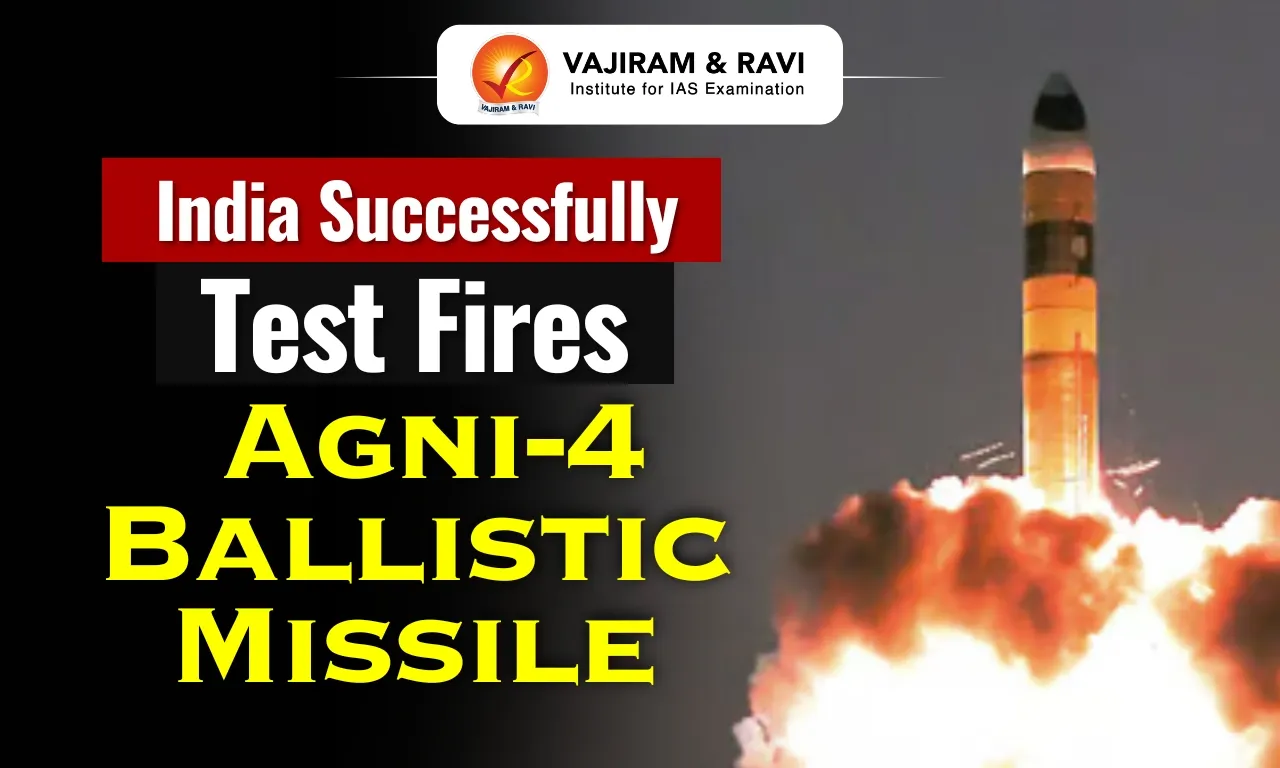
India Successfully Test Fires Agni-4 Ballistic Missile, Latest News

India Successfully Test Fires Agni-4 Ballistic Missile

India successfully conducted a user trial of the Agni-4 Medium-Range Ballistic Missile (MRBM) from the Integrated Test Range (ITR), Chandipur, Odisha, on 6 August 2026. The launch was carried out under the Strategic Forces Command (SFC) and validated all operational and technical parameters of the missile.

Agni-4 Ballistic Missile

Agni-4 is an indigenously developed, nuclear-capable medium-range ballistic missile designed by the Defence Research and Development Organisation (DRDO) to provide India with a reliable long-range strategic strike capability.

  • Developed By: Defence Research and Development Organisation (DRDO)
  • Missile Type: Medium-Range Ballistic Missile (MRBM)
  • Range: Approximately 4,000 km
  • Warhead Capability: Can carry both nuclear and conventional warheads
  • Propulsion: Two-stage solid-fuel propulsion system
  • Guidance System: Advanced Ring Laser Gyroscope (RLG), Micro Navigation System (MINGS), and indigenous avionics for high accuracy
  • Accuracy: High precision with advanced inertial navigation and onboard guidance systems
  • Launch Platform: Road-mobile launcher, enabling rapid deployment and greater survivability
  • Re-entry Vehicle: Equipped with a heat shield capable of withstanding temperatures exceeding 3,000°C during atmospheric re-entry
  • Mission Role: Provides long-range precision strike capability and forms an important pillar of India's strategic missile arsenal
  • Strategic Significance: Bridges the capability gap between Agni-2 and Agni-5, enhancing India's credible minimum deterrence and second-strike capability.

Also Read:- Agni Missile
Also Read:- Indian Ballistic Missile Defence Programme

Strategic Importance of the Agni-4 Missile for India

Agni-4 is a key component of India's strategic missile arsenal, enhancing the country's long-range strike capability and strengthening its credible minimum deterrence against potential security threats.

  • Strengthens Nuclear Deterrence: Enhances India's credible minimum nuclear deterrence by providing a reliable long-range strike capability.
  • Improves Strategic Reach: With a range of about 4,000 km, it can engage strategic targets across a wide geographical area.
  • Supports Second-Strike Capability: Contributes to India's assured retaliation capability, a key pillar of its nuclear doctrine.
  • Enhances National Security: Improves India's preparedness to address evolving regional and global security challenges.
  • High Operational Mobility: Its road-mobile launch platform enables rapid deployment, flexibility, and increased survivability.
  • Promotes Indigenous Defence Technology: Showcases India's advancements in missile technology developed by DRDO under the Atmanirbhar Bharat initiative.
  • Bridges Capability Gap: Fills the operational gap between the Agni-2 and Agni-5 missile systems, strengthening the overall Agni missile series.

Also Read:-  Missiles of India

India Successfully Test Fires Agni-4 Ballistic Missile FAQs

Q1: Why is Agni-4 in the news?

Ans: Agni-4 is in the news because India successfully conducted a user trial of the Agni-4 Medium-Range Ballistic Missile (MRBM) from the Integrated Test Range (ITR), Chandipur, Odisha, on 6 August 2026.

Q2: What is Agni-4 Ballistic Missile?

Ans: Agni-4 is an indigenously developed, nuclear-capable Medium-Range Ballistic Missile (MRBM) designed by the Defence Research and Development Organisation (DRDO) to strengthen India's strategic deterrence capability.

Q3: What is the strike range of Agni-4?

Ans: Agni-4 has a maximum strike range of approximately 4,000 kilometres, enabling it to engage strategic targets at long distances.

Q4: Who developed the Agni-4 missile?

Ans: The Defence Research and Development Organisation (DRDO) developed Agni-4 under India's Integrated Guided Missile Development Programme (IGMDP).

Q5: Who operates Agni-4?

Ans: Agni-4 is operated by the Strategic Forces Command (SFC), which manages India's strategic nuclear forces.

Amylotropic Lateral Sclerosis

Amyotrophic Lateral Sclerosis

Amyotrophic Lateral Sclerosis Latest News

People exposed to pesticides at work may be significantly more likely to develop Amyotrophic Lateral Sclerosis (ALS),  according to a new review of global evidence published.

About Amyotrophic Lateral Sclerosis 

  • It is a progressive neurological disorder that damages the nerve cells controlling voluntary muscle movement. These nerve cells are called motor neurons.  
    • One group, called upper motor neurons, extends from the brain to the spinal cord. 
    • The second group, called lower motor neurons, extends from the spinal cord to muscles throughout the body.
    • ALS causes both groups of motor neurons to gradually deteriorate and then die.
    • When motor neurons are damaged, they stop sending messages to the muscles.  As a result, the muscles can't function. 
  • ALS is often called Lou Gehrig's disease after the baseball player who was diagnosed with it.  

Amyotrophic Lateral Sclerosis Cause

  • The exact cause is still not known in most people. 
  • In a small percentage of people, ALS is inherited from a parent. 

Amyotrophic Lateral Sclerosis Symptoms

  • Symptoms vary from person to person and worsen over time. 
  • They depend on which nerve cells are affected.  
  • ALS often begins with muscle twitching and weakness in an arm or leg, trouble swallowing, or slurred speech. 
  • Eventually ALS affects the muscles needed to move, speak, eat, and breathe and can lead to serious complications over time.   

Amyotrophic Lateral Sclerosis Treatment

  • Currently, there’s no treatment to reverse damage to motor neurons or cure ALS. 
  • But some treatments may slow progression of the disorder, improve quality of life, and extend survival. 

News: TP

Amyotrophic Lateral Sclerosis FAQs

Q1: What is Amyotrophic Lateral Sclerosis (ALS)?

Ans: ALS is a progressive neurological disorder that damages and eventually kills motor neurons.

Q2: Why does muscle weakness occur in Amyotrophic Lateral Sclerosis (ALS)?

Ans: Damaged motor neurons stop sending messages to muscles, causing the muscles to weaken and lose function.

Q3: What is Amyotrophic Lateral Sclerosis (ALS) commonly known as?

Ans: ALS is often called Lou Gehrig's disease after the baseball player who was diagnosed with it.

Q4: Is the exact cause of Amyotrophic Lateral Sclerosis (ALS) known?

Ans: No. The exact cause is unknown in most cases.

Q5: Is there currently a cure for ALS?

Ans: No. There is currently no cure that reverses motor-neuron damage.

Mullaperiyar Dam

Mullaperiyar Dam

Mullaperiyar Dam Latest News

The Kerala government strongly protested Tamil Nadu's recent budget announcement on raising the water level in the Mullaperiyar dam. 

About Mullaperiyar Dam

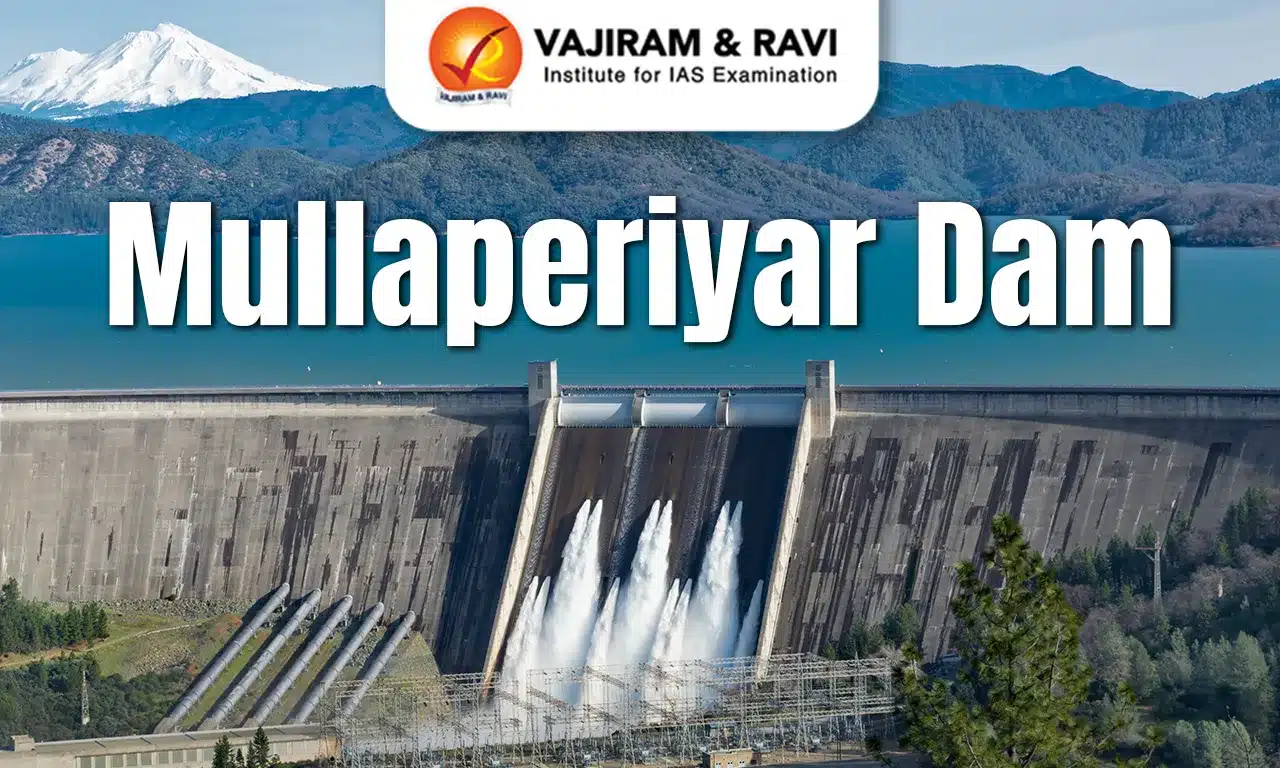
  • It is a masonry gravity dam located in Thekkady, Idukki district, Kerala.
  • The dam is built at the confluence of the Mullayar and Periyar (longest river in Kerala) rivers.
  • It is located at an altitude of 881 m on the Cardamom Hills of the Western Ghats.
  • It is one of the oldest dams in India. Its construction began in 1887 and was completed in 1895. 
  • The construction was carried out by the British Corps of Royal Engineers under the leadership of Pennycuick.
  • The dam’s primary function is to transfer water from the Periyar River to the Vaigai River basin in Tamil Nadu for irrigation and power generation purposes.
    • The water from the reservoir reaches the Theni, Madurai, Sivaganga, and Ramanathapuram districts of Tamil Nadu through tunnels that cut across the Western Ghats. 
    • The dam also generates electricity for Tamil Nadu through four hydroelectric power plants: Lower Periyar, Periyar Dam, Periyar Power House, and Vaigai.
  • The dam was constructed with limestone and “Surkhi” (burnt brick powder and a mixture of sugar and calcium oxide).
  • It has a height of 53.6 meters, a length of 365.7 meters, and a storage capacity of 443 million cubic meters.
  • It created an artificial lake and reservoir that covers an area of 8.5 sq.km.
  • It is surrounded by the Periyar National Park, a renowned biodiversity hotspot that is home to numerous endangered species of animals and birds. 
  • Although the dam is located in Kerala, it is operated and maintained by Tamil Nadu.
    • It was according to a 999-year lease agreement made during British rule that the operational rights were handed over to Tamil Nadu.
  • In recent years, there has been a long-standing dispute between Kerala and Tamil Nadu over the safety of the dam. 
    • Kerala has been demanding that the dam be strengthened or decommissioned, while Tamil Nadu has opposed any such move.

News: DP

Mullaperiyar Dam FAQs

Q1: Where is the Mullaperiyar Dam located?

Ans: The Mullaperiyar Dam is located in Thekkady, Idukki district, Kerala.

Q2: What type of dam is the Mullaperiyar Dam?

Ans: It is a masonry gravity dam.

Q3: At the confluence of which two rivers is the Mullaperiyar Dam located?

Ans: The Mullayar and Periyar Rivers.

Q4: In which mountain range is the Mullaperiyar Dam located?

Ans: The Cardamom Hills of the Western Ghats.

Q5: What is the primary purpose of the Mullaperiyar Dam?

Ans: To divert water from the Periyar River to the Vaigai River basin in Tamil Nadu, primarily for irrigation and power generation.

National Means-cum-Merit Scholarship Scheme

National Means-cum-Merit Scholarship Scheme

National Means-cum-Merit Scholarship Scheme Latest News

The Department of School Education and Literacy under the Ministry of Education has invited fresh and renewal applications for the National Means-cum-Merit Scholarship Scheme (NMMSS) for the 2026-27 academic year.  

About National Means-cum-Merit Scholarship Scheme

  • It is a central sector Scheme launched in 2008.
  • Objective: It was launched with the objective of awarding scholarships to meritorious students belonging to economically weaker sections to reduce dropout at the secondary stage by encouraging them to continue their education after Class VIII.
  • NMMSS is on the National Scholarship Portal (NSP) – a one-stop platform for scholarship schemes given to students.

Features of National Means-cum-Merit Scholarship Scheme

  • Under the Scheme, one lakh fresh scholarships are awarded every year to eligible students studying in Class IX, with renewal of the scholarship in Classes X to XII.
  • Parents Income: Students whose parental income from all sources is not more than Rs. 350,000/- per annum.
  • The students must have a minimum of 55% marks or an equivalent grade in the Class VII examination (relaxable by 5% for SC/ST students).
  • The students should be studying as regular students in a Government, Government-aided and local body school. 
  • The students studying in the Navodaya Vidyalaya Samiti (NVS), Kendriya Vidyalaya Sangathan (KVS), and residential schools are not eligible for the scholarships under the NMMSS.
  • There is reservation as per State Government norms.
  • Selection Test: Each State and UT conducts its own test to select students for awarding the National Means-cum-Merit Scholarship. The test is conducted at the stage of class VIII. 

Selection of Renewal Awardees Students

  • The awardees should get a minimum of 60% marks in Class X for continuation of scholarship (relaxable by 5% for SC/ST candidates) in the next higher classes. 
  • For continuing the scholarship in class X and XII, the awardees should get a clear promotion from class IX to class X and from class XI to class XII in the first attempt.

National Means-cum-Merit Scholarship Scheme FAQs

Q1: National Means-cum-Merit Scholarship Scheme was launched in which year?

Ans: 2008

Q2: National Means-cum-Merit Scholarship Scheme is implemented by which ministry?

Ans: Ministry of Education

GOBARdhan Scheme

GOBARdhan Scheme

GOBARdhan Scheme Latest News

Recently, the Union Cabinet has approved the GOBARdhan Scheme. 

About GOBARdhan Scheme

  • The GOBARdhan (Galvanising Organic Bio-Agro Resources Dhan) is a National Circular Bioenergy Scheme that creates a nationwide waste-to-energy ecosystem.
  • It aims to increase domestic Compressed Biogas (CBG) production nearly ten-fold, mobilize large-scale private investment and create a vibrant circular bioeconomy across the country.
  • Time Period: It will be implemented from FY 2026-27 to FY 2035-36 and will establish Compressed Biogas as a major pillar of India’s future energy mix.
  • Nodal Ministry:  Ministry of Petroleum and Natural Gas.

Components of GOBARdhan Scheme

  • Assured CBG Offtake: Under this, a dedicated framework requires City Gas Distribution entities to meet a notified CBG blending obligation of 3% in FY27, 4% in FY28, and 5% from FY29 onwards in CNG and PNG segments.
  • Stable CBG Pricing Framework: It introduces a stable administered CBG price of Rs.2,110 per Metric Million British Thermal Unit (MMBTU), supported through a government-backed pricing framework.
  • Capital Assistance: Eligible greenfield CBG projects will receive capital assistance of up to Rs.2 crore per ton per day (TPD) of installed CBG capacity.
  • The support extends beyond core plant machinery to critical value-chain assets for feedstock aggregation, organic manure processing and value addition. Brownfield projects expanding their production capacity will also be eligible.
  • Development of Pipeline Infrastructure: The Scheme supports both cluster-based and standalone pipeline infrastructure connecting CBG plants with trunk pipelines and City Gas Distribution networks.
  • Credit Guarantee Support:  A dedicated Credit Guarantee mechanism will strengthen lender confidence and expand the flow of institutional credit to eligible MSME-based CBG projects.
  • CBG Ecosystem Challenge Fund: GOBARdhan establishes a dedicated CBG Ecosystem Challenge Fund to accelerate district-level implementation and strengthen local value chains across the CBG ecosystem.   

Source: PIB

GOBARdhan Scheme FAQs

Q1: What is the aim of GOBARdhan Scheme?

Ans: It aims to increase domestic Compressed Biogas (CBG) production nearly ten-fold.

Q2: Which is the nodal ministry of GOBARdhan Scheme?

Ans: Ministry of Petroleum and Natural Gas

Agni-4 Missile

Agni-4 Missile

Agni-4 Missile Latest News

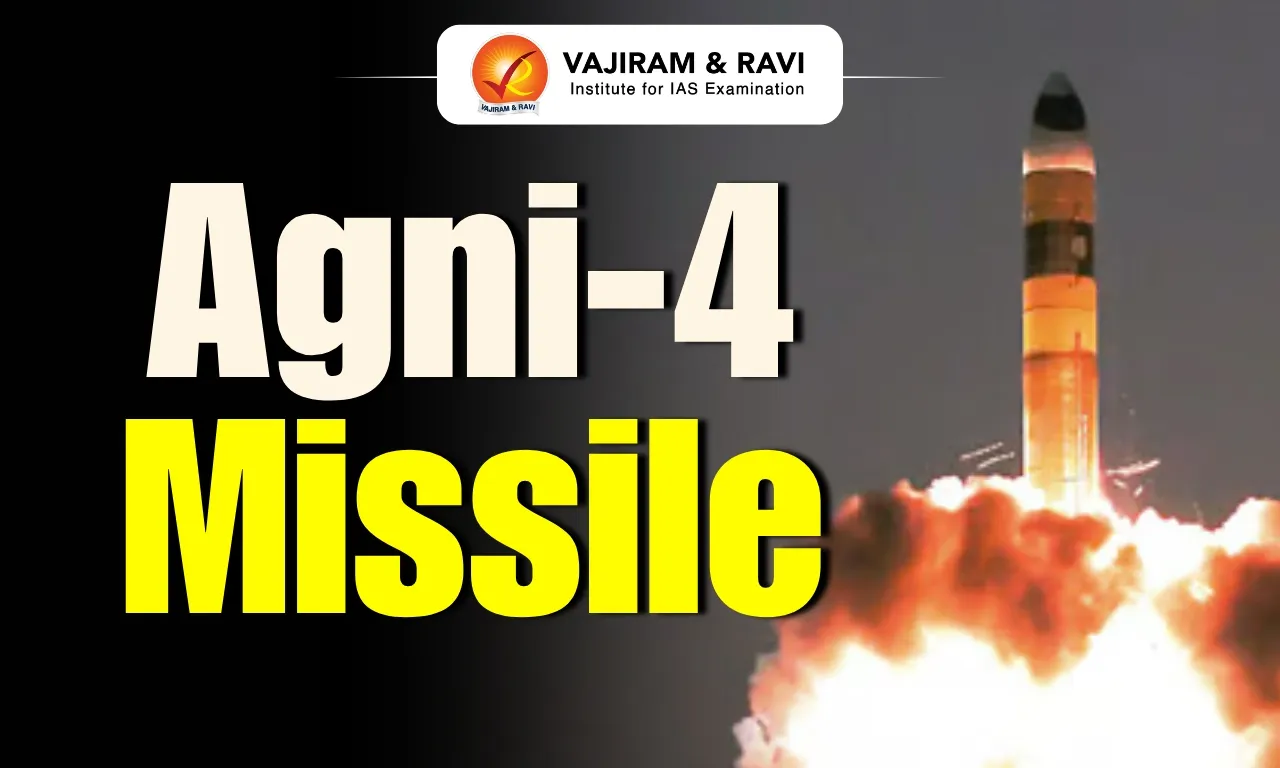
Recently, Agni-4’ was successfully test-fired from the Integrated Test Range, Chandipur in Odisha.

About Agni-4 Missile

  • It is an indigenously developed Medium-Range Ballistic Missile (MRBM).
  • It is developed by the Defence Research and Development Organisation (DRDO).
  • It is operated by the Strategic Forces Command (SFC) as part of India's strategic missile arsenal.

Key Features of Agni-4 Missile

  • Range: It is capable of striking targets at a range of up to 4,000 kilometres.
  • Propulsion: It is a two-stage, surface-to-surface ballistic missile powered by a solid-fuel rocket motor.
  • Launch Platform: Road-mobile launcher
  • Payload Capacity: It has a payload capacity up to 1,000 kg
  • Technology: It has the most accurate Ring Laser Gyro based Inertial Navigation System (RINS) supported by a highly reliable redundant Micro Navigation System (MINGS), ensuring the vehicle reaches the target within two digit accuracy.
  • It has a circular error probability (CEP) of less than 100 meters.
    • CEP is a measure of a weapon system’s accuracy.
  • Role: It is designed to deliver strategic payloads and maintain credible deterrence.

Source: PIB

Agni-4 Missile FAQs

Q1: What is the range of Agni-4 Missile?

Ans: 4000 km

Q2: Agni-4 is developed by which organization?

Ans: DRDO

Pakal Dul Hydropower Project

Pakal Dul Hydropower Project

Pakal Dul Hydroelectric Project Latest News

A significant industrial dispute involving workers engaged by L&T Construction through subcontractors at the Pakal Dul Hydroelectric Project, Kishtwar, Jammu & Kashmir, has been amicably resolved recently.

About Pakal Dul Hydroelectric Project

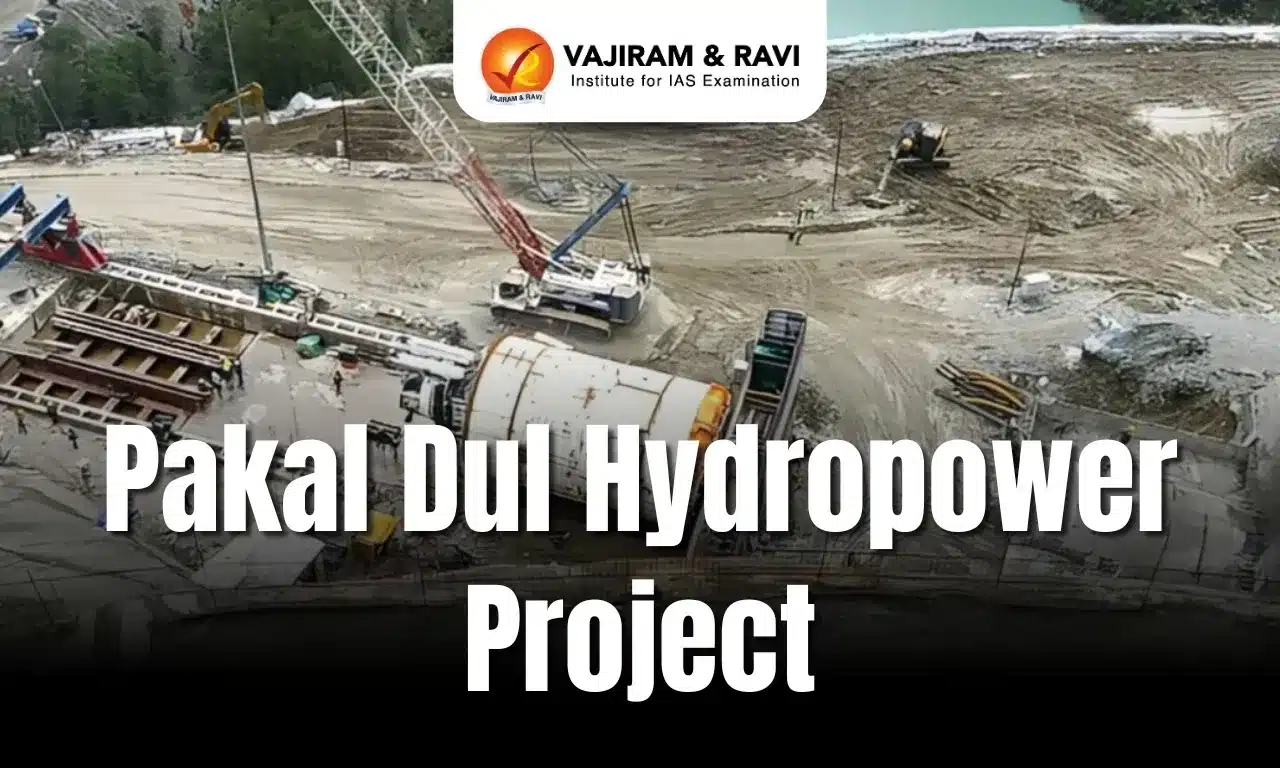
  • It is a 1 GW run-of-the-river scheme hydroelectric project (HEP) under construction in the Kishtwar district of Jammu and Kashmir.
  • The project is being constructed on the Marusudar River, a tributary of the Chenab.
  • It comprises a 167 m high concrete-face rockfill dam and an underground powerhouse.
  • The underground powerhouse will be equipped with four 250 MW Francis turbine units operating at a net head of 397.3 m.
  • It is anticipated to produce around 3,330 million units of energy a year.
  • It is being constructed by Chenab Valley Power Projects [P] Ltd. (CVPPL), a joint venture company of National Hydroelectric Power Corporation (NHPC Limited) and Jammu & Kashmir State Power Development Corporation Ltd (JKSPDC).
  • JKSPDC holds a 49% stake in CVPPL, while NHPC and PTC India hold 49% and 2%, respectively.
  • During the first ten years of operation, the J&K will receive 12% free power from the project, in addition to waiving water usage charges. 
  • J&K will also have the first right to purchase the power allotted to NHPC and PTC.

News: PIB

Pakal Dul Hydroelectric Project FAQs

Q1: Where is the Pakal Dul Hydroelectric Project located?

Ans: It is located in Kishtwar district of Jammu and Kashmir.

Q2: What type of hydroelectric project is Pakal Dul?

Ans: It is a 1 GW run-of-the-river hydroelectric project.

Q3: On which river is the Pakal Dul Hydroelectric Project being constructed?

Ans: It is being constructed on the Marusudar River.

Q4: What is the installed capacity of the Pakal Dul Hydroelectric Project?

Ans: 1,000 MW (1 GW).

Rabindranath Tagore Jayanti 2026, Date, Events, Biography

Rabindranath Tagore Jayanti 2026

Rabindranath Tagore Jayanti 2026 is observed on 9 May 2026 to mark the 165th birth anniversary of Gurudev Rabindranath Tagore. The celebration honours his immense contribution to literature, music, education, art and philosophy. Across India, especially in West Bengal, schools, universities and cultural organisations organise poetry recitations, Rabindra Sangeet performances, seminars and cultural programmes. Tagore’s ideas on creativity, humanism and education continue to influence modern Indian society and cultural thought.

Rabindranath Tagore Jayanti 2026

Rabindranath Tagore Jayanti 2026 has been celebrated on Thursday, 7 May 2026, while West Bengal observes it on 25th Boishakh according to the Bengali calendar, which falls on 9 May 2026. The occasion commemorates the 165th birth anniversary of the first Asian Nobel Prize winner in Literature. Santiniketan, Kolkata and Jorasanko Thakur Bari remain the major centres of celebration where literary gatherings, cultural performances, exhibitions and educational activities are organised to honour Tagore’s timeless legacy.

Rabindranath Tagore Biography

Rabindranath Tagore’s life reflected literature, philosophy, music, education and nationalism, making him one of modern India’s greatest cultural icons.

  • Birth and Family Background: Rabindranath Tagore was born on 9 May 1861 in Jorasanko, Kolkata, to Debendranath Tagore and Sarada Devi. He belonged to the famous Tagore family associated with the Brahmo Samaj and Bengal Renaissance Movement.
  • Early Literary Talent: Tagore started writing poetry during childhood and published his first poem “Abhilasha” in 1874. His creative upbringing encouraged deep interest in literature, music, philosophy and nature from an early age.
  • Nobel Prize Achievement: Tagore became the first Asian to win the Nobel Prize in Literature in 1913 for his poetry collection “Gitanjali”. The award gave Indian literature global recognition and established Tagore as an international literary figure.
  • Educational Vision: In 1901, Tagore founded Patha Bhavana at Santiniketan and later established Visva Bharati University in 1921. He promoted holistic education connected with creativity, nature, cultural exchange and independent thinking.
  • Final Years and Legacy: Rabindranath Tagore passed away on 7 August 1941 in Kolkata. His literary works, educational philosophy, songs, paintings and social ideas continue influencing generations across India and the world.

Rabindranath Tagore Contributions

Rabindranath Tagore transformed Indian literature, music, education and cultural identity through his timeless works and progressive philosophical ideas.

  • National Anthems Composition: Tagore composed “Jana Gana Mana”, adopted as India’s national anthem in 1950 and “Amar Shonar Bangla”, later adopted as Bangladesh’s national anthem, strengthening cultural identity across South Asia.
  • Literary Contributions: Tagore wrote various books, poems, novels, essays, dramas and short stories including “Gitanjali”, “Gora”, “Chokher Bali” and “Ghare Baire”. His writings combined spirituality, humanism, nationalism and emotional depth in modern Bengali literature.
  • Rabindra Sangeet: Tagore composed more than 2,000 songs known as Rabindra Sangeet. These songs blended classical ragas, Baul traditions and philosophical themes, becoming an integral part of Bengali cultural and musical heritage.
  • Educational Reforms: Through Visva Bharati University, Tagore opposed rote learning and encouraged experiential education. He promoted open air classrooms, artistic learning, creativity and harmony between education, culture and nature.
  • Nationalist and Humanist Ideas: Tagore criticised aggressive nationalism and promoted universal humanism, peace and ethical values. He renounced his title of “knighthood” in 1919 after the Jallianwala Bagh Massacre as a protest against British colonial brutality.

Rabindranath Tagore Jayanti 2026 Celebration

Rabindranath Tagore Jayanti 2026 will witness cultural programmes, literary discussions, artistic performances and educational activities organised across India and abroad.

  • Rabindra Sangeet Performances: Schools, universities and cultural organisations organise musical performances featuring Rabindra Sangeet songs like “Ekla Chalo Re” and “Tumi Robe Nirobe”, celebrating Tagore’s contribution to Indian music and culture.
  • Poetry Recitations and Dramas: Students and artists recite poems from “Gitanjali” and stage dance dramas such as “Chitrangada” and “Chandalika”, highlighting Tagore’s literary and theatrical brilliance before large audiences.
  • Santiniketan Celebrations: Santiniketan hosts grand celebrations including Baitalik morning processions, prayer meetings at Upasana Griha, exhibitions of Tagore’s paintings and cultural programmes organised by Visva Bharati University.
  • Educational and Creative Competitions: Educational institutions conduct essay writing, quiz contests, poster making, drawing competitions, seminars and discussions focusing on Tagore’s philosophy, literature, educational reforms and cultural contributions.
  • International Observance: Universities and Indian cultural centres abroad organise lectures, exhibitions and literary discussions. Tagore’s ideas on universalism, peace and creativity continue attracting global academic and cultural interest.

Also Read: Important Days in May 2026

Rabindranath Tagore Jayanti 2026 Significance

Rabindranath Tagore Jayanti symbolises India’s literary heritage, educational ideals, cultural unity and the continuing relevance of Tagore’s humanistic philosophy.

  • Celebration of Literary Heritage: The day honours Tagore’s contribution to Indian and global literature through works like “Gitanjali”, which introduced Indian philosophical and spiritual thought to international audiences during the twentieth century.
  • Promotion of Cultural Values: Rabindranath Tagore Jayanti promotes creativity, music, literature, peace and cultural harmony. The celebrations encourage younger generations to appreciate India’s artistic and intellectual traditions in meaningful ways.
  • Importance of Educational Philosophy: Tagore’s educational ideas emphasised creativity, freedom and nature based learning. His vision continues influencing modern educational systems that value holistic personality development beyond rote memorisation.
  • Symbol of National Pride: As the composer of India’s national anthem and the first Asian Nobel laureate, Tagore remains a symbol of India’s intellectual achievement, cultural identity and contribution to world literature.
  • Inspiration for Society: Tagore’s teachings on courage, humanity, independent thinking and universal brotherhood continue inspiring people. His famous message from “Ekla Chalo Re” motivates individuals to pursue truth and justice fearlessly.

Rabindranath Tagore Jayanti 2026 FAQs

Q1: When is Rabindranath Tagore Jayanti 2026 celebrated?

Ans: Rabindranath Tagore Jayanti 2026 is celebrated on 7 May 2026, while West Bengal observes it on 9 May 2026 as per the Bengali calendar.

Q2: Why is Rabindranath Tagore Jayanti 2026 important?

Ans: The day honours Rabindranath Tagore’s contribution to literature, music, education, art, and Indian cultural identity.

Q3: Which famous book won Rabindranath Tagore the Nobel Prize?

Ans: Rabindranath Tagore received the Nobel Prize in Literature in 1913 for his poetry collection “Gitanjali”.

Q4: Who wrote the National Anthem of India and Bangladesh?

Ans: Rabindranath Tagore composed India’s national anthem “Jana Gana Mana” and Bangladesh’s national anthem “Amar Shonar Bangla”.

Q5: How is Rabindranath Tagore Jayanti celebrated in India?

Ans: The day is celebrated through Rabindra Sangeet performances, poetry recitations, cultural programmes, seminars, exhibitions, and educational competitions.

Quit India Movement Day 2026, Theme, History, Significance

Quit India Movement Day 2026

Quit India Movement Day 2026 will be observed on 8 August 2026 to commemorate the launch of the historic Quit India Movement (Bharat Chhodo Andolan) by Mahatma Gandhi in 1942. The movement marked one of the most decisive phases of India's freedom struggle, calling for an immediate end to British colonial rule. Every year, the day is observed to remember the sacrifices of freedom fighters and inspire citizens with the values of patriotism, unity, and democracy.

Quit India Movement Day 2026 Theme

Quit India Movement Day (August Kranti Diwas), observed every year on 8 August, does not have an officially announced national theme. Instead, the observance is dedicated to commemorating the historic Quit India Movement of 1942, honouring the sacrifices of India's freedom fighters, and reaffirming Mahatma Gandhi's powerful "Do or Die" call that inspired millions to fight for India's independence.

History of the Quit India Movement

The Quit India Movement, also known as the August Movement (August Kranti), was launched on 8 August 1942 by the Indian National Congress under the leadership of Mahatma Gandhi to demand the immediate end of British rule in India.

  • Launched on: 8 August 1942 during the Bombay Session of the All India Congress Committee (AICC).
  • Venue: Gowalia Tank Maidan (now August Kranti Maidan), Bombay (Mumbai).
  • Reason: The failure of the Cripps Mission (1942) and growing dissatisfaction with British rule during World War II.
  • Leader: Mahatma Gandhi, who gave the historic "Do or Die" call.
  • Objective: To compel the British to leave India immediately and achieve complete independence.
  • British Response: Gandhi and other Congress leaders were arrested on 9 August 1942, soon after the movement began.
  • Public Participation: Students, workers, farmers, women, and ordinary citizens participated in protests, strikes, and underground activities across the country.
  • Historical Importance: Although suppressed by the British, the movement became a turning point in India's freedom struggle and accelerated the path to Independence in 1947.

Causes of the Quit India Movement

Several political, economic, and wartime developments led to the launch of the Quit India Movement in 1942, as Indians demanded an immediate end to British colonial rule.

  • Failure of the Cripps Mission (1942): The British proposals did not promise immediate self-rule, leading to widespread disappointment among Indian leaders.
  • India's Involvement in World War II: Britain declared India a participant in the war without consulting Indian political representatives.
  • Demand for Complete Independence: The Indian National Congress intensified its demand for Purna Swaraj (Complete Independence) instead of limited constitutional reforms.
  • Economic Hardships: Wartime inflation, food shortages, unemployment, and rising prices caused severe public distress.
  • Repressive British Policies: Frequent arrests of nationalist leaders, censorship, and restrictions on civil liberties increased public anger.
  • Growing Nationalist Sentiment: Decades of freedom movements had strengthened the desire for self-governance among people across the country.
  • Japanese Advance in Asia: The rapid expansion of Japanese forces during World War II exposed Britain's weakening control and encouraged Indian leaders to press for immediate independence.
  • Mahatma Gandhi's Leadership: Gandhi believed that British rule had become morally and politically unacceptable, leading him to give the historic "Do or Die" call on 8 August 1942.

Major Leaders of the Quit India Movement

The Quit India Movement was led by Mahatma Gandhi and supported by several prominent freedom fighters who organized protests, underground resistance, and mass mobilization across India.

  • Mahatma Gandhi: Launched the Quit India Movement and gave the historic "Do or Die" call on 8 August 1942.
  • Jawaharlal Nehru: A senior Congress leader who actively supported the movement and was arrested soon after its launch.
  • Sardar Vallabhbhai Patel: Mobilized public support and encouraged nationwide participation in the movement.
  • Maulana Abul Kalam Azad: Then President of the Indian National Congress, he played a key role in adopting the Quit India Resolution.
  • Aruna Asaf Ali: Hoisted the Indian National Flag at Gowalia Tank Maidan after senior leaders were arrested, becoming a symbol of resistance.
  • Ram Manohar Lohia: Organized underground activities and spread nationalist messages despite British repression.
  • Jayaprakash Narayan: Escaped from prison and led underground resistance against British rule.
  • Usha Mehta: Operated the secret Congress Radio, which broadcast patriotic messages and movement updates across the country.
  • Achyut Patwardhan: Helped coordinate underground networks and resistance activities.
  • Yusuf Meherally: Coined the slogan "Quit India" and played an important role in mobilizing public support for the movement.

Quit India Movement Day 2026 Significance

Quit India Movement Day commemorates one of the most significant milestones in India's freedom struggle. It honours the courage, unity, and sacrifices of millions of Indians who participated in the Quit India Movement of 1942 and reaffirms the nation's commitment to the ideals of freedom and democracy.

  • Honours Freedom Fighters: Pays tribute to the countless individuals who sacrificed their lives and endured imprisonment for India's independence.
  • Commemorates the Quit India Movement: Marks the launch of the historic Bharat Chhodo Andolan on 8 August 1942 under Mahatma Gandhi's leadership.
  • Promotes Patriotism: Encourages citizens, especially the youth, to appreciate India's freedom struggle and uphold national values.
  • Highlights National Unity: Recognizes how people from different regions, communities, and backgrounds came together with a common goal of independence.
  • Strengthens Democratic Values: Reinforces the importance of freedom, justice, equality, and constitutional principles in modern India.
  • Inspires Civic Responsibility: Motivates citizens to actively contribute to nation-building and protect the country's democratic institutions.
  • Preserves Historical Legacy: Ensures that future generations remain aware of the events and sacrifices that shaped India's journey to independence.
Related Post
Aligarh Movement Wahabi Movement
Faraizi Movement Deoband Movement
Ahmadiyya Movement Akali Movement
Young Bengal Movement Temple Entry Movement

Quit India Movement Day 2026 FAQs

Q1: When is Quit India Movement Day 2026 observed?

Ans: Quit India Movement Day 2026 will be observed on 8 August 2026 (Saturday) to commemorate the launch of the Quit India Movement in 1942.

Q2: Why is Quit India Movement Day celebrated?

Ans: The day is celebrated to honour the Quit India Movement (Bharat Chhodo Andolan), launched by Mahatma Gandhi on 8 August 1942, and to pay tribute to the sacrifices of India's freedom fighters.

Q3: Who launched the Quit India Movement?

Ans: The Quit India Movement was launched by Mahatma Gandhi under the leadership of the Indian National Congress (INC) during the Bombay Session of the All India Congress Committee (AICC).

Q4: What was the famous slogan of the Quit India Movement?

Ans: The most famous slogan of the movement was "Do or Die", given by Mahatma Gandhi, urging Indians to achieve freedom through determined non-violent resistance.

Q5: Where was the Quit India Movement launched?

Ans: The movement was launched at Gowalia Tank Maidan, now known as August Kranti Maidan, in Bombay (Mumbai) on 8 August 1942.

Vice Presidents of India from 1952 to 2026, List, Powers, Tenure

Vice Presidents of India

The Vice President of India hold the second highest constitutional office after the President. As per Article 65 of the Indian Constitution, the Vice President is in charge during situations where the President is unable to fulfill their duties whether due to resignation, removal, death, impeachment, or incapacity. By default, the Vice Presidents of India also serves as the ex-officio Chairman of the Rajya Sabha, presiding over its sessions and ensuring the smooth conduct of proceedings. Since the role was established, 15 strong personalities have been Vice Presidents of India.

Vice Presidents of India

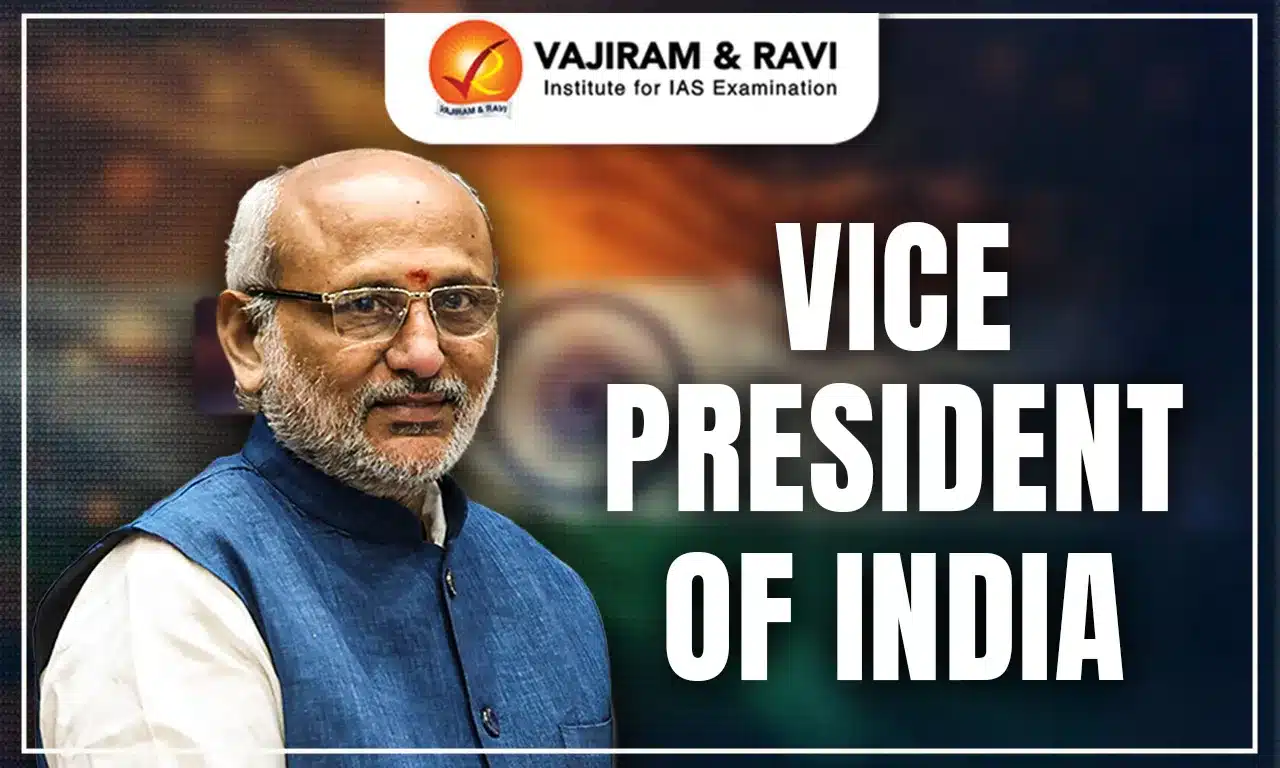
Unlike the President, the Vice Presidents of India are elected only by the members of both houses of Parliament, Lok Sabha and Rajya Sabha. State legislatures have no role in this election. C. P. Radhakrishnan is serving as the 15th Vice President of India (17th Vice President based on the office terms) since September 9, 2025. The first to hold the position of VP was Dr. Sarvepalli Radhakrishnan, who served from May 13, 1952, to May 12, 1957. 

Mohammad Hamid Ansari remains the only Vice President to complete two full terms, serving from August 11, 2007, to August 11, 2017. He was succeeded by M. Venkaiah Naidu, who held the post under President Ram Nath Kovind until August 2022. The Vice Presidents of India serve a five-year term but continue in office until a successor is elected.

Current Vice President of India 2026

C. P. Radhakrishnan has been elected as the 15th and Current Vice President of India. He secured a total of 452 votes, comfortably crossing the required majority mark of 391 votes, and won the contest by a margin of 152 votes.

The Vice President of India holds the second-highest constitutional office in the country. By virtue of this position, the Vice-President also serves as the ex-officio Chairman of the Rajya Sabha. The election to this office is conducted by an electoral college consisting of members from both Houses of Parliament. Unlike the presidential election, the State Legislatures have no role in this process.

List of Vice Presidents of India from 1952 to 2026

Dr. Sarvepalli Radhakrishnan was First Vice President of India, took oath at Rashtrapati Bhavan on May 13, 1952. Below is the complete List of Vice Presidents of India in Chronological Order from 1952 to 2026 including tenure and President of India during their tenure:

List of Vice Presidents of India from 1952 to 2026
S. No. Vice-President Tenure (From) Tenure (To) President(s) During Tenure
1 Dr. Sarvepalli Radhakrishnan 13 May 1952 12 May 1962 Dr. Rajendra Prasad
2 Dr. Zakir Hussain 13 May 1962 12 May 1967 Dr. Sarvepalli Radhakrishnan
3 Varahagiri Venkata Giri 13 May 1967 20 July 1969 Dr. Zakir Hussain
4 Gopal Swarup Pathak 31 August 1969 30 August 1974 V. V. Giri, Dr. Fakhruddin Ali Ahmed
5 Basappa Danappa Jatti 31 August 1974 30 August 1979 Dr. Fakhruddin Ali Ahmed, Neelam Sanjiva Reddy
6 Justice Muhammad Hidayatullah 31 August 1979 30 August 1984 Neelam Sanjiva Reddy, Giani Zail Singh
7 Ramaswamy Venkataraman 31 August 1984 24 July 1987 Giani Zail Singh
8 Shankar Dayal Sharma 7 September 1987 24 July 1992 Ramaswamy Venkataraman
9 Kocheril Raman Narayanan 21 August 1992 24 July 1997 Shankar Dayal Sharma
10 Krishan Kant 21 August 1997 27 July 2002 K. R. Narayanan, A. P. J. Abdul Kalam
11 Bhairon Singh Shekhawat 19 August 2002 21 July 2007 A. P. J. Abdul Kalam
12 Mohammad Hamid Ansari 11 August 2007 10 August 2017 Pratibha Patil, Pranab Mukherjee, Ram Nath Kovind
13 M. Venkaiah Naidu 11 August 2017 11 August 2022 Ram Nath Kovind
14 Jagdeep Dhankhar 11 August 2022 21 July 2025 Droupadi Murmu
15 C. P. Radhakrishnan 09 September 2025 Incumbent Droupadi Murmu

Vice Presidents of India Constitutional Provision

The Vice Presidents of India holds an important constitutional position, acting as the second-highest authority in the country and playing a key legislative and executive role. The provisions related to the office of the Vice Presidents of India are discussed in Articles 63 to 70 of the Indian Constitution. These articles outline the eligibility, method of election, tenure, powers, functions, and procedures in case of vacancies. The table below includes overview of Vice President of India Constitutional Provision:

Vice President of India Constitutional Provision
Article Details

Article 63

There will be an Indian Vice President

Article 64

The Vice-President shall not hold any other paid post and shall serve as the Council of States’ de facto Chairman

Article 65

When there are brief gaps in the office or when the president is not present, the vice president fills in for him or herself.

Article 66

The members of an electoral college made up of representatives from both Houses of Parliament will choose the vice president. The Vice-President is not permitted to serve in either the House of Representatives or the House of the Legislature of any State.

Article 67

From the time of his appointment, the Vice-tenure President’s in office must be for a period of five years.

Article 68

Before the term’s expiration, a vote must be held to fill any vacancies caused by the vice president’s tenure coming to an end. Elections must be held as soon as possible to fill any vacancies left by the vice president’s death, resignation, or removal.

Article 69

Each Vice President must take an oath or affirmation before the President, or a person he has nominated in that capacity.

Article 70

President’s duties are discharged in other emergencies

First Vice President of India

Dr. Sarvepalli Radhakrishnan was First Vice President of India. He was born on September 5, 1888, to Shri S. Veerasamiah. A renowned scholar and philosopher, Radhakrishnan held several academic honours, including an M.A., and multiple honorary degrees such as D.Litt., LL.D., D.C.L., and D.L. He was also a Fellow of the British Academy (F.B.A.) and the Royal Society of Literature (F.R.S.L.), and an Honorary Fellow at All Souls College, Oxford.

Vice Presidents of India Eligibility Criteria

To be eligible for the position of Vice President of India, a candidate must meet certain constitutional criteria. These qualifications ensure that the office is held by an individual with sufficient experience, integrity, and independence. Below are the key Vice Presidents of India Eligibility Criteria.

If elected while still a member of either House, he is considered to have vacated that seat from the day he takes office. Also, the Vice Presidents of India cannot hold any salaried position under the central, state, or local governments, or any public authority during the term.

  • Must be a citizen of India.
  • Must be at least 35 years old.
  • Must not hold any office of profit under the central or state government, or any public or local authority.

Vice Presidents of India Tenure

The Vice Presidents of India assumes office on the date he begins his term, which lasts for five years. However, he can choose to resign before completing the term. Apart from resignation, there are several other situations where the office of the Vice President can become vacant:

  • Completion of the five-year term
  • Voluntary resignation
  • Removal through a formal process
  • Death while in office
  • If the election is declared invalid by the Supreme Court

Vice Presidents of India Impeachment

Article 67(b) of the Indian Constitution deals with the removal of the Vice-President of India. It states that the Vice-President may be removed from office by a resolution of the Rajya Sabha (Council of States) passed by a majority of all its then members and agreed to by the Lok Sabha (House of the People). However, such a resolution cannot be moved unless at least 14 days’ notice has been given of the intention to move it.

Vice Presidents of India Powers and Functions

  • Chairman of Rajya Sabha: The Vice Presidents of India serves as the ex-officio Chairman of the Rajya Sabha. In this role, his powers and functions are similar to those of the Speaker of the Lok Sabha.
  • Acts as President: He is  an Acting President if the President resigns, is removed, dies, or otherwise becomes unable to serve. However, he can hold the office for a maximum of six months until a new President is elected.
  • Temporary Duties: The Vice President also performs the duties of the President during temporary absences due to illness, travel, or any other reason.
  • Similarity to U.S. System: His role resembles that of the Vice President of the United States, who presides over the Senate (the upper house of Congress).
  • Legal Continuity: If the Supreme Court later declares an election of Vice Presidents of India void, all decisions and actions made before that judgment remain valid and are not reversed.

Vice Presidents of India UPSC

  • The Vice Presidents of India is the ex-officio Chairman of the Rajya Sabha and presides over its sessions.
  • The Vice President’s office may fall vacant due to:
    • Resignation
    • Removal
    • Death
    • Absence caused by illness or incapacity
  • When the Vice President discharges the functions of the President, the Deputy Chairman of the Rajya Sabha takes over the Vice President’s duties in the House.
  • Articles 63 to 71 of the Constitution discusses the Vice Presidents of India.
  • The 11th Constitutional Amendment changed the method of election. Earlier, both Houses met in a joint sitting to elect the Vice President. Now, they vote separately.
  • Parliament determines the salary of the Vice Presidents of India. The current monthly salary of the Rajya Sabha Chairman (ex-officio the Vice President of India) is ₹4 lakh.
Also Check Related Post
Vice Presidents of India Education Ministers of India
Foreign Ministers of India Finance Ministers of India
Cabinet Ministers of India Prime Ministers of India
Deputy Prime Minister of India Presidents of India
Ministry of External Affairs

Vice President of India FAQs

Q1: How many Vice Presidents are there in India?

Ans: India has had 15 individuals serving Vice Presidents as of 2026 since independence and counted the office as 17th Vice President of India.

Q2: Who is the 17th Vice President of India?

Ans: CP Radhakrishnan is the 17th Vice President of India, elected in September 2025.

Q3: Who is the vice president of India now?

Ans: CP Radhakrishnan is the Vice President of India.

Q4: What are the powers of the Vice President of India?

Ans: The Vice President is Rajya Sabha Chairman, presides over its sessions, maintains order, decides rules, and acts as President in case of vacancy, resignation, or absence.

Q5: Who was the first woman vice president of India?

Ans: India has never had a woman Vice President.

Operation Safed Sagar, Background, Objective, Significance

Operation Safed Sagar was the Indian Air Force’s air campaign during the 1999 Kargil War, launched in support of the Indian Army’s Operation Vijay. It involved reconnaissance, intelligence gathering, precision air strikes, close air support, air defence and helicopter operations to help recapture strategic heights occupied by Pakistani forces. 

About Operation Safed Sagar

Operation Safed Sagar was launched in May 1999 to support the recapture of Indian territory in the Mushko Valley, Drass, Kaksar, Batalik and Turtok areas.

  • It was conducted in the extremely difficult high-altitude terrain of the Kargil region, where several enemy positions were located above 16,000-18,000 feet.
  • It was the first time the Indian Air Force (IAF) undertook live combat missions at such extreme altitudes.
  • A major operational constraint was that Indian aircraft had to conduct missions without crossing the Line of Control (LoC)

Operation Safed Sagar Background and Objective

In 1999, Pakistani soldiers and armed personnel occupied strategic heights on the Indian side of the Line of Control (LoC) in the Kargil sector. These positions provided them with a tactical advantage over important routes, particularly the Srinagar-Leh National Highway.

India launched Operation Vijay to recapture the occupied positions, while the Indian Air Force conducted Operation Safed Sagar to support the ground offensive. Its primary objective was to weaken the intruders’ military position through air strikes against enemy positions and supply lines, while providing intelligence and close air support to Indian troops.

Operation Safed Sagar Conduct and Features

Operation Safed Sagar was conducted through a coordinated combination of reconnaissance, precision strikes and air support.

  • Reconnaissance and intelligence: Aerial reconnaissance and ELINT missions identified enemy positions, movements, supply routes and logistic concentrations.
  • Targeted air strikes: Fighter aircraft, particularly Mirage-2000s, conducted precision strikes against identified enemy positions using Laser-Guided Bombs and Laser Designator Pods.
  • Support to ground operations: Air strikes weakened enemy positions and disrupted their supply lines, thereby supporting the Army’s advance in difficult mountainous terrain.
  • Air defence and escort: Escort and air-defence missions protected aircraft operating in the conflict zone.
  • Helicopter support: Helicopters were used mainly for casualty evacuation, air transport and logistical support.
  • Large-scale operations: The IAF conducted around 5,000 strike missions, 350 reconnaissance/ELINT missions and approximately 800 escort flights, besides more than 2,000 helicopter sorties.
  • Operational restraint: Indian aircraft were strictly directed not to cross the Line of Control, requiring careful route planning and precision targeting.

Operation Safed Sagar Challenges

Operation Safed Sagar was conducted under exceptionally difficult operational conditions, which imposed significant limitations on air operations.

  • High-altitude terrain: Enemy positions located at heights of around 16,000-18,000 feet made targeting and air operations extremely difficult.
  • Limited aircraft performance: Thin air at high altitudes affected aircraft payload, manoeuvrability and operational effectiveness.
  • Difficult target identification: Mountainous terrain, camouflage and limited visibility made accurate identification of enemy positions challenging.
  • Air defence threats: The loss of a Mi-17 helicopter to a Stinger missile on 28 May 1999 highlighted the vulnerability of helicopters operating against shoulder-fired surface-to-air missiles.

Significance of Operation Safed Sagar

Operation Safed Sagar provided important lessons for air power and high-altitude warfare.

  • Air-ground integration: Close coordination between the IAF’s air operations and the Army’s Operation Vijay supported the recapture of enemy-held heights.
  • Precision warfare: Mirage-2000 aircraft, equipped with Laser-Guided Bombs and Laser Designator Pods, enabled accurate strikes against fortified positions in mountainous terrain.
  • Technological adaptability: The IAF adapted its tactics and weapon employment to overcome the challenges of high-altitude operations.
  • Intelligence-led operations: Reconnaissance and ELINT missions improved target identification and supported more effective air strikes.
  • Operational support: Over 2,000 helicopter sorties were undertaken for casualty evacuation and air transport, highlighting the vital role of aviation in sustaining high-altitude operations.
  • Strategic restraint: Operations were conducted without crossing the LoC, demonstrating the use of calibrated military power while limiting the risk of wider escalation.

Operation Safed Sagar FAQs

Q1: What was Operation Safed Sagar?

Ans: Operation Safed Sagar was the Indian Air Force’s air campaign during the 1999 Kargil War, conducted in support of Operation Vijay to recapture strategic heights occupied by Pakistani forces.

Q2: When and where was Operation Safed Sagar conducted?

Ans: Operation Safed Sagar was launched on 25 May 1999, with offensive air operations beginning on 26 May 1999, in the Kargil-Drass-Batalik sector.

Q3: What were the key features of Operation Safed Sagar?

Ans: Operation Safed Sagar involved reconnaissance, ELINT missions, precision air strikes, air defence, escort missions and helicopter operations. Mirage-2000 aircraft used Laser-Guided Bombs (LGBs) and Laser Designator Pods (LDPs).

Q4: What were the major challenges of Operation Safed Sagar?

Ans: Operation Safed Sagar was challenged by high-altitude terrain, thin air affecting aircraft performance, difficult target identification and threats from shoulder-fired missiles such as Stinger missiles.

Q5: What was the significance of Operation Safed Sagar?

Ans: Operation Safed Sagar demonstrated the importance of precision warfare, air-ground coordination, intelligence-led operations and technological adaptability in high-altitude warfare, while Indian aircraft maintained strategic restraint by not crossing the LoC.

List of National Symbols of India 2026 with Names and Images

National Symbols of India

National Symbols of India are an essential part of any nation's identity, reflecting its cultural values and historical significance. For Indians, these 17 national symbols are not only a source of pride but also a representation of India's diverse heritage. These symbols are integral to the country's identity and are significant in the context of national importance, making it essential for every citizen to be familiar with them. This article will include each of these symbols and explore their cultural and national relevance.

What are National Symbols of India?

National Symbols of India serve as an important representation of our country’s values, history, and identity. India, with its rich cultural heritage and diverse traditions, has a set of national symbols that evoke pride, patriotism, and a deep sense of unity among its citizens. These symbols go beyond representations; they embody the collective spirit and heritage of the nation.

List of National Symbols of India 2026

Check out the List of National Symbols of India below, which includes key symbols like the National Flag, Emblem, Anthem, along with the Bengal Tiger, Lotus, and the Ganges River. These symbols embody India's cultural heritage, evoking patriotism, pride, and unity, while reflecting the country's rich diversity and identity.

List of National Symbols of India 2026

S No

Symbol

Name

1

National Flag

Tiranga

2

National Emblem

National Emblem of India

3

National Currency

Indian Rupees

4

National Calendar

Saka Calendar

5

Oath of Allegiance

National Pledge

6

National River

Ganga

7

National Heritage Animal

Indian Elephant

8

National Animal

Royal Bengal Tiger

9

National Bird

Indian Peacock

10

National Tree

Indian Banyan

11

National Song

Vande Mataram

12

National Anthem

Jana Gana Mana

13

National Reptile

King Cobra

14

National Aquatic Animal

Ganges River Dolphin

15

National Vegetable

Pumpkin

16

National Fruit

Mango

17

National Flower

Lotus

National Symbols of India with Names List

The major List of National Symbols of India 2026 has been provided below along with their pictures:

[my_image src="https://vajiramias.sgp1.cdn.digitaloceanspaces.com/wp/current-affairs/2026/07/Indian-National-Flag.webp?v=2" size="full" align="right" width="auto" height="218px" alt="Indian National Flag" title="Indian National Flag"]

Indian National Flag

The National Flag of India, popularly known as the Tiranga, was designed by Pingali Venkayya and adopted on 22 July 1947. It consists of three horizontal stripes: saffron, white, and green, with the navy-blue Ashoka Chakra at the center. The saffron color symbolizes courage and sacrifice, white represents peace and truth, while green signifies faith and prosperity. The flag stands as a powerful symbol of India's sovereignty, unity, and democratic values. It is proudly displayed during national celebrations and important government events.

[my_image src="https://vajiramias.sgp1.cdn.digitaloceanspaces.com/wp/current-affairs/2026/07/Lotus.webp?v=2" size="full" align="left" width="auto" height="240px" alt="Lotus" title="Lotus"]

National Flower of India

The Lotus is the National Flower of India and symbolizes purity, beauty, and spiritual enlightenment. Despite growing in muddy waters, the lotus blooms beautifully, representing the triumph of goodness over adversity. It holds immense significance in Indian culture and is closely associated with deities such as Goddess Lakshmi and Goddess Saraswati. The flower frequently appears in Indian art, literature, and religious practices. Its ability to remain untouched by impurities makes it a symbol of inner strength and wisdom.

National Emblem

India's National Emblem is adapted from the Lion Capital of Ashoka at Sarnath and was adopted on 26 January 1950. It features four Asiatic lions standing back-to-back, symbolizing power, courage, confidence, and pride. Below the lions appears the national motto, "Satyameva Jayate", meaning "Truth Alone Triumphs." The emblem is used on official government documents, currency, passports, and national institutions. It reflects India's rich historical heritage and commitment to truth and justice.

National Currency

[my_image src="https://vajiramias.sgp1.cdn.digitaloceanspaces.com/wp/current-affairs/2026/07/Indian-Rupee.webp?v=2" size="full" align="right" width="auto" height="184px" alt="Indian Rupee" title="Indian Rupee"]

The Indian Rupee (₹) is the official currency of India and is regulated by the Reserve Bank of India (RBI). The rupee symbol was designed by D. Udaya Kumar and officially adopted in 2010. Combining elements of the Devanagari letter "र" and the Roman letter "R," it represents India's cultural and economic identity. The Indian Rupee plays a vital role in domestic and international trade. It symbolizes the country's financial sovereignty and growing economic influence.

National Calendar

The Saka Calendar is India's National Calendar and has been used for official purposes since 1957. It begins with the month of Chaitra and aligns closely with the Gregorian calendar. Developed to provide a standardized system for government communication, it reflects India's scientific and cultural traditions. The calendar is used alongside the Gregorian calendar in official gazettes and government publications. It represents India's rich historical and astronomical knowledge.

Oath of Allegiance (National Pledge)

The National Pledge of India is a declaration of loyalty and commitment to the nation. It emphasizes unity, discipline, brotherhood, and respect for the country's diversity. Commonly recited in schools and educational institutions, the pledge instills patriotism among young citizens. It encourages individuals to work for the progress and prosperity of the nation. The pledge serves as a reminder of the duties and responsibilities of every Indian citizen.

[my_image src="https://vajiramias.sgp1.cdn.digitaloceanspaces.com/wp/current-affairs/2026/07/Mango.webp?v=2" size="full" align="right" width="auto" height="148px" alt="Mango" title="Mango"]

National Fruit of India

The Mango is recognized as the National Fruit of India and is often called the "King of Fruits." It has been cultivated in India for thousands of years and holds cultural, historical, and economic importance. The fruit is known for its rich taste, nutritional value, and numerous varieties. Mangoes are featured in Indian literature, art, and festivals, symbolizing abundance and prosperity. India is also one of the world's largest producers of mangoes.

[my_image src="https://vajiramias.sgp1.cdn.digitaloceanspaces.com/wp/current-affairs/2026/07/Royal-Bengal-Tiger.webp?v=2" size="full" align="left" width="auto" height="174px" alt="Royal Bengal Tiger" title="Royal Bengal Tiger"]

National Animal of India

The Royal Bengal Tiger is the National Animal of India and symbolizes strength, courage, and majesty. It was chosen in 1973 to replace the lion and to promote wildlife conservation through Project Tiger. Found mainly in India's forests and national parks, the tiger plays a crucial role in maintaining ecological balance. Despite conservation efforts, it remains vulnerable due to habitat loss and poaching. The tiger represents India's commitment to protecting its rich biodiversity.

Also Read: Tiger Reserves in India 2026

National Bird of India

The Indian Peacock was declared the National Bird of India in 1963. Known for its vibrant plumage and graceful appearance, the peacock occupies a special place in Indian culture and mythology. It is associated with several deities and is frequently depicted in traditional art and folklore. The bird symbolizes beauty, pride, and elegance. Its widespread presence across the country made it an ideal choice as a national symbol.

National Anthem of India

"Jana Gana Mana" is the National Anthem of India, composed by Rabindranath Tagore. It was officially adopted on 24 January 1950 and reflects the unity and diversity of the nation. The anthem celebrates India's cultural richness and geographical vastness. Sung during national ceremonies and important events, it inspires feelings of patriotism and national pride. The full rendition of the anthem takes approximately 52 seconds.

National Song of India

"Vande Mataram", written by Bankim Chandra Chatterjee, is India's National Song. It was originally composed in Sanskrit and gained prominence during the freedom movement. The song personifies India as a mother figure and inspired countless freedom fighters. It was officially accorded national song status in 1950. Even today, it remains a powerful symbol of patriotism and devotion to the nation.

National Tree of India

The Banyan Tree is India's National Tree and symbolizes longevity, resilience, and immortality. Known for its extensive aerial roots and vast canopy, it can survive for centuries. The banyan holds a sacred place in Indian culture and is often associated with wisdom and spiritual growth. Traditionally, village gatherings and community meetings were held under its shade. Its enduring nature reflects the strength and continuity of Indian civilization.

National Vegetable of India

[my_image src="https://vajiramias.sgp1.cdn.digitaloceanspaces.com/wp/current-affairs/2026/07/Pumpkin.webp?v=2" size="full" align="right" width="auto" height="158px" alt="Pumpkin" title="Pumpkin"]

The Pumpkin is often regarded as India's National Vegetable due to its widespread cultivation and importance in Indian cuisine. It is grown across diverse climatic regions and is valued for its nutritional benefits. Pumpkin is used in a variety of traditional dishes and festive preparations. Its ability to grow with relatively few resources makes it an important crop for farmers. The vegetable symbolizes agricultural abundance and food security.

National Heritage Animal

The Indian Elephant was declared the National Heritage Animal of India in 2010. Revered in Indian culture and religion, it is associated with wisdom, strength, and prosperity. Elephants have played significant roles in Indian history, warfare, and religious traditions. However, habitat loss and human-animal conflict threaten their survival. Recognizing the elephant as a heritage animal highlights the need for its conservation and protection.

National Aquatic Animal of India

The Ganges River Dolphin is India's National Aquatic Animal. Found primarily in the Ganga-Brahmaputra river system, it is an indicator of a healthy freshwater ecosystem. The species is endangered due to pollution, habitat degradation, and human activities. Its designation as a national symbol aims to increase awareness about river conservation. Protecting the dolphin is essential for maintaining the ecological health of India's river systems.

National River of India

The Ganga (Ganges) was declared the National River of India in 2008 due to its immense cultural, historical, and spiritual significance. Flowing through several states, it supports millions of people through agriculture, drinking water, and livelihoods. The river is revered as sacred in Hinduism and is central to numerous religious practices. Various government initiatives, including the Namami Gange Programme, focus on its conservation and rejuvenation. The Ganga symbolizes India's civilization, heritage, and spiritual traditions.

National Symbols of India Significance

National Symbols of India represent the country's identity, cultural heritage, sovereignty, unity, and values, fostering a sense of patriotism and national pride among citizens.

  • Reflect the history, traditions, and cultural diversity of the nation.
  • Promote national unity and integrity among people from different backgrounds.
  • Represent India's sovereignty and independent status on global platforms.
  • Instill a sense of patriotism and national pride among citizens.
  • Serve as official symbols in government institutions, documents, and ceremonies.
  • Showcase India's unique heritage, values, and achievements to the world.
  • Strengthen the feeling of belongingness and collective identity among Indians.
  • Act as symbols of respect, honor, and constitutional values.
  • Help preserve and promote India's cultural and natural legacy.
  • Play an important role in national celebrations, educational activities, and international representation.

Also Read: UNESCO World Heritage Sites in India

National Symbols of India 2026 FAQs

Q1: What are the 17 National Symbols of India?

Ans: There are 17 national symbols of India namely Tiranga, Jana Gana Mana, Saka Calendar, Vande Mataram, National Emblem of India, Mango, Ganga, Royal Bengal Tiger, Indian Banyan, Ganges River Dolphin, Indian Peacock, Indian Rupee, King Cobra, Indian Elephant, Lotus, Pumpkin and National Pledge.

Q2: What is the name of the National Symbol?

Ans: India's National Symbols, such as the lotus (spirituality and purity), the tiger (strength and courage), the peacock (grace and beauty), the banyan tree (immortality), and the mango (tropical climate), were chosen to reflect the nation's rich heritage, cultural values, and natural beauty.

Q3: What do the National Symbols of India represent?

Ans: The national animal, Tiger symbolizes power; the national flower, Lotus symbolizes purity; the national tree, Banyan symbolizes immortality, the national bird, the Peacock symbolizes elegance and the national fruit, Mango symbolizes the tropical climate of India.

Q4: What are the names of 5 of the National Symbols?

Ans: The five symbols include King Protea, Real Yellowwoods, Springbok, Galjoen Fish, and Blue Crane. In addition, is the meaning of each symbol.

Q5: Which is the National Tree?

Ans: Ficus bengalensis, an Indian fig tree, spreads its branches out like young trees across a wide region. The roots then give rise to more trunks and branches. Because of this characteristic and its longevity, this tree is considered immortal and is an integral part of the myths and legends of India.

Nizam of Hyderabad, History, List of Nizams, Contributions

Nizam of Hyderabad

The Nizam of Hyderabad was the hereditary ruler of Hyderabad State, a vast princely dominion covering present day Telangana, Marathwada in Maharashtra and Kalyana Karnataka. The title originated from the Persian phrase Nizam-ul-Mulk, meaning “Administrator of the Realm,” first granted to Mir Qamar-ud-din Khan by Mughal Emperor Farrukhsiyar. Beginning in 1724, the Asaf Jahi dynasty governed this region for 224 years until Hyderabad’s integration into the Indian Union on 17 September 1948, shaping the political, economic and cultural character of the Deccan.

Nizam of Hyderabad

The word “Nizam” derives from Persian niẓām, meaning order or arrangement. The Nizams were semi-independent sovereigns who emerged from the weakening Mughal Empire and later functioned as princely allies under British paramountcy. Asaf Jahi Dynasty was founded by Chin Qilich Khan (Mir Qamar-ud-din Khan), titled Asaf Jah I and Nizam-ul-Mulk, the dynasty maintained nominal allegiance to the Mughal emperor while exercising autonomous control from Hyderabad. Over time, the Nizams navigated conflicts with the Marathas, treaties with the British East India Company and global political shifts. By the twentieth century, Hyderabad had become the largest princely state in India, ruled by seven officially recognized Nizams.

Nizam of Hyderabad History

The evolution of the Nizam of Hyderabad authority reflects Mughal decline, Maratha pressure and British expansion across the Deccan region.

  • Appointment: In 1713, Mughal Emperor Farrukhsiyar appointed Mir Qamar-ud-din Khan as Viceroy of the Deccan and conferred the honorific Nizam-ul-Mulk, marking the formal beginning of Asaf Jahi authority.
  • Early Mughal Career: Mir Qamar-ud-din earlier served under Emperor Aurangzeb and held prominent court positions, including the office of wazir under Emperor Muhammad Shah before returning permanently to the Deccan.
  • Foundation of Autonomy: In 1724, he defeated Mubariz Khan and established effective independence in Hyderabad while continuing symbolic recognition of Mughal sovereignty through coinage and Friday sermons.
  • Asaf Jahi Dynasty: The dynasty, named after the title Asaf Jah, ruled from Hyderabad city and maintained its own court, army and revenue system for more than two centuries.
  • Period of Succession Conflict: After the death of Asaf Jah I in 1748, Nasir Jung, Muzaffar Jung and Salabat Jung contested succession for about 13 years, creating political instability without firm imperial recognition.
  • Nizam-Maratha Conflicts: From the 1720s onward, the Nizams fought multiple campaigns against the Marathas, including battles at Palkhed, Bhopal, Rakshasbhuvan and Kharda, ultimately agreeing to pay Chauth as tribute.
  • Nizam-British Relations: Following defeat at Kharda and changing power balances, the Nizam accepted British protection, aligning Hyderabad with the East India Company’s expanding authority.
  • Treaty of Machilipatnam 1768: Asaf Jah II signed this treaty, surrendering coastal territories in exchange for fixed annual rent, formally deepening British influence in Hyderabad’s external affairs.
  • Princely State under British Crown: After 1858, Hyderabad became part of the British Indian Empire as an autonomous princely state under the Crown, while retaining internal administrative control.
  • Entitlement by British: The Nizams received the unique style “His Exalted Highness” and were regarded as “Faithful Ally of the British Government” for military support during key imperial conflicts.
  • Berar Separation 1903: The Berar region was separated from Hyderabad and merged with the Central Provinces to form Central Provinces and Berar under British administration.
  • Military Contribution in World War II: During the Second World War, around 80,000 troops raised by the Nizam formed the 19th Hyderabad Regiment, serving in Malaya, North Africa, Persia, Singapore and Burma.
  • Hyderabad’s Territorial Extent: At its height, Hyderabad covered approximately 223,000 square kilometers, making it the largest princely state in India before independence.
  • Revenue and Population: By 1948, Hyderabad had nearly 17 million inhabitants and generated an estimated annual revenue of £90,029,000, reflecting substantial economic capacity.
  • Currency System: Hyderabad maintained its own currency known as the Hyderabadi Rupee until 1951, signifying fiscal autonomy even under British paramountcy.
  • Golconda Mines: The prosperity of the state was linked to the Golconda mines, once the principal global source of diamonds before South African discoveries altered the market.
  • Operation Polo 1948: On 13 September 1948, the Indian Army launched Operation Polo; within five days the Nizam surrendered and Hyderabad formally acceded to India on 17 September 1948.
  • Post-Accession Role: After accession of Hyderabad, the last Nizam served as Rajpramukh of Hyderabad State before his death on 24 February 1967, marking the formal end of dynastic political authority.

Nizam of Hyderabad List of Rulers

Seven officially recognized Nizams governed Hyderabad between 1724 and 1948 under the Asaf Jahi line.

  • Asaf Jah I (1724-1748): Mir Qamar-ud-din Khan founded the dynasty, secured Deccan autonomy in 1724 and maintained symbolic Mughal allegiance while exercising practical sovereignty from Hyderabad.
  • Nasir Jung (1748-1750): Mir Ahmed Ali Khan briefly ruled during the succession crisis after his father’s death, reflecting instability rather than consolidated dynastic authority.
  • Muzaffar Jung (1750-1751): Mir Hidayat Muhi-ud-din Sa’adullah Khan ascended with external backing but died within months, preventing durable governance.
  • Salabat Jung (1751-1762): Mir Sa’id Muhammad Khan held power during continued turbulence until displaced, concluding the prolonged interregnum phase.
  • Asaf Jah II (1762-1803): Mir Nizam Ali Khan restored stability, signed the 1768 Machilipatnam treaty and managed complex relations with both Marathas and the British.
  • Asaf Jah III (1803-1829): Mir Akbar Ali Khan, known as Sikander Jah, ruled during expanding British supremacy, maintaining Hyderabad’s internal administration under indirect rule.
  • Asaf Jah IV (1829-1857): Mir Farqunda Ali Khan governed amid fiscal challenges, navigating debt pressures and territorial adjustments with British authorities.
  • Asaf Jah V (1857-1869): Mir Tahniyath Ali Khan’s tenure coincided with administrative reforms, including modernization of communication networks and infrastructure expansion.
  • Asaf Jah VI (1869-1911): Mir Mahbub Ali Khan ascended as a minor and ruled during rapid institutional development, overseeing modernization in railways and civic services.
  • Asaf Jah VII (1911-1948): Mir Osman Ali Khan became globally renowned for immense wealth, established Osmania University and ruled until Hyderabad’s Accession in 1948.

Nizam of Hyderabad Contributions

The Nizams significantly shaped governance, infrastructure, education, philanthropy and cultural institutions across Hyderabad State. The major contributions of the Nizam of Hyderabad include:

  • Railway Development: The Nizam’s Guaranteed State Railway expanded connectivity across the Deccan, facilitating industrial growth and linking interior regions with major trade centers.
  • Irrigation Reservoirs: Major reservoirs such as Osman Sagar and Himayat Sagar were commissioned to improve water supply, urban planning and agricultural sustainability.
  • Nagarjuna Sagar Dam: Preliminary survey work for the Nagarjuna Sagar Dam began during Nizam rule, though final construction occurred after independence.
  • Architecture: Landmark buildings including Telangana High Court, City College, Jubilee Hall, Asafia Library and the Assembly building were constructed during their reign. Grand residences such as Chowmahalla Palace, Purani Haveli, Falaknuma Palace, King Kothi Palace and Hill Fort Palace reflect architectural patronage.
  • Medical Infrastructure: Institutions such as Niloufer Hospital and Osmania Medical College strengthened public healthcare and medical education in Hyderabad.
  • Osmania University Establishment: Founded during the reign of the seventh Nizam, it became the first princely state university using Urdu as medium of instruction.
  • Hyderabad Civil Service: Inspired by the Indian Civil Service model, the Nizams created a structured Hyderabad Civil Service for efficient internal administration.
  • Military Organization: The Hyderabad State Forces, including the 19th Hyderabad Regiment, demonstrated organized military capacity within princely frameworks.
  • Fiscal Administration Reform: Mir Osman Ali Khan cleared state debts, restored budget surplus and rationalized revenue management during his early reign.
  • Global Wealth Recognition: In 1937, Mir Osman Ali Khan was regarded as the richest person globally, with an estimated ₹660 crores, later valued by adjusted calculations at over US$200 billion.
  • Interfaith Philanthropy: The Nizams donated a large amount of financial and land grants to various Hindu temples, churches and Sikh gurudwaras.
  • Modernization: Electricity, roadways and early aviation infrastructure were introduced, transforming Hyderabad into a modern administrative capital.

Nizam of Hyderabad FAQs

Q1: Who was the first Nizam of Hyderabad?

Ans: The first Nizam was Mir Qamar-ud-din Khan, titled Asaf Jah I. He established autonomous rule in Hyderabad in 1724 after defeating Mubariz Khan and founded the Asaf Jahi dynasty.

Q2: How long did the Nizams rule Hyderabad?

Ans: The Nizams ruled Hyderabad State for 224 years, from 1724 until 17 September 1948, when Hyderabad was integrated into the Indian Union after Operation Polo.

Q3: Why was the last Nizam of Hyderabad famous worldwide?

Ans: Mir Osman Ali Khan, the seventh Nizam, was known as one of the richest individuals in the world in 1937, with vast wealth from state revenues and diamond resources.

Q4: What was Operation Polo?

Ans: Operation Polo was a military action launched by the Indian Army on 13 September 1948 to integrate Hyderabad into India. The Nizam surrendered on 17 September 1948.

Q5: What were the major contributions of the Nizam of Hyderabad?

Ans: The Nizams developed railways, reservoirs like Osman Sagar, established Osmania University, built major public buildings, maintained a separate currency and supported interfaith philanthropy.

National Language of India, Official Language vs National Language

National Language of India

India does not have a designated national language. Instead, Hindi in the Devanagari script and English serve as the official languages of the Union Government. While Hindi is the most widely spoken language in the country, English continues to function as an associate official language, facilitating administration, governance, and communication across India's linguistically diverse regions.

To preserve and promote its rich linguistic heritage, the Constitution of India recognizes 22 languages under the Eighth Schedule. These scheduled languages are Assamese, Bengali, Bodo, Dogri, Gujarati, Hindi, Kannada, Kashmiri, Konkani, Maithili, Malayalam, Manipuri, Marathi, Nepali, Odia, Punjabi, Sanskrit, Santali, Sindhi, Tamil, Telugu, and Urdu. Together, these languages reflect India's cultural diversity and multilingual character.

What is the National Language of India 2026?

India's rich cultural diversity has led to no single language as the National Language of India. Hindi, spoken by less than 44% of the population, has been a topic of discussion for years regarding its recognition as the official language, but no consensus has been reached. As per the Indian Constitution, no language holds the title of the National Language of India. However, for official communication at the national level, both Hindi and English have been designated as the official languages.

Official Language of India

The official language of India is Hindi in the Devanagari script, as stated in Article 343 of the Constitution. Along with Hindi, English is used as an associate official language for government communication, legal matters, and parliamentary proceedings. This dual-language policy ensures smooth administration across India’s diverse linguistic regions.

Hindi

As per Article 343 of the Indian Constitution, Hindi is the primary language used by the Central Government when communicating with states where Hindi is widely spoken. It serves as the lingua franca for most of the North India residents.

English

Serving as the associate official language, English is used for communication between the Central Government and states where Hindi is not the predominant language.

List of 22 Official Languages of India

The Eighth Schedule of the Indian Constitution officially recognizes 22 languages. Initially, only 14 languages were included, but over time, amendments led to the addition of more languages. Articles 343 to 351 in Part XVII of the Constitution specifically deal with the provisions related to official languages in the country. Below is the complete list of the 22 languages recognized by the Indian Constitution.

List of 22 Official Languages of India
Sr. No Language Recognition in state

1

Assamese

Assam, Arunachal Pradesh

2

Bengali

West Bengal, Tripura

3

Bodo

Assam

4

Dogri

Official language of Jammu and Kashmir

5

Gujarati

Dadra and Nagar Haveli and Daman and Diu, Gujarat

6

Hindi

Andaman and Nicobar Islands, Bihar, Dadra and Nagar Haveli and Daman and Diu, Chhattisgarh, Delhi, Gujarat, Haryana, Himachal Pradesh, Jharkhand, Madhya Pradesh, Jammu and Kashmir, Mizoram, Rajasthan, Uttar Pradesh, Uttarakhand and West Bengal

7

Kannada

Karnataka


Kashmiri

Jammu and Kashmir

9

Konkani

Dadra and Nagar Haveli and Daman and Diu, Maharashtra, Goa, Karnataka and Kerala (The Konkan Coast)

10

Maithili

Bihar, Jharkhand

11

Malayalam

Kerala, Lakshadweep, Puducherry

12

Manipuri

Manipur

13

Marathi

Maharashtra, Goa, Dadra and Nagar Haveli and Daman and Diu

14

Nepali

Sikkim and West Bengal

15

Odia

Official language of Orissa

16

Punjabi

Official language of Punjab and Chandigarh, 2nd official language of Delhi and Haryana

17

Sanskrit

Himachal Pradesh, Uttarakhand

18

Santali

Spoken by Santhal people mainly in the state of Jharkhand as well as in the states of Assam, Bihar, Chhattisgarh, Mizoram, Odisha, Tripura, West Bengal

19

Sindhi

Gujarat and Maharashtra, especially Ulhasnagar

20

Tamil

Tamil Nadu, Puducherry

21

Telugu

Andhra Pradesh, Telangana and Puducherry

22

Urdu

Jammu and Kashmir, Telangana, Jharkhand, Delhi, Bihar, Uttar Pradesh and West Bengal

Difference Between Official Language and National Language

As per Article 343 of the Indian Constitution, the Central Government communicates in Hindi with Hindi-speaking states. For interactions with other states, English serves as the associate official language. Therefore, Hindi and English are recognized as the official languages of India, but neither holds the status of a national language. Check the table below to know more details:

Official Language vs National Language
Official Language National Language

Hindi and English

None

Used for government communication and administration

India does not have a designated national language

Hindi is used by the Central Government for communication with Hindi-speaking states (Article 343)

A national language typically serves social, cultural, and political purposes, but no single language holds this status in India

English is the associate official language for communication with non-Hindi-speaking states

The Constitution does not grant national language status to any language

22 languages are recognized under the Eighth Schedule for cultural and administrative purposes

-

Amendments to Eighth Schedule of Indian Constitution

The Eighth Schedule of the Indian Constitution originally listed 14 languages in 1950. Over time, through the 21st (1967), 71st (1992), and 92nd (2003) Constitutional Amendments, more languages were added to recognize India’s linguistic diversity. With the inclusion of Bodo, Dogri, Maithili, and Santhali in 2003, the total number of scheduled languages increased to 22.

Amendments to Eighth Schedule of Indian Constitution
Amendment Year Languages Added Total Languages After Amendment
21st Amendment 1967 Sindhi 15
71st Amendment 1992 Konkani, Manipuri, Nepali 18
92nd Amendment 2003 Bodo, Dogri, Maithili, Santhali 22


National Language of India FAQs

Q1: What is the national language of India 2026?

Ans: There is no national language of India as per the constitution.

Q2: Which is the international language of India in 2026?

Ans: India has no officially recognized international language.

Q3: what is the Rashtra bhasha of India?

Ans: The Indian constitution, in 1950, declared Hindi in Devanagari script to be the official language of the union.

Q4: Is Hindi national language of India?

Ans: The Constitution of India does not give any language the status of the national language.

Q5: Which is the oldest language in India?

Ans: Tamil is considered to be the oldest language in India.

Union Territories of India, Capitals, Establishment, Map, Largest & Smallest UT

Union Territories of India

India, as a union of states, is a sovereign, socialist, secular, and democratic republic governed under a Parliamentary system. A Union Territory (UT) is a distinct administrative unit directly governed by the Central Government. The President of India serves as the constitutional head of the Executive at the Union level. These territories hold a unique status due to their historical formation and governance structure.

Union Territories of India

During the 18th century, Chief Commissioners' Provinces were established, and these regions were directly governed by a Chief Commissioner, who reported to the Governor-General or Viceroy of India, depending on the period. The formation of Union Territories took place following the implementation of the States Reorganisation Act, 1956. It was the Constitution (Seventh Amendment) Act of 1956 that introduced the concept of Union Territories as a distinct administrative framework within India.

List of Union Territories of India

India, as a union of states, is a Sovereign, Secular, and Democratic Republic governed under a Parliamentary system. The President serves as the constitutional head of the Union's Executive, while Union Territories are administered on their behalf through appointed representatives. The table below provides an overview of these Union Territories, including the capitals and date of creation:

List of Union Territories of India
S.no Union Territory Capital Date of Creation

1

Puducherry

Puducherry

1st November 1954

2

Andaman and Nicobar Islands

Port Blair

1st November 1956

3

Chandigarh

Chandigarh

1st November 1956

4

Lakshadweep

Kavaratti

1st November 1956

5

Delhi

Delhi

1st November 1956

6

Jammu and Kashmir

Srinagar (Summer)

Jammu (Winter)

31st October 2019

7

Ladakh

Leh

31st October 2019

8

Dadra and Nagar Haveli and Daman and Diu 

Silvassa and Daman

26th January 2020

Constitutional Provision of Union Territories of India

The Constitutional Provision of Union Territories of India are outlined in Part VIII of the Indian Constitution, specifically in Articles 239 to 241. These provisions establish the framework for governing Union Territories:

  • Article 239 given under the Part 8 of the Constitution of India gives powers to the President to administer Union Territories through appointed administrators.
  • Article 239A, introduced in 1962, grants Parliament the authority to establish legislatures and governance structures for certain Union Territories.
  • Article 239AA, was added in the constitution after the 69th Constitutional Amendment Act of 1991 which provides special provisions for the administration of the National Capital Territory of Delhi.

Special Provisions for Delhi

The 69th Constitutional Amendment Act of 1991 granted special status to the Union Territory of Delhi, renaming it the National Capital Territory (NCT) of Delhi. The Lieutenant Governor serves as its administrator.

Key provisions under this amendment include:

  • Legislative Assembly & Council of Ministers: The amendment established a 70-member legislative assembly, with all members directly elected, replacing the previous Executive Council and Metropolitan Council. Elections are conducted by the Election Commission of India.
  • Legislative Powers: The assembly can legislate on matters in the State List and Concurrent List, except for public order, police, and land, which remain under central government control.
  • Council of Ministers: The council’s strength is 10% of the assembly’s total members, meaning seven ministers, including the Chief Minister.

Appointment of Ministers

  • The Chief Minister is appointed by the President (not the Lieutenant Governor).
  • Other ministers are appointed by the President on the advice of the Chief Minister.
  • Ministers serve at the pleasure of the President.

Andaman and Nicobar Islands

The Andaman and Nicobar Islands have a humid tropical climate, indigenous tribes, and distinct island groups. The Andaman hosts Negrito tribes, while the Nicobar is home to Mongoloid tribes, preserving unique traditions.

Andaman and Nicobar Islands
Particulars Description

Area

8,249 sq. km

Population

4 lakh (approx)

Capital

Port Blair

Languages

Hindi, Nicobarese, Bengali, Tamil, Malayalam, Telugu

Dadra and Nagar Haveli and Daman and Diu

Recently, Daman and Diu merged with Dadra and Nagar Haveli to form a single Union Territory, Dadra and Nagar Haveli and Daman and Diu.

From 1954 to 1961, the region operated independently under the "Free Dadra and Nagar Haveli Administration." However, on 11 August 1961, it was officially integrated into the Indian Union and has since been governed as a Union Territory under the administration of the Government of India.

Dadra and Nagar Haveli and Daman and Diu
Particulars Description

Area

491 sq km

Population

4 Lakhs (Approx)

Capital

Silvassa

Languages

Gujarati, Hindi

Lakshadweep

Lakshadweep, India's smallest Union Territory, consists of 12 atolls, three reefs, and 27 coral islands, with only 11 of them inhabited. Initially Hindu, islanders converted to Islam under Arab traders in the 14th century. Renamed in 1973, it has been directly governed by the Union Government since 1956.

Lakshadweep
Particulars Description

Area

32 sq. km

Population

64,429 ( Approx )

Capital

Kavaratti

Principal Languages

Malayalam, Jeseri (Dweep Bhasha) and Mahal

Puducherry

Puducherry, a former French colony, includes Puducherry, Karaikal, Mahe, and Yanam, merging with India on 1st November 1954 after 138 years of French rule. Scattered across South India, these regions are bordered by Tamil Nadu, Kerala, Andhra Pradesh, and the Bay of Bengal, each with distinct geographical locations.

Puducherry
Particulars Description

Area

479 sq km

Population

12,44,464 (Approx)

Capital

Puducherry

Principal Languages

Tamil, Telugu, Malayalam, English and French

Chandigarh

Chandigarh, known as the "City Beautiful," is a well-planned city nestled in the Shivalik foothills. Designed by French architect Le Corbusier, it represents modern architecture and urban planning. Declared a Union Territory on 1st November 1966, it serves as the joint capital of Punjab and Haryana, bordered by both states.

Chandigarh

Particulars

Description

Area

114 sq km

Population

10,54,686 (Approx)

Capital

Chandigarh

Principal Languages

Hindi, Punjabi, English

Ladakh

Ladakh became a Union Territory on 31st October 2019, comprising Leh and Kargil districts. Known for its stunning mountain landscapes and unique culture, Ladakh remains a region of natural beauty and strategic significance.

Jammu and Kashmir

Jammu and Kashmir

Union Territories

India

Capital

Jammu ( winter ), Srinagar ( summer )

Area

222,236 sq.km

Languages

Urdu, Dogri, Kashmiri, Pahari, Ladakhi, Balti, Gojri and Dari


Union Territories of India FAQs

Q1: Which are 8 union territories in India?

Ans: Ladakh, Jammu & Kashmir, Puducherry, Lakshadweep, Delhi, Chandigarh, Dadra and Nagar Haveli and Daman & Diu, Andaman and Nicobar Islands.

Q2: Which state is removed from 29?

Ans: In June 2014, Telangana was separated from Andhra Pradesh as the 29th state of the union, following the Telangana movement.

Q3: Is India a 28 or 29 state?

Ans: India has 28 states, and not 29 states.

Q4: Are there 9 union territories in India?

Ans: There are 28 states and 8 Union territories in the country.

Q5: Was Goa a Union Territory?

Ans: Goa and two other former Portuguese enclaves became the union territory of Goa, Daman and Diu.

National Handloom Day 2026, Date, Theme, History, Significance

National Handloom Day 2026

National Handloom Day 2026 will be observed across India on 7 August 2026, to celebrate the country's rich handloom heritage and honour the invaluable contribution of handloom weavers and artisans. 

The National Handloom Day 2026 commemorates the Swadeshi Movement, which began on 7 August 1905 at Calcutta Town Hall to encourage the use of indigenous products and reduce dependence on foreign goods.

National Handloom Day 2026 Theme

The National Handloom Day 2026 Theme has not yet been announced by the Ministry of Textiles. Every year, a unique theme is chosen to highlight the importance of India's handloom heritage, support traditional weavers, and promote sustainable handwoven textiles. The 2026 celebrations are expected to focus on preserving indigenous weaving traditions, empowering artisans, and encouraging the "Vocal for Local" movement through greater public participation.

National Handloom Day 2026 History

National Handloom Day commemorates the historic Swadeshi Movement and celebrates India's rich handloom heritage by honouring the country's weaving community.

  • 7 August 1905: The Swadeshi Movement was launched at Calcutta Town Hall to boycott foreign goods and promote indigenous industries.
  • Handloom weavers played a key role in the movement by producing and promoting Indian-made textiles.
  • To commemorate this historic event, the Government of India declared 7 August as National Handloom Day.
  • The first National Handloom Day was celebrated on 7 August 2015.
  • The celebration was initiated by Prime Minister Narendra Modi to recognise the contribution of handloom weavers and artisans.
  • Since 2015, the Ministry of Textiles has organised annual events, exhibitions, and awareness campaigns across the country.
  • National Handloom Day 2026 marks the 12th edition of the annual celebration, continuing efforts to preserve traditional weaving techniques and promote Indian handloom products.

National Handloom Day 2026 Significance

National Handloom Day 2026 highlights the importance of preserving India's traditional weaving heritage while recognising the contribution of millions of handloom weavers to the country's economy, culture, and sustainable development.

  • Honours handloom weavers and artisans for preserving India's centuries-old weaving traditions.
  • Commemorates the Swadeshi Movement (1905), which promoted indigenous industries and self-reliance.
  • Preserves India's cultural heritage by encouraging traditional weaving techniques and regional textile crafts.
  • Supports sustainable and eco-friendly fashion, as handloom production requires minimal electricity and has a lower environmental impact.
  • Strengthens rural livelihoods by generating employment for millions of people in villages and semi-urban areas.
  • Empowers women, who make up nearly 70% of the handloom workforce, by providing income and entrepreneurship opportunities.
  • Promotes the "Vocal for Local" initiative by encouraging consumers to purchase authentic Indian handloom products.
  • Boosts the textile economy by increasing domestic demand and enhancing the global recognition of Indian handwoven fabrics.
  • Encourages innovation through initiatives such as the Handloom Hackathon, helping artisans adopt modern designs and market opportunities.
  • Raises awareness among younger generations about the value of traditional craftsmanship and the need to preserve India's handloom legacy for the future.

Famous Handloom Traditions of India

India is home to diverse handloom traditions, with each region producing unique handwoven textiles that reflect its history, culture, and exceptional craftsmanship.

  • Banarasi Silk (Uttar Pradesh): Famous for its luxurious silk fabric, intricate zari work, and exquisite bridal sarees.
  • Kanchipuram Silk (Tamil Nadu): Renowned for rich silk, vibrant colours, and durable gold-thread borders used in traditional sarees.
  • Jamdani (West Bengal): A fine muslin weave featuring delicate floral and geometric motifs crafted using the supplementary weft technique.
  • Sambalpuri Ikat (Odisha): Known for its distinctive tie-and-dye weaving process and intricate traditional patterns.
  • Pochampally Ikat (Telangana): Recognised for its geometric designs and colourful double ikat weaving technique.
  • Paithani (Maharashtra): Celebrated for handwoven silk sarees adorned with peacock, lotus, and floral motifs using pure zari.
  • Chanderi (Madhya Pradesh): Lightweight fabric admired for its sheer texture, elegant finish, and traditional motifs.
  • Maheshwari (Madhya Pradesh): Popular for its reversible borders, fine cotton-silk blend, and classic striped or checked patterns.
  • Muga Silk (Assam): Exclusive to Assam, this naturally golden silk is valued for its durability and natural sheen.
  • Bhagalpuri Silk (Bihar): Also called Tussar Silk, it is prized for its natural texture, softness, and eco-friendly production.
  • Kota Doria (Rajasthan): Lightweight cotton-silk fabric featuring the signature square-check pattern known as khat.
  • Kasavu (Kerala): Traditional off-white sarees with elegant golden borders, commonly worn during festivals and cultural occasions.

Government Initiatives for the Handloom Sector

The Government of India has launched several initiatives to strengthen the handloom sector by improving weavers' livelihoods, promoting traditional textiles, enhancing market access, and preserving India's rich weaving heritage.

  • National Handloom Development Programme (NHDP): Provides financial assistance for skill development, infrastructure, design innovation, and marketing support to handloom weavers.
  • India Handloom Brand (IHB): Promotes high-quality, authentic handloom products that meet strict quality standards and helps increase consumer confidence.
  • Yarn Supply Scheme (YSS): Ensures the timely availability of quality yarn at subsidised rates to reduce production costs for handloom weavers.
  • Comprehensive Handloom Cluster Development Scheme (CHCDS): Develops major handloom clusters by improving common facilities, technology, and market connectivity.
  • Raw Material Supply Scheme (RMSS): Facilitates easy access to quality raw materials, enabling artisans to maintain production and improve product quality.
  • Handloom Marketing Assistance (HMA): Supports participation in national and international exhibitions, fairs, and buyer-seller meets to expand market opportunities.
  • National Handloom Expo: Organises exhibitions across the country where artisans can directly sell their products and connect with consumers.
  • Weaver MUDRA Scheme: Provides affordable credit and financial assistance to handloom weavers for expanding their businesses and purchasing equipment.
  • Handloom Export Promotion: Encourages the export of Indian handloom products through trade fairs, branding, and international marketing initiatives.
Related Post
Aligarh Movement Wahabi Movement
Faraizi Movement Deoband Movement
Ahmadiyya Movement Akali Movement
Young Bengal Movement Temple Entry Movement

National Handloom Day 2026 FAQs

Q1: When is National Handloom Day 2026 celebrated?

Ans: National Handloom Day 2026 will be observed on 7 August 2026 (Friday) across India to honour the country's handloom weavers and promote its rich textile heritage.

Q2: What is the theme of National Handloom Day 2026?

Ans: The National Handloom Day 2026 theme has not yet been announced by the Ministry of Textiles. It will be updated once the official theme is released.

Q3: Why is National Handloom Day celebrated on 7 August?

Ans: National Handloom Day is celebrated on 7 August to commemorate the launch of the Swadeshi Movement in 1905, which promoted indigenous industries and encouraged the use of Indian-made handloom products.

Q4: Who started National Handloom Day?

Ans: Prime Minister Narendra Modi initiated National Handloom Day in 2015, and the first celebration was held on 7 August 2015.

Q5: Which National Handloom Day will be celebrated in 2026?

Ans: India will celebrate the 12th National Handloom Day in 2026, marking twelve years of recognising the contribution of the handloom sector.

RBI Classifies Tata Sons as NBFC-Upper Layer (NBFC-UL)

NBFC-Upper Layer (NBFC-UL)

NBFC-Upper Layer (NBFC-UL) Latest News

  • The Reserve Bank of India (RBI) has classified Tata Sons Ltd. as an Upper Layer Non-Banking Financial Company (NBFC-UL) for 2026–27, while clarifying that its pending application for de-registration as an NBFC is still under examination. 
  • The decision has renewed the debate over whether Tata Sons will be required to undertake a mandatory stock market listing, as prescribed under the RBI's Scale Based Regulation (SBR) framework.

What is an NBFC-UL Classification?

  • Overview:
    • It is a designation given by the RBI to large, systemically important non-banking financial companies (NBFCs). 
    • These entities face tighter regulations as stringent as those for commercial banks because their potential failure could disrupt the wider financial system.
  • Classification and thresholds:
    • Asset size criterion: Any standalone NBFC with an asset size of ₹1,00,000 crore or more qualifies for Upper Layer status. Public sector financial institutions that cross this limit are included in this layer.
    • Lock-in period: Once classified as an NBFC-UL, an entity remains under enhanced regulations for at least five years, even if its asset size drops below the threshold later.
  • Regulatory impact:
    • Stricter norms: Entities are subject to higher capital requirements, such as -
      • Higher Capital Adequacy Ratio.
      • Mandatory Common Equity Tier-1 (CET-1) capital norms.
      • Stronger corporate governance standards.
      • Mandatory board committees and enhanced board oversight.
  • Higher provisioning requirements.
    • Risk-based compensation policies.
    • Greater regulatory disclosures and transparency.
    • Mandatory listing on stock exchanges to improve market discipline.
  • Mandatory listing: Private NBFC-ULs are generally required to list their shares on stock exchanges within three years of classification.
  • Enhanced governance: Risk management, auditing procedures, and public disclosures mirror the strict standards applied to major commercial banks.

RBI’s Decision

  • RBI has identified 17 NBFCs as NBFC-Upper Layer (NBFC-UL) for 2026–27.
  • Other NBFCs in the Upper Layer are - Tata Capital, Bajaj Finance, Aditya Birla Capital, Shriram Finance, Mahindra & Mahindra Financial Services, L&T Finance, LIC Housing Finance, HUDCO, etc.
  • Tata Sons has been included without prejudice to the outcome of its de-registration application.
  • If RBI approves de-registration, Tata Sons may avoid mandatory listing.
  • If the application is rejected, Tata Sons must continue as an NBFC-UL, comply with enhanced prudential regulations, and list its shares on stock exchanges within the prescribed timeline.

What is the Scale Based Regulation (SBR) Framework?

  • The RBI introduced the SBR framework to regulate NBFCs according to their size, complexity and systemic importance.
  • Four regulatory layers:
    • Base Layer (NBFC-BL): Small NBFCs with basic regulation.
    • Middle Layer (NBFC-ML): Larger deposit-taking and significant NBFCs.
    • Upper Layer (NBFC-UL): Systemically important NBFCs requiring bank-like regulation.
    • Top Layer (NBFC-TL): Reserved for NBFCs posing exceptional systemic risks.
  • For 2026–27, RBI has simplified the identification criteria, for example, NBFCs with assets of ₹1 lakh crore or more qualify as NBFC-UL.

Debate Over Tata Sons Listing

  • Why does Tata Sons qualify? Although Tata Sons repaid its public borrowings in 2024, RBI continues to treat it as an indirect recipient of public funds because -
    • Several listed Tata companies such as Tata Steel, Tata Power and Tata Chemicals hold equity stakes in Tata Sons.
    • It possesses assets exceeding the revised ₹1 lakh crore threshold.
    • It functions as the principal holding company of one of India's largest business groups.
  • Debate:
    • Arguments against listing: Some trustees, including Noel Tata, believe -
      • Tata Trusts should retain greater control over the holding company.
      • Public listing could dilute the traditional governance structure.
      • Existing promoter control should remain intact.
    • Arguments supporting listing: Several trustees and the Shapoorji Pallonji Group (holding about 18% stake) favour listing because it would -
      • Unlock value for minority shareholders.
      • Improve transparency and corporate governance.
      • Strengthen regulatory oversight.
      • Enable easier capital raising for future expansion.
      • Enhance market discipline without significantly affecting Tata Trusts' promoter status.

Significance of Classifying NBFCs

  • For financial stability:
    • Strengthens supervision of systemically important shadow banks.
    • Reduces systemic risks arising from large interconnected NBFCs.
    • Brings regulatory standards closer to those applicable to banks.
  • For corporate governance:
    • Promotes greater transparency through mandatory disclosures and listing.
    • Improves accountability to public shareholders.
    • Enhances investor confidence in large financial institutions.
  • For India's financial sector:
    • Reflects RBI's shift towards risk-based regulation rather than a one-size-fits-all approach.
    • Aligns regulation with the growing importance of NBFCs in credit intermediation.

Source: IE | TH

NBFC-Upper Layer (NBFC-UL) FAQs

Q1: Why has the RBI introduced the Scale Based Regulation (SBR) framework for NBFCs?

Ans: It enables risk-based regulation by imposing stricter prudential norms on systemically important NBFCs.

Q2: What are the key regulatory implications of an NBFC being classified as an NBFC-Upper Layer (NBFC-UL)?

Ans: It must comply with enhanced capital adequacy, governance, disclosure, provisioning norms, etc.

Q3: Why does Tata Sons continue to fall under the RBI's regulatory ambit despite repaying its public debt?

Ans: It remains an indirect recipient of public funds and satisfies the prescribed asset-size threshold for NBFC-UL classification.

Q4: How does mandatory listing of large NBFCs contribute to financial sector governance?

Ans: It enhances transparency, strengthens corporate governance, improves investor protection, etc.

Q5: What is the significance of the RBI's five-year retention rule for NBFC-UL entities?

Ans: It ensures sustained regulatory oversight and prevents frequent changes in supervisory requirements.

RDI Fund – India’s Rs. 1 Lakh Crore Deep-Tech Financing Initiative

RDI Fund

RDI Fund Latest News

  • An investigation has revealed that 15 of the 22 private companies selected for funding under India's Rs. 1 lakh crore Research, Development and Innovation (RDI) Fund have investment links with members of the fund's selection committee, raising concerns over transparency in the selection process.

Research, Development and Innovation (RDI) Fund

  • The Research, Development and Innovation (RDI) Fund is a flagship initiative of the Government of India aimed at strengthening the country's deep-tech ecosystem through long-term, affordable financing.
  • Announced in 2025, the fund has a corpus of Rs. 1 lakh crore and seeks to bridge the financing gap faced by Indian technology companies developing cutting-edge innovations.
  • Unlike conventional bank lending, the RDI Fund provides collateral-free, low-interest, long-tenure loans to private sector entities engaged in research and innovation.
  • Objectives
    • Promote indigenous research and innovation. 
    • Support the commercialisation of advanced technologies. 
    • Reduce dependence on imported critical technologies. 
    • Strengthen India's deep-tech ecosystem. 
    • Encourage private sector investment in research and development. 
    • Accelerate the transition from laboratory research to market-ready products. 
  • Priority Sectors
    • Artificial Intelligence (AI) 
    • Quantum technologies 
    • Space technologies 
    • Defence technologies 
    • Robotics 
    • Semiconductors 
    • Clean energy 
    • Digital healthcare 

Institutional Framework

  • The RDI Fund is administered through a multi-tier institutional mechanism.
  • Anusandhan National Research Foundation (ANRF)
  • The fund is housed under the ANRF, a statutory body established under the Ministry of Science and Technology. The ANRF has been created to:
    • Promote scientific research. 
    • Strengthen university-based research. 
    • Mobilise additional resources for R&D. 
    • Foster industry-academia collaboration. 
  • A Special Purpose Fund (SPF) has been created within the ANRF to serve as the custodian of the RDI Fund.
  • Second-Level Fund Managers (SLFMs) - Instead of directly financing companies, the ANRF channels funds through SLFMs.
  • Currently, two organisations have been designated as SLFMs:
    • Technology Development Board (TDB) under the Department of Science and Technology. 
    • Biotechnology Industry Research Assistance Council (BIRAC) under the Department of Biotechnology. 
  • The Government intends to empanel additional organisations, including private sector entities, as SLFMs in the future.

Funding Mechanism

  • The RDI Fund provides financial assistance through soft loans rather than grants or equity investments.
  • Loan Features
    • Eligible companies can receive loans covering up to 50% of the total project cost. 
  • Collateral-free financing
    • Interest rates of approximately 2-4%. 
    • Loan tenure of up to 15 years. 
  • The objective is to support high-risk technological innovation that often struggles to obtain conventional commercial finance.

Eligibility Criteria

  • The scheme is designed for Eligible Technology Entities (ETEs).
  • To qualify, a technology must have reached at least Technology Readiness Level (TRL)-4.
  • TRL is an internationally accepted framework for measuring the maturity of a technology.
    • TRL-1: Basic scientific principles observed. 
    • TRL-4: Technology validated under laboratory conditions. 
    • TRL-9: Technology proven in real-world operational environments. 
  • Only technologies at TRL-4 or above are eligible because they have progressed beyond basic research and demonstrate commercial potential.
  • Applications are evaluated based on Scientific merit, Technological feasibility, Financial viability and Commercial potential. 

Selection Process

  • The responsibility for selecting eligible companies rests primarily with the Investment Committees constituted by each SLFM. For example:
    • The Technology Development Board's Investment Committee consists of 11 private-sector members and one non-voting government representative acting as secretary. 
  • While SLFMs formally approve the funding, companies that are not recommended by the Investment Committee are generally not selected, making these committees central to the decision-making process.

Current Status of the Fund

  • The first funding round has already begun. According to the Government:
    • 124 applications were received by the Technology Development Board. 
    • 51 applications have been evaluated. 
    • 22 companies have been selected. 
    • A total of Rs. 2,192 crore has been sanctioned. 
    • 73 applications remain under evaluation. 
  • The second round of funding is expected to be finalised shortly. 

Concerns Regarding Transparency

  • The recent investigation has raised questions regarding governance and conflict of interest.
  • It found that 15 out of the 22 companies selected in the first funding round reportedly have investment relationships with seven members of the Investment Committee.
  • Although no violation of the existing rules has been established, the findings have triggered a debate on whether additional safeguards are necessary when allocating public funds.
  • Suggested Safeguards
    • Inclusion of scientists and academicians from institutions such as the IITs and Indian Institute of Science (IISc) in Investment Committees. 
    • Independent external assessment of project valuation and funding requirements. 
    • Mandatory public disclosure of conflict-of-interest declarations by committee members. 
    • Greater transparency regarding evaluation criteria and selection decisions. 
  • Such measures could improve public confidence while maintaining the fund's objective of supporting high-quality innovation.

Significance of the RDI Fund

  • The RDI Fund represents one of India's largest public investments in deep-tech innovation. It is expected to:
    • Bridge financing gaps in high-risk technology sectors. 
    • Strengthen indigenous technological capabilities. 
    • Support the commercialisation of research. 
    • Enhance India's competitiveness in emerging technologies. 
    • Contribute to the objectives of Atmanirbhar Bharat and Viksit Bharat. 
  • However, the credibility and long-term success of the initiative will depend not only on the availability of finance but also on transparent, merit-based governance.

Source: IE

RDI Fund FAQs

Q1: What is the objective of the Research, Development and Innovation (RDI) Fund?

Ans: It aims to provide long-term, low-cost financing to private companies engaged in deep-tech research and innovation.

Q2: Which organisation administers the RDI Fund?

Ans: The fund is administered under the Anusandhan National Research Foundation (ANRF).

Q3: What is the maximum financial assistance available under the RDI Fund?

Ans: Eligible companies can receive collateral-free loans covering up to 50% of the project cost.

Q4: What is Technology Readiness Level (TRL)-4?

Ans: TRL-4 indicates that a technology has been validated under laboratory conditions and is ready for further development towards commercialisation.

Q5: Why has the RDI Fund recently attracted public attention?

Ans: An investigation reported that 15 of the 22 companies selected in the first funding round had investment links with members of the selection committee, raising concerns about transparency in the selection process.

Alluvial Soil, Distribution, Formation, Composition, Importance

Alluvial Soil

Alluvial soil is the most widespread and agriculturally important soil type in India. It covers nearly 45.6% of the country’s total land area and forms the foundation of agriculture in many regions. 

Alluvial Soil Distribution

  • Alluvial soils are mainly found in the northern plains of India. 
  • Alluvial soils also extend into Rajasthan and Gujarat through a narrow corridor. 
  • In addition, they are found in the eastern coastal plains, particularly in the delta regions of rivers such as the Mahanadi River, Godavari River, Krishna River and Kaveri River.

Alluvial Soil Formation and Composition

  • Alluvial soils are formed by the deposition of sediments such as sand, silt and clay carried by rivers.
  • These have been deposited by three important Himalayan river systems -  the Indus, the Ganga and the Brahmaputra. 
  • Composition: Contains sand, silt and clay in different proportions.
  • The composition of the soil varies across regions depending on river flow and deposition patterns.
    • In the upper parts of river valleys, particularly near the foothills, the soil is relatively coarse and sandy. Such soils are common in the piedmont plains such as the Duars, Chos and Terai regions.
    •  As rivers move toward the plains, the soil particles become finer and richer in nutrients.

Alluvial Soil Types

Based on age and formation, alluvial soils are broadly classified into two types:

  • Bhangar (Old Alluvial Soil): Bhangar refers to the older alluvial deposits found in slightly elevated areas away from river floodplains. These soils often contain kankar (calcareous nodules) and are relatively less fertile compared to the newer deposits.
  • Khadar (New Alluvial Soil): Khadar is the newer alluvial soil deposited by rivers during floods. It is finer in texture, richer in nutrients and therefore more fertile. Khadar soils are mainly found in the active floodplains of rivers.

Alluvial Soil Characteristics

Alluvial soils have several distinctive features:

  • Alluvial soils are very fertile and suitable for agriculture.
  • They are rich in potash and lime but relatively poor in nitrogen and phosphorus.
  • They are generally immature soils with thin profiles.
  • The colour varies from light grey to ash grey.
  • In some regions, kankar beds are found, particularly in older alluvial soils.
  • The soil texture ranges from loamy to clayey, especially in the middle and lower Ganga plains and the Brahmaputra valley.
  • The sand content decreases from west to east, making soils in eastern regions finer and more fertile.

Alluvial Soil Economic Importance

  • Alluvial soils play a crucial role in India’s agricultural economy. Their natural fertility and favourable texture make them ideal for growing a wide variety of crops. 
  • Major crops grown in these soils include Rice, Wheat, Sugarcane, Pulses, Oilseeds, Vegetables and fruits
  • Because of their productivity, regions with alluvial soils are intensively cultivated and densely populated. Even in drier areas, these soils can become productive with proper irrigation and soil management.
Related Post
Soil Pollution Black Soil
Soil Degradation Alluvial Soil
Soil Conservation Red Soil
Soil Erosion Mountain Soil
Laterite Soil Soil Fertility
Soils of India Western Disturbances
Geomorphology Coastal States of India
Soil Profile Loamy Soil
Khadar Soil Bhangar Soil

Alluvial Soil FAQs

Q1: What is Alluvial Soil?

Ans: Alluvial soil is a fertile soil formed by the deposition of sediments such as sand, silt and clay carried by rivers, and it is the most widespread soil type in India.

Q2: Where is alluvial soil mainly found in India?

Ans: It is mainly found in the northern plains and also in the coastal plains and river deltas of rivers such as the Mahanadi River, Godavari River, Krishna River and Kaveri River.

Q3: Which rivers are mainly responsible for the formation of alluvial soil?

Ans: Alluvial soil is mainly formed by the deposition of sediments from the Indus River, Ganga River and Brahmaputra River river systems.

Q4: What are the main types of alluvial soil?

Ans: Alluvial soil is classified into Bhangar (old alluvium) and Khadar (new alluvium) based on their age and formation.

Q5: Why is alluvial soil important for agriculture?

Ans: Alluvial soil is highly fertile and suitable for crops like rice, wheat, sugarcane and pulses, making it crucial for India’s agricultural production.

Tropic of Cancer, Meaning, Location, Countries, Indian States

Tropic of Cancer

The Tropic of Cancer is one of the five major circles of latitude that mark important positions on the Earth. It lies at approximately 23°26′ North latitude and represents the northernmost point where the Sun can appear directly overhead at noon. This phenomenon occurs once every year during the June Solstice, around 21 June.

The Tropic of Cancer divides the Earth into two major parts: the tropical region and the subtropical region of the Northern Hemisphere. Countries located along this line experience a warm climate and significant seasonal changes in daylight.

What is the Tropic of Cancer?

The Tropic of Cancer is an imaginary line drawn around the Earth parallel to the Equator. It marks the northern boundary of the tropical zone. At this latitude, the Sun is directly overhead at noon once a year during the June solstice.

The name “Cancer” comes from the zodiac constellation Cancer, where the Sun appeared thousands of years ago during the solstice.

Countries Through Which the Tropic of Cancer Passes

The Tropic of Cancer passes through 17 countries across three continents: North America, Africa, and Asia. These countries experience high solar radiation and warm climatic conditions due to their location near the tropical belt.

Countries Through Which the Tropic of Cancer Passes

Continent

Countries

North America

Mexico, Bahamas

Africa

Western Sahara, Mauritania, Mali, Algeria, Niger, Libya, Egypt

Asia

Saudi Arabia, United Arab Emirates, Oman, India, Bangladesh, Myanmar, China, Taiwan

States of India through which Tropic of Cancer Passes

The Tropic of Cancer passes almost through the middle of India and divides the country into tropical and subtropical regions. It crosses eight Indian states, starting from Gujarat in the west and moving towards the northeast. These states are Gujarat, Rajasthan, Madhya Pradesh, Chhattisgarh, Jharkhand, West Bengal, Tripura, and Mizoram.

Climatic Variations Along the Latitude of the Tropic of Cancer

The Tropic of Cancer passes through different continents, so the climate along this latitude varies significantly. Due to differences in topography, ocean currents, pressure systems, and seasonal winds, regions along the Tropic of Cancer experience a variety of climate types, ranging from hot deserts to monsoon climates.

1. Arid Desert Climate

In North Africa and parts of the Middle East, the Tropic of Cancer passes through extremely dry regions. These areas lie under subtropical high-pressure belts, which prevent cloud formation and rainfall. As a result, they experience very hot days, low humidity, and minimal rainfall. Major examples include the Sahara Desert and the Arabian Desert.

Also Read: Pressure Belts of Earth

2. Tropical Monsoon Climate

In South and Southeast Asia, the climate along the Tropic of Cancer is strongly influenced by monsoon winds. Countries such as India, Bangladesh, and Myanmar receive heavy seasonal rainfall during the monsoon season. This rainfall supports agriculture and contributes to the cultivation of crops like rice, tea, and sugarcane.

3. Temperate Climate Regions

Some regions along the Tropic of Cancer experience relatively moderate or temperate climatic conditions due to altitude and local geography. Parts of China and the Mexican highlands in Mexico have milder temperatures compared to desert regions. These areas typically experience distinct wet and dry seasons, supporting diverse vegetation and agriculture.

Tropic of Cancer FAQs

Q1: What is the Tropic of Cancer?

Ans: The Tropic of Cancer is an imaginary line of latitude located at about 23.5° North of the Equator. It marks the northernmost point on Earth where the Sun can appear directly overhead at noon.

Q2: When does the Sun shine directly over the Tropic of Cancer?

Ans: The Sun shines directly overhead on the Tropic of Cancer during the June Solstice, which usually occurs on 21 June each year.

Q3: How many countries does the Tropic of Cancer pass through?

Ans: The Tropic of Cancer passes through 18 countries across North America, Africa, and Asia.

Q4: How many Indian states lie on the Tropic of Cancer?

Ans: The Tropic of Cancer passes through eight states in India: Gujarat, Rajasthan, Madhya Pradesh, Chhattisgarh, Jharkhand, West Bengal, Tripura, and Mizoram.

Q5: Why is it called the Tropic of Cancer?

Ans: It is named after the Cancer, because the Sun was located in this constellation during the June solstice in ancient times.

National Sport of India, is Hockey the National Sport of India?

National Sport of India

The concept of a national sport holds cultural and emotional value for any country. There is a widespread belief that hockey is the National Sport of India due to its glorious history. However, the Government of India has clarified that no sport has been officially designated as the National Game. Despite this, hockey remains deeply rooted in India’s sporting history. This article discusses how national symbols are interpreted beyond legal declarations.

National Sport of India

India does not have an officially recognized National Sport of India. While hockey is commonly believed to hold this status, the Ministry of Youth Affairs and Sports has denied this in response to an RTI filed in 2020. The assumption began from India’s exceptional past performances in hockey, especially during the Olympic games. Cricket, kabaddi, and other sports are also popular but have no official status assigned to them. This reflects India's diverse sporting culture and the government's inclusive approach to promoting multiple disciplines.

Hockey as Indian Legacy

From 1928 to 1980, India won 8 gold medals, with a record six consecutive wins from 1928 to 1956. Globally recognised players like Dhyan Chand, Balbir Singh Sr., and Dhanraj Pillai contributed to this golden era. Hockey was not just a sport but a symbol of national pride during the pre- and post-independence era. This legacy, more than anything else, explains why hockey is often viewed as the National Sport of India.

Common Misconceptions Hockey as National Sport of India

A common misconception is that hockey is the National Sport of India. This belief is not legally or constitutionally supported. No official government notification has declared hockey or any sport as National Sport of India. Similarly, cricket, though the Most Popular Sport in India, has never held official status. Kabaddi, despite India’s dominance at international events, is also not recognized officially.

National Game of India

Hockey was regarded as the de facto National Game of India due to India’s strong international presence. The Indian Hockey Federation was formed in 1925, and the country’s first international tour against New Zealand marked the beginning of a winning streak. However, the Indian government promotes all sports equally, aiming to create a multi-disciplinary sporting environment. This balanced approach encourages equal opportunity for growth in every sport rather than prioritizing one.

No National Game in India-Why?

In 2020, a teacher filed an RTI asking when hockey was declared National Sport of India. The Ministry of Youth Affairs responded that India does not have any officially designated National Game of India. The reason lies in the government's inclusive sports policy that seeks to promote all disciplines instead of favoring one. Recognizing only one sport could undermine others that are also flourishing, such as wrestling, badminton, and athletics. Thus, India celebrates sporting diversity rather than limiting itself to one symbol.

Calls for Official Recognition

India's historic performance at the Tokyo Olympics 2020, where the men’s hockey team won a bronze medal, revived public calls to officially declare hockey as the National Sport of India. A PIL was filed seeking government intervention, but the Supreme Court dismissed the petition, stating the matter lies within the government's purview. While emotional sentiments support hockey’s recognition, official status remains unprovided. The debate highlights the interplay between public opinion, legal frameworks, and cultural pride.

National Sports Day of India

National Sports Day of India is celebrated on August 29th every year, marking the birth anniversary of Major Dhyan Chand, India's legendary hockey player. The day was first observed in 2012 and focuses on promoting physical fitness and sporting spirit. Various events are organized across the country, including awards like the Rajiv Gandhi Khel Ratna (now Major Dhyan Chand Khel Ratna). It reflects India’s commitment to honoring its sports heritage and encouraging youth participation in athletics.

Father of Indian Hockey

Major Dhyan Chand, a three-time Olympic gold medalist, is revered as the Father of Indian Hockey. His dominance in international matches, especially at the 1928, 1932, and 1936 Olympics, remains unmatched in hockey history. His exceptional dribbling skills and goal-scoring abilities earned him global admiration. Dhyan Chand’s contributions turned hockey into a symbol of Indian excellence and earned the sport a special place in the country’s heart. His legacy continues to inspire generations of Indian athletes.

Hockey Team of India Achievements

The Hockey Team of India is one of the most successful in Olympic history. Between 1928 and 1980, India won eight gold, one silver, and three bronze medals. The golden period saw six consecutive gold medals, an achievement unparalleled in world hockey. After a long medal drought, the team returned to the Olympic podium with a bronze medal at Tokyo 2020 and again at Paris 2024.

Hockey Team of India Achievements

Venue/Olympics Name

Year

Achievements

Amsterdam Olympics

1928

Gold Medal

Los Angeles Olympics

1932

Gold Medal

Berlin Olympics

1936

Gold Medal

London Olympics

1948

Gold Medal

Helsinki Olympics

1952

Gold Medal

Melbourne Olympics

1956

Gold Medal

Rome Olympics

1960

Silver Medal

Tokyo Olympics

1964

Gold Medal

Mexico City Olympics

1968

Bronze Medal

Munich Olympics

1972

Bronze Medal

Montreal Olympics

1976

7th Position

Moscow Olympics

1980

Gold Medal

Los Angeles Olympics

1984

5th Position

Seoul Olympics

1988

5th Position

Barcelona Olympics

1992

6th Position

Atlanta Olympics

1996

8th Position

Sydney Olympics

2000

7th Position

Athens Olympics

2004

7th Position

Beijing Olympics

2008

Did Not Qualify

London Olympics

2012

12th Position

Rio Olympics

2016

8th position

Tokyo Olympics

2021

Bronze Medal

Paris Olympics

2024

Bronze Medal

National Game of India Important Facts

  • No official National Game of India has been declared by the Government of India.
  • Hockey is widely regarded as the National Sport of India due to historical dominance.
  • India won 8 Olympic gold medals in hockey, most between 1928 and 1980.
  • The Bengal Hockey Association was India’s first governing body for hockey.
  • The Khelo India scheme promotes grassroots sports development across the country.
  • Other popular sports in India include cricket, kabaddi, badminton, and wrestling.
  • The Ministry of Youth Affairs and Sports encourages multi-sport development, not just hockey.
  • Dhyan Chand’s birth anniversary is celebrated as National Sports Day.

National Sport of India FAQs

Q1: Is hockey the national sport of India?

Ans: No, hockey is not officially recognized as the national sport of India.

Q2: Why is hockey considered India’s national game?

Ans: Due to India’s Olympic achievements and legendary players like Dhyan Chand, hockey is widely regarded as the de facto national sport.

Q3: Has the Indian government declared any national game?

Ans: No, the government has clarified that no sport holds the status of a national game.

Q4: What is National Sports Day in India?

Ans: It is celebrated on August 29, the birth anniversary of Major Dhyan Chand, to promote sports and fitness.

Q5: Who is called the Father of Indian Hockey?

Ans: Major Dhyan Chand is honored as the Father of Indian Hockey due to his remarkable achievements.

India’s Proposed UPI Transaction Levy: MDR, Trade Implications and Digital Payments

Lok Sabha Passes Bill To Allow Charges On UPI

India's Proposed UPI Transaction Levy Latest News

  • The Finance Ministry has introduced the Taxation and Other Laws (Amendment) Bill, 2026, in Parliament, proposing changes to Section 10A of the Payment and Settlement Systems Act, 2007
  • This would allow banks and payment system providers to charge fees on UPI and RuPay debit card transactions, which have so far been free. 
  • The move comes even as India and the US work to finalise a trade deal — raising questions about a possible American trade angle behind the change.

What the Bill Proposes

  • Amends the Payment and Settlement Systems Act, 2007 to enable a Merchant Discount Rate (MDR) on UPI transactions.
    • MDR is a fee charged to merchants by banks for processing digital payments, covering infrastructure, settlement, and security costs.
  • The proposed structure: an MDR of 0.3% to 0.5%, applicable only on transactions above ₹2,000, and only for larger merchants crossing a turnover threshold.
  • Small shopkeepers and everyday consumer-to-consumer transfers would remain untouched — this is a fee on merchants, not a direct "UPI tax" on users.
  • Finance Minister Nirmala Sitharaman clarified that MDR applies only to merchants, not end users, and that the matter is not yet finalised, pending passage of the Bill.

Why UPI Currently Has No Charges

  • Since January 2020, banks have been barred from charging merchants MDR on UPI transactions. The government instead compensates banks and payment firms through subsidies. 
  • However, as UPI transaction volumes have exploded — running into billions of transactions worth lakhs of crores monthly — these subsidies have not kept pace with the actual cost of running the network (servers, fraud checks, settlement infrastructure). 
  • This has revived the debate on reintroducing MDR. RBI Governor Sanjay Malhotra, responding to questions after the repo rate announcement, said it was too early to confirm consumer charges but noted that "costs have to be paid by someone" — the government, merchants, or eventually customers.

The Hidden US Trade Angle

  • While the Bill appears to be a domestic fiscal matter, it aligns closely with long-standing US objections to India's UPI ecosystem:
    • In March 2026, the US Trade Representative (USTR) classified India's digital payment policies as a foreign trade barrier, citing the inability of US electronic payment suppliers to compete with RuPay on a level playing field within UPi.
    • USTR flagged NPCI's 30% market share cap on third-party UPI apps (originally due January 2023, now deferred to December 2026) as a concern — even though two US-owned firms, PhonePe (Walmart-backed) and Google Pay, together process over 80% of UPI transactions.
  • Experts note that US card companies Visa and Mastercard have lost business since UPI's 2016 launch, as India's zero-MDR, government-promoted RuPay network reduced their fee income from merchant transactions.

Pattern Across Other Countries

  • The US has raised similar objections against several countries with domestic payment systems:
    • Brazil: Imposed 25% tariffs under Section 301 of the US Trade Act, 1974, partly citing preferential treatment for Pix, Brazil's free instant payment platform resembling UPI.
    • Indonesia: Required domestic transactions to be processed through local switching institutions; has now agreed to allow US payment networks cross-border access.
    • Vietnam: Mandates domestic card transactions route through NAPAS (National Payments Corporation of Vietnam).
    • Turkey: Favours its domestic card brand Troy over US suppliers.
    • GCC states (Oman, Qatar, Saudi Arabia): Various measures restrict or localise US payment network access.
    • China: USTR alleges Beijing gives exclusive market access to China UnionPay while delaying licences for US payment firms.

India's Prior Concessions to the US

  • The Bill follows a pattern of India accommodating US digital-sector demands as part of the ongoing trade negotiations:
    • The last Union Budget announced a tax holiday until 2047 for foreign companies setting up data centres in India.
    • India abolished the 6% "Google tax" (equalisation levy) last year amid US tariff pressure, after Washington objected to digital services taxes affecting its tech giants like Apple, Amazon, Google, and Facebook.

Conclusion

  • What appears to be a routine fiscal fix for UPI's subsidy shortfall carries a deeper trade subtext. 
  • As global payment ecosystems from Brazil to Turkey come under US scrutiny for favouring domestic platforms, India's UPI levy signals how digital payment sovereignty is increasingly entangled with international trade diplomacy.

Source: IE | NDTV

India's Proposed UPI Transaction Levy FAQ

Q1: What is India's Proposed UPI Transaction Levy?

Ans: India's Proposed UPI Transaction Levy enables banks to charge Merchant Discount Rate (MDR) on eligible UPI merchant transactions above specified thresholds through legislative amendments.

Q2: Who will be affected by India's Proposed UPI Transaction Levy?

Ans: Under India's Proposed UPI Transaction Levy, only larger merchants handling eligible transactions above ₹2,000 may pay MDR, while consumers and small merchants remain unaffected.

Q3: Why is India introducing the Proposed UPI Transaction Levy?

Ans: India's Proposed UPI Transaction Levy seeks to address the growing costs of maintaining digital payment infrastructure as government subsidies struggle to match expanding UPI transaction volumes.

Q4: How is India's Proposed UPI Transaction Levy linked to US trade concerns?

Ans: India's Proposed UPI Transaction Levy coincides with US concerns over India's digital payment ecosystem, where UPI and RuPay are viewed as limiting foreign payment network competition.

Q5: Why is India's Proposed UPI Transaction Levy significant?

Ans: India's Proposed UPI Transaction Levy illustrates how digital payment regulation increasingly intersects with international trade negotiations, financial sustainability, and India's digital payment sovereignty.

94000 Government Schools Shut: Crisis, Consolidation and India’s Education Transformation

94000 Government Schools Shut

94000 Government Schools Shut Latest News

  • Recently, the main opposition party of India flagged a NITI Aayog report (first published in May) showing that 94000 government schools have closed over the past decade. 
  • This has raised concerns about children's access to education, prompting a closer look at the data behind India's changing school landscape.

Background

  • For decades, India's education policy focused on expanding neighbourhood schools to ensure every child could access education close to home. 
  • Today, that narrative is shifting. Since education falls under the Concurrent List, several states have adopted policies to close, merge, or consolidate schools — raising both concerns and questions about the real story behind the numbers.

Three Broad Trends (2014-15 to 2024-25)

  • Total schools declined by about 45,000 — but this was driven entirely by a fall in government schools (94000 fewer), even as private unaided schools expanded.
  • Student enrolment declined in a pattern mirroring school numbers — government school enrolment fell while private school enrolment rose.
  • Number of teachers increased, indicating improved teacher availability despite fewer schools and declining enrolment.

What the Data Shows

  • Schools: Total schools (government + private) fell from 15.16 lakh (2014-15) to 14.71 lakh (2024-25). Government schools alone declined from 11.07 lakh to 10.13 lakh, while private unaided schools grew.
  • Enrolment: Overall student enrolment fell by 2.26 crore, from 26.95 crore to 24.69 crore. Between 2022-23 and 2024-25 alone, government school enrolment dropped from 13.62 crore to 12.16 crore, while private school enrolment rose from 8.42 crore to 9.59 crore (Rajya Sabha reply, March 2026). 
    • Notably, nearly 70% of students remain enrolled in Classes I-VIII, underlining the continued importance of neighbourhood schools for young children.
  • Teachers: Teacher numbers rose from about 90 lakh to over 1 crore, and the average teachers per school improved from 5.9 to 6.9
    • However, national averages mask disparities — many rural schools still run with very low enrolment or a single teacher, while urban schools remain overcrowded.

Why This Is Happening: The Demographic Driver

  • India is undergoing a demographic transition. The Total Fertility Rate (TFR) has fallen from over 3 in the early 1990s to about 2.0 today — below the replacement level of 2.1. 
  • This decline stems from rising female literacy, urbanisation, better healthcare, wider family planning access, delayed marriages, and changing family aspirations. 
  • Fewer children being born naturally translates to fewer children needing schooling.

Why School Size Matters

  • A school does more than deliver lessons — it nurtures a child's intellectual, social, emotional, and physical development through peer interaction, sports, and group activities. 
  • Such holistic development is difficult in schools with only a handful of students or a single teacher, who must simultaneously handle multiple classes, subjects, and administrative duties. 
  • Unlike home tuition, effective schooling depends on age-appropriate classrooms, subject-specific teachers, and peer learning — elements that low-enrolment schools often cannot provide.

School Consolidation: Does It Work?

  • School consolidation merges under-enrolled schools into larger, better-equipped composite institutions with qualified teachers, laboratories, libraries, and sports facilities. 
  • This approach is supported by the National Education Policy (NEP), 2020, through the concept of school complexes and clusters — aimed at pooling resources to improve quality, not merely cutting costs.
  • However, consolidation carries risks:
    • Increased travel distances can disadvantage young children, girls, and students in remote or tribal areas.
    • Success depends on balancing quality, efficiency, and equitable access — not administrative or financial convenience alone.

The Way Forward

  • Consolidation decisions should be data-driven, based on enrolment trends, demographic projections, geography, and accessibility.
  • Wherever schools are merged, governments must ensure safe transport and uninterrupted access, especially for young children, girls, and those in remote, tribal, and disadvantaged areas.
  • Success should ultimately be judged not by the number of schools closed, but by whether every child can safely access a well-resourced school delivering quality education and holistic development.

Conclusion

  • The closure of 94000 government schools is less a crisis and more a mirror of India's demographic shift and evolving preferences. 
  • Whether consolidation becomes genuine reform or a mere administrative exercise depends on ensuring equitable, safe access for every child, especially in remote and vulnerable regions.

Source: IE | TH

94000 Government Schools Shut FAQs

Q1: Why have 94000 Government Schools Shut over the past decade?

Ans: 94000 Government Schools Shut largely due to falling enrolment, demographic transition, lower fertility rates, and state-led school consolidation policies aimed at improving education quality.

Q2: How has the closure of 94000 Government Schools Shut affected student enrolment?

Ans: As 94000 Government Schools Shut, enrolment declined in government schools while private school enrolment increased, reflecting changing parental preferences and demographic trends.

Q3: What is school consolidation in the context of 94000 Government Schools Shut?

Ans: Following 94000 Government Schools Shut, school consolidation merges low-enrolment schools into better-equipped institutions with improved teachers, laboratories, libraries, and learning facilities.

Q4: What are the concerns surrounding 94000 Government Schools Shut?

Ans: 94000 Government Schools Shut may increase travel distances for children, especially girls and tribal students, making safe transportation and equitable access essential for successful consolidation.

Q5: Does the closure of 94000 Government Schools Shut indicate an education crisis?

Ans: 94000 Government Schools Shut reflects demographic changes more than an education crisis, but success depends on ensuring every child receives accessible, quality, and inclusive schooling.

Appropriation Bill, Provisions, Procedure, President’s Role

Appropriation Bill

The Appropriation Bill authorises the Government of India to withdraw money from the Consolidated Fund of India to meet expenditure for a financial year, as provided under Article 114 of the Constitution. It is introduced in the Lok Sabha after the Budget is discussed and Demands for Grants are approved, and its passage is essential for the functioning of the government. 

What is an Appropriation Bill?

An Appropriation Bill is a legislative proposal that authorizes the government to withdraw funds from the Consolidated Fund of India to meet its expenditure. It is introduced in the Lok Sabha after the annual budget is presented and approved. Without the passage of this bill, government departments cannot legally spend money, making it a critical tool for financial accountability.

Legal Provisions Governing the Appropriation Bill

The Appropriation Bill is governed primarily by Article 114 of the Indian Constitution, which states that no money can be withdrawn from the Consolidated Fund of India except under appropriation made by law. Key legal aspects include:

  • Article 114(3) of the Constitution mandates that no money can be withdrawn from the Consolidated Fund of India except under an appropriation made by law passed by Parliament.
  • Article 110 classifies the Appropriation Bill as a Money Bill, allowing its introduction only in the Lok Sabha and limiting the Rajya Sabha to making recommendations.
  • Article 116 provides for the Vote on Account, enabling the Lok Sabha to grant funds in advance when the Appropriation Bill is yet to be enacted.
  • The Speaker of the Lok Sabha has the final authority to decide whether a bill qualifies as a Money Bill, and this decision is binding on both Houses.

Procedure for Passing the Appropriation Bill

The Appropriation Bill is a vital part of the budgetary process, as it grants legal authority to the government to incur expenditure for a financial year. It is introduced only after Parliament has discussed the Budget and approved the Demands for Grants.

  • The Appropriation Bill is introduced in the Lok Sabha by the Finance Minister after the completion of Voting on Demands for Grants.
  • It includes all expenditure charged on the Consolidated Fund of India, both voted and charged expenditures, for the financial year.
  • The Lok Sabha discusses the bill, but no amendments can be proposed that alter the amount or purpose of any grant.
  • Once passed by the Lok Sabha, the bill is transmitted to the Rajya Sabha, which can only make recommendations and must return the bill within 14 days.
  • The Lok Sabha may accept or reject the recommendations made by the Rajya Sabha.
  • After parliamentary approval, the bill is sent to the President of India for assent.
  • On receiving presidential assent, the bill becomes the Appropriation Act, authorising the government to withdraw funds from the Consolidated Fund of India.

Appropriation Bill Amendment

No amendment can be moved to an Appropriation Bill that seeks to change the amount or purpose of any grant, or to vary the expenditure charged on the Consolidated Fund of India. The Speaker of the Lok Sabha has the final authority to decide whether an amendment is admissible, and this decision is binding. 

Any amendment proposing the omission of a demand already voted by the House is considered out of order. In all other respects, the legislative procedure followed for an Appropriation Bill is the same as that applicable to other Money Bills.

Role of the President in the Appropriation Bill

The President of India plays a constitutionally mandated role in the Appropriation Bill, ensuring that government expenditure receives formal executive approval. Although the President does not participate in the drafting or discussion of the bill, the assent of the President is essential for the bill to acquire legal validity.

After the Appropriation Bill is passed by both Houses of Parliament, it is presented to the President for assent under Article 111 of the Constitution. Only after receiving the President’s assent does the bill become an Appropriation Act, authorising the government to withdraw money from the Consolidated Fund of India.

Difference between Appropriation Bill and Finance Bill

The Appropriation Bill provides legal authority to withdraw money from the Consolidated Fund of India to meet government expenditure, while the Finance Bill deals with raising revenue through taxation and other financial measures. The difference between the Appropriation Bill and Finance Bill is given below.

Difference between Appropriation Bill and Finance Bill
Basis of Comparison Appropriation Bill Finance Bill

Primary Objective

Authorises withdrawal of funds from the Consolidated Fund of India

Proposes taxation and revenue-raising measures

Constitutional Basis

Article 114 of the Indian Constitution

Article 110 and Article 117 of the Indian Constitution

Nature of Expenditure

Deals with government spending for approved demands

Deals with sources of government income

Timing of Introduction

Introduced after Voting on Demands for Grants

Introduced along with or immediately after the Union Budget

Scope

Specifies the amount and purpose of expenditure

Specifies tax rates, duties, cess, and fiscal policies

House of Introduction

Lok Sabha only

Lok Sabha only

Role of Rajya Sabha

Can discuss and recommend changes but cannot amend or reject

Can discuss and recommend changes but cannot amend or reject

End Result

Becomes an Appropriation Act

Becomes a Finance Act

UPSC Prelims PYQs

  1. Which of the following are the methods of Parliamentary control over public finance in India? (2012)
  1. Placing Annual Financial Statement before the Parliament
  2. Withdrawal of moneys from Consolidated Fund of India only after passing the Appropriation Bill
  3. Provisions of supplementary grants and vote-on account
  4. A periodic or at least a mid-year review of programme of the Government against macroeconomic forecasts and expenditure by a Parliamentary Budget Office
  5. Introducing Finance Bill in the Parliament

Select the correct answer using the codes given below:

(a) 1, 2, 3 and 5 only

(b) 1, 2 and 4 only

(c) 3, 4 and 5 only

(d) 1, 2, 3, 4 and 5

Ans: (a)

  1. What is the difference between “vote-on-account” and “Interim Budget”? (2011)
  1. The provision of a “vote-on-account” is used by a regular Government while an “interim budget” is a provision used by a caretaker Government.
  2. A “vote-on-account” only deals with the expenditure in the Government's budget, while an “interim budget” includes both expenditure and receipts.

Which of the statements given above is/are correct?

(a) 1 only

(b) 2 only 

(c) Both 1 and 2

(d) Neither 1 nor 2

Ans: (b)

Appropriation Bill FAQs

Q1: Can the Rajya Sabha reject an Appropriation Bill?

Ans: No, the Rajya Sabha can only make recommendations; it cannot reject or amend the bill.

Q2: What happens if the Appropriation Bill is not passed?

Ans: Without it, the government cannot legally spend money from the Consolidated Fund of India, leading to a constitutional crisis.

Q3: Can the Appropriation Bill be amended?

Ans: Yes, minor adjustments can be made through a Supplementary Appropriation Bill if additional expenditure is required.

Q4: Is the Appropriation Bill a money bill?

Ans: Yes, as it exclusively deals with government expenditure, it is classified as a money bill under Article 110.

Q5: Who introduces the Appropriation Bill?

Ans: The Finance Minister introduces it in the Lok Sabha after the budget presentation.

Bureaucracy, Evolution, Characteristics, Role in Governance

Bureaucracy

Bureaucracy refers to a system of administration characterized by hierarchical structure, formal rules, division of work, and impersonality in decision-making. It is an essential component of modern governance and plays a crucial role in policy implementation, administration, and public service delivery.

Bureaucracy Historical Evolution

The evolution of bureaucracy reflects the gradual development of organized administrative systems to manage complex societies and states.

  • Ancient Civilizations: Early forms of bureaucracy existed in civilizations like Egypt, Mesopotamia, China, and the Roman Empire, where officials were appointed to manage taxation, law, and public administration.
  • Chinese Imperial Bureaucracy: One of the earliest structured bureaucratic systems emerged in ancient China with a merit-based civil service examination system, ensuring recruitment based on knowledge and ability rather than birth.
  • Medieval Period: Administration during feudal times was less structured and often based on loyalty and personal relationships rather than formal rules and institutions.
  • Rise of Nation-States (16th–18th Century): With the emergence of centralized states in Europe, rulers developed organized administrative machinery to collect taxes, maintain armies, and govern efficiently.
  • Industrial Revolution: The growth of industries and urbanization increased administrative complexity, leading to the need for specialized roles, standardized procedures, and professional management.
  • Modern Bureaucracy and Max Weber: In the late 19th and early 20th centuries, Weber conceptualized bureaucracy as a rational-legal system based on hierarchy, rules, and merit, shaping modern administrative theory.
  • Colonial Bureaucracy in India: During British rule, a centralized and hierarchical administrative system was established, particularly through the Indian Civil Services (ICS), focused on control and revenue collection.
  • Post-Independence India: After 1947, India adopted a democratic and welfare-oriented bureaucracy, transforming the ICS into the Indian Administrative Service (IAS) and other civil services to focus on development and public service.

Max Weber’s Theory of Bureaucracy

Max Weber’s theory of bureaucracy presents it as a rational and efficient system of administration based on clearly defined rules, hierarchy, and merit. He viewed bureaucracy as the most effective organizational structure for managing large-scale modern institutions.

  • Hierarchy of Authority: A well-defined chain of command exists where each lower office is under the control and supervision of a higher authority, ensuring discipline and accountability.
  • Division of Work (Specialization): Tasks are divided into smaller, specialized functions, allowing officials to develop expertise and improve efficiency.
  • Rule-based Functioning: Administration operates according to a set of formal rules and procedures, ensuring consistency, predictability, and uniformity in decision-making.
  • Impersonality: Decisions are made objectively without personal bias, favoritism, or emotional influence, ensuring fairness and equality before administration.
  • Merit-based Recruitment: Officials are selected based on qualifications, skills, and competitive examinations rather than personal connections.
  • Career Orientation: Bureaucracy provides fixed salaries, promotions, and job security, encouraging professionalism and long-term commitment.
  • Written Documentation: All decisions, rules, and procedures are recorded in written form, ensuring transparency, accountability, and continuity.
  • Legal Authority (Rational-Legal Authority): Authority is derived from legal rules and not from tradition or charisma, making the system more stable and legitimate.

Bureaucracy Impact

Bureaucracy has a profound impact on governance, administration, and society by shaping how policies are implemented and public services are delivered.

Positive Impact:

  • Efficient Policy Implementation: Bureaucracy ensures that government policies and programs are executed systematically across different levels of administration.
  • Continuity in Governance: It provides stability and consistency in administration, even when political leadership changes.
  • Rule of Law: By functioning on established rules and procedures, bureaucracy strengthens legal governance and reduces arbitrariness.
  • Professional Administration: Trained and skilled officials contribute to informed decision-making and effective management of public resources.
  • Public Service Delivery: It plays a key role in delivering essential services like education, healthcare, welfare schemes, and infrastructure development.
  • National Integration: A uniform administrative system helps maintain unity and coordination across diverse regions.

Negative Impact:

  • Red Tapism: Excessive rules and procedures often lead to delays and inefficiency in decision-making.
  • Corruption: Misuse of authority and lack of transparency can result in corrupt practices.
  • Lack of Flexibility: Rigid adherence to rules may hinder innovation and quick decision-making in dynamic situations.
  • Alienation from Citizens: Impersonal functioning can create a gap between officials and the public, reducing trust.
  • Inefficiency and Delay: Multiple layers of approval can slow down administrative processes.
  • Resistance to Change: Bureaucratic systems may resist reforms due to fear of losing control or comfort with existing processes.

Role of Bureaucracy in Governance

Bureaucracy forms the backbone of governance by acting as the permanent executive that ensures continuity, stability, and effective functioning of the state. It bridges the gap between policy formulation by political leaders and its implementation on the ground.

  • Policy Implementation: Bureaucracy translates laws and policies into action by executing government schemes and programs at national, state, and local levels.
  • Advisory Function: Civil servants provide expert advice, data, and policy inputs to political executives, helping in informed decision-making.
  • Administrative Continuity: It ensures stability in governance despite changes in political leadership, maintaining institutional memory and consistency.
  • Public Service Delivery: Bureaucracy delivers essential services such as healthcare, education, sanitation, and welfare schemes to citizens.
  • Regulation and Enforcement: It enforces laws, maintains law and order, and regulates economic and social activities through rules and monitoring mechanisms.
  • Development Administration: Bureaucrats play a key role in planning and implementing development programs, poverty alleviation schemes, and infrastructure projects.
  • Financial Administration: It manages public finances, including budgeting, taxation, and expenditure control, ensuring proper use of resources.
  • Crisis and Disaster Management: Bureaucracy coordinates relief and rehabilitation efforts during emergencies such as natural disasters, pandemics, and conflicts.
  • Link Between Government and Citizens: It acts as an interface between the state and the public, addressing grievances and ensuring citizen participation.
  • Promotion of Good Governance: Through transparency, accountability, and efficiency, bureaucracy contributes to achieving good governance.

Reforms Needed in Bureaucracy in India

  • Administrative Simplification: Reduce excessive procedures, minimize file movement, and eliminate redundant rules to curb red tapism and speed up decision-making.
  • E-Governance and Digitalization: Use technology platforms (online services, digital records, dashboards) to improve transparency, reduce human interface, and enhance efficiency in service delivery.
  • Performance-based Evaluation: Shift from seniority-based promotions to performance-linked appraisal systems with measurable outcomes and Key Performance Indicators (KPIs).
  • Capacity Building and Training: Regular training programs to upgrade skills in areas like technology, public policy, data analysis, and leadership for modern governance needs.
  • Lateral Entry in Civil Services: Induct domain experts from the private sector and academia to bring specialized knowledge and innovation into policymaking.
  • Strengthening Accountability Mechanisms: Empower institutions like vigilance bodies, anti-corruption agencies, and audit systems to ensure responsibility and transparency.
  • Fixed Tenure for Officials: Ensure stability in postings to reduce political interference and allow officers to implement policies effectively.
  • Citizen-Centric Approach: Promote responsiveness, grievance redressal mechanisms, and service delivery standards (Citizen Charters) to improve public trust.
  • Decentralization of Power: Empower local governments and field-level officials for quicker and context-specific decision-making.
  • Ethics and Integrity Measures: Strengthen ethical standards through codes of conduct, transparency laws, and strict action against corruption.

Bureaucracy FAQs

Q1: What is bureaucracy?

Ans: Bureaucracy is a system of administration based on hierarchy, rules, specialization, and impersonal decision-making, used to manage government functions efficiently.

Q2: Who gave the theory of bureaucracy?

Ans: The theory of bureaucracy was developed by Max Weber, who described it as the most rational and efficient form of organization.

Q3: What are the main features of bureaucracy?

Ans: Key features include hierarchy, division of work, rule-based functioning, impersonality, merit-based recruitment, and written documentation.

Q4: What is the role of bureaucracy in governance?

Ans: Bureaucracy implements policies, advises political leaders, delivers public services, maintains law and order, and ensures administrative continuity.

Q5: What are the major problems in bureaucracy?

Ans: Major issues include red tapism, corruption, lack of accountability, delay in decision-making, and resistance to change.

Daily Editorial Analysis 7 August 2026

Daily-Editorial-Analysis

Handloom — Weaving India’s Heritage into Global Growth 

Context

  • India’s journey towards Viksit Bharat 2047 cannot be measured by technological advancement alone.
  • It also requires transforming traditional strengths into modern engines of growth. Handloom represents a unique convergence of heritage, innovation, sustainability and inclusive development.
  • With global consumers increasingly valuing authentic, sustainable and handcrafted products, India has an opportunity to transform its handloom tradition into a strategic sector.

Threads of India’s Civilisational Legacy

  • A Heritage of Global Excellence

    • India’s handloom tradition dates back to the Indus Valley Civilisation, while Indian textiles dominated global trade by the 18th century.
    • Bengal muslin, Banarasi silk, Kanchipuram silk and Pochampally Ikat demonstrate the country’s extraordinary craftsmanship and regional diversity.
  • Opportunity in Global Markets

    • The global shift towards sustainable, authentic and handcrafted products creates an opportunity for India to regain textile leadership.
    • India must aim to export not merely textiles but craftsmanship, heritage, innovation and trust, making handwoven products ambassadors of Brand India.

Handloom and Inclusive Economic Development

  • Employment and Women’s Empowerment

    • Handloom supports more than 35 lakh weavers and allied workers, with nearly 72% being women.
    • Strengthening the sector can promote women’s economic participation, rural entrepreneurship and employment generation.
  • Rural and Self-Reliant Development

    • As a labour-intensive cottage industry, handloom generates livelihoods in villages and small towns, strengthens local economies and can reduce migration pressures.
    • It also supports Atmanirbhar Bharat by promoting indigenous production and community-based enterprises.

Policy Support and Institutional Transformation

  • Government Initiatives

    • The sector has benefited from the Raw Material Supply Scheme, handloom clusters, improved looms, skill development, Producer Companies, GI tags, Handloom Mark, India Handmade certification, Urban Haats and Design Resource Centres.
  • Institutional Support

    • The 29 Weavers’ Service Centres provide training, design development, raw-material assistance and market linkages.
    • The 11 Indian Institutes of Handloom Technology support advanced training and specialised, high-value products.
  • Expanding the Handloom Ecosystem

    • The proposed National Handloom and Handicraft Programme seeks to strengthen 1,800 clusters across more than 500 districts, benefiting approximately 65 lakh weavers and artisans and promoting Handmade in India as a globally recognised brand.

Technology as an Enabler, Not a Replacement

  • Improving Productivity

    • Innovation has historically strengthened handloom. Mahatma Gandhi’s Ambar Charkha improved spinning efficiency while advancing self-reliance.
    • Modern innovations such as Assam’s Maina Loom and Chitranjan Handloom similarly seek to reduce physical effort and improve productivity.
  • Handloom 4.0 and AI

    • The Centre of Excellence for Handloom Technology, developed with IITs, is working on lighter, stronger and more accessible looms, including for persons with disabilities.
    • Handloom 4.0 uses digital tools and Artificial Intelligence to monitor productivity, quality and maintenance.
    • The central principle should be: technology must empower the artisan, not replace the artisan.

The Way Forward

  • Digital Platforms, Design and Global Markets

    • Platforms such as VisioNXT can forecast demand, identify design trends, authenticate products and connect weavers with global consumers.
    • Product diversification into premium silk, natural fibres, sustainable fibres and innovative blends, alongside stronger branding, certification, e-commerce and direct-to-consumer models, can create high-value markets and improve artisan incomes.
    • The ultimate objective should be to ensure a dignified and aspirational income for weavers, with an ambition of around ₹50,000 per month.
  • From Artisans to Entrepreneurs

    • Weavers must be recognised as entrepreneurs, innovators, designers and creators of value, rather than merely beneficiaries of welfare schemes.
    • Greater access to finance, technology, branding, digital marketing and global value chains can help them establish independent enterprises.
    • India’s youth can further revitalise the sector by combining traditional knowledge with technology, design and entrepreneurship.
  • Handloom as an Instrument of Viksit Bharat

    • Handloom advances the vision of Viksit Bharat 2047 by promoting:
      • Self-reliance through indigenous production.
      • Inclusivity through women- and rural-led livelihoods.
      • Prosperity through value addition and exports.
      • Cultural confidence through India’s global heritage.
      • However, modernisation must preserve the individuality, regional identity and human craftsmanship that distinguish handloom from mass-produced textiles.

Conclusion

  • Handloom is not merely a relic of India’s past; it can become a powerful foundation for its future. Its strength lies in combining heritage with innovation, craftsmanship with technology and rural livelihoods with global markets.
  • A vibrant handloom sector can make India’s development more economically productive, socially inclusive, environmentally sustainable and culturally confident.
  • Empowering weavers as globally connected entrepreneurs can therefore make handloom an important pillar of Viksit Bharat 2047.
  • Strengthening handloom is consequently not simply about preserving tradition—it is about weaving India’s heritage into its development story.

Handloom — Weaving India’s Heritage into Global Growth FAQs

Q1. What role can handloom play in Viksit Bharat 2047?
Ans. Handloom can promote inclusive growth, rural livelihoods, women’s empowerment and cultural confidence.

Q2. How many people does handloom support?
Ans. Handloom supports more than 35 lakh weavers and allied workers.

Q3. How can technology benefit handloom?
Ans. Technology can improve productivity, quality, design and market access without replacing artisans.

Q4. What is the importance of VisioNXT?
Ans. VisioNXT can help forecast trends, authenticate products and connect weavers with global markets.

Q5. What is the key objective of handloom transformation?
Ans. The key objective is to make weavers globally competitive entrepreneurs with dignified incomes.

Source: The Hindu


India's Cancer Focus Must Shift to Early Detection

Context

  • Every day, oncology clinics across India face the same grim pattern. More than 70% of patients arrive with advanced-stage cancer, when treatment is complex, costly, and far less likely to cure.
  • India has spent two decades building world-class cancer hospitals and advanced treatments. Yet these investments cannot deliver full benefit because most patients simply arrive too late.
  • The answer lies upstream — in prevention and early detection, not just better treatment.
  • This article highlights why India must shift its cancer strategy from a treatment-centric approach to one focused on prevention and early detection.
  • It discusses the economic and health costs of late diagnosis, the importance of preventive education, emerging screening technologies, India-specific screening models, and the policy measures needed to improve cancer outcomes.

The Cost of Late Diagnosis

  • Late diagnosis is not just a health issue — it is an economic one. Over three-quarters of cancer-affected households face catastrophic healthcare expenditure. This pushes families into poverty.
  • Survival outcomes reveal the gap starkly. India's five-year survival rate for lung cancer is only about 4%, compared to nearly 33% in Japan.
  • Similar gaps exist across other common cancers. This is not just about treatment quality — it reflects the stage at which patients enter the healthcare system.

Scale of the Burden

  • India recorded an estimated 56 million new cancer cases and over 8.74 lakh cancer deaths in 2024.
  • The lifetime risk of developing cancer stands at about 11% nationally, and exceeds 20% in some northeastern states.
  • With an ageing population and changing lifestyles, this burden will only grow unless the national strategy changes.

Step One: Prevention as a Lifelong Priority

  • Nearly half of all cancers are preventable. But awareness campaigns aimed at adults yield poor results, since lifestyle habits form early in life. Once habits are set, they are hard to reverse through awareness alone.
  • Therefore, experts call for embedding "life skills" education in schools, on par with mathematics or social sciences.
  • Such education should cover physical, mental, and social health, addictions, diet, vaccination, financial literacy, and civic responsibility — benefiting not just cancer prevention but also cardiac, neurological, and other chronic diseases.

Step Two: Enabling Earlier Diagnosis

  • Public awareness that symptoms persisting beyond three weeks need medical evaluation can cut diagnostic delays.
  • But symptom awareness alone is not enough — screening remains the most powerful tool to catch cancer before symptoms even appear.
  • Organised screening in India has so far been limited mainly to cervical, breast, and prostate cancers. New scientific tools are expanding this scope.
  • Multi-Cancer Early Detection (MCED) blood tests can potentially detect signals from ten or more cancers — including colorectal, lung, liver, pancreatic, ovarian, gastric, oesophageal, breast, prostate, and bladder cancers — through a single blood sample.
  • These need careful validation for India before wider rollout.

A India-Specific Screening Model

  • A single centralised screening programme cannot serve India's 1.4 billion people, given its geographic and socioeconomic diversity.
  • Hence, analysts propose a layered model combining:
    • Community health workers
    • Digital risk assessment tools
    • Artificial Intelligence
    • Mobile diagnostic services
    • Strong referral pathways linking primary care to cancer centres
  • Some foundations already exist. NITI Aayog is building a large imaging biobank with over 20,000 cancer patient profiles, which can help train AI tools to assist frontline workers in spotting suspicious lesions.

Policy Opportunity

  • The Draft National Health Research Policy, 2026 offers a chance to accelerate this shift.
  • By prioritising diseases with the highest health burden and pushing research with measurable impact, it signals a move from publication-driven research to implementation science — encouraging affordable screening technologies, risk-prediction models, and digital health platforms suited to India's diverse settings.

Conclusion

  • True progress in cancer care isn't measured by advanced-stage treatment sophistication, but by how many cancers never reach that stage.
  • It demands coordinated action among government, medical colleges, technology firms, and community health providers, placing prevention and early detection at the heart of India's cancer strategy.

India's Cancer Focus Must Shift to Early Detection FAQs

Q1. Why does India need to shift its cancer strategy towards early detection?

Ans: Over 70% of cancer patients are diagnosed at advanced stages, making treatment expensive and less effective, highlighting the need for prevention and early detection.

Q2. How can prevention reduce India's cancer burden?

Ans: Nearly half of all cancers are preventable through healthy lifestyles, vaccination, awareness, and life-skills education that promotes long-term behavioural changes from an early age.

Q3. What role can Multi-Cancer Early Detection (MCED) tests play in cancer screening?

Ans: MCED blood tests can detect signals from multiple cancers through a single blood sample, enabling earlier diagnosis before symptoms develop, subject to validation in India.

Q4. Why is a decentralised cancer screening model important for India?

Ans: India's vast geographic and socioeconomic diversity requires community health workers, AI tools, digital risk assessment, mobile diagnostics, and strong referral systems for effective screening.

Q5. How can the Draft National Health Research Policy, 2026 strengthen cancer control?

Ans: The policy promotes affordable screening technologies, implementation-focused research, digital health platforms, and risk-prediction models to improve early cancer detection across diverse Indian populations.

Source: TH

Daily Editorial Analysis 2026 FAQs

Q1: What is editorial analysis?

Ans: Editorial analysis is the critical examination and interpretation of newspaper editorials to extract key insights, arguments, and perspectives relevant to UPSC preparation.

Q2: What is an editorial analyst?

Ans: An editorial analyst is someone who studies and breaks down editorials to highlight their relevance, structure, and usefulness for competitive exams like the UPSC.

Q3: What is an editorial for UPSC?

Ans: For UPSC, an editorial refers to opinion-based articles in reputed newspapers that provide analysis on current affairs, governance, policy, and socio-economic issues.

Q4: What are the sources of UPSC Editorial Analysis?

Ans: Key sources include editorials from The Hindu and Indian Express.

Q5: Can Editorial Analysis help in Mains Answer Writing?

Ans: Yes, editorial analysis enhances content quality, analytical depth, and structure in Mains answer writing.

Enquire Now