Monsoon Session of Parliament 2026, Bills, Constitutional Provisions

Monsoon Session of Parliament 2026

The Monsoon Session of Parliament 2026 is the second regular session of the Indian Parliament held every year after the Budget Session. During this session, the Lok Sabha and Rajya Sabha discuss important national issues, introduce and pass bills, scrutinize government policies, and hold the executive accountable. The 2026 Monsoon Session has gained significant attention due to the introduction of key legislations and debates on major political, economic, and social issues.

Why is the Monsoon Session 2026 in News?

The Monsoon Session of Parliament 2026 commenced on 20 July 2026 and is scheduled to continue until 13 August 2026. The session is expected to witness discussions on several important bills, government policies, and current national issues. The government is also planning to hold a discussion to resolve the issue of Paper Leaks in India, as there is an ongoing protest due to NEET paper leak students at Jantar Mantar, Delhi.

Bills to be Introduced in the Monsoon Session 2026

The government has listed several important bills for introduction, discussion, and passage during the session. Some of the key bills include:

  • Micro, Small and Medium Enterprises Development (Amendment) Bill, 2026
  • Income Tax (Amendment) Bill 2026 aimed at simplifying and modernizing direct tax laws.
  • Registration of Births and Deaths (Amendment) Bill 2026
  • Supreme Court (Number of Judges) Amendment Bill 2026
  • Prevention of Insults to National Honour (Amendment) Bill, 2026

Also Read:- Section 163 of Bharatiya Nagarik Suraksha Sanhita

Constitutional Provisions Related to Parliamentary Sessions

The Constitution of India provides the legal framework for convening, conducting, and regulating the sessions of Parliament, ensuring the smooth functioning of the country's legislative process.

  • Article 79: Establishes the Parliament of India, consisting of the President, Lok Sabha (House of the People), and Rajya Sabha (Council of States).
  • Article 85: Empowers the President to summon each House of Parliament, prorogue either House or both Houses, and dissolve the Lok Sabha on the advice of the Council of Ministers.
  • Maximum Gap Between Sessions: The Constitution mandates that not more than six months shall elapse between the last sitting of one session and the first sitting of the next session.
  • Article 86: Grants the President the right to address either House or both Houses of Parliament and send messages regarding pending legislative matters.
  • Article 87: Requires the President to address both Houses assembled together at the beginning of the first session after every General Election and the first session of each calendar year, outlining the government's policies and legislative agenda.
  • Article 88: Allows the Attorney General of India to participate in the proceedings of both Houses and Parliamentary Committees without having the right to vote.
  • Article 100: Specifies that questions in either House are decided by a majority of members present and voting, with the Presiding Officer exercising a casting vote in the event of a tie.
  • Article 107: Lays down the procedure for the introduction, consideration, and passage of ordinary bills in Parliament.
  • Article 108: Provides for a Joint Sitting of both Houses to resolve a legislative deadlock on an ordinary bill under specified circumstances.
  • Article 111: States that a bill passed by both Houses becomes law only after receiving the President's assent.
  • Article 118: Empowers each House of Parliament to make rules governing its own procedure and conduct of business, subject to constitutional provisions.
  • Constitutional Practice: Although the Constitution does not mention the Budget, Monsoon, and Winter Sessions by name, Parliament generally meets in three sessions every year to ensure uninterrupted legislative and oversight functions.

Also Read:- Right to Protest in India

Powers of the President in Summoning Parliament

The President of India plays a key constitutional role in convening and regulating the sessions of Parliament. These powers are exercised on the aid and advice of the Council of Ministers headed by the Prime Minister, as provided under the Constitution.

  • Summons Parliament: Under Article 85, the President summons each session of the Lok Sabha and Rajya Sabha.
  • Ensures Regular Sessions: Ensures that not more than six months elapse between the last sitting of one session and the first sitting of the next.
  • Prorogues Parliament: Has the power to prorogue either House or both Houses after the completion of a session under Article 85.
  • Dissolves the Lok Sabha: Can dissolve the Lok Sabha before the expiry of its term on the advice of the Council of Ministers.
  • Addresses Parliament: Under Article 87, addresses both Houses assembled together at the beginning of the first session after every General Election and the first session of each year.
  • Sends Messages to Parliament: Under Article 86, may send messages to either House or both Houses regarding pending bills or any matter requiring consideration.
  • Gives Assent to Bills: Under Article 111, grants assent to bills passed by Parliament, returns certain ordinary bills for reconsideration, or withholds assent where constitutionally permissible.
  • Promulgates Ordinances: Under Article 123, may issue an Ordinance when Parliament is not in session if immediate legislative action is necessary. The Ordinance must be approved by Parliament within the prescribed constitutional period.
  • Convenes Joint Sitting: Under Article 108, may summon a Joint Sitting of both Houses to resolve a deadlock over an ordinary bill, on the advice of the government.

Monsoon Session 2026 Significance

The Monsoon Session 2026 is an important phase of India's parliamentary calendar, providing an opportunity to enact legislation, review government policies, and discuss issues of national importance through democratic debate.

  • Facilitates Law-Making: Enables Parliament to introduce, debate, amend, and pass important bills.
  • Strengthens Executive Accountability: Allows Members of Parliament to question the government through Question Hour, Zero Hour, and parliamentary debates.
  • Addresses National Issues: Provides a platform to discuss matters related to the economy, agriculture, internal security, foreign policy, social welfare, and public interest.
  • Reviews Government Policies: Examines the implementation and effectiveness of government schemes, programmes, and administrative decisions.
  • Represents Public Concerns: Gives elected representatives an opportunity to raise issues affecting their constituencies and seek government action.
  • Enhances Parliamentary Oversight: Enables Parliamentary Committees and both Houses to scrutinize legislative proposals and executive functioning.
  • Supports Democratic Governance: Encourages debate, consensus-building, and informed decision-making in the legislative process.
  • Ensures Legislative Continuity: Maintains the momentum of parliamentary business between the Budget Session and the Winter Session.
Other Related Posts
Important Articles of Indian Constitution 9th Schedule
Schedules of Indian Constitution Anti Defection Law
5th Schedule Preamble of the Indian Constitution
6th Schedule 8th Schedule of Indian Constitution

Monsoon Session of Parliament 2026 FAQs

Q1: What is the Monsoon Session of Parliament?

Ans: The Monsoon Session is the second regular session of the Indian Parliament, generally held between July and August, during which important bills are introduced, debated, and passed, and national issues are discussed.

Q2: When will the Monsoon Session of Parliament 2026 be held?

Ans: The Monsoon Session 2026 is scheduled from 20 July 2026 to 13 August 2026.

Q3: Why is the Monsoon Session 2026 important?

Ans: It is important because Parliament discusses key legislative proposals, reviews government policies, raises public issues, and holds the executive accountable through parliamentary procedures.

Q4: Which Article of the Constitution deals with summoning Parliament?

Ans: Article 85 of the Constitution empowers the President to summon and prorogue Parliament and dissolve the Lok Sabha.

Russula griseopurpurata

Russula griseopurpurata

Russula griseopurpurata Latest News

A mushroom collected beneath a sal tree in Meghalaya’s Ri-Bhoi district in 2022 has been identified as a new species to science, named Russula griseopurpurata.

About Russula griseopurpurata

  • It is a new species of mushroom.
  • The species has so far been recorded from Meghalaya and West Bengal. 
  • They were found singly or in scattered groups beneath sal trees. 
  • It has a greyish-purple cap that develops cracks as it matures. 
  • Its gills show characteristic forkings near the stalk.  
  • It belongs to the large and diverse Russula genus.
  • Russula genus comprises about 2,000 species worldwide, with more than 180 species documented in different parts of India
  • Although some Russula species are edible, the researchers have not established R. griseopurpurata as edible
  • Its reported mild taste and odour do not constitute a food-safety assessment.

News: HUB

Russula griseopurpurata FAQs

Q1: What is Russula griseopurpurata?

Ans: Russula griseopurpurata is a newly identified species of mushroom.

Q2: From which Indian states has Russula griseopurpurata been recorded?

Ans: Meghalaya and West Bengal.

Q3: Where was Russula griseopurpurata found growing?

Ans: It was found singly or in scattered groups beneath sal trees.

Q4: What is the characteristic colour of the cap of Russula griseopurpurata?

Ans: Its cap is greyish-purple.

Cessna C172

Cessna C172

Cessna C172 Latest News

A Cessna C172 trainer aircraft with two people onboard suffered damage after veering off the runway at the Baramati airfield, Maharashtra, recently.

About Cessna C172

  • The Cessna C172, commonly known as the Cessna 172 Skyhawk, is a four-seat, single-engine aircraft.
  • It is manufactured by Cessna, an American manufacturer of general aviation aircraft (now part of Textron Aviation).
  • Since its introduction in 1956, Cessna has produced more than 44,000 of these aircraft, making it the most-built airplane of all time. 
  • It is used primarily for training and/or private aviation and is still in production today. 
  • More than 50% of the world's pilots started their training in the Cessna 172, and it remains a popular aircraft for flight training and personal use. 

Cessna C172 Features

  • This fixed-wing aircraft features a high-wing design, offering great visibility to beginner pilots.  
  • It also has a reputation for stability, forgiving handling, and simple controls. 
  • The design prioritizes stability over speed (with a maximum cruise speed of 124 knots), allowing students to focus more on maneuvers, takeoffs, landings, safety, and control before speed. 
  • Maximum Range: 640 nm

News: NDTV

Cessna C172 FAQs

Q1: What is the Cessna C172?

Ans: The Cessna C172, commonly known as the Cessna 172 Skyhawk, is a four-seat, single-engine aircraft.

Q2: Why is the Cessna 172 significant in aviation history?

Ans: It is widely regarded as the most-produced aircraft of all time, with more than 44,000 aircraft produced.

Q3: What is the primary use of the Cessna 172?

Ans: It is used primarily for flight training and private aviation.

Q4: Why is the Cessna 172 widely used for flight training?

Ans: It is known for its stability, forgiving handling and simple controls, making it suitable for trainee pilots.

Q5: Is the Cessna 172 still in production?

Ans: Yes, the Cessna 172 is still in production.

Lake Mead

Lake Mead

Lake Mead Latest News

Lake Mead, the largest reservoir in the United States, has plummeted to its lowest water level since it was filled some 90 years ago, another sign of the crisis plaguing the Colorado River system.

About Lake Mead

  • It is one of the largest man-made lakes in the world, located on the border between Southern Nevada and northwestern Arizona in the United States.
  • It was formed in the mid-1930s by the damming of the Colorado River through the construction of the Hoover Dam. 
  • It is the largest reservoir in the U.S. when it's full of water. 
  • When Lake Mead is completely full, it stretches 180 km long. It can be 162 m deep at its deepest point. 
  • The water surface is 375 m above sea level, covering an area of 640 sq.km.
  • Most of the water is drawn from Rocky Mountain snowmelt and runoff
  • It supplies drinking water for about 25 million people. 
  • It is home to many species of mammals, including desert bighorn sheep, mountain lions, beavers, coyotes, and bats. 
  • Since 1999, periods of extended drought paired with increased water demands driven by population growth have caused a drastic drop in lake levels. 

Key Facts about Colorado River

  • It is a major river of North America.
  • Course
    • It rises in the Rocky Mountains of Colorado, United States.
    • It flows generally west and south for 2,330 km into the Gulf of California in northwestern Mexico.
  • It flows through seven U.S. states and two Mexican states.
  • The river drains a vast arid and semiarid sector of the North American continent.
  • It is often referred to as the “Lifeline of the Southwest.”
  • Lakes: It forms several major reservoirs, including Lake Mead and Lake Powell.
  • International boundary: Colorado forms an international boundary between Arizona (US) and Mexico.
  • Tributaries: The Colorado River has several tributaries, including Green, Gunnison, San Juan, Dolores, Little Colorado, Gila, and Virgin Rivers.
  • One of the Colorado River’s most famous features is the Grand Canyon, which it carved over millions of years.
    • Grand Canyon landscape is a UNESCO World Heritage Site and a major tourist attraction.
  • The river also flows through Canyonlands National Park and Horseshoe Bend in Arizona.

News: APN

Lake Mead FAQs

Q1: Where is Lake Mead located?

Ans: Lake Mead is located on the border between Southern Nevada and northwestern Arizona in the United States.

Q2: How was Lake Mead formed?

Ans: Lake Mead was formed by damming the Colorado River through the construction of the Hoover Dam in the mid-1930s.

Q3: What is the status of Lake Mead among reservoirs in the United States?

Ans: Lake Mead is the largest reservoir in the United States when it is full.

Q4: What is the primary source of water for Lake Mead?

Ans: Most of its water comes from snowmelt and runoff from the Rocky Mountains.

Q5: What has caused a drastic decline in Lake Mead’s water levels since 1999?

Ans: Extended periods of drought combined with increasing water demand due to population growth.

Phulkari

Phulkari

Phulkari Latest News

Several years after Punjab’s traditional embroidery, Phulkari, secured the coveted Geographical Indication (GI) tag, the craftspersons who keep the centuries-old practice alive continue to struggle for recognition and a sustainable livelihood.

About Phulkari

  • Phulkari, meaning “flower work,” is a traditional embroidery art of Punjab.
  • There are various theories about the origin of phulkari. 
  • Some believe this embroidery dates back to the 7th century CE, while others suggest it originated from Iran, where it was known as Gulkari.
  • However, distinct styles of phulkari have been identified, making it uniquely Punjabi.
  • References to phulkari can be found in ancient texts, folk legends, and literature, with the earliest mention in the 18th-century Punjabi literature. 
  • It symbolizes life and is intricately linked to the birth of a girl child in Punjabi families, where mothers and grandmothers start embroidering Phulkari dupattas upon her birth.  
  • Girls learned to embroider early, with the number of phulkaris reflecting the family’s status and marking cultural milestones.
  • It received a Geographical Indication (GI) tag in 2010.

Phulkari Features

  • It's an amalgam of cotton and silk. 
  • The cloth used is usually hand-woven thick cotton, called ‘ khadder’. While the threads are thin, lustrous, and breakable silk, called ‘pat’
  • The cloth is usually dyed red, but can be white, grey, or black also. 
  • And the treads are a myriad of colors, ranging from the rich dark pink to soothing off-whites.
  • The stitch is intricate, small, and completely fills the cloth. The stitch can be vertical, horizontal, or diagonal to create the shadow effect. 
  • Phulkari embroidery makes use of the least complicated patterns to create extremely intriguing designs. 
  • The designs and patterns can vary from geometrical figures to flowers to local fauna. Peacocks, elephants, birds, and camels appear frequently.
  • Phulkari’s product range includes embroidered chaddars, dupattas, and stoles, traditionally worn by brides or for ceremonies.

News: TI

Phulkari FAQs

Q1: What is Phulkari?

Ans: Phulkari is a traditional embroidery art of Punjab.

Q2: What does the word “Phulkari” mean?

Ans: “Phulkari” means “flower work.”

Q3: When did Phulkari receive a Geographical Indication (GI) tag?

Ans: Phulkari received a GI tag in 2010.

Q4: What materials are traditionally used in Phulkari?

Ans: Phulkari traditionally involves a cotton base fabric embroidered with silk thread.

India-Russia Rail Link, Route, Need, Challenges, Latest News

India-Russia Rail Link

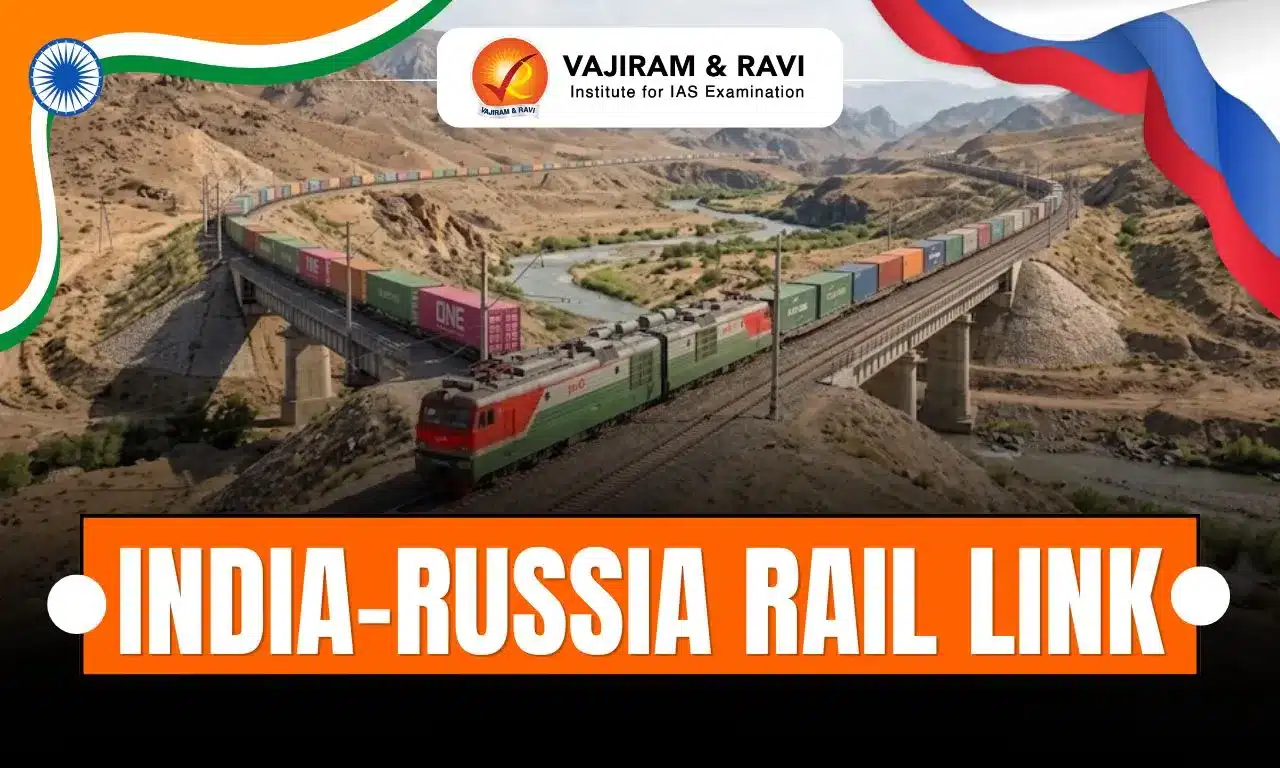
The India-Russia Rail Link is a proposed overland connectivity initiative being explored by Russia to reach the Indian Ocean and India. The proposal aims to create alternative trade connectivity and reduce exposure to maritime chokepoints. It remains a proposal, with no confirmed direct passenger train, launch date or ticketing system.

India-Russia Rail Link Latest News

Russia is examining a possible India-Russia Rail Link towards the Indian Ocean amid concerns over risks affecting the Bosphorus and Strait of Hormuz. Russian Deputy Prime Minister Marat Khusnullin suggested examining routes through Turkmenistan, Iran, Afghanistan and Pakistan. On August 7, India and Russia also reviewed railway cooperation, including infrastructure, Vande Bharat and signalling equipment, during their 12th Session of the India-Russia Working Group on Modernization and Industrial Cooperation in New Delhi.

India-Russia Rail Link Features

The proposed India-Russia Rail Link is primarily linked with freight, strategic connectivity and alternative trade routes rather than confirmed passenger services.

  • Proposed Route: Russia is considering routes through Turkmenistan, Iran, Afghanistan and Pakistan to establish access towards India and the Indian Ocean.
  • Russian proposal: Russian Deputy Prime Minister Marat Khusnullin stated that any route providing access to India could be considered, indicating flexibility regarding the final alignment.
  • Strategic objective: The proposed railway could reduce dependence on maritime routes exposed to risks around the Bosphorus and Strait of Hormuz.
  • Freight focus: The proposal is centred on movement of goods and logistics. No official announcement has confirmed passenger trains, direct tickets or tourism services.
  • Existing Russian network: Russia's Federal Passenger Company operates 40 international long distance routes connecting Russia with 19 countries across Europe and Asia.
  • Railway cooperation: India and Russia discussed railway infrastructure, the Vande Bharat train project and signalling equipment during their August 7 modernization and industrial cooperation meeting.
  • Multimodal possibility: Existing India-Russia connectivity can involve combinations of rail, road and sea transport. A fully continuous railway between both countries is not currently operational.
  • Regional connectivity: The proposed route could involve Central Asian and West Asian states, making connectivity with Russia, India and the Indian Ocean region more geographically integrated.

India-Russia Rail Link Significance

The proposal of India-Russia Rail Link has strategic importance because it seeks to expand land based connectivity between Russia and India while reducing dependence on vulnerable maritime chokepoints.

  • Trade diversification: A land route could provide Russia and India with another pathway for cargo movement and reduce excessive dependence on traditional maritime trade routes.
  • Chokepoint risks: The Strait of Hormuz handles roughly 25% of global oil trade and around 20% of global LNG shipments, making route diversification strategically important.
  • India-Russia connectivity: A direct overland framework could strengthen commercial connectivity between India and Russia while also linking important Central and South Asian regions.
  • Regional integration: Connectivity through Turkmenistan, Iran, Afghanistan and Pakistan could create wider economic linkages across Central Asia, West Asia and South Asia.
  • Railway cooperation: India-Russia discussions on railway infrastructure, Vande Bharat and signalling show that railways remain an active area of bilateral modernization cooperation.
  • Supply chain resilience: Additional land connectivity could provide another logistics option during disruptions affecting major maritime routes and strategically important shipping corridors.

India-Russia Rail Link Challenges

The proposed India-Russia Rail Link route faces major geographical, infrastructural, security and coordination challenges because it would cross several countries and require extensive international cooperation.

  • Geographical complexity: A route through Turkmenistan, Iran, Afghanistan and Pakistan would cross several national territories and require coordinated infrastructure and border arrangements.
  • Security concerns: Afghanistan and parts of the wider region present security challenges that could affect the reliability and continuity of international freight movement.
  • Infrastructure gaps: A seamless railway requires compatible rail infrastructure, border facilities, signalling systems and efficient freight handling arrangements across participating countries.
  • Multiple borders: International rail freight would require coordinated customs, documentation, tariffs and transit procedures across several jurisdictions.
  • Political coordination: The proposed alignment would depend on sustained cooperation among Russia, India and transit countries, making geopolitical stability essential.
  • Passenger limitations: Passenger connectivity would require visas, integrated schedules, passenger facilities and security arrangements that have not yet been established for this proposal.

How is India-Russia Rail Link Different from INSTC?

The major difference between India-Russia Rail Link and International North-South Transport Corridor (INSTC) has been highlighted below:

  • Mode: India-Russia Rail Link is a proposed railway oriented connection towards India, while INSTC is an established multimodal framework using rail, road and sea routes.
  • Route concept: The proposed rail link may cross Turkmenistan, Iran, Afghanistan and Pakistan, whereas INSTC has multiple corridors through Iran, Azerbaijan and Central Asia.

India-Russia Rail Link FAQs

Q1: What is the India-Russia Rail Link?

Ans: The India-Russia Rail Link is a proposed railway route to improve overland connectivity between Russia, the Indian Ocean and India.

Q2: Why is Russia considering a rail link to India?

Ans: Russia is considering alternative land connectivity to reduce risks linked to maritime chokepoints such as the Bosphorus and Strait of Hormuz.

Q3: Which countries could the proposed rail link pass through?

Ans: Possible routes could pass through Turkmenistan, Iran, Afghanistan and Pakistan before reaching India.

Q4: Is there a direct train from Russia to India?

Ans: No, there is currently no confirmed direct passenger train, ticketing system or operational railway service between Russia and India.

Q5: How is the India-Russia Rail Link different from INSTC?

Ans: The proposed rail link focuses on possible direct railway connectivity, while INSTC is an existing 7,200 kilometre multimodal corridor using rail, road and sea routes.

80th Independence Day 2026, Date, History, Theme & Significance

80th Independence Day 2026

India will celebrate its 80th Independence Day on Saturday, August 15, 2026, marking 79 completed years of freedom since the end of British rule in 1947. The day honours the sacrifices of freedom fighters who fought for the nation's freedom and the values of democracy, unity, and sovereignty. It is observed across the country with flag hoisting ceremonies, cultural programmes, parades, and patriotic events. The Prime Minister's address from the Red Fort remains the highlight of the national celebrations.

Independence Day 2026 Key Highlights

The key highlights related to Independence Day 2026 have been tabulated below in brief.

Independence Day 2026 Key Highlights
Particulars Details

Independence Day 2026 Date

Saturday, 15 August 2026

Which Independence Day

80th

Public Holiday?

Yes, a gazetted national holiday across India

Main Venue

Red Fort, New Delhi

Who Hoists the Flag

The Prime Minister of India

Chief Guest

None, India's Independence Day does not have a chief guest, unlike Republic Day

This Year's Focus

Viksit Bharat 2047, Atmanirbhar Defence, Green Transition, Digital India Bhashini

Independence Day 2026 Theme

An official theme for 2026 is yet to be announced. Building on 2025's theme of "Naya Bharat", this year's celebrations are widely expected to highlight indigenous technology (6G trials, the Semiconductor Mission, AI), a green energy transition (Mission LiFE, solar-powered villages, Green Hydrogen Mission), and Atmanirbhar Defence, with all equipment used at the Red Fort ceremony built in India for the first time.

80th Independence Day 2026 (15th August)

India is moving steadily towards its vision of Viksit Bharat 2047, and to celebrate this journey, the Ministry of Defence along with MyGov has launched the Independence Day Celebrations 2026 campaign. This initiative aims to celebrate the spirit of freedom while motivating citizens, especially the youth, to actively contribute to building a strong and self-reliant nation.

  • The campaign is deeply based on the values of patriotism, constitutional ideals, women-led development, scientific growth, and technological advancement, encouraging people across the country to reflect on India’s progress and future goals.
  • India’s Independence Day celebrations do not have a chief guest; instead, the Prime Minister hoists the national flag at the Red Fort and addresses the nation, making it a purely national event focused on India’s freedom and unity. 
  • Along with technology, there is a strong focus on Green Transition, including initiatives like Mission LiFE, Solar-Powered Villages, and the Green Hydrogen Mission, reflecting India’s commitment to sustainable development.
  • A major highlight of 2026 celebrations is Atmanirbhar Defence, where for the first time, all equipment used at the Red Fort will be completely indigenous equipment, showcasing the country’s growing defence capabilities.
  • The government will use Digital India Bhashini (AI-based translation tool) to translate the Prime Minister’s speech in real time into 22+ Indian languages, ensuring that people across the country can understand the vision of Viksit Bharat in their own mother tongue.

Why is Independence Day Celebrated?

Independence Day is celebrated on 15 August every year to mark India's freedom from British rule in 1947. It honours the sacrifices of freedom fighters and celebrates the birth of an independent and sovereign nation.

  • Freedom from Colonial Rule: India became independent from British rule on 15 August 1947, ending nearly 200 years of colonial governance.
  • Tribute to Freedom Fighters: The day honours the contributions and sacrifices of leaders such as Mahatma Gandhi, Jawaharlal Nehru, Subhas Chandra Bose, Sardar Vallabhbhai Patel, and countless unsung heroes.
  • Historic "Tryst with Destiny" Speech: On the eve of independence, Jawaharlal Nehru delivered his famous "Tryst with Destiny" address, marking the beginning of a new era.
  • First Flag Hoisting at Red Fort: On 15 August 1947, Nehru hoisted the Indian National Flag at the Red Fort, a tradition continued annually by every Prime Minister.
  • Celebration of Sovereignty: The day symbolizes India's sovereignty, democracy, unity, and national pride.
  • Nationwide Observance: It is celebrated with flag hoisting ceremonies, cultural programmes, parades, and patriotic events across the country.
  • Different from Republic Day: Independence Day commemorates freedom from British rule in 1947, while Republic Day (26 January) celebrates the adoption of the Constitution of India in 1950.

Independence Day 2026 Events & Celebrations

  • Flag Hoisting at Red Fort: On Independence Day, the Prime Minister of India hoists the National Flag at the Red Fort in New Delhi, followed by the National Anthem and a Guard of Honour, symbolizing the nation’s pride and sovereignty.
  • Prime Minister’s Address: The Prime Minister delivers a national speech highlighting India’s achievements, challenges, and future goals, with a strong focus on development, unity, and progress.
  • Cultural Performances: Students, artists, and cultural groups present patriotic songs, dances, and performances, showcasing India’s rich cultural diversity and heritage.
  • Tribute to Freedom Fighters: Special programs and ceremonies are organized to honour the sacrifices of freedom fighters, including flower tributes and remembrance events across the country.
  • Public Participation Campaigns: Platforms like MyGov and My Bharat host competitions such as essays, quizzes, and photography, encouraging citizens to actively engage in the celebrations.
  • Red Fort Ceremony Highlights: The national event includes a 21-gun salute and the presence of special invitees, such as grassroots workers, youth achievers, and women contributors, recognizing their role in nation-building.
  • Local Celebrations Across India: Schools, colleges, and offices conduct flag hoisting, National Anthem singing, and cultural programs, making it a truly nationwide celebration.

Role of Freedom Fighters in India’s Independence

  • Uniting the Nation for a Common Goal: Freedom fighters brought people from different regions, religions, and backgrounds together with one shared aim, freedom from British rule. Their efforts helped create a strong sense of national unity and identity.
  • Leading Non-Violent Movements: Leaders like Mahatma Gandhi inspired millions through peaceful protests and Civil Disobedience Movement, Non-Cooperation Movement, Dandi March, and Quit India Movement, proving that change could be achieved without violence.
  • Organizing Mass Movements and Protests: Leaders like Sardar Vallabhbhai Patel led farmer-based movements such as the Kheda Satyagraha and Bardoli Satyagraha, helping people stand up against unfair taxes and British policies.
  • Shaping Political Vision and Leadership: Jawaharlal Nehru played a key role in shaping India’s political direction and strongly advocated for complete independence (Purna Swaraj), motivating people to strive for full freedom.
  • Taking Up Armed Resistance: Some revolutionaries chose a more direct approach. Subhas Chandra Bose formed the Indian National Army (INA) to fight British rule, while Bhagat Singh, Shivaram Rajguru, and Sukhdev sacrificed their lives to inspire courage and patriotism among the youth.
  • Inspiring Youth and National Pride: Revolutionary leaders like Chandra Shekhar Azad and Bhagat Singh motivated young Indians to actively participate in the freedom struggle and stand against injustice.
  • Promoting Social Reform and Inclusion: Leaders such as Sarojini Naidu encouraged women to take part in the freedom movement, while many others worked to reduce caste and religious divisions, promoting equality and unity.
  • Spreading National Awareness: Leaders like Bal Gangadhar Tilak, Bipin Chandra Pal, and Lala Lajpat Rai spread awareness through movements like Swadeshi and public gatherings, encouraging people to boycott British goods and support Indian products.
  • Strengthening Regional Movements: Freedom fighters like Chittaranjan Das led movements at the regional level, especially in Bengal, ensuring that the struggle for independence reached every corner of the country.
  • Making Sacrifices for Freedom: Above all, freedom fighters made immense sacrifices, including imprisonment and even giving up their lives, to ensure that future generations could live in a free and independent India.

Independence Day 2026 Significance

  • 80th Independence Day 2026 - A Major Milestone: India will celebrate its 80th Independence Day on 15 August 2026, marking 80 years of freedom and sovereignty. The occasion highlights the country’s journey and its strong push towards becoming a developed and self-reliant nation.
  • Focus on Viksit Bharat 2047: The celebrations emphasize the vision of Viksit Bharat 2047, which aims at achieving overall economic growth, social development, and global leadership in the coming years.
  • Rise of Indigenous Technology: A key highlight is the focus on home-grown innovations, including 6G technology trials, the Semiconductor Mission, and the use of Artificial Intelligence, showing India’s growing strength in advanced technology.
  • Digital India and Language Inclusion: Through Digital India Bhashini, the Prime Minister’s speech will be translated in real time into more than 22 Indian languages, making it accessible to people across different regions and languages.
  • Atmanirbhar Defence Initiative: The celebrations showcase self-reliance in defence, where for the first time, equipment used during the Red Fort ceremony will be fully indigenously made, reflecting India’s defence capabilities. 
  • Green Growth and Sustainability: There is a strong focus on environment-friendly development, with initiatives like Mission LiFE, solar-powered villages, and the Green Hydrogen Mission, promoting a sustainable and cleaner future.
  • Towards a Self-Reliant and Developed India: Independence Day 2026 highlights India’s commitment to innovation, sustainability, and self-reliance, as the country continues its journey towards becoming a developed nation by 2047.
Other Related Posts
Freedom Fighters of India 80th Independence Day 2026
Subhash Chandra Bose Har Ghar Tiranga Campaign 2026
Forward Bloc Dadabhai Naoroji
Azad Hind Fauj Gopal Krishna Gokhale
Jawaharlal Nehru Surendranath Banerjee
Sardar Vallabhbhai Patel Rabindranath Tagore
Sarojini Naidu Acharya Vinoba Bhave
Madam Bhikaji Cama Sarvodaya Movement
Slogans of Freedom Fighters Indian National Movements 
Important Days in 2026 Republic Day 2026
National Song National Anthem
National Flag Code of India 2002 National Flag
Indian Independence Act 1947  Revolt of 1857 
Swadeshi Movement  Home Rule Movement 
Non-Cooperation Movement Civil Disobedience Movement 
Azad Hind Fauj and INA Trials Cabinet Mission Plan 
Partition of India 1947 Mountbatten Plan 
Constituent Assembly of India Fundamental Duties 
Constitutional Values Preamble of the Indian
National Symbols of India Madan Mohan Malviya
Pingali Venkayya  

80th Independence Day 2026 FAQs

Q1: What is the significance of 80th Independence Day 2026 in India?

Ans: Independence Day 2026 marks 80 years of India’s freedom from British rule, highlighting the nation’s journey of growth, unity, and progress toward becoming a developed country.

Q2: When will India celebrate its 80th Independence Day?

Ans: India will celebrate its 80th Independence Day on 15th August 2026, commemorating its independence achieved in 1947.

Q3: Who hoists the national flag on Independence Day?

Ans: The Prime Minister of India hoists the national flag at the Red Fort in New Delhi and addresses the nation.

Q4: Is there a chief guest on Independence Day celebrations?

Ans: No, Independence Day is a purely national event with no chief guest, unlike Republic Day celebrations.

Q5: What is the theme of Independence Day 2026?

Ans: The official theme is not announced yet, but it is expected to focus on patriotism, unity, innovation, and India’s growth journey.

Five Year Plans in India, History, Objectives, Achievements, Failures

Five Year Plan in India

The Five Year Plan in India was a systematic approach to economic development introduced after Independence to ensure planned use of resources and balanced growth. India implemented twelve Five Year Plans between 1951 and 2017, covering agriculture, industry, infrastructure, education, and welfare sectors. The planning system was discontinued after the Twelfth Five-Year Plan, and a more flexible policy framework under NITI Aayog replaced it, as discussed in detail in the article below.

What is Five Year Plan in India?

The Five Year Plans in India was a centralized economic planning mechanism under which the government set specific economic, social, and developmental targets to be achieved over a period of five years.

The planning process was formulated and implemented by the Planning Commission of India, which was established in 1950. Each plan outlined sector-wise priorities such as agriculture, industry, education, health, infrastructure, and social justice, keeping in view the country’s developmental needs.

Five Year Plans in India Origin

The concept of Five Year Plans in India was inspired by the centralized planning model adopted by the Soviet Union. After gaining independence in 1947, India faced challenges such as poverty, unemployment, low agricultural productivity, and inadequate industrial development. To address these issues through systematic economic planning, the Government of India adopted the Five Year Plan model.

Five Year Plans in India History

India adopted the Five Year Plans model in 1951 to achieve planned economic development after Independence, inspired by the Soviet Union’s centralized planning system. The plans aimed to address poverty, low industrial base, and uneven development through systematic resource allocation.

  • Planning Commission was established in 1950 under the chairmanship of the Prime Minister
  • First Five Year Plan (1951-56) focused mainly on agriculture and irrigation
  • Early plans emphasized state-led industrialization and public sector growth
  • Plan Holiday (1966-69) occurred due to wars, droughts, and economic instability
  • Economic reforms in 1991 changed the planning approach toward liberalization
  • Twelfth Five Year Plan (2012-17) was the last plan before discontinuation
  • Planning Commission was replaced by NITI Aayog in 2015
  • Five Year Plans ended in 2017 to adopt a flexible and cooperative federal framework

Five Year Plans in India Objectives and Goals

The major objectives of the Five Year Plans in India were:

  • Economic Growth: Achieving rapid and sustained economic development by increasing national income and productivity.
  • Self-Reliance: Reducing dependence on imports and promoting domestic production, especially in key industries.
  • Social Justice: Reducing inequalities of income, wealth, and opportunities across regions and communities.
  • Poverty Alleviation: Addressing unemployment, poverty, and underdevelopment through targeted programs.
  • Balanced Regional Development: Ensuring equitable growth across states and backward regions.
  • Modernization: Promoting technological advancement, industrial diversification, and human capital development.

List of Five Year Plans in India

India implemented Twelve Five Year Plans between 1951 and 2017 to guide economic and social development in a planned manner. These plans were formulated by the Planning Commission and focused on areas such as agriculture, industrialisation, poverty reduction, and inclusive growth. The Twelfth Five-Year Plan (2012-17) was the last plan, after which the Planning Commission was replaced by NITI Aayog and the planning system was discontinued. 

The complete list of All Five Year Plans in India has been provided below:

First Five Year Plan (1951-56)

  • Marked the beginning of planned economic development in independent India, aiming to stabilise the economy after Partition.
  • Presented to Parliament by Jawaharlal Nehru, reflecting a mixed economy approach with state intervention.
  • K. N. Raj advocated a cautious growth path, arguing that India should “hasten slowly” to avoid inflation and instability.
  • Priority was given to agriculture, irrigation, and food security, as nearly 70% of the population depended on agriculture.
  • Large-scale investments were made in multipurpose river valley projects like Bhakra Nangal, Damodar Valley, and Hirakud.
  • Based on the Harrod-Domar Model, stressing capital formation through higher savings and investment.
  • Strengthened institutional framework by establishing five IITs to build technical manpower.
  • Target growth rate: 2.1% | Achieved growth rate: 3.6%, indicating strong early success.

Second Five Year Plan (1956-61)

  • Shifted focus from agriculture to rapid industrialisation, especially heavy and capital goods industries.
  • Planned under P. C. Mahalanobis, whose model prioritised long-term industrial capacity over short-term consumption.
  • Emphasised development of public sector enterprises in steel, power, and machine tools.
  • Established major steel plants at Bhilai, Rourkela, and Durgapur, laying the foundation of industrial India.
  • Introduced import substitution by imposing high tariffs to protect domestic industries.
  • Faced challenges of inflation, balance of payments pressure, and limited foreign exchange.
  • Target growth rate: 4.5% | Actual growth rate: 4.27%.

Third Five Year Plan (1961-66)

  • Aimed to make India a self-reliant economy with balanced growth of agriculture and industry.
  • Focused on wheat production, fertilisers, and agricultural expansion to reduce food imports.
  • Greater decentralisation, assigning states more responsibility for education and development.
  • Introduction of Panchayat elections strengthened democratic governance at the grassroots.
  • External shocks such as the 1962 China war, 1965 Pakistan war, and consecutive droughts disrupted the plan.
  • Severe fiscal stress and inflation led to poor outcomes.
  • Target growth rate: 5.6% | Actual growth rate: 2.4%, resulting in plan failure.

Plan Holidays (1966-69)

  • Implemented due to economic crisis following the failure of the Third Plan.
  • Consisted of three Annual Plans focusing on short-term stabilization.
  • Priority given to controlling inflation, food security, and restoring economic balance.

Fourth Five Year Plan (1969-74)

  • Introduced under Indira Gandhi with an emphasis on correcting earlier distortions.
  • Based on the Gadgil Formula, ensuring balanced regional development.
  • Core objectives were growth with stability and self-reliance.
  • Nationalisation of 14 banks expanded institutional credit to agriculture and small industries.
  • Green Revolution significantly increased food grain production, especially wheat.
  • Launch of Drought Prone Area Programme (DPAP) to address regional vulnerabilities.
  • Target growth rate: 5.6% | Actual growth rate: 3.3%.

Fifth Five Year Plan (1974-78)

  • Strongly focused on poverty alleviation and employment generation under the slogan Garibi Hatao.
  • Emphasised redistribution of income and reduction of inequalities.
  • Minimum Needs Programme (MNP) aimed at providing basic services like health, education, housing, and water.
  • Expansion of power sector after amendment of the Electricity Supply Act, 1975.
  • Development of the National Highway System to improve connectivity.
  • Target growth rate: 4.4% | Actual growth rate: 4.8%.
  • Discontinued in 1978 due to political change.

Rolling Plan (1978-80)

  • Introduced by the Janata Party government to ensure flexibility in planning.
  • Plans were revised annually based on performance evaluation.
  • Allowed adjustments in targets and resource allocation each year.
  • Abandoned after political transition in 1980.

Sixth Five Year Plan (1980-1985)

  • Marked a major shift in India’s economic strategy, moving gradually from strict state control toward economic liberalisation.
  • Considered the end of Nehruvian Socialism, as price controls, licensing, and excessive regulation were reduced.
  • Focused on modernisation of industries, efficiency improvement, and technological upgradation.
  • Introduced family planning and population control measures to address demographic pressure on resources.
  • Strengthened rural and agricultural credit by establishing the National Bank for Agriculture and Rural Development (NABARD) in 1982, based on the Shivaraman Committee’s recommendations.
  • Prioritised development of energy, transport, and communication infrastructure to support industrial growth.
  • Encouraged greater participation of the private sector while retaining a strong public sector presence.
  • Target growth rate: 5.2%
  • Actual growth rate: 5.7%, making it one of the more successful Five Year Plans.

Seventh Five Year Plan (1985-1990)

  • Implemented under the leadership of Prime Minister Rajiv Gandhi, focusing on technology-driven economic growth.
  • Emphasised modernisation of industries through the adoption of computers, electronics, and telecommunications.
  • Aimed to improve industrial productivity and efficiency, reducing reliance on outdated production methods.
  • Strengthened anti-poverty initiatives and welfare schemes to promote social justice.
  • Encouraged self-sustained economic growth, reducing long-term dependence on external assistance.
  • Laid emphasis on food grain production to ensure food security and price stability.
  • Promoted a shift towards a knowledge-based economy, laying groundwork for future IT sector growth.
  • Aimed to achieve the prerequisites for self-reliant growth by the year 2000.
  • Target growth rate: 5.0%
  • Actual growth rate: 6.01%, indicating robust economic performance.

Annual Plans (1990-1992)

  • The regular Five Year Plan framework was suspended due to political instability and severe economic crisis.
  • India faced an acute balance of payments and foreign exchange crisis, with reserves barely sufficient for a few weeks of imports.
  • High fiscal deficit, rising inflation, and declining industrial growth worsened economic conditions.
  • These years acted as a transition phase before comprehensive structural reforms.
  • Under Prime Minister P. V. Narasimha Rao, India initiated Liberalisation, Privatisation, and Globalisation (LPG) reforms.
  • Major measures included industrial delicensing, reduction in import tariffs, and encouragement of foreign investment.
  • The role of the private sector was expanded, while government control over the economy was reduced.

Eighth Five Year Plan (1992-1997)

  • The first Five Year Plan implemented after the 1991 economic reforms.
  • Marked a decisive shift from centralised planning to a market-driven growth strategy.
  • Focused on modernisation of industries, improving efficiency, and global competitiveness.
  • Emphasised human resource development, especially in education, health, and skill formation.
  • Aimed to control population growth, reduce poverty, and generate employment opportunities.
  • Gave high priority to the development of infrastructure sectors such as power, roads, and telecommunications.
  • Encouraged private sector participation and foreign direct investment (FDI).
  • India became a member of the World Trade Organisation (WTO) in 1995, integrating with the global economy.
  • Target growth rate: 5.6%
  • Actual growth rate: 6.8%, reflecting strong economic performance.

Ninth Five Year Plan (1997-2002)

  • Implemented during the period marking 50 years of Indian Independence.
  • Led under the Prime Ministership of Atal Bihari Vajpayee.
  • Theme of the plan was “Growth with Social Justice.”
  • Sought to balance rapid economic growth with improvement in quality of life.
  • Emphasised poverty eradication, human development, and social sector expansion.
  • Focused on empowering socially and economically backward classes.
  • Aimed to ensure universal access to primary education and improve health outcomes.
  • Encouraged public-private partnership (PPP) to accelerate economic development.
  • Target growth rate: 7.1%
  • Actual growth rate: 6.8%, slightly below expectations.

Tenth Five Year Plan (2002-2007)

  • The Tenth Plan marked a clear shift towards inclusive and equitable economic growth.
  • Aimed at achieving an average annual GDP growth of 8%, focusing on both growth and distribution.
  • One of its key objectives was to reduce poverty by half during the plan period.
  • Targeted creation of 80 million employment opportunities, especially in agriculture, manufacturing, and services.
  • Emphasised reduction of regional disparities by promoting balanced development across states.
  • Focused on strengthening education, health, and skill development to improve human capital.
  • Sought to reduce gender inequality, particularly in education and wage employment.
  • Target growth rate: 8.1%
  • Actual growth rate: 7.6%, slightly below the target but considered relatively strong.

Eleventh Five Year Plan (2007-2012)

  • The theme of the Eleventh Five Year Plan was “Faster and More Inclusive Growth.”
  • Placed strong emphasis on social sector development, especially education, health, and skill formation.
  • Aimed to expand access to higher education, including universities, distance learning, and IT institutes.
  • The Right to Education Act (2009) was enacted, making free and compulsory education for children aged 6-14 years.
  • Focused on employment generation, particularly for youth, through skill development initiatives.
  • Sought to reduce poverty, gender inequality, and regional imbalances.
  • Emphasised environmental sustainability and sustainable use of natural resources.
  • Prepared under the leadership of C. Rangarajan.
  • Targeted provision of safe and clean drinking water for all.
  • Target growth rate: 9%
  • Actual growth rate: 8%, affected partly by the global financial crisis (2008).

Twelfth Five Year Plan (2012-2017)

  • The Twelfth Plan was the last five-year plan implemented in India.
  • Its theme was “Faster, More Inclusive and Sustainable Growth.”
  • Focused on strengthening infrastructure, including power, roads, railways, and urban development.
  • Aimed to ensure electricity access to all villages and improve energy efficiency.
  • Emphasised reducing social and gender gaps in school and higher education enrolment.
  • Promoted skill development and employment generation, especially in non-farm sectors.
  • Stressed environmental sustainability, with a target to increase green cover by 1 million hectares annually.
  • Encouraged innovation, improved governance, and better delivery of public services.
  • Initially targeted 9% growth, later revised to 8% by the National Development Council.

Five Year Plans in India Achievements and Failures

The Five Year Plans played a crucial role in shaping India's economic development after independence. Introduced in 1951, these plans aimed to promote balanced growth, reduce poverty, strengthen infrastructure, and achieve self-reliance. Over six decades, the planning process has significantly influenced various sectors of the Indian economy.

Growth of Agriculture

  • The First Five Year Plan focused heavily on agricultural development and irrigation projects.
  • Initiatives such as the Green Revolution helped India achieve food security.
  • Agricultural productivity increased, reducing dependence on food imports.

Expansion of Industrial Base

  • The Second Five Year Plan emphasized rapid industrialization through the Mahalanobis Model.
  • Development of heavy industries, steel plants, and manufacturing units strengthened the industrial sector.
  • Public sector enterprises played a key role in economic growth.

Development of Infrastructure

  • Massive investments were made in roads, railways, power generation, dams, and communication networks.
  • Major multipurpose river valley projects such as Bhakra Nangal Dam and Hirakud Dam contributed to irrigation and electricity generation.
  • Improved infrastructure facilitated trade and industrial expansion.

Reduction in Poverty and Unemployment

  • Several plans introduced poverty alleviation and employment generation programmes.
  • Schemes targeting rural development improved living standards in many regions.
  • Employment opportunities increased through industrial and infrastructure projects.

Promotion of Self-Reliance

  • Five Year Plans encouraged domestic production and import substitution.
  • India developed capabilities in sectors such as steel, machinery, agriculture, and energy.
  • Dependence on foreign goods gradually declined in strategic sectors.

Growth of Education and Healthcare

  • Increased public expenditure on education, healthcare, and social welfare improved human development indicators.
  • Literacy rates and life expectancy witnessed substantial growth.
  • Expansion of schools, colleges, hospitals, and primary health centres benefited millions.

Balanced Regional Development

  • Special efforts were made to reduce disparities between developed and backward regions.
  • Investments in rural infrastructure and development projects helped integrate remote areas into the national economy.
  • Though regional inequalities persisted, significant progress was achieved in many states.

Increase in National Income

  • India's GDP and per capita income grew steadily over successive plans.
  • Economic planning laid the foundation for long-term development and modernization.
  • The economy transformed from a primarily agrarian system to a diversified one with strong industrial and service sectors.

Five Year Plans in India Failures and Challenges

  • Several plans failed to achieve their growth targets due to wars, droughts, political instability, and resource constraints.
  • Excessive government control sometimes reduced efficiency and competitiveness.
  • Poverty, unemployment, and regional disparities remained major challenges despite planning efforts.

Overall Impact

The Five Year Plans laid the foundation for India's economic transformation by promoting agriculture, industry, infrastructure, and social development. While the planning model faced limitations, it played a vital role in building a self-reliant economy and preparing India for the liberalization era that began in 1991.

Also Read: NITI Aayog

Five Year Plans in India FAQs

Q1: Who introduced the Five Year Plans in India?

Ans: The Five Year Plans were introduced by the Government of India with the establishment of the Planning Commission in 1950.

Q2: Which was the first Five Year Plan in India?

Ans: The First Five Year Plan was launched in 1951 under the leadership of Jawaharlal Nehru.

Q3: How many Five Year Plans were implemented in India?

Ans: India implemented 12 Five Year Plans between 1951 and 2017.

Q4: Why were Five Year Plans discontinued in India?

Ans: They were discontinued to adopt a more flexible, decentralized, and market-driven planning approach through NITI Aayog.

Q5: What replaced the Five Year Plans in India?

Ans: The NITI Aayog replaced the Planning Commission and introduced long-term vision documents and action agendas.

Suckermouth catfish

Suckermouth catfish

Suckermouth catfish Latest News

The Bombay Natural History Society (BNHS) has launched an active removal of invasive fish species like the suckermouth catfish and others from Ujani reservoir.  

About Suckermouth catfish

  • It is a tropical fish belonging to the armored catfish family (Loricariidae). 
  • Appearance: It has a strongly arched body and a very large dorsal fin with one spine and seven branched rays.
  • Its ability to endure out of water is facilitated by its accessory breathing organ, akin to a gill cavity, which permits the fish to extract oxygen from the air.
  • It is locally known as' Helicopter fish’ for its unusual appearance.
  • It is native to the Amazon River in South America and entered India through the global aquarium trade. 
  • Distribution: It naturally occurs in northeastern Brazil, the Guianas, and Trinidad and Tobago. 
  • Diet: They are opportunistic omnivores and feed on algae, plants, invertebrates and small fish. 
    • It feeds on fish eggs, burrows into river banks and earthen check dams.
  • It is known for its resilience and adaptability, particularly its ability to survive in conditions that would be inhospitable to other fish.

Source: IE

Suckermouth catfish FAQs

Q1: Suckermouth Catfish is native to which continent?

Ans: South America

Q2: What is the Scientific name of Suckermouth Catfish?

Ans: Hypostomus plecostomus

Thoti Tribe

Thoti Tribe

Thoti Tribe Latest News

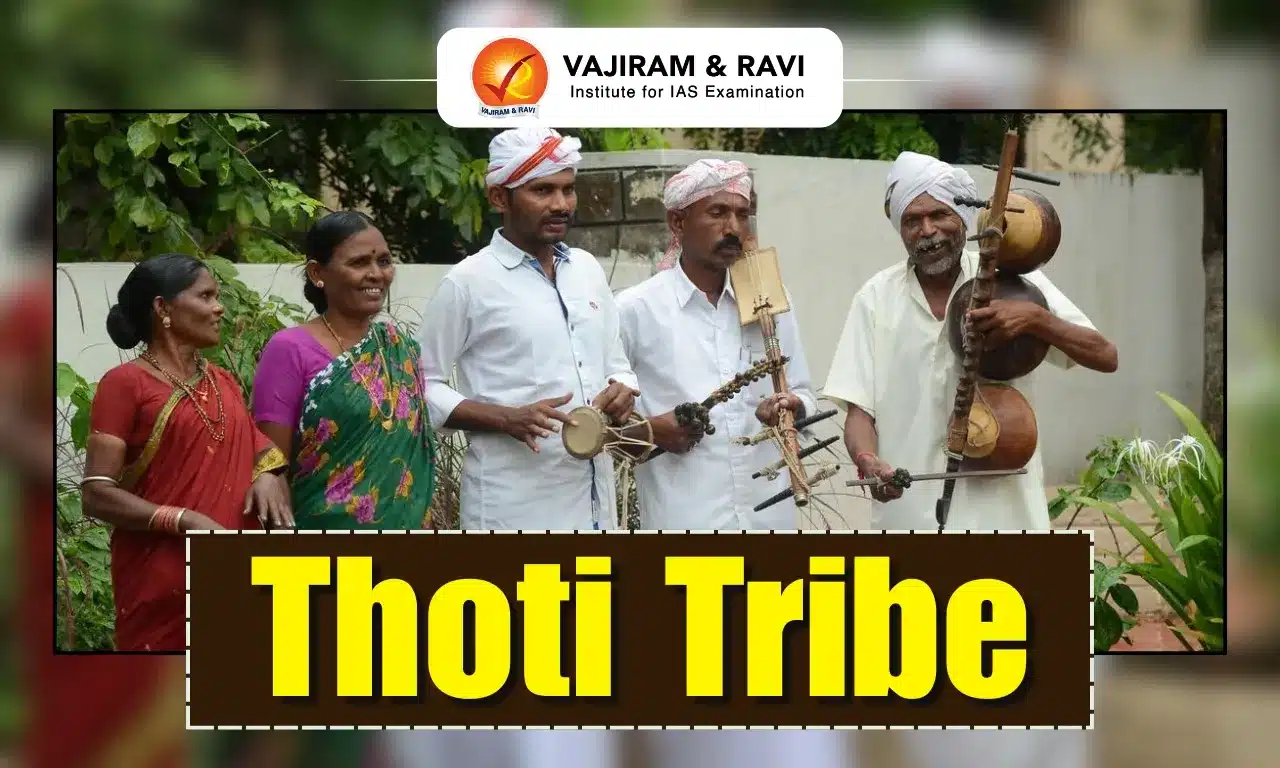
Recently, it was observed that the Thoti tribe in Telangana is facing a rapid decline driven by a shrinking population. 

About Thoti Tribe

  • It is a small tribal community concentrated in northern Telangana.
  • They are classified as a Particularly Vulnerable Tribal Group (PVTG).
  • They have historically served as village messengers, ballad singers, and folk artists, maintaining a rich heritage of storytelling and indigenous cultural practices. 
  • Historically, they were oral storytellers, narrating episodes from the Mahabharata using traditional instruments such as the burra, maddela, and harmonium.
  • Language: They speak Gonti as their mother tongue and have a more traditional appearance.
  • Society
    • The social structure of this community is hierarchically organized, wherein the village head and elders of the community exercise authority over most social, political, and legal matters related to the community and its members.
    • Belief System: They are known to be strong believers in the idea of rebirth, this is also evidenced in their traditional songs.
    • They worship and believe in their community God called “Persapen” and other village deities, and celebrate a festival known as “Nagappa Jathara” (Chariot festival). 
    • During ceremonial occasions, Thotis play the kingri, a three-stringed fiddle, and blow trumpets.
  • Many Thoti women are skilled tattoo artists, and they are responsible for the complex tattoos covering the arms, shoulders, and chests of many Gond women.
  • The Thotis have been known to practice endogamy.

Source: TT

Thoti Tribe FAQs

Q1: Thoti tribe is mainly found in which state?

Ans: Telangana

Q2: Language spoken by Thoti people belongs to?

Ans: Dravidian family

E-Samudra Platform

E-Samudra Platform

E-Samudra Platform Latest News

Recently, the Union Minister for Ports, Shipping and Waterways inaugurated the E-Samudra platform. 

About E-Samudra Platform

  • It is a comprehensive digital platform making maritime governance simpler, more transparent and more stakeholder-centric.
  • It is an initiative by the Directorate General of Shipping, and is driving a digital revolution in maritime governance.
    • This comprehensive e-governance solution streamlines shipping and seafarer operations, automates administrative processes, and enhances compliance monitoring.
  • It is aimed at transforming maritime governance by bringing services for seafarers, shipping companies, ports and other stakeholders under a single digital window.
  • It transforms maritime administration from a physical office-based model into an integrated digital ecosystem. It represents a transition towards Digital First and Faceless Governance
  • It is part of a broader effort to make maritime administration more transparent, technology-driven and accessible while strengthening the safety, security and welfare of India’s growing seafarer workforce.
  • It will bring maritime services into a single digital window with end-to-end workflows, online payments, real-time tracking and digitally issued certificates.

Source: PIB

E-Samudra Platform FAQs

Q1: E-SAMUDRA is a platform launched by which ministry?

Ans: Ministry of Ports, Shipping & Waterways

Q2: E-SAMUDRA is part of which larger vision?

Ans: Maritime India Vision 2030

Mecca Defence Pact, Key Features, Motives, Implications

Mecca Defence Pact

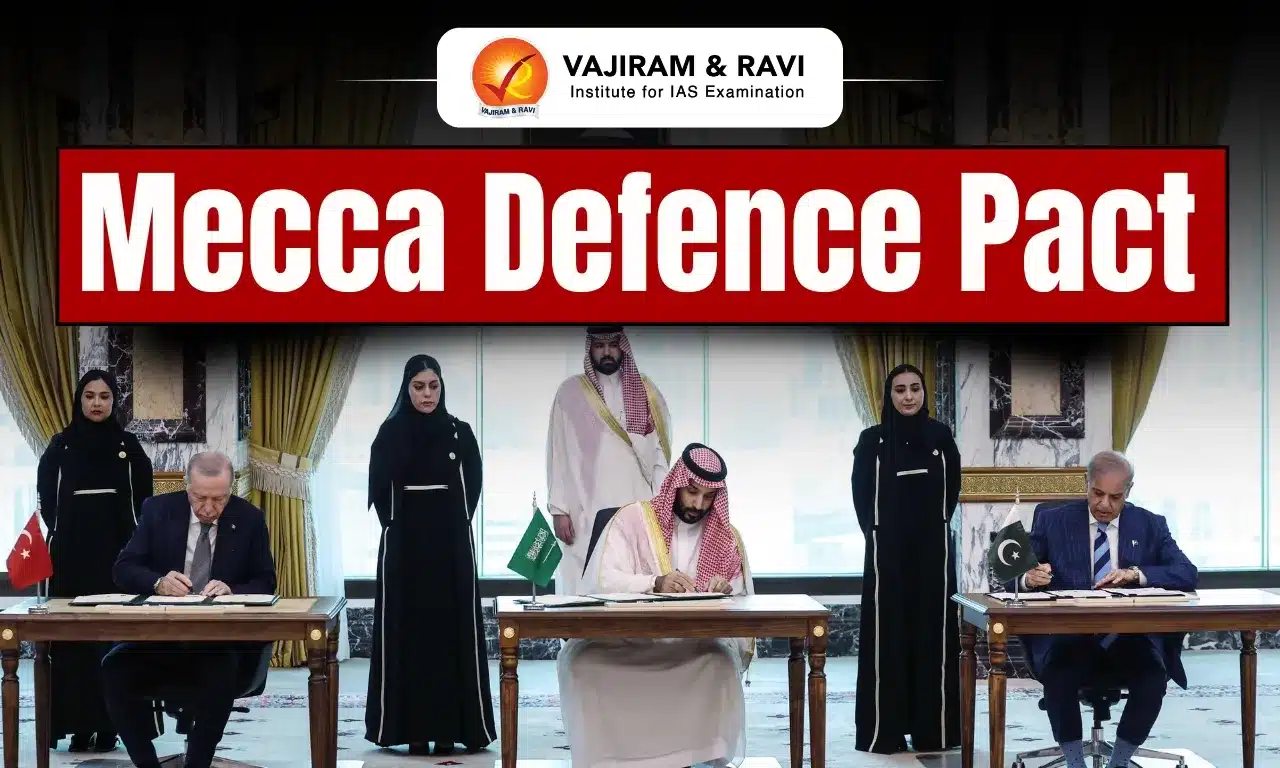
The Mecca Defence Pact, formally the Mecca Joint Defence Agreement, was signed by Saudi Arabia, Türkiye and Pakistan on 7 August 2026 in Mecca. The agreement seeks to strengthen collective deterrence and defence cooperation among the three countries. The agreement has attracted attention because it provides that an armed attack against any one of the three countries would be regarded as an attack against all three.

About the Mecca Defence Pact

The Mecca Defence Pact seeks to institutionalise the existing defence relationships among the three countries within a broader trilateral security framework.

  • Saudi Arabia brings financial resources, strategic influence and a key position in the Gulf.
  • Pakistan contributes military manpower, operational experience, nuclear capability and longstanding defence ties with Saudi Arabia.
  • Türkiye contributes NATO experience and a rapidly expanding indigenous defence industry.
  • The pact aims to strengthen collective deterrence and defence cooperation among the three countries.
  • The detailed text of the agreement has not been made public, leaving the exact nature of mutual obligations unclear.
  • It builds upon the Saudi-Pakistan Strategic Mutual Defence Agreement (SMDA) of September 2025.

Mecca Defence Pact Key Features

While the detailed text of the Mecca Defence Pact has not been made public, its broad objectives and publicly stated provisions indicate the following key features:

  • Collective defence: Attack on one member is to be treated as an attack on all.
  • Enhanced defence cooperation: Greater cooperation in military affairs and defence capabilities.
  • Complementary strengths: Saudi finance, Pakistani military capability and Turkish defence technology create a mutually beneficial strategic triangle.
  • Regional security focus: The pact is primarily linked to the changing security environment in West Asia and does not explicitly identify India as an adversary.
  • Defence-industrial cooperation: It could facilitate greater cooperation in defence production, technology and military-industrial capacity.

Why was the Mecca Defence Pact Signed?

The Mecca Defence Pact is driven by a combination of regional security concerns, strategic autonomy and the need to strengthen defence capabilities.

  • Rising regional tensions: Conflicts involving Iran, Israel, the US and regional armed groups have increased security risks in the Gulf.
  • Saudi Arabia’s strategic autonomy: Saudi Arabia wants to reduce overdependence on the US by building partnerships with other major military powers.
  • Pakistan’s strategic value: Pakistan provides military manpower, operational experience and defence expertise, while strengthening its ties with Saudi Arabia.
  • Türkiye’s regional influence: Türkiye seeks a greater role in West Asian geopolitics, supported by its rapidly expanding indigenous defence industry.
  • Strengthening defence industry: Saudi Arabia wants to develop indigenous defence production by accessing Türkiye’s technology and Pakistan’s military expertise.
  • Collective deterrence: By promising mutual support, the pact seeks to deter external aggression and increase the strategic costs for any potential adversary.

Is it a 'NATO of the Muslim World'?

Although the collective-defence clause resembles NATO's Article 5, the Mecca pact currently lacks the institutional depth of NATO.

  • NATO has an integrated military command, permanent institutions, joint planning mechanisms and decades of operational experience.
  • The Mecca pact does not presently have a unified military command or permanently deployed joint force.
  • The three countries also have different strategic priorities: Saudi Arabia focuses on Gulf security, Türkiye has wider European and West Asian interests, while Pakistan's principal security concern remains India.

Thus, its actual deterrence value will depend on how the members respond to a real security crisis, rather than merely on the wording of the agreement.

Implications for India

While the Mecca Defence Pact does not immediately alter India's military balance, its institutionalisation could influence India's strategic interests in South Asia and West Asia.

  • Pakistan gains strategic space: Institutionalised defence ties with Saudi Arabia and Türkiye could increase Pakistan’s diplomatic leverage and access to financial resources and defence technology.
  • India–Saudi ties may face pressure: Saudi Arabia has built strong energy, trade, investment and strategic ties with India. Greater security dependence on Pakistan could complicate this growing partnership.
  • India’s regional influence: A closer Pakistan–Saudi–Türkiye grouping could influence the emerging West Asian security architecture, where India seeks a greater strategic role.
  • Gulf and Red Sea security: India depends on these regions for energy supplies, trade and maritime connectivity. Any instability arising from stronger regional rivalries could directly affect Indian interests.
  • Limited impact on India-Pakistan conflict: The pact does not name India as an adversary, and its detailed obligations are not public. Hence, it does not automatically mean Saudi or Turkish military intervention against India in a future conflict.

Way Forward

India should respond through strategic balancing rather than treating the pact as an immediate threat, while protecting its interests in the Gulf and wider Indian Ocean region.

India should deepen its strategic partnership with Saudi Arabia in energy, trade, investment and defence, strengthen engagement with other Gulf partners, and safeguard energy security, maritime connectivity and the interests of the Indian diaspora. At the same time, New Delhi should closely monitor Pakistan–Türkiye defence cooperation and maintain strategic autonomy and calibrated diplomacy, especially since the pact does not explicitly target India.

Mecca Defence Pact FAQs

Q1: What is the Mecca Joint Defence Agreement?

Ans: The Mecca Joint Defence Agreement, or Mecca Defence Pact, is a trilateral defence agreement signed by Saudi Arabia, Türkiye and Pakistan on 7 August 2026 to strengthen collective defence and strategic deterrence.

Q2: What is the key provision of the Mecca Defence Pact?

Ans: The key provision is that an armed attack against one member would be regarded as an attack against all three members.

Q3: Is the Mecca Defence Pact a NATO-like alliance?

Ans: The Mecca Defence Pact is not equivalent to NATO. Unlike NATO, it does not currently have an integrated military command, permanent joint forces or comparable institutional structures.

Q4: Is the Mecca Defence Pact directed against India?

Ans: No. The publicly stated provisions do not identify India as an adversary. Its immediate focus is the changing West Asian security environment.

Q5: How does the Mecca Defence Pact affect Pakistan?

Ans: The Mecca Defence Pact could give Pakistan greater diplomatic leverage, access to Saudi financial support and Turkish defence technology, while institutionalising existing defence relationships.

Maharani Ahilyabai Holkar Death Anniversary 2026, Significance

Maharani Ahilyabai Holkar Death Anniversary 2026

The Maharani Ahilyabai Holkar Death Anniversary 2026 is observed on 13 August, remembering one of India’s most respected and visionary rulers. Known as Lokmata, she is admired for her just governance, simple lifestyle, and deep commitment to public welfare. Her life continues to inspire people for her contributions to temple restoration, social reform, women’s empowerment, and economic development. This occasion is a time to reflect on her legacy and the values of leadership, compassion, and service that she stood for.

Maharani Ahilyabai Holkar Death Anniversary 2026 Date and Significance

  • The death anniversary of Maharani Ahilyabai Holkar is observed every year on 13 August, and in 2026, it will once again be remembered with respect and admiration across India.
  • This day is not just about remembering her passing, but about celebrating her life of service, justice, and dedication to the people.
  • She is lovingly called “Lokmata” (Mother of the People) because she treated her subjects like her own family and worked tirelessly for their welfare.
  • On this occasion, people pay tribute to her by organizing cultural events, discussions, and educational programs that highlight her achievements.
  • The day also reminds us of her contributions to temple restoration, infrastructure development, social reforms, and women’s empowerment.
  • Her death anniversary serves as an opportunity to reflect on how her values of simplicity, fairness, and compassion are still relevant in today’s world.

Life and Legacy of Maharani Ahilyabai Holkar

  • Maharani Ahilyabai Holkar was born on 31 May 1725 in the small village of Chondi in Maharashtra, into a humble family.
  • Her father, Mankoji Rao Shinde, was a village head who believed in education and ensured that she learned to read and write at a time when girls’ education was rare.
  • Her life changed when Malhar Rao Holkar, a powerful ruler of Malwa, noticed her qualities and arranged her marriage to his son Khanderao Holkar in 1733.
  • After her husband’s death during the battle of Kumher, she went through deep grief and even considered ending her life, but was stopped and guided by her father-in-law.
  • Malhar Rao trained her in administration, military skills, and governance, preparing her for future responsibilities.
  • After losing both her father-in-law (1766) and her son (1767), she faced immense personal tragedy, yet chose to serve her kingdom with courage and determination.
  • In 1767, she became the ruler of Malwa and governed from Maheshwar, which she developed into a vibrant cultural and administrative center.
  • Her legacy is remembered as one of strength in adversity, dedication to public welfare, and visionary leadership.

Major Contributions and Achievements of Ahilyabai Holkar

  • One of her most famous achievements was the reconstruction of the Kashi Vishwanath Temple in Varanasi, which restored a major spiritual center for Hindus.
  • She also contributed to the rebuilding of the Somnath Temple and supported many other sacred places across India.
  • Ahilyabai invested heavily in building temples, ghats, wells, stepwells, roads, and rest houses (dharamshalas) to support pilgrims and travelers.
  • Her contributions were not limited to her own kingdom, she worked for the cultural and religious development of the entire country.
  • She transformed Maheshwar and Indore into important trade and cultural hubs, encouraging economic growth and stability.
  • She promoted the Maheshwari textile industry, which is still famous today for its elegant sarees and holds a Geographical Indication (GI) tag.
  • Ahilyabai was a great patron of art, literature, and culture, inviting scholars, poets, and artists to her court and supporting their work.
  • She also focused on the upliftment of tribal communities and lower sections of society, ensuring they received fair opportunities.

Role in Administration, Governance, and Social Reform

  • Maharani Ahilyabai Holkar is widely praised for her fair, transparent, and people-friendly administration.
  • She held open court sessions daily, where common people could directly present their issues, making governance accessible and responsive.
  • Under her rule, the Malwa region experienced peace, stability, and economic prosperity, which made her one of the most respected rulers of her time.
  • She supported farmers, traders, and local industries, understanding that economic strength comes from grassroots development.
  • Ahilyabai strongly opposed social evils such as sati, showing courage in challenging harmful traditions.
  • She supported widow remarriage and women’s education, promoting progressive ideas that were far ahead of her era.
  • She even formed a women’s army, training women in defense and administration, which was a revolutionary step for women’s empowerment.
  • Her governance reflected a perfect balance of justice, compassion, discipline, and practical decision-making, making her rule exemplary.

Why is Maharani Ahilyabai Holkar Remembered Today?

  • Maharani Ahilyabai Holkar is remembered as one of the greatest female rulers in Indian history, known for her wisdom and fairness.
  • Her rule is often seen as a model of ideal governance, where the welfare of people was the top priority.
  • People admire her for living a simple and humble life, despite holding great power and authority.
  • Her contributions to religion, culture, and infrastructure can still be seen across India in the form of temples and public works.
  • She is also remembered for her progressive thinking, especially her efforts towards women’s empowerment and social equality.
  • Her life continues to inspire leaders, administrators, and citizens to work with integrity, dedication, and compassion.

Lessons to Learn from Maharani Ahilyabai Holkar’s Life

  • Her life teaches us the importance of staying strong and resilient even in the face of personal loss and hardships.
  • She showed that true leadership is about serving people selflessly and working for their welfare.
  • Her actions highlight the importance of balancing tradition with progressive and forward-thinking ideas.
  • She proved that women are equally capable of leading with strength, wisdom, and compassion.
  • Her life encourages us to focus on long-term development and meaningful contributions to society, rather than short-term success.
  • She inspires us to live with simplicity, integrity, and a sense of responsibility towards others.

Inspirational Leadership Lessons from Maharani Ahilyabai Holkar

  • Maharani Ahilyabai Holkar’s life shows that true leadership is based on service, humility, and dedication to people’s welfare.
  • She proved that even in difficult circumstances, resilience and determination can lead to great success.
  • Her governance teaches the importance of justice, transparency, and accountability in administration.
  • She balanced tradition and modern thinking, supporting both cultural heritage and social reforms.
  • Her efforts in women empowerment and inclusive growth make her a timeless role model in today’s society.
  • She demonstrated that a ruler should be accessible, compassionate, and focused on long-term development.
  • Her vision of combining economic progress with cultural preservation remains highly relevant even today.
  • The leadership lessons from Maharani Ahilyabai Holkar continue to inspire administrators, leaders, and citizens across India.

Maharani Ahilyabai Holkar Death Anniversary 2026 FAQs

Q1: When is Maharani Ahilyabai Holkar Death Anniversary 2026 observed?

Ans: The Maharani Ahilyabai Holkar Death Anniversary 2026 will be observed on 13 August 2026.

Q2: Why is Ahilyabai Holkar called Lokmata?

Ans: She is called Lokmata (Mother of the People) because of her compassionate rule and dedication to public welfare.

Q3: Who was Maharani Ahilyabai Holkar?

Ans: She was a renowned queen of the Malwa kingdom known for her governance, social reforms, and cultural contributions.

Q4: When and where was Ahilyabai Holkar born?

Ans: She was born on 31 May 1725 in Chondi village, Maharashtra.

Q5: When did Ahilyabai Holkar become the ruler of Malwa?

Ans: She became the ruler in 1767 after the death of her son.

Tadoba-Andhari Tiger Reserve

Tadoba-Andhari Tiger Reserve

Tadoba-Andhari Tiger Reserve Latest News

Odisha’s wildlife department has initiated the second phase of tiger translocation to Similipal Tiger Reserve (STR) after the state successfully brought two tigresses from the Tadoba-Andhari Tiger Reserve. 

About Tadoba-Andhari Tiger Reserve

  • Location: It is located in the Chandrapur district in Maharashtra.
  • It is the largest and oldest tiger reserve in Maharashtra. 
  • It was established in 1955, the reserve consists of Tadoba National Park and Andhari Wildlife Sanctuary.
    • The word ‘Tadoba’ is derived from the name of the God “Tadoba” or “Taru,” which is praised by local tribal people of this region, and “Andhari” is derived from the name of the Andhari River that flows in this area.
  • It has corridor linkages with Nagzira-Navegaon and Pench Tiger Reserves within the State.
  • It has a hilly topography with an average elevation of 200–350 metres.
  • Water Sources: There are two lakes and one waterway in the reserve: Tadoba Lake, Kolsa Lake, and the Tadoba River.
  • Vegetation: It falls in the central plateau province of the Deccan peninsula, with tropical dry deciduous forests and a typical central Indian faunal assemblage.
  • Flora: It mainly consists of Teak, Ain, Bamboo, Bija, Dhaoda, Haldu, Salai, Semal and Tendu. 
  • Fauna: It is home to Indian leopards, sloth bears, Indian gaur (bison), wild dogs (dholes), striped hyenas, marsh crocodiles, sambar deer, chital (spotted deer), barking deer, and four-horned antelopes (chousingha).

Source: IE

Tadoba-Andhari Tiger Reserve FAQs

Q1: Tadoba-Andhari Tiger Reserve is located in which state?

Ans: Maharashtra

Q2: What type of forest is found in in Tadoba-Andhari Tiger Reserve?

Ans: Tropical dry deciduous forests

Viksit Bharat 2047, Vision, Pillars, Policies, Challenges

Viksit Bharat 2047

Viksit Bharat 2047 is a transformative vision of the Government of India to make the country a fully developed, self-reliant, inclusive, and globally influential nation by the time it celebrates 100 years of independence in 2047. This milestone marks a historic journey since Indian Independence, reflecting India’s progress in economic growth, governance, and global standing.

India aims to expand its economy to USD 30-40 trillion, improve living standards, and ensure inclusive development across all sections of society.

Vision of Viksit Bharat 2047

The vision focuses on achieving high living standards, inclusive growth, advanced infrastructure, and strong governance for all citizens.

  • Developed Economy: Transform India into a high-income nation with a GDP of $30-40 trillion and strong global economic presence.
  • Zero Poverty Goal: Eliminate extreme poverty through inclusive policies, social welfare schemes, and financial inclusion initiatives.
  • High Per Capita Income: Raise per capita income to around $18,000-$21,000, ensuring better quality of life.
  • Quality Education & Healthcare: Ensure universal access to affordable, high-quality education and modern healthcare systems.
  • Infrastructure Development: Build world-class physical and digital infrastructure including smart cities, high-speed transport, and 5G/6G connectivity.
  • Technological Leadership: Position India as a global leader in AI, semiconductors, space technology, and innovation-driven sectors.
  • Self-Reliance (Aatmanirbharta): Reduce dependency on imports by strengthening domestic manufacturing and supply chains.
  • Environmental Sustainability: Achieve sustainable development through renewable energy, climate action, and a circular economy.
  • Good Governance: Promote transparent, efficient, and technology-driven governance systems with citizen participation.
  • Global Leadership: Enhance India’s influence in global governance, trade, diplomacy, and cultural outreach.

Pillars of Viksit Bharat 2047

Viksit Bharat 2047 is built on four core pillars that ensure inclusive and balanced development across all sections of society. These pillars focus on empowering key segments to drive India’s transformation into a developed nation.

1. Yuva (Youth)

India has one of the youngest populations in the world, making youth empowerment central to achieving the Viksit Bharat vision.

  • Skill Development & Employability: Large-scale programs like Skill India and PM Kaushal Vikas Yojana aim to equip youth with industry-relevant skills for future jobs.
  • Education Reforms: Implementation of modern education frameworks aligned with the National Education Policy 2020, focusing on critical thinking, multidisciplinary learning, and digital education.
  • Startup & Innovation Ecosystem: Initiatives like Startup India and Atal Innovation Mission promote entrepreneurship, incubation, and funding support for young innovators.
  • Digital Empowerment: Access to online learning, coding, AI tools, and digital platforms to prepare youth for Industry 4.0 jobs.
  • Employment Generation: Schemes like PM Viksit Bharat Rozgar Yojana aim to create millions of job opportunities.
  • Civic Participation: Platforms like MY Bharat encourage youth engagement in nation-building, volunteering, and leadership roles.

2. Garib (Poor)

This pillar focuses on uplifting economically weaker sections and achieving the goal of zero poverty.

  • Basic Amenities for All: Ensuring universal access to housing (PM Awas Yojana), electricity (Saubhagya), clean water (Jal Jeevan Mission), and sanitation (Swachh Bharat Mission).
  • Financial Inclusion: Expansion of banking services through PM Jan Dhan Yojana, enabling access to savings, credit, insurance, and pensions.
  • Direct Benefit Transfer (DBT): Transparent and efficient transfer of subsidies directly to beneficiaries using Aadhaar-linked systems.
  • Affordable Healthcare: Schemes like Ayushman Bharat provide free or subsidized healthcare to poor families.
  • Education Accessibility: Digital education tools and government schemes reduce barriers due to geography, language, and income.
  • Livelihood Opportunities: Employment generation through MGNREGA and urban livelihood missions.

3. Mahilayen (Women)

Empowering women is a key driver of economic growth and social transformation under Viksit Bharat 2047.

  • Economic Empowerment: Promoting women entrepreneurship through schemes like PM Mudra Yojana, Stand-Up India, and Self-Help Groups (SHGs).
  • Financial Inclusion: Massive participation of women in Jan Dhan accounts and microfinance initiatives.
  • Workforce Participation: Increasing female labor force participation with flexible work opportunities, skill development, and workplace reforms.
  • Education & Health: Improved access to education, maternal healthcare, nutrition, and sanitation facilities.
  • Safety & Legal Rights: Strengthening laws, fast-track courts, and awareness campaigns for women’s safety and empowerment.
  • Leadership & Governance: Encouraging women participation in politics, administration, and decision-making roles.

4. Annadata (Farmers)

Farmers are central to India’s economy, and this pillar focuses on modernizing agriculture and improving rural livelihoods.

  • Income Enhancement: Target to significantly increase farmers’ income through better pricing, diversification, and value addition.
  • Agri-Tech Integration: Use of AI, drones, IoT, and precision farming for improved productivity and efficiency.
  • Market Reforms: Strengthening e-NAM (National Agriculture Market) for better price discovery and direct market access.
  • Irrigation & Infrastructure: Expansion of irrigation facilities (PM Krishi Sinchai Yojana) and rural infrastructure development.
  • Crop Insurance & Risk Management: Schemes like Pradhan Mantri Fasal Bima Yojana to protect farmers against crop losses.
  • Sustainable Agriculture: Promotion of organic farming, natural farming, and climate-resilient agricultural practices.
  • Food Processing & Exports: Boosting agro-based industries and making India a global food supplier. 

Key Policies under Viksit Bharat 2047

Viksit Bharat 2047 is supported by a wide range of government policies and flagship programmes aimed at accelerating economic growth, strengthening infrastructure, promoting innovation, and ensuring inclusive development. These policies act as the execution framework of the vision.

1. PM Gati Shakti National Master Plan

PM Gati Shakti is an integrated infrastructure development initiative that brings together various ministries for coordinated planning.

  • Integrates 16+ ministries on a single digital platform for coordinated planning
  • Uses GIS-based mapping for real-time monitoring of infrastructure projects
  • Focuses on multi-modal transport connectivity (road, rail, air, waterways)
  • Reduces logistics cost from ~14% to global benchmark (~87-10%)
  • Boosts industrial corridors, economic zones, and export hubs
  • Minimizes project delays and cost overruns through centralized planning
  • Supports last-mile connectivity in rural and remote areas

2. Digital India & Digital Hub Policy

The Digital India initiative, along with the Digital Hub Policy, aims to transform India into a global digital powerhouse.

  • Expansion of high-speed internet connectivity (BharatNet in rural areas)
  • Development of data centres and cloud infrastructure
  • Incentives (tax benefits till 2047) to attract global tech companies
  • Promotion of Artificial Intelligence, Machine Learning, and semiconductor manufacturing
  • Strengthening cybersecurity frameworks and data protection laws
  • Digital governance through e-office, e-courts, and online service delivery
  • Boost to fintech ecosystem via UPI, Aadhaar, and digital payments
  • Encourages digital literacy and inclusion across all sections

3. Make in India & Aatmanirbhar Bharat

These initiatives aim to promote self-reliance and domestic manufacturing.

  • Expansion of Production Linked Incentive (PLI) schemes across sectors
  • Focus sectors: electronics, pharmaceuticals, defence, automobiles, textiles
  • Promotion of FDI inflows and ease of doing business reforms
  • Development of industrial corridors and manufacturing clusters
  • Strengthening local supply chains and export competitiveness
  • Encouraging innovation and indigenous technology development
  • Strategic push for defence indigenization and energy security

4. MSME Development & Support Policies

MSMEs are key drivers of employment and grassroots economic growth.

  • Collateral-free loans up to ₹5 crore under credit guarantee schemes
  • ₹50,000 crore Self-Reliant India Fund for equity support
  • ₹10,000 crore growth fund to scale MSMEs globally
  • Promotion of digitization and e-commerce integration
  • Support for green and sustainable manufacturing practices
  • Simplification of compliance and regulatory procedures
  • Encouragement of cluster-based development (textiles, handicrafts, etc.)
  • Integration of MSMEs into global value chains

5. Startup India & Innovation Policies

Promotes innovation-led economic growth and entrepreneurship.

  • Tax exemptions for startups for initial years
  • Creation of incubators, accelerators, and innovation hubs
  • Funding support through venture capital and government-backed funds
  • Promotion of deep-tech sectors like AI, biotech, fintech, space tech
  • Simplified regulatory compliance and faster company registration
  • Encouragement of research & development (R&D) in universities
  • Collaboration between academia, industry, and government
  • Job creation through startup ecosystem expansion

6. PM Viksit Bharat Rozgar Yojana (PMVBRY)

A large-scale employment generation initiative targeting youth.

  • Target to generate employment for 3.5 crore+ youth
  • ₹15,000 direct benefit for first-time job seekers
  • ₹3,000/month incentive to employers for new hiring
  • Focus on formal sector job creation
  • Encourages industries to expand workforce capacity
  • Promotes skill-based employment and apprenticeship programs
  • Reduces unemployment and underemployment challenges

7. Financial Inclusion & DBT Ecosystem

Ensures transparent and efficient delivery of welfare benefits.

  • Expansion of Jan Dhan accounts for universal banking access
  • Integration with Aadhaar for identity verification
  • Direct Benefit Transfer (DBT) reduces leakages and corruption
  • Promotion of digital payments ecosystem (UPI, AEPS)
  • Financial literacy programs for rural and marginalized populations
  • Access to micro-credit, insurance, and pension schemes
  • Strengthens inclusive growth and economic participation

8. Green Growth & Energy Transition Policies

Supports sustainable development and climate commitments.

  • Expansion of renewable energy capacity (solar, wind, green hydrogen)
  • National Green Hydrogen Mission for clean energy leadership
  • Promotion of electric vehicles (EVs) and charging infrastructure
  • Policies for reducing carbon emissions and pollution
  • Target of net-zero emissions by 2070
  • Encouragement of circular economy and waste management systems
  • Conservation of biodiversity and natural resources
  • Climate-resilient infrastructure development

9. Agriculture & Rural Development Policies

Focuses on improving farmers’ income and rural transformation.

  • Income support through PM-KISAN scheme
  • Crop insurance under PM Fasal Bima Yojana
  • Digital agriculture platforms like e-NAM for market access
  • Irrigation expansion through PM Krishi Sinchai Yojana
  • Promotion of agri-tech (AI, drones, precision farming)
  • Development of food processing industries and cold storage chains
  • Encouragement of organic and natural farming
  • Strengthening rural infrastructure (roads, storage, logistics)

10. Smart Cities Mission & Urban Development Policies

Focuses on building sustainable and modern urban ecosystems.

  • Development of 100+ smart cities with digital governance
  • Smart solutions for traffic, waste management, and energy use
  • Expansion of metro rail and public transport systems
  • Affordable housing under PM Awas Yojana (Urban)
  • Focus on sustainable urban planning and green spaces
  • Use of IoT and AI for efficient city management
  • Improvement in quality of life and urban services
  • Strengthening municipal governance and urban finance

Challenges in Achieving Viksit Bharat 2047

While Viksit Bharat 2047 presents an ambitious roadmap to transform India into a developed nation, several structural, economic, and social challenges may hinder its successful implementation.

  • Digital Divide: Unequal access to internet connectivity, digital infrastructure, and digital literacy, especially in rural areas, can limit inclusive growth despite initiatives like Digital India.
  • Income Inequality: The widening gap between rich and poor, along with regional disparities, may hinder equitable distribution of growth benefits and social stability.
  • Unemployment and Skill Gap: A mismatch between education and industry needs, along with limited high-quality job creation, poses a challenge in utilizing India’s demographic dividend effectively.
  • Agricultural Distress: Low farm productivity, climate dependence, rising input costs, and limited market access continue to affect farmers’ income and rural prosperity.
  • Urbanization Pressure: Rapid urban growth is leading to overcrowding, infrastructure stress, pollution, and inadequate housing in major cities.
  • Climate Change and Environmental Risks: Increasing environmental degradation, extreme weather events, and resource scarcity threaten sustainable development and long-term growth.
  • Governance and Implementation Issues: Bureaucratic delays, lack of coordination between institutions, and inefficiencies in policy execution can slow down progress toward achieving the vision.

Importance of Viksit Bharat 2047 for India

Viksit Bharat 2047 is a crucial national vision that aims to transform India into a developed, self-reliant, and globally influential country by the centenary of Indian Independence. 

  • Economic Transformation: It aims to elevate India into a $30-40 trillion economy, making it one of the world’s leading economic powers with higher income levels and stronger global competitiveness.
  • Improved Standard of Living: The vision focuses on ensuring better quality of life through access to quality education, healthcare, housing, and basic amenities for all citizens.
  • Inclusive Growth: By targeting key groups like youth, women, poor, and farmers, it ensures that development benefits reach every section of society, reducing inequality.
  • Global Leadership: It strengthens India’s position in global governance, trade, and innovation, enhancing its influence on the international stage.
  • Technological Advancement: Promotes leadership in emerging technologies like Artificial Intelligence, semiconductors, and digital infrastructure, driving future-ready growth.
  • Sustainable Development: Emphasizes environmental protection, renewable energy, and climate action to ensure long-term ecological balance.
  • National Unity and Long-Term Vision: Acts as a unifying national goal that aligns policies, institutions, and citizens toward a common purpose of building a developed India by 2047.

Viksit Bharat 2047 FAQs

Q1: What is Viksit Bharat 2047?

Ans: It is India’s long-term vision to become a developed nation by 2047, focusing on economic growth, social inclusion, and governance reforms.

Q2: What is the GDP target under Viksit Bharat 2047?

Ans: India aims to achieve a GDP of $30-40 trillion by 2047.

Q3: What are the four pillars of Viksit Bharat 2047?

Ans: The four pillars are Yuva (Youth), Garib (Poor), Mahilayen (Women), and Annadata (Farmers).

Q4: What are the main challenges?

Ans: Key challenges include digital divide, inequality, climate risks, and urbanization pressures.

Q5: Why is Viksit Bharat 2047 important?

Ans: It aligns with India’s 100th independence anniversary and aims to establish India as a global leader.

Atmanirbhar Bharat Abhiyaan, Features, Benefits, Eligibility

Atmanirbhar Bharat Abhiyaan

The Atmanirbhar Bharat Abhiyaan is a landmark economic initiative announced by Prime Minister Shri Narendra Modi on 12th May 2020 during the unprecedented global crisis caused by the COVID-19 pandemic. Launched as a comprehensive relief package, the program involves an allocation of Rs. 20 lakh crore, accounting for nearly 10% of India’s Gross Domestic Product. The scheme aims to strengthen India’s economic system, promote self-reliance across sectors, and provide a renewed impetus to the country’s developmental journey in a post-pandemic world. In this article, we are going to cover Atmanirbhar Bharat Abhiyaan, its objectives, features and pillars of the scheme. 

Atmanirbhar Bharat Abhiyaan

The Atmanirbhar Bharat Abhiyaan shows a transformative vision for India, aiming to revive the economy, promote domestic production, and integrate the country into global supply chains while maintaining self-reliance. With targeted interventions across sectors, the initiative is designed to create jobs, enhance liquidity, boost manufacturing, and strengthen governance systems. This campaign gives an opportunity to transform India’s crisis into a chance for economic restructuring and domestic growth, reflecting the philosophy of “Vasudhaiva Kutumbakam”, meaning the world is one family, drawn from the Maha Upanishad. Far from advocating isolationism, Atmanirbhar Bharat emphasizes strategic self-reliance, leveraging indigenous resources, strengthening domestic industries, and enhancing India’s position in the global supply chain.

Atmanirbhar Bharat Abhiyaan Objectives

The primary objectives of the Atmanirbhar Bharat initiative can be categorized as follows:

  1. Strengthening Domestic Manufacturing and Services: The program seeks to empower local manufacturers, service providers, and small businesses, thereby reducing dependency on imports.
  2. Enhancing Economic Self-Reliance: By boosting indigenous production, the campaign aims to create a self-sufficient economy capable of meeting domestic demand without over-reliance on external markets.
  3. Global Supply Chain Integration: India aspires to become a global manufacturing and supply chain hub, facilitating the export of high-quality domestic products.
  4. Revival of the Economy Post-Pandemic: Through fiscal stimulus and targeted interventions, the program addresses economic disruption caused by COVID-19, ensuring a sustainable recovery.
  5. Focus on Land, Labour, Liquidity, Reforms, and Laws: The initiative emphasizes comprehensive economic reforms, regulatory simplifications, and the modernization of policies to support growth.
  6. Incentivization of Farmers and Small Enterprises: Special schemes and financial packages are designed to mitigate the losses suffered by farmers, MSMEs, and street vendors during the pandemic.
  7. Overall Improvement in Living Standards: By creating employment opportunities, enhancing production capacities, and increasing accessibility to essential services, Atmanirbhar Bharat aims to improve the quality of life for Indian citizens.

Atmanirbhar Bharat Abhiyaan Features

The Atmanirbhar Bharat initiative includes many important features designed to make India self-reliant:

  1. Job Creation
  • Funding under MGNREGA was increased by Rs. 40,000 crore to generate employment opportunities in rural areas, addressing labor shortages and supporting the livelihood of migrant workers.
  • The Atmanirbhar Bharat Rozgar Yojana was launched to formalize employment and incentivize job creation in the formal sector.
  1. Strengthening Healthcare Infrastructure
  • The scheme allocated Rs. 900 crore to the Department of Biotechnology for research and development of COVID-19 vaccines.
  • Investments in healthcare systems were increased to enhance pandemic preparedness, capacity building, and public health initiatives.
  1. Reforms in Education
  • Digital and technology-driven education was prioritized through initiatives like PM eVIDYA, SWAYAM PRABHA DTH channels, and other online education portals.
  • The focus is on ensuring equitable access to quality education, particularly in rural and underserved regions.
  1. Ease of Doing Business
  • Simplification of rules and regulations, particularly in the construction, real estate, and stressed enterprises sector, facilitates smoother business operations.
  • Relaxation of General Financial Rules (GFR) and reforms in the Insolvency and Bankruptcy Code (IBC) support financial sustainability and reduce procedural hurdles.
  1. Financial Support to Industries
  • Introduction of Emergency Credit Line Guarantee Scheme (ECLGS) 2.0 to support 26 stressed sectors identified by the Kamath Committee.
  • Policies under Public Sector Enterprise (PSE) reforms incentivize domestic industries and promote self-reliance.
  1. Boost to Agriculture
  • The government provided an additional working capital of Rs. 30,000 crore through NABARD to support farmers, benefiting around three crore individuals.
  • Development of a Rs. 10,000 crore scheme for Micro Food Enterprises (MFE) formalizes small-scale food businesses and strengthens rural entrepreneurship.
  1. Support to State Governments
  • Borrowing limits for states were increased from 3% to 5% for the financial year 2020–21, ensuring better liquidity for local development and pandemic management efforts.

Indigenization of the Defense Sector

Aligned with the vision of Atmanirbhar Bharat, the Defence Public Sector Undertakings (DPSUs) have indigenized 72 items, making sure that their manufacturing will take place exclusively in India. This move promotes domestic enterprises, reduces dependency on foreign imports, and strengthens India’s defense capabilities. The indigenization policy also encourages private sector participation and innovation in defense technology.

Five Focus Pillars of Atmanirbhar Bharat Abhiyaan

The Atmanirbhar Bharat Abhiyaan anchored on five strategic pillars, which guide its implementation across sectors:

  1. Economy: The initiative aims for a quantum leap in economic growth, converting adversity into opportunity while expanding domestic production and investment.
  2. Infrastructure: Investments in modern infrastructure serve as a foundation for New India, enhancing connectivity, logistics, and industrial efficiency.
  3. Systems: Adoption of 21st-century technology and innovative governance systems replaces outdated methods and regulatory processes.
  4. Democracy: A robust democratic framework provides the energy and institutional mechanisms necessary for self-reliance.
  5. Demand: Leveraging domestic demand intelligently ensures that production capacities are fully utilized while stimulating consumption.

Atmanirbhar Bharat Abhiyaan Importance

The Atmanirbhar Bharat Abhiyaan initiative holds strategic and economic importance for India:

  • Increasing Domestic Manufacturing Share: Despite consistent GDP growth, the manufacturing sector has remained stagnant over the last decade. Atmanirbhar Bharat seeks to increase its contribution to Gross Value Added (GVA).
  • Reducing Import Dependence: Encouraging the consumption of indigenous products reduces trade deficits and strengthens fiscal stability.
  • Promoting Local Enterprises: The initiative incentivizes small and medium businesses, farmers, and micro-enterprises to engage in domestic production.
  • Policy Reforms: By modernizing supply chains, rationalizing taxes, and simplifying laws, the campaign promotes a strong, transparent, and growth-oriented financial system.
  • Cultural Alignment: The program emphasizes self-reliance in alignment with India’s cultural and philosophical ethos, as highlighted by the Sanskrit phrase “Eshah Panthah” from the Mundaka Upanishad, meaning “self-sufficient India.”

Atmanirbhar Bharat Abhiyaan Phases

The Atmanirbhar Bharat Abhiyan was rolled out in five phases, each targeting specific sectors and challenges of the Indian economy:

Tranche 1: Micro, Small and Medium Enterprises (MSME)

Announced on 13th May 2020, this tranche focused on MSMEs, labor support, and financial institutions. Key measures included:

  • MSME Support: Revised MSME definitions, promotion of e-market linkages, emergency working capital facilities up to Rs. 25 crore, and debt restructuring for two lakh MSMEs.
  • Employee Benefits: Extension of Employees’ Provident Fund (EPF) contributions support for 72 lakh workers; reduction of EPF contribution from 12% to 10% to enhance liquidity.
  • Financial Institutions: Introduction of Special Liquidity Scheme worth Rs. 30,000 crore for NBFCs, HFCs, and MFIs; partial credit guarantee schemes revamped to cover losses of lenders.
  • Power Sector: Injection of Rs. 90,000 crore liquidity into DISCOMs to clear dues to power generators.
  • Real Estate & Construction: Invocation of Force Majeure clauses under RERA, extending project deadlines by six months.
  • Tax Measures: Immediate release of pending income tax refunds, reduction in TDS/TCS by 25%, and extension of income tax filing deadlines.

Tranche 2: Migrants, Farmers, and Street Vendors

This tranche aimed at supporting vulnerable populations and boosting consumption:

  • Food Security: Free supply of grains, including Chana, for migrants; portability of ration cards extended in 23 states.
  • Housing: Affordable Rental Housing Complexes under PPP for migrant workers and urban poor.
  • Credit Facility: Support to street vendors via PM SVANIDHI Scheme; interest subvention on MUDRA loans for small borrowers.
  • Employment Generation: Utilization of CAMPA funds to create jobs in urban, semi-urban, and rural areas.
  • Agriculture: Inclusion of fishermen and animal husbandry farmers under Kisan Credit Card Scheme; NABARD refinance support for crop loans.

Tranche 3: Agriculture and Governance Reforms

This phase focused on agricultural infrastructure, herbal cultivation, animal husbandry, and administrative reforms:

  • Agriculture Infrastructure Fund: Rs. 1 lakh crore allocated to develop farm-gate and aggregation points.
  • Herbal Cultivation: Promotion along the banks of the Ganga via National Medicinal Plants Board.
  • Micro Food Enterprises: ‘Vocal for Local with Global Outreach’ initiative formalizing and technically upgrading MFEs.
  • Animal Husbandry: PM Matsya Sampada Yojana, national vaccination programs for FMD and Brucellosis, and creation of an Animal Husbandry Infrastructure Development Fund.
  • Governance Reforms: Deregulation of foodstuff stock limits, formulation of policies for barrier-free inter-state trade.

Tranche 4: Structural Reforms in Strategic Sectors

Key reforms in coal, minerals, defense, civil aviation, power, space, and atomic energy sectors were introduced:

  • Coal Sector: Liberalization of commercial mining and promotion of coal gasification.
  • Minerals: End of monopoly in mining blocks; development of mineral indices.
  • Defense: FDI limit increased to 74%; corporatization of Ordnance Factory Board; indigenization of weapons.
  • Civil Aviation: Transfer of six airports to PPP; easing airspace restrictions; rationalization of MRO taxation.
  • Power: Privatization of power departments in Union Territories; tariff policy reforms.
  • Space and Atomic Energy: Private sector encouraged to invest; flexible geospatial data policies; technology incubation linked to startups.

Tranche 5: Health, Education, and Governance

The final tranche emphasized public health, education, employment, and state support:

  • Health Sector: Establishment of Infectious Diseases Hospital Blocks and Public Health Units; implementation of National Digital Health Mission.
  • Education: PM eVIDYA and Mano Darpan for mental well-being; National Foundational Literacy and Numeracy Mission for learning assessment.
  • MGNREGA: Additional funds for migrant worker employment.
  • Business Law Relaxation: Decriminalization of minor procedural offenses under Companies Act; reduction in insolvency thresholds.
  • State Support: Borrowing limits raised from 3% to 5% for 2020–21.

Atmanirbhar Bharat Abhiyaan Benefits

The Atmanirbhar Bharat Abhiyaan offers multiple benefits to the Indian economy:

  • Job Creation: Generates employment in manufacturing, agriculture, and under MGNREGA.
  • Credit Support: Provides liquidity and credit facilities to MSMEs and stressed industries.
  • Economic Stimulus: Infuses liquidity into banking and financial systems to stimulate production and demand.
  • Support for Migrant Workers: Direct cash transfers enhance consumption and reduce vulnerability.
  • Private Sector Participation: Opens strategic sectors like space and coal to private investment.
  • Healthcare Enhancement: Strengthens the country’s health infrastructure and pandemic preparedness.

Atmanirbhar Bharat Abhiyaan Challenges in Implementation

Despite its promise, many challenges impede the full potential of Atmanirbhar Bharat:

  1. Overestimation of Package Size: Economists note that actual government expenditure is closer to 1% of GDP, as the package includes RBI actions not directly funded by the government.
  2. Delayed Credit Effects: While DBTs ensure direct spending reaches citizens, credit easing through banks may take time due to cautious lending practices.
  3. Demand-Side Limitations: The package focuses primarily on supply-side measures, with limited direct stimulus to boost consumer demand.
  4. State Government Support: Inadequate transfer of funds to states hampers localized pandemic response and development initiatives.

Atmanirbhar Bharat Abhiyaan FAQs

Q1: What is the Atmanirbhar Bharat Abhiyaan?

Ans: It is a special economic initiative launched by the Government of India to make the country self-reliant by strengthening domestic industries and reducing dependency on imports.

Q2: What do you understand about Atmanirbhar Bharat?

Ans: Atmanirbhar Bharat means a self-reliant India that promotes indigenous production, economic resilience, and strategic independence.

Q3: When was the Atmanirbhar Bharat scheme launched?

Ans: The scheme was formally launched on 12th May 2020 by Prime Minister Narendra Modi.

Q4: How many pillars does the Atmanirbhar Bharat Abhiyaan have?

Ans: The initiative is built on five key pillars.

Q5: What are the five pillars of Atmanirbhar Bharat?

Ans: Five Pillars of Atmanirbhar Bharat are Economy, Infrastructure, Systems, Demography, and Demand.

Mithun

Mithun

Mithun Latest News

Over 200 mithuns have died in a foot-and-mouth disease (FMD) outbreak in Dibang Valley district of Arunachal Pradesh in the last one month.

About Mithun

  • The Mithun, or gayal, is a heavily built, semi-domesticated bovine species.
  • Scientific Name: Bos frontalis
  • Mithun is believed to have originated more than 8000 years ago and is considered to be a descendent of wild Indian gaur, or bison.
  • It is also known as the ‘cattle of the mountain’.

Mithun Distribution

  • The highest concentration of mithuns in the world is spread over the North Eastern (NE) region of India, with Arunachal Pradesh having the highest population.
  • It is also found in China and parts of Southeast Asia, viz., Bangladesh, Myanmar, and Bhutan.
  • The geographic zone is covered with tropical evergreen rain forests. 
  • It is the state animal of Arunachal Pradesh and Nagaland.
  • The ‘Soulung’ festival is observed annually by the Adi tribes of Arunachal Pradesh to commemorate the birth and arrival of Mithun on this earth.

Mithun Features

  • It appears somewhat similar to that of Gaur but are distinctly smaller in size. 
  • The characteristic feature lies in the head, which has a well-developed, broad frontal bone with a flat-shaped face. 
  • From the front view, it appears like an inverted triangle from where two horns emerge from the lateral sides.
  • Horn colour varies from whitish yellow to salty black in most animals.
  • The skin color of the head and body is blackish-brown in both sexes, and the forehead is creamy white or yellowish in color.
  • The other distinguishing features are a small and double dewlap and white stockings.
  • They move in small groups with one or two males and several females and calves.

Mithun Conservation Status

It is classified as 'Vulnerable  ' under the IUCN Red List. 

What is Foot and Mouth Disease (FMD)?

  • It is a severe, highly contagious viral disease that affects all cloven-hoofed animals, including cattle, sheep, goats, camelids, deer, and pigs. 
    • Cloven-hoofed animals are those with divided hooves. It does not affect horses or zebras. 
  • Cause: It is caused by an Aphthovirus of the family Picornaviridae.
  • It is a transboundary animal disease (TAD) that deeply affects the production of livestock and disrupts regional and international trade in animals and animal products. 
  • Intensively reared animals are more susceptible to the disease than traditional breeds.
  • FMD is a disease of animals, not humans, and is a different disease than hand, foot, and mouth disease which is common in young children. 
  • FMD is not transmitted to humans by eating affected meat. 
  • Transmission: 
    • The virus is transmitted through direct contact between healthy and infected animals. 
    • Indirect contact with contaminated objects (fomites) such as vehicles, clothing, footwear, and bedding can also spread FMDV. 
    • Additionally, consuming contaminated feed or milk can transmit the virus as well as through respiratory aerosols.  
  • Symptoms:
    • FMD is characterised by fever and blister-like sores on the tongue and lips, in the mouth, on the teats and between the hooves.
    • The disease is rarely fatal in adult animals, but there is often high mortality in young animals due to myocarditis.
  • Treatment: Vaccination is the only effective preventive measure against FMD.

News: DC

Mithun FAQ's

Q1: What is Mithun?

Ans: Mithun, also known as gayal, is a heavily built, semi-domesticated bovine species.

Q2: Which region of India has the highest concentration of Mithun?

Ans: The North-Eastern region of India has the highest concentration of Mithun.

Q3: What type of habitat is associated with the geographic distribution of Mithun?

Ans: Its geographic range is associated with tropical evergreen rainforests.

Q4: Which states of India have declared Mithun as their state animal?

Ans: Arunachal Pradesh and Nagaland.

Q5: What is the IUCN Red List status of Mithun?

Ans: Mithun is listed as Vulnerable on the IUCN Red List.

Education Ministers of India (1947–2026), List, New Education Minister

Education Ministers of India

The Education Minister of India is a member of the Union Cabinet who heads the Ministry of Education. The ministry is responsible for formulating national education policies, improving school and higher education, promoting research and innovation, strengthening teacher training, and expanding access to quality education across India. Pralhad Joshi has assumed the office of Education Minister after Dharmendra Pradhan resigned from his position on 25th July 2026 due to ongoing student protest over paper leak and accountability.

Education Ministers of India Complete List (1947– Present)

Since India’s independence in 1947, several distinguished leaders have served as the Education Minister. Each has contributed to strengthening the country’s education system through new policies, institutions, and reforms. 

Complete List of Education Ministers of India
Education Minister Tenure

Maulana Abul Kalam Azad

15 August 1947 – 2 February 1958

Dr. K. L. Shrimali

22 February 1958 – 31 August 1963

Humayun Kabir

1 September 1963 – 21 November 1963

M. C. Chagla

21 November 1963 – 13 November 1966

Fakhruddin Ali Ahmed

14 November 1966 – 13 March 1967

Dr. Triguna Sen

16 March 1967 – 14 February 1969

Dr. V. K. R. V. Rao

14 February 1969 – 18 March 1971

Siddhartha Shankar Ray

18 March 1971 – 20 March 1972

S. Nurul Hasan

24 March 1972 – 24 March 1977

Pratap Chandra Chunder

26 March 1977 – 28 July 1979

Dr. Karan Singh

30 July 1979 – 14 January 1980

B. Shankaranand

14 January 1980 – 17 October 1980

S. B. Chavan

17 October 1980 – 8 August 1981

Sheila Kaul

8 August 1981 – 31 December 1984

K. C. Pant

31 December 1984 – 25 September 1985

P. V. Narasimha Rao

25 September 1985 – 25 June 1988

P. Shiv Shankar

25 June 1988 – 2 December 1989

V. P. Singh (Additional Charge)

2 December 1989 – 10 November 1990

Rajmangal Pandey

21 November 1990 – 21 June 1991

Arjun Singh

23 June 1991 – 24 December 1994

P. V. Narasimha Rao

24 December 1994 – 9 February 1995

Madhavrao Scindia

9 February 1995 – 17 January 1996

P. V. Narasimha Rao

17 January 1996 – 16 May 1996

Murli Manohar Joshi

16 May 1996 – 1 June 1996

S. R. Bommai

5 June 1996 – 19 March 1998

Murli Manohar Joshi

19 March 1998 – 22 May 2004

Arjun Singh

23 May 2004 – 22 May 2009

Kapil Sibal

28 May 2009 – 28 October 2012

M. M. Pallam Raju

28 October 2012 – 26 May 2014

Smriti Irani

26 May 2014 – 5 July 2016

Prakash Javadekar

5 July 2016 – 30 May 2019

Ramesh Pokhriyal ‘Nishank’

30 May 2019 – 7 July 2021

Dharmendra Pradhan

7 July 2021 – 25 July 2026 (Resigned)

Pralhad Joshi 25 July 2026 - Present

First Education Minister of India

Maulana Abul Kalam Azad was the first Education Minister of independent India. A freedom fighter, scholar, journalist, and senior leader of the Indian National Congress, he played a crucial role in building the foundation of India’s modern education system.

Major Contributions of Maulana Abul Kalam Azad: 

  • Laid the foundation of India’s modern education system.
  • Played an important role in establishing the University Grants Commission (UGC) in 1956.
  • Supported the development of the Indian Institutes of Technology (IITs).
  • Promoted universal primary education and adult literacy.
  • Encouraged scientific research, technical education, and women’s education.
  • Supported major cultural institutions including the Indian Council for Cultural Relations (ICCR), Sahitya Akademi, Sangeet Natak Akademi, and Lalit Kala Akademi.

Because of his remarkable contribution to education, 11 November, his birth anniversary, is celebrated as National Education Day in India.

Who is the New Education Minister of India 2026?

Pralhad Joshi has been appointed as the new Union Education Minister of India. He has been provided additional charge of the Ministry of Education along with the charge of Ministry of Consumer Affair, Food and Public Distribution as well as Ministry of New and Renewable Energy.  Amid ongoing students' protest in 2026 over Paper Leaks and accountability, Dharmendra Pradhan (previous Education Minister) has officially resigned from his position on 25th July 2026

Major Educational Reforms and Contributions of Education Ministers of India

Since independence, India’s Education Ministers have played a significant role in shaping the country’s education system through institution building, policy reforms, expansion of educational opportunities, and promotion of research and innovation. Their contributions have influenced school education, higher education, technical learning, literacy programmes, and digital transformation.

  • Maulana Abul Kalam Azad (1947-1958): Laid the foundation of India’s modern education system after independence. He promoted universal primary education, adult literacy, women’s education, and scientific research. He played a key role in strengthening higher education through institutions like the University Grants Commission (UGC) and supported the development of the Indian Institutes of Technology (IITs). He also encouraged the growth of cultural and literary institutions to preserve India’s heritage.
  • Dr. K. L. Shrimali (1958-1963): Focused on expanding access to education at school and university levels. He strengthened teacher training programmes, promoted educational planning, and worked towards improving rural education facilities.
  • Humayun Kabir (1963): During his brief tenure, he encouraged curriculum development, supported higher education expansion, and promoted cultural and academic activities within the education system.
  • M. C. Chagla (1963-1966): Worked towards modernising education by promoting science education, technical learning, and improvements in secondary and higher education. He emphasised education as an important tool for national development.
  • Fakhruddin Ali Ahmed (1966-1967): Focused on educational planning, literacy improvement, and expansion of educational opportunities, particularly in rural areas.
  • Dr. Triguna Sen (1967-1969): Strengthened technical and engineering education and supported improvements in higher education institutions. His tenure was influenced by the recommendations of the Kothari Commission, which contributed to the National Policy on Education, 1968.
  • Dr. V. K. R. V. Rao (1969-1971): Promoted educational planning, academic research, and expansion of higher education institutions. He encouraged the development of education policies based on research and social needs.
  • S. Nurul Hasan (1972-1977): Continued major education reforms and strengthened academic and research institutions. He played an important role in promoting historical and social science research through institutions such as the Indian Council of Historical Research (ICHR) and supported the development of higher education.
  • Pratap Chandra Chunder (1977-1979): Focused on improving educational administration, curriculum development, value-based education, and ensuring equal educational opportunities for different sections of society.
  • Dr. Karan Singh (1979-1980): Promoted cultural education, heritage studies, and academic research. He emphasised the importance of Indian culture within the education system.
  • B. Shankaranand (1980): Worked towards expanding educational opportunities and supported initiatives aimed at improving access to education, especially in rural areas.
  • S. B. Chavan (1980-1981): Focused on literacy programmes, educational planning, and strengthening the school education system.
  • Sheila Kaul (1981-1984): Promoted girls’ education, expansion of primary education, and welfare-oriented educational programmes to improve access for disadvantaged groups.
  • K. C. Pant (1984-1985): Encouraged modernisation of education, strengthened science education, and supported reforms in higher education policies.
  • P. V. Narasimha Rao (1985-1988): Introduced the landmark National Policy on Education (NPE), 1986, which focused on universal elementary education, teacher training, adult literacy, women’s education, and vocational education. Major initiatives such as Jawahar Navodaya Vidyalayas, Operation Blackboard, and District Institutes of Education and Training (DIETs) were introduced during this period.
  • P. Shiv Shankar (1988-1989): Continued the implementation of the National Policy on Education, 1986, and worked towards strengthening educational administration and policy execution.
  • V. P. Singh (1989-1990): Held additional charge of the Education portfolio as Prime Minister and continued existing educational policies and programmes.
  • Rajmangal Pandey (1990-1991): Focused on literacy programmes, educational equality, and strengthening school education initiatives.
  • Arjun Singh (1991-1994; 2004-2009): Played an important role in expanding higher education institutions, including Central Universities, IITs, IIMs, and IISERs. During his second tenure, major developments took place regarding the Right of Children to Free and Compulsory Education Act, 2009, and policies promoting inclusion in higher education.
  • Madhavrao Scindia (1995-1996): Focused on improving the quality of higher education, modernising institutions, and promoting academic excellence.
  • S. R. Bommai (1996-1998): Strengthened educational administration and continued policy implementation during the United Front government period.
  • Murli Manohar Joshi (1998-2004): Expanded the Sarva Shiksha Abhiyan (SSA), promoted science and technology education, and introduced curriculum reforms through the National Curriculum Framework (NCF), 2000.
  • Kapil Sibal (2009-2012): Played a key role in implementing the Right to Education (RTE) Act, 2009. He introduced the Continuous and Comprehensive Evaluation (CCE) system along with the CGPA-based grading system for CBSE Class 10 examinations, promoted technology-based learning, and encouraged reforms in higher education.
  • M. M. Pallam Raju (2012-2014): Focused on improving teacher education, expanding higher education opportunities, promoting skill development, and enhancing the quality of educational institutions.
  • Smriti Irani (2014-2016): Promoted digital education initiatives, improved school education programmes, encouraged innovation, and focused on strengthening educational quality.
  • Prakash Javadekar (2016-2019): Expanded technology-based education through initiatives such as DIKSHA, encouraged digital classrooms, promoted research and innovation, and strengthened learning outcomes in schools.
  • Ramesh Pokhriyal ‘Nishank’ (2019-2021): Oversaw the approval and early implementation process of the National Education Policy (NEP) 2020, one of India’s biggest education reforms. During his tenure, the Ministry of Human Resource Development was renamed the Ministry of Education.
  • Dharmendra Pradhan (2021-2026): Leading the implementation of NEP 2020 with a focus on multidisciplinary education, skill development, digital learning, multilingual education, research, and innovation. His tenure has included initiatives such as PM SHRI Schools, the National Curriculum Framework, Academic Bank of Credits, National Credit Framework, and strengthening research through the Anusandhan National Research Foundation (ANRF). He has officially resigned from his post on 25 July 2026 due to nationwide massive students' protest for paper leak and accountability.
  • Pralhad Joshi (2026- Present): After the resignation of Dharmendra Pradhan, Joshi has been provided additional charges of Ministry of Education in India.

History of the Ministry of Education in India

The Ministry of Education was established on 15 August 1947 after India gained independence.

  • Initially focused on expanding literacy, school education, and higher education institutions.
  • During the 1980s, the ministry was renamed the Ministry of Human Resource Development (MHRD) in 1985.
  • The ministry was renamed back to the Ministry of Education on 29 July 2020 with the announcement of the National Education Policy (NEP) 2020.

The Ministry of Education currently functions through two major departments:

  • Department of School Education and Literacy.
  • Department of Higher Education.

Education Ministers of India FAQs

Q1: Who was the first Education Minister of India?

Ans: Maulana Abul Kalam Azad was the first Education Minister of independent India. He served from 1947 to 1958.

Q2: Who is the new Education Minister of India 2026?

Ans: Pralhad Joshi has been appointed as the new Education Minister after Dharmendra Pradhan has resigned on 25th July 2026 amid ongoing nationwide student protest for paper leak and accountability.

Q3: When was the Ministry of Education established?

Ans: The Ministry of Education was established on 15 August 1947.

Q4: When was the Ministry of Human Resource Development created?

Ans: The ministry was renamed as the Ministry of Human Resource Development in 1985.

Q5: When was the ministry renamed back to the Ministry of Education?

Ans: The ministry was renamed back to the Ministry of Education on 29 July 2020.

National Flag of India, History, Significance, Dimensions

National Flag of India

The National Flag of India, popularly known as the Tiranga, is the supreme symbol of India’s unity, freedom, and sovereignty. It reflects the long journey of the freedom struggle through its evolution, the deep significance of its colours and symbols, and its carefully defined dimensions and specifications. The present form of the flag was designed by Pingali Venkayya, whose vision gave India a simple yet powerful national emblem. The National Flag of India was adopted on 22 July 1947. The Indian National Flag continues to inspire patriotism and constitutional values among citizens.

National Flag of India

The Indian National Flag is a horizontal tricolour made up of three equal bands. The top band is saffron, the middle band is white, and the bottom band is green. In the center of the white band is a navy blue Ashoka Chakra, which has 24 spokes

National Flag of India Evolution

The Indian National Flag evolved over several decades during the freedom struggle. Each version reflected the political thinking, social unity, and aspirations of Indians at different stages of the independence movement.

1. Nivedita’s Flag (1904)

  • The first national flag of India was designed in 1904 by Sister Nivedita, a disciple of Swami Vivekananda.
  • The flag used two colours – yellow and red.
  • At the centre was the symbol of Vajra, representing strength and resilience.
  • A white lotus was depicted to symbolize purity and hope.
  • The Bengali words “Bande Mataram” were written on the flag.
  • This flag represented the early spiritual and cultural nationalism of India.

2. Flag during the Swadeshi Movement (1906)

  • In 1906, during the Swadeshi and Boycott Movement, the Indian flag was hoisted for the first time in India at Parsee Bagan Square, Calcutta.
  • The flag was designed by Sachindra Prasad Bose and Hemchandra Kanungo.
  • It consisted of three horizontal stripes:
    • Green (top) – with eight half-open lotus flowers, representing eight Indian provinces.
    • Yellow (middle) – with “Vande Mataram” written on it.
    • Red (bottom) – with symbols of the sun and crescent moon, indicating unity among communities.
  • This flag reflected mass participation and economic nationalism.

3. Saptarishi Flag – Bhikaji Cama’s Flag (1907)

  • Madam Bhikaji Cama hoisted an Indian flag on 22 August 1907 at the International Socialist Congress in Stuttgart, Germany.
  • This was the first time an Indian flag was hoisted on foreign soil.
  • The flag had three colours – green, saffron, and red.
  • Green strip (top) had eight lotus flowers, representing eight provinces of British India.
  • Saffron strip (middle) carried “Vande Mataram” in Devanagari script.
  • Red strip (bottom) had a rising sun and crescent moon, symbolizing unity of religions.
  • The flag was known as the “Saptarishi Flag”, referring to the seven sages of ancient India.

4. Flag of the Home Rule Movement (1917)

  • In 1917, Dr Annie Besant and Bal Gangadhar Tilak adopted a new flag during the Home Rule Movement.
  • The flag had:
    • Five red and four green horizontal stripes, arranged alternately.
    • Seven stars arranged in the Saptarishi pattern.
    • A white crescent and star in one corner.
    • The Union Jack in the opposite corner.
  • This flag symbolized self-government for Indians within the British Empire, not complete independence.

5. Origin of the Present National Flag (1921–1931)

  • The design of the present Indian flag is credited to Pingali Venkayya.
  • In 1921, at the Vijayawada session of the Congress, Venkayya presented a flag to Mahatma Gandhi.
  • The flag had three horizontal stripes – red, white, and green, representing different communities.
  • A spinning wheel (Charkha) was placed at the centre, symbolizing self-reliance and progress.
  • In 1931, the Congress officially adopted a modified version:
    • Saffron replaced red for courage and sacrifice.
    • White stood for peace and truth.
    • Green represented growth and prosperity.
    • The Charkha remained the central symbol.

6. Adoption of the Present National Flag (1947)

  • On 22 July 1947, the Constituent Assembly of India adopted the present National Flag.
  • The Charkha was replaced by the Ashoka Chakra (Dharma Chakra) from the Lion Capital of Ashoka.
  • The Ashoka Chakra has 24 spokes, symbolizing law, justice, and continuous movement.
  • This final version came to be known as the Tiranga (Tricolour).

National Flag of India Constitutional Status

The Constitution of India does not explicitly describe the National Flag, but its status is derived from:

  • Article 51A(a), which makes it a Fundamental Duty to respect the National Flag.
  • The Emblems and Names (Prevention of Improper Use) Act, 1950.
  • The Prevention of Insults to National Honour Act, 1971.

Together with the Flag Code of India, these legal provisions regulate the use, display, and protection of the National Flag, ensuring dignity and uniformity.

Significance of Colours and Ashoka Chakra

The colours and symbols of the Indian National Flag convey deep philosophical and moral values that guide the nation. Each colour and the Ashoka Chakra represent ideals essential for India’s unity, democracy, and progress.

Significance of Colours

Saffron (Kesaria):

  • Symbolises courage, sacrifice, and selflessness.
  • Reminds leaders and citizens to place national interest above personal gain.

White:

  • Represents peace, truth, and honesty.
  • Stands for transparency in governance and harmony among people.

Green:

  • Signifies growth, fertility, and prosperity.
  • Reflects faith in the future and India’s agricultural and ecological strength.

Significance of Ashoka Chakra

  • The Ashoka Chakra is taken from the Lion Capital of Emperor Ashoka at Sarnath.
  • It has 24 spokes, representing the principles of Dharma such as justice, equality, discipline, and moral conduct.
  • The wheel signifies constant movement and progress, teaching that stagnation leads to decay while continuous effort leads to development.
  • Its navy blue colour reflects calmness, stability, and depth of thought, essential for a democratic society.

National Flag of India Dimensions and Specifications

The National Flag of India is manufactured and displayed according to strict technical standards to maintain its dignity and uniform appearance across the country. These standards are prescribed by the Bureau of Indian Standards (BIS) and followed under the Flag Code of India.

  • The length-to-height ratio of the National Flag is 3:2, and this proportion must be maintained for all flag sizes without any alteration.
  • The flag is produced only in standard sizes, measured in centimetres, to ensure uniformity:
    • 630 cm × 420 cm – used on high masts and prominent government buildings
    • 360 cm × 240 cm – used during major national and ceremonial events
    • 270 cm × 180 cm – suitable for institutions and official buildings
    • 180 cm × 120 cm – commonly used for public display
    • 135 cm × 90 cm – medium-size flag for official use
    • 90 cm × 60 cm – small flag for indoor or limited display
    • 45 cm × 30 cm – table flag or ceremonial use
  • The National Flag consists of three equal horizontal bands of saffron, white, and green, each occupying one-third of the total height of the flag.
  • The Ashoka Chakra is placed exactly at the centre of the white band and is navy blue in colour.
  • The diameter of the Ashoka Chakra is approximately equal to the height of the white stripe, ensuring perfect visual balance.
  • The Ashoka Chakra contains 24 evenly spaced spokes, which must be clearly visible and identical on both sides of the flag.
  • The National Flag was traditionally made only of khadi fabric, symbolising self-reliance and the freedom movement.
  • The exact shades of saffron, white, green, and navy blue are fixed by BIS to avoid colour variation across flags.
  • A damaged, faded, torn, or improperly sized flag must not be displayed, as it is considered disrespectful to national honour.

Flag Code of India Rules and Provisions

The Flag Code of India lays down the rules, traditions, and guidelines for the proper display, hoisting, and use of the National Flag. It ensures that the Tricolour is always displayed with dignity, honour, and respect by citizens, institutions, and governments.

  • The Flag Code of India, 2002 came into force on 26 January 2002, replacing earlier fragmented instructions related to the National Flag.
  • It is divided into three parts dealing with the general description of the flag, its use by the public, and its use by governments and official bodies.
  • The National Flag may be hoisted by any citizen, private institution, or public body on all days, including national days, subject to respect and dignity.
  • As per recent amendments, the flag may be flown day and night, provided it is in an open place or on a flagstaff and is clearly visible.
  • The flag must not touch the ground, water, or floor, nor be used as a drapery, costume, or decorative material.
  • The National Flag should not be used for commercial purposes, advertising, or as a part of clothing below the waist.
  • When the flag is displayed with other flags, it must always occupy a position of honour and should not be smaller or lower than other flags.
  • No other flag or emblem should be placed above or to the right of the Indian National Flag.
  • A damaged, faded, or soiled flag should be disposed of respectfully, preferably by burning in private while maintaining dignity.
  • Any act of disrespect or insult to the National Flag is punishable under the Prevention of Insults to National Honour Act, 1971.

National Flag of India FAQs

Q1: When was the National Flag of India adopted?

Ans: It was adopted on 22 July 1947 by the Constituent Assembly.

Q2: Who designed the Indian National Flag?

Ans: The flag was designed by Pingali Venkayya.

Q3: What does the Ashoka Chakra represent?

Ans: It represents Dharma, law, and continuous progress.

Q4: Is it mandatory to hoist the National Flag on national days?

Ans: No, but when displayed, it must follow the Flag Code of India.

Q5: Can citizens hoist the National Flag at home?

Ans: Yes, citizens are allowed to hoist the flag, subject to rules of dignity and respect.

World Organ Donation Day 2026, Date, Purpose, History

World Organ Donation Day 2026

World Organ Donation Day is observed every year on 13 August to raise awareness about organ and tissue donation, encourage voluntary donor pledges, and highlight the life-saving role of organ transplantation. The observance reminds people that a single donor can save multiple lives and seeks to bridge the gap between the growing demand for organs and their limited availability through greater public awareness and ethical donation practices.

About World Organ Donation Day 2026

World Organ Donation Day is a global awareness observance dedicated to promoting voluntary organ and tissue donation and encouraging people to discuss their donation wishes with their families.

  • It is observed annually on 13 August across many countries.
  • It aims to educate people about the importance of organ donation and transplantation.
  • It honours organ donors and their families for giving others a second chance at life.
  • It encourages voluntary donor registration and supports ethical organ donation practices.
  • Unlike India's National Organ Donation Day (3 August), it is not an officially designated observance of the United Nations (UN) or the World Health Organization (WHO).

World Organ Donation Day 2026 History 

World Organ Donation Day originated as a voluntary awareness initiative of healthcare institutions and transplant organisations to address the widening gap between the demand for donor organs and their availability. With advances in transplantation and growing global support for deceased organ donation, the observance gradually evolved into an annual campaign that encourages donor pledges, recognises the contribution of organ donors and transplant professionals, and promotes public participation in organ donation

World Organ Donation Day 2026 Significance

World Organ Donation Day highlights the importance of organ donation in saving lives and improving the quality of life of patients suffering from end-stage organ failure.

  • Raises awareness about the critical shortage of donor organs worldwide.
  • Encourages voluntary organ donor registration and informed family consent.
  • Promotes deceased organ donation, which has the potential to save multiple lives.
  • Helps dispel myths and misconceptions surrounding organ donation.
  • Encourages ethical, transparent and equitable organ transplantation systems.
  • Supports governments and healthcare institutions in strengthening organ donation programmes.

What is Organ Donation?

Organ donation is the voluntary process of donating healthy organs or tissues from a living or deceased person for transplantation into a patient suffering from organ failure or severe tissue damage.

Organ transplantation is often the only effective treatment for patients with irreversible failure of organs such as the heart, liver, kidneys or lungs. Besides saving lives, tissue donation helps restore vision, repair damaged tissues and improve the quality of life of recipients.

Types of Organ Donation

Organ donation is broadly classified into three categories.

  • Living Organ Donation: A healthy individual voluntarily donates one kidney or part of the liver and, in selected cases, part of the lung, pancreas or intestine.
  • Deceased Organ Donation: Organs are donated after a person is declared brain-stem dead in accordance with prescribed medical and legal procedures. One deceased donor can potentially save several lives through transplantation of multiple organs.
  • Tissue Donation: Tissues can be donated after death even when organ donation is not possible. Common tissues donated include corneas, skin, bones, tendons and heart valves.

Organs and Tissues That Can Be Donated

Several organs and tissues can be transplanted to save or improve lives.

Organs: Heart, Kidneys, Liver, Lungs, Pancreas, Intestine.

Tissues: Corneas, Skin, Bone, Tendons, Heart valves

Organ Donation in India

  • India performed over 20,000 organ transplants in 2025, crossing the milestone for the first time and marking nearly a four-fold increase from fewer than 5,000 transplants in 2013. 
  • According to NOTTO, around 20,019 organ transplants were performed in 2025.
  • As of 3 March 2026, nearly 89,839 patients were on the national waiting list for major organ transplants, highlighting the persistent gap between demand and supply. 
  • India has recorded more than 5 lakh organ donation pledges, reflecting growing public awareness and participation in voluntary donation. 

Despite this progress, deceased donor organs account for only around 18% of all organ transplants, indicating India's continued dependence on living donors. 

India has established a comprehensive legal and institutional framework to promote ethical organ donation, regulate transplantation and prevent commercial exploitation while ensuring equitable access to transplant services.

Legal Framework

The Transplantation of Human Organs and Tissues Act (THOTA), 1994 is the principal legislation governing organ donation and transplantation in India.

  • It regulates the removal, storage and transplantation of human organs and tissues for therapeutic purposes.
  • It legally recognises brain-stem death, enabling deceased organ donation.
  • It prohibits the commercial trade of human organs and prescribes penalties for organ trafficking.
  • It provides procedures for living and deceased organ donation based on informed consent.
  • The Transplantation of Human Organs and Tissues (Amendment) Act, 2011 expanded the law to include tissues, strengthened safeguards against commercialisation and simplified organ donation procedures.
  • The Transplantation of Human Organs and Tissues Rules, 2014 prescribe operational guidelines for hospitals, transplant centres and authorisation committees

Institutional Framework

India follows a three-tier institutional mechanism for coordinating organ donation and transplantation.

  • National Organ and Tissue Transplant Organisation (NOTTO) functions as the apex body under the Ministry of Health and Family Welfare for policy coordination, the national waiting list, organ allocation and awareness.
  • Regional Organ and Tissue Transplant Organisations (ROTTOs) coordinate organ sharing among groups of States and Union Territories.
  • State Organ and Tissue Transplant Organisations (SOTTOs) manage organ donation, allocation and awareness programmes within individual States.
  • India also observes National Organ Donation Day on 3 August to promote awareness and recognise the contribution of organ donors.

National Organ Transplant Programme (NOTP)

The Government of India implements the National Organ Transplant Programme (NOTP) to strengthen organ donation and transplantation services across the country.

Its major objectives include:

  • Strengthening transplant infrastructure in government hospitals.
  • Establishing NOTTO, ROTTOs and SOTTOs.
  • Maintaining a national waiting list and transparent organ allocation system.
  • Promoting deceased organ donation through awareness campaigns.
  • Training transplant coordinators and healthcare professionals.
  • Supporting retrieval centres and organ preservation facilities. 

Challenges

Despite significant progress, India continues to face major structural and social challenges.

  • Huge demand-supply gap: Nearly 90,000 patients are waiting for organ transplants, while only a fraction receive organs each year. 
  • Low deceased organ donation: Most transplants rely on living donors, whereas deceased donation remains underutilised.
  • Limited awareness of brain-stem death: Many families are unfamiliar with the legal concept of brain-stem death, resulting in refusal to donate.
  • Family consent barriers: Even when individuals pledge their organs, transplantation often depends on family consent after death.
  • Regional disparities: States such as Tamil Nadu, Telangana, Maharashtra, Karnataka and Gujarat perform substantially better than many other States due to stronger institutional networks. 
  • Infrastructure constraints: Many districts lack organ retrieval centres, transplant coordinators and intensive care facilities.
  • Data reporting gaps: In 2025, 217 of 804 registered transplant hospitals failed to upload mandatory transplant data to the National Registry, affecting monitoring and transparency. 
  • Illegal organ trafficking: Preventing commercial exploitation and ensuring ethical transplantation remain continuing regulatory challenges.

Way Forward

  • Increase deceased organ donation by improving awareness about brain-stem death.
  • Integrate organ donation counselling into intensive care units of major hospitals.
  • Strengthen NOTTO, ROTTOs and SOTTOs through greater financial and technical support.
  • Improve digital integration of transplant waiting lists and organ allocation systems.
  • Ensure timely reporting of transplant data by all registered hospitals.
  • Expand organ retrieval centres and green corridor mechanisms for rapid organ transport.
  • Encourage schools, colleges and workplaces to conduct voluntary donor pledge campaigns.
  • Continue public awareness initiatives through the National Organ Transplant Programme (NOTP) and nationwide campaign.

World Organ Donation Day FAQs

Q1: When is World Organ Donation Day observed?

Ans: World Organ Donation Day is observed every year on 13 August to promote awareness about voluntary organ and tissue donation.

Q2: What is the objective of World Organ Donation Day?

Ans: It aims to encourage organ donation, honour organ donors and raise awareness about the life-saving benefits of organ transplantation.

Q3: What is the main law governing organ donation in India?

Ans: Organ donation and transplantation in India are regulated by the Transplantation of Human Organs and Tissues Act (THOTA), 1994.

Q4: Which organisation is responsible for organ donation in India?

Ans: The National Organ and Tissue Transplant Organisation (NOTTO) is the apex body responsible for coordinating organ donation and transplantation.

Q5: Why is deceased organ donation important?

Ans: A single deceased donor can save multiple lives by donating vital organs such as the heart, kidneys, liver and lungs while also improving lives through tissue donation.

World Elephant Day 2026, History, Theme, Conservation Efforts in India

World Elephant Day 2026

World Elephant Day is observed every year on 12th August to spread awareness about the protection and conservation of elephants across the world. It highlights the importance of elephants in maintaining ecological balance and draws attention to major threats such as habitat loss, poaching, and human-elephant conflict. The day encourages governments, organisations and individuals to come together and take steps for the survival and well-being of elephants. It also promotes the idea of peaceful coexistence between humans and elephants

World Elephant Day 2026

  • World Elephant Day is a global awareness campaign celebrated every year on August 12 to protect and support elephants across the world.
  • It brings people together to raise awareness about the challenges elephants face and encourages action to help conserve them.
  • The campaign was started in 2012 with the aim of spreading knowledge about elephants, their intelligence, emotional depth, and importance in ecosystems while also highlighting the serious threats to their survival.
  • Over the years, World Elephant Day has reached millions of people worldwide through education programs, social media campaigns, and international events, helping build a strong global voice for elephant conservation.
  • The initiative is supported by World Elephant Society, a nonprofit organization that works to manage campaigns, spread awareness, and organize events focused on elephant protection. The organization depends largely on public support and donations to continue its efforts.
  • This day also recognizes the work of conservationists, wildlife organizations, and local communities who are actively working on the ground to protect elephants and their habitats.
  • Elephants today face many serious threats, including poaching for ivory, habitat loss, human-wildlife conflict, and climate change. World Elephant Day helps bring attention to these issues and encourages people to take meaningful steps toward solutions.
  • People celebrate this day by participating in awareness drives, educational programs, social campaigns, and conservation activities, all aimed at protecting these gentle giants for future generations.
  • World Elephant Day is not just about celebration, it is a global movement that inspires individuals and communities to take responsibility and contribute to the survival and well-being of elephants.

World Elephant Day 2026 Theme

The theme of World Elephant Day 2026, “Bringing the world together to help elephants,” highlights the need for global unity in protecting these majestic animals. It emphasizes collective responsibility across countries, communities, and organizations. The theme encourages awareness, conservation efforts, and stronger action against threats like poaching and habitat loss. Overall, it calls for people worldwide to work together to ensure a safe future for elephants.

Also Read:- Elephant Corridor in India

Key Facts About Elephants

  • Three Species: Elephants are of three types-African Savannah, African Forest, and Asian elephants. African elephants are larger with big ears, while Asian elephants have smaller ears.
  • Largest Land Animal: Elephants are the biggest animals on land, known for their size, strength, and intelligence.
  • Lifespan & Reproduction: They can live up to 60-65 years. Females have a 22-month pregnancy and reproduce slowly, making population growth difficult.
  • Family Structure: Elephant groups are led by a matriarch (oldest female) and have strong family bonds.
  • Tusks: Tusks are long teeth used for feeding, digging, and protection, but they also make elephants a target for ivory poaching.
  • Communication: Elephants communicate through sounds, touch, and ground vibrations, showing high intelligence.
  • Population Decline: Elephant numbers are rapidly decreasing due to poaching, habitat loss, and human conflict.
  • Protection Status (Asian Elephants):

Decline in Elephant Population

  • Elephant populations have dropped sharply in recent years, with some reports suggesting a decline of over 60% in the past decade.
  • If urgent action is not taken, elephants could face extinction in the near future.
  • In Africa alone, around 100 elephants are killed every day due to illegal activities like poaching.
  • Today, only about 400,000 African elephants are left in the wild.
  • The growing demand for ivory products has made illegal wildlife trade highly profitable, increasing the threat to elephants.
  • This alarming situation is one of the main reasons why World Elephant Day was created to spread awareness and promote conservation efforts.

Major Reasons Behind the Decline

1. Poaching

  • Elephants are often killed for their ivory tusks, which are sold illegally in global markets.
  • In some regions, elephants are also captured from the wild for use in tourism, zoos, and entertainment industries.
  • Young elephants are sometimes separated from their families and forced into captivity, which affects their physical and emotional well-being.

2. Habitat Loss

  • Rapid urbanization, farming, and infrastructure development are reducing elephant habitats.
  • Forests and natural areas are being divided into smaller patches, making it difficult for elephants to move freely and find food and water.
  • As their space shrinks, elephants are often forced to enter human areas, leading to conflict.

3. Human-Elephant Conflict

  • When elephants enter villages or farmland in search of food, it can result in damage to crops and property.
  • This creates tension between humans and elephants, sometimes leading to injuries or deaths on both sides.
  • Increasing human population and development projects like roads and railways are major causes of this conflict.
  • Creating wildlife corridors can help reduce these clashes by allowing elephants to move safely.

4. Mistreatment in Captivity

  • Many elephants in captivity are used for tourism, rides, or entertainment, often under poor conditions.
  • They are sometimes trained using harsh methods, which can cause long-term physical and mental harm.
  • Studies show that elephants in captivity often have shorter lifespans and health problems.
  • Supporting ethical tourism and avoiding activities like elephant rides can help reduce this cruelty.

Schemes and Conservation Efforts for Elephants in India

  • Project Elephant (1992): A centrally sponsored scheme focused on protecting elephants, their habitats, and migration corridors. It supports states through funding, anti-poaching measures, and conflict mitigation strategies. Now integrated with Project Tiger for better coordination.
  • Project RE-HAB (Bee Fencing Initiative): Launched by KVIC, it uses bee boxes along forest boundaries to prevent elephants from entering human settlements, helping reduce human-elephant conflict in a natural and non-harmful way.
  • Elephant Reserves: India has established 33 Elephant Reserves across 14 states to provide safe habitats and ensure long-term conservation of elephant populations.
  • Elephant Corridors: Around 150 corridors have been identified and protected to allow safe movement of elephants between fragmented forests, reducing conflict and maintaining genetic diversity.
  • Legal Protection Measures: Elephants receive the highest protection under the Wildlife (Protection) Act, 1972 (Schedule I), along with international protection under CITES Appendix I.
  • Use of Technology in Conservation: Tools like satellite monitoring and Land Use Land Cover (LULC) analysis are used to track habitat changes and identify threats.
  • MIKE Programme: The Monitoring of Illegal Killing of Elephants (MIKE) programme helps in tracking poaching trends and improving conservation strategies.
  • Institutional Support: The Wildlife Institute of India (Elephant Cell) provides research, training, and technical guidance to strengthen conservation efforts.
  • Habitat Protection Approach: Conservation is supported through protected areas like Tiger Reserves, Wildlife Sanctuaries, and Reserved Forests, ensuring a broader ecosystem-based approach.
  • Community Involvement: Increasing focus on local participation, awareness, and coexistence strategies to reduce conflict and ensure sustainable conservation.

World Elephant Day 2026 FAQs

Q1: What is World Elephant Day?

Ans: World Elephant Day is observed on 12th August every year to raise awareness about elephant conservation and the threats faced by elephants globally.

Q2: Why is World Elephant Day celebrated?

Ans: It is celebrated to highlight issues like poaching, habitat loss, and human-elephant conflict, and to encourage efforts for their protection and survival.

Q3: What is the theme of World Elephant Day 2026?

Ans: The theme for 2026 is “Bringing the world together to help elephants.”

Q4: When was World Elephant Day started?

Ans: World Elephant Day was launched in 2012 to promote awareness and global action for elephant conservation.

Q5: What are the major threats to elephants?

Ans: The main threats include ivory poaching, habitat destruction, climate change, and human-wildlife conflict.

Important Days in August 2026, National and International Dates List

Important Days in August 2026

August is one of the most significant months of the year, bringing together important national days, international observances, cultural festivals and awareness campaigns. Important Days in August 2026 cover themes such as India's freedom movement, health, environment, renewable energy, sports, humanitarian work and social harmony.

Important Days in August 2026

Important Days in August 2026 include several nationally and internationally recognised observances that celebrate India's history, cultural traditions, scientific progress and global initiatives. The month also features major festivals such as Onam and Raksha Bandhan, along with days dedicated to youth, indigenous communities, sports, humanitarian work and environmental conservation.

List of Important Days in August 2026

The List of August Important Days 2026 includes many national, international, cultural and awareness days that have been tabulated below:

List of Important Days in August 2026
Date Special Days of August Significance

1-7 August

World Breastfeeding Week

Supported by WHO and UNICEF to promote breastfeeding as one of the most effective ways to improve child health and survival.

2 August

Friendship Day

Celebrated on the first Sunday of August in India to honour friendship, mutual trust and lifelong relationships.

2 August

World Anglo Indian Day

Recognises the history, heritage and contribution of the Anglo Indian community.

6 August

Hiroshima Day

Observed to remember the victims of the atomic bombing of Hiroshima and spread awareness about peace and nuclear disarmament.

6 August

International Day of Awareness of the Special Development Needs and Challenges of Landlocked Developing Countries

Highlights the development challenges faced by landlocked developing nations and encourages international cooperation.

7 August

National Handloom Day

Commemorates the beginning of the Swadeshi Movement in 1905 and recognises India's handloom weavers and textile heritage.

8 August

Quit India Movement Day

Marks the launch of the Quit India Movement by Mahatma Gandhi in 1942 against British rule.

8 August

International Cat Day

Celebrates the welfare and protection of cats while promoting responsible pet care.

9 August

Nagasaki Day

Remembers the victims of the atomic bombing of Nagasaki and reinforces the message of global peace.

9 August

International Day of the World's Indigenous Peoples

Recognises the rights, cultures and traditions of indigenous communities across the world.

10 August

World Biofuel Day

Promotes the importance of biofuels as cleaner and sustainable alternatives to conventional fuels.

11 August

World Steelpan Day

Celebrates the cultural importance of the steelpan musical instrument.

12 August

International Youth Day

Encourages youth participation in social, economic and sustainable development.

12 August

World Elephant Day

Raises awareness about elephant conservation and habitat protection.

13 August

International Left Handers Day

Celebrates left handed individuals and spreads awareness about their uniqueness.

13 August

World Organ Donation Day

Encourages organ donation to save lives and spread awareness about transplantation.

15 August

Independence Day

Celebrates India's independence from British rule on 15 August 1947 and honours the sacrifices of freedom fighters.

16-28 August

Onam

Festival of Kerala and a major harvest festival celebrating the annual homecoming of King Mahabali.

16 August

Parsi New Year

Marks the beginning of the New Year for the Parsi community.

17 August

Naag Panchami

Hindu festival dedicated to the worship of snakes and seeking protection and prosperity.

19 August

World Photography Day

Celebrates photography as a medium for creativity, communication and historical documentation.

19 August

World Humanitarian Day

Honours humanitarian workers who provide assistance during conflicts and disasters worldwide.

20 August

World Mosquito Day

Spreads awareness about mosquito borne diseases and disease prevention.

20 August

Sadbhavna Diwas

Observed on the birth anniversary of former Prime Minister Rajiv Gandhi to promote national unity and harmony.

20 August

Indian Akshay Urja Day

Promotes renewable energy sources such as solar, wind and hydropower in India.

21 August

World Senior Citizen Day

Recognises the contribution of senior citizens and highlights their welfare.

21 August

World Entrepreneurs' Day

Celebrates entrepreneurship, innovation and business leadership.

21 August

International Day of Remembrance and Tribute to the Victims of Terrorism

Pays tribute to victims and survivors of terrorist attacks.

22 August

Madras Day

Celebrates the foundation and history of the city of Chennai.

22 August

International Day Commemorating the Victims of Acts of Violence Based on Religion or Belief

Promotes religious freedom, tolerance and respect for all communities.

23 August

International Day for the Remembrance of the Slave Trade and Its Abolition

UNESCO observance remembering the history of the slave trade and its abolition.

26 August

Women's Equality Day

Highlights equal rights and opportunities for women empowerment.

27 August

World Lake Day

Raises awareness about protecting lakes from pollution, overuse and climate change.

28 August

Raksha Bandhan

Celebrates the bond between brothers and sisters through the tradition of tying a sacred thread.

28 August

World Sanskrit Day

Promotes Sanskrit language, literature and India's classical knowledge tradition.

29 August

Telugu Language Day

Celebrates the Telugu language and its literary heritage.

29 August

National Sports Day

Marks the birth anniversary of hockey legend Major Dhyan Chand and promotes sports and fitness.

29 August

International Day against Nuclear Tests

Raises awareness about the harmful effects of nuclear weapon testing and supports a nuclear weapon free world.

30 August

International Day of the Victims of Enforced Disappearances

Raises awareness about enforced disappearances and human rights protection.

30 August

National Small Industry Day

Recognises the contribution of small scale industries to India's economy.

31 August

International Day for People of African Descent

Celebrates the culture, heritage and contributions of people of African descent.

Important Days in August 2026 Explained

These important observances represent India's historical legacy, cultural diversity, environmental conservation, health awareness, humanitarian values and international cooperation.

1-7 August- World Breastfeeding Week

World Breastfeeding Week is supported by WHO, UNICEF and health ministries worldwide. It promotes breastfeeding as one of the most effective ways to improve child health and survival while encouraging supportive policies and workplaces for mothers.

7 August- National Handloom Day

National Handloom Day commemorates the beginning of the Swadeshi Movement in 1905. It recognises the contribution of India's handloom weavers and highlights the economic, cultural and traditional importance of the country's handloom industry.

8 August- Quit India Movement Day

Quit India Movement Day marks Mahatma Gandhi's launch of the Quit India Movement on 8 August 1942. The movement became one of the strongest phases of India's Freedom Struggle against British colonial rule.

12 August- International Youth Day

International Youth Day recognises the important role of young people in building inclusive societies. It encourages youth participation in education, innovation, leadership and sustainable development across the world.

15 August- Independence Day

India celebrates Independence Day on 15 August every year to commemorate its freedom from British Rule in 1947. The national flag is hoisted at the Red Fort and the sacrifices of Freedom Fighters are remembered across the country.

19 August- World Humanitarian Day

World Humanitarian Day honours humanitarian workers who risk their lives during conflicts and disasters to help affected communities. The observance also highlights the growing challenges faced by aid workers worldwide.

20 August- Sadbhavna Diwas

Sadbhavna Diwas is observed on the birth anniversary of former Prime Minister of India Rajiv Gandhi. The day promotes national integration, communal harmony, peace and mutual understanding among people.

20 August- Indian Akshay Urja Day

Indian Akshay Urja Day creates awareness about renewable energy sources, including Solar Energy, Wind Energy and Hydropower. It encourages sustainable energy development and reduces dependence on conventional fuels.

27 August- World Lake Day

World Lake Day highlights the ecological and economic importance of Lakes in the World as sources of freshwater, biodiversity, flood control and climate regulation. The observance also raises awareness about Pollution, Overuse and Climate Change affecting lakes.

28 August- Raksha Bandhan

Raksha Bandhan celebrates the strong bond between brothers and sisters. It is a major Festival of India in which sisters tie a sacred thread called Rakhi on their brothers' wrists, while brothers promise lifelong care and protection.

29 August- National Sports Day

National Sports Day is celebrated on the birth anniversary of hockey legend Major Dhyan Chand. The day promotes sports culture, physical fitness and the importance of an active lifestyle.

29 August- International Day against Nuclear Tests

Observed by the United Nations, this day spreads awareness about the devastating effects of nuclear weapon testing. It encourages global efforts to eliminate nuclear tests and supports international peace and security.

30 August- National Small Industry Day

National Small Industry Day recognises the role of Small Scale Industries in generating employment, promoting entrepreneurship and strengthening India's economic development.

30 August- International Day of the Victims of Enforced Disappearances

This international observance highlights the issue of enforced disappearances and stresses the importance of protecting human rights, justice and accountability.

31 August- International Day for People of African Descent

This day recognises the achievements, heritage and cultural contributions of people of African descent while promoting equality, dignity and inclusion across societies.

Related Post
Important Days in January 2026 Important Days in 2026
Important Days in February 2026 Important Days in March 2026
Important Days in April 2026 Important Days in May 2026
Important Days in June 2026 Important Days in July 2026
Important Days in August 2026  

Important Days in August 2026 FAQs

Q1: Which are the most important days in August 2026?

Ans: Some of the most important days in August 2026 are Independence Day (15 August), National Handloom Day (7 August), Quit India Movement Day (8 August), National Sports Day (29 August) and World Breastfeeding Week (1-7 August).

Q2: Why is 15 August celebrated in India?

Ans: India celebrates Independence Day on 15 August every year to mark its freedom from British rule in 1947 and honour the sacrifices of the freedom fighters.

Q3: Why is National Sports Day observed on 29 August?

Ans: National Sports Day is observed on 29 August to commemorate the birth anniversary of hockey legend Major Dhyan Chand and promote sports and physical fitness.

Q4: What is the significance of World Breastfeeding Week?

Ans: World Breastfeeding Week, observed from 1 to 7 August, promotes breastfeeding as an essential practice for improving child health, nutrition and early development.

Q5: Which major festivals are celebrated in August 2026?

Ans: The major festivals in August 2026 include Onam (16-28 August), Raksha Bandhan (28 August), Parsi New Year (16 August) and Naag Panchami (17 August).

Gujarat Port Concessions: Policy Certainty, BOOT Model and Infrastructure Investment

Gujarat Port Concessions

Gujarat Port Concessions Latest News

  • Gujarat's first generation of privately developed ports — Pipavav and Mundra — are approaching the end of their original 30-year concession periods. 
  • Despite the approaching deadlines, the state government has not yet announced a formal policy framework for extending operating rights, putting Gujarat's next phase of port policy under scrutiny.

BOOT Model

  • BOOT (Build-Own-Operate-Transfer) is a public-private partnership (PPP) mode used for developing infrastructure projects. Under this model:
    • A private developer builds the infrastructure (like a port, highway, or power plant) using its own capital.
    • The developer owns and operates the asset for a fixed concession period (typically 20-30 years), earning revenue through user charges, tariffs, or tolls.
    • At the end of the concession period, ownership of the asset transfers back to the government, usually free of cost or at a nominal value.
  • It is a variant of the broader BOT (Build-Operate-Transfer) family of models, distinguished by the explicit "ownership" phase held by the private developer during the concession period.

How It Works: The Logic

  • The government lacks the capital or technical capacity to build large infrastructure alone. 
  • Under BOOT, it invites private players to fund, construct, and run the project, allowing them to recover costs and earn profit over the concession period. 
  • Since the asset eventually reverts to the state, public ownership of strategic infrastructure is preserved in the long run.

Background: Gujarat's Port Privatisation Model

  • In the late 1990s, Gujarat opened its coastline to private investors under a 1997 Build-Own-Operate-Transfer (BOOT) framework. 
  • Private developers were given rights to build and operate ports for an initial concession period of 30 years, after which assets would revert to the government unless agreements were extended. 
  • This model helped Gujarat emerge as India's largest maritime State, attracting billions of dollars in investment and handling a substantial share of the country's cargo traffic.

The Two Ports in Focus

  • Pipavav Port: Operated by APM Terminals Pipavav (part of Netherlands-based APM Terminals group). Its 30-year BOOT concession, signed in 1998, is scheduled to end on September 29, 2028 — making it the first of Gujarat's original private ports to reach the end of its term.
  • Mundra Port: Operated by Adani Ports and Special Economic Zone (APSEZ). Its concession expires on February 16, 2031.

Why the Delay Matters: An Investment Concern

  • The lack of clarity is increasingly seen as an investment issue, not just a contractual one. 
  • Port infrastructure requires continuous investment in dredging, mechanisation, deeper berths, rail connectivity, and cargo-handling facilities. 
  • Without certainty on post-concession operations, developers may hesitate to commit fresh capital with long payback periods.
  • This concern has already surfaced publicly:
    • In October 2025, APM Terminals Pipavav signed a non-binding ₹17,000-crore investment memorandum with the Gujarat government, but indicated major investments would follow only after concession clarity.
    • APSEZ's Whole-time Director and CEO said the company expects the Pipavav decision to precede Mundra's, given Pipavav's earlier 2028 deadline, and that discussions are underway.

How Other States Compare

  • Newer port projects across India have adopted longer concession horizons than Gujarat's original 30-year model:
    • Andhra Pradesh (Gangavaram, Krishnapatnam) - 30 years + 20-year extension = up to 50 years
    • Kerala (Vizhinjam) - 40 years + 20-year extension = up to 60 years
    • Odisha (Dhamra) - 34-year initial period (including construction), extendable
  • Notably, both Gangavaram and Krishnapatnam are now part of APSEZ's own portfolio, following Adani Group's acquisition of controlling stakes.

A Signal from Gujarat's New Shipbuilding Policy

  • Gujarat's newly unveiled shipbuilding policy offers the clearest hint yet of the state's direction. 
  • Developers setting up new shipyards can now secure waterfront concessions of up to 50 years, replacing the earlier 30-year tenure. 
  • Industry executives interpret this as recognition that large maritime infrastructure needs long-term policy certainty to justify multi-billion-rupee investments.
  • This longer-concession approach is also shaping Gujarat's upcoming greenfield port projects. 
  • For six new ports planned along the coastline — Nana Layja (Kutch), Vadhera (Amreli), Vadodra Jhala (Gir Somnath), Damka (Surat), Lakhanka (Bhavnagar), and Bhogat (Devbhumi Dwarka) — the GMB has indicated concession periods could range between 30 and 50 years, with the final tenure decided during bidding. 
  • These will also follow the BOOT model.

Conclusion

  • As Gujarat's pioneering port concessions approach expiry, its policy response will test whether the state can match the longer-term certainty now offered by rivals like Andhra Pradesh and Kerala.
  • The outcome will shape not just coastal investment in Gujarat, but the broader template for India's maritime infrastructure growth.

Source: TH

Gujarat Port Concessions FAQs

Q1: What are Gujarat Port Concessions and why are they important?

Ans: Gujarat Port Concessions determine private operators' rights to develop and operate ports, making policy certainty crucial for long-term maritime infrastructure investment.

Q2: Which ports are central to the Gujarat Port Concessions debate?

Ans: The Gujarat Port Concessions debate centres on Pipavav, whose concession ends in 2028, and Mundra, whose concession expires in 2031.

Q3: What is the BOOT model behind Gujarat Port Concessions?

Ans: Gujarat Port Concessions use the BOOT model, where private developers build, own, and operate infrastructure before transferring ownership to government.

Q4: Why does uncertainty over Gujarat Port Concessions concern investors?

Ans: Uncertainty over Gujarat Port Concessions can discourage fresh investment because port infrastructure requires large capital commitments with long payback periods.

Q5: What does Gujarat's new shipbuilding policy indicate about Port Concessions?

Ans: Gujarat's new policy suggests longer Gujarat Port Concessions, allowing shipyards up to 50-year waterfront terms and signalling greater emphasis on long-term investment certainty.

Delimitation Debate – Seat Allocation, Federalism, and the 2027 Census

Delimitation Debate

Delimitation Debate Latest News

  • The delimitation debate has intensified as the Centre pushes for a constitutional amendment to redraw Lok Sabha constituencies, with the exercise set to be triggered once data from the 2027 Census is published.

About Delimitation

  • Delimitation is the process of fixing the number of seats and redrawing the boundaries of territorial constituencies for the Lok Sabha and State Legislative Assemblies, based on population data from the latest Census. It involves two distinct exercises:
    • Reallocation of seats among States and Union Territories based on their population share.
    • Redrawing of constituency boundaries within each State.
  • The exercise is carried out by an independent Delimitation Commission, whose orders have the force of law and cannot be challenged in court.
  • Constitutional Provisions
    • Article 81: Deals with the composition of the Lok Sabha and requires that seats be allocated among States, "so far as practicable," on the basis of a national average population per seat.
    • Article 82: Provides for readjustment of seats and constituency boundaries after every Census.
  • The maximum number of Lok Sabha seats permitted by the Constitution is 550.

The Freeze on Seat Reallocation

  • The last time Lok Sabha seats were reallocated among States was in 1973, based on the 1971 Census. That ratio continues to apply today.
  • On two occasions, in 1976 and 2001, Parliament deliberately froze the reallocation of seats among States. The freeze was extended until the first Census after 2026.
  • The last delimitation exercise, set up in July 2002 after the 2001 Census, only redrew constituencies within States without altering the seat share of individual States. 
  • Its recommendations were implemented in 2008, and the 2009 Lok Sabha elections were held in the newly drawn constituencies.

News Summary

  • The Union government plans to initiate a fresh delimitation of Lok Sabha constituencies which requires a two-thirds majority in Parliament to pass a constitutional amendment. An amendment was moved in April 2026 but could not be passed.
  • The proposals placed before Parliament in the previous session were:
    • Increase the size of the Lok Sabha to a maximum of 850 seats.
    • Distribute these seats among the States based on the 2011 Census through a fresh, country-wide delimitation.
    • Reserve one-third of the total seats for women.
  • Is a Constitutional Amendment Necessary?
    • A constitutional amendment is not required for a fresh delimitation to take place. The terms for the next delimitation are already written into Articles 81 and 82.
    • An amendment is needed only if the existing constitutional provisions are to be changed, for instance, to raise the ceiling of 550 seats, or to use the 2011 Census instead of the 2027 Census as the basis.
  • What Happens Without an Amendment
    • If no amendment is passed, the following sequence will unfold once the 2027 Census data is published:
      • Reallocation of the existing Lok Sabha strength among States and Union Territories based on the 2027 Census population.
      • Delimitation of individual constituencies within each State.
      • Implementation of women's reservation, which under existing provisions can be rolled out only along with delimitation.
    • Notably, reservations for women would apply to one-third of seats nationally as well as one-third of the seats within each State.

Which States Could Gain or Lose

  • The core political tension arises from differential population growth across States.
  • At present, the distribution of 543 Lok Sabha seats is based on 1971 Census figures. Once the benchmark shifts to the population recorded in the first Census after 2026:
    • Southern States are likely to face a reduction in their share of Lok Sabha seats.
    • Hindi-speaking States, particularly Uttar Pradesh, Bihar, and Rajasthan, are likely to gain seats.
  • This is because southern States achieved population stabilisation earlier, while several northern States continued to record higher growth rates.
  • The Unequal Value of Votes
    • The freeze on seat reallocation has created significant disparities in the value of each vote.
    • In 1967, an MP across most major States represented roughly four to five lakh electors. Today:
      • An MP from Kerala represents about 14 lakh electors.
      • An MP from Uttar Pradesh or Bihar represents around 19 lakh electors.
      • The current national average would be about 18 lakh voters per constituency.

The Central Tension: Federalism vs Democracy

  • Article 81 requires seats to be allocated among States "so far as practicable" on the basis of a national average. This deliberate flexibility allows for a balance between two principles that can pull in opposite directions:
    • Federalism: The representation of States as units of the Union, which argues against penalising States for successful population control.
    • Democracy: The principle of one person, one vote, one value, which argues that every vote should carry equal weight regardless of where it is cast.
  • Resolving this tension is the central challenge of the delimitation debate.

The Problem of Gerrymandering

  • Equal numbers of voters per constituency do not by themselves guarantee equal value for every vote. 
  • The way voters are grouped can dramatically affect electoral outcomes. This manipulation of boundaries is called gerrymandering.
  • Consider a simple illustration. Suppose there are 50 voters, Party A has 20 supporters and Party B has 30, spread across five constituencies of 10 voters each.
    • Fair distribution: Voters are distributed evenly, and the result broadly reflects the overall vote share, with each party winning seats roughly in proportion to its support.
    • Cracking: Party A's voters are spread thinly across all constituencies. Despite holding 40% of the total vote, Party A may fail to win even a single seat, leaving 40% of voters without representation.
    • Packing: Party B's voters are heavily concentrated in a few constituencies. Party B wins those seats by huge margins but wastes votes elsewhere, allowing Party A to win more seats overall despite having fewer supporters.
  • This demonstrates that the drawing of constituency boundaries can profoundly shape democratic representation, independent of population equality.

Way Forward

  • Broad political consensus across parties and regions before finalising any amendment.
  • Transparent criteria for both seat reallocation and boundary drawing.
  • Safeguards against gerrymandering through independent oversight and public consultation.
  • Consideration of compensatory mechanisms for States that stabilised populations, such as greater representation in the Rajya Sabha or fiscal devolution adjustments.
  • Clear timelines so that the exercise does not create uncertainty around election cycles.
  • Public awareness about what delimitation involves and how it affects representation.

Source: TH

Delimitation Debate FAQs

Q1: What is delimitation?

Ans: Delimitation is the process of fixing the number of seats and redrawing constituency boundaries for the Lok Sabha and State Assemblies based on the latest Census data.

Q2: Which constitutional articles govern delimitation?

Ans: Articles 81 and 82 principally govern delimitation, dealing with the composition of the Lok Sabha and readjustment of seats after each Census.

Q3: When were Lok Sabha seats last reallocated among States?

Ans: Seats were last reallocated among States in 1973, based on the 1971 Census, and that ratio continues today.

Q4: Which States are likely to gain or lose seats?

Ans: Southern States are likely to see a reduction in their share, while Hindi-speaking States such as Uttar Pradesh, Bihar, and Rajasthan are likely to gain seats.

Q5: What is gerrymandering?

Ans: Gerrymandering is the manipulation of constituency boundaries, through cracking or packing of voters, to influence electoral outcomes even when constituencies have equal populations.

Bankers’ Books Evidence Bill 2026: Digital Evidence, Data Privacy and Legal Safeguards

Bankers' Books Evidence Bill 2026

Bankers' Books Evidence Bill 2026 Latest News

  • Recently, the Lok Sabha passed the Bankers' Books Evidence Bill, 2026, aiming to overhaul the colonial-era Bankers' Books Evidence Act, 1891
  • While legal experts have welcomed this technological update, they have flagged concerns over data privacy and the absence of robust digital safeguards.

Why the Old Law Needed Replacement

  • The 135-year-old Act allowed certified copies of bank records to be used as evidence in court, sparing bank officials the burden of physically producing original ledgers each time. 
  • However, the law was framed when banking records were predominantly maintained in physical form. 
  • With the growth of digital banking, bank records today are increasingly created, stored, and maintained using modern technology — necessitating a modernised legal framework.

Key Change: Expanded Definition of "Bankers' Books"

  • Old law: Defined bankers' books narrowly as records "kept in written form or stored in a micro film, magnetic tape or in any other form of mechanical or electronic data retrieval mechanism."
  • 2026 Bill: Recognises records stored in electronic or digital form, whether onsite, offsite, or in virtual/cloud locations — bringing the law in line with contemporary banking practices.

Standardising Digital Evidence

  • To ensure courts can trust digital records, the Bill introduces specific certificate formats and conditions for presenting such evidence. 
  • Experts compared this to the Section 63 certificate required for electronic evidence under the Bharatiya Sakshya Adhiniyam, calling it a major improvement — it provides a defined format and undertakings so courts can be satisfied of a copy's genuineness.

Clarifying "Special Cause"

  • Under the 1891 Act, bank officers could not be compelled to produce records or appear as witnesses in cases where the bank wasn't a party — unless a court ordered it for "special cause," a term the old Act never defined.
  • The 2026 Bill defines "special cause" as situations where:
    • The accuracy of the record is doubtful;
    • Regular record-keeping has been interrupted;
    • The bank disobeys an inspection order.
  • Analysts noted this will streamline commercial litigation, such as cheque bounce cases, since bank officials won't be dragged into court unnecessarily, and electronic records can be directly admitted as evidence — reducing case lifespans.

Concern Over Police Powers

  • Section 11 of the Bill allows court orders compelling production of bank records for investigations to be treated as orders from an officer not below the rank of Superintendent of Police (SP).
  • This is not a new power — Section 8 of the 1891 Act contained an identical provision. Expertscalled concerns over this a "red herring."
  • However, others pointed out that since records are now electronic, they can be obtained and shared far more easily (even via phone), raising the risk of data leaks and privacy breaches — unlike physical books, which were harder to copy or share. 
  • They suggested such access should require court authorisation.

Missed Opportunities: Data Protection Gaps

  • No safeguards like hash values: The Bill should have incorporated hash values — a unique digital fingerprint verifying that an electronic file hasn't been tampered with — to preserve evidence integrity, since lawyers and judges currently struggle to prove or disprove digital documents.
  • No data protection framework: Experts questioned whether Indian banks are prepared for data leaks and manipulation, noting the Bill doesn't address data protection at all.
  • Unrealistic certification burden: Analsts criticised the Bill's requirement that a branch head certify that the bank's network and devices are secure from cyber threats. 
    • In a centralised banking environment, branch managers typically lack knowledge of the data centre or cloud provider's cybersecurity status. 
    • Hence, experts suggested a modular certification system with designated technical officers instead.
  • Section 4 concerns: This provision lets the Union government extend the law's provisions to any financial entity via notification. Critics warned that loosely regulated digital lenders or fintech platforms shouldn't automatically receive the same reliability presumption as scheduled commercial banks without Parliamentary approval.
  • Litigation risk from wholesale replacement: Replacing the Act entirely could cause interpretation issues, as parties dispute whether new definitions apply to ongoing trials — with pending cases likely to be the "first casualty."

Conclusion

  • The Bill rightly modernises a 135-year-old law to reflect India's digital banking reality, easing litigation and standardising electronic evidence. 
  • Yet, without robust safeguards like tamper-proof verification and clear data protection provisions, this legal upgrade risks creating new vulnerabilities even as it resolves old ones.

Source: IE

Bankers' Books Evidence Bill 2026 FAQs

Q1: What is the Bankers' Books Evidence Bill 2026?

Ans: The Bankers' Books Evidence Bill 2026 seeks to replace the 1891 law and modernise rules governing digital bank records used as court evidence.

Q2: How does the Bankers' Books Evidence Bill 2026 recognise digital records?

Ans: The Bankers' Books Evidence Bill 2026 recognises electronic records stored onsite, offsite, or in virtual and cloud locations as bankers' books.

Q3: What safeguards are missing from the Bankers' Books Evidence Bill 2026?

Ans: The Bankers' Books Evidence Bill 2026 lacks hash-value verification and a comprehensive data protection framework to prevent digital evidence tampering and data leaks.

Q4: How does the Bankers' Books Evidence Bill 2026 address special cause?

Ans: The Bankers' Books Evidence Bill 2026 defines special cause through doubtful accuracy, interrupted record-keeping, or failure to comply with a court inspection order.

Q5: Why is the Bankers' Books Evidence Bill 2026 important?

Ans: The Bankers' Books Evidence Bill 2026 can streamline litigation and standardise electronic evidence while requiring stronger safeguards against cybersecurity and privacy risks.

Commonwealth Games 2026, Host, Schedule, Indian Medal Tally

Commonwealth Games 2026

The Commonwealth Games 2026 is the latest edition of the Commonwealth's premier multi sport event, bringing together athletes from 72 Commonwealth nations and territories. The 2026 Commonwealth is scheduled in Glasgow, Scotland from 23 July to 2 August 2026. The Games continue a tradition that began in 1930 managed by the Commonwealth Games Federation (CGF). The event promotes sporting excellence, international cooperation and cultural exchange while providing a major platform for elite athletes across multiple disciplines.

As of 28 July 2026, India is placed 8th in the medal standings with 2 gold, 5 silver and 3 bronze medals, taking the total medal count to 10.

What are Commonwealth Games?

The Commonwealth Games are a quadrennial international multi sport competition contested by athletes representing Commonwealth nations and territories. The event is organised by the Commonwealth Games Federation, headquartered in London. The Games were created to strengthen sporting ties among Commonwealth members. Over time, the event has evolved from the British Empire Games into a modern sporting competition featuring able bodied and para athletes competing together, reflecting inclusivity, equality and the growing diversity of the Commonwealth.

Also Read:- Top 10 Countries With the Most Olympic Medals Till 2026

Glasgow Commonwealth Games 2026

The Glasgow Commonwealth Games 2026 marks the return of the Commonwealth Games to Scotland, bringing together athletes from across the Commonwealth in a compact, sustainable sporting model.

  • Host and Schedule: Glasgow, Scotland, is hosting the Commonwealth Games 2026 from 23 July to 2 August 2026, welcoming athletes from 72 Commonwealth countries and territories for eleven days of international sporting competition.
  • Mascot: Finnie is the official mascot of the Commonwealth Games 2026. Inspired by Scotland's national animal, the unicorn, Finnie features a distinctive traffic cone horn and succeeds Clyde, Glasgow's 2014 Commonwealth Games mascot.
  • Organising Body: The Games are conducted under the supervision of the Commonwealth Games Federation (CGF).
  • Participating Countries: A total of 72 Commonwealth Nations and territories are taking part in Glasgow 2026.
  • Indoor bowls debut: Glasgow 2026 introduces indoor bowls for both able bodied and para competitions. Earlier editions featured lawn bowls on outdoor greens, making this a significant operational change without altering the sport's basic rules.
  • Opening ceremony: The Games officially begin with the traditional opening ceremony featuring the host nation's flag, athlete parade, artistic performances and the arrival of the Queen's Baton, which concludes its relay at the host city.
  • Queen's Baton Relay: The Baton Relay, introduced during the 1958 Cardiff Commonwealth Games, remains one of the event's most recognised traditions, symbolising unity before the official opening of every Commonwealth Games.
  • Closing Ceremony: The Games conclude with athletes entering the stadium together regardless of nationality. The Commonwealth Games flag is then handed over to the representatives of the next host city before the Games officially close.
  • Overall medals record: Across all editions through 2018, Australia remains the most successful nation with highest medals, followed by England, Canada and India in the all time medal standings.

Also Read:- Winter Olympics 2026

Commonwealth Games 2026 Medal Tally

As of now, Indian athletes have brought total 4 medals as tabulated below:

Commonwealth Games 2026 Indian Medal Tally
Indian Athletes Games Medals Medals Count
Mirabai Chanu Women's 48kg Weightlifting Gold 2
Sharmila Dhankar Women's Shot Put F57 Para-Athletics
Muthupandi Raja Men's 65kg Weightlifting Silver 5
Rishikanta Singh Men's 60kg Weightlifting
Sarvesh Kushare Men's High Jump Athletics
Valluri Ajaya Babu Men's 79kg Weightlifting
Gyaneshwari Yadav Women's 53kg Weightlifting
Jhandu Kumar Men's Heavyweight Para Powerlifting Bronze 3
Bindyarani Devi Women's 58kg Weightlifting
Shilpa Shyla Women's Shot Put F57 Para-Athletics
Total Medals 10

Commonwealth Games History

The history and evolution of the Commonwealth Games has been discussed below:

  • The Commonwealth Games originated after Australian born Astley Cooper proposed an imperial sporting festival in 1891. 
  • The first British Empire Games were held at Hamilton, Canada, in 1930, featuring 11 countries and around 400 athletes. 
  • The Games adopted the title British Empire and Commonwealth Games in 1954, became the British Commonwealth Games in 1970 and have officially been known simply as the Commonwealth Games since 1978. 
  • Women initially competed only in swimming during the 1930 Games. Athletics for women was introduced in 1934 and the Games achieved an equal number of medal events for men and women at Gold Coast 2018. 
  • Over the decades, the Games added several disciplines, including badminton and shooting in 1966, team sports in 1998 and fully integrated para sports from 2002. 
  • Separate Commonwealth Paraplegic Games were organised between 1962 and 1974. 
  • Para events became demonstration sports in 1994 and have formed part of the main Commonwealth Games programme since 2002.

Also Read:- National Sport of India

Commonwealth Games 2026 Indian Participation

India begins its 19th Commonwealth Games appearance in Glasgow 2026 with a strong contingent featuring Olympic champions, experienced medal winners and several emerging athletes.

  • India's participation: India is competing in its 19th Commonwealth Games after making its debut at the 1934 Games, continuing a long history of participation in one of the Commonwealth's biggest sporting events.
  • Indian Representation: The Sports Ministry approved a 191 member contingent, including 126 athletes and 65 overall team officials, while Indian athletes represent multiple sports during the Glasgow 2026 competition.
  • Leading Athletes: Olympic Champion Neeraj Chopra, Olympic silver medallist Mirabai Chanu and Olympic bronze winning boxer Lovlina Borgohain headline India's athlete contingent for the Glasgow Commonwealth Games.
  • Opening Ceremony Roles: Mirabai Chanu serves as India's flag bearer, while Lovlina Borgohain carries the Queen's Baton during the opening ceremony, representing Indian sport on the international stage.
  • Sustainable Indian Uniforms: India is introducing jute viscose blended apparel, developed by the National Jute Board under the Ministry of Textiles, making Glasgow 2026 the first international multi sport event to feature such clothing. The biodegradable sportswear supports the Make in India initiative.
  • 2030 Hosting: India will host the Commonwealth Games 2030 in Ahmedabad, Gujarat, marking the country's second time hosting the Games after Delhi 2010.

Commonwealth Games 2026 Indian Winners

The Commonwealth Games 2026 Indian Winners have been highlighted below:

Mirabai Chanu 

Mirabai Chanu won India's first gold medal at Glasgow 2026 and secured her third consecutive Commonwealth Games title. She broke the Games snatch record twice with 82kg and 85kg, and lifted 105kg while becoming only the second Indian to claim three successive individual Commonwealth Games gold medals.

Rishikanta Singh

Rishikanta Singh earned India's first able-bodied medal by winning silver in the men's 60kg category. He also created a new Commonwealth Games record in the snatch event, highlighting India's continued strength in weightlifting despite narrowly missing the gold medal.

Muthupandi Raja

Muthupandi Raja secured silver after achieving a combined lift of 286kg. He successfully lifted 160kg and contributed to the Indian Medal Tally list of the Glasgow CWG 2026.

Jhandu Kumar

Bronze (Men's Heavyweight Para Powerlifting): Jhandu Kumar opened India's medal account by winning bronze in the men's heavyweight para powerlifting event. His podium finish marked India's first medal of the Games and underlined the important contribution of Indian para athletes to the country's overall medal tally.

Sharmila Dhankar

Sharmila Dhankar is an Indian para shot put athlete who won the women’s shot put F57 gold medal at the Commonwealth Games 2026, becoming India’s first-ever para athletics gold medallist at the Games.

Sarvesh Kushare

Indian high jumper Sarvesh Kushare won the silver medal after clearing 2.25 metres in the men’s high jump final. Sarvesh became the first Indian to win a Commonwealth Games silver medal in men’s high jump.

Valluri Ajaya Babu

He finished second in the men’s 79kg category and won Silver Medal. He missed gold by just 1kg to Malaysia’s Muhammad Erry Hidayat.

Gyaneshwari Yadav

She claimed silver in the women’s 53kg event on her Commonwealth Games debut.

Shilpa Shyla

She is an Indian shot putter and secured the bronze medal in the women’s shot put F57 event.

Bindyarani Devi

She won Silver Medal in Weightlifting Women's 53kg category at Commonwealth Games 2026 at Glasgow.

Lovlina Borgohain

Lovlina Borgohain has already secured at least a bronze medal after receiving a quarter-final bye. Since both losing semi-finalists receive bronze medals in Commonwealth Games boxing, she is assured of a podium finish and will compete for a place in the final to challenge for gold.

Commonwealth Games 2026 FAQs

Q1: When will the Commonwealth Games 2026 be held?

Ans: The Commonwealth Games 2026 are scheduled to be held in Glasgow, Scotland, from 23 July to 2 August 2026, with athletes from 72 Commonwealth countries and territories participating.

Q2: How many times has India participated in the Commonwealth Games?

Ans: India is making its 19th appearance at the Commonwealth Games in 2026 after debuting at the 1934 Commonwealth Games.

Q3: Which city is hosting the Commonwealth Games 2026?

Ans: Glasgow, Scotland, is hosting the Commonwealth Games 2026, marking the return of the Games to the city from 23 July to 2 August 2026.

Q4: Who organises the Commonwealth Games?

Ans: The Commonwealth Games Federation (CGF), headquartered in London, England, organises and governs the Commonwealth Games, overseeing its planning, rules and overall management.

Q5: When were the first Commonwealth Games held?

Ans: The first Commonwealth Games, then called the British Empire Games, were held in Hamilton, Canada, in 1930, with 11 countries and around 400 athletes participating.

India’s Performance in Commonwealth Games 2026, Rankings

India’s Performance in Commonwealth Games 2026

India concluded the Commonwealth Games 2026 in Glasgow with a commendable performance, securing 39 medals, including 13 gold, 17 silver and 9 bronze medals. The achievement was significant as India achieved a fourth-place finish despite the exclusion of several traditional medal-winning sports such as shooting, wrestling, badminton, hockey and table tennis from the competition programme.

India’s Performance in Commonwealth Games 2026

India finished fourth in the overall medal tally with 39 medals, behind Australia, England and Canada, continuing its consistent presence among the top five nations since 2002. 

  • Australia topped the medal table with 171 medals (70 gold), followed by England with 110 medals and Canada with 62 medals
  • India’s fourth-place finish was notable because the 2026 edition had a restricted sports programme, excluding disciplines that have historically contributed significantly to India’s medal tally.
  • Boxing emerged as India’s strongest discipline, with India winning 10 medals, including 7 gold medals. This was the highest gold-medal tally achieved by any country in boxing at a single Commonwealth Games edition.
  • Athletics contributed 16 medals, while weightlifting added 8 medals, strengthening India’s overall medal performance.
  • Asmita Dey created history by winning India’s first-ever Commonwealth Games gold medal in judo, followed by Harsh Singh becoming the first Indian male judoka to win a Commonwealth Games gold medal. 
  • Sharmila Dhankar became the first Indian para-athlete to win a Commonwealth Games gold medal in para-athletics, securing gold in women’s shot put F57. 
  • Mirabai Chanu won her third consecutive Commonwealth Games gold medal, becoming one of India’s most successful weightlifters at the event. 
India’s Performance in Commonwealth Games 2026
Rank Country Total Medals

1

Australia

171

2

England

110

3

Canada

62

4

India

39

India in the All-Time Commonwealth Games Medal Tally

India has emerged as one of the most successful nations in Commonwealth Games history, ranking fourth in the all-time medal standings.

Rank Country Gold Silver Bronze Total Medals

1

Australia

1073

879

823

2775

2

England

802

828

802

2432

3

Canada

529

568

612

1709

4

India

216

207

180

603

5

New Zealand

189

246

307

742

India’s Commonwealth Games Journey

India’s Commonwealth Games journey reflects its growth as a sporting nation. India first participated in the 1934 Commonwealth Games and won its first gold medals in the 1958 Cardiff Games, including Milkha Singh’s famous 440-yard victory. India’s performance improved significantly after 2000, with its best performance coming at the 2010 New Delhi Commonwealth Games, where it won 101 medals and finished second behind Australia. Since 2002, India has consistently remained among the top five countries in the Games.

Commonwealth Games Edition Venue India’s Performance

1958

Cardiff

Won its first gold medals, including Milkha Singh’s historic 440-yard victory

2002

Manchester

Won 69 medals; finished 4th

2006

Melbourne

Won 50 medals; finished 4th

2010

New Delhi

Best performance with 101 medals; finished 2nd

2014

Glasgow

Won 64 medals; finished 5th

2018

Gold Coast

Won 66 medals; finished 3rd

2022

Birmingham

Won 61 medals; finished 4th

2026

Glasgow

Won 39 medals; finished 4th

India’s Major Medal-Contributing Sports

India’s Commonwealth Games success has historically been driven by a few key sporting disciplines.

Sport Gold Silver Bronze Total Medals

Weightlifting

47

57

37

141

Shooting

63

44

28

135

Wrestling

49

39

26

114

Boxing

18

16

20

54

Athletics

9

21

22

52

Badminton

10

8

13

31

Table Tennis

10

5

13

28

Weightlifting, shooting and wrestling together have contributed 390 medals out of India’s total 603 Commonwealth Games medals, accounting for more than 60% of India’s overall medal haul. However, recent performances in boxing and athletics indicate that India is gradually expanding its medal base beyond traditional disciplines.

India’s Performance in Commonwealth Games 2026 FAQs

Q1: How many medals did India win in the Commonwealth Games 2026?

Ans: India won 39 medals in the Commonwealth Games 2026.

Q2: How many gold medals did India win in the Commonwealth Games 2026?

Ans: India won 13 gold medals in Commonwealth Games 2026 and finished fourth in the overall medal tally.

Q3: What was India’s rank in the Commonwealth Games 2026 medal tally?

Ans: India secured the fourth position in the Commonwealth Games 2026 medal tally, behind Australia, England and Canada.

Q4: Which sport contributed the highest number of medals for India in Commonwealth Games 2026?

Ans: Boxing was India’s strongest discipline in Commonwealth Games 2026, with 10 medals, including 7 gold medals.

Q5: What is India’s rank in the all-time Commonwealth Games medal tally?

Ans: India ranks fourth in the all-time Commonwealth Games medal tally with 603 medals (216 gold, 207 silver and 180 bronze).

Myoglobin

Myoglobin

Myoglobin Latest News

Recently, scientists have engineered lettuce and tobacco plants to produce myoglobin.  

About Myoglobin

  • It is a small protein that accounts for about 2% of total muscle protein. 
  • It is found predominantly in striated muscle tissue, namely skeletal muscle and cardiac muscle.
  • Specifically, it is in the cytoplasm of cardiac myocytes and the sarcoplasm of oxidative skeletal muscle fibers.
  • It encodes a single polypeptide chain with one oxygen binding site.
  • It is one of the members of the globin superfamily, which also includes hemoglobin. It often gets compared structurally and functionally to hemoglobin.
  • Composition: It’s made of amino acids, iron and other molecules that work together to hold onto oxygen.

Functions of Myoglobin

  • Transports Oxygen: It transports oxygen from the bloodstream to your muscles when they need it to convert stored energy into movements.
  • It serves as a sensitive indicator of cellular damage when detected in urine or plasma.
  • It serves as a buffer of intracellular oxygen concentrations and as an oxygen reservoir in muscle. 
  • Enzymatic functions: It is necessary for the decomposition of bioactive nitric oxide to nitrate. The removal of nitric oxide enhances mitochondrial respiration.
  • Remove reactive oxygen species: It can do this by interacting with fatty acids.

Source: HT

Myoglobin FAQs

Q1: Where does Myoglobin found?

Ans: Muscle cells

Q2: What is the role of Myoglobin?

Ans: Act as Oxygen reservoir during hypoxia

Operation Safed Sagar, Background, Objective, Significance

Operation Safed Sagar was the Indian Air Force’s air campaign during the 1999 Kargil War, launched in support of the Indian Army’s Operation Vijay. It involved reconnaissance, intelligence gathering, precision air strikes, close air support, air defence and helicopter operations to help recapture strategic heights occupied by Pakistani forces. 

About Operation Safed Sagar

Operation Safed Sagar was launched in May 1999 to support the recapture of Indian territory in the Mushko Valley, Drass, Kaksar, Batalik and Turtok areas.

  • It was conducted in the extremely difficult high-altitude terrain of the Kargil region, where several enemy positions were located above 16,000-18,000 feet.
  • It was the first time the Indian Air Force (IAF) undertook live combat missions at such extreme altitudes.
  • A major operational constraint was that Indian aircraft had to conduct missions without crossing the Line of Control (LoC)

Operation Safed Sagar Background and Objective

In 1999, Pakistani soldiers and armed personnel occupied strategic heights on the Indian side of the Line of Control (LoC) in the Kargil sector. These positions provided them with a tactical advantage over important routes, particularly the Srinagar-Leh National Highway.

India launched Operation Vijay to recapture the occupied positions, while the Indian Air Force conducted Operation Safed Sagar to support the ground offensive. Its primary objective was to weaken the intruders’ military position through air strikes against enemy positions and supply lines, while providing intelligence and close air support to Indian troops.

Operation Safed Sagar Conduct and Features

Operation Safed Sagar was conducted through a coordinated combination of reconnaissance, precision strikes and air support.

  • Reconnaissance and intelligence: Aerial reconnaissance and ELINT missions identified enemy positions, movements, supply routes and logistic concentrations.
  • Targeted air strikes: Fighter aircraft, particularly Mirage-2000s, conducted precision strikes against identified enemy positions using Laser-Guided Bombs and Laser Designator Pods.
  • Support to ground operations: Air strikes weakened enemy positions and disrupted their supply lines, thereby supporting the Army’s advance in difficult mountainous terrain.
  • Air defence and escort: Escort and air-defence missions protected aircraft operating in the conflict zone.
  • Helicopter support: Helicopters were used mainly for casualty evacuation, air transport and logistical support.
  • Large-scale operations: The IAF conducted around 5,000 strike missions, 350 reconnaissance/ELINT missions and approximately 800 escort flights, besides more than 2,000 helicopter sorties.
  • Operational restraint: Indian aircraft were strictly directed not to cross the Line of Control, requiring careful route planning and precision targeting.

Also Read:- Kargil War

Operation Safed Sagar Challenges

Operation Safed Sagar was conducted under exceptionally difficult operational conditions, which imposed significant limitations on air operations.

  • High-altitude terrain: Enemy positions located at heights of around 16,000-18,000 feet made targeting and air operations extremely difficult.
  • Limited aircraft performance: Thin air at high altitudes affected aircraft payload, manoeuvrability and operational effectiveness.
  • Difficult target identification: Mountainous terrain, camouflage and limited visibility made accurate identification of enemy positions challenging.
  • Air defence threats: The loss of a Mi-17 helicopter to a Stinger missile on 28 May 1999 highlighted the vulnerability of helicopters operating against shoulder-fired surface-to-air missiles.

Significance of Operation Safed Sagar

Operation Safed Sagar provided important lessons for air power and high-altitude warfare.

  • Air-ground integration: Close coordination between the IAF’s air operations and the Army’s Operation Vijay supported the recapture of enemy-held heights.
  • Precision warfare: Mirage-2000 aircraft, equipped with Laser-Guided Bombs and Laser Designator Pods, enabled accurate strikes against fortified positions in mountainous terrain.
  • Technological adaptability: The IAF adapted its tactics and weapon employment to overcome the challenges of high-altitude operations.
  • Intelligence-led operations: Reconnaissance and ELINT missions improved target identification and supported more effective air strikes.
  • Operational support: Over 2,000 helicopter sorties were undertaken for casualty evacuation and air transport, highlighting the vital role of aviation in sustaining high-altitude operations.
  • Strategic restraint: Operations were conducted without crossing the LoC, demonstrating the use of calibrated military power while limiting the risk of wider escalation.
Also Check
Operation Sindoor Operation Sankat Mochan
Operation Ganga Operation Olivia
Operation Devi Shakti Operation Safe Homecoming
Operation Cactus Operation Keller
Operation Kaveri Operation Rising Lion
Operation Karuna Operation Airlift
Operation Megh Chakra Operation Maitri
Operation Rahat Operation Nader
Operation Dost Operation Baam
Operation Samudra Setu Operation Mahadev
Operation Iron Swords Operation Shiv Shakti
Operation Sagar Bandhu Operation Smiling Buddha

Operation Safed Sagar FAQs

Q1: What was Operation Safed Sagar?

Ans: Operation Safed Sagar was the Indian Air Force’s air campaign during the 1999 Kargil War, conducted in support of Operation Vijay to recapture strategic heights occupied by Pakistani forces.

Q2: When and where was Operation Safed Sagar conducted?

Ans: Operation Safed Sagar was launched on 25 May 1999, with offensive air operations beginning on 26 May 1999, in the Kargil-Drass-Batalik sector.

Q3: What were the key features of Operation Safed Sagar?

Ans: Operation Safed Sagar involved reconnaissance, ELINT missions, precision air strikes, air defence, escort missions and helicopter operations. Mirage-2000 aircraft used Laser-Guided Bombs (LGBs) and Laser Designator Pods (LDPs).

Q4: What were the major challenges of Operation Safed Sagar?

Ans: Operation Safed Sagar was challenged by high-altitude terrain, thin air affecting aircraft performance, difficult target identification and threats from shoulder-fired missiles such as Stinger missiles.

Q5: What was the significance of Operation Safed Sagar?

Ans: Operation Safed Sagar demonstrated the importance of precision warfare, air-ground coordination, intelligence-led operations and technological adaptability in high-altitude warfare, while Indian aircraft maintained strategic restraint by not crossing the LoC.

Elephant Reserves in India 2026, State Wise 33 List, Project Elephant

Elephant Reserves in India

Elephant Reserves in India are important sanctuaries dedicated to the protection and conservation of elephants. Elephants are considered to be the most majestic and intelligent creatures of the animal kingdom. These reserves have been established to safeguard the natural habitats of elephants and ensure their survival amid the growing threats such as habitat loss, human-wildlife conflicts and poaching. In this article, we are going to cover Elephant Reserves, their importance, structure and impact of these Elephant reserves in India. 

What are Elephant Reserves?

Elephant Reserves are special areas created for the conservation and protection of elephants and their habitats. Their main goal is to make sure the long-term survival and well-being of the elephant population is maintained. These reserves protect the natural habitat, migration corridors and feeding ground important for elephant sustenance. They contribute to biodiversity conservation and foster coexistence between elephants and local communities. 

India’s wild elephant population is currently between 25,000 to 29,000 individuals. However, the conservation of male elephants known as tuskers is increasingly precarious with only 1,200 estimated in India. 

How Many Elephant Reserves in India 2026?

As of 2026, there are total 33 Elephant Reserves in India. With the addition of Terai Elephant Reserve (TER) in Uttar Pradesh, India has increased its Total Elephant Reserves from 32 to 33 in 2022. They cover about 80,777.78 sq. km of area. These reserves support elephant conservation, reduce human-elephant conflict and safeguard wildlife corridors.

Also Read:- World Elephant Day 2026

Elephant Reserves in India State Wise List 2026

At present, 33 Elephant Reserves are these spread across 14 major elephant states. These elephant reserves often overlap with Tiger Reserves, Wildlife Sanctuaries, and Reserved Forests, all protected under the Wildlife (Protection) Act, 1972, the Indian Forest Act, 1927, and relevant state laws. The State wise list of Elephant Reserves in India as of 2026 include: 

  1. Mayurjharna Elephant Reserve (West Bengal): Covers 414 sq. km. It is an important elephant habitat in West Bengal and supports elephant conservation through protected forests and connected wildlife landscapes.
  2. Singhbhum Elephant Reserve (Jharkhand): Spread across 13,440 sq. km., it is the largest Elephant Reserve in India by area and plays a major role in conserving large elephant populations and migration routes.
  3. Mayurbhanj Elephant Reserve (Odisha): Covers 3,214 sq. km. It protects elephant habitats in northern Odisha and supports safe movement through forested landscapes.
  4. Mahanadi Elephant Reserve (Odisha): Spread over 1,038 sq. km., this reserve conserves elephant populations and strengthens habitat protection in the Mahanadi landscape.
  5. Sambalpur Elephant Reserve (Odisha): Covers 427 sq. km. It provides protected habitat for elephants and contributes to wildlife conservation in western Odisha.
  6. Badalkhol-Tamorpingla Elephant Reserve (Chhattisgarh): Spread across 1,143.34 sq. km., it safeguards elephant habitats and helps maintain ecological connectivity in central India.
  7. Lemru Elephant Reserve (Chhattisgarh): Covers 1,995.48 sq. km. It is an important conservation landscape supporting elephant movement and reducing habitat fragmentation.
  8. Kameng Elephant Reserve (Arunachal Pradesh): Spread over 1,892 sq. km., this reserve protects elephants within the rich forest ecosystems of eastern Himalayan landscapes.
  9. Sonitpur Elephant Reserve (Assam): Covers 1,420 sq. km. It supports elephant conservation in Assam through protected forests and connected habitats.
  10. Dihing-Patkai Elephant Reserve (Assam): Spread across 937 sq. km., it conserves elephants within one of India's important biodiversity-rich forest regions.
  11. South Arunachal Elephant Reserve (Arunachal Pradesh): Covers 1,957.50 sq. km. It protects elephant habitats while supporting conservation across dense forest landscapes.
  12. Kaziranga-Karbi Anglong Elephant Reserve (Assam): Spread over 3,270 sq. km., it connects important elephant habitats and strengthens wildlife movement between protected areas.
  13. Dhansiri-Lungding Elephant Reserve (Assam): Covers 2,740 sq. km. It plays a key role in maintaining elephant corridors and conserving northeastern forest ecosystems.
  14. Intanki Elephant Reserve (Nagaland): Spread across 202 sq. km., this reserve provides secure habitat for elephants within Nagaland's protected forest region.
  15. Singphan Elephant Reserve (Nagaland): Covering 23.57 sq. km., it is the smallest Elephant Reserve in India and contributes to local elephant habitat conservation.
  16. Chirang-Ripu Elephant Reserve (Assam): Spread over 2,600 sq. km., it supports elephant conservation by protecting forests and improving habitat connectivity.
  17. Eastern Dooars Elephant Reserve (West Bengal): Covers 978 sq. km. It is an important elephant landscape linking forests and migration corridors in northern West Bengal.
  18. Garo Hills Elephant Reserve (Meghalaya): Spread across 3,500 sq. km., it conserves elephant habitats within the forested hills of Meghalaya.
  19. Mysore Elephant Reserve (Karnataka): Covers 8,055.94 sq. km. It is one of India's largest elephant reserves and forms a major elephant conservation landscape in southern India.
  20. Dandeli Elephant Reserve (Karnataka): Spread over 2,321.11 sq. km., it protects elephant habitats through extensive forests and connected wildlife areas.
  21. Wayanad Elephant Reserve (Kerala): Covers 1,200 sq. km. It supports elephant conservation by maintaining continuous forest habitats in Kerala.
  22. Nilgiri Elephant Reserve (Tamil Nadu): Spread across 4,663 sq. km., it is one of India's major elephant conservation landscapes with extensive forest connectivity.
  23. Rayala Elephant Reserve (Andhra Pradesh): Covers 766 sq. km. It provides protected habitat for elephants within the forests of Andhra Pradesh.
  24. Nilambur Elephant Reserve (Kerala): Spread over 1,419 sq. km., it conserves elephants through protected forests and habitat management.
  25. Coimbatore Elephant Reserve (Tamil Nadu): Covers 566 sq. km. It protects elephant populations and supports movement across forest ecosystems.
  26. Anamalai Elephant Reserve (Tamil Nadu): Spread across 1,457 sq. km., it provides an important habitat for elephants in the Western Ghats landscape.
  27. Anamudi Elephant Reserve (Kerala): Covers 3,728 sq. km. It strengthens elephant conservation across extensive forest ecosystems in the southern Western Ghats.
  28. Agasthyamalai Elephant Reserve (Tamil Nadu): Spread over 1,197.48 sq. km., it conserves elephants within one of India's ecologically significant mountain landscapes.
  29. Periyar Elephant Reserve (Kerala): Covers 3,742 sq. km. It is a major elephant conservation area that protects forests, wildlife habitats and migration routes.
  30. Srivilliputtur Elephant Reserve (Tamil Nadu): Spread across 1,249 sq. km., it supports elephant conservation through protected forests and connected habitats.
  31. Shivalik Elephant Reserve (Uttarakhand): Covers 5,405 sq. km. It conserves elephants across the Shivalik landscape and protects important migration corridors in northern India.
  32. Uttar Pradesh Elephant Reserve (Uttar Pradesh): Spread over 744 sq. km., it safeguards elephant habitats and supports conservation in the state's forest areas.
  33. Terai Elephant Reserve (Uttar Pradesh): Covers 3,072.358 sq. km. It protects elephant habitats across the Terai landscape and strengthens long-term conservation and corridor connectivity.

Also Read: National Parks in India 2026

Elephant Reserves Significance

Elephant Reserves in India are important due to many reasons: 

  • Habitat Preservation: They maintain forests, grasslands, and water bodies vital for elephant survival.
  • Biodiversity Conservation: Protecting elephant habitats benefits numerous other species, sustaining ecosystem health.
  • Migration Route Maintenance: Reserves preserve migratory routes, preventing disruptions from human activity or infrastructure.
  • Genetic Diversity: Safeguarding distinct populations helps maintain genetic diversity, ensuring healthier elephants.
  • Conservation of Endangered Species: Overlapping habitats with other endangered species helps protect overall biodiversity.
  • Human-Elephant Conflict Mitigation: Providing safe spaces reduces the likelihood of elephants entering human settlements.
  • Sustainable Resource Use: Proper management ensures a balance between human needs and ecosystem conservation.
  • Promotion of Ecotourism: Well-managed reserves offer eco-tourism opportunities, generating revenue for conservation efforts.

Also Read: Wildlife Sanctuaries in India 2026

Elephant Reserves Functions

Elephant Reserves are responsible for a number of functions. These functions are: 

  • Habitat Protection: Dedicated areas safeguard forests, grasslands, and water bodies for elephant well-being.
  • Biodiversity Conservation: Conserving ecosystems benefits numerous plant and animal species.
  • Migration Route Maintenance: Reserves maintain traditional migratory paths, preventing human-induced disruptions.
  • Genetic Diversity Conservation: Protecting distinct populations sustains genetic variety within elephants.
  • Human-Elephant Conflict Mitigation: Safe reserves reduce encounters with human settlements.
  • Sustainable Resource Use: Proper management balances ecological and human needs for long-term viability.

Asian Elephant Protection

Elephant Reserves are important for the conservation of Asian elephants (Elephas maximus), an endangered species of iconic significance. They safeguard habitats and make sure that the overall well-being of elephants is maintained. 

  • Habitat Protection: Elephant Reserves provide protection from poaching, habitat loss, and human-elephant conflicts.
  • Elephant Corridors: Elephant Reserves facilitate migration and movement across states while supporting research, education, and community involvement.

Also Read: Biosphere Reserves in India 2026

Project Elephant

Project Elephant was launched in February 1992, and is a Central Government initiative aimed at the conservation and management of elephants in states with wild populations. The goal of launching Project Elephant were: 

  • Protect habitats and corridors to ensure wild elephant survival.
  • It covers 16 states, including Arunachal Pradesh, Assam, Andhra Pradesh, Chhattisgarh, Jharkhand, Kerala, Karnataka, Meghalaya, Maharashtra, Nagaland, Odisha, Tamil Nadu, Uttarakhand, Uttar Pradesh, and West Bengal.
  • Provide technical and financial support to participating states for censuses, training, and conflict mitigation.

Project Elephant Objectives:

The objectives of launching Project Elephant are: 

  • Promote scientific management and anti-poaching measures.
  • Prevent unnatural causes of elephant mortality.
  • Restore ecological habitats and migration routes.
  • Mitigate human-elephant conflicts.
  • Reduce livestock grazing pressures in critical habitats.
  • Support scientific research, public awareness, veterinary care, and eco-development initiatives.

Also Read: Project Tiger

MIKE Program

The MIKE (Monitoring of Illegal Killing of Elephants) Program, launched in South Asia in 2003 under CITES, provides essential data to manage and protect elephant populations effectively, analyzing poaching trends and contributing factors.

Campaign Haathi Mere Saathi

The Campaign Haathi Mere Saathi was launched on May 24, 2011, in collaboration with the Wildlife Trust of India, to raise public awareness about elephant welfare and conservation, fostering stronger bonds between humans and elephants in India.

Difference Between Asian and African Elephant

Elephants are the largest land mammals divided mainly into two species: Asian Elephants and African Elephants. While both Elephants share some similarities, there are also many differences between them when it comes to physical features, behaviours and habitat. 

The differences in between Asian and African Elephants are: 

Difference Between Asian and African Elephant
Aspect Asian Elephant African Elephant

Scientific Name

Elephas maximus

Loxodonta africana

Size

Smaller, with a shoulder height of 2–3.5 meters

Larger, with a shoulder height of 3–4 meters

Ears

Smaller, rounded ears

Larger, fan-shaped ears

Forehead

Twin-domed forehead with a deep groove in the centre

Sloped, smooth forehead

Tusks

Only males usually have tusks, and some may lack them entirely

Both males and females have tusks

Skin Texture

Smoother skin

Wrinkled skin

Trunk Structure

One finger-like projection at the tip of the trunk

Two finger-like projections at the tip of the trunk

Habitat

Found in forests and grasslands across Asia

Inhabit savannas, forests, and deserts of Africa

Social Structure

Smaller herds led by a matriarch

Larger herds with more complex social structures

Diet

Primarily grazers with occasional browsing

Both grazers and browsers

Population Status

Endangered due to habitat loss and human conflict

Vulnerable due to poaching and habitat

Also Check Other Posts
Geomorphology Major Dams in India
Composition and Structure of Atmosphere Major Ports in India
Types of Forests in India Coastal States of India
Ocean Acidification Migration in India
Deep Ocean Mission Natural Vegetation of India

Elephant Reserves in India 2026 FAQs

Q1: Which is the 33rd elephant reserve of India 2026?

Ans: Srivilliputhur Elephant Reserve in Tamil Nadu is the 33rd elephant reserve of India.

Q2: How many elephant reserves are there in India 2026?

Ans: India has a total of 33 elephant reserves.

Q3: Which was the first elephant reserve in India?

Ans: The Periyar Elephant Reserve in Kerala was the first elephant reserve in India.

Q4: Which state has the highest elephant reserve 2026?

Ans: Odisha has the highest number of elephant reserves among Indian states.

Q5: Which is the largest elephant sanctuary in India 2026?

Ans: The Periyar Wildlife Sanctuary in Kerala is the largest elephant sanctuary in India.

International Youth Day 2026, Theme, Date, Schemes in India

international youth day 2026

International Youth Day 2026 will be observed on 12 August to highlight youth related challenges, opportunities and contributions to sustainable development. The day is also referred to as World Youth Day 2026 or Global Youth Day 2026. The observance provides a global platform for governments, youth organisations, civil society, academia and international institutions to strengthen dialogue and partnerships. The first International Youth Day was observed on 12 August 2000. 

International Youth Day 2026

International Youth Day 2026 falls on 12 August 2026. The Date marks an annual global observance focused on youth participation, development and inclusion. The World Conference of Ministers Responsible for Youth adopted the proposal in Lisbon, Portugal, during 8-12 August 1998. The United Nations General Assembly later endorsed the recommendation through Resolution 54/120. The observance highlights youth led action and global cooperation.

International Youth Day Theme 2026

The Theme of International Youth Day 2026 is “Different Contexts, Common Aspirations”. It recognises diverse youth realities while highlighting shared aspirations for dignity, opportunity, decent work, quality education, meaningful participation and a sustainable future. Special attention is given to young people in Least Developed Countries, Landlocked Developing Countries and Small Island Developing States. The theme promotes solidarity, inclusion, innovation and equal opportunities.

International Youth Day 2026 in India

India has a large young population, making youth development important for its long term economic and social progress. Key national programmes focus on skills, employment, entrepreneurship, leadership, civic participation, health and physical fitness.

  • Youth population: Over 65% of India’s population is below 35 years, making youth empowerment an important component of the Viksit Bharat @2047 vision.
  • MY Bharat: Mera Yuva Bharat is a national digital youth platform connecting volunteering, leadership, skilling, AI enabled career services, mentorship and Fit India activities.
  • Young leaders: Viksit Bharat Young Leaders’ Dialogue engages nearly 3,000 young leaders and has reached over 50.42 lakh youth through MY Bharat and MyGov.
  • Civic participation: National Service Scheme promotes community service, civic engagement and social responsibility among young people through structured participation.

Also Read:- Youth Discontent in India

International Youth Day 2026 Significance

International Youth Day 2026 highlights how common youth aspirations can connect communities despite differences in geography, economy, infrastructure and social conditions.

  • Global solidarity: The observance stresses international cooperation, partnerships and fair access to resources and opportunities for young people across different countries.
  • Shared challenges: Education gaps, employment barriers, climate change, digital inequality, social exclusion and mental well being concerns affect young people across different regions.
  • Vulnerable regions: Youth in LDCs, LLDCs and SIDS often face poverty, climate vulnerability, geographic isolation, infrastructure gaps, limited economic opportunities and restricted digital access.
  • Youth innovation: Young people contribute through entrepreneurship, digital technologies, climate action, community initiatives and social innovation, including in resource constrained settings.
  • Sustainable development: Youth participation supports more inclusive, peaceful and sustainable societies by bringing young people into decision making, partnerships and community level development efforts.

Youth Empowerment Initiatives in India 2026

India’s youth programmes combine vocational training, employment support, entrepreneurship, leadership, health, discipline, fitness and community participation through multiple national initiatives.

  • Agnipath Scheme: It provides a four year military service pathway for youth aged 17.5-21 years, supporting discipline, technical skills and post service employability.
  • PM SETU: The scheme aims to upgrade 1,000 ITIs through a government owned and industry managed hub and spoke model aligned with labour market requirements.
  • Skill India Mission: Its ecosystem includes PMKVY 4.0, PM NAPS and Jan Shikshan Sansthans to expand vocational training, apprenticeships and lifelong learning.
  • Employment generation: PM Viksit Bharat Rozgar Yojana aims to support 3.5 crore jobs over two years through financial incentives for newly employed youth and employers.
  • Youth entrepreneurship: Startup India has recognised more than 1.97 lakh startups, while PM MUDRA Yojana provides collateral free loans up to ₹20 lakh.
  • Physical fitness: Fit India promotes behavioural change through Sundays on Cycle, Fit India School Certification, fitness pledges and digital fitness tracking.
  • Youth leadership: Youth Spiritual Summit and Kashi Declaration promote mental well being, substance free living, value based leadership and the vision of Nasha Mukt Yuva for Viksit Bharat.
  • Adolescent health: Rashtriya Kishore Swasthya Karyakram addresses nutrition, mental health, sexual and reproductive health, substance misuse, non communicable diseases and injury prevention.

International Youth Day 2026 FAQs

Q1: When is International Youth Day 2026 observed?

Ans: International Youth Day 2026 will be observed on 12 August 2026.

Q2: What is the theme of International Youth Day 2026?

Ans: The theme is “Different Contexts, Common Aspirations”.

Q3: When was the first International Youth Day observed?

Ans: The first International Youth Day was observed on 12 August 2000.

Q4: Why is International Youth Day celebrated in India?

Ans: It highlights youth challenges, opportunities, participation and contributions to inclusive and sustainable development.

Q5: What is the significance of youth in India?

Ans: Over 65% of India’s population is below 35 years, making youth empowerment important for Viksit Bharat @2047.

Lohagarh Fort, History, Architecture, Other Features & Significance

Lohagarh Fort

Lohagarh Fort is a historic fort known for its strength and unique construction. Built in the city of Bharatpur, it stands out from other forts because it was designed more for defense than decoration. Instead of grand architecture, it focuses on solid walls, deep moats, and strong protection systems, which made it extremely difficult for enemies to capture. 

About Lohagarh Fort

  • Lohagarh Fort is one of the strongest and most unique forts in India, located in Bharatpur, and is especially known for its defensive strength rather than decorative beauty.
  • Unlike many forts of Rajasthan that focus on royal luxury and artistic design, this fort was built with a clear aim of protecting the kingdom from repeated invasions.
  • The name “Lohagarh” or “Iron Fort” reflects its unbreakable nature, as even strong enemies failed to capture it.
  • The fort gives a strong impression of practical architecture, where every structure has a purpose related to safety and survival.

Also Read : Daulatabad Fort

Lohagarh Fort Historical Background

  • Rajasthan has always been an entry route for foreign invaders, which made it highly exposed to attacks, destruction, and political conflicts in the past.
  • Invaders often looted wealth, destroyed settlements, and tried to capture important cities, creating a need for strong defensive systems.
  • To deal with such threats, rulers began constructing forts that could act as protective barriers and ensure the safety of their people.
  • Lohagarh Fort represents this defensive approach, showing how rulers focused on long-term protection rather than temporary solutions.
  • It also reflects the political instability of that time, when kingdoms had to constantly prepare for external threats.

Lohagarh Fort Construction and Architectural Features

  • The fort was built in 1732 by Maharaja Suraj Mal, who was known for his strong leadership and focus on building secure infrastructure.
  • It was constructed on an artificial island, which naturally made it difficult for enemies to approach and attack directly.
  • The fort has a massive rectangular layout with strong boundary walls supported by around 34 bastions, which were used for surveillance and defense.
  • A unique feature is the use of mud inside the walls, which helped absorb cannon fire instead of cracking like stone, making the fort more resistant during battles.
  • The surrounding deep and wide moat filled with water acted as a major obstacle for enemies trying to enter the fort.
  • The construction required huge manpower, time, and financial resources, showing the importance given to security.
  • The overall design reflects a perfect combination of engineering skills and military strategy.

Important Structures Inside the Lohargarh Fort

  • The fort complex includes a variety of structures such as palaces, administrative buildings, temples, and residential areas, reflecting a complete living space.
  • Jawahar Burj is one of the most important structures, built to celebrate victory and symbolize the pride of the rulers.
  • Other buildings like Kishori Mahal, Moti Mahal, Kothi Khas, and palace complexes show the lifestyle and architectural style of the royal family.
  • The fort also houses a museum, where visitors can see weapons, armours, artefacts, and other historical objects from earlier times.
  • Religious places like the Ganga Temple and Laxman Mandir highlight the spiritual beliefs and cultural practices of the people.
  • There are also watchtowers and cannon points, which were used during battles for defense and surveillance.
  • The structures inside the fort show a mix of military use and daily life, making it a self-sufficient complex.

Lohagarh Fort Historical Significance

  • Lohagarh Fort is widely known for its ability to withstand powerful attacks, including those by British forces led by Lord Lake in 1805.
  • Even after a long siege lasting several weeks, the British were unable to capture the fort, which proved its exceptional strength.
  • This made the fort a symbol of resistance and courage, especially for the Jat rulers of Bharatpur.
  • It also showed how strategic planning and smart construction could defeat even powerful armies.
  • The fort played an important role in maintaining the independence and security of the region during difficult times.
  • Today, the fort is preserved and maintained by the Archaeological Survey of India, which works to restore and protect its historical structures. 
  • Lohagarh Fort stands as a powerful symbol of strength, resilience, and intelligent design, showing how architecture was used for protection.
  • Its simple yet highly effective construction makes it different from many other forts that focus mainly on beauty.
  • The fort reflects the courage and determination of the Jat rulers, who successfully defended their kingdom.
  • Visiting this fort helps in understanding the history, culture, and military strategies of ancient India.

Also Read : Maratha Military Landscapes

Lohagarh Fort FAQs

Q1: What is Lohagarh Fort famous for?

Ans: Lohagarh Fort is famous for its extraordinary strength and defensive design, which made it almost impossible for enemies to capture, even during repeated attacks.

Q2: Where is Lohagarh Fort located?

Ans: Lohagarh Fort is located in Bharatpur, a historically important region known for both cultural heritage and natural attractions.

Q3: Who built Lohagarh Fort and when?

Ans: The fort was built in 1732 by Maharaja Suraj Mal, a powerful Jat ruler known for his strong military planning and architectural vision.

Q4: Why is Lohagarh Fort called the Iron Fort?

Ans: It is called the “Iron Fort” because of its strong structure and ability to withstand powerful attacks, including a long British siege, without being conquered.

Q5: What are the main architectural features of Lohagarh Fort?

Ans: The fort includes thick walls, deep water-filled moats, bastions, and strong gates, along with a unique use of mud inside walls to absorb cannon fire.

Delhi Lakshmi Yojana 2026, Eligibility, Benefits ₹2500 Per Month

Delhi Lakshmi Yojana

Delhi Lakshmi Yojana 2026 is a women focused welfare scheme approved by the Delhi Government to strengthen economic empowerment and social security. The scheme provides eligible women with monthly financial assistance of ₹2,500. The government has allocated ₹5,110 crore in the 2026-27 Budget for its implementation. Registration starts from 1 August and the scheme is expected to benefit more than 17 lakh women by improving financial security, savings, education, healthcare, skill development and social participation.

Delhi Lakshmi Yojana 2026

The Delhi Lakshmi Yojana aims to provide regular financial support while encouraging long term savings and financial inclusion among eligible women.

  • Monthly Financial Assistance: Every eligible woman will receive financial assistance of ₹2,500 per month under the scheme. The initiative has been introduced to improve women's economic security and increase their financial independence.
  • Budget Allocation: The Delhi Government has earmarked ₹5,110 crore in the 2026-27 Budget for implementing the scheme, making it one of the major welfare initiatives focused on women in the national capital.
  • Registration Date: The online registration portal opens on 1 August. Applicants must complete online registration and document verification before becoming eligible for receiving financial assistance.
  • Expected Beneficiaries: The government estimates that more than 17 lakh women across Delhi will benefit from the scheme, making it one of the largest direct financial support programmes for women in the city.
  • Savings Based Payment Model: Beneficiaries can choose between depositing ₹1,500 into a Recurring Deposit (RD) or Fixed Deposit (FD) and ₹1,000 into a Digital Rupee wallet, or depositing the full ₹2,500 into an RD or FD to promote long term savings.
  • Three Year Lock in: Money deposited in the Recurring Deposit remains locked for three years, after which the accumulated amount along with earned interest is credited to the beneficiary's bank account.
  • Direct Benefit Transfer: Financial assistance is expected to be transferred directly into Aadhaar linked bank accounts after successful verification, ensuring transparent and efficient benefit delivery.

Delhi Lakshmi Yojana Eligibility Criteria 2026

Eligible applicants must satisfy the prescribed age, income, residence and family related conditions before receiving benefits under the Delhi Lakshmi Yojana 2026.

  • Age Requirement: Women between 21 and 60 years of age are eligible under the approved scheme. As per the detailed operational guidelines, only one eligible woman from each family can receive the benefit.
  • Income Limit: Applicants must belong to families having an annual income of up to ₹2.5 lakh. Income verification is a mandatory part of the application process before financial assistance is approved.
  • Delhi Residency: The applicant should have been a resident of Delhi for at least 10 years and must submit a self declaration confirming continuous residence during registration.
  • Family Conditions: Only the eldest eligible woman in a family can receive benefits where multiple women qualify. The applicant and family members should not have any criminal record.

Who is Not Eligible for Delhi Lakshmi Yojana 2026?

  • Government Employees and Pensioners: Women who are government employees, receive government pensions, or already receive regular financial assistance under another government scheme are not eligible.
  • Taxpayers and High Income Households: Women from families paying income tax, filing GST returns, owning a four wheeler, or consuming more than 2,400 electricity units annually are excluded from the scheme.
  • Family Restrictions: Women with more than three living children are not eligible. Families having members employed in Central Government, State Government, Public Sector Undertakings, or other government organisations are also excluded.

Delhi Lakshmi Yojana Benefits 2026

The Delhi Lakshmi Yojana Scheme combines direct financial assistance with savings incentives to improve household financial stability and women's long term economic security.

  • Regular Financial Support: A monthly assistance of ₹2,500 provides eligible women with a reliable source of financial support for household needs and greater financial independence.
  • Promotes Savings: Mandatory or voluntary deposits into RD or FD accounts encourage disciplined savings and help beneficiaries build long term financial assets through accumulated interest.
  • Supports Social Development: The scheme is designed to improve access to education, healthcare, skill development, savings and greater participation of women in economic and social activities.
  • Strengthens Financial Inclusion: Aadhaar linked Direct Benefit Transfer and digital payment options encourage formal banking, digital financial participation and transparent fund distribution.

Delhi Lakshmi Yojana Apply Online Process 2026

Applicants must complete online registration and verification before receiving benefits under the Delhi Lakshmi Yojana scheme.

  • Portal Registration: Eligible women should visit the official registration portal from 1 August, complete the application form and provide all required personal, income and family information.
  • Document Submission: Applicants must upload prescribed documents, submit the required self declaration and provide Aadhaar linked bank account details for verification and fund transfer.
  • Verification and Payment: Government authorities will verify eligibility, residence, income and other conditions before approving applications. The first instalment is expected around Raksha Bandhan, tentatively on 28 August.

[my_image src="https://vajiramias.sgp1.cdn.digitaloceanspaces.com/wp/current-affairs/2026/08/delhi-laxshmi-yojana-login.webp?v=2" size="full" align="center" width="auto" height="696px" alt="delhi laxshmi yojana login" title="delhi laxshmi yojana login"]

Delhi Lakshmi Yojana Documents Required

Applicants must submit valid identity, residence and financial documents to establish eligibility under the Delhi Lakshmi Yojana.

  • Identity Documents: Aadhaar Card and Voter Identity Card are required to establish identity during online registration and verification.
  • Residence and Income Proof: Applicants must submit proof of residence, income related documents and a self declaration confirming at least 10 years of Delhi residence and absence of any criminal record.
  • Bank and Family Details: Aadhaar linked bank account details, information about family members and other supporting documents are required for eligibility verification and Direct Benefit Transfer.

Delhi Lakshmi Yojana Significance

The Delhi Lakshmi Yojana is expected to strengthen women's financial security by combining monthly income support with long term savings. 

  • With a budget allocation of ₹5,110 crore and an expected coverage of over 17 lakh women, the scheme focuses on Women Empowerment, social security, financial inclusion and household stability. 
  • Its emphasis on Direct Benefit Transfer, digital payments and savings based financial support seeks to improve women's participation in economic activities while encouraging responsible financial planning and self reliance.

Delhi Lakshmi Yojana 2026 FAQs

Q1: What is the Delhi Lakshmi Yojana 2026?

Ans: Delhi Lakshmi Yojana is a Delhi Government scheme that provides eligible women with ₹2,500 per month to promote economic empowerment and social security.

Q2: Who is eligible for the Delhi Lakshmi Yojana 2026?

Ans: Women aged 21 to 60 years with an annual family income of up to ₹2.5 lakh and meeting the prescribed eligibility conditions can apply.

Q3: When will Delhi Lakshmi Yojana registration begin?

Ans: The online registration portal for the Delhi Lakshmi Yojana will open on 1 August 2026, after which eligible women can submit applications.

Q4: What documents are required for Delhi Lakshmi Yojana 2026?

Ans: Applicants generally need an Aadhaar Card, Voter ID, income proof, residence proof, Aadhaar linked bank account details and the required self declaration.

Q5: Who is not eligible for Delhi Lakshmi Yojana 2026?

Ans: Women with more than three children, government employees, pensioners, taxpayers, GST filers and families not meeting prescribed eligibility conditions are ineligible.

Project Elephant – 30 Years of Project Elephant in India

Project Elephant

Project Elephant was launched by the Government of India's Ministry of Environment and Forests in February 1992. It's a scheme aimed at supporting states in managing their wild Asian elephant populations through financial and technical assistance.

Recent News:

  • The government has notified the Captive Elephant (Transfer or Transport) Rules, 2024, easing conditions for elephant transfers.
  • Captive elephants are under strict regulations, considering their historical roles and significance.
  • Translocation of captive elephants is permitted for special purposes like education and scientific research, subject to wildlife protection regulations.

Asian Elephants

India boasts the largest and most stable population of Asian elephants, with over 60% of all wild Asian elephants calling it home. The most recent elephant census conducted in 2017 recorded a total of 29,964 elephants.

Additionally, India houses 31 elephant reserves, including recent additions like the Dandeli Elephant Reserve in Karnataka, the Singphan Elephant Reserve in Nagaland, and the Lemru Elephant Reserve in Chhattisgarh. This expansion has led to approximately 76,508 square kilometres of elephant reserves spread across 14 states in India.

According to the 2017 Elephant Census, Karnataka holds the highest number of elephants, with 6,049 individuals, followed by Assam with 5,719, and Kerala with 3,054.

Species of Asian Elephants

Asian elephants are categorised into three subspecies: the Indian, Sumatran, and Sri Lankan.

  • As the largest terrestrial mammal in Asia, Asian elephants inhabit grasslands and forests across 13 countries in South and Southeast Asia, adapting to various environments from dry to wet.
  • Compared to African savannah elephants, Asian elephant herds are notably smaller in size.
  • Within elephant herds, the largest and oldest female, known as the matriarch, assumes leadership and decision-making responsibilities.
  • Asian elephants have the longest known gestational period among mammals, lasting up to 680 days (22 months).
  • Female elephants typically give birth to calves every four years between the ages of 14 and 45. This interval increases to five years by age 52 and six years by age 60.
  • Throughout Asia, elephants hold significant cultural importance and have a long history of close association with humans, evolving into symbolic figures in various cultures.

Also Read:- World Elephant Day 2026

Protection Status of Asian Elephants

  • IUCN Red List: Endangered.
  • Wildlife (Protection) Act, 1972: Schedule I.
  • CITES: Appendix I

Objectives of Project Elephant Simplified

  • Conservation Planning: Create and promote smart plans to protect elephants using science.
  • Combat Illegal Trade: Stop the illegal buying and selling of elephant tusks and shield elephants from hunters and poachers.
  • Prevent Deaths: Develop ways to stop unnatural causes of elephant deaths in India.
  • Restore Habitats: Bring back the natural homes of elephants and the paths they travel.
  • Reduce Conflict: Lower fights between people and elephants in areas where they both live.
  • Limit Human Activities: Cut down on people and their animals moving into places where elephants live.
  • Support Research: Encourage studies on elephant protection and spread awareness about them.
  • Healthcare: Make sure domestic elephants get the right care to stay healthy and help them breed properly.
  • Community Development: Help communities living near elephants to grow in a way that's good for both people and elephants.

Threats to Elephants

The threats to elephants in India are numerous and have significant impacts on their populations and habitats. Here are the primary threats:

  • Habitat Loss and Fragmentation: The expansion of human settlements and economic development has led to a significant loss and fragmentation of elephant habitats. This not only reduces the space available for elephants but also disrupts their migratory patterns.
  • Human-Elephant Conflict: As habitats shrink, elephants often raid plantations and crop fields in search of food, leading to conflicts with humans. These conflicts can result in the death and injury of both humans and elephants.
  • Poaching: Elephants are targeted by poachers for their ivory, meat, and other body parts. Poaching has led to a skewed male-female ratio in many areas, especially since only male Asian elephants have tusks.
  • Other Challenges: Elephants also face accidental deaths due to train collisions, electrocutions, harm from crude bombs intended for other animals, and falls into pits or trenches.

Efforts to mitigate these threats include habitat conservation, reducing human-elephant conflict, and stricter enforcement against poaching. Conservation organizations and the government are working together to ensure the survival of these majestic creatures.

Measures Taken for Conservation

The Indian government has implemented several measures for elephant conservation and protection, focusing on both the animals and their habitats:

  • Project Elephant: Launched in 1992, this initiative aims to conserve elephant populations and their habitats, reduce human-elephant conflicts, and improve the welfare of captive elephants.
  • Habitat Restoration: Efforts are made to restore elephant habitats and corridors to ensure safe migration routes for elephants across different states.
  • Anti-Poaching Measures: Establishment of anti-poaching squads, increased patrolling, and rewards for information on poachers are some of the steps taken to combat illegal hunting.
  • Conflict Mitigation: The government promotes eco-development, public education, and awareness programs to mitigate human-elephant conflicts. Deployment of anti-depredation squads and scientific management of elephant populations are also part of these efforts.
  • Legal Protection: Elephants are protected under Schedule I of the Indian Wildlife (Protection) Act, 1972, which prohibits their hunting and trading.
  • Ex-Gratia Payments: Compensation is provided to families affected by human-elephant conflicts, which helps in fostering coexistence.
  • Disease Prevention: Measures are taken for the detection and prevention of diseases in wild elephants to maintain their health and well-being.

These measures reflect the government’s commitment to preserving the elephant population and ensuring their survival for future generations.

Project Elephant remains crucial for safeguarding India's elephant population. With concerted efforts and regulatory measures, conservation initiatives aim to mitigate threats and ensure the well-being of these majestic animals.

Freedom Fighters of India (1857-1947), List, Contributions

Freedom Fighters of India

The independence was the result of the sacrifices of great Freedom Fighters of India who played a major role in its struggle. Prominent leaders like Bhagat Singh, Mahatma Gandhi, Subhash Chandra Bose, Jawaharlal Nehru, Dr. Rajendra Prasad, Lala Lajpat Rai, Lal Bahadur Shastri, and Bal Gangadhar Tilak united the nation. Alongside them, countless patriots also contributed to India’s struggle against British rule. All the important freedom fighters' names have been shared below in the article.

Freedom Fighters of India

India became an independent and a democratic state on 15th August 1947, marking the freedom struggle by the Freedom Fighters of India who led the great revolutions. The 78th Independence Day will be celebrated on 15th August 2024 across the nation. Freedom Fighters fought various struggles, movements, battles, and uprisings, with many of them sacrificing their lives for the nation's sovereignty. 

Also Read:- 80th Independence Day 2026

Freedom Fighters of India List

India’s struggle for independence was shaped by legendary leaders like Mahatma Gandhi, Bhagat Singh, Subhas Chandra Bose, Jawaharlal Nehru, and Chandra Shekhar Azad, among others. Each freedom fighter played an important role in the Freedom Fight of India. Check out the List of Freedom Fighters of India from 1857 to 1947 below in the table:

List of Freedom Fighters of India from 1857 to 1947
Freedom Fighters Name Contributions and Roles

Bal Gangadhar Tilak

The Maker of Modern India, Swadeshi Movement

Dr. Rajendra Prasad

First President of the Republic of India

Lal Bahadur Shastri

White Revolution

Green Revolution

Second Prime Minister of India

Sardar Vallabhbhai Bhai Patel 

Civil Disobedience Movement and Quit India Movement

Unification of India

Bhagat Singh

One of the Most Influential Revolutionary

Subhas Chandra Bose

World War II

Indian National Congress

Mahatma Gandhi

Father of the Nation,

Civil Rights Activists in South Africa,

Satyagraha,

Civil Disobedience Movement

Quit India Movement

Jawaharlal Nehru

First Prime Minister of India

Gopal Krishna Gokhale

Political guru of Mahatma Gandhi

Chandra Shekhar Azad

Reorganized the Hindustan Republican Association (HRA) under 

 the new name of the Hindustan Socialist Republican Association(HSRA)

Dadabhai Naoroji

Unofficial Ambassador of India

Tantia Tope

Indian Rebellion of 1857

Bipin Chandra Pal

Father of Revolutionary Thoughts

Swadeshi Movement

Lala Lajpat Rai

Punjab Kesari

Against Simon Commission

Ashfaqullah Khan

Member of Hindustan Republican Association

Nana Sahib

Indian Rebellion of 1857

Sukhdev

Chief of Punjab unit of HSRA(Hindustan Socialist Republican Association)

Kunwar Singh

Indian Rebellion of 1857

Mangal Pandey

Sepoy mutiny of the Revolt of 1857

Vinayak Damodar Savarkar

Leading figures of Hindu Mahasabha and formulators of Hindu Nationalist Philosophy

Rani Lakshmi Bai

Leading women in the rebellion of 1857

Begum Hazrat Mahal

First female freedom fighter

Kasturba Gandhi

Quit India movement

Kamla Nehru

Non-cooperation Movement,

Protested against foreign liquors

Vijay Laxmi Pandit

First Indian women ambassador at UN.

Sarojini Naidu

First  Indian woman who acted as governor (UP)

Aruna Asaf Ali

Inquilab (Monthly journal)

Madam Bhikaji Cama

First  Indian to hoist the Indian Non-cooperation flag on foreign soil,

Mother India’s first cultural representative of USA’

Kamla Chattopadhyay

The first woman to be elected to a legislative seat in India(madras province)

Sucheta Kriplani

First women Chief minister (UP)

Annie Besant

First woman president of INC, Home rule league.

Kittur Chennamma

First female ruler to rebel against the British

Savitribai Phule

First lady teacher in India

Usha Mehta

Organized Congress Radio popularly the Secret Congress Radio

Lakshmi Sahgal

India Democratic Women Association (IDWA) (1981 )

Dr. B.R Ambedkar

He is known as the father of the Constitution

He was the First Law Minister of India

Rani Gaidinliu

She was Naga spiritual and political leader

Prafulla Chaki

Involved in the Muzaffarpur killing

Chittaranjan Das

Leader in the Non-cooperation Movement from Bengal and Founder of the Swaraj party

Bhavabhushan Mitra

Involved in Ghadar Mutiny

Alluri Sitarama Raju

Rampa Rebellion 1922-1924

Kanneganti Hanumanthu

Palnadu Rebellion

Parbati Giri

She is also known as mother Teresa of Western Orissa.

Tirupur Kumaran

He was the founder of the DesaBandhu Youth Association

Kanaiyalal Maneklal Munshi

He was the founder of Bharatiya Vidya Bhavan

Senapati Bapat

He was the leader of the Mulshi Satyagraha

Basawon Singh (Sinha)

Lahore Conspiracy Case

Kartar Singh Sarabha

Lahore conspiracy

Bagha Jatin

The Howrah-Shibpur conspiracy case

Jogesh Chandra Chatterjee

Kakori Conspiracy

Roshan Singh

Kakori conspiracy

Pingali Venkayya

He was the designer of the flag on which our National Flag is based

Veerapandiya Kattabomman

He was an 18th-century Tamil chieftain.

He refused to accept the sovereignty of the British East India Company and raised war against them.

He was captured by the British and was hanged to death on 16 October 1799

Sachindra Bakshi

Kakori conspiracy

Rajendra Lahiri

Kakori conspiracy

Manmath Nath Gupta

Kakori conspiracy

Bahadur Shah Zafar

Indian Rebellion of 1857

Chetram Jatav

Indian Rebellion of 1857

Bakht Khan

Indian Rebellion of 1857

Top 10 Freedom Fighters of India

India's freedom struggle was shaped by the courage, sacrifice, and leadership of countless patriots who fought against British colonial rule. Top 10 prominent freedom fighters include Mahatma Gandhi, Subhas Chandra Bose, Bhagat Singh, Sardar Vallabhbhai Patel, Rani Lakshmibai, Jawaharlal Nehru, Chandrashekhar Azad, Bal Gangadhar Tilak, Lal Bahadur Shastri, and Mangal Pandey.
  1. Mahatma Gandhi: Led the Indian independence movement through non-violence (Ahimsa) and Satyagraha, spearheading the Non-Cooperation Movement, Salt March (Dandi March), and Quit India Movement.
  2. Subhas Chandra Bose: Popularly known as Netaji, he founded and led the Indian National Army (INA) and inspired millions with the slogan "Jai Hind."
  3. Bhagat Singh: A legendary revolutionary who fought against British rule and became a symbol of patriotism with the slogan "Inquilab Zindabad."
  4. Sardar Vallabhbhai Patel: Known as the Iron Man of India, he played a key role in the freedom movement and later united over 560 princely states after independence.
  5. Rani Lakshmibai: The courageous Queen of Jhansi who became one of the leading figures of the Revolt of 1857, bravely resisting British forces.
  6. Jawaharlal Nehru: A prominent leader of the Indian National Congress, he actively participated in the freedom movement and became independent India's first Prime Minister.
  7. Chandrashekhar Azad: A fearless revolutionary and leader of the Hindustan Socialist Republican Association (HSRA) who dedicated his life to India's independence.
  8. Bal Gangadhar Tilak: A nationalist leader remembered for the famous slogan, "Swaraj is my birthright, and I shall have it," which inspired millions to join the freedom struggle.
  9. Lal Bahadur Shastri: Actively participated in several freedom movements, endured imprisonment, and later served as India's second Prime Minister.
  10. Mangal Pandey: A soldier whose actions during the Revolt of 1857 ignited one of the earliest large-scale uprisings against British rule, earning him recognition as one of India's first freedom fighters.

Famous Freedom fighters of India

Here’s a brief overview of some of the Famous Top 20 Freedom fighters of India and their contributions to the struggle for independence:

Mahatma Gandhi

Mahatma Gandhi

Mahatma Gandhi, born on 2nd October 1869 in Porbandar, Gujarat, is honored as the Father of the Nation. His birthday is celebrated as Gandhi Jayanti in India and recognized globally as the International Day of Non-Violence by the UNO. He was the son of Karamchand Gandhi and Putlibai, was mentored by Gopal Krishna Gokhale. His notable publications include Indian Opinion, Harijan, and Young India. Known as ‘Bapu’ and ‘Gandhiji’, his principles of non-violence and truth shaped India's freedom struggle.

Bal Gangadhar Tilak

Bal Gangadhar Tilak

Bal Gangadhar Tilak was known as Lokmanya Tilak, he was a teacher, nationalist, and activist, and part of the Lal-Bal-Pal trio. As the first leader of the independence movement, he was titled “The Maker of Modern India” by Mahatma Gandhi. His famous slogan, "Swaraj is my birthright, and I shall have it!", became a rallying cry for freedom.

Dr. Rajendra Prasad

Dr. Rajendra Prasad

India’s first President (1950-1962), Dr. Rajendra Prasad was a lawyer, politician, and activist. A close associate of Mahatma Gandhi, he was jailed during the Satyagraha (1931) and Quit India Movement (1942). He also served as India’s Food and Agriculture Minister. Revered as “Ajata Shatru” (one with no enemies), he played a key role in shaping the nation.

Lal Bahadur Shastri

Lal Bahadur Shastri

India’s 2nd Prime Minister and 6th Home Minister, Lal Bahadur Shastri is known for leading the White Revolution, increasing the milk production, and initiating the Green Revolution to enhance food security. He was known for his simplicity and dedication to the nation.

Sardar Vallabhbhai Bhai Patel

Sardar Vallabhbhai Bhai Patel

Sardar Vallabhbhai Patel (1875–1950), known as the "Iron Man of India", was India's first Deputy Prime Minister and Home Minister. A lawyer and statesman, he played a key role in integrating 562 princely states into India. His leadership in uniting the nation earned him the title "Unifier of India".

Bhagat Singh

Bhagat Singh

Bhagat Singh (1907-1931) became a national icon through his bravery and sacrifice. He sentenced to death of Lala Lajpat Rai by mistakenly killing a British officer and later threw bombs in the Central Legislative Assembly as a protest. His hunger strike in jail and martyrdom at 23 made him a legendary figure in India's independence movement.

Subhas Chandra Bose

Subhas Chandra Bose

Famously called "Netaji", Subhas Chandra Bose (1897-1945) was a nationalist known for his militant approach toward independence. He founded Azad Hind Fauj (Indian National Army) and inspired millions with slogans like "Tum Mujhe Khoon Do, Main Tumhe Aazadi Dunga" and "Delhi Chalo". His socialist policies and strategic alliances aimed at ending British rule.

Jawaharlal Nehru

Jawaharlal Nehru

India’s first Prime Minister, Pt. Jawaharlal Nehru (1889-1964) played a key role in shaping modern India. Educated at Cambridge and London, he returned to India in 1912 and joined the freedom struggle. His love for children earned him the title "Chacha Nehru", and his birth anniversary (14th November) is celebrated as Children’s Day in India.

Gopal Krishna Gokhale

Gopal Krishna Gokhale

A moderate nationalist and social reformer, Gopal Krishna Gokhale (1866-1915) was instrumental in promoting education, economic reforms, and self-rule. He mentored Mahatma Gandhi, shaping his early political views. His dedication to social justice and gradualist approach made him a respected leader in India's fight for freedom.

Chandra Shekhar Azad

Chandra Shekhar Azad

Chandra Shekhar Azad reorganized the Hindustan Republican Association (HRA) after Ramprasad Bismil's death. At 15, he was arrested for joining Gandhi’s Non-Cooperation Movement, famously declaring “Azad” (free) as his name.

Dadabhai Naoroji

Known as the "Grand Old Man of India," Dadabhai Naoroji was a founding member of the Indian National Congress (INC) and introduced the Drain of Wealth theory in his book Poverty and Un-British Rule in India.

Tantia Tope

Tantia Tope

A commander in the 1857 Revolt, Tantia Tope fought the British alongside Rani Lakshmibai and Nana Saheb. Though lacking formal military training, he became one of India's most skilled rebel leaders.

Bipin Chandra Pal

Bipin Chandra Pal

A member of the Lal-Bal-Pal trio, Bipin Chandra Pal was known as the "Father of Revolutionary Thoughts" and advocated Swaraj (self-rule). His works include Indian Nationalism and The Soul of India.

Lala Lajpat Rai

Lala Lajpat Rai

Nicknamed “Punjab Kesari” (Lion of Punjab), Lala Lajpat Rai was a social reformer and nationalist. He led the Simon Commission protest and surrender to injuries from police brutality.

Ashfaqullah Khan

Ashfaqullah Khan

A revolutionary involved in the Kakori Train Robbery (1925), Ashfaqullah Khan was sentenced to death for challenging British rule alongside Ram Prasad Bismil.

Nana Saheb Peshwa II

Nana Saheb Peshwa II

A leader of the 1857 Revolt, Nana Saheb fought against British injustice after being denied the pension of his adoptive father, Peshwa Baji Rao II.

Sukhdev Thapar

Sukhdev Thapar

Born on 15 May 1907 in Ludhiana, Punjab, Sukhdev Thapar was a senior member of the Hindustan Socialist Republican Association (HSRA). He played a crucial role in India's freedom struggle alongside Bhagat Singh and Rajguru. At just 23 years old, he was hanged on 23 March 1931 by the British.

Kunwar Singh

Kunwar Singh

Also known as Veer Kunwar Singh, he was a chief organizer of the 1857 Revolt in Bihar. He belonged to the Ujjainiya clan in Bhojpur, Bihar, and fought bravely against British forces despite being in his 80s.

Mangal Pandey

Mangal Pandey

A soldier in the 34th Bengal Native Infantry, Mangal Pandey played a pivotal role in sparking the 1857 Revolt. His attack on British officers is considered the first major incident of the Sepoy Mutiny. In 1984, the Indian government issued a postage stamp in his honor.

Vinayak Damodar Savarkar

Vinayak Damodar Savarkar

A revolutionary, writer, and activist, Vinayak Damodar Savarkar was a leading face of the Hindu Mahasabha. His book, The War of Independence, was banned by the British for promoting nationalist sentiments. Despite being an atheist, he advocated Hindu philosophy as a pragmatic nationalist.

Rani Velu Nachiyar

Rani Velu Nachiyar

Rani Velu Nachiyar (1730-1796) is widely regarded as India’s first female freedom fighter. The Queen of Sivaganga led an armed resistance against the British East India Company in 1780, decades before the Revolt of 1857.

Other Related Posts
Freedom Fighters of India Pingali Venkayya
Subhash Chandra Bose Madan Mohan Malviya
Forward Bloc Dadabhai Naoroji
Azad Hind Fauj Gopal Krishna Gokhale
Jawaharlal Nehru Surendranath Banerjee
Sardar Vallabhbhai Patel Rabindranath Tagore
Sarojini Naidu Acharya Vinoba Bhave
Madam Bhikaji Cama Sarvodaya Movement
Slogans of Freedom Fighters  

Freedom Fighters of India FAQs

Q1: Who is known as the Father of the Nation in India?

Ans: Mahatma Gandhi is known as the Father of the Nation for leading India's freedom struggle through non violence and Satyagraha movements.

Q2: Who founded the Azad Hind Fauj during India's Independence Movement?

Ans: Subhas Chandra Bose founded the Azad Hind Fauj (Indian National Army) to fight against British rule and achieve India's freedom.

Q3: What was the role of Bhagat Singh in the Indian Freedom Struggle?

Ans: Bhagat Singh was a revolutionary freedom fighter whose courage, sacrifice and martyrdom inspired millions of Indians during the independence movement.

Q4: Who was the first President of independent India?

Ans: Dr. Rajendra Prasad became the first President of the Republic of India and played an important role in the freedom movement.

Q5: Which Freedom Fighter gave the slogan "Swaraj is my birthright and I shall have it"?

Ans: Bal Gangadhar Tilak gave the famous slogan "Swaraj is my birthright and I shall have it," which motivated Indians to demand self rule.

Elephant Corridor in India, State Wise List, Features, Legal Aspects

Elephant Corridor in India

Elephants are keystone species that shape forest ecosystems by dispersing seeds, creating clearings, and maintaining ecological balance. India hosts nearly 60% of the global wild Asian elephant population, giving it a critical responsibility for elephant conservation. Rapid habitat fragmentation, infrastructure expansion, and human settlements have disrupted traditional elephant migration routes, increasing human-elephant conflict. Elephant corridors in India play a vital role in enabling safe seasonal movement between forest habitats, supporting genetic diversity, reducing conflict, and ensuring long term survival of elephants across landscapes.

Elephant Corridor in India

An Elephant Corridor in India refers to a defined strip of land that allows elephants to move between two or more suitable forest habitats. According to the Elephant Corridors of India Report 2023, India has 150 ground validated elephant corridors across 15 elephant range states, a 40% increase from 88 corridors identified in 2010. These corridors connect 33 Elephant Reserves spread across 10 major elephant landscapes, enabling seasonal migration, genetic exchange, and access to food and water. West Bengal alone accounts for 26 corridors, the highest in the country.

Elephant Corridor in India Features

Elephant corridors in India function as ecological lifelines, balancing elephant survival needs with human development pressures across multiple landscapes.

  • Ecological Connectivity: Corridors maintain landscape level connectivity, preventing habitat isolation and supporting long distance movement between feeding, breeding, and water areas.
  • Genetic Diversity Preservation: Continuous movement allows inter breeding between elephant groups, preventing genetic bottlenecks and maintaining healthy populations.
  • Human-Elephant Conflict Reduction: Well protected corridors reduce crop raids and accidental encounters by guiding elephants away from villages and farmlands.
  • Keystone Species Protection: Elephants shape forests by seed dispersal and vegetation modification, making corridor conservation critical for entire ecosystems.
  • Habitat Restoration Needs: Around 10 corridors require immediate restoration due to infrastructure barriers, mining, agriculture, or linear development projects.
  • Usage Pattern Changes: Approximately 29 corridors show declining usage due to fragmentation, while 59 corridors report stable or increased elephant movement.
  • Cultural and Heritage Value: Elephants are India’s National Heritage Animal, deeply embedded in traditions, reinforcing strong public and institutional conservation support.
  • Landscape Ecology Application: Modern corridor identification integrates satellite imagery, long term field data, GIS analysis, and adaptive algorithms.
  • Disaster Risk Linkages: Hydropeaking risks from projects like Lower Subansiri hydropower threaten corridor safety, especially for calves during sudden water releases.
  • Forest Regeneration Role: Corridors aid forest regeneration by enabling seed dispersal across degraded patches, benefiting multiple wildlife species including tigers.

Also Read:- World Elephant Day 2026

Elephant Corridor in India Legal Aspects

Elephant corridor protection in India is supported by constitutional duties, wildlife laws, judicial rulings, and national conservation initiatives.

  • Wildlife Protection Act, 1972: Corridors can be legally notified as Conservation Reserves under Section 36A or Community Reserves under Section 36C.
  • Project Elephant Framework: Launched in 1992, Project Elephant provides financial and technical assistance for corridor protection, habitat management, and conflict mitigation.
  • MoEFCC Coordination: The Ministry of Environment, Forest and Climate Change coordinates corridor identification and validation with state forest departments.
  • Supreme Court Recognition: The Supreme Court upheld the “right of passage” for elephants, affirming state responsibility to protect migratory routes.
  • Madras High Court Ruling: The court validated Tamil Nadu’s notification of the Sigur Plateau corridor, citing Article 51A(g) of the Constitution.
  • Article 51A(g): This constitutional duty mandates citizens and governments to protect forests, wildlife, and show compassion for living creatures.
  • National Elephant Corridor Project: This initiative aims to secure and manage corridors to ensure long term elephant survival within India’s political boundaries.
  • MIKE Programme: Monitoring of Illegal Killing of Elephants operates in 10 Indian elephant reserves, tracking poaching trends under CITES since 2003.
  • Technology Driven Measures: LiDAR based habitat mapping, real time conflict portals like “Surakshya,” and Project RE-HAB bee-fencing enhance corridor safety.
  • State Specific Actions: Kerala declared human-animal conflict a state specific disaster, while Assam and Arunachal Pradesh were directed to notify the Dulung-Subansiri corridor.

Elephant Corridor in India List

India has 150 ground validated elephant corridors across 15 elephant range states, as identified by the Ministry of Environment, Forest and Climate Change in coordination with State Forest Departments. East-Central India hosts 52 corridors (35%), the North-East has 48 corridors (32%), Southern India has 32 corridors (21 %), and Northern India has 18 corridors (12%).

State Wise List of Elephant Corridors in India
State Names of Elephant Corridors

Andhra Pradesh

Tri-Junction Corridor; Rayala ER

Arunachal Pradesh

Pakke-Doimara at Dedzelling; Dulung-Subansiri; Dering-Mebo (Sigar Nalla); Pakke-Papum Longka Nalla; Pakke-Papum Seijosa Nalla; Pakke-Doimara at Tippi; Durpong-Doimukh at Khundakhuwa; D’ering-Mebo at Kongkul

Assam

Deosur; Bogapani (Upper Dihing East-West); Panbari; Kotha Buridehing; Kanchanjuri; Hatidandi; Haldhibari; Golai-Pawai (Upper Dihing East-West); Kukurakata-Bagser at Amguri; Charduar-Singri Hill

Assam & Arunachal Pradesh

D’ering-Dibru Saikhowa; Kalapahar-Doigrung

Bihar

Jamui-Jhajha-Chakayi

Chhattisgarh

Charmar-Jingol; Nagdhara-Baraud; Hati-Kudmura; Chaal-Kartala; Korondha-Rupunga; Balco-Etma Nagar; Balco-Katghora; Khod-Rihand; Ghat Pendari-Pakni

Jharkhand

Bhagabilla-Ratnasai; Jampani-Bhagabilla; Sangajata-Haldipokhar; Lepang-Dumuria; Ankua-Ambia; Raibera-Pulbaburu; Dalapani-Suklara; Dalma-Chandil; Dumariya-Nayagram; Silli-Angara; Bharno-Bero-Kara / Sisai-Karra; Dalma-Asanbani; Dalma-Rugai; Siyaljora-Dhobadhobin; Dumriya-Kundaluka-Murakanjia

Jharkhand & West Bengal

Dalapani-Kankrajhor; Chandil-Matha; Gobarghusi-Jhunjhaka-Banduan

Karnataka

Kaniyanpura-Moyar; Edayarahalli-Doddasampige; Edayarahalli-Guthiyalathur; Talamalai-Chamrajnagar (Pununjur); Karadikkal-Madeshwara

Karnataka & Kerala

Begur-Brahmagiri

Karnataka & Tamil Nadu

Talamalai-Chamrajnagar (Muddahalli); Thalli-Bilikal; Bilikal-Jawalagiri

Kerala

Kudrakote-Thirunelly; Kottiyur-Peria; Peria-Pannippad; Nilambur-Appankappu

Kerala & Tamil Nadu

Nilambur Kovilakam-New Amarambalam; Mudumalai-Nilambur via O’ Valley

Meghalaya

Rewak-Emangre; Nokrek-Emangre; Siju-Rewak; Balpakram-Baghmara; Ranggira-Nokrek; Saipung-Narpuh

Nagaland

Geleki-Sitap; Abhaypur-Singphan; Hollongapar-Longtho; Daldali-Dimapur; Geleki-Tuli; Desoi-Changdang; Tirutilip-Longchem

Odisha

Telkoi-Pallahada; Karo-Karampada; Similipal-Hadagarh-Kuldiha; Maulabhanja-Jiridamali-Anantapur; Kanheijena-Anantapur; Nuagaon-Baruni; Buguda-Central RF; Tal-Kholgarh; Barapahad-Tarva-Kantamal; Kotagarh-Chandrapur; Karlapat-Urlandi

Odisha & West Bengal

Deuli-Suliapada

Odisha & Jharkhand

Badampahar-Dhobadhobin; Badampahar-Karida East

Tamil Nadu

Srivilliputur-Saptur; Kallhatti-Sigur (Glencorin); Avarahalla at Sigur; Kalmalai-Singara-Avarahalla; Moyar-Avarahalla; Siluvaimedu-Kadamparai; Anamalai-Waterfalls Estate; Sholayar Dam (Vazhachal-Anaimalai); Topslip-Navamalai; TANTEA (Ryan route); Talamalai-Guttiyalattur; Mukurthi-Mudumalai; Anaikatti North-South; Anamalai-Punachi; Kallar-Gandhapallayam

Uttar Pradesh

Basanta; Laljhadi; Chhedia; Dudhwa-Katarniaghat; Khata; Laggabagga-Tatarganj-Shukhlaphanta; Shiwalik; Rawasan-Sonanadi (Rajaji-Corbett)

Uttarakhand

Kansrau-Barkote; Motichur-Barkote (Teenpani); Motichur-Gohri; Chilla-Motichur; Rawasan-Sonanadi (Upper Arm); Malani-Kota (Kosi); Chilkiya-Kota (Kosi); Fatehpur-Gadgadia; Kilpura-Khatima; Gorai Tanda (Gola)

West Bengal

Titi-Dumchi-Reti; Titi-Reti; Kalikunda-Chandra (Manikpara); Nayagram-Jamboni (Keshorrekha); Chandabila-Tapoban-Dhumsi; Kalaikunda-Chandra (Satpadi Ghat); Gidhni-Jamboni; Chandua-Joka; Kankrajhore-Lalgarh; Apalchand-Mahananda; Apalchand-Gorumara; Apalchand-Kalimpong (Meenglass); Apalchand-Kalimpong (Sylee); Nimati-Chilpata; Buxa-Titi (Beech-Bharnobari); Buxa-Titi (Torsha); Buxa-Ripu (Sankosh); Mahananda-Kolabari-Tukriajhar; Mahilong-Kalimati; Jhalda-Baghmundi; Chapramari-Kalimpong; Moraghat-Central Daina; Reti-Central Daina; Moraghat-Reti

Also Check Other Posts
Biosphere Reserves in India National Parks in India
Waterfalls in India Highest Peak in India
Ramsar Sites in India Wildlife Sanctuaries in India
Dams in India Tiger Reserves in India
Mountain Passes in India Longest Bridge in India

Elephant Corridor in India FAQs

Q1: What is an Elephant Corridor in India?

Ans: An Elephant Corridor in India is a land strip that enables elephants to safely move between forest habitats for food, water, and breeding.

Q2: How many Elephant Corridors are there in India?

Ans: As per the Elephant Corridors of India Report 2023, India has 150 identified and ground-validated elephant corridors.

Q3: Which state has the highest number of Elephant Corridor in India?

Ans: West Bengal has the highest number with 26 elephant corridors, accounting for about 17% of India’s total.

Q4: Why are Elephant Corridors in India important?

Ans: Elephant corridors maintain genetic diversity, reduce human-elephant conflict, and support long-distance seasonal migration.

Q5: Which law protects the Elephant Corridor in India?

Ans: Elephant corridors are protected under the Wildlife (Protection) Act 1972, along with Project Elephant and constitutional provisions.

Gulveer Singh, Harjinder Kaur Win Silver Medals at CWG 2026

Gulveer Singh, Harjinder Kaur Win Silver Medal at CWG 2026

Indian athletes Gulveer Singh and Harjinder Kaur brought pride to the nation by winning silver medals at the 2026 Commonwealth Games in Glasgow. Their performances added important medals to India’s campaign in athletics and weightlifting.

Gulveer Singh Won Silver Medal in Men’s 10,000m Athletics

Indian long-distance runner Gulveer Singh became the first Indian man to win a Commonwealth Games medal in the men’s 10,000 metres event.

  • He won the silver medal by clocking 27 minutes 49.8 seconds in the final race.
  • Australia’s Ky Robinson won the gold medal, while David Mullarkey of the Isle of Man secured the bronze medal.
  • Gulveer’s achievement marked India’s first-ever men’s 10,000m medal at the Commonwealth Games.
  • It was India’s first medal in the event since Kavita Raut’s bronze medal in the women’s 10,000m at the 2010 Commonwealth Games.
  • The race was also historic as it was the first time since 1986 that no African athlete finished on the men’s 10,000m podium.
  • His silver became India’s second athletics silver medal at CWG 2026 after Sarvesh Kushare’s men’s high jump medal.

Harjinder Kaur Won Silver Medal in Women’s 69 kg Weightlifting

Indian weightlifter Harjinder Kaur won silver in the women’s 69 kg category, continuing India’s strong performance in weightlifting.

  • She lifted 101 kg in snatch and 126 kg in clean and jerk, achieving a total of 227 kg.
  • Both her lifts were personal best performances at the international level.
  • She also broke the Commonwealth Games snatch record twice during the competition.
  • Canada’s Charlotte Simoneau won gold with 240 kg, while Australia’s Nya Phebe Hayman won bronze with 218 kg.
  • The medal marked Harjinder’s second consecutive Commonwealth Games podium finish after winning bronze at Birmingham 2022.

Gulveer Singh, Harjinder Kaur Win Silver Medals FAQs

Q1: Gulveer Singh is associated with which sporting event?

Ans: Gulveer Singh is associated with 10,000 metres long-distance running in athletics.

Q2: What historic milestone did Gulveer Singh achieve at CWG 2026?

Ans: He became the first Indian man to win a Commonwealth Games medal in the men’s 10,000m event. He won the silver medal in the men’s 10,000m event.

Q3: Which Indian athlete previously won a Commonwealth Games medal in the 10,000m event before Gulveer Singh?

Ans: Kavita Raut won bronze in the women’s 10,000m event at the 2010 Commonwealth Games.

Q4: Who won the gold medal in the men’s 10,000m event at CWG 2026?

Ans: Australia’s Ky Robinson won the gold medal.

Q5: Harjinder Kaur is associated with which sport?

Ans: Harjinder Kaur is associated with weightlifting.

Kargil War 1999, Reason, Duration, Heroes, Response, Impacts

Kargil War

The Kargil War was a high altitude conflict fought between India and Pakistan started on 3 May till 26 July 1999 for the duration of 2 months, 3 weeks and 2 days (85 days) in the Kargil district of Ladakh. It took place along the Line of Control in the disputed Kashmir region and is considered one of the rare conventional wars between two nuclear armed nations. The Kargil War stands as a significant military episode marked by extreme terrain, strategic challenges and remarkable acts of bravery by soldiers on both sides.

Kargil War Background and Reasons

The Kargil War developed from long standing India and Pakistan tensions and strategic miscalculations that escalated into a limited but intense conflict in 1999. The timeline for the reasons that resulted into the war has been listed below:

  • Partition and Kashmir Dispute: The roots of the Kargil War lie in the Partition of India 1947, which led to disputes over Accession of Jammu and Kashmir to India, triggering the first India Pakistan War.
  • Continued Hostilities: The Indo-Pak War 1965 and 1971 deepened mistrust, while the 1972 Simla Agreement established the Line of Control but failed to permanently resolve territorial tensions in Kashmir.
  • Rise of Insurgency: During the 1980s and 1990s, Kashmir witnessed insurgency and cross border infiltration, increasing military engagement and instability along the Line of Control.
  • Nuclear Context: In 1998, both India and Pakistan conducted nuclear tests, making the Kargil War a rare instance of direct conflict between nuclear armed states under global scrutiny.
  • Lahore Declaration: In February 1999, both countries signed an agreement to resolve disputes peacefully, but the spirit of cooperation soon broke due to covert military actions.
  • Pakistani Infiltration: In early 1999, Pakistani troops and militants infiltrated across the Line of Control under a planned strategy to occupy high altitude posts in Kargil.
  • Strategic Objective: The aim was to cut off the Srinagar-Leh highway, weakening India’s supply line and forcing negotiations on the Kashmir issue.
  • Terrain Advantage: Pakistani forces occupied higher peaks, giving them a tactical advantage to observe and target Indian troop movements below.

Also Read: Carnatic Wars

Kargil War Course

The Kargil War unfolded through a clear timeline of infiltration, detection, counterattack and eventual withdrawal under pressure.

  • Initial Infiltration: Pakistani troops secretly occupied Indian positions in February 1999, taking advantage of winter conditions when posts were lightly held.
  • Detection of Intrusion: On May 3, 1999, local shepherds reported unusual movements, leading to confirmation of infiltration by Indian forces on May 5.
  • Launch of Operation Vijay: India initiated a large scale military operation on May 10 to push back intruders and reclaim occupied territories.
  • Air Support Begins: On May 26, the Indian Air Force launched Operation Safed Sagar to assist ground troops with aerial strikes and reconnaissance missions.
  • Diplomatic Efforts: Talks between foreign ministers on June 12 failed, while international pressure gradually built against Pakistan’s actions.
  • Capture of Tololing: On June 13, Indian forces recaptured Tololing peak after intense fighting, marking a turning point in the Kargil War.
  • Victory at Tiger Hill: On July 4, Indian troops successfully retook Tiger Hill, a strategic peak that significantly shifted momentum in India’s favor.
  • Withdrawal Announcement: On July 11, Pakistan agreed to withdraw its troops under international pressure, especially after diplomatic engagement with global powers.
  • Declaration of Success: On July 14, India declared Operation Vijay successful after regaining major positions along the Line of Control.
  • End of Conflict: The Kargil War officially ended on July 26, 1999, which is now commemorated annually as Kargil Vijay Diwas in India.

Kargil War Battles and Operations

The Kargil War witnessed several high altitude battles and coordinated military operations that determined the outcome of the conflict.

  • Battle of Tololing: Tololing peak, over 16,000 feet high, was recaptured after a three week assault, marking a critical early success for Indian forces.
  • Battle of Tiger Hill: This fierce battle involved intense combat at 16,500 feet, where Indian troops reclaimed the peak after sustained and coordinated attacks.
  • Battle of Point 4875: Located in the Dras sector, this strategic peak allowed monitoring of the highway and was recaptured after heavy fighting.
  • Operation Vijay: The Indian Army’s primary mission focused on reclaiming occupied positions through coordinated infantry assaults, artillery support and strategic planning.
  • Operation Safed Sagar: The Indian Air Force conducted precision strikes using Mirage 2000 aircraft and laser guided bombs to destroy enemy bunkers.
  • Operation Talwar: The Indian Navy ensured maritime security and strategic deterrence, positioning fleets to signal readiness for escalation if required.

India’s Response in Kargil War

India’s response during the Kargil War combined military precision, strategic restraint and diplomatic efforts to achieve success.

  • Military Strategy: India focused on evicting intruders without crossing the Line of Control, maintaining strategic discipline and international legitimacy.
  • Infantry Operations: Soldiers undertook dangerous climbs on steep slopes under enemy fire, engaging in close combat to recapture peaks.
  • Air Power Utilization: The Indian Air Force carried out precision strikes, reconnaissance and logistical support, significantly enhancing operational effectiveness.
  • Logistical Support: Supplies such as food, ammunition and medical aid were airlifted to high altitude positions, ensuring continuous operational capability.
  • Intelligence and Surveillance: Use of satellite imagery, UAVs and ground intelligence helped identify enemy positions and plan targeted attacks.
  • Diplomatic Campaign: India highlighted Pakistan’s violation of the Line of Control, gaining global support and isolating Pakistan diplomatically.
  • Psychological Warfare: Efforts were made to demoralize enemy troops through broadcasts and strategic communication about India’s military strength.
  • Joint Operations: Coordination between the Army, Air Force and Navy ensured unified execution of operations and effective battlefield outcomes.
  • High Altitude Warfare: Battles occurred at extreme altitudes around 16,500 feet, requiring specialized training, acclimatization and resilience under harsh conditions.
  • Artillery: Bofors FH-77B howitzers played a decisive role by targeting enemy positions and providing covering fire for advancing troops.

Also Read:- Operation Safed Sagar

Kargil War Impacts and Aftermath

The Kargil War had significant military, political and diplomatic consequences for both India and Pakistan.

  • Casualties: Over 500 Indian soldiers lost their lives, while Pakistani losses ranged between 400 and 4,000, reflecting the intensity of the conflict.
  • Territorial Outcome: India successfully recaptured all occupied positions by July 26, restoring control over its territory along the Line of Control.
  • Strategic Lessons: The war exposed gaps in surveillance and intelligence, leading to reforms in defense preparedness and border monitoring systems.
  • Political Impact in Pakistan: The conflict led to tensions between civilian leadership and the military, culminating in a coup later in 1999.
  • International Reaction: Global powers largely supported India’s stance and criticized Pakistan for violating the Line of Control.
  • Nuclear Concerns: The war raised fears of escalation into nuclear conflict, prompting international diplomatic intervention to de-escalate tensions.
  • Strengthening Diplomacy: India’s restraint and diplomatic outreach enhanced its global image and strengthened future international partnerships.
  • National Unity: The Kargil War generated strong public support and patriotism across India, bringing attention to the sacrifices of soldiers.

Kargil War Heroes

The Kargil War is remembered for extraordinary bravery displayed by soldiers who made significant contributions during the conflict.

  • Capt. Vikram Batra: He led successful assaults on Points 5140 and 4875 under heavy fire and was awarded the Param Vir Chakra posthumously.
  • Capt. Yogendra Singh Yadav: Despite multiple bullet injuries, he climbed Tiger Hill and played a crucial role in capturing enemy bunkers, earning the Param Vir Chakra.
  • Capt. Manoj Kumar Pandey: He led an attack on Khalubar Ridge, destroying enemy bunkers despite injuries and was posthumously awarded the Param Vir Chakra.
  • Rifleman Sanjay Kumar: He fought face to face combat, captured enemy weapons and turned them against intruders, receiving the Param Vir Chakra.
  • Major Rajesh Adhikari: He led operations during the Tololing battle and sacrificed his life while neutralizing enemy positions, and was awarded Maha Vir Chakra (Posthumous).
  • Captain Anuj Nayyar: He destroyed multiple enemy bunkers during the assault on Pimple II before being killed in action, earning the Maha Vir Chakra.
  • Lieutenant Clifford Nongrum: He led attacks on steep slopes and inspired troops to capture key positions despite sustaining fatal injuries, received Maha Vir Chakra.
  • Major Vivek Gupta: He played a key role in the Tololing assault, breaking enemy defenses despite being critically wounded, and was awarded Maha Vir Chakra (Posthumous).
  • Captain Vijyant Thapar: He led the assault on Knoll in Dras sector, destroyed multiple enemy bunkers despite injuries, and was martyred near the objective, earning the Vir Chakra (Posthumous).

Kargil War Awards

The Kargil War witnessed exceptional bravery and dedication, with numerous soldiers being honoured for their courage, leadership and service under extreme combat conditions.

  • Param Vir Chakra (PVC): 4 soldiers were awarded India’s highest gallantry award for displaying the most exceptional bravery in the face of the enemy.
  • Maha Vir Chakra (MVC): 9 soldiers received this award for acts of conspicuous gallantry during intense combat operations.
  • Vir Chakra (VC): 55 personnel were honoured for their courage and valour in battlefield conditions.
  • Sarvottam Yudh Seva Medal (SYSM): 1 soldier was awarded for exceptional service during wartime operations.
  • Uttam Yudh Seva Medal (UYSM): 6 personnel were recognised for distinguished service of a high order in operational roles.
  • Yudh Seva Medal (YSM): 8 soldiers were awarded for notable service in operational situations.
  • Sena Medal (SM): 83 personnel received this award for individual acts of bravery and devotion to duty.
  • Vayu Sena Medal (VSM): 24 personnel of the Air Force were honoured for distinguished service and courage during aerial operations.

Kargil War Memorial

The Kargil War Memorial stands as a tribute to the soldiers who sacrificed their lives during the conflict and symbolizes national pride and remembrance.

  • Location: The memorial is located in Dras, about 60 kilometers from Kargil, near the battlefield where intense fighting took place.
  • Construction: Built by the Indian Army, the memorial features pink sandstone walls inscribed with names of soldiers who died during the war.
  • Symbolic Structure: It includes a central monument with soldiers depicted holding the national flag, representing courage, sacrifice and victory.
  • Commemoration: Every year on July 26, Kargil Vijay Diwas is observed at the site to honor the martyrs of the Kargil War.
  • Emotional Significance: Visitors experience a deep sense of respect and reflection while walking through the memorial and reading the names of fallen soldiers.
  • Cultural Importance: The memorial has become a symbol of patriotism and serves as a reminder of the sacrifices made to protect the nation’s sovereignty.
Also Check
Operation Sindoor Operation Sankat Mochan
Operation Ganga Operation Olivia
Operation Devi Shakti Operation Safe Homecoming
Operation Cactus Operation Keller
Operation Kaveri Operation Rising Lion
Operation Karuna Operation Airlift
Operation Megh Chakra Operation Maitri
Operation Rahat Operation Nader
Operation Dost Operation Baam
Operation Samudra Setu Operation Mahadev
Operation Iron Swords Operation Shiv Shakti
Operation Sagar Bandhu Operation Smiling Buddha

Kargil War FAQs

Q1: What was the Kargil War?

Ans: The Kargil War was a conflict between India and Pakistan fought from May to July 1999 in the Kargil region along the Line of Control.

Q2: Why did the Kargil War happen?

Ans: It occurred due to Pakistani infiltration into Indian territory to capture strategic peaks and disrupt the Srinagar-Leh highway.

Q3: What was Operation Vijay 1999 that took place during the Kargil War?

Ans: Operation Vijay was India’s military operation launched to recapture occupied areas from Pakistani intruders during the Kargil War.

Q4: When is Kargil Vijay Diwas observed?

Ans: Kargil Vijay Diwas is observed every year on July 26 to mark India’s victory in the Kargil War.

Q5: Who were the major heroes of the Kargil War?

Ans: Major heroes of the Kargil War include Capt. Vikram Batra, Capt. Manoj Kumar Pandey, Grenadier Yogendra Singh Yadav and Rifleman Sanjay Kumar.

Constitutional Values, Meaning, Source, Application in Public Administration

Constitutional Values

The Constitution of India is not only a legal document but also a moral guide for governance and public life. It reflects the values that India wants its institutions, leaders, civil servants, and citizens to follow. Dr. B.R. Ambedkar believed that democracy can survive only when constitutional values become part of everyday behaviour and decision-making.

For a civil servant, constitutional values act as an ethical compass. They help in choosing what is right over what is convenient, public interest over personal interest, and justice over pressure or prejudice.

Constitutional values such as justice, liberty, equality, fraternity, secularism, rule of law, democracy, etc provide the foundation of ethical governance and good administration.

Constitutional Values Sources and Foundations

Constitutional values emerge from multiple constitutional sources:

Constitutional Values Meaning and Application in Public Administration 

Constitutional Value of Justice

Justice is the constitutional commitment to ensuring fairness, dignity, and equal opportunities for all citizens. It seeks to establish a social order where no individual suffers discrimination, exploitation, or exclusion due to social or economic disadvantages.

  • Purpose : The purpose of justice is to reduce inequalities, protect the rights of vulnerable groups, promote inclusive development, and ensure that every citizen can participate meaningfully in society and governance.
  • Ethical Significance : Justice represents the ethical values of fairness, equity, compassion, inclusiveness, and responsibility towards the vulnerable. It reminds public institutions that governance should not merely follow rules but also promote human dignity and social welfare. Justice strengthens public trust by ensuring that decisions are guided by fairness rather than privilege, prejudice, or power.

Application of Justice in Public Administration : 

  • Ensuring impartial and non-discriminatory delivery of public services and welfare schemes.
  • Prioritising the needs of vulnerable and marginalised groups in policy implementation.
  • Providing fair rehabilitation and compensation to people affected by development projects.
  • Ensuring accessible grievance redressal and timely justice to citizens.
  • Allocating public resources equitably to reduce regional and social disparities.
  • Exercising administrative discretion with fairness, empathy, and objectivity.
  • Protecting citizens’ rights and dignity while enforcing laws and regulations.

Example: The Aspirational Districts Programme promotes constitutional justice by focusing administrative efforts and resources on India’s most underdeveloped districts to ensure inclusive and equitable development.

Constitutional Value of Liberty

Liberty refers to the freedom of individuals to think, express, believe, act, and pursue their aspirations without arbitrary interference. The Constitution guarantees liberty of thought, expression, belief, faith, and worship, recognising that every individual possesses inherent dignity and autonomy.

  • Purpose : The purpose of liberty is to enable individuals to develop their personality, exercise informed choices, express their views freely, and live with dignity. It seeks to protect citizens from arbitrary state action while fostering creativity, participation, and personal growth.
  • Ethical Significance : Liberty embodies the ethical values of autonomy, dignity, tolerance, respect for individual choice, and human freedom. It recognises that individuals are moral agents capable of making decisions about their own lives. Liberty also encourages open dialogue, critical thinking, and responsible citizenship, which are essential for a healthy democracy.

Application in Public Administration : 

  • Respecting citizens’ rights to freedom of expression, belief, and peaceful dissent.
  • Ensuring that administrative actions follow due process and do not arbitrarily restrict individual freedoms.
  • Protecting privacy and personal dignity while delivering public services.
  • Balancing public order and security concerns with constitutional freedoms.
  • Creating an environment where citizens can participate freely in governance and decision-making.
  • Safeguarding whistleblowers, journalists, and individuals who raise legitimate concerns in the public interest.
  • Avoiding misuse of authority that may lead to arbitrary detention, harassment, or suppression of lawful activities.
  • Ensuring that restrictions on freedoms are reasonable, lawful, and proportionate.

Example : The recognition of the Right to Privacy as a Fundamental Right by the Supreme Court in the K.S. Puttaswamy (2017) judgment reinforced the constitutional value of liberty by protecting individual autonomy and dignity in the digital age.

Constitutional Value of Equality

Equality refers to the constitutional commitment that every individual is entitled to equal respect, equal protection of law, and equal opportunities irrespective of caste, religion, gender, language, region, or economic status. It seeks to create a society where opportunities are determined by merit and capability rather than birth or privilege.

  • Purpose : The purpose of equality is to eliminate discrimination, reduce social and economic inequalities, promote equal opportunities, and ensure that every citizen can participate fully in social, economic, and political life. It also seeks to empower historically disadvantaged groups through affirmative measures.
  • Ethical Significance : Equality embodies the ethical values of fairness, impartiality, inclusiveness, respect for human dignity, and social justice. It recognises that every individual possesses equal moral worth and deserves to be treated with respect and fairness. Equality strengthens social cohesion by reducing exclusion and fostering a sense of belonging.

Application in Public Administration : 

  • Ensuring non-discriminatory delivery of public services irrespective of caste, religion, gender, language, or socio-economic background.
  • Providing equal access to education, healthcare, welfare schemes, and public opportunities.
  • Implementing affirmative action policies to support historically disadvantaged communities.
  • Making recruitment, promotions, and administrative decisions based on merit, fairness, and prescribed criteria.
  • Preventing bias, favouritism, and prejudice in decision-making and service delivery.
  • Ensuring equal protection of law and due process for all citizens.
  • Addressing regional and social disparities through inclusive and targeted development initiatives.
  • Creating accessible and inclusive public institutions for women, persons with disabilities, and other vulnerable groups.

Example : The Nari Shakti Vandan Adhiniyam (Women’s Reservation Act) advances the constitutional value of equality by enhancing women’s representation in legislative bodies and promoting their participation in decision-making processes.

Constitutional Value of Fraternity

Fraternity refers to the spirit of brotherhood, mutual respect, and solidarity among citizens. It promotes a sense of common belonging that transcends differences of caste, religion, language, region, gender, and social status. The Constitution views fraternity as essential for assuring the dignity of the individual and the unity and integrity of the nation.

  • Purpose : The purpose of fraternity is to foster social harmony, strengthen national integration, reduce divisions and prejudices, and create a society where every individual feels respected, valued, and included. It seeks to build emotional unity among citizens in a diverse society like India.
  • Ethical Significance : Fraternity embodies the ethical values of empathy, compassion, tolerance, mutual respect, inclusiveness, and human dignity. It encourages individuals to look beyond narrow identities and recognise the equal worth of every human being. Fraternity humanises governance by reminding public officials that citizens are not merely beneficiaries or statistics but individuals deserving dignity and respect.

Application in Public Administration : 

  • Treating every citizen with dignity, courtesy, and respect during public service delivery.
  • Promoting inclusive policies that ensure no community or group feels excluded from development.
  • Encouraging community participation and collaborative problem-solving in governance.
  • Maintaining social harmony and preventing discrimination based on caste, religion, language, or region.
  • Adopting a citizen-centric and compassionate approach while dealing with vulnerable sections of society.
  • Ensuring relief, rehabilitation, and welfare measures are implemented fairly and sensitively during crises and disasters.
  • Building trust between government institutions and citizens through responsive and humane administration.
  • Promoting national integration while respecting cultural and social diversity.

Fraternity transforms governance from a system of authority into a system of care, where citizens are treated not merely as subjects of administration but as fellow members of a shared constitutional community.

Example : Mission Sankalp in Tripura, which rescued children from child marriages through coordinated efforts of schools, communities, and district administration, reflected the value of fraternity by protecting vulnerable children and ensuring their dignity, safety, and future opportunities.

Constitutional Value of Secularism

Secularism refers to the constitutional principle that the State treats all religions equally and does not favour or discriminate against any faith. It ensures freedom of religion while maintaining the neutrality of public institutions. In the Indian context, secularism means equal respect for all religions (Sarva Dharma Sambhava) rather than strict separation of religion and State.

  • Purpose : The purpose of secularism is to protect religious freedom, promote peaceful coexistence among diverse communities, prevent religious discrimination, and strengthen national unity in a pluralistic society.
  • Ethical Significance : Secularism embodies the ethical values of tolerance, impartiality, inclusiveness, respect for diversity, and social harmony. It recognises that every individual has the freedom to follow their beliefs while ensuring that public institutions remain fair and unbiased. Secularism strengthens mutual trust and fosters a culture of peaceful coexistence in a diverse society.

Application in Public Administration : 

Secularism in public administration means that a civil servant’s actions must be guided by constitutional principles and public interest, not by personal religious beliefs or community affiliations.

  • Ensuring equal treatment of citizens irrespective of their religion or faith.
  • Delivering public services, welfare benefits, and government schemes without religious bias or discrimination.
  • Maintaining neutrality and fairness while handling communal tensions and law-and-order situations.
  • Protecting the religious freedoms and rights of all communities in accordance with constitutional provisions.
  • Preventing the misuse of public office or state resources for promoting any particular religion.
  • Encouraging interfaith dialogue, social harmony, and community participation in governance.
  • Ensuring fair and impartial law enforcement during religious conflicts and sensitive situations.
  • Promoting an inclusive administrative culture that respects India’s religious and cultural diversity.

Example : The administration’s role in ensuring peaceful conduct of major religious festivals such as Kumbh Mela, Eid, Christmas, and Gurpurab through equal security arrangements, public services, and coordination reflects the constitutional value of secularism in practice.

Constitutional Value of Democracy

Democracy is the constitutional principle that ultimate authority rests with the people and that governance must be carried out with their consent, participation, and accountability. It is not limited to periodic elections but encompasses a broader culture of freedom, participation, transparency, and respect for citizens’ rights.

  • Purpose : The purpose of democracy is to empower citizens, ensure accountable governance, protect individual rights, encourage public participation in decision-making, and promote inclusive development through responsive institutions.
  • Ethical Significance : Democracy embodies the ethical values of participation, accountability, transparency, responsiveness, respect for human dignity, and public trust. It recognises citizens as active stakeholders in governance rather than passive recipients of government benefits. Democracy promotes ethical governance by making public authorities answerable to the people they serve.

Application in Public Administration : 

Democracy in administration means recognising that public power is a trust delegated by citizens and must therefore be exercised with accountability, transparency, and respect for people’s voices.

  • Encouraging citizen participation in policy formulation, implementation, and monitoring of public programmes.
  • Ensuring transparency in decision-making and public access to information.
  • Remaining accountable and responsive to citizen grievances and public concerns.
  • Strengthening local self-governance through Panchayati Raj Institutions and Urban Local Bodies.
  • Conducting public consultations and stakeholder engagement before major policy decisions.
  • Promoting social audits, public hearings, and community-based monitoring mechanisms.
  • Respecting citizens’ rights to information, expression, and peaceful participation in democratic processes.
  • Delivering public services in a citizen-centric manner that builds trust and confidence in institutions.

Example : The Right to Information (RTI) Act, 2005 strengthens democratic governance by empowering citizens to seek information from public authorities, thereby enhancing transparency, accountability, and public participation.

Constitutional Value of Rule of Law

Rule of Law means that all individuals and institutions, including the government, are subject to the law and must act within its limits. It ensures that power is exercised according to established legal procedures rather than arbitrary will, personal discretion, or political influence.

  • Purpose : The purpose of the Rule of Law is to prevent arbitrary exercise of power, protect citizens’ rights and liberties, ensure equality before law, and promote fairness, predictability, and accountability in governance.
  • Ethical Significance : Rule of Law embodies the ethical values of integrity, accountability, fairness, objectivity, and respect for justice. It ensures that public power is exercised responsibly and that no individual is above the law. By replacing arbitrariness with due process, it strengthens public trust in institutions and upholds human dignity.

Application in Public Administration : 

Rule of Law means that public officials are governed by law, not by personal preferences, political pressure, or administrative convenience.

  • Ensuring that all administrative actions are taken strictly within the framework of law and constitutional provisions.
  • Following due process and principles of natural justice while making decisions that affect citizens’ rights and interests.
  • Resisting unlawful orders, political pressure, and arbitrary exercise of authority.
  • Applying laws and regulations uniformly without favouritism, discrimination, or bias.
  • Protecting citizens from abuse of power through transparent and accountable decision-making.
  • Ensuring fair investigation, enforcement, and grievance redressal mechanisms.
  • Respecting judicial decisions and implementing court orders in letter and spirit.
  • Maintaining proper records, transparency, and procedural fairness in administrative functioning.

Example : The Supreme Court’s 2024 judgment against arbitrary bulldozer demolitions reaffirmed that punitive action cannot be taken without due process, notice, and an opportunity to be heard, thereby upholding the constitutional value of Rule of Law.

2nd ARC Recommendations on Constitutional Values

The 2nd ARC viewed constitutional values not merely as constitutional ideals but as the ethical foundation of governance, capable of transforming administration from rule-based functioning to value-based public service.

The Second Administrative Reforms Commission’s 4th Report on Ethics in Governance made several critical recommendations:

  • Public servants should internalise constitutional values such as justice, equality, liberty, integrity, and human dignity as personal ethical commitments rather than viewing them merely as legal obligations.
  • Civil service training institutions, including LBSNAA and State Administrative Training Institutes, should integrate constitutional philosophy, ethical reasoning, and public service values into administrative training.
  • Codes of Ethics and Codes of Conduct for public servants should be firmly anchored in constitutional values and Fundamental Rights to ensure citizen-centric governance.
  • Officers who uphold constitutional principles and act with integrity against unethical political or administrative pressures should receive adequate institutional support and protection.
  • Administrative decision-making should be guided by constitutional morality, ensuring that public interest, rule of law, and human dignity prevail over partisan considerations.
  • Citizens should be empowered as rights-bearing stakeholders rather than passive beneficiaries, while public institutions should adopt a service-oriented and accountability-driven approach.
  • Public administration should promote transparency, accountability, and responsiveness to strengthen citizens’ trust in democratic institutions.
  • Ethical leadership should be encouraged at all levels of governance so that constitutional values are reflected not only in laws and policies but also in administrative behaviour and organisational culture.

Ethical Significance of Constitutional Values in Administration

Constitutional values provide the ethical foundation of public administration by guiding civil servants to exercise authority in a manner that is fair, accountable, citizen-centric, and consistent with the ideals of the Constitution.

  • Promote integrity in public service by ensuring that decisions are guided by constitutional principles and public interest rather than personal gain, political pressure, or sectional interests.
  • Strengthen impartiality and objectivity by requiring public officials to treat all citizens fairly, without discrimination based on caste, religion, gender, language, region, or socio-economic status.
  • Enhance accountability and transparency by reminding public servants that public power is a trust that must be exercised responsibly and openly.
  • Protect human dignity by ensuring that citizens are treated with respect, compassion, and sensitivity while delivering public services.
  • Promote social justice and inclusiveness by encouraging special attention towards vulnerable, marginalised, and disadvantaged sections of society.
  • Guide ethical decision-making during dilemmas by providing a moral framework for balancing competing interests, rights, and administrative priorities.
  • Strengthen public trust in institutions by ensuring that governance is perceived as fair, lawful, responsive, and citizen-centric.
  • Encourage moral courage and constitutional morality by empowering officials to uphold constitutional principles even in the face of political, social, or institutional pressure.
  • Promote democratic governance by fostering citizen participation, responsiveness, and respect for individual rights and freedoms.
  • Ensure adherence to the rule of law by preventing arbitrary exercise of power and reinforcing due process, fairness, and justice.
  • Foster social harmony and national integration by promoting tolerance, fraternity, secularism, and respect for diversity in a pluralistic society.
  • Transform administration into public service by shifting the focus from mere rule enforcement to the pursuit of public welfare, human development, and constitutional goals.

Challenges in Realising Constitutional Values

Despite their importance, constitutional values continue to face significant challenges.

  • Political interference often places administrators in situations where constitutional obligations conflict with immediate political expectations.
  • Social prejudices related to caste, religion, gender, and class may unconsciously influence administrative decision-making.
  • Corruption undermines justice, equality, accountability, and public trust.
  • Excessive bureaucratic formalism sometimes prioritises procedure over empathy and human dignity.
  • Growing social polarisation can weaken fraternity and constitutional morality.
  • Limited constitutional awareness among citizens often reduces the effectiveness of accountability mechanisms.

Means of Inculcating Constitutional Values

Addressing these challenges requires more than legal safeguards and institutional reforms. Constitutional values must be consciously nurtured through education, ethical leadership, citizen engagement, and value-based governance so that they become an integral part of both administrative culture and public life.

  • Value-based education should promote constitutional ideals such as justice, equality, liberty, fraternity, secularism, and respect for diversity from an early age.
  • Constitutional literacy campaigns should increase public awareness about constitutional rights, duties, and democratic values.
  • Ethics and constitutional training for civil servants should integrate constitutional philosophy with practical governance and decision-making.
  • Leading by example through ethical conduct of political leaders, judges, civil servants, and public institutions can inspire citizens to uphold constitutional values.
  • Citizen-centric governance can help people experience constitutional values through fair, transparent, and inclusive public service delivery.
  • Promotion of democratic participation through Gram Sabhas, social audits, public consultations, and local self-governance strengthens constitutional culture.
  • Strengthening institutions such as the judiciary, Election Commission, CAG, Human Rights Commissions, and vigilance bodies helps safeguard constitutional principles.
  • Effective implementation of Fundamental Duties can encourage citizens to promote harmony, scientific temper, and respect for constitutional ideals.
  • Media and digital platforms can be used to spread awareness about constitutional values, rights, responsibilities, and ethical citizenship.
  • Community engagement and social interaction among diverse groups can foster tolerance, fraternity, and respect for diversity.
  • Recognition and protection of ethical conduct can encourage public officials who demonstrate integrity, constitutional morality, and moral courage.
  • Incorporating constitutional values into organisational culture through codes of ethics, service rules, and performance evaluation can institutionalise value-based governance.

Constitutional Values FAQs

Q1: What are constitutional values?

Ans: Constitutional values are the core ethical principles embedded in the Indian Constitution such as justice, liberty, equality, fraternity, secularism, democracy, and rule of law that guide governance, public administration, and citizen behaviour.

Q2: What is the difference between legal values and constitutional values?

Ans: Legal values focus on compliance with laws and procedures, whereas constitutional values go beyond legality and emphasise fairness, justice, human dignity, and ethical governance; thus, something may be legal but still not align with constitutional morality.

Q3: Why are constitutional values important for civil servants?

Ans: They act as an ethical compass for civil servants by guiding fair, impartial, and accountable decision-making, ensuring that public power is exercised in the interest of justice, human dignity, and citizen welfare rather than personal or political interests.

Q4: How do constitutional values improve governance?

Ans: They improve governance by promoting transparency, accountability, inclusiveness, and rule-based administration, which strengthens public trust, ensures equitable service delivery, and supports citizen-centric decision-making.

Q5: How can constitutional values be inculcated in society?

Ans: They can be inculcated through value-based education, constitutional literacy, ethical leadership, citizen participation, strong institutions, and consistent practice of constitutional principles in everyday governance and public behaviour.

Energy Crisis in India, Reasons, Consequences, Initiatives

Energy Crisis in India

An Energy Crisis happens when the demand for energy becomes higher than its supply, leading to problems in the economy, international relations, and environmental management. It occurs because the natural resources used to produce energy, like fossil fuels, are limited and are being used faster than they can be replaced. Since these resources take a very long time to form, their increasing consumption raises concerns about future availability. The Energy Crisis in India has been discussed in detail in this article.

Energy Crisis in India Reasons

  • Conflict in West Asia and Supply Disruptions 
    • The ongoing conflict involving Iran has disrupted the Strait of Hormuz, through which a large share of India’s crude oil and nearly 30% of its natural gas is transported. 
    • This has led to reduced shipments from key suppliers like Qatar and Abu Dhabi, forcing companies such as Petronet LNG to declare force majeure, thereby creating supply shortages, price instability, and fuel scarcity in India.
  • Price Rise and Economic Pressure
    • The geopolitical tensions have caused a sharp rise in global oil prices, with fears of prices crossing $100 per barrel. 
    • Since India depends heavily on imports, even a small increase in crude oil prices significantly raises the import bill (about $13-14 billion for every $10 increase), leading to inflation, higher fuel costs, and pressure on the overall economy.
  • High Import Dependence and Limited Reserves
    • India imports around 88% of its crude oil and a large portion of natural gas, making it highly dependent on external sources. 
    • At the same time, its strategic reserves are limited, with petroleum reserves lasting only about 10 days and LPG/LNG reserves lasting a few weeks, which reduces the country’s ability to handle sudden supply shocks.
  • Infrastructure and Transmission Bottlenecks 
    • Despite increasing renewable energy production, India faces challenges in transmitting power efficiently due to weak grid infrastructure and limited capacity. 
    • As a result, renewable energy generated in states like Rajasthan often remains underutilized, highlighting inefficiencies in energy distribution and management.
  • Rising Demand due to Heatwaves and Industrial Growth 
    • Unusually early heatwaves have increased electricity demand for cooling, while strong industrial growth has further pushed energy consumption, with industries accounting for nearly half of total power usage. 
    • This sudden surge in demand has put additional strain on already limited energy supplies.
  • Depletion of Fossil Fuels and Growing Global Demand: The continued dependence on limited fossil fuels such as coal, oil, and natural gas, combined with rising global population, urbanization, and improved living standards, has led to a steady increase in energy demand, creating long-term supply concerns and intensifying the energy crisis.
  • Geopolitical Instability and Chokepoints: Political instability, conflicts, sanctions, and control over key energy routes such as the Suez Canal and the Strait of Hormuz disrupt global energy supply chains, making countries like India vulnerable to external shocks and fluctuations in supply and prices.
  • Policy, Technological, and External Disruptions
    • Challenges such as slow adoption of renewable energy, lack of advanced storage technology, underinvestment in infrastructure, and policy gaps further worsen the crisis.
    • Additionally, factors like natural disasters, pipeline failures, labour strikes, and even terrorist attacks on energy infrastructure can disrupt supply, while the global economy’s heavy dependence on oil means that even minor disruptions can have widespread economic impacts.

Energy Crisis Consequences

  • Business Closures and Job Losses
    • The shortage of LPG and fuel has severely affected businesses, especially small and medium enterprises. In cities like Mumbai, around 20% of hotels and restaurants have already shut down, and many more are at risk. 
    • Industrial areas like Morbi have seen about 170 factories close, leading to job losses for nearly one lakh workers.
  • Slower Economic Growth: High energy prices and supply disruptions are slowing down India’s economic growth. Experts estimate that GDP growth could fall by around 0.15% to 0.4%, and in extreme situations, a major rise in oil prices could reduce GDP by more than 2%, affecting overall economic stability.
  • Rising Inflation: The increase in energy prices has raised production and transportation costs across sectors. This leads to higher prices of goods and services, pushing inflation up by about 0.3% to 0.5%, which directly impacts the cost of living for people.
  • Pressure on Government Finances and Economy: As oil prices rise, India’s import bill increases significantly, with every $10 rise adding around $13-14 billion. This puts pressure on government finances, increases the current account deficit, and weakens the Indian Rupee.
  • Fertilizer and Agricultural Impact: Fertilizer plants are receiving only about 70% of their required gas supply, which can reduce fertilizer production. This may affect farming, especially during important crop seasons, and could lead to lower yields and higher food prices in the future.
  • Household LPG Shortages: Although the government is prioritizing households, many people are still facing LPG shortages. In some areas, cylinders are being sold in the black market at very high prices, creating difficulties for daily cooking needs.
  • Shortage of CNG and Transport Issues: There is a shortage of CNG and auto-LPG in cities, leading to long queues at fuel stations. In some places, the number of auto-rickshaws has dropped by nearly 30% because drivers are unable to find fuel, affecting daily transport.
  • Impact on Aviation Sector: Airlines are facing higher costs due to the rise in Aviation Turbine Fuel (ATF) prices. This is likely to result in increased airfares, especially during peak travel seasons, making air travel more expensive for passengers.

Initiatives to Overcome the Energy Crisis in India

  • Government Intervention through Essential Commodities Act (ECA), 1955 
    • The government has taken strong action by invoking the Essential Commodities Act, 1955 through the Natural Gas (Supply Regulation) Order, 2026 to control the situation. 
    • A priority system has been introduced where PNG for households, CNG for transport, and LPG production are given top priority with full supply ensured, while industries are facing reduced gas supply. 
    • Fertilizer plants are getting only about 70% of their usual supply, and other industries around 80%, as gas is being diverted to essential uses. To prevent panic buying and hoarding of LPG, a rule of a 25-day gap between cylinder bookings has also been introduced.
  • Diversification of Energy Supply Sources: To reduce dependence on disrupted routes like the Strait of Hormuz, India has started importing oil and gas from alternative countries such as Algeria, Norway, Canada, and Australia. These supplies are being transported through longer but safer routes like the Cape of Good Hope to ensure continuity of energy supply.
  • Increased Oil Imports from Russia: India has increased its purchase of oil from Russia to make up for shortages caused by disruptions in West Asia. This has been supported by a temporary relaxation in Western sanctions, allowing India to secure additional supplies and maintain energy stability.
  • Boosting Domestic Energy Production: The government has also focused on increasing domestic production, especially of LPG. Oil refineries have been instructed to maximize output, leading to about a 10% increase in LPG production in a short time. This additional supply is mainly being directed towards households to reduce shortages and ensure basic energy needs are met.

Way Forward to Tackle the Energy Crisis

  • Increasing Domestic Fossil Fuel Production
    • India needs to reduce its heavy dependence on imports by increasing its own oil and gas production. Under initiatives like Mission Samudra Manthan, the government plans to expand deep-sea exploration by increasing the number of drilling wells significantly in the coming years. 
    • This will help tap into unexplored offshore reserves and boost domestic production over time, reducing reliance on foreign energy sources and improving energy security.
  • Expanding Strategic Energy Reserves
    • India must strengthen its emergency reserves to handle sudden supply disruptions. Currently, petroleum reserves cover only about 10 days of imports, but the goal is to increase this significantly by adding more storage capacity. 
    • Along with oil, creating a strategic gas reserve will provide an additional safety cushion during global crises or geopolitical conflicts.
  • Investing in Energy Storage Systems
    • Since renewable energy sources like solar and wind are not always available (due to weather conditions), India needs to invest heavily in energy storage technologies. 
    • Plans include large-scale deployment of battery storage systems and pumped hydro storage to store excess energy and use it when needed, ensuring a stable and reliable power supply.
  • Promoting Green Hydrogen as Future Fuel 
    • Green hydrogen is being seen as a long-term clean energy solution. India aims to produce large quantities of green hydrogen to reduce dependence on imported natural gas, especially in sectors like fertilizers and steel. 
    • This will not only improve energy security but also support climate goals and reduce carbon emissions.
  • Diversifying Energy Sources and Suppliers 
    • India should avoid depending on a single country or region for energy imports. Instead, it should diversify its supply by sourcing energy from multiple regions such as Russia, Africa, the United States, and Latin America. 
    • At the same time, the country should explore alternative energy sources like tidal energy, geothermal energy, and hydrogen to build a more balanced and resilient energy mix.
  • Expanding Nuclear Energy Capacity: Nuclear energy can provide a stable and low-carbon source of power. India can take advantage of its large thorium reserves to develop long-term nuclear energy solutions. Additionally, new technologies like small modular reactors (SMRs) can be promoted as efficient and safer options for future energy needs.
  • Improving Energy Efficiency and Conservation: Reducing energy demand is as important as increasing supply. India should focus on energy-efficient technologies in industries, buildings, and transport systems. Measures like smart grids, energy-efficient appliances, and better urban planning can help save energy, reduce costs, and lower dependence on imports.
  • Strengthening Policy and Private Sector Participation: A clear and stable policy framework is needed to attract investment in the energy sector. Encouraging private companies and startups to participate in renewable energy, storage, and innovation can improve efficiency and accelerate growth. Public-private partnerships can play a key role in building a strong and sustainable energy system.

Energy Crisis in India FAQs

Q1: What is an Energy Crisis?

Ans: An energy crisis is a situation where energy demand exceeds supply, causing shortages, price rise, and economic problems.

Q2: Why is India highly vulnerable to an energy crisis?

Ans: India is vulnerable due to its heavy dependence on imported oil and gas and limited emergency reserves.

Q3: How do geopolitical conflicts impact India’s energy security?

Ans: Conflicts disrupt supply routes like the Strait of Hormuz, leading to shortages and higher energy prices.

Q4: What are the major economic impacts of the energy crisis in India?

Ans: It increases inflation, raises import bills, and slows down economic growth.

Q5: How does the energy crisis affect daily life and industries?

Ans: It causes fuel shortages, higher costs, transport issues, and industrial shutdowns.

World Biofuel Day 2026, Theme, Government Initiative, Example

World Biofuel Day 2026

World Biofuel Day is observed every year on 10 August to spread awareness about biofuels as clean and renewable alternatives to fossil fuels. The day also highlights government efforts to promote sustainable energy, reduce dependence on crude oil imports and encourage cleaner transport fuels. It was first observed by the Ministry of Petroleum and Natural Gas in August 2015 and commemorates the successful operation of an engine using peanut oil by Sir Rudolf Diesel on 9 August 1893.

What is World Biofuel Day 2026?

World Biofuel Day 2026 will be observed on 10 August 2026 across India and several other countries. The day promotes the use of biofuels produced from renewable biomass instead of fossil fuels. It also creates awareness about ethanol, biodiesel, bio CNG, second generation biofuels and government programmes supporting cleaner energy, rural development and sustainable economic growth through renewable fuel production.

World Biofuel Day Theme

The official theme for World Biofuel Day 2026 has not been announced yet. Every year, the observance focuses on increasing awareness about renewable fuels, promoting innovation in biofuel technologies, encouraging sustainable energy use and strengthening cooperation among governments, industries, researchers, farmers and consumers for cleaner fuel adoption.

Also Read:- E20 Petrol

World Biofuel Day Objectives

World Biofuel Day promotes renewable fuels for cleaner energy, stronger energy security, sustainable agriculture and reduced dependence on conventional fossil fuels.

  • Promote renewable fuels: Increase public awareness about biofuels as environmentally friendly alternatives that reduce greenhouse gas emissions and support cleaner transportation systems.
  • Reduce fossil fuel dependence: Encourage greater use of biofuels to lower crude oil imports and improve long term national energy security through domestic renewable fuel production.
  • Support farmers: Create additional income opportunities by using agricultural residues, crop waste, used cooking oil and non food biomass for biofuel production.
  • Encourage innovation: Promote research and development in advanced biofuels, including second, third and fourth generation technologies with higher efficiency and lower environmental impact.
  • Improve waste management: Convert agricultural waste, organic waste, animal waste and industrial residues into useful fuels instead of allowing open burning or landfill disposal.
  • Strengthen sustainable development: Align renewable fuel production with cleaner energy goals, rural employment generation, environmental conservation and circular economy practices.

What is Biofuel?

Biofuel is a renewable fuel produced from biomass such as plants, agricultural residues, animal waste, algae and organic materials within a short period. Types of Biofuels:

  • First generation biofuels: Produced from food crops containing starch, sugar, or vegetable oils. Rice, wheat, sugarcane, sugar beet, corn and edible vegetable oils are common feedstocks.
  • Second generation biofuels: Manufactured from non food biomass including agricultural residues, forest waste, industrial waste, lignocellulosic biomass and used cooking oil, reducing competition with food production.
  • Third generation biofuels: Derived mainly from algae. These fuels can produce biodiesel and bioalcohol while offering higher productivity and better long term sustainability.
  • Fourth generation biofuels: Produced using advanced technologies on non arable land without destroying biomass, making them more sustainable and environmentally friendly than earlier generations.

Also Read:- Renewable Energy in India

Examples of Biofuels

Biofuels include several renewable fuels prepared from biomass for transport, industrial and domestic energy needs with lower environmental impact.

  • Bioethanol: 
    • Produced through fermentation of sugarcane, sugar beet, corn, cassava and biomass, then blended with petrol to prepare fuels such as E10, E15 and E85. 
    • Produced from sugarcane, corn, sugar beet, starch crops and biomass residues through fermentation before blending with petrol for transport fuels.
  • Biodiesel: 
    • Produced by transesterification of vegetable oils, animal fats, tallow, acid oils and used cooking oil. 
    • It is widely considered nearly carbon neutral. 
    • Manufactured from vegetable oils, animal fats, recycled cooking oil and waste oils using transesterification for diesel engines.
  • Bio CNG: Purified biogas containing mainly methane, produced from cattle dung, food waste, sewage and agricultural waste with energy properties similar to natural gas.
  • Advanced biofuels: Produced from industrial waste, non food crops, agricultural residues, bio hydrogen, biomethanol and other advanced renewable feedstocks with lower carbon emissions.
  • Drop in fuels: Liquid fuels prepared from biomass, industrial waste and agricultural residues that meet fuel quality standards and can be used in pure or blended forms.

World Biofuel Day Government Initiatives

India has introduced several policies and programmes to expand biofuel production, improve ethanol blending and promote cleaner transport fuels.

  • National Policy on Biofuels: Approved in June 2018, the policy targets 20% ethanol blending and 5% biodiesel blending by 2030 while expanding feedstocks and encouraging advanced biofuels.
  • Ethanol Blending Programme (EBP): Promotes blending ethanol with petrol. Procurement was expanded to include B heavy molasses and sugarcane juice, while higher prices encouraged greater ethanol production.
  • GST reduction: The Government reduced GST on ethanol for blending from 18% to 5%, making ethanol blending more economically attractive.
  • PM JI VAN Yojana: Supports commercial projects using advanced technologies for second generation ethanol production and strengthens research and innovation.
  • GOBAR DHAN Scheme: Launched in 2018, it converts cattle dung and agricultural waste into compost and bio CNG, supporting village cleanliness and rural income.
  • RUCO Initiative: The Food Safety and Standards Authority of India (FSSAI) launched Repurpose Used Cooking Oil (RUCO) to collect used cooking oil and convert it into biodiesel.
  • Administrative reforms: Measures include simplified procurement by Oil Marketing Companies (OMCs), administrative pricing for ethanol, amendments to the Industries (Development and Regulation) Act 1951 and enabling lignocellulosic ethanol production.
  • 2G Biorefineries: Oil Public Sector Undertakings are planning 12 second generation biorefineries to increase ethanol production and reduce agricultural residue burning, especially in northern India.
  • National missions: Biofuel development complements Swachh Bharat Abhiyan, Atmanirbhar Bharat Abhiyan and Make in India by promoting clean energy, rural employment and domestic manufacturing.

World Biofuel Day Challenges

Despite rapid progress, biofuel production still faces several economic, technological and environmental challenges requiring continuous policy support.

  • High water consumption: Producing ethanol from sugar requires around 2,860 litres of water for one litre of ethanol, creating pressure on water resources.
  • Feedstock availability: Agricultural residues, waste materials and biomass supplies vary due to weather, seasonal production and market conditions, affecting production costs.
  • Complex production process: Biofuel production involves pretreatment, hydrolysis, fermentation, distillation and purification, increasing technological complexity and investment requirements.
  • Infrastructure limitations: Ethanol requires specialised storage, transportation and handling facilities because of its corrosive nature compared to conventional fuels.
  • Vehicle compatibility: Higher biofuel blends may require modifications in engines and fuel systems for efficient and reliable performance.
  • Lower energy density: Ethanol contains less energy than petrol, requiring larger quantities to deliver equivalent energy output during vehicle operation.
  • Import dependence: India remains the third largest energy consumer after China and the United States. The country depends on imports for about 82.1% of crude oil and 44.4% of natural gas, highlighting the need for faster biofuel expansion.

World Biofuel Day Significances

World Biofuel Day highlights renewable energy, cleaner transport, sustainable agriculture and stronger energy security through increased adoption of environmentally friendly biofuels.

  • Cleaner environment: Biofuels reduce greenhouse gas emissions, lower dependence on fossil fuels and help manage agricultural, industrial and organic waste more effectively.
  • Energy security: Increased domestic biofuel production reduces reliance on imported crude oil and strengthens long term national energy independence.
  • Support for farmers: Biofuel industries create additional demand for agricultural residues, crop waste and non food biomass, generating supplementary rural income and employment.
  • Waste to wealth approach: Agricultural residues, used cooking oil, cattle dung and industrial waste are converted into valuable fuels instead of becoming environmental pollutants.
  • Historic importance: The observance honours Sir Rudolf Diesel's successful demonstration of a peanut oil powered engine on 9 August 1893, which laid the foundation for modern biofuel development.
  • Sustainable future: Continuous investment in advanced biofuels, cleaner technologies and government support can improve energy sustainability while balancing economic growth and environmental protection.

World Biofuel Day 2026 FAQs

Q1: When is World Biofuel Day observed?

Ans: World Biofuel Day is observed every year on 10 August to promote awareness about biofuels as clean and renewable alternatives to fossil fuels.

Q2: Why is World Biofuel Day celebrated?

Ans: It is celebrated to encourage the use of renewable biofuels, reduce dependence on fossil fuels, improve energy security and support environmental sustainability.

Q3: What are the main types of biofuels?

Ans: The major types of biofuels are bioethanol, biodiesel, bio CNG, advanced biofuels and drop in fuels, produced from renewable biomass and organic waste.

Q4: Who started World Biofuel Day in India?

Ans: World Biofuel Day was first observed in August 2015 by the Ministry of Petroleum and Natural Gas to promote awareness about renewable fuels.

Q5: What is the objective of the National Policy on Biofuels?

Ans: The policy aims to achieve 20% ethanol blending and 5% biodiesel blending while promoting advanced biofuels and expanding renewable fuel production.

Constitutional Development in India, East India Company, British Rule

Constitutional Development in India

The Indian Constitution did not emerge suddenly in 1950. Its foundations were gradually laid during the British rule in India, when several legislative and administrative reforms were introduced by the British Parliament to regulate the governance of the country. The Constitutional Development in India during British rule can broadly be divided into two major phases.

Phases of Constitutional Development in India

The constitutional development of India during the British period evolved gradually through various laws and administrative reforms introduced by the British Parliament. These developments are broadly divided into two major phases based on the nature of governance in India.

Phase 1: Constitutional Development During the Rule of the East India Company (1773-1857)

During this phase, the British Parliament began regulating the affairs of the East India Company, which had gradually transformed from a trading organization into a territorial power. The objective was to establish administrative control and reduce corruption in company governance.

Phase 2: Constitutional Development Under the British Crown (1858-1947)

After the Revolt of 1857, the British government abolished the East India Company and assumed direct control over India. Several reforms were introduced to expand administrative structures and provide limited representation to Indians.

Constitutional Development Under East India Company Rule (1773-1857)

The constitutional development under the East India Company Rule (1773-1857) marked the beginning of British parliamentary intervention in the administration of India. During this period, several important Acts were passed by the British Parliament to regulate the functioning of the East India Company and establish a more centralized administrative system in India.

Regulating Act of 1773

The Regulating Act of 1773 was the first major step taken by the British Parliament to regulate the administration of the East India Company in India. It marked the beginning of centralized governance and parliamentary control over the Company’s political affairs in India.

The Governor of Bengal was designated as the Governor-General of Bengal, giving the Bengal Presidency a superior position over other presidencies.

  • Warren Hastings became the first Governor-General of Bengal under this Act.
  • The Governors of Bombay and Madras were made subordinate to the Governor-General of Bengal, thereby initiating administrative centralization.
  • A Council of four members was created to assist the Governor-General in decision-making.
  • Decisions in the council were taken by majority vote, and the Governor-General could be overruled by the council.
  • The Court of Directors of the East India Company was required to report on revenue, civil, and military affairs to the British Government.
  • The Act prohibited the servants of the Company from engaging in private trade or accepting gifts or bribes from Indians.
  • A Supreme Court was established at Calcutta in 1774, consisting of one Chief Justice and three puisne (assistant) judges.
  • The Supreme Court had jurisdiction over British subjects and Company officials in Bengal.
  • The Act required the Company’s directors to hold office for four years, and one-fourth of the members were to retire every year.
  • It marked the beginning of British parliamentary intervention in Indian administration.
  • The Act attempted to control corruption and mismanagement within the British East India Company.

Amending Act of 1781 (Act of Settlement)

The Amending Act of 1781, also known as the Act of Settlement, was passed by the British Parliament to remove the defects of the Regulating Act of 1773. It clearly defined the powers and jurisdiction of the Supreme Court at Calcutta and the Governor-General’s Council, thereby reducing conflicts between the executive and the judiciary.

  • The Act restricted the jurisdiction of the Supreme Court at Calcutta, which had earlier created conflicts with the Governor-General’s Council.
  • It clarified that the Supreme Court would have jurisdiction only over British subjects living in Bengal, Bihar, and Orissa, not over the general Indian population.
  • The Governor-General and members of his council were exempted from the jurisdiction of the Supreme Court for their official acts.
  • The revenue matters of the East India Company were kept outside the jurisdiction of the Supreme Court.
  • The Supreme Court was directed to administer justice according to the personal laws of the parties involved, such as Hindu law for Hindus and Muslim law for Muslims.
  • The Provincial courts established by the Company were recognized, and their decisions were kept outside the interference of the Supreme Court.
  • Appeals from provincial courts could be made to the Governor-General in Council rather than the Supreme Court.

Pitt’s India Act of 1784

The Pitt’s India Act of 1784 was enacted by the British Parliament to strengthen control over the administration of India and to correct the defects of the Regulating Act of 1773. It introduced a system of dual control, where the British Government supervised political affairs while the East India Company managed commercial activities.

  • The Act established a system of dual governance in India between the British Crown and the East India Company.
  • A Board of Control was created by the British Government to supervise civil, military, and revenue affairs in India.
  • The Board of Control consisted of six members, including the British Secretary of State and the Chancellor of the Exchequer.
  • The Court of Directors of the East India Company continued to manage commercial and administrative functions.
  • The Governor-General’s Council was reduced from four members to three members, making decision-making more efficient.
  • The Commander-in-Chief of the British army in India was often appointed as one of the council members.
  • The Governors of Bombay and Madras were placed under the authority of the Governor-General of Bengal, strengthening central control.
  • The territories of the East India Company in India were officially described as “British Possessions in India.

Charter Act of 1813

The Charter Act of 1813 renewed the charter of the East India Company for another 20 years but significantly reduced its commercial privileges. It ended the Company’s monopoly over trade with India and opened Indian trade to private British merchants.

  • The East India Company’s monopoly over trade with India was abolished, allowing all British merchants to trade with India.
  • However, the Company retained its monopoly over trade with China and the tea trade.
  • The Act asserted the sovereignty of the British Crown over Indian territories held by the Company.
  • It allowed Christian missionaries to enter India and propagate Christianity.
  • The Act made a provision of ₹1 lakh annually for the promotion of education in India.
  • The powers of the Board of Control over the Company were strengthened.
  • The Company continued to exercise political and administrative authority over British territories in India.
  • The Act encouraged the spread of Western education and culture in India.

Charter Act of 1833

The Charter Act of 1833 was one of the most significant constitutional measures during the East India Company rule. It centralized administrative power in India and ended the Company’s commercial activities.

  • The Governor-General of Bengal was redesignated as the Governor-General of India.
  • Lord William Bentinck became the first Governor-General of India.
  • The legislative powers of Bombay and Madras presidencies were abolished, and legislative authority was centralized in the Governor-General in Council.
  • The East India Company was transformed into a purely administrative body, ending its commercial functions.
  • The Governor-General was given complete authority over civil, military, and revenue matters in India.
  • A Law Commission was appointed to codify Indian laws, and Lord Macaulay became its first chairman.
  • The Act introduced an open competition principle for civil services, stating that Indians should not be disqualified from holding government positions based on religion, race, or birthplace.
  • It attempted to create a uniform system of laws for India.

Charter Act of 1853

The Charter Act of 1853 was the last Charter Act passed during the East India Company rule. It introduced significant administrative reforms and laid the foundation for the modern civil services system in India.

  • The Charter of the East India Company was renewed without specifying a fixed time period.
  • The legislative and executive functions of the Governor-General’s Council were separated.
  • The Governor-General’s Legislative Council was expanded by adding six new members.
  • These members included representatives from Bengal, Bombay, Madras, and Agra presidencies.
  • The Legislative Council functioned like a mini-parliament, adopting procedures similar to the British Parliament.
  • The Act introduced competitive examinations for recruitment into the civil services, ending the patronage system.
  • The Indian Civil Services (ICS) became open to merit-based recruitment.
  • It allowed for local representation in the legislative process through additional council members.

Constitutional Development Under British Crown (1858-1947)

After the Revolt of 1857, the British Government directly assumed control over India. This marked the beginning of the second phase of constitutional development.

Government of India Act 1858

The Government of India Act of 1858 was passed by the British Parliament after the Revolt of 1857 to reorganize the administration of India. This Act ended the rule of the East India Company and transferred the governance of India directly to the British Crown.

  • The rule of the East India Company in India was abolished, and its territories were transferred to the British Crown.
  • The British Government assumed direct control over the administration of India.
    The office of the Secretary of State for India was created in the British Cabinet to manage Indian affairs.
  • The Secretary of State for India was vested with complete authority over Indian administration.
  • The Secretary of State was assisted by a Council of India consisting of 15 members, which functioned as an advisory body.
  • The Governor-General of India was given the additional title of Viceroy, representing the British Crown in India.
  • Lord Canning became the first Viceroy of India under this Act.
  • The Court of Directors and the Board of Control were abolished.
  • The Act provided that the Indian administration would be carried out in the name of the British Crown.
  • The Secretary of State for India had the power to send secret dispatches to the Viceroy without consulting the Council of India.

Indian Councils Act 1861

The Indian Councils Act of 1861 was an important constitutional reform introduced by the British Government after the Revolt of 1857. The Act aimed to associate Indians with the legislative process and decentralize administrative powers by restoring legislative authority to the provinces.

  • The Act expanded the Viceroy’s Executive Council for legislative purposes by adding 6 to 12 additional members.
  • For the first time, Indians were nominated as non-official members in the legislative council, introducing limited Indian participation in governance.
  • The Act restored the legislative powers of the Bombay and Madras Presidencies, which had been centralized earlier.
  • It allowed the Viceroy to issue ordinances in case of emergency without the approval of the legislative council, which would remain valid for six months.
  • Legislative councils were established in provinces such as Bengal, Punjab, and the North-Western Provinces.
  • The Act introduced the portfolio system, under which members of the Viceroy’s Executive Council were assigned specific departments of administration.
  • The Viceroy was empowered to nominate some Indians as members of the legislative council.

Indian Councils Act 1892

The Indian Councils Act of 1892 was enacted by the British Parliament to expand the legislative councils and increase the participation of Indians in the legislative process.

  • The number of additional members in the Central and Provincial Legislative Councils was increased, thereby expanding the size of the councils.
  • The Act allowed legislative council members to discuss the annual budget, although they were not permitted to vote on it.
  • Members of the legislative councils were given the right to ask questions to the executive government regarding public matters.
  • However, members had to give prior notice (usually six days) before asking questions.
  • The Act introduced the system of indirect elections for the first time, though the term “election” was not officially used in the Act.
  • Members were nominated by the Viceroy or Governors based on recommendations from local bodies, such as municipalities, district boards, universities, and chambers of commerce.
  • The Act increased the representation of Indians in the legislative councils, although the majority of members were still officials.

Indian Councils Act 1909 (Morley-Minto Reforms)

The Indian Councils Act of 1909, popularly known as the Morley–Minto Reforms, was introduced by John Morley (Secretary of State for India) and Lord Minto (Viceroy of India).

  • The Act introduced direct elections for the first time in India to legislative councils.
  • The number of non-official members in the legislative councils was increased, though the majority at the centre remained officials.
  • Members of the legislative councils were given greater powers to discuss the budget and move resolutions on public matters.
  • Members were also allowed to ask supplementary questions to the executive government.
  • The Act introduced the system of separate electorates for Muslims, allowing Muslim voters to elect their own representatives.
    For the first time, Indians were appointed to the Viceroy’s Executive Council.
  • Satyendra Prasad Sinha became the first Indian member of the Viceroy’s Executive Council, serving as the Law Member.
  • The Act also allowed Indians to be appointed to the Executive Councils of the Governors of Bombay and Madras.

Government of India Act 1919 (Montagu-Chelmsford Reforms)

The Government of India Act of 1919, also known as the Montagu–Chelmsford Reforms, was introduced based on the report of Edwin Montagu (Secretary of State for India) and Lord Chelmsford (Viceroy of India).

  • The Act introduced bicameralism at the centre for the first time by establishing two houses of legislature: the Council of State and the Legislative Assembly.
  • The subjects of administration were divided between the centre and the provinces, which laid the foundation for a federal system in India.
  • The Act introduced the system of Dyarchy in the provinces, dividing provincial subjects into reserved and transferred categories.
  • The reserved subjects such as law and order, police, finance, and land revenue remained under the control of the Governor and his executive council.
  • The transferred subjects such as education, agriculture, public health, and local self-government were administered by Indian ministers responsible to the provincial legislative councils.
  • The size of the central and provincial legislative councils was significantly increased, allowing more representation.
  • Members of the legislative councils were given greater powers to discuss the budget, ask supplementary questions, and move resolutions on public matters.
  • The Act extended the system of communal representation to various communities such as Sikhs, Christians, Anglo-Indians, and Europeans.
  • The franchise was expanded but remained limited to people who fulfilled certain property, income, or tax qualifications.
  • The Act provided for the establishment of a Public Service Commission in India, which was later established in 1926.
  • It also provided for the appointment of a Statutory Commission after ten years to review the working of the constitutional reforms, which later led to the formation of the Simon Commission in 1927.

Government of India Act 1935

The Government of India Act of 1935 was the most comprehensive and significant constitutional reform introduced by the British Parliament for governing India. It was based on the recommendations of the Simon Commission, the Round Table Conferences, and the White Paper of 1933, and it laid the foundation for many features later adopted in the Constitution of India.

  • The Act proposed the establishment of an All-India Federation consisting of British Indian provinces and princely states as units.
  • It divided powers between the centre and provinces into three lists: Federal List, Provincial List, and Concurrent List.
  • The Act introduced provincial autonomy by abolishing the system of dyarchy in the provinces, allowing provincial governments to function independently in their respective areas.
  • The governors of provinces were given special powers and discretionary authority, even though elected ministries were formed.
  • The Act introduced the system of dyarchy at the centre, although this provision was never implemented.
  • It provided for bicameral legislatures in six provinces, including Bengal, Bombay, Madras, Assam, Bihar, and the United Provinces.
  • The size of provincial legislatures was increased, giving more representation to Indians.
  • The Act established a Federal Court in India in 1937 to resolve disputes between provinces and the centre.
  • It provided for the establishment of the Reserve Bank of India, which was set up in 1935 to regulate currency and credit in the country.
    The Act extended the system of communal representation and separate electorates to several communities.
  • It expanded the franchise, which included women, increasing the number of eligible voters though still based on property and tax qualifications.
  • The Act provided safeguards for the British government, allowing the Governor-General and provincial governors to override elected governments in certain situations.

Cripps Mission (1942)

The Cripps Mission of 1942 was sent to India by the British Government during the Second World War in order to secure Indian support for the British war effort.

  • The mission proposed that India would be granted Dominion Status after the end of the Second World War.
  • It suggested the creation of a Constituent Assembly to frame a new Constitution for India.
  • Members of the Constituent Assembly were to be elected by the provincial legislatures, while the princely states would nominate their representatives.
  • The Indian states were given the option to join or not join the proposed Indian Union, which indirectly allowed the possibility of separation.
  • Any province that was not willing to accept the new Constitution would have the right to form a separate union and frame its own constitution.
  • The British Government would retain control over defence during the war period.
  • After the Constitution was framed, a treaty would be signed between Britain and the new Indian government to safeguard minority rights and other interests.
  • The proposal allowed Indian participation in the interim government during the war, but with limited authority.

Cabinet Mission Plan (1946)

The Cabinet Mission Plan of 1946 was an important constitutional proposal sent by the British Government to India to resolve the political deadlock between the Indian National Congress and the Muslim League regarding independence and the future constitution of India.

  • The plan proposed the creation of a Union of India consisting of British Indian provinces and princely states.
  • The Union Government would deal only with three subjects: defence, foreign affairs, and communications, while other subjects would remain with the provinces.
  • The provinces were to be grouped into three sections based on religious majorities, which allowed provinces to work together on certain matters.
  • The plan proposed the formation of a Constituent Assembly to frame the Constitution of India.
  • The Constituent Assembly was to consist of 389 members, including representatives from British Indian provinces and princely states.
  • Members from the provinces were to be elected indirectly by the provincial legislative assemblies.
  • The princely states were to nominate their representatives to the Constituent Assembly.
  • The plan also proposed the formation of an Interim Government at the centre until the new Constitution was framed.
  • Until the Constitution was drafted, India would continue to be governed according to the provisions of the Government of India Act, 1935.
  • The Constituent Assembly would also function as the Dominion Legislature until the new Constitution came into force.

Mountbatten Plan

The Mountbatten Plan of 1947, also known as the 3 June Plan, was announced by Lord Louis Mountbatten, the last Viceroy of India, to resolve the political deadlock between the Indian National Congress and the Muslim League.

  • The plan proposed the partition of British India into two independent dominions, India and Pakistan.
  • It stated that power would be transferred to the two dominions on 15 August 1947.
  • The Punjab and Bengal provinces were to be partitioned based on the religious majority of districts.
  • A Boundary Commission was to be set up to demarcate the borders between India and Pakistan.
  • The legislative assemblies of Punjab and Bengal were given the option to vote on whether their provinces should be partitioned.
  • The North-West Frontier Province (NWFP) was to decide its future through a referendum.
  • The princely states were given the option to join either India or Pakistan.
  • The British Government would transfer all authority to the respective dominion governments after independence.

Indian Independence Act, 1947

The Indian Independence Act of 1947 was passed by the British Parliament in July 1947 to implement the provisions of the Mountbatten Plan.

  • The Act created two independent dominions, India and Pakistan, with effect from 15 August 1947.
  • The British Government ended its sovereignty over British India.
  • Each dominion was given the power to frame its own constitution through its Constituent Assembly.
  • The office of the Secretary of State for India was abolished.
  • The Governor-General was appointed in each dominion to act as the representative of the British Crown.
  • The legislative authority was transferred completely to the Constituent Assemblies of India and Pakistan.
  • The princely states were released from the control of the British Crown and were free to join either India or Pakistan.
  • The Government of India Act of 1935 was to continue as the interim constitution until new constitutions were framed.
Other Related Posts
Freedom Fighters of India Pingali Venkayya
Subhash Chandra Bose Madan Mohan Malviya
Forward Bloc Dadabhai Naoroji
Azad Hind Fauj Gopal Krishna Gokhale
Jawaharlal Nehru Surendranath Banerjee
Sardar Vallabhbhai Patel Rabindranath Tagore
Sarojini Naidu Acharya Vinoba Bhave
Madam Bhikaji Cama Sarvodaya Movement
Slogans of Freedom Fighters 80th Independence Day 2026
Important Days in 2026 Republic Day 2026
APJ ABDUL KALAM National Anthem
National Song National Flag
National Flag Code of India 2002 Indian National Movements

Constitutional Development in India FAQs

Q1: What is meant by Constitutional Development in India?

Ans: Constitutional development in India refers to the gradual evolution of laws, administrative systems, and political institutions during British rule that ultimately led to the formation of the Constitution of India in 1950.

Q2: How many phases are there in the constitutional development of India during British rule?

Ans: The constitutional development of India during British rule is generally divided into two major phases: East India Company Rule (1773–1857) and British Crown Rule (1858–1947)

Q3: Which Act is considered the first step in the constitutional development of India?

Ans: The Regulating Act of 1773 is considered the first step in the constitutional development of India.

Q4: Which Act transferred the administration of India from the East India Company to the British Crown?

Ans: The Government of India Act of 1858 transferred the administration of India from the East India Company to the British Crown, marking the beginning of direct British rule in India.

Q5: Which Act introduced the system of Dyarchy in India?

Ans: The Government of India Act of 1919 (Montagu–Chelmsford Reforms) introduced the system of Dyarchy in the provinces, dividing administrative subjects into reserved and transferred categories.

Revolutionary Activities Abroad, Background, Important Activities

Revolutionary Activities Abroad

Revolutionary Activities Abroad formed a crucial dimension of India’s freedom struggle, especially during the early 20th century and World War I. When political repression intensified within India, several revolutionaries shifted their base to foreign countries such as England, Germany, France, the United States, Canada, Japan, Afghanistan, and Southeast Asia. From there, they organized networks, published nationalist literature, sought foreign assistance, and attempted armed revolts against British rule.

Revolutionary Activities Abroad Background

During World War I (1914-1918), Indian revolutionaries in exile saw an opportunity to weaken British power. Since Britain was engaged in a global war, its enemies especially Germany and Turkey, were seen as potential allies.

  • Indian revolutionaries sought assistance from the German government to overthrow British rule in India.
  • Efforts were made to mobilize support from Muslims in Iran, Iraq, and Afghanistan.
  • Sardar Ajit Singh and Sufi Amba Prasad traveled to the Middle East to mobilize Indian soldiers captured during the war.
  • Raja Mahendra Pratap led an Indo-German mission to Afghanistan and established a Provisional Government of India in Kabul (1915), seeking Afghan and German support against the British.
  • The Komagata Maru incident intensified revolutionary feelings, particularly in Punjab.
  • Revolutionary activities continued until 1945, when Subhas Chandra Bose died under mysterious circumstances.

Indian Home Rule Society (1905) and India House

The Indian Home Rule Society and its headquarters, India House, marked the beginning of organized revolutionary activities abroad. Founded in London, they became centers for spreading militant nationalism among Indian students and political exiles.

  • Founder: Established in 1905 by Shyamji Krishna Varma to promote self-rule (Home Rule) for India.
  • Objective: To create political awareness among Indian students in Britain and prepare them for revolutionary action.
  • Publication: Varma published The Indian Sociologist, which criticized British rule and promoted nationalist ideology.
  • Key Members: Included Vinayak Damodar Savarkar, Lala Har Dayal, and Madan Lal Dhingra.
  • Major Incident: In 1909, Dhingra assassinated Curzon Wyllie, leading to a crackdown by British authorities.
  • Decline: After Savarkar’s arrest (1910) and increasing surveillance, many members shifted to Paris, Geneva, and Berlin.

Revolutionary Centers in Europe

After repression in London, Indian revolutionaries established bases in continental Europe to continue their anti-British campaigns. Paris, Geneva, and Berlin emerged as prominent centers.

  • Paris Base: Led by Bhikaji Cama, who published Bande Mataram and advocated independence internationally.
  • Stuttgart Conference (1907): Madam Cama unfurled an early version of the Indian national flag at the Socialist Conference.
  • Berlin Committee: Formed during World War I under Virendranath Chattopadhyaya to seek German support.
  • Propaganda Work: Revolutionaries used European press freedom to publish anti-British literature.
  • International Alliances: Attempted collaboration with Germany and Turkey against Britain.
  • Strategic Shift: Europe became the hub for planning armed uprisings and coordinating with revolutionaries in India.

Ghadar Party (1913)

The Ghadar Party was formed in 1913 in the United States by Indian immigrants, mainly Sikhs, to organize armed revolt against British rule. It became one of the most influential overseas revolutionary organizations.

  • Foundation: Established in San Francisco; early leadership included Sohan Singh Bhakna and Kartar Singh Sarabha.
  • Ideology: Advocated complete independence through armed struggle.
  • Publication: Published the Ghadar newspaper in multiple languages to inspire revolt.
  • World War I Plan: Attempted to incite mutiny among Indian soldiers in 1915.
  • British Suppression: Plans were foiled due to intelligence leaks; many leaders were arrested or executed.
  • Impact: Inspired nationalist sentiments among overseas Indians and influenced later revolutionary movements.

Komagata Maru Incident (1914)

The Komagata Maru incident exposed racial discrimination in British colonies and intensified revolutionary activities, especially in Punjab.

  • Chartered By: Gurdit Singh to challenge Canada’s discriminatory immigration laws.
  • Passengers: 376 Indians (mostly Sikhs) sailed to Vancouver, Canada.
  • Denial of Entry: Only 24 were allowed to land; others were forced to return.
  • Return to India: Upon arrival in Calcutta, British police opened fire on protesting passengers.
  • Casualties: Around 20 Sikhs were killed in the Budge Budge clash.
  • Impact: Fueled revolutionary terrorism in Punjab and strengthened the Ghadar Movement.

Singapore Mutiny (1915)

The Singapore Mutiny was one of the most notable armed revolts by Indian soldiers abroad during World War I.

  • Participants: Mainly soldiers of the 5th Light Infantry and 36th Sikh Battalion.
  • Cause: Influenced by Ghadar propaganda and dissatisfaction among Muslim sepoys.
  • Date: February 15, 1915.
  • Leadership: Led by Jamadar Chisti Khan, Jamadar Abdul Gani, and Subedar Daud Khan.
  • Suppression: Brutally crushed by British forces after intense fighting.
  • Aftermath: 37 soldiers executed, 41 transported for life, demonstrating harsh colonial repression.

Indo-German Mission and Kabul Government

During World War I, Indian revolutionaries collaborated with Germany to weaken British rule and establish an alternative Indian government in exile.

  • Leader: Raja Mahendra Pratap led the Indo-German mission.
  • Establishment: Provisional Government of India formed in Kabul in 1915.
  • Support: Received backing from Germany and Turkey.
  • Objective: Secure Afghan support and declare war against Britain.
  • Diplomatic Efforts: Attempted to gain international recognition.
  • Outcome: Failed to achieve military success but symbolized India’s sovereignty abroad.

Continuation of Revolutionary Activities - INA Phase

Revolutionary activities abroad continued into World War II under the leadership of Subhas Chandra Bose, who revitalized the militant struggle through the Indian National Army (INA).

  • Reorganization: Bose reorganized the INA in 1943 in Southeast Asia.
  • Azad Hind Government: Established the Provisional Government of Free India.
  • Military Campaign: Launched the “Delhi Chalo” movement against British forces.
  • Women’s Regiment: Formed the Rani of Jhansi Regiment.
  • INA Trials (1945-46): Sparked nationwide protests in India.
  • Impact: Weakened British control and strengthened the final push toward independence in 1947.

Revolutionary Activities Abroad FAQs

Q1: What are Revolutionary Activities Abroad?

Ans: Revolutionary Activities Abroad refer to anti-British movements organized by Indian nationalists outside India during the freedom struggle. These activities aimed to secure foreign support, spread nationalist ideas, and plan armed revolts against British rule.

Q2: Why did Indian revolutionaries move abroad?

Ans: Indian revolutionaries moved abroad to escape British repression, publish uncensored literature, seek financial and military support, and organize resistance more freely. Countries like England, Germany, France, the USA, Japan, and Afghanistan became major centers.

Q3: What was the role of the Indian Home Rule Society?

Ans: The Indian Home Rule Society was founded in 1905 by Shyamji Krishna Varma in London. It promoted self-rule for India and operated through India House, which became a hub of revolutionary activities.

Q4: What was the Ghadar Party?

Ans: The Ghadar Party was founded in 1913 in the United States by Indian immigrants, mainly Sikhs. It aimed to organize an armed revolt in India and published the revolutionary newspaper Ghadar to inspire rebellion.

Q5: What was the Komagata Maru Incident?

Ans: The Komagata Maru incident (1914) involved a Japanese ship carrying Indian passengers to Canada who were denied entry due to racial laws. When the ship returned to India, British forces fired on protesting passengers, fueling revolutionary anger in Punjab.

Tear Gas, Composition, Working, Types, Uses, Health Effects

Tear Gas

Tear gas, also known as a lachrymator, is a chemical irritant widely used by law enforcement agencies for crowd control, riot management, and self-defense. Although commonly called a "gas," it is actually a fine aerosol or solid particles dispersed into the air. Tear gas temporarily affects the eyes, skin, and respiratory system, causing intense irritation that forces people to move away from the affected area. 

What Is Tear Gas Made Of?

Tear gas was recently in the news after Delhi Police used tear gas shells and baton charges to disperse protesters during the "Chalo Sansad" march organised by the youth-led Cockroach Janta Party (CJP) on 20 July 2026.

How Does Tear Gas Work?

Tear gas consists of chemical irritants that stimulate the body's sensory nerves. These chemicals are packaged in grenades, cartridges, spray canisters, or projectiles and released as fine airborne particles.

The most commonly used tear gas agents include:

  • CS (2-Chlorobenzalmalononitrile): The most widely used riot control agent globally.
  • CN (Chloroacetophenone): An older agent that is generally more toxic than CS.
  • CR (Dibenzoxazepine): A highly potent irritant effective even at low concentrations.
  • OC (Oleoresin Capsicum): A natural extract from chili peppers, commonly known as pepper spray.
  • Other components may include propellants, solvents, and pyrotechnic compounds that help disperse the chemical.

Types of Tear Gas Agents (CS, CN, CR, and OC)

Different tear gas agents vary in their chemical composition, strength, and duration of effects. While all are designed to temporarily incapacitate individuals by irritating the eyes, skin, and respiratory system, they differ in toxicity and common applications.

1. CS (2-Chlorobenzalmalononitrile)

  • Most widely used tear gas agent for riot control.
  • Causes intense eye irritation, coughing, and breathing discomfort.
  • Effective for dispersing crowds within seconds.
  • Considered less toxic than CN when used appropriately.

2. CN (Chloroacetophenone)

  • One of the earliest tear gas agents developed.
  • Produces severe eye, skin, and respiratory irritation.
  • More toxic than CS and may cause prolonged effects.
  • Its use has declined in many countries due to health concerns.

3. CR (Dibenzoxazepine)

  • A highly potent riot control agent effective in very small quantities.
  • Causes intense burning of the eyes, skin, and respiratory tract.
  • More resistant to removal with water than CS or CN.
  • Can produce longer-lasting irritation after exposure.

4. OC (Oleoresin Capsicum)

  • A natural extract derived from chili peppers (capsaicin).
  • Commonly known as pepper spray.
  • Frequently used by police and individuals for self-defense.
  • Causes temporary burning, excessive tearing, coughing, and temporary blindness.

Uses of Tear Gas in Law Enforcement

Tear gas is used by law enforcement agencies as a less-lethal crowd control tool to maintain public order and manage situations where there is a risk of violence. It is intended to temporarily disperse individuals while reducing the need for more forceful methods.

  • Dispersing violent crowds during protests, riots, and unlawful assemblies.
  • Controlling public disturbances to restore law and order.
  • Managing prison riots and preventing escalation within correctional facilities.
  • Supporting high-risk arrests by temporarily incapacitating suspects.
  • Assisting hostage rescue and tactical operations in confined or high-risk environments.
  • Creating safe evacuation routes during emergencies or security incidents.
  • Protecting law enforcement personnel by maintaining a safe distance from aggressive individuals.
  • Reducing reliance on lethal force in situations where non-lethal measures are appropriate.
  • Supporting border security and checkpoint operations in certain high-risk situations, as permitted by law.
  • Used under legal and operational guidelines, with emphasis on necessity, proportionality, and minimum force.

Health Effects of Tear Gas Exposure

Tear gas exposure mainly affects the eyes, skin, and respiratory system, causing immediate irritation that is usually temporary. However, prolonged exposure or exposure in enclosed spaces can result in serious health complications, particularly for vulnerable individuals.

  • Causes burning, redness, excessive tearing, eye pain, and blurred vision.
  • Triggers coughing, sneezing, sore throat, chest tightness, and difficulty breathing.
  • Leads to skin irritation, burning sensation, redness, itching, and rashes.
  • May cause temporary disorientation, dizziness, nausea, and vomiting.
  • Can worsen asthma, COPD, and other chronic respiratory conditions.
  • Prolonged or high-dose exposure may result in chemical burns, corneal injuries, and severe respiratory distress.
  • Children, older adults, pregnant women, and people with pre-existing respiratory or eye conditions are at higher risk of complications.
  • Moving to fresh air, rinsing the eyes with clean water, washing exposed skin, and removing contaminated clothing can help reduce the effects.
  • Medical attention should be sought if symptoms persist or breathing difficulties become severe.

Is Tear Gas Banned Under International Law?

Tear gas is not completely banned under international law, but its use is subject to strict legal restrictions. While it is prohibited as a method of warfare, it is generally permitted for domestic law enforcement purposes, including crowd control, under national laws and international human rights standards.

  • The Chemical Weapons Convention (CWC) prohibits the use of tear gas and other riot control agents as a method of warfare.
  • The CWC allows the use of tear gas for domestic law enforcement, including riot control and public order management.
  • Countries may use tear gas only in accordance with their national laws and operational guidelines.
  • International human rights standards require that its use be necessary, proportionate, and lawful.
  • Law enforcement agencies are expected to minimize harm and avoid excessive or indiscriminate use.
  • Misuse of tear gas, particularly in confined spaces or against peaceful demonstrators, may raise human rights concerns and attract international scrutiny.
  • The legality of tear gas depends on the context in which it is used, rather than the chemical agent itself.

Tear Gas FAQs

Q1: What is tear gas?

Ans: Tear gas is a chemical irritant used by law enforcement agencies to temporarily disperse crowds by causing irritation to the eyes, skin, and respiratory system.

Q2: Is tear gas actually a gas?

Ans: No. Tear gas is not a true gas; it consists of fine solid particles or liquid aerosols dispersed into the air.

Q3: What are the main types of tear gas?

Ans: The most common tear gas agents are CS (2-Chlorobenzalmalononitrile), CN (Chloroacetophenone), CR (Dibenzoxazepine), and OC (Oleoresin Capsicum or pepper spray).

Q4: How long do the effects of tear gas last?

Ans: The effects usually begin within seconds and typically subside within 15–60 minutes after moving to fresh air, although recovery may take longer after heavy exposure.

Q5: What are the common health effects of tear gas?

Ans: Common effects include burning eyes, excessive tearing, coughing, sneezing, throat irritation, skin irritation, chest tightness, and temporary blurred vision.

Har Ghar Tiranga Campaign 2026, Theme, History, Flag Code

Har Ghar Tiranga Campaign 2026

The Har Ghar Tiranga Campaign 2026 is a nationwide initiative by the Government of India that encourages citizens to proudly hoist the Indian National Flag (Tiranga) at their homes, workplaces, and institutions. The fifth edition of the campaign started on 9th August and will continue until 17 August 2026 as part of the Independence Day celebrations. Dedicated to the Spirit of Vande Mataram, it aims to strengthen patriotism, national unity, and citizens' emotional connection with the Tiranga.

What is Har Ghar Tiranga Campaign 2026?

The Har Ghar Tiranga Campaign 2026 is a nationwide initiative by the Government of India that encourages citizens to proudly hoist the Indian National Flag (Tiranga) at their homes, workplaces, and institutions from 9 August to 17 August 2026. The campaign is being organized as part of the celebrations of India's 80th Independence Day, which will be observed on 15 August 2026.

Har Ghar Tiranga Theme 2026

The theme of Har Ghar Tiranga Campaign 2026 is "Spirit of Vande Mataram." The campaign celebrates India's unity, patriotism, and national pride by encouraging every citizen to proudly hoist the National Flag. It also pays tribute to the nation's freedom struggle and inspires people to reaffirm their commitment to the values of unity, sovereignty, and nation-building through active public participation.

Har Ghar Tiranga Campaign History

The Har Ghar Tiranga Campaign was launched by the Government of India in 2022 under the Azadi Ka Amrit Mahotsav initiative to strengthen citizens' emotional connection with the Indian National Flag and encourage mass participation in celebrating Independence Day.

  • Har Ghar Tiranga Movement was launched in 2022 as part of the Azadi Ka Amrit Mahotsav, commemorating 75 years of India's Independence.
  • Introduced to encourage every citizen to bring the Tiranga home and proudly hoist it during Independence Day celebrations.
  • Aimed to transform the National Flag from a symbol seen mainly at official institutions into a personal symbol of patriotism for every household.
  • The campaign seeks to promote awareness about the history, significance, and proper display of the Indian National Flag.
  • It is coordinated by the Ministry of Culture, Government of India, which serves as the nodal ministry.
  • The initiative has witnessed millions of participants across villages, towns, and cities through flag-hoisting drives and public events.
  • Citizens actively participate by uploading selfies with the Tiranga on the official campaign portal and becoming Har Ghar Tiranga Ambassadors.
  • Educational institutions, government offices, public sector organizations, and community groups organize awareness programmes, rallies, and cultural events during the campaign.
  • Since its launch, Har Ghar Tiranga has evolved into an annual nationwide movement, reinforcing patriotism, national unity, and citizens' commitment to nation-building.

Har Ghar Tiranga Campaign 2026 Objectives

The Har Ghar Tiranga Movement 2026 aims to strengthen every citizen's emotional connection with the Indian National Flag, promote patriotism, and encourage active public participation in celebrating India's independence.

  • Encourage every household to proudly hoist the Tiranga during the campaign period.
  • Foster a deeper sense of patriotism and national pride among citizens.
  • Strengthen the emotional bond between people and the Indian National Flag.
  • Promote awareness about the history, significance, and symbolism of the Tiranga.
  • Educate citizens about the Flag Code of India and the proper display of the National Flag.
  • Honor the sacrifices and contributions of India's freedom fighters.
  • Encourage Jan Bhagidari (people's participation) in national celebrations.
  • Promote the values of unity, integrity, and social harmony across the country.
  • Inspire young people to actively contribute to nation-building.
  • Reinforce respect for constitutional values and democratic ideals.
  • Encourage schools, colleges, government offices, and organizations to organize patriotic activities.
  • Celebrate India's cultural diversity under the shared identity of the National Flag.

Who Organizes Har Ghar Tiranga Campaign?

The Har Ghar Tiranga Campaign is organized by the Ministry of Culture, Government of India, which serves as the nodal ministry for its nationwide implementation. The campaign is conducted in collaboration with state governments, educational institutions, government departments, local bodies, and various public organizations.

Flag Code Guidelines for Har Ghar Tiranga Campaign 2026

The Indian National Flag (Tiranga) is the foremost symbol of India's sovereignty, unity, and national pride. It reflects the sacrifices of countless freedom fighters, the values of the Constitution, and the aspirations of every Indian citizen. To preserve its dignity and honor, the display and use of the National Flag are governed by the Prevention of Insults to National Honour Act, 1971 and the Flag Code of India, 2002, along with its subsequent amendments.

  • National Flag Material: Following the amendments to the Flag Code of India, 2002 (December 2021), the National Flag may be made of hand-spun, handwoven, or machine-made cotton, polyester, wool, silk, or khadi bunting.
  • Who Can Hoist the Flag: Every citizen, private organization, educational institution, and government body may hoist or display the National Flag on all days and occasions, provided it is done with dignity and respect.
  • Day and Night Display: As per the July 2022 amendment, citizens are permitted to fly the National Flag both during the day and at night, provided it is displayed in a respectful manner.
  • Correct Dimensions: The National Flag must always be rectangular in shape, with the length-to-width ratio maintained at 3:2.
  • Position of Honour: Whenever displayed, the Tiranga should always occupy the highest position of honor and be clearly visible.
  • Damaged Flags: A torn, faded, dirty, or damaged National Flag should never be hoisted or displayed.
  • No Simultaneous Hoisting: The National Flag should not be flown on the same flagpole with any other flag at the same time.
  • Display on Vehicles: The Tiranga may only be displayed on the vehicles of dignitaries authorized under the Flag Code of India, such as the President, Vice-President, Prime Minister, Governors, and other specified constitutional authorities.
  • No Flag Above the Tiranga: No other flag, banner, or decorative bunting should be placed above, higher than, or alongside the National Flag in a manner that diminishes its dignity.
  • Respectful Handling: The National Flag should never touch the ground, floor, or water, nor should it be used as clothing, table covers, drapery, packaging material, or decoration.
  • Proper Disposal: When the National Flag becomes damaged or unfit for display, it should be disposed of respectfully, preferably by private burning or another dignified method in accordance with the Flag Code.

Har Ghar Tiranga Campaign 2026 and Nation Building

The Har Ghar Tiranga Campaign 2026 encourages every citizen to actively participate in strengthening the nation by proudly hoisting the Indian National Flag. It promotes patriotism, unity, and respect for the values enshrined in the Constitution. The campaign reminds people that nation-building is a shared responsibility and that every individual has a role in India's progress. By bringing the Tiranga into every home, the initiative reinforces the spirit of unity, civic responsibility, and national pride.

Other Related Posts
Freedom Fighters of India Pingali Venkayya
Subhash Chandra Bose Madan Mohan Malviya
Forward Bloc Dadabhai Naoroji
Azad Hind Fauj Gopal Krishna Gokhale
Jawaharlal Nehru Surendranath Banerjee
Sardar Vallabhbhai Patel Rabindranath Tagore
Sarojini Naidu Acharya Vinoba Bhave
Madam Bhikaji Cama Sarvodaya Movement
Slogans of Freedom Fighters National Flag Code of India 2002
Important Days in 2026 Republic Day 2026
Indian National Movements National Anthem
National Song National Flag
 

Har Ghar Tiranga Campaign 2026 FAQs

Q1: What is the Har Ghar Tiranga Campaign 2026?

Ans: The Har Ghar Tiranga Campaign 2026 is a nationwide initiative by the Government of India that encourages citizens to hoist the Indian National Flag at their homes, workplaces, and institutions to celebrate Independence Day and promote patriotism.

Q2: When will the Har Ghar Tiranga Campaign 2026 be held?

Ans: The campaign will be observed from 9 August to 17 August 2026 across India.

Q3: What is the theme of Har Ghar Tiranga Campaign 2026?

Ans: The official theme of the campaign is "Spirit of Vande Mataram."

Q4: Which ministry organizes the Har Ghar Tiranga Campaign?

Ans: The Ministry of Culture, Government of India, is the nodal ministry responsible for organizing and coordinating the campaign.

Q5: When was the Har Ghar Tiranga Campaign first launched?

Ans: The campaign was first launched in 2022 under the Azadi Ka Amrit Mahotsav initiative to commemorate 75 years of India's Independence.

Ramsar Sites in India 2026, State Wise List, Total 101 Sites, Latest Map

ramsar sites in india

India is home to 101 Ramsar Sites across states and union territories, each recognized for its ecological, hydrological, and biodiversity significance. The largest Ramsar site is the Sundarban Wetland in West Bengal (4,230 km²), while the smallest sites include Renuka Lake in Himachal Pradesh and Vembannur Wetland Complex in Tamil Nadu (both under 1 km²). The oldest Ramsar sites, Chilika Lake in Odisha and Keoladeo Ghana National Park in Rajasthan, were designated in 1981, reflecting India’s long-standing commitment to wetland conservation.

What is a Ramsar Site?

A Ramsar Site is a wetland recognized under the Ramsar Convention (1971) for its international importance in conserving biodiversity and sustaining ecological balance. These wetlands provide critical habitats for migratory birds, endangered species, and unique flora and fauna. They help in groundwater recharge, flood control, and climate regulation, while supporting local livelihoods like fishing and agriculture. India currently has 101 Ramsar Sites spread across 28 states and union territories, highlighting the country’s rich wetland diversity.

Total Ramsar Sites in India 2026

As of August 2026, with the addition of Glaw Lake of Arunachal Pradesh in the list of Ramsar Conventions, there are a total 101 Ramsar Sites in India. The 101st Ramsar Site was designated in August 03rd, 2026.

Ramsar Sites in India StateWise List 2026

India has 101 Ramsar sites spread across 28 states and union territories, each recognized for its ecological, hydrological, and biodiversity significance. These wetlands range from large brackish lagoons to small freshwater lakes, supporting unique flora, fauna, and migratory birds.

Ramsar Sites in India State wise List 2026

S.No

Ramsar Site

State/UT

Designated Year

Area (km²)

1

Kolleru Lake

Andhra Pradesh

2002

901

2

Deepor Beel

Assam

2002

40

3

Kanwar (Kabar) Taal

Bihar

2020

26.2

4

Nagi Bird Sanctuary

Bihar

2023

2

5

Nakti Bird Sanctuary

Bihar

2023

3.3

6

Nanda Lake

Goa

2022

0.42

7

Khijadia WLS

Gujarat

2021

6

8

Nalsarovar BS

Gujarat

2012

123

9

Thol Lake

Gujarat

2021

6.99

10

Wadhvana WetlandN

Gujarat

2021

10.38

11

Bhindawas WLS

Haryana

2021

4.11

12

Sultanpur NP

Haryana

2021

142.5

13

Chandra Taal

Himachal Pradesh

2005

0.49

14

Pong Dam Lake

Himachal Pradesh

2002

156.62

15

Renuka Lake

Himachal Pradesh

2005

0.2

16

Ranganathituu BS

Karnataka

2022

5.18

17

Magadi Kere Conservation Reserve

Karnataka

2024

0.5

18

Ankasamudra Bird Conservation Reserve

Karnataka

2024

0.98

19

Aghanashini Estuary

Karnataka

2024

4.8

20

Ashtamudi Wetland

Kerala

2002

614

21

Sasthamkotta Lake

Kerala

2002

3.73

22

Vembanad-Kol Wetland

Kerala

1905

1,512.5

23

Bhoj Wetland

Madhya Pradesh

2002

32

24

Sakhya Sagar

Madhya Pradesh

2022

2.48

25

Sirpur Wetland

Madhya Pradesh

2022

1.61

26

Yashwant Sagar

Madhya Pradesh

2022

8.22

27

Tawa Reservoir

Madhya Pradesh

2024

200

28

Lonar Lake

Maharashtra

2020

4.27

29

Nandur Madhameshwar

Maharashtra

2019

14

30

Thane Creek

Maharashtra

2022

65.21

31

Loktak Lake

Manipur

1990

266

32

Pala Wetland

Mizoram

2021

18.5

33

Ansupa Lake

Odisha

2021

2.31

34

Bhitarkanika Mangroves

Odisha

2002

650

35

Chilika Lake

Odisha

1981

1,165

36

Hirakud Reservoir

Odisha

2021

654

37

Satkosia Gorge

Odisha

2021

981.97

38

Tampara Lake

Odisha

2021

3

39

Beas CnR

Punjab

2019

64

40

Harike Wetland

Punjab

1990

41

41

Kanjli Wetland

Punjab

2002

1.83

42

Keshopur-Miani CmR

Punjab

2019

34

43

Nangal WLS

Punjab

2019

1

44

Ropar Wetland

Punjab

2002

13.65

45

Keoladeo National Park

Rajasthan

1981

28.73

46

Sambhar Lake

Rajasthan

1990

240

47

Chitrangudi BS

Tamil Nadu

2021

2.6

48

Gulf of Mannar Marine BR

Tamil Nadu

2022

526.72

49

Kanjirankulam BS

Tamil Nadu

2022

0.96

50

Karikili BS

Tamil Nadu

2022

0.584

51

Koonthankulam BS

Tamil Nadu

2021

0.72

52

Pallikaranai Marsh Reserve Forest

Tamil Nadu

2022

12.475

53

Pichavaram Mangrove

Tamil Nadu

2022

14.786

54

Point Calimere WLS & BS

Tamil Nadu

2002

389

55

Suchindram Theroor Wetland Complex

Tamil Nadu

2022

0.94

56

Udhayamarthandapuram BS

Tamil Nadu

2022

0.44

57

Vaduvur BS

Tamil Nadu

2022

1.12

58

Vedanthangal BS

Tamil Nadu

2022

0.4

59

Vellode BS

Tamil Nadu

2022

0.77

60

Vembannur Wetland Complex

Tamil Nadu

2022

0.2

61

Karaivetti Bird Sanctuary

Tamil Nadu

2024

4.5

62

Longwood Shola Reserve Forest

Tamil Nadu

2024

1.16

63

Nanjarayan Bird Sanctuary

Tamil Nadu

2024

1.3

64

Kazhuveli Bird Sanctuary

Tamil Nadu

2024

1,513

65

Rudrasagar Lake

Tripura

2005

2.4

66

Hokera Wetland

UT of Jammu & Kashmir

2005

13.75

67

Hygam Wetland CnR

UT of Jammu & Kashmir

2022

8.02

68

Shallbugh Wetland CnR

UT of Jammu & Kashmir

2022

16.75

69

Surinsar-Mansar Lakes

UT of Jammu & Kashmir

2005

3.5

70

Wular Lake

UT of Jammu & Kashmir

1990

189

71

Tso Kar

UT of Ladakh

2020

95.77

72

Tsomoriri

UT of Ladakh

2002

120

73

Bakhira WLS

Uttar Pradesh

2021

28.94

74

Haiderpur Wetland

Uttar Pradesh

2021

69

75

Nawabganj BS

Uttar Pradesh

2019

2

76

Parvati Arga BS

Uttar Pradesh

2019

7

77

Saman BS

Uttar Pradesh

2019

5

78

Samaspur BS

Uttar Pradesh

2019

8

79

Sandi BS

Uttar Pradesh

2019

3

80

Sarsai Nawar Jheel

Uttar Pradesh

2019

2

81

Sur Sarovar (Keetham Lake)

Uttar Pradesh

2020

4.31

82

Upper Ganga River (Brijghat to Narora)

Uttar Pradesh

2005

265.9

83

Asan Barrage

Uttarakhand

2020

4.44

84

East Kolkata Wetlands

West Bengal

2002

125

85

Sundarban Wetland

West Bengal

2019

4,230

86

Sakkarakottai Bird Sanctuary

Tamil Nadu

2025

87

Therthangal Bird Sanctuary

Tamil Nadu

2025

88

Khecheopalri Wetland

Sikkim

2025

89

Udhwa Lake

Jharkhand

2025

90

Khichan (Phalodi)

Rajasthan

2025

91

Menar (Udaipur)

Rajasthan

2025

92

Gokul Jalashay

Bihar

2025

93

Udaipur Jheel

Bihar

2025

94

Gogabeel Lake

Bihar

2025

-

95

Siliserh Lake

Rajasthan

2025

-

96

Kopra Jalashay

Chhattisgarh

2025

-

97

Patna Bird Sanctuary

Uttar Pradesh

2026

-

98

Chhari-Dhand

Kutch (Gujarat)

2026

-

99

Shekha Jheel Bird Sanctuary

Uttar Pradesh

2026

-

100

Jai Prakash Narayan Bird Sanctuary

Uttar Pradesh

2026

-

101

Glaw Lake

Arunachal Pradesh

2026

-

Recently Added Ramsar Sites in India 2025-2026

In 2025 and 2026, India added 15 new Ramsar Sites, reflecting its ongoing commitment to wetland conservation and biodiversity protection. These sites span several states and union territories, including Tamil Nadu, Uttar Pradesh, Chhattisgarh, Sikkim, Jharkhand, Rajasthan, and Bihar.

Newly Added Ramsar Sites in India

S.No

Ramsar Site

State/UT

Designated Year

1

Sakkarakottai Bird Sanctuary

Tamil Nadu

2025

2

Therthangal Bird Sanctuary

Tamil Nadu

2025

3

Khecheopalri Wetland

Sikkim

2025

4

Udhwa Lake

Jharkhand

2025

5

Khichan (Phalodi)

Rajasthan

2025

6

Menar (Udaipur)

Rajasthan

2025

7

Gokul Jalashay

Bihar

2025

8

Udaipur Jheel

Bihar

2025

9

Gogabeel Lake

Bihar

2025

10

Siliserh Lake

Rajasthan

2025

11

Kopra Jalashay

Chhattisgarh

2025

12

Patna Bird Sanctuary

Uttar Pradesh

2026

13

Chhari-Dhand

Kutch (Gujarat)

2026

14

Shekha Jheel Bird Sanctuary

Uttar Pradesh

2026

15

Jai Prakash Narayan Bird Sanctuary

Uttar Pradesh

2026

16

Glaw Lake

Arunachal Pradesh

2026

[youtube url="https://www.youtube.com/watch?v=SSE0fdf60s4" width="560" height="315"]

Major Ramsar Sites in India 2026

This table provides a comprehensive list of all 101 Ramsar Sites in India, including their state/UT and a brief description highlighting ecological, cultural, and conservation importance. It serves as a handy reference for understanding India’s wetlands and their significance for biodiversity, migratory birds, and local livelihoods.

Ramsar Sites in India Description

S.No

Ramsar Site

State/UT

Description

1

Kolleru Lake

Andhra Pradesh

Nutrient-rich freshwater lake between Godavari and Krishna basins, supports fisheries and agriculture; endangered Spot-Billed Pelican.

2

Deepor Beel

Assam

Permanent freshwater lake near Guwahati; habitat for Grey Pelican, Lesser & Greater Adjutant Storks, Baer’s Pochard.

3

Kanwar Taal

Bihar

Oxbow lake in Indo-Gangetic plain; hosts critically endangered vultures and waterbirds like Baer’s Pochard.

4

Nagi Bird Sanctuary

Bihar

Created from damming Nagi River; wintering site for Baer’s Pochard and steppe eagle; large bar-headed goose congregation.

5

Nakti Bird Sanctuary

Bihar

Man-made wetland from Nakti Dam; habitat for red-crested pochard and vulnerable catfish.

6

Gokul Jalashay

Bihar

Oxbow lake on Ganga’s southern edge; supports 50+ bird species; local communities depend on it for fishing and agriculture.

7

Udaipur Jheel

Bihar

Oxbow lake in Udaipur WLS; home to 280 plant species and migratory birds including vulnerable common pochard.

8

Nanda Lake

Goa

Freshwater marsh near Zuari River; supports aquatic biodiversity despite small size (0.42 km²).

9

Khijadia WLS

Gujarat

Freshwater wetland in Jamnagar; endangered Pallas’s Fish-Eagle, Indian Skimmer, and Bdellium-Tree.

10

Nalsarovar BS

Gujarat

Largest natural freshwater lake in Thar Desert; supports endangered Indian Wild Ass and Sociable Lapwing.

11

Thol Lake

Gujarat

Human-made reservoir; supports Blackbucks and endangered birds like White-Rumped Vulture.

12

Wadhvana Wetland

Gujarat

Semi-arid man-made wetland; habitat for Pallas’s Fish-Eagle, Sarus Crane, Common Pochard.

13

Bhindawas WLS

Haryana

Human-made freshwater wetland; hosts Egyptian Vultures and Pallas’s Fish-Eagle.

14

Sultanpur NP

Haryana

Near Delhi; IBA wetland supporting Sociable Lapwing, Egyptian Vultures, Saker Falcon, Black-Bellied Tern.

15

Chandra Taal

Himachal Pradesh

High-altitude lake; habitat for Snow Leopard, Himalayan Ibex, Blue Sheep; threatened by overgrazing.

16

Pong Dam Lake

Himachal Pradesh

Reservoir on Beas River; lies on Trans-Himalayan Flyway for migratory waterfowl.

17

Renuka Lake

Himachal Pradesh

Freshwater wetland with karst formations; named after sage Parshuram’s mother.

18

Udhwa Lake

Jharkhand

Oxbow wetland; supports Oriental White-Backed Vulture, Pallas’s Fish Eagle, Lesser Adjutant.

19

Aghanashini Estuary

Karnataka

Free-flowing river estuary; mangroves support fish, prawns, and bird diversity; important nutrient cycling.

20

Ankasamudra Bird CnR

Karnataka

Near Hampi; 175 bird species including 11 IUCN-listed species; nesting and breeding site.

21

Magadi Kere CnR

Karnataka

Saline wetland attracting migratory waterfowl; hosts bar-headed goose, Grey & Purple Herons.

22

Ranganathituu BS

Karnataka

Part of Kaveri River; habitat for Mugger Crocodile, Smooth-Coated Otter, Painted Stork, Grey Pelican.

23

Ashtamudi Wetland

Kerala

Backwater ecosystem; second-largest estuary in Kerala; supports fisheries and National Waterway 3.

24

Sasthamkotta Lake

Kerala

Largest freshwater lake in Kerala; exceptionally pure water supporting diverse aquatic life.

25

Vembanad-Kol Wetland

Kerala

Largest brackish lake in Kerala; supports paddy cultivation and migratory birds; second-largest Ramsar site in India.

26

Bhoj Wetland

Madhya Pradesh

Two human-made lakes in Bhopal; habitat for Sarus Crane.

27

Sakhya Sagar

Madhya Pradesh

Reservoir near Madhav National Park; hosts Mugger, Smooth-Coated Otter, Hump-Backed Mahseer.

28

Sirpur Wetland

Madhya Pradesh

Human-made wetland in Indore; supports Common Pochard, Egyptian Vulture, Indian River Tern.

29

Tawa Reservoir

Madhya Pradesh

Within Satpura Tiger Reserve; fish spawning ground and habitat for Indian giant squirrel.

30

Yashwant Sagar

Madhya Pradesh

IBA wetland in Indore region; important for migratory and resident birds.

31

Lonar Lake

Maharashtra

Meteorite crater lake; hypersaline and alkaline, hosts haloarchaea producing pink pigment.

32

Nandur Madhameshwar

Maharashtra

Created by Godavari-Kadwa confluence; hosts leopards and endangered bird species.

33

Thane Creek

Maharashtra

Large brackish water creek; fringed by mangroves; supports flamingos and diverse avifauna.

34

Loktak Lake

Manipur

Largest freshwater lake in northeast India; features floating phumdis and Keibul Lamjao, the only floating national park.

35

Pala Wetland

Mizoram

Natural lake in Indo-Burma hotspot; supports Sambar Deer, Barking Deer, Hoolock Gibbon.

36

Ansupa Lake

Odisha

Freshwater oxbow of Mahanadi River; largest freshwater lake in Odisha; endangered birds and fish.

37

Bhitarkanika Mangroves

Odisha

Part of Bhitarkanika WLS; supports Olive Ridley Turtles, Saltwater Crocodiles.

38

Chilika Lake

Odisha

India’s first Ramsar site (1981); brackish water lagoon; home to Irrawaddy dolphins; major migratory bird hub.

39

Hirakud Reservoir

Odisha

Large earthen dam; moderates floods in Mahanadi delta.

40

Satkosia Gorge

Odisha

Mosaic of rivers and forests; home to tigers and endangered turtles.

41

Tampara Lake

Odisha

Formed during 1766 battle; now connected to Rushikulya River for flood control.

42

Beas CnR

Punjab

189 km stretch of Beas River; hosts Indus River dolphin and reintroduced Gharial.

43

Harike Wetland

Punjab

Shallow reservoir at Beas-Sutlej confluence; important for migratory birds.

44

Kanjli Wetland

Punjab

Associated with Guru Nanak; freshwater wetland supporting local biodiversity.

45

Keshopur-Miani CmR

Punjab

Mosaic of marshes and ponds; supports Common Pochard, Spotted Pond Turtle.

46

Nangal WLS

Punjab

Bhakra-Nangal reservoir; historically significant; endangered Indian Pangolin and Leopard.

47

Ropar Wetland

Punjab

Formed by Sutlej River barrage; supports Smooth Indian Otter, Hog Deer, Sambar.

48

Keoladeo NP

Rajasthan

Complex of seasonal marshes; invasive grasses threaten Siberian Crane; on Montreux Record in 1990.

49

Sambhar Lake

Rajasthan

India’s largest inland saltwater lake; wintering site for flamingos.

50

Khichan Wetland

Rajasthan

Thar Desert wetland; wintering site for migratory demoiselle cranes.

51

Menar Wetland Complex

Rajasthan

Monsoon-fed freshwater ponds; supports vultures, waterbirds, and local flora.

52

Khecheopalri Wetland

Sikkim

Sacred lake in Demazong valley; revered by Hindus and Buddhists; near Kanchenjunga.

53

Chitrangudi BS

Tamil Nadu

IBA adjacent to Kanjirankulam; supports Grey Pelican, Painted Stork, Little Egret.

54

Gulf of Mannar Marine BR

Tamil Nadu

First marine biosphere reserve in South Asia; Dugong, Hawksbill Turtle, Humpback Dolphin.

55

Kanjirankulam BS

Tamil Nadu

Affected by invasive Prosopis trees; hosts Painted Stork, Oriental Darter.

56

Karaivetti BS

Tamil Nadu

Irrigation tank; freshwater feeding ground for migratory birds like Bar-headed Goose.

57

Karikili BS

Tamil Nadu

Near Kanchipuram; supports Oriental Darter, Spot-Billed Pelican.

58

Kazhuveli BS

Tamil Nadu

Brackish lake; important migratory bird path and spawning ground for fish.

59

Koonthankulam BS

Tamil Nadu

Human-made wetland; IBA maintained by local community.

60

Longwood Shola RF

Tamil Nadu

Urban shola forest in Nilgiris; retains water, regulates microclimate.

61

Nanjarayan BS

Tamil Nadu

Historical freshwater lake; nesting habitats for waterbirds and flapshell turtles.

62

Pallikaranai Marsh RF

Tamil Nadu

Coastal marsh; buffers Chennai floodwaters.

63

Pichavaram Mangrove

Tamil Nadu

Large mangrove forest; spiritual value; supports endangered birds and Olive Ridley Turtle.

64

Point Calimere WLS & BS

Tamil Nadu

Last remnants of dry evergreen forests; hosts Spoon-Billed Sandpiper and Grey Pelican.

65

Suchindram Theroor Wetland Complex

Tamil Nadu

IBA; inland perennial man-made tank on Central Asian flyway.

66

Udhayamarthandapuram BS

Tamil Nadu

Stores monsoon floodwaters; maintains dry-season water flow.

67

Vaduvur BS

Tamil Nadu

Large human-made tank; shelter for migratory birds.

68

Vedanthangal BS

Tamil Nadu

Freshwater wetland; protected by locals; guano enriches agriculture.

69

Vellode BS

Tamil Nadu

Supports Indian River Tern, Oriental Darter, Painted Stork.

70

Vembannur Wetland Complex

Tamil Nadu

Human-made inland tank; habitat for Spot-Billed Pelican and Spotted Greenshank.

71

Karaivetti BS

Tamil Nadu

Freshwater lake; attracts migratory waterbirds.

72

Rudrasagar Lake

Tripura

Reservoir fed by perennial streams; habitat for Three-Striped Roof Turtle.

73

Hokera Wetland

UT of JK

Natural wetland near Srinagar; hosts White-Eyed Pochard.

74

Hygam Wetland CnR

UT of JK

Downstream of Wular Lake; threatened by siltation.

75

Shallbugh Wetland CnR

UT of JK

Prevents flooding; supports Steppe Eagle, Pallas’s Fish-Eagle.

76

Surinsar-Mansar Lakes

UT of JK

Composite freshwater lake; semi-arid Punjab plains; linked to Mahabharata mythology.

77

Wular Lake

UT of JK

Largest freshwater lake in India; fed by Jhelum; supports rich biodiversity.

78

Tso Kar

UT of Ladakh

High-altitude hypersaline and freshwater lakes; breeding site for Black-Necked Cranes.

79

Tsomoriri

UT of Ladakh

Freshwater-brackish lake; only breeding site in India for Black-Necked Cranes and Bar-Headed Geese.

80

Bakhira WLS

Uttar Pradesh

Freshwater marsh near Gorakhpur; hosts Egyptian Vultures, Greater Spotted Eagle.

81

Haiderpur Wetland

Uttar Pradesh

Formed by Madhya Ganga Barrage; supports Gharial, Golden Mahseer, Hog Deer.

82

Nawabganj BS

Uttar Pradesh

Shallow marsh near Lucknow; renamed Chandra Shekhar Azad BS; Egyptian Vulture and Pallas’s Fish Eagle.

83

Parvati Arga BS

Uttar Pradesh

Freshwater oxbow lakes; home to Red-Headed Vulture, Indian Vulture.

84

Saman BS

Uttar Pradesh

Seasonal oxbow lake on Ganges floodplain; Sarus Crane, Greater Spotted Eagle.

85

Samaspur BS

Uttar Pradesh

Perennial lowland marsh; Egyptian Vulture, Pallas’s Fish Eagle.

86

Sandi BS

Uttar Pradesh

Freshwater wetland; supports Sarus Crane.

87

Sarsai Nawar Jheel

Uttar Pradesh

Marsh; name from Sarus Crane; pilgrimage site nearby.

88

Sur Sarovar (Keetham Lake)

Uttar Pradesh

Created for Agra water supply; supports Greater Spotted Eagle.

89

Upper Ganga River

Uttar Pradesh

Stretch from Brijghat to Narora; endangered Ganges River Dolphin and Gharial.

90

Asan Barrage

Uttarakhand

Formed by damming Asan River; supports Red-Headed Vulture, White-Rumped Vulture, Baer’s Pochard.

91

East Kolkata Wetlands

West Bengal

Multiple-use wetland; feeds world’s largest wastewater-fed aquaculture.

92

Sundarban Wetland

West Bengal

Largest Ramsar site in India; mangrove forest; Northern River Terrapin, Irrawaddy Dolphin.

93

Newly Added Sites (2025 and 2026)

Multiple States

Includes Sakkarakottai BS, Therthangal BS (TN), Khecheopalri Wetland (Sikkim), Udhwa Lake (Jharkhand), Khichan (Rajasthan), Menar (Rajasthan), Gokul Jalashay, Udaipur Jheel (Bihar), Gogabeel Lake (Bihar), Siliserh Lake (Rajasthan), and Kopra Jalashay (Chhattisgarh), Patna Bird Sanctuary (Uttar Pradesh), Chhari-Dhand (Gujarat), Shekha Jheel Bird Sanctuary (Uttar Pradesh), Jai Prakash Narayan Bird Sanctuary (Uttar Pradesh), and Glaw Lake (Arunachal Pradesh).

Largest Ramsar Sites in India 2026

The Sundarban Wetland, Kazhuveli Bird Sanctuary, and Vembanad-Kol Wetland are among India’s largest Ramsar sites, spanning over 1,500 km² each. These wetlands play a crucial role in biodiversity conservation, supporting diverse flora, fauna, and migratory birds.

Largest Ramsar Sites in India

Rank

Ramsar Site

State

Area (km²)

1

Sundarban Wetland

West Bengal

4,230

2

Kazhuveli Bird Sanctuary

Tamil Nadu

1,513

3

Vembanad-Kol Wetland

Kerala

1,512.5

4

Chilika Lake

Odisha

1,165

5

Satkosia Gorge

Odisha

981.97

6

Kolleru Lake

Andhra Pradesh

901

Smallest Ramsar Sites in India 2026

Renuka Lake, Vembannur Wetland Complex, and Vedanthangal Bird Sanctuary are India’s smallest Ramsar sites, each under 1 km² in area. Despite their size, these sites are ecologically significant, providing critical habitats for endangered species and local communities.

Smallest Ramsar Sites in India

Rank

Ramsar Site

State

Area (km²)

1

Renuka Lake

Himachal Pradesh

0.2

2

Vembannur Wetland Complex

Tamil Nadu

0.2

3

Vedanthangal BS

Tamil Nadu

0.4

4

Nanda Lake

Goa

0.42

5

Udhayamarthandapuram BS

Tamil Nadu

0.44

Oldest Ramsar Sites in India 2026

Chilika Lake and Keoladeo Ghana National Park were the first Indian wetlands recognized under the Ramsar Convention in 1981. They are internationally renowned for their rich biodiversity, especially migratory waterbirds, and long-standing conservation importance.

Oldest Ramsar Sites in India

Rank

Ramsar Site

Year of Designation

1

Chilika Lake

1981

2

Keoladeo Ghana NP

1981

Importance of Ramsar Sites in India

Ramsar sites are wetlands of international importance that support biodiversity, regulate water cycles, and sustain livelihoods of local communities. They play a vital role in flood control, groundwater recharge, and climate regulation. 

  • Provide habitat for migratory and endangered species.
  • Support fisheries, agriculture, and tourism-based livelihoods.
  • Act as natural water purifiers and carbon sinks.
  • Help in flood mitigation and groundwater replenishment.
  • Contribute to climate regulation and ecosystem services.

Montreux Record in India

The Montreux Record is a register of Ramsar sites facing ecological changes due to human activities or natural factors. Inclusion highlights wetlands requiring priority conservation and restoration efforts. There are only 2 Ramsar Sites in India in the Montreux Record.

Indian Ramsar Sites on the Montreux Record

Ramsar Site

State

Reason for Inclusion

Year Listed

Keoladeo Ghana National Park

Rajasthan

Water shortage and unbalanced grazing

1990

Loktak Lake

Manipur

This lake is affected by factors such as human-induced changes and pollution

1993

Also Check Other Posts
Biosphere Reserves in India National Parks in India
Waterfalls in India Highest Peak in India
Ramsar Sites in India Wildlife Sanctuaries in India
Dams in India Tiger Reserves in India
Mountain Passes in India Longest Bridge in India


Ramsar Sites in India FAQs

Q1: What is a Ramsar Site?

Ans: A Ramsar Site is a wetland designated as being of international importance under the Ramsar Convention (1971) for its biodiversity, ecological, and hydrological value.

Q2: How many Total Ramsar Sites are there in India 2026?

Ans: As of August 2026, India has 101 Ramsar Sites spread across 28 states and union territories.

Q3: Which is the largest Ramsar Site in India 2026?

Ans: The Sundarban Wetland in West Bengal is the largest Ramsar Site in India, covering 4,230 km².

Q4: Which is the smallest Ramsar Site in India 2026?

Ans: The Renuka Lake (Himachal Pradesh) and Vembannur Wetland Complex (Tamil Nadu) are the smallest Ramsar Sites, each under 1 km².

Q5: Which are the oldest Ramsar Sites in India 2026?

Ans: Chilika Lake (Odisha) and Keoladeo Ghana National Park (Rajasthan), both designated in 1981, are the oldest Ramsar Sites.

India’s Rise as a Major Space Power, Space Capability, Commercialisation

India’s Rise as a Major Space Power

India's space journey over the last 12 years reflects the spirit of Vishwas, Vikas and Jan Kalyan. Driven by Aatmanirbhar Bharat, Make in India and the vision of Viksit Bharat 2047, the nation has emerged as a leading space power through landmark missions, indigenous technological capabilities, private-sector participation and expanding international partnerships. Space technology today supports governance, economic growth, national security and citizen welfare, making it an essential component of India’s development trajectory.

Expanding India’s Space Capability

India has significantly strengthened its scientific and technological capabilities through ambitious space missions, advanced launch vehicles and indigenous technologies.

Lunar Exploration

  • Chandrayaan-1 (2008) discovered water molecules on the Moon and provided crucial insights into the lunar surface and exosphere.
  • Chandrayaan-2 (2019) generated high-resolution images of the lunar surface and significantly expanded scientific understanding of the Moon.
  • Chandrayaan-3 (2023) made India the first country to achieve a soft landing near the lunar south pole and the fourth nation to successfully soft-land on the Moon. Scientific instruments onboard Chandrayaan-3 confirmed the presence of sulphur through direct elemental analysis.
  • Chandrayaan-4 (2027) aims to bring lunar samples back to Earth.
  • LUPEX/Chandrayaan-5, in collaboration with Japan, will explore water ice and volatile resources in permanently shadowed lunar regions.

Interplanetary Missions

  • Mars Orbiter Mission (Mangalyaan): India became the first country to reach Mars orbit on its maiden attempt and demonstrated cost-effective deep-space mission capability.
  • Venus Orbiter Mission: Scheduled for 2028, the mission will study Venusian geology, atmosphere and climate dynamics, expanding India’s planetary exploration programme.

Solar and Space Science Missions

  • Aditya-L1: India’s first solar observatory placed at the Sun-Earth L1 Lagrange Point studies the solar corona, solar winds and space weather, with over 27 TB of scientific data already released.
  • AstroSat and XPoSat: These missions have strengthened India’s capabilities in multi-wavelength and X-ray astronomy, contributing to global scientific research.

Human Spaceflight and Orbital Infrastructure

  • Gaganyaan Mission: India’s first human spaceflight programme aims to send Indian astronauts into Low Earth Orbit, placing India among the few nations with independent human spaceflight capability.
  • Axiom-4 Mission: Group Captain Shubhanshu Shukla’s participation provided valuable operational experience in astronaut training, microgravity research and human spaceflight systems.
  • Bharatiya Antariksh Station (BAS): India’s planned space station, expected to begin with its first module by 2028, will support long-duration human missions and advanced scientific research.

Space Docking and Advanced Technologies

India achieved a major technological milestone through SPADEX (Space Docking Experiment).

  • India became the fourth nation after the USA, Russia and China to demonstrate autonomous docking and undocking in space.
  • Successful testing of the indigenous Bharatiya Docking System enables future missions such as Gaganyaan, Chandrayaan-4 and Bharatiya Antariksh Station.

Commercialisation: Expanding India’s Space Economy

  • India’s space economy is currently valued at around $8 billion and is expected to grow five-fold to $40-45 billion, raising India’s share in the global space economy from 2-3% to nearly 8%.
  • To boost commercialisation, the Government established NewSpace India Limited (NSIL) in 2019 for commercial utilisation of ISRO technologies and Indian National Space Promotion and Authorisation Centre (IN-SPACe) in 2022 to promote and regulate private sector participation.
  • These reforms have delivered strong results, with NSIL’s revenue increasing from ₹321.77 crore in FY 2021–22 to ₹3,246.09 crore in FY 2024–25, reflecting growing global demand for Indian launch and satellite services.
  • Private participation has expanded rapidly, as IN-SPACe facilitated 71 technology transfers from ISRO to industries and startups, while private entities launched 18 satellites and flew 25 payloads through the PSLV Orbital Experimental Module (POEM) platform.
  • Further reforms such as the approval of an Earth Observation satellite constellation under the Public-Private Partnership (PPP) model and transfer of Small Satellite Launch Vehicle (SSLV) technology to Hindustan Aeronautics Limited (HAL) are creating a globally competitive and innovation-driven space ecosystem in India.

Self-Reliance in Space Transportation

  • India has achieved self-reliance in space transportation through the Polar Satellite Launch Vehicle (PSLV), Geosynchronous Satellite Launch Vehicle (GSLV) and Launch Vehicle Mark-3 (LVM3), enabling the country to independently launch satellites for communication, navigation, Earth observation and space exploration missions.
  • To meet future requirements, the Government has approved the Next Generation Launch Vehicle (NGLV), which will significantly enhance payload capacity and support ambitious missions such as human spaceflight, lunar exploration and future space station operations.
  • India is also expanding its launch infrastructure with a second spaceport at Kulasekarapattinam (Tamil Nadu), the Small Satellite Launch Vehicle (SSLV) Complex, and the Third Launch Pad at Sriharikota, strengthening the country’s ability to undertake a larger number of launches every year.
  • Simultaneously, the Indian Space Research Organisation (ISRO) is developing advanced propulsion technologies such as Electric Propulsion Systems (EPS), upgraded cryogenic engines and semi-cryogenic systems, which will improve mission efficiency, reduce costs and extend satellite life.
  • A major focus is on reusable space transportation through the Reusable Launch Vehicle–Technology Demonstrator (RLV-TD) programme, which has successfully demonstrated autonomous runway landings and is expected to reduce the cost of accessing space in the future.
  • India’s self-reliance has further deepened through indigenous technologies such as the VIKRAM3201 space microprocessor and KALPANA32 processor, reducing dependence on foreign electronic components and strengthening the country’s technological sovereignty in the space sector.

Global Partnerships and Space Diplomacy

India’s emergence as a major space power has been driven not only by indigenous achievements but also by strong international cooperation. Over the last decade, India has launched 399 foreign satellites and signed more than 300 space cooperation agreements with 61 countries and 5 multilateral organisations, enhancing its role as a trusted and responsible space partner.

India has also strengthened regional cooperation through the BIMSTEC Space Programme under its Neighbourhood First policy, supporting disaster management, weather forecasting, satellite applications, and capacity building across South Asia. Some of India’s most important collaborations include:

  • NASA (USA): Joint development of the NISAR mission for Earth observation, climate monitoring, and disaster management.
  • CNES (France): Partnership on the TRISHNA mission for monitoring agriculture, water resources, glaciers, and climate change.
  • JAXA (Japan): Collaboration on Chandrayaan-5/LUPEX for exploring lunar water and resources near the Moon’s south pole.
  • ROSCOSMOS (Russia): Support in astronaut training and human spaceflight technologies for the Gaganyaan mission.
  • European Space Agency (ESA): Cooperation in future human spaceflight missions, astronaut training, and lunar exploration.

Beyond these, India has expanded strategic space partnerships with Germany, Italy, Saudi Arabia, Mauritius, and Bhutan in areas such as Earth observation, satellite communication, navigation, research, and commercial space activities.

India has also used space as an instrument of diplomacy through initiatives like the South Asia Satellite (GSAT-9), which provides communication, telemedicine, education, and disaster-management services to neighbouring countries.

These partnerships have transformed India from a participant in global space activities into a key collaborator shaping the future of space exploration, scientific research, and sustainable development.

Space Technology for Citizen Welfare and National Development

India’s space programme has increasingly focused on using technology for governance, development and citizen welfare.

  • NavIC (Navigation with Indian Constellation): India’s indigenous navigation system provides accurate positioning and timing services across India and neighbouring regions, supporting train tracking, vehicle monitoring, Aadhaar geo-tagging, logistics, public safety, and strategic self-reliance.
  • Data-Driven Governance: Geospatial platforms and satellite imagery are helping ministries and state governments improve planning, monitoring, and implementation of schemes such as Mahatma Gandhi National Rural Employment Guarantee Act (MGNREGA), Pradhan Mantri Gram Sadak Yojana (PMGSY), Pradhan Mantri Krishi Sinchayee Yojana (PMKSY), and Atal Mission for Rejuvenation and Urban Transformation (AMRUT).
  • Food, Water and Livelihood Security: Satellite-based crop forecasting, drought assessment, yield estimation, and water-resource monitoring through the National Hydrology Project and India-Water Resources Information System (India-WRIS) strengthen agricultural productivity and water management.
  • Disaster Management and Early Warning: Space-based systems provide real-time monitoring of cyclones, floods, landslides, forest fires, and other hazards through platforms such as the National Database for Emergency Management and Satellite Aided Search and Rescue (SASAR), improving preparedness and response.
  • Support to Coastal Communities: Potential Fishing Zone (PFZ) advisories help fishermen identify productive fishing areas, reducing fuel costs and search time, while Indigenous Distress Alert Transmitters (DATs) enhance safety at sea.
  • Healthcare Through Telemedicine: ISRO’s telemedicine network connects remote and high-altitude regions such as Ladakh, Siachen, and Jammu & Kashmir with specialist healthcare services, improving medical access in difficult terrains.
  • Education Through Satellite Connectivity: Under PM e-VIDYA, educational content is delivered through 370 satellite-based television channels using GSAT satellites, extending quality learning opportunities to remote and underserved regions.
  • Regional Development Through South Asia Satellite (GSAT-9): The satellite supports telemedicine, tele-education, weather forecasting, disaster management, and communication services across neighbouring countries, strengthening regional cooperation.
  • Citizen-Centric Digital Platforms: Geoportals such as Bhuvan, Bhoonidhi, Meteorological and Oceanographic Satellite Data Archival Centre (MOSDAC), and Visualization of Earth Observation Data and Archival System (VEDAS) provide satellite-derived information for weather forecasting, infrastructure monitoring, flood management, and digital governance.

Through these applications, space technology has become a key enabler of inclusive development, strengthening governance, improving service delivery, and enhancing the quality of life for millions of citizens.

India’s Rise as a Major Space Power FAQs

Q1: What major space achievements have made India a leading space power?

Ans: India has emerged as a major space power through missions like Chandrayaan-3, which achieved a soft landing near the lunar south pole, and Mangalyaan, which reached Mars orbit on its first attempt. Solar missions like Aditya-L1 and astronomy missions like AstroSat have further strengthened India’s scientific capabilities.

Q2: How is India strengthening its self-reliance in space transportation?

Ans: India has developed indigenous launch vehicles like PSLV, GSLV, and LVM3, ensuring independent access to space. Future systems like the Next Generation Launch Vehicle, reusable launch vehicles, and new spaceports are being developed to increase launch capacity and reduce costs.

Q3: How is India strengthening its self-reliance in space transportation?

Ans: India has developed indigenous launch vehicles like PSLV, GSLV, and LVM3, ensuring independent access to space. Future systems like the Next Generation Launch Vehicle, reusable launch vehicles, and new spaceports are being developed to increase launch capacity and reduce costs.

Q4: How does space technology help citizens in India?

Ans: Space technology supports governance through NavIC navigation, disaster warnings, crop forecasting, telemedicine, and satellite-based education. It improves planning, delivery of services, and access to essential facilities in remote and rural areas.

Q5: How has India expanded its global space partnerships?

Ans: India has signed hundreds of cooperation agreements and launched foreign satellites for multiple countries. Collaborations with NASA, JAXA, ESA, CNES, and ROSCOSMOS support missions like NISAR, TRISHNA, and LUPEX, strengthening India’s global role in space science.

India’s Defence Transformation (2014–2026), Key Pillars, other Details

India’s Defence Transformation

Over the last decade, India’s defence sector has witnessed an unprecedented transformation driven by Atmanirbhar Bharat, technological innovation, military modernisation and strategic reforms. The focus has shifted from being one of the world’s largest defence importers to becoming a self-reliant defence manufacturing and export hub.

Key Pillars of India’s Defence Transformation

India’s defence transformation over the last decade has been driven by a combination of higher investments, technological innovation, indigenous manufacturing, institutional reforms, operational modernisation, and proactive defence diplomacy. Together, these pillars have laid the foundation for a self-reliant, future-ready and globally credible defence ecosystem.

Strengthening Defence Capability

India has significantly enhanced its military capability through sustained investments, indigenous platform development and technological modernisation.

Rising Defence Investments

  • Defence capital expenditure increased from ₹94,588 crore in 2014–15 to ₹2.19 lakh crore in 2026–27, reflecting a strong focus on capability creation and modernisation.
  • Increased investments have enabled acquisition of advanced weapon systems, military infrastructure development and greater support for indigenous defence manufacturing.

Expanding Defence Research and Development

  • Defence R&D allocation increased from ₹13,716 crore in 2014–15 to ₹29,100 crore in 2026–27, registering a growth of over 112%.
  • Since 2022–23, 25% of the defence R&D budget has been earmarked for industry, startups and academia to promote collaborative innovation.
  • DRDO has opened advanced testing facilities of 24 laboratories to private industry through the Defence Testing Portal, improving technology development and validation.

Strengthening Indigenous Military Platforms

  • The Tejas Light Combat Aircraft received Final Operational Clearance and emerged as the flagship indigenous fighter aircraft programme.
  • The government approved procurement of 97 Tejas Mk-1A aircraft worth about ₹62,000 crore, strengthening the Indian Air Force.
  • The Arjun Mk-IA Main Battle Tank enhanced indigenous armoured warfare capability.
  • The Light Combat Helicopter (LCH) Prachand strengthened high-altitude combat capability, with approval for procurement of 156 helicopters worth nearly ₹62,700 crore.
  • Indigenous systems such as Akash missiles, BrahMos missiles, anti-drone systems and surveillance platforms have increasingly become integral to India’s military preparedness.

Building a Defence Innovation Ecosystem

A major pillar of India’s defence transformation has been the creation of a strong innovation ecosystem that connects startups, industries, academia and DRDO with the needs of the armed forces.

  • iDEX (Innovations for Defence Excellence): iDEX has become the government’s flagship programme for defence innovation. By March 2026, it had engaged 676 startups and innovators and supported 551 defence innovation projects in areas such as drones, artificial intelligence, autonomous systems and surveillance technologies.
  • ADITI Scheme: The ADITI Scheme was launched with an outlay of ₹750 crore to support cutting-edge and future technologies. It focuses on developing next-generation military technologies through startups and innovators.
  • Technology Development Fund (TDF): Technology Development Fund (TDF) provides financial assistance of up to ₹50 crore for indigenous technology development. By June 2026, 80 projects worth ₹334 crore were under implementation, and some technologies developed under the scheme were successfully tested in PSLV space missions.
  • DRDO–Industry Partnership: DRDO has strengthened cooperation with Indian industries through the Development-cum-Production Partner (DcPP) model. By 2026, 134 companies had partnered with DRDO for production and technology development.
  • Technology Transfer by DRDO: DRDO has signed more than 2,180 technology transfer agreements with Indian industries, helping domestic companies manufacture advanced defence equipment within the country.
  • DRDO–Academia Collaboration: DRDO has established 15 Defence Industry Academia Centres of Excellence (DIA-CoEs) working on 82 critical technology areas, creating a strong link between research institutions and defence requirements.
  • Opening DRDO Facilities to Industry: The testing infrastructure of 24 DRDO laboratories has been opened to private companies through the Defence Testing Portal, enabling startups and industries to test and validate defence products.
  • Sharing Intellectual Property: More than 2,780 DRDO patents and intellectual property rights have been made available for industrial use, accelerating indigenous innovation and manufacturing.
  • Developing Future Defence Talent: DRDO has established five Young Scientist Laboratories and trains over 3,500 apprentices annually, creating a pipeline of skilled manpower for future defence technologies.

These initiatives have transformed India’s defence innovation landscape by encouraging indigenous research, supporting startups, promoting industry participation and reducing dependence on foreign technologies.

Expanding Defence Manufacturing Capacity

India’s defence sector has witnessed a structural shift from being primarily a defence buyer to becoming an emerging defence manufacturing hub under the vision of Atmanirbhar Bharat.

  • Growth in Defence Manufacturing: Defence production reached a record ₹1.78 lakh crore in 2025–26 compared to ₹84,643 crore in 2020–21, registering a growth of more than 110% in five years and reflecting the rapid expansion of indigenous manufacturing capabilities.
  • Increasing Private Sector Participation: Defence Public Sector Undertakings (DPSUs) and other PSUs contribute around 76% of total production, while the private sector accounts for nearly 24%, indicating growing participation of private industry in defence manufacturing.
  • Expansion of Defence Industrial Ecosystem: India today has 16 Defence Public Sector Undertakings, around 500 licensed defence companies and nearly 17,000 MSMEs engaged in defence manufacturing, creating a broad and resilient domestic industrial base.
  • Growth in Industrial Licences: The number of defence industrial licences increased from 258 in 2015 to 834 in 2026, reflecting policy reforms, improved ease of doing business and rising investor confidence in the sector.
  • Reform of Ordnance Factory Board (OFB): In 2021, the government dissolved the 200-year-old Ordnance Factory Board and reorganised its 41 factories into seven new Defence Public Sector Undertakings to improve efficiency, accountability, competitiveness and technological capability.

Outcome: These reforms have strengthened India’s domestic defence manufacturing capacity, reduced import dependence, expanded industrial participation and positioned the country as an emerging global defence production hub.

Emergence as a Defence Exporting Nation

India’s defence exports have become one of the strongest indicators of its growing technological capability, manufacturing strength and global strategic relevance.

  • Rapid Export Growth: Defence exports increased from just ₹686 crore in 2013–14 to a record ₹38,424 crore in 2025–26, registering a growth of more than 5500% in little over a decade.
  • Expanding Global Reach: Indian defence equipment is now being exported to more than 80 countries, reflecting the growing international acceptance of Indian military products. Rising exports indicate increasing trust in the quality, reliability and cost-effectiveness of Indian defence technologies and manufacturing standards.
  • Broader Industrial Participation: The number of defence-exporting companies has increased to 145 firms, showing the emergence of a wider and more competitive defence manufacturing ecosystem.
  • Diversification of Exported Products: India now exports a wide range of products including artillery systems, radars, missiles, patrol vessels, electronic warfare systems, defence components and other military equipment.

The Government has set a target of achieving ₹50,000 crore worth of defence exports by 2029, aiming to position India among the leading defence exporters globally.

Procurement and Policy Reforms

Policy reforms have played a crucial role in promoting self-reliance and reducing import dependence.

Defence Procurement Reforms

  • Defence Procurement Procedure (DPP) 2016 streamlined acquisition processes and strengthened the Make in India initiative.
  • Defence Acquisition Procedure (DAP) 2020 prioritised indigenous procurement and promoted domestic design, development and manufacturing.
  • Defence Procurement Manual (DPM) 2025 improved transparency and accelerated procurement processes worth nearly ₹1 lakh crore.
  • Draft DAP 2026 proposes higher indigenous content requirements of up to 60% and simplified acquisition categories.

Promoting Indigenisation

  • Five Positive Indigenisation Lists covering 5,012 defence items have been notified to progressively replace imports with domestic production.
  • Through the SRIJAN Portal, more than 15,700 defence items have been indigenised.
  • DPSUs have placed domestic orders worth over ₹9,782 crore through indigenisation initiatives.

Strengthening Defence Supply Chains

  • SRIJAN DEEP was launched as a digital database of defence industries to improve supply-chain resilience.
  • By May 2026, over 41,000 vendors and nearly 2.7 lakh defence products had been mapped on the platform.

Defence Industrial Corridors

To strengthen domestic defence manufacturing and attract large-scale investments, the Government launched two dedicated Defence Industrial Corridors in Uttar Pradesh and Tamil Nadu.

  • Uttar Pradesh Defence Industrial Corridor: The corridor has attracted investment commitments worth ₹42,057 crore, of which ₹4,409 crore has already been grounded. The establishment of the Defence Technology and Test Centre (DTTC) is further supporting testing, certification and innovation in defence manufacturing.
  • Tamil Nadu Defence Industrial Corridor: The corridor has received investment commitments worth ₹32,699 crore, with actual investments crossing ₹6,446 crore. It is emerging as a major hub for aerospace, defence manufacturing and advanced engineering industries.

Both corridors are strengthening domestic supply chains, creating employment opportunities and attracting advanced manufacturing investments.

Emerging Technologies and Operational Excellence

India’s defence modernisation is increasingly focused on future warfare technologies, advanced missile systems, artificial intelligence and indigenous combat capabilities.

  • Strengthening Strategic and Space Capabilities: Mission Shakti (2019) made India the fourth country in the world to demonstrate Anti-Satellite (ASAT) capability by successfully destroying a satellite in space.
  • Enhancing Strategic Deterrence: Mission Divyastra (2024) successfully tested a long-range missile equipped with Multiple Independently Targetable Re-entry Vehicle (MIRV) technology, enabling a single missile to strike multiple targets.
  • Leveraging Artificial Intelligence for Warfare: Around 75 Artificial Intelligence (AI)-based technologies have been inducted for surveillance, cyber security, logistics management, autonomous systems and battlefield decision-making.
  • Advancing Hypersonic Missile Technology: DRDO successfully conducted a long-duration ground test of an actively cooled scramjet combustor in January 2026, marking a major milestone in indigenous hypersonic missile development.
  • Building Advanced Testing Infrastructure: India established a dedicated Hypersonic Wind Tunnel in Hyderabad to support research, testing and development of next-generation hypersonic weapon systems.
  • Demonstrating Indigenous Combat Capability: During Operation Sindoor, indigenous systems such as Akash air defence missiles, BrahMos supersonic cruise missiles, anti-drone systems and airborne surveillance platforms showcased their operational effectiveness.
  • Developing Integrated Air Defence Systems: In August 2025, DRDO successfully tested an advanced air defence architecture integrating missile interceptors, short-range air defence weapons and laser-based systems to counter modern aerial threats.

Continuous investments in AI, autonomous platforms, directed-energy weapons, hypersonic systems and advanced missile technologies are preparing India for future multi-domain warfare.

Building a Future-Ready Defence Workforce

India’s defence modernisation is not only focused on advanced weapons and platforms but also on creating a young, skilled and technology-driven workforce.

  • Agnipath Scheme (2022): Introduced to build a younger and more agile armed force, the scheme provides military training, skill development and educational opportunities through institutions such as the Indira Gandhi National Open University (IGNOU) and the National Institute of Open Schooling (NIOS).
  • Promoting Defence Research Talent: The Defence Research and Development Organisation (DRDO) established five Young Scientist Laboratories in 2020, with a sixth laboratory planned for 2026, to encourage innovation in emerging defence technologies.
  • Creating Skilled Human Resources: More than 3,500 apprentices receive training every year in DRDO laboratories, while the Defence Institute of Advanced Technology (DIAT) plays a key role in developing future defence scientists and technologists.

Expanding Defence Diplomacy and Global Partnerships

Alongside military modernisation, India has strengthened defence cooperation with major powers and enhanced its role in regional and global security.

  • Deepening Strategic Partnerships: Defence ties with the United States expanded through the Logistics Exchange Memorandum of Agreement (LEMOA), Communications Compatibility and Security Agreement (COMCASA) and Basic Exchange and Cooperation Agreement (BECA), while cooperation with Russia continues through S-400 air defence systems and Su-30MKI upgrades. France remains a key partner through Rafale fighter aircraft, Scorpene submarines and defence manufacturing collaborations.
  • Broadening Global Engagement: India signed a Security and Defence Partnership with the European Union (EU) in 2026 and strengthened defence cooperation with Japan, Australia and the United Arab Emirates (UAE) through military exercises, logistics agreements and defence industrial partnerships.
  • Strengthening Multilateral Security Cooperation: Through platforms such as the Quadrilateral Security Dialogue (QUAD), Shanghai Cooperation Organisation (SCO) and ASEAN Defence Ministers’ Meeting Plus (ADMM-Plus), India actively promotes maritime security, counter-terrorism, freedom of navigation and a rules-based international order.
  • Emerging as a Net Security Provider: Guided by the Security and Growth for All in the Region (SAGAR) vision and the Mutual and Holistic Advancement for Security and Growth Across Regions (MAHASAGAR) doctrine, India is increasingly recognised as a reliable security partner and a stabilising force in the Indo-Pacific region.

India’s Defence Transformation FAQs

Q1: How has India’s defence sector transformed since 2014?

Ans: India has shifted from a major importer to an emerging self-reliant defence manufacturing and export hub through Atmanirbhar Bharat, modernisation and indigenous production.

Q2: What trends are visible in defence spending and capability building?

Ans: Defence capital expenditure increased from ₹94,588 crore (2014–15) to ₹2.19 lakh crore (2026–27), supporting acquisition of advanced systems and indigenous platforms like Tejas, Prachand, Akash and BrahMos.

Q3: What role has innovation and research played in this transformation?

Ans: Defence innovation has been strengthened through Innovations for Defence Excellence, ADITI Scheme and Technology Development Fund, promoting startups, industry participation and indigenous technology development.

Q4: How has India’s defence manufacturing base expanded?

Ans: Defence production rose from ₹84,643 crore (2020–21) to ₹1.78 lakh crore (2025–26), supported by private sector participation, micro, small and medium enterprises, and restructuring of defence public sector undertakings.

Q5: What progress has been made in defence exports?

Ans: Defence exports increased from ₹686 crore (2013–14) to ₹38,424 crore (2025–26), reaching over 80 countries, reflecting India’s growing global competitiveness and self-reliance in defence production.

Indian National Movement (1857-1947), Phases, Leaders, Timeline

Indian National Movement

The Indian National Movement was a long struggle by Indians to gain independence from British colonial rule. Beginning in the late 19th century and culminating in 1947, it involved political, social, and economic efforts to challenge foreign dominance. Leaders like Mahatma Gandhi, Jawaharlal Nehru, Subhas Chandra Bose, Bal Gangadhar Tilak, and others played crucial roles. The movement combined constitutional reforms, mass mobilization, revolutionary activities, and civil disobedience, shaping modern India

Indian National Movement

The movement evolved in phases, reflecting the changing strategies of Indians against British rule. Early leaders emphasized moderate political reforms, while later generations adopted more radical approaches. Mass movements, including the Non-Cooperation Movement, Civil Disobedience Movement, and Quit India Movement, mobilized millions. It also integrated social reform, women’s participation, and youth activism, marking a nationwide awakening. Regional movements in Bengal, Punjab, Maharashtra, and the South complemented the national struggle for freedom.

Revolt of 1857

The 1857 Revolt, also called the First War of Indian Independence, marked the beginning of modern nationalist sentiment. Triggered by sepoy grievances, economic exploitation, and religious fears, it began in Meerut and spread to Delhi, Kanpur, Lucknow, and Jhansi. Key leaders included Mangal Pandey, Rani Lakshmibai, Nana Sahib, and Bahadur Shah Zafar. Though suppressed, it inspired future organized nationalist movements.

Indian National Movement Phases

The Historians have distributed the timeline of Indian National Movement into three major Phases:

  1. Moderate Phase (1885 - 1905)
  2. Extremist Phase (1905 - 1919)
  3. Gandhian Era (1919 - 1947)

Moderate Phase (1885-1905)

Focused on petitions, reforms, and dialogue with the British. Leaders like Dadabhai Naoroji emphasized economic critique (Drain Theory).

  • Leaders: Dadabhai Naoroji, Gopal Krishna Gokhale, Pherozeshah Mehta, Surendranath Banerjee, W.C. Bonnerjee. Advocated constitutional reforms, petitions, and economic critique.
  • Objective: Gain political rights through constitutional methods through “Dominion Status”, including participation in legislative councils, economic justice, and social reform.

Major Events & Movements:

Events of Moderate Phase (1885-1905)
Event / Movement Year

Formation of INC

1885

Regional Associations

1885-1900

Early Protests against Bengal Partition

1905

  • Important Locations: Bombay, Calcutta, Madras, Allahabad- hubs of political activity and education.
  • Outcome: Laid the foundation for organized nationalism, political awareness, and petitioning the British for reform.
  • Other Contemporary British Events:
  • Indian Councils Act (1892) increased council participation but limited powers.
  • Censorship laws to curb nationalist press.
  • Regional Uprisings: Peasant agitations in Bengal and Madras, Santhal and Munda tribal revolts.

Extremist Phase (1905-1919)

Advocated direct action, boycott, and assertive nationalism.

  • Leaders: Bal Gangadhar Tilak, Lala Lajpat Rai, Bipin Chandra Pal. Advocated direct action, boycotts, and assertive nationalism.
  • Objective: Achieve “Swaraj” (self-rule) and assert Indian authority against British policies.

Major Movements & Events:

Events of Extremist Phase (1905-1919)
Movement / Event Year Objective Outcome

Swadeshi Movement

1905

Boycott British goods

Strengthened nationalist sentiment

Partition of Bengal Protests

1905

Political and economic resistance

Mass mobilization

  • Important Locations: Bengal (Calcutta), Maharashtra (Bombay), Punjab, United Provinces- major centres of agitation.
  • Regional Uprisings: Localized protests against taxes and British policies in Bengal, Punjab, and Maharashtra.

Gandhian Era/ Mass Movements Phase (1919-1947)

Non-violent protests, civil disobedience, and Satyagraha led by Mahatma Gandhi mobilized millions.

  • Leaders: Mahatma Gandhi, Jawaharlal Nehru, Subhas Chandra Bose, Sarojini Naidu, Kasturba Gandhi, Aruna Asaf Ali.
  • Objective: Achieve Sampoorna Swaraj (complete independence) through non-violent resistance and mass mobilization.

Major Movements & Events:

Events of Gandhian Era/ Mass Movements Phase (1919-1947)
Movement Year Leaders Method Outcome

Non-Cooperation

1920-22

Gandhi

Boycott institutions, resignations

Suspended after Chauri Chaura

Civil Disobedience

1930-34

Gandhi

Salt March, non-payment of taxes

International attention

Quit India

1942

Gandhi, Nehru

Mass protests, strikes

Suppressed but united India

  • Important Locations: Champaran, Kheda, Dandi, Bombay, Delhi- centres of mass Satyagraha.
  • Regional Uprisings: Champaran Satyagraha (1917), Kheda Satyagraha (1918), tribal and peasant revolts integrated into national struggle.
  • Other Contemporary British Events: Rowlatt Act (1919), Jallianwala Bagh Massacre (1919), Simon Commission (1927).

Factors Responsible for National Uprising

The Indian National Movements were the results of the various events that occurred against Policies and Actions of the British. Few of the major causes are:

Factors Responsible for National Uprising
Factor Details

Political

Exclusion from governance, British monopoly

Economic

Heavy taxation, drain of wealth, deindustrialization

Social

Famines, caste discrimination, low education

Events

Partition of Bengal (1905), World Wars I & II

Repressive Policies

Rowlatt Act, Jallianwala Bagh Massacre, Simon Commission

Indian National Movement (1857-1947) Timeline

The chronological order of the key events and list of major Indian National Movements is tabulated below:

Timeline of Indian National Movement (1857-1947)
Year Event / Movement Leader(s) / Organisation Location / Centre Outcome / Significance

1857

Revolt of 1857

Mangal Pandey, Rani Lakshmibai, Nana Sahib, Bahadur Shah Zafar

Meerut, Delhi, Jhansi, Kanpur

First War of Indian Independence; inspired nationalist sentiment

1885

Formation of INC

Allan Octavian Hume, Dadabhai Naoroji, W.C. Bonnerjee

Bombay

Platform for political dialogue and reforms

1885-1905

Moderate Phase activities

Dadabhai Naoroji, Gopal Krishna Gokhale, Pherozeshah Mehta

Bombay, Calcutta, Madras, Allahabad

Constitutional petitions, economic critique (Drain Theory), foundation for nationalism

1905

Partition of Bengal

Lord Curzon, local leaders

Bengal

Triggered Swadeshi Movement; early mass protests

1905-1919

Extremist Phase

Bal Gangadhar Tilak, Bipin Chandra Pal, Lala Lajpat Rai

Bengal, Maharashtra, Punjab

Assertive nationalism, boycott of British goods, regional mobilization

1917

Champaran Satyagraha

Mahatma Gandhi

Champaran, Bihar

First major non-violent protest addressing rural grievances

1918

Kheda Satyagraha

Mahatma Gandhi

Kheda, Gujarat

Non-payment of revenue; success in obtaining concessions from British

1919

Jallianwala Bagh Massacre

British colonial authority

Amritsar, Punjab

Sparked nationwide outrage; led to Non-Cooperation Movement

1920-22

Non-Cooperation Movement

Gandhi, C.R. Das

Nationwide

Boycott of British institutions; suspended after Chauri Chaura incident

1930

Salt March / Civil Disobedience

Mahatma Gandhi

Dandi, Gujarat

Protest against salt tax; widespread civil disobedience

1935

Government of India Act

British Parliament

India-wide

Provincial autonomy; partial self-rule; step toward independence

1942

Quit India Movement

Gandhi, Nehru

Nationwide

Mass uprising demanding immediate independence; suppressed but politically significant

1942

Formation of Indian National Army (INA)

Subhas Chandra Bose

Singapore (initially), Burma

Armed resistance against British; mobilized Indian soldiers and expatriates

1943

Provisional Government of Free India (Azad Hind)

Subhas Chandra Bose

Singapore

Parallel government in exile; diplomatic recognition sought; symbol of sovereign India

1944

INA campaigns: Imphal & Kohima

Subhas Chandra Bose

Assam-Nagaland border

Pushed into India but eventually retreated; inspired nationalist sentiment

1944

Arakan Campaign

INA + Japanese forces

Burma

Coordinated offensive; strengthened INA’s strategic role

1947

Indian Independence

Indian National Congress

India-wide

End of British rule; establishment of a sovereign nation

Kheda Satyagraha (1918)

In 1918, Gandhi led Kheda Satyagraha in Gujarat, supporting farmers facing crop failure and high taxes through non-violent protest.

Salt March/ Civil Disobedience Movement (1930)

Gandhi’s 1930 Salt March protested the salt tax, inspiring mass civil disobedience, boycotts, and nationwide anti-British mobilization.

Non-Cooperation Movement (1920)

Launched in 1920-22, Gandhi promoted boycotts of British institutions, resignations, and social unity, paused after Chauri Chaura violence.

Bardoli Satyagraha (1928)

In 1928, Sardar Vallabhbhai Patel led Bardoli Satyagraha, achieving concessions from the British against oppressive land taxes through non-violent methods.

Indigo Rebellion / Nil Bidroha (1859)

In 1859-60, Bengal peasants revolted against forced indigo cultivation, gaining temporary concessions and inspiring later nationalist and agrarian movements.

Quit India Movement (1942)

Launched in 1942 by Gandhi, the Quit India Movement demanded immediate British withdrawal, mass protests, strikes, and national unity.

Home Rule Movement (1916)

Led by Tilak and Annie Besant (1916), it aimed for self-governance within the British Empire, mobilizing people politically and socially.

Newspaper and Press Rebellion

The press played a vital role in mobilizing public opinion, spreading nationalist ideas, and documenting British injustices. Newspapers and journals became platforms for protest, awareness, and political critique. Press activism was often suppressed by the British, with censorship laws, fines, and imprisonment of editors, but it continued to strengthen nationalist consciousness across India

Newspaper and Press Rebellion

Newspaper / Journal

Year

Leader / Editor

Significance

Kesari

1881

Bal Gangadhar Tilak

Advocated extremism and Swadeshi; inspired mass mobilization

The Hindu

1878

G. Subramania Iyer

Constitutional criticism and political awareness

Indian National Herald

1938

Jawaharlal Nehru

Promoted Gandhian policies and Quit India Movement

Bengalee

1879

Surendranath Banerjee

Supported early nationalist policies; anti-partition stance

Amrita Bazar Patrika

1868

Sisir Kumar Ghosh

Highlighted colonial exploitation; mass influence

Contribution of Women to the Indian National Movement

Women played a critical role in India’s struggle for freedom, participating in protests, leadership, and social reform campaigns. Key contributions include:

Contribution of Women to the National Movement
Leader Region Contribution

Sarojini Naidu

Andhra / Maharashtra

Led Civil Disobedience and Quit India campaigns; first woman president of INC

Kasturba Gandhi

Gujarat

Participated in non-violent protests and Satyagraha

Aruna Asaf Ali

Delhi

Hoisted Indian flag during Quit India Movement; underground activist

Annie Besant

All India

Home Rule League; political awareness and reform

Begum Rokeya

Bengal

Promoted women’s education; participated in social reform

Tribal Uprisings

Tribal communities in India resisted British colonial policies that exploited their lands, resources, and autonomy. Tribal uprisings often preceded mainstream nationalist movements and highlighted local grievances against land revenue systems, forest laws, and forced labor.

Tribal Uprisings
Tribal Uprising Year Leader(s) Region Significance

Santhal Rebellion

1855-56

Sidhu & Kanhu Murmu

Bihar / West Bengal

Revolt against zamindari exploitation and revenue demands

Munda Rebellion

1899-1900

Birsa Munda

Jharkhand

Resistance to British land revenue policies; assertion of tribal rights

Kol Rebellion

1831-32

Tribal Chiefs

Chotanagpur

Early tribal revolt against British revenue and administrative interference

Paika Rebellion

1817

Bakshi Jagabandhu

Odisha

Armed resistance against British land policies; precursor to nationalist movement

Bhils & Gonds Revolts

18th-19th Century

Local Chiefs

Central India / Madhya Pradesh

Sustained resistance against revenue collection and forest exploitation

Peasant Movements

Indian peasants led agrarian movements against excessive taxation, forced cultivation, and oppressive policies. They were crucial in linking local grievances to national awareness.

Peasant Movements
Movement Year Region Leader(s) Cause Outcome

Indigo Rebellion / Nil Bidroha

1859-60

Bengal

Local peasants

Forced indigo cultivation for European planters

Temporary concessions; British attempted reforms; inspired political activism

Deccan Riots

1875

Maharashtra

Peasants

High debt, oppressive moneylenders

Limited relief via colonial reforms

Kheda Satyagraha

1918

Gujarat

Mahatma Gandhi

Failure of crops; high taxes

Successful non-payment of revenue; model for non-violent protest

Bardoli Satyagraha

1928

Gujarat

Sardar Vallabhbhai Patel

Increased land revenue

Government concession; strengthened civil disobedience strategies

Telangana Peasant Revolt

1946-51

Hyderabad State

Communist leaders

Zamindari exploitation, forced labour

Integrated into larger post-independence land reforms

Punjab Peasant Agitation

Early 20th century

Punjab

Local leaders

High taxes, colonial revenue policies

Contributed to anti-British sentiment

Formation of Indian National Army (INA)

Leader: Subhas Chandra Bose, 1942.
Objective: Overthrow British rule militarily and inspire Indian soldiers and expatriates to join the freedom struggle.

Structure of Azad Hind Government (Provisional Government of Free India, 1943):

Structure of Azad Hind Government 1943
Department Head Responsibility

Defence

Subhas Chandra Bose

Led INA operations

Foreign Affairs

Abid Hasan

Diplomacy, international recognition

Interior

Syed Mahmud

Administration of territories

Finance

Lakshmi Swaminathan

Funding INA and government operations

Impact: Boosted morale, inspired Indian soldiers, pressured British administration, and influenced post-war independence.

Causes of Indian National Movements

Various factors responsible for the National Uprising and Indian National Movements involve roles of various section of society along with major activities and policies laid by the British Rulers as discussed below:

  1. Role of British Reforms and Acts

The British passed various reforms to manage Indian dissent. These reforms often fueled further nationalist demand for complete independence, as incremental concessions were deemed insufficient.

Role of British Reforms and Acts in Indian National Movements
Act/ Reform Year Significance

Indian Councils Act

1892

Expanded legislative participation; limited powers

Morley-Minto Reforms

1909

Introduced separate electorates for Muslims

Montagu-Chelmsford Reforms

1919

Dyarchy in provinces; partial self-government

Government of India Act

1935

Provincial autonomy; federal structure

  1. Political Organizations in the Indian National Movement

Besides the Indian National Congress, regional and communal organizations influenced the movement:

  • All India Muslim League (1906): Initially sought Muslim interests, later called for Pakistan.
  • Hindu Mahasabha (1915): Promoted Hindu nationalist agenda.
  • Ghadar Party (1913): Revolutionary activities abroad, especially in the US and Canada.
  • Socialist and Labour groups: Focused on workers’ rights and peasant welfare.
  1. Role of Media and Literature

Newspapers, journals, and literature played a vital role in spreading nationalist ideas:

  • The Indian Spectator, The Hindu, Kesari promoted political awareness.
  • Writings of Bankim Chandra Chatterjee, Rabindranath Tagore, and revolutionary poetry inspired youth and common people.
  • Print media helped unite diverse linguistic and cultural groups under common goals.
  1. Role of Youth in the Movement

Youth played a critical role, often participating in revolutionary activities and protests:

  • Members of HSRA and Jugantar took part in armed resistance.
  • Student movements in colleges across India engaged in boycotts and civil disobedience.
  • Young leaders, including Bhagat Singh and Chandrashekhar Azad, became icons of courage and patriotism.
  1. Socio-Religious Movements

Social reform movements complemented political struggle:

  • Brahmo Samaj (Raja Ram Mohan Roy)- eradication of Sati, widow remarriage.
  • Arya Samaj (Dayananda Saraswati)- revivalist movement, education, anti-caste practices.
  • Aligarh Movement (Sir Syed Ahmed Khan)- Muslim education, modern institutions.
  • Prarthana Samaj- reform in Maharashtra.
  1. Secret Societies and Underground Activities

Secret revolutionary organizations worked alongside moderate and extremist movements:

  • Anushilan Samiti- Bengal, revolutionary planning, training.
  • Jugantar Party- Bengal, political assassinations.
  • Ghadar Party- North America, Indian expatriates, armed struggle during WWI.
  • Abhinav Bharat Society- Maharashtra, revolutionary activities.
  1. Split in INC and Revolutionary Rivalry

The INC split into Moderates and Extremists (1905-1919) due to differences in approach:

Split of Indian National Congress
Faction Leaders Method Objective

Moderates

Gokhale, Naoroji

Dialogue, petitions

Constitutional reforms

Extremists

Tilak, Lajpat Rai

Boycotts, protests

Assertive Swaraj

Revolutionary leaders like Bhagat Singh, Surya Sen, Chandrasekhar Azad carried out targeted attacks on British officials, inspiring youth and public support.

  1. Role of Working Class

Urban industrial workers participated in strikes and labor protests:

  • Bombay Textile Strike (1920s-1930s)
  • Bengal jute mill strikes
  • Formation of All India Trade Union Congress (AITUC, 1920)
  • Highlighted link between industrial grievances and nationalist struggle
  1. Role of Capitalists

Indian business community supported nationalism through:

  • Funding Swadeshi movement
  • Establishing indigenous industries to reduce dependence on British goods
  • Leaders: G.D. Birla, Jamnalal Bajaj, Ghanshyam Das Birla
  1. Communalism and Its Impact
  • Communal divisions emerged in the late 19th and early 20th century.
  • Muslim League (1906) advocated separate representation.
  • Hindu Mahasabha formed in 1915.
  • Impact: Led to political negotiations, partition debates, and influenced nationalist strategies
  1. Princely States and Their Struggle

During the Indian National Movement, princely states often participated in protests, strikes, and local uprisings to demand reforms and align with the broader struggle for independence.

Struggle of Princely States
Princely State Leader / Key Figure Contribution / Significance

Mysore

Maharaja Krishna Raja Wadiyar IV

Supported reforms; some administrative autonomy; allowed nationalist activities in education and society

Travancore

Local leaders, Diwan Sir C.P. Ramaswami Iyer

Mobilization in civil protests; participated in Quit India Movement indirectly

Hyderabad

People & local activists

Regional uprisings; demanded democratic reforms; resisted Nizam’s autocratic policies

Rajasthan (Mewar, Jaipur, Jodhpur)

Princes & commoners

Organized regional protests; collaborated with INC and peasant movements

Gwalior

People & local leaders

Participated in Quit India protests; provided shelter to nationalist leaders

Indian National Movement Outcomes

The result of the Indian National Movement was eventually Freedom in 1947. Although various aspects of impacts created through these movements are discussed below:

  • Political: End of British rule, foundation of democracy.
  • Social: Women and marginalized groups participated in politics.
  • Economic: Awareness of exploitation; promotion of indigenous industries.
  • Cultural: Revival of Indian identity and national unity.
  • International: Inspired anti-colonial movements worldwide.

Indian National Movement FAQs

Q1: When did the Indian National Movement start?

Ans: The Indian National Movement began with the Revolt of 1857, marking India’s first large-scale struggle against British rule.

Q2: Who were the key leaders of the Indian National Movement?

Ans: Leaders like Mahatma Gandhi, Jawaharlal Nehru, Subhas Chandra Bose, Bal Gangadhar Tilak, and Sarojini Naidu played crucial roles.

Q3: What were the main phases of the Indian National Movement?

Ans: The movement had three phases: Moderate (1885-1905), Extremist (1905-1919), and Gandhian Era (1919-1947).

Q4: How did women contribute to the Indian National Movement?

Ans: Women leaders like Sarojini Naidu, Kasturba Gandhi, Aruna Asaf Ali, and Annie Besant actively participated in protests, Satyagraha, and leadership roles.

Q5: What was the role of the Indian National Army (INA)?

Ans: Formed by Subhas Chandra Bose in 1942, the INA inspired armed resistance against British rule and boosted nationalist morale.


Daily Editorial Analysis 10 August 2026

Daily-Editorial-Analysis

A New Security Triangle Emerges with the Makkah Pact

Context

  • The Makkah Joint Defence Agreement (MJDA), signed on August 7, 2026, by Saudi Arabia, Türkiye and Pakistan, marks a significant shift in West Asian security.
  • Emerging amid the S.-Iran conflict, regional instability and uncertainty over American security guarantees, it reflects Saudi Arabia’s effort to diversify its strategic partnerships.
  • Though its collective-defence provision resembles NATO’s Article 5, the MJDA is better viewed as an experiment in regional security diversification than a prospective Muslim NATO.

A Shifting and Uncertain Regional Order

  • West Asia is experiencing growing instability due to Israeli assertiveness, Iranian tensions, non-state actors and disruptions around strategic maritime chokepoints.
  • Saudi Arabia has responded through multiple arrangements, including its Strategic Mutual Defence Agreement with Pakistan and a Multinational Maritime Defence Alliance.
  • The MJDA remains strategically ambiguous. It does not identify a specific adversary or establish its relationship with the GCC, Arab League or OIC.
  • Riyadh has also denied that it represents a military axis or sectarian bloc. This ambiguity offers flexibility but raises questions about its deterrent credibility.

Historical and Strategic Contradictions

  • The three partners possess significant strategic differences.
  • Saudi Arabia and Türkiye have historical mistrust rooted in Ottoman rule, while Ankara’s earlier support for the Muslim Brotherhood and other regional groups has unsettled Gulf monarchies.
  • Pakistan presents different challenges. Its previous military deployments to Saudi Arabia generated disagreements over command structures and Islamabad’s reluctance to confront Iran or Yemen.
  • Its 900-kilometre border with Iran, domestic security pressures and rivalry with India further constrain its strategic choices.
  • Thus, although the partners share broad interests, their divergent priorities could limit the emergence of a cohesive military bloc.

Saudi Arabia’s Security Imperatives

  • The MJDA is primarily driven by Saudi security requirements.
  • Riyadh faces asymmetric threats to oil facilities, civilian infrastructure and maritime routes, alongside risks involving the Strait of Hormuz and Bab al-Mandeb.
  • Yet Türkiye and Pakistan may not possess the capabilities required to counter such threats effectively.
  • Even the U.S., with its advanced military presence, has struggled to eliminate these vulnerabilities.
  • Hence, the MJDA is unlikely to replace American protection; instead, it represents strategic hedging and additional security insurance.

Complementarity and Defence Cooperation

  • Despite its limitations, the partnership offers substantial complementarities.
  • Saudi Arabia contributes financial resources and defence spending, Türkiye possesses a growing defence-industrial complex, and Pakistan provides a large and experienced military force.
  • Cooperation in joint military exercises, weapons interoperability, defence technology, intelligence-sharing and co-production of military equipment could strengthen all three partners.
  • The arrangement could also enhance Türkiye’s and Pakistan’s political and economic influence in Saudi Arabia.

The Iran Question and the Limits of the Alliance

  • Iran remains the central strategic complication. Türkiye and Pakistan share borders and significant interests with Tehran and are unlikely to welcome automatic involvement in a war against Iran.
  • Consequently, the MJDA may prove most effective as a mechanism of deterrence and strategic coordination rather than as an instrument for major warfare.
  • Continued low-intensity conflict could increase its relevance, while a full-scale war could expose divisions among the partners. Conversely, regional peace could make the agreement less necessary.

The Declining Certainty of Pax Americana

  • The MJDA reflects growing doubts about the reliability of an exclusively U.S.-led security system.
  • Saudi Arabia appears to be pursuing multipolar security arrangements rather than abandoning Washington altogether.
  • This represents a broader transition from dependence on a single external guarantor towards greater regional strategic autonomy.
  • Riyadh’s objective appears to be diversification of security partnerships and reduction of vulnerability to sudden shifts in American policy.

Implications for India

  • Pakistan’s participation could provide Islamabad with greater diplomatic leverage and encourage attempts to use the MJDA against India.
  • Nevertheless, New Delhi should avoid overreaction.
  • Saudi Arabia has deep and expanding economic relations with India, including strong energy and trade interests.
  • Riyadh is therefore unlikely to jeopardise its relationship with India merely to support Pakistani adventurism.
  • India should pursue strategic vigilance without strategic overreaction, while deepening economic, maritime, energy and diplomatic engagement with Saudi Arabia and the Gulf.

Conclusion

  • The MJDA is neither an inconsequential diplomatic gesture nor the immediate foundation of a Muslim NATO.
  • It represents Saudi Arabia’s search for strategic autonomy, Türkiye’s regional ambitions and Pakistan’s quest for greater strategic relevance.
  • Its future depends on overcoming historical mistrust, reconciling divergent interests and developing credible defence cooperation.
  • For India, the appropriate response is careful monitoring, deeper Gulf engagement and strategic autonomy rather than alarm.
  • Ultimately, the MJDA’s significance will be determined by whether it can convert political commitments into effective deterrence, interoperability and regional security coordination.

A New Security Triangle Emerges with the Makkah Pact FAQs

Q1. What is the MJDA?
Ans. The MJDA is a joint defence agreement between Saudi Arabia, Türkiye and Pakistan.

Q2. Why did Saudi Arabia support the MJDA?
Ans. Saudi Arabia supported the MJDA to diversify its security partnerships and reduce dependence on the United States.

Q3. What limits the MJDA’s effectiveness?
Ans. Divergent strategic interests and historical mistrust among the three partners limit its effectiveness.

Q4. Why is Iran important to the MJDA?
Ans. Iran is important because both Türkiye and Pakistan share borders and significant interests with it.

Q5. How should India respond to the MJDA?
Ans. India should maintain strategic vigilance while deepening its economic and diplomatic engagement with Saudi Arabia and the Gulf.

Source: The Hindu

Daily Editorial Analysis 2026 FAQs

Q1: What is editorial analysis?

Ans: Editorial analysis is the critical examination and interpretation of newspaper editorials to extract key insights, arguments, and perspectives relevant to UPSC preparation.

Q2: What is an editorial analyst?

Ans: An editorial analyst is someone who studies and breaks down editorials to highlight their relevance, structure, and usefulness for competitive exams like the UPSC.

Q3: What is an editorial for UPSC?

Ans: For UPSC, an editorial refers to opinion-based articles in reputed newspapers that provide analysis on current affairs, governance, policy, and socio-economic issues.

Q4: What are the sources of UPSC Editorial Analysis?

Ans: Key sources include editorials from The Hindu and Indian Express.

Q5: Can Editorial Analysis help in Mains Answer Writing?

Ans: Yes, editorial analysis enhances content quality, analytical depth, and structure in Mains answer writing.

Enquire Now