UPSC Daily Quiz 14 November 2026

UPSC Daily Quiz

[WpProQuiz 298]

UPSC Daily Quiz FAQs

Q1: What is the Daily UPSC Quiz?

Ans: The Daily UPSC Quiz is a set of practice questions based on current affairs, static subjects, and PYQs that help aspirants enhance retention and test conceptual clarity regularly.

Q2: How is the Daily Quiz useful for UPSC preparation?

Ans: Daily quizzes support learning, help in revision, improve time management, and boost accuracy for both UPSC Prelims and Mains through consistent practice.

Q3: Are the quiz questions based on the UPSC syllabus?

Ans: Yes, all questions are aligned with the UPSC Syllabus 2025, covering key areas like Polity, Economy, Environment, History, Geography, and Current Affairs.

Q4: Are solutions and explanations provided with the quiz?

Ans: Yes, each quiz includes detailed explanations and source references to enhance conceptual understanding and enable self-assessment.

Q5: Is the Daily UPSC Quiz suitable for both Prelims and Mains?

Ans: Primarily focused on Prelims (MCQ format), but it also indirectly helps in Mains by strengthening subject knowledge and factual clarity.

National Parks in India 2026, State-Wise List, Map, UPSC Notes

National Parks in India

India has 106 National Parks, according to the Wildlife Institute of India (WII) database. These are government-protected areas established to conserve wildlife, natural habitats and ecological diversity. India also has 573 Wildlife Sanctuaries, which play an important role in biodiversity conservation and wildlife protection. Madhya Pradesh has the highest number of National Parks, with 11, followed by Assam with 7.

What is a National Park?

A National Park is a protected area notified by the State Government under Section 35 of the Wild Life (Protection) Act, 1972, to conserve wildlife, flora, fauna and natural ecosystems.

The primary objective of a National Park is to protect biodiversity and provide a secure habitat for wild animals and plants. Human activities such as hunting, poaching, grazing and exploitation of forest resources are subject to strict legal restrictions.

National Parks also support ecological research, wildlife monitoring, environmental education and regulated nature tourism.

How many National Parks are there in India in 2026?

According to the Wildlife Institute of India, India has 106 existing National Parks covering 44,402.95 sq. km. These parks protect different ecosystems, including tropical rainforests, grasslands, wetlands, mangroves, deserts and Himalayan landscapes.

Particulars Details
Total National Parks  106 (WII national database)
Total area covered  44,402.95 sq. km
State with the highest number  Madhya Pradesh

Important update: The Odisha Government officially declared Similipal a National Park on 24 April 2025 and described it as India's 107th National Park. However, the WII's central National Parks page continues to report 106. Therefore, the figure of 106 is used here when referring to the WII national database. 

List of National Parks in India – State-wise

According to the Wildlife Institute of India (WII), India has 106 existing National Parks, covering an area of 44,402.95 sq. km. Madhya Pradesh has the highest number of National Parks (11), followed by Assam (7). The following table presents the state-wise list of National Parks in India, arranged in descending order by the number of parks.

S.No

National Park Name

Year Established

National Park in Madhya Pradesh (11)

1

Kanha National Park

1955

2

Madhav National Park

1959

3

Bandhavgarh National Park

1968

4

Pench National Park

1975

5

Van Vihar National Park

1979

6

Panna National Park

1981

7

Sanjay National Park

1981

8

Satpura National Park

1981

9

Fossil National Park

1983

10

Dinosaur Fossils National Park

2011

11

Kuno National Park

2018

National Park in Assam (7)

12

Kaziranga National Park

1974

13

Manas National Park

1990

14

Nameri National Park

1998

15

Dibru-Saikhowa National Park

1999

16

Rajiv Gandhi (Orang) National Park

1999

17

Dehing Patkai National Park

2021

18

Raimona National Park

2021

National Park in Andaman and Nicobar Islands (6)

19

Mahatma Gandhi Marine National Park (Wandoor)

1983

20

Mount Harriet National Park

1987

21

Saddle Peak National Park

1987

22

Campbell Bay National Park

1992

23

Galathea Bay National Park

1992

24

Rani Jhansi Marine National Park

1996

National Park in Kerala (6)

25

Eravikulam National Park

1978

26

Periyar National Park

1982

27

Silent Valley National Park

1984

28

Anamudi Shola National Park

2003

29

Mathikettan Shola National Park

2003

30

Pambadum Shola National Park

2003

National Park in Maharashtra (6)

31

Tadoba National Park

1955

32

Gugamal National Park

1975

33

Nawegaon National Park

1975

34

Pench (Jawaharlal Nehru) National Park

1975

35

Sanjay Gandhi (Borivali) National Park

1983

36

Chandoli National Park

2004

National Park in Uttarakhand (6)

37

Jim Corbett National Park

1936

38

Nanda Devi National Park

1982

39

Valley of Flowers National Park

1982

40

Rajaji National Park

1983

41

Gangotri National Park

1989

42

Govind National Park

1990

National Park in West Bengal (6)

43

Sundarbans National Park

1984

44

Neora Valley National Park

1986

45

Singalila National Park

1986

46

Buxa National Park

1992

47

Gorumara National Park

1992

48

Jaldapara National Park

2014

National Park in Himachal Pradesh (5)

49

Great Himalayan National Park

1984

50

Pin Valley National Park

1987

51

Inderkilla National Park

2010

52

Khirganga National Park

2010

53

Col. Sherjung Simbalbara National Park

2010

National Park in Karnataka (5)

54

Bandipur National Park

1974

55

Bannerghatta National Park

1974

56

Anshi National Park

1987

57

Kudremukh National Park

1987

58

Nagarahole (Rajiv Gandhi) National Park

1988

National Park in Rajasthan (5)

59

Ranthambore National Park

1980

60

Keoladeo Ghana National Park

1981

61

Desert National Park

1992

62

Sariska National Park

1992

63

Mukundra Hills National Park

2006

National Park in Tamil Nadu (5)

64

Guindy National Park

1976

65

Gulf of Mannar Marine National Park

1980

66

Indira Gandhi (Annamalai) National Park

1989

67

Mudumalai National Park

1990

68

Mukurthi National Park

1990

National Park in Gujarat (4)

69

Gir National Park

1975

70

Blackbuck (Velavadar) National Park

1976

71

Vansda National Park

1979

72

Marine National Park (Gulf of Kachchh)

1982

National Park in Jammu and Kashmir (4)

73

Dachigam National Park

1981

74

Kishtwar High Altitude National Park

1981

75

City Forest (Salim Ali) National Park

1992

76

Kazinag National Park

2000

National Park in Andhra Pradesh (3)

77

Sri Venkateswara National Park

1989

78

Rajiv Gandhi (Rameswaram) National Park

2005

79

Papikonda National Park

2008

National Park in Chhattisgarh (3)

80

Guru Ghasidas (Sanjay) National Park

1981

81

Indravati (Kutru) National Park

1982

82

Kanger Valley National Park

1982

National Park in Telangana (3)

83

Kasu Brahmananda Reddy National Park

1994

84

Mahaveer Harina Vanasthali National Park

1994

85

Mrugavani National Park

1994

National Park in Arunachal Pradesh (2)

86

Namdapha National Park

1983

87

Mouling National Park

1986

National Park in Haryana (2)

88

Sultanpur National Park

1989

89

Kalesar National Park

2003

National Park in Manipur (2)

90

Keibul-Lamjao National Park

1977

91

Shirui National Park

1982

National Park in Meghalaya (2)

92

Balphakram National Park

1986

93

Nokrek Ridge National Park

1997

National Park in Mizoram (2)

94

Phawngpui (Blue Mountain) National Park

1997

95

Murlen National Park

2003

National Park in Odisha (2)

96

Bhitarkanika National Park

1988

97

Similipal National Park

2025

National Park in Tripura (2)

98

Clouded Leopard National Park

2007

99

Bison (Rajbari) National Park

2007

National Park in Bihar (1)

100

Valmiki National Park

1989

National Park in Goa (1)

101

Mollem National Park

1992

National Park in Jharkhand (1)

102

Betla National Park

1986

National Park in Ladakh (1)

103

Hemis National Park

1981

National Park in Nagaland (1)

104

Intanki National Park

1993

National Park in Sikkim (1)

105

Khangchendzonga National Park

1977

National Park in Uttar Pradesh (1)

106

Dudhwa National Park

1977

Note: Sikhna Jwhwlao is proposed to be Assam's eighth National Park. The Assam Government issued a preliminary notification on 5 March 2025 under Sections 35(1) and 35(2) of the Wildlife (Protection) Act, 1972, expressing its intention to constitute the 316.29 sq. km area in Kokrajhar and Chirang districts as a National Park. It has not yet received the final notification under Section 35(4) required for its formal declaration as a National Park. Therefore, it is not included in the WII list of 106 National Parks.

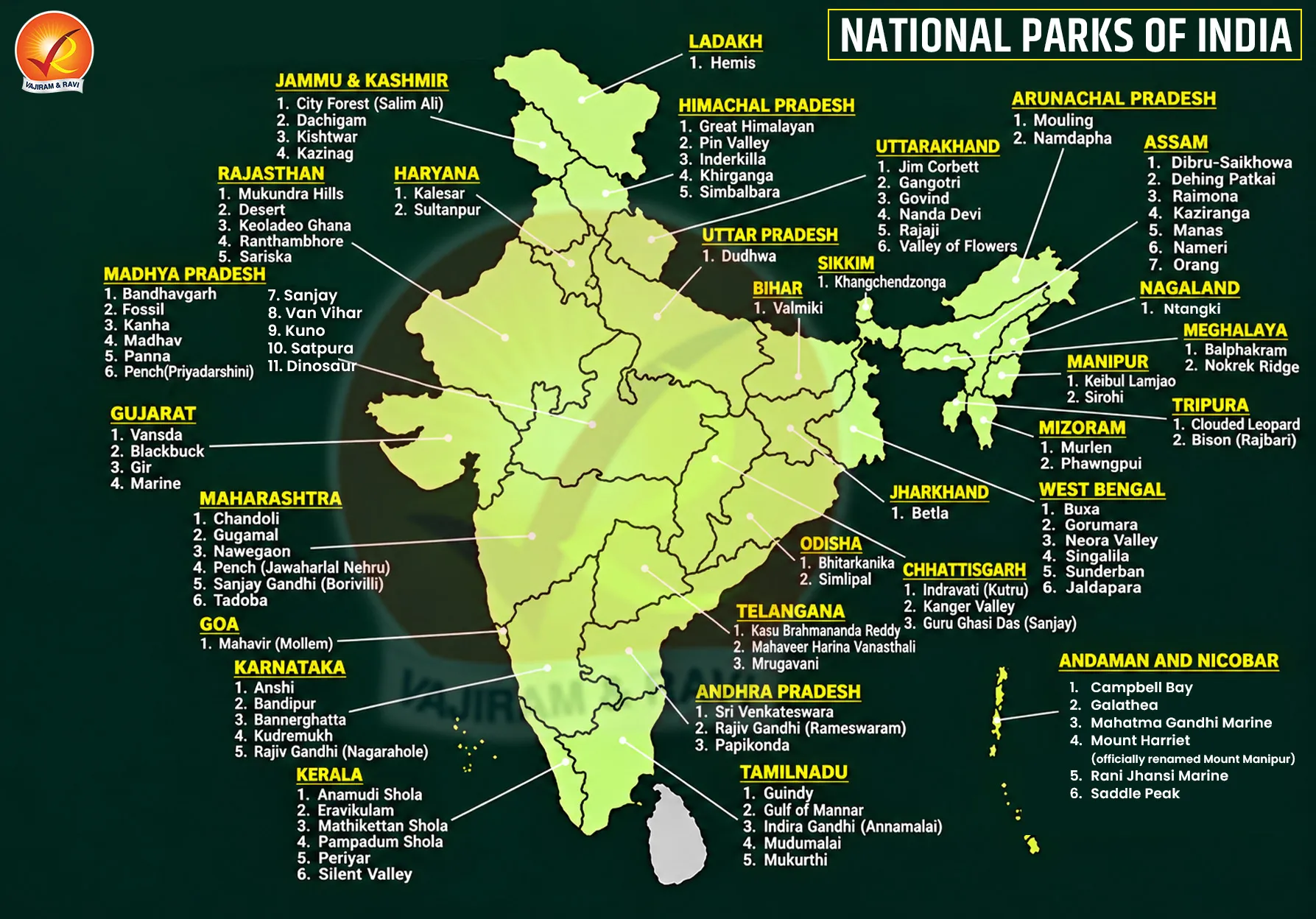
National Parks in India 2026 Map

There are 106 National Parks in India as of 2026 covering around 44,403 km2 covering the diverse including the Himalayas to coastal regions. The First National Park in India is Jim Corbett National Park which was initially known as Hailey National Park established in 1936 in Uttarakhand where as South Button Island NP in the Andaman & Nicobar Islands, which is referred as the Smallest National Park in India about 5 km². 

National Parks of India Map

Which State has the highest number of National Parks in India?

Madhya Pradesh has the highest number of National Parks in India, with 11 National Parks. The state is known for its rich forest cover, diverse wildlife and important tiger habitats.

Some of its prominent National Parks include:

  • Kanha National Park
  • Bandhavgarh National Park
  • Pench National Park
  • Panna National Park
  • Satpura National Park
  • Kuno National Park
  • Madhav National Park

Assam ranks second, with seven National Parks, including Kaziranga, Manas, Nameri, Orang, Dibru-Saikhowa, Dehing Patkai and Raimona.

Which state has the lowest number of National Parks in India?

Several states and Union Territories have only one National Park each, making them the regions with the lowest number of National Parks in India.

These include:

  • Bihar – Valmiki National Park
  • Goa – Mollem National Park
  • Jharkhand – Betla National Park
  • Ladakh – Hemis National Park
  • Nagaland – Intanki National Park
  • Sikkim – Khangchendzonga National Park
  • Uttar Pradesh – Dudhwa National Park

Each of these states and Union Territories has one National Park in the state-wise inventory.

Which is the Largest National Park in India?

Hemis National Park in Ladakh is the largest National Park in India, covering approximately 3,350 sq. km. Established in 1981, it is located in the Trans-Himalayan region and is known for its high-altitude ecosystem. The park is particularly famous for the snow leopard and also supports species such as the bharal (blue sheep), Tibetan wolf and red fox.

Which is the Smallest National Park in India?

India’s smallest National Park is South Button Island National Park, located in the Andaman and Nicobar Islands. Spread across approximately 5 sq. km, it is part of the marine ecosystem of the Rani Jhansi Marine National Park, which also includes North Button and Middle Button islands.

Latest National Parks in India 2026

Similipal National Park is the Newest National Parks in India, established in 2025. The Top 3 Recently Added National Parks in India 2026 are:

Newest National Parks in India 2026
Rank National Parks  Location Year

1

Similipal National Park

Odisha

2025

2

Dihing Patkai National Park

Assam

2021

4

Raimona National Park

Assam

2021

Which is the Oldest National Park in India?

Corbett National Park, established in 1936, is the Oldest National Parks in India. Located in the Himalayas in Uttarakhand, it was initially named Hailey National Park. Renowned for its rich biodiversity, the park is especially famous for being the first area to come under the Project Tiger initiative in 1973. Jim Corbett Tiger Reserve is home to Bengal tigers, elephants, leopards, and hundreds of bird species, making it one of the most prominent wildlife sanctuaries in India.

Oldest National Parks in India 2026

S.No

National Parks in India

Location

Year

1

Corbett National Park

Uttrakhand

1936

2

Kanha National Park

Madhya Pradesh

1955

3

Tadoba National Park

Maharashtra

1955


Difference Between National Parks, Wildlife Sanctuaries, Biosphere Reserves

National Parks, Wildlife Sanctuaries and Biosphere Reserves are protected areas established to conserve wildlife, biodiversity and natural ecosystems. However, they differ in their legal status, level of protection, objectives and permitted human activities.

Basis

National Park

Wildlife Sanctuary

Biosphere Reserve

Meaning

A protected area established to conserve wildlife, natural habitats and ecosystems.

An area designated to protect particular species of animals, plants and their habitats.

A large area designated to conserve biodiversity while promoting sustainable development and research.

Legal status in India

Declared under Section 35 of the Wild Life (Protection) Act, 1972.

Declared under Section 18 of the Wild Life (Protection) Act, 1972.

Designated under UNESCO's Man and the Biosphere (MAB) Programme or notified by the government; not a separate category under the Wild Life (Protection) Act, 1972.

Objective

To protect entire ecosystems, including flora, fauna and their habitats.

To protect wildlife and their habitats, particularly threatened species.

To conserve biodiversity, promote sustainable development and support scientific research.

Area

Generally has clearly defined boundaries.

Has clearly defined boundaries.

Usually covers a much larger area and may include National Parks and Wildlife Sanctuaries.

Human activities

Activities such as grazing and private exploitation of resources are prohibited, subject to legally permitted exceptions.

Certain human activities and rights may be permitted or regulated by the authorities.

Limited and regulated human activities are permitted, depending on the zone.

Zonation

No formal core-buffer-transition zonation.

No formal core-buffer-transition zonation.

Divided into three zones: Core, Buffer and Transition.

Human habitation

Generally restricted, subject to legal provisions.

May be permitted, subject to applicable rights and restrictions.

Human settlements and economic activities are permitted, particularly in the transition zone.

Examples

Jim Corbett National Park, Kaziranga National Park and Kanha National Park.

Indian Wild Ass Sanctuary, National Chambal Sanctuary and Bhadra Wildlife Sanctuary.

Nilgiri Biosphere Reserve, Nanda Devi Biosphere Reserve and Sundarbans Biosphere Reserve.

How are National Parks different from Wildlife Sanctuaries?

National Parks and Wildlife Sanctuaries are both protected areas established for wildlife conservation under the Wild Life (Protection) Act, 1972. However, they differ in their legal provisions, conservation objectives and restrictions on human activities.

Importance of National Parks in India

National Parks in India play a vital role in wildlife conservation, biodiversity protection, and the preservation of natural ecosystems. They help protect endangered species, maintain ecological balance, and ensure sustainable use of natural resources for future generations.

  • Conservation of Wildlife: National Parks provide a safe and protected habitat for various wildlife species, including endangered animals such as the Bengal Tiger, Asiatic Lion, and One-Horned Rhinoceros.
  • Protection of Biodiversity: These parks preserve a wide variety of flora and fauna, ensuring the survival of numerous plant, bird, reptile, and mammal species.
  • Maintenance of Ecological Balance: National Parks help maintain healthy ecosystems by protecting forests, grasslands, wetlands, and other natural habitats that support life.
  • Preservation of Natural Habitats: They prevent habitat destruction caused by deforestation, urbanization, and human encroachment, allowing wildlife to thrive in their natural environment.
  • Climate Change Mitigation: Forests within National Parks act as carbon sinks, absorbing carbon dioxide and helping reduce the effects of global warming and climate change.
  • Protection of Water Resources: Many National Parks safeguard rivers, lakes, wetlands, and watersheds, ensuring a continuous supply of clean water and supporting groundwater recharge.
  • Scientific Research and Conservation Studies: National Parks serve as important centers for wildlife research, ecological studies, and biodiversity monitoring, helping scientists understand environmental changes.
  • Promotion of Eco-Tourism: Parks attract millions of tourists every year, promoting sustainable tourism while creating awareness about wildlife conservation and environmental protection.
  • Environmental Education and Awareness: They provide opportunities for students, researchers, and visitors to learn about ecosystems, wildlife, and conservation practices.
  • Protection of Endangered Species: Several conservation programs are implemented within National Parks to protect species facing the risk of extinction and to increase their population.
  • Support for Ecosystem Services: National Parks contribute to essential ecosystem services such as pollination, soil conservation, water purification, and nutrient cycling.
  • Preservation of Genetic Diversity: They protect the genetic resources of plants and animals, which are important for future scientific research and species adaptation.
  • Control of Soil Erosion: Forest vegetation and natural landscapes in National Parks help prevent soil erosion and land degradation.
  • Boost to Local Economy: Eco-tourism and conservation-related activities generate employment opportunities for local communities, guides, forest staff, and tourism operators.
  • Protection of India's Natural Heritage: National Parks preserve India's unique wildlife and natural landscapes, ensuring that future generations can experience and benefit from this rich ecological heritage.
  • Support for National Conservation Programs: Many National Parks are part of initiatives such as Project Tiger and Project Elephant, which focus on protecting key wildlife species and their habitats.
  • Disaster Risk Reduction: Healthy ecosystems within National Parks help reduce the impact of floods, droughts, landslides, and other natural disasters by stabilizing the environment.
  • Contribution to Sustainable Development: National Parks support the goals of sustainable development by balancing environmental conservation with economic and social benefits.
  • Conservation of Rare and Medicinal Plants: Many National Parks protect valuable medicinal and endemic plant species that are important for healthcare, research, and biodiversity conservation.

National Parks in India UPSC PYQs

Q1. Which one of the following protected areas is well-known for the conservation of a sub-species of the Indian swamp deer (Barasinga) that thrives well on hard ground and is exclusively graminivorous? (2020)

(a) Kanha National Park
(b) Manas National Park
(c) Mudumalai Wildlife Sanctuary
(d) Tal Chhapar Wildlife Sanctuary

Answer: (a) Kanha National Park

Q2. With reference to India’s Desert National Park, which of the following statements are correct? (2020)

  1. It is spread over two districts.
  2. There is no human habitation inside the Park.
  3. It is one of the natural habitats of the Great Indian Bustard.

Select the correct answer using the code given below:

(a) 1 and 2 only
(b) 2 and 3 only
(c) 1 and 3 only
(d) 1, 2 and 3

Answer: (c) 1 and 3 only

Q. Which one of the following National Parks lies completely in the temperate alpine zone? (2019)

(a) Manas National Park
(b) Namdapha National Park
(c) Neora Valley National Park
(d) Valley of Flowers National Park

Answer: (d) Valley of Flowers National Park

Also Check Other Posts
Biosphere Reserves in India National Parks in India
Waterfalls in India Highest Peak in India
Ramsar Sites in India Wildlife Sanctuaries in India
Dams in India Tiger Reserves in India
Mountain Passes in India Longest Bridge in India


National Parks in India 2026 FAQs

Q1: How many National Parks are there in India 2026?

Ans: As of 2026, There are a total of 107 National Parks in India.

Q2: Which is the Largest National Park in India 2026?

Ans: Hemis National Park, situated in the Leh district of Jammu and Kashmir, holds the distinction of being India's largest national park, covering an expansive area of approximately 4,400 square kilometers.

Q3: Which state has the maximum number of National Parks in India 2026?

Ans: Madhya Pradesh and Andaman and Nicobar Islands are the leaders in India when it comes to the number of National Parks, each boasting a total of nine parks.

Q4: Which is the First National Park in India?

Ans: India's inaugural national park was Hailey National Park, established in 1936. It is currently known as Jim Corbett National Park.

Manipur Violence Inquiry Commission 2026 Report Deadline and Mandate

Manipur Violence Inquiry Commission 2026

Why is the Manipur Violence Inquiry Commission in the News?

The Manipur Violence Inquiry Commission has received its seventh extension, with the Centre setting May 20, 2027, as the deadline for submission of its report. Constituted on June 4, 2023, the Commission is investigating the ethnic violence that broke out in Manipur on May 3, 2023. Its inquiry covers the sequence of events, the causes and spread of the violence, possible administrative lapses and the adequacy of measures taken to prevent and control it.

Background of the 2023 Manipur Ethnic Violence

Ethnic violence broke out in Manipur on May 3, 2023, following a Tribal Solidarity March organised in the hill districts.

  • The march was organised to oppose the demand for inclusion of the Meitei community in the Scheduled Tribes (ST) list.
  • The violence primarily involved clashes between the Meitei and Kuki-Zo communities.
  • It resulted in widespread loss of life, displacement, arson and destruction of property.
  • The violence was preceded by tensions over the eviction of Kuki villagers from reserve forest land, among other local disputes.

According to figures presented by the Manipur Home Minister in the State Assembly, 306 people had been killed and 49 remained missing as of August 31, 2026.

Manipur Violence Inquiry Commission 2026 Establishment and Composition 

The Central Government constituted the three-member Commission of Inquiry on June 4, 2023, on the recommendation of the Manipur government. It was established to investigate the violence as a matter of public importance.

The Commission initially comprised:

  • Justice Ajai Lamba: Former Chief Justice of the Gauhati High Court and the first Chairperson.
  • Himanshu Shekhar Das: Retired Indian Administrative Service (IAS) officer.
  • Aloka Prabhakar: Retired Indian Police Service (IPS) officer.

Following Justice Ajai Lamba's resignation with effect from February 28, 2026, the Centre appointed Justice Balbir Singh Chauhan, a former judge of the Supreme Court of India, as the new Chairperson with effect from March 1, 2026. The other two members continued on the panel.

Manipur Violence Inquiry Commission 2026 Mandate and Terms of Reference

The Manipur Violence Inquiry Commission has been assigned the following responsibilities:

  1. Causes and spread of violence: Investigating the causes and spread of violence and riots targeting members of different communities in Manipur from May 3, 2023, onwards.
  2. Sequence of events: Establishing the sequence of events leading to the violence and examining the facts associated with it.
  3. Administrative accountability: Determining whether there were any lapses or dereliction of duty by responsible authorities or individuals.
  4. Assessment of government response: Examining the adequacy of administrative measures taken to prevent and deal with the violence and riots.
  5. Examination of complaints: Considering complaints and allegations submitted by individuals or associations in connection with the violence.

Legal Framework: Commissions of Inquiry Act, 1952

The Commissions of Inquiry Act, 1952 provides the legal framework for establishing commissions to investigate definite matters of public importance.

  • Section 3 – Appointment of Commission: The Central or State Government may appoint a Commission of Inquiry through an official notification to investigate a matter of public importance. The notification specifies its functions and the time within which it must complete the inquiry.
  • Section 4 – Powers of Commission: A Commission has certain powers of a civil court, including summoning witnesses, examining them on oath, requiring the production of documents and receiving evidence on affidavits.
  • Section 5 – Additional powers: The appropriate government may confer additional powers on a Commission to facilitate its inquiry.
  • Section 6 – Statements made before the Commission: Statements made by a person before the Commission are generally protected from use against that person in civil or criminal proceedings, subject to the exceptions specified in the Act.

Nature of the Commission: A Commission of Inquiry is primarily a fact-finding body. Its findings and recommendations do not automatically have the force of a judicial decree or determine criminal liability. Under Section 3(4), the report, along with a memorandum explaining the action taken, must be laid before the appropriate legislature within six months of its submission to the government.

Manipur Violence Inquiry Commission 2026 FAQs

Q1: When was the Manipur Violence Inquiry Commission constituted?

Ans: Manipur Violence Inquiry Commission was constituted on June 4, 2023, under the Commissions of Inquiry Act, 1952.

Q2: Who is the chairperson of the Manipur Violence Inquiry Commission in 2026?

Ans: Former Supreme Court judge Justice Balbir Singh Chauhan is the chairperson of the Manipur Violence Inquiry Commission in 2026.

Q3: What is the deadline for the Manipur Violence Inquiry Commission to submit its report?

Ans: The Commission has been given until May 20, 2027, to submit its report. This is its seventh extension.

Q4: What is the mandate of the Manipur Violence Inquiry Commission?

Ans: It is investigating the causes and sequence of the 2023 violence, possible administrative lapses and the adequacy of measures taken to prevent and control it.

Q5: Under which Act was the Manipur Violence Inquiry Commission established?

Ans: It was established under the Commissions of Inquiry Act, 1952.

Sikhna Jwhwlao National Park, Location, Wildlife, Significance

Sikhna Jwhwlao National Park

Sikhna Jwhwlao National Park is a protected area in Assam known for its rich biodiversity, diverse forests and important wildlife habitats. Located along the Indo-Bhutan border, it covers 316.29 square kilometres across Kokrajhar and Chirang districts. The park was officially notified in March 2025, expanding Assam’s network of protected areas, and may soon be formally declared a National Park.

The national park is named after Sikhna Jwhwlao, a legendary Bodo freedom fighter who fought against British colonial forces. Its forests, rivers and wildlife habitats play an important role in biodiversity conservation and maintaining ecological connectivity in western Assam.

Origin of the Name

The national park is named after Sikhna Jwhwlao, also known as Jaolia Dewan, a legendary Bodo freedom fighter.

He is associated with resistance against British colonial forces during the Duar War of 1864-1866, a conflict connected with British expansion and Bhutan in the Duars region.

Naming the park after Sikhna Jwhwlao recognises his historical legacy and the cultural identity of the Bodo community. It also connects wildlife conservation with the preservation of regional history.

Wildlife of Sikhna Jwhwlao National Park

Sikhna Jwhwlao National Park supports rich wildlife diversity, including endangered mammals, birds, insects and other species. Its diverse forest habitats provide food, shelter and breeding grounds for many animals.

  • Golden Langur: An endangered primate found in parts of western Assam and neighbouring Bhutan.
  • Royal Bengal Tiger: A major predator that helps maintain ecological balance by regulating prey populations.
  • Asian Elephant: A large herbivore that depends on extensive forest habitats and wildlife corridors.
  • Great One-horned Rhinoceros: An important species of northeastern India that depends on suitable grassland and wetland habitats.
  • Butterflies: The region is reported to support more than 460 butterfly species, with Ultapani recognised as an important butterfly habitat.

Rivers and Water Bodies Associated with Park

Rivers and water bodies are important components of Sikhna Jwhwlao National Park. They provide water for wildlife, support vegetation and help maintain habitats for different species.

The important rivers associated with the park are:

  • Saralbhanga River: An important river associated with the western side of the park's landscape.
  • Samukha River: Part of the river network associated with the region.
  • Champabati River: An important river in the wider landscape of western Assam.
  • Bhur River: One of the rivers associated with the park's surrounding area.
  • Laopani River: A river associated with the park's geographical landscape.
  • Dholpani River: Another important river in the surrounding region.

Mashbhandar Lake is also associated with the park's water resources.

Rivers and lakes help maintain soil moisture, support vegetation and provide water for wildlife. Riverbank forests also help reduce soil erosion and support the movement of nutrients through natural ecosystems.

Ecological Significance of Sikhna Jwhwlao National Park

Sikhna Jwhwlao National Park plays an important role in conserving Assam’s biodiversity and protecting natural forest ecosystems. Its location along the Indo-Bhutan border also supports wildlife connectivity across the region.

  • Wildlife Corridor: Helps maintain ecological connectivity between Manas and Raimona National Parks.
  • Biodiversity Conservation: Provides habitats for wildlife such as the Golden Langur, Royal Bengal Tiger and Asian Elephant.
  • Forest Protection: Conserves diverse forest types, including moist sal, evergreen and riparian forests.
  • Water Resource Conservation: Rivers and Mashbhandar Lake support wildlife and surrounding ecosystems.
  • Butterfly Diversity: The Ultapani area is known for its rich butterfly diversity, with over 460 species reported in the region.
  • Cross-border Conservation: Its location near Bhutan highlights the importance of protecting connected forest habitats across international boundaries.

Major Conservation Challenges

Like other protected forest landscapes, Sikhna Jwhwlao National Park may face several conservation challenges that require effective management and regular monitoring.

  • Habitat Fragmentation: Roads, settlements and development activities can divide forests into smaller patches.
  • Human-Wildlife Conflict: Elephants and other animals may enter agricultural fields or settlements when natural habitats or movement routes are disturbed.
  • Poaching: Illegal hunting and wildlife trade can threaten vulnerable animal populations.
  • Forest Degradation: Unsustainable extraction of forest resources can reduce habitat quality.
  • Climate Change: Changes in temperature, rainfall and water availability can affect vegetation and wildlife habitats.
  • Cross-border Conservation: Protecting connected forest landscapes may require cooperation between authorities in India and Bhutan.

Legal Framework for National Park Protection

The Wild Life (Protection) Act, 1972 provides the legal framework for declaring and managing national parks in India.

Section 35 of the Act deals with the declaration of national parks. The legal process includes provisions concerning land, existing rights and restrictions applicable to protected areas.

Importance of Sikhna Jwhwlao National Park for Assam

The establishment of Sikhna Jwhwlao National Park strengthens Assam's protected-area network and highlights the ecological importance of the Bodoland region.

Its major contributions include:

  • Biodiversity Conservation: Protecting habitats that support diverse plants, butterflies, birds and mammals.
  • Wildlife Connectivity: Supporting a wider forest landscape associated with Manas and Raimona National Parks.
  • Environmental Protection: Helping conserve forests, river systems and natural habitats.
  • Cultural Recognition: Honouring Sikhna Jwhwlao and the historical heritage of the Bodo community.
  • Ecological Security: Supporting long-term conservation and the maintenance of natural ecosystems.

Sikhna Jwhwlao National Park FAQs

Q1: Where is Sikhna Jwhwlao National Park located?

Ans: Sikhna Jwhwlao National Park is located in the Kokrajhar and Chirang districts of Assam, along the Indo-Bhutan border.

Q2: Why is Sikhna Jwhwlao National Park named after Sikhna Jwhwlao?

Ans: It is named after Sikhna Jwhwlao, also known as Jaolia Dewan, a legendary Bodo freedom fighter associated with resistance against British colonial forces during the Duar War of 1864-1866.

Q3: Which animals are found in Sikhna Jwhwlao National Park?

Ans: Important wildlife species associated with the park include the Golden Langur, Royal Bengal Tiger, Asian Elephant and Great One-horned Rhinoceros.

Q4: How many forest types are found in the park?

Ans: The park is reported to contain 12 distinct forest types, including moist sal, evergreen and riparian forests.

Q5: Which rivers are associated with Sikhna Jwhwlao National Park?

Ans: The important rivers are Saralbhanga, Samukha, Champabati, Bhur, Laopani and Dholpani. Mashbhandar Lake is also associated with the area.

Top Clean Cities in India 2025-26 List, Rankings and Awards

Top Clean Cities in India

Top Clean Cities in India are recognised through Swachh Survekshan, an annual cleanliness survey conducted by the Ministry of Housing and Urban Affairs (MoHUA) under the Swachh Bharat Mission-Urban. The survey evaluates cities based on sanitation, waste management, visible cleanliness and citizen participation. In the Swachh Survekshan 2025-26, Navi Mumbai emerged as the top clean city under the Super Swachh League, followed by Surat and Vijayawada. These rankings highlight India's efforts towards cleaner, healthier and more sustainable urban development. 

What Are Top Clean Cities in India?

The Swachh Survekshan Awards 2025-26, announced on 11 November 2026, recognised India's cleanest cities for their achievements in sanitation, waste management and public cleanliness.

  • Navi Mumbai (Maharashtra) emerged as India's top clean city under the Super Swachh League, followed by Surat (Gujarat) and Vijayawada (Andhra Pradesh).
  • Indore, which had dominated the national cleanliness rankings for eight consecutive years, was recognised under the newly introduced Swachh Shehar Jodi category.
  • President Droupadi Murmu presented the awards at Vigyan Bhawan, New Delhi.
  • The 10th edition of the survey covered 4,751 urban local bodies (ULBs) across India.

Which City Is Ranked the Cleanest City in India?

The Swachh Survekshan 2025-26 rankings recognised cities across different population groups to ensure fair assessment of both large and small urban areas.

Clean Cities of Super Swachh League

The Super Swachh League recognises cities with consistently strong cleanliness performance. The table below lists the top-ranked cities along with their states. 

Rank

City

State

1

Navi Mumbai

Maharashtra

2

Surat

Gujarat

3

Vijayawada

Andhra Pradesh

Cleanest Cities by Population Category

Swachh Survekshan ranks cities across different population categories. The table below lists the top three cleanest cities in each category.

Population Category

1st Rank

2nd Rank

3rd Rank

Above 10 lakh

Greater Visakhapatnam

Jabalpur

Lucknow

3-10 lakh

Ujjain

Chandigarh

Guntur

50,000-3 lakh

Dewas

New Delhi Municipal Council (NDMC)

Sagar

20,000-50,000

Vita

Aska

Panaji

Cleanest Cities in Special Categories

Swachh Survekshan ranks cities across different population categories. The table below lists the top three cleanest cities in each category.

Category

1st Rank

2nd Rank

3rd Rank

Clean Himalayan City

Rudrapur

Jammu

Shopian

Swachh River Front Town

Rewa

Bilaspur

Varanasi

Swachh Coastal Town

Puri

Alappuzha

Ratnagiri

Ranking Under Swachh Survekshan

Swachh Survekshan is an annual cleanliness survey conducted under the Swachh Bharat Mission-Urban, overseen by the Ministry of Housing and Urban Affairs (MoHUA).

  • Objective: To assess urban sanitation, encourage healthy competition among cities and promote public participation in cleanliness.
  • Survey Coverage: Expanded from 73 cities in 2016 to 4,751 cities in 2025-26.
  • Theme 2025-26: "Swachhata Ki Nayi Pehel - Badhayein Haath, Karein Safai Saath."
  • Assessment: More than 3,000 trained assessors carried out field inspections using GPS-enabled monitoring.
  • Digital Evaluation: Evidence submission, verification and quality checks were conducted digitally.
  • Citizen Participation: Around 2.70 crore citizens provided feedback.

Key Parameters Used for Cleanliness Rankings

Cities were evaluated using 43 indicators across 10 major assessment areas, including:

  • Waste Management: Waste segregation, collection, transportation and scientific processing.
  • Visible Cleanliness: Clean roads, streets and public spaces.
  • Sanitation Facilities: Access to toilets and mechanised desludging.
  • Used Water Management: Proper treatment and disposal of wastewater.
  • Institutional Performance: Strengthening sanitation systems and administrative capacity.
  • Sanitation Workers' Welfare: Safety, well-being and working conditions.
  • Citizen Participation: Public awareness, cleanliness campaigns, feedback and grievance redressal.

What Is the Swachh Shehar Jodi Initiative?

The Swachh Shehar Jodi (SSJ) initiative is a city-to-city mentorship programme under Swachh Bharat Mission-Urban that helps lower-performing cities improve their cleanliness standards.

  • Objective: To connect high-performing mentor cities with lower-performing mentee cities for knowledge-sharing and better waste management.
  • Approach: Based on the principle of "Each One, Teach One", inspired by the Guru-Shishya tradition.
  • Coverage: The initiative has paired 70 mentor cities with 191 mentee cities.
  • Assessment: The rankings are based on the combined cleanliness performance of mentor and mentee cities.

Top 3 Swachh Shehar Jodi Winners 2025-26

The Swachh Shehar Jodi rankings are based on the combined cleanliness performance of mentor and mentee cities. The table below lists the top three winning pairs for 2025-26. 

Rank

Mentor City

Mentee City

1

Ahmedabad

Sanand

2

Indore

Depalpur

3

Tirupati

Kuppam

Improvements in Mentee Cities

The programme helped participating cities improve several sanitation indicators between 2024-25 and 2025-26.

Cleanliness Indicator

2024-25

2025-26

Visible Cleanliness

48%

70%

Door-to-Door Waste Collection

52%

74%

Waste Segregation at Source

16%

30%

Access to Sanitation

11%

38%

Used Water Management

32%

53%

Cleanliness Awareness

48%

66%

What Are the Major Highlights of Swachh Survekshan 2025-26?

The latest survey highlighted significant improvements in urban sanitation, waste management and community participation.

  • National Recognition: A total of 60 national awards were announced across various cleanliness categories.
  • Improved City Rankings: More than 350 ULBs improved their rankings by over 500 positions.
  • Smaller Cities' Performance: Over 1,700 cities with populations below 50,000 improved their rankings compared to 2024-25.
  • State-Level Awards: 30 cities received the State First Swachh City Award for their performance.
  • Madhya Pradesh: Led the states with nine national cleanliness awards.
  • PRAGATI-50 Initiative: Aims to develop 50 Model Clean Cities through technology-driven solutions and continuous monitoring.
  • Public Participation: Nearly 2.10 crore citizens participated in the Swachhata Hi Seva 2026 campaign.
  • Sanitation Workers: Around 17 lakh SafaiMitras benefited from more than 33,000 special camps.
  • Student Awareness: Nearly 4 lakh children participated in Gyan Yatras to promote cleanliness.

Government Initiatives Promote Cleanliness in Indian Cities

The Government of India has launched several initiatives to improve urban sanitation, strengthen waste management and encourage public participation in keeping cities clean and healthy.

  • Swachh Bharat Mission-Urban (SBM-U): Launched on 2 October 2014, the mission aims to eliminate open defecation, improve sanitation facilities and promote scientific waste management in urban areas.
  • Swachh Bharat Mission-Urban 2.0: Launched in 2021, it seeks to make Indian cities Garbage Free through better solid and liquid waste management, wastewater treatment and the removal of legacy waste dumpsites.
  • Swachh Survekshan: An annual cleanliness survey conducted by the Ministry of Housing and Urban Affairs (MoHUA), it ranks cities on sanitation, waste management, visible cleanliness and citizen participation.
  • Swachh Shehar Jodi (SSJ): A mentor-mentee initiative that pairs high-performing clean cities with lower-performing towns to share best practices and strengthen waste management systems.
  • Super Swachh League: Recognises cities with consistently strong cleanliness performance and encourages them to sustain high sanitation standards.
  • Swachhata Hi Seva (SHS): An annual nationwide Jan Andolan (people’s movement) held around Gandhi Jayanti, encouraging voluntary cleanliness drives, community participation and waste reduction.
  • National Urban Sanitation Policy (NUSP), 2008: Provides a framework for achieving total urban sanitation, improving public health and ensuring safe sanitation facilities, particularly for women and economically weaker sections.
  • PRAGATI-50 Initiative: Aims to develop 50 Model Clean Cities through modern technology, improved sanitation services and continuous monitoring.

Top Clean Cities in India FAQs

Q1: Which is the cleanest city in India in 2026?

Ans: Navi Mumbai (Maharashtra) is the top clean city under the Super Swachh League in Swachh Survekshan 2025-26, followed by Surat and Vijayawada.

Q2: What is Swachh Survekshan?

Ans: It is an annual cleanliness survey conducted by the Ministry of Housing and Urban Affairs (MoHUA) under the Swachh Bharat Mission-Urban. It ranks cities on sanitation, waste management, visible cleanliness and citizen participation.

Q3: How many cities were covered in Swachh Survekshan 2025-26?

Ans: The 10th edition covered 4,751 urban local bodies, up from 73 cities in 2016.

Q4: Which are the cleanest cities in India with a population above 10 lakh?

Ans: Greater Visakhapatnam ranks first, followed by Jabalpur and Lucknow.

Q5: What is the Super Swachh League?

Ans: It recognises cities that have consistently shown strong cleanliness performance and encourages them to sustain high sanitation standards.

SHATAYU Portal: Government Initiative to Strengthen Geriatric Care in India

SHATAYU Portal

SHATAYU Portal Latest News

The Ministry of Social Justice And Empowerment, is taking significant steps towards strengthening the geriatric care ecosystem and ensuring dignified, accessible and dependable care for senior citizens through SHATAYU dashboard.

About SHATAYU Portal     

  • SHATAYU (Senior Holistic Care Assistance and Training for Your Utility) was launched on 22 May 2026.
  • It is a centralized digital initiative by the Department of Social Justice and Empowerment, Ministry of Social Justice And Empowerment.
  • Objective: Its core objective is to map certified geriatric caregivers across the country, providing senior citizens and their families with transparent, localized, and direct access to high-quality elderly care and generate employment.
  • The platform seeks to bridge the gap between professionally trained geriatric caregivers and senior citizens, their families and institutions requiring specialised elderly care services.

Key Features SHATAYU Portal  

  • It incorporates facilities such as OTP-based verification for callback requests, caregiver profile access, enrolment tracking and a feedback and rating mechanism.
  • It currently features 30,151 caregivers in its national directory, providing a digital database of caregiving professionals across States and Union Territories.
    • Through this directory, individuals and families can search for caregivers based on geographical location, including State/UT and district, making it easier to identify locally available caregiving support.
  • It also offers a convenient “Request Callback” facility for individuals seeking assistance in engaging a caregiver.
  • The request is subsequently made available to caregivers in the selected district, facilitating direct communication between service seekers and caregiving professionals, the Official said.
  • It caters to both full-time and hourly caregiving requirements, while searching the directory and placing callback requests are available free of charge.

Source: PIB

SHATAYU Portal FAQs

Q1: What is SHATAYU Portal ?

Ans: It is a centralized digital initiative by the Department of Social Justice and Empowerment, Ministry of Social Justice And Empowerment.

Q2: What is the advantage of SHATAYU Portal ?

Ans: It seeks to bridge the gap between professionally trained geriatric caregivers and senior citizens, their families and institutions requiring specialised elderly care services.

Exercise Mitra Shakti 2026: India and Sri Lanka Begin 12th Joint Military Exercise

Exercise Mitra Shakti

Exercise Mitra Shakti Latest News

Recently, a 170-member Indian Defence Forces contingent departed to participate in the 12th edition of India–Sri Lanka joint military exercise ‘MITRA SHAKTI 2026’.

About Exercise Mitra Shakti

  • It is an annual bilateral military exercise conducted alternately in India and Sri Lanka.
  • Aim: The exercise aims to enhance joint military capability of both armies to undertake Counter Terrorism operations in a semi-urban environment under a United Nations mandate.
  • Participating Contingent: Indian battalion of the Rajputana Rifles along with troops from other arms and services, and personnel from the Indian Air Force are participating.
  • It provides an important platform for both armies to strengthen interoperability, exchange operational experiences and share best practices in the conduct of Counter Terrorism operations, while promoting mutual understanding and professional camaraderie.
  • The training programme will encompass joint planning, rehearsing tactical operations and specialised combat skills including road block operations, urban patrolling, vehicle convoy protection, area ambush etc.
  • It will further strengthen defence cooperation between India and Sri Lanka.

Source: PIB

Exercise Mitra Shakti FAQs

Q1: Exercise Mitra Shakti is conducted between which two countries?

Ans: India and Sri Lanka

Q2: What is aim of Exercise Mitra Shakti?

Ans: It aims to enhance joint military capability of both armies to undertake Counter Terrorism operations in a semi-urban environment under a United Nations mandate.

Pioxaniliprole: India’s First Indigenous Insecticide Molecule, Mechanism of Action and Uses

Pioxaniliprole

Pioxaniliprole  Latest News

PI Industries Ltd’s Pioxaniliprole has received approval from the Central Insecticides Board and Registration Committee (CIBRC).

About Pioxaniliprole

  • It is India’s first indigenously discovered insecticide molecule.
  • It has been developed by PI Industries Ltd.
  • It is an insecticidal active ingredient belonging to the anthranilic diamide class of insecticides.
  • Pioxaniliprole’s Chemical Composition: It is a carboxamide compound containing chlorine, nitrogen, oxygen and sulphur atoms. 
  • Mechanism of action
    • Target insect pests: The insecticide is effective against yellow stem borer, leaf folder, fall armyworm, tobacco cutworm, fruit borer and pod borer.
    • It targets ryanodine receptors in insects, causing feeding cessation, muscle paralysis and eventually death.
    • Pioxaniliprole acts by targeting ryanodine receptors (RyRs), specialised protein channels present in insect muscle cells that regulate the release of calcium ions from intracellular storage compartments into the cell cytoplasm.
      • Calcium ions play a crucial role in normal muscle contraction and relaxation. Pioxaniliprole binds to and activates these receptors, triggering an uncontrolled release of calcium ions.
    • This disrupts normal muscle functioning in insects, leading to feeding cessation, lethargy, muscle paralysis and eventually death.

Source: IE

Pioxaniliprole FAQs

Q1: What is Pioxaniliprole?

Ans: It is India’s first indigenously discovered insecticide molecule.

Q2: Pioxaniliprole targets which type of insects?

Ans: The insecticide is effective against yellow stem borer, leaf folder, fall armyworm, tobacco cutworm, fruit borer and pod borer.

Water Rail in India: Rare Sighting at TS Chanakya Wetlands

Water Rail

Water Rail Latest News

An uncommon water rail (Rallus aquaticus) bird was recently sighted at TS Chanakya wetlands, off Palm Beach Road in Navi Mumbai, Maharashtra.

About Water Rail

  • It is a bird of the rail family Rallidae. 
  • Scientific Name: Rallus aquaticus 

Water Rail Habitat and Distribution

  • It breeds in well-vegetated wetlands across Europe, Asia, and North Africa. 
  • Northern and eastern populations are migratory, but this species is a permanent resident in the warmer parts of its breeding range.
  • In the Indian subcontinent, the Water Rail is a summer visitor to Kashmir and winters in eastern Pakistan and the northwestern plains of India. It wanders into western Uttarakhand and Rajasthan.

Water Rail Features

  • The adult is 23–28 cm long and, like other rails, has a body that is flattened laterally, allowing easier passage through the reed beds it inhabits. 
  • It has mainly brown upperparts and blue-grey underparts, black barring on the flanks, long toes, a short tail, and a long reddish bill. 
  • Known for its elusive nature, the water rail often remains motionless when threatened, opting to run for cover rather than fly.  

Water Rail Conservation Status

It is classified as 'Least Concern' under the IUCN Red List.

News: TOI

Water Rail FAQs

Q1: What is the Water Rail?

Ans: It is a bird belonging to the rail family, Rallidae.

Q2: In which regions is the Water Rail found?

Ans: Across Europe, Asia and North Africa.

Q3: What is the typical colouration of the Water Rail?

Ans: It has mainly brown upperparts and blue-grey underparts, with black barring on its flanks.

Q4: What is the conservation status of the Water Rail according to the IUCN Red List?

Ans: Least Concern (LC).

Willow Warbler in News: Karnataka Records Its First Sighting of the Rare Migratory Bird

Willow Warbler

Willow Warbler Latest News

A willow warbler recorded at Kenjar grasslands near Mangaluru recently is believed to be Karnataka’s first sighting and species’ only fifth confirmed record in India.

About Willow Warbler

  • It is a very widespread insectivorous songbird.
  • Scientific Name: Phylloscopus trochilus 

Willow Warbler Habitat and Distribution

  • Willow warblers breed throughout Europe and the Palearctic, from Ireland east to the Anadyr River basin in eastern Siberia.
  • They are strongly migratory, and almost all of the population winters in sub-Saharan Africa. 
  • They inhabit open woodlands with trees and ground cover for nesting, including most importantly birch, alder, and willow habitats. 
  • They also frequent gardens, orchards, hedges, and pastures. 

Willow Warbler Features

  • It measures around 11cm in length, with a wingspan of 19cm. 
  • It is greenish brown above and off-white to yellowish below; the wings are plain greenish-brown with no wingbars. 
  • Juveniles are yellower below than adults.
  • It can be distinguished by their paler pinkish-yellow legs, longer, paler bill, more elegant shape, and longer primary projection (wingtip). 

Willow Warbler Conservation Status

It is classified as ' Least Concern' under the IUCN Red List

News: TOI

Willow Warbler FAQs

Q1: What type of bird is the Willow Warbler?

Ans: It is a widespread insectivorous songbird.

Q2: Where does the Willow Warbler breed?

Ans: It breeds throughout Europe and the Palearctic, from Ireland eastwards to the Anadyr River basin in eastern Siberia.

Q3: Where does the Willow Warbler migrate during winter?

Ans: Almost the entire population migrates to sub-Saharan Africa for wintering.

Q4: What is the characteristic colouration of the Willow Warbler?

Ans: It has greenish-brown upperparts and off-white to yellowish underparts.

Q5: What is the IUCN Red List conservation status of the Willow Warbler?

Ans: Least Concern.

Kurumba Tribe: Migration Threatens the Survival of Its Indigenous Language

Kurumba Tribe

Kurumba Tribe Latest News

Recently, it was observed that increased migration among the Kurumbas is one of the factors that poses a threat to the survival of the Kurumba language.  

About Kurumba Tribe

  • They reside in the hilly forest regions of Attappady in Palakkad district of Kerala.
  • These people are also found in the Cardamom and Nīlgiri hills, west-central Tamil Nadu. 
  • They have been classified as a Particularly Vulnerable Tribal Group (PVTG).
  • Society
    • Belief System: They consider the forest as their mother. Thy worship the earth, mountains, nature and rivers.
    • The Kurumbas are polytheists. They pray to their gods and ancestors in all tribal ceremonies
    • They represent their deities by wooden or stone sculptures placed in small huts called ‘Kaavu’ (temples).
    • They speak Kurumba, an oral language without a script.
    • Diet: Kurumbas consume a diet based on forest produce, millets, and locally grown vegetables.
    • Occupation: The primary occupations of the Kurumba Tribe span traditional forest-based livelihoods and modern shifting labor due to conservation restrictions.

Source: TH

Kurumba Tribe FAQs

Q1: Where do we find Kurumba Tribe?

Ans: They reside in the hilly forest regions of Attappady in Palakkad district of Kerala.

Q2: What are the belief system of Kurumba Tribe?

Ans: They consider the forest as their mother. Thy worship the earth, mountains, nature and rivers.

Mississippi River Collision: Tanker and Passenger Cruise Ship Collide in New Orleans

Mississippi River

Mississippi River Latest News

A tanker ship collided recently with an American Cruise Lines passenger ship docked on the Mississippi River in New Orleans, triggering rescue operations for multiple passengers who were in the water.

About Mississippi River

  • It is the longest river in the United States and the second longest in North America. 
  • It lies entirely within the United States. 
  • Course: 
    • It rises in Lake Itasca in Minnesota and flows almost due south across the continental interior.
    • It collects the waters of its major tributaries, the Missouri River (to the west) and the Ohio River (to the east), approximately halfway along its journey to the Gulf of Mexico through a vast delta southeast of New Orleans.
  • The Mississippi River alone is more than 3,700 kilometers long. 
  • If the length of the Missouri River system is added, the Mississippi-Missouri is the world’s fourth longest river system, following the Nile (6,693 km), the Amazon (6,436 km), and the Yangtze Rivers (6,378 km).
  • The Mississippi River basin drains 1,260,000 square miles, making it the largest drainage basin in terms of area in North America.
  • The basin is home to different ecosystems, including wet forests dominated by cypress trees, brackish and freshwater marshes, sandy beaches, and salt marshes.

News: HB

Mississippi River FAQs

Q1: Where does the Mississippi River originate?

Ans: It originates from Lake Itasca in Minnesota, USA.

Q2: Does the Mississippi River flow entirely within the United States?

Ans: Yes, it lies entirely within the United States.

Q3: Into which water body does the Mississippi River empty?

Ans: The Gulf of Mexico.

Q4: What is the approximate length of the Mississippi River alone?

Ans: More than 3,700 kilometres.

Scientists Discover Disporopsis crispata in Arunachal Pradesh, Marking Genus’ First Record in India

Disporopsis crispata

Disporopsis crispata Latest News

Researchers recently discovered a new flowering plant species named Disporopsis crispata in Arunachal Pradesh's Changlang district, marking the first recorded occurrence of the genus Disporopsis in India.

About Disporopsis crispata

  • It is a new species of flowering plant.
  • It was discovered in the Vijoynagar area, Changlang district of Arunachal Pradesh. 
  • It grows on damp slopes in temperate forests dominated by mixed rhododendron and bamboo vegetation, at elevations of 2,500-2,800 metres. 
  • It marks the first recorded occurrence of the genus Disporopsis in India. 
  • The discovery is significant, as the genus Disporopsis, comprising around 12 known species, was previously recorded mainly in Myanmar, China, Taiwan, the Philippines, and other parts of Southeast Asia. 
  • Disporopsis crispatta is distinguished by its strongly wavy, crinkled leaf margins, reddish stems, and white-and-green flowers. 
  • Its stems grow between 30 and 80 cm tall, while its lance-shaped leaves measure 5–15 cm in length. 
  • The plant produces fleshy white fruits containing three to eight seeds. 
  • Researchers named the species crispata in reference to the distinctive crinkled or undulating edges of its leaves. 
  • The plant flowers between May and June, with fruiting recorded from July to December.

News: IT

Disporopsis crispata FAQs

Q1: What is Disporopsis crispata?

Ans: Disporopsis crispatta is a newly discovered species of flowering plant.

Q2: In which Indian state was Disporopsis crispatta discovered?

Ans: Arunachal Pradesh.

Q3: In which type of habitat does Disporopsis crispatta grow?

Ans: Damp slopes in temperate forests dominated by mixed rhododendron and bamboo vegetation.

Q4: What are the distinctive morphological features of Disporopsis crispatta?

Ans: Strongly wavy and crinkled leaf margins, reddish stems, and white-and-green flowers.

Eturnagaram Wildlife Sanctuary

Eturnagaram Wildlife Sanctuary

Eturnagaram Wildlife Sanctuary Latest News

Hundreds of sand-laden lorries passing through Eturnagaram Wildlife Sanctuary round the clock are disturbing wildlife habitats. 

About Eturnagaram Wildlife Sanctuary

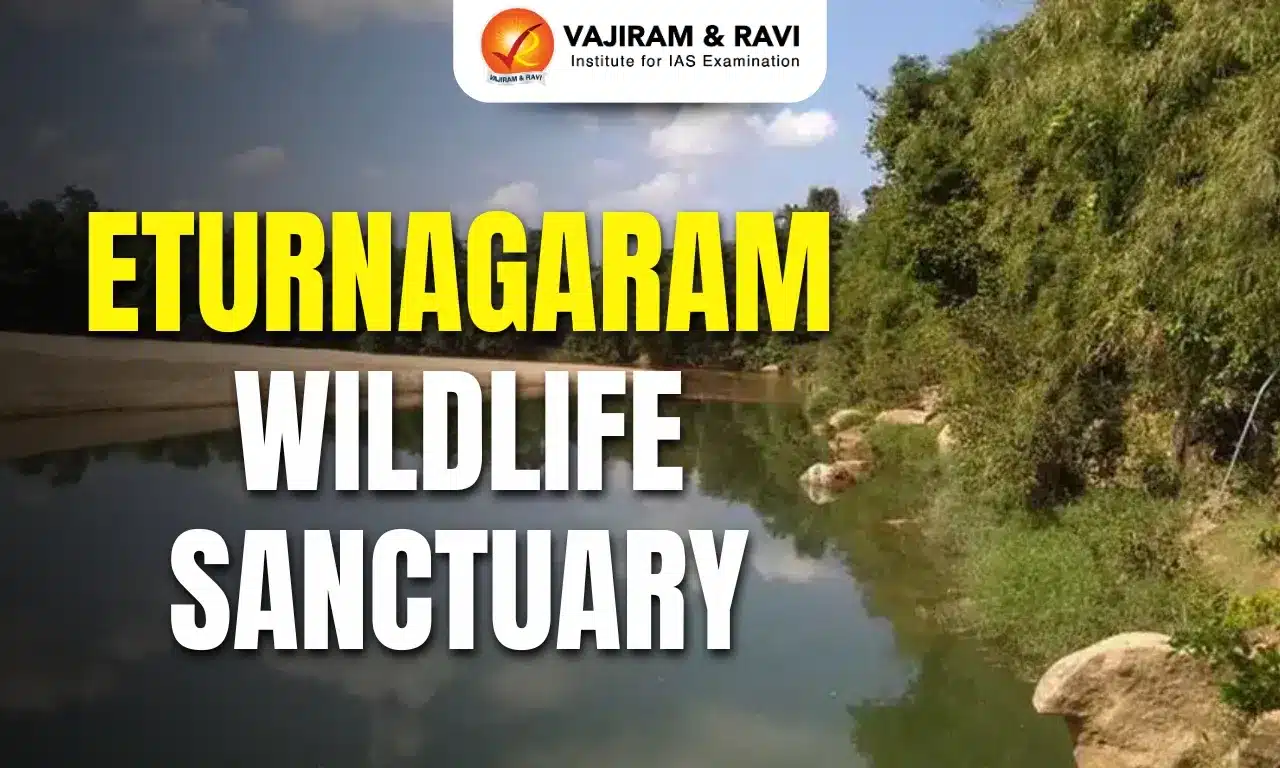
  • It is located in the Warangal district of Telangana near the border with Maharashtra and Chhattisgarh. 
  • Established in 1952, this sanctuary spreads over an area of approximately 812 sq.km.
  • Three-fourths of the sanctuary is covered in rising and falling plains and dense forest formation, while the remaining one-fourth comprises springs and streams.     
  • Rivers: 
    • It has a water source called Dayyam Vagu, which separates the sanctuary into two parts.
    • The Godavari River also passes through it.
  • The sanctuary forms part of the wider forested landscape of the Godavari basin and the Deccan Peninsula biogeographic region.  
  • The famous Sammakka-Saralamma Temple is situated inside the sanctuary.
  • Flora: 
    • The sanctuary is characterized by southern tropical dry deciduous forest, with teak (Tectona grandis) as an important dominant species. 
    • Other vegetation includes dry-deciduous trees and grasses such as Terminalia, Anogeissus, and associated forest species. 
  • Fauna: 
    • This sanctuary provides shelter to Tiger, Leopard, Panther, Wolf, Wild Dogs, Jackals, Sloth Bear, Chousingha, Black Buck, Nilgai, Sambar, Spotted Deer, Four Horned Antilope, Chinkara, Black Buck, Gaur, and Giant Squirrels.
    • The sanctuary supports diverse birdlife, including Peafowl, Junglefowl, Crested Serpent Eagle, Kingfishers, Hornbills, Painted Storks, and other resident and seasonal birds.

News: DC

Eturnagaram Wildlife Sanctuary FAQs

Q1: Where is Eturnagaram Wildlife Sanctuary located?

Ans: In Telangana, near the borders with Maharashtra and Chhattisgarh.

Q2: What type of landscape characterises Eturnagaram Wildlife Sanctuary?

Ans: Rising and falling plains with dense forest formations, along with springs and streams.

Q3: Which major river passes through Eturnagaram Wildlife Sanctuary?

Ans: The Godavari River.

Q4: Which type of forest is predominantly found in Eturnagaram Wildlife Sanctuary?

Ans: Southern tropical dry deciduous forest.

IOA-IOC Dispute and India’s 2036 Olympic Hosting Ambitions

IOA-IOC Dispute

IOA-IOC Dispute Latest News

  • The International Olympic Committee (IOC) has expressed strong disappointment over alleged irregularities and disputes surrounding the Indian Olympic Association's (IOA) electoral process.

About the Indian Olympic Association

  • The Indian Olympic Association (IOA) is the National Olympic Committee of India and the governing body responsible for coordinating the country's participation in the Olympic Games and other international multi-sport events. 
  • Established in 1927, it is recognised by the International Olympic Committee (IOC) and functions within the framework of the Olympic Charter.
  • The IOA works with national sports federations and other stakeholders to promote Olympic sports, facilitate the selection and participation of Indian athletes in international competitions, and represent India's interests within the Olympic Movement. 
  • It is also responsible for ensuring that its governance and electoral processes adhere to its Constitution and the principles of the Olympic Charter.

About the International Olympic Committee

  • The International Olympic Committee (IOC) is the supreme authority of the Olympic Movement and is responsible for overseeing the organisation of the Olympic Games. 
  • Established in 1894 by Pierre de Coubertin, it is headquartered in Lausanne, Switzerland.
  • The IOC recognises National Olympic Committees, including the IOA, and works with international sports federations and other Olympic stakeholders to promote sport globally. 
  • It safeguards the Olympic Charter, which establishes the principles and rules governing the Olympic Movement, including the autonomy, integrity and good governance of National Olympic Committees.

News Summary

  • The IOC has expressed strong disappointment over recurring disputes and allegations of misconduct surrounding the Indian Olympic Association's electoral process. 
  • In its communication to the IOA, the IOC warned that the controversy was negatively affecting the functioning and reputation of the Olympic Movement in India.
  • The IOC urged the IOA and its Electoral Officer to ensure that elections are conducted in full compliance with the Olympic Charter, the IOA Constitution and applicable rules, in a free and fair manner and without external interference.

Controversy Surrounding Sportspersons of Outstanding Merit Elections

  • The controversy intensified after IOA President P.T. Usha finished fifth with 40 votes in the women's category of the Sportspersons of Outstanding Merit (SOM) elections held on November 9, failing to secure one of the four available positions.
  • The elected candidates were Anju Bobby George (53 votes), Rani Rampal (50), Dola Banerjee (45) and Saina Nehwal (43).
  • The elections were preceded by the withdrawal of 13 candidates, comprising eight men and five women. 
  • Former athletes Ashwini Nachappa and Ronjan Sodhi alleged that their withdrawals followed external pressure. Consequently, all four men's positions were filled unopposed, while the women's category went to a vote.

P.T. Usha Seeks Independent Examination

  • In a communication dated November 9 to IOC President Kirsty Coventry, P.T. Usha sought an independent examination of alleged irregularities in the SOM election process. Her complaints included:
    • Alleged campaigning by incumbent officials and WhatsApp messages soliciting votes for a particular panel.
    • Communications seeking confirmation of voters' participation.
    • References to the Sports Ministry during an election involving a secret ballot.
    • Concerns over the handling of four representations submitted to the Electoral Officer.
  • She maintained that her complaint was not an attempt to challenge the result because she had lost, but an effort to protect the autonomy and integrity of the IOA's electoral process.
  • The IOC has expressed concern over the situation but has not adjudicated P.T. Usha's specific allegations or identified individuals responsible for the reported violations.

Disputes Over Nominations and Upcoming IOA Elections

  • The controversy has extended to the scrutiny of nominations ahead of the December 5, 2026 elections to the IOA Executive Council. 
  • P.T. Usha's nomination as a representative of the Ice Hockey Association of India to the IOA General Assembly was challenged, along with those of more than a dozen other nominees. The final electoral roll is scheduled to be published on November 15.
  • Olympic medallists Gagan Narang, Saina Nehwal and Anju Bobby George are among the names being discussed in connection with the presidential contest. Former Delhi BJP chief Virendra Sachdeva, representing the Archery Association of India, is also in the fray.

Implications for India's 2036 Olympic Bid

  • The controversy has emerged at a sensitive time for India's ambition to host the 2036 Olympic Games. 
  • An Indian delegation is scheduled to present its case before the IOC's Future Host Commission on November 26, 2026. The delegation is expected to include P.T. Usha, Nita Ambani, representatives of the Central and Gujarat governments, and an athlete. Ahmedabad has been proposed as the host city.
  • India submitted its expression of interest in October 2024 and is competing with six other countries: Qatar, Turkey, Germany, South Korea, Hungary and South Africa. 
  • The IOC's evaluation process is expected to continue over the coming years, with the host city likely to be selected in 2029.
  • The IOC had also raised concerns in July 2025 regarding IOA governance, India's anti-doping record and its performance at previous Olympic Games. 
  • These remain important areas for India to address as it seeks to establish its credentials as a potential host.

Source: IE | TOI

IOA-IOC Dispute FAQs

Q1: What is the Indian Olympic Association (IOA)?

Ans: The IOA is India's National Olympic Committee, responsible for coordinating the country's participation in the Olympic Games and representing India within the Olympic Movement.

Q2: What is the International Olympic Committee (IOC)?

Ans: The IOC is the supreme authority of the Olympic Movement. It oversees the Olympic Games, recognises National Olympic Committees and safeguards the Olympic Charter.

Q3: What are Sportspersons of Outstanding Merit (SOM) representatives?

Ans: They are sportspersons elected to the IOA General Assembly under its electoral framework.

Q4: Why did the IOC express concern over the IOA elections?

Ans: The IOC expressed disappointment over recurring disputes and allegations of irregularities, warning that they were damaging the functioning and reputation of the Olympic Movement in India.

Q5: When are the IOA Executive Council elections scheduled?

Ans: The elections are scheduled for December 5, 2026.

Paytm Wallet Services: RBI’s In-Principle Approval and the Road to Revival

Paytm Wallet Services

Paytm Wallet Services Latest News

  • Reserve Bank of India (RBI) has granted in-principle authorisation to Paytm Payments Services Ltd (PPSL) — a wholly-owned arm of Paytm’s parent One 97 Communications — to set up and operate a payment system for issuing Prepaid Payment Instruments (PPIs), including digital wallets. 
  • This comes over two-and-a-half years after the RBI imposed debilitating restrictions on Paytm Payments Bank, which had effectively shut down Paytm’s wallet services. 
  • If finalised, this would mark the return of Paytm’s wallet — once India’s largest digital wallet offering — this time operating under PPSL instead of the bank.

What the RBI’s In-Principle Approval Actually Means

  • This is not final approval — PPSL cannot yet commence wallet operations.
  • Full operations require a Certificate of Authorisation, granted only after PPSL fulfils specific RBI conditions: 
    • Undertake a system audit, including a cybersecurity audit, via a CERT-In empanelled auditor or qualified information systems auditor.
    • Audit must comply with RBI’s Master Directions on Cyber Resilience and Digital Payment Security Controls (dated November 5, 2026) for non-bank Payment System Operators.
    • Ensure compliance with RBI’s April 6, 2018 circular on storage of payment system data.
  • Deadline: PPSL must submit the system audit report within six months of the RBI’s letter — failure leads to automatic lapse of the in-principle authorisation, with no further consideration for final approval.
  • Any future change in PPSL’s shareholding or ownership must follow RBI’s July 2022 directions on prior approval for takeover/acquisition of non-bank payment system operators.
  • PPSL had applied for this authorisation in December 2025, anticipating the bank licence cancellation. Following the announcement, One 97 Communications’ shares rose 1.1%, closing at ₹1,945 on the BSE.

Background: How Paytm’s Wallet Ended Up in Trouble

  • Paytm transferred its prepaid instruments business to Paytm Payments Bank in 2017, complying with RBI norms requiring payments banks to house such operations separately.
  • In April 2026, RBI cancelled Paytm Payments Bank’s banking licence entirely, stating its operations were “detrimental to the interest of the bank and its depositors.”
  • This followed years of regulatory action, culminating in a full business shutdown.

Timeline: RBI’s Regulatory Action Against Paytm 

  • 2018: RBI scrutiny began over KYC (Know Your Customer) violations — notably, a single PAN linked to multiple customer accounts, raising red flags about bypassing regulatory safeguards.
  • June 2018: RBI audit found significant gaps in customer onboarding verification; bank directed to halt new customer onboarding until compliance improved.
  • March 2022: Bank formally barred from onboarding new customers.
  • October 2023: RBI imposed a ₹5.39 crore penalty on the bank.
  • January 2024: RBI barred the bank from accepting deposits, top-ups, prepaid instruments, wallets, FASTags, and NCMC cards after February 29, 2024, citing persistent non-compliance and supervisory concerns — including failure to maintain a “Chinese wall” with group company One 97 Communications.
  • April 2026: RBI cancelled the banking licence entirely, invoking Section 22(3)(c) of the Banking Regulation Act, 1949 — which requires that a bank’s management not be prejudicial to public or depositor interest. 
    • The RBI also invoked Section 22(3)(e), stating no useful purpose would be served by allowing continuation. 
    • The bank was barred from conducting banking business under Section 5(b)/Section 6 of the Act.

Impact on One 97 Communications

  • The RBI’s actions caused One 97 Communications’ stock to plunge 40-50%.
  • Paytm’s integrated payments ecosystem broke down — disrupting wallets, merchant settlements, FASTag, and autopay services.
  • The company was forced to partner with banks like Axis Bank and YES Bank, migrate users/infrastructure, and absorb higher compliance costs.
  • This led to temporary user and merchant attrition toward rivals like Google Pay and PhonePe, though it eventually pushed Paytm toward a leaner, partner-driven business model.

Conclusion

  • Paytm’s journey from India’s leading digital wallet provider to regulatory shutdown, and now a cautious path to revival, highlights the critical importance of compliance, transparency, and robust cybersecurity in India’s fintech ecosystem. 
  • The RBI’s conditional approval signals opportunity — but final authorisation remains contingent on Paytm successfully rebuilding regulatory trust through verified systemic safeguards.

Source: IE

Paytm Wallet Services FAQ

Q1: What does RBI’s in-principle approval mean for Paytm wallet services?

Ans: The approval allows Paytm Payments Services Ltd to establish a payment system for prepaid instruments, including wallets, subject to fulfilling RBI conditions.

Q2: Can Paytm immediately resume its wallet services after receiving in-principle approval?

Ans: No. Paytm wallet services cannot resume until the company obtains a Certificate of Authorisation after completing prescribed audits and satisfying RBI requirements.

Q3: What conditions must Paytm fulfil to restart its wallet services?

Ans: To restart Paytm wallet services, PPSL must complete system and cybersecurity audits, comply with payment-data storage rules and submit its audit report within six months.

Q4: Why did RBI impose restrictions on Paytm wallet services earlier?

Ans: RBI restricted Paytm wallet services following persistent regulatory non-compliance, including KYC deficiencies, supervisory concerns and failure to maintain adequate separation from its group company.

Q5: How did RBI’s restrictions affect Paytm’s business operations?

Ans: The restrictions disrupted Paytm wallet services, merchant settlements, FASTag and autopay, forcing the company to partner with banks and absorb higher compliance costs.

Microsoft Cloud Outage: How a 21-Hour Failure Disrupted Global Services

Microsoft Cloud Outage

Microsoft Cloud Outage Latest News

  • Between 2300-2330 IST on November 12, 2026, users across India began reporting login issues with Microsoft 365 applications — Outlook, Teams, and CoPilot AI. Within an hour, the outage had spread to 74 countries and territories, including the US, UK, Canada, Japan, Singapore, Australia, and New Zealand. 
  • By 1630 IST on November 13, over 21 hours later, the disruption remained unresolved — exposing how deeply the world’s businesses, governments, and institutions depend on a single cloud provider.

What Happened?

  • Exchange Online — Microsoft’s cloud-hosted email service — was the first to show intermittent connectivity issues, originating in the Americas.
  • Since Exchange Online is integrated into multiple Microsoft 365 functions, its disruption had a cascading effect beyond email alone.
  • Microsoft tracked the issue, later confirming it affected a wider set of services: Exchange Online, Teams, SharePoint Online, Microsoft 365 Copilot, and Microsoft Defender XDR.
  • Crucially, Microsoft clarified that only features dependent on Exchange Online were affected — not the entirety of these applications.
  • Root Cause: A number of servers unexpectedly became unavailable, placing excess load on remaining infrastructure. Microsoft explicitly stated this was not caused by increased user traffic or malicious activity.
  • Scale: Microsoft didn’t officially disclose affected user numbers, but BBC reported ~430 million global users, with complaints from tens of thousands of users across 70 countries.

Why Did the Disruption Spread So Widely?

  • Cloud-hosted services operate through a network of interconnected servers, data centres, and backend processes — not independent silos.
  • Many applications share common infrastructure for authentication and connectivity.
  • When one section of infrastructure fails, remaining components absorb additional load, stressing total system capacity.
  • Since organisations worldwide — across different countries, sectors, and jurisdictions — rely on the same technology provider, a single point of failure simultaneously disrupted unrelated institutions globally.
  • Even third-party integrations were affected: Anthropic’s Claude AI reported elevated errors in its Microsoft 365 connector, with mail, calendar, and search functions failing, and Claude for Outlook also impacted.

Why Did It Take So Long to Fix?

  • Restoring the initially affected servers does not automatically restore services — Microsoft must verify that restored infrastructure can handle the renewed volume of requests.
  • The report offers an analogy: like an athlete recovering from injury, being “injury-free” doesn’t mean being immediately “match-fit.”
  • Microsoft itself acknowledged that some recovery measures had not delivered expected improvements, prolonging the disruption.

Not an Isolated Incident

  • This was not Microsoft’s first major 365 Suite outage in 2026. Between August 31–September 3, 2026, a separate disruption affected Exchange Online and other services due to an authentication configuration issue — impacting Outlook, SharePoint Online, and OneDrive for Business.
  • This pattern highlights recurring vulnerabilities in Microsoft’s cloud infrastructure despite its massive scale.

The Real-World Fallout

  • The outage’s consequences extended far beyond lost email access:
    • Financial sector: Stock-exchange operator Euronext faced email communication problems within its listing teams; British insurer Aviva activated backup arrangements for earnings calls.
    • Aviation sector (India): IndiGo, Akasa Air, and Air India reported disruptions to email support services; some flights were grounded as a result.
  • Key Takeaway: While these sectors didn’t completely cease functioning, the outage demonstrated how failure in a single technology provider can simultaneously disrupt seemingly unrelated industries worldwide.

Microsoft’s Market Dominance: Why This Matters

  • Microsoft’s FY2026 SEC filing reported $101.997 billion in revenue from Microsoft 365 Commercial products and cloud services — a 16% increase year-on-year.
  • The company also reported a 6% increase in commercial seats (paid users under Microsoft 365 Commercial subscriptions).
  • The UK’s Competition and Markets Authority (CMA), while assessing whether Microsoft should be granted Strategic Market Status (SMS), found that Microsoft accounts for 60-70% of global revenue in the productivity software suite market.
  • This level of market concentration means outages of this scale carry systemic, cross-sector risk — a single point of failure with global economic consequences.

Conclusion

  • The Microsoft outage underscores a critical vulnerability of the digital age: concentrated dependence on a handful of cloud providers can trigger cascading, cross-sector disruptions affecting millions worldwide. 
  • As governments and businesses increasingly digitise operations, building redundancy, diversification, and stronger regulatory oversight of dominant tech providers becomes essential to safeguarding global digital resilience.

Source: IE | TH

Microsoft Cloud Outage FAQs

Q1: What caused the Microsoft cloud outage in November 2026?

Ans: The Microsoft cloud outage occurred after several servers unexpectedly became unavailable, overloading remaining infrastructure and disrupting interconnected services across multiple countries.

Q2: Which services were affected by the Microsoft cloud outage?

Ans: The Microsoft cloud outage affected Exchange Online, Teams, SharePoint Online, Microsoft 365 Copilot and Microsoft Defender XDR, particularly features dependent on Exchange Online.

Q3: Why did the Microsoft cloud outage spread across multiple countries?

Ans: The Microsoft cloud outage spread because organisations worldwide relied on shared cloud infrastructure, authentication systems and interconnected backend processes, creating a common point of failure.

Q4: How did the Microsoft cloud outage affect different economic sectors?

Ans: The Microsoft cloud outage disrupted financial-sector communications and airline email support services, affecting companies including Euronext, Aviva, IndiGo, Akasa Air and Air India.

Q5: What does the Microsoft cloud outage reveal about global technology dependence?

Ans: The Microsoft cloud outage demonstrates how concentrated dependence on dominant cloud providers creates systemic risks, making infrastructure redundancy, diversification and regulatory oversight essential.

PPVFRA: 22nd Foundation Day of the Plant Varieties and Farmers’ Rights Authority

Protection of Plant Varieties and Farmers’ Rights Authority

Protection of Plant Varieties and Farmers’ Rights Authority Latest News

Recently, the 22nd Foundation Day of the Protection of Plant Varieties and Farmers’ Rights Authority (PPVFRA) was celebrated.

About Protection of Plant Varieties and Farmers’ Rights Authority

  • It is a statutory body established on 11 November, 2005 under the Protection of Plant Varieties and Farmers’ Rights Act, 2001.
  • Nodal Ministry: It works under the Ministry of Agriculture & Farmers’ Welfare, Government of India.
  • Headquarter: New Delhi

Objectives of the Protection of Plant Varieties and Farmers’ Rights Authority

  • Grant intellectual property rights to plant breeders for their innovations in developing new plant varieties
  • Recognise and reward farmers and communities who conserve traditional varieties and biodiversity
  • Promote the protection of farmers’ rights to save, use, sow, resow, exchange, share, and sell farm-saved seed of registered varieties
  • Encourage research and innovation in plant breeding and agriculture
  • Maintain the National Register of Plant Varieties (NRPV) and ensure the documentation and conservation of valuable germplasm resources

Structure of the Protection of Plant Varieties and Farmers’ Rights Authority

  • The Chairperson is the Chief Executive of the Authority.
  • Members: It has 15 members, as notified by the Government of India (GOI).
  • Eight of them are ex-officio members representing various Departments/ Ministries, 
  • Three from State Agriculture Universities and the State Governments.
  • One representative each for farmers, tribal organization, seed industry and women organizations associated with agricultural activities are nominated by the Central Government.
  • The Registrar General is the ex-officio Member Secretary of the Authority.

Functions Protection of Plant Varieties and Farmers’ Rights Authority

  • Registration of new plant varieties, essentially derived varieties (EDV), extant varieties;
  • Compulsory cataloging facilities for all variety of plants;
  • Preservation of plant genetic resources of economic plants and their wild relatives;
  • Maintenance of the National Register of Plant Varieties and National Gene Bank

Source: PIB

Protection of Plant Varieties and Farmers’ Rights Authority FAQs

Q1: What is Protection of Plant Varieties and Farmers’ Rights Authority?

Ans: It is a statutory body established on 11 November, 2005 under the Protection of Plant Varieties and Farmers’ Rights Act, 2001.

Q2: Which is the nodal ministry of Protection of Plant Varieties and Farmers’ Rights Authority?

Ans: It works under the Ministry of Agriculture & Farmers’ Welfare, Government of India.

Daily Editorial Analysis 14 November 2026

Daily-Editorial-Analysis

To Strengthen the Supreme Court, Divide It

Context

  • The Supreme Court of India is the highest judicial authority and guardian of the Constitution, fundamental rights, and democratic values.
  • However, its expanding workload and mounting pendency have weakened its ability to perform its primary constitutional responsibilities.
  • Increasingly occupied with ordinary appeals, the court has struggled to address important constitutional questions.
  • In 2016, three Supreme Court judges raised 11 questions about the institution's functioning and referred them to a larger Bench. A decade later, the reference remains unheard.
  • This highlights the urgency of judicial reform and strengthens the case for dividing the Supreme Court into a Constitutional Court and regional Courts of Appeal.

The Growing Crisis of Judicial Pendency

  • By the end of 2025, the Supreme Court had approximately 92,318 pending cases, its highest recorded backlog.
  • This represented an increase of nearly 10,000 cases over the previous year.
  • The problem extends beyond insufficient judicial strength to the institutional structure itself.
  • During the first half of the 1960s, Constitution Benches decided an average of 134 cases annually. Over the last decade, this declined to fewer than 10 cases annually.
  • Meanwhile, Special Leave Petitions (SLPs) under Article 136 have increasingly dominated the court's workload, accounting for approximately 84.6% of its admission docket in 2011.
  • Originally intended as an extraordinary remedy, Article 136 has contributed to transforming the Supreme Court into a general appellate court.
  • In Bihar Legal Support Society (1986), a Constitution Bench led by Chief Justice P.N. Bhagwati clarified that the Supreme Court was never intended to function as an ordinary court of appeal.

Recommendations of the Law Commission and Parliament

  • The 229th Law Commission Report (2009) recommended a Constitution Bench in Delhi alongside four regional Cassation Benches.
  • Similarly, a Parliamentary Standing Committee in 2023 recommended regional Benches, subsequently accepted by the Union Law Ministry.
  • These recommendations demonstrate that judicial restructuring has considerable institutional support.

International Experiences and Comparative Models

  • Several democracies successfully separate constitutional adjudication from ordinary appellate functions.
  • United States: The Supreme Court operates above 13 federal Courts of Appeals and considers only a small proportion of cases.
  • South Africa: It has a separate Constitutional Court and Supreme Court of Appeal.
  • Germany: Its Federal Constitutional Court exclusively handles constitutional matters, while specialised federal courts address other disputes.
  • Brazil: Its 1988 Constitution established a separate Superior Tribunal of Justice to handle ordinary federal appeals, relieving the Supreme Federal Tribunal of its dual responsibilities.

Importance of Judicial Filtering

  • Brazil's experience demonstrates that structural separation alone cannot eliminate congestion.
  • Effective case-selection mechanisms are equally necessary.
  • The U.S. Supreme Court accepts roughly 1% of the 7,000 petitions it receives annually through its discretionary review system.
  • Similarly, Brazil introduced the general repercussion requirement in 2004, allowing constitutional appeals only when questions have significance beyond the immediate parties.
  • India could adopt comparable mechanisms to prevent the proposed Constitutional Court from becoming another overburdened institution.
  • The 229th Law Commission Report also suggested that Article 130 could permit regional Benches without necessarily requiring a constitutional amendment.

Concerns Regarding the Division of the Supreme Court

  • Successive Chief Justices have opposed the proposal on grounds of institutional unity.
  • They argue that regional Courts of Appeal might be perceived as inferior institutions, encouraging litigants to approach the Constitutional Court in Delhi.
  • Such a development could create another appellate hierarchy and weaken the authority of a single final court.
  • Institutional coherence, judicial independence, and consistency of judgments must therefore remain central considerations.

The Way Forward: Restoring the Court

  • Addressing the Illusion of Institutional Unity

    • The existing Supreme Court already functions through numerous small Benches, sometimes delivering contradictory judgments.
    • Its constitutional responsibilities receive inadequate attention because of excessive appellate litigation.
    • Thus, institutional unity is increasingly theoretical. A separate Constitutional Court could restore coherence by concentrating on questions affecting the entire Republic.
  • Steps Beyond Increasing Judicial Strength

    • Expanding judicial strength has not resolved the problem. When the sanctioned strength increased to 34 judges in 2019, pendency stood at approximately 60,000 cases.
    • By the end of 2025, it had reached nearly 93,000.
    • During 2025, the court disposed of 65,615 cases, while 75,410 fresh matters arrived. In 2026, Parliament increased its sanctioned strength to 38 judges.
    • These figures demonstrate that appointing additional judges without restructuring judicial responsibilities cannot provide a lasting solution.
    • The priority must be rationalising the distribution of judicial work.

Conclusion

  • The Supreme Court's mounting pendency reflects a deeper institutional crisis affecting constitutional adjudication and access to justice.
  • Establishing a dedicated Constitutional Court and regional Courts of Appeal, supported by effective case-filtering mechanisms, offers a practical solution.
  • Although concerns about institutional unity require safeguards, preserving the existing structure is unlikely to resolve the crisis.
  • Judicial specialisation, constitutional accountability, institutional efficiency, and speedy justice must guide reform.
  • Restructuring would not diminish the Supreme Court's authority but restore its constitutional purpose while ensuring accessible and timely justice for ordinary citizens.

To Strengthen the Supreme Court, Divide It FAQs

Q1. Why is restructuring the Supreme Court necessary?

Ans. The restructuring is necessary to reduce judicial pendency and restore the court's constitutional responsibilities.

Q2. What is the proposed two-tier judicial structure?

Ans. It proposes a Constitutional Court in Delhi and four or five regional Courts of Appeal.

Q3. What is the significance of Article 136?

Ans. Article 136 empowers the Supreme Court to entertain Special Leave Petitions as an extraordinary appellate remedy.

Q4. What is the main concern regarding the division of the Supreme Court?

Ans. The main concern is that division could weaken institutional unity and create conflicting judicial interpretations.

Q5. Why is increasing the number of judges insufficient?

Ans. Increasing judicial strength alone cannot resolve congestion without restructuring the distribution of judicial responsibilities.

Source: The Hindu


The Challenge of Holding the Quad Together

Context

  • The US Secretary of State announced that leaders of the four Quad countries — India, Australia, Japan, and the US — are expected to meet in Manila in November 2026, on the sidelines of the ASEAN Summit.
  • This marks the first Quad Leaders’ Summit since Donald Trump’s second term began, and the first attended by Japanese PM Sanae Takaichi.
    • The last such summit was held in Wilmington (2024), under Biden and Kishida.
  • This announcement comes after a turbulent 2025 for the grouping, raising key questions about the Quad’s future cohesion and Trump’s Indo-Pacific vision.
  • This article highlights the challenges facing the Quad grouping amid shifting US geopolitical priorities and growing uncertainty over Washington’s Indo-Pacific engagement.
  • It examines the grouping’s efforts to sustain cooperation despite strategic turbulence, the significance of the proposed Manila summit, and how India, Japan and Australia are diversifying their security partnerships.

A Period of Strategic Turbulence

  • Though India was expected to host the next summit, 2025 saw the Quad undergo intense strategic turbulence due to shifting US geopolitical priorities and changing bilateral dynamics, especially with India.
  • Despite this, the grouping did not collapse — operational cooperation continued.
  • Key Achievement: The Quad’s Indo-Pacific Maritime Domain Awareness initiative was elevated to the Indo-Pacific Maritime Surveillance Collaboration framework, launched in New Delhi (May 2026) following a Quad Foreign Ministers’ Meeting.

Keeping the Quad Afloat: Ministerial Engagement

  • Foreign Ministers met multiple times despite the political low point:
    • 2025: Twice in Washington (first meeting marked Marco Rubio’s debut as Secretary of State).
    • 2026: Three times — in New Delhi, Manila, and Atlanta.
  • Since the Quad lacks a permanent bureaucracy or institutional framework, leader-level summits serve as vital platforms to reaffirm shared purpose and set the agenda.

The Core Question: Trump’s Indo-Pacific Engagement

  • This summit will be the first real indication of Trump’s Indo-Pacific vision for his second term.
  • Historical Context: The Quad was revived during Trump’s first term (2017), which also saw the US Pacific Command renamed US Indo-Pacific Command.
  • Current Concerns: Trump’s priorities have been dominated by the Russia-Ukraine war, transatlantic/NATO relations, and the West Asia conflict — causing regional partners to worry about a potential shift away from the Indo-Pacific.
  • Trump’s push for greater burden-sharing among partners, and the White House’s review of AUKUS, have heightened uncertainty among Indo-Pacific players.

Regional Responses: Diversification Strategies

  • Facing this uncertainty, Quad partners have pursued diversification of their security approaches:
    • Japan: Launched the OCEAN (One Cooperative Effort Among Nations) framework, reshaping its post-war security posture through deeper strategic alignment with partners.
    • Australia: Strengthened defence partnerships with India, Japan, Southeast Asian nations, and Pacific Island countries to counter China’s expanding footprint.
    • India: Continues its policy of multi-alignment, diversifying defence and strategic ties across the Indian Ocean and wider Indo-Pacific.
    • JAI grouping (Japan-Australia-India): Defence Ministers met recently in Cebu, signalling deeper trilateral cooperation independent of Washington’s role.
    • France: Emerging as a new Indo-Pacific player, strengthening ties with regional countries for a balanced security environment.
  • Despite this diversification, Washington’s role remains critical — particularly in safeguarding the Taiwan Strait, a key flashpoint amid China’s growing maritime assertiveness.

Why Manila Matters: A Strategic Message

  • Though India was expected to host the summit, the Philippines hosting it reinforces a foundational Quad pillar: ASEAN centrality.
  • The Philippines is at the frontline of Chinese assertiveness in the Indo-Pacific, with ongoing South China Sea sovereignty disputes with Beijing.
  • Following precedent, Quad leaders are expected to reiterate the importance of respecting sovereignty in the South and East China Seas and condemn violations of international law.
  • For Trump, this visit carries two key priorities: resetting American posture in the region and reaffirming the Quad’s commitment against Chinese belligerence — delivered symbolically from Manila itself.

Conclusion

The Manila summit represents a crucial test of the Quad’s resilience amid Trump-era uncertainty. While regional partners diversify their strategic options, sustained American engagement remains indispensable for countering China’s assertiveness and preserving a stable, rules-based Indo-Pacific order.

The Challenge of Holding the Quad Together FAQs

Q1. What makes the proposed Manila summit significant for the Quad?

Ans. The Manila summit will be the first Quad Leaders’ Summit since Trump’s second term began and Japanese Prime Minister Sanae Takaichi took office.

Q2. How did the Quad sustain cooperation during the strategic turbulence of 2025?

Ans. Despite political differences, ministerial meetings continued, while maritime cooperation advanced through the Indo-Pacific Maritime Surveillance Collaboration framework launched in New Delhi in May 2026.

Q3. Why is Trump’s Indo-Pacific engagement a major concern for Quad partners?

Ans. Trump’s focus on other geopolitical priorities, demands for greater burden-sharing and review of AUKUS have created uncertainty about sustained American regional engagement.

Q4. How are Quad partners diversifying their regional security strategies?

Ans. Japan launched OCEAN, Australia strengthened regional defence partnerships, India pursued multi-alignment, while the Japan-Australia-India grouping deepened trilateral defence cooperation.

Q5. Why does hosting the Quad summit in Manila carry strategic significance?

Ans. Manila reinforces ASEAN centrality and highlights South China Sea tensions, offering an opportunity to reaffirm sovereignty, international law and opposition to Chinese assertiveness.

Source: TH


Egg Donation Trafficking in India - Regulatory Gaps and the Need for Stronger Enforcement

Context

  • The alleged rescue of 43 women from an egg-donation trafficking network in Hyderabad has exposed serious gaps in the regulation of Assisted Reproductive Technology (ART) in India.
  • The women, recruited from different States, were reportedly promised ₹20,000–30,000 per donation cycle. The accused were allegedly linked to 23 IVF centres.
  • Similar incidents in Erode (2022) and Varanasi (2023), involving the alleged forced donation of eggs by minors, highlight the exploitation of economically vulnerable women, the role of brokers, document falsification and inadequate oversight of fertility clinics.

Legal Framework Governing Egg Donation in India

  • The Assisted Reproductive Technology (Regulation) Act, 2021 provides safeguards to prevent exploitation and regulate egg donation.
  • Key provisions -
    • Section 27: Only registered ART banks are authorised to screen and register donors and supply gametes to ART clinics.
    • Section 21(b): ART clinics must obtain gametes exclusively from registered ART banks.
    • Eligibility criteria: A woman can donate eggs only once in her lifetime, between the ages of 23 and 35 years.
    • Limit on retrieval: A maximum of seven oocytes (eggs) can be retrieved from a donor in one cycle.
    • Section 33: Prohibits medical practitioners from using intermediaries to procure donors.
    • Penal provisions: The first offence attracts a fine of ₹5–10 lakh, while subsequent offences can result in imprisonment of 3–8 years and a fine of ₹10–20 lakh.
  • These provisions aim to prevent commercial exploitation, repeated egg retrieval and the involvement of unauthorised agents.

Structural Weaknesses due to which Egg Donation Trafficking Persist

  • Demand-supply imbalance:

    • Rising demand for donor eggs in fertility treatment, coupled with a limited pool of legally eligible donors, may encourage illegal recruitment.
    • Brokers exploit economically vulnerable women by offering financial incentives and concealing the medical risks involved.
  • Role of brokers and document fraud:

    • Intermediaries recruit women across State boundaries, often through coercion, deception or financial inducements.
    • Falsification of identity and age-related documents enables minors and otherwise ineligible women to enter the ART system.
  • Inadequate institutional oversight:

    • The National ART and Surrogacy Registry listed 4,726 registered clinics and 940 ART banks (as of October 31), significantly below the academic estimate of approximately 40,000 clinics.
    • The discrepancy raises concerns about unregistered facilities, regulatory coverage and the actual scale of the ART sector.

Weak Enforcement and Lack of Transparency

  • Inadequate regulatory data:

    • The Department of Health Research's (DHR) Annual Report 2025–26 provides information on forms downloaded from the National Registry portal and permissions granted.
    • However, it does not adequately disclose the number of regulatory inspections conducted, violations detected and penalties imposed, etc.
  • Non-functional or underdeveloped registry mechanism:

    • ART banks are required to maintain donor records and update the National Registry.
    • An effective registry should identify previous donors and prevent repeat egg retrieval.
    • However, the system for collecting donor information from clinics and banks has only been piloted.
    • Lack of transparency regarding data verification and regular updates weakens safeguards against repeat donations, as illustrated by the Erode case.
  • Weak accountability of regulatory boards:

    • Under Section 35, courts can take cognisance of offences under the Act only on complaints filed by the National or State Boards or their authorised officers.
    • Rule 5 of the ART Rules, 2022, requires these Boards to submit annual reports to the government.
    • The absence of the National Board's report in the DHR annual report raises concerns about institutional accountability and transparency.

Protecting Victims and Ensuring Medical Accountability

  • Women recruited through illegal networks should primarily be treated as victims and witnesses rather than accused persons.
  • Essential safeguards include:
    • Independent medical care: Comprehensive health assessments and monitoring for complications arising from hormonal stimulation and egg retrieval.
    • Health insurance: Section 22(1)(b) mandates 12 months of health insurance coverage for egg donors.
    • Legal protection: Victims must be protected from intimidation, coercion and further exploitation.
    • Informed consent: Donors must be adequately informed about medical risks and procedures.

Way Forward

  • Strengthen inspections: Conduct regular and surprise inspections of ART clinics and banks, including verification of donor registers and consent documents.
  • Operationalise the National Registry: Establish real-time donor-record updating, identity verification and safeguards against repeat donations.
  • Improve transparency: The Union Health Ministry should publish annual reports of the National and State Boards, while States should disclose inspections, violations, suspensions and prosecutions.
  • Fix institutional accountability: Take strict action against clinics and medical practitioners facilitating illegal recruitment, rather than targeting only intermediaries.
  • Inter-State coordination: Strengthen information-sharing between police forces, health regulators and ART authorities to dismantle trafficking networks.

Conclusion

  • India's challenge is not the absence of legislation but the gap between legal safeguards and their implementation.
  • Egg donation must remain a regulated medical procedure based on informed consent, donor safety and ethical medical practices.

Egg Donation Trafficking in India FAQs

Q1. What are the key provisions of the ART (Regulation) Act, 2021, governing egg donation?

Ans. It permits egg donation only through registered ART banks, restricts donors to women aged 23–35 years, etc.

Q2. Why does egg donation trafficking persist despite the ART Act, 2021?

Ans. Due to demand-supply gaps, economic vulnerability, illegal brokers, document falsification, etc.

Q3. What are the major institutional weaknesses in regulating India's ART sector?

Ans. Poor inspection mechanisms, an underdeveloped National Registry, inadequate disclosure of violations, etc.

Q4. What safeguards does the ART Act, 2021 provide for egg donors?

Ans. Section 22(1)(b) mandates 12-month health insurance coverage, with informed consent and medical safeguards.

Q5. What measures are needed to prevent egg donation trafficking in India?

Ans. Operationalising the National Registry, conducting regular inspections, strengthening inter-State coordination, etc.

Source: IE

Daily Editorial Analysis 2026 FAQs

Q1: What is editorial analysis?

Ans: Editorial analysis is the critical examination and interpretation of newspaper editorials to extract key insights, arguments, and perspectives relevant to UPSC preparation.

Q2: What is an editorial analyst?

Ans: An editorial analyst is someone who studies and breaks down editorials to highlight their relevance, structure, and usefulness for competitive exams like the UPSC.

Q3: What is an editorial for UPSC?

Ans: For UPSC, an editorial refers to opinion-based articles in reputed newspapers that provide analysis on current affairs, governance, policy, and socio-economic issues.

Q4: What are the sources of UPSC Editorial Analysis?

Ans: Key sources include editorials from The Hindu and Indian Express.

Q5: Can Editorial Analysis help in Mains Answer Writing?

Ans: Yes, editorial analysis enhances content quality, analytical depth, and structure in Mains answer writing.

Enquire Now