10 Years of the UPI, Growth, Expansion, Evolution, Impact

10 Years of the Unified Payments Interface

The Unified Payments Interface (UPI), launched on April 11, 2016 by the National Payments Corporation of India (NPCI), has completed 10 years and today stands as the backbone of India’s digital payments ecosystem.

About Unified Payments Interface (UPI)

The Unified Payments Interface (UPI) is a real-time digital payment system developed by the National Payments Corporation of India (NPCI) and launched on April 11, 2016. It enables instant transfer of money between bank accounts using a mobile-based interface, making digital payments simple, fast, and accessible to all.

UPI Key Features

The Unified Payments Interface (UPI) is designed as a simple, secure, and real-time digital payment system that makes financial transactions seamless and accessible for all users.

  • UPI allows users to transfer money instantly from one bank account to another without needing details like account number and IFSC code, as transactions are done using a Virtual Payment Address (UPI ID).
  • It operates 24 hours a day and 7 days a week, ensuring uninterrupted access to financial transactions at any time.
  • The system is interoperable, meaning users can send and receive money across different banks and mobile applications seamlessly without any restriction.
  • It requires only a mobile phone, bank account, and secure authentication (such as PIN or OTP).
  • UPI supports multiple types of transactions, including person-to-person (P2P) and person-to-merchant (P2M) payments, enabling both individuals and businesses to use it efficiently.

UPI Growth and Expansion 

India’s Unified Payments Interface (UPI) has evolved from a simple money transfer system into the backbone of the country’s digital economy, clocking exponential growth in both scale and scope.

  • From just 17.86 million transactions worth ₹6,952 crore in FY17, UPI has surged to 218.98 billion transactions totalling nearly ₹285 lakh crore in FY26, according to Tracxn data. 
  • Monthly transaction value has jumped from ₹21 lakh crore in FY20 to about ₹30 lakh crore recently, underlining strong post-pandemic adoption.
  • The platform now serves roughly 400 million active users, with nearly 250 million daily users and about 450 million monthly users, as highlighted by CRED cofounder Kunal Shah. 
  • UPI is also seeing rising traction in recurring payments, with close to 100 million autopay mandates set up and around 500 million monthly autopay debits.

UPI Evolution 

UPI has continuously evolved to meet the changing needs of users and businesses.

  • The introduction of UPI Lite has made it easier to carry out small-value transactions quickly without overloading the banking system.
  • UPI AutoPay has enabled seamless recurring payments such as subscriptions, utility bills, and EMIs, improving user convenience.
  • The feature of Credit on UPI has expanded access to formal credit by allowing users to utilise pre-approved credit lines directly through the platform.

These innovations have transformed UPI from a simple payment system into a comprehensive financial platform.

UPI Global Recognition

Global institutions such as the International Monetary Fund (IMF) and the World Bank have acknowledged the scale, efficiency, and inclusiveness of UPI. 

UPI has also expanded beyond national borders and is now operational or linked with payment systems in multiple countries, including the United Arab Emirates, Singapore, Bhutan, Nepal, Sri Lanka, France, Mauritius, and Qatar.

Government Initiatives for UPI 

The government’s policy push, regulatory support and interoperability framework have helped UPI emerge as the world’s largest real-time payments system.

Government Policy Push: 

  • The government actively promoted digital payments through initiatives like Jan Dhan Yojana, Aadhaar, and mobile connectivity (JAM Trinity), which created a ready user base for UPI by ensuring bank accounts, identity, and digital access.
  • The push towards a less-cash economy encouraged citizens and businesses to adopt digital transactions, accelerating UPI usage across both urban and rural areas.
  • Public systems like Direct Benefit Transfer (DBT) familiarised millions with digital banking, indirectly boosting confidence in platforms like UPI.

Regulatory Support: 

  • The Reserve Bank of India (RBI) and policymakers ensured a supportive regulatory environment by enabling secure, real-time, and 24×7 payment systems.
  • The system operates on a low-cost or zero-cost model for users, which removed entry barriers and encouraged mass adoption.
  • Continuous improvements in security frameworks and authentication mechanisms have strengthened trust, which is critical for scaling any payment system.

Interoperability Framework: 

  • UPI’s biggest strength lies in its interoperability, where users can seamlessly transfer money across different banks and apps using a single interface.
  • The expansion from 216 banks to over 690 banks by 2026 created a unified nationwide payments network.
  • This open architecture allowed fintech companies, banks, and apps to innovate on top of the same infrastructure, driving competition and rapid growth.

Impact of UPI 

The Unified Payments Interface (UPI) has emerged as a transformative digital public infrastructure that has reshaped India’s financial system.

  • Transformation of Everyday Transactions: It has replaced cash-based and time-consuming payment methods with instant, low-cost, and 24×7 digital transactions, making daily payments simpler and more efficient.
  • Financial Inclusion: UPI has expanded formal financial access by enabling real-time digital payments for users across rural and urban areas, bringing large sections of the population into the formal banking ecosystem.
  • Strengthening Welfare Delivery and Governance: Integrated with the JAM Trinity (Jan Dhan, Aadhaar, Mobile), UPI has strengthened Direct Benefit Transfer (DBT) systems by ensuring schemes like PM-KISAN are delivered directly into beneficiaries’ accounts, reducing delays, leakages, and intermediary dependence.
  • Boost to High-Velocity Digital Economy: UPI has significantly increased the speed of financial transactions and improved money circulation in the economy. In January 2026 alone, it processed 21.70 billion transactions, accounting for 81% of India’s retail digital payments, while India commands 49% of global real-time payment transactions.
  • Formalisation of Economy: UPI transactions have created a credible digital record or “information collateral,” enabling MSMEs, small traders, and street vendors to access formal credit based on transaction history, thereby reducing dependence on informal moneylenders.
  • Global Leadership: UPI has positioned India as a global leader in real-time payment systems, gaining international recognition. 

Concerns related to UPI 

Despite its transformative success, UPI faces several structural, operational, and social challenges that need to be addressed for sustainable growth.

  • Duopoly: UPI transactions are largely dominated by two major platforms, PhonePe and Google Pay, together accounting for over 80% of the market share. This creates reduced competition, high dependency on a few players, and systemic risk. 
  • Revenue Sustainability Issue (Zero MDR): The zero Merchant Discount Rate model supports adoption but limits income for banks and payment service providers, affecting their ability to invest in infrastructure, innovation, and long-term system stability.
  • Cyber Fraud and Security Risks: UPI expansion has increased cases of digital fraud such as phishing, fake QR codes, and social engineering scams, especially affecting users with low digital literacy and weakening trust in digital systems.
  • Infrastructure and Scalability Pressure: Very high transaction volumes, especially small-value frequent payments, put heavy pressure on banking systems, sometimes causing delays, slowdowns, or system failures during peak usage.
  • Digital Divide and Gender Exclusion: Unequal access to smartphones and digital literacy, particularly in rural areas and within households, limits equal participation, with women often facing restricted access to digital financial tools.

10 Years of the Unified Payments Interface FAQs

Q1: What is UPI?

Ans: UPI is a real-time payment system by NPCI that enables instant money transfer between bank accounts through a mobile app using a UPI ID.

Q2: When was UPI launched?

Ans: UPI was launched on April 11, 2016 by the National Payments Corporation of India (NPCI).

Q3: Why is UPI important?

Ans: UPI has made digital payments fast, simple, and widely accessible, forming the backbone of India’s digital financial ecosystem.

Q4: How does UPI work?

Ans: It links bank accounts to a Virtual Payment Address, allowing instant transfers with secure authentication without sharing bank details.

Q5: Is UPI used outside India?

Ans: Yes, UPI is expanding internationally and is operational or linked with countries like Singapore, UAE, France, Nepal, Bhutan, and others.
Congress of Vienna, Background, Objectives, Key Players, Outcomes

Congress of Vienna

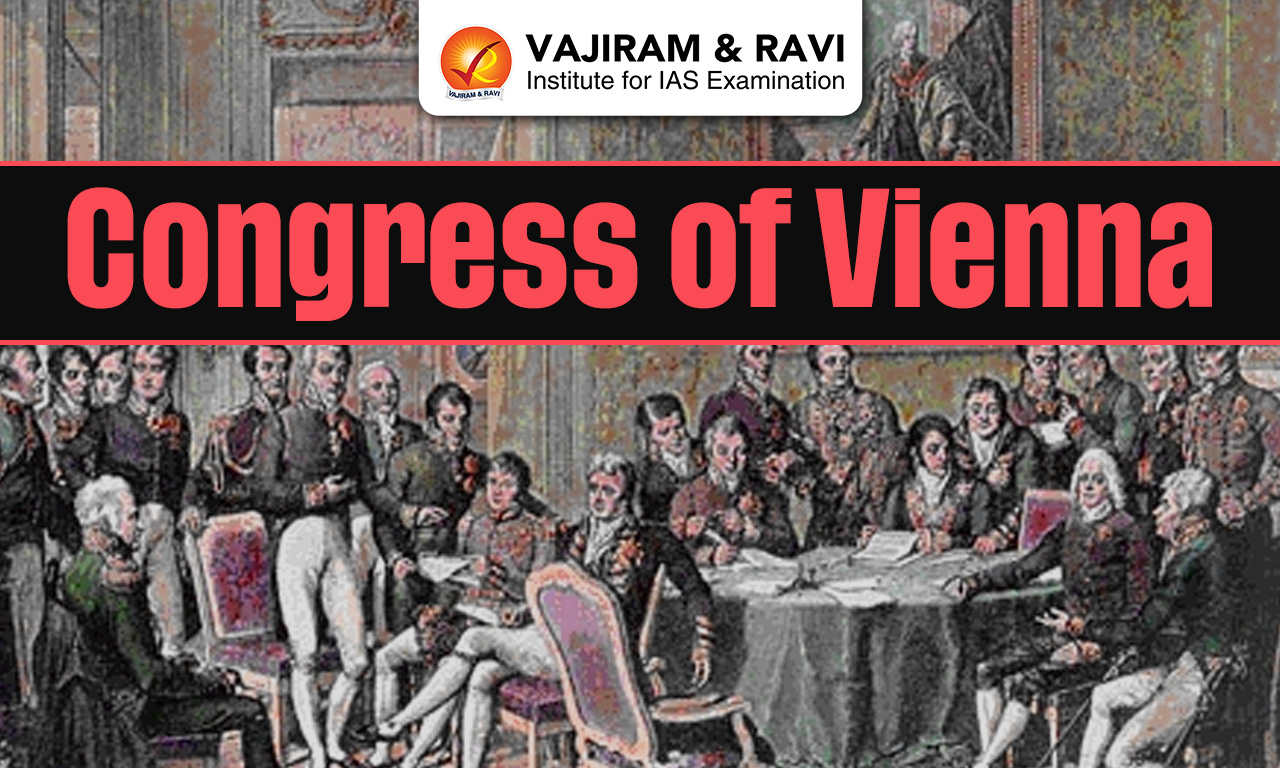
The Congress of Vienna was a meeting of important European countries held between 1814 and 1815 after the defeat of Napoleon Bonaparte. Leaders from countries like Austria, Britain, Russia, Prussia, and France came together to reorganize Europe and bring peace after years of war. Their main aim was to restore old monarchies, maintain a balance of power so that no country becomes too strong, and ensure long-term stability. The decisions taken during this meeting helped Europe avoid major wars for almost 100 years, although they also ignored and suppressed growing feelings of nationalism in many regions.

Congress of Vienna Background

  • After the defeat of Napoleon Bonaparte, four major powers - Austria, Prussia, Russia, and Great Britain played the key role in defeating him. Even before his final fall, they formed an alliance through the Treaty of Chaumont (March 9, 1814). Later, peace treaties with France were signed on May 30, 1814, joined by Sweden, Portugal, and later Spain. All countries agreed to send representatives to the Congress of Vienna, but real decision-making remained with the four major powers.
  • At the same time, nationalism was rising in Europe. In Germany and Italy, common language, culture, and shared history helped people unite and form independent nation-states by 1870. Though nationalism existed earlier, both countries became proper nation-states only in the 19th century.
  • Their unification paths were different. Germany achieved strong economic and political unity mainly under Prussia and leadership from above, while Italy’s unification was more political and cultural, with weaker economic unity and greater involvement of common people. Language also became a political issue, leading to conflicts like Schleswig-Holstein (Danes vs Germans) and the Rhine region (Germans vs French) in the 1840s.

Congress of Vienna Objectives

  • Balance of Power: The main aim of the Congress of Vienna was to make sure that no single country, especially France, becomes too powerful again and dominates Europe.
  • Control over France: To stop France from expanding in the future, strong countries were placed around it, such as a stronger Netherlands and increased territory for Prussia in the west.
  • Restoration of Monarchies: The Congress tried to bring back old royal families who had lost their thrones during the time of the French Revolution and Napoleon Bonaparte, so that traditional systems of rule could be restored.
  • Reorganisation of Territories: The map of Europe was redrawn, and land was distributed among major powers like Austria, Prussia, Russia, and Great Britain as a reward for defeating Napoleon.
  • Maintaining Peace and Stability: The Congress also wanted to ensure long-term peace in Europe, so it created a system called the “Concert of Europe,” where countries would solve problems through discussion and diplomacy instead of war.

Congress of Vienna Key Players

  • Representatives from across Europe arrived in Vienna in September 1814, including many important leaders and diplomats.
  • Klemens von Metternich represented Austria and played a leading role, while Alexander I of Russia personally guided Russia’s decisions.
  • Frederick William III of Prussia was represented by his minister Karl von Hardenberg, and Britain was first represented by Viscount Castlereagh, later replaced by Duke of Wellington and then Lord Clancarty.
  • France, under Louis XVIII, was represented by Charles-Maurice de Talleyrand, while countries like Spain, Portugal, and Sweden had less influential representatives.
  • Many smaller European states also sent delegates, along with large groups of courtiers and officials who took part in the grand social life of Vienna.
  • Friedrich Gentz helped manage the organisation of the Congress, but frequent social events and celebrations sometimes delayed serious decision-making.

Congress of Vienna Key Outcomes

  • The Congress of Vienna faced major disagreements over regions like Poland, Saxony, and German states, with powers like Russia and Prussia often opposing Austria, Britain, and France.
  • Alexander I of Russia gained control over most of Poland, while Austria got back Galicia, and Prussia received parts of Saxony and important areas near the Rhine to act as a barrier against France.
  • A strong Netherlands was created (including Belgium) to check France, while Austria gained control over regions like Lombardy and Venice. Other states like Bavaria and Hanover also gained territory.
  • Germany was reorganised into a loose group of states (confederation), and Switzerland was given a new constitution. Denmark lost Norway to Sweden.
  • In Italy, territories were rearranged, Piedmont gained Genoa, the Pope got back the Papal States, and Naples returned to its old rulers.
  • The final agreement was signed in June 1815, creating a balance of power that kept peace in Europe for many years, but it ignored people’s wishes and rising nationalism, which later caused problems.

Significance of the Congress of Vienna

  • Balance of Power: European boundaries were adjusted so that no single country, especially France, could dominate again.
  • Concert of Europe: Major powers began meeting regularly to solve problems peacefully and maintain stability.
  • Restoration of Monarchies: Old royal families were brought back to power, guided by leaders like Klemens von Metternich.
  • Long-Term Peace: The system helped Europe avoid major wars for many years until World War I.
  • Territorial Settlements: Lands were redistributed Prussia gained the Rhineland, Russia got most of Poland, and Switzerland was made neutral

Congress of Vienna FAQs

Q1: What was the Congress of Vienna?

Ans: It was a meeting (1814-1815) of major European powers after the defeat of Napoleon Bonaparte to restore peace and reorganise Europe.

Q2: Why was the Congress of Vienna held?

Ans: It was held to bring stability after years of war, restore monarchies, and prevent any one country from becoming too powerful.

Q3: Which countries played the main role?

Ans: The main powers were Austria, Russia, Prussia, and Great Britain, while France also participated.

Q4: What were the main objectives of the Congress?

Ans: Its key aims were to maintain balance of power, control France, restore old rulers, redraw boundaries, and ensure long-term peace.

Q5: What were the major outcomes of the Congress?

Ans: Europe’s map was redrawn, France was contained, new arrangements were made in Germany and Italy, and countries like the Netherlands and Switzerland were strengthened or reorganised.

Modern Music, Revival, Western Influence, Contemporary Developments

Modern Music

Modern Indian music represents a dynamic blend of tradition and innovation. From the late 19th century revival of classical forms to the influence of Western music and globalization, Indian music has evolved significantly. Today, it reflects both deep-rooted cultural heritage and modern artistic experimentation, making it relevant to global audiences.

Revival of Indian Music in the Late 19th and Early 20th Century

A major revival in Indian music took place during the late 19th and early 20th centuries. This period witnessed efforts to preserve, reform, and popularize Indian classical music, which had earlier been limited to royal courts and traditional gharanas.

One of the most influential figures of this era was Rabindranath Tagore, who created a unique genre of music known as Rabindra Sangeet. His compositions combined classical Indian elements with lyrical depth and emotional expression.

The freedom movement also played a crucial role in shaping music. Many musicians used their art as a tool for nationalism and social awakening. Notable contributors included:

  • Kazi Nazrul Islam - Known for revolutionary songs and poems
  • Vishnu Digambar Paluskar - Promoted music education and accessibility
  • Subramania Bharati - Composed patriotic songs 

Institutional Developments in Modern Indian Music

To revive and systematize Indian music, several important institutions were established:

  • In 1901, Vishnu Digambar Paluskar founded the Gandharva Mahavidyalaya in Lahore to reduce the dominance of gharanas and make music education accessible to the masses.
  • In 1926, Vishnu Narayan Bhatkhande established the Marris College of Music in Lucknow, which later became a major center for structured music education.
  • In 1919, an All-India Music Academy was set up to promote research and deeper understanding of Indian music traditions.
  • In 1928, the Madras Music Academy was established to revive and promote Carnatic music.

Cross-Cultural Collaborations

One of the most significant features of modern Indian music is its interaction with global music traditions.

  • In the early 1960s, artists like John Coltrane and George Harrison collaborated with Indian musicians and incorporated instruments like the sitar into Western compositions.
  • Indian classical music began influencing global music trends, especially in jazz and rock.
  • During the late 1970s and early 1980s, Indo-Western fusion music gained popularity in Europe and North America.

These collaborations helped Indian music gain international recognition and created new hybrid musical forms.

Impact of Western Music on Indian Musical Traditions

Globalization and technological advancement have significantly influenced Indian music. Western music has both enriched and challenged traditional Indian musical systems.

Positive Impacts

  • Global Recognition: Artists like Pandit Ravi Shankar, Zakir Hussain, and A. R. Rahman have gained worldwide acclaim.
  • Revival of Interest: International artists such as Shankar Tucker have shown interest in Indian classical music.
  • New Opportunities: Increased global exposure has created better career opportunities for musicians.
  • Fusion and Innovation: Genres like Indie-pop and fusion music have enriched Indian music traditions.

Negative Impacts

  • Decline in Traditional Learning: Many students prefer Western music due to better economic prospects.
  • Changing Audience Preferences: Western music is becoming more popular among the masses.
  • Resource Gap: Traditional artists often lack access to modern tools and marketing compared to Western musicians.
  • Rural Impact: Westernization is affecting local folk traditions and livelihoods.
  • Cinema Trends: Popular films increasingly favor Western styles over traditional Indian music.

Way Forward for Indian Music

To preserve and promote Indian musical heritage in the modern era, several steps are necessary:

  • Financial Support: Provide funding and scholarships for classical musicians.
  • Education and Awareness: Introduce music appreciation and training at the school level.
  • Employment Opportunities: Create sustainable livelihood options for traditional artists.
  • Institutional Strengthening: Organizations like the Sangeet Natak Akademi should be strengthened with resources for research and promotion.
  • Digital Promotion: Use technology and online platforms to showcase Indian music globally.

Modern Music FAQs

Q1: What is modern music?

Ans: Modern music refers to contemporary styles of music that developed from the late 19th century to the present. It includes genres like pop, rock, jazz, hip-hop, and electronic music, and focuses on creativity, innovation, and mass appeal.

Q2: When did modern music begin?

Ans: Modern music began to take shape in the late 19th and early 20th centuries, when musicians started experimenting beyond traditional classical forms and introduced new styles like jazz and blues.

Q3: How is modern music different from classical music?

Ans: Modern music is more flexible, technology-driven, and aimed at mass audiences, whereas classical music follows strict rules, traditional instruments, and structured compositions.

Q4: What role does technology play in modern music?

Ans: Technology has made music production easier and more accessible. Platforms like Spotify and YouTube allow artists to share their work globally, while digital tools help in composing, recording, and editing music.

Q5: What is modernism in music?

Ans: Modernism in music refers to a movement where artists experimented with new sounds, structures, and styles, breaking away from traditional norms to create innovative forms of expression.

UPSC Daily Quiz 15 April 2026

UPSC Daily Quiz

[WpProQuiz 137]

UPSC Daily Quiz FAQs

Q1: What is the Daily UPSC Quiz?

Ans: The Daily UPSC Quiz is a set of practice questions based on current affairs, static subjects, and PYQs that help aspirants enhance retention and test conceptual clarity regularly.

Q2: How is the Daily Quiz useful for UPSC preparation?

Ans: Daily quizzes support learning, help in revision, improve time management, and boost accuracy for both UPSC Prelims and Mains through consistent practice.

Q3: Are the quiz questions based on the UPSC syllabus?

Ans: Yes, all questions are aligned with the UPSC Syllabus 2025, covering key areas like Polity, Economy, Environment, History, Geography, and Current Affairs.

Q4: Are solutions and explanations provided with the quiz?

Ans: Yes, each quiz includes detailed explanations and source references to enhance conceptual understanding and enable self-assessment.

Q5: Is the Daily UPSC Quiz suitable for both Prelims and Mains?

Ans: Primarily focused on Prelims (MCQ format), but it also indirectly helps in Mains by strengthening subject knowledge and factual clarity.

9th Indian Ocean Conference, Venue, Theme, Purpose

9th Indian Ocean Conference

The 9th Indian Ocean Conference was held in Port Louis, Mauritius from April 10–12, 2026, marking the first time the event was hosted in Africa. External Affairs Minister Dr. S. Jaishankar Subrahmanyam Jaishankar outlined India’s priorities, including regional resilience, overcoming colonial legacies, and adapting to a fragmented global order.

About 9th Indian Ocean Conference

  • Venue: The 9th Indian Ocean Conference (IOC 2026) was held in Port Louis, Mauritius from April 10-12, 2026. This is the first time the conference was held in an African country. 
  • Theme: Collective Stewardship for Indian Ocean Governance.
  • Organised by: 9th Indian Ocean Conference (IOC 2026) was organised by the India Foundation in collaboration with the Government of Mauritius. 
  • No delegate attended from the Maldives, as diplomatic ties between Mauritius and the Maldives have been suspended over territorial differences related to the Chagos Islands

About the Indian Ocean Conference (IOC)

The Indian Ocean Conference is a flagship consultative forum aimed at strengthening regional dialogue and cooperation in the Indian Ocean Region.

  • The conference was initiated in 2016 by the India Foundation in collaboration with regional partners.
  • It brings together ministers, policymakers, scholars, and strategic experts from more than 40 countries.
  • The conference focuses on regional cooperation under India’s vision of SAGAR (Security and Growth for All in the Region). 
  • It serves as a platform to discuss geopolitical, economic, and environmental challenges in the Indian Ocean Region.

India’s Five Key Priorities at 9th Indian Ocean Conference

 EAM Dr. S. Jaishankar, in his keynote address, outlined five broad priorities for Indian Ocean nations. 

Priority 1: The Ocean as a Living Ecosystem, Not Just a Geographic Space

  • Dr. S. Jaishankar said the Indian Ocean is not merely a geographic space but a living ecosystem that sustains economies, livelihoods, connectivity, resources, and shared cultural heritage. He warned that any disruption to this interconnected system has far-reaching consequences, underscoring the need for stability and careful stewardship of the maritime domain. 

Priority 2: Overcoming Colonial Legacies and Deepening Regional Integration

  • Countries of the region must continue efforts to overcome historical barriers inherited from the colonial era and deepen regional cooperation. This includes the importance of stronger economic linkages, improved connectivity, and the revival of traditional ties, and nations must not lose sight of long-term collective goals even as global fragmentation increases. 

Priority 3: Adapting to a More Fractured and Competitive World Order

  • EAM Dr. S. Jaishankar highlighted the changing nature of the global order, noting that the world has become more competitive, inward-looking, and fractured. The benefits of globalisation are increasingly being overshadowed by tendencies to weaponise interdependence, prompting countries to seek more reliable partnerships and greater resilience in an uncertain environment. 

Priority 4: Addressing Physical and Conceptual Choke Points

  • While maritime choke points remain strategically significant, similar constraints are emerging in domains such as finance, technology, resources, and knowledge. Jaishankar cautioned that controlled systems can hinder global well-being and stressed the need for more open and resilient flows.  This is a reference not only to strategic straits like Hormuz and Malacca, but also to technological dependencies (semiconductor supply chains), financial gatekeeping, and knowledge monopolies.

Priority 5: Building Collective Resilience in the Global South

  • EAM Dr. S. Jaishankar called for deeper cooperation among Indian Ocean nations, describing the region as a “Global South ocean” facing shared challenges such as food, fuel, and fertiliser shortages; disaster response; and the spillover effects of conflicts. He stated that the answer to these challenges lies increasingly in collective resilience

Importance of the Indian Ocean Region

The strategic relevance of the Indian Ocean explains the importance of the conference.

  • The Indian Ocean connects over 35 littoral states and supports nearly 40% of the global population, making it a vital geopolitical space.
  • It carries around two-thirds of global oil shipments and a significant share of global trade, making it central to energy and economic security.
  • Key chokepoints such as the Strait of Hormuz and Malacca Strait influence global trade flows and strategic stability.
  • The region offers vast Blue Economy potential, including fisheries, seabed resources, renewable energy, and maritime trade.

9th Indian Ocean Conference FAQs

Q1: Where was the 9th Indian Ocean Conference held?

Ans: The conference was held in Port Louis, the capital of Mauritius, from April 10-12, 2026.

Q2: Who organised the 9th Indian Ocean Conference?

Ans: It was organised by the India Foundation in collaboration with the Government of Mauritius.

Q3: What was the theme of 9th Indian Ocean Conference?

Ans: The theme was “Collective Stewardship for Indian Ocean Governance,” emphasizing shared responsibility among nations to manage maritime resources, security, and sustainability.

Q4: What is the purpose of the Indian Ocean Conference?

Ans: The conference serves as a platform for dialogue and cooperation among Indian Ocean countries, focusing on geopolitical, economic, and environmental challenges under India’s SAGAR vision.

Q5: What were India’s key priorities highlighted at IOC 2026?

Ans: India, through Subrahmanyam Jaishankar, stressed viewing the ocean as an ecosystem, overcoming colonial legacies, adapting to a fragmented world order, addressing emerging choke points, and building collective resilience among Global South nations.

Sudan Civil War, Background, Consequences, Reasons, Geography

Sudan Civil War

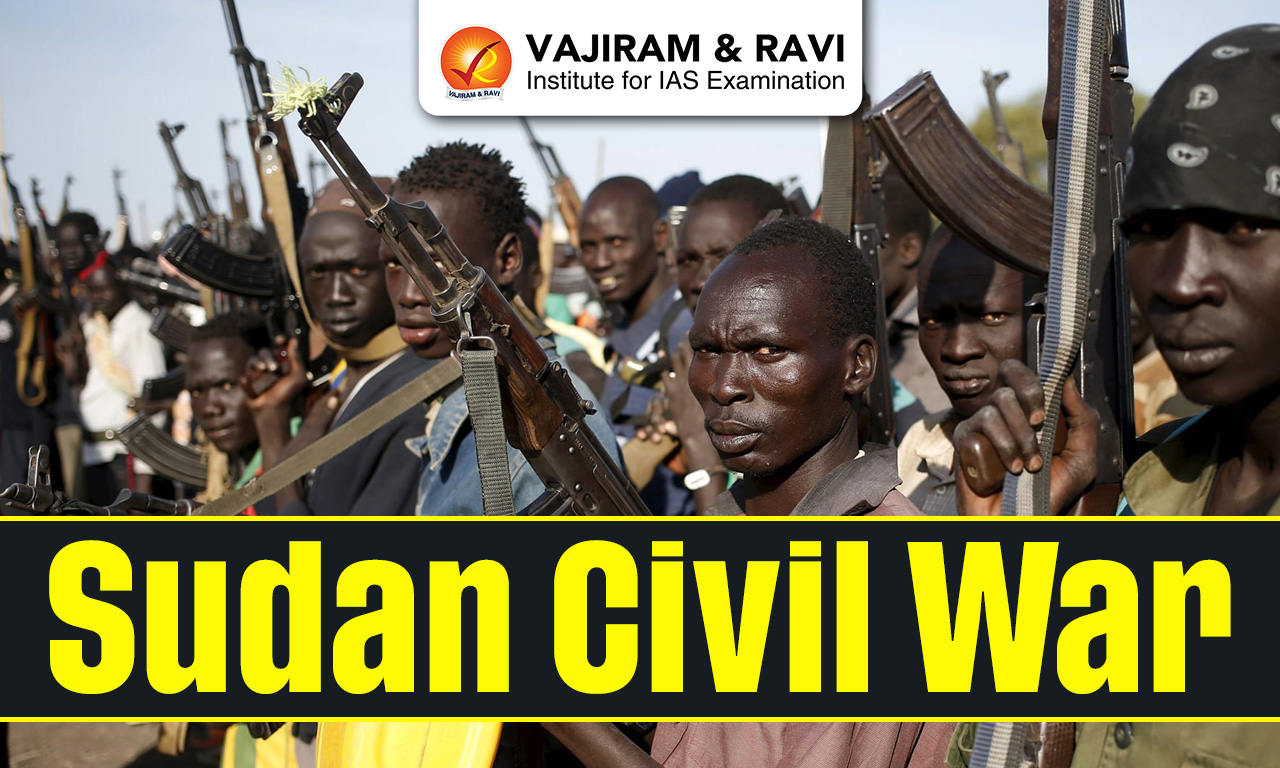
The Sudan Civil War is an ongoing conflict that has caused serious suffering to the people of Sudan. It was started due to a struggle for power between Army leader and Paramilitary leader  and has led to widespread of violence and instability across the country. Since then, millions of people have been forced to leave their homes and many are facing problems like hunger, lack of healthcare, and unsafe living conditions. The situation remains hostile with no clear solution in sight.

Sudan Civil War Background

  • Long Political Instability: Sudan faced years of instability under Omar al-Bashir, marked by economic problems, lack of freedom, and conflicts like Darfur, until he was removed in 2019 after public protests.
  • Failed Democratic Transition: After 2019, a joint civilian–military government was formed, but weak trust and continued military dominance slowed democratic progress.
  • Military Coup (2021): In October 2021, Abdel Fattah al-Burhan and Mohamed Hamdan Dagalo carried out a coup, removing the civilian government and taking control.
  • Rise of Rival Power Centres: Although they initially worked together, both leaders soon developed differences over control of the country and armed forces.
  • Growing Tensions: Disputes, especially over merging RSF into the army, increased mistrust, competition, and conflict between the two sides.
  • Start of Civil War (2023): On April 15, 2023, tensions turned into open fighting between SAF and RSF, leading to a full-scale civil war.

Also Read: Spanish Civil War

Sudan Civil War Consequences

The civil war in Sudan has caused massive human suffering, forcing millions of people to leave their homes and live in very difficult conditions. Many people are facing hunger, disease, and lack of basic needs like food, water, and healthcare. The country’s economy and infrastructure have been badly damaged, making daily life extremely hard.

  • Control and Spread of Conflict: The war in Sudan has spread across most regions, with SAF controlling eastern and central areas including Khartoum, while RSF dominates western areas like Darfur, with heavy fighting also in Gezira and Kordofan.
  • Mass Displacement and Death: Around 14 million people have been displaced, including 4.4 million who fled to countries like Chad, South Sudan, and Egypt, with an estimated 40,000 deaths and many civilians facing violence while escaping.
  • Human Rights Violations: Widespread abuses include killings, forced recruitment, and arrests, with women and girls facing severe risks of sexual violence, often used as a weapon in the conflict.
  • Severe Food Crisis: About 21 million people face hunger, with famine in some areas, as agriculture is destroyed, crops are lost, and food has become scarce and expensive.
  • Collapse of Healthcare System: Hospitals lack basic facilities and staff, disease outbreaks are increasing, and attacks on medical services have made healthcare extremely limited.
  • Disruption of Aid Supply: Regional tensions have disrupted supply routes, reducing the ability of aid agencies to deliver food and medicines, worsening the humanitarian crisis.

Also Read: Yemen Civil War

Reasons for the Persistent Conflict in Sudan

  • Power Struggle: The conflict in Sudan is mainly due to rivalry between Abdel Fattah al-Burhan (SAF) and Mohamed Hamdan Dagalo (RSF), as both want full control and refuse to compromise.
  • Continuous Flow of Weapons: Despite international bans, weapons keep entering the country, helping both sides continue fighting and increasing destruction.
  • Ethnic Divisions: The conflict has taken an ethnic form, especially in Darfur, where different communities support different sides, leading to more violence and mistrust.
  • Foreign Support: External countries are supporting both sides with money, weapons, and influence, which reduces chances of peace.
  • Failure of Peace Talks: Efforts like the Jeddah Declaration have failed due to lack of trust and repeated violations by both sides.
  • Weak System and Economic Crisis: Political instability after Omar al-Bashir and problems like poverty and competition for resources have further prolonged the conflict.

About Sudan Geography

  • Location: Sudan is a country located in the northeastern part of Africa and is one of the larger countries on the continent.
  • Bordering Countries: It shares land borders with several countries including South Sudan, Ethiopia, Eritrea, Egypt, Libya, Chad, and the Central African Republic, making it an important link between North and Central Africa.
  • Maritime Border: Sudan also has a coastline along the Red Sea, which is important for trade and transportation.
  • Capital City: The capital city of Sudan is Khartoum, which is also the political, cultural, and economic centre of the country.
  • Relief and Terrain: The country is mainly made up of vast plains and plateaus, and much of its land is shaped and drained by the Nile River and its tributaries, which play a crucial role in agriculture and settlement.
  • Climate: Sudan experiences different types of climate from north to south, with the northern region having a hot desert climate with very little rainfall, gradually changing into semi-arid conditions and then tropical savannah climate with more rainfall in the southern parts.
  • Highest Point: The highest point in Sudan is Jabal Marrah, which is located in the Darfur region.
  • Major River System: The Nile River is the most important geographical feature of Sudan, flowing from south to north and providing water for agriculture, drinking, and transportation, while also supporting most of the population.
  • Natural Resources: Sudan is rich in natural resources such as petroleum and also has smaller reserves of minerals like gold, iron ore, copper, chromium, zinc, tungsten, mica, and silver, along with significant potential for hydropower generation.

Sudan Civil War FAQs

Q1: What is the main cause of the Sudan Civil War?

Ans: The war in Sudan started mainly due to a power struggle between Abdel Fattah al-Burhan (SAF) and Mohamed Hamdan Dagalo (RSF), both wanting full control of the country.

Q2: When did the Sudan Civil War begin?

Ans: The conflict began on April 15, 2023, after rising tensions between the Sudanese Armed Forces (SAF) and Rapid Support Forces (RSF) turned into open fighting.

Q3: What was the background of the conflict?

Ans: Sudan had a long history of political instability under Omar al-Bashir, followed by a failed transition to civilian rule and a military coup in 2021, which created tensions between military leaders.

Q4: What is the current situation in Sudan?

Ans: The country remains divided, with SAF controlling eastern and central regions including Khartoum, while RSF controls much of Darfur, and fighting is still ongoing.

Q5: What are the major consequences of the war?

Ans: Millions of people have been displaced, many are facing hunger, disease, and lack of healthcare, and the country’s economy and infrastructure have been severely damaged.

Sonoran Desert, Location, Flora, Fauna, Climate

Sonoran Desert

The Sonoran Desert is one of the most ecologically rich and geographically diverse desert regions in the world. Spread across approximately 120,000 square miles, it extends over the southwestern United States (primarily Arizona and California) and northwestern Mexico, including the states of Sonora and Baja California. Unlike typical deserts, it supports a remarkable diversity of life forms due to its unique climatic conditions, varied topography, and dual rainfall system. It is widely regarded as the most biologically diverse desert in North America.

About Sonoran Desert

  • The Sonoran Desert is distinguished by its unique bimodal rainfall pattern, receiving precipitation during both winter (from Pacific storms) and summer (from monsoon thunderstorms), which supports a wide range of plant and animal life not typically found in other deserts.
  • The Sonoran Desert experiences extreme climatic conditions, with summer temperatures frequently exceeding 40°C and occasionally reaching up to 48°C, while winters remain relatively mild, especially in lowland areas where frost is rare.
  • The Sonoran Desert has a highly varied topography characterized by the Basin and Range system, including rugged mountain ranges, expansive valleys, and gently sloping alluvial fans known as bajadas, which contribute to diverse microclimates.
  • The Sonoran Desert contains geological formations that range from ancient Precambrian rocks over two billion years old to relatively recent volcanic features, including lava flows and craters found in regions like the Pinacate volcanic field.
  • The Sonoran Desert is home to the iconic saguaro cactus, along with a wide variety of vegetation such as barrel cactus, cholla, prickly pear, ocotillo, mesquite, palo verde, and creosote bush, making it the most vegetatively diverse desert in North America.
  • The Sonoran Desert supports a rich diversity of fauna, including mammals like desert bighorn sheep, mule deer, coyotes, and mountain lions, as well as reptiles such as the Gila monster, desert tortoise, and numerous snake species adapted to arid conditions.
  • The Sonoran Desert provides habitat for a wide range of bird species, including roadrunners, Gila woodpeckers, Gambel’s quail, hawks, and owls, many of which are specially adapted to survive in extreme heat and limited water availability.
  • The Sonoran Desert ecosystem includes important river systems such as the Colorado River, Gila River, and Salt River, which provide crucial water resources for both wildlife and human populations.
  • The Sonoran Desert is characterized by large diurnal temperature variations, often exceeding 15°C, due to low humidity and minimal vegetation cover, which allows rapid heat loss after sunset.
  • The Sonoran Desert is influenced by surrounding mountain systems such as the Sierra Madre Occidental and the Peninsular Ranges, which affect rainfall patterns and climatic conditions.
  • The Sonoran Desert contains several protected areas, including Saguaro National Park, Organ Pipe Cactus National Monument, and Cabeza Prieta National Wildlife Refuge, which help conserve its unique biodiversity.
  • The Sonoran Desert plays a crucial ecological role by supporting pollinators such as bats, bees, and birds, which are essential for the reproduction of many desert plants, including cacti and flowering shrubs.

Sonoran Desert FAQs

Q1: Where is the Sonoran Desert located?

Ans: The Sonoran Desert is located in North America, covering parts of Arizona, California, and northwestern Mexico, including the states of Sonora and Baja California.

Q2: Why is the Sonoran Desert considered unique?

Ans: The Sonoran Desert is unique because of its bimodal rainfall pattern (winter rains and summer monsoons) and its exceptionally high biodiversity compared to other deserts.

Q3: What is the climate of the Sonoran Desert?

Ans: The Sonoran Desert has an extremely hot climate with summer temperatures often exceeding 40°C, mild winters, and large day-night temperature variations due to low humidity.

Q4: Which is the most famous plant found in the Sonoran Desert?

Ans: The most iconic plant of the Sonoran Desert is the saguaro cactus, known for its tall, tree-like structure and long lifespan.

Q5: What types of animals are found in the Sonoran Desert?

Ans: The Sonoran Desert is home to mammals like coyotes and mountain lions, reptiles like the Gila monster and desert tortoise, and birds such as roadrunners and hawks.

Folk Music of India, State Wise List, Characteristics, Significance

Folk Music of India

Indian folk music is a traditional form of common people and it is passed down from one generation to another mostly through listening and practicing. It reflects the regional diversity, culture and daily life practices. Different regions of India have their own unique folk songs and styles often influenced by their regional practices. In this article we shall discuss in detail about Folk Music of India.

About Folk Music of India

  • Folk music is the music of ordinary people. It is created and sung by communities, not by professional musicians, and it reflects their daily life, feelings, and traditions.
  • It is usually passed down from one generation to another by listening and learning, rather than being written down. Folk songs are often simple, easy to remember, and connected to occasions like festivals, weddings, farming, or storytelling.
  • Unlike formal music, folk music does not follow strict rules. It changes with time and place, which makes it unique in every region. Most importantly, it carries the culture, history, and emotions of the people who create it.

Also Read: Classical Music of India

Folk Music of India Origin and Evolution

  • Ancient origin: Folk music in India has very deep roots going back to the Vedic period (around 1500 BC), where simple songs and chants were used in rituals and daily life, and many scholars believe it developed alongside early Indian civilization.
  • Link with epics and early storytelling: Over time, folk music became a way to narrate stories from epics like the Mahabharata, with forms like Pandavani showing how people used music to keep heroic tales and cultural memories alive.
  • Oral tradition and knowledge transfer: In the absence of written records, folk songs evolved as a powerful oral medium to pass on history, values, and social knowledge from one generation to another, making them an important cultural tool.
  • Integration into daily life and culture: As society developed, folk music became closely connected with everyday life, being sung during festivals, marriages, and agricultural activities, reflecting the emotions and experiences of common people.
  • Regional diversification: With time, different regions of India developed their own distinct styles of folk music based on local languages, traditions, and environments, leading to rich diversity across the country.
  • Simple and flexible evolution: Unlike classical music guided by texts like the Natyashastra, folk music evolved freely without strict rules, allowing it to adapt continuously to changing social and cultural contexts.
  • Continuity and modern influence: Even in modern times, folk music continues to evolve by blending with contemporary styles while still preserving its traditional roots and identity.

Also Read: Hindustani Music

Folk Music of India Characteristics

The important features of Folk Music in India are:

  • There is no single "author." These songs are community treasures shaped by countless voices over centuries.
  • Songs change naturally over time. Whether someone adds a creative twist or forgets a line, the music evolves to stay fresh.
  • It is learned entirely by ear. Knowledge is passed down through stories and singing rather than written notes.
  • A song only survives if the community loves it enough to keep singing it. If it doesn't connect with people, it simply fades away.
  • As they are not scripted, the same song might vary from village to village. Every singer adds their own "local spice" to the performance.

Different Folk Music of India

Different folk music of India reflects the rich cultural diversity and traditions of various regions. Each style is unique and connected to local festivals, daily life, and beliefs. These musical forms are passed from one generation to another and hold great cultural importance. Some important folk music styles and their features are discussed below.

S.No

Regional Music Style

States

Features

1

Rasiya Geet

Uttar Pradesh

It is popular in Braj, the land of Lord Krishna and often associated with leelas. These songs are full of love and emotions and are sung in daily life as well as celebrations. They reflect devotion, romance and the playful nature of Krishna’s stories.

2

Alha

Uttar Pradesh

A heroic ballad from Bundelkhand. It tells brave stories of warriors Alha and Udal. These songs are energetic and often sung during the rainy season or special gatherings.

3

Hori

Uttar Pradesh

It is sung during the festival of Holi. It celebrates the playful love of Radha and Krishna. These songs bring joy and are linked to the arrival of spring.

4

Sohar

Uttar Pradesh

It is sung to celebrate the birth of a child. These songs express happiness and blessings. It also shows cultural mixing, as both Hindu and Muslim families sing it.

5

Kajri

Uttar Pradesh

It is mainly sung by women during the rainy season. These songs express longing, love and emotions related to separation. Women often sing in groups and dance together.

6

Pankhida

Rajasthan

They are sung by farmers while working in fields. It includes light conversation and music with instruments like algoza and manjira. The word ‘Pankhida’ means lover, so songs often express love and relationships.

7

Lotia

Rajasthan

It is sung during the Lotia festival in Chaitra month. Women carry decorated pots filled with water from wells and ponds. The songs celebrate tradition, unity and devotion.

8

Teej Songs

Rajasthan

It is sung by women during the Teej festival. Songs celebrate monsoon, love and the union of Shiva and Parvati. They are joyful and connected with nature and traditions.

9

Panihari

Rajasthan

These songs talk about water scarcity and village life. They often include romantic and family-related themes, sung by women fetching water.

10

Maand

Rajasthan

A semi-classical and folk style. These songs praise Rajput kings and traditions. Famous songs like Kesariya Balam belong to this style.

11

Pandavani

Chhattisgarh

It is a musical storytelling style based on the Mahabharata. The main singer acts like a performer, using expressions and gestures to play different characters, making it very engaging.

12

Shakunakhar / Mangalgeet

Kumaon (Uttarakhand)

It is sung by women during happy occasions like childbirth and religious rituals. These songs are soft, emotional and do not use instruments, showing purity and tradition.

13

Barhamasa

Kumaon (Uttarakhand)

These songs describe all twelve months and changing seasons. They express feelings like love, separation and longing, often through nature symbols like birds and weather.

14

Ghasiyari Geet

Uttarakhand

It is sung by women while collecting grass from forests. These songs show their daily struggles, emotions and connection with nature.

15

Mando

Goa

A slow and melodious music form from Goa. It talks about love, sadness and social issues, especially during Portuguese rule. It reflects Goan culture and history.

16

Chhakri

Kashmir

A popular group singing form in Kashmir. It uses instruments like rabab, sarangi and tumbaknari. Songs often talk about love, nature and daily life.

17

Bhakha

Jammu & Kashmir

Sung by villagers during harvest time. It is melodious and soothing, often accompanied by instruments like harmonium and reflects rural life and happiness.

18

Wanawan

Jammu & Kashmir

It is sung during wedding ceremonies. These songs are emotional and express happiness, blessings, and family traditions.

19

Qawwali

A devotional form of music praising God and Sufi saints. It was developed in India with the contribution of Amir Khusro. It includes both solo and group singing with clapping and strong rhythm.

20

Tappa

Punjab

A lively semi-classical form inspired by camel riders’ songs. It is known for its fast pace, quick notes and energetic style, requiring great skill by the singer.

21

Powada

Maharashtra

A dramatic storytelling song praising heroes and historical events. The singer (Shahir) performs with energy and uses instruments like duff. It builds a feeling of pride and bravery.

22

Burrakatha

Andhra Pradesh

A dramatic storytelling performance with music and acting. The main performer plays a drum and narrates stories with expressions, costumes and humor.

23

Bhuta Songs

Kerala

These songs are part of rituals to drive away evil spirits. They are intense and dramatic, with loud music and energetic dance performances.

24

Daskathia

Odisha

A devotional storytelling form performed using wooden clappers. It is done as an offering to God and includes religious stories and moral teachings.

25

Bihu Songs

Assam

Sung during the Bihu festival. These songs celebrate the New Year, love, and fertility. They are lively and give young people a chance to express their feelings.

26

Sana Lamok

Manipur

Sung during royal events like coronation. It is believed to have spiritual power and is used to invoke blessings and divine protection.

27

Lai Haraoba Songs

Manipur

Sung during a festival dedicated to forest deities. These songs explain creation stories and are performed with rituals and dances.

28

Saikuti Zai

Mizoram

Songs composed by poetess Saikuti. They praise bravery, warriors, and hunting skills. They reflect the strong cultural identity of Mizos.

29

Chai Hia

Mizoram

Sung during the Chapchar Kut festival. Singing and dancing go together and continue throughout the celebration, showing joy and unity.

30

Villu Pattu

Tamil Nadu

A musical storytelling form where the main performer uses a bow-shaped instrument. Songs mainly focus on religious themes and teach moral lessons about good and evil.

31

Baul

West Bengal

It is sung by Baul singers who follow a spiritual path. These songs mix Bhakti and Sufi ideas and talk about love for God and inner peace.

32

Pai

Madhya Pradesh

It is sung to pray for good rainfall and a successful harvest. These songs are often accompanied by the Saira dance and reflect agricultural life.

Folk Music of India Significance

  • Preserves culture and traditions: Folk music helps in keeping local traditions, customs, and stories alive and passing them from one generation to another.
  • Reflects the life of common people: It shows the real emotions, struggles, and happiness of everyday life, making it very natural and relatable.
  • Brings people together: It is often sung during festivals and celebrations, which creates unity and strengthens community bonding.
  • Acts as a source of learning: Folk songs share moral values, history, and important life lessons in a simple and memorable way.
  • Protects regional identity:Different regions have different folk music styles, which helps in maintaining their unique culture and identity.

Folk Music of India FAQs

Q1: What is Indian Folk Music?

Ans: Indian folk music is the traditional music of common people, passed from one generation to another through listening and practice. It reflects daily life, culture and regional traditions.

Q2: What are the main features of Indian folk music?

Ans: Folk music has no single author, is learned by ear, changes over time, and varies from place to place. It survives only if people continue to sing and enjoy it.

Q3: Why is Indian folk music considered diverse?

Ans: As each region of India has its own language, culture, and traditions, which influence its folk songs, making them unique and varied.

Q4: What is Rasiya Geet known for?

Ans: Rasiya Geet from Uttar Pradesh is known for its emotional and devotional songs based on the life and playful stories of Lord Krishna.

Q5: What is special about Pandavani music?

Ans: Pandavani is a storytelling music form from Chhattisgarh based on the Mahabharata, where the singer performs like an actor using expressions and gestures.

e-NAM Completes 10 Years, Features, Benefits, Achievements, Role

e-NAM Completes 10 Years

The National Agriculture Market (e-NAM), a pan-India electronic trading platform that connects APMC mandis across the country, completes ten years in April 2026. It has played an important role in improving agricultural marketing by bringing transparency, better price discovery, and wider market access for farmers.

About e-NAM

The National Agriculture Market (e-NAM) is a pan-India electronic trading platform launched in April 2016.

  • It connects APMC mandis across the country and creates a unified national market for agricultural commodities. 
  • It is not a separate market, but a digital system built over existing mandis, allowing farmers and traders to buy and sell produce online while the physical trade continues in mandis. 
  • The platform is implemented by the Small Farmers’ Agribusiness Consortium (SFAC) under the Ministry of Agriculture.

e-NAM Need

Before the introduction of e-NAM, agricultural markets in India were fragmented and largely confined within state boundaries under the APMC system. Farmers had limited access to buyers and often depended on local traders, which affected price realisation. There was also a lack of transparency in price discovery and inefficiencies in the marketing process. e-NAM was introduced to address these issues by integrating markets, improving competition, and ensuring better returns to farmers.

e-NAM Features

e-NAM is designed as a comprehensive digital platform that integrates physical markets with online trading, ensuring efficiency, transparency, and wider participation.

  • Entry through Mandis and Recognised Storage Centres: Farmers bring their produce to APMC mandis, FPO collection centres, or government-recognised warehouses such as those registered with the Warehousing Development and Regulatory Authority (WDRA), which serve as the starting point for listing produce on the e-NAM platform.
  • Digital Entry of Produce: The produce is recorded through gate entry and converted into tradable lots on the e-NAM platform.
  • Lot Creation with Unique ID: Each lot is given a unique identification number, enabling tracking throughout the trading process.
  • Quality Testing and Certification: The produce is tested in mandi labs, and a quality report is uploaded online for buyers to see.
  • Online Platform Integration: The lot details (quantity, quality, location) are displayed on the e-NAM portal for nationwide visibility.
  • Pan-India Bidding: Traders from across India can participate in online bidding without being physically present in the mandi.
  • Competitive Price Discovery: The price is determined through transparent online bidding, and the farmer can sell to the highest bidder.
  • Inter-State Trade: Buyers from other states can purchase produce, breaking local market barriers.
  • Direct Digital Payment: Once the trade is finalized, payment is made directly to the farmer’s bank account.
  • Post-Payment Delivery System: After payment, the trader lifts the produce from the mandi, and transportation is arranged by the buyer.
  • Integration with Warehousing (e-NWR): Farmers can store their produce in WDRA-accredited warehouses and receive an electronic warehouse receipt (e-NWR), which acts as proof of ownership and allows them to sell the produce on e-NAM without physically bringing it to the mandi.
  • Logistics and Value Chain Services: The platform connects farmers and traders with services such as transportation of produce, grading and packaging facilities, insurance coverage, and access to trade finance.
  • Single Digital Platform: All activities - entry, quality testing, bidding, and payment are managed through one online system

Key Achievements of e-NAM

Over the past decade, e-NAM has demonstrated significant expansion and impact:

  • Expansion of Unified Market Network: e-NAM has expanded from 1,389 mandis in 2024 to 1,656 mandis by March 2026, covering 23 States and 4 Union Territories, strengthening national market integration.
  • Large-Scale Trade Facilitation: Since its launch in 2016, e-NAM has facilitated trade of about 13.25 crore metric tonnes of agricultural commodities.
  • High Trade Value Generation: The platform has enabled total trade worth approximately ₹4.84 lakh crore, reflecting its growing scale and economic impact.
  • Increasing Stakeholder Participation: As of March 2026, e-NAM has registered over 1.80 crore farmers, 2.73 lakh traders, and 4,724 Farmer Producer Organizations (FPOs), indicating wide outreach.
  • Improved Price Discovery: Online competitive bidding and real-time price dashboards have enhanced transparency and helped farmers secure better prices.
  • Promotion of Digital Payments: Integration of multiple payment modes like NEFT, RTGS, internet banking, and UPI has ensured faster, transparent, and secure transactions.
  • Mobile-Based Accessibility: The e-NAM mobile app provides free price information for 247 commodities, enabling farmers to make informed decisions anytime.
  • Integration of Value Chain Services (PoP): The Platform of Platforms launched in 2022 integrates services like logistics, warehousing, grading, financial services, and advisory support.
  • Support for Infrastructure Development: The government provides financial assistance of up to ₹75 lakh per mandi to strengthen infrastructure and digital integration.
  • Integration with e-NWR System: Linking with electronic warehouse receipts allows farmers to store produce, avoid distress sales, and sell without physical movement.
  • Strengthening Transparency and Monitoring: Real-time dashboards provide data on trade volumes, prices, and market trends, improving decision-making and accountability.
  • Improved Financial Inclusion: Direct payments and digital records have helped farmers access formal credit and financial services more easily.

e-NAM Completes 10 Years FAQs

Q1: What is e-NAM?

Ans: e-NAM, launched in 2016, is a national online platform linking APMC mandis to enable transparent trading of agricultural produce across India.

Q2: Why was e-NAM introduced?

Ans: e-NAM was introduced to remove market fragmentation, improve price discovery, and give farmers access to more buyers.

Q3: How does e-NAM work?

Ans: e-NAM allows farmers’ produce to be listed online, traders bid from anywhere, and payments are made directly to farmers.

Q4: Who manages and implements e-NAM?

Ans: e-NAM is implemented and managed by the Small Farmers’ Agribusiness Consortium under the Ministry of Agriculture.

Q5: What is the impact of e-NAM?

Ans: e-NAM has improved transparency, increased market access, and supported better price realisation for farmers.

INS Dhruv

INS Dhruv

INS Dhruv Latest News

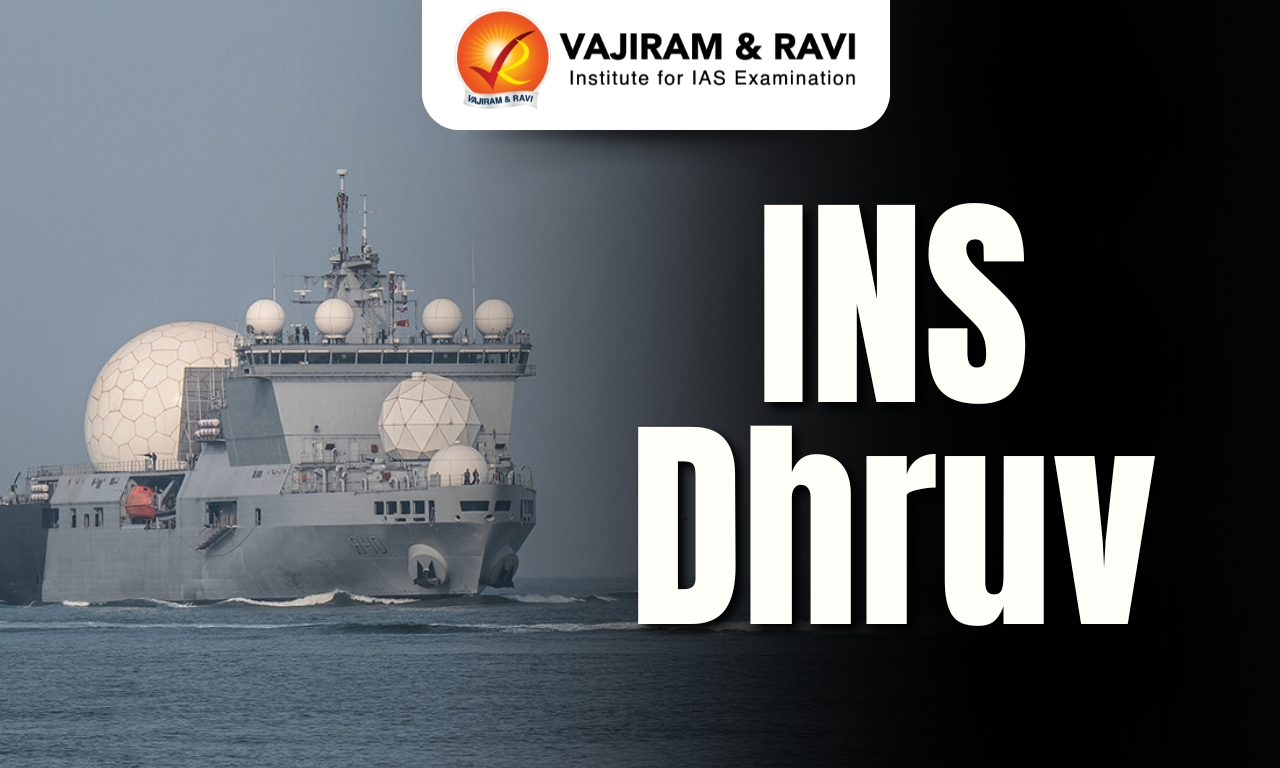
Recently, the Indian Navy has deployed its specialised missile-tracking and ocean-surveillance vessel INS Dhruv into the Arabian Sea immediately before Pakistan’s declared live-firing window.

About INS Dhruv

  • It is India's first dedicated nuclear missile tracking and ocean surveillance ship.
  • It was commissioned on 10 September 2021.
  • It was built by Hindustan Shipyard Limited in collaboration with Defence Research and Development Organisation (DRDO) and National Technical Research Organisation (NTRO).

Functions of INS Dhruv

  • The ship has the capability to map ocean floors, which aids in the research and detection of enemy submarines
  • It is a highly secretive strategic asset designed to track ballistic missiles and gather electronic intelligence (ELINT) to support India's missile defence programme.
  • It provides early warning of missile attacks and helps calibrate India's own ballistic missile defence systems by gathering data on flight trajectories and terminal performance.
  • It is operated jointly by the Indian Navy, the National Technical Research Organisation (NTRO), and the Defence Research and Development Organisation (DRDO).

Features of INS Dhruv

  • Displacement Capacity: It displaces 15000 tons.
  • Propulsion: It is powered by two diesel engines in CODAD configuration each generating 9000KW.
  • Speed: These engines can propel INS Dhruv to a maximum speed of 21 knots and generate
  • It is equipped with powerful X-band and S-band AESA radars, it can track nuclear-capable ballistic missiles and satellites from thousands of kilometres away.
  • It is capable of monitoring missile re-entry vehicles, distinguishing between different payload signatures and generating data useful for ballistic missile defence calibration, countermeasure development and strategic warning systems.

Source: DSA

INS Dhruv FAQs

Q1: What is the primary role of INS Dhruv?

Ans: Tracking missiles and satellites

Q2: When was INS Dhruv commissioned?

Ans: 2021

Startup India Fund of Funds 2.0, Objectives, Key Features

Startup India Fund of Funds 2.0

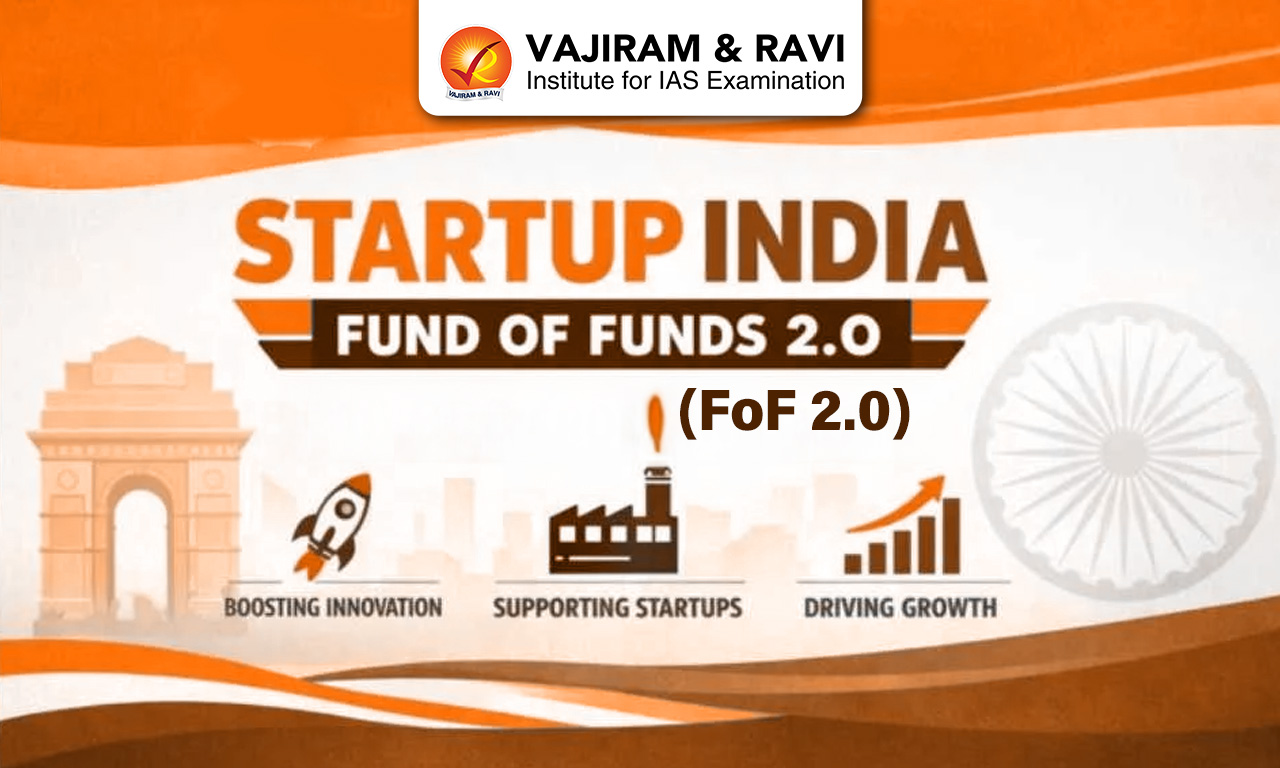
The Central Government has approved the establishment of ‘Startup India Fund of Funds 2.0’ with a total corpus of Rs. 10,000 crore for the purpose of mobilizing venture capital for the startup ecosystem of the country. The Scheme shall be known as the ‘Startup India Fund of Funds 2.0 (Startup India FoF 2.0)’.

Startup India Fund of Funds 2.0 Background

The Startup India Fund of Funds 2.0 scheme builds upon the earlier Fund of Funds for Startups (FFS 1.0). 

  • Fund of Funds for Startups (FFS 1.0) was launched in 2016 under the Startup India Action Plan to address funding gaps and catalyse the domestic capital for startups. 
  • Fund of Funds for Startups (FFS 1.0) played an important role in catalysing venture capital investments in India. It helped improve funding availability for startups, especially during their early stages.
  • However, gaps persisted in sectors such as deep technology and innovative manufacturing, where investment risks are higher and returns take longer to materialise. Startup India Fund of Funds 2.0 has been designed to address these specific shortcomings.

Startup India Fund of Funds 2.0 Objectives

The Startup India Fund of Funds 2.0 scheme aims to strengthen both the availability and quality of funding in the startup ecosystem.

  • It seeks to enable access to venture capital for startups across different stages and sectors.
  • It provides a focused push to innovation-driven manufacturing and long-gestation technologies.
  • It aims to support the development of smaller venture capital funds that invest in early-growth-stage startups.
  • It promotes innovation by nurturing startups working on complex and high-risk ideas.

Startup India Fund of Funds 2.0 Key Features

Corpus and Time Frame: The scheme has a total corpus of ₹10,000 crore. Investments will be spread across 16th and 17th Finance Commission cycles.

Priority Sectors: Special emphasis is placed on deep technology and advanced manufacturing. These sectors are critical for technological self-reliance and long-term competitiveness.

Co-Investment Framework: Acts as a common platform where the government, different ministries, and institutional investors can invest together in startups, allowing pooling of resources for priority sectors, reducing individual risk, and ensuring that larger and more strategic investments can be made in areas where funding needs are high.

Operational Framework: Startup India Fund of Funds 2.0 follows an indirect investment model, ensuring professional fund management and efficient allocation of resources.

  • The government does not invest directly in startups. Instead, it contributes to SEBI-registered Alternative Investment Funds (AIFs). These AIFs, in turn, invest in startups through equity and equity-linked instruments.
  • A Venture Capital Investment Committee (VCIC), comprising industry experts and stakeholders, will evaluate and recommend AIFs for funding. Preference will be given to AIFs managed by experienced professionals with a proven track record.

Segmented Investment Approach: Startup India Fund of Funds 2.0 adopts a four-segment structure, making it more targeted:

  • The first segment focuses on AIFs supporting deep-tech startups, which require higher investment and longer development cycles.
  • The second segment supports smaller AIFs investing in early-stage startups that are still in the process of developing products or services.
  • The third segment targets technology-driven and innovative manufacturing startups, aligning with broader industrial policy goals.
  • The fourth segment remains flexible, supporting AIFs investing across sectors and stages.

Implementation Mechanism: The Small Industries Development Bank of India (SIDBI) has been designated as the primary implementation agency. In addition, another domestic agency may be selected to assist in implementation.

Governance and Monitoring: An Empowered Committee, chaired by the Secretary of the Department for Promotion of Industry and Internal Trade (DPIIT), will monitor implementation and performance.

  • The EC will include representatives from various ministries, the National Startup Advisory Council, and experts from the startup ecosystem.
  • It will also have the authority to modify guidelines within the approved framework to ensure effective implementation.

Ecosystem Development: Up to 5% of returns can be utilised for activities such as capacity building, mentorship, workshops, and regulatory support.

Startup India Fund of Funds 2.0 FAQs

Q1: What is Startup India Fund of Funds 2.0?

Ans: Startup India Fund of Funds 2.0 is a government initiative with a corpus of ₹10,000 crore aimed at mobilising venture and growth capital for startups by investing in SEBI-registered Alternative Investment Funds, which further invest in eligible startups.

Q2: What is the main objective of Startup India Fund of Funds 2.0?

Ans: The main objective of Startup India Fund of Funds 2.0 is to improve access to funding for startups, especially in deep-tech, early-stage, and innovation-driven sectors where private investment is limited.

Q3: Who implements Startup India Fund of Funds 2.0?

Ans: Startup India Fund of Funds 2.0 is implemented primarily by the Small Industries Development Bank of India, with oversight from the Department for Promotion of Industry and Internal Trade and monitoring by an Empowered Committee.

Q4: How does Startup India Fund of Funds 2.0 work?

Ans: Startup India Fund of Funds 2.0 operates through an indirect investment model where the government provides capital to Alternative Investment Funds, and these funds then invest in startups based on their expertise and market assessment.

Q5: Which sectors are prioritised under Startup India Fund of Funds 2.0?

Ans: Startup India Fund of Funds 2.0 prioritises sectors such as deep technology, technology-driven manufacturing, and early-stage innovation, while also allowing flexibility for investments across different sectors.

Calamaria garoensis

Calamaria garoensis

Calamaria garoensis Latest News

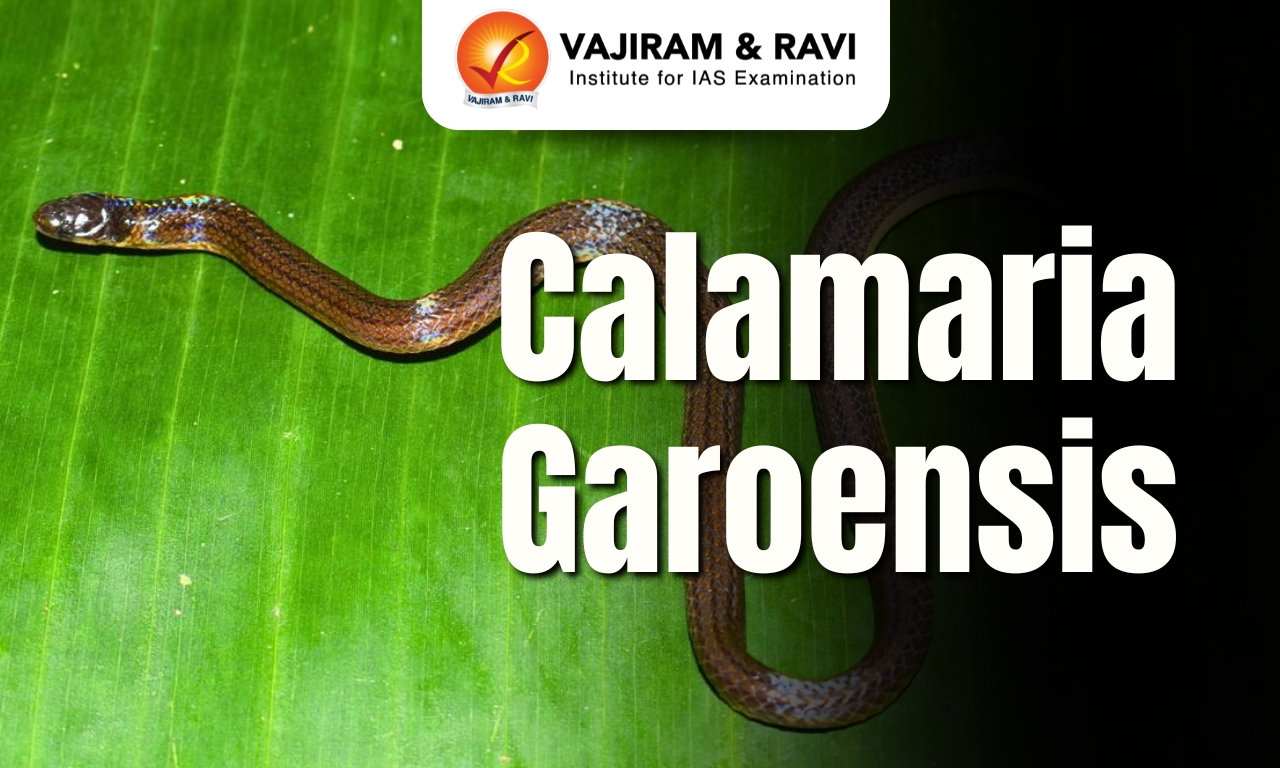
Recently, a team of researchers from multiple institutions has described a new species of burrowing reed snake from Meghalaya’s West Garo Hills district and named it as Calamaria garoensis.

About Calamaria garoensis

  • It is a new species of burrowing reed snake.
  • It is found mainly in Garo Hills of Meghalaya.
  • It is currently known only from this region, indicating a potentially restricted distribution .
  • Characteristics
    • It is characterised by smooth dorsal scales arranged in 13 rows, a short non-tapering tail with an obtuse tip, and a distinct broad median black stripe on the underside of the tail.
    • The body exhibits longitudinal striping along with a faint nuchal ring, distinguishing it from all known related species.

Key Facts about Reed Snakes

  • They are small, slender, non-venomous snakes.
  • Reed snakes of the genus Calamaria are small, secretive, and largely burrowing.
  • Appearance: Typically brown, reddish, or blackish in color.
  • Distribution: They are found in southern and southeastern Asia. 
  • Habitat: They are mostly found in moist forests, leaf litter, under logs, stones, and soil.
  • They are fossorial/semi-fossorial – spend most of their time underground or hidden in leaf litter.
  • Diet: They eat small, soft-bodied invertebrates

Source: TH

Calamaria garoensis FAQs

Q1: What is the typical habitat of Calamaria garoensis?

Ans: Moist forest floor and leaf litter

Q2: What is the common name of Calamaria garoensis?

Ans: Garo reed snake

Chalukya Dynasty, Origin, Rulers, Time Period, Founder

Chalukya Dynasty

The Chalukya Dynasty was one of the most influential dynasties in early medieval India, ruling large parts of the Deccan region between the 6th and 12th centuries. They laid the foundation for political stability, cultural development, and architectural innovation in South India. The Chalukyas are especially remembered for their powerful rulers, efficient administration, religious tolerance, and remarkable temple architecture.

Chalukya Dynasty Origin and Rise

The Chalukya Dynasty emerged in the 6th century in the Deccan region, with its base in present-day Karnataka. Under the leadership of Pulakesin I, the dynasty established a strong kingdom at Badami and gradually expanded into a powerful empire.

  • The dynasty was founded by Pulakesin I around 543 CE, marking the beginning of Chalukya rule.
  • He established his capital at Badami (ancient Vatapi), which became a major political and cultural center.
  • The early Chalukyas started as local chiefs under larger powers but gradually gained independence.
  • Strategic location in the Deccan plateau helped them control important trade and military routes.
  • The use of strong fortifications at Badami provided security and helped consolidate their rule.
  • The real expansion of the empire took place under Pulakeshin II, who turned the kingdom into a vast empire.
  • Pulakeshin II defeated Harsha, which established the Chalukyas as a major power in India.
  • Continuous conflicts with the Pallava dynasty further strengthened their military and political position.
  • The Chalukyas unified large parts of the Deccan, creating stability and encouraging cultural growth.

Branches of Chalukya Dynasty

The Chalukya Dynasty was divided into three major branches, each ruling different regions of the Deccan and contributing significantly to Indian history, culture, and architecture.

1. Badami Chalukyas (c. 543-753 CE)

  • Founded by Pulakesin I, who established Chalukya power in the Deccan.
  • Capital was Badami (ancient Vatapi), a strategically located and well-fortified city.
  • This branch marked the beginning of Chalukya political dominance in South India.
  • The greatest ruler, Pulakeshin II, expanded the empire across most of the Deccan plateau.
  • Pulakeshin II defeated Harsha, stopping northern expansion beyond the Narmada River.
  • Maintained long and intense conflicts with the Pallava dynasty, especially under Narasimhavarman I.
  • The Pallavas temporarily captured Badami, weakening Chalukya power.
  • The administration was well-structured with provinces, districts, and village-level governance.
  • Promoted early temple architecture at Aihole, Badami, and Pattadakal, laying the foundation of the Vesara style.
  • Encouraged both Sanskrit and Kannada languages in administration and literature.
  • Supported multiple religions, including Hinduism, Jainism, and Buddhism.
  • Their decline began due to continuous wars and internal weaknesses, leading to their defeat by the Rashtrakutas.

2. Eastern Chalukyas (c. 624-11th Century)

  • Founded by Kubja Vishnuvardhana, the brother of Pulakeshin II.
  • Established in the Vengi region with capital at Vengi.
  • Initially served as a subordinate branch of the Badami Chalukyas but later became independent.
  • Ruled for nearly four centuries, making them one of the longest-surviving branches.
  • Played a key role in the development and promotion of Telugu language and literature.
  • Maintained political stability in the eastern Deccan despite frequent conflicts.
  • Frequently involved in wars and alliances with the Chola dynasty.
  • Entered into matrimonial alliances with the Cholas, which strengthened political ties.
  • Acted as a cultural bridge between northern Sanskrit traditions and southern Dravidian culture.
  • Encouraged temple construction and religious activities in the region.
  • Their administration followed similar patterns to the Badami Chalukyas but adapted to local needs.
  • Eventually merged with the Chola Empire due to increasing political influence and alliances.

3. Western Chalukyas (c. 973-1189 CE)

  • Also known as the Kalyani Chalukyas, with capital at Basavakalyan.
  • Emerged after the decline of the Rashtrakuta Empire and revived Chalukya power in the Deccan.
  • Established a strong and stable kingdom in the later medieval period.
  • Known for efficient administration and decentralization of power to local authorities.
  • Introduced improved revenue systems and strengthened governance structures.
  • Played a key role in the transition of South Indian political and cultural systems.
  • Made significant contributions to temple architecture, especially using soapstone for detailed carvings.
  • Developed advanced features such as lathe-turned pillars and highly ornate temple designs.
  • Their architecture represents a transition between early Chalukya and Hoysala styles.
  • Encouraged Kannada and Sanskrit literature, supporting scholars and poets.
  • Engaged in conflicts with the Cholas and other regional powers for dominance in the Deccan.
  • Gradually declined due to the rise of powerful dynasties like the Hoysalas and Seunas (Yadavas). 

Chalukya of Badami

The Chalukyas emerged as a powerful force in the Deccan under the leadership of Pulakesin I (c. 533-566 CE), who transformed a small regional power into an independent kingdom. 

Pulakesin I (c. 533-566 CE)

  • Founder of the Badami Chalukya dynasty and first independent ruler.
  • Established Chalukya power in the Deccan region.
  • Made Badami (Vatapi) his capital due to its strong natural defenses of hills and rivers.
  • Built a strong hill-fort to secure his kingdom.
  • Performed the Ashvamedha sacrifice to declare sovereignty.
  • Adopted the title Vallabheshvara.
  • Laid the political and military foundation for future expansion. 

Kirtivarman I (566-597 CE)

  • Son and successor of Pulakesin I.
  • Expanded the kingdom through military conquests.
  • Defeated the Mauryas of North Konkan, the Nalas of Nalavadi, and the Kadambas of Banavasi.
  • Strengthened Chalukya control over Karnataka and surrounding regions.
  • Consolidated administrative structure and internal stability.

Mangalesa (597-609 CE)

  • Brother of Kirtivarman I; ruled as regent for his nephew.
  • Expanded the empire by defeating the Kalachuris of Chedi.
  • Established control over a vast region between the eastern and western seas.
  • Attempted to retain power instead of handing it to the rightful heir.
  • His actions led to a civil war with Pulakeshin II.

Pulakeshin II (609-642 CE)

  • One of the greatest rulers of the Chalukya dynasty.
  • Defeated Mangalesa in a civil war and ascended the throne.
  • Adopted the title Satyashraya.
  • Made the Chalukyas the paramount power in the Deccan.
  • Defeated southern powers like the Western Gangas and Alupas.
  • Northern rulers such as Latas, Malavas, and Gurjaras accepted his supremacy.
  • Successfully stopped the advance of Harshavardhana at the Narmada River.
  • Conquered the Vengi region and appointed his brother Kubja Vishnuvardhana as governor, leading to the rise of Eastern Chalukyas.
  • Initially defeated the Pallava dynasty and occupied northern territories.
  • Later defeated by Pallava ruler Narasimhavarman I, who captured Badami.
  • Maintained diplomatic relations with Persia; received an envoy from Khosrow II.
  • Visited by Chinese traveler Xuanzang.
  • Encouraged art, architecture, and learning; Aihole inscription written by Ravikirti.

Vikramaditya I (644-681 CE)

  • Son of Pulakeshin II who restored Chalukya power after decline.
  • Recovered territories lost to the Pallavas.
  • Formed alliances with the Pandyas.
  • Invaded and plundered Kanchipuram, avenging his father’s defeat.
  • Re-established stability and unity in the empire.

Vinayaditya (681-693 CE)

  • Ruled during a period of peace and prosperity.
  • Maintained stability and strong administration.
  • Focused on consolidation rather than expansion.

Vijayaditya (693-733 CE)

  • Had one of the longest and most peaceful reigns.
  • Period marked by economic growth and internal stability.
  • Encouraged large-scale temple construction and religious activities.
  • Strengthened administrative efficiency.

Vikramaditya II (733-745 CE)

  • Powerful ruler known for repeated victories over the Pallavas.
  • Invaded Kanchipuram multiple times and defeated the Pallavas decisively.
  • His victories ended Pallava dominance in the far south.
  • Successfully resisted Arab invasions in western India (especially Gujarat region).
  • Promoted art and temple architecture.

Kirtivarman II (744-745 CE)

  • Last ruler of the Badami Chalukya dynasty.
  • Faced internal weaknesses and external threats.
  • Defeated by Dantidurga.
  • Led to the rise of the Rashtrakuta dynasty.
  • Marked the end of the Badami Chalukya rule.

Eastern Chalukyas (c. 624 - 11th Century)

The Eastern Chalukyas were an important branch of the Chalukya dynasty that ruled the eastern Deccan region, particularly the fertile coastal plains of Andhra Pradesh. They were founded by Kubja Vishnuvardhana, the brother of Pulakeshin II, after the conquest of the Vengi region.

Political History and Struggles

  • Early rulers after Vishnuvardhana were mostly weak, leading to political instability.
  • Between 642 CE and 705 CE, frequent changes in rulers weakened the kingdom.
  • Internal family disputes and succession conflicts created instability.
  • The rise of the Rashtrakuta dynasty posed a serious threat.
  • Rashtrakutas repeatedly invaded and overran the Vengi region.
  • Stability was restored under Gunaga Vijayaditya III (848 CE), who resisted Rashtrakuta dominance.
  • He initially maintained friendly relations with Rashtrakuta ruler Amoghavarsha but later asserted independence.
  • Continuous conflicts with neighboring powers shaped the political structure of the kingdom.
  • Eventually, the Eastern Chalukyas were absorbed into the Chola Empire through alliances and succession.

Kubja Vishnuvardhana (624-641 CE)

  • Founder of the Eastern Chalukya dynasty.
  • Initially served as viceroy under Pulakeshin II.
  • Declared independence and established a separate kingdom in Vengi.
  • Known by the title Vishamasiddhi (conqueror of difficulties).
  • Likely died in battle during conflicts with the Pallavas.
  • Succeeded by his son Jayasimha I.

Mangi Yuvaraja (682–706 CE)

  • His reign marked the end of a series of weak rulers.
  • Faced increasing pressure from the Rashtrakuta dynasty.
  • Had to defend the kingdom against repeated invasions.
  • Began efforts to stabilize the kingdom.

Rajaraja Narendra (1019–1061 CE)

  • One of the most important rulers of the dynasty.
  • Established the city of Rajahmundry (Rajahmahendravaram).
  • His reign saw cultural and literary development.
  • Maintained close relations with the Cholas through marriage alliances.
  • Married Amangai Devi, daughter of Rajendra Chola I.
  • His son later became a ruler of the Chola Empire, leading to the merger of the two dynasties.

Administration under Eastern Chalukya

  • Early administration followed the model of Badami Chalukyas but later developed regional features.
  • Based on traditional Hindu political theory like Saptanga (seven elements of the state).
  • Important officials included ministers, priests, military commanders, and administrators.
  • Key administrative divisions were Vishaya (district) and Kottam (sub-division).
  • Royal orders were issued to local officers and village assemblies.
  • Land grants were common and often recorded in inscriptions.
  • Local chiefs and officers like Manneyas held land assignments.

Religion under Eastern Chalukya

  • Hinduism was the dominant religion, especially Shaivism.
  • Many rulers called themselves Parama Maheswara (devotees of Shiva).
  • Temples were built and religious festivals were organized.
  • Buddhism declined during this period.
  • Jainism continued to receive support and had strong public presence.
  • Jain temples and land grants are mentioned in inscriptions.
  • Ruler Vimaladitya was a follower of Jain teachings.

Architecture under Eastern Chalukya

  • Temple construction increased due to the popularity of Shaivism.
  • Vijayaditya II is said to have built 108 temples.
  • Yuddhamalla I built a Kartikeya temple at Vijayawada.
  • Bhima I constructed famous temples like:
    • Draksharama Temple
    • Samalkot Temple
  • Developed a distinct architectural style influenced by Pallava and Chalukya traditions.
  • Famous temple groups include:
    • Pancharama temples
    • Biccavolu temples
  • Golingeshvara Temple is known for sculptures of Shiva, Vishnu, Agni, and Surya.

Western Chalukyas (c. 973-1189 CE)

The Western Chalukyas, also known as the Kalyani Chalukyas, were a later branch of the Chalukya dynasty that ruled large parts of the Deccan from the late 10th to the 12th century. They revived Chalukya power after the decline of the Rashtrakutas and played a crucial role in the political and cultural history of South India. Their capital was at Basavakalyan (ancient Kalyani).

Origin and Establishment

  • Founded by Tailapa II in 973 CE after defeating the last Rashtrakuta ruler.
  • Re-established Chalukya authority nearly two centuries after the fall of the Badami Chalukyas.
  • Initially ruled from Manyakheta (former Rashtrakuta capital).
  • Later shifted capital to Basavakalyan (Kalyani), which became a major political and cultural center.
  • Claimed descent from the earlier Chalukyas to legitimize their rule.
  • Their rise marks the beginning of a new phase in Deccan politics.

Political Expansion and Conflicts

  • Controlled vast regions including Karnataka, parts of Maharashtra, Andhra Pradesh, and Telangana.
  • Constantly engaged in wars with the powerful Chola dynasty for control over the Vengi region.
  • The Tungabhadra River served as a natural boundary between Chalukya and Chola territories.
  • Fought against other regional powers like the Paramaras, Kalachuris, and Hoysalas.
  • Maintained a balance of power in the Deccan through both warfare and alliances.
  • Period marked by both military conflicts and political stability. 

Important Rulers and Their Contributions

We have described in brief all the important rulers of the Western Chalukyas along with their contributions to administration, society, religion, economy, art and architecture.

Tailapa II (973–997 CE)

  • Founder of the dynasty.
  • Defeated the Rashtrakutas and restored Chalukya prestige.
  • Consolidated control over the Deccan region.

Satyashraya (997–1008 CE)

  • Defended the kingdom against Chola invasions.
  • Maintained territorial integrity during external threats.

Someshvara I (1042–1068 CE)

  • One of the most capable rulers.
  • Strengthened administration and military organization.
  • Developed Basavakalyan as a prominent capital.
  • Continued conflicts with the Cholas for dominance in South India.

Vikramaditya VI (1076–1126 CE)

  • Greatest ruler of the Western Chalukyas.
  • His reign is considered the golden age of the dynasty.
  • Introduced the Chalukya-Vikrama Era in 1076 CE.
  • Defeated the Cholas and expanded political influence.
  • Ensured long-term peace, stability, and prosperity.
  • Patronized scholars like Bilhana and Vijnaneshwara.
  • Promoted literature, law, and culture.

Administration

  • Strong central monarchy supported by ministers and officials.
  • Kingdom divided into Mandalas (provinces), Nadus (districts), and villages.
  • Local self-government played an important role in administration.
  • Feudal system was prominent, with local chiefs (feudatories) controlling regions.
  • Land revenue was the main source of income.
  • Officers were appointed for tax collection, law enforcement, and justice.
  • Inscriptions mention grants to temples, Brahmins, and institutions.

Economy

  • Agriculture was the backbone of the economy, supported by irrigation tanks and canals.
  • Cultivation of crops like rice, millet, and pulses was common.
  • Trade flourished due to control over inland trade routes.
  • Trade links existed with other regions of India and possibly overseas.
  • Guilds of merchants and artisans played a significant role in economic life.
  • Use of coins and land grants facilitated economic transactions.

Religion and Society

  • Hinduism was dominant, especially Shaivism and Vaishnavism.
  • Rulers built temples and supported religious institutions.
  • Patronized Jainism, which had a strong presence in Karnataka.
  • Society was organized around temples, which acted as centers of social and economic activity.
  • Religious tolerance allowed multiple faiths to flourish.

Art and Architecture

  • Developed a unique architectural style known as the Later Chalukya or Kalyani style.
  • Used soapstone, which allowed detailed and intricate carvings.
  • Introduced lathe-turned pillars, a key architectural innovation.
  • Temples featured ornate doorways, sculpted ceilings, and detailed iconography.
  • Represent a transitional phase between early Chalukya and Hoysala architecture.

Important Temples

  • Mahadeva Temple – Known as the “Emperor among Temples”
  • Kashivisvesvara Temple – Famous for intricate carvings
  • Dodda Basappa Temple – Unique star-shaped structure

Decline

  • Continuous wars with the Cholas weakened the empire.
  • Rise of powerful regional dynasties like the Hoysalas and Seunas reduced their influence.
  • Internal rebellions and feudal fragmentation weakened central authority.
  • Gradual loss of territories led to decline by the late 12th century.

Chalukya Dynasty FAQs

Q1: What was the Chalukya Dynasty?

Ans: The Chalukya Dynasty was a powerful South Indian dynasty that ruled large parts of the Deccan from the 6th to 12th centuries, contributing significantly to politics, culture, and temple architecture.

Q2: Who founded the Chalukya Dynasty?

Ans: The dynasty was founded by Pulakesin I in the 6th century, with his capital at Badami.

Q3: Who was the greatest ruler of the Chalukyas?

Ans: Pulakeshin II is considered the greatest ruler due to his military achievements, including defeating Harsha and expanding the empire.

Q4: What were the main branches of the Chalukya Dynasty?

Ans: The dynasty had three main branches: Badami Chalukyas, Eastern Chalukyas (Vengi) and Western (Kalyani) Chalukyas

Q5: What was the capital of the Chalukyas?

Ans: The capitals varied by branch: Badami Chalukyas – Badami, Eastern Chalukyas – Vengi and Western Chalukyas – Basavakalyan

e-SafeHER Initiative

e-SafeHER Initiative

e-SafeHER Initiative Latest News

Recently, C-DAC, Hyderabad, a scientific society under the Ministry of Electronics and Information Technology (MeitY), Government of India and Reliance Foundation announced the launch of e-SafeHER initiative.

About e-SafeHER Initiative

  • It is a cyber-security awareness training programme to enable one million women across rural India.
  • It aims to strengthen last mile cybersecurity awareness, particularly among women in rural India, who are increasingly engaging with digital platforms for financial transactions, livelihoods and access to essential services. 
  • This initiative is anchored under Ministry of Electronics & IT (MeitY’s) Information Security Education and Awareness (ISEA) programme through C-DAC Hyderaba
  • Target and Duration: To empower one million Cyber Sakhis in rural India over the next three years.
  • Implementation Strategy
    • C-DAC will lead the development, localization, and continuous enhancement of cybersecurity training content under the ISEA Project.
    • Reliance Foundation will leverage its extensive grassroots presence and women’s empowerment platforms across rural India, for delivery through a peer-led, community-based model.
  • The initiative will be started first in Madhya Pradesh and Odisha and expanded nationwide in a phased manner.

Key Facts about Information Security Education and Awareness

  • It is an initiative of the Ministry of Electronics and Information Technology (MeitY), Government of India.
  • It was started in 2005 and currently in its third phase since Oct. 2023 onwards.
  • Purpose: Generating human resources in the area of Information Security and creating general awareness on cyber hygiene/cyber security among the masses.
  • Aim: It is aimed at human resources development for safe, trusted, and secure cyber space.

Source: PIB

e-SafeHER Initiative FAQs

Q1: In which states will e-SafeHER Initiative be started first before nationwide rollout?

Ans: Madhya Pradesh and Odisha

Q2: Under which Ministry and programme is e-SafeHER Initiative anchored?

Ans: Ministry of Electronics & IT (MeitY) – Information Security Education and Awareness (ISEA) programme

Shongtong Karcham Hydroelectric Project

Shongtong Karcham Hydroelectric Project

Shongtong–Karchham Hydroelectric Project Latest News

Himachal Pradesh Chief Minister recently reviewed the progress of the 450 MW Shongtong-Karcham Hydroelectric Project on the Satluj River during his two-day visit to Kinnaur district.

About Shongtong–Karchham Hydroelectric Project

  • It is a hydro power project on the river Satluj in the Kinnaur District of Himachal Pradesh.
  • The project is envisaged as a run-of-river (RoR) scheme. 
  • Capacity: 3 × 150 MW Francis turbines, totaling 450 MW.
  • The project includes:
    • Barrage - 26 m high, 122.6 m long at the top 
    • Four 260 m long underground chambers
    • 7.7 km headrace tunnel
    • 110 m high and 30.6 m diameter surge shaft
    • 23 m wide by 54 m high underground powerhouse
  • Once completed, the project is expected to generate around 1,579 million units of electricity annually.
  • It is being developed by Himachal Pradesh Power Corporation Limited (HPPCL).

Source: ANI

Shongtong Karcham Hydroelectric Project FAQs

Q1: The Shongtong Karcham Project is located in which district of Himachal Pradesh?

Ans: Kinnaur

Q2: On which river is Shongtong Karcham hydropower project located?

Ans: Satluj River

Q3: What is the total installed capacity of the Shongtong Karcham Hydroelectric Project?

Ans: 450 MW

Whole-Exome Sequencing (WES)

Whole-Exome Sequencing (WES)

Whole-Exome Sequencing (WES) Latest News

Scientists recently used a genetic sequencing technique called whole exome sequencing to discover a new rare genetic disease.

About Whole-Exome Sequencing (WES)

  • WES is the approach used to sequence only the protein-coding regions of the human genome
  • These protein-coding regions within the genome are known as exons, and they make up less than 2% of our entire genome, but they are very important because they contain about 85% of the genetic variants linked to different diseases.
  • Together, all the exons in a genome are known as the exome.
  • WES focuses on the exome and provides a more targeted approach compared to whole-genome sequencing (WGS), which sequences the entire genome, including non-coding regions. 
  • Since most disease-related mutations are found in the exome, this makes WES an effective tool for diagnosing genetic conditions and understanding disease mechanisms. 
  • WES is a faster and cost-effective alternative to WGS. It also simplifies the data analysis process.
  • WES is especially useful in research and clinical settings to identify both common and rare genetic variants.

Source: NM

Whole-Exome Sequencing (WES) FAQs

Q1: What is Whole-Exome Sequencing (WES)?

Ans: It is a technique used to sequence only the protein-coding regions (exons) of the genome.

Q2: What are exons in the human genome?

Ans: Exons are the protein-coding regions of genes.

Q3: What is the exome?

Ans: The exome is the complete set of all exons in a genome.

Q4: What percentage of the human genome do exons constitute?

Ans: Less than 2% of the entire genome.

Q5: What percentage of disease-related genetic variants are found in exons?

Ans: About 85% of disease-related genetic variants.

Eturnagaram Wildlife Sanctuary

Eturnagaram Wildlife Sanctuary

Eturnagaram Wildlife Sanctuary Latest News

Recently, a massive forest fire has engulfed hundreds of hectares of Eturnagaram Wildlife Sanctuary in Mulugu district.

About Eturnagaram Wildlife Sanctuary

  • It is located near the border of Maharashtra, Chhattisgarh, and Telangana of Telangana.
  • It was established in 1952.
  • Rivers: It has a water source called Dayyam Vagu, which separates the sanctuary into two parts.
    • The river Godavari also passes through it.
  • Terrain: The landscape is undulating, ranging from steep slopes to gentle slopes from west to east. 
  • The famous Sammakka-Saralamma Temple is situated inside the sanctuary.
  • Vegetation: The region is covered completely with thick natural vegetation, and it falls in the tropical dry deciduous.
  • Flora: It is rich in the growth of teak, bamboo, and other trees like madhuca and terminalia.
  • Fauna: This sanctuary provides shelter to Tiger, Leopard, Panther, Wolf, Wild Dogs, Jackals, Sloth Bear, Chousingha, Black Buck, Nilgai, Sambar, Spotted Deer, Four Horned Antilope, Chinkara, Black Buck, Gaur, and Giant Squirrels.

Source: NIE

Eturnagaram Wildlife Sanctuary FAQs

Q1: Which temple is situated inside Eturnagaram Wildlife Sanctuary?

Ans: Sammakka-Saralamma Temple

Q2: Which major river passes through Eturnagaram Wildlife Sanctuary?

Ans: Godavari

Chagas Disease

Chagas Disease

Chagas Disease Latest News

World Chagas Disease Day is observed every year on April 14 to raise awareness around the disease, and the impact it has on lives.

About Chagas Disease

  • Chagas disease, also known as American trypanosomiasis, is an inflammatory, infectious disease caused by the protozoan parasite, Trypanosoma cruzi. 
  • It is an illness that can cause serious heart and stomach problems.
  • It is the result of a complex health problem typical of neglected tropical diseases and socially- and environmentally-determined diseases.
  • It is named after Carlos Chagas, a Brazilian physician and researcher who on 14 April 1909 diagnosed the disease in a person for the first time. 

Chagas Disease Transmission

  • The most common way people are infected with Chagas is through the blood-sucking triatomine bugs.
  • This parasite is found in the feces of the triatomine bug.
  • These bugs also are called reduviid. They may also be known as “kissing bugs” because they tend to bite people’s faces.
  • The parasite can also be transmitted from mother to child during pregnancy or childbirth, through contaminated food and beverages, blood transfusions, organ transplants, or laboratory accidents.
  • Once a person has the infection, they remain infected for decades, often with no signs or symptoms of illness.
  • Chagas disease is common in South America, Central America, and Mexico, the primary home of the triatomine bug.

Chagas Disease Symptoms

  • Few people have symptoms at first. But over time, parasites can move to your tissues and cause chronic infections, leading to heart and digestive tract damage.
  • Left untreated, Chagas disease later can cause serious heart and digestive problems.

Chagas Disease Prevention

  • There is no vaccine to prevent Chagas disease. 
  • Vector control, reducing interaction between humans and vector insects, has been the most effective method of prevention.
  • Blood screening is necessary to prevent infection through congenital transmission, transfusion, and organ transplantation.

Chagas Disease Treatment

  • During the first phase of infection, treatment of Chagas disease aims to kill the parasite.
  • Later, it’s no longer possible to kill the parasite. Treatment in this later phase is about managing symptoms.

Source: HAM

Chagas Disease FAQs

Q1: What is Chagas disease?

Ans: It is an inflammatory infectious disease caused by the protozoan parasite Trypanosoma cruzi.

Q2: What is another name for Chagas disease?

Ans: American trypanosomiasis.

Q3: What is the most common mode of transmission of Chagas disease?

Ans: Through the bite of infected triatomine bugs.

Q4: What happens if Chagas disease is left untreated?

Ans: It can cause severe heart and digestive problems.

Anusandhan National Research Foundation

Anusandhan National Research Foundation (ANRF)

Anusandhan National Research Foundation Latest News

Recently, the Union Minister of State (Independent Charge) for Science & Technology informed that the Anusandhan National Research Foundation (ANRF) is developing AI-based platform ‘SARAL AI’. 

About Anusandhan National Research Foundation

  • It was established through the Anusandhan National Research Foundation Act, 2023.
  • It is functioning under the Department of Science & Technology (DST).
  • The Science and Engineering Research Board (SERB) has been merged into ANRF.
  • Objective: To seed, grow, and promote R&D, and foster a research and innovation culture across universities, colleges, research institutions, and R&D labs in India.
  • It acts as an apex body to provide high-level strategic direction of scientific research in the country as per recommendations of the National Education Policy.
  • Funding Target: It aims to mobilise funds amounting to ₹50,000 crore during 2023–28 through multiple streams including the ANRF Fund,  Innovation Fund, Science and Engineering Research Fund, and Special Purpose Funds.
  • ANRF forges collaborations among the industry, academia, research institutions and government departments.

What is SARAL AI?

  • It is an AI-based platform.
  • Objective: To convert complex technology and research work into simple language social media content, including podcasts and short videos in 18 Indian languages, enabling wider dissemination of scientific knowledge across the country.

Source: PIB

Anusandhan National Research Foundation FAQs

Q1: Which erstwhile body was dissolved and replaced by ANRF?

Ans: Science and Engineering Research Board

Q2: What is the total outlay envisaged for ANRF for five years?

Ans: ₹50,000 crore

Film Piracy in India – Legal Provisions and Enforcement Challenges

Film Piracy

Film Piracy Latest News

  • The leak of the Tamil film Jana Nayagan before its theatrical release has highlighted legal and enforcement challenges related to film piracy in India.

Film Piracy and Its Nature

  • Film piracy refers to the unauthorised copying, distribution or sharing of copyrighted audio-visual content such as movies and web series. It can occur through:
    • Illegal downloads and torrent platforms. 
    • Sharing via messaging apps and cloud links. 
    • Recording in theatres or leaking from production pipelines. 
  • The recent case is significant because the film was leaked in high quality even before its theatrical release, indicating internal access misuse. 

Legal Framework on Film Piracy in India

  • India has a multi-layered legal framework to address piracy.
  • Copyright Act, 1957
    • The Copyright Act forms the primary legal basis for protecting creative works.
    • Section 63 provides for imprisonment up to 3 years. 
    • It also allows fines up to Rs. 2 lakh. 
    • Section 63A deals with repeat offenders, imposing similar penalties for each violation. 
    • The Act covers films, books, music and other intellectual property.
  • Cinematograph Act, 1952 (Amended in 2023)
    • The 2023 amendment strengthened anti-piracy provisions.
    • It introduces a penalty of up to 5% of the audited gross budget of the film. 
    • This significantly increases financial deterrence for piracy. 
    • In high-value productions, this can result in extremely large fines.

Enforcement Challenges in India

  • Despite strong laws, enforcement remains weak.
    • India is often labelled a “notorious market” for piracy due to limited enforcement action. 
    • Investigations are rarely pursued rigorously. 
    • Legal action often targets distributors rather than individual infringers. 
  • However, in the current case, strong political and industry support may lead to stricter enforcement. 

Scope of Liability in Piracy Cases

  • Liability in piracy is not limited to the original leaker.
    • Individuals who forward links can also face penalties. 
    • Cloud sharing and digital dissemination expand the chain of liability. 
    • Early recipients of leaked content may face harsher punishment. 
  • This reflects the evolving nature of digital piracy, where distribution networks are decentralised.

Mechanisms Used by Studios to Prevent Piracy

  • Restricted Access and Encryption
    • Films are distributed to theatres in encrypted formats. 
    • Access is limited to authorised personnel only. 
  • Digital Rights Management (DRM)
    • OTT platforms use DRM technologies to prevent copying. 
    • However, advanced piracy tools can bypass DRM protections. 
  • Watermarking Techniques
    • Invisible and visible watermarks are embedded in film prints. 
    • These help identify the source of a leak. 
    • This acts as a strong deterrent for insiders.

Post-Leak Response Measures

  • Once a film is leaked, complete removal is nearly impossible.
  • Key challenges include:
    • Constantly changing piracy websites. 
    • Distribution through torrents and encrypted messaging platforms. 
    • Rapid replication across multiple platforms. 
  • However, studios still attempt mitigation through:
    • Copyright takedown notices to platforms. 
    • Collaboration with anti-piracy firms such as AiPlex. 
    • Blocking of infringing websites. 

Judicial Tools to Combat Piracy

  • Courts have developed innovative legal tools.
    • Dynamic injunctions: Allow continuous blocking of new piracy links. 
    • John Doe orders: Issued in anticipation of piracy even before release. 
  • These tools enhance proactive enforcement.

Source: TH | TH

Film Piracy FAQs

Q1: What is film piracy?

Ans: It is the unauthorised copying and distribution of films and other copyrighted content.

Q2: What punishment is prescribed under the Copyright Act?

Ans: Up to 3 years imprisonment and a fine of Rs. 2 lakh.

Q3: What is the key change in the Cinematograph Act amendment?

Ans: A penalty of up to 5% of the film’s audited budget.

Q4: Can sharing pirated links also be punished?

Ans: Yes, even forwarding links can attract legal penalties.

Q5: What are dynamic injunctions?

Ans: Court orders that allow continuous blocking of piracy websites and links.

Sudan

Sudan

Sudan Latest News

According to a new report by United Nations’ agency UN Women, Sexual violence against women and girls in Sudan has increased sharply during the country’s ongoing conflict.

About Sudan

  • It is a Northeast African country.
  • Bordering Countries: South Sudan, Ethiopia, Eritrea, Egypt, Libya, Chad, and Central African Republic.
  • Maritime Border: It shares its border with the Red Sea.
  • Capital City: Khartoum

Geographical Features of Sudan

  • Terrain: It is mainly composed of vast plains and plateaus that are drained by the Nile River and its tributaries.
  • Climate: The climate of Sudan varies from north to south. The northern part of Sudan is a desert climate, receiving little rainfall, shifting to semi-arid and the tropical savannah towards the South.
  • Highest point: Jabal Marrah 
  • River: The Nile River system is the dominant geographical feature, running from south to north across the country and draining all streams and rivers of Sudan.
  • Natural Resources: Petroleum; small reserves of iron ore, copper, chromium ore, zinc, tungsten, mica, silver, gold; hydropower

Source: DTE

Sudan FAQs

Q1: What is the capital city of Sudan?

Ans: Khartoum

Q2: Sudan shares a maritime border with which water body?

Ans: Red Sea

Right to Vote vs Right to Contest: How Right to Vote Impacts Elections in SIR Row

Right to Vote

Right to Vote Latest News

  • The Supreme Court of India denied interim relief to over 34 lakh individuals removed from electoral rolls in West Bengal after the SIR exercise, barring them from voting in upcoming elections.
  • The case underscores the tension between procedural integrity and individual electoral rights, raising concerns about how voter exclusion can directly affect democratic participation and candidacy.

Background: Contrasting Case Outcomes

  • Case of C. Geetha (Tamil Nadu)
    • C. Geetha filed her nomination on April 2, 2026 and began campaigning as an independent candidate. 
    • She later discovered her name had been deleted from the electoral roll, allegedly after officials skipped her house during the SIR exercise.
    • The Election Commission of India (ECI) stated the challenge was filed too late, as:  Nominations had closed; Electoral rolls were already frozen. 
      • Inclusion was only possible via a supplementary list, which requires a prior tribunal order.
    • The Supreme Court rejected her plea on April 10, upholding the ECI’s position.
  • Case of Motab Shaikh (West Bengal)
    • Motab Shaikh, an INC candidate, had his name deleted due to inconsistencies in records. He appealed promptly.
    • The appellate tribunal examined documents (Aadhaar, passport, driving licence, family records) and confirmed his identity. It ordered his name to be added to the supplementary list the same day.
    • The contrasting outcomes highlight how delays in appeal and rigid electoral procedures can determine eligibility, raising concerns about fairness and due process in large-scale voter deletions.

Court’s Position on Voting Rights

  • The Court described the right to vote as a key expression of citizenship and patriotism. It refused to allow excluded individuals to vote while their appeals are pending, citing procedural consistency and fairness.

Reasoning Behind the Decision

  • Allowing excluded voters to vote could create precedent-based complications.
  • It may lead to similar demands from those challenging voter inclusions, disrupting electoral integrity.
  • The Court emphasised consistency in electoral processes.

Broader Electoral Implications

  • The ruling highlights the strict linkage between inclusion in electoral rolls and voting rights.
  • Individuals excluded from rolls lose immediate electoral participation, even if their appeals are ongoing.
  • The situation highlights a key issue: pending appeals do not restore voting rights, leaving both voters and candidates in legal limbo during elections.

Impact on Candidates

  • A key concern arises for candidates whose names are deleted from voter rolls. 
  • Such individuals face uncertainty, as their eligibility to contest elections is tied to their status as registered voters.
  • The controversy underscores a critical democratic dilemma: the right to vote directly affects the right to contest elections, raising questions about fairness, timing, and due process in electoral roll management.

Legal and Procedural Constraints

  • Supplementary List Requirement - Under Rule 23(5) of the Registration of Electoral Rules, 1960, names can be added only after a tribunal allows the appeal. Without such a decision, no immediate correction is possible.
  • No Interim Relief During Appeals - Rule 23(3) does not allow temporary restoration of names while appeals are pending. Courts cannot order inclusion mid-process, even if sympathetic.
  • Procedural Deviations in SIR Exercise - The appellate process showed deviations from Rules 19 and 20, which require: Prior notice; Opportunity to be heard before deletion.

Right to Vote vs Right to Contest: Legal Distinction

  • Not Fundamental Rights - The Supreme Court, in Ram Chandra Choudhary v Roop Nagar Dugdh Utpadak Sahakari Samiti Ltd (2024), reiterated that neither the right to vote nor the right to contest elections is a fundamental right, but both are statutory in nature.
  • Key Distinction Between the Two Rights - The right to vote allows a person to exercise franchise as per the statutory framework. The right to contest is a separate and additional right, subject to eligibility conditions, qualifications, and disqualifications. 
  • Eligibility vs Disqualification - Eligibility is a threshold condition required to enter the electoral process. Lack of eligibility is not a punishment, but merely delays participation until conditions are fulfilled. This is distinct from disqualification, which carries legal consequences.

Implications for Candidates in SIR Deletions

  • Loss of Elector Status - Candidates whose names were removed from electoral rolls under the SIR exercise are not legally disqualified, but they lose their status as electors, which is essential to contest elections.
  • Legal Requirement Under Election Law - Under the Representation of the People Act, a candidate must be registered as a voter in any constituency within the relevant State to be eligible to contest.

Judicial Precedents Reinforcing the Principle

  • In Jyoti Basu v Debi Ghosal, the Supreme Court held that the right to contest is purely statutory.
  • In K Krishna Murthy v Union of India, it affirmed that political participation rights are subject to statutory limitations.

Emerging Concern: Scale of Administrative Impact

  • While the legal framework is well established, the current situation is unusual due to the large-scale administrative deletions under SIR, which have affected candidates who were often unaware of their exclusion.
  • The issue highlights how loss of voter registration, even without formal disqualification, effectively bars candidates from contesting, raising concerns about procedural fairness and electoral participation.

Source: IE

Right to vote FAQs

Q1: What is the SIR controversy in West Bengal?

Ans: The SIR controversy involves deletion of over 34 lakh voters from electoral rolls, raising concerns about voting rights and its impact on electoral participation.

Q2: Is the right to vote a fundamental right?

Ans: The right to vote is not a fundamental right but a statutory right, governed by election laws and subject to conditions like inclusion in electoral rolls.

Q3: How does the right to vote affect contesting elections?

Ans: The right to vote determines eligibility to contest, as candidates must be registered voters. Without this, they cannot legally contest elections.

Q4: Why did courts deny interim relief to excluded voters?

Ans: Courts denied relief due to procedural constraints, as electoral rules do not allow temporary restoration of voting rights while appeals are pending.

Q5: What are the broader implications of SIR deletions?

Ans: SIR deletions raise concerns about due process, fairness, and democratic participation, as large-scale exclusions can affect both voting rights and candidacy eligibility.

Minimum Wage Crisis: Why Minimum Wage Gap is Driving Worker Protests in India

Minimum Wage

Minimum Wage in Mandis Latest News

  • Thousands of factory workers in Noida protested—turning violent—over demands for minimum wage hikes, better working conditions, and overtime pay, amid rising living costs.
  • The immediate trigger was a 35% minimum wage hike in Haryana following protests in Manesar. Workers in neighbouring regions demanded similar wage revisions, sparking unrest in Noida.
  • The protests reflect growing distress due to rising living expenses, especially amid the West Asia war-induced inflation. Workers argue that wages have not kept pace with increasing costs of living.

Delay in Minimum Wage Revisions

  • Minimum wage has two components: 
    • Base wage – Revision supposed to take place every five years 
    • Cost of living allowance [Consumer Price Index-Industrial Workers (CPI-IW) linked] - This variable component is supposed to be revised twice a year.
  • However, base wage revisions have been delayed significantly: 
    • Haryana revised after 10 years 
    • Uttar Pradesh last revised in 2012, now offering only interim hikes
  • While most states carried out half-yearly revisions, they have missed out on the base minimum wage revisions, especially in the years after Covid-19.
  • The protests highlight a widening gap between inflation-driven expenses and delayed wage revisions, underscoring structural issues in India’s wage policy and labour welfare system.

Rising Cost of Living and Worker Distress

  • According to CPI-IW data (base year 2016), inflation for industrial workers rose by 24.8% nationally between February 2021 and February 2026. 
    • In key industrial regions, inflation was even higher—27.9% in Gurugram, 27.2% in Faridabad, and 27.4% in Ghaziabad, Noida, and Delhi.
  • However, minimum wage growth has not kept pace with rising prices: Haryana (rose only 15%); Uttar Pradesh (rose 24.6%); Delhi (rose only 20.6%).
  • This mismatch shows that real incomes of workers have declined, especially in Delhi-NCR.
  • Rising input costs due to US tariffs and disruptions like the Strait of Hormuz crisis have strained industries. This has led to delayed wage payments and job insecurity for workers.

Rising Household Expenses for Workers

  • Workers, many of whom are migrants, face increasing living costs:
    • LPG cylinders in black markets costing up to ₹4,000 
    • Rising room rents and food prices
  • These pressures have significantly worsened their financial burden.
  • The widening gap between inflation and wage growth, combined with industrial and global disruptions, has intensified economic stress for workers, fuelling protests and labour unrest.

Labour Codes and Worker Expectations

  • A key concern among protesting workers in Noida and Manesar was the expectation of higher wages following the notification of the four Labour Codes in November 2025. 
  • However, no such uniform wage increase materialised. 
  • Claims of a ₹20,000 minimum wage were clarified by the Uttar Pradesh government as misleading, since such rates applied only to central sphere establishments, not all factories.
  • The confusion stemmed from a 2024 Union government release indicating ₹783 per day (₹20,358 per month) for unskilled workers in certain sectors. 
  • Workers interpreted this as a universal minimum wage, while in reality, state-level rules determine wages for most establishments.

Uncertainty in Implementation of Labour Codes

  • The four labour codes—Code on Wages, Code on Social Security, Industrial Relations Code, and Occupational Safety, Health and Working Conditions (OSH) Code—came into effect in November 2025.
  • However, final rules are yet to be notified by the Centre and most states. Draft rules were issued in December 2025, creating uncertainty.

Working Hours and Flexibility Debate

  • The new codes define 8 hours per day and 48 hours per week, aligned with international norms.
  • However, daily work hours, rest intervals, and spread-over limits are yet to be formally specified.
  • This flexibility allows employers to introduce models like 12-hour shifts with extended weekly breaks, but has led to confusion and potential overwork.

Shift from Earlier Legal Framework

  • Under the Factories Act, 1948, daily working hours were capped at 9 hours, and spread-over hours at 10.5 (extendable to 12). 
  • The new codes shift regulatory power from Parliament to the executive, allowing states to decide details through rules. 

Concerns Raised by Experts and Workers

  • Risk of Exploitation - Experts argue that flexibility without clear safeguards is being misused by employers, leading to longer working hours in some sectors.
  • Lack of Uniformity Across States - Since states will notify their own rules: There may be regional disparities in wages and working conditions; Implementation may vary widely, creating confusion for workers and employers alike.
  • Weakening of Collective Bargaining - The new codes leave trade union recognition and collective bargaining largely to states, raising concerns about lack of a credible and uniform process for labour reforms.
  • While the Labour Codes aim to simplify regulations and standardise labour practices, delayed implementation, lack of clarity, and excessive flexibility have created confusion, unmet expectations, and concerns about worker protection.

Source: IE | ToI

Minimum Wage FAQs

Q1: Why are workers protesting in India?

Ans: Workers are protesting due to minimum wage stagnation, rising inflation, delayed wage revisions, and worsening living conditions, especially in industrial hubs like Noida and Manesar.

Q2: What are the components of minimum wage?

Ans: Minimum wage consists of base wage, revised every five years, and cost-of-living allowance linked to CPI-IW, revised twice yearly to reflect inflation trends.

Q3: How has inflation impacted workers?

Ans: Inflation for industrial workers rose sharply, but minimum wage growth lagged behind, reducing real incomes and increasing financial stress among workers in Delhi-NCR regions.

Q4: What role do labour codes play in protests?

Ans: Labour codes created expectations of higher minimum wage and better conditions, but delays in implementation and unclear rules caused confusion and dissatisfaction among workers.

Q5: What structural issues does the protest highlight?

Ans: The protests highlight delayed minimum wage revisions, policy gaps, weak labour protection, rising costs, and lack of uniform implementation across states.

Delimitation and Women’s Reservation Bills – A Structural Reset of India’s Electoral Framework

Delimitation and Women's Reservation Bills

Delimitation and Women’s Reservation Bill Latest News

  • The Union government has introduced three key Bills, including the Constitution (131st Amendment) Bill, 2026, to operationalise 33% reservation for women in the Lok Sabha and State Assemblies. 
  • These Bills also propose a major overhaul of the delimitation process, which has remained frozen since the 1970s.

The Legislative Package

  • The Constitution (131st Amendment) Bill, 2026 — proposes expansion of Lok Sabha and amends Articles 81 and 82.
  • The Delimitation Bill, 2026 — establishes a new Delimitation Commission framework.
  • A third Bill facilitating women's reservation in State Assemblies and Union Territory (UT) legislatures.

Key Provisions

  • Expanding the Lok Sabha:
    • From the current strength from the current 543 seats to up to 850, by revising the cap to 815 MPs from States and 35 from UTs. 
    • This represents a 50% increase over existing strength — and aligns with the seating capacity of 888 members in the new Parliament building (expandable to 1,272 for joint sittings). Larger membership would technically mean smaller constituency sizes geographically.
  • Women's reservation (The 2029 target):
    • Although the Constitution (106th Amendment) Act, 2023 had already legislated 33% reservation for women, its implementation was tied to a post-Census delimitation.
    • Since the 2021 Census remains ongoing with no clear completion timeline, the government now proposes conducting delimitation on the basis of the 2011 Census (the "latest Census").
    • Hence, the central government is targeting implementation from the 2029 Lok Sabha elections onwards.
  • Redefining "Population" under Article 81:
    • Shifting from "the last preceding Census" to "population as ascertained at such Census as Parliament may by law determine". 
    • This grants Parliament the discretion to choose which Census data underpins any given delimitation exercise, introducing political flexibility into a previously constitutional-mechanical process.

The North-South Divide - A Political Fault Line

  • Delimitation - a politically sensitive issue:
    • Southern states — TN, Kerala, Karnataka, Andhra Pradesh, Telangana — achieved lower population growth rates by successfully implementing family planning policies. 
    • A straight population-based delimitation would therefore reduce their share of Lok Sabha seats relative to high-growth northern states.
    • This concern led Parliament to freeze delimitation twice (in 1976 and 2001) — postponing seat readjustment until after the first Census post-2026. 
  • New mechanism:
    • The new Bills propose removing this time-linked freeze, replacing it with a Parliament-triggered process.
    • However, the constitutional principle (Article 81) that the population-to-seat ratio must be "as far as practicable, the same for all States" — directly conflicts with the commitment to preserve current regional seat proportions. 
    • Reconciling these two positions is expected to be the sharpest point of parliamentary debate.

Structural Shift in Delimitation

  • Renaming Article 82: From "Readjustment after each Census" to "Readjustment of constituencies", simultaneously removing the mandatory link between delimitation and decadal Census cycles.
  • From two-thirds to simple majority:
    • Historically, any deferral of delimitation required a two-thirds constitutional majority — precisely to prevent political manipulation of electoral boundaries. 
    • The proposed framework lowers this threshold to a simple parliamentary majority, potentially giving future ruling coalitions greater leverage to time delimitation exercises to political advantage.
  • Delimitation Commission: 
    • The Delimitation Bill, 2026 provides for a Commission that will work on the basis of the "latest Census figures" and established criteria such as administrative boundaries, physical features, and public convenience. 
    • However, no allocation formula is specified for distributing seats across states, leaving a visible gap between political assurance and legal architecture.

Challenges

  • Constitutional tension: The "one person, one vote, one value" principle under Article 81 is difficult to reconcile with the promise of maintaining existing seat proportions for southern states.
  • Lowered constitutional safeguards: Moving delimitation from a constitutionally-triggered to a legislatively-triggered process reduces institutional protection against political misuse.
  • Census delay: The ongoing 2021 Census has already derailed one implementation cycle; relying on the 2011 Census is a workaround, not a structural fix.
  • Women's reservation timeline: The 2029 target remains contingent on the delimitation process running smoothly and on time.

Way Forward

  • Parliament must debate and define a clear seat-allocation formula that satisfies both the constitutional requirement of equitable representation and the political commitment to regional fairness.
  • A transparent and independent Delimitation Commission with defined terms of reference — rather than broad legislative discretion — would strengthen public trust in the process.
  • Restoring some form of constitutional safeguard around the frequency and triggers of delimitation would prevent future politicisation of constituency boundaries.
  • The 2021 Census must be expedited, as continued delays will perpetuate uncertainty around future delimitations and reservation implementation.

Conclusion

  • The proposed Bills mark a transformative moment in India’s electoral and constitutional framework. 
  • While the intent to fast-track representation reform is evident, the shift from a rule-based to discretion-based system raises critical concerns about federal balance, electoral fairness, and constitutional integrity. 
  • The success of these reforms will depend on transparency, institutional safeguards, and political consensus, ensuring that the democratic promise of inclusive and equitable representation is truly realised.

Source: IE | IE

Delimitation and Women's Reservation Bills FAQs

Q1: What is the significance of the Constitution (131st Amendment) Bill, 2026?

Ans: It enhances representational capacity through smaller constituencies but raises concerns over equitable inter-state seat distribution.

Q2: How the proposed changes to Article 82 alter the nature of delimitation in India?

Ans: It transforms delimitation from a mandatory decadal constitutional exercise into a discretionary process controlled by Parliament.

Q3: What are the challenges in implementing women’s reservation in legislatures?

Ans: Delays due to delimitation dependency, lack of clarity on seat allocation, and political consensus remain key hurdles.

Q4: How does the delimitation debate reflect tensions between federalism and electoral equality?

Ans: Population-based seat allocation may uphold vote equality but risks undermining federal balance by disadvantaging southern states.

Q5: What are the implications of redefining ‘population’ under Article 81?

Ans: It introduces flexibility in seat allocation but increases the scope for political discretion and potential misuse.

Sakurajima Volcano

Sakurajima Volcano

Sakurajima Volcano Latest News

Recently, the Sakurajima volcano has erupted, sending huge plumes of ash billowing kilometres into the sky.

About Sakurajima Volcano

  • Location: It is located on the southern tip of Kyushu island near the city of Kagoshima, Japan.
  • It is one of Japan’s most active volcanoes and eruptions of varying levels take place on a regular basis.
  • Sakurajima is a stratovolcano formed from layers of lava and ash.
  • It is situated on a convergent plate margin.
  • It is an andesitic volcano (meaning it has a high gas content and is very viscous) located at the southern edge of the Aira caldera.
  • It is formed by the central cones of the Kitadake (northern peak) and the Minamidake (southern peak).
  • Sakura-jima formed an island until 1914, when an explosive eruption produced enough material to join the island to the peninsula on the east.

Key Facts about Stratovolcanoes

  • These are also known as composite volcanoes which are tall, steep, and cone-shaped types of volcanoes.
  • Unlike flat shield volcanoes, they have higher peaks.
  • They are built of successive layers of ash and lava.
  • The magma (molten rock) within the volcano is viscous and often contains trapped gas, causing explosive eruptions. 
  • Stratovolcanoes occur at the margins of tectonic plates, large sections of Earth’s crust that move together. 
  • The continental plates, composed of less dense material, override the oceanic plates.
  • Magma generated from the subducting plate rises and squeezes into cracks, eventually reaching the surface in a volcanic eruption.
  • They comprise the largest percentage (~60%) of the Earth’s individual volcanoes.

Source: TH

Sakurajima Volcano FAQs

Q1: What is Sakurajima known for?

Ans: It is one of Japan's most active volcanoes

Q2: What type of volcano is Sakurajima?

Ans: Stratovolcano

Daily Editorial Analysis 15 April 2026

Daily-Editorial-Analysis

Mapping the Legislative Vacuum in India’s Heat Crisis

Context

  • The phenomenon of extreme heat in India has undergone a significant transformation, evolving from a seasonal inconvenience into a widespread national crisis.
  • Once largely confined to the arid northwestern and central regions, heatwaves now affect coastal and temperate zones, with over 57% of districts classified as heat-prone.
  • Despite its broad geographic spread, the impact of extreme heat is unevenly distributed, revealing deep-rooted inequalities based on class, caste, and gender.
  • For millions of informal workers, heat is not merely discomfort, it is a fundamental threat to life and livelihood.

Changing Geography of Heatwaves

  • India’s heatwave patterns have expanded beyond their traditional boundaries.
  • Regions previously considered relatively immune, such as coastal and temperate areas, are now increasingly vulnerable.
  • This shift reflects broader climatic changes, making extreme heat a persistent and pervasive issue rather than a seasonal anomaly.
  • The result is a nationwide thermal canopy that affects all regions, albeit with unequal consequences.

Socio-Economic Dimensions of Thermal Inequality

  • While extreme heat affects everyone, its burden is disproportionately borne by the poor.
  • Affluent populations can mitigate heat exposure through private cooling systems, but nearly 400–490 million informal workers lack such cooling autonomy.
  • For them, survival depends on continued outdoor labour under hazardous conditions.
  • Even slight increases in temperature significantly reduce productivity, leading to income loss.
  • Consequently, workers are forced into a difficult choice between protecting their health and securing their livelihoods.

Frontline Realities: Evidence of Harm

  • Ground-level evidence reveals the harsh realities faced by vulnerable workers.
  • Sanitation workers and waste pickers operate in environments where heat is intensified by toxic emissions from unsegregated waste, creating dangerous micro-climates.
  • Reports of burns from handling heated waste without protective gear highlight the severity of these conditions.
  • This situation reflects a climate-caste nexus, where marginalised communities engaged in stigmatised occupations face the highest exposure to environmental hazards.

Sector-Wise Vulnerabilities

  • Gig Workers: Delivery personnel face algorithmic pressures that discourage rest, even during extreme heat alerts.
  • Construction Workers: High physical exertion combined with heat from materials like steel and concrete increases health risks.
  • Street Vendors: They suffer both physically and economically, as heat reduces customer activity and spoils perishable goods.

Legal and Institutional Gaps

  • India’s current legal framework is inadequate to address the challenges posed by extreme heat.
  • The Factories Act of 1948 provides protections only for indoor workers, leaving outdoor labourers unprotected.
  • Similarly, the Occupational Safety, Health and Working Conditions (OSHWC) Code of 2020 lacks mandatory provisions for heat safety, relying instead on discretionary measures.
  • Additionally, the exclusion of heatwaves from the Nationally Notified Disaster list limits states’ financial capacity to respond effectively.
  • This creates a fiscal vacuum, restricting the allocation of resources for relief and adaptation.

Towards Addressing Thermal Injustice

  • Recognition as a National Disaster: Including heatwaves in the National Disaster list would unlock funding and enable stronger administrative action.
  • Adoption of the Heat Index: Using a combined measure of temperature and humidity would provide a more accurate assessment of risk.
  • Strengthening Labor Protections: Mandatory work-rest cycles and provision of protective equipment should be enforced under existing labour laws.
  • Right to Cool: Recognising access to cooling as a fundamental right would ensure the establishment of public cooling shelters and water facilities.
  • Protection for Gig Workers: Legal safeguards must prevent platforms from penalising workers during extreme heat conditions.
  • Income Compensation Mechanisms: Financial support systems, including innovative insurance models, should be implemented to offset income loss.

Conclusion

  • Extreme heat in India is no longer just an environmental issue; it is a reflection of systemic social and economic inequalities.
  • The concept of thermal injustice highlights how vulnerable populations bear the brunt of climate impacts while lacking the means to adapt.
  • Addressing this crisis requires a shift from fragmented, advisory-based responses to a comprehensive framework grounded in rights, equity, and accountability.
  • Ensuring thermal safety must become an integral part of the social contract, reinforcing the constitutional promise of justice and dignity for all.

Mapping the Legislative Vacuum in India’s Heat Crisis FAQs

Q1. What is the Right to Cool?
Ans. The Right to Cool refers to the idea that access to cooling resources and protection from extreme heat should be recognized as a fundamental right under the right to life.

Q2. Who are the most affected by extreme heat in India?
Ans. Informal workers such as construction labourers, street vendors, and sanitation workers are the most affected.

Q3. What is meant by cooling autonomy?
Ans. Cooling autonomy refers to the ability to access resources like air conditioning to protect oneself from heat.

Q4. Why is the current legal framework inadequate?
Ans. The current legal framework is inadequate because it does not provide mandatory protections for outdoor workers against heat.

Q5. What is one suggested solution to address thermal injustice?
Ans. One suggested solution is to recognise heatwaves as a national disaster to enable better funding and response.

Source: The Hindu


Food Worth ₹1.55 Lakh Cr. Wasted Annually

Context

  • The International Day of Zero Waste, observed on March 30, highlights the urgent issue of food waste.
  • This year’s focus underscores the stark contradiction of massive food wastage alongside widespread hunger and malnutrition.
  • In India, such waste also reflects the loss of farmers’ and workers’ hard-earned produce and effort.
  • This article highlights the scale and implications of food waste in India and globally, examining its economic, environmental, and ethical dimensions while outlining systemic challenges and actionable pathways to reduce food loss.

Global Food Waste Crisis: A Moral and Systemic Failure

  • According to the United Nations Environment Programme Food Waste Index Report 2024, the world wastes 1.05 billion tonnes of food annually, with households contributing 60%, food services 28%, and retail 12%.
  • This massive wastage reflects systemic inefficiencies in supply chains, policy gaps, and consumption patterns, even as 783 million people face hunger and over 3.1 billion cannot afford a healthy diet.

India’s Paradox: Waste Amid Hunger

  • India ranks second globally in food waste, losing 78–80 million tonnes annually worth ₹1.55 lakh crore, behind China (108 million tonnes).
  • Despite lower per capita waste (55 kg annually compared to 73 kg in the U.S. and 75 kg in Germany), India ranks 111th in the Global Hunger Index, with about 194 million people undernourished.
  • This highlights a stark contradiction between food surplus and widespread hunger.
  • Punjab Case Study: Production Without Efficiency
    • Punjab produces surplus food but suffers heavy losses due to extreme weather and poor infrastructure.
      • Around 20% of fruits and vegetables are lost post-harvest.
      • Over 8,200 tonnes of foodgrains were damaged in FCI storage (2019–2024) — the highest in India.
      • Key issues include inadequate storage, weak cold-chain systems, lack of mechanisation, and poor packaging and grading, as highlighted by NITI Aayog.

Environmental Consequences

  • Food waste contributes 8–10% of global greenhouse gas emissions.
  • If it were a country, it would be the third-largest emitter after China and the U.S.
  • Decomposing food releases methane, a highly potent greenhouse gas. Additionally, wasted food implies loss of critical resources—water, land, energy, and labour.
  • For instance, producing 1 kg of rice requires ~5,000 litres of water, intensifying concerns like groundwater depletion in Punjab.

Structural Causes of Food Loss

  • Food waste is driven by:
    • Post-harvest inefficiencies at the farm level
    • Inadequate storage and cold-chain infrastructure
    • Fragmented logistics and supply chains
    • Cultural normalisation of waste in consumption patterns

Pathways to Reduce Food Waste

  • Strengthen Cold-Chain Infrastructure - India processes only 8% of its produce, compared to 65% in the U.S. A national cold-chain mission, especially in key agricultural states, is essential for reducing losses.
  • Legal Framework for Food Redistribution - Inspired by European models, India should enact laws to prevent destruction of surplus food and promote donation through tax incentives and food banks.
  • Empower Farmers at the Source - Post-harvest losses begin at the farm gate. Solutions include:
    • Mechanised drying and storage systems
    • Hermetic storage bags and mobile cold units
    • Reforming laws like the Jute Packaging Materials Act to allow modern storage solutions
  • Improve Data and Accountability - India lacks a national database on food waste. Mandatory measurement and public reporting for businesses, caterers, and institutions can improve accountability and efficiency.
  • Cultural and Behavioural Change - Reviving the traditional ethos of “Anna (food) as sacred” can drive responsible consumption. Awareness must translate into collective civic responsibility through education and community initiatives.

Conclusion: From Awareness to Action

  • Food waste is not just inefficiency—it is a moral, economic, and environmental crisis.
  • Addressing it requires systemic reforms, infrastructure investment, policy intervention, and a cultural shift towards valuing food as a precious resource.

Food Worth ₹1.55 Lakh Cr. Wasted Annually FAQs

Q1. What is the scale of global food waste?

Ans. Globally, 1.05 billion tonnes of food is wasted annually, with households contributing the largest share, highlighting systemic inefficiencies amid widespread hunger and food insecurity.

Q2. Why is India’s food waste situation concerning?

Ans. India wastes 78–80 million tonnes annually despite high hunger levels, reflecting a paradox of surplus production alongside widespread malnutrition and inadequate access to food.

Q3. What are the main causes of food loss in India?

Ans. Food loss arises from poor storage, weak cold-chain infrastructure, inefficient supply chains, post-harvest losses, and consumption patterns that normalise waste across households and markets.

Q4. How does food waste impact the environment?

Ans. Food waste contributes 8–10% of global emissions, wastes water and resources, and releases methane in landfills, worsening climate change and environmental degradation.

Q5. What measures can reduce food waste effectively?

Ans. Key measures include cold-chain development, food redistribution laws, farmer support, better data tracking, and promoting responsible consumption through cultural and behavioural change.

Source: TH

Daily Editorial Analysis 15 April 2026 FAQs

Q1: What is editorial analysis?

Ans: Editorial analysis is the critical examination and interpretation of newspaper editorials to extract key insights, arguments, and perspectives relevant to UPSC preparation.

Q2: What is an editorial analyst?

Ans: An editorial analyst is someone who studies and breaks down editorials to highlight their relevance, structure, and usefulness for competitive exams like the UPSC.

Q3: What is an editorial for UPSC?

Ans: For UPSC, an editorial refers to opinion-based articles in reputed newspapers that provide analysis on current affairs, governance, policy, and socio-economic issues.

Q4: What are the sources of UPSC Editorial Analysis?

Ans: Key sources include editorials from The Hindu and Indian Express.

Q5: Can Editorial Analysis help in Mains Answer Writing?

Ans: Yes, editorial analysis enhances content quality, analytical depth, and structure in Mains answer writing.

Enquire Now