Amphora

Amphora

Amphora Latest News

A Roman shipwreck over 2,100 years old has been recently located off the coast of Mazara del Vallo, Sicily, Italy, about five kilometers offshore and at a depth of 46 meters, with a cargo of around 500 amphorae.

About Amphora

  • It is an ancient vessel form used as a storage jar, particularly in Mediterranean cultures.
  • It is a two-handled pot with a neck that is considerably narrower than the body.
  • The term "amphora" originates from the Greek word meaning "carried on both sides."   
  • There are two types of amphora: 
    • the neck amphora, in which the neck meets the body at a sharp angle; 
    • the one-piece amphora, in which the neck and body form a continuous curve.  
  • The average normal height is about 18 inches (45 centimetres). 
  • These vessels served both practical and ornamental purposes
    • While functional amphorae were designed for trade and typically had a pointed base for upright storage, decorative versions were crafted for display within homes, often featuring a flat base. 
  • Initially appearing in the late Iron Age, amphorae were crucial for transporting various goods, such as wine, oil, and grains, and played a significant role in the development of the wine industry. 
  • Over time, the design of amphorae varied by region and era, leading to distinctive shapes that helped identify their origins. 
  • Archaeological discoveries of amphorae provide valuable insights into ancient trade, dietary practices, and societal structures, as they were commonly found in shipwrecks and excavation sites. 

News: DC

Amphora FAQs

Q1: What is an amphora?

Ans: An amphora is an ancient vessel form used primarily as a storage jar, particularly in Mediterranean cultures.

Q2: What is the characteristic shape of an amphora?

Ans: It is a two-handled pot with a neck that is considerably narrower than the body.

Q3: Where does the term “amphora” originate from?

Ans: The term originates from a Greek word meaning “carried on both sides.”

Q4: What purposes did amphorae serve?

Ans: Amphorae served both practical and ornamental purposes.

Q5: Which goods were commonly transported in amphorae?

Ans: Wine, oil and grains were commonly transported in amphorae.

Emergency Flight Landing, Meaning, Purpose, Recent Incidents

Emergency Flight Landing

Emergency Flight Landing is an early landing made when an aircraft faces a safety threat or urgent passenger or crew need. It may require diversion to the nearest suitable airport or airbase. If no airfield is reachable, an off airport landing or ditching may be necessary. After an emergency declaration, Air Traffic Control gives the aircraft priority over other operations to support safe landing.

Why is Emergency Flight Landing in News?

Emergency Flight Landing was in news after Chennai Airport declared a Full Emergency for IndiGo flight 6E-723 from Kolkata to Chennai after its left engine became inoperative. The aircraft landed safely with 224 persons onboard. The emergency was withdrawn later and airport operations returned to normal.

Emergency Flight Landing

Emergency Flight Landing procedures depend on the aircraft condition, emergency type and available landing site. Its main forms include forced landing, precautionary landing and ditching.

  • Types: The major types and procedures of Emergency Flight Landing are:
    • Forced landing: It becomes necessary after serious failures involving engines, hydraulics or landing gear. The pilot attempts to land quickly while reducing risks to people onboard.
    • Precautionary landing: It may follow aircraft problems, medical emergencies, police situations, weather changes or uncertain landing conditions that could increase flight safety risks.
    • Ditching: It is a forced landing on water when a suitable runway cannot be reached. The aircraft may sink after water contact depending on its design and damage.
    • Belly landing: It occurs when landing gear remains retracted or jammed, causing the aircraft to land on its underside. 
    • Crash landing: It involves severe impact that may cause major structural damage.
  • Emergency response: Pilots declare an emergency and seek priority clearance from Air Traffic Control. Fire tenders, medical teams and other emergency units may be deployed before landing.
  • Purpose: Emergency landing is usually done to protect passengers and crew when continuing the flight becomes unsafe due to technical failures, medical emergencies, severe weather, smoke alerts or other immediate risks.
  • Recent Incidents: An IndiGo Dubai-Mumbai flight diverted to Rajkot after a lower cargo hold smoke alert. In another incident, Air India flight AI2379 lost altitude above 36,000 feet. The DGCA secured its Flight Data Recorder and Cockpit Voice Recorder for investigation.
  • Government initiative: The Prime Minister inaugurated Northeast India’s first Emergency Landing Facility in Dibrugarh, Assam, in February 2026. It supports civil and defence aircraft during floods, earthquakes and other emergencies.

Emergency Flight Landing FAQs

Q1: What is an Emergency Flight Landing?

Ans: An Emergency Flight Landing is an early landing made when an aircraft faces a serious safety, technical, medical or operational emergency.

Q2: What are the main types of Emergency Flight Landing?

Ans: The main types are forced landing, precautionary landing and ditching, depending on the emergency and availability of a suitable landing site.

Q3: What happens after a pilot declares an emergency in Flight?

Ans: Air Traffic Control gives the aircraft priority, while airport emergency teams, including fire and medical units, prepare for its safe landing.

Q4: What is a Forced Emergency Flight Landing?

Ans: A forced landing occurs when an aircraft must land because of a major problem such as engine, hydraulic or landing gear failure.

Q5: What is an Emergency Flight Landing Facility?

Ans: An Emergency Landing Facility is a dedicated site designed to support rapid aircraft landing and take off during disasters and other emergencies.

Colletes bhutanicus

Colletes bhutanicus

Colletes bhutanicus Latest News

Recently, Colletes bhutanicus has been recorded for the first time in India from Tawang district of Arunachal Pradesh by scientists of the Zoological Survey of India (ZSI). 

About Colletes bhutanicus

  • It is a rare solitary Himalayan plasterer bee, recorded from Arunachal Pradesh for the first time.
  • The bee was found at elevations ranging from 1,500 metres to 3,800 metres.
  • Distribution: It has been recorded from Bhutan and China, including the Xizang region.
  • Features
    • Unlike honeybees, Colletes bees are solitary and do not live in large colonies.
    • Individual bees generally nest separately and play an important role in pollination by moving between flowers to collect pollen and nectar.
  • The study found the bee visiting 25 flowering plant species belonging to 10 botanical families, including economically important crops such as mustard, buckwheat, coriander, beans, chilli and eggplant.

Ecological Role of Bees

  • Honey bees are vital to agriculture because their pollination activities directly influence crop yields and quality.
  • They are the main pollinators of plants
  • They contribute significantly to maintaining biodiversity. By pollinating a diverse range of wild plants, honey bees help sustain the balance of ecosystems.
  • Bees are sensitive to environmental changes, making them excellent bioindicators.

Source: TH

Colletes bhutanicus FAQs

Q1: Colletes bhutanicus belongs to which family?

Ans: Colletidae

Q2: Bees of family Colletidae are commonly called by which name?

Ans: Plasterer bees or Cellophane bees

Hallaniyat Islands

Hallaniyat Islands

Hallaniyat Islands Latest News

A recent crude oil spill from the tanker Caroline Bezengi is threatening the pristine nature reserve near Oman's Hallaniyat Islands.

About Hallaniyat Islands

  • The Hallaniyat Islands, also known as the Kuria Muria Islands, is an archipelago of five islands located off the southeastern coast of Oman in the Arabian Sea.
  • From west to east, the islands are Al-Hasikiyah, Al-Sawda, Al-Hallaniyah, Qarzawit, and Al-Qibliyah. 
  • Al-Hallaniyah, the largest of the islands, is the only one inhabited.   
  • The habitat is characterised by rocky patches, coral reefs, and sandy substrates. 
  • The area overlaps with the Halaaniyaat Islands Key Biodiversity Area and the Oman Arabian Sea Ecologically or Biologically Significant Marine Area.  
  • The shallow water of the islands is characterized by its virgin nature and high diversity of corals, sponges, seaweeds, algae, fish, and other species.  
  • The Arabian Sea here is defined by the Somali Current and seasonal upwelling that creates one of the most productive marine zones in the Indian Ocean. 
  • Cold, nutrient-rich water rises from the deep during and after the monsoon season, fuelling plankton blooms that attract everything from whale sharks to humpback whales. 
  • The islands have significant strategic importance, as they lie along sea routes connecting the Indian Ocean and Arabian Sea.

News: DEVD

Hallaniyat Islands FAQs

Q1: Where are the Hallaniyat Islands located?

Ans: They are located off the southeastern coast of Oman in the Arabian Sea.

Q2: What are the five islands of the Hallaniyat Islands archipelago?

Ans: Al-Hasikiyah, Al-Sawda, Al-Hallaniyah, Qarzawit and Al-Qibliyah.

Q3: Which is the largest island in the Hallaniyat Island

Ans: Al-Hallaniyah is the largest island.

Q4: What types of habitats characterize the Hallaniyat Islands?

Ans: The habitat is characterized by rocky patches, coral reefs and sandy substrates.

Q5: What makes the shallow waters around the Hallaniyat Islands ecologically significant?

Ans: They are relatively pristine and support a high diversity of corals, sponges, seaweeds, algae, fish and other marine species.

Shruti Patrol Vessel

Shruti Patrol Vessel

Shruti Patrol Vessel Latest News

Recently the Next Generation Offshore Patrol Vessel (NGOPV) shruti was launched at M/s GRSE, Kolkata. 

About Shruti Patrol Vessel

  • It is the Next Generation Offshore Patrol Vessel (NGOPV).
  • Construction by: The construction of NGOPVs is concurrently being undertaken at two shipyards — Goa Shipyard Limited (GSL) and Garden Reach Shipbuilders & Engineers Ltd (GRSE), Kolkata.
  • These ships derive their name from India’s rich heritage, with this ship being named as ‘Shruti’, referring to four Vedas.
  • The crest design of the ship depicts the constellation of Ursa Major and a red & white coloured light house.
  • Functions: It is indigenously designed and will augment the existing OPVs/ NOPVs for multi domain operations, such as maritime surveillance, search and rescue, protection of offshore assets, HADR and anti-piracy missions

Key Features of NGOPVs

  • The NGOPVs are significantly larger and more capable than the Offshore Patrol Vessels
  • Capacity: They are with a displacement of 3,000 tonnes and achieve speeds of up to 23 knots and have an endurance of 8,500 nautical miles at a cruising speed of 14 knots,
  • Significance: It helps Indian Navy’s pursuit towards indigenous shipbuilding and is in consonance with Government of India’s vision of ‘Aatmanirbhar Bharat’ and ‘Make in India’ initiative.

Source: PIB

Shruti Patrol Vessel FAQs

Q1: What is the main role of Shruti Patrol Vessel ?

Ans: Coastal security and patrolling

Q2: What is the motto of the Indian Coast Guard?

Ans: Vayam Rakshamah - We Protect

Container Manufacturing Assistance Scheme

Container Manufacturing Assistance Scheme

Container Manufacturing Assistance Scheme Latest News

The Government has proposed a ₹10,000 crore Container Manufacturing Assistance Scheme (CMAS) to strengthen domestic production of shipping containers. 

About Container Manufacturing Assistance Scheme

  • It is a targeted initiative to establish a competitive domestic container manufacturing industry through financial and institutional support.
  • It supports establishment of new manufacturing facilities and expansion of existing units.
  • It also aims to enhance manufacturing capacity to meet India's growing demand for shipping containers.
  • Target: The initiative targets an annual domestic manufacturing capacity of around 10 times the existing container production capacity upto 7.5 lakh Twenty-foot Equivalent Units (TEUs).
  • Financial Outlay: ₹10,000 crore over five years.
  • To strengthen the container manufacturing value chain, the scheme provides:
    • Capital assistance for establishing new Greenfield manufacturing facilities.
    • Support for expansion of existing Brownfield manufacturing units.
    • Operational support to improve the competitiveness of domestic container manufacturing.
    • Support for testing infrastructure, skilling initiatives and capacity building.
  • CMAS complements the Government's initiatives under Make in India,Maritime Amrit Kaal Vision 2047, PM Gati Shakti, the National Logistics Policy and the Sagarmala Programme.

Source: DD News

Container Manufacturing Assistance Scheme FAQs

Q1: Which is the Nodal Ministry for Container Manufacturing Assistance Scheme?

Ans: Ministry of Ports, Shipping & Waterways

Q2: What is the main objective of Container Manufacturing Assistance Scheme?

Ans: Boost domestic manufacturing of shipping containers

Sangeet Natak Akademi

Sangeet Natak Akademi

Sangeet Natak Akademi Latest News

President Droupadi Murmu will confer the Sangeet Natak Akademi Fellowships (Akademi Ratna) and Awards (Akademi Puraskar) for 2024 and 2025 on 115 artists at a special investiture ceremony at Vigyan Bhawan in New Delhi.

About Sangeet Natak Akademi

  • It is India’s national academy for music, dance, and drama.
  • It is the first national academy of the arts set up by the Republic of India.
  • History:
    • It was set up by the Indian education ministry on 31 May 1952 and became functional the following year, with the appointment of its first chairman, Dr. P. V. Rajamannar. 
    • Dr. Rajendra Prasad, the first President of India, inaugurated it on 28 January 1953.     
  • Currently, it is an autonomous body of the Ministry of Culture, Government of India.  
  • Headquarters: New Delhi
  • Functions:
    • The academy functions as the apex body of the performing arts in the country to preserve and promote the vast cultural heritage of India expressed in music, dance, and drama. 
    • It also works with governments and art academies in states and territories of the country. 
  • In addition, the Akademi
    • Subsidizes the work of institutions engaged in teaching, performing, or promoting music, dance, or theatre.
    • Gives grants to aid research, documentation, and publishing in the performing arts.
    • Organises and subsidises seminars and conferences of subject specialists.
    • Documents and records the performing arts for its audio-visual archive.
    • Renders advice and assistance to the government of India in the task of formulating and implementing policies and programmes in the field.
    • Carries a part of the responsibilities of the state for fostering cultural contacts between regions in the country, as well as between India and the world.
    • Organises its annual festival of music, dance, and theatre in NCT Delhi.
  • The Sangeet Natak Akademi Awards are the highest national recognition conferred on practising artists. 
  • The Akademi also confers Fellowships on eminent artists and scholars of music, dance, and drama; and in 2006 instituted annual awards to young artists – the Ustad Bismillah Khan Yuva Puraskar. 
  • The Akademi’s archive, comprising audio and video tapes, photographs, and films, is one of the largest in the country and is extensively drawn upon for research in the performing arts. 
  • Management: 
    • The management of the Akademi vests in its General Council. 
    • The Chairman of the Akademi is appointed by the President of India for a term of five years. 

News: DDN

Sangeet Natak Akademi FAQs

Q1: What is the Sangeet Natak Akademi?

Ans: It is India’s national academy for music, dance and drama.

Q2: Who was the first Chairman of the Sangeet Natak Akademi?

Ans: Dr. P. V. Rajamannar was its first Chairman.

Q3: What is the present status of the Sangeet Natak Akademi?

Ans: It is an autonomous body of the Ministry of Culture, Government of India.

Q4: What is the primary objective of the Sangeet Natak Akademi?

Ans: Its primary objective is to preserve and promote India’s cultural heritage expressed through music, dance and drama.

Namibia

Namibia

Namibia Latest News

Recently, the Fourth Session of the India-Namibia Joint Trade Committee (JTC) was held in New Delhi.  

About Namibia

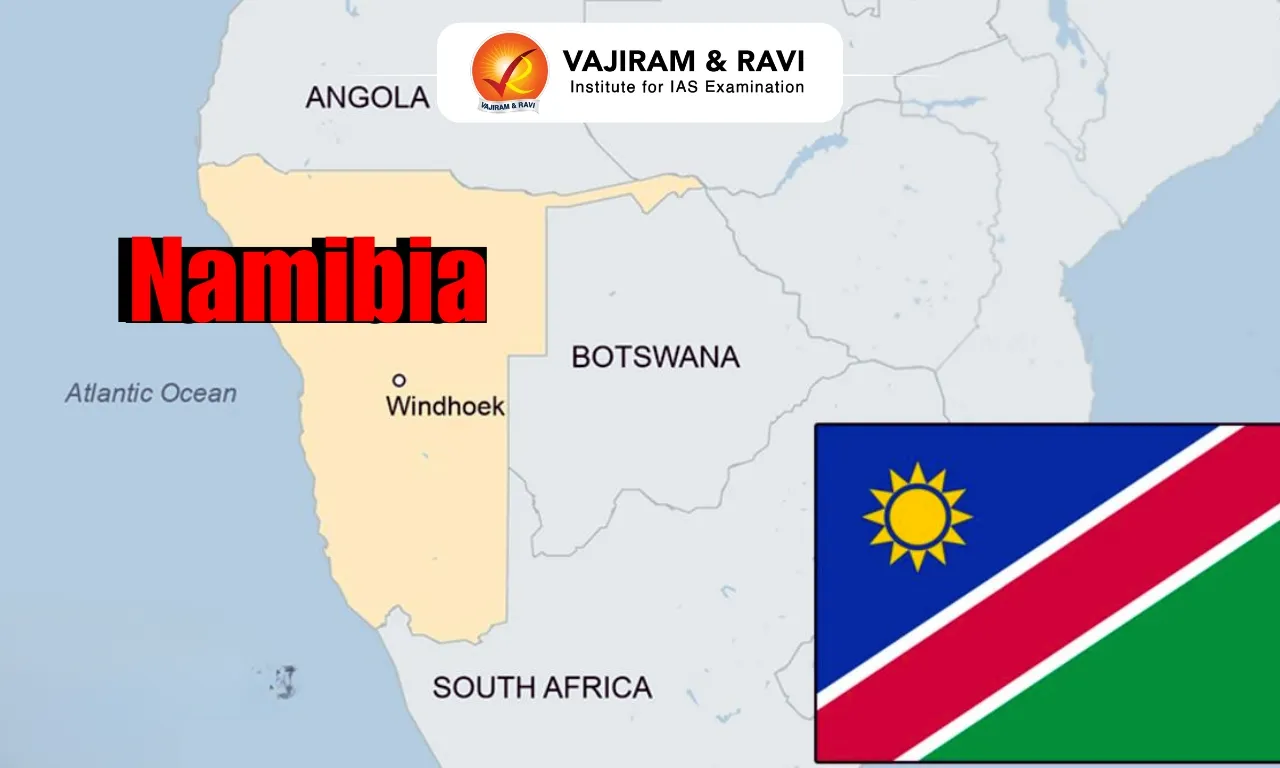
  • Location: It is located on the southwestern coast of the African continent.
  • Bordering Countries:  It is bounded by Zambia and Angola to the north, South Africa to the east and south, and Botswana to the east.
  • A small stretch of the Zambezi River separates Namibia from Zimbabwe.
  • Water Bodies: The Atlantic Ocean borders it to the west. 

Geographical Features of Namibia

  • Topography: Namibia’s extent can be divided into three topographic zones from west to east: the Namib Desert, the Central Plateau, and the Kalahari. 
  • The Central Plateau to the west with the Kalahari Desert located further inwards. The coastal Namib Desert runs along the country’s West coast on the Atlantic Ocean.
  • Rivers: It is drained by the rivers Kunene, the Okavango, the Mashi and the Zambezi on the northern border and the Orange on the southern.
  • Mountain: Brandberg, also known as Mount Brand is Namibia’s highest mountain and is located along the plateau’s western escarpment.
  • Natural Resources: It mainly consists of uranium, lithium, graphite, and manganese.

Source: PIB

Namibia FAQs

Q1: What is the Capital of Namibia?

Ans: Windhoek

Q2: Namibia shares border with how many countries?

Ans: 4 - Angola, Zambia, Botswana, South Africa

NAVYA Programme

NAVYA Programme

NAVYA Programme Latest News

Recently, the Minister of State (Independent Charge), Ministry of Skill Development and Entrepreneurship (MSDE) informed  the Lok Sabha about the NAVYA Programme. 

About NAVYA Programme

  • The NAVYA (Nurturing Aspirations through Vocational training for Young Adolescent Girls) was launched in 2025.
  • It aims to empower adolescent girls (AGs) aged 16–18 years in aspirational districts by equipping them with relevant skills for socio-economic independence.
  • It is a joint initiative of the Ministry of Skill Development & Entrepreneurship and the Ministry of Women & Child Development.
  • It is being implemented under the Pradhan Mantri Kaushal Vikas Yojana 4.0 (PMKVY 4.0).

Features of  NAVYA Programme

  • Skill Training: It focuses on empowering trained candidates to pursue diverse career pathways by providing industry-relevant skill courses with embedded On-the-Job Training (OJT).
  • Main Focus: Under NAVYA, special emphasis is placed on training in futuristic job roles, along with a mandatory Holistic Development Module covering digital literacy, financial literacy, career readiness, and entrepreneurship orientation etc.
  • Monitoring: The Government monitors and evaluates the implementation and outcomes of this programme through a robust monitoring framework under the Pradhan Mantri Kaushal Vikas Yojana (PMKVY).
  • The Skill India Digital Hub (SIDH) is leveraged for real-time tracking of beneficiary registration, attendance, training progress, certification and other key performance indicators.
    • Regular review meetings are conducted with Project Implementing Agencies (PIAs), State Skill Development Missions (SSDMs) and other stakeholders to assess progress and address implementation-related issues.

Source: PIB

NAVYA Programme FAQs

Q1: What is the Main aim of NAVYA Programme?

Ans: Socio-economic independence of adolescent girls

Q2: NAVYA is a joint initiative of which ministries?

Ans: It is a joint initiative of the Ministry of Skill Development & Entrepreneurship and the Ministry of Women & Child Development.

World Elephant Day 2026, History, Theme, Conservation Efforts in India

World Elephant Day 2026

World Elephant Day is observed every year on 12th August to spread awareness about the protection and conservation of elephants across the world. It highlights the importance of elephants in maintaining ecological balance and draws attention to major threats such as habitat loss, poaching, and human-elephant conflict. The day encourages governments, organisations and individuals to come together and take steps for the survival and well-being of elephants. It also promotes the idea of peaceful coexistence between humans and elephants

World Elephant Day 2026

  • World Elephant Day is a global awareness campaign celebrated every year on August 12 to protect and support elephants across the world.
  • It brings people together to raise awareness about the challenges elephants face and encourages action to help conserve them.
  • The campaign was started in 2012 with the aim of spreading knowledge about elephants, their intelligence, emotional depth, and importance in ecosystems while also highlighting the serious threats to their survival.
  • Over the years, World Elephant Day has reached millions of people worldwide through education programs, social media campaigns, and international events, helping build a strong global voice for elephant conservation.
  • The initiative is supported by World Elephant Society, a nonprofit organization that works to manage campaigns, spread awareness, and organize events focused on elephant protection. The organization depends largely on public support and donations to continue its efforts.
  • This day also recognizes the work of conservationists, wildlife organizations, and local communities who are actively working on the ground to protect elephants and their habitats.
  • Elephants today face many serious threats, including poaching for ivory, habitat loss, human-wildlife conflict, and climate change. World Elephant Day helps bring attention to these issues and encourages people to take meaningful steps toward solutions.
  • People celebrate this day by participating in awareness drives, educational programs, social campaigns, and conservation activities, all aimed at protecting these gentle giants for future generations.
  • World Elephant Day is not just about celebration, it is a global movement that inspires individuals and communities to take responsibility and contribute to the survival and well-being of elephants.

World Elephant Day 2026 Theme

The theme of World Elephant Day 2026, “Bringing the world together to help elephants,” highlights the need for global unity in protecting these majestic animals. It emphasizes collective responsibility across countries, communities, and organizations. The theme encourages awareness, conservation efforts, and stronger action against threats like poaching and habitat loss. Overall, it calls for people worldwide to work together to ensure a safe future for elephants.

Also Read:- Elephant Corridor in India

Key Facts About Elephants

  • Three Species: Elephants are of three types-African Savannah, African Forest, and Asian elephants. African elephants are larger with big ears, while Asian elephants have smaller ears.
  • Largest Land Animal: Elephants are the biggest animals on land, known for their size, strength, and intelligence.
  • Lifespan & Reproduction: They can live up to 60-65 years. Females have a 22-month pregnancy and reproduce slowly, making population growth difficult.
  • Family Structure: Elephant groups are led by a matriarch (oldest female) and have strong family bonds.
  • Tusks: Tusks are long teeth used for feeding, digging, and protection, but they also make elephants a target for ivory poaching.
  • Communication: Elephants communicate through sounds, touch, and ground vibrations, showing high intelligence.
  • Population Decline: Elephant numbers are rapidly decreasing due to poaching, habitat loss, and human conflict.
  • Protection Status (Asian Elephants):

Decline in Elephant Population

  • Elephant populations have dropped sharply in recent years, with some reports suggesting a decline of over 60% in the past decade.
  • If urgent action is not taken, elephants could face extinction in the near future.
  • In Africa alone, around 100 elephants are killed every day due to illegal activities like poaching.
  • Today, only about 400,000 African elephants are left in the wild.
  • The growing demand for ivory products has made illegal wildlife trade highly profitable, increasing the threat to elephants.
  • This alarming situation is one of the main reasons why World Elephant Day was created to spread awareness and promote conservation efforts.

Major Reasons Behind the Decline

1. Poaching

  • Elephants are often killed for their ivory tusks, which are sold illegally in global markets.
  • In some regions, elephants are also captured from the wild for use in tourism, zoos, and entertainment industries.
  • Young elephants are sometimes separated from their families and forced into captivity, which affects their physical and emotional well-being.

2. Habitat Loss

  • Rapid urbanization, farming, and infrastructure development are reducing elephant habitats.
  • Forests and natural areas are being divided into smaller patches, making it difficult for elephants to move freely and find food and water.
  • As their space shrinks, elephants are often forced to enter human areas, leading to conflict.

3. Human-Elephant Conflict

  • When elephants enter villages or farmland in search of food, it can result in damage to crops and property.
  • This creates tension between humans and elephants, sometimes leading to injuries or deaths on both sides.
  • Increasing human population and development projects like roads and railways are major causes of this conflict.
  • Creating wildlife corridors can help reduce these clashes by allowing elephants to move safely.

4. Mistreatment in Captivity

  • Many elephants in captivity are used for tourism, rides, or entertainment, often under poor conditions.
  • They are sometimes trained using harsh methods, which can cause long-term physical and mental harm.
  • Studies show that elephants in captivity often have shorter lifespans and health problems.
  • Supporting ethical tourism and avoiding activities like elephant rides can help reduce this cruelty.

Schemes and Conservation Efforts for Elephants in India

  • Project Elephant (1992): A centrally sponsored scheme focused on protecting elephants, their habitats, and migration corridors. It supports states through funding, anti-poaching measures, and conflict mitigation strategies. Now integrated with Project Tiger for better coordination.
  • Project RE-HAB (Bee Fencing Initiative): Launched by KVIC, it uses bee boxes along forest boundaries to prevent elephants from entering human settlements, helping reduce human-elephant conflict in a natural and non-harmful way.
  • Elephant Reserves: India has established 33 Elephant Reserves across 14 states to provide safe habitats and ensure long-term conservation of elephant populations.
  • Elephant Corridors: Around 150 corridors have been identified and protected to allow safe movement of elephants between fragmented forests, reducing conflict and maintaining genetic diversity.
  • Legal Protection Measures: Elephants receive the highest protection under the Wildlife (Protection) Act, 1972 (Schedule I), along with international protection under CITES Appendix I.
  • Use of Technology in Conservation: Tools like satellite monitoring and Land Use Land Cover (LULC) analysis are used to track habitat changes and identify threats.
  • MIKE Programme: The Monitoring of Illegal Killing of Elephants (MIKE) programme helps in tracking poaching trends and improving conservation strategies.
  • Institutional Support: The Wildlife Institute of India (Elephant Cell) provides research, training, and technical guidance to strengthen conservation efforts.
  • Habitat Protection Approach: Conservation is supported through protected areas like Tiger Reserves, Wildlife Sanctuaries, and Reserved Forests, ensuring a broader ecosystem-based approach.
  • Community Involvement: Increasing focus on local participation, awareness, and coexistence strategies to reduce conflict and ensure sustainable conservation.

World Elephant Day 2026 FAQs

Q1: What is World Elephant Day?

Ans: World Elephant Day is observed on 12th August every year to raise awareness about elephant conservation and the threats faced by elephants globally.

Q2: Why is World Elephant Day celebrated?

Ans: It is celebrated to highlight issues like poaching, habitat loss, and human-elephant conflict, and to encourage efforts for their protection and survival.

Q3: What is the theme of World Elephant Day 2026?

Ans: The theme for 2026 is “Bringing the world together to help elephants.”

Q4: When was World Elephant Day started?

Ans: World Elephant Day was launched in 2012 to promote awareness and global action for elephant conservation.

Q5: What are the major threats to elephants?

Ans: The main threats include ivory poaching, habitat destruction, climate change, and human-wildlife conflict.

Colombia Earthquake, Reason, Epicentre, Death Toll, Latest News 2026

Colombia Earthquake

The Colombia Earthquake of 2026 was a major seismic disaster that struck western Colombia on 10 August 2026. The 7.4 magnitude earthquake caused extensive destruction in Chocó, Pereira and Cali. As of 12 August, It killed at least 254 people, injured more than 2,600 and left nearly 3,900 people missing. The disaster also damaged about 1,600 buildings and nearly 5,000 homes.

Colombia Earthquake 2026 Latest News

The Colombia Earthquake triggered one of the country's largest disaster responses in recent years. The key highlights of the deadly earthquake are:

  • Magnitude: The earthquake measured 7.4 Mw. 
  • Epicentre: It occurred near San José del Palmar in Chocó, at a depth of about 100 kilometres.
  • Human Casualties: Separate reports from affected cities placed the death toll at 254, including 101 deaths in Pereira and 95 in Cali, while more than 2,600 people were injured.
  • Missing People: Nearly 3,900 people were reported missing as rescue teams searched collapsed buildings using cranes, sniffer dogs, heavy machinery and manual labour.
  • Structural Damage: Around 1,600 buildings were damaged across affected areas, while nearly 5,000 homes suffered damage, forcing many families to remain outdoors because of unsafe structures and aftershocks.
  • Economic Emergency Declaration: President Abelardo de la Espriella declared an economic emergency, allowing temporary economic and tax measures without congressional approval to strengthen disaster response.
  • International Assistance: The United States announced $15.5 million in emergency aid, while the European Union activated Copernicus satellite services and several countries offered additional assistance.

Colombia Earthquake Reasons

The major reasons of Colombia Earthquake are:

  • Tectonic Plate Movement: Colombia lies near the boundaries of the Nazca, Caribbean, Malpelo, North Andes and South American plates. Their movement and subduction generate strong seismic activity.
  • Active Fault Systems: Major faults such as the Bucaramanga-Santa Marta Fault, Romeral Fault System and Eastern Frontal Fault System can produce significant earthquakes across different parts of Colombia.
  • Pacific Ring of Fire: Colombia's location within the Pacific Ring of Fire increases its exposure to frequent earthquakes caused by active plate boundaries and associated geological processes.

Colombia Earthquakes History

Colombia has high seismic vulnerability because it lies near several tectonic plates and active fault systems associated with the Pacific Ring of Fire. Its earthquake history includes several destructive and unusual events.

  • Historical Record: The first historically recorded earthquake felt in Colombia occurred on September 11, 1530, while the first documented earthquake with an epicentre in present day Colombia occurred in 1566.
  • Strongest Recorded Event: The 1906 Ecuador-Colombia earthquake reached an estimated 8.8 Mw and generated a tsunami, with waves reaching about 5 metres.
  • Deepest Earthquake: A 1970 earthquake in Amazonas occurred at an estimated depth of 644.8 kilometres, making it the deepest registered earthquake in Colombia.
  • Recent Seismic Activities: Significant events include the 2016 Ecuador-Colombia earthquake of 7.8 Mw, the 2023 Central Colombia earthquake of 6.1 Mw and the 2025 Cundinamarca earthquake of 6.3 Mw.

Colombia Earthquake Impacts and Challenges

The Colombia Earthquake created humanitarian, economic, infrastructure and governance challenges across western Colombia. Its effects were intensified by difficult terrain and limited connectivity in rural areas.

  • Humanitarian crisis: Deaths, injuries, missing people and displacement created urgent requirements for rescue operations, temporary shelter, food, healthcare and family tracing services.
  • Infrastructure disruption: Damage to buildings, roads, electricity, water systems, healthcare facilities and communications disrupted essential services and slowed emergency operations.
  • Rural accessibility: Chocó has difficult terrain and limited transport connectivity, with some communities accessible mainly by boat, jungle routes or aircraft, delaying damage assessment.
  • Secondary hazards: Landslides and continuing aftershocks increased risks around damaged structures and could block roads, isolate communities and complicate rescue activities.
  • Economic effects: Road blockages and disruption at the main coffee export port halted coffee exports, creating wider logistics and supply chain concerns for Colombia's Arabica coffee sector.
  • Social vulnerability: Poor and structurally weak housing increased risks in vulnerable communities, while prolonged displacement could create additional health, sanitation and livelihood pressures.

Colombia Earthquake Management and Responses

Colombia activated national emergency mechanisms while international partners supported rescue, humanitarian assistance and damage assessment. The response focused on saving lives and supporting affected families.

  • National response: President Abelardo de la Espriella deployed military and police resources, engineers, rescue personnel and search dogs to affected locations.
  • Emergency assistance: The government provided immediate economic assistance to more than 1,400 families and announced temporary rental subsidies for households with damaged homes.
  • Search and rescue: Rescue teams in Pereira and Cali used cranes, heavy machinery, sniffer dogs and manual excavation to locate survivors trapped beneath collapsed structures.
  • United Nations role: The UN Resident Coordinator in Colombia coordinated assessment and emergency response efforts with national authorities and international agencies.
  • Specialised agencies: WFP supports food security, PAHO addresses health emergencies and UNDRR supports disaster risk reduction and resilience measures.
  • Disaster framework: Colombia's National Disaster Risk Management System, coordinated through the National Unit for Disaster Risk Management, provides the institutional framework for preparedness, response and recovery.
  • International cooperation: The European Union mobilised Copernicus satellite services, while the United States provided $15.5 million in emergency aid and other countries offered assistance.
  • Disaster risk reduction: The response highlights the importance of resilient infrastructure, early warning systems, rural connectivity and community preparedness under the Sendai Framework for Disaster Risk Reduction 2015-2030.
Also Read
Venezuela Earthquake 2026 Earthquake


Colombia Earthquake FAQs

Q1: What was the magnitude of the Colombia Earthquake 2026?

Ans: The Colombia Earthquake measured 7.4 Mw and struck western Colombia on 10 August 2026.

Q2: Where was the epicentre of the Colombia Earthquake 2026?

Ans: The epicentre was near San José del Palmar in Chocó, a seismically active region of western Colombia.

Q3: How many people died in the Colombia Earthquake 2026?

Ans: The death toll reached 254 people, while more than 2,600 people were injured and nearly 3,900 remained missing.

Q4: Which Colombian cities were worst affected by the earthquake?

Ans: Pereira and Cali were among the worst affected cities, reporting 101 and 95 deaths, respectively, according to the latest reports.

Q5: Why is Colombia vulnerable to earthquakes?

Ans: Colombia is highly earthquake prone because it lies near several tectonic plates and active fault systems associated with the Pacific Ring of Fire.

Rocky Mountains, Location, Highest Peak, Formation, Biodiversity

Rocky Mountains

The Rocky Mountains are also called the Rockies. They form the eastern part of the North American Cordillera. They extend about 4,800 km from northern British Columbia and Alberta to New Mexico. The range is the largest mountain system in North America. It contains more than 100 distinct ranges and includes some of the continent's highest peaks, major rivers, glaciers, forests, mineral deposits, national parks and diverse wildlife.

Rocky Mountains Features

The Rocky Mountains form a major north-south mountain system across western North America. Their physical features vary greatly with latitude, elevation, geology, climate and drainage patterns.

  • Location: The Rocky Mountains extend from northern British Columbia and Alberta in Canada to New Mexico in the United States. They lie between the Great Plains and western mountain and plateau systems.
  • Extent: The rocky mountain range stretches about 3,000 miles or 4,800 km. Its width varies from about 110 to 480 km, with some sections extending more than 300 miles across.
  • Major divisions: The Rockies include the Canadian and Northern Rockies, Middle Rockies, Southern Rockies and Colorado Plateau. These divisions differ in geology, landforms, drainage, soils and elevation.
  • Rocky Mountains USA: The United States portion includes major ranges in Montana, Idaho, Wyoming, Utah, Colorado and New Mexico. Colorado contains the largest concentration of the highest summits.
  • Highest peak: The rocky mountains highest peak is Mount Elbert in Colorado's Sawatch Range. It reaches 4,401 metres or about 14,440 feet above sea level.
  • Rocky Mountains Canada: Mount Robson in British Columbia is the highest peak of the Canadian Rockies. It rises to 3,954 metres or 12,972 feet.
  • Rocky Mountains height: Many peaks exceed 4,000 metres. Southern Rockies generally contain higher summits than the northern and middle sections.
  • Continental Divide: The Continental Divide passes through the Rockies. It separates drainage flowing towards the Atlantic and Pacific oceans and connects with major headwater systems.
  • Rivers: Important rivers include the Colorado, Columbia, Missouri, Arkansas, Rio Grande, Snake, Green, San Juan, Athabasca and Fraser. The mountains act as major water sources for western North America.
  • Glaciers: The Columbia Icefield lies on the Continental Divide in the Canadian Rockies. It covers elevations of about 3,000 to 4,000 metres and includes the Athabasca Glacier.
  • Climate: Climate varies from Arctic conditions in the north to subtropical influences in the south. Winters are cold, summers are generally cool at high elevations and precipitation increases towards the north.
  • Soil: Rocky Mountain soils are generally thin, young, shallow and nutrient poor. Some valley soils support irrigation based agriculture, while grazing is more widespread.
  • Mountain Division: Rocky Mountains on map appear as a long north-south belt along western North America. They form the easternmost major division of the North American Cordillera.

How Were The Rocky Mountains Formed?

The presentRocky Mountains (Rockies) developed through long term tectonic activity, uplift, erosion, volcanic processes and repeated glaciation across western North America.

  • Ancient rocks: The foundation includes Precambrian metamorphic and sedimentary rocks. Some exposed rocks are more than 3.3 billion years old and form ancient continental cores.
  • Laramide Orogeny: The main modern mountain building occurred about 80 to 55 million years ago during the Laramide orogeny. Plate movement produced broad uplift and crustal deformation.
  • Shallow subduction: The Farallon Plate moved beneath the North American Plate at a relatively shallow angle. This transferred compressional forces far inland and helped raise the Rocky Mountain region.
  • Erosion and glaciers: After uplift, rivers, weathering and glaciers reshaped the mountains. Pleistocene glaciations carved U shaped valleys, cirques, ridges and other distinctive landforms.

Rocky Mountains Biodiversity

The Rocky Mountains support varied ecosystems because elevation, latitude, moisture and temperature create several distinct habitats across the range.

  • Flora: Lower areas contain grasslands and shrubs. Montane forests include aspen, ponderosa pine, Douglas fir and lodgepole pine. Higher zones contain spruce, fir, krummholz and alpine tundra.
  • Fauna: Major mammals include grizzly bears, black bears, wolves, mountain lions, wolverines, elk, moose, bighorn sheep, mountain goats, mule deer, pronghorn and white tailed deer.
    • Birdlife: Bald eagles, golden eagles, peregrine falcons, ospreys, turkey vultures, grouse, ptarmigan, cranes, herons, ducks and trumpeter swans occur across different habitats.
    • Aquatic life: Mountain rivers and lakes support trout, including rainbow trout and northern waters contain Arctic grayling. Several native aquatic species face pressure from habitat alteration.
  • Indigenous people: Indigenous communities have inhabited the Rockies for thousands of years. Major groups include Blackfoot, Crow, Cheyenne, Shoshone, Ute, Arapaho, Kutenai, Flathead, Bannock and Coeur d'Alene.
  • Protected areas: Major protected landscapes include Yellowstone, Glacier, Grand Teton, Rocky Mountain, Banff, Jasper, Yoho, Kootenay and Waterton Lakes national parks.
  • Rocky Mountain National Park: The rocky mountains national park area in Colorado protects high elevation ecosystems, alpine landscapes, forests, wildlife and important headwaters.
  • Conservation: Protected forests and parks conserve wildlife habitat and watersheds. Wolf, grizzly bear, bald eagle and peregrine falcon populations have benefited from conservation and recovery measures.
  • Environmental threats: Mining, logging, grazing, oil exploration, roads and reservoirs can increase erosion, alter streams, damage habitats and release harmful metals into water systems.

Rocky Mountains Significance

The Rocky Mountains are important for water security, biodiversity, minerals, energy, tourism, forests, agriculture, recreation and the physical geography of North America.

  • Water resources: The mountains receive substantial precipitation and store water as snow and ice. Their rivers supply water for irrigation, domestic use, industry, hydropower and flood management.
  • Mineral wealth: The Rockies contain copper, gold, silver, lead, zinc, molybdenum, uranium, beryllium, tungsten, phosphate rock, gypsum, limestone and other mineral resources.
  • Energy resources: Major basins contain coal, petroleum, natural gas, oil shale and coalbed methane. The Powder River Basin and San Juan Basin are important energy producing regions.
  • Agriculture: Mountain valleys and adjoining plains support livestock grazing and irrigated farming. Seasonal movement between high summer pastures and lower winter areas is known as transhumance.
  • Tourism: Millions of visitors travel to the Rockies for hiking, camping, mountaineering, fishing, hunting, skiing, snowboarding, mountain biking and wildlife viewing.
  • Forestry: Canadian Rocky forests contribute significantly to timber production. Forest resources support sawmills and pulp and paper industries, while recreational uses dominate many U.S. national forests.
  • Geographic importance: The Rockies form a major physical barrier in western North America. Their elevation influences precipitation, river systems, climate patterns, settlement, transport and regional ecosystems.
  • Economic importance: Mining, energy production, forestry, agriculture, tourism, recreation and service industries create substantial economic activity across communities surrounding the mountain system.
  • Cultural importance: Indigenous histories, exploration routes, mining settlements, railways, parks and mountain communities have shaped the cultural landscape of the Rockies.
Also Check Other Posts
Biosphere Reserves in India National Parks in India
Waterfalls in India Highest Peak in India
Ramsar Sites in India Wildlife Sanctuaries in India
Dams in India Tiger Reserves in India
Mountain Passes in India Longest Bridge in India


Rocky Mountains FAQs

Q1: Where are the Rocky Mountains located?

Ans: The Rocky Mountains extend from northern British Columbia and Alberta in Canada to New Mexico in the United States.

Q2: What is the highest peak of the Rocky Mountains?

Ans: Mount Elbert in Colorado is the highest peak of the Rocky Mountains, reaching 4,401 metres or 14,440 feet.

Q3: Which national parks are located in the Rocky Mountains?

Ans: Major national parks include Yellowstone, Glacier, Grand Teton, Rocky Mountain, Banff, Jasper, Yoho, Kootenay and Waterton Lakes.

Q4: In What 6 States Are The Rocky Mountains Located?

Ans: The Rocky Mountains extend across Montana, Idaho, Wyoming, Utah, Colorado and New Mexico in the United States.

Q5: Why Are They Called Rocky Mountains?

Ans: They are called the Rocky Mountains because their rugged, rocky terrain inspired the name used by Indigenous peoples and later European explorers.

Prevention of Atrocities Act, 1989 – Protection, Relief and Rehabilitation

Prevention of Atrocities Act

Prevention of Atrocities Act News

  • A Central task force and the National Commission for Scheduled Tribes (NCST) have proposed changes to strengthen the implementation of the SC/ST (Prevention of Atrocities) Act, 1989, including enhanced compensation, counselling and protection of tribal livelihoods. 

SC/ST (Prevention of Atrocities) Act, 1989

  • The Scheduled Castes and the Scheduled Tribes (Prevention of Atrocities) Act, 1989, is a special legislation enacted to prevent atrocities against members of the Scheduled Castes (SCs) and the Scheduled Tribes (STs), provide relief and rehabilitation to victims, and establish mechanisms for dealing with such offences.
  • The Act recognises that members of SC and ST communities can face forms of violence, humiliation, social exclusion, dispossession and exploitation linked to their social identity. 
  • It therefore provides safeguards beyond those available under general criminal law.
  • The Act came into force in 1990 and was subsequently strengthened through amendments, particularly in 2015 and 2018.

Key Features

  • The Act identifies a range of acts that constitute atrocities when committed against SC/ST persons. 
  • These include offences involving physical violence, humiliation, social discrimination, dispossession from land and interference with rights and dignity.
  • It also provides for:
    • Special and Exclusive Special Courts for the speedy trial of offences. 
    • Special Public Prosecutors for conducting cases. 
    • Relief and rehabilitation for victims and their dependents. 
    • Preventive measures by governments and district authorities. 
    • Protection of victims and witnesses. 
    • The law, therefore, combines criminal justice, victim compensation and preventive administration.
  • 2015 Amendments
    • The 2015 amendments expanded the list of offences covered under the Act and strengthened the rights of victims. They also introduced provisions relating to:
      • Presumption in certain circumstances. 
      • Protection of victims and witnesses. 
      • Greater accountability of public servants for wilful neglect of duties. 
      • Establishment of Exclusive Special Courts in appropriate cases. 
  • 2018 Amendment
    • The 2018 amendment was introduced following widespread protests by SC and ST communities after a Supreme Court judgment concerning safeguards against alleged misuse of the Act.
    • The amendment restored the position that no prior approval is required for the arrest of a person accused under the Act, subject to the statutory framework, and that anticipatory bail is not ordinarily available in cases under the Act, subject to the Supreme Court's constitutional interpretation.
    • The task force's current recommendations seek changes primarily to the Rules framed under the Act, while the NCST has separately proposed amendments to the Act itself

News Summary

  • An internal task force headed by the Secretary, Ministry of Social Justice and Empowerment, has recommended amendments to the SC/ST (Prevention of Atrocities) Rules.
  • One of the major proposals is to increase the relief and rehabilitation amounts provided to victims and their dependents to account for inflation.
  • At present, the prescribed relief ranges from Rs. 85,000 to Rs. 8.25 lakh, depending on the seriousness of the offence and the extent of injury or harm suffered. These amounts were fixed in 2016. 
  • The task force has also proposed establishing special relief and rehabilitation cells in States and Union Territories to strengthen implementation and ensure that assistance reaches victims more effectively.
  • Counselling and Faster Case Processing
    • The proposed amendments also include counselling mechanisms for victims, their dependants and accused persons.
    • Another recommendation is that FIRs and chargesheets should be forwarded to the concerned government officials within 24 hours. The objective is to improve administrative monitoring and ensure that cases do not face unnecessary delays. 
    • The recommendations were contained in a report submitted to the Centre in July 2026.

NCST Proposals for Tribal Land and Livelihoods

  • Separately, the National Commission for Scheduled Tribes (NCST) has suggested amendments to the SC/ST (Prevention of Atrocities) Act, 1989.
  • A key concern is the protection of the livelihoods of Scheduled Tribe communities whose land has been alienated and who become involved in prolonged legal disputes over their land.
  • The NCST has also called for measures to prevent the registration of "counter FIRs" against individuals who report atrocity cases. 
  • Such cases can potentially place additional pressure on victims and discourage reporting of offences. 
  • These recommendations underline that protection under the Act is not limited to criminal prosecution but also involves safeguarding the economic and social security of vulnerable communities.

Parliamentary Panel on Scholarship Delays

  • A related issue concerning the welfare of SC and other disadvantaged communities has also been highlighted by the Parliamentary Standing Committee on Social Justice and Empowerment.
  • The committee examined the Ministry's action taken on its recommendations concerning the Demands for Grants for 2026-27. Of its 25 recommendations, the government accepted 14. 
  • The committee, however, rejected the government's response on four issues and reiterated its earlier recommendations. 
  • One of the major concerns was the delay in disbursal of scholarships.
  • The committee had earlier found that scholarship funds were sometimes released only in the next academic year because States and Union Territories took additional time to complete application verification and other formalities.
  • The Department of Social Justice and Empowerment attributed the delays primarily to the time taken by some States to complete the verification process. 
  • The committee expressed dissatisfaction with this explanation, noting that the issue had persisted despite repeated observations. 
  • The panel also reiterated that the Ministry should consider revising the Rs. 8 lakh annual family income ceiling for its free coaching scheme for students belonging to SC and OBC communities. 

Special Police Stations Under the Atrocities Act

  • The Parliamentary Committee also highlighted the inadequate establishment of special police stations for implementing the Protection of Civil Rights Act, 1955 and the SC/ST (Prevention of Atrocities) Act, 1989.
  • It noted that only seven States and Union Territories had established such special police stations even after more than three decades of the enactment of the Atrocities Act. 
  • The government informed the committee that it had submitted a proposal to the Expenditure Finance Committee (EFC) seeking enhanced budgetary support for strengthening implementation.
  • The committee recommended early approval of this proposal so that provisions for establishing special police stations could be included in the 2026-27 to 2030-31 expenditure cycle. 

Significance

  • The developments highlight that effective social justice legislation requires more than strong statutory provisions. Its impact depends on timely compensation, institutional capacity, effective policing, speedy investigation, victim support and access to welfare schemes.
  • The proposed changes to the SC/ST Rules and the NCST's recommendations focus on strengthening protection after an atrocity occurs, while the Parliamentary Committee's observations highlight the importance of timely delivery of welfare benefits and institutional mechanisms.
  • Together, these developments underline the need for a rights-based and implementation-oriented approach to social justice.

Source: TH | IE

Prevention of Atrocities Act FAQs

Q1: What is the objective of the SC/ST (Prevention of Atrocities) Act, 1989?

Ans: The Act seeks to prevent atrocities against SCs and STs and provide legal protection, relief and rehabilitation to victims.

Q2: What is the current range of relief available to victims under the Rules?

Ans: The prescribed relief ranges from Rs. 85,000 to Rs. 8.25 lakh, depending on the offence and the harm suffered.

Q3: What has the Central task force proposed regarding compensation?

Ans: It has recommended revising relief and rehabilitation amounts to account for inflation.

Q4: What has the NCST proposed regarding tribal land?

Ans: It has proposed provisions to protect the livelihoods of ST communities whose land has been alienated and who face prolonged legal disputes.

Q5: What did the Parliamentary Standing Committee observe about special police stations?

Ans: It noted that only seven States/Union Territories had established special police stations even after more than three decades of the Atrocities Act.

India’s LPG Dependence on the U.S.: Energy Security Risks and Diversification

India's LPG Dependence on the U.S.

India's LPG Dependence on the U.S. Latest News

  • Union Minister of Petroleum and Natural Gas Hardeep Singh Puri recently revealed that 67% of India's liquefied petroleum gas (LPG) now comes from the United States — a dramatic shift from the earlier practice of sourcing only about 10% from America. 
  • This transformation, driven by disruptions in the Strait of Hormuz, raises important questions about India's energy security strategy.

Background: Why the Shift Happened

  • India is the world's second-largest LPG importer, relying on imports for about 60% of its consumption, with nearly 90% traditionally passing through the Strait of Hormuz
  • When the Strait faced disruptions this year, India's LPG imports from West Asia fell by almost 85% between February and June 2026. 
  • To manage this crisis, India turned to the U.S., backed by a long-term deal for 2.2 million tonnes for 2026 signed by state-run oil refiners. 
  • U.S. imports rose to 0.77 million metric tonnes in June alone, up 19.4% from May.

Why Over-Reliance on the U.S. Is Risky

  • Diversifying away from West Asia was a prudent crisis response, but shifting overdependence to a single new source — especially one with a history of using energy as a foreign policy tool — carries its own risks. 
  • The U.S. has previously used financial sanctions, export controls and technology restrictions against countries like Iran, Russia and Venezuela. 
  • Even in commercial ties, Washington can influence third-country transactions, as seen in proposed legislation like the Lindsey O. Graham Sanctioning Russia and Iran Act of 2026, which proposes steep tariffs on major buyers of Russian oil and gas. 
  • Unlike West Asian supplies, which are largely governed by long-term Sale and Purchase Agreements (SPAs), U.S. energy exports are more exposed to shifting trade and political agendas.

The Economics: Losing Proximity Pricing

  • Geography matters in LPG trade. Shipments from the Gulf typically take just 5-10 days, while U.S. shipments take 25-35 days
  • Though U.S. LPG (Mont Belvieu propane-based) can be cheaper at the point of production, West Asian LPG (Saudi Aramco CP) is usually cheaper on arrival due to shorter shipping distances — though this calculus has temporarily shifted due to elevated geopolitical risk. 
  • Notably, Gulf benchmark prices (Saudi CP) surged nearly 46% between February and June 2026, from about $543 to $790 a tonne, making the costlier but more reliable U.S. cargoes relatively attractive.

Why Cooking Gas Is a "Political Fuel"

  • For India, LPG is not just a commodity but a politically sensitive one — shortages can trigger social and political consequences. 
  • This is why the government's priority during the crisis was ensuring availability rather than optimising costs, even if it meant paying more for U.S. supplies.

Hidden Risks: Currency and Fiscal Pressure

  • While India may have reduced its exposure to Strait of Hormuz risk, it now faces other vulnerabilities — commodity price swings, dollar fluctuations and freight costs
  • If U.S. inflation stays high, the Federal Reserve may keep interest rates elevated, strengthening the dollar and raising the rupee cost of each imported cargo. 
  • If domestic LPG prices are kept artificially low despite rising global prices and a weaker rupee, oil marketing companies face wider under-recoveries. 
  • The government has already informed Parliament that accumulated under-recoveries of public sector oil marketing companies (OMCs) crossed ₹59,000 crore as of July 31, 2026.

The Domestic Production Gap

  • India's LPG demand continues to outpace domestic supply. 
  • As of July 1, 2026, PSU oil companies (Indian Oil, Bharat Petroleum, Hindustan Petroleum) had 33.14 crore active domestic LPG customers, growing at a compound annual growth rate of 7.6% between 2015 and 2026. 
  • In the first quarter of FY27, domestic LPG production stood at just 4.3 million metric tonnes against consumption of 6.5 million metric tonnes. 
  • In response to the crisis, refineries were directed to maximise LPG output, and daily production was ramped up from 34,000 tonnes to 55,000 tonnes at the peak of the disruption — production rose 35.73% year-on-year in Q1 FY27.

The Way Forward

  • Experts suggest India should look beyond both West Asia and the U.S. for diversification. 
  • Australia offers strategic advantages — it lies in the Indo-Pacific, outside the Hormuz chokepoint, and offers shorter shipping routes than the U.S., though its export volumes remain small. 
  • Argentina, Nigeria and Angola could offer additional strategic agility, though none can replace Gulf volumes at scale. 
  • The core principle of energy security is not simply substituting one dependence for another, but ensuring no single supplier holds excessive leverage. 
  • This requires strengthening domestic production, diversifying supply chains, improving forex hedging tools for OMCs, and building larger strategic reserves.

Conclusion

  • India's pivot to U.S. LPG solved an immediate crisis but created new vulnerabilities tied to dollar strength, U.S. trade politics and shipping costs. 
  • True energy security lies not in swapping one dependency for another, but in building diversified, resilient supply chains alongside stronger domestic production capacity.

Source: TH

India's LPG Dependence on the U.S. FAQs

Q1: Why has India's LPG Dependence on the U.S. increased?

Ans: India's LPG Dependence on the U.S. increased after Strait of Hormuz disruptions sharply reduced West Asian supplies, prompting India to secure alternative American imports.

Q2: What percentage of India's LPG currently comes from the U.S.?

Ans: India's LPG Dependence on the U.S. has risen to 67%, compared with roughly 10% earlier, following disruptions affecting traditional West Asian supplies.

Q3: Why is India's LPG Dependence on the U.S. considered risky?

Ans: India's LPG Dependence on the U.S. creates exposure to US trade policies, dollar fluctuations, geopolitical decisions, freight costs, and changing energy markets.

Q4: How does shipping distance affect India's LPG costs?

Ans: India's LPG Dependence on the U.S. involves longer shipping routes, with American cargoes taking 25–35 days compared with 5–10 days from Gulf suppliers.

Q5: How can India reduce its LPG Dependence on the U.S.?

Ans: India can reduce LPG Dependence on the U.S. by diversifying suppliers, increasing domestic production, strengthening strategic reserves, and improving foreign-exchange risk management.

Aviation Drug Testing Rules in India: Air India Pilot Case and DGCA Regulations

Aviation Drug Testing Rules in India

Aviation Drug Testing Rules in India Latest News

  • A second drug test of the pilot-in-command of the Air India Phuket-Delhi flight, which suffered a sudden 300-feet altitude loss injuring 24 people, has confirmed "positive for marijuana." 
  • The incident brings renewed attention to India's drug testing protocol for aviation personnel, laid down by the Directorate General of Civil Aviation (DGCA).

The Incident

  • The Airbus A320 flight was initially thought to have hit severe turbulence, but sources suggest the aircraft may also have faced snags in its hydraulic and control systems just before the incident. 
  • The Aircraft Accident Investigation Bureau (AAIB) is currently investigating. Following standard procedure after any safety-related incident, the pilot-in-command was tested for drugs — the screening test came back "non-negative," and the confirmatory test has now returned positive for marijuana.

India's Drug Testing Framework for Aviation

  • The DGCA's Civil Aviation Requirement (CAR) on drug testing was released in September 2021 and came into effect on January 31, 2022. 
  • While pilots and air traffic controllers are the primary focus, the rules also cover other safety-sensitive aviation personnel — aircraft maintenance engineers, certifying staff, trainee pilots, instructors and examiners.
  • Only flight crew and air traffic controllers face a mandatory 10% annual random testing requirement. 
  • Other personnel are tested at the time of hiring or after specific incidents. 
  • Testing is also conducted after any safety-related event, as happened in this case. Airlines and organisations such as flying schools and maintenance providers are encouraged to extend random testing further across their workforce.
  • Urine samples are tested for six categories of psychoactive substances: amphetamines and amphetamine-type stimulants, opiates and metabolites, cannabis (tetrahydrocannabinol), cocaine, barbiturates, and benzodiazepines.

How the Testing Process Works

  • The collected urine sample is split into two containers. The sample in the first container undergoes an immediate screening test. 
  • If this result is "non-negative" — indicating possible presence of a psychoactive substance — the individual is instantly removed from flying duty pending confirmation. 
  • The second sample is then sent to a designated laboratory for confirmatory testing, using high-precision techniques like gas chromatography/mass spectrometry (GC/MS) or liquid chromatography-mass spectrometry (LC-MS).
  • If the confirmatory test is positive, the organisation's medical in-charge consults a Medical Review Officer (MRO) to check whether the result stemmed from legitimate medical treatment — for instance, certain pain-relief medicines containing codeine can trigger a false positive for opiates — rather than actual substance abuse. 

Escalating Consequences for Confirmed Drug Use

  • Once the MRO confirms genuine drug use, a graded disciplinary ladder applies:
    • First offence: The employee is referred to a specialist doctor, counsellor, or de-addiction centre for rehabilitation. Return to duty requires a fresh negative test and a fitness certificate from the organisation's medical in-charge.
    • Second offence (after returning to duty): The licence is suspended for three years.
    • Third offence: The licence is permanently cancelled.

Refusal to Test Treated as Seriously as a Positive Result

  • The DGCA treats refusal to undergo testing on par with a positive result
  • On first refusal, the employee is taken off duty and must clear a test within 48 hours; failure leads to a one-year licence suspension along with mandatory rehabilitation. 
  • A second refusal, or testing positive after an earlier refusal, results in a three-year suspension, with any further violation leading to licence cancellation.

Conclusion

  • This incident underscores why India's structured drug testing regime — from mandatory random checks to graded penalties — is vital for aviation safety. 
  • As substance abuse concerns grow globally, strict enforcement of such protocols remains essential to safeguard passengers and crew alike.

Source: IE

Aviation Drug Testing Rules in India FAQs

Q1: What are the Aviation Drug Testing Rules in India?

Ans: Aviation Drug Testing Rules in India require pilots and air traffic controllers to undergo mandatory annual random testing and testing after safety-related incidents.

Q2: Who is covered under Aviation Drug Testing Rules in India?

Ans: Aviation Drug Testing Rules in India cover pilots, air traffic controllers, maintenance engineers, certifying staff, trainee pilots, instructors, and examiners.

Q3: What happens when an aviation drug screening test is non-negative?

Ans: Under Aviation Drug Testing Rules in India, a non-negative screening result immediately removes personnel from flying duty until confirmatory laboratory testing is completed.

Q4: What are the penalties for confirmed drug use in aviation?

Ans: Aviation Drug Testing Rules in India prescribe rehabilitation for a first offence, three-year licence suspension for a second offence, and cancellation after a third.

Q5: Is refusing an aviation drug test treated as a violation?

Ans: Yes. Aviation Drug Testing Rules in India treat refusal seriously, requiring immediate removal from duty and potentially resulting in licence suspension or cancellation.

Kerala to Keralam, Name Change Bill Passed by Lok Sabha

Kerala to Keralam

Kerala to Keralam Latest News

The Kerala (Alteration of Name) Bill, 2026 is in the news after the Lok Sabha passed the Bill on August 11, 2026, seeking to officially change the name of the state from Kerala to Keralam. The Bill was introduced in the Lok Sabha on August 10 and seeks to amend the First Schedule of the Constitution.

Procedure for Renaming a State

  • Constitutional/ legal basis: Article 3 of the Constitution empowers Parliament to form new states, alter boundaries, change names of states.
  • Steps involved:
    • Proposal initiated by the state government.
    • Examination by the Ministry of Home Affairs (MHA).
    • Consultation with departments such as Intelligence Bureau, Survey of India, Registrar General of India, Department of Posts, Ministry of Railways.
    • The President refers the Bill to the State Legislature for views.
    • Introduction and passage of Bill in Parliament.
    • Presidential assent and notification.
  • Current status:
    • The Union Cabinet has approved the proposal.
    • The President will refer the Kerala (Alteration of Name) Bill, 2026 to the Kerala Assembly.
    • After receiving the Assembly’s views, the Bill will be introduced in Parliament.

Rationale Behind Renaming

  • Linguistic identity: Kerala was created on 1 November 1956 during linguistic reorganisation of states. The state's name in Malayalam is Keralam. Kerala Piravi Day commemorates the state's formation.
  • Constitutional discrepancy: The First Schedule lists the state as "Kerala". Assembly resolutions sought correction to "Keralam".
  • Correction of earlier resolution: The 2023 resolution attempted changes in all Eighth Schedule languages, but technical discrepancies required a fresh resolution in 2024.

Historical Background

  • Origin of the name "Keralam": Several theories exist -
    • Mention in Ashoka’s Rock Edict II (257 BCE) as Keralaputra, linked to the Chera dynasty.
    • Derived from Cheram, referring to the ancient Chera kingdom. Scholar Herman Gundert linked "Keralam" to Cheram, meaning "joined land". "Alam" denotes land or region.
  • Movement for a unified Kerala:
    • Aikya Kerala movement: Began in the 1920s, demanding unification of Malayalam-speaking areas - Malabar, Kochi, Travancore.
    • Formation of Kerala: Travancore and Kochi merged in 1949. State Reorganisation Commission (Fazl Ali Commission) recommended formation of Kerala. Kerala officially formed in 1956 on linguistic basis.

Administrative and Political Dimensions

  • Union Cabinet decision: The name change decision was approved at the first Cabinet meeting held at Seva Teerth (new PMO complex). It is seen as reflecting the “will of the people”, and is supported across political parties in Kerala.
  • Seva Sankalp resolution: The cabinet adopted a governance pledge inspired by "Nagrik Devo Bhava", emphasising citizen-centric governance, transparency and service orientation.

Concerns and Significance

  • Concerns/ challenges:
    • Administrative adjustments: Changes required in official records, government documents, maps and surveys, educational materials, etc.
    • Past proposals have failed: 2018 proposal to rename West Bengal as Bangla was rejected due to similarity with Bangladesh.
    • Political timing: Decision comes ahead of Kerala Assembly elections, raising political interpretations.
  • Significance:
    • Cultural significance: Reinforces linguistic federalism. Strengthens regional identity within the Union.
    • Federalism dimension: Demonstrates cooperative federalism - State initiative, Central approval, Parliamentary process.
    • Historical continuity: Aligns constitutional nomenclature with historical usage.

Conclusion

  • The proposed renaming of Kerala to Keralam represents a symbolic but significant exercise in linguistic federalism and cultural recognition. 
  • While the change requires constitutional formalities and administrative adjustments, it aligns the state's constitutional identity with its historical and linguistic reality, reinforcing India's pluralistic federal structure.

Source: IEIE

Kerala to Keralam FAQs

Q1: What is the constitutional procedure for renaming a state in India?

Ans: Renaming a state requires a law passed by Parliament under Article 3 of the Constitution.

Q2: What is the significance of the proposal to rename Kerala as Keralam?

Ans: The renaming reflects linguistic identity and aligns the constitutional name of the state with its Malayalam usage, strengthening linguistic federalism.

Q3: What are the historical roots of the demand for a unified Kerala state?

Ans: The Aikya Kerala movement of the 1920s sought to unite Malayalam-speaking regions.

Q4: Why does renaming a state require constitutional amendment while renaming cities does not?

Ans: State names are listed in the First Schedule of the Constitution, whereas city names can be changed through executive decisions.

Q5: What are the administrative challenges associated with renaming a state in India?

Ans: Renaming requires extensive updates to official records, legal documents, maps, and government databases across multiple institutions.

Tribunals Reforms Bill 2026, Key Provisions, NTC & Significance

Tribunals Reforms Bill 2026

The Tribunals Reforms Bill, 2026 was introduced in the Lok Sabha on 10 August 2026 and seeks to repeal the Tribunals Reforms Act, 2021. The Bill aims to create a more uniform, transparent and independent system for the administration of tribunals and proposes a National Tribunals Commission to oversee appointments, performance and related matters. It also seeks to bring the tribunal framework in line with Supreme Court directions on judicial independence and separation of powers

Tribunals Reforms Bill, 2026 Meaning and Objectives

  • The Tribunals Reforms Bill, 2026 is aimed at reforming the functioning and administration of tribunals by bringing greater uniformity, transparency, efficiency and independence to the system.
  • The Bill seeks to repeal the Tribunals Reforms Act, 2021 and establish a new framework for the qualifications, appointments, tenure and service conditions of tribunal chairpersons and members.
  • A key objective is to ensure that tribunal administration complies with Supreme Court directions, particularly on judicial independence and separation of powers, after certain provisions of the Tribunals Reforms Act, 2021 were struck down by the Court
  • The Bill aims to improve the speed and quality of specialised justice, as tribunals deal with areas such as taxation, company law, environment, securities, intellectual property and other regulatory matters.
  • It seeks to reduce differences in the way different tribunals are administered by creating common standards for appointments, tenure, qualifications and service conditions.
  • The Bill also proposes a dedicated National Tribunals Commission to oversee important administrative functions and strengthen the overall tribunal ecosystem.

Also Read : Tribunals in India

Tribunals Reforms Bill, 2026 Key Provisions

  • The Bill provides for standardised terms of service for tribunal chairpersons and members. Chairpersons will generally have a five-year term or continue until the age of 70 years, whichever is earlier, while members will have a five-year term or continue until 67 years, whichever is earlier.
  • Reappointment may be considered on the basis of previous performance. In the case of a member, the chairperson of the concerned tribunal will also be consulted.
  • The Bill creates a structured search-cum-selection process for filling vacancies in tribunals. The selection committee will include judicial, technical, government and expert representation.
  • For every vacancy, the selection committee will recommend one candidate along with one name on the waiting list. The Central Government is required to make the appointment within three months of receiving the recommendation.
  • The Bill lays down clear grounds for removal of tribunal chairpersons and members, including insolvency, conviction involving moral turpitude, incapacity, abuse of position and conflict of interest.
  • In the case of tribunal members, additional grounds include being found incompetent or inefficient or taking up a paid assignment.
  • The Central Government will prescribe rules relating to qualifications, selection, salaries, allowances, resignation, removal and other service conditions.
  • The Bill also provides for a National Tribunals Data Grid, which is intended to support better monitoring of tribunal cases, performance and related information.

Also Read:- Lok Sabha

Tribunals Reforms Bill, 2026 National Tribunals Commission

  • One of the most important features of the Tribunals Reforms Bill, 2026 is the proposed National Tribunals Commission (NTC), which will function as a central body for important administrative and oversight functions relating to tribunals.
  • The Commission will have five members - a Chairperson, two judicial members and two technical members. The Chairperson must have been a Supreme Court Judge or Chief Justice of a High Court.
  • The two judicial members must have served as a Chief Justice or Judge of a High Court, while technical members must have at least 25 years of experience in fields such as public administration, finance, law, accountancy, banking, management or technology.
  • The Commission will conduct or oversee the selection process for tribunal vacancies, review tribunal performance and oversee inquiries into complaints concerning the conduct of tribunal chairpersons and members.
  • It will also develop and maintain the National Tribunals Data Grid, helping create a centralised system for information related to tribunal functioning and performance.
  • Appointments to the Commission will be made by the Central Government, while appointment of the Chairperson and judicial members will require consultation with the Chief Justice of India.
  • The Commission will have its own secretariat, headed by a Secretary of the Central Government, to support its administrative functions.

Also Read:- Rajya Sabha

Tribunals Reforms Bill, 2026 Need and Significance

  • The Bill is significant because it seeks to strengthen tribunal independence by creating a more structured institutional framework for appointments, administration and oversight.
  • It responds to concerns arising from earlier tribunal reforms and seeks to align the system with the constitutional principles of separation of powers and judicial independence.
  • A common framework for appointments and service conditions can improve consistency and transparency across different tribunals and reduce uncertainty in their administration.
  • The National Tribunals Commission can provide specialised oversight of appointments, complaints and performance instead of leaving these functions entirely with individual parent ministries.
  • The National Tribunals Data Grid can improve access to information on cases, pendency and tribunal performance, supporting more data-based monitoring and accountability.
  • Faster filling of vacancies can help tribunals function more effectively and reduce delays in the disposal of specialised cases.
  • Overall, the Bill seeks to make tribunals more efficient, transparent, accountable and institutionally independent, while retaining their role as specialised bodies that complement the regular court system.

Also Read:- Monsoon Session of Parliament 2026

Tribunals Reforms Bill, 2026 Challenges and Way Forward

  • A major challenge will be maintaining a proper balance between executive authority and judicial independence, particularly because several appointments continue to involve the Central Government.
  • The effectiveness of the National Tribunals Commission will depend on how independently and transparently its members are appointed and how its powers are exercised.
  • Tribunals may continue to face issues such as vacancies, case pendency, inadequate infrastructure and administrative capacity unless these concerns are addressed alongside structural reforms.
  • The proposed data-based monitoring system should be supported by regular updating, transparency and strong data-management practices so that it becomes a useful tool for improving tribunal performance.
  • The selection process should remain merit-based, transparent and consistent, with adequate safeguards to protect the independence of judicial members.
  • Going forward, tribunal reforms should focus on institutional autonomy, timely appointments, adequate resources, digital infrastructure and accountability.
  • A strong and independent tribunal system can ultimately contribute to faster specialised justice, reduced pressure on constitutional courts and improved access to justice.

Tribunals Reforms Bill, 2026 FAQs

Q1: What is the Tribunals Reforms Bill, 2026?

Ans: The Tribunals Reforms Bill, 2026 seeks to reform the administration and functioning of tribunals by improving uniformity, transparency, efficiency and judicial independence.

Q2: When was the Tribunals Reforms Bill, 2026 introduced?

Ans: The Tribunals Reforms Bill, 2026 was introduced in the Lok Sabha on 10 August 2026.

Q3: What is the main objective of the Tribunals Reforms Bill, 2026?

Ans: Its main objective is to create a more transparent, efficient and independent tribunal system with uniform rules for appointments, tenure and service conditions.

Q4: What is the National Tribunals Commission?

Ans: The National Tribunals Commission (NTC) is a proposed central body that will oversee tribunal appointments, performance reviews, complaints and administrative functions.

Q5: What is the composition of the National Tribunals Commission?

Ans: The NTC will consist of five members: a Chairperson, two judicial members and two technical members with relevant professional experience.

ISRO Missions List, Axiom 4, Chandrayan, Mangalyaan, Aditya L1

ISRO Missions List

The Indian Space Research Organisation (ISRO), established on 15 August 1969 under the leadership of Dr. Vikram Sarabhai, has grown into one of the world’s most efficient space agencies. From its first satellite Aryabhata to complex interplanetary and human spaceflight missions, ISRO has focused on low cost, high impact science and national development. Till now, ISRO has completed 133 spacecraft missions and 104 launch missions, while also launching 434 foreign satellites. Its missions span Earth observation, lunar and planetary exploration, astronomy, solar science, navigation and human spaceflight, reflecting India’s expanding technological and scientific capabilities.

Top ISRO Missions List

ISRO’s Mission portfolio includes completed, ongoing and planned missions across multiple domains such as Earth observation, lunar exploration, interplanetary science, astronomy, solar studies, navigation and human spaceflight. Major achievements include:

  • Total Spacecraft Missions: 133 (including 3 Nano and 1 Micro Satellite)
  • Launch Missions: 104
  • Foreign Satellites Launched: 434
  • Re-entry Missions and POEMS: 9
  • Satellites realised by private players or students: 18
  • Other Launch missions facilitated by ISRO: 2
  • Human Spaceflight Missions: 1 (Gaganyaan programme)

1. Axiom Mission 4

Axiom Mission 4 marked India’s first human presence on the International Space Station through a commercial mission linked to Gaganyaan objectives.

  • Mission Overview: Launched on 25 June 2025, Ax-4 enabled Indian astronaut Shubhanshu Shukla to spend 18 days aboard the ISS until 15 July 2025.
  • Scientific Experiments: Experiments included studies on muscle atrophy, microbial behaviour, cognitive effects of screen exposure and crop growth under microgravity conditions.
  • Strategic Importance: The mission provided hands-on human spaceflight experience supporting ISRO’s independent Gaganyaan human spaceflight programme.

2. NISAR

NASA-ISRO Synthetic Aperture Radar (NISAR) is a landmark Earth observation mission jointly developed by India and the United States.

  • Mission Objective: Launched on 30 July 2025, NISAR studies Earth’s surface changes related to earthquakes, landslides, glaciers, forests and agriculture.
  • Unique Technology: It is the world’s first dual frequency radar imaging satellite using both L-band and S-band radar systems.
  • Global Impact: NISAR provides high resolution data for climate change monitoring and disaster management worldwide.

3. Chandrayaan-1

Chandrayaan-1 was India’s first mission to the Moon and a major breakthrough in lunar science.

  • Launch Details: Launched on 22 October 2008, the orbiter entered lunar orbit on 8 November 2008 and operated until August 2009.
  • Scientific Discovery: The mission confirmed the presence of water molecules on the Moon, especially near the lunar poles.
  • Technological Gain: Chandrayaan-1 established India’s capability in deep space navigation and lunar mission design.

4. Chandrayaan-2

Chandrayaan-2 aimed to explore the Moon’s south polar region with advanced instruments.

  • Mission Composition: Launched on 22 July 2019 using LVM3, it included an orbiter, Vikram lander and Pragyan rover.
  • Lander Outcome: The lander crashed during descent due to a software issue, but the orbiter remains functional.
  • Scientific Output: The orbiter continues mapping lunar water ice and surface mineral composition with high resolution data.

5. Chandrayaan-3

Chandrayaan-3 demonstrated India’s capability for safe lunar soft landing and surface operations.

  • Launch and Landing: Launched on 14 July 2023, it successfully landed on 23 August 2023 near the Moon’s south pole.
  • Mission Focus: The mission focused on landing and roving technology without carrying a new lunar orbiter.
  • Extended Operations: The propulsion module was later shifted from lunar orbit to Earth orbit, operating till August 2024.

6. Aditya-L1 

Aditya-L1 is India’s first dedicated solar observatory mission.

  • Mission Objective: Launched on 2 September 2023, it studies the Sun’s corona, chromosphere and solar wind behaviour.
  • Orbital Location: The spacecraft entered orbit around the Sun-Earth L1 point, 1.5 million kilometres from Earth, in January 2024.
  • Scientific Value: Data supports understanding of solar storms and space weather impacts on Earth.

7. Mars Orbiter Mission

Mars Orbiter Mission, also known as Mangalyaan, established India as a major interplanetary power.

  • Historic Achievement: Launched on 5 November 2013, it reached Mars orbit on 24 September 2014 in the first attempt.
  • Cost Efficiency: The mission cost around ₹450 crore, making it one of the most economical Mars missions globally.
  • Mission Duration: Operated successfully till October 2022, studying Martian atmosphere, dust storms and surface features.

8. AstroSat

AstroSat is India’s first multi-wavelength space observatory for astronomy.

  • Launch Details: Launched on 28 September 2015, AstroSat enables observations in visible, ultraviolet and X-ray bands.
  • Scientific Coverage: It studies black holes, neutron stars, galaxies and cosmic radiation across wide energy ranges.
  • Global Significance: AstroSat places India among select nations with advanced space based astronomy capability.

9. XPoSat

XPoSat is India’s first mission dedicated to X-ray polarimetry of cosmic sources.

  • Mission Launch: Launched on 1 January 2024 aboard PSLV-C58 for studying high energy astrophysical phenomena.
  • Scientific Targets: It observes pulsars, black hole binaries, active galactic nuclei and supernova remnants.
  • Research Impact: XPoSat improves understanding of extreme cosmic environments and radiation mechanisms.

10. Gaganyaan

Gaganyaan represents India’s ambitious human spaceflight programme.

  • Spacecraft Design: Developed jointly by ISRO and HAL, it is designed to carry three astronauts to low Earth orbit.
  • Test Missions: Gaganyaan-1, 2 and 3 are uncrewed test flights planned between 2025 and 2026.
  • Crewed Mission: Gaganyaan-4 in 2026 aims to make India the fourth nation to independently send humans to space.

11. Chandrayaan-4

Chandrayaan-4 is a planned lunar sample return mission enhancing India’s lunar exploration capability.

  • Mission Timeline: Scheduled for 2027, it represents the fourth mission in the Chandrayaan programme.
  • Mission Modules: It includes transfer, lander, ascender and re-entry modules for sample collection and return.
  • Scientific Value: Lunar samples will provide detailed insights into Moon’s geology and evolution.

12. Venus Orbiter Mission

The Venus Orbiter Mission focuses on studying Venus’s atmosphere and surface conditions.

  • Expected Launch: Planned for 29 March 2028, it will orbit Venus for long term atmospheric observations.
  • Research Goals: It studies cloud dynamics, greenhouse effects and surface atmosphere interactions.
  • Strategic Importance: The mission expands India’s interplanetary exploration beyond Mars and the Moon.

13. Lunar Polar Exploration Mission

Lunar Polar Exploration Mission, also known as Chandrayaan-5, is a joint ISRO-JAXA initiative.

  • Mission Timeline: Planned for 2028-29, it targets the Moon’s south polar region.
  • Mission Components: Includes a lander and rover designed for extreme polar conditions.
  • Scientific Focus: The mission aims to study water ice and lunar resources for future human missions.

14. Bharatiya Antariksh Station

Bharatiya Antariksh Station is India’s proposed space station project.

  • Development Period: Planned between 2028 and 2035, it represents India’s long term human spaceflight vision.

  • Station Design: The station will weigh about 20 tonnes and orbit Earth at approximately 400 kilometres altitude.
  • Operational Use: Astronauts may stay for 15 to 20 days conducting scientific experiments in microgravity.

ISRO Missions List FAQs

Q1: How many spacecraft missions has ISRO completed so far?

Ans: ISRO has completed 133 spacecraft missions, including nano, micro and full scale satellites across science, communication and exploration domains.

Q2: Which was ISRO’s first space mission?

Ans: Aryabhata, launched in 1975, was ISRO’s first satellite mission, marking India’s entry into space science and satellite technology.

Q3: What is ISRO’s most successful launch vehicle?

Ans: The Polar Satellite Launch Vehicle (PSLV) is ISRO’s most reliable launcher, known for precision, cost effectiveness and multiple satellite deployment capability.

Q4: Which ISRO mission made India reach Mars in its first attempt?

Ans: The Mars Orbiter Mission (Mangalyaan), launched in 2013, made India the first nation to reach Mars orbit in its maiden attempt.

Q5: What is the objective of the Gaganyaan mission?

Ans: Gaganyaan aims to send Indian astronauts into low Earth orbit using an indigenous spacecraft and launch vehicle.

International Youth Day 2026, Theme, Date, Schemes in India

international youth day 2026

International Youth Day 2026 will be observed on 12 August to highlight youth related challenges, opportunities and contributions to sustainable development. The day is also referred to as World Youth Day 2026 or Global Youth Day 2026. The observance provides a global platform for governments, youth organisations, civil society, academia and international institutions to strengthen dialogue and partnerships. The first International Youth Day was observed on 12 August 2000. 

International Youth Day 2026

International Youth Day 2026 falls on 12 August 2026. The Date marks an annual global observance focused on youth participation, development and inclusion. The World Conference of Ministers Responsible for Youth adopted the proposal in Lisbon, Portugal, during 8-12 August 1998. The United Nations General Assembly later endorsed the recommendation through Resolution 54/120. The observance highlights youth led action and global cooperation.

International Youth Day Theme 2026

The Theme of International Youth Day 2026 is “Different Contexts, Common Aspirations”. It recognises diverse youth realities while highlighting shared aspirations for dignity, opportunity, decent work, quality education, meaningful participation and a sustainable future. Special attention is given to young people in Least Developed Countries, Landlocked Developing Countries and Small Island Developing States. The theme promotes solidarity, inclusion, innovation and equal opportunities.

International Youth Day 2026 in India

India has a large young population, making youth development important for its long term economic and social progress. Key national programmes focus on skills, employment, entrepreneurship, leadership, civic participation, health and physical fitness.

  • Youth population: Over 65% of India’s population is below 35 years, making youth empowerment an important component of the Viksit Bharat @2047 vision.
  • MY Bharat: Mera Yuva Bharat is a national digital youth platform connecting volunteering, leadership, skilling, AI enabled career services, mentorship and Fit India activities.
  • Young leaders: Viksit Bharat Young Leaders’ Dialogue engages nearly 3,000 young leaders and has reached over 50.42 lakh youth through MY Bharat and MyGov.
  • Civic participation: National Service Scheme promotes community service, civic engagement and social responsibility among young people through structured participation.

Also Read:- Youth Discontent in India

International Youth Day 2026 Significance

International Youth Day 2026 highlights how common youth aspirations can connect communities despite differences in geography, economy, infrastructure and social conditions.

  • Global solidarity: The observance stresses international cooperation, partnerships and fair access to resources and opportunities for young people across different countries.
  • Shared challenges: Education gaps, employment barriers, climate change, digital inequality, social exclusion and mental well being concerns affect young people across different regions.
  • Vulnerable regions: Youth in LDCs, LLDCs and SIDS often face poverty, climate vulnerability, geographic isolation, infrastructure gaps, limited economic opportunities and restricted digital access.
  • Youth innovation: Young people contribute through entrepreneurship, digital technologies, climate action, community initiatives and social innovation, including in resource constrained settings.
  • Sustainable development: Youth participation supports more inclusive, peaceful and sustainable societies by bringing young people into decision making, partnerships and community level development efforts.

Youth Empowerment Initiatives in India 2026

India’s youth programmes combine vocational training, employment support, entrepreneurship, leadership, health, discipline, fitness and community participation through multiple national initiatives.

  • Agnipath Scheme: It provides a four year military service pathway for youth aged 17.5-21 years, supporting discipline, technical skills and post service employability.
  • PM SETU: The scheme aims to upgrade 1,000 ITIs through a government owned and industry managed hub and spoke model aligned with labour market requirements.
  • Skill India Mission: Its ecosystem includes PMKVY 4.0, PM NAPS and Jan Shikshan Sansthans to expand vocational training, apprenticeships and lifelong learning.
  • Employment generation: PM Viksit Bharat Rozgar Yojana aims to support 3.5 crore jobs over two years through financial incentives for newly employed youth and employers.
  • Youth entrepreneurship: Startup India has recognised more than 1.97 lakh startups, while PM MUDRA Yojana provides collateral free loans up to ₹20 lakh.
  • Physical fitness: Fit India promotes behavioural change through Sundays on Cycle, Fit India School Certification, fitness pledges and digital fitness tracking.
  • Youth leadership: Youth Spiritual Summit and Kashi Declaration promote mental well being, substance free living, value based leadership and the vision of Nasha Mukt Yuva for Viksit Bharat.
  • Adolescent health: Rashtriya Kishore Swasthya Karyakram addresses nutrition, mental health, sexual and reproductive health, substance misuse, non communicable diseases and injury prevention.

International Youth Day 2026 FAQs

Q1: When is International Youth Day 2026 observed?

Ans: International Youth Day 2026 will be observed on 12 August 2026.

Q2: What is the theme of International Youth Day 2026?

Ans: The theme is “Different Contexts, Common Aspirations”.

Q3: When was the first International Youth Day observed?

Ans: The first International Youth Day was observed on 12 August 2000.

Q4: Why is International Youth Day celebrated in India?

Ans: It highlights youth challenges, opportunities, participation and contributions to inclusive and sustainable development.

Q5: What is the significance of youth in India?

Ans: Over 65% of India’s population is below 35 years, making youth empowerment important for Viksit Bharat @2047.

Teachers’ Day 2026, Date, Theme, History & Significance

Teachers' Day 2026

Teachers' Day is celebrated every year in India on 5 September to honor the dedication, hard work, and contribution of teachers in shaping the future of students and the nation. The day also marks the birth anniversary of Dr. Sarvepalli Radhakrishnan, India's second President, a renowned philosopher, scholar, and teacher. Teachers' Day 2026 is an opportunity to express gratitude to educators who inspire learning, values, and leadership.

Why is Teachers' Day Celebrated on 5 September?

Teachers' Day is celebrated on 5 September because it is the birth anniversary of Dr. Sarvepalli Radhakrishnan (1888-1975). When he became the President of India in 1962, some of his students requested permission to celebrate his birthday. Instead, he suggested that the day should be celebrated as Teachers' Day to recognize the contribution of teachers across the country. Since then, India has observed Teachers' Day annually on 5 September.

Teachers' Day 2026 Theme

The Teachers' Day 2026 theme has not yet been officially announced. Every year, the theme highlights the importance of teachers in improving education, encouraging innovation, promoting inclusive learning, and preparing students for future challenges. Once announced by the Ministry of Education, it will guide the national celebrations.

Also Read:- Education Ministers of India

History of Teachers' Day in India

The history of Teachers' Day in India is closely associated with the life and ideals of Dr. Sarvepalli Radhakrishnan.

  • Dr. Radhakrishnan was born on 5 September 1888 in Tiruttani, Tamil Nadu.
  • He was a distinguished philosopher, educator, and statesman.
  • He served as India's first Vice President (1952–1962) and second President (1962–1967).
  • When his students wanted to celebrate his birthday, he requested them to dedicate the day to teachers instead.
  • India has celebrated Teachers' Day every year since 1962 to recognize the invaluable role of educators.

Who Was Dr. Sarvepalli Radhakrishnan?

Dr. Sarvepalli Radhakrishnan was a renowned philosopher, teacher, educationist, author, and statesman who made significant contributions to Indian education and served as the second President of India, inspiring the nation through his lifelong commitment to learning and teaching.

  • Born: 5 September 1888 in Tiruttani, Tamil Nadu
  • Profession: Distinguished philosopher, teacher, educationist, and author
  • Served as the first Vice President of India (1952–1962)
  • Served as the second President of India (1962–1967)
  • Awarded the Bharat Ratna in 1954 for his exceptional contributions
  • Played a key role in promoting higher education and Indian philosophy worldwide
  • Strongly believed that teachers are the backbone of society and nation-building
  • His birth anniversary on 5 September is celebrated as Teachers' Day in India every year
  • Authored several influential books on philosophy, religion, and education
  • Remembered as one of India's greatest scholars and educationists, whose ideas continue to inspire generations.

Also Read:- Anti Paper Leak Bill 2026

Importance of Teachers' Day

Teachers' Day highlights the invaluable role of teachers in shaping knowledge, character, values, and responsible citizens, while recognizing their contribution to the nation's educational and social development.

  • Honors the dedication and hard work of teachers.
  • Recognizes the role of teachers in nation-building.
  • Promotes quality education and lifelong learning.
  • Encourages respect for the teaching profession.
  • Inspires students to value knowledge, discipline, and ethics.
  • Strengthens the teacher–student relationship.
  • Appreciates teachers for nurturing critical thinking and leadership skills.
  • Motivates educators to adopt innovative teaching methods.
  • Highlights the importance of inclusive and equitable education.
  • Reinforces the role of education in building a skilled, informed, and responsible society.

Role of Teachers in Nation Building

developing critical thinking, and preparing responsible citizens who contribute to the country's social, economic, and cultural progress.

  • Build knowledge, skills, and character among students.
  • Instill moral values, discipline, and a sense of responsibility.
  • Promote critical thinking, scientific temper, and problem-solving abilities.
  • Encourage innovation, creativity, and lifelong learning.
  • Foster national unity, constitutional values, and social harmony.
  • Support inclusive education by ensuring equal learning opportunities for all.
  • Prepare students to become responsible citizens and future leaders.
  • Develop leadership, communication, and decision-making skills.
  • Create awareness about environmental conservation, digital literacy, and civic duties.
  • Contribute to the country's human capital development and long-term sustainable growth.

Teachers' Day 2026 FAQs

Q1: When is Teachers' Day celebrated in India in 2026?

Ans: Teachers' Day 2026 will be celebrated on 5 September 2026 (Saturday) across India.

Q2: Why is Teachers' Day celebrated on 5 September?

Ans: It is observed to commemorate the birth anniversary of Dr. Sarvepalli Radhakrishnan, a renowned teacher, philosopher, and the second President of India, who believed that teachers deserve the highest respect in society.

Q3: What is the theme of Teachers' Day 2026?

Ans: The official theme for Teachers' Day 2026 has not yet been announced. It will be released by the concerned authorities closer to the celebration.

Q4: Who was Dr. Sarvepalli Radhakrishnan?

Ans: Dr. Sarvepalli Radhakrishnan was a philosopher, educationist, author, Bharat Ratna awardee, and the second President of India. His birth anniversary is celebrated as Teachers' Day in India.

Q5: Since when has Teachers' Day been celebrated in India?

Ans: India has celebrated Teachers' Day every year since 1962, following Dr. Radhakrishnan's request to dedicate his birthday to teachers.

Cauvery Water Dispute, History, SC Verdict & Latest News

Cauvery Water Dispute

The Cauvery Water Dispute is one of India's oldest and most complex inter-state river water disputes. It concerns the sharing of the waters of the Cauvery River among Karnataka, Tamil Nadu, Kerala, and the Union Territory of Puducherry. The river is the lifeline for millions of people, supporting agriculture, drinking water supply, industries, and ecosystems across southern India.

Why in News?

The Cauvery Water Dispute has resurfaced following renewed differences over Karnataka's proposed Mekedatu Balancing Reservoir Project on the Cauvery River.

Recently, Tamil Nadu Chief Minister C. Joseph Vijay wrote to Prime Minister Narendra Modi, urging the Central Government to ensure that no statutory or administrative approval is granted to the Mekedatu project unless it fully complies with the Cauvery Water Disputes Tribunal (CWDT) Award of 2007 and the Supreme Court's 2018 judgment on the sharing of Cauvery waters.

Cauvery Water Dispute History

The Cauvery Water Dispute has evolved over more than a century, beginning with colonial-era agreements and continuing through tribunal awards, Supreme Court judgments, and the establishment of institutional mechanisms for equitable water sharing.

  • 1892 Agreement: Signed between the Madras Presidency and the Princely State of Mysore, requiring Mysore to obtain prior consent before undertaking major irrigation projects.
  • 1924 Agreement: Replaced the 1892 agreement, allowing the construction of the Krishnarajasagar Dam and Mettur Dam; remained valid for 50 years.
  • 1974: Karnataka considered the 1924 agreement to have expired, leading to fresh disagreements over water sharing.
  • 1990: The Central Government constituted the Cauvery Water Disputes Tribunal (CWDT) under the Inter-State River Water Disputes Act, 1956.
  • 1991 Interim Award: The Tribunal directed Karnataka to release a specified quantity of water to Tamil Nadu, triggering protests in both states.
  • 2007 Final Tribunal Award: The CWDT allocated Cauvery waters among Karnataka, Tamil Nadu, Kerala, and Puducherry based on basin requirements.
  • 2013: The Central Government notified the Tribunal's final award in the Official Gazette, making it legally enforceable.
  • 2018 Supreme Court Judgment: The Supreme Court modified the Tribunal's allocation, increased Karnataka's share by 14.75 TMC, and directed the establishment of the Cauvery Water Management Authority (CWMA).
  • 2018: The CWMA and the Cauvery Water Regulation Committee (CWRC) were established to implement the water-sharing arrangement and monitor compliance.
  • 2025-26: The dispute resurfaced over Karnataka's proposed Mekedatu Balancing Reservoir Project, with Tamil Nadu seeking strict adherence to the 2007 Tribunal Award and the 2018 Supreme Court judgment before any approval is granted.

Supreme Court Judgment (2018) on Cauvery Water Dispute

In February 2018, the Supreme Court delivered its final verdict on the Cauvery Water Dispute, modifying the 2007 Cauvery Water Disputes Tribunal (CWDT) Award and laying down a permanent framework for equitable water sharing among the basin states.

  • Karnataka's allocation increased by 14.75 TMC, raising its total share to 284.75 TMC.
  • Tamil Nadu's allocation reduced from 419 TMC to 404.25 TMC.
  • Kerala (30 TMC) and Puducherry (7 TMC) retained their allocations.
  • Directed Karnataka to ensure the annual release of 177.25 TMC of water to Tamil Nadu at Biligundlu.
  • Recognised Bengaluru's growing drinking water needs as a key reason for increasing Karnataka's share.
  • Held that inter-state river water is a national resource and no state can claim exclusive ownership.
  • Reaffirmed the principle of equitable and reasonable utilisation of inter-state river waters.
  • Directed the Central Government to establish the Cauvery Water Management Authority (CWMA) and Cauvery Water Regulation Committee (CWRC) for implementation and monitoring.
  • Declared the judgment final and binding, providing the legal basis for future water-sharing and dispute resolution.

What is the Mekedatu Project?

The Mekedatu Project is a proposed balancing reservoir and drinking water project on the Cauvery River near Mekedatu in Ramanagara district, Karnataka. The project is being developed by the Government of Karnataka to store excess monsoon water and meet the growing drinking water needs of Bengaluru and nearby regions.

  • Location: Mekedatu, Ramanagara district, Karnataka, on the Cauvery River.
  • Purpose: To provide drinking water, regulate river flow, and generate hydroelectric power.
  • Implementing Agency: Government of Karnataka.
  • Storage Capacity: Proposed reservoir with a storage capacity of about 67.16 TMC (Thousand Million Cubic Feet).
  • Drinking Water Supply: Intended to supply drinking water to Bengaluru and surrounding areas.
  • Hydropower Generation: Proposed installed capacity of around 400 MW.
  • Estimated Cost: Approximately ₹9,000 crore (subject to revision).

Cauvery Water Management Authority (CWMA)

The Cauvery Water Management Authority (CWMA) is a statutory body established by the Central Government in June 2018 to implement the Supreme Court's 2018 judgment and ensure the equitable sharing of Cauvery River waters among the basin states. Key Functions of the CWMA are:

  • Implements the Cauvery Water Disputes Tribunal (CWDT) Award and the Supreme Court's 2018 judgment.
  • Monitors water levels in reservoirs across the Cauvery basin.
  • Ensures monthly water releases among Karnataka, Tamil Nadu, Kerala, and Puducherry as per the approved schedule.
  • Coordinates with the Cauvery Water Regulation Committee (CWRC) for monitoring rainfall, inflows, and reservoir storage.
  • Resolves operational issues related to water sharing among the basin states.
  • Collects and analyses hydrological and meteorological data for effective water management.
  • Submits reports and recommendations to the Central Government on Cauvery water management.
  • Promotes compliance with legal and institutional mechanisms to reduce inter-state disputes.

Constitutional and Legal Framework

The Constitutional and Legal Framework governing the Cauvery Water Dispute provides the basis for adjudicating inter-state river water disputes and ensuring equitable sharing of river waters among the basin states.

  • Article 262: Empowers Parliament to enact laws for the adjudication of inter-state river water disputes and permits it to exclude the jurisdiction of courts in such matters.
  • Entry 56 of the Union List (Seventh Schedule): Authorises the Central Government to regulate and develop inter-state rivers and river valleys in the public interest.
  • Inter-State River Water Disputes Act, 1956: Provides for the constitution of Water Disputes Tribunals to resolve disputes over inter-state rivers; the Cauvery Water Disputes Tribunal (CWDT) was established under this Act in 1990.
  • River Boards Act, 1956: Enables the establishment of River Boards for the regulation and development of inter-state river basins, though no River Board has been constituted under the Act.

About the Cauvery River

The Cauvery River, often called the "Ganga of South India", is one of the most important east-flowing rivers of peninsular India. It is a major source of irrigation, drinking water, and hydropower for the southern states.

  • Origin: Rises at Talakaveri in the Brahmagiri Hills of the Western Ghats, Kodagu district, Karnataka.
  • Length: Flows for approximately 800 km before emptying into the Bay of Bengal.
  • Basin States: The river basin extends across Karnataka, Tamil Nadu, Kerala, and the Union Territory of Puducherry.
  • Drainage Area: Covers about 81,155 sq. km, making it one of the major river basins in southern India.
  • Major Tributaries: Kabini, Hemavati, Harangi, Shimsha, Arkavathi, Bhavani, Amaravati, and Noyyal.
  • Major Dams: Krishnarajasagar (KRS), Mettur Dam, Kabini Dam, Hemavati Dam, and Harangi Dam.
  • Mouth: Empties into the Bay of Bengal near Poompuhar (Kaveripoompattinam), Tamil Nadu, forming a fertile delta.
  • Economic Importance: Supports agriculture, drinking water supply, hydroelectric power generation, fisheries, and industries across the basin states.

Cauvery Water Dispute FAQs

Q1: What is the Cauvery Water Dispute?

Ans: The Cauvery Water Dispute is an inter-state river water sharing dispute among Karnataka, Tamil Nadu, Kerala, and Puducherry regarding the equitable distribution and use of Cauvery River waters.

Q2: Why is the Mekedatu Project controversial?

Ans: Tamil Nadu believes the proposed Mekedatu Reservoir could affect the downstream flow of water and reduce its legally allocated share under the 2007 Tribunal Award and the Supreme Court's 2018 judgment.

Q3: What is the role of the Cauvery Water Management Authority?

Ans: The CWMA implements the Supreme Court's directions, monitors reservoir levels, regulates water releases, and ensures compliance with the approved water-sharing arrangement.

Q4: Which law governs inter-state river water disputes in India?

Ans: Inter-state river water disputes are governed by the Inter-State River Water Disputes Act, 1956, enacted under Article 262 of the Constitution of India.

Q5: Why is the Cauvery River important?

Ans: The Cauvery River supports irrigation, drinking water supply, hydropower generation, biodiversity, and the livelihoods of millions of people across southern India.

Daily Editorial Analysis 12 August 2026

Daily-Editorial-Analysis

AI’s Next Test — Reaching India’s Informal Women Worker

Context

  • India’s aspiration for Viksit Bharat by 2047 depends not only on economic growth but also on the equitable distribution of technological gains.
  • Artificial Intelligence (AI) is transforming agriculture, healthcare, finance, logistics and other sectors.
  • Its impact, however, will depend on who designs these systems, whose data trains them and which languages they support.
  • Without inclusive design, AI could reinforce existing inequalities; with gender-responsive governance, it can become a powerful tool of economic empowerment.

AI and the Gendered Nature of India’s Workforce

  • Around 82% of working women in India are engaged in informal employment, including agriculture, domestic services, home-based production and micro-enterprises.
  • Their limited access to finance, technology, skills and social protection makes them vulnerable to technological disruption but also creates significant opportunities for AI-led inclusion.
  • The India AI Governance Guidelines identify fairness and equity as core principles.
  • These must translate into practical outcomes by ensuring that AI systems account for gender, language, caste, disability, location and occupational status.
  • AI should be designed, tested and governed to prevent stereotypes, discrimination and digital exclusion.

AI in Agriculture and Informal Work

  • Agriculture offers major possibilities for women through precision agriculture, crop-health monitoring, input optimisation, weather information and market access.
  • With 76.9% of rural women engaged in agriculture, women constitute a crucial constituency for agricultural AI.
  • The 2024 deployment of Farmer.Chat across 12 States reported improved quality of life among 61% of women users, with engagement two to three times higher than among men.
  • This suggests that AI can achieve strong adoption when designed around regional languages, literacy levels, mobility constraints and livelihood realities.
  • AI must therefore move beyond serving large farmers and become an instrument of empowerment for women cultivators, smallholders and informal workers.

Gender-Responsive AI Governance

  • Gender Impact Assessments
    • AI systems influencing employment, credit, welfare and safety should undergo proportionate gender impact assessments.
    • These should examine variations by sex, geography, caste, disability and work status and ensure accessible grievance mechanisms in regional languages.
    • Algorithmic transparency and explainability are vital for building trust among marginalised communities.
  • Gender-Responsive Budgeting
    • AI investments should be evaluated through Gender Responsive Budgeting.
    • Policymakers should identify which women will benefit, which barrier is being addressed, how outcomes will be measured and what resources will support corrective action.
    • This shifts attention from technological deployment to measurable social outcomes.

AI Literacy as Public Infrastructure

  • Access to AI tools is insufficient without the ability to use them effectively. Women in informal work often face constraints involving time, literacy and livelihood demands.
  • AI literacy should therefore be integrated into DAY-NRLM, DDU-GKY and Skill India, with Mission Shakti’s Sakhi network providing trusted community-level support.
  • Success should be measured through outcomes: whether women can access entitlements, navigate digital platforms, improve productivity or move towards better-paid employment.
  • AI literacy must consequently be treated as public infrastructure for economic participation.

The Way Forward

  • Digital Safety and Women’s Economic Participation
    • Deepfakes, online harassment and non-consensual imagery can discourage women from participating in digital economic spaces.
    • Digital safety is therefore an economic necessity, not merely a cybersecurity concern.
    • The IT (Amendment) Rules, 2021 provide grievance mechanisms for harmful content, while proposed MeitY measures on labelling AI-generated synthetic content can strengthen safeguards.
    • Effective implementation requires accessible, survivor-centred remedies, especially in regional languages.
    • Recommendations from the National Commission for Women’s review of cyber laws also warrant coordinated inter-ministerial action.
  • Building AI Prosperity for All
    • India has developed significant AI capabilities through the IndiaAI Mission, BHASHINI and AI Governance Guidelines, supported by partnerships across sectors.
    • The India AI Impact Summit 2026 further reflects the growth of India’s AI ecosystem.
    • The challenge now is to ensure that AI-enabled productivity gains reach the base of the economic pyramid, including women farmers, home-based workers, self-help group members and platform workers.
    • Inclusion must be embedded in procurement, AI design, training, safety frameworks and impact measurement.
  • From AI Access to AI Empowerment
    • The goal should be to move from digital access to meaningful economic empowerment.
    • Women must not merely consume AI services but use them to improve incomes, productivity, financial independence and access to public services.
    • They should also participate as designers, entrepreneurs, workers and decision-makers within the AI ecosystem.

Conclusion

  • AI can either deepen structural inequalities or become an instrument of inclusive development.
  • India’s success will depend on gender-responsive governance, AI literacy, digital safety and equitable productivity gains.
  • By 2047, AI success should not be measured merely by investment, deployment or technological capability.
  • Its real measure should be whether women at the margins of the formal economy gain productive, safe and meaningful access to AI-enabled opportunities.

AI’s Next Test — Reaching India’s Informal Women Worker FAQs

Q1. What is essential for achieving Viksit Bharat by 2047 through AI?
Ans. Equitable distribution of AI-driven productivity gains is essential for achieving Viksit Bharat by 2047.

Q2. Why is gender-responsive AI governance important?
Ans. It prevents bias, discrimination and digital exclusion against women.

Q3. How can AI benefit women in agriculture?
Ans. AI can improve crop management, input optimisation, market access and agricultural productivity.

Q4. Why is AI literacy important for women?
Ans. AI literacy enables women to access services, improve livelihoods and obtain better economic opportunities.

Q5. What should be the ultimate measure of India’s AI success?
Ans. AI success should be measured by whether marginalised women gain safe, productive and meaningful access to opportunities.

Source: The Hindu


Tribunal Reforms Bill 2026 - Strengthening India's Institutional Architecture for Viksit Bharat

Context

  • The Tribunal Reforms Bill, 2026 seeks to modernise India's tribunal system by improving appointments, governance, transparency, service conditions, independence and efficiency without altering the substantive jurisdiction of tribunals.
  • It is part of India's broader institutional reform agenda aimed at supporting Viksit Bharat @2047, enhancing the ease of doing business, and strengthening the rule of law.

Why Tribunal Reforms Matter

  • A rapidly expanding economy requires institutions capable of resolving disputes efficiently and credibly.
  • Tribunals provide specialised adjudication in sectors such as taxation, company law, securities, environment, and service matters.
  • Timely dispute resolution enhances investor confidence, facilitates capital circulation, protects employment, and improves the overall business environment.
  • Thus, ease of justice and ease of doing business are closely interconnected.

Constitutional Basis of Tribunals

  • The Constitution provides for tribunals through -
    • Article 323A – Administrative Tribunals dealing primarily with service matters.
    • Article 323B – Tribunals for specified subjects such as taxation, industrial disputes, land reforms and elections.
  • These provisions (added via 42nd Constitutional Amendment in 1976) recognise the need for specialised dispute resolution mechanisms alongside constitutional courts.

Evolution of Tribunal Reforms

  • India's tribunal ecosystem gradually expanded across different ministries, resulting in -
    • Multiple administrative structures.
    • Diverse appointment procedures.
    • Lack of uniform governance.
    • Variations in service conditions.
  • To rationalise the system, the Government initiated reforms, such as,
    • In 2015, the tribunal restructuring process began.
    • The Finance Act, 2017 merged similar tribunals; reducing the number from 26 to 19.
    • The Tribunal Rules, 2017 and 2020 standardised administrative procedures.
    • The Tribunals Reforms Ordinance, 2021 and the Tribunals Reforms Act, 2021 further reduced tribunals from 19 to 16.
  • However, several provisions relating to appointments and tenure were struck down by the Supreme Court for violating the principles of judicial independence and separation of powers.

Judicial Developments

  • Important judicial pronouncements (including the Rojer Mathew case, the Madras Bar Association case) have consistently held that tribunal members' appointments, tenure and service conditions must preserve -
    • Judicial independence
    • Institutional autonomy
    • Separation of powers
  • The Tribunal Reforms Bill, 2026 seeks to align the tribunal framework with these constitutional principles.

Key Features of the Tribunal Reforms Bill, 2026

  • Establishment of National Tribunals Commission (NTC):
    • The Bill proposes the creation of a NTC as the central governance body for tribunals.
    • Composition: Former Supreme Court Judge or former Chief Justice of a High Court as the chairperson, and two judicial and two technical members.
  • Uniform governance framework:
    • The NTC will oversee 16 tribunals under a common administrative structure, ensuring standardised governance, better coordination, institutional accountability, and administrative efficiency.
  • Transparent and merit-based appointments:
    • The Bill introduces structured selection procedures, merit-based appointments, greater transparency, and independent institutional oversight.
  • Dedicated NTC secretariat:
    • A permanent Secretariat is proposed to support uniform administration, efficient functioning, and better coordination among tribunals.
  • No change in jurisdiction:
    • The Bill does not alter the substantive jurisdiction of existing tribunals. Each tribunal will continue exercising powers assigned under its parent legislation, while administrative governance becomes more streamlined.

Significance for Governance and Economy:

  • The Bill contributes to -
    • Institutional reforms supporting Viksit Bharat.
    • Greater legal certainty and regulatory predictability.
    • Faster dispute resolution.
    • Enhanced investor confidence.
    • Improved Ease of Doing Business.
    • Strengthening the rule of law.
    • Better governance through independent and efficient adjudicatory institutions.
  • It complements broader structural reforms such as -
    • Goods and Services Tax (GST)
    • Insolvency and Bankruptcy Code (IBC)
    • Jan Vishwas initiative
    • Digital India
  • Together, these reforms aim to build a modern, transparent and efficient governance ecosystem.

Challenges and Concerns

  • Ensuring the functional independence of the NTC from executive influence.
  • Maintaining a balanced representation of judicial and technical expertise.
  • Preventing delays in appointments and vacancies.
  • Adequate financial and administrative autonomy for tribunals.
  • Effective implementation across diverse tribunal structures.

Conclusion

  • The Tribunal Reforms Bill, 2026 marks a significant step in strengthening India's institutional framework by improving tribunal governance while preserving judicial independence.
  • Successful implementation can enhance ease of justice, reinforce the rule of law, and create a more predictable legal environment that supports investment, economic growth and the vision of Viksit Bharat @2047.

Tribunal Reforms Bill 2026 FAQs

Q1. What is the significance of the Tribunal Reforms Bill, 2026?

Ans. The Bill enhances tribunal governance through transparent appointments, the National Tribunals Commission (NTC), etc.

Q2. What is the constitutional basis of tribunals and the need for their reform?

Ans. Articles 323A and 323B provide for specialised tribunals; reforms were needed to address fragmented governance.

Q3. What is the proposed National Tribunals Commission (NTC)?

Ans. The NTC will provide a common governance framework for 16 tribunals through merit-based appointments, etc.

Q4. What is the role of the Supreme Court in shaping tribunal reforms in India?

Ans. The Court reinforced judicial independence, separation of powers, and fair service conditions for tribunal members.

Q5. Why are institutional reforms as critical as economic reforms for achieving Viksit Bharat @2047?

Ans. Efficient and independent tribunals strengthen the rule of law, ensure speedy dispute resolution, etc.

Source: IE


The Mecca Pact and the Rise of Strategic Hedging

Context

  • Saudi Arabia, Türkiye and Pakistan signed a mutual defence agreement in Mecca on August 7, declaring that an attack on one member will be treated as an attack on all three.
  • Beyond this collective-defence clause, the pact signals a deeper shift: three major Muslim-world states are recalibrating their reliance on external security guarantors, particularly the United States.
  • Against this backdrop, this article examines what the pact reveals about changing regional calculations and what it means for India.

Complementary Strengths, Different Motivations

  • The three partners bring distinct capabilities to the table.
    • Saudi Arabia offers financial resources, energy power and political influence across the Arab and Islamic worlds.
    • Türkiye contributes the strongest conventional military among Muslim West Asian states and an expanding indigenous defence industry.
    • Pakistan brings a large professional military and, most significantly, nuclear weapons — meaning any adversary attacking one member must now factor in Pakistan's nuclear capability, even without a formal nuclear guarantee.
  • Each state has its own rationale for joining.
    • Saudi Arabia seeks strategic insurance after the 2019 attacks on its oil installations and its ongoing confrontation with Iran exposed the risks of depending on a single guarantor.
    • Türkiye views the pact through the lens of strategic autonomy, with President Erdoğan seeking to convert Türkiye from a NATO flank state into an independent power centre, extending Ankara's influence into the Gulf and South Asia.
    • For Pakistan, the agreement widens its strategic horizons beyond its India-centric posture and converts its military strength into greater geopolitical leverage.

Not Quite Anti-American, Not Quite an Alliance

  • It would be premature to call the pact an anti-American realignment.
  • Saudi Arabia still depends heavily on American military technology, Türkiye remains a NATO member, and Pakistan has no interest in confronting Washington given its currently warm ties with the Trump administration.
  • The more accurate description is strategic hedging — regional powers supplementing, not replacing, external security guarantees.
  • However, when multiple major states hedge simultaneously, their combined actions can still reshape the regional order.

Reading the Regional Reactions

  • The pact's implications vary by country.
  • Despite Saudi-Iran rivalry, both Türkiye and Pakistan share borders with Iran and have strong incentives to avoid confrontation with Tehran, given their own restive border minorities.
  • Israel is likely to view the development with greater unease, since its traditional strategic advantage has rested on the political and military fragmentation of the Muslim world.
    • A combination of Saudi finance, Turkish military strength and Pakistani nuclear capability alters that calculus, even without an explicit anti-Israel intent.
  • For Washington, the pact poses a paradox: the US has long urged regional partners to take more responsibility for their own defence, but greater self-reliance also means reduced American leverage over them.

What It Means for India

  • India has built strong relations with Saudi Arabia over two decades, and Riyadh has significant economic and strategic stakes in maintaining that relationship — so India should not read the pact as automatically anti-India.
  • Türkiye is more complicated, given its consistent support for Pakistan's position on Kashmir and past arms transfers used against India.
  • New Delhi should seek explicit assurance from Riyadh that the pact will not apply to any India-Pakistan confrontation, while avoiding the temptation to view the entire alignment purely through a Pakistan-centric lens.

Conclusion

  • The Mecca Pact signals a historic shift — West Asian security, long guaranteed by outside powers, may now be shaped increasingly by regional actors themselves.
  • India must engage this transformation with measured attention, neither alarm nor indifference, safeguarding its strategic interests through calibrated diplomacy.

The Mecca Pact and the Rise of Strategic Hedging FAQs

Q1. What is the Mecca Pact?

Ans: The Mecca Pact is a mutual defence agreement between Saudi Arabia, Türkiye and Pakistan, treating an attack on one member as an attack on all.

Q2. What does strategic hedging mean in the context of the Mecca Pact?

Ans: Strategic hedging means regional powers supplement, rather than replace, external security guarantees while developing alternative partnerships to reduce dependence on a single guarantor.

Q3. Why did Saudi Arabia join the Mecca Pact?

Ans: Saudi Arabia seeks strategic insurance after attacks on its oil installations and tensions with Iran exposed the risks of relying on one security guarantor.

Q4. Why is the Mecca Pact not considered an anti-American alliance?

Ans: Saudi Arabia remains dependent on US military technology, Türkiye remains a NATO member, and Pakistan maintains warm relations with Washington.

Q5. What does the Mecca Pact mean for India?

Ans: India should avoid assuming the pact is anti-India while seeking assurances from Riyadh and maintaining calibrated diplomacy amid Türkiye's support for Pakistan.

Source: TH

Daily Editorial Analysis 2026 FAQs

Q1: What is editorial analysis?

Ans: Editorial analysis is the critical examination and interpretation of newspaper editorials to extract key insights, arguments, and perspectives relevant to UPSC preparation.

Q2: What is an editorial analyst?

Ans: An editorial analyst is someone who studies and breaks down editorials to highlight their relevance, structure, and usefulness for competitive exams like the UPSC.

Q3: What is an editorial for UPSC?

Ans: For UPSC, an editorial refers to opinion-based articles in reputed newspapers that provide analysis on current affairs, governance, policy, and socio-economic issues.

Q4: What are the sources of UPSC Editorial Analysis?

Ans: Key sources include editorials from The Hindu and Indian Express.

Q5: Can Editorial Analysis help in Mains Answer Writing?

Ans: Yes, editorial analysis enhances content quality, analytical depth, and structure in Mains answer writing.

Enquire Now