UPSC Daily Quiz 9 October 2026

UPSC Daily Quiz

[WpProQuiz 274]

UPSC Daily Quiz FAQs

Q1: What is the Daily UPSC Quiz?

Ans: The Daily UPSC Quiz is a set of practice questions based on current affairs, static subjects, and PYQs that help aspirants enhance retention and test conceptual clarity regularly.

Q2: How is the Daily Quiz useful for UPSC preparation?

Ans: Daily quizzes support learning, help in revision, improve time management, and boost accuracy for both UPSC Prelims and Mains through consistent practice.

Q3: Are the quiz questions based on the UPSC syllabus?

Ans: Yes, all questions are aligned with the UPSC Syllabus 2025, covering key areas like Polity, Economy, Environment, History, Geography, and Current Affairs.

Q4: Are solutions and explanations provided with the quiz?

Ans: Yes, each quiz includes detailed explanations and source references to enhance conceptual understanding and enable self-assessment.

Q5: Is the Daily UPSC Quiz suitable for both Prelims and Mains?

Ans: Primarily focused on Prelims (MCQ format), but it also indirectly helps in Mains by strengthening subject knowledge and factual clarity.

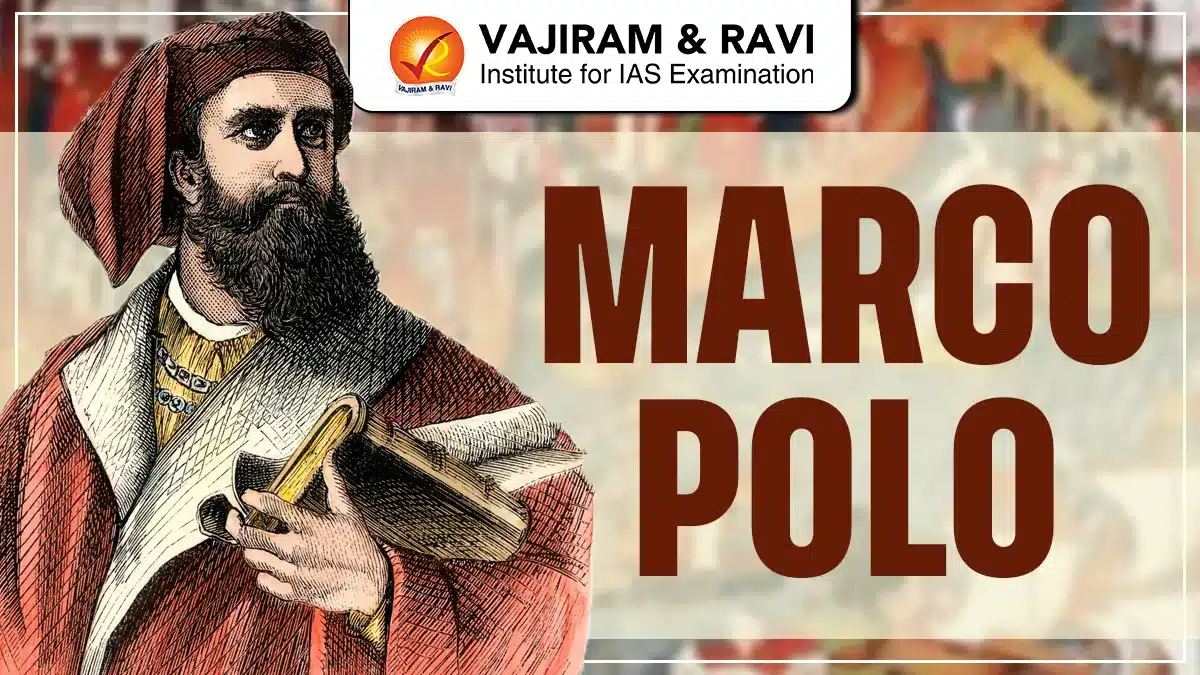
Marco Polo (1254-1324), Biography, Book, Expeditions, Visit to India

Marco Polo

Marco Polo was one of the most important European travelers of the medieval world. Born in Venice around 1254 CE, he journeyed across Asia along the Silk Road between 1271 and 1295 CE. His travels opened a new window for Europe to understand Asia, especially the Mongol Empire, China, India and Southeast Asia. At a time when Asia was largely unknown to Europeans, Marco Polo provided detailed descriptions of geography, administration, economy, culture and customs. His experiences were recorded in The Travels of Marco Polo, which became a landmark work in world history.

Marco Polo Biography

Marco Polo was born around 1254 in Venice to a merchant family deeply involved in long distance Asian trade networks. His father Niccolò Polo and uncle Maffeo Polo were experienced traders who had already travelled across Asia and met the Mongol ruler Kublai Khan before Marco joined them. In 1271, at about seventeen years of age, Marco travelled with them along the Silk Road to China. He spent nearly seventeen years in the Mongol Empire under the Yuan dynasty, serving as a trusted emissary of Kublai Khan. After returning to Venice in 1295, he was captured during a war with Genoa, where he narrated his experiences to Rustichello da Pisa. Marco Polo died in 1324, leaving behind a legacy that reshaped Europe’s understanding of Asia.

Marco Polo’s Book

Marco Polo’s book records his experiences across Asia and became Europe’s primary source of information about the Eastern world.

  • Title and composition: Written around 1300, dictated to Rustichello da Pisa during Genoese imprisonment, using Franco-Italian literary language.
  • Alternate names: Known as The Travels of Marco Polo, Book of the Marvels of the World and Il Milione.
  • Purpose of the book: Served as a guide for merchants describing distances, trade routes, currencies and regional products.
  • Geographical coverage: Describes China, India, Persia, Japan, Southeast Asia and the Mongol Empire.
  • Unique contributions: First European record of paper money, porcelain, gunpowder and salt revenue systems.
  • Historical impact: Influenced European cartography, including the Catalan Atlas and Fra Mauro Map.
  • Cultural significance: Inspired explorers such as Christopher Columbus and later European travellers.
  • Manuscript spread: Over 150 manuscript versions exist across Latin, French, Italian and other languages.
  • Reliability: Many details verified later by Chinese records and archaeological evidence.
  • Enduring value: Remains a cornerstone source for understanding medieval Asia through European eyes.

Marco Polo Expeditions

Marco Polo undertook one of the longest and most detailed journeys of the medieval world, spanning nearly 24 years across continents.

  • Departure year: Began journey in 1271 with father and uncle from Venice.
  • Route taken: Travelled via Acre, Persia, Hormuz, Central Asia and the Silk Road.
  • Arrival in China: Reached Kublai Khan’s court at Shangdu between 1271-1275.
  • Service under Kublai Khan: Appointed foreign emissary due to linguistic skills and administrative abilities.
  • Diplomatic missions: Travelled across China, Myanmar, Vietnam, Indonesia and Sri Lanka.
  • Duration in China: Lived within the Yuan Empire for about 17 years.
  • Return journey: Left China in 1292 escorting Mongol princess Kököchin to Persia.
  • Maritime route: Sailed through South China Sea, Sumatra, Indian Ocean and Arabian Sea.
  • Journey risks: Out of 600 travellers, only 18 survived the dangerous sea voyage.
  • Total distance: Covered approximately 15,000 miles before returning to Venice in 1295.

Marco Polo Visit to India

Marco Polo visited India during his return journey from China, offering rare European observations of medieval Indian society.

  • Period of visit: Travelled to India between 1292 and 1294 CE.
  • Entry point: Landed on the Coromandel Coast of southern India.
  • Regions visited: Travelled through Tamil Nadu, Kerala and parts of southern India.
  • Pandyan kingdom: Visited the prosperous Pandya territory near present day Thanjavur.
  • Kakatiya rule: Travelled during the reign of Queen Rudramma Devi (1261-1295 CE).
  • Trade focus: Observed thriving trade networks involving pearls, gems, textiles and spices.
  • Horse imports: Noted large scale import of horses for South Indian rulers.
  • Religious sites: Visited the tomb of St. Thomas near present day Chennai.
  • Maritime trade: Documented India’s strong connections with China and Southeast Asia.
  • Strategic importance: Recognised southern India as a key link in Indian Ocean trade.

Marco Polo Accounts of India

Marco Polo provided detailed descriptions of Indian society, economy, customs, religion and natural environment.

  • Social customs: People sat on the ground to eat, using only the right hand for food.
  • Travel safety: Reported that travelling with valuables at night was safe.
  • Dietary habits: Rice was the staple grain, while meat consumption was limited in many communities.
  • Alcohol consumption: Noted widespread use of beer and fermented beverages.
  • Hygiene practices: Drinking vessels were personal and never shared.
  • Chewing habits: Described chewing of betel leaves and tambur leaves mixed with spices and lime.
  • Religious beliefs: Mentioned cow worship, astrology, omens and temple rituals.
  • Status of women: He observed female rulers like Rudramma Devi, rare in medieval societies.
  • Royal wealth: Described Pandyan rulers wearing immense quantities of gold, pearls and gemstones.
  • Trade activities: Horse imports, pepper, indigo, incense and textiles were major economic goods.
  • Economic prosperity: Identified South India as one of the richest regions globally.
  • Natural diversity: Documented elephants, peacocks, parrots, lions and exotic flora, larger and richer than Europe.
  • Agricultural products: Noted cultivation of pepper, indigo, incense and date wine.
  • Religious sites: He visited the tomb of St. Thomas near modern Chennai, a shared pilgrimage center.
  • Dress and climate: Light clothing was common due to hot climate conditions.
  • Belief systems: Astrology and horoscope consultations influenced decisions and daily actions.
  • Cultural values: Observed preference for dark skin and local beauty standards.
  • Ascetic practices: Mentioned naked holy men following non violence.
  • Urban organisation: Highlighted busy ports and well developed trade towns.
  • Historical importance: Provides invaluable foreign perspective on 13th century India.

Marco Polo FAQs

Q1: Who was Marco Polo?

Ans: Marco Polo was a Venetian merchant and explorer who travelled across Asia in the 13th century and documented his experiences.

Q2: Why is Marco Polo famous?

Ans: He is famous for his book The Travels of Marco Polo, which gave Europeans detailed knowledge about Asia, China and India.

Q3: Which Asian ruler did Marco Polo serve?

Ans: Marco Polo served Kublai Khan, the Mongol ruler and founder of the Yuan Dynasty in China, as a foreign emissary.

Q4: When did Marco Polo visit India?

Ans: Marco Polo visited India between 1292 and 1294 CE during his return journey from China by sea.

Q5: What is the historical importance of Marco Polo’s accounts?

Ans: His writings provide valuable information on Asian geography, trade, culture, economy and societies of the 13th century.

Feminization of Agriculture, Meaning, Causes, Implications

Feminization of Agriculture

The feminization of agriculture is the growing involvement of women in farming activities, driven by the migration of men into non-agricultural sectors and influenced by many socio-economic transformations. This shift includes the important role of women in ensuring food security, sustaining rural livelihoods and contributing significantly to the agricultural economy. In this article, we are going to cover the feminization of agriculture, its forms, causes, implications and challenges. 

Feminization of Agriculture

The Feminization of Agriculture is the rising dependence on women in carrying out agricultural work and sustaining rural economies. It emerges as an important global trend, representing a structural transformation in the farming system, especially within the rural landscapes of developing nations. The process shows demographic shifts, transitions in the labor market and changing societal roles of women that together hold big consequences for rural development, agricultural productivity, food security and gender equity. 

Feminization of Agriculture Forms 

The Feminization of Agriculture is sub-divided into three different forms. These forms include: 

  1. High Female Labor Participation: Women are now working in a large segment of agricultural workforce, undertaking farming tasks earlier dominated by men. 
  2. Rise of Female-Headed Farm Households: Male migration, absenteeism, and mortality rates have contributed to a rise in women-led farming households.
  3. Improved Decision-Making Power: Women are gradually assuming greater authority in agricultural decision-making, resource allocation, and leadership roles within farming households.

Feminization of Agriculture Causes

Feminization of Agriculture was caused due to the following reasons: 

  • Male Outmigration: In many rural regions, men migrate to towns and cities for higher incomes in industrial or service jobs, leaving women in charge of agricultural activities. Seasonal migration intensifies this trend and hence increases women’s responsibilities.
  • Economic Transition: The decline in agrarian opportunities and expansion of industrial and service sectors reduce male participation in farming, while women continue to remain engaged in sustaining the agricultural base of rural life.
  • Conflict and Displacement: Armed conflicts, forced displacement, and crises disproportionately affect men, thereby increasing women’s roles in food production and agricultural labor.
  • Policy Gaps: Unequal access to education, skilling, and non-farm employment opportunities restrict women’s ability to diversify their livelihoods, confining them to agriculture.
  • Technological Transformation: Mechanization and the adoption of modern agricultural technologies often exclude women, concentrating them in traditional and labor-intensive agricultural practices.

Feminization of Agriculture Implications

Feminization of Agriculture has the following implications: 

  • Economic Dimensions: Women’s participation in agriculture enhances family incomes and contributes to strengthening rural economies. However, persistent wage gaps and limited access to institutional credit and capital hinder the realization of their full potential.
  • Gender Equality and Empowerment: By assuming agricultural responsibilities, women gain social recognition and improved status within their families and communities. Yet, patriarchal structures and limited decision-making autonomy restrict the scope of empowerment.
  • Food Security: Women’s central role in subsistence farming and nutrition-sensitive agricultural practices makes them key actors in ensuring household food security. However, their restricted access to land ownership, modern technologies, and agricultural finance compromises output and productivity.
  • Environmental Sustainability: Women’s traditional knowledge of local ecosystems supports the practice of sustainable farming. Nevertheless, their exclusion from institutional training limits their ability to adopt and spread modern eco-friendly techniques.

Challenges Faced by Women in Agriculture 

Women have faced many challenges in the field of agriculture: 

  • Restricted Land and Property Rights: Societal customs and legal barriers frequently prevent women from accessing or inheriting land.
  • Limited Financial Access: Women’s absence of collateral assets often results in exclusion from formal credit and financing channels.
  • Technological Disparities: Agricultural training programs and dissemination of modern technologies predominantly target men, leaving women with outdated tools and practices.
  • Health and Safety Concerns: Long working hours, exposure to pesticides, and lack of healthcare increase women’s vulnerability.
  • Time Poverty and Workload: Women balance agricultural responsibilities alongside domestic chores and caregiving duties, leading to exhaustion and lower productivity.
  • Social and Cultural Barriers: Patriarchal social norms restrict women’s decision-making power, mobility, and independence in farming.

Feminization of Agriculture Policy Responses 

Feminization of Agriculture had the following policy and programmatic responses:  

  • Strengthening Land and Property Rights: Reforming laws to guarantee equal inheritance and ownership rights for women farmers.
  • Financial Inclusion Measures: Promoting microfinance, gender-sensitive banking systems, and collateral-free credit facilities.
  • Capacity Building and Skill Development: Expanding inclusive agricultural extension services tailored to the needs of women farmers.
  • Technology Integration: Ensuring access to mechanization, digital tools, and improved agricultural practices through subsidies and targeted training.
  • Social Protection Measures: Designing maternity benefits, childcare facilities, and social safety nets to ease women’s multiple burdens.
  • Women’s Cooperatives: Supporting women-led cooperatives to expand bargaining power, enhance access to markets, and increase collective resilience.

Feminization of Agriculture FAQs

Q1: What is meant by feminization of labour?

Ans: Feminization of labour refers to the rising participation of women in the workforce, often in low-paid, insecure, or informal jobs.

Q2: Do you think that feminization of agriculture can boost the Indian rural economy, especially states like Assam?

Ans: Yes, feminization of agriculture can strengthen rural economies like Assam’s by improving food security, household income, and women’s empowerment.

Q3: What is the term feminization of poverty?

Ans: Feminization of poverty means the growing trend of women experiencing higher levels of poverty compared to men due to gender discrimination and economic inequalities.

Q4: What does high female labour participation mean?

Ans: High female labour participation indicates greater involvement of women in economic activities, contributing significantly to national growth and social development.

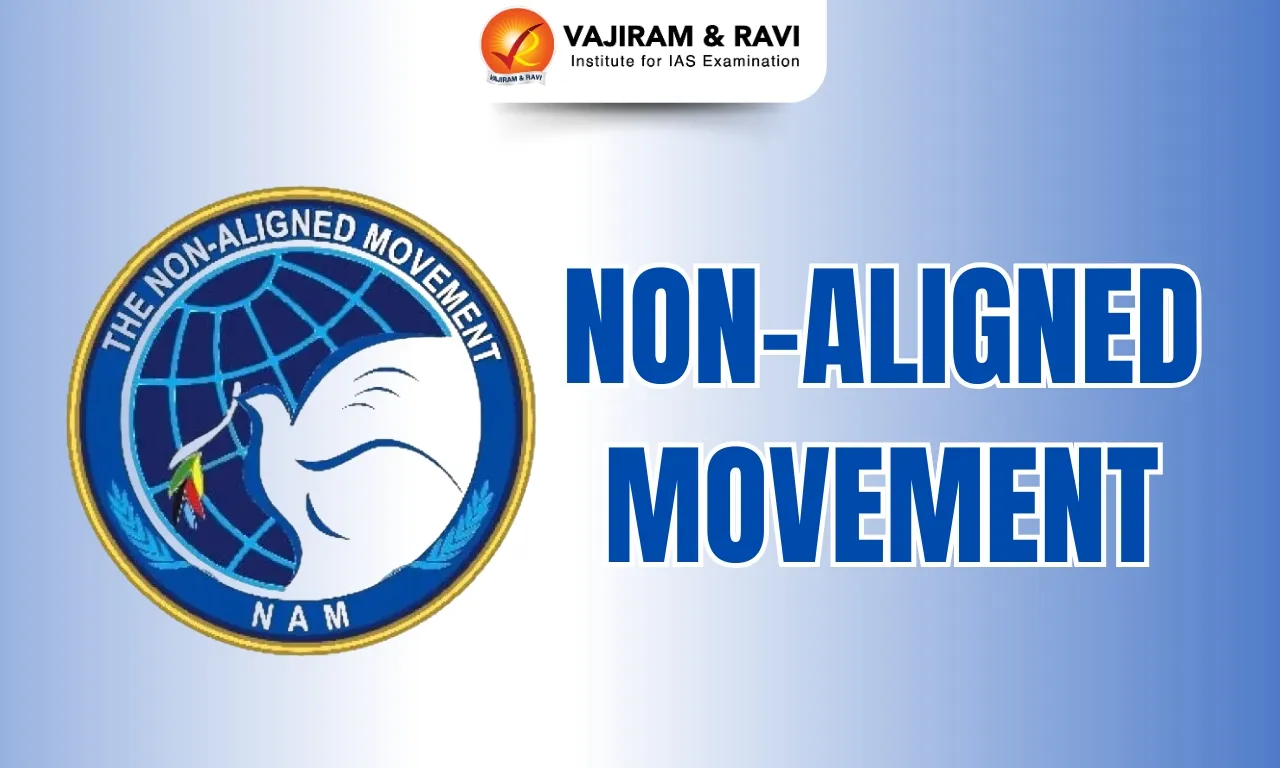
Non-Aligned Movement, History, Objectives, Principle, Challenges

Non-Aligned Movement

The Non-Aligned Movement (NAM) is a collective platform of sovereign states that chose not to align formally with any major power bloc during the Cold War. It was established in 1961 at Belgrade. It emerged from the shared concerns of newly independent nations seeking to preserve political autonomy, territorial integrity and independent foreign policies. NAM was shaped by leaders like Jawaharlal Nehru, Josip Broz Tito, Gamal Abdel Nasser, Sukarno and Kwame Nkrumah, who aimed to protect developing countries from great power rivalry. Today, with 121 member states, NAM remains the largest international grouping after the United Nations, representing nearly two-thirds of UN membership and about 55% of the global population.

Non-Aligned Movement Objectives

The objectives of the Non-Aligned Movement focus on safeguarding sovereignty, promoting peace and advancing collective interests of developing nations globally.

  • Protection of Sovereignty: NAM seeks to protect national independence and territorial integrity of member states against external domination, foreign aggression and political coercion by major powers.
  • Promotion of World Peace: The movement aims to reduce global tensions by opposing military alliances, foreign bases and escalation of conflicts through dialogue, mediation and peaceful dispute resolution.
  • Support for Developing Countries: NAM works to advance the political, economic and social interests of developing nations, especially those facing poverty, underdevelopment and unequal global economic structures.
  • Strengthening Multilateralism: It advocates reform of global institutions, particularly the United Nations, to ensure democratic decision making and fair representation of the Global South.
  • Opposition to Imperialism: NAM consistently resists colonialism, neo colonialism, racism, apartheid and all forms of external interference that undermine self determination.

Non-Aligned Movement Principles

The principles of Non-Aligned Movement are derived mainly from the Panchsheel doctrine and the Bandung Conference commitments.

  • Mutual Respect for Sovereignty: Member states commit to respecting territorial integrity and political independence of all nations, regardless of size or power.
  • Non Interference in Internal Affairs: NAM opposes intervention in domestic matters of states, emphasizing sovereign equality and freedom of policy choice.
  • Mutual Non Aggression: Countries pledge to refrain from the use or threat of force against other nations, ensuring peaceful coexistence.
  • Equality and Mutual Benefit: NAM promotes cooperation based on equality, rejecting dominance by stronger nations over weaker states.
  • Peaceful Coexistence: The movement supports dialogue, diplomacy and peaceful resolution of disputes as core principles of international relations.

Non-Aligned Movement Historical Background

The historical roots of the Non-Aligned Movement lie in post World War II decolonization and Cold War bipolarity.

  • Bandung Conference 1955: Asian and African nations met in Indonesia to oppose colonialism and military alliances, laying ideological foundations for NAM.
  • Brijuni Declaration 1956: Leaders of India, Yugoslavia and Egypt formally articulated non-alignment principles to avoid superpower domination.
  • Belgrade Summit 1961: The first Conference of Heads of State or Government officially established NAM as a global political movement.
  • Cold War Role: NAM expanded rapidly during the 1960s-1980s, supporting decolonization, nuclear disarmament and opposition to apartheid.
  • Post Cold War Transition: After 1991, NAM shifted focus from bloc politics to development, multilateral cooperation and Global South solidarity.

Non-Aligned Movement Organizational Structure

The organizational structure of the Non-Aligned Movement is flexible, reflecting its non institutional character.

  • Summit Conference: The Conference of Heads of State or Government is the highest decision making body, held every few years.
  • Chairmanship System: The chair rotates among member states, with Uganda holding chairmanship for 2024-2027 under President Yoweri Museveni.
  • Coordinating Bureau: Based at the United Nations headquarters in New York, it manages daily activities, working groups and coordination.
  • Ministerial Meetings: Foreign Ministers’ conferences and thematic meetings ensure continuity between summits and policy implementation.
  • Working Groups: Specialized groups address issues like UN reform, disarmament, peacekeeping, human rights and economic cooperation.

Non-Aligned Movement Membership

Non-Aligned Movement Membership reflects global diversity and developing world solidarity.

  • Member States: The movement currently has 121 full members across Asia, Africa, Latin America, Europe and the Middle East.
  • Observer States: Eighteen observer countries participate without full membership, maintaining association with NAM principles.
  • International Organizations: Ten international organizations engage with NAM, expanding cooperation beyond nation states.
  • Population Representation: NAM countries collectively account for approximately 55 percent of the world’s population, giving it demographic weight.
  • Membership Criteria: States must follow Bandung principles, avoid military alliances tied to great power conflicts and support independence movements.

Non-Aligned Movement India’s Position

India has played a central yet evolving role within the Non-Aligned Movement.

  • Founding Leadership: India, under Jawaharlal Nehru, was a principal architect of NAM, promoting strategic autonomy and peaceful coexistence.
  • Cold War Challenges: India’s close relations with the Soviet Union during the 1970s created doubts among smaller members about its neutrality.
  • Post Cold War Shift: Economic liberalization and closer ties with the United States reduced India’s emphasis on NAM diplomacy.
  • Selective Engagement: India skipped the 2016 NAM Summit in Venezuela, signaling declining priority while still engaging diplomatically.
  • Strategic Autonomy Today: India balances relations through forums like G20, SCO and Quad while advocating a multipolar world aligned with NAM ideals.

Non-Aligned Movement Challenges

The Non-Aligned Movement faces structural and political challenges in the contemporary global order.

  • Loss of Original Context: The end of the Cold War reduced the relevance of strict non-alignment between two superpower blocs.
  • Internal Diversity: Wide ideological, economic and political differences among members limit unity and decisive collective action.
  • Leadership Vacuum: Absence of strong consensus leaders weakens NAM’s global influence and strategic direction.
  • Competing Platforms: Emergence of BRICS, G20, SCO and regional blocs has diluted NAM’s centrality in global diplomacy.
  • Limited Enforcement Power: NAM resolutions often lack binding mechanisms, reducing their impact on global policy outcomes.

Non-Aligned Movement Recent Developments

Recent developments show Non-Aligned Movement’s efforts to remain relevant in a changing world.

  • Uganda Chairmanship 2024: The 19th NAM Summit in Kampala reaffirmed commitment to Global South cooperation and shared prosperity.
  • COVID 19 Cooperation: The 2020 virtual summit highlighted collective action against pandemics and global health inequality.
  • Focus on Multipolarity: NAM increasingly advocates a balanced world order resisting unilateral dominance and neo colonial practices.
  • UN Reform Advocacy: The movement continues to push for restructuring the UN Security Council to reflect contemporary global realities.
  • Sustainable Development Agenda: NAM emphasizes climate action, poverty reduction, South-South cooperation and inclusive economic growth.

Non-Aligned Movement FAQs

Q1: What is the Non-Aligned Movement?

Ans: The Non-Aligned Movement is a group of countries that avoid formal military alliances with major power blocs to maintain independent foreign policies.

Q2: When and where was the Non-Aligned Movement founded?

Ans: The Non-Aligned Movement was formally established in 1961 at the Belgrade Summit in Yugoslavia.

Q3: Who were the key founders of the Non-Aligned Movement?

Ans: Jawaharlal Nehru, Josip Broz Tito, Gamal Abdel Nasser, Sukarno and Kwame Nkrumah were the main founders of NAM.

Q4: How many countries are members of the Non-Aligned Movement today?

Ans: The Non-Aligned Movement has 121 member states, making it the largest grouping of countries after the United Nations.

Q5: Why is the Non-Aligned Movement still relevant today?

Ans: NAM remains relevant by promoting strategic autonomy, Global South cooperation and a multipolar world order in global affairs.

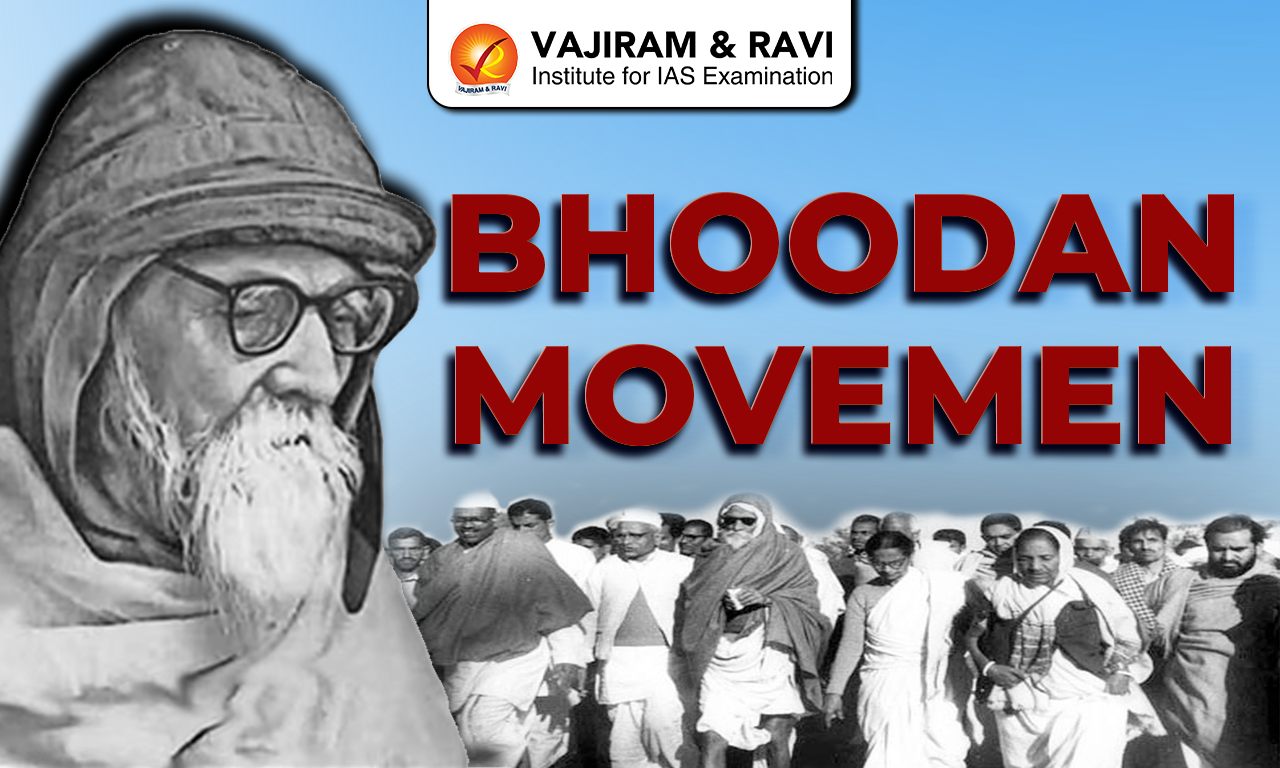
Bhoodan Movement, Objectives, Background, Features, Significance

Bhoodan Movement

The Bhoodan Movement, also known as the Land Gift Movement, was a major socio-economic reform initiative in post-independence India. It was launched in 1951 by Vinoba Bhave, a prominent follower of Mahatma Gandhi.

The Bhoodan movement aimed to solve the problem of landlessness by encouraging landowners to voluntarily donate a portion of their land to the landless poor. It is often described as a “bloodless revolution” because it sought to bring social change without violence.

Bhoodan Movement Background

At the time of independence, India’s agrarian structure was marked by stark inequalities. Large landholdings were concentrated in the hands of a few, while millions of peasants remained landless or marginal farmers. Despite land reform laws, implementation remained weak due to administrative inefficiencies and political resistance. Recognizing this gap, Vinoba Bhave launched the Bhoodan Movement in 1951 from Pochampally village in Telangana.

His approach was deeply rooted in Gandhian principles of Sarvodaya (welfare of all) and Ahimsa (non-violence). Instead of demanding land redistribution through the state, he appealed directly to the conscience of landowners, urging them to voluntarily donate a portion of their land for the benefit of the landless.

Bhoodan Movement Objectives and Philosophy

The central objective of the Bhoodan Movement was simple yet transformative:

  • To persuade wealthy landowners to donate land to landless peasants.
  • To reduce rural inequality and promote social justice.
  • To create a moral and cooperative framework for economic redistribution.

Vinoba Bhave undertook extensive padayatras (foot marches) across villages, engaging directly with rural communities. His moral authority and simplicity inspired many landowners to donate land. The movement was not merely economic in nature but also aimed at fostering compassion, social harmony, and ethical responsibility.

Gramdan Movement The Next Phase

The Bhoodan Movement later developed into the Gramdan Movement, which means “village gift movement.”

  • In this system, instead of individuals donating small pieces of land, the entire village agreed to treat land as a common property. 
  • Villagers voluntarily gave up their ownership rights and allowed the land to be managed by the whole community. 
  • A village council looked after the land and ensured that it was shared fairly among all villagers, especially the landless. 
  • The main aim of Gramdan was to create villages that were self-sufficient, equal, and able to govern themselves, following Gandhian ideas of cooperation and rural development.

Gramdan Movement Key Features

  • At least 75% of landowners must agree to surrender ownership.
  • The surrendered land must constitute at least 60% of total village land.
  • 5% of land is distributed to landless households for cultivation.
  • Beneficiaries cannot transfer land without community approval.
  • Donors retain usage rights but cannot sell land outside the village framework.
  • All participating cultivators contribute 2.5% of their income to the community.

Bhoodan-Gramdan Movement Significance

The Bhoodan-Gramdan Movement holds great significance in India’s post-independence history as a unique attempt to bring about peaceful social and economic transformation based on justice, equality, and community participation.

  • Addressing Landlessness: The movement succeeded in mobilizing significant land donations across India, helping many landless families gain access to agricultural land.
  • Promoting Non-Violent Social Change: It demonstrated that structural socio-economic issues could be addressed through moral persuasion rather than coercion, reinforcing Gandhian methods in independent India.
  • Strengthening Rural Communities: By encouraging cooperation and shared responsibility, the movement contributed to community empowerment and self-reliance.
  • Influence on Policy and Thought: The ideas of equitable land distribution and decentralized governance influenced subsequent land reform policies and debates in India.
  • Environmental and Resource Ethics: By promoting collective ownership, Gramdan encouraged a sense of shared responsibility towards natural resources, fostering sustainable practices.

Bhoodan Movement Limitations and Criticism

Despite its moral appeal, the movement faced several structural challenges:

  • Poor Quality of Donated Land: Much of the land donated was infertile, uncultivable, or under legal disputes.
  • Implementation Gaps: Although large tracts were collected, actual redistribution to beneficiaries remained limited.
  • Regional Ineffectiveness: The movement struggled in areas with high land inequality and entrenched socio-economic hierarchies.
  • Lack of Institutional Support: Absence of strong administrative backing reduced its long-term impact.
  • Failure to Achieve Revolutionary Change: It could not fundamentally transform the agrarian structure as envisioned.

Bhoodan Movement FAQs

Q1: What is the Bhoodan Movement?

Ans: The Bhoodan Movement, started by Vinoba Bhave in 1951, was a voluntary land reform initiative in which landowners were encouraged to donate a portion of their land to landless people to reduce rural inequality through non-violent means.

Q2: What was the main objective of the Bhoodan Movement?

Ans: Its main objective was to address landlessness in rural India by promoting voluntary land donation, reducing economic inequality, and encouraging social justice through moral persuasion rather than state coercion.

Q3: Where did the Bhoodan Movement begin?

Ans: The movement began in 1951 at Pochampally village in present-day Telangana, when a landlord voluntarily donated land to landless villagers following Vinoba Bhave’s appeal.

Q4: What is the Gramdan Movement in relation to Bhoodan?

Ans: Gramdan was an extension of the Bhoodan Movement where instead of individual land donations, an entire village collectively transferred land ownership to the community for fair redistribution and cooperative management.

Q5: Why did the Bhoodan Movement fail to achieve full success?

Ans: The movement faced limitations such as poor quality of donated land, weak implementation, lack of legal enforcement, and dependence on voluntary participation, which prevented large-scale structural transformation.

Ibn Battuta, Early Life, Travel to India, Rihla, Legacy

Ibn Battuta

Ibn Battuta was born on February 24, 1304, in Tangier, Morocco, and he died in 1368 in Morocco. He was one of the greatest travelers of the medieval Muslim world and is famous for writing the Riḥlah (Travels), a book that tells the story of his journeys. During his life, he traveled around 75,000 miles (120,000 km), visiting almost all Muslim countries and even going as far as China and Sumatra (now part of Indonesia). His travel book gives a detailed account of the people, places, and cultures he saw.

Ibn Battuta Early Life and Travel

  • Ibn Battuta was born into a family of Muslim judges (qadis). He received a traditional education in law and literature in his hometown of Tangier. In 1325, at the age of 21, he began his travels by going on the Hajj (pilgrimage) to Mecca. At first, his aim was to fulfill his religious duty and learn from famous scholars in places like Egypt, Syria, and the Hejaz. He met many scholars and Sufi saints and received certificates, which later helped him become qualified for judicial work and gain respect in different courts.
  • While in Egypt, he developed a strong love for travel and decided to explore as much of the world as possible. He even made a rule never to travel the same route twice. Unlike others who traveled for trade or duty, Ibn Battuta traveled mainly for the joy of discovering new places and people. He supported himself through his knowledge and later through the gifts and hospitality of rulers and nobles.
  • From Cairo, he first tried to reach the Red Sea but returned and went to Syria, joining a caravan to Mecca. After completing his pilgrimage in 1326, he traveled to Iraq, Iran, Azerbaijan, and Baghdad, where he met the Mongol ruler Abū Saʿīd. He then spent a few years (1327-1330) living a peaceful life in Mecca and Medina, although he soon felt the urge to travel again.
  • He later sailed from Jiddah to Yemen and traveled along the east coast of Africa, visiting trading cities like Kilwa (in present-day Tanzania). He returned through Arabia and Persia and reached Mecca again in 1332. Around this time, he decided to travel to India after hearing about the generous Sultan of Delhi, Muhammad ibn Tughluq.
  • On his way, he traveled through Anatolia (modern Turkey), where he was warmly welcomed by local rulers. He then crossed the Black Sea to the Crimea and traveled through regions of Russia and Central Asia, visiting cities like Bukhara, Samarkand, and Balkh. He also visited Constantinople (now Istanbul), where his observations were detailed and mostly accurate, showing his curiosity and open-mindedness.
  • Finally, after passing through Afghanistan and crossing the Hindu Kush mountains, he reached the Indus River, the border of India, in 1333. However, some of his travel dates are uncertain, as the distances he covered in a short time seem difficult to believe.

Ibn Battuta Travel to India

  • On 12 September 1333, Ibn Battuta entered India by crossing the Hindu Kush mountains in Afghanistan and the Indus River. At that time, the Tughlaq dynasty was at its peak, and he soon made his way to Delhi.
  • While passing through Sindh, he noted the presence of the Indian rhinoceros near the Indus River. After crossing the Sutlej River (in present-day Pakistan), he visited the shrine of Baba Farid. He also traveled through the Rajput region of Saraswati and visited Hansi, which he described as one of the most beautiful towns in the world.
  • When he reached Delhi, he met the Sultan, Muhammad bin Tughlaq, and presented him with gifts. In return, the sultan gave him a furnished house and appointed him as a Qadi (judge) in the royal court. Ibn Battuta stayed in India for about seven to eight years.
  • During his stay, he traveled widely across India, visiting places like Abohar, Sirsa, Hansi, Aligarh, Kannauj, Daulatabad, Khambhat, Gwalior, Ujjain, and Kozhikode. He was also given the responsibility of looking after the tomb of Qutb al-Din Mubarak and lived near famous monuments like the Qutb Minar and Quwwat-ul-Islam Mosque in Delhi.
  • In 1341, wanting to leave political tensions behind, he asked permission to go for another Hajj. However, the sultan instead appointed him as an ambassador to China, asking him to travel with Chinese envoys and take gifts to the emperor.
  • His journey was full of difficulties. Soon after leaving Delhi, his group was attacked by rebels, though they managed to escape. From Khambhat (Gujarat), he sailed to Calicut (Kozhikode), where he stayed with the local ruler (Zamorin). However, a storm destroyed one of his ships, and another ship carrying gifts was lost, putting him in a difficult situation.
  • He then stayed for some time in South India under a local ruler, but after political troubles, he left India and went to the Maldives, where he stayed for about nine months. There, he became the chief judge and even married into the royal family.
  • After that, he traveled to Sri Lanka, visiting important religious sites like Adam’s Peak (Sri Pada). Later, he returned to South India and spent some time in the Madurai Sultanate under its ruler.
  • Still determined to reach China, he again set out by sea. In 1345, he reached Chittagong (in present-day Bangladesh) and traveled towards Sylhet and Assam before continuing his journey further.

Rihla (The Travels) - Account of India

  • Postal System in India
    • Ibn Battuta, in his book Riḥla (Travels), mentioned that India had a very efficient and well-organized postal system during the rule of Muhammad bin Tughlaq. 
    • He described that horse messengers were stationed at every four miles, while foot messengers were placed at every mile. 
    • This system helped in the quick transfer of messages and information across long distances.
  • Social Structure and Practices
    • According to Ibn Battuta, Indian society followed strict social customs. He wrote about the practice of Sati (burning of widows) and the existence of the caste system. 
    • He also mentioned slave markets and slavery. He noted that Muslim men were allowed to have up to four wives, but at the same time, adultery was treated as a serious crime and strictly punished.
  • Life in Cities and Markets
    • Ibn Battuta described Indian cities as crowded, rich, and full of life. The streets were colorful and busy, and markets (bazaars) were the center of daily life. 
    • These bazaars were not only places of trade but also centers of social and cultural activities, often surrounded by mosques and temples.
  • Trade and Commerce
    • He observed that India had a strong network of trade and commerce, especially in the Malabar region. Important ports like Calicut (Kozhikode) and Kollam were major centers of international trade. 
    • Traders from China and Persia visited these ports mainly for spices like pepper. Indian textiles such as cotton cloth, muslin, silk, brocade, and satin were in high demand and were exported to West Asia and Southeast Asia.
  • Agriculture and Crops
    • Ibn Battuta praised the fertility of Indian soil. He noted that farmers could grow two crops in a year (Rabi and Kharif), and in some places, rice was grown three times a year. 
    • He also mentioned that different regions specialized in different crops: rice and sugarcane in the east, wheat and oilseeds in the north, and crops like sesame, cotton, and barley in other areas.
  • Food and Eating Habits
    • He gave detailed descriptions of Indian food. Meals included different types of meat such as sheep and birds. 
    • Royal meals began with round bread (chapatis), followed by dishes like roasted meat, sambusak (samosas), and chicken served with rice. Desserts included halwa and almond pudding. 
    • He also mentioned that people drank sherbet (sweet water) before meals and barley water after meals.
  • Fruits and Daily Items
    • Ibn Battuta showed great interest in Indian fruits and daily items. He especially liked mangoes and described jackfruit as one of the best fruits in India. He also mentioned oranges, ginger, wheat, and chickpeas. 
    • He wrote about the use of pan (betel leaf) and betel nut, which were supplied to the capital from places like Chanderi.
  • Coconut and Regional Food
    • He described coconut trees in detail and noted their importance in daily life, especially in coastal regions. In Kerala, he mentioned a popular dish called rasoi, which was made using rice, meat, and coconut milk.
  • Court Life and Culture
    • Ibn Battuta also described the lifestyle in the royal court of the Tughlaqs. He wrote about their customs, traditions, monuments, saints, and scholars. 
    • He mentioned Jogis (holy men) who performed magical tricks and impressed people with their skills.
  • Forts and Architecture
    • He described important monuments such as the strong and beautiful fort of Deogiri (Daulatabad), which was an important center during that time and reflected the power of the rulers.
  • Maritime Trade and Sea Travel
    • Ibn Battuta noted that Muslims dominated sea trade and navigation during that period. 
    • He wrote about active maritime routes across the Red Sea, Arabian Sea, Indian Ocean, and Chinese waters, showing the importance of sea trade in connecting different parts of the world.

Ibn Battuta Legacy

Ibn Battuta is remembered as one of the greatest travelers in history. His famous book, the Riḥla (Travels), provides valuable information about the cultures, societies, and daily life of the 14th century across regions like India, Africa, the Middle East, and China. His writings are very important for historians, as they help us understand the past in detail. He is also known for his curiosity and love for travel, as he explored the world mainly to learn about new places and people. Overall, his legacy lies in his remarkable journeys, detailed writings, and lasting contribution to history and knowledge.

Ibn Battuta FAQs

Q1: Who was Ibn Battuta?

Ans: Ibn Battuta was a famous medieval traveler born in 1304 in Morocco. He traveled about 75,000 miles across many countries and wrote about his journeys in his book Riḥla (Travels).

Q2: Why did Ibn Battuta start his travels?

Ans: He began traveling in 1325 to perform the Hajj (pilgrimage) to Mecca. Later, he continued traveling because of his curiosity and desire to learn about different places, people, and cultures.

Q3: When and how did Ibn Battuta come to India?

Ans: He arrived in India on 12 September 1333 by crossing the Hindu Kush mountains and the Indus River, during the rule of Muhammad bin Tughlaq.

Q4: What position did Ibn Battuta get in India?

Ans: In Delhi, he was appointed as a Qadi (judge) by the Sultan and lived there for about 7-8 years, enjoying respect and a comfortable life.

Q5: What difficulties did Ibn Battuta face during his travels in India?

Ans: He faced many challenges such as attacks by rebels, shipwrecks, loss of property, and political dangers. Despite this, he continued his journey to places like the Maldives, Sri Lanka, and Southeast Asia.

Indira Gandhi 1917-1984, Biography, Prime Minister, Death, Contributions

Indira Priyadarshini Gandhi was India’s first and only female Prime Minister. She remains one of the most iconic and controversial figures in Indian political history. As the second-longest-serving Prime Minister (1966-1977 and 1980-1984), her leadership shaped India’s destiny in the post-independence era. From economic reforms and foreign policy decisions to her powerful political strategies, Indira Gandhi’s legacy continues to influence India’s governance, economy, and global standing even today. Her tenure was marked by bold decisions, both admired and criticized, but undeniably transformative. India’s growth in sectors like banking, agriculture, and industry reflects her deep imprint.

Indira Gandhi Biography

Indira Gandhi was born on November 19, 1917, in Allahabad. Indira Gandhi was the only daughter of Pandit Jawaharlal Nehru, India’s first Prime Minister, and Kamala Nehru. Indira’s early life was deeply influenced by her father’s vision and Mahatma Gandhi’s philosophy. She studied in India and abroad, including at Visva-Bharati University (Santiniketan) and Oxford University, and later received an honorary doctorate and global recognition, including the Columbia University Citation of Distinction. On March 26, 1942, she married Feroze Gandhi, a journalist and fellow Congress worker. The couple had two sons, Rajiv Gandhi and Sanjay Gandhi, both of whom later entered politics. She later died in an assassination by her bodyguards  on October 31 1984 at her residence in New Delhi.

Indira Gandhi Political Career

Indira Gandhi’s political journey began long before she became Prime Minister. She actively participated in India’s freedom movement, even forming youth organizations like Bal Charkha Sangh and Vanar Sena in 1930 to mobilize children in the Civil Disobedience Movement. Post-independence, she began to take on significant roles in the Indian National Congress. By 1955, she was a member of the Congress Working Committee, and by 1959, she rose to become the President of the Indian National Congress. Her growing political stature and strong willpower caught the attention of national leaders. From 1964 to 1966, Indira Gandhi served as the Minister of Information and Broadcasting, where she proved her administrative capability and communication skills, handling both the media and cultural policies effectively.

Prime Minister Indira Gandhi 

Indira Gandhi served as the Prime Minister of India two times and overall for about 16 years from 1966 to 1977 serving the first tenure followed by second tenure starting from 1980 till 1984. 

First Term (1966-1977)

After the sudden death of Lal Bahadur Shastri in 1966, Indira Gandhi was chosen as India’s Prime Minister. Her early years were filled with challenges, economic instability, food shortages, and global political tensions. However, her determination to build a self-reliant India guided her decisions. In 1969, internal conflicts within the Congress led to her expulsion, prompting her to form a new faction  Congress (R), later known as Congress (I). Her political gamble paid off when she achieved a landslide victory in the 1971 General Elections, winning massive public support with her campaign slogan, “Garibi Hatao” (Remove Poverty).

Second Term (1980-1984)

Despite her fall, Indira Gandhi’s resilience stood out. In 1978, she and her supporters formed Congress (I), with the “I” symbolizing “Indira.” By 1980, she made a remarkable comeback, winning the general elections and returning as Prime Minister. Her second term was marked by efforts to strengthen India’s industrial base, foster agricultural growth, and assert India’s independent foreign policy. She maintained close ties with the Soviet Union, balancing Cold War politics while safeguarding India’s strategic interests. However, rising regional tensions, especially in Punjab, tested her leadership. The Operation Blue Star in 1984 aimed at removing militants from the Golden Temple sparked widespread outrage and unrest. Tragically, on October 31, 1984, Indira Gandhi was assassinated by her Sikh bodyguards, marking the end of an era.

The National Emergency (1975-1977)

However, her tenure also witnessed one of the most controversial chapters in Indian democracy. On June 25, 1975, Indira Gandhi declared a National Emergency, citing “internal disturbances.” During the 21 months of Emergency, civil liberties were suspended, the press was censored, and political opponents were jailed. While the move was justified by her as necessary for stability and national discipline, it drew immense criticism for authoritarianism. The Emergency period remains one of the most debated times in Indian politics, a blend of efficiency and excess. In 1977, after lifting the Emergency, she faced the public’s verdict in elections. Her party suffered a major defeat, and she lost power.

Indira Gandhi Contributions

Significant contributions and reforms by Indira Gandhi include various National as well as International Programmes and Initiatives as highlighted below:

Nationalization of Banks

One of Indira Gandhi’s most defining decisions was the nationalisation of 14 major commercial banks on July 19, 1969. This move brought banking access to the rural and underprivileged sections of society. It aligned with her vision of a socialist economy, ensuring that credit facilities reached farmers, small businesses, and marginalized communities. The step strengthened India’s financial inclusion and reduced dependence on private monopolies.

Bangladesh Liberation

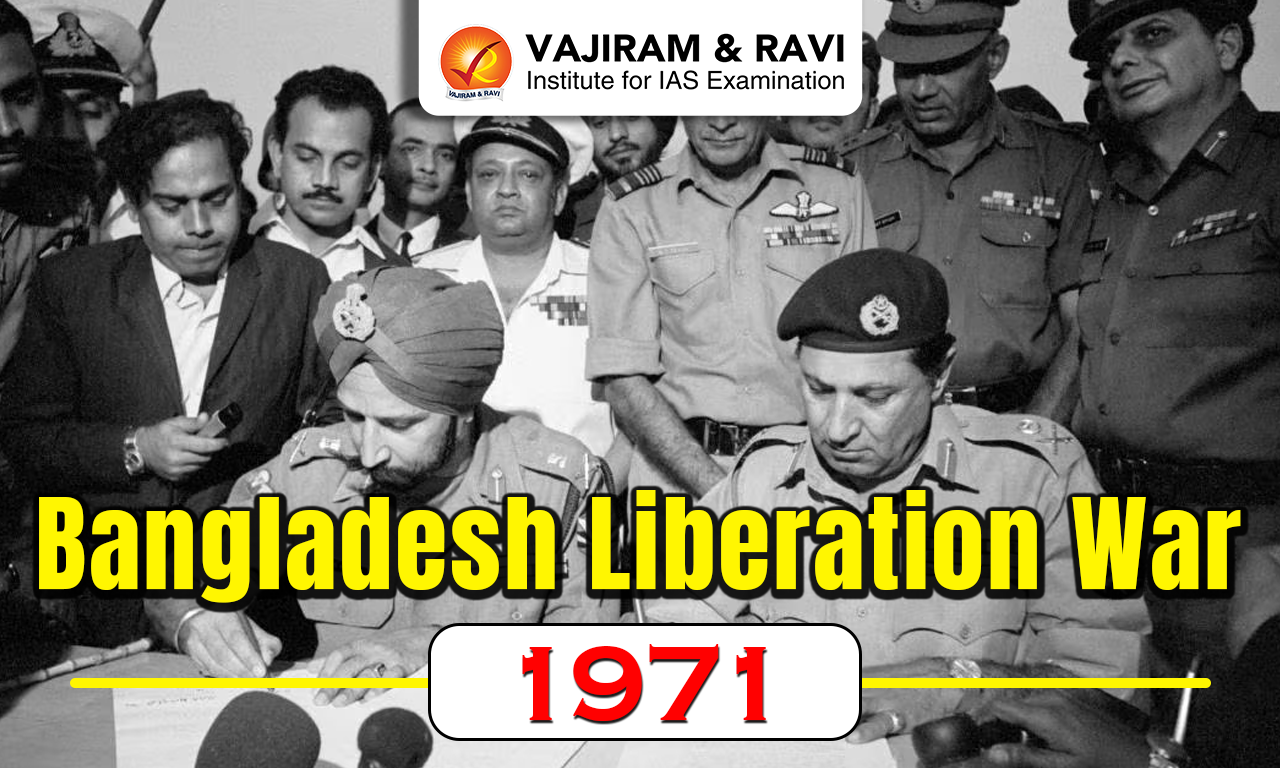
One of Indira Gandhi’s greatest diplomatic and military achievements came in 1971, during the Bangladesh Liberation War. India’s intervention against Pakistan led to the creation of Bangladesh, showcasing her as a decisive leader with immense international stature. This victory elevated India’s position in South Asia and strengthened Indira’s image as a global stateswoman. Her popularity soared as she won massive victories in subsequent state elections in 1972, and she became a symbol of national pride and power.

The Green Revolution

Indira Gandhi played a vital role in promoting the Green Revolution, which transformed India from a food-deficient nation into a self-sufficient one. Her support for scientific agriculture, improved irrigation, and use of high-yield seeds revolutionized India’s agricultural sector, ensuring food security for millions.

Abolition of Privy Purse (1971)

To promote equality and social justice, she abolished the Privy Purse, payments made to former princely rulers under Articles 291 and 362 of the Constitution. Through the 26th Amendment (1971), she ended these privileges, symbolizing India’s move toward egalitarian democracy.

Twenty Point Programme (1975)

During the Emergency, Indira Gandhi launched the Twenty Point Programme, a comprehensive plan to eradicate poverty, reduce inequality, and promote rural development. The scheme focused on housing, education, healthcare, irrigation, and environmental protection. It later underwent revisions in 1982, 1986, and 2006, remaining one of India’s longest-running socio-economic programs aligned with the UN Millennium Development Goals.

Garibi Hatao (Remove Poverty)

Her “Garibi Hatao” slogan became the heart of her political identity. It not only resonated with millions of Indians but also guided welfare schemes aimed at uplifting the poor. The campaign later shaped the Fifth Five-Year Plan (1974-1979), focusing on employment, rural upliftment, and income redistribution.

Strengthening India’s Global Presence

Indira Gandhi’s foreign policy was marked by independence and strength. She championed the Non-Aligned Movement, supported anti-colonial struggles, and maintained India’s dignity on the world stage. Her leadership during the 1971 war, her relationship with the Soviet Union, and her efforts to keep India self-reliant made her one of the most respected world leaders.

Indira Gandhi Awards and Recognition

Indira Gandhi’s leadership was globally acknowledged. Her awards include:

  • Bharat Ratna (1972): India’s highest civilian honor.
  • Mexican Academy Award for the Liberation of Bangladesh (1972)
  • Second Annual Medal of FAO (1973)
  • Sahitya Vachaspati by Nagari Pracharini Sabha (1976)
  • Mother’s Award (USA) (1953)
  • Isabella d’Este Award (Italy) for outstanding diplomatic work
  • Yale University’s Howland Memorial Prize
  • Diploma of Honour from the Argentine Society for Animal Protection (1971)

Indira Gandhi Books

Indira Gandhi was also an articulate writer and thinker. Her important publications include:

  • The Years of Challenge (1966-1969)
  • The Years of Endeavour (1969-1972)
  • India (London, 1975)
  • Inde (Lausanne, 1979)*

Indira Gandhi Legacy

Indira Gandhi’s life was a journey of courage, conviction, and complexity. She combined firmness with foresight, authority with empathy, and nationalism with globalism. While her policies often invited criticism, her impact on India’s political and economic landscape remains indelible.

She transformed India’s financial system through bank nationalization, strengthened food security via the Green Revolution, and redefined social justice by abolishing feudal privileges. Her vision of a self-reliant India still inspires policymakers and citizens alike.

Despite the controversies surrounding her tenure particularly the Emergency Indira Gandhi’s contributions shaped modern India’s political and developmental framework. She was not just India’s first female Prime Minister but also one of its strongest leaders, remembered for her determination, resilience, and unyielding belief in India’s potential.

Indira Gandhi FAQs

Q1: Who is Indira Gandhi?

Ans: Indira Gandhi was the first and only woman Prime Minister of India, known for her strong leadership and political acumen.

Q2: What were the books written by Indira Gandhi?

Ans: Her notable books include ‘Eternal India’, ‘My Truth’, and ‘Letters to My Grandchildren’.

Q3: Who wrote The Years of Challenge?

Ans: The Years of Challenge was written by Indira Gandhi herself.

Q4: What is the Twenty Point Programme?

Ans: The Twenty Point Programme was launched in 1975 by Indira Gandhi to promote poverty alleviation, employment, and social justice.

Q5: When was the first National Emergency announced?

Ans: The first National Emergency in India was declared in 1962 during the Indo-China War.

Kanva Dynasty (73-28 BCE), Background, Capital, Society, Rulers

Kanva Dynasty

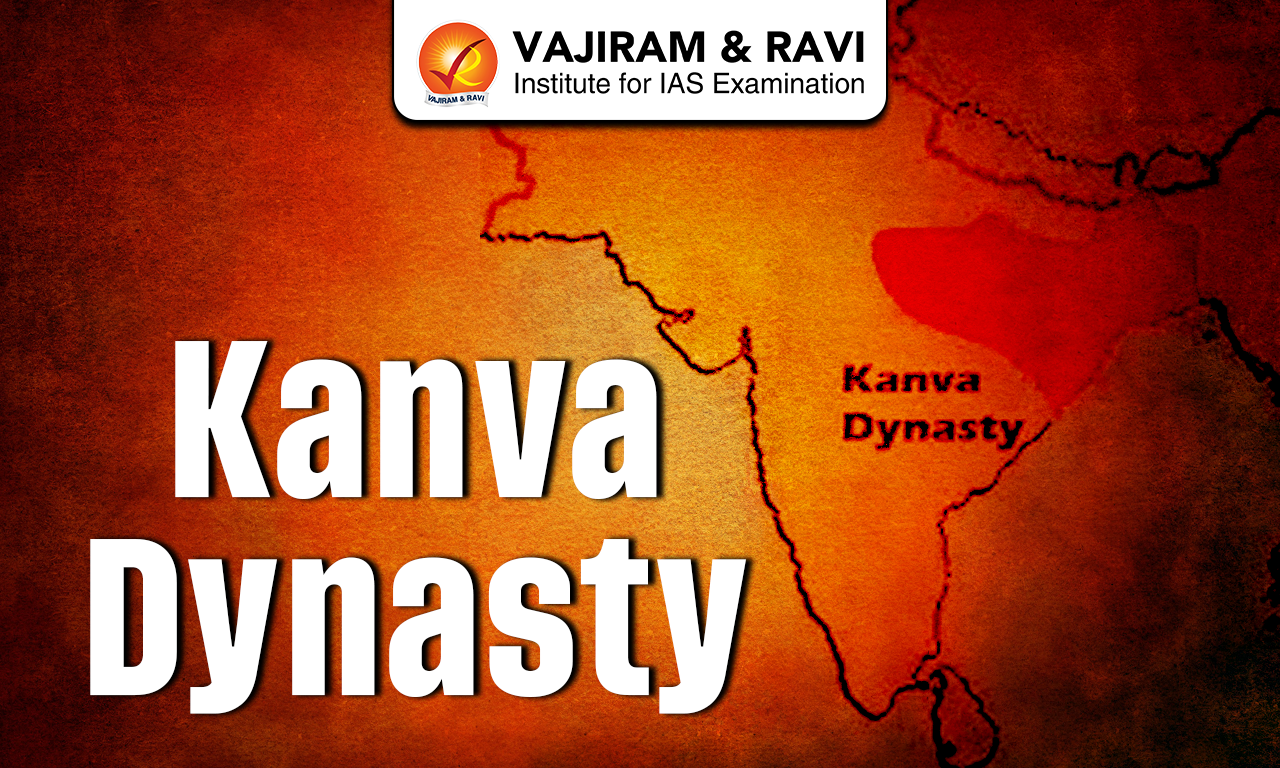
The Kanva Dynasty was a short lived but important Brahmin ruling line that governed Magadha from 73 BCE to 28 BCE after overthrowing the Shunga Dynasty. It was founded by Vasudeva Kanva. The dynasty continued Brahmanical traditions in a politically fragmented post Mauryan period. Despite ruling for only about 45 years, it played a key transitional role in ancient Indian history, especially in maintaining continuity in administration, culture and regional power structures.

Kanva Dynasty Background

The Kanva Dynasty emerged after the decline of the Shunga Dynasty and reflected political instability in post Mauryan India.

  • Origin of dynasty: The Kanvas were Brahmins descended from sage Saubhari and belonged to a respected priestly lineage, which gave them social legitimacy and religious authority in governance.
  • Establishment in 73 BCE: Vasudeva Kanva, originally a minister under Shunga king Devabhuti, assassinated him and seized power, marking the beginning of Kanva rule in Magadha.
  • Capital and Empire: Though Puranas mention Pataliputra as the capital, most coins are found in Vidisha, indicating strong administrative presence in Central India.
  • Political context: The dynasty arose during a period of weakening central authority, where multiple regional powers like Indo-Greeks and Satavahanas were emerging across the subcontinent.
  • Continuation of Shungas: Kanva rulers allowed remnants of the Shunga Dynasty to rule in limited areas, showing a gradual transition rather than complete displacement of earlier rulers.

Kanva Dynasty Administration

The administrative system under the Kanva Dynasty largely continued earlier models with limited innovation due to short rule and weak territorial control.

  • Monarchical governance: The Kanva rulers followed a hereditary monarchy system where power passed within the family, maintaining continuity but lacking strong institutional support.
  • Capital administration: Pataliputra remained the central administrative hub, although effective control was limited to Magadha and nearby regions due to political fragmentation.
  • Role of Brahmins: Being Brahmins themselves, rulers relied heavily on priestly elites for administration, reinforcing Brahmanical authority in governance and judicial matters.
  • Provincial control: Local governance was managed by regional officials, but declining central power reduced effective control over distant territories.
  • Policy approach: The dynasty focused more on maintaining stability and continuity rather than expansion or administrative reforms, reflecting a defensive political strategy.

Kanva Dynasty Society and Culture

The Kanva Dynasty period continued Brahmanical traditions while allowing coexistence of multiple religious and cultural practices.

  • Brahmanical dominance: The rulers strongly supported Vedic traditions and rituals, reinforcing the social position of Brahmins in society and governance.
  • Religious coexistence: Buddhism and Jainism continued without direct suppression, supported mainly by merchants and local communities rather than royal patronage.
  • Social structure: Society remained stratified with Brahmins at the top, followed by other varnas, reflecting continuation of traditional social hierarchy.
  • Rural integration: Local folk traditions and agrarian beliefs were incorporated into Brahmanical practices, strengthening rural legitimacy of the rulers.

Kanva Dynasty Art and Architecture

Art and architecture under the Kanva Dynasty largely followed earlier traditions with limited innovation due to short duration of rule.

  • Artistic continuity: The Kanva period continued Shunga style art, especially in terracotta figures and decorative elements seen in earlier monuments.
  • Literary patronage: Sanskrit literature received support and Brahmanical texts and Puranic traditions were preserved and transmitted during this period.
  • Script usage: Brahmi script continued to be used in inscriptions and coins, indicating administrative and cultural continuity.
  • Numismatic evidence: Coins bearing names like “Bhumimitra” and “Kanvasya” provide important historical evidence about rulers and regional control.

Kanva Dynasty Economy

The economy under the Kanva Dynasty remained agrarian with reliance on traditional taxation and limited expansion due to weak political control.

  • Agrarian base: Agriculture formed the backbone of the economy, supported by fertile Gangetic plains and seasonal monsoon patterns.
  • Revenue system: Land tax remained the primary source of income, typically collected as a share of agricultural produce.
  • Trade activities: Internal trade continued through established routes, supported by coin circulation found in regions like Vidisha and Kaushambi.
  • Limited expansion: Lack of territorial growth restricted economic expansion and reduced opportunities for increasing revenue sources.
  • Fiscal constraints: Political instability and external pressures likely strained resources, weakening long term economic strength of the dynasty.

Kanva Dynasty Rulers and their Contributions

The Kanva Dynasty had four major rulers whose reigns collectively lasted about 45 years with limited but notable contributions. The rulers followed direct succession, but short reigns indicate weak consolidation and limited long term political stability.

  • Vasudeva Kanva: He is the founder of the dynasty. He ruled from 73 BCE to 64 BCE for 9 years. He established authority after overthrowing Devabhuti and stabilised initial governance.
  • Bhumimitra: He was the son of Vasudeva. He ruled from 64 BCE to 50 BCE for 14 years. He was known from coins found in Panchala, Vidisha and Kaushambi showing administrative continuity.
  • Narayana: He ruled from 50 BCE to 38 BCE for 12 years. He maintained control and continued Brahmanical traditions with minimal historical records available.
  • Susarman: He was the last ruler of the Kanva Dynasty. He governed from 38 BCE to 28 BCE for 10 years. He witnessed decline and eventual defeat by Satavahanas leading to the dynasty’s end.

Kanva Dynasty Contemporary Relations

Political relations under the Kanva Dynasty were shaped by regional pressures rather than active diplomatic or military expansion.

  • Satavahana relations: The Satavahanas in the Deccan emerged as the strongest external force and eventually defeated the Kanvas around 28 BCE.
  • Indo-Greek context: Northwestern regions were under Indo-Greek influence, limiting Kanva expansion and isolating Magadha politically.
  • Regional interactions: The dynasty interacted indirectly with neighboring states through trade and political competition rather than alliances.
  • Lack of expansion: No evidence suggests major military campaigns or territorial conquests, indicating a defensive and inward focused policy.
  • External pressures: Continuous pressure from rising regional powers weakened Kanva authority and reduced their ability to maintain sovereignty.

Kanva Dynasty Decline

The decline of the Kanva Dynasty resulted from internal weaknesses and growing external pressures leading to its eventual fall.

  • Short reign duration: The dynasty lasted only about 45 years, indicating lack of strong institutional foundations and stable governance systems.
  • Weak leadership: Later rulers lacked effective control, leading to administrative inefficiency and declining authority over regions.
  • Successor and External invasion: The Satavahanas defeated the last ruler Susarman, ending Kanva rule around 28 BCE.
  • Magadha fragmentation: After the fall, Magadha lost its imperial status and came under regional powers like the Mitra dynasty of Kaushambi.
  • Puranic accounts: Texts suggest Balipuccha killed the last king, though archaeological evidence for this claim remains insufficient. 

Kanva Dynasty FAQs

Q1: Who founded the Kanva Dynasty?

Ans: The Kanva Dynasty was founded by Vasudeva Kanva in 73 BCE after he overthrew the last Shunga ruler, Devabhuti and established his rule in Magadha.

Q2: How long did the Kanva Dynasty rule?

Ans: The Kanva Dynasty ruled for about 45 years, from 73 BCE to 28 BCE, before being overthrown by the Satavahanas.

Q3: Who were the rulers of the Kanva Dynasty?

Ans: The four major rulers of the Kanva Dynasty were Vasudeva Kanva, Bhumimitra, Narayana and Susarman, as mentioned in the Puranic texts.

Q4: What was the capital of the Kanva Dynasty?

Ans: According to Puranic sources, Pataliputra was the capital, although coins suggest strong administrative activity in Vidisha.

Q5: When did the Kanva Dynasty end?

Ans: The Kanva Dynasty ended around 28 BCE after the last ruler, Susarman, was defeated by the Satavahana dynasty.

Coalition Government, Features, Significance, Challenges

Coalition Government

A coalition government is formed when no single political party secures a clear majority in the legislature, and two or more parties come together to form the government. These parties agree on a Common Minimum Programme (CMP) to run the administration collectively. Coalition governments are common in multi-party democracies like India, reflecting political diversity and regional representation.

Coalition Government

A coalition government is formed when two or more political parties come together to secure the majority required to form a government, usually when no single party wins an absolute majority. Such coalitions may be pre-poll or post-election alliances, where partners agree on a common programme to ensure stable governance and implement shared policies. At the Union level, coalition governments have existed since 1977, with regionalism and the rise of regional parties playing a major role in their emergence in India.

Coalition Government Features

The features of the Coalition Government are:

  • Multi-party composition: Formed by two or more political parties when no single party gets a majority.
  • Common Minimum Programme (CMP): Partners agree on a shared policy agenda to run the government.
  • Power sharing: Cabinet posts and responsibilities are distributed among coalition partners.
  • Consensus-based decision making: Major policies require consultation and agreement among allies.
  • Role of regional parties: Regional and smaller parties gain influence in governance.
  • Flexible political arrangements: Alliances may change based on political support and interests.
  • Limited stability: Government survival depends on the continued support of coalition partners.
  • Checks on dominance: Prevents concentration of power in a single party, strengthening democracy.

Formation of Coalition Governments in India

Coalition governments in India are formed when no single political party secures an absolute majority in the Lok Sabha or a State Assembly.

Morarji Desai (March 1977 - July 1979): Morarji Desai became the Prime Minister in March 1977, heading India’s first major coalition government. The Janata Party, a coalition of several opposition groups, came to power after defeating the Congress in the post-Emergency elections. His tenure marked a historic shift from one-party dominance to coalition politics at the national level.

Charan Singh (July 1979 - January 1980): Charan Singh assumed office as Prime Minister on 28 July 1979 after Morarji Desai’s resignation. He was the founder of the Bharatiya Kranti Dal and had earlier served as the Union Home Minister. His government was short-lived as it collapsed before a confidence vote, making him the only Indian Prime Minister who never faced Parliament.

P. Singh (December 1989 - November 1990): Vishwanath Pratap Singh led the National Front coalition government after the 1989 general elections. His government was supported from outside by the BJP and Left parties, reflecting a complex coalition arrangement. His tenure is especially remembered for the implementation of the Mandal Commission recommendations, which had a lasting impact on Indian politics.

Chandra Shekhar (November 1990 - June 1991): Chandra Shekhar became Prime Minister on 10 November 1990, leading a minority government with external support from the Congress. Although his administration aimed to provide political stability, it faced continuous challenges. The government eventually fell after Congress withdrew its support, leading to fresh elections.

D. Deve Gowda (June 1996 - April 1997): H. D. Deve Gowda took oath as Prime Minister on 2 June 1996, heading the United Front coalition government. The Congress extended external support to this coalition, allowing it to form the government at the Centre. However, disagreements with Congress led to the withdrawal of support, bringing his tenure to an end.

Inder Kumar Gujral (April 1997 - March 1998): Inder Kumar Gujral succeeded Deve Gowda as Prime Minister after Congress temporarily restored support to the United Front. A former External Affairs Minister, he is well known for the Gujral Doctrine in India’s foreign policy. His government collapsed when Congress withdrew its support again in November 1997, ending his short tenure.

Atal Bihari Vajpayee (March 1998 - May 2004): Atal Bihari Vajpayee led the BJP-led National Democratic Alliance (NDA) government from 1998 to 2004. After an initial brief term, he successfully completed a full five-year tenure (1999-2004), bringing stability to coalition politics. His leadership demonstrated that coalition governments could provide effective and durable governance.

Manmohan Singh (May 2004 - May 2014): Manmohan Singh served as Prime Minister for two consecutive terms, heading the Congress-led United Progressive Alliance (UPA) from 2004 to 2014. His coalition government focused on economic growth, social welfare schemes, and inclusive development. Completing ten years in office, his tenure remains one of the most stable coalition governments in India.

Coalition Government Significance

  • Coalition governments represent India’s diversity by including national and regional parties, ensuring wider social and regional representation in governance.
  • They strengthen federalism by giving states and regional parties a greater role in decision-making at the Centre.
  • Coalition governments reflect the true mandate of voters when no single party secures a clear majority.
  • They prevent concentration of power by promoting power-sharing and reducing the risk of authoritarian rule.
  • Coalition politics encourage consensus and dialogue, leading to more consultative and democratic policy-making.
  • By involving multiple parties, coalition governments increase accountability and checks within the political system.

Coalition Government Challenges

  • Coalition governments often suffer from political instability due to frequent withdrawal of support by allies. The fall of the V. P. Singh government (1990) after support was withdrawn.
  • Ideological differences among partners make consensus difficult and delay decision-making. Conflicting views within the National Front coalition on economic and social policies.
  • Policy paralysis occurs when major reforms are diluted or postponed to keep coalition partners satisfied. Slow reforms during the United Front governments (1996–98).
  • The authority of the Prime Minister may weaken due to dependence on coalition partners. Leadership constraints faced during H. D. Deve Gowda’s tenure.
  • Regional interests may dominate national priorities as regional parties press for local demands. Influence of regional parties in UPA coalition decision-making.
  • Coalition instability can lead to frequent elections and administrative disruption. Multiple governments between 1989 and 1991.

Recommendations on Coalition Government in India

  • The Second Administrative Reforms Commission (ARC) recommended the need for stable and principled coalitions, supported by a clear Common Minimum Programme to ensure policy continuity and effective governance.
  • The ARC emphasized ethical coalition management, suggesting transparency in power-sharing and decision-making to avoid opportunistic politics.
  • The National Commission to Review the Working of the Constitution (NCRWC) highlighted the importance of pre-poll alliances to reduce post-election instability and frequent government collapse.
  • The NCRWC suggested strengthening the Anti-Defection Law to prevent misuse of defections that destabilize coalition governments.
  • The Sarkaria Commission indirectly supported coalition stability by stressing cooperative federalism, which helps manage Centre-State relations in coalition eras.

Way Forward

  • Strengthen pre-poll alliances with clear ideological understanding and long-term policy goals to reduce post-election instability.
  • Formulate a clear and binding Common Minimum Programme (CMP) to ensure policy clarity and coordination among coalition partners.
  • Enforce the Anti-Defection Law strictly to prevent opportunistic withdrawals and political instability.
  • Establish institutional coordination mechanisms for regular consultation and dispute resolution within the coalition.
  • Balance regional aspirations with national interest through cooperative and competitive federalism.
  • Promote electoral and political reforms, such as simultaneous elections, to ensure continuity and stability in governance.

Coalition Government FAQs

Q1: What is a coalition government?

Ans: A coalition government is formed when multiple political parties jointly form a government due to the absence of a clear majority.

Q2: When did coalition politics begin in India?

Ans: Coalition politics became prominent at the national level after 1989, following the decline of single-party dominance.

Q3: Is a coalition government good for democracy?

Ans: Yes, it promotes inclusiveness, consensus-building, and representation of diverse interests.

Q4: What is a Common Minimum Programme (CMP)?

Ans: CMP is a shared policy agenda agreed upon by coalition partners to guide governance.

Q5: Name two major coalition governments in India.

Ans: The United Progressive Alliance (UPA) and National Democratic Alliance (NDA).

India’s Fiscal Position, Revenue, Expenditure, Deficit & Debt

India’s Fiscal Position

India’s fiscal position has strengthened in recent years, supported by fiscal consolidation, better revenue mobilisation and higher capital expenditure. The government has gradually reduced the fiscal and revenue deficits while maintaining spending on infrastructure and development. The Economic Survey 2025-26 highlights that this calibrated fiscal strategy has helped maintain macroeconomic stability despite global economic uncertainty. 

India’s Fiscal Position Current Position

  • India’s fiscal strategy is increasingly focused on balancing economic growth, fiscal sustainability and macroeconomic stability. The government has followed a gradual path of fiscal consolidation rather than making sharp cuts in public expenditure.
  • The fiscal deficit was budgeted at 4.4% of GDP in FY 2025-26, down from 4.8% in FY 2024-25. For FY 2026-27, the fiscal deficit is estimated at 4.3% of GDP, showing continued movement towards fiscal consolidation.
  • The revenue deficit was budgeted at 0.8% of GDP in FY 2025-26, its lowest level since FY 2008-09. This indicates that a larger share of government resources can be directed towards productive capital expenditure.
  • The quality of government expenditure has improved as revenue expenditure has moderated, while capital expenditure has received greater priority. Effective capital expenditure has increased significantly compared with the pre-pandemic period.
  • The government's debt-to-GDP ratio has also declined. It stood at 55.7% in FY 2024-25, while the Union Budget 2026-27 estimates it at 55.6% and targets a level of around 50±1% by 2030-31.
  • States remain an important part of India's overall fiscal position because their finances directly affect general government debt, public investment and fiscal stability.

Key Indicators of India’s Fiscal Position

The fiscal position of India is assessed through several indicators that show the government's ability to raise revenue, manage expenditure and control debt.

  • Fiscal Deficit: It is the gap between total government expenditure and total receipts excluding borrowings. It represents the government's overall borrowing requirement. A lower and sustainable fiscal deficit helps strengthen fiscal stability.
  • Revenue Deficit: It occurs when revenue expenditure exceeds revenue receipts. A reduction in the revenue deficit is important because it creates greater room for spending on productive assets.
  • Debt-to-GDP Ratio: This measures government debt in relation to the size of the economy. India's medium-term objective is to bring the debt-to-GDP ratio towards 50±1% by FY 2030-31.
  • Capital Expenditure: Capital expenditure creates long-term assets such as roads, railways, ports and other infrastructure. The government has increasingly prioritised capital expenditure because of its role in supporting productivity and long-term growth.
  • Revenue Mobilisation: Stronger tax and non-tax revenues improve the government's ability to finance expenditure without excessive borrowing. Expansion of the direct-tax base and GST base has supported revenue mobilisation.
  • Quality of Expenditure: Fiscal health depends not only on how much the government spends but also on where and how effectively it spends. Productive capital expenditure is generally more beneficial for long-term growth than excessive committed or non-developmental expenditure.

Government Revenue, Expenditure and Fiscal Deficit in India

This section covers the main sources of government revenue, the nature of government expenditure and the fiscal deficit, which together explain the overall fiscal position of the government. 

Government Revenue

  • Government revenue mainly comes from tax revenue and non-tax revenue. Tax revenue includes direct and indirect taxes, while non-tax revenue includes dividends, interest receipts, fees and other government income.
  • India's revenue mobilisation has improved due to better tax compliance, digitalisation, technology-driven tax administration and a broader tax base. Income-tax return filings increased from 6.9 crore in FY 2021-22 to 9.2 crore in FY 2024-25.
  • GST revenue has also become an important source of government revenue. The GST taxpayer base has expanded considerably since its introduction, reflecting increasing formalisation of economic activity.
  • Non-tax revenue has remained an important source of support, with improved performance of Central Public Sector Enterprises (CPSEs) contributing through higher profits and dividends.

Government Expenditure

  • Government expenditure consists mainly of revenue expenditure and capital expenditure. Revenue expenditure includes salaries, pensions, interest payments, subsidies and other recurring expenses.
  • Capital expenditure is directed towards the creation of long-term productive assets, including roads, railways, infrastructure and other public facilities.
  • Revenue expenditure declined from 13.6% of GDP in FY 2021-22 to 10.9% in FY 2024-25, creating greater fiscal space for productive expenditure.
  • The government has also rationalised subsidies while continuing to support essential welfare and food-security programmes. Major subsidies declined from 1.9% of GDP in FY 2021-22 to 1.1% in FY 2025-26.

Fiscal Deficit and Fiscal Consolidation

  • Fiscal deficit represents the government's borrowing requirement. Persistent high deficits can increase debt and interest burdens and may also create crowding-out effects if government borrowing reduces the resources available for private investment.
  • Fiscal consolidation refers to measures aimed at improving government finances by controlling deficits, improving revenue mobilisation and making expenditure more efficient.
  • India's fiscal consolidation strategy seeks to reduce the deficit gradually while protecting public investment and essential welfare expenditure.

Factors Affecting India’s Fiscal Position

India's fiscal position is influenced by domestic economic conditions, government policies, revenue performance and the finances of states.

  • Economic growth: Higher economic growth generally expands the tax base and increases government revenue, making fiscal consolidation easier. A slowdown, on the other hand, can reduce revenue while increasing the need for government support.
  • Tax mobilisation: Strong tax collection improves fiscal capacity. GST expansion, digital tax administration and better compliance have helped improve revenue mobilisation.
  • Public expenditure: The composition of expenditure is important. Greater emphasis on capital expenditure can support long-term growth, while excessive committed expenditure can reduce fiscal flexibility.
  • Subsidies and welfare expenditure: Welfare programmes support vulnerable sections of society, but poorly targeted or rapidly rising subsidies can put pressure on public finances.
  • Public borrowing and interest payments: Borrowing helps finance development expenditure when government revenues are insufficient. However, excessive borrowing increases debt and future interest obligations.
  • State finances: State governments account for a significant share of general government debt and expenditure. Their fiscal discipline is therefore important for India's overall fiscal stability.
  • Fiscal policy: Fiscal policy operates mainly through taxation, public expenditure and public borrowing. Depending on economic conditions, the government may adopt expansionary, contractionary or neutral fiscal policies.
  • Economic cycle: A counter-cyclical fiscal policy attempts to support the economy during a slowdown and moderate demand during an economic boom. A pro-cyclical policy, in contrast, can amplify economic fluctuations.

Fiscal Position of Indian States

  • State finances are important for India’s overall fiscal stability as states account for a significant share of government debt and expenditure. Their fiscal health directly affects macroeconomic stability and sustainable growth.
  • NITI Aayog’s Fiscal Health Index (FHI) 2026 assesses states on Quality of Expenditure, Revenue Mobilisation, Fiscal Prudence, Debt Index and Debt Sustainability. It separately evaluates 18 major states and 10 North-Eastern and Himalayan States.
  • Among major states, Odisha remained the top performer, followed by Goa and Jharkhand, while Gujarat, Maharashtra, Chhattisgarh, Telangana, Uttar Pradesh and Karnataka were among the Front-Runners.
  • Punjab, West Bengal, Kerala and Andhra Pradesh remained in the Aspirational category due to high debt, persistent deficits, large committed expenditure and modest revenue growth. The combined fiscal deficit of states rose from around 2.8% of GDP in the post-pandemic period to 3.2% in FY 2024-25.
  • Among the North-Eastern and Himalayan States, Arunachal Pradesh and Uttarakhand were Achievers, while Assam, Meghalaya, Mizoram, Sikkim and Tripura were Performers. Himachal Pradesh, Manipur and Nagaland remained Aspirational due to fiscal pressures.

Challenges for India’s Fiscal Position

  • High public debt: Although India's debt-to-GDP ratio has declined, the overall level of public debt remains significant. Continued fiscal consolidation is necessary to create greater fiscal space for future shocks.
  • Rising interest burden: Interest payments are a major component of government expenditure and can reduce the resources available for development and welfare spending.
  • State-level fiscal stress: The fiscal position of states varies considerably. NITI Aayog's Fiscal Health Index 2026, based on FY 2023-24 data, shows significant differences among states in revenue mobilisation, expenditure quality, fiscal prudence and debt sustainability. Odisha ranked first among the major states, while Punjab, Andhra Pradesh, West Bengal and Kerala remained in the fiscally stressed category.
  • Committed expenditure: High expenditure on salaries, pensions and interest payments can leave states with limited flexibility to increase productive and developmental spending.
  • Limited own-revenue capacity: Some states remain highly dependent on transfers from the Centre because of their relatively weak own-tax and non-tax revenue mobilisation.
  • Need to balance growth and consolidation: Excessive fiscal tightening could affect public investment and economic growth, while prolonged high deficits could weaken debt sustainability. Maintaining the right balance remains a major policy challenge.
  • Global economic uncertainty: External shocks such as changes in commodity prices, global interest rates, geopolitical tensions and slower global growth can affect India's revenue, expenditure and borrowing conditions.

Way Forward for India’s Fiscal Position

  • Continue gradual fiscal consolidation: India should maintain a credible medium-term path of deficit reduction without compromising essential welfare spending and productive public investment.
  • Strengthen revenue mobilisation: Expanding the tax base, improving compliance, reducing leakages and using technology can help increase government revenues without placing excessive pressure on existing taxpayers.
  • Maintain focus on capital expenditure: Public investment in infrastructure, transport, logistics and other productive sectors should remain a priority because it can support private investment and long-term economic growth.
  • Improve the quality of expenditure: Governments should gradually reduce unproductive and excessive committed expenditure while directing more resources towards development and asset creation.
  • Strengthen state finances: States need to improve own-revenue mobilisation, expenditure management, debt management and fiscal transparency. NITI Aayog has highlighted the importance of improving revenue capacity and controlling committed expenditure for stronger state-level fiscal resilience.
  • Rationalise subsidies: Subsidies should be better targeted so that fiscal resources reach the intended beneficiaries while reducing unnecessary pressure on government finances.
  • Improve public financial management: Greater transparency, better cash and debt management, reliable fiscal data and stronger monitoring can improve the efficiency of public spending.
  • Strengthen Centre-State coordination: Schemes such as Special Assistance to States for Capital Expenditure (SASCI) can continue to encourage states to maintain capital spending while linking fiscal support with reforms and investment priorities.
  • Maintain a sustainable debt trajectory: India's medium-term objective of bringing the debt-to-GDP ratio towards 50±1% by FY 2030-31 should remain an important anchor for fiscal policy.

India’s Fiscal Position FAQs

Q1: What is India’s fiscal position?

Ans: India’s fiscal position refers to the overall condition of government finances, including revenue, expenditure, fiscal deficit and public debt.

Q2: What is India’s current fiscal deficit?

Ans: India’s fiscal deficit is estimated at 4.3% of GDP for FY 2026-27, compared with the budgeted 4.4% in FY 2025-26.

Q3: What are the main sources of government revenue in India?

Ans: The main sources are tax revenue and non-tax revenue. Tax revenue includes direct and indirect taxes, while non-tax revenue includes dividends, interest receipts and fees.

Q4: What is the difference between revenue expenditure and capital expenditure?

Ans: Revenue expenditure covers recurring expenses such as salaries, pensions, subsidies and interest payments, while capital expenditure is used to create long-term productive assets such as roads, railways and infrastructure.

Q5: What is fiscal consolidation in India?

Ans: Fiscal consolidation refers to measures taken to reduce fiscal deficits, improve revenue mobilisation and manage government expenditure efficiently while maintaining economic growth.

Women Empowerment, Need, Legal Framework, Challenges, Achievements

Women Empowerment

Women Empowerment is the process of reducing and eliminating Social Issues, Economic Challenges and Political Inequalities between men and women. The concept gained prominence in the 19th century, where empowerment meant enabling individuals with rights and authority. Historically, women have been regarded as the weaker gender worldwide and, even after India’s independence, they remained deprived of equal socio-economic status. To address this imbalance, the Government of India and various non-governmental organizations initiated multiple women development programmes. At the global level, the United Nations declared 1975-1985 as the "Decade for Women", and 2001 as the "International Year for Women’s Empowerment", a resolution adopted by India.

Women Empowerment in India

In India, Women constitute nearly 48% of the population which makes the Woman Empowerment central to inclusive national development. Over the past decade, improvements in female literacy, workforce participation, entrepreneurship, political representation and health indicators show steady progress. At the same time, persistent challenges such as patriarchy, violence, informal employment and moral policing continue to restrict women’s autonomy.

Women Empowerment Need

Women Empowerment is essential for equality, economic growth, democratic strength, social justice and sustainable development in a diverse and populous society.

  • Reduction of Violence Against Women: Empowerment strengthens legal awareness, economic independence and social support, enabling women to resist domestic violence, sexual abuse and exploitation while improving reporting and justice delivery.
  • Addressing Feminization of Poverty: Women form a disproportionate share of the poor due to low wages, informal work and unpaid care responsibilities; empowerment expands income access and financial security.
  • Economic Productivity: Greater female workforce participation increases national productivity, household incomes and economic resilience, directly supporting inclusive growth.
  • Social Justice: Empowerment corrects historical discrimination by ensuring equal rights, opportunities and dignity across social, economic and political spheres.
  • Democratic Strengthening: Women’s participation in governance improves policy inclusiveness, accountability and responsiveness, reflecting grassroots realities and social diversity.

Women Empowerment Legal Frameworks

In India, Women Empowerment is backed by Constitutional Provisions, Government Schemes and Initiatives and other Legal Aspects as highlighted below:

1. Constitutional Provisions

Article 14 guarantees equality before law, while Article 15 prohibits discrimination and allows special provisions for women. Article 16 ensures equal opportunity in public employment, forming the legal foundation for gender justice. Article 39(d) mandates equal pay for equal work and Article 42 directs the state to ensure humane working conditions and maternity relief.

2. Government Initiatives

Various Government Schemes and Initiatives help in the eradication of discrimination against woman at various levels of society and administrations. The major initiatives include:

  • The Protection of Women from Domestic Violence Act 2005: provides legal remedies against abuse, the Nirbhaya Scheme improved legal deterrence, though enforcement gaps remain a concern.
  • Maternity Benefit (Amendment) Act 2017: extended paid maternity leave to 26 weeks and mandated crèche facilities, supporting women’s workforce continuity and child care responsibilities.
  • Beti Bachao Beti Padhao Scheme: addresses declining child sex ratios and promotes girls’ education, contributing to rising female literacy and increased school enrollment across states.
  • Pradhan Mantri Mudra Yojana: expanded credit access, with 68% of loans in 2024 issued to women. Stand-Up India and Mahila E-Haat further support women-led enterprises and market access.
  • Mission Shakti: integrates safety, security and empowerment schemes, including One Stop Centres. Over 725 centres offer legal aid, medical support and counselling to women facing violence.
  • The Nari Shakti Vandan Adhiniyam 2023: mandates 33% reservation for women in Parliament and state assemblies, marking a historic step toward balanced political representation after delimitation.
  • Digital and Technology Initiatives: Programs like Drone Didis promote technology adoption and digital entrepreneurship among rural women, expanding income opportunities beyond traditional sectors.
  • Other Scheme: The Government of India has brought various other schemes for the upliftment and protection of the Females, such as: Swadhar Greh, Nari Shakti Puruskar, POSH Act, Ujjawala Scheme, POCSO Act, Sakhi Niwas, Vishaka Guidelines, Sukanya Samriddhi Yojana, Mahtari Vandana Yojana  etc.

Women Empowerment Challenges

Women empowerment in India faces structural, social, economic and cultural barriers that limit women’s freedom, safety and participation despite visible progress in education and employment. Some of the major Women Empowerment Difficulties are:

  • Labour Force Exclusion: About 90% of working women remain in informal employment without social security, maternity benefits, or job stability. Although female labour force participation rose to 41.7% in 2023-24, it remains far below male participation and the global average of 48.7%, reinforcing economic vulnerability.
  • Feminisation of Agriculture: Women constitute over 42% of India’s agricultural workforce in 2025, marking a 135% rise in a decade. However, most lack land ownership, access to credit and decision making power, resulting in unpaid or underpaid labour despite increased responsibility in food production.
  • Political Underrepresentation: Women hold only about 13.6% of seats in the 18th Lok Sabha, with limited representation in state legislatures. Practices like the “sarpanch-pati” system undermine elected women leaders, while delays in implementing the 33% reservation law weaken meaningful political empowerment.
  • Health Inequality: NFHS-5 reports that 57% of women aged 15-49 are anaemic, affecting productivity and maternal health. Despite maternal mortality declining to 97 per 100,000 live births, malnutrition and inadequate preventive care continue to undermine women’s physical well-being.
  • Educational and Skill Gaps: Higher education enrollment stands at about 28.5%, with women underrepresented in STEM fields. Early marriage, care burdens and limited career guidance restrict skill development, preventing education from translating into quality employment opportunities.
  • Digital and Infrastructure Exclusion: Around 51.6% of rural women do not own a mobile phone, limiting access to digital education, banking and e-governance. This digital divide reduces participation in the modern economy and increases dependence on intermediaries for essential services.
  • Cyber Abuse and Online Harassment: Growing digital access has introduced cyberstalking, bullying, AI manipulation of Photos and Videos and doxing, discouraging women from using online platforms for education and work as seen in the recent Grok AI Case. Fear of online violence creates a chilling effect, reinforcing digital exclusion rather than empowerment.
  • Gender-Based Violence: More than 4,45,000 crimes against women were reported in 2022, including domestic violence and sexual assault. Weak enforcement and social stigma reduce reporting, affecting women’s mobility, confidence and participation in public life.

Women Empowerment International Measures

Global conventions and development goals provide normative guidance and accountability mechanisms supporting women’s rights and gender equality across nations.

  • CEDAW: India ratified the Convention on the Elimination of All Forms of Discrimination against Women, committing to eliminate legal and social discrimination and ensure equal political, economic and social rights.
  • Beijing Platform for Action: The 1995 declaration emphasised women’s economic participation, education, health and freedom from violence, shaping national gender policies and monitoring frameworks worldwide.
  • Sustainable Development Goal 5: SDG 5 aims to achieve gender equality by 2030, linking women empowerment with education, health, decent work, leadership and access to resources, influencing national planning priorities.
  • International Labour Standards: ILO conventions on equal remuneration, maternity protection and workplace safety inform labour reforms and gender-sensitive employment policies in developing economies.
  • Global Advocacy and Reporting: UN Women and global indices on gender inequality highlight gaps and best practices, encouraging evidence based policymaking and cross-country learning for women empowerment.

Women Empowerment Achievements

India’s progress in women empowerment is reflected in measurable gains across education, economy, health, leadership and social visibility over the past decade.

  • Rising Female Literacy: Female literacy reached about 70.3% in 2025, while youth literacy stands at 96%. States like Kerala and Mizoram approach universal literacy, showing the impact of sustained educational investments.
  • Workforce Participation Growth: Female labour force participation rose to 41.7% in 2023-24, with increased presence in IT, healthcare, education and the gig economy, signalling gradual economic integration.
  • Entrepreneurship Expansion: Women-led MSMEs nearly doubled to 1.92 crore enterprises in 2023-24. Women-owned proprietary establishments increased from 17.4% to 26.2%, reflecting growing economic independence.
  • Self-Employment Rise: Self-employment among women increased from 51.9% in 2017 to 67.4% in 2024, supported by microcredit, SHGs and digital marketplaces.
  • Local Governance Leadership: Women constitute nearly 46% of representatives in Panchayati Raj Institutions, supported by state-level reservations up to 50%, strengthening grassroots democracy.
  • Health Outcome Improvements: Maternal mortality declined and institutional deliveries exceeded 88%, reflecting expanded healthcare access and maternal support schemes.
  • Political Visibility: Women leaders like Nirmala Sitharaman and Mamata Banerjee influence national and state governance, while the reservation law signals future gains in legislative representation.
  • Cultural and Sports Achievements: Athletes like Smriti Mandhana and Harmanpreet Kaur led historic cricket victories in 2025, while Olympic performances by women enhanced national pride and challenged gender stereotypes.
Related Articles
National Annual Report and Index on Women's Safety (NARI) 2025 International Day for Elimination of Violence Against Women
Women Entrepreneurship Program National Policy For Women
National Women's Day POSH Act
Women Freedom Fighters Commission on the Status of Women (CSW)
Women in Space Leadership Programme Women Poineers of Indian Constitution
Female Genital Mutilation Me Too Movement
Womaniya Initiative Pankhudi Portal
Acid Attack Laws in India Devadasi System
Child Marriage in India Shilp Didi Programme


Women Empowerment FAQs

Q1: What is Women Empowerment?

Ans: Women Empowerment means enabling women to participate equally in decision-making, education, employment and social life with dignity and rights.

Q2: What is the need of Women Empowerment?

Ans: It reduces gender inequality, boosts economic growth, improves family health and strengthens democratic participation.

Q3: How does the Government support Women Empowerment in India?

Ans: The Government supports Women Empowerment through constitutional guarantees, education and skill schemes, economic support programs, safety laws, and integrated initiatives like Mission Shakti.

Q4: What are the Challenges to the Empowerment of Womens?

Ans: Patriarchy, gender-based violence, wage gap, limited access to education and underrepresentation in politics and leadership roles.

Q5: How does Women Empowerment help reduce Poverty?

Ans: When women earn and control income, family spending on food, health, and education increases, which directly reduces poverty and improves living standards.

Tashkent Declaration, Background, Features, Outcomes

Tashkent Declaration

The Tashkent Declaration was a significant diplomatic agreement aimed at restoring peace between India and Pakistan following the war of 1965. It laid down key terms related to ceasefire, withdrawal of forces, and the normalization of diplomatic and economic relations between the two countries.

Tashkent Declaration

The Tashkent Declaration, signed to end the Indo-Pakistan War of 1965 (August 5 – September 23, 1965), was a landmark peace agreement between India and Pakistan. Concluded in Tashkent, the capital of the then Uzbek SSR in the USSR, its primary objective was to restore economic and diplomatic relations between the two countries. The agreement emphasized non-interference in each other’s internal and external affairs and sought to promote bilateral cooperation for mutual progress and stability.

Tashkent Declaration Overview

The Tashkent Declaration was a peace agreement signed between India and Pakistan on January 10, 1966, to formally end the Indo-Pakistan War of 1965. The agreement outlined key commitments, including the withdrawal of military forces and a pledge of non-interference in each other’s internal affairs. The table below summarizes its main aspects, outcomes, and consequences.

Tashkent Declaration Overview

Aspect

Details

Date

January 10, 1966

Location

Tashkent, Uzbekistan (USSR at the time)

Parties

India and Pakistan

Purpose

To end the Indo-Pakistan War of 1965 and restore peace between the two nations

Key Points

  • Military withdrawal to pre-conflict positions by February 25, 1966
  • Neither country would interfere in the other’s internal affairs

Outcome

Temporarily halted hostilities but did not resolve deep-rooted issues between the two countries

Consequences

Marked a brief pause in conflicts; underlying tensions remained, leading to renewed hostilities in 1970

Tashkent Declaration Background

  • First Indo-Pakistani War (1947-1949): Fought shortly after independence, it ended in a ceasefire and led to the establishment of the Line of Control (LOC) in Kashmir.
  • Operation Gibraltar (April 1965): Pakistan’s unsuccessful attempt to capture Kashmir by infiltrating forces disguised as locals.
  • Indo-Pakistan War (August-September 1965): Sparked by the failure of Operation Gibraltar, this conflict risked drawing in Cold War superpowers.
  • Diplomatic Intervention: The United States and the USSR pushed for peace talks to prevent further escalation.
  • UN Resolution (September 22, 1965): The UN called for a ceasefire, temporarily halting hostilities.
  • Tashkent Declaration (January 1966): Mediated by the USSR, leaders Lal Bahadur Shastri and Muhammad Ayub Khan signed the declaration to restore peace and rebuild diplomatic ties.

Tashkent Declaration Features

  • Restoration of Pre-War Positions: Both India and Pakistan agreed to return to the territorial positions held before the outbreak of the 1965 conflict, helping to ease tensions.
  • Non-Interference in Internal Affairs: Each country pledged not to interfere in the other’s internal matters and to avoid harmful propaganda, fostering mutual respect.
  • Orderly Transfer of Prisoners of War: The declaration called for the systematic and humane repatriation of prisoners captured during the war.
  • Commitment to Bilateral Improvement: Leaders of both nations committed to dialogue and cooperation aimed at rebuilding trust and improving diplomatic relations.
  • Restoration of Trade and Economic Relations: Both sides agreed to reinstate trade and economic ties to pre-war levels, promoting stability and shared prosperity.

Tashkent Declaration Outcomes

  • Ceasefire: Both nations agreed to an immediate ceasefire along the Line of Control and international borders.
  • Withdrawal of Forces: India and Pakistan committed to returning to the positions held before August 5, 1965.
  • No Use of Force: Both sides pledged to resolve disputes peacefully, avoiding military action.
  • Respect for Sovereignty: The declaration emphasized mutual respect for territorial integrity and sovereignty.
  • Economic and Diplomatic Relations: India and Pakistan agreed to restore trade and diplomatic ties.

Prisoners of War: Both countries consented to release and repatriate captured soldiers.

Also Check Other Posts
Battle of Plassey Robert Clive
Battle of Buxar Anglo Mysore Wars
Dual Government in Bengal Tipu Sultan
Anglo Maratha Wars Maratha Empire
Third Battle of Panipat Chhatrapati Shivaji Maharaj
Battel of Bhima Koregaon Anglo Burmese War
Maharaja Ranjit Singh Anglo Nepal War

Tashkent Declaration FAQs

Q1: What is the Tashkent Declaration?

Ans: The Tashkent Declaration was a peace agreement signed on 10 January 1966 between India and Pakistan, mediated by the USSR, after the Indo-Pak War of 1965.

Q2: Who signed the Tashkent Agreement?

Ans: It was signed by Lal Bahadur Shastri (Prime Minister of India) and Ayub Khan (President of Pakistan) in Tashkent, with Soviet Premier Alexei Kosygin mediating.

Q3: What is the Tashkent Agreement of UPSC?

Ans: For UPSC, it refers to the 1966 peace pact resolving the 1965 war, highlighting India-Pakistan relations, Cold War geopolitics, and India’s foreign policy under Shastri.

Q4: Which Indian prime minister died during the Tashkent Agreement?

Ans: Lal Bahadur Shastri, India’s second Prime Minister, died on 11 January 1966 in Tashkent, just hours after signing the peace agreement with Pakistan.

Q5: Was the Tashkent Agreement successful?

Ans: The agreement restored status quo ante (return to pre-war positions) and temporarily reduced tensions, but failed to resolve Kashmir, so its success was limited.

Napoleon Bonaparte (1769-1821), Biography, French Revolution, Death

Napoleon Bonaparte

Napoleon Bonaparte was one of the most powerful and influential leaders in world history. He rose from a modest background to become the Emperor of France and ruled much of Europe in the early nineteenth century. Napoleon Bonaparte shaped modern warfare, laws, administration, and education systems. His actions changed the political map of Europe and influenced many countries beyond France. Even today, Napoleon Bonaparte is remembered for his military skills, legal reforms, and the long wars that affected millions of people across Europe.

Napoleon Bonaparte Biography

Napoleon Bonaparte was born on 15 August 1769 in Ajaccio, Corsica, a Mediterranean island that had recently come under French control. He belonged to a family of minor nobility with Italian roots. Napoleon Bonaparte joined the French army as an artillery officer and gained recognition during the French Revolution. Through military success and political skill, he became First Consul of France in 1799. In 1804, Napoleon Bonaparte crowned himself Emperor of the French. He ruled until his defeat in 1815 and died in exile on the island of Saint Helena on 5 May 1821.

Napoleon Bonaparte Early Life

Napoleon Bonaparte grew up in Corsica in a disciplined household led by his mother, Letizia. At the age of nine, he was sent to France for education. He studied at military schools in Autun, Brienne, and later Paris. Napoleon Bonaparte was especially good at mathematics and artillery science, which later helped him in battles. Although he struggled with the French language initially, his strong focus on learning and military training shaped his future as a skilled commander.

Napoleon Bonaparte and the French Revolution

The French Revolution created opportunities for talented officers like Napoleon Bonaparte. He supported revolutionary ideas such as equality and the end of monarchy. His major breakthrough came in 1793 when he helped France recapture the port city of Toulon from enemy forces. In 1795, Napoleon Bonaparte protected the revolutionary government by stopping a royalist uprising in Paris. These successes made him famous and helped him rise quickly in the French army.

Napoleon Bonaparte Rise to Power

Napoleon Bonaparte became a national hero after leading successful military campaigns in Italy between 1796 and 1797. He defeated stronger Austrian forces and gained territory for France. In 1798, he led a military expedition to Egypt to weaken British influence, though his navy was defeated at the Battle of the Nile. In 1799, Napoleon Bonaparte played a key role in the Coup of 18 Brumaire, which overthrew the existing government and made him First Consul, the most powerful leader in France.

Napoleon Bonaparte First Consul

As First Consul, Napoleon Bonaparte controlled France’s government, military, and administration. He brought political stability after years of revolution. His victory over Austria at the Battle of Marengo in 1800 strengthened his authority. Napoleon Bonaparte improved tax collection, rebuilt infrastructure, and restored order. In 1802, peace with Britain through the Treaty of Amiens increased his popularity among the French people.

Napoleon Bonaparte French Empire

In December 1804, Napoleon Bonaparte declared himself Emperor of the French. This symbolized complete control over the state. As emperor, he expanded French influence across Europe by conquering territories and placing his relatives on foreign thrones. Napoleon Bonaparte ruled over France, Italy, and large parts of Central Europe. His empire became the most powerful political force on the continent.

Napoleonic Wars under Napoleon Bonaparte

Between 1803 and 1815, Napoleon Bonaparte fought a series of wars against European powers such as Britain, Austria, Prussia, and Russia. His greatest victory came in 1805 at the Battle of Austerlitz, where he defeated Austrian and Russian armies. This victory ended the Holy Roman Empire. However, Napoleon Bonaparte’s navy was destroyed by Britain at the Battle of Trafalgar. Despite many land victories, constant warfare weakened France over time.

Napoleon Bonaparte Policies

In 1803, Napoleon Bonaparte sold the Louisiana Territory to the United States for fifteen million dollars. This helped France raise money for wars and ended its North American ambitions. He also introduced the Continental System, an economic blockade aimed at damaging British trade. However, this policy hurt European economies and created resistance among French allies, reducing support for Napoleon Bonaparte.

Napoleon Bonaparte Reforms

One of Napoleon Bonaparte’s most important achievements was the Napoleonic Code, introduced in 1804. It created equal laws for all male citizens and ended privileges based on birth. The code protected private property, allowed religious freedom, and promoted merit-based government jobs. Napoleon Bonaparte also abolished feudal practices and serfdom in many regions under French control.

Napoleon Bonaparte reformed education to create skilled administrators and soldiers. He established state-run secondary schools called lycées and strengthened higher education institutions. In 1808, he created the Imperial University to control education standards. The system focused on discipline, science, and loyalty to the state and influenced education systems across Europe.

Napoleon Bonaparte Decline

Napoleon Bonaparte’s power declined due to continuous wars. The Peninsular War in Spain drained French resources. His invasion of Russia in 1812 failed due to harsh weather, disease, and supply problems. After major defeats, especially at the Battle of Leipzig in 1813, enemy forces invaded France. Napoleon Bonaparte abdicated in 1814 and was sent to the island of Elba.

Napoleon Bonaparte Death

Napoleon Bonaparte returned briefly to power in 1815 but was defeated by British and allied forces at the Battle of Waterloo. He was then exiled to the remote island of Saint Helena in the South Atlantic Ocean. Living under strict supervision, Napoleon Bonaparte died there on 5 May 1821. Medical studies suggest stomach cancer as the cause of death.

Napoleon Bonaparte Legacy

Napoleon Bonaparte left a lasting impact on the modern world. His legal reforms influenced many countries. His military strategies are still studied today. At the same time, his wars caused massive destruction and loss of life across Europe. Napoleon Bonaparte is remembered as both a brilliant leader and a controversial ruler whose actions shaped modern history.

Napoleon Bonaparte FAQs

Q1: Who was Napoleon Bonaparte?

Ans: Napoleon Bonaparte was a French military leader who became Emperor of France and ruled much of Europe.

Q2: When and where was Napoleon Bonaparte born?

Ans: Napoleon Bonaparte was born on 15 August 1769 in Ajaccio, Corsica.

Q3: Why is Napoleon Bonaparte famous?

Ans: He is famous for his military victories, legal reforms, and shaping modern Europe.

Q4: What was the Napoleonic Code?

Ans: The Napoleonic Code was a law system that gave equal rights to male citizens.

Q5: How did Napoleon Bonaparte die?

Ans: Napoleon Bonaparte died in exile on Saint Helena in 1821, likely due to stomach cancer.

Unification of Italy, Historical Background, Foundations, Phases

Unification of Italy

The Unification of Italy, known as the Risorgimento (meaning “resurgence”), was one of the most important political developments of nineteenth-century Europe. It transformed the Italian peninsula from a collection of fragmented states, foreign-controlled territories, and papal domains into a unified nation-state. The process formally began with the proclamation of the Kingdom of Italy in 1861 and was completed in 1870 with the annexation of Rome. However, unification was not a sudden event; it was a gradual and complex process shaped by ideological movements, diplomatic strategies, wars, and popular participation.

Historical Background Italy Before Unification

In the early nineteenth century, Italy was not a unified nation but a fragmented region divided into multiple states after the Congress of Vienna. The objective of European powers was to restore monarchies and suppress the spread of nationalism that had emerged after the French Revolution and the rule of Napoleon Bonaparte. As a result, Italy was split into several political units such as: 

  • The progressive Kingdom of Piedmont-Sardinia in the northwest,
  • The conservative and economically backward Kingdom of the Two Sicilies in the south, and 
  • The Papal States in central Italy under the authority of the Pope. 
  • Smaller states like Parma, Modena, and Tuscany remained under Austrian influence, while Lombardy-Venetia was directly controlled by Austria. 

Ideological Foundations of Unification of Italy 

The movement for Italian unification was shaped by powerful intellectual and political ideas that emerged in the nineteenth century. 

  • Nationalism played a central role by promoting the belief that people sharing a common language, culture, and history should form a single nation. 
  • Liberalism further strengthened this movement by demanding constitutional government, individual rights, and political freedom. 
  • At the same time, Romanticism contributed by reviving interest in Italy’s glorious past, particularly the legacy of ancient Rome and the Renaissance, thereby fostering a sense of shared identity. 

Leaders like Giuseppe Mazzini were instrumental in spreading these ideas and mobilising people towards the goal of a united Italy.

Phases of Unification of Italy

The unification of Italy was a gradual and multi-stage process that unfolded over several decades, involving revolutionary movements, diplomatic strategies, and military actions led by different leaders and forces.

Phase I Revolutionary Nationalism (1830s-1848)

The initial phase of unification was marked by revolutionary efforts led by nationalist leaders. 

  • Giuseppe Mazzini founded Young Italy in 1831 with the aim of creating a unified, republican Italy based on popular sovereignty. His movement inspired widespread nationalist sentiment, but most uprisings failed due to lack of organisation, military strength, and external support. 
  • The Revolutions of 1848 further intensified the struggle, with uprisings occurring across Italy. 
  • However, the Kingdom of Piedmont-Sardinia, led by Charles Albert, was defeated by Austria. 

These failures demonstrated that unification could not be achieved through revolutionary action alone and required strong leadership and international alliances.

Phase II Diplomatic and Political Strategy (1852-1861)

A decisive shift occurred under the leadership of Count Camillo di Cavour, the Prime Minister of Piedmont-Sardinia. He adopted a pragmatic approach by modernising the economy, strengthening the military, and pursuing diplomatic alliances. Cavour secured the support of Napoleon III through the Plombières Agreement, which led to a war against Austria in 1859. As a result, Lombardy was annexed, and several central Italian states joined Piedmont through plebiscites. 

This phase marked the success of diplomacy and statecraft over purely revolutionary methods.

Phase III Popular Movement and Military Action (1860)

The next phase was characterised by mass participation and military action led by Giuseppe Garibaldi. 

  • In 1860, he launched the Expedition of the Thousand and successfully captured Sicily and southern Italy. His campaign gained support from local populations and rapidly weakened Bourbon rule. Despite being a committed republican, Garibaldi chose to hand over his conquered territories to Victor Emmanuel II, placing national unity above personal ideology. This act ensured the consolidation of Italy under a constitutional monarchy.

Phase IV Final Unification (1861-1870)

The process of unification was completed in stages after the initial formation of the Kingdom of Italy in 1861.

  • Venetia was incorporated in 1866 following Austria’s defeat in the Austro-Prussian War. 
  • The final step came in 1870 when Rome was annexed after French troops withdrew during the Franco-Prussian War. 
  • With Rome becoming the capital, the political unification of Italy was finally completed, marking the end of the Risorgimento.

Factors Responsible for Unification of Italy

The success of Italian unification was due to the interaction of several important factors:

  • Rise of Nationalism and Romanticism: Writers and intellectuals promoted a shared cultural identity based on language, history, and heritage. Nationalism became a powerful emotional force that united people across regions.
  • Impact of the French Revolution and Napoleon: Revolutionary ideas such as liberty, equality, and popular sovereignty spread across Italy. Napoleonic reforms also introduced administrative unity, which inspired future unification efforts.
  • Economic Factors: Political fragmentation created barriers to trade and industrial development. The emerging middle class supported unification to create a unified economic system and remove internal tariffs.
  • Role of Leadership: Mazzini inspired the nationalist movement ideologically, Cavour used diplomacy and statecraft, and Garibaldi contributed through military action and mass mobilization.
  • Role of Foreign Powers: France played a crucial but inconsistent role, supporting Italy against Austria but also limiting its ambitions. Britain’s indirect support and Prussia’s later alliance also contributed significantly.

Challenges in the Unification of Italy 

Despite its success, the unification process faced several major challenges:

  • Austrian Control: Austria’s dominance in northern Italy was the biggest obstacle and required military confrontation to overcome.
  • Opposition of the Papacy: The Pope resisted unification as it threatened his authority over the Papal States, creating a major political and religious challenge.
  • Internal Ideological Conflicts: Differences between republicans (like Mazzini) and monarchists (like Cavour) created divisions within the movement.
  • Piedmontization of Italy: Unification is often criticized as an expansion of Piedmont-Sardinia. The new Italian state adopted Piedmont’s laws, administration, and taxation system without considering regional differences. This led to resentment, particularly in southern Italy, where people viewed unification as domination rather than liberation. The resulting unrest led to widespread brigandage, reflecting resistance against the new state.
  • Regional Imbalances: The north was more industrialized, while the south remained agrarian and underdeveloped, leading to long-term inequality known as the “Southern Question.”
  • Limited Popular Participation: Unification was largely driven by elites, with limited involvement of the masses, which weakened national integration.

Impact of the Unification of Italy

The unification had both positive and negative consequences:

  • Political Unity: Italy emerged as a unified nation-state, ending centuries of fragmentation and foreign domination.
  • Change in European Power Balance: Austria’s influence declined, and Italy became a new power in European politics.
  • Spread of Nationalism: Italian unification inspired similar movements, especially the unification of Germany.
  • Economic Integration: A unified market was established, promoting trade and development, though disparities persisted.
  • Church-State Conflict: The annexation of Rome created tensions with the Catholic Church, leading to the “Roman Question.”
  • Incomplete Nation-Building: Political unity did not automatically create social unity. As rightly observed by Massimo d’Azeglio, “We have made Italy; now we must make Italians.” This highlights the challenge of creating a common national identity among diverse populations.

Unification of Italy FAQs

Q1: What is the Unification of Italy?

Ans: The Unification of Italy refers to the process through which the fragmented Italian states were brought together into a single nation-state between 1815 and 1870, known as the Risorgimento.

Q2: Who were the main leaders of the Unification of Italy?

Ans: The Unification of Italy was led by Giuseppe Mazzini, Count Camillo di Cavour, Giuseppe Garibaldi, and Victor Emmanuel II, each contributing through ideology, diplomacy, and military action.

Q3: What were the main causes of the Unification of Italy?

Ans: The Unification of Italy was driven by nationalism, liberal ideas, economic needs for a unified market, and opposition to Austrian domination and political fragmentation.

Q4: What were the major challenges in the Unification of Italy?

Ans: The Unification of Italy faced challenges such as Austrian control, opposition from the Papacy, regional inequalities between north and south, and limited participation of the common people.

Q5: What was the impact of the Unification of Italy?

Ans: The Unification of Italy led to the creation of a unified nation-state, changed the balance of power in Europe, inspired other nationalist movements, but also left issues like regional imbalance and weak national integration unresolved.

Privy Purse, Meaning, History, Purpose, Abolishment, Cases

Privy Purse

Privy Purse was a tax free payment given to former princely rulers after India’s independence to ensure smooth political integration. The Privy Purse system emerged during 1947-49 as rulers surrendered sovereignty and merged their states with the Union of India. It was constitutionally protected under Article 291 and continued until 1971. The Privy Purse later became controversial and was abolished to promote equality and remove hereditary privileges.

Privy Purse Historical Background

After independence, India faced the challenge of integrating more than 560 princely states into a unified nation through agreements and political negotiations.

  • Integration of Princely States: At independence in 1947, around 555-565 princely states existed, covering nearly 48% of India’s area and 28% population. They acceded through Instruments of Accession, surrendering defence, foreign affairs and communications powers.
  • Role of Leaders: Vallabhbhai Patel and V. P. Menon played a key role in convincing rulers of states like Hyderabad, Bhopal and Travancore to join India peacefully through diplomatic negotiations and agreements.
  • Merger Agreements: Between 1948 and 1949, states signed Merger Agreements or Covenants of Integration, transferring complete administrative control and revenues to India in return for Privy Purse payments and privileges.
  • Political Necessity: The Privy Purse arrangement was designed to avoid conflicts, ensure administrative stability and prevent fragmentation of India during the sensitive transition from monarchy to democracy.

Privy Purse Purpose

The Privy Purse system aimed to compensate rulers for surrendering sovereignty and maintain stability during India’s transition to a democratic republic.

  • Compensation Mechanism: Privy Purse payments were given as compensation for rulers who gave up ruling powers, state revenues and public assets while merging their territories into the Indian Union.
  • Financial Support: These payments covered personal expenses of royal families, including religious ceremonies, household maintenance and traditional obligations associated with their former status.
  • Political Stability: The arrangement ensured peaceful integration by avoiding resistance from powerful rulers, thus preventing internal conflicts and ensuring unity of newly independent India.
  • Transitional Device: Privy Purse was considered a temporary arrangement to ease the shift from princely rule to democratic governance, not a permanent entitlement.
  • Variation in Amounts: Privy Purse payments varied widely based on state revenue and status. States like Hyderabad, Mysore, Travancore, Baroda, Jaipur, Patiala, Nawanagar, Bhavnagar, Rewa, Bhopal and Kolhapur received ₹1,000,000 or more annually, while about 100 rulers got ₹100,000+ and smaller states received amounts as low as ₹5,000 per year.

Also Check: Nizam of Hyderabad

Privy Purse Constitutional Framework

The Privy Purse system had a strong constitutional basis that ensured its legality and protection until its removal in 1971.

  • Article 291: It guaranteed Privy Purse payments as tax free sums charged on the Consolidated Fund of India, making them secure and not subject to parliamentary vote or reduction.
  • Article 366(22): This provision defined rulers and allowed the President to recognize them, forming the legal basis for granting Privy Purse and associated privileges.
  • Article 362: It directed the government to respect rights and privileges promised to rulers under merger agreements, though it was non justiciable in nature.
  • Article 363A: Introduced by the 26th Amendment, it ended recognition of rulers and abolished all privileges, including Privy Purse, making such claims legally invalid.

Privy Purse Abolishment

The Privy Purse system faced criticism over time and was finally abolished in 1971 after political and legal challenges.

  • 1970 Constitutional Attempt: A proposal to abolish Privy Purse was passed in Lok Sabha but failed in Rajya Sabha by one vote, lacking the required two-thirds majority.
  • Presidential Order 1970: The President issued an order under Article 366(22) withdrawing recognition of rulers, stopping Privy Purse payments, which was later challenged in the Supreme Court.
  • Supreme Court Judgment: The Supreme Court ruled in favour of rulers, stating that constitutional guarantees could not be removed through executive action without proper constitutional amendment.
  • 26th Amendment 1971: The Constitution (Twenty Sixth Amendment) Act, 1971 abolished Privy Purse, removed recognition of rulers and ended all privileges granted under earlier agreements.

Privy Purse Case Laws

Legal disputes around Privy Purse played an important role in shaping constitutional interpretation and limits of executive power.

  • In Madhav Rao Scindia Case 1971, former rulers challenged the Presidential order abolishing Privy Purse and the Supreme Court ruled that executive action could not override constitutional provisions.
  • The judgment established that rights guaranteed by the Constitution can only be altered through formal constitutional amendments, not administrative decisions.
  • After the 26th Amendment, legal challenges became ineffective due to Article 363A, which barred judicial review on matters related to former rulers’ privileges.
  • Courts later emphasized that continued use of royal titles violates constitutional principles under Article 14 and Article 18, reinforcing equality and abolition of hereditary distinctions.

Privy Purse FAQs

Q1: What was the Privy Purse in India?

Ans: Privy Purse was a tax free annual payment given to former princely rulers for surrendering their ruling powers after independence.

Q2: Why was the Privy Purse introduced?

Ans: It was introduced to ensure smooth and peaceful integration of princely states into the Indian Union without conflict.

Q3: When was the Privy Purse abolished?

Ans: Privy Purse was abolished in 1971 through the Constitution (Twenty Sixth Amendment) Act.

Q4: Which Article of the Constitution of India guaranteed Privy Purse?

Ans: Article 291 of the Indian Constitution guaranteed Privy Purse payments as charged expenditure from the Consolidated Fund of India.

Q5: Why was the Privy Purse abolished?

Ans: It was abolished to promote equality, remove special privileges and reduce government expenditure in a democratic system.

Treaty of Versailles, Provisions, Background, Implementation, Impact

Treaty of Versailles

The Treaty of Versailles was a document signed in between Allied powers and Germany in 1919. The Treaty was responsible for officially ending World War I that took place in between Germany and the Allied Powers. The document was signed at the Palace of Versailles near Paris and hence is known by the name Treaty of Versailles. The treaty was an important contributing factor in the outbreak of the Second World War. In this article, we are going to cover the Treaty of Versailles, its historical background, important points and implementation process. 

Treaty of Versailles

The Treaty of Versailles was signed in 1919 and marked the end of World War I. The treaty focused on Germany and imposed penalties on the nation. Germany was blamed for the war and had to face harsh terms, including territorial losses, disarmament and massive reparations. This was done to weaken Germany and prevent its resurgence. After the signing of this treaty, the League of Nations was established. It was an international organisation that was responsible for maintaining peace and cooperation between the nations. This helped prevent future conflicts. The Treaty of Versailles also criticized its harshness and the economic difficulties imposed on Germany and contributed to the grievances that led to World War II. 

Treaty of Versailles Provisions

Treaty of Versailles had the following key provisions:

  • Prohibition of secret agreements among countries 
  • Reduction of armaments and standing forces
  • Recognising the right of self-determination, restricting one nationality from dominating another. 
  • Compulsory membership for all nations in the League of Nations

Treaty of Versailles 1919 Background

The peace agreement came after the conclusion of war in 1918 and the Russian Revolution and ongoing events in Russia. The agreement was signed in the Palace of Versailles near Paris by Germany and the Allied Powers. The negotiators were David Lloyd George of Britain, George of Britain, Georges Clemenceau of France and Woodrow Wilson of the United States. The allies were unwilling to show leniency towards Germany and its defeated partners, making them directly accountable for the war. Germany was excluded from the drafting process. The backdrop included the deadly Spanish flu outbreak of mid 1918 killing nearly 25 million people, heightening anger across Europe, mostly directly at Germany. After months of debate among the “Big Three,” the treaty was signed on June 28, 1919.

The Paris Peace Settlement

Delegates from 32 nations gathered in Paris in 1919 to draft the peace terms. The decision-making authority rested with the “Big Three,” with Italy playing a smaller role. The settlement resulted in five major treaties that are the Versailles, St. Germain, Trianon, Neuilly, and Sevres/Lausanne.The Treaty of Versailles was specifically concerned with Germany, dominating discussions throughout the conference, while the other treaties dealt with territorial and economic restructuring in Europe.

Treaty of Versailles and Wilson’s Fourteen Points

In 1918, U.S. President Wilson addressed Congress during what he called “the war to end all wars.” He presented an optimistic vision of global peace, suggesting territorial adjustments if the Allies triumphed and emphasizing that nationalities should govern themselves. His most significant proposal was the creation of an international body to resolve disputes and prevent wars. This later became the League of Nations. On November 11, 1918, Germany agreed to an armistice, assuming Wilson’s ideals would shape the eventual peace. However, the final treaty largely disregarded his vision. His Fourteen Points included:

  • Transparency in diplomacy with no secret treaties.
  • Freedom of navigation during war and peace.
  • Equal trade opportunities for all nations.
  • Reduction of military capacities worldwide.
  • Negotiation of colonial disputes.
  • Recognition of Russia’s independence.
  • Restoration of Belgium.
  • Return of Alsace-Lorraine to France.
  • Adjustment of Italy’s borders through diplomacy.
  • Autonomy for Austria-Hungary.
  • Redefinition of Balkan boundaries for Romania, Serbia, and Montenegro.
  • Establishment of Turkey with free passage through the Dardanelles.
  • Formation of an independent Polish state.
  • Founding of a League of Nations to uphold cooperation.

Treaty of Versailles Implementation

The agreement of Versailles was monumental and enforced tough penalties on Germany. Its outcomes can be grouped into three areas:

  • Reparations: Germany had to compensate the victorious nations, as it was blamed for the war. The figure was set at 132 billion gold marks, about 269 billion USD today. The already weakened German economy worsened under this burden.
  • Territorial Changes: Germany’s borders were redrawn. Lands were ceded to Poland, including the “Polish Corridor,” while other territories went to France, Belgium, and Denmark. This loss reduced Germany’s size and population, creating resentment among Germans.
  • Rhineland Occupation: The Rhineland in western Germany was occupied by Allied troops. This demilitarized zone ensured Germany could not mount aggression, but it bred further German hostility. The occupation lasted until 1930.
  • The treaty was expected to maintain long-term peace but instead bred dissatisfaction, setting the stage for another global conflict.

Treaty of Versailles Impact

The Treaty of Versailles had the following impacts: 

  • Territorial Losses:
    • The Saar Basin was placed under League of Nations control.
    • A new Polish state was established with West Prussia and Posen.
    • Alsace-Lorraine was restored to France.
    • Danzig became a “free city.”
    • Referendums were held in Schleswig, Upper Silesia, and West Prussia.
    • German colonies and overseas investments were lost.
  • Military Restrictions
    • The German army was capped at 100,000 men.
    • No air force was permitted, and only a minimal navy remained.
    • Conscription was abolished.
    • Allied forces occupied the Rhineland for 15 years.
    • Commissions overseeing German military affairs remained until 1927.
  • Reparations:
    • Germany had to pay £6,600 million.
  • Payments were made through gold and goods.
  • By 1923, when Germany defaulted, France occupied the Ruhr.

German Reaction to the Treaty

Germany had anticipated milder terms shaped by Wilson’s principles. The nation objected to:

  • Accepting blame for the war.
  • Being excluded from the discussions.
  • Signing under compulsion without negotiations.
  • Harsh reparations and territorial concessions.
  • Denial of self-determination in German-inhabited areas.

The population viewed the treaty as humiliating and demanded its reversal.

Treaty of Versailles FAQs

Q1: What are the main points of the Treaty of Versailles?

Ans: The provisions of Treaty of Versailles included Disarmament of Germany, territorial losses, war reparations, and creation of the League of Nations.

Q2: What are the 5 treaties of Versailles?

Ans: The 5 treaties of Versailles are Versailles, St. Germain, Trianon, Neuilly, and Sevres (later Lausanne).

Q3: What are the 4 things the Treaty of Versailles did?

Ans: The treaty of Versailles imposed reparations, reduced Germany’s military, redrew European borders, and established the League of Nations.

Q4: How many countries signed the Treaty of Versailles?

Ans: The peace settlement involved representatives of 32 nations, though Germany signed under compulsion.

Q5: Which Indian signed the Treaty of Versailles?

Ans: Maharaja Ganga Singh of Bikaner signed on behalf of India.

RK Narayan Birth Anniversary 2026, Life, Major Works and Literary Contributions

RK Narayan Birth Anniversary 2026

RK Narayan Birth Anniversary 2026 will be observed on 10 October 2026, marking the 120th birth anniversary of one of the pioneers of Indian writing in English. He is best known for his novels and short stories set in Malgudi, a fictional South Indian town.

Who Was RK Narayan?

RK Narayan (1906-2001) was an Indian novelist and short-story writer known for portraying Indian society through the everyday lives of ordinary people. Along with Mulk Raj Anand and Raja Rao, he is regarded as one of the pioneers of modern Indian writing in English.

RK Narayan Early Life and Education

RK Narayan was born on 10 October 1906 in Madras (now Chennai), Tamil Nadu. His full name was Rasipuram Krishnaswami Narayanaswami. He graduated from Maharaja’s College, Mysore, in 1930. His first novel, Swami and Friends, was published in 1935 with the support of British novelist Graham Greene.

RK Narayan Major Literary Works

  1. K. Narayan wrote novels, short stories, autobiographical works and prose retellings of Indian epics, exploring everyday Indian life, human relationships and social change. His major literary works include:

Work

Year

Significance

Swami and Friends

1935

His first novel, centred on a schoolboy and his friends.

The Bachelor of Arts

1937

Explores education and the transition to adulthood.

The English Teacher

1945

Explores personal loss and spirituality.

The Financial Expert

1952

Examines money, ambition and human relationships.

The Guide

1958

His celebrated novel; received the Sahitya Akademi Award in 1960.

The Man-Eater of Malgudi

1961

Uses humour and conflict to explore human behaviour.

The Vendor of Sweets

1967

Explores generational differences and changing social values.

My Days

1974

His autobiography.

The Ramayana

1972

His prose retelling of the Indian epic.

The Mahabharata

1978

His prose retelling of the Indian epic.

Malgudi Days is one of Narayan’s best-known short-story collections. Its television adaptation, directed by Shankar Nag, began airing in 1986.

R. K. Narayan’s Writing Style and Literary Contribution

  1. K. Narayan’s writing is known for its simple language, gentle humour and realistic portrayal of Indian society, particularly the lives of ordinary people.
  • He used simple prose, irony and gentle humour to portray human behaviour.
  • His works explored family relationships, education, social customs and changing values.
  • He created Malgudi, a fictional South Indian town that serves as the setting for many of his novels and short stories.
  • Along with Mulk Raj Anand and Raja Rao, he helped establish Indian experiences and settings in English-language literature.

RK Narayan Major Awards and Honours 

  • Sahitya Akademi Award (1960): Received for The Guide.
  • Padma Bhushan (1964): Recognised for his contribution to literature.
  • A. C. Benson Medal (1980): Awarded by the Royal Society of Literature.
  • Sahitya Akademi Fellowship (1994): Recognised his contribution to Indian literature.
  • Padma Vibhushan (2000): India’s second-highest civilian award.
  • Rajya Sabha: Served as a nominated member of Parliament from 1986 to 1992.

Narayan’s works continue to be read in India and internationally. The television adaptation of Malgudi Days introduced his stories to a wider audience.

RK Narayan Birth Anniversary 2026 FAQs

Q1: When is RK Narayan Birth Anniversary 2026?

Ans: RK Narayan Birth Anniversary 2026 will be observed on 10 October 2026, marking the 120th birth anniversary of the renowned Indian writer.

Q2: What is RK Narayan famous for?

Ans: RK Narayan is famous for his novels and short stories set in Malgudi, a fictional South Indian town, and his contribution to Indian writing in English.

Q3: What was RK Narayan’s first novel?

Ans: Swami and Friends, published in 1935, was RK Narayan’s first novel.

Q4: Which RK Narayan novel won the Sahitya Akademi Award?

Ans: RK Narayan received the Sahitya Akademi Award in 1960 for his novel The Guide.

Q5: What were RK Narayan’s major awards and honours?

Ans: RK Narayan received the Sahitya Akademi Award (1960), Padma Bhushan (1964), A. C. Benson Medal (1980), Sahitya Akademi Fellowship (1994) and Padma Vibhushan (2000).

Vakataka Dynasty, Origins, Time Period, Region, Rulers, Decline

Vakataka Dynasty

The Vakataka Dynasty was one of the most influential ruling houses in ancient India, flourishing in the Deccan region between the 3rd and 5th centuries CE. Emerging after the decline of the Satavahanas, the Vakatakas played an important role in shaping the political, cultural, and artistic landscape of peninsular India. Known for their close political and marital ties with the Gupta Empire, they stood as a link between northern and southern India during a formative period of classical Indian civilisation. Their remarkable patronage of art and architecture most notably the Ajanta Caves marked a golden era of cultural development in the Deccan. In this article, we are going to cover about the Vakatakas Dynasty, its origin, geography, rulers, branches, cultural achievements and decline of the Vakataka Dynasty. 

Vakataka Dynasty 

The Vakataka Dynasty occupies an eminent place in the annals of Indian history for its political significance and cultural patronage. Acting as a cultural bridge between North and South India, the Vakatakas ensured the diffusion of Gupta ideals into the Deccan. Their rule was marked by administrative efficiency, religious tolerance, and a deep appreciation of art and learning.

Under rulers like Pravarsena I, Prabhavatigupta, and Harisena, the dynasty achieved political strength and artistic brilliance. The splendour of the Ajanta Caves remains their most visible legacy, a timeless symbol of India’s spiritual and artistic excellence.

Although their power eventually waned due to internal discord and external threats, the Vakatakas left behind a legacy of cultural integration, architectural innovation, and artistic mastery that profoundly shaped the Deccan’s historical and cultural identity.

Vakataka Dynasty Origins and Rise

The Vakatakas succeeded the Satavahanas and rose to power around the mid-3rd century CE. They established themselves as the dominant power in central India and the northern Deccan plateau. Their reign lasted until the early 6th century CE, covering nearly three centuries of political influence and cultural patronage. Vindhyashakti was the founder of Vakataka Dynasty. 

Inscriptions from the Ajanta Caves mention him as an “illustrious warrior” and the founder of the Vakataka line. His efforts laid the groundwork for the dynasty’s subsequent expansion under his successors.

The first great ruler of the dynasty was Pravarsena I, who transformed the Vakataka kingdom into a major empire. He was the first to assume the title of Samrat and successfully expanded his territory by defeating the Naga kings of central India. Under Pravarsena I, the Vakataka Empire became an important political entity, extending from the southern parts of Malwa and Gujarat to the Tungabhadra River in the south.

Vakataka Dynasty Geographical Extent of the Empire

The Vakataka Empire was vast and strategically located, controlling key regions of Central and South India. At its peak, it stretched from Malwa and Gujarat in the north to Tungabhadra River in the south. Its western borders reached the Arabian Sea, while in the east, it extended up to the borders of present-day Chhattisgarh.

This geographical expanse enabled the Vakatakas to control vital trade routes that connected northern India with the southern peninsula, promoting economic prosperity and cultural exchange. Their dominion also included important urban centres such as Nandivardhana (modern-day Nagpur), Vatsagulma (modern-day Washim), and Pravarapura (likely near Paunar).

Vakataka Dynasty Important Rulers and Political Developments

After Pravarsena I, the Vakataka Dynasty witnessed both consolidation and division. The Vakatakas eventually split into four branches, among which two- the Pravarpura-Nandivardhana branch and the Vatsagulma branch were the most important.

1. Pravarpura-Nandivardhana Branch

This branch, with its capital at Nandivardhana, played an important role in forging ties with the Guptas.

  • Rudrasena II (380–385 CE) was one of its notable rulers who strengthened the Vakataka position by marrying Prabhavatigupta, the daughter of the Gupta emperor Chandragupta II (Vikramaditya). This marital alliance linked the two great empires of India that is the Gupta and Vakataka culturally and politically.
  • After Rudrasena II’s early death, Prabhavatigupta ruled as regent on behalf of her minor sons, Divakarasena and Damodarasena (Pravarsena II), for nearly two decades (385-405 CE). Her reign brought the Vakatakas into close alignment with Gupta administrative and cultural practices, ushering in a period of stability and prosperity.
  • Pravarsena II, one of the most celebrated kings of this branch, founded the new capital Pravarapura and issued numerous copper plate grants that shed light on the governance and land administration of his time.
  • The last known ruler of this branch, Prithvisena II, was succeeded by Harisena of the Vatsagulma branch, marking the political unification of the dynasty under a single ruler before its decline.

2. Vatsagulma Branch

The Vatsagulma branch was founded by Sarvasena, the second son of Pravarsena I. Its capital was Vatsagulma, corresponding to modern-day Washim in Maharashtra. This branch produced some of the most illustrious rulers of the Vakataka line.

  • Sarvasena, the founder, established the branch as a strong regional power.
  • His successor, Pravarasena II (400-415 CE), was praised for his efficient and benevolent administration. The Cave XVI inscription at Ajanta lauds his virtues and his support for learning and religion.
  • The dynasty reached its zenith under Harisena (475-500 CE), the most celebrated ruler of the Vakatakas. Harisena expanded the empire to include Avanti, Kosala, Kalinga, Andhra, and other adjoining regions. His reign was marked by peace, prosperity, and remarkable cultural achievements.

Vakataka Dynasty Cultural Contributions and Patronage

The Vakatakas were not only skilled administrators but also great patrons of art, architecture, and literature. Their reign witnessed a fusion of northern Gupta cultural ideals with Deccan artistic traditions.

1. Ajanta Caves

Their most enduring contribution of the Vakataka Dynasty to Indian art is the Ajanta Caves, located near modern Aurangabad, Maharashtra. These magnificent Buddhist rock-cut caves, containing chaityas (prayer halls) and viharas (monastic dwellings), flourished under the patronage of King Harisena.

The Ajanta murals and sculptures, depicting scenes from the Jataka tales and the life of the Buddha, represent the pinnacle of Indian classical art. The delicate brushwork, graceful figures, and spiritual depth of the paintings reflect both technical mastery and profound religious devotion.

2. Literature and Learning

The Vakatakas also encouraged Sanskrit literature and learning. Their close association with the Gupta Empire facilitated the spread of classical Sanskrit culture across the Deccan. Scholars, poets, and artists received royal patronage, contributing to the intellectual vitality of the era.

3. Architecture and Religion

Apart from Buddhist monuments, the Vakatakas supported Hindu temples and Brahmanical traditions. Their inscriptions reveal generous land grants to Brahmins and temples, reflecting a syncretic religious atmosphere where Buddhism and Hinduism coexisted harmoniously.

The architectural style developed during their reign influenced later dynasties such as the Chalukyas of Badami and Rashtrakutas, marking the Vakatakas as a crucial link in the evolution of Deccan architecture.

Vakataka Dynasty Administration and Economy

The Vakataka Dynasty rulers followed a well-organised system of administration influenced by both Satavahana and Gupta models. The empire was divided into provinces and districts governed by local officials. Land revenue was the primary source of income, while trade and agriculture ensured economic prosperity.

The many copper plate inscriptions issued during their reign provide valuable insights into land grants, taxation, and the social hierarchy. The Vakatakas Dynasty economic stability supported their grand architectural projects and sustained the flourishing of art and education.

Vakataka Dynasty Decline

The decline of the Vakataka Dynasty began soon after the death of Harisena. According to Dandin’s Dasakumaracharita, written around 125 years later, Harisena’s son, though gifted and learned, neglected statecraft and indulged in luxury. Taking advantage of this weakness, the ruler of Ashmaka, with the support of the Vanavasi king, invaded the Vakataka territory.

In the ensuing battle on the banks of the Varada River, Harisena’s son was betrayed by his own feudatories and killed. This internal treachery and external aggression led to the disintegration of the Vakataka Empire. Subsequently, the Chalukyas of Badami emerged as the dominant power in the Deccan, marking a new chapter in South Indian history.

Also Check Other Posts
Jainism Mauryan Administration
Vardhaman Mahavira Ashoka
Jain Councils Post Mauryan Period
Sects of Jainism Indo-Greek Kingdom
Buddhism and Jainism Sangam Age
Mauryan Empire Kushan Empire
Pallavas of Kanchi
Post-Gupta Era

Vakataka Dynasty FAQs

Q1: Who was the founder of the Vakataka dynasty?

Ans: The founder of the Vakataka dynasty was Vindhyashakti.

Q2: Where is the Vakataka dynasty located?

Ans: The Vakataka dynasty was located in the Deccan region, covering parts of Maharashtra, Madhya Pradesh, and Chhattisgarh.

Q3: Who was the successor of the Vakataka dynasty?

Ans: The Chalukyas of Badami succeeded the Vakataka dynasty in the Deccan region.

Q4: Where are the Ajanta Caves located?

Ans: The Ajanta Caves are located near Aurangabad in Maharashtra.

Q5: Where are the Ellora Caves?

Ans: The Ellora Caves are situated near Verul village, about 30 km from Aurangabad in Maharashtra.

Harshavardhana, Early Life, Administration, Society, Economy

Harshavardhana

Harshavardhana was one of the most powerful rulers of early medieval India and the last great emperor of North India. After the fall of the Gupta Empire, King Harshavardhana was able to bring much of northern India under his control. 

Harshavardhana Sources 

  • Harshacharita by Banabhatta, the court poet of Harsha, provides detailed information about Harsha’s lineage, early life, military campaigns, court life, and administration.
  • Si-Yu-Ki by the Chinese pilgrim Xuanzang (Hiuen Tsang) gives an account of Harsha’s reign, administration, religious policy, and social conditions.
  • Sanskrit plays written by Harsha namely Ratnavali, Nagananda, and Priyadarshika, also provide useful information. 
  • Copper plate inscriptions issued during Harsha’s reign provide information about land grants and administrative practices. 
  • The Madhuben plate inscription and the Sonpat inscription are helpful in knowing the chronology of Harsha.
  • Banskhera inscription contains the signature of Harsha

Harshavardhana Early Life 

  • Harshavardhana, popularly known as Harsha, belonged to the Pushyabhuti (Vardhana) dynasty.
  • Pushyabhutis were the feudatories of the Guptas. They called themselves Vardhanas. After the Hun invasions they assumed independence. 
  • The first important king of Pushyabhuti dynasty was Prabhakaravardhana. His capital was Thaneswar, north of Delhi. He assumed the title Maharajadhiraja and Paramabhattaraka.
  • Harshavardhana was the son of Prabhakaravardhana, the Pushyabuti king of Thanesvar. Harsha’s mother was Yasomati. Harsha’s elder brother Rajyavardhana ruled over Thaneswar while Harsha’s sister Rajyasri was given in marriage to Grihavarman of Kannauj.
  • Following the murder of Grihavarman of Kannauj and Rajyasri’s confinement, Rajyavardhan attacked Kannauj and defeated the Malava ruler Devagupta but was killed by Sasanka, the ruler of Gauda through treachery. In these circumstances, Harsa ascended the throne at Kannauj in 606 AD and adopted the title of Rajaputra instead of maharaja and took another name Shiladitya.
  • Harshvardhana ruled large parts of North India from his capital at Thanesar initially and later Kannauj.
  • He maintained diplomatic relations with China. In 641 AD, he sent an envoy to Tai-Tsung, the Tang emperor of China. Hiuen-Tsang, a Chinese pilgrim visited India during Harsha’s reign. 

Harshavardhana Military Conquests

After the fall of the Gupta Empire, King Harshavardhana was able to bring much of northern India under his control. His rule spread over the present states of Punjab, Bengal, and Orissa and covered the entire Indo-Gangetic plain, with the Narmada River marking the southern boundary.

  • In his first expedition, Harsha drove out Sasanka from Kanauj. He made Kanauj his new capital. This made him the most powerful ruler of north India. 
  • Harsha fought against Dhuruvasena II of Valabhi and defeated him. Dhuruvasena II became a vassal.
  • The most important military campaign of Harsha was against the Western Chalukya ruler Pulakesin II. Harsha with an ambition to extend his kingdom south of the Narmada river marched against the Chalukya ruler. But the Aihole inscription of Pulakesin II mentions the defeat of Harsha by Pulakesin, who after this achievement assumed the title Paramesvara.
  • Harsha led another campaign against the ruler of Sindh, which was an independent kingdom. But, it is doubtful whether his Sind campaign was a successful one. 
  • Nepal had accepted Harsha’s overlordship. Harsha established his control over Kashmir and its ruler sent tributes to him.
  • He also maintained cordial relations with Bhaskaravarman, the ruler of Assam. 
  • Harsha’s last military campaign was against the kingdom of Kalinga in Orissa and it was a success.

Thus Harsha established his hold over the whole of north India. The regions of modern Rajasthan, Punjab, Uttar Pradesh, Bihar and Orissa were under his direct control. But his sphere of influence was much more extensive. The peripheral states such as Kashmir, Sind, Valabhi and Kamarupa acknowledged his sovereignty.

Harshavardhana map

Harshavardhana Administration

  • The administration of Harsha was organized on the same lines as the Guptas did.
  • The king was the supreme head of government. He ruled according to the ideals laid down in the Dharmashastras. He also kept in close touch with the common man through tours of inspection in which he travelled incognito.
  • He appointed the ministers and important officers of the state and led the armies in battle. 
  • The council of ministers played an important role in the selection of the king as well as framing the foreign policy of the empire. The prime minister was of the most important position. 
  • Some of the key officials of Harshvardhana administration were as follows: 
Key Official  Work 

Avanti 

Minister for Foreign Relations and War 

Simhananda

Commander in Chief 

Kuntala 

Chief Cavalry Officer 

Skandagupta

Chief Commandant of Elephant Forces

Dirghadhvajas 

Royal Messengers 

Banu

Keeper of Records

Mahaprathihara

Chief of the Palace Guard 

Sarvagata

Secret Service Department 

Provincial Administration

  • The empire was divided into several provinces. 
  • Each province was divided into Bhuktis and each Bhukti was divided into several Vishayas (districts). Each vishaya was further divided into Pathakas. Each such area was divided into several villages for the sake of administration convenience.

Revenue Administration

  • Land revenue was the main source of income, generally around one-sixth of produce.
  • The crown land was divided into four parts: 
    • Part I for carrying out affairs of the state
    • Part II for paying the ministers and officers of the crown 
    • Part III for rewarding men of letters
    • Part IV for charity to religious institutions
  • Bhaga: Land tax paid in kind. 
  • Hiranya: Tax paid by farmers and merchants in cash.

Judicial Administration

  • Mimamsakas were appointed to dispense justice. 
  • Banishment and the cutting of limbs of the body were the usual punishments.  
  • Trial by ordeals was in practice 
  • Life imprisonment for violations of laws and for plotting against the king.

Military Administration

  • Harsha paid great attention to discipline and strength of the Army. The Army consisted of elephants, cavalry, and infantry. Horses were imported 
  • Ordinary soldiers were known as Chatas and Bhatas. Cavalry officers were called Brihadisvaras. Infantry officers were known as Baladhikritas.

Society under Harshavardhana 

Both Bana and Hiuen Tsang portray the social life in the times of Harsha. 

  • The fourfold division of the society – Brahmin, Kshatriya, Vysya and Sudra – was prevalent. 
  • The Brahmins were the privileged section of the society and they were given land grants by the kings.
  • The Kshatriyas were the ruling class and the Vysyas were mainly traders. Hiuen Tsang mentions that the Sudras practiced agriculture. 
  • There existed many sub castes.
  • The position of women was not satisfactory. The institution of Swyamvara (the choice of choosing her husband) had declined. Remarriage of widows was not permitted, particularly among the higher castes. The system of dowry had also become common. The practice of sati was also prevalent.
  • Hiuen Tsang mentions three ways of disposal of the dead – cremation, water, burial and exposure in the woods.

Economy under Harshavardhana 

  • The economy became increasingly more feudal and self-sufficient.
  • Trade and commerce had declined during Harsha’s period. This is evident from the decline of trade centres, less number of coins, and slow activities of merchant guilds. 
  • The decline of trade in turn affected the handicrafts industry and agriculture.
  • Since there was no large-scale demand for goods, the farmers began to produce only in a limited way. This led to the rise of a self-sufficient village economy. 

Cultural Progress under Harshvardhana 

  • The art and architecture of Harsha’s period are very few and mostly followed the Gupta style. 
  • Hiuen Tsang describes the glory of the monastery with many storeys built by Harsha at Nalanda. He also speaks of a copper statue of Buddha with eight feet in height.
  • The brick temple of Lakshmana at Sirpur with its rich architecture is assigned to the period of Harsha.
  • Harsha was a great patron of learning. His biographer Banabhatta adorned his royal court. Besides Harshacharita, he wrote Kadambari. 
  • Other literary figures in Harsha’s court were Matanga Divakara and the famous Barthrihari, who was a poet, philosopher and grammarian. Harsha himself authored three plays - Ratnavali, Priyadarsika and Nagananda.
  • Nalanda University flourished during Harsha’s reign, attracting students from China, Korea, and Southeast Asia. Hiuen Tsang visited the Nalanda University and remained as a student for some time
  • Sanskrit was the primary language of learning, alongside Pali and Prakrit.

Religion under Harshvardhana 

  • Harsha was initially a Shaivite, but later became a follower of Mahayana Buddhism. Despite this shift, he continued to respect and patronise Brahmanical traditions.
  • He followed a policy of religious tolerance, supporting Buddhist, monasteries, Brahmanas and Jain institutions. Once in five years he convened a gathering of representatives of all religions and honoured them with gifts and costly presents.
  • He erected thousands of stupas and established travellers’ rests all over his kingdom. He also erected monasteries at the sacred places of Buddhists.
  • He prohibited animal slaughter on certain occasions, reflecting Buddhist influence.
  • During his reign, the famous religious festival called ‘Makamokshaparishad’ was organised every 5 years at Prayag, lasting for 4 days. On the first 3 days, Ganesh, Shiva, and Buddha were worshipped and the 4th day was reserved for charitable purposes.
  • Harsha organised grand religious assemblies at Kannauj and Prayaga. At the Prayaga Assembly, held every five years, he distributed accumulated wealth in charity, often ending as a pauper.

Decline of Harshavardhana empire

Aihole Inscription mentioned the defeat of Harshavardhana by the Chalukya king Pulakesin II in 637AD. He did not have any heirs; his empire collapsed and disintegrated rapidly into small states.

Harshavardhana FAQs

Q1: Harshavardhana belonged to which dynasty?

Ans: Harshavardhana belonged to the Pushyabhuti (Vardhana) dynasty.

Q2: What were the capitals of Harsha?

Ans: Thanesar (initial capital) and later Kannauj.

Q3: Which Chinese pilgrim visited Harsha’s court?

Ans: Xuanzang (Hiuen Tsang) visited Harsha’s court.

Q4: Which ruler defeated Harsha in the south?

Ans: Pulakesin II of the Chalukya dynasty at the Narmada River.

Q5: Which literary works are associated with Harsha?

Ans: Sanskrit plays such as Ratnavali, Nagananda, and Priyadarshika are associated with Harsha.

Gender Development Index (GDI), Definition, Purpose, Importance

Gender Development Index

The Gender Development Index is an important metric for assessing gender equality within nations, offering a gender-sensitive dimension to traditional human development measures. Introduced in the United Nations Development Programme’s (UNDP) Human Development Report in 1995 alongside the Gender Empowerment Measure (GEM), the GDI was developed to complement the Human Development Index (HDI) and provide a more nuanced understanding of development through the lens of gender. While conventional indicators like GDP or per-capita income focus solely on economic output, the GDI focuses on disparities between men and women in health, education, and living standards.

Gender Development Index Definition and Purpose

The GDI is a distribution-sensitive measure that considers the impact of existing gender gaps on human development in the three main components of the HDI: health, knowledge, and living standards. Being distribution-sensitive means that the GDI does not merely reflect average well-being or wealth in a country but also examines how these benefits are distributed between men and women. Essentially, it quantifies how far a nation has progressed in closing the gender gap and highlights areas where women lag behind their male counterparts.

Read About: Balance of Payments

GDI as a Gender-Sensitive HDI Extension

Also known as a gender-sensitive extension of the HDI, the GDI adjusts the HDI to account for inequalities between men and women. It incorporates an “inequality aversion” penalty, which reduces the HDI score in proportion to the degree of gender disparity observed in life expectancy, educational attainment, and per-capita income. Life expectancy data, for instance, typically predicts that women live longer than men by approximately five years, and the GDI accounts for this difference alongside economic disparities. Income is measured based on actual earnings rather than general economic output, making the measure more reflective of real-life gender gaps.

It is important to note that the GDI cannot function independently. It requires the HDI score for calculation. The difference between a country’s HDI and GDI provides a clearer picture of the gender gaps present in that nation. The GDI is calculated as the ratio of female to male HDI, expressed as a percentage, which directly measures the extent of gender inequality across the three core dimensions of human development.

Gender Development Index Core Dimensions and Calculation

The GDI checks gender differences in three fundamental areas:

  1. Health: Measured through life expectancy at birth, assessing the gap between male and female longevity.
  2. Knowledge: Assessed via adult literacy rates and combined school enrollment at primary, secondary, and tertiary levels, highlighting disparities in educational opportunities.
  3. Standard of Living: Measured using estimated earned income, capturing differences in economic well-being between men and women.

By calculating female and male HDI separately using the same methodology, the GDI provides a direct measure of how women’s achievements compare with those of men. Countries are then categorized based on the absolute divergence from gender parity, considering both disparities that favor men and, in rarer cases, those that favor women. Currently, the GDI is computed for 167 countries, providing a comprehensive global view of gender equality in human development.

GDI Importance and Policy Implications

The GDI serves as an important tool for policymakers, helping identify areas where gender disparities are most pronounced and guiding the formulation of targeted interventions. It reflects how much women need to catch up with men in each dimension of human development, informing policy measures aimed at promoting equality in health, education, and economic participation. By highlighting the gender gap, the GDI encourages governments to focus not just on overall development but on equitable development that benefits all members of society.

Countries that rank high on the GDI exhibit relatively low gender inequality, whereas countries with low GDI rankings often face significant challenges in promoting gender parity. For instance, in the 2017 GDI rankings, the United States stood at 24th out of 189 countries, indicating progress but also highlighting the ongoing need for improvements in gender equality across various sectors.

Gender Development Index UPSC 

The Gender Development Index is a vital instrument for understanding and addressing gender disparities in human development. By examining differences in health, education, and economic status between men and women, it provides a clearer picture of how gender affects overall development. The GDI is not just a measurement tool, it is a guide for shaping policies and programs that aim to make sure equitable opportunities for women and men, fostering inclusive growth and sustainable development. Recognizing and addressing the gaps identified by the GDI is important for building societies where gender equality is not only an ideal but a measurable reality.

Also Check Other Posts
Care Economy Mutual Funds
Alternative Investment Funds GDP Deflator

Gender Development Index FAQs

Q1: What is the rank of India in the Gender Development Index?

Ans: India's rank in the Global Gender Gap Index 2025 is 131st out of 148 countries, with a gender parity score of 64.1%.

Q2: What is the Gender Development Index of India in 2025?

Ans: India's gender parity score in the Global Gender Gap Index 2025 is 64.1%.

Q3: What is the Gender Development Index?

Ans: The Gender Development Index (GDI) is a metric that adjusts the Human Development Index (HDI) for gender disparities in health, education, and income.

Q4: Who releases the National Gender Index in India?

Ans: The National Gender Index in India is released by the Ministry of Women and Child Development.

Q5: Who topped the Global Gender Gap Index in 2025?

Ans: Iceland topped the Global Gender Gap Index in 2025, closing 92.6% of its gender gap.

Chedi Dynasty, Capital, History, Sources, Architecture, Rulers

Chedi Dynasty

The Chedi Dynasty was an important ruling lineage that emerged in Kalinga around the 1st century BCE. The dynasty was also known as Cheta, Chetavamsa or Mahameghavahana. It gained prominence after Ashoka. There is very limited or no detailed information available about other rulers of the Chedi dynasty. Most historical information about this dynasty comes from the Hathigumpha inscription.

Chedi Dynasty Historical Background

The Chedi Dynasty originated in Kalinga and rose to prominence after the decline of Mauryan influence in the region.

  • Origin: The dynasty was founded by King Abhichandra around the 1st century BCE in Kalinga (present day Odisha).
  • Rise: After Ashoka’s rule, Kalinga regained importance under the Chedi rulers, who re-established regional political strength and cultural identity in eastern India.
  • Capital: Suktimati-Puri served as the capital city, strategically located on the banks of the Suktimati river, supporting political control and regional connectivity in Kalinga.
  • Sources: Almost all information about the dynasty comes from the Hathigumpha inscription near Bhubaneswar, making it the primary historical evidence for understanding the dynasty’s political and cultural aspects.
  • Mahajanapada Linkage: The Chedi lineage is connected with one of the sixteen monarchical mahajanapadas, earlier located near the Yamuna river between the Vatsas and Kurus.
  • Literary References: The Chedi people, a Kshatriya group, are frequently mentioned in Buddhist, Jaina and Brahmanical texts, as well as in the Rigveda, indicating their long standing historical presence.
  • Geographic Expansion: In later periods, the Chedi region extended towards the Narmada river and important towns like Sahajati and Tripuri became associated with its political geography.

Chedi Dynasty Features

The Chedi Dynasty displayed significant features in administration, economy, religion and art, mainly reflected through inscriptions and cave architecture.

  • Administration: The dynasty followed a monarchical system, with strong centralized authority under the king, as reflected in Kharavela’s detailed inscriptions describing governance and military expeditions.
  • Economy: The economy was supported by agriculture and regional trade, with river based settlements like Suktimati aiding in economic activities and sustaining urban centers.
  • Religion: Jainism was strongly patronized, especially under Kharavela, who supported Jain monks and religious practices, evident from inscriptions and cave structures linked to Jain traditions.
  • Hathigumpha Inscription: Located in the Udayagiri hills near Bhubaneswar, this inscription in Brahmi script provides detailed information about Kharavela’s reign and remains the primary historical source. This inscription is written beginning with Jain Namokar Mantra and detailing military campaigns and achievements of Kharavela.
  • Art and Architecture: The dynasty is noted for rock cut cave architecture, inscriptions and sculptures, showing a blend of religious purpose and artistic excellence in early historic India.
  • Udayagiri and Khandagiri Caves: Built during the 1st to 2nd century BCE near Bhubaneswar, these caves include both natural and artificial structures, used as residences for Jain monks and religious activities.
  • Ranigumpha Cave: The double storeyed Ranigumpha cave in Udayagiri is known for its intricate sculptures, reflecting advanced artistic skills and architectural planning during the Chedi period.
  • Cultural Importance: The Chedi dynasty played a role in preserving Kshatriya traditions and contributed to the cultural and religious landscape through its association with Jainism and ancient literature.

Chedi Dynasty Rulers

The information about the Chedi rulers is limited. However King Kharavela is considered as the most prominent and well documented ruler of the dynasty. Major rulers of the Chedi Dynasty are:

  • Abhichandra: Considered the founder of the Chedi dynasty in Kalinga during the 1st century BCE, he established the base of the dynasty with Suktimati-Puri as its capital.
  • Kharavela: The most important ruler, he ruled around the 1st century BCE and is known through the Hathigumpha inscription, which records his achievements, military campaigns and administrative activities. He was a follower of Jainism and promoted Jain religious traditions, as reflected in the Hathigumpha inscription that begins with the Jain Namokar Mantra.
  • Kudepasiri: Kharavela was succeeded by his son Kudepasiri, whose name appears in the Mancapuri Cave inscription, indicating continuation of the dynasty.

Chedi Dynasty FAQs

Q1: What was the Chedi Dynasty?

Ans: The Chedi Dynasty was an ancient ruling dynasty that emerged in Kalinga around the 1st century BCE and is mainly known through the Hathigumpha inscription.

Q2: Who founded the Chedi Dynasty?

Ans: The dynasty was founded by King Abhichandra in Kalinga, with Suktimati-Puri as its capital.

Q3: Who was the most important ruler of the Chedi Dynasty?

Ans: King Kharavela was the most prominent ruler, known for his military achievements and Jain patronage recorded in the Hathigumpha inscription.

Q4: What is the main source of information about the Chedi Dynasty?

Ans: The Hathigumpha inscription located in the Udayagiri hills near Bhubaneswar is the primary source of information about the dynasty.

Q5: Which religion was supported by the Chedi Dynasty Rulers?

Ans: The Chedi rulers, especially Kharavela, were followers and patrons of Jainism.

Fa Hien, Visit to India, Political, Social, Economic Conditions

Fa Hien

Fa-Hien was a famous Chinese Buddhist monk and traveler who visited India during the reign of Chandragupta II in the early 5th century CE. His journey is considered one of the most important sources for understanding the social, religious, and economic conditions of ancient India, especially during the Gupta period.

His travel account, “Fo-Kwo-Ki” (Record of Buddhist Kingdoms), provides valuable insights for understanding Ancient Indian History.

Fa-Hien's Early Life and Background

Fa-Hien was born in 337 CE in Pingyang (modern Shanxi province in China). He lost his parents at a young age and was brought up in a Buddhist monastery.

  • He became a devoted follower of Buddhism early in life.
  • He spent most of his years studying Buddhist scriptures.
  • He was particularly interested in the Vinaya Pitaka, which contains rules for monks and nuns.
  • During a visit to Chang’an, he found that many Buddhist texts in China were incomplete or corrupted.

Purpose of Fa-Hien’s Visit to India

Fa-Hien’s journey was purely religious and scholarly in nature. His main objectives were:

  • To collect original Buddhist texts, especially the Vinaya Pitaka
  • To visit important Buddhist pilgrimage sites associated with Gautama Buddha
  • To study the original teachings and practices of Buddhism
  • To interact with Indian monks and scholars
  • To bring back sacred texts to China for translation and preservation

Fa-Hien’s Journey to India

Fa-Hien began his remarkable journey to India in 399 CE from Chang’an with the aim of collecting authentic Buddhist texts and visiting sacred sites associated with Gautama Buddha. Traveling mostly on foot, he crossed dangerous deserts, mountains, and regions of Central Asia before entering India through the northwest.

  • Started journey at the age of 62 from Chang’an (modern Xi’an, China)
  • Traveled with a group of Buddhist monks on a religious mission
  • Crossed the Gobi Desert, facing extreme climatic conditions
  • Passed through Central Asian regions like Khotan and Kashgar
  • Entered India via the northwestern region (present-day Pakistan)
  • First major stop in India was Purushapura (Peshawar)
  • Traveled across important cities like Taxila, Mathura, and Pataliputra
  • Followed the course of the Ganga River towards eastern India
  • Visited major Buddhist pilgrimage sites including Lumbini, Bodh Gaya, and Sarnath
  • Reached Tamralipti port on the eastern coast
  • Traveled to Sri Lanka by sea and stayed there for about two years
  • Returned to China through a difficult and risky sea route

Important Places Visited by Fa-Hien

Fa-Hien visited several important cities and sacred Buddhist sites during his journey across India and nearby regions. His travel accounts provide valuable details about these places, especially their religious significance, prosperity, and cultural life during the Gupta period.

  • Purushapura (Peshawar) – One of the first places he visited after entering India; associated with Kanishka and a famous Buddhist stupa
  • Taxila – An important center of learning and culture; known for education and Buddhist influence
  • Mathura – Described as a prosperous and peaceful city where people followed non-violence, vegetarianism, and moral values
  • Pataliputra – Capital of the Gupta Empire; stayed here for about 3 years, learned Sanskrit, and copied Buddhist texts; observed well-developed monasteries
  • Vaishali – Important Buddhist site associated with the life and teachings of Gautama Buddha
  • Rajgir – Ancient capital of Magadha; known for Buddhist heritage and monasteries
  • Bodh Gaya – The place where Gautama Buddha attained enlightenment; major pilgrimage center
  • Sarnath – Site of Buddha’s first sermon (Dharmachakra Pravartana)
  • Kushinagar – Place where Buddha attained Mahaparinirvana
  • Lumbini – Birthplace of Gautama Buddha; an important pilgrimage destination
  • Champa – A significant town along the Ganga route during his travels
  • Tamralipti – A major eastern port in present-day West Bengal; center of trade and departure point for sea journey
  • Sri Lanka (Ceylon) – Stayed for about two years to study Buddhist traditions and collect texts

Political Conditions (As per Fa-Hien)

Fa-Hien describes the political system of India during the time of Chandragupta II as stable, peaceful, and welfare-oriented. His account reflects a benevolent administration where people enjoyed security, prosperity, and freedom.

  • Administration was liberal and efficient, ensuring smooth governance
  • Empire experienced peace and internal security with very low crime rate
  • Taxation was moderate, and people were not overburdened
  • Fines were the main form of punishment; harsh penalties were rarely used
  • Religious institutions were exempt from taxes, showing tolerance
  • State promoted public welfare through rest houses and free hospitals 

Economic Conditions

Fa-Hien describes India during the time of Chandragupta II as economically prosperous and well-developed. His account highlights a strong agrarian base, flourishing trade, and effective public welfare systems.

  • Agriculture was the main occupation, and land revenue was the primary source of state income
  • Tax burden was low, indicating economic stability and prosperity
  • Internal and external trade flourished, supported by well-connected routes
  • Important ports like Tamralipti facilitated overseas trade and sea voyages
  • Rest houses and hospitals were maintained, providing free services to travelers and the poor
  • Wealthy individuals actively engaged in charity and donations, supporting temples and monasteries 

Social Conditions

Fa-Hien portrays Indian society during the time of Chandragupta II as morally strong, prosperous, and disciplined. His observations highlight a simple lifestyle, high ethical standards, and a well-structured social order.

  • People were honest, law-abiding, and followed high moral values
  • Majority of the population practiced vegetarianism and avoided alcohol and intoxicants
  • Society was organized under the caste system, with clear social divisions
  • Untouchability existed, and Chandalas were considered the lowest group
  • Charity and donations were common; people supported temples, monasteries, and the poor
  • Social practices like slavery, Devadasi system, and discouragement of widow remarriage were present

Religious Conditions

Fa-Hien observed that India during the time of Chandragupta II was marked by religious tolerance and harmony. Different religions, especially Buddhism and Hinduism, coexisted peacefully, and people freely followed their faiths.

  • Buddhism and Hinduism flourished together without conflict
  • Buddhism was more popular in regions like Punjab, Bengal, and Mathura
  • The teachings of Gautama Buddha were widely followed in many areas
  • Both Mahayana and Hinayana sects of Buddhism were present
  • Monasteries (Viharas) served as centers of learning and residence for monks
  • Religious tolerance prevailed, and temples and monasteries received patronage and donations

Fa Hien FAQs

Q1: Who was Fa-Hien?

Ans: Fa-Hien was a Chinese Buddhist monk and traveler who visited India in the 5th century CE to study Buddhism and collect sacred texts.

Q2: During whose reign did Fa-Hien visit India?

Ans: He visited India during the reign of Chandragupta II of the Gupta Empire.

Q3: What is Fa-Hien famous for?

Ans: He is famous for his travel account “Fo-Kwo-Ki” (Record of Buddhist Kingdoms), which describes the social, economic, and religious conditions of ancient India.

Q4: What was the main purpose of his visit?

Ans: His main aim was to collect original Buddhist scriptures and visit important sites related to Gautama Buddha.

Q5: How long did Fa-Hien stay in India?

Ans: Fa-Hien spent around 13–15 years traveling across India and nearby regions.

Hiuen Tsang, Early Life, Visit to India, Contribution

Hiuen Tsang

Hiuen Tsang, also known as Xuanzang, was a famous Chinese Buddhist monk, scholar, and traveler who visited India during the 7th century CE. His detailed travel accounts provide valuable insights into ancient Indian history, society, religion, and education, especially during the reign of Harsha. His writings are considered one of the most reliable sources for understanding early medieval India.

Early Life of Hiuen Tsang

Hiuen Tsang was born on April 6, 602 CE in Chenhe Village, China, into a well-educated and respected family. His father, Chen Hui, was a Confucian scholar and government official, which helped shape his early education and disciplined upbringing.

Born in Henan province of China in a family with strong academic and cultural background

  • His original name was Chen Yi, before becoming a monk
  • Lost his parents at a young age, which increased his inclination toward religious life
  • Joined a Buddhist monastery along with his elder brother
  • Became a fully ordained Buddhist monk in his teenage years
  • Studied various Buddhist scriptures like the Mahayana and Hinayana traditions
  • Mastered subjects such as philosophy, logic, and religious texts
  • Traveled across different parts of China to learn from famous teachers
  • Noticed differences and confusion in Buddhist teachings available in China
  • Felt that many texts were incomplete or wrongly translated
  • Developed a strong desire to find original and authentic Buddhist scriptures
  • Became determined to visit India, the birthplace of Buddhism

Journey to India

Hiuen Tsang’s journey to India is considered one of the most remarkable travel stories in history. Despite strict restrictions by the Chinese emperor, he secretly left China in 629 CE and faced many hardships.

  • Left China secretly during the reign of Emperor Taizong of Tang
  • Crossed Liangzhou and passed through Yumen Pass with the help of guards
  • Traveled across the Gobi Desert and reached Hami (Kumul)
  • Met the king of Turpan, who supported his journey
  • Passed through Silk Route cities like Karasahr and Kucha
  • Crossed Central Asia including regions like Samarkand and Tashkent
  • Traversed the Pamir Mountains and the dangerous Iron Gate
  • Reached Amu Darya and Termez, where he met many Buddhist monks
  • Visited Afghanistan and saw famous sites like Nava Vihara and Bamiyan Buddhas
  • Passed through Kabul with many monasteries and thousands of monks
  • Entered Gandhara (modern Pakistan-Afghanistan region)
  • Crossed Khyber Pass and reached Purushapura (Peshawar)
  • Saw the famous Kanishka Stupa
  • Traveled through Swat Valley and Taxila
  • Reached Kashmir in 631 CE and studied with scholars
  • Visited many Indian cities like Mathura, Kannauj, Ayodhya, and Varanasi
  • Met King Harsha and stayed at his court
  • Attended religious assemblies and Kumbh Mela at Prayag
  • Continued traveling across India including Bihar, Bengal, and South India
  • Returned to China in 645 CE after 16 years of travel 

Visit to Nalanda University

One of the most important parts of Hiuen Tsang’s journey was his stay at Nalanda University, the greatest center of learning in ancient India.

  • Stayed at Nalanda for about five years
  • Studied under the famous scholar Shilabhadra
  • Learned subjects like logic, grammar, philosophy, and Sanskrit
  • Specialized in the Yogachara (Vijnanavada) school of Buddhism
  • Nalanda had thousands of students from different countries
  • The university had a vast library with rare manuscripts
  • Gained deep knowledge of Buddhist philosophy
  • Became a respected teacher and scholar
  • Studied commentaries on works of Vasubandhu

Contribution to Buddhism

Hiuen Tsang made remarkable contributions to Buddhism through his dedication to learning, translation, and spreading of Buddhist teachings. His work played a key role in preserving original Buddhist knowledge and strengthening cultural ties between India and China.

  • Collected around 600 original Buddhist manuscripts from India and Central Asia
  • Brought sacred texts, relics, and Buddha images back to China
  • Translated many important Sanskrit Buddhist texts into Chinese
  • Helped in spreading Mahayana Buddhism widely in China
  • Promoted the Yogachara (Vijnanavada) school of Buddhist philosophy
  • Studied and explained the teachings of great scholars like Vasubandhu
  • Established a translation center in China for systematic study of Buddhist texts
  • Wrote detailed commentaries to simplify complex Buddhist ideas
  • His work Cheng Weishi Lun became a major philosophical text in East Asia
  • Strengthened religious and cultural exchange between India and China

Hiuen Tsang’s Book – Si-Yu-Ki

Hiuen Tsang wrote Si-Yu-Ki (Great Tang Records on the Western Regions) after returning to China, describing his journey across Central Asia and India. The book provides detailed information about Indian geography, society, religion, and education during the time of Harsha. It also highlights important places like Nalanda University and various monasteries and cities. This work is considered one of the most reliable historical sources for understanding 7th-century India and the spread of Buddhism.

Hiuen Tsang FAQs

Q1: Who was Hiuen Tsang?

Ans: Hiuen Tsang was a Chinese Buddhist monk and traveler who visited India to study Buddhism and collect original texts.

Q2: Why did Hiuen Tsang travel to India?

Ans: He traveled to India to resolve confusion in Buddhist teachings and to gain authentic knowledge.

Q3: Which king supported Hiuen Tsang in India?

Ans: He was supported by Emperor Harsha.

Q4: Where did Hiuen Tsang study in India?

Ans: He studied at Nalanda University.

Q5: What is Si-Yu-Ki?

Ans: It is Hiuen Tsang’s travel record describing his journey and observations about India and Central Asia.

Bangladesh Liberation War 1971, Reason, History, Timeline

Bangladesh Liberation War 1971

The Bangladesh Liberation War 1971 was a major armed conflict in South Asia that led to the birth of Bangladesh as an independent nation. It was fought from 26 March 1971 to 16 December 1971. This war emerged from political discrimination, economic exploitation, cultural suppression and military violence in East Pakistan. The conflict transformed regional geopolitics, involved India and Pakistan directly and caused one of the largest humanitarian crises of the twentieth century.

Bangladesh Liberation War 1971

The Bangladesh Liberation War 1971 was rooted in decades of inequality between East Pakistan and West Pakistan after the creation of Pakistan in 1947. Although both regions formed one country, they were divided by nearly 1,600 km of Indian territory, and had different languages, cultures, economies and political priorities.

The war permanently changed the geopolitical map of South Asia and established Bangladesh as a sovereign nation after decades of inequality and violence.

Bangladesh Liberation War 1971 Historical Background

The Bangladesh Liberation War 1971 Timeline has been detailed below:

  • Partition of Bengal 1905: The British partitioned Bengal in 1905 on religious lines, deepening Hindu-Muslim political divisions. This event shaped Muslim political mobilisation and later influenced the formation of separate Muslim political identity in eastern Bengal.
  • Creation of Pakistan in 1947: British India was partitioned in 1947, creating Pakistan with West Pakistan and East Pakistan. Despite being one country, the two wings were geographically separated and culturally distinct.
  • Demographic imbalance: East Pakistan had a larger population than West Pakistan, but political power remained concentrated in western provinces, particularly among Punjabi and military elites.
  • Language conflict of 1948: In 1948, Muhammad Ali Jinnah declared Urdu as Pakistan’s sole national language. Bengali speaking East Pakistan strongly opposed this decision because Bengali was spoken by the majority.
  • Language Movement 1952: Student protests in Dhaka against Urdu imposition intensified in February 1952. Police firing killed several students on 21 February 1952, making it a historic day later recognised as International Mother Language Day by UNESCO.
  • Cultural suppression: Bengali culture faced marginalisation. Traditional Bengali identity, literature, music and symbols were viewed suspiciously by West Pakistani rulers. The works of Rabindranath Tagore were restricted.
  • 1954 provincial election: The Awami League gained major support in East Pakistan. However, the central government repeatedly undermined democratic authority in the eastern wing.
  • Constitution of 1956: Pakistan became the Islamic Republic of Pakistan in 1956. Although East Pakistan got formal representation, actual control remained with military and bureaucratic elites in the west.
  • Military coup of 1958: General Mohammad Ayub Khan took power in 1958. His rule increased centralisation and widened economic inequalities between East and West Pakistan.
  • Economic exploitation: East Pakistan produced major export goods such as jute, Pakistan’s largest foreign exchange earner. However, much of the revenue was spent in West Pakistan.
  • Underrepresentation in state institutions: Bengalis remained underrepresented in the military, civil administration and foreign policy structures despite forming a large share of the population.
  • Six Point Movement 1966: Sheikh Mujibur Rahman introduced the Six Points in 1966 demanding autonomy for East Pakistan. These included separate currency arrangements, fiscal control, trade independence and regional military structure.
  • Agartala Conspiracy Case 1968: Mujibur Rahman was accused of conspiring with India for secession. The case increased his popularity among Bengalis.
  • Yahya Khan’s rule 1969: General Yahya Khan replaced Ayub Khan in 1969 and promised elections, but his administration remained dominated by West Pakistan.
  • Bhola Cyclone 1970: The cyclone killed around 300,000 to 500,000 people in East Pakistan. Poor central government relief deepened Bengali anger.
  • 1970 General Elections: The Awami League won 167 out of 169 East Pakistan seats and secured majority in Pakistan’s National Assembly, giving Sheikh Mujibur Rahman the right to form government.
  • Denial of democratic transfer: Zulfikar Ali Bhutto and Yahya Khan refused to transfer power to Mujib, triggering widespread protests and civil disobedience.
  • Historic 7 March Speech: On 7 March 1971, Sheikh Mujibur Rahman delivered his famous speech at Dhaka Race Course Ground, preparing Bengalis for resistance.
  • First Bangladesh flag raising: On 23 March 1971, the flag of Bangladesh was publicly raised, symbolising the move toward independence.
  • Beginning of repression: Political talks collapsed by late March, leading directly to military action and the start of the Bangladesh Liberation War 1971.

Bangladesh Liberation War 1971 Reasons

The Bangladesh Liberation War 1971 began because East Pakistan’s people faced sustained political exclusion, economic discrimination and cultural suppression. The major causes of the war has been discussed here:

  • Political exclusion: Despite majority population, Bengalis lacked real political influence. Decision making remained dominated by West Pakistan’s military bureaucratic structure.
  • Economic disparity: East Pakistan generated major export earnings through jute, yet development investment remained concentrated in West Pakistan.
  • Language discrimination: Urdu imposition ignored Bengali identity and created early resistance.
  • Cultural hostility: Bengali dress, literature and social identity were often treated as weak Islamic markers by western rulers.
  • Military underrepresentation: Bengalis had low representation in Pakistan Army and administration.
  • Autonomy demands ignored: The Six Point Programme was rejected by the central government.
  • Bhola Cyclone neglect: Failure to provide adequate relief increased anti state sentiment.
  • Election denial: Awami League’s 1970 democratic mandate was blocked.
  • Operation Searchlight: Military crackdown directly transformed political conflict into war.
  • Mass refugee crisis: Millions fled to India, internationalising the conflict.
  • Rise of Bengali nationalism: Shared language and identity created a strong liberation movement.
  • Indian strategic interests: India sought to reduce two front military threat and manage refugee pressure.
  • Cold War alignment: The Indo-Soviet Treaty of August 1971 strengthened India’s position.
  • Humanitarian catastrophe: Atrocities created global pressure and resistance.

Bangladesh Liberation War 1971 Events

The major events that took place during the Bangladesh Liberation War 1971 has been highlighted below:

  • Political crisis and mass mobilisation (March 1971): On 1 March 1971, President Yahya Khan postponed the National Assembly session, denying power to the Awami League. This triggered widespread protests, civil disobedience and administrative paralysis across East Pakistan. On 7 March, Sheikh Mujibur Rahman delivered his historic speech at Dhaka, effectively calling for resistance and preparing the population for independence.
  • Operation Searchlight and declaration of independence (25-26 March 1971): On the night of 25 March, the Pakistan Army launched Operation Searchlight, targeting Dhaka University, intellectuals, students and civilians using heavy weapons. Mass killings began immediately. In the early hours of 26 March, Sheikh Mujibur Rahman declared independence before being arrested and taken to West Pakistan. This marked the formal beginning of the Bangladesh Liberation War 1971.
  • Spread of violence and early resistance (late March-April 1971): Following the crackdown, widespread massacres occurred in places like Chittagong, Rangpur and Syedpur. Bengali soldiers, police and civilians began organised resistance. Major Ziaur Rahman announced independence from Chittagong on behalf of Mujib, strengthening morale. Large numbers of civilians began fleeing to India due to escalating violence.
  • Formation of government in exile and command structure (April 1971): On 10 April, Awami League leaders formed a provisional government in exile, formally sworn in on 17 April at Mujibnagar. Tajuddin Ahmad became Prime Minister, while M. A. G. Osmani was appointed Commander in Chief, organising the resistance into sectors.
  • Rise of Mukti Bahini and guerrilla warfare (April-June 1971): The Mukti Bahini emerged as the main resistance force, consisting of defected soldiers, students and civilians. Guerrilla tactics such as ambushes, sabotage and intelligence operations weakened Pakistani positions. India began providing training camps, arms and logistical support along the border, strengthening the insurgency.
  • Mass atrocities and humanitarian crisis (May-August 1971): Pakistani forces and allied militias carried out systematic massacres, including the Chuknagar and Jinjira killings. Sexual violence affected an estimated 200,000-400,000 women. US diplomat Archer Blood sent the “Blood Telegram,” describing a “reign of terror.” By mid 1971, around 10-15 million refugees had fled into India.
  • International awareness and cultural mobilisation (mid 1971): The Swadhin Bangla Betar Kendra broadcast resistance messages, while global awareness increased through diplomatic channels and media. On 1 August 1971, George Harrison and Ravi Shankar organised the Concert for Bangladesh in New York, raising funds and international sympathy.
  • Strategic alignment and Indo-Soviet Treaty (August 1971): India signed the Indo-Soviet Treaty of Peace, Friendship and Cooperation with the Soviet Union, securing diplomatic backing against possible US or Chinese intervention. This agreement strengthened India’s position and ensured strategic balance during the conflict.
  • Expansion of guerrilla operations and military organisation (July-November 1971): The Mukti Bahini intensified operations through coordinated attacks like Operation Jackpot, targeting ports, communication lines and supply chains. Bangladesh’s naval and air units began limited operations. Sector commanders coordinated resistance, weakening Pakistani administrative and military control across rural regions.
  • Escalation into full scale India-Pakistan war (3 December 1971): Pakistan launched Operation Chengiz Khan, carrying out pre-emptive air strikes on Indian airbases in the western sector. In response, India formally entered the war on both eastern and western fronts, transforming the Bangladesh Liberation War 1971 into a full scale interstate conflict.
  • Rapid Indian advance and key battles (December 1971): Indian forces, in coordination with Mukti Bahini, achieved swift victories in battles such as Garibpur, Hilli and Dhalai. The Tangail airdrop cut off Pakistani retreat routes, while the Meghna heli bridge operation enabled rapid troop movement. Indian Navy established dominance in the Bay of Bengal, isolating East Pakistan.
  • Recognition of Bangladesh and fall of Dhaka (December 1971): On 6 December, India officially recognised Bangladesh as an independent state. Indian and Bangladeshi forces advanced rapidly toward Dhaka, capturing key towns and cutting supply lines, making Pakistani defence unsustainable.
  • Surrender and end of war (16 December 1971): On 16 December, A. A. K. Niazi signed the Instrument of Surrender before Jagjit Singh Aurora in Dhaka. Around 93,000 Pakistani troops surrendered, marking the end of the Bangladesh Liberation War 1971 and the birth of an independent Bangladesh.

Bangladesh Liberation War 1971 Consequences

The Bangladesh Liberation War 1971 changed South Asia’s political structure and created Bangladesh. The war had deep humanitarian, diplomatic and military consequences.

  • Creation of Bangladesh (December 1971): East Pakistan officially became the independent People’s Republic of Bangladesh..
  • Humanitarian crisis aftermath (late 1971-early 1972): The war left between 300,000 and 3,000,000 dead, with tens of millions displaced and around 10-15 million refugees returning from India, creating immediate rehabilitation and reconstruction challenges.
  • Recognition of war survivors (1972): The Bangladesh government honoured women subjected to sexual violence as Birangona and initiated rehabilitation programs, acknowledging the suffering of an estimated 200,000 to 400,000 survivors.
  • Bihari refugee crisis (early 1970s): Many Bihari muhajirs faced violence and displacement for alleged collaboration with Pakistan, with hundreds of thousands placed in camps and many remaining as “stranded Pakistanis” for decades.
  • Shimla Agreement (2 July 1972): India and Pakistan signed this agreement to normalise relations, return captured territory, repatriate prisoners of war and commit to peaceful resolution of disputes including Kashmir.
  • Shift in regional power balance (1970s): India emerged as a dominant military and political power in South Asia, while Pakistan faced strategic and psychological setbacks after losing its eastern wing.
  • India-Bangladesh Relations (post 1971): Strong bilateral ties developed, with Bangladesh becoming an important regional partner for trade, connectivity and security cooperation.
  • End of two front threat for India: The separation of East Pakistan removed the strategic risk of simultaneous eastern and western attacks on India in future conflicts.
  • Global recognition of Bangladesh (1972 onwards): Many countries gradually recognised Bangladesh as an independent state, strengthening its international legitimacy.

Bangladesh Liberation War 1971 Leaders

The Bangladesh Liberation War 1971 was shaped by political, military and diplomatic leadership across Bangladesh, India and Pakistan.

  • Sheikh Mujibur Rahman: Leader of the Awami League who declared independence on 26 March 1971 and mobilised mass support for autonomy through the Six Point Movement, becoming the central symbol of Bengali nationalism.
  • Tajuddin Ahmad: Prime Minister of the provisional government who organised administration in exile, coordinated international support and ensured effective functioning of resistance leadership during the war.
  • M. A. G. Osmani: Commander in Chief of Bangladesh Forces who structured the Mukti Bahini into organised sectors and led coordinated guerrilla warfare against Pakistani military forces.
  • Ziaur Rahman: Military officer who announced independence from Chittagong on behalf of Mujibur Rahman and played an active operational role in resistance efforts.
  • Indira Gandhi: Prime Minister of India who provided diplomatic backing, mobilised global opinion, supported refugees and authorised military intervention in December 1971.
  • Jagjit Singh Aurora: Indian Eastern Command chief who led the final military campaign in East Pakistan and accepted the Instrument of Surrender on 16 December 1971.
  • Sam Manekshaw: Chief of Army Staff of India who planned and executed military strategy, ensuring coordinated operations across eastern and western fronts.
  • Yahya Khan: President of Pakistan who ordered Operation Searchlight and directed military suppression of Bengali movement, leading to escalation into full scale war.
  • Zulfikar Ali Bhutto: Political leader of West Pakistan who opposed transfer of power to Mujibur Rahman after 1970 elections, contributing to political deadlock.
  • A. A. K. Niazi: Commander of Pakistan Eastern Command who led Pakistani forces in East Pakistan and signed the Instrument of Surrender before Indian and Bangladeshi forces.
  • Archer Blood: United States diplomat in Dhaka who highlighted atrocities through the “Blood Telegram,” bringing international attention to human rights violations.
  • George Harrison and Ravi Shankar: Organised the Concert for Bangladesh in August 1971, raising global awareness and humanitarian support for war victims.

Bangladesh Liberation War 1971 FAQs

Q1: When did the Bangladesh Liberation War 1971 begin and end?

Ans: The war started on 26 March 1971 and ended on 16 December 1971 with the surrender of Pakistani forces.

Q2: What was the main cause of the Bangladesh Liberation War 1971?

Ans: The war was mainly caused by political discrimination, economic inequality, cultural suppression and denial of democratic rights to East Pakistan.

Q3: What was Operation Searchlight?

Ans: Operation Searchlight was a military crackdown launched by Pakistan on 25 March 1971 to suppress the Bengali independence movement.

Q4: What role did India play in the Bangladesh Liberation War 1971?

Ans: India supported the Mukti Bahini with training and later directly intervened militarily, leading to Pakistan’s defeat.

Q5: What was the outcome of the Bangladesh Liberation War 1971?

Ans: The war resulted in the creation of Bangladesh as an independent nation after Pakistan’s surrender on 16 December 1971.

Feudalism in India, Meaning, Rise, Features, Impact, Decline

Feudalism in India

Feudalism in India means decentralized socio-economic and political system in which power and authority are distributed among local rulers, landlords and religious institutions, on the basis of land ownership. This system shaped the agrarian economy of India, its social hierarchy and governance structures from the medieval period. The European model of feudalism was a legal and military arrangement between kings, nobles and vassals while the Indian model was unique in response to land grants, agrarian needs and the decline of urban centres. In this article, we are going to cover Feudalism in India, its origin, meaning, role and causes in its decline. 

What is Feudalism in India?

Feudalism was a hierarchical system in Europe( 9th-15th century A.D.) under which the king granted land to nobles in return of portions to vassals in exchange for military and administrative services. However, in India the system was different. Kings and rulers were unable to directly control vast territories or reward supporters  with monetary payments and hence donated land to brahmins, officials and military commanders. These land grants not only transferred revenue rights but often included administrative and judicial powers, hence creating a decentralised order of governance.  Thus, while Indian feudalism shared the principle of land-based authority with its European counterpart, it developed its own unique structure, deeply tied to religion, caste, and agrarian relations.

Rise of Feudalism in India

Feudalism in India originated because of: 

  • Decline of Urban Centres: After the end of the Gupta Empire, trade and urban economic activity declined and villages became largely self-sufficient. 
  • Land Grants to Brahmins: From 1st Century A.D. rulers donated land to brahmins, scholars, and temples while providing them with ownership and revenue rights. 
  • Religious Sanction: Texts like the Dharmashastras, Puranas, and Mahabharata (Anusasana Parva) glorified land grants, sanctifying the practice.
  • Erosion of Community Rights: Over the period, peasants lost customary rights over land and became dependent on landlords and intermediaries.
  • Rise of a Middle Class of Landlords: Local feudatories (Samantas and Mahasamantas) emerged as an intermediary ruling class, reducing the king’s authority.

Indian Feudalism Features

Feudalism in India was practiced in the following ways: 

  • Political Decentralisation: Land grants created semi-autonomous rulers like Samantas, who collected revenue and maintained order in their regions.
  • Emergence of New Classes: A new class of landholding intermediaries and Brahmin feudatories came into existence, and altered the social fabric of medieval India.
  • Changes in Agrarian Structure: Peasants were tied to the land and lost their mobility and freedom. Localised customs, languages, and rituals developed in isolated agrarian units.
  • Nature of Land Grants: Initially limited to revenue rights, grants later included administrative, judicial, and police functions. By the Gupta period, kings often relinquished almost all rights, including taxation and punishment of offenders.

Feudalism in Indian History

The system of feudalism in India can be traced back to medieval times as highlighted below: 

  • Gupta and Post-Gupta Period (4th–8th centuries): Foundation of feudalism laid through widespread land grants; kings increasingly dependent on local feudatories.
  • Rajput Period (8th–12th centuries): Rajput rulers consolidated feudal practices. Warrior elites held estates, and political power became decentralised.
  • Delhi Sultanate (13th–15th centuries): The Iqta system resembled feudal practices, with land grants made to military commanders for revenue collection and administrative duties.
  • Mughal Period (16th–18th centuries): The Mansabdari and Jagirdari systems displayed feudal characteristics. Mansabdars collected revenue and maintained troops in return for jagirs.
  • South India (Vijayanagara Empire, 14th–17th centuries): The Nayaka system reflected feudal arrangements, with Nayakas governing regions in return for military service and tribute.

Feudalism in India Social and Economic Impact 

Feudalism in India caused the following social and economic impact: 

  • Social Stratification
    • Reinforced caste-based hierarchy, with Brahmins and Kshatriyas as landholding elites.
    • Reduced peasantry to a dependent and exploited class.
  • Agrarian Economy
    • Predominantly rural and agrarian, with peasants paying heavy taxes in produce.
    • Decline of trade and urban centres limited economic diversification.
  • Local Autonomy and Political Fragmentation
    • Strengthened local powers but weakened centralised authority.
    • Led to frequent conflicts among feudatories.

Feudalism in India Decline 

Feudalism in India declined due to the following reasons: 

  • Rise of Centralised Empires: Under the Mughals, especially Akbar, centralised administration curbed feudal autonomy.
  • British Colonial Policies: The Permanent Settlement (1793) created zamindars as revenue collectors, altering feudal relations. Systems like Ryotwari and Mahalwari redefined agrarian administration.
  • Peasant Uprisings: Exploitation by zamindars and landlords led to numerous peasant revolts, eroding feudal authority

Feudalism in India FAQs

Q1: What is the feudal system in India?

Ans: The feudal system in India was a decentralised socio-economic and political order where land ownership determined power, and kings granted land to landlords, officials, and religious elites in return for service.

Q2: Who was the first to begin feudalism in India?

Ans: The practice of feudalism in India began with the Satavahanas and later expanded during the Gupta period through widespread land grants.

Q3: What are the 4 types of feudalism?

Ans: The four types of feudalism are land-based feudalism, military feudalism, administrative feudalism, and religious feudalism.

Q4: What is feudalism in simple words?

Ans: Feudalism is a system where land is exchanged for service and loyalty, with peasants working for landlords who, in turn, served the king.

Q5: What are the three main characteristics of feudalism?

Ans: The three main characteristics are land-based hierarchy, decentralised political power, and mutual obligations between lords and vassals/peasants.

Twenty Point Programme 1975, Launch, Update 2006, Achievements

Twenty Point Programme

The Twenty Point Programme is a major socio-economic initiative launched in 1975 to reduce poverty and improve living standards. It was revised in 1982, 1986 and comprehensively restructured in 2006. The updated Twenty Point Programme 2006 became operational from 1 April 2007. The programme focuses on rural development, employment, housing, education, health and environmental protection through coordinated government schemes.

Twenty Point Programme Objectives

The Twenty Point Programme aims to eliminate poverty, reduce inequality and improve quality of life through targeted welfare and development schemes across sectors.

  • Poverty eradication: Reduces poverty through targeted welfare schemes, income support programmes and improved access to basic resources for economically weaker sections.
  • Employment generation: Creates job opportunities in rural and urban areas through wage employment and self employment schemes.
  • Social justice: Promotes equality by supporting SC, ST, OBC and minority communities through welfare and development initiatives.
  • Basic services improvement: Ensures access to housing, education, healthcare and drinking water for overall human development.
  • Environmental protection: Encourages sustainable development through afforestation, conservation and resource management initiatives.

Twenty Point Programme Historical Evolution

The Twenty Point Programme has evolved through multiple phases since 1975, adapting to changing development priorities and economic reforms in India.

  • Launch in 1975: The programme was introduced in 1975 under the fifth five year plan under the leadership of Prime Minister Indira Gandhi to address poverty, inflation and socio-economic inequality through direct government intervention and welfare measures.
  • Restructuring in 1982 and 1986: The programme was revised to include new development priorities such as rural employment, land reforms and improved delivery of public services to address emerging socio-economic challenges.
  • Major restructuring in 2006: The Twenty Point Programme 2006 aligned with economic liberalisation and globalization, incorporating 20 points and 66 items linked with various central government schemes and development goals.
  • Alignment with global goals: The programme was harmonised with the Millennium Development Goals (MDGs) and later aligned with Sustainable Development Goals (SDGs), ensuring international standards in development monitoring.
  • Monitoring mechanism evolution: Monitoring expanded from central and state levels to include district and block levels, with the Ministry of Statistics and Programme Implementation overseeing performance through reports and data analysis.

List of Twenty Point Programme 2006

The Twenty Point Programme 2006 includes twenty core focus areas covering poverty, welfare, infrastructure and governance for comprehensive development.

  1. Garibi Hatao [Poverty Eradication]: Focuses on reducing poverty through targeted welfare schemes, income generation programmes and improved access to resources for economically weaker sections.
  2. Jan Shakti [Power to People]: Encourages decentralization, public participation and empowerment of local institutions to ensure inclusive governance and effective implementation of development programmes.
  3. Kisan Mitra [Support to Farmers]: Promotes agricultural productivity through irrigation, credit access, improved seeds and support systems to enhance farmers’ income and sustainability.
  4. Shramik Kalyan [Labour Welfare]: Ensures welfare of workers by improving working conditions, wages and social security benefits for both organized and unorganized sector labourers.
  5. Khadya Suraksha [Food Security]: Strengthens food distribution systems and ensures availability of essential food grains to vulnerable populations through public distribution and nutrition programmes.
  6. Subke Liye Aawas [Housing for All]: Aims to provide affordable housing for rural and urban poor through schemes like rural housing and low income urban housing programmes.
  7. Shudh Peya Jal [Clean Drinking Water]: Ensures safe drinking water supply in rural and urban areas, addressing water scarcity and contamination issues.
  8. Jan Jan Ka Swasthya [Health for All]: Focuses on universal healthcare access, immunization, maternal and child health services to improve public health outcomes.
  9. Sabke Liye Shiksha [Education for All]: Promotes universal education through expansion of schools, literacy programmes and inclusive education policies.
  10. SC/ST/OBC and Minorities Welfare: Provides targeted schemes for social and economic upliftment of disadvantaged communities through education, employment and welfare measures.
  11. Mahila Kalyan [Women Welfare]: Promotes gender equality, women empowerment and access to health, education and employment opportunities.
  12. Bal Kalyan [Child Welfare]: Ensures nutrition, education and protection of children through schemes like ICDS and child development programmes.
  13. Yuva Vikas [Youth Development]: Encourages skill development, employment opportunities and participation of youth in nation building activities.
  14. Basti Sudhar [Improvement of Slums]: Focuses on improving living conditions in urban slums through housing, sanitation and infrastructure development.
  15. Paryavaran Sanrakshan evam Van Vridhi: Promotes environmental conservation, afforestation and sustainable use of natural resources.
  16. Samajik Suraksha [Social Security]: Ensures financial and social protection for vulnerable groups including elderly, disabled and poor households.
  17. Grameen Sadak [Rural Roads]: Enhances rural connectivity through construction of roads, improving access to markets, healthcare and education.
  18. Grameen Oorja [Rural Energy]: Expands electrification and energy access in rural areas to support development and improve living standards.
  19. Pichhara Kshetra Vikas [Backward Area Development]: Targets development of economically backward regions through infrastructure and investment support.
  20. e-Shasan [E-Governance]: Promotes digital governance and use of information technology for efficient service delivery and transparency.

Twenty Point Programme Achievements

The Twenty Point Programme shows mixed performance based on April-June 2023 data, with strong outcomes in some sectors and gaps in others.

  • Very good performance categories: Six parameters achieved above 90% targets, including PMGSY road construction (107%), ICDS blocks operational (100%), anganwadis functional (100%), electricity supply (nearly 100%) and food security under NFSA reaching 97-98% achievement.
  • Good performance indicators: Two parameters recorded 80-90% achievement, including pump sets energized at 81% and NFSA (Tide Over) food distribution at around 80%, showing moderate but stable progress.
  • Poor performing sectors: Six parameters remained below 80%, including SHGs promotion (71%), revolving fund support (43%), CIF support (40%), rural housing under PMAY(G) (35%), plantation area (10%) and seedlings planted (13%).
  • Employment and livelihood generation: Under MGNREGA, 1.68 crore job cards were issued, 77.54 crore person days employment generated and wages worth ₹18,446 crore were distributed, indicating strong rural employment support.
  • Food security achievements: Total food grain distribution under NFSA reached 131.64 lakh tonnes, including 126.35 lakh tonnes under normal category and 5.29 lakh tonnes under tide over provisions.
  • Housing and infrastructure progress: Around 4,96,810 rural houses and 1,01,311 urban EWS/LIG houses were constructed, while 6,403 km of rural roads were built under PMGSY during the quarter.
  • Social welfare coverage: Over 14.54 lakh SC families and 14.39 lakh SC students received assistance, while 17.02 lakh institutional deliveries and 6.03 lakh rural toilets highlight progress in health and sanitation.
  • Women and child development services: ICDS coverage remained strong with 7,073 operational blocks and 13.98 lakh functional anganwadis, ensuring nutrition and childcare support across regions.
  • Twenty Point Programme: Afforestation recorded 56,296 hectares plantation area and 4.71 crore seedlings planted, but performance remained significantly below targets, indicating need for improvement.
  • Energy and electrification progress: Electricity supply reached 4,09,622 million units and 0.92 lakh pump sets were energized, while all inhabited census villages were already electrified, reflecting strong rural energy coverage.

List of Twenty Point Programme 2006 Items

The Twenty Point Programme 2006 includes 65 items grouped under 20 categories as highlighted below:

I. Garibi Hatao [Poverty Eradication]

This category focuses on employment generation, rural livelihoods and poverty reduction through targeted schemes in rural and urban areas.

  • Employment generation under MGNREGA: Provides guaranteed wage employment in rural areas, creating livelihood security and strengthening rural infrastructure through labour intensive public works.
  • National Rural Livelihood Mission (NRLM): Promotes self employment and skill development by organizing poor households into Self Help Groups and linking them with financial institutions.
  • Rural Business Hubs: Encourages partnerships between Panchayats and private sector to create rural enterprises, improve market access and generate sustainable income opportunities.
  • Self Help Groups (SHGs): Strengthens community based savings and credit groups, especially for women, enabling financial inclusion and economic empowerment at grassroots level.
  • Swaran Jayanti Shahari Rojgar Yojana: Focuses on urban poverty alleviation by providing employment opportunities and skill training to the urban poor population.

II. Jan Shakti [Power to People]

This category emphasizes decentralization, local governance and access to justice for strengthening democratic participation.

  • Local Self Government: Ensures effective functioning of Panchayati Raj Institutions and Urban Local Bodies through devolution of functions, funds and functionaries.
  • Gram Nyayalayas and Nyaya Panchayats: Provides quick and affordable justice at grassroots level, reducing burden on higher courts and improving access to legal services.
  • District Planning Committees: Facilitates decentralized planning by integrating rural and urban development plans at district level.

III. Kisan Mitra [Support to Farmers]

This category supports agriculture through irrigation, credit, land distribution and infrastructure development.

  • Watershed development: Promotes soil and water conservation to improve agricultural productivity in rain fed areas.
  • Marketing and infrastructure support: Strengthens agricultural markets, storage facilities and supply chains for better price realization.
  • Irrigation facilities: Expands minor and micro irrigation systems to ensure efficient water use in agriculture.
  • Credit to farmers: Enhances access to institutional credit for farmers to support agricultural investments.
  • Distribution of wasteland: Allocates unused land to landless farmers to improve livelihoods and agricultural output.

IV. Shramik Kalyan [Labour Welfare]

This category focuses on protection and welfare of labour, especially unorganized sector workers.

  • Social security for labour: Provides insurance, pensions and welfare schemes for agricultural and unorganized workers.
  • Minimum wages enforcement: Ensures fair wages through inspections and legal mechanisms.
  • Prevention of child labour: Implements policies and laws to eliminate child labour practices.
  • Welfare of women labour: Promotes safe working conditions and equal opportunities for women workers.

V. Khadya Suraksha [Food Security]

This category ensures availability and access to food for vulnerable populations.

VI. Subke Liye Aawas [Housing for All]

This category focuses on providing affordable housing.

  • Rural housing (PMAY-G): Provides financial assistance for construction of houses in rural areas.
  • Urban housing (EWS/LIG): Supports housing for economically weaker and low income groups in urban areas.

VII. Shudh Peya Jal [Clean Drinking Water]

This category ensures access to safe drinking water.

  • Rural drinking water: Covers National Rural Drinking Water Programme for safe water supply in villages.
  • Urban water supply: Includes Accelerated Urban Water Supply Programme for cities.

VIII. Jan Jan Ka Swasthya [Health for All]

This category focuses on healthcare, nutrition and disease control.

  • Disease control programmes: Targets HIV/AIDS, TB, malaria, leprosy and blindness.
  • National Rural Health Mission: Strengthens rural healthcare infrastructure and services.
  • Immunisation of children: Ensures vaccination coverage for children.
  • Sanitation programmes: Improves sanitation facilities in rural and urban areas.
  • Institutional delivery: Promotes safe childbirth in healthcare institutions.
  • Prevention of female foeticide: Addresses gender imbalance and promotes awareness.
  • Nutrition programmes: Provides supplementary nutrition for mothers and children.
  • Two child norms: Encourages population stabilization.

IX. Sabke Liye Shiksha [Education for All]

This category promotes universal education.

  • Sarva Shiksha Abhiyan: Ensures compulsory elementary education for all children.
  • Mid Day Meal Scheme: Provides nutritious meals to improve school attendance and nutrition.

X. Welfare of SC/ST/OBC/Minorities

This category focuses on upliftment of disadvantaged communities.

  • SC welfare schemes: Includes financial assistance and scholarships for SC families and students.
  • Rehabilitation of scavengers: Aims at ending manual scavenging and rehabilitating workers.
  • ST welfare: Provides development support to tribal families.
  • Forest rights: Ensures rights of forest dwellers over minor forest produce.
  • PTGs welfare: Focuses on particularly vulnerable tribal groups.
  • Protection of tribal land: Prevents alienation of tribal lands.
  • PESA implementation: Strengthens self governance in tribal areas.
  • Minority welfare: Supports socio-economic development of minorities.
  • Professional education: Promotes higher education among minorities.
  • OBC reservation: Ensures reservation in education and employment.

XI. Mahila Kalyan [Women Welfare]

This category promotes empowerment of women.

  • Financial assistance: Provides economic support schemes for women.
  • Political participation: Encourages women’s representation in Panchayats, municipalities and legislatures.

XII. Bal Kalyan [Child Welfare]

This category ensures child development and nutrition.

  • ICDS universalisation: Expands integrated child development services.
  • Functional anganwadis: Strengthens grassroots childcare centres.

XIII. Yuva Vikas [Youth Development]

This category focuses on youth engagement and development.

  • Sports programmes: Promotes sports activities in rural and urban areas.
  • Rashtriya Sadbhavana Yojana: Encourages national integration and harmony.
  • National Service Scheme: Engages youth in community service.

XIV. Basti Sudhar [Improvement of Slums]

This category improves urban living conditions.

  • Urban poor assistance: Supports families through housing, sanitation, health, education and social security services.

XV. Paryavaran Sanrakshan evam Van Vridhi

This category focuses on environmental protection.

  • Afforestation: Covers plantation activities and seedling growth on public and forest lands.
  • Pollution control: Prevents pollution of rivers and water bodies.
  • Waste management: Improves solid and liquid waste management in rural and urban areas.

XVI. Samajik Suraksha [Social Security]

This category provides support to vulnerable groups.

  • Rehabilitation of handicapped and orphans: Ensures welfare and support services.
  • Welfare of the aged: Provides schemes for elderly care and support.

XVII. Grameen Sadak [Rural Roads]

This category enhances connectivity.

  • PMGSY roads: Develops rural road infrastructure to connect villages with markets and services.

XVIII. Grameen Oorja [Rural Energy]

This category focuses on rural electrification and energy access.

  • Bio diesel production: Promotes alternative energy sources.
  • Deendayal Upadhyaya Gram Jyoti Yojana: Expands rural electrification.
  • Renewable energy: Encourages use of solar and other renewable sources.
  • Energising pump sets: Supports irrigation through electrification.
  • Electricity supply: Ensures consistent power supply in rural areas.
  • Kerosene and LPG supply: Improves access to clean cooking fuels.

XIX. Pichhara Kshetra Vikas [Backward Area Development]

This category focuses on regional development.

  • Backward Regions Grants Fund: Provides financial support for development of backward regions.

XX. e-Shasan [E-Governance]

This category promotes digital governance.

  • Central and State Governments: Enhances use of IT in governance systems.
  • Panchayats and Municipalities: Promotes digital service delivery at local government level.

Twenty Point Programme FAQs

Q1: What is the Twenty Point Programme?

Ans: The Twenty Point Programme is a government initiative launched in 1975 to reduce poverty and improve quality of life through various socio-economic development schemes.

Q2: When was the Twenty Point Programme last restructured?

Ans: The programme was last restructured in 2006 and became operational in its updated form from 1 April 2007.

Q3: How many points are included in the Twenty Point Programme 2006?

Ans: The Twenty Point Programme 2006 consists of 20 key focus areas and originally included 66 items, later revised to 65 monitored items.

Q4: Which ministry monitors the Twenty Point Programme?

Ans: The Ministry of Statistics and Programme Implementation monitors the programme through monthly progress reports and annual performance reviews.

Q5: What is the main objective of the Twenty Point Programme?

Ans: The main objective is to eradicate poverty, reduce inequality and improve living standards through targeted development and welfare schemes.

Maintenance of Internal Security Act (MISA) 1971, Repeal 

Maintenance of Internal Security Act

The Maintenance of Internal Security Act (MISA) was enacted in 1971 to empower the government to ensure national security and public order through preventive detention. It was introduced during Prime Minister Indira Gandhi’s tenure. The act granted wide authority to detain individuals without trial. The law became highly controversial, especially during the Emergency period of 1975-1977, as it highlighted the conflict between state power and individual civil liberties in India’s democratic system.

Maintenance of Internal Security Act Features

The Maintenance of Internal Security Act provided extraordinary powers to the executive to maintain internal stability and address threats to national integrity and governance.

  • Preventive Detention Power: MISA allowed authorities to detain individuals without trial for up to twelve months, extendable under special conditions, making it one of the strongest preventive detention laws in India.
  • Grounds of Detention: Persons could be detained if suspected of acting against defence of India, foreign relations, state security, public order or essential services, giving wide interpretative powers to the government.
  • Non disclosure of Grounds: Authorities were not required to disclose reasons for detention if considered against public interest, limiting transparency and weakening the rights of the detained individual.
  • Limited Judicial Review: Courts had minimal power to interfere in detention matters, significantly reducing judicial oversight and restricting legal remedies like habeas corpus during enforcement.
  • Advisory Board System: Detentions beyond a specified period required review by Advisory Boards consisting of High Court judges or qualified persons, though these boards rarely overturned detention orders.
  • Executive Dominance: Both Central and State Governments, along with designated officers like District Magistrates, could issue detention orders, concentrating authority within the executive branch.
  • Control over Detention Conditions: Government had full authority to decide place, transfer and conditions of detention, including discipline rules and movement across states.
  • Protection of Officials: Actions taken in good faith under the Act were legally protected, preventing lawsuits or prosecution against government officials implementing MISA provisions.
  • Applicability to Foreigners: The Act also applied to foreigners, allowing their detention for security or expulsion purposes under specified legal conditions.
  • Temporary Release Provision: Government could grant temporary release under conditions, but failure to comply could lead to imprisonment or penalties, maintaining strict control over detainees.

Maintenance of Internal Security Act Historical Background

The Maintenance of Internal Security Act emerged during a period of political unrest, external threats and internal instability, prompting the government to adopt strict security measures.

  • Post 1969 Legal Gap: After the lapse of the Preventive Detention Act 1950 in 1969, there was no strong central law for preventive detention, creating a legal vacuum in national security enforcement.
  • Bangladesh Liberation War: The 1971 war and refugee influx from East Pakistan increased internal pressure, requiring measures to manage national security and social stability.
  • Rising Political Unrest: Student movements, labour strikes and protests across India created a climate of instability, influencing the government’s decision to enact a stringent law.
  • Security Concerns: Government cited threats to unity and integrity of India, including external aggression and internal disturbances, as justification for introducing MISA.
  • Temporary Yet Extended Law: Though introduced as a temporary measure, the Act remained operational for more than a decade.
  • 39th Amendment Act 1975: Strengthened provisions by limiting judicial review, expanding detention powers and introducing stricter emergency related clauses.
  • 42nd Amendment Act 1976: Further expanded executive authority by reducing procedural safeguards and increasing duration of detention under National Emergency conditions.
  • Special Emergency Provisions: Sections like 16A allowed suspension of normal legal protections and bypassing of Advisory Board review.
  • Reduced Accountability: Amendments increased secrecy and reduced the requirement to disclose detention grounds, weakening transparency.
  • Janata Party Government Action: After coming to power in 1977, the new government moved to dismantle emergency era laws and restore democratic norms.
  • Repeal in 1978: MISA was officially repealed through Act 27 of 1978 (the Maintenance of Internal Security Repeal Act 1978) and removal from the 9th schedule through the 44th Constitutional Amendment Act 1978, marking the end of one of India’s most controversial laws.
  • Emergence of New Laws: Later laws like the National Security Act 1980 adopted similar mechanisms but included additional procedural safeguards.

Maintenance of Internal Security Act Provisions

The Maintenance of Internal Security Act contained detailed legal provisions defining powers, procedures and conditions of detention under various sections.

  • Section 3 Detention Orders: Central and State Governments could detain individuals to prevent actions harmful to national security, public order or essential services.
  • Role of Officers: District Magistrates and Commissioners of Police were authorised to issue detention orders, subject to approval by State Governments within specified time limits.
  • Communication of Grounds: Grounds for detention had to be communicated within five days, extendable to fifteen days, though disclosure could be withheld in public interest.
  • Advisory Board Review: Cases had to be referred to Advisory Boards within thirty days, which reviewed detention validity and submitted reports within ten weeks.
  • Maximum Detention Period: Confirmed detention orders allowed imprisonment up to twelve months, with scope for earlier revocation or modification by the government.
  • Revocation and Re detention: Authorities could revoke or issue fresh detention orders even after expiry, ensuring continued control over individuals considered threats.
  • Execution Across India: Detention orders could be executed anywhere in India as per criminal procedure laws, enabling nationwide enforcement.
  • Confidential Proceedings: Advisory Board proceedings and reports were kept confidential, limiting public scrutiny and transparency.
  • Absconding Persons Clause: Special provisions allowed action against individuals evading detention, including legal penalties and property attachment procedures.
  • Restriction on Legal Representation: Detainees were not allowed legal representation before Advisory Boards, reducing their ability to defend themselves effectively.

Maintenance of Internal Security Act During National Emergency 1975

Maintenance of Internal Security Act (MISA) became the main legal tool during the Emergency, leading to widespread detention and suppression of dissent across the country.

  • After the Emergency proclamation on 25 June 1975, fundamental rights under Article 19 were suspended, strengthening MISA’s application.
  • Thousands of opposition leaders, activists, journalists and students were detained without trial, demonstrating large scale use of preventive detention powers.
  • Leaders such as Jayaprakash Narayan, Atal Bihari Vajpayee, L. K. Advani and Morarji Desai were imprisoned under MISA provisions.
  • Press freedom was restricted and censorship laws were enforced, limiting public access to information and criticism of government policies.
  • Public gatherings were banned and constitutional safeguards were weakened, creating an environment of strict administrative control.
  • Emergency amendments allowed detention without Advisory Board review and removed procedural safeguards, expanding executive authority.
  • ADM Jabalpur Case: The Supreme Court ruled that habeas corpus petitions were not maintainable during Emergency, weakening judicial protection of personal liberty.
  • Detention could continue without standard review procedures, allowing prolonged imprisonment without trial.
  • Decision making became highly centralised, with reduced role of states and judiciary in reviewing detention actions.
  • Authorities claimed strict enforcement ensured discipline and national stability, though it faced strong opposition from civil society.

Maintenance of Internal Security Act Impact

The Maintenance of Internal Security Act had deep and long lasting effects on India’s political, legal and constitutional framework.

  • Expansion of Executive Power: MISA significantly increased executive authority, setting a precedent for strong state intervention in internal security matters.
  • Weakening of Civil Liberties: The law curtailed personal freedom and due process, impacting constitutional rights guaranteed under Articles 21 and Article 22.
  • Political Consequences: Misuse during Emergency contributed to public dissatisfaction and electoral defeat of the ruling government in 1977.
  • Judicial Reflection: Courts later acknowledged shortcomings during the Emergency, influencing future judgments to protect fundamental rights.
  • Legal Precedent: MISA became a reference point in debates on preventive detention and constitutional safeguards in India.
  • Public Awareness: The experience increased awareness about civil liberties and importance of democratic accountability.
  • Administrative Control Mechanism: Government institutions gained experience in handling internal security through legal frameworks.
  • Influence on Future Laws: Subsequent legislation incorporated lessons from MISA, balancing security needs with procedural protections.
  • Historical Significance: It remains a key example of how emergency powers can affect democratic governance.
  • Political Consciousness: The Act shaped long term attitudes toward state authority and citizen rights in India.

Maintenance of Internal Security Act Criticism

The Maintenance of Internal Security Act faced widespread criticism for undermining democratic values and enabling misuse of power. Legal experts described MISA as one of the darkest phases in India’s legal and political history.

  • Violation of Fundamental Rights: MISA was seen as infringing personal liberty and due process, contradicting constitutional guarantees under Articles 21 and 22.
  • Arbitrary Detention: Broad discretionary powers allowed detention without clear evidence, leading to misuse against political opponents.
  • Suppression of Opposition: During Emergency, it was used to silence dissent, weakening democratic institutions and political competition.
  • Lack of Transparency: Non disclosure of detention grounds created secrecy, preventing accountability and fair legal process.
  • Weak Judicial Role: Limited court intervention reduced checks and balances, enabling executive dominance.
  • Misuse of Authority: Officials could detain individuals based on suspicion, leading to widespread abuse of power.
  • Fear and Repression: The law created an atmosphere of fear among citizens, restricting freedom of expression and participation.
  • International Concerns: Human rights organisations criticised the Act for violating democratic norms and individual freedoms.

Maintenance of Internal Security Act FAQs

Q1: What was the Maintenance of Internal Security Act (MISA)?

Ans: MISA was a 1971 law that allowed the government to detain individuals without trial to maintain national security and public order.

Q2: Is the Maintenance of Internal Security Act still applicable?

Ans: No MISA (enacted in 1971) was repealed in 1978 after the end of the Emergency period under the government of Janata Party.

Q3: Why was the Maintenance of Internal Security Act controversial?

Ans: It was criticised for allowing detention without trial, limiting judicial review and suppressing civil liberties, especially during the Emergency.

Q4: How was the Maintenance of Internal Security Act used during the Emergency (1975-1977)?

Ans: It was used for mass arrests of political leaders, journalists and activists, along with censorship and restriction of fundamental rights.

Q5: Which law replaced the Maintenance of Internal Security Act after its repeal?

Ans: After MISA was repealed, laws like the National Security Act (NSA) of 1980 were introduced with similar preventive detention provisions but added safeguards.

Kanishka (127 CE – 150 CE), Kushan Empire, Conquests, Buddhism

Kanishka

Kanishka was one of the most powerful and influential rulers of ancient India and Central Asia. He belonged to the Kushan Empire, which originated from the Yuezhi, a group of Central Asian nomadic tribes. The Kushans later built a vast and strong empire that lasted until around 350 CE. He was not only a successful conqueror but also a great supporter of religion, art, and culture. His rule is considered a golden period for trade, especially along the Silk Route, and for the spread of Buddhism.

About Kanishka

Kanishka I, also known as Kanishka the Great, was the most important emperor of the Kushan dynasty. During his reign, the empire reached its highest level of power and expansion.

  • He was a descendant of Kujula Kadphises, the founder of the Kushan Empire
  • His empire extended from Central Asia to northern India, covering regions like Gandhara and parts of the Gangetic plain
  • He ruled from two major capitals: Purushapura (modern Peshawar) and Mathura
  • He played a major role in promoting trade along the Silk Route
  • Around 127 CE, he introduced Bactrian as the official administrative language instead of Greek
  • He is associated with the Saka Era (78 CE), though historians debate this connection
  • His reign helped in spreading Mahayana Buddhism to Central Asia and China

Kanishka’s Conquests

Kanishka was a powerful and ambitious ruler who greatly expanded the Kushan Empire across South Asia and Central Asia. His conquests helped him control important regions, trade routes, and cultural centers, making his empire one of the strongest of its time.

Expansion in Central Asia

  • Kanishka extended his rule into Central Asia, including regions like present-day Uzbekistan, Tajikistan, and areas near the Amu Darya (Oxus River).
  • He brought important cities such as Kashgar, Yarkand, and Khotan under his control.
  • These regions were part of the famous Silk Route, which connected India with China and the Roman Empire.
  • Control over these areas helped Kanishka manage international trade and increase the wealth of his empire.

Conflicts with China

  • Kanishka fought against Chinese forces to gain control over Central Asian territories.
  • In his first campaign, he was defeated by a Chinese general named Ban Chao.
  • However, he later launched another attack and successfully defeated the Chinese forces led by Ban Chao’s son.
  • After this victory, he gained control over key trade centers in the Tarim Basin region.

Expansion in South Asia

  • In South Asia, Kanishka expanded his empire deep into northern India.
  • His rule extended from Gandhara in the northwest to Varanasi (Benares) in the east.
  • He conquered important regions like Magadha, which included major cities such as Pataliputra and Bodh Gaya.
  • He also took control of Kashmir, where he later established a city known as Kanishkapura.
  • His coins found in places like Mathura, Kaushambi, and Sravasti confirm his control over the Gangetic plains.

Strategic Importance of His Conquests

  • His empire stretched from Central Asia in the north-west to northern India in the south-east, making it vast and well-connected.
  • By controlling both land and trade routes, especially the Silk Route, he boosted trade between India, China, and Rome.
  • His conquests helped in the spread of Buddhism, especially to Central Asia and China.

Kanishka’s Coins

Kanishka’s coins are one of the most important sources of information about his rule, culture, and religious beliefs. These coins clearly show the diversity and richness of the Kushan Empire. They reflect his policies of religious tolerance, cultural mixing, and strong economic activity.

Main Features of Kanishka’s Coins

  • Kanishka issued a large number of gold and copper coins, which shows that the economy of his empire was strong and stable.
  • His coins were widely circulated across India, Central Asia, and trade routes, especially the Silk Route.
  • Many of his coins have been found in regions like Mathura, Taxila, and even Central Asia, proving the vast extent of his empire.

Use of Different Languages

  • In the early part of his reign, Kanishka’s coins had Greek inscriptions.
  • Later, he replaced Greek with Bactrian language, written in Greek script.
  • This change shows a shift in administration and reflects the influence of Central Asian culture.

Depiction of Kanishka on Coins

  • Kanishka is usually shown standing on his coins.
  • He is dressed in a long coat, trousers, and heavy boots, which reflects Central Asian style.
  • He is often shown holding a sword or spear, symbolizing his power as a warrior king.
  • In some coins, he is shown performing a religious ritual at an altar, indicating his spiritual side.
  • Flames are sometimes shown coming from his shoulders, representing divine power.

Religious Symbols on Coins

  • One of the most unique features of Kanishka’s coins is the presence of different gods from various religions.
  • His coins include images of:
    • Greek gods like Helios and Selene
    • Iranian (Persian) gods like Mithra and Nana
    • Indian deities and later even Buddha
  • This shows that Kanishka followed a policy of religious tolerance and inclusiveness.

Importance of Kanishka’s Coins

  • They provide valuable historical information about religion, dress, language, and political power.
  • They show the cultural diversity of the Kushan Empire.
  • They confirm Kanishka’s role as a ruler who respected different traditions.
  • They also highlight the importance of trade and economy during his reign.

Kanishka and Buddhism

Kanishka is one of the most important rulers in the history of Buddhism. His contribution to the growth and spread of Buddhism, especially the Mahayana form, made him as significant as Emperor Ashoka. During his reign, Buddhism not only flourished in India but also spread to Central Asia and China.

Adoption of Buddhism

  • Kanishka initially followed different religious traditions, but later he became a follower of Buddhism.
  • He showed deep respect for Buddhist teachings and supported monks, scholars, and religious institutions.
  • His rule marked a major turning point in the development of Buddhism.

Promotion of Mahayana Buddhism

  • Kanishka strongly supported Mahayana Buddhism, which focused on the worship of Bodhisattvas and the idea of compassion.
  • This form of Buddhism was more flexible and appealed to a larger number of people.
  • Due to his patronage, Mahayana Buddhism spread widely beyond India.

Fourth Buddhist Council

One of Kanishka’s greatest contributions was organizing the Fourth Buddhist Council.

  • It was held in Kashmir (Kundalvana) during his reign
  • The council was led by scholars like Vasumitra and Ashvaghosha
  • Important Buddhist texts were collected, edited, and compiled
  • The teachings of Mahayana Buddhism were clearly defined and promoted

This council played a key role in strengthening and organizing Buddhist philosophy.

Spread of Buddhism to Other Regions

  • Kanishka helped spread Buddhism to Central Asia, China, and other parts of Asia.
  • Buddhist monks traveled along the Silk Route, carrying teachings to distant lands.
  • His empire’s location made it easier for cultural and religious exchange.

Support to Art and Architecture

  • Kanishka supported the building of stupas, monasteries, and statues.
  • He promoted the Gandhara School of Art, where Buddha was shown in human form for the first time.
  • The Mathura School of Art also flourished under his rule.
  • Many beautiful statues of Buddha and Bodhisattvas were created during his reign.

Religious Tolerance

  • Even though Kanishka supported Buddhism, he respected other religions.
  • His coins show various gods from Greek, Iranian, and Indian traditions.
  • This shows that he believed in religious harmony and tolerance.

Kanishka FAQs

Q1: Who was Kanishka?

Ans: Kanishka was the greatest Kushan ruler (127-150 CE), known for expanding his empire, promoting Mahayana Buddhism, supporting art, trade, and organizing the Fourth Buddhist Council.

Q2: Which dynasty did Kanishka belong to?

Ans: Kanishka belonged to the Kushan Dynasty, formed by the Yuezhi tribes of Central Asia, which later established a powerful empire in northwestern India.

Q3: What were Kanishka’s capitals?

Ans: Kanishka ruled from two main capitals: Purushapura (modern Peshawar) in the northwest and Mathura in northern India, both important political and cultural centers.

Q4: Why is Kanishka famous?

Ans: Kanishka is famous for his military conquests, promotion of Mahayana Buddhism, organization of the Fourth Buddhist Council, and support for trade, art, and culture.

Q5: What was the Fourth Buddhist Council?

Ans: The Fourth Buddhist Council was held in Kashmir under Kanishka, where Buddhist teachings were compiled and Mahayana Buddhism was promoted and strengthened.

Accession of Jammu and Kashmir, Background, Instrument of Accession

Accession of Jammu and Kashmir

After the Indian Independence Act, 1947, British India was divided into India and Pakistan. Around 580 princely states were given three choices: Join India, Join Pakistan, Remain independent. According to Section 6(a) of the Act, before joining India or Pakistan, these states had to sign an Instrument of Accession, in which they would specify the terms on which they were becoming part of the new dominions. This legal provision formed the basis of the Accession of Jammu and Kashmir.

Accession of Jammu and Kashmir Background 

The accession of Jammu and Kashmir took place on 26th October 1947. The ruler of Jammu & Kashmir, Maharaja Hari Singh, first wanted to remain independent. He signed standstill agreements with India and Pakistan to maintain the status quo. However, in October 1947, tribesmen and soldiers from Pakistan invaded Kashmir. Facing this threat, the Maharaja asked India for military help. India agreed, but only after Kashmir formally joined India. So, the Maharaja signed the Instrument of Accession on 26 October 1947. It was accepted by Governor-General Lord Mountbatten on 27 October 1947.

Instrument of Accession Key Provisions

The key provisions that shaped the Accession of Jammu and Kashmir were as follows:

  • Limited powers to India: The Indian government could make laws for Jammu & Kashmir only on three subjects - Defence, External Affairs and Communications.
  • No automatic change in terms (Clause 5): The conditions of accession could not be changed by Indian laws unless the Maharaja agreed.
  • No compulsion to accept India’s future Constitution (Clause 7): The Maharaja was not bound to accept any future Constitution of India automatically.
  • Protection of land rights (Clause 6): The Indian Parliament could not pass laws to take land in Jammu & Kashmir without permission.

After the Accession of Jammu and Kashmir in 1947,its relationship with India was given a special constitutional arrangement through Article 370. This provision defined how the Indian Constitution would apply to the state.

Article 370 Special Status for Jammu & Kashmir

Article 370 was included in the Constitution of India as a temporary provision. It granted special autonomy to Jammu & Kashmir after the Accession of Jammu and Kashmir.

Key features of Article 370 were as follows: 

  • The Indian Parliament could make laws for the state only on Defence, External Affairs, Communications (and later, other subjects only with the state’s consent)
  • Jammu & Kashmir had its own Constitution (adopted in 1957).
  • The state had its own flag along with the Indian national flag.
  • Central laws were applied to the state only through Presidential Orders with the state government’s approval.

In practice, over the years, many provisions of the Indian Constitution were gradually extended to the state.

In 1954, another provision called Article 35A was added to the Constitution through a Presidential Order issued under Article 370. 

Article 35A: Special Rights for Permanent Residents

Article 35A was added to the Constitution in 1954 through a Presidential Order issued under Article 370. It gave special legal status for residents of Jammu & Kashmir after the Accession of Jammu and Kashmir.

Key features of Article 35A:

  • It empowered the Jammu & Kashmir legislature to define “permanent residents” of the state.
  • Based on this definition, the state government could give special rights and privileges only to these permanent residents. These rights included the right to own land and property, eligibility for government jobs, access to state scholarships, and other welfare benefits provided by the state government. 
  • People from other parts of India were not allowed to buy land or get state government jobs in Jammu and Kashmir unless they were recognized as permanent residents.

In August 2019, the Government of India made major constitutional changes regarding Jammu and Kashmir. Through a Presidential Order and a resolution passed by Parliament, Article 370 was made inoperative. Since Article 35A existed only because of Article 370, it was automatically removed after these changes.

At the same time, the state was reorganized under the Jammu and Kashmir Reorganisation Act, 2019 into two Union Territories:

  • Jammu & Kashmir (with a legislature)
  • Ladakh (without a legislature)

Later, in December 2023, the Supreme Court of India upheld this decision and confirmed that the removal of Article 370 was constitutionally valid.

Accession of Jammu and Kashmir FAQs

Q1: What was the Instrument of Accession?

Ans: The Instrument of Accession was a legal document that princely states had to sign to join either India or Pakistan after independence in 1947. By signing it, the ruler agreed to give certain powers to the new dominion. The Accession of Jammu and Kashmir took place when this document was signed on 26 October 1947.

Q2: Why did Jammu & Kashmir sign the Instrument of Accession?

Ans: Maharaja Hari Singh initially wanted to remain independent. However, when tribesmen and soldiers from Pakistan invaded Kashmir in October 1947, he asked India for military help. India agreed only after the Accession of Jammu and Kashmir, so he signed the Instrument.

Q3: On what subjects did India get powers after the accession?

Ans: India received powers only on three subjects: Defence, External Affairs, and Communications. Other matters remained under the control of the Jammu & Kashmir government after the Accession of Jammu and Kashmir.

Q4: What was the purpose of Article 370?

Ans: Article 370 gave special constitutional status to Jammu & Kashmir. It allowed the state to have its own Constitution, flag, and internal autonomy, while India controlled defence, foreign affairs, and communications.

Q5: What rights were given under Article 35A?

Ans: Article 35A allowed the Jammu & Kashmir legislature to define permanent residents and give them special rights, such as owning land, getting government jobs, and receiving state welfare benefits.

Green Keelback

Green Keelback

Green Keelback Latest News

A snake, identified as 'Green Keelback', that is usually found in Central Asia, Sri Lanka and Eastern India, was recently found near Gangawadi village, on the fringes of Biligiri Rangana Betta (BR Hills), in Yelandur taluk, Chamarajanagar district, Karnataka.

About Green Keelback

  • It is a non-venomous, semi-aquatic snake that is native to South and Southeast Asia.  
  • Scientific Name: Macropisthodon plumbicolor

Green Keelback Habitat and Distribution

  • It is found in parts of South and Southeast Asia, including India, Sri Lanka, Bangladesh, Myanmar, Thailand, Malaysia, and parts of Indonesia. 
  • It prefers wetlands, including ponds, rivers, streams, rice fields, and marshy areas. 
  • It is often found in areas with abundant vegetation where it can hide and hunt in the water and on land. 

Green Keelback Features

  • Size: Green Keelbacks are medium-sized snakes, typically ranging between 60 cm to 1 meter in length, though some individuals can reach up to 1.2 meters.
  • Coloration: Their bodies are typically green, ranging from light to darker shades, often with lighter yellowish or white underbellies. 
  • Some may have faint dark markings along the back and sides, though their overall appearance remains quite smooth.
  • Keels: The term "keelback" comes from the pronounced ridges or "keels" along the scales of their bodies. These keels provide texture and grip, assisting the snake in climbing and swimming.
  • Head: The head is moderately triangular but distinct from the body, with large, round eyes that are set on the sides of the head. Its large eyes help it navigate in both water and dense vegetation.
  • Tail: The tail is slender and helps with swimming, acting as a rudder to guide the snake through water.

Green Keelback Conservation Status

It is classified as 'Least Concern' under the IUCN Red List.

News: DH

Green Keelback FAQs

Q1: What is the Green Keelback?

Ans: The Green Keelback is a non-venomous, semi-aquatic snake native to South and Southeast Asia.

Q2: Which countries are part of the distribution range of the Green Keelback?

Ans: India, Sri Lanka, Bangladesh, Myanmar, Thailand, Malaysia and parts of Indonesia.

Q3: What type of habitat does the Green Keelback prefer?

Ans: Wetlands, including ponds, rivers, streams, rice fields and marshy areas.

Q4: What is the IUCN Red List conservation status of the Green Keelback?

Ans: Least Concern (LC).

Bhavanisagar Dam

Bhavanisagar Dam

Bhavanisagar Dam Latest News

Demanding the release of water from Bhavanisagar Dam into the Kalingarayan Canal, ayacut farmers staged a protest on the Erode Collectorate premises recently.

About Bhavanisagar Dam

  • Bhavanisagar Dam and Reservoir, also called Lower Bhavani Dam, is located on the Bhavani River (a major tributary of the Cauvery River) in Erode district, Tamil Nadu. 
  • It is one of the world's largest earthen dams.  
  • The dam was constructed during the independent period from 1948 to 1955. 
  • It is a Multi-Purpose Dam. 
    • It is used to store water for irrigation, generate electricity, supply drinking water, control floods, and control the silt formation in the downstream river. 
    • The dam feeds the Lower Bhavani Project Canal and is the second largest dam in Tamil Nadu. 
    • It forms the tail end of the long river chain on the eastern side of the Western Ghats in Nilgiris.

News: TH

Bhavanisagar Dam FAQs

Q1: Where is Bhavanisagar Dam located?

Ans: It is located in Erode district, Tamil Nadu.

Q2: On which river is Bhavanisagar Dam constructed?

Ans: The Bhavani River.

Q3: Why is Bhavanisagar Dam significant globally?

Ans: It is one of the world's largest earthen dams.

Q4: What are the major purposes of Bhavanisagar Dam?

Ans: Irrigation, electricity generation, drinking water supply, flood control and control of silt formation downstream.

Slaty Egret

Slaty Egret

Slaty Egret Latest News

According to the United Nations Environment Programme (UNEP) officials said that the behavioural shifts of the Slaty Egret (Egretta vinaceigula) are an important instance of changes in natural ecosystems. 

About Slaty Egret

  • It is a small, shy water bird mainly found in Botswana’s Okavango Delta.
  • Appearance
    • It features a slender form with long legs and neck, distinctive of egrets.
    • It exhibits slaty gray plumage with a subtle purple tint, giving it a unique coloration.
  • Habitat: It is usually found in seasonal wetlands and floodplains
  • Distribution: The slaty egret lives in south-central Africa. The largest populations are found in Zambia and Botswana.
  • Behavior: It is a fishing maestro, known for its unique "foot-ruffling" technique—stirring up the water with its feet to flush out tasty fish.
  • Nesting Preference: It typically breeds in colonially dense vegetative areas on islands or marshlands, usually away from potential predators.
  • Diet: The Slaty Egret is known for its diverse diet primarily consisting of fish, amphibians, and aquatic invertebrates.
  • Threats: It is highly dependent on wetlands, which makes it vulnerable to habitat loss due to agricultural expansion and changes in water management.
  • Conservation Status
    • IUCN Red List: Vulnerable

Source: DTE

Slaty Egret FAQs

Q1: What is Slaty Egret ?

Ans: It is a small, shy water bird.

Q2: Where do we find Slaty Egret ?

Ans: It is mainly found in Botswana’s Okavango Delta.

Conservation Assured | Tiger Standards

Conservation Assured | Tiger Standards

Conservation Assured | Tiger Standards Latest News

Recently, Nameri Tiger Reserve in Assam has secured the Conservation Assured | Tiger Standards (CA|TS) Approved status.

About Conservation Assured | Tiger Standards 

  • It is a global framework designed to assess the effectiveness of tiger reserve management and protection.
  • It was launched at the 1st Asian Parks Congress in Japan in 2013.
  • CA|TS is a global certification system that ensures effective management specifically of tiger conservation areas.
  • It sets benchmarks for protection, habitat management, community involvement, and wildlife monitoring.
  • CA|TS helps identify strengths and improvement areas within reserves, supporting efforts to create safe, sustainable environments for tigers and preserve global biodiversity.
  • Assessment Structure
    • CA|TS consists of seven pillars (Importance and status, Management, Community, Tourism (optional), Protection, Habitat management, Tiger populations) and 17 elements with standards and criteria for managing tiger conservation areas.
    • Five of these pillars are applicable to conservation area management in general and represent the Conservation Assured (CA) aspect of the scheme; the two final pillars focus specifically on management issues related to tiger conservation – the Tiger Standards (TS).
  • The Global Tiger Forum (GTF) and World Wildlife Fund India are the two implementing partners of the National Tiger Conservation Authority for CA|TS assessment in India. 

The list of 15 Tiger Reserves of India who Received CA|TS Accreditation

  • Kaziranga, Manas, Orang and Nameri Tiger Reserve, Assam
  • Sundarbans, West Bengal
  • Valmiki Tiger Reserve, Bihar
  • Dudhwa Tiger Reserve Uttar Pradesh
  • Kanha, Panna and Satpuda Tiger Reserve, Madhya Pradesh
  • Pench Tiger Reserve, Maharashtra
  • Anamalai and Mudumalai Tiger Reserve, Tamil Nadu
  • Parambikulam Tiger Reserve, Kerala
  • Bandipur Tiger Reserve, Karnataka 

Source: DD News

Conservation Assured | Tiger Standards FAQ's

Q1: What is Conservation Assured | Tiger Standards?

Ans: It is a global framework designed to assess the effectiveness of tiger reserve management and protection.

Q2: How many Tiger Reserves of India who received CA|TS accreditation?

Ans: 15 Tiger Reserves

Indo Pak War 1965, Date, Reason, Operations, Result, Summary

Indo Pak War 1965

The Indo Pak War 1965 was the second major conflict between India and Pakistan over Kashmir. It lasted for about 17 days between August and September 1965 and involved large scale land, air and limited naval warfare. The war place extended across Jammu and Kashmir, Punjab, Rajasthan and international borders. Both sides claimed victory, but the result remained largely inconclusive despite heavy casualties and intense battles.

Indo Pak War 1965 Background

The background of Indo Pak War 1965 developed through earlier conflicts, border tensions and strategic miscalculations after 1947, eventually escalating into full scale war.

  • Partition of 1947: After independence, princely states chose accession. Kashmir acceded to India under Maharaja Hari Singh, leading to the First Indo Pak War 1947-48 and creation of a ceasefire line dividing the region.
  • Ceasefire and unresolved dispute: The 1949 United Nations brokered ceasefire left Kashmir divided. Pakistan controlled a part, while India administered the rest. The dispute remained unresolved, causing repeated tensions along the border.
  • Post 1962 situation: After Sino Indian War in 1962, Pakistan assumed India was militarily weak. This perception became a major reason behind Pakistan’s aggressive posture in 1965.
  • Rann of Kachchh clashes (Jan-June 1965): Skirmishes occurred in Gujarat’s Rann of Kachchh. Pakistan launched Operation Desert Hawk in April to test Indian response, capturing some positions before a UK brokered ceasefire in July.
  • Operation Gibraltar (August 5, 1965): Pakistan infiltrated 7,000 to 30,000 troops into Jammu and Kashmir to incite rebellion. This marked the key escalation point in the Indo Pak War 1965 timeline.
  • Capture of Haji Pir Pass (August 28, 1965): Indian forces captured this strategic infiltration route in Kashmir, strengthening their control and disrupting Pakistani plans significantly.
  • Operation Grand Slam (September 1, 1965): Pakistan launched a major offensive targeting Akhnoor to cut Indian supply lines. Initial gains were made but later halted by Indian resistance.
  • Expansion of war (September 6, 1965): India crossed the international border near Lahore, converting the conflict into a full scale war across multiple fronts in Punjab and Rajasthan.

Indo Pak War 1965 Reasons

The Indo Pak War 1965 was caused by strategic, political and military factors rooted in unresolved territorial disputes and misjudgments.

  • Kashmir dispute: The primary reason was the unresolved status of Jammu and Kashmir. Both countries claimed the region, making it the central issue behind repeated conflicts including the Indo Pak War 1965.
  • Pakistan’s strategic miscalculation: Pakistan believed India was weakened after the 1962 war with China and would not respond strongly to infiltration, leading to aggressive actions like Operation Gibraltar.
  • Failure of diplomacy: Despite earlier UN intervention, no permanent solution was achieved. Continued border tensions and lack of political dialogue contributed to escalation.
  • Military testing in Rann of Kachchh: Early clashes in 1965 gave Pakistan confidence that India would avoid large scale confrontation, encouraging further military operations.
  • Desire to alter status quo: Pakistan aimed to change the existing control over Kashmir by triggering local uprising and capturing strategic locations.

Second Indo Pak War 1965 Course

The course of Indo Pak War 1965 saw rapid escalation from infiltration to full scale war involving tanks, air forces and major offensives across borders.

  • Initial infiltration phase: The war began with covert infiltration under Operation Gibraltar, where Pakistani soldiers entered Kashmir disguised as locals to create insurgency.
  • Indian counter offensive: India responded by clearing infiltrators and launching attacks across the ceasefire line, capturing strategic points like Haji Pir Pass.
  • Expansion to international border: On September 6, India opened the western front in Punjab, attacking Lahore and Sialkot sectors to reduce pressure on Kashmir.
  • Tank and air warfare: The conflict saw one of the largest tank battles since World War II, involving over 1,000 tanks, along with extensive aerial combat between both air forces.
  • Stalemate phase: By mid September, both sides held captured territories, but neither could achieve decisive victory, leading to a stalemate situation.
  • UN intervention: The United Nations Security Council passed Resolution 211, demanding an immediate ceasefire, which came into effect on September 22, 1965.

Indo Pak War 1965 Events

Major events of Indo Pak War 1965 occurred in a structured timeline with key battles, operations and declarations shaping the conflict.

  • Operation Gibraltar (August 5, 1965): Pakistan infiltrated thousands of troops into Kashmir to trigger rebellion, but locals reported them, leading to failure of the operation.
  • Battle of Haji Pir Pass (August 26-28, 1965): Indian forces captured the pass after intense fighting, cutting a major infiltration route used by Pakistani forces.
  • Operation Grand Slam (September 1, 1965): Pakistan launched an offensive to capture Akhnoor, aiming to disrupt Indian logistics, but failed due to Indian resistance and counter attacks.
  • Indian advance towards Lahore (September 6, 1965): India crossed the international border and advanced towards Lahore, marking a major escalation of the war.
  • Battle of Asal Uttar (September 8-10, 1965): One of the largest tank battles where Indian forces destroyed around 97 Pakistani Patton tanks, halting their advance towards Amritsar.
  • Battle of Phillora (September 10, 1965): Indian armoured division defeated Pakistani forces, destroying many tanks and gaining advantage in the Sialkot sector.
  • Battle of Chawinda (September 14-19, 1965): A major tank battle where Pakistani forces stopped Indian advance, resulting in heavy losses on both sides.
  • Air war engagements: Indian Air Force and Pakistan Air Force engaged in dogfights; Indian Folland Gnat earned the nickname “Sabre Slayer” for downing advanced F 86 Sabre jets.
  • Operation Dwarka (September 7, 1965): Pakistan Navy bombarded Dwarka radar station in Gujarat, marking a limited naval operation during the war.

Indo Pak War 1965 Results

The Indo Pak War 1965 ended without a clear winner, though both countries claimed success, resulting in strategic and political consequences.

  • Military result: The war result remained inconclusive. India performed better in several sectors, while Pakistan failed to achieve its primary objective of capturing Kashmir.
  • Territorial changes: India captured about 1,840 sq km of Pakistani territory, while Pakistan held around 540 sq km of Indian land during the conflict.
  • Casualties: India suffered approximately 3,000 military deaths, while Pakistan lost around 3,800 personnel, along with thousands of civilian casualties on both sides.
  • Strategic outcome: Pakistan’s plan to incite rebellion in Kashmir failed completely, while India demonstrated its military capability after the 1962 setback.
  • International impact: The war attracted global attention to the Kashmir Issue. The USA and UK imposed arms embargoes on both nations during the conflict.
  • Military lessons: The war highlighted the importance of coordination, modern equipment and intelligence. It also led to future military reforms in both countries.
  • Long term consequences: The Kashmir dispute remained unresolved and continued to be a flashpoint, leading to future conflicts like the Indo Pak War 1971 and Kargil War conflict.

Indo Pak War 1965 Tashkent Agreement

The Indo Pak War 1965 formally ended through diplomatic negotiations known as the Tashkent Declaration signed under Soviet mediation.

  • Signing of agreement (January 10, 1966): The Prime Minister of India Lal Bahadur Shastri and Pakistani President Mohammad Ayub Khan signed the agreement in Tashkent, Uzbekistan, restoring peace.
  • Restoration of status quo: Both countries agreed to withdraw troops and return to positions held before August 5, 1965, effectively reversing territorial gains made during the war.
  • Non interference clause: The agreement emphasized non interference in each other’s internal affairs and commitment to peaceful coexistence.
  • Diplomatic relations: Both sides agreed to restore diplomatic ties, including returning High Commissioners and normalizing communication channels.
  • Economic and cultural cooperation: Provisions included efforts to improve trade, economic ties and cultural exchanges between the two nations.
  • Implementation deadline: Armed forces were to withdraw by February 25, 1966, ensuring compliance with ceasefire terms and reducing tensions along borders.
  • Death of Lal Bahadur Shastri: The Indian Prime Minister died of a heart attack on January 11, 1966, in Tashkent, shortly after signing the agreement, adding a tragic note to the event.

Indo Pak War 1965 FAQs

Q1: What was the Indo Pak War 1965?

Ans: It was the second war between India and Pakistan fought over Kashmir from August to September 1965.

Q2: What was the main reason for the Indo Pak War 1965?

Ans: The main reason was the Kashmir dispute, along with Pakistan’s Operation Gibraltar aimed at triggering insurgency in Jammu and Kashmir.

Q3: Which operation started the Indo Pak War 1965?

Ans: Operation Gibraltar by Pakistan, launched on August 5, 1965, initiated the conflict.

Q4: Who won the Indo Pak War 1965?

Ans: The result of the war was inconclusive, but India is often considered to have won militarily as Pakistan failed to achieve its main objectives.

Q5: Who was the Prime Minister of India during the Indo Pak War 1965?

Ans: The Prime Minister of India was Lal Bahadur Shastri and the war took place in Kashmir, Punjab, Rajasthan and areas near the international border.

Nobel Peace Prize 2026 Winner, Navanethem “Navi” Pillay, Key Highlights

Nobel Peace Prize 2026

Nobel Peace Prize 2026 has been awarded to Navanethem “Navi” Pillay for her efforts to promote peace and international law. Her work in historic international court cases has demonstrated how legal measures can help prevent war and violence and strengthen international institutions.

The award highlights the importance of international law, justice and accountability in addressing global conflicts. As wars and conflicts continue to challenge international peace and security, Pillay’s work underscores the role of legal institutions in protecting peace and upholding international standards.

Nobel Peace Prize 2026 Key Highlights

Nobel Peace Prize 2026 recognises Navanethem “Navi” Pillay for her efforts to promote peace and international law, strengthen international legal institutions, and demonstrate how legal measures can help prevent war and violence.

Nobel Peace Prize 2026 Key Highlights

Particulars

Details

Award

Nobel Peace Prize 2026

Laureate

Navanethem “Navi” Pillay

Award citation

For her efforts to promote peace and international law

Main focus

International law, justice and peace

Awarding body

Norwegian Nobel Committee

Who Is Navanethem “Navi” Pillay?

Navanethem “Navi” Pillay is an internationally recognised jurist who has served as the United Nations High Commissioner for Human Rights. Her work has focused on international justice, human rights and accountability for serious violations.

Also Read:- Nobel Prize in Literature 2026

Key Contributions of Navi Pillay

  • International Justice: Her involvement in historic international court cases has highlighted the role of legal mechanisms in addressing violence and conflict.
  • Promotion of International Law: Her work has contributed to strengthening the role of international law in maintaining peace and security.
  • Accountability for Human Rights Violations: Pillay has emphasised the importance of addressing past abuses, ending impunity and ensuring access to justice and remedies.
  • Strengthening Institutions: Her work highlights the importance of effective international institutions in upholding legal standards and protecting human rights.

Also Read:- Nobel Prize in Chemistry 2026

Significance of the Nobel Peace Prize 2026

The award's stated focus on peace and international law highlights several important issues:

  • Preventing Conflict: Legal mechanisms can help address disputes and prevent violence from escalating.
  • Upholding International Law: Respect for international legal standards is essential for peaceful relations between countries.
  • Ensuring Accountability: Investigating serious violations and holding perpetrators accountable can help reduce impunity.
  • Strengthening Global Institutions: International courts and legal institutions can support peaceful conflict resolution.
  • Protecting Human Rights: Justice and respect for human rights are important foundations for lasting peace.

Nobel Peace Prize 2026 FAQs

Q1: Who won the Nobel Peace Prize 2026?

Ans: Navanethem “Navi” Pillay won the Nobel Peace Prize 2026 for her efforts to promote peace and international law.

Q2: Why did Navi Pillay receive the Nobel Peace Prize 2026?

Ans: She was recognised for her contributions to international law, strengthening legal institutions and demonstrating how legal measures can help prevent war and violence.

Q3: What is the main theme of the Nobel Peace Prize 2026?

Ans: The central theme is peace through justice, highlighting the importance of international law, accountability and strong legal institutions in maintaining global peace.

Q4: What is the role of international law in maintaining peace?

Ans: International law provides rules for relations between countries, supports peaceful dispute resolution, promotes accountability for violations and helps protect human rights.

Q5: When is the Nobel Peace Prize awarded?

Ans: The Nobel Peace Prize is traditionally presented on 10 December, the anniversary of Alfred Nobel’s death.

New Species of Springtails

New Species of Springtails

New Species of Springtails Latest News

Scientists recently discovered two new species of tiny soil-dwelling creatures called springtails named Folsomia ciega and Folsomia unioculata in the Nilgiri Hills of the Western Ghats, taking the number of known species of the genus Folsomia in India to 13.

About Folsomia ciega and Folsomia unioculata

  • They are two new species of tiny soil-dwelling creatures called springtails.
  • They were discovered in the Nilgiri Hills of the Western Ghats.   
  • Both species belong to the genus Folsomia. 
  • Folsomia ciega, named after the Spanish word for ‘blind’, lacks eyes entirely. 
    • It is a small, pale, and elongated springtail measuring about 1 mm and is distinguished by the arrangement of bristles and a two-pronged tail structure called a mucro.
  • Folsomia unioculata, meaning ‘one-eyed’ in Latin, has a single eye on each side of its head. 
    • It grows up to 1.3 mm and differs from related species that either have multiple eyes or are completely blind.

What are Springtails?

  • Springtails (Collembola) are tiny insect-like creatures. 
  • They are one of the world’s tiniest arthropods, measuring up to 0.2 mm in length. The largest springtail you could find is just about 10 mm long. 
  • They lack wings, and the body is divided into three parts: head (with short antennae), thorax, and abdomen. 
  • Six legs, short antennae, and a soft, elongated, or circular body distinguish these tiny organisms. 
  • Springtails are creamy white or grey in colour, with some having yellow, orange, metallic green, or red scales. 
  • Their skin has comb-like hexagonal or rhombic granules that are water repellent and self-cleaning.

News: NIE

New Species of Springtails FAQs

Q1: What are Folsomia ciega and Folsomia unioculata?

Ans: They are two newly discovered species of tiny soil-dwelling creatures known as springtails.

Q2: Where were Folsomia ciega and Folsomia unioculata discovered?

Ans: They were discovered in the Nilgiri Hills of the Western Ghats.

Q3: What are springtails?

Ans: Springtails are tiny soil-dwelling arthropods commonly found in moist environments.

Q4: What are the distinguishing physical features of Folsomia ciega?

Ans: It is small, pale and elongated, measuring about 1 mm, with a distinctive arrangement of bristles and a two-pronged tail structure called a mucro.

PRASHAST Portal

PRASHAST Portal

PRASHAST Portal Latest News

Recently, the Department of School Education & Literacy (DoSEL) organized the nationwide screening of a 30-minute Sensitization and Orientation Module on Inclusive Education for Children with Special Needs (CwSN) through the PRASHAST Portal in schools across the country.

About PRASHAST Portal

  • PRASHAST (Pre-Assessment Holistic Screening Tool) is a school-based disability screening tool.
  • It is for identifying children with probable disability conditions (21) covered under the Rights of Persons with Disabilities (RPwD) Act, 2016 .
  • It serves as an initial screening and referral mechanism.
  • It is designed for use by regular teachers, special educators, counsellors, and school heads involved in the screening and support of students.
  • Structure
    • PRASHAST consists of two parts:
      • Part-1: Initial screening conducted by regular teachers.
      • Part-2: Validation of observations and tentative identification of disability categories by special educators or counsellors.
  • Process
    • Teachers should observe students for a minimum period of 1–2 months in various settings such as classrooms, playgrounds, co-curricular activities, and social interactions before recording their observations.
    • After screening, the observations are validated through the second-level screening process. If required, the child may be referred for detailed assessment and certification by competent authorities.
  • Significance: The initiative is part of the Ministry of Education’s continued efforts to strengthen equitable, accessible and inclusive education , in line with the National Education Policy (NEP), 2020 and the RPwD Act, 2016 .

Source: PIB

PRASHAST Portal FAQs

Q1: What is PRASHAST Portal?

Ans: PRASHAST (Pre-Assessment Holistic Screening Tool) is a school-based disability screening tool.

Q2: Who use this PRASHAST Portal?

Ans: It is designed for use by regular teachers, special educators, counsellors, and school heads involved in the screening and support of students.

Gomti River

Gomti River

Gomti River Latest News

The rising level of water in the Gomti River in Lucknow has triggered a flood-like situation in parts of the city recently.

About Gomti River

  • It is a tributary of the Ganges (Ganga) River, flowing entirely through the state of Uttar Pradesh.
  • The river is also known by the names Gumti or Gomati.
  • Course:
    • It originates from Gomath Tal (Fulhar Jheel) near the town of Madho Tanda in the Pilibhit district which lies within the Pilibhit Tiger Reserve. 
    • From here, the river travels a distance of about 940 kilometers before it merges with the Ganga River near Saidpur/Kaithi in Ghazipur district. 
  • The entire Gomti basin is underlain by thick alluvial sediments of the Quaternary age. 
    • The alluvial sediments consist of boulders, pebbles, gravel, sand, silt, clay, and kankars.
    • The unconsolidated unit may be further subdivided into younger alluvium and older alluvium. 
    • The younger alluvium occupies the present-day flood plains, while the older group occupies elevated portions, mainly the doab portions.
    • The older alluvium is characterized by kankar nodules at depth otherwise it is similar to the younger alluvium. 
  • It is a perennial river. The river is characterised by sluggish flow throughout the year, except during the monsoon season, when heavy rainfall causes a manifold increase in the runoff.
  • Major Tributaries: Sai River, Chowka River, Kathina River, and Saryu River.
  • There are various cities that are situated on the banks of River Gomti, such as Sultanpur, Lucknow, Jaunpur, and Lakhimpur Kheri.
  • Over the years, Gomti has become one of the most polluted rivers in Uttar Pradesh.

News: NDTV

Gomti River FAQs

Q1: Which major river is the Gomti River a tributary of?

Ans: The Ganga River.

Q2: In which Indian state does the Gomti River flow entirely?

Ans: Uttar Pradesh.

Q3: Where does the Gomti River originate?

Ans: It originates from Gomath Tal, also known as Fulhar Jheel, near Madho Tanda in Pilibhit district, Uttar Pradesh.

Q4: What is the approximate length of the Gomti River?

Ans: About 940 kilometres.

National Health Policy 2017, Objectives, Vision, Features

National Health Policy

The National Health Policy 2017 represents India’s strategic roadmap to improve the health and well-being of its population, aiming to achieve Universal Health Coverage (UHC) and improve overall healthcare outcomes. By emphasizing preventive and promotive healthcare, equitable access to quality services, and attention to vulnerable populations, the policy is designed to address the evolving health needs of the nation. In this article, we are going to cover National Health Policy 2017, its historical background, vision, objectives and features.

National Health Policy

The National Health Policy 2017 is a forward-looking framework for transforming India’s healthcare system. By emphasizing Universal Health Coverage, preventive health, and equitable access, it seeks to ensure that every citizen can live a healthy and productive life. Successful implementation of NHP 2017 requires sustained commitment from the government, innovative strategies, and active participation from communities, healthcare providers, and other stakeholders. With coordinated efforts, India can achieve its vision of a robust, equitable, and sustainable healthcare system that meets the needs of its diverse population.

Read About: Indian Healthcare Sector

National Health Policy Background

Health is fundamental to national development and human progress. Recognizing this, India has periodically formulated national health policies to guide its healthcare system. The National Health Policy 1983 prioritized primary healthcare, rural health infrastructure, and the control of communicable diseases, maternal, and child health. The National Health Policy 2002 focused on improving access to affordable and quality healthcare, encouraging private sector participation, and setting targets for reducing infant mortality and fertility rates.

The National Health Policy 2017, the most comprehensive iteration, aims to meet current and future healthcare challenges by emphasizing preventive and promotive health, equity, and quality care. It aligns with India’s commitment to Universal Health Coverage and the Sustainable Development Goals, reflecting a holistic approach to health planning.

National Health Policy 2017 Vision

The vision of NHP 2017 is to attain the highest possible health and well-being for all age groups through preventive and promotive health orientation, along with universal access to quality healthcare services. The policy stresses reducing health inequities, strengthening infrastructure, and ensuring financial protection for all, particularly underserved and vulnerable populations.

National Health Policy Objectives

The NHP 2017 outlines several critical objectives:

  1. Universal Health Coverage (UHC): Ensuring affordable, accessible, and equitable healthcare for all citizens.
  2. Reduction of Disease Burden: Addressing communicable, non-communicable, and emerging health challenges.
  3. Strengthening Healthcare Infrastructure: Expanding healthcare facilities, especially in rural and underserved regions.
  4. Community Participation: Promoting health literacy and active community engagement in healthcare delivery.
  5. Health Financing: Increasing public health expenditure to 2.5% of GDP by 2025.
  6. Human Resource Development: Training healthcare professionals and improving the doctor-patient ratio to meet the growing demand for quality healthcare.

National Health Policy Features

The policy integrates multiple components to create a robust and equitable healthcare system:

  • Primary Healthcare: Establishing Health and Wellness Centers (HWCs) to deliver comprehensive primary care, including preventive, promotive, and curative services.
  • Preventive Healthcare: Emphasizing immunization, early screening, and preventive interventions to reduce the disease burden.
  • Public Health Expenditure: Increasing government spending on health to reduce out-of-pocket expenditure for citizens, and providing free essential drugs and diagnostics.
  • Integration of AYUSH: Promoting Ayurveda, Yoga, Unani, Siddha, and Homeopathy as complementary systems to modern medicine.
  • Non-Communicable Diseases (NCDs): Focusing on prevention, early detection, and management of NCDs such as diabetes, hypertension, and cancer, while also addressing mental health and palliative care needs.
  • Digital Health: Encouraging telemedicine, electronic health records, and e-governance to improve efficiency and accessibility.
  • Health Equity: Prioritizing marginalized populations and reducing rural-urban disparities in healthcare access and outcomes.
  • Health Workforce Development: Implementing skill development programs to address shortages of healthcare workers, particularly in remote areas.

National Health Policy Challenges in Implementation

Despite its comprehensive framework, the implementation of NHP 2017 faces several challenges:

  • Low Public Health Expenditure: Government spending remains below the 2% GDP target, restricting infrastructure development and service delivery.
  • Human Resource Shortages: There is a significant deficit of doctors, nurses, and allied health professionals, particularly in rural regions.
  • Urban-Rural Disparities: Healthcare infrastructure is concentrated in urban areas, leaving rural populations underserved.
  • High Out-of-Pocket Expenditure: Citizens bear a significant portion of healthcare costs, which can lead to financial hardship.
  • Fragmented Health Systems: Coordination between public and private healthcare sectors remains limited, affecting service delivery.
  • Rising Disease Burden: Non-communicable and emerging infectious diseases are increasing, creating additional pressures on the health system.

Major Government Initiatives Aligned with NHP 2017

Several flagship programs have been launched to operationalize the policy’s objectives:

  • Ayushman Bharat: Launched in 2018, it includes the Pradhan Mantri Jan Arogya Yojana (PMJAY) for secondary and tertiary care and HWCs for primary care, aiming to achieve Universal Health Coverage.
  • National Digital Health Mission (NDHM): Establishes a digital ecosystem with unique health IDs for citizens, facilitating efficient service delivery.
  • Jan Aushadhi Scheme: Provides affordable generic medicines through Pradhan Mantri Bharatiya Janaushadhi Kendras.
  • Mission Indradhanush: Enhances immunization coverage for children and pregnant women.
  • National Program for Prevention and Control of NCDs: Focuses on awareness, early detection, and treatment of lifestyle diseases.

National Health Policy Achievements

The implementation of NHP 2017 has led to notable outcomes:

  • Establishment of over 1.5 lakh Health and Wellness Centers across the country.
  • Increased immunization coverage through Mission Indradhanush.
  • Enhanced access to affordable medicines via Jan Aushadhi Kendras.
  • Greater adoption of digital health solutions, including electronic health records and telemedicine services.

National Health Policy Way Forward

To realize the full potential of NHP 2017, several strategic measures are necessary:

  • Strengthening Infrastructure: Expand healthcare facilities and improve resource allocation, particularly in underserved regions.
  • Focus on Preventive Health: Promote awareness campaigns, early screening, and lifestyle interventions to reduce the overall disease burden.
  • Human Resource Development: Address workforce shortages through targeted training programs, recruitment, and skill development initiatives.
  • Increased Health Financing: Achieve the target of 2.5% GDP for public health expenditure to ensure sustainable healthcare funding.
  • Public-Private Partnerships: Leverage private sector expertise to enhance service delivery and improve healthcare efficiency.
  • Equitable Healthcare Access: Prioritize marginalized and vulnerable populations to reduce disparities in health outcomes.

National Health Policy FAQs

Q1: What is the National Health Policy?

Ans: The National Health Policy is a government framework that guides India’s healthcare system to improve health outcomes, ensure universal access, and promote preventive healthcare.

Q2: What was the aim of the National Health Policy 1983?

Ans: The aim of NHP 1983 was to provide accessible primary healthcare to all, strengthen rural health infrastructure, and control communicable diseases along with maternal and child health.

Q3: What are the objectives of the health policy?

Ans: The objectives include achieving Universal Health Coverage, reducing disease burden, strengthening healthcare infrastructure, and promoting community participation.

Q4: What is the PM-JAY Scheme?

Ans: The Pradhan Mantri Jan Arogya Yojana (PM-JAY) is a government health insurance scheme providing secondary and tertiary care coverage to economically vulnerable families.

Q5: What is Mission Indradhanush?

Ans: Mission Indradhanush is a government initiative aimed at increasing immunization coverage for children and pregnant women to prevent vaccine-preventable diseases.

Article 19 of Indian Constitution, Amendments, Case Laws

Article 19 of Indian Constitution

Article 19 of Indian Constitution guarantees certain important freedoms to citizens. It gives six basic rights: freedom of speech and expression, peaceful assembly, forming associations or unions, moving freely throughout India, residing and settling anywhere in India, and practicing any profession or business. These freedoms are essential for democracy and personal development. However, they are not absolute. The State can impose reasonable restrictions in the interest of security, public order, morality and sovereignty of India.

Article 19 of Indian Constitution

Article 19 guarantees six fundamental freedoms to every citizen of India. We have discussed below in brief.

Article 19(1)(a) Freedom of Speech and Expression

Article 19(1)(a) guarantees every Indian citizen the freedom to express thoughts, opinions, beliefs, and ideas through lawful means. It is the foundation of democracy, enabling citizens to participate in governance, hold authorities accountable, and exchange information freely.

  • Guarantees the right to express opinions through speech, writing, printing, painting, films, electronic media, and digital platforms.
  • Protects the freedom of the press, allowing the media to report news and criticize government policies within constitutional limits.
  • Includes the right to receive and disseminate information, which strengthens transparency and informed decision-making.
  • Recognizes the right to peaceful political dissent, criticism, debate, and discussion on public issues.
  • Covers commercial speech, artistic expression, academic freedom, and symbolic expression.
  • Includes the right to remain silent, as recognized by judicial interpretation.
  • Encourages free exchange of ideas, innovation, and democratic participation.

Reasonable Restrictions (Article 19(2))

The freedom of speech and expression is not absolute. The State may impose reasonable restrictions by law to protect larger public and national interests. Such restrictions can be imposed on the grounds of:

  • Sovereignty and Integrity of India
  • Security of the State
  • Friendly Relations with Foreign States
  • Public Order
  • Decency or Morality
  • Contempt of Court
  • Defamation
  • Incitement to an Offence

Article 19(1)(b) Freedom to Assemble Peaceably and Without Arms

Article 19(1)(b) gives every citizen the right to gather peacefully for meetings, rallies, demonstrations, protests, and public discussions without carrying weapons. It enables citizens to collectively express their opinions and participate in democratic activities.

  • Guarantees the right to peaceful assembly without arms.
  • Permits public meetings, demonstrations, rallies, protests, and processions.
  • Enables citizens to collectively voice their opinions on social, political, and economic issues.
  • Strengthens democratic participation and public engagement.
  • Protects peaceful gatherings organized for lawful purposes.
  • Does not protect violent gatherings or assemblies involving weapons.
  • Citizens may require prior permission from authorities for assemblies at public places as prescribed by law.

Reasonable Restrictions (Article 19(3))

The State may impose reasonable restrictions to maintain public peace and protect national interests. Restrictions can be imposed on the grounds of:

  • Sovereignty and Integrity of India
  • Public Order

Article 19(1)(c) Freedom to Form Associations, Unions or Cooperative Societies

Article 19(1)(c) guarantees citizens the right to form associations, unions, cooperative societies, political parties, clubs, and organizations for lawful purposes. It promotes collective action and protects organizational freedom in a democratic society.

  • Guarantees the right to form associations and unions voluntarily.
  • Includes the formation of political parties, trade unions, professional bodies, NGOs, clubs, and cooperative societies.
  • Enables citizens to work collectively for social, cultural, economic, educational, or political objectives.
  • Protects the autonomy and functioning of lawful organizations.
  • Supports collective bargaining and representation of workers and professionals.
  • Promotes democratic participation through organized groups.

Reasonable Restrictions (Article 19(4))

The State may regulate or restrict this freedom when necessary to safeguard constitutional values and public welfare. Restrictions may be imposed on the grounds of:

  • Sovereignty and Integrity of India
  • Public Order
  • Morality

Article 19(1)(d) Freedom to Move Freely Throughout the Territory of India

Article 19(1)(d) ensures that every Indian citizen can move freely throughout the territory of India without unnecessary interference. The freedom promotes national integration and equal opportunities across the country.

  • Guarantees free movement across all States and Union Territories.
  • Allows citizens to travel for employment, education, business, tourism, and personal reasons.
  • Promotes national unity by removing regional barriers.
  • Ensures equal access to opportunities throughout India.
  • Facilitates economic and social mobility.
  • Does not extend to unrestricted access to prohibited or protected areas notified by law.

Reasonable Restrictions (Article 19(5))

The State may impose restrictions where necessary for protecting public welfare and vulnerable communities. Restrictions may be imposed:

  • In the Interest of the General Public
  • For the Protection of the Interests of Scheduled Tribes
  • To regulate entry into protected, restricted, or environmentally sensitive areas
  • During emergencies, epidemics, or situations affecting public safety

Article 19(1)(e) Freedom to Reside and Settle in Any Part of India

Article 19(1)(e) guarantees every citizen the freedom to reside and permanently settle in any part of the country. It encourages national integration and provides equal opportunities irrespective of regional boundaries.

  • Guarantees the right to reside anywhere within India.
  • Allows citizens to permanently settle in any State or Union Territory.
  • Facilitates migration for employment, education, business, and better living conditions.
  • Promotes equality among citizens irrespective of their place of origin.
  • Prevents discrimination based solely on residence, except where permitted by law.
  • Supports economic development through free movement of labour and skills.

Reasonable Restrictions (Article 19(5))

This freedom is subject to reasonable restrictions to protect public interests and preserve the rights of vulnerable communities. Restrictions may be imposed:

  • In the Interest of the General Public
  • For the Protection of the Interests of Scheduled Tribes
  • To safeguard ecologically fragile or protected regions
  • To preserve the cultural identity and traditional rights of tribal communities

Article 19(1)(g) Freedom to Practice Any Profession or Carry on Any Occupation, Trade or Business

Article 19(1)(g) guarantees every citizen the freedom to choose and pursue any lawful profession, occupation, trade, or business. It forms the constitutional basis of economic freedom and the right to livelihood.

  • Guarantees the freedom to choose any lawful profession or occupation.
  • Allows citizens to establish and operate businesses, industries, and commercial enterprises.
  • Promotes entrepreneurship, innovation, and economic development.
  • Protects the right to earn a livelihood through lawful means.
  • Encourages fair competition and economic participation.
  • Covers self-employment, professional practice, trade, commerce, and business activities.
  • Subject to licensing, regulatory requirements, and professional standards where applicable.

Reasonable Restrictions (Article 19(6))

The State may regulate professional and commercial activities to protect public welfare and maintain standards. Reasonable restrictions include:

  • Prescribing professional or technical qualifications for certain professions.
  • Imposing reasonable restrictions in the interest of the general public.
  • Regulating or licensing businesses dealing with public health, safety, or essential services.
  • Creating a State monopoly in any trade, business, industry, or service where permitted by law.
  • Regulating hazardous, environmentally sensitive, or socially significant commercial activities.

Article 19 of Indian Constitution Case Laws

  • Romesh Thappar v. State of Madras (1950): The Supreme Court held that freedom of speech includes the right to circulate ideas, which is essential for democracy.
  • Bennett Coleman & Co. v. Union of India (1972): Freedom of the press is part of Article 19(1)(a); restrictions on newspaper circulation were declared unconstitutional.
  • Bijoe Emmanuel v. State of Kerala (1986): Upheld the right to remain silent; no citizen can be forced to express views against their beliefs.
  • Union of India v. Naveen Jindal (2004): Hoisting the national flag is a form of expression under Article 19(1)(a).
  • S.R. Bommai v. Union of India (1994): The right to form associations includes the right to form political parties.
  • Kharak Singh v. State of UP (1963): Police surveillance and domiciliary visits violate the right to free movement and privacy.
  • State of Gujarat v. Mirzapur Moti Kureshi (2005): Reasonable restrictions on trade, such as prohibiting cow slaughter for public welfare, are valid.
  • Shreya Singhal v. Union of India (2015): Struck down Section 66A of the IT Act, protecting online speech from arbitrary restrictions.

Article 19 of Indian Constitution Key Amendments

Article 19 of the Indian Constitution guarantees six fundamental freedoms, but over time, certain amendments have expanded the State’s power to impose reasonable restrictions or changed the rights themselves. The most important amendments are the 1st, 16th, 44th, and 97th.

  • 1st Amendment (1951): Introduced new grounds for restricting freedom of speech and expression, such as public order, friendly relations with other countries, and preventing incitement to an offence.
  • 16th Amendment (1963): Added “sovereignty and integrity of India” as a reason to impose restrictions on the freedoms of speech, assembly, and association.
  • 44th Amendment (1978): Removed the right to property (Article 19(1)(f)) from the list of fundamental rights, reducing the total freedoms under Article 19 from seven to six.
  • 97th Amendment (2011): Added the right to form cooperative societies under Article 19(1)(c).

These amendments balance individual freedoms with public interest and national security, shaping the way citizens can exercise their rights today.

Suspension of Article 19 during National Emergency

  • Article 19 of Indian Constitution, which guarantees six fundamental freedoms such as speech, assembly, and movement, is automatically suspended under Article 358 when a National Emergency is declared on the grounds of war or external aggression. This means the State can make laws or take actions that would otherwise violate these rights, and such actions cannot be challenged in court, as long as they are directly connected to the emergency.
  • The 44th Amendment Act (1978) clarified that this automatic suspension applies only to external emergencies (war or aggression) and not to internal disturbances like armed rebellion. The suspension remains in effect for the entire duration of the National Emergency.
Also Check Related Articles
Article 167 of Indian Constitution Article 93 of Indian Constitution
Article 141 of Indian Constitution Article 47 of Indian Constitution
Article 84 of Indian Constitution Article 174 Of Indian Constitution
Article 128 of Indian Constitution Article 114 of Indian Constitution
Article 17 of Indian Constitution Article 32 of Indian Constitution
Article 21 of Indian Constitution Article 19 of indian constitution
Article 14 of indian constitution Article 18 of Indian Constitution
Article 23 of Indian Constitution Article 24 of Indian Constitution
Article 3 of Indian Constitution Article 38 of Indian Constitution
Article 43 of Indian Constitution Article 48 of Indian Constitution
Article 143 of Indian Constitution Article 326 of Indian Constitution
Article 124 of indian constitution Article 45 of Indian Constitution
Article 41 of Indian Constitution Article 160 of Indian Constitution
Article 340 of Indian Constitution Article 43b of Indian Constitution
Article 156 of Indian Constitution Article 144 of Indian Constitution
Article 365 of Indian Constitution
Article 201 of Indian Constitution
Article 140 of Indian Constitution Article 35 of Indian Constitution
Article 166 of Indian Constitution Article 102 of Indian Constitution
Article 83 of Indian Constitution Article 88 of Indian Constitution
Article 28 of Indian Constitution Article 103 of Indian Constitution
Article 36 of Indian Constitution Article 62 of Indian Constitution
Article 82 of Indian Constitution Article 97 of Indian Constitution
Article 224 of Indian Constitution Article 251 of Indian Constitution
Article 13 of Indian Constitution Article 29 & 30 of Indian Constitution
Article 15 of Indian Constitution Article 4 of Indian Constitution
Article 85 of Indian Constitution Article 27 of Indian Constitution
Article 238 of Indian Constitution Article 312 of Indian Constitution
Article 137 of Indian Constitution Article 118 of Indian Constitution
Article 353 of Indian Constitution Article 111 of Indian Constitution
Article 113 of Indian Constitution Article 76 of Indian Constitution
Article 44 of Indian Constitution Article 50 of Indian Constitution
Article 295 of Indian Constitution Article 194 of Indian Constitution
Article 39 of Indian Constitution Article 191 of Indian Constitution
Article 20 of Indian Constitution Article 16 of Indian Constitution
Article 67 of Indian Constitution Article 40 of Indian Constitution
Article 78 of Indian Constitution

Article 19 of Indian Constitution FAQs

Q1: What does Article 19 guarantee?

Ans: Six fundamental freedoms for Indian citizens: speech and expression, assembly, association/unions/cooperatives, movement, residence, and profession/trade.

Q2: Can foreigners claim rights under Article 19?

Ans: The freedoms under Article 19 are available only to Indian citizens. Foreigners cannot claim these rights.

Q3: What are “reasonable restrictions” under Article 19?

Ans: The State can restrict these freedoms for public order, security, morality, sovereignty, integrity of India, or protection of others’ rights.

Q4: Is Article 19 suspended during an emergency?

Ans: Article 19 can be automatically suspended only during a national emergency caused by war or external aggression, while other Fundamental Rights (except Articles 20 and 21) can be suspended by the President through a written proclamation.

Q5: How are restrictions applied?

Ans: Each freedom has specific grounds for restriction, such as Articles 19(2) to 19(6), ensuring limits are reasonable, necessary, and constitutional, balancing rights with social welfare and public safety.

Persian and Greek Invasions in India, Impact, Key Details

Persian and Greek Invasions

The Persian and Greek Invasions into India became an important turning point in the history of the subcontinent. These foreign conquests started in the 6th century BCE and brought not only conflict but also long-lasting cultural, political and economic consequences. During the time of invasion, the northwestern frontiers of India lacked strong central authority and were divided into small principalities such as Gandhara and Kamboja, constantly at war with one another. The natural passes of the Hindukush mountains provide an easy entry into the fertile plains of India, making the region highly vulnerable to repeated invasions. The Persians were the first to march into this frontier, followed later by the Greeks under the leadership of Alexander the Great. In this article, we are going to cover the Persian and Greek Invasions in India.

Persian and Greek Invasion in India

The Persian and Greek invasions of India were far more than mere military encounters. While the Persians introduced administrative practices, new scripts, and artistic influences, the Greeks opened India to western cultural exchanges, trade, and art forms. Both invasions, though external, shaped India’s internal development, particularly in terms of political unity and cultural enrichment. Their legacies continued to influence Indian history, leading to the rise of the Mauryan Empire, which became the first great pan-Indian political power.

Also Read: Mahajanapadas

Persian Invasion of India

The Persian Invasion of India took place in the sixth century BCE, while Magadha was emerging as a powerful force in eastern India and the northwestern part of India remained fragmented. The rich resources and lack of a unified kingdom attracted foreign powers. The Achaemenid rulers of Persia, sensed the disunity and began their eastward campaigns laying the foundation of India-Persia contact. 

Cyrus the Great

Cyrus was the founder of Achaemenid Empire and the first to invade India around 535 BCE. His conquests extended as far as the Indus River and the tribes west of the Indus submitted to him and the Gandhara was incorporated into his empire. According to the Behistun Inscription, the conquered Indian Territory was brought under the Satrapy province of Gandhara, administered by a satrap, governor. Although his campaigns in India were limited, they marked the beginning of foreign incursions into the subcontinent. 

Darius I

Cyrus’s son Cambyses neglected India, but his successor and grandson, Darius I, expanded Persian influence further. In 516 BCE, Darius annexed Punjab, Sindh, and the region west of the Indus. These areas became part of the 20th satrapy of the Persian Empire, recognized as one of the most fertile and revenue gaining provinces. Surprisingly, the tribute collected from India amounted to 360 talents of gold, nearly one-third of Persia’s total revenue from Asia. Indians were recruited into the Persian army, and Darius even sent an expedition under Skylax to explore the Indus River, improving geographical knowledge and opening new trade routes.

Xerxes

Darius was succeeded by Xerxes, who also utilized Indian resources for his military campaigns. Indian army and infantry were sent to fight in Greece during his wars with the Greeks. However, the defeat of Xerxes led to a decline in Persia’s aggressive policy towards India, decreasing their ambitions in the region.

Persian Invasion Impact

Persian contact with India lasted for nearly two centuries and created significant changes:

  • Trade and Commerce: Indo-Iranian trade flourished, as seen in the circulation of Persian coins in northwestern India.
  • Script: The Kharoshthi script, written from right to left, was introduced by Iranian scribes and remained in use for centuries.
  • Art and Architecture: Mauryan art, especially Ashoka’s pillars and monuments, bore clear Iranian influence in their polished finish and stylistic features.
  • Administration: The idea of issuing royal edicts, along with certain administrative practices, can be traced to Persian traditions.
  • Link to Greek Invasion: Crucially, Persian campaigns introduced the Greeks to India’s wealth, laying the path for Alexander’s later invasion.

Also Read: Magadha Empire

Greek Invasion of India

By the fourth century BCE, the Persian Empire came into conflict with the Greeks. Alexander of Macedonia, succeeding his father Philip in 334 BCE, launched an ambitious campaign against Persia. After defeating Darius III in the famous Battle of Arbela, Alexander conquered Persia, Iraq, and much of Asia. Inspired by accounts of India’s immense wealth and driven by the belief that India marked the eastern edge of the known world, Alexander advanced towards the subcontinent. He entered India through Kabul and the Khyber Pass, benefiting from the disunity of Indian states.

Battle of Hydaspes

One of the most significant confrontations occurred with Porus, the ruler of Punjab. When Porus refused to submit, the two armies clashed in the Battle of Hydaspes (326 BCE) on the banks of the Jhelum River. Though Porus was defeated, Alexander was deeply impressed by his valor and reinstated him as a subordinate ruler. Alexander’s armies went eastward up to the River Beas. However, his soldiers were tired by years of continuous warfare and doubtful of facing the powerful kingdoms further east, mutinied and refused to proceed. Reluctantly, Alexander turned back.

Retreat and Administration

During his retreat, Alexander reorganized his Indian territories by dividing them among three governors. He restored autonomy to rulers who accepted his authority. Unfortunately, Alexander fell ill during his journey back and died at Babylon in 323 BCE, leaving behind no clear successor.

Greek Invasion Impact

The Greek invasion also had huge consequences on the Indian Subcontinent: 

  • Cultural Exchange: Direct contact was established between India and Greece, paving the way for cultural fusion.
  • Trade Routes: Four new routes by land and sea were opened, improving connectivity between India and the Mediterranean world.
  • Settlements: Several Greek communities settled in northwestern India, continuing even under Mauryan rule.
  • Historical Records: Greek historians accompanying Alexander documented Indian society, economy, and polity, providing invaluable accounts.
  • Artistic Influence: The Gandhara School of Art, blending Indian themes with Greco-Roman techniques, emerged as a legacy of this cultural synthesis.
  • Political Unity: The disunity witnessed by Alexander highlighted the need for political consolidation. This indirectly set the stage for Chandragupta Maurya to unify northern India under the Mauryan Empire. Tradition also suggests that Chandragupta learned from Alexander’s military tactics, which aided his success against the Nandas.

Persian and Greek Invasions FAQs

Q1: Who invaded India first, Persian or Greek?

Ans: The Persians invaded India first under Darius I in the 6th century BCE.

Q2: How did the Persians invade Greece?

Ans: The Persians invaded Greece through large-scale military campaigns led by Darius I and later Xerxes via land and sea routes.

Q3: How did the Greeks invade India?

Ans: The Greeks, under Alexander the Great, invaded India in 326 BCE after crossing the Hindu Kush mountains.

Q4: Who fought the Battle of Hydaspes?

Ans: The Battle of Hydaspes (326 BCE) was fought between Alexander the Great and King Porus on the banks of the River Jhelum.

Q5: Who was Darius I?

Ans: Darius I, also known as Darius the Great, was the Persian king of the Achaemenid dynasty who expanded the empire into India.

Police Powers During Protests in India, Laws and Rights

Police Powers During Protests in india

Police powers during protests in India are governed by laws such as the Bharatiya Nagarik Suraksha Sanhita (BNSS), 2023, the Bharatiya Nyaya Sanhita (BNS), 2023, and constitutional safeguards. These laws empower the police to maintain public order, prevent violence, disperse unlawful assemblies and take preventive action. However, these powers must be exercised lawfully, proportionately and with respect for fundamental rights.

The central challenge is to balance the right to peaceful protest with public order, individual liberty and the rule of law. While the state can regulate demonstrations to prevent violence and disruption, restrictions should not unnecessarily interfere with citizens' democratic rights.

Constitutional Provisions Related to the Right to Protest

The Indian Constitution protects citizens' right to peaceful protest while allowing reasonable restrictions to maintain public order and protect national security.

  • Article 19(1)(a): Freedom of Speech and Expression – Guarantees citizens the right to express opinions, criticise government policies and raise public concerns peacefully.
  • Article 19(1)(b): Right to Assemble Peacefully – Grants citizens the right to assemble peacefully and without arms, subject to reasonable restrictions.
  • Article 19(2): Restrictions on Freedom of Speech – Allows the state to impose reasonable restrictions on freedom of speech and expression on specified grounds, including public order, security of the state and sovereignty and integrity of India.
  • Article 19(3): Restrictions on Peaceful Assembly – Permits reasonable restrictions on the right to assemble peacefully in the interests of India's sovereignty and integrity and public order.
  • Article 21: Right to Life and Personal Liberty – Protects individuals against unlawful deprivation of life and personal liberty. Police action, including detention and the use of force, must comply with applicable law and constitutional safeguards.
  • Article 22: Protection Against Arbitrary Arrest and Detention – Provides safeguards for arrested persons, including the right to be informed of the grounds of arrest, consult a lawyer and be produced before a magistrate within 24 hours, excluding necessary journey time, subject to constitutional exceptions.
  • Article 32: Right to Constitutional Remedies – Allows individuals to approach the Supreme Court to enforce fundamental rights, including when police action violates constitutional protections.
  • Article 226: Power of High Courts to Issue Writs – Empowers High Courts to issue writs for the enforcement of fundamental rights and for other legal purposes, including addressing unlawful detention or arbitrary restrictions on protests.

Extraordinary Police Powers During Protests

In situations involving serious threats to public order or national security, authorities may invoke additional preventive laws. Such powers are distinct from ordinary police powers and are subject to their own legal requirements.

  • National Security Act (NSA), 1980: Allows preventive detention in specified circumstances involving threats to national security, public order and other grounds set out in the Act. It is not an ordinary power to detain people simply for participating in peaceful protests.
  • Preventive detention safeguards: The law prescribes procedures relating to the grounds of detention, representation by the detained person and review by an Advisory Board, subject to applicable statutory provisions.
  • Judicial scrutiny: The legality of detention and compliance with statutory and constitutional safeguards may be examined by courts.

Challenges in Regulating Protests in India

Despite the existing legal framework, regulating protests remains challenging because authorities must protect public safety without undermining democratic participation.

  • Balancing liberty and public order: Excessive restrictions can discourage legitimate dissent, while inadequate policing can allow violence and damage to property.
  • Possibility of arbitrary action: Broad prohibitory orders and preventive arrests may affect peaceful protesters if not supported by specific and lawful grounds.
  • Excessive use of force: Unnecessary force can cause injuries, escalate tensions and weaken public trust in law-enforcement agencies.
  • Misuse of preventive detention: Extraordinary detention powers can raise concerns about personal liberty and due process when safeguards are not strictly followed.
  • Disruption of public life: Prolonged road blockades and disruption of essential services can affect commuters, businesses, patients and emergency vehicles.
  • Limited accountability: Delays in investigating alleged police excesses can make it difficult to establish responsibility and provide effective remedies.

Way Forward

A balanced approach should enable peaceful dissent while ensuring that police action remains lawful, proportionate and accountable.

  • Clear operational guidelines: Establish transparent protocols for managing crowds, issuing dispersal orders, making arrests and using force.
  • Dialogue before escalation: Encourage communication between protest organisers, police and local authorities to resolve disputes and prevent confrontation.
  • Proportionate restrictions: Apply prohibitory orders only when justified by the circumstances, with appropriate geographical scope and duration.
  • Training and sensitisation: Train police personnel in crowd management, de-escalation, human rights and constitutional protections.
  • Independent accountability: Ensure impartial investigation of allegations of excessive force, unlawful detention and custodial abuse.
  • Accessible protest spaces: Provide suitable locations for demonstrations while maintaining access to public roads, hospitals and essential services.
  • Effective judicial remedies: Ensure timely access to legal assistance and courts for individuals challenging unlawful arrest, detention or restrictions.

Police Powers During Protests in India FAQs

Q1: Which law governs police powers during protests in India?

Ans: Police powers are governed by the Bharatiya Nagarik Suraksha Sanhita (BNSS), 2023, the Bharatiya Nyaya Sanhita (BNS), 2023, and other applicable laws, subject to constitutional safeguards.

Q2: What is Section 163 of the BNSS?

Ans: Section 163 empowers an executive magistrate to issue urgent orders to prevent danger, public disturbance or other threats covered by the provision. Such orders may impose restrictions on gatherings when legally justified.

Q3: Can police arrest protesters without a warrant?

Ans: Yes, in circumstances authorised by law. For example, Section 170 of the BNSS permits preventive arrest to stop a cognisable offence when the statutory conditions are satisfied and the offence cannot otherwise be prevented.

Q4: Can police use force to disperse a protest?

Ans: Yes, Section 148 of the BNSS permits authorised officers to disperse specified unlawful or potentially disruptive assemblies using force where legally permitted. The action must comply with applicable law and safeguards against excessive force.

Q5: Is the right to protest a fundamental right in India?

Ans: Peaceful protest is protected through Articles 19(1)(a) and 19(1)(b) of the Constitution, subject to reasonable restrictions under Articles 19(2) and 19(3).

Protest Management in Indian Cities, Balancing Traffic, Public Safety and Civil Liberties

Protest Management in Indian Cities

Protest management in Indian cities requires balancing the fundamental right to peaceful assembly with public order, traffic management and public safety. In Delhi, processions increased from 1,672 in January–August 2025 to 1,908 during the same period in 2026. This highlights the need for effective crowd management that facilitates democratic dissent while protecting commuters, residents and essential services.

Constitutional Provisions: The Right to Protest and Its Limits

The Constitution protects peaceful protest through fundamental rights, while allowing reasonable restrictions to maintain public order.

  • Article 19(1)(a): Protects freedom of speech and expression, including criticism of government policies.
  • Article 19(1)(b): Guarantees the right to assemble peaceably and without arms.
  • Article 19(2): Permits reasonable restrictions on freedom of speech and expression on specified grounds, including public order.
  • Article 19(3): Permits reasonable restrictions on peaceful assembly in the interests of the sovereignty and integrity of India and public order.

The State must maintain public order without arbitrarily suppressing peaceful dissent. At the same time, the right to protest does not confer an unrestricted right to occupy every public space or obstruct essential services indefinitely.

Supreme Court Judgments on Protest Management

The Supreme Court has clarified how authorities should balance peaceful assembly, public order and the rights of other citizens.

  • Mazdoor Kisan Shakti Sangathan v. Union of India (2018): The Court addressed protests at Jantar Mantar and stressed balancing the right to peaceful assembly with the rights of residents and other users of public spaces. It called for regulation rather than a blanket prohibition on protests.
  • Anita Thakur v. Government of Jammu and Kashmir (2016): The Court examined police action against participants in a protest march, highlighting the need for accountability in the use of force.

Legal Provisions Governing Public Protests

Authorities can regulate public gatherings to prevent disorder, but their actions must have a lawful basis and be justified by the circumstances.

  • Section 163 of the Bharatiya Nagarik Suraksha Sanhita (BNSS), 2023: Empowers an Executive Magistrate to issue preventive orders in urgent cases involving apprehended danger or similar circumstances. Such orders may restrict specified activities or assemblies within a defined area and period.
  • Permission for demonstrations: In Delhi, organisers seeking to hold demonstrations at Jantar Mantar must follow the applicable police permission procedure. Authorities assess expected attendance, traffic impact and security requirements before deciding on the request.

Preventive powers should address genuine risks and should not become a blanket ban on peaceful dissent.

Major Challenges in Managing Urban Protests

Managing protests in densely populated cities is difficult because public demonstrations can affect both public safety and the daily lives of people who are not participating.

  • Traffic congestion and emergency access: Processions and road blockades can disrupt public transport, delay commuters and obstruct ambulances or fire services.
  • Crowd safety: Unexpected increases in attendance, narrow exits and counter-protests can lead to overcrowding, stampedes and clashes.
  • Excessive restrictions: Arbitrary prohibitory orders, unnecessary detentions or disproportionate force can undermine fundamental rights and public trust.
  • Competing public interests: Protesters need a meaningful opportunity to express grievances, while residents and other citizens have legitimate interests in mobility, safety and access to their homes.
  • Unplanned mobilisation: Rapid mobilisation through social media can make attendance difficult to estimate, complicating police deployment and traffic planning.

Way Forward: A Rights-Based Approach

Effective protest management requires advance planning, coordination among public agencies and respect for constitutional freedoms.

  • Accessible protest venues: Provide adequate space and essential facilities without unnecessarily isolating demonstrations from decision-makers.
  • Transparent permission procedures: Establish clear requirements and timelines, explain refusals and provide appropriate avenues for review.
  • Advance traffic planning: Announce diversions, maintain emergency corridors and coordinate with transport operators and municipal authorities.
  • Dialogue and de-escalation: Engage organisers to address route changes, overcrowding and emerging tensions before they escalate.
  • Proportionate policing: Prioritise negotiation and use force only when necessary and proportionate to the circumstances.
  • Accountability: Document police action, investigate credible complaints and provide remedies for unlawful detention or excessive force.
  • Inter-agency coordination: Coordinate police, traffic authorities, municipal bodies and emergency services to ensure public safety.

The objective should be to facilitate peaceful protest while preventing violence and avoidable disruption, rather than treating every demonstration as a law-and-order threat.

Protest Management in Indian Cities FAQs

Q1: What is protest management in Indian cities?

Ans: Protest management in Indian cities involves regulating public demonstrations while protecting the right to peaceful assembly, public safety and traffic movement.

Q2: Which constitutional Articles protect the right to protest in India?

Ans: Articles 19(1)(a) and 19(1)(b) protect freedom of speech and expression and the right to assemble peacefully.

Q3: How does Section 163 of the BNSS, 2023, regulate protests?

Ans: Section 163 of the BNSS, 2023 empowers an Executive Magistrate to issue preventive orders in urgent situations involving apprehended danger or similar circumstances.

Q4: Which Supreme Court judgment deals with protest management in India?

Ans: In Mazdoor Kisan Shakti Sangathan v. Union of India (2018), the Supreme Court addressed the balance between peaceful protests and the rights of residents and other users of public spaces.

Q5: How can protest management in Indian cities be improved?

Ans: Protest management in Indian cities can be improved through accessible protest venues, transparent permission procedures, traffic planning, dialogue with organisers and proportionate policing.

National SC-ST Hub Scheme

National SC-ST Hub scheme

National SC-ST Hub Scheme Latest News

The National SC-ST Hub Scheme has assisted 1,90,414 beneficiaries, and trained 54,499 candidates, as of 31st July 2026 since its inception. 

About National SC-ST Hub Scheme

  • It was launched in October 2016.
  • It is one of the flagship schemes of the Ministry of Micro, Small & Medium Enterprises.
  • It is aimed at capacity enhancement of Schedule Caste – Schedule Tribe entrepreneurs and promoting “entrepreneurship culture” amongst the SC-ST population.
  • Implementation: It is implemented by the National Small Industries Corporation Ltd. (NSIC).
  • The NSSH scheme supports purchase of plant & machinery/equipment; capacity building & training, market linkage, facilitation for participation in exhibitions, credit, Udyam registration and GeM onboarding.
    • One of the major components of NSSH is the Special Credit Linked Capital Subsidy Scheme (SCLCSS).
    • Under the scheme, new and existing SC/ST-owned MSEs can receive a 25 per cent capital subsidy, capped at ₹25 lakh, for investment in plant, machinery and equipment financed through institutional credit.

Functions of the scheme

  • To encourage SC/ST owned units to be part of 4% of total procurement being made by Central/State Governments, CPSEs and other government agencies
  • To prepare strategy for intervention through industry associations to sensitize, encourage and enable the SC/ST owned units for participation in Public Procurement Process
  • Facilitating SC/ST Entrepreneurs to be part of vendor development programs and mentoring support by specific CPSE matching the products/services of such entrepreneurs
  • Capacity building of existing and prospective SC/ST entrepreneurs through skill development programs
  • Significance: These initiatives are fostering inclusive economic growth, promoting self-reliance and strengthening the MSME ecosystem by creating greater opportunities across India.

Source: PIB

National SC-ST Hub Scheme FAQs

Q1: What is the National SC-ST Hub Scheme?

Ans: It is one of the flagship schemes of the Ministry of Micro, Small & Medium Enterprises.

Q2: Which organization implements the National SC-ST Hub Scheme?

Ans: It is implemented by the National Small Industries Corporation Ltd. (NSIC).

Sunga Dynasty, Background, Founder, Art and Architecture

Sunga Dynasty

The Sunga Dynasty emerged in northern India after the fall of the Mauryan Empire and ruled from around 185 BCE to 73 BCE. The dynasty was founded by Pushyamitra Shunga. It marked a transition from Mauryan centralization to a more regionally controlled polity. The period is known for the revival of Brahmanical traditions, resistance against Indo-Greek invasions and significant contributions to art, architecture and Sanskrit literature in ancient India.

Sunga Dynasty Background

The Sunga Dynasty arose in a period of political instability following the decline of Mauryan authority and reflects a shift in power structures.

  • Origin of Dynasty: Pushyamitra Shunga, the Senapati of Brihadratha, assassinated him during a military parade around 185 BCE and established the Sunga rule at Pataliputra, ending Mauryan sovereignty.
  • Territorial Extent: The empire included Bihar, Uttar Pradesh, Madhya Pradesh, Rajasthan, Vidarbha and Punjab, with key centers like Pataliputra, Vidisha, Ujjain, Mathura and Saket forming administrative hubs.
  • Political Context: The weakening of later Mauryas created instability, allowing military elites like Pushyamitra to seize power and reorganize governance with stronger military emphasis.
  • Capital and Centers: Pataliputra remained the primary capital, while Vidisha later became an important political center, reflecting decentralization of authority within the empire.
  • Sources of Information: Knowledge comes from texts like Harshacharita, Malavikagnimitram, Mahabhashya, Puranas, Divyavadana and inscriptions like Hathigumpha and Heliodorus Pillar.

Sunga Dynasty Administration

The Sunga Dynasty administration combined Mauryan administrative features with strong military control and Brahmanical influence.

  • Nature of Kingship: The king retained supreme authority and Pushyamitra continued using the title Senapati, indicating the military origin and importance of armed forces in governance.
  • Provincial Administration: Provinces were governed by viceroys, often royal princes, such as Agnimitra in Vidisha, ensuring control over distant regions and efficient administration.
  • Bureaucratic Continuity: The Sungas largely continued Mauryan administrative structures but on a smaller scale, adapting centralized governance to regional needs and political realities.
  • Military Organization: A strong standing army with infantry, cavalry, chariots and elephants was maintained to counter Indo-Greek invasions and internal rebellions.
  • Role of Brahmanism: Administration emphasized Vedic traditions, rituals and Brahmanical authority, reflecting ideological changes from the Mauryan emphasis on Buddhism.

Sunga Dynasty Society and Culture

The Sunga Dynasty period witnessed a cultural shift marked by Brahmanical revival alongside continued religious diversity.

  • Brahmanical Revival: The rulers promoted Vedic rituals, sacrifices like Ashvamedha and priestly authority, marking a strong resurgence of Brahmanism in political and social life.
  • Position of Buddhism: Some texts like Divyavadana accuse persecution of Buddhists, but evidence suggests continued existence and even development of Buddhist sites like Sanchi and Bharhut.
  • Social Structure: The varna system became more prominent, supported by texts like Manusmriti, reflecting strengthening of Brahmanical social order and hierarchy.
  • Religious Diversity: Worship of Vishnu and Shiva increased, while Buddhist symbols like lotus and Bodhi tree remained present, indicating coexistence of multiple religious traditions.
  • Cultural Synthesis: The period reflects a blend of Brahmanical and Buddhist influences, shaping a complex cultural environment with evolving religious practices and artistic expressions.

Sunga Dynasty Art and Architecture

The Sunga Dynasty period was marked by major artistic developments in sculpture, architecture, literature and script evolution.

  • Stupa Architecture: Major expansions of stupas at Bharhut and Sanchi included stone railings, balustrades and narrative carvings depicting Jataka tales and daily life scenes.
  • Stone Sculpture: Artistic style became more decorative with floral, geometric patterns and narrative reliefs, marking a shift from Mauryan simplicity to elaborate indigenous forms.
  • Terracotta Art: Highly developed terracotta figurines depicting women, deities and animals reflected everyday life, religious beliefs and artistic creativity of the period.
  • Literature: Sanskrit flourished as the court language, with works like Malavikagnimitram by Kalidasa and Mahabhashya by Patanjali providing insights into politics and grammar.
  • Script Development: Brahmi script continued with more angular and developed forms, serving as the medium for Sanskrit and inscriptions across the empire.
  • Intellectual Contributions: Patanjali’s Mahabhashya and Yoga Sutra played a crucial role in grammar and philosophy, shaping intellectual traditions for centuries.
  • Monuments and Sites: Important centers like Bharhut, Sanchi, Vidisha and Pataliputra showcase architectural advancements and religious symbolism of the Sunga period.

Sunga Dynasty Economy

The Sunga Dynasty economy was based on agriculture, trade and regional economic centers, sustaining a decentralized political system.

  • Agricultural Base: Agriculture remained the backbone, supported by fertile Gangetic plains, ensuring steady revenue through land taxes and agrarian production.
  • Trade Networks: Trade routes connected major cities like Pataliputra, Vidisha and Ujjain, facilitating exchange of goods and cultural interactions across regions.
  • Urban Centers: Cities like Mathura and Saket emerged as economic hubs, contributing to commercial growth and local administrative importance.
  • Coinage System: Regional coinage and independent minting by local authorities indicate decentralization and reduced central control over economic activities.
  • Resource Distribution: Economic resources were unevenly distributed due to regional autonomy, leading to emergence of smaller kingdoms and localized economies.

Sunga Dynasty Rulers and their Contributions

The Sunga Dynasty had several rulers who contributed to political stability, military defense and cultural development.

  • Pushyamitra Shunga (c. 185-149 BCE): Founder who ruled for 36 years, performed two Ashvamedha Yajnas, resisted Indo-Greek invasions under Demetrius and Menander and revived Brahmanical traditions.
  • Agnimitra (c. 149-141 BCE): Son of Pushyamitra, governed from Vidisha, known through Malavikagnimitram and maintained political control while supporting arts and culture.
  • Vasumitra: Grandson of Pushyamitra, defeated Indo-Greek forces near the Sindhu region and strengthened military defense of the empire’s frontiers.
  • Bhagabhadra (c. 114-83 BCE): Known from Heliodorus Pillar inscription, maintained diplomatic relations with Indo-Greek king Antialkidas and supported Vaishnavism.
  • Devabhuti (c. 83-73 BCE): Last ruler, weak and ineffective, whose assassination by minister Vasudeva Kanva led to the end of the dynasty.

Sunga Dynasty Foreign Relations

The Sunga Dynasty actively engaged in military conflicts and diplomatic relations with neighboring powers and foreign invaders.

  • Indo-Greek Conflicts: Pushyamitra and successors resisted invasions by Demetrius and Menander, preventing complete foreign control over Magadha and northern India.
  • Battle Engagements: Vasumitra’s victory over Greek forces near the Sindhu river highlights military strength and strategic defense of frontiers.
  • Diplomatic Relations: Heliodorus Pillar inscription shows diplomatic ties between Bhagabhadra and Indo-Greek king Antialkidas, indicating peaceful exchanges alongside conflicts.
  • Regional Conflicts: The Sungas fought with Kalinga ruler Kharavela, Satavahanas and other regional powers, reflecting constant political competition in post Mauryan India.
  • Territorial Challenges: Loss of regions like Mathura to Indo-Greeks and rise of independent states show limits of Sunga control in frontier areas.

Sunga Dynasty Decline

The decline of the Sunga Dynasty resulted from internal weakness, regional fragmentation and external pressures.

  • Weak Successors: After strong rulers like Pushyamitra, later kings lacked administrative and military capabilities, leading to weakening central authority.
  • Provincial Revolts: Governors and local rulers asserted independence, fragmenting the empire into smaller kingdoms and reducing central control.
  • External Pressures: Continuous conflicts with Indo-Greeks, Satavahanas and Kalinga drained resources and weakened defensive capabilities.
  • Political Instability: Rapid succession of rulers and lack of clear authority contributed to administrative inefficiency and instability within the empire.
  • Assassination of Devabhuti: The last ruler was killed by his minister Vasudeva Kanva around 73 BCE, marking the end of the dynasty and beginning of Kanva rule. 

Sunga Dynasty FAQs

Q1: Who founded the Sunga Dynasty?

Ans: Pushyamitra Shunga founded the Sunga Dynasty around 185 BCE after assassinating the last Mauryan ruler, Brihadratha and establishing his rule at Pataliputra.

Q2: What was the duration of the Sunga Dynasty?

Ans: The Sunga Dynasty ruled from approximately 185 BCE to 73 BCE, covering a period of about 112 years in northern and central India.

Q3: What was the main feature of Sunga Dynasty religious policy?

Ans: The Sunga rulers promoted Brahmanical traditions, revived Vedic rituals like Ashvamedha Yajna and strengthened the position of Brahmins in society.

Q4: Which important literary works are associated with the Sunga Dynasty period?

Ans: Key works include Malavikagnimitram by Kalidasa and Mahabhashya by Patanjali, both reflecting political, cultural and linguistic developments of the time.

Q5: How did the Sunga Dynasty come to an end?

Ans: The dynasty ended around 73 BCE when the last ruler Devabhuti was assassinated by his minister Vasudeva Kanva, who then established the Kanva Dynasty.

Ghana

Ghana

Ghana Latest News

Recently, Ghana's Cabinet has approved a decision to seek membership of the BRICS organization.

About Ghana

  • Location: It is located in West Africa.
  • Bordering Countries: It shares its borders with three countries: Côte d’Ivoire to the west, Burkina Faso to the north, and Togo to the east.
  • It is situated on the Gulf of Guinea and the Atlantic Ocean in the subregion of West Africa. 
  • The Prime Meridian passes through it.
  • Capital City: Accra.

Geographical Features of Ghana

  • Climate: Generally, the country has a tropical, warm and humid climate. 
  • Topography: In Ghana Kwahu Plateau and Gambaga Scarp form major uplands and escarpments.
  • Mountains: Mount Afadjato , Mount Djebobo, Mount Torogbani , all situated east of the Volta River near the Togo border. 
  • Lakes: Lake Volta which is created by the Akosombo Dam and considered as one of the largest artificial lakes globally
  • Rivers: The drainage system is dominated by the Volta River basin, which includes Lake Volta and the Black Volta, White Volta, and Oti rivers. 
  • Natural Resources: Gold, cocoa and more recently oil form the cornerstone of Ghana’s economy and have helped fuel an economic boom.

Source: DD News

Ghana FAQs

Q1: Where is Ghana located?

Ans: It is located in West Africa.

Q2: What is the capital city of Ghana?

Ans: Accra

Unification of Germany (1871), Timeline, Causes, Process, Result

Unification of Germany

The Unification of Germany was a major political transformation of Europe during the late 19th century which led to the creation of a unified German Empire in 1871 under the Prussian leadership. Before unification, the regions included 39 states under the German Confederation (1815)  for which the two dominant powers: Austria and Prussia competed for influence. The process involved wars, diplomatic and economic strategies, treaties, nationalism, etc. that was primarily led by Prussian Chancellor Bismarck, which resulted in the altered European power and shaping Modern Germany’s Territory, Polity, etc.

What is Unification of Germany?

The Unification of Germany refers to the series of political and military steps that consolidated more than 300 German Speaking States (kingdoms, duchies, principalities & free cities) into a unified German Empire under the Prussian Leadership of Emperor Wilhelm I at the Palace of Versailles (1871). The process resulted into the formation of a modern Industrial State, covering an area ~540,000 sq. km with ~41 million population. Historically the structure of the Empire evolved from the Holy Roman Empire (962-1806) to the Confederation of Rhine (1806-1813), the German Confederation (1815-1866) and the North German Confederation (1867-1871) leading to the German Empire (1871 onwards).

Unification of Germany Timeline

The Unification of Germany Timeline has been given below including the series of political and economic events that led to the creation of the German Empire:

  • 1806: Fall of Holy Roman Empire after Napoleon's Victory.
  • 1806-1813: Formation of the Confederation of Rhine
  • 1815: Establishment of German Confederation of 39 States under Austrian Presidency at the Congress of Vienna, after Napoleon's defeat.
  • 1834: Formation of the Zollverein (Customs Union) led by Prussia (25 states by 1842) which integrated economies except Austria.
  • 1848: Frankfurt Parliament attempted to unify the German Empire, but failed after the rejection of its constitution by the Prussian King.
  • 1862: Otto von Bismarck became the Prime Minister of Prussia and promoted unification by “blood and iron” strategy.
  • 1864: Second Schleswig War (Prussia + Austria vs. Denmark), resulting in Danish defeat and annexing Schleswig and Holstein.
  • 1866: Austro-Prussian War (Seven Weeks’ War), resulting- Prussian Victory at the Battle of Königgrätz and dissolution of German Confederation.
  • 1867: North Germany Confederation established under Prussian leadership.
  • 1870-71: Franco-Prussian War resulted in French defeat and joining of southern German states.
  • Jan 18, 1871: Proclamation of German Empire in the Hall of Mirrors (Versailles) and crowning of Kaiser Wilhelm I.

Unification of Germany Reasons

The Unification of Germany was the result of various factors including nationalism, economic needs, rise of Prussia, several wars and strategies of Bismarck, etc. as listed below:

  • Rise of Nationalism: The nationalism rose, inspired by the Napoleonic Occupation which dissolved the Holy Roman Empire, during 1848. It was promoted by thinkers like ‘Fichte’. The Hambach Festival (1832) united 30,000 people. The demand of the revolution was Constitutional Unity but failed after 1848 due to the failure of Frankfurt Parliament because of lack of military support and Austrian opposition.
  • Economic Integration by Zollverein: The Zollverein was formed in 1834 by Prussia which included the large economies but excluded Austria. It was the unified customs system among 25 German States by 1842. It resulted in the increase of trade volume above 80% (1834-50) due to elimination of internal tariffs across German States which eventually boosted the industrial growth by 1860. The Zollverein produced ~60% of Coal and ~55% of Steel in Europe.
  • Role of Otto Von Bismarck: Bismarck was appointed as the Prussian Minister-President (Prime Minister) in 1862. He adopted the strategy of “Blood and Iron” and followed the policy of “Realpolitik” by using diplomacy, manipulation and wars for the German Unification. He strengthened the Prussian Army under the reforms of Helmuth Von Moltke and Albrecht Von Roon. His diplomatic strategy included neutralising Russia by supporting Polish repression (1863) and Italy with secret promises (1866). He manipulated the southern German States to join the Northern Confederation by provoking nationalism through shared German Language and culture.
  • Wars Leading to Unification: The strategic wars provided territorial gains, elimination of rival influences, annexation of the German states under Prussia, which led to the rise of Industrial and Military strength under the House of Hohenzollern. The major wars indirectly paving way for the unification are:
    • Second Schleswig War (1864): In this war, Prussia and Austria together defeated the Danish Army and annexed the territories of Schleswig and Holstein under joint Prussian-Austrian rule.
    • Austro-Prussian War (1866): Also known as Seven Week War as it lasted for the same duration. In this, the Prussian Army won at the Battle of Königgrätz in July 1866. This led to the annexation of Hannover, Nassau and Frankfurt. After the annexation, German Confederation was dissolved and led to the establishment of North German Confederation (1867).
    • Franco-Prussian War (1870-71): The war was sparked by the manipulation of Ems Dispatch. In the Battle of Sedan (Sep 1870) of this war, France was defeated and the territory of Alsace-Lorraine was ceded to Prussia. Along with it, southern states like Bavaria, Württemberg, Baden, etc. joined the empire and eventually triggered the proclamation of the German Empire.
  • Decline of Austrian Power: Austria struggled with several factors including economic, internal revolts, etc. It was excluded from the Zollverein since 1834. Internal ethnic revolts in Hungary, Italy, etc. demolished its strength. The major defeat in the Austro-Prussian War (1866) eliminated Austria dominance under Habsburg.

Unification of Germany Process

The Unification of Germany included multiple aspect processes including diplomatic strategies, military combats, treaties, alliances, etc. The complete process involved in the unification is given below:

  • Modernization of Prussian Army: Prussia modernized its army (1860-62) through Krupp Steel supplied artillery that dominated battle and doubled the rail mobilization capacity to 11000 km by 1870.
  • Diplomatic Strategies: The war with Denmark was eventually for the purpose of gaining territories. Further, Bismarck isolated Austria diplomatically through the alliances (neutralisation) of Russia and Italy. The strategic defeat of France prevented the formation of anti-Prussian coalitions. 
  • Formation of North German Confederation: After defeating Austria (1866), the German Confederation was replaced by North German Confederation (1867), which created federal structures including- Reichstag (universal male suffrage), Bundesrat and federal army. It included 22 states and adopted the constitution with the Prussian King as President.
  • Inclusion of Southern German States: The Southern German States voluntarily joined after the victory in the Franco-Prussian War (1870). The States signed the November Treaties with Prussia while agreeing to unite. It signed Defence Treaties with the states of Bavaria, Baden, Württemberg (1866-67).
  • Proclamation of German Empire (1871): On Jan 18th, 1871, the Prussian King- Wilhelm I was crowned as the German Emperor (Kaiser) and Bismarck was appointed as the chancellor at Versailles. The new constitution came into force by May 1871 with strong Prussian dominance as 2/3rd of the population and 3/5th of the territory of the new empire was controlled by Prussia. The federal structure retained certain rights to the southern states (eg: postal services, excise duty, etc.).

Result of Unification of Germany

The Unification of Germany impacted the geopolitics of Europe. The outcomes of the Unification of Germany can be studied into several aspects as mentioned below:

  • The Unification led to the coverage of ~540,000 sq km area with initial population ~41 million (1871), rising to ~67 million by 1914.
  • It led to the rapid industrial growth of the German Empire, with steel production rose from 0.2 million tons (1871) to over 14 million tonnes by 1913, surpassing Britain. 
  • It became Europe’s most powerful industrial nation by 1890 and the largest economy in Europe by 1910, producing 16 percent of global manufacturing output.
  • Germany became a major continental power, replacing France as dominant land power in Europe; greatly shifted European balance-of-power politics.
  • Increased militarisation ultimately contributed to tensions leading to World War I.
Also Read
World War II Renaissance
Industrial Revolution American Revolution
French Revolution Rise of Nationalism in Europe
Unification of Italy Imperialism
Treaty of Versailles Russian Revolution
League of Nation Cold War
Fascism Nazism
Dissolution of Soviet Union Decolonization


Unification of Germany FAQs

Q1: What is meant by the Unification of Germany?

Ans: The Unification of Germany refers to the political consolidation of numerous German states into the German Empire on 18 January 1871.

Q2: Who led the Unification of Germany?

Ans: Otto von Bismarck, the Prussian Chancellor, led the unification using policies of Realpolitik, military reforms, and strategic wars.

Q3: Which wars contributed to German unification?

Ans: Three key wars contributed: the Danish War (1864), Austro Prussian War (1866), and Franco Prussian War (1870-71).

Q4: When was the German Empire proclaimed?

Ans: The German Empire was proclaimed on 18 January 1871 at the Hall of Mirrors, Palace of Versailles.

Q5: What was the major result of German unification?

Ans: Germany emerged as a major European power with strong industry, centralized authority, and significant geopolitical influence.

Kashmir Issue, History, Articles 370 & 35A, Causes, Key Events

Kashmir Issue

The Kashmir issue is a long-standing conflict over Jammu and Kashmir between India and Pakistan since 1947. It began after the region’s accession to India, leading to disputes and wars between the two countries. Over time, it has become a complex issue involving security, politics, and people’s rights. Today, it remains a key topic for peace and stability in South Asia.

History of Jammu and Kashmir Issue

  • Early History of Kashmir
    • Kashmir has a very rich and long history, and one of the earliest written records about it comes from the famous book Rajatarangini written by Kalhana. This text gives us valuable information about ancient rulers and events.
    • In ancient times, Kashmir, along with regions like Jammu, Ladakh, and Gilgit, was mainly ruled by Hindu and Buddhist kings. It was also an important center for both religions, attracting scholars, monks, and learners.
    • Several powerful dynasties such as the Gonanditya, Karkota, and Lohara ruled Kashmir for many years. These rulers helped shape the culture, traditions, and political system of the region.
  • Shift in Rule and New Dynasties
    • Hindu rule in Kashmir continued for a long time, but a major change happened in 1339 when Shah Mir became the first Muslim ruler. This marked the beginning of the Shah Mir dynasty.
    • This shift from Hindu to Muslim rule brought many cultural and administrative changes, and over time, both communities contributed to the region’s unique identity.
  • Mughal, Sikh and Later Rule
    • In 1587, Kashmir came under the control of the Mughal Empire when Akbar conquered it. The Mughals influenced art, architecture, and governance in Kashmir.
    • Later, Kashmir was ruled by Afghan rulers, and then by the Sikh Empire under Ranjit Singh. This shows that different communities ruled the region at different times.
  • Dogra Rule Begins
    • In the mid-19th century, Jammu and Kashmir came under the rule of Gulab Singh, who belonged to the Dogra dynasty. His rule marked the beginning of a new political phase for the region.
    • In 1846, an important agreement called the Treaty of Amritsar was signed between Gulab Singh and the British East India Company. This agreement played a key role in shaping the future of Jammu and Kashmir.
    • As part of this treaty, Gulab Singh paid a large sum of money (around 75 lakh rupees) to the British. In return, he received control over Kashmir and nearby areas. This helped bring different regions like Jammu, Kashmir, and Ladakh under one unified rule.
    • After this agreement, Jammu and Kashmir became a princely state. This means it was ruled by its own king (the Dogra ruler), but it was also under the overall influence and control of the British.
  • Last Ruler Before Independence
    • In 1925, Hari Singh became the ruler of Jammu and Kashmir. He was the last king of the princely state.
    • During his rule, important political changes took place, especially around the time of India’s independence in 1947.
    • It was under Hari Singh that the historic agreement (Instrument of Accession) was signed with India, which decided the future of the region.

Background of Kashmir’s accession to India

  • At the time of India’s independence in 1947, Jammu and Kashmir was one of the many princely states. These states were given three choices: join India, join Pakistan, or remain independent.
  • The ruler of J&K, Hari Singh, did not want to immediately join either country. He hoped to keep the state independent and maintain control over it.
  • To manage day-to-day matters while delaying a final decision, he proposed a Standstill Agreement to both India and Pakistan. This agreement meant that existing arrangements like trade, communication, and travel would continue as they were.
  • Pakistan agreed to this proposal on 15 August 1947. India, however, suggested that further discussions were needed before making any decision.
  • Meanwhile, the people of Kashmir were also politically active. Many supported the freedom movement and wanted a better future, not just freedom from British rule but also relief from the old feudal system under the Dogra rulers.
  • Tribal Invasion and Crisis
    • Despite agreeing to the Standstill Agreement, Pakistan supported a tribal invasion in October 1947. Thousands of armed tribal fighters entered Kashmir from the north.
    • These attackers caused violence and captured several areas, creating panic and instability in the region.
    • This sudden invasion made the situation very serious, and the Maharaja found it difficult to protect the state on his own.
  • Appeal to India and Signing of Accession
    • Facing this emergency, Maharaja Hari Singh asked India for military help. He also sent Sheikh Abdullah to Delhi to support his request.
    • The Indian government agreed to help, but on one condition: the state had to officially join India.
    • On 26 October 1947, Hari Singh signed the Instrument of Accession, making Jammu and Kashmir a part of India.
    • According to this agreement, India would take control of important matters like defence, foreign affairs, and communications, while the state could manage its internal affairs.
    • Immediately after the signing, on 27 October 1947, India responded quickly by sending its troops to Kashmir through airlifting, and within a short time, these forces were able to stop the invading forces and protect major parts of the region.
  • Political Changes After Accession
    • In March 1948, Maharaja Hari Singh announced the formation of an interim government to give people more representation.
    • Sheikh Abdullah became the Prime Minister of this new government, marking a shift towards more democratic governance.
    • Later, Hari Singh transferred his powers to his son Karan Singh, who became the Regent (temporary ruler).
  • Despite the accession, Pakistan did not accept this move, which led to the outbreak of the First Kashmir War, as both sides tried to gain control over different areas of the region.
  • On the advice of Lord Mountbatten, in January 1948, India took the issue to the United Nations Security Council, stating that Pakistani-backed forces had illegally entered and occupied parts of Kashmir.
  • India requested international help to ensure that these forces withdraw and peace is restored in the region.
  • The UN proposed a ceasefire, demilitarization (removal of troops), and a plebiscite to let people decide their future.
  • A ceasefire was successfully implemented, but further steps could not be completed.
  • The plebiscite did not take place because India and Pakistan could not agree on key conditions, especially regarding troop withdrawal.
  • A ceasefire was finally declared on 1 January 1949, which stopped the fighting but also resulted in the division of the region along what came to be known as the Line of Control, with India controlling about two-thirds of the territory while Pakistan held the remaining areas, including Gilgit and Baltistan.

Delhi Agreement (July 1952)

  • The Delhi Agreement was signed in July 1952 to define the relationship between Jammu and Kashmir and the Indian Union while maintaining the state’s special status.
  • Jammu and Kashmir was given residuary powers, meaning powers not mentioned in the Constitution remained with the state, unlike other states where they belong to the Centre.
  • People of the state were recognized as Indian citizens, but the state could grant special rights and privileges to its permanent residents.
  • The state was allowed to have its own flag along with the national flag, without challenging the authority of the Union flag.
  • The head of the state, called Sadar-i-Riyasat, was to be elected by the state legislature, instead of being appointed by the Centre.
  • There were debates on applying Fundamental Rights, especially because of land reforms led by Sheikh Abdullah.
  • The Supreme Court of India had limited jurisdiction initially, mainly for appeals.
  • Emergency provisions (Article 352) could apply, but for internal issues only with the state’s consent, while Articles 356 and 360 were not applied.

Article 370 of the Indian Constitution

  • Article 370 was a special provision in the Constitution (Part XXI) that gave Jammu and Kashmir a unique status within India.
  • It was drafted with the involvement of Sheikh Abdullah to address the region’s specific political and historical situation at the time of accession.
  • Under this article, only matters like defence, foreign affairs, finance, and communications were directly under the Centre, while other laws required approval of the state government.
  • Jammu and Kashmir had its own constitution, flag, and governance system, including earlier positions like Prime Minister and Sadar-i-Riyasat.
  • The state followed separate laws, especially regarding property rights and local privileges for residents.
  • A 1954 Presidential Order defined which parts of the Indian Constitution would apply to the state.
  • The article could be revoked only with the recommendation of the state’s Constituent Assembly, but since it was dissolved without doing so, the provision continued for many years.
  • While it aimed to protect the region’s identity and autonomy, it remained debated, with differing views on its impact on national integration.

Article 35A (1954)

  • Article 35A was added in 1954 through a Presidential Order under Article 370, mainly for Jammu and Kashmir.
  • It allowed the state government to define who qualifies as a “permanent resident” and to give them special rights and privileges.
  • While Article 370 gave special status to the state, Article 35A focused on giving special benefits to its residents.
  • These special rights included government jobs, property ownership, settlement rights, and scholarships.
  • People from other states of India were not allowed to buy property, settle permanently, or access state benefits in Jammu and Kashmir.
  • The definition of permanent residents could only be changed by the state assembly with a two-thirds majority.
  • As per state rules, a permanent resident was someone who was a state subject before May 14, 1954, or had lived there for a long time and owned property legally.
  • There were also rules about people who migrated during partition and later returned with proper permission.
  • Earlier, there were concerns that women might lose property rights after marrying outsiders, but a 2002 High Court ruling protected their rights.
  • The article gave the state government power to decide who gets privileges, but it also remained debated, with some people supporting it for protecting local identity and others questioning its constitutional validity.

Threats and Challenges Faced by Jammu and Kashmir

  • Jammu and Kashmir faces rising terrorism and violence, which continues to disturb peace and daily life.
  • Cross-border infiltration and support from Pakistan make the security situation more complex.
  • Porous borders and LoC crossings allow militants to enter the region easily.
  • Public dissatisfaction and local grievances sometimes add to unrest and instability.
  • The rise of lone-wolf attacks and use of drones has made it harder for security forces to predict and prevent threats.
  • Development challenges, including gaps in healthcare, education, and governance, affect the overall stability of the region.
  • At times, militants get local support or sympathy, which makes it difficult to track and arrest them quickly.

Major Changes in 2019

  • In August 2019, Home Minister Amit Shah announced in the Rajya Sabha the revocation of Article 370.
  • A new Presidential Order was issued, which replaced the 1954 order and allowed the full application of the Indian Constitution to Jammu and Kashmir.
  • This step also led to the removal of Jammu and Kashmir’s separate constitution and its special status.
  • The decision was taken with the approval of the state’s Governor (acting on behalf of the state government at that time).
  • After this, the Jammu and Kashmir Reorganisation Act, 2019 was passed, which divided the state into two Union Territories - Jammu & Kashmir and Ladakh.
  • From 31 October 2019, Jammu & Kashmir became a Union Territory with a legislature, while Ladakh became a Union Territory without a legislature.

Government Initiatives for Jammu & Kashmir Development

  • The Government of India is making strong efforts to develop Jammu and Kashmir by focusing on infrastructure, economy, and social welfare to improve people’s lives.
  • Major projects like the Udhampur-Srinagar-Baramulla Rail Link (USBRL) are helping connect the Kashmir Valley with the rest of India, including important structures like the Chenab Bridge. At the same time, better roads, highways like NH-44, tunnels, and improved air travel (including new routes such as Srinagar-Sharjah) are boosting connectivity.
  • To grow the economy, the government launched the New Central Sector Scheme (NCSS) 2021, which provides financial support and incentives to encourage industries and create jobs.
  • There has been a strong push for digital development, with better internet services like 4G connectivity and improved access in rural areas, making communication and services easier.
  • In the agriculture sector, programs like the Holistic Agriculture Development Program, along with schemes such as PM-Kisan and crop insurance, are helping farmers increase their income and adopt modern methods.
  • The government is improving healthcare and education by setting up new hospitals, medical colleges, and institutions like AIIMS to provide better facilities.
  • Special focus is being given to women empowerment, with programs that support self-help groups and encourage women-led development.
  • Investments in sports infrastructure are helping youth get better training and opportunities at national and international levels.

Kashmir Issue FAQs

Q1: What is the Kashmir issue?

Ans: The Kashmir issue is a long-standing dispute over Jammu and Kashmir between India and Pakistan since 1947. It began after the region’s accession to India and involves political, security, and territorial concerns.

Q2: Why did Jammu and Kashmir join India in 1947?

Ans: In 1947, Maharaja Hari Singh signed the Instrument of Accession to India after a tribal invasion supported from Pakistan. This allowed India to send military help and protect the region.

Q3: What was Article 370 and why was it important?

Ans: Article 370 gave special status to Jammu and Kashmir, allowing it to have its own constitution, flag, and control over internal matters, while India handled defence and foreign affairs.

Q4: What is Article 35A?

Ans: Article 35A allowed the Jammu and Kashmir government to define permanent residents and give them special rights like property ownership, jobs, and scholarships.

Q5: What major changes happened in Jammu and Kashmir in 2019?

Ans: In 2019, the Government of India removed Article 370, ended the special status of Jammu and Kashmir, and divided it into two Union Territories - Jammu & Kashmir and Ladakh.

League of Nations, History, Structure, Success, Failure, Legacy

League of Nations

The League of Nations was an international organization established in 1920 after World War I to maintain global peace and prevent future wars. It aimed to resolve disputes through discussion, cooperation, and collective security among nations. Although it achieved success in humanitarian work and settling minor conflicts, it failed to stop major aggression in the 1930s. Its failure eventually led to the creation of the United Nations in 1945.

League of Nations Objectives

The League of Nations was established with the primary goal of ensuring global peace and preventing future wars through cooperation and diplomacy. It aimed to replace military conflict with dialogue and collective action.

  • Maintain International Peace and Security: The League sought to prevent wars by resolving disputes peacefully and discouraging aggression through collective security.
  • Promote Disarmament: It encouraged countries to reduce their military strength and arms production to minimize the chances of war.
  • Peaceful Settlement of Disputes: Nations were urged to settle conflicts through negotiation, arbitration, and legal procedures instead of war.
  • Collective Security System: An attack on one member was considered an attack on all, ensuring joint action against aggressors.
  • Improve Global Welfare: Focused on better labor conditions, public health, and humanitarian issues through various agencies.
  • Supervise Mandated Territories: Managed former colonies of defeated nations until they were ready for self-governance.

League of Nations History

The League of Nations was established in 1920 after the devastation of the World War I as part of the Treaty of Versailles to maintain global peace. It functioned as the first international organization for dispute resolution but declined in the 1930s and was replaced by the United Nations in 1946.

  • Establishment (1920): Formally created on 10 January 1920 under the Treaty of Versailles to prevent future wars through collective security.
  • Headquarters: Located in Geneva, Switzerland, serving as the center for international diplomacy.
  • Initial Membership: Began with 42 founding members and expanded to 58 countries by 19347-35.
  • Early Success (1920s): Successfully resolved minor disputes and promoted cooperation in health, labor, and refugee welfare.
  • Absence of Major Powers: The United States never joined, weakening its global authority from the beginning.
  • Major Crises in the 1930s: Failed to stop aggressive actions such as the Japanese invasion of Manchuria and Italian invasion of Abyssinia.
  • Withdrawal of Members: Key countries like Germany and Japan withdrew, further weakening the League.
  • Decline and Ineffectiveness: Lack of enforcement power and unity led to failure in preventing global conflicts.
  • Dissolution (1946): Officially dissolved after World War II, transferring responsibilities to the United Nations.

League of Nations Structure

The League of Nations had a structured system of institutions to maintain peace and promote cooperation after World War I. It included main organs and specialized agencies that worked together to resolve disputes and address global issues.

  • Assembly: Included all member nations, each with one vote, and met annually to discuss global matters.
  • Council: Executive body handling peace and security issues, consisting of permanent and non-permanent members.
  • Secretariat: Administrative body responsible for daily operations, reports, and coordination.
  • Permanent Court of International Justice: Settled legal disputes and provided advisory opinions on international law.
  • Health Committee: Worked to control diseases and improve global health conditions.
  • Disarmament Commission: Promoted reduction of weapons to prevent future wars.
  • Mandates Commission: Supervised former colonies until they were ready for independence.
  • Refugee Commission: Assisted refugees and displaced persons with relief and resettlement.
  • Slavery Commission: Worked towards ending slavery and human trafficking globally.

Success of the League of Nations

The League of Nations achieved notable success in resolving minor disputes and promoting international cooperation, especially during the 1920s after World War I. Although it failed in preventing major wars, its humanitarian and diplomatic efforts laid the groundwork for the modern United Nations.

  • Peaceful Settlement of Disputes: Successfully resolved conflicts like the Aaland Islands dispute between Finland and Sweden and the Upper Silesia dispute between Germany and Poland.
  • Prevention of Small Wars: Intervened in conflicts such as the Greece–Bulgaria dispute (1925), preventing escalation into larger wars.
  • Humanitarian Work: Helped millions of refugees and prisoners of war return to their home countries and provided relief support.
  • Health Improvements: Controlled the spread of deadly diseases like typhus and worked to improve global public health systems.
  • Labor Reforms: Improved working conditions, wages, and working hours through international cooperation and standards.
  • Control of Slavery and Human Trafficking: Took steps to abolish slavery and reduce exploitation in various parts of the world.
  • Management of Mandated Territories: Supervised former colonies of defeated powers and guided them toward self-governance.
  • Promotion of International Cooperation: Encouraged dialogue and diplomacy among nations, reducing tensions in many regions.

Failure of the League of Nations

The League of Nations ultimately failed to achieve its main goal of maintaining global peace, especially during the 1930s when aggressive expansion by powerful nations went unchecked. Its weaknesses became evident as it could not prevent the outbreak of World War II, leading to its eventual collapse and replacement by the United Nations.

  • Absence of Major Powers: The United States never joined, reducing the League’s authority and global influence from the beginning.
  • Lack of Military Power: The League had no independent armed force, so it could not enforce its decisions or take action against aggressor nations.
  • Unanimous Decision-Making: Important decisions required agreement from all members, causing delays and weakening effectiveness.
  • Failure to Stop Aggression: Could not prevent major events such as:
    • Japanese invasion of Manchuria
    • Italian invasion of Abyssinia
  • Withdrawal of Key Members: Powerful countries like Germany and Japan left the League, weakening its strength.
  • Weak Enforcement of Sanctions: Economic sanctions imposed by the League were often ineffective and not strictly followed by member states.
  • Dominance of Britain and France: The League was largely controlled by United Kingdom and France, leading to bias and lack of trust among other nations.
  • Focus on National Interests: Member countries prioritized their own interests over collective security, reducing cooperation.
  • Slow and Inefficient Response: The League often reacted too late to crises, allowing situations to worsen.
  • Failure to Prevent Global War: Its inability to control rising militarism and aggression directly contributed to the outbreak of World War II.

League of Nations FAQs

Q1: What was the League of Nations?

Ans: The League of Nations was the first international organization established in 1920 to maintain global peace and prevent conflicts after World War I through cooperation and diplomacy.

Q2: Why was the League of Nations formed?

Ans: It was formed to prevent future wars, promote disarmament, and encourage peaceful resolution of disputes among countries.

Q3: Who proposed the League of Nations?

Ans: The idea was proposed by Woodrow Wilson in his Fourteen Points Plan (1918).

Q4: Why did the League of Nations fail?

Ans: It failed due to lack of military power, absence of major countries like the United States, slow decision-making, and inability to stop aggression.

Q5: When was the League of Nations established?

Ans: It was officially established on January 10, 1920, under the Treaty of Versailles.

Voter Deletion and Democratic Participation, How Can India Prevent Electoral Exclusion?

Voter Deletion and Democratic Participation

The right to vote is a cornerstone of Indian democracy. It enables citizens to elect their representatives, influence public policies, and hold governments accountable. However, voter deletion and errors in electoral rolls can prevent eligible citizens from exercising their voting rights, raising concerns about democratic participation and electoral fairness.

Electoral roll revision is necessary to remove duplicate entries, deceased voters, and other legally ineligible entries. However, wrongful deletion caused by administrative errors, inadequate verification, or communication gaps can lead to electoral exclusion in India. The challenge is to maintain accurate voter lists without denying eligible citizens their opportunity to participate in elections.

Why Is Voter Deletion a Concern for Democratic Participation?

Voter deletion can affect individual voting rights, political representation, and public trust in electoral institutions. In a country as large and diverse as India, even administrative errors can have serious consequences when they affect many eligible voters.

  • Denial of voting rights: Eligible citizens whose names are missing from the electoral roll may be unable to vote, particularly if they discover the problem on polling day.
  • Exclusion of vulnerable groups: Migrant workers, homeless persons, women who relocate after marriage, senior citizens, and persons with disabilities may face additional difficulties in maintaining or correcting their voter registration.
  • Unequal political representation: If wrongful deletions disproportionately affect particular communities, their participation in choosing representatives and influencing public policy may decline.
  • Erosion of public trust: Unexplained or inadequately communicated deletions can create doubts about the fairness and transparency of electoral administration.
  • Weakening of electoral legitimacy: Accurate electoral rolls are essential for credible elections. Both wrongful inclusion and wrongful exclusion can undermine confidence in the electoral process.

Why Does Voter Deletion Occur in India?

Voter deletion may result from legitimate electoral roll revision or administrative shortcomings. Understanding the causes is essential to preventing electoral exclusion.

  • Routine electoral roll revision: Electoral rolls are updated to account for deaths, duplicate registrations, changes in eligibility, and other legally valid grounds. Errors during verification can sometimes result in the wrongful removal of eligible voters.
  • Migration and change of residence: People moving for employment, education, or marriage may face difficulties updating their registration. Temporary absence should not automatically be treated as proof that a person has lost eligibility.
  • Data entry and identity-matching errors: Similar names, spelling variations, incorrect personal details, and unreliable database matching can result in mistaken deletions.
  • Inadequate notice and verification: If voters are not properly informed about proposed deletions or are not given a meaningful opportunity to respond, errors may remain uncorrected.
  • Limited awareness of voter registration: Some citizens may not regularly check their electoral roll details or understand the procedure for restoring a missing entry.
  • Administrative capacity constraints: High workloads, insufficient staffing, limited training, and poor coordination can increase errors during electoral roll preparation and revision.

Constitutional and Legal Framework for Electoral Rolls in India

India's electoral system is governed by constitutional provisions and election laws that establish the foundation for voter eligibility, electoral roll preparation, and the conduct of elections.

  • Article 324: Vests the Election Commission of India with the superintendence, direction, and control of elections to Parliament, state legislatures, and the offices of the President and Vice-President, within the constitutional framework.
  • Article 325: Provides for one general electoral roll for every territorial constituency and prohibits exclusion from electoral rolls on grounds only of religion, race, caste, or sex.
  • Article 326: Establishes elections to the Lok Sabha and state legislative assemblies on the basis of adult suffrage, subject to constitutional and legal qualifications.
  • Representation of the People Act, 1950: Provides the legal framework for electoral rolls, voter qualifications, registration, and related matters, including the conditions and procedures governing inclusion and deletion.
  • Representation of the People Act, 1951: Governs the conduct of elections and addresses election-related offences, candidate qualifications and disqualifications, and election disputes.

What Is Form 6, and How Does It Help Prevent Electoral Exclusion?

Form 6 is the prescribed application form for the inclusion of a name in the electoral roll for eligible Indian citizens. It is commonly used by first-time voters and eligible applicants seeking registration in a constituency where they are ordinarily resident.

Key features of Form 6 include:

  • First-time voter registration: Eligible Indian citizens who have attained the qualifying age can apply to have their names included in the electoral roll.
  • Application for inclusion: Eligible citizens whose names are missing can approach the electoral authorities and apply for inclusion, subject to verification and the applicable procedure.
  • Online application: Applicants can use the Election Commission's official Voters' Services Portal to access Form 6 and submit an application.
  • Offline application: Form 6 can also be submitted through the designated electoral registration authorities using the prescribed offline procedure.
  • Verification of details: Applicants must provide the required personal information and supporting documents. Electoral officials verify the application before deciding on inclusion.
  • Application tracking: Applicants can use the official voter services system to check the status of their application, where the facility is available.

How Can India Prevent Electoral Exclusion?

Preventing electoral exclusion requires a combination of accurate records, transparent procedures, accessible registration services, and institutional accountability. 

  • Ensure transparent voter deletion: Every deletion should have a legally valid basis and adequate verification. Authorities should maintain clear records of the reasons for deletion, follow prescribed procedures, and provide affected voters with the required notice and opportunity to respond.
  • Strengthen Booth Level Officer (BLO) verification: Provide BLOs with adequate training, resources, and clear guidelines to verify voter details, identify errors, and assist citizens with registration and correction procedures.
  • Use technology responsibly: Digital tools can help identify duplicate entries and inconsistencies, but uncertain identity matches should undergo appropriate human review. Systems should maintain audit trails, protect personal information, and flag unusual deletion patterns for investigation.
  • Improve registration for migrant workers: Simplify lawful procedures for registration and transfer between constituencies, provide clear guidance on ordinary residence, and ensure that temporary movement does not automatically result in wrongful deletion.
  • Strengthen grievance redressal: Establish accessible and time-bound procedures for voters to challenge incorrect deletions, submit supporting documents, track applications, and seek review or appeal where available.
  • Conduct regular electoral roll audits: Use sample-based audits and complaint data to identify unusual deletion patterns, procedural failures, and recurring errors. Publish relevant aggregate information while protecting personal data.
  • Increase voter awareness: Encourage citizens to check their names on official electoral rolls before elections and explain how to apply for inclusion, correction, or transfer through local-language campaigns, public announcements, and digital platforms.
  • Protect vulnerable communities: Provide accessible services for women who relocate after marriage, homeless persons, senior citizens, persons with disabilities, and remote communities that may face documentation or access barriers.

Challenges in Preventing Electoral Exclusion

India faces several administrative and technological challenges in ensuring that electoral rolls remain accurate and inclusive.

  • Large and mobile population: Frequent migration makes it difficult to keep voter records updated across constituencies.
  • Inaccurate personal data: Spelling differences, incomplete records, and mistaken identity matching can lead to wrongful deletions.
  • Digital divide: Online-only services may exclude people with limited internet access, digital literacy, or access to devices.
  • Administrative workload: High volumes of applications and verification requests can delay corrections and increase the risk of errors.
  • Limited awareness: Citizens may not discover that their names are missing until shortly before polling day.
  • Weak grievance mechanisms: Delays in resolving complaints may prevent eligible voters from correcting their registration in time.
  • Concerns about impartiality: Unexplained or inconsistent deletion practices can weaken public confidence in electoral institutions.

What Should Citizens Do If Their Name Is Missing From the Voter List?

Citizens who discover that their names are missing from the electoral roll should check their registration status and contact the relevant electoral authorities promptly.

  • Check the electoral roll: Use the Election Commission of India's official voter services or the relevant state Chief Electoral Officer's website to verify registration details.
  • Contact the concerned authority: Approach the Booth Level Officer or Electoral Registration Officer to understand why the name is missing.
  • Submit the appropriate application: Follow the prescribed procedure for inclusion, correction, or other applicable relief, depending on the circumstances.
  • Keep records: Retain application acknowledgements, notices, and supporting documents for future reference.
  • Follow up on complaints: Use official grievance channels and the applicable review or appeal procedure if the issue remains unresolved.

Conclusion

Voter deletion in India is not merely an administrative issue; it is closely linked to democratic participation, political equality, and public trust. While accurate electoral rolls are essential for free and fair elections, wrongful deletion can prevent eligible citizens from exercising their voting rights and weaken representative democracy.

India can prevent electoral exclusion through transparent verification, responsible use of technology, accessible grievance redressal, regular audits, and greater public awareness.

Voter Deletion and Democratic Participation FAQs

Q1: What is voter deletion?

Ans: Voter deletion refers to removing a person's name from the electoral roll due to legally valid reasons, such as death or duplicate registration. However, wrongful deletion can prevent eligible citizens from voting.

Q2: How does voter deletion affect democratic participation?

Ans: Voter deletion can restrict eligible citizens from exercising their voting rights, weaken political representation, and reduce public trust in the electoral process.

Q3: What are the main causes of wrongful voter deletion in India?

Ans: Major causes include incorrect personal data, mistaken identity matching, migration-related errors, inadequate verification, poor communication, and administrative shortcomings.

Q4: Which constitutional articles protect electoral participation in India?

Ans: Articles 324, 325, and 326 of the Indian Constitution provide the framework for election administration, non-discriminatory electoral rolls, and adult suffrage, respectively.

Q5: How can India prevent electoral exclusion?

Ans: India can prevent electoral exclusion through transparent verification, proper notice, responsible use of technology, regular electoral roll audits, accessible grievance redressal, and public awareness campaigns.

Snow Leopard

Snow Leopard

Snow Leopard Latest News

India’s first high-altitude snow leopard wildlife safari was launched in the cold desert of Ladakh recently.

About Snow Leopard

  • It is a large wild cat native to the high-altitude mountain ranges of Central and South Asia.
  • It is popularly known as the “Ghost of the Mountains” because of its elusive nature and excellent camouflage. 
  • Scientific Name: Panthera uncia 
  • Formerly classified as Leo uncia, the snow leopard has been placed—with the lion, tiger, and other big cats—in the genus Panthera. 

Snow Leopard Habitat and Distribution

  • They inhabit the highlands of central Asia and the Indian subcontinent, ranging from the Himalayas, Hindu Kush, and Plateau of Tibet in the south to the Altai Mountains and highlands west of Lake Baikal in Russia. 
  • They are found in rocky, shrub-dominated, and grassy habitats occurring between 500 and 5,800 meters.
  • India is home to an estimated 500–700 snow leopards spread across the Himalayas and Trans-Himalayan region.
  • It is the state animal of Himachal Pradesh. 

Snow Leopard Features

  • Adult snow leopards grow to a length of about 2.1 meters, including the 0.9-meter-long tail. 
  • They stand about 0.6 meter high at the shoulder and weigh 23–41 kg , with males slightly heavier and larger than females. 
  • Their soft coat, consisting of a dense insulating undercoat and a thick outercoat of hairs about 5 cm long, is pale grayish with dark rosettes and a dark streak along the spine. 
  • The underparts, on which the fur may be 10 cm long, are uniformly whitish. 
  • They have several other physical adaptations to conserve heat in cold mountain environments, including broad front paws, small rounded ears, and a wide head containing large nasal cavities, which can warm the cold air it takes in. 

Snow Leopard Conservation Status

It is classified as 'Vulnerable' under the IUCN Red List.

News: NIE

Snow Leopard FAQs

Q1: What is the Snow Leopard?

Ans: The Snow Leopard is a large wild cat native to the high-altitude mountain ranges of Central and South Asia.

Q2: In which countries and regions is the Snow Leopard found?

Ans: It is found across the mountainous regions of Central and South Asia, including India, Nepal, Bhutan, China, Mongolia, Pakistan and Russia.

Q3: What type of habitat does the Snow Leopard prefer?

Ans: Rocky, shrub-dominated and grassy habitats in high-altitude mountain regions.

Q4: What is the IUCN Red List conservation status of the Snow Leopard?

Ans: Vulnerable (VU).

Daily Editorial Analysis 9 October 2026

Daily-Editorial-Analysis

Flawed by Design, Exclusionary in Impact

Context

  • The Election Commission of India (ECI) has historically strengthened Indian democracy by expanding universal adult franchise.
  • Since the first general election of 1951–52, it has worked to ensure electoral participation irrespective of literacy, income, gender or social background.
  • However, the Special Intensive Revision (SIR) of electoral rolls has raised concerns about mass deletions, procedural irregularities and the exclusion of eligible voters.

The Scale of Voter Deletions

  • Approximately 13.37 crore names were deleted at the draft stage across 30 States and Union Territories during three phases of the SIR.
  • Deletion rates increased from 8.3% in Bihar to 12.9% in Phase 2 and 17% in Phase 3. Delhi recorded 32.8%, while Telangana recorded 21.7%.
  • In Delhi, the draft roll contained 97.54 lakh electors, barely exceeding the 94.95 lakh people who voted in the 2025 Assembly election.
  • In 24 constituencies, the draft roll contained fewer electors than the number who had voted previously.

Flaws by Design

  • Reversal of the Enumeration Process

    • The ECI’s 2023 Manual on Electoral Rolls prescribes household enumeration and gives evidentiary value to existing electoral entries when eligibility is questioned.
    • The SIR, however, shifts the burden onto voters to establish their eligibility through old records or documents.
    • People who could not be contacted, complete forms or produce required information risked deletion, even if they had voted previously.
    • This approach undermines presumption of eligibility and places excessive responsibility on citizens.
  • Difficulties in Restoring Deleted Voters

    • Deleted voters must often apply through Form 6, normally intended for new electors.
    • This creates unnecessary barriers and prevents clear differentiation between new enrolments and restored voters.
    • A simple, accessible correction mechanism is essential to protect legitimate electoral participation.
  • Arbitrary Logical Discrepancies

    • Software comparisons with decades-old records flagged spelling variations, family relationships and age differences.
    • In West Bengal, 60 lakh names were flagged, and judicial officers removed 27 lakh.
    • Appellate tribunals restored 93% of the cases they decided, indicating significant scope for errors.
    • By early September, only 1.22 lakh of more than 38 lakh appeals had been decided.
    • Automated scrutiny must not replace individual verification, notice and fair hearings.
  • Excessive Centralisation

    • The increasing use of ERONet, the central electoral database, has raised concerns about transparency.
    • State officials reportedly cannot always view centrally made changes. Clear responsibility, traceable records and effective oversight by statutory Electoral Registration Officers are essential.

Unequal Impact Across Social Groups

  • In Bihar, more women than men were deleted, particularly those aged 18–29 and classified as permanently shifted.
  • The gender ratio fell from 907 in the 2024 Lok Sabha rolls to 892 after revision.
  • In West Bengal, the SABAR Institute estimated that Muslims constituted 65% of those deleted after adjudication for logical discrepancies, despite representing around 27% of the State’s population.
  • These disparities warrant independent investigation. Electoral fairness requires protection against disproportionate exclusion, particularly among women, migrants, minorities and young voters.

A Deferential Court

  • The Supreme Court upheld the SIR on May 27, after Phase 2 had ended and Phase 3 had been notified.
  • Critics question whether the judgment adequately examined the statutory basis and consequences of the exercise.
  • They argue that Section 21(3) of the Representation of the People Act, 1950, permits special revision for a constituency or part of one, while the Court allowed a State-wide exercise.
  • The judgment has also been criticised for insufficiently considering less harmful alternatives and the precedent in Lal Babu Hussein (1995), which emphasised procedural safeguards against wrongful deletion.
  • Judicial oversight must balance electoral independence with constitutional protection of voting rights.

Dissent Within the Election Commission

  • Reports indicate that Election Commissioners Sukhbir Singh Sandhu and Vivek Joshi raised at least 14 objections between October 2025 and August 2026.
  • One concerned changes to Form 6 requiring applicants to establish links to previous SIR rolls without corresponding rule amendments.
  • Such decisions demand legal clarity, transparent deliberation and institutional accountability.
  • Internal objections should trigger meaningful review rather than superficial administrative changes.

The Way Forward

  • The Supreme Court should reconsider significant legal concerns and examine an independent audit of finalised rolls.
  • Door-to-door verification by Booth Level Officers should be strengthened, with election officials bearing primary responsibility for identifying eligible voters.
  • Deleted electors must receive notice, clear reasons and accessible appeals.
  • The ECI should publish transparent data on deletions, additions, restorations and appeals, including disaggregated information on gender, age and migration.
  • Centralised databases must remain auditable, while urgent safeguards should prevent eligible citizens from losing their voting rights during election periods.

Conclusion

  • The SIR exposes a fundamental tension between electoral accuracy and democratic inclusion. Removing ineligible entries is legitimate, but doing so must not exclude genuine voters through arbitrary procedures or excessive documentation requirements.
  • The ECI’s credibility depends on transparent administration, judicial scrutiny and effective remedies.
  • An electoral revision succeeds only when it removes ineligible entries without disenfranchising eligible citizens.

Flawed by Design, Exclusionary in Impact FAQs

Q1. What is the Special Intensive Revision (SIR)?

Ans. The SIR is an exercise conducted by the ECI to revise and update electoral rolls.

Q2. What is the major concern regarding the SIR?

Ans. The major concern is the deletion of eligible voters due to procedural flaws.

Q3. How has the SIR affected vulnerable groups?

Ans. The SIR has raised concerns about the disproportionate exclusion of women, migrants and minorities.

Q4. What role should the Supreme Court play in the SIR?

Ans. The Supreme Court should ensure legal compliance and protect voters against wrongful disenfranchisement.

Q5. What measures can improve the SIR process?

Ans. Door-to-door verification, transparent audits and accessible appeals can improve the SIR process.

Source: The Hindu


Delhi’s Winter Air Pollution - Super El Niño and the Need for Science-Based Airshed Management

Context

  • Delhi’s winter air pollution is likely to intensify due to the combined effects of vehicular emissions, stubble burning, firecrackers and unfavourable meteorological conditions.
  • An exceptionally strong El Niño event could worsen the situation by weakening winds, reducing rainfall and trapping pollutants near the ground.
  • The challenge highlights the need to shift from fragmented, city-centric measures to science-based, regional airshed management.

Reassessing the Sources of Air Pollution

  • PM₂.₅ vs PM₁₀:

    • PM₂.₅ (fine particulate matter) consists of particles with a diameter of 2.5 micrometres or less. It can penetrate deep into the lungs and enter the bloodstream, posing serious health risks.
    • PM₁₀ consists of particles with a diameter of 10 micrometres or less and includes coarser dust particles.
    • According to the findings under SAFAR (System of Air Quality and Weather Forecasting and Research), the transport sector accounted for approximately 40% of Delhi’s PM₂.₅ emissions.
  • Policy priorities and measurement gaps:

    • The National Clean Air Programme (NCAP) has historically emphasised reductions in PM₁₀ concentrations, encouraging attention to road dust and construction activities.
    • While dust control is necessary, an excessive focus on PM₁₀ reduction can divert attention from combustion-related sources such as vehicles, biomass burning and waste burning.
    • The key concern: Air-quality policies must address the pollutants most harmful to health rather than rely disproportionately on a single performance indicator.

Super El Niño - A Potential Winter Pollution Multiplier

  • El Niño:

    • It refers to the periodic warming of the central and eastern equatorial Pacific Ocean, which alters atmospheric circulation and influences weather patterns worldwide.
    • It does not directly generate pollution but can worsen air quality by creating conditions that restrict pollutant dispersion.
  • How El Niño could Aggravate Delhi’s Pollution?

    • Weaker winds: Reduced wind speeds over northern India could prevent PM₂.₅ from dispersing, allowing emissions from vehicles, stubble burning, biofuels and open waste burning to accumulate.
    • Fewer western disturbances: They bring winter precipitation to northwestern India. If their frequency or influence declines, fewer rain events may remove pollutants from the atmosphere, prolonging dry and polluted conditions.
    • Temperature inversion and stagnant air: Stable atmospheric conditions and surface temperature inversions can suppress vertical mixing, trapping pollutants close to the ground and sharply increasing their concentrations.
  • Together, these factors could produce prolonged and severe pollution episodes across Delhi and the Indo-Gangetic Plain.

Stubble Burning

  • The challenge of accurate monitoring:

    • Punjab and Haryana have experienced substantial rainfall deficits, affecting agricultural conditions.
    • Early monsoon rainfall in some areas enabled earlier paddy sowing, potentially advancing harvesting and the associated period of stubble burning.
    • Evidence suggests that some farmers may have shifted stubble burning from morning to evening.
    • MODIS-based fire detection, widely used for monitoring agricultural fires, may consequently miss some incidents because satellite observations capture fires only under particular observational conditions.
    • However, the actual effect of rainfall deficits on paddy yields, harvesting patterns and the extent of stubble burning remains uncertain.
  • Policy implication:

    • Authorities should strengthen ground-level verification and use multiple monitoring methods rather than rely exclusively on satellite fire counts.
    • Accurate measurement is essential for assessing the effectiveness of mitigation measures.

The Critical November Pollution Window

  • The festive season, including Diwali-related firecracker emissions, coincides with winter pollution and the stubble-burning period.
  • Historically, November 5–10 has been particularly challenging for Delhi’s air quality.
  • Weak winds could create an atmospheric trap in which emissions from vehicles, agricultural fires, firecrackers and other sources accumulate rapidly.
  • Preventive measures should therefore be intensified during this critical period, including -
    • Strict enforcement of firecracker restrictions.
    • Timely support for farmers to adopt alternatives to burning.
    • Reduced vehicular emissions and effective public transport.
    • Targeted restrictions on polluting activities when meteorological conditions deteriorate.
    • Real-time monitoring and coordinated emergency responses.

Way Forward - From City-Centric to Airshed-Based Management

  • Short-term measures: Implement winter action plans, strengthen pollution forecasting, monitor agricultural fires more accurately and coordinate emergency interventions across neighbouring States.
  • Medium-term measures: Expand access to crop-residue management machinery, incentivise in-situ and ex-situ residue utilisation, improve public transport and strengthen regional emission inventories.
  • Long-term structural reforms:
    • Airshed-based governance: Treat the Indo-Gangetic Plain as an interconnected pollution system rather than managing Delhi in isolation.
    • Institutional coordination: Establish mechanisms for joint planning and accountability among States and urban and rural authorities.
    • Science-led policymaking: Align funding and performance indicators with health-relevant pollutants, particularly PM₂.₅, alongside PM₁₀.
    • Climate-informed planning: Integrate seasonal forecasts, climate projections and meteorological conditions into pollution-control strategies.

Air-Quality Research and Management

  • The National Air Quality Resource Framework of India (NARFI), developed by the National Institute of Advanced Studies (NIAS) under the Office of the Principal Scientific Adviser, provides a framework for strengthening air-quality research and management.
  • Where a full airshed is too extensive for practical implementation, smaller satellite airsheds can offer operational units for coordinated action.

Conclusion:

  • Delhi’s winter pollution is not merely a local emissions problem; it is the product of regional pollution sources interacting with adverse weather and climate variability.
  • A durable solution requires coordinated airshed governance, reliable scientific monitoring and sustained action across short-, medium- and long-term horizons.

Delhi’s Winter Air Pollution FAQs

Q1. How can El Niño aggravate Delhi’s winter air pollution?

Ans. El Niño may weaken winds, reduce winter rainfall and intensify stagnant atmospheric conditions.

Q2. Why should India’s air pollution control policy prioritise PM₂.₅ alongside PM₁₀?

Ans. Because PM₂.₅ penetrates deep into the lungs and may enter the bloodstream.

Q3. What are the major challenges in monitoring stubble burning in northwestern India?

Ans. Changes in burning timings, limitations of satellite-based fire detection, agricultural constraints and inadequate alternatives.

Q4. What is airshed-based management?

Ans. It treats an interconnected geographical region as one unit, enabling coordinated action across States and sectors.

Q5. What measures are required to address Delhi’s recurring winter air pollution?

Ans. Long-term measures require alternatives to stubble burning, climate-informed planning, coordinated airshed governance, etc.

Source: IE


Calibrating India’s Inbound Investment Framework

Context

  • India recently hosted the 18th BRICS Summit in New Delhi, in September 2026. It was a success.
  • Now, PM Narendra Modi plans to visit Canada and Brussels in December. India expects to sign formal Free Trade Agreements (FTAs) during these visits. This shows India is steadily building its global economic presence.
  • This article highlights the challenges facing India’s inbound investment framework, examining why rising FDI commitments do not always translate into actual capital deployment.

The Headline Numbers

  • India’s investment trajectory has genuinely improved:
    • RBI data: Gross inward FDI reached a record $94.8 billion in FY26.
    • UNCTAD’s World Investment Report 2026: India ranks 11th among the world’s top FDI destinations, following a 44% rise in inflows.

The Global Lag, Reflected in India

  • Despite the headline growth, UNCTAD’s report reveals that globally, international project finance remains roughly a quarter below its 2021 peak — a trend India mirrors.
  • Case in point — greenfield data centre investments (a focal sector across economic partnerships):
  • This raises the central question: what creates the lag between committed investment and its actual deployment in greenfield projects?

The Real Negotiation Is Internal

  • Investors believe incremental reform can ease this lag. Crucially, the remaining negotiations are often internal — between the Centre and States, between DPIIT and line Ministries, or between central rules and State notifications needed to enforce policy.
  • Resolving these bottlenecks would benefit domestic enterprises as much as foreign investors.

Judicial Bottlenecks

  • Commercial dispute resolution has improved but remains strained:
    • India’s courts had nearly 48 million pending cases as of April 2026, including about six million in High Courts.
    • Reforms like the Commercial Courts Act, 2015 and the Mediation Act, 2023 have helped. As a result, when companies write contracts now, they increasingly choose institutional arbitration as their standard method for resolving disputes.
    • Smaller enterprises, however, still rely heavily on courts — making better staffing of commercial benches and mediation centres essential to reducing resolution times.

The Labour Codes: A Case Study in Fragmentation

  • Parliament’s consolidation of 29 central labour laws into four codes was a legislative milestone, with Central Rules notified in May 2026.
  • But since labour sits on the Concurrent List, implementation depends on State notifications.
    • Gujarat moved swiftly, notifying rules under all four codes.
    • Other industrial states are still finalising theirs.
    • For enterprises designing national HR frameworks, this creates a messy transitional phase of varied state timelines.

Progress on Tax Certainty

  • The Taxation Laws (Amendment) Act, 2021 effectively ended the ghost of retrospective tax disputes, withdrawing outstanding demands against entities like Vodafone and Cairn Energy.
  • The relaunched Vivad se Vishwas scheme has helped reduce the broader direct-tax litigation backlog.

Compliance Recalibration: The QCO Example

  • Mandatory BIS certification under Quality Control Orders (QCOs) was designed to protect consumers, but the framework expanded extensively.
    • The Gauba Committee found QCOs had grown from fewer than 70 to nearly 790, covering raw materials and intermediate goods.
    • For imported components, compliance costs rose to ₹20 lakh, with six- to eight-month certification timelines disrupting domestic MSME supply chains.
    • Government response: QCOs were withdrawn on critical intermediate goods, including PVC, aluminium and zinc, providing relief to manufacturers.

Trade Pacts and Investor Protection Gaps

  • India’s modern trade agreements now introduce binding investment targets:
    • The EFTA agreement sets a historic $100-billion target, but investor-protection mechanisms remain a work in progress.
    • The India-EFTA TEPA lacks an independent bilateral investment dispute mechanism.
    • Switzerland is separately negotiating a bilateral investment treaty, which could inform future negotiations with the EU and UK.

Approval Speed: Still Uneven

  • DPIIT is the nodal agency, but not the final decision-maker on approvals.
  • A revised SOP issued in May 2026 sets a 12-week deadline, but compliance remains uneven.
  • Positive example: Large-scale projects like Tata Electronics’ semiconductor facility in Dholera, Gujarat, show how effective administrative coordination can accelerate capital deployment.

Reform Lessons from Past Successes

  • External Benchmark — Singapore’s CECA: Has facilitated over $195 billion in cumulative FDI since 2000, including $19.8 billion last year. Its non-discrimination and investor-protection frameworks offer a useful blueprint for India’s treaty negotiations.
  • Domestic Benchmark — the mobile-phone industry: Demonstrates the potential of coordinated policy:
    • Production grew 33-fold since FY15 — from ₹180 billion to ₹6.27 trillion.
    • Exports reached ₹2.59 trillion.
    • India is now the world’s second-largest mobile-phone manufacturer by volume, meeting 99.2% of domestic demand through local production.

Conclusion

  • India’s rise to the 11th-largest FDI destination and the world’s second-largest mobile-phone manufacturer shows real resolve in tackling internal bottlenecks.
  • But the mobile-phone success and the stalled labour-code rollout sit side by side as proof that coordination, not capital, is now India’s binding constraint.
  • The next phase of reform will be won or lost less in trade negotiating rooms abroad and more in the everyday friction between Central rules and State notifications at home.

Calibrating India’s Inbound Investment Framework FAQs

Q1. What is the main challenge facing India’s inbound investment framework?

Ans: India’s main challenge is converting investment commitments into actual capital deployment by addressing regulatory bottlenecks, administrative delays and Centre-State coordination gaps.

Q2. How do judicial delays affect India’s investment climate?

Ans: Nearly 48 million pending court cases increase dispute-resolution uncertainty, making stronger commercial benches, better staffing and mediation mechanisms important for investors.

Q3. Why have the labour codes created implementation challenges?

Ans: Labour falls under the Concurrent List, so implementation requires State notifications, creating different timelines and compliance uncertainties for enterprises operating across India.

Q4. How have Quality Control Orders affected domestic manufacturers?

Ans: Expanded Quality Control Orders increased certification costs and delays for imported components, disrupting domestic MSME supply chains before selected intermediate-goods requirements were withdrawn.

Q5. What lessons can India draw from its mobile-phone manufacturing industry?

Ans: India’s mobile-phone industry demonstrates that coordinated policies can expand production, boost exports and reduce import dependence when implementation supports manufacturing objectives.

Source: TH

Daily Editorial Analysis 2026 FAQs

Q1: What is editorial analysis?

Ans: Editorial analysis is the critical examination and interpretation of newspaper editorials to extract key insights, arguments, and perspectives relevant to UPSC preparation.

Q2: What is an editorial analyst?

Ans: An editorial analyst is someone who studies and breaks down editorials to highlight their relevance, structure, and usefulness for competitive exams like the UPSC.

Q3: What is an editorial for UPSC?

Ans: For UPSC, an editorial refers to opinion-based articles in reputed newspapers that provide analysis on current affairs, governance, policy, and socio-economic issues.

Q4: What are the sources of UPSC Editorial Analysis?

Ans: Key sources include editorials from The Hindu and Indian Express.

Q5: Can Editorial Analysis help in Mains Answer Writing?

Ans: Yes, editorial analysis enhances content quality, analytical depth, and structure in Mains answer writing.

Stubble Burning in India: Causes, Laws and Policy Solutions

Stubble Burning in India

Stubble Burning Latest News

  • Every year around this time, air pollution in North India, particularly Delhi, dominates public discourse. Stubble burning by farmers is one of the most cited reasons for the worsening Air Quality Index (AQI). 
  • Experts argue that the practice is not simply a farmer’s bad choice — it is the result of legal, technological and economic factors interacting together.

What Is Stubble Burning?

  • Stubble burning means setting fire to crop residue — the lower parts of plants left after harvesting. 
  • It is prevalent from early October to late November across northwest India, especially Punjab, Haryana, and parts of Uttar Pradesh. 
  • It is mainly associated with paddy straw, and Punjab and Haryana together produce around 29 million metric tons of it.

Why It Matters for Health and Soil

  • Releases large amounts of particulate matter, carbon monoxide, volatile organic compounds (VOCs), and other carcinogenic substances, forming a thick smog.
  • Causes loss of soil fertility by depleting nitrogen, sulphur, potash, phosphorus and other micronutrients.
  • The heat generated causes loss of soil moisture and organic content, which in turn increases fertiliser use in the next crop cycle.

Not A New Practice

  • Stubble burning has existed in Punjab since the late 1970s and early 1980s, following the introduction of combine harvesters, which leave plant residue behind. 
  • What has changed is its timing — now coinciding with winter months, following the enactment of the Punjab Preservation of Sub-Soil Water Act, 2009 (PPSSWA 2009).

The Water Crisis That Triggered a Law

  • In 2012, nearly 73% of Punjab’s cropped area was irrigated using groundwater. There was a deficit of 14.31 billion cubic metres, met through excessive groundwater withdrawal.
  • Groundwater levels in Punjab declined at an alarming 0.36 metres annually between 1999 and 2009.
  • A landmark NASA GRACE satellite study (2009) found the Punjab-Haryana-Rajasthan region lost 109 cubic kilometres of groundwater between 2002 and 2008 alone — then considered the largest groundwater depletion event in the world.

How PPSSWA 2009 Unintentionally Caused the Timing Shift

  • The Act aimed to prevent rapid groundwater depletion by prohibiting early paddy sowing and transplantation before the monsoon arrived.
  • Farmers were barred from sowing paddy before May 10 and transplanting before June 10. Stringent punishments were prescribed for this.
  • These sowing restrictions pushed the paddy harvest to late October/early November, leaving farmers just a 10–15-day window to prepare fields for wheat. 
  • The high-yielding PUSA-44 variety, which takes 150–160 days to harvest, narrowed this window further. Combine harvesters leave about a foot of stubble behind, and manual clearing is time-consuming and expensive. 
  • Together, these factors made stubble burning almost a necessity.

Why Farmers Keep Growing Paddy and Wheat Anyway

  • The deeper question: why do farmers persist with these crops despite strict laws and falling groundwater? The answer lies in the incentive structure.
    • Paddy procurement (2012–2024 average): 37% nationally, but 87% in Punjab and 74% in Haryana — more than double the national average.
    • Wheat procurement: 30% nationally, versus 70% in Punjab and 63% in Haryana.
      • These national averages already include Punjab and Haryana — excluding them would make the gap even starker.
  • This assured procurement provides guaranteed income, discouraging diversification. 
  • Additionally, power is free in Punjab and almost free in Haryana, further encouraging water-intensive paddy and wheat cultivation via groundwater extraction.

Technical Solutions and Their Limits

  • In-Situ Measures: Crop Residue Management (CRM) machines — Happy Seeders, Super Seeders, Rotavators; Short-duration rice varieties and direct seeding of rice.
  • Ex-situ Measures: Converting residue into bio-ethanol and compressed biogas.
  • The problem with both:
    • Happy Seeders/Super Seeders need an expensive 60-HP tractor, often idle for most of the year. Even hiring one costs ₹10,000 with a long waiting period.
    • Ex-situ measures cost ₹1,500–₹2,500 per acre — a significant expense for many farmers.

Policy Responses: Punjab vs Haryana

  • National Green Tribunal (2018): Ruled that farmers who burn stubble could be excluded from MSP policy. The Supreme Court upheld this in 2023.
  • In 2025, CPCB deployed 31 flying squads across 18 districts of Punjab and 13 of Haryana, involving 10,500 field functionaries in Punjab and 10,000 in Haryana.
  • CAQM has directed complaints to be filed against officials for inadequate monitoring.
  • However, the Parliamentary Committee on air quality recommended that penalising farmers should be a last resort, instead suggesting a minimum price covering all costs for selling stubble for ex-situ use.

Punjab’s Approach

  • Relied mostly on in-situ CRM-based measures, with limited ex-situ initiatives. 
  • CAQM noted in 2025 that Punjab still needs improvement in timely CRM machinery availability, support for CBG (compressed biogas) plants, and better enforcement.

Haryana’s Approach

  • Adopted an incentive-based model, aligned with the Parliamentary Panel’s recommendations:
    • ₹1,000/acre for CRM use.
    • ₹4,000/acre for direct seeding of rice.
    • ₹7,000/acre for diversification to alternate crops.
    • Additional incentives to panchayats for good performance.

The Measurement Problem

  • Punjab and Haryana reportedly achieved a 90% reduction in stubble-burning incidents during 2025 paddy harvesting compared to 2022. But this figure needs caution.

Why The Data May Be Misleading

  • The CREAMS protocol (Consortium for Research on Agroecosystem Monitoring and Modeling from Space) relies on NASA’s MODIS and VIIRS satellites — polar satellites observing India only between 10:30 am and 1:30 pm, capturing only active fires at that moment, not total fires over 24 hours.
  • A 2025 report, using multiple satellites, found the actual reduction was more gradual — around 30%, not 90%.
  • A November 2025 study, led by ISRO scientists, found farmers have shifted to burning stubble in the evening specifically to avoid polar satellite detection windows.

Conclusion

  • Stubble burning survives not because farmers lack alternatives, but because the system rewards exactly the behaviour it then punishes — assured procurement and free power push farmers toward paddy, while a water-conservation law compresses their harvest window to days. 
  • Haryana’s incentive-based model shows a more promising direction than Punjab’s penalty-heavy approach, but even the headline “90% reduction” may be a measurement artifact, not a real one. 
  • A lasting fix needs genuine crop diversification, better residue economics, and satellite monitoring that farmers can’t simply outrun by burning after dark.

Source: TH | CEEW

Stubble Burning FAQs

Q1: Why does stubble burning continue despite government restrictions?

Ans: Stubble burning persists because assured paddy procurement, subsidised electricity, expensive residue-management machinery and limited time between paddy harvesting and wheat sowing reinforce the practice.

Q2: How did the Punjab Preservation of Sub-Soil Water Act affect stubble burning?

Ans: The 2009 Act delayed paddy sowing to conserve groundwater, pushing harvesting into late October and narrowing the window for wheat preparation, increasing stubble burning.

Q3: How does stubble burning affect human health and soil fertility?

Ans: Stubble burning releases particulate matter, carbon monoxide and other harmful substances, while depleting soil nutrients, moisture and organic content, potentially increasing fertiliser requirements.

Q4: How do Punjab and Haryana differ in addressing stubble burning?

Ans: Punjab has relied mainly on in-situ residue-management machinery, whereas Haryana offers financial incentives for machinery use, direct rice seeding and diversification into alternative crops.

Q5: Why might reported reductions in stubble burning be misleading?

Ans: Satellite monitoring captures active fires during limited daytime observation windows, potentially missing evening burning and overstating reductions in actual stubble-burning incidents.

PERM Suspension: Why the US Targeted Indian IT Firms

PERM Suspension

PERM Suspension Latest News

  • The US government has suspended several large Indian IT firms (Cognizant, Infosys, Tata, Wipro, HCL, and Capgemini) from a key programme that lets skilled foreign workers gain permanent residency, citing alleged fraud and claiming foreign workers took jobs at the cost of American workers.
  • This is a major blow for Indian professionals looking to work at these companies in the US. Last month, the US had already announced Cognizant’s suspension, without specifying the allegations, the number of applications affected, or the duration.

Part of a Broader Crackdown

  • This action represents a clear broadening of the crackdown on foreign workers that has become central policy under President Donald Trump. 
  • Technology and IT services companies face particularly heightened scrutiny over their reliance on foreign workers.
  • US authorities have stepped up investigations into alleged misuse of both the H-1B and PERM programmes, including claims of:
    • Wage undercutting
    • Fraudulent filings
    • Displacement of American workers
  • This scrutiny matters enormously for Indian professionals, who account for a large share of H-1B beneficiaries and employment-based Green Card applicants.
  • The US administration’s core justification is that foreign workers hired by these companies reduced job opportunities for Americans.
    • As per a report, since 2009, the impacted companies have requested permanent residency for almost 3 million foreign workers, receiving over 230,000 H-1B visa approvals and over 100,000 permanent labour certifications.
    • The US administration characterised this as hundreds of thousands of jobs that were taken from American workers.

Understanding PERM: The Programme at the Centre of This

  • PERM (Program Electronic Review Management) is the system through which employers generally obtain labour certification before sponsoring a foreign employee for an employment-based Green Card.

Key Features

  • Unlike a visa application (made primarily by an individual), PERM filing is done by the employer on behalf of the worker.
  • Before filing, the employer must obtain a prevailing wage determination for the position and carry out prescribed recruitment.
  • The process is meant to establish that permanently hiring a foreign worker will not adversely affect job opportunities, wages, or working conditions of US workers.
  • Once the Labour Department certifies the application, the employer can proceed to the next stage of the Green Card process.

PERM vs H-1B — An Important Distinction

  • H-1B is a temporary, non-immigrant work visa allowing US employers to employ foreign professionals in specialty occupations.
  • PERM is part of the process for obtaining permanent residency — a fundamentally different track.

How This Affects Indian Workers

  • For employees whose Green Card process hasn’t yet reached the PERM filing stage: The immediate consequence is delay. 
    • They cannot make fresh PERM filings while the suspension is in place.
    • This means they cannot secure a priority date or begin moving through the employer-sponsored Green Card process.
  • Why This Hits Indians Especially Hard: India already faces a severe backlog.
    • In the US State Department’s September 2026 Visa Bulletin, the EB-2 category (Employment-Based Second Preference) for India was listed as “unavailable” for final action.
    • The EB-3 final-action date was January 1, 2014 — meaning applicants from over a decade ago are still being processed.
    • The system also imposes per-country limits on employment-based Green Cards, disproportionately affecting high-demand countries like India.

An Additional H-1B Complication

  • US rules allow certain H-1B holders to extend their stay beyond the normal six-year limit if a labour certification was filed sufficiently early. 
  • For workers approaching this six-year deadline, being unable to start the PERM process could become a serious problem.
  • Workers who already have approved petitions and are merely waiting because a Green Card number is unavailable are in a different position — they can, subject to rules, still qualify for H-1B extensions of up to three years at a time.

Conclusion

  • The PERM suspension doesn’t cancel existing Green Card queues, but it freezes new entries into them — and for Indian applicants already facing a decade-plus backlog, a freeze functions much like a setback. 
  • Framed by Washington as closing a fraud loophole, the move lands squarely on the companies and workers most dependent on this pathway: Indian IT professionals, for whom the priority date is often the only thing standing between temporary status and permanent residency.

Source: IE | FP

PERM suspension FAQs

Q1: What is the PERM suspension affecting Indian IT firms?

Ans: The PERM suspension prevents affected companies from filing new labour-certification applications, delaying the employer-sponsored Green Card process for eligible foreign employees.

Q2: What is PERM, and how does it differ from an H-1B visa?

Ans: PERM is an employer-led labour-certification process for permanent residency, whereas H-1B is a temporary work visa for foreign professionals in specialty occupations.

Q3: Why does the PERM suspension particularly affect Indian professionals?

Ans: The PERM suspension compounds India's existing Green Card backlog, with the article reporting unavailable EB-2 final action and an EB-3 date of January 1, 2014.

Q4: How does the PERM suspension affect workers approaching the H-1B six-year limit?

Ans: Workers nearing the six-year H-1B limit may face difficulties because delayed labour certification can prevent them from qualifying for certain extensions beyond the normal limit.

Q5: Does the PERM suspension cancel existing Green Card applications?

Ans: No, the PERM suspension does not cancel existing Green Card queues; it freezes new entries into the affected process, delaying progress for prospective applicants.

GST Reforms 2026 – Easier Compliance, Faster Refunds and Reduced Prosecution Risks

GST Reforms 2026

GST Reforms 2026 Latest News

  • The 57th meeting of the Goods and Services Tax (GST) Council recommended major process reforms to simplify compliance, accelerate refunds, reduce litigation-related burdens and improve certainty for businesses.

Background: From Rate Rationalisation to Process Reforms

  • The GST Council’s September 2025 exercise focused on rationalising tax rates on goods and services. 
  • Its latest meeting, held in October 2026, shifted attention towards simplifying procedures, improving taxpayer experience and reducing compliance-related friction.
  • Union Finance Minister Nirmala Sitharaman stated that most GST-related issues concerning rates and processes had been addressed, while leaving the possibility of further reforms open.
  • No GST rate changes were made at this meeting. The Council indicated that rate decisions would generally be considered annually and implemented from the beginning of the subsequent financial year.

Faster Refunds and Improved Working Capital

  • One of the most significant reforms concerns the processing of GST refunds and accumulated Input Tax Credit (ITC).
  • System-based refund processing
    • The Council recommended a system under which 90% of eligible refund claims would be sanctioned automatically within three working days of acknowledgement, compared with the earlier seven-day timeline for most refunds.
    • Refund acknowledgement is also proposed within 10 days, compared with the existing 15 days.
  • Refunds under the inverted duty structure
    • An inverted duty structure arises when the tax rate on inputs is higher than the tax rate on the final output, resulting in accumulated ITC.
    • The Council recommended widening refund eligibility to include:
      • Input services: The change can be availed from November 1, 2026.
      • Capital goods: Refunds relating to eligible capital goods, such as plant and machinery, will be spread over 60 months, with the change scheduled to take effect from April 1, 2027.
    • These measures are expected to benefit sectors such as FMCG, pharmaceuticals and food processing, where accumulated tax credits can constrain working capital.

Simplified GST Registration and Returns

  • The Council recommended improvements to registration procedures, including greater certainty about the documents required.
  • According to the government, 61% of taxpayers already receive automatic registration within three working days. The upgraded system is intended to simplify the process for remaining low-risk applicants by reducing unnecessary queries and rejections.
  • Other proposed measures include:
    • Simplified registration for small suppliers selling through e-commerce platforms.
    • Easier amendments and cancellations of registrations.
    • An option for small e-commerce sellers to register in a single State rather than in every State where they sell goods.
    • An optional annual return-filing scheme for businesses with turnover up to Rs. 5 crore that supply directly to consumers.
  • The annual return-filing scheme has received in-principle approval, but the Council will consider the final decision at a subsequent meeting.

Changes to Arrest and Prosecution Provisions

  • The Council recommended removing the arrest powers of GST officers and increasing the prosecution threshold from Rs. 1 crore to Rs. 5 crore.
  • The stated objective is to distinguish more clearly between tax-related disputes and conduct involving criminality.
  • The Finance Minister emphasised that prosecution should follow the establishment of a prima facie criminal case rather than an officer making an arrest merely in anticipation of possible wrongdoing.
  • The Council also recommended reducing the maximum general penalty from Rs. 25,000 to Rs. 10,000.
  • For non-fraud cases, it recommended a lower penalty of 5% and removal of the minimum penalty requirement of Rs. 10,000.

Greater Safeguards for Inter-State Goods Movement

  • The Council recommended restrictions on the interception and inspection of goods moving between States.
  • Under the proposed framework, vehicles carrying goods may be stopped only by tax officers of the supplier State or recipient State, and not by officers of an intermediate State. 
  • Interception would require:
    • Specific intelligence
    • Due authorisation by an officer at Joint Commissioner level
    • The objective is to prevent arbitrary checks and detention of goods during inter-State transportation
  • Such safeguards can improve logistics efficiency, reduce delays and strengthen the predictability of supply chains.

Faceless Assessment and Digital Tax Administration

  • Separately, the Union government announced plans to introduce faceless assessment for Central GST taxpayers registered in multiple States.
  • A framework is to be issued for public consultation before Budget 2027, with implementation planned during 2027-28.
  • Faceless assessment can reduce direct interactions between taxpayers and assessing officers, potentially improving consistency and limiting opportunities for discretionary action.

Relief for Service Exports and E-Commerce

  • Export of services
    • The Council recommended aligning GST treatment with established business practices for services supplied through overseas branches. 
    • The changes are intended to enable qualifying transactions to receive export treatment where the relevant conditions are met.
    • This is significant because services exports are an important source of foreign exchange for India.
  • E-commerce delivery services
    • The Council clarified that delivery services provided by unregistered riders through e-commerce platforms would attract GST at 5%.
    • The clarification seeks to reduce differences in tax treatment arising from different contractual arrangements, so that the tax treatment reflects the service actually delivered.

Source: TH | IE

GST Reforms 2026 FAQs

Q1: What was the main focus of the GST Council’s 57th meeting?

Ans: The meeting focused on process reforms, including easier compliance, faster refunds, reduced litigation-related burdens and improved certainty for businesses.

Q2: What change was recommended in the GST prosecution threshold?

Ans: The Council recommended increasing the prosecution threshold from Rs. 1 crore to Rs. 5 crore.

Q3: How will the proposed GST refund reforms help businesses?

Ans: Faster refund processing and wider ITC refund eligibility can release working capital that would otherwise remain locked in accumulated tax credits.

Q4: What is an inverted duty structure?

Ans: An inverted duty structure occurs when the GST rate on inputs is higher than the rate on the final output, leading to accumulated input tax credit.

Q5: What is faceless GST assessment?

Ans: Faceless GST assessment is a proposed system for conducting assessments digitally with reduced direct interaction between taxpayers and assessing officers.

Major Navya Shekhawat, First Woman Army Officer ADC to President

Major Navya Shekhawat

Major Navya Shekhawat has become the first woman officer from the Indian Army to be appointed Aide-de-Camp (ADC) to President Droupadi Murmu. She serves at Rashtrapati Bhavan in one of the Armed Forces’ most prestigious protocol appointments. An ADC is a commissioned military officer who assists a senior constitutional or military authority in official and ceremonial duties.

Who is Major Navya Shekhawat?

Major Navya Shekhawat is an officer of the Army Service Corps who entered the Indian Army through the Combined Defence Services (CDS) examination. She trained at Officers Training Academy (OTA), Chennai and later became the first woman Army officer appointed as the President’s ADC.

Women entered the Indian Army through the Short Service Commission route in 1992. The Supreme Court’s 2020 decision strengthened opportunities for eligible women SSC officers to receive Permanent Commission on terms comparable with male officers.

What is Aide-De-Camp (ADC)?

An Aide-De-Camp is a commissioned Armed Forces officer attached to a senior constitutional or military authority. The key features and highlights related to the ADC in India are given below:

  • Meaning of ADC: Aide-De-Camp means an officer appointed to assist a senior authority during official engagements. The officer works closely with the principal and handles responsibilities requiring discipline, discretion and military etiquette.
  • Services represented: ADCs can come from the Indian Army, Indian Navy or Indian Air Force. Their appointment depends on the authority they serve and the requirements of the concerned office.
  • Selection: ADC is not a direct entry level appointment. Officers are generally selected internally after gaining military experience. Performance, discipline, conduct, professional ability and suitability for protocol duties are important considerations.
  • Service Experience: Officers selected for ADC appointments generally have around 5 to 7 years of service. Captains, Majors and equivalent officers in the Navy and Air Force may be considered depending on the appointment.
  • Tenure: The tenure of an ADC is generally around three years. The exact appointment and service arrangements can depend on the authority and applicable military procedures.
  • Uniform Identification: ADCs can be identified by distinctive ceremonial uniform features, including aiguillettes or golden shoulder cords. These elements indicate their official appointment and protocol responsibilities.
  • Who is ADC appointed to in India?
    • ADC to Governors: State Governors are generally assisted by two ADCs. The arrangement usually includes one officer from the Armed Forces and one officer from the State Police.
    • ADC to Service Chiefs: Senior military leaders, including the Chiefs of the Army, Navy and Air Force, have designated ADCs. These officers provide assistance and coordination within the senior leadership environment.
    • ADC to President: The President of India is traditionally assisted by five ADCs, comprising three Army officers, one Navy officer and one Air Force officer.

Role and Responsibilities of ADC

Aide-De-Camps (ADCs) assist with schedules, meetings, official visits, ceremonies, communication and coordination. They also help ensure that protocol and military etiquette are properly followed during important engagements.

  • Ceremonial Duties: ADCs are commonly seen during state ceremonies, military functions, investiture ceremonies, official visits and national events. Their visible presence reflects the formal connection between the Armed Forces and senior national leadership.
  • Coordination Role: An ADC coordinates with military formations, civil authorities and officials involved in an engagement. This helps ensure that programmes involving senior authorities are conducted smoothly and according to established protocol.

Aide-De-Camp (ADC) to the President of India

The President’s ADC appointment has special national significance because the President is the Supreme Commander of the Indian Armed Forces. Five ADCs traditionally assist the President, representing all three military services.

  • How many ADCs are appointed to the President of India?: The President of India is traditionally assisted by five ADCs. Three are from the Indian Army, while one each comes from the Indian Navy and Indian Air Force.
  • First Woman ADC to the President of India: Lieutenant Commander Yashasvi Solanki of the Indian Navy became the first woman ADC to the President in May 2025. Major Shekhawat followed this milestone as the first woman Army officer in the position.
  • First Woman Army Officer ADC to the President of India: Major Navya Shekhawat is the first woman officer from the Indian Army to serve as ADC to the President. Her appointment made her the second woman overall to enter this presidential ADC group.
  • Duties: The President’s ADCs assist during state ceremonies, investiture functions, military events, diplomatic engagements, official visits, national celebrations and programmes at Rashtrapati Bhavan.

Major Navya Shekhawat FAQs

Q1: Who is Major Navya Shekhawat?

Ans: Major Navya Shekhawat is an Indian Army officer who became the first woman from the Indian Army to be appointed Aide-De-Camp (ADC) to the President of India.

Q2: Who is Major Navya Shekhawat ADC to?

Ans: Major Navya Shekhawat serves as an Aide-De-Camp to President Droupadi Murmu at Rashtrapati Bhavan.

Q3: Which Army branch does Major Navya Shekhawat belong to?

Ans: Major Navya Shekhawat belongs to the Army Service Corps (ASC) of the Indian Army.

Q4: How many ADCs assist the President of India?

Ans: The President of India is traditionally assisted by five ADCs, including three from the Army, one from the Navy and one from the Air Force.

Q5: Who was the first woman ADC to the President of India?

Ans: Lieutenant Commander Yashasvi Solanki of the Indian Navy became the first woman ADC to the President in May 2025. Major Navya Shekhawat later became the first woman Army officer in this role.

Prehistoric Painting, Historical Evolution, Rock Paintings in India

Prehistoric Painting

Prehistoric Painting refers to the earliest artistic expressions created by human beings during the time before the development of written language. These paintings were mainly made on cave walls and rock shelters using natural pigments. They provide valuable evidence about early human life, beliefs, and environment. Through these paintings scholars understand hunting practices, social organization, animals, and cultural evolution of early communities that lived thousands of years ago.

Prehistoric Painting Historical Evolution

The Prehistoric Paintings evolved gradually across several ancient cultural phases, reflecting changing lifestyles, technology, and social activities of early humans.

Upper Palaeolithic Period 

  • This phase shows the earliest clear evidence of Prehistoric Paintings. Artists used mineral colours such as red ochre, white and green on quartzite cave walls. Large animal figures like bison, elephants, rhinos, tigers and boars were painted along with stick like human figures. Green colours mostly represented dancers while red colours illustrated hunters.
  • Painting Materials and Techniques: Prehistoric artists produced pigments by grinding coloured rocks into powder. Red colour was obtained from haematite known as geru in India, green from chalcedony stone and white from limestone. The powder was mixed with water along with sticky substances like animal fat, plant gum or resin. Brushes were made from plant fibres.
  • Use of Natural Surfaces: Rock shelters formed by quartzite provided natural canvases for prehistoric painters. Many paintings were executed deep inside caves where sunlight could not easily damage them. The chemical reaction of mineral oxides present on rock surfaces helped preserve colours for thousands of years.
  • Subjects of Early Paintings: The themes mainly included human figures, animals and geometric symbols. Stick like human shapes depicted activities such as hunting, dancing and movement. Geometric forms such as rectangles, wavy lines and groups of dots were frequently used as symbolic representations.
  • Superimposition of Paintings: Many prehistoric rock shelters show several layers of paintings placed one above another. The earliest paintings were usually in black colour, later paintings appeared in red and the newest ones in white. This layering indicates continuous artistic activity across different prehistoric periods.

Also Read: Indian Paintings

Mesolithic Period 

  • During this phase paintings became more detailed and themes increased greatly. Hunting scenes dominated the artwork where groups of hunters carried barbed spears, arrows, bows and pointed sticks. Animals were often shown either chasing humans or being chased by hunters.
  • Depiction of Social Life: Mesolithic paintings portray many aspects of community life. Women, children and elderly people appear in several images. Scenes of community dances, family groups and decorated hunters wearing ornaments or headgear indicate the development of social and cultural traditions.
  • Naturalistic Representation of Animals: Animals were drawn more realistically compared to humans. Artists painted elephants, deer, antelope, bison, tiger, rhinoceros, birds, fish, frogs and reptiles. These paintings reflect the importance of wildlife in prehistoric survival and hunting economy.

Also Read: Mural Paintings

Chalcolithic Period

  • The Chalcolithic or Copper Age introduced new themes related to early agricultural communities. Paintings show pottery, metal tools and objects used in daily life. Many designs resemble motifs found on Chalcolithic ceramics such as cross hatched squares and lattice patterns.
  • Changes in Artistic Style: Compared to earlier phases, Chalcolithic paintings appear less vibrant. However they reveal increased interaction between cave dwellers and settled agricultural populations. Battle scenes, riders on animals and complex geometric shapes such as spirals, circles and rhomboids also appear.
  • Types of Rock Art: Prehistoric artistic expressions are commonly grouped into three forms. Petroglyphs are engravings carved into rock surfaces, pictographs are painted images on rock walls, and earth figures are large designs created on the ground.
  • Purpose and Symbolism: Many scholars believe Prehistoric Paintings had social or communicative functions. They may have served as signals, warnings or markers of territories. The paintings also show symbolic inspiration from nature and reveal early human attempts to express ideas using limited drawings.

Prehistoric Painting in India

India possesses one of the richest collections of Prehistoric Rock Paintings found across several regions, showing early artistic traditions.

  • Discovery of Rock Paintings in India: The first prehistoric rock paintings in India were discovered in 1867-68 by archaeologist Archibold Carlleyle. This discovery happened about twelve years before the famous Altamira cave paintings were identified in Spain, highlighting India’s early contribution to the study of prehistoric art.
  • Geographical Distribution: Prehistoric Paintings have been discovered in many Indian states including Madhya Pradesh, Uttar Pradesh, Andhra Pradesh, Telangana, Karnataka, Bihar and Uttarakhand. These paintings usually appear on the walls of natural caves and rock shelters located in hill ranges and forest regions.
  • Kupgallu and South Indian Sites: In southern India, Prehistoric Paintings have been found at Kupgallu in Telangana and sites like Piklihal and Tekkalkotta in Karnataka. Granite rocks in these regions provided suitable surfaces for painting, where artists depicted animals, hunting scenes and symbolic geometric designs.
  • Vindhya and Kaimur Ranges: The Vindhya hills of Madhya Pradesh and their extension into the Kaimur ranges of Uttar Pradesh contain some of the richest Prehistoric Painting remains. These regions show abundant evidence of both Palaeolithic and Mesolithic human settlements.
  • Themes in Indian Rock Paintings: Indian Prehistoric Paintings mainly fall into three thematic categories: human figures, animals and geometric symbols. Human figures are generally shown in stick like form, animals are drawn in naturalistic style and geometric motifs include dots, wavy lines, grids and rectangular shapes.
  • Animal Motifs in Early Art: Common animal representations include foxes, long snouted animals, lizards, deer, gazelles, bulls, elephants and horses. These images highlight the close relationship between prehistoric humans and wildlife, which played a crucial role in their survival.
  • Cultural Significance: Prehistoric Paintings in India help reconstruct the lifestyle, economy and environment of early societies. They depict hunting, dancing, rituals, family life and interactions with animals, making them valuable historical records of human cultural evolution long before written history began.

Also Read: Pithora Painting

Bhimbetka Rock Paintings

The major features of the Bhimbetka Rock Paintings has been highlighted below:

  • The Bhimbetka caves in the Vindhya ranges of Madhya Pradesh are among the most significant Prehistoric Painting sites. 
  • Discovered in 1957-58 by archaeologist V. S. Wakankar, the site contains nearly 400 painted rock shelters grouped into five clusters and shows continuous human occupation from about 100000 BCE to 1000 CE.
  • Bhimbetka paintings depict animals such as elephants, bison, tigers and rhinoceroses along with human figures engaged in hunting and dancing activities. 
  • The colours used include red ochre, white, yellow, green and brown obtained from natural minerals. 
  • Some rock shelters contain up to twenty layers of paintings.
  • Most paintings in Bhimbetka belong to the Mesolithic period. 
  • These artworks show hunters using bows, arrows, pointed sticks and barbed spears. 
  • The scenes often depict organized hunting groups, dancing communities and family gatherings, giving insight into early social organization.

Jogimara Cave Paintings

The key features of the Jogimara Cave Paintings is mentioned here:

  • The Jogimara caves located in the Ramgarh hills of present day Chhattisgarh contain important prehistoric and early historic paintings. 
  • These paintings are believed to date around 1000 BCE and are considered among the earliest cave paintings in India preceding later artistic traditions.

Lakhudiyar Rock Paintings

The major highlighting features of the Lakhudiyar Rock Paintings has been listed below:

  • Lakhudiyar in Uttarakhand is another major prehistoric site located near the banks of the Suyal River. 
  • The name literally means “one lakh caves.” 
  • The paintings include stick like human figures, animals, dancing groups and geometric patterns created using red ochre, black and white colours.

Prehistoric Painting FAQs

Q1: What are Prehistoric Paintings?

Ans: Prehistoric Paintings are artworks created by early humans on cave walls or rock surfaces before the invention of writing. These paintings mainly depict animals, human activities, and geometric symbols and provide valuable information about the lifestyle and environment of prehistoric societies.

Q2: Which are the main phases of Prehistoric Paintings?

Ans: Prehistoric Paintings are generally divided into three major phases: the Upper Palaeolithic period (around 40,000-10,000 BCE), the Mesolithic period (about 10,000-4000 BCE), and the Chalcolithic period when early agricultural communities and metal tools began to appear.

Q3: Which colours were commonly used in Prehistoric Paintings?

Ans: Prehistoric artists used natural mineral colours such as red ochre, white, yellow, green, brown and black. Red colour was usually obtained from haematite (geru), green from chalcedony stone and white from limestone.

Q4: Where are major Prehistoric Painting sites found in India?

Ans: Important Prehistoric Painting sites in India include Bhimbetka rock shelters in Madhya Pradesh, Jogimara caves in Chhattisgarh, Lakhudiyar in Uttarakhand, Kupgallu in Telangana and Piklihal and Tekkalkotta in Karnataka.

Q5: Who first discovered Prehistoric Rock Paintings in India?

Ans: The first prehistoric rock paintings in India were discovered in 1867-68 by archaeologist Archibold Carlleyle. This discovery occurred about twelve years before the famous Altamira cave paintings in Spain were identified.

Section 163 of Bharatiya Nagarik Suraksha Sanhita (BNSS), Latest News

Section 163 of Bharatiya Nagarik Suraksha Sanhita

Section 163 of the Bharatiya Nagarik Suraksha Sanhita (BNSS) empowers an Executive Magistrate to issue immediate preventive orders in situations where there is a threat to public peace, safety, health, or tranquility. It is one of the most important preventive provisions in India's criminal procedure framework and has replaced Section 144 of the Code of Criminal Procedure (CrPC), 1973. The provision enables authorities to impose temporary restrictions to prevent violence, riots, unlawful assemblies, and other situations that may disturb public order.

Why in News?

Section 163 of the Bharatiya Nagarik Suraksha Sanhita (BNSS) came into focus after the Delhi Police invoked the provision ahead of the Monsoon Session of Parliament to maintain law and order in the national capital. The restrictions were imposed in view of the Cockroach Janata Party (CJP)'s "Chalo Sansad" protest, prohibiting unauthorized gatherings and demonstrations in sensitive areas to prevent any disruption to public peace.

Also Read:- Monsoon Session of Parliament 2026

What is Section 163 of the Bharatiya Nagarik Suraksha Sanhita?

Section 163 of the Bharatiya Nagarik Suraksha Sanhita (BNSS) 2023 is a preventive legal provision that empowers Executive Magistrates to issue temporary orders to maintain public order and prevent imminent threats to life, safety, health, and public tranquillity.

  • Replaces Section 144 of the Code of Criminal Procedure (CrPC), 1973.
  • Empowers the District Magistrate (DM), Sub-Divisional Magistrate (SDM), and other Executive Magistrates authorized by the State Government.
  • Authorizes issuance of written orders in urgent cases requiring immediate preventive action.
  • Aims to prevent nuisance, obstruction, riots, unlawful assemblies, and disturbances to public peace.
  • Permits restrictions on individuals, groups, organizations, or the general public, depending on the situation.
  • Allows ex parte orders (without prior notice) in emergencies where immediate action is necessary.
  • Enables authorities to regulate certain acts or the use of property to prevent danger.
  • Generally remains in force for up to 60 days, with the State Government empowered to extend the order for a further period not exceeding six months when required.

Objective of Section 163 BNSS

The primary objective of Section 163 of the Bharatiya Nagarik Suraksha Sanhita (BNSS) is to empower authorities to take timely preventive action to maintain public order and protect people from imminent threats.

  • To maintain public peace and tranquillity.
  • To prevent riots, violence, and communal disturbances.
  • To protect human life, health, and public safety.
  • To prevent obstruction, nuisance, and unlawful assemblies.
  • To enable immediate administrative action during emergencies.
  • To safeguard public and private property from damage.
  • To ensure smooth conduct of public events, elections, and sensitive occasions.
  • To prevent situations that may lead to breaches of law and order.
  • To balance individual rights with the larger interest of society.
  • To promote effective law enforcement through preventive measures rather than punitive action.

Also Read:- Right to Protest in India

Powers of the Executive Magistrate Under Section 163

Section 163 of the Bharatiya Nagarik Suraksha Sanhita (BNSS) empowers the Executive Magistrate to take immediate preventive measures when there is a likelihood of danger to public peace, safety, or tranquillity. These powers enable the Magistrate to issue temporary written orders to prevent situations from escalating into violence or disorder while ensuring public safety. Orders must be based on sufficient grounds and recorded reasons.

When Can Section 163 Be Imposed?

Section 163 can be imposed when an Executive Magistrate is satisfied that immediate preventive action is necessary to avert danger, maintain public order, or protect public safety. It is invoked in situations where delaying action could lead to violence, unrest, or harm to people or property.

  • During communal tension or the possibility of riots.
  • Before or during large public gatherings that may disturb public order.
  • During protests, demonstrations, or strikes with a risk of violence.
  • In response to intelligence inputs indicating a threat to law and order.
  • During election periods to maintain peace and security.
  • In cases of terrorist threats or serious security concerns.
  • During religious processions or festivals where clashes are anticipated.
  • During natural disasters or emergencies requiring movement restrictions.
  • During public health emergencies, gatherings are regulated.
  • Whenever there is an imminent threat to human life, safety, health, or public tranquillity.

Legal Consequences of Violating Section 163

Violation of an order issued under Section 163 of the Bharatiya Nagarik Suraksha Sanhita (BNSS) may attract legal action, as disobedience of a lawful order issued by a public servant is a punishable offence. Individuals who fail to comply with such orders can face criminal proceedings in accordance with the applicable provisions of law.

  • Registration of a criminal case for disobeying a lawful order.
  • Arrest by law enforcement authorities where permitted by law.
  • Criminal prosecution before the competent court.
  • Imprisonment, fine, or both upon conviction, as prescribed under the relevant penal provisions.
  • Preventive detention or removal from the prohibited area, where legally authorized.
  • Enhanced legal liability if the violation results in violence, injury, or damage to public or private property.
  • Seizure of prohibited items, such as weapons, if carried in violation of the order.
  • Additional criminal charges may be invoked if other offences are committed while violating the order.

Significance of Section 163 in Maintaining Public Order

Section 163 of the Bharatiya Nagarik Suraksha Sanhita (BNSS) serves as an important preventive legal mechanism for maintaining public order, ensuring public safety, and preventing situations that may lead to violence or unrest. It enables authorities to take timely action while balancing the interests of society and individual rights.

  • Helps prevent riots, violence, and communal disturbances before they escalate.
  • Ensures public peace and tranquillity during sensitive situations.
  • Protects human life, public safety, and property from imminent threats.
  • Enables swift preventive action by the Executive Magistrate in emergencies.
  • Supports the peaceful conduct of elections, festivals, and public events.
  • Assists law enforcement agencies in maintaining law and order.
  • Reduces the risk of unlawful assemblies and public disorder.
  • Strengthens the preventive justice framework under the BNSS.
  • Promotes effective crisis management during emergencies and security threats.
  • Balances fundamental rights with the need to safeguard the larger public interest.

Criticism and Concerns Regarding Section 163

While Section 163 of the Bharatiya Nagarik Suraksha Sanhita (BNSS) is intended to preserve public order, its broad preventive powers have raised concerns regarding the protection of fundamental rights and the possibility of misuse.

  • Possibility of misuse of discretionary powers by authorities.
  • May restrict the fundamental right to freedom of speech and peaceful assembly.
  • Risk of imposing blanket prohibitory orders without sufficient justification.
  • Can affect peaceful protests and democratic dissent.
  • Broad and subjective interpretation of "apprehended danger" may lead to arbitrary action.
  • Prolonged restrictions may impact business activities, education, and daily life.
  • Concerns over lack of adequate judicial oversight during implementation.
  • Necessitates adherence to the principles of necessity, proportionality, and reasonableness while issuing orders.
  • Requires authorities to record clear reasons and ensure restrictions are limited to the extent necessary.
  • Emphasizes the need to balance public order with constitutional freedoms and civil liberties.
Other Related Posts
Important Articles of Indian Constitution 9th Schedule
Schedules of Indian Constitution Anti Defection Law
5th Schedule Preamble of the Indian Constitution
6th Schedule 8th Schedule of Indian Constitution

Section 163 BNSS FAQs

Q1: What is Section 163 of the Bharatiya Nagarik Suraksha Sanhita (BNSS)?

Ans: Section 163 of the BNSS empowers an Executive Magistrate to issue temporary written orders in urgent situations to prevent danger, maintain public order, and protect human life, health, safety, and public tranquillity.

Q2: Which provision of the CrPC has been replaced by Section 163 BNSS?

Ans: Section 163 of the BNSS replaces Section 144 of the Code of Criminal Procedure (CrPC), 1973, while retaining similar preventive powers under the new criminal law framework.

Q3: Who can issue an order under Section 163?

Ans: Orders under Section 163 can be issued by a District Magistrate (DM), Sub-Divisional Magistrate (SDM), or any other Executive Magistrate specially empowered by the State Government.

Q4: When can Section 163 be imposed?

Ans: Section 163 may be imposed when there is an imminent threat to public peace, safety, health, or public order, requiring immediate preventive action to avoid violence or disturbance.

Q5: How long can an order under Section 163 remain in force?

Ans: An order issued under Section 163 generally remains in force for up to 60 days. The State Government may extend it for a further period, subject to the provisions of the BNSS, if necessary.

Asian Games 2026 Medal Tally, Country-Wise Medals and Rankings

Asian Games 2026 Medal Tally

Asian Games 2026 Medal Tally is updated as athletes from across Asia compete for medals at the 20th Asian Games in Aichi-Nagoya, Japan. The Asian Games 2026 are being held from 19 September to 4 October 2026. The event features 43 sports, 71 disciplines and 469 medal events.

China, Japan, South Korea and other Asian countries are competing across multiple sports. The medal table ranks countries based primarily on the number of gold medals, followed by silver and bronze medals. 

India has won 85 medals at the Asian Games 2026, including 21 gold medal, 27 silver medals and 37 bronze medals. Indian athletes have earned these medals across events such as shooting and mixed martial arts.

Asian Games 2026 Medal Tally

The following is the Asian Games 2026 medal tally based on the latest figures as concluded on 4th October, 2026.

Country Gold Silver Bronze Total
China 169 89 83 341
Japan 83 95 91 269
South Korea 39 43 68 150
India 21 27 37 85
Uzbekistan 21 25 24 70
Iran 19 18 15 52
Thailand 18 13 21 52
Kazakhstan 12 24 48 84
Hong Kong, China 11 19 24 54
Bahrain 11 5 6 22
Malaysia 9 7 16 32
North Korea 7 13 9 29
United Arab Emirates 7 5 1 13
Qatar 6 6 6 18
Chinese Taipei 5 17 33 55
Indonesia 5 11 23 39
Philippines 4 9 16 29
Saudi Arabia 4 3 10 17
Kuwait 4 1 4 9
Vietnam 3 3 19 25
Singapore 2 9 7 18
Tajikistan 2 5 9 16
Jordan 2 3 6 11
Myanmar 2 1 2 5
Macao, China 1 4 1 6
Kyrgyzstan 1 3 10 14
Mongolia 1 1 13 15
Sri Lanka 1 1 1 3
Pakistan 0 2 8 10
Iraq 0 2 3 5
Turkmenistan 0 2 0 2
Afghanistan 0 1 2 3
Lebanon 0 1 2 3
Oman 0 1 1 2
Cambodia 0 0 4 4
Nepal 0 0 2 2
Bangladesh 0 0 1 1
Brunei Darussalam 0 0 1 1
Laos 0 0 1 1
Syria 0 0 1 1

Note: The medal tally changes throughout the Asian Games as more events are completed. The table above reflects the figures provided for this update and should be treated as a live/ongoing tally rather than the final medal standings.

India in Asian Games 2026 Medal Tally

India has recorded 85 medals in the provided Asian Games 2026 medal tally, including 21 gold medal, 27 silver medals and 37 bronze medals.

India in Asian Games 2026 Medal Tally

Medal

Number

Gold

21

Silver

27

Bronze

37

Total

85

Indian Medalists at Asian Games 2026

India delivered a strong performance at the Asian Games 2026, winning 85 medals, 21 Gold, 27 Silver and 37 Bronze across sports including shooting, athletics, kabaddi, cricket, squash, weightlifting, badminton, rowing, wushu and table tennis.

No. Athlete Sport Event Medal
1 Elavenil Valarivan, Sonam Maskar, Vidarsa Vinod Shooting Women's 10m air rifle team Silver
2 Elavenil Valarivan Shooting Women's 10m air rifle Silver
3 Rudrankksh Patil, Parth Mane, Himanshu Dhillon Shooting Men's 10m air rifle team Silver
4 Himanshu Dhillon Shooting Men's 10m air rifle Silver
5 Rudrankksh Patil Shooting Men's 10m air rifle Bronze
6 Suchika Tariyal Mixed martial arts Women's traditional -60kg Bronze
7 Team India Cricket Women's event Gold
8 Parinaaz Dhaliwal, Raiza Dhillon, Maheshwari Chauhan Shooting Women's skeet team Bronze
9 Anantjeet Singh Naruka, Bhavtegh Singh Gill, Mairaj Ahmad Khan Shooting Men's skeet team Bronze
10 Jay Meena Soft tennis Men's singles Bronze
11 Mirabai Chanu Weightlifting Women's 49kg Silver
12 Team India Badminton Men's team Bronze
13 Satnam Singh, Salman Khan Rowing Men's double sculls Bronze
14 Roshibina Devi Wushu Women's 60kg sanda Silver
15 Anantjeet Singh Naruka, Parinaaz Dhaliwal Shooting Mixed skeet team Bronze
16 Seema Kumari Athletics Women's 10,000m Bronze
17 Manu TS, Poovamma MR, Vishal Thennarasu, Vithya Ramraj Athletics Mixed 4×400m relay Silver
18 Aishwary Pratap Singh Tomar, Rudranksh Patil, Niraj Kumar Shooting Men's 50m rifle 3P team Silver
19 Kamaljeet, Suruchi Singh Shooting Mixed team 10m air pistol Gold
20 Diya Chitale, Manush Shah Table tennis Mixed doubles Bronze
21 Manpreet Kaur Athletics Shot put Bronze
22 Gulveer Singh Athletics Men's 10,000m Silver
23 Baranica Elangovan Athletics Women's pole vault Bronze
24 Sawan Berwal Athletics Men's marathon Silver
25 Vidarsa Vinod, Ashi Chouksey, Tilottama Sen Shooting Women's 50m rifle 3P team Silver
26 Joshna Chinappa, Velavan Senthilkumar Squash Mixed doubles Bronze
27 Team India Kabaddi Women's event Gold
28 Team India Kabaddi Men's event Gold
29 Tajinderpal Singh Toor Athletics Shot put Silver
30 Prachi Choudhary Athletics Women's 400m Bronze
31 Abhay Singh Squash Men's singles Silver
32 Anahat Singh Squash Women's singles Silver
33 Haritha Bhadra Athletics Women's 200m Bronze
34 Ancy Sojan Athletics Women's long jump Silver
35 Tejaswin Shankar Athletics Decathlon Bronze
36 Parul Chaudhary Athletics Women's 3000m steeplechase Bronze
37 Sarvesh Kushare Athletics Men's high jump Silver
38 Pincky Balhara Kurash Women's -78kg Bronze
39 Esha Singh Shooting Women's 25m pistol Silver
40 Vithya Ramraj Athletics Women's 400m hurdles Bronze
41 Gulveer Singh Athletics Men's 1500m Silver
42 Parul Chaudhary Athletics Women's 5000m Bronze
43 Murali Sreeshankar Athletics Men's long jump Silver
44 Yash Vir Singh Athletics Men's javelin throw Silver
45 Rohit Yadav Athletics Men's javelin throw Bronze
46 Neeru Dhanda, Manisha Keer, Aashima Ahlawat Shooting Women's trap team Silver
47 Neeru Dhanda Shooting Women's trap Gold
48 Narender Berwal Boxing Men's +90kg Bronze
49 Gulveer Singh Athletics Men's 5000m Bronze
50 Gurindervir Singh, Sneha SS, Animesh Kujur, Harita Bhadra Athletics Mixed 4×100m team relay Bronze
51 Pooja Singh Athletics Women's high jump Bronze
52 Kiran Pahal, Poovamma MR, Prachi Choudhary, Vithya Ramraj Athletics Women's 4×400m relay Gold
53 Dharmveer Choudhary, Manu TS, Jay Kumar, Vishal TK Athletics Men's 4×400m relay Bronze
54 Jyothi Surekha Vennam, Prithika Pradeep, Chikitha Taniparthi Archery Women's compound team Gold
55 Chikitha Taniparthi, Sahil Jadhav Archery Mixed compound team Gold
56 Priya Ghanghas Boxing Women's 60kg Bronze
57 Kynan Chenai, Neeru Dhanda Shooting Mixed trap Gold
58 Kapil Pokhariya Boxing Men's 90kg Bronze
59 Sahil Jadhav, Ganesh Mani Ratnam Thirumuru, Kushal Dalal Archery Men's compound team Gold
60 Sunil Kumar Wrestling Greco-Roman 87kg Bronze
61 Anahat Singh, Joshana Chinappa, Tanvi Khanna, Shameena Riaz Squash Women's team Bronze
62 Prince Kurisinkal Noble, Manu Francis Sailing Men's skiff Silver
63 Ganesh Mani Ratnam Thirumuru Archery Men's compound individual Bronze
64 Nitesh Kumar Wrestling Greco-Roman 97kg Silver
65 Abhay Singh, Veer Chotrani, Velavan Senthilkumar, Suraj Kumar Chand Squash Men's team Bronze
66 Harshita Tomar, Shital Verma Sailing Women's skiff Bronze
67 Ankita Bhakat, Kumkum Mohod, Kirti Sharma Archery Women's team recurve Gold
68 Kumkum Mohod, Dhiraj Bommadevara Archery Mixed team recurve Silver
69 Nethra Kumanan Sailing Women's dinghy Bronze
70 Lovlina Borgohain Boxing Women's 75kg Gold
71 Dhiraj Bommadevara, Neeraj Chauhan, Yashdeep Bhoge Archery Men's team Silver
72 Team India Sepaktakraw Men's quadrant Bronze
73 Parveen Hooda Boxing Women's 65kg Gold
74 Ankush Panghal Boxing Men's 80kg Gold
75 Sujeet Kalkal Wrestling Men's 65kg Gold
76 Team India Hockey Women's event Gold
77 Kumkum Mohod Archery Women's individual recurve Gold
78 Pranavi Urs Golf Women's individual Gold
79 Pranavi Urs, Aditi Ashok, Diksha Dagar Golf Women's team Silver
80 Neeraj Chauhan Archery Men's individual recurve Bronze
81 Team India Cricket Men's event Gold
82 Aman Sehrawat Wrestling Men's 57kg Gold
83 Deepak Punia Wrestling Men's 97kg Bronze
84 Antim Panghal Wrestling Women's 53kg Silver
85 Team India Hockey Men's event Gold
India at Asian Games 2026 Day-Wise Medal Updates

India has won 85 medals at the Asian Games 2026 in Aichi-Nagoya, comprising 21 Gold, 27 Silver and 37 Bronze medals as of 4th October, 2026. India’s medal campaign has seen strong contributions from shooting, athletics, kabaddi, cricket, squash, weightlifting, wushu, rowing, badminton and table tennis.

4 October Update

India added further medals on 4 October, taking its final Asian Games 2026 tally to 85 medals, 21 Gold, 27 Silver and 37 Bronze.

  • Indian men’s cricket team won the Gold medal in the men’s T20 cricket event.
  • Indian men’s hockey team won the Gold medal in the men’s hockey event.
  • Aman Sehrawat won Gold in the men’s 57kg wrestling event.
  • Antim Panghal won Silver in the women’s 53kg wrestling event.
  • Deepak Punia won Bronze in the men’s 97kg wrestling event.
  • India’s final medal tally reached 85 medals, including 21 Gold, 27 Silver and 37 Bronze.

3 October Update

India added medals in archery and golf on 3 October, taking its tally to 79 medals, 18 Gold, 26 Silver and 35 Bronze at that stage.

  • Kumkum Mohod won Gold in the women’s individual recurve archery event.
  • Pranavi Urs won Gold in the women’s individual golf event with a score of 15-under par.
  • Pranavi Urs, Aditi Ashok and Diksha Dagar won Silver in the women’s team golf event.
  • India also competed in the men’s T20 cricket gold-medal match against Pakistan.
  • India faced Malaysia in the men’s hockey gold-medal match on the same day.

2 October Update

India enjoyed one of its most successful days at the Asian Games 2026 on 2 October, winning 11 medals — five Gold, two Silver and four Bronze. The day's medals came from archery, boxing, wrestling, hockey, sailing and sepaktakraw.

  • Ankita Bhakat, Kumkum Mohod and Kirti Sharma won gold in the women’s recurve team event.
  • Lovlina Borgohain won gold in women’s 75kg boxing.
  • Parveen Hooda secured gold in women’s 65kg boxing.
  • Ankush Panghal won gold in men’s 80kg boxing.
  • Sujeet Kalkal won gold in men’s 65kg freestyle wrestling after a dramatic comeback in the final.
  • India’s women’s hockey team defeated China 1–0 to win gold, ending a 44-year wait for an Asian Games women’s hockey title.
  • Kumkum Mohod and Dhiraj Bommadevara won silver in the mixed recurve team event.
  • Yashdeep Bhoge, Neeraj Chauhan and Dhiraj Bommadevara secured silver in the men’s recurve team event.
  • Nethra Kumanan won bronze in the women’s dinghy sailing event.
  • Harshita Tomar and Shital Verma secured bronze in the women’s skiff event following China’s disqualification.
  • India won bronze in the men’s quadrant sepaktakraw event after losing to Japan.

1 October Update

India added seven medals on 1 October 2026, taking its overall tally to 65 medals — 10 Gold, 23 Silver and 32 Bronze. The medals came from wrestling, sailing, squash and archery.

  • Nitesh Siwach won the silver medal in the men’s Greco-Roman 97kg wrestling event after losing the final to Japan’s Yuri Nakazato.
  • Manu Francis and Prince Kurisinkal Noble secured silver in the men’s skiff (49er) sailing event.
  • Harshita Tomar and Shital Verma won bronze in the women’s skiff sailing event after a retrospective change in the standings.
  • India’s women’s squash team won bronze after losing its semifinal to Hong Kong, China.
  • India’s men’s squash team also secured bronze after its semifinal defeat to Malaysia.
  • T. Ganesh Mani Ratnam Thirumuru won bronze in the men’s compound individual archery event.
  • India also secured a bronze medal in the men’s quadrant sepaktakraw event, with the team losing to Japan in the semifinal.

30 September Update

India enjoyed its best medal-winning day so far at the Asian Games 2026 on 30 September, with the compound archery contingent completing a clean sweep of all three team gold medals. Indian shooters also added a gold in the mixed trap team event, while boxing and wrestling contributed bronze medals.

  • Jyothi Surekha Vennam, Chikitha Taniparthi and Prithika Pradeep won gold in the women's compound team event, defeating China 238–234. Their score equalled the world record for the event.
  • Chikitha Taniparthi and Sahil Jadhav won gold in the mixed compound team event, defeating South Korea in a dramatic shoot-off. Their victory also secured an LA 2028 Olympic quota place.
  • Sahil Jadhav, Kushal Dalal and Thirumuru Ganesh Maniratnam won gold in the men's compound team event, completing India's sweep of all three compound archery team titles.
  • Neeru Dhanda and Kynan Chenai won gold in the mixed team trap shooting event, giving India another gold medal on the day.
  • Priya Ghanghas won bronze in women's 60kg boxing after losing her semifinal to China's Yang Chengyu by a 1–4 decision.
  • Kapil Pokhariya secured bronze in men's 90kg boxing after losing his semifinal to Uzbekistan's Turabek Khabibullaev.
  • Sunil Kumar won bronze in men's 87kg Greco-Roman wrestling. His medal was notable as it made him the first Indian to win two Greco-Roman medals at the Asian Games.
  • India's women's hockey team reached the final after defeating South Korea 2–0, while both the men's and women's squash teams reached the semifinals and assured themselves of at least bronze medals.

29 September Update

India had a highly productive 29 September, winning eight medals, including two gold, one silver and five bronze medals. The day's medals took India's tally to 47 medals, 5 Gold, 21 Silver and 21 Bronze.

  • Neeru Dhanda, Manisha Keer and Aashima Ahlawat won the silver medal in the women's trap team event in shooting.
  • Neeru Dhanda then won the gold medal in the women's individual trap event.
  • Dhanda became the first Indian woman to win Asian Games gold in the women's individual trap event.
  • India also added medals in athletics, shooting and other events during the day, taking the total to 47 medals by the end of the day's reported tally.

28 September Update

India entered 28 September with 37 medals, 4 Gold, 16 Silver and 17 Bronze. The day features medal opportunities in athletics, shooting, boxing, squash and hockey, along with India's men's cricket quarter-final against Afghanistan. Key Indian athletes in action include Manu Bhaker, Avinash Sable and Lovlina Borgohain.

  • Athletics: Avinash Sable begins his campaign in the men's 3000m steeplechase as he looks to defend his Asian Games title.
  • Shooting: Manu Bhaker competes in the women's 25m pistol event after India's strong showing in shooting earlier in the Games.
  • Boxing: Lovlina Borgohain and other Indian boxers continue their campaigns across different weight categories.
  • Cricket: India's men's cricket team takes on Afghanistan in the quarter-final.
  • Hockey: The Indian women's hockey team continues its campaign after topping its group with five wins from five matches.
  • Medal tally: No new Indian medal had been added at the time of this update; India's latest confirmed tally remained 37 medals.

27 September Update – Seven More Medals

India added seven medals on 27 September, taking its overall tally to 37 medals. Athletics contributed five medals, while India won two silver medals in squash.

  • Ancy Sojan – Silver (Athletics): Won silver in the women's long jump.
  • Sarvesh Kushare – Silver (Athletics): Won silver in the men's high jump, clearing 2.25m.
  • Anahat Singh – Silver (Squash): Won silver in the women's singles after losing the final to Malaysia's Sivasangari Subramaniam.
  • Abhay Singh – Silver (Squash): Won silver in the men's singles after losing the final to Malaysia's Ng Eain Yow.
  • Tejaswin Shankar – Bronze (Athletics): Secured bronze in the men's decathlon with 7,934 points.
  • Harita Bhadra – Bronze (Athletics): Won bronze in the women's 200m.
  • Parul Chaudhary – Bronze (Athletics): Secured bronze in the women's 3000m steeplechase.

26 September Update – India Wins Double Kabaddi Gold

India enjoyed a highly successful day on 26 September, winning seven medals, including two gold medals in kabaddi. The men's and women's teams both defeated Iran in their respective finals, completing India's historic kabaddi double.

  • Men's Kabaddi Gold: India defeated Iran 40–34 in the final to successfully defend its Asian Games title.
  • Women's Kabaddi Gold: India defeated Iran 37–34 to win the women's kabaddi title and successfully defend its crown.
  • Sawan Barwal – Silver (Athletics): Won silver in the men's marathon, setting a national record and becoming India's first Asian Games marathon medallist since 1982.
  • Tajinderpal Singh Toor – Silver (Athletics): Secured silver in the men's shot put.
  • Ashi Chouksey, Tilottama Sen & Vidarsa Kochalumkal – Silver (Shooting): Won silver in the women's 50m rifle 3 positions team event.
  • Prachi Chaudhary – Bronze (Athletics): Won bronze in the women's 400m.
  • Joshna Chinappa & Velavan Senthilkumar – Bronze (Squash): Secured bronze in mixed doubles.

Following the day's results, India had 4 Gold, 12 Silver and 14 Bronze medals, taking its tally to 30 medals at the end of 26 September.

25 September Update

India added two medals on 25 September, including a gold medal in shooting. Kamaljeet and Suruchi Singh won the 10m Air Pistol Mixed Team event, securing India's second gold medal of the Games and India's first shooting gold.

India also won a silver medal in the Men's 50m Rifle 3 Positions Team event, with Aishwary Pratap Singh Tomar, Rudrankksh Patil and Niraj Kumar finishing second.

Athlete/Team Sport Event Medal
Kamaljeet & Suruchi Singh Shooting 10m Air Pistol Mixed Team Gold
Aishwary Pratap Singh Tomar, Rudrankksh Patil & Niraj Kumar Shooting Men's 50m Rifle 3 Positions Team Silver

Following these results, India's medal tally stands at 2 Gold, 8 Silver and 9 Bronze, 19 medals in total.

24 September Update Wushu Silver and Rowing Bronze

  • Roshibina Devi – Silver (Wushu): Won silver in the women's 60kg sanda category after losing the final to China's Zhang Xiaoyu. This is her third consecutive Asian Games medal, following bronze in 2018 and silver in 2023.
  • Satnam Singh and Salman Khan – Bronze (Rowing): Won bronze in the men's double sculls, clocking 6:13.25. It is India's first Asian Games medal in the men's double sculls.
  • Anantjeet Singh Naruka and Parinaaz Dhaliwal: Qualified for the mixed skeet team final, keeping India in contention for another shooting medal.
  • Balraj Panwar: Finished fourth in the men's single sculls after staying in medal contention for much of the race.

23 September Update India's Five-Medal Day

  • Mirabai Chanu – Silver (Weightlifting): Won silver in the women's 49kg category, ending India's 28-year wait for an Asian Games weightlifting medal since Karnam Malleswari's bronze in 1998.
  • Women's skeet team – Bronze (Shooting): Parinaaz Dhaliwal, Raiza Dhillon and Maheshwari Chauhan won bronze.
  • Men's skeet team – Bronze (Shooting): Anantjeet Singh Naruka, Bhavtegh Singh Gill and Mairaj Ahmad Khan secured bronze.
  • Jay Meena – Bronze (Soft Tennis): Won India's first-ever Asian Games medal in soft tennis in the men's singles.
  • Men's badminton team – Bronze: India secured bronze after reaching the semi-finals.
  • Women's hockey: India defeated Thailand 20-1, with Deepika Sehrawat scoring nine goals.
  • Women's kabaddi: The defending champions defeated Iran 37-23 to record their second consecutive group-stage win.

22 September Update India Wins First Gold

  • Women's cricket team – Gold: India defeated Sri Lanka by 147 runs in the final to retain the Asian Games women's cricket title.
  • Record total: India scored 216/3, the highest team total in Asian Games cricket, with Smriti Mandhana scoring 79, Shafali Verma 48 and Richa Ghosh remaining unbeaten on 49.
  • Shooting: Elavenil Valarivan and Parth Mane finished fourth in the 10m air rifle mixed team event.
  • Swimming: India's men's 4x100m medley relay team qualified for the final with the seventh-fastest time.
  • Karate: Chetan Bhatt missed a bronze medal in the men's 84kg kumite event.

Also Read:- Asian Games 2026 Indian Cricket Team

Asian Games 2026 Host Country

Japan is the host country of the 20th Asian Games. The event is officially called the Aichi-Nagoya 2026 Asian Games.

The Games are being organised in Aichi Prefecture and Nagoya, with competitions taking place across multiple venues. The official event programme includes 43 sports and 71 disciplines.

The Asian Games are being held from 19 September 2026 to 4 October 2026. The Opening Ceremony took place on 19 September 2026, while the Closing Ceremony is scheduled for 4 October 2026.

Also Read:- India's medals at Asian Games 2026

How is the Asian Games Medal Tally Calculated?

The Asian Games medal tally records the number of gold, silver and bronze medals won by each participating country or region.

The ranking generally follows this order:

  1. Number of gold medals
  2. Number of silver medals
  3. Number of bronze medals

For example, a country with 5 gold medals is placed above a country with 4 gold medals even if the second country has a higher overall medal count.

The Total column is calculated by adding: Gold + Silver + Bronze = Total Medals

Asian Games 2026 Key facts for UPSC Prelims

20th Asian Games, hosted by Aichi Prefecture and Nagoya, Japan, are being held from 19 September to 4 October 2026, featuring 43 sports, 71 disciplines and 469 medal events under the Olympic Council of Asia (OCA).

Parameter Details
Edition 20th Asian Games (XX Asian Games)
Host Aichi Prefecture and Nagoya, Japan
Dates 19 September – 4 October 2026
Sports / Disciplines / Events 43 / 71 / 469
Governing Body Olympic Council of Asia (OCA), headquartered in Kuwait City
Debut Sport Mixed Martial Arts (MMA)
India’s Firsts in 2026 First MMA medal – Suchika Tariyal; first soft tennis medal – Jay Meena; first wushu medals at three consecutive Games – Roshibina Devi
First Asian Games New Delhi, India – 1951
India at Hangzhou 2023 106 medals (28 Gold, 38 Silver, 40 Bronze) – 4th position; India’s first 100+ medal haul
Next Editions Doha 2030 and Riyadh 2034

Asian Games 2026 Medal Tally FAQs

Q1: What is the Asian Games 2026 Medal Tally?

Ans: The Asian Games 2026 Medal Tally is the country-wise record of gold, silver and bronze medals won at the Aichi-Nagoya 2026 Asian Games.

Q2: Which country is leading the Asian Games 2026 Medal Tally?

Ans: China is leading the medal tally with 169 gold medals and 341 total medals.

Q3: How many medals has India won in Asian Games 2026?

Ans: According to the provided update, India has won 85 medals, including 21 gold, 27 silver and 37 bronze medals.

Q4: How many gold medals has India won in Asian Games 2026?

Ans: India has won 21 gold medals in the provided medal tally.

Q5: When are the Asian Games 2026 being held?

Ans: Asian Games 2026 are being held from 19 September to 4 October 2026 in Aichi-Nagoya, Japan.

Article 326 of Indian Constitution, Provisions, Amendments

Article 326 of Indian Constitution

Article 326 of the Indian Constitution deals with the right to vote in elections to the Lok Sabha and State Legislative Assemblies. It provides for universal adult suffrage, which means every citizen of India who is 18 years or older has the right to vote, regardless of caste, religion, gender, or education. This article ensures that elections are conducted fairly and all eligible citizens can participate in choosing their representatives, making India a true democracy. Article 326 of Indian Constitution has been discussed in detail in this article. 

Article 326 of Indian Constitution Provisions

Article 326 of the Indian Constitution gives every adult Indian citizen the right to vote in elections for the Lok Sabha and State Legislative Assemblies. Any citizen who is 18 years or older can register as a voter, though certain people may be disqualified based on legal provisions.

  • Universal Adult Suffrage: Every Indian citizen aged 18 or above has the right to vote, ensuring that everyone can participate in the democratic process.
  • Applicability: Article 326 specifically applies to elections for the Lok Sabha and State Legislative Assemblies.
  • Voting Age: The voting age was originally 21 but was lowered to 18 by the 61st Constitutional Amendment Act, 1988 to increase youth participation.
  • No Discrimination: Voting rights cannot be denied on the basis of caste, religion, gender, race, or economic status, making elections inclusive and fair.
  • Legal Restrictions: Some citizens may be barred from voting, including those of unsound mind, convicted of serious crimes, involved in corrupt or electoral malpractices, or non-residents of the constituency.
  • Special Cases: Convicted prisoners cannot vote, while undertrial prisoners (not yet convicted) retain their voting rights. Some government employees posted abroad may also face temporary restrictions.
  • Regulation by Law: Parliament and State Legislatures can make laws to regulate elections, define voter eligibility, and list disqualifications. The Representation of the People Acts, 1950 and 1951 are examples of such laws.
  • Direct Elections: Article 326 ensures that representatives in the Lok Sabha and State Assemblies are elected directly by voters, giving citizens a real role in governance.
  • Constitutional Guarantee: The right to vote is protected by the Constitution, so it cannot be taken away arbitrarily. Citizens also have the right to be included in electoral rolls to exercise this right.

Article 326 of Indian Constitution Amendments 

  • Since the Indian Constitution came into effect, Article 326 has mostly stayed the same, setting rules for voting in Lok Sabha and State Assembly elections. The most important change came with the 61st Constitutional Amendment in 1988, which lowered the voting age from 21 to 18 years.
  • Why the change was made: The government wanted to encourage youth participation in democracy. Allowing 18-year-olds to vote gave young citizens a voice in decision-making and helped increase overall voter engagement.
  • Impact on Indian Democracy:
    • Millions of new young voters joined the electoral process.
    • Youth became more politically aware and active.
    • It strengthened the idea of universal adult suffrage, making representation more inclusive.
  • Legal Changes: The Representation of the People Act, 1950 was updated to reflect this new voting age. Originally, Article 326 allowed only citizens aged 21 and above to vote, but after the 61st Amendment, the age was lowered to 18, effective from March 1989.
  • This change not only expanded the electorate but also helped make Indian democracy more representative, encouraging the next generation to participate actively in governance.

Article 326 of Indian Constitution Exceptions and Exclusions 

Article 326 gives every adult citizen the right to vote, but there are some exceptions where people cannot vote.

  • Legal Disqualifications: Only certain individuals are allowed to vote. Non-citizens, such as foreigners or people without Indian citizenship, are not eligible. People declared of unsound mind by a court also cannot vote. Those convicted of serious crimes like corruption, terrorism, or election fraud can lose their voting rights, though they may regain them after serving their sentence or appealing legally. Similarly, anyone punished for electoral malpractices under the Representation of the People Act, 1951 cannot vote.
  • Special Cases: Convicted prisoners lose their right to vote, but undertrial prisoners those who have not yet been convicted can still vote. Some government employees posted abroad, especially in foreign or diplomatic services, may have temporary voting restrictions due to official rules.
  • These exceptions ensure that voting remains fair and lawful while protecting the democratic process.

Significance of Article 326 of the Indian Constitution

    • Article 326 is very important for India’s democracy because it gives every eligible citizen the right to vote in elections for the Lok Sabha (Parliament) and State Legislative Assemblies. By allowing all citizens aged 18 and above to vote, it ensures that everyone has an equal chance to choose their leaders, promoting fairness and equality in governance. This right supports the values of the Constitution, such as justice, liberty, equality, and fraternity, and strengthens the democratic system by making the government accountable to the people.
  • The key significance of Article 326 includes:
    • Universal Adult Suffrage: Every adult citizen has the right to vote, no matter their caste, religion, gender, or economic status, ensuring political equality.
    • Encourages Public Participation: Citizens play an active role in choosing their government, which strengthens democracy at the grassroots and national level.
    • Supports Popular Sovereignty: It reflects the principle that the authority to govern comes from the people themselves.
    • Stability and Transparency: Regular and fair elections ensure that governments are stable and follow democratic procedures.
    • Promotes Accountability: Since leaders are elected directly by the people, they are responsible for their actions and decisions.
    • Increases Political Awareness: By giving citizens the power to vote, it encourages them to learn about policies, governance, and social issues.

Article 326 of the Indian Constitution FAQs

Q1: What is Article 326 of the Indian Constitution?

Ans: Article 326 gives every adult Indian citizen the right to vote in elections to the Lok Sabha and State Legislative Assemblies, ensuring universal adult suffrage.

Q2: Who can vote under Article 326?

Ans: All Indian citizens aged 18 years or above can vote, regardless of caste, religion, gender, or education.

Q3: What are the exceptions to voting rights under Article 326?

Ans: Voting is restricted for non-citizens, persons of unsound mind, convicted criminals, and those guilty of electoral malpractices. Convicted prisoners cannot vote, but undertrial prisoners can vote.

Q4: What was the main amendment to Article 326?

Ans: The 61st Constitutional Amendment Act, 1988 lowered the voting age from 21 to 18 years to encourage youth participation in democracy.

Q5: How are elections regulated under Article 326?

Ans: Parliament and State Legislatures can make laws to regulate elections, voter eligibility, and disqualifications, such as through the Representation of the People Acts, 1950 and 1951.

List of National Parks in India 2026, State-Wise, 107 Names

National Parks in India

National Parks in India 2026 are government-protected areas established to conserve wildlife, natural habitats, and ecological diversity. As of 2026, India currently has 107 National Parks and 573 Wildlife Sanctuaries. These protected areas serve as important centers for biodiversity conservation and wildlife protection. Madhya Pradesh and the Andaman & Nicobar Islands have the highest number of National Parks in India, with nine parks each.

National Parks in India 2026

National Parks in India play a vital role in protecting wildlife and their natural habitats. These areas have strict rules that ban hunting, poaching, industrial activities, and farming to keep the environment undisturbed. With secure boundaries, no outside activities are allowed near or within these parks. The main purpose of National Parks in India is to conserve India’s diverse wildlife. Below is a List of National Parks in India 2026, which is useful for competitive exams and general knowledge.

What is a National Park?

A National Park is a protected area established by the government under the Wildlife Protection Act 1972 to conserve wildlife, flora, and natural ecosystems. These parks aim to safeguard biodiversity and provide a secure habitat for endangered species. Human activities like hunting, poaching, and commercial use of resources are strictly prohibited within their boundaries. National Parks also promote eco-tourism, environmental education, and scientific research to maintain ecological balance and awareness.

List of National Parks in India 2026 State Wise

India proudly hosts around 107 national parks, each dedicated to preserving its remarkable biodiversity and distinctive landscapes. Here’s a List of National Parks in India 2026 State wise with Declaration/ Establishment Year and Famous Animals:

List of National Parks in India 2026 State wise

State/Union Territory

Total National Parks

National Parks Name

Declaration/ Establishment Year

Famous Animal

Andaman & Nicobar Islands

9

Campbell Bay National Park

1992

Nicobar Megapode, Giant Robber Crab

Galathea Bay National Park

1992

Giant Leatherback Turtle

Mahatama Gandhi Marine (Wandoor) National Park

1982

Dugong

Middle Button Island National Park

1987

Dugong

Mount Harriett National Park

1987

Andaman wild pig

North Button Island National Park

1987

Dugong, Dolphins

Rani Jhansi Marine National Park

1996

Dugong

Saddle Peak National Park

1987

Andaman wild pig, water monitor lizard, Andaman hill myna, Andaman imperial pigeon

South Button Island National Park

1987

Dugongs, sea turtles, blue whales, dolphins

Andhra Pradesh

3

Papikonda National Park

2008

Bengal Tiger

Rajiv Gandhi (Rameswaram) National Park

2005

Spotted deer (chital), Black-naped hare

Sri Venkateswara National Park

1989

Sloth Bear, Slender Loris, Indian Golden Gecko, Red Sanders 

Arunachal Pradesh

2

Mouling National Park

1986

Red Panda, Himalayan Takin

Namdapha National Park

1983

Namdapha Flying Squirrel, Hoolock Gibbon, Red Panda

Assam

8

Dibru-Saikhowa National Park

1999

White-winged Wood Duck, feral horses, Gangetic River Dolphin

Kaziranga National Park

1974

Great Indian One-Horned Rhinoceros

Manas National Park

1990

Bengal Tiger, Pygmy Hog

Nameri National Park

1998

Royal Bengal Tiger, Asian Elephant, White-winged Wood Duck

Rajiv Gandhi Orang National Park

1999

Great Indian One-Horned Rhinoceros, Royal Bengal Tiger, Wild Water Buffalo, Asian Elephant

Dehing Patkai National Park

2021

Royal Bengal Tiger, Indian Leopard, Hoolock Gibbon, White-Winged Wood Duck, Grey Peacock-Pheasant

Raimona National Park

2021

Gee's Golden Langur

Sikhna Jwhwlao National Park

2025

Gee's Golden Langur

Bihar

1

Valmiki National Park

1989

Royal Bengal Tiger

Chhattisgarh

3

Guru Ghasidas (Sanjay) National Park

1981

Royal Bengal Tiger

Indravati (Kutru) National Park

1982

Wild Water Buffalo

Kanger Valley National Park

1982

Bastar Hill Myna

Goa

1

Mollem National Park

1992

Bengal Tiger, Gaur

Gujarat

4

Vansda National Park

1979

Indian Leopard, Four-horned Antelope (Chausinga), Indian Giant Squirrel,

Blackbuck (Velavadar) National Park

1976

Indian blackbuck

Gir National Park

1975

Asiatic Lion

Marine (Gulf of Kachchh) National Park

1982

Dugong

Haryana

2

Kalesar National Park

2003

Indian Leopard

Sultanpur National Park

1989

Siberian Crane, Greater Flamingo, Bar-headed Goose

Himachal Pradesh

5

Great Himalayan National Park

1984

Snow Leopard

Inderkilla National Park

2010

Snow Leopard

Khirganga National Park

2010

Snow Leopard

Pin Valley National Park

1987

Snow Leopard

Simbalbara National Park

2010

Goral, Sambhar, Chittal

Jammu and Kashmir

4

City Forest (Salim Ali) National Park

1992

Hangul

Dachigam National Park

1981

Hangul

Kishtwar National Park

1981

Snow Leopard

Jharkhand

1

Betla National Park

1986

Bison, Elephant, Tiger, Leopard, and Axis-axis (Spotted Deer

Karnataka

5

Anshi National Park

1987

Black Panther

Bandipur National Park

1974

Bengal Tiger, Asian Elephant

Bannerghatta National Park

1974

Asian Elephant

Kudremukh National Park

1987

Lion-tailed Macaque

Nagarhole National Park

1988

Bengal tigers

Kerala

6

Anamudi Shola National Park

2003

Nilgiri Tahr, Asian Elephant

Eravikulam National Park

1978

Nilgiri Tahr

Mathikettan Shola National Park

2003

Asian Elephant

Pambadum Shola National Park

2003

Nilgiri marten

Periyar National Park

1982

Asian Elephant, Bengal Tiger 

Silent Valley National Park

1984

Lion-tailed Macaque

Madhya Pradesh

9

Bandhavgarh National Park

1968

Royal Bengal Tiger

Fossil National Park

1983

prehistoric plant and mollusk fossils

Pench National Park

1975

Royal Bengal Tiger

Kanha National Park

1955

Hard Ground Barasingha, Royal Bengal Tiger

Madhav National Park

1959

Royal Bengal Tiger

Panna National Park

1981

Royal Bengal Tiger

Sanjay National Park

1981

Royal Bengal Tiger

Satpura National Park

1981

Indian Giant Squirrel

Van Vihar National Park

1979

White tigers, Hard Ground Barasingha, Royal Bengal Tiger

Dinosaur Fossils National Park

2011

Sauropods, Abelisaurids, fossilized herbivorous dinosaur eggs

Kuno National Park

2018

Cheetah

Maharashtra

6

Chandoli National Park

2004

Bengal tiger

Gugamal National Park

1975

Bengal tiger

Nawegaon National Park

1975

Indian leopard, Bengal tiger 

Pench (Jawaharlal Nehru) National Park

1975

Bengal tiger 

Sanjay Gandhi (Borivali) National Park

1983

Leopard

Tadoba Andhari National Park

1955

Bengal tiger 

Manipur

1

Keibul-Lamjao National Park

1977

Sangai

Meghalaya

2

Balphakram National Park

1985

Asian elephant

Nokrek Ridge National Park

1986

Red Panda

Mizoram

2

Murlen National Park

1991

Hoolock Gibbon

Phawngpui Blue Mountain National Park

1992

Hoolock Gibbon

Nagaland

1

Intanki National Park

1993

Hoolock Gibbon

Odisha

2

Bhitarkanika National Park

1988

Saltwater Crocodile

Similipal National Park

2025

Royal Bengal Tiger, black tigers

Rajasthan

5

Mukundra Hills National Park

2006

Royal Bengal Tiger

Desert National Park

1992

Great Indian Bustard

Keoladeo Ghana National Park

1981

Siberian Crane

Ranthambhore National Park

1980

Royal Bengal Tiger

Sariska National Park

1992

Royal Bengal Tiger

Sikkim

1

Khangchendzonga National Park

1977

Snow Leopard

Tamil Nadu

5

Guindy National Park

1976

Blackbuck

Gulf of Mannar Marine National Park

1980

Dugong

Indira Gandhi (Annamalai) National Park

1989

Asian Elephant

Mudumalai National Park

1990

Bengal Tiger

Mukurthi National Park

1990

Nilgiri Tahr

Ladakh

1

Hemis National Park

1981

Snow Leopard

Telangana

3

Kasu Brahmananda Reddy National Park

1994

Indian Peafowl

Mahaveer Harina Vanasthali National Park

1994

Blackbuck

Mrugavani National Park

1994

Spotted Deer

Tripura

2

Clouded Leopard National Park

2007

Clouded Leopard

Bison (Rajbari) National Park

2007

Indian Gaur

Uttar Pradesh

1

Dudhwa National Park

1977

Swamp Deer (Barasingha)

Uttarakhand

6

Corbett National Park

1936

Royal Bengal Tiger

Gangotri National Park

1989

Snow Leopard

Govind National Park

1990

Snow Leopard

Nanda Devi National Park

1982

Snow Leopard, Bharal 

Rajaji National Park

1983

Asian Elephant

Valley of Flowers National Park

1982

Snow Leopard, Himalayan Musk Deer, Asiatic Black Bear

West Bengal

6

Buxa National Park

1992

Royal Bengal Tiger

Gorumara National Park

1992

Great Indian One-Horned Rhinoceros

Jaldapara National Park

2012

Great Indian One-Horned Rhinoceros

Neora Valley National Park

1986

Red Panda

Singalila National Park

1986

Red Panda

Sunderban National Park

1984

Royal Bengal Tiger

Total 107

How Many National Parks in India 2026?

With the addition of Sikhna Jwhwlao National Park and Similipal National Park in 2025, there are 107 Total National Parks in India as of 2026. 

National Parks in India 2026 Map

There are 107 National Parks in India as of 2026 covering around 44,403 km2 covering the diverse including the Himalayas to coastal regions. The First National Park in India is Jim Corbett National Park which was initially known as Hailey National Park established in 1936 in Uttarakhand where as South Button Island NP in the Andaman & Nicobar Islands, which is referred as the Smallest National Park in India about 5 km². 

National Park in India Features

  • Legal Protection: National Parks are legally protected; activities like hunting, grazing, and forestry are prohibited.
  • Wildlife Conservation: They serve as safe habitats for endangered and native species of animals and birds.
  • Ecological Balance: Helps in preserving ecosystems, biodiversity, and natural landscapes.
  • Public Access: Generally open to visitors for education and eco-tourism under strict rules.
  • Scientific Research: Provide opportunities for research, wildlife monitoring, and conservation studies.

Latest National Parks in India 2026

Similipal National Park is the Newest National Parks in India, established in 2025. The Top 3 Recently Added National Parks in India 2026 are:

Newest National Parks in India 2026
Rank National Parks  Location Year

1

Similipal National Park

Odisha

2025

2

Sikhna Jwhwlao National Park

Assam

2025

3

Dihing Patkai National Park

Assam

2021

4

Raimona National Park

Assam

2021

Oldest National Parks in India 2026

Corbett National Park, established in 1936, is the Oldest National Parks in India. Located in the Himalayas in Uttarakhand, it was initially named Hailey National Park. Renowned for its rich biodiversity, the park is especially famous for being the first area to come under the Project Tiger initiative in 1973. Jim Corbett Tiger Reserve is home to Bengal tigers, elephants, leopards, and hundreds of bird species, making it one of the most prominent wildlife sanctuaries in India.

Oldest National Parks in India 2026

S.No

National Parks in India

Location

Year

1

Corbett National Park

Uttrakhand

1936

2

Kanha National Park

Madhya Pradesh

1955

3

Tadoba National Park

Maharashtra

1955

Top 30 Largest National Parks in India 2026

Hemis National Park is the Largest National Parks in India in India by area. It is located in the eastern part of Ladakh (previously part of Jammu and Kashmir) in northern India and spans an area of approximately 4,400 square kilometers. Nestled in the trans-Himalayan region, this park is renowned for being the highest altitude national park in the country and serves as a vital sanctuary for the elusive snow leopard, along with other rare wildlife like the Tibetan wolf, red fox, and bharal (blue sheep).

Largest National Parks in India 2026

Rank

National Park

Location (State/UT)

Area (km²)

1

Hemis National Park

Ladakh

3,350

2

Desert National Park

Rajasthan

3,162

3

Gangotri National Park

Uttarakhand

2,390

4

Namdapha National Park

Arunachal Pradesh

1,808

5

Khangchendzonga National Park

Sikkim

1,784

6

Guru Ghasidas (Sanjay) National Park

Chhattisgarh

1,441

7

Sundarbans National Park

West Bengal

1,330

8

Indravati (Kutru) National Park

Chhattisgarh

1,258

9

Papikonda National Park

Andhra Pradesh

1,013

10

Kanha National Park

Madhya Pradesh

940

11

Bandipur National Park

Karnataka

874

12

Kaziranga National Park

Assam

859

13

Simlipal National Park

Odisha

846

14

Rajaji National Park

Uttarakhand

820

15

Great Himalayan National Park

Himachal Pradesh

754

16

Khirganga National Park

Himachal Pradesh

710

17

Pin Valley National Park

Himachal Pradesh

675

18

Nagarahole National Park

Karnataka

643

19

Nanda Devi National Park

Uttarakhand

625

20

Kudremukh National Park

Karnataka

600

21

Satpura National Park

Madhya Pradesh

585

22

Panna National Park

Madhya Pradesh

543

23

Corbett National Park

Uttarakhand

521

24

Manas National Park

Assam

500

25

Dudhwa National Park

Uttar Pradesh

490

26

Mouling National Park

Arunachal Pradesh

483

27

Govind National Park

Uttarakhand

472

28

Sanjay National Park

Madhya Pradesh

467

29

Bandhavgarh National Park

Madhya Pradesh

449

30

Campbell Bay National Park

Andaman & Nicobar Islands

426

Famous Top 10 National Parks in India 2026

India has 107 National Parks as of 2026, protecting diverse wildlife, natural habitats and ecosystems. Madhya Pradesh and Andaman & Nicobar Islands have the highest number of National Parks, with nine each. The famous Top 10 National Parks in India 2026 has been listed below:

1. Jim Corbett National Park

Established in 1936, Corbett National Park in Uttarakhand is the oldest National Park in India. Initially called Hailey National Park, it is famous for the Royal Bengal Tiger and rich biodiversity.

2. Kaziranga National Park

Established in 1974, Kaziranga National Park is located in Assam and is famous for the Great Indian One Horned Rhinoceros. It covers 859 km² and is among India’s largest National Parks.

3. Gir National Park

Gir National Park in Gujarat was established in 1975 and is famous for the Asiatic Lion. It is one of the important National Parks associated with the conservation of this distinctive wildlife species.

4. Kanha National Park

Established in 1955, Kanha National Park is located in Madhya Pradesh and covers 940 km². It is particularly known for the Hard Ground Barasingha and Royal Bengal Tiger.

5. Bandipur National Park

Bandipur National Park in Karnataka was established in 1974 and covers 874 km². It is known for the Bengal Tiger and Asian Elephant, making it an important wildlife conservation area.

6. Ranthambhore National Park

Ranthambhore National Park in Rajasthan was established in 1980. The park is prominently known for the Royal Bengal Tiger.

7. Sundarbans National Park

Sundarbans National Park in West Bengal was established in 1984 and covers 1,330 km². It is famous for the Royal Bengal Tiger and represents an important protected natural landscape.

8. Periyar National Park

Established in 1982, Periyar National Park is located in Kerala. It is known for the Asian Elephant and Bengal Tiger and forms an important protected area for wildlife and natural habitats.

9. Hemis National Park

Hemis National Park in Ladakh was established in 1981 and covers 3,350 km². It is the largest National Park and is famous for the Snow Leopard.

10. Dudhwa National Park

Dudhwa National Park in Uttar Pradesh was established in 1977. It is known for the Swamp Deer or Barasingha and is the only National Park listed for Uttar Pradesh.

Smallest National Parks in India 2026

South Button Island National Park is the Smallest National Parks in India covering an area of just 5 sq.km. It is located in the Andaman and Nicobar Islands, off the southeastern coast of the Indian mainland. Despite its small size, the park is rich in marine biodiversity, offering vibrant coral reefs, sea turtles, and exotic fish species. It forms part of the Rani Jhansi Marine National Park and is a popular site for scuba diving.

Smallest National Parks in India 2026

Rank

National Park

Location

Area (km^2)

1

South Button Island NP

Andaman and Nicobar Islands

0.03

2

Fossil National Park

Madhya Pradesh

0.3

4

North Button Island National Park

Andaman and Nicobar Islands

0.4

5

Middle Button Island National Park

Andaman and Nicobar Islands

0.9

7

Dinosaur Fossils National Park

Madhya Pradesh

1.4

8

Pambadum Shola National Park

Tamil Nadu

1.4

National Parks in India 2026 Facts

  • Hemis National Park (Jammu & Kashmir): The largest national park in India, famous for its snow leopard population.
  • South Button Island National Park (Andaman & Nicobar Islands): The smallest national park in India, known for its coral reefs and marine life.
  • Rann of Kutch (Gujarat): The largest wildlife sanctuary in India, home to the Indian wild ass and migratory birds.
  • Bor Tiger Reserve (Maharashtra): The smallest wildlife sanctuary in India, critical for tiger conservation.

Biodiversity Conservation in India 2026

India has established several constitutional, legal, and policy measures to protect its rich flora and fauna. These provisions aim to conserve biodiversity, protect endangered species, prevent illegal wildlife trade, and ensure sustainable management of natural resources.

Constitutional Provisions

  • Article 48A – Directs the State to protect and improve the environment and safeguard forests and wildlife.
  • Article 51A(g) – Makes it a Fundamental Duty of every citizen to protect and improve the natural environment, including forests, lakes, rivers, and wildlife.
  • Forests and Wildlife were transferred to the Concurrent List through the 42nd Constitutional Amendment Act, 1976, allowing both the Centre and States to make laws on these subjects.

Major Laws for Flora & Fauna Conservation

  • Wild Life (Protection) Act, 1972
    • Provides legal protection to wild animals, birds, and plants.
    • Regulates hunting and wildlife trade.
    • Establishes National Parks, Wildlife Sanctuaries, and Conservation Reserves.
    • Creates schedules for different levels of species protection.
  • Forest (Conservation) Act, 1980
    • Restricts the diversion of forest land for non-forest purposes without Central Government approval.
    • Helps prevent deforestation and habitat destruction.
  • Environment (Protection) Act, 1986
    • Provides a comprehensive framework for environmental protection.
    • Empowers the Central Government to take measures for protecting ecosystems and biodiversity.
  • Biological Diversity Act, 2002
    • Conserves biological diversity and promotes sustainable use of biological resources.
    • Ensures fair and equitable sharing of benefits arising from biological resources.
    • Established the National Biodiversity Authority (NBA).
  • Indian Forest Act, 1927
    • Regulates forest management and protection.
    • Controls forest produce and forest-related activities.

International Conventions Supported by India

  • Convention on Biological Diversity (CBD)
  • Convention on International Trade in Endangered Species of Wild Fauna and Flora (CITES)
  • Ramsar Convention
  • Convention on Migratory Species

Important Conservation Initiatives

  • Project Tiger (1973)
  • Project Elephant (1992)
  • Integrated Development of Wildlife Habitats
  • National Biodiversity Action Plan
  • Green India Mission

Importance of National Parks in India 2026

National Parks in India play a vital role in wildlife conservation, biodiversity protection, and the preservation of natural ecosystems. They help protect endangered species, maintain ecological balance, and ensure sustainable use of natural resources for future generations.

  • Conservation of Wildlife: National Parks provide a safe and protected habitat for various wildlife species, including endangered animals such as the Bengal Tiger, Asiatic Lion, and One-Horned Rhinoceros.
  • Protection of Biodiversity: These parks preserve a wide variety of flora and fauna, ensuring the survival of numerous plant, bird, reptile, and mammal species.
  • Maintenance of Ecological Balance: National Parks help maintain healthy ecosystems by protecting forests, grasslands, wetlands, and other natural habitats that support life.
  • Preservation of Natural Habitats: They prevent habitat destruction caused by deforestation, urbanization, and human encroachment, allowing wildlife to thrive in their natural environment.
  • Climate Change Mitigation: Forests within National Parks act as carbon sinks, absorbing carbon dioxide and helping reduce the effects of global warming and climate change.
  • Protection of Water Resources: Many National Parks safeguard rivers, lakes, wetlands, and watersheds, ensuring a continuous supply of clean water and supporting groundwater recharge.
  • Scientific Research and Conservation Studies: National Parks serve as important centers for wildlife research, ecological studies, and biodiversity monitoring, helping scientists understand environmental changes.
  • Promotion of Eco-Tourism: Parks attract millions of tourists every year, promoting sustainable tourism while creating awareness about wildlife conservation and environmental protection.
  • Environmental Education and Awareness: They provide opportunities for students, researchers, and visitors to learn about ecosystems, wildlife, and conservation practices.
  • Protection of Endangered Species: Several conservation programs are implemented within National Parks to protect species facing the risk of extinction and to increase their population.
  • Support for Ecosystem Services: National Parks contribute to essential ecosystem services such as pollination, soil conservation, water purification, and nutrient cycling.
  • Preservation of Genetic Diversity: They protect the genetic resources of plants and animals, which are important for future scientific research and species adaptation.
  • Control of Soil Erosion: Forest vegetation and natural landscapes in National Parks help prevent soil erosion and land degradation.
  • Boost to Local Economy: Eco-tourism and conservation-related activities generate employment opportunities for local communities, guides, forest staff, and tourism operators.
  • Protection of India's Natural Heritage: National Parks preserve India's unique wildlife and natural landscapes, ensuring that future generations can experience and benefit from this rich ecological heritage.
  • Support for National Conservation Programs: Many National Parks are part of initiatives such as Project Tiger and Project Elephant, which focus on protecting key wildlife species and their habitats.
  • Disaster Risk Reduction: Healthy ecosystems within National Parks help reduce the impact of floods, droughts, landslides, and other natural disasters by stabilizing the environment.
  • Contribution to Sustainable Development: National Parks support the goals of sustainable development by balancing environmental conservation with economic and social benefits.
  • Conservation of Rare and Medicinal Plants: Many National Parks protect valuable medicinal and endemic plant species that are important for healthcare, research, and biodiversity conservation.
Also Check Other Posts
Biosphere Reserves in India 2026 National Parks in India 2026
Waterfalls in India 2026 Highest Peak in India 2026
Ramsar Sites in India 2026 Wildlife Sanctuaries in India 2026
Dams in India 2026 Tiger Reserves in India 2026
Mountain Passes in India 2026 Longest Bridge in India 2026


National Parks in India 2026 FAQs

Q1: How many National Parks are there in India 2026?

Ans: As of 2026, There are a total of 107 National Parks in India.

Q2: Which is the Largest National Park in India 2026?

Ans: Hemis National Park, situated in the Leh district of Jammu and Kashmir, holds the distinction of being India's largest national park, covering an expansive area of approximately 4,400 square kilometers.

Q3: Which state has the maximum number of National Parks in India 2026?

Ans: Madhya Pradesh and Andaman and Nicobar Islands are the leaders in India when it comes to the number of National Parks, each boasting a total of nine parks.

Q4: Which is the First National Park in India?

Ans: India's inaugural national park was Hailey National Park, established in 1936. It is currently known as Jim Corbett National Park.

Madhvacharya, Biography, Contributions, Dvaita Vedanta

Madhvacharya

Madhvacharya was a 13th century Hindu philosopher and theologian who propounded the Dvaita or dualism school of Vedanta. He was born as Vasudeva on the day of Vijayadashami in 1238 A.D. in South Kanara, he emerged as a key thinker after Adi Shankaracharya and Ramanujacharya. His teachings emphasized the reality of the world and devotion to Vishnu as the path to liberation.

Madhvacharya Biography

Madhvacharya is also known as Purna Prajna and Ananda Tirtha. He was born at Kalyanapur near Udupi and initiated into sanyasa by Achyutapreksha, who gave him the title ‘Madhva’. Initially trained in Advaita philosophy, he later rejected it and developed Dvaita Sidhhanth. He travelled across India, debated scholars, reached the Himalayas, wrote on Vedanta Sutras and finally settled in Udupi where he established Krishna worship and preached until his disappearance around 1317 C.E.

Also Read: Ramananda

Madhvacharya Contributions

Madhvacharya made significant contributions to philosophy, religion and literature through his teachings, travels and institutional developments across India.

  • Literary Works: He authored major texts like Gita Bhashya, Brahma Sutra Bhashya, Anu Bhashya, Karma Nirnaya and Vishnu Tattva Nirnaya, explaining his Tattvavada philosophy in a structured and detailed manner.
  • Tattvavada Philosophy: He systematized Dvaita philosophy under the name Tattvavada, presenting a realist viewpoint that rejected illusionism and emphasized the independent reality of God, soul and matter.
  • Establishment of Krishna Temple: He established the Krishna temple at Udupi using an idol brought from Dwarka, making it a central hub for Vaishnavism and propagation of his teachings.
  • Formation of Madhva Sampradaya: He founded a religious tradition within Vaishnavism based on the Bhagavata Purana and established a strong devotional community centered on Vishnu worship.
  • Ashta Mathas System: He appointed eight monks to head eight monasteries in Udupi, ensuring continuity of teachings and structured religious administration after his lifetime.
  • Philosophical Debates: He actively participated in debates across regions like Trivandrum, challenging Advaita scholars and defending dualism, which strengthened his intellectual influence.
  • Travel Across India: He travelled extensively to Bengal, Varanasi, Dwarka, Goa and Kanyakumari, spreading his philosophy and engaging with various centers of Hindu learning.
  • Commentary on Scriptures: He wrote commentaries on Upanishads and a companion volume to the Mahabharata, enriching scriptural interpretation within the Dvaita framework.

Dvaita Vedanta

Dvaita Vedanta developed by Madhvacharya presents a dualistic interpretation of reality, emphasizing clear distinctions between God, soul and matter.

  • Core Principle of Dualism: It asserts a fundamental difference between Atman (individual soul) and Brahman (Vishnu), where both are eternal but the soul is always dependent on God.
  • Refutation of Mayavada: It rejects the illusion theory of Adi Shankaracharya, stating that the world is real and not a product of ignorance or illusion.
  • Panch Bheda: Madhva proposed five distinctions between God and soul, God and matter, soul and matter, among souls and among material objects, defining reality in clear categories.
  • Nature of God: Vishnu is the supreme, independent reality who created the universe and governs all worldly affairs, while everything else remains subordinate to Him.
  • Concept of Bhakti: Liberation is possible only through devotion to Vishnu and Bhakti is considered the sole path to attain divine grace and freedom from worldly bondage.
  • Role of Guru: Understanding sacred texts and attaining spiritual knowledge requires guidance from a Guru, whose grace is essential for proper interpretation and realization.
  • Meditation and Discipline: Meditation is necessary for practicing devotion, which requires mental clarity, detachment and study of scriptures to progress spiritually.
  • Reality of the Universe: Unlike monistic schools, Dvaita asserts that the universe is real, filled with genuine distinctions and not merely a temporary or illusory phenomenon.
  • Classification of Souls: Souls are categorized into those eligible for liberation, those bound to continuous rebirth and those destined for eternal damnation, a unique concept in Hindu philosophy.
  • Influence on Vaishnavism: The Dvaita School significantly shaped Vaishnavism and contributed to the Bhakti movement, becoming one of the three major Vedanta traditions alongside Advaita and Vishishtadvaita. 

Madhvacharya FAQs

Q1: Who was Madhvacharya?

Ans: Madhvacharya was a 13th century Hindu philosopher who founded the Dvaita (dualism) school of Vedanta and promoted devotion to Vishnu as the path to liberation.

Q2: What is Dvaita Vedanta?

Ans: Dvaita Vedanta is a dualistic philosophy propounded by Madhvacharya which states that God, soul and matter are distinct and real entities, with the soul dependent on Vishnu.

Q3: What were the main works of Madhvacharya?

Ans: His important works include Gita Bhashya, Brahma Sutra Bhashya, Anu Bhashya, Karma Nirnaya and Vishnu Tattva Nirnaya, which explain his Tattvavada philosophy.

Q4: What is the concept of Panch Bheda in Dvaita philosophy?

Ans: Panch Bheda refers to five eternal differences explained by Madhvacharya between God, soul and matter, forming the foundation of Dvaita Vedanta.

Q5: How did Madhvacharya influence Indian philosophy?

Ans: Madhvacharya influenced Vaishnavism and the Bhakti movement by emphasizing devotion to Vishnu and establishing Dvaita Vedanta as a major philosophical tradition.

Dadu Dayal, Early Life, Teachings, Literary Contribution, Legacy

Dadu Dayal

Dadu Dayal was a 16th-century poet-saint and religious reformer who played an important role in the Nirguna Bhakti tradition in northern India. He believed in worshipping a formless God and opposed rituals, caste discrimination, and religious divisions. Through his teachings, he promoted unity, equality, and compassion among people. His influence was especially strong in regions like Rajasthan and Gujarat.

Early Life of Dadu Dayal

The early life of Dadu Dayal remains partially obscured by legend, yet it reflects his humble origins and spiritual inclination from a young age.

  • Dadu Dayal was born in 1544, most commonly associated with Ahmedabad, although historical evidence remains debated. Some traditions describe him as belonging to a simple artisan background, possibly a cotton carder (dhunia).
  • Certain accounts suggest that he was found as an infant and raised by a Brahmin named Lodhi Ram, though such narratives are not historically verified.
  • His disciple Jan Gopal mentions Ahmedabad as his birthplace, but there is limited evidence to confirm this definitively.
  • Dadu Dayal himself referred to profound spiritual experiences, including visions of his mystical teacher Baba Budhau at the ages of eleven and eighteen, which deeply influenced his spiritual development.

Dadu Dayal Spiritual Awakening and Teachings

Dadu Dayal’s teachings emerged from his spiritual awakening and reflect the essence of the Nirguna Bhakti tradition.

  • Like Kabir and Guru Nanak, Dadu emphasized devotion to a formless (Nirguna) God, rejecting idol worship and external religious practices.
  • He strongly opposed ritualism and priestly dominance, arguing that such practices create divisions and hinder genuine devotion.
  • His philosophy focused on direct personal experience of the divine through bhakti and nama-japa (repetition of God’s name).
  • He advocated a path of ethical living, simplicity, non-violence (ahimsa), compassion, and humility, encouraging followers to lead morally disciplined lives.
  • Dadu promoted the idea of “Nipakh” (non-sectarianism), urging individuals to transcend religious identities and divisions.

Dadu Dayal Literary Contributions

Dadu Dayal’s literary works form an important part of the Bhakti literature and convey his spiritual and social philosophy.

  • He composed a large number of verses in Braj Bhasha, which were later compiled into the Dadu Anubhav Vani.
  • This compilation, recorded by his disciple Rajjab, contains approximately 5,000 verses, reflecting his teachings on devotion, equality, and spiritual realization.
  • His poetry uses simple language and powerful imagery, making it accessible to the common masses.
  • The themes in his works include: Devotion to a formless God, Criticism of hypocrisy and external religiosity, Emphasis on inner purity and self-realization, Rejection of caste and sectarian divisions. 
  • His poetic style shows resemblance to earlier traditions such as the Nath yogis and Sahajiya Buddhists, as well as the works of Kabir.

Dadu Dayal Spiritual Leadership and Formation of Dadupanth

Dadu Dayal’s spiritual leadership led to the formation of a distinct religious order known as the Dadupanth.

  • During his lifetime, he gathered a large number of disciples, including around 100 direct followers, and instructed 52 disciples to establish centres (thambas) for spreading his teachings.
  • These thambas functioned as centres of worship, learning, and community life, playing a crucial role in institutionalizing his ideas.
  • The Dadupanth became a significant religious movement, particularly in Rajasthan, promoting devotion, equality, and simplicity.
  • Among the many centres, Naraina near Jaipur emerged as the principal pilgrimage site associated with Dadu Dayal.
  • Other important centres include Bhairana, Sambhar, Amer, and Karadala, which continue to hold religious significance.

Dadu Dayal’s later life also shows that he had some interaction with the political authorities of his time, while remaining focused on his spiritual mission. He is believed to have come into contact with the Mughal emperor Akbar, possibly through Bhagwant Das, the Kachwaha ruler of Amber. However, despite such connections, Dadu Dayal stayed detached from political power and continued to spread his teachings independently. He spent the later part of his life near Naraina, close to Jaipur, where he carried out his spiritual and community work. He eventually passed away in 1603 and attained samadhi at Naraina, which later became an important centre for his followers.

Dadu Dayal Legacy

The legacy of Dadu Dayal lies in his lasting impact on religious thought, social reform, and the Bhakti tradition in India.

  • Dadu Dayal’s teachings were institutionalized through the Dadupanth, which continued to spread his message of devotion, equality, and non-sectarianism across regions like Rajasthan, Gujarat, and Haryana, ensuring the continuity of his spiritual tradition.
  • His emphasis on a formless God and inner devotion contributed significantly to the broader Nirguna Bhakti movement, strengthening the tradition represented by saints like Kabir and Guru Nanak.
  • The Dadupanthi community preserved a rich body of literature, including manuscripts, devotional songs, and oral traditions, which continue to serve as important sources for understanding medieval Indian spirituality.
  • His followers organized themselves into both spiritual and martial groups (akhara traditions), and at times played an active role in regional socio-political contexts, including defense activities.
  • Important pilgrimage centres such as Naraina and Bhairana (Dadu Khol) emerged as sacred spaces, where traditions associated with Dadu Dayal continue to be practiced by devotees.
  • Most importantly, Dadu Dayal’s message of equality, rejection of caste hierarchy, and emphasis on inner purity left a deep imprint on Indian society, contributing to the long-term process of making religion more inclusive and accessible.

Dadu Dayal Relevance in Contemporary India

The teachings of Dadu Dayal continue to remain highly relevant in present-day society, especially in the context of social harmony and ethical living.

  • His emphasis on religious tolerance and unity provides an important framework for addressing communal tensions and promoting peaceful coexistence in a diverse society like India.
  • His strong opposition to caste discrimination resonates with modern constitutional values such as equality, dignity, and social justice.
  • His teachings encourage simplicity, compassion, and moral conduct, which offer meaningful guidance in an increasingly materialistic and competitive world.
  • His idea of non-sectarianism promotes inclusivity and mutual respect among different communities and belief systems.

Dadu Dayal FAQs

Q1: Who was Dadu Dayal?

Ans: Dadu Dayal was a 16th-century Bhakti saint and poet who promoted devotion to a formless God and emphasized equality, unity, and inner spirituality.

Q2: What were the main teachings of Dadu Dayal?

Ans: Dadu Dayal taught devotion to a Nirguna God, rejection of rituals and caste divisions, and the importance of compassion, simplicity, and moral living.

Q3: Which tradition did Dadu Dayal belong to?

Ans: Dadu Dayal belonged to the Nirguna Bhakti tradition, which focused on worship of a formless and universal God.

Q4: What is the Dadu Panth established by Dadu Dayal?

Ans: The Dadu Panth is a religious sect founded by Dadu Dayal that spread his teachings of devotion, equality, and non-sectarianism, especially in Rajasthan.

Q5: What is the literary contribution of Dadu Dayal?

Ans: Dadu Dayal’s teachings are preserved in the Dadu Anubhav Vani, a collection of devotional verses emphasizing inner purity and spiritual realization.

Kabir Das, Early Life, Teachings, Bhakti Movement, Literary Works

Kabir Das

Kabir Das was a mystic poet and a popular Bhakti saint of medieval India. He is regarded as one of the most influential figures of the Bhakti movement, which sought to bring religion closer to the common people through devotion, ethical living, and social reform. 

Kabir Das Early Life and Background 

While the exact details of Kabir’s birth remain unclear, he is believed to have lived between 1440 and 1518. He was born in the city of Varanasi, Uttar Pradesh, with some stories suggesting he was born to a Brahmin mother but raised by a Muslim weaver.

Though he didn’t receive any formal education but from an early age, he was deeply drawn to spiritual inquiry. In his quest for spiritual enquiry, he became a disciple of Saint Ramananda, a prominent Hindu Bhakti saint of medieval India. 

Kabir and the Bhakti Movement

The Bhakti movement was a religious and cultural movement in India that emphasized personal devotion over caste, rituals, and orthodoxy. It promoted equality, religious harmony, and devotion as the path to salvation. It began in the 7th century in South India and began to spread across north India in the 14th and the 15th centuries. 

One school within the Bhakti movement was the Nirguni tradition and Kabir Das was a prominent member of it. In this tradition, God was understood to be a universal and formless being.

Kabir Das Teachings 

Kabir Das' teachings were secular and universal and therefore he was respected across different religious traditions. Sikhs regard him as a precursor to Guru Nanak, Muslims associate him with Sufi lineages, and Hindus venerate him as a Nirguna saint.

His teachings are as follows: 

  • Monotheism: There is only one God (Nirguna), who is formless and resides within the heart of every living being.
  • Rejection of Rituals: Kabir rejected formal worship, idolatry, scriptural knowledge and emphasised on personal spiritual experience as the true path to knowledge. 
  • Social Equality: He opposed the caste system and other forms of discrimination. For Kabir, the divine (Brahman) and truth (Satya) exist in all living beings (jiva), and therefore humans must transcend the divisions of “me” and “you”. 
  • Simple living: He believed in simple living as a householder and rejected severe asceticism.

Kabir Das preached his teachings in simple vernacular language like Awadhi, Bhojpuri, and Braj, making his ideas accessible to common people.

After his death, his teachings were carried forward by his followers, who formed the Kabir Panth, a community that believes in devotion to a formless God, rejecting idol worship and caste distinctions. Two major centres emerged -Kabir Chaura at Banaras, established by his disciple Surat Gopal, and Dham Khera in Chhattisgarh, founded by Dharamdas. 

Kabir Das Literary Works 

Kabir Das writings were not composed as formal books but were orally transmitted and later compiled by his followers in works such as the Bijak, Kabir Granthavali, and Anurag Sagar. A large amount of Kabir’s works were compiled by the fifth Sikh Guru, Guru Arjan Dev, and placed in the Sikh scripture, Guru Granth Sahib.

Sant Kabir Das used everyday metaphors, sharp satire, and paradoxes to criticise caste discrimination, ritualism, and religious hypocrisy in both Hinduism and Islam. 

His dohas, also known as shabad or sakhi, played a major role in the growth of vernacular literature.

He employed a unique literary technique called ulatbansi (upside-down language) to convey deeper spiritual meanings. 

Relevance of Kabir Das Teachings in Today’s World

Kabir’s ideas are highly relevant in contemporary society 

  • His rejection of caste is relevant in addressing social inequality
  • Message of religious unity counters communalism and extremism
  • Emphasis on inner ethics supports moral governance and integrity
  • Simplicity and humanism align with constitutional values
  • Encourages critical thinking against blind traditions

In an age of polarization, Kabir’s teachings promote tolerance, harmony, and shared humanity.

Kabir Das FAQs

Q1: Who was Kabir Das?

Ans: Kabir Das was a 15th-century mystic poet and Bhakti saint from Varanasi, known for his devotional poetry, social reform, and emphasis on a formless God.

Q2: Whose disciple was Kabir Das?

Ans: Sant Kabir Das was a disciple of Saint Ramananda, a prominent Bhakti saint of medieval India, from whom he learned devotion to a formless God and spiritual inquiry.

Q3: What were the core teachings of Kabir Das?

Ans: He taught monotheism, rejected rituals and idol worship, promoted social equality, simple living, and stressed personal spiritual experience over dogma.

Q4: Which literary works preserve Kabir’s teachings?

Ans: His teachings were compiled orally by followers into texts like the Bijak, Kabir Granthavali, Anurag Sagar, and included in the Guru Granth Sahib of Sikhism.

Q5: How did Kabir influence the Bhakti movement?

Ans: As a member of the Nirguna tradition, Kabir emphasized devotion to a formless God, criticized caste and ritualism, and inspired religious harmony and vernacular literature.

Chaitanya Mahaprabhu, Early Life, Philosophy, Teachings

Chaitanya Mahaprabhu

Chaitanya Mahaprabhu was a great saint and spiritual teacher who is remembered for spreading love and devotion towards Lord Krishna. He believed that true happiness comes from chanting God’s name and having a pure heart. Through his simple teachings and emotional devotion, he connected with people from all sections of society. His life inspired many to follow the path of bhakti (devotion), kindness, and unity.

About Chaitanya Mahaprabhu

  • Birth and Early Life: Chaitanya Mahaprabhu was born in 1486 on the occasion of Phalguni Purnima at Nabadwip (Mayapur) in Bengal, and he was originally named Vishwambhar, later known as Nimai Pandit due to his scholarly nature, before becoming famous as Chaitanya Mahaprabhu after adopting a spiritual life.
  • Names and Identity: He was also popularly known as Gauranga because of his fair complexion and Vishwambhar, and his different names reflect various phases of his life from a learned scholar to a devoted spiritual leader.
  • Spiritual Guru and Influence: He became a disciple of Keshav Bharati, under whom he accepted sannyasa (renunciation), which marked a turning point in his life as he fully devoted himself to spiritual preaching.
  • Role in Bhakti Movement: Chaitanya Mahaprabhu was one of the most important Bhakti reformers from Bengal, and he played a major role in spreading the message of devotion (bhakti), love, and equality among people, especially in eastern India.
  • Devotion to Krishna: He was a great devotee of Lord Krishna and encouraged people to develop a personal connection with God through love and faith, treating devotion as the simplest path to spiritual fulfillment.
  • Spread of Vaishnavism: He actively preached Vaishnavism in regions like Bengal and Odisha, and his teachings gave rise to a new tradition known as Gaudiya Vaishnavism, which focused on devotion to Radha and Krishna.
  • Centre of Activities: Puri in Odisha became the main centre of his activities, where he spent a large part of his life spreading his teachings and engaging in devotional practices.
  • Introduction of Kirtan Tradition: He popularized the practice of singing devotional songs (kirtans) as a form of worship, making spirituality more accessible and emotional, and encouraging collective participation in devotion.
  • Popular Chanting Tradition: He widely promoted the chanting of “Hare Rama, Hare Krishna” as a simple and powerful way to connect with God, especially in the age of Kali Yuga.
  • Philosophy of Achintya Bheda-Abheda: He taught the philosophy of Achintya Bheda-Abheda, which means the relationship between God and the world is both different and non-different at the same time, a concept that tries to balance unity and diversity in spiritual understanding.
  • Nature of His Philosophy: His ideas were influenced by earlier traditions like those of Madhvacharya and Ramanuja but developed into a unique system that combined elements of dualism and qualified non-dualism.
  • Teachings and Message: His teachings emphasized love for God (prema), devotion through chanting, equality among people, and the idea that the ultimate goal of life is to achieve divine love and spiritual realization.
  • Siksastakam and Literary Contribution: Although he did not write many texts himself, his teachings were preserved in the form of eight verses called Siksastakam, which explain the core ideas of devotion and are considered very important in his tradition.
  • Role of Disciples: His followers, especially the Six Goswamis of Vrindavan, later organized and spread his teachings in a systematic way through various texts and practices.
  • Universal Religion Idea: He believed in a universal path of religion where people from all backgrounds could come together by chanting the name of God, promoting unity and reducing conflicts in society.
  • Belief in Divine Incarnation: Followers of Gaudiya Vaishnavism consider him to be an incarnation of Lord Krishna who appeared in human form to show the path of devotion in the Kali Yuga.
  • Cultural and Religious Impact: His influence spread widely across eastern India, and his devotional practices, especially kirtans and bhajans, continue to be an important part of religious life even today.
  • Legacy and Importance: Chaitanya Mahaprabhu is remembered as a great spiritual reformer who simplified religion, emphasized love and devotion, and brought people together through faith, music, and collective worship.

Chaitanya Mahaprabhu FAQs

Q1: Who was Chaitanya Mahaprabhu?

Ans: Chaitanya Mahaprabhu was a 15th-16th century Bhakti saint and reformer from Bengal who spread devotion to Lord Krishna through love, faith, and simple practices like chanting.

Q2: Where and when Chaitanya Mahaprabhu was born?

Ans: Chaitanya Mahaprabhu was born in 1486 at Nabadwip (Mayapur) in Bengal on the occasion of Phalguni Purnima.

Q3: What was his main contribution to the Bhakti Movement?

Ans: Chaitanya Mahaprabhu popularized emotional devotion to Krishna and made bhakti accessible to all through singing, chanting, and collective worship.

Q4: What is the philosophy of Achintya Bheda-Abheda?

Ans: It is the idea that God and the world are both different and not different at the same time, showing a balance between unity and diversity in spiritual thought.

Q5: What role did kirtans play in his teachings?

Ans: He introduced and popularized kirtans (devotional songs) as a simple and powerful way to worship God and bring people together.

Mirabai, Early Life, Struggles, Major Works, Legacy

Mirabai

Mirabai was a well-known saint and poet who is remembered for her deep love and devotion to Lord Krishna. She lived a simple life and expressed her feelings through beautiful songs and poems filled with emotion and faith. Despite facing many challenges, she remained strong in her beliefs and chose the path of devotion over worldly life. Her life and teachings continue to inspire people to follow love, devotion, and inner strength.

About Mirabai

  • Birth and Early Life: Mirabai was born around 1498 in Kudki, located in present-day Rajasthan, into a Rajput royal family, and she spent much of her early life in Merta, where she developed a deep spiritual inclination from a very young age, especially towards Lord Krishna.
  • Royal Background and Marriage: She was married to Bhoj Raj, the crown prince of Mewar, but despite her royal position, she remained deeply devoted to Krishna, which created tensions within her marital family as she prioritized spiritual devotion over royal responsibilities.
  • Deep Devotion to Krishna: Mirabai considered Lord Krishna as her eternal husband and dedicated her entire life to his worship, expressing intense love, surrender, and devotion, which became the central theme of her life and teachings.
  • Association with Bhakti Movement: She emerged as one of the most prominent figures of the Bhakti movement, which emphasized personal devotion to God, equality, and rejection of rigid social norms, thereby making spirituality accessible to all sections of society.
  • Struggles and Social Opposition: Mirabai faced strong opposition and criticism from her in-laws and society due to her unconventional lifestyle, as she openly mingled with saints and common people and rejected traditional expectations of a royal woman.
  • Literary Contributions and Poetry: She composed numerous devotional songs and poems, mainly in the form of bhajans and padas, written in simple languages like Rajasthani and Braj Bhasha, which conveyed deep spiritual emotions and devotion toward Krishna.
  • Authenticity of Works: Although Mirabai is traditionally credited with a large number of hymns, scholars believe that only a limited number can be authentically attributed to her, as many compositions were passed down orally and later written by her followers.
  • Major works: Some of Mirabai’s notable compositions include Raag Govind, Govind Tika, Raag Soratha, Meera Ki Malhar, Mira Padavali, and Narsi Ji Ka Mayara.
  • Themes of Her Poetry: Her poetry reflects themes of divine love, longing, surrender, and detachment from worldly life, and it often portrays a personal and emotional relationship with God rather than ritualistic worship.
  • Cultural and Religious Influence: Mirabai’s songs became widely popular across India and continue to be sung as devotional bhajans, inspiring people with values of faith, courage, devotion, and inner strength.
  • Mention in Historical Texts: By the late 16th century, she had gained significant recognition, as evidenced by her mention in texts like Bhaktamal, indicating her importance in the Bhakti tradition.
  • Language and Style: Her compositions are lyrical and simple, making them easily understandable, and they reflect a blend of regional languages, which helped in spreading her message among the masses.
  • Association with Sikh Tradition: Some of her verses are believed to have been included in later compilations like Prem Ambodh Pothi, showing her influence beyond regional and religious boundaries.
  • Festivals and Commemoration: Her legacy is celebrated through events like Meera Mahotsav, organized annually in Rajasthan, where music, dance, and devotional performances highlight her contributions to Indian culture.
  • Legacy and Importance: Mirabai is remembered as a symbol of devotion, courage, and spiritual independence, who challenged social norms and inspired generations through her unwavering faith and poetic expression.

Also Read: Classical Music of India

Mirabai FAQs

Q1: Who was Mirabai?

Ans: Mirabai was a 16th-century saint-poet of the Bhakti movement, known for her deep devotion to Lord Krishna and her emotionally rich devotional songs.

Q2: Where and when was Mirabai born?

Ans: Mirabai was born around 1498 in Kudki, Rajasthan, into a Rajput royal family and was brought up in Merta.

Q3: What was the nature of Mirabai’s devotion?

Ans: Mirabai considered Krishna as her eternal husband and dedicated her life to his worship, expressing complete love, surrender, and spiritual attachment.

Q4: What challenges did Mirabai face in her life?

Ans: Mirabai faced opposition from her royal family and society due to her devotion to Krishna and her disregard for traditional social norms.

Q5: What are the main features of Mirabai’s poetry?

Ans: Her poetry consists of bhajans and padas in simple languages like Rajasthani and Braj, focusing on love for God, devotion, and detachment from worldly life.

Guru Ravidas

Guru Ravidas

Guru Ravidas Latest News

The Prime Minister recently inaugurated the Adampur Airport in Punjab and renamed it after Sri Sant Guru Ravidas Ji in a bid to honour the revered saint and social reformer on his birth anniversary.

About Guru Ravidas

  • Guru Ravidas (1377-1527 C.E.) was a renowned saint known for his contributions to the Bhakti movement.
  • His devotional songs and verses made a lasting impact upon the Bhakti Movement.
  • Guru Ravidas is also known as Raidas, Rohidas, and Ruhidas.
  • Ravidas was born in a village called Sir Gobardhanpur, near Varanasi in Uttar Pradesh, India. 
    • Today, his birthplace is a special place known as Shri Guru Ravidass Janam Asthan.
    • His birthday is celebrated as Ravidas Jayanti.
  • Ravidas is traditionally seen as a student of the bhakti-poet Ramananda. 
  • He is also thought to have lived around the same time as Kabir, another famous poet-saint.
  • He was a well-known poet. His poems, written in local languages, inspired many people.
    • 41 of his devotional songs and poems are found in the Sikh holy book, the Guru Granth Sahib. 
    • Many of his poems are also in the Panch Vani text of the Dadu Panthi tradition within Hinduism. 
  • Philosophy and Teachings:
    • The core of Guru Ravidas’s philosophy was the rejection of the caste system and the promotion of human rights and dignity. 
    • He envisioned a society called 'Beghumpura' (a city without sorrow), where there is no suffering, no fear, and no discrimination.
    • He also became a symbol of opposition to untouchability in society by the higher caste people for the lower caste people.
    • He emphasised the philosophy of spiritual freedom.
    • He abandoned the saguna (with attributes, image) forms of supreme beings and focussed on the nirguna (without attributes, abstract) form of supreme beings.
    • Meera Bai, a revered figure in Hindu spiritualism, is said to have considered Guru Ravidas as her spiritual Guru. 
  • Ravidassia religion:
    • The Guru’s teachings now form the basis of the Ravidassia religion.
    • Ravidassias believe that Guru Ravidas should be treated as a saint just like the other gurus, as he lived before the first Sikh Guru, and his teachings were studied by the Sikh Gurus.
    • The Ravidassia community adopted the Amrit Bani Guru Ravidass as its holy book and established its own symbols and rituals.

Source: IT

Guru Ravidas FAQs

Q1: Who was Guru Ravidas?

Ans: Guru Ravidas was a renowned saint known for his contributions to the Bhakti movement.

Q2: During which period did Guru Ravidas live?

Ans: Guru Ravidas lived from 1377 to 1527 C.E.

Q3: By what other names is Guru Ravidas known?

Ans: He is also known as Raidas, Rohidas, and Ruhidas.

Q4: Who is traditionally considered Guru Ravidas’s spiritual teacher?

Ans: Ramananda, the Bhakti poet-saint.

Q5: Which contemporary saint is Guru Ravidas believed to have lived alongside?

Ans: He is also thought to have lived around the same time as Kabir, another famous poet-saint.

Vaishnavism, Origin and Development, Philosophers

Vaishnavism

Vaishnavism is one of the main traditions of Hinduism that focuses on the worship of Vishnu as the supreme god. It teaches that God cares for the world and takes different forms, like Krishna and Rama, to protect people and maintain balance. The tradition mainly emphasises devotion (bhakti), love, and faith in God as the path to a peaceful and meaningful life. Over time, Vaishnavism has grown through different teachings and practices, but its central idea remains simpledeveloping a close and loving relationship with God.

Vaishnavism Origin and Development

  • Ancient Sources of Vaishnavism
    • Vaishnavism is an important tradition of Hinduism that worships Lord Vishnu as the supreme god.
    • Its origin is not based on a single source but comes from different ideas and traditions developed over time.
    • Some scholars believe it started from the Vedic period, while others think it became prominent later with the rise of devotional texts.
  • Different Concepts of Vishnu
    • The idea of Vishnu developed through various forms:
      • Vishnu in the Vedas: Described as a god who takes three strides, symbolizing his power over the universe.
      • Narayana: Seen as the cosmic and philosophical form of God, representing the supreme being.
      • Vasudeva: Considered a historical and personal form of God.
      • Krishna: Viewed as a pastoral and loving deity, associated with devotion and human life.
    • These different concepts together contributed to the growth of Vaishnavism.
  • Development in South India
    • In South India, Vaishnavism developed through different traditions:
    • Some believe the Krishna cult began with the Yadavas in Madurai.
    • Others say it came from ancient Tamil regions, especially the Mullai region, where the god Perumal was worshipped.
  • Sacred Texts of Vaishnavism
    • Vaishnavism is also called Bhāgavata tradition, meaning the worship of Bhagavan (the Lord).
    • Important texts include:
      • Bhāgavata Purāṇa
      • Bhagavad Gita
      • Nārāyaṇīya (part of Mahabharata)
    • Other important religious texts:
      • Pāñcarātra Āgamas: Explain rituals, meditation, temple building, and daily worship.
      • Vaikānasa Āgamas: Give detailed rules for temple construction and idol making.
  • Concept of Vishnu and His Abode
    • Vishnu is believed to live in Vaikuṇṭha, his divine abode.
    • He is seated there with his consort Lakshmi (Śrī), who represents wealth, prosperity, and good fortune.
  • Five Forms of Vishnu
    • Vaishnavism explains that Vishnu exists in five forms:
    • Para (Transcendent): The supreme and highest form of God.
    • Vyūha (Grouped forms): Includes four forms Vasudeva, Saṁkarṣaṇa, Pradyumna, and Aniruddha each with a role in creation and salvation.
    • Vibhava (Incarnations): God takes birth on earth to protect the world.
    • Antaryāmin (Immanent): God exists within all beings.
    • Arcā (Idol form): Worshipped in temples as a visible form of God.
  • Concept of Avatāras (Incarnations)
    • Vishnu takes incarnations (avatāras) to protect the world from evil and restore order.
    • Traditionally, there are nine main incarnations, and the tenth (Kalki) is yet to come.
    • Important incarnations include:
      • Animal forms: Fish, tortoise, boar (to save the world from natural dangers).
      • Narasimha and Vamana: To defeat powerful demons.
      • Parasurama: To destroy unjust rulers.
      • Rama and Krishna: Most important and widely worshipped forms.
      • Buddha: Added later, with different interpretations.
    • The future incarnation Kalki is believed to appear at the end of the present age to destroy evil and restore righteousness.
  • Importance of Idol Worship (Arcā)
    • The idol (arcā) is considered a real and living form of Vishnu.
    • It is believed that God enters the idol, making it accessible to devotees.
    • Worship and service to the idol is an important duty in Vaishnavism.

Also Read: Buddhism

Philosophers of Vaishnavism

  • Vaishnavism developed strongly through the Bhakti movement, led by many saints and philosophers.
  • These thinkers explained the nature of God, soul, and liberation in different ways, but all emphasized devotion (bhakti) to Lord Vishnu or Krishna.
  • Ramanuja (Qualified Monism)
    • Ramanuja was one of the greatest Vaishnava philosophers and taught the path of bhakti (devotion) as the way to attain happiness and liberation.
    • He believed that:
      • The soul is a part of God, but not completely identical with Him.
      • The soul depends entirely on God and must surrender fully to Him.
      • Liberation is achieved through complete surrender and God’s grace.
    • God has a personal form, and creation is an expression of His love.
    • Even after liberation, the soul remains separate but united with God, keeping its individuality.
    • His philosophy is called Qualified Monism (Viśiṣṭādvaita), meaning unity with some difference.
  • Madhva (Dualism)
    • Madhva taught the philosophy of Dualism (Dvaita).
    • According to him:
      • God, soul, and matter are completely different and remain separate forever.
      • Liberation does not mean becoming one with God, but living close to Him and enjoying His presence.
      • Liberation depends mainly on God’s grace, not just human effort.
    • He emphasized devotion and moral life, but believed God’s will is the most important factor.
  • Nimbarka (Duality in Unity)
    • Nimbarka was a devotee of Krishna, especially associated with Mathura.
    • His philosophy is called Dvaitādvaita (duality in unity) or Bhedābheda (difference and non-difference).
    • Main ideas:
      • There are three eternal realities: God (Brahman), soul (cit), and matter (acit).
      • God is independent, while soul and matter depend on Him.
      • The soul and world are different from God, but also not separate from Him.
      • The relationship is like clay and pot both different and the same.
    • Liberation does not destroy individuality; the soul remains distinct but close to God.
    • Liberation is achieved through karma (action), jnana (knowledge), meditation, surrender, and devotion.
    • He emphasized pure love for God (mādhurya bhakti) as the highest path.
  • Vallabha (Pure Non-Dualism)
    • Vallabha was a great saint and philosopher, who promoted devotion to Krishna.
    • His philosophy is called Śuddhādvaita (pure non-dualism).
    • Main teachings:
      • God (Krishna) is the Supreme Reality, full of bliss (sat-cit-ananda).
      • The world is real and not an illusion; it is a form of God.
      • Souls are parts of God, like sparks from fire.
    • He classified souls into three types:
      • Pravāha: Attached to worldly life.
      • Maryāda: Follow religious rules.
      • Puṣṭi: Devotees who love God with pure devotion.
    • Liberation comes through loving devotion to Krishna.
  • Chaitanya (Achintya Bhedābheda)
    • Chaitanya was a famous Vaishnava saint from Bengal who spread devotion through kirtans (devotional songs).
    • He focused on the love of Radha and Krishna as the highest form of devotion.
    • His philosophy is called Achintya Bhedābheda (incomprehensible difference and non-difference). Key ideas:
      • God has many powers (śaktis) such as:
      • Svarūpaśakti: Divine inner power.
      • Māyāśakti: Creates the material world.
      • Jīvaśakti: Represents individual souls.
      • The soul is both different and not different from God in a way that cannot be fully explained.
    • He taught that:
      • Bhakti is higher than knowledge or yoga.
      • Complete self-surrender and love for God is the ultimate goal.
      • Devotion itself is the highest aim of life, even beyond liberation.

Vaishnavism FAQs

Q1: What is Vaishnavism?

Ans: Vaishnavism is a major tradition of Hinduism that worships Vishnu as the supreme god. It focuses on devotion and teaches that God protects the world and guides people towards liberation

Q2: What are the main sources of the origin of Vaishnavism?

Ans: Vaishnavism developed from different traditions such as early Vedic ideas of Vishnu and later concepts like Narayana, Vasudeva, and Krishna. It gradually grew through devotional practices and religious texts.

Q3: What are the important sacred texts of Vaishnavism?

Ans: Important texts include the Bhagavad Gita, the Bhagavata Purana, and parts of the Mahabharata. These texts explain devotion, duty, and the nature of God.

Q4: What are the five forms of Vishnu?

Ans: Vishnu is believed to exist in five forms such as the supreme form, grouped forms, incarnations, the inner presence in all beings, and the idol form worshiped in temples.

Q5: What is the concept of avatāra in Vaishnavism?

Ans: The concept of avatāra means that Vishnu takes birth on earth in different forms to protect the world and remove evil. Important incarnations include Rama and Krishna, while Kalki is believed to come in the future.

Pandya Dynasty

Pandya Dynasty

Pandya Dynasty Latest News

An 800-year-old Shiva temple of the later Pandya period was recently unearthed at Udampatti, a village in Melur taluk, Madurai district, Tamil Nadu.

About Pandya Dynasty

  • The Pandya dynasty was an ancient Tamil dynasty of South India that developed during the Sangam Age. 
  • It is one of the three Tamil dynasties, the other two being the Chola and the Chera. 
    • The kings of the three dynasties were referred to as the Three Crowned Kings of Tamilakam.
  • The Early Pandyas ruled parts of Southern India from at least 4th century BCE. Pandya rule ended in the first half of the 16th century CE.
  • They ruled extensive territories, at times including the Chera (Kerala) country, the Chola country, and Ceylon (now Sri Lanka) through collateral branches subject to Madura.
  • They initially ruled their country, Pandya Nadu, from Korkai, a seaport on the southernmost tip of the Indian Peninsula, and in later times moved to Madurai.
  • The early Pandya Dynasty of the Sangam Literature faded into obscurity upon the invasion of the Kalabhras.
  • The dynasty revived under Kadungon in the early 6th century, pushed the Kalabhras out of the Tamil country, and ruled from Madurai. 
  • They again went into decline with the rise of the Cholas in the 9th century and were in constant conflict with them. 
  • The Pandyas allied themselves with the Sinhalese and the Cheras in harassing the Chola empire until they found an opportunity for reviving their fortunes during the late 13th century. 
  • The Later Pandyas (1216–1345) entered their golden age under Maravarman Sundara Pandyan and Jatavarman Sundara Pandyan (c. 1251), who expanded the empire into Telugu country,conquered Kalinga (Orissa), and invaded and conquered Sri Lanka. 
  • They also had extensive trade links with the Southeast Asian maritime empiresof Srivijaya and their successors. 
  • The Pandyas excelled in both trade and literature.
  • They controlled the pearl fisheries along the South Indian coast between Sri Lanka and India, which produced some of the finest pearls in the known ancient world.
  • The Pandyas had diplomatic relations as far as Rome. 
  • The symbol of the Pandya Dynasty was the fish. 

Pandya Dynasty Literary Sources

  • Pandyas are mentioned in Sangam literature (c. 100–200 C.E.) as well as by Greek and Roman sources during this period. 
  • The country of the Pandyas was described as Pandaie by Megasthenes, Pandi Mandala in the Periplus of the Erythraean Sea (1st-century CE Greco-Roman travelogue) and as Pandya Mediterranea and Modura Regia Pandionis by Ptolemy.

Pandya Dynasty Literary Sources Cultural Contributions

  • The Pandya empire was home to temples including Meenakshi Temple in Madurai, and Nellaiappar Temple in Tirunelveli.
  • Jainism, Shaivism, and Vaishnavism flourishedduring the reign of the early Pandya kings, but after the revival of the Pandya power by Kadungon, the Shaivite Nayanars and the Vaishnavite Alvars rose to prominence. and the non-Hindu sects declined.
  • Traditionally, the legendary Sangams (congregation of Tamil poets who created the great Sangam literature) were held in Madurai under their patronage, and some of the Pandya Kings were poets themselves. 
  • Under Pandya patronage, Tamil poets and scholars thrived, enriching Tamil literature significantly. 
  • The dynasty also made notable contributions to art, music, and dance, particularly Bharatanatyam. 
  • Advancements in irrigation and agriculture further bolstered their economic stability. 
  • The Pandyas actively promoted education and established renowned centers of learning.

Pandya Dynasty Literary Sources Decline

  • During their history, the Pandyas were repeatedly in conflict with the Pallavas, Cholas, Hoysalas, and finally the Muslim invaders from the Delhi Sultanate. 
  • The Islamic invasion led to the end of Pandya supremacy in South India, and in 1323, the Jaffna Kingdom of Sri Lanka declared its independence from the crumbling Pandya Empire. 
  • The Pandyas lost their capital city, Madurai, to Madurai Sultanate in 1335. 
  • However, they shifted their capital to Tenkasi and continued to rule the Tirulnelveli, Tuticorin, Ramanad, and Sivagangai regions. 
  • Meanwhile, the Madurai sultanate was replaced by Nayaka governors of Vijayanagara in 1378. 
  • In 1529 Nayaka governors declared independence and established the Madurai Nayak dynasty.

Pandya Dynasty FAQs

Q1. What was the earliest known capital of the Pandya Dynasty?

Ans. They initially ruled their country, Pandya Nadu, from Korkai, a seaport on the southernmost tip of the Indian Peninsula, and in later times moved to Madurai.

Q2. Which ancient travelogue referred to the Pandya territory as "Pandi Mandala"?

Ans. Periplus of the Erythraean Sea

Q3. Which symbol is associated with the Pandya Dynasty?

Ans. Fish

Source: TH

Difference between Colonialism and Imperialism, Key Points

Difference between Colonialism and Imperialism

Colonialism and Imperialism are often used interchangeably, however, they represent two distinct concepts with specific characteristics. Both involve political and economic domination over other regions, yet their methods and implications differ. Colonialism typically refers to the direct and physical establishment of settlements or colonies in a foreign land, often accompanied by the migration of settlers and administrative control. In contrast, Imperialism denotes a broader policy of extending a nation's influence through conquest, diplomacy, or economic dominance without necessarily involving settlement.

Colonialism

Colonialism is a system in which one country takes control over another, often by setting up settlements and extending its influence in political, economic, and social spheres. The main goal behind this control is to use the resources, labour, and wealth of the colonized land to benefit the colonizing country. This often involved exploiting local populations and restructuring local economies to serve foreign interests.

Key Features of Colonialism

  • Establishment of permanent settlements.
  • Direct political rule and governance over the colony.
  • Exploitation of natural resources and labor.
  • Often involves cultural assimilation or ethnic domination.
  • Notable colonial powers: Britain, France, Portugal, Spain.

Example: British colonization of India from 1858 to 1947 is a classic case of colonialism, involving direct administrative control and economic exploitation.

Imperialism

Imperialism is a broader concept referring to the extension of a nation's power through diplomacy, economic influence, or military force, often without direct settlement. It can include colonialism but also covers indirect control, economic dominance, or strategic influence.

Key Features of Imperialism

  • May or may not involve physical occupation.
  • Involves economic, political, or military control.
  • Focuses on expanding a nation’s influence and territory.
  • Can operate through puppet governments, economic dependency, or military dominance.
  • Notable imperial powers: British Empire, Soviet Union, United States.

Example: The US influence in Latin America through military interventions and economic policies is often considered imperialism without formal colonization.

Difference between Colonialism and Imperialism

Colonialism and Imperialism can be distinguished based on several factors, including their definitions, underlying processes, historical origins, patterns of settlement, and economic-political objectives.

Difference between Colonialism and Imperialism
Aspect Colonialism Imperialism

Definition

Practice of acquiring and maintaining colonies

Policy of extending a country's power and influence

Form of Control

Direct control through settlement and governance

Can be direct or indirect control (political, economic, or military)

Presence of Settlers

Often involves settlement of colonizers in the foreign land

Does not necessarily involve settlers

Objective

Economic exploitation and political control

Expansion of influence, economic or strategic advantage

Historical Examples

British rule in India, French rule in Algeria

American influence in Latin America, Soviet dominance in Eastern Europe

Scope

A form of imperialism

Broader concept that includes colonialism

Also Check Related Articles
Difference between NITI Aayog and Inter-State Council Difference Between Economic Survey and Union Budget
Difference Between Tropical Evergreen and Tropical Deciduous Forests Difference Between Ordinary Bill and Money Bill
Difference Between Legislative and Executive Difference between Himalayan and Peninsular Plateau
Difference Between Vedas and Upanishads Difference Between Scheduled and Non-Scheduled Banks
Difference Between Written and Unwritten Constitution Difference between NITI Aayog and Planning Commission
Difference between Colonialism and Imperialism Difference between Fundamental Rights and Directive Principles of State Policy
Difference between Procedure Established by Law and Due Process of Law Difference Between Democracy and Republic
Difference between Creamy Layer and Non-Creamy Layer of OBC Difference between Rajya Sabha and Vidhan Sabha
Difference Between Western Ghats and Eastern Ghats

Difference between Colonialism and Imperialism FAQs

Q1: Are colonialism and imperialism the same?

Ans: No, while they are related, colonialism refers specifically to the establishment of settlements and direct control, whereas imperialism is a broader term for expanding power and influence, with or without settlement.

Q2: Can a country be imperialist without being colonialist?

Ans: Yes, countries can practice imperialism through economic dominance, diplomacy, or military power without setting up colonies. The US influence post-World War II is a modern example.

Q3: What is neo-imperialism or neo-colonialism?

Ans: These terms describe modern forms of economic and political domination, where former colonies or weaker nations are controlled indirectly through trade, debt, or foreign aid, often by former colonial powers or international institutions.

Q4: How did colonialism end?

Ans: Colonialism declined largely due to independence movements, world wars, and the rise of international organizations like the United Nations that promoted self-determination.

Q5: Is colonialism a type of imperialism?

Ans: Yes. Colonialism is often viewed as a subset of imperialism, focusing specifically on settlement and direct territorial control.

Chandela Dynasty, History, Founder, Capital, Kings, Architecture

Chandela Dynasty

The Chandela Dynasty was a prominent Rajput ruling clan that governed the Bundelkhand region (historically known as Jejakabhukti) in present day Madhya Pradesh and adjoining areas for over four centuries. Emerging after the decline of Harsha’s empire, the Chandelas played a crucial role in shaping early medieval Indian polity, culture and architecture. They are especially known for their temples at Khajuraho, which reflect remarkable artistic excellence and religious diversity.

Chandela Dynasty History

The Chandela Dynasty originated in the early 9th century in the Vindhyan region and rose as a regional power in Jejakabhukti.

  • Origin: The dynasty began with Nanuka, who established authority after defeating a Parihar chief ruling Bundelkhand, marking the foundation of Chandela political power in central India.
  • Emergence After Harsha: After the fall of Harsha’s empire, several Rajput clans rose. The Chandelas emerged as one such Kshatriya lineage claiming noble warrior status.
  • Lunar Lineage: The Chandelas traced their ancestry to the Moon (Chandravanshi), supported by inscriptions and traditions linking them to sage Chandratreya, strengthening their legitimacy.
  • Early feudatory status: Initially, the Chandelas served as feudatories under the Gurjara-Pratiharas of Kannauj, gradually gaining autonomy during the Pratihara decline.
  • Rise to independence: Under rulers like Yashovarman and Dhanga, the Chandelas became fully independent and emerged as a sovereign regional power.
  • Duration of Rule: The dynasty ruled for more than 400 years, from around 835 CE to the early 14th century, maintaining control over Bundelkhand.

Chandela Dynasty Features

The Chandela Dynasty had well defined political and geographical features that shaped its identity as a regional power in central India.

  • Founder: Nanuka (835-845 CE) is regarded as the founder, who established Chandela authority by overthrowing a Parihar chief in Jejakabhukti.
  • Time Period: The dynasty ruled from the mid 9th century to early 14th century, with peak power between the 10th and 12th centuries.
  • Capital Cities: Early capital was Khajuraho, later shifted to Mahoba, while forts like Kalinjar and Ajaigarh became strategic power centers.
  • Territory extent: The kingdom extended from Yamuna River in north to Sagar region in south and from Dhasan River to Vindhya hills.
  • Important Centres: Key centers included Kalinjar fort, Khajuraho temples, Mahoba city and Ajaigarh fort, ensuring military and administrative strength.
  • Strategic location: Their territory connected northern and central India, enabling control over trade routes and military movements.

Chandela Dynasty Administration

The Administration under Chandela Dynasty was structured, hierarchical and largely hereditary, ensuring continuity and stability in governance.

  • Nature of kingship: The king held supreme authority with hereditary succession, though succession disputes occurred, such as Kirtivarman gaining power through conflict.
  • Royal titles: Independent rulers like Dhanga adopted titles such as “Parmeshwara” and “Param Bhattaraka” to assert sovereignty.
  • Council of Ministers: Governance was supported by a council of about ten ministers including purohita, senapati, sachiv and koshadhikari.
  • Administrative Divisions: The kingdom was divided into mandals and visayas, with villages as the smallest unit, ensuring effective local governance.
  • Role of Samantas: Feudatory chiefs or samantas administered provinces and often belonged to royal families, maintaining loyalty to the king.
  • Ministerial System: Ministers like Prabhasa and Sivanath held hereditary positions, showing continuity in administration across generations.
  • Military Organization: The king controlled armed forces led by senapati, ensuring defense against external invasions and internal rebellions.

Chandela Dynasty Society

The Society under Chandela Dynasty was hierarchical, caste based and culturally active, reflecting both traditional structures and social transitions.

  • Caste System: Society was divided into four main castes with Brahmans at the top, followed by Kshatriyas, Kayasthas and others identified by occupation.
  • Role of Brahmans: Brahmans held high status as teachers and priests, though they could adopt other professions and sometimes held administrative roles.
  • Kshatriya Class: Primarily warriors, Kshatriyas also engaged in agriculture and were divided into multiple sub groups based on lineage.
  • Rise of Kayasthas: Kayasthas emerged as a distinct administrative class, playing important roles in record keeping and governance.
  • Position of Women: Women generally held lower social status, though queens are occasionally mentioned in inscriptions and literature.
  • Social Practices: Practices like sati existed and marriages usually occurred within similar caste groups, reflecting rigid social norms.
  • Cultural Diversity: Society included people opposing caste rigidity, indicating some level of social dynamism and ideological variation.

Chandela Dynasty Architecture

The Architecture of Chandela Dynasty represents one of the finest achievements of medieval Indian temple construction, especially visible in Khajuraho.

  • Temple Construction: The Chandelas built around 85 temples, of which about 30 survive today, showcasing architectural brilliance and cultural richness.
  • Architectural Style: Temples followed the Nagara style with features like shikharas, mandapa, garbhagriha and antarala arranged in a standardized layout.
  • Panchayatana Design: Temples were built with one main shrine and four subsidiary shrines, forming a balanced and symmetrical structure.
  • Chandela Dynasty: Built as a major cultural center, these temples represent peak Chandela architecture with Nagara style design, intricate sculptures and religious diversity..
  • Kandariya Mahadeva Temple: This temple, over 102 feet long with a 101 feet high spire, represents the peak of Chandela architectural achievement.
  • Sculptural Art: Temples feature carvings of deities, apsaras, daily life scenes and mithuna figures, reflecting both religious and secular themes.
  • Religious Diversity: Temples dedicated to Shiva, Vishnu and Jain Tirthankaras show tolerance towards Shaivism, Vaishnavism and Jainism.
  • Evolution of Style: Early temples like Lalguan Mahadeva were simple, later structures became highly ornate with miniature spires and intricate carvings.

Chandela Dynasty Decline

The decline of the Chandela Dynasty occurred in phases due to external invasions, internal weaknesses and shifting political dynamics.

  • Initial decline (1001 CE): The defeat alongside Jaipal against Mahmud of Ghazni marked the beginning of decline and exposed Chandela military limitations.
  • Loss of territories: In 1023, Kalinjar was lost, becoming a contested region between Hindu and Muslim powers, weakening Chandela dominance.
  • Shift of capital: The capital moved from Khajuraho to Mahoba, with forts like Kalinjar and Ajaigarh becoming defensive centers.
  • Subordination to Ajmer: By 1082, the Chandelas were reduced to vassalage under Ajmer rulers, indicating decline in sovereignty.
  • Temporary revival: Under rulers like Kirtivarman and Madanavarman, the dynasty regained strength and resisted invasions, restoring partial control.
  • Invasion by Prithviraj Chauhan: In 1182-83, Prithviraj Chauhan invaded Mahoba, forcing Paramardi to retreat and weakening Chandela power.
  • Final decline: The Delhi Sultanate invasion in 1202-03 led to Paramardi’s surrender attempt and death, after which the dynasty weakened significantly.
  • End of rule: Eventually, Chandela authority was replaced by the Bundelas, marking the end of their political dominance in Bundelkhand with Viravarman II as the final ruler.

Chandela Dynasty Rulers List

The Chandela Dynasty had a long line of rulers who contributed to its rise, expansion and decline. The list of important Chandela Dynasty Kings include:

  • Nanuka (835-845 CE): Founder of the dynasty who established control over Jejakabhukti by defeating a Parihar chief.
  • Vakpati (845-865 CE): Strengthened early foundations and consolidated territories gained by Nanuka.
  • Jayashakti and Vijayashakti (865-885 CE): Expanded the kingdom and gave the region its name Jejakabhukti.
  • Rahila (885-905 CE): Continued consolidation and strengthened internal administration.
  • Shri Harshadev (905-925 CE): Maintained stability and prepared ground for future expansion.
  • Yashovarman (925-950 CE): Asserted independence and initiated temple construction at Khajuraho.
  • Dhangadeva (950-999 CE): Achieved full sovereignty and patronized major temple constructions.
  • Gandadeva (999-1002 CE): Faced early invasions and decline pressures.
  • Vidyadhara (1003-1035 CE): Powerful ruler who resisted Mahmud of Ghazni and built Kandariya Mahadeva Temple.
  • Vijaypala (1035-1050 CE): Ruled during a period of weakening power.
  • Devavarman (1050-1060 CE): Continued rule amid political challenges.
  • Kirtivarman (1060-1100 CE): Revived Chandela strength and resisted invasions.
  • Sallakshanavarman (1100-1110 CE): Maintained stability.
  • Jayavarman (1110-1120 CE): Continued administrative governance.
  • Prithvivarman (1120-1128 CE): Ruled briefly with limited expansion.
  • Madanavarman (1128-1165 CE): Last powerful ruler who revived Chandela prestige.
  • Yahsovarman-II (1164-65 CE): Short reign during declining phase.
  • Paramardi (1165-1203 CE): Faced invasions by Prithviraj Chauhan and Delhi Sultanate, last powerful ruler.
  • Trailokya Varman (1203-1245 CE): Attempted to sustain weakened kingdom.
  • Viravarman (1245-1285 CE): Continued rule in reduced territory.
  • Bhojavarman (1285-1288 CE): Short reign during final phase.
  • Hammiravarman (1288-1311 CE): One of the last rulers before final decline.
  • Viravarman II (1315 CE): Marked the end phase of Chandela political authority.

Chandela Dynasty FAQs

Q1: Who was the founder of Chandela Dynasty?

Ans: Nanuka founded the Chandela Dynasty in the 9th century CE after defeating a Parihar chief and establishing control over Jejakabhukti in Bundelkhand region.

Q2: What was the capital of the Chandela Dynasty?

Ans: Khajuraho was the early capital, later shifted to Mahoba, while forts like Kalinjar and Ajaigarh served as important political and military centers.

Q3: Why is the Chandela Dynasty famous?

Ans: The dynasty is famous for its temple architecture, especially the Khajuraho temples, known for their Nagara style, intricate carvings and artistic excellence.

Q4: Which was the most powerful ruler of the Chandela Dynasty?

Ans: Dhangadeva and Vidyadhara were among the most powerful rulers, expanding the kingdom and patronizing grand temple constructions.

Q5: When did the Chandela Dynasty decline?

Ans: The decline of Chandela Dynasty began after 1001 CE following defeats and invasions and it ended in the early 13th century after attacks by Prithviraj Chauhan and the Delhi Sultanate.

Legal Provisions Related to Surrogacy in India

Legal Provisions Related to Surrogacy in India

What’s in Today’s Article?

  • Why in News?
  • Salient Provisions of the Surrogacy (Regulation) Act 2021
  • What was the Recent Case, and Why did the Woman Approach the SC?
  • The Petitioner’s Arguments
  • The Government's Argument
  • The SC’s Verdict

Why in News?

  • The Supreme Court has protected the right of parenthood of a woman, suffering from a rare medical condition, by staying the operation of a law which threatened to wreck her hopes to become a mother through surrogacy.
  • In this context, this article analyses the legal provisions with respect to surrogacy in India.

Salient Provisions of the Surrogacy (Regulation) Act 2021

  • What is surrogacy?
    • The Act defines surrogacy as a practice where a woman gives birth to a child for an intending couple with the intention to hand it over to them after the birth.
    • It is permitted only for altruistic purposes or for couples who suffer proven infertility or disease.
    • Surrogacy is prohibited for commercial purposes including for sale, prostitution or any other forms of exploitation.
  • Status of child born:
    • Once the child is born, it will be deemed to be the biological child of the couple for all intents and purposes.
    • Abortion of such a foetus is allowed only with the consent of the surrogate mother and the authorities and must adhere to the provisions of the Medical Termination of Pregnancy Act.
  • Who can avail of surrogacy?
    • Under the Act, a couple should procure certificates of eligibility and essentiality in order to have a child via surrogacy.
    • The couple is deemed ‘eligible’ if they have been married for five years, the wife is aged between 25-50 years and the husband is between 26-55 years.
    • The couple must not have any living child (biological, adopted or surrogate.) A child with mental or physical disabilities or one suffering from a life-threatening disorder or illness has been exempted from the above criterion.
  • Who can issue an ‘essential’ certificate?
    • The couple can get an ‘essential’ certificate if suffering from proven infertility of either partner certified by a District Medical Board, and an order of parentage and custody of the surrogate child, passed by a Magistrate’s court.
    • They must also have insurance coverage for 16 months for the surrogate mother, covering any postpartum complications.
  • Who can be a surrogate?
    • A surrogate mother has to be a close relative of the couple, a married woman with a child of her own, aged between 25-35 years, who has been a surrogate only once in her life.
    • She must also possess a certificate of medical and psychological fitness for surrogacy.
  • Who regulates surrogacy?
    • The Centre and State governments are expected to constitute a National Surrogacy Board (NSB) and State Surrogacy Boards (SSB) respectively, within 90 days of the passing of the Act.
    • This body is tasked with enforcing standards for surrogacy clinics, investigating breaches and recommending modifications.
    • Further, surrogacy clinics need to apply for registration within 60 days of the appointment of the appropriate authority.
  • Offences under the Act: Include commercial surrogacy, selling of embryos, exploiting, abandoning a surrogate child, etc. These may invite up to 10 years of imprisonment and a fine of up to Rs. 10 lakhs.

What was the Recent Case, and Why did the Woman Approach the SC?

  • The woman has the Mayer Rokitansky Kuster Hauser (MRKH) syndrome. Medical board records showed she has absent ovaries and absent uterus, hence she cannot produce her own eggs/oocytes.
  • The couple had begun the process of gestational surrogacy, through a donor, last year.
  • However, a government notification (on March 14 this year) amended the law, banning the use of donor gametes.
    • It said “intending couples” must use their own gametes for surrogacy.
      • Gametes are reproductive cells that are used during sexual reproduction to produce a new organism. They are also known as sex cells.
      • In animals, female gametes are called ova or egg cells, and male gametes are called sperm.
    • The petition was filed in the SC challenging the amendment as a violation of a woman’s right to parenthood.

The Petitioner’s Arguments

  • She had begun the surrogacy process months before the amendment, which cannot be implemented retrospectively.
  • The amendment to the Surrogacy (Regulation) Rules 2022 ruled out the use of donor eggs and made it impossible for her and her husband to continue with the process of surrogacy in order to achieve parenthood.
  • The amendment contradicts the Surrogacy Act 2021 which recognised the situation when a medical condition would require a couple to opt for gestational surrogacy in order to become parents.
  • The Surrogacy Rules listed the medical or congenital conditions owing to which a woman could choose to become a mother through gestational surrogacy.
    • They included having no uterus or missing uterus or abnormal uterus or if the uterus is surgically removed due to any medical condition such as gynaecological cancer.
    • The Surrogacy Rules made it clear that the choice was solely that of the woman.

The Government's Argument

The process of surrogacy cannot be availed under the law unless the child was “genetically related” to the intending couple. This exempted the use of donor eggs.

The SC’s Verdict

  • The amendment is prima facie contrary to what is intended under the main provisions of the Surrogacy Act both in form as well as in substance.
  • The law permitting gestational surrogacy was “woman-centric”.
    • The decision to have a surrogate child was entirely based on the woman’s inability to become a mother owing to her medical or congenital condition.
    • Such a condition included the absence of a uterus or repeatedly failed pregnancies, multiple pregnancies or an illness which makes it impossible for her to carry a pregnancy or would make the pregnancy life-threatening.
  • The amendment cannot contradict Rules which specifically recognises the absence of a uterus or any allied condition as a medical indication necessitating gestational surrogacy.
  • Addressing the government’s contention that the surrogate child should be “genetically related” to the couple, the court pointed out that the child would be related to the husband
    • In this regard, it may be noted that the expression ‘genetically’ related to the intending couple has to be read as being related to the husband.

Q1) What was the Assisted Reproductive Technology (Regulation) Act 2021 enacted?

The Assisted Reproductive Technology (Regulation) Act 2021 was enacted to regulate the functioning of assisted reproductive technology (ART) clinics and ART banks in the country. 

Q2) What is the Mayer Rokitansky Kuster Hauser (MRKH) syndrome?

MRKH syndrome is a rare congenital disorder that affects the female reproductive system. This condition is characterised by an underdeveloped vagina and uterus. The uterus may be small or absent and the vagina is typically shortened.


Source: Supreme Court allows surrogacy, strikes down rule banning use of donor gametes

Kalachuri Dynasty, Origin, Branches, Rulers, Administration, Decline

Kalachuri Dynasty

The Kalachuri Dynasty was a powerful medieval Indian dynasty that ruled between the 10th and 12th centuries CE, though its origins go back earlier. They governed important regions of India, mainly Central India (Chedi region) and parts of the Deccan (Haihaya region). Their capital was Tripuri, which became a major political and cultural center.

The Kalachuris are also mentioned in ancient texts like the Puranas and epics, linking them to the legendary Haihaya clan, which gave them historical and mythological importance.

Kalachuri Dynasty Origin

The Kalachuri Dynasty originated in early medieval India and is believed to have roots in the ancient Haihaya clan, mentioned in Puranic traditions. Their earliest political center was Mahishmati, from where they later expanded to Tripuri in Central India.

  • Mythological Connection: The Kalachuris are linked to the Haihaya dynasty, a legendary Kshatriya lineage mentioned in Puranas and epics.
  • Early Capital: Their earliest seat of power was Mahishmati, located on the banks of the Narmada River, an important trade and cultural center.
  • Shift of Power: Over time, their political center shifted to Tripuri, which became the main capital of the powerful Chedi branch.
  • Regional Roots: The dynasty initially emerged in Central India, especially in present-day Madhya Pradesh, before expanding to other regions.
  • Multiple Branches: The Kalachuris developed different branches such as Tripuri, Ratanpur, and Deccan (Kalyani), indicating a widespread origin.
  • Historical Debate: Historians have different views about their exact origin—some consider them local chiefs who rose to power, while others connect them to ancient royal lineages.
  • Early Expansion: From their base in Mahishmati, they expanded into regions like Maharashtra, Gujarat, and Malwa.
  • Political Rise: Their rise to prominence began around the 8th-9th century CE, reaching peak power under rulers like Kokalla I and Gangeyadeva.

Major Branches of the Kalachuri Dynasty

The Kalachuri Dynasty was not a single unified kingdom but consisted of several important branches that ruled different regions of India. These branches developed over time due to expansion, family divisions, and regional control.

Kalachuris of Tripuri (Chedi):

  • The most powerful and prominent branch.
  • Capital: Tripuri.
  • Ruled Central India from the 8th to 12th century.
  • Produced famous rulers like Kokalla I, Gangeyadeva, and Karna.

Kalachuris of Mahishmati:

  • Considered the earliest branch of the dynasty.
  • Based at Mahishmati.
  • Controlled regions of northern Maharashtra, Malwa, and Gujarat.
  • Declined after the rise of the Chalukyas.

Kalachuris of Kalyani (Deccan/Karnataka):

  • Emerged in the Deccan region.
  • Established by Bijjala II.
  • Overthrew the Kalyani Chalukyas.
  • Associated with the rise of the Lingayat movement.

Kalachuris of Ratanpur:

  • Initially feudatories of the Tripuri Kalachuris.
  • Became independent under Jajalladeva I.
  • Later divided into Ratanpur and Raipur branches.
  • Ruled parts of present-day Chhattisgarh.

Sarayupara Kalachuris:

  • Ruled regions along the Sarayu River in present-day Uttar Pradesh.
  • Territory extended from Bahraich to Gonda.
  • Active between the 8th and 11th centuries.

Important Rulers of the Kalachuri Dynasty

The Kalachuri Dynasty reached its political and military peak under a series of strong rulers, especially from the Tripuri (Chedi) branch. These kings expanded the empire, formed strategic alliances, issued coins, and patronized art and literature, making the dynasty a major power in Central India.

1. Kokalla I (c. 845-855 CE)

  • Founder of the powerful Tripuri branch and established authority at Tripuri, laying the foundation of Kalachuri rule in Central India.
  • Expanded his kingdom towards the Konkan region and strengthened control over central trade routes.
  • Formed a strategic alliance with Krishna II, helping him counter powerful enemies like the Pratiharas and Chalukyas.
  • Had many sons (traditionally 18), which led to the spread of Kalachuri influence but also future division of the dynasty.

2. Samkaragana (Shankaragana I)

  • Succeeded Kokalla I and focused on consolidating the empire rather than expanding aggressively.
  • Defeated the Somavanshi rulers of South Kosala, strengthening control over present-day Chhattisgarh.
  • Maintained strong matrimonial alliances with the Rashtrakutas to ensure political stability.
  • Improved internal administration and maintained law and order in the kingdom.

3. Yuvraja I

  • A powerful and ambitious ruler who defeated Rashtrakuta forces and asserted independence.
  • Led military campaigns in northern regions including Kashmir and the Himalayan areas.
  • Patronized literature and supported Rajasekhara, enhancing cultural growth.
  • His achievements are mentioned in literary works like Viddhasalabhanjika, highlighting his fame.

4. Lakshmanaraja

  • A strong conqueror who expanded the kingdom towards Bengal (Vangala) and Gujarat (Lata region).
  • Defeated rulers of South Kosala and Gurjara regions, strengthening territorial control.
  • Improved economic conditions by controlling important trade routes and fertile lands.
  • Played a key role in establishing Kalachuri dominance in Central and Eastern India.

5. Samkaragana II & Yuvraja II

  • Their reign was marked by internal conflicts and weakening central authority.
  • Faced invasions from powerful rulers like Taila II of the Chalukyas.
  • Lost several territories due to administrative weakness and lack of strong leadership.
  • Their rule represents the beginning of decline before the later revival.

6. Gangeyadeva (c. 1015-1041 CE)

  • Revived the Kalachuri power after a period of decline and instability.
  • Assumed grand titles like Vikramaditya and Trikalingadhipati, reflecting imperial ambitions.
  • Successfully resisted or avoided raids by Mahmud of Ghazni, maintaining sovereignty.
  • Issued gold, silver, and copper coins, showing strong economic and political control.

7. Karna (c. 1041-1073 CE)

  • The most powerful ruler who expanded the empire to its greatest extent.
  • Conquered important regions like Varanasi and Prayagraj, extending influence to Bengal.
  • Conducted successful campaigns against southern dynasties like Pallavas and Pandyas.
  • Promoted religion, temple construction, and culture, and later abdicated in favor of his son.

8. Yashahkarna

  • Successor of Karna who faced continuous defeats from rival dynasties.
  • Lost control over key territories including Varanasi, weakening the empire.
  • Could not maintain the administrative strength built by his predecessors.
  • His reign marked the steady decline of the Kalachuri Dynasty.

Administration System

The Kalachuri Dynasty had a well-organized and efficient administrative system that helped them manage their vast territories in Central and Deccan India.

Central Authority of the King:

  • The king was the supreme head of the state and controlled administration, military, and justice.
  • He held titles like Maharajadhiraja and Vikramaditya to show power and prestige.
  • The king was responsible for maintaining law, order, and protection of the kingdom.

Council of Ministers:

  • The king was assisted by a group of ministers for governance.
  • Important officials included:
    • Prime Minister (Mahamantri)
    • Military Chief (Senapati)
    • Treasurer and Revenue Officers
  • Ministers advised the king on political, military, and economic matters.

Provincial Administration:

  • The empire was divided into provinces (mandalas or bhuktis) for easy administration.
  • Each province was governed by officials or trusted nobles appointed by the king.
  • These officials ensured implementation of royal orders and collected revenue.

Feudal System (Samanta System):

  • Local rulers or chiefs called Samantas governed smaller regions.
  • They paid tribute to the king and provided military support during wars.
  • This system helped in controlling large territories but sometimes led to rebellions.

District and Village Administration:

  • Provinces were further divided into districts and villages.
  • Village administration was managed by local headmen and councils.
  • Local bodies handled day-to-day matters like irrigation, agriculture, and disputes.

Revenue System:

  • Land revenue was the main source of income.
  • Taxes were collected from:
    • Agriculture
    • Trade and commerce
    • Forest and mineral resources
  • Revenue was used for administration, army, and public works.

Judicial System:

  • The king was the highest judicial authority.
  • Local courts handled minor disputes, while serious cases were decided at the royal court.
  • Laws were based on Hindu scriptures and customs.

Military Administration:

  • Maintained a strong army consisting of infantry, cavalry, and elephants.
  • Military officers were appointed to manage defense and warfare.
  • Feudal lords also contributed troops during conflicts.

Economic Administration:

  • Encouraged agriculture by supporting irrigation systems.
  • Promoted trade through control of important routes and markets.
  • Issued coins in gold, silver, and copper for smooth economic transactions.

Record Keeping and Inscriptions:

  • Important decisions and grants were recorded through inscriptions on stone and copper plates.
  • These records provide valuable historical information about administration and society.

Religious Beliefs and Practices

  • Dominance of Hinduism:
    • The Kalachuri rulers mainly followed Hinduism, especially Shaivism (worship of Lord Shiva).
    • Many rulers built Shiva temples and performed religious rituals.
  • Religious Tolerance:
    • Despite being Shaivites, they showed tolerance towards Jainism and Buddhism.
    • Donations and land grants were given to Jain monks and Buddhist institutions.
  • Royal Titles and Faith:
    • Kings adopted religious titles like Param Maheshvara (devotee of Shiva).
    • Religion was closely linked with kingship and legitimacy.
  • Temple Worship and Rituals:
    • Temple-based worship became an important part of society.
    • Rituals, festivals, and offerings were regularly performed. 

Social and Cultural Life

  • Caste System:
      • Society was organized according to the traditional caste system.
      • Brahmins were given special respect and land grants.
  • Role of Religion in Society:
      • Religion influenced daily life, customs, and traditions.
      • Festivals and rituals played a major role in social unity.
  • Education and Learning:
      • Temples and monasteries acted as centers of education.
      • Scholars were encouraged through royal patronage.
  • Influence of Regional Culture:
    • Local traditions and customs were integrated into mainstream culture.
  • This created a blend of classical and regional cultural practices.

Architecture and Art

  • Temple Architecture: Built mainly Shiva temples following the Nagara style, with features like shikhara (tower), mandapa (hall), and sanctum.
  • Stone Construction: Used locally available stone, making structures strong, durable, and regionally distinctive.
  • Intricate Carvings: Temple walls were decorated with detailed carvings of gods, goddesses, and mythological scenes.
  • Sculptural Excellence: Created fine sculptures of Hindu deities like Shiva, Vishnu, and Devi with expressive and symbolic designs.
  • Inscriptions & Cultural Records: Used stone and copper plate inscriptions to record temple grants, religious activities, and achievements.

Decline of the Kalachuri Dynasty

The Kalachuri Dynasty declined after the 11th century as strong rulers were followed by weak successors who could not maintain the vast empire. Continuous wars, internal conflicts, and the rise of powerful neighboring dynasties gradually reduced their political strength and led to their fall.

  • Weak rulers after Karna failed to control the empire effectively.
  • Internal conflicts and succession disputes weakened central authority.
  • The feudal system led to powerful samantas who became independent.
  • Continuous wars exhausted the kingdom’s military and economic resources.
  • Strong rival dynasties like the Chandellas and Paramaras reduced their power.
  • Loss of important regions like Varanasi weakened their political position.
  • Economic decline due to reduced revenue and instability affected governance.
  • Decline of central control allowed provinces to break away.

Kalachuri Dynasty FAQs

Q1: Who were the Kalachuris?

Ans: The Kalachuris were a medieval Indian dynasty that ruled parts of Central and Southern India between the 10th and 12th centuries.

Q2: What was the capital of the Kalachuri Dynasty?

Ans: Their main capital was Tripuri.

Q3: Who founded the Kalachuri Dynasty?

Ans: Kokalla I is considered the founder of the powerful Tripuri branch.

Q4: Which was the most powerful branch?

Ans: The Tripuri (Chedi) branch was the most powerful and influential.

Q5: Who was the greatest ruler of the Kalachuris?

Ans: Karna and Gangeyadeva were the most prominent rulers.

Chera Dynasty, Geography, Rulers, Economy, Society, Cultural Legacy

Chera Dynasty

The Chera Dynasty was one of the three important kingdoms of ancient South India, along with the Chola Dynasty and the Pandya Dynasty. They ruled mainly in present-day Kerala and parts of western Tamil Nadu from around the 4th century BCE to the 12th century CE. They were also called Keralaputras.

The Cheras became powerful mainly because of their location near the sea, which helped them develop strong trade relations, especially with the Roman Empire. Their history is mostly known from Sangam literature.

Chera Dynasty Geographical Extent 

  • The Chera kingdom was located in the south-western part of the Indian subcontinent, mainly covering present-day Kerala and parts of western Tamil Nadu. 
  • Its territory lay to the west and north of the Pandya Dynasty.
  • Geographically, the Chera land was bounded by the Arabian Sea on the west, which gave it direct access to maritime trade routes. 
  • To the east, it was bordered by the Western Ghats, which acted as a natural barrier separating it from the interior regions of Tamil Nadu.
  • Beyond the Ghats, the Cheras expanded into the Kongu region (modern western Tamil Nadu), with important centres like Karur serving as inland trade hubs.
  • The northern limits of the Chera territory are generally associated with the region around present-day northern Kerala, while the southern boundary extended close to the areas near Kanyakumari, though this region often overlapped with Pandya influence.
  • One of the most important geographical features of the Chera kingdom was its coastal location, which included major ports such as Muziris (Muchiri). This port acted as a gateway for trade with the Roman Empire and West Asia, making the Chera region a key centre of international commerce.

Chera Dynasty Political History and Major Rulers

The political history of the Chera Dynasty is mainly known from Sangam literature and is marked by powerful rulers, military expansion, and frequent conflicts with neighbouring kingdoms like the Chola Dynasty and the Pandya Dynasty. The Cheras were constantly involved in wars to expand their territory and maintain their position among the three major powers of ancient South India.

Uthiyan Cheralathan

The earliest known ruler of the Chera dynasty was Uthiyan Cheralathan.

  • He is generally regarded as the founder of the Chera dynasty.
  • He is believed to have ruled around the 3rd century BCE.
  • He played an important role in establishing the Chera kingdom.
  • Under him, the Chera state began to take shape as a political power in the region.

Nedunjeral Adan

Nedunjeral Adan was one of the most important rulers of the Chera dynasty and is remembered for his military strength and achievements. 

  • He is portrayed in Sangam literature as a powerful monarch who defeated several rival kings and assumed the prestigious title of Adhiraja, which means a supreme ruler.
  • He also led successful campaigns along the Malabar Coast. During one such campaign, he is said to have captured a number of Yavana (Greek or Roman) traders. However, instead of harming them, he later released them after receiving ransom, which shows both his authority and the value of foreign traders in the region.
  • Nedunjeral Adan is also known to have fought a major battle against a ruler of the Chola Dynasty. This war is particularly notable because it ended with the deaths of both kings.
  • The expansion of the Chera kingdom continued under his family. His younger brother, Kuttuvan, played an important role in extending Chera power by conquering the Kongu region. This helped the Cheras expand their influence from the eastern parts of South India to the western coast.
  • In addition, one of Nedunjeral Adan’s sons is also described as a powerful ruler who claimed the title of Adhiraja. He is said to have worn a symbolic garland representing seven crowns and achieved victory over Anji, a local chieftain of Tagadur, further strengthening the reputation of the Chera dynasty.

Senguttuvan Chera (The Greatest Chera King)

Senguttuvan Chera, the son of Nedunjeral Adan, is considered the greatest ruler of the Chera dynasty. 

  • He is often referred to as the “Red Chera” and is remembered for both his military achievements and cultural contributions.
  • As a military leader, Senguttuvan led several successful campaigns. He defeated regional chieftains such as the ruler of Mokur and carried out expeditions in areas like Viyalur. He also captured important strongholds such as the Kodukur fortress in the Kongu region. 
  • His influence extended beyond his kingdom, as he intervened in a succession dispute in the Chola kingdom and supported one claimant by defeating the others.
  • Senguttuvan’s reign is also important for its cultural significance. He is closely associated with the Tamil epic Silappadikaram, which narrates the story of Kannagi. 
  • According to tradition, he undertook a northern expedition, crossed the Ganga, and brought back a sacred stone to build an idol of Kannagi, who came to be worshipped as a goddess of chastity. 

Kudakko Ilanjeral Irumporai (Last Important Sangam Ruler)

  • Kudakko Ilanjeral Irumporai is considered one of the last important rulers mentioned in Sangam texts. 
  • His reign continued to witness conflicts with both the Cholas and the Pandyas, showing that warfare remained a constant feature of Chera politics. 
  • His period marks the declining phase of the early Chera dynasty.

After the 2nd century CE, the power of the early Chera dynasty declined significantly. This decline was mainly due to continuous wars with rival kingdoms and internal weaknesses. For several centuries, there is limited historical information about the Cheras.

However, the dynasty revived again around the 8th century CE under a new line of rulers known as the Kulasekharas. One of the important rulers of this later phase was Kulasekhara Alvar, who was not only a king but also a famous Vaishnavite saint. His rule reflects the growing influence of religion and the Bhakti movement in South India during the early medieval period.

Chera Dynasty Administration and Political Structure

The Chera polity was essentially monarchical, with power concentrated in the hands of the king. However, it was not a rigidly centralized system. Instead, it exhibited a decentralized structure in which local chieftains exercised considerable autonomy. 

  • Monarchy: The Chera king was the supreme authority, responsible for law, trade, military campaigns, and overall governance. The king was assisted by a council of ministers, while the queen held a respected and influential position, participating in religious and ceremonial affairs.
  • Regional Administration: The kingdom was divided into regions governed by local chieftains or governors. These rulers collected taxes, maintained law and order, and provided military support to the king during wars.
  • Village Administration: At the village level, local councils called Manrams managed day-to-day affairs, resolved disputes, supervised community projects, and oversaw resource management.
  • Military Organization: The Cheras maintained a strong army. Local chieftains were required to contribute soldiers during campaigns, ensuring the kingdom could defend itself and expand its territory.

Chera Dynasty Economy 

  • The Chera economy was primarily based on maritime trade, which thrived due to the kingdom’s strategic location along the Arabian Sea and the Indian Ocean.
  • They were skilled sailors and developed a well-organized network of ports and harbours, enabling safe and efficient trade with distant regions.
  • Muziris (modern Kodungallur) was the most important port, serving as the main hub for commerce and foreign interactions.
  • The Cheras traded a variety of goods, including spices like pepper, textiles, precious stones, metals, ivory, pearls, and exotic items such as peacocks, which brought wealth and prosperity to the kingdom.
  • Trade with the Roman Empire was particularly significant, with evidence of Roman coins, artifacts, and even temporary Roman settlements in Chera territory to protect commercial interests.
  • Agriculture was another key part of the economy, with rice as the main crop, cultivated using advanced irrigation systems that supported farming even in areas with low rainfall.
  • The Cheras collected taxes in grain, cattle, and other goods, which funded military campaigns, infrastructure development, and trade activities.
  • The combination of maritime trade, agriculture, and an organized taxation system made the Chera kingdom prosperous, politically strong, and capable of supporting cultural and religious development.

Chera Dynasty Society

  • The Chera society was primarily agrarian, with most people engaged in rice cultivation supported by advanced irrigation systems.
  • There was a significant presence of traders, artisans, and craftsmen, contributing to economic growth and cultural richness.
  • Education, literature, and arts were highly valued; Sangam poetry provides insights into customs, morals, and daily life.
  • Music and dance were widely appreciated, with talented performers often attached to royal courts and temples.
  • Society was hierarchical, with kings, nobles, and chieftains at the top, and farmers, traders, and laborers forming the lower strata, though social mobility was possible through bravery, merit, or economic success.
  • Women enjoyed a relatively respected position, could inherit property, participate in religious ceremonies, and were praised in literature for intelligence and virtue.
  • Festivals, fairs, and public performances reinforced community bonds and cultural identity.

Chera Dynasty Culture 

The Chera dynasty had a rich cultural heritage, excelling in literature, music, dance, and art. 

  • The Cheras were strong patrons of the Tamil language, and many renowned works of Tamil literature, including Sangam poems and songs, were composed during their rule.
  • The Cheras valued music and dance, and the Natyashastra mentions the Chera kingdom as a region where performing arts were highly developed. Their style of music and dance was known for its grace and elegance, and many accomplished musicians and dancers emerged under their patronage.
  • The dynasty made significant contributions to architecture, including the construction of temples, palaces, and other monumental buildings. Their architectural style was largely Dravidian, with detailed carvings and sculptural work.
  • The famous Sabarimala Temple in Kerala, one of the most important Hindu pilgrimage sites, is closely associated with the Cheras. According to legend, it was built by Chera king Rajasekhara, who was a devotee of Lord Ayyappa. The temple continues to attract millions of devotees, and the Makaravilakku festival, which involves lighting a lamp on the hilltop, is said to have been initiated during the Chera period.
  • The Cheras were also expert shipbuilders, which supported their thriving maritime trade with regions across the Indian Ocean, including West Asia and the Roman Empire.
  • Religion played an important role in Chera culture. They were strong supporters of Hinduism, commissioning many temples and supporting religious activities. At the same time, they displayed tolerance towards other religions, with evidence suggesting that Buddhism and Jainism were also practiced in the kingdom.

  • Overall, Chera culture reflected a blend of literary excellence, artistic expression, religious devotion, and maritime expertise, which contributed to the prosperity and prominence of their kingdom in ancient South India.

Chera Dynasty FAQs

Q1: What was the geographical extent of the Chera Dynasty?

Ans: The Chera Dynasty ruled present-day Kerala and western Tamil Nadu, from the Arabian Sea to the Western Ghats, with key centres like Karur and ports like Muziris for trade.

Q2: Who were the major rulers of the Chera Dynasty?

Ans: Key rulers include Uthiyan Cheralathan, Nedunjeral Adan, Senguttuvan Chera, Kudakko Ilanjeral Irumporai, and in the later period, Kulasekhara Alvar.

Q3: How was the Chera Dynasty administered?

Ans: It was a monarchy with local chieftains managing regions and village councils (Manrams) handling day-to-day affairs, combining central authority with local autonomy.

Q4: What was the economy of the Chera Dynasty based on?

Ans: Maritime trade, especially through Muziris, agriculture with rice as the main crop, and a structured taxation system. Trade included spices, textiles, precious stones, and exotic goods.

Q5: How was society structured under the Chera Dynasty?

Ans: Chera society was primarily agrarian but economically diverse, with farmers, traders, and artisans contributing to prosperity. It was hierarchical, yet social mobility was possible through merit or wealth. Women enjoyed respected roles, could inherit property, and participate in religious and cultural activities.

Who was Rani Durgavati?

Who was Rani Durgavati?

About Rani Durgavati:

  • Rani Durgavati (1524-2024) was the descendant of the famous Chandela dynasty of Mahoba and the queen of the Gond kingdom of Garha-Katanga.
  • She was born on 5th October 1524 A.D. in the family of famous Chandel emperor Keerat Rai.
    • The Chandel Dynasty is famous in Indian history for the valiant king Vidyadhar, who repulsed the attacks of Mehmood Gaznavi.
    • His love for sculptures is shown in the world famed temples of Khajuraho and Kalanjar Fort. 
  • Rani Durgavati was born in Kalinjar (Banda, U.P.), one of the most important forts of medieval India.
  • In 1542, she was married to Dalpatshah, the eldest son of King Sangramshah of the Gond Dynasty. Chandel and Gond dynasties got closer as a consequence of this marriage.
  • She gave birth to a son in 1545 A.D. who was named Vir Narayan.
  • Dalpatshah died in about 1550 A.D. As Vir Narayan was too young at that time, Durgavati took the reins of the Gond kingdom in her hands. 
  • Two ministers, Adhar Kayastha and Man Thakur, helped the Rani in looking after the administration successfully and effectively. 
  • Rani moved her capital to Chauragarh in place of Singaurgarh. It was a fort of strategic importance situated on the Satpura hill range.
  • It is said that trade flourished during this period. Peole were prosperous.
  • Like her husband’s predecessors, she extended her territory and accomplished the political unification of Gondwana, also called Garha-Katanga, with courage, generosity, and tact.
  • She distinguished herself as a warrior and fought with unvarying success against BazBahadur, the Sultan of Malwa.
  • In the year 1562, Akbar vanquished the Malwa ruler Baj Bahadur and annexed the Malwa with Mughal dominion. Consequently, the state boundary of Rani touched the Mughal kingdom.
  • She is chiefly remembered fordefending Gondwana against the Mughal Empire. She took on the might of the Mughal Empire with great courage and leadership.
  • Though she finally faced defeat at the hands of the Mughal army, she is remembered as a warrior in blood and spirit.

Q1: What is the Gond Dynasty?

The Gond dynasty arose in the Gondwana region of central India around the 13th century CE. Their influence spread from eastern Madhya Pradesh to western Odisha and parts of Andhra Pradesh and Uttar Pradesh. They governed four major kingdoms: Garha-Mandla, Deogarh, Chanda, and Kherla. The Gond rulers held power between the 16th and 18th centuries in present-day Madhya Pradesh.

Source: Madhya Pradesh Cabinet gives nod to Rs 100 crore memorial for Rani Durgavati in Jabalpu

Warsaw Pact, Background, Membership, Objectives, Role, Decline

Warsaw Pact

The Warsaw Pact, formally known as the Warsaw Treaty Organization, was a political and military alliance established on 14 May 1955 by the Soviet Union and its Eastern European allies. It emerged during the Cold War as a direct response to the formation of NATO and symbolised the deep ideological and strategic divide between the socialist and capitalist blocs. While presented as a collective defence arrangement, the Pact largely functioned as an instrument through which the Soviet Union consolidated its control over Eastern Europe and maintained a unified military front against the West.

Warsaw Pact Historical Background and Formation

The origins of the Warsaw Pact can be traced to the geopolitical reconfiguration of Europe after the Second World War. The continent was divided into two rival camps, with Western Europe aligning with the United States and Eastern Europe coming under Soviet influence. In the years immediately following the war, the Soviet Union secured its position by entering into bilateral treaties with Eastern European countries, thereby establishing a network of allied socialist states.
The immediate trigger for the formation of the Warsaw Pact was the inclusion of West Germany into NATO in May 1955. This development raised serious concerns in the Soviet Union, which feared the revival of German militarism under Western influence. In response, the Soviet leadership sought to formalise a multilateral alliance that would not only counterbalance NATO but also bind Eastern European countries more closely to Moscow. The treaty was signed in Warsaw, marking the beginning of a structured military alliance within the Eastern bloc.

Warsaw Pact Membership and Structure

  • The Warsaw Pact initially consisted of the Soviet Union, Poland, East Germany, Czechoslovakia, Hungary, Romania, Bulgaria, and Albania. 
  • These countries formed a geographically contiguous bloc in Eastern Europe and were governed by socialist regimes aligned with Soviet ideology. 
  • Although Albania later withdrew in 1968 and East Germany exited in 1990, the alliance remained a key feature of Cold War politics for over three decades.

Organisationally, the Pact was structured around a Political Consultative Committee, which served as the highest decision-making body, and a unified military command led by a Soviet Supreme Commander. While these institutions suggested a framework of collective decision-making, in practice the Soviet Union exercised overwhelming control over both political and military affairs. This imbalance highlighted the hierarchical nature of the alliance, where smaller states had limited autonomy.

Warsaw Pact Objectives

The objectives of the Warsaw Pact were shaped by the strategic, military, and ideological needs of the Soviet Union during the Cold War, aiming to ensure security, maintain influence over Eastern Europe, and counter Western alliances.

  • Collective Defence: The Pact aimed to ensure that any external attack on a member would be treated as an attack on all, thereby providing mutual security guarantees.
  • Counterbalance to NATO: It sought to maintain military parity with the Western alliance and prevent strategic dominance by NATO.
  • Consolidation of Soviet Control: The Pact institutionalised Soviet political and military dominance over Eastern Europe, limiting the autonomy of member states.
  • Military Coordination: It promoted joint planning, training, and standardisation of military equipment and doctrine among member countries.
  • Diplomatic Leverage: The alliance strengthened the Soviet Union’s position in global negotiations by presenting it as the leader of a unified bloc.

Key Features of the Warsaw Pact

The Warsaw Pact was characterised by a highly centralised and Soviet-dominated structure, combining military integration with strong political and ideological control over member states.

  • Soviet Dominance: Although presented as a collective alliance, decision-making was largely controlled by the Soviet Union, reflecting unequal power relations.
  • Unified Military Command: A centralised command structure led by a Soviet commander ensured coordinated military strategies and operations.
  • Stationing of Soviet Troops: Soviet military forces were deployed across member states, enabling direct control and rapid intervention if required.
  • Ideological Alignment: All members followed socialist systems aligned with Soviet ideology, ensuring political conformity within the bloc.
  • Interventionist Approach: The Pact allowed intervention in member states to suppress dissent and maintain socialist regimes, as seen in multiple instances.

Warsaw Pact Role and Major Interventions

The Warsaw Pact played a crucial role in maintaining Soviet authority in Eastern Europe, often through direct military intervention. 

  • In 1956, when Hungary experienced a popular uprising demanding political reforms and independence from Soviet control, Warsaw Pact forces intervened to suppress the movement and restore a pro-Soviet government.
  • In 1968, the reformist movement in Czechoslovakia, known as the Prague Spring, sought to introduce liberal policies and greater freedom. The Soviet Union, along with other Pact members, launched a military intervention to halt these reforms and reassert control. This action led to the articulation of the Brezhnev Doctrine, which justified intervention in socialist countries to preserve communism.
  • In Poland, during the early 1980s, the rise of the Solidarity movement posed a challenge to communist rule. Although direct military intervention was avoided, the threat of Warsaw Pact involvement played a significant role in pressuring the government to impose martial law. 

These events demonstrate that the Pact was frequently used as a tool to suppress dissent and maintain political stability within the Eastern bloc.

Decline of the Warsaw Pact

The decline of the Warsaw Pact began in the 1980s as a result of both internal and external factors. Economically, many Eastern European countries were experiencing stagnation and inefficiency, which weakened the foundations of socialist systems. Politically, there was a growing demand for democratic reforms and greater autonomy, leading to widespread unrest.

The policies of Mikhail Gorbachev, particularly Glasnost and Perestroika, further accelerated this decline by reducing Soviet control over its satellite states. By the late 1980s, a wave of democratic revolutions swept across Eastern Europe, leading to the collapse of communist governments. The fall of the Berlin Wall in 1989 symbolised the end of division in Europe and marked a turning point in the Cold War.

As member states began to distance themselves from Soviet influence, the Warsaw Pact gradually lost its relevance and effectiveness.

Dissolution of the Warsaw Pact

The Warsaw Pact formally came to an end in 1991. Its military structures were dissolved in March of that year, followed by the official disbandment of the alliance in July 1991. This coincided with the collapse of the Soviet Union, which removed the central pillar of the alliance. The dissolution marked the end of the Cold War military bloc system and signalled a major shift in global geopolitics.

Warsaw Pact Significance

The significance of the Warsaw Pact lies in its central role in shaping Cold War geopolitics, maintaining Soviet influence in Eastern Europe, and contributing to the global balance of power.

  • Symbol of Bipolar World Order: It represented the division of the world into two rival blocs led by the United States and the Soviet Union.
  • Instrument of Soviet Control: The Pact enabled the Soviet Union to maintain political and military dominance over Eastern Europe for decades.
  • Role in Global Security: It contributed to the balance of power and deterrence, preventing direct conflict between superpowers despite high tensions.
  • Impact on Cold War Dynamics: The alliance intensified the arms race and ideological confrontation between East and West.
  • Post-Cold War Legacy: Its dissolution led to NATO expansion and a restructured European security system, marking a shift to a new global order.

Smart Cities Mission: Deadline pushed to 2024, Smart Cities working hard to showcase achievements

Smart Cities Mission: Deadline pushed to 2024, Smart Cities working hard to showcase achievements

What’s in today’s article?

  • Why in News?
  • What is the Smart Cities Mission (SCM)?
  • Objective of SCM
  • Achievements of SCM (as of June 2023)
  • About the “Labelling Strategy”


Why in News?

  • With the Government pushing the deadline of its Smart Cities Mission (to next June), the 100 cities that are part of it are marking their completed projects with logos.
  • The cities have been asked to implement the “labelling strategy” - a strategy aimed at displaying the accomplishments so far - by August 31 (2023).


What is the Smart Cities Mission (SCM)?

  • It was launched on 25 June, 2015, with the objective to promote cities that provide core infrastructure, clean and sustainable environment.
  • 100 cities have been selected to be developed as Smart Cities (through a two-stage competition) in various rounds from 2016 to 2018, with each getting five years from their selection to complete the projects.
  • It is a Centrally Sponsored Scheme under the Union Ministry of Housing and Urban Affairs (MoHUA).
    • The Central Government will give financial support to the extent of Rs. 48,000 crores over 5 years i.e., on an average Rs.100 crore per city per year. 
    • An equal amount on a matching basis is to be provided by the State/ULB.
  • The six fundamental principles on which the concept of Smart Cities is based are:


Objective of SCM:

  • It will ensure a decent quality of life to their citizens through the application of ‘smart solutions’.
  • It aims to drive economic growth and improve quality of life through comprehensive work on social, economic, physical and institutional pillars of the city.
  • The focus is on sustainable and inclusive development by creation of replicable models which act as lighthouses to other aspiring cities.


Achievements of SCM (as of June 2023):

  • According to the MoHUA, 74% of the nearly 8,000 projects for which work orders have been issued, have been completed.
  • A total of Rs.73,454 crore had been released to the cities, which have utilised 90% of the amount. The total cost of the projects is estimated to be Rs.1,79,204 crore.


About the “Labelling Strategy”:

  • The “labelling strategy” was first rolled out as a pilot in 15 cities and expanded to all 100 cities recently.
  • It laid out options for using bespoke logos as well as common imagery such as the Mission logo.
    • Stickers, boards, signage and other such material were also designed for installation on completed projects, including smart roads, lights, preserved heritage sites, etc.
  • The labelling exercise was “not marketing”, but rather a method for creating awareness and providing information to the stakeholders of the projects. For example,
    • In Udaipur, visitors are given additional information through a QR code that leads to a city app developed under the Mission.
    • In Agartala, the boards that have been put up have left space for advertisements, for generating revenue.
  • Hence, the strategy provides a link to build trust with the community and strengthen the loop between citizen feedback and project implementation.


Q1) What is Atal Mission for Rejuvenation and Urban Transformation (AMRUT) mission?

Jawaharlal Nehru National Urban Renewal Mission was renamed to AMRUT and then relaunched in 2015 with the focus to establish infrastructure that could ensure adequate robust sewage networks and water supply for urban transformation by implementing urban revival projects.


Q2) What is the Rurban mission?

The Ministry of Rural Development launched the Shyama Prasad Mukherji Rurban Mission in 2016. The Mission aims at development of 300 Rurban clusters, that are not stand-alone settlements but part of a cluster of settlements, in relative proximity to each other.


Source: Deadline pushed to 2024, Smart Cities working hard to showcase achievements

What is Atal Mission for Rejuvenation and Urban Transformation (AMRUT) Scheme?

What is Atal Mission for Rejuvenation and Urban Transformation (AMRUT) Scheme?

About AMRUT Scheme

  • It was launched by the Ministry of Housing and Urban Affairs on 25th June 2015, in 500 selected cities and towns across the country. 
  • It focuses on development of basic infrastructure in the selected cities and towns in the sectors of water supply, sewerage and septage management, storm water drainage, green spaces and parks, and non-motorized urban transport. 
  • A set of Urban Reforms and Capacity Building have been included in the mission.
  • AMRUT Mission has been subsumed under AMRUT 2.0, which was launched on 01st October, 2021.
  • AMRUT 2.0, which was launched for a period of five years, from the financial year 2021-22 to the financial year 2025-26, is designed to provide universal coverage of water supply through functional taps to all households in all the statutory towns in the country and coverage of sewerage/septage management in 500 cities covered in the first phase of the AMRUT scheme.
  • AMRUT 2.0 will promote a circular economy of water through the development of City Water Balance Plan (CWBP) for each city focusing on recycle/reuse of treated sewage, the rejuvenation of water bodies, and water conservation.
  • It will help cities to identify scope for projects focusing on universal coverage of functional water tap connections, water source conservation, rejuvenation of water bodies and wells, recycle/reuse of treated used water, and rainwater harvesting. 
  • Based on the projects identified in CWBP, Mission envisages making cities ‘water secure’ through a circular economy of water.
  • The mission also has a reform agenda on ease of living of citizens through reduction of non-revenue water, recycle of treated used water, rejuvenation of water bodies, augmenting double entry accounting system, urban planning, strengthening urban finance etc.
  • Other components of AMRUT 2.0 are:
    • Pey Jal Survekshan to ascertain equitable distribution of water, reuse of wastewater, mapping of water bodies, and promote healthy competition among the cities /towns.
    • Technology Sub-Mission for water to leverage latest global technologies in the field of water.
    • Information, Education, and Communication (IEC) campaign to spread awareness among the masses about conservation of water.
  • The total indicative outlay for AMRUT 2.0 is ₹2,99,000 crore including Central share of ₹76,760 crore for five years.

Q1) Which are the major tributaries of Krishna River?

The principal tributaries joining Krishna are the Ghataprabha, the Malaprabha, the Bhima, the Tungabhadra and the Musi.

Source: 39 sewage treatment plants from AMRUT scheme to line Musi river in Hyderabad

75th anniversary of Operation Polo

75th anniversary of Operation Polo

What’s in today’s article?

  • Why in news?
  • Operation Polo
  • What was the background against which Operation Polo was launched?
  • Why was Operation Polo launched?
  • Operation Polo on the ground


Why in news?

  • India celebrated the 75thanniversary of Operation Polo on September 13, 2023.
  • On this day in 1948, Indian Army launched military action to integrate the princely state of Hyderabad.


What was the background against which Operation Polo was launched?

  • Intentions of Nizam of Hyderabad state
    • The Nizam of Hyderabad state, Mir Osman Ali Shah, had the intention of keeping his state as an independent entity and did not join India or Pakistan after Independence.
    • The Nizam took advantage of the fact that the Indian government got preoccupied with the Kashmir war soon after Independence.
  • Standstill agreement with India
    • The Nizam signed a standstill agreement with India in November 1947.
    • This essentially meant that a status quo would be maintained between the Indian dominion and the Hyderabad state till a solution was found.
    • The agreement was signed for a period of one year during which the Indian government would not exercise any authority over Hyderabad.


Why was Operation Polo launched?

  • Location of Hyderabad
    • Situated in the Deccan, Hyderabad was one of the most populous and richest states.
    • It had 17 districts including Aurangabad (now in Maharashtra) and Gulbarga (now in Karnataka).
  • Intention to have fraternal relations with Pakistan
    • The landlocked state had a majority Hindu population with the state administration almost entirely run by its Muslim rulers.
    • There was no common border with Pakistan but the Nizam had every intention to have fraternal relations with that country.
  • Excesses of the Razakars
    • During this period, the Nizam’s administration had taken advantage of the standstill agreement signed with India.
    • It started to increase the number of its irregular force called Razakars which was led by Maj Gen SA El Edroos, the Arab commander in chief of the Hyderabad state forces.
      • The Razakars were a paramilitary force in the Hyderabad State. It was created to support the Nizam's rule.
      • It also resisted the integration of Hyderabad into the newly independent India.
      • The Razakars primarily consisted of local radical Muslim volunteers who were loyal to the Nizam's regime.
    • The Razakars persecuted Hindus and forced them to become Muslims.
    • They killed many Hindus and Hindu sympathizers, forcing them to flee the state. They also raped women.


Operation Polo on the ground

  • The Indian forces were led by Maj Gen Jayanto Nath Chaudhuri, the General Officer Commanding of 1 Armoured Division.
  • The Nizam of Hyderabad announced a ceasefire on September 17.
  • On September 18, Maj Gen Chaudhuri entered Hyderabad city with his forces and Maj Gen El Edroos surrendered to him.
  • Maj Gen Chaudhuri was later appointed the Military Governor of Hyderabad.


Q1) Who were Razakars?

Razakars were a private militia in Hyderabad, India, during the Nizam's rule, known for supporting the Nizam's regime and opposing integration with India.


Q2) Who was Maj Gen SA El Edroos?

Major General Syed Ahmed El Edroos was a notable military figure during the Indian annexation of Hyderabad in 1948. He led the Indian Army's Operation Polo, which resulted in the integration of Hyderabad into the newly independent India.


Source: Explained: 75th anniversary of Operation Polo and ‘Police Action’ in Hyderabad

Enquire Now