Folk Dances of India, State Wise List, Pictures, Features

Folk Dances of India

India is a land of diverse cultures, with each region showcasing unique traditions, languages, and art forms. Among these, Folk Dances of India play a significant role in reflecting the country's cultural richness. From the classical to regional folk performances, dance is an essential part of India's heritage. For candidates preparing for government exams, understanding List of Folk Dances of India is crucial. This article covers the most commonly asked folk dances, focusing on those that have appeared in past exams and those likely to feature in future ones, ensuring thorough exam preparation.

Folk Dances of India

Folk dances in India are dance forms which represent different communities and are performed during celebrations such as births, festivals, weddings, and other special occasions. These dances aren’t performed by professionals but by people who carry forward age-old traditions, showcasing the cultural identity and values passed down through generations. Unique to each region, these dances showcase the cultural identity and narrates tales of heritage, joy, and the shared history of the community.

Folk Dances of India Historical Background

The history of Indian folk dances goes back to ancient agricultural communities. Early human settlements performed group dances to thank nature, celebrate good harvest, pray for rain and mark important events. As kingdoms, trade routes and communities evolved, these dances absorbed new cultural influences such as tribal customs, local mythology, regional music and craftsmanship. Over time, folk dances became part of community identity and were performed during festivals, fairs and seasonal rituals. Many dances also served social purposes such as community coordination, storytelling or strengthening unity within villages.

Folk Dances of India State Wise Categories

To understand them better, folk dances can be studied region-wise or theme-wise. Below are the major categories.

1. North Indian Folk Dances

These dances are energetic, vibrant and often linked with agriculture and festivals. Major Examples:

[my_image src="https://vajiramias.sgp1.cdn.digitaloceanspaces.com/wp/current-affairs/2026/06/Bhangra-Dance.webp?v=2" size="full" align="center" width="auto" height="371px" alt="Bhangra Dance" title="Bhangra Dance"]

  • Bhangra (Punjab): Performed during Baisakhi; celebrates harvest.
  • Gidda (Punjab): Women’s dance expressing folk stories and humor.
  • Rouf (Jammu and Kashmir): Slow, graceful steps performed during Ramadan and spring season.
  • Kud (Jammu): Performed by villages to thank local deities.
  • Features: Use of drums like dhol, colorful attire, group movements, and strong community participation.

2. West Indian Folk Dances

These dances highlight desert culture, royal traditions and festive celebrations. Major Examples:

[my_image src="https://vajiramias.sgp1.cdn.digitaloceanspaces.com/wp/current-affairs/2026/06/Dandiya-Dance.webp?v=2" size="full" align="center" width="auto" height="427px" alt="Dandiya Dance" title="Dandiya Dance"]

  • Garba (Gujarat): Performed in circles during Navratri with clapping patterns.
  • Dandiya Raas (Gujarat): Stick dance performed in pairs.
  • Ghoomar (Rajasthan): Graceful circular movements performed by women.
  • Kachhi Ghodi (Rajasthan): Mock horse dance narrating heroic tales.
  • Features: Rich costumes, mirror-work dresses, use of traditional instruments like dhol, nagada, shehnai.

3. East Indian Folk Dances

These dances are deeply influenced by nature, harvest rituals and tribal life. Major Examples:

[my_image src="https://vajiramias.sgp1.cdn.digitaloceanspaces.com/wp/current-affairs/2026/06/Bihu-Dance.webp?v=2" size="full" align="center" width="auto" height="394px" alt="Bihu Dance" title="Bihu Dance"]

  • Bihu (Assam): Celebrates Assamese New Year and spring; involves fast beats.
  • Chhau (Odisha, West Bengal, Jharkhand): Martial art-based dance with masks.
  • Santhali Dance (Jharkhand/West Bengal): Tribal dance celebrating community unity.
  • Jhumur (Bengal region): Rhythmic dance expressing daily rural life.
  • Features: Bamboo instruments, rhythmic footwork, storytelling through movements.

4. South Indian Folk Dances

These dances focus on temple traditions, local myths and agricultural celebrations. Major Examples:

[my_image src="https://vajiramias.sgp1.cdn.digitaloceanspaces.com/wp/current-affairs/2026/06/Kummi-Dance.webp?v=2" size="full" align="center" width="auto" height="347px" alt="Kummi Dance" title="Kummi Dance"]

  • Kummi (Tamil Nadu): Simple clapping dance by women.
  • Karagattam (Tamil Nadu): Balancing pots decorated as temple offerings.
  • Theyyam (Kerala): Ritual dance where performers take the form of deities.
  • Dollu Kunitha (Karnataka): Drum-based vigorous dance by men.
  • Oggu Katha (Telangana): Storytelling dance glorifying local heroes and Gods.
  • Features: Strong devotional links, colorful makeup, ritual elements and fast rhythms.

5. Central Indian Folk Dances

Central India has a strong tribal cultural base and most dances here connect with forests, festivals and local beliefs. Major Examples:

[my_image src="https://vajiramias.sgp1.cdn.digitaloceanspaces.com/wp/current-affairs/2026/06/Matki-Dance.webp?v=2" size="full" align="center" width="auto" height="366px" alt="Matki Dance" title="Matki Dance"]

  • Gaur Dance (Madhya Pradesh/ Chhattisgarh): Tribal dance honoring hunting traditions.
  • Saila Dance (Chhattisgarh): Performed during post-harvest season.
  • Matki Dance (Madhya Pradesh): Women perform balancing acts with pots.
  • Features: Use of natural materials, vibrant group movements and symbolic animal or nature-inspired steps.

List of Folk Dances of India State Wise

The State Wise List of the Folk Dances of India has been provided below. The list contains the names of all major Folk Dances in Indian States:

  • Andhra Pradesh: Kuchipudi, Dappu, Dhimsa, Kolattam, Vilasini Natyam, Andhra Natyam, Bhamakalapam, Veeranatyam, Dappu, Tappeta Gullu, Lambadi, Dhimsa, Kolattam, Butta Bommalu.
  • Assam: Bihu, Gamocha, Tabal Chongli, Natpuja, Bichhua, Maharas, Kaligopal, Bagurumba, Naga dance, Khel Gopal, Tabal Chongli, Canoe, Jhumura Hobjanai.
  • Bihar: Jata-Jatin, Bakho-Bakhain, Panwariya, Sama Chakwa, Bidesia
  • Gujarat: Garba, Dangi, Hallisaka, Gheriya Nritya, Dandia (On Navratri), Rathwa ni Gher (On Holi by Rathwa Tribe), Dandiya Ras, Tippani Juriun, Bhavai
  • Haryana: Jhumar, Phag, Daph, Dhamal, Loor (by Women), Ratvai (By Mewati Tribes), Gugga, Khor, Gagor
  • Himachal Pradesh: Jhora, Chharhi, Thoda (Sports Dance/ Martial Art form), Chham (By Buddhist to ward off evil spirit), Nati ( Guiness Book of World), Jhali, Dhaman, Chhapeli, Mahasu, Dangi
  • Jammu and Kashmir: Rauf, Dhumal, Hafiza, Bhand Pather, Hikat, Mandjas, Kud Dandi Nach, Damali
  • Karnataka: Yakshagana, Bolak-aat, Ummatt-aat, Dollu Kunitha, Hampi, Bayalata, Veeragase (During Dussehra), Bhootada Kola (Walking on bed of hot coal), Huttari, Suggi, Kunitha, Karga, Lambi
  • Kerala: Kathakali (Classical), Kummattikali (Mask dance), Kolkali, Padayani, Ottamthullal, Mohiniattam, Kaikottikali
  • Maharashtra: Lavani, Povada, Dhangari Gaja, Lezim (During Ganesh Festival), Nakata, Koli, Gafa, Dahikala, Dashavatar or Bohada
  • Odisha: Mayurbhanj Chhau (Martial Art form derived from Tribal), Savari, Ghumara, Munari, Chhau, Odissi (Classical), Dalkhai, Sakhi Kandhei (Puppet Dance), Paika, Gotipua, Tiger Nach (Bagh Nach on Chatra month), Ranapa (Enacting Chapters from life of Lord Krishna)
  • West Bengal: Jatra, Baul, Marasia, Mahal, Kathi, Gambhira, Dhali, Bhatiyali Geet, Gambira (Using Wooden Masks), Alkam (Famous Dancing, Singing), Keertan
  • Punjab: Dhaman, Bhand, Naqual, Baga (Martial Dance), Heer Geet, Tappa (Often shows soreness of a lover), Viyahula Giddha (During Marriage), Bhangra (Bhangra word derived from Hemp), Daff
  • Rajasthan: Ghumar, Chakri, Bhavai, Jhulan, Gangaur, Terah Taali, Suisini, Kalbelia (UNESCO Recognised dance form), Ghoomar (State Dance of Rajasthan), Khayal (By Bhawai Tribe), Jhulan Leela, Jhuma, Suisini, Ghapal, Kalbeliya
  • Tamil Nadu: Bharatanatyam, Kummi, Karagam, Natyanjali (Tribute to Lord Shiva), Kolattam, Kavadi
  • Uttar Pradesh: Nautanki, Raslila, Kajri, Jhora, Chappeli, Jaita
  • Uttarakhand: Garhwali, Kumayuni, Kajari, Jhora, Raslila, Choliya (Martial art/ Sword Dance), Hurka Baul, Chappeli
  • Goa: Tarangamel, Dhalo, Kunbi (Tribal Dance), Dhangar (Shepherd Community during Navratri), Koli, Dekhni, Fugdi, Shigmo, Ghode Modni, Samayi nrutya, Jagar, Ranmale, Gonph, Tonnya mell
  • Madhya Pradesh: Jawara, Matki, Phulpati (By unmarried girls of Malwa Community), Aada, Khada Nach, Phulpati, Grida Dance, Selalarki, Selabhadoni, Maanch
  • Chhattisgarh: Gaur Maria, Panthi, Gaur, Saila (By Boys after harvest Season), Sua (Tribal Dance Women dance like a Parrot), Raut Nacha, Pandwani, Vedamati, Kapalik, Bharthari Charit, Chandaini
  • Jharkhand: Alkap, Karma Munda, Agni, Jhumar, Janani Jhumar, Mardana Jhumar, Paika, Karma (During Autumn Season), Birhor (By Tribe Birhor), Kadsa (Carrying Kalasha), Phagua, Hunta Dance, Mundari Dance, Sarhul, Barao, Jhitka, Danga, Domkach, Ghora Naach
  • Arunachal Pradesh: Buiya, Rikhampada, Ponu Yoksi, Bardo Chham, Ponung, Popir, Chalo, Wancho, Pasi Kongki, Ponung, Popir, Bardo Chham
  • Manipur: Dol Cholam, Thang Ta, Lai Haraoba, Pung Cholom, Khamba Thaibi, Nupa Dance, Raslila, Jagoi, Khubak Ishei, Lhou Sha
  • Meghalaya: Ka Shad Suk Mynsiem, Laho, Nongkrem (By Khasi Tribes during Wangla Festival), Chad Sukra (Celebrate as a sowing festival), Behdienkhlam
  • Mizoram: Cheraw Dance, Khuallam, Chailam, Sawlakin, Cheraw (Traditional Bamboo Dance), Khullam (Performed by village Guests), Chawnglaizawn, Zangtalam, Par Lam, Sarlamkai/Solakia, Tlanglam
  • Nagaland: Rangma, Bamboo Dance, Zeliang, Nsuirolians, Gethinglim, Temangnetin, Hetaleulee, Leshalaptu, Aaluyattu (By konyak tribe)
  • Tripura: Hojagiri, Maimata (By Kaloi Community)
  • Sikkim: Chu Faat Dance, Sikmari, Singhi Chaam or the Snow Lion Dance, Yak Chaam, Denzong Gnenha, Tashi Yangku Dance, Khukuri Naach, Chutkey Naach, Maruni Dance, Chu Faat (By Lepcha Community, in honour of Mount Khangchendzonga), Maruni, Limbo or Subba (Chyap Brung music instrument is used), Lama or Chham (Masked Dance by buddhist lamas during Pong Lhabsol Festival)
  • Ladakh: Spao
  • Lakshadweep: Lava, Kolkali, Chakali, Parichakali

What are Classical Dances?

India's classical dance forms are a significant part of its cultural and religious heritage. These dances hold deep connections to Hindu mythology, often symbolizing devotion to Hindu deities. Here is a List of Classical Dances of India, each with its own unique style and cultural significance:

List of Classical Dances in India
Dance Form

State

Bharatnatyam

Tamil Nadu

Kathak

Uttar Pradesh

Kuchipudi

Andhra Pradesh

Odissi

Odisha

Kathakali

Kerala

Sattriya

Assam

Manipuri

Manipur

Mohiniyattam

Kerala

Folk Dances of India Significance

Folk dances play an important role in shaping cultural identity and social harmony. They preserve ancient customs and provide a platform for storytelling and expression. Many folk dances strengthen unity within communities, promote physical coordination and help transmit values and history to younger generations. They also attract tourism, support local artisans, and generate economic opportunities for performers, musicians and costume makers. In modern times, folk dances are performed in schools, cultural festivals, national events and international platforms to showcase India’s cultural diversity.

Folk Dances of India Challenges

Several Challenges faced in Preserving the Folk Dances of India:

  • Urbanization and modernization have reduced community participation.
  • Youth migration to cities leads to loss of performers in rural areas.
  • Decline in traditional instruments affects authenticity.
  • Commercialization sometimes modifies original forms.
  • Lack of documentation leads to disappearance of many tribal dances.
  • Insufficient government funding for local artists prevents regular performances.

Folk Dances of India Government Initiatives

Various national and state-level initiatives aim to preserve folk dances. These efforts help maintain the continuity of folk traditions and create new platforms for artists.

  • Sangeet Natak Akademi documents and promotes traditional performing arts.
  • Zonal Cultural Centres (ZCCs) conduct fairs and cultural festivals.
  • Ministry of Culture’s schemes support folk artists financially.
  • Tribal Research Institutes record tribal dances and customs.
  • Republic Day cultural segments regularly showcase dances from different states.

Folk Dances of India FAQs

Q1: Which is the National Dance of India?

Ans: India does not have an officially declared national dance, but Bharatanatyam is among the most revered classical dance forms.

Q2: Which is the Oldest Dance of India?

Ans: Odissi is the Oldest Dance of India.

Q3: Bihu is Folk Dance of which State in India?

Ans: Bihu is Folk Dance of Assam.

Q4: What is Kashmiri Folk Dance called?

Ans: Bacha Nagma is one of the major folk dance forms found in the Kashmir valley. It is also referred to as Bacha Gyavaun in certain parts of Kashmir.

Q5: What is Folk Dance of Gujarat?

Ans: The dance form of Dandiya.

Indiahandmade

Indiahandmade

Indiahandmade Latest News

India’s traditional handloom and handicraft sector is finding a stronger foothold in the digital economy through Indiahandmade.

About Indiahandmade

  • It is a government-backed dedicated digital marketplace that brings India’s handloom and handicraft traditions into the online economy. 
  • Developed by the Digital India Corporation under the Ministry of Textiles and launched in 2023, it showcases some of the world’s oldest and most traditional crafts of India. 
  • The main motive behind this online eCommerce portal is to provide a platform for Indian handloom weavers and handicraft artisans to sell their traditional products online, paving the way for their financial and social empowerment. 

Indiahandmade Salient Features

  • The platform enables artisans and weavers to sell their products directly to consumers, reducing dependence on intermediaries and improving opportunities for fair compensation.  
  • It also equips sellers with digital tools and greater online visibility, allowing them to participate more effectively in e-commerce.
  • The marketplace showcases an extensive range of handmade products spanning apparel, home décor, furnishings, paintings, furniture, religious items, stationery, musical instruments, jewellery, bags, and footwear. 
  • Alongside everyday handmade products, the platform gives prominence to region-specific crafts through dedicated sections for GI-tagged and ODOP products
  • Buyers benefit from free shipping, secure payment systems, purchase protection, and buyer support mechanisms.
  • For artisans and weavers, the platform offers a guided onboarding process to simplify participation in digital commerce. 
  • In a move aimed at making online selling more inclusive, artisans who do not have GST registration can register using an Enrolment ID, although they are permitted to sell only within their own state. 
  • This provision enables smaller artisans and first-time digital sellers to access online markets with fewer barriers. 
  • The platform also highlights the stories of artisan enterprises that continue to preserve India’s traditional crafts through digital commerce. 

News: DD

Indiahandmade FAQs

Q1: What is Indiahandmade?

Ans: A government-backed digital marketplace for Indian handloom and handicraft products.

Q2: Which ministry launched the Indiahandmade platform?

Ans: Ministry of Textiles.

Q3: What is the primary objective of the Indiahandmade platform?

Ans: To enable Indian handloom weavers and handicraft artisans to sell their products online.

Q4: What is one major advantage of Indiahandmade for artisans?

Ans: Direct market access through digital commerce.

Q5: What benefits does Indiahandmade provide to buyers?

Ans: Free shipping, secure payments, purchase protection, and buyer support.

Chief Labour Commissioner (Central)

Chief Labour Commissioner

Chief Labour Commissioner (Central) Latest News

The Chief Labour Commissioner (Central) Organisation continues to strengthen labour welfare and industrial harmony across the country through sustained awareness programmes, effective grievance redressal mechanisms, and timely conciliation efforts.

About Chief Labour Commissioner (Central)

  • The organization of the Chief Labour Commissioner (Central), also known as the Central Industrial Relations Machinery, is an apex organization in the country responsible for maintaining harmonious industrial relations mainly in the sphere of central Government.  
  • It is under the aegis of the Ministry of Labour & Employment, Government of India.  
  • Headquarters: New Delhi  

Chief Labour Commissioner (Central) Formation

  • In pursuance of the recommendation of the Royal Commission on Labour in India, the organization was set up in April 1945 by combining the former organizations of the conciliation Officer (Railways), Supervisor of Railway Labour and the Labour Welfare Advisor. 
  • It was then charged mainly with duties of prevention and settlement of industrial disputes, enforcement of labour laws, and to promote welfare of workers in the industrial establishments falling within the sphere of the Central Government. 
  • It started with a small complement of staff comprising a Chief Labour Commissioner (C) at New Delhi, 3 Regional Labour Commissioners at Bombay, Kolkata & Lahore, 8 Conciliation Officers, and 18 Labour Inspectors. 
  • The Conciliation Officers and Labour Inspector were redesignated as Assistant Labour Commissioner (C) and Labour Enforcement Officer (C).  
  • The organization was further augmented gradually by establishing regional offices at various places across India. 

Chief Labour Commissioner (Central) Functions

  • Prevention and settlement of industrial disputes through conciliation/mediation.
  • Enforcement of labour laws and rules made there under the Central Sphere.
  • Quasi-Judicial functions
  • Verification of trade union membership
  • Miscellaneous functions

News: PIB

Chief Labour Commissioner (Central) FAQs

Q1: The Chief Labour Commissioner (Central) functions under which Ministry?

Ans: Ministry of Labour & Employment.

Q2: In which year was the Chief Labour Commissioner (Central) organization established?

Ans: 1945.

Q3: Which commission recommended the establishment of the Chief Labour Commissioner (Central)?

Ans: Royal Commission on Labour in India.

Q4: Why was the Chief Labour Commissioner (Central) organization established?

Ans: To prevent and settle industrial disputes, enforce labour laws, and promote workers' welfare.

Eurasian Lynx

Eurasian Lynx

Eurasian Lynx Latest News

Recently, the elusive Eurasian lynx has been photographed for the first time in Sikkim.

About Eurasian Lynx

  • The Eurasian lynx (Lynx lynx) is a medium-sized wild cat.
  • Appearance
    • The body of the Eurasian lynx is short and it has long legs with large feet.
    • Its ears have a distinctive black tuft at its tip and its paws have retractile sharp claws.
  • Distribution: It lives in a wide range from Western Europe to Russia and Central Asia.
  • Habitat
    • They live in temperate broadleaf boreal or mixed forests with lots of undergrowth for cover.
    • These animals also inhabit the Himalayas' northern slopes, the alpine tundra, mountains in the central Asian desert area, and all of the Tibetan Plateau.
    • They can live in rocky areas, brushy spaces, and open forests.
  • Characteristics
    • Behaviour: The Eurasian Lynx is an elusive, solitary and territorial animal
    • Typically crepuscular or nocturnal, Eurasian lynxes are mainly active at dawn and dusk
    • They are good climbers and sometimes lie in trees and high rocks.
    • Diet: They are strictly carnivorous.
  • Threats: Habitat loss as a result of deforestation, loss of prey due to illegal hunting, and game hunting
  • Conservation Status
    • IUCN: Least Concern

Source: NDTV

Eurasian Lynx FAQs

Q1: What is the Range & habitat of Eurasian Lynx?

Ans: Europe, Russia, Central Asia to Tibetan Plateau; found in boreal forests, taiga, mountains up to 5500 m

Q2: What is the Eurasian Lynx & its scientific name?

Ans: Largest lynx species; Lynx lynx

National Highways Logistics Management Limited (NHLML)

National Highways Logistics Management Limited

National Highways Logistics Management Limited Latest News

The Union Minister for Road Transport and Highways recently reviewed the progress of key infrastructure projects being implemented by the National Highways Logistics Management Limited (NHLML).

About National Highways Logistics Management Limited

  • NHLML, (formerly known as Cochin Port Road Company Limited), is a 100% owned company of the National Highways Authority of India (NHAI) formed under the guidance of the MoRT&H Ministry of Road Transport and Highways (MoRTH). 
  • NHLML is responsible for spearheading pivotal initiatives aimed at improving transport logistics, infrastructure, and asset monetization. 
  • It is at the forefront of transformative projects across the country in various domains. These include 
    • The development of 35 Multimodal Logistics Parks (MMLPs)
    • Construction of ropeways
    • Deployment of Optical Fibre Cable networks
    • Establishment of Wayside Amenities
    • Facilitation of port connectivity roads
    • Creation of warehousing zones
    • Enhancement of passenger transport terminal infrastructure
    • Deployment of solarization on highways
    • Development of other allied infrastructure facilities.

News: DDN

National Highways Logistics Management Limited FAQs

Q1: Which organization wholly owns National Highways Logistics Management Limited?

Ans: National Highways Authority of India (NHAI).

Q2: What is the primary objective of National Highways Logistics Management Limited?

Ans: To improve transport logistics, infrastructure, and asset monetization.

Q3: What was the former name of National Highways Logistics Management Limited?

Ans: Cochin Port Road Company Limited.

Global Passport Index

Global Passport Index

Global Passport Index Latest News

India's ranking in the Global Passport Index (GPI) has slipped to 125th spot, one rank drop from last year.

About Global Passport Index

  • It ranks passports not only on the ease of international travel but also on the benefits they offer for living, working and investing in other countries.
  • It is a comprehensive passport ranking that goes beyond measuring the number of countries passport holders can travel to without a visa. 
  • Published by: It is published by residency and citizenship advisory firm Global Citizen Solutions (GCS).
  • It measures passports across three key categories: Enhanced Mobility (50 per cent), Investment (25 per cent) and Quality of Living (25 per cent). These are based on 14 separate indicators.
  • It draws on quantitative data from various international institutions and multilateral organisations such as the World Bank, the World Economic Forum and the Sustainable Development Report

Key Highlights of Global Passport Index 2026

  • The Strongest passports of this year's index are: Sweden, Switzerland, Finland, Germany, Denmark (joint) and Netherlands (joint).

Source: HT

Global Passport Index FAQs

Q1: What are the 2 major global passport rankings?

Ans: Henley Passport Index and Global Passport Index

Q2: What is India’s rank in Global Passport Index 2026?

Ans: 125

Nigeria

Key Facts about Nigeria

Nigeria Latest News

Nigeria's competition regulator said it was investigating major technology and AI companies over allegations of "unlawful exploitation of news content" and "unfair market practices". 

About Nigeria

  • Location: It is a country located on the western coast of Africa. It is often called the “Giant of Africa.” 
  • Boundaries: It is bordered to the north by Niger, to the east by Chad and Cameroon, and to the west by Benin. It also has a coastline on the Gulf of Guinea.
  • Capital: Abuja.

Geographical Features of Nigeria

  • Climate: Nigeria has a diverse geography, with climates ranging from arid to humid equatorial.
  • Drainage: The major drainage areas in Nigeria are the Niger-Benue basin, the Lake Chad basin, and the Gulf of Guinea basin.
  • River: The Niger River, for which the country is named, and the Benue, its largest tributary, are the principal rivers.
  • Major Mountain Range: Cameroonian Highlands
  • Natural Resources: It has abundant natural resources, notably large deposits of petroleum and natural gas.

Source: TH

Nigeria FAQs

Q1: What are major rivers & drainage system of Nigeria?

Ans: Niger River and tributary Benue River

Q2: What is the Capital & largest city of Nigeria?

Ans: Abuja

Ulhas River

Ulhas River

Ulhas River Latest News

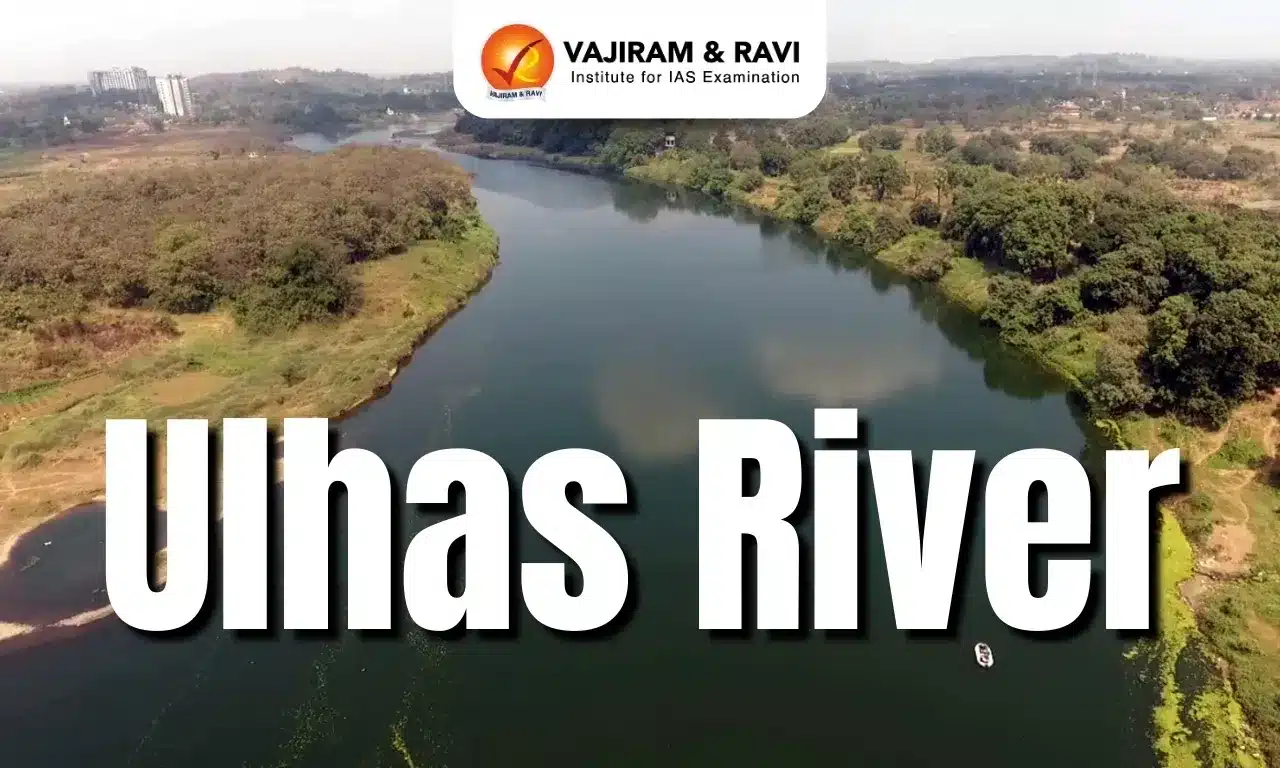
The Ulhas river recently crossed the warning level at Mohane and Jambhulpada following continuous heavy rainfall, prompting the district administration to issue an alert for residents living close to the banks.

About Ulhas River

  • It is a prominent west-flowing river located entirely within Maharashtra. 
  • Course: Originating from the Sahyadri hill ranges in the Raigad district, the river travels westward and eventually drains into the Arabian Sea near Vasai Creek, north of Mumbai. 
  • The total length of this river from its source to its outfall is 122 kilometers
  • The Ulhas drains an area of 4,637 sq.km., which lies completely in Maharashtra. The Thane, Raigad, and Pune districts fall in the basin.
  • The river basin is bounded by the main Sahyadri hill range on the east, its offshoots to the north and south, and opens narrowly to the Arabian Sea in the west. 
  • It passes through cities such as Kalyan, Thane, and Navi Mumbai.  
  • Along its route, the Ulhas River forms several distributaries and creeks, which are vital for irrigation, drinking water supply, and local ecosystems.  
  • Important Tributaries: Pej, Barvi, Bhivapuri, Murbari, Kalu, Shari, Bhasta, Salpe, Poshir, and Shilar. 
  • Major Dams: Barvi Dam, Bhatsa Dam, Tansa Dam, and Middle Vaitarna.
  • The estuary of Ulhas houses several historical ports of Kalyan, Kopri, and Shurparaka.

News: TOI

Ulhas River FAQs

Q1: Where is the Ulhas River located?

Ans: It is located entirely within Maharashtra.

Q2: The Ulhas River flows into which sea?

Ans: Arabian Sea.

Q3: Where does the Ulhas River originate?

Ans: Sahyadri hill ranges in Raigad district, Maharashtra.

Q4: What is the total length of the Ulhas River?

Ans: 122 kilometres.

Mahabodhi Temple

Mahabodhi Temple

Mahabodhi Temple Latest News

The Mahabodhi Temple received donations worth nearly Rs 2 crore in a six-day census of donation boxes, including Rs 1.5 crore from Indian and Rs 50 lakh from foreign countries. 

About Mahabodhi Temple

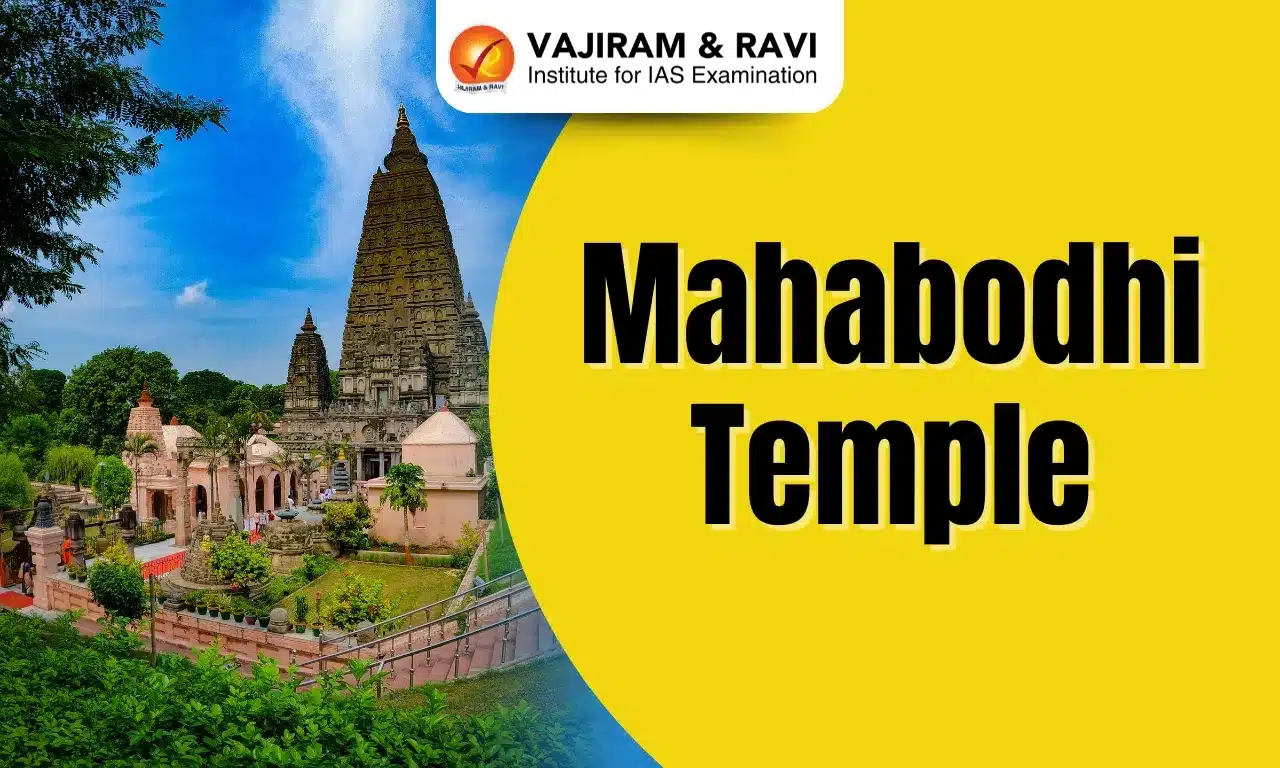
  • It is an ancient Buddhist temple located in Bodh Gaya, Bihar, on the banks of the Niranjana River. 
  • It is one of the four most sacred sites of Buddhism, marking the location where Buddha attained Enlightenment (Bodhi), along with:
    • Lumbini (Buddha’s birthplace)
    • Sarnath (Buddha’s first sermon)
    • Kushinagar (Buddha’s parinirvana)
  • The original temple was constructed by the Mauryan emperor Ashoka in the 3rd century BC. 
  • The present structure is estimated to have been erected between 5th and 6th century BC during the Gupta Period. 
  • The temple was heavily restored in the 19th century by Myanmar (Burmese) Buddhists and then by the British archaeologist Sir Alexander Cunningham.
  • It was recognized as a UNESCO World Heritage site in 2002. 

Mahabodhi Temple Architecture

  • It is constructed of brick and is one of the oldest brick structures to have survived in India.  
  • Built-in the classical style of Indian temple architecture, the temple complex spreads over 5 hectares. 
  • The temple structure is 180 feet (55 meters) in height. 
  • Its pyramidal shikhara (tower) comprises several layers of niches, arch motifs, and fine engravings. 
  • Four additional towers, each identical to the main tower but smaller in size, adorn the corners of the two-story structure
  • A shrine inside the temple holds a yellow sandstone statue of the Buddha encased in glass.
  • In 2013, the upper portion of the temple was covered with gold, as a gift from the King and devotees of Thailand. 
  • A descendant of the Bodhi tree under which the Buddha is said to have sat until he attained enlightenment stands adjacent to the temple. 
  • Vajrasana (Diamond Throne): A stone slab marking the exact spot where Buddha meditated and attained enlightenment, originally installed by Emperor Asoka. 
  • Stone railings surround the temple as well as the Bodhi tree. 
  • One of the most famous of Ashoka’s many pillars (on which he had engraved his proclamations and his understanding of religious doctrine) stands at the southeast corner of the temple.

News: JAG

Mahabodhi Temple FAQs

Q1: Where is the Mahabodhi Temple located?

Ans: Bodh Gaya, Bihar, on the banks of the Niranjana River.

Q2: Why is the Mahabodhi Temple considered sacred in Buddhism?

Ans: It marks the place where Gautama Buddha attained Enlightenment (Bodhi).

Q3: Who originally built the Mahabodhi Temple?

Ans: Emperor Ashoka.

Q4: The present structure of the Mahabodhi Temple was mainly built during which period?

Ans: Gupta Period.

Q5: What is the significance of the Bodhi Tree at the Mahabodhi Temple?

Ans: It is a descendant of the tree under which Buddha attained Enlightenment.

INS Mahendragiri

INS Mahendragiri

INS Mahendragiri Latest News

The Indian Navy is set to commission indigenous stealth frigate, Mahendragiri (F38), at Visakhapatnam on 11 Jul 2026. 

About INS Mahendragiri

  • It is the sixth ship of Nilgiri Class (Project 17A).
  • It was designed by Warship Design Bureau (WDB).
  • It was built at Mazagon Dock Shipbuilders Limited (MDSL) Mumbai.

Features of INS Mahendragiri

  • Propulsion: These ships are configured with Combined Diesel or Gas (CODOG) propulsion plants.
  • Comprising a diesel engine and a gas turbine that drive a Controllable Pitch Propeller (CPP) on each shaft, and state-of-the-art Integrated Platform Management System (IPMS)
  • Armaments: The potent weapon and sensor suite comprises anti-surface, anti-air, and anti-submarine warfare systems.
  • It is capable of undertaking anti-air, anti-surface, and anti-submarine operations.
  • It is equally suited for maritime security, power projection, Humanitarian Assistance and Disaster Relief (HADR), Search and Rescue (SAR), and sustained presence missions.

What are Project 17A Frigates?

  • These are versatile multi-mission platforms designed to address current and emerging challenges in the maritime domain. 
  • The five already delivered to the Navy are INS Nilgiri, INS Himgiri, INS Udaygiri, INS Taragiri and INS Vindhyagiri.
  • Armaments: P17A ships are fitted with an advanced weapon and sensor suite like MF-STAR active phased array radar, BrahMos supersonic cruise missiles, and Barak-8 long-range surface-to-air missiles, designed for superior anti-air, anti-surface and anti-submarine warfare.

Source: PIB

INS Mahendragiri FAQs

Q1: Who designed & built INS Mahendragiri?

Ans: Designed by Warship Design Bureau (WDB); Built by Mazagon Dock Shipbuilders Ltd (MDL), Mumbai

Q2: What is INS Mahendragiri?

Ans: 6th & final ship of Project 17A Nilgiri-class stealth guided-missile frigate of Indian Navy

Right to Legal Representation: Why Bar Association Boycotts Are Unconstitutional

Right to Legal Representation

Right to Legal Representation Latest News

  • Recently, the Ayodhya (Faizabad) Bar Association announced that none of its lawyers would defend eight persons accused in an alleged embezzlement of Ram Temple donation funds. The association went further, saying it would impose a Rs 5 lakh fine on any lawyer who chose to represent the accused. 
  • This is not an isolated event — bar associations across India have passed similar resolutions before, despite repeated Supreme Court rulings declaring such actions illegal and unconstitutional. 
  • This makes it an important issue from both a constitutional and criminal justice standpoint.

What Does the Constitution Say About an Accused's Right to Legal Defence

  • India's Constitution provides strong protection for an accused person's right to be defended:
    • Article 22(1) guarantees every arrested person the fundamental right to consult and be defended by a legal practitioner of their choice.
    • Article 14 ensures equality before law and equal protection of laws for everyone in India.
    • Article 21 — the Supreme Court has recognised the right to a fair trial as part of the right to life and personal liberty.
    • Article 39A, a Directive Principle of State Policy, requires the state to ensure justice is not denied to any citizen due to economic or other disabilities. This is the constitutional basis for free legal aid.
  • Together, these provisions form the foundation of an accused person's right to legal representation — regardless of the nature or gravity of the alleged crime.

What Have Bar Council Rules Said

  • The Bar Council of India's "Standards of Professional Conduct and Etiquette" state that an advocate is bound to accept any brief in courts or tribunals, at a fee suited to their standing and the nature of the case. 
  • The rules do allow refusal in "special circumstances" — but courts have clarified what this actually means.
  • In Kuldeep Agarwal v. State of Uttarakhand (2019), the Uttarakhand High Court held that "special circumstances" apply only to an individual advocate deciding not to take up a case personally. 
  • It does not give a Bar Association the power to collectively ban all its members from representing a particular accused.

The Landmark Supreme Court Judgment: A.S. Mohammed Rafi v. State of Tamil Nadu (2010)

  • This is the most significant precedent on this issue. The case arose from a 2006 confrontation between a lawyer and police personnel in Coimbatore. 
  • Following this, a local bar association passed a resolution that none of its members would represent the accused police personnel. 
  • The Madras High Court called this "unprofessional," and the matter reached the Supreme Court.
  • The apex court delivered a strongly worded verdict: Such resolutions are "wholly illegal, against all traditions of the bar and against professional ethics."
  • The judgment cited historical precedents to reinforce this principle — including how Indian revolutionaries against British rule, the alleged assailants of Mahatma Gandhi and Indira Gandhi, and even Nazi war criminals at the Nuremberg trials were provided legal defence.

Fair Trial as a Core Constitutional Value

  • In J. Jayalalithaa v. State of Karnataka (2014), the Supreme Court reiterated that a fair trial is the central objective of criminal procedure. 
  • It held that fair trial protects the interests of the accused, the victim, and society together, and must be conducted in the spirit of the right to life and personal liberty.

Other Notable Cases

  • Bar associations have passed such resolutions multiple times in high-profile cases:
  • Ajmal Kasab (2008 Mumbai attacks): A legal aid lawyer initially refused to represent him; another lawyer who agreed faced political threats before one was eventually appointed with police protection.
  • December 16, 2012 Delhi gangrape case: Saket court lawyers passed a similar resolution.
  • 2019 Hyderabad veterinary doctor rape-murder case: The bar association refused representation to the accused, who were later killed in an alleged police encounter.
  • 2017 Gurugram (Pradyuman Thakur murder case): The Gurgaon Bar Association tried to bar representation for an accused school official; the Supreme Court intervened, stating "for the rule of law to be upheld, it is essential that the right to counsel is zealously protected."

Why This Matters

  • The Bar is not a trade union; it is an institution of constitutional significance.
  • Courts have consistently held that such resolutions violate the rights of both the accused and the victims of crime, since they compromise the fairness of the trial process itself. 
  • The right to legal representation is treated as a core, non-negotiable feature of a fair trial — one that cannot be denied based on the nature of the allegation, however serious or unpopular it may be.

Conclusion

  • Despite a clear and consistent line of Supreme Court and High Court judgments declaring such bar association resolutions illegal, unconstitutional, and unethical, they continue to recur across India — as seen once again in the Ayodhya Ram Temple funds case. 
  • This reflects a persistent tension between institutional professional conduct and the constitutional guarantee of a fair trial, reaffirming that the right to counsel must remain inviolable regardless of public sentiment or the nature of the accusation.

Source: TH | IE

Right to Legal Representation FAQs

Q1: Why is the Right to Legal Representation considered a fundamental right?

Ans: The Right to Legal Representation flows from Articles 21 and 22 of the Constitution, ensuring every accused receives legal assistance and a fair trial regardless of the allegation.

Q2: What did the Supreme Court rule regarding the Right to Legal Representation in bar association boycott cases?

Ans: The Supreme Court held that resolutions preventing advocates from appearing for accused persons violate the Right to Legal Representation, professional ethics and constitutional guarantees.

Q3: How do the Bar Council Rules support the Right to Legal Representation?

Ans: The Bar Council Rules require advocates to ordinarily accept briefs, reinforcing the Right to Legal Representation while permitting refusal only in limited personal circumstances.

Q4: Why do bar association resolutions undermine the Right to Legal Representation?

Ans: Such resolutions deny accused persons access to counsel, compromise fair trial rights and weaken the constitutional commitment to equality before law and due process.

Q5: Why is the Right to Legal Representation essential for the criminal justice system?

Ans: The Right to Legal Representation safeguards fair trials, protects the rule of law and ensures justice is delivered through constitutional procedures rather than public opinion.

E20 Petrol: Why E20 Petrol Is Reducing Mileage and Raising Consumer Concerns

E20 Petrol

E20 Petrol Latest News

  • India completed its transition to E20 petrol (20% ethanol blended with 80% petrol) last year. This target was achieved five years ahead of the original 2030 deadline. 
  • In June 2026, Union Minister for Petroleum and Natural Gas Hardeep Singh Puri launched E85 fuel (85% ethanol, 15% petrol) in New Delhi. 
  • This rapid push toward higher ethanol blending has left many motorists worried about reduced mileage and possible engine damage, especially owners of older vehicles.

Background: India's Ethanol Blending Journey

  • The idea of ethanol blending in India isn't new. The first National Policy on Biofuels in 2009 had set an indicative target of 20% ethanol blending by 2017. This target got delayed for various reasons over the years.
  • More recently, the blending level jumped rapidly. Ethanol content in petrol doubled from 10% (E10) to 20% (E20) within just three years. 
  • This was originally planned to happen gradually over eight years. This fast transition, especially for older vehicles certified only for E10 fuel, came without adequate consumer warnings, leaving many motorists feeling short-changed.

Why Do Indians Care So Much About Mileage

  • Fuel efficiency has always been central to Indian car buying decisions. Popular advertising taglines like "fill it, shut it, forget it" captured this obsession for decades. 
  • Even as India's car market shifts toward premium vehicles, mileage remains a key consideration, especially since growth in disposable incomes remains uneven across the country.

Three Key Problems With Higher Ethanol Blends

  • Drop in Fuel Economy: There is a genuine and measurable drop in mileage when using higher ethanol blends, particularly in vehicles not originally designed for them. 
    • This is rooted in basic chemistry — ethanol has a lower calorific value than petrol, causing roughly 30% less mileage in unadapted vehicles. 
    • The impact also isn't linear; as blending levels increase, the drop in performance intensifies further.
  • Risk of Vehicle Part Damage: Ethanol is hygroscopic — meaning it attracts and holds water molecules from its surroundings. This property raises concerns about corrosion in older vehicle parts. 
    • Ethanol also burns at a higher temperature than petrol, making cars harder to start on cold winter mornings.
  • No Fuel Choice for Consumers: Unlike in Brazil, where consumers can choose between different ethanol blends at different price points, Indian motorists currently have no such choice at the pump. 
    • In Brazil, law mandates a price discount for higher ethanol blends. In India, motorists have had to accept the switch without any corresponding price benefit.

The Chemistry Behind Ethanol Blending

  • Ethanol (C2H5OH) has a much simpler carbon chain compared to petrol (which ranges between C8 and C12). 
  • This means burning ethanol produces less carbon dioxide compared to burning an equivalent amount of petrol — making it more environment-friendly.
  • Ethanol also has a very high-octane number (around 108 Research Octane Number, or RON), enabling a cleaner burn inside engines. 
  • This is why ethanol has traditionally been favoured in high-performance sports cars, thanks to its anti-knock properties, higher power potential, and better cooling effect from its high latent heat of vaporisation. 
  • Indian carmakers say this high RON value could eventually allow them to design engines with higher compression ratios, extracting better mileage from higher ethanol blends — but this remains a future possibility, not a current reality.

The Road Ahead: E25 and E85

  • The government now plans to move beyond E20, towards E25, alongside promoting E85 fuel for flex-fuel vehicles (vehicles designed to run on multiple fuel blends).
  • Interestingly, even in flex-fuel vehicles, running standard E20 fuel currently works out cheaper than E85, since E85's fuel efficiency loss (over 25%) isn't sufficiently offset by its lower price. 
  • E85 is expected to cost around Rs 20 per litre less than E20. For comparison, in Brazil, a similar fuel switch only becomes economically viable when the higher ethanol blend is at least 30% cheaper.
  • Auto industry insiders privately suggest that the jump from E20 to E25 could have a bigger impact than the E10 to E20 transition, especially for older engines and two-wheelers that don't use high-grade aluminium or steel casts. 
  • This transition will require carmakers to undertake fresh engineering work around engine calibration, fuel-system durability, corrosion resistance, and material compatibility, along with fresh homologation — the official certification process confirming a vehicle meets safety, environmental, and roadworthiness standards.

Lessons From Brazil's Ethanol Model

  • Brazil offers a useful comparison. Its ethanol programme began in the 1970s in response to global oil market uncertainties. Over five decades, Brazil built a genuine alternative fuel ecosystem using sugarcane-based ethanol.
  • Today, at almost every Brazilian fuel pump, consumers can choose between blended petrol (containing 27-35% ethanol) and E100 (pure hydrous ethanol). 
  • Brazil also successfully promoted flex-fuel cars, allowing consumers to fill up with whichever fuel option is cheaper on a given day. E100 is often 25-35% cheaper than lower blended petrol, thanks to strong government price support.
  • This price incentive made flex-fuel cars hugely popular in Brazil. By the late 1980s, nine out of every ten new cars sold there could run entirely on ethanol. Ethanol's ability to improve acceleration made it further attractive in a country where motorsport enjoys a passionate following.
  • In India, by contrast, consumers currently have no such choice or price differential at the pump — a key structural difference that experts believe India could learn from as it moves toward higher ethanol blends.

Source: IE

E20 Petrol FAQs

Q1: Why does E20 Petrol reduce vehicle mileage?

Ans: E20 Petrol contains 20% ethanol, which has a lower calorific value than petrol, resulting in reduced fuel efficiency, especially in vehicles not designed for higher ethanol blends.

Q2: What challenges does E20 Petrol pose for older vehicles?

Ans: E20 Petrol may increase corrosion risks, affect fuel system components and reduce performance in older vehicles originally certified only for lower ethanol blends.

Q3: How does E20 Petrol contribute to India's energy and environmental goals?

Ans: E20 Petrol reduces crude oil imports, lowers carbon emissions, supports ethanol production and strengthens India's long-term energy security and biofuel strategy.

Q4: How does Brazil's ethanol programme differ from India's E20 Petrol model?

Ans: Unlike India's E20 Petrol system, Brazil offers multiple ethanol fuel options, competitive pricing and widespread flex-fuel vehicles, allowing consumers greater fuel choice.

Q5: What factors should guide the future expansion of E20 Petrol to higher blends?

Ans: Future expansion beyond E20 Petrol should consider vehicle compatibility, consumer awareness, fuel pricing, engine technology and adequate regulatory safeguards.

61st Constitutional Amendment Act 1988, Provisions, Clauses

61st Constitutional Amendment Act

The 61st Constitutional Amendment Act 1988, is a landmark reform in India’s democratic framework that lowered the voting age from 21 years to 18 years. This amendment, enacted during the tenure of Prime Minister Rajiv Gandhi, expanded political participation among India’s youth, empowering millions of young citizens with the right to vote. It symbolized India’s commitment to deepening democracy by ensuring inclusivity and encouraging political awareness among younger generations.

61st Constitutional Amendment Act 1988

The 61st Constitutional Amendment Act was passed by Parliament on March 28, 1989, and came into effect on March 28, 1989. It amended Article 326 of the Indian Constitution, which governs elections to the House of the People (Lok Sabha) and State Legislative Assemblies based on adult suffrage. Before this amendment, the minimum voting age was 21 years. The Act reduced this to 18 years, acknowledging the evolving maturity, awareness, and participation of India’s youth in the nation’s socio-political discourse.

This reform was rooted in the idea that youth form a vital segment of the population capable of shaping national policies and democratic institutions. With this change, a large number of new voters were added to India’s electoral rolls during the 1989 General Elections, marking a turning point in the political landscape.

61st Constitutional Amendment Act Historical Background

India’s democratic evolution since independence has been marked by expanding rights and inclusivity. When the Constitution came into effect in 1950, the voting age was fixed at 21 years, reflecting post-independence caution regarding administrative readiness and citizens’ literacy levels.

However, by the 1980s, India had undergone significant socio-economic transformation. The literacy rate improved, communication networks expanded, and political awareness deepened through mass media. Youth-led movements like the JP Movement (1974) and student activism during the Emergency (1975-77) demonstrated that the young population was both politically conscious and socially engaged.

Recognizing this, Prime Minister Rajiv Gandhi and the Congress government sought to harness this energy through democratic inclusion. The Statement of Objects and Reasons attached to the Amendment Bill highlighted that lowering the voting age would “provide an opportunity to the unrepresented youth of the country to express their feelings and help in shaping the destiny of the nation.”

61st Constitutional Amendment Act 1988 Provisions

The 61st Amendment Act is concise, containing only one operative clause:

  • Amendment to Article 326: The phrase “twenty-one years” was substituted with “eighteen years” in Article 326. This change applied to both parliamentary and state assembly elections, ensuring uniformity in the voting age across all levels of government.
  • Key Aspects:
    • The amendment does not affect eligibility to contest elections, which continues to be governed by Articles 84 and 173.
    • It aligns with global democratic standards, as many democracies, including the United States (1971) and the United Kingdom (1969), had already reduced their voting age to 18 years.
    • It reflects a progressive expansion of democratic rights, similar to the 42nd and 44th Amendments, which focused on the rights and duties of citizens.

61st Constitutional Amendment Act 1988 Significance

The 61st Amendment holds immense constitutional, social, and political importance. It marked a generational shift in Indian democracy, making it more participatory and reflective of the nation’s demographic composition. Major Significances:

  • Democratic Deepening: Strengthened India’s democratic base by expanding the electorate to include younger citizens.
  • Youth Empowerment: Recognized youth as an active force in shaping governance and policy.
  • Political Awareness: Promoted civic education and engagement among the young population.
  • Global Alignment: Brought India in line with democratic norms worldwide regarding voting age.
  • Increased Representation: Added millions of new voters, influencing electoral outcomes and political strategies.

Also Read: Universal Adult Franchise

61st Constitutional Amendment Act 1988 Impacts

The 61st Amendment altered India’s democratic framework by broadening the definition of “adult suffrage.” Article 326, under Part XV (Elections), ensures that elections to the Lok Sabha and State Assemblies are based on adult suffrage. By redefining adulthood from 21 to 18 years, the Act:

Legal and Constitutional Impact:

  • Expanded the electoral base by nearly 20%.
  • Reinforced the principle of equality under Article 14, ensuring equal participation rights.
  • Strengthened the fundamental right to participate in public affairs, indirectly upholding the spirit of democracy enshrined in the Preamble and Article 19.

Political and Social Impact:

  • Increased Youth Representation: Political parties began incorporating youth-centric policies and manifestos, recognizing young voters as a significant constituency.
  • Rise of Student Politics: University-level political activities gained greater legitimacy, feeding into national politics through parties like the NSUI, ABVP, and SFI.
  • Policy Reorientation: Post-1989, governments introduced several youth-oriented programs, such as the Nehru Yuva Kendra Sangathan (NYKS), Skill India Mission, and National Youth Policy (2014), promoting youth empowerment.
  • Electoral Participation: Data from the Election Commission (2019) show that youth voter turnout has steadily increased, with nearly 55-60% participation among first-time voters in recent elections.

61st Constitutional Amendment Act Global Perspective

Globally, the movement to lower the voting age was driven by similar democratic ideals. India’s reform followed a global democratic trend, highlighting its alignment with international standards of youth inclusion in governance.

61st Constitutional Amendment Act Global Perspective
Country Year of Lowering Voting Age Previous Age New Age

United Kingdom

1969

21

18

United States

1971 (26th Amendment)

21

18

France

1974

21

18

India

1988

21

18

Japan

2015

20

18

61st Constitutional Amendment Act 1988 Challenges

While the 61st Constitutional Amendment Act 1988 was widely welcomed, certain concerns and challenges have persisted:

  • Political Manipulation: Critics argue that political parties often exploit young voters with populist promises.
  • Lack of Civic Education: Many first-time voters lack awareness about democratic processes and their responsibilities.
  • Urban-Rural Divide: Limited voter education in rural areas can hinder informed participation.
  • Low Turnout: Despite inclusion, young voter turnout remains inconsistent, as per ECI reports.
  • Digital Misinformation: The rise of social media has exposed young voters to fake news and ideological polarization.

Way Forward:

  • Civic Education in Schools: Incorporate electoral literacy in the national curriculum under the National Education Policy (NEP 2020).
  • Youth Voter Awareness Programs: Expand ECI’s Systematic Voters’ Education and Electoral Participation (SVEEP) initiative to enhance informed participation.
  • Political Accountability: Encourage issue-based campaigns rather than personality-driven politics.
  • Digital Literacy: Combat misinformation through official awareness campaigns and collaborations with tech platforms.
  • Engaging Youth in Governance: Promote youth representation in local bodies and advisory councils to sustain democratic engagement.

61st Constitutional Amendment Act FAQs

Q1: What is the 61st Constitutional Amendment Act, 1988?

Ans: It reduced the minimum voting age in India from 21 to 18 years by amending Article 326 of the Constitution.

Q2: When was the 61st Amendment implemented?

Ans: The amendment came into effect on March 28, 1989.

Q3: Who introduced the 61st Constitutional Amendment Bill?

Ans: The amendment was introduced by the Rajiv Gandhi-led government.

Q4: How did the 61st Amendment affect voter participation?

Ans: It added a large number of new voters during the 1989 General Elections, significantly expanding electoral participation.

Q5: Why was the voting age reduced to 18 years?

Ans: It was reduced to recognize the maturity, awareness, and democratic rights of India’s young citizens.

Weak Monsoon and El Nino – Impact on India’s Economy

Weak Monsoon

Weak Monsoon Latest News

  • The India Meteorological Department has forecast below-normal rainfall in July after a 40% deficit in June, raising concerns about the impact of a weak monsoon and a potential "super" El Nino on India's economy.

Understanding the Monsoon and El Nino Connection

  • The southwest monsoon (June-September) is the lifeline of India's economy, delivering about 75% of the country's annual rainfall. 
  • It supports agriculture, replenishes reservoirs, recharges groundwater, and sustains hydropower generation.
  • El Nino is a climate phenomenon marked by the warming of surface waters in the equatorial Pacific Ocean, off the north-western coast of South America. 
  • It has a tendency to suppress rainfall over the Indian region, though the impact usually comes with a lag of over a month.
  • A "super" El Nino refers to a particularly strong phase of this phenomenon, which can cause more severe rainfall deficits and prolonged droughts.
  • Historically, several of India's worst droughts have coincided with El Nino years, including 1972, 1982, 2009, and 2015.

How a Poor Monsoon Damages the Economy

  • Impact on Agricultural Output
    • Agriculture accounts for about one-fifth of India's Gross Value Added (GVA) but employs 46% of the workforce.
    • Nearly 55% of the population depends on agriculture directly or indirectly.
    • India came into the current kharif season from a strong position, foodgrain output in 2024-25 rose to 357.73 million metric tonnes, up 25.43 MMT from the previous year.
    • A weak monsoon puts this momentum at risk, particularly for kharif crops like paddy, maize, pulses, and cotton.
  • Impact on Rural Incomes and Demand
    • A weak monsoon hits rural income, denting aggregate demand across the economy.
    • Farm incomes could fall by up to 10% during a weak monsoon year.
    • The rural non-farm sector, mainly non-traded services like construction, contracts when agriculture is affected.
    • Industries dependent on rural demand, including two-wheelers, tractors, and real estate in smaller towns, are among the first to feel the squeeze.
  • Food Inflation Pressures
    • A weak monsoon threatens to push up food prices, fuelling inflation.
    • The RBI has warned in its June bulletin that an adverse southwest monsoon may weigh on the domestic growth-inflation outlook.
    • Data up to June 18 already showed food inflation continuing to rise, with prices of edible oils, potatoes, onions, and tomatoes edging up.

Broader Economic Impact

  • GDP Growth Concerns
    • According to analyses by financial firms, a combined El Nino-plus-drought scenario could shave 20-65 basis points off India's GDP growth.
  • Cropping Pattern Shifts
    • Paddy acreage is expected to expand in Punjab, Haryana, and Bihar.
    • Maize acreage may decline as farmers shift to more remunerative crops.
    • Pulses may be preferred due to lower cultivation costs and water requirements.
    • Some farmers may choose not to plant vegetables at all.
    • Decisions are influenced by irrigation availability, MSP, procurement support, and market conditions.
  • Fertiliser and Supply Constraints
    • Pest attacks in weakened crops.
    • Fertiliser supply constraints caused by the Iran conflict.
    • The Union Cabinet approved a Rs. 41,533 crore Nutrient-Based Subsidy for phosphatic and potassic fertilisers for the kharif season, covering 28 grades.
  • External Sector Impact
    • If domestic output falls short:
    • The government may release buffer stocks and increase imports.
    • This could widen the Current Account Deficit and put pressure on the rupee.
    • India's agricultural exports, which have grown at a CAGR of 8.2% between FY20 and FY25 and contribute 12% to core exports, face a threat.

Lessons from Past El Nino Years

  • The 2009 and 2015 monsoon failures illustrate how differently poor monsoons can affect the economy:
  • 2009 and Its Aftermath
    • Two subsequent years of rainfall stress.
    • All-India average irrigation cover less than 45%.
    • Crop GVA contracted 2.5% and 3.2% in FY09 and FY10, respectively.
    • Inflation reached double digits.
  • 2015 Experience
    • Both 2014 and 2015 saw monsoon disruptions as El Nino moved from weak to strong.
    • Crop GVA contracted, but the impact on inflation was muted.
  • Reasons for controlled inflation included: 
    • Proactive food management
    • Restrained MSP hikes
    • Global commodity price slump
  • Since 2000, of the 11 instances of below-normal or deficient monsoon at the all-India level, six were classified as El Nino years by the IMD, with five seeing deficient rainfall.

India’s Preparedness

  • The government has identified vulnerabilities:
    • 315 districts are vulnerable to a poor monsoon.
    • 111 districts across 12 States are of primary concern due to poor irrigation facilities.
  • Reservoir Storage Status
    • As of July 2:
    • Storage levels across the 166 reservoirs monitored by the Central Water Commission stood at 47.725 BCM.
    • This is lower than 78.077 BCM during the corresponding period last year.
    • It is also below the normal storage of 48.402 BCM for this time of year.
    • While the system can meet current requirements, a prolonged poor monsoon could strain it significantly.
  • Structural Preparedness
    • Experts have raised concerns about India's disaster preparedness:
    • Irrigation is crucial for adapting to climate change-induced water stress.
    • India needs to move from crop insurance to ex-ante risk reduction.
    • Investment in drought-resistant, high-yielding crops remains inadequate.
    • Public investment in risk reduction is currently lacking.
    • A second successive bad weather year would be significantly more damaging.

Way Forward

  • Short-Term Measures
    • Strengthen buffer stocks to manage food supply.
    • Monitor food inflation and take proactive measures.
    • Support farmers in vulnerable districts with contingency plans.
    • Manage fertiliser supply through diversified imports.
  • Medium-Term Reforms
    • Expand irrigation coverage, especially in rain-fed regions.
    • Promote water-efficient crops and precision agriculture.
    • Strengthen crop insurance with quicker settlements.
    • Enhance weather forecasting and early warning systems.
  • Long-Term Strategy
    • Drought-proof the economy through structural reforms.
    • Move from crop insurance to ex-ante risk reduction.
    • Invest in drought-resistant, high-yielding crop varieties and ensure farmer access.
    • Modernise water storage and management infrastructure.
    • Diversify rural economy to reduce dependence on agriculture alone.
    • Strengthen public investment in agricultural R&D and disaster preparedness.

Source: TH

Weak Monsoon FAQs

Q1: What is El Niño and how does it affect India?

Ans: El Nino is the warming of equatorial Pacific waters that tends to suppress rainfall over India, often leading to weak monsoons and droughts.

Q2: What is the IMD's July 2026 rainfall forecast?

Ans: The IMD has forecast below-normal rainfall in July, less than 94% of the long-period average, following a 40% deficit in June.

Q3: Which past years saw major El Nino-linked droughts in India?

Ans: 1972, 1982, 2009, and 2015 were among India's worst drought years and coincided with El Nino conditions.

Q4: How many districts are vulnerable to a poor monsoon?

Ans: 315 districts are vulnerable, of which 111 across 12 States are of primary concern due to poor irrigation facilities.

Q5: By how much could El Nino reduce India's GDP growth?

Ans: A combined El Nino and drought scenario could shave 20-65 basis points off India's GDP growth.

National Parks in Chhattisgarh, Map, Wildlife Sanctuaries, Ramsar Sites

National Parks in Chhattisgarh

A National Park in Chhattisgarh is a protected natural area where forests, wildlife, rivers, and landscapes are conserved by law to prevent damage and ensure long term ecological balance within the State. Other protected areas include Wildlife Sanctuaries, Tiger Reserves, and Biosphere Reserves, which allow varying degrees of human activity. Together, these areas safeguard forests, rivers, flora-fauna, and endangered species while supporting scientific research, climate resilience, and sustainable livelihoods for forest-dependent communities.

Protected Areas in Chhattisgarh

Chhattisgarh has an extensive protected area network conserving Central India’s forests, rivers, wildlife corridors, and endangered species.

  1. National Parks: Legally protected core conservation zones with strict ecological safeguards.
  2. Tiger Reserves: Landscapes managed for tiger conservation and prey population recovery.
  3. Wildlife Sanctuaries: Areas allowing limited human use while protecting wildlife habitats.
  4. Biosphere Reserves: Large ecological regions balancing conservation, research, and livelihoods.
  5. Ramsar Wetlands: Internationally recognized wetlands important for biodiversity and water security.

National Parks in Chhattisgarh

Chhattisgarh has three National Parks in India that represent diverse forest types, river systems, and wildlife assemblages of Central India. These parks protect dry and moist deciduous forests dominated by sal, teak, and bamboo. They are ecologically significant for conserving endangered species like wild water buffalo and tigers while maintaining wildlife corridors connecting Madhya Pradesh, Jharkhand, Odisha, and Maharashtra. Rivers flowing through these parks support regional hydrology and biodiversity. Together, these national parks form the ecological backbone of Chhattisgarh’s conservation landscape.

Sanjay (Guru Ghasidas) National Park

Sanjay National Park, officially known as Guru Ghasidas National Park, lies across Chhattisgarh and Madhya Pradesh within the Narmada Valley ecosystem.

  1. Location: Situated near Ambikapur, Manendragarh, and Chirimiri in northern Chhattisgarh.
  2. Establishment: Notified as a national park in 1981 for large-scale forest conservation.
  3. Landscape: Part of the Narmada Valley with undulating terrain and dry deciduous forests.
  4. Vegetation: Dominated by sal and bamboo forests supporting diverse herbivore populations.
  5. Fauna: Home to tigers, leopards, sambar, chital, nilgai, chinkara, wild boar, monitor lizards.
  6. Rivers: Drained by Banas, Gopad, Mawai, Mahan, Kodmar, and Umrari rivers.
  7. Historical Significance: Last known Indian habitat of the Asiatic cheetah.
  8. Connectivity: Forms a vital corridor linking Bandhavgarh and Palamau Tiger Reserves.
Indravati National Park

Indravati National Park is located in southern Chhattisgarh and is one of the most biodiversity-rich forest landscapes in India.

  1. Location: Situated in Bijapur district, bordering Odisha and Telangana forest regions.
  2. River Boundary: Named after the Indravati River forming its northern boundary.
  3. Vegetation: Tropical moist and dry deciduous forests with bamboo, sal, and teak.
  4. Flagship Species: Supports one of India’s last wild water buffalo populations.
  5. Mammals: Tigers, gaur, blackbuck, chausingha, sambar, chital, Indian muntjac.
  6. Birdlife: Habitat of Bastar hill myna, the state bird of Chhattisgarh.
  7. Reptiles: Presence of freshwater crocodiles in riverine ecosystems.

Kanger Valley National Park

Kanger Valley National Park, also called Kanger Ghati National Park, represents unique limestone landscapes and dense forests.

  1. Location: Located in the Bastar region near Jagdalpur town.
  2. River System: Named after the Kanger River flowing through the park.
  3. Geology: Known for limestone caves such as Kotumsar Caves.
  4. Extent: Stretches from Tirathgarh Waterfalls to the Kolab River near Odisha border.
  5. Vegetation: Rich sal, teak, and bamboo forests.
  6. Mammals: Tigers, leopards, sloth bears, mouse deer, sambar, barking deer.
  7. Birdlife: Hill myna, spotted owlet, and steppe eagles recorded.
  8. Reptiles: Freshwater crocodiles inhabit perennial river stretches.

Tiger Reserves in Chhattisgarh

Chhattisgarh has four notified tiger reserves forming a critical part of the Central Indian tiger landscape, ensuring habitat connectivity and genetic flow. There are total 4 Tiger Reserves in Chhattisgarh as of 2025:

  • Achanakmar Tiger Reserve
  • Indravati Tiger Reserve
  • Udanti-Sitanadi Tiger Reserve
  • Sanjay-Dubri Tiger Reserve

Indravati Tiger Reserve

Indravati Tiger Reserve protects dense forests and riverine habitats crucial for endangered wildlife.

  1. Location: Situated in Bijapur district of southern Chhattisgarh.
  2. River System: Indravati River defines its northern ecological boundary.
  3. Vegetation: Tropical moist and dry deciduous forests.
  4. Key Species: Tigers, wild water buffalo, gaur, chital, sambar.
  5. Avifauna: Bastar hill myna widely recorded across forest tracts.

Udanti-Sitanadi Tiger Reserve

Udanti-Sitanadi Tiger Reserve represents a unique merged conservation landscape in central Chhattisgarh.

  1. Formation: Created during 2008-09 by combining Udanti and Sitanadi sanctuaries.
  2. Location: Lies in Gariaband district of Chhattisgarh.
  3. River Systems: Sitanadi and Udanti rivers feed forest ecosystems.
  4. Vegetation: Tropical dry deciduous mixed forests dominated by sal.
  5. Wildlife: Tigers, wild water buffalo, chital, sambar, chausingha.

Sanjay-Dubri Tiger Reserve Tiger Reserve

Sanjay-Dubri Tiger Reserve forms a transboundary conservation corridor in Central India.

  1. Composition: Includes Sanjay National Park and Dubri Wildlife Sanctuary.
  2. Location: Spreads across Chhattisgarh and Madhya Pradesh.
  3. Connectivity: Links Bandhavgarh and Palamau tiger landscapes.
  4. Vegetation: Dry deciduous forests with sal and bamboo dominance.
  5. Fauna: Tigers, leopards, nilgai, sambar, chinkara.

Achanakmar Tiger Reserve

Achanakmar Tiger Reserve is a biologically rich forested plateau supporting multiple river systems. 

  1. Location: Lies across Chhattisgarh and Madhya Pradesh.
  2. Biosphere Status: Part of Achanakmar-Amarkantak Biosphere Reserve.
  3. Topography: Bauxite-rich soils of the Amarkantak plateau.
  4. Hydrology: Maniyari River flows centrally, sustaining forest life.
  5. Rivers Origin: Source of Narmada, Son, and Johilla rivers.
  6. Vegetation: Dry deciduous forests with sal and bamboo.
  7. Fauna: Tigers, leopards, gaur, chital, blackbuck, chinkara.
  8. Connectivity: Linked to Kanha Tiger Reserve via Kanha-Achanakmar Corridor.

Wildlife Sanctuaries in Chhattisgarh

Chhattisgarh hosts a wide network of wildlife sanctuaries conserving forests, grasslands, riverine ecosystems, and wildlife corridors. These sanctuaries play a vital role in protecting endangered species, supporting elephant and tiger movements, and preserving ecological connectivity across Central India. Many sanctuaries safeguard important rivers, originate tributaries, and maintain forest-based livelihoods. They complement national parks and tiger reserves by acting as buffer zones and stepping-stone habitats crucial for long-term biodiversity conservation.

Wildlife Sanctuaries in Chhattisgarh List

Chhattisgarh’s major wildlife sanctuaries protect varied landscapes from hills to river valleys.

  • Achanakmar Wildlife Sanctuary: Part of biosphere reserve with sal forests and tiger movement corridors.
  • Badalkhol Wildlife Sanctuary: Located in Ramgarh Hills, acting as tiger corridor to Palamau.
  • Barnawapara Wildlife Sanctuary: Bounded by Mahanadi and Jonk rivers with dry deciduous forests.
  • Bhairamgarh Wildlife Sanctuary: Separated from Indravati National Park by the Indravati River.
  • Bhoramdev Wildlife Sanctuary: Maikal Hills corridor between Kanha and Achanakmar reserves.
  • Gomardha Wildlife Sanctuary: Located near Sarangarh, conserving regional forest biodiversity.
  • Pamed Wildlife Sanctuary: Established to protect wild buffalo in Dantewada district.
  • Semarsot Wildlife Sanctuary: Ramgarh Hills sanctuary sharing border with Bihar.
  • Sitanadi Wildlife Sanctuary: Named after Sitanadi River, supporting tiger habitats.
  • Tamor Pingla Wildlife Sanctuary: Part of Surguja-Jashpur elephant reserve landscape.
  • Udanti Wildlife Sanctuary: Critical habitat for endangered wild water buffalo.

Ramsar Site in Chhattisgarh

Kopra Reservoir is Chhattisgarh’s first Ramsar-recognized wetland, highlighting its international ecological importance.

  • Location: Situated in Baloda Bazar-Bhatapara and Bilaspur region.
  • Wetland Type: Freshwater reservoir developed from irrigation infrastructure.
  • Bird Diversity: Recorded 161 bird species including 58 migratory species.
  • Threatened Birds: Egyptian vulture endangered; woolly-necked stork vulnerable.
  • Vegetation: Aquatic plants like Ipomea and Cyperaceae support food chains.
  • Ecological Role: Enhances water security, biodiversity protection, and climate resilience.
Also Check
National Parks in Uttar Pradesh National Parks in Bihar
National Parks in Assam National Parks in Uttarakhand
National Parks in West Bengal National Parks in Arunachal Pradesh
National Parks in Andhra Pradesh National Parks in Chhattisgarh
National Parks in Goa National Parks in Jharkhand
National Parks in Gujarat National Parks in Kerala
National Parks in Haryana National Parks in Madhya Pradesh
National Parks in Himachal Pradesh National Parks in Maharashtra
National Parks in Karnataka National Parks in Odisha
National Parks in Manipur National Parks in Mizoram
National Parks in Meghalaya National Parks in Nagaland
National Parks in Telangana National Parks in Rajasthan
National Parks in Tamil Nadu National Parks in Sikkim
National Parks in Tripura

National Parks in Chhattisgarh FAQs

Q1: How many national parks are there in Chhattisgarh?

Ans: Chhattisgarh has three national parks: Guru Ghasidas (Sanjay), Indravati, and Kanger Valley National Park.

Q2: Which is the largest national park in Chhattisgarh?

Ans: Guru Ghasidas National Park, earlier known as Sanjay National Park, is the largest national park in the state.

Q3: Which national park in Chhattisgarh is famous for wild water buffalo?

Ans: Indravati National Park is well known for protecting one of the last remaining populations of wild water buffalo in India.

Q4: Which national park of Chhattisgarh has limestone caves?

Ans: Kanger Valley National Park is famous for its limestone caves such as the Kotumsar Caves.

Q5: Which rivers flow through national parks in Chhattisgarh?

Ans: Major rivers include the Indravati River, Kanger River, and tributaries like Banas, Gopad, and Mawai flowing through different parks.

Changpa Community

Changpa Community

Changpa Community Latest News

Recently, the Ladakh lieutenant governor made decisions for improving the livelihoods of indigenous Changpa pastoral communities.

About Changpa Community

  • The Changpas are a semi-nomadic people found mainly in the Changthang region of the Trans-Himalayas of the Indian subcontinent.
  • They are nomads who have been shepherding their world-class pashmina goats (or cashmere goats) for centuries.
  • The Changpa nomads are Buddhists.
  • They were granted official status in India as a scheduled tribe.
  • They can be identified by their conical yak-skin tents called reboo.
  • Each reboo invariably accommodates the family deity, and a picture of their spiritual head, in most cases, the Dalai Lama.
  • The Changpa who live nomadic lives are known as Phalpa and those who have settled down in fixed locations are called Fangpa.
  • Festival: One of the main purifying rituals of the Changpas is known as Jyabten where they make different kinds of food as an offering to Lord Padmasambhav and another festival Tangpe Chona (15th day of the first month of the lunar calendar).

Source: ET

Changpa Community FAQs

Q1: Who are the Changpa and where are they found?

Ans: Semi-nomadic pastoral tribe of Tibetan origin; mainly in Changthang plateau, Southeastern Ladakh; also parts of Tibet

Q2: What is Constitutional status of Changpa in India?

Ans: Scheduled Tribe since 1989 in Ladakh UT

Birth Anniversary of Sri Guru Har Krishan Ji, 8th Guru, Death

Birth Anniversary of Sri Guru Har Krishan Ji

The Birth Anniversary of Sri Guru Har Krishan Ji is observed every year to honour the eighth Sikh Guru, who became Guru at the age of five and served humanity with extraordinary compassion. Despite living only eight years, he strengthened Sikh values of selfless service, equality, humility and faith. His life remains an important example of spiritual wisdom, humanitarian leadership and dedication to public welfare during times of crisis.

Birth Anniversary of Sri Guru Har Krishan Ji

Birth Anniversary of Sri Guru Har Krishan Ji commemorates the life of the youngest Sikh Guru and his lasting spiritual legacy. The day highlights his teachings of compassion, equality, humility and service to humanity. Sikh devotees remember his sacrifice, organise prayers, perform seva and reflect on his message of caring for all people without discrimination. His brief Guruship from 1661 to 1664 proved that leadership depends on wisdom and character rather than age. His life occupies a unique place in Sikh history because of his humanitarian work and spiritual influence.

Sri Guru Har Krishan Ji Biography

Sri Guru Har Krishan Ji's life reflects remarkable spiritual wisdom, humanitarian service and courageous leadership despite lasting only eight years.

  • Birth and family: Born on 7 July 1656 (often regarded 23 July 1656) at Kiratpur Sahib, he was the second son of Guru Har Rai Ji, the seventh Sikh Guru and Mata Krishan Kaur Ji. 
  • Education and spiritual wisdom: Though very young, Guru Har Krishan Ji displayed exceptional knowledge of religious teachings. He amazed learned Brahmins by explaining the Bhagavad Gita, proving that spiritual understanding comes through divine wisdom rather than age.
  • Youngest Sikh Guru: On 7 October 1661, after the passing of Guru Har Rai Ji, Guru Har Krishan Ji became the eighth Sikh Guru at about five years of age, earning the titles Bal Guru and Bala Pritam Guru. His elder brother Ram Rai later challenged his succession.
  • Guruship and succession dispute: After becoming Guru in 1661, Ram Rai sought the support of Emperor Aurangzeb against his appointment. Aurangzeb summoned the young Guru to Delhi through Raja Jai Singh, creating a major succession dispute.
  • Journey to Delhi and recognition: During his journey through Ropar, Banur and Ambala, large gatherings welcomed him. At Delhi, he impressed Raja Jai Singh by immediately identifying the queen disguised among servant women, demonstrating remarkable spiritual insight.
  • Death and successor: During the smallpox and cholera epidemic in Delhi, Guru Har Krishan Ji served the sick until he contracted smallpox himself. Before passing away on 30 March 1664, he uttered "Baba Bakala," leading Sikhs to Guru Tegh Bahadur Ji as the ninth Guru.

Sri Guru Har Krishan Ji Contributions

Sri Guru Har Krishan Ji strengthened Sikh values through compassionate leadership, humanitarian service and spiritual guidance during his short Guruship.

  • Humanitarian service during epidemic: During the devastating 1664 smallpox and cholera epidemic in Delhi, Guru Ji served patients regardless of caste or religion. His compassion earned him the title Bala Pir, especially among the local Muslim population.
  • Promotion of equality: Guru Ji rejected social discrimination and treated everyone equally. His actions reinforced Sikh principles that humanity is one and that service should never depend on caste, religion, wealth or social position.
  • Legacy of compassion and seva: Continuing the path shown by Guru Har Rai Ji, he encouraged kindness, humility, charity and selfless service. His life established humanitarian work as an essential expression of Sikh faith and leadership.
  • Spiritual guidance through wisdom: Guru Har Krishan Ji humbled the proud scholar Pandit Lal Chand by enabling the uneducated Chhajju Ram to explain difficult verses of the Bhagavad Gita, demonstrating that divine grace is greater than intellectual pride.
  • Ensuring continuity of Sikh leadership: His final words, "Baba Bakala," guided the Sikh community towards Guru Tegh Bahadur Ji, ensuring an orderly continuation of the Sikh Guruship despite political challenges and uncertainty following his early death.

Birth Anniversary of Sri Guru Har Krishan Ji FAQs

Q1: When was Sri Guru Har Krishan Ji born?

Ans: Sri Guru Har Krishan Ji was born on 7 July 1656 at Kiratpur Sahib.

Q2: Why is Sri Guru Har Krishan Ji known as Bal Guru?

Ans: He became the eighth Sikh Guru at about five years of age, making him the youngest Sikh Guru.

Q3: When is the Birth Anniversary of Sri Guru Har Krishan Ji celebrated?

Ans: The Birth Anniversary of Sri Guru Har Krishan Ji is observed according to the Nanakshahi Calendar. The widely considered date is 7 July however some traditional sources also mention 23 July as the birth anniversary.

Q4: When did Sri Guru Har Krishan Ji pass away?

Ans: Sri Guru Har Krishan Ji passed away on 30 March 1664 in Delhi at the age of eight.

Q5: Who succeeded Sri Guru Har Krishan Ji as the ninth Sikh Guru?

Ans: Following Guru Ji's final words, "Baba Bakala," Guru Tegh Bahadur Ji was recognised as the ninth Sikh Guru.

Daily Editorial Analysis 7 July 2026

Daily-Editorial-Analysis

In India, Voting Cannot Remain Merely a Statutory Right

Context

  • The right to vote is the foundation of a democracy, enabling citizens to choose their representatives and ensure governmental accountability.
  • Yet, the Supreme Court of India has consistently treated voting as a statutory right, not a fundamental right.
  • Over time, however, the Court has granted constitutional protection to several essential aspects of voting, creating a constitutional paradox.
  • While the freedoms associated with voting are protected, the act of voting itself remains statutory, raising questions about its compatibility with constitutional principles.

Historical Judicial Position

  • The traditional position originated in P. Ponnuswami vs Returning Officer (1952), where the Court held that the rights to vote and contest elections are created by statute rather than common law or the Constitution.
  • This view was reaffirmed in Jyoti Basu vs Debi Ghosal (1982), where Justice O. Chinnappa Reddy described voting as fundamental to democracy but still a statutory right.
  • In Kuldip Nayar vs Union of India (2006), the Constitution Bench reiterated that while democracy forms part of the Basic Structure, the right to vote flows from the Representation of the People Acts.
  • Since the Constitution does not expressly include voting in Part III, Parliament retains the authority to regulate electoral qualifications, disqualifications, and procedures.

The Constitutionalisation of Voting Rights

  • Judicial decisions have progressively expanded constitutional protection over the electoral process.
  • In Union of India vs Association for Democratic Reforms (2002), the Court held that voters possess the right to know candidates' criminal records, educational qualifications, and financial assets under Article 19(1)(a), recognising informed voting as essential for meaningful democracy.
  • In People's Union of Civil Liberties vs Union of India (2003), the Court distinguished between the statutory right to vote and the freedom to vote, holding that making an informed choice is protected by freedom of speech and expression.
  • The NOTA judgment (2013) further recognized choosing None of the Above as a form of political expression protected by Article 19(1)(a).
  • It also extended ballot secrecy to NOTA voters, reinforcing constitutional safeguards over electoral choice.

The Constitutional Paradox

  • The constitutional framework now protects the right to know, informed choice, ballot secrecy, and even the right to reject all candidates.
  • Yet the actual act of choosing a candidate continues to be classified as merely statutory.
  • This creates an inconsistency: if rejecting every candidate is constitutionally protected, the positive act of selecting one logically deserves similar constitutional recognition.

Recent Judicial Developments

  • In Anoop Baranwal vs Union of India (2023), Justice Ajay Rastogi supported recognising voting as a fundamental right.
  • Although this opinion did not command a majority, the Constitution Bench repeatedly described voting as a constitutional right, reflecting a significant departure from the earlier narrow statutory approach.

Voting and the Basic Structure Doctrine

  • The Basic Structure Doctrine, established in Kesavananda Bharati vs State of Kerala (1973), identifies democracy as an inviolable constitutional principle.
  • In Indira Nehru Gandhi vs Shri Raj Narain (1975), the Court further declared free and fair elections an essential feature of democracy.
  • Democracy operates through elections, and elections derive legitimacy from citizens exercising the ballot.
  • As the instrument of popular sovereignty, voting enables citizens to periodically renew governmental legitimacy and ensure accountability.
  • Treating democracy as part of the Constitution's basic structure while denying constitutional protection to voting appears inconsistent.

The Importance of Article 326 and The Need for Constitutional Recognition

  • The Importance of Article 326
    • Article 326 guarantees universal adult suffrage for elections to the Lok Sabha and State Legislative Assemblies.
    • Every eligible citizen above eighteen has a constitutional entitlement to be registered as an elector, subject only to limited disqualifications.
    • The Representation of the People Acts merely operationalise this constitutional guarantee.
    • Consequently, the citizen's entitlement to participate in elections originates from the Constitution rather than ordinary legislation.
  • Need for Constitutional Recognition
    • Recognising voting as a constitutional or fundamental right does not eliminate Parliament's power to regulate electoral procedures such as age, electoral rolls, residency, or disqualifications.
    • Constitutional protection should extend only to the core right of every eligible citizen to participate in the democratic process while allowing reasonable regulation for orderly elections.

Conclusion

  • The distinction between statutory and constitutional voting rights has become increasingly difficult to justify.
  • Judicial recognition of the right to know, freedom of choice, NOTA, and ballot secrecy has already constitutionalised most aspects of voting.
  • Given the centrality of democracy, free and fair elections, and Article 326, the right of every eligible citizen to vote deserves constitutional recognition.
  • The ballot is not merely a statutory privilege but the primary instrument through which the people exercise sovereignty and sustain the democratic legitimacy of the Republic.

In India, Voting Cannot Remain Merely a Statutory Right FAQs

Q1. Why is the right to vote considered a statutory right in India?
Ans. The Supreme Court has held that the right to vote is created by law and not explicitly guaranteed as a Fundamental Right under the Constitution.

Q2. Which constitutional provision protects informed voting?
Ans. Article 19(1)(a) protects a voter's right to make an informed choice as part of the freedom of speech and expression.

Q3. What was the significance of the NOTA judgment?
Ans. The NOTA judgment recognized the right to reject all candidates as a form of protected political expression.

Q4. How does Article 326 strengthen the case for voting rights?
Ans. Article 326 guarantees universal adult suffrage, giving eligible citizens a constitutional entitlement to participate in elections.

Q5. Why is there a constitutional paradox regarding voting rights?
Ans. Several aspects of voting enjoy constitutional protection, but the act of voting itself continues to be treated as a statutory right.

Source: The Hindu


India, AI Governance, and a Voice for the Global South

Context

  • In February 2026, India hosted the India AI Impact Summit 2026. The goal was to place the needs of the Global South at the centre of global Artificial Intelligence (AI) discussions.
  • India's approach was different from earlier AI summits — Bletchley Park (2023, UK), Seoul (2024), and Paris (2025).
  • Those summits had focused mainly on catastrophic and existential risks of AI. India's summit instead focused on real-world harms, equity, and inclusion — issues that matter more directly to developing nations.

How Did India's Position Shift After the Summit?

  • As the summit progressed, the focus quietly changed. Instead of championing Global South solidarity, India's attention shifted toward raising capital for AI development and pushing domestic adoption of AI use cases.
  • India began positioning itself as a "middle power" in global AI politics — moving away from its original role as a Global South representative.
  • This shift became clearer when India joined Pax Silica. This is significant because Pax Silica signals alignment with the US-dominated semiconductor supply chain.
  • As part of this arrangement, India agreed to adopt a pro-innovation regulatory approach.
  • This essentially means lighter regulation — a trade-off that comes at the cost of India's strategic autonomy.

The Middle Power Dilemma

  • India's attempt to reposition itself as a "middle power" is diplomatically appealing but strategically shaky.
  • India wants to be seen alongside countries like Japan and various European nations. However, these countries do not see India as their technological or economic peer.
  • This ambition also clashes with ground realities: India's colonial history and its low per capita income firmly place it within the Global South, not alongside advanced economies.

Can the US Be a Reliable AI Partner?

  • Adding to this dilemma is the United States' evolving foreign policy stance. The US has been actively pushing global adoption of American AI technology, while showing little interest in participating in global multilateral or multistakeholder AI governance frameworks.
  • This raises an important concern: will this repeat what happened with social media?
  • Earlier, US foreign policy resisted global regulation of social media platforms to protect American companies' interests — even though harms were borne globally, including within the US itself.
  • There's a real risk of the same pattern repeating with AI, where economic benefits mostly flow to American industry, while both India and the US bear the social and economic costs.

What Risks Does India Face?

  • Several important questions arise from this situation:
    • Will India merely become a consumer of American AI technology, with Indian users absorbing disproportionate harms?
    • Will India simply serve as a source of raw material for AI — providing data, cheap labour for data-labelling, minerals for manufacturing, and natural resources like land, water, and electricity for data centres — mainly benefiting American Big Tech companies?
  • There is already evidence pointing in this direction. Since the February summit, India has allocated land for data centres, which has led to displacement of local communities and resulting protests.
  • There are no strong safeguards protecting these communities as American firms scrape public content to build AI datasets, including indigenous knowledge systems.
  • Meanwhile, India's own AI capabilities remain limited. It cannot yet compete with global foundational AI models.
  • Its semiconductor sector is largely stuck at low-value assembly work rather than advanced manufacturing.
  • There are also concerns about whether India has enough capital to build and grow its own AI ecosystem independently.

A Window of Opportunity: The UN Global Dialogue

  • Despite these challenges, there's a genuine opportunity ahead. The first part of a two-part UN Global Dialogue on AI Governance is taking place in Geneva (July 6-7, 2026).
  • This platform brings together global stakeholders to collectively shape international rules for AI governance.
  • India has a real chance here to unite a currently fragmented global AI policy discussion — one that currently lacks a clear leader.
  • India possesses the political influence, technical capability, and a large, diverse market to take up this leadership role.
  • Instead of positioning itself as merely an investment destination or a consumer market for AI products, India could instead champion a vision of AI development rooted in public purpose, user safety, strategic autonomy, and genuine international cooperation.

What Should India Push For?

  • India should advocate for international norms that help Global South nations:
    • Build their own local AI ecosystems
    • Foster homegrown innovation
    • Protect users from AI-related harms
    • Strengthen regulatory capacity
    • Enable skill development
    • Build domestic digital infrastructure
  • India should also raise important debates around competition and consumer protection in AI markets, ensuring economic value generated stays within national economies rather than flowing entirely to foreign Big Tech firms.

Building Global South Solidarity

  • Beyond its own interests, India must also create genuine pathways for cooperation among Global South countries.
  • The Geneva dialogue offers a critical moment for these nations to come together and strengthen their collective agency and strategic autonomy.
  • This would require innovative approaches — pooling resources and capacity together on things like data sharing, computing infrastructure, common technical standards, and shared governance protocols.
  • It would also mean building stronger regulatory and technical institutions across Global South nations collectively.

Conclusion

  • India stands at a genuine crossroads — between becoming a mere consumer of Big Tech's AI ambitions or emerging as a principled leader for the Global South.
  • Choosing solidarity over dependency could help build equitable, autonomous, and inclusive AI governance benefiting billions across developing nations.

India, AI Governance, and a Voice for the Global South FAQs

Q1. Why did the India AI Impact Summit 2026 differ from previous global AI summits?

Ans: The summit prioritised equity, inclusion and real-world AI harms affecting developing countries, rather than focusing mainly on existential risks posed by advanced AI systems.

Q2. What is India's 'middle power' dilemma in AI governance?

Ans: India seeks greater influence in global AI politics, but balancing strategic partnerships with advanced economies and representing Global South interests remains challenging.

Q3. Why does the article caution against excessive dependence on foreign AI ecosystems?

Ans: Overdependence could reduce India's strategic autonomy, making it primarily a consumer of foreign AI technologies while limiting domestic innovation and value creation.

Q4. What opportunity does the UN Global Dialogue on AI Governance present for India?

Ans: The dialogue offers India a platform to shape international AI norms, strengthen Global South cooperation and advocate inclusive, responsible and development-oriented AI governance.

Q5. What measures should India promote for the Global South in AI governance?

Ans: India should support local AI ecosystems, digital infrastructure, regulatory capacity, skill development, fair competition and collaborative governance frameworks for developing countries.

Source: TH


India–Indonesia Partnership - Securing Critical Minerals and Strengthening Indo-Pacific Cooperation

Context

  • The Indian Prime Minister's visit to Indonesia (July 6–8) comes at a strategically significant time as India seeks to secure critical mineral supply chains essential for its clean energy transition and electric mobility ambitions.
  • The visit aims to deepen the 2018 Comprehensive Strategic Partnership by expanding cooperation in defence, connectivity, maritime security, emerging technologies, etc.

Why Indonesia Matters for India

  • Critical minerals and energy security

    • India's transition to electric vehicles (EVs) and renewable energy depends heavily on uninterrupted access to critical minerals, particularly nickel, a key component in lithium-ion batteries.
    • Indonesia possesses the world's largest nickel reserves and is also rich in cobalt, bauxite, tin and rare earth elements.
    • Chinese companies currently dominate Indonesia's downstream nickel processing through large-scale investments, giving Beijing considerable influence over global battery supply chains.
    • India has a narrow window to establish a meaningful presence through:
      • Joint ventures.
      • Upstream mining equity.
      • Mineral processing partnerships.
      • Long-term commercial investments across Indonesia's critical mineral value chain.
    • Success will depend on the ability of Indian industry to compete with the speed and scale of Chinese investments.
  • Strategic and geopolitical significance

  • Maritime security in the Indo-Pacific:
    • Indonesia occupies a pivotal geostrategic position as the world's largest archipelagic state, controlling access to the Malacca Strait, one of the busiest global maritime chokepoints.
    • India and Indonesia share a maritime boundary in the Andaman Sea, making cooperation on maritime security, connectivity and freedom of navigation strategically indispensable.
    • India's Act East Policy complements Indonesia's maritime vision, with the Sabang Port (Aceh province) offering significant potential for strategic and commercial cooperation.
  • Counterbalancing China's growing influence:
    • China's expanding maritime assertiveness, especially its Nine-Dash Line claims overlapping Indonesia's Exclusive Economic Zone near the Natuna Islands, has heightened regional security concerns.
    • While Indonesia continues strong economic engagement with China, it is simultaneously diversifying its strategic partnerships with India and other regional partners.
    • India, through frameworks such as the Quad, seeks to promote a free, open and rules-based Indo-Pacific while respecting ASEAN centrality.
  • Economic cooperation - Expanding trade and investment:
    • Indonesia is India's 2nd-largest trading partner (total bilateral trade - ~ US$40 billion) within ASEAN, yet bilateral economic engagement remains below potential.
    • India is a major consumer of Indonesian coal and crude palm oil, while exporting refined petroleum, commercial vehicles, and agricultural products.
    • India currently faces a trade deficit of nearly US$20 billion with Indonesia.
    • Both countries have set an ambitious target of increasing bilateral trade to US$100 billion by 2030.
    • Greater cooperation in critical minerals, manufacturing and infrastructure could rebalance trade while improving India's supply-chain resilience.
  • Defence cooperation:
    • Defence cooperation could emerge as the most immediate outcome of the visit.
    • The two nations engage in robust defense diplomacy - regular coordinated naval patrols (CORPAT), bilateral exercises like Samudra Shakti and Garuda Shakti.
    • Progress on Indonesia's proposed acquisition of BrahMos supersonic cruise missiles would:
      • Enhance Indonesia's maritime deterrence capability.
      • Strengthen India's defence exports following the Philippines deal.
      • Reinforce India's reputation as a reliable security partner.
    • Regional and multilateral cooperation - Shared Indo-Pacific vision:
      • India and Indonesia share common interests in preserving freedom of navigation, ensuring maritime stability, supporting ASEAN centrality, and promoting resilient regional supply chains.
      • Indonesia's membership in BRICS and the Indian Ocean Rim Association (IORA) further expands opportunities for bilateral and multilateral cooperation on regional governance and economic resilience.

India-Indonesia Relations

  • Historical foundations
    • India and Indonesia share centuries-old civilisational ties through Java, Bali and Sumatra.
    • Their partnership was strengthened during the 1955 Bandung Conference, which laid the foundations of the Non-Aligned Movement (NAM).
    • Long-standing diplomatic cooperation, including close interaction at the United Nations, has fostered trust that continues to support contemporary strategic engagement.
  • Connectivity - The missing link

    • Despite strong strategic convergence, people-to-people and commercial exchanges remain constrained by the limited direct air connectivity, inadequate shipping links, and restrictive visa procedures.
    • Therefore, strengthening connectivity, particularly between India's A&N Islands and Indonesia's Aceh Province, can significantly enhance trade, tourism, logistics and maritime cooperation.

Conclusion

  • The Indian PM's Indonesia visit represents a strategic opportunity to transform longstanding goodwill into a concrete partnership.
  • Enhanced cooperation will strengthen supply-chain resilience, reinforce a free and open Indo-Pacific, and elevate the India–Indonesia Comprehensive Strategic Partnership to a new level of strategic relevance.

India–Indonesia Partnership FAQs

Q1. Why is Indonesia strategically important for India's clean energy transition?

Ans. India needs access to Indonesia's vast nickel and other critical mineral reserves to secure resilient EV battery supply chains.

Q2. How does India–Indonesia maritime cooperation strengthen India's Indo-Pacific strategy?

Ans. It enhances maritime security, freedom of navigation, connectivity and stability in the Malacca Strait.

Q3. What is the significance of critical minerals in India's economic and strategic security?

Ans. They are essential for electric mobility, renewable energy, advanced manufacturing, and resilient global supply chains.

Q4. What is the strategic significance of the proposed BrahMos missile export to Indonesia?

Ans. The deal would strengthen Indonesia's maritime deterrence, and enhance its credibility as a reliable Indo-Pacific security partner.

Q5. What measures can deepen India–Indonesia bilateral relations?

Ans. Expanding critical mineral partnerships, improving connectivity, increasing trade and investment, and enhancing people-to-people exchanges.

Source: IE

Daily Editorial Analysis 2026 FAQs

Q1: What is editorial analysis?

Ans: Editorial analysis is the critical examination and interpretation of newspaper editorials to extract key insights, arguments, and perspectives relevant to UPSC preparation.

Q2: What is an editorial analyst?

Ans: An editorial analyst is someone who studies and breaks down editorials to highlight their relevance, structure, and usefulness for competitive exams like the UPSC.

Q3: What is an editorial for UPSC?

Ans: For UPSC, an editorial refers to opinion-based articles in reputed newspapers that provide analysis on current affairs, governance, policy, and socio-economic issues.

Q4: What are the sources of UPSC Editorial Analysis?

Ans: Key sources include editorials from The Hindu and Indian Express.

Q5: Can Editorial Analysis help in Mains Answer Writing?

Ans: Yes, editorial analysis enhances content quality, analytical depth, and structure in Mains answer writing.

Enquire Now