UPSC Daily Quiz 20 November 2026

UPSC Daily Quiz

[WpProQuiz 301]

UPSC Daily Quiz FAQs

Q1: What is the Daily UPSC Quiz?

Ans: The Daily UPSC Quiz is a set of practice questions based on current affairs, static subjects, and PYQs that help aspirants enhance retention and test conceptual clarity regularly.

Q2: How is the Daily Quiz useful for UPSC preparation?

Ans: Daily quizzes support learning, help in revision, improve time management, and boost accuracy for both UPSC Prelims and Mains through consistent practice.

Q3: Are the quiz questions based on the UPSC syllabus?

Ans: Yes, all questions are aligned with the UPSC Syllabus 2025, covering key areas like Polity, Economy, Environment, History, Geography, and Current Affairs.

Q4: Are solutions and explanations provided with the quiz?

Ans: Yes, each quiz includes detailed explanations and source references to enhance conceptual understanding and enable self-assessment.

Q5: Is the Daily UPSC Quiz suitable for both Prelims and Mains?

Ans: Primarily focused on Prelims (MCQ format), but it also indirectly helps in Mains by strengthening subject knowledge and factual clarity.

World Fisheries Day 2026, Theme, History, Significance

World Fisheries Day 2026

World Fisheries Day 2026 is observed on November 21, 2026, to highlight the importance of sustainable fishing, marine conservation and the welfare of fishing communities. The day recognises the contribution of fishers and fish workers to global food security, nutrition, employment and economic development. This year, special attention is being given to decent working conditions, labour rights and better opportunities for women and youth in the fisheries and aquaculture sector. 

About World Fisheries Day 2026

World Fisheries Day 2026 is observed on November 21, 2026 to promote sustainable fishing practices, marine biodiversity conservation and the welfare of fishing communities. The day highlights the importance of fisheries in food security, employment and environmental sustainability.

  • Date of Observance: Celebrated annually on November 21 across the world.
  • Historical Background: World Fisheries Day originated on November 21, 1997, when representatives of fishing communities from 18 countries gathered in New Delhi, India.
  • Establishment: The historic meeting led to the formation of the World Forum of Fish Harvesters and Fish Workers, promoting international cooperation among fishing communities.
  • Key Declaration: Representatives advocated responsible fishing policies, conservation of aquatic resources and better working conditions for fishers.
  • Main Objective: Promote sustainable fisheries, food security, marine ecosystem protection and improved livelihoods.
  • Global Significance: Recognises the contributions of fishers, fish farmers, processors and other fish workers to the global economy and food supply.
  • Major Focus Areas: Addresses overfishing, illegal fishing, marine pollution, unsafe working conditions and limited social protection.
  • International Cooperation: Encourages governments, fishing communities and international organisations to work together for responsible fisheries management.

World Fisheries Day 2026 Theme

World Fisheries Day 2026 focuses on improving the livelihoods of fishing communities by promoting fair employment, labour rights, safe working conditions and equal opportunities. The observance highlights the importance of building an inclusive and sustainable fisheries and aquaculture sector.

  • Theme 2026: "Empowering People for Change: Advancing Decent Work in Fisheries and Aquaculture, particularly for Youth and Women."
  • Theme Focus: Promote decent work, fair employment, labour rights and social protection for fishers and fish workers.
  • Women Empowerment: Improve women's access to employment, skill development, financial resources and decision-making opportunities.
  • Youth Participation: Encourage employment, entrepreneurship and skill development among young people in fisheries and aquaculture.
  • Safe Working Conditions: Address occupational hazards, unsafe fishing practices and inadequate social security.
  • Sustainable Development: Support an inclusive, responsible and environmentally sustainable fisheries sector.
  • Global Event: The FAO and ILO are jointly organising an event on November 20, 2026, at FAO headquarters in Rome and online.

Fisheries Sector in India

India is the second-largest fish-producing country in the world, contributing approximately 8% of global fish production. The sector supports nearly 3 crore people and plays a major role in food security, rural employment and export growth.

  • Global Ranking: India is the second-largest fish producer in the world.
  • Global Contribution: Accounts for approximately 8% of global fish production.
  • Fish Production: Increased from 95.79 lakh tonnes in 2013-14 to 197.75 lakh tonnes in 2024-25.
  • Production Growth: Recorded an increase of approximately 106% during this period.
  • Seafood Exports: Reached ₹62,408 crore in 2024-25, contributing to foreign exchange earnings.
  • Employment and Livelihoods: Supports nearly 3 crore people, including fishers, fish farmers and related workers.
  • Major Growth Drivers: Inland fisheries and aquaculture are key contributors to production growth.
  • Fisheries Budget 2026-27: The government proposed an allocation of ₹2,761.80 crore for fisheries development.

Government Initiatives for Fisheries Development in India

The Government of India has introduced several schemes to promote sustainable fisheries, improve fish production, strengthen infrastructure and support the livelihoods of fishers and fish farmers.

  • Pradhan Mantri Matsya Sampada Yojana (PMMSY): Launched in 2020 to boost fish production, modernise fisheries infrastructure and promote sustainable aquaculture.
  • Fisheries and Aquaculture Infrastructure Development Fund (FIDF): Established in 2018-19 to provide financial support for fishing harbours, landing centres, cold storage and processing facilities.
  • Pradhan Mantri Matsya Kisan Samridhi Sah-Yojana (PM-MKSSY): Introduced in 2023-24 to improve financial inclusion, insurance coverage, credit access and market opportunities for fishers.
  • Blue Revolution Scheme: Launched in 2015 to increase fish production, improve productivity and develop inland and marine fisheries.
  • Kisan Credit Card (KCC) for Fishers: Extended to fisheries in 2019 to provide affordable institutional credit for fishing and aquaculture activities.
  • National Fisheries Digital Platform (NFDP): Launched in 2024 to promote digital registration, financial inclusion and easier access to government fisheries schemes.
  • Marine Fisheries Census 2025: Launched to collect digital data on fishing communities for better policy planning and welfare delivery.
  • Mission Amrit Sarovar: Promotes inland fisheries and aquaculture through the development and sustainable use of ponds and reservoirs.
  • Sustainable Fisheries Rules, 2025: Aim to promote responsible fishing, marine resource conservation and sustainable fisheries management in India's Exclusive Economic Zone and high seas.

World Fisheries Day 2026 Significance

World Fisheries Day 2026 highlights the importance of fisheries in ensuring food security, employment, economic growth and environmental sustainability. It also draws attention to the need for protecting marine ecosystems and improving the welfare of fishing communities. 

  • Food and Nutritional Security: Fish provides high-quality protein, essential nutrients and healthy fats, supporting better nutrition.
  • Employment Generation: Creates livelihoods for fishers, fish farmers, processors, traders and coastal communities.
  • Economic Development: Contributes to GDP, agricultural growth, seafood exports and rural development.
  • Women Empowerment: Generates employment opportunities in fish processing, marketing, trading and aquaculture.
  • Foreign Exchange Earnings: Seafood exports contribute to India's foreign exchange earnings.
  • Blue Economy: Supports the sustainable use of marine and aquatic resources for economic growth.
  • Environmental Conservation: Encourages the protection of fish stocks, marine habitats, mangroves and aquatic biodiversity.

World Fisheries Day 2026 FAQs

Q1: When is World Fisheries Day 2026 celebrated?

Ans: World Fisheries Day 2026 is celebrated on November 21, 2026 (Saturday) to promote sustainable fishing and the welfare of fishing communities.

Q2: What is the theme of World Fisheries Day 2026?

Ans: The World Fisheries Day 2026 theme is "Empowering People for Change: Advancing Decent Work in Fisheries and Aquaculture, particularly for Youth and Women."

Q3: Why is World Fisheries Day celebrated?

Ans: World Fisheries Day is celebrated to raise awareness about sustainable fisheries, marine conservation, food security and the livelihoods of fishing communities.

Q4: When was World Fisheries Day first observed?

Ans: World Fisheries Day originated on November 21, 1997, following a meeting of fishing community representatives from 18 countries in New Delhi, India.

Q5: What is India's rank in global fish production?

Ans: India is the second-largest fish-producing country in the world, contributing approximately 8% of global fish production.

Tiger Reserves in Arunachal Pradesh, Locations, Area, Features

Tiger Reserves in Arunachal Pradesh

Tiger Reserves in Arunachal Pradesh play an important role in protecting Bengal tigers, endangered wildlife and the rich biodiversity of the Eastern Himalayas. The state has three tiger reserves, Namdapha, Pakke and Kamlang, covering tropical rainforests, evergreen forests, mountain valleys and alpine habitats. These reserves support tiger conservation, wildlife corridors, ecological balance and biodiversity protection, making Arunachal Pradesh an important region under Project Tiger. 

How Many Tiger Reserves Are There in Arunachal Pradesh?

As of 2026, Arunachal Pradesh has three tiger reserves under Project Tiger, managed by the Arunachal Pradesh Forest Department with guidance from the National Tiger Conservation Authority (NTCA). These reserves are located within the Eastern Himalayan Biodiversity Hotspot and protect several rare and endangered wildlife species.

  • Total Tiger Reserves: Arunachal Pradesh has three tiger reserves, Namdapha, Pakke (Pakhui) and Kamlang.
  • Largest Tiger Reserve: Namdapha Tiger Reserve, covering approximately 2,052.82 sq. km, including its core and buffer areas.
  • Smallest Tiger Reserve: Kamlang Tiger Reserve, covering approximately 783 sq. km.
  • Oldest Tiger Reserve: Namdapha Tiger Reserve, included under Project Tiger in 1982-83.
  • Newest Tiger Reserve: Kamlang Tiger Reserve, notified in 2017 as India's 50th tiger reserve.
  • Tiger Population: According to the 2022 All India Tiger Estimation, Arunachal Pradesh recorded 9 tigers, compared with 29 in 2018.
  • Conservation Significance: These reserves protect Bengal tigers, clouded leopards, snow leopards, elephants, red pandas, hoolock gibbons and hornbills.

How Are Tiger Reserves in India Governed and Managed?

Tiger Reserves in India are managed through cooperation between the Central and State Governments under Project Tiger and the Wild Life (Protection) Act, 1972. The National Tiger Conservation Authority (NTCA) provides statutory oversight, while State Forest Departments are responsible for conservation and daily management.

Legal and Institutional Framework

  • Wild Life (Protection) Act, 1972: Establishes the legal framework for tiger and habitat conservation. Its 2006 amendment introduced Section 38V, covering the notification and management of tiger reserves.
  • Ministry of Environment, Forest and Climate Change (MoEFCC): Supervises Project Tiger, initiated in 1973, and provides financial assistance, policy support and conservation guidance.
  • National Tiger Conservation Authority (NTCA): A statutory authority headed by the Union Environment Minister, responsible for setting conservation standards, monitoring tiger protection and approving Tiger Conservation Plans.
  • State Governments: Oversee the day-to-day administration of tiger reserves, including forest conservation, wildlife surveillance, anti-poaching measures and habitat management.
  • Changes in Reserve Boundaries: Under Section 38W, boundary modifications require recommendations from the NTCA and approval from the National Board for Wild Life. De-notification requires approval from both authorities and must serve the public interest.

Core and Buffer Zones of Tiger Reserves in India

As of November 2026, India has 58 tiger reserves across 18 states, with separate core and buffer zones designed to protect wildlife while supporting sustainable human activities.

  • Core Zone (Critical Tiger Habitat): Provides a protected habitat for tigers, prey species and other wildlife, with minimal human disturbance and safeguards prescribed by law.
  • Buffer Zone (Peripheral Area): Surrounds or adjoins the core and supports wildlife movement, community livelihoods and human-wildlife conflict management.
  • Conservation Management: The NTCA, State Forest Departments and local communities work together to strengthen habitat protection, wildlife monitoring and long-term conservation.

List of Tiger Reserves in Arunachal Pradesh

The three tiger reserves in Arunachal Pradesh are located in the eastern and western parts of the state. They support different forest ecosystems and are important for protecting wildlife across the Eastern Himalayan landscape.

Tiger Reserve District Total Area (sq. km)

Namdapha Tiger Reserve

Changlang

2,052.82

Pakke (Pakhui) Tiger Reserve

Pakke Kessang and East Kameng region

1,198.45

Kamlang Tiger Reserve

Lohit

783.00

Key Features of Tiger Reserves in Arunachal Pradesh

The Tiger Reserves in Arunachal Pradesh are known for their dense tropical rainforests, Eastern Himalayan mountains, rare wildlife and important river systems. Each reserve has unique geographical features and supports several endangered animal and plant species.

1. Namdapha Tiger Reserve

  • Location and Establishment: Located in Changlang district, near the India-Myanmar border, Namdapha was included under Project Tiger in 1982-83 and formally notified as a tiger reserve in 1987.
  • Total Area: Covers approximately 2,052.82 sq. km, making it the largest tiger reserve in Arunachal Pradesh.
  • Geographical Features: Situated between the Dapha Bum range of the Mishmi Hills and the Patkai Hills, within the Eastern Himalayan Biodiversity Hotspot.
  • River System: The Noa-Dihing River, a tributary of the Brahmaputra river system, flows through the reserve and originates near Chaukan Pass.
  • Flora and Vegetation: Supports tropical evergreen forests, subtropical forests, temperate broadleaf forests, bamboo, orchids and alpine vegetation.
  • Major Wildlife: Home to Bengal tigers, leopards, clouded leopards, snow leopards, elephants, red pandas, Asiatic black bears, dholes, takins, musk deer and sambar.
  • Primates and Birds: Supports hoolock gibbons, Assamese macaques, stump-tailed macaques and slow lorises, along with white-winged wood ducks, hornbills and pheasants.
  • Special Features: Namdapha is particularly known for its association with four large cat species - tiger, leopard, snow leopard and clouded leopard. It also protects the rare and critically endangered Namdapha flying squirrel, considered endemic to the region.

2. Pakke (Pakhui) Tiger Reserve

  • Location and Establishment: Located in the foothills of the Eastern Himalayas, in the Pakke Kessang-East Kameng region, Pakke was included under Project Tiger in 1999-2000.
  • Total Area: Covers approximately 1,198.45 sq. km, including its core and buffer zones.
  • Geographical Features: Bounded by the Kameng River to the west and north and the Pakke River to the east, with Assam's Nameri Tiger Reserve to the south.
  • Flora and Vegetation: Contains tropical semi-evergreen forests, evergreen forests and Eastern Himalayan broadleaf forests, with bamboo, orchids, canes, hollock and other large trees.
  • Major Wildlife: Supports Bengal tigers, leopards, clouded leopards, elephants, gaurs, sambar, barking deer, wild dogs, Himalayan black bears and wild boars.
  • Primates and Reptiles: Important species include capped langurs, Assamese macaques, rhesus macaques, slow lorises and the Assam roofed turtle.
  • Bird Diversity: Famous for its four resident hornbill species, along with numerous other forest birds, including pheasants and the white-winged wood duck.
  • Special Features: Known for the Hornbill Nest Adoption Programme, launched through community-based conservation efforts to protect hornbill nesting sites with the participation of local Nyishi communities.

3. Kamlang Tiger Reserve

  • Location and Establishment: Situated in Lohit district, Kamlang was established as a wildlife sanctuary in 1989 and notified as India's 50th tiger reserve in 2017.
  • Total Area: Covers approximately 783 sq. km, making it Arunachal Pradesh's smallest tiger reserve.
  • Geographical Features: Located near the Lohit River and Namdapha Tiger Reserve, with elevations ranging from approximately 200 m to 4,572 m.
  • River System: Named after the Kamlang River, which flows through the reserve. Other important rivers include the Lang and Lati, which form part of the Lohit River drainage system.
  • Flora and Vegetation: Supports tropical wet evergreen forests, subtropical forests, temperate broadleaf forests and alpine vegetation, along with bamboo, orchids and diverse tree species.
  • Major Wildlife: Home to Bengal tigers, leopards, clouded leopards, marbled cats, elephants, dholes, leopard cats and yellow-throated martens. High-altitude habitats have also been associated with snow leopards.
  • Primates: Supports Eastern hoolock gibbons, capped langurs, rhesus macaques, Assamese macaques, stump-tailed macaques and Bengal slow lorises.
  • Special Features: Famous for Glaw (Glow) Lake, a natural lake covering approximately 82 hectares at an elevation of 1,168 m. The reserve also forms part of an important forest landscape connected to Namdapha and forests extending towards Myanmar.

Tiger Reserves in Arunachal Pradesh Significance

The Tiger Reserves in Arunachal Pradesh are essential for protecting endangered wildlife, maintaining forest ecosystems and conserving the Eastern Himalayan biodiversity. They also support important wildlife corridors and contribute to sustainable conservation across Northeast India.

  • Protection of Endangered Species: Provide habitats for Bengal tigers, clouded leopards, red pandas, hooloc gibbons, hornbills and rare forest animals.
  • Eastern Himalayan Biodiversity: Conserve tropical rainforests, temperate forests, alpine habitats and rare orchids, supporting diverse plant and animal species.
  • Wildlife Corridor Conservation: Protect forest connections between Namdapha, Kamlang, Pakke and neighbouring protected areas, allowing wildlife movement and genetic exchange.
  • Transboundary Conservation: The Namdapha-Kamlang forest landscape connects with forests extending towards Myanmar, making international conservation cooperation important.
  • Ecological Balance: Tigers help maintain healthy ecosystems by regulating prey populations, while forests protect soil, water resources and natural habitats.
  • River and Watershed Protection: Forests surrounding the Lohit, Kamlang, Kameng, Pakke and Noa-Dihing rivers support water conservation and ecological stability.

Challenges in Tiger Conservation in Arunachal Pradesh

Despite their rich biodiversity, Tiger Reserves in Arunachal Pradesh face several challenges, including wildlife poaching, habitat disturbance, difficult terrain and limited conservation infrastructure. These issues make tiger monitoring and long-term wildlife protection difficult.

  • Poaching and Illegal Hunting: Illegal wildlife hunting and trafficking threaten tigers, prey animals and other endangered species.
  • Habitat Encroachment: Expansion of settlements, agricultural activities and other human activities can damage forest habitats, particularly around Namdapha.
  • Difficult Terrain: Rugged mountains, dense forests and remote locations make patrolling, wildlife surveys and rescue operations challenging.
  • Human-Wildlife Conflict: Wildlife movement near villages and agricultural areas can lead to livestock losses and conflicts with local communities.
  • Declining Tiger Numbers: The 2022 tiger estimation recorded 9 tigers, compared with 29 in 2018, highlighting concerns about tiger conservation and monitoring.
  • Cross-Border Wildlife Crime: Proximity to Myanmar and international forest corridors creates challenges in preventing illegal wildlife trade.

Conservation Efforts for Tiger Reserves in Arunachal Pradesh

The Tiger Reserves in Arunachal Pradesh are protected through Project Tiger, wildlife monitoring, anti-poaching measures, habitat conservation and community-based initiatives. These efforts aim to strengthen tiger populations and protect the state's unique forest ecosystems.

  • Project Tiger: Provides financial and technical support for habitat management, wildlife protection and tiger conservation in Namdapha, Pakke and Kamlang.
  • Tiger Population Monitoring: Camera traps, wildlife surveys, field observations and digital monitoring help assess tiger presence and habitat conditions.
  • Anti-Poaching Measures: Forest patrolling, surveillance and cooperation with enforcement agencies help prevent illegal hunting and wildlife trafficking.
  • Hornbill Nest Adoption Programme: A community-based initiative in Pakke Tiger Reserve that involves local Nyishi communities in protecting hornbills and their nesting habitats.
  • Wildlife Corridor Protection: Conservation of forest connections between Namdapha, Kamlang, Pakke and neighbouring forest landscapes supports tiger movement and biodiversity.
  • Habitat Conservation: Protection of evergreen forests, river ecosystems, bamboo forests and high-altitude habitats helps maintain healthy populations of tigers and their prey.
  • Community Participation: Local awareness programmes, alternative livelihoods and responsible ecotourism encourage communities to participate in wildlife conservation.

Tiger Reserves in Arunachal Pradesh FAQs

Q1: How many tiger reserves are there in Arunachal Pradesh in 2026?

Ans: As of 2026, Arunachal Pradesh has three tiger reserves, Namdapha, Pakke (Pakhui) and Kamlang, protected under Project Tiger.

Q2: Which is the largest tiger reserve in Arunachal Pradesh?

Ans: Namdapha Tiger Reserve in Changlang district is the largest, covering approximately 2,052.82 sq. km.

Q3: Which is the smallest tiger reserve in Arunachal Pradesh?

Ans: Kamlang Tiger Reserve in Lohit district is the smallest, covering approximately 783 sq. km.

Q4: Which is the oldest tiger reserve in Arunachal Pradesh?

Ans: Namdapha Tiger Reserve is the oldest, having been included under Project Tiger in 1982-83.

Q5: Which is the newest tiger reserve in Arunachal Pradesh?

Ans: Kamlang Tiger Reserve, notified in 2017, is the newest and was designated India's 50th tiger reserve.

Tiger Reserves in Uttar Pradesh 2026, List, Names & Conservation

Tiger Reserves in Uttar Pradesh

Uttar Pradesh is an important state for tiger conservation in northern India, particularly in the Terai region along the Indo-Nepal border. Its tiger habitats include sal forests, grasslands, wetlands and riverine ecosystems that form part of the wider Terai Arc Landscape.

The Uttar Pradesh Ecotourism Department recognises four tiger reserves in the state: Dudhwa, Pilibhit, Amangarh and Ranipur. The National Tiger Conservation Authority (NTCA), however, lists Dudhwa, Pilibhit and Ranipur as standalone tiger reserves and identifies Amangarh as the buffer area of Corbett Tiger Reserve in Uttar Pradesh.

According to the 2022 All India Tiger Estimation, Uttar Pradesh had an estimated 205 tigers, compared with 173 in 2018.

List of Tiger Reserves in Uttar Pradesh

The following table lists the four tiger reserves recognised by the Uttar Pradesh Ecotourism Department, along with their notification years and geographical areas.

Tiger Reserve

Year of notification

Area (sq. km.)

Dudhwa

2007

2,201.77

Pilibhit

2014

730.25

Amangarh

2012

80.60*

Ranipur

2022

529.36

The Amangarh figure of 80.60 sq. km. refers to the buffer area of Corbett Tiger Reserve recorded by the NTCA. The Uttar Pradesh Ecotourism portal describes Amangarh as an area of 95 sq. km.

Note: Dudhwa was included under Project Tiger in 1987-88, although its tiger reserve notification year is 2007. The two dates refer to different administrative milestones.

Tiger Reserves in Uttar Pradesh

Uttar Pradesh’s four tiger reserves represent important parts of the Terai landscape in the north and the Bundelkhand region in the south.

1. Dudhwa Tiger Reserve

Dudhwa Tiger Reserve is located in the Terai region of Uttar Pradesh, along the Indo-Nepal border. It is the largest tiger reserve in the state by total area.

  • It is centred in Lakhimpur Kheri district and includes adjoining forest divisions.
  • It was brought under Project Tiger in 1987-88 and formally notified as a tiger reserve in 2007.
  • Its core area comprises Dudhwa National Park, Kishanpur Wildlife Sanctuary and Katarniaghat Wildlife Sanctuary, along with adjoining forest areas in its wider landscape.
  • The reserve is characterised by alluvial plains, sal forests, tall grasslands, marshes and wetlands.
  • The Sharda, Mohana and Suheli river systems are important geographical features of the landscape.
  • Important wildlife includes Bengal tigers, swamp deer (barasingha), one-horned rhinoceroses, elephants, leopards and several species of birds.
  • It is particularly important for the conservation of the endangered swamp deer and the one-horned rhinoceros.

2. Pilibhit Tiger Reserve

Pilibhit Tiger Reserve is situated in the Terai region of northern Uttar Pradesh, close to the Indo-Nepal border.

  • It is located in Pilibhit district.
  • It was notified as a tiger reserve in 2014.
  • The reserve is characterised by sal forests, tall grasslands, wetlands and swampy areas.
  • The Sharda River and Sharda Sagar reservoir are important geographical features of the landscape.
  • Important wildlife includes Bengal tigers, leopards, swamp deer, hog deer, sambar and several bird species.
  • It forms an important part of the Terai Arc Landscape and supports ecological connectivity with forest habitats in Nepal and neighbouring regions.

Pilibhit Tiger Reserve received the TX2 Award in 2020 for doubling its tiger population within the stipulated period. It became the first tiger reserve in India to receive this international recognition.

3. Amangarh Tiger Reserve

Amangarh Tiger Reserve is located in Bijnor district of Uttar Pradesh, near the Uttarakhand border. It forms an important forest habitat connected with the Corbett landscape.

  • It was notified in 2012 as the buffer area of Corbett Tiger Reserve.
  • It is situated in the Terai-Bhabar landscape at the foothills of the Himalayas.
  • The area is characterised by sal forests, grasslands and riverine habitats.
  • It supports wildlife such as tigers, elephants, leopards and other species.
  • Its location makes it important for ecological connectivity with the adjoining forests of Corbett Tiger Reserve.

Note: The Uttar Pradesh Ecotourism Department recognises Amangarh as one of the state’s four tiger reserves. The NTCA records it as the buffer area of Corbett Tiger Reserve, whose core area lies in Uttarakhand. 

4. Ranipur Tiger Reserve

Ranipur Tiger Reserve is located in Chitrakoot district of southern Uttar Pradesh. It is the state’s first tiger reserve in the Bundelkhand region.

  • It was notified as a tiger reserve in 2022, becoming India’s 53rd tiger reserve at the time.
  • Ranipur Wildlife Sanctuary forms the core area of the reserve.
  • Its landscape is characterised by tropical dry deciduous forests, rocky terrain, hills and seasonal streams.
  • Important wildlife includes tigers, leopards, sloth bears, chinkara, sambar and spotted deer.
  • It forms part of the wider Panna-Ranipur landscape, which is important for tiger movement and habitat connectivity.

Ranipur is significant because it extends tiger conservation beyond the Terai forests of northern Uttar Pradesh into the drier Bundelkhand landscape.

Significance of Tiger Reserves in Uttar Pradesh

Tiger reserves in Uttar Pradesh are important not only for protecting tigers but also for conserving the Terai ecosystem and maintaining ecological connectivity across northern India.

  • Biodiversity conservation: Protect tigers, swamp deer, rhinoceroses, elephants and other threatened wildlife.
  • Terai ecosystem protection: Conserve sal forests, grasslands, wetlands and riverine habitats along the Himalayan foothills.
  • Wildlife corridors: Maintain ecological connectivity between forest habitats in Uttar Pradesh, Uttarakhand and Nepal.
  • Watershed protection: Preserve wetlands, river systems, natural water sources and associated ecosystem services.
  • Local livelihoods: Support nature-based tourism, employment and conservation-linked livelihood opportunities for nearby communities.

Challenges in Tiger Conservation in Uttar Pradesh

Despite the increase in tiger numbers, Uttar Pradesh faces several challenges in maintaining viable and connected tiger populations.

  • Habitat fragmentation: Roads, railways, agricultural expansion and infrastructure projects disrupt wildlife corridors.
  • Human-tiger conflict: Encounters involving tigers and local communities create risks for both people and wildlife.
  • Habitat degradation: Encroachment, grazing and pressure on forest resources reduce habitat quality and prey availability.
  • Poaching: Illegal hunting of tigers and prey species threatens wildlife populations.
  • Wetland and grassland loss: Degradation of floodplain habitats affects prey species such as swamp deer and hog deer.
  • Corridor disruption: Maintaining connectivity between protected areas in Uttar Pradesh, Uttarakhand and Nepal remains essential for long-term tiger conservation.

Tiger Reserves in Uttar Pradesh FAQs

Q1: How many tiger reserves are there in Uttar Pradesh?

Ans: The Uttar Pradesh Ecotourism Department recognises four tiger reserves: Dudhwa, Pilibhit, Amangarh and Ranipur. The NTCA lists Amangarh separately as the buffer area of Corbett Tiger Reserve.

Q2: Which is the largest tiger reserve in Uttar Pradesh?

Ans: Dudhwa Tiger Reserve is the largest, covering approximately 2,201.77 sq. km.

Q3: Which is the first tiger reserve in Uttar Pradesh?

Ans: Dudhwa was the first area in Uttar Pradesh brought under Project Tiger in 1987–88. Its tiger reserve notification year is 2007.

Q4: Which is the newest tiger reserve in Uttar Pradesh?

Ans: Ranipur Tiger Reserve, notified in 2022, is the newest tiger reserve in the state.

Q5: Which tiger reserve in Uttar Pradesh received the TX2 Award?

Ans: Pilibhit Tiger Reserve received the TX2 Award in 2020 for doubling its tiger population within the stipulated period.

National Milk Day 2026, Date, History & White Revolution

National Milk Day 2026

National Milk Day is observed every year on 26 November in India to recognise the contribution of the dairy sector to the country’s economy, rural livelihoods and nutritional security. The day commemorates the birth anniversary of Dr. Verghese Kurien, widely known as the Father of the White Revolution in India.

Why is National Milk Day Celebrated on 26 November?

National Milk Day is observed on 26 November because it marks the birth anniversary of Dr. Verghese Kurien (26 November 1921), the Father of the White Revolution in India. The Indian Dairy Association, along with other dairy-sector institutions, chose this date in 2014 to honour his contribution to transforming India's dairy sector through the cooperative movement and Operation Flood.

The day also recognises the contribution of dairy farmers and the importance of the dairy sector to India's rural economy and nutritional security.

National Milk Day is different from World Milk Day, which is observed on 1 June every year. The Food and Agriculture Organization (FAO) established World Milk Day in 2001.

About Dr. Verghese Kurien

Dr. Verghese Kurien (1921-2012) was an Indian social entrepreneur and dairy engineer who transformed India’s dairy sector through the cooperative movement. He is widely known as the Father of the White Revolution in India and the Milkman of India.

  • He played a central role in developing the Anand pattern of dairy cooperatives, which placed milk producers at the centre of dairy operations.
  • He was instrumental in the development of Amul, which became a successful model of farmer-owned dairy enterprise.
  • He served as the first chairman of the National Dairy Development Board (NDDB), established in 1965 at Anand, Gujarat.
  • His contributions to dairy development were recognised through several awards, including the Ramon Magsaysay Award (1963), the World Food Prize (1989) and the Padma Vibhushan (1999).

About the White Revolution in India

The White Revolution refers to the transformation of India’s dairy sector through a significant increase in milk production, expansion of dairy cooperatives and development of organised milk procurement, processing and marketing systems.

It was driven primarily by Operation Flood, launched in 1970 by the National Dairy Development Board (NDDB). The programme sought to connect rural milk producers with urban markets, reduce the role of intermediaries and ensure better returns to dairy farmers.

Also Read:-  White Revolution

Operation Flood three phases: 

Phase

Period

Major features

Phase I

1970-1980

Connected 18 milk sheds with the four major metropolitan markets of Delhi, Mumbai, Kolkata and Chennai.

Phase II

1981-1985

Expanded the network to 136 milk sheds and 290 urban markets.

Phase III

1985-1996

Strengthened dairy cooperatives and expanded milk procurement, processing and marketing infrastructure.

The programme helped India move from a milk-deficient country towards self-sufficiency in milk production and eventually become the world’s largest milk producer.

India’s Dairy Sector: Latest Statistics

India is the world’s largest milk producer, accounting for approximately 25% of global milk production. According to the Basic Animal Husbandry Statistics 2025, the latest available annual estimates show the following trends:

Indicator

2024-25

Total milk production

247.87 million tonnes

Growth over 2023–24

3.58%

Per capita milk availability

485 grams/day

Milk production in 2014-15

146.31 million tonnes

India’s milk production increased by approximately 69.4% between 2014-15 and 2024-25, reflecting the expansion of dairy farming, improved productivity and wider cooperative and private-sector participation.

Major Milk-Producing States in India

The five leading milk-producing states in 2024-25 were:

State

Share in India’s milk production

Uttar Pradesh

15.66%

Rajasthan

14.82%

Madhya Pradesh

9.12%

Gujarat

7.78%

Maharashtra

6.71%

Uttar Pradesh and Rajasthan together accounted for more than 30% of India’s total milk production.

Economic Significance of the Dairy Sector

The dairy sector is a major contributor to India's rural economy, providing livelihoods, supporting agricultural incomes and strengthening nutritional security.

  • Rural income: Provides a regular supplementary source of income, particularly for small and marginal farmers.
  • Women's empowerment: Creates livelihood opportunities for women, who play a major role in livestock rearing and milk production.
  • Economic contribution: The livestock sector contributed 5.49% of India's total GVA and 30.87% of agriculture and allied sector GVA in 2023–24, at current prices.
  • Nutritional security: Milk provides protein, calcium and other essential nutrients.

Also Read:- Important Days in November 2026

Government Initiatives for Dairy Development in India

The Government of India has introduced several schemes to improve milk productivity, strengthen dairy infrastructure, conserve indigenous breeds and expand cooperative institutions.

  • Rashtriya Gokul Mission (2014): Focuses on improving indigenous cattle and buffalo breeds through scientific breeding. It promotes artificial insemination, high-genetic-merit bulls, sex-sorted semen and IVF technology to improve milk productivity.
  • National Programme for Dairy Development (NPDD) (2014): Strengthens the organised dairy network by supporting village-level milk collection, testing and chilling facilities, along with milk processing infrastructure. It also helps dairy cooperatives connect farmers with organised markets.
  • White Revolution 2.0 (2024): A cooperative-led initiative to expand dairy services in villages that lack organised milk procurement facilities. It targets the establishment of 75,000 new dairy cooperative societies and strengthening of 46,422 existing societies by 2028-29.
  • Animal Husbandry Infrastructure Development Fund (AHIDF): Encourages private companies, entrepreneurs, Farmer Producer Organisations and dairy cooperatives to invest in modern milk processing, value addition, cold-chain facilities and animal feed plants. Eligible projects receive 3% interest subvention.
  • Livestock Health and Disease Control Programme (LHDCP): Focuses on preventing and controlling livestock diseases through vaccination, disease surveillance and veterinary services. Its National Animal Disease Control Programme targets Foot and Mouth Disease (FMD) and brucellosis.
  • National Livestock Mission (NLM): Promotes livestock-based entrepreneurship and improves the availability of quality feed and fodder, helping farmers reduce input constraints and improve livestock productivity.

National Milk Day 2026 FAQs

Q1: When is National Milk Day celebrated in India?

Ans: National Milk Day is celebrated every year on 26 November.

Q2: Why is 26 November observed as National Milk Day?

Ans: It marks the birth anniversary of Dr. Verghese Kurien, the Father of the White Revolution in India.

Q3: When was National Milk Day first celebrated in India?

Ans: National Milk Day was first observed in 2014.

Q4: Who is known as the Father of the White Revolution in India?

Ans: Dr. Verghese Kurien is known as the Father of the White Revolution in India for his contribution to dairy cooperatives and Operation Flood.

Q5: What was Operation Flood?

Ans: Operation Flood was a dairy development programme launched by NDDB in 1970 to increase milk production, expand dairy cooperatives and connect rural milk producers with urban markets.

Tiger Reserves in Maharashtra 2026, List of 6 with Names & Areas

Tiger Reserves in Maharashtra

Maharashtra is one of India’s major tiger-conservation states, with six notified tiger reserves spread across the Satpura, Central Indian and Western Ghats landscapes. These reserves protect important tiger habitats and help maintain ecological connectivity across central and western India.

According to the National Tiger Conservation Authority (NTCA), the six reserves are Melghat, Tadoba-Andhari, Pench, Sahyadri, Nawegaon-Nagzira and Bor. The 2022 All India Tiger Estimation recorded an estimated 444 tigers in Maharashtra, making it one of the states with the largest tiger populations in the country. 

List of Tiger Reserves in Maharashtra

The following table lists all six tiger reserves in Maharashtra, along with their notification years and geographical areas.

Tiger Reserve

Year of notification

Total area (sq. km.)

Melghat

2007

2,768.52

Tadoba-Andhari

2007

1,727.59

Pench (Maharashtra)

2007

741.22

Sahyadri

2012

1,165.57

Nawegaon-Nagzira

2013

1,894.94

Bor

2012

816.27

Melghat tiger reserve was among the original nine reserves selected when Project Tiger was launched in 1973-74 and is Maharashtra’s first tiger reserve under the programme. 

Tiger Reserves in Maharashtra

Maharashtra’s six tiger reserves represent different ecological regions, from the Satpura ranges in the north to the Western Ghats in the west. 

1. Melghat Tiger Reserve

Melghat Tiger Reserve is one of the original nine tiger reserves selected under Project Tiger in 1973-74.

  • It is located in the Amravati district of Maharashtra, in the Satpura hill ranges.
  • It was among the first areas brought under Project Tiger when the programme was launched in 1973-74.
  • Its core area includes Gugamal National Park, while the larger reserve also includes Melghat Wildlife Sanctuary and surrounding forest areas.
  • The reserve is characterised by hilly terrain, valleys and tropical dry deciduous forests.
  • It is an important habitat for tigers, leopards, sloth bears, gaur and other wildlife.

2. Tadoba-Andhari Tiger Reserve

Tadoba-Andhari Tiger Reserve is located in Chandrapur district and is among the major tiger habitats in central India.

  • It was established by combining Tadoba National Park and Andhari Wildlife Sanctuary.
  • The Government of India approved the composite area under Project Tiger in 1993, and the Maharashtra Government notified it as Tadoba-Andhari Tiger Reserve in 1995.
  • The reserve is situated entirely in Chandrapur district.
  • The Andhari River flows through the reserve and gives it the second part of its name.
  • Tadoba Lake is an important perennial water source within the national park.
  • Its tropical dry deciduous forests support tigers, leopards, sloth bears, dholes, gaur, sambar and chital.

3. Pench Tiger Reserve (Maharashtra)

Pench Tiger Reserve in Maharashtra forms part of the larger Pench forest landscape shared with Madhya Pradesh.

  • It is located in Nagpur district, in eastern Maharashtra.
  • The reserve is associated with the Pench River, which flows through the Pench landscape.
  • The Maharashtra and Madhya Pradesh portions are separately notified as tiger reserves, although they form part of a connected ecological landscape.
  • The Maharashtra portion includes the Pench National Park.
  • The forest landscape supports tigers, leopards, wild dogs, gaur, sambar and other species.

4. Sahyadri Tiger Reserve

Sahyadri Tiger Reserve is situated in the northern part of the Western Ghats and represents an important tiger habitat in the Western Ghats landscape.

  • It was notified in 2012 and comprises Chandoli National Park and Koyna Wildlife Sanctuary.
  • It extends across parts of Satara, Sangli, Kolhapur and Ratnagiri districts.
  • It is characterised by the rugged terrain, evergreen and semi-evergreen forests and high biodiversity of the Western Ghats.
  • The reserve forms part of the larger Sahyadri landscape, which is ecologically connected with forest areas in Goa and Karnataka.
  • The Wildlife Institute of India reported that no tiger presence was recorded in Sahyadri during the sampling for the 2022 All India Tiger Estimation.
  • The 2022 assessment highlighted the importance of restoring habitat connectivity with the tiger populations of Goa and Kali Tiger Reserve in Karnataka.

5. Nawegaon-Nagzira Tiger Reserve

Nawegaon-Nagzira Tiger Reserve is located in the eastern Vidarbha region of Maharashtra and forms part of the Central Indian tiger landscape.

  • It was notified as a tiger reserve in 2013.
  • It is spread across the Gondia and Bhandara region of eastern Maharashtra.
  • The reserve brings together the forest ecosystems of Nawegaon National Park and Nagzira Wildlife Sanctuary, along with adjoining protected and forest areas.
  • It is an important component of the wider tiger habitat connecting Maharashtra with neighbouring forest landscapes.
  • The 2022 tiger assessment identified the need to improve prey availability in the reserve to strengthen its capacity to support a larger tiger population.

6. Bor Tiger Reserve

Bor Tiger Reserve is located in Wardha district and is an important protected area in the Vidarbha region.

  • It was notified as a tiger reserve in 2012.
  • It is situated near Hingani in Wardha district, Maharashtra.
  • The reserve includes Bor Wildlife Sanctuary and adjoining forest areas.
  • The Bor River and the surrounding forest ecosystem form an important part of its landscape.
  • It provides habitat for tigers, leopards, sloth bears, gaur and other wildlife.
  • The 2022 All India Tiger Estimation identified Bor as one of the smaller tiger populations within the broader Central Indian landscape.

Significance of Tiger Reserves in Maharashtra

Tiger reserves in Maharashtra are important not only for protecting tigers but also for conserving forest ecosystems and maintaining ecological connectivity across central and western India.

  • Biodiversity conservation: Protect tigers, prey species and other threatened wildlife, preserving entire forest ecosystems.
  • Wildlife corridors: Maintain ecological connectivity between the Central Indian and Western Ghats landscapes, enabling wildlife movement and genetic exchange.
  • Forest and watershed protection: Conserve forest cover, water sources, soil and associated ecosystem services.
  • Ecological balance: As apex predators, tigers help regulate prey populations and maintain healthy food chains.
  • Climate benefits: Forest ecosystems contribute to carbon storage and local climate regulation.
  • Local livelihoods: Support nature-based tourism, employment and conservation-linked livelihood opportunities for nearby communities.

Challenges in Tiger Conservation in Maharashtra

Despite the increase in tiger numbers, Maharashtra faces several challenges in maintaining viable and connected tiger populations.

  • Habitat fragmentation: Roads, railways, mining and infrastructure projects disrupt tiger habitats and wildlife corridors.
  • Human-tiger conflict: Livestock predation and encounters with tigers increase risks to local communities and wildlife.
  • Habitat degradation: Encroachment, grazing and excessive extraction of forest resources reduce habitat quality and prey availability.
  • Poaching: Illegal hunting of tigers and their prey threatens population recovery.
  • Corridor disruption: Land-use changes weaken connectivity between protected areas and adjoining tiger landscapes.
  • Uneven tiger distribution: Concentration of tiger populations in eastern Maharashtra and limited recovery in some landscapes, particularly Sahyadri, pose conservation challenges.

Tiger Reserves in Maharashtra FAQs

Q1: How many tiger reserves are there in Maharashtra?

Ans: Maharashtra has six notified tiger reserves: Melghat, Tadoba-Andhari, Pench, Sahyadri, Nawegaon-Nagzira and Bor.

Q2: Which is the first tiger reserve in Maharashtra?

Ans: Melghat was among the original nine reserves selected under Project Tiger in 1973-74 and is Maharashtra’s first tiger reserve under the programme.

Q3: Which is the largest tiger reserve in Maharashtra?

Ans: Melghat Tiger Reserve is the largest in Maharashtra, covering approximately 2,768.52 sq. km.

Q4: Which tiger reserve in Maharashtra is part of the Western Ghats?

Ans: Sahyadri Tiger Reserve is located in the Western Ghats and comprises Chandoli National Park and Koyna Wildlife Sanctuary.

Q5: What was Maharashtra’s tiger population in the 2022 census?

Ans: Maharashtra had an estimated 444 tigers according to the 2022 All India Tiger Estimation.

Himalayan Marmot Droppings Could Reveal Climate Change and Vegetation History in the Himalayas

Himalayan Marmot

Himalayan Marmot Latest News

Scientists have found that the faeces of Himalayan marmots could serve as a valuable biological archive for understanding climate change, vegetation patterns and environmental shifts in the higher Himalaya.

About Himalayan Marmot

  • It is a type of herbivorous mammal.
  • Appearance
    • Himalayan marmots are about the size of a large housecat.
    • They are closely related to the woodchuck, the Hoary marmot, and the Yellow-bellied marmot.
    • They have a dark chocolate-brown coat with contrasting yellow patches on their face and chest.
    • They have stout limbs and short tails. They have five toes on each hind foot and four toes on each forefoot with long concave claws adapted for burrowing.
  • Habitat: It inhabits alpine grasslands throughout the Himalayas and on the Tibetan Plateau.
  • Distribution: It is found in South Asia and in China
  • Characteristics
    • These are social creatures that live in colonies and excavate deep burrows which colony members share during hibernation.
    • These marmots are diurnal and are mostly active in the morning and late afternoon. They hibernate for 6-8 months during the coldest times of the year.
    • Diet: It relies on local vegetation for food and shelter.
    • The important plant groups in the diet of the marmot were Artemisia, Asteroideae, Caryophyllaceae, Poaceae, Cyperaceae and Chenopodiaceae.
  • Conservation Status
    • IUCN Red List: Least Concern

Source: PIB

Himalayan Marmot FAQs

Q1: What is Himalayan Marmot?

Ans: It is a type of herbivorous mammal.

Q2: Where do we find Himalayan Marmot?

Ans: It inhabits alpine grasslands throughout the Himalayas and on the Tibetan Plateau.

Enithares deccanensis: New Aquatic Insect Species Discovered in Eastern Ghats

Enithares deccanensis

Enithares deccanensis Latest News

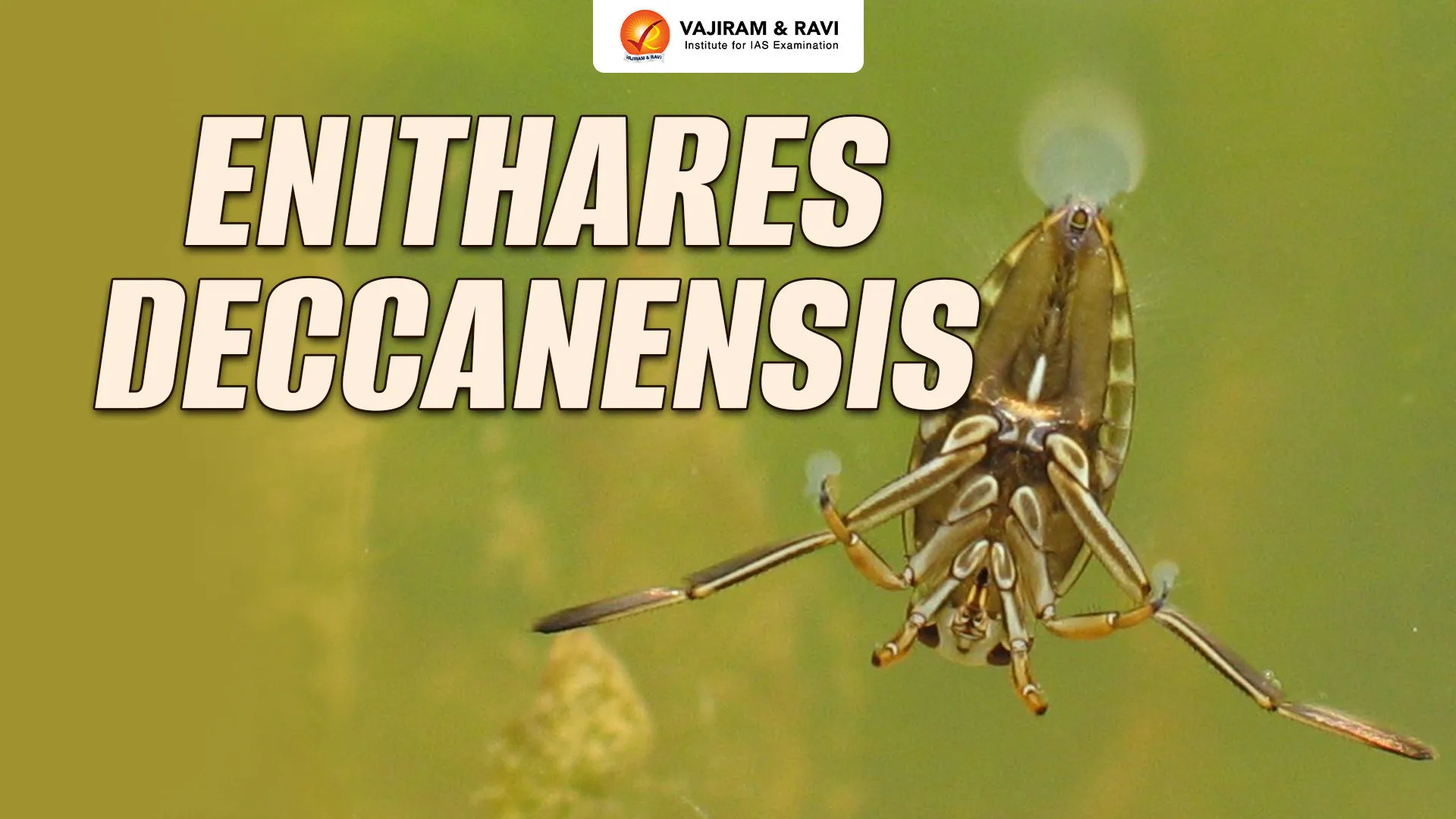
A new species of aquatic insect named Enithares deccanensis has been recently identified in the Eastern Ghats.

About Enithares deccanensis

  • It is a new species of aquatic insect discovered in the Eastern Ghats.
  • It was documented from freshwater habitats across the Seshachalam Biosphere Reserve in Andhra Pradesh and Amrabad Tiger Reserve in Telangana. 
  • It belongs to the family Notonectidae, commonly known as backswimmers. These predatory insects swim upside down beneath the water surface. 
  • It has an elongated, oval-shaped body and dark dorsal colouring. 
  • It possesses a distinctive combination of morphological features, including a dark, V-shaped marking on its wings, known as hemelytra,  and a characteristic sickle-shaped male reproductive structure. 
  • The specimens exhibited both light and dark colour forms, demonstrating colour polymorphism within the species.

News: DC

Enithares deccanensis FAQs

Q1: What is Enithares deccanensis?

Ans: It is a newly discovered species of aquatic insect found in the Eastern Ghats.

Q2: In which protected areas was Enithares deccanensis documented?

Ans: Seshachalam Biosphere Reserve in Andhra Pradesh and Amrabad Tiger Reserve in Telangana.

Q3: To which insect family does Enithares deccanensis belong?

Ans: It belongs to the family Notonectidae, commonly known as backswimmers.

Q4: What is the characteristic body shape of Enithares deccanensis?

Ans: It has an elongated, oval-shaped body with dark dorsal colouring.

Q5: What distinctive marking is present on the wings of Enithares deccanensis?

Ans: A dark, V-shaped marking on its wings, known as hemelytra.

Brown Shrike Spotted in Karnataka’s Vijayanagara After 6,000 km Migration from Siberia

Brown Shrike

Brown Shrike Latest News

A rare brown shrike bird, having travelled nearly 6,000 km from Siberia, recently made its seasonal appearance at Ulavatti village, Vijayanagara district, Karnataka. 

About Brown Shrike

  • It is a small songbird in the shrike family that is found mainly in Asia. 
  • Scientific Name: Lanius cristatus 
  • The genus name, Lanius, is derived from the Latin word for "butcher", and some shrikes are also known as "butcher birds" because of their feeding habits. 

Brown Shrike Habitat and Distribution

  • It breeds in northern Asia, from Mongolia to Siberia, and winters in South Asia, Myanmar, and the Malay Peninsula.  
  • It is among the commonest wintering shrikes in southern and eastern India and is also recorded in many other states during the cold months. 
  • It favors open or semi-open landscapes with a mixture of low vegetation and prominent hunting perches. 

Brown Shrike Features

  • It is about 18 to 20 cm in length, with a rounded, medium-long tail.
  • This shrike is mainly brown on the upper parts, and the tail is rounded. 
  • Like most other shrikes, it has a distinctive black "bandit-mask" through the eye.
  • The black mask can be paler in winter and has a white brow over it. 
  • The underside is creamy with rufous flanks and belly.  
  • The wings are brown and lack any white "mirror" patches. 
  • Females tend to have fine scalloping on the underside, and the mask is dark brown and not as well marked as in the male.  
  • Like other shrikes, the brown shrike has a strong bill with a hooked tip and a tooth-like notch that helps it kill prey with a bite to the neck. 

Brown Shrike Conservation Status

It is classified as 'Least Concern' under the IUCN Red List.

News: NIE

Brown Shrike FAQs

Q1: What is the Brown Shrike?

Ans: It is a small songbird belonging to the shrike family, found mainly in Asia.

Q2: Where does the Brown Shrike breed?

Ans: In northern Asia, extending from Mongolia to Siberia.

Q3: Where does the Brown Shrike migrate during winter?

Ans: South Asia, Myanmar and the Malay Peninsula.

Q4: What distinctive facial marking is found in the Brown Shrike?

Ans: A black bandit-like mask extending through the eye.

Q5: What is the IUCN conservation status of the Brown Shrike?

Ans: Least Concern (LC).

Ayush Quality Mark: Government Distributes Quality Certificates to Hospitals and Manufacturers

Ayush Quality Mark

Ayush Quality Mark Latest News

The Union Minister of State (Independent Charge), Ministry of Ayush and Minister of State, distributed ‘Ayush Quality Mark’ certificates to hospitals and manufacturers in New Delhi.

About Ayush Quality Mark

  • It was launched on 19th December, 2025 during the 2nd World Health Organization (WHO) Global Summit on Traditional Medicine.
  • It acts as a unified quality assurance framework to promote globally accepted standards for Ayush products and services.
  • Purpose: The primary purpose of the Ayush Quality Mark is to establish a reliable stamp of quality and authenticity for specific categories of Ayush products and services, which meet global standards, positioning it as a trusted benchmark.
  • Implementation: The implementation of the initiative has been entrusted to AYUSHEXCIL (Ayush Export Promotion Council) Ministry of Commerce and supported by the Ministry of Ayush.
  • It covers Ayush products, Ayush hospitals, day-care centres, clinics, wellness centres, Medical Value Travel Facilitators (MVTFs) and Ayush product testing laboratories.
  • Levels of Ayush Mark
    • Ayush Standard Mark for domestic assurance
    • Ayush Premium Mark for international markets 
  • Key Benefits of the Ayush Quality Mark
    • Enhanced Trust and Credibility: Provides consumers globally with a reliable symbol of verified quality and safety, as applicable.
    • Improved Market Access: Distinguishes high-quality offerings, making them more competitive in global markets.
    • Sector Standardization: Encourages all stakeholders to adhere to finalized, robust quality standards which match global standards.

Source: PIB

Ayush Quality Mark FAQs

Q1: What is Ayush Quality Mark?

Ans: It acts as a unified quality assurance framework to promote globally accepted standards for Ayush products and services.

Q2: What Ayush Quality Mark covers?

Ans: It covers Ayush products, Ayush hospitals, day-care centres, clinics, wellness centres, Medical Value Travel Facilitators (MVTFs) and Ayush product testing laboratories.

Awa Tribe: 20 Members of Isolated Amazon Community Seek Food Amid Growing Forest Threats

Awa Tribe

Awa Tribe Latest News

Around 20 members of the Awa tribe, which has avoided contact with outsiders for decades, recently approached a government team and asked for food – an interaction that advocates say may reflect the growing pressure on their forest home.

About Awa Tribe

  • The Awa, also known as the Awá-Guajá, are one of the most endangered Indigenous groups in the world. 
  • They live in the eastern Amazon rainforest, primarily in the Brazilian state of Maranhão.  
  • They speak the Awá (Guajá) language, belonging to the Tupi-Guarani language family. 
  • Traditionally nomadic hunter-gatherers, the Awa have deep spiritual and cultural ties to the rainforest, relying on it for food, medicine, and identity. 
  • They have chosen to remain isolated from mainstream society, making their own decisions about how they live and whom they interact with. 
  • They are one of the world’s last uncontacted Indigenous tribes.  But their isolation does not mean they are untouched by the outside world.  
  • The Awá have faced invasions of their territory for generations. 
  • European settlers began encroaching on their lands during the 19th century, pushing many members towards a nomadic lifestyle to escape outside threats. 
  • Brazil finally supplied the Awá with settlement areas during the mid-1980s.
  • However, numerous deadly interactions with loggers, farmers, and other illegal intruders had reduced the Awá community to barely 300 people. 
  • Fires, deforestation and climate change are adding to the pressure, disturbing the balance of a landscape that has sustained them for centuries.

News: IT

Awa Tribe FAQs

Q1: Who are the Awá people?

Ans: The Awá, also known as the Awá-Guajá, are one of the most endangered Indigenous groups in the world.

Q2: Where do the Awá people live?

Ans: In the eastern Amazon rainforest, primarily in the Brazilian state of Maranhão.

Q3: What is the traditional lifestyle of the Awá tribe?

Ans: They are traditionally nomadic hunter-gatherers.

Q4: Which activities and groups have threatened the traditional territories of the Awá tribe?

Ans: Illegal logging, farming and encroachment by other illegal intruders.

Q5: What is the approximate population of the Awá community?

Ans: Barely 300 people.

Tiger Reserves in Uttarakhand, Corbett, Rajaji, Names & Areas

Tiger Reserves in Uttarakhand

Uttarakhand is one of India’s most important tiger-conservation states, forming part of the Shivalik-Gangetic Plains landscape. Its forests, river valleys and grasslands provide important habitats for Bengal tigers and support ecological connectivity across the Himalayan foothills.

According to the National Tiger Conservation Authority (NTCA), Uttarakhand has two notified tiger reserves: Corbett and Rajaji. Corbett was among the original reserves selected under Project Tiger in 1973, while Rajaji was added to the programme in 2015.

The 2022 All India Tiger Estimation recorded an estimated 560 tigers in Uttarakhand, making it the state with the third-highest tiger population in India, after Madhya Pradesh and Karnataka.

List of Tiger Reserves in Uttarakhand

The following table lists both tiger reserves in Uttarakhand, along with their notification years and geographical areas.

Tiger Reserve

Year of notification

Total area (sq. km.)

Corbett

2010

1,288.31

Rajaji

2015

1,075.17

Tiger Reserves in Uttarakhand

Uttarakhand’s two tiger reserves represent important parts of the Shivalik and Himalayan foothill ecosystems. They also form part of the wider Shivalik–Gangetic tiger landscape, which extends into Uttar Pradesh.

1. Corbett Tiger Reserve

Corbett Tiger Reserve is located in the Kumaon region of Uttarakhand and is one of India’s most important tiger habitats. It is known for its rich biodiversity, riverine forests, grasslands and high tiger density.

  • Location: It extends across parts of Nainital and Pauri Garhwal districts, with adjoining forest landscapes connecting to other areas of the state.
  • Notification: It was formally notified as a tiger reserve in 2010.
  • Project Tiger: It was among the original nine tiger reserves selected when Project Tiger was launched on 1 April 1973.
  • Area: It covers a total area of approximately 1,288.31 sq. km., comprising a core area of 821.99 sq. km. and a buffer area of 466.32 sq. km.
  • Composition: The reserve includes Corbett National Park, Sonanadi Wildlife Sanctuary and adjoining reserve forest areas.
  • Rivers: The Ramganga, Sonanadi, Mandal and Palain rivers are important water systems within the reserve.
  • Important wildlife: It supports Bengal tigers, Asian elephants, leopards, gharials, mugger crocodiles, otters and several species of birds.
  • Conservation significance: It forms an important part of the Terai Arc Landscape and provides habitat connectivity with neighbouring forest areas.

Corbett National Park was established in 1936 as Hailey National Park, making it India’s first national park. It was renamed Ramganga National Park in 1954-55 and subsequently Jim Corbett National Park in 1957, in memory of the naturalist and conservationist Jim Corbett.

Project Tiger was launched at Corbett National Park on 1 April 1973.

2. Rajaji Tiger Reserve

Rajaji Tiger Reserve is located in the Shivalik hills and foothills of the Himalayas in Uttarakhand. It is an important habitat for tigers and Asian elephants.

  • Location: It extends across Haridwar, Dehradun and Pauri Garhwal districts.
  • Notification: It was notified as a tiger reserve in 2015.
  • Composition: The reserve includes Rajaji National Park and adjoining forest areas.
  • Formation of National Park: Rajaji National Park was established in 1983 by combining three wildlife sanctuaries — Rajaji, Chilla and Motichur.
  • Landscape: It consists of Shivalik hills, tropical and subtropical forests, riverine vegetation, grasslands and seasonal streams.
  • River: The Ganga River flows through the landscape and separates the Chilla range from the western part of the park.
  • Important wildlife: It supports Bengal tigers, Asian elephants, leopards, sloth bears, sambar, spotted deer and several bird species.
  • Conservation significance: It forms an important part of the Shivalik elephant landscape and supports wildlife connectivity between the Himalayan foothills and the Terai forests.

Rajaji Tiger Reserve is particularly important for maintaining the ecological connectivity of the Shivalik landscape. The Chilla-Motichur corridor is significant for the movement of elephants and other wildlife between forest habitats.

Significance of Tiger Reserves in Uttarakhand

Tiger reserves in Uttarakhand are important not only for protecting tigers but also for conserving the Himalayan foothill ecosystems and maintaining wildlife connectivity.

  • Biodiversity conservation: Protect tigers, elephants and other wildlife.
  • Wildlife corridors: Maintain connectivity across the Shivalik and Terai landscapes.
  • Watershed protection: Conserve forests, river systems and catchment areas.
  • Elephant conservation: Protect important elephant habitats and movement corridors.
  • Local livelihoods: Support ecotourism and employment opportunities.

Challenges in Tiger Conservation in Uttarakhand

Despite the increase in tiger numbers, Uttarakhand faces several challenges in maintaining viable and connected tiger populations.

  • Habitat fragmentation: Roads, railways, settlements and infrastructure projects disrupt wildlife habitats and corridors.
  • Human-wildlife conflict: Encounters involving tigers, elephants and local communities create risks for both people and wildlife.
  • Pressure on forest resources: Grazing, encroachment and extraction of forest resources can degrade habitats and reduce prey availability.
  • Poaching: Illegal hunting and wildlife trafficking remain threats to tigers and other threatened species.
  • Corridor disruption: Development activities and urban expansion threaten important wildlife corridors, including the Chilla-Motichur corridor.
  • Tourism pressure: Unregulated tourism and excessive human activity can disturb wildlife and affect sensitive habitats.

Tiger Reserves in Uttarakhand FAQs

Q1: How many tiger reserves are there in Uttarakhand?

Ans: Uttarakhand has two notified tiger reserves: Corbett Tiger Reserve and Rajaji Tiger Reserve.

Q2: Which is the largest tiger reserve in Uttarakhand?

Ans: Corbett Tiger Reserve is the largest, covering approximately 1,288.31 sq. km.

Q3: Which is the first tiger reserve in Uttarakhand?

Ans: Corbett was among the original nine tiger reserves selected under Project Tiger in 1973. It was formally notified as a tiger reserve in 2010.

Q4: Which is the newest tiger reserve in Uttarakhand?

Ans: Rajaji Tiger Reserve, notified in 2015, is the newest tiger reserve in the state.

Q5: Where was Project Tiger launched in India?

Ans: Project Tiger was launched at Corbett National Park on 1 April 1973.

Sundarbans Tiger Reserve, Location, Area, Wildlife, Flora & Fauna

Sundarbans Tiger Reserve

Sundarbans Tiger Reserve is located in West Bengal, within the Ganga-Brahmaputra-Meghna delta along the Bay of Bengal. It is globally significant for its unique mangrove ecosystem and Royal Bengal Tiger population. Its proposed expansion will make it India's second largest tiger reserve, strengthening tiger conservation and biodiversity protection.

Sundarbans Tiger Reserve

Sundarbans Tiger Reserve is one of India's most important tiger habitats, recognised for its extensive mangrove forests and distinctive deltaic landscape.

  • Location: Situated in South and North 24 Parganas districts of West Bengal, it occupies the southernmost part of the lower Gangetic delta, bordering the Bay of Bengal and Bangladesh.
  • Notification: The area was included in the Project Tiger initiative in 1973-74, while Sundarbans Tiger Reserve was formally notified in 2007.
  • Existing Area: According to NTCA figures, the reserve covers 2,584.89 sq. km, comprising 1,699.62 sq. km of core area and 885.27 sq. km of buffer area.
  • Geographical Features: It comprises numerous islands, estuaries, rivers and interconnected creeks. The landscape includes approximately 102 islands and forms part of the world's largest delta.
  • International Boundaries: Rivers Harinbhanga, Raimangal and Kalindi form its eastern international boundary with Bangladesh, while the Bay of Bengal lies to its south.
  • Approved Expansion: On 19 August 2025, the National Board for Wildlife approved an additional 1,044.68 sq. km across the Matla, Raidighi and Ramganga ranges in South 24 Parganas.
  • Second Largest Tiger Reserve: Following the approved expansion, its proposed total area will increase to 3,629.57 sq. km, making it India's second largest tiger reserve after Nagarjunasagar-Srisailam. Final notification of the expansion is yet to be announced.

Sundarbans Tiger Reserve Biodiversity

The Sundarbans Tiger Reserve supports diverse mangrove vegetation and wildlife, making it an ecologically significant habitat for several threatened and endangered species.

  • Flora and Mangrove Vegetation: Sundarbans has several plant species, including true mangroves and associated vegetation. Important species include Sundari, Goran, Genwa, Kankra, Keora and Golpata.
  • Adaptation of Mangroves: Mangrove plants are adapted to saline and waterlogged conditions through specialised roots, salt tolerance mechanisms and viviparous germination, enabling survival in tidal environments.
  • Mammals: The reserve supports Royal Bengal Tigers, fishing cats, spotted deer, wild boars, Gangetic dolphins and Irrawaddy dolphins. It is the only mangrove ecosystem in the world supporting a significant tiger population.
  • Tiger Population: According to the All India Tiger Estimation (AITE) 2021-22 report, 81 tigers were photo captured in Sundarbans Tiger Reserve and 20 in adjoining South 24 Parganas, with one common tiger recorded across both divisions. Tigers occupied 1,895 sq. km of the Sundarbans landscape.
  • Avifauna: Bird species recorded here including migratory birds, herons, egrets, kingfishers and white bellied sea eagles. The region is also known as a Kingfishers' Paradise.
  • Reptiles: Important reptiles include the endangered estuarine crocodile, king cobra, water monitor lizard and river terrapin (Batagur baska). Olive Ridley, Green Sea and Hawksbill turtles are also found here.
  • Aquatic Biodiversity: Its rivers and creeks support diverse fish, prawns, crabs and other aquatic organisms. Important fish include Hilsa and Bhetki, while mangroves provide breeding and nursery grounds for aquatic species.
  • Ecological Significance: Mangroves protect coastal areas, support fisheries and maintain ecological balance. The interconnected waterways also provide movement corridors for tigers and other wildlife across the delta.

Sundarbans Tiger Reserve FAQs

Q1: Where is Sundarbans Tiger Reserve located?

Ans: Sundarbans Tiger Reserve is located in West Bengal, across South and North 24 Parganas districts, in the lower Gangetic delta along the Bay of Bengal.

Q2: When was Sundarbans Tiger Reserve established?

Ans: The area was included under Project Tiger in 1973-74 and formally notified as a tiger reserve in 2007.

Q3: What is the total area of Sundarbans Tiger Reserve?

Ans: Its existing notified area is 2,584.89 sq. km, including 1,699.62 sq. km of core area and 885.27 sq. km of buffer area. Its proposed expanded area is 3,629.57 sq. km.

Q4: Why is Sundarbans Tiger Reserve ecologically important?

Ans: It protects a unique mangrove ecosystem, provides habitat to Royal Bengal Tigers and several threatened species and supports coastal biodiversity and fisheries.

Q5: Which is India's second largest tiger reserve after the proposed expansion of Sundarbans?

Ans: Sundarbans Tiger Reserve is set to become India's second largest tiger reserve after its approved expansion, with a proposed total area of 3,629.57 sq. km, behind Nagarjunasagar-Srisailam Tiger Reserve.

Tiger Reserves in Chhattisgarh, Complete List, Names & Areas

Tiger Reserves in Chhattisgarh

Tiger Reserves in Chhattisgarh play an important role in conserving India's tiger population and protecting its forest ecosystems. The state has four notified Tiger Reserves: Indravati, Udanti-Sitanadi, Achanakmar and Guru Ghasidas-Tamor Pingla. These reserves are significant for wildlife conservation, biodiversity protection and maintaining ecological connectivity with neighbouring states.

Tiger Reserves in Chhattisgarh

Chhattisgarh has 4 Tiger Reserve, covering a combined geographical area of approximately 8,385 sq km. These reserves were notified between 2009 and 2024, with Guru Ghasidas-Tamor Pingla being the latest addition in 2024.

List of Tiger Reserves in Chhattisgarh 2026

The four Tiger Reserves of Chhattisgarh differ in their geographical extent, core habitats and conservation significance. Their important details are given below.

1. Indravati Tiger Reserve

  • Location: Bijapur district of Chhattisgarh.
  • Notified: Indravati Tiger Reserve was notified in 2009.
  • Area: Indravati covers 2,799.07 sq km, comprising a core area of 1,258.37 sq km and a buffer area of 1,540.70 sq km.
  • Geographical Location: The perennial Indravati River forms its northern and western boundaries and also marks part of the interstate boundary between Chhattisgarh and Maharashtra.
  • Biodiversity: The reserve supports tigers, leopards, sloth bears, gaur, sambar and chital. It is also important for the conservation of the endangered wild buffalo.
  • Forest Cover: Its vegetation includes tropical moist mixed deciduous forests, dry deciduous forests, teak mixed forests and grasslands.
  • Landscape Connectivity: It forms part of the Indravati landscape along with Bhairamgarh and Pamed Wildlife Sanctuaries. It is connected with Kawal, Tadoba and Kanha Tiger Reserves.

2. Udanti-Sitanadi Tiger Reserve

  • Location: Gariyaband and Dhamtari districts of Chhattisgarh.
  • Notified: Udanti-Sitanadi Tiger Reserve was notified in 2009.
  • Area: The reserve covers 1,842.54 sq km, including 851.09 sq km of core area and 991.45 sq km of buffer area.
  • Composition: It comprises Udanti and Sitanadi Wildlife Sanctuaries, along with adjoining forest ranges in Gariyaband, Dhamtari and neighbouring areas.
  • Wildlife: The reserve is particularly important for the conservation of the endangered Asiatic wild buffalo. Other significant species include tigers, leopards, Indian wolves and sloth bears.
  • Forest Types: Its vegetation includes dry teak forests, dry and moist peninsular Sal forests, northern dry mixed deciduous forests and bamboo forests.
  • Interstate Significance: Udanti is contiguous with Odisha's Khariar Forest Division and acts as a buffer for Sonabeda Wildlife Sanctuary, supporting an important Chhattisgarh-Odisha conservation landscape.

3. Achanakmar Tiger Reserve

  • Notified: Achanakmar Tiger Reserve was notified in 2009.
  • Area: Achanakmar Tiger Reserve covers 914.02 sq km, consisting of 626.19 sq km of core area and 287.82 sq km of buffer area.
  • Biosphere Reserve: It forms part of the larger Achanakmar-Amarkantak Biosphere Reserve, making it an important conservation area in Central India.
  • Wildlife: The reserve provides habitat for Bengal tigers, leopards, gaur, chital and sambar, along with several bird species.
  • Forest Cover: Its forests predominantly comprise Sal, bamboo and teak vegetation, supporting diverse wildlife habitats.
  • Geographical Features: The reserve has a landscape of hills, valleys and rivers, with the Maniyari River flowing through the area.

4. Guru Ghasidas-Tamor Pingla Tiger Reserve

  • Location: The reserve spans four districts of Chhattisgarh: Manendragarh-Chirmiri-Bharatpur, Korea, Surajpur and Balrampur, covering an extensive forest landscape in northern Chhattisgarh.
  • Notified: 2024
  • Area: It covers 2,829.387 sq km, comprising 2,049.232 sq km of core area and 780.155 sq km of buffer area.
  • National Status: Notified in 2024, it became India's 56th Tiger Reserve and the fourth Tiger Reserve in Chhattisgarh.
  • Composition: The reserve includes the Guru Ghasidas National Park and Tamor Pingla Wildlife Sanctuary, forming a large protected forest landscape.
  • Wildlife: Important species found in the region include tigers, leopards, elephants, wolves, chital and several bird species.
  • Interstate Connectivity: It is connected with Sanjay-Dubri and Bandhavgarh Tiger Reserves in Madhya Pradesh and Palamau Tiger Reserve in Jharkhand, supporting a larger conservation landscape.
  • National Significance: With an area of approximately 2,829 sq km, it is the third largest Tiger Reserve in India, after Nagarjunasagar-Srisailam and Manas Tiger Reserves.

Tiger Reserves in Chhattisgarh FAQs

Q1: How many Tiger Reserves are there in Chhattisgarh?

Ans: Chhattisgarh has four notified Tiger Reserves: Indravati, Udanti-Sitanadi, Achanakmar and Guru Ghasidas-Tamor Pingla.

Q2: Which is the latest Tiger Reserve in Chhattisgarh?

Ans: Guru Ghasidas-Tamor Pingla is the latest Tiger Reserve in Chhattisgarh. It was notified in 2024 as India's 56th Tiger Reserve.

Q3: Which is the largest Tiger Reserve in Chhattisgarh?

Ans: Guru Ghasidas-Tamor Pingla is the largest Tiger Reserve in Chhattisgarh, covering approximately 2,829.39 sq km.

Q4: Which Tiger Reserve in Chhattisgarh is known for the conservation of wild buffalo?

Ans: Indravati and Udanti-Sitanadi Tiger Reserves are important for wild buffalo conservation. The Asiatic wild buffalo is a key endangered species in these landscapes.

Q5: In which year were the Tiger Reserves of Chhattisgarh notified?

Ans: Indravati, Udanti-Sitanadi and Achanakmar were notified as Tiger Reserves in 2009, while Guru Ghasidas-Tamor Pingla received notification in 2024.

Tiger Reserves in Assam, List of 4 with Names, Areas & Locations

Tiger Reserves in Assam

Tiger Reserves in Assam are important for conserving Bengal tigers and protecting the state's rich wildlife habitats. Assam has four tiger reserves: Kaziranga, Manas, Nameri and Orang. Located across the Brahmaputra Valley and Eastern Himalayan foothills, these reserves support biodiversity conservation and maintain ecological connectivity across Northeast India.

Tiger Reserves in Assam

Assam has 4 Tiger Reserves, namely Kaziranga Tiger Reserve (2007), Manas Tiger Reserve (2008), Nameri Tiger Reserve (2000) and Orang Tiger Reserve (2016). These protected areas are significant for tiger conservation and also provide habitats for rhinoceroses, elephants and other endangered wildlife.

List of Tiger Reserves in Assam

The following is the list of 4 Tiger Reserve in Assam, along with their locations, geographical extent and conservation significance.

1. Kaziranga Tiger Reserve

  • Location: Kaziranga lies along the Brahmaputra floodplains, near the Karbi Anglong hills of Assam.
  • Area: The reserve covers approximately 1,173.58 sq. km, comprising 625.58 sq. km of core area and 548 sq. km of buffer area.
  • Historical Significance: Kaziranga was declared a National Park on 11 February 1974 and received UNESCO World Heritage Site recognition in December 1985.
  • Biodiversity: It is globally recognised for its Greater One-Horned Rhinoceros population. Other important species include Bengal tigers, elephants, wild buffaloes and swamp deer.
  • Habitat: Its landscape consists of alluvial grasslands, wetlands, marshes, shallow pools and moist deciduous forests, supporting diverse wildlife.
  • Conservation Significance: Kaziranga is an important tiger conservation landscape in Northeast India, with ecological connectivity to Orang and Nameri through the Brahmaputra riverine landscape.

2. Manas Tiger Reserve

  • Location: Manas Tiger Reserve is situated in north-western Assam along the Bhutan border.
  • Area: The reserve covers approximately 2,837.10 sq. km, including 526.22 sq. km of core area and 2,310.88 sq. km of buffer area.
  • Historical Significance: Established in 1973 as Northeast India's first tiger reserve, Manas is also recognised as a UNESCO World Heritage Site and Biosphere Reserve.
  • Biodiversity: Important species include Bengal tigers, elephants, rhinoceroses, wild buffaloes, golden langurs, pygmy hogs and Hispid hares. It also supports more than 450 bird species.
  • Geographical Features: The reserve comprises Sub-Himalayan semi-evergreen forests, moist deciduous forests, Bhabar grasslands and alluvial floodplains, with the Manas and Beki rivers forming important geographical features.
  • Conservation Significance: Manas forms part of a transboundary conservation landscape connecting Bhutan's protected areas with India's Buxa and other protected forest regions, supporting tiger movement and habitat connectivity.

3. Nameri Tiger Reserve

  • Location: Nameri Tiger Reserve is situated in the northern part of Sonitpur district, along the foothills of Arunachal Pradesh in Assam.
  • Area: The reserve covers approximately 464.00 sq. km, comprising 320 sq. km of core area and 144 sq. km of buffer area.
  • Constitution: It comprises Nameri National Park, Sonai-Rupai Wildlife Sanctuary, Naduar Reserve Forest and Balipara Reserve Forest.
  • Biodiversity: Nameri is known for its White-winged Wood Duck. Other important species include Bengal tigers, leopards, clouded leopards, wild dogs and Asian elephants.
  • Forest and Habitat: Its vegetation includes tropical evergreen, semi-evergreen and moist deciduous forests, along with riverine grasslands and cane brakes.
  • Conservation Significance: Nameri is contiguous with Pakke Tiger Reserve in Arunachal Pradesh, forming an important forest corridor for tiger movement and wildlife conservation in Northeast India.

4. Orang Tiger Reserve

  • Location: Orang Tiger Reserve is situated across Darrang and Sonitpur districts on the northern bank of the Brahmaputra River in Assam.
  • Area: The reserve covers approximately 492.46 sq. km, comprising 79.28 sq. km of core area and 413.18 sq. km of buffer area.
  • Historical Significance: Orang was declared a Game Reserve in 1915, a Wildlife Sanctuary in 1998 and as Orang National Park in 1999. It received Tiger Reserve status in 2016.
  • Biodiversity: The reserve supports Greater One-Horned Rhinoceros, Bengal tigers, Asian elephants, wild water buffaloes, hog deer and several important bird species.
  • Geographical Features: Its landscape consists of alluvial floodplains, grasslands, wetlands and riverine forests, providing suitable habitats for several endangered wildlife species.
  • Conservation Significance: Popularly known as Mini Kaziranga because of its similar floodplain landscape and rhinoceros population, Orang is an important protected area for wildlife conservation in Assam.

Tiger Reserves in Assam FAQs

Q1: How many Tiger Reserves are there in Assam?

Ans: Assam has four tiger reserves: Kaziranga, Manas, Nameri and Orang.

Q2: Which was the First Tiger Reserve in Assam?

Ans: Manas Tiger Reserve, established in 1973, was the first tiger reserve in Assam and Northeast India.

Q3: Which Tiger Reserve in Assam is a UNESCO World Heritage Site?

Ans: Kaziranga and Manas are UNESCO World Heritage Sites, recognised for their outstanding ecological and biodiversity significance.

Q4: Which Tiger Reserve in Assam is famous for the one-horned rhinoceros?

Ans: Kaziranga Tiger Reserve is particularly famous for its Greater One-Horned Rhinoceros population. Orang also provides an important habitat for this species.

Q5: Which Tiger Reserve in Assam shares a boundary with Bhutan?

Ans: Manas Tiger Reserve shares an international boundary with Bhutan and is ecologically connected with Royal Manas National Park.

National Anti-Terror Conference 2026, Theme, NIA & Key Highlights

National Anti-Terror Conference

National Anti-Terror Conference was inaugurated by Union Home Minister Amit Shah on November 19, 2026, in New Delhi. Organised by the National Investigation Agency (NIA) under the Ministry of Home Affairs, the two-day conference focuses on strengthening India's fight against terrorism under the theme "Cross-Border Terrorism." It brings together police officers, security agencies and experts to discuss emerging terror threats, intelligence sharing, cyber security and counter-terrorism strategies. The conference also highlights the government's Zero Tolerance Policy against Terrorism and its efforts to develop a unified national security system. 

About National Anti-Terror Conference 2026

The National Anti-Terror Conference is an annual national-level meeting organised by the National Investigation Agency (NIA) to strengthen coordination among law enforcement agencies and improve India's counter-terrorism capabilities.

  • Organising Agency: National Investigation Agency (NIA), under the Ministry of Home Affairs (MHA).
  • Conference 2026: Held on November 19-20, 2026, in New Delhi.
  • Theme: Cross-Border Terrorism, focusing on threats originating beyond India's borders.
  • Participants: Senior police officers from states and Union Territories, central security agencies and experts in law, forensic science and technology.
  • Government Approach: Follows a Whole-of-Government Approach, promoting cooperation between central and state agencies.
  • Annual Platform: Provides opportunities to exchange experiences, discuss emerging threats and develop effective counter-terrorism policies.

National Anti-Terror Conference Key Objectives

The National Anti-Terror Conference 2026 aims to improve India's ability to prevent terrorist attacks, strengthen intelligence networks and develop modern security strategies.

  • Strengthen National Security: Improve cooperation between the Centre, states and security agencies to counter terrorism effectively.
  • Unified Counter-Terrorism Strategy: Develop a common strategy extending from national security agencies to police stations across India.
  • Improve Intelligence Sharing: Ensure faster exchange of intelligence between police stations, state police headquarters and central agencies.
  • Combat Cross-Border Terrorism: Strengthen investigations and international cooperation to tackle terrorists operating from foreign countries.
  • Disrupt Terror Financing: Identify and dismantle financial networks supporting terrorist organisations.
  • Promote Technology-Based Investigations: Expand the use of digital forensics, cyber security and data analysis in terrorism investigations.
  • Build Institutional Capacity: Train police personnel in modern investigation techniques, new criminal laws and effective prosecution.
  • Prevent Radicalisation: Address extremist recruitment, espionage and emerging hybrid security threats.

National Anti-Terror Conference 2026 Major Highlights

The National Anti-Terror Conference 2026 highlighted important government initiatives, security achievements and new strategies to strengthen India's fight against terrorism.

1. Zero Tolerance Policy Against Terrorism

  • Government Policy: Home Minister highlighted that India's Zero Tolerance Policy against Terrorism is producing positive results.
  • Proactive Counter-Terrorism: Security agencies were encouraged to prevent terrorist attacks by identifying and arresting suspects before they execute their plans.
  • Unified Security System: The government is developing a system in which all police stations follow a common counter-terrorism strategy.

2. Strengthening Intelligence and Security Coordination

  • Intelligence Sharing: He stressed the need to transmit intelligence from police stations through different levels to the Director General of Police (DGP) for timely action.
  • Multi-Agency Centre (MAC): Its scope has been expanded to cover cyber security, narco-terrorism, organised crime and radicalisation hotspots.
  • National Memory Bank: A centralised intelligence database has been developed to improve information sharing and counter-terrorism preparedness.
  • Border Security: Establishing a Quadrangular Regional Security Grid in border states was identified as an important priority.

3. Major Counter-Terrorism Achievements

  • Kashmir Security: Following the killing of Lashkar-e-Taiba terrorist Latif Bhat, he stated that Kashmir had become free of locally recruited, India-born terrorists after approximately 35 years.
  • Action Against PFI: Coordinated operations involving police forces from 11 states and central agencies in September 2022 were highlighted as an example of successful joint action against the Popular Front of India (PFI) network.
  • Shahzad Bhatti Network: According to the Home Minister, more than 40 modules were dismantled, over 100 cases registered and 271 arrests made.
  • Return of Fugitives: Since 2019, 303 fugitives have been brought back to India from 36 countries, strengthening action against terrorism, organised crime and drug-related offences.

4. Strengthening NIA and Anti-Terrorism Laws

  • NIA Act Amendment, 2019: Expanded the agency's investigative powers and jurisdiction, including investigations involving the interests of Indians abroad.
  • UAPA Amendment, 2019: Strengthened provisions for designating individuals as terrorists and seizing terrorist-linked properties.
  • NIA Expansion: Approval was granted for 16 new branch offices and two zonal offices to strengthen the agency's nationwide presence.
  • Special Courts: 70 new NIA Special Courts have been established to improve the handling of terrorism-related cases.
  • Terror Financing: A 25-point integrated action plan was introduced to control terrorist funding networks.

5. Digital Forensics and Training Programmes

  • Cyber Expertise: State Anti-Terrorism Squads (ATS) were advised to strengthen their cyber expert units to investigate technology-enabled terrorism.
  • Digital Investigations: Sessions focused on digital evidence, data analysis and collecting evidence from foreign jurisdictions.
  • Capacity Building: Special training programmes were organised for state police personnel and legal professionals.
  • Legal Training: Covered new criminal laws, terrorism investigations, prosecution strategies, witness protection and trial management.
  • Emerging Threats: Discussions included radicalisation, espionage, hybrid threats and terror financing networks.

6. Important Launches and Announcements

During the inaugural session, Amit Shah announced several initiatives to strengthen the NIA's infrastructure and investigation capabilities.

  • Fail-Safe Investigation: Released an NIA publication aimed at improving investigation practices.
  • Pushti Portal: Electronically launched the NIA's Pushti Portal.
  • Chandigarh Office: Laid the foundation stone for a new NIA office complex in Chandigarh.
  • Residential Complex: Inaugurated the NIA residential complex at Maidan Garhi, Delhi.
  • Recognition: Honoured seven NIA officers and personnel for their services.

Challenges in Counter-Terrorism in India

Despite improvements in India's counter-terrorism framework, several challenges continue to affect national security and require coordinated action from security agencies.

  • Cross-Border Terrorism: Terrorist groups operating from foreign territories create challenges for border security, intelligence gathering and investigations.
  • Coordination Gaps: Differences in resources, operational procedures and intelligence-sharing systems can affect cooperation between central and state agencies.
  • Cyber Terrorism: Increasing use of encrypted communications, online platforms and digital technologies makes terrorist activities difficult to monitor.
  • Terror Financing: Complex financial transactions, informal money-transfer networks and overseas funding make it difficult to identify the entire terror financing network.
  • Foreign-Based Terror Networks: Investigating terrorists and bringing fugitives back from other countries requires international cooperation and legal assistance.
  • Investigation and Prosecution: Gathering digital evidence, protecting witnesses and managing complex terrorism trials remain significant challenges.
  • Emerging Hybrid Threats: The growing links between terrorism, organised crime, cyberattacks and drug trafficking demand more integrated security strategies.

Significance of the National Anti-Terror Conference for India's Internal Security

The National Anti-Terror Conference 2026 plays an important role in strengthening India's internal security by promoting coordinated action, modern investigation techniques and preventive measures against terrorism.

  • Better Centre-State Coordination: Encourages cooperation between central agencies, state police forces and Anti-Terrorism Squads (ATS).
  • Preventive Security Approach: Promotes early identification of terrorist activities to prevent attacks before they occur.
  • Stronger Intelligence Network: Improves the flow of information from local police stations to national security agencies.
  • Control Over Terror Financing: Helps agencies identify and disrupt financial networks supporting terrorism.
  • Improved Border Security: Strengthens efforts to tackle cross-border terrorism, infiltration and threats linked to organised crime.
  • Technology-Driven Policing: Encourages the use of cyber intelligence, digital forensics and data analytics in investigations
  • Future-Ready Security System: Helps India develop coordinated strategies to address evolving terrorist threats and security challenges.

National Anti-Terror Conference FAQs

Q1: What is the National Anti-Terror Conference 2026?

Ans: The National Anti-Terror Conference 2026 is a two-day national security meeting organised by the National Investigation Agency (NIA) to strengthen India's counter-terrorism strategies and coordination among security agencies.

Q2: When and where was the National Anti-Terror Conference 2026 held?

Ans: The National Anti-Terror Conference 2026 was held on November 19-20, 2026, in New Delhi and was inaugurated by Union Home Minister Amit Shah.

Q3: What is the theme of the National Anti-Terror Conference 2026?

Ans: The theme of the National Anti-Terror Conference 2026 is "Cross-Border Terrorism," focusing on tackling international terrorist networks and strengthening India's national security.

Q4: What are the main objectives of the National Anti-Terror Conference?

Ans: The main objectives include improving intelligence sharing, strengthening Centre-State coordination, preventing terrorist attacks, disrupting terror financing and enhancing cyber security capabilities.

Q5: What were the major highlights of the National Anti-Terror Conference 2026?

Ans: Key highlights included the Zero Tolerance Policy against Terrorism, strengthening the NIA, expanding intelligence networks, launching the Pushti Portal and promoting a unified counter-terrorism strategy.

Veerangana Jhalkari Bai 1830-1858, Biography, Contributions

Veerangana Jhalkari Bai

Veerangana Jhalkari Bai was a courageous woman soldier who played an important role during the Revolt of 1857. She served in Rani Lakshmibai’s women’s army, Durga Dal and became a trusted adviser to the queen. Her bravery and sacrifice remain significant in the history and cultural identity of Bundelkhand.

Veerangana Jhalkari Bai Birth Anniversary 2026

Veerangana Jhalkari Bai Birth Anniversary 2026 will be observed on 22 November 2026, marking her 196th birth anniversary. Born in 1830 in Bhojla village near Jhansi, Uttar Pradesh, she is remembered for her courage, military service and contribution during the Revolt of 1857.

Veerangana Jhalkari Bai Biography

Jhalkaribai emerged as a prominent woman warrior in Jhansi, earning recognition through her bravery, military leadership and close association with Rani Lakshmibai.

  • Birth and Family Background: She was born on 22 November 1830 in Bhojla village near Jhansi to Sadova Singh and Jamunadevi in a Dalit Koli family.
  • Early Bravery: Known for her courage from childhood, she reportedly confronted dangerous wild animals, demonstrating exceptional fearlessness and physical courage.
  • Marriage: She married Puran Kori, a soldier serving in the army of Raja Gangadhar Rao, the husband of Rani Lakshmibai.
  • Association with Rani Lakshmibai: Her resemblance to the queen helped her enter Jhansi’s women's regiment, where she gradually gained the queen's confidence and became a close adviser.
  • Military Leadership: Through her military abilities, she rose through the ranks of the Jhansi army and eventually took responsibility for commanding soldiers.

Veerangana Jhalkari Bai Contributions

Veerangana Jhalkari Bai's contribution is particularly associated with the Revolt of 1857, the defence of Jhansi and the legacy of women's participation in armed resistance.

  • Role in Durga Dal: She served in Durga Dal, the women's military unit of Rani Lakshmibai and became one of its prominent soldiers during the Revolt of 1857.
  • Disguise as Rani Lakshmibai: During the British siege of Jhansi, she used her physical resemblance to the queen to disguise herself as Rani Lakshmibai and mislead enemy forces.
  • Protection of the Queen: By presenting herself as the queen before British General Hugh Rose's camp, she diverted enemy attention and helped create an opportunity for the real queen to escape.
  • Military Resistance: Her actions during the siege strengthened the resistance of Jhansi's forces by creating confusion among British troops and providing the defenders with additional time.
  • Recognition and Memorials: The Government of India issued a postal stamp in her honour. Her statue was unveiled in Bhopal on 10 November 2017 by President Ram Nath Kovind.
  • Historical and Cultural Legacy: Her life has been documented through literary works, biographies and oral traditions. Her death anniversary is observed as Shahid Diwas by several Koli and Kori organisations.
  • Museum Commemoration: The Archaeological Survey of India has undertaken efforts to establish a museum at Panch Mahal inside Jhansi Fort in her remembrance.

Veerangana Jhalkari Bai FAQs

Q1: Who was Veerangana Jhalkari Bai?

Ans: Veerangana Jhalkari Bai was a woman soldier in Rani Lakshmibai's army who played an important role during the Revolt of 1857 by disguising herself as the queen.

Q2: When is Veerangana Jhalkari Bai Birth Anniversary 2026 observed?

Ans: Veerangana Jhalkari Bai Birth Anniversary 2026 will be observed on 22 November 2026, marking her 196th birth anniversary.

Q3: Where was Jhalkaribai born?

Ans: Jhalkaribai was born on 22 November 1830 in Bhojla village near Jhansi, Uttar Pradesh.

Q4: What was the role of Jhalkaribai in the Revolt of 1857?

Ans: She served in Rani Lakshmibai's Durga Dal and reportedly disguised herself as the queen during the British siege of Jhansi, helping the real queen escape.

Q5: Why is Veerangana Jhalkari Bai remembered in Indian history?

Ans: She is remembered for her bravery, military leadership, sacrifice and contribution to the resistance against British forces during the Revolt of 1857.

Harekrushna Mahatab (Utkal Keshari) 1899-1987, Biography, Contributions

Harekrushna Mahatab

Harekrushna Mahatab was a prominent freedom fighter, political leader and literary figure from Odisha. Known as Utkal Keshari, he played an important role in India's independence movement and the political integration of Odisha. His contributions as Chief Minister, administrator and social reformer shaped the state's development.

Harekrushna Mahatab Birth Anniversary 2026

Harekrushna Mahatab Birth Anniversary 2026 will be observed on 21 November 2026, marking his 127th birth anniversary. Remembered as Utkal Keshari, he made significant contributions to India's freedom struggle, Odisha's political integration, social reform and administrative development.

Harekrushna Mahatab Biography

Harekrushna Mahatab was born on 21 November 1899 in Agarpada village, present day Bhadrak district, Odisha.

  • Early Life: He was born to Krushna Charan Das and Tohapha Debi. He completed matriculation from Bhadrak High School and joined Ravenshaw College, Cuttack, for higher education.
  • Entry into Freedom Movement: In 1921, he left college to participate in the freedom struggle. He was arrested in 1922 on sedition charges and imprisoned several times for his nationalist activities.
  • Political Leadership: He served as Chairman of the Balasore District Board from 1924 to 1928 and became a member of the Bihar and Odisha Council.
  • Role in National Movement: He participated in the Salt Satyagraha in 1930 and the Quit India Movement in 1942, remaining imprisoned from 1942 to 1945.
  • Congress Association: Subhas Chandra Bose nominated him to the Congress Working Committee in 1938. He also served as President of the Utkal Pradesh Congress Committee.
  • Chief Minister and Other Positions: He served as Odisha's Chief Minister from 1946 to 1950 and 1956 to 1960. He also held the Union Commerce and Industry portfolio and served as Governor of Bombay.
  • Later Political Career: He became an MP from Angul in 1962 and Congress Vice President in 1966. Later, he founded and led the Orissa Jana Congress and was imprisoned during the Emergency in 1976.
  • Death: Harekrushna Mahatab passed away on 2 January 1987.

Harekrushna Mahatab Contributions

Harekrushna Mahatab made lasting contributions to Odisha through political integration, infrastructure development, social reform, the freedom movement and literature.

  • Integration of Princely States: He played a significant role in integrating former princely states with Odisha, strengthening the state's territorial and administrative unity after independence.
  • Development of Bhubaneswar: During his tenure as Chief Minister, he facilitated the shifting of Odisha's capital from Cuttack to Bhubaneswar, supporting the state's administrative development.
  • Hirakud Dam Project: He contributed to the sanction and construction of the Hirakud Dam Project, an important multipurpose river valley project supporting irrigation and regional development.
  • Fight Against Untouchability: In 1934, he opened the gates of his ancestral temple to people from all communities, taking a significant step towards social equality and the removal of untouchability.
  • Contribution to Journalism: He founded the weekly Prajatantra in 1923, which later became a daily newspaper. He also edited Jhankar and the English weekly The Eastern Times.
  • Literary Contributions: He authored several literary works, including Gaon Majlis. He received the Sahitya Akademi Award in 1983 for its third volume.
  • Promotion of Literature and Culture: He served as President of the Odisha Sahitya Akademi and Sangeet Natak Akademi, contributing to the promotion of literature, performing arts and cultural activities.
  • Legacy: Popularly known as the Lion of Odisha and Utkal Keshari. His contributions remain significant in Odisha's political, social and literary history.

Harekrushna Mahatab FAQs

Q1: Who was Harekrushna Mahatab?

Ans: Harekrushna Mahatab was an Indian freedom fighter, political leader, writer and former Chief Minister of Odisha, popularly known as Utkal Keshari.

Q2: When was Harekrushna Mahatab born?

Ans: Harekrushna Mahatab was born on 21 November 1899 in Agarpada village, Bhadrak district, Odisha.

Q3: Why is Harekrushna Mahatab known as Utkal Keshari?

Ans: He is popularly known as Utkal Keshari, meaning Lion of Odisha, for his contributions to the freedom movement and Odisha's development.

Q4: How many times did Harekrushna Mahatab serve as Chief Minister of Odisha?

Ans: He served as Chief Minister of Odisha twice, from 1946 to 1950 and from 1956 to 1960.

Q5: What were the major contributions of Harekrushna Mahatab?

Ans: His major contributions include Odisha's princely state integration, shifting the capital to Bhubaneswar, the Hirakud Dam Project and promotion of literature and social reform.

Multi Agency Centre (MAC): Amit Shah Inaugurates ₹500 Crore Upgraded Intelligence Network

Multi Agency Centre (MAC)

Multi-Agency Centre Latest News

The Multi-Agency Centre (MAC), a centralised intelligence-sharing platform, now tracks cybersecurity, narcotics, organised crime networks, and emerging radicalisation hotspots, the Union Home Minister said recently.

About Multi-Agency Centre 

  • It is a centralized intelligence-sharing body under India's Intelligence Bureau (IB).
  • It is the apex institutional mechanism through which the Government of India collates, stores, analyzes, and disseminates terrorism-related intelligence among its civilian, military, and police agencies. 
  • It was created in December 2001 in the aftermath of the Kargil conflict.
  • It has no independent statutory charter; its authority derives from executive sanction and the operational primacy of the IB in internal security matters. 
  • Its scope was significantly expanded after the November 2008 Mumbai attacks. 
  • The network was extended downward to the state and district level through Subsidiary Multi-Agency Centres (SMACs), situated in state capitals and connected to the central database.
  • As many as 28 organisations, including the IB, R&AW, the Defence Intelligence Agency, the three service intelligence directorates, the Central Bureau of Investigation, the Directorate of Revenue Intelligence, the National Investigation Agency, the Narcotics Control Bureau, central armed police forces and state police, are part of the system through which they share intelligence inputs.  
  • Procedurally, the MAC operates as a round-the-clock fusion centre. 
    • Designated agencies post liaison officers to the MAC headquarters in New Delhi, where raw and assessed intelligence inputs are uploaded to a shared database. 
    • The flow runs in two directions: agencies feed terrorism-related information into the centre, and the MAC in turn disseminates collated, deduplicated, and where possible corroborated inputs back to the relevant stakeholders, including state police forces. 
  • A new MAC network was inaugurated on 16 May 2025. 
    • It connects all police districts in the country through a secured network and has been built at a cost of ₹500 crore.
    • It incorporates futuristic capabilities such as embedded AI and machine learning techniques to harness the potential of the vast database with MAC and GIS services.
    • The upgraded network will enhance trend analysis, hotspot mapping, and predictive operations, offering more accurate and actionable outcomes.
    • The network spans the entire country, including island territories, insurgency-affected areas, and mountainous high-altitude regions, ensuring last-mile connectivity to district-level officials in remote areas through a secure and dedicated network.
    • It strengthens the country’s efforts to tackle serious threats like terrorism,  cybersecurity, narcotics, organised crime networks, and emerging radicalisation hotspots.

News: TH

Multi-Agency Centre FAQs

Q1: What is the Multi-Agency Centre (MAC)?

Ans: It is a centralised intelligence-sharing body under India's Intelligence Bureau (IB).

Q2: Under which organisation does the Multi-Agency Centre function?

Ans: The Intelligence Bureau (IB).

Q3: What is the primary function of the Multi-Agency Centre (MAC)?

Ans: To collate, store, analyse and disseminate terrorism-related intelligence among India's civilian, military and police agencies.

Q4: When was the Multi-Agency Centre established?

Ans: It was created in December 2001 in the aftermath of the Kargil conflict.

Q5: What are Subsidiary Multi-Agency Centres (SMACs)?

Ans: They are regional-level intelligence coordination centres that extend the MAC network to the state and district levels.

SCO Civilisational Dialogue Forum 2026, Background, Latest News

SCO Civilisational Dialogue Forum 2026

SCO Civilisational Dialogue Forum 2026 is an Indian initiative under the Shanghai Cooperation Organisation framework to promote cultural understanding and civilisational exchanges among member countries. Scheduled from 20 to 22 November 2026 in New Delhi, the inaugural forum will highlight shared heritage, strengthen people to people connections and encourage cooperation through cultural, historical and intellectual dialogue.

SCO Civilisational Dialogue Forum Latest News

Prime Minister Narendra Modi will inaugurate the first SCO Civilisational Dialogue Forum on 20 November 2026 at around 5:30 PM at Purana Qila, New Delhi. The three day event will bring together scholars, academics, experts and cultural representatives to explore shared civilisational traditions across India and Eurasia.

What is SCO Civilisational Dialogue Forum?

The SCO Civilisational Dialogue Forum is an Indian initiative designed to promote cultural diplomacy and mutual understanding among countries through discussions, exhibitions and exchanges highlighting their interconnected histories, traditions, languages, literature, art and philosophical heritage.

SCO Civilisational Dialogue Forum Background

The SCO Civilisational Dialogue Forum initiative emerged from India's proposal to establish a dedicated civilisational dialogue platform under the SCO framework, subsequently welcomed in the Bishkek Declaration.

  • Origin of the initiative: Prime Minister Narendra Modi proposed establishing a dedicated platform for civilisational dialogue during the SCO Summit held in Tianjin, China, in 2025.
  • Institutional recognition: The proposal received recognition through the Bishkek Declaration of the Shanghai Cooperation Organisation, providing an institutional basis for cultural engagement among member countries.
  • Announcement by India: On 20 October 2026, Defence Minister Rajnath Singh announced India's plan to host the first forum while addressing the 25th SCO Council of Heads of Government meeting in Dushanbe, Tajikistan.
  • Cultural presentation: The inaugural ceremony will feature Civilisations in Conversation – Cultural Show, combining music, dance, visual storytelling and narration to present cultural connections across India and Eurasia.
  • Central theme: The cultural presentation follows the theme Vasudhaiva Kutumbakam – The World Is One Family, highlighting the importance of shared human values and interconnected civilisational traditions.
  • Heritage exhibitions: The exhibition ASTITVA - The Essence of Our Existence will showcase India's archaeological, artistic and literary heritage, including evidence of Delhi's history dating from 1200 BCE to 1200 CE.

What is Shanghai Cooperation Organisation (SCO)?

The Shanghai Cooperation Organisation is a Eurasian intergovernmental organisation established in 2001 to promote regional security, political engagement, economic cooperation and cultural exchanges among its member countries.

  • Establishment: The SCO was established on 15 June 2001 in Shanghai, China, evolving from the Shanghai Five mechanism formed in 1996 to address border related issues.
  • Founding members: China, Kazakhstan, Kyrgyzstan, Russia, Tajikistan and Uzbekistan were the founding members. The Shanghai Five mechanism provided the foundation for the organisation's establishment.
  • Expansion of membership: India and Pakistan joined in 2017, Iran became a member in 2023 and Belarus joined in July 2024, expanding the organisation's geographical and strategic reach.
  • Headquarters: The SCO Secretariat is located in Beijing, China, while its Regional Anti Terrorist Structure (RATS), responsible for counter terrorism coordination, is headquartered in Tashkent, Uzbekistan.
  • Major objectives: Its cooperation covers regional security, counter terrorism, economic development, connectivity, energy cooperation, political engagement and cultural exchanges among countries across the Eurasian region.
  • Council of Heads of State: It is the highest decision making body of the organisation and determines its broad priorities, strategic direction and major guidelines through annual meetings.
  • Council of Heads of Government: It is responsible for economic and trade cooperation, cultural engagement and approval of the organisation's annual budget, making it important for practical cooperation.
  • Regional Anti Terrorist Structure: RATS coordinates intelligence sharing, maintains information on terrorist organisations and supports cooperation among member countries' security agencies to address terrorism, separatism and extremism.

SCO Civilisational Dialogue Forum Significance

The SCO Civilisational Dialogue Forum extends regional cooperation beyond conventional diplomacy by connecting cultural heritage, intellectual exchanges and people to people engagement with the broader objectives of the Shanghai Cooperation Organisation.

  • Strengthening cultural diplomacy: The forum provides a platform for countries to use heritage, literature, art and intellectual exchanges to develop cultural understanding and strengthen diplomatic engagement beyond formal government interactions.
  • Promoting people to people connections: Interaction among scholars, artists, academics and cultural representatives can improve familiarity with neighbouring societies, reduce stereotypes and encourage mutual respect among different communities.
  • Preserving shared heritage: Discussions on archaeological remains, manuscripts, architecture and traditional practices can encourage collaborative research, heritage documentation and greater awareness of interconnected civilisational traditions.
  • Expanding SCO's engagement: Cultural participation can connect the organisation's diplomatic activities with ordinary citizens, increasing public awareness and creating opportunities for cooperation beyond security and economic matters.
  • Strengthening India's regional engagement: The initiative provides India with an opportunity to deepen cultural engagement with Eurasian countries and complement its broader diplomatic, connectivity and strategic interests in the region.
  • Addressing institutional challenges: Political differences, language barriers, competing historical narratives and uneven participation may restrict cooperation, making inclusive discussions and sustained institutional engagement important for meaningful outcomes.
  • Ensuring long term cooperation: Regular dialogue, joint research, translation projects, digital heritage collections and collaborative cultural programmes can help transform the inaugural forum into a continuing platform for regional engagement.
  • Encouraging youth participation: Involving students, young researchers and emerging cultural practitioners can strengthen long term connections and ensure that civilisational exchanges extend beyond established academic and diplomatic institutions.

SCO Civilisational Dialogue Forum 2026 FAQs

Q1: What is the SCO Civilisational Dialogue Forum 2026?

Ans: The SCO Civilisational Dialogue Forum 2026 is an Indian initiative under the Shanghai Cooperation Organisation framework to promote cultural exchanges, shared heritage and people to people connections among member countries.

Q2: When and where will the first SCO Civilisational Dialogue Forum be held?

Ans: The first SCO Civilisational Dialogue Forum will be held from 20 to 22 November 2026 at Purana Qila, New Delhi.

Q3: Who will inaugurate the SCO Civilisational Dialogue Forum 2026?

Ans: Prime Minister Narendra Modi will inaugurate the first SCO Civilisational Dialogue Forum on 20 November 2026 at around 5:30 PM in New Delhi.

Q4: What is the theme of the SCO Civilisational Dialogue Forum 2026?

Ans: The inaugural cultural presentation will follow the theme Vasudhaiva Kutumbakam - The World Is One Family, highlighting cultural connections between India and Eurasia.

Q5: What is the significance of the SCO Civilisational Dialogue Forum for India?

Ans: The forum strengthens India's cultural diplomacy, promotes people to people engagement with Eurasian countries, supports heritage cooperation and complements India's wider regional diplomatic engagement.

Tiger Reserves in Madhya Pradesh, List of 9 with Names & Areas

Tiger Reserves in Madhya Pradesh

Madhya Pradesh is known as the ‘Tiger State of India’ because it recorded the highest tiger population among Indian states in the 2022 All India Tiger Estimation. Its extensive forest cover, diverse ecosystems and network of protected areas make it an important centre of tiger conservation in the country.

As of November 2026, Madhya Pradesh has nine tiger reserves, the highest number among Indian states. These reserves play a crucial role in conserving tigers, protecting biodiversity and maintaining ecological connectivity across the Central Indian landscape.

List of Tiger Reserves in Madhya Pradesh

The National Tiger Conservation Authority (NTCA) recognises nine tiger reserves in Madhya Pradesh. Their names and total geographical areas are given below.

Tiger Reserve

Total Area (sq. km.)

Kanha

2,051.79

Bandhavgarh

1,536.93

Pench

1,179.63

Panna

1,598.10

Satpura

2,133.31

Sanjay-Dubri

1,674.50

Veerangana Durgavati

2,339.12

Ratapani

1,271.47

Madhav

1,651.39

Tiger Reserves in Madhya Pradesh

Madhya Pradesh has nine notified tiger reserves, each with distinct geographical features, biodiversity and conservation significance. The following sections provide an overview of all nine reserves.

1. Kanha Tiger Reserve

Kanha Tiger Reserve was among the first reserves to be brought under Project Tiger in 1973-74. It is known for its rich biodiversity and successful wildlife conservation efforts.

  • It is located in the Mandla and Balaghat districts of Madhya Pradesh.
  • The reserve covers approximately 2,051.79 sq. km.
  • The Banjar and Halon rivers flow through its landscape.
  • It provides habitat for tigers, leopards, gaur, wild dogs and hard-ground barasingha.
  • It is particularly known for the conservation of the hard-ground barasingha (Rucervus duvaucelii branderi), a subspecies of swamp deer.
  • Successful conservation efforts helped bring the hard-ground barasingha back from the brink of extinction.
  • The hard-ground barasingha is also the state animal of Madhya Pradesh.
  • The reserve is characterised by sal forests, meadows and mixed deciduous vegetation.

2. Bandhavgarh Tiger Reserve

Bandhavgarh Tiger Reserve is known for its relatively high density of tigers and its historical and archaeological significance.

  • It is primarily located in the Umaria and Katni districts.
  • The reserve covers approximately 1,536.93 sq. km.
  • It provides habitat for tigers, leopards, sloth bears, gaur and sambar.
  • The reserve includes Bandhavgarh National Park, which is known for its rich wildlife and forest ecosystems.
  • Bandhavgarh Fort, located within the national park, is an important historical landmark.
  • Its landscape includes tropical moist and dry deciduous forests, bamboo patches and grasslands.

3. Pench Tiger Reserve

Pench Tiger Reserve is named after the Pench River, which flows through the reserve and forms an important part of its ecological landscape.

  • It is located in the Seoni and Chhindwara districts.
  • The reserve covers approximately 1,179.63 sq. km.
  • The Pench River flows through the reserve and is an important tributary of the Kanhan River.
  • It provides habitat for tigers, leopards, Indian gaur, wild dogs and sambar.
  • The reserve is part of a larger forest landscape extending into Maharashtra, where a separate Pench Tiger Reserve is located.
  • The river system ultimately connects with the Wainganga river system.
  • The landscape is popularly associated with Rudyard Kipling's The Jungle Book.

4. Panna Tiger Reserve

Panna Tiger Reserve is located in the Vindhyan landscape and is known for its successful tiger reintroduction programme.

  • It is located in the Panna and Chhatarpur districts.
  • The reserve covers approximately 1,598.10 sq. km.
  • The Ken River flows through the reserve.
  • It provides habitat for tigers, leopards, gharials, sloth bears and chital.
  • The reserve experienced a serious decline in its tiger population, with no resident tigers recorded in 2009.
  • A tiger reintroduction programme was subsequently undertaken, making Panna an important example of species recovery through scientific conservation.
  • The Ken Gharial Sanctuary is located along the Ken River.
  • Panna is also associated with the Ken-Betwa River Linking Project, which has raised concerns regarding its potential ecological impact on the region.

5. Satpura Tiger Reserve

Satpura Tiger Reserve is located in the Satpura mountain range and is known for its varied terrain, rich biodiversity and extensive forest ecosystem.

  • It is primarily located in the Narmadapuram district.
  • The reserve covers approximately 2,133.31 sq. km.
  • The Denwa and Tawa rivers are important features of its landscape.
  • It provides habitat for tigers, leopards, Indian gaur, sloth bears and giant squirrels.
  • The reserve comprises Satpura National Park, Bori Wildlife Sanctuary and Pachmarhi Wildlife Sanctuary.
  • It forms part of the Pachmarhi Biosphere Reserve, which was included in UNESCO's World Network of Biosphere Reserves in 2009.
  • Its varied topography includes hills, valleys, plateaus, rivers and dense forests.

6. Sanjay-Dubri Tiger Reserve

Sanjay-Dubri Tiger Reserve is an important protected area in the north-eastern part of Madhya Pradesh and forms part of the larger Central Indian tiger landscape.

  • It is located in the Sidhi and Singrauli region.
  • The reserve covers approximately 1,674.50 sq. km.
  • It includes Sanjay National Park and Dubri Wildlife Sanctuary.
  • It provides habitat for tigers, leopards, sloth bears, chital and sambar.
  • Its forests are ecologically connected with forest landscapes in neighbouring Chhattisgarh.
  • It forms part of the Bandhavgarh-Sanjay-Guru Ghasidas-Palamau tiger corridor, which is important for maintaining wildlife movement and habitat connectivity in the region.

7. Veerangana Durgavati Tiger Reserve

Veerangana Durgavati Tiger Reserve was notified in 2023 and became the seventh tiger reserve in Madhya Pradesh.

  • It is spread across the Sagar, Damoh and Narsinghpur districts.
  • The reserve covers approximately 2,339.12 sq. km.
  • It provides habitat for tigers, leopards, sloth bears, chinkara and sambar.
  • It is named after Rani Durgavati, the 16th-century Gond queen.
  • The reserve forms part of the Vindhyan landscape and contains deciduous forests, grasslands and riverine habitats.
  • Its establishment is intended to strengthen tiger conservation and improve habitat connectivity in the region.

8. Ratapani Tiger Reserve

Ratapani Tiger Reserve was notified in December 2024 as India's 57th tiger reserve and became the eighth tiger reserve in Madhya Pradesh.

  • It is located in the Raisen and Sehore districts.
  • The reserve covers approximately 1,271.47 sq. km.
  • It provides habitat for tigers, leopards, sloth bears, chital and sambar.
  • It lies in the Vindhyan landscape and is characterised by tropical dry deciduous forests.
  • The Bhimbetka rock shelters, a UNESCO World Heritage Site, are located in the wider Ratapani landscape.
  • Its forests are important for biodiversity conservation and ecological connectivity in the region.

9. Madhav Tiger Reserve

Madhav Tiger Reserve was notified in 2025, becoming the ninth tiger reserve in Madhya Pradesh and India's 58th tiger reserve.

  • It is located in Shivpuri district.
  • The reserve covers approximately 1,651.39 sq. km.
  • It provides habitat for tigers, leopards, chital, sambar and nilgai.
  • It includes Madhav National Park, which is known for its forest ecosystems, grasslands and lakes.
  • Sakhya Sagar, a lake located within Madhav National Park, was designated a Ramsar site in 2022.
  • Its notification as a tiger reserve is intended to strengthen wildlife protection and conserve the region's forest ecosystem.

Significance of Tiger Reserves in Madhya Pradesh

Tiger reserves in Madhya Pradesh are important not only for protecting the country's tiger population but also for maintaining the ecological health of the Central Indian landscape.

  • Biodiversity conservation: They protect several threatened species, including tigers, leopards, hard-ground barasingha, gharials and wild dogs.
  • Ecological balance: Tigers regulate prey populations and help maintain the balance of forest ecosystems.
  • Habitat connectivity: Forest corridors connecting reserves allow wildlife movement, genetic exchange and long-term population survival.
  • Water security: Forests and river systems within these reserves support watersheds and contribute to groundwater recharge and soil conservation.
  • Climate regulation: Forest ecosystems store carbon, regulate local climatic conditions and contribute to climate-change mitigation.
  • Livelihood generation: Responsible ecotourism and conservation-related activities can generate employment for communities living around protected areas.

Tiger Reserves in Madhya Pradesh FAQs

Q1: How many tiger reserves are there in Madhya Pradesh?

Ans: Madhya Pradesh has nine tiger reserves: Kanha, Bandhavgarh, Pench, Panna, Satpura, Sanjay-Dubri, Veerangana Durgavati, Ratapani and Madhav.

Q2: Why is Madhya Pradesh called the Tiger State of India?

Ans: Madhya Pradesh is called the Tiger State because it recorded the highest estimated tiger population among Indian states, with 785 tigers in the 2022 All India Tiger Estimation.

Q3: Which is the largest tiger reserve in Madhya Pradesh by total area?

Ans: Veerangana Durgavati Tiger Reserve is the largest in Madhya Pradesh, with a total area of approximately 2,339.12 sq. km.

Q4: Which tiger reserve in Madhya Pradesh is famous for the hard-ground barasingha?

Ans: Kanha Tiger Reserve is famous for the conservation of the hard-ground barasingha, a subspecies of swamp deer.

Q5: Which is the newest tiger reserve in Madhya Pradesh?

Ans: Madhav Tiger Reserve, notified in 2025, is the newest tiger reserve in Madhya Pradesh.

Bandipur Tiger Reserve: Forest Officials Rescue Tigress and Five Cubs in Karnataka

Bandipur Tiger Reserve (BTR)

Bandipur Tiger Reserve Latest News

Recent photographs circulating on social media have sparked suspicion of an illegal safari in the eco-sensitive zone (ESZ) of the Bandipur Tiger Reserve (BTR).

About Bandipur Tiger Reserve     

  • Location: It is situated in the Mysore and Chamarajanagar revenue districts of southern Karnataka. 
  • It is located at the tri-junction area of the States of Karnataka, Tamil Nadu, and Kerala.
  • Geographically, it is an “ecological confluence” of the Western and Eastern Ghats.
  • It is part of the larger Nilgiri Biosphere Reserve, which is recognized as a UNESCO World Heritage Site.
  • It is surrounded by: 
    • Nagarahole Tiger Reserve in the North West (Kabini Reservoir separates the two).
    • Mudumalai Tiger Reserve (Tamil Nadu) in the South.
    • Wayanad Wildlife Sanctuary (Kerala) in the South West.
  • Rivers: It is surrounded by River Kabini in its north and River Moyar in its south. The Nugu River runs through the reserve. 
  • Highest Point: Himavad Gopalaswamy Betta Hill is the highest point in the park. 
  • Climate: It has a typical tropical climate with distinct wet and dry seasons.
  • Vegetation: The Park has various biomes, including dry deciduous forests, moist deciduous forests, and shrublands. 
  • Flora: It supports teak wood, rosewood, sandalwood, and a variety of bamboo. 
  • Fauna: It is home to Bengal tiger, gaur, sloth bear, golden jackal, dhole, four-horned antelope, etc.
    • It is a shelter for the largest population of wild Asian elephants in South Asia.

Source: DH

Bandipur Tiger Reserve FAQs

Q1: Where is Bandipur Tiger Reserve located?

Ans: Karnataka

Q2: Which rivers runs through Bandipur Tiger Reserve?

Ans: The Nugu River runs through the reserve. 

Deendayal Port in Gujarat Prepares to Handle 22 Ships in Just 72 Hours

Deendayal Port

Deendayal Port Latest News

Deendayal Port Authority (DPA), Kandla, recently received the ‘Major Port of the Year’ award at the 13th Samudra Manthan Awards, organised by Bhandarkar Publications in Mumbai.

About Deendayal Port

  • Deendayal Port (previously called Kandla Port) is one of India’s major ports, located in the Kutch District of Gujarat.
  • It is an all-weather natural tidal port situated in Kandla Creek, at the inner end of the Gulf of Kutch. 
  • It was constructed in the 1950s as the chief seaport serving western India after the partition of India from Pakistan left the port of Karachi in Pakistan. 
  • It is 256 nautical miles southeast of the Port of Karachi in Pakistan and over 430 nautical miles north-northwest of the Port of Mumbai.
  • It was declared a major port on 8 April 1955. 
  • It is administered by the Deendayal Port Authority (DPA) under the Ministry of Ports, Shipping and Waterways, Government of India. 
  • It serves as the vital maritime conduit for Gujarat, Rajasthan, Haryana, Punjab, and the National Capital Region (NCR). 
  • The port handles a wide range of cargo, including bulk, liquid, and containers. 
  • It features 18 berths, including 12 dry cargo berths and 6 oil jetties, handling a wide range of cargo such as petroleum, chemicals, iron ore, salt, and containers.
  • On 31 March 2016, Deendayal Port created history by handling 100 Million Metric Tonnes of cargo in a single year—becoming the first major port in India to achieve this milestone.
  • During the year 2025-26, Deendayal Port achieved the milestone of 150+ MMT of cargo.
  • It remains India’s biggest state-owned cargo handler by volume, but it has steadily lost market share to privately owned Mundra Port (India’s largest private port), 60 km to the southwest.

News: NM

Deendayal Port FAQs

Q1: What was the former name of Deendayal Port?

Ans: Kandla Port.

Q2: Where is Deendayal Port located?

Ans: In Kutch district of Gujarat.

Q3: What type of port is Deendayal Port?

Ans: An all-weather natural tidal port.

Q4: Which authority administers Deendayal Port?

Ans: It is administered by the Deendayal Port Authority (DPA) under the Ministry of Ports, Shipping and Waterways, Government of India.

Indira Gandhi Peace Prize 2025 Awarded to Mozambican Humanitarian Graça Machel

Indira Gandhi Peace Prize

Indira Gandhi Peace Prize Latest News

Recently, Mozambican politician and women’s rights advocate Graca Machel was conferred the 2025 Indira Gandhi Prize for Peace, Disarmament and Development.

About Indira Gandhi Peace Prize

  • It was instituted in the memory of the former Prime Minister Indira Gandhi by a trust in her name in 1986.
  • It is also known as the Indira Gandhi Prize for Peace, Disarmament, and Development,
  • It consists of a monetary award of 25 lakh rupees along with a citation.
  • It is awarded annually by the Indira Gandhi Memorial Trust  to a person or organization without any distinction of nationality, race or religion, in recognition of creative efforts towards:
    • Promoting international peace and disarmament, racial equality, and goodwill and harmony among nations;
    • Securing economic co-operation and promoting a new international economic order;
    • Accelerating the all-round advancement of developing nations;
    • Ensuring that the discoveries of science and modern knowledge are used for the larger good of the human race; and
    • Enlarging the scope of freedom and enriching the human spirit.

Source: TH

Indira Gandhi Peace Prize FAQs

Q1: What is the cash award given under Indira Gandhi Peace Prize ?

Ans: It consists of a monetary award of 25 lakh rupees along with a citation.

Q2: Who is eligible for Indira Gandhi Peace Prize?

Ans: It is awarded annually by the Indira Gandhi Memorial Trust  to a person or organization without any distinction of nationality, race or religion,

Corporate Responsibility in India – Jobs, Wages and Domestic Manufacturing

Corporate Responsibility

Corporate Responsibility Latest News

  • Prime Minister Narendra Modi criticised India Inc at the Federation of Indian Chambers of Commerce and Industry (FICCI) centenary celebrations on November 19, 2026, questioning the failure of corporates to translate tax benefits and ease-of-doing-business reforms into higher employee salaries, greater employment and better-quality products.

Background: Prime Minister's Message to India Inc

  • Addressing business leaders at FICCI's centenary event at Bharat Mandapam, New Delhi, the Prime Minister questioned whether the private sector had adequately contributed to employment generation and wage growth despite receiving significant policy support from the government.
  • He highlighted that the corporate tax rate had been reduced from 30% in 2014 to 22% in 2019, while income up to Rs. 12 lakh had effectively become tax-free under the new tax regime, subject to applicable conditions.
  • However, he argued that these measures had not been matched by comparable increases in employee salaries or the number of people employed by companies. 
  • He criticised businesses for retaining the gains rather than passing them on to employees and consumers.
  • The Prime Minister also questioned the quality of products manufactured for Indian consumers, arguing that the size of India's domestic market should not become an excuse for compromising on quality.

Corporate Profits and the Wage-Growth Gap

  • The criticism comes amid evidence of rising corporate profitability alongside concerns over wage stagnation and the quality of employment.
    • Corporate earnings: Nifty-500 companies recorded a 28.7% compound annual growth rate (CAGR) in earnings between FY2020 and FY2026, compared with 9.5% CAGR for India's GDP.
    • Profitability: The Reserve Bank of India's March 2026 assessment found that the aggregate profits of 7,992 non-government, non-financial public limited companies increased by 23.1% in FY2024-25. Their combined profits rose from Rs. 2.5 trillion in FY2020-21 to Rs. 7.1 trillion in FY2024-25.
    • Profit-to-GDP ratio: The corporate profit-to-GDP ratio for Nifty-500 companies reached 5.2% in FY2025-26, an all-time high, while the ratio for listed Indian companies stood at 5.7%, an 18-year high.
    • Direct tax composition: Personal income-tax collections, including Securities Transaction Tax (STT), reached Rs. 10.45 lakh crore in FY2023-24, exceeding corporate tax collections of Rs. 9.11 lakh crore.
  • These figures highlight the growing debate over the distribution of economic gains between businesses, employees and the government.

Employment Growth and the Quality of Jobs

  • According to the Periodic Labour Force Survey (PLFS), the Worker Population Ratio (WPR) for people aged 15 years and above increased from 46.8% in 2017-18 to 58.2% in 2023-24. The unemployment rate declined from 6% to 3.2% during the same period.
  • However, higher employment does not necessarily translate into the creation of secure, formal-sector jobs.
  • Informal employment: A NITI Aayog report based on PLFS 2023-24 data estimated that nearly 87% of India's 63.4 crore employed workers were in informal employment, with only around 13% in formal jobs.
  • Skill mismatch: The Economic Survey 2024-25 found that more than 53% of graduates and around 36% of postgraduates were employed in occupations below their educational qualifications.
  • Job security: A significant proportion of workers remain outside the organised workforce and lack benefits such as medical insurance and provident fund coverage.

Improving Product Quality and Consumer Protection

  • The Prime Minister also criticised manufacturers for relying on India's large domestic consumer base rather than investing sufficiently in product quality.
  • He argued that a market of 1.4 billion people should be treated as an opportunity to build globally competitive products, not as a guarantee that substandard goods will continue to find buyers.
  • The emphasis on quality also reflects the need to move beyond low-cost production towards globally competitive manufacturing standards.

Strengthening Domestic Manufacturing and Reducing Import Dependence

  • The Prime Minister identified several areas requiring greater investment:
  • Pharmaceuticals
    • Although India is known as the "Pharmacy of the World" for its finished medicines, it continues to import substantial quantities of active pharmaceutical ingredients (APIs), bulk drugs and drug intermediates.
    • The industry was urged to invest in advanced technologies and large-scale production facilities to develop domestic capabilities in pharmaceutical ingredients.
  • Steel and Aluminium
    • India exports iron ore but continues to import certain grades of finished steel.
    • Similarly, despite possessing substantial bauxite reserves, India imports specialised aluminium alloys and related products. Developing domestic manufacturing capabilities in these segments could strengthen industrial self-reliance.
  • Agriculture and Food Processing
    • India's share in global agricultural exports remains only 2-2.5%, despite its large agricultural base.
    • The Prime Minister urged corporates to increase investment in agriculture and food processing, establish dependable procurement systems and develop products according to the requirements of specific overseas markets.
  • Engineering Goods and Industrial Machinery
    • Indian companies were encouraged to explore global demand for engineering products, including packaging equipment, irrigation systems and factory-related machinery.
    • The Prime Minister also called upon larger companies to help smaller enterprises improve product quality, manufacturing scale and competitiveness.

Leveraging Free Trade Agreements and Global Markets

  • The Prime Minister urged FICCI to prepare a strategy for maximising opportunities arising from India's free trade agreements (FTAs).
  • Businesses need to understand the requirements of international markets, identify products with export potential and develop manufacturing capabilities accordingly.
  • He emphasised an "India First" approach, encouraging businesses to look beyond domestic demand and prepare for global opportunities over the next two decades.
  • The broader objective is to strengthen India's position in global value chains through higher-quality products, greater domestic value addition and competitive manufacturing.

Source: IE | IT

Corporate Responsibility FAQs

Q1: What did Prime Minister Narendra Modi criticise India Inc for?

Ans: He criticised corporates for not adequately increasing employee salaries or employment despite receiving corporate tax reductions and other policy support. He also questioned the quality of products manufactured for Indian consumers.

Q2: How was India's corporate tax rate reduced?

Ans: The corporate tax rate was reduced from 30% in 2014 to 22% in 2019 for eligible domestic companies opting for the concessional tax regime.

Q3: What is the Worker Population Ratio (WPR)?

Ans: WPR is the proportion of the population that is employed. India's WPR for people aged 15 years and above increased from 46.8% in 2017-18 to 58.2% in 2023-24.

Q4: What is informal employment?

Ans: Informal employment generally refers to work that lacks adequate formal employment arrangements and social security benefits such as provident fund and medical insurance.

Q5: Why is India dependent on imports in the pharmaceutical sector?

Ans: Despite its strength in finished medicines, India continues to import significant quantities of APIs, bulk drugs and drug intermediates, highlighting gaps in domestic manufacturing capabilities.

National Pollution Control Day 2026, Objectives, Bhopal Gas Tragedy

National Pollution Control Day 2025

National Pollution Control Day is observed every year on 2 December in India to raise awareness about the harmful effects of pollution and to strengthen actions that prevent industrial disasters. The day commemorates the victims of the Bhopal Gas Tragedy of 1984, one of the world’s deadliest industrial accidents.

National Pollution Control Day 2026

National Pollution Control Day 2026 is marked on December 2nd, 2026 annually. It emphasizes how small, everyday decisions made by individuals and communities can collectively improve India’s environmental health. It highlights the need for responsible consumption, reduced waste, energy conservation, and eco-friendly habits to build a cleaner and more sustainable future for all.

National Pollution Control Day 2026 Objectives

National Pollution Control Day 2026 is observed to raise awareness about pollution and prevent industrial disasters. It aims to educate citizens, promote environmental responsibility, and strengthen safety measures across industries.

  • Commemoration: Honour the victims of the Bhopal Gas Tragedy 1984.
  • Awareness Generation: Educate the public on air, water, soil, noise, and chemical pollution.
  • Industrial Safety: Emphasise safe handling of hazardous chemicals and disaster preparedness.
  • Pollution Control: Encourage adoption of clean technologies, waste management, and zero-discharge practices.
  • Policy Support: Support national environmental initiatives like Clean Air, Namami Gange, and climate action programs.

Bhopal Gas Tragedy 1984

The Bhopal Gas Tragedy, which occurred on 2-3 December 1984, is the world’s worst industrial disaster. A massive leak of Methyl Isocyanate (MIC) gas from the Union Carbide pesticide plant in Bhopal led to catastrophic consequences.

  • The immediate death toll was accounted as 2,259.
  • The Madhya Pradesh government later confirmed 3,787 deaths related to the gas release.
  • Long-term deaths are unofficially estimated at 15,000-20,000.
  • About 5.74 lakh claimants were awarded compensation who were exposed to the toxic gas.
  • Survivors suffer from chronic diseases: respiratory disorders, vision loss, cancers, reproductive issues, and neurological damage.

Environmental Laws and Regulations in India

India has developed a strong environmental regulatory framework over the years. Key laws include:

  • Environment (Protection) Act, 1986: Enacted after the Bhopal Gas Tragedy, this act provides an umbrella framework for environmental protection in India. It empowers the government to set standards, regulate emissions, and take action against polluting industries.
  • Air (Prevention and Control of Pollution) Act, 1981: This act focuses on controlling and preventing air pollution across India. It authorizes the government to monitor air quality, set emission limits, and penalize violators.
  • Water (Prevention and Control of Pollution) Act, 1974: Designed to safeguard water bodies from industrial and domestic pollution, this act establishes pollution control boards. It regulates discharge into rivers, lakes, and groundwater, ensuring clean and safe water for public use.
  • Public Liability Insurance Act, 1991: This law ensures compensation for victims of accidents involving hazardous chemicals. Industries must maintain insurance coverage to provide immediate relief to affected persons.
  • Hazardous and Other Wastes (Management & Transboundary Movement) Rules, 2016 (amended in 2019): These rules govern the proper handling, storage, and disposal of hazardous waste. They aim to minimize environmental damage and promote safe industrial practices.
  • National Green Tribunal (NGT), 2010: The NGT provides a fast-track mechanism for environmental litigation and enforcement of laws. It hears cases related to pollution, forest conservation, and environmental protection.

Central Pollution Control Board (CPCB)

The Central Pollution Control Board (CPCB), established in 1974, is a statutory body under the Water (Prevention and Control of Pollution) Act of 1974. It is India’s apex authority for monitoring and controlling pollution. It sets environmental standards, monitors air and water quality, coordinates with State Pollution Control Boards, and enforces compliance to reduce pollution nationwide.

Functions:

  • Monitors air, water, and soil quality across India.
  • Advises the Central Government on pollution control policies and regulations.
  • Implements programs like the National Clean Air Programme (NCAP).
  • Supports industrial safety and hazardous waste management initiatives.

National Pollution Control Day 2026 FAQs

Q1: When is National Pollution Control Day observed?

Ans: National Pollution Control Day is observed every year on 2 December.

Q2: Why is the National Pollution Control Day observed on 2 December?

Ans: It marks the anniversary of the 1984 Bhopal Gas Tragedy, an industrial disaster caused by the leakage of MIC gas.

Q3: What is the main aim of National Pollution Control Day?

Ans: To spread awareness about pollution, prevent industrial disasters, and promote environmental protection.

Q4: Which agency monitors pollution in India?

Ans: The Central Pollution Control Board (CPCB) is the apex authority for pollution monitoring and control.

EPFO Systematic Withdrawal Plan: Transforming Retirement Payouts

EPFO Systematic Withdrawal Plan

EPFO Systematic Withdrawal Plan Latest News

  • The Central Board of Trustees (CBT) of the Employees’ Provident Fund Organisation (EPFO), in its 240th meeting, discussed a landmark proposal: allowing retiring members a Systematic Withdrawal Plan (SWP) with periodic payouts, instead of the current practice of a lump-sum withdrawal of the entire corpus at retirement. 
  • The meeting also eased several existing withdrawal norms, marking a significant shift in India’s retirement savings framework.

About Systematic Withdrawal Plan (SWP)

  • Allows retiring members to retain savings within the EPF ecosystem, continue earning EPF interest, and receive post-retirement income without giving up ownership of the residual corpus.
  • Multiple withdrawal options proposed: 
    • Full systematic withdrawal
    • Partial lump-sum withdrawal + SWP for the remaining balance
    • Interest-only withdrawal model
  • Members can withdraw savings at regular intervals — monthly, quarterly, or half-yearly — based on personal preference.
  • Completely voluntary: The Ministry of Labour and Employment clarified there is “no compulsion on members to opt for withdrawals.”
  • May be extended to eligible family members and beneficiaries for added flexibility and financial security.

Why Introduce SWP? Key Objectives

  • Ensure stable post-retirement income.
  • Reduce reinvestment risks that retirees face when managing a lump sum themselves.
  • Strengthen fund sustainability within the EPF system.
  • Facilitate extension of social security coverage to gig and platform workers.
  • Internal EPFO estimates suggest periodic SWP withdrawals could generate higher monthly payouts compared to equivalent bank fixed deposits or annuity products.

Additional SWP Features

  • Voluntary digital contributions: Members can make additional contributions directly into their EPF accounts via EPFO-designated digital channels, independent of employer payroll systems — with no employer matching required.
  • Exit flexibility: Retirees can terminate the SWP and withdraw the remaining balance at any time.
  • Nominee protection: Spouse or nominee rights continue on the same terms for the balance corpus if the member dies during the SWP tenure.

Easing of Existing Withdrawal Rules

  • Minimum balance requirement reduced from 25% to 10% — reversing an earlier decision that had triggered social media backlash and Opposition criticism.
  • Premature final settlement relief: Members can now claim premature final PF settlement after being unemployed for just 2 months, down from the 12-month waiting period introduced in October 2025.
  • Pension withdrawal: The minimum waiting period for final pension withdrawal remains unchanged at 36 months.
  • Current baseline: EPFO members can currently withdraw 100% of their PF balance at retirement (age 58); those with 10+ years of eligible service separately receive a monthly pension under the Employees’ Pension Scheme (EPS).

Scale and Beneficiaries

  • ~6.32 lakh members above age 55, holding PF savings exceeding ₹5 lakh, are expected to benefit from SWP.
  • EPFO’s overall scale: over 8 crore active contributing members, 34+ crore total members, managing a retirement corpus of nearly ₹32 lakh crore.

Extending Coverage to Gig and Informal Workers

  • The proposal introduces a framework for direct voluntary contributions and third-party micro-contributions (e.g., customer tips) directly into EPF accounts via Universal Account Number (UAN)-linked digital payment mechanisms — entirely independent of employer payroll systems.
  • This would convert informal and incidental income into long-term retirement savings.
  • Contributions will be capped per Income-tax Act limits and governed by CBT-specified rules.
  • Target beneficiaries: Gig workers, platform workers, construction workers, domestic workers, street vendors, and home-based workers.

Investment Diversification: AIF Approval

  • EPFO’s Board gave in-principle approval to invest up to 3% of fresh annual accretions in eligible Alternative Investment Funds (AIFs), within the existing overall investment ceiling.
  • Initial focus: Government-backed entities — specifically the National Investment and Infrastructure Fund (NIIF) and SIDBI’s “Startup India Fund of Funds 2.0”.
  • What is an AIF? A privately pooled investment vehicle (trust/company/LLP/body corporate) collecting funds for a defined investment strategy — not covered under SEBI’s Mutual Funds or Collective Investment Schemes Regulations.
  • Risk-return distinction discussed: AIFs (especially startup/VC-focused) differ significantly from InvITs (infrastructure assets like highways, power transmission) and REITs (commercial real estate like office parks, warehouses) — AIFs don’t necessarily generate regular income, justifying the cautious 3% cap.

Conclusion

  • EPFO’s proposed Systematic Withdrawal Plan marks a structural shift from a one-time lump-sum payout model to a flexible, income-generating retirement framework — reducing reinvestment risk while preserving fund growth. 
  • Combined with eased withdrawal norms and a pathway for gig workers’ inclusion, this reform could meaningfully strengthen India’s social security architecture, provided implementation remains simple and genuinely voluntary for all EPF subscribers.

Source: IE

EPFO Systematic Withdrawal Plan FAQs

Q1: What is the EPFO systematic withdrawal plan?

Ans: The EPFO systematic withdrawal plan allows retiring members to receive periodic payments from their PF corpus while retaining the remaining savings within the EPF ecosystem.

Q2: What withdrawal options are proposed under the EPFO systematic withdrawal plan?

Ans: The EPFO systematic withdrawal plan offers full systematic withdrawals, partial lump-sum withdrawals with periodic payouts, and interest-only withdrawal options.

Q3: How will the EPFO systematic withdrawal plan benefit retirees?

Ans: The EPFO systematic withdrawal plan can provide stable retirement income, reduce reinvestment risks and allow retirees to retain ownership of their remaining corpus.

Q4: What changes have been made to EPFO withdrawal rules?

Ans: Alongside the EPFO systematic withdrawal plan, the minimum balance requirement was reduced to 10%, while premature final settlement became available after two months of unemployment.

Q5: Can gig workers benefit from the EPFO systematic withdrawal plan framework?

Ans: The EPFO systematic withdrawal plan framework proposes voluntary contributions through digital channels, potentially extending retirement savings opportunities to gig, platform and informal workers.

COP31 Fossil Fuel Phase-out: Global Divide Over Climate Commitments

COP31

COP31 Latest News

  • With just one day left in the two-week COP31 climate conference in Antalya, Türkiye, the latest draft of the cover text (dated November 19, 2026) dropped all references to fossil fuel phase-out and net-zero dates, triggering anger among negotiators. 
  • This marks a stark regression from the conference’s opening draft and echoes a similar failure at last year’s Brazil summit, where over 80 countries had pushed unsuccessfully for the issue’s inclusion.

What Changed in the Draft?

  • The first draft had called for “accelerated action to phase out fossil fuels” and an “immediate transition away from fossil fuels in energy systems.”
  • Later, the revised draft removed every single mention of fossil fuels — not just these two phrases.
  • Experts called it a glaring regression, stating: “You cannot solve a fossil fuel crisis by pretending we don’t need to phase out fossil fuels.”
  • The cover text itself is a broad political framing document for the summit’s outcome, finalised last and requiring consensus of all Parties.
  • The revised cover decision shrank from 144 paragraphs (November 16) to 80 paragraphs (November 19), indicating significant paring down of contested provisions.

Why Fossil Fuels Remain the Core Sticking Point

  • Burning fossil fuels (coal, oil, gas) accounts for nearly three-quarters of global greenhouse gas emissions, yet they still meet over 80% of global energy needs.
  • For almost three decades, climate negotiations avoided using the term “fossil fuels” entirely in COP decisions.
  • It was only at COP28 in Dubai (2023) that “fossil fuels” was mentioned for the first time in a main agreement.
  • Divergent Interests
    • European Union has led calls for a fossil fuel phase-out roadmap.
    • Major oil-producing economies oppose such mechanisms, given dependence on fossil fuel revenues.
    • Major consumers like India and China are also not enthusiastic, reflecting their energy security concerns.
  • At least 8 European countries have announced their own national roadmaps for transitioning away from fossil fuels, independent of the COP process.

The 1.5°C Target: A More “Realistic” Tone

  • Two scientific reports earlier in 2026 concluded that the window to keep warming within 1.5°C (Paris Agreement target) is no longer firmly open — a rise to 1.7-1.8°C now appears inevitable.
  • This time, the first draft had called to return to 1.5°C “as early as possible” and proposed a ‘work programme’ to study pathways back to 1.5°C after overshoot.
  • Later, the draft softened this significantly — it merely “resolves to continue pursuing efforts” toward 1.5°C and to limit the duration/magnitude of overshoot; the proposed ‘work programme’ was dropped entirely.

What Survived in the Draft

  • A target to raise electricity’s share in global final energy consumption to 35% by 2035 (up from 23% currently) — a proposal championed by host nation Türkiye, now elevated from a voluntary pledge to a negotiated decision.
  • Scaling up carbon capture utilisation technologies.
  • Making early warning systems universal by 2027.
  • A broad (non-specific) commitment to triple adaptation finance.
  • India’s perspective
    • India’s electricity use rose 13% in 2025 due to the Hormuz crisis alone. 
    • While 35% electrification by 2035 is ambitious, India’s growing renewable energy mix should bring it to 32-34% by then.

What Was Dropped — A Blow to Developing Nations

  • A firm $120 billion annual adaptation-finance target, which developing countries sought as a “legally binding financial obligation” on developed nations, was eliminated.
  • The proposal to phase out unilateral trade measures like the EU’s Carbon Border Adjustment Mechanism (CBAM) by 2027 — a major developing-country concern — was also removed.
  • Analysts criticised rich nations, particularly EU countries, for resisting the $120 billion commitment: “Some countries seem willing to push negotiations toward failure.”

The Bigger Picture

  • The removal of both the fossil fuel phase-out demand (developing/climate-vulnerable nations’ key ask) and the firm adaptation finance target (developed nations’ key resistance point) suggests the most ambitious demands of both blocs have been diluted — a classic COP compromise-through-dilution pattern.
  • Climate conferences rarely end on schedule; despite an official November 20 end date, negotiations often overshoot into the weekend.

Conclusion

  • COP31’s watered-down draft reveals the persistent fault lines in global climate diplomacy — between fossil-fuel producers and climate-vulnerable nations, and between developed countries’ reluctance on finance and developing nations’ demand for accountability. 
  • With the 1.5°C target now effectively unreachable and key commitments diluted, the summit risks reinforcing scepticism about whether COP negotiations can still deliver meaningful, equitable climate action.

Source: IE | TH

COP31 FAQs

Q1: Why was the COP31 fossil fuel phase-out proposal removed from the draft?

Ans: The COP31 fossil fuel phase-out proposal was removed amid disagreements between oil-producing economies, energy-dependent nations and countries demanding stronger climate commitments.

Q2: What did the initial COP31 draft propose regarding fossil fuels?

Ans: The initial COP31 fossil fuel phase-out draft called for accelerated action and an immediate transition away from fossil fuels in energy systems.

Q3: Why is the COP31 fossil fuel phase-out issue controversial?

Ans: The COP31 fossil fuel phase-out debate reflects conflicting priorities involving economic dependence, energy security, climate vulnerability and the transition towards cleaner energy systems.

Q4: What climate commitments survived in the revised COP31 draft?

Ans: Despite removing COP31 fossil fuel phase-out references, the draft retained electricity expansion, carbon capture, universal early-warning systems and a broad adaptation-finance commitment.

Q5: How does the COP31 fossil fuel phase-out debate affect developing countries?

Ans: The COP31 fossil fuel phase-out setback, alongside removal of the adaptation-finance target and CBAM proposal, weakened key demands of developing countries.

ULLAS – 11 States and UTs Declared Fully Literate

ULLAS Programme

ULLAS Latest News

  • As many as 11 States and Union Territories (UTs) have declared themselves “fully literate” under the Centre’s ULLAS – Nav Bharat Saaksharta Karyakram, an adult education initiative aligned with the National Education Policy (NEP) 2020.
  • The initiative aims to achieve Foundational Literacy and Numeracy (FLN) among non-literate individuals aged 15 years and above, thereby promoting inclusive education and lifelong learning.

States and UTs Achieving Full Literacy Status

  • The 11 States and UTs that have declared themselves fully literate are -
    • UTs: Ladakh, Chandigarh, Andaman and Nicobar Islands, Jammu and Kashmir and Lakshadweep.
    • States: Mizoram, Goa, Tripura, Himachal Pradesh, Sikkim and Uttarakhand.
  • Criteria for full literacy:
    • A literacy rate of 95% or above is considered equivalent to achieving full literacy.
    • Achieving 100% literacy is practically difficult due to factors such as advanced age and certain intellectual disabilities that may affect an individual's ability to read and write.

ULLAS - Progress and Key Achievements

  • The Department of School Education and Literacy, under the Ministry of Education, has been imple
  • menting ULLAS (Understanding of Lifelong Learning for All in Society) since 2022-23.
  • Assessment through FLNAT:
    • The Foundational Literacy and Numeracy Assessment Test (FLNAT) evaluates learners' reading, writing and numeracy skills.
    • It is conducted twice a year to assess learning outcomes.
    • Successful candidates receive a literacy certificate from the National Institute of Open Schooling (NIOS).
  • Participation and performance:
    • Over 90.96 lakh learners aged 15 years and above have appeared for FLNAT during 2026-27 so far.
    • Overall, approximately 4.15 crore learners across 34 States and UTs have taken the assessment.
    • The overall success rate is above 90%.
  • State-wise participation:
    • In Madhya Pradesh, adult learners assessed were 20.43 lakh. Similarly, in Rajasthan (18.18 lakh), Odisha (12 lakh), Telangana (7.54 lakh), Maharashtra (6.5 lakh), and Tamil Nadu (4.5 lakh)
    • Madhya Pradesh leads in the number of adult learners assessed under the programme.

Components of the ULLAS Scheme

  • In pursuance of NEP 2020, ULLAS adopts a comprehensive approach to adult education through five components:
    • Foundational Literacy and Numeracy: Developing basic reading, writing and mathematical skills.
    • Critical Life Skills: Promoting essential skills related to financial literacy, digital literacy, legal awareness, health and family welfare.
    • Basic Education: Providing opportunities to acquire equivalent foundational and elementary education.
    • Vocational Skills: Enhancing employability and livelihood opportunities through skill development.
    • Continuing Education: Encouraging lifelong learning through further educational and skill-development opportunities.

Implementation Mechanism and Community Participation

  • Target group: Non-literate individuals aged 15 years and above.
  • Implementation mode: Hybrid approach combining digital and community-based learning.
  • Volunteerism: Encourages educated citizens to participate as volunteer teachers.
  • Institutional support: Utilises schools and Higher Education Institutions (HEIs) as platforms for adult learning.
  • Community engagement: Promotes local participation to improve access and learning outcomes.
  • Digital participation: More than 4.17 crore learners have registered on the ULLAS mobile application. Around 52.89 lakh volunteer teachers have registered on the platform.

Impact on India’s Literacy Rate

  • According to government figures, India's literacy rate has increased to 81.1%, compared with 74.04% in Census 2011.
  • The programme seeks to address educational exclusion among adults who missed formal schooling opportunities.
  • It also promotes social empowerment, economic participation and intergenerational learning.

Significance of the Initiative

  • Inclusive Development: Extends educational opportunities to disadvantaged and marginalised sections.
  • Women Empowerment: Adult literacy can strengthen women's financial independence, awareness of rights and participation in decision-making.
  • Economic Empowerment: Foundational and vocational skills can improve livelihood opportunities and productivity.
  • Digital Inclusion: Digital literacy enables citizens to access online public services and participate in the digital economy.
  • Democratic Participation: Literacy improves awareness of constitutional rights, government programmes and civic responsibilities.
  • Human Capital Development: Supports the development of a skilled, informed and productive population.

Challenges and Way Forward

  • Challenges:
    • Learning Retention: Ensuring that newly acquired literacy skills are retained and used in everyday life.
    • Digital Divide: Addressing unequal access to smartphones, internet connectivity and digital learning resources.
    • Regional Disparities: Improving literacy outcomes in educationally disadvantaged regions.
    • Social Barriers: Overcoming gender inequalities, poverty, social exclusion and lack of time among adult learners.
    • Quality Assessment: Ensuring that certification reflects functional literacy rather than merely examination performance.
  • Way forward for ensuring sustainable learning outcomes:
  • Strengthen community-based learning centres, 
  • Provide locally relevant learning materials in regional languages, 
  • Promote women's participation, 
  • Improve digital accessibility and 
  • Establish continuous monitoring mechanisms 

Source: IE

ULLAS FAQs

Q1: What is the ULLAS scheme, and what are its major objectives?

Ans: ULLAS, launched in 2022-23 under NEP 2020, promotes adult education through foundational literacy.

Q2: What is the significance of considering a 95% literacy rate equivalent to full literacy?

Ans: It recognises practical limitations in achieving universal literacy due to advanced age and certain intellectual disabilities.

Q3: How does the ULLAS scheme promote inclusive and lifelong learning?

Ans: Through volunteerism, community engagement, digital platforms and institutional support.

Q4: What is the role of adult literacy in India's socio-economic development?

Ans: It enhances employability, women's empowerment, financial and digital inclusion.

Q5: What are the major challenges in achieving universal adult literacy in India?

Ans: Digital divides, gender inequalities, regional disparities and poor learning retention.

National Constitution Day of India 2026, Samvidhan Diwas, History, Significance

National Constitution Day of India

National Constitution Day of India 2026, also known as Samvidhan Divas, is observed every year on 26 November to commemorate the adoption of the Indian Constitution. The day honours the vision of the Constituent Assembly and reinforces the role of constitutional values in shaping India’s democracy. It also aims to promote constitutional literacy among citizens, especially students and public servants. The detailed article on the Constitution Day of India has been shared below.

National Constitution Day of India 2026

National Constitution Day of India, observed on 26 November, commemorates the adoption of the Indian Constitution in 1949 and honours the work of the Constituent Assembly. This year marks the 77th Anniversary of National Constitution Day of India (Samvidhan Divas). The Constitution’s drafting was an extensive process that lasted 2 years, 11 months, and 17 days, from 9 December 1946 to 26 November 1949. The day highlights the vision of Dr. B.R. Ambedkar and other framers who shaped India’s democratic foundations. It also promotes awareness of constitutional values, rights, duties, and the importance of safeguarding democratic principles.

National Constitution Day of India History

National Constitution Day was officially designated on 19 November 2015, when the Government of India decided to commemorate 26 November 1949, the date on which the Constitution was adopted. Prior to 2015, the day was observed informally as Law Day by legal institutions. The renaming highlighted the need to recognise the Constitution’s transformative impact on India’s socio-political fabric. The celebration pays tribute to Dr. B.R. Ambedkar and the Constituent Assembly for laying India’s democratic foundation.

  • Adopted by the Constituent Assembly on 26 November 1949.
  • Enforced on 26 January 1950, marking the birth of the Republic.
  • Declared officially as Constitution Day in 2015 to honour Dr. B.R. Ambedkar’s 125th birth anniversary year.
  • Earlier known as Law Day, celebrated primarily by legal bodies.

National Constitution Day of India (Samvidhan Diwas) Significance

National Constitution Day holds deep symbolic and educational importance, as it reaffirms India's commitment to democracy, liberty, equality, justice, and fraternity. It encourages citizens to understand the Constitution not as a legal document alone but as a living guide shaping governance and rights.

Why Constitution Day Matters

  • Raises awareness about Fundamental Rights, Duties, and Directive Principles.
  • Reinforces commitment to constitutional supremacy and democratic governance.
  • Pays homage to Dr. B.R. Ambedkar, the principal architect of the Constitution.
  • Encourages study of key values like secularism, federalism, equality, and rule of law.

National Constitution Day of India Drafting Timeline

The drafting of the Indian Constitution was a monumental process that spanned 2 years, 11 months, and 17 days, beginning with the Constituent Assembly’s first meeting on 9 December 1946 and culminating in its adoption on 26 November 1949. A major milestone was the creation of the Drafting Committee under the chairmanship of Dr. B.R. Ambedkar on 29 August 1947, which prepared the foundational text of the Constitution. The final draft was placed before the Assembly for detailed debate and scrutiny on 4 November 1948, marking the beginning of intensive discussions. The Constitution was finally adopted on 26 November 1949 and came into full effect on 26 January 1950, celebrated today as Republic Day.

National Constitution Day of India Drafting Timeline
Event Date

Formation of Constituent Assembly

Nov-Dec 1946

First meeting of the Constituent Assembly

9 December 1946

Dr. Rajendra Prasad elected as President of the Assembly

11 December 1946

Formation of Drafting Committee under Dr. B.R. Ambedkar

29 August 1947

Presentation of Draft Constitution

4 November 1948

Adoption of Constitution by the Constituent Assembly

26 November 1949

Enforcement of Constitution / Republic Day

26 January 1950

Constitutional Values Highlighted on Constitution Day of India

Constitution Day serves as a reminder of the core values enshrined in the Preamble, which guide India’s democratic, ethical, and governance framework. These values shape the relationship between the State and the citizen while promoting justice, equality, liberty, and national unity.

  • Justice - Ensuring social, economic, and political fairness for all citizens.
  • Liberty - Protecting freedom of thought, expression, belief, faith, and worship.
  • Equality - Guaranteeing equal rights, opportunities, and dignity for every individual.
  • Fraternity - Promoting national unity, integrity, and brotherhood across communities.
  • Secularism - Upholding religious neutrality and respect for all faiths.
  • Democracy - Ensuring participation, representation, and accountability in governance.
  • Rule of Law - Establishing supremacy of law over arbitrary power.

National Constitution Day & Republic Day Differences

National Constitution Day marks the adoption of the Indian Constitution on 26 November 1949, focusing on awareness of constitutional values and citizen duties. In contrast, Republic Day on 26 January 1950 celebrates the enforcement of the Constitution, symbolising India’s transition to a sovereign republic with a public holiday and national celebrations. The detailed key differences between Constitution Day & Republic Day have been shared below in the table.

National Constitution Day & Republic Day Difference
Feature Constitution Day (26 Nov) Republic Day (26 Jan)

Purpose

Marks adoption of the Constitution

Marks enforcement of the Constitution

Declared as

Constitution Day (2015)

National Festival

Focus

Awareness of constitutional values

Celebration of India becoming a Republic

Type of Holiday

Not a public holiday

National public holiday

Activities

Preamble reading, debates, lectures

Parade, awards, cultural displays


National Constitution Day of India FAQs

Q1: Why is National Constitution Day celebrated on 26 November?

Ans: It is celebrated to mark the adoption of the Indian Constitution by the Constituent Assembly on 26 November 1949.

Q2: Who announced Constitution Day in India?

Ans: The Government of India declared it in 2015, during Dr. B.R. Ambedkar’s 125th birth anniversary year.

Q3: What is the difference between Law Day and Constitution Day?

Ans: Earlier, 26 November was observed informally as Law Day by legal institutions; after 2015, it became Constitution Day to promote broader constitutional awareness.

Q4: Is Constitution Day a public holiday?

Ans: No, Constitution Day is not a public holiday but is widely observed in government institutions and educational establishments.

Q5: What activities are conducted on Constitution Day?

Ans: Activities include Preamble reading, essay competitions, seminars, judicial workshops, pledge ceremonies, and awareness campaigns on rights and duties.

Daily Editorial Analysis 20 November 2026

Daily-Editorial-Analysis

India’s Minerals Policy Needs to Move to Material Security 

Context

  • Critical minerals have become essential for modern industrial development, technological advancement and national security.
  • Minerals such as lithium, cobalt, nickel and rare earth elements are crucial for electric vehicles (EVs), batteries, electronics, renewable energy and strategic industries.
  • As India pursues manufacturing expansion and a clean energy transition, securing a reliable supply of these minerals has become a major policy priority.
  • The government has strengthened its critical minerals strategy through financial investments, legislative reforms and institutional initiatives.

Strengthening India's Critical Minerals Policy

  • The government has elevated critical minerals within its economic and strategic priorities.
  • The National Critical Mineral Mission (NCMM) received an allocation of ₹34,300 crore for a seven-year programme covering exploration, mining and processing.
  • Amendments to mining legislation have enabled the auction of blocks containing 24 critical minerals, with further auctions expected before 2031.
  • These initiatives reflect India's recognition that critical minerals are essential for industrial competitiveness, energy transition and technological self-reliance.
  • However, their success depends on establishing an integrated ecosystem covering exploration, extraction, processing, refining and recycling.

Beyond the Auctions: Building Processing and Refining Capacity

  • Extracted ores require beneficiation and refining to remove impurities and convert them into usable industrial materials.
  • India remains vulnerable because it imports most of its critical and processed materials. Expanding domestic mining without developing processing infrastructure could perpetuate this dependence.
  • China's dominance in critical mineral supply chains demonstrates the importance of processing and refining capabilities.
  • Its influence comes not merely from mining but from its ability to process minerals on a large scale.
  • India must therefore recognise that mineral availability and material availability are different.
  • Mining and processing facilities must develop simultaneously, despite challenges such as environmental clearances, land acquisition, inadequate infrastructure and technological limitations.

Tapping the Recycling Industry

  • Critical mineral recycling offers an alternative to dependence on newly established mines.
  • Recovering minerals from electronic waste, discarded batteries and industrial residues can strengthen domestic supplies while reducing environmental pressures.
  • Under the NCMM, a recycling scheme targets the recovery of 400 kilotonnes of critical minerals by 2031, supported by an allocation of ₹1,500 crore.
  • It covers tailings, fly ash, red mud and end-of-life products.
  • According to Redseer, India generated 3.8 million metric tonnes of e-waste in 2024. Growing electronic consumption, electric mobility and battery storage will further increase recyclable material availability.
  • Recycling can provide critical minerals faster than developing new mines and promote a circular economy.

Challenges in Establishing an Effective Recycling Ecosystem

  • India's recycling industry remains fragmented, creating difficulties in systematic waste collection and mineral recovery.
  • Two priorities require attention:
    • Collection and traceability: Recyclers need predictable access to electronic waste, discarded batteries and industrial residues.
    • Quality assurance: Manufacturers require recovered materials with consistent purity, composition and reliability.
  • Organised collection networks, formal recycling operations and appropriate quality standards are essential for integrating recycled minerals into industrial supply chains.

Stockpiling: A Short-Term Security Measure, Not a Long-Term Solution

  • A national strategic stockpile of critical minerals can protect India against sudden international supply disruptions.
  • Export restrictions imposed by mineral-producing countries have demonstrated the vulnerability of global supply chains.
  • Strategic reserves can provide temporary protection to industries against shortages and price fluctuations. However, stockpiling alone cannot guarantee long-term mineral security.
  • The government must determine which minerals should be stored, appropriate inventory levels and replenishment requirements.
  • Technological advancements may also change the strategic importance of particular minerals over time.
  • Therefore, strategic reserves should complement domestic mining, processing and recycling rather than substitute for them.

Implementation: The Real Test of India's Mineral Strategy

  • India has made considerable progress through financial allocations, legislative reforms and institutional frameworks.
  • Nevertheless, effective implementation remains the greatest challenge.
  • Developing advanced processing facilities and reliable recycling networks requires sustained investment, technological expertise and coordination between government and industry.
  • India must prioritise:
    • Expanding domestic exploration and mining.
    • Developing advanced beneficiation and refining technologies.
    • Encouraging private investment and international collaboration.
    • Strengthening recycling infrastructure and waste collection.
    • Establishing strategic reserves against temporary disruptions.
    • Promoting research into alternative materials and mineral recovery.
  • These measures are essential for reducing import dependence and building resilient domestic supply chains.

Conclusion

  • India's critical minerals strategy has entered an important phase. However, mineral ownership is not equivalent to material security.
  • The next stage must focus on domestic processing, refining, recycling and carefully planned strategic reserves.
  • Ultimately, India's technological self-reliance, manufacturing competitiveness and clean energy transition will depend not on the number of mineral blocks auctioned but on its ability to transform natural resources into reliable industrial materials.
  • The transition from mineral resource availability to material security must become the central objective of India's critical minerals policy.

India’s Minerals Policy Needs to Move to Material Security FAQs

Q1. What is the National Critical Mineral Mission?

Ans. The National Critical Mineral Mission is a seven-year programme with an allocation of ₹34,300 crore for critical mineral exploration, mining and processing.

Q2. Why are mineral auctions insufficient for ensuring mineral security?

Ans. Mineral auctions alone are insufficient because extracted minerals require beneficiation, processing and refining before industrial use.

Q3. How can recycling strengthen India's critical mineral supply?

Ans. Recycling can recover valuable minerals from e-waste, discarded batteries and industrial residues, reducing import dependence.

Q4. What is the purpose of a strategic mineral stockpile?

Ans. A strategic stockpile protects industries against temporary supply disruptions and international export restrictions.

Q5. What is India's biggest challenge in achieving critical mineral security?

Ans. India's biggest challenge is developing integrated domestic mining, processing, refining and recycling capabilities to ensure reliable material supplies.

Source: The Hindu


The Changing Dynamic of Nationalism in India

Context

  • Despite predictions that modernity and developed capitalism would weaken national and ethnic identities, nationalism continues to shape political and social relationships.
  • Its character depends on the principles on which national identity is constructed.
  • In India, the growing tension between the inclusive nationalism of the freedom struggle and the assertion of exclusionary ethnic nationalism has become an important concern.
  • Understanding this transformation requires examining civic and ethnic nationalism and their implications for democracy, social justice and economic equality.

Two Forms of Nationalism

  • Civic Nationalism: An Inclusive Democratic Framework

    • Civic nationalism is based on shared constitutional values such as liberty, equality, justice, fraternity and secularism.
    • It unites people belonging to different religions, languages, cultures and social backgrounds.
    • Its essential features include:
      • Inclusiveness: Accommodating diverse communities without imposing cultural uniformity.
      • Democratic values: Respecting constitutional institutions, individual freedoms and fundamental rights.
      • Social justice: Addressing historical discrimination and marginalisation.
      • Respect for diversity: Allowing different identities to flourish.
      • Emancipation: Challenging oppressive social structures and promoting equality.
  • Ethnic Nationalism: An Exclusionary Identity

    • Ethnic nationalism defines national identity through a dominant religion, language, race or culture.
    • It privileges one identity and marginalises those who do not conform to it.
    • Unlike civic nationalism, it is exclusionary and threatens pluralism and individual freedoms.
    • Nazi Germany under Hitler provides a historical example.
    • Its ideology of Aryan racial superiority resulted in systematic persecution and genocide, particularly against Jews.
  • The Inclusive Legacy of India's Freedom Struggle

    • Indian nationalism during the freedom struggle was predominantly civic and anti-imperialist.
    • It united diverse communities against colonial rule through shared aspirations for freedom, equality, secularism and justice.
    • The adoption of the Indian Constitution institutionalised this inclusive vision through fundamental rights, individual freedoms and equality before the law.
    • It also challenged oppressive institutions such as the caste system.
    • The Constitution represented the emancipatory possibilities of democratic nationalism, recognising that national development required rational thinking, scientific temper, social reform and democratic participation.

Exclusionary Nature of Present Nationalism

  • Shift Towards Ethnic and Majoritarian Nationalism

    • The dominant political expression of nationalism in India over the last decade has increasingly emphasised religious identity and cultural uniformity.
    • The assertion of Hindutva-based ethnic nationalism privileges a particular religious-cultural identity as the defining characteristic of the nation.
    • Consequently, religious minorities, Dalits, Adivasis and other marginalised communities risk exclusion.
    • Violence against individuals accused of storing beef or skinning dead animals illustrates the growing insecurity associated with religious and cultural differences.
  • Patriarchy and Masculinisation of Nationalism

    • Contemporary ethnic nationalism is closely associated with patriarchal social structures.
    • Women face restrictions regarding clothing, behaviour and personal choices, undermining their bodily autonomy.
    • Women's participation in protests and criticism of government policies can also provoke hostility.
    • This reflects the relationship between patriarchy and majoritarian nationalism, both of which seek to reinforce established hierarchies and restrict individual freedom.
  • Suppression of Dissent and Alternative National Imaginations

    • Political scientist Benedict Anderson described a nation as an imagined political community.
    • However, nations can accommodate multiple imaginations based on democracy, diversity and social justice.
    • Problems arise when one political imagination attempts to delegitimise all alternatives.
    • A healthy democracy requires freedom of expression, peaceful protest and criticism of government policies.
    • Suppressing dissent weakens constitutional democracy and reduces nationalism to unquestioning political loyalty.
  • Ethnic Nationalism and the Threat of Fascism

    • Extreme ethnic nationalism can develop authoritarian and fascistic characteristics.
    • Philosopher Jason Stanley identifies features of fascism, including glorification of a mythical past, anti-intellectualism, propaganda and the creation of internal enemies.
    • Economist Prabhat Patnaik highlights the imperialist character of European nationalism, historically associated with colonial expansion.
    • In contrast, Indian nationalism emerged primarily through an anti-imperialist struggle.
    • Therefore, adopting exclusionary European models contradicts India's historical experience.

The Role of Corporate Capitalism

  • Alliance Between Corporate Interests and Ethnic Nationalism

    • Capitalism periodically experiences crises involving unemployment, declining profitability and economic inequality.
    • Such conditions can generate demands for redistribution and structural reforms.
    • Right-wing nationalism can divert public attention from economic difficulties towards religious and cultural conflicts.
    • This helps protect established economic interests from growing public dissatisfaction.
  • Weakening Class Consciousness and Social Solidarity

    • Ethnic nationalism divides society along religious and cultural lines, weakening collective struggles for economic and social justice.
    • It prevents disadvantaged communities from developing common platforms against inequality and exploitation.
    • Both corporate capitalism and exclusionary nationalism have an uncomfortable relationship with substantive equality.
    • Their convergence can weaken demands for redistribution, workers' rights and democratic accountability.

Conclusion

  • India must recover the inclusive, constitutional and anti-imperialist nationalism that shaped its freedom struggle.
  • National unity cannot emerge through cultural uniformity, discrimination or suppression of dissent.
  • It must rest on constitutional values, secularism, gender equality, social justice and respect for diversity.
  • True patriotism lies in defending democratic freedoms, protecting marginalised communities and preserving the pluralistic character of the nation.

The Changing Dynamic of Nationalism in India FAQs

Q1. What is civic nationalism?
Ans. Civic nationalism is based on shared constitutional values such as liberty, equality, justice, fraternity and secularism.

Q2. How does ethnic nationalism differ from civic nationalism?
Ans. Ethnic nationalism privileges a dominant identity and excludes communities that do not conform to it.

Q3. Who described a nation as an "imagined political community"?
Ans. Political scientist Benedict Anderson described a nation as an "imagined political community."

Q4. How does ethnic nationalism threaten democracy?
Ans. It marginalises minorities, suppresses dissent and undermines constitutional freedoms and social equality.

Q5. How does corporate capitalism benefit from ethnic nationalism?
Ans. It diverts public attention from economic inequality and weakens collective struggles for social and economic justice.

Source: The Hindu


Shenzhen Trilateral - Great-Power Politics and the Future of Multilateralism

Context:

  • The meeting of US President Donald Trump, Chinese President Xi Jinping and Russian President Vladimir Putin in Shenzhen raises concerns about the future of the post-World War II, rules-based international order.
  • Their shared scepticism towards multilateral institutions and preference for personalised diplomacy, bilateral bargaining and power politics may accelerate the shift towards a more fragmented, multipolar world order.
  • Although the meeting may not signal a definitive realignment, it reflects the growing influence of great-power diplomacy over institutionalised multilateral cooperation.

Changing Foreign Policy Approaches of the Three Powers:

  • China under Xi Jinping - An alternative global order:

    • Since 2012, China has pursued a more assertive and expansionist foreign policy, seeking a greater role in global governance.
    • It has established or strengthened alternative institutions and arrangements, including AIIB, BRI, RCEP, and BRICS, where China has emerged as a dominant influence.
    • Paradoxically, China's economic rise has also benefited significantly from Western-led trade liberalisation, contributing to growing protectionist sentiments in the US.
  • Russia under Putin - Multipolarity and spheres of influence:

    • Russia has consistently challenged the US-led international order and advocated a multipolar world.
    • Its actions include the 2014 annexation of Crimea and the 2022 invasion of Ukraine, challenging established principles of sovereignty and territorial integrity.
    • It advocates negotiated spheres of influence for major powers and has strengthened strategic, economic and security partnerships with China and Iran.
  • US under Trump - America First and unilateralism:

    • Despite being the principal architect and defender of the post-war international order, the US under Trump has increasingly questioned its institutions.
    • Trump has criticised the WTO and NATO, favouring bilateral negotiations over multilateral arrangements.
    • His tariff wars have weakened confidence in rules-based global trade and encouraged unilateral economic coercion.
    • Personalised diplomacy and direct engagement with national leaders have increasingly bypassed established diplomatic institutions.

Shenzhen Trilateral:

  • The meeting has drawn comparisons with the 1945 Yalta Conference, where the US, Britain and the Soviet Union discussed the post-war international order.
  • However, unlike Yalta, the Shenzhen meeting took place amid intensifying geopolitical rivalries.
  • The joint statement emphasised maintaining strategic stability and international security, suggesting an attempt to identify common ground rather than conclude a comprehensive strategic agreement.

Four Major Areas of Understanding and Their Symbolism:

  • UN reforms:

    • The leaders supported reforms to make the United Nations more responsive to global challenges.
    • However, the nature and extent of proposed reforms remain unclear, despite the UN's outdated representation of contemporary geopolitical realities.
  • Energy security: They proposed increasing the production and supply of refined petroleum products. This is significant for India, a major global refining hub, particularly amid disruptions to international energy supplies.
  • International Criminal Court (ICC):

    • The leaders cautioned against the alleged misuse of jurisdiction by the ICC and similar bodies.
    • This aligns with Russia's opposition to the ICC arrest warrant against Putin over alleged war crimes. None of the three countries is a party to the Rome Statute.
  • Nuclear security:

    • They agreed to engage in dialogue on reducing nuclear risks and preventing nuclear proliferation.
    • However, this does not amount to a commitment to reduce their own nuclear arsenals. The reference to non-proliferation also carries implications for Iran.
  • Historical symbolism:

    • Xi invoked World War II as the backbone of the global anti-fascist struggle, while Putin highlighted the three countries as victorious powers.
    • These references underline the continuing importance of the 1945 legacy in shaping their geopolitical narratives, including messages directed towards Japan and Europe.

Implications for Multilateralism and Global Governance:

  • Shift towards personalised great-power diplomacy:

    • Institutionalised cooperation, collective deliberation and common norms may increasingly give way to direct negotiations among powerful leaders.
    • Excluding Ukraine and European powers from discussions concerning the Ukraine conflict risks legitimising decisions by a handful of powerful states over affected countries.
  • Emergence of a new global hierarchy:

    • The meeting reinforces perceptions of multipolarity by bringing three major powers together.
    • However, it may replace the existing hierarchy with another dominated by powerful states rather than establish an inclusive international order.
  • Marginalisation of international institutions:

    • The growing preference for leader-level negotiations could weaken the role of institutions in resolving disputes and establishing global norms.
    • Institutions such as the UN may increasingly become platforms for endorsing decisions already negotiated outside their frameworks.
  • Fragmentation of multilateralism:

    • Rather than witnessing the complete decline of multilateralism, the world may experience competing versions of it, shaped by different power centres and strategic interests.
    • The role of emerging economies and the Global South in these alternative arrangements remains uncertain.

India's Strategic Priorities:

  • Strategic autonomy: Maintain independent foreign policy choices and avoid excessive dependence on any single power bloc.
  • Diversified partnerships: Strengthen cooperation with like-minded countries through platforms such as the Quad, BRICS and G20.
  • Institutional reforms: Advocate democratisation of global governance, particularly reforms in the UN Security Council, to provide greater representation to the Global South.
  • Economic resilience: Strengthen domestic manufacturing, supply-chain diversification and energy security to reduce external vulnerabilities.
  • Technological capabilities: Invest in indigenous research, critical technologies, semiconductors and defence production to enhance strategic autonomy.
  • Constructive multilateralism: Support inclusive, rules-based international cooperation while engaging pragmatically with competing power centres.

Conclusion:

  • The Shenzhen trilateral may not mark the end of multilateralism, but it reflects its transformation.
  • Hence, the emerging international order could witness multiple competing forms of multilateralism rather than a single universally accepted framework.

Shenzhen Trilateral FAQs

Q1. How does the Shenzhen trilateral reflect the changing nature of multilateralism?

Ans. It reflects a shift from institutionalised, rules-based cooperation towards personalised diplomacy.

Q2. Why is China's approach challenging the US-led international order?

Ans. Through initiatives such as BRI, AIIB and BRICS, China is promoting alternative structures of global governance.

Q3. What are the major implications of great-power diplomacy for global governance?

Ans. It risks marginalising smaller states, weakening international institutions and promoting exclusive great-power decision-making.

Q4. How does the emerging global order pose challenges for India's strategic autonomy?

Ans. Intensifying US-China-Russia competition may require diversified partnerships.

Q5. What should be India's approach towards the emerging multipolar world order?

Ans. India should pursue strategic autonomy, strengthen domestic industrial and technological capabilities.

Source: IE | IE

Daily Editorial Analysis 2026 FAQs

Q1: What is editorial analysis?

Ans: Editorial analysis is the critical examination and interpretation of newspaper editorials to extract key insights, arguments, and perspectives relevant to UPSC preparation.

Q2: What is an editorial analyst?

Ans: An editorial analyst is someone who studies and breaks down editorials to highlight their relevance, structure, and usefulness for competitive exams like the UPSC.

Q3: What is an editorial for UPSC?

Ans: For UPSC, an editorial refers to opinion-based articles in reputed newspapers that provide analysis on current affairs, governance, policy, and socio-economic issues.

Q4: What are the sources of UPSC Editorial Analysis?

Ans: Key sources include editorials from The Hindu and Indian Express.

Q5: Can Editorial Analysis help in Mains Answer Writing?

Ans: Yes, editorial analysis enhances content quality, analytical depth, and structure in Mains answer writing.

Cyclone Akvan 2026, Origin, Formation, Affected Areas and Impact

Cyclone Akvan

Cyclone Akvan is a tropical cyclonic weather system developing over the Bay of Bengal, posing a threat to India's eastern coastal regions. Formed from a low-pressure system, it is expected to bring heavy rainfall, strong winds, rough seas and possible coastal flooding. According to the India Meteorological Department (IMD), the cyclone may intensify into a severe cyclonic storm and move towards the Andhra Pradesh coast, affecting neighbouring states such as Tamil Nadu, Odisha and West Bengal. 

Cyclone Akvan Latest News

Cyclone Akvan, a tropical cyclone that formed over the Bay of Bengal, crossed the Odisha-Andhra Pradesh coast near Gopalpur on November 20, 2026, bringing heavy rainfall, strong winds gusting up to 90 kmph and rough sea conditions.

  • Cyclone Formation: Cyclone Akvan developed over the Bay of Bengal and intensified into a severe cyclonic storm. It is the third cyclonic storm to affect the region within a month.
  • Landfall Update: According to the India Meteorological Department (IMD), Cyclone Akvan crossed the North Andhra Pradesh-South Odisha coast near Gopalpur on November 20, 2026 in the early morning, with winds of 70-80 kmph, gusting up to 90 kmph.
  • Rainfall Alerts: Heavy rainfall affected Odisha and Andhra Pradesh, with Patrapur in Odisha recording 209 mm and Ichchapuram in Andhra Pradesh recording 168.75 mm. Rainfall alerts were also issued for parts of Jharkhand and Bihar.
  • Disaster Preparedness: The Odisha government evacuated over 3 lakh people, deployed 423 rescue teams and arranged 9,341 cyclone shelters. Authorities also issued fishermen warnings, suspended classes in affected areas and cancelled several trains as precautionary measures.

How Was Cyclone Akvan Named and its Meaning?

The name Cyclone Akvan was proposed by Iran under the international tropical cyclone naming system. Cyclone names help meteorological agencies communicate weather warnings clearly and improve public awareness and disaster preparedness.

  • Naming Country: The name Akvan was proposed by Iran under the naming system of the World Meteorological Organization (WMO) and UNESCAP Panel on Tropical Cyclones.
  • Meaning of Akvan: The name is associated with Akvan-e Div, a demon-like character from Persian mythology mentioned in the epic Shahnameh, written by Ferdowsi. However, the official naming list does not specify an English translation.
  • Naming Authority: The Regional Specialised Meteorological Centre (RSMC), New Delhi, operated by the IMD, assigns names to cyclonic storms forming over the Bay of Bengal and Arabian Sea.
  • Naming Process: The 13 participating countries have contributed 169 cyclone names, which are used in a fixed sequence to help identify storms and communicate weather warnings.

Also Read:- Cyclone Arnab 2026

Development of Cyclone Akvan

Cyclone Akvan developed from a low-pressure system over the southeast Bay of Bengal. Favourable atmospheric and oceanic conditions allowed it to strengthen into a depression, with the IMD forecasting further intensification as it moves towards India's eastern coast.

  • Initial Formation: A low-pressure area developed over the southeast Bay of Bengal on November 13, 2026, strengthening into a well-marked low-pressure system on November 14.
  • Depression Stage: The system intensified into a depression on November 15 and a deep depression by November 16, moving north-northwestwards over the Bay of Bengal.
  • Cyclonic Intensification: The system developed into Cyclone Akvan on November 16 and strengthened into a severe cyclonic storm by November 17, 2026.
  • Landfall and Weakening: Cyclone Akvan weakened into a cyclonic storm before crossing the North Andhra Pradesh-South Odisha coast near Gopalpur in the early morning of November 20, 2026, with winds of 70-80 kmph, gusting up to 90 kmph.
  • Recent Cyclonic Activity: Following Cyclones Arnab and Murasu, Akvan became the third cyclonic storm in the Bay of Bengal within a month, highlighting increased cyclonic activity in the region.

Also Read:- Cyclone Murasu 2026

Expected Path of Cyclone Akvan and Affected Areas

As per the IMD, Cyclone Akvan made landfall near Gopalpur along the North Andhra Pradesh-South Odisha coast on the morning of November 20, 2026, with wind speeds reaching 90 kmph. The storm triggered intense rainfall, strong coastal winds and rough sea conditions, leading to widespread evacuations and emergency preparedness measures.

  • Andhra Pradesh: Cyclone Akvan brought heavy to very heavy rainfall to northern coastal districts on November 20, 2026. Ichchapuram recorded 168.75 mm rainfall, while the cyclone crossed the coast near Gopalpur with winds of 70-80 kmph, gusting to 90 kmph.
  • Tamil Nadu, Puducherry and Karaikal: These regions were earlier under heavy rainfall alerts for November 17-19. However, the cyclone's subsequent movement shifted the main impact towards Odisha and northern Andhra Pradesh.
  • Odisha: Ganjam, Gajapati and Puri were among the vulnerable districts. Patrapur recorded 209 mm rainfall, while the state evacuated over 3 lakh people, deployed 423 rescue teams and arranged 9,341 cyclone shelters.
  • West Bengal: Coastal districts, including South 24 Parganas and Purba Medinipur, were earlier warned of possible rainfall and strong winds during November 19-21. The cyclone's main landfall impact was concentrated near the Odisha-Andhra Pradesh coast.
  • Potential Impact: Cyclone Akvan caused heavy rainfall, rough sea conditions and transport disruptions, with risks of coastal flooding, waterlogging and crop damage. Train services were disrupted, fishermen were advised to avoid the sea, and emergency teams remained on alert.

Cyclone Akvan FAQs

Q1: What is Cyclone Akvan?

Ans: Cyclone Akvan is a developing tropical cyclone over the Bay of Bengal, forecast to intensify into a severe cyclonic storm by November 17, 2026, bringing heavy rainfall and strong winds to India's eastern coast.

Q2: Which country has named Cyclone Akvan?

Ans: Iran proposed the name Akvan under the WMO/ESCAP Panel on Tropical Cyclones naming system for the North Indian Ocean.

Q3: What is the meaning of Cyclone Akvan?

Ans: The name Akvan is associated with Akvan-e Div, a mythical demon-like character mentioned in the Persian epic Shahnameh.

Q4: When and where did Cyclone Akvan form?

Ans: Cyclone Akvan originated from a low-pressure area over the southeast Bay of Bengal on November 13, 2026, which strengthened into a depression on November 15.

Q5: When and where is Cyclone Akvan expected to make landfall?

Ans: Cyclone Akvan made landfall near Gopalpur along the Odisha–Andhra Pradesh coast on the morning of November 20, 2026, with winds gusting up to 90 kmph.

Biosphere Reserves in India 2026, Map, State-Wise List & UNESCO Sites

Biosphere Reserve in India

Biosphere Reserves in India 2026 are designated by the Government of India and recognized by the UNESCO (United Nations Educational, Scientific and Cultural Organization) to protect representative parts of natural and cultural landscapes. These areas may cover large terrestrial, coastal, or marine ecosystems, or a combination of both. It protects and maintains the diversity of flora, fauna, and ecosystems and promotes economic and social development that aligns with ecological conservation. Biosphere Reserves serve as living examples of coexistence between humans and nature, demonstrating how development and conservation can progress together while respecting each other’s needs.

What is Biosphere Reserve?

Biosphere Reserves are declared by countries and recognized under UNESCO’s Man and the Biosphere (MAB) Programme. Their main goal is to promote sustainable development through local community involvement and scientific management.

  • These reserves encompass terrestrial, marine, and coastal ecosystems, conserving all forms of life in situ along with their support systems. They also act as reference sites for monitoring and evaluating ecological changes over time.
  • Part of UNESCO’s Man and Biosphere (MAB) framework since 1971, Biosphere Reserves are nominated by national governments. There are over 500 reserves across more than 100 countries, highlighting their importance in preserving ecosystems while supporting human development.
  • The Biosphere Reserves programme was initiated by UNESCO in 1971, with the first reserve established in 1979. Since then, the network has grown to 686 reserves across 122 countries, including 20 transboundary sites.
  • Biosphere Reserves are nominated by national governments and remain under the sovereign jurisdiction of the countries where they are located. Despite this, their status is internationally recognized, highlighting their global importance in biodiversity conservation and sustainable development.

Biosphere Reserves Structure

Biosphere Reserves are structured into three interconnected zones, each designed to balance conservation with sustainable use. These zones work together to protect biodiversity while supporting research, education, and local livelihoods.

Biosphere Reserve Structure
Zone Description Purpose/ Function

Core Area

Strictly protected ecosystem.

Conserves landscapes, ecosystems, species, and genetic variation.

Buffer Zone

Surrounds or adjoins the core area.

Supports ecological practices, scientific research, monitoring, training, and education.

Transition Area

Outermost zone with human settlements and activities.

Encourages sustainable economic and human development, blending ecological and socio-cultural needs.

Biosphere Reserves Declaration Criteria 2026

The core area of the Biosphere Reserves should represent a typical bio-geographical unit and be large enough to sustain viable populations across all trophic levels.

  • It must include an effectively protected and minimally disturbed core zone with significant value for nature conservation.
  • The site should have potential for preserving traditional tribal or rural lifestyles that reflect harmonious use of the environment.
  • The management authority must involve and cooperate with local communities to integrate biodiversity conservation with socio-economic development.
  • Efforts should focus on managing and containing conflicts while using community knowledge and experience for sustainable outcomes.

How Many Biosphere Reserves are there in India?

There are currently 18 total Biosphere Reserves in India as of 2026. Among these, 13 Reserves are officially recognized by UNESCO under MAB (Man and the Biosphere) Programme. According to the 2025 report of FAO, India ranks 9th globally in terms of Forest Area cover and 3rd globally in terms of annual gain through forests. Several Government initiatives promote the management and functioning of the Biosphere Reserves in India, such as- Project Tiger, Project Elephant, Green India Mission, etc.

List of 18 Biosphere Reserves of India with States 2026

India is home to a rich natural heritage, with ecosystems, to preserve this biodiversity and promote sustainable development, the country has established 18 Biosphere Reserves.  Below is the complete List of Biosphere Reserves in India 2026, along with their year of establishment, states covered, and key species protected.

List of 18 Biosphere Reserves in India State Wise 2026
S No Establish Year UNESCO Recognition Date Biosphere Reserves UNESCO Recognition State(s) Key Species Area (km²)
1

1986

2000

Nilgiri

Recognized

Tamil Nadu, Karnataka, Kerala

Nilgiri Tahr, Tiger

5,520

2

1988

2004

Nanda Devi

Recognized

Uttarakhand

Snow Leopard, Musk Deer

5,860

3

1988

2009

Nokrek

Recognized

Meghalaya

Red Panda, Hoolock Gibbon

820

4

1989

2001

Gulf of Mannar

Recognized

Tamil Nadu

Dugong, Olive Ridley Turtle

10,500

5

1989

2001

Sundarbans

Recognized

West Bengal

Royal Bengal Tiger

9,630

6

1989

-

Manas

Not Recognized

Assam

Asiatic Elephant, Golden Langur

2,837

7

1989

2013

Great Nicobar

Recognized

Andaman & Nicobar

Saltwater Crocodile, Nicobar Megapode

885

8

1994

2009

Simlipal

Recognized

Odisha

Gaur, Tiger, Elephant

4,374

9

1998

-

Dihang-Dibang

Not Recognized

Arunachal Pradesh

Takin, Red Panda

5,112

10

1997

-

Dibru-Saikhowa

Not Recognized

Assam

Gangetic Dolphin, Bengal Tiger

765

11

1999

2009

Pachmarhi

Recognized

Madhya Pradesh

Indian Giant Squirrel

4,981

12

2000

2018

Khangchendzonga

Recognized

Sikkim

Red Panda, Snow Leopard

2,620

13

2001

2016

Agasthyamalai

Recognized

Kerala, Tamil Nadu

Nilgiri Tahr, Elephant

3,500

14

2005

2012

Achanakmar-Amarkantak

Recognized

Madhya Pradesh, Chhattisgarh

Wild Dog, Sarus Crane

3,835

15

2008

-

Great Rann of Kutch

Not Recognized

Gujarat

Indian Wild Ass

12,454

16

2009

2025

Cold Desert

Recognized

Himachal Pradesh

Snow Leopard

7,770

17

2010

-

Seshachalam Hills

Not Recognized

Andhra Pradesh

Slender Loris

4,755

18

2011

2020

Panna

Recognized

Madhya Pradesh

Bengal Tiger, Chinkara

2,998

UNESCO Biosphere Reserves in India 2026

There are a total 13 Biosphere Reserves in India Recognized by UNESCO under MAB.  These include: Achanakmar-Amarkantak, Pachmarhi, Agasthyamala, Gulf of Mannar, Khangchendzonga, Nokrek, Cold Desert, Great Nicobar, Nilgiri, Panna, Similipal, Nanda Devi and Sunderban. These UNESCO Biosphere Reserves have been discussed in detail below:

1. Achanakmar-Amarkantak Biosphere Reserve

The Achanakmar-Amarkantak Biosphere Reserve is a biodiversity rich UNESCO Biosphere Reserve spread across Madhya Pradesh and Chhattisgarh with diverse forests and wildlife.

  • Location: The biosphere reserve covers about 3,83,551 hectares at the junction of major hill ranges in Madhya Pradesh and Chhattisgarh. Its landscape includes mountains, valleys, plains and dense forests, creating diverse natural habitats.
  • UNESCO Recognition: The reserve was included in the UNESCO World Network of Biosphere Reserves in 2012.
  • Biodiversity: About 63% of the reserve is covered by moist deciduous forests. It supports nearly 1,498 plant species and 327 animal species, including the four horned antelope, Indian wild dog, sarus crane, Asian white backed vulture and several rare and threatened species.
  • Ecological and Human Importance: The reserve has varied rocks and fertile soils that support forests, rivers and wildlife. Around 418 villages with tribal and non tribal communities depend on agriculture, medicinal plants, bamboo handicrafts and other non timber forest products for their livelihoods.

2. Pachmarhi Biosphere Reserve

Pachmarhi Biosphere Reserve is a UNESCO recognised protected area in central India, known for its rich forests, wildlife, unique landscapes and ecological importance.

  • Location: Pachmarhi Biosphere Reserve is located in Madhya Pradesh within the Satpura Range of the Deccan Peninsula. It covers about 4,981.72 sq km and includes Bori Sanctuary, Satpura National Park and Pachmarhi Sanctuary, together forming the Satpura Tiger Reserve.
  • UNESCO Recognition: It was recognised by UNESCO in 2009. The reserve is internationally recognised under UNESCO's World Network of Biosphere Reserves for conserving biodiversity while promoting sustainable development.
  • Biodiversity and Ecosystems: Tropical moist deciduous, tropical dry deciduous and subtropical hill forests dominate the reserve. Teak and sal are the major tree species. It also contains over 150 medicinal plant species, 50 mammal species, 254 bird species, 30 reptile species and 50 butterfly species.
  • Important Ecological and Cultural Features: The reserve includes valleys, waterfalls, marshes, streams and the Pachmarhi Plateau, often called the "Queen of Satpura." It provides habitat for gaur, tiger, leopard, giant squirrel and crested serpent eagle, while also preserving ancient rock paintings and supporting traditional tribal communities.

3. Agasthyamala Biosphere Reserve

Agasthyamala Biosphere Reserve or Agasthyamalai Biosphere Reserve is a UNESCO recognised biodiversity hotspot in the southern Western Ghats, known for its rich forests and endemic species.

  • Location: Agasthyamala Biosphere Reserve is located at the southern end of the Western Ghats across Kerala and Tamil Nadu. It covers about 3,500 sq. km., extends through Thiruvananthapuram, Kollam, Tirunelveli and Kanniyakumari and includes Agasthyamala Peak (1,868 m).
  • UNESCO Recognition: The reserve was recognised as a UNESCO Biosphere Reserve in 2016 for its exceptional biodiversity and conservation value. 
  • Other Protected Areas: It includes Shendurney, Peppara, Neyyar Wildlife Sanctuaries and the Kalakad Mundanthurai Tiger Reserve, strengthening ecosystem protection.
  • Biodiversity: The reserve supports 2,254 higher plant species (about 405 are endemic). It is home to mammals, birds, reptiles, amphibians and fish, and plant species including cardamom, pepper, nutmeg, jamun and plantain.
  • Communities and Cultural Significance: The Kani tribal community depends on forest resources for its livelihood while following traditional conservation practices.

4. Gulf of Mannar Biosphere Reserve

Gulf of Mannar is one of India's richest marine biodiversity regions, known for coral reefs, seagrass beds, mangroves and rare marine species.

  • Location: The Gulf of Mannar lies between the south-eastern coast of Tamil Nadu and Sri Lanka in the Indian Ocean. It covers about 10.5 lakh hectares and includes 21 islands, making it an important marine ecosystem and coastal conservation region.
  • UNESCO Recognition: The Gulf of Mannar Biosphere Reserve was recognised under UNESCO's Man and the Biosphere (MAB) Programme in 2001. It is India's first marine biosphere reserve and promotes biodiversity conservation, sustainable resource use and community participation.
  • Rich Marine Biodiversity: The Gulf supports over 4,200 species of plants and animals. Its coral reefs, seagrass beds and mangrove forests provide habitat for dugong (Dugong dugon), sea turtles, ornamental fishes, crustaceans, molluscs, echinoderms and the rare Balanoglossus living fossil.
  • Ecological and Cultural Importance: Seagrass beds act as breeding and feeding grounds for marine life, while coral reefs protect the coastline and support fisheries. The region also includes Rameswaram on Pamban Island, an important pilgrimage centre, making the Gulf significant for both ecology and cultural heritage.

5. Khangchendzonga Biosphere Reserve

Khangchendzonga Biosphere Reserve is a UNESCO recognised Himalayan biosphere reserve in Sikkim, known for its rich biodiversity, glaciers, alpine ecosystems and rare wildlife.

  • Location: Located in northern and western Sikkim along the borders of Nepal and Tibet (China), the biosphere reserve covers about 2,93,112 hectares.
  • UNESCO Recognition: Khangchendzonga Biosphere Reserve was included in the UNESCO World Network of Biosphere Reserves in 2018. It lies within one of the world's 34 global biodiversity hotspots and plays an important role in conserving the Himalayan ecosystem.
  • Biodiversity and Ecological Features: The reserve contains glaciers, alpine meadows, forests, deep valleys, rocky landscapes and important lakes spread across seven watersheds. 
  • Cultural and Conservation Importance: The biosphere reserve has great religious significance, with many sacred mountains, lakes, caves, hot springs and pilgrimage sites. Around 44 villages are located in the transition zone, where people mainly depend on agriculture, horticulture, animal husbandry and limited tourism for their livelihood.

6. Nokrek Biosphere Reserve

Nokrek Biosphere Reserve is a UNESCO Biosphere Reserve in Meghalaya, known for its rich biodiversity, evergreen forests, rare wildlife and unique wild citrus species.

  • Location: Nokrek Biosphere Reserve is located on the Tura Range of the Meghalaya Plateau in north-eastern India. It covers about 82,000 hectares and includes Nokrek Peak (1,412 m), the highest point in the Garo Hills. Major rivers such as the Simsang, Ganol and Dareng originate here.
  • UNESCO Recognition: Nokrek Biosphere Reserve was included in the UNESCO World Network of Biosphere Reserves in 2009.
  • Rich Biodiversity: Nearly 90% of the reserve is covered by evergreen forests. It is famous for the rare Indian wild orange (Citrus indica). Important plant species include cotton tree, hairy sterculia and golden shower tree. Wildlife includes tiger, leopard, Asian elephant, hoolock gibbon, slow loris, giant flying squirrel and pig tailed macaque.
  • Conservation Importance: The reserve protects important river catchments, supports groundwater recharge and helps maintain ecological balance in the Garo Hills. Sustainable livelihood programmes, including beekeeping, horticulture and freshwater pond development, are being promoted to reduce shifting cultivation and conserve biodiversity.

7. Cold Desert Biosphere Reserve

Cold Desert Biosphere Reserve is a high altitude UNESCO Biosphere Reserve in the Trans Himalayan region of Himachal Pradesh, known for its unique cold desert ecosystem and rich biodiversity.

  • History: The Cold Desert was established in 2009 and was officially included in the UNESCO World Network of Biosphere Reserves in September 2025.
  • Location: The Cold Desert Biosphere Reserve is located in the Lahaul and Spiti district of Himachal Pradesh. Spread over about 7.77 lakh hectares, it lies at elevations between 3,300 and 6,600 metres and includes Pin Valley National Park, Kibber Wildlife Sanctuary and Chandratal Wildlife Sanctuary.
  • UNESCO Status: India nominated the Cold Desert Biosphere Reserve to the UNESCO World Network of Biosphere Reserves in 2025. It represents one of the world's highest cold desert ecosystems.
  • Biodiversity: Important flora include Himalayan birch, willow leaved sea buckthorn and Persian juniper, while key wildlife includes the snow leopard, Himalayan ibex, blue sheep, Himalayan wolf, Himalayan snowcock and golden eagle.
  • People and Conservation Significance: Local communities mainly practice agro pastoralism, yak and goat rearing and cultivate barley and peas. Traditional Sowa Rigpa medicine, Buddhist culture and community based management help conserve the fragile alpine ecosystem while supporting sustainable livelihoods.

8. Great Nicobar Biosphere Reserve

Great Nicobar Biosphere Reserve is a biodiversity rich protected area in the southernmost Nicobar Islands, known for tropical forests, endemic wildlife and UNESCO recognition.

  • Location: Great Nicobar Biosphere Reserve is located on Great Nicobar Island, the southernmost island of the Nicobar archipelago in the Andaman and Nicobar Islands. It covers about 104,400 hectares with Mount Thullier (642 m) as its highest peak.
  • UNESCO Recognition: The reserve was included in the UNESCO World Network of Biosphere Reserves in 2013. 
  • Flora and Fauna: The reserve supports around 650 plant species, including rare Cyathea albosetacea (tree fern) and Phalaenopsis speciosa (orchid). It also records over 1,800 animal species, including the dugong, Nicobar megapode, saltwater crocodile, marine turtles, crab eating macaque and Nicobar tree shrew, many of which are endemic or threatened.
  • Indigenous Communities and Conservation: The reserve is home to the Shompen and Nicobarese communities. The Shompen mainly depend on forests for hunting and gathering, while the Nicobarese and other settlers rely on fishing, agriculture and horticulture, making conservation and sustainable resource use important for the region.

9. Nilgiri Biosphere Reserve

Nilgiri Biosphere Reserve is India's first biosphere reserve, located in the Western Ghats and known for its exceptional biodiversity, endemic species and diverse forest ecosystems.

  • Location: The Nilgiri Biosphere Reserve is spread across Tamil Nadu, Kerala and Karnataka in the Western Ghats. It includes hills, valleys, grasslands and forests.
  • UNESCO Status: India nominated the Nilgiri Biosphere Reserve under UNESCO's Man and the Biosphere (MAB) Programme in 2000.
  • Biodiversity: The reserve contains evergreen, semi evergreen, moist deciduous, dry deciduous, thorn forests, montane shola forests and grasslands.
  • Flora and Fauna: The reserve protects endangered wildlife such as the Bengal tiger, Asian elephant, lion tailed macaque, Nilgiri tahr, gaur, sambar, chital and barking deer. Notable endemic plants include Rhododendron arboreum, Michelia nilagirica, Garcinia gummi gutta and Actinodaphne malabarica, making it a globally important conservation landscape.

10. Panna Biosphere Reserve

Panna Biosphere Reserve in Madhya Pradesh protects forests, wetlands, rivers and endangered wildlife, including the Bengal tiger population.

  • Location: Located in the Central Highlands of Madhya Pradesh, the reserve covers about 2,99,898 hectares. It includes Panna National Park, parts of Gangau Sanctuary and surrounding reserved and protected forests, forming an important ecological landscape of north-central India.
  • UNESCO status: Panna Biosphere Reserve was nominated to UNESCO’s World Network of Biosphere Reserves in 2020. 
  • flora and fauna: The reserve supports dry deciduous forests, seasonal vegetation, aquatic habitats and marshy ecosystems. Important animals include the Bengal tiger, caracal, jungle cat and bird species including the Indian paradise flycatcher along the Ken River.
  • Conservation and human importance: Panna National Park is also a Tiger Reserve and contains a notified Critical Tiger Habitat. Nearly 300 villages depend on forest resources, while agriculture, ecotourism, medicinal plants and cultural tourism support sustainable development in the region.

11. Similipal Biosphere Reserve

Similipal Biosphere Reserve is a UNESCO recognised protected area in Odisha, known for rich biodiversity, dense sal forests, wildlife conservation and tribal heritage.

  • Location: Similipal Biosphere Reserve is located in the Mayurbhanj district of Odisha within the Mahanadian East Coastal and Chhotanagpur biogeographical regions. It has volcanic sedimentary rock formations, the Khairiburu peak (1,168 m) and many waterfalls and rivers, including the Budhabalang, Baitarani and Subarnarekha.
  • UNESCO Biosphere Reserve Status: Similipal was included in the UNESCO World Network of Biosphere Reserves in 2009. 
  • Flora and Fauna: The reserve contains India's largest sal (Shorea robusta) forest and supports plant species including orchid and medicinal plants. It is home to Bengal tigers, Asiatic elephants and several endangered plants and animals.
  • Tribal and Cultural Importance: Indigenous communities such as the Erenga Kharias, Mankirdias, Ho, Munda and Gonda maintain traditional livelihoods.

12. Nanda Devi Biosphere Reserve

Nanda Devi Biosphere Reserve is a UNESCO recognised Himalayan biosphere reserve in Uttarakhand, known for rich biodiversity, alpine ecosystems, glaciers and rare wildlife.

  • Location: Nanda Devi Biosphere Reserve is located in Uttarakhand in the western Himalayas. It includes the Nanda Devi National Park and Valley of Flowers National Park as its core protected areas. The reserve lies between the Zanskar and Great Himalaya mountain ranges.
  • UNESCO Recognition: The reserve was designated as a UNESCO Biosphere Reserve in 2004. Its core areas are also part of the UNESCO World Heritage Site in India.
  • Biodiversity: The reserve consists of diverse habitats such as alpine meadows (bugyals), forests, glaciers and snowfields. It supports Rhododendron campanulatum, Rhododendron anthopogon and Salix denticulata, with many native and endemic Himalayan species.
  • Important Wildlife and Communities: The reserve provides habitat to endangered animals such as the snow leopard, Himalayan black bear, brown bear, musk deer and bharal (blue sheep). Local communities, including the Bhotia people, depend on agriculture, medicinal plants, sheep rearing and ecotourism for their livelihoods.

13. Sunderban Biosphere Reserve

The Sunderban Biosphere Reserve is the world's largest mangrove ecosystem and an important biodiversity hotspot located in the Ganga Delta.

  • Location: The Sunderban Biosphere Reserve is situated in the Ganga Delta of West Bengal, bordering Bangladesh. It is bounded by the Muriganga River in the west and the Harinbhanga and Raimangal rivers in the east. 
  • UNESCO Status: It was designated as a UNESCO Biosphere Reserve in 2001. The core area of the reserve is the Sunderban National Park, which is also a UNESCO World Heritage Site.
  • Biodiversity: The reserve contains mangrove plant species and several animal species. It is the largest continuous habitat of the Royal Bengal Tiger and also supports saltwater crocodiles, hawk eagles, etc.
  • Significance: The Sunderban acts as a natural fish nursery, supports fisheries, protects coastal areas and helps maintain ecological balance. Local communities depend on forest products such as honey, wax, timber and fuelwood, while conservation programmes promote sustainable livelihoods.

Biosphere Reserves in India Not Recognized by UNESCO 2026

There are total 18 Biosphere Reserves in India out of which 13 have been recognized under MAB while remaining 5 Biosphere Reserves include:

1. Dihang-Dibang Biosphere Reserve

Established in 1998, Dihang-Dibang Biosphere Reserve protects one of the richest biodiversity zones of the Eastern Himalayas in Arunachal Pradesh.

  • Location: Situated across Dibang Valley, Upper Siang and West Siang districts of Arunachal Pradesh, it lies in the Eastern Himalayas and Mishmi Hills, named after the Dihang (Siang) and Dibang rivers, with elevations exceeding 5,000 metres.
  • Flora: Vegetation changes continuously from subtropical evergreen forests to temperate forests, conifer forests, alpine meadows and mountain tundra, supporting orchids, rhododendrons, oak, maple, fir, spruce, juniper, bamboo, medicinal plants, mosses and lichens.
  • Fauna: It shelters rare species including Red Panda, Mishmi Takin, Musk Deer, Red Goral, Gongshan Muntjac, Tiger, Clouded Leopard, Snow Leopard and Asiatic Black Bear, besides important birds such as Sclater's Monal and Blyth's Tragopan.
  • Key Features: The reserve includes Mouling National Park and Dibang Wildlife Sanctuary, forms a major ecological corridor of the Eastern Himalayas, protects Brahmaputra watershed systems and has recorded discoveries such as the Mechuka Giant Flying Squirrel.

2. Dibru-Saikhowa Biosphere Reserve

Located in Assam, Dibru-Saikhowa Biosphere Reserve protects floodplain forests, wetlands and river islands shaped by the Brahmaputra river system.

  • Location: Situated in Assam, the reserve is influenced by the Dibru and Brahmaputra rivers and experiences a tropical monsoon climate, creating extensive wetlands and floodplain ecosystems.
  • Flora: Major vegetation includes semi evergreen forests, tropical moist deciduous forests, swamp forests, bamboo, cane brakes and grasslands, with notable plants such as Rauvolfia (Sarpagandhi), Benteak and Livistona orchids.
  • Fauna: It provides habitat for endangered species including the White winged Wood Duck, Hoolock Gibbon and Wild Buffalo, besides supporting rich wetland birds and aquatic wildlife.
  • Key Features: The reserve contains Dibru-Saikhowa National Park, which was first declared a Wildlife Sanctuary in 1986 and is recognised for conserving Assam's riverine floodplain biodiversity.

3. Great Rann of Kutch Biosphere Reserve

The Great Rann of Kutch preserves India's vast seasonal salt desert and supports unique desert wildlife and traditional communities.

  • Location: Located in Gujarat, it is a vast seasonal salt marsh that was once connected to the Arabian Sea before geological changes transformed it into an inland salt desert.
  • Flora: Sparse shrub vegetation, saline grasslands and scattered wetland patches appear after the monsoon, supporting plant communities adapted to highly saline and dry conditions.
  • Fauna: The nearby Little Rann of Kutch Wild Ass Sanctuary, covering about 4,953 sq km, protects the world's last wild population of the Indian Wild Ass (Khur) along with Blackbuck, Chinkara and Nilgai.
  • Key Features: During the monsoon the marsh fills with water, while summer leaves a white salt crust. Wetlands attract Pink Flamingoes and surrounding villages are renowned for Kutchi embroidery, Rogan painting, pottery and leather crafts.

4. Seshachalam Hills Biosphere Reserve

Declared in September 2010, Seshachalam Hills became Andhra Pradesh's first Biosphere Reserve, conserving Eastern Ghats biodiversity and endemic Red Sanders forests.

  • Location: Spread across Chittoor and Kadapa districts of Andhra Pradesh, the reserve covers about 4,756 sq km within the Eastern Ghats, with rugged hills, deep valleys and elevations reaching nearly 1,000 metres.
  • Flora: Dominated by Tropical Southern Dry Mixed Deciduous forests, it is globally famous for the endangered Red Sanders (Pterocarpus santalinus) and also supports moist deciduous patches, semi evergreen vegetation and medicinal plants.
  • Fauna: The reserve supports wildlife such as the Slender Loris, numerous reptiles, birds and several other forest species adapted to the dry hill ecosystem.
  • Key Features: It includes Sri Venkateswara National Park, the Tirumala Natural Arch, seasonal streams of the Pennar basin and the culturally important seven Tirumala hills, combining ecological and religious significance.

5. Manas Biosphere Reserve

Manas Biosphere Reserve is among India's finest grassland forest ecosystems and an internationally important conservation landscape along the India-Bhutan border.

  • Location: Located in Assam at the foothills of the Eastern Himalayas, it shares a transboundary landscape with Royal Manas National Park in Bhutan, while the Manas River, a Brahmaputra tributary, shapes its fertile floodplains.
  • Flora: The reserve contains semi evergreen forests, moist deciduous forests, swamp forests and alluvial grasslands, supporting diverse trees, shrubs, herbs, orchids, climbers and grasses.
  • Fauna: It supports nearly 60 mammal species, over 500 bird species and more than 40 reptile species, including the Bengal Tiger, Indian Elephant, One horned Rhinoceros, Wild Water Buffalo, Clouded Leopard, Golden Langur, Pygmy Hog, Hispid Hare and Bengal Florican.
  • Key Features: Declared a Wildlife Sanctuary (1950), included under Project Tiger (1973), designated a UNESCO World Heritage Site (1985), notified as a Biosphere Reserve (1989) and upgraded to a National Park (1990), it remains a vital transboundary conservation landscape.

Which is the 18th Biosphere Reserve of India 2026?

As of November 2026, Panna Biosphere Reserve in Madhya Pradesh is the 18th Biosphere Reserve of India in 2026, established in 2011 and covering 2,998 km². The Cold Desert Biosphere Reserve (2025) is the latest UNESCO addition but was established as a reserve by the government earlier in 2009.

First Biosphere Reserve in India

The Nilgiri Biosphere Reserve, established in 1986, holds the distinction of being the 1st Biosphere Reserve in India. Spread across Tamil Nadu, Karnataka, and Kerala, it forms part of the Western Ghats, a global biodiversity hotspot. This reserve shelters a wide range of unique flora and fauna, including the endangered Nilgiri Tahr, the Lion-tailed Macaque, and the Malabar Giant Squirrel. Its diverse landscapes, from montane forests to grasslands, make it a vital ecological region, balancing conservation with the livelihood needs of local communities.

Smallest Biosphere Reserve in India

Nokrek Biosphere Reserve in Meghalaya is known as the Smallest Biosphere Reserve in India covering only 820 km². The location provides shelter to Red Panda, Hoolock Gibbon and unique citrus plant species.

Biosphere Reserves under MAB Importance

  • Conservation of Biodiversity - Protects endangered species, rare plants, animals, and ecosystems.
  • Sustainable Development - Encourages eco-tourism, organic farming, and traditional practices supporting local communities.
  • Climate Change Mitigation - Forests and wetlands act as carbon sinks, reducing global warming.
  • Research and Education - Provides opportunities for scientific research, wildlife studies, and conservation awareness.
  • Cultural Preservation - Safeguards indigenous tribes, their traditions, and sustainable lifestyles.

Biosphere Reserves Challenges

  • Human Encroachment - Expansion of agriculture, grazing, and settlements disrupts natural habitats.
  • Deforestation & Poaching - Illegal logging, hunting, and wildlife trade reduce biodiversity.
  • Climate Change - Alters rainfall, temperature, and ecosystem balance, affecting species survival.
  • Lack of Funding - Limited financial support weakens conservation and monitoring programs.
  • Tourism Pressure - Unregulated tourism leads to waste generation and habitat degradation.
  • Conflict with Locals - Restrictions on resource use often clash with community livelihood needs.

Difference Between Biosphere Reserves and National Parks/ Wildlife Sanctuaries

To understand conservation in India better, it’s important to know Difference Between Biosphere Reserve and National Park & Wildlife Sanctuaries. Both aim at protecting biodiversity, but their objectives, legal backing, and approach vary.

Difference Between Biosphere Reserves and National Park & Wildlife Sanctuaries

National Park/ Wildlife Sanctuary

Biosphere Reserves

National Parks, Wildlife Sanctuaries, Conservation Reserves, Community Reserves and Tiger Reserves are established as per provisions of the Wildlife Protection Act 1972

There is no law as such under which these Reserves are established.

No grazing or private tenurial rights land rights are allowed in National Parks.

Biosphere reserves serve as ‘living laboratories’ for testing out and demonstrating integrated management of land, water and biodiversity. Thus, limited economic activity (sand and stone mining) is permitted

Wildlife sanctuaries and national parks are set up for the protection of mammals normally

They envisage protection of plant species, Invertebrates and biotic community as a whole


Also Check Other Posts
Biosphere Reserves in India National Parks in India
Waterfalls in India Highest Peak in India
Ramsar Sites in India Wildlife Sanctuaries in India
Dams in India Tiger Reserves in India
Mountain Passes in India Longest Bridge in India

Biosphere Reserves in India FAQs

Q1: What is the definition of Biosphere Reserve?

Ans: A biosphere reserve is a protected area conserving biodiversity, supporting sustainable development, and prompting research and education for environmental protection.

Q2: How many Biosphere Reserve in India 2026?

Ans: There are 18 total biosphere reserves in India 2026, of which 13 are part of UNESCO’s World Network of Biosphere Reserves under MAB.

Q3: How any UNESCO Biosphere Reserves in India 2026?

Ans: As of 2026, there are total 13 UNESCO Biosphere Reserves in India out of total 18 officially recognized Biosphere Reserves in India

Q4: What is the difference between a national park and a biosphere reserve?

Ans: A national park protects specific wildlife, while a biosphere reserve conserves biodiversity, includes human settlements, and promotes sustainable use.

Q5: Which is the Largest Biosphere Reserve in India?

Ans: The Gulf of Mannar Biosphere Reserve in Tamil Nadu is the largest in India.

Women Freedom Fighters of India 1857 to 1947, List, Names, Contributions

Women Freedom Fighters of India

Women Freedom Fighters of India: The role of women in the Indian freedom struggle cannot be undermined. Many courageous women came forward and raised their voices against the injustices being done by the British. Women came onto the streets to hold demonstrations and raised their voices on the radio and held lectures in villages to educate the masses. This article is going to cover the women freedom fighters who dedicated their lives to our nation. These are the women who fought with bravery and ignored all their pain all for the sake of winning India’s freedom.

List of Women Freedom Fighters of India 1857 to 1947

The list of Famous Female Freedom Fighters of India from 1857 to 1947 have been tabulated below:

List of Lady Freedom Fighters of India
Name Contributions

Rani Lakshmi Bai of Jhansi

Led the 1857 Revolt in Jhansi, symbolizing resistance against British rule.

Sarojini Naidu

The first Indian Woman President of the Indian National Congress 

Madam Bhikaji Cama

Unfurled the First Indian Independence Flag at an international platform at the International Socialist Conference in Germany in 1907.

Begum Hazrat Mahal

Played a pivotal role in the 1857 Revolt, leading the rebellion in Awadh (Lucknow)

Annie Besant

A prominent leader of the Home Rule Movement and the first woman President of the Indian National Congress.

Aruna Asaf Ali

Known as the "Grand Old Lady of the Independence Movement," she hoisted the  Indian National Congress (INC) flag during the 1942 Quit India Movement.

Usha Mehta

Organized the underground radio station during the Quit India Movement in 1942.

Kasturba Gandhi

Actively supported Mahatma Gandhi in the Indian independence struggle through non-violent protests.

Kamala Nehru

Participated in the Non-Cooperation Movement and supported nationalist activities alongside her husband, Jawaharlal Nehru.

Vijaya Lakshmi Pandit

The first woman to become President of the United Nations General Assembly in 1953.

Top 20 Female Freedom Fighters of India

The contributions and key highlights of major important Women Freedom Fighters of India has been provided below:

1. Rani Lakshmi Bai of Jhansi

  • Remembering 19 November 1828- 18 June 1858
  • Rani Lakshmi Bai of Jhansi is remembered as an important figure from the revolt of 1857. 
  • She fought against the British who wanted to annex Jhansi under Doctrine of Lapse. She is remembered as a courageous queen who showed signs of patriotism, self-respect and perseverance and courage till her very last breath. 

2. Sarojini Naidu

  • Remembering 13 February 1879- 2 March 1949
  • Sarojini Naidu is known as the ‘Nightingale of India’.
  • Was elected as the President of Indian National Congress in 1925.
  • She played an important role in the Khilafat Movement, Dharasana Satyagraha, Quit India Movement, etc.. 

3. Madam Bhikaji Cama

  • Remembering 24 September 1861- 13 August 1936. 
  • Madam Bhikaji Cama unfurled the first Indian National Flag at the International Socialist Conference in Germany in 1907.

Also Read: Unification of Germany

4. Begum Hazrat Mahal (1820–1879)

  • Also known as the Begum of Awadh, Begum Hazrat Mahal played an important role in India’s First War of Independence 1857
  • She joined forces with leaders like Nana Saheb and Tantia Tope during the revolt. In 1984, the Government of India honored her legacy by issuing a stamp in her memory.

Also Read: Annexation of Awadh

5. Annie Besant (October 1, 1847 – September 20, 1933)

  • Having an Irish origin and becoming a prominent member of the Theosophical Society, Annie Besant became deeply involved in Indian politics and education.
  • Annie Besant was the first woman to serve as President of the Indian National Congress. In 1916, she launched the Indian Home Rule Movement and founded the newspaper New India. 
  • Besant also contributed to the education sector by establishing schools and colleges, including the Central Hindu College High School in Banaras.

6. Aruna Asaf Ali (July 16, 1909 – July 29, 1996)

  • Aruna Asaf Ali was a key Congress Party member and an active participant in India's independence movement. She took part in public marches during the Salt Satyagraha and edited In-Qilab, a monthly journal of the Indian National Congress. Known as the Grand Old Lady of the Independence Movement, she famously hoisted the Indian National Congress flag in Bombay during the Quit India Movement.

7. Usha Mehta (March 25, 1920 – August 11, 2000)

  • Usha Mehta was a prominent freedom fighter, best known for broadcasting Congress Radio, an underground radio station during the Quit India Movement.
  • She played a crucial role in spreading the message of India's fight for independence.

8. Kasturba Gandhi (April 11, 1869 – February 22, 1944)

  • Kasturba Gandhi was an influential leader in the Women's Satyagraha movement and actively participated in the Champaran Satyagraha with indigo workers. 
  • She also contributed to the No Tax Campaign in Bihar and was part of the Rajkot Satyagraha, advocating for India's freedom.

9. Kamala Nehru (1899–1936)

  • The wife of Jawaharlal Nehru, Kamala Nehru was deeply involved in India's freedom movement. 
  • She organized parades, led protests against liquor and foreign cloth shops, and played a key role in the No Tax Campaign in the United Provinces, contributing significantly to the movement's success.

10. Vijaya Lakshmi Pandit (August 18, 1900 – December 1, 1990)

  • Daughter of Motilal Nehru, Vijaya Lakshmi Pandit was an important leader in the Indian National Congress. 
  • She joined the Non-Cooperation Movement to oppose British rule and was arrested during both the Quit India Movement (1942) and earlier in 1940. After India’s independence, she represented the nation at various international conferences.

11. Matangini Hazra (19 October 1870 - 29 September 1942)

  • Matangini Hazra was a prominent freedom fighter from Bengal who actively participated in the Civil Disobedience Movement and Quit India Movement.
  • She was known as “Gandhi Buri” or “Old Lady Gandhi”
  • During the Quit India Movement in 1942, she led a procession of nearly 6,000 people, mostly women, towards a police station in Tamluk, Bengal.
  • She was shot by British police while carrying the national flag, continued advancing with the Tricolour and continuously chanted "Vande Mataram" until her death.

12. Kanaklata Barua (22 December 1924 - 20 September 1942)

  • Kanaklata Barua was a young freedom fighter from Assam who sacrificed her life during the Quit India Movement.
  • On 20 September 1942, she led a procession of volunteers towards Gohpur Police Station to hoist the national flag.
  • She was shot dead by British police at the age of 17 while carrying the Tricolour.

13. Rani Gaidinliu (26 January 1915 - 17 February 1993)

  • Rani Gaidinliu was a Naga spiritual and political leader who actively resisted British colonial rule in Northeast India.
  • She joined the Heraka movement led by Haipou Jadonang and continued the resistance after his execution in 1931.
  • She led an armed uprising against British rule in the regions of present-day Manipur, Nagaland and Assam.
  • She was arrested by the British in 1932 and remained imprisoned until 1946 before India's independence.

14. Durgawati Devi (Durga Bhabhi) (7 October 1907 - 15 October 1999)

  • Durgawati Devi, popularly known as Durga Bhabhi, was an important woman revolutionary associated with the Hindustan Socialist Republican Association (HSRA).
  • She helped Bhagat Singh escape from Lahore after the assassination of British police officer John Saunders in 1928.
  • She was an active member of the Naujawan Bharat Sabha and supported revolutionary activities against British rule.
  • She also participated in efforts to target British officials in response to the execution of Bhagat Singh and his associates.

15. Sucheta Kripalani (25 June 1908 - 1 December 1974)

Sucheta Kripalani was an important leader of the Indian freedom movement and an active participant in the Quit India Movement.

  • She participated in underground activities during the Quit India Movement of 1942 and helped organise the freedom struggle.
  • She worked alongside other nationalist leaders and contributed to the Indian independence movement.
  • After independence, she became the first woman Chief Minister of an Indian state, Uttar Pradesh, in 1963.

16. Rajkumari Amrit Kaur (2 February 1889 - 6 February 1964)

  • Rajkumari Amrit Kaur was a prominent freedom fighter who worked closely with Mahatma Gandhi and actively participated in India's national movement.
  • She joined the Indian National Movement and served as Mahatma Gandhi's secretary for 16 years.
  • She participated in the Salt Satyagraha and Quit India Movement and was imprisoned for her involvement.
  • She was also one of the 15 women members of the Constituent Assembly of India and became India's first Health Minister.

17. Durgabai Deshmukh (15 July 1909 - 9 May 1981)

  • Durgabai Deshmukh was a prominent freedom fighter, social reformer and educationist from Andhra Pradesh.
  • Inspired by Mahatma Gandhi, she joined the freedom movement and participated in the Salt Satyagraha.
  • She was imprisoned multiple times between 1930 and 1933 for her participation in the national movement.
  • She was a member of the Constituent Assembly and worked for women's education and social welfare.

18. Accamma Cherian (14 February 1909 - 5 May 1982)

  • Accamma Cherian was a prominent woman freedom fighter from Travancore, Kerala, who actively opposed British rule.
  • She led the Travancore State Congress agitation for responsible government against the autocratic administration.
  • Mahatma Gandhi gave her the title 'Jhansi Rani of Travancore' in recognition of her courage and leadership.
  • She became an important figure in the political movement for democratic rights in Travancore.

19. Hansa Mehta (3 July 1897 - 4 April 1995)

  • Hansa Mehta was a freedom fighter, social reformer and prominent advocate of women's rights in India.
  • She joined the freedom movement led by Mahatma Gandhi in 1930 and was imprisoned several times.
  • She actively participated in the women's movement and advocated equal rights and education for women.
  • She was one of the 15 women members of the Constituent Assembly and contributed to the framing of the Indian Constitution.

20. Malati Choudhury (26 July 1904 - 15 March 1998)

  • Malati Choudhury was a prominent freedom fighter and social reformer from Odisha who participated in India's national movement.
  • She joined the Indian National Congress and actively participated in the Civil Disobedience Movement.
  • She was called “Toofani” by Gandhi.
  • She worked with Mahatma Gandhi and supported the constructive programmes associated with the freedom struggle.
  • She also worked for rural development, education and the welfare of marginalised communities.
Other Related Posts
Freedom Fighters of India 80th Independence Day 2026
Vande Mataram To Be Sung at Red Fort For First Time Har Ghar Tiranga Campaign 2026
Women Freedom Fighters of India Dadabhai Naoroji
Subhash Chandra Bose Gopal Krishna Gokhale
Jawaharlal Nehru Surendranath Banerjee
Sardar Vallabhbhai Patel Rabindranath Tagore
Sarojini Naidu Independence Day 2026
Madam Bhikaji Cama Sarvodaya Movement
Slogans of Freedom Fighters Indian National Movements 
Important Days in 2026 Republic Day 2026
National Song National Anthem
National Flag Code of India 2002 National Flag
Indian Independence Act 1947  Revolt of 1857 
Swadeshi Movement  Home Rule Movement 
Non-Cooperation Movement Civil Disobedience Movement 
Azad Hind Fauj and INA Trials Azad Hind Fauj
Partition of India 1947 Mountbatten Plan 
Constituent Assembly of India Fundamental Duties 
Constitutional Values Preamble of the Indian
National Symbols of India Madan Mohan Malviya
Pingali Venkayya APJ Abdul Kalam 
 

Women Freedom Fighters FAQs

Q1: Who is the youngest female freedom fighter in India?

Ans: Kanaklata Barua, who joined the Quit India Movement at age 17.

Q2: What are the 10 female freedom fighters?

Ans: Rani Lakshmibai, Sarojini Naidu, Kasturba Gandhi, Annie Besant, Begum Hazrat Mahal, Madam Bhikaji Cama, Kamaladevi Chattopadhyay, Usha Mehta, Aruna Asaf Ali, and Vijayalakshmi Pandit.

Q3: Who was the first woman freedom fighter?

Ans: Rani Velu Nachiyar (1730–1796), the Queen of Sivaganga in Tamil Nadu, is widely regarded as India's first woman freedom fighter to wage war against British colonial rule in the 1780s.

Q4: Who are the top 10 freedom fighters?

Ans: Mahatma Gandhi, Subhas Chandra Bose, Bhagat Singh, Jawaharlal Nehru, Sardar Patel, Rani Lakshmibai, Lala Lajpat Rai, Bal Gangadhar Tilak, Chandra Shekhar Azad, and Mangal Pandey.

Q5: Who are the great leaders of India (female)?

Ans: Indira Gandhi, Sarojini Naidu, Rani Lakshmibai, Aruna Asaf Ali, Vijayalakshmi Pandit, and Kalpana Chawla.

Enquire Now