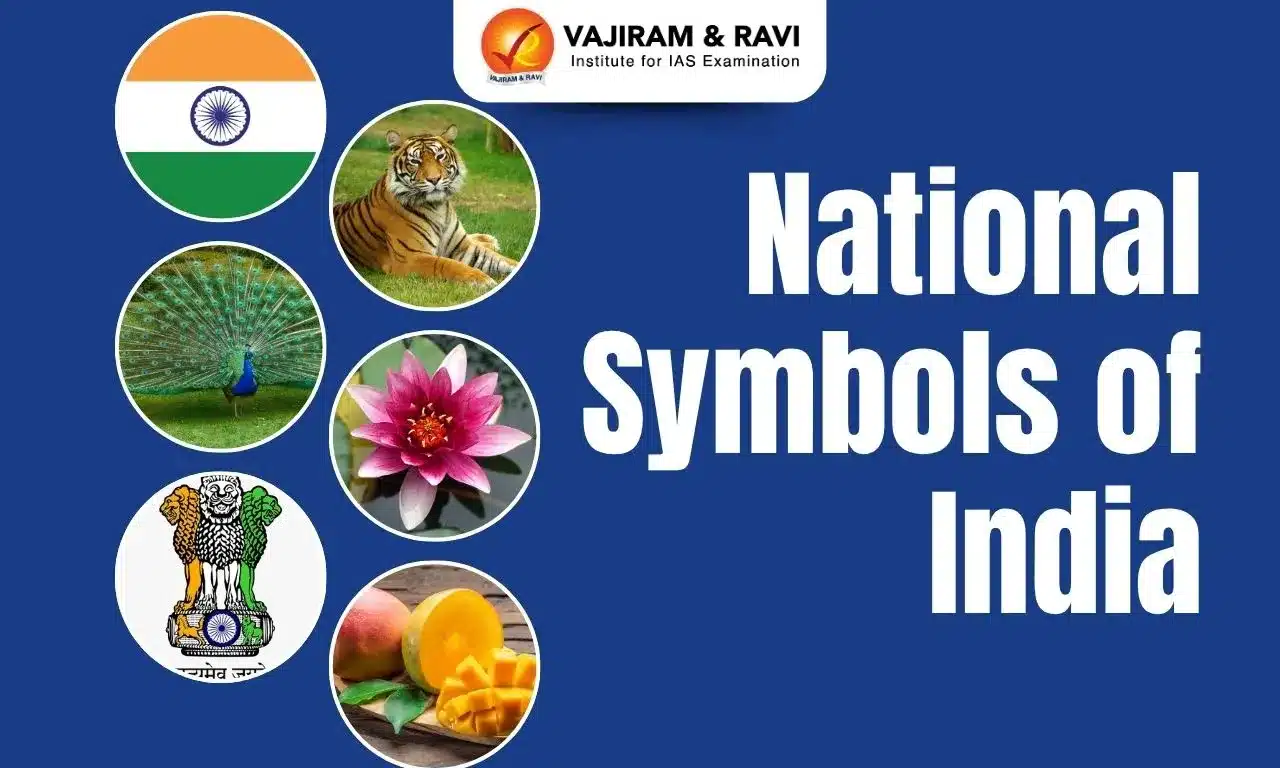
National Party in India, List, Symbol, Significance, Key Details

National Party in India

India follows a vibrant multi-party democratic system where political parties act as the primary link between citizens and governance. To ensure fairness and uniformity in elections, the Election Commission of India regulates the registration and recognition of political parties. Based on electoral performance and geographical presence, parties are recognised as national parties or state parties. National parties play a decisive role in shaping national policies, forming governments, influencing federal relations, and representing India’s diverse political ideologies at the central level.

National Party in India

A National Party in India is a political party recognised by the Election Commission of India due to its significant electoral presence across multiple states or at the national level. Such recognition provides exclusive privileges, including a reserved election symbol throughout the country, free airtime on public broadcasters, and consultation rights on electoral reforms. As of March 2024, India has six recognised national parties, reflecting the competitive and plural nature of Indian democracy across regions and ideologies. Although in 1952, India had 14 National Political Parties, which later lost their status for several reasons.

National Party in India Criteria

A National Party in India is recognised by fulfilling at least one of the officially prescribed electoral conditions. The criteria for a party to be recognised as national party include:

  • Securing at least 6% valid votes in Lok Sabha or Assembly elections in four states and winning four Lok Sabha seats
  • Winning a minimum of 2% Lok Sabha seats from at least three different states
  • Being recognised as a state party in four or more states
  • Recognition is reviewed periodically after two consecutive elections, not after every election

National Party in India List

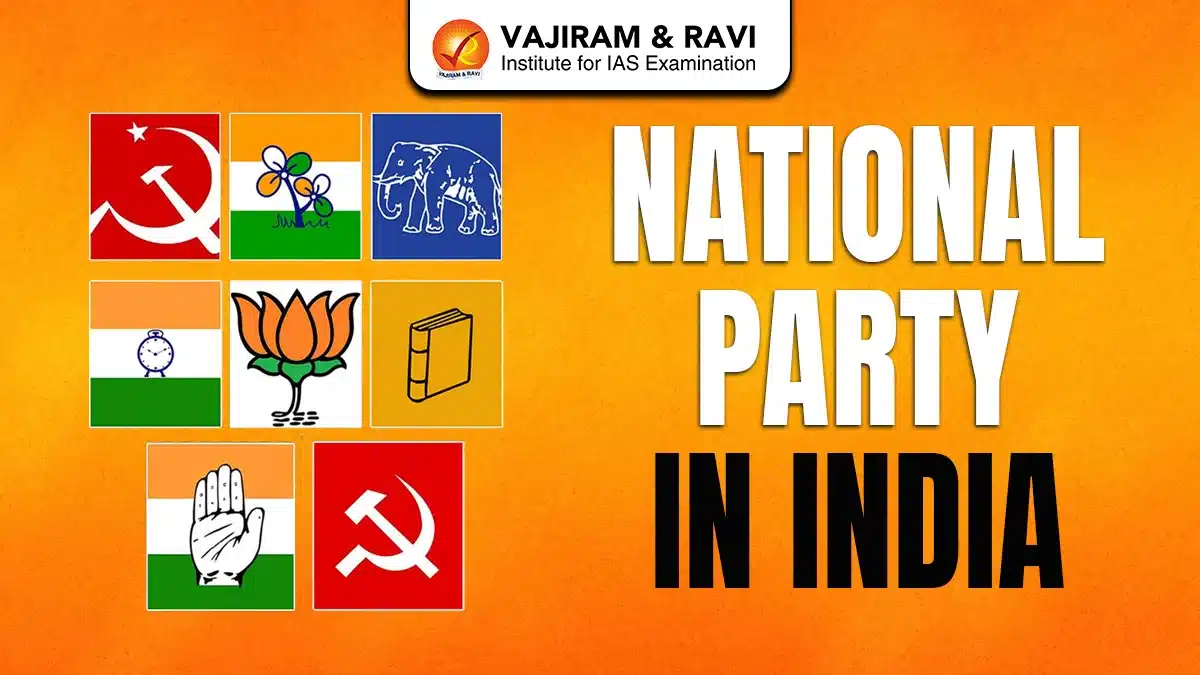
Currently there are six recognised National Party in India as per Election Commission notifications. Together, these parties represent diverse ideological positions ranging from left-wing socialism to right-wing nationalism. The recognised National Political Parties in India are:

  1. Aam Aadmi Party
  2. Bahujan Samaj Party
  3. Bharatiya Janata Party
  4. Communist Party of India (Marxist)
  5. Indian National Congress
  6. National People’s Party

Aam Aadmi Party

Aam Aadmi Party emerged as a reform-oriented political force focused on governance, transparency, and welfare delivery. The election symbol of the party is “broom”:

[my_image src="https://vajiramandravi.com/current-affairs/wp-content/uploads/2025/12/Aam.webp" size="full" align="none" width="auto" height="246px" alt="Aam Aadmi Party" title="Aam Aadmi Party"]

  • Founded on 26 November 2012 under the leadership of Arvind Kejriwal
  • Originated from the anti-corruption movement advocating institutional accountability
  • Recognised as a national party after electoral success in multiple states
  • The party currently governs the state of Punjab
  • Ideology combines welfare governance, Indian nationalism, populism, and secularism

Bahujan Samaj Party

Bahujan Samaj Party represents political mobilisation of historically marginalised communities. The election symbol of the party is “elephant”:

[my_image src="https://vajiramandravi.com/current-affairs/wp-content/uploads/2025/12/Bahujan.webp" size="full" align="none" width="auto" height="204px" alt="Bahujan Samaj Party" title="Bahujan Samaj Party"]

  • Founded on 14 April 1984 by Kanshi Ram, currently led by Mayawati
  • Ideology rooted in Ambedkarism, social justice, and self-respect movements
  • Played a major role in Uttar Pradesh politics, including forming state governments
  • Retains national party status despite limited recent electoral presence
  • Holds representation mainly in state legislatures with minimal parliamentary seats
  • Focuses on political empowerment of Scheduled Castes and backward communities

Bharatiya Janata Party

Bharatiya Janata Party is India’s largest political party in terms of representation and governance. The election symbol of the party is “Lotus”:

[my_image src="https://vajiramandravi.com/current-affairs/wp-content/uploads/2025/12/Bharatiya.webp" size="full" align="none" width="auto" height="233px" alt="Bharatiya Janata Party" title="Bharatiya Janata Party"]

  • Established on 6 April 1980, led by J. P. Nadda
  • Ideology includes Hindutva, conservatism, nationalism, and economic reforms
  • Currently leads the Union government and governs a majority of Indian states
  • Dominant force in coalition politics and policy formulation
  • Strong organisational structure with nationwide presence and cadre-based mobilization

Communist Party of India (Marxist)

Communist Party of India (Marxist) represents left-wing ideology within India’s parliamentary democracy. The election symbol of the party is “Hammer, Sickle and Star”: 

[my_image src="https://vajiramandravi.com/current-affairs/wp-content/uploads/2025/12/Communist.webp" size="full" align="none" width="auto" height="233px" alt="Communist Party of India" title="Communist Party of India"]

  • Formed on 7 November 1964 after a split in the Communist movement
  • Ideology based on Marxism-Leninism, socialism, and secularism
  • Strong historical presence in West Bengal and Tripura
  • Currently governs Kerala and Tamil Nadu, maintaining relevance through social welfare policies
  • Holds limited parliamentary representation
  • Focuses on labour rights, land reforms, and public sector expansion

Indian National Congress

Indian National Congress is the oldest political party in India and a foundational force in nation-building. The election symbol of the party is “Palm”:

[my_image src="https://vajiramandravi.com/current-affairs/wp-content/uploads/2025/12/Indian.webp" size="full" align="none" width="auto" height="230px" alt="Indian National Congress" title="Indian National Congress"]

  • Founded on 28 December 1885, currently led by Mallikarjun Kharge
  • Played a central role in India’s freedom struggle and constitutional development
  • Ideology includes secularism, social democracy, liberalism, and inclusive growth
  • Has governed India for several decades after independence
  • Continues to be a principal opposition party at the national level

National People's Party

National People’s Party is a regional-origin party with national recognition. The election symbol of the party is “Book”:

[my_image src="https://vajiramandravi.com/current-affairs/wp-content/uploads/2025/12/National.webp" size="full" align="none" width="auto" height="287px" alt="National People's Party" title="National People's Party"]

  • Founded on 6 January 2013 by P. A. Sangma, currently under Conrad Sangma
  • Ideology blends conservatism, regional aspirations, and decentralisation
  • Recognised as a national party due to state-level presence in multiple regions
  • Governs Meghalaya and participates in coalition governments
  • Holds representation in Rajya Sabha and several state assemblies
  • Reflects growing political assertion of the North-East in national politics

National Party in India Significance

National Party in India recognition gives political parties uniform symbols, wider visibility, official privileges, and stronger participation in election processes across India. The benefits and significance of the recognition of National Political Party Status are:

  • National parties get one permanently reserved election symbol usable across all states, even where they do not contest elections.
  • Recognised parties receive free broadcast time on state-run television and radio, helping them reach voters equally.
  • National parties can appoint up to 40 star campaigners, double the limit given to unrecognised political parties.
  • They get access to electoral rolls and are consulted while fixing election dates and framing electoral rules.

National Party in India FAQs

Q1: What is a National Party in India?

Ans: A National Party in India is a political party recognised by the Election Commission for significant electoral performance across multiple states.

Q2: How many National Parties are there in India currently?

Ans: As of 2025, India has six recognised National Parties as notified by the Election Commission of India.

Q3: Who grants the status of National Party in India?

Ans: The Election Commission of India grants, reviews, and withdraws National Party status based on prescribed electoral criteria.

Q4: What are the main benefits of being a National Party in India?

Ans: National Parties get a reserved symbol nationwide, free media time, and consultation rights on election-related decisions.

Q5: Can a National Party in India lose its status?

Ans: Yes, a National Party can lose its status if it fails to meet recognition criteria in two consecutive elections.
Major Committees of the Indian Constituent Assembly, List, Objectives

The Constituent Assembly of India was a landmark body responsible for framing the Constitution of independent India. It represented diverse regions, social groups, and political perspectives, ensuring that the Constitution was inclusive, coherent, and forward-looking. Understanding its committee system is crucial for UPSC aspirants, as it helps answer questions on Polity, Governance, Federalism, and Social Justice.

Constituent Assembly Formation

The Constituent Assembly of India was established to draft the Constitution and prepare for independent governance. Initially guided by the Cabinet Mission Plan of 1946, it later gained full legislative powers through the Indian Independence Act of 1947. The Assembly represented provinces, princely states, and diverse communities, ensuring an inclusive constitution. Its first session was held on 9 December 1946, with Dr. Rajendra Prasad elected as President.

  • Initial Strength: 389 members (292 from provinces, 93 from princely states, 4 from Chief Commissioner provinces)
  • Post-Partition Strength: 299 members
  • First Meeting: 9 December 1946 (Interim President: Dr. Sachchidananda Sinha)
  • President: Dr. Rajendra Prasad (elected 11 December 1946)
  • Functioning Period: December 1946 - November 1949
  • Adoption of Constitution: 26 November 1949

Cabinet Mission Plan of 1946

The Cabinet Mission Plan was the blueprint for the Constituent Assembly’s formation. It outlined the composition, election procedure, and federal structure for India, ensuring fair representation of all provinces and communities. The plan also recommended committees to streamline constitution drafting. It emphasized consensus-building and a federal framework with Union and provincial autonomy.

  • Provided framework for formation and composition of the Assembly.
  • Determined method of election of members from provinces and princely states.
  • Recommended committees for specific constitutional tasks.
  • Emphasized federal structure and provincial autonomy.
  • Ensured representation of minorities and diverse communities.

Indian Independence Act of 1947

The Indian Independence Act legally empowered the Constituent Assembly as a sovereign legislative body. Passed by the British Parliament, it confirmed the Assembly’s authority to draft the Constitution and enact laws. The Act also made the Assembly the successor to British legislative powers in India. 

  • Confirmed Constituent Assembly’s sovereign status.
  • Granted full legislative authority to draft laws and Constitution.
  • Recognized Assembly as successor to British legislative powers.
  • Enabled Assembly to act independently during transition.
  • Provided legal legitimacy for constitution-making and governance.

Objectives of Committees in the Constituent Assembly

The Constituent Assembly formed 22 committees to ensure systematic drafting and inclusive deliberation. Their objectives were:

  • Structured Drafting: Divide the complex task into manageable parts
  • Expert Consultation: Involve specialists in law, administration, and governance
  • Inclusivity: Represent different social groups, regions, and minorities
  • Deliberation & Review: Examine, debate, and refine proposals before Assembly approval
  • Efficiency: Reduce the workload on the main Assembly by pre-processing issues

Major Committees of the Indian Constituent Assembly List

Major Committees of the Indian Constituent Assembly handled the core aspects of the Constitution, including Union-State relations, fundamental rights, and governance structures.

Major Committees of the Indian Constituent Assembly List
Name of Major Committee Chairperson Function / Focus

Union Powers Committee

Pandit Jawaharlal Nehru

Examined the distribution of powers between Union and States; recommended legislative and executive powers for the Union government.

Union Constitution Committee

Pandit Jawaharlal Nehru

Drafted provisions for the structure and functioning of the Union government, including Parliament and executive authorities.

States Committee

Pandit Jawaharlal Nehru

Focused on relations between Centre and States, integration of princely states, and state autonomy.

Provincial Constitution Committee

Sardar Vallabhbhai Patel

Drafted a constitutional framework for provinces, including legislative and administrative powers at the provincial level.

Drafting Committee

B.R. Ambedkar

Drafted the Constitution of India, prepared and finalised clauses, and incorporated recommendations from other committees.

Advisory Committee

Sardar Vallabhbhai Patel

Provided advice on policy matters, governance issues, and constitutional proposals from other committees.

Fundamental Rights Sub-Committee

J.B. Kripalani

Formulated provisions on Fundamental Rights to safeguard civil liberties and individual freedoms.

Minorities Sub-Committee

H.C. Mukherjee

Examined safeguards for religious and cultural minorities and recommended protective measures.

North East Frontier Tribal Areas & Assam Excluded & Partially Excluded Areas Sub-Committee

A.V. Thakkar

Addressed administration and special constitutional provisions for tribal areas in North East India.

Excluded & Partially Excluded Areas Sub-Committee

A.V. Thakkar

Examined governance and legal provisions for areas excluded or partially excluded from regular provincial administration.

Rules and Procedure Committee

Dr. Rajendra Prasad

Determined rules and procedures for the Constituent Assembly’s functioning and legislative processes.

Steering Committee

Dr. Rajendra Prasad

Coordinated the work of all committees, prioritised the agenda, and ensured smooth workflow and reporting.

Minor Committees of the Indian Constituent Assembly List

The Minor Committees of the Indian Constituent Assembly assisted the major committees by handling administrative, procedural, and technical tasks. They ensured the smooth functioning of the Assembly and provided expert input for specialised areas such as finance, national symbols, citizenship, and media coverage.

Minor Committees of the Indian Constituent Assembly List
Name of Minor Committee Chairperson Function / Focus

Finance and Staff Committee

Dr. Rajendra Prasad

Managed administrative and financial arrangements of the Assembly, including salaries, staff appointments, and budgetary provisions.

Credentials Committee

Alladi Krishnaswami Ayyar

Verified the credentials of Assembly members to ensure proper representation and legitimacy of membership.

House Committee

Pattabhi Sitaramayya

Oversaw accommodation, facilities, and logistical arrangements for members within the Assembly premises.

Order of Business Committee

Dr. K.M. Munshi

Scheduled the Assembly’s agenda, organized debates, and managed the flow of legislative business.

Ad Hoc Committee on National Flag

Dr. Rajendra Prasad

Recommended the design and adoption of the Indian national flag and its symbolic elements.

Committee on Functions of Constituent Assembly

G.V. Malvankar

Defined the operational functions, responsibilities, and procedural framework of the Assembly.

Ad Hoc Committee on Supreme Court

S. Varadachari

Drafted provisions and guidelines for the formation, powers, and functioning of the Supreme Court of India.

Committee on Chief Commissioners’ Provinces

Pattabhi Sitaramayya

Examined governance and administrative arrangements for Chief Commissioner provinces.

Expert Committee on Financial Provisions of the Union Constitution

Nalini Ranjan Sarkar

Drafted detailed financial provisions for the Union government, including revenue distribution and budgetary rules.

Linguistic Provinces Commission

S.K. Dhar

Proposed recommendations for the formation of language-based provinces and administrative divisions.

Special Committee to Examine Draft Constitution

Jawaharlal Nehru

Reviewed the draft Constitution, suggested revisions, and coordinated inputs from other committees.

Press Gallery Committee

Usha Nath Sen

Managed media access, press coverage, and reporting of Assembly proceedings.

Ad Hoc Committee on Citizenship

S. Varadachari

Drafted provisions related to citizenship, rights, and eligibility criteria for Indian citizens.

Women in the Indian Constituent Assembly

Women played a significant role in shaping India’s Constitution by participating actively in debates and committees. They contributed to issues related to fundamental rights, social justice, minority protection, and governance. Out of 299 members, 15 were women, representing various regions, communities, and professional backgrounds.

Women in the Indian Constituent Assembly
Name of Member Committee(s) Contribution / Focus

Ammu Swaminathan

Steering Committee, Fundamental Rights discussions

Contributed to policy and procedural deliberations on rights and governance

Annie Mascarene

Minor Committees

Assisted in administrative and procedural tasks of Assembly

Begum Aizaz Rasul

Advisory and Minor Committees

Advocated for minority rights and social justice provisions

Sarojini Naidu

Various Debates

Provided inputs on social reform, civil liberties, and governance

Sucheta Kripalani

Drafting Committee member

Worked on drafting provisions related to rights and governance

Vijaya Lakshmi Pandit

Advisory roles

Contributed to discussions on foreign policy and administrative issues

Hansa Mehta

Fundamental Rights Sub-Committee

Played a key role in drafting gender equality and civil rights provisions

Renuka Ray

Minor Committees

Focused on procedural and legislative matters

Purnima Banerji

Steering and Procedural Committees

Assisted in operational coordination of Assembly and debates

Drafting Committee

The Drafting Committee was the most important committee of the Constituent Assembly, tasked with preparing the final draft of the Constitution. Formed on 29 August 1947, it was chaired by Dr. B.R. Ambedkar and included six other members with expertise in law, administration, and governance.

  • Chairman: Dr. B.R. Ambedkar, considered the chief architect of the Constitution.
  • Members: K.M. Munshi, N. Gopalaswami Ayyangar, Alladi Krishnaswamy Ayyar, Syed Mohammed Sadulla, B.L. Mitter (replaced by N. Madhava Rau), D.P. Khaitan (replaced by T.T. Ramakrishna Chari).
  • Formation Date: 29 August 1947.
  • Responsibilities: Drafted, reviewed, and finalized the Constitution, incorporating inputs from all other committees.
  • Key Milestones: First draft - Feb 1948, Second draft - Oct 1948, Final draft introduced - 4 Nov 1948, Adopted - 26 Nov 1949.

Major Committees of the Indian Constituent Assembly FAQs

Q1: How many Major Committees were there?

Ans: There were 12 Major Committees, including the Drafting Committee, Union Powers Committee, Advisory Committee, Fundamental Rights Sub-Committee, and committees for minorities and excluded areas.

Q2: Who chaired the Drafting Committee?

Ans: Dr. B.R. Ambedkar chaired the Drafting Committee, which was responsible for preparing the final draft of the Constitution.

Q3: What was the role of the Union Powers Committee?

Ans: The Union Powers Committee, chaired by Jawaharlal Nehru, examined the distribution of powers between the Union and the States and recommended legislative and executive powers for the Union government.

Q4: Which committee dealt with Fundamental Rights?

Ans: The Fundamental Rights Sub-Committee, chaired by J.B. Kripalani, was responsible for formulating provisions on fundamental rights to protect civil liberties and individual freedoms.

Q5: What was the function of the Advisory Committee?

Ans: Chaired by Sardar Vallabhbhai Patel, the Advisory Committee provided guidance on policy matters, governance issues, and constitutional proposals from other committees.

Important Days in 2026, National and International Days List

Important Days in 2026

Important Days in 2026, Month-wise List helps candidates track national and international observances throughout the year in an organised manner. These days cover important themes such as health, environment, education, science, culture, and national pride. Remembering the date along with its significance improves general awareness and exam performance.

The detailed article on Important Days in 2026, along with a month-wise list have been mentioned below.

Important Days in 2026

Important Days in 2026 include nationally and internationally recognised dates observed to promote awareness about health, environment, human rights, culture, science, and historical events. Throughout the year, these days commemorate significant milestones such as independence movements, social reforms, humanitarian efforts, and global cooperation initiatives.

Important Days in January 2026

Important Days in January 2026 mark the beginning of the year with significant national and international observances such as Republic Day, National Youth Day, and Army Day. These days highlight themes of patriotism, youth empowerment, cultural heritage, and social awareness.

Important Days in January 2026
Date Important Day Significance

1 January

English New Year

Marks the beginning of the Gregorian calendar year

1-31 January

National Road Safety Month

Spreads awareness on traffic safety and accident prevention

4 January

World Braille Day

Highlights importance of Braille for visually impaired

4 January

Holi

Festival symbolising victory of good over evil

5 January

National Birds Day

Promotes bird conservation and biodiversity

6 January

World War Orphans Day

Focuses on children orphaned due to wars

9 January

Pravasi Bharatiya Divas

Celebrates contribution of Indian diaspora

10 January

World Hindi Day

Promotes Hindi language globally

11 January

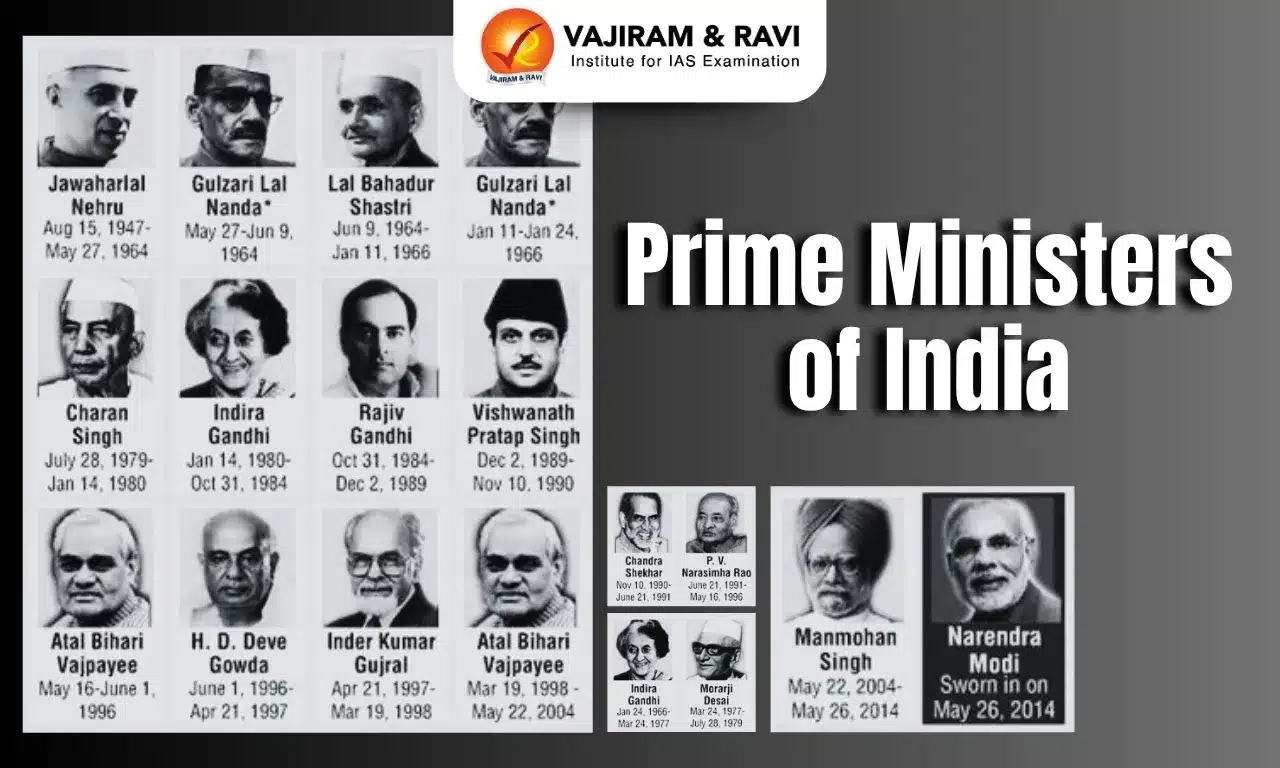
Lal Bahadur Shastri Death Anniversary

Remembers India’s second Prime Minister

12 January

National Youth Day

Birth anniversary of Swami Vivekananda

13 January

Lohri

Harvest festival of North India

14 January

Makar Sankranti

Marks sun’s transition into Capricorn

15 January

Army Day

Establishment of Indian Army leadership

23 January

Netaji Subhas Chandra Bose Jayanti

Honors freedom fighter Subhas Chandra Bose

25 January

India Tourism Day

Promotes tourism in India

25 January

National Voters Day

Encourages democratic participation

26 January

Republic Day

Adoption of Indian Constitution

28 January

Lala Lajpat Rai Jayanti

Birth anniversary of Punjab Kesari

28 January

Data Protection Day

Awareness on data privacy

28 January

K.M. Cariappa Day

Honors India’s first Field Marshal

30 January

Martyrs’ Day

Death anniversary of Mahatma Gandhi

30 January

World Leprosy Day

Awareness for leprosy eradication

31 January

International Zebra Day

Conservation of zebra species

Important Days in February 2026

Important Days in February 2026 focus on health, science, language, and social justice, with key observances like World Cancer Day, National Science Day, and International Mother Language Day.

Important Days in February 2026
Date Important Day Significance

1 February

Indian Coast Guard Day

Formation of Indian Coast Guard

2 February

World Wetlands Day

Conservation of wetlands

4 February

World Cancer Day

Awareness on cancer prevention

13 February

World Radio Day

Importance of radio communication

20 February

World Social Justice Day

Promotes equality and fairness

21 February

Mother Language Day

Protects linguistic diversity

24 February

Central Excise Day

Formation of Excise Department

28 February

National Science Day

Discovery of Raman Effect

Important Days in March 2026

March 2026 emphasises equality, happiness, and environmental protection through observances such as International Women’s Day, World Water Day, and World Wildlife Day. It promotes social justice, sustainability, and global well-being.

Important Days in March 2026
Date Important Day Significance

1 March

Zero Discrimination Day

Promotes equality

3 March

World Wildlife Day

Wildlife conservation

8 March

International Women’s Day

Women empowerment

14 March

Pi Day

Mathematical awareness

15 March

Consumer Rights Day

Protects consumer interests

20 March

Happiness Day

Global well-being

21 March

World Forestry Day

Forest conservation

22 March

World Water Day

Sustainable water management

23 March

Shaheed Diwas

Martyrdom of Bhagat Singh

24 March

World Tuberculosis (TB) Day

Tuberculosis awareness

Important Days in April 2026

Important Days in April 2026 underlines public welfare, democracy, and cultural heritage. The table have been shared below.

Important Days in April 2026
Date Important Day Important Day

1 April

Odisha Foundation Day

Marks the formation of Odisha as a separate state in 1936

1 April

April Fools’ Day

A day associated with humor, jokes, and light-hearted pranks

1 April

Prevention of Blindness Week

Promotes eye care awareness and prevention of avoidable blindness

2 April

World Autism Awareness Day

Spreads awareness about autism spectrum disorder and social inclusion

5 April

National Maritime Day

Commemorates India’s maritime history and shipping sector

7 April

World Health Day

Raises awareness on global public health issues under WHO

10 April

World Homoeopathy Day

Birth anniversary of Dr. Samuel Hahnemann, founder of homoeopathy

11 April

National Safe Motherhood Day

Focuses on maternal health and reducing maternal mortality

13 April

Vaisakhi / Baisakhi / Vishu

Harvest festivals celebrated in different parts of India

13 April

Jallianwala Bagh Massacre

Remembers the 1919 massacre during India’s freedom struggle

14 April

Dr. B.R. Ambedkar Jayanti

Birth anniversary of the chief architect of the Indian Constitution

15 April

Bengali New Year / Bihu

Celebrates New Year and harvest season in eastern India

17 April

World Haemophilia Day

Raises awareness about haemophilia and bleeding disorders

18 April

World Heritage Day

Promotes protection of cultural and natural heritage sites

21 April

National Civil Service Day

Recognises the role of civil servants in governance

22 April

World Earth Day

Encourages environmental protection and climate action

23 April

World Book and Copyright Day

Promotes reading, publishing, and intellectual property rights

24 April

National Panchayati Raj Day

Marks constitutional status of local self-governance in India

25 April

World Malaria Day

Focuses on prevention and eradication of malaria

26 April

World Intellectual Property Day

Highlights importance of innovation and IP rights

30 April

World Veterinary Day

Recognises contributions of veterinarians to animal health

Important Days in May 2026

Important Days in May 2026 focuses on workers’ rights, family values, and global health through days like International Labour Day, International Day of Families, and World No Tobacco Day.

Important Days in May 2026
Date Important Day Significance

1 May

International Labour Day / May Day

Celebrates workers’ rights and labour movements worldwide

1 May

Maharashtra Day

Marks the formation of Maharashtra state in 1960

2 May

World Asthma Day

Raises awareness about asthma management and care

3 May

World Press Freedom Day

Promotes freedom of expression and press independence

4 May

Coal Miners Day

Recognises the contribution of coal miners

7 May

World Athletics Day

Encourages youth participation in sports and fitness

8 May

World Red Cross Day

Marks the birth of Henry Dunant and humanitarian work

8 May

World Thalassaemia Day

Raises awareness about thalassaemia prevention and care

9 May

Rabindranath Tagore Jayanti

Birth anniversary of Nobel laureate Rabindranath Tagore

11 May

National Technology Day

Commemorates India’s technological achievements

12 May

Mother’s Day

Celebrates motherhood and maternal bonds

12 May

International Nurses Day

Birth anniversary of Florence Nightingale

17 May

National Endangered Species Day

Promotes conservation of endangered species

18 May

Armed Forces Day

Honours the armed forces and their service

18 May

World AIDS Vaccine Day

Encourages research towards HIV vaccines

18 May

International Museum Day

Highlights role of museums in cultural preservation

21 May

National Anti-Terrorism Day

Observed in memory of Rajiv Gandhi

22 May

International Day for Biological Diversity

Promotes biodiversity conservation

26 May

National Memorial Day

Honours military personnel who died in service

31 May

World No Tobacco Day

Raises awareness about harmful effects of tobacco

Important Days in June 2026

Important Days in June 2026 centre on environmental protection, yoga, and humanitarian issues, including World Environment Day and International Yoga Day.

Important Days in June 2026
Date Important Day Significance

1 June

World Milk Day

Highlights the importance of milk and dairy for nutrition

2 June

Telangana Formation Day

Marks formation of Telangana state in 2014

4 June

International Day of Innocent Children Victims of Aggression

Protects children affected by war and violence

5 June

World Environment Day

Encourages environmental protection and climate action

7 June

World Food Safety Day

Raises awareness of safe food handling and hygiene

8 June

World Oceans Day

Promotes conservation of oceans and marine resources

12 June

World Day Against Child Labour

Focuses on ending child labour worldwide

16 June

Martyrdom of Guru Arjan Dev

Commemorates the 5th Sikh Guru’s martyrdom

17 June

World Day to Combat Desertification and Drought

Promotes sustainable land management

19 June

World Sickle Cell Awareness Day

Awareness about sickle cell disease

19 June

World Sauntering Day

Promotes slow walking for health and relaxation

20 June

World Refugee Day

Recognises the rights and plight of refugees

21 June

World Hydrography Day

Highlights the importance of mapping seas and waterways

21 June

International Yoga Day

Promotes physical and mental well-being through yoga

23 June

International Olympic Day

Celebrates Olympic values and sports participation

23 June

United Nations Public Service Day

Recognises contributions of public servants

23 June

International Widow’s Day

Raises awareness of challenges faced by widows

26 June

International Day against Drug Abuse

Focuses on prevention of drug abuse worldwide

29 June

National Statistics Day

Recognises importance of statistics for development

30 June

World Asteroid Day

Promotes awareness of asteroid impact risks

Important Days in July 2026

Important Days in July 2026 highlights population awareness, youth skills, and national pride with observances such as World Population Day and Kargil Vijay Diwas. It encourages responsibility, innovation, and patriotism.

Important Days in July 2026
Date Important Day Significance

1 July

National Doctor’s Day

Honours doctors for their contributions to healthcare

1 July

Canada Day

Celebrates Canada’s national day and independence

1 July

Chartered Accountants Day (India)

Recognises the role of CAs in India’s economy

2 July

National Anisette Day

Celebrates the anise-flavored liqueur drink

4 July

Independence Day (USA)

Commemorates US independence from British rule in 1776

7 July

Jagannath Puri Rath Yatra

Annual Hindu chariot festival in Puri, Odisha

11 July

World Population Day

Focuses on global population awareness and challenges

12 July

Malala Day

Celebrates education advocacy and women’s rights inspired by Malala Yousafzai

15 July

World Youth Skills Day

Highlights importance of skill development for youth

17 July

World Day for International Justice

Promotes accountability and international justice mechanisms

18 July

International Nelson Mandela Day

Honors Mandela’s legacy of peace, equality, and social justice

21 July

Guru Purnima

Pays tribute to spiritual and academic teachers

22 July

Chandrayaan 2 Launch Anniversary

Marks India’s second lunar mission launch

24 July

National Thermal Engineer Day

Recognises contributions of thermal engineers in India

26 July

Kargil Vijay Diwas

Commemorates India’s victory in Kargil War (1999)

28 July

World Nature Conservation Day

Promotes biodiversity and natural habitat protection

28 July

World Hepatitis Day

Raises awareness about hepatitis prevention and treatment

29 July

International Tiger Day

Promotes tiger conservation and wildlife protection

Important Days in August 2026

Important Days in August 2026 commemorate freedom, humanitarian values, and peace, led by Independence Day, Quit India Movement Day, and World Humanitarian Day. The month reflects sacrifice, unity, and national pride.

Date Important Day Significance

6 August

Hiroshima Day

Remembers the atomic bombing of Hiroshima in 1945

7 August

National Handloom Day

Promotes India’s handloom sector and traditional weaving

8 August

Quit India Movement Day

Commemorates India’s 1942 struggle for independence

9 August

Nagasaki Day

Remembers atomic bombing of Nagasaki in 1945

12 August

International Youth Day

Highlights youth empowerment and social engagement

12 August

World Elephant Day

Promotes conservation of elephants and their habitats

13 August

World Organ Donation Day

Encourages organ donation to save lives

14 August

Youm-e-Azadi (Pakistan Independence Day)

Commemorates Pakistan’s independence from British India in 1947

15 August

National Mourning Day (Bangladesh)

Observes the assassination of Sheikh Mujibur Rahman in 1975

15 August

Independence Day (India)

Marks India’s independence from British rule in 1947

19 August

World Humanitarian Day

Honors aid workers and promotes humanitarian causes

20 August

Sadbhavna Diwas

Promotes national harmony and peace in India

20 August

Indian Akshay Urja Day

Highlights renewable energy initiatives in India

29 August

National Sports Day

Marks birth anniversary of hockey legend Major Dhyan Chand

Important Days in September 2026

Important Days in September 2026 focus on education, democracy, and peace through International Literacy Day and International Day of Peace.

Important Days in September 2026
Date Important Day Significance

1 September

National Nutrition Week

Promotes awareness about balanced diet and nutrition

5 September

Teachers’ Day (India)

Honors teachers on Dr. S. Radhakrishnan’s birth anniversary

8 September

International Literacy Day

Promotes global literacy and education

11 September

National Forest Martyrs Day

Honors forest personnel who sacrificed their lives

14 September

Hindi Diwas

Celebrates Hindi as India’s official language

15 September

Engineer’s Day (India)

Marks birth anniversary of M. Visvesvaraya

15 September

International Day of Democracy

Promotes democratic values and governance

16 September

World Ozone Day

Raises awareness on ozone layer protection

18 September

World Bamboo Day

Promotes sustainable use of bamboo resources

21 September

International Day of Peace (UN)

Promotes global peace and non-violence

22 September

World Rhino Day

Promotes conservation of rhinoceros species

24 September

Antyodaya Diwas

Honors Pandit Deendayal Upadhyaya’s birth anniversary

25 September

World Pharmacists Day

Recognizes role of pharmacists in healthcare

26 September

World Environmental Health Day

Highlights link between environment and public health

28 September

World Rabies Day

Raises awareness to eliminate rabies

30 September

International Translation Day

Honors translators and language professionals

Important Days in October 2026

Important Days in October 2026 highlight non-violence, mental health, and social equality, with key observances like Gandhi Jayanti and World Mental Health Day.

Important Days in October 2026
Date Important Day Significance

1 October

International Day of the Older Persons

Promotes dignity, rights, and well-being of senior citizens

2 October

Gandhi Jayanti

Marks birth anniversary of Mahatma Gandhi

2 October

International Day of Non-Violence

Promotes non-violence inspired by Gandhian philosophy

8 October

Indian Air Force Day

Commemorates establishment of Indian Air Force in 1932

9 October

World Postal Day

Highlights role of postal services in communication

10 October

World Mental Health Day

Raises awareness about mental health issues

12 October

Dussehra

Celebrates victory of good over evil

13 October

International Day for Disaster Risk Reduction

Promotes disaster preparedness and resilience

16 October

World Anaesthesia Day

Commemorates first public demonstration of anaesthesia

17 October

International Day for the Eradication of Poverty

Highlights need to end poverty globally

20 October

World Statistics Day

Promotes importance of statistics in development

24 October

United Nations Day

Marks establishment of the United Nations in 1945

31 October

Rashtriya Ekta Diwas (National Unity Day)

Marks birth anniversary of Sardar Vallabhbhai Patel

Important Days in November 2026

Important Days in November 2026 emphasise children’s welfare, science, and social tolerance through Children’s Day and World Science Day. It reflects compassion, education, and equality.

Important Days in November 2026
Date Important Day Significance

1 November

Rajyotsava Day (Karnataka Formation Day)

Celebrates formation of Karnataka state in 1956

5 November

World Tsunami Awareness Day

Raises awareness about tsunami risks and preparedness

7 November

National Cancer Awareness Day

Promotes early detection and cancer prevention

9 November

Legal Services Day

Raises awareness about legal aid and justice

11 November

National Education Day

Celebrates birth anniversary of Maulana Abul Kalam Azad

12 November

World Pneumonia Day

Raises awareness on pneumonia prevention

14 November

Children’s Day (India)

Celebrates childhood on Jawaharlal Nehru’s birth anniversary

16 November

International Day for Tolerance

Promotes mutual understanding and harmony

17 November

National Epilepsy Day

Raises awareness about epilepsy

19 November

World Toilet Day

Promotes sanitation and hygiene

24 November

Guru Nanak Jayanti

Celebrates birth of Guru Nanak Dev Ji

25 November

International Day for Elimination of Violence against Women

Raises awareness to end gender-based violence

26 November

Constitution Day of India

Commemorates adoption of Indian Constitution

Important Days in December 2026

Important Days in December 2026 focus on human rights, national pride, and social responsibility, marked by World AIDS Day, Vijay Diwas, and Human Rights Day.

Important Days in December 2026
Date Important Day Significance

1 December

World AIDS Day

Raises awareness about HIV/AIDS prevention and treatment

2 December

National Pollution Control Day

Commemorates the Bhopal Gas Tragedy and promotes pollution control

4 December

Indian Navy Day

Marks Operation Trident and honours the Indian Navy

5 December

World Soil Day

Highlights importance of soil health for ecosystems

7 December

Armed Forces Flag Day

Supports welfare of Indian armed forces personnel

9 December

International Anti-Corruption Day

Raises awareness against corruption globally

10 December

Human Rights Day

Marks adoption of the Universal Declaration of Human Rights

14 December

National Energy Conservation Day

Promotes energy efficiency and conservation in India

16 December

Vijay Diwas

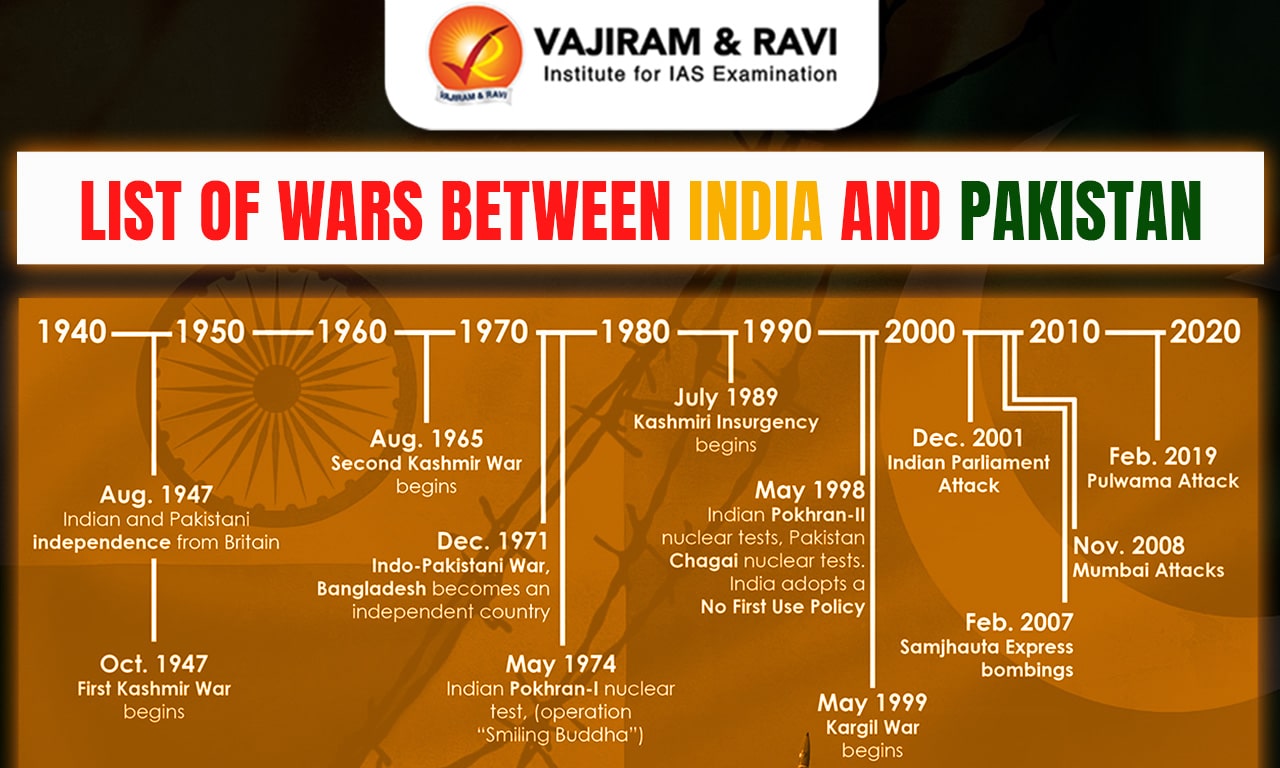
Celebrates India’s victory in the 1971 Indo-Pak war

18 December

Minorities Rights Day (India)

Protects constitutional rights of minorities

19 December

Goa’s Liberation Day

Marks Goa’s liberation from Portuguese rule in 1961

22 December

National Mathematics Day

Birth anniversary of Srinivasa Ramanujan

23 December

Kisan Diwas

Birth anniversary of Chaudhary Charan Singh

24 December

National Consumer Rights Day

Promotes awareness of consumer rights

25 December

Christmas Day

Celebrates birth of Jesus Christ

25 December

National Good Governance Day

Birth anniversary of Atal Bihari Vajpayee

Important Days in 2026 FAQs

Q1: What will be celebrated in 2026?

Ans: 2026 will be celebrated with major national, international, cultural, environmental, and awareness days observed throughout the year.

Q2: What is the significance of the year 2026?

Ans: The year 2026 holds importance for global observances, policy milestones, and competitive exam current affairs preparation.

Q3: What are the important days in August 2026 in India?

Ans: Key days include Independence Day (15 August), Quit India Movement Day (8 August), Hiroshima Day (6 August), and National Sports Day (29 August).

Q4: What will happen in year 2026?

Ans: 2026 will witness regular international observances, national commemorations, and scheduled social, environmental, and scientific events worldwide.

Q5: Why should students remember Important Days of 2026?

Ans: Remembering Important Days of 2026 helps students score better in competitive exams and stay aware of national and global issues.

Poverty In India, Absolute Vs Relative, Causes, Types, Trends

Poverty In India

Poverty in India reflects both basic deprivation and widening inequality, seen through absolute poverty (lack of essentials for survival) and relative poverty (inequality compared to societal standards). It is driven by factors such as low agricultural productivity, unemployment, population pressure, and historical social disparities. To combat this, the government implements programmes like MGNREGA, NFSA, PMAY, and social security schemes targeting income support, food security, and basic services. Despite improvements, reducing multidimensional deprivation remains a core developmental challenge.

Poverty In India

Poverty in India has reduced significantly in its multidimensional form, yet extreme poverty has remained persistently high in the last five years, showing uneven progress. Poverty is a social condition where a section of society cannot meet basic needs like food, shelter, healthcare, and education. Structural inequalities, slow employment growth, and rising vulnerabilities have contributed to continued deprivation despite welfare improvements.

Poverty In India Historical Perspective

India’s poverty has deep historical roots shaped by colonial exploitation, post-Independence economic stagnation, and long-standing structural inequalities. While the country has made notable progress in recent decades, especially after economic reforms, the legacy of low productivity, unequal access to resources, and regional imbalance continues to influence today’s poverty patterns.

  • Colonial Exploitation and Deindustrialisation: British rule destroyed traditional industries and drained wealth, causing mass unemployment; India’s share in world GDP fell from ~20% in 1700 to ~4% by 1950.
  • Slow Economic Growth Post-Independence (1950–1980): The “Hindu Rate of Growth” of 3–3.5% was too low to significantly reduce poverty, despite planning and state-led development.
  • Green Revolution but Uneven Gains: The 1960s–70s agriculture reforms boosted yields mainly in Punjab–Haryana, while Eastern and Central India remained trapped in chronic poverty.
  • High Poverty Estimates in the 1970s–80s: Early official poverty assessments showed over 50% of India’s population living below the poverty line, highlighting widespread deprivation.
  • Post-1991 Reforms and Accelerated Poverty Reduction: Liberalisation increased growth to 6–8%, helped lift millions out of poverty, and set the stage for the sharp MPI decline noted between 2013–14 and 2019–21.

Types of Poverty Absolute vs. Relative

Poverty may be understood as absolute, defined by minimum subsistence needs, or relative, defined by inequality and deprivation compared to societal standards.

  1. Absolute poverty: It refers to a condition where individuals or households are unable to meet the minimum basic necessities required for survival, such as adequate food, clothing, shelter, and healthcare. It is measured against a fixed and universal poverty line, such as the International Poverty Line (IPL) of $2.15/day (World Bank) based on 2017 Purchasing Power Parity.
  2. Relative Poverty: Relative poverty is defined as a condition where individuals have significantly lower income or resources compared to the average or median income of the society they live in. It highlights economic inequality, as people may meet basic needs but remain deprived relative to societal standards. 
Types of Poverty Absolute vs. Relative

Aspect

Absolute Poverty

Relative Poverty

Definition

Lack of basic necessities (fixed, universal)

Income/resources inadequate relative to society

Measurement

Fixed threshold (e.g., $2.15/day - WB IPL)

Compared to median income

Focus

Survival and subsistence

Inequality and social disparity

Policy Implications

Provide essential needs & services

Reduce inequality & improve distribution

Trends

Stable unless standards change

Changes with growth & income distribution

[recap title="Differences Between Absolute Poverty and Relative Poverty" url="https://vajiramandravi.com/current-affairs/differences-between-absolute-poverty-and-relative-poverty/" new_tab="yes"]

Poverty Estimation in India: Methods and Committees

Poverty estimation in India is carried out primarily by NITI Aayog (earlier Planning Commission) using household consumption expenditure data from the NSSO under the Ministry of Statistics and Programme Implementation (MOSPI). These estimates determine the official poverty line, which helps identify beneficiaries for welfare schemes and assess long-term socio-economic trends.

The Ministry of Rural Development conducts the BPL Census for identifying poor households for specific schemes. India does not have a single fixed poverty line; instead, it has evolved with committees adapting to changing economic realities and nutritional standards.

Methods of Poverty Estimation

  1. Calorie-Based Method (Pre-1993)
  • Adopted before the Lakdawala Committee.
  • Poverty line defined by minimum calorie intake requirements (2400 rural, 2100 urban).
  • Did not capture spending on health, education, housing, or inflation accurately.
  1. Consumption Expenditure Method (Post-1993)
  • Shifted from pure calorie intake to a broader consumption-based approach.
  • Captures household spending on food and non-food essentials.
  • Committees refine the basket of goods, inflation indices, and regional variations.
  1. Mixed Reference Period (MRP) Method
  • Used by NSSO: combines 30-day recall for some items and 365-day recall for infrequent purchases.
  • Provides a more accurate picture of consumption.
  1. Modified Mixed Reference Period (MMRP) Method (Post-2011)
  • Uses 7-day, 30-day, and 365-day recall depending on items.
  • Became the basis for more recent committee recommendations.

Poverty Estimation Committees in India

  1. Alagh Committee (1979)
  • First systematic poverty estimation post-independence.
  • Used calorie-based norms:
    • Rural: 2400 calories
    • Urban: 2100 calories
  • Developed a poverty line basket (PLB) of goods.
  • Poverty Line was derived from the expenditure needed to meet these calorie norms.
  1. Lakdawala Committee (1993)
  • Continued calorie norms but refined methodology.
  • Did not update the basket of goods; relied on the same base year.
  • Recommended poverty estimation based on state-specific poverty lines.
  • MPCE Poverty Line:
    • Rural: ₹328
    • Urban: ₹454 (1993-94 prices)
  1. Tendulkar Committee (2009)
  • Major methodological shift.
  • Abandoned calorie norms and adopted a broader consumption approach.
  • Included spending on health, education, clothing, shelter, etc.
  • Recommended uniform poverty line basket across rural and urban areas.
  • Poverty Line (2004-05 prices):
    • Rural: ₹672
    • Urban: ₹859
  • Significantly increased the estimated number of poor in India.
  1. Rangarajan Committee (2012-2014)
  • Reviewed Tendulkar’s method and increased thresholds.
  • Used Modified Mixed Reference Period (MMRP).
  • Higher poverty lines:
    • Rural: ₹972
    • Urban: ₹1,407 (2011-12 prices)
  • Resulted in a higher poverty headcount than Tendulkar.

Causes of Poverty in India

  1. Low Agricultural Productivity: Agricultural output remains low because of fragmented landholdings and limited irrigation over 55% of India’s farmland is still rainfed. For example, states like Bihar and Jharkhand, dominated by small and marginal farmers, consistently report low yields compared to Punjab and Haryana.
  2. Population Explosion: India adds nearly 17 million people every year, creating intense pressure on food, housing, and employment systems. States like Uttar Pradesh and Bihar, with some of the highest population growth rates, also show some of the highest poverty levels.
  3. Unemployment and Underemployment: India’s unemployment rate has fluctuated between 6%-8% in recent years (PLFS), but the bigger issue is informal employment, where nearly 90% of workers are engaged in low-paying, insecure jobs. Youth unemployment remains high, especially among educated youth over 18% urban youth unemployed (PLFS 2023).
  4. Inefficient Resource Utilisation: Disguised unemployment in agriculture leads to low productivity as too many workers share limited work. Such labour underutilisation prevents households from earning sustainable incomes. Agriculture employs 45% of the workforce but contributes only 14-16% to GDP, reflecting major inefficiencies.
  5. Price Rise (Inflation): Persistent inflation reduces the purchasing power of the poor, especially when incomes don’t rise proportionately. Essential goods like food and fuel become less affordable.
  6. Low Rate of Economic Development: For decades after independence, slow industrialisation and state-controlled economic structures limited income growth and job creation. This delayed large-scale poverty reduction.
  7. Lack of Capital and Entrepreneurship: Limited access to credit, inadequate financial literacy, and weak entrepreneurial ecosystems inhibit investment in small businesses and agriculture. This restricts job creation and income opportunities. Only 10% of MSMEs in India have access to formal credit; the remaining depend on informal, high-interest borrowing (MSME Ministry).
  8. Social Inequalities and Structural Barriers: Caste discrimination, patriarchal norms, unequal inheritance, and social exclusion restrict access to land, education, and employment. Such structural barriers perpetuate intergenerational poverty. SCs and STs have an MPI (Multi-Dimensional Poverty Index) significantly higher than the national average, 32% for SCs and 43% for STs (NITI Aayog MPI 2023).
  1. Climatic and Environmental Vulnerability: Frequent floods, droughts, cyclones, and other disasters disrupt agriculture and livelihoods in vulnerable states, pushing households into repeated poverty cycles. Bihar and Assam face severe floods almost annually, affecting over 10 million people each year, damaging crops and homes (IMD & NDMA).

Trends in Poverty Reduction Post-Liberalisation

Post-1991 economic liberalisation significantly accelerated poverty reduction in India by boosting growth, increasing employment opportunities, and expanding social welfare schemes. Over the years, both consumption poverty and multidimensional poverty have shown a consistent decline, supported by targeted government interventions and rising rural development indicators.

  • Sharp Decline in Poverty Ratio (1993–2011): Poverty fell from 45.3% in 1993–94 to 21.9% in 2011–12 (Planning Commission). Example: 133 million people were lifted out of poverty between 2004–05 and 2011–12 alone.
  • Decline in Extreme Poverty as per World Bank (2022 Report): Extreme poverty in India reduced to less than 3% by 2019. Example: WB calculated poverty using the international poverty line of $2.15/day PPP.
  • Significant Drop in Multidimensional Poverty (MPI): India saw a 55% reduction in MPI poverty between 2005–06 and 2019–21 (UNDP & NITI Aayog). Example: Over 415 million people exited multidimensional poverty in 15 years.
  • Rural Poverty Reduction Accelerated Post-2005: Rural poverty declined faster due to schemes like MGNREGA, PMGSY, and NRLM. Example: Rural poverty dropped from 50.1% in 1993–94 to 25.7% in 2011–12.
  • Urban Poverty Also Declined Steadily: Urban poverty fell from 31.8% in 1993-94 to 13.7% in 2011-12. Example: Growth in construction and service sectors pulled large numbers into informal urban jobs.
  • Rise in Real Wages Post-2005 Contributed to Poverty Reduction: Real agricultural wages increased by ~3% annually from 2007-2013.
  • Food Security Measures Reduced Extreme Deprivation: Schemes like TPDS reforms, NFSA 2013, and mid-day meals reduced hunger and child malnutrition. Example: NFSA covers 75% rural and 50% urban population with subsidised food grains.
  • Expansion of Social Welfare and Direct Benefit Transfers: JAM trinity (Jan Dhan, Aadhaar, Mobile) reduced leakages and improved cash assistance. Example: Over ₹2.3 lakh crore transferred via DBT in 2021-22.

Rural vs. Urban Poverty in India

Rural and urban poverty in India differ significantly in terms of causes, intensity, and living conditions, though both reflect deep structural inequalities. Rural areas experience poverty driven mainly by agricultural distress, while urban poverty is shaped by informal employment and high living costs.

  • Over 70% of India’s poor still reside in rural areas, showing the uneven spread of development and the continued dominance of agriculture-based livelihoods.
  • Agriculture employs ~45% of the workforce but contributes only ~15% of GDP, resulting in low rural wages and pushing many households into chronic poverty.
  • Urban poverty remains lower in percentage terms but intense in living conditions, as 35% of urban residents live in slums with overcrowding, poor sanitation, and limited social security.
  • Average monthly per capita consumption is significantly lower in rural areas: Rural ₹3,773 vs. Urban ₹6,459 (NSO 2022–23), highlighting persistent income and affordability gaps.
  • Access to healthcare and education remains poorer in rural regions, where shortages of doctors, teachers, and facilities reinforce long-term poverty traps.
  • Inflation impacts the rural poor more severely, especially food inflation; even a 10% rise in food prices can push vulnerable rural households below the poverty line.

Poverty and Unemployment Linkages

Poverty and Unemployment in India are deeply interconnected, forming a cycle where one reinforces the other. High unemployment reduces household income, pushing families into poverty, while poverty limits access to education, skills, and opportunities, leading to structural unemployment.

  • Unemployment reduces household income and consumption capacity, directly increasing poverty; for example, India’s youth unemployment crossed 18% (2023), disproportionately affecting poor households.
  • Poverty limits access to quality education and skill training, resulting in low employability; ASER surveys show ~25% of rural children in Class 5 cannot read Class 2 text, indicating future unemployment risks.
  • India faces widespread disguised unemployment in agriculture, where too many workers share limited farm output, keeping rural wages low and perpetuating poverty.
  • Underemployment and informal work dominate the labour market, with ~92% of workers in informal jobs, often earning below minimum wages and lacking job security.
  • Poor households lack access to credit and assets, preventing them from starting enterprises, which keeps them dependent on low-paying casual wage labour.
  • Long-term poverty pushes people into vulnerable work like construction, domestic work, and street vending, where wages fluctuate and social security is minimal.
  • Economic shocks such as the pandemic hit informal workers the hardest, as seen in 2020 when over 120 million informal workers lost jobs, driving millions back into poverty.
  • Poverty leads to poor nutrition and ill health, lowering productivity and employability; for example, India’s 35.5% child stunting rate indicates future labour force weakness.

Impact of Poverty on Health, Education, and Human Development

Poverty deeply impacts health, education, and overall human development by limiting access to basic services, nutritious food, and learning opportunities. Poor households often face a cycle of illness, low learning outcomes, and reduced productivity, which restricts their earning potential and further reinforces poverty.

  • Poor families cannot afford quality healthcare, leading to untreated illnesses and high mortality; for example, 63% of out-of-pocket health expenditure is paid directly by households, pushing millions into debt.
  • Malnutrition is concentrated among poor households, reducing physical and cognitive development; India’s child stunting rate is 35.5% (NFHS-5), disproportionately affecting low-income groups.
  • Poverty increases vulnerability to diseases like TB, malaria, and diarrhoea due to poor sanitation, unsafe water, and crowded living conditions. 50% of rural households still rely on non-piped water.
  • Education outcomes decline due to poverty-driven absenteeism, child labour, and lack of learning resources; over 3.2% of children aged 6–14 are out of school, mostly from poor families (UNESCO).
  • Poor nutrition and lack of healthcare impair learning ability, resulting in weak foundational skills; ASER 2023 shows 25% of Class 5 children cannot read Class 2 text.
  • Poverty forces children into labour to support family income, reducing school attendance; India has 10.1 million child labourers (Census 2011), mainly in poor states.

Government’s Programmes to Reduce Poverty in India

The Government of India implements a wide range of poverty alleviation programmes focusing on employment generation, social security, food security, housing, and financial inclusion. These schemes aim to reduce multidimensional poverty by improving livelihoods, ensuring basic services, and creating safety nets for vulnerable groups.

  • MGNREGA (2005) provides 100 days of guaranteed wage employment, reducing rural distress; it generated 3.2 billion person-days in 2022–23, offering a crucial safety net for rural poor.
  • National Rural Livelihood Mission (DAY-NRLM) promotes self-employment through SHGs; over 8.7 crore women have been mobilised into SHGs, improving rural incomes and credit access.
  • Pradhan Mantri Awaas Yojana (PMAY-Gramin & PMAY-Urban) provides pucca houses to poor families; PMAY has sanctioned over 2.3 crore rural houses and 1.2 crore urban houses.
  • Pradhan Mantri Garib Kalyan Anna Yojana (PMGKAY) ensures free foodgrains to all NFSA beneficiaries; it benefits 81.35 crore people, preventing extreme poverty during crises.
  • National Food Security Act (2013) provides subsidised foodgrains to 67% of India’s population, improving nutrition and reducing hunger-driven poverty.
  • PM-KISAN offers ₹6,000 annually to farmers, supporting small and marginal families; 11 crore farmers are beneficiaries, reducing income volatility.
  • Ayushman Bharat (PM-JAY) provides health insurance up to ₹5 lakh for poor families, reducing catastrophic health expenditure; it covers over 50 crore people.
  • Atal Pension Yojana (APY) gives old-age income security to informal workers; over 5.6 crore subscribers, many from low-income households, have enrolled.
  • PM-JDY (Jan Dhan Yojana) promotes financial inclusion, enabling direct benefit transfers; over 51 crore bank accounts opened, reducing leakages in welfare schemes.
  • Pradhan Mantri Ujjwala Yojana (PMUY) provides free LPG connections to poor women; 9.6 crore connections have reduced indoor pollution and improved health.
  • Deendayal Antyodaya Yojana–National Urban Livelihood Mission (DAY-NULM) enhances urban poor’s skills and employment; over 20 lakh beneficiaries trained under various components.
  • Saubhagya Scheme ensures electricity connections to poor households; more than 2.8 crore homes have been electrified.
  • Swachh Bharat Mission (SBM) improved sanitation access, reducing health-related poverty; rural sanitation coverage rose from 39% (2014) to nearly 100% (2023).
  • Integrated Child Development Services (ICDS) provides nutrition and preschool education to children and mothers, reducing intergenerational poverty; 13.9 lakh Anganwadi centres provide services.
  • Skill India Mission enhances employability for poor youth; more than 1.4 crore candidates trained under PMKVY.
  • One Nation One Ration Card (ONORC) enables foodgrain portability across states, benefitting migrants and reducing urban poverty-related food insecurity.

Role of MGNREGA in Poverty Alleviation

The Mahatma Gandhi National Rural Employment Guarantee Act (MGNREGA) is one of India’s most significant anti-poverty programmes, offering 100 days of guaranteed wage employment to rural households. By providing an assured safety net during lean agricultural seasons, it reduces distress migration, stabilises incomes, and strengthens rural livelihoods.

  • MGNREGA ensures minimum income security by guaranteeing 100 days of employment; in 2022–23, over 3.2 billion person-days of work were generated, directly supporting rural poor households.
  • It raises rural wages by increasing bargaining power; studies by ILO and NSS show agricultural real wages rose significantly between 2007–2013, partly due to MGNREGA’s wage floor.
  • The scheme reduces seasonal migration by providing local employment opportunities during lean agricultural months; states like MP and Rajasthan show reduced distress outmigration.
  • A large share of its beneficiaries are women, enhancing gender empowerment; women’s participation consistently exceeds 50%, reaching 55–57% in several states.
  • It enhances social inclusion, with strong participation of SC/ST households, who form nearly 40% of total person-days worked annually.
  • During crises (e.g., COVID-19 pandemic), MGNREGA acted as an economic stabiliser; the highest-ever 389 crore person-days were generated in 2020–21 to support migrant and rural workers.

Women and Poverty: The Feminisation of Poverty

The feminisation of poverty refers to the growing trend of women experiencing higher levels of poverty than men, due to structural inequalities in employment, wages, education, healthcare, and access to resources. Women often face multiple layers of discrimination: economic, social, and cultural, which reduce their opportunities and increase vulnerability.

  • Women have lower labour force participation (around 28% in 2023, PLFS), restricting their income-earning opportunities and increasing their risk of poverty.
  • They are concentrated in informal, low-paid, and insecure jobs; over 90% of working women are in the informal sector, where wages are below minimum levels and job security is minimal.
  • Wage inequality remains high; women earn 20–30% less than men for similar work (ILO estimates), limiting their long-term financial stability.
  • Women shoulder a disproportionate burden of unpaid care and domestic work, averaging 5–6 hours per day, leaving them less time for paid employment.
  • Women-led SHGs under NRLM play a major role in reducing feminisation of poverty, 8.7 crore women mobilised into SHGs have improved income, credit access, and entrepreneurship.
  • Schemes like PMUY, PMMVY, PMJDY, MGNREGA (with >55% women participation) have contributed to reducing gendered poverty, but gaps remain in economic freedom and asset creation.

SDGs and India’s Progress on Poverty Eradication

India’s poverty reduction efforts are closely aligned with Sustainable Development Goal 1: No Poverty, which aims to end extreme poverty by 2030. Over the past decade, India has made steady progress through targeted social protection schemes, rural employment programmes, and direct benefit delivery reforms.

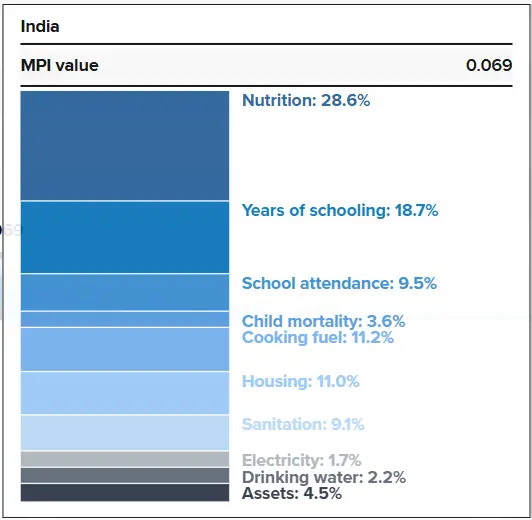
  • Significant Decline in Multidimensional Poverty: According to NITI Aayog’s National MPI Report 2024, India lifted around 24 crore people out of multidimensional poverty between 2013–14 and 2022–23, showing accelerated progress in nutrition, housing, sanitation, and access to clean cooking fuel.
  • Improvement in Social Indicators: India’s MPI dropped from 0.117 in 2015–16 to 0.066 in 2019–21, driven by better health outcomes (like reduced child mortality), improved school attendance, and wider electricity coverage.
  • Expansion of Social Protection Schemes: Schemes such as PM-KISAN, PM-JAY, Ujjwala Yojana, and PMAY-Gramin have enhanced income security and basic living
  • standards, reducing both consumption-based and multidimensional poverty.
    Direct Benefit Transfer (DBT) Efficiency: DBT has enabled transparent delivery of subsidies to over 50 crore beneficiaries, cutting leakages and ensuring that welfare benefits reach the poorest households efficiently.
  • Progress towards SDG 1.3 (Social Security Coverage): India has expanded coverage through schemes like Atal Pension Yojana and PM-JAY, providing financial risk protection to vulnerable families.
  • Challenges Ahead: Despite progress, issues such as rising urban poverty pockets, jobless growth, and rural distress still pose obstacles to achieving SDG-1 by 2030.

Way Forward

India’s fight against poverty requires a multi-dimensional, growth-oriented, and inclusive strategy that addresses structural inequalities and strengthens human capabilities.

  • Strengthen Labour-Intensive Job Creation: Boost sectors like manufacturing, agro-processing, textiles, and construction to generate large-scale employment. For example, labour-intensive manufacturing accounts for less than 20% of total employment, showing the need for expansion.
  • Enhance Quality of Education and Skills: Improve foundational learning and vocational training to make the workforce job-ready. ASER 2023 shows over 25% of rural youth lack basic employability skills, highlighting the need for skill-linked poverty reduction.
  • Expand Social Protection Coverage: Build resilient safety nets including universal health coverage, pensions, and insurance for informal workers. Over 80% of India’s workforce is informal, making targeted protection essential.
  • Improve Agricultural Productivity and Farmers’ Incomes: Promote MSP reforms, irrigation expansion, FPOs, and post-harvest infrastructure to raise rural incomes. Agriculture still employs around 45% of the workforce, but contributes only 15-17% of GDP.
  • Strengthen Urban Poverty Alleviation Policies: Implement affordable housing, skilling, and social security for migrant and informal workers. Urban poverty pockets grew during Covid-19, revealing gaps in existing programmes.
  • Promote Women-Centric Development: Improve women’s workforce participation, credit access, and asset ownership. India’s female LFPR, though rising, is still around 37%, much lower than global averages.
  • Use Technology to Improve Targeting and Delivery: Expand DBT, Aadhaar-linked benefits, and digital monitoring to reduce leakage. JAM trinity has already saved over ₹2.7 lakh crore in leakages, indicating strong potential.

Poverty In India FAQs

Q1: What is poverty in the Indian context?

Ans: Poverty in India refers to a state of socioeconomic deprivation where individuals lack sufficient income, resources, and access to basic necessities such as food, housing, healthcare, and education.

Q2: How is poverty measured in India?

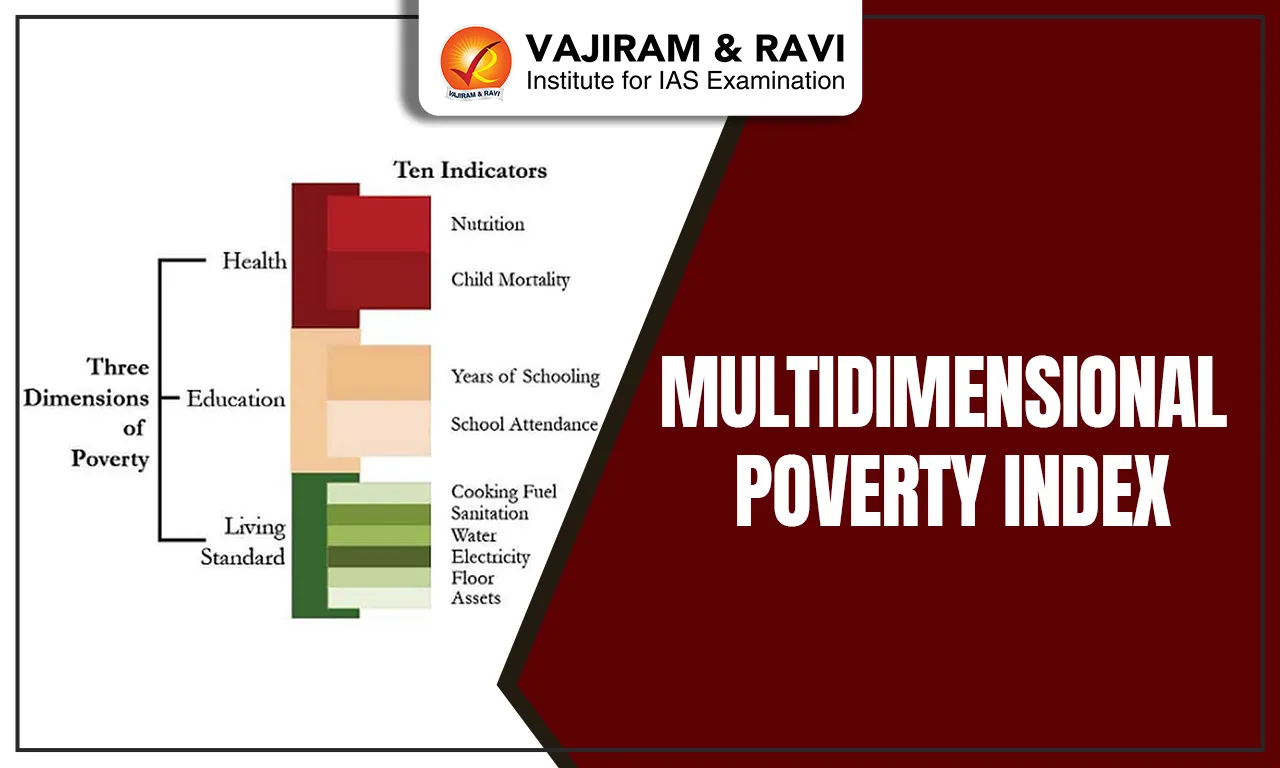
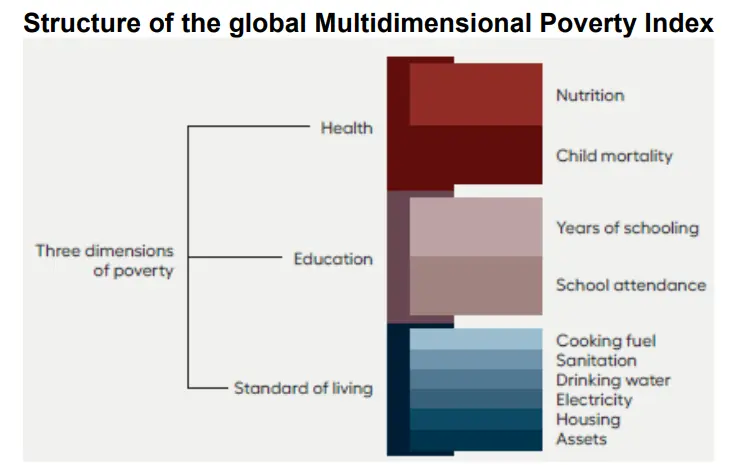
Ans: India measures poverty using income/consumption-based measures and multidimensional indicators. The Tendulkar Committee (2009) and Rangarajan Committee (2014) provide poverty lines, while NITI Aayog’s Multidimensional Poverty Index (MPI) uses health, education, and living standards indicators.

Q3: What is the current status of poverty in India?

Ans: According to NITI Aayog’s National MPI 2023, India reduced multidimensional poverty from 29% in 2013–14 to about 15% in 2019–21, lifting around 13.5 crore people out of poverty in six years.

Q4: What are the major causes of poverty in India?

Ans: Key causes include population pressure, low agricultural productivity, unemployment, low human development, inequality, inadequate social security, and climate vulnerability.

Q5: What is the difference between absolute and relative poverty?

Ans: Absolute poverty refers to the inability to meet basic survival needs such as food, shelter, and clothing. Relative poverty refers to inequality within a society, when people have significantly less income or resources compared to the average standard of living.

Parts of Indian Constitution, Check All 25 Parts Subject, Key Details

Parts of Indian Constitution

The Constitution of India, adopted in 1950, originally consisted of 395 Articles, 22 Parts, and 8 Schedules. Over time, through amendments, its scope has expanded to address emerging needs of governance and society. Today, the Constitution contains 448 Articles, 25 Parts, and 12 Schedules.

The Parts of Indian Constitution serve as the backbone, organizing its provisions into broad themes such as fundamental rights, directive principles, governance structure, and emergency provisions. Later additions like Part IXA (Municipalities), Part IXB (Co-operative Societies), and Part XIVA (Tribunals) highlight the evolving nature of constitutional law in India.

It’s also important to note that when new Articles or Parts are inserted, they are numbered alphabetically (like Article 21A) to maintain the document’s structure without disrupting the original sequence.

Parts of Indian Constitution 

The Constitution of India is not just a legal document but also the supreme law of the land. It lays down the framework of governance by defining the roles of people in positions of authority and clearly outlining the limitations on their power. At the same time, it secures the rights, powers, procedures, and duties of both the government and the citizens.

What makes it unique is its emphasis on the supremacy of the Constitution itself, rather than the supremacy of the legislature. This ensures that every law and every action of the government remains within the constitutional framework.

To understand this structure better, here’s an overview of the Parts of the Indian Constitution presented in a table:

Parts of Indian Constitution Overview

Particulars

Details

Constitution formed on

26th November 1949

Parts of Indian Constitution Originally

22 Parts

Parts of Indian Constitution at Present

25 Parts

New Parts added in Constitution

  • Part IX A of the Constitution was inserted by the Constitution (74th Amendment) Act, 1992. It contains provisions for local self government at the urban level.
  • Part IXB of the Constitution grants constitutional status to co-operative societies and contains provisions for their democratic functioning. It was inserted by the Constitution (97th, Amendment) Act, 2011.
  • Part XIVA of the Indian Constitution provides for the appointment of tribunals for administrative and other disputes. It was not a part of the Constitution of India 1950, but was added by the Constitution (Forty-second Amendment) Act, 1942.

List of Parts of Indian Constitution

The Indian Constitution is a written document that serves as the supreme law of the land. It was drafted by the Constituent Assembly, with key contributions from leaders like Dr. B.R. Ambedkar, Rajendra Prasad, and Jawaharlal Nehru, and came into effect on January 26, 1950.

To ensure clarity and proper governance, the Constitution is divided into distinct sections that address specific subjects. Over time, it has expanded and now consists of 25 Parts, each focusing on different aspects of governance, rights, and duties.

List of Parts of Indian Constitution

Parts and Subject

Articles

Part I - The Union and its Territories

1 - 4

Part II - Citizenship

5 -11

Part III - Fundamental Rights

12 - 35

Part IV - Directive Principles of State Policy

36 - 51

Part IV A - Fundamental Duties

51A

Part V - The Union

52 - 151

Part VI - The States

152 - 237

Part VII - The States in Part B of First Schedule

238 [Repealed]

Part VIII - The Union Territories

239 - 242

Part IX - The Panchayats

243 - 243O

Part IXA - The Municipalities

243P - 243ZG

Part IXB - The Co-operative Societies

243ZH - 243ZT

Part X - The Scheduled and Tribal Areas

244 - 244A

Part XI - Relation between the Union and the States

245 - 263

Part XII - Finance, Property, Contracts and Suits

264 - 300A

Part XIII - Trade, Commerce and Intercourse within the territory of India

301 - 307

Part XIV - Services Under the Union and the States

308 - 323

Part XIVA - Tribunals

323A - 323B

Part XV - Elections

324 - 329A

Part XVI - Special provisions relating to certain classes

330 - 342

Part XVII - Official language

343 - 351

Part XVIII - Emergency Provisions

352 - 360

Part XIX - Miscellaneous

361 - 367

Part XX - Amendment of the Constitution

368

Part XXI - Temporary, Transitional and Special Provisions

369 - 392

Part XXII - Short Title, Commencement, Authoritative Text in Hindi and Repeals

393 - 395

Parts of Indian Constitution Details

The Constitution of India is the supreme law of the land. It was adopted on 26 January 1950 and originally contained 395 Articles, 22 Parts, and 8 Schedules. Today, through amendments, it has expanded to 448 Articles, 25 Parts, and 12 Schedules.

Each Part of the Constitution deals with a specific subject - from Union and State structures to rights, duties, emergency provisions, and governance frameworks. 

Parts of Indian Constitution Details

Part

Articles Covered

Subject / Theme

Brief Explanation

Part I

Articles 1 - 4

The Union and its Territory

Defines India as a Union of States; regulates formation of new states and alteration of boundaries.

Part II

Articles 5 - 11

Citizenship

Lays down provisions for citizenship at the commencement of the Constitution and rules for acquisition/termination.

Part III

Articles 12 - 35

Fundamental Rights

Guarantees six categories of Fundamental Rights to citizens, inspired by the US Bill of Rights.

Part IV

Articles 36 - 51

Directive Principles of State Policy (DPSP)

Guidelines for the State to establish a just society; non-justiciable but fundamental to governance.

Part IVA

Article 51A

Fundamental Duties

Lists 11 duties of citizens, added by the 42nd Amendment (1976) on recommendation of Swaran Singh Committee.

Part V

Articles 52 - 151

The Union

Deals with the Union Government - Executive (President, PM, Council of Ministers), Parliament, and Judiciary.

Part VI

Articles 153 - 237

The States

Deals with State Governments - Governors, State Legislature, and High Courts.

Part VII

[Repealed]

States in Part B

Dealt with Part B states; repealed by the 7th Amendment (1956).

Part VIII

Articles 239 - 242

Union Territories

Provides for administration of Union Territories by the President through Administrators.

Part IX

Articles 243 - 243O

The Panchayats

Establishes Panchayati Raj system (73rd Amendment, 1992) for rural local self-government.

Part IXA

Articles 243P - 243ZG

The Municipalities

Establishes urban local bodies (74th Amendment, 1992) with structure, powers, and responsibilities.

Part IXB

Articles 243ZH - 243ZT

Co-operative Societies

Provides for regulation and management of co-operatives (97th Amendment, 2011).

Part X

Articles 244 - 244A

Scheduled and Tribal Areas

Deals with administration of Scheduled Areas (Fifth Schedule) and Tribal Areas (Sixth Schedule).

Part XI

Articles 245 - 263

Relations between the Union and States

Lays down legislative, administrative, and financial relations between the Centre and States.

Part XII

Articles 264 - 300A

Finance, Property, Contracts, and Suits

Covers distribution of revenues, borrowing powers, property rights, and legal suits involving government.

Part XIII

Articles 301 - 307

Trade, Commerce, and Intercourse

Ensures freedom of trade and commerce across India; modeled on Australian Constitution.

Part XIV

Articles 308 - 323

Services under Union and States

Covers recruitment, conditions of service, and role of Public Service Commissions.

Part XIVA

Articles 323A - 323B

Tribunals

Provides for Administrative Tribunals and other tribunals for speedy justice (42nd Amendment, 1976).

Part XV

Articles 324 - 329A

Elections

Deals with conduct of elections; empowers Election Commission of India.

Part XVI

Articles 330 - 342

Special Provisions for Certain Classes

Safeguards for SCs, STs, and Anglo-Indians, including reservation of seats.

Part XVII

Articles 343 - 351

Official Language

Declares Hindi in Devanagari script as official language; provides for use of English and development of regional languages.

Part XVIII

Articles 352 - 360

Emergency Provisions

Provides for National Emergency, President’s Rule, and Financial Emergency.

Part XIX

Articles 361 - 367

Miscellaneous

Covers protection of President/Governors, privy purses, interpretation of Constitution, etc.

Part XX

Article 368

Amendment of the Constitution

Provides the procedure for constitutional amendments - flexible yet rigid.

Part XXI

Articles 369 - 392

Temporary, Transitional, and Special Provisions

Deals with temporary and special provisions for certain states and union territories.

Part XXII

Articles 393 - 395

Short title, Commencement, Authoritative Text, Repeals

Specifies short title, date of commencement, authoritative text in Hindi, and repeals of previous laws.

Parts of Indian Constitution FAQs

Q1: Are there 22 or 25 parts in the Indian Constitution?

Ans: Originally, the Constitution had 22 parts, but after subsequent amendments and additions, it now has 25 parts.

Q2: Why is part 7 removed?

Ans: Part 7 dealt with Part-B states. After the 7th Constitutional Amendment, 1956, Part-B states were merged with others, making this part redundant, so it was repealed.

Q3: What is part 8 of the Indian Constitution?

Ans: Part 8 (Articles 239-242) deals with Union Territories, their administration, governance, and special provisions.

Q4: What are the articles 1, 2, 3, 4, 5 of the Constitution?

Ans: Article 1 - India, that is Bharat, is a Union of States, Article 2 - Admission/establishment of new States, Article 3 - Formation of new States and alteration of areas/boundaries, Article 4 - Laws under Articles 2 & 3 not amendments under Article 368, Article 5 - Citizenship at the commencement of the Constitution.

Q5: How to remember 25 parts of the Indian Constitution?

Ans: Use a mnemonic chain technique. For example: “The Union’s State Needs Citizenship, Directive Policies, Emergency Provisions, Panchayati Raj, Tribunals...” linking each part in order with keywords.

Special Intensive Revision (SIR) by Election Commission, Significance, Challenges

Special Intensive Revision (SIR)

The Special Intensive Revision (SIR) of electoral rolls is a strategic exercise by the Election Commission of India (ECI) aimed at thoroughly updating, verifying and correcting the voter lists across India. While routine roll updates happen annually, SIR is a far more comprehensive, time-bound house-to-house verification drive, often preceding major elections. Its goal is to ensure that the electoral roll is accurate, inclusive and free from errors such as duplicates, deceased voters, or ineligible entries.

Special Intensive Revision (SIR)

SIR refers to a large-scale, intensive revision of electoral rolls by the Election Commission of India under its constitutional and statutory powers. Usually triggered in anticipation of high-stakes elections or when the rolls have remained largely unchanged for years, the SIR involves steps such as fresh enumeration forms, house-to-house verification by Booth Level Officers (BLOs), document verification of voters, deletion of ineligible entries, and inclusion of those omitted. The SIR 2025 in Bihar, where more than 8 crore voters were to be re-verified, is the latest example. Key facts:

  • The legal basis lies in Article 324 of the Constitution (superintendence, direction and control of elections) and Section 21(3) of the Representation of the People Act, 1950, which allows the Commission to carry out “special revision of the electoral roll.”
  • The objective is to include every eligible citizen (18+ years) and to remove duplicates, deceased persons, ineligible entries and correct errors like wrong names or addresses.
  • It is not simply a summary revision but combines features of a full enumeration (intensive revision) and summary updates, hence the nomenclature “Special Intensive”.

Special Intensive Revision Significance

The SIR exercise offers multiple benefits for democracy and electoral integrity:

  • Reduces ghost voters and multiple registrations: By removing duplicate entries, the fairness of elections improves.
  • Reflects demographic changes: Large-scale migration, new elector entrants, and urbanization distort old rolls; SIR addresses this.
  • Improves inclusion of marginalised groups: Young voters, internal migrants, disabled voters get properly registered.
  • Strengthens transparency and trust: When voters feel the list is updated and inclusive, public confidence in the system increases.
  • Facilitates efficient polling logistics: Clean rolls help better planning: fewer spoiled ballots, accurate polling station allocation (as seen in Jaipur creation of new booths).

Special Intensive Revision Objectives

The major objectives of conducting a Special Intensive Revision are:

  • Accuracy: To update and correct the electoral roll so that duplicate names, deceased voters, and ineligible persons are removed.
  • Inclusion: To ensure that all eligible citizens, including first-time voters, migrants, and those omitted earlier, are included in the voter list.
  • Legitimacy: To strengthen public trust in elections by cleansing rolls and thereby reinforcing the “one person, one vote” principle.
  • Demographic adjustment: With increasing migration (rural→urban), changing residencies, newly eligible voters (18+), SIR helps the roll reflect ground realities.
  • Pre-election readiness: Especially before major Assembly or Lok Sabha elections, a clean roll reduces litigations and helps smooth polling operations.

Special Intensive Revision Legal Framework

The legal and constitutional basis for SIR is critical for understanding its authority and challenges:

  • Article 324 (1): Grants the ECI superintendence, direction and control of elections to Parliament and State Legislatures.
  • Article 326: Guarantees adult suffrage to all citizens aged 18+ for elections to Lok Sabha and State Assemblies.
  • Representation of the People Act, 1950, Section 16 and 19: Sets out criteria for voter eligibility (citizen, 18+, ordinary resident). Section 21(3) empowers the ECI to order special roll revision.
  • Registration of Electors Rules, 1960: Specifies procedures for enrolment, revision, etc. Some legal commentators note that the term “Special Intensive Revision” itself is not explicitly present in the Rulebook, raising questions of nomenclature and procedural clarity.

Special Intensive Revision Process

The SIR process involves several distinct phases and features which differentiate it from routine roll updates:

  1. Notification & Planning: The ECI issues notification specifying qualifying date (e.g., July 1, 2025 in Bihar).
  2. House-to-House Enumeration: BLOs visit every house in assigned polling booth area and distribute pre-filled “Enumeration Forms” to existing electors and new eligible persons.
  3. Submission of Documents: For voters enrolled after a certain past date (e.g., Jan 2003 in Bihar SIR) proof of date/place of birth and parentage is required. This is stricter than earlier frameworks.
  4. Verification & Deletions/ Additions: EROs scrutinise the submissions, identify deaths, duplicates, migration, ineligible voters and remove them; simultaneously new inclusions are processed. For example in Jaipur, 741 new polling booths were to be created under SIR to accommodate changes.
  5. Draft Publication & Objections: A draft roll is published, objections entertained, grievance redressal mechanism applied. The Supreme Court directed ECI to publish details of deleted names in the Bihar SIR litigation.
  6. Final Roll & Freeze: The final roll is constituted and frozen for ensuing election. Additions/deletions after that are restricted to special cases.

Special Intensive Revision Features

The key features of the Special Intensive Revision (SIR) has been listed below:

  • Focus on every household rather than selective updates.
  • Time-bound completion preceding major elections.
  • Special emphasis on migrants, youth, and excluded electorates.
  • Integration of digital tools, SMS alerts, online enumeration portals.
  • Stronger document verification for entries added post last intensive revision.

Bihar SIR 2025

The SIR exercise launched in Bihar in mid-2025 offers concrete insights and lessons. This case underlines both the scale and complexity of SIR. It also highlights the balancing act between thoroughness of revision and inclusivity of electoral participation.

  • The ECI notified SIR with the qualifying date 1 July 2025, marking all citizens turning 18 by 1 October 2025 as eligible for inclusion.
  • More than 8 crore voters were subject to enumeration; BLOs and 4 lakh volunteers were mobilised.
  • The process required voters registered after Jan 2003 to provide proof of their name, birth date and parent’s details. This was stricter than past editions of intensive revision.
  • The Supreme Court directed the ECI to publish details of deletions and make it widely known via websites and media.
  • As part of booth rationalisation, districts such as Jaipur created hundreds of new polling stations under SIR to avoid over-crowding.

Uttar Pradesh SIR 2026

The Election Commission of India (ECI) has published the draft electoral roll for Uttar Pradesh following the recently completed Special Intensive Revision (SIR) 2026, marking one of the most extensive voter list overhauls in the state ahead of upcoming elections. Out of the total 15.44 crore registered voters in Uttar Pradesh, the names of 12.55 crore voters have been retained in the draft electoral roll after the completion of the Special Intensive Revision (SIR).

The reasons for this Uttar Pradesh Special Intensive Revision (SIR) 2026 have been listed below.

  • Death of the voter as verified through field checks and official records
  • Permanent migration of voters to other states or constituencies
  • Duplicate or multiple entries detected in the electoral roll
  • Voters found to be untraceable or not residing at the given address during verification
  • Ineligible entries due to age-related discrepancies or incorrect details
  • Failure to submit required documents or verification forms during the SIR process

Special Intensive Revision Challenges

While SIR is conceptually sound, its implementation has raised serious concerns:

  • Risk of disenfranchisement: The demand for additional documents (especially for post-2003 entries) may exclude legitimate voters lacking birth or parentage proof. Critics argue that this risks excluding the poor, migrants and marginalised groups.
  • Timing before elections: Conducting a full-scale revision just before a major election may create confusion, logistic issues, and allegations of bias. For example, state parties asked for clarity that SIR is not a citizenship verification exercise.
  • Terminology & procedural clarity: The term “Special Intensive Revision” is not explicitly mentioned in existing rules, leading to questions about legal basis and consistency.
  • Resource and staffing constraints: House-to-house enumeration at scale demands huge human and technological resources, field officials have flagged shortages.
  • Digital divide and accessibility: Rural, remote, migrant or low-literate citizens may be disadvantaged in online enumeration or document submission.
  • Political objections and litigations: Some opposition parties allege SIR may be used to manipulate voter lists for favourable outcomes. For example, the Supreme Court is hearing a PIL (Association for Democratic Reforms vs ECI) challenging the 2025 Bihar SIR.

Way Forward:

Given the importance and complexity of SIR, a set of reforms can help strengthen its outcomes:

  • Define clear legal guidelines: While Section 21(3) of RP Act provides power, transparent guidelines on document requirements, timeline and inclusion criteria can reduce disputes and litigations.
  • Ensure minimal documentation barrier: Maintain presumption of validity for earlier registered voters; avoid blanket demands of new proof unless probable cause exists.
  • Use technology to streamline the process: Mobile apps for enumeration, GIS mapping of premises, online grievance portals for exclusion/delayed enrolment can enhance efficiency and reduce errors.
  • Inclusion focus: Special camps for migrants, disabled, first-time voters; mass awareness campaigns in multiple languages; mobile verification vehicles in remote areas.
  • Stakeholder consultation: Political parties, civil society organisations, tribal and migrant groups must be consulted to detect potential exclusion and build confidence in the exercise.
  • Real-time monitoring & public disclosure: Publishing lists of deleted/included names, reasons for deletion, leveraging transparency to reduce fear of disenfranchisement.
  • Post-roll audit & feedback mechanism: Conduct sample audits after the roll is finalised to verify inclusion of marginalised groups, and correct omissions before polling.
  • Synchronise with delimitation and polling station rationalisation: Changes in constituency boundaries, migration flows, and new polling station creation (as seen in Jaipur) must be integrated into SIR design.

SIR Election Commission

The Election Commission of India (ECI) plays a central role in planning and executing the Special Intensive Revision (SIR). It issues formal notifications specifying the schedule, qualifying date, and procedures for enumeration. The ECI also supervises the house-to-house verification, document scrutiny, and final roll publication. Through its constitutional authority under Article 324, the Commission ensures that every eligible citizen is included and every error or duplicate is eliminated from the voter roll.

Chief Electoral Officer

The Chief Electoral Officer (CEO) of each state or union territory is responsible for implementing SIR on the ground. Acting under the guidance of the Election Commission, the CEO coordinates with District Election Officers, Electoral Registration Officers, and Booth Level Officers. The CEO ensures timely data collection, field verification, training of staff, public awareness drives, and transparent grievance redressal during the revision. Their reports form the basis for ECI’s final electoral roll approval.

Special Intensive Revision UPSC

The Election Commission of India (ECI) has launched the next phase of the Special Intensive Revision (SIR) of electoral rolls across 12 states and Union Territories, including Tamil Nadu, Kerala, West Bengal, and Puducherry, ahead of upcoming Assembly elections. The process begins on November 4, 2025, covering over 51 crore voters, with the final roll to be released on February 7, 2026. Voters must prove eligibility using one of 13 documents, including the Aadhaar card, a provision introduced after procedural reforms during the Bihar SIR. States like Tamil Nadu and Kerala have sought clarifications, citing concerns over large-scale voter verification. Meanwhile, Assam has been excluded due to the ongoing NRC exercise, making this one of India’s largest voter verification drives since 2002.

Special Intensive Revision (SIR) FAQs

Q1: What is Special Intensive Revision (SIR)?

Ans: SIR is a large-scale voter roll verification process conducted by the Election Commission to update and correct the electoral list.

Q2: Why is Special Intensive Revision important before elections?

Ans: It ensures fair and accurate elections by removing duplicate or ineligible entries and adding newly eligible voters to the list.

Q3: Who conducts Special Intensive Revision in each state?

Ans: The Chief Electoral Officer and local election officers conduct SIR under the supervision of the Election Commission of India.

Q4: What documents are required for SIR verification?

Ans: Voters may need to provide proof of age, address, and parentage, especially for registrations after 2003.

Q5: What are the major challenges in Special Intensive Revision?

Ans: Challenges include risk of voter exclusion, documentation barriers, limited staff, and digital accessibility issues in remote areas.

British East India Company, Timeline, Headquarters, Key Details

British East India Company

The British East India Company in India was established in the year 1600 as a trading company and later turned into a ruling body in 1765. This transition was attained after East India Company obtained the Diwani Rights to collect revenue of Bengal, Bihar and Orissa in the treaty of Allahabad. This way the British East India Company got to interfere in the Indian Affairs. The East India Company ruled in India until the Government of India Act of 1858. This resulted in the formation of a new British Raj and the British finally gained complete control over India. In this article, we are going to cover all about the British East India Company.  

British East India Company First Factory

The British East India Company established its first temporary factory at Masulipatnam in 1605 to begin trade with India. Later, it set up its first permanent factory at Surat in 1613 after getting permission from Mughal Emperor Jahangir. This marked the official start of British commercial presence in India and laid the foundation for future colonial expansion.

British East India Company Timeline

The British East India Company was founded in 1600 as a joint stock company to carry out trade in the Indian Ocean. The company started conducting its business with the East Indies and then East Asia and finally dissolved by order of the British Parliament in 1874. Following is the timeline of British East India Company in India:

Timeline of the British East India Company in India (From 1600 to 1858)
Year Events

1600

A Royal charter from the British Queen Elizabeth I was obtained by the Governor and Company of Merchants of London Trading to the East India Company.

1601

The first East India Company Voyage was led by Sir James Lancaster aboard the Red Dragon. 

1609

Sir William Hawkins fails to obtain a permit for a factory in Surat during the reign of Jahangir due to Portuguese influence in the Mughal Court.

1611

The East India Company established its first factory at Masulipatnam (now Machilipatnam), Andhra Pradesh.

1612

Battle of Suvali (Sawally)

  • Portuguese were defeated off the coast of Surat by the EIC’s Fleet under the command of Captain Thomas Best.

1613

EIC got permission from Jahangir to build a factory in Surat (the first permanent factory).

1615 -1619

Sir Thomas Roe was the British ambassador at Jahangir’s court.

  • Later, he was successful in obtaining permission to build factories in Agra, Ahmedabad, and Broach (now Bharuch).

1616

EIC established a permanent factory at Masulipatnam.

1632

The Sultan of Golconda had granted the “Golden Farman” to EIC.

1633

EIC established factories in Balasore, Odisha, and Hariharpur on the Mahanadi delta.

1639

The Chandragiri ruler gave the EIC permission to construct a fortified factory in Madras that would later become known as Fort St. George.

  • It took over as the headquarters of the British settlements in South India from Masulipatnam.

1651

Mughal Bengal governor Shah Shuja allowed the English to trade in Bengal without paying any customs duties in exchange for an annual lump sum of Rs. 3000.

  • EIC built a factory in Hooghly, Bengal.

1658

At Kasimbazar, another factory was opened.

1662

King Charles II of Britain receives Bombay from Portugal as a dowry for Princess Catherine.

  • In addition, Portugal and Britain signed a non-aggression treaty.

1668

Britain leased Bombay to the EIC for €10 per year.

  • Later, it replaces Surat as the Western presidency’s headquarters.

1686 – 1689

A series of battles erupted between Mughal and EIC.

1689

The Mughal Navy, led by Admiral Sidi Yukub, launched an attack on Bombay.

1690

EIC was forced to surrender and beg Aurangzeb for forgiveness

EIC was also forced to sign a treaty with Mughal, which included:

  • Bombay was returned to EIC after a huge fine was paid.
  • Job Charnock, an EIC agent, obtains permission for the EIC to establish a factory in Sutanuti, Bengal.

1696

Sutanuti was fortified following a conflict with the local Zamindars.

1698

EIC paid 1200 rupees for the zamindari of three villages: Sutanuti, Gobinpur, and Kalighat (Kalikata, letter Calcutta/Kolkata).

1700 – 1701

Fort William, named after King William III of England, was built in Sutanuti.

1701 – 1708

Formation of the “United Company of Merchants of England Trading to the East Indies”.

1717

Farrukhsiyar, the Mughal emperor, issued royal farmans to the EIC (the British mission led by John Surman).

In Bengal

  • Except for a yearly payment of 3,000 rupees, they were permitted to trade freely.
  • EIC was granted the authority to issue Dastaks (trade permit passes) for the transportation of goods.
  • By this Farman, EIC was permitted to rent more around Calcutta.

In Hyderabad

  • EIC already had free trade rights, which were retained by the new farman.
  • EIC would only pay the prevailing rent in Madras.

In Surat

  • EIC was required to pay Rs 10,000 per year and was exempt from all other duties.

By this farman, EIC coins were permitted in all Mughal territories.

1740 – 1763

The Carnatic Wars (the English-French rivalry) began.

  • First Carnatic War 1740 – 1748
  • Second Carnatic War 1749 – 1754
  • Third Carnatic War 1756 – 1763

1756

Black Hole of Calcutta or Black hole tragedy

  • The term “Black Hole of Calcutta” refers to a jail cell where 146 British prisoners were held after the Nawab of Bengal stopped fortifying the city in anticipation of war surrounding the fort in Calcutta.

1757

Treaty of Alinagar

  • On February 9, 1757, the Bengal Nawab Sirajuddaula and the EIC signed the Alinagar Treaty.
  • The treaty allowed for the fortification of the town and the minting of coins, and it returned Calcutta to the EIC with all of its rights.
  • The treaty’s terms favoured EIC and increased their power. The terms of the treaty, according to Clive’s letter to the Select Committee dated February 22, 1757, were “both honourable and advantageous to the Company.”

1757

Battle of Plassey 

  • East India Company victory
  • British Rule started in India

1759

Battle of Chinsurah

  • The then-Nawab of Bengal, Mir Jafar, invited the Dutch East India Company to defeat the East India Company, but they were defeated by EIC.

1760

Battle of Wandiwash

  • It was an attempt by the French to take over the Fort of Vandavasi in Tamil Nadu during the third Carnatic war, but they were defeated by EIC.

1761

The East India Company captured Pondichery from French forces in India.

1764

Battle of Buxar

  • EIC victory
  • Treaty of Allahabad 1765

1765

Treaty of Allahabad

It was signed on August 12, 1765, in the aftermath of the Battle of Buxar, by Mughal Emperor Shah Alam II, Shuja-ud-daulah, and Robert Clive of the East India Company.

With Shuja-Ud-Daulah of Awadh

  • He handed over Kara and Allahabad to the Mughal emperor.
  • He was forced to pay EIC 50 lakh as a war indemnity.
  • He was forced to sign an offensive and defensive alliance with EIC.
  • EIC succeed to obtain free trade rights in Awadh.

With Shah Alam II of Delhi

  • In exchange for a 26 lakh pension, Shah Alam II granted Diwani rights to the East India Company in Bengal, Bihar, and Orisa.

1765 – 1772

Dual System of Government in Bengal

  • Nizamat Rights (Political and Administrative Rights): were given to Nawab of Bengal by EIC.
  • Diwani Rights (Rights to collect taxes): These rights were under EIC’s direct control.

1767-1769

First Anglo-Mysore War

  • Mysore victory
  • Treaty of Madras

1769 – 1772

Great Bengal Famine

1773

Regulating Act 1773

1775 – 1782

First Anglo-Maratha War

  • Maratha victory
  • Treaty of Salbai

1780 – 1784

Second Anglo-Mysore War

  • Status quo ante bellum
  • Treaty of Mangalore

1781

Amending Act of 1781 or Act of Settlement of 1781

1784

Pitt’s India Act

1790 – 1792

Third Anglo-Mysore War

  • East India Company victory
  • Treaty of Seringapatam

1791

Charles Cornwallis introduced a regular Police force system in India.

1793

Introduction of the Cornwallis Code

  • Revenue and justice administration were separated.
  • Principles of the sovereignty of law were introduced.
  • Hindu and Muslim laws were codified separately.
  • European subjects were now brought under jurisdiction as well.
  • The civil service was founded by Warren Hastings, and it was reformed, modernised, and rationalised by Charles Cornwallis.

1799

Fourth Anglo-Mysore War

  • East India Company victory
  •  Mysore entered into a subsidiary alliance

Introduction of Censorship of Press Act in India

  • The EIC was concerned about the French invasion and the spread of French revolution ideas in India.
  • Publishers were not allowed news against the government.

1803 -1805

Second Anglo-Maratha War

  • East India Company victory
  • Treaty of Surji-Anjangaon

1806

Vellore Mutiny

  • It was the first significant mutiny by Indian sepoys within the East India Company, and it occurred because the EIC ignored the Hindu and Muslim Indian sepoys’ religious sensibilities.
  • Fateh Hyder, Tipu Sultan’s son, led the Indian sepoys.

1809

Treaty of Amritsar

  • The East India Company signed a treaty with Maharaj Ranjit Singh of Punjab.

1813

Introduction of the Charter Act of 1813

1814 -1816

Anglo-Nepalese War

  • East India Company victory
  • Treaty of Sugauli

1817 – 1819

Third Anglo-Maratha War

  • East India Company victory
  • The formal end of the Maratha Empire

1820

Royatwari system was established by Thomas Munro.

1824 – 1826

First Anglo-Burmese War

  • East India Company victory
  • Treaty of Yandabo
  • British rule started in Burma (present-day Myanmar)

1826

Siege of Bharatpur

1829

Bengal Sati Regulation Act

  • Raja Ram Mohan Roy played a significant part in this Act, which banned the Sati Pratha in all areas of British India.

1830

Suppression of thugis by Colonel Sleemen.

1833

Charter Act of 1833

The creation of coins bearing the name of the Mughal emperor was stopped.

1834

Law Commission under Macaulay

  • The Charter Act of 1833 constituted the first law commission.
  • This led to:
  • Civil Procedure code 1859
  • Indian Penal Code 1860
  • Criminal Procedure Code 1861

1835

Macaulay Committee for educational reforms constituted in India.

  • In his “Minute on Indian Education,” British historian and politician Thomas Babington Macaulay argued for the adoption of English education for Indian indigenous.
  • Know about the Education System In India During British Rule!

Introduction of the Press Act or Metcalf Act.

1837

The Post Office Act

  • The British Government had sole authority to deliver letters in EIC territories.

1838 – 1842

First Anglo-Afghan War

  • Afghan Victory
  • British EIC withdrawal from Afghanistan

1843

Sindh was annexed by the East India Company under Charles Napier.

1845 – 1846

First Anglo-Sikh War

  • British victory
  • Treaty of Lahore

1848 – 1849

Second Anglo-Sikh War

  • East India Company victory
  • The formal end of the Sikh Empire

1848-1856

Dalhousie initiated the “doctrine of lapse” which was an annexation policy.

In India, 4000 miles of telegraph lines were laid down under the supervision of O’Shaughnessy.

  • The East India Company introduced the first postal stamp in India under the name “SCINDE DISTRICT DAWK.”

1852 – 1853

Second Anglo-Burmese War

  • East India Company victory
  • East India Company troops annexed Pegu, Burma’s (now Myanmar) only remaining independent coastal province.

1853

History of Railways (British India): Railway expansion work was started in India under James Broun Ramsay (Lord Dalhousie).

  • Railways were primarily used for military, commercial, and administrative purposes.

Introduction of the Charter Act of 1853.

1854

  • The upper Ganges canal was declared open.
  • Separate Public works Departments (PWDs) were established in every province.
  • The British East India Company established the modern postal system in India.
  • Postal stamps were issued throughout India.
  • Postal rates were uniform throughout India.

Wood’s Despatch for Indian Education System was introduced.

  • The First Comprehensive Plan for Mass Education in India, also known as the “Magna Carta” of English Education in India.

The Macaulay Committee (committee on Indian civil services) was formed.

1856

Awadh was annexed by Dalhousie.

Widow Remarriage Act Passed.

  • The Indian activists Ishwar Chandra Vidyasagar and Rani Rashmoni of Bengal played a significant role.
  • It was drafted during Dalhousie’s tenure but passed during Charles Canning’s tenure before the 1857 Revolt.

1857

Revolt of 1857: Sepoy Mutiny

  • East India Company victory
  • The formal end of Mughal Empire
  • The formal end of EIC rule in India

1858

Queen Victoria’s Proclamation

  • On November 1, 1858, Lord Canning announced the Queen’s Proclamation at Allahabad Durbar.

Introduction of Government of India Act, 1858.

  • From now on, India would be governed and known as Her Majesty the British Monarch.
  • The British Raj was officially established in India, and company rule was transferred to the British crown.

1 Jun 1874

The British Parliament formally dissolved the East India Company.

British East India Company

The British East India Company has the following important facts to be remembered: 

British East India Company
Established 31st December 1600

Type

State-owned company partially

Headquarters

East India House, London, Great Britain

Dissolved

The East India Company was formally dissolved on June 1, 1874 in accordance with the provisions of the East India Stock Dividend Redemption Acct 1873. 


On June 1, 1874, the East India Company was formally dissolved in accordance with the provisions of the East India Stock Dividend Redemption Act 1873.

British East India Company FAQs

Q1: When did British East India come to India?

Ans: The British East India Company arrived in India in 1600 and established its first factory at Surat in 1613.

Q2: What did the British do to the East India Company?

Ans: The British government abolished the East India Company in 1874 after transferring its powers to the Crown in 1858.

Q3: Who founded the British East India Company?

Ans: The British East India Company was founded by a group of English merchants and was granted a royal charter by Queen Elizabeth I in 1600.

Q4: What is the old name of East India Company?

Ans: The old name of the East India Company was "The Governor and Company of Merchants of London Trading into the East Indies."

Q5: Who wrote the economic history of India?

Ans: Dadabhai Naoroji wrote "Poverty and Un-British Rule in India", laying the foundation for India’s economic history under colonial rule.

Banking System in India, Types, Structure, Related Concepts

Banking System in India

The Banking System in India forms the cornerstone of the country’s economic structure. It acts as the principal financial intermediary, channeling funds from savers to borrowers, facilitating capital formation, and ensuring the smooth flow of credit across all sectors of the economy. Beyond its traditional roles of accepting deposits and lending money, the Indian banking system also promotes financial inclusion, supports government policy implementation, and contributes to national development. Understanding the structure, classification, and working of India’s banking system is important for comprehending the broader Indian financial system. In this article, we are going to cover the Banking System in India, its components, regulatory framework, types of banks, and related concepts like Basel Norms, Development Banks, NBFCs and digital banking trends.

Banking System in India

The Banking System in India refers to the network of financial institutions that perform banking and allied functions. These institutions like the commercial banks, cooperative banks, and development banks handle deposits, provide loans, facilitate payments, and offer financial services to individuals, businesses, and governments.

Essentially, banks act as financial intermediaries, transferring surplus funds from households and institutions that save, to those that require funds for investment and consumption. This intermediation promotes productive use of money and stimulates economic activity.

The Indian banking sector not only supports private business and industry but also plays a crucial social role by implementing welfare-oriented schemes like Jan Dhan Yojana, MUDRA, and Priority Sector Lending, which ensure that credit reaches weaker sections of society.

Classification of Banks in India

Banks in India are classified into two main categories:

  1. Scheduled Banks
  2. Non-Scheduled Banks

This classification is based on their inclusion in the Second Schedule of the Reserve Bank of India Act, 1934

1. Scheduled Banks

Scheduled Banks are those institutions that appear in the Second Schedule of the RBI Act, 1934. Inclusion in the Schedule indicates that the bank fulfills certain conditions prescribed by the RBI and is therefore eligible for various facilities offered by it.

To qualify as a Scheduled Bank, an institution must:

  • Have a paid-up capital and reserves of at least ₹5 lakh.
  • Satisfy the RBI that its operations are not conducted in a manner detrimental to the interests of depositors. If a bank fails to maintain these standards, it can be de-listed from the Schedule.

Benefits of Being a Scheduled Bank

  • Access to borrowings from the RBI at the Bank Rate.
  • Membership of the Clearing House, enabling efficient settlement of interbank transactions.
  • Eligibility to rediscount first-class exchange bills with the RBI.
  • Enhanced public confidence, as inclusion in the Schedule signals stability and reliability.

2. Non-Scheduled Banks

Non-Scheduled Banks are institutions not listed in the Second Schedule of the RBI Act. They are usually small local banks that do not meet the RBI’s prescribed criteria. Though they function under the supervision of the RBI, they are subject to less stringent regulations.

These banks maintain their own cash reserves instead of depositing them with the RBI and usually operate on a smaller scale, focusing on local or regional needs.

Key Differences between Scheduled and Non-Scheduled Banks 

The Difference between Scheduled and Non-Scheduled Banks are:

Basis Scheduled Banks Non-Scheduled Banks

Inclusion

Listed in the Second Schedule of RBI Act, 1934.

Not listed in the Second Schedule.

Capital Requirement

Minimum paid-up capital of ₹5 lakh.

No specific requirement.

CRR Maintenance

Maintain Cash Reserve Ratio (CRR) with RBI.

Maintain CRR with themselves.

Borrowing from RBI

Can borrow funds from RBI.

Can borrow only in emergencies.

Clearing House Membership

Automatic membership.

Not eligible.

Supervision

Strictly regulated by RBI.

Lesser degree of regulation.

Examples

SBI, HDFC Bank, PNB.

Local Area Banks, small UCBs.

Most banks operating in India today fall under the category of Scheduled Banks.

Banking System in India Structure

The structure of the Indian Banking System is multi-layered and includes various institutions catering to different needs ranging from large-scale commercial banks to rural cooperative societies. At the top of this structure is the Reserve Bank of India (RBI), which acts as the regulator and guardian of the entire system.

1. Reserve Bank of India (RBI)

Established in 1935, the Reserve Bank of India is the central bank and monetary authority of the country. It regulates and supervises the functioning of all banks and financial institutions in India.

Functions of RBI

  • Formulation of monetary policy to ensure price stability and economic growth.
  • Regulation and supervision of banking operations.
  • Control of credit and liquidity in the economy.
  • Issuance and management of currency.
  • Acting as the banker to the government and banker’s bank.
  • Maintaining financial stability and promoting economic development. The RBI thus acts as the apex institution of the banking hierarchy in India.

2. Commercial Banks

Commercial Banks are profit-oriented institutions that provide financial services to the general public, businesses, and government. They form the backbone of India’s banking network.

  • Accept deposits and extend loans.
  • Provide investment, insurance, and payment services.
  • Operate on a profit motive while maintaining social obligations.
  • Regulated by the Banking Regulation Act, 1949.

Types of Commercial Banks

  1. Public Sector Banks: Majority owned by the government (e.g., SBI, Bank of Baroda).
  2. Private Sector Banks: Owned by private entities (e.g., HDFC Bank, Axis Bank).
  3. Foreign Banks: Branches of foreign institutions (e.g., Citi Bank, HSBC).
  4. Regional Rural Banks (RRBs) : Established to serve rural credit needs (e.g., Prathama Bank).

Commercial banks play a major role in mobilizing savings, facilitating trade, and ensuring capital formation in the economy.

3. Cooperative Banks

Cooperative Banks operate on the principle of cooperation, self-help, and mutual benefit. Owned and managed by their members, these banks aim to provide affordable credit, particularly to rural and semi-urban populations.

Structure of Cooperative Banks: 

  1. Primary Agricultural Credit Societies (PACS): Operate at the village level.
  2. District Central Cooperative Banks (DCCBs):  Operate at the district level.
  3. State Cooperative Banks (SCBs): Apex institutions at the state level.

Cooperative banks have been instrumental in promoting agricultural finance and rural development in India.

4. Development Banks

Development Banks, also known as Development Financial Institutions (DFIs) or Term-Lending Institutions (TLIs), provide long-term capital for industries and infrastructure projects.

Functions of Development Banks

  • Provide long-term loans to industries and infrastructure projects.
  • Promote entrepreneurship and industrialization.
  • Fill gaps left by commercial banks in providing long-term finance.

Examples

Development banks have been important in strengthening India’s industrial and rural sectors.

5. Differentiated Banks

To promote innovation and inclusion, the RBI introduced the concept of Differentiated Banks based on the Nachiket Mor Committee Report (2013).

Types of Differentiated Banks

  • Payments Banks: Focus on small savings, remittances, and payments; cannot lend. Examples:  Paytm Payments Bank, India Post Payments Bank.
  • Small Finance Banks (SFBs): Provide banking services to small businesses and low-income groups. Examples: AU Small Finance Bank, Ujjivan SFB.

These banks help in advancing the goal of financial inclusion by bringing underserved populations into the formal financial network.

6. Non-Banking Financial Companies (NBFCs)

NBFCs are financial institutions that perform similar functions to banks such as providing loans, advances, and investment services but do not possess a full banking license.

NBFCs Characteristics

  • Cannot accept demand deposits.
  • Not part of the payment and settlement system.
  • Do not issue cheques drawn on themselves.
  • Regulated under the Companies Act, 1956, and supervised by the RBI and other regulators.

NBFCs play an important role in financing small-scale industries, transport operators, and self-employed individuals segments often overlooked by commercial banks.

Difference between Banks and NBFCs 

Banks and NBFCs are different in the following ways: 

Basis Banks NBFCs

Demand Deposits

Can accept

Cannot accept

Cheque Facility

Available

Not available

Deposit Insurance

Covered under DICGC

Not covered

Reserve Ratios

Must maintain CRR, SLR

Not mandatory

Regulatory Act

Banking Regulation Act, 1949

Companies Act, 1956

FDI Limit

74%

100%

NBFCs complement traditional banks by serving niche sectors, thereby expanding financial access.

Banking System in India Basel Norms (Basel Accords)

The Basel Norms are international banking regulations developed by the Basel Committee on Banking Supervision (BCBS) under the Bank for International Settlements (BIS), Switzerland. They aim to strengthen the regulation, supervision, and risk management of banks globally.

These norms ensure that banks maintain sufficient capital to absorb losses and remain solvent even during economic stress.

Basel I (1988)

  • Focused on credit risk.
    Introduced the concept of Risk-Weighted Assets (RWA).
  • Minimum capital adequacy ratio fixed at 8% of RWA.

Basel II (2004)

  • Broadened the framework to include market risk and operational risk.
  • Based on three pillars:
    1. Minimum Capital Requirement
    2. Supervisory Review
    3. Market Discipline

Basel III (2010)

  • Introduced after the 2008 global financial crisis.
  • Aimed to enhance banks’ ability to absorb shocks.
  • Focused on capital adequacy, leverage, and liquidity.
  • Encourages banks to build capital buffers and maintain stronger risk management practices.

Capital-to-Risk Weighted Asset Ratio (CRAR)

The Capital Adequacy Ratio (CAR) or CRAR ensures that a bank maintains sufficient capital to meet its obligations and absorb potential losses. It is calculated as:

A higher CRAR shares a stronger and more stable bank. In India, the RBI mandates a minimum CRAR of 9%, higher than the global Basel requirement, reflecting the prudential approach of Indian regulators.

Banking System in India Related Concepts

Here are a few terms and concepts related to the Banking System in India:

Domestic Systemically Important Banks (D-SIBs)

D-SIBs are banks that are considered “Too Big to Fail” due to their size, interconnectedness, and importance in the financial system. Their failure could trigger wider instability.

  • Identified under RBI’s 2014 framework.
  • Banks with assets exceeding 2% of India’s GDP are classified as D-SIBs.
  • As of now, SBI, ICICI Bank, and HDFC Bank have been identified as D-SIBs.

These banks are required to maintain additional capital buffers to enhance resilience.

Neobanks

Neobanks are digital-only financial institutions with no physical branches. They leverage technology to offer banking services through mobile applications and websites.

Types in India: 

  1. Partnered Neobanks: Collaborate with traditional banks to offer services. (e.g., Jupiter, RazorpayX)
  2. Licensed Neobanks: Hold independent banking licenses (yet limited in India).

Neobanks aim to make banking more accessible, personalized, and cost-effective, especially for the tech-savvy generation.

Banking System in India UPSC

The Banking System in India is a vast, dynamic, and evolving network that underpins the country’s economic development. From the RBI at the apex to rural cooperative societies at the grassroots, every institution contributes to maintaining the flow of credit, ensuring stability, and fostering inclusive growth.

In recent years, the Indian banking sector has embraced digitalization, financial inclusion, and regulatory reforms, ensuring greater transparency and efficiency. Initiatives like Jan Dhan Yojana, UPI, and Digital Rupee signify the sector’s transformation toward a more inclusive, technology-driven future.

As India aspires to become a $5 trillion economy, the banking system will continue to play an important role not just as a financial intermediary but as a driver of sustainable and equitable growth.

Banking System in India FAQs

Q1: What are the 4 types of banks in India?

Ans: The four types of banks in India are Commercial Banks, Cooperative Banks, Development Banks, and Differentiated Banks.

Q2: How many types of banking systems are there in India?

Ans: There are two main types of banking systems in India: Scheduled Banks and Non-Scheduled Banks.

Q3: When was the banking system introduced in India?

Ans: The formal banking system in India began in 1770 with the establishment of the Bank of Hindustan.

Q4: What are the three phases of the banking system?

Ans: The three phases of the Indian banking system are Pre-Independence Phase (before 1947), Post-Independence Phase (1947–1991), and Liberalization Phase (1991 onwards).

Q5: What are the different types of bank accounts?

Ans: The main types of bank accounts are Savings Account, Current Account, Fixed Deposit Account, and Recurring Deposit Account.

Republic Day Tableau 2026, Meaning, List, Theme, Winners

Republic Day Tableau 2026

Republic Day tableau is an important cultural feature of the Republic Day Parade showcasing India’s rich Culture, heritage, historical legacy, achievements and vision. 

On 26 January 2026, India celebrated its 77th Republic Day and the tableaux mainly focused on commemorating 150 years of Vande Mataram and the vision of Atmanirbhar Bharat

What is the Republic Day Tableau? 

Republic Day tableaux are thematic and artistic displays presented by States, Union Territories, and Central Ministries during the Republic Day Parade on 26 January at Kartavya Path, New Delhi. It visually represents India’s cultural heritage, historical legacy, constitutional values, social achievements, or future vision. Through art, models, music, and performers, each tableau communicates a distinct message.

Republic Day Tableau’s History in India

  • Republic Day tableaus have been part of the parade since India became a republic in 1950.
  • Early tableaus highlighted freedom fighters and national unity. 
  • Over the years, the themes of the tableaus broadened to include culture, science, tribal heritage, environmental conservation, and various government initiatives.

Republic Day Tableau 2026 Theme

The theme of the The 77th Republic Day tableaux centred around two main themes : “Svatantrata Ka Mantra – Vande Mataram” and “Samriddhi Ka Mantra – Aatmanirbhar Bharat”.

  • Swatantrata ka Mantra : Vande Mataram : Celebrating 150 years of the national song Vande Mataram (composed by Bankim Chandra Chattopadhyay in 1875).
  • Samriddhi ka Mantra : Aatmanirbhar Bharat : Highlighting India's journey toward self-reliance and economic prosperity.

Who decides the theme of  Republic Day Tableau 2026? 

The theme of the Republic Day Tableau is decided by the Ministry of Defence in consultation with other central agencies.

List of Republic Day Tableaux 2026 State and UT Wise and their Themes

This year, 30 tableaux were selected from various States, Union Territories, and Central Ministries-17 tableaux from States / Union Territories and 13 tableaux from Ministries / Departments / Services. Each tableau showcased the culture and progress of its region or sector.

Gujarat and Chhattisgarh focused on the theme of “Vande Mataram,” highlighting its role in strengthening national unity while Assam’s tableau featured Ashirakandi, a village known for its traditional crafts. Maharashtra presented Ganeshotsav, while West Bengal highlighted the state’s contribution to India’s freedom struggle.  The Department of Military Affairs presented the Tri-Services Tableau – showcasing  Victory of Operation Sindoor through Joint coordination of three forces. 

States / UTs & Ministry / Department  Theme

Assam 

Asharikandi – Terracotta Craft Village of Assam

Chattisgarh 

The Mantra of Freedom – Vande Mataram

Gujarat 

Mantra of Swadeshi – Self-Reliance – Freedom: Vande Mataram

Himachal Pradesh 

Dev Bhoomi, Veer Bhoomi

Jammu & Kashmir 

Handicrafts and Folk Dances of Jammu & Kashmir

Kerala 

Water Metro and 100% Digital Literacy: Aatmanirbhar Kerala for Aatmanirbhar Bharat

Maharashtra 

Ganeshotsav: A Symbol of Aatmanirbharta

Manipur 

Towards Prosperity: From Agricultural Fields to International Markets

Nagaland 

The Hornbill Festival – Celebrating Culture, Tourism & Self-Reliance

Odisha 

Soil to Silicon: Rooted in Tradition, Rising with Innovation

Puducherry 

Rich Heritage of Craft, Culture and Auroville’s Vision

Rajasthan 

Golden Touch of the Desert: Bikaner Gold Art (Usta Art)

Tamil Nadu

Mantra of Prosperity: Self-Reliant India

Uttar Pradesh 

Culture of Bundelkhand 

West Bengal 

Bengal in the Freedom Movement of India

Madhya Pradesh 

Punyashlok Lokmata Devi Ahilyabai Holkar

Punjab 

350th Year of Martyrdom of Sri Guru Tegh Bahadur Sahib Ji

Air HQs 

Veteran Tableau – Nation Building through War

Naval HQs 

Samudra Se Samriddhi

Department of Military Affairs 

Tri-Services Tableau – Operation Sindoor, Victory through Jointness

Ministry of Culture

Vande Mataram – The Soul Cry of a Nation

Department of School Education and Literacy 

National Education Policy 2020: Rocketing Indian School Education on the Path to Viksit Bharat

Ministry of AAYUSH

AYUSH KA TANTRA, SWASTHYA KA MANTRA

Ministry of Home Affairs 

(NDMA & NDRF)

Bhuj Earthquake: 25 Years of Resilience

Ministry of Home Affairs 

(BPRD) 

Jan Kendrit Nyay Pranali - Enactment of the Three New Criminal Laws – 2023

Ministry of Housing and Urban Affairs 

Vande Mataram – Commemoration of 150 Years

Ministry of Information and Broadcasting 

Bharat Gatha: Shruti, Kriti, Drishti

Ministry of Panchayati Raj

SVAMITVA Scheme – Aatmanirbhar Panchayat se Samriddh evam Aatmanirbhar Bharat

Ministry of Power 

Prakash Ganga: Powering an Aatmanirbhar and Viksit Bharat

Ministry of Skill Development & Entrepreneurship 

Powered by Skills: Building a Self-Reliant, Future-Ready India

Republic Day Tableau 2026 Winners

  • The winners of the Republic Day tableaux are decided by an expert jury constituted by the Ministry of Defence. 
  • This jury includes eminent artists, cultural experts, architects, and senior government officials who evaluate the tableaux on the basis of adherence to the annual theme, creativity and innovation, visual appeal, clarity of message, and overall presentation. 
  • In addition to the jury awards, a Popular Choice Award is also given, which is determined through public voting, usually conducted via the MyGov platform or other online and SMS-based mechanisms.

Republic Day Tableaux Selection Process 

  • Republic Day Tableaux are selected through a two-stage selection by an expert committee under the Ministry of Defence.
  • States, Union Territories, and various departments submit design sketches for their proposed tableaux. An expert committee evaluates these proposals. 
  • This committee comprises experts in fields such as arts, culture, painting, sculpture, music, architecture, and choreography. 
  • The selection involves two main phases : 
  • First, the committee assesses initial sketches, suggesting modifications if needed. 
  • Second, approved designs move to a 3D model stage for final selection. 

States not selected for the main parade can still display their tableaux at Bharat Parv. This alternative event takes place at the Red Fort from January 26-31.

Further, the government has finalized a rotational plan to ensure that every State and Union Territory gets an opportunity to present their tableaux at the Republic Day parade within a three-year cycle (2024-2026).

Republic Day Tableau 2026 Purpose 

  • It highlights unity in diversity by showcasing traditions, languages, and lifestyles of different regions.
  • It highlights progress in defense, technology, and social welfare (e.g., Space missions or Green energy).
  • It brings rare folk arts, crafts, and historical stories into the national spotlight.
  • It promotes awareness of government policies and national missions like Aatmanirbhar Bharat.

Republic Day Tableau 2026 FAQs

Q1: What is Republic Day Tableau?

Ans: A Republic Day tableau is a thematic float displayed during the Republic Day Parade (26 January) at Kartavya Path, New Delhi, showcasing India’s cultural heritage, Historical events, Developmental achievements and Government initiatives.

Q2: What is the theme of Republic Day Tableau 2026?

Ans: Svatantrata Ka Mantra – Vande Mataram” and “Samriddhi Ka Mantra – Aatmanirbhar Bharat.

Q3: Who composed Vande Mataram?

Ans: Vande Mataram was composed by Bankim Chandra Chattopadhyay in 1875.

Q4: Who participates in the Republic Day Tableau?

Ans: States / Union Territories and Ministries / Departments / Services of Central government and Defence Forces.

Q5: Who selects the Republic Day tableaux?

Ans: Selection is done by an Expert Committee under the Ministry of Defence.

Balance of Payments, Meaning, Formula, Components, Outcome

Balance of Payments

The Balance of Payments (BoP) is an important economic indicator that provides a comprehensive overview of a country’s economic transactions with the rest of the world. It serves as a vital tool for policymakers, economists, and financial analysts to assess the economic health of a nation, shape trade policies, and design strategies for sustainable growth. The BoP encompasses all transactions conducted between residents of a country and non-residents over a specific period, typically a year. These transactions include trade in goods and services, income from investments, transfers such as gifts and remittances, foreign investments, loans, and other financial exchanges. Essentially, the BoP reflects the interactions of a country with the global economy, offering insights into its financial stability, competitiveness, and currency position.

Balance of Payments Definition and Meaning

The Balance of Payments, also referred to as the Balance of International Payments, is an accounting statement that summarizes all economic transactions between the residents of a country and the rest of the world during a given period. It captures imports and exports of goods and services, capital flows, foreign investments, loans, and transfers. Transactions are recorded from the perspective of the home country, including those undertaken by government bodies, private firms, and individuals. In essence, BoP acts as a mirror reflecting how much a nation owes to or is owed by the rest of the world, and whether it is a net lender or borrower globally.

Balance of Payments Importance 

The Balance of Payments is significant for several reasons:

  1. Economic Health Indicator: It provides an overview of a country’s financial and economic status, indicating whether the economy is growing sustainably.
  2. Currency Valuation: BoP data helps determine the direction of a country’s currency whether it is appreciating or depreciating relative to other currencies.
  3. Policy Formulation: Governments and central banks use BoP statistics to shape fiscal, trade, and monetary policies, ensuring macroeconomic stability.
  4. Investment Decisions: International investors and agencies rely on BoP data to assess the economic environment and investment potential of a country.
  5. Understanding Trade Performance: BoP allows policymakers to analyze trade imbalances, capital flows, and international investment patterns.

Balance of Payments Components

The Balance of Payments is broadly divided into three main components: the Current Account, the Capital Account, and errors and omissions. These components collectively provide a holistic picture of a nation’s foreign transactions.

1. Current Account

The Current Account captures the flow of goods, services, income, and transfers between a country and the rest of the world. It reflects how a nation is performing in its international trade and is composed of the following sub-components:

  • Balance of Trade (BoT): This is the net difference between exports and imports of goods. A positive balance (more exports than imports) indicates a trade surplus, while a negative balance indicates a trade deficit.
  • Net Services: It includes services like tourism, banking, transportation, IT services, and royalties earned or paid internationally.
  • Net Primary Income (Factor Income): This represents earnings from foreign investments minus payments made to foreign investors.
  • Net Current Transfers: These are unilateral transfers such as foreign aid, remittances, and gifts received or sent abroad.

The Current Account balance is calculated as:
Current Account = Trade Balance + Net Services + Net Income + Net Transfers

A surplus in the current account indicates that a country is a net lender to the rest of the world, while a deficit indicates that it is a net borrower. Generally, the trade balance is the most influential component of the current account, significantly impacting whether the account records a surplus or deficit.

2. Capital Account

The Capital Account records transactions related to the buying and selling of assets such as stocks, bonds, real estate, and loans between residents and non-residents. It includes:

  • Foreign Direct Investment (FDI): Investments made by foreign entities to acquire ownership or control in domestic firms.
  • Portfolio Investments: Transactions in stocks, bonds, and other financial instruments.
  • Loans and Borrowings: International lending and borrowing activity, including assistance from foreign governments and institutions.

A capital account surplus indicates more money is flowing into the economy than leaving it, while a deficit shows the opposite. These movements often mirror investor confidence and the country’s attractiveness for foreign capital.

3. Errors and Omissions

Despite meticulous accounting, discrepancies can arise in recording all international transactions. These are captured under errors and omissions in the BoP, reflecting unrecorded or misreported transactions.

4. Changes in Foreign Exchange Reserves

Foreign exchange reserves, maintained by the central bank, include foreign currency holdings and Special Drawing Rights (SDRs). Changes in these reserves play a critical role in stabilizing the BoP. For instance, a deficit in the BoP can be corrected through foreign reserve adjustments, while a surplus can lead to accumulation of reserves.

Difference Between Balance of Trade and Balance of Payments 

Balance of Trade and Balance of Payments have the following differences: 

Dimension Balance of Trade (BoT) Balance of Payments (BoP)

Definition

Records exports and imports of goods only.

Records all economic transactions including goods, services, and capital.

Record

Goods transactions only.

Goods, services, income, and capital transactions.

Capital Transfers

Excluded

Included

Economic Status

Partial view of economy

Complete view of economy

Component

Part of Current Account of BoP

Comprises Current and Capital Accounts

Outcome

Favorable, Unfavorable, or Balanced

Both receipts and payments are reconciled

BoP and Foreign Reserves

In accounting terms, the central bank’s foreign reserves are considered part of the BoP’s capital account. Ideally, the BoP should balance to zero when all transactions are accounted for. The term “balance” in BoP thus reflects this theoretical equilibrium.

Disequilibrium in Balance of Payments

A disequilibrium occurs when the sum of the current account and the capital account, excluding central bank reserves, does not balance. For example, excessive imports over exports create a demand for foreign currency exceeding its supply. Such imbalances are counterbalanced by adjusting the country’s foreign exchange reserves. A BoP surplus or deficit thus correlates with accumulation or depletion of foreign reserves.

Causes of Disequilibrium

Disequilibrium in the BoP arises due to multiple factors:

Economic Factors:

  • Structural economic changes affecting exports and imports.
  • Large-scale development expenditure leading to higher imports.
  • High domestic prices reduce export competitiveness.
  • Business cycle fluctuations, inflation, or deflation.

Political Factors:

  • High population growth increasing import requirements.
  • Political instability, wars, and changes in diplomatic policy leading to capital outflows.

Social Factors:

  • Changes in consumer preferences influencing imports and exports.

Types of Disequilibrium

  1. Temporary Disequilibrium: Short-term deficits or surpluses caused by factors like seasonal variations, crop failure, or temporary market shocks.
  2. Fundamental Disequilibrium: Persistent, long-term deficits or surpluses indicating deep-rooted structural issues.
  3. Cyclical Disequilibrium: Arising due to business cycle fluctuations, differing trade patterns, and varying stabilization policies across countries.
  4. Structural Disequilibrium: Caused by long-term structural changes such as technological advancements or shifts in consumer preferences.

Measures to Overcome BoP Imbalances

  1. Automatic Correction:
    Market forces and economic mechanisms adjust imbalances through changes in prices, interest rates, income levels, and capital flows without direct government intervention.
  2. Deliberate Measures:

Monetary Measures:

  • Monetary Contraction: Reducing money supply lowers domestic demand, decreases imports, and encourages exports.
  • Devaluation: Reduces the domestic currency’s official value to boost exports and curb imports.
  • Exchange Control: Government regulates the use of foreign currency to control imports and maintain BoP stability.

Trade Measures:

  • Export Promotion: Providing subsidies, incentives, and institutional support to enhance exports.
  • Import Control: Imposing tariffs, quotas, licensing, or restrictions to reduce non-essential imports.

Miscellaneous Measures:

  • Foreign Loans: Borrowing from foreign institutions to cover deficits.
  • Foreign Investments: Attracting FDI and portfolio investments to increase capital inflows.
  • Tourism Development: Enhancing tourism infrastructure to boost foreign exchange earnings.
  • Foreign Remittances: Incentivizing remittances from citizens working abroad.
  • Import Substitution: Encouraging domestic production of goods that were previously imported.

Balance of Payments Crisis

A BoP crisis, also known as a currency crisis, occurs when a country cannot pay for essential imports or service foreign debt. Such crises often follow a period of excessive capital inflows, leading to economic growth followed by sudden withdrawal of foreign investments. This triggers a rapid decline in the currency value, impacting firms reliant on domestic earnings to repay foreign-denominated debts. Governments may respond by increasing interest rates or seeking international assistance.

Role of Global Institutions in Balance of Payments

  • International Monetary Fund (IMF): Provides financial assistance to countries facing BoP deficits, allowing them to implement adjustment policies and reforms while stabilizing the economy.
  • BRICS Contingent Reserve Arrangement (CRA): Offers short-term liquidity support to member countries through currency swaps to mitigate potential BoP crises.

Balance of Payments UPSC

The Balance of Payments is a vital indicator of a country’s economic health and global economic integration. By analyzing current and capital account transactions, policymakers can evaluate trade performance, investment flows, and financial stability. Addressing BoP imbalances through monetary policy, trade regulation, and international assistance is crucial for sustaining economic growth and stability. The BoP not only reflects past economic performance but also guides strategic decisions that shape a nation’s future economic trajectory.

Also Check Other Posts
Care Economy Mutual Funds
Alternative Investment Funds GDP Deflator

Balance of Payments FAQs

Q1: What do you mean by balance of payments?

Ans: Balance of Payments (BoP) is a statement that tracks a country’s imports, exports, capital flows, and financial transfers with other countries.

Q2: What are the three types of BoP?

Ans: The three types are: Current Account, Capital Account, and Financial Account.

Q3: What are the three components of a BoP?

Ans: The three components are: Current Account, Capital Account, and Errors & Omissions (or Reserve Account adjustments).

Q4: How many types of accounts are there in BoP?

Ans: There are mainly two types: Current Account and Capital & Financial Account.

Q5: What are the three types of payment systems?

Ans: The three types are: Real Time Gross Settlement (RTGS), National Electronic Funds Transfer (NEFT), and Immediate Payment Service (IMPS).

South Asian Association for Regional Cooperation (SAARC)

South Asian Association for Regional Cooperation

The South Asian Association for Regional Cooperation (SAARC) is a regional organisation established on 8th December 1985 in Dhaka, Bangladesh, to promote economic, social, cultural, and technical cooperation among South Asian countries. It comprises 8 member states: India, Pakistan, Bangladesh, Sri Lanka, Nepal, Bhutan, the Maldives, and Afghanistan, with its headquarters in Kathmandu, Nepal. SAARC has launched initiatives like the SAARC Development Fund, South Asian University, and SAARC Satellite to strengthen regional collaboration. Despite achievements in trade, education, and disaster management, the organisation faces challenges due to political tensions and low intra-regional trade.

South Asian Association for Regional Cooperation (SAARC) Overview

The South Asian Association for Regional Cooperation (SAARC), established on 8th December 1985 in Dhaka, is a regional organisation. The table gives an overview of the SAARC organisation.

South Asian Association for Regional Cooperation (SAARC) Overview
Information Details

SAARC Established

1985 (December 8), Dhaka, Bangladesh

Number of Member Countries

8 - India, Bangladesh, Nepal, Sri Lanka, Maldives, Bhutan, Afghanistan, Pakistan

Number of Observers

9 - Australia, European Union (E.U), Iran, Japan, Mauritius, South Korea, USA, China, Myanmar

SAARC Headquarters

Kathmandu, Nepal

Launch of SAARC Satellite for South Asia

2017

SAARC Specialised Bodies

  1. South Asian University (SAU) - India
  2. South Asian Regional Standards Organization (SARSO) - Dhaka
  3. SAARC Development Fund (SDF) - Bhutan
  4. SAARC Arbitration Council (SARCO) - Pakistan

1st Secretary General of SAARC

Abul Ahsan (Bangladesh)

Current Secretary-General of SAARC

Golam Sarwar (Bangladesh) - Took office on 4th March 2023

Last Member to Join SAARC

Afghanistan (April 2007)

Last SAARC Summit

19th SAARC Summit in Pakistan (Cancelled)

Also Read: United Nations Environment Programme

SAARC Historical background

  • Formation Idea (1980s): The idea of a South Asian regional organisation was first proposed by Ziaur Rahman (Bangladesh), Indira Gandhi (India), and other leaders to promote regional cooperation.
  • Treaty Signed (1985): The SAARC Charter was signed on 8 December 1985 in Dhaka, Bangladesh, officially establishing the organisation.
  • Founding Members: The original members were Bangladesh, Bhutan, India, the Maldives, Nepal, Pakistan, and Sri Lanka. Afghanistan joined later in 2007.
  • Objectives: The main aim was to promote economic, social, cultural, and technical cooperation among South Asian countries and to strengthen regional integration.
  • Headquarters and Secretariat: The SAARC Secretariat was established in Kathmandu, Nepal, in 1987 to coordinate activities and implement programs.
  • Early Initiatives: Initially, SAARC focused on health, population, agriculture, rural development, and education, laying the groundwork for later economic and trade cooperation.

SAARC Principles

  • All member countries are equal in status, regardless of their size or power.
  • Cooperation is aimed at economic, social, and cultural development for all members.
  • Decisions are taken jointly by all members to ensure a collective agreement.
  • The main focus is on strengthening regional resources and reducing dependence on external powers.
  • Encouragement of collaboration in trade, technology, education, and culture.
  • Respect for each country’s internal affairs, and there is no interference in domestic matters.

Also Read: International Labour Organisation

SAARC Objectives

  • To promote cooperation in economic, social, cultural, technical, and scientific fields among member countries.
  • To enhance economic growth and trade within the region.
  • To strengthen social development in areas like health, education, and poverty alleviation.
  • To ensure regional peace and stability through dialogue and cooperation.
  • To encourage cultural exchange and knowledge-sharing among member states.
  • To promote regional self-reliance by efficiently utilising shared resources.

South Asian Association for Regional Cooperation (SAARC) Countries List

There are 8 member nations in the South Asian Association for Regional Cooperation (SAARC) organisation. Here is the list of all the SAARC member countries along with their capital, population and area.

South Asian Association for Regional Cooperation (SAARC) Countries List
S.No Country Capital Population Area (sq km)

1

Afghanistan

Kabul

42 million

652,230

2

Bangladesh

Dhaka

170 million

147,570

3

Bhutan

Thimphu

0.8 million

38,394

4

India

New Delhi

1.42 billion

3,287,263

5

Maldives

Malé

0.5 million

298

6

Nepal

Kathmandu

31 million

147,516

7

Pakistan

Islamabad

240 million

881,913

8

Sri Lanka

Colombo / Sri Jayawardenepura Kotte

22 million

65,610

Structure & Composition of SAARC

SAARC’s structure consists of the Secretariat in Kathmandu, the Council of Ministers, and various Technical Committees, and its composition includes eight member states: Afghanistan, Bangladesh, Bhutan, India, Maldives, Nepal, Pakistan, and Sri Lanka.

  • SAARC Summit - The highest decision-making body, comprising the Heads of State or Government of member countries, which meets biennially to set policies and priorities.
  • Council of Ministers (COM) - Composed of Foreign Ministers of member states, responsible for implementing Summit decisions and reviewing progress of SAARC programs.
  • Standing Committee - Consists of Foreign Secretaries of member countries; monitors and coordinates activities of various SAARC bodies.
  • SAARC Secretariat - Headquartered in Kathmandu, Nepal, led by the Secretary-General, it coordinates and implements programs and maintains records of decisions.
  • Observers: SAARC has nine observers: Australia, China, the European Union, Iran, Japan, Mauritius, Myanmar, South Korea, and the United States.

SAARC’s Specialised Bodies

The specialised bodies of SAARC are given below:

  1. SAARC Arbitration Council (SARCO) - Pakistan: The SAARC Arbitration Council (SARCO), based in Pakistan, was established to resolve commercial and investment disputes among member countries. It aims to promote regional trade and economic cooperation by providing a fair and efficient arbitration mechanism.
  2. SAARC Development Fund (SDF) - Bhutan: The SAARC Development Fund (SDF), headquartered in Bhutan, finances social, economic, and infrastructure projects across member states. Its goal is to reduce regional disparities and promote sustainable development in South Asia.
  3. South Asian University (SAU) - India: The South Asian University (SAU), located in India, was set up to provide postgraduate education and research for students from SAARC countries. It fosters regional integration and knowledge exchange in higher education and research.
  4. South Asian Regional Standards Organisation (SARSO) - Dhaka: The South Asian Regional Standards Organisation (SARSO) in Dhaka develops regional standards and quality assurance for products and services. It helps facilitate trade and technical cooperation among SAARC member countries.

Also Read: United Nations Development Programme

SAARC Significance

  • South Asian Association for Regional Cooperation (SAARC) comprises of 21% of world’s population, 3% of the world’s area and 3.8% (US$2.9 trillion) of the world economy.
  • Neighbourhood First Policy: India gives primacy to its immediate South Asian neighbours through initiatives in trade, connectivity, and development projects, strengthening regional ties.
  • Act East Policy Integration: Linking South Asian economies with Southeast Asia through SAARC-driven projects promotes economic integration, especially in the services sector, IT, tourism, and trade.
  • Global Leadership Role: Active participation in SAARC allows India to assert regional leadership, take on development and humanitarian responsibilities, and influence policy-making in South Asia.
  • Regional Stability: SAARC provides a platform for political dialogue and conflict resolution, helping to build mutual trust, peace, and cooperation among South Asian nations historically affected by disputes.

SAARC Achievements

  • SAFTA (South Asian Free Trade Area) came into effect in 2006, which aims to reduce tariffs and promote intra-regional trade.
  • Intra-SAARC trade, low compared to global trade, increased from $1 billion in 1995 to around $23 billion in 2020.
  • SAARC also launched the SAARC Development Fund (SDF) in 2010, with a total capital of $300 million, to finance social, economic, and infrastructure projects.
  • Initiatives like the SAARC Motor Vehicles Agreement (2010) and SAARC Railway Cooperation aim to improve transport links.
  • SAARC established several specialised bodies, e.g., SAARC Tuberculosis and HIV/AIDS Centre (Bangladesh) and SAARC Agriculture Centre (Bhutan).
  • Launched programs like the SAARC Food Bank (2013) to help member countries in times of food shortages.
  • The SAARC Disaster Management Centre (SDMC), based in India, coordinates disaster preparedness and emergency response.
  • Established the SAARC Cultural Centre (Sri Lanka) and SAARC Documentation Centre (India) to promote regional culture and knowledge sharing.

SAARC Challenges

  • The relation between India and Pakistan has escalated tensions and conflicts which hamper the prospects of SAARC.
  • Geopolitical factors and the influence of external powers like China create additional complications for regional dynamics.
  • SAARC operates on the consensus of all members which means that a single member's opposition can block reforms and policies.
  • SAARC has often struggled to effectively implement agreements and regional projects due to limited authority and coordination.
  • Trade among SAARC countries remains limited due to similar export products, high tariffs, and investment barriers, restricting regional economic integration.
  • Addressing environmental issues is a common challenge for member nations.

SAARC Way Forward

  • Boost Intra-Regional Trade: Intra-SAARC trade is only 5% of the total trade of member countries; reducing tariffs, removing non-tariff barriers, and diversifying exports can significantly increase regional economic integration.
  • Enhance Connectivity: Only 50% of South Asian countries are well-connected via transport and digital networks; improving roads, railways, energy grids, and internet infrastructure will facilitate trade and mobility.
  • Strengthen Institutions: SAARC Secretariat and specialised bodies like SDF ($300 million fund) need greater authority and efficiency to implement regional projects effectively.
  • Support Less-Developed Members: Countries like Afghanistan, Bhutan, and the Maldives lag in development; targeted programs can reduce regional disparities and ensure inclusive growth.
  • Promote Peace and Political Dialogue: Regular SAARC summits and councils can help build trust among India, Pakistan, and other members, ensuring regional stability.
  • Collaborate on Emerging Challenges: Focus on climate change, health, technology, disaster management, and sustainable development, areas where joint action can yield significant regional benefits.

South Asian Association for Regional Cooperation (SAARC) FAQs

Q1: What is SAARC?

Ans: The South Asian Association for Regional Cooperation (SAARC) is a regional organization established in 1985 to promote economic, social, cultural, technical, and scientific cooperation among South Asian countries.

Q2: When and where was SAARC established?

Ans: SAARC was established on 8th December 1985 in Dhaka, Bangladesh.

Q3: How many member countries are in SAARC?

Ans: SAARC has 8 member countries: Afghanistan, Bangladesh, Bhutan, India, Maldives, Nepal, Pakistan, and Sri Lanka.

Q4: How many observer countries does SAARC have?

Ans: There are 9 observer countries: Australia, European Union (EU), Iran, Japan, Mauritius, South Korea, USA, China, and Myanmar.

Q5: Where is the SAARC Secretariat located?

Ans: The SAARC Secretariat is located in Kathmandu, Nepal.

Five Year Plan in India, History, Objectives, Complete List

Five Year Plan in India

The Five Year Plan in India was a systematic approach to economic development introduced after Independence to ensure planned use of resources and balanced growth. India implemented twelve Five Year Plans between 1951 and 2017, covering agriculture, industry, infrastructure, education, and welfare sectors. The planning system was discontinued after the Twelfth Five-Year Plan, and a more flexible policy framework under NITI Aayog replaced it, as discussed in detail in the article below.

What is Five Year Plan in India?

The Five Year Plan in India was a centralized economic planning mechanism under which the government set specific economic, social, and developmental targets to be achieved over a period of five years.

The planning process was formulated and implemented by the Planning Commission of India, which was established in 1950. Each plan outlined sector-wise priorities such as agriculture, industry, education, health, infrastructure, and social justice, keeping in view the country’s developmental needs.

Five Year Plan in India History

India adopted the Five Year Plan model in 1951 to achieve planned economic development after Independence, inspired by the Soviet Union’s centralized planning system. The plans aimed to address poverty, low industrial base, and uneven development through systematic resource allocation.

  • Planning Commission was established in 1950 under the chairmanship of the Prime Minister
  • First Five Year Plan (1951-56) focused mainly on agriculture and irrigation
  • Early plans emphasized state-led industrialization and public sector growth
  • Plan Holiday (1966-69) occurred due to wars, droughts, and economic instability
  • Economic reforms in 1991 changed the planning approach toward liberalization
  • Twelfth Five Year Plan (2012-17) was the last plan before discontinuation
  • Planning Commission was replaced by NITI Aayog in 2015
  • Five Year Plans ended in 2017 to adopt a flexible and cooperative federal framework

Five Year Plan in India Objectives

The major objectives of the Five Year Plans in India were:

  • Economic Growth: Achieving rapid and sustained economic development by increasing national income and productivity.
  • Self-Reliance: Reducing dependence on imports and promoting domestic production, especially in key industries.
  • Social Justice: Reducing inequalities of income, wealth, and opportunities across regions and communities.
  • Poverty Alleviation: Addressing unemployment, poverty, and underdevelopment through targeted programs.
  • Balanced Regional Development: Ensuring equitable growth across states and backward regions.
  • Modernization: Promoting technological advancement, industrial diversification, and human capital development.

List of Five Year Plan in India

India implemented Twelve Five Year Plans between 1951 and 2017 to guide economic and social development in a planned manner. These plans were formulated by the Planning Commission and focused on areas such as agriculture, industrialisation, poverty reduction, and inclusive growth. The Twelfth Five-Year Plan (2012-17) was the last plan, after which the Planning Commission was replaced by NITI Aayog and the planning system was discontinued.

First Five-Year Plan (1951-56)

  • Marked the beginning of planned economic development in independent India, aiming to stabilise the economy after Partition.
  • Presented to Parliament by Jawaharlal Nehru, reflecting a mixed economy approach with state intervention.
  • K. N. Raj advocated a cautious growth path, arguing that India should “hasten slowly” to avoid inflation and instability.
  • Priority was given to agriculture, irrigation, and food security, as nearly 70% of the population depended on agriculture.
  • Large-scale investments were made in multipurpose river valley projects like Bhakra Nangal, Damodar Valley, and Hirakud.
  • Based on the Harrod-Domar Model, stressing capital formation through higher savings and investment.
  • Strengthened institutional framework by establishing five IITs to build technical manpower.
  • Target growth rate: 2.1% | Achieved growth rate: 3.6%, indicating strong early success.

Second Five-Year Plan (1956-61)

  • Shifted focus from agriculture to rapid industrialisation, especially heavy and capital goods industries.
  • Planned under P. C. Mahalanobis, whose model prioritised long-term industrial capacity over short-term consumption.
  • Emphasised development of public sector enterprises in steel, power, and machine tools.
  • Established major steel plants at Bhilai, Rourkela, and Durgapur, laying the foundation of industrial India.
  • Introduced import substitution by imposing high tariffs to protect domestic industries.
  • Faced challenges of inflation, balance of payments pressure, and limited foreign exchange.
  • Target growth rate: 4.5% | Actual growth rate: 4.27%.

Third Five-Year Plan (1961-66)

  • Aimed to make India a self-reliant economy with balanced growth of agriculture and industry.
  • Focused on wheat production, fertilisers, and agricultural expansion to reduce food imports.
  • Greater decentralisation, assigning states more responsibility for education and development.
  • Introduction of Panchayat elections strengthened democratic governance at the grassroots.
  • External shocks such as the 1962 China war, 1965 Pakistan war, and consecutive droughts disrupted the plan.
  • Severe fiscal stress and inflation led to poor outcomes.
  • Target growth rate: 5.6% | Actual growth rate: 2.4%, resulting in plan failure.

Plan Holidays (1966-69)

  • Implemented due to economic crisis following the failure of the Third Plan.
  • Consisted of three Annual Plans focusing on short-term stabilization.
  • Priority given to controlling inflation, food security, and restoring economic balance.

Fourth Five-Year Plan (1969-74)

  • Introduced under Indira Gandhi with an emphasis on correcting earlier distortions.
  • Based on the Gadgil Formula, ensuring balanced regional development.
  • Core objectives were growth with stability and self-reliance.
  • Nationalisation of 14 banks expanded institutional credit to agriculture and small industries.
  • Green Revolution significantly increased food grain production, especially wheat.
  • Launch of Drought Prone Area Programme (DPAP) to address regional vulnerabilities.
  • Target growth rate: 5.6% | Actual growth rate: 3.3%.

Fifth Five-Year Plan (1974-78)

  • Strongly focused on poverty alleviation and employment generation under the slogan Garibi Hatao.
  • Emphasised redistribution of income and reduction of inequalities.
  • Minimum Needs Programme (MNP) aimed at providing basic services like health, education, housing, and water.
  • Expansion of power sector after amendment of the Electricity Supply Act, 1975.
  • Development of the National Highway System to improve connectivity.
  • Target growth rate: 4.4% | Actual growth rate: 4.8%.
  • Discontinued in 1978 due to political change.

Rolling Plan (1978-80)

  • Introduced by the Janata Party government to ensure flexibility in planning.
  • Plans were revised annually based on performance evaluation.
  • Allowed adjustments in targets and resource allocation each year.
  • Abandoned after political transition in 1980.

Sixth Five-Year Plan (1980-1985)

  • Marked a major shift in India’s economic strategy, moving gradually from strict state control toward economic liberalisation.
  • Considered the end of Nehruvian Socialism, as price controls, licensing, and excessive regulation were reduced.
  • Focused on modernisation of industries, efficiency improvement, and technological upgradation.
  • Introduced family planning and population control measures to address demographic pressure on resources.
  • Strengthened rural and agricultural credit by establishing the National Bank for Agriculture and Rural Development (NABARD) in 1982, based on the Shivaraman Committee’s recommendations.
  • Prioritised development of energy, transport, and communication infrastructure to support industrial growth.
  • Encouraged greater participation of the private sector while retaining a strong public sector presence.
  • Target growth rate: 5.2%
  • Actual growth rate: 5.7%, making it one of the more successful Five Year Plans.

Seventh Five-Year Plan (1985-1990)

  • Implemented under the leadership of Prime Minister Rajiv Gandhi, focusing on technology-driven economic growth.
  • Emphasised modernisation of industries through the adoption of computers, electronics, and telecommunications.
  • Aimed to improve industrial productivity and efficiency, reducing reliance on outdated production methods.
  • Strengthened anti-poverty initiatives and welfare schemes to promote social justice.
  • Encouraged self-sustained economic growth, reducing long-term dependence on external assistance.
  • Laid emphasis on food grain production to ensure food security and price stability.
  • Promoted a shift towards a knowledge-based economy, laying groundwork for future IT sector growth.
  • Aimed to achieve the prerequisites for self-reliant growth by the year 2000.
  • Target growth rate: 5.0%
  • Actual growth rate: 6.01%, indicating robust economic performance.

Annual Plans (1990-1992)

  • The regular Five Year Plan framework was suspended due to political instability and severe economic crisis.
  • India faced an acute balance of payments and foreign exchange crisis, with reserves barely sufficient for a few weeks of imports.
  • High fiscal deficit, rising inflation, and declining industrial growth worsened economic conditions.
  • These years acted as a transition phase before comprehensive structural reforms.
  • Under Prime Minister P. V. Narasimha Rao, India initiated Liberalisation, Privatisation, and Globalisation (LPG) reforms.
  • Major measures included industrial delicensing, reduction in import tariffs, and encouragement of foreign investment.
  • The role of the private sector was expanded, while government control over the economy was reduced.

Eighth Five-Year Plan (1992-1997)

  • The first Five Year Plan implemented after the 1991 economic reforms.
  • Marked a decisive shift from centralised planning to a market-driven growth strategy.
  • Focused on modernisation of industries, improving efficiency, and global competitiveness.
  • Emphasised human resource development, especially in education, health, and skill formation.
  • Aimed to control population growth, reduce poverty, and generate employment opportunities.
  • Gave high priority to the development of infrastructure sectors such as power, roads, and telecommunications.
  • Encouraged private sector participation and foreign direct investment (FDI).
  • India became a member of the World Trade Organisation (WTO) in 1995, integrating with the global economy.
  • Target growth rate: 5.6%
  • Actual growth rate: 6.8%, reflecting strong economic performance.

Ninth Five-Year Plan (1997-2002)

  • Implemented during the period marking 50 years of Indian Independence.
  • Led under the Prime Ministership of Atal Bihari Vajpayee.
  • Theme of the plan was “Growth with Social Justice.”
  • Sought to balance rapid economic growth with improvement in quality of life.
  • Emphasised poverty eradication, human development, and social sector expansion.
  • Focused on empowering socially and economically backward classes.
  • Aimed to ensure universal access to primary education and improve health outcomes.
  • Encouraged public-private partnership (PPP) to accelerate economic development.
  • Target growth rate: 7.1%
  • Actual growth rate: 6.8%, slightly below expectations.

Tenth Five-Year Plan (2002-2007)

  • The Tenth Plan marked a clear shift towards inclusive and equitable economic growth.
  • Aimed at achieving an average annual GDP growth of 8%, focusing on both growth and distribution.
  • One of its key objectives was to reduce poverty by half during the plan period.
  • Targeted creation of 80 million employment opportunities, especially in agriculture, manufacturing, and services.
  • Emphasised reduction of regional disparities by promoting balanced development across states.
  • Focused on strengthening education, health, and skill development to improve human capital.
  • Sought to reduce gender inequality, particularly in education and wage employment.
  • Target growth rate: 8.1%
  • Actual growth rate: 7.6%, slightly below the target but considered relatively strong.

Eleventh Five-Year Plan (2007-2012)

  • The theme of the Eleventh Five-Year Plan was “Faster and More Inclusive Growth.”
  • Placed strong emphasis on social sector development, especially education, health, and skill formation.
  • Aimed to expand access to higher education, including universities, distance learning, and IT institutes.
  • The Right to Education Act (2009) was enacted, making free and compulsory education for children aged 6-14 years.
  • Focused on employment generation, particularly for youth, through skill development initiatives.
  • Sought to reduce poverty, gender inequality, and regional imbalances.
  • Emphasised environmental sustainability and sustainable use of natural resources.
  • Prepared under the leadership of C. Rangarajan.
  • Targeted provision of safe and clean drinking water for all.
  • Target growth rate: 9%
  • Actual growth rate: 8%, affected partly by the global financial crisis (2008).

Twelfth Five-Year Plan (2012-2017)

  • The Twelfth Plan was the last --Year Plan implemented in India.
  • Its theme was “Faster, More Inclusive and Sustainable Growth.”
  • Focused on strengthening infrastructure, including power, roads, railways, and urban development.
  • Aimed to ensure electricity access to all villages and improve energy efficiency.
  • Emphasised reducing social and gender gaps in school and higher education enrolment.
  • Promoted skill development and employment generation, especially in non-farm sectors.
  • Stressed environmental sustainability, with a target to increase green cover by 1 million hectares annually.
  • Encouraged innovation, improved governance, and better delivery of public services.

Initially targeted 9% growth, later revised to 8% by the National Development Council.

Five Year Plan in India FAQs

Q1: Who introduced the Five Year Plans in India?

Ans: The Five Year Plans were introduced by the Government of India with the establishment of the Planning Commission in 1950.

Q2: Which was the first Five Year Plan in India?

Ans: The First Five Year Plan was launched in 1951 under the leadership of Jawaharlal Nehru.

Q3: How many Five Year Plans were implemented in India?

Ans: India implemented 12 Five Year Plans between 1951 and 2017.

Q4: Why were Five Year Plans discontinued in India?

Ans: They were discontinued to adopt a more flexible, decentralized, and market-driven planning approach through NITI Aayog.

Q5: What replaced the Five Year Plans in India?

Ans: The NITI Aayog replaced the Planning Commission and introduced long-term vision documents and action agendas.

Important Days in February 2026, National and International Days List

Important Days in February 2026

February is an important month that focuses on health, science, language, social justice and cultural awareness. The Important Days in February 2026 include many national and international observances that highlight critical global and Indian issues, even though it is the shortest month of the year. In India, February is also the last month of winter and is marked by festivals, cultural events and historical commemorations that make it significant.

Important Days in February 2026

Important Days in February 2026 include several national, international, cultural and awareness days. These days are observed to educate people about health issues, scientific achievements, social equality, environmental protection and historical personalities. Major Festivals that fall in the month of February include: Mahashivaratri, Ramadan and other regional festive events.

List of Important Days in February 2026

The list of Important Days in February 2026 has been tabulated below:

Important Days in February 2026
Date Event Significance

1 February

Union Budget (India)

Since 2017, the Government of India releases Union Budget on this day each year

1 February

Indian Coast Guard Day

Marks the foundation day (Feb 1, 1977) of the Indian Coast Guard and its role in maritime security.

1 February

Guru Ravidas Jayanti

Celebrates the birth of saint and social reformer Guru Ravidas.

1-7 February

International Development Week

Highlights global development efforts and career opportunities in development sectors.

2 February

World Wetlands Day

Raises awareness about the importance of wetlands and environmental conservation.

2 February

Rheumatoid Arthritis Awareness Day

Spreads awareness about Rheumatoid Arthritis and its impact on health.

4 February

World Cancer Day

Promotes awareness, prevention and control of cancer worldwide.

4 February

Independence Day of Sri Lanka

Celebrates Sri Lanka’s independence from British rule in 1948.

6 February

International Day of Zero Tolerance for Female Genital Mutilation

Educates about the harmful effects of female genital mutilation.

9 February

Baba Amte’s Death Anniversary

Remembers the social reformer known for work with leprosy patients.

9 February (Second Monday of the Month)

International Epilepsy Day

Raises awareness about epilepsy and the need for better treatment, observed on second Monday of February

10 February

National Deworming Day

Government initiative to protect children from parasitic worm infections, celebrated biannually on Feb 10 and Aug 10.

10 February

World Pulses Day

Highlights the nutritional and environmental benefits of pulses.

10 February

Safer Internet Day

Encourages safer and responsible use of the internet, especially for children. Observed on Second Tuesday of the Month

11 February

World Day of the Sick

Observed to pray and care for people suffering from illness.

11 February

International Day of Women and Girls in Science

Promotes gender equality in science and technology fields.

12 February

Darwin Day

Commemorates the birth of Charles Darwin and his contribution to science.

12 February

Abraham Lincoln’s Birthday

Honors the former US President known for ending slavery.

12 February

National Productivity Day

Promotes productivity awareness in India.

13 February

World Radio Day

Highlights the importance of radio as a mass communication medium.

13 February

Sarojini Naidu Birth Anniversary

Celebrates the birth of the Nightingale of India and freedom fighter.

14 February

Black Day

Commemorates the sacrifice of Indian Soldiers in the Pulwama Attack of 2019

14 February

World Congenital Heart Defect Awareness Day

Raises awareness about congenital heart defects.

15 February

Mahashivratri

Major Hindu festival dedicated to Lord Shiva.

18-27 February

Taj Mahotsav

Cultural festival showcasing India’s heritage at Agra.

17 February

Ramadan Begins

Marks the beginning of the holy fasting month for Muslims.

19 February

World Anthropology Day

Promotes awareness about anthropology and human societies. Observed on Third Thursday of the Month

20 February

Arunachal Pradesh Foundation Day

Celebrates the formation of Arunachal Pradesh.

20 February

Mizoram Foundation Day

Marks Mizoram becoming a full fledged Indian state.

20 February

World Day of Social Justice

Promotes equality, employment and social inclusion.

21 February

International Mother Language Day

Encourages linguistic diversity and multilingual education.

22 February

World Thinking Day

Observed by Girl Guides and Girl Scouts worldwide. This year marks the 100th Anniversary of the day.

23 February

World Peace and Understanding Day

Promotes peace and international understanding.

24 February

Central Excise Day

Encourages efficient functioning of the excise department in India.

26 February

Veer Savarkar’s Death Anniversary

This day remembers freedom fighter Vinayak Damodar Savarkar.

27 February

World NGO Day

Recognizes the contribution of non-governmental organizations.

28 February

National Science Day (India)

Marks the discovery of the Raman Effect by C.V. Raman.

28 February

Rare Disease Day

Raises awareness about rare diseases and affected individuals. Observed on the last day of February.

Major Important Days in February 2026 Explained

The significance and background of the days celebrated in the month of February has been detailed below:

February 1: Union Budget and Indian Coast Guard Day

February 1 is important in India as the Union Budget is presented on this day. It outlines government policies, expenditure and development plans. The same day is also celebrated as Indian Coast Guard Day, honoring the force that protects India’s maritime boundaries.

February 4: World Cancer Day

World Cancer Day is observed to spread awareness about cancer prevention, early detection and treatment. It encourages global efforts to reduce cancer related deaths.

February 6: Zero Tolerance for Female Genital Mutilation

This international observance highlights the harmful effects of female genital mutilation and promotes human rights and women’s health.

February 10: National Deworming Day and World Pulses Day

National Deworming Day focuses on improving child health in India, while World Pulses Day promotes pulses as a sustainable and nutritious food source.

February 11: Women and Girls in Science

This day recognizes the achievements of women in science and encourages equal participation in scientific research and education.

February 12: Darwin Day

Darwin Day celebrates the birth of Charles Darwin and his contribution to evolutionary science through the theory of natural selection.

February 13: Sarojini Naidu Birth Anniversary

Sarojini Naidu was a freedom fighter, poet and the first woman Governor of an Indian state. Her birth anniversary honors her contribution to India’s freedom struggle.

February 15: Mahashivratri

Mahashivratri is a major Hindu festival dedicated to Lord Shiva. Devotees observe fasting and night long prayers.

February 20: State Foundation Days and Social Justice

Arunachal Pradesh and Mizoram celebrate their foundation days on February 20. The same day is also observed as World Day of Social Justice, promoting equality and inclusion.

February 28: National Science Day

National Science Day commemorates the discovery of the Raman Effect by C.V. Raman in 1928 and promotes scientific thinking among students and citizens.

Important Days in February 2026 FAQs

Q1: Why is February important for awareness campaigns?

Ans: February includes many health, science and social justice observances that focus on public awareness.

Q2: Which is the most important national day in February in India?

Ans: National Science Day on February 28 is one of the most important national observances.

Q3: Why is February 21 celebrated as International Mother Language Day?

Ans: It promotes linguistic diversity and the protection of mother languages worldwide.

Q4: What is the significance of World Cancer Day?

Ans: World Cancer Day spreads awareness about cancer prevention and treatment.

Q5: Which cultural festival is celebrated in February in Agra?

Ans: Taj Mahotsav is celebrated in February to showcase India’s cultural heritage.

Right to Information (RTI) Act 2005, Objectives, Provisions, Challenges

Right to Information (RTI) Act 2005

The RTI Act of 2005 was created to provide citizens with access to information from their government through authorised agencies. The Act is intended to provide citizens with greater transparency, accountability, and the ability to engage in democratic activities.

This article provides evolutions, objectives, important provisions, challenges, recent amendments and Supreme Court judgements, along with its criticism and way forward.

Right to Information Act 2005

The Government of India enacted the Right to Information (RTI) Act, 2005, which allows Indian citizens to obtain any information that the Government or its institutions have available to them, thereby increasing accountability between the State and the people and enhancing the processes of democracy. 

The RTI Act provides a mechanism by which citizens may request access to records and information located within the Government. The timeframe for a response is 48 hours for life and liberty situations and 30 days for all other requests. The Act also establishes a formal procedure for Citizens to appeal against a denial of their request for information.

Right to Information Act 2005 Evolution

The evolution of the Right to Information Act 2005 has been highlighted below:

  • 1976: Supreme Court recognition: The Supreme Court, in the case of Raj Narain v. State of Uttar Pradesh, declared the right to information a fundamental right under Article 19(1)(a) of the Constitution.
  • 1977-1980: The demand for “open government” gained momentum after the Emergency period.
  • 1990s: Grassroots movements like the Mazdoor Kisan Shakti Sangathan (MKSS) led campaigns in Rajasthan and demanded transparency in public expenditure and government records.
  • 1997: Tamil Nadu became the first state to enact a state-level RTI law, followed by 8 other states.
  • 2002: The Freedom of Information Act was passed, but it was weak, and hence it was never implemented fully.
  • 2005: The RTI Act has replaced the earlier law, offering stronger provisions, broader coverage, and broader appeal mechanisms.

Right to Information Act 2005 Objectives

The Right To Information Act, 2005, aims to promote transparency and accountability in the operation of the Government, and thus enable citizens to hold their Governments accountable through the use of this legislation. The main purpose of the legislation is to improve and strengthen the functioning of democracy by allowing citizens to more effectively engage with government agencies and organisations.

  • Promote transparency in the functioning of public authorities.
  • Ensure accountability by making government officials answerable for their actions.
  • Empower citizens to seek information affecting their lives and rights.
  • Reduce corruption through public scrutiny of decisions and processes.
  • Strengthen participatory democracy by encouraging citizen involvement in governance.
  • Make government records accessible except those linked to national security or sensitive concerns.
  • Improve decision-making by ensuring information flows openly within the system.

Right to Information Act 2005 Important Provisions

The Right To Information Act of 2005 is designed with numerous provisions to make it easier for individuals to access public records and obtain information from government agencies and organisations. 

Under this law, every citizen in India can ask for access to information held by public authorities without having to give reasons for his/her requests. 

In addition, the Act places a duty on public authorities to respond to requests for information within a specific period of time: information requested must be provided within 30 days from the date of request, or within 48 hours for cases of life and liberty

  • Proactive Disclosure (Section 4): Public authorities must regularly publish organisational details, functions, budgets, decisions, and other key documents.
  • Penalties: PIOs face fines up to ₹25,000 for delays or wrongful denial of information.
  • Appeals Mechanism: Applicants can approach the First Appellate Authority and later the CIC or SIC if information is denied or unsatisfactory.
  • Digital records: The Act encourages electronic storage and dissemination of information for better accessibility.

Exemptions from Disclosure under the RTI Act

RTI Act not only promotes openness, but also balances national interest, privacy, and sensitive information through specific exemptions listed under Section 8. These exemptions prevent disclosure of information that could harm national security, privacy, investigations, or diplomatic relations.

Information exempted under Section 8

  • Information affecting India’s sovereignty, security, or strategic interests.
  • Information prohibited by a court or constituting contempt of court.
  • Data that breaches parliamentary privilege.
  • Commercial confidence, trade secrets, and intellectual property.
  • Information received confidentially from a foreign government.
  • Data that endangers the life or safety of any individual.
  • Information affecting ongoing investigations and prosecution.
  • Cabinet papers and deliberations.
  • Personal information unrelated to public activity.

Section 24 exempts a total of 27 intelligence and security organisations. These include various agencies such as the Computer Emergency Response Team (CERT-In), Intelligence Bureau (IB), Research and Analysis Wing (RAW), Directorate of Enforcement (ED), and the National Technical Research Organisation (NTRO).

Central Information Commission

The Central Information Commission (CIC) is the highest appellate body under the RTI Act 2025, and is responsible for ensuring transparency and resolving disputes related to information access. It acts as an independent authority that reviews appeals when citizens are denied information by public authorities.

Central Information Commission Composition

    • One Chief Information Commissioner (CIC)
  • Up to ten Information Commissioners (ICs)
  • Members are appointed by the President of India
  • Appointment is based on the recommendation of a committee which comprises the Prime Minister (Chairperson), the Leader of Opposition in Lok Sabha, and a Union Cabinet Minister nominated by the Prime Minister.

Challenges in the Implementation of the RTI Act

  • Non-Functional Commissions: Many CICs and SICs operate understaffed or without heads, causing inefficiencies.
  • Weak Enforcement: Penalties for PIOs are applied in only about 2% of eligible cases, reducing accountability.
  • Transparency Deficits: Proactive disclosure under Section 4 is inconsistently implemented; many commissions fail to publish annual reports.
  • Low Public Awareness: Awareness is particularly low among women, rural populations, and marginalised groups; only 48% of citizens dissatisfied with PIO responses know about filing appeals (Section 18).
  • Application Submission Issues: Mandatory user guides (Section 26) are often missing, standard forms may not exist, submission channels are limited, and payment options are inconvenient.
  • Poor Information Quality: Inadequately trained PIOs provide incomplete or unclear information; inspection facilities are rarely used due to lack of training.
  • Ineffective Record Management: Weak systems for managing and retrieving records delay RTI processing.
  • Executive Apathy: The RTI Amendment 2019 reduced the autonomy of commissions, reflecting limited government commitment.

Recent Amendments and Supreme Court Judgments on the RTI Act

The RTI Act has undergone key amendments and judicial interpretations that shape its current implementation. The RTI (Amendment) Act, 2019 allows the central government to decide the tenure, salaries, and service conditions of Information Commissioners, which has raised concerns about reducing their independence.

Digital Personal Data Protection (DPDP) Act, 2023: This act amended Section 8(1)(j) of the RTI Act 2005, strengthening the exemption for "personal information".The previous version allowed for disclosure of personal information if a "larger public interest" justified it. The new provision removes this override, potentially shielding more information about public servants, such as asset declarations or qualifications.

  • Association for Democratic Reforms (ADR) v. Union of India, 2013: It mandated disclosure of criminal records of electoral candidates.
  • CBSE vs Aditya Bandopadhyay, 2011: Students can access their evaluated answer sheets.
  • RBI vs Jayantilal Mistry, 2015: Bank inspection reports can be disclosed for transparency in financial institutions.
  • Office of the Chief Justice of India Case, 2019: Brought the office of the CJI under RTI, enhancing accountability in the judiciary.

Right to Information Act 2005 Criticism

  • Delays and Backlogs: Thousands of RTI applications and appeals remain pending, causing delays of months or years in receiving information.
  • Weak Enforcement: Penalties for non-compliance by Public Information Officers (PIOs) are rarely imposed, reducing accountability.
  • Reduced Autonomy of Commissions: The RTI Amendment Act 2019 allows the government to decide tenure, salaries, and service conditions of Information Commissioners, raising concerns over executive influence.
  • Threats to RTI Activists: Citizens using RTI to expose corruption or mismanagement often face intimidation, harassment, or violence.
  • Overuse of Exemptions: Broad or vague exemptions under Section 8 and Section 24 limit access to critical information, undermining transparency.
  • Poor Record-Keeping: Inadequate document management and lack of digitization delay responses and reduce the quality of information provided.
  • Administrative Gaps: Lack of trained personnel, insufficient infrastructure at local levels, and low motivation among PIOs hinder proper implementation.
  • Limited Public Awareness: Many citizens, especially in rural areas and marginalised groups, are unaware of their RTI rights or appeal mechanisms.

Way Forward

  • Fill Vacancies in Commissions: Prompt appointment of Chief Information Commissioners and Information Commissioners to reduce backlogs.
  • Strengthen Enforcement: Strictly impose penalties on PIOs who delay or deny information.
  • Digitise Records: Promote electronic record-keeping and online RTI filing to speed up access.
  • Public Awareness Campaigns: Educate citizens, especially rural populations and marginalised groups, about RTI rights and appeal procedures.
  • Protect RTI Activists: To ensure legal and physical protection for citizens exposing corruption or maladministration.
  • Improve Infrastructure: To allocate adequate resources, especially at the Block and Panchayat levels, for smooth RTI implementation.
  • Increase PIO Motivation: To provide training, incentives, and support systems to encourage proactive information disclosure.
  • Enhance Transparency in Governance: Encourage proactive disclosure of government functions, decisions, and budgets under Section 4.

Right to Information Act 2005 FAQs

Q1: What is the aim of the RTI Act?

Ans: To promote transparency and accountability in governance by empowering citizens to access information held by public authorities.

Q2: Who can file an RTI application?

Ans: Any Indian citizen, regardless of age or profession, can file an RTI request.

Q3: Which authorities are covered under the RTI Act?

Ans: All public authorities, including central, state, and local government bodies, constitutional authorities, and institutions substantially funded or controlled by the government.

Q4: What is the time frame for providing information?

Ans: Information must be provided within 30 days; in cases involving the life or liberty of a person, within 48 hours.

Q5: Can a citizen appeal if information is denied?

Ans: Yes, appeals can be filed first with the first appellate authority within the same public authority, and then with the Central or State Information Commission.

Maharatna, Navratna, and Miniratna, Eligibility, List, Benefits, Impact

Maharatna, Navratna, and Miniratna

Maharatna, Navratna, and Miniratna companies are special categories created by the Government of India to give selected Public Sector Undertakings more financial and operational freedom. These categories help strong-performing PSUs take quicker decisions, invest in large projects, and compete globally without waiting for multiple government approvals. PSUs are government-owned companies with at least 51 percent government stake. Their roles include developing heavy industries, boosting exports, reducing imports, and expanding infrastructure. Over the decades, PSUs have become one of India’s major economic pillars, contributing significantly to employment, industrialization, and national growth. Understanding their classification helps explain their functioning and importance.

What are Maharatna, Navratna, and Miniratna Status?

Maharatna, Navratna, and Miniratna are classifications created to reward high-performing Central Public Sector Enterprises (CPSEs) with different levels of autonomy. Maharatna companies enjoy the highest decision-making power and investment freedom. Navratna companies receive moderate autonomy, while Miniratna firms, divided into Category I and II, get limited but important operational independence. These categories depend on financial strength, profitability, net worth, and overall performance. The system ensures that efficient PSUs can grow faster, invest more easily, and expand globally. This framework helps the government strengthen its best-performing enterprises while encouraging other PSUs to improve and reach higher categories.

Maharatna, Navratna, and Miniratna Historical Background

The history of Maharatna, Navratna, and Miniratna categories reflects India’s effort to strengthen PSUs and push them towards financial and administrative autonomy.

  • After Independence, India needed rapid industrialization, leading to the creation of PSUs under the Industrial Policy Resolution of 1956.
  • PSUs were established in strategic sectors: communication, irrigation, chemicals, heavy industries, and energy.
  • By the 1990s, many PSUs were financially strong and required greater autonomy to compete globally.
  • In 1997, the government created the Navratna category to give nine top PSUs more powers.
  • Later, the Miniratna Category I and II classifications were introduced for profitable but smaller PSUs.
  • In 2010, the Maharatna Category was created to give the largest PSUs even greater financial independence.

Maharatna, Navratna, and Miniratna Definitions

The three classes of the companies can be defined as:

Maharatna

A Maharatna is the highest classification granted to the most financially strong, strategically important, and globally competitive CPSEs. These PSUs have very large investments, strong profits, and significant national importance. They are allowed to make large financial decisions without seeking government approval, enabling them to compete internationally. Maharatna companies represent India’s biggest public sector brands and play a major role in key areas such as energy, minerals, transportation, and heavy engineering.

Navratna

A Navratna is a mid-level classification awarded to strong-performing PSUs that meet specific financial and managerial criteria. To become a Navratna, a PSU must first qualify as a Miniratna and achieve a performance score of 60 out of 100 based on parameters like net worth, net profit, capital employed, manpower cost, and service cost. Navratna companies get moderate financial autonomy, enabling them to invest in projects up to a fixed limit. These companies show strong potential to grow into Maharatna status.

Miniratna

Miniratnas are profitable PSUs divided into two categories: Category I and Category II. They are financially stable but smaller than Navratna and Maharatna companies. Category I companies can invest up to ₹500 crore or their net worth, while Category II companies can invest up to ₹300 crore or 50 percent of net worth. Miniratnas are important regional and sectoral PSUs and often serve as the foundation for future Navratna-level performance.

Maharatna, Navratna, and Miniratna Eligibility Criteria

Each category has clear financial and performance-based criteria that determine whether a PSU qualifies as a Maharatna, Navratna, or Miniratna.

Maharatna Eligibility Criteria

  • Average annual net profit above ₹2,500 crore for three years OR
  • Average annual net worth ₹10,000 crore for three years OR
  • Average annual turnover ₹20,000 crore for three years
  • Must already have Navratna status
  • Should have a strong global footprint and leadership in the sector

Navratna Eligibility Criteria

  • Must be a Miniratna Category I
  • Score of 60 out of 100 based on financial parameters
  • Must have at least four independent directors
  • Strong profitability track record
  • Broad sectoral importance and good management systems

Miniratna Eligibility Criteria

  • Category I
    • Profit-making for the last three years
    • At least ₹30 crore profit in one of the three years
    • Positive net worth
  • Category II
    • Profit-making for the last three years
    • Positive net worth
    • Smaller financial strength compared to Category I

Also Read: SEBI

Maharatna, Navratna, and Miniratna Benefits

These categories provide financial autonomy and operational flexibility, allowing PSUs to make strategic decisions faster and more effectively.

Maharatna Benefits

  • Can invest up to ₹5,000 crore without government approval
  • Can invest up to 15 percent of net worth in a project
  • Greater freedom for joint ventures and mergers
  • Independent international operations
  • Faster decision-making for large-scale projects

Navratna Benefits

  • Can invest up to ₹1,000 crore or 15 percent of net worth
  • Improved financial autonomy compared to Miniratna
  • Ability to enter joint ventures
  • Faster project clearances
  • Greater competitiveness in domestic markets

Miniratna Benefits

  • Category I
    • Can invest up to ₹500 crore or their net worth
    • More autonomy than regular PSUs
    • Flexibility in operational decisions
  • Category II
    • Can invest up to ₹300 crore
    • Limited but useful decision-making freedom
    • Helps PSUs grow to Category I

Maharatna, Navratna, and Miniratna Impact

These classifications significantly impact India’s industrial growth, economic performance, and the global competitiveness of public sector enterprises.

Maharatna Impact

  • Drive India’s energy, minerals, and infrastructure sectors
  • Lead global expansion of Indian PSUs
  • Generate high revenue and profit for the country
  • Strengthen national strategic capacity

Navratna Impact

  • Support mid-level industrial growth
  • Enhance competitiveness of key sectors
  • Strengthen domestic manufacturing and services
  • Improve financial efficiency within the PSU ecosystem

Miniratna Impact

  • Promote regional development
  • Strengthen smaller industrial sectors
  • Convert profitable PSUs into stronger enterprises
  • Serve as a talent and development base for future Navratnas

Maharatna, Navratna, and Miniratna Significance

These categories help the government strengthen PSUs while promoting financial discipline, competitiveness, and strategic development.

Maharatna Significance

  • Represent India’s strongest public enterprises
  • Ensure leadership in globally competitive sectors
  • Help India achieve economic sovereignty
  • Major contributors to national infrastructure

Navratna Significance

  • Bridge the gap between Miniratna and Maharatna
  • Maintain industrial stability
  • Promote efficient management practices
  • Expand India’s sectoral capacity

Miniratna Significance

  • Encourage smaller PSUs to grow
  • Improve operational efficiency
  • Support local economies
  • Provide employment and industrial expansion

Also Read: Mutual Funds

Maharatna, Navratna, and Miniratna Financial Contributions

These PSUs collectively contribute major revenue, profits, and capital investments to India’s economy each year.

  • CPSUs earned revenue above ₹24 lakh crore in 2018-19
  • Top 10 profit-making PSUs earned ₹1.60 lakh crore profit in 2021-22
  • ONGC alone generated ₹40,305 crore profit
  • Maharatna and Navratna companies account for the largest share of national industrial investment
  • Miniratnas contribute significantly to regional economies

Maharatna, Navratna, and Miniratna Recent Development

The government is revising the classification system to improve PSU performance and align with Vision 2047.

  • A new proposal suggests adding two more Ratna categories.
  • A 10-member committee led by Cabinet Secretary T. V. Somanathan will review performance standards.
  • New criteria include corporate governance, leadership development, capital expenditure, sustainability, and dividend payout.
  • The revision aims to modernize public sector enterprises for global competitiveness.
  • This aligns PSU growth with India’s long-term development strategy under Vision 2047.

Maharatna, Navratna, and Miniratna List

As of 2025, India has 14 Maharatna, 26 Navratna, and 74 Miniratna companies (Category I and II combined). These companies together form the backbone of India’s industrial and economic strength.

Maharatna Companies

Maharatnas include India’s biggest companies like ONGC, NTPC, IOCL, Coal India, and Power Grid. The Maharatna consists of 14 companies as of now-

  1. Oil and Natural Gas Corporation (ONGC)
  2. Bharat Heavy Electricals Limited (BHEL)
  3. Bharat Petroleum Corporation Limited (BPCL)
  4. Coal India Limited (CIL)
  5. Gas Authority of India Limited (GAIL)
  6. Hindustan Petroleum Corporation Limited (HPCL)
  7. Indian Oil Corporation Limited (IOCL)
  8. National Thermal Power Corporation (NTPC)
  9. Power Grid Corporation of India (PGCIL)
  10. Power Finance Corporation Limited (PFCL)
  11. Rural Electrification Corporation Limited (REC)
  12. Steel Authority of India Limited (SAIL)
  13. Oil India Limited (OIL)
  14. Hindustan Aeronautics Limited (HAL) (since 12 October 2024)

Navratna Companies

Navratnas include leading sectoral enterprises such as BEL, Hindustan Aeronautics Limited (HAL), and Engineers India Limited. The list of 26 Navratnas are:

  1. Bharat Electronics Limited (BEL)
  2. Container Corporation of India (CONCOR)
  3. Engineers India Limited (EIL)
  4. Mahanagar Telephone Nigam Limited (MTNL)
  5. National Aluminium Company (NALCO)
  6. NBCC (India) Limited
  7. National Mineral Development Corporation (NMDC)
  8. NLC India Limited (Neyveli Lignite)
  9. Rashtriya Ispat Nigam Limited (RINL)
  10. Shipping Corporation of India (SCI)
  11. Rail Vikas Nigam Limited (RVNL)
  12. ONGC Videsh Limited
  13. Rashtriya Chemicals & Fertilizers Limited (RCF)
  14. Ircon International
  15. RITES Limited
  16. National Fertilizers Limited (NFL)
  17. Housing And Urban Development Corporation Limited (HUDCO)
  18. Indian Renewable Energy Development Agency (IREDA)
  19. Central Warehousing Corporation (CWC)
  20. Mazagon Dockyard Limited
  21. RailTel Corporation of India Limited (RCIL) (since 30 August 2024)
  22. SJVN Limited
  23. NHPC Limited
  24. Solar Energy Corporation of India (SECI)
  25. Indian Railway Catering and Tourism Corporation (IRCTC)
  26. Indian Railway Finance Corporation (IRFC)

Miniratna Companies

Miniratnas include both large and regionally important PSUs spread across energy, services, transport, minerals, manufacturing, and engineering sectors. The major companies under Miniratna Category has been listed below:

Miniratna Category-I

  1. Airports Authority of India (AAI)
  2. ONGC Videsh Limited
  3. Antrix Corporation (ANTRIX)
  4. Balmer Lawrie
  5. Braithwaite & Co.
  6. Bharat Coking Coal Limited (BCCL)
  7. Bharat Dynamics Limited (BDL)
  8. Bharat Earth Movers Limited (BEML)
  9. Bharat Sanchar Nigam Limited (BSNL)
  10. Bridge and Roof Company (India)
  11. Central Electronics Limited (CEL)
  12. Central Coalfields Limited (CCL)
  13. Central Mine Planning & Design Institute Limited
  14. Mishra Dhatu Nigam Limited (MIDHANI)
  15. Chennai Petroleum Corporation (CPCL)
  16. Cochin Shipyard (CSL)
  17. Cotton Corporation of India Limited (CCIL)
  18. EdCIL (India) Limited (EdCIL)
  19. Garden Reach Shipbuilders & Engineers (GRSE)
  20. Goa Shipyard (GSL), etc.

Miniratna Category-II

  1. Artificial Limbs Manufacturing Corporation of India
  2. Bharat Pumps & Compressors Limited
  3. Broadcast Engineering Consultants India Limited
  4. Engineering Projects (India) Limited
  5. FCI Aravali Gypsum and Minerals (India) Limited
  6. HMT International Limited
  7. Indian Medicines Pharmaceutical Corporation Limited
  8. Ferro Scrap Nigam Limited (FSNL)
  9. MECON
  10. National Film Development Corporation of India (NFDC)
  11. Rajasthan Electronics and Instruments Limited

Maharatna, Navratna, and Miniratna UPSC

Maharatna, Navratna, and Miniratna classifications highlight the government’s strategy of empowering its strongest enterprises while encouraging others to grow. They ensure that PSUs remain globally competitive, financially strong, and strategically important for national development. Maharatnas drive large-scale national growth, Navratnas enhance sectoral performance, and Miniratnas strengthen regional and foundational industries. Together, they contribute significantly to revenue, employment, capital formation, and infrastructure. As India moves towards Vision 2047, strengthening these categories will help create modern, efficient, and future-ready public sector enterprises that support India’s economic progress.

Maharatna, Navratna, and Miniratna FAQs

Q1: What are Maharatna, Navratna, and Miniratna companies?

Ans: These are categories of top-performing Central Public Sector Enterprises (CPSEs) in India, classified based on their financial strength, autonomy, and strategic importance.

Q2: Which companies get Maharatna status?

Ans: Maharatna status is awarded to very large CPSEs with high annual turnover, profitability, and global presence, such as ONGC, Indian Oil, and NTPC.

Q3: What is the main difference between Navratna and Miniratna companies?

Ans: Navratna companies enjoy greater financial autonomy than Miniratna companies, while Miniratna are divided into Category I and II based on consistent profit-making records.

Q4: How does a company become a Navratna?

Ans: A CPSE becomes Navratna by meeting specific performance criteria, including strong financials and a high score in parameters like profitability, net worth, and operational efficiency.

Q5: Why are the classification of Maharatna, Navratna, and Miniratna important?

Ans: These categories allow CPSEs greater independence in investment decisions, helping them expand operations, compete globally, and improve efficiency without seeking constant government approval.

Delimitation Commission, Constitutional Provisions, Members, Objectives

Delimitation Commission

The Delimitation Commission is a statutory body constituted by the Union Government to redraw the boundaries of Lok Sabha and State Assembly constituencies based on Census data, ensuring equal representation. Its formation is guided by Articles 82 and 170, with Articles 330 and 332 covering SC/ST seat reservations. The Commission is chaired by a retired Supreme Court judge, with the Chief Election Commissioner and State Election Commissioners as members.

Delimitation Commission

The Delimitation Commission is a statutory and quasi-judicial body established by the Government of India to redraw the boundaries of Lok Sabha and State Assembly constituencies based on the latest Census. This process ensures that each constituency represents roughly equal population size, maintaining the principle of democratic equality. The Commission’s decisions are final, have the force of law, and cannot be challenged in any court, ensuring independence and integrity in the process.

Delimitation Commission Constitutional Provisions

India’s Constitution contains detailed provisions to ensure population-based representation. These provisions guide how Parliament and the Commission undertake delimitation.

Delimitation Commission Constitutional Provisions
Article Provision

Article 82

Parliament to enact a Delimitation Act after every Census.

Article 170

Readjustment of State Legislative Assembly seats after every Census.

Articles 330 & 332

Reservation of seats for SCs and STs based on population proportion.

Article 327

Parliament’s power to make laws regarding elections.

Article 329(a)

Delimitation orders cannot be challenged in any court.

Delimitation Commission Members

The Delimitation Commission consists of a retired Supreme Court judge as the Chairperson, along with the Chief Election Commissioner and State Election Commissioners as members. This structure ensures neutrality and legal oversight in redrawing constituency boundaries. Associate Members (MPs/MLAs) may participate, but the final authority rests solely with the Commission.

Chairperson: Retired Judge of the Supreme Court
Member: Chief Election Commissioner (CEC) of India
Members: State Election Commissioners of concerned states

Associate Members: Selected MPs/MLAs (consultative only, no voting power)
Decisions: Final and legally binding; cannot be challenged in court

Delimitation Commission Objectives & Functions

The primary objective of the Delimitation Commission is to ensure fair and equal representation by redrawing constituency boundaries based on the latest population data. It aims to correct population imbalances, allocate seats proportionately for SC/ST communities, and improve the administrative coherence of electoral divisions.

Objectives

  • Ensure equal population representation across constituencies.
  • Allocate SC/ST reserved seats as per their population proportion.
  • Maintain electoral fairness by preventing over- or under-representation.
  • Promote balanced federal representation among states.

Functions

  • Redraw boundaries of Lok Sabha and State Assembly constituencies.
  • Fix the total number of seats allocated to each state.
  • Determine SC/ST seat reservation based on Census data.
  • Ensure compact, contiguous, and administratively coherent constituencies.
  • Publish draft proposals, invite public objections, and finalise orders.
  • Implement seat rotation for reserved constituencies where applicable.

Delimitation Acts in India

The Delimitation Acts provide the legal framework for periodically redrawing Lok Sabha and State Assembly constituencies based on Census data. These Acts ensure equal population representation, update SC/ST reserved seats, and maintain electoral fairness across states. India has enacted four major Delimitation Acts in 1952, 1962, 1972, and 2002, each corresponding to a national Census and leading to the formation of a Delimitation Commission

Delimitation Acts in India
Delimitation Act Year of Commission Census Used Key Features

Delimitation Act, 1952

1952

1951 Census

First Delimitation Commission; created initial LS & Assembly constituencies; set SC/ST reserved seats.

Delimitation Act, 1962

1963

1961 Census

Redefined constituencies based on population changes; ensured updated SC/ST reservation.

Delimitation Act, 1972

1973

1971 Census

Third Commission; boundaries readjusted; total seats later frozen by 42nd Amendment (1976).

Delimitation Act, 2002

2002

2001 Census

Fourth Commission; updated boundaries & reserved seats; total seats unchanged due to freeze until 2026.

Delimitation Commission Amendments

Delimitation in India has been influenced by key constitutional amendments aimed at ensuring fair representation while encouraging population control. These amendments froze or adjusted the number of seats and guided the process of redrawing constituency boundaries. Major changes were brought by the 42nd, 84th, and 87th Amendments, which continue to shape delimitation today.

  • 42nd Amendment (1976): Froze total Lok Sabha and Assembly seats until 2001 to promote population control.
  • 84th Amendment (2002): Extended the freeze until 2026 and allowed internal readjustments using the 1991 Census.
  • 87th Amendment (2003): Mandated use of the 2001 Census for SC/ST seat allocation and constituency rationalisation.
  • Impact: Ensures stability in seat allocation but delays adjustment to reflect population changes.

Criteria Used for Delimitation of Constituencies

Delimitation of constituencies is guided by clear criteria to ensure fair representation, administrative efficiency, and electoral equity. The process considers population distribution, geographic contiguity, natural and administrative boundaries, and the proportion of SC/ST population for reserved seats.

  • Population Equality: Each constituency should represent roughly the same number of people.
  • Geographical Compactness: Constituencies must be contiguous and not fragmented.
  • Natural Boundaries: Rivers, hills, and other natural features are considered while drawing boundaries.
  • Administrative Convenience: Districts, blocks, and tehsils should not be unnecessarily split.
  • SC/ST Representation: Reserved seats are allocated in proportion to the SC/ST population in the area.
  • Public Feedback: Draft proposals are published for objections before finalisation.

International Practices Related to Delimitation

Delimitation, or the redrawing of electoral boundaries, is practiced worldwide to ensure fair and equal representation. Different countries adopt various methods, including independent commissions, proportional representation, and legal safeguards to prevent gerrymandering.

International Practices Related to Delimitation
Country Delimitation/Redistricting Authority Key Features

USA

State legislatures, some with independent commissions

Boundaries redrawn every 10 years after Census; gerrymandering is a major concern.

UK

Boundary Commissions

Independent commissions review and propose boundaries; public consultations are mandatory.

Canada

Independent Electoral Boundaries Commissions

Boundaries reviewed every 10 years; transparency and population equality emphasized.

Australia

Australian Electoral Commission (Independent)

Uses strict population quotas; public objections invited; legal challenges allowed.

South Africa

Independent Electoral Commission

Reviews boundaries before general elections; ensures minority and regional representation.

Lessons for India

  • Use independent commissions to reduce political bias.
  • Ensure public consultation and transparency in the delimitation process.
  • Maintain strict population equality with flexibility for geography and administrative convenience.
  • Consider minority representation to protect marginalised communities.

Impact of Delimitation on Political Representation

Delimitation significantly influences political representation by adjusting constituency boundaries to reflect population changes. It ensures that each vote has roughly equal value, enhances fair representation for SC/ST communities, and can alter the political strength of parties across regions.

  • Equal Representation: Balances voter population across constituencies, upholding the principle of “one person, one vote.”
  • SC/ST Reservation Adjustment: Ensures reserved seats reflect current demographic proportions.
  • Shift in Political Power: States or regions may gain or lose influence based on population changes.
  • Effect on Party Strongholds: Traditional strongholds may be altered, influencing election outcomes.
  • Administrative Efficiency: Constituencies become more manageable, improving governance and electoral management.
  • Federal Balance: Adjusts representation among states, preserving equity in Parliament and Assemblies.

Impact of Delimitation on Southern & North-Eastern States

Delimitation has had a significant impact on Southern and North-Eastern states due to differences in population growth compared to the national average. Southern states, which successfully implemented population control measures, retained fewer parliamentary seats relative to their population, while North-Eastern states often maintained smaller constituencies due to geographic and administrative considerations.

Southern States (e.g., Kerala, Tamil Nadu, Karnataka, Andhra Pradesh)

  • Population control led to smaller seat share relative to Northern states despite stable population growth.
  • Political influence in Lok Sabha remains limited due to fixed seat allocation under the freeze (until 2026).
  • Encouraged efficient constituency management with relatively smaller populations per seat.

North-Eastern States (e.g., Nagaland, Manipur, Mizoram, Meghalaya)

  • Constituencies are smaller in population due to difficult terrain and scattered settlements.
  • Seat allocation ensures regional representation despite low population density.
  • Helps preserve minority and tribal representation, maintaining political and cultural inclusivity.

Delimitation Commission Issues

Delimitation faces challenges such as population imbalances, unequal constituency sizes, and political resistance from states fearing loss of seats. Delays and outdated boundaries also affect fair representation and SC/ST seat allocation.

  • Population Imbalance Across States: Southern states successfully controlled population growth, while Northern states have higher growth, creating disparities in representation. The freeze on seats until 2026 prevents proportional adjustment based on current population.
  • Political Sensitivity and Resistance: States fearing loss of seats or political influence often resist delimitation. Redistribution of constituencies may alter party strongholds, causing political friction.
  • Unequal Constituency Sizes: Northern states like Uttar Pradesh have overpopulated constituencies, while North-Eastern states have very small populations per seat. This affects voter equality, with some votes carrying more weight than others.
  • Delayed Delimitation: Lack of regular delimitation results in stale constituency boundaries that no longer reflect demographic realities.
  • SC/ST Reservation Issues: Reserved constituencies for Scheduled Castes and Tribes may not reflect current population distribution, leading to under- or over-representation.
  • Geographical and Administrative Challenges: North-Eastern states and hill regions pose terrain and accessibility challenges, complicating boundary rationalization.

Delimitation Commission Way Forward

To ensure fair and equitable representation, delimitation should be conducted after 2026 using the latest Census data. Greater use of technology, periodic reviews, public consultation, and special attention to Southern and North-Eastern states can enhance transparency, accuracy, and political equity.

  • Conduct delimitation using the latest Census post-2026.
  • Implement periodic delimitation every 10 years.
  • Use GIS and digital mapping for precise boundaries.
  • Ensure public participation and transparency.
  • Protect representation for states with population control.
  • Consider terrain, accessibility, and tribal representation in the North-Eastern and hill regions.

Delimitation Commission UPSC Prelims PYQs

Que. How many Delimitation Commissions have been constituted by the Government of India till December 2023? [UPSC Prelims 2024]

a). One

b). Two

c). Three

d). Four

Ans d Four

Explanation: Delimitation Commissions have been established under the Delimitation Acts of 1952, 1962, 1972, and 2002, leading to commissions being set up in 1952, 1963, 1973, and 2002. Notably, no commissions were created following the 1981 and 1991 Censuses due to political considerations and a nationwide freeze on seat allocation aimed at encouraging population control, which was first introduced by the 42nd Amendment (1976).

The process also considers the reservation of seats for Scheduled Castes (SCs) and Scheduled Tribes (STs) as mandated by Articles 330 and 332 of the Constitution, ensuring proportional representation based on population. Delimitation has a direct impact on political representation, electoral competitiveness, and federal balance among states, making it a crucial mechanism in India’s democratic framework. The next major delimitation is expected after 2026, once the freeze on seat allocation ends, potentially reshaping political dynamics across the country.

Delimitation Commission FAQs

Q1: What is the Delimitation Commission?

Ans: A statutory body constituted by the Union Government to redraw Lok Sabha and State Assembly constituency boundaries based on Census data.

Q2: Under which constitutional provisions does it function?

Ans: Articles 82 and 170 (delimitation) and Articles 330 and 332 (SC/ST reservations).

Q3: Who are the members of the Commission?

Ans: Chairperson (retired Supreme Court judge), Chief Election Commissioner, State Election Commissioners, and Associate MPs/MLAs (consultative role).

Q4: Are its orders legally binding?

Ans: Yes. Under Article 329(a), its decisions cannot be challenged in any court.

Q5: When was the last delimitation conducted?

Ans: Between 2002 and 2008, based on the 2001 Census.

Monthly Current Affairs January 2026 for UPSC Prelims and Mains

Monthly Current Affairs January 2026

Monthly Current Affairs for January 2026 are a vital part of the UPSC Civil Services Examination (CSE) Syllabus. Current affairs include important events, decisions, and developments occurring in India and across the world. These issues span several areas such as politics, economy, society, culture, environment, science, technology, and sports. This article offers a detailed overview of Monthly Current Affairs January 2026, specifically prepared to support both Prelims and Mains examination preparation.

Monthly Current Affairs January 2026

Monthly Current Affairs January 2026 play a significant role in UPSC CSE 2026 preparation. To assist aspirants, Vajiram and Ravi publish the Monthly Current Affairs Magazine- The Recitals, along with Daily Prelims Pointers, Mains Articles, Editorial Analysis, and The Analyst- Newspaper Analysis Video. These resources systematically compile all major current affairs of the month from trusted sources such as PIB, Yojana, Kurukshetra, The Hindu, Indian Express, Economic Times, and Down to Earth. 

Monthly Current Affairs January 2026 for Prelims and Mains

The Monthly Current Affairs January 2026 include Daily Prelims Pointers, Mains Articles, and Editorial Analysis prepared by experienced faculty members and updated daily on the website. The topics are primarily sourced from The Hindu and The Indian Express to maintain relevance with the UPSC Syllabus. Prelims Pointers provide crisp and factual coverage suited for objective questions, while Mains Articles focus on developing analytical depth and answer writing skills. In addition, The Analyst- Newspaper Analysis Video offers detailed explanations of major news events along with a handout summarizing important points.

UPSC January Current Affairs 2026

On a daily basis, ten Prelims Pointers, four Mains Articles, and two Editorial Analysis are published to ensure comprehensive coverage of monthly current affairs. Along with this, aspirants can practice using the Daily MCQ Quiz and watch The Analyst- Newspaper Analysis Video for conceptual understanding. 

Below is the complete list of links for Daily Prelims Pointers, Mains Articles, Editorial Analysis, and The Analyst Videos for January 2026:

Monthly Current Affairs January 2026
January 2026 Date Prelims Pointers Link Mains Articles Link Editorial Analysis The Analyst- Newspaper Analysis Video

1 January 2026

Holiday

Holiday

Holiday

Holiday

2 January 2026

Click Here

Click Here

Click Here

Click Here

3 January 2026

Click Here

Click Here

Click Here

Click Here

4 January 2026

Click Here

Click Here

To be Updated

Click Here

5 January 2026

Click Here

Click Here

Click Here

Click Here

6 January 2026

Click Here

Click Here

Click Here

Click Here

7 January 2026

Click Here

Click Here

Click Here

Click Here

8 January 2026

Click Here

Click Here

Click Here

Click Here

9 January 2026

Click Here

Click Here

Click Here

Click Here

10 January 2026

Click Here

Click Here

Click Here

Click Here

11 January 2026

Click Here

Click Here

To be Updated

Click Here

12 January 2026

Click Here

Click Here

Click Here

Click Here

13 January 2026

Click Here

Click Here

Click Here

Click Here

14 January 2026

Click Here

Click Here

Click Here

Click Here

15 January 2026

Click Here

Click Here

Click Here

Click Here

16 January 2026

Click Here

Click Here

Click Here

Click Here

17 January 2026

Click Here

Click Here

Click Here

Click Here

18 January 2026

Click Here

Click Here

To be Updated

Click Here

19 January 2026

Click Here

Click Here

Click Here

Click Here

20 January 2026

Click Here

Click Here

Click Here

Click Here

21 January 2026

Click Here

Click Here

Click Here

Click Here

22 January 2026

Click Here

Click Here

Click Here

Click Here

23 January 2026

Click Here

Click Here

Click Here

Click Here

24 January 2026

Click Here

Click Here

Click Here

Click Here

25 January 2026

Click Here

Click Here

To be Updated

Click Here

26 January 2026

Click Here

Click Here

To be Updated

To be Updated

27 January 2026

Click Here

Click Here

Click Here

Click Here

28 January 2026

Click Here

Click Here

Click Here

Click Here

29 January 2026

Click Here

Click Here

Click Here

Click Here

30 January 2026

Click Here

Click Here

Click Here

Click Here

31 January 2026

Click Here

Click Here

Click Here

Click Here

Importance of Monthly Current Affairs January 2026 for UPSC Aspirants

Monthly Current Affairs remain the backbone of UPSC 2026 preparation, reflecting contemporary developments of national and international importance. Covering subjects like polity, economy, environment, society, and science, the Monthly Current Affairs January 2026 help aspirants strengthen awareness, analytical ability, and conceptual understanding, which are essential for clearing both Pre and Mains stages of the examination.

Assessing Awareness and Analytical Ability

Monthly Current Affairs January 2026 go beyond factual learning and emphasize understanding the broader impact of events. They assess an aspirant’s awareness of current national and global issues along with the ability to analyze causes, consequences, and policy responses. This approach helps develop critical thinking skills and a well rounded perspective required for civil services.

Integrating Static and Dynamic Syllabus Components

January 2026 Current Affairs help connect static subjects with ongoing developments. Policy decisions, economic reforms, international relations, and social changes can be linked with topics from polity, economy, geography, and history. This integration enhances answer quality by allowing aspirants to support theoretical concepts with real life examples.

Dynamic and Evolving Nature of Preparation

The importance of Monthly Current Affairs January 2026 also lies in their constantly changing nature. Since current events evolve daily, aspirants must stay updated regularly. This dynamic aspect of preparation encourages continuous learning, adaptability, and alertness, which are necessary to handle the unpredictable nature of UPSC 2026 Questions.

Relevance to Civil Services and Governance

Monthly Current Affairs January 2026 are directly linked to real world governance and administration. They introduce aspirants to current policy challenges, administrative decisions, and socio-economic issues faced by the country. Such topics are frequently discussed during the UPSC interview stage, where candidates are evaluated on awareness, clarity of thought, and balanced opinions.

Monthly Current Affairs January 2026 FAQs

Q1: How should aspirants prepare Monthly Current Affairs for UPSC CSE?

Ans: By regularly reading newspapers, following standard monthly compilations, and revising key topics with answer writing practice.

Q2: Why are Monthly Current Affairs important for UPSC preparation?

Ans: They link static syllabus topics with present day issues and play a crucial role in Prelims, Mains, and Interview stages.

Q3: What are Vajiram and Ravi Prelims Pointers?

Ans: They are short, exam oriented current affairs notes prepared daily for effective UPSC Prelims revision.

Q4: Which newspapers are best for UPSC Current Affairs?

Ans: The Hindu and The Indian Express are the most reliable newspapers for UPSC oriented current affairs coverage.

Q5: How should newspaper notes be prepared for UPSC CSE?

Ans: By identifying exam relevant issues, summarizing them concisely, and organizing them according to the GS syllabus for quick revision.

Plate Tectonics Theory, Types, Diagram, Significance, Divisions

Plate Tectonics Theory

Plate tectonics is a geographical theory that covers the lithosphere, the outer layer of Earth and its division into large pieces that are known as tectonic plates. Tectonic plates move slowly beneath the Earth’s surface and are responsible for the formation of mountains, volcanoes and other geographical features that form and change over time. In this article, we are going to cover all about Plate Tectonic Theory. 

The Plate Tectonics Theory evolved from Alfred Wegener’s early concept of continental drift, proposed in 1912. The modern, comprehensive version was developed during the 1950s and 1960s, with significant contributions from scientists like Harry Hess, who introduced seafloor spreading, W.J. Morgan, and Vine & Matthews, among others, ultimately formalizing the movement of Earth’s rigid plates.

Plate Tectonics Theory

A tectonic plate is a slab of solid rock that keeps shifting and causes changes in the lithosphere, that is the outermost layer of Earth. Tectonic plates are not static and move slowly over the asthenosphere, a semi-molten, ductile layer below the lithosphere that allows movement. 

Tectonic Plates Types

Tectonic Plates are of the following types: 

  • Continental Plates: Consists of granitic rocks, light but thicker
  • Oceanic Plates: Consists of basaltic rocks, dense but thin
  • Mixed Pates: Include both continental and oceanic crust 

A tectonic plate can be categorised as continental or oceanic depending on the dominant type of crust that it contains. Example- 

  • Pacific Plate- Oceanic Plate
  • Eurasian Plate- Continental Plate

Plate Tectonics Theory Significance

The Plate Tectonics Theory was given by Alfred Weneger in the mid 20th century. Plate- Tectonics is accepted as the most reasonable theory for large-scale Earth processes. The theory explains- 

  • The origin and breakup of oceans and continents 
  • Formation of mountains due to collision of plates 
  • Occurrence of earthquakes due to fault lines 
  • Eruption of volcanoes at subduction zones and mid-ocean ridges 
  • This helps in understanding the dynamic surface of Earth

Plate Tectonics Major and Minor Divisions

The lithosphere layer of Earth is divided into seven major and minor plates: 

Major Tectonic Plates:  

  1. Pacific Plate
  2. Eurasian Plate
  3. North American Plate
  4. South American Plate
  5. African Plate
  6. Indo-Australian Plate
  7. Antarctic Plate

Minor Tectonic Plates:

  • Cocos Plate – Between Central America & Pacific Plate
  • Nazca Plate – Between South America & Pacific Plate
  • Arabian Plate – Covers much of the Middle East
  • Philippine Plate – Between Asia & Pacific
  • Caroline Plate – North of New Guinea
  • Fuji Plate – Northeast of Australia 

Plate Tectonics Diagram 

The following diagram below explains the Theory of Plate Tectonics:

Forces Driving Plate Tectonics Movement 

Plate Tectonics movement is caused by the energy of heat in the Earth’s interior. These forces include: 

  • Asthenosphere Flow: Movement of tectonic plates due to convection currents in the semi-fluid asthenosphere. 
  • Heat sources include radioactive decay of elements (uranium, thorium, potassium) and heat residual from Earth’s formation. 
  • Convection Cells: Hot mantle material rises, spreads, cools and sinks leading to circular flow that pushes and pulls plates. 
  • This idea, proposed by Arthur Holmes (1930s), laid the foundation for Harry Hess’ theory of seafloor spreading in the 1960s. 

Plate Tectonics Boundaries

Plate Tectonics boundaries can be classified into three types: 

  1. Divergent Boundaries (Constructive)
  • Plates move apart, and new crust forms from rising magma.
  • Example: Mid-Atlantic Ridge (North American Plate separating from Eurasian Plate).
  1. Convergent Boundaries (Destructive)
  • Plates collide, leading to subduction or mountain-building.
    • Oceanic–Oceanic Convergence: One oceanic plate subducts beneath the other Volcanic island arcs (e.g., Philippines, Indonesia).
    • Oceanic–Continental Convergence: Denser oceanic plate subducts beneath continental plate Volcanic mountains (e.g., Andes).
    • Continental–Continental Convergence: Both plates collide Fold mountains (e.g., Himalayas, Alps).
  1. Transform Boundaries (Conservative)
  • Plates slide past each other horizontally → causes earthquakes.
  • Example: San Andreas Fault in California.

Plate Tectonics and Continental Evolution 

  • Alfred Wegener’s Theory of Continental Drift (1912) says that all continents were once a part of a supercontinent that is Pangaea. 
  • Over the years, through the studying of seafloor spreading and paleomagnetism, it was confirmed that continents were separated by tectonic plates. 
  • Continents move constantly, collide, break apart and reshape the globe.

  • Example: The Indian subcontinent drifted from near Antarctica and collided with Asia, forming the Himalayas.

Plate Tectonics Theory FAQs

Q1: What is plate tectonic theory?

Ans: The plate tectonic theory explains the movement of Earth’s lithospheric plates over the asthenosphere, shaping continents, oceans, mountains, earthquakes, and volcanoes.

Q2: Who proposed the plate tectonic theory?

Ans: The plate tectonic theory was developed in the 1960s, building on Alfred Wegener’s continental drift hypothesis and Harry Hess’s seafloor spreading concept.

Q3: What is the 3 plate tectonic theory?

Ans: The three types of plate boundaries in plate tectonic theory are divergent (plates move apart), convergent (plates collide), and transform (plates slide past each other).

Q4: How many types of plate tectonics are there?

Ans: There are three main types of plate tectonic boundaries—divergent, convergent, and transform.

Q5: What are the transform boundaries of Plate tectonics?

Ans: Transform boundaries are places where two plates slide past each other horizontally, neither creating nor destroying crust, e.g., San Andreas Fault in California.

Bharat Ratna Award Winners List from 1954 to 2026, Recipients Name

Bharat Ratna Award Winners

The Bharat Ratna is India’s most prestigious civilian honour award which was established in 1954. This award recognizes individuals who have made extraordinary contributions to the nation, whether through public service or exceptional achievements in literature, science, art, or other fields. Each year, a maximum of 3 individuals may be honoured with this title. Below, we present a Bharat Ratna Award Winners List from 1954 to 2026, along with their important contribution in the history of the nation.

Bharat Ratna Award Winners

The recommendation for the most prestigious Bharat Ratna Award is given by the Prime Minister of India and is presented by the President of India. Till 2026, 48 aspiring personalities have been awarded with the Bharat Ratna Award, including 14 posthumously.

As per Article 18(1) of the Indian Constitution, no titles related to the award can be used as prefixes or suffixes to a person’s name. This rule also applies to the Bharat Ratna, meaning awardees cannot add the award to their names officially. The award doesn’t hold any monetary rewards. Recipients are given a certificate (Sanad) signed by the President and a peepal-leaf-shaped medal. This medal displays the state emblem of India and the national motto, “Satyamev Jayate” (Truth Alone Triumphs).

Bharat Ratna Award Winners List from 1954 to 2026

The Bharat Ratna, India’s highest civilian honour, has a rich history associated with its recipients and nominations. For instance, in 1992, the Government of India decided to present the award posthumously to Netaji Subhas Chandra Bose. However, his family and supporters opposed it, questioning the circumstances surrounding his death. Similarly, the legendary hockey player Major Dhyan Chand’s name has frequently surfaced for this honour, yet he has not been awarded to date.

No Bharat Ratna awards were presented in 2021 or 2022. Below is a year-wise Bharat Ratna Award Winners List from 1954 to 2026, with posthumous recipients marked by an asterisk (*).

Bharat Ratna Award Winners List from 1954 to 2026

Recipients (State/UT)

Year    

Key Notes

C. Rajagopalachari/ Rajaji 

(Tamil Nadu)

1954

He was the last Governor General of India and also founder of the Swatantra Party. He was the conscience keeper of MK Gandhi.

Sarvapalli Radhakrishnan 

(Tamil Nadu)

1954

He was the first Vice President of India and the country's second President. 

C. V. Raman 

(Tamil Nadu)

1954

He became the first Asian scientist to receive a Nobel Prize in any branch of science, also famous for his discoveries in physics like Raman Scattering.

Bhagwan Das 

(Uttar Pradesh)

1955

He co-founded the Mahatma Gandhi Kashi Vidyapith, also contributed to the foundation of Banaras Hindu University. 

M. Visvesvaraya 

(Karnataka)

1955

He was a civil engineer who contributed much to the country's dam development.

Jawaharlal Nehru 

(Uttar Pradesh)

1955

Jawaharlal Nehru became the first and longest tenure Prime Minister (PM) of India, He was PM at the time of receiving this award.

Govind Ballabh Pant 

(Uttarakhand)

1957

He was elected to be the first chief minister of the state of Uttar Pradesh who was a huge supporter of making Hindi a national language.

Dhondo Keshav Karve 

(Maharashtra)

1958

Dhondo Keshav Karve was a great social reformer and was famous for women's education, and widow remarriage also founded the Widow Marriage Association.

Bidhan Chandra Roy 

(West Bengal)

1961

Bidhan Chandra Roy is recognized as the Maker of Modern West Bengal. 

Purushottam Das Tandon 

(Uttar Pradesh)

1961

Purushottam Das Tandon was titled Rajarshi. He became the speaker in Uttar Pradesh Legislative Assembly. 

He supported the Hindi language making it the official language.

Rajendra Prasad 

(Bihar)

1962

Rajendra Prasad swore as the first President of India. 

He was actively involved in the non-cooperation movement with Mahatma Gandhi Ji. 

Zakir Husain 

(Andhra Pradesh)

1963

Zakir Husain was elected to be the second Vice President and third President of India. 

He became the Vice Chancellor of Aligarh Muslim University.

Pandurang Vaman Kane 

(Maharashtra)

1963

He was a great Indologist and Sanskrit scholar who was well known for his works like ‘History of Dharmasastra: Ancient and Mediaeval Religious and Civil Laws in India’.

Lal Bahadur Shastri 

(Uttar Pradesh) *

1966

Lal Bahadur Shastri became the first posthumous recipient of the Bharat Ratna Award, He was elected to be the second PM of India. He is popular in the country for his slogan ‘Jai Jawan Jai Kisan’.

Indira Gandhi 

(Uttar Pradesh)

1971

Indira Gandhi was the first female recipient of the Bharat Ratna Award, She was PM during the Indo-Pak War of 1971.

V. V. Giri 

(Odisha)

1975

V. V. Giri, 4th President of India, was a trade union leader and freedom fighter championing workers' rights and democracy.

K. Kamaraj 

(Tamil Nadu) *

1976

K. Kamaraj, "Kingmaker," played a pivotal role in Indian politics by supporting Lal Bahadur Shastri and Indira Gandhi as Prime Ministers.

Mother Teresa 

(West Bengal, born in North Macedonia)

1980

Mother Teresa, a Bharat Ratna recipient and Nobel Laureate, founded the Missionaries of Charity, dedicating her life to humanitarian service.

Vinoba Bhave 

(Maharashtra) *

1983

Vinoba Bhave, a Gandhian, is renowned for the Bhoodan Movement and received the Ramon Magsaysay Award for his humanitarian efforts.

Khan Abdul Ghaffar Khan 

(Pakistan) 

1987

Khan Abdul Ghaffar Khan, "Frontier Gandhi," founded the Red Shirt Movement and was the first non-citizen Bharat Ratna recipient.

M. G. Ramachandran 

(Tamil Nadu) *

1988

M. G. Ramachandran, the first actor to receive Bharat Ratna, founded AIADMK and became the first actor-turned-Chief Minister.

B.R. Ambedkar 

(Maharashtra) 

1990

B.R. Ambedkar, chief architect of the Indian Constitution and first Law Minister, strongly opposed the caste system in Hinduism.

B.R. Ambedkar 

(South Africa)

1990

B.R. Ambedkar, known as the "Gandhi of South Africa," was the second non-citizen Bharat Ratna recipient and Nobel laureate.

Rajiv Gandhi 

(Uttar Pradesh) 

1991

Rajiv Gandhi, India’s youngest PM at 40, passed landmark laws like the Anti-defection Law during his tenure from 1984.

Vallabhbhai Patel 

(Gujarat) 

1991

Vallabhbhai Patel, the "Iron Man of India," served as Deputy Prime Minister and led the Bardoli Satyagraha and All India Services.

Morarji Desai (Gujarat)

1991

Morarji Desai, India's first non-Congress PM and oldest PM, is the only Indian awarded Pakistan's Nishan-e-Pakistan honour.

Abul Kalam Azad 

(West Bengal) 

1992

Maulana Abul Kalam Azad, India's first Education Minister, is honoured on his birth anniversary (11th November) as National Education Day.

J. R. D. Tata 

(Maharashtra)

1992

J. R. D. Tata, an industrialist and aviation pioneer, founded Air India and established institutes like TIFR, TCS, and Tata Motors.

Satyajit Ray 

(West Bengal)

1992

Satyajit Ray, renowned for bringing Indian cinema global recognition, directed Pather Panchali and received the Dadasaheb Phalke Award.

Gulzarilal Nanda 

(Punjab)

1997

Gulzarilal Nanda served twice as interim PM and deputy chairman of the Planning Commission, advocating labor issues nationally.

Aruna Asaf Ali 

(West Bengal) 

1997

Aruna Asaf Ali, the first post-independence Mayor of Delhi, played a key role in the Quit India Movement of 1942.

A.P.J Abdul Kalam 

(Tamil Nadu)

1997

A.P.J. Abdul Kalam, the "Missile Man of India," advanced missile technology, served as 11th President, and authored notable works.

M. S. Subbulakshmi 

(Tamil Nadu)

1998

M. S. Subbulakshmi, the Queen of Songs, was India's first musician awarded the Ramon Magsaysay for her charity work.

Chidambaram Subramaniam 

(Tamil Nadu)

1998

Chidambaram Subramaniam contributed to the Green Revolution in India and the International Rice Research Institute of Manila, Philippines. 

Jayaprakash Narayan 

(Bihar) 

1999

Jayaprakash Narayan, known as Loknayak, led the Total Revolution Movement against the Congress government, advocating for political and social reforms.

Amartya Sen 

(West Bengal)

1999

Amartya Sen, Nobel Laureate in Economics, contributed to welfare economics, social justice, and social choice theory, influencing global policies.

Gopinath Bordoloi 

(Assam) 

1999

Gopinath Bordoloi, Assam's first chief minister, is honored as Lokapriya for his dedication to Assam's development and progress.

Ravi Shankar 

(Uttar Pradesh)

1999

Ravi Shankar, the world’s leading Hindustani classical musician, is renowned for his mastery and received a Grammy Award for his work.

Lata Mangeshkar 

(Maharashtra)

2001

Lata Mangeshkar, the Nightingale of India, honoured with the Dadasaheb Phalke Award, is celebrated as the Queen of Melody.

Bismillah Khan 

(Uttar Pradesh)

2001

Bismillah Khan, a renowned shehnai virtuoso, popularised the instrument in Indian music and became the third classical musician honoured with Bharat Ratna.

Bhimsen Joshi 

(Karnataka)

2009

Bhimsen Joshi, a renowned Hindustani classical singer from Kirana Gharana, was celebrated for his mastery in the Khyal genre.

C. N. R. Rao 

(Karnataka)

2014

C. N. R. Rao, an eminent chemist, contributed to solid-state chemistry and received numerous prestigious awards, including the Marlow Medal.

Sachin Tendulkar 

(Maharashtra)

2014

Sachin Tendulkar is known as the Master Blaster in cricket history. He is the only batsman to score more than 30,000 runs in entire forms of international cricket matches. 

Madan Mohan Malaviya 

(Uttar Pradesh) 

2015

Madan Mohan Malaviya was the founder of the Banaras Hindu University and Akhil Bharatiya Hindu Mahasabha. 

Atal Bihari Bajpayee 

(Madhya Pradesh)

2015

Atal Bihari Vajpayee, a three-time PM and 1994 Best Parliamentarian, was also a renowned poet and statesman.

Pranab Mukherjee 

(West Bengal)

2019

Pranab Mukherjee, the 13th President of India and former Lok Sabha leader, passed away in 2020 due to COVID-19.

Nanaji Deshmukh 

(Maharashtra) 

2019

Nanaji Deshmukh, also known as Chandikadas Deshmukh, contributed to education, rural development, health, and led Bharatiya Jana Sangh.

Bhupen Hazarika 

(Assam) 

2019

Bhupen Hazarika, known as Sudhakantha, was an influential filmmaker, poet, lyricist, playback singer, and musician in India.

Karpoori Thakur

(Bihar)*

2024

Karpoori Thakur, Bihar's former CM and Jan Nayak, passed away on 17th February 1988; award recognized 35 years later.

Lal Krishna Advani

2024

He served as Home Minister and later Deputy Prime Minister in Atal Bihari Vajpayee's cabinet from 1999 to 2004.

MS Swaminathan

(Thiruvananthapuram)

2024

Conferred with the Bharat Ratna - the country's highest civilian honour.

Chaudhary Charan Singh

(Uttar Pradesh)*

2024

He dedicated his life to farmers' welfare, opposed the Emergency, and inspired through his unwavering commitment to farmers.

PV Narasimha Rao

(Andhra Pradesh)

2024

Narasimha Rao led major economic reforms in the 1990s, transforming India's economy while heading a Congress government at Centre.

First Three Bharat Ratna Award Winners

The Bharat Ratna, India’s highest civilian honour, was first awarded in 1954. Among the inaugural recipients were C. Rajagopalachari, C.V. Raman, and Dr. Sarvepalli Radhakrishnan, all from Tamil Nadu. 

  1. Rajagopalachari, a multifaceted leader, was a prominent activist, statesman, and lawyer. 
  2. Dr. Radhakrishnan, renowned for his contributions to education, served as India's first Vice-President and later became its second President. 
  3. C.V. Raman, a distinguished physicist and mathematician, is celebrated for his groundbreaking work in the field of physics, particularly for the discovery of Raman Scattering. His remarkable achievements led him to become the first Asian scientist to win a Nobel Prize in a scientific field.

Bharat Ratna Award Winner Indian Presidents

Between 1954 and 2026, several Indian Presidents have been honoured with the Bharat Ratna Award. Out of the 48 individuals who have received this esteemed recognition, six of them have served as Presidents of India. Below is a table listing the names of these Presidents and the years they were awarded the Bharat Ratna.

Bharat Ratna Award Winner Indian Presidents

Presidents of India

Year of Award

Sarvapalli Radhakrishnan

1954

Rajendra Prasad

1962

Zakir Hussain

1963

A. P. J. Abdul Kalam

1997

Dr. V V Giri

1975

Pranab Mukherjee

2019

What Are The Benefits For Bharat Ratna Award

  1. Bharat Ratna awardees are placed at Position 7A in the Table of Precedence, alongside top dignitaries like Governors, Former Presidents, and the Deputy Prime Minister, ensuring high-level recognition during official events.
  2. Awardees receive a diplomatic passport, granting them access to separate immigration counters, VIP lounges at airports, and other privileges reserved for top government officials.
  3. Recipients enjoy lifetime free air travel in executive class across domestic routes, sponsored by the Government of India.
  4. They receive the same treatment as senior government dignitaries during official travels, including protocol services and access to government guest houses.
  5. The Bharat Ratna Award includes a bronze medallion shaped like a peepal leaf, a miniature replica, and a certificate signed by the President of India.
  6. Any financial rewards or accompanying honors received by Bharat Ratna Awardees are exempt from income tax under Indian tax laws.
  7. Bharat Ratna recipients are revered across the country. Their names are often associated with public institutions, and they hold a permanent place of respect in Indian history and society.

Youngest Recipient of Bharat Ratna Award

The Youngest Recipient of Bharat Ratna Award is Sachin Tendulkar, who received the honour in 2014 at the age of 40. He made history not only as the youngest awardee but also as the first sportsperson to receive India’s highest civilian honour. Tendulkar was recognised for his exceptional contribution to Indian cricket, having inspired millions through his sporting achievements and discipline.

Oldest Recipient of Bharat Ratna Award

The Oldest Recipient of Bharat Ratna Award is Dhondo Keshav Karve, who was honoured in 1958 at the age of 100. A renowned social reformer and educator, Karve played a crucial role in women’s education and widow remarriage in India during the early 20th century. His lifetime of service to society earned him this prestigious recognition at a remarkably advanced age.

Bharat Ratna Award Winners FAQs

Q1: Who became the first Bharat Ratna Award winner?

Ans: The first recipients of the Bharat Ratna Award were C Rajagopalachari, CV Raman, and S Radhakrishnan in 1954. Interestingly all first recipients were from the state of Tamil Nadu.

Q2: Who became the youngest Bharat Ratna Awardee?

Ans: The youngest recipient of the Bharat Ratna award is Sachin Tendulkar who was awarded in 2014.

Q3: Who were the first three recipients of Bharat Ratna?

Ans: The first three recipients of Bharat Ratna were C Rajagopalachari, CV Raman, and S Radhakrishnan. All three were awarded with the Bharat Ratna award in 1954.

Q4: Who are the recipients of the Bharat Ratna Award 2019?

Ans: The latest recipients of the Bharat Ratna Award are Pranab Mukherjee, Nanaji Deshmukh, and Bhupen Hazarika who were awarded in 2019.

Q5: How many people have received the Bharat Ratna Award till now?

Ans: The total number of recipients of the Bharat Ratna Award is 48 as of now.

Government Budgeting, Meaning, Types, Components, Facts

Government Budgeting

Government Budgeting is the process by which the government plans, allocates and monitors the public fund. The process involves estimating revenues from taxes, fees, borrowings and planning the expenditures required to achieve policy objectives within a fixed fiscal period, generally one year.

Government Budgeting in India

The Government Budgeting in India is a comprehensive exercise undertaken by both the Central and the state levels. For the discussion, the focus is on the union budget, that is the annual financial statement of the Central Government. 

Union Budget of India

The Constitution of India has the following provisions when it comes to the Union Budget: 

  • According to Article 112 of the Indian Constitution, the Union Budget refers to the Annual Financial Statement of the Central Government. This statement provides details of estimated receipts and expenditures for the financial year. 
  • The Union Budget can be sub divided into three categories: 
    1. Budget Estimates (BE): Projections for the upcoming fiscal year.
    2. Revised Estimates (RE): Updated estimates for the current fiscal year.
    3. Provisional Actuals (PA): Actual receipts and expenditures of the previous fiscal year. 

Union Budget of India Important Facts

  • The Union Budget is presented in the Parliament on 1st February every year since 2017-18. 
  • Before this, the budget was always presented in the last week of February. 
  • The Railway Budget, earlier presented separately since 1924 (Acworth Committee recommendation), was merged with the General Budget in 2017–18 (Bibek Debroy Committee). 
  • The Nodal Agency managing the Union Budget is the Budget Division of the Department of Economic Affairs, Ministry of Finance. 

Government Budgeting Stages in India

Government Budgeting in India is divided into four phases: 

  1. Budget Formulation: Preparation of estimates of receipts and expenditures.
  2. Budget Enactment: Legislative approval through Finance Bill & Appropriation Bill.
  3. Budget Execution: Collection of revenues and spending as per approvals.
  4. Legislative Review: Post-budget audits and scrutiny by Parliament.

Procedure of Union Budget Enactment

The Union Budget is passed in the Parliament by by following procedure: 

  • The President fixes the date of the budget presentation. 
  • The Budget is laid down in the Lok Sabha by the Union Finance Minister, followed by  laying it before the Rajya Sabha
  • The Budget is then put up for debate on the basis of principles and priorities without voting. 
  • The Standing Committees examine Demands for Grants in detail and submit reports. 
  • Voting on Demands for Grants (Lok Sabha only):
    • Lok Sabha votes on expenditure demands, converting them into Grants.
    • Rajya Sabha can only discuss, not vote.
    • Cut Motions:
      • Policy Cut Motion – reduce demand to ₹1 (policy disapproval).
      • Economy Cut Motion – reduce demand by a specific amount (suggest savings).
      • Token Cut Motion – reduce demand by ₹100 (raise a grievance). 
  • The Appropriation Bill is passed after grants are approved. This bill authorises withdrawals from the Consolidated Funds of India. 
  • The Finance Bill legalises tax proposals and revenue measures. 
  • Finally with the Presidential assent to Appropriation and Finance Acts, the Budget is finally enforceable. 

Government Budget Components

The Government Budget is sub-divided into two main components- Revenue Budget and Capital Budget

1. Revenue Budget 

The Revenue Budget details the government’s revenue receipts and revenue expenditure. 

(a) Revenue Receipts

Income received by the government that is not repayable.

  • Tax Revenue includes: 
    • Direct Taxes: e.g., Income Tax, Corporation Tax
    • Indirect Taxes: e.g., Customs Duties, Excise Duties, Service Tax, GST
    • Other Direct Taxes: Wealth Tax, Gift Tax, etc.
  • Non-Tax Revenue
    • Interest receipts on loans
    • Dividends & profits from government investments
    • Fees & service charges
    • Spectrum revenue
    • Grants from foreign countries/institutions

(b) Revenue Expenditure 

Revenue Expenditure neither creates assets nor generates future returns.
Examples: Salaries, pensions, subsidies, interest payments, grants to states/UTs, and daily functioning of government departments.

2. Capital Budget 

The Capital Budget reflects the assets and liabilities of the government and funds required for long-term development. 

(a) Capital Receipts

Funds that either create liabilities or reduce assets.

  • Debt-Creating: Fresh loans and borrowings
  • Non-Debt Creating: Recovery of loans, disinvestment proceeds

(b) Capital Expenditure

Capital Expenditure is the spending that leads to creation of assets or investments.
Examples: Infrastructure (roads, schools, hospitals), equity in PSUs, loans to states/UTs, and repayment of loan principal.

Budget Types

The Union Budget is of the following types:

  1. Balanced Budget – Receipts = Expenditure (rare in practice).
  2. Surplus Budget – Receipts > Expenditure (used to control inflation).
  3. Deficit Budget – Expenditure > Receipts (used during recession/depression). 

Budget Deficits 

The Deficits in Budget is of the following types: 

  1. Budget Deficit = Total Expenditure – Total Receipts (rarely used now).
  2. Revenue Deficit = Revenue Expenditure – Revenue Receipts (indicates non-asset spending).
  3. Effective Revenue Deficit (ERD) = Revenue Deficit – Grants for Capital Assets (introduced in 2012–13).
  4. Fiscal Deficit = Total Expenditure – (Revenue Receipts + Non-Debt Capital Receipts).
  5. Primary Deficit = Fiscal Deficit – Interest Payments.
  6. Monetized Deficit = Borrowings from RBI + Cash drawdown (leads to increase in money supply).

Government Budgeting Types

Government Budgeting is of the following types: 

  1. Line-Item Budgeting : Lists expenditures by categories 
  2. Performance Budgeting : Links spending to measurable performance.
  3. Zero-Based Budgeting : Introduced in 1987-88 and every program reviewed afresh from "zero" each year.
  4. Outcome Budgeting : Introduced in 2005 and consolidated in 2017-18, it focuses on results achieved rather than inputs.
  5. Gender Budgeting : introduced in 2005-06, it examines budgets from a gender perspective to promote equality.

Government Budgeting FAQs

Q1: What does the government budget mean?

Ans: A government budget is an annual financial statement of estimated revenue and expenditure for a fiscal year.

Q2: What are the types of government budgets?

Ans: The three types are Balanced Budget, Surplus Budget, and Deficit Budget.

Q3: What are the 4 types of budgeting?

Ans: The four types are Line-Item Budgeting, Performance Budgeting, Zero-Based Budgeting, and Outcome Budgeting.

Q4: What is the revenue deficit?

Ans: Revenue deficit is the excess of revenue expenditure over revenue receipts.

Q5: How do you calculate the fiscal deficit?

Ans: Fiscal Deficit = Total Expenditure – (Revenue Receipts + Non-Debt Capital Receipts).

Peninsular Plateau of India, Map, Major Divisions, Major Rivers

Peninsular Plateau

The Peninsular Plateau of India, also known as the Indian Shield, is one of the oldest and most stable landmasses on Earth. It forms the core of the Indian subcontinent and dominates the geographical landscape of central and southern India. 

Its geological antiquity, mineral wealth, diverse physiographic divisions, and ecological significance make it an essential topic for UPSC Prelims, Mains, and optional Geography. The plateau has shaped India’s river systems, agriculture, settlement patterns, industrial development, and biodiversity over millions of years.

Peninsular Plateau of India Features

The Peninsular Plateau stands out due to its unique terrain, geological stability, and mineral-rich composition.

  • The plateau covers nearly 16 lakh sq km, representing almost 50% of India’s total landmass.
  • It is composed primarily of crystalline, igneous, and metamorphic rocks, dating back to the Archean and Proterozoic ages (over 2.5 billion years old).
  • The plateau is roughly triangular in shape, drained by both east-flowing and west-flowing rivers, creating deep valleys, escarpments, and basins.
  • The Peninsular Plateau is bounded by the Aravalli Range, Vindhya, Satpura, Barmer, and Rajmahal Hills in the north; the Western Ghats in the west; and the Eastern Ghats in the east.
  • It consists of numerous plateaus, uplands, hill ranges, forest belts, and fertile valleys formed by tectonic movements and prolonged erosion.
  • The region is rich in minerals such as iron ore, coal, manganese, bauxite, gold, mica, making it India’s “mineral heartland.”

Geological Formation of the Peninsular Plateau

The geological evolution of the Peninsular Plateau is linked to tectonic activity, volcanic events, and the breakup of ancient continents.

  • Part of the Gondwana supercontinent, the plateau separated due to continental drift about 135 million years ago.
  • The foundation of the plateau is formed by some of the world’s oldest rocks, comparable to those found in Western Australia and South Africa.
  • Large igneous eruptions known as Deccan Trap volcanic events (around 60-68 million years ago) formed extensive basaltic layers, especially in Maharashtra.
  • Lineaments, faults, and rift valleys such as the Narmada-Son Lineament and Narmada-Tapti Rift Valley are prominent tectonic features.
  • Weathering, denudation, and fluvial erosion have shaped its current topography over millions of years.

Major Divisions of Peninsular Plateau of India

The Peninsular Plateau is divided into several physiographic units, each with distinct geological structure, river systems, soil types, ecology, and agricultural patterns. Below are the Major Divisions of the Peninsular Plateau of India

Peninsular Plateau of India Map

Marwar Upland

The Marwar Upland lies in the northwestern part of the Peninsular Plateau and forms a transitional zone between the Thar Desert and the Aravalli Range. It is characterized by semi-arid climate, rocky terrain, and ancient residual hills.

Location: Western Rajasthan, mainly Jodhpur, Pali, Nagaur, Barmer regions.

Topography:

  • Rocky uplands, pediments, and residual hills.
  • Elevation ranges between 250-500 m.

Rivers:

  • Seasonal rivers such as Luni, Sukri, and Bandi.

Geological Composition:

  • Predominantly Aravalli schists, gneisses, quartzite, and granite.

Flora & Fauna:

  • Xerophytic vegetation - Khejri, Acacia, Ber, thorn scrub.
  • Wildlife: Chinkara, Desert fox, Blackbuck.

Major Crops:

  • Bajra, Jowar, Pulses, Mustard, and limited wheat in irrigated areas.

States Covered: Rajasthan.

Central Highlands

The Central Highlands form the northern segment of the Peninsular Plateau, extending from the Aravallis to the eastern part of Madhya Pradesh. They include important plateaus and river basins.

Location: Rajasthan, Madhya Pradesh, parts of Uttar Pradesh.

Topography:

  • Elevation 300-600 m, dissected plateaus.
  • Slopes eastward towards the Gangetic plains.

Rivers:

  • Chambal, Banas, Sind, Betwa, Ken.

Geological Composition:

  • Granite-gneiss, Vindhyan sedimentary rocks (sandstone, shale, limestone).

Flora & Fauna:

  • Dry deciduous forest - Teak, Salai, Palash.
  • Fauna: Leopard, Nilgai, Sloth bear.

Major Crops:

  • Wheat, Soybean, Mustard, Pulses, Cotton (western part).

States Covered: Rajasthan, Madhya Pradesh, Uttar Pradesh.

Bundelkhand Upland

Bundelkhand Upland is a rugged region between the Yamuna and Narmada river systems known for granite outcrops, uneven terrain, and low water availability.

Location: Southern Uttar Pradesh & Northern Madhya Pradesh (Jhansi, Banda, Chhatarpur).

Topography:

  • Highly eroded upland, rocky plateau, inselbergs.
  • Average elevation 300-400 m.

Rivers:

  • Betwa, Dhasan, Ken, Sonar.

Geological Composition:

  • Ancient Bundelkhand granites, gneisses, quartzite.

Flora & Fauna:

  • Thorn & dry deciduous vegetation.
  • Wildlife includes Nilgai, Wild Boar, Indian Wolf.

Major Crops:

  • Gram, Wheat, Bajra, Urad, limited paddy.

States Covered: Madhya Pradesh, Uttar Pradesh.

Malwa Plateau

The Malwa Plateau is a fertile volcanic region with black soil, forming an important agricultural zone in central India.

Location: Western Madhya Pradesh & southeastern Rajasthan.

Topography:

  • Flat to gently undulating plateau, elevation 500-600 m.
  • Northern boundary marked by Chambal ravines.

Rivers:

  • Western Drainage (towards the Arabian Sea): Includes Narmada, Tapi, and Mahi, which flow westward and drain into the Arabian Sea.
  • Eastern Drainage (towards the Bay of Bengal): Includes Chambal and Betwa, which flow northeast and join the Yamuna, ultimately draining into the Bay of Bengal.

Geological Composition:

  • Basaltic lava flows from Deccan volcanism, which formed Black cotton soil.

Flora & Fauna:

  • Dry deciduous forest - Teak, Butea, Neem.
  • Fauna: Chital, Indian fox, Hyena.

Major Crops:

  • Soybean (largest producer), Wheat, Cotton, Sugarcane, Maize.

States Covered: Madhya Pradesh, Rajasthan and some parts of Gujarat

Baghelkhand Plateau

The Baghelkhand Plateau lies in eastern Madhya Pradesh and is known for rugged topography, dense forest cover, and important mineral reserves.

Location: Eastern Madhya Pradesh, Uttar Pradesh & northern Chhattisgarh.

Topography:

  • Dissected plateau, steep escarpments, elevation 300-600 m.

Rivers:

  • Son, and Mahanadi

Geological Composition:

  • Vindhyan & Gondwana sediments, sandstone, limestone, shales.

Flora & Fauna:

  • Moist deciduous forests - Sal, Bamboo.
  • Animals: Tiger, Leopard, Sambar, Indian Bison.

Major Crops:

  • Paddy, Wheat, Pulses, minor millets.

States Covered: Madhya Pradesh, Uttar Praedesh, Chhattisgarh.

Chotanagpur Plateau

The Chotanagpur Plateau is India's mineral heartland, rich in coal, iron ore, mica, bauxite, and copper. It supports major industrial belts.

Location: Jharkhand, northern Odisha, eastern Chhattisgarh, West Bengal border.

Topography:

  • Uplands, valleys, and highest peak Parasnath (1365 m).
  • Ranchi, Hazaribagh, Palamu uplands.

Rivers:

  • Damodar, Subarnarekha, Koel, Sankh.

Geological Composition:

  • Archaean granites and Gondwana coalfields.

Flora & Fauna:

  • Tropical dry & moist deciduous - Sal, Bamboo, Mahua.
  • Fauna: Elephant, Leopard, Sloth Bear.

Major Crops:

  • Paddy, Maize, Oilseeds, Pulses.

States Covered: Jharkhand, Odisha, Chhattisgarh, West Bengal.

Meghalaya Plateau

The Meghalaya Plateau is a detached fragment of the Peninsular block, famous for heavy rainfall, limestone caves, and biodiversity.

Location: Meghalaya (Khasi, Garo, Jaintia Hills).

Topography:

  • High hills (avg. 1200-1500 m), deep valleys.
  • Receives highest rainfall at Mawsynram & Cherrapunji.

Rivers:

  • Umngot, Myntdu, Simsang, seasonal streams.

Geological Composition:

  • Gneiss, schist, sandstone, limestone, rich cave systems.

Flora & Fauna:

  • Evergreen forests - Orchids, Pine, Bamboo.
  • Fauna: Hoolock gibbon, Clouded leopard, Elephants.

Major Crops:

  • Jhum crops, Potatoes, Turmeric, Oranges, spices.

States Covered: Meghalaya.

Deccan Plateau

The Deccan Plateau is the largest and most prominent part of the Peninsular Plateau, covering almost the entire southern part of India. It is a volcanic plateau formed primarily during the Cretaceous period due to massive basaltic lava flows, commonly known as the Deccan Traps.

Location

  • Bounded by the Western Ghats on the west, Eastern Ghats on the east, and the Satpura and Vindhya ranges in the north.

Topography

  • Average elevation ranges from 500 to 1000 meters above sea level.
  • Broad, gently sloping plateau surface, mostly towards the east.
  • Western Ghats form a steep escarpment with narrow coastal plains; Eastern Ghats are discontinuous and eroded.
  • Contains hill ranges like Balaghat, Nilgiri, Anaimalai, and Cardamom Hills.

Geological Composition

  • Dominated by basaltic lava flows of the Deccan Traps.
  • Some areas with granite, gneiss, schist, and laterite formations.
  • Rich in minerals: iron ore, manganese, bauxite, and limestone.

Rivers and Drainage

  • East-flowing rivers: Godavari, Krishna, Kaveri, Tungabhadra, Bhima, Pennar (drain into Bay of Bengal).
  • West-flowing rivers: Some short rivers along Western Ghats, e.g., Mandovi, Sharavathi (drain into Arabian Sea).
  • Provides hydropower potential at dams like Srisailam, Nagarjuna Sagar, and Tungabhadra.

Soil and Agriculture

  • Black soil (Regur): Ideal for cotton cultivation.
  • Red and laterite soils: Support millets, pulses, oilseeds.
  • Alluvial soils along river valleys: Rice and sugarcane.
  • Major crops: Cotton, Jowar, Ragi, Groundnut, Sugarcane, Paddy, Millets.
  • Horticulture: Coffee, Rubber, Spices (especially in Karnataka, Kerala, and Tamil Nadu).

Flora and Fauna

  • Dry and moist deciduous forests in plateau areas.
  • Western Ghats: Biodiversity hotspot with tropical evergreen forests.
  • Wildlife includes Tiger, Leopard, Gaur, Elephant, Nilgiri Tahr, Sloth Bear.

Economic Significance

  • Agriculture: Major cotton, sugarcane, and food grain-producing region.
  • Minerals: Iron ore (Karnataka, Goa), Manganese (Maharashtra, Karnataka), Bauxite (Karnataka, Odisha).

States Covered: Maharashtra, Karnataka, Telangana, Andhra Pradesh, Tamil Nadu, Kerala, Chhattisgarh

Major Hillls of Peninsular Plateau of India

[my_image src="https://vajiramandravi.com/current-affairs/wp-content/uploads/2025/12/Artboard-1.webp" size="full" align="none" width="auto" height="442px" alt="Major Hillls of Peninsular Plateau of India" title="Major Hillls of Peninsular Plateau of India"]

The Peninsular Plateau of India consists of several ancient hill ranges that influence river systems, climate, and biodiversity. These hills include both continuous ranges like the Western Ghats and discontinuous ranges like the Eastern Ghats, along with isolated highlands across central and southern India.

Major Hillls of Peninsular Plateau of India
Hill Range Location / States Highest Peak Significance

Aravalli Hills

Rajasthan, Delhi

Guru Shikhar (1,722 m)

Oldest fold mountains; influence desert ecology

Vindhya Range

Madhya Pradesh, Uttar Pradesh, Rajasthan

1,100 m

Natural divide between north & south India

Satpura Range

Madhya Pradesh, Maharashtra, Chhattisgarh

Dhupgarh (1,350 m)

Source of Narmada river; rich forests

Western Ghats

Maharashtra, Goa, Karnataka, Kerala, Tamil Nadu

Anamudi (2,695 m)

UNESCO Heritage Site; biodiversity hotspot

Eastern Ghats

Odisha, Andhra Pradesh, Tamil Nadu, Karnataka

Jindhagada or Arma Konda (1,690 m, Araku Valley)

Discontinuous hills; many rivers originate

Nilgiri Hills

Tamil Nadu, Kerala, Karnataka

Doddabetta (2,637 m)

Hill station & tourism; rich flora & fauna

Anaimalai Hills

Tamil Nadu, Kerala

Anamudi (2,695 m)

Coffee plantations; wildlife habitats

Cardamom Hills

Kerala

South Cardamom (1,670 m)

Spices cultivation; tropical forests

Meghalaya Hills

Meghalaya (Khasi, Garo, Jaintia Hills)

Shillong Peak (1,965 m)

Wettest region; unique biodiversity

Mineral Resources of the Peninsular Plateau

The Peninsular Plateau is rich in metallic, non-metallic, and fuel minerals due to its ancient geological formations like Archaean rocks, Deccan Traps, and Gondwana sediments. These minerals are crucial for India’s industrial growth, energy production, and infrastructure development.

  • Chotanagpur Plateau: Coal, iron, mica, copper.
  • Malwa & Bundelkhand Plateaus: Limestone, bauxite, some iron ore.
  • Karnataka Plateau: Gold, manganese, bauxite, granite.
Mineral Resources of the Peninsular Plateau
Mineral Major Producing States

Iron Ore

Odisha, Jharkhand, Chhattisgarh, Karnataka, Goa

Manganese

Madhya Pradesh, Maharashtra, Karnataka

Copper

Jharkhand (Singhbhum), Rajasthan (Khetri)

Bauxite

Maharashtra, Odisha, Jharkhand, Gujarat

Limestone

Madhya Pradesh, Rajasthan, Chhattisgarh, Andhra Pradesh

Coal

Jharkhand, Chhattisgarh, Odisha, Madhya Pradesh

Gold

Karnataka (Kolar, Hutti)

Mica

Jharkhand, Bihar, Andhra Pradesh

Graphite

Jharkhand, Tamil Nadu

Granite & Marble

Rajasthan, Karnataka

Diamond

Madhya Pradesh (Panna)

Gemstones

Andhra Pradesh, Rajasthan, Karnataka

Economic Significance of the Peninsular Plateau

  • Fertile soils like black cotton soil and alluvial soils support cotton, wheat, rice, sugarcane, millets, and oilseeds.
  • Rivers of the plateau provide irrigation through dams and canals, supporting agriculture.
  • Rich in iron, manganese, bauxite, copper, coal, mica, limestone, and gold, making it a mineral hub.
  • Mineral resources have led to the growth of steel plants, cement factories, and mining-based industries.
  • Plateau forests provide timber, medicinal plants, and other forest products.
  • Western and Eastern Ghats host biodiversity hotspots, contributing to eco-tourism and research.
  • Rivers are suitable for hydroelectric power projects, e.g., Srisailam, Nagarjuna Sagar.
  • Coal deposits in Jharkhand, Chhattisgarh, and Odisha support thermal power plants.
  • Hill stations, rivers, waterfalls, and scenic plateaus attract tourism.

Environmental Issues and Challenges

  • Deforestation - India’s forest cover on the plateau is around 21-23%, lower than the national average in some states. Western Ghats and Chotanagpur forests have lost 10-15% of original forest cover in the past two decades due to logging, mining, and urban expansion.
  • Soil Erosion - Over 35% of Bundelkhand and Malwa plateau areas are prone to soil erosion due to overgrazing, deforestation, and unsustainable farming.
  • Water Scarcity - Western plateau regions like Marwar and parts of Telangana receive less than 500-800 mm annual rainfall, leading to recurrent droughts and low groundwater levels.
  • Mining Impacts - Jharkhand and Chhattisgarh account for over 40% of India’s coal production, causing land degradation, deforestation, and siltation in rivers like Damodar.
  • Biodiversity Loss - Western Ghats are a UNESCO World Heritage site, yet nearly 150 species are critically endangered, including the lion-tailed macaque and Malabar civet.
  • Air and Water Pollution - Industrial regions in Odisha, Jharkhand, and Chhattisgarh contribute to high levels of suspended particulate matter, and heavy metal contamination in rivers like Brahmani and Mahanadi.
  • Climate Change Effects - Plateau areas have recorded temperature rise of 0.6-0.8°C over the last 50 years, impacting agriculture (e.g., reduced yields of millets, pulses) and increasing drought frequency.
  • Invasive Species - Plants like Lantana camara have invaded over 20% of degraded forest areas in Chhattisgarh and Madhya Pradesh, affecting local flora.
  • Landslides and Flooding - Western Ghats and Meghalaya Hills receive annual rainfall exceeding 2,500-11,000 mm, causing frequent landslides and flash floods during monsoon season.

Way Forward

  • Afforestation and Forest Management: Increase forest cover in degraded areas; India’s forest cover is 21.7%, lower than the ideal 33%, e.g., Western Ghats restoration projects.
  • Soil and Water Conservation: Adopt watershed management and rainwater harvesting; Bundelkhand has implemented Jaiv Krishi practices to reduce erosion.
  • Sustainable Mining Practices: Enforce eco-friendly mining and land reclamation, e.g., coal mining in Jharkhand and Odisha is being regulated under the Mine Environment & Safety Act.
  • Biodiversity Protection: Strengthen protected areas; the Nilgiri Biosphere Reserve conserves endemic species like lion-tailed macaque and Malabar civet.
  • Climate Change Adaptation: Promote drought-resistant crops and water-efficient irrigation, e.g., Telangana’s micro-irrigation schemes reduce water stress during erratic monsoons.
  • Pollution Control Measures: Implement industrial emission and effluent regulations; e.g., Odisha’s steel belt now follows stricter CPCB standards.

Peninsular Plateau Major Divisions

The Peninsular Plateau can be divided into three major divisions: 

  1. Deccan Plateau

  • The boundaries of Deccan Plateau are- Western Ghats in the west, Eastern Ghats in the East 
  • Satpura, Maikal Range and Mahadeo Hills in the North and extends in the south from the Narmada River. 
  • The Deccan plateau is a result of volcanic activity, forming horizontal layers of solidified lava and a distinct trap structure. 
  • The plateau is spread across an area of over 5,00,000 sq. km with an average elevation of 600m. 
  • The highest point is marked at Doddabetta Peak, Tamil Nadu.
  • The major rivers in the Deccan Plateau are Godavari, Krishna and Kaveri flowing west to east. 
  • The climate is usually tropical, hot and dry summers, accompanied by mild winters with an average rainfall of 600 mm. 
  • Crops grown are usually rice, sorghum, cotton, tobacco and spices. 

2. Central Highlands

  • The Central Highlands have an elevation of 700-1,000m having a slope from north to northeast.
    The boundaries are aravalli range in the west, satpura range in the north, rajmahal hills in the east and chotanagpur plateau in the south. 
  • The central highlands are wider in the west and narrow in the east and extend towards Bundelkhand and Baghelkhand in the east. 
  • The desert extension reaches Jaisalmer, covered by barchans and sand ridges. 
  • The presence of metamorphic rocks can be found in the form of rocks like marble, slate and gneiss. 
  • The Vindhya and the Kaimur Ranges are a source of Yamuna tributaries and the Banas river is an important tributary of Chambal rising from the Aravallis. 

3. Northeastern Plateau 

  • The Northeastern Plateau is formed because of the northeastern drift of the Indian Plate during Himalayan formation, creating the Malda Gap between Rajmahal Hills and Meghalaya Plateau, filled by river deposits. 
  • The area extends in Meghalaya, Karbi- Anglong Plateau and North Cachar Hills. 
  • The hill ranges include Garo, Khasi and Jaintia Hills from west to east. 
  • The Kopili river separates Mikir, Regma and Barail Hills from Meghalaya Plateau. 
  • The northeastern plateau receives a heavy southwest monsoon rainfall and is highly eroded on the surface. 

Peninsular Plateau FAQs

Q1: Why is the Peninsular Plateau important for the UPSC exam?

Ans: It forms a major part of India’s physical geography and is crucial for topics like physiography, minerals, environment, and river systems.

Q2: Which is the largest division of the Peninsular Plateau?

Ans: The Deccan Plateau, covering most of southern India.

Q3: Which region of the plateau is richest in minerals?

Ans: The Chotanagpur Plateau, known as India’s mineral heartland.

Q4: What type of rocks dominate the Peninsular Plateau?

Ans: Igneous and metamorphic rocks formed in the Precambrian era.

Q5: Why does the plateau have east-flowing rivers?

Ans: Because the plateau slopes gently toward the east, making rivers like Godavari and Krishna flow into the Bay of Bengal.

Important Battles in Indian History, List, Year, Outcomes

Important Battles in Indian History

The important battles in Indian History cover all the major events and battles that took place during ancient, medieval and modern history. Given the long history of conquering and invasion, India has witnessed a huge number of wars which were fought for the quest of power, religious domination and territorial control. In this article, we are going to look into these wars and their important dates and significance. 

Important Battles in Indian History

The important battles in Indian history are the ones that have left a lasting impact on the topography, culture and political environment of India. The battles in Indian history can be divided into three periods: 

  • Ancient period 
  • Medieval period 
  • Modern period 

Important Battles in Ancient India History

Ancient Indian History has witnessed some important battles that reflect on the culture, philosophies and flourishing economy of that period. Once known as the “sone ki chidiya”, India was invaded by some powerful dynasties, with the intention of expansion and power control. 

Battle Name

Year

Between

Outcome

Battle of the Ten Kings

14th century BCE

King of Bharatas vs. a confederation of ten tribes

Bharatas emerged victorious, leading to the establishment of the Kuru Kingdom.

Battle of Hydaspes

326 BCE

Alexander the Great vs. King Porus

Alexander won but respected Porus, allowing him to retain his kingdom.

Seleucid–Mauryan War

305–303 BCE

Chandragupta Maurya vs. Seleucus I Nicator

Chandragupta secured territories and a marriage alliance with Seleucus.

Kalinga War

261 BCE

Ashoka vs. Raja Anantha Padmanabha

Ashoka won but adopted Buddhism due to the war's brutality.

Battle of Pullalur

618–619 CE

Chalukya King Pulakesin II vs. Pallava King Mahendravarman I

Pulakesin II defeated the Pallavas.

Important Battles in Medieval Indian History

Medieval India saw the invasion of the Mughal Empire and the Delhi Sultanate both constituting powerful empires. Both being powerful kingdoms, this period saw a rise in political struggles for supremacy in India and military conflicts. List of important battles in Medieval Indian History include: 

Battle

Year

Between

Outcome

First Battle of Tarain

1191 CE

Prithviraj Chauhan vs. Muhammad Ghori

Prithviraj defeated Muhammad Ghori, showcasing Rajput strength.

Second Battle of Tarain

1192 CE

Muhammad Ghori vs. Prithviraj Chauhan

Muhammad Ghori defeated Prithviraj, marking the start of Muslim rule in North India.

Battle of Chandawar

1194 CE

Muhammad Ghori vs. Jaichandra

Muhammad Ghori defeated Jaichandra, consolidating his power in northern India.

Battle of Kili

1299 CE

Mongols (Chagatai Khanate) vs. Delhi Sultanate

Delhi Sultanate, under Alauddin Khilji, successfully repelled the Mongol invasion.

Battle of Delhi

1398 CE

Timur (Timurids) vs. Tughlaq Dynasty

Timur sacked Delhi, causing widespread destruction and weakening the Tughlaq dynasty.

First Battle of Panipat

1526 CE

Babur vs. Ibrahim Lodi

Babur's victory established the Mughal Empire in India.

Battle of Khanwa

1527 CE

Babur vs. Rana Sanga

Babur defeated Rana Sanga, solidifying Mughal control over northern India.

Battle of Chanderi

1528 CE

Babur vs. Medini Rai

Babur captured Chanderi, further consolidating Mughal power in central India.

Second Battle of Panipat

1556 CE

Akbar (Mughals) vs. Hemu

Akbar's forces defeated Hemu, ensuring Mughal dominance in northern India.

Battle of Haldighati

1576 CE

Maharana Pratap of Mewar vs. Mughal forces (led by Man Singh I)

Mughals emerged victorious, Maharana Pratap's guerrilla warfare tactics continued.

List of Important Battles in Modern Indian History

Modern History of India constitutes a major power supremacy of the British and their ruling. The wars fought during this period shaped the political landscape of India and also acknowledged the wars fought by Indians against the British to get freedom from colonial rule. Important battles in Modern Indian History include: 

Battle Name

Year

Between

Outcome

Battle of Plassey

1757 CE

British East India Company vs. Siraj-ud-Daulah

Marked the beginning of British political dominance in India.

Battle of Buxar

1764 CE

British East India Company vs. Mir Qasim, Shuja-ud-Daula, and Shah Alam II

Consolidated British control over Bengal and established the Company's dominance in India.

Third Battle of Panipat

1761 CE

Marathas vs. Ahmad Shah Abdali

Decisive defeat of the Marathas, leading to a decline in their power.

Battle of Wandiwash

1760 CE

British vs. French

Ended French ambitions in India during the Carnatic Wars.

Anglo-Mysore Wars

1767–1799 CE

British East India Company vs. Mysore (Hyder Ali and Tipu Sultan)

Series of wars that led to the fall of Mysore and strengthened British control.

Anglo-Maratha Wars

1775–1818 CE

British East India Company vs. Maratha Empire

Led to the dissolution of the Maratha Empire and British supremacy.

Revolt of 1857 (First War of Independence)

1857 CE

Indian rebels vs. British East India Company

Marked the end of Company rule and the beginning of direct British Crown rule.

Top 10 Battles in Indian History

Here is a list of the top 10 most important battles in Indian history, based on their historical impact and legacy:

  1. Battle of Kurukshetra (Mahabharata) 
  • Date: Legendary (circa 3000 BCE)
  • Significance: Fought between the Pandavas and Kauravas, the battle of Kurukshetra is a mythological battle which shaped the narrative in Indian culture about the Mahabharata and its philosophy. 
  1. Battle of Hydaspes 
  • Date: 326 BCE
  • Combatants: Alexander the Great vs. King Porus of Paurava
  • Significance: fought on the banks of Jhelum River, the Battle of Hydaspes was one of the biggest victories of Alexander. However, while King Porus was defeated, his efforts to resist were appreciated by Alexander. 
  1. Kalinga War 
  • Date: 261 BCE
  • Combatants: Emperor Ashoka and the kingdom of Kalinga.
  • Significance: Ashoka is remembered to play an important role in preaching and promoting Buddhism in India as well in other nations. After the casualties that occured in the Kalinga War, Ashoka gave up on violence and decided to follow a non-violence life and embrace buddhism. 
  1. Battle of Panipat 
  • Date: April 21, 1526
  • Combatants: Babur vs. Ibrahim Lodi
  • Significance: The beginning of Mughal Empire in India witnessed the first battle of Panipat that was fought in between Babur and Ibrahim Lodi. This war played a significant role in shaping Indian history by marking the start of Mughal Rule in India. 
  1. Battle of Talikota
  • Date: January 26, 1565
  • Combatants: Deccan Sultanates vs. Vijayanagara Empire
  • Significance: Battle of Talikota marked the collapse of Vijayanagara empire by a combined effort of the Deccan sultanate to fight against the power in south India. 
  1. Battle of Plassey
  • Date: June 23, 1757
  • Combatants: British East India Company vs. Nawab of Bengal, Siraj-ud-Daula
  • Significance: 
  • This battle marked the beginning of British rule in India. The British victory, largely due to treachery within the Nawab’s ranks, led to British domination of Bengal and, eventually, most of India.
  1. Battle of Buxar 
  • Date: October 22, 1764
  • Combatants: British East India Company vs. Shuja-ud-Daula, Mir Qasim, and the Nawab of Oudh
  • Significance: This war increased the influence of British over India and led to the expansion of British Colonial power, strengthening the control of British East India Company over Bengal territory.
  1. Battle of Kolhapur 
  • Year: 1779
  • Combatants: Marathas vs. British East India Company
  • Significance: Showed the resilience of Maratha Empire through the key battle of maratha-british conflict. After this war, the Marathas emerged as a powerful empire in Indian politics.
  1. First Battle of Indian Independence 
  • Year: 1857
  • Combatants: Indian rebels (Sepoys) vs. British East India Company
  • Significance: The Revolt against British Rule was the first war of Indian Independence. All the wars after this event were inspired from this war of 1857.
  1. Battle of Kohima
  • Date: April 4 to June 22, 1944
  • Combatants: British-Indian forces vs. Imperial Japanese Army
  • Significance: A turning point in World War II where British-Indian troops halted Japan’s advance into India, shifting momentum in favor of the Allies in Southeast Asia.

All Battles fought in the past have played an important role in impacting the cultural and political history of India, whether it involved struggle of independence, spread of religious changes, and territorial dominance.

Important Battles of Indian History FAQs

Q1: What was the greatest battle in Indian history?

Ans: The Battle of Panipat (1526, 1556, 1761) had a massive impact on Indian history, shaping empires and dynasties.

Q2: Which part of history is most important for UPSC Mains?

Ans: Modern Indian History (1757–1947), especially British rule, freedom struggle, and post-independence developments.

Q3: What was the most famous battle in history?

Ans: The Battle of Kurukshetra (from Mahabharata) is legendary, while the Battle of Panipat (1761) is historically significant.

Q4: When and between whom did the major wars of Indian history take place?

Ans: Major battles like Panipat (1526, 1556, 1761), Buxar (1764), Plassey (1757), and 1857 Revolt were fought between Indian rulers and foreign powers like the Mughals, Marathas, British, and Afghans.

Q5: What was India called 1000 years ago?

Ans: India was known as "Bharat", "Aryavarta", and "Jambudweep" in ancient texts.

Himalayan Region in India, Formation, Types, Significance

Himalayan Region in India

The Himalayas are fold mountains that were formed due to the convergence of two tectonic plates. Acting as a dividing range between the Tibetan Plateau in the north and India in the south, the Himalayas constitute one of the 5 physiographic divisions of India. The mountains also act as a barrier guarding India’s frontiers. 

Formation of Himalayas

The Himalayas were formed several years ago due to the convergence of the Indo-Australian Tectonic Plate with Eurasian Tectonic Plate. The evolution of the Himalayas is as follows: 

  • The Pangea Landscape was surrounded by the Panthalassa waterbody about 250 million years ago. Later, about 150 years later, the Pangea subcontinent further broke into pieces into further two parts: 
  • Laurasia and Angaraland: The northern part was called Angaraland or Laurasia. It consists of present day North America, Europe and Asia. 
  • The South part is called Gondawanaland and consists of Africa, Australia, Antarctica and South America. 
  • The Tethys Sea in between Dondwanaland and Angaraland, was created by the division of Pangea. 
  • Millions of years ago, Gondwanaland and Angaraland began breaking apart into smaller landmasses. The Indo-Australian Plate (now India and Australia) separated from Gondwanaland, while the Eurasian Plate (comprising Europe and Northern Asia) emerged from Angaraland.
  • Driven by convection currents in the Earth's mantle, the Indo-Australian Plate drifted northward, gradually colliding with the Eurasian Plate across the Tethys Sea. As they converged, the Tethys Sea shrank, and its seabed sediments were compressed and pushed upward, forming folds.
  • Over time, these rising folds gave birth to the Himalayas, a process that continues even today. The collision of these plates still causes the Himalayas to rise by about 5 mm per year, shaping the world’s highest mountain range.

Types of Himalayas

Himalayas happen to be one of the youngest mountain ranges in the words and are divided into four different types according to their geological and geographical characteristics:

  • Trans- Himalayas: they are on the north of Great Himalayas and consist of arid landscapes and high plateaus
  • Greater Himalayas (Himadri): this is the most prominent himalayan range, consisting of the Mount Everest and kanchenjunga
  • Lesser Himalayas (Himachal): includes Shimla and Darjeeling and rugged terrains
  • Shivalik Hills are the youngest range lying on the low-altitude foothills
  • The Himalayas act as a natural barrier and are important for balancing Indian climates, water resources and biodiversity. 

Longitudinal Division of Himalayas

According to the longitudinal division, the Himalayas can be divided into 3 divisions: 

The Trans-Himalayas

  • The Trans-Himalayas lie north of the Great Himalayas, stretching 1,000 km from east to west.
  • Their average elevation is around 3,000 meters above sea level.
  • The major ranges include the Karakoram Range, Ladakh Range, and Zaskar Range.

Karakoram Range

  • The northernmost Trans-Himalayan range in India, forming a natural boundary with Afghanistan and China.
  • It spans 110-130 km in width and houses some of the world’s highest peaks and largest glaciers.
  • K2 (Mount Godwin-Austen), at 8,611m, is the second-highest peak in the world.
  • Major glaciers include the Siachen Glacier and Remo Glacier.

Ladakh Range

  • A southeastern extension of the Karakoram Range.
  • Runs from Shyok River in North Kashmir to the Indo-Tibetan border.
  • The Deosai Mountains in POK and the Kailash Range in Tibet are often considered part of this range.

Zaskar Range

  • Runs parallel to the Great Himalayas, extending southeast from the Suru River to the Upper Karnali River.
  • Kamet Peak (25,446 ft) is the highest peak in this range.

The Himalayan Ranges

The Himalayan Ranges are divided into different ranges like Himavan, Himadri, Shivalik Range etc. Being the youngest mountains, the Himalayas consist of uplifted Sedimentary and Metamorphic Rocks.The Himalayas are bordered on the northwest by Karakoram and Hindu Kush Ranges on the North by the Tibetan Plateau and Indo-Gangetic Plains on south. 

The mountains range over 2,400 km from Indus Gorge In west to Brahmaputra Gorge in the east. 

1. The Greater Himalayas (Himadri/Inner Himalayas/Central Himalayas)

  • Composed of Archaean rocks like granite, gneiss, and schist.
  • Orientation changes across regions:
    • Southeast across northern Pakistan, India, and Nepal.
    • Eastward across Sikkim and Bhutan.
    • Northeast across northern Arunachal Pradesh.
  • Home to several of the world’s highest peaks, including:
    • Nanga Parbat, Mount Everest, Kanchenjunga, and Namcha Barwa.
  • The slopes are steep in the north and gentler in the south.

2. The Middle Himalayas (Lesser/Lowe Himalayas)

  • Elevation: 3,500 to 5,000 meters | Width: 60 to 80 km.
  • Major ranges: Nag Tibba, Mahabharat Range, Dhauladhar, Pir Panjal, Mussoorie Range.
  • Rivers like Jhelum and Chenab pass through this range.
  • Kashmir Valley lies between Pir Panjal and Zanskar Range.
  • Famous hill stations: Shimla, Chail, Ranikhet, Chakrata, Nainital, Almora.
  • Karewas (fluvioglacial deposits) are found between the Greater and Middle Himalayas.

3. The Outer Himalayas (Shiwalik Hills)

  • Southernmost Himalayan range, lying between the Middle Himalayas and the Indo-Gangetic Plains.
  • Rises abruptly from the plains of the Indus and Ganges rivers.
  • Churia Range is the portion of Shiwaliks in Nepal.
  • Wider in the west, narrower in the east.
  • Known for the formation of Doons and Duars:
    • Created by rivers depositing fertile alluvial soils after cutting through the Shiwaliks.
    • Doons (western India) & Duars (eastern India) are important for tea cultivation.

4. The Eastern Hills (Purvanchal)

  • Formed by a southward bend of the Himalayas at the Dihang Gorge (Syntaxial Bend).
  • Extends from Arunachal Pradesh to Mizoram, forming India’s border with Myanmar.
  • Major ranges:
    • Patkai Bum – Along the Arunachal Pradesh-Myanmar border.
    • Naga Hills – South of Patkai Bum, forms a watershed with Myanmar.
    • Manipur Hills – South of Naga Hills, separated by Barail Range.
    • Mizo Hills (Lushai Hills) – Southernmost range of Purvanchal. 

Himalayan Mountains Significance

The importance of Himalayas is as follows: 

  • Climatic Influence: The Himalayas shape India’s climate by blocking cold Siberian winds and triggering monsoonal rainfall through their altitude and orientation.
  • Natural Defense: Acting as a formidable barrier, they have historically protected India from invasions and external threats.
  • Water Source: These mountains sustain major Indian rivers, supporting agriculture and daily life across northern India.
  • Forest Wealth: The region is rich in forests, providing fuelwood and raw materials for various industries.
  • Agriculture: While large plains are scarce, terraced farming on slopes supports cultivation.
  • Mineral Resources: The Himalayas contain valuable minerals like copper, lead, zinc, gold, silver, and gemstones.
  • Hydroelectric Potential: Rugged terrain and fast-flowing rivers make the region ideal for hydroelectric power generation.

Beyond their geographical importance, the Himalayas face critical ecological challenges, including climate change, deforestation, and unregulated tourism. Ensuring their sustainability is vital not only for India but for global environmental balance. A sustainable approach is the way forward.

Himalayan Region of India FAQs

Q1: Where is the Himalayan region?

Ans: The Himalayan region stretches across northern India, Nepal, Bhutan, and Tibet, forming a natural border between the Indian subcontinent and the Tibetan Plateau.

Q2: What are the 4 Himalayan ranges?

Ans: The four Himalayan ranges are Trans-Himalayas, Greater Himalayas (Himadri), Lesser Himalayas (Middle Himalayas), and Shiwalik (Outer Himalayas).

Q3: What is the Himalayan region Class 9?

Ans: The Himalayan region is a vast mountain system in northern India, consisting of parallel ranges that influence climate, biodiversity, and river systems.

Q4: What are the 5 divisions of the Himalayas?

Ans: The five divisions of the Himalayas are Punjab Himalayas, Kumaon Himalayas, Nepal Himalayas, Assam Himalayas, and Eastern Hills (Purvanchal).

Q5: What are the 11 Himalayan states in India?

Ans: The 11 Himalayan states in India are Jammu & Kashmir, Ladakh, Himachal Pradesh, Uttarakhand, Sikkim, Arunachal Pradesh, Nagaland, Manipur, Mizoram, Tripura, and Meghalaya.

Important Supreme Court Judgements, Case Summaries, Constitutional Principles

Important Supreme Court Judgements

Supreme Court judgements are the backbone of constitutional interpretation in India. They explain the true meaning of constitutional provisions, resolve conflicts between organs of the state, and protect citizens’ rights.

Supreme Court judgements are not merely case-specific decisions; they lay down binding legal principles, doctrines, and interpretations that guide future legislation, executive action, and judicial reasoning. Concepts such as basic structure, judicial review, due process, federalism, secularism, equality, and dignity have evolved primarily through judicial pronouncements.

Important Supreme Court Judgements

The Supreme Court of India plays a vital role in interpreting the Constitution and safeguarding fundamental rights. Its landmark judgements have shaped the balance of power between the state and citizens, clarified constitutional ambiguities, and strengthened democracy.

We have listed all the Important Supreme Court Judgements for candidates to get a detailed insight into each important judgement.

A.K. Gopalan Case (1950)

This was one of the earliest constitutional cases interpreting the scope of Article 21 – Right to Life and Personal Liberty. The Supreme Court adopted a strict and literal interpretation of the Constitution and upheld the validity of preventive detention laws.

  • Article 21 was interpreted narrowly
  • “Procedure established by law” did not require fairness or reasonableness
  • Fundamental Rights were treated as isolated provisions
  • Later overruled by Maneka Gandhi judgement

Romesh Thapar Case (1950)

This case dealt with government restrictions on a political journal and examined the scope of free speech. The Court recognised that democracy depends on the free circulation of ideas and opinions. It significantly strengthened press freedom in the early years of the Constitution.

  • Freedom of speech includes freedom of circulation
  • Press recognised as essential to democracy
  • Restrictions must strictly fall within constitutional grounds
  • Executive censorship limited
  • Strengthened liberal interpretation of Article 19

Shankari Prasad Case (1951)

The case questioned whether Parliament could amend Fundamental Rights through constitutional amendments. The Supreme Court upheld Parliament’s power, giving wide scope to legislative authority in constitutional matters.

  • Parliament empowered to amend Fundamental Rights
  • Article 368 includes both power and procedure
  • Constitutional amendments not treated as ordinary law
  • Article 13 not applicable to amendments
  • Early preference for parliamentary supremacy

Berubari Union Case (1960)

This case concerned the transfer of Indian territory to Pakistan following an international agreement. The Supreme Court clarified that territorial integrity cannot be altered by ordinary legislation.

  • Article 3 insufficient for ceding territory
  • Constitutional amendment required for boundary changes
  • International agreements subject to constitutional limits
  • Sovereignty of territory protected
  • Strengthened federal constitutional process

Golaknath Case (1967)

In a major shift, the Supreme Court restricted Parliament’s amending power by protecting Fundamental Rights from alteration. This judgement placed individual liberties above legislative authority.

  • Fundamental Rights declared non-amendable
  • Constitutional amendments treated as law under Article 13
  • Parliament’s amending power curtailed
  • Judiciary asserted constitutional guardianship
  • Led to constitutional conflict

Kesavananda Bharati Case (1973)

This landmark judgement resolved the tension between parliamentary sovereignty and constitutional supremacy. The Court evolved the Basic Structure Doctrine to protect core constitutional principles.

  • Parliament can amend Constitution but not its basic structure
  • Judicial review of amendments established
  • Constitution declared supreme over Parliament
  • Balance between flexibility and rigidity achieved
  • Cornerstone of Indian constitutional law

Indira Nehru Gandhi v. Raj Narain Case (1975)

The case examined constitutional provisions that attempted to immunise election disputes from judicial scrutiny. The Court struck them down for violating democratic principles.

  • Free and fair elections recognised as basic feature
  • Judicial review reaffirmed
  • Equality before law upheld
  • Arbitrary constitutional amendments invalidated
  • Strengthened democratic accountability

Habeas Corpus Case (ADM Jabalpur) (1976)

Decided during the Emergency, this case tested the limits of state power over personal liberty. The majority judgement favoured executive authority, while the dissent defended constitutional morality.

  • Judicial remedy for life and liberty denied (majority view)
  • State power prioritised during Emergency
  • Rule of law weakened
  • Justice H.R. Khanna’s dissent upheld liberty
  • Later regarded as a constitutional failure

Maneka Gandhi Case (1978)

This judgement marked a transformative shift in constitutional interpretation. The Court expanded the meaning of personal liberty and rejected arbitrary state action.

  • Article 21 interpreted broadly
  • Procedure must be just, fair, and reasonable
  • Articles 14, 19, and 21 linked
  • Introduced substantive due process
  • Human dignity placed at the centre

Minerva Mills Case (1980)

The Supreme Court reinforced the Basic Structure Doctrine and limited Parliament’s power to amend the Constitution. It emphasised constitutional harmony and balance.

  • Limited amending power part of basic structure
  • Balance between Fundamental Rights and DPSPs
  • Parliamentary supremacy rejected
  • Constitution declared supreme
  • Strengthened democratic governance

Waman Rao Case (1981)

The Waman Rao case clarified the temporal application of the Basic Structure Doctrine laid down in the Kesavananda Bharati judgement. The Supreme Court sought to prevent legal uncertainty by distinguishing between constitutional amendments made before and after April 24, 1973.

  • Constitutional amendments after April 1973 are subject to judicial review
  • Amendments made before this date were largely protected from challenge
  • Prevented retrospective invalidation of constitutional changes
  • Reinforced the authority of the Kesavananda Bharati ruling
  • Ensured legal certainty and constitutional continuity

Shah Bano Begum Case (1985)

This case addressed the maintenance rights of a divorced Muslim woman and highlighted the tension between personal laws and constitutional principles. The Supreme Court upheld the right to maintenance under secular law, emphasising equality and dignity. The judgement triggered widespread legal and social debate across the country.

  • Maintenance granted under secular criminal law
  • Gender justice and women’s dignity prioritised
  • Equality before law reinforced
  • Personal laws made subject to constitutional values
  • Sparked nationwide debate on uniform civil rights

MC Mehta v. Union of India (1986)

This landmark judgement transformed environmental jurisprudence in India by expanding state and corporate responsibility. The Supreme Court evolved the doctrine of Absolute Liability for hazardous industries, ensuring stronger protection of public health. It recognised environmental safety as an essential component of the right to life.

  • Absolute Liability doctrine introduced for hazardous industries
  • Victims entitled to compensation without proof of negligence
  • Right to life includes a clean and healthy environment
  • Corporate accountability significantly strengthened
  • Environmental protection integrated into constitutional law

Indra Sawhney Case (1992)

Popularly known as the Mandal case, this judgement examined the constitutional validity of reservations for Other Backward Classes. The Supreme Court upheld affirmative action while laying down limits to maintain balance with equality. It provided a structured framework for social justice policies.

  • Reservation for OBCs upheld
  • Creamy layer concept introduced
  • 50% ceiling imposed on total reservations
  • Reservation in promotions disallowed
  • Balanced equality with social justice objectives

S.R. Bommai Case (1994)

The S.R. Bommai judgement strengthened Indian federalism by restricting the arbitrary use of President’s Rule. The Supreme Court subjected the exercise of Article 356 to judicial review, ensuring democratic accountability. It protected the autonomy of state governments against central overreach.

  • Proclamation under Article 356 made justiciable
  • Federalism recognised as a basic feature of the Constitution
  • Arbitrary dismissal of state governments curtailed
  • State autonomy safeguarded
  • Centre-State balance constitutionally reinforced

L. Chandra Kumar Case (1997)

This case clarified the role of tribunals within India’s constitutional framework. The Supreme Court reaffirmed the primacy of judicial review while allowing tribunals to function as supplementary bodies. It ensured that access to justice remains protected.

  • Judicial review declared part of the basic structure
  • High Courts retain supervisory jurisdiction over tribunals
  • Tribunal decisions subject to scrutiny by constitutional courts
  • Access to justice preserved
  • Judicial hierarchy maintained

Vishaka v. State of Rajasthan (1997)

In the absence of specific legislation, this judgement addressed sexual harassment at the workplace. The Supreme Court framed binding guidelines to protect women’s dignity and safety. It relied on constitutional guarantees and international conventions to fill the legal vacuum.

  • Vishaka Guidelines issued
  • Workplace dignity and gender equality upheld
  • Employer responsibility clearly defined
  • International norms incorporated
  • Foundation laid for later legislation

Samatha Case (1997)

This judgement protected tribal land rights in Scheduled Areas from commercial exploitation. The Supreme Court restricted mining leases to non-tribals and emphasised the state’s duty to protect indigenous communities. It linked social justice with environmental protection.

  • Mining leases to non-tribals declared invalid
  • Tribal land and resource rights safeguarded
  • Environmental concerns recognised
  • State’s protective responsibility emphasised
  • Social justice strengthened

Lily Thomas v. Union of India (2000)

This case dealt with the misuse of religious conversion to evade personal laws related to marriage. The Supreme Court upheld the sanctity of marriage and prevented circumvention of legal obligations. It reinforced women’s legal protection and equality.

  • Conversion does not dissolve an existing marriage
  • Second marriage during subsistence of first declared void
  • Misuse of personal laws prevented
  • Women’s rights strengthened
  • Equality principles reaffirmed

I.R. Coelho Case (2007)

The Court examined whether laws placed in the Ninth Schedule are immune from judicial scrutiny. It ruled that such laws cannot violate the Basic Structure of the Constitution. This judgement reinforced constitutional supremacy over legislative actions.

  • Ninth Schedule laws subject to judicial review
  • Basic Structure Doctrine made applicable
  • Legislative immunity limited
  • Judicial oversight strengthened
  • Supremacy of the Constitution upheld

Aruna Shanbaug Case (2011)

This case addressed passive euthanasia and the right to die with dignity. The Supreme Court allowed withdrawal of life support under strict safeguards. It balanced ethical considerations with constitutional values.

  • Passive euthanasia permitted
  • Right to die with dignity recognised
  • Strict procedural safeguards laid down
  • Medical ethics clarified
  • Article 21 expanded to include dignity in death

NOTA Judgement (2013)

This judgement strengthened electoral democracy by introducing the “None of the Above” option. It empowered voters to reject all candidates while maintaining secrecy. The ruling encouraged cleaner and more accountable elections.
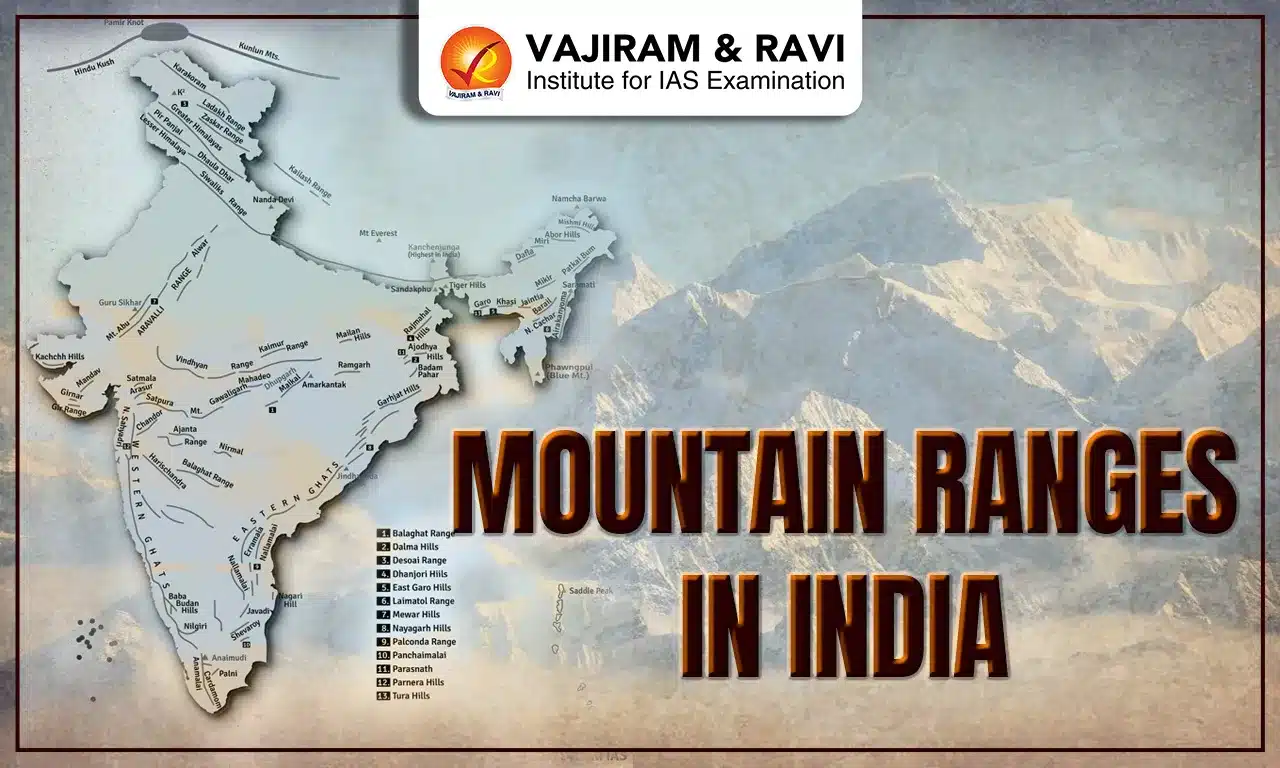
  • NOTA option introduced
  • Voter choice and freedom enhanced
  • Electoral secrecy protected
  • Democratic participation strengthened
  • Electoral reforms encouraged

NALSA v. Union of India (2014)

This progressive judgement recognised transgender persons as a distinct legal category. The Supreme Court affirmed their rights to equality, dignity, and self-identification. It directed the state to implement welfare and inclusion measures.

  • Third gender legally recognised
  • Equality and dignity upheld
  • Welfare measures directed
  • Reservations encouraged
  • Social inclusion promoted

Right to Privacy - Puttaswamy Case (2017)

The Supreme Court unanimously declared the right to privacy as a fundamental right. It linked privacy with personal liberty, dignity, and autonomy. The judgement overruled earlier restrictive interpretations.

  • Privacy recognised as a Fundamental Right
  • Integral part of Article 21
  • Limits placed on state surveillance
  • Individual autonomy protected
  • Earlier rulings overruled

Triple Talaq Judgement (2017)

This judgement struck down the practice of instant triple talaq for being arbitrary and unconstitutional. The Supreme Court prioritised gender justice and constitutional morality. It strengthened women’s rights within personal laws.

  • Instant triple talaq declared unconstitutional
  • Equality and dignity upheld
  • Arbitrary religious practices rejected
  • Constitutional morality applied
  • Women’s rights reinforced

Section 377 Judgement (2018)

This historic ruling decriminalised consensual same-sex relations between adults. The Supreme Court affirmed personal liberty, dignity, and equality. It marked a significant advance in rights-based jurisprudence.

  • Consensual same-sex acts decriminalised
  • Personal autonomy recognised
  • Equality and dignity affirmed
  • Constitutional morality prioritised
  • Progressive interpretation of fundamental rights advanced

Important Supreme Court Judgements FAQs

Q1: What are landmark Supreme Court judgements?

Ans: Landmark judgements are decisions of the Supreme Court that have a profound impact on Indian law, governance, or society.

Q2: Why are Supreme Court judgements important?

Ans: These judgements shape the interpretation of the Constitution, limit arbitrary state power, ensure social justice, and protect civil liberties.

Q3: What is the Basic Structure Doctrine?

Ans: The Basic Structure Doctrine, established in the Kesavananda Bharati case (1973), holds that Parliament can amend the Constitution but cannot alter its core principles such as democracy, federalism, and fundamental rights.

Q4: Which case recognised the right to privacy as a Fundamental Right?

Ans: The Puttaswamy case (2017) declared the right to privacy as an intrinsic part of the Right to Life and Personal Liberty under Article 21.

Q5: Which judgement addressed gender justice for Muslim women?

Ans: The Shah Bano Begum case (1985) upheld a Muslim woman’s right to maintenance, emphasising equality and dignity over personal law practices.

Asian Countries, List, Capitals, Currency, Area, Population

Asian Countries

List of Asian Countries: Asia, the world's largest and most populous continent, with huge diversity. There are 48 countries in Asia, making it the largest and most populous continent in the world. It covers about 30% of the Earth’s land area and is home to nearly 60% of the global population. Each country tells a unique story through its capital city, currency, and regional identity. This article includes the List of Asian Countries, showcasing their capitals, regions, and other interesting details. 

Asian Countries

Asia, the world’s largest continent, spans 44.58 million square kilometres, covering 30% of Earth’s land area and hosting 60% of its population. Located in the northern and eastern hemispheres, it is bordered by the Pacific Ocean (east), Indian Ocean (south), and Arctic Ocean (north). It connects to Europe through the Ural Mountains and links to Africa via the Isthmus of Suez. Its immense diversity and strategic location make it a vital region in understanding global development, both historically and in contemporary times.

Asian Countries

Divisions

Countries

Central Asia

Kazakhstan, Kyrgyzstan, Tajikistan, Turkmenistan, Uzbekistan

Eastern Asia

China, Hong Kong, Japan, North Korea, South Korea, Macau, Mongolia, Taiwan

Northern Asia

Russia

South-eastern Asia

Brunei, Myanmar, Cambodia, Indonesia, Laos, Malaysia, Philippines, Singapore, Thailand, Timor-Leste, Vietnam.

Southern Asia

Afghanistan, Bangladesh, Bhutan, India, Maldives, Nepal, Pakistan, Sri Lanka.

Western Asia

Armenia, Azerbaijan, Bahrain, Cyprus, Georgia, Iran, Iraq, Israel, Jordan, Kuwait, Lebanon, Oman, State of Palestine, Qatar, Saudi Arabia, Syria, Turkey, United Arab Emirates, and Yemen.

List of Asian Countries, Capital and Currency

Asia, the Largest Continent in the World, is home to 48 countries, as recognized by the United Nations. Spanning a massive land area of over 44.58 million km², the continent showcases diverse geographical, cultural, and political characteristics.

Among these nations, Russia holds the title of the largest Asian country by area, covering approximately 13 million km², which accounts for 77% of Asia's landmass. Next in line is China, having an area of 9.6 million km². On the other hand, the smallest Asian nation is the island country of Maldives, which spans just 298 km².

List of Asian Countries, Capital and Currency

Country

Capital

Region

Currency

Population (2024 Estimate)

Afghanistan

Kabul

South Asia

Afghan Afghani (AFN)

41.8 million

Armenia

Yerevan

West Asia

Armenian Dram (AMD)

2.8 million

Azerbaijan

Baku

West Asia

Azerbaijani Manat (AZN)

10.4 million

Bahrain

Manama

West Asia

Bahraini Dinar (BHD)

1.8 million

Bangladesh

Dhaka

South Asia

Bangladeshi Taka (BDT)

171.2 million

Bhutan

Thimphu

South Asia

Bhutanese Ngultrum (BTN)

777,000

Brunei

Bandar Seri Begawan

Southeast Asia

Brunei Dollar (BND)

450,000

Cambodia

Phnom Penh

Southeast Asia

Cambodian Riel (KHR)

17.1 million

China

Beijing

East Asia

Chinese Yuan (CNY)

1.41 billion

Cyprus

Nicosia

West Asia

Euro (EUR)

1.2 million

Georgia

Tbilisi

West Asia

Georgian Lari (GEL)

3.7 million

India

New Delhi

South Asia

Indian Rupee (INR)

1.44 billion

Indonesia

Jakarta

Southeast Asia

Indonesian Rupiah (IDR)

278.7 million

Iran

Tehran

West Asia

Iranian Rial (IRR)

88.2 million

Iraq

Baghdad

West Asia

Iraqi Dinar (IQD)

45.6 million

Israel

Jerusalem

West Asia

Israeli New Shekel (ILS)

9.6 million

Japan

Tokyo

East Asia

Japanese Yen (JPY)

124.7 million

Jordan

Amman

West Asia

Jordanian Dinar (JOD)

11.4 million

Kazakhstan

Astana

Central Asia

Kazakhstani Tenge (KZT)

19.7 million

Kuwait

Kuwait City

West Asia

Kuwaiti Dinar (KWD)

4.5 million

Kyrgyzstan

Bishkek

Central Asia

Kyrgyzstani Som (KGS)

6.9 million

Laos

Vientiane

Southeast Asia

Lao Kip (LAK)

7.7 million

Lebanon

Beirut

West Asia

Lebanese Pound (LBP)

6.5 million

Malaysia

Kuala Lumpur

Southeast Asia

Malaysian Ringgit (MYR)

34.4 million

Maldives

Malé

South Asia

Maldivian Rufiyaa (MVR)

557,000

Mongolia

Ulaanbaatar

East Asia

Mongolian Tugrik (MNT)

3.5 million

Myanmar

Naypyidaw

Southeast Asia

Burmese Kyat (MMK)

55.5 million

Nepal

Kathmandu

South Asia

Nepalese Rupee (NPR)

31.1 million

North Korea

Pyongyang

East Asia

North Korean Won (KPW)

26.1 million

Oman

Muscat

West Asia

Omani Rial (OMR)

5.4 million

Pakistan

Islamabad

South Asia

Pakistani Rupee (PKR)

247.5 million

Palestine

Ramallah

West Asia

Israeli New Shekel (ILS)

5.4 million

Philippines

Manila

Southeast Asia

Philippine Peso (PHP)

119.9 million

Qatar

Doha

West Asia

Qatari Riyal (QAR)

2.9 million

Russia*

Moscow

Eurasia

Russian Ruble (RUB)

143.5 million

Saudi Arabia

Riyadh

West Asia

Saudi Riyal (SAR)

36.5 million

Singapore

Singapore

Southeast Asia

Singapore Dollar (SGD)

5.7 million

South Korea

Seoul

East Asia

South Korean Won (KRW)

51.7 million

Sri Lanka

Sri Jayawardenepura Kotte

South Asia

Sri Lankan Rupee (LKR)

21.4 million

Syria

Damascus

West Asia

Syrian Pound (SYP)

19.8 million

Taiwan

Taipei

East Asia

New Taiwan Dollar (TWD)

23.6 million

Tajikistan

Dushanbe

Central Asia

Tajikistani Somoni (TJS)

10.1 million

Thailand

Bangkok

Southeast Asia

Thai Baht (THB)

71.9 million

Timor-Leste

Dili

Southeast Asia

US Dollar (USD)

1.4 million

Turkey*

Ankara

Eurasia

Turkish Lira (TRY)

88.6 million

Turkmenistan

Ashgabat

Central Asia

Turkmenistan Manat (TMT)

6.4 million

United Arab Emirates

Abu Dhabi

West Asia

UAE Dirham (AED)

10.2 million

Uzbekistan

Tashkent

Central Asia

Uzbekistani Som (UZS)

36.3 million

Vietnam

Hanoi

Southeast Asia

Vietnamese Dong (VND)

103.7 million

Yemen

Sana’a

West Asia

Yemeni Rial (YER)

34.3 million

Top 10 Asian Countries Area Wise

Water covers about 71% of the Earth's surface, while landmass occupies the remaining 29%. When it comes to the largest countries by land area in Asia, Russia takes the lead, spanning an impressive 17,125,000 square kilometres. The following are the Top 10 Asian Countries (Area Wise):

Top 10 Asian Countries Area Wise

Asian Countries

Area covered

Russia

17,125,000 ²km

Canada

9,984,670 ²km

China

9,572,900 ²km

United States of America

9,525,067 ²km

Brazil

8,515,767 ²km

Australia

7,692,202 ²km

India

3,166,391 ²km

Argentina

2,780,400 ²km

Kazakhstan

2,724,900 ²km

Algeria

2,381,741 ²km

Top 10 Asian Countries Population Wise

Asia contributes the most when it comes to the global population, accounting for approximately 60%. Among its vast nations, China and India stand out as the most populous. China, with its population of 1.37 billion, leads the continent. The following are the Top 10 Asian Countries (Population Wise):

Top 10 Asian Countries Population Wise

Asian Countries

Population

China

1.37 billion

India

1.299 billion

Indonesia

255.46 million

Pakistan

191.78 million

Bangladesh

158.76 million

Japan 

126.89 million

The Philippines

102.96 million

Vietnam

91.81 million

Iran

78.77 million

Turkey

78.21 million

Asian Countries and Populations

Asia, the largest and most populous continent on the Earth, is divided into six distinct geographical regions based on physiographic features. Each of these regions encompasses a variety of countries with diverse landscapes, cultures, and populations. Below is a List of Asian Countries categorised by their respective regions, along with details about their population sizes.

Asian Countries and Population

Regions

Asian Countries

Populations

Northern Asia

Russia (Siberia)

146,085,586 

Western Asia

Armenia

2,963,243

Azerbaijan

10,139,177

Bahrain

1,701,575

Cyprus

1,207,359

Georgia

3,989,167

Iran

83,992,949

Iraq

40,222,493

Israel

8,655,535

Jordan

10,203,134

Kuwait

4,270,571

Lebanon

6,825,445

Oman

5,106,626

Qatar

2,881,053

Saudi Arabia

34,813,871

State of Palestine

5,101,414

Syria

17,500,658

Turkey

84,339,067

United Arab Emirates

9,890,402

Jordan

10,203,134

Kuwait

4,270,571

Oman

5,106,626

Qatar

2,881,053

Saudi Arabia

34,813,871

State of Palestine

5,101,414

Syria

17,500,658

Turkey

84,339,067

United Arab Emirates

9,890,402

Yemen

29,825,964

Central Asia

Kazakhstan

18,776,707

Kyrgyzstan

6,524,195

Tajikistan

9,537,645

Turkmenistan

6,031,200

Uzbekistan

33,469,203

East Asia

China

1,439,323,776

China, Hong Kong SAR

7,496,981

China, Macao SAR

649,335

Japan

126,476,461

North Korea

25,778,816

South Korea

51,269,185

Mongolia

3,278,290

Taiwan

23,816,775

South Asia

Afghanistan

38,928,346

Bangladesh

164,689,383

Bhutan

771,608

India

1,380,004,385

Maldives

540,544

Nepal

29,136,808

Pakistan

220,892,340

Sri Lanka

21,413,249

Southeast Asia

Brunei Darussalam

437,479

Cambodia

16,718,965

Indonesia

273,523,615

Lao PDR

7,275,560

Malaysia

32,365,999

Myanmar (Burma)

54,409,800

Philippines

109,581,078

Singapore

5,850,342

Thailand

69,799,978

Timor-Leste (East Timor)

1,318,445

Vietnam

97,338,579

Asian Countries Map

This Asian Countries Map depicts a political division of Asia, showcasing all countries with clear boundaries and capitals. Asia, covering around 49.7 million km² (≈30 % of Earth's land area), is bordered by the Arctic Ocean in the north, Pacific Ocean to the east, Indian Ocean to the south, and connects with Europe via the Ural Mountains and Caucasus. Asia’s landmass features transcontinental nations such as Russia, Turkey, Kazakhstan, Azerbaijan, and Georgia, which straddle both Europe and Asia.

Asian Countries Features

  1. Diverse Economies: Asia has economic powerhouses like China, Japan, and India, alongside emerging markets such as Vietnam and Bangladesh that are rapidly industrializing.
  2. Cultural Richness: Home to ancient civilizations and spiritual traditions, Asia features deep cultural roots in countries like China, India, Thailand, and Indonesia.
  3. Population Giants: China and India together make up more than one-third of the world’s population, with each exceeding one billion people.

Economic and Cultural Diversity in Asia

Economic and Cultural Diversity in Asia is remarkably diverse. The continent includes advanced economies like Japan, Singapore, and South Korea, alongside rapidly developing countries striving for growth. Culturally, Asia showcases a rich variety of languages, religions, traditions, and social norms, highlighting its vast historical and societal depth across regions.

Asian Countries FAQs

Q1: How many countries in Asia?

Ans: Currently, there are 48 countries in the Asian continent according to the United Nations.

Q2: List the top 3 countries in terms of area globally?

Ans: The top 3 countries in terms of area are- Russia, Canada and China.

Q3: List the top 3 countries in terms of population globally?

Ans: The top 3 countries in terms of population are- China, India and Indonesia.

Q4: What are the subregions of Asian Countries?

Ans: The six geographical regions of Asian countries are, namely, Northern Asia, Western Asia, Central Asia, Eastern Asia, Southern Asia, and Southeast Asia.

Q5: Which countries are covered in Southern Asian Countries?

Ans: The countries covered under southern Asian countries are- Afghanistan, Bangladesh, Bhutan, India, Maldives, Nepal, Pakistan, Sri Lanka.

Wildlife Protection Act 1972, Objectives, Provisions, Significance

Wildlife Protection Act 1972

The Wildlife Protection Act 1972 is one of India’s most important environmental legislation, providing an important turning point in India’s approach to biodiversity conservation. The act provided a framework to conserve ecosystems, protect endangered species and regulate human interaction with wildlife. This law continues to be a foundation of India’s wildlife conservation strategy and its implementation has evolved through amendments, particularly in line with global conventions such as CITES. In this article, we are going to cover the Wildlife Protection Act 1972, its provisions and objectives its effectiveness. 

Wildlife Protection Act 1972

The Wildlife Protection Act 1972 was enacted by the Government of India, 1972 and came into force in 1973. 

  • It provides a framework to protect wild animals, birds, plants and their habitats. 
  • Regulates activities like hunting, poaching and trade of wildlife products. 
  • Creates protected areas such as National Parks, wildlife sanctuaries and Biosphere reserves. 

Wildlife Protection Act 1972 Objectives

Wildlife Protection Act 1972 has the following objectives: 

  • Protection of endangered species and prevention of extinction.
  • Regulation of hunting and safeguarding wildlife against poaching.
  • Control of trade and commerce in wildlife and its derivatives.
  • Creation of protected areas to conserve biodiversity in natural habitats.
  • Promotion of coexistence between humans and wildlife.

Wildlife Protection Act 1972 Key Provisions

Wildlife Protection Act 1972 has the following provisions: 

1. Wildlife includes animals (terrestrial and aquatic), plants, insects, fish, and vegetation forming part of any habitat.

2. Establishment of Wildlife Advisory Boards

  • Constituted at the state level to advise on:
    • Selection and management of Sanctuaries and National Parks.
    • Conservation policies for wildlife and plants.
    • Harmonizing tribal needs with conservation goals.

3. Schedules of the WPA

The Act categorizes flora and fauna into six schedules with varying levels of protection.

  • Schedule I & II: Endangered species; absolute protection; highest penalties (1–6 years imprisonment + fine). Example: Tiger, Elephant.
  • Schedule III & IV: Species not endangered; lesser penalties. Example: Hyena, Nilgai.
  • Schedule V: Vermin species that may be hunted with license. Example: Crows, Rats.
  • Schedule VI: Regulation of cultivation and trade of specific plants. Example: Beddomes’ cycad.

4. Hunting Regulations

  • General ban on hunting animals from Schedules I–IV.
  • Chief Wildlife Warden may grant permits if animals pose danger or are diseased.
  • Permits can also be issued for education, scientific research, and zoological purposes.

5. Wildlife Sanctuaries

  • Declared by State Governments.
  • Protect ecologically significant areas.
  • Certain activities may be permitted with regulation.

6. National Parks

  • Declared by State Legislatures.
  • No alteration of boundaries without legislative approval.
  • Prohibited activities: hunting, grazing, habitat destruction, and exploitation.

7. Central Zoo Authority

  • Supervises zoos across India.
  • Ensures proper care and conservation practices for captive animals.

8. Ownership of Wildlife & Trophies

  • All wildlife (other than vermin), trophies, and animal products are state property.
  • Illegal possession, trade, or transfer is punishable.

Wildlife Protection (Amendment) Act 2021

  • CITES Implementation: Expanded protection for species under international trade regulation.
  • Rationalized Schedules: Reduced from six to four for clarity:
    • Schedule I: Highest protection.
    • Schedule II: Lesser protection.
    • Schedule III: Protected plants.
    • Schedule IV: CITES species.
  • Regulation of Invasive Alien Species: Government empowered to prohibit or control them.
  • Increased Penalties: General fine raised from ₹25,000 to ₹1,00,000.
  • Stronger Management of Sanctuaries: Gram Sabha consultation made mandatory in scheduled areas.
  • Voluntary Surrender: Captive animals and trophies can be surrendered without compensation.
  • Controversial Clause: Commercial trade in live elephants permitted under certain conditions.

Wildlife Protection Act 2021 Amendment Significance

Wildlife Protection Act 2021 has the following significance: 

  • Aligns India’s wildlife laws with global conservation standards (CITES).
  • Provides clarity by simplifying schedules.
  • Strengthens community participation in wildlife management.
  • Introduces better penalties and enforcement mechanisms.
  • Recognizes modern conservation challenges like invasive alien species.

Wildlife Protection Act 1972 FAQs

Q1: What is the Wildlife Protection Act 1972?

Ans: The Wildlife Protection Act 1972 is an Indian law enacted to protect wild animals, plants, and their habitats by creating a legal framework for conservation.

Q2: What are the protected areas under the Wildlife Protection Act?

Ans: Protected areas under the Act include National Parks, Wildlife Sanctuaries, Conservation Reserves, and Community Reserves.

Q3: What are the objectives of the Wildlife Protection Act, 1972?

Ans: Its objectives are to protect endangered species, regulate hunting, control wildlife trade, and establish protected areas.

Q4: What is Schedule I of the Wildlife Protection Act, 1972?

Ans: Schedule I provides absolute protection to endangered species, with the highest penalties for violations.

Q5: What is CITES?

Ans: CITES (Convention on International Trade in Endangered Species of Wild Fauna and Flora) is an international treaty regulating trade in endangered species to ensure it does not threaten their survival.

Mountain Ranges in India, List, Map, Key Features, Details

Mountain Ranges in India

India is home to some of the most magnificent and ancient mountain ranges in the world. These Mountain Ranges in India define the country's geography, influence its climate, shape its river systems, and play a key role in cultural and spiritual traditions. From the towering Himalayas in the north to the scenic Nilgiris in the south, each range tells a story of geological evolution and natural beauty.

In this detailed guide, we will understand the major Mountain Ranges in India, their location, formation, highest peaks, and unique geographical features.

Mountain Ranges in India

India is a land of many beautiful mountain ranges that cover almost every part of the country. From the high Himalayas in the north to the green hills of the Western and Eastern Ghats in the south, these ranges add to India’s natural beauty. They also play an important role in climate, rivers, and rich wildlife. The details of all the important Mountain Ranges in India has been shared below. 

1. The Himalayas

The Himalayas are among the most prominent and youngest fold mountain ranges in the world, formed by the collision of the Indian Plate with the Eurasian Plate millions of years ago. Stretching over 2,500 km from west to east, they form a natural barrier between the Indian subcontinent and the Tibetan Plateau.

  • Length: ~2,500 km
  • Width: 160-400 km
  • Highest Peak: Mount Everest (8,848.86 meters)
  • Spread Across: India, Nepal, Bhutan, China, and Pakistan
  • Borders: Karakoram & Hindu Kush (NW), Tibetan Plateau (N), Indo-Gangetic Plain (S)

The Himalayas are divided into three main parallel ranges (from north to south):

  1. Greater Himalayas (Himadri)
  2. Lesser Himalayas (Himachal)
  3. Outer Himalayas (Shivalik)

I. The Greater Himalayas (Himadri)

The Greater Himalayas, also known as Himadri or the Inner Himalayas, form the northernmost and highest range of the Himalayan system. This range has an average elevation of around 6,000 meters, containing many of the world’s tallest peaks such as Mount Everest (8,849 m), Kanchenjunga (8,598 m), and Nanga Parbat. It is the permanent snow-covered zone and the origin of major glaciers like Gangotri and Satopanth, which give rise to sacred rivers such as the Ganga and Yamuna.

II. Lesser Himalayas (Himachal)

The Lesser Himalayas, also known as the Himachal Range or Middle Himalayas, lie to the south of the Himadri. They have an average elevation ranging from 3,700 to 4,500 meters and consist of rugged terrain with deep valleys and forested slopes. Major mountain ranges like the Pir Panjal, Dhauladhar, and Nag Tibba belong to this region. It is home to several popular hill stations such as Shimla, Mussoorie, Nainital, and Dharamshala, making it a prominent zone for tourism and habitation.

III. Outer Himalayas (Shivalik)

The Outer Himalayas, also known as the Shivalik Hills, form the southernmost and youngest range of the Himalayan system. They stretch for about 2,400 km from the Indus Gorge in the northwest to the Brahmaputra valley in the east, with an average height of 1,500-2,000 meters. The range is composed mainly of loose sediments and gravel, making it prone to erosion. It features fertile Doon and Duar valleys (like Dehradun), and is known by local names such as Dafla Hills, Dundwa Range, and Churia Hills in different regions.

2. The Karakoram Range

The Karakoram Range, located in the northern region of India (Ladakh and Jammu & Kashmir), is one of the most rugged and high-altitude mountain systems in the world. Stretching across India, Pakistan, and China, it features some of the highest peaks on Earth, including K2 (8,611 meters), the second-highest peak in the world. The range is also home to vast glaciers like the Siachen Glacier, which is the longest glacier outside the polar regions.

  • Location: Northern India (Ladakh & J&K), extending into Pakistan and China
  • Highest Peak: K2 (8,611 m), world’s second-highest mountain
  • Major Glaciers: Siachen, Baltoro, Biafo, and Hispar
  • Importance: Acts as a natural barrier and holds great strategic and defense significance for India

3. The Purvanchal Range

The Purvanchal Range, also known as the Eastern Hills, is an extension of the Himalayas located in northeastern India, curving southward beyond the Dihang River. It runs along the borders of Nagaland, Manipur, Mizoram, Tripura, and Assam, forming a scenic landscape of lush hills and dense forests. The region is known for its rich biodiversity, humid climate, and tribal culture, making it an ecological hotspot. These ranges also play a key role in preventing soil erosion and maintaining the stability of the northeastern terrain.

  • Location: Northeastern India (Assam, Manipur, Nagaland, Mizoram, Tripura)
  • Highest Peak: Dapha Bum (4,570 m)
  • Major Hills: Patkai, Naga, Mizo, and Manipur Hills
  • Significance: Rich in biodiversity, cultural diversity, and ecological importance

4. The Aravalli Range

The Aravalli Range, one of the oldest fold mountain ranges in the world, stretches for about 700 km from Delhi and Haryana through Rajasthan to Gujarat. Formed during the Precambrian era, it is a residual mountain range that has been heavily eroded over millions of years. Despite its age, the Aravallis play a vital role in blocking the expansion of the Thar Desert, supporting biodiversity, and maintaining ecological balance in northwestern India. The famous Mount Abu hill station and Guru Shikhar (1,722 m), its highest peak, lie within this range.

  • Location: Extends across Delhi, Haryana, Rajasthan, and Gujarat
  • Highest Peak: Guru Shikhar (1,722 m) in Mount Abu, Rajasthan
  • Type: Ancient fold (residual) mountains
  • Significance: Prevents desert spread, rich in minerals, and hosts historical sites

5. The Western Ghats

The Western Ghats, also known as the Sahyadri Hills, run parallel to the western coast of India for about 1,600 km from Gujarat to Kerala. This mountain range is one of the eight biodiversity hotspots in the world and a UNESCO World Heritage Site. It plays a major role in influencing the Indian monsoon, maintaining ecological balance, and supporting diverse flora and fauna. The region is home to scenic hill stations like Munnar, Wayanad, and Mahabaleshwar, as well as Anamudi (2,695 m), the highest peak in South India.

  • Location: Extends through Gujarat, Maharashtra, Goa, Karnataka, Kerala, and Tamil Nadu
  • Highest Peak: Anamudi (2,695 m), Kerala
  • Local Names: Sahyadri (Maharashtra), Nilgiri, Anaimalai, and Cardamom Hills (South)
  • Significance: Regulates monsoon, rich biodiversity, UNESCO World Heritage Site

6. The Eastern Ghats

The Eastern Ghats are a discontinuous and eroded mountain range running along the eastern coast of India from Odisha to Tamil Nadu. Unlike the Western Ghats, they are not continuous and are intersected by major east-flowing rivers like the Mahanadi, Godavari, Krishna, and Kaveri. These ancient hills are rich in minerals, forests, and biodiversity, playing a crucial role in the ecology and agriculture of eastern India. The Jindhagada Peak (1,690 m) in Andhra Pradesh is the highest point in the Eastern Ghats.

  • Location: Extends through Odisha, Andhra Pradesh, Telangana, Karnataka, and Tamil Nadu
  • Highest Peak: Jindhagada Peak or Arma Konda or Sitamma Konda(1,690 m), Andhra Pradesh
  • Major Hills: Javadi, Nallamala, Palkonda, Seshachalam, and Shevaroy Hills
  • Significance: Source of east-flowing rivers, rich in minerals and forest resources

7. The Vindhya Range

The Vindhya Range is a discontinuous chain of hills and plateaus located in central India, extending across Madhya Pradesh, Uttar Pradesh, and parts of Bihar and Chhattisgarh. It runs almost parallel to the Narmada River and forms a natural boundary between North and South India. The range holds great mythological and cultural significance, being mentioned in many ancient Hindu scriptures as the southern limit of the Aryavarta region. Its terrain consists of rocky ridges and forested plateaus, rich in minerals and wildlife.

  • Location: Central India - Madhya Pradesh, Uttar Pradesh, Bihar, and Chhattisgarh
  • Highest Peak: Sad-Bhawna Shikhar (752 m)
  • Type: Discontinuous and ancient mountain range
  • Significance: Marks the boundary between North and South India; rich in mineral and cultural heritage

8. The Satpura Range

The Satpura Range lies to the south of the Vindhya Range and extends through Madhya Pradesh, Maharashtra, and Chhattisgarh. It consists of a series of flat-topped plateaus and rugged hills, with an average elevation of 600-900 meters. The range is known for its dense forests, rich biodiversity, and significant role in separating the Narmada and Tapi river valleys. Its highest peak, Dhupgarh (1,350 m) near Pachmarhi in Madhya Pradesh, is also the highest point in Central India.

  • Location: Extends through Madhya Pradesh, Maharashtra, and Chhattisgarh
  • Highest Peak: Dhupgarh (1,350 m), near Pachmarhi
  • Type: Relict (eroded) mountain range formed by plateaus
  • Significance: Source of major rivers, rich in forests and wildlife sanctuaries like Pachmarhi Biosphere Reserve

9. The Nilgiri Hills

The Nilgiri Hills, meaning “Blue Mountains,” are located at the junction of Tamil Nadu, Kerala, and Karnataka, forming part of the Western Ghats. These hills are known for their rolling tea gardens, pleasant climate, and rich biodiversity. The Doddabetta Peak (2,637 m) is the highest point in the Nilgiri range and one of the highest in South India. The Nilgiris also serve as a meeting point of the Eastern and Western Ghats, making them a vital ecological and geographical link in southern India.

  • Location: Junction of Tamil Nadu, Kerala, and Karnataka
  • Highest Peak: Doddabetta (2,637 m), Tamil Nadu
  • Known For: Tea plantations, scenic beauty, and biodiversity
  • Significance: Connects Eastern and Western Ghats; major hill stations like Ooty and Coonoor

Mountain Ranges in India Map

The Mountain Ranges in India Map clearly shows how these ranges are spread across the country, shaping its geography and climate. In the north, the Himalayas and Karakoram dominate, while the Aravalli, Vindhya, and Satpura ranges define central India’s terrain. The Western and Eastern Ghats run along the peninsular coasts, and the Purvanchal hills mark the country’s eastern frontier. Together, these ranges form the backbone of India’s physical landscape.

List of Mountain Ranges in India

India has many famous mountain ranges that make the country rich in natural beauty. From the great Himalayas in the north to the green Ghats in the south, each range is special in its own way. They are home to rivers, forests, and many beautiful places to visit. All the Important mountain ranges of India have been shared below.

Mountain Ranges in North India (North to South)

The Mountain Ranges in North India are dominated by some of the world’s highest and most majestic mountain ranges, including the Himalayas and the Karakoram. Stretching from Ladakh to Arunachal Pradesh, these ranges form a natural barrier against cold winds from Central Asia and play a vital role in shaping India’s climate, rivers, and biodiversity.

Mountain Ranges in North India (North to South)

Mountain Range

Location/State

Saltoro Mountains

Ladakh

Karakoram Range

Ladakh

Deosai Mountain

Jammu & Kashmir

Ladakh Range

Jammu & Kashmir

Zanskar Range

Jammu & Kashmir

Pir Panjal Range

Jammu & Kashmir

Zabarwan Range

Jammu & Kashmir

Dhauladhar Range

Himachal Pradesh

Kishtwar Himalaya

Jammu & Kashmir

Garhwal Himalaya

Uttarakhand

Dundwa Range

Northern Uttar Pradesh

Mountain Ranges in Central India (West to East)

The Mountain Ranges in Central India are mostly folded and eroded hills, rich in minerals and dense forests. Stretching from Rajasthan in the west to Jharkhand in the east, they play a key role in influencing local climate, drainage patterns, and biodiversity.

Mountain Ranges in Central India (West to East)

Mountain Range

Location/State

Aravalli Range

Rajasthan to Haryana

Vindhya Range

Madhya Pradesh to Uttar Pradesh

Satpura Range

Madhya Pradesh to Maharashtra

Maikal Range

Madhya Pradesh to Chhattisgarh

Rajmahal Hills

Jharkhand

Mountain Ranges in North East India (North to South)

The Mountain Ranges in North East India are part of the Eastern Himalayas and Patkai hills, forming a natural boundary with Myanmar and China. These ranges are rich in biodiversity, covered with dense forests, and home to many tribal communities. The region includes significant ranges like Patkai, Naga, Mizo, Garo, Khasi, and Jaintia Hills, known for their scenic beauty and cultural diversity.

Mountain Ranges in Central India (West to East)

Mountain Range

Location (State/Region)

Highest Peak

Approx. Height (m)

Patkai Range

Arunachal Pradesh, Nagaland

Mount Saramati

3,841 m

Naga Hills

Nagaland

Mount Saramati

3,841 m

Khasi Hills

Meghalaya

Lum Shyllong

1,965 m

Jaintia Hills

Meghalaya

Smit Peak

1,700 m

Garo Hills

Meghalaya

Nokrek Peak

1,412 m

Mizo Hills (Lushai Hills)

Mizoram

Blue Mountain (Phawngpui)

2,157 m

Western Ghats Mountains (North to South)

The Western Ghats, also known as the Sahyadri Range, run parallel to India’s western coast from Gujarat to Kerala. These mountains form one of the world’s eight biodiversity hotspots, known for their lush forests, waterfalls, and diverse wildlife. Here is the list of Western Ghats Mountains (North to South).

Western Ghats Mountains (North to South)

Mountain Range

States

Satmala Hills

Maharashtra

Ajanta Hills

Maharashtra

Harishchandra Range

Maharashtra

Balaghat Range

Maharashtra

Kudremukh

Karnataka

Baba Budan Hills

Karnataka

Nilgiri Mountains

Tamil Nadu

Akamala Machad Hills

Kerala

Anaimalai Hills

Tamil Nadu, Kerala

Palani Hills

Tamil Nadu, Kerala

Cardamom Hills

Tamil Nadu, Kerala

Varushnad Hills

Tamil Nadu

Eastern Ghats Mountains (North to South)

The Eastern Ghats run parallel to India’s eastern coast, extending from Odisha in the north to Tamil Nadu in the south. These discontinuous and ancient hill ranges are lower than the Western Ghats and are rich in minerals, forests, and scenic river valleys like those of the Godavari and Krishna.

Eastern Ghats Mountains (North to South)

Mountain Range

States

Nayagarh Hills

Odisha

Bastar Plateau

Chhattisgarh

Nallamala Hills

Andhra Pradesh, Telangana

Erramala Hills

Andhra Pradesh

Velikonda Range

Andhra Pradesh

Palkonda Range

Andhra Pradesh

Seshachalam Hills

Andhra Pradesh

Nagari Hills

Andhra Pradesh

Javedi Hills

Tamil Nadu

Melagiri Range

Tamil Nadu

Shevaroy Hills

Tamil Nadu

Pachaimalai Hills

Tamil Nadu

Sirumalai Hills

Tamil Nadu

Mountain Peaks in India FAQs

Q1: Which is the oldest mountain range in India?

Ans: The Aravalli Range is the oldest mountain range in India and one of the oldest geological formations in the world, dating back to around 2.5 billion years.

Q2: Which is the highest mountain range in India?

Ans: The Greater Himalayas (Himadri) is the highest mountain range in India, containing peaks like Mount Everest (on the border) and Kanchenjunga (within India).

Q3: Which mountain range separates Northern and Southern India?

Ans: The Vindhya Range acts as a natural divide between North and South India, influencing both geography and climate.

Q4: What are the 7 major mountain ranges of India?

Ans: The 7 major mountain ranges in India are the Himalayas, Karakoram, Aravalli, Western Ghats, Eastern Ghats, Vindhya, and Satpura ranges.

Q5: Which is the 2nd highest peak in India?

Ans: Nanda Devi is the second-highest peak in India at 7,816 meters.

Neighbouring Countries of India, List, Capital, Physical Features

Neighbouring Countries of India: India, a prominent South Asian nation, stands out as one of the largest countries in the world. Positioned in both the Northern and Eastern Hemispheres, India ranks as the seventh-largest globally by land area. India's land boundaries extend to approximately 15,106.7 kilometers, encompassing a coastline of around 7,516.6 kilometers. This extensive border area offers unique access to neighboring countries, connecting India with cultures, economies, and ecosystems that enhance its regional significance.

Neighbouring Countries of India

India shares over 15,106.7 kilometers of land borders with six countries: Pakistan to the west, China and Nepal to the north, Bhutan to the northeast, and Bangladesh and Myanmar to the east. This geographical spread makes India a central player in South Asian geopolitics.

In addition to its land borders, India has a coastline stretching 7,516.6 kilometers, providing it with direct access to the Arabian Sea, the Bay of Bengal, and the Indian Ocean. This coastal expanse connects India to international waters, giving it a strategic marine position that supports trade routes linking the Middle East, Africa, and Southeast Asia. Important ports like Mumbai, Chennai, and Kolkata facilitate extensive trade and cultural exchange, solidifying India's role in the global economy.

Neighbouring Countries of India Overview

India shares its borders with nine countries: seven land borders (Pakistan, China, Nepal, Bhutan, Bangladesh, Myanmar, Afghanistan) and two maritime borders (Sri Lanka and the Maldives). This geographical knowledge is vital for competitive exams, especially in the General Awareness section.

Neighbouring Countries of India Overview

Total Neighbouring Countries Of India

9

Neighbouring Countries Of India

Afghanistan, Pakistan, China, Nepal, Bhutan, Bangladesh, Sri Lanka, Maldives and MyanmarTotal

Total Land Border Of India

15,106.7 k.m.

Total Length Of Indian Coastline

7516.6 km

List of Neighbouring Countries of India With Capital

India shares its borders with 9 countries, each with distinct geographical, cultural, and economic ties. Below is a List of Neighbouring Countries of India With Capital the capital, border length, and bordering states.

List of Neighbouring Countries of India With Capital

Country

Capital

Border Length

Bordering States

Afghanistan

Kabul

106 Km

Ladakh (PoK)

Bangladesh

Dhaka

4096.7 Km

West Bengal, Meghalaya, Mizoram, Tripura and Assam

Bhutan

Thimphu

699 Km

West Bengal, Sikkim, Arunachal Pradesh & Assam

China

Beijing

3488 Km

Ladakh, Himachal Pradesh, Uttarakhand, Sikkim and Arunachal Pradesh

Myanmar

Naypyidaw, Yangon

1643 Km

Arunachal Pradesh, Nagaland, Mizoram and Manipur

Nepal

Kathmandu

1751 Km

Bihar, Uttarakhand, UP, Sikkim and West Bengal

Pakistan

Islamabad

3323 Km

Jammu and Kashmir, Ladakh, Punjab, Rajasthan and Gujarat

Sri Lanka

Colombo (Commercial), Sri Jayawardenepura Kotte (Legislative)

Sea Border

It is separated to India by Gulf of Mannar

Maldives

Male

Sea Border

It lies in the south-west part of India Ocean below the Lakshadweep Island

Neighbouring Countries of India Physical Features

India shares its land and maritime boundaries with several countries, each having distinct physical features that influence geopolitics, trade, and regional cooperation. India shares land borders with seven countries and maritime boundaries with two. The Neighbouring Countries of India Physical Features has been discussed in the table below:

Neighbouring Countries of India Physical Features

Country

Geographical & Climatic Features

Energy & Natural Resources

India’s Strategic Interests

Afghanistan

Mountainous terrain influences cold winters and seismic activity due to tectonic plate location.

Rich in minerals and water but lacks infrastructure in remote regions.

Acts as a corridor for India to Central Asia, enhancing connectivity and economic cooperation.

Bangladesh

Dense river network vital for agriculture, but vulnerable to monsoons and floods; seismic risk exists.

Investing in solar energy to meet growing demands; high population strains resources.

Important trade partner in textiles and agriculture; collaboration on river management is crucial.

Bhutan

High-altitude mountainous country; experiences cold winters and occasional earthquakes.

Major hydropower potential; rivers are tapped for electricity generation.

India imports hydropower from Bhutan, vital for energy supply in northeastern states.

China

Geographically diverse, with deserts, tropical zones, and the Tibetan Plateau; earthquake-prone zones.

Global leader in renewable and nuclear energy production.

Trade ties benefit India in goods and tech, though geopolitical relations are complex and sensitive.

Myanmar

Tropical climate with intense monsoons; situated near earthquake fault lines.

Exploring geothermal and wind energy; rich in river-based water resources.

Strategic for India’s Act East policy; access to ports strengthens trade and regional integration.

Nepal

Dominated by the Himalayas; experiences altitude-driven cold weather and frequent quakes.

Excellent hydropower potential; solar energy initiatives are rising in remote areas.

Access to Nepal’s rivers for electricity benefits India’s northern power grid and water-sharing cooperation.

Pakistan

Diverse terrain with deserts and fertile plains; northern areas face high seismic activity.

Water-stressed despite major rivers; exploring wind and solar solutions.

Cooperation essential for managing shared rivers like the Indus; has energy and climate impact implications.

Sri Lanka

Island nation with tropical monsoons; affected by Indian Ocean climate and tsunami risk.

Expanding use of solar energy; coastal ecosystems critical for livelihood.

Strategic location aids India in maritime security, trade routes, and regional diplomacy.

Maldives

The low-lying island nation, highly threatened by sea-level rise, has a tropical marine climate.

Depends largely on solar energy; rich marine biodiversity in coral reefs.

Important for India’s maritime diplomacy and security in the Indian Ocean; enhances regional influence.

9 Neighbouring Countries of India 

India shares its borders with nine neighbouring countries, including Pakistan, China, Nepal, Bhutan, Bangladesh, Myanmar, Afghanistan, Sri Lanka, and the Maldives. Among them, seven share land borders: Pakistan, China, Nepal, Bhutan, Bangladesh, Myanmar, and Afghanistan, while Sri Lanka and the Maldives are India’s maritime neighbours. These countries together reflect India’s vast geopolitical landscape, cultural diversity, and regional influence.

1. Pakistan

Pakistan lies to the northwest of India, sharing a 3,323 km long border. The two countries were part of undivided British India until 1947. Key border crossings include Wagah (Punjab) and Attari (Amritsar). While relations have been politically strained, they share strong cultural and linguistic links.

2. China

China borders India to the north and northeast with a border length of 3,488 km. The boundary passes through Ladakh, Himachal Pradesh, Uttarakhand, Sikkim, and Arunachal Pradesh. Both countries are ancient civilizations and major Asian powers. However, the border areas like Aksai Chin and Arunachal Pradesh remain disputed.

3. Nepal

Nepal lies to the north of India, bordered by Bihar, Sikkim, Uttar Pradesh, and West Bengal, sharing an open border of 1,770 km. Citizens of both countries can travel and work freely across borders. The two nations share deep cultural, linguistic, and religious ties. Mount Everest and the Himalayas further connect their geography and tourism.

4. Bhutan

Bhutan is a landlocked Himalayan kingdom situated to the northeast of India, sharing a 699 km border. It touches Indian states like Sikkim, Arunachal Pradesh, Assam, and West Bengal. Relations between India and Bhutan are marked by friendship, trust, and cooperation. India assists Bhutan in defense, trade, and hydropower development.

5. Bangladesh

Bangladesh lies to the east of India and shares the longest international border with India, about 4,096 km. It borders West Bengal, Assam, Meghalaya, Tripura, and Mizoram. The two countries share strong historical and cultural bonds, with Bengali as a common language. India supported Bangladesh’s independence movement in 1971.

6. Myanmar (Burma)

Myanmar shares a 1,643 km border with India, touching Arunachal Pradesh, Nagaland, Manipur, and Mizoram. It acts as India’s gateway to Southeast Asia under the “Act East Policy.” The Moreh–Tamu border point facilitates trade and cross-border cooperation. India and Myanmar also collaborate in defense and counter-insurgency operations.

7. Afghanistan

Afghanistan shares a 106 km border with India, though it currently lies in Pakistan-occupied Kashmir (PoK). Historically, India and Afghanistan had strong trade and cultural connections through the Silk Route. India has helped rebuild Afghanistan through infrastructure and education projects. The region is strategically vital for South Asian geopolitics.

8. Sri Lanka

Sri Lanka is India’s southern maritime neighbor, separated by the Palk Strait and the Gulf of Mannar. The shortest distance between them is around 30 km through Adam’s Bridge (Rama’s Bridge). The two nations share close historical, cultural, and religious ties, especially through Buddhism and Hinduism. Trade and tourism link both economies strongly.

9. Maldives

The Maldives lies to the southwest of India in the Indian Ocean, about 700 km from the Lakshadweep Islands. Though separated by sea, it is a key maritime neighbor of India. The two countries maintain friendly ties focused on security, trade, and tourism. India often assists the Maldives in disaster relief and defense cooperation.

Neighbouring Countries of India Facts

India-China Relations

India and China share a historical bond that spans thousands of years, marked by significant cultural and trade exchanges. In modern times, the two nations signed the Panchsheel Agreement in 1954, emphasizing mutual respect and peaceful coexistence. However, the relationship has been marred by a border conflict in 1962, which has led to long-standing disputes over territorial boundaries.

India-Pakistan Relations

The relationship between India and Pakistan is deeply rooted in a shared history, marked by the partition of British India in 1947. Despite cultural and historical similarities, the two nations have faced tensions, especially after conflicts such as the 1965 war and the Kargil conflict in 1999. Diplomatic channels remain open, with a focus on reducing tensions and fostering stability in the region.

South Asian Association for Regional Cooperation (SAARC)

Established in 1985, SAARC was formed with the goal of promoting regional cooperation and advancing economic, social, and cultural development across South Asia. Comprising eight member states, including India, Pakistan, and Bangladesh, SAARC aims to create a unified approach to addressing regional challenges such as poverty, education, and climate change. The organization has played a significant role in fostering peace and collaboration, though political disagreements have sometimes hindered its full potential.

India-Bangladesh Relations

India's support for Bangladesh's independence in 1971 laid the foundation for a strong bilateral relationship. Since then, India and Bangladesh have developed close ties in political, economic, and cultural spheres. Both countries share a commitment to regional peace and stability, with cooperation in areas like trade, water-sharing agreements, and counterterrorism. 

India-Sri Lanka Relations

India and Sri Lanka have long standing historical and cultural ties that have shaped their bilateral relationship. The two nations share deep connections through religion, language, and trade. While challenges related to the Indian-origin Tamil population in Sri Lanka have occasionally strained relations, both countries continue to maintain positive political and economic ties. Cooperation in areas such as defense, trade, and infrastructure development has strengthened the partnership, with efforts focused on resolving issues diplomatically.

Neighbouring Countries of India FAQs

Q1: How many neighbouring countries of India?

Ans: There are 9 neighbouring countries of India.

Q2: Which country has the longest boundary with India?

Ans: Bangladesh has the longest boundary with India.

Q3: Which country has the shortest boundary with India?

Ans: Afghanistan has the shortest boundary with India.

Q4: How many states share boundaries with China?

Ans: China shares a boundary with 5 Indian states.

Q5: How many states share boundary with Bangladesh?

Ans: Bangladesh share boundary with 5 Indian states.

Parliamentary Form of Government, History, Advantages, Disadvantages

Parliamentary Form of Government

A Parliamentary Form of Government is a form of democracy in which the political party that wins the most seats in a national election forms the ruling government. In this system, the executive is drawn from the legislature and is accountable to it. India follows a parliamentary system similar to that of the United Kingdom.

In a parliamentary system, there is a close relationship between the executive and legislative branches, with the executive being dependent on the confidence of the legislature. This arrangement ensures greater accountability and makes the Parliament the central institution of governance.

Parliamentary Form of Government History

Since ancient times, councils of headmen, whose decisions were guided by village elders, existed in tribal societies. These early consultative bodies gradually evolved into modern parliamentary institutions. In 1188, King Alfonso IX of León (Spain) convened the Cortes of León, considered one of Europe’s first parliaments. A proto-parliamentary system also emerged during the Dutch Revolt (1581), when the States-General assumed power from King Philip II of Spain. The modern parliamentary framework developed in the United Kingdom (1707-1800) and Sweden (1721-1772), gaining broader acceptance across Europe after World War I.

  • Adoption in the Indian Constitution: India adopted the parliamentary system from Britain after thorough deliberations. During the Constituent Assembly debates, different models including Presidential and Parliamentary systems were discussed. The parliamentary model was preferred for its capacity to provide strong leadership while ensuring accountability to the elected legislature.
  • Notable Opinions
    • Professor K. T. Shah emphasized that parliamentary government connects the Executive, Legislature, and Judiciary effectively.
    • Shri K. Hanumanthaiya argued that the parliamentary system was better suited to India’s needs than a Presidential system.

Parliamentary Form of Government Features

  • Real and Nominal Executives: The President acts as the formal or nominal executive, while the Prime Minister serves as the actual (de facto) executive. In this arrangement, the President represents the State, whereas the Prime Minister runs the government’s day-to-day affairs.
  • Dual Membership: The executive (Prime Minister and Council of Ministers) is drawn from the legislature (Parliament). Members of Parliament elect the Prime Minister and other cabinet ministers, linking the executive and legislative branches closely.
  • Collective Responsibility: The Council of Ministers is collectively accountable to the legislature. This principle ensures that all ministers share responsibility for government policies and decisions, even if individual ministers are directly responsible for their departments.
  • Secret Procedure: Cabinet discussions and deliberations are conducted in private and are not disclosed publicly, allowing for open and candid decision-making among ministers.
  • Leadership under the Prime Minister: The Prime Minister heads the government and exercises leadership over the Council of Ministers, guiding policy and administration.
  • Majority Party Rule: The Prime Minister is usually the leader of the party that holds a majority in the lower house of the legislature, ensuring stability and alignment between the executive and legislative branches.
  • Bicameral Legislature: Most parliamentary democracies have a bicameral legislature, consisting of two chambers, typically an upper house and a lower house, which provide checks and balances on lawmaking.
  • Political Homogeneity: Members of the Council of Ministers usually share similar political ideologies, as they belong to the same party. In coalition governments, ministers are bound by coalition agreements to maintain unity.
  • No Fixed Term: The government’s tenure depends on maintaining the confidence of the lower house. If a motion of no-confidence succeeds, the Council of Ministers must resign, triggering elections and the formation of a new government.

Parliamentary Form of Government Constitutional Provision

The Indian Constitution contains specific provisions that establish and support the parliamentary system of governance at both the central and state levels. The following table summarizes the key articles, their scope, and the way they define the roles, responsibilities, and accountability of the executive in relation to the legislature.

Parliamentary Form of Government Constitutional Provision

Article

Level

Provision

Key Features

Accountability

74

Central

Council of Ministers to aid and advise the President

President acts on advice of the Cabinet headed by PM; advice can be reconsidered but must be adopted

Not subject to judicial review

75

Central

Appointment and responsibility of the Council of Ministers

President appoints PM; PM recommends other ministers; ministers hold office during President’s pleasure

Council of Ministers is collectively responsible to Lok Sabha

163

State

State Council of Ministers to aid and advise the Governor

Governor acts on advice of Council headed by CM; discretionary powers in certain matters

Not subject to judicial review

164

State

Appointment and responsibility of State Ministers

Governor appoints CM; CM recommends other ministers; ministers hold office during Governor’s pleasure

Council of Ministers is collectively responsible to State Legislative Assembly

Parliamentary Form of Government Advantages

The Parliamentary Form of Government Advantages that contribute to effective governance and political stability. Its structure ensures cooperation between branches, accountability of the executive, prevention of despotism, and broad representation of diverse interests. The key merits are summarized below.

Parliamentary Form of Government Advantages

Merit

Description

Cooperation Between Legislative and Executive Branches

The parliamentary system fosters close coordination between the legislature and the executive, ensuring smooth policy-making and implementation.

Responsible Government

Ministers are accountable to Parliament, and their actions are scrutinized through tools such as question periods, debates, adjournment motions, and no-confidence motions.

Prevents Despotism

Executive power is vested in a council of ministers rather than a single individual, decentralizing authority and reducing the risk of authoritarianism.

Wide Representation

The council of ministers represents diverse regions, communities, and interests, enabling the government to reflect the country’s varied demographic and cultural composition.

Parliamentary Form of Government Disadvantages

While the Parliamentary Form of Government has several advantages, it is not without shortcomings. Certain structural and political factors can lead to instability, inefficiency, and limited accountability. The key demerits are summarized below.

Parliamentary Form of Government Disadvantages

Demerit

Description

No Separation of Powers

When the ruling party has a strong majority, the legislature may struggle to check the executive. Anti-defection laws further restrict MPs from voting independently, reducing legislative oversight.

Unqualified Lawmakers

Legislators often aim to join the executive rather than focus on lawmaking, resulting in a lack of expertise in drafting effective laws.

Instability

Governments depend on maintaining a parliamentary majority. Coalition governments can be short-lived and unstable, forcing the administration to prioritize staying in power over public welfare.

Ministers

Ministers are typically chosen from the ruling party, limiting the inclusion of subject-matter experts in governance.

Failure to Make Quick Decisions

The absence of fixed tenure can delay significant long-term policy decisions, as the Council of Ministers often prioritizes political considerations.

Party Politics

Parliamentary systems can accentuate party interests over national concerns, leading to partisan decision-making.

Bureaucratic Control

Civil servants wield significant influence over ministers and policy, yet they are not directly accountable to the legislature.

Parliamentary Form of Government vs Presidential Form of Government

The Parliamentary Form of Government and Presidential Form of Government are two prominent forms of democratic governance. While both aim to uphold democracy, they differ significantly in structure, powers, and functioning. The table below highlights the key Differences Between the Parliamentary Form of Government and the Presidential Form of Government in India.

Parliamentary Form of Government vs Presidential Form of Government

Feature

Parliamentary Form of Government

Presidential Form of Government

Head of State

President (formal executive)

President (both head of state and government)

Head of Government

Prime Minister (real executive)

President

Executive-Legislature Relationship

Executive is drawn from the legislature and is accountable to it

Executive and legislature are separate; President is not responsible to legislature

Collective Responsibility

Council of Ministers is collectively responsible to the legislature

No concept of collective responsibility; President acts independently

Tenure

Depends on parliamentary confidence; no fixed term for government

Fixed tenure for the President and government officials

Decision-Making

Cabinet decisions are made collectively

President can make independent decisions

Stability

Can be unstable if no clear parliamentary majority

Generally more stable due to fixed tenure

Political Homogeneity

Ministers usually belong to the majority party or coalition

Cabinet may include members from different political affiliations if allowed

Removal of Executive

By parliamentary vote of no-confidence

Impeachment through constitutional procedure

Role of Legislature

Strong oversight and accountability of executive

Legislature and executive function independently

Also Check Other Posts
Important Articles of Indian Constitution 9th Schedule
Schedules of Indian Constitution Anti Defection Law
5th Schedule Preamble of the Indian Constitution
6th Schedule

Parliamentary Form of Government FAQs

Q1: Which is the best definition of a parliamentary form of government?

Ans: A parliamentary government is a system where the executive (Prime Minister and Council of Ministers) is accountable to the legislature and derives authority from it.

Q2: Which country is a parliamentary form of government?

Ans: Countries like India, the United Kingdom, Canada, Australia, and Japan follow a parliamentary system, where the executive is responsible to the legislature.

Q3: What is the difference between parliamentary and presidential government?

Ans: In parliamentary systems, the executive is accountable to the legislature; in presidential systems, the executive is independent and directly elected by the people.

Q4: Why is India a parliamentary form of government?

Ans: India adopted a parliamentary system to ensure accountability of the executive, collective decision-making, and flexibility in governance, modeled on the British system.

Q5: What are the two types of parliamentary form of government?

Ans: The two types are Westminster (British) model, where the head of state is ceremonial, and European (continental) model, with more active head-of-state powers.

Money Supply, Types, Components, Role of RBI, Impact

Money Supply

What is Money?

Money is anything that is widely accepted in exchange for goods and services. It serves as a medium to buy and sell, a way to measure value, and a store of wealth for future use. Money can exist in physical forms like coins and notes or in digital forms like bank deposits and online payments. It is essential for smooth economic transactions and trade.

Characteristics and Functions of Money

  • Medium of Exchange: Money eliminates the inefficiencies of barter trade by providing a common standard accepted by all for buying and selling goods and services.
  • Unit of Account: Money provides a consistent measure to value goods and services, enabling price comparison and economic calculation.
  • Store of Value: Money retains its value over time, allowing individuals and businesses to save and plan for the future.
  • Standard of Deferred Payment: Money is used to settle debts and contractual obligations, facilitating credit and lending.
  • Liquidity: Money is the most liquid asset, easily convertible into goods, services, or other forms of wealth.
  • Acceptability: Money is widely accepted within an economy for transactions and payments.

Types of Money

Money exists in different forms depending on its nature, acceptability, and the way it is used in the economy. Understanding the different types of money is essential to study money supply, monetary policy, and banking.

1. Commodity Money

Commodity money is a form of money that has intrinsic value, meaning it is valuable in itself and can be used for purposes other than trade. Historically, people used metals or goods as a medium of exchange. Examples: Gold coins, silver coins, copper coins, salt, or cattle in ancient economies.

2. Fiat Money

Fiat money is money issued by a government and accepted as legal tender, even though it has no value in itself. Its value comes entirely from the trust people place in the issuing authority and its legal acceptance for payments. Examples: Indian rupee notes and coins, US dollar bills.

3. Representative Money

Representative money consists of paper or tokens that represent a claim on a physical commodity, which can be exchanged on demand. It allows people to trade easily without carrying heavy commodities. Examples: Gold certificates, silver certificates, old currency notes backed by gold reserves.

4. Bank Money

Bank money exists as deposits in banks that can be transferred electronically or through instruments like cheques. This type of money is created when banks lend money, effectively increasing the money available in the economy. Examples: Savings account deposits, current account balances, demand deposits.

5. Digital Money

Digital money is money that exists only in electronic form. It is used for online transactions, mobile payments, and cashless banking. This form of money has become increasingly important in modern economies. Examples: UPI transfers, Paytm balances, Google Pay, cryptocurrencies like Bitcoin.

Components of Money Supply

Money supply refers to the total amount of money circulating in an economy at a particular time. Economists classify money into different categories, called aggregates, to measure liquidity and help the Reserve Bank of India (RBI) regulate the economy effectively.

  • M0 (Reserve Money/Base Money):
    • Includes all currency notes and coins in circulation with the public.
    • Includes deposits of commercial banks held with the RBI.
    • Forms the foundation for all other money supply measures.
  • M1 (Narrow Money):
    • Consists of currency held by the public, demand deposits in banks, and other liquid deposits.
    • Used for day-to-day transactions and payments.
  • M2:
    • Includes all of M1 plus savings deposits with post offices.
    • Represents slightly less liquid money than M1 but still readily accessible.
  • M3 (Broad Money):
    • Includes M1 plus time deposits with commercial banks.
    • Widely used to measure total money available in the economy.
  • M4:
    • Includes M3 plus total deposits with post office savings institutions (excluding National Savings Certificates).
    • Represents the broadest measure of money supply in the economy.

Here’s the money supply hierarchy arranged from most liquid to least liquid: M0 > M1 > M2 > M3 > M4

Factors Affecting Money Supply

The total money circulating in an economy depends on several key factors that influence liquidity, inflation, and economic growth:

  1. Banks create money by giving loans and advances, which increases deposits and circulation in the economy.
  2. The Reserve Bank of India controls money supply through tools like Cash Reserve Ratio (CRR), Statutory Liquidity Ratio (SLR), and repo/reverse repo rates.
  3. Government borrowing absorbs money from the economy, while government spending injects money into circulation.
  4. Foreign inflows like exports, foreign investment, and remittances increase money supply, while imports and capital outflows reduce it.
  5. Public preference for cash or bank deposits affects liquidity; more cash holdings reduce deposits, while more deposits increase money supply.
  6. Economic activity and business confidence affect circulation; during growth, borrowing and spending increase money supply, while in slowdown, saving increases and circulation decreases.

Role of Reserve Bank of India in Controlling Money Supply

The Reserve Bank of India (RBI) plays a key role in managing the money supply to ensure economic stability, control inflation, and support growth.

  1. RBI uses the Cash Reserve Ratio (CRR) to control the amount of money banks can lend, affecting liquidity in the economy.
  2. The Statutory Liquidity Ratio (SLR) requires banks to maintain a certain percentage of deposits in approved government securities, regulating credit availability.
  3. Through repo and reverse repo rates, RBI controls borrowing and lending rates, influencing money supply and interest rates.
  4. Open Market Operations (OMO) involve buying or selling government securities to inject or absorb money from the economy.
  5. RBI monitors and regulates credit creation by banks to prevent excessive or inadequate money supply.
  6. By maintaining price stability and controlling inflation, RBI ensures that money supply supports sustainable economic growth without destabilizing the economy.

Money Supply Impact on Inflation and Economic Growth

  • Excessive money supply increases aggregate demand for goods and services, leading to higher prices and inflation, which reduces the real purchasing power of money.
  • A low or shrinking money supply decreases spending and demand, slowing down production, reducing employment, and potentially causing deflation.
  • Adequate money supply encourages borrowing and lending by businesses and individuals, promoting investment, industrial growth, and capital formation.
  • Increased money circulation stimulates consumption, trade, and entrepreneurship, contributing to higher GDP and overall economic development.
  • Changes in money supply influence interest rates; higher liquidity lowers borrowing costs, while lower liquidity increases interest rates, affecting investment and consumption.
  • Maintaining a balanced money supply ensures price stability, prevents financial crises, supports smooth functioning of markets, and promotes long-term sustainable economic growth.

Money Supply FAQs

Q1: What is money supply?

Ans: Money supply is the total amount of money available in an economy at a given time, including currency, deposits, and other liquid forms.

Q2: What are the main components of money supply?

Ans: The main components are M0 (currency in circulation + bank reserves), M1 (narrow money), M2 (M1 + savings deposits), M3 (M1 + time deposits), and M4 (M3 + post office deposits).

Q3: How does RBI control money supply?

Ans: RBI controls money supply using tools like Cash Reserve Ratio (CRR), Statutory Liquidity Ratio (SLR), repo and reverse repo rates, and open market operations.

Q4: How does money supply affect inflation?

Ans: An excessive money supply can increase demand, causing prices to rise (inflation), while low money supply can reduce demand, potentially causing deflation.

Q5: Can digital money impact money supply?

Ans: Yes, digital money in bank accounts and electronic payments contributes to M1 and M3, affecting overall liquidity.

Why Do We Need a Constitution? Importance and Purpose

Why Do We Need a Constitution?

Why do we need a constitution? A Constitution is a document that helps in protecting individual rights, set up a framework for governance of the country, uphold the rule of law and provide stability, promote citizen participation and safeguard against tyranny. The constitution guarantees fundamental freedom, structure of the government and rules that govern the society. The constitution is the law of the land helping in establishing the rules of the society. It helps in avoiding the abuse of power, promotes justice and equality and allows citizens to take part in decision-making. In this article, we are going to cover all about why we need a constitution. 

Why Do We Need a Constitution?

A Constitution gives a foundational blueprint for a nation’s governance, defines the distribution of power, provides a protection of fundamental rights and guiding principles of the state. It makes sure of accountability, helps avoid abuse of authority, and frames a collective force for national identity, fostering stability and democracy. Its importance lies in establishing the structure that shapes the functioning of the government. It also helps set the powers and responsibilities of different branches, helps set the mechanism for citizen participation and provides transparency and accountability.  

Constitution of India Historical Importance 

The Constitution of India is shaped on the basis of history of historical events, and the vision of its leaders. The making of the Constitution of India can be traced back to the following historical importance: 

  • British Colonial Rule and Early Demands
    India came under British control in the 18th century, ushering in far-reaching political, social, and economic changes under a centralized administration. This governance system deeply influenced the lives of Indians.
  • By the 19th century, Indian intellectuals and reformers such as Raja Ram Mohan Roy, Dadabhai Naoroji, and Gopal Krishna Gokhale began demanding greater representation in governance. The formation of the Indian National Congress in 1885 marked a turning point, initially seeking reforms within the British framework but later transforming into a movement for self-rule and independence.
  • Struggle for Independence and the Constituent Assembly
    Mahatma Gandhi’s leadership brought non-violent civil disobedience to the forefront, mobilizing millions and uniting the country against British rule. As the independence movement strengthened, the demand for a Constituent Assembly to draft a constitution became central to the vision of self-governance.
  • The Cabinet Mission Plan of 1946 proposed the creation of such an assembly. Formed later that year, it included representatives from across regions and communities, with Dr. Rajendra Prasad as President and Dr. B.R. Ambedkar as Chairman of the Drafting Committee.
  • Drafting and Adoption of the Constitution
    The Drafting Committee, under Ambedkar’s leadership, sought to embed justice, liberty, equality, and fraternity into the constitutional framework. Drawing from global inspirations, such as the French Revolution, the British parliamentary system, and the Universal Declaration of Human Rights, the Assembly engaged in extensive debates on citizenship, fundamental rights, governance structure, and centre–state relations. After nearly three years of deliberations, the Constitution was adopted on 26 November 1949 and came into force on 26 January 1950, marking India’s transformation into a sovereign republic.

Constitution Importance and Purpose

A Constitution lays down the structure and guidelines for the country. It has the following purpose and significance: 

  • Protects Fundamental Rights and Liberties: The Constitution helps protect the fundamental rights and liberties of the citizens of the country. The Constitution is like a protecting shield against the abuse of power, and provides a legal framework to seek redress in case of violations. 
  • Separation of Powers: The Constitution helps separate the power of government into separate branches that are the executive, legislative and the Judiciary. This separation of power helps in decentralisation of power instead of concentrating it into the hands of a single entity and avoids tyranny and authoritarianism. 
  • Set up a system of Checks and Balances : The setting up of a system of checks and balances allows every branch of government to have an oversight of the functioning of others, making sure accountability is maintained and power doesn't get concentrated in the hands of one. 
  • Gives Stability and Predictability: The Constitution lays down the fundamental outline, principles and rules that governs a nation, provides a framework for decision making as well as policy implementation. This stability provides confidence among citizens, investors and international partners. 
  • Social Cohesion and National Identity: The Constitution includes provisions that recognise and protect the rights of all communities belonging to any ethnicity, cultural and religious background. 
  • Improves Democracy and popular participation: A constitution sets up a framework of democratic governance, including election procedure, representative and citizen participation. This facilitates active involvement in the decision-making process. 
  • Constitution as the Blueprint for Governance: Serving as the guiding framework, a constitution outlines the structure of government, the powers and limits of each branch, and the processes for policy-making and implementation. 
  • Safeguarding Minority Rights: In societies where majority dominance can threaten vulnerable groups, the constitution acts as a shield for minority rights. It guarantees equality, inclusivity, and non-discrimination, protecting the dignity and freedoms of all individuals, regardless of identity or belief.
  • A Living Document for Change: Far from being static, a constitution is designed to evolve. Through its amendment provisions, it adapts to new challenges and reflects social progress. This flexibility ensures it remains relevant to the aspirations and needs of its citizens over time.

Why Do We Need a Constitution FAQs

Q1: Why do we need a constitution?

Ans: To provide a legal framework that defines governance, protects rights, and upholds the rule of law.

Q2: What are the benefits of having a constitution?

Ans: It ensures stability, safeguards liberties, prevents abuse of power, and promotes democratic governance.

Q3: What is the difference between a written and non-written constitution?

Ans: A written constitution is formally codified in a single document, while a non-written constitution is based on customs, precedents, and laws without a single codified text.

Q4: How does a constitution ensure accountability?

Ans: By defining powers, setting limits, and establishing checks and balances among government institutions.

Q5: What is the purpose of a constitution?

Ans: To outline the structure of government, protect citizens’ rights, and guide the nation’s political and legal system.

Highest Peak in India, List, State Name, Height, Range

Highest Peak in India

List of Highest Peak in India: India is a land full of diversity, known not only for its rich culture and history but also for its amazing landscapes. The country has everything from high mountain peaks and deep valleys to flowing rivers and lush vegetation. Some of the world's Highest Peak in India are found, especially in the Karakoram, Garhwal, and Kangchenjunga ranges. These ranges hold peaks like Nanda Devi and Kangchenjunga, located mainly in the states of Uttarakhand and Sikkim. The beauty of these mountains, along with the unique plants and animals found here, makes India a true natural wonder.

Highest Peak in India

Kanchenjunga, reaching a height of 8,586 meters (28,169 feet), is the Highest Peak in India. Located on the border between India and Nepal in the Himalayan range, this peak towers over Sikkim with its impressive elevation. It’s the third-highest mountain worldwide. Down in the Western Ghats, Anamudi stands as South India's highest point and is also the tallest peak in this range, showcasing the natural beauty of southern India.

List of Highest Peak in India

The List of Highest Peaks in India, their heights, and the states they are in are shown in the table below.

List of Highest Peak in India

Peak

Range/ Region

State

Height

Arma Konda

Eastern Ghats

Andhra Pradesh

1680 m

Kangto

Eastern Himalaya

Arunachal Pradesh

7090 m

Someshwar Fort

West Champaran District

Bihar

880 m

Bailadila Range

Dantewada District

Chhattisgarh

1276 m

Sosogad

Western Ghats

Goa

1022 m

Girnar

Junagadh District

Gujarat

1145 m

Karoh Peak

Morni Hills

Haryana

1499 m

Reo Purgyil

Western Himalaya

Himachal Pradesh

6816 m

K2

Karakoram

Jammu and Kashmir

8611 m

Parasnath

Parasnath Hills

Jharkhand

1366 m

Mullayanagiri

Western Ghats

Karnataka

1925 m

Anamudi

Western Ghats

Kerala

2695 m

Dhupgarh

Satpura

Madhya Pradesh

1350 m

Kalsubai

Western Ghats

Maharashtra

1646 m

Mount Iso

Senapati District

Manipur

2994 m

Shillong Peak

Khasi Hills

Meghalaya

1965 m

Phawngpui

Saiha District

Mizoram

2165 m

Mount Saramati

Naga Hills

Nagaland

3841 m

Deomali

Eastern Ghats

Odisha

1672 m

Unnamed point on the Naina Devi

Rupnagar District

Punjab

1000 m

Guru Shikhar

Aravali

Rajasthan

1722 m

Kanchenjunga

Eastern Himalaya

Sikkim

8598 m

Doddabetta

Nilgiri Hills

Tamil Nadu

2636 m

Laxmidevipalli

Deccan Plateau

Telangana

670 m

Betalongchhip

Jampui Hills

Tripura

1097 m

Amsot Peak

Shivalik Hills

Uttar Pradesh

957 m

Nanda Devi

Garhwal Himalaya

Uttarakhand

7816 m

Sandakphu

Eastern Himalaya

West Bengal

3636 m

Second Highest Mountain Peak in India

Nanda Devi is the second highest mountain peak in India and the 23rd highest peak in the world, with an elevation of 7,816 meters (25,643 feet) above sea level. It is located in the Chamoli district of Uttarakhand and forms part of the Garhwal Himalayas. Nanda Devi is considered a sacred mountain and is named after the goddess Nanda Devi, believed to be the patron goddess of the region. The Nanda Devi National Park, surrounding the peak, is a UNESCO World Heritage Site known for its unique flora and fauna and stunning Himalayan landscapes.

Top 10 Highest Peaks in India

Here are the Top 10 Highest Peaks in India, each with its own story and breathtaking elevation.

Kangchenjunga – Sikkim

  • Height: 8,586 meters

Known as the "Five Treasures of Snows," this is India's tallest mountain and the third-highest in the world, standing majestically on the India-Nepal border.

Nanda Devi – Uttarakhand

  • Height: 7,816 meters

The tallest peak entirely within India, Nanda Devi is revered locally and stands as a symbol of Uttarakhand’s natural beauty.

Kamet – Uttarakhand

  • Height: 7,756 meters

The highest peak in the Zaskar range, Kamet is remote and challenging, making it a favorite among seasoned mountaineers.

Saltoro Kangri – Jammu & Kashmir

  • Height: 7,742 meters

This peak dominates the Saltoro range in the Karakoram, known for its closeness to the Siachen Glacier.

Saser Kangri – Jammu & Kashmir

  • Height: 7,672 meters

Located in the Saser Muztagh range, this peak is one of five towering summits that add to the  beauty of the Karakoram.

Mamostong Kangri – Jammu & Kashmir

  • Height: 7,516 meters

Rising in the Rimo range, Mamostong Kangri is known for its proximity to Siachen and is India’s sixth-highest peak.

Rimo – Jammu & Kashmir

  • Height: 7,385 meters

Near the Karakoram Pass, Rimo I is the tallest of the Rimo peaks, historically part of ancient trade routes.

Hardeol – Uttarakhand

  • Height: 7,151 meters

Often called the "Temple of God," Hardeol stands in the Kumaon Himalayas, neighboring the Nanda Devi sanctuary.

Chaukhamba – Uttarakhand

  • Height: 7,138 meters

The highest peak in the Gangotri group, Chaukhamba is recognized for its four-pointed structure and scenic prominence in Garhwal.

Trisul – Uttarakhand

  • Height: 7,120 meters

Named after Lord Shiva's trident, Trisul is located near Nanda Devi and is a favorite in the Kumaon region.

Highest Mountain Peak in the Western Ghats

The highest mountain peak in the Western Ghats is Anamudi, located in the Idukki district of Kerala. It stands at an impressive height of 2,695 meters (8,842 feet) above sea level. Anamudi is often called the “Everest of South India” due to its towering height and prominence. The peak lies within the Eravikulam National Park and is home to rich biodiversity, including the endangered Nilgiri Tahr and Neelakurinji flowers.

Highest Mountain Peak in the Eastern Ghats

The highest mountain peak in the Eastern Ghats is Arma Konda, also known as Jindhagada Peak, located in the Alluri Sitharama Raju district of Andhra Pradesh. It rises to an elevation of about 1,680 meters (5,512 feet) above sea level. Arma Konda is part of the hilly terrain of the Araku Valley region and is surrounded by lush forests and tribal villages. The area is known for its scenic beauty and rich biodiversity, making it a popular trekking and nature exploration destination.

Also Check Other Posts
Biosphere Reserves in India National Parks in India
Waterfalls in India Highest Peak in India
Ramsar Sites in India Wildlife Sanctuaries in India
Dams in India Tiger Reserves in India
Mountain Passes in India Longest Bridge in India

Highest Peak in India FAQs

Q1: Which is the highest mountain peak in India?

Ans: Kangchenjunga is the highest peak in India. It is the third highest mountain in the world with an elevation of 8,586 meters.

Q2: What is the height of Kanchenjunga?

Ans: The height of Kanchenjunga is 8586 meters.

Q3: Is k2 the highest mountain peak in India?

Ans: Mount K2 also known as Godwin-Austen is taller than Kangchenjunga but it is located in Pak occupied Kashmir (POK). K2 is the world's second tallest mountain.

Q4: Which is the highest mountain peak in the world?

Ans: Mount Everest is the highest peak in the world. It is 8,848 meters (29,029 feet) above sea level.

Q5: Which is the second highest peak in India?

Ans: Nanda Devi is the second highest peak in India. It has a height of 7816 meters.

National Parks in India 2026, State Wise List, Map, Facts

National Parks in India

National Parks in India: India is home to a diversity of National Parks and Wildlife Sanctuaries, each serving as a hub for biodiversity conservation. These government-protected areas are established to safeguard native wildlife, conserve plant and animal species, and help restore ecological balance. Currently, there are 107 National Parks in India and 544 Wildlife Sanctuaries across the country, with Madhya Pradesh and the Andaman & Nicobar Islands leading in numbers, each hosting nine National Parks.

National Parks in India

National Parks in India play a vital role in protecting wildlife and their natural habitats. These areas have strict rules that ban hunting, poaching, industrial activities, and farming to keep the environment undisturbed. With secure boundaries, no outside activities are allowed near or within these parks. The main purpose of National Parks in India is to conserve India’s diverse wildlife. Below is a List of National Parks in India 2026, which is useful for competitive exams and general knowledge.

List of National Parks in India 2026 State-wise

India proudly hosts around 107 national parks, each dedicated to preserving its remarkable biodiversity and distinctive landscapes. Here’s a List of National Parks in India 2026 State-wise, for easy reference.

List of National Parks in India 2026 State-wise

State/Union Territory

Total Parks

National Parks Name

Establishment Year

Andaman & Nicobar Islands

9

Campbell Bay National Park

1992

Galathea Bay National Park

1992

Mahatama Gandhi Marine (Wandoor) National Park

1982

Middle Button Island National Park

1987

Mount Harriett National Park

1987

North Button Island National Park

1987

Rani Jhansi Marine National Park

1996

Saddle Peak National Park

1987

South Button Island National Park

1987

Andhra Pradesh

3

Papikonda National Park

2008

Rajiv Gandhi (Rameswaram) National Park

2005

Sri Venkateswara National Park

1989

Arunachal Pradesh

2

Mouling National Park

1986

Namdapha National Park

1983

Assam

5

Dibru-Saikhowa National Park

1999

Kaziranga National Park

1974

Manas National Park

1990

Nameri National Park

1998

Rajiv Gandhi Orang National Park

1999

Bihar

1

Valmiki National Park

1989

Chhattisgarh

3

Guru Ghasidas (Sanjay) National Park

1981

Indravati (Kutru) National Park

1982

Kanger Valley National Park

1982

Goa

1

Mollem National Park

1992

Gujarat

4

Vansda National Park

1979

Blackbuck (Velavadar) National Park

1976

Gir National Park

1975

Marine (Gulf of Kachchh) National Park

1982

Haryana

2

Kalesar National Park

2003

Sultanpur National Park

1989

Himachal Pradesh

5

Great Himalayan National Park

1984

Inderkilla National Park

2010

Khirganga National Park

2010

Pin Valley National Park

1987

Simbalbara National Park

2010

Jammu and Kashmir

4

City Forest (Salim Ali) National Park

1992

Dachigam National Park

1981

Kishtwar National Park

1981

Jharkhand

1

Betla National Park

1986

Karnataka

5

Anshi National Park

1987

Bandipur National Park

1974

Bannerghatta National Park

1974

Kudremukh National Park

1987

Nagarhole National Park

1988

Kerala

6

Anamudi Shola National Park

2003

Eravikulam National Park

1978

Mathikettan Shola National Park

2003

Pambadum Shola National Park

2003

Periyar National Park

1982

Silent Valley National Park

1984

Madhya Pradesh

9

Bandhavgarh National Park

1968

Fossil National Park

1983

Pench National Park

1975

Kanha National Park

1955

Madhav National Park

1959

Panna National Park

1981

Sanjay National Park

1981

Satpura National Park

1981

Van Vihar National Park

1979

Maharashtra

6

Chandoli National Park

2004

Gugamal National Park

1975

Nawegaon National Park

1975

Pench (Jawaharlal Nehru) National Park

1975

Sanjay Gandhi (Borivali) National Park

1983

Tadoba Andhari National Park

1955

Manipur

1

Keibul-Lamjao National Park

1977

Meghalaya

2

Balphakram National Park

1985

Nokrek Ridge National Park

1986

Mizoram

2

Murlen National Park

1991

Phawngpui Blue Mountain National Park

1992

Nagaland

1

Intanki National Park

1993

Odisha

2

Bhitarkanika National Park

1988

Simlipal National Park

1980

Rajasthan

5

Mukundra Hills National Park

2006

Desert National Park

1992

Keoladeo Ghana National Park

1981

Ranthambhore National Park

1980

Sariska National Park

1992

Sikkim

1

Khangchendzonga National Park

1977

Tamil Nadu

5

Guindy National Park

1976

Gulf of Mannar Marine National Park

1980

Indira Gandhi (Annamalai) National Park

1989

Mudumalai National Park

1990

Mukurthi National Park

1990

Ladakh

1

Hemis National Park

1981

Telangana

3

Kasu Brahmananda Reddy National Park

1994

Mahaveer Harina Vanasthali National Park

1994

Mrugavani National Park

1994

Tripura

2

Clouded Leopard National Park

2007

Bison (Rajbari) National Park

2007

Uttar Pradesh

1

Dudhwa National Park

1977

Uttarakhand

6

Corbett National Park

1936

Gangotri National Park

1989

Govind National Park

1990

Nanda Devi National Park

1982

Rajaji National Park

1983

Valley of Flowers National Park

1982

West Bengal

6

Buxa National Park

1992

Gorumara National Park

1992

Jaldapara National Park

2014

Neora Valley National Park

1986

Singalila National Park

1986

Sunderban National Park

1984

National Parks in India Map

There are 107 National Parks in India as of 2026 covering around 44,403 km2 covering the diverse including the Himalayas to coastal regions. The First National Park in India is Jim Corbett National Park which was initially known as Hailey National Park established in 1936 in Uttarakhand where as South Button Island NP in the Andaman & Nicobar Islands, which is referred as the Smallest National Park in India about 5 km². Below we have provided the National Park of India Map for the reference.

What is a National Park?

A National Park is a protected area established by the government under the Wildlife Protection Act, 1972 to conserve wildlife, flora, and natural ecosystems. These parks aim to safeguard biodiversity and provide a secure habitat for endangered species. Human activities like hunting, poaching, and commercial use of resources are strictly prohibited within their boundaries. National Parks also promote eco-tourism, environmental education, and scientific research to maintain ecological balance and awareness.

National Park in India Features

  • Legal Protection: National Parks are legally protected; activities like hunting, grazing, and forestry are prohibited.
  • Wildlife Conservation: They serve as safe habitats for endangered and native species of animals and birds.
  • Ecological Balance: Helps in preserving ecosystems, biodiversity, and natural landscapes.
  • Public Access: Generally open to visitors for education and eco-tourism under strict rules.
  • Scientific Research: Provide opportunities for research, wildlife monitoring, and conservation studies.

Oldest National Parks in India

Corbett National Park, established in 1936, is the Oldest National Parks in India. Located in the Himalayas in Uttarakhand, it was initially named Hailey National Park. Renowned for its rich biodiversity, the park is especially famous for being the first area to come under the Project Tiger initiative in 1973. Jim Corbett Tiger Reserve is home to Bengal tigers, elephants, leopards, and hundreds of bird species, making it one of the most prominent wildlife sanctuaries in India.

Oldest National Parks in India

S.No

National Parks in India

Location

Year

1

Corbett National Park

Uttrakhand

1936

2

Kanha National Park

Madhya Pradesh

1955

3

Tadoba National Park

Maharashtra

1955

Smallest National Parks in India

South Button Island National Park is the Smallest National Parks in India covering an area of just 5 sq.km. It is located in the Andaman and Nicobar Islands, off the southeastern coast of the Indian mainland. Despite its small size, the park is rich in marine biodiversity, offering vibrant coral reefs, sea turtles, and exotic fish species. It forms part of the Rani Jhansi Marine National Park and is a popular site for scuba diving.

Smallest National Parks in India

Rank

National Park

Location

Area (km^2)

1

South Button Island NP

Andaman and Nicobar Islands

0.03

2

Fossil National Park

Madhya Pradesh

0.3

4

North Button Island National Park

Andaman and Nicobar Islands

0.4

5

Middle Button Island National Park

Andaman and Nicobar Islands

0.9

7

Dinosaur Fossils National Park

Madhya Pradesh

1.4

8

Pambadum Shola National Park

Tamil Nadu

1.4

Newest National Parks in India

Dihing Patkai National Park is the Newest National Parks in India, established in June 2021. It is located in the Dibrugarh and Tinsukia districts of Assam and spans an area of 231.65km2. Known as the "Amazon of the East," the park is rich in biodiversity and forms part of the largest stretch of lowland rainforest in India. It is home to rare and endangered species like the clouded leopard, hoolock gibbon, and several species of hornbills.

Newest National Parks in India

Rank

National Parks 

Location

Year

1

Dihing Patkai National Park

Assam

2021

2

Raimona National Park

Assam

2021

3

Jaldapara National Park

West Bengal

2014

Largest National Parks in India

Hemis National Park is the Largest National Parks in India in India by area. It is located in the eastern part of Ladakh (previously part of Jammu and Kashmir) in northern India and spans an area of approximately 4,400 square kilometers. Nestled in the trans-Himalayan region, this park is renowned for being the highest altitude national park in the country and serves as a vital sanctuary for the elusive snow leopard, along with other rare wildlife like the Tibetan wolf, red fox, and bharal (blue sheep).

Largest National Parks in India

Rank

National Park

Location (State/UT)

Area (km²)

1

Hemis National Park

Ladakh

3,350

2

Desert National Park

Rajasthan

3,162

3

Gangotri National Park

Uttarakhand

2,390

4

Namdapha National Park

Arunachal Pradesh

1,808

5

Khangchendzonga National Park

Sikkim

1,784

6

Guru Ghasidas (Sanjay) National Park

Chhattisgarh

1,441

7

Sundarbans National Park

West Bengal

1,330

8

Indravati (Kutru) National Park

Chhattisgarh

1,258

9

Papikonda National Park

Andhra Pradesh

1,013

10

Kanha National Park

Madhya Pradesh

940

11

Bandipur National Park

Karnataka

874

12

Kaziranga National Park

Assam

859

13

Simlipal National Park

Odisha

846

14

Rajaji National Park

Uttarakhand

820

15

Great Himalayan National Park

Himachal Pradesh

754

16

Khirganga National Park

Himachal Pradesh

710

17

Pin Valley National Park

Himachal Pradesh

675

18

Nagarahole National Park

Karnataka

643

19

Nanda Devi National Park

Uttarakhand

625

20

Kudremukh National Park

Karnataka

600

21

Satpura National Park

Madhya Pradesh

585

22

Panna National Park

Madhya Pradesh

543

23

Corbett National Park

Uttarakhand

521

24

Manas National Park

Assam

500

25

Dudhwa National Park

Uttar Pradesh

490

26

Mouling National Park

Arunachal Pradesh

483

27

Govind National Park

Uttarakhand

472

28

Sanjay National Park

Madhya Pradesh

467

29

Bandhavgarh National Park

Madhya Pradesh

449

30

Campbell Bay National Park

Andaman & Nicobar Islands

426

National Parks in India 2026 Facts

  1. Hemis National Park (Jammu & Kashmir): The largest national park in India, famous for its snow leopard population.
  2. South Button Island National Park (Andaman & Nicobar Islands): The smallest national park in India, known for its coral reefs and marine life.
  3. Rann of Kutch (Gujarat): The largest wildlife sanctuary in India, home to the Indian wild ass and migratory birds.
  4. Bor Tiger Reserve (Maharashtra): The smallest wildlife sanctuary in India, critical for tiger conservation.
Also Check Other Posts
Biosphere Reserves in India National Parks in India
Waterfalls in India Highest Peak in India
Ramsar Sites in India Wildlife Sanctuaries in India
Dams in India Tiger Reserves in India
Mountain Passes in India Longest Bridge in India

National Parks in India FAQs

Q1: How many National Parks are there in India?

Ans: There are a total of 107 National Parks in India.

Q2: Which is the largest national park in India?

Ans: Hemis National Park, situated in the Leh district of Jammu and Kashmir, holds the distinction of being India's largest national park, covering an expansive area of approximately 4,400 square kilometers.

Q3: Which state has the maximum number of national parks?

Ans: Madhya Pradesh and Andaman and Nicobar Islands are the leaders in India when it comes to the number of National Parks, each boasting a total of nine parks.

Q4: Which is the first national park in India?

Ans: India's inaugural national park was Hailey National Park, established in 1936. It is currently known as Jim Corbett National Park.

Human Development Index (HDI), Meaning, Calculation, Components

The Human Development Index (HDI) is a key measure developed by the United Nations Development Programme (UNDP) that shifts the focus of development from purely economic output to people’s capacities and lives. It provides a more holistic view of how countries are doing in terms of health, education and standard of living.

Human Development Index (HDI)

The Human Development Index is a summary measure of average achievement in three basic dimensions of human development:

  • A long and healthy life (measured by life expectancy at birth)
  • Access to knowledge (measured by expected years of schooling for children and mean years of schooling for adults)
  • A decent standard of living (measured by Gross National Income (GNI) per capita, adjusted for purchasing-power parity)

In effect, the HDI uses the geometric mean of these three dimension-indices to compute a composite score between 0 and 1, where a higher number indicates higher human development.

Human Development Index Calculation

The Human Development Index 2025 is calculated in three steps:

  • Compute Dimension Indices
    • Health Index = (Life Expectancy - 20) / (85 -20)
    • Education Index = (Mean Years of Schooling Index + Expected Years of Schooling Index) / 2
    • Income Index = (log(GNI per capita) - log(100)) / (log(75,000) - log(100))
  • Combine Indices
    • HDI = (Health Index × Education Index × Income Index)^(1/3)
  • Rank Countries
    • Countries are ranked based on their HDI score and grouped into development categories.

Human Development Index Historical Background

The idea of measuring development through people’s well-being, rather than only economic output, gained importance in the late 20th century. The United Nations Development Programme (UNDP) introduced the Human Development Index (HDI) in 1990, inspired by the works of Dr. Mahbub ul Haq and Amartya Sen. Dr. Haq argued that development should expand people’s choices and freedoms, not just increase national income. The first Human Development Report published in 1990 introduced HDI as a new approach to understanding development, focusing on health, knowledge, and income as key pillars.

Since then, the HDI has become a central feature of UNDP’s annual Human Development Reports (HDRs) and is used by governments, economists, and researchers worldwide to evaluate progress and inequalities among countries.

Human Development Index Classification of Countries

The United Nations Development Programme (UNDP) categorizes countries into four groups based on HDI values:

  • Very High Human Development: HDI of 0.800 and above
  • High Human Development: HDI between 0.700 and 0.799
  • Medium Human Development: HDI between 0.550 and 0.699
  • Low Human Development: HDI below 0.550

Human Development Index Components

The major dimensions of the Human Development Index is distributed into three components as given below:

  1. Health Dimension
    • Represented by life expectancy at birth, which reflects the average number of years a person is expected to live under current conditions.
    • Higher life expectancy indicates better health services, nutrition, and living conditions.
  2. Education Dimension
    • Measured using mean years of schooling (average years of education received by adults aged 25 and above) and expected years of schooling (years of schooling a child entering the education system can expect).
    • Education enhances human capabilities and contributes to individual and national growth.
  3. Standard of Living
    • Measured by Gross National Income (GNI) per capita (PPP), adjusted for purchasing power parity to reflect real living standards.
    • This captures the economic capacity and access to resources available to citizens.

Inequality Adjusted Human Development Index (IHDI)

The Inequality-Adjusted Human Development Index (IHDI) shows how unequal access to opportunities lowers overall development. For India, the IHDI shows nearly 31% loss in HDI value due to inequality in income, health, and education. The Gender Development Index (GDI) and Gender Inequality Index (GII) highlight gender-based disparities:

  • India ranked 108th on GII (UNDP 2024).
  • Women’s labor participation rate is below 30%.
  • Access to higher education and political representation still needs improvement.

Human Development Index India’s Performance

India’s experience with the Human Development Index offers interesting insights:

  • According to UNDP, India’s HDI value rose from 0.676 in 2022 to 0.685 in 2023, placing the country at 130th out of 193 countries in the 2025 Human Development Report.
  • Between 1990 and 2022, India’s HDI value increased from 0.434 to 0.644, a rise of about 48.4%.
  • The improvement has been driven by gains in life expectancy (from 58.6 years in 1990 to around 72 years in 2023), education (schooling years increasing) and income (GNI per capita rising).
  • Life expectancy: Increased from 58.6 years (1990) to 72 years (2023).
  • Education: Mean years of schooling rose from 3.0 years to 6.2 years.
  • Income: GNI per capita (PPP) increased from US$2,000 in 1990 to about US$9,000 in 2023.
  • Despite these gains, India still falls under the Medium Human Development category.
  • States like Kerala, Goa, and Himachal Pradesh show higher HDI, while Bihar, Uttar Pradesh, and Jharkhand lag behind.

Government Policies to Improve HDI in India

India has introduced several national programs to improve its HDI indicators. Together, these schemes aim to raise living standards and human capital, both essential for improving the Human Development Index.

  • Ayushman Bharat Yojana (2018): Provides free healthcare coverage to over 10 crore families.
  • National Education Policy (2020): Focuses on inclusive, skill-based, and flexible education.
  • Skill India Mission (2015): Aims to provide vocational training to millions of youth.
  • PM-KISAN and PM Awas Yojana: Support rural income and housing.
  • Beti Bachao Beti Padhao (2015): Promotes education and safety of girls.
  • Digital India Mission: Expands access to technology and e-governance, improving service delivery.

UNDP Indices

To overcome Human Development Index’s limitations, UNDP introduced related indices:

  • Inequality-adjusted HDI (IHDI)- Adjusts HDI based on inequality levels in each dimension.
  • Gender Development Index (GDI)- Compares HDI values for men and women.
  • Gender Inequality Index (GII)- Measures gender-based disadvantages in health, empowerment, and labor.
  • Multidimensional Poverty Index (MPI)- Measures overlapping deprivations in health, education, and living standards.

Human Development Index Challenges

While the HDI is a powerful tool, there are well-recognised limitations:

  • Simplification: It condenses complex realities into a single number, which can mask internal disparities and context.
  • Data Lag and Quality: Some critics argue that HDI data may be outdated or not fully represent the current situation, particularly in countries with rapid change.
  • Exclusion of Important Dimensions: HDI does not directly capture environmental sustainability, governance quality, informal work, and the distribution of development. Although complementary indices exist, they are not always emphasised.
  • Comparability Issues: Methodological changes over time, and differing national circumstances, complicate direct comparisons across years or countries.

Way Forward:

  • Focus on Quality Education: Mere enrolment is not sufficient; improving learning outcomes and mean years of schooling should be a priority.
  • Health Equity: Strengthening primary health-care networks, reducing malnutrition, and improving maternal and child health will push life-expectancy gains further.
  • Growth with Inclusivity: Economic growth must translate into improved living standards for marginalised communities for the standard-of-living dimension to keep rising.
  • Addressing Inequality: Losses in HDI due to inequality suggest that targeted programmes for vulnerable groups (women, rural, SC/ST, minorities) will deliver better human development.
  • State-Level Variation: Sub-national HDI shows vast gaps between Indian states (for example, Goa or Kerala perform much better than others), policy must recognise regional diversity.
  • Beyond HDI: Integrate sustainability and climate resilience into human development planning, as climate change increasingly threatens human life and well-being.

Human Development Index Significance

While Gross Domestic Product (GDP) and per capita income remain important, they don’t tell the full story about human welfare. The HDI matters because:

  • It highlights people’s opportunities, not just their income or output.
  • It allows cross-country comparison and shows broader social progress.
  • It directs attention to education, health and standard of living as core development components.
  • It enables policy makers to identify weak areas (for example schooling or income) and design targeted interventions.

Human Development Index Future Aspects

As India and the world navigate 21st-century challenges, the Human Development Index remains relevant but requires evolution:

  • Technological Change: The UNDP’s 2025 Report emphasises how AI and digital inclusion can shape future human development opportunities.
  • Climate and Environment: Human development must increasingly account for environmental resilience, because climate vulnerabilities affect health, livelihood and education.
  • Data Disaggregation: More granularity at district and city-level HDI, and inclusion of informal work and technology access, will improve relevance.
  • Inclusive Growth: The focus will shift to not just raising HDI values but ensuring equitable and sustainable human development.
  • Global Interdependence: India’s progress in HDI ties into global goals like the Sustainable Development Goal 10 (reduced inequalities) and SDG 3, 4 (health and education).

Human Development Index UPSC

The Human Development Index reveals important global trends:

  • Worldwide, HDI values have steadily increased since its introduction in 1990.
  • The HDI emphasises that human well-being is more than economic growth—it encompasses health, education and living standards.
  • The index has also been complemented by related measures such as the Inequality-adjusted HDI (IHDI), Gender Development Index (GDI) and Multidimensional Poverty Index (MPI) to account for uneven distribution of development.
  • In policy discourse, the HDI has shifted the paradigm from “how much economy grows” to “how well people live”.

Human Development Index FAQs

Q1: What is the Human Development Index (HDI)?

Ans: The Human Development Index (HDI) is a composite measure developed by UNDP in 1990 to assess health, education, and income levels in countries.

Q2: Who introduced the Human Development Index?

Ans: HDI was introduced by economist Dr. Mahbub ul Haq and Nobel Laureate Amartya Sen in 1990 through the United Nations Development Programme (UNDP).

Q3: What is India’s rank in the Human Development Index 2024?

Ans: According to the UNDP Human Development Report 2024, India ranks 134th with an HDI value of 0.644.

Q4: What are the three main components of Human Development Index?

Ans: The three main components of HDI are life expectancy at birth, mean and expected years of schooling, and Gross National Income per capita.

Q5: How is the Human Development Index different from GDP?

Ans: GDP measures only economic output, while HDI assesses overall human well-being by combining health, education, and income indicators.

Tiger Reserves in India, State Wise List, Established Date

Tiger Reserves in India

The Bengal Tiger was officially declared the National Animal of India in April 1973 as part of the Project Tiger initiative. Before this the Lion held the status of National Animal of India. The decision was made as Bengal Tiger was listed as Endangered in the IUCN Red Data Book. Tiger Reserves in India network was established in 1973.

Tiger Reserves in India

India is home to 80% of the world's tiger population. According to the Tiger Census Report 2022, conducted every 4 years, the tiger population in India increased from 2,967 in 2018 to 3,682 in 2022. In 2022, Madhya Pradesh had the highest number of tigers (785), followed by Karnataka (563), Uttarakhand (560), and Maharashtra (444). Among the Tiger Reserves in India, Corbett National Park (Uttarakhand) had the highest tiger population (260), followed by Bandipur (150) and Nagarhole (141) in Karnataka. Currently, India has 58 tiger reserves, governed under Project Tiger and administered by the National Tiger Conservation Authority (NTCA). 

List of Tiger Reserves in India

India is home to 58 Tiger Reserves, established under Project Tiger. The latest addition is Madhav National Park in Madhya Pradesh, which was added in 2025. Here is the List of Tiger Reserves in India.

List of Tiger Reserves in India
Sl No Tiger Reserve (TR) State TR Notifcn Year Total Area (sq km)
1 Bandipur Karnataka 2007 1456.3
2 Corbett Uttarakhand 2010 1288.31
3 Amanagarh buffer Uttar Pradesh 2012 80.60
4 Kanha Madhya Pradesh 2007 2051.79
5 Manas Assam 2008 2837.10
6 Melghat Maharashtra 2007 2768.52
7 Palamau Jharkhand 2012 1129.93
8 Ranthambore Rajasthan 2007 1411.29
9 Simlipal Odisha 2007 2750.00
10 Sunderban West Bengal 2007 2584.89
11 Periyar Kerala 2007 925.00
12 Sariska Rajasthan 2007 1213.34
13 Buxa West Bengal 2009 757.90
14 Indravati Chhattisgarh 2009 2799.07
15 Namdapha Arunachal Pradesh 1987 2052.82
16 Nagarjunsagar Sagar Andhra Pradesh 2007 3296.31
17 Dudhwa Uttar Pradesh 2010 2201.77
18 Kalakad Mundanthurai Tamil Nadu 2007 1601.54
19 Valmiki Bihar 2012 899.38
20 Pench Madhya Pradesh 2007 1179.63
21 Tadobha Andhari Maharashtra 2007 1727.59
22 Bandhavgarh Madhya Pradesh 2007 1536.93
23 Panna Madhya Pradesh 2007 1598.10
24 Dampa Mizoram 2007 988.00
25 Bhadra Karnataka 2007 1064.29
26 Pench – MH Maharashtra 2007 741.22
27 Pakke Arunachal Pradesh 2012 1198.45
28 Nameri Assam 2000 464.00
29 Satpura Madhya Pradesh 2007 2133.31
30 Anamalai Tamil Nadu 2007 1479.87
31 Udanti Sitanadi Chhattisgarh 2009 1842.54
32 Satkoshia Odisha 2007 963.87
33 Kaziranga Assam 2007 1173.58
34 Achanakmar Chhattisgarh 2009 914.02
35 Kali Karnataka 2007 1097.51
36 Sanjay Dhubri Madhya Pradesh 2011 1674.50
37 Mudumalai Tamil Nadu 2007 688.59
38 Nagarhole Karnataka 2007 1205.76
39 Parambikulam Kerala 2009 643.66
40 Sahyadri Maharashtra 2012 1165.57
41 Biligiri Ranganatha Temple Karnataka 2007 574.82
42 Kawal Telangana 2012 2015.44
43 Sathyamangalam Tamil Nadu 2013 1408.40
44 Mukundara Rajasthan 2013 759.99
45 Nawegaon Nagzira Maharashtra 2013 1894.94
46 Amrabad Telangana 2015 2611.39
47 Pilibhit Uttar Pradesh 2014 730.25
48 Bor Maharashtra 2014 816.27
49 Rajaji Uttarakhand 2015 1075.17
50 Orang Assam 2016 492.46
51 Kamlang Arunachal Pradesh 2017 783.00
52 Srivilliputhur Megamalai Tamil Nadu 2021 1016.57
53 Ramgarh Vishdhari Rajasthan 2022 1501.89
54 Ranipur Uttar Pradesh 2022 529.36
55 Veerangana Durgavati Madhya Pradesh 2023 2339.12
56 Dholpur – Karauli Rajasthan 2023 599.64
57 Guru Ghasidas – Tamor Pingla Chhattisgarh 2024 2829.39
58 Ratapani Madhya Pradesh 2024 1271.47
59 Madhav Madhya Pradesh 2025 1651.39
Total 84487.83

State-Wise List of Tiger Reserves in India

India is home to 58 Tiger Reserves spread across 18 states, dedicated to protect the endangered Bengal tiger and its natural habitat. These reserves operate under Project Tiger, launched in 1973 to ensure the recovery of tiger populations and the preservation of their ecosystems.

State-Wise List of Tiger Reserves in India
State Number of Tiger Reserves Tiger Reserves (TR)
Andhra Pradesh 1 Nagarjunsagar Sagar
Arunachal Pradesh 3 Namdapha, Pakke, Kamlang
Assam 4 Manas, Nameri, Kaziranga, Orang
Bihar 1 Valmiki
Chhattisgarh 4 Indravati, Udanti Sitanadi, Achanakmar, Guru Ghasidas – Tamor Pingla
Karnataka 5 Bandipur, Bhadra, Kali, Nagarhole, Biligiri Ranganatha Temple
Kerala 2 Periyar, Parambikulam
Madhya Pradesh 9 Kanha, Pench, Bandhavgarh, Panna, Satpura, Sanjay Dhubri, Veerangana Durgavati, Ratapani, Madhav
Maharashtra 6 Melghat, Tadobha Andhari, Pench – MH, Sahyadri, Nawegaon Nagzira, Bor
Rajasthan 5 Ranthambore, Sariska, Mukundara, Ramgarh Vishdhari, Dholpur – Karauli
Tamil Nadu 5 Kalakad Mundanthurai, Anamalai, Mudumalai, Sathyamangalam, Srivilliputhur Megamalai
Telangana 2 Kawal, Amrabad
Uttar Pradesh 4 Dudhwa, Amanagarh buffer, Pilibhit, Ranipur
Uttarakhand 2 Corbett, Rajaji
West Bengal 2 Sunderban, Buxa
Mizoram 1 Dampa
Odisha 2 Simlipal, Satkoshia

Top 10 Largest Tiger Reserves in India

Each Tiger Reserves in India plays a major role in wildlife conservation. Below are the Top 10 Largest Tiger Reserves in India, known for their diverse ecosystems.

Nagarjunsagar-Srisailam Tiger Reserve (3,296.31 sq. km.) Andhra Pradesh & Telangana

Nagarjunsagar-Srisailam Tiger Reserve is spanning across 5 districts in Andhra Pradesh and Telangana, this tiger reserve is the Largest Tiger Reserve in India, offering a vast habitat for Bengal tigers, leopards, pangolins, Indian rock pythons, and several other species. The Srisailam and Nagarjunasagar Reservoirs enhance the biodiversity of this reserve, making it an ecologically significant area.

Manas Tiger Reserve (3,150.92 sq. km.) Assam

Manas Tiger Reserve is located in the Himalayas, Manas Tiger Reserve is not just a national park but also a UNESCO World Heritage Site, an Elephant Reserve, and a Biosphere Reserve. It is home to some of the rarest and most endangered species, including the one-horned rhinoceros, Asiatic elephant, clouded leopard, and hoolock gibbons. The Manas River, which flows through the park, adds to its scenic beauty and ecological richness.

Melghat Tiger Reserve (2,768.52 sq. km.) Maharashtra

Melghat Tiger Reserve is situated in the Satpura Hill Range, and is an important part of central India's biodiversity. The reserve serves as a catchment area for five major rivers, which support its diverse flora and fauna. Apart from tigers, Melghat Tiger Reserve is home to species like Indian gaur, sambar deer, wild boars, and many bird species, making it a haven for wildlife enthusiasts.

Similipal Tiger Reserve (2,750 sq. km.) Odisha

Located in the Mayurbhanj district of Odisha, Similipal is known for its dense forests, unique biodiversity, and stunning waterfalls. The reserve is home to Royal Bengal tigers, elephants, leopards, barking deer, and rare orchids. The cool breeze from the forests and the presence of various streams make it a refreshing natural habitat. Similipal is an essential part of India's wildlife conservation efforts.

Amrabad Tiger Reserve (2,611.39 sq. km.) Telangana

Amrabad Tiger Reserve is situated in the Nallamala Hills, Amrabad Tiger Reserve is one of the largest reserves in South India. It has a rich tribal heritage, with the Chenchu tribe coexisting with the wildlife. The Amrabad Tiger Reserve is home to Bengal tigers, rusty-spotted cats, mugger crocodiles, Indian rock pythons, and a variety of bird species. 

Sundarbans Tiger Reserve (2,584.89 sq. km.) West Bengal

Sundarbans Tiger Reserve is the largest mangrove forest in the world and a UNESCO World Heritage Site. Located in West Bengal, it is famous for the Royal Bengal tigers, which have adapted to swimming in the saline waters. The forest gets its name from the Sundari trees, which dominate the landscape. The Sundarbans are also home to saltwater crocodiles, Gangetic dolphins, and various bird species, making it one of the most unique tiger reserves in India.

Dudhwa Tiger Reserve (2,201.77 sq. km.) Uttar Pradesh

Dudhwa Tiger Reserve is located along the India-Nepal border, and is a crucial part of Uttar Pradesh’s wildlife conservation efforts. It is the only place in the state where both tigers and one-horned rhinos coexist. The reserve features dense forests, vast grasslands, and wetland ecosystems, providing an ideal habitat for a diverse range of species, including elephants, swamp deer, and migratory birds.

Satpura Tiger Reserve (2,133.30 sq. km.) Madhya Pradesh

Satpura Tiger Reserve is situated south of the Narmada River, Satpura Tiger Reserve is known for its rich biodiversity and unique terrain. Apart from tigers, the reserve is home to leopards, chital, nilgai, blackbuck, Indian giant squirrels, and flying squirrels. The landscape consists of rugged hills, deep valleys, and dense forests, making it one of the most picturesque wildlife sanctuaries in India.

Namdapha Tiger Reserve (2,052.82 sq. km.) Arunachal Pradesh

Namdapha Tiger Reserve is located in Arunachal Pradesh, is the only tiger reserve in the world to host all four big cat species: tiger, leopard, snow leopard, and clouded leopard. This makes it one of the most ecologically significant reserves in India. It is part of the Eastern Himalayan Biodiversity Hotspot, featuring a mix of tropical, subtropical, and alpine ecosystems.

Kanha Tiger Reserve (2,051.79 sq. km.) Madhya Pradesh

Kanha Tiger Reserve, the inspiration behind Rudyard Kipling’s Jungle Book, is one of India’s most famous tiger reserves. It is home to the hard ground swamp deer (Barasingha), Bengal tigers, Indian wild dogs, and leopards. The lush green meadows and dense forests of Kanha make it an ideal wildlife habitat and a popular destination for nature lovers.

Also Check Other Posts
Biosphere Reserves in India National Parks in India
Waterfalls in India Highest Peak in India
Ramsar Sites in India Wildlife Sanctuaries in India
Dams in India Tiger Reserves in India
Mountain Passes in India Longest Bridge in India

Tiger Reserves in India FAQs

Q1: Which is India's 57th tiger reserve?

Ans: Ratapani Tiger Reserve in Madhya Pradesh is the India’s 57th tiger reserve.

Q2: What is the 54th tiger reserve of India?

Ans: Dholpur-Karauli Tiger Reserve is the 54th tiger reserve of India.

Q3: Which is the 53rd Tiger Reserve in India?

Ans: Guru Ghasidas National Park of Chhattisgarh is the 53rd Tiger Reserve in India.

Q4: Where are 52 tiger reserves in India?

Ans: Ramgarh Vishdhari wildlife sanctuary is the 52nd Tiger Reserve in India.

Q5: Which is 55th tiger reserve in India?

Ans: Dholpur – Karauli Tiger Reserve in Rajasthan is the 55th Tiger Reserve in India.

Controller General of Accounts (CGA)

Controller General of Accounts

Controller General of Accounts Latest News

Recently, the Controller General of Accounts (CGA) launched two major initiatives i.e. the Government Bank Dashboard and the Government Bank Manual in New Delhi.

About Controller General of Accounts

  • CGA is the Principal Accounting Adviser to the Government of India.
  • It was established in October 1975 to administer matters pertaining to the departmentalisation of the accounts of the Union. 
  • The CGA is responsible for the central government exchequer control and internal audits.
  • Nodal Ministry: Department of Expenditure, Ministry of Finance.

Functions of Controller General of Accounts

  • The Office of CGA smoothly and annually analyzes expenditure, revenues, borrowings, and various fiscal indicators for the Union Government. 
  • It further formulates policies relating to general principles, forms, and procedures of accounting for the Central and State Governments.
  • It administers the process of payments, receipts, and accounting in the Central Civil Ministries/ Departments. 
  • CGA is also responsible for coordination and monitoring the progress of the submission of corrective/remedial action taken notes (ATNs) on the recommendations contained in the Public Accounts Committee’s (PAC) reports as well as the Comptroller and Auditor General (CAG) reports through its web-based Audit Para Monitoring System (APMS).
  • It also looks after the pensions of Central government employees.

Source: PIB

Controller General of Accounts FAQs

Q1: What is the role of the CGA?

Ans: To maintain accounts of the Government of India

Q2: Under which ministry does the CGA function?

Ans: Ministry of Finance

Mountain Passes in India, State Wise List, Significance

Mountain Passes in India

Mountain Passes in India is a natural route through or across a mountain range, often formed by geological activity, glacial movement, or erosion from rain and snow. At lower elevations, such routes are commonly referred to as hill passes. Mountain Passes in India may range from narrow high-altitude mountains to wide valleys stretching across several miles. They are commonly located near rivers fed by precipitation and snowmelt. While a Mountain Passes in India need not be entirely flat, it is characteristically much lower in elevation compared to the surrounding peaks, providing a navigable pathway through otherwise difficult terrain.

Mountain Passes in India

Mountain Passes in India are navigable routes through mountainous terrain formed due to natural gaps or breaks. These serve as vital connectors between regions separated by mountain ranges. In India, passes such as Khardung La, Nathu La, and Rohtang Pass hold strategic, commercial, and touristic significance. Many of these are located in geopolitically sensitive areas, influencing defense strategy and international diplomacy. Mountain Passes in India are also crucial for supply chains and emergency access. Their accessibility often depends on weather, especially in snow-bound regions.

Mountain Passes in India Overview

Mountain Passes in India act as vital links between geographically isolated regions. Many are located in the Himalayas, connecting India to countries like China, Nepal, and Pakistan. These passes support military logistics, border management, and trade. Some like Rohtang and Zoji La also serve as popular tourist routes. The below table includes the Mountain Passes in India Overview:

Mountain Passes in India Overview

Key Aspect

Details

Geopolitical Importance

Mountain passes such as Nathu La and Khardung La connect India to neighbouring countries and act as strategic international borders. These passes are crucial for maintaining diplomatic and military relations, especially with countries like China, Nepal, and Pakistan.

Tourism and Adventure

Passes like Rohtang and Zojila attract tourists for their beauty and adventure activities like trekking, biking, and snow sports. These passes are major for tourism, especially in the Himalayan regions, promoting the local economy.

Weather Conditions

Mountain passes experience extreme weather with heavy snowfall and frequent landslides, especially during winter. Passes like Baralacha La and Zoji La often become unreachable due to harsh conditions, requiring road closures.

Military Significance

Passes such as Karakoram Pass and Bomdi-La are critical for military operations and supply chains. These high-altitude passes are vital for army movements and maintaining defence strategies along India’s borders.

Cultural Exchange

Historically, passes like Shipki La facilitated trade and cultural exchanges through routes such as the ancient Silk Route. These routes played a key role in the movement of goods, ideas, and cultures between India and its neighbours.

Environmental Challenges

High-altitude passes are prone to climate extremes, and their accessibility is often limited by changing weather patterns. Passes also face environmental concerns like glacial melts and landslides, impacting transportation and local communities.

List of Mountain Passes in India

There are various Mountain Passes in India across the Himalayas, Western Ghats, and Eastern Ghats. Some of the most prominent ones include Khardung La (Ladakh), Zoji La (Jammu & Kashmir), Nathu La (Sikkim), and Rohtang Pass (Himachal Pradesh). The passes have historically enabled the movement of armies, traders, and pilgrims across the subcontinent.

List of Mountain Passes in India

State

Mountain Pass

Description

Leh-Ladakh

Chang La

One of the highest motorable passes (17,590 ft), connecting Leh to Pangong Lake. Known for its extreme cold and low oxygen; DRDO center is nearby.


Bara-Lacha La

Connects Lahaul (Himachal) with Leh; considered the “Gateway to Ladakh.” Once a vital trade route.


Khardung La

Among the world’s highest motorable roads. Managed by BRO, it provides access to Nubra Valley and supports Siachen supply.


Imis La

Connects Ladakh with Tibet; opens into the historic and spiritually significant Hanle Valley.


Tanglang La

At 17,480 ft, it's one of the highest passes, linking Debring and Gya. Offers stunning Himalayan views.


Zoji La

Connects Kashmir Valley with Ladakh. Faces heavy snowfall; Zoji La Tunnel construction is underway to ease access.

Jammu & Kashmir

Karakoram Pass

Located in the Karakoram range, it links India and China. Once a major trade route, it's now a high-altitude barren corridor.


Pir Panjal Pass

Connects Kashmir Valley to Rajouri. Part of the Mughal Road. Significant for India-Pakistan connectivity.


Banihal Pass

Located in the Pir Panjal range. Once a key route from Jammu to Srinagar; now bypassed by Jawahar Tunnel.


Burzail Pass

Connects Astore Valley (Kashmir) with Deosai Plains (Ladakh); strategically important and scenic.


Pensi La

Connects Kashmir to Kargil through the Zanskar Range; vital route for transportation and tourism.

Himachal Pradesh

Rohtang Pass

Connects Kullu Valley with Lahaul-Spiti; heavily congested due to short open period (May–Oct).


Shipki La

On the India–Tibet border in Kinnaur; mostly used for Indo-Tibetan trade. Entry restricted for civilians.


Bara-Lacha La

Also lies partly in Himachal; important for connecting Manali to Leh via Zanskar Range.


Debsa Pass

Discovered in 1995 by Joydeep Sircar’s team; links Kullu to Spiti, offering trekking potential.

Uttarakhand

Mana Pass

At 18,478 ft, it connects Uttarakhand to Tibet; part of Nanda Devi Biosphere Reserve. Very strategic.


Niti Pass

Historic Indo-Tibet route closed since 1962. Lies in Chamoli district.


Lipu Lekh

A tri-junction between India, Tibet, and Nepal. Crucial for the Kailash Mansarovar Yatra and India-China trade.


Traill’s Pass

Located at the Pindari Glacier's end. Links Pindari and Milam valleys; difficult and steep trek.


Mangsha Dhura

Strategic Himalayan pass connecting India and Tibet; relevant during Kailash Yatra.


Muling La

Seasonal pass north of Gangotri at 5669m. Snow-covered in winter; links Uttarakhand and Tibet.

North-Eastern States

Nathu La (Sikkim)

Connects Sikkim with Tibet. Important for Indo-China trade and military communication; requires permit for civilians.


Jelep La (Sikkim)

Historic Indo-Tibet trade route, now closed since 1962. Offers smoother terrain.


Bom Di La (Arunachal)

Connects Arunachal Pradesh to Tibet. Located at 8,556 ft; key military post.


Diphu Pass (Arunachal)

Located on tri-junction of India, China, and Myanmar. Important strategic and trade route.


Dihang La (Arunachal)

Connects Arunachal with Burma; lies at 4000 m. Less used, but geopolitically important.


Pangsau Pass (Arunachal)

Connects Arunachal with Myanmar; offers direct access to Burma from Assam plains. Also called "Hell’s Pass" during WWII.

Western Ghats

Bhor Ghat (Maharashtra)

Important rail-road link between Palasdari and Khandala; vital for Mumbai-Pune route.


Thal Ghat (Maharashtra)

On the Mumbai–Nashik highway. Noted for steep gradient and scenic train route.


Palakkad Gap (Kerala-TN)

A low mountain pass at 460 ft that links Tamil Nadu and Kerala through the Nilgiri range.


Shencottah Gap (TN-Kerala)

Connects Madurai (TN) with Kottayam (Kerala). Second-largest pass in Western Ghats.

Mountain Passes in India Importance

  1. Mountain Passes in India are the most convenient routes for crossing difficult mountainous terrain, aiding human movement and migration.
  2. Historically, they played a crucial role in trade, cultural exchange, and settlement between regions separated by mountains.
  3. Mountain Passes in India often provide the only flat or gentle terrain in mountainous regions, making them ideal for building villages or defensive outposts.
  4. Their strategic locations made them easier to defend, often serving as military checkpoints or fortified locations in ancient and modern conflicts.
  5. Mountain Passes in India act as vital links between different civilizations and cultures, promoting socio-economic interaction.
  6. Example: Khyber Pass has connected Central and South Asia for thousands of years, linking modern-day Kabul and Peshawar and serving as a critical trade and invasion route.

List of Mountain Passes in India State Wise

List of Mountain Passes in India - State Wise helps understand their geographical distribution. For instance, Ladakh has Khardung La and Chang La; Sikkim has Nathu La and Jelep La; Himachal Pradesh hosts Baralacha La and Rohtang Pass. In the Western Ghats, Maharashtra has Thal Ghat and Bhor Ghat, while Kerala and Tamil Nadu share the Palakkad and Shenkottai Passes. Eastern Ghats include passes like Panchpatmali (Odisha) and Ganjikunta (Andhra Pradesh).

List of Mountain Passes in India State Wise List

Mountain Pass

State/Region

Height (m)

Area

Significance

Aghil Pass

Jammu and Kashmir

4,885

Karakoram Range

Links Ladakh with Xinjiang, China

Auden’s Col

Uttarakhand

5,490

Garhwal Himalayas

Popular trekking route, but difficult to access

Banihal Pass

Jammu and Kashmir

2,832

Pir Panjal Range

Links Jammu with Srinagar

Bara-lacha-la

Himachal Pradesh

4,890

Zanskar Range

Connects Lahaul district in Himachal to Ladakh

Bilafond La

Jammu and Kashmir

5,450

Siachen Glacier

Critical pass in the India-Pakistan border conflict zone

Bomdila

Arunachal Pradesh

2,217

Eastern Himalayas

Strategic military pass linking Tawang with the rest of India

Changla Pass

Ladakh

5,360

Ladakh Range

Links Leh to Pangong Lake

Chankan Pass

Jammu and Kashmir

4,900

Ladakh

Important route towards China’s border

Chanshal Pass

Himachal Pradesh

4,520

Shimla

Connects Rohru with Dodra Kwar

Dehra Compass

Uttarakhand

N/A

Garhwal Himalayas

Trekking route

Debsa Pass

Himachal Pradesh

5,360

Spiti Valley

High-altitude trekking pass

Dihang Pass

Arunachal Pradesh

4,049

Eastern Himalayas

Connects India with Tibet

Diphu Pass (Dipher Pass)

Arunachal Pradesh

4,587

Indo-Myanmar-China tri-junction

Tri-junction of India, Myanmar, and China

Dongkhala

Sikkim

4,880

Himalayas

Strategic importance near Indo-China border

Fotu La

Ladakh

4,108

Zanskar Range

The highest point on the Srinagar-Leh highway

Goecha La

Sikkim

4,940

Himalayas

Gateway to Kanchenjunga Base Camp

Gyong La

Jammu and Kashmir

5,680

Siachen Glacier

Critical in the India-Pakistan border conflict

Haldighati Pass

Rajasthan

607

Aravalli Range

Historical battlefield between Maharana Pratap and the Mughals

Hpungan Pass

Arunachal Pradesh

4,488

Eastern Himalayas

Links India with Myanmar

Imis La

Jammu and Kashmir

5,350

Karakoram Range

Located near the Siachen Glacier

Indrahar Pass

Himachal Pradesh

4,342

Dhauladhar Range

Popular trekking pass between Kangra and Chamba

Jalori Pass

Himachal Pradesh

3,120

Kullu Valley

The scenic route connecting Kullu to Shimla

Jelep La

Sikkim

4,267

Indo-China border

Ancient Indo-Tibet trade route

Kalindi Pass

Uttarakhand

5,950

Garhwal Himalayas

High-altitude trekking route

Karakoram Pass (Qara Tagh La)

Jammu and Kashmir

5,540

Karakoram Range

Strategic Indo-China trade route

Khardung La

Ladakh

5,359

Ladakh Range

World’s highest motorable road

Khunjerab Pass

Jammu and Kashmir

4,693

Karakoram Range

Connects Gilgit-Baltistan with China

Kongka Pass

Jammu and Kashmir

5,171

Aksai Chin

The disputed region between India and China

Kumjawng Pass

Arunachal Pradesh

N/A

Eastern Himalayas

Close to Indo-China border

Kaldang Kildang La

Himachal Pradesh

5,300

Zanskar Range

Trekking route

Kunzum Pass

Himachal Pradesh

4,590

Lahaul and Spiti

Links Lahaul to Spiti Valley

Lamkhaga Pass

Uttarakhand

5,282

Garhwal Himalayas

High-altitude trekking pass connecting Uttarakhand and Himachal

Lanak Pass

Jammu and Kashmir

5,409

Aksai Chin

The disputed area between India and China

Lekhapani Pass

Arunachal Pradesh

N/A

Indo-Myanmar border

Entry point to the Stilwell Road

Lipulekh Pass

Uttarakhand

5,334

Indo-China-Nepal tri-junction

The trade route to Tibet

Lungalacha La

Himachal Pradesh

5,059

Zanskar Range

Part of the Leh-Manali highway

Mana Pass

Uttarakhand

5,545

Indo-Tibet border

Highest vehicle-accessible pass in India

Mangsha Dhura

Uttarakhand

N/A

Garhwal Himalayas

Trekking route

Marsimik La

Ladakh

5,582

Ladakh Range

Higher than Khardung La, important for defence

Mayodia Pass

Arunachal Pradesh

2,655

Eastern Himalayas

Known for snowfall and strategic military importance

Mintaka Pass

Jammu and Kashmir

4,709

Karakoram Range

Old Silk Route link

Muling La

Himachal Pradesh

5,700

Zanskar Range

Trekking route

Nama Pass

Uttarakhand

N/A

Kumaon Range

Historical trade route

Namika La

Ladakh

3,700

Zanskar Range

Part of the Srinagar-Leh highway

Nathu La

Sikkim

4,310

Indo-China border

Trade route between India and China

Niti Pass

Uttarakhand

5,070

Indo-Tibet border

Important for defence and trade

Palakkad Gap

Kerala-Tamil Nadu

300

Western Ghats

The widest gap in the Western Ghats connects Kerala and Tamil Nadu

Pangsau Pass

Arunachal Pradesh

1,136

Indo-Myanmar border

Part of the Stilwell Road

Parpik Pass

Jammu and Kashmir

N/A

Karakoram Range

Important for trekking

Pensi La

Ladakh

4,400

Zanskar Range

Connects the Zanskar Valley with the Suru Valley

Pir-Panjal Pass

Jammu and Kashmir

3,490

Pir Panjal Range

Historic route linking Jammu with the Kashmir Valley

Rezang La

Jammu and Kashmir

5,500

Ladakh Range

Site of a famous battle in the 1962 Indo-China war

Rohtang Pass

Himachal Pradesh

3,978

Pir Panjal Range

Links Manali to Lahaul and Spiti

Sasser Pass

Jammu and Kashmir

5,411

Karakoram Range

Part of the route to the Siachen Glacier

Sela Pass

Arunachal Pradesh

4,170

Eastern Himalayas

Connects Tawang to the rest of Arunachal Pradesh

Sengottai

Tamil Nadu-Kerala

1,300

Western Ghats

Important transport route between Tamil Nadu and Kerala

Shashi La

Jammu and Kashmir

4,900

Karakoram Range

Strategic pass near Siachen

Shingo La

Himachal Pradesh

5,091

Zanskar Range

Important for trekking and border patrols

Shipki La

Himachal Pradesh

4,722

Indo-Tibet border

The trade route between India and Tibet

Sia La

Jammu and Kashmir

5,490

Siachen Glacier

Part of the Siachen conflict zone

Sin La

Uttarakhand

5,495

Garhwal Himalayas

Trekking route

Spangur Gap

Jammu and Kashmir

5,230

Indo-China border

Strategic military importance

Tanglang La (Thang La)

Ladakh

5,328

Ladakh Range

Second-highest motorable pass in India

Thamarassery

Kerala

900

Western Ghats

The scenic route connecting Kozhikode with Wayanad

Traill’s Pass

Uttarakhand

5,200

Kumaon Himalayas

High-altitude trekking pass

Umling La

Ladakh

5,882

Ladakh Range

Highest motorable road in the world

Yonggyap Pass

Himachal Pradesh

5,090

Zanskar Range

Remote trekking route

Zojila Pass

Jammu and Kashmir

3,528

Zanskar Range

Connects the Kashmir Valley to Ladakh

Also Check Other Posts
Biosphere Reserves in India National Parks in India
Waterfalls in India Highest Peak in India
Ramsar Sites in India Wildlife Sanctuaries in India
Dams in India Tiger Reserves in India
Mountain Passes in India Longest Bridge in India

Mountain Passes in India FAQs

Q1: How many mountain passes are there in India?

Ans: India has over 100 mountain passes, spanning the Himalayas, Western and Eastern Ghats, and other ranges, serving vital roles in trade, defense, and connectivity.

Q2: What are the 7 mountain ranges of India?

Ans: The seven major mountain ranges in India are the Himalayas, Aravalli, Western Ghats, Eastern Ghats, Satpura, Vindhya, and Purvanchal ranges, each holding geographical and ecological significance.

Q3: Which is the highest pass in India?

Ans: Khardung La in Ladakh is considered the highest motorable pass in India, at around 5,359 meters, crucial for strategic defense and access to Nubra Valley.

Q4: What are the passes of India?

Ans: India’s famous passes include Khardung La, Zoji La, Nathu La, Shipki La, and Rohtang Pass, enabling transport across mountain ranges and linking various cultural regions.

Q5: What is a mountain pass called?

Ans: A mountain pass is often called a "La" in Tibetan regions or simply a "ghati" in local languages; it’s a navigable route through mountain terrain.

Football for Schools (F4S) Programme

Football for Schools (F4S) programme

Football for Schools (F4S) Programme Latest News

Union Minister of State for Education & Development of North Eastern Region distributed football at PM SHRI Kendriya Vidyalaya, Dakshin Dinajpur, West Bengal, as part of the Football for Schools (F4S) initiative.

About Football for Schools (F4S) Programme

  • It is run by Fédération Internationale de Football Association (FIFA) in collaboration with UNESCO.
  • Aim: It aims to contribute to the education, development and empowerment of around 700 million children.
  • Objective: It seeks to make football more accessible to both boys and girls around the world by incorporating football activities into the education system, in partnership with relevant authorities and stakeholders.
  • The programme has been designed to promote targeted life skills and competencies through football and contribute to the United Nations’ Sustainable Development Goals (SDGs) and other priorities.
  • The F4S Programme is aligned with,
    • Global sport, education and health policies, including UNESCO’s Kazan Action Plan, the Education 2030: Incheon Declaration and Framework of Action, and the World Health Organization (WHO) Global Action Plan on Physical Activity (GAPPA).
  • It was launched in mid-2019 with pilot projects in Puerto Rico and Lebanon. The F4S Programme will be re-launched in other regions in 2021.
  • In India, the programme is implemented by the Department of School Education and Literacy, Ministry of Education (DoSEL), with support from the All India Football Federation (AIFF) and the Sports Authority of India (SAI).

Source: PIB

Football for Schools (F4S) Programme FAQs

Q1: What is the primary objective of the F4S Programme?

Ans: To empower learners with life skills through football

Q2: Which organizations are collaborating to implement F4S in India?

Ans: FIFA, AIFF, and SAI

Major Crops of India, State Wise List, Classification, Government Initiatives

Major Crops of India

India is one of the largest agricultural countries in the world, producing a wide variety of crops due to its diverse climate, soil, and irrigation facilities. Crops in India are mainly classified into food crops, cash crops, fibre crops, oilseeds, and plantation crops. These crops not only meet the country’s domestic consumption needs but also contribute to exports and rural employment. 

Understanding the Major Crops of India and their distribution is essential for food security and economic planning.

Classification of Major Crops in India

  • Food Crops: Crops grown primarily for human consumption, including cereals like rice, wheat, and millets, as well as pulses.
  • Cash Crops: Crops cultivated for commercial purposes, such as cotton, sugarcane, and tobacco.
  • Fibre Crops: Crops like cotton, jute, and hemp used in textiles and industrial applications.
  • Plantation Crops: Long-duration crops like tea, coffee, rubber, and spices grown mainly in hilly regions.
  • Oilseed Crops: Crops like groundnut, mustard, soybean, and sunflower cultivated for oil extraction.
  • Horticultural Crops: Fruits, vegetables, and flowers grown for domestic consumption and export.

Major Crops of India

1. Rice

  • Rice is a staple food crop for a large part of India, especially in eastern and southern states.
  • Requires high temperature (20-37°C), high humidity, and abundant water for cultivation.
  • India is the second-largest producer of rice in the world.
  • Primarily a Kharif crop, sown with the onset of monsoon and harvested in autumn.
  • Important varieties include Basmati, Sona Masuri, Ponni, and non-Basmati hybrids.
  • Grown in alluvial soils of river valleys and irrigated plains.
  • Major Producing States: West Bengal, Uttar Pradesh, Punjab, Andhra Pradesh, Tamil Nadu

Also Read: Rice Cultivation in India

2. Wheat

  • Wheat is a Rabi crop and staple food in northern and north-western India.
  • Requires cool and dry climate with moderate rainfall (50-75 cm) and fertile, well-drained loamy soil.
  • Grown under irrigated conditions, making it suitable for areas like Punjab, Haryana, and Uttar Pradesh.
  • India ranks among the top three wheat-producing countries globally.
  • Varieties include Sharbati, Lok-1, PBW-343, and HD-2967.
  • Plays a major role in food security and national buffer stocks.
  • Major Producing States: Uttar Pradesh, Punjab, Haryana, Madhya Pradesh, Rajasthan, Bihar and Gujarat.

Also Read: Wheat Cultivation in India

3. Maize (Corn)

  • Maize is a versatile crop used for human consumption, animal feed, and industrial purposes.
  • Can be cultivated in both Kharif and Rabi seasons depending on climatic conditions.
  • Requires moderate rainfall (50-100 cm), well-drained fertile soil, and warm temperature.
  • Varieties include sweet corn, hybrid maize, and popcorn, with high-yield hybrids increasing productivity.
  • India is among the top 10 maize-producing countries.
  • Contributes to processed foods, poultry feed, and starch industries.
  • Major Producing States: Karnataka, Madhya Pradesh, Bihar, Tamil Nadu, Telangana, Maharashtra and Andhra Pradesh.

Also Read: Maize Cultivation in India

4. Millets (Jowar, Bajra, Ragi)

  • Millets are drought-resistant cereals suitable for semi-arid and arid regions.
  • Require minimal irrigation, grow in poor or less fertile soils, and are nutritionally rich.
  • Includes Jowar, Bajra, and Ragi, widely used for human consumption and fodder.
  • Serve as subsistence crops in dry regions, ensuring food security.
  • Can withstand high temperatures and low rainfall, making them climate-resilient.
  • India is a major producer of millets, supporting rural livelihoods.
  • Major Producing States: Rajasthan is the largest producer, followed by Uttar Pradesh, Karnataka, and Maharashtra.

Also Read: Millets in India

5. Pulses

  • Pulses are a vital protein source, complementing cereals in the Indian diet.
  • Mostly grown as Rabi crops, requiring moderate water and well-drained soil.
  • Improve soil fertility by nitrogen fixation, making them important in crop rotation.
  • Common varieties: Gram (chana), Moong, Urad, Arhar (Tur), Masoor.
  • Essential for nutrition, protein supply, and soil conservation.
  • India is the largest producer of pulses, contributing 25% of global production, the largest consumer with 27% of world consumption, and also accounts for 14% of global imports.
  • Major Producing States: Madhya Pradesh, Maharashtra, Rajasthan, Uttar Pradesh, Karnataka

6. Sugarcane

  • Sugarcane is a major cash crop cultivated for sugar, jaggery, and ethanol.
  • Requires tropical to subtropical climate, high temperature, and abundant water.
  • Long-duration crop grown mainly in irrigated regions due to high water requirement.
  • Varieties include Co 86032, Co 0238, and others suitable for sugar mills.
  • Supports sugar, ethanol, and paper industries, generating rural employment.
  • India ranks second globally in sugarcane production.
  • Major Producing States: Uttar Pradesh, Maharashtra, Karnataka, Tamil Nadu, Andhra Pradesh

7. Cotton

  • Cotton is the primary fibre crop for India’s textile industry.
  • Requires warm, frost-free climate and moderate rainfall (50-100 cm).
  • Can be grown under rainfed or irrigated conditions depending on region.
  • Varieties include Hirsutum (long-staple) and Desi cotton (short-staple).
  • Supports cotton textile industry, exports, and employment in rural areas.
  • India is among the top five cotton-producing countries globally.
  • Major Producing States: Gujarat, Maharashtra, Telangana, Punjab, Haryana

Also Read: Cotton Production in India

8. Tea

  • Tea is a plantation crop grown mainly in hilly and high rainfall areas.
  • Requires acidic soil, humidity, well-distributed rainfall (200-250 cm), and cool climate.
  • Varieties include Assam, Darjeeling, Nilgiri, each with unique characteristics.
  • India is the second-largest tea producer and a major exporter.
  • Plantation sector provides employment in rural and tribal areas.
  • Tea is used domestically and internationally as a beverage commodity.
  • Major Producing States: Assam, West Bengal, Tamil Nadu, Kerala

9. Coffee

  • Coffee is grown in tropical regions with high rainfall and shade conditions.
  • Requires well-drained soil, moderate temperature (15-28°C), and humidity.
  • Produces Arabica and Robusta varieties, used domestically and exported.
  • Plantation crop providing employment in hilly and forested areas.
  • India ranks among top 10 coffee producers globally.
  • Major for export revenue and specialty coffee industry.
  • Major Producing States: Karnataka, Kerala, Tamil Nadu

10. Rubber

  • Rubber is a plantation crop cultivated for latex production.
  • Requires tropical climate, rainfall above 2000 mm, and temperatures 25-35°C.
  • Supports industrial sectors like tires, gloves, and adhesives.
  • Plantation cultivation ensures employment in rural southern India.
  • India is among the top 10 rubber producers, mainly in tropical south.
  • Varieties include RRII 105, RRII 414, and high-yield clones.
  • Major Producing States: Kerala, Tamil Nadu, Karnataka

Major Crops Producing States in India​

India’s diverse climate and fertile soils support the cultivation of a wide variety of crops across different states. Each state specialises in certain major crops based on regional climate, soil type, and irrigation facilities, contributing significantly to national agricultural production. Here is the List of Major Crops Producing States in India​.

Major Crops Producing States in India​
State Major Crops Produced

Uttar Pradesh

Wheat, Sugarcane, Rice, Maize

Punjab

Wheat, Rice, Cotton

Madhya Pradesh

Soybean, Wheat, Rice, Pulses

Maharashtra

Sugarcane, Cotton, Rice

West Bengal

Rice, Jute, Pulses, Oilseeds

Rajasthan

Bajra (Pearl Millet), Wheat, Pulses, Oilseeds

Bihar

Rice, Wheat, Maize

Karnataka

Coffee, Sugarcane, Rice, Oilseeds

Andhra Pradesh

Rice, Sugarcane, Cotton

Tamil Nadu

Rice, Sugarcane, Banana, Oilseeds

Major Crops and Cropping Seasons

India’s agriculture follows three main cropping seasons: Kharif, Rabi, and Zaid, determined by the monsoon and climatic conditions. Different crops are cultivated in these seasons based on temperature, rainfall, and soil requirements.

Major Crops and Cropping Seasons (Kharif, Rabi, Zaid)
Season Months Major Crops Features

Kharif

June - October

Rice, Maize, Cotton, Sugarcane, Soybean, Millets

Sown with the onset of monsoon; requires high rainfall and warm temperature; harvested in autumn

Rabi

November - April

Wheat, Barley, Gram, Mustard, Peas

Sown after monsoon; requires cool, dry climate; harvested in spring

Zaid

March - June

Watermelon, Muskmelon, Cucumber, Maize, Vegetables

Short-duration crops grown between Rabi and Kharif; require warm and sunny climate

Perennial/Plantation

Year-round (specific to crop)

Tea, Coffee, Rubber, Sugarcane

Long-duration crops grown in tropical/hilly regions; require specific climatic and soil conditions

Factors Influencing Crop Distribution in India

Crop distribution in India is influenced by natural and human factors, determining which crops are suitable for different regions. Key factors include:

  • Climate: Temperature, rainfall, and humidity directly affect crop growth.
    • Example: Rice requires annual rainfall above 100 cm and temperatures of 20-37°C, which is why it is mainly grown in West Bengal, Uttar Pradesh, and Punjab.
    • Wheat grows best in cool, dry climates with rainfall 50-75 cm, making Punjab, Haryana, and Madhya Pradesh major producers.
  • Soil Type: Fertility and soil texture influence crop suitability.
    • Example: Alluvial soils of the Indo-Gangetic plains support rice and wheat, while black soils of Maharashtra and Gujarat are ideal for cotton cultivation.
    • Laterite soils in Kerala and Tamil Nadu are suited for tea and coffee plantations.
  • Irrigation Availability: Access to water determines high-yield crop cultivation.
    • Example: Sugarcane, which requires 150-250 cm of water, is grown in Uttar Pradesh and Maharashtra, where irrigation infrastructure is well-developed.
  • Topography: Landforms and elevation impact crop choice.
    • Example: Hilly areas like Assam, Darjeeling, and Nilgiris grow tea due to sloping terrain and high rainfall, while the plains of Punjab and Haryana favour wheat and rice.
  • Technology and Inputs: High-yield varieties (HYVs), fertilisers, pesticides, and mechanisation improve productivity.
    • Example: Adoption of HYV wheat and rice varieties during the Green Revolution doubled yields in Punjab and Haryana between 1965-1975.
  • Socio-Economic Factors: Market demand, government policies, and cropping patterns influence decisions.
    • Example: Cotton cultivation in Gujarat and Maharashtra is promoted due to domestic textile industry demand and government support for cash crops.

Government Initiatives Related to Major Crops

The Indian government has implemented several schemes and programs to enhance crop production, improve farmers’ income, and ensure food security. These initiatives focus on insurance, diversification, technology adoption, and crop management.

  • Pradhan Mantri Fasal Bima Yojana (PMFBY):
    • Provides crop insurance against natural calamities, pests, and diseases.
    • Ensures farmers receive compensation for crop losses, reducing financial risk.
    • In 2022-23, over 50 million farmers were covered under this scheme, with claims of around ₹30,000 crore paid.
  • National Food Security Mission (NFSM):
    • Aims to increase production of rice, wheat, pulses, and coarse cereals.
    • Promotes high-yield varieties, improved seeds, fertilizers, and crop management practices.
    • Between 2019-2023, NFSM contributed to ~10-15% increase in pulse production in targeted districts.
  • Rashtriya Krishi Vikas Yojana (RKVY):
    • Encourages crop diversification, modernization, and infrastructure development.
    • Supports irrigation projects, farm machinery, and post-harvest storage.
    • States like Maharashtra and Madhya Pradesh used RKVY funds for modern storage and drip irrigation projects.
  • Soil Health Card Scheme:
    • Provides farmers with soil nutrient status and fertilizer recommendations.
    • Promotes balanced fertilization and enhances crop productivity.
    • As of 2023, 12 crore soil health cards were issued to farmers across India.
  • National Mission on Oilseeds and Oil Palm (NMOOP):
    • Focuses on increasing oilseed crop production to reduce dependency on imports.
    • Supports high-yielding varieties, technology, and extension services.
    • Oilseed production increased from 27 million tonnes in 2014-15 to 35 million tonnes in 2023.

Challenges Related to Crop Production in India

  • Climate change and erratic rainfall reduce crop yields; e.g., 2022 monsoon caused an almost 15% decline in Kharif rice in eastern states.
  • Soil degradation and nutrient depletion from monocropping and overuse of fertilisers affect fertility; Punjab and Haryana face declining soil health.
  • Water scarcity and inefficient irrigation limit high-water crops like sugarcane; Maharashtra suffers from falling water tables.
  • Post-harvest losses due to inadequate storage and transport infrastructure lead to 20-25% loss in fruits and vegetables.
  • Low mechanisation and limited technology adoption reduce productivity, especially in rainfed regions of Rajasthan and Madhya Pradesh.
  • Pest and disease outbreaks damage crops; e.g., 2020 locust swarms affected wheat and millet in Rajasthan and Madhya Pradesh.
  • Market and price volatility impact farmers’ income; cotton and soybean farmers in Maharashtra faced losses due to low MSP in 2021-22.

Way Forward

  • Promote climate-resilient and drought-tolerant crop varieties to withstand erratic weather, as seen with drought-resistant jowar and pulses in Maharashtra, increasing yields by 15–20%.
  • Improve irrigation efficiency through drip, sprinkler systems, and watershed management, like the Mula Pravara project in Maharashtra, reducing water use by 40% for sugarcane.
  • Encourage modern farming techniques such as mechanisation, precision agriculture, and high-yield seeds, similar to Punjab’s adoption of PBW-343 wheat during the Green Revolution.
  • Strengthen storage, cold chain, and processing infrastructure to reduce post-harvest losses, exemplified by the Amul cold chain system in Gujarat.
  • Provide better market access, MSP support, and crop insurance to stabilize farmers’ income, as under PMFBY where 50 million farmers received ₹30,000 crore in claims in 2022–23.
  • Enhance research, extension services, and farmer training for sustainable agriculture practices, like ICAR-KVK programs increasing yields by 10–15%.
  • Promote crop diversification and organic farming to improve soil health and reduce dependency on a few crops, following Sikkim’s 100% organic farming policy.

Major Crops of India FAQs

Q1: What are the main food crops of India?

Ans: Rice, wheat, maize, millets (jowar, bajra, ragi), and pulses (gram, moong, urad, arhar, masoor).

Q2: Which crops are grown in Kharif season?

Ans: Rice, maize, cotton, sugarcane, soybean, and millets; sown with the onset of monsoon and harvested in autumn.

Q3: Which crops are grown in Rabi season?

Ans: Wheat, barley, gram, mustard, peas; sown after monsoon and harvested in spring.

Q4: Which crops are grown in Zaid season?

Ans: Watermelon, muskmelon, cucumber, maize, and vegetables; grown between Rabi and Kharif seasons.

Q5: Which states are major rice producers?

Ans: West Bengal, Uttar Pradesh, Punjab, Andhra Pradesh, and Tamil Nadu.

Monthly Current Affairs February 2026 for UPSC Prelims and Mains

Monthly Current Affairs February 2026

Monthly Current Affairs February 2026 constitute one of the most important and scoring components of the UPSC Civil Services Examination (CSE) syllabus. Current affairs refer to recent events and ongoing developments of national and international importance. These developments span multiple domains such as polity, economy, society, culture, environment, science and technology, international relations and sports. This article comprehensively covers the UPSC Current Affairs for February 2026, relevant for both UPSC Prelims and Mains examination preparation.

Monthly Current Affairs February 2026

Monthly Current Affairs February 2026 play a crucial role in UPSC CSE preparation. To support aspirants, Vajiram & Ravi publish the Monthly Current Affairs Magazine-The Recitals, along with Daily Prelims Pointers, Mains Articles, Editorial Analysis and The Analyst- Newspaper Analysis Video. These resources systematically compile all significant current affairs of the month into structured, exam oriented content. Information is curated from trusted sources such as PIB, Yojana, Kurukshetra, The Hindu, Indian Express, Economic Times and Down to Earth.

Monthly Current Affairs February 2026 for Prelims and Mains

Monthly Current Affairs February 2026 for Prelims and Mains include Daily Prelims Pointers, Mains Articles and Daily Editorial Analysis, which are meticulously prepared by subject experts and updated regularly on the official platform. These topics are primarily sourced from The Hindu and The Indian Express to maintain relevance with the UPSC syllabus. Prelims Pointers focus on crisp, fact based coverage for objective questions, whereas Mains Articles are designed to help aspirants develop analytical depth and answer writing skills. The Daily Editorial Analysis critically examines editorials published in The Hindu and Indian Express. Additionally, The Analyst- Daily Newspaper Analysis Video provides a detailed explanation of major news items, supported by a concise handout summarizing key points for easy revision.

UPSC February Current Affairs 2026

On a daily basis, Prelims Pointers, Mains Articles and Editorial Analyses are published to ensure comprehensive coverage of all relevant issues. Along with this, aspirants are provided with a Daily MCQ Quiz for practice and The Analyst- Newspaper Analysis Video to strengthen conceptual understanding. 

Below is the complete list of links to Daily Prelims Pointers, Mains Articles, Editorial Analysis and The Analyst Videos for February 2026, created using multiple reliable sources to simplify UPSC 2026 preparation:

Monthly Current Affairs February 2026
Date Prelims Pointers Mains Articles Editorial Analysis The Analyst- Newspaper Analysis Video

1 February 2026

Link

Link

To be updated

Link

2 February 2026

Link

Link

Link

Link

3 February 2026

Link

Link

Link

Link

4 February 2026

Link

Link

Link

Link

5 February 2026

Link

Link

Link

Link

6 February 2026

Link

Link

Link

Link

7 February 2026

Link

Link

Link

Link

8 February 2026

Link

Link

To be updated

Link

9 February 2026

Link

Link

Link

Link

10 February 2026

Link

Link

Link

Link

11 February 2026

Link

Link

Link

Link

12 February 2026

Link

Link

Link

Link

13 February 2026

Link

Link

Link

Link

14 February 2026

Link

Link

Link

Link

15 February 2026

Link

Link

To be updated

Link

16 February 2026

Link

Link

Link

Link

17 February 2026

Link

Link

Link

Link

18 February 2026

Link

Link

Link

Link

19 February 2026

Link

Link

Link

Link

20 February 2026

Link

Link

Link

Link

21 February 2026

Link

Link

Link

Link

22 February 2026

Link

Link

To be updated

Link

23 February 2026

Link

Link

Link

Link

24 February 2026

Link

Link

Link

Link

25 February 2026

Link

Link

Link

Link

26 February 2026

Link

Link

Link

Link

27 February 2026

Link

Link

Link

Link

28 February 2026

Link

Link

Link

Link

Importance of Monthly Current Affairs February 2026 for UPSC Aspirants

Current affairs remain a core component of the UPSC CSE Syllabus, encompassing recent developments and pressing issues from India and across the world. Covering a wide range of topics such as governance, economy, social issues, science and technology, environment and international relations, Monthly Current Affairs February 2026 significantly contributes to building an aspirant’s knowledge base and analytical capabilities, which are essential for success in the examination.

Testing Awareness and Understanding of the Contemporary World

Monthly Current Affairs February 2026 go beyond factual learning and focus on understanding the broader implications of events. They assess an aspirant’s awareness of national and global developments and their ability to analyze causes, consequences and policy responses. This approach enhances critical thinking and develops a global perspective, both of which are fundamental qualities expected from future civil servants.

Connecting Static and Dynamic Portions of the Syllabus

Current Affairs for February 2026 act as a crucial link between static subjects and real time developments. Issues such as government policies, international agreements, economic reforms and social movements can be directly connected with static topics from polity, economy, geography and history. This integration strengthens conceptual clarity and enables aspirants to write well linked, multidimensional answers in the Mains examination.

Unpredictable and Dynamic Nature of UPSC Preparation

The significance of Monthly Current Affairs February 2026 also lies in their continuously evolving nature. Unlike static subjects, current affairs change daily and demand consistent revision. This dynamic aspect challenges aspirants to stay updated and adaptable, ensuring preparation goes beyond rote memorization and fosters analytical flexibility to handle unpredictable UPSC questions.

Relevance to Civil Services and Administration

Monthly Current Affairs February 2026 are directly relevant to the responsibilities of civil servants. They highlight real governance challenges, policy decisions, socio-economic issues and administrative reforms that officers encounter in public service. These topics are also crucial for the UPSC interview stage, where aspirants are evaluated on their depth of understanding, clarity of thought and balanced opinions on contemporary national and global issues.

Monthly Current Affairs February 2026 FAQs

Q1: How to prepare Monthly Current Affairs for UPSC 2026?

Ans: By regularly reading newspapers, following standard monthly magazines and revising reliable current affairs compilations along with answer writing practice.

Q2: What is the importance of studying Monthly Current Affairs for UPSC CSE 2026?

Ans: Current affairs connect static subjects with contemporary developments and form a major part of Prelims, Mains and the Interview stage.

Q3: What are Vajiram & Ravi Prelims Pointers?

Ans: They are concise, exam oriented current affairs notes prepared by Vajiram & Ravi and uploaded daily on their website for Prelims revision.

Q4: Which newspaper is recommended for UPSC Current Affairs preparation?

Ans: The Hindu and The Indian Express are the most widely recommended newspapers for UPSC aspirants.

Q5: How should newspaper notes be prepared for UPSC CSE?

Ans: By identifying exam relevant issues, summarizing them in bullet points and organizing content under GS syllabus topics for quick revision.

Light Combat Helicopter Prachand

LCH Prachand

Light Combat Helicopter Prachand Latest News

Recently, the President of India undertook a sortie in the indigenous Light Combat Helicopter PRACHAND at Air Force Station Jaisalmer, Rajasthan.

About Light Combat Helicopter Prachand

  • It is an indigenously developed Light Combat Helicopter (LCH).
  • It is developed by state-run aerospace major Hindustan Aeronautics Ltd. 
  • It is the only attack helicopter in the world that can land and take off at an altitude of 5,000 metres (16,400 ft).

Features of Light Combat Helicopter Prachand

  • It is fitted with a 5.8-tonne twin-engine named Shakti engine, primarily designed for deployment in high-altitude areas. 
  • Its maximum speed is 268 kilometres per hour.
  • It has a range of 550 kilometres and endurance of over three hours.
  • It has the best stealth features, armored-shield systems, and dark-mode attack capability. 
  • Its crash-resistant landing gear gives it an added edge for better survivability, among other technologies like radar and IR signature.
  • A pressurised cabin offers protection from nuclear, biological, and chemical contingencies.
  • It is equipped with a countermeasure dispensing system that protects it from enemy radars or infrared seekers of enemy missiles.
  • The multi-role attack helicopter has been customised as per the requirements of the Indian armed forces to operate both in desert terrains and high-altitude sectors. 
  • The weapon complement includes a 20mm nose gun in the front, capable of firing 800 rounds per minute from a range of up to 2 km.

Source: PIB

LCH Prachand FAQs

Q1: Which organization developed LCH Prachand?

Ans: Hindustan Aeronautics Limited (HAL)

Q2: What is the primary objective of LCH Prachand?

Ans: To provide a high-altitude combat platform

BRICS 2026, Theme, Objectives, Host Country, India’s Role

BRICS 2026

Why in News?

India has formally launched the official logo and website for its BRICS 2026 Presidency. This marks the start of India’s leadership year, highlighting its role in guiding the agenda and initiatives of the BRICS grouping.

BRICS 2026 Host Country

India will host the BRICS Summit 2026, taking the leadership of the group for the year. This is an important opportunity for India to guide discussions on economic growth, global cooperation, and development priorities for BRICS 2026 member countries. As the host, India will set the agenda, organize meetings, and strengthen ties among the BRICS Nations.

BRICS 2026 Theme

The BRICS 2026 Theme is “Building for Resilience, Innovation, Cooperation, and Sustainability” as countries work together to tackle global challenges. It aims to strengthen shared growth, support green development, and promote new technologies that benefit all members. The theme highlights the importance of unity, mutual respect, and people‑centric progress among BRICS nations. This approach reflects India’s priority to make BRICS a platform that improves global welfare and addresses real‑world issues in an inclusive way.

BRICS Countries 2026

BRICS Countries 2026 is a group of major emerging economies that work together for economic cooperation, development, and global governance reforms. In 2026, BRICS consists of 11 member countries, including its founding nations and newly inducted members. The expanded BRICS aims to strengthen South-South cooperation and increase the voice of developing countries at the global level. The group plays an important role in shaping a multipolar world order. BRICS Member Countries 2026 include Brazil, Russia, India, China, South Africa, Saudi Arabia, United Arab Emirates, Iran, Egypt, Ethiopia, and Indonesia.

India’s Role in BRICS 2026

India, as the host of BRICS 2026, will lead the group in promoting inclusive growth, sustainability, and global cooperation. Its role focuses on strengthening partnerships, guiding discussions, and representing the interests of developing countries.

  • Chairing the BRICS Summit and setting the agenda for 2026.
  • Promoting inclusive economic growth and sustainable development.
  • Strengthening trade, investment, and technological cooperation among members.
  • Representing the interests of developing nations in global decision-making.
  • Encouraging practical solutions for shared global challenges.

Challenges and Criticisms of BRICS

  • BRICS lacks a permanent secretariat or strong institutional structure, making decision‑making slower and implementation of initiatives weak.
  • Different political and economic interests among members slow cooperation, especially with expanded membership bringing diverse priorities.
  • Economic imbalances within the group, especially China’s dominant share of GDP, create influence gaps and perceptions of unequal power.
  • The New Development Bank and other BRICS financial mechanisms are still small compared to major global institutions, limiting impact.
  • Intra‑BRICS trade remains low despite overall global trade share, showing limited economic integration.
  • BRICS has faced external political and economic pressure, including warnings related to de‑dollarization and tariffs, affecting cohesion.
  • Some critics call BRICS a “talk shop” with many discussions but fewer concrete global outcomes.

Way Forward

  • Establish a permanent secretariat to strengthen institutional structure and coordination.
  • Enhance trade, investment, and economic cooperation among member countries.
  • Focus on sustainable development, including clean energy, climate action, and green initiatives.
  • Promote digital innovation, technology exchange, and health cooperation.
  • Engage with other countries and international organizations to increase global influence.
  • Encourage practical solutions for shared global challenges and inclusive growth.

BRICS 2026 FAQs

Q1: What is BRICS?

Ans: BRICS is a group of eleven emerging economies Brazil, Russia, India, China, South Africa, Egypt, Ethiopia, Iran, Indonesia, Saudi Arabia, and the UAE that work together on economic, political, and developmental issues.

Q2: Who is hosting BRICS in 2026?

Ans: India is hosting the BRICS Summit in 2026 and will lead the group’s activities throughout the year.

Q3: What is the theme of BRICS 2026?

Ans: The BRICS 2026 Theme is “Building for Resilience, Innovation, Cooperation, and Sustainability”.

Q4: Why is BRICS important?

Ans: BRICS represents a large part of the world’s population and economy, giving developing countries a stronger voice in global cooperation and decision‑making.

Q5: What are the main goals of BRICS 2026?

Ans: The main goals include strengthening economic cooperation, supporting sustainable development, encouraging innovation, and promoting fair global governance.

Forest Owlet

Forest owlet

Forest Owlet Latest News

Recently, in Kuno National Park in Madhya Pradesh forest owl has been spotted 113 years after it was last seen.

About Forest Owlet

  • It is a member of the typical owl family, Strigidae.
  • It was first described in 1873. As it was not sighted after 1884, it was considered extinct for many years. In1997, it was rediscovered.
  • Habitat: It is mainly found in tropical and subtropical moist lowland woods, dense deciduous woodlands, open dry deciduous teak woods,and tropical and subtropical dry forests.
  • Distribution
    • It is endemic to the forests of central India. 
    • It was observed in Odisha, Chhattisgarh, Madhya Pradesh, Maharashtra, and Gujarat, and at a few locations in the Melghat Tiger Reserve in Maharashtra.
  • Features of Forest Owlet
    • It is a typical owlet with a rather unspotted crown, presence of full throat collar, thickly feathered legs, heavily banded wings, and a tail.
    • These birds are diurnal and have been observed to hunt during the day.
    • They eat rodents, reptiles such as lizards and skinks, and insects.
  • Conservation Status
    • IUCN Red List: Endangered
    • CITES:  Appendix I

Source: TOI

Forest owlet FAQs

Q1: What is the conservation status of the Forest Owlet?

Ans: Endangered

Q2: Where is the Forest Owlet primarily found?

Ans: Central India

Prominent Rulers of India, List, Period of Rule, Territory

Prominent Rulers of India

Prominent Rulers of India includes a list of rulers who have ruled this country since ancient times. India has witnessed a number of brave rulers who have fought for this country as well as established their own independent kingdoms. Having knowledge about these rulers is important to help you understand the history of the Indian subcontinent. In this article, we are going to cover all the important rulers who have ruled the Indian subcontinent starting from ancient times. 

List of Important Rulers of India 

Here is a list of all the prominent rulers who ruled the Indian Subcontinent in a unique manner and left their mark through some way or another: .

Name of Rulers Period of Rule Territory

Chandragupta Maurya

300-324 BC

Magadha

Akbar

1542-1605

Kalanaur

Ashoka

232-263 BCE

Pataliputra

Porus

315-340 BC

Between Jhelum & Chenab

Shivaji Bhosale

1627-1680

Maharashtra

Prithviraj Chauhan

1178-1192 CE

Sapadalaksha

Maharaja Ranjit Singh

1801-1839

Northwest Indian

Samudragupta

336-380 CE

West Bengal

Maharana Pratap

1326-1884

Mewar

Raja Raja Chola

985-1014 ECE

Southern India

Alauddin Khilji

1296-1316

Delhi Sultanate

Rana Sanga

1508-1528

Mewar

Rajendra Chola 1

947-1014

Lamuri

Harshvardhana

606-647 CE

Thanesar

Bimbisara

492-544 BCE

Magadha

Pulakeshin

610-642

Deccan

Bindusara

273-297 BCE

Deccan upto Mysore

Tipu Sultan

1782-1799

Mysore

Krishnadevaraya

1471-1529

Vijayanagar

Muhammad bin Tughluq

1324-1351

Delhi

Sher Shah Suri

1540-1545

North India & Delhi

Hemachandra Vikramaditya

1556

Delhi

Prominent Rulers of India

India is known as a country that not only has a royal heritage but also some of the most prominent rulers of ancient times. These rulers are not only remembered for their courage and the wars they fought, but also for their way of ruling, unique methods of running the economy and introduction of currencies and administration methods. Some of these important rulers are: 

  • Chandragupta Maurya

    • First historical emperor of India and founder of the Maurya Dynasty.
    • With Chanakya’s guidance, seized control of Magadha.
    • Ruled for 24 years.
    • Famous Monument: Palace at Pataliputra.
  • Jalal-ud-Din Muhammad Akbar

    • The third Mughal emperor, son of Humayun, ascended the throne at a young age.
    • Widely regarded as the greatest Mughal ruler; promoted religious tolerance.
    • Abolished tax on Hindu pilgrims; founded Din-i Ilahi blending Hindu, Islamic, and Parsi principles.
    • Defeated Hemu in the Second Battle of Panipat.
    • Famous Monuments: Agra Fort, Fatehpur Sikri 
  • Ashoka

    • Son of Mauryan Emperor Bindusara; known as Samraat Chakravartin.
    • Key figure in the spread of Buddhism worldwide.
    • Modern Indian emblem derived from his Lion Capital at Sarnath.
    • Advocated protection of minorities; renounced war after the Kalinga conflict.
    • Famous Monuments: Sanchi Stupa, Nalanda Mahavihara.
  • Porus

    • King of Pauravas (region in present-day Pakistan).
    • Famed for bravery against Alexander in the Battle of the Jhelum.
    • Reinstated by Alexander and granted territories up to the River Beas.
  • Shivaji Bhosale

    • Founder and greatest ruler of the Maratha Empire.
    • Expert in guerrilla warfare; resisted Mughal advances.
    • Established Raigad as the capital and was crowned Chhatrapati.
    • Known as the "Father of the Indian Navy."
    • Famous Monuments: Sindhudurg and Pratapgad Forts.
  • Prithviraj Chauhan

    • King of the Chauhan dynasty; one of the few Hindu rulers of Delhi.
    • Defeated Muhammad Ghori in the First Battle of Tarain (1191).
    • Legendary tale of elopement with Sanyogita.
    • Famous Monuments: Hansi Fort, Rai Pithora’s Fort.
  • Maharaja Ranjit Singh

    • Founder of the Sikh Empire in Punjab; first Sikh Emperor.
    • United Sikhs and others despite losing one eye.
    • Acquired the Koh-i-Noor Diamond after rescuing Shah Shuja.
    • Famous Monuments: Ram Bagh Palace, prominent Gurudwaras.
  • Samudragupta

    • Successor of Chandragupta I; greatest ruler of the Gupta dynasty.
    • Patron of art, culture, and religious tolerance.
    • Issued seven distinct types of coins.
  • Raja Raja Chola I

    • Initiated the Second Golden Age of Tamil Nadu.
    • Expanded the Chola Empire across South Asia.
    • Famous Monument: Brihadeeswarar Temple (Thanjai Big Temple).
  • Alauddin Khilji

    • Second ruler of the Khilji dynasty; known for military conquests and strong administration.
    • Governed Kara before ascending to the throne.
    • Conquered Gujarat in 1297 CE.
    • Famous Monuments: Alai Darwaza, Siri Fort, Jamait Khana Mosque.
  • Rana Sanga

    • Maharana Sangram Singh of Mewar; last major Rajput ruler before Mughal dominance.
    • Known for bravery and defending Rajputana against Babur.
  • Rajendra Chola I

    • Son of Raja Raja Chola I; expanded the empire beyond India.
    • Known for naval power and building a vast artificial lake.
  • Harshavardhana

    • Celebrated ruler of North India; patron of art and religion.
    • Supported Nalanda University; praised by Chinese traveler Xuanzang.
  • Bimbisara

    • Haryanka dynasty ruler of Magadha.
    • Used marriage alliances to expand territory; disciple of Buddha.
    • Founded the city of Rajgir.
  • Pulakeshin II

    • The great Chalukya ruler defended his kingdom from Harshavardhana.
    • Built several Shiva temples.
  • Bindusara

    • Son of Chandragupta Maurya; expanded the empire except Kalinga.
    • Had 16 wives and 8 sons.
  • Tipu Sultan

    • Known as the "Tiger of Mysore"; pioneer in rocket technology.
    • Wrote Fathul Mujahidin, a military manual.
    • Famous Monuments: Nandi Hills Fort, Manjarabad Fort.
  • Krishnadevaraya

    • Vijayanagara ruler led the empire to its peak.
    • Encouraged foreign trade.
    •  Tenali Rama served in his court.
  • Hemachandra Vikramaditya (Hemu)

    • Prime Minister of Adil Shah Suri; undefeated in 22 battles.
    • Crowned himself Emperor of Delhi after his 22nd victory.

Prominent Rulers of India FAQs

Q1: Who are the 5 famous rulers of India?

Ans: Chandragupta Maurya, Ashoka the Great, Akbar, Raja Raja Chola I, and Shivaji Maharaj.

Q2: What are the 10 major dynasties of India?

Ans: Maurya, Gupta, Chola, Mughal, Chalukya, Rashtrakuta, Vijayanagara, Delhi Sultanate, Kushan, and Pala dynasties.

Q3: Which dynasty was prominent in India's history?

Ans: The Maurya Dynasty, known for unifying most of the Indian subcontinent under Ashoka.

Q4: Who was the first known ruler of India?

Ans: Chandragupta Maurya was the founder of the Maurya Empire, 321 BCE.

Q5: Who was the last great ruler of India?

Ans: Aurangzeb was the last powerful Mughal emperor.

Coal Mines In India, State Wise List, Types, Largest, Oldest, Map

Coal Mines In India

Coal Mining refers to the extraction of coal deposits from both the Earth’s surface and underground layers. Coal played a crucial role as the primary source of energy during the Industrial Revolution, driving industrial expansion and leading to large-scale exploitation of coal reserves.

By the late 20th century, open-pit mining gradually replaced underground mining as the dominant method in many industrial nations. With advancements in technology, Coal Mines In India today whether surface or underground has become a highly mechanized and efficient process.

In India, the first coalfield was discovered at Raniganj, where mining began in 1774 under the East India Company. Owing to its vast reserves of ancient hard rocks, India holds significant mineral resources, with coal continuing to be one of its most important.

Coal Mines in India

India holds significant coal reserves of around 319 billion tonnes, making it one of the largest coal producers in the world. The major coal-bearing areas are concentrated in the eastern and central regions of the country. The dominant types of coal found in India are bituminous and sub-bituminous, which are widely used for power generation and industrial purposes.

Coal Mines in India are broadly classified into two categories - Gondwana Coal and Tertiary Coal.

  • Gondwana Coal, among the oldest and most important reserves globally, is mainly located in central India. It forms the bulk of India’s coal resources.
  • Tertiary Coal, comparatively younger in age, is primarily found in the northeastern states, such as Meghalaya, Assam, and Arunachal Pradesh.

Within the Gondwana Reserves, coal is further categorized based on its carbon content into anthracite, bituminous, and sub-bituminous varieties. These categories determine the energy content and suitability of coal for different applications, ranging from domestic use to large-scale power generation and industrial consumption.

List of Coal Mines in India

In India, there are several places where coal is mined from the ground. These areas are called coal mines, and they are mainly located in states rich in mineral resources. Some of the well-known coal mines in India include:

List of Coal Mines in India
Coal Mine States

-Jharia, Dhanbad

-Bokaro

-Jayanti

-Godda

-Giridih (Karbhari Coal Field)

-Ramgarh

-Karanpura

-Daltonganj

Jharkhand

-Raniganj Coalfield,  

-Dalingkot (Darjeeling) Birbhum, 

-Chinakuri

West Bengal

-Korba

-Bishrampur

- Sonhat

- Jhilmil

- Hasdo-Arand

Chhattisgarh

-Jharsuguda,

- Himgiri,

- Rampur, 

-Talcher

Odisha

-Singareni, 

-Kothagudem,

-Kantapalli

Telangana/ Andhra Pradesh

-Neyveli

Tamil Nadu

-Kamptee(Nagpur)

-Wun field

-Wardha

-Walarpur

-Ghughus

-Warora

Maharashtra

-Ledo

-Makum

-Najira

-Janji

-Jaipur

Assam

-Darrangiri (Garo hills), 

-Cherrapunji, 

-Liotryngew, 

-Maolong

- Langrin coalfields (Khasi & Jaintia Hills)

Meghalaya

-Singrauli, 

-Sohagpur,  

-Johila, 

-Umaria,

- Satpura coalfield

Madhya Pradesh

Coal Types

Coal in India is classified into four main types based on its carbon content, heating capacity, and age. These types range from the oldest and most energy-rich (Anthracite) to the youngest and least carbon-rich (Lignite). Each type has distinct properties and uses, and their distribution varies across regions.

Coal Types

Type of Coal

Carbon Content

Properties

Major Uses

Major Deposits in India

Anthracite

80-95%

Hard, shiny, highest quality, burns cleanly

Industrial use, domestic heating

Jammu & Kashmir

Bituminous

60-80%

Black, soft, high heating value

Power generation, steel industry

Jharkhand, Odisha, Chhattisgarh, West Bengal

Sub-Bituminous

45-60%

Lower heat, burns cleaner than bituminous

Electricity generation

Madhya Pradesh, Maharashtra

Lignite

25-35%

Brown, soft, high moisture, lowest heating

Power generation in local plants

Tamil Nadu (Neyveli), Rajasthan, Gujarat

Largest Coal Mines in India

India is home to some of the largest coal mines in the world, which play a crucial role in meeting the country’s energy needs. These mines supply coal for electricity generation, industries, and other everyday uses. Here are some of the most important Largest Coal Mine in India:

Largest Coal Mines in India

Coal Mine / Coalfield

State

Key Features

Jharia Coalfield

Jharkhand

Famous for high-quality bituminous coal; major source of coking coal for steel.

Raniganj Coalfield

West Bengal & Jharkhand

India’s first coalfield (mining started in 1774); supplies thermal coal.

Singrauli Coalfield

Madhya Pradesh & Uttar Pradesh

One of the largest coal reserves; key supplier for thermal power plants.

Korba Coalfield

Chhattisgarh

Major source for NTPC’s thermal power stations; rich in thermal coal.

Talcher Coalfield

Odisha

Among the largest coalfields in Asia; fuels several power plants and industries.

Neyveli Lignite Mines

Tamil Nadu

Famous for lignite (brown coal); supports Neyveli Lignite Corporation (NLC).

Oldest Coal Mines in India

Coal Mining in India has a long history, with some mines operating for more than a century. These mines not only powered industries during the colonial period but also laid the foundation for India’s modern energy sector. Here are two of the Oldest Coal Mines in India:

Oldest Coal Mines in India

Coalfield / Mine

State

Significance

Raniganj Coalfield

West Bengal

India’s first coal mining area, where operations began in 1774 during British rule.

Jharia Coalfield

Jharkhand

Known for its rich reserves of coking coal and a long history of underground mining.

Coal Mines in India Map

An illustration showing the geographical distribution of coal reserves in India is presented in a coal mines map. Such a map highlights the major coalfields and mining regions across the country. You can view an example of this Coal Mines in India Map here.

Coal Mines in India Challenges

Coal Mines in India face a range of challenges that affect its efficiency, safety, and sustainability. Some of the most pressing issues include:

  • Environmental Impact: Mining often causes deforestation, soil erosion, air and water pollution, and loss of biodiversity. Balancing energy needs with environmental protection remains a tough task.
  • Safety Concerns: Coal mines are hazardous workplaces. Risks include mine collapses, explosions, and long-term health problems like lung diseases among workers.
  • Land Acquisition and Rehabilitation: Securing land for mining projects often leads to disputes, displacement, and the need to resettle and rehabilitate affected communities.
  • Technological Modernization: Many mines still use outdated techniques. Introducing modern machinery and practices is vital for improving productivity and reducing harm to the environment.
  • Sustainable Practices: There is a growing need to restore mined areas, replant forests, and adopt eco-friendly methods to make coal mining more sustainable.
  • Regulatory Compliance: Mining companies must navigate complex laws, environmental norms, and safety standards, which can slow down operations if not managed well.
  • Social Impact: The displacement of local populations often results in loss of livelihoods and social tensions, making community relations a major challenge.
  • Economic Viability: Global coal price fluctuations, rising costs, and competition from renewable energy sources impact the profitability of coal mining.

Infrastructure Development: Efficient transport systems are critical for moving coal from mines to power plants and industries, but poor infrastructure in some regions adds to the challenge.

Also Check Other Posts
Geomorphology Major Dams in India
Composition and Structure of Atmosphere Major Ports in India
Types of Forests in India Coastal States of India
Ocean Acidification Migration in India
Deep Ocean Mission Natural Vegetation of India

Coal Mines In India FAQs

Q1: What are the 5 largest coal mines in India?

Ans: The five largest are Jharia, Raniganj, Talcher, Korba, and Neyveli, known for high production and significant contribution to India’s energy sector.

Q2: How many coal mines are there in India?

Ans: India has approximately 450 coal mines, both public (mostly Coal India Ltd) and private, spread across states like Jharkhand, Chhattisgarh, Odisha, and West Bengal.

Q3: Which state has the largest coal mine in India?

Ans: Jharkhand houses the largest coal mine in India, Jharia, known for its extensive reserves and metallurgical coal production.

Q4: Which city is known as the coal city in India?

Ans: Dhanbad, in Jharkhand, is called the Coal Capital of India, due to its extensive coal mines and mining industry.

Q5: Which is Asia's largest coal mine in India?

Ans: Jharia coalfield in Jharkhand is Asia’s largest coal mine, famous for high-quality metallurgical coal and long-term mining operations.

Gypsum

Gypsum

Gypsum Latest News

Recently, scientists are studying gypsum in the Salar de Pajonales which is found on both the earth and Mars.

About Gypsum

  • It is a sedimentary rock primarily composed of calcium sulfate dihydrate (CaSO4 · 2H2O) and anhydrite (CaSO4).
  • Gypsum is found in both crystal and rock forms. 
  • Occurrence: It commonly occurs in extensive beds alongside evaporite minerals like anhydrite and halite, especially in Permian and Triassic sedimentary formations.
  • It is often found in saline lakes and salt pans and constitutes a significant part of cap rock on salt domes,
  • It generally results from the evaporation of saline water and is one of the more common minerals in sedimentary conditions.
  • Gypsum that occurs in nature is called mineral gypsum.
  • In India, marine gypsum is recovered from salt pans during production of common salt in coastal regions, particularly in Gujarat and Tamil Nadu.

Applications of Gypsum

  • Agricultural use: It works as an agent to remove Saline/Alkaline ingredients in the soil. It acts more or less like manure.
  • Industrial use: It is used in manufacturing lime and in the cement industry and also used in manufacturing Plaster of Paris.

Source: TH

Gypsum FAQs

Q1: Gypsum is a type of?

Ans: Sedimentary rock

Q2: Gypsum is used in which of the following industries?

Ans: Construction, Agriculture and Pharmaceuticals

Biosphere Reserves in India, List, Origin, Structure, Importance

Biosphere Reserve in India

Biosphere Reserves in India are designated by UNESCO (United Nations Educational, Scientific and Cultural Organization) to protect representative parts of natural and cultural landscapes. These areas may cover large terrestrial, coastal, or marine ecosystems, or a combination of both. It protects and maintains the diversity of flora, fauna, and ecosystems and promotes economic and social development that aligns with ecological conservation.

Biosphere Reserves serve as living examples of coexistence between humans and nature, demonstrating how development and conservation can progress together while respecting each other’s needs.

Biosphere Reserves

Biosphere Reserves are established by countries and recognized under UNESCO’s Man and the Biosphere (MAB) Programme. Their main goal is to promote sustainable development through local community involvement and scientific management.

These reserves encompass terrestrial, marine, and coastal ecosystems, conserving all forms of life in situ along with their support systems. They also act as reference sites for monitoring and evaluating ecological changes over time.

Part of UNESCO’s Man and Biosphere (MAB) framework since 1971, Biosphere Reserves are nominated by national governments. There are over 500 reserves across more than 100 countries, highlighting their importance in preserving ecosystems while supporting human development.

Biosphere Reserves Origin

The Biosphere Reserves programme was initiated by UNESCO in 1971, with the first reserve established in 1979. Since then, the network has grown to 686 reserves across 122 countries, including 20 transboundary sites.

Biosphere Reserves are nominated by national governments and remain under the sovereign jurisdiction of the countries where they are located. Despite this, their status is internationally recognized, highlighting their global importance in biodiversity conservation and sustainable development.

Biosphere Reserves Structure

Biosphere Reserves are structured into three interconnected zones, each designed to balance conservation with sustainable use. These zones work together to protect biodiversity while supporting research, education, and local livelihoods.

Biosphere Reserve Structure

Zone

Description

Purpose/Function

Core Area

Strictly protected ecosystem.

Conserves landscapes, ecosystems, species, and genetic variation.

Buffer Zone

Surrounds or adjoins the core area.

Supports ecological practices, scientific research, monitoring, training, and education.

Transition Area

Outermost zone with human settlements and activities.

Encourages sustainable economic and human development, blending ecological and socio-cultural needs.

Biosphere Reserves Designation Criteria

The core area should represent a typical bio-geographical unit and be large enough to sustain viable populations across all trophic levels.

  • It must include an effectively protected and minimally disturbed core zone with significant value for nature conservation.
  • The site should have potential for preserving traditional tribal or rural lifestyles that reflect harmonious use of the environment.
  • The management authority must involve and cooperate with local communities to integrate biodiversity conservation with socio-economic development.
  • Efforts should focus on managing and containing conflicts while using community knowledge and experience for sustainable outcomes.

Difference Between Biosphere Reserves and National Park & Wildlife Sanctuaries

To understand conservation in India better, it’s important to know Difference Between Biosphere Reserve and National Park & Wildlife Sanctuaries. Both aim at protecting biodiversity, but their objectives, legal backing, and approach vary.

Difference Between Biosphere Reserves and National Park & Wildlife Sanctuaries

National Park/Wildlife Sanctuary

Biosphere Reserves

National Parks, Wildlife Sanctuaries, Conservation Reserves, Community Reserves and Tiger Reserves are established as per provisions of the Wildlife Protection Act, of 1972

There is no law as such under which these Reserves are established.

No grazing or private tenurial rights land rights are allowed in National Parks.

Biosphere reserves serve as ‘living laboratories’ for testing out and demonstrating integrated management of land, water and biodiversity. Thus, limited economic activity (sand and stone mining) is permitted

Wildlife sanctuaries and national parks are set up for the protection of mammals normally

They envisage protection of plant species, Invertebrates and biotic community as a whole

List of Biosphere Reserves in India 2025

India is home to a rich natural heritage, with ecosystems, to preserve this biodiversity and promote sustainable development, the country has established 18 Biosphere Reserves. Many of these are also recognized under UNESCO’s Man and Biosphere (MAB) Programme, highlighting their global importance. These reserves not only safeguard endangered species but also protect diverse ecosystems and cultural heritage. Below is the complete List of Biosphere Reserves in India 2025, along with their year of establishment, states covered, and key species protected.

List of Biosphere Reserves in India 2025

Year

Biosphere Reserves

State(s)

Key Species

Area (km²)

1986

Nilgiri

Tamil Nadu, Karnataka, Kerala

Nilgiri Tahr, Tiger

5,520

1988

Nanda Devi

Uttarakhand

Snow Leopard, Musk Deer

5,860

1988

Nokrek

Meghalaya

Red Panda, Hoolock Gibbon

820

1989

Gulf of Mannar

Tamil Nadu

Dugong, Olive Ridley Turtle

10,500

1989

Sundarbans

West Bengal

Royal Bengal Tiger

9,630

1989

Manas

Assam

Asiatic Elephant, Golden Langur

2,837

1989

Great Nicobar

Andaman & Nicobar

Saltwater Crocodile, Nicobar Megapode

885

1994

Simlipal

Odisha

Gaur, Tiger, Elephant

4,374

1998

Dihang-Dibang

Arunachal Pradesh

Takin, Red Panda

5,112

1997

Dibru-Saikhowa

Assam

Gangetic Dolphin, Bengal Tiger

765

1999

Pachmarhi

Madhya Pradesh

Indian Giant Squirrel

4,981

2000

Khangchendzonga

Sikkim

Red Panda, Snow Leopard

2,620

2001

Agasthyamalai

Kerala, Tamil Nadu

Nilgiri Tahr, Elephant

3,500

2005

Achanakmar-Amarkantak

Madhya Pradesh, Chhattisgarh

Wild Dog, Sarus Crane

3,835

2008

Great Rann of Kutch

Gujarat

Indian Wild Ass

12,454

2009

Cold Desert

Himachal Pradesh

Snow Leopard

7,770

2010

Seshachalam Hills

Andhra Pradesh

Slender Loris

4,755

2011

Panna

Madhya Pradesh

Bengal Tiger, Chinkara

2,998

First Biosphere Reserve in India

The Nilgiri Biosphere Reserve, established in 1986, holds the distinction of being the First Biosphere Reserve in India. Spread across Tamil Nadu, Karnataka, and Kerala, it forms part of the Western Ghats, a global biodiversity hotspot. This reserve shelters a wide range of unique flora and fauna, including the endangered Nilgiri Tahr, the Lion-tailed Macaque, and the Malabar Giant Squirrel. Its diverse landscapes, from montane forests to grasslands, make it a vital ecological region, balancing conservation with the livelihood needs of local communities.

Smallest Biosphere Reserve in India

Nokrek Biosphere Reserve in Meghalaya is known as the Smallest Biosphere Reserve in India covering only 820 km². The location provides shelter to Red Panda, Hoolock Gibbon and unique citrus plant species.

Biosphere Reserve Importance

  • Conservation of Biodiversity - Protects endangered species, rare plants, animals, and ecosystems.
  • Sustainable Development - Encourages eco-tourism, organic farming, and traditional practices supporting local communities.
  • Climate Change Mitigation - Forests and wetlands act as carbon sinks, reducing global warming.
  • Research and Education - Provides opportunities for scientific research, wildlife studies, and conservation awareness.
  • Cultural Preservation - Safeguards indigenous tribes, their traditions, and sustainable lifestyles.

Biosphere Reserve Challenges

  • Human Encroachment - Expansion of agriculture, grazing, and settlements disrupts natural habitats.
  • Deforestation & Poaching - Illegal logging, hunting, and wildlife trade reduce biodiversity.
  • Climate Change - Alters rainfall, temperature, and ecosystem balance, affecting species survival.
  • Lack of Funding - Limited financial support weakens conservation and monitoring programs.
  • Tourism Pressure - Unregulated tourism leads to waste generation and habitat degradation.

Conflict with Locals - Restrictions on resource use often clash with community livelihood needs.

Also Check Other Posts
Biosphere Reserves in India National Parks in India
Waterfalls in India Highest Peak in India
Ramsar Sites in India Wildlife Sanctuaries in India
Dams in India Tiger Reserves in India
Mountain Passes in India Longest Bridge in India

Biosphere Reserves in India FAQs

Q1: What is meant by biosphere reserve?

Ans: A biosphere reserve is a protected area conserving biodiversity, supporting sustainable development, and prompting research and education for environmental protection.

Q2: How many biosphere reserves are in India?

Ans: India has 18 biosphere reserves, of which 12 are part of UNESCO’s World Network of Biosphere Reserves.

Q3: Is biosphere reserve class 8?

Ans: Yes, the concept of biosphere reserves is introduced in Class 8 NCERT Geography to explain biodiversity conservation.

Q4: What is the difference between a national park and a biosphere reserve?

Ans: A national park protects specific wildlife, while a biosphere reserve conserves biodiversity, includes human settlements, and promotes sustainable use.

Q5: Which is the largest biosphere reserve in India?

Ans: The Gulf of Mannar Biosphere Reserve in Tamil Nadu is the largest in India.

Folk Dances of India, Check State Wise Folk Dances List Here

Folk Dances of India

India is a land of diverse cultures, with each region showcasing unique traditions, languages, and art forms. Among these, Folk Dances of India play a significant role in reflecting the country's cultural richness. From the classical to regional folk performances, dance is an essential part of India's heritage. For candidates preparing for government exams, understanding List of Folk Dances of India is crucial. This article covers the most commonly asked folk dances, focusing on those that have appeared in past exams and those likely to feature in future ones, ensuring thorough exam preparation.

Folk Dances of India

Folk dances in India are dance forms which represent different communities and are performed during celebrations such as births, festivals, weddings, and other special occasions. These dances aren’t performed by professionals but by people who carry forward age-old traditions, showcasing the cultural identity and values passed down through generations. Unique to each region, these dances showcase the cultural identity and narrates tales of heritage, joy, and the shared history of the community.

Folk Dances of India Historical Background

The history of Indian folk dances goes back to ancient agricultural communities. Early human settlements performed group dances to thank nature, celebrate good harvest, pray for rain and mark important events. As kingdoms, trade routes and communities evolved, these dances absorbed new cultural influences such as tribal customs, local mythology, regional music and craftsmanship. Over time, folk dances became part of community identity and were performed during festivals, fairs and seasonal rituals. Many dances also served social purposes such as community coordination, storytelling or strengthening unity within villages.

Folk Dances of India Categories

To understand them better, folk dances can be studied region-wise or theme-wise. Below are the major categories.

1. North Indian Folk Dances

These dances are energetic, vibrant and often linked with agriculture and festivals. Major Examples:

  • Bhangra (Punjab): Performed during Baisakhi; celebrates harvest.
  • Gidda (Punjab): Women’s dance expressing folk stories and humor.
  • Rouf (Jammu and Kashmir): Slow, graceful steps performed during Ramadan and spring season.
  • Kud (Jammu): Performed by villages to thank local deities.
  • Features: Use of drums like dhol, colorful attire, group movements, and strong community participation.

2. West Indian Folk Dances

These dances highlight desert culture, royal traditions and festive celebrations. Major Examples:

  • Garba (Gujarat): Performed in circles during Navratri with clapping patterns.
  • Dandiya Raas (Gujarat): Stick dance performed in pairs.
  • Ghoomar (Rajasthan): Graceful circular movements performed by women.
  • Kachhi Ghodi (Rajasthan): Mock horse dance narrating heroic tales.
  • Features: Rich costumes, mirror-work dresses, use of traditional instruments like dhol, nagada, shehnai.

3. East Indian Folk Dances

These dances are deeply influenced by nature, harvest rituals and tribal life. Major Examples:

  • Bihu (Assam): Celebrates Assamese New Year and spring; involves fast beats.
  • Chhau (Odisha, West Bengal, Jharkhand): Martial art-based dance with masks.
  • Santhali Dance (Jharkhand/West Bengal): Tribal dance celebrating community unity.
  • Jhumur (Bengal region): Rhythmic dance expressing daily rural life.
  • Features: Bamboo instruments, rhythmic footwork, storytelling through movements.

4. South Indian Folk Dances

These dances focus on temple traditions, local myths and agricultural celebrations. Major Examples:

  • Kummi (Tamil Nadu): Simple clapping dance by women.
  • Karagattam (Tamil Nadu): Balancing pots decorated as temple offerings.
  • Theyyam (Kerala): Ritual dance where performers take the form of deities.
  • Dollu Kunitha (Karnataka): Drum-based vigorous dance by men.
  • Oggu Katha (Telangana): Storytelling dance glorifying local heroes and Gods.
  • Features: Strong devotional links, colorful makeup, ritual elements and fast rhythms.

5. Central Indian Folk Dances

Central India has a strong tribal cultural base and most dances here connect with forests, festivals and local beliefs. Major Examples:

  • Gaur Dance (Madhya Pradesh/ Chhattisgarh): Tribal dance honoring hunting traditions.
  • Saila Dance (Chhattisgarh): Performed during post-harvest season.
  • Matki Dance (Madhya Pradesh): Women perform balancing acts with pots.
  • Features: Use of natural materials, vibrant group movements and symbolic animal or nature-inspired steps.

List of Folk Dances of India

We have shared the List of Folk Dances of India according to different states. In exams such as UPSC, there are questions which can be related to the State Wise List of Folk Dances in India:

  • Andhra Pradesh: Kuchipudi, Dappu, Dhimsa, Kolattam, Vilasini Natyam, Andhra Natyam, Bhamakalapam, Veeranatyam, Dappu, Tappeta Gullu, Lambadi, Dhimsa, Kolattam, Butta Bommalu.
  • Assam: Bihu, Gamocha, Tabal Chongli, Natpuja, Bichhua, Maharas, Kaligopal, Bagurumba, Naga dance, Khel Gopal, Tabal Chongli, Canoe, Jhumura Hobjanai.
  • Bihar: Jata-Jatin, Bakho-Bakhain, Panwariya, Sama Chakwa, Bidesia
  • Gujarat: Garba, Dangi, Hallisaka, Gheriya Nritya, Dandia (On Navratri), Rathwa ni Gher (On Holi by Rathwa Tribe), Dandiya Ras, Tippani Juriun, Bhavai
  • Haryana: Jhumar, Phag, Daph, Dhamal, Loor (by Women), Ratvai (By Mewati Tribes), Gugga, Khor, Gagor
  • Himachal Pradesh: Jhora, Chharhi, Thoda (Sports Dance/ Martial Art form), Chham (By Buddhist to ward off evil spirit), Nati ( Guiness Book of World), Jhali, Dhaman, Chhapeli, Mahasu, Dangi
  • Jammu and Kashmir: Rauf, Dhumal, Hafiza, Bhand Pather, Hikat, Mandjas, Kud Dandi Nach, Damali
  • Karnataka: Yakshagana, Bolak-aat, Ummatt-aat, Dollu Kunitha, Hampi, Bayalata, Veeragase (During Dussehra), Bhootada Kola (Walking on bed of hot coal), Huttari, Suggi, Kunitha, Karga, Lambi
  • Kerala: Kathakali (Classical), Kummattikali (Mask dance), Kolkali, Padayani, Ottamthullal, Mohiniattam, Kaikottikali
  • Maharashtra: Lavani, Povada, Dhangari Gaja, Lezim (During Ganesh Festival), Nakata, Koli, Gafa, Dahikala, Dashavatar or Bohada
  • Odisha: Mayurbhanj Chhau (Martial Art form derived from Tribal), Savari, Ghumara, Munari, Chhau, Odissi (Classical), Dalkhai, Sakhi Kandhei (Puppet Dance), Paika, Gotipua, Tiger Nach (Bagh Nach on Chatra month), Ranapa (Enacting Chapters from life of Lord Krishna)
  • West Bengal: Jatra, Baul, Marasia, Mahal, Kathi, Gambhira, Dhali, Bhatiyali Geet, Gambira (Using Wooden Masks), Alkam (Famous Dancing, Singing), Keertan
  • Punjab: Dhaman, Bhand, Naqual, Baga (Martial Dance), Heer Geet, Tappa (Often shows soreness of a lover), Viyahula Giddha (During Marriage), Bhangra (Bhangra word derived from Hemp), Daff
  • Rajasthan: Ghumar, Chakri, Bhavai, Jhulan, Gangaur, Terah Taali, Suisini, Kalbelia (UNESCO Recognised dance form), Ghoomar (State Dance of Rajasthan), Khayal (By Bhawai Tribe), Jhulan Leela, Jhuma, Suisini, Ghapal, Kalbeliya
  • Tamil Nadu: Bharatanatyam, Kummi, Karagam, Natyanjali (Tribute to Lord Shiva), Kolattam, Kavadi
  • Uttar Pradesh: Nautanki, Raslila, Kajri, Jhora, Chappeli, Jaita
  • Uttarakhand: Garhwali, Kumayuni, Kajari, Jhora, Raslila, Choliya (Martial art/ Sword Dance), Hurka Baul, Chappeli
  • Goa: Tarangamel, Dhalo, Kunbi (Tribal Dance), Dhangar (Shepherd Community during Navratri), Koli, Dekhni, Fugdi, Shigmo, Ghode Modni, Samayi nrutya, Jagar, Ranmale, Gonph, Tonnya mell
  • Madhya Pradesh: Jawara, Matki, Phulpati (By unmarried girls of Malwa Community), Aada, Khada Nach, Phulpati, Grida Dance, Selalarki, Selabhadoni, Maanch
  • Chhattisgarh: Gaur Maria, Panthi, Gaur, Saila (By Boys after harvest Season), Sua (Tribal Dance Women dance like a Parrot), Raut Nacha, Pandwani, Vedamati, Kapalik, Bharthari Charit, Chandaini
  • Jharkhand: Alkap, Karma Munda, Agni, Jhumar, Janani Jhumar, Mardana Jhumar, Paika, Karma (During Autumn Season), Birhor (By Tribe Birhor), Kadsa (Carrying Kalasha), Phagua, Hunta Dance, Mundari Dance, Sarhul, Barao, Jhitka, Danga, Domkach, Ghora Naach
  • Arunachal Pradesh: Buiya, Rikhampada, Ponu Yoksi, Bardo Chham, Ponung, Popir, Chalo, Wancho, Pasi Kongki, Ponung, Popir, Bardo Chham
  • Manipur: Dol Cholam, Thang Ta, Lai Haraoba, Pung Cholom, Khamba Thaibi, Nupa Dance, Raslila, Jagoi, Khubak Ishei, Lhou Sha
  • Meghalaya: Ka Shad Suk Mynsiem, Laho, Nongkrem (By Khasi Tribes during Wangla Festival), Chad Sukra (Celebrate as a sowing festival), Behdienkhlam
  • Mizoram: Cheraw Dance, Khuallam, Chailam, Sawlakin, Cheraw (Traditional Bamboo Dance), Khullam (Performed by village Guests), Chawnglaizawn, Zangtalam, Par Lam, Sarlamkai/Solakia, Tlanglam
  • Nagaland: Rangma, Bamboo Dance, Zeliang, Nsuirolians, Gethinglim, Temangnetin, Hetaleulee, Leshalaptu, Aaluyattu (By konyak tribe)
  • Tripura: Hojagiri, Maimata (By Kaloi Community)
  • Sikkim: Chu Faat Dance, Sikmari, Singhi Chaam or the Snow Lion Dance, Yak Chaam, Denzong Gnenha, Tashi Yangku Dance, Khukuri Naach, Chutkey Naach, Maruni Dance, Chu Faat (By Lepcha Community, in honour of Mount Khangchendzonga), Maruni, Limbo or Subba (Chyap Brung music instrument is used), Lama or Chham (Masked Dance by buddhist lamas during Pong Lhabsol Festival)
  • Ladakh: Spao
  • Lakshadweep: Lava, Kolkali, Chakali, Parichakali

Classical Dances of India

India's classical dance forms are a significant part of its cultural and religious heritage. These dances hold deep connections to Hindu mythology, often symbolizing devotion to Hindu deities. Here is a List of Classical Dances of India, each with its own unique style and cultural significance:

List of Classical Dances in India
Dance Form

State

Bharatnatyam

Tamil Nadu

Kathak

Uttar Pradesh

Kuchipudi

Andhra Pradesh

Odissi

Odisha

Kathakali

Kerala

Sattriya

Assam

Manipuri

Manipur

Mohiniyattam

Kerala

Folk Dances of India Significance

Folk dances play an important role in shaping cultural identity and social harmony. They preserve ancient customs and provide a platform for storytelling and expression. Many folk dances strengthen unity within communities, promote physical coordination and help transmit values and history to younger generations. They also attract tourism, support local artisans, and generate economic opportunities for performers, musicians and costume makers. In modern times, folk dances are performed in schools, cultural festivals, national events and international platforms to showcase India’s cultural diversity.

Folk Dances of India Challenges

Several Challenges faced in Preserving the Folk Dances of India:

  • Urbanization and modernization have reduced community participation.
  • Youth migration to cities leads to loss of performers in rural areas.
  • Decline in traditional instruments affects authenticity.
  • Commercialization sometimes modifies original forms.
  • Lack of documentation leads to disappearance of many tribal dances.
  • Insufficient government funding for local artists prevents regular performances.

Folk Dances of India Government Initiatives

Various national and state-level initiatives aim to preserve folk dances. These efforts help maintain the continuity of folk traditions and create new platforms for artists.

  • Sangeet Natak Akademi documents and promotes traditional performing arts.
  • Zonal Cultural Centres (ZCCs) conduct fairs and cultural festivals.
  • Ministry of Culture’s schemes support folk artists financially.
  • Tribal Research Institutes record tribal dances and customs.
  • School and university festivals promote youth participation.
  • Republic Day cultural segments regularly showcase dances from different states.

Folk Dances of India UPSC

Folk dances of India are living expressions of the country’s cultural richness. They represent daily life, beliefs, nature, festivals and emotions of common people. Each region of India has unique folk forms that highlight its history, geography and traditions. Though modernization has created challenges, strong cultural pride and government initiatives continue to protect these art forms. Preserving folk dances ensures that future generations understand and appreciate the diversity, unity and heritage of India.

Folk Dances of India FAQs

Q1: Which is the national dance of India?

Ans: India does not have an officially declared national dance, but Bharatanatyam is among the most revered classical dance forms.

Q2: Which is the oldest dance of India?

Ans: Odissi is the oldest dance of India.

Q3: Bihu is folk dance of which state in India?

Ans: Bihu is folk dance of Assam.

Q4: What is Kashmiri folk dance called?

Ans: Bacha Nagma is one of the major folk dance forms found in the Kashmir valley. It is also referred to as Bacha Gyavaun in certain parts of Kashmir.

Q5: What is folk dance of Gujarat?

Ans: The dance form of Dandiya.

Minimum Support Price (MSP) Crops List

Minimum Support Price (MSP)

The Minimum Support Price (MSP) is a market intervention scheme where the government sets a predetermined price for 22 crops. If market prices drop below the MSP, the government steps in to purchase the crops. This ensures that farmers receive a guaranteed price, protecting them from market fluctuations and ensuring financial stability. Keep reading the article to know the details of MSP, the List of Crops Covered Under MSP and many more.

Minimum Support Price (MSP)

The Minimum Support Price (MSP) is the minimum price set by the government to ensure farmers receive fair value for their crops, even when market prices fall. This concept was introduced in 1966-67 during the Green Revolution as part of agricultural reforms, MSP serves as a safety measure taken by the union government to protect farmers from financial losses and maintain food security.

The Indian government announces MSP twice a year, before the Kharif (monsoon) and Rabi (winter) sowing seasons. The Commission for Agricultural Costs and Prices (CACP) recommends the MSP, which is then approved by the Cabinet Committee on Economic Affairs (CCEA). This system encourages farmers to grow essential crops while ensuring financial stability.

List of Crops Covered Under MSP

The government sets the Minimum Support Price (MSP) for 22 crops to provide financial support to farmers. This includes 14 Kharif crops, 6 Rabi crops, and 2 commercial crops. MSP is also determined for Toria and de-husked coconut, based on the MSPs of rapeseed & mustard and copra. The MSP is revised annually by the government, considering the existing economic and agricultural conditions to ensure fair price for the crop to the farmers.

Kharif Crops

  1. Paddy
  2. Jowar
  3. Bajra
  4. Ragi
  5. Maize
  6. Tur (Arhar)
  7. Moong
  8. Urad
  9. Groundnut
  10. Sunflower Seed
  11. Soyabean (Yellow)
  12. Sesamum
  13. Nigerseed
  14. Cotton

Rabi Crops

  1. Wheat
  2. Barley
  3. Gram
  4. Masur (Lentil)
  5. Rapeseed & Mustard
  6. Safflower

Commercial Crops

  1. Copra
  2. Jute

Steps to Determine Minimum Support Price

The Commission for Agricultural Costs and Prices (CACP) recommends the Minimum Support Price (MSP) based on various factors, ensuring fair prices for crops to farmers. Before announcing the MSP, the government considers:

  1. Cost of Production: The primary factor includes expenses on seeds, fertilizers, irrigation, and labour. Farmers are assured a minimum margin of 50% over the production cost.
  2. Demand and Supply: The government analyzes market trends and consumer demand to determine appropriate pricing.
  3. Market Price Trends: Domestic and international price comparisons ensure that the MSP remains competitive.
  4. Inter-Crop Price Parity: A balanced pricing structure across different crops encourages diversified farming.
  5. Terms of Trade: The government assesses the relationship between agricultural and non-agricultural sectors to maintain fair trade conditions.

Other Considerations

  1. Changes in Input Prices
  2. Input-Output Price Parity
  3. Industrial Cost Structure
  4. Cost of Living
  5. Impact on Subsidies
  6. Farmer’s Income Parity

The government uses the A2+FL formula to calculate MSP, which includes:

  • A2: Actual paid-out costs incurred by the farmer.
  • FL: The imputed value of family labour.

Minimum Support Price Needs

The Minimum Support Price (MSP) is a minimum price set by the government of India for Indian agriculture, offering stability, security, and motivation for farmers to sustain crop production. The below mentioned are the needs for the Minimum Support Price:

  1. It guarantees a minimum income for farmers, protecting them from financial losses.
  2. By providing assured prices, it motivates farmers to grow more staple crops, contributing to food security.
  3. MSP acts as a buffer against price fluctuations, especially during harvest season.
  4. A strong agricultural sector, backed by MSP, uplifts rural livelihoods and strengthens the economy.
  5. Farmers are protected from being forced to sell their produce at unfair prices by traders.

Latest Minimum Support Price 2025-26

According to the Directorate of Economics and Statistics, Ministry of Agriculture and Farmers Welfare, according to the latest Minimum Support Price (MSP) applicable for the 2025-26 is as follows (as of 22 January 2025):

Latest Minimum Support Price 2025-26

Commodity

Variety

2023-24

2024-25

Increase in MSP (2024-25 over 2023-24)

Kharif Crops

Paddy

Common

2183

2300

117 (5.4%)


Grade 'A'

2203

2320

117 (5.3%)

Jowar

Hybrid

3180

3371

191 (6.0%)


Maldandi

3225

3421

196 (6.1%)

Bajra


2500

2625

125 (5.0%)

Ragi


3846

4290

444 (11.5%)

Maize


2090

2225

135 (6.5%)

Tur (Arhar)


7000

7550

550 (7.9%)

Moong


8558

8682

124 (1.4%)

Urad


6950

7400

450 (6.5%)

Groundnut


6377

6783

406 (6.4%)

Sunflower Seed


6760

7280

520 (7.7%)

Soyabeen (Yellow)


4600

4892

292 (6.3%)

Sesamum


8635

9267

632 (7.3%)

Nigerseed


7734

8717

983 (12.7%)

Cotton

Medium Staple

6620

7121

501 (7.6%)


Long Staple

7020

7521

501 (7.1%)

Rabi Crops

Wheat


2275

2425

150 (6.6%)

Barley


1850

1980

130 (7.0%)

Gram


5440

5650

210 (3.9%)

Masur (Lentil)


6425

6700

275 (4.3%)

Rapeseed & Mustard


5650

5950

300 (5.3%)

Safflower


5800

5940

140 (2.4%)

Toria


5650

5950

300 (5.3%)

Commercial Crops

Copra 

Milling

10860

11160

300 (2.8%)


Ball

11750

12000

250 (2.1%)

De-Husked Coconut


2930

3013

83 (2.8%)

Jute


5050

5335

285 (5.6%)

Minimum Support Price FAQs

Q1: What is meant by minimum support price?

Ans: The Minimum Support Price (MSP) is the price set by the government to ensure farmers receive a guaranteed price for their crops, protecting them from market fluctuations.

Q2: What is the minimum price class 9?

Ans: In Class 9 Economics, the minimum price refers to the Minimum Support Price (MSP) set by the government to ensure farmers get fair compensation for their crops.

Q3: What is state minimum support price?

Ans: The State Minimum Support Price (State MSP) is a price set by individual state governments for certain crops, often higher than the central MSP, to support local farmers.

Q4: Who introduced MSP in India?

Ans: The Minimum Support Price (MSP) was introduced in 1966-67 by the Government of India during the Green Revolution to support farmers and ensure food security.

Q5: What is the purpose of MSP?

Ans: The Minimum Support Price (MSP) ensures farmers receive a fair price for their crops, protecting them from market fluctuations and ensuring agricultural sustainability.

Wildlife Sanctuaries of India, List, Map, Area, Importance

Wildlife Sanctuaries of India

Wildlife Sanctuaries of India are special places where animals can live safely without human interference. These protected areas are designed to keep the natural habitats of animals safe, where activities like hunting, poaching, and trapping are strictly forbidden. India is home to a wide variety of these protected spaces, from lush forests and dense jungles to riverbanks and majestic mountains. Each sanctuary reflects the country’s commitment to preserving its incredible wildlife and diverse landscapes.

Wildlife Sanctuaries of India

Wildlife Sanctuaries of India is a specially protected area dedicated to the preservation of both flora and fauna. These sanctuaries are established as natural habitats where tourism is typically restricted, focusing on undisturbed conservation. The inception of these protected zones began with the Wildlife Protection Act of 1947, with further reinforcements introduced through the Wildlife (Protection) Act of 1972, which empowered state governments to officially designate ecologically significant regions as sanctuaries.

India now boasts approximately 553 wildlife sanctuaries that collectively cover around 119,776 square kilometers. Among these, 51 are designated as tiger reserves, primarily serving as safe place for Bengal tigers. Classified under IUCN Category IV, these sanctuaries aim to safeguard ecosystems with high ecological, geomorphologic, and natural significance, reinforcing India's commitment to wildlife preservation.

Wildlife Sanctuaries of India Provisions

  • Wildlife Sanctuaries are notified by State Governments under the Wildlife (Protection) Act, 1972 to conserve wild animals, habitats, and biodiversity.
  • Constitutional backing is provided through Article 48A and Article 51A(g), making wildlife protection a State duty and citizen responsibility.
  • Entry, hunting, exploitation of wildlife, forest produce removal, and setting fires are strictly regulated or prohibited.
  • Certain traditional rights of local communities may continue, and relocation is not compulsory.
  • Sanctuaries are managed by State Forest Departments under the Chief Wildlife Warden.
  • Eco-Sensitive Zones may be declared around sanctuaries to control developmental activities.
  • Violations attract penalties including imprisonment and fines, with stricter punishment for offences involving endangered species.

List of Wildlife Sanctuaries of India

The following table provides an updated List of Wildlife Sanctuaries of India, specifying their respective states and union territories along with the area they cover.

List of Wildlife Sanctuaries of India

S.No.

State & UT

State Area (km²)

No. of Wildlife Sanctuary

Area (km²)

% of State Area

1.

Andhra Pradesh

160229

13

6771.40

4.23

2.

Arunachal Pradesh

83743

13

7614.56

9.09

3.

Assam

78438

17

1728.95

2.20

4.

Bihar

94163

12

2851.67

3.03

5.

Chhattisgarh

135191

11

3760.28

2.78

6.

Goa

3702

6

647.91

17.50

7.

Gujarat

196022

23

16618.42

8.48

8.

Haryana

44212

7

118.21

0.27

9.

Himachal Pradesh

55673

28

6115.97

10.99

10.

Jharkhand

79714

11

1955.82

2.45

11.

Karnataka

191791

38

8216.69

4.28

12.

Kerala

38863

18

2156.21

5.55

13.

Madhya Pradesh

308245

24

7046.19

2.29

14.

Maharashtra

307713

49

7861.70

2.55

15.

Manipur

22327

7

708.14

3.17

16.

Meghalaya

22429

4

94.11

0.42

17.

Mizoram

21081

9

1359.75

6.45

18.

Nagaland

16579

4

43.91

0.26

19.

Odisha

155707

19

7094.65

4.56

20.

Punjab

50362

13

326.60

0.65

21.

Rajasthan

342239

25

5592.38

1.63

22.

Sikkim

7096

7

399.10

5.62

23.

Tamil Nadu

130058

33

7096.54

5.46

24.

Telangana

114840

9

5672.70

4.94

25.

Tripura

10486

4

603.64

5.76

26.

Uttar Pradesh

240928

26

5822.20

2.42

27.

Uttarakhand

53483

7

2690.12

5.03

28.

West Bengal

88752

16

1440.18

1.62

29.

Andaman & Nicobar

8249

97

395.60

4.80

30.

Chandigarh

114

2

26.01

22.82

31.

Dadra & Nagar Haveli

491

1

92.17

18.77

32.

Daman & Diu

112

1

2.19

1.96

33.

Delhi

1483

1

19.61

1.32

34.

Jammu & Kashmir

163090

14

1815.04

1.11

35.

Ladakh

59146

2

9000.00

15.22

36.

Lakshadweep

32

1

0.01

0.03

37.

Puducherry

480

1

3.90

0.81


TOTAL

3287263

573

123762.56

3.76

Wildlife Sanctuaries of India Map

The Wildlife Sanctuaries of India Map highlights the locations of over 570 Wildlife Sanctuaries across India including deserts and wetlands to forests and mangroves. Major clusters are visible in states like Andhra Pradesh, Assam, Gujarat, Kerala, and Madhya Pradesh, as well as the Andaman & Nicobar Islands.

10 Largest Wildlife Sanctuaries in India

The 10 Largest Wildlife Sanctuaries in India cover vast and diverse ecosystems, ranging from arid deserts to dense forests and mangrove wetlands. These sanctuaries play a crucial role in conserving endangered species, maintaining ecological balance, and protecting India’s rich biodiversity.

Rank Wildlife Sanctuary Area (km²) Location
1 Kutch Desert Wildlife Sanctuary 7,506.22 Gujarat
2 Indian Wild Ass Sanctuary 4,954 Gujarat
3 Desert National Park 3,162 Rajasthan
4 Great Indian Bustard Sanctuary 1,222 Maharashtra
5 Achanakmar Wildlife Sanctuary 914.02 Chhattisgarh
6 Manas Wildlife Sanctuary 950 Assam
7 Koyna Wildlife Sanctuary 423.55 Maharashtra
8 Bhadra Wildlife Sanctuary 492.46 Karnataka
9 Nagarjunsagar–Srisailam Wildlife Sanctuary 3,568 Andhra Pradesh
10 Sundarbans Wildlife Sanctuary 362.4 West Bengal

10 Smallest Wildlife Sanctuaries in India

The 10 Smallest Wildlife Sanctuaries in India occupy limited geographical areas but play a vital role in protecting region-specific flora and fauna. Despite their small size, they significantly contribute to biodiversity conservation, bird protection, and local ecological balance.

Rank Wildlife Sanctuary Area (km²) Location
1 Mayureshwar Wildlife Sanctuary 5.14 Maharashtra
2 Bor Wildlife Sanctuary 61.1 Maharashtra
3 Chilika Wildlife Sanctuary 15.53 Odisha
4 Bondla Wildlife Sanctuary 7.98 Goa
5 Mahavir Swami Wildlife Sanctuary 5.4 Uttar Pradesh
6 Kinnerasani Wildlife Sanctuary 635.4 Telangana
7 Pobitora Wildlife Sanctuary 38.8 Assam
8 Kutch Bustard Sanctuary 2 Gujarat
9 Nangal Wildlife Sanctuary 3 Punjab
10 Thol Wildlife Sanctuary 7 Gujarat

Wildlife Sanctuaries of India State Wise List

Below is the complete List of Wildlife Sanctuaries in India according to the states.

Wildlife Sanctuaries of India State Wise List

S No.

States

Wildlife Sanctuaries

1.

Assam

Nambor Wildlife Sanctuary

Dihing Patkai Wildlife Sanctuary

East Karbi Anglong Wildlife Sanctuary

Chakrashila Wildlife Sanctuary

Amchang Wildlife Sanctuary

2.

Bihar

Kaimur Wildlife Sanctuary

Gautam Budha Wildlife Sanctuary

Pant (Rajgir) Wildlife Sanctuary

Valmiki Wildlife Sanctuary

3.

Chhatisgarh

Bhairamgarh Wildlife Sanctuary

Badalkhol Wildlife Sanctuary

Bhoramdev Wildlife Sanctuary

Udanti Wild Buffalo Wildlife Sanctuary

4.

Goa

Bondla Wildlife Sanctuary

Madei Wildlife Sanctuary

5.

Gujarat

Kutch Desert Wildlife Sanctuary

Porbandar Lake Wildlife Sanctuary

Jambugodha Wildlife Sanctuary

Wild Ass Wildlife Sanctuary

Ratanmahal Wildlife Sanctuary

Thol Lake Wildlife Sanctuary

Sasan Gir Sanctuary

Mitiyala Wildlife Sanctuary

6.

Haryana

Bhindawas Wildlife Sanctuary

N Khaparwas Wildlife Sanctuary

Kalesar Wildlife Sanctuary

7.

Himachal Pradesh

Bandli Wildlife Sanctuary

Daranghati Wildlife Sanctuary

Dhauladhar Wildlife Sanctuary

Talra Wildlife Sanctuary

Pong Dam Lake Wildlife Sanctuary

Nargu Wildlife Sanctuary

9.

Jharkhand

Lawalong Wildlife Sanctuary

Parasnath Wildlife Sanctuary

Palkot Wildlife Sanctuary

10.

Karnataka

Someshwara Wildlife Sanctuary

Bhadra Wildlife Sanctuary

Bhimgad Wildlife Sanctuary

Brahmagiri Wildlife Sanctuary

Cauvery Wildlife Sanctuary

Pushpagiri Wildlife Sanctuary

Sharavathi Valley Wildlife Sanctuary

11.

Kerala

Periyar Wildlife Sanctuary

Chinnar Wildlife Sanctuary

Aralam Wildlife Sanctuary

Chimmony Wildlife Sanctuary

Idukki Wildlife Sanctuary

Malabar Wildlife Sanctuary

12.

Madhya Pradesh

Bori Wildlife Sanctuary

Gandhi Sagar Wildlife Sanctuary

Ken Gharial Wildlife Sanctuary

National Chambal Wildlife Sanctuary

Orcha Wildlife Sanctuary

13.

Maharashtra

Koyana Wildlife Sanctuary

Painganga Wildlife Sanctuary

Bhimashankar Wildlife Sanctuary

Tungareshwar Wildlife Sanctuary

Great Indian Bustard Wildlife Sanctuary

14.

Manipur

Yangoupokpi-Lokchao Wildlife Sanctuary

15.

Meghalaya

16.

Mizoram

Dampa Wildlife Sanctuary (TR)

Ngengpui Wildlife Sanctuary

Baghmara Pitcher Plant Wildlife Sanctuary

17.

Nagaland

Fakim Wildlife Sanctuary

Rangapahar Wildlife Sanctuary

18.

Odisha

Baisipalli Wildlife Sanctuary

Chilika (Nalaban) Wildlife Sanctuary

Hadgarh Wildlife Sanctuary

Satkosia Gorge Wildlife Sanctuary

19.

Punjab

Abohar Wildlife Sanctuary

Harike Lake Wildlife Sanctuary

Jhajjar Bacholi Wildlife Sanctuary

20.

Rajasthan

Keoladeo Bird Sanctuary

Jawahar Sagar Wildlife Sanctuary

Mount Abu Wildlife Sanctuary

Ramsagar Wildlife Sanctuary

Shergarh Wildlife Sanctuary

21.

Sikkim

Fambong Lho Wildlife Sanctuary

Kitam Wildlife Sanctuary (Bird)

Maenam Wildlife Sanctuary

22.

Tamil Nadu

Indira Gandhi (Annamalai) Wildlife Sanctuary

Karaivetti Wildlife Sanctuary

Pulicat Lake Wildlife Sanctuary

Vedanthangal Wildlife Sanctuary

Kalakad Wildlife Sanctuary

23.

Tripura

Gumti Wildlife Sanctuary

Rowa Wildlife Sanctuary

Trishna Wildlife Sanctuary

24.

Uttarakhand

Askot Musk Deer Wildlife Sanctuary

Binsar Wildlife Sanctuary

Govind Pashu Vihar Wildlife Sanctuary

Kedarnath Wildlife Sanctuary

Sonanadi Wildlife Sanctuary

25.

Uttar Pradesh

Hastinapur Wildlife Sanctuary

Ranipur Wildlife Sanctuary

Sohagibarwa Wildlife Sanctuary

Sur Sarovar Wildlife Sanctuary

Chandraprabha Wildlife Sanctuary

National Chambal Wildlife Sanctuary

26.

West Bengal

Sunderbans Wildlife Sanctuary

Chintamani Kar Bird Sanctuary

Haliday Island Wildlife Sanctuary

Ballavpur Wildlife Sanctuary

Lothian Island Wildlife Sanctuary

Mahananda Wildlife Sanctuary

Wildlife Sanctuaries of India Union Territory List

Below is the complete List of Wildlife Sanctuaries in India according to the Union Territory.

Wildlife Sanctuaries of India Union Territory List

S No.

UTs

Wildlife Sanctuary

1.

Andaman and Nicobar Islands

Bamboo Island Wildlife Sanctuary

Barren Island Wildlife Sanctuary

Chanel Island Wildlife Sanctuary

Peacock Island Wildlife Sanctuary

Turtle Islands Wildlife Sanctuary

2.

Jammu & Kashmir

Gulmarg Wildlife Sanctuary

Limber Wildlife Sanctuary

Nandini Wildlife Sanctuary

3.

Lakshadweep

Pitti Wildlife Sanctuary (Bird)

4.

Dadra Nagar Haveli and Daman and Diu

Dadra & Nagar Haveli Wildlife Sanctuary

Fudam Wildlife Sanctuary

Wildlife Sanctuaries of India Importance

Wildlife Sanctuaries of India serve as indispensable sanctuaries not only for animals but also for entire ecosystems. Acting as protected areas, these sanctuaries shield endangered species, natural landscapes, and even indigenous cultures from external threats. As vital resources for both nature and humanity, their conservation is crucial.

Protecting Endangered Species

Relocating endangered species is both costly and challenging, which is why preserving them in their natural habitat is essential. Sanctuaries enable these species to survive in an environment free from the risks of poaching and habitat destruction. Here, under the careful watch of sanctuary staff, species can breed, adapt, and grow their populations naturally. For researchers and biologists, sanctuaries provide a unique opportunity to study animal behaviors in a natural setting without disrupting their way of life.

Safeguarding Landscapes and Ecosystems

With urban expansion on the rise, natural forests are increasingly under threat. Wildlife Sanctuaries in India combat this trend by protecting forested areas and allowing natural landscapes to flourish. From dense forests to serene rivers, valleys, and waterfalls, these protected zones maintain essential features of our environment. 

Preserving Indigenous Cultures

For many indigenous tribes, sanctuaries represent both home and heritage. Certain tribes, such as Odisha’s Saara Adivasis, have coexisted with nature for centuries, sustaining forest ecosystems through traditional practices. Sanctuaries not only protect the biodiversity within them but also help preserve these communities' cultures and ways of life. Free from the pressures of urban development, these tribes can continue their customs, which, in turn, support forest conservation.

Conserving Biodiversity

Human activity has posed significant threats to global biodiversity. Sanctuaries offer a haven where ecosystems can exist without interference. Often described as in-situ conservation, sanctuaries maintain the natural balance, supporting ecosystems in their original configuration, thereby aiding species diversity and ecological health.

Promoting Ecotourism

Ecotourism has grown as more people seek meaningful travel experiences that support environmental conservation. Wildlife Sanctuaries in India provide a setting where people can observe animals in their natural, cage-free surroundings, often with their young, unhindered by the limitations of captivity. The revenue generated from ecotourism supports conservation efforts and aids in sanctuary development, creating a cycle where tourism funds the very habitats tourists come to appreciate.

Also Check Other Posts
Biosphere Reserves in India National Parks in India
Waterfalls in India Highest Peak in India
Ramsar Sites in India Wildlife Sanctuaries in India
Dams in India Tiger Reserves in India
Mountain Passes in India Longest Bridge in India

Wildlife Sanctuaries of India FAQs

Q1: How many wildlife sanctuaries are there in India?

Ans: There are 573 existing wildlife sanctuaries in India covering an area of 123,762.56 km2, which is 3.76% of the geographical area of the country (National Wildlife Database Centre, Nov. 2023).

Q2: Which is the 1st wildlife sanctuary in India?

Ans: The first wildlife sanctuary established in India is Manas National Park, also known as Manas Wildlife Sanctuary.

Q3: Which is the largest wildlife sanctuary of India?

Ans: The Ranthambore National Park, located in the state of Rajasthan, is the largest wildlife sanctuary in India. It serves as a national reserve for the tigers.

Q4: Which is the famous wildlife sanctuary in India?

Ans: Corbett National Park, located in Uttarakhand, is widely regarded as the oldest wildlife sanctuary in India, established in 1936. It's famous for its Bengal tiger population and was named after Jim Corbett.

Q5: Which is the largest wildlife sanctuary in the world?

Ans: Northeast Greenland National Park is the largest terrestrial protected area in the world, encompassing a massive 972,000 sq.km. (375,000 sq mi) in eastern Greenland.

Carbon-14

What is Carbon-14

Carbon-14 Latest News

Martin Kamen and Samuel Ruben's discovery of the radioactive isotope carbon-14 in 1940 helped usher in a new era of dating artifacts from past civilizations.

About Carbon-14

  • Carbon has three main isotopes: carbon-12, carbon-13, and carbon-14. The first two are stable.
  • Carbon-14 is a radioactive isotope of carbon.
  • It is created in the atmosphere through the bombardment of nitrogen by cosmic rays.
  • It has six protons and eight neutrons in its nucleus. 
  • By contrast, most of the carbon in our bodies and in the outside world, known as carbon-12, has six protons and six neutrons. 
  • Crucially, those two extra neutrons make the nucleus of a carbon-14 atom unstable so that it decays radioactively into an atom of nitrogen.
  • It is used in radiocarbon dating to determine the age of organic substances by measuring its decay over time.

What is Radiocarbon Dating, or Carbon-14 Dating?

  • It is a method that provides objective age estimates for carbon-based materials that originated from living organisms.
  • It is based on the fact that living organisms—like trees, plants, people, and animals—absorb carbon-14 into their tissue. 
  • When they die, the carbon-14 starts to change into other atoms over time. 
  • Carbon-14 has a half-life of approximately 5,730 years (i.e., half the amount of the isotope present at any instant will undergo spontaneous disintegration during the succeeding 5,730 years).
  • Because carbon-14 decays at this constant rate, an estimate of the date at which an organism died can be made by measuring the amount of its residual carbon-14. 
  • The technique was developed in the late 1940s at the University of Chicago by a team led by chemistry professor Willard Libby, who would later receive the Nobel Prize for the work.
  • It has proved to be a versatile technique of dating archaeological specimens from 500 to 50,000 years old.
  • Over the years, carbon-14 dating has also found applications in geology, hydrology, geophysics, atmospheric science, oceanography, paleoclimatology, and even biomedicine.

Source: LS


Carbon-14 FAQs

Q1: What is Carbon-14?

Ans: It is a radioactive isotope of carbon.

Q2: How is Carbon-14 formed in the atmosphere?

Ans: It is formed when cosmic rays bombard nitrogen atoms.

Q3: How many protons and neutrons are present in a Carbon-14 atom?

Ans: It has six protons and eight neutrons.

Q4: What is the primary use of Carbon-14?

Ans: It is used in radiocarbon dating to determine the age of organic materials.

Q5: What is the half-life of Carbon-14?

Ans: Approximately 5,730 years.

Ramsar Sites in India, State-wise List, Largest, Smallest & Oldest Sites

ramsar sites in india

India is home to 98 Ramsar Sites across 28 states and union territories, each recognized for its ecological, hydrological, and biodiversity significance. The largest Ramsar site is the Sundarban Wetland in West Bengal (4,230 km²), while the smallest sites include Renuka Lake in Himachal Pradesh and Vembannur Wetland Complex in Tamil Nadu (both under 1 km²). The oldest Ramsar sites, Chilika Lake in Odisha and Keoladeo Ghana National Park in Rajasthan, were designated in 1981, reflecting India’s long-standing commitment to wetland conservation.

What is a Ramsar Site?

A Ramsar Site is a wetland recognized under the Ramsar Convention (1971) for its international importance in conserving biodiversity and sustaining ecological balance. These wetlands provide critical habitats for migratory birds, endangered species, and unique flora and fauna. They help in groundwater recharge, flood control, and climate regulation, while supporting local livelihoods like fishing and agriculture. India currently has 98 Ramsar Sites spread across 28 states and union territories, highlighting the country’s rich wetland diversity.

Ramsar Sites in India State-wise List

India has 98 Ramsar sites spread across 28 states and union territories, each recognized for its ecological, hydrological, and biodiversity significance. These wetlands range from large brackish lagoons to small freshwater lakes, supporting unique flora, fauna, and migratory birds.

Ramsar Sites in India State-wise List

S.No

Ramsar Site

State/UT

Designated Year

Area (km²)

1

Kolleru Lake

Andhra Pradesh

2002

901

2

Deepor Beel

Assam

2002

40

3

Kanwar (Kabar) Taal

Bihar

2020

26.2

4

Nagi Bird Sanctuary

Bihar

2023

2

5

Nakti Bird Sanctuary

Bihar

2023

3.3

6

Nanda Lake

Goa

2022

0.42

7

Khijadia WLS

Gujarat

2021

6

8

Nalsarovar BS

Gujarat

2012

123

9

Thol Lake

Gujarat

2021

6.99

10

Wadhvana Wetland

Gujarat

2021

10.38

11

Bhindawas WLS

Haryana

2021

4.11

12

Sultanpur NP

Haryana

2021

142.5

13

Chandra Taal

Himachal Pradesh

2005

0.49

14

Pong Dam Lake

Himachal Pradesh

2002

156.62

15

Renuka Lake

Himachal Pradesh

2005

0.2

16

Ranganathituu BS

Karnataka

2022

5.18

17

Magadi Kere Conservation Reserve

Karnataka

2024

0.5

18

Ankasamudra Bird Conservation Reserve

Karnataka

2024

0.98

19

Aghanashini Estuary

Karnataka

2024

4.8

20

Ashtamudi Wetland

Kerala

2002

614

21

Sasthamkotta Lake

Kerala

2002

3.73

22

Vembanad-Kol Wetland

Kerala

1905

1,512.5

23

Bhoj Wetland

Madhya Pradesh

2002

32

24

Sakhya Sagar

Madhya Pradesh

2022

2.48

25

Sirpur Wetland

Madhya Pradesh

2022

1.61

26

Yashwant Sagar

Madhya Pradesh

2022

8.22

27

Tawa Reservoir

Madhya Pradesh

2024

200

28

Lonar Lake

Maharashtra

2020

4.27

29

Nandur Madhameshwar

Maharashtra

2019

14

30

Thane Creek

Maharashtra

2022

65.21

31

Loktak Lake

Manipur

1990

266

32

Pala Wetland

Mizoram

2021

18.5

33

Ansupa Lake

Odisha

2021

2.31

34

Bhitarkanika Mangroves

Odisha

2002

650

35

Chilika Lake

Odisha

1981

1,165

36

Hirakud Reservoir

Odisha

2021

654

37

Satkosia Gorge

Odisha

2021

981.97

38

Tampara Lake

Odisha

2021

3

39

Beas CnR

Punjab

2019

64

40

Harike Wetland

Punjab

1990

41

41

Kanjli Wetland

Punjab

2002

1.83

42

Keshopur-Miani CmR

Punjab

2019

34

43

Nangal WLS

Punjab

2019

1

44

Ropar Wetland

Punjab

2002

13.65

45

Keoladeo National Park

Rajasthan

1981

28.73

46

Sambhar Lake

Rajasthan

1990

240

47

Chitrangudi BS

Tamil Nadu

2021

2.6

48

Gulf of Mannar Marine BR

Tamil Nadu

2022

526.72

49

Kanjirankulam BS

Tamil Nadu

2022

0.96

50

Karikili BS

Tamil Nadu

2022

0.584

51

Koonthankulam BS

Tamil Nadu

2021

0.72

52

Pallikaranai Marsh Reserve Forest

Tamil Nadu

2022

12.475

53

Pichavaram Mangrove

Tamil Nadu

2022

14.786

54

Point Calimere WLS & BS

Tamil Nadu

2002

389

55

Suchindram Theroor Wetland Complex

Tamil Nadu

2022

0.94

56

Udhayamarthandapuram BS

Tamil Nadu

2022

0.44

57

Vaduvur BS

Tamil Nadu

2022

1.12

58

Vedanthangal BS

Tamil Nadu

2022

0.4

59

Vellode BS

Tamil Nadu

2022

0.77

60

Vembannur Wetland Complex

Tamil Nadu

2022

0.2

61

Karaivetti Bird Sanctuary

Tamil Nadu

2024

4.5

62

Longwood Shola Reserve Forest

Tamil Nadu

2024

1.16

63

Nanjarayan Bird Sanctuary

Tamil Nadu

2024

1.3

64

Kazhuveli Bird Sanctuary

Tamil Nadu

2024

1,513

65

Rudrasagar Lake

Tripura

2005

2.4

66

Hokera Wetland

UT of Jammu & Kashmir

2005

13.75

67

Hygam Wetland CnR

UT of Jammu & Kashmir

2022

8.02

68

Shallbugh Wetland CnR

UT of Jammu & Kashmir

2022

16.75

69

Surinsar-Mansar Lakes

UT of Jammu & Kashmir

2005

3.5

70

Wular Lake

UT of Jammu & Kashmir

1990

189

71

Tso Kar

UT of Ladakh

2020

95.77

72

Tsomoriri

UT of Ladakh

2002

120

73

Bakhira WLS

Uttar Pradesh

2021

28.94

74

Haiderpur Wetland

Uttar Pradesh

2021

69

75

Nawabganj BS

Uttar Pradesh

2019

2

76

Parvati Arga BS

Uttar Pradesh

2019

7

77

Saman BS

Uttar Pradesh

2019

5

78

Samaspur BS

Uttar Pradesh

2019

8

79

Sandi BS

Uttar Pradesh

2019

3

80

Sarsai Nawar Jheel

Uttar Pradesh

2019

2

81

Sur Sarovar (Keetham Lake)

Uttar Pradesh

2020

4.31

82

Upper Ganga River (Brijghat to Narora)

Uttar Pradesh

2005

265.9

83

Asan Barrage

Uttarakhand

2020

4.44

84

East Kolkata Wetlands

West Bengal

2002

125

85

Sundarban Wetland

West Bengal

2019

4,230

86

Sakkarakottai Bird Sanctuary

Tamil Nadu

2025

87

Therthangal Bird Sanctuary

Tamil Nadu

2025

88

Khecheopalri Wetland

Sikkim

2025

89

Udhwa Lake

Jharkhand

2025

90

Khichan (Phalodi)

Rajasthan

2025

91

Menar (Udaipur)

Rajasthan

2025

92

Gokul Jalashay

Bihar

2025

93

Udaipur Jheel

Bihar

2025

94

Gogabeel Lake

Bihar

2025

-

95

Siliserh Lake

Rajasthan

2025

-

96

Kopra Jalashay

Chhattisgarh

2025

-

97

Patna Bird Sanctuary

Uttar Pradesh

2026

-

98

Chhari-Dhand

Kutch (Gujarat)

2026

-

Newly Added Ramsar Sites in India

In 2025 and 2026, India added 13 new Ramsar Sites, reflecting its ongoing commitment to wetland conservation and biodiversity protection. These sites span several states and union territories, including Tamil Nadu, Chhattisgarh, Sikkim, Jharkhand, Rajasthan, and Bihar.

Newly Added Ramsar Sites in India

S.No

Ramsar Site

State/UT

Designated Year

1

Sakkarakottai Bird Sanctuary

Tamil Nadu

2025

2

Therthangal Bird Sanctuary

Tamil Nadu

2025

3

Khecheopalri Wetland

Sikkim

2025

4

Udhwa Lake

Jharkhand

2025

5

Khichan (Phalodi)

Rajasthan

2025

6

Menar (Udaipur)

Rajasthan

2025

7

Gokul Jalashay

Bihar

2025

8

Udaipur Jheel

Bihar

2025

9

Gogabeel Lake

Bihar

2025

10

Siliserh Lake

Rajasthan

2025

11

Kopra Jalashay

Chhattisgarh

2025

12

Patna Bird Sanctuary

Uttar Pradesh

2026

13

Chhari-Dhand

Kutch (Gujarat)

2026

[youtube url="https://www.youtube.com/watch?v=SSE0fdf60s4" width="560" height="315"]

Ramsar Sites in India Description

This table provides a comprehensive list of all 98 Ramsar Sites in India, including their state/UT and a brief description highlighting ecological, cultural, and conservation importance. It serves as a handy reference for understanding India’s wetlands and their significance for biodiversity, migratory birds, and local livelihoods.

Ramsar Sites in India Description

S.No

Ramsar Site

State/UT

Description

1

Kolleru Lake

Andhra Pradesh

Nutrient-rich freshwater lake between Godavari and Krishna basins, supports fisheries and agriculture; endangered Spot-Billed Pelican.

2

Deepor Beel

Assam

Permanent freshwater lake near Guwahati; habitat for Grey Pelican, Lesser & Greater Adjutant Storks, Baer’s Pochard.

3

Kanwar Taal

Bihar

Oxbow lake in Indo-Gangetic plain; hosts critically endangered vultures and waterbirds like Baer’s Pochard.

4

Nagi Bird Sanctuary

Bihar

Created from damming Nagi River; wintering site for Baer’s Pochard and steppe eagle; large bar-headed goose congregation.

5

Nakti Bird Sanctuary

Bihar

Man-made wetland from Nakti Dam; habitat for red-crested pochard and vulnerable catfish.

6

Gokul Jalashay

Bihar

Oxbow lake on Ganga’s southern edge; supports 50+ bird species; local communities depend on it for fishing and agriculture.

7

Udaipur Jheel

Bihar

Oxbow lake in Udaipur WLS; home to 280 plant species and migratory birds including vulnerable common pochard.

8

Nanda Lake

Goa

Freshwater marsh near Zuari River; supports aquatic biodiversity despite small size (0.42 km²).

9

Khijadia WLS

Gujarat

Freshwater wetland in Jamnagar; endangered Pallas’s Fish-Eagle, Indian Skimmer, and Bdellium-Tree.

10

Nalsarovar BS

Gujarat

Largest natural freshwater lake in Thar Desert; supports endangered Indian Wild Ass and Sociable Lapwing.

11

Thol Lake

Gujarat

Human-made reservoir; supports Blackbucks and endangered birds like White-Rumped Vulture.

12

Wadhvana Wetland

Gujarat

Semi-arid man-made wetland; habitat for Pallas’s Fish-Eagle, Sarus Crane, Common Pochard.

13

Bhindawas WLS

Haryana

Human-made freshwater wetland; hosts Egyptian Vultures and Pallas’s Fish-Eagle.

14

Sultanpur NP

Haryana

Near Delhi; IBA wetland supporting Sociable Lapwing, Egyptian Vultures, Saker Falcon, Black-Bellied Tern.

15

Chandra Taal

Himachal Pradesh

High-altitude lake; habitat for Snow Leopard, Himalayan Ibex, Blue Sheep; threatened by overgrazing.

16

Pong Dam Lake

Himachal Pradesh

Reservoir on Beas River; lies on Trans-Himalayan Flyway for migratory waterfowl.

17

Renuka Lake

Himachal Pradesh

Freshwater wetland with karst formations; named after sage Parshuram’s mother.

18

Udhwa Lake

Jharkhand

Oxbow wetland; supports Oriental White-Backed Vulture, Pallas’s Fish Eagle, Lesser Adjutant.

19

Aghanashini Estuary

Karnataka

Free-flowing river estuary; mangroves support fish, prawns, and bird diversity; important nutrient cycling.

20

Ankasamudra Bird CnR

Karnataka

Near Hampi; 175 bird species including 11 IUCN-listed species; nesting and breeding site.

21

Magadi Kere CnR

Karnataka

Saline wetland attracting migratory waterfowl; hosts bar-headed goose, Grey & Purple Herons.

22

Ranganathituu BS

Karnataka

Part of Kaveri River; habitat for Mugger Crocodile, Smooth-Coated Otter, Painted Stork, Grey Pelican.

23

Ashtamudi Wetland

Kerala

Backwater ecosystem; second-largest estuary in Kerala; supports fisheries and National Waterway 3.

24

Sasthamkotta Lake

Kerala

Largest freshwater lake in Kerala; exceptionally pure water supporting diverse aquatic life.

25

Vembanad-Kol Wetland

Kerala

Largest brackish lake in Kerala; supports paddy cultivation and migratory birds; second-largest Ramsar site in India.

26

Bhoj Wetland

Madhya Pradesh

Two human-made lakes in Bhopal; habitat for Sarus Crane.

27

Sakhya Sagar

Madhya Pradesh

Reservoir near Madhav National Park; hosts Mugger, Smooth-Coated Otter, Hump-Backed Mahseer.

28

Sirpur Wetland

Madhya Pradesh

Human-made wetland in Indore; supports Common Pochard, Egyptian Vulture, Indian River Tern.

29

Tawa Reservoir

Madhya Pradesh

Within Satpura Tiger Reserve; fish spawning ground and habitat for Indian giant squirrel.

30

Yashwant Sagar

Madhya Pradesh

IBA wetland in Indore region; important for migratory and resident birds.

31

Lonar Lake

Maharashtra

Meteorite crater lake; hypersaline and alkaline, hosts haloarchaea producing pink pigment.

32

Nandur Madhameshwar

Maharashtra

Created by Godavari-Kadwa confluence; hosts leopards and endangered bird species.

33

Thane Creek

Maharashtra

Large brackish water creek; fringed by mangroves; supports flamingos and diverse avifauna.

34

Loktak Lake

Manipur

Largest freshwater lake in northeast India; features floating phumdis and Keibul Lamjao, the only floating national park.

35

Pala Wetland

Mizoram

Natural lake in Indo-Burma hotspot; supports Sambar Deer, Barking Deer, Hoolock Gibbon.

36

Ansupa Lake

Odisha

Freshwater oxbow of Mahanadi River; largest freshwater lake in Odisha; endangered birds and fish.

37

Bhitarkanika Mangroves

Odisha

Part of Bhitarkanika WLS; supports Olive Ridley Turtles, Saltwater Crocodiles.

38

Chilika Lake

Odisha

India’s first Ramsar site (1981); brackish water lagoon; home to Irrawaddy dolphins; major migratory bird hub.

39

Hirakud Reservoir

Odisha

Large earthen dam; moderates floods in Mahanadi delta.

40

Satkosia Gorge

Odisha

Mosaic of rivers and forests; home to tigers and endangered turtles.

41

Tampara Lake

Odisha

Formed during 1766 battle; now connected to Rushikulya River for flood control.

42

Beas CnR

Punjab

189 km stretch of Beas River; hosts Indus River dolphin and reintroduced Gharial.

43

Harike Wetland

Punjab

Shallow reservoir at Beas-Sutlej confluence; important for migratory birds.

44

Kanjli Wetland

Punjab

Associated with Guru Nanak; freshwater wetland supporting local biodiversity.

45

Keshopur-Miani CmR

Punjab

Mosaic of marshes and ponds; supports Common Pochard, Spotted Pond Turtle.

46

Nangal WLS

Punjab

Bhakra-Nangal reservoir; historically significant; endangered Indian Pangolin and Leopard.

47

Ropar Wetland

Punjab

Formed by Sutlej River barrage; supports Smooth Indian Otter, Hog Deer, Sambar.

48

Keoladeo NP

Rajasthan

Complex of seasonal marshes; invasive grasses threaten Siberian Crane; on Montreux Record in 1990.

49

Sambhar Lake

Rajasthan

India’s largest inland saltwater lake; wintering site for flamingos.

50

Khichan Wetland

Rajasthan

Thar Desert wetland; wintering site for migratory demoiselle cranes.

51

Menar Wetland Complex

Rajasthan

Monsoon-fed freshwater ponds; supports vultures, waterbirds, and local flora.

52

Khecheopalri Wetland

Sikkim

Sacred lake in Demazong valley; revered by Hindus and Buddhists; near Kanchenjunga.

53

Chitrangudi BS

Tamil Nadu

IBA adjacent to Kanjirankulam; supports Grey Pelican, Painted Stork, Little Egret.

54

Gulf of Mannar Marine BR

Tamil Nadu

First marine biosphere reserve in South Asia; Dugong, Hawksbill Turtle, Humpback Dolphin.

55

Kanjirankulam BS

Tamil Nadu

Affected by invasive Prosopis trees; hosts Painted Stork, Oriental Darter.

56

Karaivetti BS

Tamil Nadu

Irrigation tank; freshwater feeding ground for migratory birds like Bar-headed Goose.

57

Karikili BS

Tamil Nadu

Near Kanchipuram; supports Oriental Darter, Spot-Billed Pelican.

58

Kazhuveli BS

Tamil Nadu

Brackish lake; important migratory bird path and spawning ground for fish.

59

Koonthankulam BS

Tamil Nadu

Human-made wetland; IBA maintained by local community.

60

Longwood Shola RF

Tamil Nadu

Urban shola forest in Nilgiris; retains water, regulates microclimate.

61

Nanjarayan BS

Tamil Nadu

Historical freshwater lake; nesting habitats for waterbirds and flapshell turtles.

62

Pallikaranai Marsh RF

Tamil Nadu

Coastal marsh; buffers Chennai floodwaters.

63

Pichavaram Mangrove

Tamil Nadu

Large mangrove forest; spiritual value; supports endangered birds and Olive Ridley Turtle.

64

Point Calimere WLS & BS

Tamil Nadu

Last remnants of dry evergreen forests; hosts Spoon-Billed Sandpiper and Grey Pelican.

65

Suchindram Theroor Wetland Complex

Tamil Nadu

IBA; inland perennial man-made tank on Central Asian flyway.

66

Udhayamarthandapuram BS

Tamil Nadu

Stores monsoon floodwaters; maintains dry-season water flow.

67

Vaduvur BS

Tamil Nadu

Large human-made tank; shelter for migratory birds.

68

Vedanthangal BS

Tamil Nadu

Freshwater wetland; protected by locals; guano enriches agriculture.

69

Vellode BS

Tamil Nadu

Supports Indian River Tern, Oriental Darter, Painted Stork.

70

Vembannur Wetland Complex

Tamil Nadu

Human-made inland tank; habitat for Spot-Billed Pelican and Spotted Greenshank.

71

Karaivetti BS

Tamil Nadu

Freshwater lake; attracts migratory waterbirds.

72

Rudrasagar Lake

Tripura

Reservoir fed by perennial streams; habitat for Three-Striped Roof Turtle.

73

Hokera Wetland

UT of JK

Natural wetland near Srinagar; hosts White-Eyed Pochard.

74

Hygam Wetland CnR

UT of JK

Downstream of Wular Lake; threatened by siltation.

75

Shallbugh Wetland CnR

UT of JK

Prevents flooding; supports Steppe Eagle, Pallas’s Fish-Eagle.

76

Surinsar-Mansar Lakes

UT of JK

Composite freshwater lake; semi-arid Punjab plains; linked to Mahabharata mythology.

77

Wular Lake

UT of JK

Largest freshwater lake in India; fed by Jhelum; supports rich biodiversity.

78

Tso Kar

UT of Ladakh

High-altitude hypersaline and freshwater lakes; breeding site for Black-Necked Cranes.

79

Tsomoriri

UT of Ladakh

Freshwater-brackish lake; only breeding site in India for Black-Necked Cranes and Bar-Headed Geese.

80

Bakhira WLS

Uttar Pradesh

Freshwater marsh near Gorakhpur; hosts Egyptian Vultures, Greater Spotted Eagle.

81

Haiderpur Wetland

Uttar Pradesh

Formed by Madhya Ganga Barrage; supports Gharial, Golden Mahseer, Hog Deer.

82

Nawabganj BS

Uttar Pradesh

Shallow marsh near Lucknow; renamed Chandra Shekhar Azad BS; Egyptian Vulture and Pallas’s Fish Eagle.

83

Parvati Arga BS

Uttar Pradesh

Freshwater oxbow lakes; home to Red-Headed Vulture, Indian Vulture.

84

Saman BS

Uttar Pradesh

Seasonal oxbow lake on Ganges floodplain; Sarus Crane, Greater Spotted Eagle.

85

Samaspur BS

Uttar Pradesh

Perennial lowland marsh; Egyptian Vulture, Pallas’s Fish Eagle.

86

Sandi BS

Uttar Pradesh

Freshwater wetland; supports Sarus Crane.

87

Sarsai Nawar Jheel

Uttar Pradesh

Marsh; name from Sarus Crane; pilgrimage site nearby.

88

Sur Sarovar (Keetham Lake)

Uttar Pradesh

Created for Agra water supply; supports Greater Spotted Eagle.

89

Upper Ganga River

Uttar Pradesh

Stretch from Brijghat to Narora; endangered Ganges River Dolphin and Gharial.

90

Asan Barrage

Uttarakhand

Formed by damming Asan River; supports Red-Headed Vulture, White-Rumped Vulture, Baer’s Pochard.

91

East Kolkata Wetlands

West Bengal

Multiple-use wetland; feeds world’s largest wastewater-fed aquaculture.

92

Sundarban Wetland

West Bengal

Largest Ramsar site in India; mangrove forest; Northern River Terrapin, Irrawaddy Dolphin.

93

Newly Added Sites (2025 and 2026)

Multiple States

Includes Sakkarakottai BS, Therthangal BS (TN), Khecheopalri Wetland (Sikkim), Udhwa Lake (Jharkhand), Khichan (Rajasthan), Menar (Rajasthan), Gokul Jalashay, Udaipur Jheel (Bihar), Gogabeel Lake (Bihar), Siliserh Lake (Rajasthan), and Kopra Jalashay (Chhattisgarh), Patna Bird Sanctuary and Chhari-Dhand.

Ramsar Sites in India Largest, Smallest and Oldest

The detailed list of Lagest, Smallest and Oldest Ramsar Sites in India have been listed below.

The Sundarban Wetland, Kazhuveli Bird Sanctuary, and Vembanad-Kol Wetland are among India’s largest Ramsar sites, spanning over 1,500 km² each. These wetlands play a crucial role in biodiversity conservation, supporting diverse flora, fauna, and migratory birds.

Largest Ramsar Sites in India

Rank

Ramsar Site

State

Area (km²)

1

Sundarban Wetland

West Bengal

4,230

2

Kazhuveli Bird Sanctuary

Tamil Nadu

1,513

3

Vembanad-Kol Wetland

Kerala

1,512.5

4

Chilika Lake

Odisha

1,165

5

Satkosia Gorge

Odisha

981.97

6

Kolleru Lake

Andhra Pradesh

901

Renuka Lake, Vembannur Wetland Complex, and Vedanthangal Bird Sanctuary are India’s smallest Ramsar sites, each under 1 km² in area. Despite their size, these sites are ecologically significant, providing critical habitats for endangered species and local communities.

Smallest Ramsar Sites in India

Rank

Ramsar Site

State

Area (km²)

1

Renuka Lake

Himachal Pradesh

0.2

2

Vembannur Wetland Complex

Tamil Nadu

0.2

3

Vedanthangal BS

Tamil Nadu

0.4

4

Nanda Lake

Goa

0.42

5

Udhayamarthandapuram BS

Tamil Nadu

0.44

Chilika Lake and Keoladeo Ghana National Park were the first Indian wetlands recognized under the Ramsar Convention in 1981. They are internationally renowned for their rich biodiversity, especially migratory waterbirds, and long-standing conservation importance.

Oldest Ramsar Sites in India

Rank

Ramsar Site

Year of Designation

1

Chilika Lake

1981

2

Keoladeo Ghana NP

1981

Importance of Ramsar Sites in India

Ramsar sites are wetlands of international importance that support biodiversity, regulate water cycles, and sustain livelihoods of local communities. They play a vital role in flood control, groundwater recharge, and climate regulation. 

  • Provide habitat for migratory and endangered species.
  • Support fisheries, agriculture, and tourism-based livelihoods.
  • Act as natural water purifiers and carbon sinks.
  • Help in flood mitigation and groundwater replenishment.
  • Contribute to climate regulation and ecosystem services.

Montreux Record in India

The Montreux Record is a register of Ramsar sites facing ecological changes due to human activities or natural factors. Inclusion highlights wetlands requiring priority conservation and restoration efforts. There are only 2 Ramsar Sites in India in the Montreux Record.

Indian Ramsar Sites on the Montreux Record

Ramsar Site

State

Reason for Inclusion

Year Listed

Keoladeo Ghana National Park

Rajasthan

Water shortage and unbalanced grazing

1990

Loktak Lake

Manipur

This lake is affected by factors such as human-induced changes and pollution

1993

Also Check Other Posts
Biosphere Reserves in India National Parks in India
Waterfalls in India Highest Peak in India
Ramsar Sites in India Wildlife Sanctuaries in India
Dams in India Tiger Reserves in India
Mountain Passes in India Longest Bridge in India

Ramsar Sites in India FAQs

Q1: What is a Ramsar Site?

Ans: A Ramsar Site is a wetland designated as being of international importance under the Ramsar Convention (1971) for its biodiversity, ecological, and hydrological value.

Q2: How many Ramsar Sites are there in India?

Ans: India has 96 Ramsar Sites spread across 28 states and union territories.

Q3: Which is the largest Ramsar Site in India?

Ans: The Sundarban Wetland in West Bengal is the largest Ramsar Site in India, covering 4,230 km².

Q4: Which is the smallest Ramsar Site in India?

Ans: The Renuka Lake (Himachal Pradesh) and Vembannur Wetland Complex (Tamil Nadu) are the smallest Ramsar Sites, each under 1 km².

Q5: Which are the oldest Ramsar Sites in India?

Ans: Chilika Lake (Odisha) and Keoladeo Ghana National Park (Rajasthan), both designated in 1981, are the oldest Ramsar Sites.

World Trade Organisation, Objectives, Evolution, Principles

World Trade Organisation

The World Trade Organisation is responsible for managing global trade by ensuring fair and free trade, resolving related disputes and working towards ensuring economic growth. In this article, we are going to cover all details about the World Trade Organisation, its history, objectives, structure and other relevant information. 

World Trade Organisation Overview

The World Trade Organisation was established in 1995 as a global multilateral organisation that would make and implement rules for trading between nations of the world. 

  • The responsibility of the WTO is to promote and manage free trade. 
  • It acts as a forum for governments across the world to negotiate free trade agreements and manage trade disputes. 
  • Helps producers conduct international business smoothly. 
  • At present, the WTO consists of
    • 164 members (including European Union), and
    • 23 observer governments (like Iraq, Iran, Bhutan, Libya etc).

Key Objectives of WTO

The objectives of World Trade Organisations are: 

  • To establish and uphold rules governing international trade, with the aim of promoting global economic growth and generating employment opportunities.
  • To serve as a platform for negotiations and oversight, facilitating further trade liberalisation by lowering trade barriers and ensuring fair, non-discriminatory practices.
  • To provide a structured mechanism for resolving trade disputes, thereby fostering global peace, economic predictability, and geopolitical stability.
  • To enhance the transparency of trade-related decision-making, empowering smaller and developing nations with a stronger voice in global trade governance.
  • To collaborate with other key international economic institutions, ensuring coordinated and effective management of the global economy.
  • To support developing countries in fully leveraging the benefits of the global trading system, thus reducing their operational costs and improving integration into global markets.
  • To promote good governance by minimising arbitrariness, encouraging the use of clear, consistent, and rules-based approaches in trade administration.

World Trade Organisation Evolution

The World Trade Organisation’s history dates back to 1945 and officially came into existence in 1995. 

Idea of International Trade Organisation (ITO)

  • The idea behind creating the International Trade Organisation came through the western countries to manage the trade side of international economic cooperation. 
  • Apart from “Bretton woods” and UN specialised agency, WTO became the third international institution in the world. 
  • However, the major countries, including the USA, failed to get this treaty ratified in their respective legislatures.
    • Thus, this treaty became a dead letter.

General Agreement on Tariffs and Trade (GATT)

The General Agreement on Tariffs and Trade (GATT) was established in 1947 and came into effect on January 1, 1948, with the signing of 23 founding countries in Geneva. Its primary objective was to gradually eliminate import quotas and reduce tariffs on merchandise trade to promote freer and fairer global trade.

From 1948 to 1994, GATT served as the primary framework governing most of the world’s trade in goods. It laid the foundation for multilateral trade rules and negotiations across successive trade rounds.

Uruguay Round (1986–1994)

As international trade became more complex, GATT’s mechanisms proved inadequate to address emerging issues in services, intellectual property, and dispute resolution.

The Uruguay Round, held from 1986 to 1994, was the most comprehensive and ambitious of all GATT trade negotiations. It not only expanded the scope of trade talks but also led to the creation of a more robust global trade body—the World Trade Organization (WTO).

The WTO Era

The WTO was formally established through the Marrakesh Agreement in April 1994, during a ministerial conference held in Marrakesh, Morocco. This marked a transition from GATT to the WTO regime, which came into force on January 1, 1995.

The original GATT contracting parties automatically became members of the WTO. The agreement was subsequently opened for accession by other countries, making the WTO a truly global organisation for regulating international trade in goods, services, and intellectual property.

India and World Trade Organisation 

India was a member of GATT since 1948 and also the founding member of the World Trade Organisation. 

Organisational Structure of WTO 

The organisational structure of WTO consists of the Ministerial Conference, General Council, director general, trade policy review body etc. 

Ministerial Council (MC)

  • The Ministerial Conference is the topmost structural organisation of WTO and acts as a supreme governing body that makes all the decisions. It consists of all ministers of trade of all countries who are also the members of WTO. 
  • The conference is conducted every 2 years.

General Council (GC) 

The WTO General Council is located in Geneva and is considered to the highest level decision making body. The council meets frequently to carry out the functions of World Trade Organisation. All the representatives are members of the council and they act on behalf of the Ministerial Conference. The Council is also responsible for acting as the Dispute Settlement Body as well as the Trade Policy Review Body. 

Three Councils of WTO 

The General Council has three WTO councils under it. These councils are: 

  • Council for Trade in Goods,
  • Council for Trade in Services, and
  • Council for Trade-Related Aspects of Intellectual Property Rights (TRIPS) 

Director General (DG)

  • The administration of the World Trade Organisation is conducted by the Secretariat, headed by the Director General (DG)
  • The Director General (DG) is appointed by the Ministerial Conference (MC) for a tenure of four years.
  • The Director General (DG) is assisted by the four Deputy Directors from different member countries.

Trade Policy Review Body (TPRB)

  • The General Council meets as the Trade Policy Review Body (TPRB) to undertake trade policy reviews of members under the Trade Policy Review Mechanism (TPRM) and to consider the Director-General’s regular reports on trade policy development.
  • Thus, the TPRB is open to all the members of the WTO.

Dispute Settlement Body (DSB)

  • The General Council convenes itself as the Dispute Settlement Body (DSB) to deliberate upon and resolve the disputes among the WTO members.
  • Such disputes may arise w.r.t. any agreement contained in the Final Act of the Uruguay Round that is subject to the Understanding of Rules and Procedures Governing the Settlement of Disputes (DSU).
  • The DSB has the authority to:
    • establish dispute settlement panels,
    • refer matters to arbitration,
    • adopt panel, Appellate Body and arbitration reports,
    • maintain surveillance over the implementation of recommendations and rulings contained in such reports, and
    • authorized suspension of concessions in the event of non-compliance with those recommendations and rulings.

Appellate Body

  • The Appellate Body was established in 1995 under Article 17 of the Understanding on Rules and Procedures Governing the Settlement of Disputes (DSU).
  • The DSB appoints persons to serve on the Appellate Body for a term of four years.
  • It is a standing (permanent) body of 7 persons that hears appeals from reports issued by panels in disputes brought by members of the World Trade Organisation.
  • The Appellate Body can uphold, reverse or modify the legal findings and conclusions of a panel.
  • Once adopted by the Dispute Settlement Body (DSB), the reports of the Appellate Body must be accepted by the parties to the dispute.
  • The seat of the Appellate Body is in Geneva, Switzerland.

Principles of World Trade Organisation

The WTO is guided by a set of foundational principles that aim to ensure a fair, predictable, and transparent international trading system. These principles are enshrined in the WTO Agreement and serve as the bedrock for global trade governance.

1. Non-Discrimination

Non-discrimination lies at the heart of the WTO’s multilateral trading system. It is intended to prevent unfair treatment among trading partners and promote equal opportunity in global trade.

a. Most Favoured Nation (MFN)

  • Under the MFN principle, if a WTO member grants a trade advantage (like a reduced customs duty) to one country, it must extend the same benefit to all other WTO members.

  • This principle applies to trade in goods, services, and aspects of intellectual property.

Exceptions to MFN:

  • Formation of Free Trade Agreements (FTAs) and customs unions.

  • Special market access for developing and least developed countries (LDCs).

  • Anti-dumping and countervailing measures against unfair trade practices.

  • Limited discriminatory treatment in services under specific conditions.

b. National Treatment

  • Once goods have entered a country, they must be treated no less favourably than domestically-produced goods.

  • This applies equally to services and intellectual property (trademarks, patents, copyrights).

  • The principle ensures imported and local products compete on a level playing field after entry into the domestic market.

2. Free Trade and Market Access

One of the WTO’s primary objectives is to liberalise trade by reducing barriers to market entry.

a. Tariff Barriers

  • Countries commit to reducing and "binding" tariffs at agreed levels.

  • A bound tariff is a legally committed ceiling beyond which the tariff cannot be raised.

  • The Uruguay Round led to extensive tariff binding across sectors.

b. Non-Tariff Barriers

  • These include quotas, lack of transparency in trade policies, complex customs procedures, technical standards, and government procurement biases.

  • WTO rules discourage or prohibit such barriers unless justified under specific conditions.

  • Only duties, taxes, and safeguards are permitted under defined circumstances.

3. Promoting Fair Competition

WTO rules ensure that trade is conducted in a fair, predictable, and transparent manner.

  • Equal treatment is mandated through MFN and national treatment provisions.

  • The system guards against unfair trade practices such as dumping (selling goods at unfairly low prices) and the use of export subsidies that distort competition.

  • Members can impose anti-dumping duties or countervailing measures after due investigation and adherence to WTO norms.

4. Special and Differential Treatment for Developing Countries

Recognising disparities in economic development, WTO agreements provide flexibility and support to developing and least-developed countries.

Key Provisions Include:

  • Longer timelines for implementing commitments.

  • Preferential market access in developed countries.

  • Technical assistance and capacity-building measures.

  • Requirements for developed nations to consider the developmental impact of their trade policies on poorer countries.

WTO Dispute Settlement Mechanism 

The WTO Dispute Settlement Mechanism  includes members of World Trade Organisation. The detailed process of Dispute Settlement by the World Trade Organisation is as follows:

Process of Dispute Settlement 

  • First stage: Consultation up to 60 days, aimed at settling the trade disputes through conciliation.
  • Second stage (up to 1 year): In case the consultations fails to settle the dispute, the DSB forms a Dispute Panel.
    • The report of the Dispute Panel can be rejected only through consensus among the DSB members.
  • Appeal Stage: Either side can appeal the Dispute Panel’s ruling.
    • Each appeal is heard by three members of a permanent 7-membered Appellate Body.
    • The Appellate Body can uphold, reverse or modify the Dispte Panel’s rulings.
    • The Dispute Settlement Body has to accept or reject the report of the Appeallate Body; Rejection of its report is only possible by consensus.

Present Issue with Dispute Settlement Mechanism

  • The sanctioned strength of the Appellate Body (AB) is seven members.
  • The Appellate Body members are appointed through consensus among the member countries.
  • The AB must have a quorum of 3 judges to hear a particular case.
  • The US has been blocking appointments of members to the Appellate Body (AB) as it feels that the AB is “unfair” and biased against it.
  • Since December 10, 2019, the AB has been left with only 1 Judge and the quorum required to hear a case is minimum 3 judges. Hence, the Appellate Body has become dysfunctional.

World Trade Organisation FAQs

Q1: What is the World Trade Organization?

Ans: The World Trade Organization (WTO) is a global intergovernmental body that regulates international trade rules among member nations.

Q2: What are the 6 objectives of WTO?

Ans: The WTO aims to promote free trade, ensure non-discrimination, resolve trade disputes, enhance transparency, support developing countries, and cooperate with global economic institutions.

Q3: Who established the WTO?

Ans: The WTO was established by the participating countries of the Uruguay Round through the Marrakesh Agreement in 1994.

Q4: Is India a member of WTO?

Ans: Yes, India is a founding member of the WTO and has been part of the global trading system since its inception in 1995.

Q5: When was WTO established?

Ans: The WTO was officially established on 1st January 1995.

List of Countries With the Most Time Zones, Country Wise Time zone

List of Countries With the Most Time Zones

Time Zones play a crucial role in maintaining global synchronisation, affecting everything from international trade to travel and communication. While most countries operate within one or two time zones, some nations span vast geographic areas or possess overseas territories, necessitating the management of multiple time zones. 

France leads the world with 12 Time Zones, primarily due to its numerous overseas departments and territories. Russia and the United States follow closely, each encompassing 11 Time Zones owing to their expansive mainland regions and distant holdings.

Why Time Zones Matter

A Time Zone is a geographic region that observes a uniform standard time for legal, commercial, and social purposes. Most time zones are defined by their offset from Coordinated Universal Time (UTC), such as UTC+5:30 for India. The global system of time zones ensures synchronisation across countries and continents, especially in sectors like aviation, international trade, and broadcasting.

Several factors contribute to a country having multiple time zones:

  • Large east-west landmass (e.g., Russia, USA)
  • Overseas territories scattered across the globe (e.g., France, UK)
  • Seasonal changes due to Daylight Saving Time (DST)
  • Administrative and political divisions

List of Countries With Most Time Zones 2026

Time Zones are established based on one or more deviations from Coordinated Universal Time (UTC). In certain regions, these deviations vary according to specific dates due to the implementation of daylight saving time (DST). As a result, such regions may alternate between time offsets throughout the year. The range of UTC offsets extends from UTC−12:00 to UTC+14:00, commonly measured in full-hour increments. However, a few regions, such as India (UTC+5:30), South Australia (UTC+9:30), and Nepal (UTC+5:45), follow non-standard offsets of 30 or 45 minutes.

The table below includes the List of Countries With Most Time Zones 2026:

List of Countries With Most Time Zones 2026
S. No. Countries No. of time zones Time zone

1

France

12

UTC−10:00 — Society Islands, Tuamotus, Austral Islands

UTC−09:30 — Marquesas Islands

UTC−09:00 — Gambier Islands

UTC−08:00 — Clipperton Island

UTC−04:00 (AST) — Guadeloupe, Martinique, Saint Barthélemy, Saint Martin

UTC−03:00 (PMST)— French Guiana, Saint Pierre and Miquelon

UTC+01:00 (CET) — metropolitan France

UTC+03:00 — Mayotte, Scattered Islands in the Indian Ocean

UTC+04:00 — Réunion, Crozet Islands

UTC+05:00 — Kerguelen Islands, Saint Paul and Amsterdam Islands

UTC+11:00 — New Caledonia

UTC+12:00 — Wallis and Futuna

2

Russia

11

UTC+02:00 (Kaliningrad Time) — Kaliningrad Oblast

UTC+03:00 (Moscow Time) — Most of European Russia

UTC+04:00 (Samara Time) — Astrakhan Oblast, Samara Oblast, Saratov Oblast, Udmurtia, and Ulyanovsk Oblast

UTC+05:00 (Yekaterinburg Time) — Bashkortostan, Chelyabinsk Oblast, Khanty–Mansia, Kurgan Oblast, Orenburg Oblast, Perm Krai, Sverdlovsk Oblast, Tyumen Oblast, and Yamalia

UTC+06:00 (Omsk Time) — Omsk Oblast

UTC+07:00 (Krasnoyarsk Time) — Altai Krai, Altai Republic, Kemerovo Oblast, Khakassia, Krasnoyarsk Krai, Novosibirsk Oblast, Tomsk Oblast, and Tuva

UTC+08:00 (Irkutsk Time) — Buryatia and Irkutsk Oblast

UTC+09:00 (Yakutsk Time) — Amur Oblast, western Sakha Republic, and Zabaykalsky Krai

UTC+10:00 (Vladivostok Time) — Jewish Autonomous Oblast, Khabarovsk Krai, Primorsky Krai, and central Sakha Republic

UTC+11:00 (Magadan Time) — Magadan Oblast, eastern Sakha, and Sakhalin Oblast

UTC+12:00 (Kamchatka Time) — Chukotka and Kamchatka Krai

3

United States

11

UTC−12:00 (AoE) — Baker Island and Howland Island

UTC−11:00 (ST) — American Samoa, Jarvis Island, Kingman Reef, Midway Atoll and Palmyra Atoll

UTC−10:00 (HT) — Hawaii, most of the Aleutian Islands, and Johnston Atoll

UTC−09:00 (AKT) — most of the state of Alaska

UTC−08:00 (PT) — Pacific Time zone: the Pacific coast states, the Idaho Panhandle and most of Nevada and Oregon

UTC−07:00 (MT) — Mountain Time zone: most of Idaho, part of Oregon, and the Mountain states plus western parts of some adjacent states

UTC−06:00 (CT) — Central Time zone: a large area spanning from the Gulf Coast to the Great Lakes

UTC−05:00 (ET) — Eastern Time zone: roughly a triangle covering all the states from the Great Lakes down to Florida and east to the Atlantic coast

UTC−04:00 (AST) — Puerto Rico, the U.S. Virgin Islands

UTC+10:00 (ChT) — Guam and the Northern Mariana Islands

UTC+12:00 (WAKT) — Wake Island

4

Antarctica

9

UTC−03:00 (ART) — Palmer Station, Rothera Station

UTC±00:00 (GMT) — Troll Station

UTC+03:00 — Syowa Station

UTC+05:00 — Mawson Station

UTC+06:00 — Vostok Station

UTC+07:00 — Davis Station

UTC+10:00 — Dumont-d'Urville Station

UTC+11:00 — Casey Station

UTC+12:00 — McMurdo Station, Amundsen–Scott South Pole Station

5

Australia

9

UTC+05:00 — Heard and McDonald Islands

UTC+06:30 — Cocos (Keeling) Islands

UTC+07:00 (CXT) — Christmas Island

UTC+08:00 (AWST) — Western Australia, Indian Pacific railway when travelling between Port Augusta, South Australia and Kalgoorlie, Western Australia)

UTC+08:45 (CWT) – South Australia (Border Village), Western Australia (Caiguna, Cocklebiddy, Eucla, Madura, Mundrabilla)

UTC+09:30 (ACST) — South Australia, Northern Territory, New South Wales (Yancowinna County)

UTC+10:00 (AEST) — Queensland, New South Wales, Australian Capital Territory, Victoria, Tasmania

UTC+10:30 — Lord Howe Island

UTC+11:00 (NFT) — Norfolk Island

6

United Kingdom

9

UTC−08:00 — Pitcairn Islands

UTC−05:00 — Cayman Islands, Turks and Caicos Islands

UTC−04:00 (AST) — Anguilla, Bermuda, British Virgin Islands, Montserrat

UTC−03:00 (FKST) — Falkland Islands

UTC−02:00 — South Georgia and the South Sandwich Islands

UTC±00:00 (GMT in winter/BST in summer) — main territory of the United Kingdom, Saint Helena, Ascension and Tristan da Cunha, Guernsey, Isle of Man, Jersey

UTC+01:00 (CET) — Gibraltar

UTC+02:00 (EET) — Akrotiri and Dhekelia

UTC+06:00 — British Indian Ocean Territory

7

Canada

6

UTC−08:00 (PT) — larger western part of British Columbia, Tungsten and the associated Cantung Mine in Northwest Territories, Yukon

UTC−07:00 (MT) — Alberta, some eastern parts of British Columbia, most of Northwest Territories, Nunavut (west of 102°W and all communities in the Kitikmeot Region), Lloydminster and the surrounding area in Saskatchewan

UTC−06:00 (CT)— Manitoba, Nunavut (between 85° West and 102°W except for western Southampton Island), Ontario (Northwestern Ontario west of 90°W with some exceptions and Big Trout Lake area east of 90°W), Saskatchewan except Lloydminster

UTC−05:00 (ET) — Nunavut east of 85°W and entire Southampton Island, Ontario east of 90°W (except Big Trout Lake area) plus several more western areas, Quebec (most of the province)

UTC−04:00 (AT) — Labrador (all but southeastern tip), New Brunswick, Nova Scotia, Prince Edward Island, eastern part of Quebec

UTC−03:30 (NT) — Labrador (southeastern), Newfoundland

8

Denmark

5

UTC−04:00 — Pituffik Space Base in Greenland

UTC−03:00 — most of Greenland, including inhabited south coast and west coast

UTC−01:00 — Ittoqqortoormiit and the surrounding area in Greenland's Tunu county

UTC±00:00 — Danmarkshavn weather station and surrounding area in Greenland's Tunu county, Faroe Islands

UTC+01:00 (CET) — main territory of Denmark

9

New Zealand

5

UTC−11:00 — Niue

UTC−10:00 — Cook Islands

UTC+12:00 — main territory of New Zealand

UTC+12:45 — Chatham Islands

UTC+13:00 — Tokelau

10

Brazil

4

UTC−05:00 (Brasília time −2) — Acre and Southwestern Amazonas

UTC−04:00 (Brasília time −1) — Most part of the Amazonas State, Mato Grosso, Mato Grosso do Sul, Rondônia, Roraima

UTC−03:00 (Brasília time) — the Southeast Region, the South Region, the Northeast Region (except some islands), Goiás, Distrito Federal, Tocantins, Pará, Amapá

UTC−02:00 (Brasília time +1) — A few islands on the east coast of Brazil (Fernando de Noronha, Trindade and Martim Vaz, Rocas Atoll, Saint Peter and Saint Paul Archipelago)

11

Mexico

4

UTC−08:00 (Zone 4 or Northwest Zone) — the state of Baja California

UTC−07:00 (Zone 3 or Pacific Zone) — the states of Baja California Sur, Chihuahua, Nayarit, Sinaloa and Sonora

UTC−06:00 (Zone 2 or Central Zone) — most of Mexico

UTC−05:00 (Zone 1 or Southeast Zone) — the state of Quintana Roo

12

Chile

3

UTC−06:00 — Easter Island

UTC−04:00 — main territory of Chile

UTC−03:00 — Magallanes and Chilean Antarctica

13

Indonesia

3

UTC+07:00 (Western Indonesian Standard Time) — islands of Sumatra, Java, Madura, provinces of Bangka Belitung Islands, Riau Islands, West Kalimantan and Central Kalimantan

UTC+08:00 (Central Indonesian Standard Time) — islands of Sulawesi, Bali, provinces of East Nusa Tenggara, West Nusa Tenggara, East Kalimantan, North Kalimantan and South Kalimantan

UTC+09:00 (Eastern Indonesian Standard Time) — islands of the Maluku Islands and Western New Guinea

14

Kiribati

3

UTC+12:00 — Gilbert Islands

UTC+13:00 — Phoenix Islands

UTC+14:00 — Line Islands

15

Democratic Republic of the Congo

2

UTC+01:00 (WAT) — provinces of Équateur, Kinshasa, Kongo Central, Kwango, Kwilu, Mai-Ndombe, Mongala, Nord-Ubangi, Sud-Ubangi and Tshuapa

UTC+02:00 (CAT) — provinces of Bas-Uele, Haut-Katanga, Haut-Lomami, Haut-Uele, Kasaï, Kasaï-Central, Kasaï Oriental, Lomami, Lualaba, Maniema, Nord-Kivu, Sankuru, Sud-Kivu, Tanganyika, Tshopo and Ituri Interim Administration

16

Ecuador

2

UTC−06:00 (GALT) — Galápagos Province

UTC−05:00 (Ecuador Time) — main territory of Ecuador

17

Federated States of Micronesia

2

UTC+10:00 — the states of Chuuk and Yap

UTC+11:00 — the states of Kosrae and Pohnpei

18

Kazakhstan

2

UTC+05:00 — western Kazakhstan (Aktobe, Atyrau, Kyzylorda, Mangystau and West Kazakhstan)

UTC+06:00 — eastern Kazakhstan

19

Kingdom of the Netherlands

2

UTC−04:00 (AST) — Caribbean municipalities and constituent countries

UTC+01:00 (CET) — main territory of the Netherlands

20

Mongolia

2

UTC+07:00 — the provinces of Khovd, Uvs and Bayan-Ölgii

UTC+08:00 — most of the country

21

Papua New Guinea

2

UTC+10:00 — most of the country

UTC+11:00 — Autonomous Region of Bougainville (Bougainville Standard Time)

22

Portugal

2

UTC−01:00 — Azores

UTC±00:00 (WET) — Madeira and the main territory of Portugal

23

South Africa

2

UTC+02:00 (South African Standard Time) — main territory of South Africa

UTC+03:00 — Prince Edward Islands

24

Spain

2

UTC±00:00 (WET) — Canary Islands

UTC+01:00 (CET) — main territory of Spain

Top Countries With the Most Time Zones (2026)

  • France - 12 Time Zones: France surprisingly tops the list, not due to the size of its mainland, but because of its numerous overseas departments and territories spread across the globe. These include territories in the Caribbean, Indian Ocean, Pacific Ocean, and even Antarctica.
  • Time zones: UTC−10:00 to UTC+12:00
  • Russia - 11 Time Zones: As the largest country in the world by area, Russia spans 11 time zones from its western exclave of Kaliningrad to the eastern edge of Kamchatka. Unlike France, all of Russia’s time zones exist within its mainland territory.
  • Time zones: UTC+02:00 to UTC+12:00
  • United States - 11 Time Zones: The United States covers a significant expanse and includes several unincorporated territories, which contribute to its 11 time zones.
  • Time zones: UTC−12:00 to UTC+12:00
  • Antarctica - 9 Time Zones: Antarctica is unique because it doesn't have a permanent population, yet hosts various research stations operated by different countries. Each station uses the time zone of the country that runs it or the supply base it connects with.
  • Time zones: UTC−03:00 to UTC+12:00
  • United Kingdom - 9 Time Zones: Despite being relatively small in size, the UK has numerous overseas territories that contribute to its broad time zone coverage.
  • Time zones: UTC−08:00 to UTC+06:00
  • Australia - 9 Time Zones: Australia itself covers three official time zones, but when its external territories are considered, the count rises to nine.
  • Time zones: UTC+05:00 to UTC+11:00
  • Canada - 6 Time Zones: Canada spans from the Atlantic Ocean to the Pacific, resulting in six different time zones. Unlike France or the UK, Canada does not have overseas territories, so all time zones are domestic.
  • Time zones: UTC−08:00 to UTC−03:30
  • Denmark - 5 Time Zones: Denmark's mainland may follow just one time zone, but its autonomous territories, including Greenland and the Faroe Islands, span several others.
  • Time zones: UTC−04:00 to UTC+01:00
  • New Zealand - 5 Time Zones: New Zealand includes several island dependencies, which extend its time zone reach.
  • Time zones: UTC−11:00 to UTC+13:00
  • Brazil - 4 Time Zones: Brazil spans four time zones across its continental mass and distant islands. It’s the largest country in South America and follows Brasília Time as the standard.

Time zones: UTC−05:00 to UTC−02:00

List of Countries With the Most Time Zones FAQs

Q1: Which country has the highest number of time zones in 2026?

Ans: France has the most with 12 official time zones, due to its widespread overseas territories.

Q2: How many time zones does India have?

Ans: India has only one official time zone (IST - UTC+5:30) despite spanning over 29 degrees longitude.

Q3: Why does Russia have so many time zones?

Ans: Due to its east-west expanse, Russia requires 11 time zones to align local time with the solar position.

Q4: Does the US observe all its time zones equally?

Ans: No, most mainland operations follow four time zones, while others apply to territories like Guam and Samoa.

Q5: Is there a country with UTC+14:00?

Ans: Yes, Kiribati’s Line Islands use UTC+14:00, making them among the first places to see each new day.

Indus River System, Origin, Map, Major Tributaries, Key Features

Indus River System

The Indus River System is one of the three major Himalayan river basins and world’s largest and most ancient river basins. With its vast network of tributaries, it sustains diverse ecosystems and human settlements, contributing significantly to agriculture, culture, and the economy of both the countries it is flowing into that is India and Pakistan. This article provides an in-depth study of the Indus River System, covering its origin, course, major tributaries, and significance.

Indus River System

The Indus River System is among the largest and oldest river basins in the world. Originating in the Himalayas, it covers India and Pakistan, nourishing fertile lands and supporting diverse ecosystems. The system includes six major rivers, Indus, Jhelum, Chenab, Ravi, Beas, and Satluj which have played a crucial role in shaping South Asian history and culture. The Indus Waters Treaty (1960) governs water distribution between India and Pakistan. Under this agreement, Pakistan controls the Indus, Jhelum, and Chenab, while India manages Ravi, Beas, and Satluj.

Indus River System Map

The Indus River System is one of the largest and major river systems in the Indian subcontinent, spanning India, Pakistan, and parts of Tibet. A map of this system illustrates the course of the Indus River from its origin in the Tibetan Plateau to its delta in the Arabian Sea. It also displays the network of its major tributaries including the Jhelum, Chenab, Ravi, Beas, and Satluj rivers.

Indus River System Origin

The Indus River originates from a glacier near Bokhar Chu in the Tibetan region, within the Kailash Mountain Range, close to Mansarovar Lake. The river flows northwest and enters India’s Ladakh region at Demchok. Within India, it flows between the Karakoram and Ladakh ranges, shaping the region’s unique topography. In Tibet, the Indus River is revered and known as ‘Singi Khamban’, meaning ‘Lion’s Mouth’ due to its flow.

Indus River System Left Bank Tributaries

The left bank tributaries of the Indus River System include the Zanskar, Suru, Soan, Jhelum, Chenab, Ravi, Beas, Sutlej, and Panjnad rivers. These tributaries rise from the Himalayas, Zaskar Range, Pir Panjal, and the Kailash region, contributing major volumes of snowmelt and perennial flow to the Indus.

Zanskar River

The Zanskar River is an important left-bank tributary of the Indus, flowing through the cold desert region of Ladakh. It originates in the Zanskar Range and cuts through some of the deepest gorges of the Himalayas. Due to harsh climate and terrain, human settlements are very limited along its course.

  • Originates from the Zanskar Range in Ladakh
  • Joins the Indus at Nimmu (near Leh)
  • Known for deep gorges and rugged terrain
  • Famous for the winter Chadar Trek on its frozen surface

Suru River

The Suru River originates from the Panzella Glacier in the Ladakh region and flows through the fertile Suru Valley near Kargil. It provides essential water for agriculture in an otherwise cold and arid environment. The river’s course supports barley and apricot cultivation and sustains several villages in the valley.

  • Originates from the Panzella Glacier in Ladakh
  • Flows through the Suru Valley and supports local agriculture
  • Major source of irrigation for Kargil region
  • Drains into the Indus River downstream

Indus River

The Indus River, the primary watercourse of the Indus River System, originates from glaciers in the Kailash Range, near Mansarovar Lake in Tibet. It flows for approximately 2,880 kilometers, of which 710 kilometers pass through the Indian Union Territory of Ladakh, before continuing its course through Pakistan and Tibet. The river’s journey is shaped by diverse landscapes, including:

  • The Himalayan Mountains,
  • The Hindu Kush,
  • The Karakoram Range,
  • The semi-arid plains of Pakistan.

Jhelum River

  1. Tributary of the Indus River System; known as Vitusta (Rigveda), Hydaspes (Greek), and Veth (Kashmir).
  2. Originates from Chashma Verinag Glacier, Pir Panjal Range, Jammu & Kashmir.
  3. It flows through Srinagar and Wular Lake (one of India's largest freshwater lakes).
  4. Jhelum River travels 720 km; enters Pakistan via Baramulla and Muzaffarabad.
  5. Merges with the Chenab River in Pakistan.

Chenab River

  1. Chenab River is also known as Asskini Chandrabhaga in ancient texts.
  2. Formed by the confluence of Chandra and Bhaga rivers near Keylong, Himachal Pradesh.
  3. The River originates from glacial meltwater at Baralacha La Pass.
  4. Largest tributary of the Indus River System.
  5. Flows through India and Pakistan, where it merges with the Indus River.

Ravi River

  1. Ravi River is known as Iravati (ancient) and “The River of Lahore.”
  2. It originates near Rohtang Pass in Chamba district, Himachal Pradesh.
  3. Ravi River flows 720 km before merging with the Chenab in Pakistan.
  4. Passes through Shahdara Bagh, site of Mughal tombs (Jahangir and Noor Jahan).
  5. Supports agriculture between Pir Panjal and Dhauladhar Ranges.

Beas River

  1. Beas River originates from Beas Kund near Rohtang La Pass in Himachal Pradesh.
  2. The River travels 470 km through Himachal Pradesh and Punjab.
  3. It merges with the Satluj River in Punjab.
  4. Crucial for irrigation, hydroelectric power, and sustaining biodiversity.

Satluj River

  1. Satluj River is the longest tributary of the Indus River System.
  2. It Originates from Lake Rakshastal near Mansarovar, Tibet.
  3. Enters India through Shipki La Pass, Himachal Pradesh.
  4. Flows 1,450 km (1,050 km in India) through Himachal and Punjab.
  5. Enters Pakistan and joins the Indus River near Mithankot.

Indus River System Right Bank Tributaries

The right bank tributaries of the Indus River System include the Shyok, Gilgit, Hunza, Swat, Kunnar, Kurram, Gomal, Tochi, and Kabul rivers. These rivers rise mainly from the Karakoram, Hindu Kush, and western Himalayan ranges, bringing snowmelt and seasonal flows from Ladakh, Afghanistan, and northwest Pakistan.

1. Shyok River

The Shyok River originates from the Rimo Glacier in the Karakoram Range and flows through northern Ladakh. It widens at the confluence with the Nubra River and forms a unique V-shaped bend around the Karakoram. Its course is highly braided and dynamic due to glacial melt.

  • Origin: Rimo Glacier, Karakoram Range
  • Meets Nubra River in Ladakh
  • Forms a distinct V-shaped bend
  • Major right-bank tributary of the Indus

2. Nubra River

The Nubra River rises from the Nubra Glacier and flows through the cold desert region of the Nubra Valley. It meanders southeast and joins the Shyok River at the base of the Ladakh Range. The river supports limited agriculture and settlements in the valley.

  • Origin: Nubra Glacier
  • Flows through Nubra Valley
  • Joins Shyok River downstream
  • Supports local agriculture in Ladakh

3. Gilgit River

The Gilgit River originates from the Shandur region and flows through the Gilgit Valley in northern Pakistan. It receives water from several glaciers before meeting the Indus near Juglot. The river sustains agriculture and settlements across Gilgit-Baltistan.

  • Origin: Shandur region
  • Flows through Gilgit Valley
  • Joins Indus near Juglot
  • Supplies irrigation to mountain settlements

4. Hunza River

The Hunza River is formed by the Hispar and Batura glaciers in the Karakoram Range. Flowing through the picturesque Hunza Valley, it merges with the Gilgit River. Its waters are crucial for irrigation and glacial runoff management.

  • Origin: Hispar & Batura Glaciers
  • Drains the Hunza Valley
  • Merges with Gilgit River
  • Important for irrigation in Karakoram region

Indus River System State Covered

The Indus River originates in Tibet (China) near Lake Mansarovar and flows northwest into Ladakh (India) before entering Pakistan. In Pakistan, it passes through Gilgit–Baltistan, Khyber Pakhtunkhwa, Punjab, and Sindh, serving as the major freshwater source. Along its course, it forms fertile plains and supports extensive irrigation networks. Finally, it drains into the Arabian Sea near Karachi after traversing diverse terrains and climates.

Indus River System Features

  1. The Indus River is about 3,180 km long. Its drainage basin covers approximately 1.16 million square kilometers, spanning Tibet (China), India, and Pakistan.
  2. Originates from Bokhar Chu Glacier, near Mansarovar Lake in Tibet. Flows through Ladakh (India), Punjab (Pakistan), and merges into the Arabian Sea near Karachi.
  3. Right Bank Tributaries include Shyok, Gilgit, Kabul, Gomal and Left Bank Tributaries include Jhelum, Chenab, Ravi, Beas, Satluj.
  4. Forms fertile alluvial plains in Punjab and Sindh regions. Creates deep gorges in Ladakh and Gilgit-Baltistan.
  5. The Indus River System supports agriculture in India and Pakistan.
  6. Several dams and hydroelectric projects use Indus River System water.
  7. Indus Water Treaty (1960) was signed to govern water-sharing between India and Pakistan.

Indus Water Treaty 1960

  • The Indus Water Treaty of 1960 is a historic agreement between India and Pakistan, mediated by the World Bank, to regulate the distribution of the Indus River System's waters. 
  • Under the treaty, India was allocated control over the three eastern rivers—Ravi, Beas, and Sutlej, while Pakistan was granted rights over the three western rivers—Indus, Jhelum, and Chenab. 
  • This agreement is widely regarded as one of the most successful water-sharing treaties, offering a structured framework for cooperation and conflict resolution between the two nations despite ongoing geopolitical tensions. 
  • The treaty permits India to utilize the western rivers for non-consumptive purposes, including hydropower generation, navigation, and irrigation, while ensuring an uninterrupted downstream flow to Pakistan, thereby maintaining a balance of water rights and usage.
Also Check Other River System
Godavari River System Tapti River System
Kaveri River System Mahanadi River System
Ganga River System Narmada River System
Yamuna River System Krishna River System
Indus River System
Brahmaputra River System

Indus River System FAQs

Q1: Where do 5 rivers meet Indus?

Ans: Jhelum and Ravi join Chenab, Beas joins Sutlej, and then Sutlej and Chenab join to form Panjnad, 10 miles north of Uch Sharif in Muzaffar Garh district.

Q2: What are the Indus water systems?

Ans: The Indus River system comprises six rivers: Indus, Jhelum, Chenab, Ravi, Beas, and Sutlej.

Q3: Which river is called the father of rivers?

Ans: Indus River, great trans-Himalayan river of South Asia.

Q4: What are the 5 tributaries of the Indus River?

Ans: Jhelum, Chenab, Ravi, Beas, and Satluj—from the Panchnad.

Q5: What is the other name of Indus River system?

Ans: The river Indus is also known as Sindhu.

Sulawesi Island

Sulawesi Island

Sulawesi Island Latest News

In a limestone cave on the Indonesian island of Sulawesi, a hand stencil has been dated to at least 67,800 years ago, making it the oldest known example of rock art currently identified anywhere in the world.

About Sulawesi Island

  • Sulawesi, formerly known as Celebes, is a large island in Southeast Asia, in the Indonesian archipelago.
  • It sits centrally within the Indonesian archipelago.
  • It is part of the island chain known as the Greater Sunda Islands. 
  • It is the 11th largest island in the world. It covers an area of 180,680.7 sq. km.
  • The island consists almost entirely of four interconnecting peninsulas. Three large bays, or gulfs, separate these peninsulas.
  • Makassar is the largest city on the island.
  • The island is surrounded on all sides by other big islands: Borneo to the west, the Philippines to the north, the Maluku Islands to the east, and Flores and Timor to the south.
  • The island is highly mountainous, with some active volcanoes.
  • The highest peak on the island of Sulawesi is Mt. Ratenkombola, which is also known simply as Mario.
  • Sulawesi is known for its rainforests, which once covered the entire island until human activity led to mass deforestation.
  • It is home to 127 types of native mammals. A large number, 62% (79 species), are endemic.
  • The island contains thirteen freshwater lakes, including the deepest lake, Matano, in Southeast Asia.
  • It has several remarkable prehistoric cave paintings depicting ancient hunts and animal life. 
  • Seven major ethnic groups inhabit Sulawesi: the Toala, Toraja, Buginese, Makassarese, Minahasan, Mori, and Gorontalese.

Source: TOI


Sulawesi Island FAQs

Q1: Where is Sulawesi Island located?

Ans: Sulawesi is located in Southeast Asia, centrally within the Indonesian archipelago.

Q2: Sulawesi is part of which island group?

Ans: It is part of the Greater Sunda Islands.

Q3: Which is the largest city on Sulawesi?

Ans: Makassar is the largest city.

Q4: What type of terrain dominates Sulawesi?

Ans: The island is highly mountainous and has some active volcanoes.

42nd Constitutional Amendment Act, Provisions, Key Details

42nd Constitutional Amendment Act

42nd Constitutional Amendment Act, 1976 is the most important constitutional amendment and also known as the ‘mini constitution’ of India. Indira Gandhi was heading the Indian Congress when these changes were implemented. In this article, we are going to cover the 42nd Constitutional Amendment Act, 1976 and its importance and major changes that were implemented. 

42nd Constitutional Amendment Act, 1976

The 42nd Constitutional Amendment Act, 1976 introduced some major changes in the Constitution of India. Also known as the constitution act, 1976, this act made the following changes in the constitution: 

  • Reduce the power of the supreme court and the high court
  • Laid down fundamental duties for citizens
  • Terms- socialist, secular and integrity were added to the Preamble 

42nd Constitutional Amendment as a ‘Mini Constitution’

The 42nd Constitutional Amendment Act 1976 altered the basic structure of the Constitution of India. The changes include: 

Changes in Provisions by the 42nd Amendment Act

Details of the Amendment

Preamble

  • For the words “Sovereign Democratic Republic”, the words “Sovereign
    Socialist Secular Democratic Republic” was substituted
  • For the words “unity of the Nation”, the words “unity and
    integrity of the Nation” was substituted.

7th Schedule

Transferred five subjects from the state list to the concurrent list:

  1. Education
  2. Forests
  3. Weights & Measures
  4. Protection of Wild Animals and Birds
  5. Administration of Justice

Article 51A

10 Fundamental Duties added for the citizens. (The Fundamental Duties of citizens were added upon the recommendations of the Swaran Singh Committee that was constituted by the government in 1976)

Parliament

  1. Made President bound to the advice of the cabinet
  2. Allowed Centre to deploy central forces in State to deal with the conflicting situations of law and order (Article 257A)
  3. Gave special discretionary powers to the speaker of  the Lok Sabha and Prime Minister (Article 329A)
  4. Directive Principles were given precedence over Fundamental Rights and any law made to this effect by the Parliament was kept beyond the scope of judicial review by the Court

Judicial Powers of HC

Curtailed the judicial review power of the High Courts

Articles 323A and 323B, Part XIV-A 

Part XIV-A added entitled as ‘Tribunals dealing with Administrative matters’ and ‘Tribunals for other matters’

DPSPs 

Three new DPSPs (Directive Principles of State Policy) were added to the existing list of DPSPs and one was amended:

  1. To secure opportunities for the healthy development of children (Article 39)
  2. To promote equal justice and to provide free legal aid to the poor (Article 39 A)
  3. To take steps to secure the participation of workers in the management of industries (Article 43 A)
  4. To protect and improve the environment and to safeguard forests and wildlife (Article 48 A)

42nd Constitutional Amendment Act FAQs

Q1: What is the 42nd amendment of India?

Ans: It is the Constitutional (42nd Amendment) Act, 1976, which made extensive changes to the Indian Constitution during the Emergency.

Q2: Which words are added in the Preamble by the 42nd amendment?

Ans: The words "Socialist", "Secular", and "Integrity" were added to the Preamble.

Q3: When was the 42nd amendment Act implemented?

Ans: It came into effect on 3 January 1977.

Q4: What were the major changes of the 42nd Constitutional Amendment?

Ans: It added Fundamental Duties, strengthened Directive Principles, curtailed judicial review, extended legislatures’ terms, and altered the Preamble.

Q5: Why is the 42nd amendment act also called a mini constitution?

Ans: The 42nd Constitutional amendment brought the most comprehensive and wide-ranging changes to the Constitution since its adoption.

Porcelain

What is Porcelain

Porcelain Latest News

In the waters off Singapore, a recently uncovered shipwreck with a huge cargo of blue-and-white porcelain is shedding light on the storied Chinese craft produced during the turbulent era of the Mongol Empire.

About Porcelain

  • It is a type of ceramic material that is highly durable and has high-performance characteristics due to its production process.
  • It is made from a combination of natural materials including kaolin (china clay), feldspar, and quartz.
  • Porcelain was first made in China—in a primitive form during the Tang dynasty (618–907 CE) and in the form best known in the West during the Yuan dynasty (1279–1368 CE). 
  • The word porcelain is derived from porcellana, used by Marco Polo to describe the pottery he saw in China.
  • It is often called “china.”
  • There are three major types of porcelain historically used in dinnerware and decorative pieces: hard paste, soft paste, and bone china. 
    • Hard-paste porcelain dates back to antiquity in China and gets its durability from firing at a very high temperature. 
    • The exact composition of porcelain varies depending on its use and the manufacturer, though one common ingredient is kaolin, a soft white clay that is combined with other ingredients like mica, quartz, and feldspar.
    • Soft-paste porcelain was made by Europeans attempting to achieve the durability and translucence of Chinese porcelain.
      • It often incorporated materials like ground glass or soapstone and was fired at a lower temperature.
    • Finally, bone china incorporates up to 50% bone ash in its recipe and was developed during the mid-18th century in England. 
  • Properties of Porcelain:
    • High material density.
    • Smooth, glossy surface, which is particularly translucent and gives porcelain products a refined, elegant character.
    • High resistance to scratches and breakage, making it ideal for everyday use as well as special occasions.

Source: CNN


Porcelain FAQs

Q1: What is porcelain?

Ans: Porcelain is a highly durable ceramic material known for its high-performance characteristics and refined finish.

Q2: Which natural materials are primarily used to make porcelain?

Ans: Porcelain is made from kaolin (china clay), feldspar, and quartz.

Q3: Where was porcelain first produced?

Ans: Porcelain was first produced in China.

Q4: What are the key physical properties of porcelain?

Ans: Porcelain has high density, a smooth glossy and translucent surface, and strong resistance to scratches and breakage.

Padma Awards 2026 Winners List, Name, Field, State

Padma Awards 2026 Winners List

The Padma Awards are among India’s highest civilian honours and are presented in three categories: Padma Vibhushan, Padma Bhushan, and Padma Shri. These awards recognise excellence and distinguished service across a wide range of fields, including art, social work, public affairs, science and engineering, trade and industry, medicine, literature and education, sports, and civil service. The Padma Vibhushan is conferred for exceptional and outstanding service, the Padma Bhushan for distinguished service of a high order, and the Padma Shri for notable contributions in any area of activity. The awards are traditionally announced every year on the occasion of Republic Day.

The Padma Awards 2026 Winners List has been shared below, along with the field in which it has been awarded.

Padma Awards 2026 Winners List

The Padma Awards 2026 recognise 131 individuals for their exceptional contributions across various fields such as art, public affairs, medicine, literature, science, social work, sports, and trade. The awards include Padma Vibhushan, Padma Bhushan, and Padma Shri, with some honours given posthumously. Notable recipients include Dharmendra Singh Deol, Mammootty, Alka Yagnik, Rohit Sharma, and Uday Kotak. These awards are announced every year on Republic Day to honour distinguished service to the nation.

Padma Vibhushan Winners 2026

The Padma Vibhushan 2026 was awarded to five individuals for their exceptional and distinguished service in fields like art and public affairs. The  Padma Vibhushan Winners 2026 List has been tabulated below.

Padma Vibhushan Winners 2026
SN Name Field State

1

Shri Dharmendra Singh Deol (Posthumous)

Art

Maharashtra

2

Shri K T Thomas

Public Affairs

Kerala

3

Ms. N. Rajam

Art

Uttar Pradesh

4

Shri P. Narayanan

Literature & Education

Kerala

5

Shri V. S. Achuthanandhan (Posthumous)

Public Affairs

Kerala

Padma Bhushan Winners 2026

The Padma Bhushan 2026 was conferred on 13 individuals for distinguished service of a high order in fields such as art, public affairs, medicine, social work, sports, and trade & industry. The Padma Bhushan Winners 2026 List has been shared below.

Padma Bhushan Winners 2026
SN Name Field State / Country

1

Ms. Alka Yagnik

Art

Maharashtra

2

Shri Bhagat Singh Koshyari

Public Affairs

Uttarakhand

3

Shri K. R. Palaniswamy

Medicine

Tamil Nadu

4

Shri Mammootty

Art

Kerala

5

Dr. Nori Dattatreyudu

Medicine

United States of America

6

Shri Piyush Pandey (Posthumous)

Art

Maharashtra

7

Shri S. K. M. Maeilanandhan

Social Work

Tamil Nadu

8

Shri Shatavadhani R. Ganesh

Art

Karnataka

9

Shri Shibu Soren (Posthumous)

Public Affairs

Jharkhand

10

Shri Uday Kotak

Trade & Industry

Maharashtra

11

Shri V. K. Malhotra (Posthumous)

Public Affairs

Delhi

12

Shri Vellappally Natesan

Public Affairs

Kerala

13

Shri Vijay Amritraj

Sports

United States of America

Padma Shri Winners 2026

The Padma Shri 2026 was awarded to 113 individuals for their distinguished contributions in diverse fields including art, literature and education, medicine, science and engineering, social work, sports, and others. Padma Shri Winners 2026 List is given below.

Padma Shri Winners 2026
SN Name Field State / Country

1

Shri A E Muthunayagam

Science and Engineering

Kerala

2

Shri Anil Kumar Rastogi

Art

Uttar Pradesh

3

Shri Anke Gowda M.

Social Work

Karnataka

4

Ms. Armida Fernandez

Medicine

Maharashtra

5

Shri Arvind Vaidya

Art

Gujarat

6

Shri Ashok Khade

Trade and Industry

Maharashtra

7

Shri Ashok Kumar Singh

Science and Engineering

Uttar Pradesh

8

Shri Asok Kumar Haldar

Literature and Education

West Bengal

9

Shri Baldev Singh

Sports

Punjab

10

Shri Bhagwandas Raikwar

Sports

Madhya Pradesh

11

Shri Bharat Singh Bharti

Art

Bihar

12

Shri Bhiklya Ladakya Dhinda

Art

Maharashtra

13

Shri Bishwa Bandhu (Posthumous)

Art

Bihar

14

Shri Brij Lal Bhat

Social Work

Jammu and Kashmir

15

Shri Buddha Rashmi Mani

Others – Archaeology

Uttar Pradesh

16

Dr. Budhri Tati

Social Work

Chhattisgarh

17

Shri Chandramouli Gaddamanugu

Science and Engineering

Telangana

18

Shri Charan Hembram

Literature and Education

Odisha

19

Shri Chiranji Lal Yadav

Art

Uttar Pradesh

20

Ms. Deepika Reddy

Art

Telangana

21

Shri Dharmiklal Chunilal Pandya

Art

Gujarat

22

Shri Gadde Babu Rajendra Prasad

Art

Andhra Pradesh

23

Shri Gafruddin Mewati Jogi

Art

Rajasthan

24

Shri Gambir Singh Yonzone

Literature and Education

West Bengal

25

Shri Garimella Balakrishna Prasad (Posthumous)

Art

Andhra Pradesh

26

Ms. Gayatri Balasubramanian & Ms. Ranjani Balasubramanian (Duo)

Art

Tamil Nadu

27

Shri Gopal Ji Trivedi

Science and Engineering

Bihar

28

Shri Guduru Venkat Rao

Medicine

Telangana

29

Shri H V Hande

Medicine

Tamil Nadu

30

Shri Hally War

Social Work

Meghalaya

31

Shri Hari Madhab Mukhopadhyay (Posthumous)

Art

West Bengal

32

Shri Haricharan Saikia

Art

Assam

33

Ms. Harmanpreet Kaur Bhullar

Sports

Punjab

34

Shri Inderjit Singh Sidhu

Social Work

Chandigarh

35

Shri Janardan Bapurao Bothe

Social Work

Maharashtra

36

Shri Jogesh Deuri

Others – Agriculture

Assam

37

Shri Juzer Vasi

Science and Engineering

Maharashtra

38

Shri Jyotish Debnath

Art

West Bengal

39

Shri K Pajanivel

Sports

Puducherry

40

Shri K Ramasamy

Science and Engineering

Tamil Nadu

41

Shri K Vijay Kumar

Civil Service

Tamil Nadu

42

Shri Kabindra Purkayastha (Posthumous)

Public Affairs

Assam

43

Shri Kailash Chandra Pant

Literature and Education

Madhya Pradesh

44

Ms. Kalamandalam Vimala Menon

Art

Kerala

45

Shri Kewal Krishan Thakral

Medicine

Uttar Pradesh

46

Shri Khem Raj Sundriyal

Art

Haryana

47

Ms. Kollakal Devaki Amma G

Social Work

Kerala

48

Shri Krishnamurty Balasubramanian

Science and Engineering

Telangana

49

Shri Kumar Bose

Art

West Bengal

50

Shri Kumarasamy Thangaraj

Science and Engineering

Telangana

51

Prof. (Dr.) Lars-Christian Koch

Art

Germany

52

Ms. Liudmila Viktorovna Khokhlova

Literature and Education

Russia

53

Shri Madhavan Ranganathan

Art

Maharashtra

54

Shri Maganti Murali Mohan

Art

Andhra Pradesh

55

Shri Mahendra Kumar Mishra

Literature and Education

Odisha

56

Shri Mahendra Nath Roy

Literature and Education

West Bengal

57

Shri Mamidala Jagadesh Kumar

Literature and Education

Delhi

58

Ms. Mangala Kapoor

Literature and Education

Uttar Pradesh

59

Shri Mir Hajibhai Kasambhai

Art

Gujarat

60

Shri Mohan Nagar

Social Work

Madhya Pradesh

61

Shri Narayan Vyas

Others – Archaeology

Madhya Pradesh

62

Shri Naresh Chandra Dev Varma

Literature and Education

Tripura

63

Shri Nilesh Vinodchandra Mandlewala

Social Work

Gujarat

64

Shri Nuruddin Ahmed

Art

Assam

65

Shri Othuvaar Thiruthani Swaminathan

Art

Tamil Nadu

66

Dr. Padma Gurmet

Medicine

Ladakh

67

Shri Palkonda Vijay Anand Reddy

Medicine

Telangana

68

Ms. Pokhila Lekthepi

Art

Assam

69

Dr. Prabhakar Basavprabhu Kore

Literature and Education

Karnataka

70

Shri Prateek Sharma

Medicine

USA

71

Shri Praveen Kumar

Sports

Uttar Pradesh

72

Shri Prem Lal Gautam

Science and Engineering

Himachal Pradesh

73

Shri Prosenjit Chatterjee

Art

West Bengal

74

Dr. Punniamurthy Natesan

Medicine

Tamil Nadu

75

Shri R Krishnan (Posthumous)

Art

Tamil Nadu

76

Shri R V S Mani

Civil Service

Delhi

77

Shri Rabilal Tudu

Literature and Education

West Bengal

78

Shri Raghupat Singh (Posthumous)

Others – Agriculture

Uttar Pradesh

79

Shri Raghuveer Tukaram Khedkar

Art

Maharashtra

80

Shri Rajastapathi Kaliappa Goundar

Art

Tamil Nadu

81

Shri Rajendra Prasad

Medicine

Uttar Pradesh

82

Shri Rama Reddy Mamidi (Posthumous)

Others – Animal Husbandry

Telangana

83

Shri Ramamurthy Sreedher

Others – Radio Broadcasting

Delhi

84

Shri Ramchandra Godbole & Ms. Suneeta Godbole (Duo)

Medicine

Chhattisgarh

85

Shri Ratilal Borisagar

Literature and Education

Gujarat

86

Shri Rohit Sharma

Sports

Maharashtra

87

Ms. S G Susheelamma

Social Work

Karnataka

88

Shri Sangyusang S Pongener

Art

Nagaland

89

Sant Niranjan Dass

Others – Spiritualism

Punjab

90

Shri Sarat Kumar Patra

Art

Odisha

91

Shri Saroj Mandal

Medicine

West Bengal

92

Shri Satish Shah (Posthumous)

Art

Maharashtra

93

Shri Satyanarayan Nuwal

Trade and Industry

Maharashtra

94

Ms. Savita Punia

Sports

Haryana

95

Prof. Shafi Shauq

Literature and Education

Jammu and Kashmir

96

Shri Shashi Shekhar Vempati

Literature and Education

Karnataka

97

Shri Shrirang Devaba Lad

Others – Agriculture

Maharashtra

98

Ms. Shubha Venkatesha Iyengar

Science and Engineering

Karnataka

99

Shri Shyam Sundar

Medicine

Uttar Pradesh

100

Shri Simanchal Patro

Art

Odisha

101

Ms. Sivasankari

Literature and Education

Tamil Nadu

102

Dr. Suresh Hanagavadi

Medicine

Karnataka

103

Swami Brahmdev Ji Maharaj

Social Work

Rajasthan

104

Shri T T Jagannathan (Posthumous)

Trade and Industry

Karnataka

105

Shri Taga Ram Bheel

Art

Rajasthan

106

Shri Tarun Bhattacharya

Art

West Bengal

107

Shri Techi Gubin

Social Work

Arunachal Pradesh

108

Shri Thiruvaarur Bakthavathsalam

Art

Tamil Nadu

109

Ms. Tripti Mukherjee

Art

West Bengal

110

Shri Veezhinathan Kamakoti

Science and Engineering

Tamil Nadu

111

Shri Vempaty Kutumba Sastry

Literature and Education

Andhra Pradesh

112

Shri Vladimer Mestvirishvili (Posthumous)

Sports

Georgia

113

Shri Yumnam Jatra Singh (Posthumous)

Art

Manipur


[youtube url="https://www.youtube.com/watch?v=fbMRY-9iRHA" width="560" height="315"]

Padma Awards 2026 Winners List FAQs

Q1: What are the Padma Awards?

Ans: The Padma Awards are among India’s highest civilian honours, bestowed annually to individuals for distinguished service in various fields such as art, public affairs, science, social work, medicine, sports, and literature.

Q2: When were the Padma Awards 2026 announced?

Ans: The Padma Awards 2026 were announced by the Government of India in January ahead of Republic Day, recognising achievements across diverse fields.

Q3: How many categories are there in the Padma Awards?

Ans: There are three main categories: Padma Vibhushan (second highest civilian award), Padma Bhushan (third highest civilian award) and Padma Shri (fourth highest civilian award)

Q4: How many recipients were named in the Padma Awards 2026?

Ans: A total of 131 recipients were conferred with Padma honours in 2026 across the three categories.

Q5: Which category includes the largest number of recipients?

Ans: The Padma Shri category has the most recipients, honouring individuals from a wide range of professions and regions.

New Income Tax Slab 2026-27, Rates for FY 2026-27

new income tax slab 2026

The finance minister of India, Nirmala Sitharaman has announced the changes in the New Income Tax Slabs under new tax regime in Budget 2025. This budget contained significant initiatives across multiple sectors, aiming to promote economic growth, support agriculture, enhance infrastructure, and introduce various reforms. Keep reading the article to have a clear understanding about the New Income Tax Slab Rates.

New Income Tax Slab 2026-27

The income tax is a direct tax that follows a progressive slab system, where the tax rate increases as income rises. Under the Income-tax Act, 1961, taxpayers choose between two regimes: the new regime and the old regime. 

In Budget 2025, the Finance Minister announced no income tax will be payable for income up to ₹12 lakh under the new regime, as the rebate has been increased to ₹60,000. The New Income Tax Slab for the new regime for FY 2026-27 has also been announced.

[youtube url="https://www.youtube.com/live/KzlPvOUPrvU" width="560" height="315"]

New Income Tax Slab Features

The New Tax Regime 2026 includes various changes to simplify taxation and provide ease to taxpayers. The New Income Tax Slab Features Includes:

  1. The first ₹3 lakh from the annual income is completely tax-free, offering significant benefits to low-income earners. 
  2. New Income Tax Slab ensures a fair distribution of the tax burden. 
  3. The new regime simplifies tax calculations, making it easier for individuals to understand and comply with the tax system.

New Income Tax Slab Rates

The New Income Tax Slab Rates under the New Tax Regime for FY 2026–27 introduce updated brackets aimed at reducing the tax burden on middle-income earners. Below shared are the simplified revised tax slabs:

New Income Tax Slab Rates

Income Range (₹)

Tax Rate (%)

Up to ₹4,00,000

NIL

₹4,00,000 – ₹8,00,000

5

₹8,00,000 – ₹12,00,000

10

₹12,00,000 – ₹16,00,000

15

₹16,00,000 – ₹20,00,000

20

₹20,00,000- ₹24,00,000

25

Above 24,00,000

30

New Tax Regime vs Old Tax Regime

Below we have shared the comparison between tha New Tax Regime vs Old Tax Regime:

New Tax Regime vs Old Tax Regime

New Tax Regime

Old Tax Regime


Introduction

Introduced in April 2023

Traditional tax regime existing prior to the new regime

Basic Income Exemption Limit

Rs 3 lakh for all taxpayers

Varies depending on taxpayer category and deductions

Tax Rates and Slabs

More income tax slabs with lower rates

Fewer slabs with comparatively higher rates

Standard Deduction

Rs 50,000 from salary/pension income

Available, but limited to specific categories

Employer’s NPS Contribution

Up to 10% of salary (14% for government employees)

Deductions available for employer’s NPS contribution

Deductions Available

Limited to standard deduction and employer’s NPS contribution

Wide range of deductions under various sections (80C, 80D, etc.)

Flexibility vs. Simplicity

Simplified structure with fewer deductions

Offers flexibility with multiple deductions

Tax Planning Strategies

Requires careful planning due to limited deductions

Offers more options for tax planning and optimization

Long-term Financial Goals

May be suitable for individuals seeking simplicity

Beneficial for those prioritizing tax savings through deductions

Considerations

Individual income level, eligibility for deductions

Long-term financial goals, tax planning objectives

New Income Tax Slab FAQs

Q1: What is the new income tax slab for 2026-27?

Ans: Check out the new income tax slab for 2026-27 in the article above.

Q2: Is the new tax regime slab 2026-27?

Ans: No income tax will be payable on annual income of up to 12 Lakhs.

Q3: What is the new tax rebate for 2026 27?

Ans: Incomes of up to Rs 12 lakh are eligible for rebate of up to Rs 60,000 under the new tax regime.

Q4: Is 7 lakh income tax free?

Ans: The Finance Minister increased the no-tax limit from ₹7 lakh to ₹12 lakh.

Q5: How upto 12 lakh is tax-free?

Ans: No income tax will be payable on annual income of up to 12 Lakhs.

List of Countries Accepting UPI Payment 2025, Key Highlights

Countries Accepting UPI Payment 2025

India's fintech revolution continues to leave a mark across international borders, and at the heart of this movement lies the Unified Payments Interface (UPI). Developed by the National Payments Corporation of India (NPCI), UPI has evolved into one of the most advanced, secure, and user-friendly digital payment systems in the world. Its seamless real-time fund transfers, QR-code compatibility, and multi-app ecosystem have now become a model for other countries.

As of 2025, UPI has made significant inroads into several foreign nations, expanding India’s digital influence and simplifying cross-border payments for Indian tourists, businesses, and expatriates. This article includes the List of Countries Accepting UPI Payment 2025, recent developments, and how this move benefits India's global outreach.

What is UPI

Unified Payments Interface (UPI) is a real-time payment system that enables users to link multiple bank accounts and initiate instant fund transfers using mobile apps like PhonePe, Google Pay, Paytm, and BHIM. Launched in 2016, UPI has witnessed growth domestically, making over 10 billion transactions monthly by mid-2023. The global push for UPI aims to:

  • Facilitate seamless cross-border transactions
  • Support Indian tourists and businesses abroad
  • Strengthen economic and digital partnerships
  • Reduce remittance costs and promote financial inclusion

NPCI’s international arm, NPCI International Payments Limited (NIPL), has been partnering with foreign governments and banks to make UPI available overseas.

PM Modi's Cyprus Visit

In June 2025, Prime Minister Narendra Modi's historic visit to Cyprus marked a major milestone. Cyprus became the second European nation after France to adopt UPI services. The visit led to the signing of a Memorandum of Understanding (MoU) between NPCI and Eurobank Cyprus, enabling UPI-based cross-border transactions for tourists, businesses, and expatriates.

Cypriot President Nikos Christodoulides described the partnership as “historic,” reinforcing the strategic relationship between India and Cyprus, and positioning Cyprus as a gateway for Indian trade into the European Union and the Mediterranean region.

List of Countries Accepting UPI Payment

Below is the updated List of UPI Adopted Countries that are currently live or under various stages of implementation as of 2025.

List of Countries Accepting UPI Payment
Country Year Introduced Key Highlights Major Partners Coverage

France

2024

First European country to accept UPI; launched at the Eiffel Tower; expanding to tourist spots.

Worldline, Indian Embassy, NPCI

Retail & tourism

Cyprus

2025

Second European nation; agreement with Eurobank Cyprus; supports tourists and diaspora.

Eurobank, NPCI

To be expanded

UAE

2021

Over 60,000 outlets accept UPI; Indian expats benefit; QR-enabled retail payments.

Mashreq Bank, Lulu Exchange

Airports, malls

Bhutan

2021

First foreign country to adopt UPI through BHIM app.

Royal Monetary Authority, NIPL

Widespread

Nepal

2024

UPI integrated with Nepal’s national system via Fonepay; cross-border payments activated.

Fonepay, Gateway Payments

Retail, tourism

Mauritius

2024

UPI and RuPay launched; supports tourism and remittances.

NPCI, local banks

Select outlets

Sri Lanka

2024

UPI accepted at major tourist centres and airport.

LankaPay, Dialog

Airports, tourist zones

Singapore

2023

Integrated with PayNow; supported by apps like PhonePe and Google Pay.

PayNow, NIPL

8,000+ merchants

Malaysia

Expected 2025

UPI rollout in progress; part of ASEAN strategy.

NPCI, local partners

To be announced

Qatar

Expected 2025

Planned launch for Indian tourists.

NPCI, Qatar fintech

Tourism & retail

Thailand

Expected 2025

Strategic expansion in Southeast Asia; talks underway.

NPCI, Thai partners

Tourist areas

United Kingdom

Ongoing

MoUs signed for phased UPI integration.

Local banks, NIPL

Select outlets

Oman

In discussion

Fintech and remittance focus; early-stage talks.

NIPL, Central Bank

TBD

Maldives

In discussion

UPI for Indian tourists; pilot projects in motion.

Local banks, NIPL

Tourist hubs

How UPI Payments Work Abroad

To use UPI internationally, Indian users must:

Step 1: Download the issuer app and sign in.

Step 2: Verify Documents (Passport and Valid Visa) physically at Issuer Counter.

Step 3: Issuance of UPI One World on international mobile number.

Step 4: Load INR value against the desired amount by either:

  • Exchanging foreign currency at the issuer counter with Forex experts help
  • By the mode of Credit Card or Debit Card.

Step 5: Use the preloaded INR at merchant outlets.

Step 6: Encash any remaining balance loaded by the traveler before departure

UPI Global Expansion Strategic Benefits 

  1. With millions of Indians traveling abroad annually, UPI enables instant payments at retail outlets, hotels, and tourist attractions, eliminating the need for foreign currency exchange.
  2. UPI integration abroad allows small businesses, exporters, and the Indian diaspora to conduct transactions with greater transparency, lower costs, and quicker settlement times.
  3. UPI has become a symbol of India’s digital diplomacy. Partnering nations benefit from low-cost, secure, and interoperable digital payment infrastructure.
  4. NPCI's global partnerships open the door for bilateral fintech agreements, digital innovation, and shared economic growth.

Upcoming Expansions and MoUs

National Payments Corporation of India has signed or is in discussion to sign multiple MoUs to further expand UPI’s global presence. Some notable collaborations include:

  • Buna Payment Platform (Arab Monetary Fund): Enables multi-currency transactions across Arab nations.
  • United Kingdom & EU Discussions: Targeted integration into financial systems through secure gateways.
  • Gulf Cooperation Council (GCC) Initiatives: Focused on Indian expatriate markets and digital banking.

UPI Transaction Growth and Global Impact

UPI has revolutionised India’s domestic payments scene, growing from 92 crore transactions in 2018 to 8,375 crore in 2023. By August 2023, UPI had recorded over 10.5 billion monthly transactions, with total value crossing ₹15.7 lakh crore. Merchant payments alone accounted for $380 billion out of a $1.7 trillion annual transaction volume.

The global adoption of UPI aims to replicate this digital transformation for cross-border commerce, tourism, and remittances.

List of Countries Accepting UPI Payment 2025 FAQs

Q1: Which was the first country to accept UPI outside India?

Ans: The first country to enable UPI payments after India is Bhutan.

Q2: Is UPI available in Europe?

Ans: Yes, France and Cyprus currently accept UPI, with expansion planned to other EU nations.

Q3: Can Indian tourists use UPI in Singapore?

Ans: Yes, UPI is integrated with PayNow in Singapore and accepted at over 8,000 outlets.

Q4: Are forex charges applicable on UPI international transactions?

Ans: Yes, your bank may levy foreign exchange fees, depending on the country and transaction value.

Q5: What is UPI International?

Ans: UPI International is a cross-border payment facility offered via UPI apps for transactions abroad.

Gitchak nakana

What is Gitchak nakana

Gitchak nakana Latest News

A new groundwater fish species, 'Gitchak Nakana', has been recently discovered in Assam.

About Gitchak nakana

  • It is a new species of groundwater fish.
  • This miniature, blind loach was discovered from a dug-out well in Assam, marking the first aquifer-dwelling (phreatobitic) fish recorded from Northeast India.
  • It belongs to a newly described genus within the family Cobitidae (loaches).
  • Named Gitchak nakana, the species draws from the Garo language, “Gitchak” meaning red, referencing its striking blood-red live colour, and “na-tok” and “kana” referring to a blind fish.
  • It grows to just 2 cm and displays classic subterranean adaptations, or troglomorphies: no externally visible eyes, a translucent, pigmentless body, and extreme miniaturization.
  • It is the most unusual among other groups due to the complete lack of a skull roof, with the brain covered dorsally only by skin.
  • It lives in aquifers, groundwater habitats far more difficult to access. 
    • While more than 300 fish species worldwide are known from subterranean habitats, the vast majority inhabit caves. 
    • Fewer than 10 percent are known from groundwater aquifers, making such discoveries rare.

Source: IT


Gitchak nakana FAQs

Q1: What is Gitchak nakana?

Ans: Gitchak nakana is a newly discovered species of groundwater-dwelling fish.

Q2: Where was Gitchak nakana discovered?

Ans: It was discovered in a dug-out well in Assam.

Q3: Why is the discovery of Gitchak nakana significant for Northeast India?

Ans: It is the first aquifer-dwelling (phreatobitic) fish recorded from the region.

Union Budget 2026, Key Highlights, Constitutional Provisions, Stages

Union Budget 2026-27

The Union Budget 2026 is India’s annual financial statement presented by the Central Government that lays down plans for revenue and expenditure for the next financial year from 1 April 2026 to 31 March 2027. It is the most important financial instrument of the government, reflecting priority sectors, economic strategy, taxation policy, social welfare, and fiscal discipline.

The budget determines how India mobilises resources, spends on defence, health, education, infrastructure, and social sectors, and balances growth with fiscal prudence.

What is Union Budget of India?

The Union Budget of India is the annual financial statement of the Government of India, which presents a detailed account of the estimated revenues and expenditures of the Central Government for a particular financial year, running from 1st April to 31st March.

The Union Budget is presented every year by the Union Finance Minister in the Lok Sabha, on 1st February, and it requires approval from Parliament before implementation.

Also Read: New Income Tax Slab 2026-27

Union Budget 2026-27 PDF Download

Union Budget 2026-27 PDF presents the Government of India’s roadmap for sustained economic growth, fiscal discipline, and inclusive development under the vision of Viksit Bharat. It highlights key policy measures across manufacturing, infrastructure, agriculture, services, taxation, and social sectors with a strong focus on reform-led growth.

Download Union Budget 2026-27 Key Highlights PDF

Union Budget 2026 Highlights

Union Budget 2026 has been presented by Finance Minister Nirmala Sitharaman on 1st Februaury, 2026 (Sunday). Aligned with the Viksit Bharat@2047 vision, the budget seeks to balance fiscal discipline with strategic investments that promise strong long-term economic returns. The key highlights of the Union Budget 2026-27 has been discussed below in detail.

Rupee Comes From

Rupee Comes from  

Rupee Goes to 

Rupee Goes to

Receipts

Receipts

Expenditures

Expenditure  

1. Overall Vision and Economic Philosophy

  • The Union Budget 2026–27 is guided by the theme “Action over Ambivalence, Reform over Rhetoric, People over Populism”, aligning with the long-term vision of Viksit Bharat
  • The budget focuses on moderate inflation, sustained high growth (~7%), fiscal discipline, and macroeconomic stability, while balancing ambition with social inclusion.
  • Strong emphasis is placed on reduced import dependence, energy security, domestic manufacturing capacity, and public investment-led growth.

2. Yuva Shakti & Inclusive Growth Focus

  • The budget is Yuva Shakti-driven, targeting employment generation, skill development, and entrepreneurship for youth.
  • Priority is given to poor, underprivileged, and disadvantaged sections, reinforcing the vision of Sabka Saath, Sabka Vikas.
  • The government outlines three Kartavyas:
    • First Kartavya: Accelerate and sustain economic growth
    • Second Kartavya: Fulfil aspirations of our people
    • Third Kartavya: Vision of Sabka Saath, Sabka Vikas

3. Sustaining Momentum of Structural Reforms

  • Over 350 structural reforms have been implemented, including GST simplification, labour code notification, and quality control rationalisation.
  • High Level Committees have been formed.
  • Central Government is working with the State Governments on deregulation and reducing compliance requirements.

4. Manufacturing Push: Strategic & Frontier Sectors

  • Major schemes announced for strengthening high-value and technology-intensive manufacturing, including:

    • Revival of 200 legacy industrial clusters
    • India Semiconductor Mission (ISM) 2.0
    • Electronics Components Manufacturing Scheme
    • Biopharma SHAKTI
    • Dedicated Chemical Parks, Container Manufacturing, and Rare Earth Permanent Magnets initiatives
    • Hi-Tech Tool Rooms in CPSEs
    • Scheme for Container Manufacturing
    • Dedicated initiative for the manufacturing of affordable Sports Goods

5. Tax & Customs Reforms to Boost Manufacturing

  • Five-year income tax exemption for non-residents supplying capital goods to toll manufacturers in bonded zones.
  • Expansion of duty-free import limits for seafood, footwear, leather, and textile exporters.
  • Deferred duty payment facilities for trusted manufacturers and recognition of regular importers with trusted supply chains.
  • One-time concessional duty window for eligible SEZ manufacturing units to sell in Domestic Tariff Area

6. MSME Growth as ‘Champions’

  • Introduction of a ₹10,000 crore SME Growth Fund and ₹2,000 crore top-up to the Self-Reliant India Fund.
  • Mandatory use of TReDS by CPSEs for MSME procurement, with CGTMSE-backed credit guarantee for invoice discounting.
  • Linking GeM with TReDS to ensure faster and cheaper MSME financing.
  • Development of Corporate Mitras in Tier-II and Tier-III towns for affordable compliance support 

7. Services Sector as a Growth Engine

  • Establishment of a High-Powered Education-to-Employment Committee focusing on services.
  • Five Medical Value Tourism Hubs to be developed in partnership with states and the private sector.
  • Expansion of AYUSH infrastructure, allied health institutions, caregiver training, and AVGC creator labs.
  • Strong push to sports, design, healthcare, and the orange economy through institutional strengthening
  • Khelo India Mission - integrated talent development pathweay, systematic coaching development, intergration of science & technology and development of sports infrastructure.

8. Tourism, Education & Culture

  • Development of 15 archaeological sites into experiential destinations and a National Destination Digital Knowledge Grid.
  • Pilot upskilling of 10,000 tourist guides and setting up a National Institute of Hospitality.
  • Establishment of 5 University Townships, girls’ hostels in STEM institutions, and telescope infrastructure facilities
  • India to host the first-ever Global Big Cat Summit.
  • Development of Buddhist Circuits in the North East Region.

9. Financial Sector Reforms

  • Setting up the High Level Committee on Banking for Viksit Bharat to align with India’s next growth phase.
  • Incentive of ₹100 crore for the single issuance of municipal bonds of more than ₹1000 crore and continuation of AMRUT-linked support.
  • Introduction of market-making framework and total return swaps in corporate bonds.
  • Restructuring Power Finance Corporation (PFC) and Rural Electrification Corporation (REC).
  • Review of FEMA (Non-debt Instruments) Rules and restructuring of PFC and REC.
  • Increase in Securities Transaction Tax (STT) on futures and options 

10. Agriculture & Allied Sectors

  • Integrated development of 500 reservoirs and Amrit Sarovars.
  • Targeted programmes for fisheries, horticulture, cashew, cocoa, coconut, sandalwood, and animal husbandry.
  • Launch of Bharat-VISTAAR integrating AgriStack and ICAR practices with AI system.

11. Infrastructure & Public Capital Expenditure

  • Continued sharp rise in public capex, supported through REITs, InVITs, NIIF, and NABFID.
  • New Dedicated Freight Corridors, 20 New National Waterways, and coastal cargo promotion.
  • ₹2 lakh crore support to states under SASCI Scheme.
  • Focus on Tier-II and Tier-III city infrastructure and logistics corridors 

12. Energy Security & Climate Action

  • ₹20,000 crore for the Carbon Capture Utilization and Storage (CCUS) Scheme.
  • BCD exemptions for lithium-ion batteries, solar glass, nuclear projects (extended till 2035), and critical minerals.
  • Excise duty relief on biogas-blended CNG to promote clean energy 

13. People-Centric Development

  • Creation of a Care Ecosystem with training of 1.5 lakh caregivers.
  • Launch of SHE Marts, Divyangjan Kaushal Yojana, and Divyang Sahara Yojana.
  • Expansion of mental health institutions and trauma care centres at district hospitals
  • Supporting Artificial Limbs Manufacturing Corporation of India (ALIMCO) to scale up production of assistive devices, invest in R&D and AI integration.

14. Ease of Doing Business & Trust-Based Governance

  • Automated customs, single digital cargo clearance window, and extended validity of advance rulings.
  • Simplification of TDS/TCS, extended return filing timelines, and decriminalisation of minor tax offences.
  • MAT rationalisation and immunity schemes to encourage voluntary compliance

15. Fiscal Discipline & Deficit Targets

  • Fiscal deficit targeted at 4.3% of GDP in BE 2026–27, continuing the consolidation path.
  • Debt-to-GDP ratio projected at 55.6%, with a medium-term target of 50±1% by 2030.
  • 16th Finance Commission Recommendation: ₹1.4 lakh crore Finance Commission grants to states; vertical devolution share retained at 41%.

[youtube url="https://www.youtube.com/live/q15M7tR1obs" width="560" height="315"]

Union Budget History

India’s budgetary tradition began during the colonial era and has grown into a vital instrument guiding the country’s economic and social policies. From the first budget in 1860 to modern times, it reflects India’s evolving fiscal priorities and development goals.

  • Colonial Era Beginnings: The first budget in India was presented on 7th April 1860 by James Wilson, the first Finance Member of the Viceroy’s Council.
  • Purpose in Early Times: Initially, the budget mainly focused on revenue collection and expenditure for administration under British rule.
  • First Post-Independence Budget: After India gained independence, the first budget was presented on 26th November 1947 by R. K. Shanmukham Chetty, setting the foundation for India’s sovereign fiscal policy.
  • Evolution Over Time: The Union Budget transformed from a simple statement of revenue and expenditure to a comprehensive economic policy instrument.
  • Policy and Social Impact: Today, the budget influences economic growth, social welfare, taxation, infrastructure development, and national priorities.
  • Annual Significance: The budget is presented every year, on 1st February, marking the beginning of discussions on economic strategies for the upcoming fiscal year.
  • Modern Innovations: Over decades, the budget has incorporated reforms like digital reporting, gender budgeting, environmental considerations, and sector-specific allocations.
  • Public Engagement: With growing transparency, the budget now engages citizens, experts, and industries through detailed presentations, press releases, and live sessions.

Union Budget Constitutional Provisions

The Union Budget of India is prepared, presented, and implemented strictly according to the constitutional framework laid down in the Indian Constitution. These provisions ensure financial accountability, legislative control, and transparency in the use of public money.

Note: The term ‘budget’ is nowhere mentioned in the Constitution of India.

Union Budget Constitutional Provisions
Article Provision Explanation

Article 112

Annual Financial Statement

Mandates the presentation of the Union Budget showing estimated receipts and expenditures of the Government of India for the financial year.

Article 113

Voting on Demands for Grants

Requires Lok Sabha approval for all expenditure demands of ministries; Rajya Sabha has no voting power.

Article 114

Appropriation Bill

Authorizes withdrawal of money from the Consolidated Fund of India after demands are passed.

Article 110

Finance Bill (Money Bill)

Contains tax proposals; can be introduced only in Lok Sabha and cannot be rejected by Rajya Sabha.

Article 117

Financial Bills

Deals with bills involving expenditure from the Consolidated Fund other than Money Bills.

Article 266

Consolidated Fund of India

All revenues, loans, and repayments go into this fund; money can be withdrawn only with parliamentary approval.

Article 267

Contingency Fund of India

Used to meet unforeseen expenditure, placed at the disposal of the President.

Article 109

Role of Rajya Sabha

Rajya Sabha can only discuss the Budget and must return Money Bills within 14 days.

Article 111

Presidential Assent

Budget becomes law only after President gives assent to Appropriation and Finance Bills.

Article 116

Vote on Account

Allows government to meet expenses temporarily if Budget is not passed in time.

Stages of Budget Session in Indian Parliament

The Budget Session of the Indian Parliament is a special session conducted to discuss, scrutinize, and approve the Union Budget for the upcoming financial year. The stages of Budget Session 2026-27 have been discussed below.

  1. Presentation of the Budget: The Union Budget is presented in the Lok Sabha on 1st February every year by the Finance Minister of India. During the presentation, the Finance Minister delivers the budget speech. After the speech, the budget is formally laid before both Houses of Parliament.
  2. General Discussion: Members of the Lok Sabha discuss the budget as a whole or on any principle involved in it. However, no cut motions can be moved, and the budget is not submitted to a vote at this stage. The Finance Minister has the right to reply at the end of the discussion, clarifying policies and addressing members’ concerns.
  3. Scrutiny by Departmental Committees: Each departmental standing committee conducts an in-depth examination of the Demands for Grants of its respective ministry. This process lasts three to four weeks, during which the House remains in recess. At the end of this period, the committees submit their reports to Parliament, suggesting reductions, modifications, or reallocations if necessary.
  4. Voting on Demands for Grants: The Lok Sabha votes on the individual demands for grants of each ministry. Only Lok Sabha members can vote on these demands. Expenditure charged on the Consolidated Fund of India is excluded and does not require voting.
  5. Passing of Appropriation Bill: No money can be withdrawn from the Consolidated Fund of India except through an Appropriation Bill. This bill authorises the government to withdraw funds and meet its approved expenditures for the financial year.
  6. Passing of Finance Bill: The Finance Bill is introduced to give legal effect to the financial proposals of the government, including taxation and revenue measures, for the upcoming year. It is presented as a Money Bill under Article 110 and requires Lok Sabha approval followed by Presidential assent to become the Finance Act.

Documents Presented in Parliament Along with the Union Budget

When the Union Budget is presented in Parliament, it is accompanied by several mandatory documents that provide detailed information on government finances, allocations, and fiscal policies. These documents ensure transparency, accountability, and detailed scrutiny of government expenditure and revenue.

Budget Documents:

  • Annual Financial Statement (AFS): The primary budget document detailing the estimated receipts and expenditures of the Government of India, prepared under Article 112 of the Constitution.
  • Demands for Grants (DGs): Ministry-wise requests for funds for specific services and schemes, which must be voted upon by the Lok Sabha.
  • Finance Bill: Introduces new taxes or amendments to existing tax laws to implement the government’s revenue proposals.
  • Appropriation Bill: Authorizes the withdrawal of funds from the Consolidated Fund of India to meet expenditure approved through the budget.

FRBM Act Mandated Statements (Fiscal Responsibility and Budget Management)

  • Macro-Economic Framework Statement (MEFS): Evaluates economic growth prospects, fiscal balance, and external sector position for the upcoming year.
  • Fiscal Policy Strategy Statement (FPSS): Outlines the government’s fiscal policies and priorities for the financial year.
  • Medium-Term Fiscal Policy Statement (MTFPS): Presents medium-term fiscal targets and strategies to ensure sustainable public finances over the next 3 years.
Other Related Posts
National Income UPSC Economy Notes 2026
Inflation Monetary Policy in India
Sectors of Indian Economy Balance of Payments
Economic Growth and Development Indirect Tax
Fiscal Policy in India Financial Market
Reserve Bank of India MSME
Poverty and Developmental Issues Green GDP

Union Budget 2026 FAQs

Q1: What is the Union Budget 2026-27?

Ans: The Union Budget 2026-27 is the annual financial statement of the Government of India for the fiscal year 1st April 2026 to 31st March 2027.

Q2: Who presents the Union Budget 2026-27?

Ans: The Finance Minister of India, currently Nirmala Sitharaman, presents the budget in the Lok Sabha.

Q3: When is the Union Budget 2026-27 presented?

Ans: Union Budget 2026-27 has been presented on 1st February 2026.

Q4: Under which Article of the Constitution is the Union Budget presented?

Ans: The budget is presented under Article 112 (Annual Financial Statement) of the Indian Constitution.

Q5: What are Demands for Grants?

Ans: Demands for Grants (DGs) are ministry-wise requests for funds for specific services or schemes. The Lok Sabha votes on them to authorise spending; the Rajya Sabha can only discuss them.

Economic Survey 2025-26 Out, Key Highlights, Features, PDF Download

Economic Survey 2026 Out

The Economic Survey 2026 is one of the most important official documents released by the Government of India every year. It acts as a comprehensive report card of the Indian economy and provides a clear picture of economic performance, challenges, opportunities, and future policy directions. It is released just before the Union Budget, the Economic Survey plays a crucial role in shaping fiscal decisions and long-term economic planning.

What is the Economic Survey?

The Economic Survey is an annual document prepared by the Department of Economic Affairs, Ministry of Finance, under the supervision of the Chief Economic Adviser (CEA) of India. It presents a detailed analysis of the Indian economy’s performance during the previous financial year.

Features of the Economic Survey

  • Economic Survey 2026 provides a comprehensive analysis of India’s economic performance, including growth, inflation, employment, and fiscal trends.
  • It evaluates sector-wise performance such as agriculture, industry, services, and infrastructure.
  • It is released every year before the Union Budget to provide an economic background for policy formulation.
  • The document is data-driven and analytical in nature, based on official statistics and economic indicators.
  • It reviews government policies and reforms while suggesting future economic strategies.
  • The Economic Survey serves as an important reference for policymakers and researchers.

Economic Survey 2026 History

The Economic Survey was first presented in 1950–51 as a part of the Union Budget documents to provide an overview of India’s economic performance. However, in 1964, it was separated from the Budget and began to be presented as an independent document. This change was introduced to ensure a more detailed and objective review of economic developments before the presentation of the Union Budget. The separation allowed policymakers and Parliament to analyze economic trends, challenges, and opportunities in advance, thereby enabling better-informed fiscal decisions. 

In line with this tradition, the Economic Survey 2026 has been released on 29th January 2026, before the Union Budget 2026-27, which will be presented on 1st February 2026.

Economic Survey 2025-26 PDF Download

The Economic Survey 2025-26 PDF is officially released by the Government of India for public access. It provides a detailed review of the country’s economic performance, sector-wise analysis, and policy recommendations. This year, the Economic Survey 2026 has been released on 29th January 2026, ahead of the Union Budget. The PDF can be downloaded from the official government portals for reference by students, researchers, and policymakers.

Download Economic Survey 2025-26 PDF

Economic Survey 2026 Key Highlights

The Economic Survey 2026 highlights India’s continued macroeconomic resilience, with FY26 real GDP growth estimated at 7.4%, low inflation, improved fiscal consolidation, and a strong banking and external sector despite global uncertainties. It underscores structural transformation driven by robust services growth, manufacturing revival, infrastructure expansion, digital and financial inclusion, poverty reduction, and a long-term vision of strategic resilience and strategic indispensability under the Viksit Bharat 2047 framework.

1. Overall State of the Economy

  • India remained the fastest-growing major economy for the fourth consecutive year, despite global headwinds such as geopolitical tensions, trade fragmentation and financial instability.
  • As per First Advance Estimates, real GDP growth for FY26 is projected at 7.4%, while GVA growth is estimated at 7.3%, indicating broad-based economic expansion.
  • Potential growth rate of the Indian economy is assessed at around 7%, with FY27 real GDP growth projected between 6.8–7.2%.

2. Consumption and Investment

  • Private Final Consumption Expenditure (PFCE) grew by 7% in FY26, reaching 61.5% of GDP, the highest level since 2012, reflecting strong domestic demand.
  • Rural consumption improved due to a good agricultural performance, while urban demand was supported by stable employment and tax rationalisation.
  • Gross Fixed Capital Formation (GFCF) rose by 7.8%, remaining steady at 30% of GDP, driven by sustained public capital expenditure and revival of private investment.

3. Fiscal Developments

  • Centre’s revenue receipts increased to 9.2% of GDP in FY25, up from the pre-pandemic average of about 8.5%, reflecting improved tax buoyancy.
  • The direct tax base expanded, with income tax return filers increasing from 6.9 crore in FY22 to 9.2 crore in FY25, indicating better compliance and formalisation.
  • Gross GST collections during April–December 2025 stood at ₹17.4 lakh crore, registering a 6.7% year-on-year growth.
  • Effective capital expenditure of the Centre rose to about 4% of GDP in FY25, reinforcing growth through infrastructure creation.
  • India reduced its general government debt-to-GDP ratio by 7.1 percentage points since 2020, while maintaining high public investment.

4. Monetary Management and Banking Sector

  • The banking system showed strong resilience, with Gross NPAs declining to 2.2% in September 2025, a multi-decadal low.
  • Net NPAs declined further to 0.5%, reflecting improved asset quality and stronger balance sheets.
  • Credit growth of scheduled commercial banks accelerated to 14.5% (YoY) by December 2025, supporting economic activity.

5. Financial Inclusion and Capital Markets

  • Under PM Jan Dhan Yojana, 55.02 crore bank accounts were opened by March 2025, with 36.63 crore accounts in rural and semi-urban areas.
  • The number of unique investors crossed 12 crore in September 2025, with nearly 25% being women, highlighting widening financial participation.
  • Mutual fund penetration expanded beyond metros, with a growing share of investors from non-tier I and II cities.
  • GIFT City is emerging as an international financial hub, helping channel global capital into India.

6. External Sector Performance

  • India’s share in global merchandise exports nearly doubled from 1% in 2005 to 1.8% in 2024, while services export share rose from 2% to 4.3%.
  • Total exports reached a record USD 825.3 billion in FY25, driven mainly by services exports.
  • Services exports touched an all-time high of USD 387.6 billion, growing by 13.6%.
  • India remained the largest recipient of remittances globally, with inflows of USD 135.4 billion in FY25, approximately 3.5% of GDP.
  • Foreign exchange reserves rose to USD 701.4 billion (January 2026), providing import cover of about 11 months and covering 94% of external debt.

7. Inflation Trends

  • India recorded the lowest average CPI inflation (1.7%) for April–December 2025 since the beginning of the CPI series.
  • The sharp decline in inflation was mainly due to moderation in food and fuel prices, strengthening household purchasing power.

8. Agriculture and Allied Sectors

  • Foodgrain production reached 3,577.3 LMT in AY 2024–25, an increase of 254.3 LMT over the previous year.
  • Horticulture, contributing about one-third of agricultural GVA, produced 362.08 MT, surpassing foodgrain outp ut.
  • Livestock and fisheries sectors showed strong long-term growth with fish production increasing by more than 140 per cent during 2014-2024, compared to the increase from 2004-14, reflecting diversification of rural incomes.
  • Under PM-KISAN, more than ₹4.09 lakh crore has been transferred to farmers, strengthening income support.
  • e-NAM enhanced price discovery by integrating farmers, traders and FPOs across States.

9. Services Sector

  • Services accounted for 53.6% of GDP and 56.4% of GVA, the highest ever, reflecting India’s shift towards a service-led economy.
  • India emerged as the 7th largest services exporter globally, driven by IT, business services and digitally delivered services.
  • The services sector attracted over 80% of total FDI inflows during FY23–FY25.

10. Industry and Manufacturing

  • Industry GVA (in real terms) grew by 7% in H1 FY26, despite global slowdown pressures.
  • Manufacturing GVA accelerated to 7.72% in Q1 and 9.13% in Q2 FY26, indicating structural recovery.
  • PLI schemes across 14 sectors attracted over ₹2 lakh crore in investment, generated ₹18.7 lakh crore in output, and created 12.6 lakh jobs.
  • The India Semiconductor Mission advanced domestic manufacturing with ₹1.6 lakh crore investment across 10 projects.

11. Infrastructure and Connectivity

  • Central government capital expenditure increased over four times since FY18, reaching ₹11.21 lakh crore in FY26 (BE).
  • High-speed highway corridors expanded nearly ten-fold to 5,364 km.
  • Railway network expanded with near-total electrification (99.1%).
  • India became the 3rd largest domestic aviation market, with airports increasing from 74 (2014) to 164 (2025).
  • Power sector reforms led to DISCOMs recording a positive PAT of ₹2,701 crore in FY25 for the first time.

12. Social Sector: Education, Health and Employment

  • School enrolment improved with GERs exceeding 90% at primary and upper primary levels.
  • Expansion of premier institutions: 23 IITs, 21 IIMs and 20 AIIMS, including overseas IIT campuses.
  • India achieved faster reduction in maternal and child mortality than global averages since 1990.
  • Employment (15 years & above) stood at 56.2 crore persons in Q2 FY26, with new job creation supported by manufacturing and services.
  • e-Shram portal registered over 31 crore unorganised workers, with women forming 54%.

13. Poverty Reduction and Rural Development

  • Multidimensional Poverty Index (MPI) declined sharply from 55.3% (2005–06) to 11.28% (2022–23) as per NITI Aayog.
  • Social Services Expenditure increased to 7.9% of GDP in FY26 (BE).
  • SVAMITVA scheme improved rural asset ownership through drone-based property mapping.

14. Strategic Vision: From Swadeshi to Strategic Indispensability

  • The Survey advocates “Disciplined Swadeshi” through a three-tier framework focusing on strategic urgency, feasibility and cost-effectiveness.
  • Emphasises reducing input costs, strengthening advanced manufacturing, and integrating India into global value chains.
  • The long-term goal is to make India strategically indispensable in the global economic system.

[youtube url="https://www.youtube.com/watch?v=Wu66P3clSAU" width="560" height="315"]

Why is the Economic Survey 2026 Released Before the Union Budget?

The Economic Survey 2026 is released before the Union Budget to provide a detailed review of India’s economic performance and trends. It helps policymakers and Parliament understand the current economic situation and challenges. The Survey acts as a guide for budget formulation and prioritizing government spending. Releasing it beforehand ensures informed decision-making and transparency in fiscal planning.

Difference Between Union Budget and Economic Survey

The Economic Survey is an analytical document that reviews India’s economic performance and provides policy insights, while the Union Budget is a financial statement outlining government revenue, expenditure, and fiscal priorities. The Survey is presented before the Budget to guide policy decisions. Together, they provide a complete picture of India’s economic strategy and planning

Difference Between Union Budget and Economic Survey
Aspect Economic Survey Union Budget

Nature

Analytical document assessing the economy

Financial and legal statement of government’s revenue and expenditure

Purpose

Review past economic performance and provide policy recommendations

Allocate resources, announce taxes, and set fiscal priorities

Content

GDP trends, inflation, employment, sector-wise performance, and policy suggestions

Tax proposals, government spending, fiscal deficit, and schemes

Timing

Released before the Budget

Released after the Economic Survey

Binding Nature

Non-binding, advisory in nature

Legally binding financial plan for the fiscal year

Prepared by

Chief Economic Adviser and Ministry of Finance

Finance Minister with Ministry of Finance support

Focus

Economic trends, challenges, and future outlook

Financial planning, allocation of resources, and fiscal management

Usefulness

Helps policymakers, researchers, and analysts understand economic conditions

Directly affects citizens, businesses, and government programs

Political Nature

Objective and neutral

Policy-oriented and may include government priorities

Frequency

Annually

Annually

Economic Survey 2026 FAQs

Q1: What is the Economic Survey 2026?

Ans: The Economic Survey 2026 is an annual report that reviews India’s economic performance over the past year, highlights trends and challenges, and offers analytical insights before the Union Budget.

Q2: Who prepares the Economic Survey?

Ans: It is prepared by the Ministry of Finance under the guidance of the Chief Economic Adviser (CEA).

Q3: When is the Economic Survey 2026 released?

Ans: The Economic Survey 2026 has been released on 29th January 2026, ahead of the Union Budget.

Q4: Why is the Economic Survey released before the Union Budget?

Ans: It is released because it provides a detailed economic review and context that helps policymakers and Parliament make informed budgetary decisions.

Q5: What does the Economic Survey include?

Ans: It includes economic data, macroeconomic trends, sector‑wise analysis, policy insights, projections, and recommendations for future growth.

Brahmaputra River System, Origin, Length, Tributaries

brahmaputra river system

The Brahmaputra River System is one of Asia's largest and most significant river systems. It originates from the Chemayungdung Glacier, near Mount Kailash, in the Angsi Glacier region in southwestern Tibet. It then passes through Assam and Bangladesh, eventually merging with the Bay of Bengal. 

The river spans across the Indian states of Assam and Arunachal Pradesh and plays a crucial role in the northeastern region of India. The Brahmaputra River rises in the eastern Tibetan Plateau course through India and Bangladesh. The river supports a diverse ecosystem, serving as shelter to a wide range of flora and fauna, including rare and endangered species.

Brahmaputra River System

The Brahmaputra River System is surrounded by the Himalayas to the north, the Patkai Hills to the east, the Assam Hills to the south, and the Himalayas again to the west. The Himalayan regions of Sikkim and Arunachal Pradesh, which form part of the Brahmaputra Basin, experience heavy snowfall. These regions also account for 55.48% of India’s total forest cover, making them some of the greenest areas in the country.

One of the most remarkable features of the Brahmaputra River System is Majuli, an island in Assam, which holds the distinction of being the world’s largest and oldest inhabited river island, recognized by UNESCO. The river system also has a significant hydropower potential of 66,065 MW, making it a crucial resource for renewable energy development.

As the Brahmaputra River flows from Kobo to Dhubri in Assam, it accumulates a large amount of sediment from its 20 tributaries on the north bank and 13 on the south bank. The region receives the majority of its annual rainfall during the South-West monsoon season, with 85% of the total precipitation occurring between May and September.

Brahmaputra River System Origin

The Brahmaputra, meaning "Son of Brahma," originates from the Chemayungdung glacier in southwestern Tibet. Its source lies in proximity to the origins of the Indus and Sutlej rivers. Despite its location at a remarkably high altitude, the Tsangpo River maintains a gentle gradient. It flows at a slow pace, forming a broad river channel that stretches for nearly 640 kilometers.

Brahmaputra River System Map

The Brahmaputra River has its origin in the Chemayungdung Glacier in southwestern Tibet. From there, it flows eastward across the Tibetan Plateau as the Yarlung Tsangpo River. This majestic river later enters India through Arunachal Pradesh, marking the beginning of its long journey across Northeast India. The Brahmaputra River System Map has been shared below.

Brahmaputra River System Tributaries

The Brahmaputra River System Tributaries play a significant role in shaping its flow and water volume. The rivers in the Himalayan region are primarily glacier-fed, experiencing a rise in water levels during the monsoon season. Heavy rainfall, occurring between May and September due to the southwest monsoon, often leads to flooding in these rivers, impacting the Brahmaputra’s overall flow. The tributaries of the Brahmaputra are classified into two categories: northern (left-bank) tributaries and southern (right-bank) tributaries. These rivers contribute significantly to the river’s strength, often causing seasonal flooding.

Brahmaputra River System Tributaries

Northern (Left-bank) Tributaries

Southern (Right-bank) Tributaries

Lhasa River

Kameng River

Nyang River

Manas River

Parlung Zangbo River

Beki River

Lohit River

Raidak River

Dhanashri River

Jaldhaka River

Kolong River

Teesta River


Subansiri River

Brahmaputra River System Left Tributaries

The Brahmaputra River is fed by several significant tributaries that originate across Tibet, Arunachal Pradesh, and the Northeast Indian region. These rivers not only enrich the water volume of the Brahmaputra but also support hydropower generation, agriculture, flood regulation, and ecological balance. Below is a detailed table including the Brahmaputra River System Left Tributaries, their origins, the states or regions they pass through, and their key contributions to the river system and surrounding ecosystems.

Brahmaputra River System Left Tributaries

Tributary Name

Origin

States/Regions Covered

Key Significance

Lhasa River

Tibet (Lhasa Plateau)

Tibet

Major tributary of Yarlung Tsangpo; contributes to Brahmaputra's upper flow

Nyang River

Nyangtri Prefecture, Tibet

Tibet

Enhances flow in Tibet; important for hydro development

Parlung Zangbo River

Tibet

Tibet

One of the easternmost contributors to the Tsangpo system

Subansiri River

Tibet

Arunachal Pradesh, Assam

Largest tributary; site of major hydropower projects

Kameng River

Tawang, Arunachal Pradesh

Arunachal Pradesh, Assam

Supports agriculture and biodiversity in West Kameng

Lohit River

Eastern Tibet

Arunachal Pradesh, Assam

Joins Siang & Dibang to form Brahmaputra; prone to floods

Dhanashri (Dhansiri)

Laisang Peak, Nagaland

Nagaland, Assam

Important for irrigation; passes through ecologically sensitive zones

Kolong River

Distributary of Brahmaputra

Assam

Supports inland navigation and local livelihoods

Brahmaputra River System Right Tributaries

The Brahmaputra River System is enriched by various tributaries that originate in the Eastern Himalayas and the hills of Northeast India. These tributaries, flowing through diverse terrains and states like Assam, Meghalaya, Sikkim, and even Bhutan and Bangladesh, play an important role in shaping the region’s ecology, economy, and culture. Each river contributes uniquely, be it through hydroelectric potential, biodiversity support, irrigation, or transboundary cooperation. The following table highlights the Brahmaputra River System Right Tributaries detailing their origin, the regions they flow in, and their key significance.

Brahmaputra River System Right Tributaries

Tributary Name

Origin

States/Regions Covered

Key Significance

Manas River

Bhutan Himalayas

Bhutan, Assam

A UNESCO World Heritage Site; supports rich biodiversity and wildlife sanctuaries.

Beki River

Himalayas in Bhutan

Assam

Important for fisheries, floodplain cultivation, and a tributary of the Manas River.

Raidak River

Northern Bhutan

Bhutan, West Bengal, Assam

Supports irrigation and hydropower; merges with the Brahmaputra near Dhubri.

Jaldhaka River

Bitang Lake (Sikkim-Bhutan border)

Sikkim, West Bengal, Bangladesh

Transboundary river; key for farming, hydroelectricity, and cross-border cooperation.

Teesta River

Pauhunri Glacier, Eastern Himalayas

Sikkim, West Bengal, Bangladesh

Major eastern Himalayan river; vital for hydro projects and Indo-Bangladesh water sharing.

Kopili River

Meghalaya Hills (Sapong Reserve)

Meghalaya, Assam

Major source for power and irrigation; joins Brahmaputra near Nagaon.

Kulsi River

Khasi Hills, Meghalaya

Meghalaya, Assam

Seasonal river; known for river dolphins; prone to flooding during monsoon.

Dhansiri (South)

Patkai Hills, Eastern Himalayas

Arunachal Pradesh, Assam

Important for floodplain agriculture and biodiversity; passes through Golaghat.

Krishnai River

West Garo Hills, Meghalaya

Assam

Seasonal river supporting agriculture; joins with Dudhnoi before meeting Brahmaputra.

Dudhnoi River

East Garo Hills, Meghalaya

Assam

Converges with Krishnai River; crucial for local irrigation systems.

Jinjiram River

East Garo Hills, Meghalaya

Meghalaya, Assam

Seasonal waterway; significant for flood management in the Goalpara district.

Sonkosh (Sankosh)

Bhutan

Bhutan, Assam

Borders Assam and West Bengal; joins Brahmaputra near Srirampur; irrigation support.

States Through Which the Brahmaputra River Flows

The majestic Brahmaputra River, one of the longest and most important rivers in India, flows through several northeastern states before entering Bangladesh. In India, the Brahmaputra River passes through the states of Arunachal Pradesh, Assam, Meghalaya, Nagaland, West Bengal, and Sikkim. Originating from the Angsi Glacier in Tibet (where it is known as the Yarlung Tsangpo), the river enters India through Arunachal Pradesh as the Siang or Dihang River, flows majestically across Assam, and finally travels toward West Bengal before entering Bangladesh as the Jamuna River.

Cities Located on the Brahmaputra River

The Brahmaputra River flows through several important cities that play a key role in the cultural, economic, and geographical landscape of Northeast India. Major cities situated along the banks of the Brahmaputra River include Pasighat, Dibrugarh, Tezpur, Guwahati, and Goalpara.

  • Pasighat (Arunachal Pradesh): One of the oldest towns in Arunachal Pradesh, Pasighat lies near the entry point of the Brahmaputra into India and is known for its scenic beauty.
  • Dibrugarh (Assam): Often called the "Tea City of India," Dibrugarh is a major commercial hub located on the banks of the Brahmaputra.
  • Tezpur (Assam): A historical and cultural city, Tezpur sits gracefully along the river, surrounded by lush landscapes.
  • Guwahati (Assam): The largest city in Assam, Guwahati is an important river port and urban center along the Brahmaputra.
  • Goalpara (Assam): Located in Lower Assam, Goalpara is another significant town positioned along the river’s fertile plains.

Brahmaputra River System List of Dams and Hydro Projects

Brahmaputra River System has its vast network of tributaries, it sustains diverse ecosystems and human settlements, contributing significantly to agriculture, culture, and the economy. Below in the table includes the Brahmaputra River System List of Dams and Hydro Projects:

Brahmaputra River System List of Dams and Hydro Projects

Dam

Location

Status

Zangmu Dam

Tibet, China

Operational

Jiacha Dam

Tibet, China

Under construction

Dagu Dam

Tibet, China

Proposed

Jiexu Dam

Tibet, China

Proposed

Upper Subansiri Hydroelectric Project

India

Under construction

Lower Subansiri Hydroelectric Project

India

Under construction

Teesta-V (NHPC) Dam

India

Completed

Teesta-III Dam

India

Under construction

Rangit Dam

India

Completed

Jaldhaka Hydroelectric Project

India and Bhutan

Operational

Kurichu Hydroelectric Project

Bhutan

Operational

Chukha Hydroelectric Project

Bhutan

Operational

Tala Hydroelectric Project

Bhutan

Operational

Daguchu Hydroelectric Project

Bhutan

Operational

Different Names of Brahmaputra River

The Brahmaputra River is known by different names across its journey through various regions, reflecting diverse linguistic and cultural identities. Originating from Tibet, where it is revered as Tsangpo meaning "The Purifier," the river flows through China, India, and Bangladesh. In each of these regions, it adopts unique names.

Different Names of Brahmaputra River

Region

Name

Tibet

Tsangpo (meaning ‘The Purifier’)

China

Yarlung Zangbo, Jiangin

Assam Valley

Dihang or Siang, South of Sadiya: Brahmaputra

Bangladesh

Jamuna River

Padma River: Combined Waters of Ganga and Brahmaputra

Meghana: From the confluence of Padma and Meghna 

Also Check Other River System
Godavari River System Tapti River System
Kaveri River System Mahanadi River System
Ganga River System Narmada River System
Yamuna River System Krishna River System
Indus River System
Brahmaputra River System

Brahmaputra River System FAQs

Q1: What is the river system of Brahmaputra?

Ans: The river originates from the Kailash ranges of Himalayas at an elevation of 5300 M.

Q2: What are the four names of Brahmaputra River?

Ans: Brahmaputra or Luit in Assamese, Yarlung Tsangpo in Tibetan, the Siang/Dihang River in Arunachali, and Jamuna River in Bengali.

Q3: Which glacier is the origin of the Brahmaputra River?

Ans: The Brahmaputra River originates from the Chemayungdung Glacier.

Q4: What is Brahmaputra called in China?

Ans: Tsangpo, the Brahmaputra is also known by its Chinese name.

Q5: Why is Brahmaputra called the red river?

Ans: The soil of this region is naturally rich in iron content, bringing the colour red to the river with a high concentration of red and yellow soil sediments.

Yadava Dynasty

Key Facts about Yadava Dynasty

Yadava Dynasty Latest News

Remains of a 12th-century Mandir-style stone pillar from the Seuna (Yadava) dynasty have been recently discovered near the Vena River in Hinganghat, Wardha district, Maharashtra.

About Yadava Dynasty

  • The Yadava Dynasty, also known as the Seuna Dynasty, were rulers of a 12th–14th-century Hindu kingdom of central India.
  • At its zenith they ruled a vast kingdom stretching from the River Tungabhadra to the River Narmada, including modern Maharashtra, the north of Karnataka, and parts of Madhya Pradesh.
  • Originally a feudatory of the Eastern Chalukyas of Kalyani, the dynasty became paramount in the Deccan under Bhillama (c. 1187–91), who founded Devagiri (later Daulatabad) as his capital. 
  • Under Bhillama’s grandson Singhana (reigned c. 1210–47), the dynasty declared independence and reached its height, as the Yadava campaigned against the Hoysalas in the south, the Kakatiyas in the east, and the Paramaras and Chalukyas in the north.
  • Later rulers continued expansionist wars with varying success. 
  • During the reign of the last Yadava king, Ramachandra (reigned 1271–c. 1309), a Muslim army commanded by the Delhi sultan Alauddin Khilji invaded the kingdom in 1294 and imposed tributary status. 
  • A later attempt to throw off the vassalage brought another Delhi army; Ramachandra was imprisoned but was later released and remained loyal to Delhi until his death. 
  • In a further attempt, his son and successor died in battle, and the kingdom was annexed by the Khaljī empire in 1317.
  • The foundations of Marathi culture were laid by the Yadavas, and the peculiarities of Maharashtra's social life developed during their rule.
  • The Hemadpanti architectural style (stone masonry without mortar) is associated with this period.

Source: ORG


Yadava Dynasty FAQs

Q1: What was another name for the Yadava Dynasty?

Ans: The Seuna Dynasty.

Q2: During which period did the Yadava Dynasty rule?

Ans: From the 12th to the 14th century.

Q3: Which modern Indian states were included in the Yadava kingdom?

Ans: Maharashtra, northern Karnataka, and parts of Madhya Pradesh.

Q4: Who founded Devagiri as the capital of the Yadava kingdom?

Ans: Bhillama

Q5: Which Delhi Sultan invaded the Yadava kingdom in 1294?

Ans: Alauddin Khilji.

Election Commission of India (ECI), Structure, Framework, Composition

Election Commission of India

The Election Commission of India (ECI) is an autonomous constitutional authority responsible for administering elections to the Parliament, state legislatures, and the offices of the President and Vice-President of India. Established on 25 January 1950, the Commission ensures that elections are conducted freely, fairly, and transparently across the country. Its work upholds the democratic principle of universal adult suffrage guaranteed by the Constitution under Article 326. The ECI’s independence and credibility are vital to maintaining India’s democratic integrity.

Election Commission of India

The Election Commission of India derives its powers and responsibilities from Article 324 of the Indian Constitution. It is a constitutional body, independent of government influence, tasked with supervising the entire electoral process. Initially a single-member body, it became a multi-member Commission in 1993, consisting of the Chief Election Commissioner (CEC) and two Election Commissioners. The ECI manages over 97 crore registered voters (as per 2024 data) and conducts elections in more than 10 lakh polling stations nationwide.

Election Commission of India Structure

The Election Commission of India (ECI) is a constitutional body established under Article 324 of the Indian Constitution. It is a multi-member commission responsible for supervising elections to Parliament, State Legislatures, and the offices of the President and Vice-President. Originally, it had only one Chief Election Commissioner (CEC), but since October 1993, it became a three-member body. The Commission operates as a collegiate body, ensuring collective decision-making. It has a permanent secretariat at Nirvachan Sadan, New Delhi, and functions independently of government control. Its structure ensures autonomy, impartiality, and accountability in the electoral process as mandated by the Constitution.

Election Commission of India Composition

The ECI comprises the Chief Election Commissioner (CEC) and two Election Commissioners (ECs), as provided under Article 324(2) of the Constitution. The President of India determines the number of Commissioners from time to time. All three members enjoy equal powers, salaries, and status, and decisions are taken collectively through majority vote. The Chief Election Commissioner acts as the head of the institution, ensuring smooth coordination. The administrative staff is drawn from central and state government services. This composition aims to maintain checks and balances within the Commission, upholding transparency and non-partisanship in the conduct of elections.
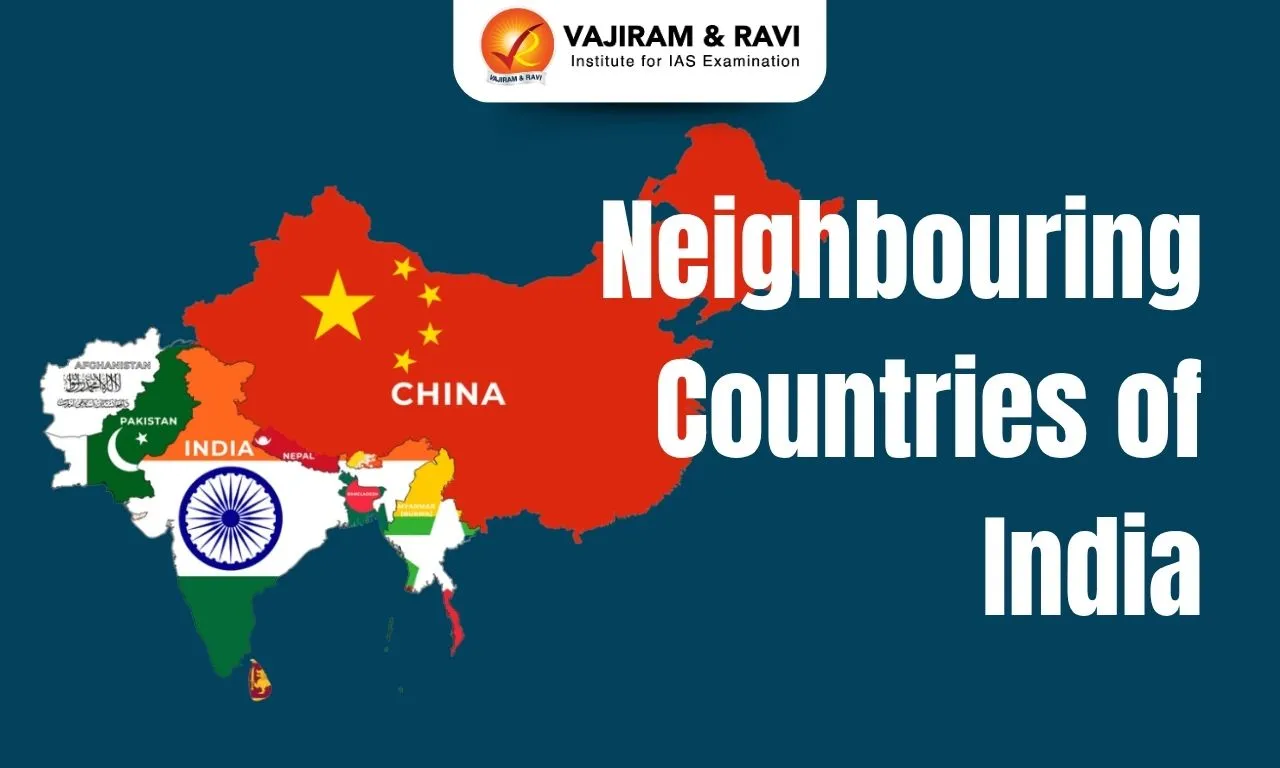
As of 2025 the members of Election Commission of India are:

  • Chief Election Commissioner (CEC): Shri Gyanesh Kumar
  • Election Commissioners: Dr. Sukhbir Singh Sandhu and Dr. Vivek Joshi

Chief Election Commissioner (CEC)

The Chief Election Commissioner is the head of the Election Commission of India and ensures the independence and integrity of the electoral process.

  • The CEC is appointed by the President of India under Article 324(2) of the Constitution.
  • The CEC’s role is crucial in enforcing the Model Code of Conduct (MCC), supervising voter rolls, and ensuring impartial conduct of elections.
  • The Supreme Court in T.N. Seshan vs Union of India (1995) upheld that all Election Commissioners are equal in power and status, ensuring collective functioning.
  • The CEC is considered the guardian of India’s electoral democracy, accountable only to Parliament and the Constitution.

Election Commissioners Appointment

The Chief Election Commissioner and other Election Commissioners are appointed by the President of India under Article 324(2). Though the Constitution does not specify a detailed procedure, the appointment is made on the advice of the Council of Ministers. However, several legal experts and the Supreme Court (in March 2023) have recommended a collegium system involving the Prime Minister, Leader of Opposition, and Chief Justice of India to ensure transparency until Parliament enacts law. Their appointment order is issued by the President, and their terms, conditions, and service benefits are defined under the Election Commission (Conditions of Service) Rules, 1992.

Election Commissioners Tenure

Under the Election Commission (Conditions of Service of Election Commissioners and Transaction of Business) Act, 1991, each Election Commissioner, including the CEC, holds office for six years or until attaining the age of 65 years, whichever is earlier. This fixed tenure provides functional independence and stability. Their salaries and allowances are equivalent to those of Judges of the Supreme Court, ensuring parity with other high constitutional offices. Article 324(5) protects their tenure by stating that their service cannot be varied to their disadvantage after appointment. Such constitutional safeguards ensure autonomy and prevent arbitrary interference by the executive branch.

Election Commissioners Resignation and Removal

Election Commissioners may resign from office by submitting a written resignation to the President of India. However, the Chief Election Commissioner (CEC) enjoys stronger constitutional protection. Under Article 324(5), the CEC can be removed only in the same manner and on the same grounds as a Judge of the Supreme Court, that is, by a special majority of both Houses of Parliament on proven misbehavior or incapacity. Other Election Commissioners can be removed only on the recommendation of the CEC. This system ensures the Commission’s independence, preventing misuse of executive power and preserving the institution’s credibility and neutrality in elections.
Election Commission of India Powers

The Commission enjoys wide-ranging powers to ensure the integrity, neutrality, and transparency of the electoral process across India.Key Powers:

  • Administrative Powers: Control over election schedules, polling arrangements, and the deployment of polling staff.
  • Advisory Powers: Advises the President and Governors on matters related to disqualification of members.
  • Quasi-Judicial Powers: Decides disputes regarding political party recognition and symbols under the Election Symbols (Reservation and Allotment) Order, 1968.
  • Regulatory Powers: Enforces the Model Code of Conduct (MCC) and monitors election expenditure.
  • Disciplinary Powers: Can direct transfers or suspension of officials for election-related misconduct.

Election Commission of India Functions

The ECI performs multiple functions to ensure free, fair, and periodic elections in accordance with democratic principles. Major Functions:

  • Conduct of Elections: Supervises, directs, and controls elections to Parliament, State Legislatures, and high offices.
  • Delimitation: The Election Commission of India (ECI) does not directly have delimitation powers; instead, it oversees the process, which is conducted by a separate, temporary Delimitation Commission established by the Central Government.
  • Electoral Rolls: Prepares, revises, and updates voter lists through continuous revision and SIR (Special Intensive Revision).
  • Registration of Political Parties: Recognizes parties and allots election symbols.
  • Voter Education: Promotes awareness under the Systematic Voters’ Education and Electoral Participation (SVEEP) program.
  • Monitoring Expenditure: Ensures transparency through election expenditure audits and monitoring teams.

Election Commission of India Constitutional Provisions

The Election Commission of India is established under Article 324 of the Constitution to ensure free and fair elections in India. Key Constitutional Provisions:

  • Article 324(1): Grants the ECI the power to conduct elections to Parliament, State Legislatures, and the offices of President and Vice-President.
  • Article 324(2): Empowers the President to appoint the Chief Election Commissioner and other Election Commissioners.
  • Article 324(5): Provides protection to the tenure and service conditions of the CEC, ensuring independence.
  • These provisions ensure the ECI acts as an autonomous constitutional authority, not subordinate to any executive or legislature.

Election Commission of India Legal Safeguards

The legal framework guarantees the Commission’s independence and shields it from executive or political influence during elections. Major Legal Provisions:
  • Article 324(5): Protects the CEC’s tenure and prevents arbitrary removal.
  • Election Commission (Conditions of Service of Election Commissioners and Transaction of Business) Act, 1991: Defines tenure, salaries, and conditions of service.
  • Representation of the People Acts (1950 & 1951): Provide detailed election procedures, voter eligibility, and dispute resolution.
  • Indian Penal Code & Conduct of Election Rules, 1961: Penalize malpractices like bribery, booth capturing, and false nominations.
  • These legal safeguards collectively ensure institutional autonomy and operational transparency.

Election Commission of India Government Policies

To strengthen electoral integrity, several policy measures and reforms have been introduced by the government in consultation with the ECI. Key Policies and Their Impact:

  • Electoral Bond Scheme (2018): Introduced to improve transparency in political funding, though under judicial scrutiny.
  • One Nation, One Election (Proposal): Aims to synchronize national and state elections, reducing expenditure and administrative burden.
  • Voter ID-Aadhaar Linking Drive (Proposal): Ensures cleaner voter rolls by removing duplicate entries.
  • Remote Voting Prototype (Proposal): Designed to allow migrant workers to vote from other locations.
  • Awareness Campaigns (SVEEP): Promotes voter education and participation, increasing turnout rates to over 67% in 2019 Lok Sabha polls.

Election Commission of India Independence

The independence of the Election Commission is fundamental to Indian democracy. The Constitution grants it autonomy, but its accountability mechanisms ensure transparency.

Accountability Measures:

  • Judicial review of Commission decisions.
  • Parliamentary oversight through questions and debates.
  • Media transparency and publication of detailed election reports.

Measures Ensuring Independence:

  • Fixed Tenure: CEC and ECs hold office for six years or till the age of 65.
  • Security of Tenure: CEC can be removed only by parliamentary impeachment similar to a Supreme Court judge.
  • Equal Status: All commissioners enjoy equal decision-making power.
  • Financial Autonomy: ECI’s budget is charged on the Consolidated Fund of India, ensuring executive non-interference.
  • Neutrality in Appointments: Recent Supreme Court directives advocate a collegium-based selection process for transparency.

Election Commission of India Case Laws

Several judicial decisions have strengthened the constitutional position and functioning of the ECI:

  1. S. Subramaniam Balaji v. State of Tamil Nadu (2013): Directed the ECI to enforce the Model Code of Conduct more stringently.
  2. Union of India v. Association for Democratic Reforms (2002): Mandated disclosure of candidates’ criminal, educational, and financial backgrounds.
  3. PUCL v. Union of India (2003): Recognized the Right to Vote as part of the freedom of expression under Article 19(1)(a).
  4. A.C. Jose v. Sivan Pillai (1984): Affirmed that the ECI has plenary powers under Article 324 to ensure free elections.
  5. ADR vs. Election Commission (2024): The Supreme Court emphasized transparency in voter list revisions under SIR, ensuring uniform procedures across states.

Election Commission of India Challenges

Despite its achievements, the ECI faces several operational and institutional challenges:

  1. Political Pressure and Allegations of Bias: Increasing accusations of partisanship affect its credibility.
  2. Voter Exclusion: Issues in electoral roll verification, especially during Special Intensive Revisions (SIR), lead to disenfranchisement.
  3. Election Expenditure: Unchecked campaign spending and unaccounted political donations undermine transparency.
  4. Fake News and Electoral Manipulation: Social media misinformation impacts voter behavior.
  5. Digital Divide: Limited accessibility of digital services in rural areas hinders full participation.

Way Forward:

  • Establish a collegium system for appointment of Election Commissioners.
  • Provide statutory backing for the Model Code of Conduct.
  • Expand voter education programs in marginalized communities.
  • Enhance cyber resilience through AI-based monitoring.
  • Strengthen coordination with social media platforms to curb misinformation.

Election Commission of India Technology Integration

The ECI has significantly integrated technology into election management, ensuring faster, more secure, and transparent processes. Key Digital Initiatives:

  • EVMs and VVPATs: Ensure tamper-proof voting and verifiable paper trails.
  • cVIGIL App: Allows citizens to report Model Code violations in real time.
  • ERONet and NVSP Portal: Facilitate online voter registration and roll management.
  • Suvidha and Samadhan Portals: Streamline candidate permissions and grievance redressal.
  • Garuda App: Enables Booth Level Officers (BLOs) to conduct door-to-door verification digitally.

Election Commission of India Significance

The Election Commission acts as the foundation of India’s democracy, ensuring the people’s mandate is exercised freely, fairly, and periodically.

  • Democratic Legitimacy: Upholds citizens’ right to vote under Article 326, maintaining public confidence in electoral outcomes.
  • Institutional Stability: Ensures smooth transitions of power without conflict, protecting the essence of parliamentary democracy.
  • Inclusivity: Implements initiatives like SVEEP and Accessible Elections Project to include marginalized groups, PwDs, and senior citizens.
  • Technological Reforms: Adoption of EVMs, VVPAT, and digital voter roll systems enhances transparency and reduces human error.
  • Global Recognition: India’s ECI is often cited as a model for electoral management by international organizations like the UNDP and International IDEA.

Election Commission of India UPSC

The Election Commission of India (ECI) has announced Phase 2 of its nationwide “Special Intensive Revision” (SIR) of electoral rolls, covering 12 states and Union Territories from November 4, 2025.

  • The exercise will affect around 51 crore electors, aiming for a final roll publication on February 7, 2026.
  • States involved include major poll-bound regions such as Tamil Nadu, Kerala, West Bengal and Puducherry. 
  • The ECI clarified that Aadhaar card and 13 other documents may be used for identity proof, though concerns over potential disenfranchisement have been raised by opposition parties. 
  • The revision follows the earlier SIR pilot in Bihar, where the ECI reported zero appeals or complaints relating to deletions. 
  • Some states have questioned the timeline and scope of the exercise, arguing that it should not proceed in a short span of 2-3 months given migration and administrative challenges.

Election Commission of India FAQs

Q1: What is the Election Commission of India?

Ans: It is a constitutional body established under Article 324 to supervise elections in India.

Q2: Who appoints the Chief Election Commissioner?

Ans: The President of India appoints the Chief Election Commissioner and other Election Commissioners.

Q3: What is the tenure of Election Commissioners?

Ans: They hold office for six years or until the age of 65, whichever is earlier.

Q4: What are the major powers of the Election Commission of India?

Ans: The ECI conducts elections, enforces the Model Code, and regulates political parties and expenditure.

Q5: How does the Election Commission of India ensure free and fair elections?

Ans: Through technology use, strict monitoring, legal powers, and transparent processes under constitutional safeguards.

Pax Silica and India – Securing Critical Technology Supply Chains

Pax Silica

Pax Silica Latest News

  • India is likely to be invited to join the U.S.-led Pax Silica initiative aimed at securing global semiconductor, AI, and critical mineral supply chains.

Understanding Pax Silica

  • Pax Silica is a multilateral initiative launched by the United States in December 2025 to secure supply chains of critical technologies such as semiconductors, artificial intelligence (AI), and rare earth elements (REEs). 
  • The term “Pax” denotes peace, while “Silica” refers to silicon-based semiconductor technologies, symbolising a stable and cooperative global technology order.
  • The Pax Silica Declaration emphasises three core objectives: 
    • Reducing coercive economic dependencies, 
    • Ensuring secure global technology and AI supply chains, and 
    • Building trusted digital infrastructure. 
  • The initiative reflects growing concerns that over-dependence on a single country for critical inputs can expose economies to geopolitical coercion.

Global Context Behind Pax Silica

  • The global economy is witnessing a shift where advanced technologies such as AI, semiconductors, and digital infrastructure are becoming central to economic and strategic power. 
  • At the same time, supply chains for rare earths and critical minerals remain highly concentrated.
  • China currently dominates the global supply of rare earth elements and processing capabilities. 
  • In recent years, it has used export restrictions as a strategic tool, including suspending REE exports following tariff disputes with the U.S. India too faced disruptions in rare-earth magnet supplies, affecting its automobile and electronics industries.
  • The COVID-19 pandemic further exposed vulnerabilities of globally fragmented and concentrated supply chains, prompting countries to pursue diversification and resilience strategies.

Key Members of Pax Silica

  • The Pax Silica grouping brings together technologically advanced and resource-rich countries. 
  • Key participants include the United States and Japan as technology leaders; Australia as a major lithium and rare-earth exporter; the Netherlands for advanced lithography technologies; South Korea for memory chip manufacturing; and Singapore for semiconductor fabrication.
  • Israel contributes expertise in AI software, defence technologies, and cybersecurity, while the United Kingdom hosts one of the world’s largest AI markets. 
  • Gulf countries such as Qatar and the UAE add financial strength through sovereign investment funds. 
  • Canada, the European Union, OECD, and Taiwan currently participate as observers.

India’s Strategic Relevance

  • India is not yet a formal member but is expected to be invited soon. India brings several strengths to Pax Silica. 
  • It has one of the world’s most robust digital public infrastructures, a rapidly growing AI market, and a large pool of skilled technology professionals.
  • The Government of India has also launched the India Semiconductor Mission and national AI initiatives with significant financial support. 
  • Investments by Indian firms such as the Tata Group and foreign companies like Micron indicate growing confidence in India’s semiconductor ecosystem. 
  • Additionally, a steady return of skilled Indian professionals trained abroad could strengthen domestic capabilities.

Existing Supply Chain Initiatives Involving India

  • India has already taken steps to enhance supply chain resilience. In 2021, it joined Australia and Japan in launching the Supply Chain Resilience Initiative
  • India is also part of the Quad’s Critical Minerals Initiative, aimed at securing emerging technology supply chains.
  • Collaborations with Japan, Singapore, and Israel in semiconductor manufacturing further position India as a credible partner in Pax Silica-aligned ecosystems.

Challenges for India in Joining Pax Silica

  • Despite the opportunities, India faces challenges. Pax Silica members are largely high-income U.S. allies, whereas India would be the first developing country and non-ally strategic partner in the grouping. 
  • This may create expectation gaps on policy alignment and strategic responses.
  • India also prioritises strategic autonomy and may resist frameworks that constrain independent foreign or economic policy choices. 
  • Moreover, India may seek to protect its nascent semiconductor and AI industries through subsidies, procurement preferences, and calibrated import controls, policies that may not fully align with the current U.S. policy environment.

Strategic Implications and the Road Ahead

  • The emergence of Pax Silica signals the likelihood of two parallel global technology supply chains, one centred around China and the other around Pax Silica countries. 
  • Given India’s long-standing technological collaboration with Western economies and recent supply disruptions from China, aligning with Pax Silica appears strategically advantageous.
  • However, India is expected to proceed cautiously, engaging in dialogue to ensure that participation strengthens domestic capabilities without compromising strategic autonomy or development priorities.

Source : TH

Pax Silica FAQs

Q1: What is Pax Silica?

Ans: Pax Silica is a U.S.-led initiative aimed at securing global semiconductor, AI, and critical mineral supply chains.

Q2: Why is Pax Silica important for India?

Ans: It can help India reduce dependence on China and strengthen its semiconductor and AI ecosystems.

Q3: Which countries are part of Pax Silica?

Ans: Members include the U.S., Japan, Australia, South Korea, the Netherlands, Singapore, and others.

Q4: What challenges could India face in joining Pax Silica?

Ans: Balancing strategic autonomy, policy flexibility, and expectations of high-income member countries.

Q5: How does Pax Silica impact global geopolitics?

Ans: It signals the emergence of competing technology supply chains led by China and Pax Silica countries.

Top 10 Longest Rivers in India List, Origin, Length, Other Facts

Longest Rivers in India

Top 10 Longest Rivers in India: India, known for its rich network of rivers, depends on these waterways for both its environment and economy. Indian rivers are broadly classified into two types: Himalayan Rivers, which are fed year-round by melting glaciers, and Peninsular Rivers, which rely on seasonal rainfall. Leading them all, the Ganga stretches over 2,525 km, making it the Longest River in India. In this article, we’ll explore the Top 10 Longest Rivers in India List and their importance.

Longest Rivers in India

The Ganges River, or Ganga, stands as Longest Rivers in India, spanning roughly 2,525 kilometers from the Himalayas to the Bay of Bengal. Beyond its length, the Ganga holds deep cultural and spiritual significance, impacting the lives and beliefs of millions across the country. The Ganges River originates high in the Himalayas, beginning its journey at the Gangotri Glacier in Uttarakhand, India. The Ganges River travels through multiple states, starting from Uttarakhand and flowing through Uttar Pradesh, Bihar, Jharkhand, and West Bengal, before merging with the Bay of Bengal. A detailed map of the Ganges highlights its path and the diverse regions it nourishes along the way.

Top 10 Longest Rivers of India

Discover Top 10 Longest Rivers of India ranked by their length:

Top 10 Longest Rivers of India

S.No

River

Length in India (km)

Total Length (km)

Origin

Empties Into

1

Ganga

2,525

2,525

Gangotri Glacier, Uttarakhand

Bay of Bengal

2

Godavari

1,464

1,465

Trimbak, Maharashtra

Bay of Bengal

3

Krishna

1,400

1,400

Mahabaleshwar, Maharashtra

Bay of Bengal

4

Yamuna

1,376

1,376

Yamunotri Glacier, Uttarakhand

Confluence with Ganga

5

Narmada

1,312

1,312

Amarkantak Plateau, Madhya Pradesh

Arabian Sea

6

Indus

1,114

3,180

Tibet (near Lake Mansarovar)

Arabian Sea

7

Brahmaputra

916

2,900

Angsi Glacier, Tibet

Bay of Bengal

8

Mahanadi

890

890

Sihawa Hills, Chhattisgarh

Bay of Bengal

9

Cauvery

800

800

Brahmagiri Hills, Karnataka

Bay of Bengal

10

Tapi (Tapti)

724

724

Satpura Range, Madhya Pradesh

Arabian Sea

Longest Rivers in India in Brief

Top 10 Longest Rivers of India each tell a unique story as they flow across the country, sustaining its people, culture, and rich history. From the mighty Ganga, the longest, to the more modest Tapi, these rivers shape India’s landscapes and heritage. Here’s a closer look at the Top 10 Longest Rivers of India:

Ganga River

The Ganga River, with a total length of 2,525 kilometers, holds the title of the Longest River in India, flowing entirely through the mainland. It originates from the Gangotri Glacier in Uttarakhand and travels across multiple states, including Uttar Pradesh, Bihar, and West Bengal, before merging with the Bay of Bengal. Along its journey, the Ganga is fed by numerous tributaries. On the left bank, it receives waters from the Ramganga, Garra, Gomti, Ghaghara, Gandak, Burhi Gandak, Koshi, and Mahananda rivers. Its right bank tributaries include the Yamuna, Tamsa, Son, Punpun, Kiul, Karmanasa, and Chandan rivers.

Godavari River

The Godavari River, spanning a length of 1,464 kilometers, holds the title of the Longest Rivers in India in peninsular region. It originates from the Triambakeshwar region near Nashik in Maharashtra. The river flows through the states of Chhattisgarh, Telangana, and Andhra Pradesh before emptying into the Bay of Bengal. Along its journey, the Godavari is joined by several tributaries: the left bank tributaries include the Banganga, Kadva, Shivana, and Purna rivers, while the right bank tributaries are Nasardi, Darna, and Pravara.

Krishna River

The Krishna River spans 1,400 kilometers, originating from the Western Ghats at an elevation of approximately 1,337 meters, just north of Mahabaleshwar, about 64 kilometers from the Arabian Sea. Its left bank tributaries include the Bhima, Dindi Musi, Paleru, and Munneru rivers, while the right bank is fed by the Vienna, Koyna, and Panchganga rivers. The Krishna River ultimately flows into the Bay of Bengal. Known for its vital role in irrigation, it is a major water source for the states of Maharashtra, Karnataka, Telangana, and Andhra Pradesh.

Yamuna River

The Yamuna River, spanning a length of 1,376 kilometers, originates from the Yamunotri Glacier, located at the Banderpoonch Peak in Uttarkashi district, Uttarakhand. As one of the primary tributaries of the Ganges, the Yamuna’s tributaries include Hindon, Sharda on the left bank, and Chambal, Betwa, and Ken on the right. The river flows through several key states, including Uttarakhand, Himachal Pradesh, Delhi, Haryana, and Uttar Pradesh.

Narmada River

The Narmada River, stretching over 1,312 kilometers, originates from the Amarkantak Peak in Madhya Pradesh. Its left-bank tributaries include Burhner, Banjar, Sher, and Karjan, while the right bank tributaries consist of Hiran, Tendoni, and Choral. The river flows westward, ultimately emptying into the Arabian Sea. Often referred to as the "Lifeline of Madhya Pradesh and Gujarat," the Narmada plays a crucial role in the agricultural and economic development of both states.

Indus River

The Indus River holds the distinction of being the longest river in terms of the total distance it covers, stretching over 3,180 kilometers. However, within India, it flows for approximately 1,114 kilometers, with the majority of the river's course running through present-day Pakistan. Originating from the northern slopes of the Kailash Range in Tibet, near Lake Manasarovar, the river traverses vast regions. Prominent cities situated along its banks include Leh and Skardu. The river is fed by several tributaries, with the left bank contributing Zanskar, Suru, Soan, Jhelum, Chenab, and Luni, while the right bank is nourished by Shyok, Hunza, Gilgit, Gomal, and Zhob. Ultimately, the Indus River empties into the Arabian Sea.
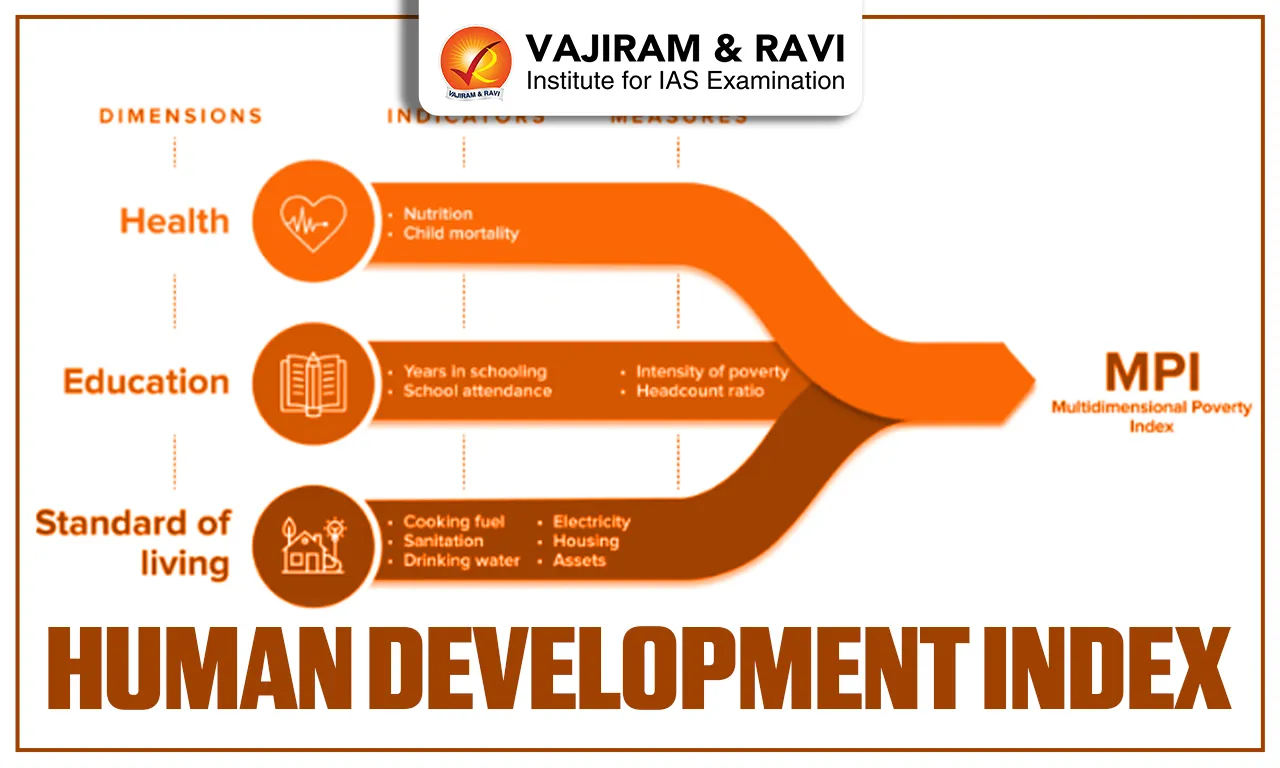
Brahmaputra River

The Brahmaputra River, stretching 2,900 kilometers from Tibet’s Kailash Ranges, flows 916 kilometers through India, entering via Arunachal Pradesh. Its left bank tributaries include Dibang, Lohit, and Dhansiri, while the right bank is fed by Kameng, Manas, Jaldhaka, Teesta, and Subansiri. In Bangladesh, it becomes the Jamuna River, merging with the Padma (Ganges) before emptying into the Bay of Bengal. Majuli, an island in Assam’s Brahmaputra, became India’s first river island district in 2016, once covering 880 square kilometers at the turn of the 20th century.

Mahanadi River

The Mahanadi River, stretching 890 km, begins its journey in the Raipur district of Chhattisgarh. Its left bank tributaries include the Mand, Ib, and Hasdeo rivers, while its right bank tributaries are the Ong and Parry. The river ultimately empties into the Bay of Bengal. Due to its impact on Odisha, it has historically been referred to as "the distress of Odisha." However, the construction of the Hirakud Dam has significantly changed the situation, providing much-needed regulation and flood control.

Cauvery River

The Cauvery River, spanning 800 km, originates from the Brahmagiri Range in the Western Ghats, located in the Coorg District of Karnataka. On its left bank lies the Harangi Reservoir, while its primary right bank tributary is the Lakshmana Tirtha. The river ultimately flows toward the Grand Anicut in the south, before branching into numerous distributaries. These tributaries form a vast delta, often referred to as the "Garden of Southern India," before the Cauvery empties into the Bay of Bengal, in Tamil Nadu.

Tapi River

The Tapi River, stretching over 724 kilometers, begins its journey from the Satpura Range. It flows through the states of Madhya Pradesh, Maharashtra, and Gujarat before emptying into the Gulf of Khambhat, part of the Arabian Sea. The river is fed by six tributaries, including Purna and Girna.

Largest River in India

The Ganga is the largest river in India, stretching for about 2,525 kilometers. It originates from the Himalayas, flows across northern India, and enters Bangladesh before emptying into the Bay of Bengal. Beyond its geographical significance, the Ganges holds immense cultural and spiritual importance for Hindus, who revere it as a sacred goddess.

Top 10 Longest Rivers in India FAQs

Q1: Which is the longest river in India?

Ans: The Ganges River is the longest river in India with a length of 2525 Kms.

Q2: Which is the inland longest river of India?

Ans: Ganges is the longest inland river of India.

Q3: Which is the longest tributary river of India?

Ans: Yamuna is the longest tributary river of India.

Q4: Which is the longest river of South India?

Ans: Godavari is the longest river of South India.

Q5: Which is the largest river island of India?

Ans: Majuli is the largest river island of India.

Disinvestment Policy – Shift from Disinvestment to Asset Monetisation

Disinvestment Policy

Disinvestment Policy Latest News

  • Since the announcement of the revamped Disinvestment Policy (2020) and the Public Sector Enterprises (PSE) Policy (2021), the Union Government initially emphasized privatisation and strategic disinvestment. 
  • However, recent policy developments — including the launch of the National Monetisation Pipeline (NMP) 2.0 — indicate a clear shift from asset sales to value extraction and asset monetisation.
  • The focus is on dividends and leasing of assets instead of outright privatisation.

Evolution of Disinvestment Policy

  • Original privatisation push (2020–21): The Public Sector Enterprises Policy (2021) provides a framework for -
    • Government to exit non-strategic sectors.
    • Minimum presence in strategic sectors.
    • Strategic disinvestment encouraged where private sector capacity exists.
  • Policy rationale: Government should minimise direct business operations. The private sector is seen as more efficient in managing enterprises.
Declining Disinvestment Revenues

  • Temporary surge: 2022–23 disinvestment revenue (₹35,294 crore), with stake sales in ONGC, LIC, GAIL, and IRCTC, ended a four-year declining trend.
  • Subsequent decline: Disinvestment proceeds fell sharply. For example, from a disinvestment revenue of ₹16,507 crore in 2023-24 to ₹10,163 crore (2024-25) and ₹15,562 crore (till date in 2025–26).
  • Policy signals:
    • Key changes indicate reduced emphasis on privatisation.
    • Removal of separate disinvestment category in Budget documents.
    • Disinvestment receipts merged into “Miscellaneous Capital Receipts.”
    • No annual disinvestment targets.

Reasons for Reduced Privatisation

  • Limited private sector interest: 
    • Key constraints include large employee headcounts, loss-making assets, structural inefficiencies, and political and labour resistance.
    • These factors made many Public Sector Enterprises unattractive to private investors.
  • Increasing focus on dividend income:
    • Consistent Dividend Policy (2020): The Department of Investment and Public Asset Management (DIPAM) advised CPSEs to pay higher dividends, use cash reserves efficiently, and balance capex needs and profitability.
    • Capital Restructuring Guidelines (2024): Revised guidelines emphasized value creation in CPSEs, maximising returns for the government.
    • Rising dividend receipts: From ₹39,750 crore in 2020–21 to ₹74,128 crore (2024-25) and ₹59,730 crore (so far in 2025-26). Dividend income now significantly exceeds disinvestment proceeds.

Asset Monetisation as the New Strategy

  • National Monetisation Pipeline (NMP)
    • Launched in 2021 to monetise brownfield infrastructure assets through leasing arrangements. Key features include -
      • No transfer of ownership
      • Private sector participation
      • Revenue generation from idle or underutilised assets
    • Performance: About 90% of the target [₹6 lakh crore (2021–25)] achieved.
  • National Monetisation Pipeline 2.0 (2025–30):
    • Target: ₹16.72 lakh crore
    • Focus sectors: Transport infrastructure, energy assets, telecom, warehousing, etc.
    • This represents a major expansion of the asset monetisation approach.

Advantages of the New Approach

  • Fiscal benefits: Stable and predictable revenue through dividends. Reduced political resistance compared to privatisation. Avoids one-time asset sales.
  • Economic benefits: Improves utilisation of public assets, encourages private sector efficiency, and retains public ownership.
  • Administrative benefits: Lower complexity compared to strategic disinvestment, and faster implementation.

Challenges and Way Forward

  • Fiscal risks: Dividend extraction may reduce reinvestment capacity of CPSEs. Overdependence on dividends can weaken long-term growth.
    • Strengthen corporate governance: Professional management of CPSEs, reduced political interference.
    • Selective privatisation: Focus on loss-making non-strategic sectors.
  • Structural issues: Persistent inefficiencies in CPSE management. Asset monetisation does not address operational problems.
    • Balanced public sector reform: Combine strategic disinvestment with monetisation  and governance reforms.
  • Market risks: Private sector interest depends on economic conditions. Monetisation revenues may fluctuate.
    • Efficient asset monetisation: Transparent bidding processes, and strong regulatory oversight.
  • Policy inconsistency: Shift from privatisation to monetisation may create uncertainty among investors.
    • Sustainable dividend policy: Avoid excessive dividend extraction, and ensure adequate capital expenditure.

Conclusion

  • India’s public sector reform strategy is undergoing a significant transition from privatisation to asset monetisation and dividend extraction. 
  • While this approach provides steady fiscal returns and political acceptability, long-term success will depend on balancing revenue generation with the financial health and competitiveness of CPSEs. 
  • A calibrated mix of privatisation, monetisation, and governance reforms remains essential for sustainable public sector management.

Source: TH

Disinvestment Policy FAQs

Q1: What is the changing approach of the Government of India in managing Public Sector Enterprises (PSEs)?

Ans: It has shifted from strategic disinvestment to asset monetisation and dividend extraction to generate stable revenues.

Q2: Why has strategic disinvestment in India slowed down in recent years?

Ans: Due to limited private sector interest, labour liabilities, loss-making assets, and valuation challenges.

Q3: How does asset monetisation differ from privatisation in public sector reforms?

Ans: Asset monetisation involves leasing public assets without transfer of ownership, whereas privatisation involves sale of government equity and control.

Q4: What is the fiscal significance of dividend income from CPSEs?

Ans: Rising CPSE dividends provide a stable and recurring source of non-tax revenue.

Q5: What are the long-term implications of relying on CPSE dividends instead of disinvestment?

Ans: Excessive reliance on dividends may weaken CPSE investment capacity and delay structural reforms.

Fiscal Responsibility & Budget Management (FRBM) Act, Objectives

Fiscal Responsibility & Budget Management (FRBM) Act

The Fiscal Responsibility and Budget Management (FRBM) Bill was introduced in 2000 by the Atal Bihari Vajpayee government to give legal shape to the idea of fiscal discipline in India. It aimed to bring accountability and transparency to government finances. The bill became law in 2003, marking a major shift in how public funds were to be managed. The FRBM Act 2003 set specific targets for reducing fiscal deficits, improving financial management, and promoting long-term fiscal stability.

Fiscal Responsibility & Budget Management (FRBM) Act

The Fiscal Responsibility & Budget Management Act, 2003 (FRBMA), is a law enacted by the Indian Parliament to enforce principles of sound financial management and keep fiscal deficits under control. Its core aim is to ensure a balanced budget and promote fiscal discipline.

The Act initially targeted eliminating the revenue deficit and capping the fiscal deficit at 3% of GDP by March 2008. However, the 2007 global financial crisis forced the government to delay and eventually suspend these targets in 2009. In 2011, as the economy began recovering, the Economic Advisory Council recommended revisiting the FRBM framework. A review committee, chaired by N. K. Singh, set up under the Ministry of Finance, was later tasked with evaluating and updating the Act’s provisions.

Fiscal Responsibility & Budget Management (FRBM) Act Needs

In May 2016, the government appointed N. K. Singh to head a committee to review the Fiscal Responsibility and Budget Management (FRBM) Act. The committee recommended a phased reduction in the fiscal deficit starting with a target of 3% of GDP by March 2020, then lowering it to 2.8% in 2020-21, and further to 2.5% by 2022-23.

During COVID-19 pandemic, the economic slowdown and increased spending on welfare and healthcare led to a major revenue shortfall. As a result, the government recorded a fiscal deficit of 9.2% of GDP in FY21, slightly better than the revised estimate of 9.5%. For FY22, the deficit target was scaled down to 6.8%, with a longer-term goal of bringing it down to 4.5% by FY26.

The FRBM Act, 2003 is designed not just to limit deficits but also to improve transparency in fiscal management of India. Over the long term, it aims to achieve budgetary stability while giving the Reserve Bank of India (RBI) the space it needs to manage inflation effectively.

Fiscal Responsibility & Budget Management (FRBM) Act Objectives

The Fiscal Responsibility and Budget Management (FRBM) Act, passed by the Indian Parliament in 2003, was a significant step toward institutionalizing financial discipline in the country. Its core objective is to ensure responsible fiscal management by reducing the fiscal deficit and improving the quality of macroeconomic governance. The key goals of the Act can be understood across four broad themes:

  • The FRBM Act mandates specific targets to bring down the fiscal deficit, revenue deficit, and total government debt as a percentage of GDP. 
  • To promote openness in fiscal operations, the FRBM Act requires the government to present documents such as the Medium-Term Fiscal Policy Statement, Fiscal Policy Strategy Statement, and Outcome Budget to Parliament. 
  • The FRBM Act aims to reduce inflationary pressures and maintain a stable macroeconomic environment. 
  • One of the Act’s long-term aims is to prevent the economy from falling into a debt trap by ensuring that debt levels remain within sustainable limits.

Fiscal Responsibility & Budget Management (FRBM) Act Features

To achieve the objectives, Fiscal Responsibility & Budget Management (FRBM) Act Features were incorporated which are mentioned below:

  • The FRBM Act sets limits on fiscal deficit and revenue deficit, expressed as a percentage of GDP. Initially, the Act aimed to reduce the fiscal deficit to 3% of GDP by 2008. These targets are periodically updated based on economic needs and government priorities. 
  • Under the FRBM Act, the central government is mandated to present three critical fiscal documents every financial year: the Medium-Term Fiscal Policy Statement, the Fiscal Policy Strategy Statement, and the Macroeconomic Framework Statement. 
  • Each year, the government outlines specific fiscal goals and performance determiners in line with FRBM principles.
  • The FRBM Act is not static, it includes a built-in review mechanism. This means fiscal targets can be reassessed and modified based on changing economic conditions.

FRBM Act Escape

The FRBM Act Escape allows the government to exceed the fiscal deficit target in case of extraordinary circumstances which includes war, natural calamity, severe economic downturn or other significant events beyond control. While this provides flexibility and the government is expected to return to the fiscal path once the crisis passes. Even when invoked, the government must justify the deviation and lay out a path to correction.

Fiscal Responsibility & Budget Management (FRBM) Act Advantages

  • FRBM Act sets legal limits on fiscal and revenue deficits, discouraging excessive borrowing and forcing the government to prioritize essential spending. 
  • Mandates regular reports like the Medium-Term Fiscal Policy and Fiscal Strategy Statements. These documents provide reliable insights into government finances, helping stakeholders plan based on data rather than guesswork.
  • By keeping deficits under control, the Act helps reduce inflationary pressure, stabilizes interest rates, and avoids crowding out private investment which creates a more stable environment for long-term economic growth.
  • Transparent and rule-based fiscal policy enhances the government's credibility. It attracts both domestic and foreign investors, strengthens market confidence, and supports better sovereign credit ratings.

Fiscal Responsibility & Budget Management (FRBM) Act Issues

  • Though the FRBM Act Escape clause allows deviation from targets during unforeseen circumstances, frequent use undermines the Act’s credibility. It raises doubts about the government’s commitment to long-term fiscal discipline.
  • Strict fiscal targets may limit necessary investments in critical sectors like health, education, and infrastructure. This can hurt long-term growth and weaken efforts to improve social outcomes.
  • The success of the Act relies on strong institutions and political commitment. Inconsistent implementation across different governments and regimes hampers its effectiveness and enforcement.

Fiscal Responsibility & Budget Management (FRBM) Act FAQs

Q1: What is the FRBM Act?

Ans: A law to ensure responsible fiscal management by reducing fiscal deficits and promoting transparency in India's financial operations.

Q2: When was the FRBM Act passed?

Ans: The FRBM Act was enacted in 2003 by the Indian Parliament.

Q3: What is the main objective of the FRBM Act?

Ans: To reduce fiscal deficit, eliminate revenue deficit, and ensure macroeconomic stability.

Q4: Who implements the FRBM Act?

Ans: The Ministry of Finance, under the Government of India.

Q5: What are fiscal and revenue deficits?

Ans: Fiscal deficit is excess expenditure over income; revenue deficit is excess revenue spending over revenue receipts.

List of Government Schemes in India, Objectives, Impacts

Important Government Schemes

Government Schemes are a foundational element of UPSC CSE Exam 2026 preparation, as they play a major role in the nation’s developmental priorities and the execution of public policy. Spanning across various sectors such as health, education, agriculture, and the economy, these Important Government Schemes provide insights into governance frameworks, social inclusion, and public service delivery framework. Questions related to government initiatives are frequently asked across the Prelims, Mains, and Interview stages of the UPSC Exam 2026.

Government Schemes for UPSC CSE Exam 2026 Prelims

In Prelims, UPSC often has factual questions about the Important Government Scheme. Aspirants must know the launch year, objectives, implementing ministry, beneficiaries, and key features of Important Government Schemes. Focus should be on those featured in the Union Budget, Economic Survey, and PIB updates from the past two years. Schemes like PM-KISAN, Ayushman Bharat, or PM Gati Shakti have often appeared. 

Government Schemes for UPSC CSE Exam 2026 Mains

In Mains, especially in GS Paper II (Governance, Social Justice) and GS Paper III (Economy, Environment), Important Government Schemes are used to support arguments and showcase awareness. Topics like rural development, women empowerment, MSMEs, and health require references to relevant schemes. Writing answers with examples like MGNREGA, Beti Bachao Beti Padhao, or Jal Jeevan Mission adds credibility. 

Government Schemes for UPSC CSE Exam 2026 Interview

In Interview stage, during the UPSC CSE Exam 2026 often evaluates the understanding of ongoing government initiatives and their real-world impact. Questions may be asked about schemes related to home states, optional subjects, or academic background. Knowledge of schemes like Aspirational Districts Programme or Ayushman Bharat helps form informed opinions. Referring to Government Schemes also reflects your awareness of national development issues and policy implementation, which can leave a strong impression on the board.

Government Schemes for UPSC Importance

  1. Important Government Schemes are directly linked to topics in GS Paper II (Governance, Social Justice) and GS Paper III (Economy, Environment, Agriculture, Infrastructure).
  2. UPSC regularly asks factual questions about schemes, launch year, objectives, ministry, and features making them important areas for Prelims.
  3. Citing Important Government Schemes in Mains answers adds credibility, relevance, and depth to your arguments, especially in topics like rural development, health, and employment.
  4. Important Government Schemes reflect governance values like transparency, accountability, and social justice making them valuable in Ethics and Essay papers.
  5. Government Schemes are frequently covered in PIB, Yojana, Budget, and Economic Survey, making them an essential part of dynamic preparation.
  6. Understanding Important Government Schemes shows your awareness of real-world policy implementation, especially during discussions on your home state or optional subject.
  7. The Important Government Schemes provide insights into how the government tackles national challenges such as poverty, education, health, infrastructure, etc. through targeted interventions.

How to Study Government Schemes for UPSC

To study Government Schemes for UPSC effectively, first categorize them under GS Papers, e.g., health under GS II, economy under GS III. Refer to authentic sources such as PIB, Yojana, Kurukshetra, and the official portals of relevant ministries. Focus on the objectives, launch year, key features, budgetary allocation, challenges, and impact. Create mind maps, flowcharts, and comparative tables for revision. Practice MCQs and answer writing based on schemes for better elaboration.

Important Government Schemes List for UPSC

Below in the table including newly launched and strategically Important Government Schemes relevant for UPSC Exam 2026:

Important Government Schemes for UPSC

Scheme Name

Launch Date

Department

Key Features

Budget

Beneficiaries

Completion Date

PM Awas Yojana

2015

Ministry of Housing & Urban Affairs

Affordable housing for all by 2022

₹6.85 lakh crore

Urban and rural poor

2022

Model Skill Loan Scheme

2015

Ministry of Skill Development

Provides loans for skill development courses

N/A

Students pursuing skill development

Ongoing

Mudra Yojana

2015

Ministry of Finance

Financial support to small businesses

₹3 lakh crore

Small entrepreneurs

Ongoing

PMGSY (Pradhan Mantri Gram Sadak Yojana)

2000

Ministry of Rural Development

Rural road connectivity

₹1.8 lakh crore

Rural population

Ongoing

Urban 2.0 Initiative

2021

Ministry of Housing & Urban Affairs

Urban renewal and smart city development

₹2.05 lakh crore

Urban residents

Ongoing

PM Vishwakarma Scheme

2023

Ministry of MSME

Skill enhancement for traditional artisans

₹13,000 crore

Traditional artisans

Ongoing

Amrit Bharat Station Scheme

2023

Ministry of Railways

Redevelopment of railway stations

₹10,000 crore

Railway passengers

2025

Mission LiFE (Lifestyle for Environment)

2022

Ministry of Environment

Promoting sustainable living practices

N/A

General public

Ongoing

National Logistics Policy (NLP)

2022

Ministry of Commerce & Industry

Improve efficiency in logistics sector

N/A

Logistics companies

Ongoing

PM Gati Shakti National Master Plan

2021

Ministry of Commerce & Industry

Integrated infrastructure planning

₹100 lakh crore

Infrastructure sector

2025

PM Schools for Rising India (PM SHRI)

2022

Ministry of Education

Strengthen schools with modern facilities

₹27,360 crore

Students and educators

2026-27

Rashtriya Udyamita Vikas Pariyojana

2024

Ministry of Skill Development

Entrepreneurship development for youth

N/A

Young entrepreneurs

Ongoing

Pradhan Mantri Janjatiya Unnat Gram Abhiyan

2024

Ministry of Tribal Affairs

Development of tribal villages

₹7,000 crore

Tribal communities

2026

Vatsalya Scheme

2024

Ministry of Women & Child Development

Child welfare and protection

N/A

Children in need

Ongoing

Purvodaya

2024

Ministry of Steel

Boosting Eastern India's steel sector

N/A

Steel industry

2030

Pradhan Mantri Surya Ghar Yojana

2024

Ministry of New & Renewable Energy

Solar energy adoption in households

₹75,000 crore

Residential households

2027

Electric Mobility Promotion Scheme

2024

Ministry of Heavy Industries

Promotion of electric vehicles

₹10,000 crore

EV manufacturers and buyers

2030

Pradhan Mantri Swasthya Suraksha Nidhi

2021

Ministry of Health & Family Welfare

Health infrastructure funding

₹64,180 crore

Health institutions

Ongoing

Ayushman Bharat Pradhan Mantri Jan Aarogya Yojana

2018

Ministry of Health & Family Welfare

Health insurance for the poor

₹64,180 crore

Low-income families

Ongoing

National Digital Health Mission

2020

Ministry of Health & Family Welfare

Digital health records for all citizens

₹1,600 crore

General public

Ongoing

Pradhan Mantri Swasthya Suraksha Yojna

2006

Ministry of Health & Family Welfare

Establish AIIMS-like institutions across India

₹14,970 crore

Medical students, patients

Ongoing

Intensified Mission Indradhanush 3.0

2021

Ministry of Health & Family Welfare

Immunization drive for children and pregnant women

N/A

Children and pregnant women

Ongoing

STARS Project

2020

Ministry of Education

Strengthening teaching-learning outcomes

$500 million (World Bank)

School students

2025

Institutions of Eminence Scheme

2018

Ministry of Education

Promote world-class higher education institutions

₹10,000 crore

Universities

Ongoing

Mid-Day Meal

1995

Ministry of Education

Free meals to school children

₹11,000 crore

School students

Ongoing

Swach Vidyalaya Abhiyan

2014

Ministry of Education

Build separate toilets for boys and girls in schools

N/A

School students

Completed 2019

Kala Utsav

2015

Ministry of Education

Promote art and cultural activities in schools

N/A

School students

Ongoing

Shikshav Parv Initiative

2020

Ministry of Education

Discuss and implement NEP 2020

N/A

Educators, students

Ongoing

Scheme for Promotion of Academic and Research Collaboration (SPARC)

2018

Ministry of Education

Promote research collaboration between Indian and foreign institutions

₹418 crore

Researchers

Ongoing

Higher Education Financing Agency (HEFA)

2017

Ministry of Education

Finance infrastructure projects in higher education

₹1 lakh crore

Educational institutions

Ongoing

Pradhan Mantri Matru Vandana Yojna

2017

Ministry of Women & Child Development

Maternity benefit scheme for pregnant and lactating women

₹12,661 crore

Pregnant women

Ongoing

Poshan Abhiyan

2018

Ministry of Women & Child Development

Improve nutritional outcomes for children, pregnant women, and lactating mothers

₹9,046 crore

Women and children

Ongoing

Rashtriya Poshan Maah

2018

Ministry of Women & Child Development

Nutrition awareness campaign

N/A

General public

Annual event

Pradhan Mantri Kaushal Vikas Yojna

2015

Ministry of Skill Development

Skill development and certification

₹12,000 crore

Youth

Ongoing

Unique Land Parcel Identification Number (ULPIN) Scheme

2021

Ministry of Rural Development

Assign unique IDs to land parcels

N/A

Landowners

Ongoing

National Social Assistance Programme (NSAP)

1995

Ministry of Rural Development

Social pensions for elderly, widows, and disabled persons

₹9,200 crore

Vulnerable groups

Ongoing

Mahatma Gandhi National Rural Employment Guarantee Scheme (MGNREGS)

2006

Ministry of Rural Development

Guarantee 100 days of wage employment to rural households

₹1.11 lakh crore

Rural workers

Ongoing

Rashtriya Aajivika Mission

2011

Ministry of Rural Development

Promote self-employment and skilled wage employment

₹5,000 crore

Rural poor

Ongoing

Gram Panchayat Development Plans

2015

Ministry of Panchayati Raj

Bottom-up planning at Gram Panchayat level

N/A

Rural population

Ongoing

Startup Village Entrepreneurship Programme

2016

Ministry of Rural Development

Promote entrepreneurship in rural areas

₹700 crore

Rural entrepreneurs

Ongoing

DDU Grameen Kaushalya Yojna

2014

Ministry of Rural Development

Skill training for rural youth

₹1,500 crore

Rural youth

Ongoing

Global Housing Technology Challenge

2019

Ministry of Housing & Urban Affairs

Promote innovative construction technologies

N/A

Construction sector

Ongoing

Safaimitra Suraksha Challenge

2020

Ministry of Housing & Urban Affairs

Promote mechanized cleaning of sewers

N/A

Sanitation workers

Ongoing

PM SVANIDI

2020

Ministry of Housing & Urban Affairs

Micro-credit scheme for street vendors

₹10,000 crore

Street vendors

Ongoing

Climate-Smart City Assessment Framework

2021

Ministry of Housing & Urban Affairs

Evaluate climate actions in cities

N/A

Urban residents

Ongoing

Swachh Sarvekshan

2016

Ministry of Housing & Urban Affairs

Annual cleanliness survey

N/A

Urban population

Annual event

Rashtriya Swachhta Kendra

2020

Ministry of Housing & Urban Affairs

National center for cleanliness awareness

N/A

General public

Ongoing

Grand ICT Challenge

2020

Ministry of Electronics & IT

Promote innovative ICT solutions

N/A

Tech startups

Ongoing

Ambekar Social Innovation & Incubation Mission

2019

Ministry of Social Justice & Empowerment

Promote social entrepreneurship

N/A

Social entrepreneurs

Ongoing

Saral Jeevan Bima

2021

IRDAI

Standard term life insurance policy

N/A

Insurance buyers

Ongoing

One District One Product Scheme

2018

Ministry of Commerce & Industry

Promote district-specific products

₹6,000 crore

Local entrepreneurs

Ongoing

PRARAMBH: Startup India International Summit

2021

Ministry of Commerce & Industry

Global platform for startups

N/A

Startups

Annual event

Merchandise Export From India Scheme

2015

Ministry of Commerce & Industry

Incentives for goods exporters

₹40,000 crore

Exporters

Ongoing

SAMARTH Scheme

2017

Ministry of Textiles

Skill development in textile sector

₹1,300 crore

Textile workers

Ongoing

National Technical Textile Mission

2020

Ministry of Textiles

Promote technical textiles

₹1,480 crore

Textile industry

2024

Sagarmala Sea Plane Services

2020

Ministry of Ports, Shipping & Waterways

Enhance coastal and inland water connectivity

N/A

Tourists, travelers

Ongoing

Atal Beemit Vyakti Kalyan Yojna

2018

Ministry of Labour & Employment

Provide financial support to unemployed insured persons

₹6,500 crore

Unemployed persons

Ongoing

Nation Career Service Project

2015

Ministry of Labour & Employment

Employment services and career counseling

₹1,000 crore

Job seekers

Ongoing

Vision 2035

2020

NITI Aayog

Long-term policy vision for India

N/A

Policy makers

2035

NPMPF (‘National Program and Project Management Policy Framework’)

2020

NITI Aayog

Improve project management practices

N/A

Government agencies

Ongoing

Aatmanirbhar Bharat ARISE-Atal New India Challenge

2020

Atal Innovation Mission

Support startups with innovative solutions

₹500 crore

Startups

Ongoing

Startup India Seed Fund Scheme (SISFS)

2021

Department for Promotion of Industry & Internal Trade

Financial support to early-stage startups

₹945 crore

Startups

2025

Important Government Schemes FAQs

Q1: How many government schemes should I study for UPSC 2026?

Ans: Focus on 80–100 current and flagship schemes, especially those mentioned in PIB, Budget, and Economic Survey.

Q2: Which government source is best for reading about schemes?

Ans: Use PIB, Yojana magazine, Kurukshetra, and ministry websites. Avoid relying solely on coaching material.

Q3: How to remember so many schemes effectively?

Ans: Use short notes, categorization (GS Paper-wise), and visual tools like flowcharts or tables for memory retention.

Q4: Should I quote schemes in Ethics and Essay papers?

Ans: Yes, referring to schemes in Ethics case studies or Essay themes like social justice enhances answer quality.

Q5: Are schemes relevant for all UPSC stages?

Ans: Absolutely. Schemes play a key role in Prelims (MCQs), Mains (GS, Essay, Ethics), and even in Interview discussions.

Israel-US Joint Missile Strike in Tehran: Escalation Across the Middle East

Israel-US Joint Missile Strike in Tehran

Israel-US Joint Missile Strike in Tehran Latest News

  • On February 28, 2026, Israel carried out a daylight strike on Tehran, calling it a pre-emptive operation. US President Donald Trump confirmed American involvement, stating that major combat operations had begun to stop Iran from developing nuclear weapons.
  • Iran responded with missile and projectile attacks on Israeli territory and subsequently expanded its retaliation by targeting US bases in Qatar, Bahrain, Jordan, Kuwait, and the UAE.
  • The widening scope of strikes has pushed the crisis beyond a bilateral confrontation, placing the entire Middle East under threat of a broader regional war.

What Happened in Iran

Israel US Attack on Iran

  • Explosions were reported in Tehran, with smoke seen rising from several parts of the capital.
  • Israel initially announced missile strikes on Iranian targets. A US official later confirmed the attacks were part of a joint military operation.
  • Trump called the operation “massive and ongoing,” and the US Department of Defense named it Operation Epic Fury.

Iran’s Response

  • Iran retaliated by launching missiles toward northern Israel. Air-raid sirens were activated, and Israeli air defence systems intercepted incoming projectiles.
  • Iran expanded its response by targeting US-linked military facilities across the Middle East, including:
    • Al Udeid Airbase (Qatar)
    • Al-Salem Airbase (Kuwait)
    • Al-Dhafra Airbase (UAE)
    • US Fifth Fleet Headquarters (Bahrain)
  • Reports also indicated explosions in Saudi Arabia and attacks on US bases in Jordan.

Trigger Behind The Attack: Breakdown of Nuclear Talks and Rising Tensions

  • The escalation follows mounting strain over stalled US–Iran nuclear negotiations. A recent round of indirect talks in Geneva, mediated by Oman, failed to produce a breakthrough, though technical discussions are set to continue.
  • Iran insists on its right to enrich uranium for peaceful purposes, while the US demands strict limits on its nuclear programme. 
  • President Trump had expressed dissatisfaction with the pace of talks and repeatedly described Iran as an “imminent threat” and the world’s “number one terror sponsor,” signalling growing impatience ahead of the military action.

India’s Diplomatic Test Amid Israel–Iran Escalation

  • Less than two days after PM Modi’s visit to Israel, India faced a major diplomatic challenge as US–Israel strikes on Iran and Tehran’s retaliation widened the regional conflict. 
  • With deep strategic, economic, and diaspora stakes in West Asia, New Delhi called for restraint, de-escalation, and dialogue.

Diaspora and Evacuation Concerns

  • India has significant diaspora exposure:
    • ~10,000 Indians in Iran
    • Over 41,000 in Israel
    • 8–9 million across the wider Gulf
  • Embassies issued advisories amid airspace closures and flight disruptions. 
  • India’s approach reflects past experience, including the evacuation of over 3,000 nationals during the previous Israel–Iran flare-up.

Strategic and Economic Stakes

  • Beyond citizen safety, India’s energy security is at risk. 
  • Nearly 60% of India’s energy imports come from the region, and threats to close the Strait of Hormuz raise concerns over oil supply disruptions.
  • The US role and President Trump’s explicit stance on Iran further complicate India’s balancing act between strategic partner Israel and longstanding partner Iran.

A Tightrope of Strategic Autonomy

  • India’s response mirrors its approach to the Russia–Ukraine war: maintaining strategic autonomy, avoiding public condemnation, keeping communication channels open, and prioritising national interests.
  • However, as the Middle East conflict expands and US involvement deepens, India’s room for calibrated neutrality may narrow. 
  • The evolving regional dynamics will test New Delhi’s diplomatic agility in preserving its core interests.

Source: IE | IE | TH

Israel-US Joint Missile Strike in Tehran FAQs

Q1: What triggered the Israel-US Joint Missile Strike in Tehran?

Ans: The Israel-US Joint Missile Strike in Tehran followed stalled nuclear talks and mounting US pressure over Iran’s uranium enrichment programme.

Q2: How did Iran respond to the Israel-US Joint Missile Strike in Tehran?

Ans: After the Israel-US Joint Missile Strike in Tehran, Iran launched missiles at Israel and targeted US bases across the Gulf region.

Q3: What is Operation Epic Fury in the Israel-US Joint Missile Strike in Tehran?

Ans: Operation Epic Fury is the US military codename for its involvement in the Israel-US Joint Missile Strike in Tehran.

Q4: How does the Israel-US Joint Missile Strike in Tehran affect India?

Ans: The Israel-US Joint Missile Strike in Tehran threatens energy supplies, diaspora safety, and regional stability affecting India’s strategic interests.

Q5: Why is the Israel-US Joint Missile Strike in Tehran significant globally?

Ans: The Israel-US Joint Missile Strike in Tehran risks widening into a regional war, impacting global oil markets and geopolitical alignments.

India–Brazil Critical Minerals MoU: Securing Strategic Supply Chains

India–Brazil Critical Minerals MoU

India–Brazil Critical Minerals MoU Latest News

  • India and Brazil signed an MoU on rare earths and critical minerals during President Lula da Silva’s visit to India in February 2026.
  • The agreement aims to deepen cooperation across the entire mineral value chain — including exploration, mining, processing, refining, and recycling. 
  • Both countries seek to strengthen supply chains, enhance competitiveness, and secure reliable access to critical resources essential for strategic and industrial sectors.

India’s Strategy on Critical Minerals

  • India is working to strengthen its capabilities across the entire critical minerals value chain — from exploration and mining to processing, recycling, and recovery.
  • In January 2025, the Union Cabinet approved the National Critical Mineral Mission (2024–25 to 2030–31) to accelerate domestic exploration, beneficiation, processing, and recovery from end-of-life products.

Policy and Regulatory Measures

  • Identification of Critical Minerals - In July 2023, India released a list of 30 critical minerals essential for strategic and industrial sectors.
  • Legal Reforms - The Mines and Minerals (Development and Regulation) Amendment Act, 2023 empowered the Centre to auction blocks for critical and strategic minerals. By September 2025, multiple auction rounds had been conducted.
  • Overseas Partnerships - To reduce reliance on a single country, India is expanding international cooperation. Khanij Bidesh India Ltd. (KABIL) is pursuing overseas acquisitions and exploration agreements in countries such as Argentina and Chile.
  • Trade and Cost Rationalisation - India has reduced customs duties on certain critical minerals and recyclable scrap to lower input costs and improve domestic processing capacity.
  • Boosting Advanced Manufacturing - The government is promoting late-stage manufacturing. India aims to begin domestic production of rare-earth permanent magnets by end-2026 to cut import dependence in sectors like electric vehicles and defence.

What the India–Brazil MoU Means for India

  • Access to Substantial Mineral Reserves - Brazil possesses significant rare earth and critical mineral reserves, of which only about 30% have been explored. The MoU opens avenues for India to partner in exploration and processing, potentially expanding its long-term resource base.
  • Strengthening India’s Bargaining Power - Diversifying supply sources enhances India’s leverage in global markets. With Brazil as an alternative partner, India is less dependent on a limited number of suppliers, improving its negotiating position on pricing and terms.
  • Enhancing Supply Chain Stability - The agreement signals greater supply security to Indian industries. By reducing vulnerability to export controls or geopolitical disruptions, it can encourage higher private-sector investment in downstream manufacturing.
  • Facilitating Standards and Market Access - If India and Brazil harmonise environmental and sourcing standards, Indian manufacturers could more easily access global markets that require transparent and responsible mineral supply chains.

Link Between the India–Brazil MoU and Pax Silica

  • Pax Silica is a U.S.-led initiative aimed at securing the “silicon stack” — from raw materials and manufacturing equipment to advanced computing, data centres, and AI hardware. 
    • India joined the initiative on February 20, 2026.
  • The India–Brazil critical minerals MoU complements Pax Silica’s broader goal of securing supply chains. 
  • By improving access to and processing of key minerals, the MoU could support one component of the secure silicon ecosystem.
  • However, the MoU does not make Brazil a Pax Silica member, nor will cooperation under the MoU operate as a Pax Silica project. 
  • It remains a separate bilateral arrangement aligned with broader supply chain security objectives.

What the India–Brazil MoU Means for Brazil

  • Leveraging Vast Mineral Reserves - Brazil holds substantial reserves of rare earths, bauxite, manganese, and lithium. The MoU provides an opportunity to convert this mineral wealth into greater industrial value rather than merely exporting raw materials.
  • Attracting Investment and Buyers - The agreement can help Brazil draw Indian investment into exploration, mining, and processing projects. Long-term purchase commitments from a large and growing market like India make financing new mines and processing facilities more viable.
  • Moving Up the Value Chain - By covering exploration, mining, refining, recycling, and processing, the MoU aligns with Brazil’s objective to strengthen its domestic value chain and reduce dependence on raw ore exports.
  • Enhancing Strategic Leverage - Partnership with India strengthens Brazil’s bargaining power in global critical mineral markets, diversifies its partnerships, and positions it as a more influential player in supply chain negotiations.

Source: TH

India–Brazil Critical Minerals MoU FAQs

Q1: What is the India–Brazil Critical Minerals MoU about?

Ans: The India–Brazil Critical Minerals MoU promotes cooperation in exploration, mining, processing, refining, and recycling of rare earths and critical minerals.

Q2: How does the India–Brazil Critical Minerals MoU benefit India?

Ans: The India–Brazil Critical Minerals MoU diversifies supply sources, improves bargaining power, and supports India’s strategy to secure critical mineral supply chains.

Q3: What does the India–Brazil Critical Minerals MoU mean for Brazil?

Ans: The India–Brazil Critical Minerals MoU helps Brazil attract Indian investment, move up the value chain, and secure long-term buyers for its mineral resources.

Q4: Does the India–Brazil Critical Minerals MoU link to Pax Silica?

Ans: The India–Brazil Critical Minerals MoU complements Pax Silica’s supply chain goals but remains a separate bilateral agreement.

Q5: Why are critical minerals important in the India–Brazil Critical Minerals MoU?

Ans: Critical minerals are vital for EVs, defence, semiconductors, and clean energy, making the India–Brazil Critical Minerals MoU strategically significant.

Rice Fortification Scheme Suspended – Explained

Rice Fortification

Rice Fortification Latest News

  • The Centre has temporarily discontinued the Rice Fortification Scheme under PMGKAY and allied schemes, citing findings from an IIT Kharagpur study on nutrient stability. 

Background of the Rice Fortification Scheme

  • Rice fortification was introduced as a nutritional intervention to address widespread anaemia and micronutrient deficiencies in India. 
  • Under this initiative, Fortified Rice Kernels (FRK), enriched with iron, folic acid, and vitamin B12, were blended with regular rice and distributed through welfare schemes.
  • The scheme was implemented under the Pradhan Mantri Garib Kalyan Anna Yojana (PMGKAY), as well as through the Public Distribution System (PDS), Integrated Child Development Services (ICDS), and the Mid-Day Meal Scheme.
  • The objective was to provide essential micronutrients to vulnerable populations, particularly women and children, by leveraging the existing foodgrain distribution network.

Government Decision to Suspend Fortification

  • The Union Food Ministry announced that the process of rice fortification would be temporarily discontinued “until a more effective mechanism for delivery of nutrients to beneficiaries is identified.” 
  • The decision followed a review of the implementation of rice fortification under PMGKAY and allied schemes. 
  • The Ministry clarified that this suspension does not reduce foodgrain entitlements and will not affect operations under PDS, ICDS, or the Mid-Day Meal Scheme. 
  • Thus, beneficiaries will continue to receive their allocated foodgrains, albeit without fortification.

Findings of the IIT Kharagpur Study

  • The government had commissioned IIT Kharagpur to assess the shelf life of Fortified Rice Kernels (FRK) and fortified rice under actual storage conditions across diverse agro-climatic zones. 
  • The study concluded that factors such as Moisture content, Storage condition, Temperature, Relative Humidity and Packaging Material critically influence the stability and shelf life of fortified rice. 
  • The report found that FRK and fortified rice are susceptible to micronutrient reduction during prolonged storage and routine handling. 
  • Since rice in the central pool may remain in storage for two to three years, the effective shelf life of fortified rice was found to be shorter than expected, thereby limiting the intended nutritional outcomes. 
  • These findings raised concerns about whether beneficiaries were actually receiving the expected nutritional benefits.

Supply and Storage Context

  • According to official data, against an annual allocation of 372 lakh metric tonnes (LMT) under PMGKAY and other welfare schemes, total availability in the central pool is projected at 674 LMT, including receipts from the Kharif Marketing Season (KMS) 2025-26. 
  • Large procurement volumes and extended storage duration increase the challenges associated with maintaining nutrient stability in fortified rice.
  • The suspension reflects the difficulty of implementing nutrient-sensitive interventions within large-scale foodgrain logistics systems.

Activist and Public Health Perspectives

  • Activists who had challenged the scheme in the Supreme Court welcomed the move. 
  • They argued that fortification is not a scientific method to curb anaemia and that not all anaemia is linked to iron deficiency. 
  • Critics have raised concerns about the safety, cost-effectiveness, and regulatory oversight of large-scale fortification. They argue that addressing anaemia requires a more comprehensive approach that includes dietary diversity, improved public health measures, and targeted supplementation rather than blanket fortification.
  • This debate highlights the tension between population-wide interventions and targeted nutritional strategies.

Broader Policy Implications

  • India continues to face high levels of anaemia, particularly among women and children, as reflected in National Family Health Survey (NFHS) data. 
  • The rice fortification initiative was seen as a scalable solution leveraging the PDS network.
  • However, the IIT study underscores the importance of:
    • Ensuring scientific validation of large-scale interventions
    • Accounting for storage and climatic variations
    • Monitoring nutrient retention over time
    • Aligning food policy with logistical realities
  • The government has stated that fortification will remain suspended until a more robust and effective nutrient delivery mechanism is developed and operationalised. 
  • This suggests a possible redesign rather than complete abandonment of micronutrient strategies.

Source: TH | BS

Rice Fortification FAQs

Q1: Why has the Rice Fortification Scheme been suspended?

Ans: It has been suspended following an IIT Kharagpur study that found reduced micronutrient stability during prolonged storage.

Q2: What is fortified rice?

Ans: Fortified rice is regular rice blended with fortified rice kernels enriched with iron, folic acid, and vitamin B12.

Q3: Will beneficiaries lose foodgrain entitlements?

Ans: No, foodgrain entitlements under PMGKAY, PDS, ICDS, and Mid-Day Meal schemes remain unchanged.

Q4: What major concern did the IIT study highlight?

Ans: It highlighted that storage conditions reduce micronutrient content, limiting intended nutritional outcomes.

Q5: What is the broader objective of rice fortification?

Ans: The objective is to address anaemia and micronutrient deficiencies among vulnerable populations.

Top 10 Intercontinental Ballistic Missiles, List, Range, Speed

Top 10 Intercontinental Ballistic Missiles

The Top 10 Intercontinental Ballistic Missiles represent the most advanced nuclear deterrence systems globally, combining extreme range, payload capacity, accuracy, survivability, and penetration capabilities. These missiles form the backbone of nuclear triads maintained by major powers such as Russia, the United States, China, France, and India. Technological advancements like MIRVs, hypersonic glide vehicles, canisterised launches, and satellite-aided navigation have significantly enhanced their effectiveness. Deployed on land, sea, and mobile platforms, these missiles ensure credible deterrence and strategic stability in an era of evolving missile defence systems.

Intercontinental Ballistic Missiles (ICBMs)

Intercontinental Ballistic Missiles (ICBMs) are the most powerful long-range nuclear delivery systems in modern warfare. These missiles can strike targets beyond 5,500 kilometres, travelling through space before re-entering Earth’s atmosphere at hypersonic speeds exceeding Mach 20. ICBMs can be launched from underground silos, mobile road launchers, or submarines, ensuring survivability and second-strike capability. Equipped with Multiple Independently Targetable Re-entry Vehicles (MIRVs), a single missile can hit multiple targets simultaneously. As of 2025, Russia possesses the world’s largest ICBM force, with around 306 strategic missiles capable of carrying nearly 1,185 nuclear warheads.

Top 10 Intercontinental Ballistic Missiles List

The list of Top 10 Intercontinental Ballistic Missiles has been given below: 

  1. RS-28 Sarmat (Russia)
  2. DF-41 (China)
  3. LGM-35 Sentinel (United States)
  4. Trident II D5 (United States / United Kingdom)
  5. RS-24 Yars (Russia)
  6. M51 (France)
  7. R-29RMU2.1 Layner (Russia)
  8. LGM-30G Minuteman III (United States)
  9. JL-2 (China)
  10. Agni-V (India)

1. RS-28 Sarmat (Russia)

RS-28 Sarmat, also called Satan II, is Russia’s heaviest and longest-range ICBM, designed to defeat all existing missile defence systems globally. Features:

  • Launch weight: ~208 tonnes; length: 35.3 metres
  • Maximum range: up to 18,000 kilometres
  • Liquid-fuelled, silo-based missile
  • Carries 10-15 MIRVs or 3 Avangard hypersonic glide vehicles
  • Individual warhead yield: up to 750 kilotons
  • Uses Fractional Orbital Bombardment System (FOBS)
  • Can approach targets via South Pole trajectory
  • Central pillar of Russia’s strategic deterrence

2. DF-41 (China)

DF-41 is China’s most advanced road-mobile ICBM, enhancing survivability and long-range nuclear strike capability. Features:

  • Range: 12,000-15,000 kilometres
  • Solid-fuel, three-stage missile
  • Speed: approximately Mach 25
  • Capable of carrying up to 10 MIRVs
  • Uses BeiDou satellite-aided guidance
  • Accuracy: ~100 metres CEP
  • Operated by PLA Rocket Force
  • Entered service around 2017

3. LGM-35 Sentinel (United States)

LGM-35 Sentinel is a next-generation silo-based ICBM replacing Minuteman III for long-term land deterrence.

  • Range: approximately 13,000 kilometres
  • Three-stage, solid-fuel missile
  • Warheads: W87 Mod 0 or Mod 1 (300-475 kt)
  • Managed by Northrop Grumman
  • Program cost: about USD 140.9 billion
  • Deployment planned around 2030
  • Designed to remain operational until 2075

4. Trident II D5 (United States)

Trident II D5 is a highly accurate submarine-launched missile forming the sea-based nuclear deterrent of NATO powers. It was developed by the United States, although used by both the United States as well as the United Kingdom. Features:

  • Range: about 12,000 kilometres
  • Speed: Mach 24
  • Carries up to 8 MIRVs
  • Accuracy: ~90 metres CEP
  • Deployed on Ohio-class and Vanguard submarines
  • Over 190 successful test launches
  • Operational since the 1990s

5. RS-24 Yars (Russia)

RS-24 Yars is a modern Russian solid-fuel ICBM designed for both silo and mobile deployment. Features:

  • Range: ~10,500 kilometres
  • Launch weight: ~49,000 kg
  • Carries up to 10 MIRVs
  • Warhead yield: 150-300 kilotons
  • Uses inertial plus GLONASS guidance
  • Accuracy: ~250 metres CEP
  • Equipped with advanced decoys and penetration aids

Also Read: Missiles of India

6. M51 (France)

M51 is France’s primary submarine-launched ballistic missile ensuring independent nuclear deterrence capability at sea.

  • Range: ~8,000 kilometres
  • Three-stage solid-fuel missile
  • Launch weight: ~53,000 kg
  • Carries 4-6 MIRVs
  • Warheads: TN-75 or TNO (up to 150 kt)
  • Deployed on Triomphant-class submarines
  • Operational since 2010

7. R-29RMU2.1 Layner (Russia)

R-29RMU2.1 Layner strengthens Russia’s naval nuclear forces with flexible warhead configurations and extended strike range.

  • Range: up to 12,000 kilometres
  • Submarine-launched from Delta IV class
  • Carries up to 12 low-yield MIRVs
  • Designed to overwhelm missile defences
  • Uses advanced countermeasures and decoys
  • Ensures credible second-strike capability

8. LGM-30G Minuteman III (United States)

Minuteman III remains the backbone of America’s land-based nuclear deterrent despite gradual replacement plans. Features:

  • Range: ~13,000 kilometres
  • In service since 1970
  • Three-stage solid-fuel missile
  • Current load: single W78 or W87 warhead
  • Yield: 300-475 kilotons
  • Accuracy: ~120 metres CEP
  • Deployed in hardened underground silos

9. JL-2 (China)

JL-2 provides China with its first credible sea-based nuclear deterrence capability through submarine deployment.Features:

  • Range: ~7,000-8,000 kilometres
  • Deployed on Type-094 Jin-class submarines
  • Solid-fuel propulsion
  • Carries 3-4 MIRVs
  • Warhead yield: ~90 kilotons each
  • Uses inertial and satellite-assisted guidance

10. Agni-V (India)

Agni-V is India’s longest-range missile, enabling credible minimum deterrence and strengthening strategic reach beyond Asia. Features:

  • Range: 7,000-8,000 kilometres
  • Three-stage solid-fuel missile
  • Road-mobile and canisterised launch system
  • Speed: up to Mach 24
  • Carries 3-6 MIRVs (future capability- 10-12)
  • Accuracy: less than 10 metres CEP
  • Uses inertial navigation with NavIC/ GPS support
  • Core component of India’s nuclear triad

Top 10 Intercontinental Ballistic Missiles FAQs

Q1: What are the Top 10 Intercontinental Ballistic Missiles?

Ans: The Top 10 Intercontinental Ballistic Missiles include RS-28 Sarmat, DF-41, LGM-35 Sentinel, Trident II D5, RS-24 Yars, M51, Layner, Minuteman III, JL-2, and Agni-V.

Q2: Which country has the most missiles in the Top 10 Intercontinental Ballistic Missiles list?

Ans: Russia leads the Top 10 Intercontinental Ballistic Missiles list with Sarmat, Yars, and Layner systems forming its strategic core.

Q3: Which is the most powerful among the Top 10 Intercontinental Ballistic Missiles?

Ans: RS-28 Sarmat (Russia) is the most powerful among the Top 10 Intercontinental Ballistic Missiles, with up to 18,000 km range and heavy MIRV payload.

Q4: Why are MIRVs important in the Top 10 Intercontinental Ballistic Missiles?

Ans: MIRVs allow Top 10 Intercontinental Ballistic Missiles to strike multiple targets simultaneously, overwhelming missile defence systems effectively.

Q5: Which missile represents India in the Top 10 Intercontinental Ballistic Missiles?

Ans: Agni-V represents India in the Top 10 Intercontinental Ballistic Missiles, with a 7,000-8,000 km range and canisterised road-mobile launch.

Lord Macaulay Minute, Objectives, Features, Historical Background

Lord Macaulay Minute

Lord Macaulay Minute was an important document in colonial India’s educational history as it advocated the introduction and promotion of English education for Indians. British historian and politician Thomas Babington Macaulay introduced this document on 2 February 1835. Macaulay’s vision was to create a class of Indians who could act as intermediaries between the British rulers and the Indian masses. He aimed to develop individuals who would be “Indian in blood and colour, but English in tastes, opinions, morals, and intellect.” Macaulay dismissed the worth of traditional Indian learning, claiming that European knowledge especially in science and social thought was way above. In this article, we are going to cover Lord Macaulay minute, its historical background, features and objectives. 

Lord Macaulay Minute Historical Background

  • In the beginning, the British East India Company showed little interest in education, focusing solely on trade and profit.
  • Over the period, they realized the strategic importance of education and began setting up limited institutions of higher learning.
  • Early efforts promoted Indian classical learning in languages such as Sanskrit, Arabic, and Persian (the court language at the time).
  • The Charter Act of 1813 was the first concrete step, allocating ₹1 lakh annually for education. However, missionary efforts largely focused on religious and moral instruction, aiming to Christianize Indians.
  • A major debate emerged between:
    • Orientalists : who supported traditional Indian learning in native languages.
    • Anglicists:  who advocated for English education and Western sciences.
  • To resolve this, Macaulay arrived in India in 1834 as the President of the General Committee of Public Instruction (GCPI). His Minute finally tilted the balance in favour of the Anglicists.

Macaulay’s Minute Features 

Following were the features of Macaulay’s Minutes: 

  1. Education funds should be used exclusively for promoting European literature and science in English.
  2. Stipends for students already enrolled in traditional institutions would continue, but no new grants would be provided for Oriental studies.
  3. No government support for printing Oriental works.
  4. All resources were to be diverted towards English education, with the belief that it would serve as the gateway to modern knowledge.

Lord Macaulay’s Minute Objectives

Following are the objectives of Lord Macaulay’s Minute: 

  • Prioritization of Western Education: Funds should be spent only on Western sciences and literature.
  • Closure of Oriental Colleges: Institutions teaching only Eastern philosophy and classics were to be discontinued.
  • Downward Filtration Theory:  Only a small group of elites would be educated, who in turn were expected to spread knowledge to the masses.
  • Cultural Assimilation: Creating a loyal class of Indians aligned with British values and interests.

Lord Macaulay

  • Thomas Babington Macaulay (1800-1859) was a politician, historian, and essayist.
  • He is known as the architect of India’s modern education system under British rule.
  • Lord Macaulay advocated the superiority of Western knowledge, famously stating that “a single shelf of a good European library was worth the whole native literature of India and Arabia.”
  • He was a strong believer in liberal progress and European traditions, while dismissing Indian and Arabic learning as inferior.

Downward Filtration Theory

  • Downward Filtration Theory was proposed in Macaulay’s Minute of 1835.
  • The theory suggested providing education only to a small upper-class elite, who would act as agents of knowledge diffusion for the wider population.
  • It is based on the belief that education would “trickle down” from elites to the masses.
  • In practice, it led to a social and educational divide, benefiting the upper classes while leaving the majority uneducated.

Lord Macaulay Minute FAQs

Q1: What was introduced following Macaulay's Minute of 1835?

Ans: Macaulay’s minute introduced English education and promotion of Western literature and science were officially introduced in India.

Q2: What were the main features of Lord Macaulay's recommendations?

Ans: Lord Macaulay recommended promotion of English education, closure of Oriental institutions, focus on Western sciences, and the Downward Filtration Theory.

Q3: Who was the Governor-General of India during Macaulay's Minute?

Ans: Lord William Bentinck was the governor general of India during Macaulay’s minute.

Q4: What is the difference between Macaulay Minute and Wood's Despatch?

Ans: Macaulay’s Minute (1835) emphasized English education for elites, while Wood’s Despatch (1854) laid down a comprehensive plan for mass education and institutions at all levels.

Q5: What was Macaulay's Minute?

Ans: Macaulay’s Minute is a policy document of 1835 recommending English as the medium of instruction and Western knowledge for Indian education.

International Awards List 2025, Category, Winners

International Awards List 2025

International Awards 2025 are conducted to highlight the contributions of people and organisations in fields of science, peace, literature, journalism and film. Awards like Pulitzer Prize, Nobel prize and others show the global excellence of human development. In this article, we are going to cover these international awards, their importance and the winners. Here is the list of Top 10 Awards and Honours List.

Top 10 Awards in the World

The international awards include a huge range of categories like peace, literature, science and arts and many more. The top 10 international awards include:

1. Oscar Awards 2025

The Oscar Awards 2025 also known as academy awards, recognises the film industry. Introduced in 1929 for the first time by the Academy of Motion Picture Arts and Sciences,  

97th Oscar Awards 

Award Category 

Winner 

Best Picture 

Anora

Best Actor in a Leading Role 

Adrien Brody (The Brutalist)

Best Actress in a Leading Role 

Mikey Madison (Anora)

Best Directing 

Sean Baker (Anora)

Best Animated Feature Film 

Flow

Best Cinematography 

Lol Crawley (The Brutalist)

Best Documentary Feature Film 

No Other Land

Best International Feature Film 

I’m Still Here

2. Nobel Prize 

The Nobel Prize is considered as the highest most prestigious international award established in 1901 by Alfred Nobel, a Swedish engineer, chemist and inventor. The prize is awarded for six categories: Literature, Physics, Economic science,Chemistry, Medicine and Peace. Here is a list of Nobel Prize winners of 2024:

Nobel Prize Winners 2024

Prize Category 

Laureates 

Contribution Description 

Physiology/Medicine 

Victor Ambros and Gary Ruvkun 

Discovery of microRNA and its role in post-transcriptional gene regulation. 

Physics 

John J. Hopfield and Geoffrey E. Hinton

Foundational discoveries and inventions that enable machine learning with artificial neural networks.

Chemistry 

David Baker, Demis Hassabis, and John Jumper

Baker was recognized for his work in computational protein design, while Hassabis and Jumper were honored for protein structure prediction.

Literature 

Han Kang

Intense poetic prose that confronts historical traumas and exposes the fragility of human life.

Peace 

Nihon Hidankyo

Efforts to achieve a world free of nuclear weapons and for demonstrating through witness testimony that nuclear weapons must never be used again.

Economic Sciences 

Daron Acemoglu, Simon Johnson, and James Robinson

Studies of how institutions are formed and affect prosperity

3. Magsaysay Awards 

Established in 1957, Magsaysay Award is Asia's version of nobel prize, that demonstrates the integrity of government, the service to the people and idealism within a democratic society. The list of Magsaysay Awards is given below:

Ramon Magsaysay Awards 2024 

Awardee 

Country 

Contribution Description 

Karma Phuntsho 

Bhutan 

Harmonizing Bhutan's past with its present; inspiring pride in heritage. 

Miyazaki Hayao 

Japan 

Using animation to illuminate the human condition and nurture children's imagination. 

Rural Doctors Movement 

Thailand 

Advocating for rural health and rights; ensuring no one is left behind in progress. 

Nguyen Thi Ngoc Phuong 

Vietnam 

Promoting public service and hope; warning against the repercussions of war. 

Farwiza Farhan 

Indonesia 

Connecting nature and humanity; advancing social justice and environmental awareness. 

4. The International Booker Prize 

The International Booker Prize, awarded every year since 2004, honors the best translated fiction published in the UK or Ireland. The 2024 winner is Kairos by Jenny Erpenbeck, translated by Michael Hofmann. This novel, set in 1980s East Berlin, explores a turbulent romance and raises deep questions about freedom and love. The £50,000 prize is shared equally between the author and translator.

The Booker Prize 2024 was awarded on November 12 to British author Samantha Harvey for Orbital, a novel set aboard the International Space Station. Described as a "space pastoral," it delves into human fragility and Earth's beauty, following six astronauts experiencing 16 sunrises and sunsets in a single day. Harvey began writing it during the COVID-19 lockdowns, drawing parallels between space isolation and life on Earth. Her lyrical prose and profound reflections earned her the £50,000 ($64,000) prize.

5. Grammy Awards 

The Grammy Awards established in 1959, honors the achievements across various genres of pop, rock and classical. Introduced by the Recording academy, grammy awards are given to the artists and technical merits of the music industry.

Grammy Awards Winners 

Award 

Winner 

Album of the Year 

Taylor Swift - Midnights 

Record of the Year 

Miley Cyrus - Flowers 

Song of the Year 

Billie Eilish - What Was I Made For? 

Producer of the Year 

Non-Classical - Jack Antonoff 

6. Pulitzer Prize 

Started in 1917, the Pulitzer Prize was initiated by Joseph Pulitzer, who was an american-hungarian journalist. The award recognises the excellence of musical composition, literature and journalism. Awarded for 21 categories, here is a list of Pulitzer award winners: 

Top Pulitzer Prize Winners 2024 

Category 

Winner 

Public Service 

ProPublica (Joshua Kaplan et al.) 

Investigative Reporting 

Hannah Dreier,   The New York Times 

Editorial Writing 

David E. Hoffman,   The Washington Post 

Breaking News Photography 

Photography Staff of Reuters 

7. UN Human Rights Award 

The UN Human Rights awards were established in 1966 by the United Nations to honor individuals and organisations for their contributions towards promoting human rights. Presented every five years, the award winners include name likes Human Rights Center “Viasna”, Ms. Julienne Lusenge (DR Congo), the Amman Centre for Human Rights Studies (Jordan) and a global coalition for the right to a clean environment. 

8. Goldman Environmental Prize 

The Goldman Environmental Prize established in 1989, is awarded to environmental activists around the world every year. The award recognises the efforts of environmentalists towards protecting and improving the natural environment. The Goldman Environmental Prize, also known as “Green Nobel Prize” is awarded to six activists around the six continents.  

Goldman Environmental Prize 

Winner 

Country 

Contribution 

Alok Shukla 

India 

Protected a forest from coal mining. 

Andrea Vidaurre 

U.S. 

Changed California’s transportation regulations. 

Marcel Gomes 

Brazil 

Exposed links between beef and deforestation. 

Murrawah Maroochy Johnson 

Australia 

Blocked the development of a coal mine. 

Teresa Vicente 

Spain 

Led a campaign for legal rights to an ecosystem. 

Nonhle Mbuthuma and Sinegugu Zukulu 

South Africa 

Stopped destructive seismic testing for oil and gas. 

9. The Booker Prize 

Established in 1969, the Booker Prize is a literary award awarded to authors who write original fiction novels in English, irrespective of nationality.  In 2023, Paul Lynch’s Prophet Song was awarded the Booker Prize that awarded him  £50,000.

10. The International Gandhi Peace Prize 

Established by India in 1995, the International Gandhi Peace Prize honors individuals and institutions for their contributions to social change through non-violence, reflecting Mahatma Gandhi’s ideals. The award includes ₹1 crore (approximately $130,000), a plaque, and a citation. The 2021 Gandhi Peace Prize has been awarded to Gita Press, Gorakhpur for its remarkable contributions.

International Awards Categories 

International awards honor excellence in diverse fields such as science, peace, literature, journalism, and films. Here’s a breakdown of key awards and their significance:

Science Awards

  • Nobel Prize (Physics, Chemistry, Medicine) – The highest recognition for groundbreaking discoveries in these fields.
  • Breakthrough Prize – Dubbed the "Oscars of Science," it celebrates advances in fundamental physics, life sciences, and mathematics.

Peace Awards

  • Nobel Peace Prize – The most prestigious global award recognizing efforts toward peace and conflict resolution.
  • International Gandhi Peace Prize – Awarded by the Government of India for contributions to non-violent social, economic, and political transformation.
  • Indira Gandhi Peace Prize – Honors efforts in peace, disarmament, and development.
  • World Peace Prize – Acknowledges significant contributions to global peace.

Literature Awards

  • Nobel Prize in Literature – The highest global honor for literary excellence.
  • Pulitzer Prize – Recognizes achievements in literature, journalism, and musical composition in the U.S.
  • Booker Prize – One of the most prestigious awards for novels written in English.
  • Man Booker International Prize – Celebrates translated works of literary excellence.

Journalism Awards

  • Pulitzer Prize for Journalism – The top honor for outstanding journalistic work in the U.S.
  • George Polk Awards – Recognizes journalists who risk their lives to uncover crucial stories.
  • International Press Freedom Awards – Celebrates courageous defenders of press freedom.

Film Awards

  • Academy Awards (Oscars) – The highest recognition in global cinema, honoring excellence in acting, directing, and production.
  • BAFTA Film Awards – The British counterpart of the Oscars, celebrating outstanding films worldwide.
  • International Film Awards (IFAs) – Recognizes exceptional achievements in global cinema.

International Awards 2025 FAQs

Q1: Who are the Oscar winners in 2025?

Ans: "Anora" won Best Picture; Adrien Brody and Mikey Madison secured Best Actor and Best Actress, respectively.

Q2: Which is the number one award in the world?

Ans: The Nobel Prize is widely regarded as the world's most prestigious award.

Q3: Who won the leading actress award in 2025?

Ans: Mikey Madison won Best Actress for her role in "Anora."

Q4: Who won the best song in the Oscars in 2025?

Ans: Specific information about the Best Original Song winner at the 2025 Oscars is not available in the provided sources.

Q5: Who is hosting the Oscars in 2025?

Ans: Conan O'Brien hosted the 2025 Oscars.

Salient Features of Indian Constitution, List, Complete Details

Salient Features of Indian Constitution

The Indian Constitution is the lengthiest in the world which includes various provisions that, in many other countries, would typically be addressed through ordinary legislation or administrative measures. The framers of the Constitution intentionally incorporated such details to avoid ambiguity, legal uncertainty, or future controversies.

In contrast to the United States where a federal Constitution exists alongside individual state constitutions, India adopted a single, unified Constitution to address the country’s vast size, social and cultural diversity, and administrative complexity. This also led to the inclusion of several temporary and special provisions to modify the unique needs of different regions and communities. This article discusses the Salient Features of Indian Constitution.

List of Salient Features of Indian Constitution

The Indian Constitution was drafted after a comprehensive study of various constitutions across the globe. While it incorporates several provisions from these sources, it has evolved into a unique and enduring document that reflects socio-political diversity of India. The Salient Features of Indian Constitution are:

Lengthiest Written Constitution

There are two primary types of constitutions: written, such as that of the United States, and unwritten, as seen in the United Kingdom. The Constitution of India is widely regarded as the longest and most detailed written constitution in the world. The influence of the Government of India Act, 1935 significantly shaped its structure. India follows a single constitutional framework that governs both the Union and the states, adding to its complexity. 

Drawn from Various Sources

A significant portion of the Indian Constitution draws upon the constitutions of various other nations, as well as the Government of India Act of 1935, which contributed nearly 250 provisions. Dr. B. R. Ambedkar acknowledged that the framers had thoroughly studied several global constitutions to shape India’s own which are discussed in the table below:

Drawn from Various Sources
Source Borrowed

Government of India Act, 1935

Federal Scheme, Office of Governor, Judiciary, Public Service Commissions, Emergency Provisions, Administrative Details

British Constitution

Parliamentary Government, Rule of Law, Legislative Procedure, Single Citizenship, Cabinet System, Prerogative Writs, Parliamentary Privileges, Bicameralism

US Constitution

Fundamental Rights, Independence of Judiciary, Judicial Review, Impeachment of President, Removal of Supreme Court and High Court Judges, Post of Vice-President

Irish Constitution

Directive Principles of State Policy, Nomination of Members to Rajya Sabha, Method of Election of President

Canadian Constitution

Federation with a Strong Centre, Vesting of Residuary Powers in the Centre, Appointment of State Governors by the Centre, Advisory Jurisdiction of Supreme Court

Australian Constitution

Concurrent List, Freedom of Trade, Commerce, and Inter-course, Joint Sitting of Two Houses of Parliament

Weimar Constitution of Germany

Suspension of Fundamental Rights During Emergency

Soviet Constitution (USSR, now Russia)

Fundamental Duties, Ideal of Justice (Social, Economic, and Political) in Preamble

French Constitution

Republic and Ideals of Liberty, Equality, and Fraternity in Preamble

South African Constitution

Procedure for Amendment of Constitution, Election of Members of Rajya Sabha

Japanese Constitution

Procedure Established by Law

Blend of Rigidity and Flexibility

There are broadly two types of constitutions: rigid and flexible. A rigid constitution, such as that of the United States, requires a special and often complex procedure for amendment. On the other hand, a flexible constitution, like that of the United Kingdom, can be amended through the ordinary legislative process. The Indian Constitution represents a blend of both types. Its amendment procedure includes elements that are both strict and adaptable, reflecting a balance between rigidity and flexibility. The nature of its amendment process is what determines this dual character.

Federal System with Unitary Bias

The Constitution of India lays the foundation for a federal system of governance. It incorporates essential characteristics of a federation, including a dual government structure, a clear division of powers, a written and supreme constitution, an independent judiciary, and a bicameral legislature.

Parliamentary Form of Government

The Constitution of India adopts the British Parliamentary System of Government rather than the American Presidential model. This system operates at both the central and state levels. Key features of the Indian parliamentary framework include the presence of a nominal and a real executive, governance by the majority party, collective responsibility of the executive to the legislature, ministers being part of the legislature, leadership by the Prime Minister or Chief Minister, and the authority to dissolve the lower house (Lok Sabha or State Legislative Assembly).

Although the Indian parliamentary system is largely inspired by the British model, it differs in significant ways. The Indian Parliament is not a sovereign body as the British Parliament is. Furthermore, India functions as a republic with an elected head of state, whereas the United Kingdom remains a monarchy with a hereditary head of state.

Synthesis of Parliamentary Sovereignty & Judicial Supremacy

The British Parliament operates on the principle of parliamentary sovereignty, whereas the American system upholds the doctrine of judicial supremacy through its Supreme Court. In contrast, the Indian Supreme Court holds more limited powers of judicial review compared to its American counterpart. This distinction aligns with the differing constitutional philosophies: the Indian Constitution adheres to the principle of “procedure established by law” under Article 21, while the US Constitution guarantees “due process of law.” These differences reflect broader divergences in how legislative and judicial powers are balanced within each system.

Rule of Law

The idea rests on a simple truth: people aren't perfect, so a society must be governed by laws, not by the whims of individuals. This principle is the backbone of any democracy. But more than just having laws, it's the belief in the supremacy of law that no one is above it that truly defines a just system. At its roots, law grows out of long-standing customs, the collective habits and beliefs shaped over generations. In that sense, the rule of law isn’t just a legal idea, it’s the distilled wisdom of society itself.

Integrated and Independent Judiciary

India follows a single, integrated judicial system. The Constitution of India ensures the independence of the judiciary by keeping it free from interference by the legislature and the executive. At the apex of this system stands the Supreme Court, which functions as the highest judicial authority in the country.

Below the Supreme Court are the High Courts at the state level, which in turn oversee subordinate courts, including district and other lower courts. The Supreme Court serves multiple roles: it is the final court of appeal, the guardian of fundamental rights, and the interpreter and protector of the Constitution. To uphold its autonomy, the Constitution provides several institutional safeguards ensuring the judiciary’s independence.

Fundamental Rights

The Constitution of India includes six Fundamental Rights to all citizens under Part III. These rights form the core of the Constitution, reflecting its commitment to individual liberty and democratic values. These rights are not subject to revocation by popular opinion or legislative action. Their purpose is to uphold the ideals of constitutional democracy and ensure that the dignity and autonomy of each citizen are protected.

Fundamental Rights
Right Articles

Right to Equality

14-18

Right to Freedom

19-22

Right against Exploitation

23-24

Right to Freedom of Religion

25-28

Cultural and Educational Rights

29-30

Right to Constitutional Remedies

32

Directive Principles of State Policy

The Directive Principles of State Policy, described by Dr. BR Ambedkar as a “new aspect” of the Indian Constitution, are enshrined in Part IV. They were incorporated to promote social and economic justice for all citizens and to guide the State in establishing a welfare society. These principles aim to prevent the concentration of wealth in the hands of a few and ensure equitable distribution of resources.

Although they are non-justiciable and not legally enforceable in a court of law, their significance is foundational. In the landmark Minerva Mills case (1980), the Supreme Court emphasized that the Constitution rests on a harmonious balance between Fundamental Rights and Directive Principles.

Fundamental Duties

The original Constitution did not include a section on the fundamental obligations of citizens. Based on the recommendations of the Swaran Singh Committee, the 42nd Constitutional Amendment Act of 1976 introduced Fundamental Duties into the Constitution. This amendment added ten duties that every Indian citizen is expected to observe. Subsequently, the 86th Constitutional Amendment Act of 2002 added an eleventh duty. While Fundamental Rights are guaranteed entitlements provided to individuals, Fundamental Duties represent moral and civic responsibilities expected of every citizen.

Indian Secularism

The Constitution of India guarantees a secular government, meaning the state does not endorse or promote any particular religion. But that doesn’t mean the government is anti-religion. What it really ensures is equal respect and protection for all faiths. This idea of secularism in India is about neutrality not indifference and equal treatment, not preference.

Universal Adult Franchise

Universal Adult Franchise is allowing every citizen who is above 18 years to cast their votes in the Lok Sabha and state assemblies regardless of their caste, race, religion, gender or wealth. The age was lowered from 21 to 18 in 1989, under 61st Constitutional Amendment Act.

Single Citizenship

The Indian Constitution establishes a federal structure with a division of powers between the central and state governments. However, it provides for only a single citizenship, Indian citizenship. This implies that every individual, regardless of the state or territory in which they are born or reside, enjoys the same political and civil rights across the country, without any form of discrimination.

Independent Bodies

The Constitution of India has established various independent bodies other than legislative, executive and judicial of the state and federal governments which are essential for the democratic system of India.

Emergency Provisions

The framers of the Indian Constitution predicted the situations where normal governance might become unjustified. To address such scenarios, the Constitution includes detailed emergency provisions. In times of national crisis, these provisions empower the central government with overriding authority, effectively placing the functioning of state governments under its direct control.

Three-Tier Government

The Indian Constitution originally established a two-tier system of governance, describing the powers and responsibilities of the central and state governments. However, the 73rd and 74th Constitutional Amendment Acts of 1992 introduced a third tier local government which is a rare feature in most other constitutions. The 73rd Amendment added Part IX and the Eleventh Schedule, thereby granting constitutional status to panchayats (rural local bodies). Similarly, the 74th Amendment incorporated Part IX-A and the Twelfth Schedule, formally recognizing municipalities as urban local bodies within the constitutional framework.

Co-operative Societies

The 97th Constitutional Amendment Act, passed in 2011, gave cooperative societies constitutional status and protection. It empowered Parliament to make laws for multi-state cooperatives, while state legislatures were given the authority to regulate those operating within their own states.

Salient Features of Indian Constitution Criticism

The Indian Constitution is widely regarded as one of the most comprehensive drafted constitutions in the world, yet there are various criticism along which are discussed below:

  • Length and Complexity: With over 450 articles spread across numerous parts, schedules, and amendments, the Indian Constitution is among the longest in the world. Its size and intricate structure often make it difficult for the average citizen to fully grasp its contents and implications.
  • Rigidity and Flexibility: While certain parts of the Constitution particularly those related to federal structure and fundamental rights are difficult to amend and require a special majority in Parliament, the Constitution has nonetheless been amended over a hundred times. 
  • Federalism with a Unitary Bias: Although the Constitution establishes a federal system of government, the distribution of powers heavily favors the central government. Provisions such as the power to dismiss state governments under Article 356 and control over the All-India Services have led many to argue that India’s federalism is largely nominal and unitary in practice.
  • Parliamentary System of Government: India’s adoption of the Westminster-style parliamentary system means that the executive is drawn from and accountable to the legislature. Critics argue that this system has led to political instability, coalition governments, and frequent changes in leadership, particularly at the central level during certain periods.
  • Fundamental Rights: The Constitution guarantees six fundamental rights to all citizens. However, critics point out that these rights are subject to various reasonable restrictions, and the scope of certain rights such as the right to equality or freedom of expression has often been narrowed by judicial interpretation or legislative action.
  • Directive Principles of State Policy (DPSPs): While the DPSPs aim to guide the state toward ensuring social and economic justice, they are non-justiciable meaning they cannot be enforced in a court of law. As a result, their practical impact is often seen as limited, leading to concerns about their effectiveness.

Emergency Provisions: The Constitution empowers the central government to assume extraordinary powers during national emergencies, including the suspension of fundamental rights and the imposition of President’s Rule in states. These provisions have been criticized for their potential for misuse, as seen during the Emergency of 1975–77, when civil liberties were significantly curtailed.

Other Related Posts
Directive Principles of State Policy Federalism in Indian Polity
Uniform Civil Code Sarkaria Commission
Fundamental Duties Punchhi Commission
Ordinance Making Power of President Inter State Council
Prime Minister of India Fiscal Federalism
Fundamental Rights Rule of Law
Citizenship Emergency in India

Salient Features of Indian Constitution FAQs

Q1: What are the salient features of the Indian Constitution?

Ans: The Indian Constitution is federal in structure, parliamentary in nature, with a written document, fundamental rights, directive principles, secularism, and an independent judiciary.

Q2: Who is considered the chief architect of the Indian Constitution?

Ans: Dr. B.R. Ambedkar, the Chairman of the Drafting Committee, is regarded as the chief architect of the Indian Constitution.

Q3: Is the Indian Constitution rigid or flexible?

Ans: It is a blend of rigidity and flexibility some parts require a special majority for amendment, while others can be changed by a simple majority.

Q4: How is the Indian Constitution federal in nature?

Ans: It divides powers between the Centre and States through three lists in the Seventh Schedule, ensuring a federal system with a strong central government.

Q5: Why is India called a secular country under the Constitution?

Ans: India has no official state religion, and the Constitution guarantees equal treatment of all religions by the state, promoting religious freedom and harmony.

14 Feb Black Day in India, Pulwama Attack 2019

14 Feb Black Day in India

February 14, 2026, marks the 7th anniversary of the Pulwama Attack, in which 40 CRPF jawans lost their lives while on duty. The incident took place in 2019 when a suicide bomber targeted a convoy of 78 vehicles transporting over 2,500 soldiers along the Jammu-Srinagar National Highway.

The devastating attack resulted in the loss of 40 jawans and left more than 35 others injured, making it one of the deadliest terror strikes in history. This day serves as a solemn reminder of the ultimate sacrifice made by our brave soldiers.

14 February Black Day Background

  • Kashmir has long been a disputed territory, with both India and Pakistan claiming ownership. 
  • Since the late 1980s, terrorism in the region has intensified, with Pakistan's backing playing a significant role.
  • Since 1989, around 70,000 people including terrorists, civilians, and security forces have lost their lives due to the conflict.
  • On February 14, 2019, at approximately 3:15 PM, a convoy of CRPF personnel was enroute from Jammu to Srinagar. The convoy comprised 78 vehicles carrying nearly 2,500 soldiers. Due to a two-day highway closure, a larger group of personnel was traveling together. 
  • As the convoy reached the Avantipora area of Pulwama, a suicide bomber rammed a vehicle laden with an improvised explosive device (IED) into one of the CRPF buses. 
  • The massive explosion claimed the lives of 40 soldiers on the spot. The attacker, Adil Ahmad Dar, a local resident of Pulwama, was also killed in the blast.
  • Jaish-e-Mohammed (JeM), a Pakistan-based terrorist organization, took responsibility for the attack and released a video featuring Adil Ahmad Dar, in which he confessed to planning the suicide bombing. 
  • India accused Pakistan of being complicit in the attack, while Pakistan condemned the incident and denied any involvement. 
  • However, JeM's chief, Masood Azhar, was known to operate from Pakistan. This attack led to heightened tensions between the two nations, ultimately triggering the India-Pakistan military confrontation of 2019

14 Feb Black Day Conspiracy

The attack was planned and executed by Pakistan-based terrorist organizations which was was associated with Jaish-e-Mohammed (JeM) and the suicide bomber was Adil Ahmad Dar, who had already been monitored by security agencies. However, he was radicalized and trained by the group before carrying out the attack. Investigations focused on how such a large cache of explosives was acquired and how the attack was executed.

Prior to the incident, Indian intelligence agencies had issued at least 11 alerts about a potential terrorist strike. Just two days before the attack, Jaish-e-Mohammed had released a video showcasing a suicide bombing in Afghanistan, warning of a similar attack in Kashmir.

Black Day 14 February Investigation

Following the attack, the National Investigation Agency (NIA) assembled a 12-member team to conduct a thorough investigation. Initial findings indicated that approximately 300 kilograms of explosives, including 80 kilograms of RDX, were used in the blast. The NIA later confirmed that Adil Ahmad Dar was the suicide bomber responsible for the attack.

In August 2020, the NIA filed a charge sheet against 19 accused terrorists. By August 2021, security forces had neutralized seven key conspirators, while seven others were apprehended.

14 Feb Black Day Consequences

  • In response to the attack, India revoked Pakistan’s Most Favored Nation (MFN) trade status and imposed a 200% import duty on Pakistani goods.
  • The Financial Action Task Force (FATF) continued to keep Pakistan on its "grey list," issuing strict warnings over its links to terrorist organizations.
  • Widespread protests, candlelight marches, and anti-Pakistan demonstrations took place across the country, reflecting the nation's collective outrage.
  • The Indian film and television industry imposed a ban on Pakistani artists, restricting their participation in projects within India.

Pulwama Attack India’s Response

The attack led to nationwide outrage, with the Indian government promising a positive response. On February 26, 2019, the Indian Air Force (IAF) launched the Balakot Airstrike, striking Jaish-e-Mohammed’s training camps in Pakistan’s Khyber Pakhtunkhwa province.

Beyond military action, India also pursued diplomatic measures to isolate Pakistan on the global stage. Efforts were made to ensure Pakistan remained on the FATF "grey list," while India sought international backing for its counter-terrorism initiatives.

Balakot Airstrike

On February 26, 2019, Indian Air Force Mirage-2000 fighter jets crossed the Line of Control (LoC) and targeted a terrorist training camp in Balakot, Pakistan. India asserted that the airstrike neutralized 300–350 terrorists, while Pakistan denied any casualties.

14 Feb Black Day in India FAQs

Q1: Why is February 14 a black day?

Ans: On February 14, 2019, the country suffered one of the most fatal attacks in its events - the Pulwama Terror Attack.

Q2: What happened on 14th Feb in India?

Ans: Pulwama attack of February 14, 2019, remains one of the darkest days in India's history.

Q3: Which day is today black day?

Ans: 14 February is the black day today.

Q4: Which day is known as black?

Ans: February 14, 2026, marks the seventh anniversary of the tragic Pulwama Attack, in which 40 CRPF personnel lost their lives while on duty.

Q5: What does "black day" mean in India?

Ans: February 14, 2019, is remembered as one of the darkest days in India's history.

World Organisations and Their Headquarters, List, Established Date

World Organisations and Their Headquarters

A World Organisation is a grouping composed of member states from multiple countries. These organisations serve as catalysts for collaboration, incorporating cooperation among their member nations. Their primary role is to promote the welfare and development of these nations, often by offering financial support to countries in need. 

List of World Organisations and Their Headquarters is an important General Knowledge topic. The question from this topic can be asked in the General Awareness section. Candidates preparing for UPSC must learn the list given in this article. 

World Organisations and Their Headquarters

In today’s world, creating unity in the world to maintain peace, the International Organisation came into existence and has functioned since then. One of the key objectives of such organisations is to ensure peace among the member countries while contributing to their economic and social progress. These organisations tackle the conflicts where more than one country is being affected and the diversity is being hampered. 

List of World Organisations and Their Headquarters

In recent days where there are conflicts going on in various nations,these organisations are the incharge to maintaining the peace and improving the quality of lives of the citizens of that country. Below in the table we have shared the List of World Organisations and Their Headquarters to know which organisations work for which concern and are there any similar common goals to address.

List of World Organisations and Their Headquarters

Organisation 

Headquarters

Established

United Nations Development Programme (UNDP)

New York City, USA

1965

United Nations Environment Programme (UNEP)

Nairobi, Kenya

1972

United Nations Population Fund (UNPF)

New York City, USA

1969

United Nations Human Settlement Programme (UN-Habitat)

Nairobi, Kenya

1978

United Nations Children's Fund (UNICEF)

New York City, USA

1946

World Food Programme (WFP)

Rome, Italy

1961

Food and Agriculture Organization (FAO)

Rome, Italy

1945

International Civil Aviation Organization (ICAO)

Montreal, Canada

1947

International Fund for Agricultural Development (IFAD)

Rome, Italy

1977

International Labour Organization (ILO)

Geneva, Switzerland

1919

International Monetary Fund (IMF)

Washington, DC, USA

1944

International Maritime Organization (IMO)

London, United Kingdom

1948

International Telecommunication Union (ITU)

Geneva, Switzerland

1865

United Nations Educational, Scientific and Cultural Organization (UNESCO)

Paris, France

1945

United Nations Industrial Development Organization (UNIDO)

Vienna, Austria

1966

World Tourism Organization (UNWTO)

Madrid, Spain

1974

Universal Postal Union (UPU)

Bern, Switzerland

1874

World Health Organization (WHO)

Geneva, Switzerland

1948

World Intellectual Property Organization (WIPO)

Geneva, Switzerland

1967

World Meteorological Organization (WMO)

Geneva, Switzerland

1950

World Bank

Washington, DC, USA

1944

Joint United Nations Programme on HIV/AIDS (UNAIDS)

Geneva, Switzerland

1994

United Nations High Commissioner for Refugees (UNHCR)

Geneva, Switzerland

1950

United Nations Institute for Disarmament Research (UNIDIR)

Geneva, Switzerland

1980

United Nations Institute for Training and Research (UNITAR)

Geneva, Switzerland

1963

United Nations Office for Project Services (UNOPS)

Copenhagen, Denmark

1973

United Nations Relief and Works Agency for Palestine Refugees (UNRWA)

Amman, Jordan

1949

United Nations System Staff College (UNSSC)

Turin, Italy

2002

United Nations University (UNU)

Tokyo, Japan

1973

UN Women

New York City, USA

2010

International Atomic Energy Agency (IAEA)

Vienna, Austria

1957

International Organization for Migration (IOM)

Geneva, Switzerland

1951

Organization for the Prohibition of Chemical Weapons (OPCW)

The Hague, Netherlands

1997

United Nations Framework Convention on Climate Change (UNFCCC)

Bonn, Germany

1994 (Signed in 1993)

World Trade Organization (WTO)

Geneva, Switzerland

1995

International Trade Centre (ITC)

Geneva, Switzerland

1964

African Development Bank Group

Abidjan, Cote d'Ivoire

1964

African Union (AU)

Addis Abab, Ethiopia

2002

Amnesty International (AI)

London, United Kingdom

1961

Andean Community 

Lima, Peru

1969

Arctic Council

Tromso, Norway

1996

Asia-Pacific Economic Cooperation (APEC)

Queenstown, Singapore

1989

Asian Development Bank (ADB)

Mandaluyong, Philippines

1966

Association of Caribbean States (ACS)

Port of Spain, Trinidad, Tobago

1994

Association of Southeast Asian Nations (ASEAN)

Jakarta, Indonesia

1967

Bank for International Settlements (BIS)

Basel, Switzerland

1930

Black Sea Economic Cooperation (BSEC)

Istanbul, Turkey

1992

Caribbean Community (CARICOM)

Georgetown, Guyana

1973

Central American Bank for Economic Integration 

Tegucigalpa, Honduras

1960

Common Market for Eastern and Southern Africa (COMESA)

Lusaka, Zambia

1994

Commonwealth Secretariat

London, United Kingdom

1965

Council of Europe

Strasbourg, France

1949

Council of European Municipalities and Regions (CEMR)

Geneva, Switzerland

1951

Council of the Baltic Sea States (CBSS)

Stockholm, Switzerland

1992

Economic Community of West African States (ECOWAS)

Federal Capital Territory, Nigeria

1975

European Bank for Reconstruction and Development (EBRD)

London, United Kingdom

1991

European Central Bank (ECB)

Frankfurt, Germany

1998

European Free Trade Association (EFTA)

Geneva, Switzerland

1960

Association of European Parliamentarians with Africa (AWEPA)

Amsterdam, Netherlands

1984

European Space Agency (ESA)

Paris, France

1975

European Union (EU)

Brussels, Belgium

1993

Group of Eight (G8)

New York, USA

1975

G-15 Summit

Geneva, Switzerland

1990

Inter-American Development Bank (IDB)

Washington, DC, USA

1959

Intergovernmental Authority on Development (IGAD)

Djibouti, Djibouti

1986

International Atomic Energy Agency (IAEA)

Vienna, Austria

1957

International Civil Aviation Organization (ICAO)

Montreal, Canada

1947

International Chamber of Commerce (ICC)

Paris, France

1919

International Committee of the Red Cross (ICRC)

Geneva, Switzerland

1863

International Court of Justice (ICJ)

The Hague, Netherlands

1945

International Development Association (IDA)

Washington, DC, USA

1960

International Federation of Red Cross and Red Crescent Societies (IFRC)

Geneva, Switzerland

1919

International Finance Corporation (IFC)

Washington, DC, USA

1956

International Labour Organization (ILO)

Geneva, Switzerland

1919

International Olympic Committee (IOC)

Lausanne, Switzerland

1894

International Organization for Standardization (ISO)

Geneva, Switzerland

1947

International Peace Bureau (IPB)

Geneva, Switzerland

1891

International Seabed Authority (ISA)

Kingston, Jamaica

1994

International Service for Human Rights (ISHR)

Geneva, Switzerland

1984

Inter-Parliamentary Union

Geneva, Switzerland

1889

League of Arab States

Cairo, Egypt

1945

Multilateral Investment Guarantee Agency (MIGA)

Washington, DC, USA

1988

The Non-Aligned Movement (NAM)

Central Jakarta, Indonesia

1961

Nordic Council of Ministers

Copenhagen, Denmark

1971

North Atlantic Treaty Organization (NATO)

Washington, DC, USA

1949

Organisation for Economic Co-operation and Development (OECD)

Paris, France

1961

Organisation for Security and Co-operation in Europe (OSCE)

Vienna, Austria

1975

Organization of Arab Petroleum Exporting Countries (OAPEC)

Kuwait, Middle East

1968

Organization of the Islamic Conference (OIC)

Jeddah, Saudi Arabia

1969

Organization of the Petroleum Exporting Countries (OPEC)

Vienna, Austria

1960

Secretariat of the Pacific Community (SPC)

Noumea, New Caledonia

1947

South Asian Association for Regional Cooperation (SAARC)

Kathmandu, Nepal

1985

Unión Latina

Paris, France

1954

United Cities & Local Governments (UCLG)

Barcelona, Spain

2004

United Nations Economic and Social Commission for Asia and the Pacific (ESCAP)

Bangkok, Thailand

1947

United Nations Economic and Social Commission for Western Asia (ESCWA)

Beirut, Lebanon

1973

United Nations Environmental Program (UNEP)

Nairobi, Kenya

1972

United Nations Food and Agriculture Organization (FAO)

Rome, Italy

1945

United Nations High Commissioner for Human Rights (UNHCHR)

Geneva, Switzerland and New York City, USA

1993

United Nations Office on Drugs and Crime (UNODC)

Vienna, Austria

1997

United Nations International Research and Training Institute for the Advancement of Women (INSTRAW)

Santo Domingo, Dominican Republic

1975

United Nations Office for the Coordination of Humanitarian Affairs (OCHA)

Geneva, Switzerland and New York City, USA

1991

United Nations Relief and Works Agency for Palestine Refugees in the Near East (UNRWA)

Amman, Jordan

1949

Western European Union (WEU)

Paris, France

1954

World Federation of United Nations Associations (WFUNA)

Geneva, Switzerland and New York City, USA

1946

World Organization Against Torture (OMCT)

Geneva, Switzerland

1985

World Wide Fund for Nature (WWF)

Gland, Switzerland

1961

List of International Organizations where India is Member

India's membership in various international organisations plays an important role in its development and global standing. Although the United States has re-classified India from a developing nation to a developed one. These international organisations offer crucial aid, making it essential to acknowledge the key global bodies to which India belongs.

List of International Organizations where India is Member

International Organization

Headquarters

Year of Foundation

AALCO - Asian-African Legal Consultative Organization

New Delhi

1956

ADB - Asian Development Bank

Manila, Philippines 

1956

AfDB - African Development Bank (non-regional members)

Tunis, Tunisia

1964

AG - Australia Group

Brussels, Belgium

1985

ASEAN Regional Forum - The Association of Southeast Asian Nations

Jakarta, Indonesia

1967

BIMSTEC - Bay of Bengal Initiative for Multi-Sectoral Technical and Economic Cooperation

Dhaka, Bangladesh

1997

BIS - Bank for International Settlements

Basel, Switzerland

1930

BRICS - Brazil, Russia, India, China, and South Africa

Shanghai, China

2006

CoN - Commonwealth of Nations

London, UK

1931

CERN - European Organization for Nuclear Research 

Geneva, Switzerland

1954

CP - Colombo Plan

Colombo, Srilanka

1950

EAS - East Asia Summit

Colombo, Sri Lanka

1950

FAO - Food and Agriculture Organization of the United Nations

Rome, Itlay

1945

G-15 - Group of 15

Geneva, Switzerland

1989

G-20 - Group of 20

Cancun, Mexico

1999

G-77 - Group of 77

New York

1964

IAEA - International Atomic Energy Agency

Vienna, Austria

1957

IBRD - International Bank for Reconstruction and Development (World Bank)

Washington DC, US

1944

ICAO - International Civil Aviation Organization

Montreal, Canada

1944

ICC - International Chamber of Commerce

Paris, France

1919

IDA - International Development Association

Washington DC

1950

IEA - International Energy Agency

Paris, France

1974

IFAD - International Fund for Agricultural Development

Rome, Italy

1977

IFC - International Finance Corporation

Washington DC, US

1956

ILO - International Labour Organization

Geneva, Switzerland

1919

IMF - International Monetary Fund

Washington DC, US

1945

IMO - International Maritime Organization

London, UK

1948

IMSO - International Mobile Satellite Organization

London, UK

1999

Interpol - International Criminal Police Organization

Lyon, France

1923

IOC - International Olympic Committee

Lausanne, Switzerland

1894

IPEEC - International Partnership for Energy Efficiency Cooperation

Paris, France

2009

ISO - International Organization for Standardization

Geneva, Switzerland

1947

ITSO - International Telecommunications Satellite Organization

Washington DC

1964

ITU - International Telecommunication Union

Geneva, Switzerland

1864

ITUC - International Trade Union Confederation (the successor to ICFTU (International Confederation of Free Trade Unions) and the WCL (World Confederation of Labour))

Brussels, Belgium

2006

MTCR Missile Technology Control Regime

Japan

1987

NAM - Non-Aligned Movement

Jakarta, Indonesia

1961

OPCW - Organisation for the Prohibition of Chemical Weapons

Hague, Netherland

1997

PCA - Permanent Court of Arbitration

Hague, Netherland

1899

PIF - Pacific Islands Forum (partner)

Suva, Fiji

1971

SAARC - South Asian Association for Regional Cooperation

Kathmandu, Nepal

1985

SACEP  - South Asia Co-operative Environment Programme

Colombo, Sri Lanka

1982

SCO - Shanghai Cooperation Organisation (member)

Beijing, China

1996

UN - United Nations

New York

1945

UNAIDS  - United Nations Programme on HIV/AIDS

New York

1994

UNESCO - United Nations Educational, Scientific and Cultural Organisation

London, Uk

1946

WHO- World Health Organization

Geneva, Switzerland

1948

International Organization and Their Headquarters Types

  • Intergovernmental Organizations (IGOs):

IGOs are formed through agreements between sovereign nations to address common global or regional concerns. They play a vital role in fostering international cooperation on matters such as health, development, trade, and security. Notable examples include the United Nations (UN), World Health Organization (WHO), International Monetary Fund (IMF), World Bank, and World Trade Organization (WTO).

  • Non-Governmental Organizations (NGOs):

NGOs are independent, non-state entities that operate across borders to advocate for social, humanitarian, and environmental causes. Though not affiliated with governments, their influence in shaping policy and delivering aid is significant. Prominent examples include Amnesty International, Greenpeace, and Médecins Sans Frontières (Doctors Without Borders).

  • Regional Organizations:

These organizations focus on strengthening political, economic, and cultural ties within a specific geographic area. They are designed to address regional challenges through dialogue and cooperation among member states. Examples include the European Union (EU), African Union (AU), and the Association of Southeast Asian Nations (ASEAN).

International Organization and Their Headquarters Characteristics

  1. International Organizations are established through multilateral agreements among sovereign states, allowing member countries to collaborate on shared interests and global challenges. Participation is voluntary, and cooperation is based on mutually agreed principles.
  2. While International Organizations promote collective decision-making, member states maintain their sovereign authority. Most decisions are made through consensus or voting systems to ensure fair representation and respect for each nation’s autonomy.
  3. Each organization operates under clearly defined objectives and mandates, as outlined in its founding charter. These goals shape the organization’s strategies, programs, and areas of engagement.
  4. Most international Organizations have permanent headquarters in key global cities. Their governance structures typically include bodies such as a General Assembly, Executive Council, Secretariat, and specialized agencies tailored to their operational needs.
  5. International Organizations are funded through contributions from member states, as well as grants and voluntary donations. The financial contribution from each country is usually determined by its economic capacity or agreed-upon criteria.

International Organizations and Their Headquarters Roles

  1. International Organizations such as the United Nations play a vital role in promoting peace and stability across the globe. Through peacekeeping missions, diplomatic interventions, and mediation efforts, they help manage and resolve political and armed conflicts.
  2. In times of natural disasters, armed conflicts, or humanitarian crises, international bodies provide essential relief, including food, shelter, medical care, and logistical support, to affected populations.
  3. Institutions like the World Bank and the International Monetary Fund (IMF) assist developing nations by offering financial aid, policy advice, and infrastructure development programs aimed at promoting sustainable economic growth.
  4. Organizations such as the World Health Organization (WHO) and the United Nations Environment Programme (UNEP) address cross-border health challenges and environmental concerns, promoting global public health standards and environmental sustainability.
  5. The World Trade Organization (WTO) and similar institutions work to streamline international trade, reduce barriers, and ensure fair and equitable trade practices among member countries.

Tricks to remember World Organisations and Their Headquarters

Memorising the names of World Organisations and Their Headquarters can be challenging, but we’ve got you covered. Below, you'll find some simple tricks to help you recall them effortlessly.

Tricks to remember World Organisations and Their Headquarters

Headquarters

Organisations

The organisation which Starts with World and ends with Organization has its headquarters in Geneva

World Health Organisation

World Meteorological Organization

World Intellectual Property Organization

Organisations having money associated with them usually have Headquarters in Washington DC

International Monetary Fund (IMF)

World Bank

Organisations connected to Industrial development, Petroleum, and atomic research have their headquarters in Vienna

United Nations Industrial Development Organization (UNIDO)

International Atomic Energy Agency

Organization of Petroleum Exporting Countries (OPEC)

Organisations which are related to the Economy or Education usually have headquarters in Paris

International Council on Monuments and Sites (ICOMOS)

United Nations Educational Scientific and Cultural Organisation (UNESCO)

Organisation for Economic Cooperation and Development (OECD)

World Organisations and Their Headquarters FAQs

Q1: How many international organisations and their headquarters are there?

Ans: There are 107 international organisations.

Q2: How many organisations are there in the world?

Ans: There are more than 300 intergovernmental organisations around the world.

Q3: What is the world's largest organisation?

Ans: The United Nations is the largest organisation having 193 member states and 2 observer states.

Q4: What is the world No 1 organisation?

Ans: The United Nations (UN) is considered as the world’s no. 1 organisation.

Q5: What are the 8 agencies of the UN and their headquarters?

Ans: FAO. Headquarters: Rome, Italy ICAO. Headquarters: Montreal, Canada IFAD. Headquarters: Rome, Italy ILO. Headquarters: Geneva, Switzerland IMF. Headquarters: Washington, DC, USA IMO. Headquarters: London, United Kingdom ITU. Headquarters: Geneva, Switzerland UNESCO. Headquarters: Paris, France

Maharatna Companies in India 2026, List, Eligibility, Benefits

Maharatna Company in India

The Government of India classifies Central Public Sector Enterprises (CPSEs) into three categories: Maharatna, Navratna, and Miniratna based on specific eligibility criteria. As of 2026, there are 14 Maharatna Companies in India with the latest addition of Hindustan Aeronautics Limited (HAL) in the year 2024. This article outlines the criteria for achieving these statuses and provides a detailed list of Maharatna companies, along with key information about each.

Maharatna Company Eligibility Criteria

Public Sector Undertakings (PSUs) in India are also classified based on their specific non-financial objectives and are registered under Section 8 of the Companies Act, 2013 (formerly Section 25 of the Companies Act, 1956). In 2010, the government introduced the Maharatna category to recognise higher-performing PSUs.

Eligibility Criteria for a Maharatna Company:

  • Must hold Navratna status.
  • Listed on the Indian stock exchange with the required minimum public shareholding as per Securities and Exchange Board of India (SEBI) regulations.
  • Should have an average annual net profit after tax exceeding Rs. 5,000 crore over the last three years.
  • Must maintain an average annual turnover of Rs. 25,000 crore for three years, or
  • An average annual net worth of Rs. 15,000 crore for three years.
  • Must demonstrate a global presence or international operations.

Maharatna Companies Benefits

Maharatna status is a prestigious designation granted to select Central Public Sector Enterprises (CPSEs) in India. Here are some key benefits of Maharatna status:

  1. Greater Autonomy: Maharatna companies enjoy greater operational and financial autonomy compared to other CPSEs. This allows them to make quicker and more efficient decisions.
  2. Investment Capabilities: These companies can invest up to ₹5,000 crore or 15% of their net worth in a single project without requiring government approval.
  3. Strategic Flexibility: Maharatna companies have the freedom to undertake mergers, acquisitions, and strategic investments both domestically and internationally.
  4. Human Resource Management: The Board of Directors of Maharatna companies has the authority to create posts below the level of the Board of Directors and make decisions related to human resource management and training.
  5. Global Expansion: The status aims to empower these companies to expand their operations and emerge as global giants.
  6. Financial Performance: To qualify for Maharatna status, companies must demonstrate exceptional financial performance, including high turnover, net worth, and profitability over the past three years.

List of 14 Maharatna Companies in India

Here is the list of 14 Central Public Sector Enterprises that are classified as Maharatna Companies: 

Sl.No

Central Public Sector Enterprises (CPSE – Maharatna Company)

1

NTPC Limited (NTPC)

2

Oil and Natural Gas Corporation Limited (ONGC)

3

Steel Authority of India Limited (SAIL)

4

Bharat Heavy Electricals Limited (BHEL)

5

Indian Oil Corporation Limited (IOCL)

6

Hindustan Petroleum Corporation Limited (HPCL)

7

Coal India Limited (CIL)

8

GAIL India Limited (GAIL)

9

Bharat Petroleum Corporation Limited (BPCL)

10

Power Grid Corporation of India Limited (POWERGRID)

11

Power Finance Corporation

12

Rural Electrification Corporation Limited

13

Oil India Ltd

14

Hindustan Aeronautics Limited (HAL)

14 Maharatna Company in India Details 

Brief Details about 14 Public Sector Maharatna Companies: 

  • National Thermal Power Corporation (NTPC)
    NTPC, founded on 7th November 1975, was granted Maharatna status in May 2010 by the Government of India. Operating from 70 locations in India and abroad (Sri Lanka and Bangladesh), NTPC has five regional headquarters. It offers services in electricity generation, distribution, and natural gas exploration, production, and distribution.
  • Oil and Natural Gas Corporation (ONGC)
    Established on 14th August 1956, ONGC is India’s largest crude oil and natural gas company, responsible for 75% of the country’s domestic production. With over 11,000 km of pipelines, it holds Maharatna status since 2010. ONGC has subsidiaries like ONGC Videsh Limited (OVL), Hindustan Petroleum Corporation Limited (HPCL), and ONGC Mangalore Petrochemicals Limited (OMPL).
  • Steel Authority of India Limited (SAIL)
    SAIL, based in New Delhi, is the 20th largest steel producer in the world and the third largest in India. It operates five integrated steel plants and three special steel plants across the country.
  • Bharat Heavy Electricals Limited (BHEL)
    BHEL specializes in the design, engineering, and servicing of products for core sectors such as power, transportation, renewable energy, oil & gas, and defense. It supplies locomotives to Indian Railways and defense equipment like naval guns and simulators.
  • Indian Oil Corporation Limited (IOCL)
    IOCL is India’s largest commercial oil company, with ventures into alternative energy and international downstream operations. It operates across the entire hydrocarbon value chain, including refining, pipeline transportation, and petrochemicals.
  • Coal India Limited (CIL)
    CIL, granted Maharatna status in 2011, is the world’s largest coal producer. Founded in 1975, it is headquartered in Kolkata and operates through subsidiaries like Western Coalfields Limited (WCL), Central Coalfields Limited (CCL), and others.
  • Gas Authority of India Limited (GAIL)
    Founded in 1984, GAIL is India’s largest state-owned natural gas processing and distribution company. It received Maharatna status in February 2013 and is under the Ministry of Petroleum and Natural Gas.
  • Bharat Petroleum Corporation Limited (BPCL)
    BPCL, India’s second-largest fuel retailer, was granted Maharatna status in 2017.
  • Power Grid Corporation of India Limited (POWERGRID)
    Incorporated in 1989, POWERGRID handles electric power distribution, transmission, and energy trading. It is headquartered in Gurugram and holds Maharatna status.
  • Power Finance Corporation (PFC)
    PFC, a non-banking financial corporation established in 1986, serves as the financial backbone of India’s power sector.
  • Rural Electrification Corporation Limited (REC)
    REC, incorporated in 1969, provides long-term financing for infrastructure projects. It is a Public Financial Institution (PFI) and a Non-Banking Finance Company (NBFC) under the Ministry of Power.
  • Oil India Ltd (OIL)
    OIL, founded in 1959, is India’s second-largest national oil and gas company, engaged in the exploration and production of crude oil, natural gas, and LPG. It operates under the Ministry of Petroleum and Natural Gas.
  • Hindustan Aeronautics Limited (HAL) Founded in 1940 and granted Maharatna status in 2024, Hindustan Aeronautics Limited (HAL) is a Bengaluru-based government-owned aerospace and defence giant that designs, manufactures, and maintains aircraft, helicopters, engines, avionics, and related systems. It plays a crucial role in strengthening India’s military and civil aviation capabilities while also supporting ISRO in key space missions through advanced engineering and collaborative technology development.

Maharatna Companies in India FAQs

Q1: What is the 12th Maharatna company in India?

Ans: Power Finance Corporation (PFC) is the 12th Maharatna company in India.

Q2: Which is the 13th Maharatna company?

Ans: Rural Electrification Corporation Limited (REC) is the 13th Maharatna company.

Q3: How many Maharatna companies are there in India now?

Ans: There are 14 Maharatna companies in India now.

Winter Olympics 2026, Host Country, Motto, India’s Presence

Winter Olympics 2026

The Winter Olympics 2026, officially known as the 25th Winter Olympic Games, is one of the most awaited international sporting events. The Games are popularly called Milano Cortina 2026 and will bring together athletes from across the world to compete in snow and ice sports. The event is organized under the supervision of the International Olympic Committee (IOC) and aims to promote sportsmanship, global unity, and cultural exchange.

Winter Olympics 2026 Host Country

The Winter Olympics 2026 will be hosted by Italy, marking the country’s fourth time hosting the Olympic Games. The event will take place in the northern Italian cities of Milan and Cortina d’Ampezzo, both famous winter sports destinations. The Games aim to showcase Italy’s sports infrastructure, tourism, and cultural heritage on a global platform.

Olympics Logo and Motto

The official logo of the Milano Cortina 2026 Olympics represents modern design, creativity, and unity between the host cities Milan and Cortina d’Ampezzo. It reflects innovation and Italy’s rich artistic culture. The official motto of the Games is “IT’s Your Vibe.” The word “IT” highlights Italy as the host nation and encourages people worldwide to connect with the Olympic spirit and celebrate sports together.

About Winter Olympics 2026

The Winter Olympics 2026 will be hosted in northern Italy. The Games will be jointly hosted by two famous winter sports destinations - Milan and Cortina d’Ampezzo.

Italy has previously hosted the Olympics three times:

  • Winter Olympics 1956 - Cortina d’Ampezzo
  • Summer Olympics 1960 - Rome
  • Winter Olympics 2006 - Turin

The Winter Olympics 2026 Games will be Italy’s fourth Olympic hosting event. Around 2,900 athletes from nearly 90 countries are expected to participate. The Games will include 116 medal events across 16 winter sports disciplines.

A major highlight of the Winter Olympics 2026 Games is the inclusion of a new sport called Ski Mountaineering (Skimo). This sport involves athletes climbing and skiing down mountainous terrains using specialized equipment and techniques.

The official mascot of the Games is Tina, a white stoat symbolizing agility and adaptability in snowy conditions. Another branding element includes “The Flo,” characters inspired by the snowdrop flower, representing hope and resilience.

Olympics History

The Olympic Games have a rich history that dates back thousands of years. They began as a religious and cultural festival in ancient Greece and later evolved into one of the largest international sporting events in the modern world. The journey of the Olympics reflects the development of sports, international cooperation, and global unity.

Ancient Olympic Games

The Ancient Olympic Games started in 776 BCE in Olympia, Greece. These games were organized to honour Zeus, the king of Greek gods. The event was not just a sports competition but also a religious and cultural festival.

Features of Ancient Olympics

  • Held every four years, a period known as an Olympiad.
  • Only free Greek men were allowed to participate.
  • Women were not allowed to compete or watch the Games.
  • Athletes competed without modern equipment and often performed naked, which symbolized strength and equality.
  • Major sports included running, wrestling, boxing, chariot racing, discus throw, javelin throw, and pentathlon.

Decline of Ancient Olympics

The Ancient Olympic Games continued for nearly 12 centuries but were abolished in 393 CE by Roman Emperor Theodosius I. He banned the Games because they were linked to pagan religious practices.

Modern Olympics

  • The Modern Olympic Games were revived by Baron Pierre de Coubertin in the late 19th century.
  • The first Modern Olympics were held in 1896 in Athens, Greece.
  • Around 241 athletes from 14 countries participated in the first modern Games.
  • The Olympics are now organized by the International Olympic Committee (IOC), established in 1894.
  • Women were first allowed to participate in the 1900 Paris Olympics.
  • The Winter Olympic Games were introduced in 1924 in Chamonix, France.
  • The Paralympic Games began in 1960 to promote sports for athletes with disabilities.
  • The Youth Olympic Games started in 2010 to encourage young athletes.
  • The Olympics were cancelled during World War I (1916) and World War II (1940 and 1944).
  • The Games are now divided into Summer Olympics and Winter Olympics, held every four years.
  • The Olympic symbol includes five interlocking rings, representing unity among continents.
  • Modern Olympics promote values such as excellence, friendship, peace, and global unity.

About International Olympics Committee

  • The International Olympic Committee (IOC) is the main governing body of the Olympic Games.
  • It was established in 1894 by Baron Pierre de Coubertin.
  • The headquarters of the IOC is located in Lausanne, Switzerland.
  • The IOC organizes and supervises both Summer and Winter Olympic Games.
  • It selects and approves host cities for the Olympic Games.
  • The IOC promotes Olympic values such as excellence, friendship, and respect.
  • It ensures fair competition and maintains rules and regulations for Olympic sports.
  • The IOC works with National Olympic Committees and international sports federations.
  • It supports athlete development and encourages global participation in sports.
  • The IOC also promotes peace, cultural exchange, and international cooperation through sports.

India’s Presence in Winter Olympics 2026

India’s participation in the Winter Olympics 2026 is expected to be limited but significant, showing the country’s gradual progress in winter sports. Arif Khan, India’s top alpine skier, has qualified in the Slalom event and is likely to represent the country at the Games. Additionally, Abhinav Bindra, India’s first individual Olympic gold medallist, has been selected as a torchbearer, highlighting India’s growing role in the global Olympic movement.

Indian Olympic Association

  • The Indian Olympic Association (IOA) is the official body responsible for India’s participation in the Olympic Games.
  • It was established in 1927 and is recognized by the International Olympic Committee (IOC).
  • The IOA selects and sends Indian athletes to the Olympics, Asian Games, Commonwealth Games, and other international sports events.
  • It works to promote and develop sports across India.
  • The IOA coordinates with national sports federations and training authorities.
  • It supports athlete preparation, training, and participation in global competitions.
  • The IOA also promotes Olympic values such as sportsmanship, unity, and fair play.

Winter Olympics 2026 Significance

  • The Winter Olympics 2026 will promote global unity and international cooperation through sports.
  • It will boost tourism and economic growth in Italy, especially in Milan and Cortina d’Ampezzo.
  • The Games will encourage the development of winter sports and inspire young athletes worldwide.
  • The inclusion of Ski Mountaineering (Skimo) highlights innovation and expansion of Olympic sports.
  • It focuses on sustainable and eco-friendly infrastructure, promoting environmental responsibility.
  • The event will strengthen cultural exchange and showcase Italy’s rich heritage and hospitality.
Other Related Posts
Nobel Prize 2025 Winners List Padma Awards 2026 Winners List
Oscar Award 2025 Indian Olympic Association
Commonwealth Games International Awards List 2025

Winter Olympics 2026 FAQs

Q1: When will the Winter Olympics 2026 be held?

Ans: The Winter Olympics 2026 are scheduled to be held in February 2026.

Q2: Which country is hosting the Winter Olympics 2026?

Ans: Italy is hosting the Winter Olympics 2026.

Q3: Which cities will host the Winter Olympics 2026?

Ans: The Games will be co-hosted by Milan and Cortina d’Ampezzo in northern Italy.

Q4: How many sports will be included in the Winter Olympics 2026?

Ans: The Games will feature 16 winter sports with 116 medal events.

Q5: Which new sport is introduced in the Winter Olympics 2026?

Ans: Ski Mountaineering (Skimo) will make its Olympic debut in 2026.

New Labour Codes 2025, Download PDF, Changes, Benefits, Impact

New Labour Codes

The New Labour Codes 2025 represent a historic transformation in India’s labour governance framework, consolidating 29 outdated and fragmented labour laws into four new labour codes: the Code on Wages, 2019, the Industrial Relations Code, 2020, the Code on Social Security, 2020 and the Occupational Safety, Health and Working Conditions Code, 2020 which are modern, progressive and worker-centric Codes. These reforms significantly improve wage protection, workplace safety, social security access, and ease of compliance for industries. With their implementation starting 21 November 2025, India’s labour ecosystem now reflects global standards and supports the vision of a future-ready workforce and a resilient, competitive economy.

Together, the Codes lay the foundation for Aatmanirbhar Bharat, ensuring that workers, especially women, youth, gig, migrant, and unorganised workers, receive stronger rights and welfare protection.

What Are the Four New Labour Codes?

The Four New Labour Codes, notified by the Government, streamline decades-old laws into a simpler, efficient structure designed for modern economies.

Four New Labour Codes
Labour Code Key Focus Area Major Benefit

Code on Wages, 2019

Wages, minimum wages, payment of wages

Ensures statutory minimum wages for all workers

Industrial Relations Code, 2020

Hiring, firing, dispute resolution, unions

Faster dispute resolution, flexibility in employment

Code on Social Security, 2020

PF, ESIC, maternity, gig workers, unorganised workers

Universal social security coverage

Occupational Safety, Health, and Working Conditions Code, 2020

Occupational safety, health, working conditions

Safer workplaces across all industries

New Labour Codes PDF

The New Labour Codes consolidate 29 existing labour laws into 4 comprehensive codes to simplify and modernise India’s labour regulations. These codes aim to improve the ease of doing business, ensure better social security, and strengthen workers’ rights in a unified framework. The link to download the New Labour Codes has been shared below.

New Labour Codes PDF Download

Why India Needed the New Labour Codes

For decades, India operated under labour laws designed during the 1930s-1950s, a period when the nature of employment, technology and work structures were drastically different. Many provisions became outdated and ineffective for today’s gig economy, digital workforce, MSMEs, and large-scale industries. The Codes solve this by modernising regulations, improving legal clarity, and providing equitable protection across all forms of employment.

Reasons for Reform

  • The old laws were fragmented across 29 Acts with inconsistent definitions and processes.
  • New forms of work, gig, platform, and contractual work need legal recognition.
  • Labour dispute resolution was slow and unpredictable.
  • Social security coverage was extremely limited, excluding gig and informal workers.
  • Women’s participation in night shifts and high-paying sectors was restricted by outdated norms.

[youtube url="https://www.youtube.com/watch?v=nMpr5BYtBbo" width="560" height="315"]

Changes Under New Labour Codes

The transition highlights how the New Labour Codes bring India closer to global labour practices. Workers benefit through formalisation, financial stability and access to social protection, while businesses enjoy simplified compliance and operational flexibility. The Codes strike a balance between worker welfare and industry growth, ensuring that reforms support both productivity and protection.

Changes Under New Labour Codes
Area Pre-Labour Codes Post-Labour Codes (2025)

Formalisation

No mandatory appointment letter

Mandatory appointment letters for all

Social Security

Limited coverage

Universal PF, ESIC, insurance for all workers

Minimum Wages

Only for scheduled employments

Statutory minimum wage for every worker

Healthcare

No annual check-up requirement

Free annual health check-up for workers 40+

Timely Wages

No strict enforcement

Mandatory timely wage payment

Women’s Employment

Restrictions in night shifts

Women allowed in all jobs with safety measures

ESIC Coverage

Only notified areas

PAN-India ESIC coverage, including small units

Compliance

Multiple returns and licences

Single registration, single licence, single return

New Labour Codes Benefits

  1. Fixed-Term Employees (FTE): FTEs get equal pay, benefits and gratuity after one year, reducing excessive contractual hiring.
  2. Gig & Platform Workers: Gig workers receive legal recognition, aggregator-funded welfare, and fully portable Aadhaar-linked benefits.
  3. Contract Workers: Contract workers get equal benefits as permanent staff with gratuity after one year and free annual health check-ups.
  4. Women Workers: Women get equal pay, legal protection, night-shift options with safety and mandatory committee representation.
  5. Youth Workers: Youth receive guaranteed minimum wages, formal appointment letters and mandatory paid leave protection.
  6. MSME Workers: MSME employees gain social security coverage, standard working hours and assured timely wage payment.
  7. Beedi & Cigar Workers: Workers get minimum wages, capped working hours and double overtime rates with bonus eligibility.
  8. Plantation Workers: Plantation workers receive safety training, protective gear and full ESI coverage for families.
  9. Audio-Visual & Digital Media Workers: AV and digital media workers get appointment letters, timely wages and double overtime pay.
  10. Mine Workers: Mine workers receive accident-related coverage, free health check-ups and regulated 8–12 hour work shifts.
  11. Hazardous Industry Workers: Hazardous industry workers get annual health check-ups, national safety standards and gender-inclusive job access.
  12. Textile Workers: Textile workers get equal wages, migrant benefits, longer claim periods and double overtime rates.
  13. IT & ITES Workers: IT workers are assured salary by the 7th, anti-harassment protections and mandatory social

security coverage.

  1. Dock Workers: Dock workers receive legal recognition, PF/pension/insurance benefits and employer-funded health check-ups.
  2. Export Sector Workers: Export workers get gratuity, timely wages, annual leave after 180 days and safe, consent-based night-shift options.

Impact of New Labour Codes on India’s Labour Landscape

India has rapidly expanded social security coverage from 19% in 2015 to 64% in 2025, and the New Labour Codes accelerate this trajectory by making benefits portable, inclusive and technology-driven. They empower workers while easing compliance for industries, creating a balanced and future-ready labour ecosystem that aligns with global standards.

  • Formalisation of the workforce
  • Expanded ESIC and PF coverage
  • Increased women’s participation
  • Better safety and health standards
  • Boost to employment and industry growth

New Labour Codes FAQs

Q1: What are the four new Labour Codes?

Ans: They are the Code on Wages, Industrial Relations Code, Social Security Code, and Occupational Safety, Health & Working Conditions (OSH) Code.

Q2: What is the main objective of Labour Codes?

Ans: To simplify 29 labour laws into 4 codes for ease of compliance, transparency, and worker welfare.

Q3: Are the Labour Codes implemented in India?

Ans: They are notified but not yet fully implemented as states must frame corresponding rules.

Q4: How will the new Labour Codes affect salaries?

Ans: They may reduce take-home pay but increase social security contributions due to a 50% cap on allowances.

Q5: What is the ‘floor wage’ under the Wage Code?

Ans: It is a nationally fixed minimum wage benchmark set by the Centre for all states.

Multidimensional Poverty Index (MPI), Report 2025, Indicator, Calculation

Multidimensional Poverty Index

The Multidimensional Poverty Index (MPI) goes beyond traditional income-based measures to evaluate poverty through various deprivations that people face in their daily lives. It includes factors like education, health, and living standards to capture the real extent of hardship. The 2025 Global MPI, released on October 17, 2025, marks a significant milestone by combining climate hazard data with poverty measures, highlighting how environmental risks and poverty are deeply connected across the world.

Multidimensional Poverty Index

The Multidimensional Poverty Index (MPI) is an international measure of poverty developed by the United Nations Development Programme (UNDP) and the Oxford Poverty and Human Development Initiative (OPHI). Unlike monetary poverty, which measures income alone, MPI identifies people who are deprived in multiple aspects of life such as education, health, and standard of living. 

Each of these three dimensions carries several specific indicators. A household is considered multidimensionally poor when it is deprived in at least one-third of the weighted indicators. The MPI value ranges from 0 to 1, where a lower value indicates better performance. It serves as a crucial policy tool for governments to monitor and address poverty more effectively.

Multidimensional Poverty Index 2025

The Global MPI Report 2025, titled “Overlapping Hardships: Poverty and Climate Hazards”, presents an in-depth look at how poverty and environmental vulnerability overlap. It evaluates data from 109 countries, with subnational estimates for 1,359 regions across 101 nations. Key Findings from MPI 2025 Report:

  1. 1.1 billion people out of 6.3 billion live in acute multidimensional poverty.
  2. More than 50% of the poor are children, highlighting generational vulnerability.
  3. Around 740 million poor people, approximately 64.5%, live in middle-income countries.
  4. 887 million poor individuals are exposed to at least one of four major climate hazards: high heat, drought, floods, and air pollution.
  5. Among these, 309 million face three or four concurrent hazards, intensifying their hardship.
  6. Common deprivations include lack of clean cooking fuel, housing, sanitation, nutrition, and electricity.
  7. India’s MPI value stands at 0.069, indicating significant progress compared to past years.

Multidimensional Poverty Index Indicators

The Multidimensional Poverty Index measures deprivation through three key dimensions, each containing specific indicators. Every indicator is assigned a particular weight, contributing to the overall MPI score.

Multidimensional Poverty Index Indicators

  1. Health (1/3 Total Weight)
    • Nutrition (1/6): A person is deprived if any adult or child in the household is undernourished.
    • Child Mortality (1/6): A family is deprived if any child under 18 has died in the past five years.
  1. Education (1/3 Total Weight)
    • Years of Schooling (1/6): Deprivation occurs if no household member above school entrance age + six years has completed six years of schooling.
    • School Attendance (1/6): A household is deprived if any school-aged child is not attending school up to class eight.
  1. Standard of Living (1/3 Total Weight)
    • Cooking Fuel (1/18): Using wood, charcoal, dung, or coal counts as deprivation.
    • Sanitation (1/18): Sanitation is considered deprived if facilities are unimproved or shared with other households.
    • Drinking Water (1/18): If improved water is unavailable or over a 30-minute round trip away, it is deprived.
    • Electricity (1/18): Absence of electricity is a deprivation.
    • Housing (1/18): If walls, roof, or floor are made from natural or rudimentary materials, it is deprived.
    • Assets (1/18): If the household owns fewer than one asset such as a radio, TV, or bicycle, and no vehicle, it is deprived.

Multidimensional Poverty Index Calculation

The Multidimensional Poverty Index is calculated using a systematic and data-driven process. It includes the following steps:

  1. Identification of Deprivations: Each household is assessed across the ten indicators.
  2. Scoring: Each indicator is given a specific weight, and households are assigned scores based on their deprivation status.
  3. Cut-off Point: If the cumulative deprivation score is 33% or more, the household is identified as multidimensionally poor.
  4. Headcount Ratio (H): This represents the proportion of people identified as poor.
  5. Intensity (A): It measures the average proportion of indicators in which poor people are deprived.
  6. MPI Value (H × A): The final MPI score is obtained by multiplying the Headcount Ratio and Intensity.

Multidimensional Poverty Index India 

India’s multidimensional poverty reduction has been a global success story. Between 2015-16 and 2019-21, around 135 million people escaped multidimensional poverty according to earlier MPI findings.

Multidimensional Poverty Index

The national MPI value of 0.069 reflects a headcount ratio of 16.4%, meaning that about 16 out of every 100 Indians experience multidimensional poverty. The intensity of deprivation stands at 42%, which is the average proportion of indicators in which poor people are deprived. Breakdown by major dimensions:

  • Health deprivation: 32.2%
  • Education deprivation: 28.2%
  • Standard of living: 39.7%

States like Bihar, Jharkhand, Uttar Pradesh, and Madhya Pradesh still have higher MPI values, showing deeper deprivations. In contrast, states such as Kerala, Tamil Nadu, and Goa perform far better, with very low poverty intensity and higher educational attainments.

Kerala to Announce Extreme Poverty Free Status

On November 1, 2025, Kerala will become the first Indian state officially declared free from extreme poverty. The Extreme Poverty Eradication Programme, launched in 2021, identified 64,006 extremely poor families through detailed surveys assessing deprivation in food, health, livelihood, and shelter. Following this, micro-plans were prepared for each family, ensuring access to essentials like housing, land, and documents. As of 2025, 59,277 families have been successfully uplifted. Kerala’s poverty rate, just 0.7% (NITI Aayog, 2021), is the lowest in India. The official declaration will be made by Chief Minister Pinarayi Vijayan in Thiruvananthapuram, marking a historic milestone.

Multidimensional Poverty Index Challenges

Despite global progress, multidimensional poverty remains a critical challenge. The intertwining of poverty and climate vulnerability is one of the biggest threats of the 21st century. The 2025 report highlights several ongoing challenges that demand urgent global attention.

  1. Climate and Environmental Risks: Nearly 887 million poor people live in regions facing at least one major climate hazard, and 309 million face multiple hazards. Droughts, floods, and extreme heat directly impact livelihoods, food security, and health, pushing millions back into poverty.
  2. Unequal Access to Resources: Inequality persists both within and between countries. Rural areas continue to lag behind in sanitation, drinking water, and energy access, showing that infrastructure development remains incomplete.
  3. Child Poverty: Children constitute more than half of the global multidimensionally poor population. Malnutrition, low school attendance, and poor living standards threaten their long-term development.
  4. Data Gaps and Measurement Challenges: Many low-income countries lack regular data collection, making it difficult to monitor poverty reduction accurately. Reliable and timely data are essential for effective policy interventions.
  5. Policy Fragmentation: Policies addressing poverty often operate in silos, missing the interconnected nature of deprivations. Integrating environmental and social policies is key to sustainable poverty alleviation.

Way Forward:

  1. Integrated Development Approach: Governments must combine poverty reduction with climate adaptation strategies.
  2. Focus on Education and Skill Development: Education remains a critical tool for breaking poverty cycles.
  3. Inclusive Growth Policies: Ensuring equitable access to healthcare, housing, and sanitation can accelerate progress.
  4. Community Participation: Local empowerment and decentralized planning can enhance efficiency in poverty eradication.
  5. Data-Driven Decision Making: Expanding data collection and sharing across regions will improve monitoring and accountability.
  6. International Cooperation: Richer nations and global institutions must provide financial and technical assistance to developing countries.

Multidimensional Poverty Index UPSC

The 2025 Global Multidimensional Poverty Index reminds the world that poverty is not just about income, it is about overlapping hardships that affect human dignity and opportunity. India’s progress, especially the success of states like Kerala, shows that strategic investment in health, education, and social protection can yield powerful results. However, the growing link between poverty and climate hazards calls for renewed global commitment to building a poverty-free and climate-resilient future.

This year’s report provides valuable insight into how climate change and poverty interact, stressing that countries facing the steepest temperature rises are often those already struggling with high poverty rates.

Multidimensional Poverty Index FAQs

Q1: What is the Multidimensional Poverty Index (MPI)?

Ans: The MPI measures poverty using multiple indicators beyond income, including health, education, and living standards, developed by UNDP and Oxford University.

Q2: What is India’s MPI value in 2025?

Ans: As per the 2025 Global MPI Report, India’s MPI value is 0.069, reflecting a steady improvement in multidimensional poverty reduction.

Q3: How many people live in multidimensional poverty globally in 2025?

Ans: According to the UNDP Global MPI 2025, around 1.1 billion people across 109 countries live in acute multidimensional poverty.

Q4: Which states in India have the lowest multidimensional poverty?

Ans: Kerala, Tamil Nadu, and Himachal Pradesh have the lowest multidimensional poverty levels, due to better education, health, and infrastructure outcomes.

Q5: How is the MPI different from income-based poverty?

Ans: Unlike income measures, the MPI considers ten indicators across three dimensions, health, education, and standard of living, to capture holistic poverty levels.

7th Schedule of Indian Constitution, Provisions, States, Articles

7th Schedule of Indian Constitution

The Constitution of India establishes a clear framework for the distribution of legislative powers between the Union and the States, reinforcing the Federal System of India. A key component of this framework is the 7th Schedule of Indian Constitution, which discusses the division of subjects into three lists: the Union List, the State List, and the Concurrent List. Each list defines the areas in which the respective governments can legislate, ensuring clarity and preventing overlap in responsibilities. This structured division plays an important role in governance, policy formulation, and legal interpretation, making it an essential feature of India’s constitutional design.

7th Schedule of Indian Constitution History

The concept of the 7th Schedule of Indian Constitution has its discussion in the Government of India Act, 1935, which introduced a three-fold division of legislative subjects into:

  • Federal List
  • Provincial List
  • Concurrent List

This model was later adopted and modified by the Constitution of India in 1950. While drafting the Constitution, the Constituent Assembly took into account India’s complex realities such as its cultural diversity, need for unity, and uneven levels of development.

Hence, the Seventh Schedule was included to maintain a functional balance between the powers of the Centre and the States. India is a quasi-federal country with a strong unitary bias, unlike classical federations like the United States. The Constitution allows the Centre to step into State affairs under specific conditions, a provision that became especially important in the early post-Independence period, when ensuring national integration was critical.

Article 246

Article 246 of the Indian Constitution discusses the division of legislative powers between the Union and State governments based on the Seventh Schedule. It establishes a hierarchical structure among the three lists:

  • Clause (1): Parliament has exclusive authority to legislate on subjects listed in the Union List.
  • Clause (2): Both Parliament and State Legislatures can legislate on matters in the Concurrent List.
  • Clause (3): State Legislatures have exclusive powers over subjects in the State List.
  • Clause (4): Parliament holds the right to legislate on State List matters for Union Territories.

In case of conflict or overlap, the lists follow a priority order: Union List > Concurrent List > State List. If there’s any inconsistency between Central and State law on Concurrent subjects, the Parliament’s law exists.

7th Schedule of Indian Constitution Structure

The 7th Schedule of Indian Constitution plays a central role in defining the federal structure of governance. It clearly defines the areas of legislation between the Union and State governments through three distinct lists. The below table includes 7th Schedule of Indian Constitution Structure:

7th Schedule of Indian Constitution Structure
List Subject Count Examples Significance Special Provisions

Union List (List I)

Originally 97, now ~100

Defence, Atomic Energy, Foreign Affairs, Railways, Banking, Insurance, Citizenship, Currency, Interstate Trade

  • Centralizes control of key national areas
  • Maintains national unity
  • Ensures uniform foreign policy and economic strategy

Parliament has exclusive authority

State List (List II)

Originally 66, now 61

Police, Public Order, Local Government, Public Health, Land, Agriculture, Fisheries, Betting and Gambling

  • Strengthens state autonomy
  • Encourages decentralised governance
  • Reflects regional priorities and diversity

Parliament can legislate during:• National Emergency (Art. 250)• Rajya Sabha Resolution (Art. 249)• States' Consent (Art. 252)• To implement International Agreements (Art. 253)

Concurrent List (List III)

Originally 47, now ~52

Criminal Law, Marriage & Divorce, Education, Forests, Economic and Social Planning, Trade Unions, Bankruptcy

  • Balances national interest with state flexibility
  • Support Centre-State coordination
  • Encourages cooperative federalism

If State law conflicts with Union law, Union law prevails unless State law has Presidential assent (Art. 254)

Union List (List I)

The Union List contains subjects on which only the Parliament of India can make laws. These matters are of national importance such as defense, foreign affairs, atomic energy, and railways. It currently includes 100 subjects under the Seventh Schedule of the Indian Constitution.

Key Subjects under Union List Description
Defence and Armed Forces Management and control of India’s defense system.
Foreign Affairs Diplomatic relations, treaties, and international organizations.
Atomic Energy Regulation of nuclear power and research.
Railways Development and operation of the national railway network.
Currency and Banking Control over the Reserve Bank of India and monetary policy.
Citizenship and Naturalization Rules governing Indian citizenship and immigration.

State List (List II)

The State List includes subjects on which state legislatures have the exclusive power to make laws. These topics primarily concern local or regional governance and welfare. The list contains 61 subjects, such as police, public health, and agriculture.

Key Subjects under State List Description
Police and Public Order Maintenance of law, order, and internal security within the state.
Public Health and Sanitation Regulation of hospitals, healthcare, and sanitation systems.
Agriculture Policies related to farming, irrigation, and crop management.
Local Government Administration of municipalities and panchayats.
State Taxes Collection of taxes on land, electricity, and goods within the state.
Prisons and Reformatories Management of jails and correctional facilities.

Concurrent List (List III)

The Concurrent List contains subjects on which both Parliament and state legislatures can make laws. In case of a conflict, the Central law prevails. It includes 52 subjects, focusing on areas requiring cooperative federalism such as education, forests, and labor welfare.

Key Subjects under Concurrent List Description
Education Policies for schools, universities, and technical education.
Forests and Wildlife Conservation and regulation of natural resources.
Marriage and Divorce Uniform laws governing marriage, divorce, and succession.
Criminal Law and Procedure Penal codes and criminal justice administration.
Labor Welfare Working conditions, trade unions, and industrial disputes.
Social Security Welfare schemes for workers, women, and children.

Article 248

The Constitution gives Parliament the exclusive power to make laws on subjects not covered in any of the three lists. These are called residuary subjects. This setup tilts power toward the Centre and ensures it can step in to handle new, evolving issues as they arise.

Examples: Cyber laws, space exploration, digital currencies, artificial intelligence.

7th Schedule of Indian Constitution Major Amendments

The Federal System of India has undergone significant transformation through constitutional amendments. Among them, the 42nd and 101st Amendment Acts stand out for their deep impact on Centre-State relations. While the 42nd Amendment expanded the Centre’s legislative domain by shifting key subjects to the Concurrent List, the 101st Amendment reshaped India’s fiscal landscape through the introduction of the Goods and Services Tax (GST). The table below highlights the 7th Schedule of Indian Constitution Major Amendments.

7th Schedule of Indian Constitution Major Amendments
Amendment Key Provisions Impact

42nd Amendment Act, 1976

Shifted 5 subjects from State List to Concurrent List: 

  • Education
  • Forests
  • Weights & Measures
  • Administration of Justice
  • Protection of Wild Animals & Birds
  • Enhanced Centre’s legislative power
  • Triggered debates on State autonomy erosion

101st Amendment Act, 2016 (GST)

Introduced GST; added Article 246A for concurrent taxation powers; removed State List sales tax entries

  • Unified indirect tax regime
  • Reduced State’s fiscal autonomy
  • Established GST Council

7th Schedule of Indian Constitution FAQs

Q1: What is the 7th Schedule in the Constitution?

Ans: It defines subjects for Union, State, and both governments via Union List, State List, and Concurrent List.

Q2: How many subjects are in the Union List?

Ans: There are 97 subjects in the Union List.

Q3: How many subjects are in the State List?

Ans: There are 66 subjects under the State List.

Q4: What is the Concurrent List?

Ans: It contains 47 subjects where both Union and State governments can make laws.

Q5: Who can amend the 7th Schedule?

Ans: Parliament can amend it through a constitutional amendment under Article 368.

AI Impact Summit 2026, Importance, Three Sutras, Seven Chakras

AI Impact Summit 2026

The Ministry of Electronics and Information Technology (MeitY) is hosting AI Impact Summit 2026 on 16-20 February 2026 at Bharat Mandapam, New Delhi. It will be the first global AI summit held in the Global South.The summit aims to promote inclusive and responsible use of AI through global cooperation.

India AI Impact Summit 2026

  • The India-AI Impact Summit 2026, announced by Prime Minister Narendra Modi, will be held on 16-20 February 2026 in New Delhi. It will be the first global AI summit hosted in the Global South.
  • The summit builds on earlier global meetings such as the UK AI Safety Summit, AI Seoul Summit, France AI Action Summit and the Global AI Summit on Africa. Its aim is to move beyond only discussions and focus on practical results, stronger cooperation and real progress in global AI governance.
  • The summit plans to ensure that AI supports inclusive growth, social development and people-centered innovation, while also protecting the environment. It also aims to strengthen the voice of developing countries so that AI benefits are shared equally across the world.
  • At the same time, it recognizes challenges such as job loss, bias in AI systems and rising energy use. Therefore, the summit focuses on taking concrete steps to manage both the opportunities and risks of Artificial Intelligence.

AI Impact Summit 2026 Need

  • Artificial Intelligence (AI) is rapidly transforming society, economy and governance. It offers major opportunities for development, especially for developing countries, by improving access to services through multi-lingual and digital platforms.
  • In recent years, global efforts like the G20 AI Principles, UN resolutions and the Global Partnership on AI (GPAI) have focused on promoting responsible and ethical use of AI.
  • However, a “Global AI Divide” still exists, as AI resources are concentrated in a few developed countries and big corporations. AI also creates challenges such as job loss, bias and high energy consumption.
  • Therefore, there is a need for coordinated global action to ensure AI is inclusive, fair and beneficial for all.

AI Impact Summit 2026 Three Sutras

The India-AI Impact Summit is based on three main guiding principles, called “Sutras.” These Sutras explain how Artificial Intelligence (AI) should be used for the benefit of all through global cooperation.

  1. People
  • The People Sutra focuses on human welfare. It says that AI should respect cultural diversity, protect human dignity and include everyone in its design and use. Technology must remain human-centered and promote safety, trust and equal benefits for society.
  1. Planet
  • The Planet Sutra highlights environmental responsibility. It calls for the responsible use of AI so that it reduces resource use and helps in climate action and environmental protection. AI development should support global sustainability and not harm the planet.
  1. Progress
  • The Progress Sutra aims at inclusive development. It sees AI as a tool for economic growth and social progress. It supports equal access to AI resources and encourages the use of AI in sectors like health, education, agriculture and governance for overall development.

AI Impact Summit 2026 Seven Chakras of the India

Based on the three main Sutras-People, Planet and Progress, the Summit discussions will focus on seven key areas called “Chakras.” These Chakras represent important areas of international cooperation to ensure that AI brings real and practical benefits to society.

  • Human Capital: AI is changing jobs, creating new roles but replacing old ones, risking an “AI divide.” The Human Capital Chakra promotes skills, AI literacy and fair access to AI benefits for all workers.
  • Science: AI is changing scientific research in areas like health, climate and materials. The Science Chakra promotes global collaboration, clear standards and using AI discoveries for real-world benefits.
  • Resilience, Innovation and Efficiency: As AI use grows, it can harm the environment and affect fair development. The Resilience, Innovation & Efficiency Chakra promotes sustainable, efficient AI systems that work well even with limited resources.
  • Inclusion for Social Empowerment: AI can boost social and economic progress if used inclusively. The Inclusion for Social Empowerment Chakra promotes designing AI that meets the needs of all people fairly.
  • Democratizing AI Resources: AI needs large infrastructure like computing power and data systems, which are mostly in a few countries, creating global inequality. The Democratizing AI Resources Chakra aims to make these resources affordable and accessible to all nations, so everyone can benefit from AI progress.
  • Economic Growth and Social Good: AI can boost economic growth and support social development. The Economic Growth and Social Good Chakra aims to use AI to improve services, increase productivity and promote fair and inclusive development.
  • Safe and Trusted AI: Promoting ethical, secure and reliable AI systems that protect privacy and reduce bias.

Earlier AI Summits

  • The AI Safety Summit 2023 was held in England to discuss risks from advanced (frontier) AI. Twenty-eight countries, including the US, China, India and the EU, signed the Bletchley Park Declaration, the first global agreement on AI safety.
  • The declaration recognized both the benefits and risks of AI, especially in cybersecurity and misinformation, and called for international cooperation and regular summits.
  • India supported risk-based and ethical AI regulation and referred to the proposed Digital India Act, 2023 to regulate AI platforms.
  • This was followed by the AI Seoul Summit (2024), where countries discussed innovation, inclusiveness and responsible AI development. The focus expanded from safety to broader governance and global collaboration.
  • In 2025, the AI Action Summit in Paris emphasized practical cooperation, responsible AI deployment and shared global standards. It highlighted the importance of ensuring that AI benefits are distributed fairly among nations. The 2nd India-France AI Policy Roundtable was held on the sidelines of the summit.

[youtube url="https://www.youtube.com/watch?v=m-rJS68k4Q4" width="560" height="315"]

Significance of AI for India

Artificial Intelligence (AI) has become an important tool for India’s economic growth, better governance and improved quality of life. It supports the goals of People, Planet and Progress by promoting inclusive and sustainable development.

AI in Healthcare

  • AI improves healthcare services, especially in rural areas. It supports telemedicine, early disease detection (like TB and cancer), faster diagnosis, and drug discovery. It also helps in predicting disease outbreaks and reducing treatment costs.

AI in Agriculture & Rural Economy

  • AI helps farmers through weather prediction, pest alerts, crop monitoring using drones, and market price forecasting. Mobile-based advisories and regional language tools provide real-time support to farmers.

AI in Education

  • AI enables personalized learning and provides content in regional languages. Platforms like DIKSHA use AI to make education more accessible and inclusive.

AI in Finance

  • AI strengthens digital payments through fraud detection, improves credit access for the unbanked, and provides 24/7 banking support through chatbots.

AI in Governance

  • AI improves public service delivery, smart city management, translation of court judgments, and efficient case management in the judiciary.
  • Recognizing its importance, the Government of India launched initiatives like the IndiaAI Mission to build AI infrastructure, promote indigenous AI models, and develop skilled manpower.

AI Impact Summit 2026 Key Highlights

  • The AI Impact Expo at Bharat Mandapam would be inaugurated by the Prime Minister, showcasing newly developed Indian AI language models, including sovereign AI models by Sarvam AI and BharatGen.
  • More than 840 exhibitors, including national delegations, tech companies, AI startups and research labs, showcased their AI products and innovations.
  • The Bharat-VISTAAR (Virtually Integrated System to Access Agricultural Resources) tool would be launched in Jaipur. It is an AI-based multilingual platform to help farmers with crop planning, pest control, weather updates and government schemes through a 24/7 AI assistant named Bharati. It initially supports Hindi and English and will later expand to regional languages.
  • The tool also allows stakeholder collaboration and feedback to improve agricultural policies and research.
  • The India AI Readiness Assessment Methodology (RAM) Report, prepared by UNESCO in partnership with the IndiaAI Mission and Ikigai Law, would be released. It will assess India’s preparedness for ethical and responsible AI and give policy recommendations.
  • AI4Bharat (IIT Madras) announced a new benchmark to evaluate speech recognition systems across 15 Indian languages.

AI Impact Summit 2026 FAQs

Q1: What is the AI Impact Summit 2026?

Ans: It is a global AI governance summit hosted by India in February 2026, focusing on inclusive and responsible AI. It is the first such summit held in the Global South.

Q2: Why is the summit needed?

Ans: AI is growing fast but benefits are unequal and risks like job loss and bias exist. The summit aims to ensure fair and coordinated global AI development.

Q3: What are the Three Sutras?

Ans: People (human-centered AI), Planet (environment-friendly AI), and Progress (inclusive economic growth through AI).

Q4: What are the Seven Chakras?

Ans: They focus on Human Capital, science, Resilience, Innovation and Efficiency, inclusion, Democratizing AI Resources, AI for economic and social good and Safe and Trusted AI.

Q5: How is it linked to earlier AI summits?

Ans: It builds on earlier global AI meetings in the UK, Seoul and Paris, moving from safety discussions to practical outcomes and Global South leadership.

106th Constitutional Amendment Act, Provisions, Concerns

106th Constitutional Amendment Act

The 106th Amendment Act, 2023 provided for one-third reservation of seats in the Lok Sabha and State assemblies. The goal was to increase women participation in politics and work on overcoming the challenges associated with the patriarchal political landscape. In this article, we are going to cover the 106th Constitutional Amendment Act, 2023. 

106th Constitutional Amendment Act 2023

  • The Women’s reservation bill has faced many challenges since its introduction. 
  • The bill was introduced multiple times in both the parliament as well as the state assembly in 1996, 1998, 1999 and 2008. 
  • The bill lapsed the first three times due to dissolution of assemblies in the Lok Sabha
  • The bill finally got passed in 2008 in the Rajya Sabha but again got lapsed in the Lok Sabha due to dissolution. 
  • In 2023, the Women Reservation Bill, also known as the Nari Shakti Vandan Adhiniyam bill got strong support from both the Lok Sabha as well as the Rajya Sabha.
  • The bill makes sure that women receive one-third reservation in the Lok Sabha, state assemblies and the Legislative Assembly of Delhi. 
  • However, the bill will only be implemented after the completion of the decennial census and delimitation of seats.

Women Reservation Act 2023

The Women Reservation Act was introduced for the first time in 1996 in the Lok Sabha. The Bill can be traced on the following timeline: 

  • The bill has passed by the Parliament in India to provide one-third reservation for women in the Lok Sabha, State Assemblies and the Legislative Assembly of Delhi. 
  • The bill will be implemented after the delimitation has been conducted.  

106th Amendment Act Key Provisions

The 106th Constitutional Amendment has the following key provisions: 

  • Article 239AA – One-third reservation for women in Delhi Legislative Assembly.
  • Article 330A – One-third reservation for women in Lok Sabha, including SC/ST seats.
  • Article 332A – One-third reservation for women in State Assemblies, including SC/ST seats.
  • Article 334A – Implementation post-delimitation, 15-year sunset clause, with provisions for extension and rotation.

106th Constitutional Amendment Act Concerns

There have been a few concerns related to 106th constitutional amendment act: 

  • Equality vs. Reservation: Some critics argue that reserving seats for women may conflict with the principle of merit-based competition and equality, as enshrined in the Constitution.
  • Restriction on Voter Choice: By mandating the reservation of certain seats for women, the Act may limit the voters’ ability to choose candidates freely from the entire pool of eligible contestants.
  • Lack of Homogeneity: Women, unlike caste groups, do not form a homogeneous category. Therefore, a uniform reservation policy may not address the diverse challenges faced by women from different socio-economic backgrounds.
  • Risk of Proxy Representation: Without deeper political reforms, there is a possibility that women representatives might act as nominal heads, with real political power being exercised by male relatives, as seen in the Sarpanch Pati phenomenon at the Panchayat level.
  • Uneven State Impact: The rotation of reserved seats and differences in state-wise implementation could lead to uneven representation and unpredictable political outcomes.
  • Exclusion of Upper Houses: The Act does not provide for any reservation in the Rajya Sabha (Upper House of Parliament) or in State Legislative Councils, which means women’s representation will remain limited to directly elected lower houses.

106th Constitutional Amendment Act FAQs

Q1: What is the 106th amendment of the Indian Constitution?

Ans: It is the Constitutional (106th Amendment) Act, 2023, providing one-third reservation for women in the Lok Sabha, State Assemblies, and the Delhi Legislative Assembly.

Q2: What is the 107th Constitutional Amendment?

Ans: The 107th Amendment to the Constitution of India pertains to reorganization of the northeastern states, specifically Arunachal Pradesh, Nagaland, and Mizoram (enacted in 2003).

Q3: What is the 106th amendment Nari Shakti?

Ans: It refers to the Nari Shakti Vandan Adhiniyam, 2023, which reserves one-third of seats for women in Parliament and State Assemblies.

Q4: When was the 106th Constitutional Amendment Act implemented?

Ans: It was passed in September 2023, but will be implemented after the next delimitation exercise following a census.

Q5: What is the Women’s Reservation Bill 2023?

Ans: It is the bill that became the 106th Constitutional Amendment, ensuring one-third reservation for women in Parliament and State Assemblies.

European Countries Name, List, Capital, Area, Population

European Countries

Europe consists of 50 countries, although only 44 of them have their capital cities located on the European continent. The largest country in Europe is Russia, followed by Ukraine and France in terms of land area. On the other end of the scale, the smallest country in Europe is Vatican City, covering an area of just 0.44 square kilometres (0.17 square miles).

European Countries

Europe is the second-smallest continent among the seven continents, covering approximately 10.18 million km² (3.93 million sq mi), which is about 2% of Earth's surface. The continent comprises 50 European Countries and, as of 2021, had a population of around 745 million people, making up nearly 10% of the global population. Europe has played a major role in shaping Western civilization, with its cultural and historical influence since many centuries.

European Countries Interesting Facts

  • Europe is the second smallest continent after Australia.
  • Vatican City, the world’s smallest country, is located in Europe.
  • The continent comprises 50 countries.
  • Russia has the largest population among European nations.
  • St. Peter’s Basilica in Vatican City is the world’s largest church.
  • Christianity is the most widely practiced religion in Europe.

List of European Countries

According to the United Nations, Europe consists of 44 recognized countries, while around 50 states are often considered part of the continent. Below is a List of European Countries along with their capitals.

List of European Countries
European Countries Capital

Denmark 

Copenhagen

Sweden 

Stockholm

Finland 

Helsinki

Norway 

Oslo

Iceland 

Reykjavik

Kosovo 

Pristina

Slovenia 

Ljubljana

Albania

Tirana

Croatia

Zagreb

North Macedonia 

Skopje

Bulgaria 

Sofia

Bosnia and Herzegovina 

Sarajevo

Montenegro 

Podgorica

Serbia

Belgrade

Andorra 

Andorra la Vella

Austria 

Vienna

Germany 

Berlin

Belgium 

Brussels

France 

Paris

Italy 

Rome

Greece 

Athens

Ireland 

Dublin

Malta 

Valletta

Liechtenstein 

Vaduz

Luxembourg 

Luxembourg

Portugal 

Lisbon

Monaco

No official capital

Netherlands 

Amsterdam

Switzerland

Bern

San Marino 

San Marino

Spain 

Madrid

United Kingdom

London

Turkey 

Ankara

Azerbaijan 

Baku

Belarus 

Minsk

Serbia 

Belgrade

Slovakia 

Bratislava

Ukraine

Kiev

Poland 

Warsaw

Republic of Moldova 

Chișinău

Russia 

Moscow

Czech Republic 

Prague

Estonia

Tallinn

Georgia 

Tbilisi

Hungary 

Budapest

Latvia 

Riga

Lithuania

Vilnius

Armenia 

Yerevan

List of Top 10 European Countries by Area

Covering a total area of 10,186,000 km², it is one of the most densely populated regions and consists of around 50 countries, along with several dependent territories. Below is a List of Top 10 European Countries by Area.

List of Top 10 European Countries by Area
European Countries Area Covered

Russia

17,098,246 km² 

Ukraine 

603,500 km²

France 

543,940 km² 

Spain 

505,992 km² 

Sweden 

450,295 km²

Germany 

357,114 km²

Finland 

338,425 km²

Norway

323,802 km² 

Poland

312,696 km² 

Italy

301,339 km² 

List of Top 10 European Countries by Population

Below mention is the List of Top 10 European Countries by Population as of 2023, along with their estimated populations:

List of Top 10 European Countries by Population
European Countries Population

Russia 

144,373,540

Germany 

83,132,800

France  

67,059,890

United Kingdom 

66,834,400

Italy 

60,297,400

Spain 

47,076,780

Ukraine 

44,385,150

Poland 

37,970,870

Romania  

19,356,540

The Netherlands 

17,332,850

European Countries FAQs

Q1: What is the 44 country in Europe?

Ans: Holy See is the 44th country of Europe.

Q2: How many countries are in Europe?

Ans: The continent comprises 50 countries.

Q3: Are there 55 countries in Europe?

Ans: This list of European countries by population comprises the 51 countries and 5 territories.

Q4: Are the USA bigger than Europe?

Ans: Europe is only slightly larger than the United States.

Q5: Which country has 48 countries?

Ans: Asia is an incredibly diverse continent of 48 countries.

Monetary Policy in India, Types, Objectives, Significance

Monetary Policy in India

Monetary Policy in India frames an important outline of the Indian economy as it helps the RBI as well as the government in controlling the supply of money, inflation and the stability of the Indian economy. In this article, we are going to cover all about the Monetary Policy in India, its types, important monetary tools and related concepts. 

Monetary Policy in India

Monetary Policy is a macroeconomic policy tool used by the Central Bank to manage the money supply in the Indian economy in order to achieve the macroeconomic goals of the country. The central bank uses various monetary instruments to manage the credit availability in the market to fulfil all the objectives of the economic policy. 

The Reserve Bank of India Act 1934 makes it necessary for the Reserve Bank of India to create monetary policies of India. Before 2016, the governor of RBI was responsible for formulating Monetary Policy in India and after 2016, the Finance Act of India 2016 was enacted that led to the creation of the Monetary Policy Committee. This committee is responsible for formulating the monetary policy of India. 

Monetary Policy Objectives 

The Monetary Policy of India has the following objectives: 

  • Maintaining price balance
  • Provide employment opportunities 
  • Managing the exchange rates 
  • Accelerating the growth of economy

Monetary Policy Types 

There are two types of Monetary Policy- Expansionary Monetary Policy and Contractionary Monetary Policy

Expansionary Monetary Policy

Also known as Accommodative Monetary Policy, its primary objective is to increase the money supply in the economy to stimulate growth. The key measures include:

  • Decreasing interest rates – Makes borrowing cheaper for consumers and businesses, encouraging spending and investment.
  • Lowering reserve requirements for banks – Allows commercial banks to lend more, increasing liquidity in the market.
  • Purchasing government securities – The RBI injects money into the economy by buying securities, thereby increasing available funds.

This policy is aimed at boosting economic activity, encouraging consumer spending, and reducing unemployment. However, if overused, it can lead to inflationary pressures or even hyperinflation.

Contractionary Monetary Policy

This policy is designed to reduce the money supply in the economy, primarily to control inflation. The key measures include:

  • Raising interest rates – Makes borrowing costlier, discouraging excessive spending and investment.
  • Increasing reserve requirements for banks – Limits the amount banks can lend, tightening liquidity in the market.
  • Selling government bonds – Withdraws money from the economy as buyers pay the RBI for these securities.

The primary goal is to control rising prices and maintain economic stability.

Monetary Policy Committee (MPC)

Features of Indian Monetary Policy Committee include:

  • The setting of MPC  was recommended by the Urjit Patel Committee. 
  • Section 45ZB of amended RBI Act 1934, provides for the establishment of 6-member monetary policy committee. 
  • MPC has to meet at least 4 times a year. 
  • The committee consists of 6 members. 
  • The MPC members can hold the office for a term of 4 years and are not eligible for re-appointment. 
  • The RBI Governor has a casting vote in the case of a tie. 

Monetary Policy Tools in India 

Various instruments used by the RBI to control the money supply can be categorized into two categories:

  • Quantitative Tools – Quantitative tools of monetary policy are aimed at controlling the cost and quantity of credit.
  • Qualitative Tools – Qualitative tools of monetary policy are aimed at controlling the use and direction of credit.
    • The qualitative measures do not regulate the total amount of credit created by commercial banks. Rather, they make a distinction between good credit and bad credit and regulate only such credit which creates economic instability. Therefore, qualitative measures are known as the selective measures of credit control.

Monetary Policy Quantitative Tools

Major instruments coming in this category are explained below:

  1. Bank Rate (Discount Rate) 

  • Bank Rate is the rate at which the RBI buys or rediscounts Bills of Exchange or Commercial Papers from Scheduled Commercial Banks. 
  • Higher Bank Rate means banks avoid borrowing money from RBI and the money supply decreases. 
  • Lower Bank Rate means banks borrow more money and the money supply increases. 
  1. Reserve Requirements

A regulation that specifies the minimum reserves banks must maintain.
Two components:

a) Cash Reserve Ratio (CRR)

  • Percentage of a bank’s total Demand and Time Liabilities (DTL) deposited with RBI in cash.
  • No interest is paid on CRR deposits.

  • When CRR increases, there is less money available for lending and money supply decreases. 
  • When the CRR decreases, money money is available for lending and the money supply in the economy increases. 

b) Statutory Liquidity Ratio (SLR)

  • Percentage of Net Demand and Time Liabilities (NDTL) maintained by banks in cash, gold, SLR securities, or a combination.
  • It is not mandatory to deposit SLR to the RBI. 
  • Range prescribed by RBI: 0%–40%.
  • When SLR increases, banks have less lending capacity and money supply decreases. 
  • When SLR decreases, banks have more lending capacity and the money supply increases. 

3. Liquidity Adjustment Facility (LAF)

Helps banks manage daily liquidity mismatches via:

  1. a) Repo Rate – Interest rate at which RBI lends short-term funds to SCBs against approved securities.
  2. b) Reverse Repo Rate – Interest rate at which RBI borrows from SCBs (banks park excess funds with RBI).

4. Marginal Standing Facility (MSF)

  • Introduced in 2011 by the Narasimhan Committee recommendation.
  • Allows SCBs to borrow overnight loans (up to 1% of NDTL) from RBI at Repo Rate + 0.25%.
  • Marginal Standing Facility is used when funds via LAF are exhausted.
  • Minimum: ₹1 crore, in multiples thereof.

5. Open Market Operations (OMOs)

  • Buying/selling of government securities by RBI.
  • Buy securities in order toInject liquidity into the economy.
  • Sell securities in order to withdraw liquidity from the economy.

6. Market Stabilization Scheme (MSS)

  • RBI sells Market Stabilization Bonds (MSBs) to absorb excess liquidity.
  • Mainly used for sterilization of surplus funds in the system.

7. Term Repos

  • Introduced in Oct 2013 for tenors of 7, 14, or 28 days.
  • Provides liquidity for longer than overnight.
  • Helps develop the inter-bank money market and improve monetary policy transmission.

Monetary Policy Qualitative Tools

Major instruments coming in this category are explained below

  1. Margin Requirements

  • Margin Requirements is the difference between the value of securities offered as collateral and the actual value of the loan granted.
  • Introduced to control credit flow to specific sectors.
  • High margin leads to less loan sanctioned and reduced credit to that sector.

2. Consumer Credit Regulation

  • Consumer credit regulation means loans given by banks in installments for purchasing consumer durables.
  • RBI’s Control Measures:
    • Increase down payment required.
    • Reduce the number of repayment installments.
  • Used when excess demand for consumer goods pushes prices upward.

3. Moral Suasion

  • Moral Suasion means persuasion and requests by RBI to banks to follow monetary policy guidelines.
  • Relies on cooperation rather than compulsion to maintain desired money supply levels.

4. Direct Action

  • Direct Action means penal or restrictive measures against non-cooperative banks.
  • Examples include: 
    • Refusal to rediscount bills.
    • Charging penal interest rates.

5. Rationing of Credit (Credit Ceiling)

  • Rationing of credit means RBI sets a maximum limit on loans that Scheduled Commercial Banks (SCBs) can grant.
  • This tightens lending and controls credit expansion.

6. Priority Sector Lending

  • RBI mandates banks to allocate a specific portion of lending to sectors like:
    • Agriculture & allied activities
    • Micro & small enterprises
    • Housing for low-income groups
  • Ensures credit availability to socially important but underfunded sectors.

Monetary Policy Significance

Introduction of Monetary Policy on India has the following significance: 

  • Helps maintain price stability and economic growth of the country. 
  • Helps in managing inflation. 
  • Helps determine variables like consumption, savings, investment and capital formation. 
  • Control over the money supply market helps in balancing the currency exchange rates.

Monetary Policy in India FAQs

Q1: What is the Monetary Policy of India?

Ans: It is the process by which the Reserve Bank of India manages money supply and interest rates to achieve economic objectives like growth, inflation control, and financial stability.

Q2: What is Fiscal Policy?

Ans: It refers to the government's use of taxation, spending, and borrowing to influence the economy.

Q3: What is the meaning of Bank Rate?

Ans: It is the rate at which the RBI is willing to buy or rediscount bills of exchange from commercial banks.

Q4: What do you mean by Moral Suasion?

Ans: It is the RBI’s method of persuading banks to follow its monetary policy guidelines without using legal force.

Q5: What is Expansionary Monetary Policy?

Ans: It is a policy aimed at increasing money supply and stimulating economic growth, often by lowering interest rates and reserve requirements.

Top 10 Most Populated Country in the World, Rank Wise List

Top 10 Most Populated Country in the World

As of 2025, the global population is estimated at approximately 8.16 billion. Over half of humanity resides in just ten countries. The Top 10 Most Populated Country in the World include India, China, the United States, Indonesia, Pakistan, Nigeria, Brazil, Bangladesh, Russia, and Ethiopia. Together, they account for nearly 46% of the world’s population. Understanding demographic trends related to global governance, developmental economics, migration, environment, and geopolitical strategy.

Top 10 Most Populated Country in the World

As per the latest data from the World Population Review, India holds the top position in the term of population size, with over 1.46 billion people. China is at the second position with 1.42 billion. The projections suggest that India will not only maintain its lead but is also expected to witness continued population growth, reaching an estimated peak of 1.65 billion by around 2060.

While the global population continues to rise, the annual growth rate is gradually slowing. In 2025, the global population growth rate stands at approximately 0.85%, down from 0.97% in 2020 and 1.25% in 2015. Currently, the world population is about 8.2 billion, increasing by roughly 70 million people each year. If trends continue, the global population is projected to reach 9 billion by the year 2037.

Top 10 Most Populated Country in the World
Rank Country Population (2025) Yearly Change Net Change World Share

1

India

1,463,865,525

0.89%

12,929,734

17.78%

2

China

1,416,096,094

-0.23%

-3,225,184

17.20%

3

United States

347,275,807

0.54%

1,849,236

4.22%

4

Indonesia

285,721,236

0.79%

2,233,305

3.47%

5

Pakistan

255,219,554

1.57%

3,950,390

3.10%

6

Nigeria

237,527,782

2.08%

4,848,304

2.89%

7

Brazil

212,812,405

0.38%

813,832

2.59%

8

Bangladesh

175,686,899

1.22%

2,124,535

2.13%

9

Russia

143,997,393

-0.57%

-823,030

1.75%

10

Ethiopia

135,472,051

2.58%

3,412,284

1.65%

India

  1. Population (2025): ~1.464 billion; share ~17.8%.
  2. Growth Rate: ~0.89% annually, adding ~13 million people .
  3. Median Age: ~28.8 years; ~37% urban.
  4. Positioned to become the world’s most populous nation by 2030, according to UN projections.
  5. Expected to peak at ~1.68 billion by 2050 and around 1.65 billion by 2060 .
  6. The demographic dividend is strong, yet urbanisation, food security, and ageing pose multifaceted challenges ahead.

China

  1. Population (2025): ~1.416 billion; ~17.2% global share.
  2. Growth Rate: Slight decline of -0.23%, losing ~3 million people .
  3. Median Age: ~40.1 years; ~67.5% urban.
  4. Faces demographic ageing and low fertility, with the UN projecting a peak by 2035, followed by a sustained decline.
  5. Key global issues include ageing population, workforce constraints, and regional economic impact due to population decline.

United States

  1. Population (2025): ~347.3 million; ~4.22% of world total.
  2. Growth Rate: ~0.54%, fueled by migration and natural growth.
  3. Median Age: ~38.5 years; ~82.8% urban.
  4. Recognised as a migration-driven society with diverse demographics; projected to remain steadily populous (~380 million by 2050).
  5. Demographic stability will support continuous economic strength, but ageing and healthcare strain remain major concerns.

Indonesia

  1. Population (2025): ~285.7 million; ~3.5% share.
  2. Growth Rate: ~0.79% annually .
  3. Median Age: ~30.4 years; ~59.6% urban .
  4. Fertility rate around 2.1; population projected at ~320 million by 2050 .
  5. As the world’s largest archipelagic country, Indonesia’s challenges include urban planning, climate resilience, and youth employment.

Pakistan

  • Population (2025): ~255.2 million; ~3.10% share.
  • Growth Rate: ~1.57%; ~3.95 million annual increase.
  • Median Age: ~20.6 years; ~34.4% urban .
  • Fertility rate ~3.5; projected population ~372 million by 2050 .
  • Pakistan sees both potential demographic dividend and challenges including education and healthcare delivery.

Nigeria

  1. Population (2025): ~237.5 million; ~2.89% share .
  2. Growth Rate: ~2.08%; ~4.85 million rise annually .
  3. Median Age: ~18.1 years; ~54.9% urban.
  4. Fertility rate ~4.3; forecasted ~359 million by 2050, overtaking Indonesia by growth terms.
  5. Nigeria leads Africa in demographic growth, facing infrastructure, unemployment, and educational expansion challenges.

Brazil

  1. Population (2025): ~212.8 million; ~2.59% share.
  2. Growth Rate: ~0.38% annually .
  3. Median Age: ~34.8 years; ~91.4% urban.
  4. Population projected ~217 million by 2050 .
  5. While relatively stable, Brazil grapples with urban inequality, environmental sustainability in the Amazon region, and demographic ageing.

Bangladesh

  1. Population (2025): ~175.7 million; ~2.13% share.
  2. Growth Rate: ~1.22% annually .
  3. Median Age: ~26 years; ~42.6% urban .
  4. Fertility ~2.11; population to reach ~214 million by 2050 .
  5. Governance, cyclone resilience, urbanisation, rural poverty, and Rohingya refugee issues are critical policy areas.

Russia

  1. Population (2025): ~144.0 million; ~1.75% share .
  2. Growth Rate: -0.57%, shrinking by ~823,000 people .
  3. Median Age: ~40.3 years; ~75% urban .
  4. Projected at ~136 million by 2050 .
  5. Confronts serious demographic decline, ageing, health challenges, and low fertility with migration offsetting some decline.

Ethiopia

  1. Population (2025): ~135.5 million; ~1.65% share .
  2. Growth Rate: ~2.58% annually .
  3. Median Age: ~19.1 years; ~22.5% urban .
  4. Fertility ~3.81; estimated ~225 million by 2050 .
  5. Rapid demographic expansion brings challenges in food security, infrastructure, and governance, but also a potential for future workforce gains.

Most Populous Countries in 2050

By 2050, the global population landscape is expected to shift significantly. Projections indicate that India and China will continue to lead as the most populous countries, together comprising more than 30% of the world’s total population. 

Much of the population growth is anticipated to occur in developing nations across Asia and Africa, driven by higher fertility rates and younger demographics. Meanwhile, notable changes in the rankings of the top 20 most populous countries are expected, reflecting broader demographic trends such as urbanization, aging populations, and migration patterns.

Most Populous Countries in 2050 (Projections)
Rank Country Population (2050) World Share 2050 Rank

1

India

1,679,589,259

17.38%

(1)

2

China

1,260,289,093

13.04%

(2)

3

United States

380,846,910

3.94%

(3)

4

Pakistan

371,863,793

3.85%

(5)

5

Nigeria

359,185,556

3.72%

(6)

6

Indonesia

320,712,949

3.32%

(4)

7

Ethiopia

225,021,875

2.33%

(10)

8

DR Congo

218,246,072

2.26%

(15)

9

Brazil

217,489,299

2.25%

(7)

10

Bangladesh

214,709,097

2.22%

(8)

11

Egypt

161,630,192

1.67%

(13)

12

Mexico

148,946,274

1.54%

(11)

13

Russia

136,132,775

1.41%

(9)

14

Philippines

134,373,439

1.39%

(14)

15

Tanzania

129,621,102

1.34%

(21)

16

Vietnam

110,008,908

1.14%

(16)

17

Japan

105,123,167

1.09%

(12)

18

Iran

101,861,993

1.05%

(17)

19

Turkey

91,258,061

0.94%

(18)

20

Uganda

85,431,202

0.88%

(31)

Top 10 Most Populated Country in the World FAQs

Q1: Which country has the largest population in 2025?

Ans: India: ~1.464 billion, leading the world in population share (~17.8%).

Q2: Is China’s population still growing?

Ans: No, China’s population is declining slightly, with a negative growth rate (~-0.23%) and projected future decrease after peaking around 2035.

Q3: Which African country is most populous?

Ans: Nigeria, with nearly 237.5 million people, is the most populous in Africa and sixth globally.

Q4: How does the US population growth compare?

Ans: The US grows at a modest 0.54% annually, primarily driven by immigration; projected to reach ~381 million by 2050.

Q5: Which countries are rising in rankings by 2050?

Ans: Pakistan (4th), Nigeria (5th), Ethiopia (7th), and DR Congo (8th) are expected to climb, driven by high fertility and youthful populations.

List of National Symbols of India with Names, Significance

National Symbols of India

National Symbols of India are an essential part of any nation's identity, reflecting its cultural values and historical significance. For Indians, these 17 national symbols are not only a source of pride but also a representation of India's diverse heritage. These symbols are integral to the country's identity and are significant in the context of national importance, making it essential for every citizen to be familiar with them. In competitive exams such as UPSC, questions related to these 17 National Symbols of India are frequently asked. This article will include each of these symbols and explore their cultural and national relevance.

National Symbols of India

National Symbols of India serve as an important representation of our country’s values, history, and identity. India, with its rich cultural heritage and diverse traditions, has a set of national symbols that evoke pride, patriotism, and a deep sense of unity among its citizens. These symbols go beyond representations; they embody the collective spirit and heritage of the nation.

List of National Symbols of India

Check out the List of National Symbols of India below, which includes key symbols like the National Flag, Emblem, Anthem, along with the Bengal Tiger, Lotus, and the Ganges River. These symbols embody India's cultural heritage, evoking patriotism, pride, and unity, while reflecting the country's rich diversity and identity.

List of National Symbols of India

1

National Flag

Tiranga

2

National Emblem

National Emblem of India

3

National Currency

Indian Rupees

4

National Calendar

Saka Calendar

5

Oath of Allegiance

National Pledge

6

National River

Ganga

7

National Heritage Animal

Indian Elephant

8

National Animal

Royal Bengal Tiger

9

National Bird

Indian Peacock

10

National Tree

Indian Banyan

11

National Song

Vande Mataram

12

National Anthem

Jana Gana Mana

13

National Reptile

King Cobra

14

National Aquatic Animal

Ganges River Dolphin

15

National Vegetable

Pumpkin

16

National Fruit

Mango

17

National Flower

Lotus

National Symbols of India with Names List

Check below the Name List of National Symbols of India with a brief description.

Indian National Flag

The National Flag of India, known as the Tiranga, was designed by Pingali Venkayya and was officially adopted on 22nd July 1947. Its three colors, saffron, white, and green which symbolize the sacrifice of freedom fighters, peace, and prosperity respectively. The flag is a symbol of India's unity, diversity, and pride.

National Flower of India

The National Flower of India is the Lotus, symbolizing purity, beauty, and spiritual enlightenment. It holds great cultural and religious significance in Indian traditions, often associated with gods and goddesses like Lakshmi and Saraswati. The lotus represents the idea of rising above challenges, just as it blooms beautifully even in muddy waters.

National Emblem

India's National Emblem, derived from the Ashoka Chakra at Sarnath, reflects the nation's history and cultural significance. The emblem carries the motto ‘Satyameva Jayate’, which means “Truth Alone Triumphs”, symbolizing India's commitment to justice and righteousness.

National Currency

The currency of India is the Indian Rupee (INR), which is regulated by the Reserve Bank of India. Designed by Udayakumar Dharmalingam, the rupee symbol reflects India’s economic strength and heritage.

National Calendar

The Saka Calendar serves as India’s national calendar. With deep historical roots, it represents the golden period of Indian civilization and has been in use for official purposes since 1957.

Oath of Allegiance

The National Pledge of India is a declaration of allegiance to the nation, emphasizing unity, peace, and national integrity. This pledge is recited across schools and institutions to promote patriotism and a sense of belonging.

National Fruit of India

The mango holds the title of the National Fruit of India. Loved across the nation, it is a symbol of summer and prosperity. Known for its sweetness, the mango is a cultural icon in India.

National Animal of India

The Royal Bengal Tiger is India’s National Animal. Recognized for its strength and grace, the tiger is also a symbol of the nation’s commitment to conservation, as it faces the threat of extinction.

National Bird of India

The peacock is India’s National Bird, chosen for its beauty and significance in Indian culture. The bird was adopted in 1963, representing vibrancy, national pride, and cultural heritage.

National Anthem

India’s National Anthem, ‘Jana Gana Mana’, was composed by Rabindranath Tagore in Bengali and later translated into Hindi. It was officially adopted as the anthem in 1950, and its stirring lyrics reflect India’s diversity and unity.

National Song of India

‘Vande Mataram’, written by Bankim Chandra Chatterjee, is India’s National Song. Adopted in 1950, it celebrates the country’s freedom struggle and pays homage to India as a motherland.

National Tree of India

The banyan tree is India’s National Tree. Known for its vast canopy, the banyan is a symbol of immortality and spiritual significance in Hinduism, representing resilience and longevity.

National Vegetable of India

Pumpkin is the National Vegetable of India, chosen for its widespread cultivation and the vital role it plays in Indian diets. This versatile vegetable is grown across the country with minimal resources.

National Heritage Animal

The Indian Elephant is declared the National Heritage Animal of India. Revered in Indian culture, the elephant symbolizes strength and wisdom. Efforts are underway to protect this majestic animal as its population dwindles.

National Aquatic Animal of India

The Ganges River Dolphin is India’s National Aquatic Animal. This species, found in the Ganges River, is endangered, and its declaration as a national symbol aims to raise awareness for its conservation.

National River of India

In 2008, the Ganges was declared India’s National River, underscoring its deep cultural and spiritual significance. The Ganga Action Plan was initiated to protect and preserve this sacred river.

Significance of National Symbols of India

National symbols are essential to a country’s identity, values, and history, and they foster unity and pride. In India, symbols like the national flag, emblem, flower, bird, animal, and tree represent the country’s rich cultural heritage. These symbols not only evoke patriotism but also serve practical purposes—such as the national flag identifying Indian ships and aircraft, and the emblem appearing on official government documents.

The lotus, India’s national flower, symbolizes purity and spirituality, while the Bengal tiger, the national animal, represents strength and bravery. The peacock, recognized as the national bird, reflects grace and beauty, and the banyan tree, India’s national tree, signifies immortality.

Together, these symbols help unite the Indian people, promote cultural pride, and reinforce the country’s values both within India and internationally. They are more than just emblems—they inspire respect and celebrate the country’s unique identity.

National Symbols of India 2026 FAQs

Q1: What are the 17 National Symbols of India?

Ans: There are 17 national symbols of India namely Tiranga, Jana Gana Mana, Saka Calendar, Vande Mataram, National Emblem of India, Mango, Ganga, Royal Bengal Tiger, Indian Banyan, Ganges River Dolphin, Indian Peacock, Indian Rupee, King Cobra, Indian Elephant, Lotus, Pumpkin and National Pledge.

Q2: What is the name of the National Symbol?

Ans: India's National Symbols, such as the lotus (spirituality and purity), the tiger (strength and courage), the peacock (grace and beauty), the banyan tree (immortality), and the mango (tropical climate), were chosen to reflect the nation's rich heritage, cultural values, and natural beauty.

Q3: What do the National Symbols of India represent?

Ans: The national animal, Tiger symbolizes power; the national flower, Lotus symbolizes purity; the national tree, Banyan symbolizes immortality, the national bird, the Peacock symbolizes elegance and the national fruit, Mango symbolizes the tropical climate of India.

Q4: What are the names of 5 of the National Symbols?

Ans: The five symbols include King Protea, Real Yellowwoods, Springbok, Galjoen Fish, and Blue Crane. In addition, is the meaning of each symbol.

Q5: Which is the National Tree?

Ans: Ficus bengalensis, an Indian fig tree, spreads its branches out like young trees across a wide region. The roots then give rise to more trunks and branches. Because of this characteristic and its longevity, this tree is considered immortal and is an integral part of the myths and legends of India.

Prime Ministers of India, List from 1947-2026, Tenure

Prime Ministers of India

The Prime Minister of India is the head of the government and plays a crucial role in shaping the nation’s policies, governance, and international relations. They lead the Council of Ministers, make key decisions, and ensure the smooth functioning of the administration. Narendra Modi is the current Prime Minister of India, serving since 2014. He took the oath for his third term on June 9, 2024, making him the second longest-serving Prime Minister after Jawaharlal Nehru. This article provides a List of Prime Ministers of India from 1947-2026 highlighting their contributions and leadership.

Prime Ministers of India

India has seen 15 Prime Ministers since independence, each shaping the nation’s progress. Narendra Modi, currently serving his third term in 2024, began his leadership in 2014 and has introduced transformative reforms like GST, Make in India, and Swachh Bharat Abhiyan. His tenure also witnessed major decisions, including the revocation of Article 370, digital advancements, and a push for self-reliance (Atmanirbhar Bharat).

List of Prime Ministers of India from 1947-2026

Jawaharlal Nehru, India’s first Prime Minister, took office on 15th August 1947. Currently, Narendra Modi serves as India’s 15th Prime Minister. Below is a detailed List of Prime Ministers of India from 1947-2026 along with their tenure and key contributions.

List of Prime Ministers of India from 1947-2026
No. Name Start of Term End of Term Duration in years and days Party

1

Jawaharlal Nehru (1889–1964)

15 August 1947 

27 May 1964

16 years, 286 days

Indian National Congress

2

Gulzarilal Nanda (1898–1998)

27 May 1964 

9 June 1964

13 days

3

Lal Bahadur Shastri (1904–1966)

9 June 1964

11 January 1966

1 year, 216 days

4

Indira Gandhi (1917–1984)

24 January 1966

24 March 1977

11 years, 59 days

Indian National Congress (R)

5

Morarji Desai (1896–1995)

24 March 1977

28 July 1979

2 years, 126 days

Janata Party

6

Charan Singh (1902–1987)

28 July 1979 

14 January 1980

170 days

Janata Party (Secular)

7

Indira Gandhi (1917–1984)

14 January 1980

31 October 1984

4 years, 291 days

Indian National Congress (I)

8

Rajiv Gandhi (1944–1991)

31 October 1984

2 December 1989

5 years, 32 days

Indian National Congress

9

Vishwanath Pratap Singh (1931–2008)

2 December 1989

10 November 1990

343 days

Janata Dal

10

Chandra Shekhar (1927–2007)

10 November 1990 

21 June 1991

223 days

Samajwadi Janata Party (Rashtriya)

11

P. V. Narasimha Rao (1921–2004)

21 June 1991

16 May 1996

4 years, 330 days

Indian National Congress (I)

12

Atal Bihari Vajpayee (1924–2018)

16 May 1996

1 June 1996

16 days

Bharatiya Janata Party

13

H. D. Deve Gowda (born 1933)

1 June 1996 

21 April 1997

324 days

Janata Dal

14

Inder Kumar Gujral (1919–2012)

21 April 1997 

19 March 1998

332 days

15

Atal Bihari Vajpayee (1924–2018)

19 March 1998 

22 May 2004

6 years, 64 days

Bharatiya Janata Party (NDA)

16

Manmohan Singh (1932-2024)

22 May 2004

26 May 2014

10 years, 4 days

Indian National Congress (UPA)

17

Narendra Modi (born 1950)

26 May 2014

May 30, 2019

10 years, 192 days

Bharatiya Janata Party (NDA)

May 30, 2019

June 9, 2024

June 9, 2024

Incumbent

Prime Ministers of India from 1947-2026

From Jawaharlal Nehru’s vision for a modern India to Narendra Modi’s digital and economic transformation, each leader has played a significant role in nation-building. Check out the contribution of each leader in shaping the independent India:

Narendra Modi (2014 - Present)

Narendra Modi became India’s 14th Prime Minister in 2014 and has served three consecutive terms. His tenure has been marked by bold economic and policy reforms such as GST (Goods and Services Tax), Digital India, Make in India, and Swachh Bharat Abhiyan. He also played a crucial role in revoking Article 370 in Jammu & Kashmir, the implementation of the CAA.

Dr. Manmohan Singh (2004-2014)

Dr. Manmohan Singh served as India’s 13th Prime Minister and was a respected economist. He is known for introducing economic liberalization in 1991 as Finance Minister. As Prime Minister, he launched schemes like MNREGA, Right to Information (RTI), and the Indo-US Nuclear Deal. His tenure saw significant economic growth, but it was also affected by corruption scandals such as 2G, Commonwealth Games, and Coalgate.

Atal Bihari Vajpayee (1996, 1998-99, 1999-2004)

Atal Bihari Vajpayee was the 10th Prime Minister of India and served three terms. He is remembered for Pokhran-II nuclear tests (1998), the Kargil War (1999), and the Golden Quadrilateral highway project. His tenure strengthened India's defense and infrastructure. In 2014, he was honored with the Bharat Ratna, India’s highest civilian award.

Inder Kumar Gujral (1997-1998)

Inder Kumar Gujral, the 12th Prime Minister of India, is best known for his Gujral Doctrine, which promoted good relations with India's neighbors. His tenure was short-lived, but his diplomatic initiatives aimed at improving relations with Pakistan, Nepal, and Bangladesh had a long-term impact.

H.D. Deve Gowda (1996-1997)

H.D. Deve Gowda served as India’s 11th Prime Minister and was a leader from Karnataka. He focused on agriculture and irrigation projects, benefiting farmers across the country. His tenure was part of a coalition government formed by the United Front.

P.V. Narasimha Rao (1991-1996)

P.V. Narasimha Rao was the 10th Prime Minister of India and is regarded as the architect of India’s economic liberalization. His government introduced Liberalization, Privatization, and Globalization (LPG) reforms, which transformed India into a free-market economy. His leadership helped India recover from an economic crisis and improved foreign relations.

Chandra Shekhar (1990-1991)

Chandra Shekhar served as the 8th Prime Minister of India for a brief period. His government struggled with a weak coalition, leading to political instability. His tenure was marked by the 1991 economic crisis and the assassination of Rajiv Gandhi.

V.P. Singh (1989-1990)

V.P. Singh was the 7th Prime Minister of India and is most remembered for implementing the Mandal Commission Report, which introduced reservations for OBCs in government jobs and educational institutions. His tenure also saw political turbulence due to caste-based reservations and protests.

Rajiv Gandhi (1984-1989)

Rajiv Gandhi, the 6th Prime Minister of India, was the youngest to hold office at 40 years old. His tenure focused on modernizing India’s technology and telecom sector. He introduced computerization, reduced the voting age to 18, and initiated the Panchayati Raj system. However, his term was marred by the Bofors scandal, Shah Bano case, and Bhopal Gas Tragedy. He was assassinated by an LTTE suicide bomber in 1991.

Chaudhary Charan Singh (1979-1980)

Chaudhary Charan Singh served as the 5th Prime Minister of India. Coming from a farmer’s background, he championed agricultural and land reforms. His tenure was short-lived due to lack of parliamentary support.

Morarji Desai (1977-1979)

Morarji Desai, the 4th Prime Minister of India, was the first non-Congress Prime Minister. He led the Janata Party government after Indira Gandhi’s Emergency. He worked on dismantling the Emergency laws and improving India’s foreign relations, including with Pakistan and China.

Indira Gandhi (1966-1977, 1980-1984)

Indira Gandhi was India’s 3rd and first woman Prime Minister. She is best known for leading India during the 1971 Bangladesh Liberation War and implementing the Green Revolution to achieve self-sufficiency in food production. However, her decision to impose Emergency (1975-1977) remains controversial. She was assassinated in 1984 following Operation Blue Star.

Gulzarilal Nanda (1964, 1966 - Interim PM)

Gulzarilal Nanda served as interim Prime Minister twice (1964, 1966) after the deaths of Jawaharlal Nehru and Lal Bahadur Shastri. His tenure lasted only 13 days each time, but he played a role in ensuring political stability.

Lal Bahadur Shastri (1964-1966)

Lal Bahadur Shastri was the 2nd Prime Minister of India. He is famous for the slogan "Jai Jawan, Jai Kisan", which honored soldiers and farmers. He led India during the 1965 Indo-Pakistan War. His tenure ended abruptly due to his mysterious death in Tashkent after signing a peace agreement.

Jawaharlal Nehru (1947-1964)

Jawaharlal Nehru was India’s first and longest-serving Prime Minister. A key figure in the Indian independence movement, he played a major role in shaping modern India. His contributions include establishing IITs, AIIMS, the Planning Commission, and a non-aligned foreign policy. He was popularly called "Chacha Nehru" for his love for children.

Current Prime Minister of India

The current Prime Minister of India is Shri Narendra Modi, serving his third consecutive term after winning the 2024 general elections. He first took office on May 26, 2014, and has continued to lead the nation with a focus on development, digital transformation, and global diplomacy. His leadership marks one of the longest continuous tenures in independent India’s history.

First Prime Minister of India

Pandit Jawaharlal Nehru was the first Prime Minister of India, serving from 1947 to 1964. He played a pivotal role in shaping modern India through his vision of democracy, secularism, and industrial development. Under his leadership, India laid the foundation for progress in science, education, and international diplomacy.

Second Prime Minister of India

Shri Gulzarilal Nanda served as the Second Prime Minister of India, holding office for two brief terms. He played a key role in the establishment and organization of the Indian National Trade Union Congress (INTUC). In recognition of his remarkable contributions to the nation, he was honoured with the Bharat Ratna, India’s highest civilian award, in 1997.

Prime Ministers of India Important Facts

  1. Jawaharlal Nehru is recognized as the architect of modern India and holds the longest tenure as Prime Minister, serving 16 years and 286 days.
  2. Indira Gandhi was India’s first and only female Prime Minister, holding office for 15 years and 350 days across two terms.
  3. Rajiv Gandhi became India’s youngest Prime Minister at age 40, assuming office on October 31, 1984.
  4. Morarji Desai was India’s first non-Congress Prime Minister, serving from March 24, 1977, to July 28, 1979.
  5. Atal Bihari Vajpayee had the shortest tenure of 16 days during his first term in 1996.
  6. Manmohan Singh was India’s first Sikh Prime Minister, serving from May 22, 2004, to May 26, 2014.
  7. P. V. Narasimha Rao was the first Prime Minister from South India, serving from June 21, 1991, to May 16, 1996.
  8. Gulzarilal Nanda served as acting Prime Minister twice, each time for just 13 days.
  9. Narendra Modi has been in office since May 26, 2014, and is currently serving his third consecutive term after being re-elected in June 2024.
Also Check Related Post
Vice Presidents of India Education Ministers of India
Foreign Ministers of India Finance Ministers of India
Cabinet Ministers of India Prime Ministers of India
Deputy Prime Minister of India Presidents of India
Ministry of External Affairs

Prime Ministers of India FAQs

Q1: Who is PM 2026 in India?

Ans: Narendra Modi, currently serving his third term in 2026.

Q2: Who was the first CM of India?

Ans: The first chief minister in India was Pandit Govind Ballabh Pant.

Q3: Who is the longest serving PM?

Ans: The longest-serving prime minister was Jawaharlal Nehru, also the first prime minister, whose tenure lasted 16 years and 286 days.

Q4: Who is the first lady Prime Minister of India?

Ans: Indira Gandhi was the first woman Prime Minister of India and served the nation for two terms.

Q5: Who is the 12th Prime Minister of India?

Ans: Shri Inder Kumar Gujral was sworn in as the 12th Prime Minister of India on 21st April, 1997.

List of Wars Between India and Pakistan, Year, Cause, Outcome

List of Wars Between India and Pakistan

The partition of British India in 1947 gave birth to two nations, India and Pakistan. The division, grounded in religious and political differences, led to widespread violence, displacement, and a bitter legacy. Since independence, India and Pakistan have fought four major wars, engaged in numerous military standoffs, and have experienced countless border conflicts and terrorist attacks. The article below includes the List of Wars Between India and Pakistan from the First Kashmir War of 1947 to the recent Operation Sindoor of 2025 including key facts, triggers, outcomes, and their broader implications.

List of Wars Between India and Pakistan

Since 1947, India and Pakistan have experienced several military confrontations, most of them rooted in the long-standing Kashmir dispute and cross-border tensions. These clashes have ranged from full-scale wars to limited strikes and standoffs, each with its own background, trigger, and outcome. The table below offers a List of Wars Between India and Pakistan over the years.

List of Wars Between India and Pakistan
Conflict / War Year Cause / Trigger Outcome

First Kashmir War

1947-1948

Accession of J&K, tribal invasion

LoC established, Kashmir dispute unresolved

Second Indo-Pak War

1965

Pakistan’s Operation Gibraltar

Tashkent Agreement, status quo restored

Indo-Pak War / Bangladesh

1971

Bengali independence movement

Creation of Bangladesh

Kargil War

1999

Pakistani intrusion in Kargil

Indian victory, global condemnation of Pak

Siachen Conflict

1984-2003

Control of Siachen Glacier

India holds key positions

Military Standoff

2001-2002

Indian Parliament attack

De-escalated via diplomacy

Surgical Strikes

2016

Uri attack

Terror camps destroyed

Balakot Airstrike

2019

Pulwama attack

First IAF strike on Pak territory since 1971

Operation Sindoor

2025

Pahalgam terror attack

Massive punitive retaliation, ceasefire

Major Wars Between India and Pakistan

First Indo-Pak War (1947–1948): First Kashmir War

  • Duration: October 22, 1947 – January 1, 1949
  • Cause: Accession of Jammu & Kashmir
  • Outcome: Ceasefire brokered by UN, establishment of the Line of Control (LoC)

Background:
Following independence, princely states were given three choices: accede to India, join Pakistan, or remain independent. Maharaja Hari Singh, the ruler of Jammu and Kashmir, initially chose to remain independent. However, when Pakistani tribal militias invaded in October 1947, he sought help from India and signed the Instrument of Accession, making Jammu & Kashmir a part of India.

Course of War:
The Indian Army was airlifted into Srinagar and successfully pushed back the infiltrators. Key battles were fought in Uri, Baramulla, and Jammu. However, Pakistan retained control over a portion of the territory now known as Pakistan-occupied Kashmir (PoK).

Result:
A UN-mediated ceasefire came into effect on January 1, 1949. It led to the establishment of the LoC, dividing Jammu and Kashmir between the two nations. The Kashmir issue, however, remained unresolved and a perpetual flashpoint.

Second Indo-Pak War (1965)

  • Duration: August-September 1965
  • Cause: Dispute over Kashmir, Pakistani Operation Gibraltar
  • Outcome: Tashkent Agreement (January 1966) - Status quo ante bellum

Background:
Pakistan initiated Operation Gibraltar, sending soldiers disguised as locals into Jammu and Kashmir to incite rebellion. The plan backfired as locals did not support the intruders, and the Indian Army responded with full-scale retaliation.

Course of War:
The conflict spread across the International Border. Major battles were fought in Lahore, Sialkot, and the Rann of Kutch. The Indian Army made significant gains, and both sides suffered heavy casualties.

Result:
After intense fighting lasting 17 days, a UN-mandated ceasefire was declared. The Tashkent Agreement, brokered by the USSR, restored pre-war positions. However, the war did not resolve the Kashmir dispute, and both nations claimed victory.

Indo-Pak War of 1971: Bangladesh Liberation War

  • Duration: December 3-16, 1971
  • Cause: Political crisis in East Pakistan; support for Bengali independence movement
  • Outcome: Creation of Bangladesh, Decisive Indian victory

Background:
East Pakistan (present-day Bangladesh) had been agitating for autonomy. Following the denial of electoral victory to Sheikh Mujibur Rahman’s Awami League and subsequent military crackdown by West Pakistan, a refugee crisis emerged with over 10 million people fleeing to India.

Course of War:
India supported the Mukhti Bahini (freedom fighters) and launched military operations on both the eastern and western fronts. The Battle of Longewala in Rajasthan and naval blockade of Karachi were strategic successes.

Result:
On December 16, 1971, Pakistan’s Eastern Command surrendered in Dhaka with over 90,000 troops taken as prisoners of war. The war led to the birth of Bangladesh. The Shimla Agreement (1972) was signed, where India returned captured territory in the west in exchange for peace commitments from Pakistan.

Kargil War (1999)

  • Duration: May-July 1999
  • Cause: Pakistani infiltration into Kargil sector
  • Outcome: India regained all lost territory, diplomatic victory

Background:
Pakistani troops and militants infiltrated into Indian positions along the LoC in the Kargil region. Their aim was to cut off National Highway 1A, thereby disrupting Indian logistics in Siachen and Kashmir.

Course of War:
India launched Operation Vijay, combining infantry assaults, artillery bombardments, and air strikes. Major battles took place at Tololing, Tiger Hill, and Batalik.

Result:
Indian forces successfully recaptured all the occupied positions. International pressure, especially from the United States, forced Pakistan to withdraw. The war exposed Pakistan Army's duplicity, as then-Prime Minister Nawaz Sharif was kept unaware of the operation by the military leadership.

Other Major Conflicts and Military Engagements

India and Pakistan have experienced a series of high-stakes military confrontations since their independence in 1947, with several conflicts emerging even in the post-Kargil era. While full-scale wars have been largely avoided since 1999, tensions have remained high due to terrorism, border conflicts, and strategic rivalries. The table below summarizes key India-Pakistan military engagements and operations from 1984 onwards, highlighting their causes, actions taken by India, and their outcomes.

Other Major Conflicts and Military Engagements
Event Period/Date Trigger/Cause Action Taken Outcome

Siachen Conflict

1984-2003

Strategic control over Siachen Glacier

India launched Operation Meghdoot

India gained and maintained control over key heights on the glacier

2001-2002 Military Standoff

Dec 2001 - Oct 2002

Indian Parliament attack (Dec 13, 2001)

India initiated Operation Parakram (massive troop mobilization)

Full-scale war was averted; high tension persisted for months

Surgical Strikes

Sept 29, 2016

Uri attack (19 Indian soldiers killed by Pakistani terrorists)

Cross-LoC surgical strikes on terror launch pads

Marked a proactive shift in India’s counter-terror strategy; received wide domestic support

Balakot Airstrikes

Feb 26, 2019

Pulwama attack (40 CRPF personnel martyred)

IAF conducted airstrikes on terror camps in Balakot, Pakistan

Escalated into air combat; Wing Commander Abhinandan captured and returned by Pakistan

Operation Sindoor (2025)

Operation Sindoor 2025 was launched in direct response to the tragic Pahalgam terror attack on April 22, 2025, which claimed the lives of 26 innocent civilians. India initiated a swift and coordinated military offensive on May 7, 2025. The operation spanned approximately four days and concluded on May 10, 2025. The primary objectives of this mission were to dismantle terror infrastructure across the border, and deliver a strong message of deterrence to hostile elements.

Operation Sindoor (2025)
Phase Details

Phase 1: Precision Strikes

Targets: Terrorist camps of LeT, JeM, Hizbul in PoJK and across Pakistan Weapons Used: SCALP missiles, BrahMos, HAMMER bombs, loitering munitions Notable Platforms: Rafale, Su-30 MKI, drones

Phase 2: Pakistani Retaliation

Pakistan launched drones and missiles at Indian military bases India’s air defense systems intercepted many threats India responded with deep strikes targeting airbases and radars inside Pakistan

Phase 3: Escalation & Ceasefire

India struck major Pakistani airbases like Sargodha, Rahim Yar Khan, Bholari Destruction of 6+ fighter jets, 2 surveillance aircraft, 10+ drones, and missile systems Pakistan requested a ceasefire within 88 hours

List of Wars Between India and Pakistan FAQs

Q1: How many wars have India and Pakistan fought since independence?

Ans: India and Pakistan have fought four major wars in 1947, 1965, 1971, and 1999 along with several military standoffs and counter-terror operations.

Q2: What was the main reason for the First Indo-Pak War in 1947–48?

Ans: The first war was triggered by Pakistan-backed tribal invasion in Jammu and Kashmir after the Maharaja signed the Instrument of Accession to join India.

Q3: What was the outcome of the 1971 Indo-Pak War?

Ans: The 1971 war led to the creation of Bangladesh, with India securing a decisive victory and capturing over 90,000 Pakistani soldiers.

Q4: What was the significance of the Kargil War in 1999?

Ans: The Kargil War was fought in high-altitude terrain where India successfully pushed back infiltrators and reclaimed lost territory. It was seen as a diplomatic and military win for India.

Q5: What is the Line of Control (LoC)?

Ans: The LoC is the de facto border between India and Pakistan in the region of Jammu and Kashmir, established after the 1948 ceasefire.

Important Constitutional Amendments in India, Types, Procedures

Constitutional Amendments in India

The Constitution of India, adopted on 26th January 1950, is a dynamic document that has continuously evolved to meet the changing needs of society, politics, and governance. To adapt to shifting social, political, and economic conditions, Constitutional Amendments have been introduced periodically. These amendments reflect the growth of Indian democracy, highlight policy priorities, and mark shifts in power structures. Some amendments have made minor procedural changes, while others like the 42nd and 44th Amendments have fundamentally reshaped the Constitution's spirit and framework.

Constitutional Amendments in India

The Constitutional Amendments in India are formal changes to the text of the Constitution. These changes may modify, add, or remove provisions to adapt to new circumstances. Article 368 of the Indian Constitution grants Parliament the power to amend the Constitution while safeguarding the basic structure.

Dr. B.R. Ambedkar once said, “The Constitution is a dynamic document. It must be capable of growth and change.”

Constitutional Amendments in India Types

According to Article 368, there are three types of constitutional amendments which are discussed in the table below:

Constitutional Amendments in India Types
Type of Amendment Majority Required Examples

By Simple Majority of Parliament

More than 50% of members present and voting (Not under Article 368)

  • Admission or establishment of new states (Article 2)
  • Alteration of state boundaries or names

By Special Majority of Parliament

Majority of total membership + 2/3 of members present and voting in each House

  • Amendment to Fundamental Rights
  • Directive Principles
  • Election of President

By Special Majority + State Ratification

Special majority + Approval by half of the state legislatures

  • Changes in federal structure
  • Representation of states in Parliament
  • Distribution of powers

Important Constitutional Amendments in India

The Constitution of India, as a living document, has evolved over the decades through a series of significant amendments. These constitutional amendments reflect the dynamic needs of governance, societal transformation, and legal reform in a developing democracy. The following table includes the Important Constitutional Amendments in India:

Important Amendments in the Indian Constitution
Constitution Amendment Changes Introduced

1st Amendment Act, 1951

  • Provided for the saving of laws, providing for the acquisition of estates, etc. 
  • Addition of the Ninth Schedule to protect the land reform and other laws included in it from judicial review. 
  • Empowerment of the state to make special provisions for the advancement of socially and economically backward classes. 
  • Added three more grounds of restrictions on freedom of speech and expression, public order, friendly relations with foreign states, and incitement to an offence. Also, it made the restrictions “reasonable” and thus justiciable in nature.
  • The act also provided that state trading and nationalisation of any trade or business by the state is not invalid on the grounds such as violation of the right to trade or business. 
  • Insertion of 31A and 31 B.

2nd Amendment Act, 1952

  • Readjustment of the scale of representation in the Lok Sabha by providing that one member could represent even more than 7,50,000 persons. 

7th Amendment Act, 1956

  • Abolition of the existing classification of states into four categories, i.e., Part A, Part B, Part C, and Part D state, and reorganised them into 14 states and 6 union territories. 
  • Extension of the jurisdiction of high courts to union territories and establishment of a common high court for two or more states. 
  • Provided for the appointment of additional and acting judges of the high court. 
  • Amendment of Second Schedule.
  • Modifications to the lists relating to the acquisition and requisition of property in the seventh schedule of the Constitution.

10th Amendment Act, 1961

  • Incorporation of Dadra and Nagar Haveli in the Indian Union in order to enable the President to make regulations for the peace, progress, and good government of the territory.

15th Amendment Act, 1963 

  • The High Courts were enabled to issue writs to any person or authority, even outside its territorial jurisdiction, if the cause of action arose within its territorial limits. Increase in the retirement age of high court judges from 60 to 62 years. 
  • Amendment in articles 297, 311, and 316.
  • Provision for appointment of retired judges of the high courts as acting judges of the same court.
  • Provided compensatory allowance to judges who are transferred from one high court to another. 
  • Enabling the retired judge of a high court to act as an ad-hoc judge of the Supreme Court. 

24th Amendment Act, 1971

  • Affirmation of the power of Parliament to amend any part of the Constitution, including fundamental rights.
  • It was made compulsory for the president to give his assent to a Constitutional Amendment Bill.
  • The act seeks to amend article 13 of the Constitution to make it inapplicable to any amendment of the Constitution under article 368.

25th Amendment Act, 1971

  • Introduction of new Article 31C.
  • The amendment act aims to overcome the obstacles that stand in the way of putting the Directive Principles of State Policy into action.
  • The act limited the fundamental right to property. 

26th Amendment Act, 1971

  • Omission of Articles 291 and 362 and insertion of new article 363A that states recognition granted to Rulers of Indian States to cease and privy purses to be abolished.

34th Amendment Act, 1974

  • This amendment act proposed to amend the Ninth Schedule to the Constitution to include the revised ceiling laws. 
  • The act also included twenty more land tenure and land reform acts of various states in the Ninth Schedule.

38th Amendment Act, 1975

  • The 38th amendment act of the Constitution seeks to amend articles 123, 213, 239B, 352, 356, 359, and 360 of the Constitution.
  • The emergency was declared as non-justiciable by the president of India. 
  • The promulgation of ordinances by the president, governors, and administrators of union territories was made non-justiciable. 
  • Empowerment of the president to declare different proclamations of national emergency on different grounds simultaneously.

42nd Amendment Act, 1976 (Mini Constitution)

  • Three new words were added in the 42nd Amendment Act, i.e., socialist, secular, and integrity, which were added in the Preamble. 
  • Fundamental Duties were added by the citizens (new Part IV A). 
  • President shall act in accordance with the advice of the Council of Ministers in the discharge of his functions under Article 74.
  • Provided provision for administrative tribunals and tribunals for other matters (Added Part XIV A). 
  • Maintenance of seats in the Lok Sabha and state legislative assemblies on the basis of the 1971 census till 2001. 
  • Constitutional amendments were made beyond judicial scrutiny. 
  • The tenure of Lok Sabha and state legislative assemblies was raised from 5 to 6 years. 
  • As long as certain Fundamental Rights are not violated, laws enacted to implement Directive Principles cannot be deemed invalid by the courts.
  • Added three new Directive Principles of state policy, viz., equal justice and free legal aid, participation of workers in the management of industries, and protection of the environment, forests, and wildlife. 
  • Facilitating the proclamation of national emergency in a part of the territory of India.
  • Extension of the one-time duration of the President’s rule in a state from 6 months to one year. 
  • Five subjects, including education, forests, wild animal and bird protection, weights and measures and administration of justice, Constitution, and organisation of all courts aside from the Supreme Court and the high courts, were moved from the state list to the concurrent list.
  • Establishment of All-India Judicial Service. 

44th Amendment Act, 1978

  • In the 44th Amendment Act, some of the powers of the Supreme Court and high courts were restored.
  • Replacement of the term “internal disturbance” with “armed rebellion” in respect of national emergency. 
  • Made the President declare a national emergency only on the written recommendation of the cabinet.
  • Deletion of the right to property from the list of Fundamental Rights, making it a legal right.
  • Provided that the fundamental rights guaranteed by Articles 20 and 21 cannot be suspended during a national emergency. 

51st Amendment Act, 1984

  • Provision of the reservation of seats in the Lok Sabha for Scheduled Tribes in Meghalaya, Arunachal Pradesh, Nagaland, and Mizoram, as well as in the Legislative Assemblies of Meghalaya and Nagaland.

52nd Amendment Act, 1985

  • This amendment act is also known as Anti Defection Law
  • The act provided for the disqualification of members of Parliament and state legislatures on the grounds of defection
  • Addition of a new Tenth Schedule containing the details in this regard.

61st Amendment Act, 1989

  • Reduced the voting age from 21 years to 18 years for the Lok Sabha and Assembly elections.
65th Amendment Act, 1990

  • Provision for the establishment of a National Commission for Scheduled Castes and Scheduled Tribes in the place of a Special Officer or SCs and STs.

69th Amendment Act, 1991

  • Made Delhi the ‘National Capital Territory of Delhi’ along with the provision of a 70-member assembly and a 7-member Council of Ministers for Delhi.

73rd Amendment Act, 1992

  • Panchayati Raj Institutions were included under the Eleventh Schedule that enumerated the powers and functions of Panchayati Raj Institutions.
  • Provisions for a three-tier model of Panchayati Raj, reservation of seats for SCs and STs in proportion to their population, and one-third reservation of seats for women were granted.

74th Amendment Act, 1992

  • This act granted Constitutional status and protection to the urban local bodies. 
  • For this purpose, the Amendment has added a new Part IX-A entitled “the municipalities.” 
  • A new Twelfth Schedule was added containing 18 functional items of the municipalities.

76th Amendment Act, 1994

  • The act included the Tamil Nadu Reservation Act of 1994, which provides for 69 percent reservation of seats in educational institutions and posts in state services in the Ninth Schedule in order to protect it from judicial review. 
  • In 1992, the Supreme Court ruled that the total reservation should not exceed 50 percent.

77th Amendment Act, 1995

  • The Scheduled Castes and the Scheduled Tribes have been enjoying the reservation in the promotion since 1955.
  • This act provided for reservation in promotions in government jobs for SCs and STs. 
  • Nullification of the Supreme Court ruling with regard to reservation in promotions.

80th Amendment Act, 2000

  • An alternative scheme of devolution of revenue for sharing taxes between the Union and the State was enacted. 

85th Amendment Act, 2001

  • Provided provision for “consequential seniority” in the case of promotion by virtue of the rule of reservation for the government servants belonging to the Scheduled Castes and Scheduled Tribes.

86th Amendment Act, 2002

  • Elementary education was made a fundamental right
  • The newly-added Article 21-A declares that “the State shall provide free and compulsory education to all children of the age of six to fourteen years in such manner as the State may determine.”
  • Changed the subject matter of Article 45 in Directive Principles.
  • Addition of a new fundamental duty under Article 51-A, which reads – It shall be the duty of every citizen of India who is a parent or guardian to provide opportunities for education to his child or ward between the age of six and fourteen years.

91st Amendment Act, 2003

  • Limited the size of the Council of Ministers at the Center and in the States to debar defectors from holding public offices and to strengthen the anti-defection law.

93rd Amendment Act, 2005

  • Reservation for the socially and educationally backward classes in private unaided educational institutions except for the minority educational institutions

97th Amendment Act, 2012

  • This act gave Constitutional status and protection to co-operative societies.

99th Amendment Act, 2014

  • Replacement of the collegium system of appointing judges to the Supreme Court and High Courts with a new body called the National Judicial Appointments Commission (NJAC). 
  • However, in 2015, the Supreme Court declared this amendment act unconstitutional and void. Consequently, the earlier collegium system became operational.

100th Amendment Act, 2015

  • This act amended the Constitution of India to give effect to the acquiring of territories by India and the transfer of certain territories to Bangladesh in pursuance of the agreement and its protocol entered into between the Governments of India and Bangladesh.

101st  Amendment Act, 2016

  • It introduced the Goods and Services Tax (GST) in India.
  • This amendment was passed by the Parliament and the states, and came into effect on July 1, 2017. 

102nd Amendment Act, 2018

  • Provided Constitutional status to the National Commission for Backward Classes.
  • This act relieved the National Commission for Scheduled Castes from its functions with regard to the backward classes. 
  • It also empowered the President to specify the socially and educationally backward classes in relation to a state or union territory. 

103rd Amendment Act, 2019

  • Empowered the state to make any special provision for the advancement of any economically weaker sections (EWS) of citizens. 
  • An EWS Certificate is needed in order to avail benefits of the EWS category. 
  • The state was permitted to set aside up to 10% of seats for certain sections when it came to admission to educational institutions, including private educational institutions that were either assisted or unassisted by the state, with the exception of minority educational institutions. This additional reservation of up to 10% would be made in addition to the ones already made.
104th Amendment Act, 2020

  • Extension of deadline for the cessation of seats for SCs and STs in the Lok Sabha and state assemblies from 70 to 80 years.
  • Removal of the reserved seats for the Anglo-Indian community in the Lok Sabha and state assemblies.

105th Amendment Act, 2020

  • It restored the power of state governments and union territories to identify and recognize Socially and Educationally Backward Classes (SEBCs).
  • The amendment came into effect on August 15, 2021. 

106th Amendment Act, 2020

  • Also known as the Women's Reservation Act.
  • It reserves one-third of seats in the Lok Sabha and state assemblies for women.
  • The amendment was passed in September 2023 and received the President's assent on September 28, 2023. 

Scope of Amenability of the Indian Constitution

The Indian Constitution is designed with enough flexibility to adapt to changing needs while ensuring the preservation of its foundational principles. The scope of Parliament's power to amend the Constitution is broad, yet it is subject to important limitations to safeguard the democratic ethos and integrity of the Constitution.

One of the most significant limitations arises from the doctrine of the “Basic Structure,” which was propounded by the Supreme Court in the landmark Kesavananda Bharati case (1973). According to this doctrine, Parliament cannot amend those elements of the Constitution that form its basic structure.

Key Features of the Basic Structure Include:

  • Sovereignty of the people
  • Rule of law
  • Separation of powers
  • Judicial review
  • Federalism
  • Republican form of government
  • Secularism
  • Equality
  • Liberty
  • Justice

Additional Restrictions on Parliamentary Amendments:

  • Parliament cannot pass an amendment that seeks to extend or curtail its own term of office.
  • The Constitution cannot be amended to abolish key democratic institutions such as the office of the President or the Supreme Court.
  • Amendments that affect federal provisions such as the representation of states in Parliament or the powers of the states, require ratification by at least half of the state legislatures.

Procedure for Making Constitutional Amendments in India

The Procedure for Making Constitutional Amendments in India is provided under Article 368. It ensures that amendments reflect a balance between flexibility and rigidity, preserving the core framework of the Constitution while allowing necessary changes.

The amendment process involves the following steps:

  1. Initiation of the Bill: An amendment bill can be introduced in either House of Parliament Lok Sabha or Rajya Sabha. It can be proposed by a minister or any private member. However, it cannot be introduced in any of the state legislatures.
  2. Parliamentary Approval: The bill must be passed in each House of Parliament by a special majority. This means:
    • A majority of the total membership of the House, and
    • A majority of not less than two-thirds of the members present and voting.
  3. State Ratification (if required): In the case of amendments affecting federal provisions such as the distribution of powers between the Centre and the states, or representation of states in Parliament, the bill must be ratified by at least half of the state legislatures through a simple majority.
  4. Presidential Assent: Once passed by Parliament and ratified by states (if required), the bill is sent to the President. The President is constitutionally obligated to give assent and cannot withhold or return the bill.

Enactment: Upon receiving the President’s assent, the bill becomes a Constitutional Amendment Act. It is then formally incorporated into the Constitution.

Constitutional Amendments in India FAQs

Q1: How many constitutional amendments have been made in India till 2025?

Ans: A total of 106 amendments have been enacted as of 2025.

Q2: What is the most significant constitutional amendment?

Ans: The 42nd Amendment Act (1976) is considered the most comprehensive, often called the Mini Constitution.

Q3: Which amendment introduced Fundamental Duties?

Ans: The 42nd Amendment Act inserted Article 51A, introducing Fundamental Duties.

Q4: Which amendment granted constitutional status to Panchayati Raj?

Ans: The 73rd Amendment Act, 1992.

Q5: What is the 103rd Amendment Act?

Ans: It provides 10% reservation to Economically Weaker Sections (EWS) in educational institutions and government jobs.

Indian National Movement (1857-1947), Phases, Leaders, Timeline

Indian National Movement

The Indian National Movement was a long struggle by Indians to gain independence from British colonial rule. Beginning in the late 19th century and culminating in 1947, it involved political, social, and economic efforts to challenge foreign dominance. Leaders like Mahatma Gandhi, Jawaharlal Nehru, Subhas Chandra Bose, Bal Gangadhar Tilak, and others played crucial roles. The movement combined constitutional reforms, mass mobilization, revolutionary activities, and civil disobedience, shaping modern India

Indian National Movement

The movement evolved in phases, reflecting the changing strategies of Indians against British rule. Early leaders emphasized moderate political reforms, while later generations adopted more radical approaches. Mass movements, including the Non-Cooperation Movement, Civil Disobedience Movement, and Quit India Movement, mobilized millions. It also integrated social reform, women’s participation, and youth activism, marking a nationwide awakening. Regional movements in Bengal, Punjab, Maharashtra, and the South complemented the national struggle for freedom.
Revolt of 1857

The 1857 Revolt, also called the First War of Indian Independence, marked the beginning of modern nationalist sentiment. Triggered by sepoy grievances, economic exploitation, and religious fears, it began in Meerut and spread to Delhi, Kanpur, Lucknow, and Jhansi. Key leaders included Mangal Pandey, Rani Lakshmibai, Nana Sahib, and Bahadur Shah Zafar. Though suppressed, it inspired future organized nationalist movements.
Indian National Movement Phases

The Historians have distributed the timeline of Indian National Movement into three major Phases:

  1. Moderate Phase (1885 - 1905)
  2. Extremist Phase (1905 - 1919)
  3. Gandhian Era (1919 - 1947)

Moderate Phase (1885-1905)

Focused on petitions, reforms, and dialogue with the British. Leaders like Dadabhai Naoroji emphasized economic critique (Drain Theory).

  • Leaders: Dadabhai Naoroji, Gopal Krishna Gokhale, Pherozeshah Mehta, Surendranath Banerjee, W.C. Bonnerjee. Advocated constitutional reforms, petitions, and economic critique.
  • Objective: Gain political rights through constitutional methods through “Dominion Status”, including participation in legislative councils, economic justice, and social reform.

Major Events & Movements:

Events of Moderate Phase (1885-1905)
Event / Movement Year

Formation of INC

1885

Regional Associations

1885-1900

Early Protests against Bengal Partition

1905

  • Important Locations: Bombay, Calcutta, Madras, Allahabad- hubs of political activity and education.
  • Outcome: Laid the foundation for organized nationalism, political awareness, and petitioning the British for reform.
  • Other Contemporary British Events:
  • Indian Councils Act (1892) increased council participation but limited powers.
  • Censorship laws to curb nationalist press.
  • Regional Uprisings: Peasant agitations in Bengal and Madras, Santhal and Munda tribal revolts.

Extremist Phase (1905-1919)

Advocated direct action, boycott, and assertive nationalism.

  • Leaders: Bal Gangadhar Tilak, Lala Lajpat Rai, Bipin Chandra Pal. Advocated direct action, boycotts, and assertive nationalism.
  • Objective: Achieve “Swaraj” (self-rule) and assert Indian authority against British policies.

Major Movements & Events:

Events of Extremist Phase (1905-1919)
Movement / Event Year Objective Outcome

Swadeshi Movement

1905

Boycott British goods

Strengthened nationalist sentiment

Partition of Bengal Protests

1905

Political and economic resistance

Mass mobilization

  • Important Locations: Bengal (Calcutta), Maharashtra (Bombay), Punjab, United Provinces- major centres of agitation.
  • Regional Uprisings: Localized protests against taxes and British policies in Bengal, Punjab, and Maharashtra.

Gandhian Era/ Mass Movements Phase (1919-1947)

Non-violent protests, civil disobedience, and Satyagraha led by Mahatma Gandhi mobilized millions.

  • Leaders: Mahatma Gandhi, Jawaharlal Nehru, Subhas Chandra Bose, Sarojini Naidu, Kasturba Gandhi, Aruna Asaf Ali.
  • Objective: Achieve Sampoorna Swaraj (complete independence) through non-violent resistance and mass mobilization.

Major Movements & Events:

Events of Gandhian Era/ Mass Movements Phase (1919-1947)
Movement Year Leaders Method Outcome

Non-Cooperation

1920-22

Gandhi

Boycott institutions, resignations

Suspended after Chauri Chaura

Civil Disobedience

1930-34

Gandhi

Salt March, non-payment of taxes

International attention

Quit India

1942

Gandhi, Nehru

Mass protests, strikes

Suppressed but united India

  • Important Locations: Champaran, Kheda, Dandi, Bombay, Delhi- centres of mass Satyagraha.
  • Regional Uprisings: Champaran Satyagraha (1917), Kheda Satyagraha (1918), tribal and peasant revolts integrated into national struggle.
  • Other Contemporary British Events: Rowlatt Act (1919), Jallianwala Bagh Massacre (1919), Simon Commission (1927).

Factors Responsible for National Uprising

The Indian National Movements were the results of the various events that occurred against Policies and Actions of the British. Few of the major causes are:

Factors Responsible for National Uprising
Factor Details

Political

Exclusion from governance, British monopoly

Economic

Heavy taxation, drain of wealth, deindustrialization

Social

Famines, caste discrimination, low education

Events

Partition of Bengal (1905), World Wars I & II

Repressive Policies

Rowlatt Act, Jallianwala Bagh Massacre, Simon Commission

Indian National Movement (1857-1947) Timeline

The chronological order of the key events and list of major Indian National Movements is tabulated below:

Timeline of Indian National Movement (1857-1947)
Year Event / Movement Leader(s) / Organisation Location / Centre Outcome / Significance

1857

Revolt of 1857

Mangal Pandey, Rani Lakshmibai, Nana Sahib, Bahadur Shah Zafar

Meerut, Delhi, Jhansi, Kanpur

First War of Indian Independence; inspired nationalist sentiment

1885

Formation of INC

Allan Octavian Hume, Dadabhai Naoroji, W.C. Bonnerjee

Bombay

Platform for political dialogue and reforms

1885-1905

Moderate Phase activities

Dadabhai Naoroji, Gopal Krishna Gokhale, Pherozeshah Mehta

Bombay, Calcutta, Madras, Allahabad

Constitutional petitions, economic critique (Drain Theory), foundation for nationalism

1905

Partition of Bengal

Lord Curzon, local leaders

Bengal

Triggered Swadeshi Movement; early mass protests

1905-1919

Extremist Phase

Bal Gangadhar Tilak, Bipin Chandra Pal, Lala Lajpat Rai

Bengal, Maharashtra, Punjab

Assertive nationalism, boycott of British goods, regional mobilization

1917

Champaran Satyagraha

Mahatma Gandhi

Champaran, Bihar

First major non-violent protest addressing rural grievances

1918

Kheda Satyagraha

Mahatma Gandhi

Kheda, Gujarat

Non-payment of revenue; success in obtaining concessions from British

1919

Jallianwala Bagh Massacre

British colonial authority

Amritsar, Punjab

Sparked nationwide outrage; led to Non-Cooperation Movement

1920-22

Non-Cooperation Movement

Gandhi, C.R. Das

Nationwide

Boycott of British institutions; suspended after Chauri Chaura incident

1930

Salt March / Civil Disobedience

Mahatma Gandhi

Dandi, Gujarat

Protest against salt tax; widespread civil disobedience

1935

Government of India Act

British Parliament

India-wide

Provincial autonomy; partial self-rule; step toward independence

1942

Quit India Movement

Gandhi, Nehru

Nationwide

Mass uprising demanding immediate independence; suppressed but politically significant

1942

Formation of Indian National Army (INA)

Subhas Chandra Bose

Singapore (initially), Burma

Armed resistance against British; mobilized Indian soldiers and expatriates

1943

Provisional Government of Free India (Azad Hind)

Subhas Chandra Bose

Singapore

Parallel government in exile; diplomatic recognition sought; symbol of sovereign India

1944

INA campaigns: Imphal & Kohima

Subhas Chandra Bose

Assam-Nagaland border

Pushed into India but eventually retreated; inspired nationalist sentiment

1944

Arakan Campaign

INA + Japanese forces

Burma

Coordinated offensive; strengthened INA’s strategic role

1947

Indian Independence

Indian National Congress

India-wide

End of British rule; establishment of a sovereign nation

Kheda Satyagraha (1918)

In 1918, Gandhi led Kheda Satyagraha in Gujarat, supporting farmers facing crop failure and high taxes through non-violent protest.

Salt March/ Civil Disobedience Movement (1930)

Gandhi’s 1930 Salt March protested the salt tax, inspiring mass civil disobedience, boycotts, and nationwide anti-British mobilization.

Non-Cooperation Movement (1920)

Launched in 1920-22, Gandhi promoted boycotts of British institutions, resignations, and social unity, paused after Chauri Chaura violence.

Bardoli Satyagraha (1928)

In 1928, Sardar Vallabhbhai Patel led Bardoli Satyagraha, achieving concessions from the British against oppressive land taxes through non-violent methods.

Indigo Rebellion / Nil Bidroha (1859)

In 1859-60, Bengal peasants revolted against forced indigo cultivation, gaining temporary concessions and inspiring later nationalist and agrarian movements.

Quit India Movement (1942)

Launched in 1942 by Gandhi, the Quit India Movement demanded immediate British withdrawal, mass protests, strikes, and national unity.

Home Rule Movement (1916)

Led by Tilak and Annie Besant (1916), it aimed for self-governance within the British Empire, mobilizing people politically and socially.

Newspaper and Press Rebellion

The press played a vital role in mobilizing public opinion, spreading nationalist ideas, and documenting British injustices. Newspapers and journals became platforms for protest, awareness, and political critique. Press activism was often suppressed by the British, with censorship laws, fines, and imprisonment of editors, but it continued to strengthen nationalist consciousness across India

Newspaper and Press Rebellion

Newspaper / Journal

Year

Leader / Editor

Significance

Kesari

1881

Bal Gangadhar Tilak

Advocated extremism and Swadeshi; inspired mass mobilization

The Hindu

1878

G. Subramania Iyer

Constitutional criticism and political awareness

Indian National Herald

1938

Jawaharlal Nehru

Promoted Gandhian policies and Quit India Movement

Bengalee

1879

Surendranath Banerjee

Supported early nationalist policies; anti-partition stance

Amrita Bazar Patrika

1868

Sisir Kumar Ghosh

Highlighted colonial exploitation; mass influence

Contribution of Women to the Indian National Movement

Women played a critical role in India’s struggle for freedom, participating in protests, leadership, and social reform campaigns. Key contributions include:

Contribution of Women to the National Movement
Leader Region Contribution

Sarojini Naidu

Andhra / Maharashtra

Led Civil Disobedience and Quit India campaigns; first woman president of INC

Kasturba Gandhi

Gujarat

Participated in non-violent protests and Satyagraha

Aruna Asaf Ali

Delhi

Hoisted Indian flag during Quit India Movement; underground activist

Annie Besant

All India

Home Rule League; political awareness and reform

Begum Rokeya

Bengal

Promoted women’s education; participated in social reform

Tribal Uprisings

Tribal communities in India resisted British colonial policies that exploited their lands, resources, and autonomy. Tribal uprisings often preceded mainstream nationalist movements and highlighted local grievances against land revenue systems, forest laws, and forced labor.

Tribal Uprisings
Tribal Uprising Year Leader(s) Region Significance

Santhal Rebellion

1855-56

Sidhu & Kanhu Murmu

Bihar / West Bengal

Revolt against zamindari exploitation and revenue demands

Munda Rebellion

1899-1900

Birsa Munda

Jharkhand

Resistance to British land revenue policies; assertion of tribal rights

Kol Rebellion

1831-32

Tribal Chiefs

Chotanagpur

Early tribal revolt against British revenue and administrative interference

Paika Rebellion

1817

Bakshi Jagabandhu

Odisha

Armed resistance against British land policies; precursor to nationalist movement

Bhils & Gonds Revolts

18th-19th Century

Local Chiefs

Central India / Madhya Pradesh

Sustained resistance against revenue collection and forest exploitation

Peasant Movements

Indian peasants led agrarian movements against excessive taxation, forced cultivation, and oppressive policies. They were crucial in linking local grievances to national awareness.

Peasant Movements
Movement Year Region Leader(s) Cause Outcome

Indigo Rebellion / Nil Bidroha

1859-60

Bengal

Local peasants

Forced indigo cultivation for European planters

Temporary concessions; British attempted reforms; inspired political activism

Deccan Riots

1875

Maharashtra

Peasants

High debt, oppressive moneylenders

Limited relief via colonial reforms

Kheda Satyagraha

1918

Gujarat

Mahatma Gandhi

Failure of crops; high taxes

Successful non-payment of revenue; model for non-violent protest

Bardoli Satyagraha

1928

Gujarat

Sardar Vallabhbhai Patel

Increased land revenue

Government concession; strengthened civil disobedience strategies

Telangana Peasant Revolt

1946-51

Hyderabad State

Communist leaders

Zamindari exploitation, forced labour

Integrated into larger post-independence land reforms

Punjab Peasant Agitation

Early 20th century

Punjab

Local leaders

High taxes, colonial revenue policies

Contributed to anti-British sentiment

Formation of Indian National Army (INA)

Leader: Subhas Chandra Bose, 1942.
Objective: Overthrow British rule militarily and inspire Indian soldiers and expatriates to join the freedom struggle.

Structure of Azad Hind Government (Provisional Government of Free India, 1943):

Structure of Azad Hind Government 1943
Department Head Responsibility

Defence

Subhas Chandra Bose

Led INA operations

Foreign Affairs

Abid Hasan

Diplomacy, international recognition

Interior

Syed Mahmud

Administration of territories

Finance

Lakshmi Swaminathan

Funding INA and government operations

Impact: Boosted morale, inspired Indian soldiers, pressured British administration, and influenced post-war independence.

Causes of Indian National Movements

Various factors responsible for the National Uprising and Indian National Movements involve roles of various section of society along with major activities and policies laid by the British Rulers as discussed below:

  1. Role of British Reforms and Acts

The British passed various reforms to manage Indian dissent. These reforms often fueled further nationalist demand for complete independence, as incremental concessions were deemed insufficient.

Role of British Reforms and Acts in Indian National Movements
Act/ Reform Year Significance

Indian Councils Act

1892

Expanded legislative participation; limited powers

Morley-Minto Reforms

1909

Introduced separate electorates for Muslims

Montagu-Chelmsford Reforms

1919

Dyarchy in provinces; partial self-government

Government of India Act

1935

Provincial autonomy; federal structure

  1. Political Organizations in the Indian National Movement

Besides the Indian National Congress, regional and communal organizations influenced the movement:

  • All India Muslim League (1906): Initially sought Muslim interests, later called for Pakistan.
  • Hindu Mahasabha (1915): Promoted Hindu nationalist agenda.
  • Ghadar Party (1913): Revolutionary activities abroad, especially in the US and Canada.
  • Socialist and Labour groups: Focused on workers’ rights and peasant welfare.
  1. Role of Media and Literature

Newspapers, journals, and literature played a vital role in spreading nationalist ideas:

  • The Indian Spectator, The Hindu, Kesari promoted political awareness.
  • Writings of Bankim Chandra Chatterjee, Rabindranath Tagore, and revolutionary poetry inspired youth and common people.
  • Print media helped unite diverse linguistic and cultural groups under common goals.
  1. Role of Youth in the Movement

Youth played a critical role, often participating in revolutionary activities and protests:

  • Members of HSRA and Jugantar took part in armed resistance.
  • Student movements in colleges across India engaged in boycotts and civil disobedience.
  • Young leaders, including Bhagat Singh and Chandrashekhar Azad, became icons of courage and patriotism.
  1. Socio-Religious Movements

Social reform movements complemented political struggle:

  • Brahmo Samaj (Raja Ram Mohan Roy)- eradication of Sati, widow remarriage.
  • Arya Samaj (Dayananda Saraswati)- revivalist movement, education, anti-caste practices.
  • Aligarh Movement (Sir Syed Ahmed Khan)- Muslim education, modern institutions.
  • Prarthana Samaj- reform in Maharashtra.
  1. Secret Societies and Underground Activities

Secret revolutionary organizations worked alongside moderate and extremist movements:

  • Anushilan Samiti- Bengal, revolutionary planning, training.
  • Jugantar Party- Bengal, political assassinations.
  • Ghadar Party- North America, Indian expatriates, armed struggle during WWI.
  • Abhinav Bharat Society- Maharashtra, revolutionary activities.
  1. Split in INC and Revolutionary Rivalry

The INC split into Moderates and Extremists (1905-1919) due to differences in approach:

Split of Indian National Congress
Faction Leaders Method Objective

Moderates

Gokhale, Naoroji

Dialogue, petitions

Constitutional reforms

Extremists

Tilak, Lajpat Rai

Boycotts, protests

Assertive Swaraj

Revolutionary leaders like Bhagat Singh, Surya Sen, Chandrasekhar Azad carried out targeted attacks on British officials, inspiring youth and public support.

  1. Role of Working Class

Urban industrial workers participated in strikes and labor protests:

  • Bombay Textile Strike (1920s-1930s)
  • Bengal jute mill strikes
  • Formation of All India Trade Union Congress (AITUC, 1920)
  • Highlighted link between industrial grievances and nationalist struggle
  1. Role of Capitalists

Indian business community supported nationalism through:

  • Funding Swadeshi movement
  • Establishing indigenous industries to reduce dependence on British goods
  • Leaders: G.D. Birla, Jamnalal Bajaj, Ghanshyam Das Birla
  1. Communalism and Its Impact
  • Communal divisions emerged in the late 19th and early 20th century.
  • Muslim League (1906) advocated separate representation.
  • Hindu Mahasabha formed in 1915.
  • Impact: Led to political negotiations, partition debates, and influenced nationalist strategies
  1. Princely States and Their Struggle

During the Indian National Movement, princely states often participated in protests, strikes, and local uprisings to demand reforms and align with the broader struggle for independence.

Struggle of Princely States
Princely State Leader / Key Figure Contribution / Significance

Mysore

Maharaja Krishna Raja Wadiyar IV

Supported reforms; some administrative autonomy; allowed nationalist activities in education and society

Travancore

Local leaders, Diwan Sir C.P. Ramaswami Iyer

Mobilization in civil protests; participated in Quit India Movement indirectly

Hyderabad

People & local activists

Regional uprisings; demanded democratic reforms; resisted Nizam’s autocratic policies

Rajasthan (Mewar, Jaipur, Jodhpur)

Princes & commoners

Organized regional protests; collaborated with INC and peasant movements

Gwalior

People & local leaders

Participated in Quit India protests; provided shelter to nationalist leaders

Indian National Movement Outcomes

The result of the Indian National Movement was eventually Freedom in 1947. Although various aspects of impacts created through these movements are discussed below:

  • Political: End of British rule, foundation of democracy.
  • Social: Women and marginalized groups participated in politics.
  • Economic: Awareness of exploitation; promotion of indigenous industries.
  • Cultural: Revival of Indian identity and national unity.

International: Inspired anti-colonial movements worldwide.

Indian National Movement FAQs

Q1: When did the Indian National Movement start?

Ans: The Indian National Movement began with the Revolt of 1857, marking India’s first large-scale struggle against British rule.

Q2: Who were the key leaders of the Indian National Movement?

Ans: Leaders like Mahatma Gandhi, Jawaharlal Nehru, Subhas Chandra Bose, Bal Gangadhar Tilak, and Sarojini Naidu played crucial roles.

Q3: What were the main phases of the Indian National Movement?

Ans: The movement had three phases: Moderate (1885-1905), Extremist (1905-1919), and Gandhian Era (1919-1947).

Q4: How did women contribute to the Indian National Movement?

Ans: Women leaders like Sarojini Naidu, Kasturba Gandhi, Aruna Asaf Ali, and Annie Besant actively participated in protests, Satyagraha, and leadership roles.

Q5: What was the role of the Indian National Army (INA)?

Ans: Formed by Subhas Chandra Bose in 1942, the INA inspired armed resistance against British rule and boosted nationalist morale.

Difference between Creamy Layer and Non-Creamy Layer of OBC

Difference between Creamy Layer and Non-Creamy Layer of OBC

The Indian Constitution provides special provisions for the upliftment of the Other Backward Classes (OBCs). However, not all OBCs are eligible for reservations and benefits under government schemes. This distinction is made through the classification of Creamy Layer and Non-Creamy Layer within the OBC category. Understanding this classification is crucial for aspirants preparing for competitive exams and for those seeking government benefits.

Creamy Layer of OBC

The Creamy Layer refers to the wealthier and better-educated segment within the OBC category. These individuals are considered socially advanced and thus not eligible for reservation benefits in jobs, education, or government schemes meant for socially and educationally backward classes.

Eligibility Criteria for Creamy Layer (As of 2024)

  • Annual family income exceeds ₹8 lakh (some states consider ₹8 lakh–₹15 lakh for revision).
  • Parents employed in Group A or Group B central or state government services.
  • Professionals and high-income earners, including doctors, engineers, and entrepreneurs.

These individuals are excluded from reservation quotas under the OBC category.

Non-Creamy Layer of OBC

The Non-Creamy Layer refers to the economically and socially backward segment of OBCs. This group qualifies for reservation benefits in education, employment, and other government welfare schemes.

Eligibility Criteria for Non-Creamy Layer:

  • Annual family income is less than ₹8 lakh.
  • Parents are not in senior government posts or high-earning private positions.
  • Considered economically weaker and socially disadvantaged within the OBC category.

This classification enables the government to target affirmative action more effectively.

Difference Between Creamy Layer and Non-Creamy Layer of OBC

The classification of OBCs into Creamy Layer and Non-Creamy Layer is essential for equitable distribution of reservation benefits. It ensures that only the genuinely disadvantaged sections receive affirmative action support. The table below includes the Difference Between Creamy Layer and Non-Creamy Layer of OBC:

Difference between Creamy Layer and Non-Creamy Layer of OBC
Aspect Creamy Layer of OBC Non-Creamy Layer of OBC

Eligibility for Reservation

Not eligible

Eligible

Annual Income Limit

Above ₹8 lakh (as per current criteria)

Below ₹8 lakh

Social Status

Economically and socially advanced

Economically and socially backward

Government Job Criteria

Parents in Group A/Group B jobs

Parents in lower categories or unemployed

Purpose of Classification

To exclude affluent OBCs from reservation benefits

To provide benefits to the truly backward

Proof Required

No Non-Creamy Layer certificate needed

Must obtain a Non-Creamy Layer Certificate

Example

Doctor earning ₹15 lakh annually

Farmer with annual income of ₹4 lakh

Difference Between Creamy Layer and Non-Creamy Layer Key Points

  • The Creamy Layer concept was introduced in 1993 by the Supreme Court to ensure that the benefits of reservation reach the needy among OBCs.
  • Income and social status both play a role in determining whether an individual falls into the creamy or non-creamy category.
  • The Non-Creamy Layer Certificate is mandatory to avail of reservation in government jobs and educational institutions.
  • While SC/ST categories do not have a creamy layer criterion for reservation benefits, OBCs are divided into creamy and non-creamy layers.
Also Check Related Articles
Difference between NITI Aayog and Inter-State Council Difference Between Economic Survey and Union Budget
Difference Between Tropical Evergreen and Tropical Deciduous Forests Difference Between Ordinary Bill and Money Bill
Difference Between Legislative and Executive Difference between Himalayan and Peninsular Plateau
Difference Between Vedas and Upanishads Difference Between Scheduled and Non-Scheduled Banks
Difference Between Written and Unwritten Constitution Difference between NITI Aayog and Planning Commission
Difference between Colonialism and Imperialism Difference between Fundamental Rights and Directive Principles of State Policy
Difference between Procedure Established by Law and Due Process of Law Difference Between Democracy and Republic
Difference between Creamy Layer and Non-Creamy Layer of OBC Difference between Rajya Sabha and Vidhan Sabha
Difference Between Western Ghats and Eastern Ghats

Difference between Creamy Layer and Non-Creamy Layer of OBC FAQs

Q1: What is the income limit for determining the creamy layer of OBC?

Ans: As per current rules, the annual family income limit is ₹8 lakh. Above this, OBC individuals fall under the creamy layer and are not eligible for reservations.

Q2: Who issues the Non-Creamy Layer Certificate?

Ans: The Tahsildar or Revenue Officer of the concerned district issues the certificate after verifying the family’s income and occupational status.

Q3: Is the creamy layer concept applicable to SC/ST candidates?

Ans: No. The creamy layer criterion is only applicable to OBCs, not to Scheduled Castes (SC) or Scheduled Tribes (ST).

Q4: Is the income of siblings and spouses considered in determining the creamy layer?

Ans: No. Only the income of parents (mother and father) is considered, not of the individual, spouse, or siblings.

Q5: Can someone from the creamy layer apply under the general category?

Ans: Yes. Individuals belonging to the creamy layer of OBCs can apply under the general (unreserved) category in competitive exams or job recruitment.

Freedom Fighters of India (1857-1947), List, Contributions

Freedom Fighters of India

The Freedom of India was the result of the sacrifices of great freedom fighters who played a major role in its independence. Prominent leaders like Bhagat Singh, Mahatma Gandhi, Subhash Chandra Bose, Jawaharlal Nehru, Dr. Rajendra Prasad, Lala Lajpat Rai, Lal Bahadur Shastri, and Bal Gangadhar Tilak united the nation. Alongside them, countless patriots also contributed to India’s struggle against British rule. All the important freedom fighters' names have been shared below in the article.

Freedom Fighters of India

India became an independent and a democratic state on 15th August 1947, marking the freedom struggle by the Freedom Fighters of India who led the great revolutions. The 78th Independence Day will be celebrated on 15th August 2024 across the nation.

Freedom Fighters of India fought various struggles, movements, battles, and uprisings, with many of them sacrificing their lives for the nation's sovereignty. Keep reading the article to know about the Freedom Fighters of India from 1857 to 1947 and their Contributions. 

List of Freedom Fighters of India from 1857 to 1947

India’s struggle for independence was shaped by legendary leaders like Mahatma Gandhi, Bhagat Singh, Subhas Chandra Bose, Jawaharlal Nehru, and Chandra Shekhar Azad, among others. Each freedom fighter played an important role in the Freedom Fight of India. Check out the List of Freedom Fighters of India from 1857 to 1947 below in the table:

List of Freedom Fighters of India from 1857 to 1947
Freedom Fighters Name Contributions and Roles

Bal Gangadhar Tilak

The Maker of Modern India, Swadeshi Movement

Dr.Rajendra Prasad

First President of the Republic of India

Lal Bahadur Shastri

White Revolution

Green Revolution

Second Prime Minister of India

Sardar Vallabhbhai Bhai Patel 

Civil Disobedience Movement and Quit India Movement

Unification of India

Bhagat Singh

One of the Most Influential Revolutionary

Subhas Chandra Bose

World War II

Indian National Congress

Mahatma Gandhi

Father of the Nation,

Civil Rights Activists in South Africa,

Satyagraha,

Civil Disobedience Movement

Quit India Movement

Jawaharlal Nehru

First Prime Minister of India

Gopal Krishna Gokhale

Political guru of Mahatma Gandhi

Chandra Shekhar Azad

Reorganized the Hindustan Republican Association (HRA) under 

 the new name of the Hindustan Socialist Republican Association(HSRA)

Dadabhai Naoroji

Unofficial Ambassador of India

Tantia Tope

Indian Rebellion of 1857

Bipin Chandra Pal

Father of Revolutionary Thoughts

Swadeshi Movement

Lala Lajpat Rai

Punjab Kesari

Against Simon Commission

Ashfaqullah Khan

Member of Hindustan Republican Association

Nana Sahib

Indian Rebellion of 1857

Sukhdev

Chief of Punjab unit of HSRA(Hindustan Socialist Republican Association)

Kunwar Singh

Indian Rebellion of 1857

Mangal Pandey

Sepoy mutiny of the Revolt of 1857

Vinayak Damodar Savarkar

Leading figures of Hindu Mahasabha and formulators of Hindu Nationalist Philosophy

Rani Lakshmi Bai

Leading women in the rebellion of 1857

Begum Hazrat Mahal

First female freedom fighter

Kasturba Gandhi

Quit India movement

Kamla Nehru

Non-cooperation Movement,

Protested against foreign liquors

Vijay Laxmi Pandit

First Indian women ambassador at UN.

Sarojini Naidu

First  Indian woman who acted as governor (UP)

Aruna Asaf Ali

Inquilab (Monthly journal)

Madam Bhikaji Cama

First  Indian to hoist the Indian Non-cooperation flag on foreign soil,

Mother India’s first cultural representative of USA’

Kamla Chattopadhyay

The first woman to be elected to a legislative seat in India(madras province)

Sucheta Kriplani

First women Chief minister (UP)

Annie Besant

First woman president of INC, Home rule league.

Kittur Chennamma

First female ruler to rebel against the British

Savitribai Phule

First lady teacher in India

Usha Mehta

Organized Congress Radio popularly the Secret Congress Radio

Lakshmi Sahgal

India Democratic Women Association(IDWA)(1981 )

Dr. B.R Ambedkar

He is known as the father of the Constitution

He was the First Law Minister of India

Rani Gaidinliu

She was Naga spiritual and political leader

Prafulla Chaki

Involved in the Muzaffarpur killing

Chittaranjan Das

Leader in the Non-cooperation Movement from Bengal and Founder of the Swaraj party

Bhavabhushan Mitra

Involved in Ghadar Mutiny

Alluri Sitarama Raju

Rampa Rebellion 1922-1924

Kanneganti Hanumanthu

Palnadu Rebellion

Parbati Giri

She is also known as mother Teresa of Western Orissa.

Tirupur Kumaran

He was the founder of the DesaBandhu Youth Association

Kanaiyalal Maneklal Munshi

He was the founder of Bharatiya Vidya Bhavan

Senapati Bapat

He was the leader of the Mulshi Satyagraha

Basawon Singh (Sinha)

Lahore Conspiracy Case

Kartar Singh Sarabha

Lahore conspiracy

Bagha Jatin

The Howrah-Shibpur conspiracy case

Jogesh Chandra Chatterjee

Kakori Conspiracy

Roshan Singh

Kakori conspiracy

Pingali Venkayya

He was the designer of the flag on which our National Flag is based

Veerapandiya Kattabomman

He was an 18th-century Tamil chieftain.

He refused to accept the sovereignty of the British East India Company and raised war against them.

He was captured by the British and was hanged to death on 16 October 1799

Sachindra Bakshi

Kakori conspiracy

Rajendra Lahiri

Kakori conspiracy

Manmath Nath Gupta

Kakori conspiracy

Bahadur Shah Zafar

Indian Rebellion of 1857

Chetram Jatav

Indian Rebellion of 1857

Bakht Khan

Indian Rebellion of 1857

Famous Freedom fighters of India

Here’s a brief overview of some of the Famous Freedom fighters of India and their contributions to the struggle for independence:

Mahatma Gandhi

Mahatma Gandhi

Mahatma Gandhi, born on 2nd October 1869 in Porbandar, Gujarat, is honored as the Father of the Nation. His birthday is celebrated as Gandhi Jayanti in India and recognized globally as the International Day of Non-Violence by the UNO. He was the son of Karamchand Gandhi and Putlibai, was mentored by Gopal Krishna Gokhale. His notable publications include Indian Opinion, Harijan, and Young India. Known as ‘Bapu’ and ‘Gandhiji’, his principles of non-violence and truth shaped India's freedom struggle.

Bal Gangadhar Tilak

Bal Gangadhar Tilak

Bal Gangadhar Tilak was known as Lokmanya Tilak, he was a teacher, nationalist, and activist, and part of the Lal-Bal-Pal trio. As the first leader of the independence movement, he was titled “The Maker of Modern India” by Mahatma Gandhi. His famous slogan, "Swaraj is my birthright, and I shall have it!", became a rallying cry for freedom.

Dr. Rajendra Prasad

Dr. Rajendra Prasad

India’s first President (1950-1962), Dr. Rajendra Prasad was a lawyer, politician, and activist. A close associate of Mahatma Gandhi, he was jailed during the Satyagraha (1931) and Quit India Movement (1942). He also served as India’s Food and Agriculture Minister. Revered as “Ajata Shatru” (one with no enemies), he played a key role in shaping the nation.

Lal Bahadur Shastri

Lal Bahadur Shastri

India’s 2nd Prime Minister and 6th Home Minister, Lal Bahadur Shastri is known for leading the White Revolution, increasing the milk production, and initiating the Green Revolution to enhance food security. He was known for his simplicity and dedication to the nation.

Sardar Vallabhbhai Bhai Patel

Sardar Vallabhbhai Bhai Patel

Sardar Vallabhbhai Patel (1875–1950), known as the "Iron Man of India", was India's first Deputy Prime Minister and Home Minister. A lawyer and statesman, he played a key role in integrating 562 princely states into India. His leadership in uniting the nation earned him the title "Unifier of India".

Bhagat Singh

Bhagat Singh

Bhagat Singh (1907-1931) became a national icon through his bravery and sacrifice. He sentenced to death of Lala Lajpat Rai by mistakenly killing a British officer and later threw bombs in the Central Legislative Assembly as a protest. His hunger strike in jail and martyrdom at 23 made him a legendary figure in India's independence movement.

Subhas Chandra Bose

Subhas Chandra Bose

Famously called "Netaji", Subhas Chandra Bose (1897-1945) was a nationalist known for his militant approach toward independence. He founded Azad Hind Fauj (Indian National Army) and inspired millions with slogans like "Tum Mujhe Khoon Do, Main Tumhe Aazadi Dunga" and "Delhi Chalo". His socialist policies and strategic alliances aimed at ending British rule.

Jawaharlal Nehru

Jawaharlal Nehru

India’s first Prime Minister, Pt. Jawaharlal Nehru (1889-1964) played a key role in shaping modern India. Educated at Cambridge and London, he returned to India in 1912 and joined the freedom struggle. His love for children earned him the title "Chacha Nehru", and his birth anniversary (14th November) is celebrated as Children’s Day in India.

Gopal Krishna Gokhale

Gopal Krishna Gokhale

A moderate nationalist and social reformer, Gopal Krishna Gokhale (1866-1915) was instrumental in promoting education, economic reforms, and self-rule. He mentored Mahatma Gandhi, shaping his early political views. His dedication to social justice and gradualist approach made him a respected leader in India's fight for freedom.

Chandra Shekhar Azad

Chandra Shekhar Azad

Chandra Shekhar Azad reorganized the Hindustan Republican Association (HRA) after Ramprasad Bismil's death. At 15, he was arrested for joining Gandhi’s Non-Cooperation Movement, famously declaring “Azad” (free) as his name.

Dadabhai Naoroji

Known as the "Grand Old Man of India," Dadabhai Naoroji was a founding member of the Indian National Congress (INC) and introduced the Drain of Wealth theory in his book Poverty and Un-British Rule in India.

Tantia Tope

Tantia Tope

A commander in the 1857 Revolt, Tantia Tope fought the British alongside Rani Lakshmibai and Nana Saheb. Though lacking formal military training, he became one of India's most skilled rebel leaders.

Bipin Chandra Pal

Bipin Chandra Pal

A member of the Lal-Bal-Pal trio, Bipin Chandra Pal was known as the "Father of Revolutionary Thoughts" and advocated Swaraj (self-rule). His works include Indian Nationalism and The Soul of India.

Lala Lajpat Rai

Lala Lajpat Rai

Nicknamed “Punjab Kesari” (Lion of Punjab), Lala Lajpat Rai was a social reformer and nationalist. He led the Simon Commission protest and surrender to injuries from police brutality.

Ashfaqullah Khan

Ashfaqullah Khan

A revolutionary involved in the Kakori Train Robbery (1925), Ashfaqullah Khan was sentenced to death for challenging British rule alongside Ram Prasad Bismil.

Nana Saheb Peshwa II

Nana Saheb Peshwa II

A leader of the 1857 Revolt, Nana Saheb fought against British injustice after being denied the pension of his adoptive father, Peshwa Baji Rao II.

Sukhdev Thapar

Sukhdev Thapar

Born on 15 May 1907 in Ludhiana, Punjab, Sukhdev Thapar was a senior member of the Hindustan Socialist Republican Association (HSRA). He played a crucial role in India's freedom struggle alongside Bhagat Singh and Rajguru. At just 23 years old, he was hanged on 23 March 1931 by the British.

Kunwar Singh

Kunwar Singh

Also known as Veer Kunwar Singh, he was a chief organizer of the 1857 Revolt in Bihar. He belonged to the Ujjainiya clan in Bhojpur, Bihar, and fought bravely against British forces despite being in his 80s.

Mangal Pandey

Mangal Pandey

A soldier in the 34th Bengal Native Infantry, Mangal Pandey played a pivotal role in sparking the 1857 Revolt. His attack on British officers is considered the first major incident of the Sepoy Mutiny. In 1984, the Indian government issued a postage stamp in his honor.

Vinayak Damodar Savarkar

Vinayak Damodar Savarkar

A revolutionary, writer, and activist, Vinayak Damodar Savarkar was a leading face of the Hindu Mahasabha. His book, The War of Independence, was banned by the British for promoting nationalist sentiments. Despite being an atheist, he advocated Hindu philosophy as a pragmatic nationalist.

Freedom Fighters of India FAQs

Q1: Who is the legend of the freedom fighter?

Ans: Mahatma Gandhi

Q2: Who is the freedom fighter queen?

Ans: Rani Lakshmibai, the Queen of Jhansi, stands as a prominent figure among female Indian freedom fighters.

Q3: Who is the brave woman in India?

Ans: Prominent brave women in India’s freedom struggle include Rani Lakshmibai, Rani Abbakka, Kittur Chennamma, Aruna Asaf Ali, and Sarojini Naidu.

Q4: Who is the best female fighter in India?

Ans: Rani Lakshmibai is often regarded as one of the bravest and most iconic women in India’s freedom struggle.

Enquire Now