Alauddin Khilji (129-1316 AD), Expeditions History, Reforms, Death

Alauddin Khilji

Alauddin Khilji (1296-1316 AD) was one of the most powerful rulers of the Delhi Sultanate. He belonged to the Khalji Dynasty and ruled for 20 years. His original name was Ali Gurshasp. He is remembered for expanding his empire, defeating Mongol attacks, and introducing strong administrative and market reforms. He came to power by killing his uncle and father-in-law, Jalal-ud-din Firoz Khilji. After becoming Sultan, he removed all possible rivals to secure his throne.

Who was Alauddin Khilji?

Alauddin Khilji was a ruler of the Khalji Dynasty under the Delhi Sultanate.

  • He was the nephew and son-in-law of Jalal-ud-din Firoz Khilji.
  • Before becoming Sultan, he served as the Governor of Kara and Awadh.
    In 1296 AD, he attacked Devagiri and collected huge wealth.
  • Using this wealth, he killed Jalaluddin Khilji and became Sultan in 1296 AD.
  • After taking the throne, he removed rivals to secure his power.
  • He adopted grand titles like Sikander-e-Sani (Second Alexander).
  • His main aim was to expand the empire and strengthen administration.
  • He ruled from 1296 to 1316 AD and became one of the most powerful rulers of the Delhi Sultanate.

Major Expeditions of Alauddin Khilji

  • Alauddin Khilji adopted an aggressive imperial policy to expand the territory of the Delhi Sultanate.
  • His campaigns covered Rajasthan, Gujarat, Central India, and the Deccan region.
  • Most southern expeditions were led by his trusted general Malik Kafur.
  • His victories brought enormous wealth, strengthened administration, and enhanced military power.

1. Gujarat Expedition (1299 AD)

  • Alauddin sent his generals Ulugh Khan and Nusrat Khan to conquer Gujarat, which was ruled by Rai Karan Baghela.
  • The Gujarat army was defeated, and large quantities of gold, silver, and precious items were looted.
  • Kamla Devi, the queen of Gujarat, was captured and brought to Delhi.
  • During this campaign, Malik Kafur was captured and later became Alauddin’s most trusted commander.
  • The conquest helped control important trade ports and increased state revenue.

2. Ranthambore Expedition (1301 AD)

  • The target was Rajput ruler Hamir Dev of Ranthambore, who had given shelter to Alauddin’s enemies.
  • The initial campaign faced resistance, and Nusrat Khan was killed.
  • Alauddin personally led the final assault and captured the fort after a long siege.
  • Rajput women committed Jauhar to avoid capture.
  • Ranthambore was annexed, strengthening Sultanate control in Rajasthan.

3. Chittor Expedition (1303 AD)

  • Chittor was ruled by Rana Ratan Singh of Mewar.
  • The siege lasted nearly seven months due to strong Rajput resistance.
  • After defeat, Rajput women performed Jauhar.
  • Alauddin captured the fort and renamed it Khizrabad after his son Khizr Khan.
  • The victory secured Delhi’s dominance in Rajasthan.

4. Malwa Expedition (1305 AD)

  • Alauddin’s forces attacked the Malwa region in Central India.
  • Important cities such as Ujjain, Mandu, and Dhar were captured.
  • The region was placed under Sultanate administration.
  • This conquest increased political influence in Central India.

5. Devagiri Campaigns (1307–1313 AD)

  • Devagiri was ruled by Ramchandra Deva of the Yadava dynasty.
  • Malik Kafur led the campaign and defeated Ramchandra.
  • Ramchandra accepted Delhi’s authority and agreed to pay tribute.
  • After his death, his son Shankar Deva revolted but was defeated and killed.
  • This brought the Deccan region firmly under Delhi’s control.

6. Warangal (Telangana) Expedition (1309–1310 AD)

  • Malik Kafur attacked Warangal ruled by Pratap Rudra Deva of the Kakatiya dynasty.
  • After resistance, the ruler agreed to pay heavy tribute and accept Delhi’s supremacy.
  • Large amounts of wealth, including diamonds and precious stones, were brought to Delhi.
  • This campaign increased the economic strength of the Sultanate.

7. Dwarasamudra and Madurai Expeditions (1310–1311 AD)

  • Malik Kafur attacked the Hoysala kingdom of Dwarasamudra.
  • The Hoysala ruler accepted Sultanate authority and paid tribute.
  • The army then marched towards Madurai in South India.
  • Southern rulers agreed to pay annual tribute without direct annexation.
  • These campaigns extended Delhi’s influence to far South India.

8. Mongol Invasions (1297–1306 AD)

  • During his reign, several Mongol invasions threatened North India.
  • Alauddin strengthened his army and border defenses.
  • In 1306 AD, Mongols were decisively defeated near the Ravi River.
  • After this victory, Mongol attacks significantly declined.
  • His military reforms ensured long-term security of the northern frontiers.

Major Reforms Under Alauddin Khilji

Alauddin Khilji introduced strict and practical reforms to strengthen the administration and prevent rebellions in the Delhi Sultanate. His reforms mainly focused on administration, market control, military organization, and revenue system to maintain a strong central authority.

1. Administrative Reforms

Alauddin aimed to centralize power and reduce the influence of nobles and religious leaders.

  • Confiscated jagirs (land grants) from nobles to weaken their financial power.
  • Cancelled pensions, waqf (religious endowments), and inam lands.
  • Banned social gatherings, feasts, and matrimonial alliances among nobles to prevent conspiracies.
  • Established a strong spy (intelligence) system to monitor nobles and officials.
  • Prohibited consumption and sale of alcohol and intoxicants in Delhi.
  • Kept religion separate from politics and did not allow Ulema to interfere in administration.

2. Market Reforms

To maintain a large army with low salaries, Alauddin introduced a strict price control system.

  • Fixed prices of essential goods like wheat, rice, sugar, cloth, and horses.
  • Established special markets in Delhi for different commodities.
  • Appointed an officer called Shahana-i-Mandi to supervise markets.
  • Created a department to check hoarding and black marketing.
  • Imposed strict punishments on traders who violated price rules.
  • Maintained government storehouses to control grain supply during famine.

3. Military Reforms

Alauddin strengthened the army to defend against Mongol invasions and expand the empire.

  • Maintained a large standing army directly under the Sultan.
  • Introduced the Dagh system (branding of horses) to prevent fraud.
  • Maintained detailed descriptive rolls (Chehra system) of soldiers.
  • Paid soldiers in cash salary instead of land grants.
  • Strengthened border defenses against Mongols.
  • Appointed Ariz-i-Mumalik as head of the military department.

4. Revenue Reforms

Revenue reforms increased state income and reduced the power of local landlords.

  • Established a separate revenue department called Diwan-i-Mustakhraj.
  • Measured agricultural land to assess tax scientifically.
  • Collected land revenue directly from peasants.
  • Increased land tax up to 50% of the produce in fertile areas.
  • Imposed Jaziya tax on non-Muslims.
  • Reduced the privileges of local chiefs and intermediaries.

Alauddin Khilji FAQs

Q1: Who was Alauddin Khilji?

Ans: Alauddin Khilji was a powerful ruler of the Khalji Dynasty who ruled the Delhi Sultanate from 1296 to 1316 AD.

Q2: What was the original name of Alauddin Khilji?

Ans: His original name was Ali Gurshasp.

Q3: How did Alauddin Khilji become Sultan?

Ans: He became Sultan in 1296 AD after killing his uncle and father-in-law, Jalal-ud-din Firoz Khilji.

Q4: Why is Alauddin Khilji famous?

Ans: He is famous for his military conquests, price control system, military reforms, and for successfully defending India against Mongol invasions.

Q5: What were Alauddin Khilji’s major reforms?

Ans: His major reforms included administrative reforms, market (price control) reforms, military restructuring, and revenue reforms.

Indra Sawhney Case 1992, Issues, Judgement, Creamy Layer 

Indra Sawhney Case

The Indra Sawhney Case 1992 is officially known as the Indra Sawhney v. Union of India and Mandal Commission Case. It is one of the most significant constitutional judgments on reservation policy in India. It was decided on 16 November 1992 by a nine judge bench of the Supreme Court. The case examined the constitutional validity of the Mandal Commission recommendations granting 27% reservation to Socially and Educationally Backward Classes (SEBCs) in central government services. The judgement clarified the scope of Article 16(4), introduced the Creamy Layer principle, fixed the 50% reservation ceiling and reshaped reservation jurisprudence in India.

Indra Sawhney Case Historical Background

The historical background of the Indra Sawhney Case emerged from constitutional debates, backward class commissions and political conflicts over reservations after independence.

  • Constitutional Basis of Reservation: Article 16 (4) empowered the State to make provisions for backward classes inadequately represented in public services. Dr. B. R. Ambedkar supported special provisions for historically excluded communities while maintaining equality of opportunity under Article 16(1).
  • Kaka Kalelkar Commission: The First Backward Classes Commission, headed by Kaka Kalelkar, was established in 1953 under Article 340 to identify socially and educationally backward classes and recommend welfare measures including reservations.
    • In the Kaka Kalelkar Commission Report 1955, Commission identified 2399 castes as backward classes and recommended reservation measures. However, the Central Government rejected the report in 1961 because caste was considered an unsuitable primary basis for identifying backwardness.
  • State Level Reservation Policies: Southern states such as Tamil Nadu and Karnataka continued providing reservations to backward classes before and after independence. Different states created their own backward class lists and commissions under Articles 15 and 16.
  • Mandal Commission 1979: The Second Backward Classes Commission was established on 1 January 1979 by the Janata Party government led by Morarji Desai and chaired by B. P. Mandal.
    • Objectives: The Commission was tasked with identifying Socially and Educationally Backward Classes and recommending measures for improving their representation in public employment and administration.
    • Findings: The Commission estimated OBC population at nearly 52% of India’s total population and recommended 27% reservation in central government jobs in addition to the existing 22.5% quota for SCs and STs.
    • Indicators Used: The Commission adopted 11 indicators divided into social, educational and economic categories. Social indicators carried 3 points, educational indicators 2 points and economic indicators 1 point, totaling 22 points.
    • Criteria for Backwardness: Social backwardness, low educational attainment, poor housing, dependence on manual labour, high dropout rates and low family assets were used to determine backward class status across communities.
  • Political Delay in Implementation: Although the Mandal Commission submitted its report in December 1980, successive governments delayed implementation until the Janata Dal government led by V. P. Singh revived it in 1990.
  • Office Memorandum of 1990: On 13 August 1990, the Central Government issued an Office Memorandum granting 27% reservation to SEBCs in central services, leading to nationwide anti reservation protests and violent unrest.
  • Narasimha Rao Government Modification: In 1991, the government led by P. V. Narasimha Rao modified the reservation policy by adding economic preference within OBC quota and introducing an additional 10% quota for economically weaker sections.
  • Nationwide Agitation and Litigation: Violent protests, student self immolations and social tensions followed the implementation announcement. Multiple writ petitions challenging the policy were transferred to the Supreme Court on 11 September 1990.

Indra Sawhney Case Issues Involved

The Supreme Court examined constitutional questions relating to reservation, backward class identification and limits on State power under Articles 14, 15 and 16.

  • Scope of Article 16(1) and 16(4): The Court examined whether Article 16(4) was merely an exception to equality under Article 16(1) or an independent enabling provision permitting reservation for backward classes.
  • Meaning of Backward Class: The Court considered whether “Backward Class” under Article 16(4) referred only to socially and educationally backward classes or also included broader categories suffering inadequate representation.
  • Caste as Identification Criterion: One major issue was whether caste alone could constitute a backward class and whether caste based identification violated equality principles under Articles 14 and 16.
  • Economic Criteria Debate: The validity of using purely economic criteria for reservation and the constitutional validity of the additional 10% quota for economically weaker sections were examined.
  • Reservation Ceiling Limit: The Court considered whether reservations exceeding 50% violated constitutional equality and whether adequate representation differed from proportionate representation.
  • Sub Classification of Backward Classes: The issue involved whether backward classes could be divided into backward and more backward groups to ensure equitable distribution of reservation benefits.
  • Reservation in Promotions: The Court examined whether Article 16(4) permitted reservations only in initial appointments or also in promotions within government services.
  • Executive versus Legislative Power: Another issue concerned whether reservation policies could be introduced through executive orders or required legislation passed by Parliament or State Legislatures.
  • Judicial Review of Reservation Policies: The Court considered the extent to which judiciary could review backward class identification and reservation percentages fixed by governments and commissions.
  • Petitioners’ Arguments: Senior advocates including Nani Palkhivala and K. K. Venugopal argued that caste based reservation harmed merit, promoted social division and violated equality principles.
  • Respondents’ Arguments: The Union Government and supporting states argued that reservation was a tool of historical compensation intended to address centuries of social discrimination and exclusion from administration.

Indra Sawhney Case Judgment

The Supreme Court delivered a historic 6:3 majority judgment on 16 November 1992 that permanently shaped India’s reservation framework and constitutional interpretation.

  • Nine Judge Constitutional Bench: The bench consisted of Chief Justice M. H. Kania and Justices M. N. Venkatachaliah, S. Ratnavel Pandian, T. K. Thommen, A. M. Ahmadi, Kuldip Singh, P. B. Sawant, R. M. Sahai and B. P. Jeevan Reddy.
  • Majority and Dissent Ratio: The judgment was delivered by a 6:3 majority. Justice B. P. Jeevan Reddy authored the leading opinion supported by Justices Kania, Venkatachaliah and Ahmadi.
  • Validity of Mandal Commission Reservation: The Court upheld the constitutional validity of 27% reservation for SEBCs in central government jobs based on the Mandal Commission recommendations.
  • Article 16(4) Interpretation: The Court ruled that Article 16(4) was not an exception to Article 16(1) but an enabling provision intended to achieve substantive equality through affirmative action.
  • Reservation Limited to Initial Appointments: The majority held that reservations under Article 16(4) applied only to appointments and not to promotions, citing administrative efficiency under Article 335.
  • Rejection of Economic Reservation: The Court struck down the additional 10% reservation for economically weaker sections because economic criteria alone could not define backwardness under Article 16(4).
  • Judicial Recognition of Caste: The Court accepted caste as an important indicator of social backwardness in Indian society while clarifying that caste need not be the sole criterion.
  • Executive Power Upheld: The Court ruled that reservation policies could validly be introduced through executive orders and were not restricted only to parliamentary legislation.
  • Reliance on Earlier Cases: The Court referred to landmark cases including M. R. Balaji v. State of Mysore and State of Kerala v. N. M. Thomas while interpreting reservation jurisprudence.

Also Read: Non Creamy Layer Principle

Concepts Introduced in Judgment

The judgment introduced several foundational principles that continue to govern reservation law and constitutional interpretation in India today.

  • Creamy Layer Principle: The Court directed exclusion of socially advanced members of OBCs from reservation benefits to ensure that truly backward sections receive affirmative action advantages. High ranking government officers, wealthy professionals and economically advanced families were considered outside the backward class because they no longer suffered social disadvantages.
  • 50% Ceiling Rule: The Court held that reservations under Article 16(4) should ordinarily remain below 50% to preserve equality and prevent excessive reservation.
  • Exceptional Circumstances Doctrine: The Court allowed reservation beyond 50% only in extraordinary situations involving unique demographic or social conditions requiring special constitutional treatment.
  • Adequate Representation Principle: The judgment clarified that Article 16(4) aimed at ensuring adequate representation in services and not proportional representation according to population percentages.
  • Sub Classification of OBCs: States were permitted to classify backward classes into backward and most backward categories to prevent dominant OBC groups from monopolising reservation benefits.
  • Vertical Reservations: Reservations for SCs, STs and OBCs under Article 16(4) were recognised as vertical reservations because they apply to distinct social categories.
  • Horizontal Reservations: Reservations for women, persons with disabilities, veterans and transgender persons were recognised as horizontal reservations cutting across vertical categories.
  • Carry Forward Rule: The Court upheld the carry forward rule for unfilled reserved vacancies but directed that the 50% ceiling must still be respected annually.
  • Administrative Efficiency Principle: Referring to Article 335, the Court advised against reservations in highly technical and specialised posts requiring exceptional skill and efficiency.

Indra Sawhney Case Dissent

Three judges delivered dissenting opinions disagreeing with major conclusions of the majority judgment regarding caste, reservation scope and backwardness identification.

  • Judges in Minority Opinion: Justices T. K. Thommen, Kuldip Singh and R. M. Sahai formed the minority dissenting bench.
  • Article 16(4) as Complete Code: The dissenting judges argued that all forms of reservation were covered exclusively under Article 16(4) and not under Article 16(1).
  • Opposition to Caste Criterion: The minority disagreed with the majority view that caste could constitute a backward class and opposed caste as the dominant identifying factor.
  • Economic Backwardness Emphasis: Justice Kuldip Singh strongly argued that poverty and economic disadvantage were the real causes of backwardness rather than caste identity alone.
  • Inadequate Representation Standard: The dissenting judges believed inadequate representation in public services should be the principal test for determining backward classes under Article 16(4).
  • Objection to Sub Classification: Justice S. Ratnavel Pandian differed from the majority on sub classification of OBCs and separate quotas based on varying degrees of backwardness.
  • Broader Equality Concern: The dissent reflected concern that excessive caste based reservations could weaken constitutional equality and shift reservation policy away from individual merit considerations.

Indra Sawhney Case FAQs

Q1: What is the Indra Sawhney Case?

Ans: The Indra Sawhney Case was a 1992 Supreme Court judgment that upheld 27% reservation for OBCs in central government jobs.

Q2: Which commission’s recommendations were challenged in the Indra Sawhney Case?

Ans: The case challenged the implementation of the Mandal Commission recommendations related to OBC reservations.

Q3: What is the Creamy Layer concept in the Indra Sawhney Judgment?

Ans: Creamy Layer refers to socially and economically advanced OBC members excluded from reservation benefits to help genuinely backward groups.

Q4: What was the reservation limit fixed in the Indra Sawhney Case?

Ans: The Supreme Court fixed a general reservation ceiling of 50% under Article 16(4), except in extraordinary circumstances.

Q5: Did the Indra Sawhney Judgment allow reservation in promotions?

Ans: No, the 1992 judgment held that reservations should apply only to initial appointments and not to promotions.

Coastal Plains of India, Map, Length, Western and Eastern Coast

Coastal Plains of India

The Coastal Plains of India are flat, low-lying lands that lie along the Arabian Sea in the west and the Bay of Bengal in the east. These plains are important for fishing, trade, and agriculture due to their fertile soil and access to the sea. They are divided into the Western Coastal Plains and Eastern Coastal Plains, each with distinct features. Overall, they play a vital role in India’s economy, culture, and biodiversity.

About Coastal Plains of India

  • The Coastal Plains of India are divided into two main parts: the Western Coastal Plains and the Eastern Coastal Plains.
  • The Western Coastal Plains lie along the Arabian Sea, while the Eastern Coastal Plains are along the Bay of Bengal.
  • Both coastal plains meet at the southernmost tip of India, Kanyakumari.
  • These plains are located on either side of the Deccan Plateau and form a long stretch of low-lying land
  • They extend for about 6,150 km, from the Rann of Kutch in the west to West Bengal in the east
  • India’s total coastline is about 7,516 km, including the mainland and island groups like Lakshadweep and Andaman and Nicobar Islands
  • These coastal plains are flat and low-lying areas formed due to ancient geological changes, including the breaking of the Gondwana land.
  • The coastline of India is mostly straight and regular in shape.
  • The coastal plains touch around 13 states and Union Territories of India.
  • Both the Western and Eastern Coastal Plains are further divided into smaller regions based on their physical features. The Coastal Plain of India Map has been attached below:

The Coastal Plain of India Map

Western and Eastern Coastal Plains

Comparison of Western and Eastern Coastal Plains has been discussed below:

Western and Eastern Coastal Plains

Feature

Western Coastal Plains

Eastern Coastal Plains

Width

Narrower

Wider

Location

Between Western Ghats & Arabian Sea

Between Eastern Ghats & Bay of Bengal

Continuity

Broken by hills and mountains

More continuous from north to south

River Features

Short rivers form estuaries

Large rivers form wide deltas

Harbours

Good natural harbours present

Fewer natural harbours

Rainfall

Mainly from Southwest Monsoon

From both Southwest & Northeast Monsoon

Coast Nature

Mostly rocky with backwaters (Malabar coast)

Mostly sandy with dunes & lagoons

Examples

Konkan & Malabar coasts

Coromandel & Northern Circar coasts

The Western Coastal Plains of India

  • The Western Coastal Plains of India stretch from the Gulf of Khambhat in the north to Kanyakumari in the south.
  • These plains lie between the Western Ghats and the Arabian Sea, forming a narrow strip of land along the western edge of India.
  • From north to south, the coast is divided into three parts
    • Konkan Coast
    • Karnataka Coast (also called Kanara Coast)
    • Malabar Coast
  • These coastal plains pass through states like Gujarat, Maharashtra, Goa, Karnataka, and Kerala.
  • The plains are relatively narrow, with an average width of about 50-65 km, though they become slightly wider in the northern and southern parts.
  • Many short rivers flow down from the Western Ghats and deposit sediments (alluvium), helping in the formation of these plains.
  • The coastline is irregular and dotted with coves, creeks, and estuaries, which create natural inlets and sheltered water bodies.
  • Important estuaries are formed by rivers like the Narmada River and Tapi River.
  • The Malabar Coast in Kerala is well known for its backwaters, lagoons, and lakes, with Vembanad Lake being the largest.
  • This coast is called a submergent coastline, meaning parts of the land have sunk below sea level, creating ideal natural conditions for the development of harbours and ports.
  • Major ports like Mumbai Port and Kochi Port are located along this coast.
  • The region has a humid tropical climate with heavy rainfall, especially during the monsoon season, supporting rich vegetation and biodiversity. The Western Coastal Plain of India Map has been attached below:

The Western Coastal Plain of India Map

Sub-Divisions of Western Coastal Plains

Based on their physical features and geological structure, these can be further divided into the following subdivisions:

Kutch Peninsula

  • The Kutch Peninsula is located in the northwestern part of Gujarat and forms an important part of India’s western coastal region
  • In the past, this region was actually an island, surrounded by shallow seas and lagoons
  • Over time, sediments brought by the Indus River gradually filled these water bodies, connecting the island to the mainland.
  • Today, the region has a dry and semi-arid climate due to very low rainfall and strong winds.
  • The landscape is mostly barren and sandy, with features like sand dunes, flat plains, and scattered rocky hills.
  • The area shows clear signs of wind action, which shapes the land and creates desert-like conditions.
  • The Kutch region is bordered by two unique salt marsh areas known as the Great Rann and the Little Rann.
  • The Great Rann of Kutch lies to the north and is a vast, flat, salt-covered plain that remains dry for most of the year.
  • During the monsoon season, rivers like the Luni River and Banas River flood this area, turning it into a shallow wetland.
  • The Little Rann of Kutch is located to the southeast and is considered an extension of the Great Rann.
  • This region is also ecologically important, as it supports wildlife like the Indian wild ass and several migratory birds.

Kathiawar Peninsula

  • The Kathiawar Peninsula is located to the south of the Kutch Peninsula in Gujarat and forms an important part of India’s western coastal region.
  • It is surrounded by the Little Rann of Kutch on the eastern side and the Nal Basin in the northeast.
  • The central part of this peninsula is made up of elevated land known as the Mandav Hills, from where many small rivers and streams flow outward in different directions.
  • This pattern of rivers flowing outwards from a central high point is called radial drainage, which is a key feature of this region.
  • The highest point here is the Girnar Hills, which rises to about 1,117 meters and is believed to be of volcanic origin.
  • The southern part of the peninsula is occupied by the Gir Range, which is covered with dense forests.
  • This region is world-famous as the only natural habitat of the Asiatic lion, protected inside the Gir National Park.
  • The Kathiawar Peninsula has a mix of hills, plateaus, and coastal plains, making its landscape quite diverse.
  • The climate here is mostly dry to semi-arid, but the forested areas receive moderate rainfall.

Gujarat Plain

  • The Gujarat Plain is located to the east of the Kutch Peninsula and Kathiawar Peninsula, covering a large part of southern Gujarat.
  • It also extends along the coastal areas of the Gulf of Khambhat.
  • This plain has been formed over time by the deposition of sediments brought by major rivers like the Narmada River, Tapi River, Mahi River, and Sabarmati River.
  • The land here is generally low-lying, and most areas are below 150 meters above sea level.
  • The slope of the plain is gentle and mostly towards the west and southwest, which helps rivers flow into the Arabian Sea.
  • The Gujarat Plain can be divided into two main parts based on its features:
    • The eastern part is made up of rich alluvial soil, making it fertile and suitable for agriculture
    • The coastal part is covered with wind-blown sand (loess), giving it a more dry and semi-arid character
  • Due to its fertile soil, crops like cotton, groundnut, and wheat are commonly grown in the eastern region.
  • The coastal areas, though less fertile, are important for salt production and trade activities.
  • This region also supports several towns and ports due to its proximity to the sea.

Konkan Plain

  • The Konkan Plain is a part of the western coastal plains of India and lies to the south of the Gujarat Plain.
  • It stretches from Daman in the north to Goa in the south, covering a distance of about 500 km.
  • The plain is relatively narrow, with its width ranging between 50 to 80 km.
  • It lies between the Western Ghats on the east and the Arabian Sea on the west.
  • The coastline here shows clear signs of marine erosion, which has shaped features like cliffs, rocky shores, reefs, and small offshore islands.
  • The Konkan coast is known for its beautiful beaches, small bays, and natural inlets, making it an important tourist region.
  • Mumbai, one of India’s major cities, is located in this region and was originally a group of islands that were later joined together through land reclamation.
  • The Thane Creek near Mumbai forms a natural harbour, which has supported the growth of ports and trade.
  • Several short and fast-flowing rivers descend from the Western Ghats and drain into the Arabian Sea along this coast.
  • The region experiences heavy rainfall during the monsoon, leading to lush green landscapes, especially in the ghats.

Karnataka Coastal Plain

  • The Karnataka Coastal Plain is a part of the western coastal plains of India and lies to the south of the Konkan Plain.
  • It stretches from Goa to Mangaluru (Mangalore) and is about 225 km long.
  • This plain is very narrow, with an average width of around 30-50 km, though it becomes slightly wider (up to about 70 km) near Mangaluru.
  • It lies between the Western Ghats on the east and the Arabian Sea on the west.
  • In the central part, many spurs (small ridges) extend from the Western Ghats towards the sea, making the plain even narrower in some areas.
  • Several short rivers and streams originate in the Western Ghats and flow rapidly towards the sea due to steep slopes.
  • These rivers often form beautiful waterfalls while descending from the hills.
  • A famous example is Jog Falls, formed by the Sharavati River, where water drops from a height of about 253 meters, making it one of the highest waterfalls in India.
  • The coastal area shows features shaped by the sea, such as beaches, cliffs, and marine landforms.
  • The region receives heavy rainfall during the monsoon, especially because of the Western Ghats, leading to dense vegetation and rich biodiversity.
  • Important towns and ports like Mangaluru have developed here due to access to the sea and natural harbours.

Kerala Coastal Plain

  • The Kerala Coastal Plain, also called the Malabar Plain, is an important part of the western coastal plains of India.
  • It extends from Mangaluru in the north to Kanyakumari in the south, covering a distance of about 500 km.
  • Compared to the Karnataka coastal plain, this region is wider and more extensive.
  • It is a low-lying area, often close to sea level, which makes it rich in water bodies.
  • One of the most unique features of this plain is the presence of backwaters, lagoons, lakes, and sandbars (spits).
  • The backwaters of Kerala are locally known as “kayals”, which are shallow water channels running parallel to the coast.
  • These backwaters are formed due to the action of waves and rivers, creating a network of calm waterways.
  • The most important and largest backwater is Vembanad Lake, which is about 75 km long and 5-10 km wide.
  • Vembanad Lake is also a Ramsar site, highlighting its importance for biodiversity and wetland conservation.
  • These backwaters are widely used for transport, fishing, and tourism, especially houseboat tourism in Kerala.
  • The region receives heavy rainfall during the monsoon, making it green, fertile, and rich in vegetation.
  • Coconut trees, paddy fields, and spices are commonly found here, supporting local agriculture.

The Eastern Coastal Plains of India

  • The Eastern Coastal Plains of India lie between the Eastern Ghats and the Bay of Bengal.
  • These plains extend from the region near the Subarnarekha River in the north (around the West Bengal-Odisha border) to Kanyakumari in the south.
  • Unlike the Western Ghats, the Eastern Ghats are not continuous, which allows rivers to flow easily and form wide plains.
  • The Eastern Coastal Plains are generally wider than the Western Coastal Plains, with an average width of about 100-120 km.
  • In delta regions, they can become very wide (up to 200 km), while in some places they narrow down to around 30-35 km.
  • These plains have been formed mainly by the deposition of sediments (alluvium) brought by major rivers like the Mahanadi River, Godavari River, Krishna River, and Cauvery River.
  • Due to heavy deposition, these rivers form large and fertile deltas, making the region very suitable for agriculture.
  • The coast is known as an emergent coastline, which means it has fewer natural harbours and is less suitable for port development compared to the western coast.
  • Important features of this coast include lagoons and lakes like Chilika Lake and Pulicat Lake.
  • The climate is generally hot and humid, with temperatures often rising above 30°C.
  • This region receives rainfall from both the southwest monsoon and the northeast monsoon, making it well-watered.
  • The plains are often divided into different sections such as the Mahanadi delta region, Godavari-Krishna delta region, Coromandel Coast, and the southern coastal plains.
  • Due to fertile soil and good water supply, crops like rice, sugarcane, and coconut are widely grown here.

Sub-Divisons of Eastern Coastal Plains

Based on their physical features and landforms, the Eastern Coastal Plains can be further divided into the following subdivisions.

Utkal Plain

  • The Utkal Plain is a part of the Eastern Coastal Plains and lies along the coast of Odisha.
  • It mainly includes the coastal areas of Odisha, especially the region formed by the Mahanadi River delta.
  • This plain has been formed by the deposition of sediments brought by rivers, making the soil very fertile and suitable for agriculture.
  • One of the most important features of this region is Chilika Lake, which is the largest brackish water lagoon in India.
  • The size of Chilika Lake changes with seasons, becoming larger during the monsoon and smaller in winter.
  • This lake is also a Ramsar site and is famous for its rich biodiversity, especially migratory birds.
  • The plain is mostly flat and low-lying, but in some areas, especially to the south of Chilika Lake, small low hills can be seen.
  • The region receives good rainfall and supports crops like rice, making it an important agricultural area.

Andhra Plain

  • The Andhra Plain is a part of the Eastern Coastal Plains and lies to the south of the Utkal Plain, extending up to Pulicat Lake.
  • It mainly covers the coastal region of Andhra Pradesh.
  • The most important feature of this plain is the formation of large deltas by the Godavari River and Krishna River.
  • Over time, these two river deltas have merged together, forming a broad and fertile plain.
  • Due to continuous deposition of sediments, the coastline in this region is gradually moving forward into the sea.
  • This change can be seen in the case of Kolleru Lake, which was once near the coast but is now located further inland.
  • The coastline here is mostly straight and smooth, with very few natural inlets or bays.
  • Because of this, the region lacks natural harbours, making port development more difficult compared to the western coast.
  • However, some important ports like Visakhapatnam Port and Machilipatnam Port have developed here.
  • Pulicat Lake is partly separated from the sea by a long sandy strip called Sriharikota Island, which is also known for hosting a major space launch centre.
  • The plain is very fertile and agriculturally important, especially for crops like rice due to rich alluvial soil and water availability.

Tamil Nadu Plain

  • The Tamil Nadu Plain is a part of the Eastern Coastal Plains and lies along the coast of Tamil Nadu.
  • It extends from Pulicat Lake in the north to Kanyakumari in the south, covering a distance of about 675 km.
  • The plain has an average width of around 100 km, though it becomes wider in some areas.
  • The most important feature of this region is the Cauvery Delta, formed by the Cauvery River.
  • In the delta region, the plain becomes quite wide (around 130 km) and is extremely fertile due to rich alluvial soil.
  • Because of fertile land and well-developed irrigation systems, this region is known as the “Granary of South India”.
  • Crops like rice, sugarcane, and pulses are widely grown here, making it an important agricultural zone.
  • The coastline here is mostly straight and smooth, with fewer natural harbours.
  • The region receives rainfall mainly from the northeast monsoon, which is important for agriculture.
  • Important cities like Chennai are located along this coastal plain.
  • Fishing and coastal trade are also important economic activities in this region.

Coastal Plains of India Significance

  • The Coastal Plains of India have fertile soil, making them ideal for agriculture, with rice as the main crop and coconut trees widely grown along the coast.
  • These regions have many ports and harbours, which support trade and connect India with other countries, making them important for transportation and the economy.
  • Coastal areas are rich in natural resources, including mineral oil and natural gas in the Krishna-Godavari Basin, and monazite sands in Kerala used for nuclear energy.
  • Fishing and salt production are major occupations, especially in coastal regions like Gujarat.
  • Coastal plains are also important for tourism, with attractions like the backwaters of Kerala and the beaches of Goa drawing many visitors.

Coastal Plains of India FAQs

Q1: What are the Coastal Plains of India?

Ans: The Coastal Plains of India are flat, low-lying lands along the Arabian Sea in the west and the Bay of Bengal in the east. They are important for agriculture, fishing, and trade due to fertile soil and sea access.

Q2: How are the Coastal Plains of India divided?

Ans: They are divided into two main parts: the Western Coastal Plains and the Eastern Coastal Plains, each having distinct physical and climatic features.

Q3: What is the main difference between Western and Eastern Coastal Plains?

Ans: The Western Coastal Plains are narrow with estuaries and good harbours, while the Eastern Coastal Plains are wider with large river deltas and fewer natural harbours.

Q4: What are the major rivers forming deltas in the Eastern Coastal Plains?

Ans: Major rivers like the Mahanadi River, Godavari River, Krishna River, and Cauvery River form large and fertile deltas.

Q5: What are backwaters and where are they found?

Ans: Backwaters are shallow lagoons and water channels formed along the coast. They are mainly found in the Kerala Coastal Plain, especially around Vembanad Lake.

Tetragonula nagalandensis

Tetragonula nagalandensis

Tetragonula nagalandensis Latest News

Recently, scientists have discovered a new species of stingless honey bee and named it Tetragonula nagalandensis.

About Tetragonula nagalandensis

  • It is a species of stingless honey bee discovered in Nagaland.
  • The name nagalandensis was chosen as a tribute to the state of Nagaland, where the bee was first discovered in the Medziphema region.
  • It brings the total number of known stingless bee species in the country to 19.
  • Their unique reproductive anatomy provides the fingerprint needed for identification.
  • Characteristics
    • Morphology: Under a microscope, the researchers found distinct differences in the male's underside and reproductive organs, specifically a C-shaped notch and a sharply curved penis valve.
    • It is notably smaller, with a body length of about 5 millimetres.
    • Unlike common honey bees that build hives in trees or buildings, these bees are subterranean, living under the soil.
    • Its home is also unique; as it builds compact clusters of brood cells protected by several thin layers of wax and organic material to survive the damp, underground environment.
  • Ecological Role: Stingless bees are vital pollinators for local crops and wild vegetation.

Source: RM

Tetragonula nagalandensis FAQs

Q1: What is Tetragonula nagalandensis ?

Ans: Stingless honey bee

Q2: Where did researchers discover Tetragonula nagalandensis?

Ans: Nagaland

National Sports Day 2026, Major Dhyan Chand, Date, Initiatives

National Sports Day 2026

National Sports Day 2026 is observed on 29 August across India to mark the birth anniversary of Major Dhyan Chand, the legendary Indian hockey player. The day celebrates his contribution to Indian sports and highlights the wider importance of sports, fitness and sporting excellence. It also encourages young people to participate in sports and promotes a stronger sporting culture across the country. 

National Sports Day 2026 Date

  • National Sports Day 2026 is observed on 29 August 2026 across India to commemorate the birth anniversary of legendary hockey player Major Dhyan Chand, one of the most celebrated figures in Indian sports.
  • The day highlights the importance of sports, physical fitness, discipline, teamwork and healthy lifestyles. It also provides an opportunity to recognise the contribution of athletes, coaches and other professionals who support the development of Indian sports.
  • National Sports Day also encourages people, particularly children and young people, to participate in different sporting activities and make physical fitness a regular part of their lives.
  • The celebrations are linked with the broader vision of creating a fit, active and sporting India and strengthening the role of sports in youth development and nation-building.

Major Dhyan Chand and the Significance of National Sports Day

  • Major Dhyan Chand is remembered for his exceptional contribution to Indian hockey and his remarkable achievements at the international level. His career continues to inspire young sportspersons through values such as dedication, discipline, focus and national pride.
  • He represented India in the 1928, 1932 and 1936 Olympic Games, where the Indian hockey team won gold medals. His outstanding ball control and goal-scoring ability earned him the popular titles “The Hockey Wizard” and “The Magician.”
  • National Sports Day uses his legacy to encourage greater participation in sports and to create awareness about the importance of physical activity and fitness in everyday life.
  • On this occasion, sporting events and fitness activities are organised in different parts of the country. People from different age groups participate in activities such as hockey, kabaddi, basketball, marathons and other sports.

Government Initiatives for Sports Development in India

  • The Government of India has been strengthening the sports ecosystem through programmes focused on grassroots participation, talent identification, athlete training, infrastructure and sports education. The Ministry of Youth Affairs and Sports received an allocation of ₹3,794 crore for FY 2025-26, including ₹2,191 crore for Central Sector Schemes.
  • Khelo India - National Programme for Development of Sports, launched in FY 2016-17, focuses on increasing mass participation and developing sporting talent. It has supported sports infrastructure, Khelo India Centres, State Centres of Excellence and athletes across the country.
  • KIRTI (Khelo India Rising Talent Identification) focuses on identifying and nurturing sporting talent among children aged 9 to 18 years through systematic talent assessment and modern technology.
  • The Target Olympic Podium Scheme (TOPS) provides selected athletes with customised financial and training support for their preparation for major international competitions, including the Olympic and Paralympic Games.
  • The FIT India Movement promotes fitness as part of daily life and seeks to encourage behavioural changes towards a more physically active lifestyle. It aims to turn fitness into a wider people’s movement.
  • The Revamped Khelo India Scheme, approved for 2026-27 to 2030-31, aims to build a complete sports development pathway from school and village-level participation to elite and Olympic-level performance. With a combined allocation of ₹36,441 crore for the revamped scheme and the enhanced ANSF Scheme, it seeks to identify and support sporting talent irrespective of location, economic background or access to opportunities.
  • The scheme brings together sports, education, fitness, technology and high-performance training in line with the Khelo Bharat Niti 2025 and NEP 2020. It is also designed to strengthen India’s preparations for major sporting events, including the 2030 Commonwealth Games, the 2036 Olympic ambitions, and the broader goal of Viksit Bharat@2047.

National Sports Governance Act 2025 and Khelo Bharat Niti 2025

  • The National Sports Governance Act, 2025, enacted on 18 August 2025, introduced reforms aimed at improving transparency, accountability, ethics and athlete welfare in sports administration.
  • The Act places emphasis on athlete protection, including provisions relating to safe sports policies, codes of ethics and internal grievance redressal mechanisms for athletes, coaches and other stakeholders.
  • It also provides for reforms in the structure of sports bodies, including age and tenure limits for office bearers, with provisions aimed at promoting greater accountability and renewal in sports administration.
  • Khelo Bharat Niti 2025, launched in July 2025, seeks to transform sports into a wider national movement and a viable career option. It connects sports development with education, grassroots talent identification, infrastructure and India’s long-term sporting ambitions.
  • The policy supports the broader objective of developing India into a stronger sporting nation and contributes to the vision of Viksit Bharat 2047 and the ambition of becoming a leading sporting power.

National Sports Awards and Other Sports Development Measures

  • National Sports Awards are presented annually on National Sports Day to honour outstanding contributions by athletes, coaches and institutions. These awards recognise excellence and encourage greater commitment to Indian sports.
  • The Sports Authority of India (SAI) works towards promoting sports and achieving sporting excellence through talent scouting, athlete training, scientific support, infrastructure development and preparation of national teams.
  • The National Sports University, established in 2018 at Imphal, Manipur, focuses on sports education, coaching, sports sciences, technology and management, helping develop skilled athletes and sports professionals.
  • The National Sports Development Fund (NSDF) supports sports development by mobilising contributions from the private sector, NRIs and philanthropic organisations for infrastructure, athletes and other sporting initiatives.
  • The National Centre of Sports Sciences and Research (NCSSR) strengthens scientific support for athletes through research, sports medicine, injury prevention, rehabilitation and performance enhancement.
  • Welfare measures such as the Pension to Meritorious Sportspersons and the Pandit Deendayal Upadhyay National Welfare Programme for Sportspersons provide financial and other assistance to eligible retired or former athletes facing financial or medical difficulties.

National Sports Day 2026 FAQs

Q1: When is National Sports Day 2026 celebrated?

Ans: National Sports Day 2026 is celebrated on 29 August 2026 across India.

Q2: Why is National Sports Day celebrated on 29 August?

Ans: National Sports Day is observed on 29 August to commemorate the birth anniversary of Major Dhyan Chand, the legendary Indian hockey player.

Q3: Who was Major Dhyan Chand?

Ans: Major Dhyan Chand was a legendary Indian hockey player who represented India in the 1928, 1932 and 1936 Olympic Games, helping the Indian team win gold medals.

Q4: What is the significance of National Sports Day 2026?

Ans: National Sports Day 2026 promotes sports, physical fitness, discipline, teamwork and healthy lifestyles while encouraging greater participation in sports.

Q5: What is the role of Khelo India in sports development?

Ans: Khelo India aims to promote mass participation in sports and identify sporting talent by supporting grassroots athletes, sports infrastructure and training facilities.

Kothari Commission 1964-1966, Report, Chairman, Recommendations

Kothari Commission

Kothari Commission was formed under the chairmanship of Dr. Daulat Singh Kothari with 17 other members and is also known as National Education Commission, 1964. It was a temporary committee established by the government of India to streamline the education system of India. The main objective of the Kothari Commission was to create an educational framework and provide recommendations and create policies for the development of the education system in India.

Kothari Commission

Kothari Commission sustained from 1964 till 1966 under the chairmanship of Dr. DS Kothari aimed to lay down the framework for a national education policy from primary school to the highest level. The scope excluded medical and legal education but covered every other aspect of the education system of India.

The Kothari Commission worked for two years and submitted the report on 29th June 1966. It formed 12 Task Forces to focus on key areas like School Education, Technical and Higher Education, and Agricultural Education. Alongside, 7 Working Groups were created to study specific issues in greater detail.

Kothari Commission Formation

The Kothari Commission was formed with the core agenda of crafting a roadmap for the educational development and policy formation to contribute to growth and progress of the country. Other than this commission was formed to address the below mentioned needs:

  • To conduct a thorough review of Education System of India and identify gaps at every level from primary to higher education.
  • To tackle inequalities in access and quality, especially in rural and underprivileged regions.
  • To push for broad reforms in areas like curriculum design, infrastructure, teacher training, and overall learning quality.
  • To make education more relevant to the evolving social and economic needs of a developing India.
  • To introduce a unified and consistent national education framework across the country.

Kothari Commission Report

Kothari Commission Report was submitted on 29th June 1996 with title “Education and National Development” based on how education is the most important and essential resource that every citizen has the right and must equip with for the development of the country. The report was divided into four sub parts including:

  • Part I: Focused on the General issues.
  • Part II: Studied the Stages of Education.
  • Part III: Provided Recommendations and programmes.
  • Part IV: Deals with additional papers.

Also further based on four main themes including:

  • Increase of Productivity
  • Promoting National and social integration
  • Modernization and Education
  • Developing moral, social, and spiritual values

Kothari Commission Recommendations

  • Kothari Commission proposed a unified school system to offer equal learning opportunities to all children, regardless of their background.
  • Recommended free education for all children up to the age of 14.
  • The commission emphasized creativity, critical thinking, and the holistic development of learners through a well-rounded curriculum.
  • Suggested that students should learn three Language:
    • Mother tongue or regional language
    • Official language of the state
    • English
  • Standardized the academic progression into 10+2+3 Education Structure:
    • 10 years of school (Class 1-10)
    • 2 years of higher secondary (Class 11-12)
    • 3 years of undergraduate education (Bachelor’s degree)
  • Teacher-Student Ratio must be an optimal ratio to ensure better attention and instruction.
  • Expanding access to girl’s education, including setting up schools and hostels for female students.
  • Recommended revamping teacher education to improve teaching quality and morale.
  • Focus on Core Subjects by integrating science, mathematics, social studies, and national service throughout the education journey.
  • Proposed increasing the number of universities and investing in research and innovation.
  • Emphasized developing vocational and technical institutions to serve the needs of a modern economy.

Kothari Commission Impact

As a result of the recommendations by the Kothari Commission, National Policy on Education was formed. Other recommendations includes:

  • Education System followed the pattern of 10+2+3
  • Education became the fundamental right which provided education to children who are between the age of 6 to 14 years.
  • The equalization of the education system was adopted to all sections of the society.
  • The revision in the pay scale and status was seen in the aspect of teachers.
  • There was a setup of two different boards i.e. the central board and the state board was done. The Board of Higher Secondary Education was formed in 1986.

Kothari Commission Limitations

There were also some Kothari Commission Limitations which are discussed below:

  • The Commission’s recommendations were leaned toward a centralized model and didn’t fully reflect India’s vast linguistic, cultural, and regional differences.
  • Many recommendations required heavy funding, better infrastructure, and inter-governmental coordination, which were not always feasible leading to delays and uneven execution.
  • While it offered structural suggestions for universities, the Commission fell short of providing a sustainable roadmap for funding higher education.
  • It did not propose a strong framework for revisiting and updating policies over time.
  • The emphasis was more on structure and access than measurable learning outcomes or quality metrics.
Also Read
Parliamentary Committee Join Parliamentary Committee
Ethics Committee Drafting Committee

Kothari Commission FAQs

Q1: What is the Kothari Commission?

Ans: A landmark education commission formed in 1964 to examine India’s education system and recommend reforms for national development.

Q2: When was the Kothari Commission formed?

Ans: It was established in July 1964 and submitted its final report in 1966.

Q3: Who headed the Kothari Commission?

Ans: Dr. Daulat Singh Kothari, then Chairman of the University Grants Commission (UGC), led the commission.

Q4: Why was the Kothari Commission formed?

Ans: To evaluate the Indian education system and suggest a uniform, modern, and nationalistic educational structure.

Q5: How many members were in the Kothari Commission?

Ans: It had 17 members, including educationists, scientists, and administrators from India and abroad.

Ramon Magsaysay Award

Ramon Magsaysay Award

Ramon Magsaysay Award Latest News

Recently, Singaporean lawyer and diplomat Tommy Koh, Myanmar activist Bo Kyi and Bangladeshi social worker Runa Khan have been named winners of this year’s Ramon Magsaysay Awards. 

About Ramon Magsaysay Award

  • It is Asia’s premier prize and highest honor, celebrates greatness of spirit and transformative leadership in Asia.
  • It was first given in 1958 and named after former Philippine president Ramon Magsaysay.
  • It is presented in formal ceremonies in Manila, Philippines on August 31st.
  • Selection: The Awardees, annually selected by the RMAF board of trustees, are presented with a certificate and a medallion with an embossed image of Ramon Magsaysay facing right in profile.
  • From 1958 to 2008, the Award was given in six categories annually:
    • Government Service: To recognize outstanding service in the public interest in any branch of government, including the executive, judicial, legislative, or military;
    • Public Service: To recognize outstanding service for the public good by a private citizen;
    • Community Leadership: To recognize leadership of a community toward helping the disadvantaged have fuller opportunities and a better life;
    • Journalism, Literature, and Creative Communication Arts: To recognize effective writing, publishing, or photography or the use of radio, television, cinema, or the performing arts as a power for the public good;
    • Peace and International Understanding: To recognize contributions to the advancement of friendship, tolerance, peace, and solidarity as the foundations for sustainable development within and across countries.
    • Emergent Leadership: To recognize an individual, forty years of age or younger, for outstanding work on issues of social change in his or her community, but whose leadership may not yet be broadly recognized outside of this community.
  • The category of Emergent Leadership was inaugurated in 2000 and is supported by a grant from the Ford Foundation.
  • Starting in 2009, the Ramon Magsaysay Award is no longer being given in fixed Award categories, except for Emergent Leadership.
  • The winners are presented with a certificate and a medallion with an embossed image of Ramon Magsaysay.

Source:  TH

Ramon Magsaysay Award FAQs

Q1: Ramon Magsaysay award established in which year?

Ans: 1957

Q2: Who is the first ever Ramon Magsaysay Award winner from India?

Ans: Vinoba Bhave

Economic Reforms in India, Background, New Economic Policy

Economic Reforms in India

Economic Reforms in India refer to the policy changes introduced by the government to improve the efficiency and growth of the economy. These reforms began in 1991 during a major economic crisis. The government reduced controls on businesses, encouraged private investment and opened the economy to global markets. Overall, these reforms aimed to promote economic growth, increase competitiveness and integrate India with the world economy. The Economic Reforms in India have been discussed in detail in this article.

Economic Reforms in India Background

  • The economic reforms of 1991 were introduced due to a serious economic crisis faced by India in the late 1980s and early 1990s. During the 1980s, economic growth increased but it created large fiscal imbalances because government expenditure was much higher than its income. To manage this gap, the government borrowed heavily from foreign countries and international institutions.
  • As a result, India faced an unfavourable Balance of Payments (BoP) situation. Imports increased faster than exports, leading to a large current account deficit and a rapid fall in foreign exchange reserves. Inflation and food prices also increased, while domestic and foreign debt kept rising. India’s credit rating declined, commercial loans were reduced, and many NRI deposits were withdrawn.
  • The 1990 Gulf Crisis, which increased oil prices, further worsened the situation. By 1991, India had very little foreign exchange left enough to cover imports for only about two weeks and international institutions like the International Monetary Fund (IMF) and the World Bank were unwilling to give new loans. This severe crisis forced the government to introduce economic reforms in 1991.

New Economic Policy (1991)

  • To manage the economic crisis of 1991, India approached the International Monetary Fund (IMF) and the World Bank (also known as the International Bank for Reconstruction and Development – IBRD) and received about $7 billion as a loan. In return, these institutions asked India to reduce government control, encourage the private sector and remove trade restrictions to open the economy to the world.
  • India accepted these conditions and introduced the New Economic Policy (NEP) in 1991. The main aim was to create a more competitive economy and remove barriers to business growth.
  • The reforms were broadly divided into two types:
    • Stabilisation measures - short-term steps to control inflation and improve the balance of payments by maintaining enough foreign exchange reserves.
    • Structural reforms - long-term changes to improve efficiency and increase global competitiveness.
  • These reforms were mainly carried out through three major policies: Liberalisation, Privatisation, and Globalisation (LPG).

Liberalisation

Liberalisation refers to the removal or reduction of government controls and restrictions in the economy to promote competition, efficiency, and growth. Major liberalisation reforms were introduced in 1991 to open different sectors of the economy.

  • Deregulation of Industrial Sector: Before 1991, industries required government permission through industrial licensing, and many sectors were reserved for the public or small-scale industries. After reforms, industrial licensing was removed for most industries and market forces were allowed to determine production and prices.
  • Financial Sector Reforms: The financial sector includes banks, stock markets, and financial institutions. Earlier it was strictly controlled by the Reserve Bank of India (RBI). Reforms allowed more freedom to banks, encouraged private and foreign banks, and permitted Foreign Institutional Investors (FIIs) to invest in Indian financial markets.
  • Tax Reforms: Tax rates on income and corporations were gradually reduced to encourage savings and reduce tax evasion. Indirect taxes were simplified, leading to the introduction of the Goods and Services Tax (GST) in 2017 to create a unified national market.
  • Foreign Exchange Reforms: In 1991, the rupee was devalued to improve the Balance of Payments situation. Later, exchange rates were largely determined by market demand and supply.
  • Trade and Investment Reforms: The government reduced import restrictions, lowered tariff rates, and removed most import licensing to promote international trade, foreign investment, and global competitiveness.

Privatisation

Privatisation refers to reducing the role of the government in Public Sector Enterprises (PSEs) by transferring ownership or management to the private sector. This can be done either by withdrawing government control or by selling public sector companies to private investors.

  • Disinvestment: Privatisation mainly took place through disinvestment, where the government sold a part of its shares in public sector enterprises to the public or private sector. The main aim was to improve financial discipline, modernisation, and efficiency. It was also expected that private capital and better management would improve the performance of these enterprises and encourage Foreign Direct Investment (FDI).
  • Greater Autonomy to PSUs: The government also tried to improve the performance of Public Sector Undertakings (PSUs) by giving them more managerial freedom. Some efficient PSUs were given special status such as Maharatna, Navratna, and Miniratna.

Globalisation

Globalisation means integrating a country’s economy with the world economy to increase trade, investment, and economic cooperation among countries.

  • Outsourcing: Outsourcing means hiring services from other countries instead of doing them within the company. Due to the growth of IT and communication, many services like BPO, accounting, and banking are outsourced to India because of low costs and skilled labour.
  • World Trade Organization (WTO): The World Trade Organization (WTO) was established in 1995, replacing the General Agreement on Tariffs and Trade (GATT). Its aim is to promote free and fair international trade by reducing trade barriers. India is an important member and has removed many trade restrictions according to WTO rules.

Economic Reforms in India Assessment

The impact of economic reforms in India has been mixed, with both positive results and some challenges.

Positive Outcomes

  • Economic growth after reforms has been higher than the pre-reform period, mainly due to the rapid growth of the service sector.
  • Fiscal deficit and inflation have been better controlled.
  • India has emerged as an important player in areas like manufacturing, medical services, and IT.
  • Exports, especially software exports, and remittances from Indians abroad have increased, leading to a strong rise in foreign exchange reserves.
  • India is now seen as a major emerging market because of its growing economy, young population, expanding middle class, and strong private sector.

Issues and Limitations

  • Economic growth has not been inclusive. There is a wide gap between agriculture and industry, and rural infrastructure remains weak.
  • Reforms mainly focused on the economic sector, while the social sector such as health, education, social security, gender equality, and environmental protection received less attention.
  • Low public spending has increased inequality in education and social services.
  • Indian society still faces major divides such as rural–urban, rich–poor, gender, and caste inequalities.

Need for Inclusive Growth

  • To achieve inclusive growth, the government needs to create more rural employment, improve infrastructure, and invest more in health and education. The state should also provide better public services to support weaker and marginalised sections of society.

Economic Reforms in India FAQs

Q1: What are Economic Reforms in India?

Ans: Policy changes introduced in 1991 to improve economic growth by reducing government control and opening the economy to global markets.

Q2: Why were Economic Reforms introduced in 1991?

Ans: Due to a severe economic crisis, including high fiscal deficit, inflation, rising debt, and very low foreign exchange reserves.

Q3: What is the New Economic Policy (NEP) 1991?

Ans: A reform programme introduced in 1991 to stabilise the economy and promote growth through Liberalisation, Privatisation and Globalisation (LPG).

Q4: What is Liberalisation?

Ans: Reduction or removal of government restrictions on economic activities to promote competition and private investment.

Q5: What is Privatisation?

Ans: Transfer of ownership or management of public sector enterprises to the private sector, mainly through disinvestment.

AstroRad

AstroRad

AstroRad Latest News

An Israeli company named StemRad has, along with Lockheed Martin, recently developed a vest called AstroRad for spaceflight.

About AstroRad

  • It is a wearable, radiation-shielding vest designed for space travel by the Israeli company named StemRad, with support from the Israel Space Agency and Lockheed Martin. 
  • It protects astronauts' vital organs from dangerous space radiation beyond low-Earth orbit (LEO)
  • It reduces Radiation Exposure Induced Death (REID) while eliminating the possibility of Acute Radiation Syndrome (ARS) due to solar particle events. 

AstroRad Features

  • The AstroRad uses a proprietary smart shielding design to selectively protect those organs and tissues which are most sensitive to radiation in terms of REID probability. 
  • This approach provides the greatest biological impact of protection with the least amount of mass. 
  • Tissue-weighting factors are assigned to organs and tissues in the body to reflect the variance in radiation sensitivity, with organs such as the lungs, bone marrow, colon, stomach, breasts, and ovaries being among the most sensitive. 
  • Selective protection of these organs, and tissue-resident stem cell concentrations within them was accomplished by designing variable shielding thickness to complement the body’s own shielding. 
  • The shielding in the AstroRad comprises a polymer with a high abundance of hydrogen, which is advantageous for shielding against space radiation because it minimizes the generation of secondary radiation. 
  • Individual solid shielding elements are organized into a scale-like architecture to allow for uninhibited, comfortable movement of the astronauts while wearing the AstroRad. 

News: TH

AstroRad FAQs

Q1: What is AstroRad?

Ans: AstroRad is a wearable, radiation-shielding vest designed to protect astronauts during space travel.

Q2: Which company developed AstroRad?

Ans: AstroRad was developed by the Israeli company StemRad.

Q3: What is the primary purpose of AstroRad?

Ans: Its primary purpose is to protect astronauts' vital organs from dangerous space radiation beyond low-Earth orbit (LEO).

Q4: What is the key principle behind AstroRad's smart shielding design?

Ans: It selectively protects radiation-sensitive organs and tissues while minimizing the overall mass of the shielding.

Longest Bridge in India, List of Longest Bridges in India

Longest Bridge in India

Bridges are among the most important infrastructure assets of a country, improving connectivity, supporting economic growth, and linking geographically separated regions. India has developed several major bridges across rivers, seas, lakes, and difficult terrains to strengthen road and rail networks. 

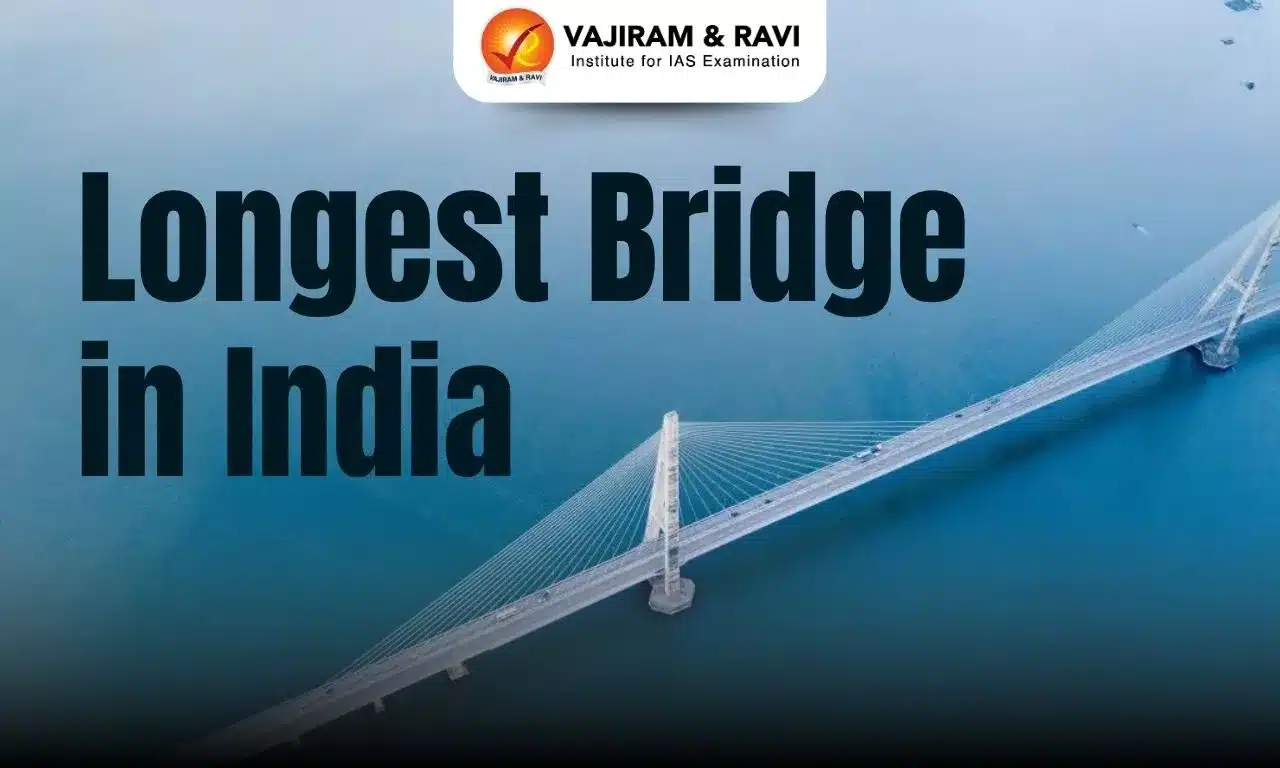
The longest bridge in India is the Atal Setu (Mumbai Trans Harbour Link), which is 21.8 km long and located in Maharashtra. It is also the longest sea bridge in India, connecting Sewri in Mumbai with Nhava Sheva in Navi Mumbai across Thane Creek and the Arabian Sea region. It was inaugurated in January 2024.

Top 10 Longest Bridges in India Complete List

The top 10 longest bridges in India are as follows: 

Rank Bridge Name Length Location Water Body / Feature Year of Opening

1

Atal Setu (Mumbai Trans Harbour Link)

21.8 km

Maharashtra

Thane Creek / Arabian Sea

2024

2

Kacchi Dargah–Bidupur Bridge

9.76 km (main bridge)

Bihar

Ganga River

Under completion (target 2026)

3

Dr. Bhupen Hazarika Setu (Dhola–Sadiya Bridge)

9.15 km

Assam

Lohit River

2017

4

Dibang River Bridge

6.20 km

Arunachal Pradesh

Dibang River

2018

5

Mahatma Gandhi Setu

5.75 km

Bihar

Ganga River

1982

6

Bandra–Worli Sea Link

5.60 km

Maharashtra

Mahim Bay

2009

7

Bogibeel Bridge

4.94 km

Assam

Brahmaputra River

2018

8

Vikramshila Setu

4.70 km

Bihar

Ganga River

2001

9

Vembanad Rail Bridge

4.62 km

Kerala

Vembanad Lake

2011

10

Digha-Sonpur Bridge (J.P. Setu)

4.55 km

Bihar

Ganga River

2016

Important Bridges in India

India has built several landmark bridges across rivers, seas, and lakes to improve connectivity, trade, and strategic mobility. Some of the longest and most important bridges in India are listed below.

Atal Setu (Mumbai Trans Harbour Link)

  • Atal Setu, officially known as the Atal Bihari Vajpayee Sewri-Nhava Sheva Atal Setu, is the longest bridge in India with a length of 21.8 km.  
  • It connects Sewri in Mumbai with Nhava Sheva in Navi Mumbai and significantly reduces travel time between the two regions.  
  • The bridge has approximately a 16.5 km section over the sea and around 5.5 km approach viaducts on land.  
  • It is a six-lane road bridge constructed by the Mumbai Metropolitan Region Development Authority (MMRDA).  
  • It is an important infrastructure project aimed at improving connectivity between Mumbai, Navi Mumbai International Airport, and Jawaharlal Nehru Port.

Kacchi Dargah-Bidupur Bridge

  • The Kacchi Dargah-Bidupur Bridge is a major six-lane bridge project over the Ganga River in Bihar.
  • The main bridge section over the river is approximately 9.76 km long, making it one of India’s longest river bridges after completion.
  • The complete project alignment, including approach roads and connecting structures, extends to nearly 19.76 km.
  • The project connects Patna district with Vaishali district and aims to improve connectivity between northern and southern Bihar.

Dr. Bhupen Hazarika Setu (Dhola-Sadiya Bridge)

  • The Dr. Bhupen Hazarika Setu is India’s longest operational river bridge before the completion of newer mega projects.
  • It is 9.15 km long and built over the Lohit River, a tributary of the Brahmaputra.
  • It connects Dhola and Sadiya in Assam and improves connectivity with Arunachal Pradesh.
  • It was inaugurated in 2017 and was named after legendary Assamese singer Dr. Bhupen Hazarika.

Dibang River Bridge

  • The Dibang River Bridge is located in Arunachal Pradesh and has a length of approximately 6.20 km.
  • It is constructed over the Dibang River and provides strategic connectivity in India’s northeastern border region.
  • The bridge improves movement between Assam and remote areas of Arunachal Pradesh.
  • It was opened in 2018.

Mahatma Gandhi Setu

  • The Mahatma Gandhi Setu is a major road bridge over the Ganga River in Bihar.
  • It connects Patna with Hajipur and plays a vital role in Bihar’s transport network.
  • Opened in 1982, it was once the longest river bridge in India.
  • The bridge is approximately 5.75 km long.

Bandra-Worli Sea Link

  • The Bandra-Worli Sea Link, officially called the Rajiv Gandhi Sea Link, is located in Mumbai, Maharashtra.
  • It connects Bandra with Worli across Mahim Bay.
  • It is approximately 5.6 km long and was opened in 2009.
  • It was India’s first major cable-stayed bridge built over the open sea.

Bogibeel Bridge

  • Bogibeel Bridge is India’s longest rail-cum-road bridge.
  • It is built over the Brahmaputra River in Assam and has a length of approximately 4.94 km.
  • The bridge connects Dibrugarh and Dhemaji districts.
  • It was inaugurated in 2018 and has strategic importance because of its proximity to the India-China border region.

Vikramshila Setu

  • Vikramshila Setu is a road bridge over the Ganga River near Bhagalpur, Bihar.
  • It was opened in 2001 and has a length of approximately 4.70 km.
  • The bridge connects Bhagalpur with Naugachhia and northern Bihar regions.
  • The bridge suffered a partial structural collapse in May 2026. 

Vembanad Rail Bridge

  • The Vembanad Rail Bridge is located in Kerala and crosses Vembanad Lake.
  • It has a length of approximately 4.62 km.
  • It is one of India’s longest railway bridges and forms an important part of the railway connectivity in the Kochi region.
  • It was opened in 2011.

Digha-Sonpur Bridge (J.P. Setu)

  • The Digha-Sonpur Bridge, also known as Jai Prakash Setu, is a rail-cum-road bridge over the Ganga River in Bihar.
  • It connects Digha Ghat in Patna with Sonpur in Saran district.
  • The bridge is approximately 4.55 km long.
  • It was opened in 2016 and improved connectivity between northern and southern Bihar.
Also Check Other Posts
Biosphere Reserves in India National Parks in India
Waterfalls in India Highest Peak in India
Ramsar Sites in India Wildlife Sanctuaries in India
Dams in India Tiger Reserves in India
Mountain Passes in India Longest Bridge in India


Longest Bridge in India FAQs

Q1: Which is the longest bridge in India?

Ans: The Atal Setu (Mumbai Trans Harbour Link) is the longest bridge in India. It is 21.8 km long, located in Maharashtra, and was inaugurated in January 2024. It connects Sewri in Mumbai with Nhava Sheva in Navi Mumbai across Thane Creek.

Q2: Which is the longest river bridge in India?

Ans: The Kacchi Dargah-Bidupur Bridge over the Ganga River in Bihar is the longest river bridge in India after completion. Its main bridge section over the river is approximately 9.76 km long.

Q3: Which is the longest rail-cum-road bridge in India?

Ans: The Bogibeel Bridge in Assam is India’s longest rail-cum-road bridge. It is built over the Brahmaputra River and was inaugurated in 2018.

Q4: Which is the longest sea bridge in India?

Ans: The Atal Setu (Mumbai Trans Harbour Link) is the longest sea bridge in India, with a total length of 21.8 km. It connects Mumbai and Navi Mumbai across Thane Creek.

Q5: Which bridge is known as India’s first major cable-stayed sea bridge?

Ans: The Bandra-Worli Sea Link (Rajiv Gandhi Sea Link) in Mumbai is India’s first major cable-stayed sea bridge. It was opened in 2009 and connects Bandra with Worli across Mahim Bay.

Grand Canyon Flash Floods 2026, Causes, Colorado, Latest News

Grand Canyon Flash Floods 2026

More than 20 people are reportedly missing after a major flash flood struck Grand Canyon National Park in the United States. The sudden flooding affected the Bright Angel Canyon and Phantom Ranch areas, carrying large boulders, metal structures and other debris into the Colorado River

What Caused the Grand Canyon Flash Floods?

Grand Canyon flash floods were caused by a combination of intense monsoon rainfall, wildfire-damaged terrain, drought conditions and steep canyon topography, which together produced rapid and powerful runoff.

  • Intense monsoon rainfall: Heavy thunderstorms during the June–September monsoon season caused large amounts of rain to fall over a short period.
  • Dragon Bravo wildfire: The 2025 Dragon Bravo wildfire destroyed vegetation, leaving parts of the landscape more exposed to rainfall and increasing runoff and debris-flow risks.
  • Drought and hardened soil: Prolonged dry conditions reduced the ground's ability to absorb sudden, heavy rainfall, allowing more water to flow over the surface.
  • Steep canyon terrain: The steep slopes and narrow drainage channels of the Grand Canyon rapidly concentrated rainwater into Bright Angel Creek and surrounding areas.
  • Debris and sediment: The wildfire burn scar made the terrain more vulnerable to erosion and debris flows, adding rocks, soil and other material to the floodwater.
  • Changing extreme-weather patterns: Rising temperatures and changing atmospheric conditions can contribute to more intense short-duration rainfall events, increasing the risk of such compound hazards.

About Grand Canyon

Grand Canyon is a vast natural canyon in northern Arizona, USA, carved primarily by the Colorado River over millions of years. It is known for its deep valleys, layered rock formations, steep cliffs and diverse ecosystems, and much of it is protected within Grand Canyon National Park.

  • Location: Northern Arizona, United States
  • River: The Colorado River flows through the canyon.
  • Length: About 446 km (277 miles).
  • Depth: More than 1.6 km (1 mile) at its deepest points.
  • Geology: Its exposed rock layers preserve a record of millions of years of geological history.
  • Tourism: It is a major destination for hiking, rafting, camping and sightseeing.
  • Natural hazards: Its steep terrain and narrow tributary canyons make it vulnerable to flash floods, rockfalls and extreme weather events.
  • UNESCO status: The Grand Canyon was designated a UNESCO World Heritage Site in 1979.

About Colorado River

Colorado River is one of the most important rivers in the southwestern United States. It originates in the Rocky Mountains of Colorado and flows through several states before reaching Mexico. The river is especially famous for carving the Grand Canyon and remains a major source of water for cities, agriculture, ecosystems and industries across the region.

  • Origin: Rocky Mountains, Colorado, USA
  • Length: Approximately 2,330 km (1,450 miles)
  • States: The river basin covers parts of seven U.S. states.
  • Grand Canyon: The Colorado River flows through the Grand Canyon and has played a major role in shaping its landscape.
  • Water supply: It provides water to millions of people in the southwestern United States.
  • Agriculture: Its water supports extensive irrigation and farming in the Colorado River Basin.
  • Hydropower: Major dams, including Hoover Dam and Glen Canyon Dam, generate hydroelectric power.
  • Environmental importance: The river supports wetlands, wildlife and aquatic ecosystems despite facing prolonged water-stress challenges.

What Is a Flash Flood?

A flash flood is a sudden and fast-moving flood that develops within a short period, usually after intense rainfall, thunderstorms, rapid snowmelt, dam failure or sudden water releases. Unlike ordinary floods that may take hours or days to develop, flash floods can occur within minutes to a few hours, leaving little time for people to move to safety. They are especially dangerous in steep mountains, narrow valleys, deserts and canyons, where water can quickly collect and gain destructive force.

How Do Flash Floods Occur?

Flash floods generally occur when the amount of water entering an area is greater than the soil, streams, drainage systems or rivers can absorb or carry. Several factors can increase this risk:

  • Intense rainfall: Very heavy rain falling over a short period can overwhelm the ground and drainage channels.
  • Saturated or hardened soil: When soil is already saturated, or becomes less absorbent because of drought, more rainfall becomes surface runoff.
  • Steep terrain: Water flows rapidly downhill in mountainous and canyon regions, concentrating in streams and narrow channels.
  • Wildfire burn scars: Wildfires remove vegetation and can make soil less capable of absorbing rainfall, increasing runoff, erosion and debris flows.
  • Narrow waterways: In canyons and confined valleys, large amounts of water can be concentrated into a small space, causing water levels to rise rapidly.
  • Dam or infrastructure failure: The sudden release of stored water can also produce a flash flood downstream.

Grand Canyon Flash Floods 2026 FAQs

Q1: What happened in the Grand Canyon in 2026?

Ans: A major flash flood struck the Bright Angel Canyon and Phantom Ranch areas of Grand Canyon National Park on August 29, 2026.

Q2: Why did the Grand Canyon flash floods occur?

Ans: The flooding was triggered by intense monsoon rainfall and worsened by several environmental factors, including the 2025 Dragon Bravo wildfire burn scar, dry conditions, hardened soil and steep canyon terrain.

Q3: Where did the Grand Canyon flash floods occur?

Ans: The most severely affected areas included Bright Angel Creek, Bright Angel Canyon and Phantom Ranch in the Inner Canyon.

Q4: What is the connection between the Colorado River and the Grand Canyon floods?

Ans: The Colorado River flows through the bottom of the Grand Canyon and receives water and sediment from tributary canyons such as Bright Angel Creek.

Q5: Why are flash floods common in the Grand Canyon during the monsoon season?

Ans: The Grand Canyon experiences a summer monsoon season, during which thunderstorms can produce intense rainfall over short periods. Because of the canyon's steep slopes and narrow drainage channels, rainwater can rapidly concentrate and create dangerous flash floods.

Lok Sabha Passes Bill To Allow Charges On UPI, Latest News

Lok Sabha Passes Bill To Allow Charges On UPI

The Lok Sabha Passes Bill To Allow Charges On UPI. The Taxation and Other Laws (Amendment) Bill 2026 was passed on 6 August 2026. It empowered the Central Government to allow banks and payment service providers to levy charges on Unified Payments Interface (UPI) and other notified electronic payment modes. The amendment changes the Payment and Settlement Systems Act 2007 by removing the legal restriction on charging Merchant Discount Rate (MDR). The move aims to build a financially sustainable digital payments ecosystem while keeping future charges under government notification.

Why Transaction Charges on UPI in News?

The Taxation and Other Laws (Amendment) Bill 2026 marks a major policy shift by allowing the government to notify electronic payment modes on which banks and payment service providers may levy charges.

  • Lok Sabha Approval: The Lok Sabha passed the Taxation and Other Laws (Amendment) Bill 2026 on 6 August 2026 through a voice vote without debate due to continuous Opposition sloganeering during the Monsoon Session.
  • UPI Charge Provision: The amendment authorises the Central Government to permit charges on UPI and other notified electronic payment modes by removing the existing legal prohibition under the Payment and Settlement Systems Act 2007.
  • Policy Objective: The government stated that a small user charge could help create a sustainable revenue model for banks, payment service providers (PSPs) and digital payment infrastructure companies.

Lok Sabha Passes Bill To Allow Charges On UPI

UPI has operated as a zero cost digital payment platform because of legal protection under the existing payment law.

  • Legal Framework: Section 10A of the Payment and Settlement Systems Act 2007 prohibited banks and payment system providers from directly or indirectly charging users on specified electronic payment modes.
  • Income Tax Link: The earlier provision referred to Section 269SU of the Income Tax Act which required businesses with annual turnover above ₹50 crore to provide prescribed electronic payment options such as BHIM UPI QR and RuPay debit cards.
  • Existing Payment Charges: While RTGS and NEFT transactions already carry service charges, UPI remained free despite being a real time payment system, creating a different treatment among digital payment platforms.
  • Rapid UPI Growth: Since its launch in 2016, UPI has become India's leading retail digital payment platform, recording over 140 billion transactions with transaction value exceeding ₹200 lakh crore during FY 2025-26.

Taxation and Other Laws (Amendment) Bill 2026

The Taxation and Other Laws (Amendment) Bill 2026 proposes changes in digital payments and taxation. It gives the government greater powers over electronic payment charges and introduces tax reforms to promote investment, electronics manufacturing, offshore funds, data centres and global business operations in India. 

The key features of the Bill has been provided below:

  • UPI Charge Framework: The Bill amends Section 10A of the Payment and Settlement Systems Act, 2007. It allows the Central Government to notify electronic payment modes on which banks and payment service providers may levy charges.
  • Merchant Discount Rate (MDR): The Bill removes the legal restriction on charging Merchant Discount Rate (MDR) for notified electronic payment modes. However, it does not fix any charge amount or impose fees immediately.
  • Offshore Fund Reforms: The Bill reduces compliance for Eligible Investment Funds (EIFs) by removing 8 of the existing 13 conditions. Offshore funds will mainly need to satisfy only five key conditions, making India more attractive for global fund management.
  • Electronics Manufacturing Support: Tax incentives for foreign companies supplying machinery and equipment to Indian electronics contract manufacturers are proposed to continue until 2040-41, extending the earlier benefit that was available up to 2030-31.
  • Component Supply Chain Benefits: Foreign companies storing electronic components in customs bonded warehouses and supplying them to Indian contract manufacturers will receive new tax exemptions to strengthen electronics production.
  • Data Centre Tax Relief: The Bill expands the definition of eligible data centres to include leased facilities. It also removes the requirement for separate Central Government notification for certain foreign companies using Indian data centres.
  • Diamond Trade Incentive: A 15 year tax holiday up to 31 March 2041 is proposed for specified foreign mining companies, sightholders, brokers, aggregators and auction entities selling rough diamonds in notified special zones.
  • Foreign Portfolio Investor Relief: The Bill replaces the Income tax (Amendment) Ordinance 2026 issued on 5 June 2026. It provides permanent tax relief on capital gains and withholding tax for Foreign Portfolio Investors (FPIs) investing in Government securities.

Charges on UPI Impacts

The Taxation and Other Laws (Amendment) Bill 2026 may reshape India's digital payments ecosystem by balancing affordability with long term financial sustainability.

  • Revenue Sustainability: Banks, payment service providers and infrastructure firms may receive a stable revenue source for maintaining, upgrading and expanding digital payment infrastructure across the country.
  • Consumer and Merchant Costs: Small transaction charges could increase payment costs for consumers and merchants, although the government has indicated that charges are expected to remain limited.
  • Investment Incentives: A revenue model may encourage greater investment in payment technology, cybersecurity, fraud prevention and infrastructure needed to support growing digital transaction volumes.
  • Global Alignment: The proposal brings India's digital payment framework closer to many international payment systems where electronic transactions generally involve service or processing charges.

Charges on UPI Challenges

Several implementation issues remain because the Taxation and Other Laws (Amendment) Bill 2026 provides enabling powers rather than immediate operational rules.

  • Pricing Uncertainty: The government has not announced the rate, structure, or categories of charges, creating uncertainty for consumers, merchants, banks and payment service providers.
  • Financial Inclusion: Even small transaction charges may discourage low value digital payments, particularly among low income users and small businesses that depend heavily on UPI.
  • Merchant Burden: Small retailers could face additional operating costs if MDR is introduced, which may reduce profit margins or increase prices for customers.
  • Regulatory Balance: Authorities must ensure transparent pricing, consumer protection and effective oversight so that payment charges remain reasonable and do not reduce digital payment adoption.

Charges on UPI Transaction Significance

The Taxation and Other Laws (Amendment) Bill 2026 represents an important policy change by shifting India's digital payments framework from a completely free model towards a regulated and financially sustainable ecosystem.

  • Legal Reform: The amendment modernises the Payment and Settlement Systems Act 2007 by giving the government flexibility to notify chargeable electronic payment modes according to future policy requirements.
  • Digital Economy: Sustainable funding can strengthen payment infrastructure as digital transactions continue growing rapidly across banking, retail commerce, government services and financial inclusion programmes.
  • Balanced Approach: The government seeks to balance affordable digital payments with the financial needs of banks, payment service providers and infrastructure companies supporting the payment ecosystem.
  • Future Policy Flexibility: Since charges require separate government notifications, policymakers retain flexibility to protect consumers while responding to technological developments and changing payment market conditions.

Lok Sabha Passes Bill To Allow Charges On UPI FAQs

Q1: Has the Lok Sabha passed the Bill allowing charges on UPI payments?

Ans: Yes. The Lok Sabha passed the Taxation and Other Laws (Amendment) Bill 2026 on 6 August 2026, enabling the government to permit charges on UPI and other notified electronic payment modes.

Q2: Will UPI transactions become chargeable immediately?

Ans: No. The amendment only gives the Central Government the power to notify payment modes for charges. No immediate UPI transaction charge has been announced through the Bill.

Q3: What change has been made to the Payment and Settlement Systems Act 2007?

Ans: The amendment revises Section 10A, removing the legal restriction that prevented banks and payment service providers from charging notified electronic payment modes, including UPI if notified.

Q4: Why is the government considering UPI transaction charges?

Ans: The proposal aims to create a sustainable revenue model for banks, payment service providers and payment infrastructure firms while supporting the long term growth of India's digital payments ecosystem.

Q5: Does the Bill impose a fixed Merchant Discount Rate (MDR) on UPI?

Ans: No. The Bill does not prescribe any fixed MDR or transaction fee. It only authorises the government to allow such charges through future official notifications.

Airports In India 2026, State Wise List, International and Domestic

Airports In India

Airports in India 2026 are important transport facilities that connect different parts of the country as well as the rest of the world. They play a key role in air travel, trade, tourism, and economic development. India has a large network of airports, including international, domestic, and regional airports, which help in the movement of passengers and goods. These airports are located in major cities as well as smaller towns to improve connectivity.

Aviation Sector of India

In the last decade, India’s aviation sector has grown rapidly, and air travel has become more common than ever. Today, India is the third-largest domestic aviation market in the world. The number of airports has also increased significantly from 74 in 2014 to 163 in 2026. Looking ahead, the government plans to expand this number to around 350-400 airports by 2047.

  • The aviation sector is one of the fastest-growing parts of India’s economy. It not only provides air transport but also supports other sectors like tourism, trade, logistics, and manufacturing.
  • According to the International Civil Aviation Organization (ICAO), investment in aviation has a strong impact on the economy. For every rupee spent, it creates more than three times the value and generates many job opportunities in related sectors.
  • At present, the aviation sector supports over 7.7 million jobs, including around 369,000 direct jobs. In the future, the demand for skilled workers such as pilots, engineers, and ground staff is expected to increase.
  • India is also improving its global connectivity through more than 116 air service agreements with other countries. This is helping Indian airlines expand internationally and making India an important aviation hub in Asia. The sector is also attracting foreign investment (FDI) and promoting initiatives like Make in India, especially in areas like aircraft maintenance and manufacturing.
  • Over the past few years, domestic air travel in India has been growing at a steady rate of 10-12% every year. By 2040, passenger traffic is expected to increase nearly six times, reaching around 1.1 billion passengers. The number of aircraft is also expected to grow significantly, and total employment in the aviation sector may reach around 25 million.

What are International Airports in India?

International Airports in India are airports that allow people to travel to other countries through direct or connecting flights. Along with international travel, these airports are also used for domestic flights.

  • These airports usually have separate terminals for domestic and international passengers. They include important facilities like customs checks, security systems, and immigration services, which are necessary for international travel.
  • Compared to domestic airports, international airports are larger and more advanced. They provide extra facilities such as duty-free shops, lounges, waiting areas, airline offices, baby care rooms, prayer rooms, and tourism help centres.
  • International airports in India follow global standards set by organizations like the International Air Transport Association and the International Civil Aviation Organization, which also assign airport codes.
  • The Indira Gandhi International Airport is the largest and busiest airport in India (2026). It is built over a large area and handles a huge number of passengers. It is followed by the Chhatrapati Shivaji Maharaj International Airport.
  • The Cochin International Airport is important because it is the first airport in India developed under the Public-Private Partnership (PPP) model. Another example is the Calicut International Airport, which has been recently included in the list of international airports.

List of International Airports in India 2026

The list of International Airports in India State Wise 2026 has been tabulated below:

Number of International Airports in India 2026

S. No.

State / UT

City

Airport Name

1

Andaman & Nicobar

Port Blair

Veer Savarkar International Airport

2

Andhra Pradesh

Visakhapatnam

Visakhapatnam International Airport

3

Assam

Guwahati

Lokpriya Gopinath Bordoloi International Airport

4

Bihar

Gaya

Gaya Airport

5

Delhi

New Delhi

Indira Gandhi International Airport

6

Goa

Dabolim

Dabolim Airport

7

Goa

Mopa

Manohar International Airport

8

Gujarat

Ahmedabad

Sardar Vallabhbhai Patel International Airport

9

Gujarat

Surat

Surat International Airport

10

Jammu & Kashmir

Srinagar

Sheikh ul-Alam International Airport

11

Karnataka

Bengaluru

Kempegowda International Airport

12

Karnataka

Mangaluru

Mangaluru International Airport

13

Kerala

Kannur

Kannur International Airport

14

Kerala

Kochi

Cochin International Airport

15

Kerala

Kozhikode

Calicut International Airport

16

Kerala

Thiruvananthapuram

Trivandrum International Airport

17

Madhya Pradesh

Indore

Devi Ahilyabai Holkar International Airport

18

Maharashtra

Mumbai

Chhatrapati Shivaji Maharaj International Airport

19

Maharashtra

Nagpur

Dr. Babasaheb Ambedkar International Airport

20

Manipur

Imphal

Imphal International Airport

21

Odisha

Bhubaneswar

Biju Patnaik International Airport

22

Punjab

Amritsar

Sri Guru Ram Dass Jee International Airport

23

Rajasthan

Jaipur

Jaipur International Airport

24

Tamil Nadu

Chennai

Chennai International Airport

25

Tamil Nadu

Coimbatore

Coimbatore International Airport

26

Tamil Nadu

Madurai

Madurai Airport

27

Tamil Nadu

Tiruchirappalli

Tiruchirappalli International Airport

28

Telangana

Hyderabad

Rajiv Gandhi International Airport

29

Uttar Pradesh

Ayodhya

Maharishi Valmiki International Airport

30

Uttar Pradesh

Kushinagar

Kushinagar International Airport

31

Uttar Pradesh

Lucknow

Chaudhary Charan Singh International Airport

32

Uttar Pradesh

Varanasi

Lal Bahadur Shastri International Airport

33

West Bengal

Kolkata

Netaji Subhash Chandra Bose International Airport

What are Domestic Airports in India?

Domestic airports in India are airports that handle flights within the country only. They connect different cities and regions of India and do not operate international flights.

  • Unlike international airports, domestic airports do not have customs and immigration facilities, so they cannot handle flights to or from other countries. However, they still follow security checks such as baggage screening and metal detectors to ensure passenger safety.
  • Domestic terminals provide many facilities for the comfort of passengers. These include waiting areas, VIP lounges with Wi-Fi, and basic travel services. Some modern airports also offer extra facilities like spas, massage centres, and showers, especially for passengers traveling long distances.

List of Domestic Airports in India 2026

Here is the list of domestic airports in India, along with the city and state where they are located.

List of Domestic Airports in India (2026)

S. No.

State / UT

City

Airport Name

1

Andaman & Nicobar

Car Nicobar

Car Nicobar Air Force Station

2

Andhra Pradesh

Kadapa

Kadapa Airport

3

Andhra Pradesh

Kurnool

Uyyalawada Narasimha Reddy Airport

4

Andhra Pradesh

Rajahmundry

Rajahmundry Airport

5

Andhra Pradesh

Tirupati

Tirupati Airport

6

Arunachal Pradesh

Itanagar

Donyi Polo Airport

7

Arunachal Pradesh

Pasighat

Pasighat Airport

8

Arunachal Pradesh

Tezu

Tezu Airport

9

Assam

Dibrugarh

Dibrugarh Airport

10

Assam

Jorhat

Jorhat Airport

11

Assam

North Lakhimpur

Lilabari Airport

12

Assam

Silchar

Silchar Airport

13

Assam

Tezpur

Tezpur Airport

14

Bihar

Darbhanga

Darbhanga Airport

15

Bihar

Patna

Jay Prakash Narayan Airport

16

Bihar

Purnia

Purnia Airport

17

Chhattisgarh

Ambikapur

Maa Mahamaya Airport

18

Chhattisgarh

Bilaspur

Bilasa Devi Kevat Airport

19

Chhattisgarh

Raipur

Swami Vivekananda Airport

20

Daman & Diu

Diu

Diu Airport

21

Gujarat

Bhavnagar

Bhavnagar Airport

22

Gujarat

Bhuj

Bhuj Airport

23

Gujarat

Jamnagar

Jamnagar Airport

24

Gujarat

Kandla

Kandla Airport

25

Gujarat

Porbandar

Porbandar Airport

26

Gujarat

Vadodara

Vadodara Airport

27

Haryana

Hisar

Maharaja Agrasen International Airport

28

Himachal Pradesh

Kangra

Kangra Airport

29

Himachal Pradesh

Kullu

Kullu–Manali Airport

30

Himachal Pradesh

Shimla

Shimla Airport

31

Jammu & Kashmir

Jammu

Jammu Airport

32

Jharkhand

Bokaro

Bokaro Airport

33

Jharkhand

Deoghar

Deoghar Airport

34

Karnataka

Belagavi

Belagavi Airport

35

Karnataka

Hubballi

Hubballi Airport

36

Karnataka

Kalaburagi

Kalaburagi Airport

37

Karnataka

Mysuru

Mysuru Airport

38

Karnataka

Shivamogga

Rashtrakavi Kuvempu Airport

39

Karnataka

Bidar

Bidar Airport

40

Ladakh

Leh

Kushok Bakula Rimpochee Airport

41

Lakshadweep

Agatti

Agatti Airport

42

Madhya Pradesh

Bhopal

Raja Bhoj Airport

43

Madhya Pradesh

Gwalior

Rajmata Vijaya Raje Scindia Airport

44

Madhya Pradesh

Jabalpur

Jabalpur Airport

45

Madhya Pradesh

Khajuraho

Khajuraho Airport

46

Madhya Pradesh

Rewa

Rewa Airport

47

Maharashtra

Aurangabad

Aurangabad Airport

48

Maharashtra

Kolhapur

Chhatrapati Rajaram Maharaj Airport

49

Maharashtra

Nashik

Nashik Airport (Ozar)

50

Maharashtra

Nanded

Shri Guru Gobind Singh Ji Airport

51

Maharashtra

Shirdi

Shirdi Airport

52

Maharashtra

Solapur

Solapur Airport

53

Maharashtra

Sindhudurg

Sindhudurg Airport

54

Meghalaya

Shillong

Umroi Airport

55

Mizoram

Aizawl

Lengpui Airport

56

Nagaland

Dimapur

Dimapur Airport

57

Odisha

Jharsuguda

Veer Surendra Sai Airport

58

Puducherry

Puducherry

Pondicherry Airport

59

Punjab

Pathankot

Pathankot Airport

60

Rajasthan

Jaisalmer

Jaisalmer Airport

61

Rajasthan

Jodhpur

Jodhpur Airport

62

Rajasthan

Bikaner

Nal Airport

63

Rajasthan

Udaipur

Maharana Pratap Airport

64

Rajasthan

Kishangarh

Kishangarh Airport

65

Sikkim

Gangtok

Pakyong Airport

66

Tamil Nadu

Salem

Salem Airport

67

Tamil Nadu

Thoothukkudi

Tuticorin Airport

68

Tripura

Agartala

Maharaja Bir Bikram Airport

69

Uttarakhand

Dehradun

Jolly Grant Airport

70

Uttarakhand

Pantnagar

Pantnagar Airport

71

Uttarakhand

Pithoragarh

Naini Saini Airport

72

West Bengal

Siliguri

Bagdogra Airport

What are Greenfield Airports in India?

Out of the 21 approved greenfield airports in India, 12 airports have already become operational. These include places like Durgapur, Shirdi, Sindhudurg, Pakyong, Kannur, and others. The remaining airports are either under development or in the planning stage, and are expected to become operational in the coming years.

Recently Alluri Sitharamaraju International Airport at Bhogapuram has been completed and will become operational in August. It is replacing scheduled commercial operations at Visakhapatnam (VTZ) while retaining limited services at the existing airport.

Greenfield Airports in India 2026 with Status

S. No.

State / UT

Airport / Location

Status

1

Goa

Mopa

Operational

2

Maharashtra

Navi Mumbai

Under Development

3

Maharashtra

Shirdi

Operational

4

Maharashtra

Sindhudurg

Operational

5

Karnataka

Kalaburagi

Operational

6

Karnataka

Vijayapura

Approved

7

Karnataka

Hassan

Approved

8

Karnataka

Shivamogga

Operational

9

Madhya Pradesh

Dabra (Gwalior)

Approved

10

Uttar Pradesh

Kushinagar

Operational

11

Uttar Pradesh

Noida (Jewar)

Under Development

12

Gujarat

Dholera

Approved

13

Gujarat

Rajkot

Operational

14

Puducherry

Karaikal

Approved

15

Andhra Pradesh

Dagadarthi

Approved

16

Andhra Pradesh

Alluri Sitarama Raju International Airport (Bhogapuram)

Operational (Aug 2026)

17

Andhra Pradesh

Oravakal (Kurnool)

Operational

18

West Bengal

Durgapur

Operational

19

Sikkim

Pakyong

Operational

20

Kerala

Kannur

Operational

21

Arunachal Pradesh

Itanagar

Operational

22

Rajasthan

Alwar

Site Cleared

23

Madhya Pradesh

Singrauli

Site Cleared

24

Himachal Pradesh

Mandi

Site Cleared

25

Kerala

Kottayam

Site Cleared

26

Odisha

Puri

Site Cleared

27

Assam

Doloo

Site Cleared

28

Tamil Nadu

Parandur

Site Cleared

29

Rajasthan

Kota

Site Cleared

30

Karnataka

Raichur

Site Cleared

Aviation Initiatives in India 2026

The Government Initiatives for the Aviation Sector in India has been provided below:

  • UDAN (Ude Desh ka Aam Nagrik): This scheme aims to make air travel affordable and accessible for common people. It connects small towns and remote areas with major cities, boosting tourism and local economic development.
  • Krishi UDAN (2020): This initiative helps in the fast transport of agricultural and perishable goods, especially from rural, tribal, and northeastern regions. It also provides subsidy on freight charges, benefiting farmers.
  • Lifeline UDAN (2020): Started during the COVID-19 pandemic, this scheme ensured the delivery of medical supplies and essential goods across the country, especially to remote areas.
  • Greenfield Airports Policy: This policy promotes the development of new airports on unused land, often through public-private partnerships, to improve connectivity and reduce pressure on major airports.
  • Digi Yatra (2022): A digital initiative that allows paperless and contactless travel using facial recognition technology, making airport processes faster and smoother.
  • Flight Training and Pilot Development: The government is expanding pilot training institutes to meet future demand and is also promoting greater participation of women in aviation.
  • Drone Rules (2021) and PLI Scheme: These initiatives aim to simplify drone regulations and promote domestic manufacturing, supporting growth in the drone sector.
  • Bharatiya Vayuyan Adhiniyam (2024): A new law introduced to modernize India’s aviation sector, simplify regulations, and support Make in India and global standards.

Airports In India 2026 FAQs

Q1: What are airports and why are they important in India?

Ans: Airports are transport hubs that connect different parts of India and the world. They help in travel, trade, tourism, and economic growth by enabling movement of people and goods.

Q2: How has India’s aviation sector grown in recent years?

Ans: India’s aviation sector has grown rapidly and is now the third-largest domestic aviation market. The number of airports increased from 74 (2014) to 163 (2025), and it is expected to grow further.

Q3: What is the difference between international and domestic airports?

Ans: International airports handle flights between countries and have facilities like customs and immigration, while domestic airports handle flights within India only and do not have these facilities.

Q4: Which is the largest and busiest airport in India 2026?

Ans: Indira Gandhi International Airport is the largest and busiest airport in India (2026), followed by Chhatrapati Shivaji Maharaj International Airport.

Q5: What are Greenfield airports in India?

Ans: Greenfield airports are new airports built on unused land. Out of 21 approved projects, 12 airports are already operational, while others are under development or planning.

Coral Bleaching

Coral Bleaching

Coral Bleaching Latest News

Recently, the seventh Status of Coral Reefs of the World report by the Global Coral Reef Monitoring Network (GCRMN) said that Coral bleaching events are becoming more frequent and recovery periods have shortened dramatically. 

About Coral Bleaching

  • It occurs when corals experience stress in their environment due to changes in temperature, pollution or high levels of ocean acidity.
  • Process of Coral Bleaching
    • Under stressed conditions, the zooxanthellae or food-producing algae living inside coral polyps start producing reactive oxygen species, which are not beneficial to the corals.
    • So, the corals expel the colour-giving zooxanthellae from their polyps, which expose their pale white exoskeleton, giving the corals a bleached appearance.
    • This also ends the symbiotic relationship that helps the corals to survive and grow.

What Causes Coral Bleaching?

  • Change in Ocean Temperature: Increased Ocean temperature caused by climate change is the leading cause of coral bleaching.
  • Runoff and Pollution: Storm generated precipitation can rapidly dilute ocean water and runoff can carry pollutants, which can bleach near shore corals.
  • Overexposure to sunlight: When temperatures are high, high solar irradiance contributes to bleaching in shallow water corals.
  • Extremely low tides: Exposure to the air during extremely low tides can cause bleaching in shallow corals.

What are Corals?

  • Corals are marine invertebrates or animals not possessing a spine.
  • Each coral is called a polyp and thousands of such polyps live together to form a colony, which grows when polyps multiply to make copies of themselves.
  • Corals share a symbiotic relationship with single-celled algae called zooxanthellae.
  • The algae provide the coral with food and nutrients, which they make through photosynthesis, using the sun’s light.
  • In turn, the corals give the algae a home and key nutrients. The zooxanthellae also give corals their bright colour.

Source: DTE

Coral Bleaching FAQs

Q1: What is Coral Bleaching?

Ans: It is the expulsion of zooxanthellae Symbiodinium algae due to heat stress, coral turns white.

Q2: What are the major Indian Coral reef regions?

Ans: Gulf of Mannar, Gulf of Kutch, Lakshadweep, Andaman & Nicobar

Water Resources in India, Types, Distribution, Challenges

Water Resources

Water is a fundamental and cyclic natural resource, vital for life, agriculture, industry, and ecosystems. Despite its global abundance covering approximately 71 % of the earth’s surface, only a small fraction, about 3% constitutes freshwater suitable for human use. India, accounting for 2.45 % of the world’s land area and housing 16 % of the global population, has 4 % of the world’s water resources. Effective management of these resources is critical for sustaining livelihoods, food production, and economic growth in a rapidly developing country. In this article, we are going to cover water resources in India.

Water Resources in India

The total annual water availability in India from precipitation is estimated to be 4,000 cubic kilometers, with an average annual precipitation of 1,170 mm. Of this, the total availability from surface water and replenishable groundwater is approximately 1,869 cubic kilometers, but only about 60 % of this water is potentially utilizable for beneficial purposes. Consequently, India’s total utilizable water resources amount to 1,122 cubic kilometers per year, highlighting the gap between natural abundance and practical availability.

Water resources in India can be broadly classified into:

  • Surface water resources
  • Groundwater resources

Surface Water Resources in India

Surface water resources primarily include rivers, lakes, ponds, and tanks. India’s rivers, fed by the monsoon and Himalayan snowmelt, account for most of the country’s surface water. The mean annual flow in all river basins is estimated at 1,869 cubic kilometers, yet only approximately 690 cubic kilometers (37 %) can be effectively harnessed.

Challenges in Surface Water Utilization:

  • Seasonal Concentration: Over 90 % of the annual flow of Himalayan rivers occurs during the four monsoon months, limiting capture potential.
  • Storage Limitations: Suitable sites for reservoirs and dams are scarce, especially in hilly and flood-prone regions.
  • Geographical Constraints: Surface water in many regions is unevenly distributed, with northern and northeastern states enjoying abundant flow, while western and southern regions experience deficits.

India has constructed nearly 5,000 major and medium dams, barrages, and reservoirs to store river water, support irrigation, generate hydropower, and replenish groundwater.

Groundwater Resources in India

The total replenishable groundwater resources of India are estimated at 432 cubic kilometers, with Ganga and Brahmaputra basins accounting for approximately 46 % of the total potential. Groundwater plays a critical role in Indian agriculture, providing water for over 50 % of irrigated areas, supported by about 20 million tube wells nationwide.

  • High Utilization: States like Punjab, Haryana, Rajasthan, and Tamil Nadu exploit groundwater intensively for irrigation and industrial purposes.
  • Low Utilization: States such as Chhattisgarh, Odisha, and Kerala use only a small proportion of their groundwater potential due to abundant surface water and lower irrigation demands.
  • Overreliance on groundwater has led to aquifer depletion, declining water tables, and quality deterioration. To address this, the government emphasizes groundwater recharging through reservoirs, rainwater harvesting, and integrated water resource management.

Water Use and Sectoral Distribution

Agriculture dominates water usage in India, consuming 89 % of surface water and 92 % of groundwater. By contrast, the industrial sector accounts for only 2 % of surface water and 5 % of groundwater, while the domestic sector consumes 9 % of surface water.

This skewed distribution highlights the importance of efficient irrigation techniques and water-saving technologies to ensure sustainable allocation among sectors.

Factors Contributing to Water Quality Deterioration

Many anthropogenic and natural factors have led to water quality deterioration in India:

  1. Water Scarcity: Limited availability increases dependency on contaminated sources.
  2. Pathogenic Pollution: Presence of bacteria and viruses from untreated sewage and surface runoff.
  3. Chemical Leaching: Pesticides, fertilizers, and industrial effluents seep into groundwater.
  4. Oxygen Depletion & Eutrophication: Excess nutrients from fertilizers trigger algal blooms and reduce oxygen levels in water bodies.
  5. Salinity and Alkalinity: Improper irrigation and seawater intrusion increase soil and water salinity.
  6. Toxic Contaminants: Heavy metals like arsenic, lead, and mercury pose significant health risks.

The Central Ground Water Board (CGWB), under the Ministry of Jal Shakti, monitors and manages groundwater resources through scientific assessment, exploration, augmentation, and regulation. Established in 1970, CGWB serves as India’s apex agency for groundwater governance.

Types of Pollution Sources

  1. Point Source Pollution: Sources are identifiable, such as domestic sewage and industrial effluents.
  2. Non-Point Source Pollution: Sources are diffuse, including agricultural runoff, stormwater, rural waste, open defecation, and air deposition.

Other contaminants include heavy metals and biochemical oxygen demand (BOD) or chemical oxygen demand (COD), which impact aquatic ecosystems. Monsoon flooding further exacerbates pollution spread.

Global Water Scarcity

Water scarcity arises when freshwater availability is insufficient to meet demand. It manifests in:

  • Unmet water needs for households, agriculture, or industry
  • Economic competition for limited water resources
  • Environmental degradation
  • Groundwater depletion

Currently, one-third of the global population (2 billion people) faces severe water scarcity for at least one month per year.

Measuring Water Scarcity

The Falkenmark Indicator or Water Stress Index is widely used to assess water scarcity:

  • Below 1,700 m³ per capita per year: Water stress
  • Below 1,000 m³: Water scarcity
  • Below 500 m³: Absolute water scarcity

India is currently water-stressed, with declining per capita availability due to population growth, overexploitation, and regional imbalances in distribution.

Water Scarcity in India

The causes and stress factors leading to water scarcity in India are: 

  1. Population Growth: Rising demand from households and agriculture.
  2. Agricultural Dominance: Over 70 % of water resources are consumed by irrigation.
  3. Rapid Urbanization: High urban demand strains surface and groundwater.
  4. Climate Change: Altered monsoon patterns, melting glaciers, and temperature rises affect water availability.
  5. Aquifer Depletion: Excessive extraction for irrigation and domestic use lowers groundwater levels.
  6. Pollution: Discharge of untreated sewage, industrial waste, and agricultural runoff deteriorates water quality.

Projections indicate India’s population may reach 1.6 billion by 2050, further intensifying water stress.

Consequences of Water Scarcity

Water scarcity can lead to the following consequences for the human population: 

  1. International Conflicts: Shared river basins with neighboring countries like Pakistan, Nepal, Bangladesh, and Myanmar may trigger disputes.
  2. Health Impacts: Limited access to clean water causes water-borne diseases and limits educational and economic opportunities.
  3. Food Shortages: Reduced water availability threatens agriculture, potentially leading to food insecurity and social unrest.
  4. Energy Shortages: Water-intensive thermoelectric plants and hydropower require adequate water for energy security.
  5. Economic Slowdown: Industrial production and urban growth are constrained by water shortages, affecting GDP growth and livelihoods.

Solutions for Water Scarcity 

In order to tackle the problem of water scarcity, the following methods can be adopted: 

  1. CO₂ Cleaning: Use of carbon dioxide in solid form as a cleaning agent reduces water consumption in industries.
  2. Realistic Pricing: Pricing water to reflect true costs encourages conservation and infrastructure maintenance.
  3. Education and Awareness: Behavioural changes in water usage are vital for sustainable consumption.
  4. Water Conservation Technologies: Including rainwater harvesting, drip irrigation, solar-powered purifiers, and wastewater recycling.
  5. Desalination Plants: Energy-efficient and solar-powered plants can augment freshwater supply in coastal regions.
  6. Improved Irrigation Practices: Use of drip or sprinkler systems to reduce water wastage.
  7. Community Governance: Localized management and participation ensure sustainable water use.
  8. Distribution Infrastructure: Repairing pipelines, reservoirs, and treatment plants to reduce losses and improve quality.
  9. Pollution Control: Establishment of STPs, water treatment facilities, and bioremediation techniques.
  10. Research & Development: Innovation in water conservation, wastewater treatment, and sustainable aquifer management.

Government Initiatives to Manage Water Scarcity

The Government of India has adopted the following schemes and initiatives to manage the problem of water scarcity: 

  1. Jal Shakti Abhiyan: Focuses on water conservation in water-stressed districts, promoting citizen participation.
  2. Pradhan Mantri Krishi Sinchay Yojana (PMKSY): Aims at "Har Khet Ko Pani" and "More Crop per Drop", enhancing irrigation efficiency.
  3. National Water Mission: Promotes conservation, efficient use, and equitable distribution of water, targeting a 20 % improvement in water use efficiency.
  4. Atal Bhujal Yojana: Encourages sustainable groundwater management with community involvement.
  5. Jal Jeevan Mission (JJM): Ensures functional household tap connections (FHTC) for all rural households by 2024.
  6. National Rural Drinking Water Programme (NRDWP): Enhances rural water supply coverage and quality.
  7. Jal Kranti Abhiyan: Aims to transform water-scarce villages into water-surplus villages through integrated conservation and management.

Sustainable Approaches for Water Resource Augmentation

  1. Enhancing Water Availability: Protect ecosystems, increase green cover, manage riparian buffers, and implement diversified agriculture and recycling.
  2. Improving Water Quality: Enforce regulations, control pollution, establish treatment plants, and adopt bioremediation.
  3. Reducing Water-Related Risks: Implement integrated watershed management, flood control, climate-resilient agriculture, and sustainable livelihoods.

Mihir Shah Committee Recommendations

The committee recommended restructuring the Central Water Commission (CWC) and Central Ground Water Board (CGWB) into a National Water Commission (NWC) as India’s apex body for water policy, data management, and governance, enabling coordinated and strategic management of water resources at the national level.

Sustainable Management of Water Resources in Indian States

Water is an essential resource for human survival, agriculture, industry, and ecosystems. India, despite being endowed with abundant water resources, faces significant challenges in ensuring equitable distribution, sustainable utilization, and conservation. Various states in India have developed innovative programmes, traditional practices, and modern governance mechanisms to manage water resources sustainably. Understanding these strategies, along with challenges and solutions, is vital for ensuring water security for present and future generations.

Water Resources State-Level Water Management Initiatives 

Different states have launched different schemes and initiatives to ensure water resources are available for all. These include: 

Rajasthan: Mukhya Mantri Jal Swavlamban Abhiyan

Rajasthan, one of the driest states in India, launched the ‘Mukhya Mantri Jal Swavlamban Abhiyan’ to promote water conservation and harvesting activities in rural areas. The scheme focuses on:

  • Construction and restoration of check dams, ponds, and traditional water bodies.
  • Encouraging community participation in maintaining irrigation infrastructure.
  • Ensuring sustainable groundwater recharge to combat water scarcity.

The programme has successfully mobilized local communities, particularly women, to actively participate in pre-monsoon desilting, water body cleaning, and maintenance activities

Maharashtra: Jalyukt Shivar Abhiyan

Maharashtra’s Jalyukt Shivar programme aims to make 5,000 villages free of water scarcity every year. Key features include:

  • Restoration of minor irrigation structures, such as check dams and percolation tanks.
  • Promotion of rainwater harvesting and soil moisture conservation techniques.
  • Strengthening village-level water governance systems to manage irrigation and drinking water needs effectively.

The programme has also contributed to improved agricultural productivity by ensuring water availability during critical cropping seasons.

Telangana: Mission Kakatiya

The Telangana government initiated Mission Kakatiya with the objective of enhancing agriculture-based income for small and marginal farmers. The programme focuses on:

  • Renovation and restoration of ancient tanks and minor irrigation structures.
  • Promoting community-based irrigation management.
  • Facilitating water availability for irrigation, livestock, and domestic use.

By restoring nearly 46,000 tanks, the mission has increased groundwater levels, reduced irrigation dependence on monsoon rainfall, and improved cropping intensity.

Distribution and Challenges of India’s Water Resources

India receives an average annual rainfall of about 1,170 mm, corresponding to 4,000 BCM (Billion Cubic Meters) of precipitation, including snowfall. However, water distribution is highly uneven:

  • Water Surplus States: Uttar Pradesh, Himachal Pradesh, Assam, and northeastern states receive abundant rainfall.
  • Water-Scarce States: Maharashtra (especially Vidarbha and Beed), Karnataka, Tamil Nadu, Rajasthan, and parts of Gujarat face recurring water stress.

Groundwater in northwestern India is now available at depths of nearly 100 meters, reflecting over-extraction and declining aquifer levels.

Institutional Mechanisms for Water Governance 

The following mechanisms have been adopted for water governance: 

Central Water Commission (CWC)

The CWC is India’s premier technical organization in the field of water resources. Its responsibilities include:

  • Initiating and coordinating water resource schemes in consultation with state governments.
  • Conservation and utilization of water for flood control, irrigation, drinking water supply, navigation, and hydropower development.
  • Monitoring water infrastructure and advising on policy and management.

NITI Aayog Composite Water Management Index (CWMI)

To encourage efficient water use and management, NITI Aayog developed the Composite Water Management Index, which benchmarks state-level performance across key water indicators.

Key Focus Areas and Weights:

Theme Weight (%)

Source augmentation and restoration of water bodies

5

Source augmentation (Groundwater)

15

Major & medium irrigation – supply-side management

15

Watershed development – supply-side management

10

Participatory irrigation practices – demand-side

10

Sustainable on-farm water use practices – demand-side

10

Rural drinking water

10

Urban water supply and sanitation

10

Policy and governance

15

Total

100

The index evaluates states on water availability, consumption efficiency, equitable access, and governance, facilitating data-driven decision-making.

Interlinking of Rivers Project

The government has identified four priority links for detailed project reports under the Peninsular Component:

  1. Ken-Betwa Link: Uttar Pradesh and Madhya Pradesh

  2. Damanganga-Pinjal Link: Maharashtra and Gujarat

  3. Par-Tapi-Narmada Link: Maharashtra and Gujarat

  4. Godavari-Cauvery Link: Andhra Pradesh and Tamil Nadu

  • Arguments in Favor:

    • Optimizes water utilization across regions.
    • Addresses water stress and improves irrigation coverage.
    • Enhances power generation and disaster management capabilities.
  • Arguments Against:

    • Artificially alters river courses and affects dryland areas.
    • May have negative environmental impacts, including shoreline erosion and disruption of monsoon patterns.
    • Raises federal disputes over water sharing between states.

Dam Rehabilitation and Improvement Project

Started in 2010 with World Bank assistance, this project aims to:

  • Rehabilitate dams and appurtenant structures.
  • Strengthen institutional capacity and project management.
  • Enhance flood control, irrigation, and water security.
  • The project was scheduled for completion in 2020 and continues to support water storage and safety improvements nationwide.

Groundwater Management and Extraction Rules

India is the largest user of groundwater globally, accounting for 25% of global extraction:

  • 90% is used for agriculture.
  • 10% is used for drinking, domestic, and industrial purposes.
  • Industrial use contributes only 5% of total groundwater extraction.
  • The Central Ground Water Authority (CGWA), constituted in 1997 under the Environment Protection Act, 1986, regulates groundwater extraction and promotes sustainable management practices.

Challenges in Water Resources Governance

  • Lack of credible water information and comprehensive data.
  • Presence of multiple institutions with overlapping mandates.
  • Unsustainable extraction and depletion of aquifers.
  • Absence of an overarching National Water Policy in some regions.
  • Suboptimal water infrastructure performance and deteriorating soil moisture.
  • Increasing water footprint due to agriculture, industry, and urbanization.

The National Aquifer Mapping and Management Program (NAQUIM) by CGWB addresses these challenges by mapping aquifers, characterizing water-bearing formations, and developing Aquifer Management Plans for sustainable groundwater use.

Day Zero Instances in India

Day Zero refers to a situation when taps in a region run dry due to prolonged drought or excessive extraction. Global examples include:

  • Cape Town, South Africa: Countdown due to a three-year drought.
  • Sao Paulo, Brazil (2015): Water supply cut for 12 hours daily.
  • Barcelona, Spain (2008): Water imported from France.
  • In India, cities like Shimla (Himachal Pradesh), Udupi, and Mangaluru (Karnataka) are at risk of similar crises due to unsustainable water use and depletion of local sources.

Traditional Water Conservation Practices in India

India’s rich cultural heritage offers valuable lessons for water management:

  • Building water structures: Stepwells (e.g., Rani Ki Vav, Patan), ponds, and tanks.
  • Maintenance and cleaning of local water bodies.
  • Cultural performances: Songs, dances, and rituals like Ganga Geet, Bhawai, Jal Yatras, and Jal Yagya celebrated water’s sacred value.

Tribal and Rural Practices

  • Ziro Valley, Arunachal Pradesh: Community-managed irrigation canals.
  • Spiti Valley: Khuls channel glacial water to villages with regulated distribution.
  • Thar Desert, Rajasthan: Rituals like Lasipa and community desilting maintain water structures.

Traditional Conservation System 

There are many traditional conservation systems for conserving water: 

System Location/Description Function

Phad

Tapi basin, Maharashtra

Community-managed irrigation with check dams and canals.

Zing

Ladakh

Small tanks collecting glacier meltwater.

Kuhls

Himachal Pradesh

Channels carrying glacial water to fields.

Zabo/Ruza

Nagaland

Terraced hill structures for rainwater collection.

Jackwells

Great Nicobar

Bamboo tubes collecting leaf runoff into pits.

Pat System

Madhya Pradesh

Diverts hill stream water via bunds for irrigation.

Eri

Tamil Nadu

Tank system controlling floods, preventing soil erosion, recharging groundwater.

Johads

Rajasthan

Earthen check dams for groundwater recharge.

Panam Keni

Wayanad

Wooden cylinders capturing groundwater from springs.

Ahar Pynes

South Bihar

Reservoirs and artificial rivulets for irrigation.

Jhalara/Bawari

Rajasthan

Stepwells for storage and access to groundwater.

Taanka

Thar Desert

Cylindrical underground pits capturing rooftop rainwater.

Khadin

Jaisalmer

Long earthen embankments across hill slopes for runoff irrigation.

Kund
Western Rajasthan/Gujarat
Saucer-shaped catchments directing water to central wells.

These systems combine traditional engineering, community participation, and ecological knowledge, providing sustainable solutions for water management in diverse terrains.

Modern Integration with Traditional Practices

Modern initiatives like rainwater harvesting, check dams, and minor irrigation projects often integrate traditional knowledge systems, ensuring:

  • Improved water availability and groundwater recharge.
  • Reduced soil erosion and flooding.
  • Increased community ownership and participation.
  • Preservation of cultural heritage and biodiversity.
Also Check Other Posts
Geomorphology Major Dams in India
Composition and Structure of Atmosphere Major Ports in India
Types of Forests in India Coastal States of India
Ocean Acidification Migration in India
Deep Ocean Mission Natural Vegetation of India

Water Resources FAQs

Q1: What is called water resources?

Ans: Water resources are sources of water, both surface and underground, that are useful for human consumption, agriculture, industry, and ecological purposes.

Q2: What are the five types of water resources?

Ans: The five types of water resources are surface water, groundwater, rainwater, atmospheric water, and artificial water resources.

Q3: What are the 10 natural resources of water?

Ans: The ten natural water resources include rivers, lakes, ponds, glaciers, springs, wetlands, groundwater, rainwater, snow, and estuaries.

Q4: What is Jal Shakti Abhiyan?

Ans: Jal Shakti Abhiyan is a nationwide campaign launched by the Indian government for water conservation, rainwater harvesting, and improving water use efficiency, especially in water-stressed districts.

Q5: What is Jal Kranti Abhiyan?

Ans: Jal Kranti Abhiyan is a government initiative aimed at transforming villages and cities through integrated water conservation and management practices to make water-scarce regions water-surplus.

Demographic Transition Theory, Stages, Features, India’s Profile

Demographic Transition Theory

Demographic Transition Theory is a simple way to understand how a country’s population changes over time as it develops. It explains how birth rates and death rates gradually shift due to improvements in factors like healthcare, education, and living conditions. In general, societies move from having high birth and death rates to lower and more stable population growth as they progress economically and socially.

About Demographic Transition Theory

  • Demographic Transition Theory explains how a country’s population changes over time as it develops economically and socially.
  • The idea was first introduced by Warren S. Thompson (1929) and later explained in detail by Frank W. Notestein (1945).
  • It mainly studies changes in birth rates, death rates, and overall population growth.
  • The theory is based on the experience of European countries, where these changes started around the late 18th century.
  • It is not a fixed rule but a general model used to understand population trends in different countries.
  • According to this theory, societies move from a rural and agricultural stage to a more urban, industrial, and modern stage, and this shift changes population patterns.
  • In the early stage, both birth rates and death rates are high, so population growth is slow.
  • As development begins, death rates start to fall first due to better healthcare, sanitation, and food supply.
  • After some time, birth rates also begin to decline, leading to slower population growth.
  • Eventually, both birth and death rates become low and stable, resulting in little or no population growth.
  • The theory also shows that population changes are closely linked with social and economic development like education, urbanization, and improved living standards.
  • Stages of Demographic Transition
    • Pre-Transition Stage: High birth and death rates with very slow population growth.
    • Early Expanding Stage: Birth rates remain high, but death rates fall, causing rapid population growth.
    • Late Expanding Stage: Birth rates start declining along with low death rates, so growth begins to slow.
    • Low Stationary Stage: Both birth and death rates are low, leading to stable population growth.
    • Declining Stage (in some models): Birth rates fall below death rates, causing a decline in population.

First Stage of Demographic Transition

The features of the first stage of the Demographic Transition Theory are highlighted as follows:

  • The first stage is called the stage of high birth rate and high death rate, where population growth remains slow and nearly stable.
  • Countries in this stage are at a very low level of development, with most people depending on traditional agriculture and living a subsistence lifestyle with little or no surplus.

  • The standard of living is poor, with low income, low productivity, and limited use of modern technology; most people are illiterate and live in rural areas.
  • Medical facilities are inadequate, leading to frequent diseases, epidemics, famine, hunger, and poor sanitation, which keep the death rate very high and life expectancy low.
  • At the same time, birth rates remain high due to social and economic reasons such as early marriages, lack of education, and the need for more working hands, making large families common and useful.
  • The population structure shows many young people and very few elderly, with a broad-based population pyramid.
  • Society is largely traditional and influenced by religious beliefs, with very little urbanization.
  • Around 200 years ago, almost all countries were in this stage, while today only a few countries like Sierra Leone and Somalia show similar characteristics.

Also read: Social Issues in India

Second Stage of Demographic Transition

The features of the second stage of the Demographic Transition Theory are highlighted as follows:

  • The second stage is known as the stage of high birth rate and low death rate, often called the population explosion stage, where population grows very rapidly.
  • The death rate falls quickly due to improvements in healthcare, sanitation, and food supply, which increases life expectancy and reduces deaths from diseases.
  • The birth rate remains high in the beginning because of traditional beliefs, low awareness, and limited use of contraceptives, but it starts declining gradually over time.
  • The wide gap between high birth rates and low death rates leads to a very high natural increase in population.
  • The population pyramid expands rapidly at the base, showing a large number of children and young people, along with a decline in infant mortality.
  • Economic conditions begin to improve, with rising incomes and a shift from a rural agricultural society to a more urban and industrial one.
  • Modernization increases, including better education, healthcare, and living standards, and large families slowly become less important.
  • This stage has two phases:
    • Early phase: High birth rate and sharply falling death rate
    • Later phase: Birth rate begins to fall while death rate remains low
  • Population growth is very fast at first but slows down gradually towards the end of this stage.
  • Today, many developing countries such as India, Bangladesh, Pakistan, Nepal, Kenya, Indonesia, Malaysia, Iran, and Yemen are in this stage.

Third Stage of Demographic Transition

The features of the third stage of the Demographic Transition Theory are highlighted as follows:

  • The third stage is marked by a declining birth rate and a low death rate, leading to slow and stable population growth.
  • As countries develop economically and urbanization increases, people begin to prefer smaller families, seeing large families as a burden.
  • Birth rates fall rapidly, while death rates remain low, reducing the gap between the two and slowing population growth.
  • Improvements in healthcare, sanitation, and living conditions keep death rates low and increase life expectancy.
  • Women Empowerment through education and employment opportunities improved, leading to delayed marriages and fewer children.
  • Greater awareness and access to family planning methods further reduce fertility rates.
  • The society becomes more urban, industrial, and modern, moving away from traditional agricultural systems.
  • The population structure becomes more balanced, with a rising number of older people and a stationary population pyramid.
  • Economic growth leads to higher incomes, reduced poverty, and better standards of living, along with improved and diverse food choices.
  • This stage provides an opportunity for countries to build a strong and stable economic base.
  • Countries like India, Mexico, South Africa, UAE, and several European nations are currently in this stage.

Fourth Stage of Demographic Transition

The features of the fourth stage of the Demographic Transition Theory are highlighted as follows:

  • The fourth stage is known as the stage of low birth rate and low death rate, where population becomes stable or grows very slowly.
  • Due to rapid economic development, the standard of living is high, and people focus more on quality of life rather than large family size.
  • Both birth rate and death rate remain low, and the birth rate is almost equal to the death rate, leading to population stabilization.
  • The fertility rate is low, usually around or below the replacement level (about 2.1).
  • Life expectancy is high, and the number of elderly people increases due to better medical facilities, technological progress, and government support systems.
  • The population pyramid becomes contracting, showing fewer children and more older people.
  • Society becomes highly urbanized, educated, and technologically advanced, and people deliberately control family size.
  • This stage creates an ideal condition for economic development due to a stable population and better resources.
  • Countries in this stage include China, Argentina, Canada, Australia, Brazil, Singapore, and most European countries.

Demographic Profile of India

  • The demographic profile of India shows details about its population like age, sex, place of living, structure, and distribution. Population growth plays a key role in shaping it.
  • India is one of the most populous countries in the world. Its growth rate was 2.15% (1991-2001) and later decreased to 1.64% (2001-2011).
  • India has only 2.4% of the world’s land area but supports about 16.7% of the world’s population, which shows high population pressure.
  • Although the population is large, only one-third are working people, while two-thirds are dependents, which affects economic development.
  • India is the 7th largest country in area, but in terms of population, it has become the largest country (by 2023).
  • Population has generally increased over time, except in 1921, when a negative growth rate was recorded (called the demographic divide).
  • Before the 20th century, population growth was slow, but it started increasing rapidly later.
  • India’s population history is divided into four phases:
    • Stagnant Population (1901-1921)
    • Steady Growth (1921-1951)
    • Rapid High Growth (1951-1981)
    • High Growth with Slowing Down (post 1981)
  • Phase of Stagnant Population (1901-1921)
    • Population growth was very slow and irregular because the high birth rate was balanced by high death rate.
    • Death rate was very high due to diseases like influenza, plague, cholera, smallpox, along with famines and poor food supply caused by droughts.
    • 1921 recorded a negative growth rate (-0.31%), the only time in India’s history, so it is called the demographic divide.
    • Deaths also increased due to World War I (1914-1918).
  • Phase of Steady Growth (1921-1951)
    • The population started growing steadily due to a decline in the death rate, while birth rate remained high.
    • Improvements in healthcare, sanitation, water supply, and transport helped control diseases and reduce deaths.
    • Death rate dropped from 47 to 27 per thousand, while birth rate stayed high (around 40 per thousand).
    • Growth during this phase is called mortality-induced growth (growth due to falling death rate).
  • Phase of Rapid High Growth (1951-1981)
    • The population increased very rapidly, from 361 million (1951) to 683 million (1981).
    • Death rate declined sharply due to better medical facilities, but birth rate decreased only slightly, leading to a population explosion.
    • This created a large gap between birth and death rates, causing fast population growth.
  • Phase of High Growth with Slowing Down (post 1981)
    • The population continued to grow, but the growth rate started declining.
    • The total population increased by about 34.37 crore in 20 years, but the annual growth rate fell from 2.2% (1981) to 1.93% (2001).
    • This phase shows clear signs of slowing population growth, although the population size is still increasing rapidly.

Also Read : Demographic Dividend

Criticism of Demographic Transition Theory

Demographic Transition Theory has been criticised for the below discussed reasons:

  • The theory is mainly based on the experience of Western countries like Europe, America, and Australia, so it may not fully apply to all countries, especially developing ones.
  • It is not a perfect predictive theory, as it cannot clearly tell how or when a country will move from one stage to another.
  • The stages are not always followed in a fixed order. Some countries have shown unexpected changes, like rising death rates due to political or economic problems.
  • The theory does not clearly explain why birth rates fall, and it ignores many important factors like culture, traditions, and personal choices.
  • It also does not give a proper time frame, so we cannot say how long each stage will last in different countries.
  • The role of technology and medical advancements is not fully considered, even though they can quickly reduce death rates and change population patterns.
  • It does not fully fit developing countries, where death rates have fallen rapidly but birth rates remain high, causing sudden population growth.
  • The theory ignores social factors like women’s education, empowerment, and government policies, which strongly influence population changes.
  • It also overlooks migration, which can significantly affect population size and structure.

Demographic Transition Theory FAQs

Q1: What is Demographic Transition Theory?

Ans: Demographic Transition Theory explains how a country’s population changes over time as it develops, moving from high birth and death rates to low and stable population growth.

Q2: What are the stages of Demographic Transition Theory?

Ans: There are mainly four stages: high birth & death rates, high birth & low death rates, low birth & death rates, and finally a stable or slowly growing population stage (some models include a fifth declining stage).

Q3: Why does the population increase rapidly in the second stage?

Ans: The population grows fast because death rates fall due to better healthcare and food supply, while birth rates remain high for some time.

Q4: How does economic development affect population growth?

Ans: As a country develops, better education, healthcare, and urbanization lead to lower birth and death rates, resulting in slower and more stable population growth.

Q5: Which stage of demographic transition is India in?

Ans: India is generally considered to be in the third stage, where birth rates are declining and population growth is slowing down.

List of Wars Between India and Pakistan, Year, Cause, Outcome

List of Wars Between India and Pakistan

The partition of British India in 1947 gave birth to two nations, India and Pakistan. The division, grounded in religious and political differences, led to widespread violence, displacement, and a bitter legacy. Since independence, India and Pakistan have fought four major wars, engaged in numerous military standoffs, and have experienced countless border conflicts and terrorist attacks. The article below includes the List of Wars Between India and Pakistan from the First Kashmir War of 1947 to the recent Operation Sindoor of 2025 including key facts, triggers, outcomes, and their broader implications.

List of Wars Between India and Pakistan

Since 1947, India and Pakistan have experienced several military confrontations, most of them rooted in the long-standing Kashmir dispute and cross-border tensions. These clashes have ranged from full-scale wars to limited strikes and standoffs, each with its own background, trigger, and outcome. The table below offers a List of Wars Between India and Pakistan over the years.

List of Wars Between India and Pakistan
Conflict / War Year Cause / Trigger Outcome

First Kashmir War

1947-1948

Accession of J&K, tribal invasion

LoC established, Kashmir dispute unresolved

Second Indo-Pak War

1965

Pakistan’s Operation Gibraltar

Tashkent Agreement, status quo restored

Indo-Pak War / Bangladesh

1971

Bengali independence movement

Creation of Bangladesh

Kargil War

1999

Pakistani intrusion in Kargil

Indian victory, global condemnation of Pak

Siachen Conflict

1984-2003

Control of Siachen Glacier

India holds key positions

Military Standoff

2001-2002

Indian Parliament attack

De-escalated via diplomacy

Surgical Strikes

2016

Uri attack

Terror camps destroyed

Balakot Airstrike

2019

Pulwama attack

First IAF strike on Pak territory since 1971

Operation Sindoor

2025

Pahalgam terror attack

Massive punitive retaliation, ceasefire

Major Wars Between India and Pakistan

First Indo-Pak War (1947–1948): First Kashmir War

  • Duration: October 22, 1947 – January 1, 1949
  • Cause: Accession of Jammu & Kashmir
  • Outcome: Ceasefire brokered by UN, establishment of the Line of Control (LoC)

Background:
Following independence, princely states were given three choices: accede to India, join Pakistan, or remain independent. Maharaja Hari Singh, the ruler of Jammu and Kashmir, initially chose to remain independent. However, when Pakistani tribal militias invaded in October 1947, he sought help from India and signed the Instrument of Accession, making Jammu & Kashmir a part of India.

Course of War:
The Indian Army was airlifted into Srinagar and successfully pushed back the infiltrators. Key battles were fought in Uri, Baramulla, and Jammu. However, Pakistan retained control over a portion of the territory now known as Pakistan-occupied Kashmir (PoK).

Result:
A UN-mediated ceasefire came into effect on January 1, 1949. It led to the establishment of the LoC, dividing Jammu and Kashmir between the two nations. The Kashmir issue, however, remained unresolved and a perpetual flashpoint.

Second Indo-Pak War (1965)

  • Duration: August-September 1965
  • Cause: Dispute over Kashmir, Pakistani Operation Gibraltar
  • Outcome: Tashkent Agreement (January 1966) - Status quo ante bellum

Background:
Pakistan initiated Operation Gibraltar, sending soldiers disguised as locals into Jammu and Kashmir to incite rebellion. The plan backfired as locals did not support the intruders, and the Indian Army responded with full-scale retaliation.

Course of War:
The conflict spread across the International Border. Major battles were fought in Lahore, Sialkot, and the Rann of Kutch. The Indian Army made significant gains, and both sides suffered heavy casualties.

Result:
After intense fighting lasting 17 days, a UN-mandated ceasefire was declared. The Tashkent Agreement, brokered by the USSR, restored pre-war positions. However, the war did not resolve the Kashmir dispute, and both nations claimed victory.

Indo-Pak War of 1971: Bangladesh Liberation War

  • Duration: December 3-16, 1971
  • Cause: Political crisis in East Pakistan; support for Bengali independence movement
  • Outcome: Creation of Bangladesh, Decisive Indian victory

Background:
East Pakistan (present-day Bangladesh) had been agitating for autonomy. Following the denial of electoral victory to Sheikh Mujibur Rahman’s Awami League and subsequent military crackdown by West Pakistan, a refugee crisis emerged with over 10 million people fleeing to India.

Course of War:
India supported the Mukhti Bahini (freedom fighters) and launched military operations on both the eastern and western fronts. The Battle of Longewala in Rajasthan and naval blockade of Karachi were strategic successes.

Result:
On December 16, 1971, Pakistan’s Eastern Command surrendered in Dhaka with over 90,000 troops taken as prisoners of war. The war led to the birth of Bangladesh. The Shimla Agreement (1972) was signed, where India returned captured territory in the west in exchange for peace commitments from Pakistan.

Kargil War (1999)

  • Duration: May-July 1999
  • Cause: Pakistani infiltration into Kargil sector
  • Outcome: India regained all lost territory, diplomatic victory

Background:
Pakistani troops and militants infiltrated into Indian positions along the LoC in the Kargil region. Their aim was to cut off National Highway 1A, thereby disrupting Indian logistics in Siachen and Kashmir.

Course of War:
India launched Operation Vijay, combining infantry assaults, artillery bombardments, and air strikes. Major battles took place at Tololing, Tiger Hill, and Batalik.

Result:
Indian forces successfully recaptured all the occupied positions. International pressure, especially from the United States, forced Pakistan to withdraw. The war exposed Pakistan Army's duplicity, as then-Prime Minister Nawaz Sharif was kept unaware of the operation by the military leadership.

Other Major Conflicts and Military Engagements

India and Pakistan have experienced a series of high-stakes military confrontations since their independence in 1947, with several conflicts emerging even in the post-Kargil era. While full-scale wars have been largely avoided since 1999, tensions have remained high due to terrorism, border conflicts, and strategic rivalries. The table below summarizes key India-Pakistan military engagements and operations from 1984 onwards, highlighting their causes, actions taken by India, and their outcomes.

Other Major Conflicts and Military Engagements
Event Period/Date Trigger/Cause Action Taken Outcome

Siachen Conflict

1984-2003

Strategic control over Siachen Glacier

India launched Operation Meghdoot

India gained and maintained control over key heights on the glacier

2001-2002 Military Standoff

Dec 2001 - Oct 2002

Indian Parliament attack (Dec 13, 2001)

India initiated Operation Parakram (massive troop mobilization)

Full-scale war was averted; high tension persisted for months

Surgical Strikes

Sept 29, 2016

Uri attack (19 Indian soldiers killed by Pakistani terrorists)

Cross-LoC surgical strikes on terror launch pads

Marked a proactive shift in India’s counter-terror strategy; received wide domestic support

Balakot Airstrikes

Feb 26, 2019

Pulwama attack (40 CRPF personnel martyred)

IAF conducted airstrikes on terror camps in Balakot, Pakistan

Escalated into air combat; Wing Commander Abhinandan captured and returned by Pakistan

Operation Sindoor (2025)

Operation Sindoor 2025 was launched in direct response to the tragic Pahalgam terror attack on April 22, 2025, which claimed the lives of 26 innocent civilians. India initiated a swift and coordinated military offensive on May 7, 2025. The operation spanned approximately four days and concluded on May 10, 2025. The primary objectives of this mission were to dismantle terror infrastructure across the border, and deliver a strong message of deterrence to hostile elements.

Operation Sindoor (2025)
Phase Details

Phase 1: Precision Strikes

Targets: Terrorist camps of LeT, JeM, Hizbul in PoJK and across Pakistan Weapons Used: SCALP missiles, BrahMos, HAMMER bombs, loitering munitions Notable Platforms: Rafale, Su-30 MKI, drones

Phase 2: Pakistani Retaliation

Pakistan launched drones and missiles at Indian military bases India’s air defense systems intercepted many threats India responded with deep strikes targeting airbases and radars inside Pakistan

Phase 3: Escalation & Ceasefire

India struck major Pakistani airbases like Sargodha, Rahim Yar Khan, Bholari Destruction of 6+ fighter jets, 2 surveillance aircraft, 10+ drones, and missile systems Pakistan requested a ceasefire within 88 hours

List of Wars Between India and Pakistan FAQs

Q1: How many wars have India and Pakistan fought since independence?

Ans: India and Pakistan have fought four major wars in 1947, 1965, 1971, and 1999 along with several military standoffs and counter-terror operations.

Q2: What was the main reason for the First Indo-Pak War in 1947–48?

Ans: The first war was triggered by Pakistan-backed tribal invasion in Jammu and Kashmir after the Maharaja signed the Instrument of Accession to join India.

Q3: What was the outcome of the 1971 Indo-Pak War?

Ans: The 1971 war led to the creation of Bangladesh, with India securing a decisive victory and capturing over 90,000 Pakistani soldiers.

Q4: What was the significance of the Kargil War in 1999?

Ans: The Kargil War was fought in high-altitude terrain where India successfully pushed back infiltrators and reclaimed lost territory. It was seen as a diplomatic and military win for India.

Q5: What is the Line of Control (LoC)?

Ans: The LoC is the de facto border between India and Pakistan in the region of Jammu and Kashmir, established after the 1948 ceasefire.

Lakes in India, Types, Distribution, Importance, Conservation

Lakes in India

Lakes are important natural water bodies found across India, playing a crucial role in ecology, climate regulation, agriculture, and human life. India has a wide variety of lakes due to its diverse geography, from the Himalayas to coastal plains and plateaus. These lakes differ in origin, size, water type, and usage.
This article provides a clear insight into Important Lakes in India, including their types, formation, distribution, and significance.

What is a Lake?

A lake is a large natural body of water surrounded by land. It can contain either freshwater or saltwater and is usually bigger and deeper than a pond. Lakes are formed by natural processes like tectonic movements, glaciers, or river changes, and some are also man-made. They serve as an important source of water, support wildlife, and help maintain the environment.

Types of Lakes in India

Lakes in India are classified based on their origin and physical characteristics, which explain how they were formed. Each type of lake has distinct features and is found in specific geographical regions of the country.

1. Tectonic Lakes

  • Formed due to movements of the Earth’s crust such as faulting, folding, or subsidence, creating large depressions
  • Generally deep, elongated, and stable water bodies with long geological history
  • Mostly located in tectonically active regions like the Himalayas
  • Water is usually freshwater, but depth and clarity vary
  • Important for irrigation, fisheries, and local climate regulation
  • Example: Wular Lake

2. Glacial Lakes

  • Formed by the melting of glaciers that carve out basins or leave behind depressions (cirques and moraines)
  • Found at high altitudes in the Himalayan region and often surrounded by snow-covered peaks
  • Water is cold, clear, and mainly freshwater
  • Many are seasonal and depend on glacial melt; some pose risks of Glacial Lake Outburst Floods (GLOFs)
  • Important for freshwater supply and scientific study of climate change
  • Examples: Dal Lake, Pangong Lake

3. Oxbow Lakes

  • Formed when a meandering river cuts off a loop, leaving behind a crescent-shaped water body
  • Common in floodplains where rivers frequently change course
  • Usually shallow and may dry up over time due to silt deposition
  • Rich in nutrients, making them suitable for agriculture and fishing nearby
  • Often seen along major river systems
  • Example: Oxbow lakes along the Ganga River plains

4. Lagoon (Coastal) Lakes

  • Formed when sandbars, spits, or barrier beaches separate a portion of seawater from the ocean
  • Typically shallow and contain brackish water (mix of fresh and saltwater)
  • Influenced by tides and seasonal freshwater inflow from rivers
  • Support rich biodiversity including migratory birds and marine species
  • Important for fisheries, salt production, and tourism
  • Examples: Chilika Lake, Pulicat Lake

5. Saltwater Lakes

  • Formed in inland basins where water evaporates faster than it drains, leaving salts behind
  • Found mainly in arid and semi-arid regions like Rajasthan
  • High salinity limits biodiversity but supports salt-tolerant organisms
  • Economically important for salt extraction and mineral resources
  • Water is not suitable for drinking or irrigation
  • Example: Sambhar Lake

6. Freshwater Lakes

  • Contain low levels of dissolved salts and are suitable for human consumption and agriculture
  • Can be formed by various processes such as tectonic activity, glacial action, or river systems
  • Support diverse aquatic life including fish, plants, and birds
  • Serve as major sources of drinking water, irrigation, and hydroelectric power
  • Widely distributed across India in hills, plains, and plateaus
  • Example: Bhimtal Lake

7. Artificial (Man-made) Lakes

  • Created by constructing dams across rivers to store water
  • Used for irrigation, hydroelectric power generation, flood control, and drinking water supply
  • Usually large reservoirs with controlled water levels
  • Play a key role in regional development and agriculture
  • Also support fisheries and tourism activities
  • Examples: Gobind Sagar Lake, Nagarjuna Sagar Lake

8. Crater/Volcanic Lakes

  • Formed in volcanic craters or depressions created by meteorite impacts
  • Usually circular in shape with steep sides
  • Rare in India but scientifically significant for geological studies
  • Water may contain unique minerals and chemical properties
  • Provide insights into Earth’s geological history
  • Example: Lonar Lake

Distribution of Lakes in India

The distribution of lakes in India reflects the country’s diverse physical geography, from the Himalayan mountains to coastal plains and arid deserts. Different regions have distinct types of lakes based on geological processes, climate, and river systems.
Distribution of Lakes in India

Lake Name

Type of Lake

State/Region

Associated River

Significance

Wular Lake

Tectonic (Freshwater)

Jammu & Kashmir

Jhelum River

One of the largest freshwater lakes; helps in flood control and supports fisheries

Dal Lake

Glacial (Freshwater)

Jammu & Kashmir

Jhelum River system

Famous for tourism, houseboats, and floating gardens

Pangong Lake

Glacial (Saltwater)

Ladakh

No major river (endorheic basin)

High-altitude lake; strategic and ecological importance

Chilika Lake

Lagoon (Brackish)

Odisha

Daya River (distributary of Mahanadi)

Largest brackish water lake; major bird sanctuary and Ramsar site

Pulicat Lake

Lagoon (Brackish)

Andhra Pradesh & Tamil Nadu

Swarnamukhi River

Second-largest brackish water lake; important for fisheries and bird habitat

Vembanad Lake

Lagoon (Brackish)

Kerala

Periyar River

Longest lake in India; supports backwater tourism and agriculture

Sambhar Lake

Saltwater Lake

Rajasthan

No river (inland drainage)

Largest inland salt lake; major source of salt production

Lonar Lake

Crater Lake

Maharashtra

No river

Formed by meteorite impact; unique geological and ecological site

Kolleru Lake

Freshwater Lake

Andhra Pradesh

Between Krishna & Godavari rivers

Important wetland and bird sanctuary

Loktak Lake

Freshwater (Floating lake)

Manipur

Manipur River

Famous for floating phumdis; supports Keibul Lamjao National Park

Bhimtal Lake

Freshwater Lake

Uttarakhand

Fed by small streams

Important for tourism and drinking water supply

Gobind Sagar Lake

Artificial (Reservoir)

Himachal Pradesh

Sutlej River

Created by Bhakra Dam; used for irrigation and hydropower

Nagarjuna Sagar Lake

Artificial (Reservoir)

Telangana & Andhra Pradesh

Krishna River

One of the largest man-made lakes; irrigation and power generation

Importance of Lakes in India

  • Freshwater Source: Lakes provide water for drinking, irrigation, and domestic use, especially in areas facing water scarcity
  • Biodiversity Support: They act as habitats for fish, aquatic plants, and migratory birds, seen in Chilika Lake
  • Climate Regulation: Lakes help maintain local temperature, humidity, and microclimate, reducing extreme weather conditions
  • Flood Control: They store excess rainwater and reduce flood risks; reservoirs like Gobind Sagar Lake help regulate water flow
  • Economic Benefits: Support fisheries, tourism, and livelihoods, generating income for local communities
  • Hydropower Generation: Artificial lakes are used for electricity production, such as Nagarjuna Sagar Lake
  • Cultural Significance: Many lakes have religious and cultural importance, like Pushkar Lake
  • Groundwater Recharge: Lakes help in replenishing underground water levels, improving water availability in nearby regions
  • Soil Conservation: They reduce soil erosion and surface runoff, helping maintain soil fertility
  • Scientific Value: Lakes are useful for research in climate change, hydrology, and geology, with examples like Lonar Lake

Environmental Issues Related to Lakes in India

  • Water Pollution: Discharge of untreated sewage, industrial effluents, and plastic waste degrades water quality and harms aquatic life, as seen in Dal Lake
  • Eutrophication: Excess nutrients (nitrogen and phosphorus) from fertilizers and waste lead to algal blooms, reducing oxygen levels and killing fish
  • Encroachment: Rapid urbanization and illegal construction shrink lake areas and disrupt natural drainage systems
  • Siltation: Continuous deposition of sediments from soil erosion reduces lake depth and storage capacity, affecting water availability
  • Invasive Species: Growth of non-native plants like water hyacinth disturbs aquatic ecosystems and blocks sunlight and oxygen
  • Overexploitation of Resources: Excessive water extraction, fishing, and tourism activities disturb ecological balance
  • Climate Change: Changing rainfall patterns and rising temperatures affect water levels, especially in high-altitude lakes like Pangong Lake
  • Loss of Biodiversity: Pollution and habitat destruction lead to decline in fish species, birds, and aquatic plants, impacting ecosystems like Chilika Lake
  • Salinization: Increased salt concentration due to evaporation and reduced freshwater inflow affects lakes such as Sambhar Lake
  • Unplanned Tourism: Activities like boating, littering, and construction of resorts cause environmental degradation and disturb natural habitats

Conservation of Lakes in India

Conservation of lakes in India is essential to protect water resources, biodiversity, and ecological balance in the face of increasing pollution and urban pressure. The government has launched several initiatives and policies to restore and sustainably manage these vital water bodies.

  • National Plan for Conservation of Aquatic Ecosystems (NPCA): Focuses on restoration, pollution control, and biodiversity conservation of lakes and wetlands, including sites like Dal Lake
  • Wetlands (Conservation and Management) Rules, 2017: Provides a legal framework for protection, prohibits encroachment and industrial activities in notified wetlands
  • National Lake Conservation Plan (NLCP): Aims at improving water quality, desilting, and sewage treatment in urban and semi-urban lakes
  • Ramsar Convention Sites Protection: International recognition helps conserve ecologically important lakes like Chilika Lake
  • Atal Mission for Rejuvenation and Urban Transformation (AMRUT): Supports urban water body rejuvenation, sewage management, and green spaces
  • Swachh Bharat Mission: Reduces solid waste and sewage pollution entering lakes through sanitation improvements
  • State-Level Lake Development Authorities: Bodies like Lake Development Authorities work on local conservation, monitoring, and restoration projects
  • Community Participation: Encourages public awareness, local involvement, and sustainable practices to protect lakes
  • Afforestation and Catchment Treatment: Plantation activities reduce soil erosion and siltation in lakes
  • Pollution Control Measures: Establishment of sewage treatment plants (STPs) and strict regulation of industrial discharge

Lakes in India FAQs

Q1: Which is the largest lake in India?

Ans: The largest lake in India is Chilika Lake, which is a brackish water lagoon located along the east coast.

Q2: Which is the largest freshwater lake in India?

Ans: Wular Lake is considered the largest freshwater lake in India.

Q3: Which is the largest saltwater lake in India?

Ans: Sambhar Lake is the largest inland saltwater lake, known for salt production.

Q4: Which is the longest lake in India?

Ans: Vembanad Lake is the longest lake in India and an important part of Kerala’s backwaters.

Q5: What type of lake is Lonar Lake?

Ans: It is a crater lake formed due to a meteorite impact, making it geologically unique.

Sunga Dynasty, Background, Founder, Art and Architecture

Sunga Dynasty

The Sunga Dynasty emerged in northern India after the fall of the Mauryan Empire and ruled from around 185 BCE to 73 BCE. The dynasty was founded by Pushyamitra Shunga. It marked a transition from Mauryan centralization to a more regionally controlled polity. The period is known for the revival of Brahmanical traditions, resistance against Indo-Greek invasions and significant contributions to art, architecture and Sanskrit literature in ancient India.

Sunga Dynasty Background

The Sunga Dynasty arose in a period of political instability following the decline of Mauryan authority and reflects a shift in power structures.

  • Origin of Dynasty: Pushyamitra Shunga, the Senapati of Brihadratha, assassinated him during a military parade around 185 BCE and established the Sunga rule at Pataliputra, ending Mauryan sovereignty.
  • Territorial Extent: The empire included Bihar, Uttar Pradesh, Madhya Pradesh, Rajasthan, Vidarbha and Punjab, with key centers like Pataliputra, Vidisha, Ujjain, Mathura and Saket forming administrative hubs.
  • Political Context: The weakening of later Mauryas created instability, allowing military elites like Pushyamitra to seize power and reorganize governance with stronger military emphasis.
  • Capital and Centers: Pataliputra remained the primary capital, while Vidisha later became an important political center, reflecting decentralization of authority within the empire.
  • Sources of Information: Knowledge comes from texts like Harshacharita, Malavikagnimitram, Mahabhashya, Puranas, Divyavadana and inscriptions like Hathigumpha and Heliodorus Pillar.

Sunga Dynasty Administration

The Sunga Dynasty administration combined Mauryan administrative features with strong military control and Brahmanical influence.

  • Nature of Kingship: The king retained supreme authority and Pushyamitra continued using the title Senapati, indicating the military origin and importance of armed forces in governance.
  • Provincial Administration: Provinces were governed by viceroys, often royal princes, such as Agnimitra in Vidisha, ensuring control over distant regions and efficient administration.
  • Bureaucratic Continuity: The Sungas largely continued Mauryan administrative structures but on a smaller scale, adapting centralized governance to regional needs and political realities.
  • Military Organization: A strong standing army with infantry, cavalry, chariots and elephants was maintained to counter Indo-Greek invasions and internal rebellions.
  • Role of Brahmanism: Administration emphasized Vedic traditions, rituals and Brahmanical authority, reflecting ideological changes from the Mauryan emphasis on Buddhism.

Sunga Dynasty Society and Culture

The Sunga Dynasty period witnessed a cultural shift marked by Brahmanical revival alongside continued religious diversity.

  • Brahmanical Revival: The rulers promoted Vedic rituals, sacrifices like Ashvamedha and priestly authority, marking a strong resurgence of Brahmanism in political and social life.
  • Position of Buddhism: Some texts like Divyavadana accuse persecution of Buddhists, but evidence suggests continued existence and even development of Buddhist sites like Sanchi and Bharhut.
  • Social Structure: The varna system became more prominent, supported by texts like Manusmriti, reflecting strengthening of Brahmanical social order and hierarchy.
  • Religious Diversity: Worship of Vishnu and Shiva increased, while Buddhist symbols like lotus and Bodhi tree remained present, indicating coexistence of multiple religious traditions.
  • Cultural Synthesis: The period reflects a blend of Brahmanical and Buddhist influences, shaping a complex cultural environment with evolving religious practices and artistic expressions.

Sunga Dynasty Art and Architecture

The Sunga Dynasty period was marked by major artistic developments in sculpture, architecture, literature and script evolution.

  • Stupa Architecture: Major expansions of stupas at Bharhut and Sanchi included stone railings, balustrades and narrative carvings depicting Jataka tales and daily life scenes.
  • Stone Sculpture: Artistic style became more decorative with floral, geometric patterns and narrative reliefs, marking a shift from Mauryan simplicity to elaborate indigenous forms.
  • Terracotta Art: Highly developed terracotta figurines depicting women, deities and animals reflected everyday life, religious beliefs and artistic creativity of the period.
  • Literature: Sanskrit flourished as the court language, with works like Malavikagnimitram by Kalidasa and Mahabhashya by Patanjali providing insights into politics and grammar.
  • Script Development: Brahmi script continued with more angular and developed forms, serving as the medium for Sanskrit and inscriptions across the empire.
  • Intellectual Contributions: Patanjali’s Mahabhashya and Yoga Sutra played a crucial role in grammar and philosophy, shaping intellectual traditions for centuries.
  • Monuments and Sites: Important centers like Bharhut, Sanchi, Vidisha and Pataliputra showcase architectural advancements and religious symbolism of the Sunga period.

Sunga Dynasty Economy

The Sunga Dynasty economy was based on agriculture, trade and regional economic centers, sustaining a decentralized political system.

  • Agricultural Base: Agriculture remained the backbone, supported by fertile Gangetic plains, ensuring steady revenue through land taxes and agrarian production.
  • Trade Networks: Trade routes connected major cities like Pataliputra, Vidisha and Ujjain, facilitating exchange of goods and cultural interactions across regions.
  • Urban Centers: Cities like Mathura and Saket emerged as economic hubs, contributing to commercial growth and local administrative importance.
  • Coinage System: Regional coinage and independent minting by local authorities indicate decentralization and reduced central control over economic activities.
  • Resource Distribution: Economic resources were unevenly distributed due to regional autonomy, leading to emergence of smaller kingdoms and localized economies.

Sunga Dynasty Rulers and their Contributions

The Sunga Dynasty had several rulers who contributed to political stability, military defense and cultural development.

  • Pushyamitra Shunga (c. 185-149 BCE): Founder who ruled for 36 years, performed two Ashvamedha Yajnas, resisted Indo-Greek invasions under Demetrius and Menander and revived Brahmanical traditions.
  • Agnimitra (c. 149-141 BCE): Son of Pushyamitra, governed from Vidisha, known through Malavikagnimitram and maintained political control while supporting arts and culture.
  • Vasumitra: Grandson of Pushyamitra, defeated Indo-Greek forces near the Sindhu region and strengthened military defense of the empire’s frontiers.
  • Bhagabhadra (c. 114-83 BCE): Known from Heliodorus Pillar inscription, maintained diplomatic relations with Indo-Greek king Antialkidas and supported Vaishnavism.
  • Devabhuti (c. 83-73 BCE): Last ruler, weak and ineffective, whose assassination by minister Vasudeva Kanva led to the end of the dynasty.

Sunga Dynasty Foreign Relations

The Sunga Dynasty actively engaged in military conflicts and diplomatic relations with neighboring powers and foreign invaders.

  • Indo-Greek Conflicts: Pushyamitra and successors resisted invasions by Demetrius and Menander, preventing complete foreign control over Magadha and northern India.
  • Battle Engagements: Vasumitra’s victory over Greek forces near the Sindhu river highlights military strength and strategic defense of frontiers.
  • Diplomatic Relations: Heliodorus Pillar inscription shows diplomatic ties between Bhagabhadra and Indo-Greek king Antialkidas, indicating peaceful exchanges alongside conflicts.
  • Regional Conflicts: The Sungas fought with Kalinga ruler Kharavela, Satavahanas and other regional powers, reflecting constant political competition in post Mauryan India.
  • Territorial Challenges: Loss of regions like Mathura to Indo-Greeks and rise of independent states show limits of Sunga control in frontier areas.

Sunga Dynasty Decline

The decline of the Sunga Dynasty resulted from internal weakness, regional fragmentation and external pressures.

  • Weak Successors: After strong rulers like Pushyamitra, later kings lacked administrative and military capabilities, leading to weakening central authority.
  • Provincial Revolts: Governors and local rulers asserted independence, fragmenting the empire into smaller kingdoms and reducing central control.
  • External Pressures: Continuous conflicts with Indo-Greeks, Satavahanas and Kalinga drained resources and weakened defensive capabilities.
  • Political Instability: Rapid succession of rulers and lack of clear authority contributed to administrative inefficiency and instability within the empire.
  • Assassination of Devabhuti: The last ruler was killed by his minister Vasudeva Kanva around 73 BCE, marking the end of the dynasty and beginning of Kanva rule. 

Sunga Dynasty FAQs

Q1: Who founded the Sunga Dynasty?

Ans: Pushyamitra Shunga founded the Sunga Dynasty around 185 BCE after assassinating the last Mauryan ruler, Brihadratha and establishing his rule at Pataliputra.

Q2: What was the duration of the Sunga Dynasty?

Ans: The Sunga Dynasty ruled from approximately 185 BCE to 73 BCE, covering a period of about 112 years in northern and central India.

Q3: What was the main feature of Sunga Dynasty religious policy?

Ans: The Sunga rulers promoted Brahmanical traditions, revived Vedic rituals like Ashvamedha Yajna and strengthened the position of Brahmins in society.

Q4: Which important literary works are associated with the Sunga Dynasty period?

Ans: Key works include Malavikagnimitram by Kalidasa and Mahabhashya by Patanjali, both reflecting political, cultural and linguistic developments of the time.

Q5: How did the Sunga Dynasty come to an end?

Ans: The dynasty ended around 73 BCE when the last ruler Devabhuti was assassinated by his minister Vasudeva Kanva, who then established the Kanva Dynasty.

1st Constitutional Amendment Act, Features, Importance

1st Constitutional Amendment Act

The 1st Constitutional Amendment Act also known as the Constitutional (First Amendment) Act, was enacted in 1951, making many changes to the fundamental rights provisions of the Indian Constitution. This amendment brought in a meaning to restrict freedom of speech and expression, validation of zamindari abolition laws and provided a clarification for right to equality and a special consideration for weaker sections of society. In this article, we are going to cover all about the 1st Constitutional Amendment Act, 1951. 

First Constitutional Amendment Act 1951

The Constitution (First Amendment) Act, 1951 was introduced by Prime Minister Jawaharlal Nehru on 10 May and passed by Parliament on 18 June as the first major constitutional change in India. This amendment set a precedent for amending the Constitution of India to override judicial rulings that hindered the government's policy objectives especially in land reform and freedom of speech.

Important highlights of the amendment include:

  • Amendment to Fundamental Rights: It imposed reasonable restrictions on freedom of speech and expression on new grounds like public order, friendly relations with foreign states, and incitement to an offence.
  • Support for Land Reforms: Allowed abolition of zamindari and protected agrarian laws from being struck down by courts.
  • Explained Article 15: Allowed special provisions for weaker sections without violating the right to equality.
  • Article Additions: Introduced Articles 31A and 31B, and created the Ninth Schedule to shield specific laws from judicial review.
  • Trade and Business: Stated that nationalization or state trading cannot be challenged as violating the right to trade or business.

It amended Articles 15, 19, 85, 87, 174, 176, 341, 342, 372, and 376, reshaping India’s legal and political landscape.

Also Check: 103rd Constitutional Amendment Act

1st Constitutional Amendment Act Features

The First Amendment to the Indian Constitution was enacted to tackle legal and constitutional challenges faced by the nascent Republic. Its purpose was to adapt key constitutional provisions in line with the emerging socio-political realities and the State’s policy goals, particularly around land reforms and social justice.

  • Land Reform and Right to Property
    • Amended Articles 19(1)(f) and 31 to empower the State to impose reasonable restrictions on the right to property.
    • Enabled land reform and acquisition for public welfare, essential to dismantle the zamindari system.
  • Freedom of Speech and Expression
    • Revised Article 19(2) to expand the grounds for restrictions on free speech.
    • Included public order, security of the state, and foreign relations as valid reasons for imposing limitations.
  • Social Justice for SCs and STs
    • Inserted Articles 15(4) and 16(4) to allow reservations in education and employment for Scheduled Castes, Scheduled Tribes, and other socially and educationally backward classes.
  • Validation of Land Reform Laws
    • Added Article 31A to protect agrarian reform laws from being struck down for violating property rights.
    • Inserted Article 31B and the Ninth Schedule to insulate such laws from judicial review.
  • Directive for Upliftment of Weaker Sections
    • Strengthened Article 46, directing the State to promote the educational and economic interests of SCs, STs, and other weaker sections with special care.

1st Constitutional Amendment Act FAQs

Q1: What was the First Amendment Act of 1951?

Ans: It was the first change to the Indian Constitution, enacted to overcome judicial challenges and facilitate land reforms and social justice measures.

Q2: What was the main object of the First Constitutional Amendment in 1951?

Ans: To enable land reforms, impose reasonable restrictions on fundamental rights, and introduce reservations for backward classes.

Q3: What is Amendment 1 in the Indian Constitution?

Ans: The First Amendment added Articles 15(4), 31A, and 31B, and modified Articles 19 and 31 to support land reforms and social equity.

Q4: Why was the First Amendment Act 1951 implemented?

Ans: It was implemented to resolve legal obstacles in enforcing land reform laws and to clarify limits on fundamental rights like free speech and property rights.

Q5: What was the 2nd Amendment Act Features?

Ans: The Second Amendment (1952) modified Article 81(1)(b) to remove the population cap for Lok Sabha seat allocation, ensuring proportional representation.

Unification of Germany (1871), Timeline, Causes, Process, Result

Unification of Germany

The Unification of Germany was a major political transformation of Europe during the late 19th century which led to the creation of a unified German Empire in 1871 under the Prussian leadership. Before unification, the regions included 39 states under the German Confederation (1815)  for which the two dominant powers: Austria and Prussia competed for influence. The process involved wars, diplomatic and economic strategies, treaties, nationalism, etc. that was primarily led by Prussian Chancellor Bismarck, which resulted in the altered European power and shaping Modern Germany’s Territory, Polity, etc.

What is Unification of Germany?

The Unification of Germany refers to the series of political and military steps that consolidated more than 300 German Speaking States (kingdoms, duchies, principalities & free cities) into a unified German Empire under the Prussian Leadership of Emperor Wilhelm I at the Palace of Versailles (1871). The process resulted into the formation of a modern Industrial State, covering an area ~540,000 sq. km with ~41 million population. Historically the structure of the Empire evolved from the Holy Roman Empire (962-1806) to the Confederation of Rhine (1806-1813), the German Confederation (1815-1866) and the North German Confederation (1867-1871) leading to the German Empire (1871 onwards).

Unification of Germany Timeline

The Unification of Germany Timeline has been given below including the series of political and economic events that led to the creation of the German Empire:

  • 1806: Fall of Holy Roman Empire after Napoleon's Victory.
  • 1806-1813: Formation of the Confederation of Rhine
  • 1815: Establishment of German Confederation of 39 States under Austrian Presidency at the Congress of Vienna, after Napoleon's defeat.
  • 1834: Formation of the Zollverein (Customs Union) led by Prussia (25 states by 1842) which integrated economies except Austria.
  • 1848: Frankfurt Parliament attempted to unify the German Empire, but failed after the rejection of its constitution by the Prussian King.
  • 1862: Otto von Bismarck became the Prime Minister of Prussia and promoted unification by “blood and iron” strategy.
  • 1864: Second Schleswig War (Prussia + Austria vs. Denmark), resulting in Danish defeat and annexing Schleswig and Holstein.
  • 1866: Austro-Prussian War (Seven Weeks’ War), resulting- Prussian Victory at the Battle of Königgrätz and dissolution of German Confederation.
  • 1867: North Germany Confederation established under Prussian leadership.
  • 1870-71: Franco-Prussian War resulted in French defeat and joining of southern German states.
  • Jan 18, 1871: Proclamation of German Empire in the Hall of Mirrors (Versailles) and crowning of Kaiser Wilhelm I.

Unification of Germany Reasons

The Unification of Germany was the result of various factors including nationalism, economic needs, rise of Prussia, several wars and strategies of Bismarck, etc. as listed below:

  • Rise of Nationalism: The nationalism rose, inspired by the Napoleonic Occupation which dissolved the Holy Roman Empire, during 1848. It was promoted by thinkers like ‘Fichte’. The Hambach Festival (1832) united 30,000 people. The demand of the revolution was Constitutional Unity but failed after 1848 due to the failure of Frankfurt Parliament because of lack of military support and Austrian opposition.
  • Economic Integration by Zollverein: The Zollverein was formed in 1834 by Prussia which included the large economies but excluded Austria. It was the unified customs system among 25 German States by 1842. It resulted in the increase of trade volume above 80% (1834-50) due to elimination of internal tariffs across German States which eventually boosted the industrial growth by 1860. The Zollverein produced ~60% of Coal and ~55% of Steel in Europe.
  • Role of Otto Von Bismarck: Bismarck was appointed as the Prussian Minister-President (Prime Minister) in 1862. He adopted the strategy of “Blood and Iron” and followed the policy of “Realpolitik” by using diplomacy, manipulation and wars for the German Unification. He strengthened the Prussian Army under the reforms of Helmuth Von Moltke and Albrecht Von Roon. His diplomatic strategy included neutralising Russia by supporting Polish repression (1863) and Italy with secret promises (1866). He manipulated the southern German States to join the Northern Confederation by provoking nationalism through shared German Language and culture.
  • Wars Leading to Unification: The strategic wars provided territorial gains, elimination of rival influences, annexation of the German states under Prussia, which led to the rise of Industrial and Military strength under the House of Hohenzollern. The major wars indirectly paving way for the unification are:
    • Second Schleswig War (1864): In this war, Prussia and Austria together defeated the Danish Army and annexed the territories of Schleswig and Holstein under joint Prussian-Austrian rule.
    • Austro-Prussian War (1866): Also known as Seven Week War as it lasted for the same duration. In this, the Prussian Army won at the Battle of Königgrätz in July 1866. This led to the annexation of Hannover, Nassau and Frankfurt. After the annexation, German Confederation was dissolved and led to the establishment of North German Confederation (1867).
    • Franco-Prussian War (1870-71): The war was sparked by the manipulation of Ems Dispatch. In the Battle of Sedan (Sep 1870) of this war, France was defeated and the territory of Alsace-Lorraine was ceded to Prussia. Along with it, southern states like Bavaria, Württemberg, Baden, etc. joined the empire and eventually triggered the proclamation of the German Empire.
  • Decline of Austrian Power: Austria struggled with several factors including economic, internal revolts, etc. It was excluded from the Zollverein since 1834. Internal ethnic revolts in Hungary, Italy, etc. demolished its strength. The major defeat in the Austro-Prussian War (1866) eliminated Austria dominance under Habsburg.

Unification of Germany Process

The Unification of Germany included multiple aspect processes including diplomatic strategies, military combats, treaties, alliances, etc. The complete process involved in the unification is given below:

  • Modernization of Prussian Army: Prussia modernized its army (1860-62) through Krupp Steel supplied artillery that dominated battle and doubled the rail mobilization capacity to 11000 km by 1870.
  • Diplomatic Strategies: The war with Denmark was eventually for the purpose of gaining territories. Further, Bismarck isolated Austria diplomatically through the alliances (neutralisation) of Russia and Italy. The strategic defeat of France prevented the formation of anti-Prussian coalitions. 
  • Formation of North German Confederation: After defeating Austria (1866), the German Confederation was replaced by North German Confederation (1867), which created federal structures including- Reichstag (universal male suffrage), Bundesrat and federal army. It included 22 states and adopted the constitution with the Prussian King as President.
  • Inclusion of Southern German States: The Southern German States voluntarily joined after the victory in the Franco-Prussian War (1870). The States signed the November Treaties with Prussia while agreeing to unite. It signed Defence Treaties with the states of Bavaria, Baden, Württemberg (1866-67).
  • Proclamation of German Empire (1871): On Jan 18th, 1871, the Prussian King- Wilhelm I was crowned as the German Emperor (Kaiser) and Bismarck was appointed as the chancellor at Versailles. The new constitution came into force by May 1871 with strong Prussian dominance as 2/3rd of the population and 3/5th of the territory of the new empire was controlled by Prussia. The federal structure retained certain rights to the southern states (eg: postal services, excise duty, etc.).

Result of Unification of Germany

The Unification of Germany impacted the geopolitics of Europe. The outcomes of the Unification of Germany can be studied into several aspects as mentioned below:

  • The Unification led to the coverage of ~540,000 sq km area with initial population ~41 million (1871), rising to ~67 million by 1914.
  • It led to the rapid industrial growth of the German Empire, with steel production rose from 0.2 million tons (1871) to over 14 million tonnes by 1913, surpassing Britain. 
  • It became Europe’s most powerful industrial nation by 1890 and the largest economy in Europe by 1910, producing 16 percent of global manufacturing output.
  • Germany became a major continental power, replacing France as dominant land power in Europe; greatly shifted European balance-of-power politics.
  • Increased militarisation ultimately contributed to tensions leading to World War I.
Also Read
World War II Renaissance
Industrial Revolution American Revolution
French Revolution Rise of Nationalism in Europe
Unification of Italy Imperialism
Treaty of Versailles Russian Revolution
League of Nation Cold War
Fascism Nazism
Dissolution of Soviet Union Decolonization


Unification of Germany FAQs

Q1: What is meant by the Unification of Germany?

Ans: The Unification of Germany refers to the political consolidation of numerous German states into the German Empire on 18 January 1871.

Q2: Who led the Unification of Germany?

Ans: Otto von Bismarck, the Prussian Chancellor, led the unification using policies of Realpolitik, military reforms, and strategic wars.

Q3: Which wars contributed to German unification?

Ans: Three key wars contributed: the Danish War (1864), Austro Prussian War (1866), and Franco Prussian War (1870-71).

Q4: When was the German Empire proclaimed?

Ans: The German Empire was proclaimed on 18 January 1871 at the Hall of Mirrors, Palace of Versailles.

Q5: What was the major result of German unification?

Ans: Germany emerged as a major European power with strong industry, centralized authority, and significant geopolitical influence.

Self Help Groups, Meaning, Objectives, Role, Important Features

Self Help Groups

Self Help Groups are small organisations that are community based where members pool their resources together for mutual economic support with a focus on savings and credit activities. The group plays an important role in marginalising communities, providing financial assistance and promoting sustainable livelihoods. In this article, we are going to cover all about Self Help Groups, their meaning, role and contribution in socio-economic development. 

Self Help Groups (SHGs)

  • Self Help Groups are groups of people who come together to pool their resources and work for a mutual economic benefit. 
  • Self-help Groups have managed to treat a transformative movement in India as well as other developing countries. These groups work on the principles of mutual aid, self-reliance and collective empowerment. 
  • The groups focus on mobilizing people, take charge of their economic, social and personal growth.  

Self Help Group Meaning 

  • A Self-Help Group (SHG) is a small, informal group of individuals from similar socio-economic backgrounds who voluntarily unite to pursue shared goals.
  • They contribute regular savings, pool their resources, and utilize the collective fund to address personal needs or initiate income-generating ventures.

Self-Help Groups (SHGs) Objectives

Self- Help Groups have the following Objectives: 

  • Access to credit and promotion of entrepreneurship 
  • Build confidence among marginalised groups, with a special focus on women to foster a sense of community. 
  • Connect unbanked populations with proper official financial institutions. 
  • Improve skills, awareness and decision-making capabilities. 
  • Improve the standard of living of poor households through sustainable livelihoods.

Self-Help Groups (SHGs) Features

Following are the features of Self-Help Groups- 

  • Group Size: SHGs usually consist of 10–20 members, a manageable number that supports effective communication, coordination, and a strong sense of responsibility among members.
  • Homogeneity: Members typically come from similar socio-economic backgrounds, fostering trust, mutual understanding, and collaboration in addressing shared challenges.
  • Savings and Credit: Members regularly save to build a common fund, which is used to provide low-interest loans for personal or income-generating needs, promoting financial self-reliance and internal resource circulation.
  • Collective Decision-Making: SHGs follow a democratic approach where decisions are made collectively, ensuring equal participation and shared ownership of group initiatives.
  • Training and Capacity Building: Members undergo training in financial literacy, entrepreneurship, and skill development, empowering them to manage finances and run small businesses effectively.
  • Bank Linkages: Through initiatives like NABARD’s SHG-Bank Linkage Programme, SHGs connect with formal banks, gaining access to credit and enhancing the group’s financial stability and community impact.

Emergence and Origin of SHGs in India

The Self Help Group (SHG) movement in India emerged as a grassroots response to rural poverty, lack of institutional credit, and women’s economic exclusion. It evolved through voluntary collective action, later supported by banks and government-led livelihood missions.

  • Early Collective Efforts (1950s): The Textile Labour Association (TLA), Ahmedabad formed a women’s wing in 1954 to provide skill training like sewing and knitting to women from mill worker families, laying the foundation for organized self-help initiatives.
  • Formation of SEWA (1972): A major milestone was the establishment of Self-Employed Women's Association by Ela Bhatt.
    SEWA organized poor self-employed women such as weavers, hawkers, and artisans in the unorganized sector to improve income security and bargaining power.
  • Rise of NGO-led SHGs (1980s): During the 1980s, several NGOs promoted small savings and credit groups to address rural indebtedness and exploitative moneylender practices.
  • NABARD’s SHG-Bank Linkage Programme (1992): National Bank for Agriculture and Rural Development launched the SHG-Bank Linkage Programme (SBLP), integrating informal groups with the formal banking system. This became the world’s largest microfinance initiative.
  • RBI Policy Support (1993): The Reserve Bank of India permitted SHGs to open savings bank accounts, formally recognizing them within the banking framework.
  • Government-Led Livelihood Missions (1999 onwards): The Government of India launched Swarn Jayanti Gram Swarozgar Yojana in 1999 to promote self-employment through SHGs.
    This later evolved into National Rural Livelihoods Mission (2011), strengthening SHGs across rural India.
  • Expansion and Institutionalization (2000s–Present): SHGs expanded rapidly under NRLM and state-level initiatives like Kudumbashree in Kerala, becoming key instruments of financial inclusion and women empowerment.

Role of SHGs in Socio-Economic Development

  • Women Empowerment: SHGs empower women by promoting financial independence, boosting confidence, and involving them in decision-making, which enhances leadership skills and rights awareness.
  • Poverty Alleviation: By providing access to microcredit for income-generating activities, SHGs help uplift families from poverty.
  • Financial Inclusion: SHGs bring marginalized populations into the formal banking system by facilitating savings and credit access.
  • Skill Development & Employment: Members receive training in trades like tailoring, handicrafts, and farming, enabling self-employment and job creation.
  • Social Cohesion: SHGs strengthen community bonds and collectively tackle social issues such as domestic violence, child marriage, and illiteracy.
  • Disaster Management: SHGs enhance community resilience by mobilizing resources and support during emergencies like natural disasters or pandemics.

Self Help Group (SHGs) Advantages

Self Help Groups (SHGs) have become one of the most effective grassroots development models in India. The advantages of SHgs in India are:

  • Financial Inclusion – Provide collateral-free loans to poor households who lack access to formal banking; supported through initiatives like National Bank for Agriculture and Rural Development.
  • Regular Savings Habit – Encourage small but consistent savings, building a common corpus for internal lending.
  • Reduced Dependence on Moneylenders – Protect members from exploitative high-interest informal credit systems.
  • Women Empowerment – Enhance decision-making power, leadership skills, and economic independence of women.
  • Income Generation – Promote micro-enterprises such as dairy, tailoring, handicrafts, and food processing.
  • Poverty Alleviation – Strengthen household income stability and reduce vulnerability to economic shocks.
  • Social Awareness – Spread awareness about health, sanitation, education, and legal rights during group meetings.
  • Elimination of Social Evils – Act collectively against dowry, alcoholism, and child marriage.
  • Improved Access to Government Schemes – Facilitate better implementation of schemes under National Rural Livelihoods Mission.
  • Financial Literacy – Improve banking knowledge, bookkeeping skills, and repayment discipline.

Self Help Groups (SHGs) Challenges

The major challenges associated with Self Help Groups (SHGs) are:

  • Limited Outreach to the Poorest – SHGs sometimes fail to include the ultra-poor and most marginalized families, limiting their poverty alleviation impact.
  • Patriarchal Social Structure – Deep-rooted gender bias and social restrictions prevent many women from actively participating in SHGs.
  • Inadequate Banking Infrastructure – With limited rural bank branches compared to the large number of villages, access to formal credit linkage remains uneven despite support from National Bank for Agriculture and Rural Development.
  • Irregular Meetings and Poor Participation – Some groups suffer from low attendance and weak group cohesion, affecting decision-making and sustainability.
  • Weak Financial Management – Lack of proper bookkeeping skills and transparency can lead to mismanagement of funds.
  • Overdependence on External Agencies – Excessive reliance on NGOs or government officials reduces self-sustainability and autonomy of SHGs.
  • Loan Default Risk – Peer pressure ensures repayment, but income instability can lead to delayed or defaulted payments.
  • Limited Skill Development – Inadequate training restricts members from expanding into profitable and competitive enterprises.
  • Market Linkage Problems – SHG products often face poor marketing support and limited access to wider markets, reducing profitability.
  • Regional Imbalance – SHG movement is stronger in southern states, while credit-deficient regions like parts of central and northeastern India lag behind.

Way Forward

  • Expand Outreach to Credit-Deficient Regions – Strengthen SHG penetration in underserved states such as Madhya Pradesh, Rajasthan, and North-Eastern states to ensure balanced regional development and financial inclusion.
  • Strengthen Financial Infrastructure – Enhance rural banking networks and promote digital banking with support from National Bank for Agriculture and Rural Development to improve timely credit flow and transparency.
  • Capacity Building and Skill Development – Provide regular training in entrepreneurship, bookkeeping, digital literacy, and marketing skills to improve sustainability and income generation.
  • Improved Market Linkages – Develop better branding, packaging, e-commerce access, and supply chain networks so SHG products can compete in wider markets.
  • Robust Monitoring and Evaluation Mechanism – Establish dedicated state and district-level SHG monitoring cells for performance tracking, transparency, and quality control.
  • Urban and Peri-Urban Expansion – Extend SHG models beyond rural areas under schemes like National Rural Livelihoods Mission to include the urban poor and migrant populations for inclusive growth.

Self Help Groups FAQs

Q1: What are the 5 principles of SHG?

Ans: Mutual trust, active participation, group decision-making, peer pressure, and collective responsibility.

Q2: What is a self-help support group?

Ans: It is a small, voluntary group of people with shared interests or problems who support each other emotionally and practically.

Q3: What is the function of SHG?

Ans: To promote savings, provide credit, support income-generating activities, and empower members socially and economically.

Q4: How to register a self-help group?

Ans: An SHG can be registered under the Societies Registration Act, Trust Act, or as a cooperative society, through the local authorities or NGOs.

Q5: What are the objectives of a SHG?

Ans: To foster financial inclusion, self-reliance, skill development, and collective problem-solving among marginalized groups.

Fundamental Rights of Indian Constitution, Article Wise List

Fundamental Rights of Indian Constitution

Fundamental Rights of Indian Constitution are discussed in Articles 12 to 35 and form the foundation of India's democratic structure. These Fundamental Rights ensure essential freedoms and protect individuals from arbitrary state action. There are six fundamental rights, including the Right to Life, Right to Dignity, and Right to Education, which safeguard the dignity and liberty of every citizen. Recognized as a crucial part of the Constitution, Part III of the Indian Constitution is often referred to as the "Magna Carta of India" due to its role in upholding justice, equality, and personal freedoms.

What are Fundamental Rights?

The Fundamental Rights of Indian Constitution are applied to all individuals, ensuring equality and protection without discrimination. These rights were introduced to ensure equality, freedom, and protection for all individuals, regardless of background and preventing any misuse of power by the state. The Fundamental Rights ensures that the country is governed by laws, not by individuals, protecting citizens from arbitrary actions by the authorities.

Fundamental Rights of Indian Constitution

Initially, The Indian Constitution includes 7 Fundamental Rights. The Right to Property was originally a Fundamental Right, but was removed by the 44th Constitutional Amendment Act of 1978. It is now classified as a legal right under Article 300-A in Part XII of the Constitution.

  1. Right to Equality (Articles 14 to 18): Ensures equal treatment before the law and prohibits discrimination.
  2. Right to Freedom (Articles 19 to 22): Grants freedoms such as speech, expression, and movement while protecting individuals' rights in legal matters.
  3. Right Against Exploitation (Articles 23 to 24): Prohibits human trafficking, forced labor, and child labor.
  4. Right to Freedom of Religion (Articles 25 to 28): Guarantees the freedom to practice, profess, and propagate any religion.
  5. Cultural and Educational Rights (Articles 29 to 30): Protects the cultural and educational rights of minorities.
  6. Right to Constitutional Remedies (Articles 32 to 35): Empowers citizens to seek enforcement of Fundamental Rights through the Supreme Court and High Courts.

Fundamental Rights of Indian Constitution List

The Fundamental Rights of India are discussed in Part III of the Constitution (Articles 12 to 35). These rights serve as essential safeguards, ensuring the protection of individuals from any unjust actions by the state.

List of Fundamental Rights of Indian Constitution
Fundamental Rights Articles

Right to equality 

(a) Article 14 - Equal protection of laws and Equality before law. 

(b) Article 15 - Prohibition of discrimination on grounds of religion, caste, sex, place of birth or race. 

(c) Article 16 - Equality of opportunity in terms of public employment. 

(d) Article 17 - Abolition of untouchability and prohibition of its practice. 

(e) Article 18 - Abolition of titles except military and academic. 

Right to freedom

(a) Article 19 - Protection of six rights regarding freedom of: 

(i) speech and expression, 

(ii) assembly, 

(iii) association, 

(iv) movement, 

(v) residence, and 

(vi) profession

(b) Article 20 - Protection in a conviction for offences. 

(c) Article 21 - Protection of life and personal liberty. 

(d)Article 21A -  Right to elementary education. 

(e) Article 22 -  Protection against arrest and detention in certain cases.

Right against exploitation 

(a) Article 23 - Prohibition of traffic in forced labour and human beings. 

(b) Article 24 - Prohibition of employment of children in Companies and factories, etc.

Right to freedom of religion 

(a) Article 25 - Freedom of conscience and free profession, practice and propagation of religion. 

(b) Article 26 - Freedom to manage religious affairs. 

(c) Article 27 - Freedom from payment of taxes for promotion of any religion or religious affairs.

(d) Article 28 - Freedom from attending religious instruction or worship in certain educational institutions 

Cultural and educational rights

(a) Article 29 - Protection of language, script and culture of minorities. 

(b) Article 30 - Rights of minorities to establish and administer educational institutions.

Right to constitutional remedies

(a) Article 32 - Right to move the Supreme Court for the enforcement of fundamental rights including the writs of 

  1. Habeas corpus,
  2. Mandamus,
  3. Prohibition,
  4. Certiorari,
  5. Quo Warranto

(b) Article 33 - Provides the Parliament with the authority to limit or abolish the fundamental rights of “Members of the Armed Forces, paramilitary forces, police forces, intelligence agencies, and analogous forces”.

(c) Article 34 - Provides for the restrictions on fundamental rights while martial law (military rule) is in force.

(d) Article 35 - Empowers the Parliament to make laws on Fundamental Rights.

Fundamental Rights in India Article Wise

The Indian Constitution grants its citizens 6 Fundamental Rights, ensuring justice, equality, and freedom in various aspects of life. Below is a detailed breakdown of these rights:

Right to Equality (Articles 14–18)

Right to Equality guarantees that all individuals are treated equally under the law and enjoy equal protection. It prohibits discrimination based on religion, race, caste, sex, or place of birth. It ensures equal opportunities in public employment, abolishes untouchability, and prohibits the use of titles except for military and academic distinctions.

Right to Freedom (Articles 19–22)

Right to Freedom includes safeguards against arbitrary punishment and unlawful detention. The State is also responsible for providing free and compulsory education to children aged 6 to 14 years. These freedoms include freedom of speech and expressions, residence, movement, information, etc.

Right Against Exploitation (Articles 23–24)

Right Against Exploitation protects individuals from forced labor, human trafficking, and child labor. It strictly prohibits children under 14 years of age from working in hazardous industries, such as factories and mines.

Right to Freedom of Religion (Articles 25–28)

Every individual in India has the freedom to practice, profess, and propagate any religion of their choice. Religious groups also have the right to: Establish and manage religious institutions, Handle their religious affairs independently, Own and manage property for religious purposes and Be exempt from paying taxes specifically for religious promotion

Cultural and Educational Rights (Articles 29–30)

Cultural and Educational Rights safeguard the cultural, linguistic, and educational interests of minorities. They ensure: The right to preserve one’s language, culture, and heritage, Equal access to educational institutions without discrimination and te right of minorities to establish and administer their own educational institutions

Right to Constitutional Remedies (Articles 32–35)

Right to Constitutional Remedies is called the "Heart and Soul of the Constitution" as it empowers citizens to approach the courts if their fundamental rights are violated. Under this, the Supreme Court (Article 32) and High Courts (Article 226) can issue five types of writs to protect rights:

  1. Habeas Corpus – To prevent unlawful detention.
  2. Mandamus – To compel a public official to perform their duty.
  3. Prohibition – To stop lower courts from exceeding their jurisdiction.
  4. Certiorari – To quash an illegal order or decision of a lower court.
  5. Quo Warranto – To challenge a person’s authority in holding a public office.

Fundamental Rights of Indian Constitution Features

The major features of the fundamental rights as given in the Constitution of India are:

1. Rights Apply for Indian Citizens Only

Apart from Fundamental Rights, the Indian Constitution provides certain rights that are applicable only for Indian citizens and not for foreigners which includes the below mentioned rights. The rights that are only applicable for the citizens of India and not any alien are:

  • Article 15: Prohibition of discrimination on grounds of religion, race, caste, sex or place of birth 
  • Article 16: Equality of opportunity in matters of public employment 
  • Article 19: Protection of six rights regarding freedom of : speech and expression, assembly, association, movement, residence, and profession
  • Article 21: Protection of life and personal liberty
  • Article 30: Right of minorities to establish and administer educational institutions

2. Rights Apply for Everyone

The rights that apply to Indian Citizens as well as any foreigner aliens are listed below:

  • Article 14: Equality before the law and equal protection of laws 
  • Article 20: Protection in respect of conviction for offences 
  • Article 21: Protection of life and personal liberty 
  • Article 22: Protection against arrest and detention in certain cases 
  • Article 23: Prohibition of traffic in human beings and forced labour.
  • Article 24: Prohibition of employment of children in factories etc.
  • Article 25: Freedom of conscience and free profession, practice and propagation of religion 
  • Article 26: Freedom to manage religious affairs.
  • Article 27: Freedom from payment of taxes for promotion of any religion
  • Article 28: Freedom from attending religious instruction or worship in certain educational institutions)

Fundamental Rights of Indian Constitution FAQs

Q1: Are there 6 or 7 fundamental rights in India?

Ans: There are six fundamental rights that include right to equality, right to freedom, right against exploitation, right to freedom of religion, cultural and educational rights, and right to constitutional remedies.

Q2: What are the fundamental rights from article 14 to 32?

Ans: Right to equality (Article 14–18) Right to freedom (Article 19–22) Right against exploitation (Article 23–24) Right to freedom of religion (Article 25–28).

Q3: Who is called the father of fundamental rights?

Ans: Sardar Vallabhbhai Patel considered as the father of Fundamental rights in India.

Q4: What is the Article 14 to 18?

Ans: Right to Equality is the Article 14 to 18.

Q5: What is Article 51A G?

Ans: Article 51A (g) places a duty on the citizens of India to protect and improve the natural environment and have compassion for all living creatures.

Goods and Services Tax, History, Components, Benefits

Goods and Services Tax

The Goods and Services Tax was an important reform introduced on 1st July 2017 by the Government of India to reform the indirect tax structure of the country. This new initiative also helped in improving Ease of Doing Business (EoDB) of India as well as unified and simplified the existing tax system. In this article, we are going to study about the Goods and Services Tax, its features, objectives and benefits. 

Goods and Services Tax (GST)

  • Goods and Services Tax (GST) is an indirect tax levied on the supply of goods and services for domestic consumption across India. 
  • While consumers pay this tax at the point of purchase, it is collected and deposited with the government by the businesses providing these goods and services. GST has unified and replaced a range of previous indirect taxes levied by both the Central and State Governments. 
  • It is implemented nationwide and is based on the principle of value addition at each stage of the supply chain.

GST History and Evolution in India

  • The Kelkar Task Force on Indirect Tax, suggested the implementation of Goods and Services Tax in 2003, on the lines of Value Added Tax. 
  • In 2006, the National Goods and Services Tax implementation was suggested in the Budget Speech. 
  • The ‘One Nation One Tax’ system bill was introduced in 2014 as the 122nd Amendment. The bill got passed in 2016. 
  • The Goods and Services Tax was finally implemented in India on 1st July 2017.  

Goods and Services Tax Constitutional Framework

In 2014, the Goods and Services Tax was introduced in the Parliament in order to provide it a constitutional status. The bill got passed in 2016 as the Constitutional 101st Amendment Act. This amendment brought in 3 new articles to the constitution: 
  • Article 246A- The Parliament and State Legislatures both get concurrent powers to make laws about GST. The Parliament will have the power to legislate in inter state trade of goods and services. 

  • Article 269A- the inter-state trade is collected by the central government and then distributed between the centre and state on the basis of the numbers recommended by the GST Council. 
  • Article 279A- The President of India has the power to outline the functioning and composition of the GST Council. 

Goods and Services Tax Features

  1. Tax on Supply, Not Sale or Manufacture:
    GST is levied on the supply of goods and services, unlike the earlier regime where tax was imposed at multiple stages like manufacture or sale.
  2. Destination-Based Consumption Tax:
    GST follows the destination principle—tax revenue goes to the state where goods or services are consumed, not where they are produced.
  3. Dual GST Structure:
    India has adopted a dual model, allowing both the Centre and States to levy GST simultaneously on a common base.
  4. Four Components of GST:
  • CGST (Central Goods & Services Tax)
  • SGST (State Goods & Services Tax)
  • UTGST (Union Territory GST)
  • IGST (Integrated GST on inter-state supply)
  1. Harmonised Tax Rates:
    Tax rates are finalized through mutual agreement between the Centre and States, based on GST Council recommendations.
  2. Multiple Tax Slabs:
    Different goods and services are taxed under various slabs—currently, 7 for goods and 5 for services.
  3. Threshold Exemptions:
    Small businesses with turnover below specified limits are exempt from GST. The exact exemption threshold varies by category and region.

Goods and Services Tax Components

The Goods and Services Tax can be be divided into 4 components: 

Central Goods and Services Tax (CGST) 

  • Levied on intra-state and intra-UT on Goods and services. 
  • The Central Government can levy as well as collect this tax. 
  • All the transactions occurring all over India are to charge this tax alongside the State GST. 
  • CGST is charged uniformly all over the country. 

State Goods and Services Tax (SGST) 

  • The State Government levies and collects this tax from their respective states. 
  • Applied on all transactions happening in the state along with CGST. 
  • The state government has the power to decide their own rates. 

Union Territories Goods and Services Tax (UTGST) 

  • The Union Territory that has its own legislature can collect this tax. 
  • CGST is also collected alongside  the UT translation. 
  • Each union territory has the authority to decide their own GST rates. 

Integrated Goods and Services Tax (IGST)

  • Levied on inter-state supply of goods and services. This is also known as a combined tax.
  • The central government levies and collects this tax and the collected amount is distributed between the centre and the state.  
  • The IGST rate remains uniform all over the country. 

Indirect Taxes Subsumed under GST 

The following indirect taxes are subsumed under the GST: 

Central Taxes Subsumed under GST

The Goods and Services Tax replaced the following taxes levied and collected by the Centre:

  • Service Tax
  • Central Sales Tax
  • Central Excise Duty
  • Duties of Excise (Medicinal and Toiletries Preparations)
  • Additional Duties of Excise (Goods of Special Importance)
  • Additional Duties of Excise (Textiles and Textile Products)
  • Additional Duties of Customs (commonly known as CVD)
  • Special Additional Duty of Customs (SAD)
  • Central Surcharges and Cess, so far as they relate to the supply of goods and services.

State Taxes Subsumed under GST

State taxes subsumed under the Goods and Services Tax are:

  • State VAT/Sales Tax
  • Purchase Tax
  • Entertainment and Amusement Tax (other than those levied by the local bodies)
  • Luxury Tax
  • Octroi Duty and all other forms of Entry Tax
  • Taxes on lotteries, betting and gambling
  • Mandi Tax
  • Taxes on advertisements
  • State Surcharges and Cess, so far as they relate to the supply of goods and services.

Taxes Exempted from GST 

While maximum indirect taxes have been subsumed under the Goods and Services tax, there are a few taxes that still stand independent. These taxes are: 

  • Basic Customs Duty charged on goods imported in India.
  • Surcharge on Customs Duty.
  • Customs Cess.
  • Motor Vehicle Tax.
  • Stamp Duty.
  • Excise Duty on Liquor (which is levied by State Governments)
  • Excise Duty on Petroleum Products (which is levied by Central Government)
  • VAT on Petroleum Products
  • VAT on Tobacco Products
  • Anti-Dumping Duty and Safeguard Duty
  • Toll Tax and Entertainment Tax levied by Local Bodies

Goods and Services Tax Council (GST Council)

The 101st Constitutional Amendment Act introduced Article 279A, empowering the President to establish the GST Council to oversee the implementation and administration of the GST framework in India.

The GST Council plays a central role in recommending key aspects of GST—such as tax rates, exemptions, laws, and procedural rules.

To explore the composition, functioning, and powers of the GST Council in detail, refer to our comprehensive article on the GST Council.

Goods and Services Tax Benefits

The implementation of Goods and Services taxes had the following benefits: 

  • Establishment of a Unified National Market: By subsuming numerous Central and State taxes into a single tax structure, GST has facilitated the formation of a seamless national market.
  • Elimination of Cascading Taxes: GST has removed the burden of tax-on-tax, thereby reducing overall tax incidence and improving business efficiency.
  • Boost to Competitiveness: Lower indirect tax rates have enhanced the cost competitiveness of Indian goods and services, both domestically and globally.

For Business and Industry

  • Simplified Compliance: GST is supported by a robust IT infrastructure, streamlining return filing and tax payments.

  • Uniform Taxation: Harmonized tax rates and structures across the country bring predictability and reduce complexities.

  • Enhanced Competitiveness: Lower transaction costs and removal of cascading taxes improve overall business efficiency and competitiveness.

For Central and State Governments

  • Simplified Administration: Replaces multiple indirect taxes with a single tax, making the system easier to manage through a unified digital platform.

  • Reduced Tax Evasion: Digital trail and simplified procedures enhance transparency and reduce leakages.

  • Improved Revenue Efficiency: Lower cost of tax collection and increased compliance lead to more efficient revenue mobilization.

For Consumers

  • Lower Tax Burden: Elimination of tax-on-tax and rationalized rates reduce the overall tax burden on goods and services.

  • Price Stability: Transparency and efficiency help curb inflationary pressures, offering relief to end consumers.

For States

  • Wider Tax Base: States can now tax the full value chain, including services, expanding their revenue scope.
  • Greater Revenue Autonomy: Empowered to tax the fast-growing service sector, boosting state revenues.
  • Investment Boost: As a destination-based tax, GST benefits consuming states and enhances the investment climate.
  • Higher Compliance: Uniform tax rates across states discourage tax arbitrage and improve tax discipline.

Goods and Services Tax FAQs

Q1: What is the meaning of Goods and Services Tax?

Ans: GST is a comprehensive indirect tax levied on the supply of goods and services across India.

Q2: What is the GST tax in India?

Ans: GST in India is a multi-stage, destination-based tax that replaces multiple indirect taxes and is levied at every point of sale.

Q3: How can I check my GST status online?

Ans: You can check your GST status on the official GST portal: www.gst.gov.in using your GSTIN or PAN.

Q4: Who heads the GST Council?

Ans: The Union Finance Minister is the Chairperson of the GST Council.

Q5: What are the benefits of GST implementation?

Ans: GST simplifies taxation, reduces tax cascading, promotes ease of doing business, and creates a unified national market.

Wildlife Protection Act 1972, Schedule, Amendment, Punishment

Wildlife Protection Act 1972

The Wildlife Protection Act 1972 is India's primary law for protecting wild animals, birds, plants and their natural habitats. It regulates hunting, wildlife trade, protected areas and conservation institutions across the country. The law has been strengthened through several amendments over years. It also supports India's commitments under the Convention on International Trade in Endangered Species of Wild Fauna and Flora (CITES).

Wildlife Protection Act 1972

The Wildlife Protection Act 1972 provides the legal foundation for wildlife conservation, habitat protection, regulation of wildlife trade and scientific management of biodiversity in India.

  • Legal framework: Enacted as the Wild Life (Protection) Act 1972 (Act 53 of 1972), it protects wild animals, specified plants, habitats, trophies, animal articles and regulates trade in wildlife products throughout India.
  • Constitutional basis: The 42nd Constitutional Amendment 1976 shifted Forests and Protection of Wild Animals and Birds from the State List to the Concurrent List, enabling both Parliament and States to legislate.
  • Directive Principles: Article 48A directs the State to protect and improve the environment while safeguarding forests and wildlife, making conservation a constitutional responsibility of governments.
  • Fundamental Duty: Article 51A(g) makes it the duty of every citizen to protect forests, wildlife, lakes, rivers and the natural environment while showing compassion towards living creatures.
  • International commitment: The Act strengthened India's implementation of CITES by regulating international trade in endangered wildlife species and products derived from them.
  • National applicability: Earlier, Jammu and Kashmir had a separate wildlife law. Following the Jammu and Kashmir Reorganisation Act 2019, the Wildlife Protection Act 1972 became applicable throughout India.
  • Latest implementation: The Wildlife (Protection) Amendment Act 2022 came into force from 1 April 2023. Section 49M introduced registration of living CITES listed scheduled species through notified rules issued on 28 February 2024.
  • Digital compliance: Owners of scheduled living specimens listed under Schedule IV must register possession, transfers, births and deaths before the concerned Chief Wildlife Warden through the PARIVESH 2.0 portal.

Wildlife Protection Act 1972 Provisions

The Wildlife Protection Act contains detailed provisions covering wildlife administration, hunting restrictions, protected areas, wildlife trade, enforcement powers and penalties.

  • Sections 1 and 2: Section 1 extends the Act across India, while Section 2 provides detailed definitions of animals, habitat, hunting, sanctuary, national park, zoo, trophy, vermin, wildlife, specified plants and government property.
  • Sections 3 to 5: Section 3 empowers the Central Government to appoint the Director of Wildlife Preservation, Section 4 provides for Chief Wildlife Wardens, while Section 5 permits delegation of official powers.
  • Sections 5A to 8: These sections establish the National Board for Wildlife headed by the Prime Minister and State Boards headed by Chief Ministers to advise on conservation policies and protected areas.
  • Section 9: Hunting of animals listed under Schedules I, II, III and IV is prohibited, including species such as Tiger, Indian Elephant, Snow Leopard, Lion and Great Indian Bustard.
  • Sections 11 and 12: Hunting may be permitted only under exceptional situations such as self defence, dangerous or incurably diseased animals, scientific research, education, scientific management or venom collection with official approval.
  • Sections 18 to 35: These sections provide procedures for declaring Wildlife Sanctuaries and National Parks, settlement of rights, boundary protection, land acquisition and restrictions on human activities.
  • Sections 36A and 36C: Added later, these sections introduced Conservation Reserves and Community Reserves to protect migration routes and ecologically important buffer landscapes.
  • Sections 38A to 38J: These sections establish the Central Zoo Authority, responsible for zoo recognition, animal welfare standards, veterinary care, breeding programmes and regulation of animal transfers.
  • Sections 38K to 38X: These provisions establish the National Tiger Conservation Authority (NTCA), Tiger Conservation Plans, Steering Committees and Tiger Conservation Foundations for effective reserve management.
  • Section 39: Wild animals, trophies, animal articles, meat, ivory and wildlife products covered under the Act generally become Government property, except notified vermin.
  • Sections 40 to 49B: These sections regulate ownership certificates, declarations, possession, transfer, manufacture and trade of scheduled animals, trophies and wildlife derived products through strict licensing.
  • Section 49M: Introduced after the 2022 amendment, it mandates registration of possession, transfer, birth and death of living scheduled CITES species through prescribed procedures.
  • Section 50: Wildlife authorities, forest officers and police officers not below Sub Inspector rank can conduct search, seizure, arrest, inspection and detention for wildlife offences.
  • Section 51: Wildlife offences attract imprisonment up to three years and fines. Offences involving Schedule I and Part II of Schedule II animals carry minimum three years' imprisonment and prescribed minimum fines.
  • Section 55: Courts can take cognizance of wildlife offences only upon complaints filed by authorised wildlife authorities or persons following the statutory notice procedure.

Wildlife Protection Act 1972 Schedules

The original Wildlife Protection Act classified protected species into six schedules, each providing different levels of legal protection and regulation.

  • Schedule I: Provides the highest level of protection with the toughest penalties. Hunting is prohibited except under exceptional legal circumstances. Species include Black Buck, Snow Leopard, Himalayan Bear, Asiatic Cheetah, Indian Elephant, Gharial and Great Indian Bustard.
  • Schedule II: Grants high protection with strict restrictions on hunting and trade. Important species include Assamese Macaque, Himalayan Black Bear, Indian Cobra, King Cobra, Sloth Bear and Wild Dog.
  • Schedules III and IV: Cover protected but comparatively less threatened species. Examples include Chital, Sambhar, Bharal, Hyena, Flamingo, Falcons, Kingfishers, Hares and Horseshoe Crabs, with comparatively lower penalties.
  • Schedule V: Lists vermin species that may be hunted after notification. It includes Common Crow, Fruit Bat, Rats and Mice under the original framework.
  • Schedule VI: Protects specified plant species by regulating cultivation, possession, sale and transport. Protected plants include Beddomes' Cycad, Blue Vanda, Red Vanda, Kuth, Slipper Orchids and Pitcher Plant.
  • 2022 schedule restructuring: The Wildlife (Protection) Amendment Act 2022 reduced six schedules to four, covering highly protected animals (Schedule I), other protected animals (Schedule II), protected plants (Schedule III) and CITES listed scheduled specimens (Schedule IV).

Wildlife Protection Act 1972 Amendments

The Wildlife Protection Act has evolved through important amendments to address emerging conservation challenges and international obligations.

  • Wildlife (Protection) Amendment Act 1991: Strengthened punishments for wildlife offences, enhanced protection for endangered species and improved enforcement against illegal hunting and wildlife trade.
  • Wildlife (Protection) Amendment Act 2002: Established the National Board for Wildlife, introduced Conservation Reserves and Community Reserves and added provisions for forfeiture of property derived from illegal wildlife trade.
  • Wildlife Protection Act 2003 reforms: Expanded protection beyond sanctuaries and national parks by operationalising Conservation Reserves under Section 36A and Community Reserves under Section 36C.
  • Wildlife (Protection) Amendment Act 2006: Created the National Tiger Conservation Authority, Tiger Conservation Plans, Wildlife Crime Control Bureau and strengthened legal measures against human wildlife conflict and organised wildlife crime.
  • Wildlife (Protection) Amendment Act 2022: Implemented CITES provisions, reduced schedules from six to four, increased penalties, strengthened regulation of scheduled species and permitted use of elephants for religious or other notified purposes.
  • Wildlife Protection Act 2024 Rules: Rules notified on 28 February 2024 operationalised Section 49M by prescribing online registration and reporting procedures for living CITES listed scheduled species.

Wildlife Protection Act 1972 Projects

The Wildlife Protection Act 1972 supports several national conservation programmes aimed at protecting flagship species, habitats and wildlife connectivity.

  • Project Tiger: Launched in 1973 under the Ministry of Environment, Forest and Climate Change, it operates through Tiger Conservation Plans under Section 38V and scientific management of Tiger Reserves.
  • National Tiger Conservation Authority: Constituted in 2005, NTCA approves Tiger Reserves, prepares conservation standards, regulates tourism and safeguards ecological connectivity between protected landscapes.
  • Tiger corridors: NTCA and the Wildlife Institute of India identified 32 tiger corridors to facilitate safe movement, minimise infrastructure impacts and maintain long term genetic connectivity among tiger populations.
  • Project Elephant: Started in 1992 to conserve elephants through habitat protection, financial assistance to states and identification of 88 elephant corridors across the country.
  • Wildlife corridors: Corridors connect protected areas, reduce human-animal conflict and support seasonal migration. India's first planned urban wildlife corridor links the Asola Bhatti landscape with Haryana for species including leopards.
  • Conservation and Community Reserves: These protected landscapes function as ecological buffers and migration corridors. India presently has numerous notified Conservation Reserves and Community Reserves supporting biodiversity outside core protected areas.
  • Wildlife Crime Control Bureau: Constituted under the Act to combat organised wildlife crime, illegal trade, poaching networks and cross border trafficking of endangered species.
  • Protected Area Network: The Act recognises five categories of protected areas- Wildlife Sanctuaries, National Parks, Conservation Reserves, Community Reserves and Tiger Reserves.

Wildlife Protection Act 1972 Case Laws

Indian courts have consistently strengthened wildlife conservation by interpreting the Wildlife Protection Act 1972 as highlighted below.

  • State of Bihar v. Murad Ali Khan (1988): The Supreme Court condemned commercial elephant poaching for ivory and observed that excessive commercial hunting has been a major reason for wildlife depletion.
  • Balram Kumawat v. Union of India (2003): The Court upheld the complete prohibition on African elephant ivory trade, holding that reasonable restrictions on trade are constitutionally valid for conservation.
  • Sansar Chand v. State of Rajasthan (2010): The Court recognised organised wildlife trafficking as a transnational crime and highlighted illegal tiger poaching driven by international demand.
  • Mahaveer Nath v. Union of India (2019): The Court upheld Sections 9 and 11, ruling that restrictions on snake handling and wildlife use are reasonable limitations on the right to trade for public welfare.
  • A. Rangarajan v. Union of India (2018): The Court ordered closure of illegal resorts located in the Nilgiri elephant corridor to ensure uninterrupted movement of elephants through critical habitats.

Wildlife Protection Act 1972 Punishments

The Wildlife Protection Act 1972 prescribes strict punishments to prevent hunting, illegal trade, poaching and other wildlife related offences across India.

  • Section 51 penalties: Violation of the Act may lead to imprisonment for up to three years, a fine up to ₹25,000, or both, depending on the nature and seriousness of the offence.
  • Schedule I offences: Crimes involving Schedule I animals or Part II of Schedule II species attract a minimum imprisonment of three years along with a minimum fine of ₹10,000.
  • National Park and Sanctuary offences: Hunting or committing wildlife offences inside National Parks or Wildlife Sanctuaries attracts the same stringent punishment prescribed for offences involving highly protected scheduled species.
  • Repeat offences: A person convicted again under the Act faces enhanced punishment, including a minimum fine of ₹25,000 along with the prescribed term of imprisonment.
  • Forfeiture and licence cancellation: The court may order confiscation of wildlife articles, trophies, weapons and related materials used in the offence, while the offender's licence may also be suspended or cancelled under the Act.

Wildlife Protection Act 1972 Challenges

The Wildlife Protection Act has strengthened conservation, but several implementation challenges continue to affect wildlife protection across India.

  • Human-wildlife conflict: Habitat fragmentation, expanding settlements and agricultural activities increase encounters between humans and wildlife, leading to crop damage, livestock loss and retaliatory killings.
  • Illegal wildlife trade: Organised poaching and cross border trafficking continue despite strict legal provisions, threatening endangered species including tigers, elephants, pangolins and reptiles.
  • Weak coordination: Better coordination among forest departments, police, customs, revenue authorities and intelligence agencies remains essential for effective enforcement against organised wildlife crime.
  • Limited public awareness: Many communities remain unaware of wildlife laws, conservation responsibilities and legal consequences, reducing public participation in biodiversity protection.
  • Climate change: Rising temperatures, changing rainfall patterns and habitat degradation increasingly threaten wildlife distribution, breeding patterns and ecosystem stability across protected landscapes.
  • Community participation: Sustainable conservation requires stronger involvement of local communities, tribal groups and forest dependent populations in habitat protection and wildlife management.

Way Forward

  • Strengthen enforcement: Improve intelligence sharing, digital surveillance, wildlife forensics and coordinated operations among enforcement agencies to effectively dismantle organised wildlife trafficking networks.
  • Protect habitats: Expand wildlife corridors, restore degraded habitats and integrate ecological connectivity into infrastructure planning to minimise habitat fragmentation and animal mortality.
  • Increase community involvement: Promote eco-development, compensation mechanisms, community conservation models and livelihood support to encourage local participation in wildlife protection.
  • Use technology: Expand camera trapping, satellite monitoring, drones, GIS mapping and digital databases for scientific wildlife monitoring and evidence based conservation planning.

Wildlife Protection Act 1972 FAQs

Q1: What is the Wildlife Protection Act 1972?

Ans: The Wildlife Protection Act 1972 is India's main law for protecting wild animals, plants and habitats, while regulating hunting, trade and conservation activities.

Q2: Which constitutional provisions support wildlife conservation in India?

Ans: Article 48A directs the State to protect wildlife, while Article 51A(g) makes wildlife conservation a Fundamental Duty of every citizen.

Q3: What are the major protected areas under the Wildlife Protection Act 1972?

Ans: The Act recognizes Wildlife Sanctuaries, National Parks, Conservation Reserves, Community Reserves and Tiger Reserves as protected areas.

Q4: Which amendment created the National Tiger Conservation Authority (NTCA)?

Ans: The Wildlife (Protection) Amendment Act 2006 established the National Tiger Conservation Authority to strengthen tiger conservation and reserve management.

Q5: What was the major change introduced by the Wildlife (Protection) Amendment Act 2022?

Ans: The 2022 amendment implemented CITES provisions, reduced the number of schedules from six to four, increased penalties and strengthened protection for listed species.

Universal Adult Franchise, Meaning, Article, Case Laws

Universal Adult Franchise

The Universal Adult Franchise is one of the strongest pillars of Indian democracy. It grants every adult citizen the right to vote, irrespective of caste, religion, gender, income, or social status. Introduced after India’s independence, this principle reflects the ideals of equality and inclusivity enshrined in the Constitution. It ensures that political power rests with the people, enabling them to choose their representatives through free and fair elections.

Universal Adult Franchise

The Universal Adult Franchise means that every adult citizen of India who has attained the age of 18 years has the right to vote in elections without any discrimination. It is the foundation of democratic governance, ensuring political equality. Earlier, during colonial rule, voting rights in India were restricted to certain groups based on property ownership, income, or education. However, the framers of the Indian Constitution abolished such limitations and established equal voting rights for all.

Universal Adult Franchise Historical Background

The concept of universal voting rights evolved through decades of struggle and reform. During British rule, only a small section of Indians could vote, as seen in the Government of India Acts of 1919 and 1935.

  • 1919: The Montagu-Chelmsford Reforms introduced limited franchise, giving voting rights to just 3% of the population.
  • 1935: The Government of India Act expanded the electorate to around 10% of the adult population.
  • 1947: The Constituent Assembly decided to introduce universal suffrage for all adults above 21 years.
  • 1988: The voting age was reduced from 21 to 18 years by the 61st Constitutional Amendment Act, expanding the electorate significantly.

Universal Adult Franchise Constitutional Articles

The Universal Adult Franchise in India is guaranteed through various constitutional provisions that protect every citizen’s right to participate in the democratic process.

  • Article 326: Provides for elections to the Lok Sabha and State Legislative Assemblies based on adult suffrage.
  • Article 324: Empowers the Election Commission of India to supervise and conduct elections.
  • Article 325: Prohibits exclusion from electoral rolls based on religion, race, caste, or sex.
  • 61st Constitutional Amendment Act, 1988: Reduced the voting age from 21 to 18 years, enhancing youth participation.

Universal Adult Franchise Significance

The adoption of universal adult suffrage was a revolutionary step for a newly independent India. It played a transformative role in shaping the democratic structure of the nation.

  • Political Equality: Ensures every citizen has an equal say in governance.
  • Social Justice: Empowers marginalized communities, promoting social inclusion.
  • Representation: Reflects the diverse voices of India’s population.
  • Accountability: Makes governments answerable to citizens through periodic elections.
  • Nation-Building: Encourages civic participation and national integration.
  • Dr. B.R. Ambedkar called it the “heart of democracy,” emphasizing that without equal voting rights, true democracy cannot exist.

Universal Adult Franchise Global Perspective

Globally, the idea of universal suffrage evolved over centuries. Early democracies like Britain and the United States initially restricted voting rights to property-owning men.

  • Britain: Achieved universal suffrage in 1928.
  • United States: The Voting Rights Act of 1965 guaranteed universal suffrage regardless of race or gender.
  • New Zealand: First country to grant women the right to vote in 1893.
  • South Africa: Introduced universal suffrage after the end of apartheid in 1994.
  • India adopted this right in 1950, becoming one of the few post-colonial nations to grant equal voting rights from the very beginning.

Implementation of Universal Adult Franchise in India

The Election Commission of India (ECI), established under Article 324, ensures the smooth implementation of universal adult franchise across the country. Key steps include:

  • Voter Registration: Citizens aged 18 and above are eligible to be included in electoral rolls.
  • Electoral Roll Updates: Regular revisions ensure accuracy and inclusivity.
  • Awareness Programs: Initiatives like SVEEP (Systematic Voters’ Education and Electoral Participation) promote voter awareness.
  • Accessibility Measures: Special arrangements for differently-abled and senior citizens to vote easily.
  • Use of Technology: Electronic Voting Machines (EVMs) and VVPATs have improved transparency and efficiency.

Role of Universal Adult Franchise in Indian Democracy

The right to vote has empowered millions of Indians, turning democracy into a participatory process. It ensures that governance reflects public will.

  • Inclusive Representation: Ensures that women, Scheduled Castes, Scheduled Tribes, and minorities are politically represented.
  • Peaceful Political Transition: Facilitates smooth power transfers through free elections.
  • Empowerment of Grassroots: Local elections under the 73rd and 74th Amendments promote participatory democracy.
  • Policy Responsiveness: Governments must align with citizen needs to retain power.

Universal Adult Franchise Challenges

Despite being constitutionally guaranteed, the exercise of voting rights faces multiple challenges in India:

  • Low Voter Turnout: Many citizens, especially urban voters, abstain from voting.
  • Money and Muscle Power: Electoral corruption influences voting patterns.
  • Illiteracy and Awareness Gaps: Limited political awareness affects informed voting.
  • Gender Barriers: Social restrictions still discourage female participation in some regions.
  • Voter Identity Issues: Missing names and errors in electoral rolls cause exclusion.

Way Forward:

  • Voter Awareness Campaigns: Strengthen programs like SVEEP for increased participation.
  • Electoral Reforms: Enforce stricter limits on election expenditure and transparency in funding.
  • Use of Technology: Introduce online registration and remote voting for migrant workers.
  • Woman Empowerment: Conduct focused drives to enhance women’s participation.
  • Civic Education: Integrate electoral awareness in school curricula to promote responsible citizenship.

Universal Adult Franchise Impact

The Universal Adult Franchise has had a transformative impact on India’s democratic evolution:

  • Political Inclusion: Empowered marginalized groups, including Dalits, women, and minorities.
  • Democratic Deepening: Promoted multi-party democracy and coalition governments reflecting diverse interests.
  • Social Mobility: Gave voice to economically weaker sections.
  • Developmental Accountability: Governments now focus more on rural and welfare-oriented policies.
  • Youth Empowerment: Lowering the voting age increased youth engagement in political processes.
  • According to the Election Commission, the 2019 Lok Sabha elections witnessed over 61 crore voters, with 67.4% voter turnout, one of the highest globally for such a large democracy.

Universal Adult Franchise Case Laws

The case laws related to Universal Adult Franchise has been given below:

  • Kuldip Nayar v. Union of India (2006): The Supreme Court upheld the validity of open ballots in Rajya Sabha elections, stating that it does not violate the principle of free and fair elections.
  • PUCL v. Union of India (2013): Introduced the NOTA (None of the Above) option, enhancing voter choice and accountability.
  • Mohinder Singh Gill v. Chief Election Commissioner (1978): Reaffirmed the Election Commission’s powers to ensure free and fair elections.
  • Lily Thomas v. Union of India (2013): Disqualified convicted legislators from contesting elections, strengthening electoral integrity.

Universal Adult Franchise and Gender Empowerment

Women’s participation in India’s elections has seen remarkable progress since independence. In the 1951 general elections, women’s turnout was around 46%, which increased to over 67% in 2019. The Election Commission’s gender inclusion initiatives, such as “Mahila Matdata Kendras”, have enhanced female participation. Political reservation in Panchayats under the 73rd Amendment has also ensured women’s voices in decision-making.

Universal Adult Franchise FAQs

Q1: What is the meaning of Universal Adult Franchise in India?

Ans: It means every Indian citizen aged 18 or above has the right to vote without any discrimination.

Q2: When was Universal Adult Franchise introduced in India?

Ans: It was introduced in 1950 after the adoption of the Indian Constitution.

Q3: Which article of the Constitution provides for Universal Adult Franchise?

Ans: Article 326 provides for elections based on adult suffrage.

Q4: When was the voting age reduced from 21 to 18 years?

Ans: The 61st Constitutional Amendment Act of 1988 reduced the voting age.

Q5: What is the significance of Universal Adult Franchise in democracy?

Ans: It ensures political equality, representation, and active participation of all citizens in governance.

Cyclones, Tropical & Temperate Cyclones, Formation, Nomenclature

Cyclones

Cyclones are dynamic low-pressure systems characterised by the inward spiralling of winds towards a central core. These systems play a critical role in atmospheric heat redistribution, monsoon circulation, and seasonal climatic variations. For India, cyclones greatly influence both the southwest monsoon and the pattern of rainfall over coastal regions, making them essential for understanding weather-related vulnerabilities as well as agricultural outcomes. 

Cyclones rotate anticlockwise in the Northern Hemisphere and clockwise in the Southern Hemisphere due to the Coriolis force. They draw their name from the Greek word ‘Cyclos,’ meaning a coiled snake, which aptly describes the spiral cloud bands observed in satellite imagery. 

In the Indian Ocean region, these cyclones form primarily in the Bay of Bengal and Arabian Sea, where warm ocean waters fuel their development.

Cyclones Classification

Cyclones are broadly classified based on their origin, latitudinal location, and the atmospheric conditions responsible for their formation. This categorization helps differentiate their structure, behavior, and potential impact on different climatic zones.

  • Tropical Cyclones
    • Form over warm tropical oceans between the Tropics of Cancer and Capricorn.
    • Characterized by intense low pressure, strong winds, and heavy rainfall.
    • Common in regions such as the Indian Ocean, Western Pacific, and Atlantic basins.
  • Extratropical Cyclones (Temperate or Mid-Latitude Cyclones)
    • Develop in the mid-latitudes between 35° and 65° in both hemispheres.
    • Form due to interaction of contrasting air masses along the polar front.
    • Move west to east and are dominant during winter seasons in temperate regions.

Anticyclones

Anticyclones are high-pressure weather systems where air subsides and diverges outward from the center, creating calm and stable atmospheric conditions. These systems typically bring clear skies, dry weather, and steady winds that rotate differently in each hemisphere.

Anticyclones Features

  • High-Pressure Center: Air pressure is highest at the center and decreases outward.
  • Subsiding Air: Air sinks from upper layers toward the surface, preventing cloud formation.
  • Wind Direction:
    • Northern Hemisphere: Winds blow outward in a clockwise direction.
    • Southern Hemisphere: Winds blow outward in a counter-clockwise direction.
  • Weather Conditions: Usually bring fair weather, mild temperatures, clear skies, and low precipitation.
  • Large and Slow-Moving: Anticyclones cover large areas and may persist for several days to weeks.
  • Associated Hazards: Can cause cold waves in winter, heatwaves in summer, and fog due to stable air.
Pattern of Wind Direction in Cyclones and Anticyclones

Pressure System

Pressure Condition at the Centre

Pattern of Wind Direction (Northern Hemisphere)

Pattern of Wind Direction (Southern Hemisphere)

Cyclone

Low

Anticlockwise

Clockwise

Anticyclone

High

Clockwise

Anticlockwise

Also Read: Amphan Cyclone

Tropical Cyclones

Tropical cyclones are intense low-pressure systems that form over warm tropical oceans and develop into powerful storms with strong winds, heavy rainfall, and storm surges. Their formation depends on warm sea temperatures, high humidity, and organized wind circulation. These systems can cause large-scale destruction when they move toward coastal regions.

Tropical Cyclones Features

  • Origin: Develop over tropical and subtropical oceans between 5° and 30° latitude.
  • Energy Source: Derive energy from warm ocean surfaces with temperatures above 27°C.
  • Pressure Conditions: Characterized by a sharply defined low-pressure center called the eye.
  • Wind Circulation:
    • Northern Hemisphere: Anticlockwise.
    • Southern Hemisphere: Clockwise.
  • Cloud Structure: Surrounded by dense cumulonimbus cloud bands arranged in a spiral pattern.
  • Movement: Generally move westward and curve poleward due to Coriolis force.
  • Associated Hazards: High-velocity winds, torrential rainfall, and storm surges causing coastal flooding.
  • Seasonality: Most active during pre-monsoon and post-monsoon periods in the Indian Ocean.
  • Naming: Names assigned by WMO’s regional bodies based on predetermined lists.
  • Lifecycle: Undergo stages of formation, maturation, and decay, often weakening rapidly after landfall.

Conditions Favourable for Tropical Cyclone Formation

Tropical cyclones require a combination of warm ocean temperatures, atmospheric instability, and organized wind flow to develop into powerful rotating systems. These conditions allow moisture, heat, and convection to intensify the low-pressure center.

  • Warm Sea Surface Temperature: Ocean temperature above 27°C over a large area to supply heat and moisture.
  • High Humidity: Sufficient moisture in the lower and middle troposphere to fuel continuous convection.
  • Coriolis Force: Adequate Coriolis effect (usually beyond 5° latitude) to initiate and maintain cyclonic rotation.
  • Low Vertical Wind Shear: Minimal variation in wind speed and direction with altitude to allow vertical cloud development.
  • Pre-existing Low-Pressure Area: Presence of a weak low-level disturbance or cyclonic circulation to act as an initial trigger.
  • Upper-Air Divergence: Strong divergence or outflow at the upper troposphere to support rising air and intensification.
  • Unstable Atmosphere: Favourable lapse rate enabling warm, moist air to rise and form deep convective clouds.

Stages in the Formation of Tropical Cyclones

Cyclones evolve through a sequence of well-defined stages depending on atmospheric conditions and ocean heat availability. Each stage contributes to the organisation, intensification, or dissipation of the storm. Understanding these stages is essential for predicting cyclone behaviour.

  1. Formation and Initial Development Stage
    • Begins with the transfer of heat and moisture from warm ocean surfaces through evaporation.
    • Rising air cools and condenses to form cumulonimbus clouds, increasing atmospheric instability.
    • A weak low-pressure area emerges, organizing into a developing cyclonic circulation.
  1. Mature Stage
    • Strong convection produces vigorous thunderstorms and widespread upward motion.
    • Air diverges outward at the tropopause, intensifying the low pressure at the center.
    • A distinct warm “eye” develops, surrounded by dense cloud bands and extremely strong winds.
  1. Modification and Decay Stage
    • Cyclone weakens when cut off from its supply of warm, moist air, typically after landfall or moving over cooler waters.
    • Central pressure rises, wind speeds drop, and cloud systems begin to disintegrate.
    • The storm gradually loses strength and eventually dissipates. Tropical Cyclone Formation

Tropical Cyclones Nomenclature

Tropical cyclones are given human-readable names to facilitate clear communication between meteorological agencies, governments and the public. The WMO/ESCAP Panel on Tropical Cyclones maintains pre-approved lists of names submitted by member countries; each name is used once and then retired.

  • Names are chosen by regional bodies (e.g. WMO/ESCAP panel) from lists submitted by participating countries.
  • Each name is short, easy to pronounce, culturally neutral, and not repeated once used. 
  • In the North Indian Ocean (Bay of Bengal + Arabian Sea), naming began in 2004 and is handled by the RSMC in New Delhi. 
  • From 2020 onwards, a new list of 169 names was adopted by the WMO/ESCAP Panel (including more countries). 
  • Names are used sequentially column-wise from the member-country list; once a column's names are used, they move to the next.
Country Some Recent Names in List

Bangladesh

Nisarga, Biparjoy, Arnab, Upakul, Rajani, Urmi, Meghala

India

Gati, Tej, Murasu, Aag, Vyom, Jhar, Probaho, Neer, Prabhanjan, Ghurni, Ambud, Jaladhi, Vega 

Iran

Nivar, Hamoon, Akvan, Sepand, Booran, Anahita, Azar, Pooyan, Arsham, Hengame, Savas, Tahamtan, Toofan

Maldives

Burevi, Midhili, Kaani, Odi, Guruva, Kurangi, Kuredhi, Horangu, Thundi, Faana 

Myanmar

Kywe, Michaung, Ngamann, Kyarthit, Sapakyee, Yinkaung, Linyone, Kyeekan, Bautphat

Oman

Yaas, Remal, Sail, Naseem, Muzn, Sadeem, Dima, Manjour, Rukam, Watad, Al-jarz, Rabab, Raad

Pakistan

Gulab, Asna, Sahab, Afshan, Manahil, Zannata, Sarsar, Badban, Sarrab, Gulnar, Waseq

Qatar

Shaheen, Dana, Lulu, Mouj, Suhail, Rayhan, Anbar, Oud, Bahar, Seef, Fanar

Saudi Arabia

Jawad, Fengal, Ghazeer, Asif, Sidrah, Kaseer, Nakheel, Haboob, Bareq, Alreem, Wabil 

Sri Lanka

Asani, Shakhti, Gigum, Gagana, Verambha, Ogha, Salitha, Rivi, Rudu

Thailand

Sitrang, Montha, Thianyot, Bulan, Phutala, Kraison, Matcha, Mahingsa, Phraewa, Asuri, Thara

UAE

Mandous, Senyar, Afoor, Nahhaam, Quffal, Gargoor, Khubb, Degl, Athmad, Boom, Saffar

Yemen

Mocha, Ditwah, Diksam, Sira, Bakhur, Balhaf, Brom, Shuqra, Fartak, Darsah, Samhah

Cyclone Levels (Categories 1 to 5)

Cyclones are classified into five levels based on maximum sustained wind speed, with higher categories indicating more destructive potential.

Levels of Cyclones and Their Wind Speed Range

Cyclone Level

Category

Wind Speed Range

Impact Severity

Level 1

Category 1

119–153 km/h

Minor damage; broken tree branches; light structural damage.

Level 2

Category 2

154–177 km/h

Moderate damage; uprooted shallow trees; damage to weak structures.

Level 3

Category 3

178–208 km/h

Major damage; roofs damaged; trees uprooted; power failures.

Level 4

Category 4

209–251 km/h

Severe damage; structural failures; widespread power outages.

Level 5

Category 5

≥ 252 km/h

Catastrophic destruction; total roof failure; large-scale devastation.

Extratropical Cyclones (Temperate Cyclones)

Extratropical cyclones, also known as temperate cyclones or mid-latitude cyclones, form outside the tropics and are driven mainly by temperature contrasts between warm and cold air masses. These cyclones typically develop along the polar front in mid-latitudes between 30°-60°. They bring widespread rainfall, strong winds, and frontal systems affecting large areas.

  • Also called mid-latitude, wave, or temperate cyclones.
  • Associated with frontal systems like warm front and cold front.
  • Influenced by westerlies and jet streams.
  • Move from west to east and cover large spatial areas.
  • Common in North America, Europe, and the North Atlantic.

Extratropical Cyclones Formation

  • Develop along the polar front, where warm tropical air meets cold polar air.
    Initiated by a wave-like disturbance on the front.
  • Cyclogenesis occurs as pressure drops and a low-pressure centre forms.
  • Warm front and cold front develop and begin to rotate around the low.
  • Strengthening aided by upper-air divergence and jet stream support.
    Mature stage shows a comma-shaped cloud pattern with intense rainfall.
  • Dissipation occurs when the cyclone becomes occluded as the cold front overtakes the warm front.

Cyclones in India

Cyclones in India primarily form in the Bay of Bengal and the Arabian Sea due to warm ocean temperatures and favourable monsoon dynamics. The Bay of Bengal witnesses a higher frequency and intensity of storms, impacting eastern coastal states more severely. These cyclones significantly influence India’s climate, disaster patterns, and seasonal rainfall distribution.

  • India is impacted by cyclones from two major basins, the Bay of Bengal (more active) and the Arabian Sea (increasingly intense in recent years).
  • Eastern coastal states like Odisha, West Bengal, Andhra Pradesh, and Tamil Nadu face the maximum risk.
  • Cyclones occur mostly in April-June and October-December, with November being the peak month.
  • Bay of Bengal is more cyclone-prone due to warmer waters, low wind shear, and storm movement from the South China Sea.
  • Cyclones bring heavy rainfall, flooding, storm surges, and strong winds, affecting millions along the coast.
  • IMD acts as the Regional Cyclone Warning Centre, issuing alerts using satellites, radars, and models.
  • India has strengthened evacuation planning, early warning systems, and cyclone shelters, reducing fatalities significantly.
  • Recent years show a rise in rapid intensification and more powerful Arabian Sea cyclones due to climate warming.

Destructive Elements of Cyclones

  • Strong Winds: Cyclones generate extremely powerful winds capable of uprooting trees, damaging buildings, and disrupting essential services. These winds increase rapidly near the eyewall, causing enormous destruction within a short period. Electrical and communication infrastructure is particularly vulnerable.
  • Torrential Rainfall: Heavy rainfall associated with cyclones can cause widespread flooding, landslides, and soil erosion. Large amounts of precipitation accumulate over short intervals, overwhelming drainage systems. Flooding remains a major source of loss of life during cyclonic events.
  • Storm Surge: Storm surges are abnormal rises in seawater levels caused by low pressure and strong onshore winds. These surges inundate coastal areas, contaminating freshwater sources and destroying agricultural land.

Cyclones Management in India

India’s strategy for managing cyclones combines structural infrastructure and advanced early-warning systems, backed by strong institutional coordination under the National Cyclone Risk Mitigation Project (NCRMP). The government has significantly strengthened last-mile alerting, evacuation networks, shelters, and community capacity, reducing cyclone-related casualties.

  • The National Cyclone Risk Mitigation Project (NCRMP) strengthens coastal infrastructure, builds cyclone shelters, and improves communication networks across coastal states.
  • A modern early-warning dissemination system sends alerts through SMS, sirens, radio, television, satellites, and local control rooms for timely action.
  • Thousands of Multi-Purpose Cyclone Shelters (MPCS) have been constructed to house communities safely during cyclone landfalls.
  • Evacuation routes, raised roads, saline embankments, and underground power cabling help minimise structural damage during storms.
  • Community capacity-building programs train volunteers in first aid, search and rescue, shelter management, and disaster preparedness.
  • India uses advanced forecasting tools, numerical weather models, Doppler radars, and satellite monitoring to improve cyclone prediction accuracy.
  • A web-based risk atlas and decision-support system assist planners in assessing cyclone vulnerability and making informed decisions before landfall.
  • Large-scale, well-organized evacuations conducted by state governments significantly reduce loss of life during severe cyclones.
  • The Common Alerting Protocol helps issue location-specific warnings in multiple formats to ensure alerts reach even remote coastal villages.
  • Maintenance of cyclone shelters and disaster infrastructure is now handled by state authorities to ensure long-term readiness.
  • Recent government initiatives focus on climate-resilient development, improved coastal zone management, and strengthening of early-warning technology.

Western Disturbances

Western Disturbances in India are eastward-moving extratropical storms originating in the Mediterranean region that bring significant winter rainfall to northwestern India. They travel across West Asia, picking up moisture and producing cloudiness, rainfall, hailstorms, and snowfall in the Himalayas. These systems play a crucial role in supporting rabi agriculture, especially wheat, in North India.

  • They are mid-latitude cyclonic systems embedded in the westerly jet stream that enter India through Pakistan and Afghanistan.
  • Western Disturbances bring winter rainfall to Punjab, Haryana, Delhi, Rajasthan, and western Uttar Pradesh.
  • They cause snowfall in Jammu & Kashmir, Ladakh, Himachal Pradesh, and Uttarakhand.
  • Associated weather features include cloudy skies, rise in night temperatures, thunderstorms, hailstorms, and sometimes cold waves post-rainfall.
    They contribute 5–10% of India’s annual rainfall, vital for the rabi crop cycle.
  • Interaction with tropical winds sometimes triggers intense rainfall events, leading to flooding or crop damage.
  • Increased frequency and intensity in recent years is linked to climate variability and warmer oceans affecting global circulation patterns.
  • Strong Western Disturbances can also influence heatwave patterns, delaying the onset of summer in north India.
Other Related Posts
Chota Nagpur Plateau Interior of the Earth
Malwa Plateau Continental Drift Theory
Soils of India Paleomagnetism
Largest State in India Convectional Current Theory
Godavari River System Tsunami
Big Bang Theory Western Disturbances in India
Latitude and Longitude The Universe
Asteroid

Cyclones FAQs

Q1: What is the definition of a cyclone?

Ans: A cyclone is a rotating low-pressure system with inward-spiralling winds around its centre.

Q2: What are cyclones also called?

Ans: Cyclones are also called hurricanes, typhoons, willy-willies, and tropical storms depending on the region.

Q3: How do cyclones happen?

Ans: Cyclones form when warm ocean water heats the air, creating a low-pressure system that intensifies with moisture and rotation.

Q4: Which is the longest cyclone?

Ans: Cyclone Freddy (2023) is the longest-lived tropical cyclone ever recorded.

New EPF Scheme 2026, Changes for PF and Pension Subscribers

New EPF Scheme

New EPF Scheme Latest News

  • The government has notified the Employees’ Provident Funds Scheme, 2026 and the Employees’ Pension Scheme, 2026, replacing the older frameworks and bringing them under the Code on Social Security, 2020.

EPF and EPS in India

  • The Employees’ Provident Fund (EPF) is one of India’s most important social security and retirement savings mechanisms for organised sector workers. It is managed by the Employees’ Provident Fund Organisation (EPFO) under the Ministry of Labour and Employment.
  • Under the EPF system:
    • Employees contribute a fixed share of their wages every month
    • Employers make a matching contribution
    • The savings earn annual interest declared by EPFO
    • Workers can make partial withdrawals for specified purposes and receive the accumulated amount at retirement or exit
  • Alongside EPF operates the Employees’ Pension Scheme (EPS), which provides monthly pension benefits after retirement, subject to service conditions. Together, EPF and EPS form the backbone of formal sector retirement security in India.
  • The new EPF Scheme, 2026 replaces the old Employees’ Provident Funds Scheme, 1952, while the EPS 2026 replaces the earlier Employees’ Pension Scheme, 1995 and the Employees’ Family Pension Scheme, 1971.

Employees’ Provident Fund Scheme, 2026

  • The biggest change is legal and administrative, not structural. The provident fund framework has now formally moved from the old 1952 law to the Code on Social Security, 2020.
  • For existing subscribers:
    • PF balances remain unchanged
    • Universal Account Numbers (UANs) continue
    • Past contributions remain valid
    • Existing benefits continue without interruption
  • Greater Digitalisation
    • One of the major shifts under the 2026 scheme is the formal recognition of the digital systems that EPFO has gradually built over time. These include:
      • Online filing of employer returns
      • Electronic maintenance of records
      • Digital member accounts
      • Online claim processing
      • Electronic annual statements
      • Digital inspections
    • This means PF administration will increasingly rely on digital compliance and online service delivery.
  • New Withdrawal Structure Incorporated
    • Changes that EPFO had already announced in 2025 have now been formally incorporated. Withdrawal categories have been streamlined from 13 to 3 broad heads:
      • Essential needs such as illness, education, and marriage
      • Housing needs
      • Special circumstances
  • Under the new scheme:
    • For illness of self or family members, members can withdraw up to 100% of eligible member balance after 12 months of membership. Since 25% must remain as minimum balance, this effectively allows withdrawal of 75% of total funds. The full amount can be withdrawn after one year of unemployment.
    • For education of self and family members, withdrawal is allowed after 12 months of total membership, up to 10 times during membership.
    • For marriage of self or family members, members may withdraw up to 100% of eligible member balance, with such withdrawals limited to 5 times during membership.
    • For housing purposes, purchase, construction, repayment of home loan, or renovation, members can withdraw up to 75% of total funds after 12 months of membership, with withdrawals limited to 5 times.
  • Contract Workers and Principal Employer
    • For the first time, the scheme explicitly introduces the concept of the principal employer for contract workers. Where workers are employed through contractors who are not independently registered, the employer must initially pay both:
      • The employer’s contribution
      • The employee’s contribution
      • Along with applicable administrative charges, within 15 days of the close of every month.
    • Even where a contractor makes the PF payment, the ultimate responsibility remains with the principal employer.
  • Flexibility in Voluntary Contributions
    • The new scheme expressly provides that employees may:
      • Contribute on wages above the statutory wage ceiling
      • Contribute at a rate higher than 12% through Voluntary Provident Fund (VPF)
    • Employers may also choose to make matching contributions. These additional voluntary contributions may later be reduced or discontinued, providing more flexibility to employees and employers.
  • What Remains Unchanged in EPF
    • For most subscribers, the core features remain the same:
      • Employee contribution remains 12% of wages
      • Employer contribution remains equal
      • Certain notified establishments may continue with 10% contribution
      • Interest rate framework remains unchanged
      • Tax treatment remains unchanged
      • Nomination rules remain unchanged
      • Transfer of PF balance remains unchanged
    • So, the new scheme does not alter the basic retirement savings structure for salaried employees.

Employees’ Pension Scheme, 2026

  • The new EPS 2026 has also been notified under the Social Security Code.
  • What Stays the Same
    • The pension calculation formula remains unchanged:
    • Monthly pension = Pensionable Salary × Pensionable Service / 70
    • Pensionable salary will continue to be based on the average monthly salary of the last 60 months
    • Employer contribution to EPS remains 8.33% of wages, subject to the wage ceiling
    • Government contribution remains 1.16% of wages, subject to the wage ceiling
    • The minimum pension remains Rs 1,000 per month, subject to existing conditions.
  • Eligibility rules also remain unchanged:
    • At least 10 years of eligible service is required for a pension
    • Early pension can be taken from the age 50
    • Pension is reduced by 4% for every year before the normal retirement age
    • Members with less than 10 years of service can either withdraw benefits or obtain a scheme certificate
  • Faster Pension Claim Settlement
    • A notable operational reform is the introduction of a timeline for pension claim settlement. EPFO must now either:
      • Settle a complete pension claim within 20 days, or
      • Inform the applicant about deficiencies within the same period
    • If a complete claim is delayed without a valid reason, 12% annual interest will be payable on the benefit amount, and it will be recovered from the salary of the responsible EPFO official.
  • Higher Pension Provision Incorporated
    • For employees who opted for a higher pension following the Supreme Court ruling, the additional contribution provisions have now been formally incorporated into the scheme.

Overall Significance

  • The EPF Scheme 2026 and EPS 2026 are best understood as part of a broader administrative modernisation exercise under the Code on Social Security, 2020. The key changes are:
    • Shift to the new labour code framework
    • Greater digital compliance
    • Clearer rules for contract labour and exempted trusts
    • More structured withdrawal categories
    • Faster pension settlement timelines
    • Better compliance and accountability
  • At the same time, the basic savings and pension architecture remains largely intact, which means there is no immediate disruption for subscribers.

Source: IE | BS

New EPF Scheme FAQs

Q1: Has the new EPF Scheme changed PF contribution rates?

Ans: No. Employees and employers will continue contributing 12% each, with 10% continuing for certain notified establishments.

Q2: Will existing PF balances and UANs be affected?

Ans: No. Existing PF balances, UANs, past contributions, and benefits will continue without interruption.

Q3: What is the biggest change in EPF Scheme 2026?

Ans: The biggest change is the legal shift of EPF under the Code on Social Security, 2020, along with greater digital compliance and updated administrative rules.

Q4: Has the pension calculation formula changed under EPS 2026?

Ans: No. The formula remains the same: Pensionable salary multiplied by pensionable service divided by 70.

Q5: What new timeline has been introduced for pension claims?

Ans: EPFO must settle a complete pension claim within 20 days or point out deficiencies within that time, failing which 12% annual interest becomes payable.

Partition Horrors Remembrance Day 2026, Date, History, Significance

Partition Horrors Remembrance Day 2026

Partition Horrors Remembrance Day 2026, also known as Vibhajan Vibhishika Smriti Diwas, will be observed on 14 August to remember the people who lost their lives, suffered violence or were displaced during the Partition of India in 1947. The day highlights the human cost of Partition and encourages future generations to learn from this painful chapter of history while promoting peace, unity, communal harmony and peaceful coexistence.

Partition Horrors Remembrance Day 2026 Meaning and Significance

  • Partition Horrors Remembrance Day is observed on 14 August to honour the people who lost their lives, were displaced or suffered violence during the Partition of 1947.
  • The Government of India declared 14 August as Partition Horrors Remembrance Day in 2021 to preserve the memories of those affected and ensure that future generations understand the human suffering associated with Partition.
  • Partition caused one of the largest mass migrations in modern history, with millions of people forced to leave their homes and move across the newly created borders.
  • The tragedy involved communal violence, killings, abductions, sexual violence, destruction of property and separation of families. Punjab and Bengal were among the worst-affected regions.
  • The day highlights the human cost of political and social divisions and reminds society of the dangers of communal hatred, violence and intolerance.
  • It also promotes national unity, communal harmony, empathy and peaceful coexistence, rather than allowing memories of Partition to become a source of further division.

Partition Horrors Remembrance Day 2026 History and Background

  • The Partition of 1947 accompanied the end of British rule and resulted in the creation of the two independent dominions of India and Pakistan under the Indian Independence Act, 1947.
  • Several factors contributed to Partition, including communal tensions, political disagreements, the demand for Pakistan and the two-nation theory, along with the wider context of British colonial rule.
  • On 3 June 1947, Viceroy Lord Mountbatten announced the Partition plan. The boundary between India and Pakistan was subsequently drawn by the Radcliffe Commission.
  • The boundaries were drawn and announced in a short period, creating uncertainty and contributing to the rapid and often unplanned movement of millions of people.
  • Punjab and Bengal experienced particularly severe disruption, as the new border divided communities, families, villages, properties and long-established social and economic relationships.
  • Partition resulted in widespread killings, communal riots, displacement and property losses, leaving a deep psychological and social impact that continued across generations.
  • The experiences of Partition have been preserved through survivor accounts, oral histories, photographs, literature and official records, helping later generations understand the personal side of the tragedy.

Also Read : Mountbatten Plan 1947

Partition Horrors Remembrance Day 2026 Observance

  • The main purpose is to remember and honour the victims and survivors of Partition and recognise the suffering caused by violence and forced migration.
  • It reminds people that while 1947 marked India's independence, it was also accompanied by immense human suffering and the displacement of millions.
  • The day encourages younger generations to learn about Partition through historical records, exhibitions, documentaries, educational programmes and survivor narratives.
  • It highlights the dangers of communal hatred, intolerance and social divisions, showing how such tensions can result in widespread human suffering.
  • The observance promotes social harmony and national unity by encouraging people to remember the past without allowing historical trauma to create new divisions.
  • Since Partition affected communities across present-day India, Pakistan and Bangladesh, a broader understanding of this shared history can help promote empathy and reconciliation.
  • The ultimate message of the day is to remember the past, learn from its mistakes and work towards a peaceful and inclusive society.

Significance of Partition Horrors Remembrance Day 2026

  • Honours the victims: The day remembers those who lost their lives, homes and livelihoods during the Partition of 1947.
  • Preserves historical memory: It ensures that the suffering, displacement and violence experienced during Partition are not forgotten by future generations.
  • Highlights the human cost: It reminds us that Partition was not merely a political division but a major humanitarian tragedy involving mass migration, violence and family separation.
  • Promotes communal harmony: The day highlights the dangers of communal hatred and intolerance and encourages peace, understanding and mutual respect.
  • Strengthens national unity: Remembering the past reinforces the importance of unity, social harmony and peaceful coexistence in a diverse society.
  • Teaches lessons for the future: It encourages younger generations to learn from the mistakes of the past and work towards a peaceful, inclusive and harmonious society.

Way Forward

  • Partition should be remembered through responsible education, historical research, oral histories and preservation of archival records.
  • Remembrance should focus on the suffering of people from all communities rather than promoting blame or hatred.
  • Social harmony requires continuous efforts to promote tolerance, dialogue, equality and respect for diversity.
  • The lessons of Partition should strengthen India's commitment to unity, peace, constitutional values and peaceful coexistence.

Partition Horrors Remembrance Day 2026 FAQs

Q1: What is Partition Horrors Remembrance Day?

Ans: Partition Horrors Remembrance Day, or Vibhajan Vibhishika Smriti Diwas, is observed on 14 August to remember the people who suffered, died or were displaced during the Partition of India in 1947.

Q2: When is Partition Horrors Remembrance Day observed?

Ans: Partition Horrors Remembrance Day is observed every year on 14 August, a day before India celebrates its Independence Day.

Q3: When was Partition Horrors Remembrance Day first observed?

Ans: The Government of India declared 14 August as Partition Horrors Remembrance Day in 2021. It was introduced to preserve the memory of those affected by the Partition.

Q4: Why is Partition Horrors Remembrance Day observed?

Ans: The day is observed to honour the victims and survivors of Partition, remember the suffering caused by violence and displacement, and promote peace, communal harmony and national unity.

Q5: What happened during the Partition of India in 1947?

Ans: The Partition divided British India into India and Pakistan and resulted in mass migration, communal violence, killings, displacement, property loss and separation of families.

South Asian Association for Regional Cooperation (SAARC), Headquarter

South Asian Association for Regional Cooperation

The South Asian Association for Regional Cooperation (SAARC) is a regional organisation established on 8th December 1985 in Dhaka, Bangladesh, to promote economic, social, cultural, and technical cooperation among South Asian countries. It comprises 8 member states: India, Pakistan, Bangladesh, Sri Lanka, Nepal, Bhutan, the Maldives, and Afghanistan, with its headquarters in Kathmandu, Nepal. SAARC has launched initiatives like the SAARC Development Fund, South Asian University, and SAARC Satellite to strengthen regional collaboration. Despite achievements in trade, education, and disaster management, the organisation faces challenges due to political tensions and low intra-regional trade.

South Asian Association for Regional Cooperation (SAARC)

The South Asian Association for Regional Cooperation (SAARC), established on 8th December 1985 in Dhaka, is a regional organisation. The table gives an overview of the SAARC organisation.

South Asian Association for Regional Cooperation (SAARC) Overview
Information Details

SAARC Established

1985 (December 8), Dhaka, Bangladesh

Number of Member Countries

8 - India, Bangladesh, Nepal, Sri Lanka, Maldives, Bhutan, Afghanistan, Pakistan

Number of Observers

9 - Australia, European Union (E.U), Iran, Japan, Mauritius, South Korea, USA, China, Myanmar

SAARC Headquarters

Kathmandu, Nepal

Launch of SAARC Satellite for South Asia

2017

SAARC Specialised Bodies

  1. South Asian University (SAU) - India
  2. South Asian Regional Standards Organization (SARSO) - Dhaka
  3. SAARC Development Fund (SDF) - Bhutan
  4. SAARC Arbitration Council (SARCO) - Pakistan

1st Secretary General of SAARC

Abul Ahsan (Bangladesh)

Current Secretary-General of SAARC

Golam Sarwar (Bangladesh) - Took office on 4th March 2023

Last Member to Join SAARC

Afghanistan (April 2007)

Last SAARC Summit

19th SAARC Summit in Pakistan (Cancelled)

Also Read: United Nations Environment Programme

SAARC Historical background

The historical evolution of the South Asian Association for Regional Cooperation (SAARC) has been highlighted below:

  • Formation Idea (1980s): The idea of a South Asian regional organisation was first proposed by Ziaur Rahman (Bangladesh), Indira Gandhi (India), and other leaders to promote regional cooperation.
  • Treaty Signed (1985): The SAARC Charter was signed on 8 December 1985 in Dhaka, Bangladesh, officially establishing the organisation.
  • Founding Members: The original members were Bangladesh, Bhutan, India, the Maldives, Nepal, Pakistan, and Sri Lanka. Afghanistan joined later in 2007.
  • Objectives: The main aim was to promote economic, social, cultural, and technical cooperation among South Asian countries and to strengthen regional integration.
  • Headquarters and Secretariat: The SAARC Secretariat was established in Kathmandu, Nepal, in 1987 to coordinate activities and implement programs.
  • Early Initiatives: Initially, SAARC focused on health, population, agriculture, rural development, and education, laying the groundwork for later economic and trade cooperation.

SAARC Principles

The major principles of the South Asian Association for Regional Cooperation (SAARC) has been listed below:

  • All member countries are equal in status, regardless of their size or power.
  • Cooperation is aimed at economic, social, and cultural development for all members.
  • Decisions are taken jointly by all members to ensure a collective agreement.
  • The main focus is on strengthening regional resources and reducing dependence on external powers.
  • Encouragement of collaboration in trade, technology, education, and culture.
  • Respect for each country’s internal affairs, and there is no interference in domestic matters.

Also Read: International Labour Organisation

SAARC Objectives

The key objectives of the South Asian Association for Regional Cooperation (SAARC) has been highlighted below:

  • To promote cooperation in economic, social, cultural, technical, and scientific fields among member countries.
  • To enhance economic growth and trade within the region.
  • To strengthen social development in areas like health, education, and poverty alleviation.
  • To ensure regional peace and stability through dialogue and cooperation.
  • To encourage cultural exchange and knowledge-sharing among member states.
  • To promote regional self-reliance by efficiently utilising shared resources.

South Asian Association for Regional Cooperation (SAARC) Countries List

There are 8 member nations in the South Asian Association for Regional Cooperation (SAARC) organisation. Here is the list of all the SAARC member countries along with their capital, population and area.

South Asian Association for Regional Cooperation (SAARC) Countries List
S.No Country Capital Population Area (sq km)

1

Afghanistan

Kabul

42 million

652,230

2

Bangladesh

Dhaka

170 million

147,570

3

Bhutan

Thimphu

0.8 million

38,394

4

India

New Delhi

1.42 billion

3,287,263

5

Maldives

Malé

0.5 million

298

6

Nepal

Kathmandu

31 million

147,516

7

Pakistan

Islamabad

240 million

881,913

8

Sri Lanka

Colombo / Sri Jayawardenepura Kotte

22 million

65,610

Structure and Composition of SAARC

SAARC’s structure consists of the Secretariat in Kathmandu, the Council of Ministers, and various Technical Committees, and its composition includes eight member states: Afghanistan, Bangladesh, Bhutan, India, Maldives, Nepal, Pakistan, and Sri Lanka.

  • SAARC Summit - The highest decision-making body, comprising the Heads of State or Government of member countries, which meets biennially to set policies and priorities.
  • Council of Ministers (COM) - Composed of Foreign Ministers of member states, responsible for implementing Summit decisions and reviewing progress of SAARC programs.
  • Standing Committee - Consists of Foreign Secretaries of member countries; monitors and coordinates activities of various SAARC bodies.
  • SAARC Secretariat - Headquartered in Kathmandu, Nepal, led by the Secretary-General, it coordinates and implements programs and maintains records of decisions.
  • Observers: SAARC has nine observers: Australia, China, the European Union, Iran, Japan, Mauritius, Myanmar, South Korea, and the United States.

SAARC’s Specialised Bodies

The specialised bodies of South Asian Association for Regional Cooperation (SAARC) are given below:

  1. SAARC Arbitration Council (SARCO) - Pakistan: The SAARC Arbitration Council (SARCO), based in Pakistan, was established to resolve commercial and investment disputes among member countries. It aims to promote regional trade and economic cooperation by providing a fair and efficient arbitration mechanism.
  2. SAARC Development Fund (SDF) - Bhutan: The SAARC Development Fund (SDF), headquartered in Bhutan, finances social, economic, and infrastructure projects across member states. Its goal is to reduce regional disparities and promote sustainable development in South Asia.
  3. South Asian University (SAU) - India: The South Asian University (SAU), located in India, was set up to provide postgraduate education and research for students from SAARC countries. It fosters regional integration and knowledge exchange in higher education and research.
  4. South Asian Regional Standards Organisation (SARSO) - Dhaka: The South Asian Regional Standards Organisation (SARSO) in Dhaka develops regional standards and quality assurance for products and services. It helps facilitate trade and technical cooperation among SAARC member countries.

Also Read: United Nations Development Programme

SAARC Significance

The major significance and importance of the South Asian Association for Regional Cooperation (SAARC) has been provided below:

  • South Asian Association for Regional Cooperation (SAARC) comprises of 21% of world’s population, 3% of the world’s area and 3.8% (US$2.9 trillion) of the world economy.
  • Neighbourhood First Policy: India gives primacy to its immediate South Asian neighbours through initiatives in trade, connectivity, and development projects, strengthening regional ties.
  • Act East Policy Integration: Linking South Asian economies with Southeast Asia through SAARC-driven projects promotes economic integration, especially in the services sector, IT, tourism, and trade.
  • Global Leadership Role: Active participation in SAARC allows India to assert regional leadership, take on development and humanitarian responsibilities, and influence policy-making in South Asia.
  • Regional Stability: SAARC provides a platform for political dialogue and conflict resolution, helping to build mutual trust, peace, and cooperation among South Asian nations historically affected by disputes.

SAARC Achievements

Key achievements of the  South Asian Association for Regional Cooperation (SAARC) has been provided below:

  • SAFTA (South Asian Free Trade Area) came into effect in 2006, which aims to reduce tariffs and promote intra-regional trade.
  • Intra-SAARC trade, low compared to global trade, increased from $1 billion in 1995 to around $23 billion in 2020.
  • SAARC also launched the SAARC Development Fund (SDF) in 2010, with a total capital of $300 million, to finance social, economic, and infrastructure projects.
  • Initiatives like the SAARC Motor Vehicles Agreement (2010) and SAARC Railway Cooperation aim to improve transport links.
  • SAARC established several specialised bodies, e.g., SAARC Tuberculosis and HIV/AIDS Centre (Bangladesh) and SAARC Agriculture Centre (Bhutan).
  • Launched programs like the SAARC Food Bank (2013) to help member countries in times of food shortages.
  • The SAARC Disaster Management Centre (SDMC), based in India, coordinates disaster preparedness and emergency response.
  • Established the SAARC Cultural Centre (Sri Lanka) and SAARC Documentation Centre (India) to promote regional culture and knowledge sharing.

SAARC Challenge

Challenges associated with the South Asian Association for Regional Cooperation (SAARC) has been highlighted below:

  • The relation between India and Pakistan has escalated tensions and conflicts which hamper the prospects of SAARC.
  • Geopolitical factors and the influence of external powers like China create additional complications for regional dynamics.
  • SAARC operates on the consensus of all members which means that a single member's opposition can block reforms and policies.
  • SAARC has often struggled to effectively implement agreements and regional projects due to limited authority and coordination.
  • Trade among SAARC countries remains limited due to similar export products, high tariffs, and investment barriers, restricting regional economic integration.
  • Addressing environmental issues is a common challenge for member nations.

Way Forward

  • Boost Intra-Regional Trade: Intra-SAARC trade is only 5% of the total trade of member countries; reducing tariffs, removing non-tariff barriers, and diversifying exports can significantly increase regional economic integration.
  • Enhance Connectivity: Only 50% of South Asian countries are well-connected via transport and digital networks; improving roads, railways, energy grids, and internet infrastructure will facilitate trade and mobility.
  • Strengthen Institutions: SAARC Secretariat and specialised bodies like SDF ($300 million fund) need greater authority and efficiency to implement regional projects effectively.
  • Support Less-Developed Members: Countries like Afghanistan, Bhutan, and the Maldives lag in development; targeted programs can reduce regional disparities and ensure inclusive growth.
  • Promote Peace and Political Dialogue: Regular SAARC summits and councils can help build trust among India, Pakistan, and other members, ensuring regional stability.
  • Collaborate on Emerging Challenges: Focus on climate change, health, technology, disaster management, and sustainable development, areas where joint action can yield significant regional benefits.

South Asian Association for Regional Cooperation (SAARC) FAQs

Q1: What is SAARC?

Ans: The South Asian Association for Regional Cooperation (SAARC) is a regional organization established in 1985 to promote economic, social, cultural, technical, and scientific cooperation among South Asian countries.

Q2: When and where was SAARC established?

Ans: SAARC was established on 8th December 1985 in Dhaka, Bangladesh.

Q3: How many member countries are in SAARC?

Ans: SAARC has 8 member countries: Afghanistan, Bangladesh, Bhutan, India, Maldives, Nepal, Pakistan, and Sri Lanka.

Q4: How many observer countries does SAARC have?

Ans: There are 9 observer countries: Australia, European Union (EU), Iran, Japan, Mauritius, South Korea, USA, China, and Myanmar.

Q5: Where is the SAARC Secretariat located?

Ans: The SAARC Secretariat is located in Kathmandu, Nepal.

Indus Waters Treaty – India Rejects Hague Arbitration Ruling

Indus Waters Treaty (IWT)

Indus Waters Treaty (IWT) Latest News

  • The Permanent Court of Arbitration (PCA), The Hague, has ruled that the 1960 Indus Waters Treaty (IWT) between India and Pakistan remains fully in force” and that India must continue observing its obligations under the treaty. 
  • India, however, has categorically rejected the ruling, maintaining that the Court of Arbitration itself was constituted in violation of the IWT and therefore has no jurisdiction over India.
  • The dispute marks a significant escalation in the long-standing India–Pakistan contest over transboundary water governance, hydroelectric projects and the interpretation of the IWT.

Indus Waters Treaty - A Brief Framework

  • The IWT, brokered by the World Bank in 1960, allocates the six Indus-system rivers between the two countries:
    • Eastern rivers — Ravi, Beas and Sutlej: primarily allocated to India.
    • Western rivers — Indus, Jhelum and Chenab: primarily allocated to Pakistan, while India retains specified rights for domestic use, irrigation and run-of-the-river hydropower projects.
  • The treaty also establishes mechanisms for resolving disputes, including a Permanent Indus Commission, Neutral Expert and Court of Arbitration, depending upon the nature of the dispute.

What Has the Hague Court Ruled?

  • The Court issued two decisions on August 31, 2026.
  • Status of the Treaty:
    • India announced on April 23, 2025, following the Pahalgam terror attack, that the IWT would remain in “abeyance” until Pakistan “credibly and irrevocably” ended its support for cross-border terrorism.
    • The Court held that -
      • The IWT does not provide for unilateral suspension or termination by either party.
      • “Abeyance” cannot be used to suspend the treaty's operation.
      • The treaty remains binding unless India and Pakistan jointly modify or terminate it through a subsequent treaty.
      • India's cited grounds—including terrorism, sovereignty, material breach, demographic and technological changes, climate change and armed conflict—did not legally justify suspension or termination.
    • Consequently, the Court held that India remains bound by treaty obligations concerning its hydroelectric projects on the Western Rivers and the treaty's dispute-settlement mechanisms.
  • Ratle Hydroelectric Project:
    • The Court also imposed interim measures concerning the Ratle Hydro-Electric Plant (RHEP) on the Chenab.
    • India has been directed to temporarily refrain from concreting the dam wall and power-intake structure above specified levels and to report changes to the construction schedule. 
    • These restrictions are to continue until 90 days after the Neutral Expert's final decision, expected around July 2027.

Why Does India Reject the Court?

  • India has never participated in the Court of Arbitration proceedings and disputes its very constitution.
  • New Delhi argues that -
    • The Court was established by the World Bank in breach of the IWT.
    • Pakistan's invocation of the Court created parallel proceedings on issues that were already before the Neutral Expert.
    • The treaty does not permit simultaneous dispute-resolution mechanisms for the same questions.
    • The Court therefore lacks jurisdiction to rule upon India's sovereign decisions.
  • India has consequently described the Court's pronouncements as “null and void” and reiterated that its decision to keep the IWT in abeyance remains operative.

The Ratle-Kishenganga Dispute

  • Pakistan has challenged design features of India's Ratle and Kishenganga hydroelectric projects, arguing that they violate the IWT's restrictions on India's use of the Western Rivers.
  • These disputes involve highly technical issues such as reservoir storage/pondage, dam design and operational parameters.
  • A Neutral Expert, appointed through the World Bank mechanism at India's request, was separately examining technical questions. 
  • India argues that this mechanism is the treaty-consistent route, whereas the Court of Arbitration represents an impermissible parallel process.

Strategic and Geopolitical Significance

  • Water as a strategic instrument:
    • Pakistan is heavily dependent on the Indus river system; the rivers covered by the treaty support a substantial share of its agriculture and water security. 
    • Consequently, any alteration in India's approach to the treaty has significant implications for Pakistan's food security, irrigation and economy.
  • India's security argument:
    • India's position reflects the linkage it has drawn between cross-border terrorism and bilateral agreements, particularly after the Pahalgam attack. 
    • New Delhi has repeatedly argued that “blood and water cannot flow together” and has maintained that the treaty requires reconsideration because circumstances have changed substantially since the 1950s.

International Legal Challenge

  • The episode highlights a larger question of treaty law versus unilateral sovereign action. 
  • While the PCA has interpreted the IWT according to its legal provisions, India disputes the tribunal's jurisdiction itself. 
  • Thus, the immediate issue is not merely water allocation but also the legitimacy and applicability of the dispute-settlement mechanism.

What Lies Ahead?

  • The ruling is unlikely to immediately resolve the dispute because India does not recognise the tribunal's jurisdiction. 
    • The central contest is therefore likely to continue through -
    • India's continued implementation of its “abeyance” position;
  • Pakistan's efforts to internationalise the issue;
    • Parallel proceedings involving the Neutral Expert;
    • Disputes over Indian hydroelectric projects on the Western Rivers; and
    • Broader negotiations over the future of the IWT.

Source: IE | TH

Indus Waters Treaty FAQs

Q1: What are the key provisions of the Indus Waters Treaty (IWT) governing the use of the Indus river system?

Ans: The IWT (1960) allocates the Eastern Rivers and the Western Rivers primarily to Pakistan.

Q2: Why has India rejected the recent Permanent Court of Arbitration ruling on the IWT?

Ans: India rejects it because it considers the Court of Arbitration illegally constituted, and disputes its jurisdiction.

Q3: What is the significance of the Ratle Hydroelectric Project in the India–Pakistan water dispute?

Ans: It illustrates the conflict between India's permitted hydropower rights under the IWT and Pakistan's concerns over downstream flows.

Q4: How does the IWT illustrate the complexities of international water diplomacy?

Ans: It demonstrates that transboundary water-sharing involves competing interests of water security, sovereignty, and international law.

Q5: What are the broader strategic implications of India keeping the IWT in abeyance?

Ans: It could increase pressure on Pakistan's water and agricultural security, intensify India–Pakistan tensions.

India Semiconductor Mission 2.0 – Building a Complete Semiconductor Ecosystem

India Semiconductor Mission

India Semiconductor Mission Latest News

  • The Government has notified the second phase of the India Semiconductor Mission (ISM 2.0) with an outlay of about Rs. 1,27,500 crore. The scheme expands support beyond semiconductor fabrication to cover chip design, equipment, materials, packaging, research and development, and talent development. 

Semiconductor Ecosystem in India

  • Semiconductors are essential components used in smartphones, computers, automobiles, defence systems, telecommunications equipment, consumer electronics and artificial intelligence infrastructure. 
  • Their strategic importance has increased because disruptions in global semiconductor supply chains can affect multiple industries.
  • India has traditionally been strong in semiconductor design and engineering talent, but has had limited domestic manufacturing capacity. 
  • Government policy has therefore increasingly focused on developing an integrated ecosystem covering the entire semiconductor value chain.
  • The India Semiconductor Mission was launched with this broader objective. 
  • The first phase, or ISM 1.0, received an allocation of Rs. 76,000 crore and resulted in the approval of 12 projects involving around Rs. 1.64 lakh crore of cumulative investment. 

India Semiconductor Mission 2.0

  • ISM 2.0 seeks to move beyond individual semiconductor projects and develop a complete domestic ecosystem. Its six pillars are:
    • Chip design: Supporting indigenous chip design, particularly for strategically important applications. 
    • Machines and materials: Promoting domestic manufacturing of semiconductor equipment, chemicals and gases. 
    • Fabs: Supporting the establishment of semiconductor fabrication facilities. 
    • Packaging and testing: Expanding assembly, packaging and testing capabilities. 
    • Research and development: Supporting advanced semiconductor technologies. 
    • Talent development: Building the specialised workforce required by the industry. 

News Summary

  • The notified scheme has an outlay of approximately Rs. 1,27,500 crore. 
  • The Government expects ISM 2.0 to attract around Rs. 4 lakh crore of cumulative investment, generate semiconductor production worth Rs. 2 lakh crore, and achieve approximately Rs. 1 lakh crore of exports during the scheme period. 
  • The broader ecosystem is also expected to create 50,000-60,000 direct jobs, according to the Electronics and Information Technology Minister. 

Investment Support

  • The Centre will provide capital support of up to 40% for silicon fabrication units. 
  • Support of up to 35% will be available for compound semiconductor and discrete fabs, as well as specified display fabs and semiconductor packaging units. 
  • Incentives will be released on a pari-passu basis, meaning government support will correspond proportionately to capital invested in the project. 
    • Pari passu is a Latin phrase that means "equal footing" or "moving together in equal step".
  • The scheme also extends support upstream. Facilities producing wafers, substrates, chemicals and gases, as well as semiconductor testing and R&D facilities, can receive support of up to 30% of capital expenditure. 
  • Manufacturers of equipment, sub-assemblies and components can receive an additional production-linked incentive of 2-10% of the bill of materials. 

Support for Indian Chip-Design Start-ups

  • ISM 2.0 also seeks to strengthen India's semiconductor design ecosystem. The Centre can take minority stakes in Indian semiconductor start-ups, matching private investment to bridge funding gaps.
  • Chip-design start-ups and MSMEs can receive seed funding of up to Rs. 15 crore, followed by government co-investment beyond that threshold. 
  • The scheme also provides for royalty financing, under which supported companies pay 5% of net revenue until the Government recovers 1.5 times its support. 

Talent and R&D

  • Research and development and talent development receive support of up to 75% of project cost, according to the notified framework. 
  • This is important because semiconductor manufacturing requires specialised skills spanning chip architecture, fabrication, packaging, equipment and materials. 
  • India has already exceeded an earlier target of developing 85,000 semiconductor engineers in four years, against the original 10-year timeline. 

Significance

  • ISM 2.0 attempts to address India’s semiconductor vulnerability by developing capabilities across the entire value chain, rather than focusing only on fabrication. 
  • It can strengthen supply-chain resilience, support domestic technology companies, generate skilled employment and increase India's participation in global semiconductor production.

Source: ET | TH

India Semiconductor Mission FAQs

Q1: What is the outlay of ISM 2.0?

Ans: ISM 2.0 has an outlay of approximately Rs. 1.28 lakh crore.

Q2: What are the six pillars of ISM 2.0?

Ans: The six pillars cover design, machines and materials, fabs, packaging and testing, R&D, and talent development.

Q3: What investment is ISM 2.0 expected to attract?

Ans: The Government expects the scheme to attract around Rs. 4 lakh crore in cumulative investment.

Q4: What support is available for silicon fabs?

Ans: Silicon fabrication units can receive up to 40% of their capital expenditure as government support.

Q5: How does ISM 2.0 support chip-design start-ups?

Ans: Eligible chip-design start-ups and MSMEs can receive seed funding of up to Rs. 15 crore, along with further government co-investment.

US-Venezuela Oil Deal: Geopolitics, Refinery Economics and Risks

US-Venezuela Oil Deal

US-Venezuela Oil Deal Latest News

  • The US has announced what President Donald Trump called the biggest oil deal in world history, gaining majority control over 65 billion barrels — 20% — of Venezuela's proven oil reserves. This comes after the US captured Venezuelan President Nicolás Maduro in January 2026.
  • Though the US is already the world's largest oil producer, its interest in Venezuelan crude stems from both technical refinery requirements and geopolitical calculations.

The Deal: Key Details

  • US to gain majority control over 65+ billion barrels of Venezuelan oil (20% of proven reserves).
  • To be implemented via a partnership involving private companies, "at no cost to the American taxpayer".
  • Proposed structure: a new private company jointly owned by US interests and an operator, with the US holding a 55% operational share.
  • Would develop 17 oil fields; US buyers would purchase oil at cost.
  • Venezuela projects ~$100 billion in private investment and over $209 billion in tax revenues.
  • Legal structure remains unclear — questions persist over whether Venezuela's interim administration has authority to commit to long-term agreements; opposition leaders have objected.

Why Does the World's Top Oil Producer Want More Oil?

  • The Technical Reason: Crude Isn't Fungible
    • Venezuelan crude is "heavy sour" — thicker, denser and high in sulphur.
    • US domestic production is predominantly "light sweet" — low viscosity, low sulphur.
    • US Gulf Coast refineries were built decades ago specifically to process heavy crudes, historically sourced from Venezuela, Mexico and Canada.
    • The shale oil revolution boosted US light sweet output, but retrofitting refineries for a different crude grade is capital-intensive and economically unviable.
    • Result: the US exports light sweet crude while still importing heavy sour crude to keep refineries running efficiently.
  • The Geopolitical Reasons
    • Energy market dominance and building up reserves.
    • Reducing international oil prices amid the Strait of Hormuz crisis, triggered by US-Iran tensions.
    • Countering the influence of Iran and Russia, both major heavy-crude holders with whom the US has strained relations.
    • Curbing growing Chinese and Russian investment in Venezuela's oil sector, positioning the deal as part of a broader contest for influence in the Americas.

Venezuela's Oil Story: From Dominance to Decline

  • Venezuela holds the world's largest proven oil reserves (~300 billion barrels — a fifth of global reserves) but produces under 1% of global output.
  • Was a major US crude supplier until the early 2000s.
  • Hugo Chávez-era nationalisation (2007) forced ExxonMobil and ConocoPhillips to exit.
  • Chronic underinvestment, mismanagement and corruption crippled output.
  • US sanctions (2019) halted Venezuelan oil supply to America entirely.
  • A 2023 licence to Chevron allowed limited resumption of production and imports.
  • Current output is roughly a third of turn-of-the-century levels.
  • China became Venezuela's leading oil destination after US sanctions; Russia also invested heavily.

The Road Ahead: Steep Challenges

  • Analysts estimate that Venezuelan output could return to late-1990s levels only by 2040, requiring $180+ billion in investment over 15 years, starting as early as 2026.
  • Venezuela's oil infrastructure remains dilapidated after decades of underinvestment.
  • Domestic political contention over foreign control of oil assets could complicate implementation.

Conclusion

  • The US-Venezuela oil deal reflects a convergence of refinery economics and geopolitical strategy, driven by America's structural need for heavy sour crude and its bid to counter Chinese and Russian influence in Latin America. 
  • However, legal ambiguity, Venezuela's crumbling oil infrastructure and domestic political resistance mean the deal's long-term success remains far from assured.

Source: IE | AJ

US-Venezuela Oil Deal FAQs

Q1: What is the US-Venezuela Oil Deal?

Ans: The US-Venezuela Oil Deal proposes majority US operational control over more than 65 billion barrels of Venezuelan oil through a private-sector partnership.

Q2: Why does the US want Venezuelan crude under the US-Venezuela Oil Deal?

Ans: The US-Venezuela Oil Deal addresses refinery requirements because Venezuelan crude is heavy sour, while many Gulf Coast refineries were designed to process heavier grades.

Q3: What geopolitical objectives does the US-Venezuela Oil Deal serve?

Ans: The US-Venezuela Oil Deal could strengthen American energy influence, counter Iran and Russia, reduce Chinese involvement and reshape strategic influence across Latin America.

Q4: Why has Venezuela's oil production declined despite huge reserves?

Ans: Venezuela possesses the world's largest proven reserves, but underinvestment, mismanagement, corruption, sanctions and deteriorating infrastructure have sharply reduced production capacity.

Q5: What challenges could affect the US-Venezuela Oil Deal?

Ans: The US-Venezuela Oil Deal faces legal uncertainty, deteriorating Venezuelan infrastructure, political opposition and the enormous investment required to restore oil production.

National Language of India, Official Language vs National Language

National Language of India

India does not have a designated national language. Instead, Hindi in the Devanagari script and English serve as the official languages of the Union Government. While Hindi is the most widely spoken language in the country, English continues to function as an associate official language, facilitating administration, governance, and communication across India's linguistically diverse regions.

To preserve and promote its rich linguistic heritage, the Constitution of India recognizes 22 languages under the Eighth Schedule. These scheduled languages are Assamese, Bengali, Bodo, Dogri, Gujarati, Hindi, Kannada, Kashmiri, Konkani, Maithili, Malayalam, Manipuri, Marathi, Nepali, Odia, Punjabi, Sanskrit, Santali, Sindhi, Tamil, Telugu, and Urdu. Together, these languages reflect India's cultural diversity and multilingual character.

What is the National Language of India 2026?

India's rich cultural diversity has led to no single language as the National Language of India. Hindi, spoken by less than 44% of the population, has been a topic of discussion for years regarding its recognition as the official language, but no consensus has been reached. As per the Indian Constitution, no language holds the title of the National Language of India. However, for official communication at the national level, both Hindi and English have been designated as the official languages.

Official Language of India

The official language of India is Hindi in the Devanagari script, as stated in Article 343 of the Constitution. Along with Hindi, English is used as an associate official language for government communication, legal matters, and parliamentary proceedings. This dual-language policy ensures smooth administration across India’s diverse linguistic regions.

Hindi

As per Article 343 of the Indian Constitution, Hindi is the primary language used by the Central Government when communicating with states where Hindi is widely spoken. It serves as the lingua franca for most of the North India residents.

English

Serving as the associate official language, English is used for communication between the Central Government and states where Hindi is not the predominant language.

List of 22 Official Languages of India

The Eighth Schedule of the Indian Constitution officially recognizes 22 languages. Initially, only 14 languages were included, but over time, amendments led to the addition of more languages. Articles 343 to 351 in Part XVII of the Constitution specifically deal with the provisions related to official languages in the country. Below is the complete list of the 22 languages recognized by the Indian Constitution.

List of 22 Official Languages of India
Sr. No Language Recognition in state

1

Assamese

Assam, Arunachal Pradesh

2

Bengali

West Bengal, Tripura

3

Bodo

Assam

4

Dogri

Official language of Jammu and Kashmir

5

Gujarati

Dadra and Nagar Haveli and Daman and Diu, Gujarat

6

Hindi

Andaman and Nicobar Islands, Bihar, Dadra and Nagar Haveli and Daman and Diu, Chhattisgarh, Delhi, Gujarat, Haryana, Himachal Pradesh, Jharkhand, Madhya Pradesh, Jammu and Kashmir, Mizoram, Rajasthan, Uttar Pradesh, Uttarakhand and West Bengal

7

Kannada

Karnataka


Kashmiri

Jammu and Kashmir

9

Konkani

Dadra and Nagar Haveli and Daman and Diu, Maharashtra, Goa, Karnataka and Kerala (The Konkan Coast)

10

Maithili

Bihar, Jharkhand

11

Malayalam

Kerala, Lakshadweep, Puducherry

12

Manipuri

Manipur

13

Marathi

Maharashtra, Goa, Dadra and Nagar Haveli and Daman and Diu

14

Nepali

Sikkim and West Bengal

15

Odia

Official language of Orissa

16

Punjabi

Official language of Punjab and Chandigarh, 2nd official language of Delhi and Haryana

17

Sanskrit

Himachal Pradesh, Uttarakhand

18

Santali

Spoken by Santhal people mainly in the state of Jharkhand as well as in the states of Assam, Bihar, Chhattisgarh, Mizoram, Odisha, Tripura, West Bengal

19

Sindhi

Gujarat and Maharashtra, especially Ulhasnagar

20

Tamil

Tamil Nadu, Puducherry

21

Telugu

Andhra Pradesh, Telangana and Puducherry

22

Urdu

Jammu and Kashmir, Telangana, Jharkhand, Delhi, Bihar, Uttar Pradesh and West Bengal

Difference Between Official Language and National Language

As per Article 343 of the Indian Constitution, the Central Government communicates in Hindi with Hindi-speaking states. For interactions with other states, English serves as the associate official language. Therefore, Hindi and English are recognized as the official languages of India, but neither holds the status of a national language. Check the table below to know more details:

Official Language vs National Language
Official Language National Language

Hindi and English

None

Used for government communication and administration

India does not have a designated national language

Hindi is used by the Central Government for communication with Hindi-speaking states (Article 343)

A national language typically serves social, cultural, and political purposes, but no single language holds this status in India

English is the associate official language for communication with non-Hindi-speaking states

The Constitution does not grant national language status to any language

22 languages are recognized under the Eighth Schedule for cultural and administrative purposes

-

Amendments to Eighth Schedule of Indian Constitution

The Eighth Schedule of the Indian Constitution originally listed 14 languages in 1950. Over time, through the 21st (1967), 71st (1992), and 92nd (2003) Constitutional Amendments, more languages were added to recognize India’s linguistic diversity. With the inclusion of Bodo, Dogri, Maithili, and Santhali in 2003, the total number of scheduled languages increased to 22.

Amendments to Eighth Schedule of Indian Constitution
Amendment Year Languages Added Total Languages After Amendment
21st Amendment 1967 Sindhi 15
71st Amendment 1992 Konkani, Manipuri, Nepali 18
92nd Amendment 2003 Bodo, Dogri, Maithili, Santhali 22


National Language of India FAQs

Q1: What is the national language of India 2026?

Ans: There is no national language of India as per the constitution.

Q2: Which is the international language of India in 2026?

Ans: India has no officially recognized international language.

Q3: what is the Rashtra bhasha of India?

Ans: The Indian constitution, in 1950, declared Hindi in Devanagari script to be the official language of the union.

Q4: Is Hindi national language of India?

Ans: The Constitution of India does not give any language the status of the national language.

Q5: Which is the oldest language in India?

Ans: Tamil is considered to be the oldest language in India.

India’s Q1 GDP Growth: 7.8% Growth Amid Emerging Economic Risks

India's Q1 GDP Growth

India's Q1 GDP Growth Latest News

  • India's real GDP grew 7.8% in Q1 FY2026-27 (April-June 2026), surpassing the RBI's 7% estimate and marking the fastest Q1 growth in recent years. 
  • However, elevated crude oil prices, food inflation and a strengthening El Niño cloud the outlook ahead.

Headline Numbers

  • Real GDP growth: 7.8% in Q1 FY27 — higher than RBI's 7% estimate, higher than 6.9% in Q1 FY26, but lower than 8.6% in Q4 FY26
  • Nominal GDP growth: 10.3%
  • Real Gross Value Added (GVA) growth: 8.2%
  • Gross Fixed Capital Formation (GFCF): Grew 11.9% (real terms); grew 20.4% in nominal terms, raising its GDP share to 34.3% from 31.4% last year

Three Key Drivers of the Growth Surprise

  1. Manufacturing and Services Surge
  • Manufacturing: Grew 9.2% (a three-quarter high), up from 8.3% a year ago, led by infrastructure-based companies.
  • Services (tertiary sector): Expanded 10%, up from 8% a year ago; the 'Financial, Real Estate, Ownership of Dwelling, IT & Professional Services' category alone grew 12.1% (vs 8.8% last year).
  • Construction: Grew 7.7%, up from 5.2%.
  • Electricity, Gas, Water Supply & Utilities: Grew 8.9%, though partly a low-base effect.
  • Agriculture: Grew a modest 3.6%, down from 4.4%, but better than feared given the June monsoon shortfall.
  • Mining and quarrying: Contracted 2.4%, largely due to a high base (12.4% growth last year).
  1. Demand Push
  • Strong rural and urban demand reflected in GST collections and automobile sales.
  • Rise in core exports (excluding oil, gems and jewellery).
  • Air passenger traffic moderated in June amid higher costs.
  • Rural consumption supported by PM-KISAN, higher Minimum Support Prices (MSP), and fertiliser affordability measures.
  1. Investment Activity
  • GFCF (the proxy for investment) rose sharply, signalling a healthy trend for future growth.
  • Economic Advisory Council to the PM had noted that investment must reach 34–35% of GDP to sustain 7%+ growth — a threshold nearly touched this quarter.

The Resilience Factor

  • Chief Economic Adviser V. Anantha Nageswaran identified "resilience" as the key message from the Q1 GDP data. 
  • He noted that this continued resilience in India's growth performance is well-supported by high-frequency indicators. 
  • All three sectors — agriculture, manufacturing and services — contributed to growth despite West Asia-related uncertainties, with outcomes turning out better than initially feared amid the simmering conflict.

Lingering Risks Ahead

  • Crude oil prices: Risk of supply disruption amid US-Iran tensions may keep Brent crude above $80/barrel; rising prices of diesel and natural gas could dent private consumption globally and dim export prospects.
  • El Niño intensification: Expected to peak in late 2026, posing downside risks to crop yields during the flowering and grain-formation stages, and threatening winter Rabi crops like wheat and mustard.
  • Unfavourable base effects: Economists expect growth to slow from Q2 onward.
  • Deficient monsoon risk: Could weigh on agriculture and rural demand in subsequent quarters.

Conclusion

  • India's 7.8% Q1 GDP growth, driven by robust manufacturing, services and investment activity, underscores the economy's resilience amid global uncertainty. 
  • However, elevated crude prices, an intensifying El Niño and unfavourable base effects pose credible risks, necessitating sustained reform and diversification to secure growth momentum in the coming quarters.

Source: IE | TH

India's Q1 GDP Growth FAQs

Q1: What was India's Q1 GDP Growth in FY2026-27?

Ans: India's Q1 GDP Growth reached 7.8% in April-June 2026, exceeding the RBI's 7% estimate and marking the fastest Q1 growth in recent years.

Q2: What drove India's Q1 GDP Growth?

Ans: India's Q1 GDP Growth was driven by manufacturing and services expansion, strong demand, rising investment activity and resilient rural and urban consumption.

Q3: How did investment contribute to India's Q1 GDP Growth?

Ans: Investment supported India's Q1 GDP Growth as real Gross Fixed Capital Formation increased 11.9%, lifting its GDP share to 34.3% during the quarter.

Q4: What risks could affect India's Q1 GDP Growth momentum?

Ans: India's Q1 GDP Growth could face pressure from elevated crude prices, intensifying El Niño conditions, deficient monsoons and unfavourable base effects in subsequent quarters.

Q5: Why is India's Q1 GDP Growth described as resilient?

Ans: India's Q1 GDP Growth demonstrated resilience because agriculture, manufacturing and services all contributed positively despite global uncertainty and West Asia-related geopolitical tensions.

Reservation in India, Category Wise, Percentage, Provisions, Case Laws

Reservation in India

The Reservation in India was created to provide equal opportunity to marginalised communities such as Scheduled Castes (SC), Scheduled Tribes (ST), and other backward classes. The aim was to eliminate social inequality, discrimination injustices being done to the marginalized community. The Reservation System in India helped disadvantaged groups to hold a place in the education system, the government jobs and legislation. In this article, we will discuss the reservation policy, structure and its impact. 

Why in News?

The Reservation Hatao Andolan (RHA) has gained significant attention after emerging as a viral youth-led campaign. The movement advocates for the abolition of caste-based reservations in education and government jobs, calling for a merit-based selection system and reservations based on economic criteria, sparking widespread public and political debate on India's reservation policy.

What is Reservation System in India?

The Reservation System in India was introduced for the purpose of ensuring justice and inclusive development. The goal of the Caste Reservation in India was to work towards the upliftment of communities that were having historical disadvantages of caste-hierarchy and systematic exclusion. The need of introducing Reservation in India was: 

  • Social Equality: Ensure that oppressed communities like SCs, STs, OBCs receive equal access to education, employment and upward mobility. 
  • Reduce Economic Gaps: The reserved seats at educational institutes and offices ensures that the marginalised group receive economic empowerment and stability. 
  • Overcome historical injustice: Compensates for the years of injustice, discrimination, exclusion and denial of basic rights to SCs, STs and OBC groups. 
  • Inclusive Representation: Provide diversity across public services as well as academia. 
  • Strengthen democratic participation: enables marginalised communities to participate in governance and policymaking, providing a stronger voice in shaping the nation. 

Reservation in India History

The Reservation in India was created to address social inequalities and fair representation. The journey of caste-based reservation can be traced back to the colonial era: 

  • 1882- Early Foundation: Reformers like William Hunter and Jyotirao Phule are remembered as the very initial people who initiated the need of caste-based reservations to uplift the marginalised groups and ensure social justice is served. 
  • 1933- The Communal Awards: Communal Awards were introduced by British Prime Minister Ramsay Macdonald. Under this, it was proposed that electorates be separated for communities including Muslims, Sikhs, Indian Christians, Anglo-Indians, Dalits and Europeans.
  • 1932- The Poona Pact: Mahatma Gandhi and Dr. B.R Ambedkar negotiated the separate electorates for dalits under the Poona Pact. The pact was concluded with the decision of establishing a common Hindu electorate having reserved seats for dalits in legislatures. 
  • Post- Independence Constitutional Provisions: Dr. Ambedkar and the constituent assembly introduced reservations for SCs and STs in education, employment and legislatures. Initially it was set up for 10 years, but kept on extending due to social disparities. 
  • 1991- Inclusion of OBCs: The Mandal Commission was established for the purpose of submitting a report about the OBCs. Based on this report, the Indian government provided reservation benefits of Other Backward Classes in order to address their historical socio-economic disadvantages. 

Mandal Commission for Reservation in India

The Mandal Commission was a major backward class commission that shaped India's OBC Reservation in India policy and affirmative action framework.

  • The Mandal Commission was established in December 1978 under Article 340 and formally set up on 1 January 1979 by the Morarji Desai government.
  • It was chaired by B.P. Mandal (a Member of Parliament) and was tasked with identifying socially and educationally backward classes across India.
  • The Commission developed 11 indicators covering social, educational and economic factors to determine backwardness and identify eligible communities.
  • Its report, submitted to the President in December 1980, estimated that Other Backward Classes (OBCs) constituted about 52% of India's population.
  • Based on this estimate, the Commission recommended 27% reservation in central government jobs for OBCs to improve representation and social justice.
  • The Commission prepared an all India list of over 3,000 OBC castes, covering both Hindu and non Hindu communities, including Muslims, Sikhs, Christians and Buddhists.
  • It also identified over 2,000 highly disadvantaged groups under a separate "depressed backward classes" category for targeted welfare measures.
  • In 1990, Prime Minister V.P. Singh announced implementation of its recommendations and in 1992 the Supreme Court upheld the 27% OBC reservation with certain conditions.

Reservation System in India Constitutional Provisions

The Reservation in India underwent a number of constitutional provisions and amendments: 

  • Articles 15(4) & 16(4):  The state provides reservation in education and public employment for SCs, STs, and other backward classes.
  • Article 16(4A) (77th Amendment, 1995): Reservation in promotions for SCs and STs.
  • Article 16(4B) (81st Amendment, 2000): Allows the carrying forward of unfilled SC/ST vacancies beyond the 50% limit.
  • Article 335: Balances the claims of SCs/STs in public employment with administrative efficiency.
  • Articles 330 & 332: Provide reservation in Parliament and State Assemblies for SCs and STs.
  • Articles 243D & 243T: Mandate reservations in Panchayats and Municipalities respectively.
  • Article 15(6) & 16(6) (103rd Amendment, 2019): Introduce 10% reservation for Economically Weaker Sections (EWS) in the general category, in addition to the existing 50% cap for SCs, STs, and OBCs.

Reservation Percentage in India for SC/ ST/ OBC

The current Reservation Quota in India are based on caste and other social categories. The percentage of Reservation in India has been tabulated below:

Reservation Percentage in India
Category Reservation Percentage
Scheduled Castes (SC) 15%
Scheduled Tribes (ST) 7.5%
Other Backward Classes (OBC) 27%
Economically Weaker Sections (EWS) 10%
Persons with Benchmark Disabilities 4%

Caste Reservation in India

In India, both government and select private educational institutions as well as Government Jobs implement reservation policies to promote equitable access to higher education for historically marginalized communities.

  • Seats are reserved for Scheduled Castes (SC), Scheduled Tribes (ST), and Other Backward Classes (OBC) to bridge educational disparities and ensure representation.
  • In several states, private colleges, especially those receiving government aid, are also mandated to follow reservation norms for SC, ST, and OBC students.
  • Even premier institutions like IITs, NITs, and top medical colleges adhere to reservation policies, fostering diversity and inclusion at the highest levels of academia.
  • Around 60% of government job vacancies are reserved for SC, ST, OBC, and EWS categories, while 3% horizontal reservation is provided for persons with disabilities across all categories.

Reservation in India Landmark Cases

Reservation in India has been shaped by landmark Supreme Court judgments that defined reservation limits, promotions, creamy layer rules and constitutional amendments. These judgments have played a defining role in balancing affirmative action with constitutional principles of equality. India’s reservation framework has evolved through several critical Supreme Court rulings:

  • State of Madras v. Champakam Dorairajan (1951): The Supreme Court struck down castebased admission quotas under Article 15. This led to the First Constitutional Amendment and insertion of Article 15(4) for backward classes, SCs and STs.
  • M.R. Balaji v. State of Mysore (1963): The Court ruled that reservations in educational institutions should generally not exceed 50%, establishing a principle that continues to guide reservation policies across India.
  • Indra Sawhney v. Union of India (1992): The Court upheld 27% OBC reservation, introduced the creamy layer concept, restricted reservations in promotions and reaffirmed the 50% reservation ceiling.
  • Constitutional Changes after Indra Sawhney: Parliament enacted the 77th Constitutional Amendment, inserting Article 16(4A), which empowers states to provide reservation in promotions for SCs and STs.
  • M. Nagaraj v. Union of India (2006): The Supreme Court upheld promotion reservations for SCs and STs but required proof of inadequate representation and protection of administrative efficiency.
  • Jarnail Singh and Recent Judgements (2018-2024): The Court extended creamy layer exclusion to SC/ST promotions, allowed sub classification within reserved groups and reaffirmed constitutional equality principles in reservation policies.
  • 103rd Constitutional Amendment (2019): The amendment introduced 10% EWS reservation in education and government jobs for economically weaker sections, beyond the existing 50% reservation cap.
  • Janhit Abhiyan v. Union of India (2022): The Supreme Court upheld the validity of the 103rd Constitutional Amendment Act, 2019, which introduced a 10% reservation for Economically Weaker Sections (EWS), even if it breached the 50% ceiling.

Also Check: Difference Between Creamy Layer and Non Creamy Layer of OBC

Reservation in India FAQs

Q1: What is the Reservation Percentage in India?

Ans: The total reservation in India is currently around 59.5%, including SC (15%), ST (7.5%), OBC (27%), and EWS (10%).

Q2: What is the 33% Reservation in India?

Ans: It refers to the proposed reservation of 33% of seats for women in the Lok Sabha and State Legislative Assemblies under the Women's Reservation Bill.

Q3: What is the Reservation of SC, ST, and OBC in India?

Ans: SCs have 15%, STs 7.5%, and OBCs 27% reservation in education and government jobs.

Q4: Why was Mandal Commission setup?

Ans: The Mandal Commission was set up in 1979 to identify socially and educationally backward classes and recommend measures for their advancement, including reservations.

Q5: What are Communal Awards?

Ans: The Communal Award of 1932 by the British government provided separate electorates for different religious and social communities in India, including Dalits.

Hiroshima Day 2026, Theme, History, Consequences, Significance

Hiroshima Day 2026

Hiroshima Day 2026 is observed on August 6, 2026, marking the 81st anniversary of the atomic bombing of Hiroshima during World War II. The day honours the lives lost, remembers the suffering of survivors, and spreads awareness about the devastating consequences of nuclear warfare. It also strengthens the global commitment to peace, nuclear disarmament, and preventing such tragedies in the future.

Why is Hiroshima Day Observed?

Hiroshima Day is observed every year to commemorate the atomic bombing of Hiroshima on August 6, 1945, one of the most devastating events in human history.

The day serves as a reminder of the immense destruction caused by nuclear weapons and promotes global efforts towards peace, non-violence, and nuclear disarmament. Governments, international organisations, peace activists, and citizens across the world participate in memorial events to honour the victims.

Hiroshima Day 2026 Theme

Hiroshima Day 2026 marks the 81st anniversary of the 1945 atomic bombing of Hiroshima and is centred on the principles of Remembrance, Responsibility, and Resilience, honouring the victims while reinforcing the global commitment to peace and a world free of nuclear weapons.

Hiroshima Day 2026 History

Hiroshima Day commemorates the atomic bombing of Hiroshima on 6 August 1945, remembering the victims of the tragedy and reinforcing the global commitment to peace and nuclear disarmament.

  • 7 December 1941: Japan attacked the U.S. Naval Base at Pearl Harbor, bringing the United States into World War II.
  • 6 August 1945: The U.S. B-29 bomber Enola Gay dropped the "Little Boy" atomic bomb on Hiroshima at 8:15 a.m.
  • The bombing caused the immediate deaths of around 130,000 people, with the toll rising to nearly 140,000 by the end of 1945 due to injuries and radiation.
  • 9 August 1945: A second atomic bomb, "Fat Man," was dropped on Nagasaki.
  • 15 August 1945: Japan announced its surrender, effectively bringing World War II to an end.
  • Since then, 6 August has been observed annually as Hiroshima Day to honour the victims and promote global peace.
  • Since 1964, the Flame of Peace at Hiroshima Peace Memorial Park has burned continuously as a symbol of the world's determination to eliminate nuclear weapons.

Atomic Bombing of Hiroshima

The Atomic Bombing of Hiroshima was carried out on 6 August 1945 during the final phase of World War II. It marked the first use of a nuclear weapon in armed conflict and caused widespread destruction, immense human suffering, and long-lasting environmental and health consequences.

  • The bombing occurred during the final stages of World War II.
  • The United States targeted the Japanese city of Hiroshima with an atomic bomb.
  • The bomb, known as "Little Boy," was dropped from the B-29 bomber Enola Gay.
  • The explosion destroyed large parts of the city within moments.
  • Thousands of civilians lost their lives, while many others suffered severe injuries.
  • Survivors, known as Hibakusha, experienced lifelong physical and psychological effects due to radiation exposure.
  • Homes, hospitals, schools, and public infrastructure were extensively damaged.
  • The bombing highlighted the catastrophic humanitarian consequences of nuclear weapons.
  • It was followed by the atomic bombing of Nagasaki three days later.
  • The tragedy continues to strengthen global efforts toward peace, nuclear disarmament, and the prevention of future nuclear conflicts.

Human Consequences of Hiroshima

The atomic bombing of Hiroshima caused devastating humanitarian consequences, affecting not only those who died immediately but also generations of survivors.

  • Immediate Loss of Life: Approximately 70,000–80,000 people died instantly from the blast and intense heat.
  • Rising Death Toll: By the end of 1945, the total number of deaths had reached around 140,000 due to burns, injuries, and radiation sickness.
  • Radiation Sickness: Thousands suffered from acute radiation syndrome, causing nausea, vomiting, hair loss, internal bleeding, fever, and weakened immunity.
  • Long-Term Health Effects: Survivors experienced a significantly higher risk of leukaemia, thyroid cancer, breast cancer, lung cancer, cataracts, and other chronic illnesses.
  • Severe Burn Injuries: Many victims sustained extensive burns from the intense thermal radiation, resulting in permanent disfigurement and lifelong disabilities.
  • Psychological Trauma: Survivors endured post-traumatic stress, anxiety, depression, grief, and survivor's guilt for many years.
  • Hibakusha (Survivors): The survivors, known as Hibakusha, often faced social stigma and discrimination in employment, education, and marriage due to fears about radiation exposure.
  • Homelessness and Humanitarian Crisis: Around 90% of Hiroshima's buildings were damaged or destroyed, leaving tens of thousands homeless and without access to food, clean water, or medical care.
  • Impact on Children: Many children were orphaned, while others developed long-term health complications linked to radiation exposure.
  • Generational Effects: Scientific studies have monitored the long-term health of survivors and their children, although significant hereditary genetic effects have been found to be more limited than initially feared.
  • Environmental Damage: Fires and radioactive fallout devastated the city's infrastructure and disrupted normal life for years.

Hiroshima Day 2026 Significance

Hiroshima Day 2026 serves as a powerful reminder of the devastating consequences of nuclear warfare and reinforces the global commitment to peace, humanity, and nuclear disarmament.

  • Honours the Victims: Pays tribute to the thousands of people who lost their lives in the Hiroshima atomic bombing and remembers their suffering.
  • Raises Awareness: Educates people about the humanitarian impact of nuclear weapons on civilians and future generations.
  • Promotes Nuclear Disarmament: Strengthens global support for the elimination of nuclear weapons and the prevention of nuclear war.
  • Encourages World Peace: Inspires nations to resolve conflicts through dialogue, diplomacy, and peaceful cooperation.
  • Recognises the Hibakusha: Acknowledges the resilience of the Hibakusha (atomic bomb survivors) and preserves their testimonies for future generations.
  • Preserves Historical Memory: Ensures that the lessons of Hiroshima remain an important part of world history and peace education.
  • Supports Humanitarian Values: Reinforces the importance of protecting human rights, civilians, and human dignity during conflicts.
  • Promotes Global Unity: Brings together governments, international organisations, and communities in a shared commitment to a world free of nuclear weapons.

Hiroshima Day 2026 FAQs

Q1: When is Hiroshima Day 2026 observed?

Ans: Hiroshima Day 2026 is observed on 6 August 2026, marking the 81st anniversary of the atomic bombing of Hiroshima in 1945.

Q2: Why is Hiroshima Day observed?

Ans: Hiroshima Day is observed to remember the victims of the atomic bombing, honour the survivors (Hibakusha), and promote peace, nuclear disarmament, and awareness of the humanitarian consequences of nuclear warfare.

Q3: What is the theme of Hiroshima Day 2026?

Ans: The theme of Hiroshima Day 2026 is "Remembrance, Responsibility, and Resilience," highlighting the need to remember the past, promote peace, and prevent future nuclear conflicts.

Q4: What happened on 6 August 1945?

Ans: On 6 August 1945, the United States dropped the "Little Boy" atomic bomb on Hiroshima, Japan, causing massive destruction and the deaths of approximately 140,000 people by the end of 1945.

Q5: Who were the Hibakusha?

Ans: Hibakusha are the survivors of the atomic bombings of Hiroshima and Nagasaki. Many suffered lifelong physical illnesses, radiation-related diseases, psychological trauma, and social discrimination.

Waterfalls in India 2026, State Wise List, Rivers, Largest Falls

Waterfalls in India

India is home to a stunning variety of waterfalls, each showcasing the country's diverse natural beauty. From the majestic heights of the Himalayas to the lush, beautiful landscapes of the Western Ghats, these waterfalls captivate visitors from around the globe. This article provides the detailed List of Waterfalls in India 2026 along with key details about each.

What are Waterfalls?

A waterfall is formed when river water falls steeply down from higher ground. Typically, waterfalls are found in the upper reaches of rivers, where the terrain is mountainous and steep. Due to the specific geographical conditions, many waterfalls are located over solid bedrock and are often fed by small tributaries, making them seasonal. As a result, these waterfalls are usually temporary and are most visible during heavy rainfalls. In this article, we have shared the List of Major Waterfalls in India 2026.

List of Waterfalls in India 2026

India is renowned for its waterfalls, each possessing its own unique beauty and charm. The following List of Waterfalls in India 2026, offering a brief into the stunning waterfalls that can be found across the nation.

List of Waterfalls in India 2026

Waterfalls in India

Location

Height Metre/ Feet

Kunchikal Falls

Shimoga district, Karnataka

455 metres (1,493 ft)

Barehipani Falls

Mayurbhanj district, Odisha

399 metres (1,309 ft)

Nohkalikai Falls

East Khasi Hills district, Meghalaya

340m (1115 feet)

Nohsngithiang Falls or Mawsmai Falls

East Khasi Hills district, Meghalaya

315 metres (1,033 ft)

Dudhsagar Falls

Karnataka and Goa

310 m(1017 feet)

Kynrem Falls

East Khasi Hills district, Meghalaya

305 metres (1,001 ft)

Meenmutty Falls

Wayanad district, Kerala

300 metres (984 feet)

Thalaiyar Falls

Batlagundu, Dindigul district, Tamil Nadu

297 metres (974 ft)

Barkana Falls

Shimoga district, Karnataka

259 metres (850 ft)

Jog Falls

Shimoga district, Karnataka

253 meters (830ft)

Top 10 Highest Waterfalls in India 2026

India, known for its diverse landscapes and rich natural beauty, is home to stunning waterfalls. Below are the Top 10 Highest Waterfalls in India 2026, along with their locations and impressive heights. These waterfalls not only add to the natural charm of their regions but also provide a vital source of livelihood for the local communities. For those who love nature and adventure, exploring these waterfalls is an unforgettable experience. 

The below list provides details on Top 10 Highest Waterfalls in India with Rivers: 

1. Kunchikal Falls

Kunchikal Falls is the Highest and Largest Waterfall in India and the second tallest in Asia, standing at an impressive height of 1,493 feet. Located near Agumbe in Shimoga district, Karnataka, the falls are nestled in one of the rainiest areas of India, Agumbe Valley. This area is also home to India’s only permanent rainforest research station. 

2. Barehipani Falls

Barehipani Falls, located in Simlipal National Park in Mayurbhanj district, Odisha, is the second tallest and largest waterfall in India at 712 feet. The waterfall, nestled in dense forests, is known for its two distinct drops, with the taller one falling from a height of 259 meters (850 feet).

3. Nohkalikai Falls

Situated near Cherrapunji in the East Khasi Hills district of Meghalaya, Nohkalikai Falls is one of India’s tallest waterfalls, measuring 1,120 feet. It is also the highest plunge waterfall in the country. The falls are located in one of the wettest places on Earth and offer a breathtaking view of the surrounding hills and valleys. 

4. Nohsngithiang Falls (Seven Sisters Falls)

Nohsngithiang Falls, also known as the Seven Sisters Falls, is located in the East Khasi Hills of Meghalaya. The waterfall drops from a height of 1,033 feet and is segmented into seven distinct sections, creating a stunning visual. The falls are a seasonal phenomenon, flowing during the monsoon, and are symbolic of the seven sister states of Northeast India.

5. Dudhsagar Falls

Known as the "Sea of Milk," Dudhsagar Falls is one of the most famous Waterfalls in India, located on the Goa-Karnataka border. This majestic waterfall stands at 1,020 feet and is a popular tourist attraction due to its grandeur and the surrounding scenic beauty of the Western Ghats. It’s an excellent spot for a day trip for nature lovers and adventurers.

6. Kynrem Falls

Located in Thangkharang Park in Cherrapunji, Meghalaya, Kynrem Falls is a beautiful three-tiered waterfall. It falls from a height of 1,000 feet, making it one of the Highest Waterfalls in India. The waterfall is part of the park's natural splendor and adds to the beauty of Cherrapunji’s landscape.

7. Meenmutty Falls

Meenmutty Falls, situated in Wayanad district, Kerala, is the tallest waterfall in the state, falling from a height of 980 feet. The falls are a major tourist attraction in South India and are surrounded by lush forests. The waterfall is divided into three tiers, making it a spectacular sight, especially during the monsoon when it is at its most powerful.

8. Thalaiyar Falls (Rat Tail Falls)

Thalaiyar Falls, also known as Rat Tail Falls, is located in the Dindigul district of Tamil Nadu. Standing at 974 feet, it is one of the tallest waterfalls in India. The waterfall is difficult to access, as there are no roads leading to the site, but its stunning drop and the surrounding dark caves make it a unique and adventurous spot for those who can reach it.

9. Barkana Falls

Barkana Falls, located in the Shimoga district of Karnataka, is one of the ten tallest waterfalls in India, with a height of 850 feet. The waterfall, which forms from the Seetha River, is primarily known for its role in hydroelectric power generation in Karnataka. It’s an ideal spot for those visiting Agumbe, often referred to as the "Cherrapunji of the South."

10. Jog Falls

Jog Falls, created by the Sharavathi River in the Shimoga district of Karnataka, is one of the most impressive plunge waterfalls in India. With a height of 829 feet, it ranks as the second-tallest waterfall in India. The falls are a significant tourist attraction and are associated with the nearby Linganamakki Dam, which harnesses the power of the Sharavathi River.

Also Check Other Posts
Biosphere Reserves in India National Parks in India
Waterfalls in India Highest Peak in India
Ramsar Sites in India Wildlife Sanctuaries in India
Dams in India Tiger Reserves in India
Mountain Passes in India Longest Bridge in India


Waterfalls in India FAQs

Q1: Which is the highest waterfall in India 2026?

Ans: Kunchikal falls is the highest waterfall in India with a height of 455 meters.

Q2: What is the height of Kunchikal falls?

Ans: The height of Kunchikal falls is 1493 feet.

Q3: Which place is known as Cherrapunji of South India?

Ans: Western Ghats is known as the Cherrapunji of South India.

Q4: Where is the Kunchikal Fall?

Ans: The Kunchikal Fall is in Shimoga District of Karnataka.

Q5: Where is Jog Fall?

Ans: Jog falls is in Shimoga District Karnataka.

Nuclear Power Plants in India, List, Location, Reactor Type, Capacity

Nuclear Power Plants in India

Nuclear Power is the fifth largest source of electricity generation in India after thermal, renewable, hydroelectric and other major sources. As of 2026, India has 24 operational nuclear reactors with a total installed capacity of 8,780 MW (8.78 GW) across seven locations. The country's long term target is to achieve 100 GW of nuclear power capacity by 2047 under the Nuclear Energy Mission. Nuclear power contributes around 3.1% of India's total electricity generation while providing a reliable source of clean, low carbon energy.

Nuclear Power Plants in India

Nuclear Power Plants in India play an important role in ensuring energy security, reducing carbon emissions and supporting sustainable economic growth. 

  • During 2024-25, India's nuclear power plants generated 56,681 Million Units (MU) of electricity. 
  • A major milestone was achieved on 6 April 2026, when the 500 MWe Prototype Fast Breeder Reactor (PFBR) at Kalpakkam attained its first criticality, officially marking India's entry into the second stage of its three stage nuclear power programme envisioned by Dr. Homi J. Bhabha
  • The Government is also promoting indigenous Small Modular Reactors (SMRs) under the Nuclear Energy Mission announced in the Union Budget 2025-26.

Nuclear Power Plants in India List

Nuclear Power Plants in India are operated mainly by the Nuclear Power Corporation of India Limited (NPCIL) under the Department of Atomic Energy, while the Prototype Fast Breeder Reactor at Kalpakkam has been developed by BHAVINI. 

India currently operates 24 nuclear reactors. The latest list of operational reactors is given below.

List of Nuclear Power Plants in India
S. No. Nuclear Power Plant Location Reactor Type Capacity (MW)

1

Tarapur Atomic Power Station Unit 1

Maharashtra

BWR

160

2

Tarapur Atomic Power Station Unit 2

Maharashtra

BWR

160

3

Tarapur Atomic Power Station Unit 3

Maharashtra

PHWR

540

4

Tarapur Atomic Power Station Unit 4

Maharashtra

PHWR

540

5

Rajasthan Atomic Power Station Unit 2

Rajasthan

PHWR

200

6

Rajasthan Atomic Power Station Unit 3

Rajasthan

PHWR

220

7

Rajasthan Atomic Power Station Unit 4

Rajasthan

PHWR

220

8

Rajasthan Atomic Power Station Unit 5

Rajasthan

PHWR

220

9

Rajasthan Atomic Power Station Unit 6

Rajasthan

PHWR

220

10

Rajasthan Atomic Power Station Unit 7

Rajasthan

PHWR

700

11

Madras Atomic Power Station Unit 1

Tamil Nadu

PHWR

220

12

Madras Atomic Power Station Unit 2

Tamil Nadu

PHWR

220

13

Narora Atomic Power Station Unit 1

Uttar Pradesh

PHWR

220

14

Narora Atomic Power Station Unit 2

Uttar Pradesh

PHWR

220

15

Kakrapar Atomic Power Station Unit 1

Gujarat

PHWR

220

16

Kakrapar Atomic Power Station Unit 2

Gujarat

PHWR

220

17

Kakrapar Atomic Power Station Unit 3

Gujarat

PHWR

700

18

Kakrapar Atomic Power Station Unit 4

Gujarat

PHWR

700

19

Kaiga Generating Station Unit 1

Karnataka

PHWR

220

20

Kaiga Generating Station Unit 2

Karnataka

PHWR

220

21

Kaiga Generating Station Unit 3

Karnataka

PHWR

220

22

Kaiga Generating Station Unit 4

Karnataka

PHWR

220

23

Kudankulam Nuclear Power Plant Unit 1

Tamil Nadu

PWR

1,000

24

Kudankulam Nuclear Power Plant Unit 2

Tamil Nadu

PWR

1,000

Under Construction Nuclear Power Plants in India

India is rapidly expanding its nuclear power capacity through several ongoing projects. These projects include indigenous 700 MW PHWRs, 1000 MW PWRs and the 500 MW Prototype Fast Breeder Reactor. After completion of these projects, India's installed nuclear capacity is expected to reach 22.38 GW by 2032. Examples- RAPP-8 (Rawatbhata, Rajasthan), KKNPP-3&4 and KKNPP-5&6 (Kudankulam, Tamil Nadu), PFBR& (Kalpakkam, , Tamil Nadu), GHAVP-1&2 (Gorakhpur, Haryana).

Also Read: Viksit Bharat 2047

Proposed Nuclear Power Plants In India List

Several new nuclear power projects are currently in the pre project stage to support India's long term target of 100 GW nuclear capacity by 2047.

List of Nuclear Power Plants in India (Proposed)
Nuclear Power Plant Location Capacity (MW) Status

Kaiga Units 5 & 6

Karnataka

2 × 700

Pre-project activities

Gorakhpur Units 3 & 4

Haryana

2 × 700

Pre-project activities

Chutka Units 1 & 2

Madhya Pradesh

2 × 700

Pre-project activities

Mahi Banswara Units 1 & 2

Rajasthan

2 × 700

Pre-project activities

Mahi Banswara Units 3 & 4

Rajasthan

2 × 700

Pre-project activities

Nuclear Power Plants in India Significance

The key highlighting advantages and importance of the Nuclear Power Plants in India has been listed below: 

  • Clean Energy Source: Nuclear power produces very low carbon emissions and supports India's net zero target for 2070.
  • Reliable Baseload Power: It supplies continuous electricity throughout the year unlike weather dependent renewable sources.
  • Energy Security: Reduces dependence on imported fossil fuels and strengthens long term energy independence.
  • Efficient Fuel Use: Small quantities of nuclear fuel generate large amounts of electricity.
  • Supports Three Stage Programme: Enables India's long term plan to utilize its vast thorium reserves.
  • Promotes Indigenous Technology: Encourages development of advanced reactors, Fast Breeder Reactors and Small Modular Reactors.
  • Economic Development: Creates skilled employment and supports research, manufacturing and engineering sectors.
  • Climate Commitments: Helps India increase the share of non fossil fuel based electricity generation.

Nuclear Power Plants in India Recent Development

  • Prototype Fast Breeder Reactor (PFBR): On 6 April 2026, the 500 MWe PFBR at Kalpakkam achieved first criticality, officially marking India's entry into the second stage of its three stage nuclear programme.
  • Three Stage Nuclear Programme: India is progressing from PHWRs to Fast Breeder Reactors, which will eventually enable large scale use of thorium based reactors for long term energy security.
  • Nuclear Energy Mission: The Union Budget 2025-26 announced a mission targeting 100 GW nuclear capacity by 2047, supported by an allocation of ₹20,000 crore for indigenous Small Modular Reactors.
  • SHANTI Act 2025: The Act modernises India's nuclear legal framework and allows limited private sector participation under regulatory oversight.
  • Capacity Expansion: India's installed nuclear capacity stands at 8.78 GW and is expected to increase to 22.38 GW by 2031-32 with ongoing and upcoming projects.
  • International Cooperation: India has signed Civil Nuclear Cooperation Agreements with 18 countries for peaceful use of nuclear energy and advanced reactor technologies.
  • Strong Operational Performance: NPCIL generated 10,863 Million Units during April-May FY 2026-27, while cumulative generation since 1969 crossed 989,548 Million Units, avoiding nearly 851 million tonnes of CO₂ equivalent emissions.

Nuclear Power Plants in India Challenges

  • High Capital Cost: Nuclear power plants require very high investment in construction, technology and safety infrastructure.
  • Long Project Timelines: Regulatory approvals, land acquisition and complex engineering often delay project completion.
  • Fuel Availability: Limited domestic uranium reserves require continued international cooperation for fuel supply.
  • Radioactive Waste Management: Safe storage, transportation and disposal of spent nuclear fuel remain long term challenges.
  • Public Awareness: Concerns regarding safety and radiation continue to affect public acceptance of new projects.
  • Skilled Workforce Requirement: Expansion of the nuclear sector requires trained engineers, scientists and specialised manufacturing capabilities.
  • Technology and Supply Chain: Indigenous manufacturing and specialised equipment production need further strengthening to support rapid capacity expansion.
Related Articles
SHANTI Act 2025 India Nuclear Power 2047
Nuclear Energy Nuclear Technology


Nuclear Power Plants in India FAQs

Q1: How many nuclear power plants are operational in India in 2026?

Ans: As of 2026, India has 24 operational nuclear reactors with a total installed capacity of 8,780 MW (8.78 GW).

Q2: Which is the latest major development in India's nuclear power programme in 2026?

Ans: The 500 MWe Prototype Fast Breeder Reactor (PFBR) at Kalpakkam achieved its first criticality on 6 April 2026, marking India's entry into the second stage of its three-stage nuclear programme.

Q3: What is the Nuclear Energy Mission 2047?

Ans: The Nuclear Energy Mission aims to increase India's nuclear power capacity to 100 GW by 2047 to strengthen clean energy and energy security.

Q4: What is the current installed nuclear power capacity of India in 2026?

Ans: India's installed nuclear power capacity is 8,780 MW (8.78 GW), contributing around 3.1% of the country's total electricity generation.

Q5: Which organisation operates nuclear power plants in India?

Ans: Most commercial nuclear power plants in India are operated by the Nuclear Power Corporation of India Limited (NPCIL) under the Department of Atomic Energy (DAE).

World Biofuel Day 2026, Theme, Government Initiative, Example

World Biofuel Day 2026

World Biofuel Day is observed every year on 10 August to spread awareness about biofuels as clean and renewable alternatives to fossil fuels. The day also highlights government efforts to promote sustainable energy, reduce dependence on crude oil imports and encourage cleaner transport fuels. It was first observed by the Ministry of Petroleum and Natural Gas in August 2015 and commemorates the successful operation of an engine using peanut oil by Sir Rudolf Diesel on 9 August 1893.

What is World Biofuel Day 2026?

World Biofuel Day 2026 will be observed on 10 August 2026 across India and several other countries. The day promotes the use of biofuels produced from renewable biomass instead of fossil fuels. It also creates awareness about ethanol, biodiesel, bio CNG, second generation biofuels and government programmes supporting cleaner energy, rural development and sustainable economic growth through renewable fuel production.

World Biofuel Day Theme

The official theme for World Biofuel Day 2026 has not been announced yet. Every year, the observance focuses on increasing awareness about renewable fuels, promoting innovation in biofuel technologies, encouraging sustainable energy use and strengthening cooperation among governments, industries, researchers, farmers and consumers for cleaner fuel adoption.

Also Read:- E20 Petrol

World Biofuel Day Objectives

World Biofuel Day promotes renewable fuels for cleaner energy, stronger energy security, sustainable agriculture and reduced dependence on conventional fossil fuels.

  • Promote renewable fuels: Increase public awareness about biofuels as environmentally friendly alternatives that reduce greenhouse gas emissions and support cleaner transportation systems.
  • Reduce fossil fuel dependence: Encourage greater use of biofuels to lower crude oil imports and improve long term national energy security through domestic renewable fuel production.
  • Support farmers: Create additional income opportunities by using agricultural residues, crop waste, used cooking oil and non food biomass for biofuel production.
  • Encourage innovation: Promote research and development in advanced biofuels, including second, third and fourth generation technologies with higher efficiency and lower environmental impact.
  • Improve waste management: Convert agricultural waste, organic waste, animal waste and industrial residues into useful fuels instead of allowing open burning or landfill disposal.
  • Strengthen sustainable development: Align renewable fuel production with cleaner energy goals, rural employment generation, environmental conservation and circular economy practices.

What is Biofuel?

Biofuel is a renewable fuel produced from biomass such as plants, agricultural residues, animal waste, algae and organic materials within a short period. Types of Biofuels:

  • First generation biofuels: Produced from food crops containing starch, sugar, or vegetable oils. Rice, wheat, sugarcane, sugar beet, corn and edible vegetable oils are common feedstocks.
  • Second generation biofuels: Manufactured from non food biomass including agricultural residues, forest waste, industrial waste, lignocellulosic biomass and used cooking oil, reducing competition with food production.
  • Third generation biofuels: Derived mainly from algae. These fuels can produce biodiesel and bioalcohol while offering higher productivity and better long term sustainability.
  • Fourth generation biofuels: Produced using advanced technologies on non arable land without destroying biomass, making them more sustainable and environmentally friendly than earlier generations.

Also Read:- Renewable Energy in India

Examples of Biofuels

Biofuels include several renewable fuels prepared from biomass for transport, industrial and domestic energy needs with lower environmental impact.

  • Bioethanol: 
    • Produced through fermentation of sugarcane, sugar beet, corn, cassava and biomass, then blended with petrol to prepare fuels such as E10, E15 and E85. 
    • Produced from sugarcane, corn, sugar beet, starch crops and biomass residues through fermentation before blending with petrol for transport fuels.
  • Biodiesel: 
    • Produced by transesterification of vegetable oils, animal fats, tallow, acid oils and used cooking oil. 
    • It is widely considered nearly carbon neutral. 
    • Manufactured from vegetable oils, animal fats, recycled cooking oil and waste oils using transesterification for diesel engines.
  • Bio CNG: Purified biogas containing mainly methane, produced from cattle dung, food waste, sewage and agricultural waste with energy properties similar to natural gas.
  • Advanced biofuels: Produced from industrial waste, non food crops, agricultural residues, bio hydrogen, biomethanol and other advanced renewable feedstocks with lower carbon emissions.
  • Drop in fuels: Liquid fuels prepared from biomass, industrial waste and agricultural residues that meet fuel quality standards and can be used in pure or blended forms.

World Biofuel Day Government Initiatives

India has introduced several policies and programmes to expand biofuel production, improve ethanol blending and promote cleaner transport fuels.

  • National Policy on Biofuels: Approved in June 2018, the policy targets 20% ethanol blending and 5% biodiesel blending by 2030 while expanding feedstocks and encouraging advanced biofuels.
  • Ethanol Blending Programme (EBP): Promotes blending ethanol with petrol. Procurement was expanded to include B heavy molasses and sugarcane juice, while higher prices encouraged greater ethanol production.
  • GST reduction: The Government reduced GST on ethanol for blending from 18% to 5%, making ethanol blending more economically attractive.
  • PM JI VAN Yojana: Supports commercial projects using advanced technologies for second generation ethanol production and strengthens research and innovation.
  • GOBAR DHAN Scheme: Launched in 2018, it converts cattle dung and agricultural waste into compost and bio CNG, supporting village cleanliness and rural income.
  • RUCO Initiative: The Food Safety and Standards Authority of India (FSSAI) launched Repurpose Used Cooking Oil (RUCO) to collect used cooking oil and convert it into biodiesel.
  • Administrative reforms: Measures include simplified procurement by Oil Marketing Companies (OMCs), administrative pricing for ethanol, amendments to the Industries (Development and Regulation) Act 1951 and enabling lignocellulosic ethanol production.
  • 2G Biorefineries: Oil Public Sector Undertakings are planning 12 second generation biorefineries to increase ethanol production and reduce agricultural residue burning, especially in northern India.
  • National missions: Biofuel development complements Swachh Bharat Abhiyan, Atmanirbhar Bharat Abhiyan and Make in India by promoting clean energy, rural employment and domestic manufacturing.

World Biofuel Day Challenges

Despite rapid progress, biofuel production still faces several economic, technological and environmental challenges requiring continuous policy support.

  • High water consumption: Producing ethanol from sugar requires around 2,860 litres of water for one litre of ethanol, creating pressure on water resources.
  • Feedstock availability: Agricultural residues, waste materials and biomass supplies vary due to weather, seasonal production and market conditions, affecting production costs.
  • Complex production process: Biofuel production involves pretreatment, hydrolysis, fermentation, distillation and purification, increasing technological complexity and investment requirements.
  • Infrastructure limitations: Ethanol requires specialised storage, transportation and handling facilities because of its corrosive nature compared to conventional fuels.
  • Vehicle compatibility: Higher biofuel blends may require modifications in engines and fuel systems for efficient and reliable performance.
  • Lower energy density: Ethanol contains less energy than petrol, requiring larger quantities to deliver equivalent energy output during vehicle operation.
  • Import dependence: India remains the third largest energy consumer after China and the United States. The country depends on imports for about 82.1% of crude oil and 44.4% of natural gas, highlighting the need for faster biofuel expansion.

World Biofuel Day Significances

World Biofuel Day highlights renewable energy, cleaner transport, sustainable agriculture and stronger energy security through increased adoption of environmentally friendly biofuels.

  • Cleaner environment: Biofuels reduce greenhouse gas emissions, lower dependence on fossil fuels and help manage agricultural, industrial and organic waste more effectively.
  • Energy security: Increased domestic biofuel production reduces reliance on imported crude oil and strengthens long term national energy independence.
  • Support for farmers: Biofuel industries create additional demand for agricultural residues, crop waste and non food biomass, generating supplementary rural income and employment.
  • Waste to wealth approach: Agricultural residues, used cooking oil, cattle dung and industrial waste are converted into valuable fuels instead of becoming environmental pollutants.
  • Historic importance: The observance honours Sir Rudolf Diesel's successful demonstration of a peanut oil powered engine on 9 August 1893, which laid the foundation for modern biofuel development.
  • Sustainable future: Continuous investment in advanced biofuels, cleaner technologies and government support can improve energy sustainability while balancing economic growth and environmental protection.

World Biofuel Day 2026 FAQs

Q1: When is World Biofuel Day observed?

Ans: World Biofuel Day is observed every year on 10 August to promote awareness about biofuels as clean and renewable alternatives to fossil fuels.

Q2: Why is World Biofuel Day celebrated?

Ans: It is celebrated to encourage the use of renewable biofuels, reduce dependence on fossil fuels, improve energy security and support environmental sustainability.

Q3: What are the main types of biofuels?

Ans: The major types of biofuels are bioethanol, biodiesel, bio CNG, advanced biofuels and drop in fuels, produced from renewable biomass and organic waste.

Q4: Who started World Biofuel Day in India?

Ans: World Biofuel Day was first observed in August 2015 by the Ministry of Petroleum and Natural Gas to promote awareness about renewable fuels.

Q5: What is the objective of the National Policy on Biofuels?

Ans: The policy aims to achieve 20% ethanol blending and 5% biodiesel blending while promoting advanced biofuels and expanding renewable fuel production.

Constitutional Development in India, East India Company, British Rule

Constitutional Development in India

The Indian Constitution did not emerge suddenly in 1950. Its foundations were gradually laid during the British rule in India, when several legislative and administrative reforms were introduced by the British Parliament to regulate the governance of the country. The Constitutional Development in India during British rule can broadly be divided into two major phases.

Phases of Constitutional Development in India

The constitutional development of India during the British period evolved gradually through various laws and administrative reforms introduced by the British Parliament. These developments are broadly divided into two major phases based on the nature of governance in India.

Phase 1: Constitutional Development During the Rule of the East India Company (1773-1857)

During this phase, the British Parliament began regulating the affairs of the East India Company, which had gradually transformed from a trading organization into a territorial power. The objective was to establish administrative control and reduce corruption in company governance.

Phase 2: Constitutional Development Under the British Crown (1858-1947)

After the Revolt of 1857, the British government abolished the East India Company and assumed direct control over India. Several reforms were introduced to expand administrative structures and provide limited representation to Indians.

Constitutional Development Under East India Company Rule (1773-1857)

The constitutional development under the East India Company Rule (1773-1857) marked the beginning of British parliamentary intervention in the administration of India. During this period, several important Acts were passed by the British Parliament to regulate the functioning of the East India Company and establish a more centralized administrative system in India.

Regulating Act of 1773

The Regulating Act of 1773 was the first major step taken by the British Parliament to regulate the administration of the East India Company in India. It marked the beginning of centralized governance and parliamentary control over the Company’s political affairs in India.

The Governor of Bengal was designated as the Governor-General of Bengal, giving the Bengal Presidency a superior position over other presidencies.

  • Warren Hastings became the first Governor-General of Bengal under this Act.
  • The Governors of Bombay and Madras were made subordinate to the Governor-General of Bengal, thereby initiating administrative centralization.
  • A Council of four members was created to assist the Governor-General in decision-making.
  • Decisions in the council were taken by majority vote, and the Governor-General could be overruled by the council.
  • The Court of Directors of the East India Company was required to report on revenue, civil, and military affairs to the British Government.
  • The Act prohibited the servants of the Company from engaging in private trade or accepting gifts or bribes from Indians.
  • A Supreme Court was established at Calcutta in 1774, consisting of one Chief Justice and three puisne (assistant) judges.
  • The Supreme Court had jurisdiction over British subjects and Company officials in Bengal.
  • The Act required the Company’s directors to hold office for four years, and one-fourth of the members were to retire every year.
  • It marked the beginning of British parliamentary intervention in Indian administration.
  • The Act attempted to control corruption and mismanagement within the British East India Company.

Amending Act of 1781 (Act of Settlement)

The Amending Act of 1781, also known as the Act of Settlement, was passed by the British Parliament to remove the defects of the Regulating Act of 1773. It clearly defined the powers and jurisdiction of the Supreme Court at Calcutta and the Governor-General’s Council, thereby reducing conflicts between the executive and the judiciary.

  • The Act restricted the jurisdiction of the Supreme Court at Calcutta, which had earlier created conflicts with the Governor-General’s Council.
  • It clarified that the Supreme Court would have jurisdiction only over British subjects living in Bengal, Bihar, and Orissa, not over the general Indian population.
  • The Governor-General and members of his council were exempted from the jurisdiction of the Supreme Court for their official acts.
  • The revenue matters of the East India Company were kept outside the jurisdiction of the Supreme Court.
  • The Supreme Court was directed to administer justice according to the personal laws of the parties involved, such as Hindu law for Hindus and Muslim law for Muslims.
  • The Provincial courts established by the Company were recognized, and their decisions were kept outside the interference of the Supreme Court.
  • Appeals from provincial courts could be made to the Governor-General in Council rather than the Supreme Court.

Pitt’s India Act of 1784

The Pitt’s India Act of 1784 was enacted by the British Parliament to strengthen control over the administration of India and to correct the defects of the Regulating Act of 1773. It introduced a system of dual control, where the British Government supervised political affairs while the East India Company managed commercial activities.

  • The Act established a system of dual governance in India between the British Crown and the East India Company.
  • A Board of Control was created by the British Government to supervise civil, military, and revenue affairs in India.
  • The Board of Control consisted of six members, including the British Secretary of State and the Chancellor of the Exchequer.
  • The Court of Directors of the East India Company continued to manage commercial and administrative functions.
  • The Governor-General’s Council was reduced from four members to three members, making decision-making more efficient.
  • The Commander-in-Chief of the British army in India was often appointed as one of the council members.
  • The Governors of Bombay and Madras were placed under the authority of the Governor-General of Bengal, strengthening central control.
  • The territories of the East India Company in India were officially described as “British Possessions in India.

Charter Act of 1813

The Charter Act of 1813 renewed the charter of the East India Company for another 20 years but significantly reduced its commercial privileges. It ended the Company’s monopoly over trade with India and opened Indian trade to private British merchants.

  • The East India Company’s monopoly over trade with India was abolished, allowing all British merchants to trade with India.
  • However, the Company retained its monopoly over trade with China and the tea trade.
  • The Act asserted the sovereignty of the British Crown over Indian territories held by the Company.
  • It allowed Christian missionaries to enter India and propagate Christianity.
  • The Act made a provision of ₹1 lakh annually for the promotion of education in India.
  • The powers of the Board of Control over the Company were strengthened.
  • The Company continued to exercise political and administrative authority over British territories in India.
  • The Act encouraged the spread of Western education and culture in India.

Charter Act of 1833

The Charter Act of 1833 was one of the most significant constitutional measures during the East India Company rule. It centralized administrative power in India and ended the Company’s commercial activities.

  • The Governor-General of Bengal was redesignated as the Governor-General of India.
  • Lord William Bentinck became the first Governor-General of India.
  • The legislative powers of Bombay and Madras presidencies were abolished, and legislative authority was centralized in the Governor-General in Council.
  • The East India Company was transformed into a purely administrative body, ending its commercial functions.
  • The Governor-General was given complete authority over civil, military, and revenue matters in India.
  • A Law Commission was appointed to codify Indian laws, and Lord Macaulay became its first chairman.
  • The Act introduced an open competition principle for civil services, stating that Indians should not be disqualified from holding government positions based on religion, race, or birthplace.
  • It attempted to create a uniform system of laws for India.

Charter Act of 1853

The Charter Act of 1853 was the last Charter Act passed during the East India Company rule. It introduced significant administrative reforms and laid the foundation for the modern civil services system in India.

  • The Charter of the East India Company was renewed without specifying a fixed time period.
  • The legislative and executive functions of the Governor-General’s Council were separated.
  • The Governor-General’s Legislative Council was expanded by adding six new members.
  • These members included representatives from Bengal, Bombay, Madras, and Agra presidencies.
  • The Legislative Council functioned like a mini-parliament, adopting procedures similar to the British Parliament.
  • The Act introduced competitive examinations for recruitment into the civil services, ending the patronage system.
  • The Indian Civil Services (ICS) became open to merit-based recruitment.
  • It allowed for local representation in the legislative process through additional council members.

Constitutional Development Under British Crown (1858-1947)

After the Revolt of 1857, the British Government directly assumed control over India. This marked the beginning of the second phase of constitutional development.

Government of India Act 1858

The Government of India Act of 1858 was passed by the British Parliament after the Revolt of 1857 to reorganize the administration of India. This Act ended the rule of the East India Company and transferred the governance of India directly to the British Crown.

  • The rule of the East India Company in India was abolished, and its territories were transferred to the British Crown.
  • The British Government assumed direct control over the administration of India.
    The office of the Secretary of State for India was created in the British Cabinet to manage Indian affairs.
  • The Secretary of State for India was vested with complete authority over Indian administration.
  • The Secretary of State was assisted by a Council of India consisting of 15 members, which functioned as an advisory body.
  • The Governor-General of India was given the additional title of Viceroy, representing the British Crown in India.
  • Lord Canning became the first Viceroy of India under this Act.
  • The Court of Directors and the Board of Control were abolished.
  • The Act provided that the Indian administration would be carried out in the name of the British Crown.
  • The Secretary of State for India had the power to send secret dispatches to the Viceroy without consulting the Council of India.

Indian Councils Act 1861

The Indian Councils Act of 1861 was an important constitutional reform introduced by the British Government after the Revolt of 1857. The Act aimed to associate Indians with the legislative process and decentralize administrative powers by restoring legislative authority to the provinces.

  • The Act expanded the Viceroy’s Executive Council for legislative purposes by adding 6 to 12 additional members.
  • For the first time, Indians were nominated as non-official members in the legislative council, introducing limited Indian participation in governance.
  • The Act restored the legislative powers of the Bombay and Madras Presidencies, which had been centralized earlier.
  • It allowed the Viceroy to issue ordinances in case of emergency without the approval of the legislative council, which would remain valid for six months.
  • Legislative councils were established in provinces such as Bengal, Punjab, and the North-Western Provinces.
  • The Act introduced the portfolio system, under which members of the Viceroy’s Executive Council were assigned specific departments of administration.
  • The Viceroy was empowered to nominate some Indians as members of the legislative council.

Indian Councils Act 1892

The Indian Councils Act of 1892 was enacted by the British Parliament to expand the legislative councils and increase the participation of Indians in the legislative process.

  • The number of additional members in the Central and Provincial Legislative Councils was increased, thereby expanding the size of the councils.
  • The Act allowed legislative council members to discuss the annual budget, although they were not permitted to vote on it.
  • Members of the legislative councils were given the right to ask questions to the executive government regarding public matters.
  • However, members had to give prior notice (usually six days) before asking questions.
  • The Act introduced the system of indirect elections for the first time, though the term “election” was not officially used in the Act.
  • Members were nominated by the Viceroy or Governors based on recommendations from local bodies, such as municipalities, district boards, universities, and chambers of commerce.
  • The Act increased the representation of Indians in the legislative councils, although the majority of members were still officials.

Indian Councils Act 1909 (Morley-Minto Reforms)

The Indian Councils Act of 1909, popularly known as the Morley–Minto Reforms, was introduced by John Morley (Secretary of State for India) and Lord Minto (Viceroy of India).

  • The Act introduced direct elections for the first time in India to legislative councils.
  • The number of non-official members in the legislative councils was increased, though the majority at the centre remained officials.
  • Members of the legislative councils were given greater powers to discuss the budget and move resolutions on public matters.
  • Members were also allowed to ask supplementary questions to the executive government.
  • The Act introduced the system of separate electorates for Muslims, allowing Muslim voters to elect their own representatives.
    For the first time, Indians were appointed to the Viceroy’s Executive Council.
  • Satyendra Prasad Sinha became the first Indian member of the Viceroy’s Executive Council, serving as the Law Member.
  • The Act also allowed Indians to be appointed to the Executive Councils of the Governors of Bombay and Madras.

Government of India Act 1919 (Montagu-Chelmsford Reforms)

The Government of India Act of 1919, also known as the Montagu–Chelmsford Reforms, was introduced based on the report of Edwin Montagu (Secretary of State for India) and Lord Chelmsford (Viceroy of India).

  • The Act introduced bicameralism at the centre for the first time by establishing two houses of legislature: the Council of State and the Legislative Assembly.
  • The subjects of administration were divided between the centre and the provinces, which laid the foundation for a federal system in India.
  • The Act introduced the system of Dyarchy in the provinces, dividing provincial subjects into reserved and transferred categories.
  • The reserved subjects such as law and order, police, finance, and land revenue remained under the control of the Governor and his executive council.
  • The transferred subjects such as education, agriculture, public health, and local self-government were administered by Indian ministers responsible to the provincial legislative councils.
  • The size of the central and provincial legislative councils was significantly increased, allowing more representation.
  • Members of the legislative councils were given greater powers to discuss the budget, ask supplementary questions, and move resolutions on public matters.
  • The Act extended the system of communal representation to various communities such as Sikhs, Christians, Anglo-Indians, and Europeans.
  • The franchise was expanded but remained limited to people who fulfilled certain property, income, or tax qualifications.
  • The Act provided for the establishment of a Public Service Commission in India, which was later established in 1926.
  • It also provided for the appointment of a Statutory Commission after ten years to review the working of the constitutional reforms, which later led to the formation of the Simon Commission in 1927.

Government of India Act 1935

The Government of India Act of 1935 was the most comprehensive and significant constitutional reform introduced by the British Parliament for governing India. It was based on the recommendations of the Simon Commission, the Round Table Conferences, and the White Paper of 1933, and it laid the foundation for many features later adopted in the Constitution of India.

  • The Act proposed the establishment of an All-India Federation consisting of British Indian provinces and princely states as units.
  • It divided powers between the centre and provinces into three lists: Federal List, Provincial List, and Concurrent List.
  • The Act introduced provincial autonomy by abolishing the system of dyarchy in the provinces, allowing provincial governments to function independently in their respective areas.
  • The governors of provinces were given special powers and discretionary authority, even though elected ministries were formed.
  • The Act introduced the system of dyarchy at the centre, although this provision was never implemented.
  • It provided for bicameral legislatures in six provinces, including Bengal, Bombay, Madras, Assam, Bihar, and the United Provinces.
  • The size of provincial legislatures was increased, giving more representation to Indians.
  • The Act established a Federal Court in India in 1937 to resolve disputes between provinces and the centre.
  • It provided for the establishment of the Reserve Bank of India, which was set up in 1935 to regulate currency and credit in the country.
    The Act extended the system of communal representation and separate electorates to several communities.
  • It expanded the franchise, which included women, increasing the number of eligible voters though still based on property and tax qualifications.
  • The Act provided safeguards for the British government, allowing the Governor-General and provincial governors to override elected governments in certain situations.

Cripps Mission (1942)

The Cripps Mission of 1942 was sent to India by the British Government during the Second World War in order to secure Indian support for the British war effort.

  • The mission proposed that India would be granted Dominion Status after the end of the Second World War.
  • It suggested the creation of a Constituent Assembly to frame a new Constitution for India.
  • Members of the Constituent Assembly were to be elected by the provincial legislatures, while the princely states would nominate their representatives.
  • The Indian states were given the option to join or not join the proposed Indian Union, which indirectly allowed the possibility of separation.
  • Any province that was not willing to accept the new Constitution would have the right to form a separate union and frame its own constitution.
  • The British Government would retain control over defence during the war period.
  • After the Constitution was framed, a treaty would be signed between Britain and the new Indian government to safeguard minority rights and other interests.
  • The proposal allowed Indian participation in the interim government during the war, but with limited authority.

Cabinet Mission Plan (1946)

The Cabinet Mission Plan of 1946 was an important constitutional proposal sent by the British Government to India to resolve the political deadlock between the Indian National Congress and the Muslim League regarding independence and the future constitution of India.

  • The plan proposed the creation of a Union of India consisting of British Indian provinces and princely states.
  • The Union Government would deal only with three subjects: defence, foreign affairs, and communications, while other subjects would remain with the provinces.
  • The provinces were to be grouped into three sections based on religious majorities, which allowed provinces to work together on certain matters.
  • The plan proposed the formation of a Constituent Assembly to frame the Constitution of India.
  • The Constituent Assembly was to consist of 389 members, including representatives from British Indian provinces and princely states.
  • Members from the provinces were to be elected indirectly by the provincial legislative assemblies.
  • The princely states were to nominate their representatives to the Constituent Assembly.
  • The plan also proposed the formation of an Interim Government at the centre until the new Constitution was framed.
  • Until the Constitution was drafted, India would continue to be governed according to the provisions of the Government of India Act, 1935.
  • The Constituent Assembly would also function as the Dominion Legislature until the new Constitution came into force.

Mountbatten Plan

The Mountbatten Plan of 1947, also known as the 3 June Plan, was announced by Lord Louis Mountbatten, the last Viceroy of India, to resolve the political deadlock between the Indian National Congress and the Muslim League.

  • The plan proposed the partition of British India into two independent dominions, India and Pakistan.
  • It stated that power would be transferred to the two dominions on 15 August 1947.
  • The Punjab and Bengal provinces were to be partitioned based on the religious majority of districts.
  • A Boundary Commission was to be set up to demarcate the borders between India and Pakistan.
  • The legislative assemblies of Punjab and Bengal were given the option to vote on whether their provinces should be partitioned.
  • The North-West Frontier Province (NWFP) was to decide its future through a referendum.
  • The princely states were given the option to join either India or Pakistan.
  • The British Government would transfer all authority to the respective dominion governments after independence.

Indian Independence Act, 1947

The Indian Independence Act of 1947 was passed by the British Parliament in July 1947 to implement the provisions of the Mountbatten Plan.

  • The Act created two independent dominions, India and Pakistan, with effect from 15 August 1947.
  • The British Government ended its sovereignty over British India.
  • Each dominion was given the power to frame its own constitution through its Constituent Assembly.
  • The office of the Secretary of State for India was abolished.
  • The Governor-General was appointed in each dominion to act as the representative of the British Crown.
  • The legislative authority was transferred completely to the Constituent Assemblies of India and Pakistan.
  • The princely states were released from the control of the British Crown and were free to join either India or Pakistan.
  • The Government of India Act of 1935 was to continue as the interim constitution until new constitutions were framed.
Other Related Posts
Freedom Fighters of India Pingali Venkayya
Subhash Chandra Bose Madan Mohan Malviya
Forward Bloc Dadabhai Naoroji
Azad Hind Fauj Gopal Krishna Gokhale
Jawaharlal Nehru Surendranath Banerjee
Sardar Vallabhbhai Patel Rabindranath Tagore
Sarojini Naidu Acharya Vinoba Bhave
Madam Bhikaji Cama Sarvodaya Movement
Slogans of Freedom Fighters 80th Independence Day 2026
Important Days in 2026 Republic Day 2026
APJ ABDUL KALAM National Anthem
National Song National Flag
National Flag Code of India 2002 Indian National Movements

Constitutional Development in India FAQs

Q1: What is meant by Constitutional Development in India?

Ans: Constitutional development in India refers to the gradual evolution of laws, administrative systems, and political institutions during British rule that ultimately led to the formation of the Constitution of India in 1950.

Q2: How many phases are there in the constitutional development of India during British rule?

Ans: The constitutional development of India during British rule is generally divided into two major phases: East India Company Rule (1773–1857) and British Crown Rule (1858–1947)

Q3: Which Act is considered the first step in the constitutional development of India?

Ans: The Regulating Act of 1773 is considered the first step in the constitutional development of India.

Q4: Which Act transferred the administration of India from the East India Company to the British Crown?

Ans: The Government of India Act of 1858 transferred the administration of India from the East India Company to the British Crown, marking the beginning of direct British rule in India.

Q5: Which Act introduced the system of Dyarchy in India?

Ans: The Government of India Act of 1919 (Montagu–Chelmsford Reforms) introduced the system of Dyarchy in the provinces, dividing administrative subjects into reserved and transferred categories.

Irrigation Systems, Types, Government Initiatives, Indian Context

Irrigation Systems

Irrigation is the artificial and controlled application of water to agricultural fields to support crop growth when rainfall is insufficient or irregular. Irrigation Systems include various methods and structures used to deliver water efficiently to crops. Since ancient times, irrigation has played a vital role in increasing agricultural productivity, reducing drought risks, and ensuring stable food production across regions.

Irrigation Systems Types

Irrigation Systems include multiple methods designed to deliver water efficiently to crops depending on soil, climate, and crop requirements.

  • Surface Irrigation: Water is spread over fields by gravity through flooding, basin, border, or furrow methods. It is simple and widely used but causes high water loss through evaporation and runoff, reducing overall efficiency in large agricultural fields.
  • Sprinkler Irrigation: Water is sprayed into the air through nozzles, resembling rainfall. It is suitable for uneven lands and shallow soils, and supports crops like vegetables, tea, and coffee, but requires high energy and infrastructure investment.
  • Drip Irrigation: Water is delivered directly to plant roots using emitters at a low rate of 2-20 liters per hour. It minimizes water loss, reduces weed growth, and increases efficiency, especially in orchards, vegetables, and plantation crops.
  • Sub surface Irrigation: Water is supplied below the soil surface through pipes or porous tubes, allowing roots to absorb moisture directly. It reduces evaporation losses and helps prevent waterlogging and salinity in high water table regions.
  • Center Pivot Irrigation: A rotating sprinkler system distributes water in circular patterns over large fields. It is efficient for crops like wheat and corn but requires high capital investment and continuous energy supply.
  • Well and Tube Well Irrigation: Groundwater is extracted through shallow or deep wells. Tube wells can irrigate up to 400 hectares and are widely used in states like Uttar Pradesh, Punjab, and Haryana due to reliable year round supply.
  • Canal Irrigation: Water is transported from rivers through canals. Perennial canals provide continuous irrigation using barrages, while inundation canals operate during floods. This system is prominent in northern plains with fertile soils.
  • Tank Irrigation: Water is stored in tanks formed by constructing bunds across streams. It is common in Karnataka, Maharashtra, and Rajasthan, but tanks often dry during dry seasons, limiting their reliability.

Irrigation Systems Features

The major features of the Irrigation System has been highlighted below:

  • Need: Irrigation is required due to uneven and uncertain rainfall distribution, seasonal monsoon concentration (75% rainfall in 3-4 months), limited rainfall coverage (only 30% adequate), and torrential nature of rains causing runoff, making water supply essential for crop survival and growth.
  • Purpose: The main purpose of irrigation is to provide controlled and timely water supply to crops, maintain optimum soil moisture, support use of HYV seeds and fertilizers, and enable multiple cropping cycles across different seasons.
  • Significance: Irrigation ensures higher agricultural productivity, stable crop production, improved food security, and increased farmer income by enabling cultivation of water intensive crops and protecting crops from droughts and rainfall variability.
  • Factors Influencing Irrigation: Key factors include soil type (water retention capacity), crop water requirements, rainfall variability, groundwater availability, and regional climatic conditions which determine the type and efficiency of irrigation systems used.
  • Economic Importance: Irrigation supports rural employment, increases agricultural output, strengthens agro-based industries, and contributes significantly to overall economic growth by stabilizing farm income and reducing risks.
  • Environmental Role: Proper irrigation helps in maintaining soil moisture balance, prevents desertification, supports vegetation growth, and improves climate resilience, but requires careful management to avoid waterlogging and salinity.
  • Agricultural Transformation: Irrigation has enabled the Green Revolution by supporting high yielding varieties and intensive farming, reducing monoculture practices, and promoting diversification into high value crops and commercial agriculture.

Irrigation Systems in India

Irrigation Systems in India are extensive and diverse, playing a central role in agriculture with large scale infrastructure and varied water sources.

  • India has around 68 million hectares of gross irrigated area as of 2025, making it one of the largest irrigated regions globally.
  • About 48% of India’s net sown area is irrigated, while the remaining 52% still depends on rainfall, highlighting partial irrigation coverage.
  • Groundwater contributes nearly 63% of irrigation, making India the largest user globally, but raising sustainability concerns due to excessive extraction.
  • Canals account for about 24% of irrigation, mainly concentrated in northern plains due to favorable terrain and perennial rivers.
  • Crops like wheat and sugarcane have more than 90% irrigation coverage, while pulses and oilseeds remain largely rainfed, affecting productivity differences.
  • Northern and western regions have better irrigation facilities, whereas eastern and northeastern regions remain dependent on rainfall.
  • Over 50 lakh tube wells operate across India, significantly contributing to irrigation, especially in states like Uttar Pradesh and Punjab.
  • Tank irrigation is significant in peninsular regions like Karnataka and Tamil Nadu, where natural depressions and streams support water storage systems.

Irrigation Systems Challenges

Irrigation Systems face multiple structural, environmental, and socio-economic challenges affecting sustainability and efficiency.

  • Groundwater Overexploitation: Excessive use of groundwater, accounting for 63% irrigation, has led to declining water tables in Punjab, Haryana, Rajasthan, and Uttar Pradesh, threatening long term water availability.
  • Water Use Inefficiency: Surface irrigation methods result in significant water loss through seepage and evaporation, reducing water availability for crops, especially at canal tail ends.
  • Soil Degradation: Over irrigation causes waterlogging and salinity, which deteriorates soil fertility and reduces agricultural productivity over time.
  • Water Pollution: Runoff from irrigated fields carries fertilizers and pesticides into nearby water bodies, leading to ecological damage and contamination.
  • Biodiversity Impact: Alteration of natural water flow disrupts ecosystems, affecting wetlands and reducing biodiversity in irrigated regions.
  • Regional Inequality: Irrigation development is uneven, with better facilities in western and southern regions compared to eastern and northeastern areas.
  • Socio-economic Disparity: Farmers with irrigation access benefit more, while small and marginal farmers without irrigation face lower productivity and income instability.
  • Infrastructure Limitations: Poor maintenance of canals and traditional systems leads to inefficiencies, water losses, and unequal distribution across agricultural fields.

Way Forward

  • Promoting drip and sprinkler systems can significantly improve water efficiency and reduce wastage.
  • Monitoring and controlling groundwater extraction.
  • Upgrading canal infrastructure with lining and automation can reduce seepage losses and improve water distribution efficiency.
  • Expanding irrigation facilities in eastern and northeastern regions can reduce disparities and improve agricultural productivity.
  • Encouraging drought resistant crops and efficient irrigation scheduling helps farmers adapt to climate variability and water scarcity.
  • Promoting water storage structures like tanks and reservoirs.
  • Solar powered pumps reduce dependency on conventional energy and provide cost effective irrigation solutions.

Irrigation Systems Government Initiatives

The government has launched several schemes and projects to improve Irrigation Systems coverage, efficiency, and sustainability across India.

  • Pradhan Mantri Krishi Sinchai Yojana: Focuses on “Har Khet Ko Pani” and “Per Drop More Crop,” promoting micro irrigation and improving water use efficiency through integrated water management.
  • Micro Irrigation Fund: Established with ₹5,000 crore under NABARD to promote drip and sprinkler irrigation and support states in expanding micro irrigation coverage.
  • Atal Bhujal Yojana: Focuses on sustainable groundwater management in water stressed regions through community participation and demand side management.
  • PM KUSUM Scheme: Promotes solar powered irrigation pumps, enabling farmers to reduce energy costs and even sell surplus electricity to the grid.
  • Indira Gandhi Canal Project: A 600+ km canal in Rajasthan irrigating over 1.8 million hectares, transforming desert areas into productive agricultural land.
  • Narmada Valley Project: Provides irrigation to over 1.7 million hectares across Gujarat, Madhya Pradesh, and Maharashtra through dams and canals.
  • Sardar Sarovar Project: Irrigates more than 1.8 million hectares and supplies drinking water and hydroelectric power in Gujarat and surrounding regions.
  • Krishna Godavari Basin Project: Covers over 5 million hectares in Andhra Pradesh, supporting irrigation, drinking water, and power generation through a network of dams and canals.

Irrigation Systems FAQs

Q1: What is an Irrigation System?

Ans: An Irrigation System is a method of supplying water artificially to crops to support their growth when rainfall is insufficient or irregular.

Q2: Which is the most efficient Irrigation Method?

Ans: Drip irrigation is the most efficient method as it delivers water directly to plant roots, reducing wastage and improving water use efficiency.

Q3: What is the main source of Irrigation in India?

Ans: Groundwater is the main source, contributing about 63% of total irrigation, mainly through wells and tube wells.

Q4: Why is Irrigation important in India?

Ans: Irrigation is important due to uneven and seasonal rainfall, helping ensure stable crop production, food security, and higher agricultural productivity.

Q5: Name one major Irrigation scheme in India.

Ans: Pradhan Mantri Krishi Sinchai Yojana (PMKSY) is a major scheme aimed at expanding irrigation coverage and promoting efficient water use.

Chief Justice of India, List from 1950 to 2026, Tenure

The Chief Justice of India (CJI) is the head of the Indian judiciary and is responsible for upholding constitutional values and ensuring justice for every citizen. Each CJI brings a distinct vision and approach to strengthening the legal system during their tenure. Since the Supreme Court’s establishment on 26 January 1950, a total of 53 judges have served as Chief Justice of India.

Justice Surya Kant is the 53rd Chief Justice of India 2026. He assumed office on 24 November 2025, with a tenure marked by his focus on constitutional rights and judicial reforms.

Chief Justice of India

The Chief Justice of India (CJI) stands at the apex of the judicial system and ensures that the Constitution is upheld in both spirit and practice. The CJI oversees the Supreme Court’s functioning, allocation of cases, and judicial appointments while guiding the overall direction of India’s legal framework. Justice Surya Kant, serving as the 53rd CJI of India 2026, is known for his balanced and rights-oriented judicial approach. He is set to lead the judiciary through a 15-month tenure, which will conclude on 9 February 2027, upon reaching the age of retirement.

List of Chief Justice of India from 1950-2026

Since its establishment in 1950, the Supreme Court of India has been led by 53 Chief Justices, each playing a vital role in shaping the country’s judicial system. Below is the complete List of Chief Justice of India from 1950-2026:

List of Chief Justice of India from 1950-2026
S. No. Name Date of Appointment Date of Retirement Term
53 Justice Surya Kant 24/11/2025 09/02/2027 15-month
52 Justice Bhushan Ramkrishna Gavai 14/05/2025 23/11/2025 6 months 10 days
51 Justice Sanjiv Khanna 11/11/2024 13/05/2025 6 months 2 days
50 Justice DY Chandrachud 09/11/2022 10/11/2024 2 years 1 day
49 Justice UU Lalit 27/08/2022 08/11/2022 2 months 12 days
48 Justice Nuthalapati Venkata Ramana 24/04/2021 26/08/2022 1 year 4 months 2 days
47 Justice Sharad Arvind Bobde 18/11/2019 23/04/2021 1 year 5 months 5 days
46 Justice Ranjan Gogoi 03/10/2018 17/11/2019 1 year 1 month 14 days
45 Justice Dipak Misra 28/08/2017 02/10/2018 1 year 1 month 5 days
44 Justice Jagdish Singh Khehar 04/01/2017 27/08/2017 7 months 23 days
43 Justice T. S. Thakur 03/12/2015 03/01/2017 1 year 1 month
42 Justice H.L. Dattu 28/09/2014 02/12/2015 1 year 2 months 5 days
41 Justice R. M. Lodha 27/04/2014 27/09/2014 5 months
40 Justice P. Sathasivam 19/07/2013 26/04/2014 9 months 7 days
39 Justice Altamas Kabir 29/09/2012 18/07/2013 9 months 19 days
38 Justice S.H. Kapadia 12/05/2010 28/09/2012 2 years 4 months 16 days
37 Justice K.G. Balakrishnan 14/01/2007 12/05/2010 3 years 3 months
36 Justice Y.K. Sabharwal 01/11/2005 13/01/2007 1 year 2 months 13 days
35 Justice R.C. Lahoti 01/06/2004 31/10/2005 1 year 5 months
34 Justice S. Rajendra Babu 02/05/2004 31/05/2004 29 days
33 Justice V.N. Khare 19/12/2002 01/05/2004 1 year 4 months 13 days
32 Justice G.B. Pattanaik 08/11/2002 18/12/2002 1 month 10 days
31 Justice B.N. Kirpal 06/05/2002 07/11/2002 6 months 1 day
30 Justice S.P. Bharucha 01/11/2001 05/05/2002 6 months 4 days
29 Dr. Justice A.S. Anand 10/10/1998 31/10/2001 3 years 21 days
28 Justice M.M. Punchhi 18/01/1998 09/10/1998 8 months 22 days
27 Justice J.S. Verma 25/03/1997 17/01/1998 9 months 23 days
26 Justice A.M. Ahmadi 25/10/1994 24/03/1997 2 years 5 months
25 Justice M.N. Venkatachaliah 12/02/1993 24/10/1994 1 year 8 months 12 days
24 Justice L.M. Sharma 18/11/1992 11/02/1993 2 months 24 days
23 Justice M.H. Kania 13/12/1991 17/11/1992 11 months 4 days
22 Justice K.N. Singh 25/11/1991 12/12/1991 17 days
21 Justice Ranganath Misra 25/09/1990 24/11/1991 1 year 2 months
20 Justice Sabyasachi Mukherjee 18/12/1989 25/09/1990 9 months 7 days
19 Justice E.S. Venkataramiah 19/06/1989 17/12/1989 6 months 29 days
18 Justice R.S. Pathak 21/12/1986 18/06/1989 2 years 5 months 28 days
17 Justice P.N. Bhagwati 12/07/1985 20/12/1986 1 year 5 months 8 days
16 Justice Y.V. Chandrachud 22/02/1978 11/07/1985 7 years 4 months 19 days
15 Justice M. Hameedullah Beg 29/01/1977 21/02/1978 1 year 23 days
14 Justice A.N. Ray 26/04/1973 28/01/1977 3 years 9 months 2 days
13 Justice S.M. Sikri 22/01/1971 25/04/1973 2 years 3 months 3 days
12 Justice J.C. Shah 17/12/1970 21/01/1971 1 month 4 days
11 Justice M. Hidayatullah 25/02/1968 16/12/1970 2 years 9 months 21 days
10 Justice K.N. Wanchoo 12/04/1967 24/02/1968 10 months 12 days
9 Justice K. Subba Rao 30/06/1966 11/04/1967 9 months 12 days
8 Justice A.K. Sarkar 16/03/1966 29/06/1966 3 months 13 days
7 Justice P.B. Gajendragadkar 01/02/1964 15/03/1966 2 years 1 month 14 days
6 Justice Bhuvneshwar Prasad Sinha 01/10/1959 31/01/1964 4 years 3 months
5 Justice Sudhi Ranjan Das 01/02/1956 30/09/1959 3 years 7 months 29 days
4 Justice Bijan Kumar Mukherjea 23/12/1954 31/01/1956 1 year 1 month 8 days
3 Justice Mehr Chand Mahajan 04/01/1954 22/12/1954 11 months 18 days
2 Justice M. Patanjali Sastri 07/11/1951 03/01/1954 2 years 1 month 27 days
1 Justice Harilal Jekisundas Kania 26/01/1950 06/11/1951 1 year 9 months 11 days

Chief Justice of India Appointment Process

The Constitution does not specifically outline the Chief Justice of India Appointment Process (CJI), but over time, conventions and seniority have guided the selection.

  1. Seniority Principle: The senior-most Supreme Court judge is usually recommended for the position.
  2. Recommendation Process: The outgoing CJI suggests their successor based on seniority.
  3. Executive Approval: The Union Law Minister forwards the recommendation to the Prime Minister, who advises the President for final approval.
  4. Exceptions: In 1973 and 1977, seniority was bypassed, but a 1993 ruling reinforced the convention of appointing the senior-most judge.

Chief Justice of India Term & Oath

The Chief Justice of India (CJI) is the head of the Supreme Court of India and is appointed by the President of India. The Constitution prescribes the tenure and oath of the CJI to ensure judicial independence and uphold constitutional values.

Term of the Chief Justice of India

  • The Chief Justice of India holds office until attaining the age of 65 years.
  • There is no fixed tenure for the CJI; the term depends on the age at which the judge assumes office.
  • The CJI can resign before retirement by submitting a resignation letter to the President of India.
  • The CJI may also be removed through the process of impeachment on grounds of proved misbehavior or incapacity.
  • The senior-most judge of the Supreme Court is generally appointed as the next Chief Justice of India.

Oath of the Chief Justice of India

Before entering office, the Chief Justice of India takes an oath administered by the President of India under Article 124(6) of the Constitution.

The CJI swears to:

  • Bear true faith and allegiance to the Constitution of India.
  • Uphold the sovereignty and integrity of India.
  • Perform duties faithfully and conscientiously.
  • Act without fear, favour, affection, or ill will.
  • Uphold the Constitution and the laws of the country.

Role & Responsibilities of Chief Justice of India

As the guardian of the Constitution and the leader of the judicial system, the CJI performs several administrative, judicial, and constitutional functions to ensure the effective functioning of the judiciary.

  • Head of the Supreme Court: Leads the Supreme Court and oversees its overall functioning, administration, and judicial work.
  • Master of the Roster: Decides the allocation of cases to different benches and determines which judges will hear specific matters.
  • Constitutes Benches: Forms constitutional benches and special benches to hear important cases involving constitutional interpretation or matters of national importance.
  • Judicial Decision-Making: Participates in hearing and deciding significant constitutional, civil, criminal, and public interest cases.
  • Guardian of the Constitution: Ensures that laws and executive actions conform to the provisions of the Constitution and protects fundamental rights.
  • Administrative Head of the Judiciary: Supervises the administration of the Supreme Court, including staffing, case management, and judicial procedures.
  • Appointment and Transfer Consultation: Plays a crucial role in the appointment and transfer of judges through the Collegium System, in consultation with senior Supreme Court judges.
  • Advisory Role to the President: May participate in proceedings when the President seeks the Supreme Court's advisory opinion under Article 143 of the Constitution.
  • Representation of the Judiciary: Acts as the principal representative of the Indian judiciary in interactions with the executive, legislature, and international judicial forums.
  • Appointment to Constitutional Bodies: Recommends or nominates members to various commissions, committees, and statutory bodies where judicial participation is required.
  • Protection of Judicial Independence: Safeguards the autonomy and impartiality of the judiciary from external influence or interference.
  • Public Interest and Constitutional Governance: Ensures timely adjudication of cases affecting governance, public welfare, constitutional values, and the rule of law.

First Chief Justice of India 

Justice Harilal Jekisundas Kania became First Chief Justice of India on January 26, 1950, and served until his passing on November 6, 1951. As the first head of the Supreme Court, which replaced the Federal Court of India, Justice Kania played a key role in shaping the country’s judicial system after independence. His tenure was crucial in establishing judicial independence and interpreting the newly adopted Constitution. The decisions made under his leadership set important legal precedents, laying the foundation for the Supreme Court’s functioning in the years to come.

Current Chief Justice of India

As the 53rd Chief Justice of India, Justice Surya Kant leads the functioning of the judiciary, oversees the allocation of cases, and constitutes benches for significant matters. His tenure reflects a strong focus on protecting constitutional rights, improving judicial efficiency, and strengthening transparency in the justice system. Known for his balanced and citizen-centric approach, he has contributed to key constitutional discussions and major judicial reforms. Justice Surya Kant’s leadership continues to shape the Supreme Court’s role in upholding justice and constitutional integrity.

Notable Judgments by Chief Justice Surya Kant:

  • Article 370 Abrogation: He was part of the bench that upheld the abrogation of Article 370, supporting the reorganization of Jammu & Kashmir.
  • Pegasus Spyware Surveillance: In a high-profile case, he co-authored a judgment ordering a technical committee to investigate alleged use of Pegasus, holding that “national security” cannot be a blanket shield.
  • Sedition Law (Section 124A IPC): He was on the bench that put the colonial-era sedition law in abeyance, suspending new FIRs till a review is done, a major win for free speech.
  • One Rank One Pension (OROP): He upheld the OROP scheme for ex-servicemen, calling it constitutionally valid.
  • Gender Justice & Local Governance: He reinstated a woman sarpanch who had been removed unfairly and decried gender bias, showing his commitment to grassroots democracy.
  • Women in Bar Associations: He directed that one-third of seats in bar associations (including SC Bar) be reserved for women.
  • Environmental Protection: In Jitendra Singh v. Ministry of Environment, he held that village ponds are “public utilities,” and their destruction can violate the right to life (Article 21).
  • Victim’s Right to be Heard: In Jagjeet Singh v. Ashish Mishra, he ruled that victims have the right to be heard right from the investigation stage, not just during trial.

Next Chief Justice of India

Justice Vikram Nath is set to become the next Chief Justice of India after Justice Surya Kant, serving from 7 February 2027 to 23 September 2027, a tenure of nearly eight months. Elevated to the Supreme Court in August 2021, he previously served in the Allahabad High Court and has developed strong expertise in labour law, service law, and civil law. During his time in the Supreme Court, he has been part of 180 benches and has authored 40 judgments, reflecting his consistent contribution to the judiciary.

Succeeding Chief Justices of India (2026-2033)

If the seniority principle continues to guide appointments, the following eight judges will successively serve as Chief Justices of India (CJI) from 2026 to 2033. Each of these judges has made significant contributions to the Indian judiciary through landmark judgments and constitutional interpretation. The list below highlights their expected tenures, judicial achievements, and key constitutional moments, including the historic appointment of the first female CJI.

Succeeding Chief Justices of India (2026-2033)
S. No. Name Expected Tenure Date of Retirement Significance
1 Justice Surya Kant 1.2 years 9 Feb 2027 From Punjab & Haryana HC; part of Constitution Bench on Abrogation of Article 370 and Citizenship Act validity; authored 291 SC judgments; upheld minority status of AMU (dissent).
2 Justice Vikram Nath 7 months 23 Sept 2027 From Allahabad HC; Chief Justice of Gujarat HC; sat on Bench deciding Bhopal Gas Tragedy compensation and SC/ST sub-classification; authored 260 judgments.
3 Justice B.V. Nagarathna 36 days 30 Oct 2027 First Woman Chief Justice of India; known for dissent in Demonetisation case; emphasized constitutional procedure and federal balance; authored 326 judgments.
4 Justice P.S. Narasimha 6+ months 4 May 2028 Third Bar-elevated CJI; argued landmark cases: Ayodhya dispute, NJAC case, Euthanasia verdict; authored 218 judgments; dissent on arbitration clause violating Article 14.
5 Justice J.B. Pardiwala 2+ years 11 Aug 2030 From Gujarat HC; EWS Reservation judgment; dissent in Citizenship Act Section 6A; rulings on Governor assent timelines and stray dog relocation; 307 authored judgments.
6 Justice K.V. Viswanathan 10 months 25 May 2031 Fourth CJI from the Bar; represented Internet Freedom Foundation in WhatsApp privacy case; involved in marriage equality plea; 78 authored judgments; promoted judicial reforms.
7 Justice Joymalya Bagchi 4 months 2 Oct 2031 From Calcutta HC; first judge from Calcutta to reach CJI post since 2013; part of Electoral Rolls Review case; 17 judgments; emphasized judicial inclusion in appointments.
8 Justice Vipul Pancholi 1.5 years May 2033 From Gujarat HC; later Chief Justice of Patna HC; appointment debated within Collegium; will be 60th CJI; key judgments expected in judicial accountability and reform.

Chief Justice of India FAQs

Q1: Who is the present Chief Justice of India?

Ans: Hon'ble Mr. Justice B R Gavai is serving as the Current Chief Justice of India.

Q2: Who was the first woman Chief Justice in India?

Ans: India has never had a woman Chief Justice of India (CJI). However, Justice B.V. Nagarathna is set to become the first Woman CJI in September 2027.

Q3: Who is the 44 Chief Justice of India?

Ans: Justice Jagdish Singh Khehar served as the 44th Chief Justice of India from January 4, 2017, to August 27, 2017. He was the first Sikh CJI.

Q4: Who is the current Chief Supreme Justice?

Ans: The current Chief Justice of India is Justice B.R. Gavai, serving since 14 May 2025 and retiring 23 November 2025

Q5: What is the salary of CJI in India?

Ans: The Chief Justice of India (CJI) earns a monthly salary of ₹2,80,000.

El Nino, Meaning, Effect in India and World, Weather Conditions

El Nino

Why in News?

The Ministry of Agriculture and Farmers’ Welfare recently reviewed the availability of fertilizers, seeds, monsoon progress, and El Niño conditions during its weekly review meeting. The Union Agriculture Minister Shivraj Singh Chouhan stated that the Southwest Monsoon has covered the entire country, creating favourable conditions for Kharif crop sowing, and directed officials to continuously monitor agricultural activities in sensitive districts to ensure smooth progress of the cropping season.

What is El Nino?

El Nino is the warm phase of the ENSO which is one of the world's most important natural climate patterns. It develops when sea surface temperatures in the central and eastern equatorial Pacific Ocean become unusually warm, changing global wind systems and rainfall patterns. It normally occurs every two to seven years and lasting about nine to twelve months. Its effects depend on intensity, duration and interaction with other climate systems such as the Indian Ocean Dipole.

El Nino 2026

El Nino Weather conditions strengthened during 2026, with global agencies warning of widespread weather disruptions, higher temperatures and changing rainfall patterns.

  • WMO Forecast: The World Meteorological Organization (WMO) estimated an 80% probability of El Niño during June-August 2026, with the likelihood rising to 90% or more of continuing until at least November 2026.
  • Ocean Monitoring: Observations during late April to mid-May showed sea surface temperatures in the central-eastern equatorial Pacific approaching El Nino thresholds. Subsurface waters exceeded 6°C above average, providing a large heat reserve that continued warming the ocean surface.
  • Atmospheric Signals: The Southern Oscillation Index (SOI) also shifted towards El Niño conditions, confirming weakening atmospheric circulation. Together with warmer ocean waters, these indicators showed that El Niño development was well underway during 2026.
  • NOAA Advisory: On 11 June 2026, the National Oceanic and Atmospheric Administration (NOAA) officially issued an El Nino Advisory. It forecast a 63% probability of sea surface temperatures crossing 2°C above average, indicating the possibility of a very strong El Niño (Super El Nino).

El Nino Effects on India and World

El Nino influences rainfall, temperatures and weather systems worldwide, affecting agriculture, food security, public health, water resources and economic activity.

Effect on India

  • El Niño weakens the Southwest Monsoon by shifting the Walker Circulation eastward. During late June 2026, India's cumulative monsoon rainfall remained around 42% below normal, increasing drought risk, reducing reservoir levels and affecting agricultural production.
  • Reduced rainfall and prolonged heat increase temperatures above 45°C across many parts of India. Lower hydropower generation, combined with rising electricity demand exceeding 240 GW, places additional pressure on thermal power generation and electricity prices.
  • Nearly 45% of India's workforce depends on agriculture. Weak monsoon conditions reduce crop yields, raise food inflation, lower rural incomes, affect FMCG and automobile demand, and increase government spending on relief measures and food imports.

Global Impact

  • Rainfall Changes: El Niño generally brings heavier rainfall to southern South America, southern United States, the Horn of Africa and Central Asia, while causing drier conditions across Australia, Indonesia, Central America, northern South America, the Caribbean and parts of southern Asia.
  • Europe Heatwaves 2026: During June 2026, Europe experienced record-breaking heat, with temperatures reaching 43.8°C in France, 41.7°C in Germany, and 40.7°C in Hungary, causing severe stress on agriculture, infrastructure and public health.
  • Human Health Risks: Prolonged El Niño-driven heatwaves increase heat stress, dehydration and heat-related illnesses. WHO reported more than 1,300 excess deaths in Europe after 21 June 2026, while over 150 million people were affected by extreme heat conditions.
  • Agriculture and Food Security: Rising temperatures and changing rainfall reduce crop productivity across several regions. The 2026-27 El Niño is expected to affect agriculture in India, China, Australia, Brazil and Sub-Saharan Africa, increasing food security concerns and disrupting global agricultural markets.
  • Wildfires and Drought: El Niño raises drought risk in Australia, South-East Asia, southern Africa and Central America, while prolonged dry conditions increase the probability of forest fires, water shortages and ecosystem degradation across vulnerable regions.
  • Flood and Disaster Risk: While some regions become drier, East Africa, parts of Central and East Asia, and large areas of North and South America are expected to receive above-normal rainfall, increasing the risk of floods, landslides, soil erosion and waterlogging.
  • Urban Heat Stress: El Niño intensifies the urban heat island effect, where cities remain much hotter than surrounding areas. Warm nights prevent the human body from recovering, increasing health risks, especially for elderly people, children, outdoor workers and those with chronic illnesses.
  • Water Resource Pressure: Reduced rainfall and prolonged drought lower reservoir levels and groundwater recharge in many regions, increasing competition for drinking water, irrigation and industrial use while raising the likelihood of water scarcity.
  • Marine Ecosystems: Warmer Pacific waters alter fish migration patterns, push cold-water species into deeper waters and encourage harmful algal blooms in some coastal regions, affecting fisheries, marine biodiversity and coastal livelihoods.
  • Compound Climate Disasters: WMO highlighted that El Niño can trigger multiple hazards simultaneously, including heatwaves, droughts, floods, storms and wildfires, creating cascading impacts on food systems, water availability, public health and national economies.

El Nino Formation

El Nino develops when the normal ocean-atmosphere system of the Pacific Ocean gets disturbed due to changes in wind patterns and heat distribution, leading to large-scale climatic impacts across the globe.

  • Weakening of Trade Winds: The easterly trade winds, which normally push warm water toward the western Pacific, lose strength or may even reverse direction.
  • Eastward Movement of Warm Water: Warm surface water accumulated near Asia and Australia starts flowing back toward the central and eastern Pacific Ocean.
  • Reduction in Upwelling: The usual rise of cold, nutrient-rich water along the western coast of South America decreases significantly, affecting ocean productivity.
  • Increase in Sea Surface Temperature (SST): The central and eastern Pacific Ocean experience abnormal warming, which is the core feature of El Nino.
  • Shift in Convection Zone: The region of rising warm air and cloud formation moves eastward, changing rainfall patterns across the Pacific.
  • Disturbance in Atmospheric Circulation: The Walker Circulation weakens or shifts, disrupting the balance between ocean and atmosphere.
  • Change in Pressure Systems: The pressure difference between the eastern and western Pacific reduces, influencing global wind systems.
  • Alteration of Jet Streams: The Pacific jet stream shifts its path, affecting weather patterns in different parts of the world.

Also Read: Primary Winds

El Nino and Indian Monsoon

El Nino has a strong and often negative impact on the Indian monsoon, which is crucial for agriculture, water supply, and the overall economy. When El Nino develops, the warming of the Pacific Ocean weakens the monsoon circulation over India, leading to reduced rainfall and increased chances of drought.

  • Weak Monsoon Winds: El Nino reduces the strength of southwest monsoon winds, leading to less moisture transport toward India.
  • Deficient Rainfall: Many regions experience below-normal rainfall, especially during strong El Nino years.
  • Increased Drought Risk: Lower rainfall increases the chances of drought, particularly in central and northwestern India.
  • Rise in Temperature: Reduced cloud cover and rainfall lead to higher temperatures and heatwave conditions.
  • Agricultural Impact: Crop yields decline due to insufficient water, affecting food production and farmer income.
  • Water Scarcity: Reservoir levels, groundwater, and rivers receive less recharge, causing water shortages.
  • Regional Variability: While most areas face deficit rainfall, some regions may still receive normal or even excess rain due to local factors.

Impacts of El Nino

El Nino significantly alters global weather systems by redistributing heat and moisture across the Pacific Ocean. This leads to widespread climatic disturbances such as floods, droughts, and temperature extremes in different parts of the world.
eastern Pacific Ocean.

  • Australia and Indonesia: Face severe drought conditions and increased risk of forest fires due to reduced rainfall.
  • North America: Southern regions (like California) may receive heavy rainfall, while northern areas experience warmer winters.
  • Asia: Countries like India may face weak monsoon and drought-like conditions, while Southeast Asia also sees reduced rainfall.
  • Africa: Eastern Africa often receives above-normal rainfall causing floods, while Southern Africa may experience drought.
  • Global Temperature Rise: El Nino years are generally warmer, contributing to short-term global warming spikes.
  • Marine Ecosystem Impact: Reduced upwelling affects fish populations, especially along the South American coast.
  • Coral Bleaching: Warmer ocean temperatures lead to widespread coral bleaching events in tropical oceans.
  • Cyclone/Hurricane Patterns: Decreases Atlantic hurricanes but may increase cyclone activity in the Pacific.
  • Agriculture Impact: Crop yields decline in drought-affected regions, while floods damage crops elsewhere.
  • Water Resources: Causes water scarcity in some regions and excess water in others, disrupting supply systems.
  • Economic Losses: Leads to global economic impacts due to damage to agriculture, fisheries, and infrastructure.

El Nino Management

Early monitoring, climate planning and resilient infrastructure help governments reduce the economic and humanitarian impacts of El Nino.

  • Early Warning Systems: WMO issues global El Niño/ La Niña Updates, seasonal climate forecasts and regional outlooks to support governments, humanitarian agencies and sectors such as agriculture, water management, health and energy in timely decision-making.
  • Scientific Monitoring: Continuous monitoring through ONI, RONI, SOI, satellite observations, ocean buoys and atmospheric measurements enables earlier detection of changing Pacific Ocean conditions and improves forecast accuracy.
  • Climate-Resilient Agriculture: Promoting millets, pulses and oilseeds, expanding drip irrigation, using AI-based weather advisories and developing drought-tolerant crop varieties improve agricultural resilience against weak monsoon conditions.
  • Water and Urban Management: Rainwater harvesting, groundwater recharge, restoration of wetlands, canal-top solar projects, efficient reservoir management and urban "cool roof" programmes help reduce water shortages and heat stress.
  • International Coordination: Organizations including WMO, NOAA, IMD, IITM, ECMWF, IRI and regional climate forums regularly share forecasts, technical expertise and humanitarian guidance for coordinated preparedness across countries.

Also Check: Difference Between El Nino and La Nina

El Nino FAQs

Q1: What is El Nino?

Ans: El Nino is a climate phenomenon in which the central and eastern Pacific Ocean becomes warmer than normal, affecting global weather patterns.

Q2: What causes El Nino?

Ans: It is mainly caused by the weakening or reversal of trade winds, which allows warm water to move eastward across the Pacific Ocean.

Q3: How often does El Nino occur?

Ans: El Nino typically occurs every 2 to 7 years as part of the El Niño–Southern Oscillation (ENSO) cycle.

Q4: What is the difference between El Nino and La Nina?

Ans: El Nino involves warming of Pacific waters, while La Niña involves cooling, leading to opposite weather effects.

Q5: How does El Nino affect India?

Ans: It usually weakens the monsoon, leading to less rainfall, drought conditions, and higher temperatures.

Daily Editorial Analysis 1 September 2026

Daily-Editorial-Analysis

Political Demography, The Future of Democracy 

Context

  • What connects Elon Musk, K. Stalin, N. Chandrababu Naidu, Mohan Bhagwat, religious leaders and C. Joseph Vijay is their concern about declining birth rates and their calls for larger families.
  • Falling fertility, population ageing, migration and changing population balances increasingly influence elections, public policy, federal relations and identity politics.
  • In India, Census 2027 and the prospect of future Lok Sabha delimitation have intensified concerns about uneven population growth across States and communities.

Take the Subject Seriously

  • Political demography examines how changes in births, deaths, ageing and migration affect political power, public policy and social stability.
  • Serious discussion, however, is often weakened by two extremes: conspiracy theories that exploit demographic anxieties and the tendency to dismiss all demographic concerns as nativism or xenophobia.
  • India is undergoing a rapid fertility transition. According to NFHS-5, India's total fertility rate has fallen below replacement level to around 0 children per woman.
  • Fertility has declined across all major religious communities, while gaps between communities have narrowed.
  • Demographic change is influenced by education, urbanisation, healthcare and economic development rather than religious identity alone.
  • Yet, it remains politically significant because population trends vary sharply across India's regions.

Uneven Demographic Transition

  • India's demographic transition is highly uneven. Southern States such as Keralam and Tamil Nadu achieved lower fertility earlier and are now ageing faster.
  • Keralam has a significantly higher median age than younger States such as Uttar Pradesh.
  • These differences have major political consequences. Younger States will continue adding more people to the workforce and may demand greater political representation.
  • Meanwhile, States that successfully controlled population growth may face ageing populations and labour shortages.
  • Migration further complicates the situation. Millions of Indians move internally from regions with limited opportunities to economically stronger areas.
  • Many Indians also migrate abroad. Therefore, population trends must be understood through birth rates, age structure, migration, employment opportunities and life expectancy.

What Is in Focus: The Limits of Natalism

  • Growing political support for natalism or pronatalism reflects anxiety over declining fertility.
  • It encourages higher birth rates through appeals to national survival, cultural identity or political representation.
  • However, natalism often simplifies a complex reality. Countries such as Japan, South Korea, China and Italy have introduced financial incentives, childcare support and parental benefits, yet none has consistently restored fertility to earlier levels.
  • Decisions about having children depend on housing costs, employment security, education, gender relations, childcare responsibilities and confidence in the future.
  • Financial incentives alone cannot reverse sustained fertility decline. Political appeals asking communities to have more children are therefore unlikely to provide a complete solution.

Demography, Federalism and Representation

  • Political representation is closely connected to population, but a purely numerical approach can create tensions between States.
  • Southern States may argue that they should not be politically disadvantaged for achieving population stabilisation and better social development.
  • Younger and more populous States, meanwhile, may demand representation proportional to their population.
  • The challenge is to balance population, development, representation and federal equality.
  • The debate should move beyond numbers and consider investments in healthcare, education, human development and the challenges created by ageing populations.

Impact on Planning and Politics

  • Ageing populations require greater spending on healthcare, pensions and elderly care, while younger populations require investment in education, skills and employment.
  • Regional differences may intensify disputes over fiscal transfers, taxation, migration and political representation.
  • States with ageing populations may increasingly depend on workers from younger States.
  • Demographic anxieties can also encourage divisive identity politics.
  • Communities that perceive themselves as shrinking may feel insecure, while growing groups may demand greater political influence.
  • Such concerns should not be exploited through theories of demographic replacement.

Towards a More Expansive Idea of “The People”

  • The central challenge is to recognise demographic differences without turning them into permanent political conflicts.
  • Democratic societies must accommodate group identities, regional inequalities and changing population patterns while preserving social cohesion.
  • India needs a more mature approach to political demography. Instead of encouraging competitive population growth among communities, policymakers should focus on ageing, migration, employment, welfare and regional inequality.
  • The important questions are not simply Who has more people? but which regions need greater resources, where employment must be created, how representation should evolve and how States can cooperate despite different demographic trajectories.

Conclusion

  • Declining fertility, ageing, migration and uneven regional growth will reshape economies, democracies and federal systems.
  • Natalism alone cannot solve demographic challenges. Encouraging larger families without addressing economic insecurity, gender inequality and the cost of raising children is unlikely to reverse long-term trends.
  • India must balance democratic representation, federalism, development and social cohesion.
  • The goal should not be to fear demographic change or exploit it politically, but to manage it with sensitivity and foresight.
  • A stronger democracy requires an inclusive idea of The People that accommodates changing populations and identities without allowing demographic differences to become permanent political antagonisms.

Political Demography, The Future of Democracy FAQs

Q1. What is political demography?
Ans. Political demography studies how population changes affect politics and public policy.

Q2. Why is natalism gaining attention?
Ans. Natalism is gaining attention because many societies are experiencing declining fertility rates.

Q3. Why is demographic change uneven in India?
Ans. Indian States differ in fertility rates, ageing patterns and migration trends.

Q4. How can demographic change affect federalism?
Ans. It can create tensions over political representation, resources and fiscal transfers.

Q5. What should India focus on instead of demographic competition?
Ans. India should focus on managing ageing, migration, development and social cohesion.

Source: The Hindu

Daily Editorial Analysis 2026 FAQs

Q1: What is editorial analysis?

Ans: Editorial analysis is the critical examination and interpretation of newspaper editorials to extract key insights, arguments, and perspectives relevant to UPSC preparation.

Q2: What is an editorial analyst?

Ans: An editorial analyst is someone who studies and breaks down editorials to highlight their relevance, structure, and usefulness for competitive exams like the UPSC.

Q3: What is an editorial for UPSC?

Ans: For UPSC, an editorial refers to opinion-based articles in reputed newspapers that provide analysis on current affairs, governance, policy, and socio-economic issues.

Q4: What are the sources of UPSC Editorial Analysis?

Ans: Key sources include editorials from The Hindu and Indian Express.

Q5: Can Editorial Analysis help in Mains Answer Writing?

Ans: Yes, editorial analysis enhances content quality, analytical depth, and structure in Mains answer writing.

ISRO Missions List, Axiom 4, Chandrayan, Mangalyaan, Aditya L1

ISRO Missions List

The Indian Space Research Organisation (ISRO), established on 15 August 1969 under the leadership of Dr. Vikram Sarabhai, has grown into one of the world’s most efficient space agencies. From its first satellite Aryabhata to complex interplanetary and human spaceflight missions, ISRO has focused on low cost, high impact science and national development. Till now, ISRO has completed 133 spacecraft missions and 104 launch missions, while also launching 434 foreign satellites. Its missions span Earth observation, lunar and planetary exploration, astronomy, solar science, navigation and human spaceflight, reflecting India’s expanding technological and scientific capabilities.

Top ISRO Missions List

ISRO’s Mission portfolio includes completed, ongoing and planned missions across multiple domains such as Earth observation, lunar exploration, interplanetary science, astronomy, solar studies, navigation and human spaceflight. Major achievements include:

  • Total Spacecraft Missions: 133 (including 3 Nano and 1 Micro Satellite)
  • Launch Missions: 104
  • Foreign Satellites Launched: 434
  • Re-entry Missions and POEMS: 9
  • Satellites realised by private players or students: 18
  • Other Launch missions facilitated by ISRO: 2
  • Human Spaceflight Missions: 1 (Gaganyaan programme)

1. Axiom Mission 4

Axiom Mission 4 marked India’s first human presence on the International Space Station through a commercial mission linked to Gaganyaan objectives.

  • Mission Overview: Launched on 25 June 2025, Ax-4 enabled Indian astronaut Shubhanshu Shukla to spend 18 days aboard the ISS until 15 July 2025.
  • Scientific Experiments: Experiments included studies on muscle atrophy, microbial behaviour, cognitive effects of screen exposure and crop growth under microgravity conditions.
  • Strategic Importance: The mission provided hands-on human spaceflight experience supporting ISRO’s independent Gaganyaan human spaceflight programme.

2. NISAR

NASA-ISRO Synthetic Aperture Radar (NISAR) is a landmark Earth observation mission jointly developed by India and the United States.

  • Mission Objective: Launched on 30 July 2025, NISAR studies Earth’s surface changes related to earthquakes, landslides, glaciers, forests and agriculture.
  • Unique Technology: It is the world’s first dual frequency radar imaging satellite using both L-band and S-band radar systems.
  • Global Impact: NISAR provides high resolution data for climate change monitoring and disaster management worldwide.

3. Chandrayaan-1

Chandrayaan-1 was India’s first mission to the Moon and a major breakthrough in lunar science.

  • Launch Details: Launched on 22 October 2008, the orbiter entered lunar orbit on 8 November 2008 and operated until August 2009.
  • Scientific Discovery: The mission confirmed the presence of water molecules on the Moon, especially near the lunar poles.
  • Technological Gain: Chandrayaan-1 established India’s capability in deep space navigation and lunar mission design.

4. Chandrayaan-2

Chandrayaan-2 aimed to explore the Moon’s south polar region with advanced instruments.

  • Mission Composition: Launched on 22 July 2019 using LVM3, it included an orbiter, Vikram lander and Pragyan rover.
  • Lander Outcome: The lander crashed during descent due to a software issue, but the orbiter remains functional.
  • Scientific Output: The orbiter continues mapping lunar water ice and surface mineral composition with high resolution data.

5. Chandrayaan-3

Chandrayaan-3 demonstrated India’s capability for safe lunar soft landing and surface operations.

  • Launch and Landing: Launched on 14 July 2023, it successfully landed on 23 August 2023 near the Moon’s south pole.
  • Mission Focus: The mission focused on landing and roving technology without carrying a new lunar orbiter.
  • Extended Operations: The propulsion module was later shifted from lunar orbit to Earth orbit, operating till August 2024.

6. Aditya-L1 

Aditya-L1 is India’s first dedicated solar observatory mission.

  • Mission Objective: Launched on 2 September 2023, it studies the Sun’s corona, chromosphere and solar wind behaviour.
  • Orbital Location: The spacecraft entered orbit around the Sun-Earth L1 point, 1.5 million kilometres from Earth, in January 2024.
  • Scientific Value: Data supports understanding of solar storms and space weather impacts on Earth.

7. Mars Orbiter Mission

Mars Orbiter Mission, also known as Mangalyaan, established India as a major interplanetary power.

  • Historic Achievement: Launched on 5 November 2013, it reached Mars orbit on 24 September 2014 in the first attempt.
  • Cost Efficiency: The mission cost around ₹450 crore, making it one of the most economical Mars missions globally.
  • Mission Duration: Operated successfully till October 2022, studying Martian atmosphere, dust storms and surface features.

8. AstroSat

AstroSat is India’s first multi-wavelength space observatory for astronomy.

  • Launch Details: Launched on 28 September 2015, AstroSat enables observations in visible, ultraviolet and X-ray bands.
  • Scientific Coverage: It studies black holes, neutron stars, galaxies and cosmic radiation across wide energy ranges.
  • Global Significance: AstroSat places India among select nations with advanced space based astronomy capability.

9. XPoSat

XPoSat is India’s first mission dedicated to X-ray polarimetry of cosmic sources.

  • Mission Launch: Launched on 1 January 2024 aboard PSLV-C58 for studying high energy astrophysical phenomena.
  • Scientific Targets: It observes pulsars, black hole binaries, active galactic nuclei and supernova remnants.
  • Research Impact: XPoSat improves understanding of extreme cosmic environments and radiation mechanisms.

10. Gaganyaan

Gaganyaan represents India’s ambitious human spaceflight programme.

  • Spacecraft Design: Developed jointly by ISRO and HAL, it is designed to carry three astronauts to low Earth orbit.
  • Test Missions: Gaganyaan-1, 2 and 3 are uncrewed test flights planned between 2025 and 2026.
  • Crewed Mission: Gaganyaan-4 in 2026 aims to make India the fourth nation to independently send humans to space.

11. Chandrayaan-4

Chandrayaan-4 is a planned lunar sample return mission enhancing India’s lunar exploration capability.

  • Mission Timeline: Scheduled for 2027, it represents the fourth mission in the Chandrayaan programme.
  • Mission Modules: It includes transfer, lander, ascender and re-entry modules for sample collection and return.
  • Scientific Value: Lunar samples will provide detailed insights into Moon’s geology and evolution.

12. Venus Orbiter Mission

The Venus Orbiter Mission focuses on studying Venus’s atmosphere and surface conditions.

  • Expected Launch: Planned for 29 March 2028, it will orbit Venus for long term atmospheric observations.
  • Research Goals: It studies cloud dynamics, greenhouse effects and surface atmosphere interactions.
  • Strategic Importance: The mission expands India’s interplanetary exploration beyond Mars and the Moon.

13. Lunar Polar Exploration Mission

Lunar Polar Exploration Mission, also known as Chandrayaan-5, is a joint ISRO-JAXA initiative.

  • Mission Timeline: Planned for 2028-29, it targets the Moon’s south polar region.
  • Mission Components: Includes a lander and rover designed for extreme polar conditions.
  • Scientific Focus: The mission aims to study water ice and lunar resources for future human missions.

14. Bharatiya Antariksh Station

Bharatiya Antariksh Station is India’s proposed space station project.

  • Development Period: Planned between 2028 and 2035, it represents India’s long term human spaceflight vision.
  • Station Design: The station will weigh about 20 tonnes and orbit Earth at approximately 400 kilometres altitude.
  • Operational Use: Astronauts may stay for 15 to 20 days conducting scientific experiments in microgravity.

ISRO Missions List FAQs

Q1: How many spacecraft missions has ISRO completed so far?

Ans: ISRO has completed 133 spacecraft missions, including nano, micro and full scale satellites across science, communication and exploration domains.

Q2: Which was ISRO’s first space mission?

Ans: Aryabhata, launched in 1975, was ISRO’s first satellite mission, marking India’s entry into space science and satellite technology.

Q3: What is ISRO’s most successful launch vehicle?

Ans: The Polar Satellite Launch Vehicle (PSLV) is ISRO’s most reliable launcher, known for precision, cost effectiveness and multiple satellite deployment capability.

Q4: Which ISRO mission made India reach Mars in its first attempt?

Ans: The Mars Orbiter Mission (Mangalyaan), launched in 2013, made India the first nation to reach Mars orbit in its maiden attempt.

Q5: What is the objective of the Gaganyaan mission?

Ans: Gaganyaan aims to send Indian astronauts into low Earth orbit using an indigenous spacecraft and launch vehicle.

Coal Mines In India 2026, State Wise List, Top 10, Underground Mines

Coal Mines In India

Coal Mining refers to the extraction of coal deposits from both the Earth’s surface and underground layers. Coal played a crucial role as the primary source of energy during the Industrial Revolution, driving industrial expansion and leading to large-scale exploitation of coal reserves. By the late 20th century, open-pit mining gradually replaced underground mining as the dominant method in many industrial nations. With advancements in technology, Coal Mines In India 2026 today whether surface or underground has become a highly mechanized and efficient process. In India, the first coalfield was discovered at Raniganj, where mining began in 1774 under the East India Company. Owing to its vast reserves of ancient hard rocks, India holds significant mineral resources, with coal continuing to be one of its most important.

Coal Mines in India 2026

India holds significant coal reserves of around 400.715 billion tonnes, making it one of the largest coal producers in the world. The major coal-bearing areas are concentrated in the eastern and central regions of the country. The dominant types of coal found in India are bituminous and sub-bituminous, which are widely used for power generation and industrial purposes.

Coal Mines in India are broadly classified into two categories - Gondwana Coal and Tertiary Coal.

  • Gondwana Coal, among the oldest and most important reserves globally, is mainly located in central India. It forms the bulk of India’s coal resources.
  • Tertiary Coal, comparatively younger in age, is primarily found in the northeastern states, such as Meghalaya, Assam, and Arunachal Pradesh.

Within the Gondwana Reserves, coal is further categorized based on its carbon content into anthracite, bituminous, and sub-bituminous varieties. These categories determine the energy content and suitability of coal for different applications, ranging from domestic use to large-scale power generation and industrial consumption.

Coal Reserves in India 2026

The National Coal Inventory of 2025 Report published by Geological Survey of India estimates the total Coal Resources in India to be 400.715 billion tonnes as of April 2025. As of 2026, 64 Coal Fields are operational which include 45 Gondwana and 19 Tertiary Coalfields. In addition, country has a total 15 Lignite Fields which reserves 47.37 billion tonnes of Lignite Resources (2025).

List of Coal Mines in India 2026

In India, there are several places where coal is mined from the ground. These areas are called coal mines, and they are mainly located in states rich in mineral resources. Some of the famous Coal Mines in India include:

List of Coal Mines in India 2026
Coal Mines Name State
Jharia, Dhanbad Jharkhand
Bokaro
Jayanti
Godda
Giridih (Karbhari Coal Field)
Ramgarh
Karanpura
Daltonganj
Raniganj West Bengal
Dalingkot (Darjeeling) Birbhum
Chinakuri
Korba Chhattisgarh
Bishrampur
Sonhat
Jhilmil
Hasdo-Arand
Jharsuguda Odisha
Himgiri
Rampur
Talcher
Singareni Telangana/ Andhra Pradesh
Kothagudem
Kantapalli
Neyveli Tamil Nadu
Kamptee (Nagpur) Maharashtra
Wun field
Wardha
Walarpur
Ghughus
Warora
Ledo Assam
Makum
Najira
Janji
Jaipur
Darrangiri (Garo hills)  Meghalaya
Cherrapunji
Liotryngew
Maolong
Langrin
Singrauli Madhya Pradesh
Sohagpur
Johila
Umaria
Satpura

What are the Types of Coal?

Coal in India is classified into four main types based on its carbon content, heating capacity, and age. These types range from the oldest and most energy-rich (Anthracite) to the youngest and least carbon-rich (Lignite). Each type has distinct properties and uses, and their distribution varies across regions.

Coal Types

Type of Coal

Carbon Content

Properties

Major Uses

Major Deposits in India

Anthracite

80-95%

Hard, shiny, highest quality, burns cleanly

Industrial use, domestic heating

Jammu & Kashmir

Bituminous

60-80%

Black, soft, high heating value

Power generation, steel industry

Jharkhand, Odisha, Chhattisgarh, West Bengal

Sub-Bituminous

45-60%

Lower heat, burns cleaner than bituminous

Electricity generation

Madhya Pradesh, Maharashtra

Lignite

25-35%

Brown, soft, high moisture, lowest heating

Power generation in local plants

Tamil Nadu (Neyveli), Rajasthan, Gujarat

Also Check: Critical Minerals

Top 10 Biggest Coal Mines in India 2026

India is home to some of the largest coal mines in the world, which play a crucial role in meeting the country’s energy needs. These mines supply coal for electricity generation, industries, and other everyday uses. Here are some of the most important Largest Coal Mine in India:

1. Gevra Open Cast Mine (Chhattisgarh)

Gevra Open Cast Mine is the Largest Coal Mine of India and Asia and the 2nd Largest Coal Mine in the World. It is operated by South Eastern Coalfields Limited (SECL). The mine recently produced 3,07,716 tonnes of coal in a single day in March 2026 and is expected to surpass the the present Largest Coal Mine in the World 2026 (Black Thunder Mine, USA).

2. Kusmunda Open Cast Mine (Chhattisgarh)

Kusmunda Open Cast Mine is the second largest coal mine in India. In FY 2023-24, it produced more than 50 million tonnes of coal. Along with Gevra Mine, it also uses advanced and environment friendly mining machines such as Surface Miner which extract and cut coal without blast.

3. Dipka Open Cast Project (Chhattisgarh)

Dipka Open Cast Project is a flagship mega mine under SECL. On an average, it produces more than 35 million tonnes of Coal per year and has targeted more than 40 million production in the FY 2026-27. 

4. Jharia Coalfield (Jharkhand)

The Jharia Coalfield is located in the Dhanbad district of Jharkhand, popularly known as the "Coal Capital of India". It is famous for producing high quality metallurgical (coking) coal. It has the Largest Coal Reserve in India 2026 estimating to about 19.4 billion tonnes.

5. Raniganj Coalfield (West Bengal & Jharkhand)

Raniganj Coalfield is the oldest and the second largest coal mining region in West Bengal. The mine was set up and began it's operations in 1774. It produces high grade non-coking coal.

6. Talcher Coalfield (Odisha)

The Talcher Coalfield is one of the largest coal mines in India. It estimates the reserves of about 15% of the total prognosticated coal resources in India. It is operated by Mahanadi Coalfield. In FY 2022-23, it produced more than 95 million tonnes of Coal and is projected to produce about 300 million tonnes till 2030.

7. Singrauli Coalfield (Madhya Pradesh & Uttar Pradesh)

Singrauli Coalfield is operated by Northern Coalfields Limited (NCL). In FY 2025-26, it has achieved the annual target of producing 140 million tonnes of coal. It is popularly known as the "Energy Capital of India". It supports two mega mines Jayant and Nigahi that are useful in thermal power generation.

8. Bhubaneswari Open Cast Mine (Odisha)

The Bhubaneswari Open Cast Mine is located in the Angul district of Odisha. It is operated by Mahanadi Coalfields Limited (MCL). The mine has the capacity of producing 30 million tonnes coal. 

9. Ib Valley Coalfield (Odisha)

The Ib Valley Coalfield is located in Jharsuguda and Sundargarh districts of Odisha. They are operated by Mahanadi Coalfield. The mine has recently made a record by producing 86,638 tonnes of coal in single day in January 2026. 

10. Godavari Valley Coalfield (Telangana)

The Godavari Valley Coalfield is operated by the Singareni Collieries Company Limited (SCCL). The mine is the Largest Gondwana Coalfield in South India. It is crucial for supplying coals to power and cement industries.

Oldest Coal Mines in India 2026

Coal Mining in India has a long history, with some mines operating for more than a century. These mines not only powered industries during the colonial period but also laid the foundation for India’s modern energy sector. Here are two of the Oldest Coal Mines in India:

Oldest Coal Mines in India 2026

Coalfield / Mine

Year of Establishment

State

Significance

Raniganj Coalfield

1774

West Bengal

India’s first coal mining area, where operations began in 1774 during British rule.

Jharia Coalfield

1894

Jharkhand

Known for its rich reserves of coking coal and a long history of underground mining.

Underground Coal Mines in India 2026

In India, along with the Open Cast Mines several Underground Mines are also operational. These mines are generally used for extraction of deep-seated coal seams which are typically located above 200 feet of depth. The major examples of Underground Coal Mines in India include:

  • Jhanjra Mines: It is located in West Bengal. The Jhanjra Mine is the largest highly mechanized underground coal mining project in India. It is operated by Eastern Coalfields Limited and is extended upto 225m of depth below surface.
  • Churcha Mine: It is located in the Koriya district of Chhattisgarh and is operated by South Eastern Coalfields Limited (SECL). It has the average capacity of 2.10 million tonnes of coal production.
  • Adasa Mine: The coal mine earlier operated as the underground coal mine under Western Coalfields Limited (WCL). However, in 2019 it officially concluded it underground works and reopened in 2020 as an opencast mine. Thus as of 2026 it is no more an underground coal mine of India.

Coal Mines in India Map

An illustration showing the geographical distribution of coal reserves in India is presented in a coal mines map. Such a map highlights the major coalfields and mining regions across the country. You can view an example of this Coal Mines in India Map here.

Also Check: Natural Resources

Coal Mines in India Challenges

Coal Mines in India face a range of challenges that affect its efficiency, safety, and sustainability. Some of the most pressing issues include:

  • Environmental Impact: Mining often causes deforestation, soil erosion, air and water pollution, and loss of biodiversity. Balancing energy needs with environmental protection remains a tough task.
  • Safety Concerns: Coal mines are hazardous workplaces. Risks include mine collapses, explosions, and long-term health problems like lung diseases among workers.
  • Land Acquisition and Rehabilitation: Securing land for mining projects often leads to disputes, displacement, and the need to resettle and rehabilitate affected communities.
  • Technological Modernization: Many mines still use outdated techniques. Introducing modern machinery and practices is vital for improving productivity and reducing harm to the environment.
  • Sustainable Practices: There is a growing need to restore mined areas, replant forests, and adopt eco-friendly methods to make coal mining more sustainable.
  • Regulatory Compliance: Mining companies must navigate complex laws, environmental norms, and safety standards, which can slow down operations if not managed well.
  • Social Impact: The displacement of local populations often results in loss of livelihoods and social tensions, making community relations a major challenge.
  • Economic Viability: Global coal price fluctuations, rising costs, and competition from renewable energy sources impact the profitability of coal mining.
  • Infrastructure Development: Efficient transport systems are critical for moving coal from mines to power plants and industries, but poor infrastructure in some regions adds to the challenge.
Also Check Other Posts
Geomorphology Major Dams in India
Composition and Structure of Atmosphere Major Ports in India
Types of Forests in India Coastal States of India
Ocean Acidification Migration in India
Deep Ocean Mission Natural Vegetation of India

Coal Mines In India 2026 FAQs

Q1: What are the top 5 biggest coal mines in India 2026?

Ans: The five largest are Jharia, Raniganj, Talcher, Korba, and Neyveli, known for high production and significant contribution to India’s energy sector.

Q2: How many coal mines are there in India?

Ans: India has approximately 60+ coal mines, both public (mostly Coal India Ltd) and private, spread across states like Jharkhand, Chhattisgarh, Odisha, and West Bengal.

Q3: Which state has the biggest coal mine in India?

Ans: Jharkhand houses the largest coal mine in India, Jharia, known for its extensive reserves and metallurgical coal production.

Q4: Which city is known as the coal city in India?

Ans: Dhanbad, in Jharkhand, is called the Coal Capital of India, due to its extensive coal mines and mining industry.

Q5: Which is Asia's largest coal mine in India?

Ans: Jharia coalfield in Jharkhand is Asia’s largest coal mine, famous for high-quality metallurgical coal and long-term mining operations.

Madras Day 2026, Date, Theme, History, Evolution of Madras

Madras Day 2026

Madras Day 2026 is observed every year on August 22 to commemorate the founding of Madras, now Chennai. The occasion marks the 1639 grant through which the East India Company acquired land at Madraspatnam from local rulers. Madras Day also highlights the city’s transition from a colonial settlement into a major cultural, commercial and urban centre. The observance connects Chennai’s present identity with its historical and colonial origins.

Madras Day 2026

Madras Day 2026 will be observed on August 22, 2026. It will mark the 23rd anniversary of Madras Day and the 387th anniversary of the founding of Madras in 1639. The date is widely associated with the East India Company’s acquisition of Madraspatnam. The annual observance was initiated in 2004. Madras Day celebrations focus on the city’s history, heritage and evolution.

Madras Day 2026 Theme

The Madras Day 2026 Theme has not been announced yet. The observance generally centres on Chennai’s history, heritage, cultural identity and transformation. Its programmes have included heritage walks, lectures, exhibitions, quizzes, film screenings, public performances, food festivals and competitions. The celebrations have gradually expanded from a small set of events into wider city-based programmes involving communities, institutions and cultural groups.

Madras Day 2026 History and Background

Madras Day 2026 traces its historical basis to the 1639 land grant that enabled the English East India Company to establish a settlement at Madraspatnam.

  • 1639 Land Grant: Francis Day obtained a grant for the East India Company from Damarla Venkatadri Nayaka, covering a three-mile-long coastal strip at Madraspatnam.
  • Fort St. George: The English established Fort St. George at the settlement. The fort became the foundation around which Madras expanded as a trading centre.
  • Early Settlement: Francis Day and Andrew Cogan reached Madraspatnam on 20 February 1640. A renewed grant followed in 1642, while another agreement in 1645 expanded English administrative and legal authority.
  • Madras Town: Fort St. George and surrounding areas developed into White Town and Black Town. Together, these settlements came to be known as Madras.
  • Madras Day Origin: The annual celebration was conceived in 2004. The first edition began with about five events and expanded considerably in later years.
  • Date Controversy: Historical records create debate over whether the relevant deed was dated 22 July or 22 August 1639. August 22 remains the widely observed date for Madras Day.

Evolution of Madras State

The political identity of Madras changed significantly after independence, eventually becoming Tamil Nadu.

  • Madras State: After independence in 1947, the former Madras province continued as Madras State. It included territories that were later reorganised into separate South Indian states.
  • Tamil Nadu Movement: K. P. Sankaralinganar launched a movement in 1956 demanding that Madras State be renamed Tamil Nadu. 
  • Renaming of State: A resolution for renaming Madras State was passed and the state officially became Tamil Nadu on January 14, 1969.
  • Chennai Renaming: Madras City was officially renamed Chennai on July 17, 1996. The name is associated with Chennapatnam and reflects the region’s local historical identity.
  • Modern Chennai: Chennai has developed into an important educational, commercial, cultural, healthcare and automobile manufacturing centre. It is also known for Carnatic music and Bharathanatyam.
  • Chennai Day 2026: Due to the change of name of Madras, Madras Day is also sometimes referred as Chennai Day.

Madras Day 2026 FAQs

Q1: When is Madras Day 2026 celebrated?

Ans: Madras Day 2026 will be observed on August 22, 2026, commemorating the founding of Madras, now Chennai.

Q2: Why is Madras Day celebrated?

Ans: Madras Day is celebrated to commemorate the 1639 founding of Madras and highlight Chennai’s historical and cultural heritage.

Q3: What is the Madras Day 2026 theme?

Ans: The Madras Day 2026 theme has not been announced yet. The celebrations generally focus on Chennai’s history, heritage and cultural identity.

Q4: When was Madras renamed Chennai?

Ans: Madras was officially renamed Chennai on July 17, 1996, with the name linked to the historical name Chennapatnam.

Q5: When did Madras State become Tamil Nadu?

Ans: Madras State was officially renamed Tamil Nadu on January 14, 1969.

Part 9 of Indian Constitution, Article 243 to 243 O, Amendment

Part 9 of Indian Constitution

The Constitution of India is divided into several Parts which collectively define the structure of government, powers of institutions and rights of citizens. Part 9 of Indian Constitution focuses on rural local self government. It gives constitutional status to Panchayati Raj Institutions (PRI) and strengthens democracy at the grassroots level. Through this Part, rural governance was formally structured under clear constitutional provisions.

Part 9 of Indian Constitution

Part IX of the Indian Constitution deals with The Panchayatsand provides a constitutional framework for rural local self government. It was inserted by the Constitution (Seventy-third Amendment) Act, 1992. The earlier it had been removed by the Constitution (Seventh Amendment) Act, 1956. The present Part 9 of Indian Constitution covers Articles 243 to 243 O. It represents a major step toward democratic decentralization and participatory governance.

Articles under Part 9 of Indian Constitution

Part 9 of Indian Constitution contains Articles 243 to 243 O, defining structure, powers, finance, elections and safeguards of Panchayats as highlighted below:

  • Article 243- Definitions: This Article explains important terms such as District, Gram Sabha, Intermediate Level, Panchayat, Panchayat Area, Population and Village. These definitions provide clarity for uniform interpretation across all States.
  • Article 243 A- Gram Sabha: It empowers the Gram Sabha to perform functions at the village level as provided by State law. The Gram Sabha consists of registered voters within the Panchayat area.
  • Article 243 B- Constitution of Panchayats: This Article mandates the establishment of Panchayats at village, intermediate and district levels. The structure is determined by the State Legislature.
  • Article 243 C- Composition of Panchayats: It describes the composition at different levels. Village members are directly elected, while intermediate and district bodies may include directly elected, indirectly elected, or nominated members.
  • Article 243 D- Reservation of Seats: It provides reservation for Scheduled Castes and Scheduled Tribes in proportion to their population. At least one-third of total seats, including reserved seats, are for women.
  • Article 243 E- Duration of Panchayats: Panchayats have a five year term from their first meeting. They can be dissolved earlier, but fresh elections must follow constitutional requirements.
  • Article 243 F- Disqualifications: This Article sets minimum age at 21 years and allows State Legislatures to prescribe additional disqualifications for Panchayat membership.
  • Article 243 G- Powers and Responsibilities: Panchayats are empowered to prepare plans for economic development and social justice. They function in matters listed in the Eleventh Schedule.
  • Article 243 H- Financial Powers: Panchayats may levy taxes, duties, tolls and fees as authorized by State law. They can also receive grants-in-aid from the State’s Consolidated Fund.
  • Article 243 I- Finance Commission: A State Finance Commission must be constituted every five years to review Panchayat finances and recommend distribution of revenue.
  • Article 243 J- Audit of Accounts: State Legislatures may provide for maintenance and audit of Panchayat accounts to ensure financial transparency and accountability.
  • Article 243 K- Elections: It establishes a State Election Commission to supervise, direct and control Panchayat elections, ensuring free and fair democratic processes.
  • Article 243 L- Application to Union Territories: The President may apply Part IX provisions to Union Territories with necessary modifications.
  • Article 243 M- Exclusion of Certain Areas: Certain areas such as Fifth Schedule and Sixth Schedule tribal regions may be excluded from the application of this Part.
  • Article 243 N- Continuance of Existing Laws: Laws and Panchayats existing before the 73rd Amendment continue until amended, repealed, or until their term expires.
  • Article 243 O- Bar to Court Interference: Courts cannot question delimitation or seat allotment. Panchayat elections can only be challenged through election petitions under State law.

Amendments related to Part 9 of Indian Constitution

Part 9 of Indian Constitution was shaped mainly through the 73rd Amendment. The major features of the Constitution (Seventy-third Amendment) Act, 1992 are:

  • This amendment inserted Part IX and Articles 243 to 243 O. It gave constitutional recognition to Panchayati Raj Institutions and added the Eleventh Schedule listing 29 subjects.
  • The amendment required a Gram Panchayat at village level, Panchayat Samiti at intermediate level and Zila Parishad at district level, strengthening grassroots participation.
  • It ensured representation of Scheduled Castes, Scheduled Tribes and women, including one-third seats reserved for women in all Panchayats.
  • It mandated State Finance Commissions every five years to review financial positions and recommend revenue sharing for effective decentralization.
  • The amendment created independent State Election Commissions responsible for timely and fair Panchayat elections within the five year constitutional term.

Case Laws related to Part 9 of Indian Constitution

Courts have clarified democratic functioning and limits under the provisions of Part 9 of Indian Constitution:

  • Sudhakar v. State Election Commission, Maharashtra (2015): The Bombay High Court upheld minimum educational qualifications for Panchayat candidates as constitutionally valid.
  • Kishansing Tomar v. Municipal Corporation of Ahmedabad (2006): The Supreme Court held that State Election Commissions must conduct elections before the expiry of the five year term without delay.
  • Rajendra Singh Rana v. Swami Prasad Maurya (2007): The judgment clarified that the Tenth Schedule does not automatically apply to Panchayats unless State laws provide anti defection measures.
  • Bhanumati v. State of Uttar Pradesh (2010): It upheld the State’s power to restructure or abolish Panchayats in public interest, provided such action follows democratic principles.
  • Javed v. State of Haryana (2003): The Supreme Court upheld disqualification of candidates having more than two children, stating such provisions promote public welfare.
  • State of U.P. v. Pradhan Sangh Kshettra Samiti (1995): The Court ruled that courts cannot interfere in ongoing Panchayat elections and disputes must be resolved only through election petitions.
  • K.K. Krishnan v. State of Tamil Nadu (2005): The Madras High Court emphasized transfer of 29 subjects listed in the Eleventh Schedule to Panchayats for true decentralization.
Part of Indian Constitution
Part 1 of Indian Constitution Part 12 of Indian Constitution
Part 2 of Indian Constitution Part 13 of Indian Constitution
Part 3 of Indian Constitution Part 14 of Indian Constitution
Part 4 of Indian Constitution Part 14A of Indian Constitution
Part 5 of Indian Constitution Part 4A of Indian Constitution
Part 6 of Indian Constitution Part 15 of Indian Constitution
Part 7 of Indian Constitution Part 16 of Indian Constitution
Part 8 of Indian Constitution Part 17 of Indian Constitution
Part 9 of Indian Constitution Part 18 of Indian Constitution
Part 10 of Indian Constitution Part 19 of Indian Constitution
Part 11 of Indian Constitution
Part 20 of Indian Constitution
Part 21 of Indian Constitution
Part 22 of Indian Constitution
Part 9A of Indian Constitution
Part 9B of Indian Constitution

Part 9 of Indian Constitution FAQs

Q1: What is Part 9 of the Indian Constitution about?

Ans: Part 9 deals with Panchayats and rural local self government. It provides a constitutional framework for the establishment, powers and functioning of Panchayati Raj Institutions.

Q2: Which amendment introduced Part 9 into the Constitution?

Ans: Part 9 was inserted by the Constitution (73rd Amendment) Act, 1992, which gave constitutional status to Panchayats.

Q3: Which Articles are included under Part 9?

Ans: Part 9 includes Articles 243 to 243 O, covering definitions, composition, elections, powers, finance and other provisions related to Panchayats.

Q4: What is the duration of a Panchayat under Part 9?

Ans: A Panchayat has a five year term from the date of its first meeting, as provided under Article 243E.

Q5: Who conducts Panchayat elections in India?

Ans: The State Election Commission supervises, directs and controls Panchayat elections to ensure free and fair elections.

Cabinet Ministers of India, List, Tenure, Roles, Responsibilities

Cabinet Ministers of India

The Cabinet Ministers of India 2026 form the core of the Union Government, headed by Prime Minister Narendra Modi, who began his third term on 9 June 2024. The cabinet includes around 30 Cabinet Ministers, along with Ministers of State (Independent Charge) and Ministers of State. Each minister oversees important portfolios such as Defence, Home Affairs, Finance, External Affairs, and Education. Together, they work to implement government policies, ensure national development, and represent India’s diverse regions and interests.

Cabinet Ministers of India

The Cabinet Ministers of India have an important role in managing the governance of India. They are responsible for taking all the decisions in the executive branch. To understand the functioning of Cabinet Ministers of India, it is important to understand their structure, role and responsibilities, tenure and appointment process.

Cabinet Ministers of India 2026

Here is a list of Cabinet Ministers of India 2026 along with ministers and their portfolios: Here is the detailed List of Cabinet Ministers of India 2026.

Prime Minister

Sl. No. Ministers Portfolios

1

Narendra Modi, Prime Minister

Ministry of Personnel, Public Grievances and Pensions; Department of Atomic Energy; Department of Space

Cabinet Ministers

Sl. No. Cabinet Ministers Portfolios

1

Rajnath Singh

Minister of Defence

2

Amit Shah

Minister of Home Affairs; Minister of Cooperation

3

Nitin Gadkari

Minister for Road Transport & Highways

4

JP Nadda

Minister of Health; and Minister of Chemicals and Fertilizers

5

Shivraj Singh Chouhan

Minister of Agriculture and Farmers Welfare; Minister of Rural Development

6

Nirmala Sitharaman

Minister of Finance; Minister of Corporate Affairs

7

S Jaishankar

Ministry of External Affairs

8

Manohar Lal Khattar

Housing and Urban Affairs, Power

9

HD Kumaraswamy

Minister of Heavy Industries; Minister of Steel

10

Piyush Goyal

Minister of Commerce and Industry

11

Pralhad Joshi

Education Ministry

12

Jitan Ram Manjhi

Ministry of Micro, Small and Medium Enterprises

13

Lalan Singh

Minister of Panchayati Raj; Minister of Fisheries, Animal Husbandry and Dairying

14

Sarbananda Sonowal

Minister of Ports, Shipping and Waterways

15

Virendra Kumar

Minister of Social Justice and Empowerment

16

Ram Mohan Naidu

Aviation Ministry

17

Pralhad Joshi

Minister of Consumer Affairs

18

Jual Oram

Minister of Tribal Affairs

19

Giriraj Singh

Minister of Textiles

20

Ashiwnin Vaishnaw

Minister of Railways, Minister of Information and Broadcasting

21

Jyotiraditya Scindia

Minister of Development of North Eastern Region and Telecom

22

Bhupendra Yadav

Minister of Environment, Forest and Climate Change

23

Gajendra Singh Shekhawat

Minister of Culture; Minister of Tourism

24

Annapurna Devi

Minister of Women and Child Development

25

Kiran Rijiju

Minister of Parliamentary Affairs; Minister of Minority Affairs

26

Hardeep Singh Puri

Minister of Petroleum and Natural Gas

27

Mansukh Mandaviya

Minister of Labour and Employment; Minister of Youth Affairs and Sports

28

G Kishan Reddy

Minister of Coal, Mines

29

Chirag Paswan

Minister of Food Processing Industries

30

CR Patil

Minister of Jal Shakti

Cabinet Ministers of India Structure 

The Cabinet Ministers of India are responsible to collectively take decisions of the Government of India. The body is composed of various ministers each having different roles and responsibilities. 

  • Prime Minister: The Prime Minister is the head of the government of India and the leader of the executive branch. He is responsible for ensuring smooth functioning of the government and manages the setting of Agenda for the Cabinet. 
  • Cabinet Ministers: Cabinet Ministers consist of the senior ministers who head the important ministers like Defence, Finance, Home Affairs and External Affairs. These ministers participate in all the important policy discussions and decisions that are responsible for the functioning of the government. 
  • Ministers of State: These are junior-level ministers who may either be assigned independent charge of a ministry or be attached to Cabinet Ministers to assist them in managing their portfolios. They are often responsible for handling specific functions or departments within a larger ministry.
  • Deputy Ministers: Now relatively uncommon, Deputy Ministers were traditionally appointed to support Cabinet Ministers and Ministers of State in carrying out administrative responsibilities and coordinating routine functions.

Cabinet Ministers in India Roles and Responsibilities

The Cabinet Ministers of India are responsible for shaping and executing the government policy. Their roles and responsibilities cover areas like legislation, administration, delivery of public service all coming together and forming the backbone of India’s executive governance. Their Roles and Responsibilities include: 

  • Policy Formulation: Cabinet Ministers of India draft the national policies and legislative proposals. They help shape the overall strategic direction of the government. 
  • Administrative Leadership: Every Cabinet Minister is responsible for managing the functioning of a ministry. This includes handling budgets, implementing schemes, and ensuring the ministry's effective operation.
  • Legislative Participation: Cabinet Ministers are expected to actively participate in the legislative process in the form of introduction of bills, engaging in debates and raising questions in the parliament. 
  • Collective Responsibility: All Cabinet Ministers are collectively accountable to the Parliament. Even if a minister disagrees in internal discussions, they must publicly support Cabinet decisions as part of the principle of collective responsibility.

Cabinet Ministers Tenure and Appointment

The following is the appointment and tenure of Cabinet Ministers

  • Selection Process: The Cabinet Ministers are selected by the Prime Minister based on their competence, experience and political considerations. 
  • Formal Appointment: The President of India formally appoints the Cabinet Minister in accordance with Article 75 of the Constitution on the advice of the Prime Minister. 
  • Tenure: The Cabinet Ministers are appointed for a tenure of 5 years, same as that of the Prime Minister. 
  • Resignation and Removal Ministers can resign or be removed at the discretion of the Prime Minister. The President acts on the Prime Minister’s advice in such matters.
Also Check Related Post
Vice Presidents of India Education Ministers of India
Foreign Ministers of India Finance Ministers of India
Cabinet Ministers of India Prime Ministers of India
Deputy Prime Minister of India Presidents of India
Ministry of External Affairs

Cabinet Ministers of India FAQs

Q1: Who are the 29 cabinet ministers of India?

Ans: The list of the 29 Cabinet Ministers of India is available on the official website of the Government of India and changes with cabinet reshuffles.

Q2: Who are called cabinet ministers in India?

Ans: Cabinet Ministers are senior members of the Council of Ministers who head key ministries and are part of the Prime Minister’s core decision-making team.

Q3: Is the PM a cabinet minister?

Ans: Yes, the Prime Minister is the head of the Cabinet and the most senior Cabinet Minister.

Q4: How is a cabinet minister appointed?

Ans: Cabinet Ministers are appointed by the President of India on the recommendation of the Prime Minister.

Q5: What constitutional article presents Cabinet Minister in India?

Ans: Article 74 and Article 75 of the Indian Constitution deal with the appointment, role, and tenure of Cabinet Ministers.

PM Kisan Samman Nidhi Yojana 2026, Eligibility Beneficiary, Benefits

PM Kisan Samman Nidhi Yojana

The Central Sector Scheme named PM Kisan Samman Nidhi Yojana was introduced under the Government of India to facilitate income support to farmers and their families. The scheme was implemented as the Rythu Bandhu Scheme in Telangana by their state government where a fixed amount was transferred directly to the farmers who were eligible for the scheme. During the Interim Union Budget of India on 1 February 2019, Piyush Goyal announced the project as a country wise project.

Pradhan Mantri Kisan Samman Nidhi Yojana was launched on 24th February 2019 by the Prime Minister Narendra Modi in Gorakhpur, Uttar Pradesh. 

What is PM Kisan Samman Nidhi Yojana?

The Pradhan Mantri Kisan Samman Nidhi (PM-KISAN) was launched in February 2019 to offer direct financial aid to small and marginal farmers. Under this scheme, eligible farming families receive ₹6,000 a year, paid in three instalments of ₹2,000 each, credited into their bank accounts directly.

The core idea behind PM Kisan Samman Nidhi Yojana is to promote farmer’s income, helping them manage agricultural costs and household needs more effectively. It specifically targets those with limited land, aiming to improve rural livelihoods and strengthen the rural economy. PM KISAN also aligns with the broader goal of increasing the farmer’s income and tackling rural struggles, making it a pillar in the country’s agricultural support system.

PM Kisan Samman Nidhi Yojana 24th Installment 2026

The PM Kisan Samman Nidhi Yojana (PM KISAN) Installment provides ₹2,000 to each eligible small and marginal farmer as part of the annual ₹6,000 aid. More than 10 crore farmers across the country benefit from this direct financial transfer. The scheme plays a crucial role in empowering farmers and promoting sustainable growth in the agricultural sector. The PM Kisan Samman Nidhi Yojana (PM KISAN) 23rd Installment of ₹2,000 is released in the month of June 2026. while the next PM Kisan Samman Nidhi Yojana 24th Installment is expected to be released in the month of October 2026. The scheme ensures that farmers receive timely monetary support to manage agricultural expenses and household needs.

PM Kisan Samman Nidhi Yojana 2026

The key highlights of the PM Kisan Samman Nidhi Yojana 2026 has been tabulated below:

PM Kisan Samman Nidhi Yojana Overview
Aspect Description

Name of the scheme

PM-KISAN Yojana

Full-Form

Pradhan Mantri Kisan Samman Nidhi Yojana

Date of launch

24th February 2019

Government Ministry

Ministry of Agriculture and Farmers Welfare

Official Website

https://pmkisan.gov.in/

PM Kisan Samman Nidhi Yojana 2026 Features

The key features of the PM Kisan Samman Nidhi Yojana 2026 has been listed below:

  • The PM Kisan Samman Nidhi Yojana is introduced to support around 12 crore small and marginal farmers across India. With an annual budget of ₹75,000 crore, it stands as one of the largest direct income support programs in the country.
  • Every farmer who is eligible receives ₹6,000 per year, distributed in three equal instalments of ₹2,000. This amount is transferred straight into their bank accounts via Direct Benefit Transfer (DBT), cutting out delays and eliminating middlemen.
  • This scheme ensures a basic, reliable income for farming families. With timely payments every four months, it provides expected support for managing agricultural and household expenses.
  • There are no restrictions on how the money should be spent. Whether it’s seeds, fertilizers, family needs, or medical expenses, farmers are free to use the funds as they see fit.
  • The scheme is entirely financed by the central government. From its introduction, the Centre has committed ₹75,000 crore annually, ensuring a consistent flow of funds through the DBT system.
  • To access the benefits of PM Kisan Samman Nidhi Yojana, Aadhaar authentication is required. Farmers without Aadhaar can get enrolled at the nearest Common Service Centre (CSC) to become eligible for the scheme.
  • The process has been made user-friendly. Farmers can register themselves using the PM-KISAN mobile app or visit a CSC for assistance. This self-registration setup ensures broader and quicker access.
  • A centralized call center has been established to handle queries, resolve issues, and assist farmers with registration or any problems they might face with the scheme.

PM Kisan Samman Nidhi Yojana Objectives

The Pradhan Mantri Kisan Samman Nidhi Yojana (PM-KISAN) is a scheme launched by the Government of India to increase the income of small and marginal farmers. It serves as a direct support mechanism for rural households dependent on agriculture. PM Kisan Samman Nidhi Yojana Objectives are as follow:

  • The PM Kisan Samman Nidhi Yojana aims to provide assured income support to eligible farmer families with cultivable land, helping them manage both agricultural and household expenses.
  • PM-KISAN also helps farmers purchase essential inputs like seeds, fertilizers, and equipment. The goal is to promote better crop health and improve farm productivity, thereby stabilizing farm income.
  • The government plans to expand the scheme’s coverage to nearly 14.5 crore farmers, up from the current base, with a target of including 2 crore more beneficiaries.
  • PM Kisan Samman Nidhi Yojana coverage is expected to cost ₹87,217.50 crore, fully financed by the Central Government.

PM Kisan Samman Nidhi Yojana Eligibility Criteria 2026

To be eligible for the Pradhan Mantri Kisan Samman Nidhi Yojana 2026 (PM KISAN 2026), small and marginal farmers must not fall under certain exclusion categories. The scheme is meant for land-owning farmers, and specific individuals and groups are banned from receiving its benefits.

  • Institutional landholders - Any land owned by institutions rather than individuals is excluded.
  • High-ranking public officials which includes:
    • Former and current holders of constitutional posts.
    • Ex or current Union and State Ministers.
    • Sitting or former Members of Parliament (Lok Sabha or Rajya Sabha) or State Legislatures.
    • Former and present Mayors of Municipal Corporations.
    • Former and current Chairpersons of District Panchayats.
  • Government employees and retirees - Any serving or retired employee of Central or State Government departments, offices, or ministries is ineligible. This also applies to retirees drawing a monthly pension of ₹10,000 or more.
  • Income taxpayers - Anyone who paid income tax in the most recent assessment year is automatically excluded.
  • Professionals practicing independently - Registered doctors, engineers, lawyers, chartered accountants, and architects actively practicing their profession are not eligible, even if they own agricultural land.

PM Kisan Samman Nidhi Yojana Verification 2026

Documents required for verification by eligible farmers under the PM Kisan Samman Nidhi Yojana 2026 are:

  • Valid proof of Indian citizenship
  • Landholding documents to prove ownership
  • Aadhaar card for identity authentication
  • Active bank account details to receive DBT transfers

PM Kisan Samman Nidhi Yojana Benefits

The major benefits, advantages and significance of the PM Kisan Samman Nidhi Yojana 2026 has been provided below:

  • One of the PM Kisan Samman Nidhi Yojana Advantages is the direct transfer of money to farmer’s bank accounts. An example was on December 25, 2020, when ₹18,000 crore was deposited into the accounts of 9 crore farmers in the presence of Prime Minister Narendra Modi. This kind of direct benefit transfer ensures speed, transparency, and zero leakage.
  • All beneficiary details are maintained on a central digital platform. This has streamlined both registration and fund distribution, making the process more efficient and reliable. The digital shift has also helped in reducing errors and eliminating duplication.
  • By providing timely financial assistance, PM Kisan Samman Nidhi Yojana helps ease the cash issues that farmers often face, especially during sowing or harvest seasons. This support can make a real difference in managing day-to-day farming and household expenses.
  • With improved financial support, farmers are in a better position to adopt improved practices, invest in inputs, or even explore new technologies.
  • The selection of beneficiaries is based on eligibility criteria, leaving no room for bias or political interference.

PM Kisan Samman Nidhi Yojana 2026 Challenges

  • While the intent is to offer income support, the ₹6,000 annual aid may not be enough to meaningfully improve the financial stability of small farmers. The fixed amount also doesn’t consider the size of landholding or varying cost of living across regions, limiting its real impact.
  • Despite being positioned as a poor welfare scheme, data suggests that the benefits often reach relatively better-off farmers, those who already had access to land and resources even before the pandemic, leaving out some of the most vulnerable rural households.
  • One of the major drawbacks is the exclusion of landless agricultural workers. Since eligibility is only restricted to land ownership, millions of rural households who work on leased land or as laborers don’t qualify, even though they form a critical part of the rural economy.
  • The PM Kisan Samman Nidhi Yojana follows a top-down structure, where the central government funds and directs it while states identify beneficiaries. This model often faces coordination issues, delays in updating records, and gaps in last-mile delivery which reduces its overall effectiveness.
  • As more focus and funding shift toward cash transfer schemes like PM-KISAN, there’s growing concern that critical long-term investments like those in irrigation, infrastructure, and market support which will affect the agricultural sector in a longer run.
Related Post
PM Awas Yojana PM Uday Yojana
PMGSY (Pradhan Mantri Gram Sadak Yojana) PM Vishwakarma Scheme
Amrit Bharat Station Scheme PM Schools for Rising India
Pradhan Mantri Surya Ghar Yojana Ayushman Bharat Pradhan Mantri Jan Aarogya Yojana
Pradhan Mantri Swasthya Suraksha Yojna Pradhan Mantri Matru Vandana Yojna
Pradhan Mantri Kaushal Vikas Yojna Pradhan Mantri Garib Kalyan Rojgar Yojana
Pradhan Mantri Gramodaya Yojana Pradhan Mantri Viksit Bharat Rozgar Yojana
Pradhan Mantri Jan Dhan Yojana PM Matru Vandana Yojana
Pradhan Mantri Vaya Vandana Yojana Pradhan Mantri Viksit Bharat Rozgar Yojana
Pradhan Mantri Shram Yogi Maan Dhan Yojana Pradhan Mantri Van Dhan Vikas Yojna
Pradhan Mantri Van Dhan Yojana Pradhan Mantri Ujjwala Yojana
Pradhan Mantri Fasal Bima Yojana
Pradhan Mantri Bhartiya Jan Aushadhi Kendras
Ayushman Bharat Pradhan Mantri Jan Arogya Yojana Pradhan Mantri Bhartiya Janaushadhi Pariyojana
PM VIKAS Scheme Pradhan Mantri Kaushal Vikas Yojana
Pradhan Mantri Jeevan Jyoti Bima Yojana PM Kisan Samman Nidhi Yojana

PM Kisan Samman Nidhi Yojana 2026 FAQs

Q1: What is PM Kisan Samman Nidhi Yojana 2026?

Ans: It is a Central Sector Scheme launched by the Government of India that provides ₹6,000 per year to eligible farmers in three equal installments directly into their bank accounts.

Q2: What is the PM Kisan Samman Nidhi Yojana Eligibility 2026

Ans: All landholding farmer families with cultivable land, as per official land records, are eligible. However, income tax payers, institutional landholders, and professionals like doctors or engineers are excluded.

Q3: How can a farmer register for PM Kisan?

Ans: Farmers can register through the official PM Kisan portal (pmkisan.gov.in), local CSC centers, or through the agriculture department of their respective states.

Q4: What documents are required for PM Kisan registration?

Ans: Aadhaar card, bank account details, land ownership proof, and mobile number are required for registration.

Q5: How is the PM Kisan amount disbursed?

Ans: The amount of ₹2,000 is transferred thrice a year, usually in April-July, August-November, and December-March directly into the beneficiary’s Aadhaar-linked bank account.

AI Impact Summit 2026, Importance, Three Sutras, Seven Chakras

AI Impact Summit 2026

The Ministry of Electronics and Information Technology (MeitY) is hosting AI Impact Summit 2026 on 16-20 February 2026 at Bharat Mandapam, New Delhi. It will be the first global AI summit held in the Global South.The summit aims to promote inclusive and responsible use of AI through global cooperation.

India AI Impact Summit 2026

  • The India-AI Impact Summit 2026, announced by Prime Minister Narendra Modi, will be held on 16-20 February 2026 in New Delhi. It will be the first global AI summit hosted in the Global South.
  • The summit builds on earlier global meetings such as the UK AI Safety Summit, AI Seoul Summit, France AI Action Summit and the Global AI Summit on Africa. Its aim is to move beyond only discussions and focus on practical results, stronger cooperation and real progress in global AI governance.
  • The summit plans to ensure that AI supports inclusive growth, social development and people-centered innovation, while also protecting the environment. It also aims to strengthen the voice of developing countries so that AI benefits are shared equally across the world.
  • At the same time, it recognizes challenges such as job loss, bias in AI systems and rising energy use. Therefore, the summit focuses on taking concrete steps to manage both the opportunities and risks of Artificial Intelligence.

AI Impact Summit 2026 Need

  • Artificial Intelligence (AI) is rapidly transforming society, economy and governance. It offers major opportunities for development, especially for developing countries, by improving access to services through multi-lingual and digital platforms.
  • In recent years, global efforts like the G20 AI Principles, UN resolutions and the Global Partnership on AI (GPAI) have focused on promoting responsible and ethical use of AI.
  • However, a “Global AI Divide” still exists, as AI resources are concentrated in a few developed countries and big corporations. AI also creates challenges such as job loss, bias and high energy consumption.
  • Therefore, there is a need for coordinated global action to ensure AI is inclusive, fair and beneficial for all.

AI Impact Summit 2026 Three Sutras

The India-AI Impact Summit is based on three main guiding principles, called “Sutras.” These Sutras explain how Artificial Intelligence (AI) should be used for the benefit of all through global cooperation.

  1. People
  • The People Sutra focuses on human welfare. It says that AI should respect cultural diversity, protect human dignity and include everyone in its design and use. Technology must remain human-centered and promote safety, trust and equal benefits for society.
  1. Planet
  • The Planet Sutra highlights environmental responsibility. It calls for the responsible use of AI so that it reduces resource use and helps in climate action and environmental protection. AI development should support global sustainability and not harm the planet.
  1. Progress
  • The Progress Sutra aims at inclusive development. It sees AI as a tool for economic growth and social progress. It supports equal access to AI resources and encourages the use of AI in sectors like health, education, agriculture and governance for overall development.

AI Impact Summit 2026 Seven Chakras of the India

Based on the three main Sutras-People, Planet and Progress, the Summit discussions will focus on seven key areas called “Chakras.” These Chakras represent important areas of international cooperation to ensure that AI brings real and practical benefits to society.

  • Human Capital: AI is changing jobs, creating new roles but replacing old ones, risking an “AI divide.” The Human Capital Chakra promotes skills, AI literacy and fair access to AI benefits for all workers.
  • Science: AI is changing scientific research in areas like health, climate and materials. The Science Chakra promotes global collaboration, clear standards and using AI discoveries for real-world benefits.
  • Resilience, Innovation and Efficiency: As AI use grows, it can harm the environment and affect fair development. The Resilience, Innovation & Efficiency Chakra promotes sustainable, efficient AI systems that work well even with limited resources.
  • Inclusion for Social Empowerment: AI can boost social and economic progress if used inclusively. The Inclusion for Social Empowerment Chakra promotes designing AI that meets the needs of all people fairly.
  • Democratizing AI Resources: AI needs large infrastructure like computing power and data systems, which are mostly in a few countries, creating global inequality. The Democratizing AI Resources Chakra aims to make these resources affordable and accessible to all nations, so everyone can benefit from AI progress.
  • Economic Growth and Social Good: AI can boost economic growth and support social development. The Economic Growth and Social Good Chakra aims to use AI to improve services, increase productivity and promote fair and inclusive development.
  • Safe and Trusted AI: Promoting ethical, secure and reliable AI systems that protect privacy and reduce bias.

Earlier AI Summits

  • The AI Safety Summit 2023 was held in England to discuss risks from advanced (frontier) AI. Twenty-eight countries, including the US, China, India and the EU, signed the Bletchley Park Declaration, the first global agreement on AI safety.
  • The declaration recognized both the benefits and risks of AI, especially in cybersecurity and misinformation, and called for international cooperation and regular summits.
  • India supported risk-based and ethical AI regulation and referred to the proposed Digital India Act, 2023 to regulate AI platforms.
  • This was followed by the AI Seoul Summit (2024), where countries discussed innovation, inclusiveness and responsible AI development. The focus expanded from safety to broader governance and global collaboration.
  • In 2025, the AI Action Summit in Paris emphasized practical cooperation, responsible AI deployment and shared global standards. It highlighted the importance of ensuring that AI benefits are distributed fairly among nations. The 2nd India-France AI Policy Roundtable was held on the sidelines of the summit.

[youtube url="https://www.youtube.com/watch?v=m-rJS68k4Q4" width="560" height="315"]

Significance of AI for India

Artificial Intelligence (AI) has become an important tool for India’s economic growth, better governance and improved quality of life. It supports the goals of People, Planet and Progress by promoting inclusive and sustainable development.

AI in Healthcare

  • AI improves healthcare services, especially in rural areas. It supports telemedicine, early disease detection (like TB and cancer), faster diagnosis, and drug discovery. It also helps in predicting disease outbreaks and reducing treatment costs.

AI in Agriculture & Rural Economy

  • AI helps farmers through weather prediction, pest alerts, crop monitoring using drones, and market price forecasting. Mobile-based advisories and regional language tools provide real-time support to farmers.

AI in Education

  • AI enables personalized learning and provides content in regional languages. Platforms like DIKSHA use AI to make education more accessible and inclusive.

AI in Finance

  • AI strengthens digital payments through fraud detection, improves credit access for the unbanked, and provides 24/7 banking support through chatbots.

AI in Governance

  • AI improves public service delivery, smart city management, translation of court judgments, and efficient case management in the judiciary.
  • Recognizing its importance, the Government of India launched initiatives like the IndiaAI Mission to build AI infrastructure, promote indigenous AI models, and develop skilled manpower.

AI Impact Summit 2026 Key Highlights

  • The AI Impact Expo at Bharat Mandapam would be inaugurated by the Prime Minister, showcasing newly developed Indian AI language models, including sovereign AI models by Sarvam AI and BharatGen.
  • More than 840 exhibitors, including national delegations, tech companies, AI startups and research labs, showcased their AI products and innovations.
  • The Bharat-VISTAAR (Virtually Integrated System to Access Agricultural Resources) tool would be launched in Jaipur. It is an AI-based multilingual platform to help farmers with crop planning, pest control, weather updates and government schemes through a 24/7 AI assistant named Bharati. It initially supports Hindi and English and will later expand to regional languages.
  • The tool also allows stakeholder collaboration and feedback to improve agricultural policies and research.
  • The India AI Readiness Assessment Methodology (RAM) Report, prepared by UNESCO in partnership with the IndiaAI Mission and Ikigai Law, would be released. It will assess India’s preparedness for ethical and responsible AI and give policy recommendations.
  • AI4Bharat (IIT Madras) announced a new benchmark to evaluate speech recognition systems across 15 Indian languages.

AI Impact Summit 2026 FAQs

Q1: What is the AI Impact Summit 2026?

Ans: It is a global AI governance summit hosted by India in February 2026, focusing on inclusive and responsible AI. It is the first such summit held in the Global South.

Q2: Why is the summit needed?

Ans: AI is growing fast but benefits are unequal and risks like job loss and bias exist. The summit aims to ensure fair and coordinated global AI development.

Q3: What are the Three Sutras?

Ans: People (human-centered AI), Planet (environment-friendly AI), and Progress (inclusive economic growth through AI).

Q4: What are the Seven Chakras?

Ans: They focus on Human Capital, science, Resilience, Innovation and Efficiency, inclusion, Democratizing AI Resources, AI for economic and social good and Safe and Trusted AI.

Q5: How is it linked to earlier AI summits?

Ans: It builds on earlier global AI meetings in the UK, Seoul and Paris, moving from safety discussions to practical outcomes and Global South leadership.

European Countries, Name List 2026, Capital, Area, Flags

European Countries

Europe consists of 51 countries, although only 44 of them have their capital cities located on the European continent. The largest European Country is Russia, followed by Ukraine and France in terms of land area. On the other end of the scale, the smallest country in Europe is Vatican City, covering an area of just 0.44 square kilometres (0.17 square miles).

European Countries

Europe is the second-smallest continent among the seven continents, covering approximately 10.18 million km² (3.93 million sq mi), which is about 2% of Earth's surface. The continent comprises 50 European Countries and, as of 2021, had a population of around 745 million people, making up nearly 10% of the global population. Europe has played a major role in shaping Western civilization, with its cultural and historical influence since many centuries.

What are the 51 Countries in Europe 2026?

There are 44 officially UN recognised Countries in Europe however the broader list is considered to be of 51 as several other countries are debated due to their transcontinental existence, geographic location in Asia but political engagement in Europe, etc. These debated European Countries include:

  • Armenia: Located West Asia but a member in European organizations.
  • Azerbaijan: Extends Eastern Europe and Western Asia.
  • Cyprus: Located in the Eastern Mediterranean but politically and culturally part of Europe.
  • Georgia: Extends Eastern Europe and Western Asia.
  • Kazakhstan: Most of the part is located in Central Asia but the westernmost tip spans into Europe.
  • Russia: Spans Eastern Europe and Northern Asia.
  • Turkey: A part of its landmass is located in Southeast Europe.

Also Read: NATO Countries

European Countries List 2026

According to the United Nations, Europe consists of 44 recognized countries. Below is a List of European Countries along with their capitals and flags:

List of European Countries 2026
European Countries Capital Flag

Denmark 

Copenhagen

Flag of Denmark | Meaning, Colors & History | Britannica

Sweden 

Stockholm

Flag of Sweden | Colors, Meaning & History | Britannica

Finland 

Helsinki

Flag of Finland | Meaning, Colors & History | Britannica

Norway 

Oslo

Flag of Norway | Colors, Meaning & History | Britannica

Iceland 

Reykjavik

Flag of Iceland | Meaning, Colors & History | Britannica

Kosovo 

Pristina

Flag of Kosovo | Colors, Meaning & History | Britannica

Slovenia 

Ljubljana

Flag of Slovenia | Meaning, Colors & Design | Britannica

Albania

Tirana

Flag of Albania | Meaning, Emblem & History | Britannica

Croatia

Zagreb

Flag of Croatia | History, Meaning, & Coat of Arms | Britannica

North Macedonia 

Skopje

Flag of North Macedonia | Meaning, Colors & Design | Britannica

Bulgaria 

Sofia

Flag of Bulgaria | Meaning, Colors & Design | Britannica

Bosnia and Herzegovina 

Sarajevo

Flag of Bosnia and Herzegovina | Symbolism, Colors, Design | Britannica

Montenegro 

Podgorica

Flag of Montenegro | Meaning, Symbol & Colors | Britannica

Serbia

Belgrade

Flag of Serbia | History, Meaning & Design | Britannica

Andorra 

Andorra la Vella

Flag of Andorra | Meaning, Colors & History | Britannica

Austria 

Vienna

Flag of Austria - Wikipedia

Germany 

Berlin

Flag of Germany | History, Meaning, WW1, & WW2 | Britannica

Belgium 

Brussels

Flag of Belgium | History, Colors & Design | Britannica

France 

Paris

Flag of France | History & Meaning | Britannica

Italy 

Rome

Flag of Italy | History, Colors & Symbolism | Britannica

Greece 

Athens

Flag of Greece | Meaning, Colors & History | Britannica

Ireland 

Dublin

Flag of Ireland | History, Symbolism, Design | Britannica

Malta 

Valletta

Flag of Malta | Meaning, Colors & Symbol | Britannica

Liechtenstein 

Vaduz

Flag of Liechtenstein | Symbolism, Design, Colors | Britannica

Luxembourg 

Luxembourg

Flag of Luxembourg | Meaning, Colors & History | Britannica

Portugal 

Lisbon

Flag of Portugal | History, Colors, Symbols | Britannica

Monaco

No official capital

Monaco summary | Britannica

Netherlands 

Amsterdam

Flag of the Netherlands | Colors, Meaning & History | Britannica

Switzerland

Bern

Flag of Switzerland | History, Design & Symbolism | Britannica

San Marino 

San Marino

San Marino | Population, Italy, Flag, Map, Capital, & Government | Britannica

Spain 

Madrid

Flag of Spain | History, Meaning & Design | Britannica

United Kingdom

London

Flag of the United Kingdom | History, Meaning, Colors & Design | Britannica

Turkey 

Ankara

Flag of Turkey | Colors, History & Symbolism | Britannica

Azerbaijan 

Baku

Flag of Azerbaijan | Colors, Meaning & History | Britannica

Belarus 

Minsk

Flag of Belarus | Symbols, Colors, History | Britannica

Serbia 

Belgrade

Flag of Serbia | History, Meaning & Design | Britannica

Slovakia 

Bratislava

Flag of Slovakia | Symbols, Colors, Design | Britannica

Ukraine

Kiev

Flag of Ukraine | Colors, Meaning & History | Britannica

Poland 

Warsaw

Flag of Poland | History, Colors & Symbolism | Britannica

Republic of Moldova 

Chișinău

Flag of Moldova | History, Design & Meaning | Britannica

Russia 

Moscow

Flag of Russia | History, Design, Symbolism | Britannica

Czech Republic 

Prague

Flag of the Czech Republic | Colors, Meaning & History | Britannica

Estonia

Tallinn

Flag of Estonia | Meaning, Colors & History | Britannica

Georgia 

Tbilisi

Flag of Georgia (country) | History, Meaning & Design | Britannica

Hungary 

Budapest

Flag of Hungary | Colors, History & Meaning | Britannica

Latvia 

Riga

Flag of Latvia | History, Design & Meaning | Britannica

Lithuania

Vilnius

Flag of Lithuania | History, Colors, Symbols | Britannica

Armenia 

Yerevan

Flag of Armenia | History, Meaning & Symbolism | Britannica

Top 10 European Countries by Area 2026

Covering a total area of 10,186,000 km², it is one of the most densely populated regions and consists of around 50 countries, along with several dependent territories. Below is a List of Top 10 European Countries by Area.

List of Top 10 European Countries by Area 2026
European Countries Area Covered

Russia

17,098,246 km² 

Ukraine 

603,500 km²

France 

543,940 km² 

Spain 

505,992 km² 

Sweden 

450,295 km²

Germany 

357,114 km²

Finland 

338,425 km²

Norway

323,802 km² 

Poland

312,696 km² 

Italy

301,339 km² 

Top 10 European Countries by Population 2026

Below mention is the List of Top 10 European Countries by Population as of 2026, along with their estimated populations:

List of Top 10 European Countries by Population 2026
European Countries Population

Russia 

144,373,540

Germany 

83,132,800

France  

67,059,890

United Kingdom 

66,834,400

Italy 

60,297,400

Spain 

47,076,780

Ukraine 

44,385,150

Poland 

37,970,870

Romania  

19,356,540

The Netherlands 

17,332,850

European Countries Interesting Facts

  • Europe is the second smallest continent after Australia.
  • Vatican City, the world’s smallest country, is located in Europe.
  • The continent comprises 50 countries.
  • Russia has the largest population among European nations.
  • St. Peter’s Basilica in Vatican City is the world’s largest church.
  • Christianity is the most widely practiced religion in Europe.

Also Read: Asian Countries 

European Countries FAQs

Q1: What is the 44 country in Europe?

Ans: Holy See is the 44th country of Europe.

Q2: How many countries are in Europe 2026?

Ans: The continent comprises 44 UN recognised countries.

Q3: Are there 55 countries in Europe?

Ans: This list of European countries by population comprises the 51 countries and 5 territories.

Q4: Are the USA bigger than Europe?

Ans: Europe is only slightly larger than the United States.

Q5: Which country has 48 countries?

Ans: Asia is an incredibly diverse continent of 48 countries.

National Population Policy 2000, Objectives, Evolution, Features

National Population Policy

The second largest population in the world is India with a current population of about 1.4 billion, recognising the implications of population expansion on socio-economic development, the Government of India has implemented various policy measures over the decades. Among these, the National Population Policy 2000 stands out as a comprehensive strategy aimed at achieving population stabilisation and improving reproductive health outcomes. 

National Population Policy 2000

The National Population Policy 2000 was adopted by the Government of India to address the challenges related to the rapid population growth. Its primary objective is to achieve population stabilisation through voluntary and informed family planning. The policy provides access to reproductive and child healthcare services, while also promoting responsible parenthood.

National Population Policy Evolution

  • Pre-Independence Efforts (1940): The Indian National Congress set up a committee under social thinker Radha Kamal Mukherjee to explore ways to resolve the fast-growing population, especially post-1921. The committee emphasized voluntary restraint, public education about low-cost contraception, and discouraging practices like polygamy.
  • Bhore Committee (1943-46): Headed by Sir Joseph Bhore, this health-focused panel proposed actively limiting family size as part of a national health strategy. It laid early groundwork for linking public health with population control.
  • Post-Independence Beginnings (1952): India became the first developing nation to launch a government-backed family planning program. A Population Policy Committee was formed in 1952, though its initial efforts lacked structure and impact.
  • Establishment of Central Family Planning Board (1956): By the mid-1950s, a national board was introduced, shifting focus primarily to sterilization as a core method of population control.
  • National Population Policy of 1976: Key measures under this policy included:
    • Raising the legal marriage age to 21 for men and 18 for women
    • Offering financial rewards for adopting birth control
    • Promoting female literacy
    • Tying central assistance to states with their performance in population control
    • Using mass media to spread family planning messages
    • Including population awareness in school curriculum
  • Emergency Period & Coercive Measures (1975-77): During the Emergency, the government carried out mass sterilizations under duress, which severely damaged public trust in the program and drew widespread backlash.
  • Shift to Voluntary Approach (Post-1977): The incoming government moved away from coercion, rebranding the initiative as the “Family Welfare Programme” to rebuild credibility.
  • National Health Policy 1983: This policy supported smaller family norms achieved through informed, voluntary choices, and emphasized population stabilization as a national goal.
  • Population Committee & MS Swaminathan Group (1991-1993): A new committee was formed to suggest a long-term, integrated population strategy. It recommended a full-fledged national policy, integrating development, demographic balance, and environmental sustainability.
  • An expert panel led by Dr. M.S. Swaminathan later drafted the framework for what would become India’s formal population policy.
  • Launch of National Population Policy (2000): The policy was officially adopted in 2000, providing a comprehensive plan to stabilize population growth while addressing health, education, and gender-related concerns in a balanced, rights-based framework.

Also Read: New Economic Policy 1991

National Population Policy Objectives

  • To address the need of contraception, strengthen the health infrastructure and human resources and ensure integrated service delivery in the domain of reproductive and child healthcare.
  • To bring the Total Fertility Rate (TFR) to replacement level by 2010 through the effective implementation of inter-sectoral strategies and coordinated policy interventions.
  • To achieve a stable population by 2045, aligned with the goals of sustainable economic development, improved quality of life, and environmental sustainability.

Measures of Population

  • Survey: Collection of sample based demographic data through questionnaires to know the population trends.
  • Census: The Census is a full count of the population. It captures data on population size, distribution, literacy, employment, housing, and more, serving as the foundation for planning and policy-making every 10 years.
  • Population Registers: This keeps continuous records of people living in a country. These registers are dynamic in nature and are useful for maintaining up-to-date information on births, deaths, migration, and marital status.
  • Vital Registration Systems: Official systems that record vital events such as births, deaths, marriages, and divorces. They provide essential data for calculating indicators like birth rate, death rate, and life expectancy.

Also Read: National Education Policy 2020

National Population Policy 2000 Features

  • The National Population Policy 2000 lays a clear framework aimed at ensuring accessible reproductive health service across India, it emphasizes on encouraging people to adopt responsible health and family planning decisions through awareness and education.
  • NPP 2000 guarantees free and compulsory education for every child up to 14 years of age, reducing the dropout rates and improving retention for both boys and girls.
  • The policy targets a significant reduction in the Infant Mortality Rate aiming for fewer than 30 deaths per 1000 live births. In maternal health, the goal is to reduce the Maternal Mortality Ratio (MMR) to fewer than 100 deaths per 1,00,000 live births.
  • National Population Policy had an objective to expand immunization coverages delaying the age of marriage for women to improve maternal and child health outcomes.
  • Controlling the spread of communicable diseases is another area of focus, alongside integrating traditional Indian medicine systems (AYUSH) into maternal and child healthcare.
  • The NPP 2000 policy expands access to various contraceptive options, also promotes HIV prevention and strengthens coordination between National AIDS Control Organization (NACO) and healthcare services for treating reproductive and sexually transmitted infections.

National Population Policy 2000 Initiatives

  • Expanded Contraceptive Choices: The policy has broadened the range of contraceptives available, introducing newer methods like injectable contraceptives. This gives individuals more flexibility to choose options that align with their health needs and personal preferences.
  • Sterilization Incentive Scheme: To support those opting for sterilization, a compensation mechanism is in place. It offers financial support both to individuals undergoing the procedure and to healthcare teams involved in offsetting any income loss or related costs during the process.
  • Mission Parivar Vikas: To strengthen the reach of family planning services, Mission Parivar Vikas was rolled out in 146 districts with high fertility rates across seven priority states. The mission focuses on direct community engagement and ensures wider access to contraceptives and reproductive health services.
  • Use of Postpartum IUDs (PPIUCDs): The policy promotes offering intrauterine devices to women immediately after childbirth. This helps ensure effective birth spacing and long-term contraception right from the post-delivery stage.
  • Doorstep Delivery of Contraceptives: ASHAs (Accredited Social Health Activists) play a central role in distributing contraceptives directly to households. This approach is especially crucial for reaching people in remote or underserved regions, where access to healthcare services can be limited.
  • Pregnancy Test Kits at Community Level: Pregnancy testing kits have been added to the medical supplies distributed by ASHAs. These kits allow women to check for pregnancy privately and promptly, improving early detection and timely medical care.

National Population Policy 2000 Need of Changes

  • By 2041, around 59% of Indians will be of working age, a narrow window to leverage demographic advantage.
  • With longer lifespans and falling birth rates, the world is aging fast. In India, 12% of the population will be elderly by 2025, and 20% by 2050.
  • Economic planning must align with population growth. The key lies in equipping people with relevant skills and making them employable.
  • The one-child policy slowed growth but led to a steep rise in the elderly population. India's policies must avoid such unintended consequences.
  • Rather than enforcing fertility limits, the goal should be enabling families to make informed choices in a growing economy.
  • The 2000 National Population Policy emphasized family planning. Now, it must also address aging, sexual health, and regional imbalances.
  • India must treat its population as a development asset. The goal isn’t just to manage numbers but to create a healthy, skilled, and productive society.
Also Read
Government Schemes Government Policies and Interventions
British Policies in India Skill Development Schemes


National Population Policy 2000 FAQs

Q1: What is the National Population Policy (NPP)?

Ans: The NPP is a policy aimed at stabilizing India’s population through education, healthcare access, and voluntary family planning initiatives.

Q2: When was the National Population Policy implemented?

Ans: The current National Population Policy was implemented in 2000, replacing the earlier policies from 1976 and 1977.

Q3: What are the objectives of the NPP 2000?

Ans: Its goals include achieving a stable population, reducing infant and maternal mortality, promoting delayed marriage, and ensuring universal access to contraception.

Q4: What is the immediate objective of NPP 2000?

Ans: The immediate goal was addressing unmet needs for contraception, healthcare infrastructure, and personnel in reproductive and child health.

Q5: What is the medium-term objective of the NPP 2000?

Ans: To bring the Total Fertility Rate (TFR) to replacement levels by 2010 meaning two children per woman.

Folk Dances of India, State Wise List, Pictures, Features

Folk Dances of India

India is a land of diverse cultures, with each region showcasing unique traditions, languages, and art forms. Among these, Folk Dances of India play a significant role in reflecting the country's cultural richness. From the classical to regional folk performances, dance is an essential part of India's heritage. For candidates preparing for government exams, understanding List of Folk Dances of India is crucial. This article covers the most commonly asked folk dances, focusing on those that have appeared in past exams and those likely to feature in future ones, ensuring thorough exam preparation.

Folk Dances of India

Folk dances in India are dance forms which represent different communities and are performed during celebrations such as births, festivals, weddings, and other special occasions. These dances aren’t performed by professionals but by people who carry forward age-old traditions, showcasing the cultural identity and values passed down through generations. Unique to each region, these dances showcase the cultural identity and narrates tales of heritage, joy, and the shared history of the community.

Folk Dances of India Historical Background

The history of Indian folk dances goes back to ancient agricultural communities. Early human settlements performed group dances to thank nature, celebrate good harvest, pray for rain and mark important events. As kingdoms, trade routes and communities evolved, these dances absorbed new cultural influences such as tribal customs, local mythology, regional music and craftsmanship. Over time, folk dances became part of community identity and were performed during festivals, fairs and seasonal rituals. Many dances also served social purposes such as community coordination, storytelling or strengthening unity within villages.

Folk Dances of India State Wise Categories

To understand them better, folk dances can be studied region-wise or theme-wise. Below are the major categories.

1. North Indian Folk Dances

These dances are energetic, vibrant and often linked with agriculture and festivals. Major Examples:

[my_image src="https://vajiramias.sgp1.cdn.digitaloceanspaces.com/wp/current-affairs/2026/06/Bhangra-Dance.webp?v=1781955742" size="full" align="center" width="auto" height="371px" alt="Bhangra Dance" title="Bhangra Dance"]

  • Bhangra (Punjab): Performed during Baisakhi; celebrates harvest.
  • Gidda (Punjab): Women’s dance expressing folk stories and humor.
  • Rouf (Jammu and Kashmir): Slow, graceful steps performed during Ramadan and spring season.
  • Kud (Jammu): Performed by villages to thank local deities.
  • Features: Use of drums like dhol, colorful attire, group movements, and strong community participation.

2. West Indian Folk Dances

These dances highlight desert culture, royal traditions and festive celebrations. Major Examples:

[my_image src="https://vajiramias.sgp1.cdn.digitaloceanspaces.com/wp/current-affairs/2026/06/Dandiya-Dance.webp?v=1781955734" size="full" align="center" width="auto" height="427px" alt="Dandiya Dance" title="Dandiya Dance"]

  • Garba (Gujarat): Performed in circles during Navratri with clapping patterns.
  • Dandiya Raas (Gujarat): Stick dance performed in pairs.
  • Ghoomar (Rajasthan): Graceful circular movements performed by women.
  • Kachhi Ghodi (Rajasthan): Mock horse dance narrating heroic tales.
  • Features: Rich costumes, mirror-work dresses, use of traditional instruments like dhol, nagada, shehnai.

3. East Indian Folk Dances

These dances are deeply influenced by nature, harvest rituals and tribal life. Major Examples:

[my_image src="https://vajiramias.sgp1.cdn.digitaloceanspaces.com/wp/current-affairs/2026/06/Bihu-Dance.webp?v=1781955710" size="full" align="center" width="auto" height="394px" alt="Bihu Dance" title="Bihu Dance"]

  • Bihu (Assam): Celebrates Assamese New Year and spring; involves fast beats.
  • Chhau (Odisha, West Bengal, Jharkhand): Martial art-based dance with masks.
  • Santhali Dance (Jharkhand/West Bengal): Tribal dance celebrating community unity.
  • Jhumur (Bengal region): Rhythmic dance expressing daily rural life.
  • Features: Bamboo instruments, rhythmic footwork, storytelling through movements.

4. South Indian Folk Dances

These dances focus on temple traditions, local myths and agricultural celebrations. Major Examples:

[my_image src="https://vajiramias.sgp1.cdn.digitaloceanspaces.com/wp/current-affairs/2026/06/Kummi-Dance.webp?v=1781955726" size="full" align="center" width="auto" height="347px" alt="Kummi Dance" title="Kummi Dance"]

  • Kummi (Tamil Nadu): Simple clapping dance by women.
  • Karagattam (Tamil Nadu): Balancing pots decorated as temple offerings.
  • Theyyam (Kerala): Ritual dance where performers take the form of deities.
  • Dollu Kunitha (Karnataka): Drum-based vigorous dance by men.
  • Oggu Katha (Telangana): Storytelling dance glorifying local heroes and Gods.
  • Features: Strong devotional links, colorful makeup, ritual elements and fast rhythms.

5. Central Indian Folk Dances

Central India has a strong tribal cultural base and most dances here connect with forests, festivals and local beliefs. Major Examples:

[my_image src="https://vajiramias.sgp1.cdn.digitaloceanspaces.com/wp/current-affairs/2026/06/Matki-Dance.webp?v=1781955718" size="full" align="center" width="auto" height="366px" alt="Matki Dance" title="Matki Dance"]

  • Gaur Dance (Madhya Pradesh/ Chhattisgarh): Tribal dance honoring hunting traditions.
  • Saila Dance (Chhattisgarh): Performed during post-harvest season.
  • Matki Dance (Madhya Pradesh): Women perform balancing acts with pots.
  • Features: Use of natural materials, vibrant group movements and symbolic animal or nature-inspired steps.

List of Folk Dances of India State Wise

The State Wise List of the Folk Dances of India has been provided below. The list contains the names of all major Folk Dances in Indian States:

  • Andhra Pradesh: Kuchipudi, Dappu, Dhimsa, Kolattam, Vilasini Natyam, Andhra Natyam, Bhamakalapam, Veeranatyam, Dappu, Tappeta Gullu, Lambadi, Dhimsa, Kolattam, Butta Bommalu.
  • Assam: Bihu, Gamocha, Tabal Chongli, Natpuja, Bichhua, Maharas, Kaligopal, Bagurumba, Naga dance, Khel Gopal, Tabal Chongli, Canoe, Jhumura Hobjanai.
  • Bihar: Jata-Jatin, Bakho-Bakhain, Panwariya, Sama Chakwa, Bidesia
  • Gujarat: Garba, Dangi, Hallisaka, Gheriya Nritya, Dandia (On Navratri), Rathwa ni Gher (On Holi by Rathwa Tribe), Dandiya Ras, Tippani Juriun, Bhavai
  • Haryana: Jhumar, Phag, Daph, Dhamal, Loor (by Women), Ratvai (By Mewati Tribes), Gugga, Khor, Gagor
  • Himachal Pradesh: Jhora, Chharhi, Thoda (Sports Dance/ Martial Art form), Chham (By Buddhist to ward off evil spirit), Nati ( Guiness Book of World), Jhali, Dhaman, Chhapeli, Mahasu, Dangi
  • Jammu and Kashmir: Rauf, Dhumal, Hafiza, Bhand Pather, Hikat, Mandjas, Kud Dandi Nach, Damali
  • Karnataka: Yakshagana, Bolak-aat, Ummatt-aat, Dollu Kunitha, Hampi, Bayalata, Veeragase (During Dussehra), Bhootada Kola (Walking on bed of hot coal), Huttari, Suggi, Kunitha, Karga, Lambi
  • Kerala: Kathakali (Classical), Kummattikali (Mask dance), Kolkali, Padayani, Ottamthullal, Mohiniattam, Kaikottikali
  • Maharashtra: Lavani, Povada, Dhangari Gaja, Lezim (During Ganesh Festival), Nakata, Koli, Gafa, Dahikala, Dashavatar or Bohada
  • Odisha: Mayurbhanj Chhau (Martial Art form derived from Tribal), Savari, Ghumara, Munari, Chhau, Odissi (Classical), Dalkhai, Sakhi Kandhei (Puppet Dance), Paika, Gotipua, Tiger Nach (Bagh Nach on Chatra month), Ranapa (Enacting Chapters from life of Lord Krishna)
  • West Bengal: Jatra, Baul, Marasia, Mahal, Kathi, Gambhira, Dhali, Bhatiyali Geet, Gambira (Using Wooden Masks), Alkam (Famous Dancing, Singing), Keertan
  • Punjab: Dhaman, Bhand, Naqual, Baga (Martial Dance), Heer Geet, Tappa (Often shows soreness of a lover), Viyahula Giddha (During Marriage), Bhangra (Bhangra word derived from Hemp), Daff
  • Rajasthan: Ghumar, Chakri, Bhavai, Jhulan, Gangaur, Terah Taali, Suisini, Kalbelia (UNESCO Recognised dance form), Ghoomar (State Dance of Rajasthan), Khayal (By Bhawai Tribe), Jhulan Leela, Jhuma, Suisini, Ghapal, Kalbeliya
  • Tamil Nadu: Bharatanatyam, Kummi, Karagam, Natyanjali (Tribute to Lord Shiva), Kolattam, Kavadi
  • Uttar Pradesh: Nautanki, Raslila, Kajri, Jhora, Chappeli, Jaita
  • Uttarakhand: Garhwali, Kumayuni, Kajari, Jhora, Raslila, Choliya (Martial art/ Sword Dance), Hurka Baul, Chappeli
  • Goa: Tarangamel, Dhalo, Kunbi (Tribal Dance), Dhangar (Shepherd Community during Navratri), Koli, Dekhni, Fugdi, Shigmo, Ghode Modni, Samayi nrutya, Jagar, Ranmale, Gonph, Tonnya mell
  • Madhya Pradesh: Jawara, Matki, Phulpati (By unmarried girls of Malwa Community), Aada, Khada Nach, Phulpati, Grida Dance, Selalarki, Selabhadoni, Maanch
  • Chhattisgarh: Gaur Maria, Panthi, Gaur, Saila (By Boys after harvest Season), Sua (Tribal Dance Women dance like a Parrot), Raut Nacha, Pandwani, Vedamati, Kapalik, Bharthari Charit, Chandaini
  • Jharkhand: Alkap, Karma Munda, Agni, Jhumar, Janani Jhumar, Mardana Jhumar, Paika, Karma (During Autumn Season), Birhor (By Tribe Birhor), Kadsa (Carrying Kalasha), Phagua, Hunta Dance, Mundari Dance, Sarhul, Barao, Jhitka, Danga, Domkach, Ghora Naach
  • Arunachal Pradesh: Buiya, Rikhampada, Ponu Yoksi, Bardo Chham, Ponung, Popir, Chalo, Wancho, Pasi Kongki, Ponung, Popir, Bardo Chham
  • Manipur: Dol Cholam, Thang Ta, Lai Haraoba, Pung Cholom, Khamba Thaibi, Nupa Dance, Raslila, Jagoi, Khubak Ishei, Lhou Sha
  • Meghalaya: Ka Shad Suk Mynsiem, Laho, Nongkrem (By Khasi Tribes during Wangla Festival), Chad Sukra (Celebrate as a sowing festival), Behdienkhlam
  • Mizoram: Cheraw Dance, Khuallam, Chailam, Sawlakin, Cheraw (Traditional Bamboo Dance), Khullam (Performed by village Guests), Chawnglaizawn, Zangtalam, Par Lam, Sarlamkai/Solakia, Tlanglam
  • Nagaland: Rangma, Bamboo Dance, Zeliang, Nsuirolians, Gethinglim, Temangnetin, Hetaleulee, Leshalaptu, Aaluyattu (By konyak tribe)
  • Tripura: Hojagiri, Maimata (By Kaloi Community)
  • Sikkim: Chu Faat Dance, Sikmari, Singhi Chaam or the Snow Lion Dance, Yak Chaam, Denzong Gnenha, Tashi Yangku Dance, Khukuri Naach, Chutkey Naach, Maruni Dance, Chu Faat (By Lepcha Community, in honour of Mount Khangchendzonga), Maruni, Limbo or Subba (Chyap Brung music instrument is used), Lama or Chham (Masked Dance by buddhist lamas during Pong Lhabsol Festival)
  • Ladakh: Spao
  • Lakshadweep: Lava, Kolkali, Chakali, Parichakali

What are Classical Dances?

India's classical dance forms are a significant part of its cultural and religious heritage. These dances hold deep connections to Hindu mythology, often symbolizing devotion to Hindu deities. Here is a List of Classical Dances of India, each with its own unique style and cultural significance:

List of Classical Dances in India
Dance Form

State

Bharatnatyam

Tamil Nadu

Kathak

Uttar Pradesh

Kuchipudi

Andhra Pradesh

Odissi

Odisha

Kathakali

Kerala

Sattriya

Assam

Manipuri

Manipur

Mohiniyattam

Kerala

Folk Dances of India Significance

Folk dances play an important role in shaping cultural identity and social harmony. They preserve ancient customs and provide a platform for storytelling and expression. Many folk dances strengthen unity within communities, promote physical coordination and help transmit values and history to younger generations. They also attract tourism, support local artisans, and generate economic opportunities for performers, musicians and costume makers. In modern times, folk dances are performed in schools, cultural festivals, national events and international platforms to showcase India’s cultural diversity.

Folk Dances of India Challenges

Several Challenges faced in Preserving the Folk Dances of India:

  • Urbanization and modernization have reduced community participation.
  • Youth migration to cities leads to loss of performers in rural areas.
  • Decline in traditional instruments affects authenticity.
  • Commercialization sometimes modifies original forms.
  • Lack of documentation leads to disappearance of many tribal dances.
  • Insufficient government funding for local artists prevents regular performances.

Folk Dances of India Government Initiatives

Various national and state-level initiatives aim to preserve folk dances. These efforts help maintain the continuity of folk traditions and create new platforms for artists.

  • Sangeet Natak Akademi documents and promotes traditional performing arts.
  • Zonal Cultural Centres (ZCCs) conduct fairs and cultural festivals.
  • Ministry of Culture’s schemes support folk artists financially.
  • Tribal Research Institutes record tribal dances and customs.
  • Republic Day cultural segments regularly showcase dances from different states.

Folk Dances of India FAQs

Q1: Which is the National Dance of India?

Ans: India does not have an officially declared national dance, but Bharatanatyam is among the most revered classical dance forms.

Q2: Which is the Oldest Dance of India?

Ans: Odissi is the Oldest Dance of India.

Q3: Bihu is Folk Dance of which State in India?

Ans: Bihu is Folk Dance of Assam.

Q4: What is Kashmiri Folk Dance called?

Ans: Bacha Nagma is one of the major folk dance forms found in the Kashmir valley. It is also referred to as Bacha Gyavaun in certain parts of Kashmir.

Q5: What is Folk Dance of Gujarat?

Ans: The dance form of Dandiya.

Drafting Committee, Meaning, Formation, Members, Chairman, Set Up

Drafting Committee

The Drafting Committee was one of the major committees of the Constituent Assembly of India. It was tasked with framing the Constitution of independent India, ensuring that the nation became a sovereign and democratic republic. The committee embedded the core values of justice, liberty, equality, and fraternity into the governance structure, while also considering India’s cultural, linguistic, and religious diversity.

What is Drafting Committee?

The Committee served as the central body that synthesized proposals from various sub-committees, analyzed suggestions from members of the Constituent Assembly, and prepared drafts for discussion. The committee laid the foundation for a legal framework of India. It was part of the Constituent Assembly.

Drafting Committee Formation

The Drafting Committee was set up on 29 August 1947, shortly after India gained independence on 15 August 1947. The formation was recommended by the Constituent Assembly’s Steering Committee, chaired by Dr. Rajendra Prasad. The decision was formalized to assign the task of preparing a draft Constitution to a smaller, focused group with expertise in law, governance, and public administration.

Drafting Committee Members

The Drafting Committee had seven members, chaired by Dr. B. R. Ambedkar, considered the “Father of the Indian Constitution.” Each member contributed uniquely to different aspects of the Constitution:

Members of the Drafting Committee
Member Roles and Contributions

Dr. B. R. Ambedkar

Drafting Committee Chairman; led drafting of fundamental rights, directive principles, and social justice provisions

Alladi Krishnaswami Ayyar

Legal expert; contributed to judicial and administrative provisions

N. Gopalaswami Ayyangar

Worked on federal structure and state reorganization

K. M. Munshi

Advocated for cultural preservation and fundamental rights

Mohammad Saadulla

Focused on minority rights and regional interests

B. L. Mitter / N. Madhava Rau

Legal and administrative contributions, replaced resigning members

D. P. Khaitan / T. T. Krishnamachari

Assisted in drafting, replaced members as necessary

Drafting Committee Objectives

The Drafting Committee was guided by the following objectives:

  • Draft a Constitution suitable for India’s socio-political diversity.
  • Safeguard individual rights through Fundamental Rights and Directive Principles of State Policy.
  • Ensure a federal structure balancing central and state powers.
  • Promote social justice, minority rights, and affirmative action.
  • Establish strong governance institutions with checks and balances between Executive, Legislature, and Judiciary.

Process of Drafting of the Constitution

The drafting of the Indian Constitution was carried out in well-defined stages, beginning with the Objectives Resolution in 1946 and culminating in its adoption in 1949. The timeline below highlights the major steps:

Drafting of the Indian Constitution
Stage Title Date Key Highlights

Stage 1

First Session of Constituent Assembly

13 Dec 1946 - 22 Jan 1947

Nehru moved the Objectives Resolution on 13 Dec 1946; adopted on 22 Jan 1947, setting guiding principles for the Constitution.

Stage 2

Committee Stages & Second Session

27 Feb 1947 - 30 Aug 1947

Advisory Committee, Union Powers Committee, Provincial Constitution Committee submitted reports; debates concluded on 30 Aug 1947.

Stage 3

Draft by Constitutional Adviser (B. N. Rau)

1 Feb 1947 - 31 Oct 1947

B. N. Rau prepared the Draft Constitution, completed by Oct 1947 and submitted to Drafting Committee.

Stage 4

First Draft by Drafting Committee

27 Oct 1947 - 21 Feb 1948

Drafting Committee, chaired by Ambedkar, revised Rau’s draft; First Draft submitted on 21 Feb 1948.

Stage 5

Public Circulation of Draft

21 Feb 1948 - 26 Oct 1948

Draft Constitution circulated for feedback; Special Committee reviewed suggestions; revised draft re-submitted on 26 Oct 1948.

Stage 6

Draft Presented to Assembly

4 Nov 1948

Dr. B. R. Ambedkar introduced the Draft Constitution in the Constituent Assembly.

Stage 7

First Reading (Clause-by-Clause Debates)

15 Nov 1948 - 17 Oct 1949

Assembly held extensive debates, with over 2,000 amendments proposed and discussed article by article.

Stage 8

Revision & Second Reading

3 Nov 1949 - 16 Nov 1949

Drafting Committee revised Constitution as per debates; Second Reading held from 14–16 Nov 1949.

Stage 9

Third Reading

17 Nov 1949 - 26 Nov 1949

Final speeches and general comments; Constitution adopted on 26 Nov 1949.

Stage 10

Enactment & Adoption

24 Jan 1950 - 26 Jan 1950

Constitution signed by members on 24 Jan 1950; came into effect on 26 Jan 1950 (Republic Day).

First Draft (21 February 1948)

The Drafting Committee, chaired by Dr. B.R. Ambedkar, presented the first draft on 21 February 1948. It had 315 Articles and 8 Schedules. This draft was circulated for public discussion, attracting over 7,000 comments from provincial assemblies, legal experts, and the public, shaping future revisions.

Second Draft (21 October 1948)

The second draft was introduced in the Constituent Assembly on 21 October 1948. It reflected changes from public feedback and Assembly debates. Members deliberated extensively on fundamental rights, the federal system, and emergency provisions. This draft remained open for detailed discussions until November 1949.

Third Draft (Feb - Oct, 1949)

Between February and October 1949, the Drafting Committee submitted the third draft after considering nearly 2,000 amendments moved in the Assembly. Key debates covered the national language, separation of powers, minority rights, and the judiciary’s role, bringing the Constitution close to its final shape.

Final Draft (26 November 1949)

On 26 November 1949, the Constituent Assembly formally adopted the final Constitution with 395 Articles, 22 Parts, and 8 Schedules. The process had taken 2 years, 11 months, and 18 days. This date is now observed as Constitution Day in India.

Signature (24 January 1950)

On 24 January 1950, 284 of 299 members of the Constituent Assembly signed the final handwritten copies in English and Hindi. Two days later, on 26 January 1950, the Constitution came into effect, marking India’s transition to a sovereign democratic republic.

Challenges Faced by Drafting Committee

The drafting committee although being filled with the members belonging to Political and Legal backgrounds faced several challenges while drafting of the constitution as given below:

  • Balancing linguistic, religious, and cultural differences.
  • Fundamental Rights vs Directive Principles while Ensuring social justice without compromising liberty.
  • Confusion in Federal vs Unitary Structure while determining power distribution between Union and States.
  • Adapting and integrating ideas from other constitutions to suit Indian context.
  • Drafting amid post-independence economic and political instability.

Criticism of Drafting Committee

In spite of various features and successful implementation of final draft, the drafting committee faced several backlashes including:

  • Limited representation, with only seven members, potentially reducing diversity of perspectives.
  • Dominant influence of the Chairman, Dr. Ambedkar, though positive for efficiency.
  • Too complex for the Public to understand.
  • Domination of Advocates and Politicians.
  • No representation of Woman.
  • Borrowing of Provisions
  • Excessive Restrictions on Fundamental Rights

Also Read: Salient Features of Indian Constitution

Drafting Committee FAQs

Q1: Who chaired the Drafting Committee of India?

Ans: Dr. B. R. Ambedkar served as the Chairman of the Drafting Committee.

Q2: When was the Drafting Committee formed?

Ans: It was established on August 29, 1947.

Q3: How many members were initially in the Drafting Committee?

Ans: The committee initially had seven members.

Q4: When was the final draft of the Constitution completed?

Ans: The final draft was completed on October 17, 1949.

Q5: What was the main objective of the Drafting Committee?

Ans: To prepare a Constitution reflecting India’s diversity, ensuring justice, equality, liberty, and social welfare.

British East India Company, Timeline, Headquarters, History

British East India Company

The British East India Company in India was established in the year 1600 as a trading company and later turned into a ruling body in 1765. This transition was attained after East India Company obtained the Diwani Rights to collect revenue of Bengal, Bihar and Orissa in the treaty of Allahabad. This way the British East India Company got to interfere in the Indian Affairs. The East India Company ruled in India until the Government of India Act of 1858. This resulted in the formation of a new British Raj and the British finally gained complete control over India. In this article, we are going to cover all about the British East India Company.  

British East India Company First Factory

The British East India Company established its first temporary factory at Masulipatnam in 1605 to begin trade with India. Later, it set up its first permanent factory at Surat in 1613 after getting permission from Mughal Emperor Jahangir. This marked the official start of British commercial presence in India and laid the foundation for future colonial expansion.

British East India Company History 

The British East India Company was a trading company established by the British that gradually expanded its political and military influence, laying the foundation for British rule in India.

  • Founded on 31 December 1600 by a royal charter granted by Queen Elizabeth I.
  • Initially established to conduct trade with the East Indies, particularly in spices, silk, cotton, tea, and other goods.
  • Set up its first factory at Surat in 1613 after obtaining trading rights from the Jahangir.
  • Established major trading centers at Madras, Bombay, and Calcutta.
  • Defeated the Nawab of Bengal in the Battle of Plassey, marking the beginning of British political dominance in India.
  • Secured the Diwani Rights of Bengal, Bihar, and Orissa in 1765, gaining authority to collect revenue.
  • Expanded its control through wars, alliances, annexations, and policies such as the Subsidiary Alliance and Doctrine of Lapse.
  • Played a significant role in transforming India’s economy by promoting British trade interests and exploiting local resources.
  • Faced widespread opposition, culminating in the Revolt of 1857, the first major uprising against British rule.
  • Following the Revolt of 1857, the company was abolished, and governance of India was transferred directly to the British Crown through the Government of India Act, 1858.

British East India Company Timeline

The British East India Company was founded in 1600 as a joint stock company to carry out trade in the Indian Ocean. The company started conducting its business with the East Indies and then East Asia and finally dissolved by order of the British Parliament in 1874. Following is the timeline of British East India Company in India:

Timeline of the British East India Company in India (From 1600 to 1858)
Year Events

1600

A Royal charter from the British Queen Elizabeth I was obtained by the Governor and Company of Merchants of London Trading to the East India Company.

1601

The first East India Company Voyage was led by Sir James Lancaster aboard the Red Dragon. 

1609

Sir William Hawkins fails to obtain a permit for a factory in Surat during the reign of Jahangir due to Portuguese influence in the Mughal Court.

1611

The East India Company established its first factory at Masulipatnam (now Machilipatnam), Andhra Pradesh.

1612

Battle of Suvali (Sawally)

  • Portuguese were defeated off the coast of Surat by the EIC’s Fleet under the command of Captain Thomas Best.

1613

EIC got permission from Jahangir to build a factory in Surat (the first permanent factory).

1615 -1619

Sir Thomas Roe was the British ambassador at Jahangir’s court.

  • Later, he was successful in obtaining permission to build factories in Agra, Ahmedabad, and Broach (now Bharuch).

1616

EIC established a permanent factory at Masulipatnam.

1632

The Sultan of Golconda had granted the “Golden Farman” to EIC.

1633

EIC established factories in Balasore, Odisha, and Hariharpur on the Mahanadi delta.

1639

The Chandragiri ruler gave the EIC permission to construct a fortified factory in Madras that would later become known as Fort St. George.

  • It took over as the headquarters of the British settlements in South India from Masulipatnam.

1651

Mughal Bengal governor Shah Shuja allowed the English to trade in Bengal without paying any customs duties in exchange for an annual lump sum of Rs. 3000.

  • EIC built a factory in Hooghly, Bengal.

1658

At Kasimbazar, another factory was opened.

1662

King Charles II of Britain receives Bombay from Portugal as a dowry for Princess Catherine.

  • In addition, Portugal and Britain signed a non-aggression treaty.

1668

Britain leased Bombay to the EIC for €10 per year.

  • Later, it replaces Surat as the Western presidency’s headquarters.

1686 – 1689

A series of battles erupted between Mughal and EIC.

1689

The Mughal Navy, led by Admiral Sidi Yukub, launched an attack on Bombay.

1690

EIC was forced to surrender and beg Aurangzeb for forgiveness

EIC was also forced to sign a treaty with Mughal, which included:

  • Bombay was returned to EIC after a huge fine was paid.
  • Job Charnock, an EIC agent, obtains permission for the EIC to establish a factory in Sutanuti, Bengal.

1696

Sutanuti was fortified following a conflict with the local Zamindars.

1698

EIC paid 1200 rupees for the zamindari of three villages: Sutanuti, Gobinpur, and Kalighat (Kalikata, letter Calcutta/Kolkata).

1700 – 1701

Fort William, named after King William III of England, was built in Sutanuti.

1701 – 1708

Formation of the “United Company of Merchants of England Trading to the East Indies”.

1717

Farrukhsiyar, the Mughal emperor, issued royal farmans to the EIC (the British mission led by John Surman).

In Bengal

  • Except for a yearly payment of 3,000 rupees, they were permitted to trade freely.
  • EIC was granted the authority to issue Dastaks (trade permit passes) for the transportation of goods.
  • By this Farman, EIC was permitted to rent more around Calcutta.

In Hyderabad

  • EIC already had free trade rights, which were retained by the new farman.
  • EIC would only pay the prevailing rent in Madras.

In Surat

  • EIC was required to pay Rs 10,000 per year and was exempt from all other duties.

By this farman, EIC coins were permitted in all Mughal territories.

1740 – 1763

The Carnatic Wars (the English-French rivalry) began.

  • First Carnatic War 1740 – 1748
  • Second Carnatic War 1749 – 1754
  • Third Carnatic War 1756 – 1763

1756

Black Hole of Calcutta or Black hole tragedy

  • The term “Black Hole of Calcutta” refers to a jail cell where 146 British prisoners were held after the Nawab of Bengal stopped fortifying the city in anticipation of war surrounding the fort in Calcutta.

1757

Treaty of Alinagar

  • On February 9, 1757, the Bengal Nawab Sirajuddaula and the EIC signed the Alinagar Treaty.
  • The treaty allowed for the fortification of the town and the minting of coins, and it returned Calcutta to the EIC with all of its rights.
  • The treaty’s terms favoured EIC and increased their power. The terms of the treaty, according to Clive’s letter to the Select Committee dated February 22, 1757, were “both honourable and advantageous to the Company.”

1757

Battle of Plassey 

  • East India Company victory
  • British Rule started in India

1759

Battle of Chinsurah

  • The then-Nawab of Bengal, Mir Jafar, invited the Dutch East India Company to defeat the East India Company, but they were defeated by EIC.

1760

Battle of Wandiwash

  • It was an attempt by the French to take over the Fort of Vandavasi in Tamil Nadu during the third Carnatic war, but they were defeated by EIC.

1761

The East India Company captured Pondichery from French forces in India.

1764

Battle of Buxar

  • EIC victory
  • Treaty of Allahabad 1765

1765

Treaty of Allahabad

It was signed on August 12, 1765, in the aftermath of the Battle of Buxar, by Mughal Emperor Shah Alam II, Shuja-ud-daulah, and Robert Clive of the East India Company.

With Shuja-Ud-Daulah of Awadh

  • He handed over Kara and Allahabad to the Mughal emperor.
  • He was forced to pay EIC 50 lakh as a war indemnity.
  • He was forced to sign an offensive and defensive alliance with EIC.
  • EIC succeed to obtain free trade rights in Awadh.

With Shah Alam II of Delhi

  • In exchange for a 26 lakh pension, Shah Alam II granted Diwani rights to the East India Company in Bengal, Bihar, and Orisa.

1765 – 1772

Dual System of Government in Bengal

  • Nizamat Rights (Political and Administrative Rights): were given to Nawab of Bengal by EIC.
  • Diwani Rights (Rights to collect taxes): These rights were under EIC’s direct control.

1767-1769

First Anglo-Mysore War

  • Mysore victory
  • Treaty of Madras

1769 – 1772

Great Bengal Famine

1773

Regulating Act 1773

1775 – 1782

First Anglo-Maratha War

  • Maratha victory
  • Treaty of Salbai

1780 – 1784

Second Anglo-Mysore War

  • Status quo ante bellum
  • Treaty of Mangalore

1781

Amending Act of 1781 or Act of Settlement of 1781

1784

Pitt’s India Act

1790 – 1792

Third Anglo-Mysore War

  • East India Company victory
  • Treaty of Seringapatam

1791

Charles Cornwallis introduced a regular Police force system in India.

1793

Introduction of the Cornwallis Code

  • Revenue and justice administration were separated.
  • Principles of the sovereignty of law were introduced.
  • Hindu and Muslim laws were codified separately.
  • European subjects were now brought under jurisdiction as well.
  • The civil service was founded by Warren Hastings, and it was reformed, modernised, and rationalised by Charles Cornwallis.

1799

Fourth Anglo-Mysore War

  • East India Company victory
  •  Mysore entered into a subsidiary alliance

Introduction of Censorship of Press Act in India

  • The EIC was concerned about the French invasion and the spread of French revolution ideas in India.
  • Publishers were not allowed news against the government.

1803 -1805

Second Anglo-Maratha War

  • East India Company victory
  • Treaty of Surji-Anjangaon

1806

Vellore Mutiny

  • It was the first significant mutiny by Indian sepoys within the East India Company, and it occurred because the EIC ignored the Hindu and Muslim Indian sepoys’ religious sensibilities.
  • Fateh Hyder, Tipu Sultan’s son, led the Indian sepoys.

1809

Treaty of Amritsar

  • The East India Company signed a treaty with Maharaj Ranjit Singh of Punjab.

1813

Introduction of the Charter Act of 1813

1814 -1816

Anglo-Nepalese War

  • East India Company victory
  • Treaty of Sugauli

1817 – 1819

Third Anglo-Maratha War

  • East India Company victory
  • The formal end of the Maratha Empire

1820

Royatwari system was established by Thomas Munro.

1824 – 1826

First Anglo-Burmese War

  • East India Company victory
  • Treaty of Yandabo
  • British rule started in Burma (present-day Myanmar)

1826

Siege of Bharatpur

1829

Bengal Sati Regulation Act

  • Raja Ram Mohan Roy played a significant part in this Act, which banned the Sati Pratha in all areas of British India.

1830

Suppression of thugis by Colonel Sleemen.

1833

Charter Act of 1833

The creation of coins bearing the name of the Mughal emperor was stopped.

1834

Law Commission under Macaulay

  • The Charter Act of 1833 constituted the first law commission.
  • This led to:
  • Civil Procedure code 1859
  • Indian Penal Code 1860
  • Criminal Procedure Code 1861

1835

Macaulay Committee for educational reforms constituted in India.

  • In his “Minute on Indian Education,” British historian and politician Thomas Babington Macaulay argued for the adoption of English education for Indian indigenous.
  • Know about the Education System In India During British Rule!

Introduction of the Press Act or Metcalf Act.

1837

The Post Office Act

  • The British Government had sole authority to deliver letters in EIC territories.

1838 – 1842

First Anglo-Afghan War

  • Afghan Victory
  • British EIC withdrawal from Afghanistan

1843

Sindh was annexed by the East India Company under Charles Napier.

1845 – 1846

First Anglo-Sikh War

  • British victory
  • Treaty of Lahore

1848 – 1849

Second Anglo-Sikh War

  • East India Company victory
  • The formal end of the Sikh Empire

1848-1856

Dalhousie initiated the “doctrine of lapse” which was an annexation policy.

In India, 4000 miles of telegraph lines were laid down under the supervision of O’Shaughnessy.

  • The East India Company introduced the first postal stamp in India under the name “SCINDE DISTRICT DAWK.”

1852 – 1853

Second Anglo-Burmese War

  • East India Company victory
  • East India Company troops annexed Pegu, Burma’s (now Myanmar) only remaining independent coastal province.

1853

History of Railways (British India): Railway expansion work was started in India under James Broun Ramsay (Lord Dalhousie).

  • Railways were primarily used for military, commercial, and administrative purposes.

Introduction of the Charter Act of 1853.

1854

  • The upper Ganges canal was declared open.
  • Separate Public works Departments (PWDs) were established in every province.
  • The British East India Company established the modern postal system in India.
  • Postal stamps were issued throughout India.
  • Postal rates were uniform throughout India.

Wood’s Despatch for Indian Education System was introduced.

  • The First Comprehensive Plan for Mass Education in India, also known as the “Magna Carta” of English Education in India.

The Macaulay Committee (committee on Indian civil services) was formed.

1856

Awadh was annexed by Dalhousie.

Widow Remarriage Act Passed.

  • The Indian activists Ishwar Chandra Vidyasagar and Rani Rashmoni of Bengal played a significant role.
  • It was drafted during Dalhousie’s tenure but passed during Charles Canning’s tenure before the 1857 Revolt.

1857

Revolt of 1857: Sepoy Mutiny

  • East India Company victory
  • The formal end of Mughal Empire
  • The formal end of EIC rule in India

1858

Queen Victoria’s Proclamation

  • On November 1, 1858, Lord Canning announced the Queen’s Proclamation at Allahabad Durbar.

Introduction of Government of India Act, 1858.

  • From now on, India would be governed and known as Her Majesty the British Monarch.
  • The British Raj was officially established in India, and company rule was transferred to the British crown.

1 Jun 1874

The British Parliament formally dissolved the East India Company.

British East India Company

The British East India Company has the following important facts to be remembered: 

British East India Company
Established 31st December 1600

Type

State-owned company partially

Headquarters

East India House, London, Great Britain

Dissolved

The East India Company was formally dissolved on June 1, 1874 in accordance with the provisions of the East India Stock Dividend Redemption Acct 1873. 


On June 1, 1874, the East India Company was formally dissolved in accordance with the provisions of the East India Stock Dividend Redemption Act 1873.

British East India Company FAQs

Q1: When did British East India come to India?

Ans: The British East India Company arrived in India in 1600 and established its first factory at Surat in 1613.

Q2: What did the British do to the East India Company?

Ans: The British government abolished the East India Company in 1874 after transferring its powers to the Crown in 1858.

Q3: Who founded the British East India Company?

Ans: The British East India Company was founded by a group of English merchants and was granted a royal charter by Queen Elizabeth I in 1600.

Q4: What is the old name of East India Company?

Ans: The old name of the East India Company was "The Governor and Company of Merchants of London Trading into the East Indies."

Q5: Who wrote the economic history of India?

Ans: Dadabhai Naoroji wrote "Poverty and Un-British Rule in India", laying the foundation for India’s economic history under colonial rule.

List of Presidents of India from 1950 to 2026, Tenure, Facts

President of India

List of President of India from 1950 to 2026: Draupadi Murmu serves as the 15th President of India, marking a historic moment as the first tribal woman to hold this esteemed position. Her candidacy received substantial backing from various political groups, particularly the National Democratic Alliance (NDA). From the beginning, her victory over Yashwant Sinha, the opposition-backed candidate, was widely anticipated.

President of India

The President of India is the constitutional head of the country and symbolises the unity and integrity of the nation. Article 52 of the Indian Constitution states that "there shall be a President of India." While the President is the head of state, their role is largely ceremonial, with executive powers exercised by the Prime Minister and the Council of Ministers. The President acts on the advice of the Prime Minister and performs functions like assenting to bills, appointing key officials, and representing India in international agreements.

Since India's independence, several leaders have served as the President of India. The first President, Dr Rajendra Prasad, played a vital role in shaping the office's legacy. The current President of India is Droupadi Murmu, who made history by being the first tribal woman to hold the position. She succeeded Shri Ram Nath Kovind after his term ended.

List of Presidents of India from 1950 to 2026

Dr. Rajendra Prasad was the first President of India, serving from 1950 to 1962, while Droupadi Murmu is the current President, having assumed office in 2022. Below is the List of all 15 Presidents of India from 1950 to 2026:

All Presidents of India from 1950 to 2026

Name

Starting date

Ending date

Profiles

Dr. Rajendra Prasad

January 26th, 1950

May 13th, 1962

He was the first President of the Republic of India.

Dr. Sarvepalli Radhakrishnan

May 13th, 1962

May 13th, 1967

He was the 2nd President of India.

Dr.  Zakir Hussain

May 13th, 1967

May 3rd, 1969

He was the 3rd President of India.

Varahagiri Venkata Giri

May 3rd, 1969

July 20th, 1969

He was acting President because of Hussain’s death.

Mohammad Hidayatullah

July 20th, 1969

August 24th, 1969

He was acting President till Giri’s presidency.

Varahagiri Venkata Giri

August 24th, 1969

August 24th, 1974

He was the 4th President of India.

Fakhruddin Ali Ahmed

August 24th, 1974

February 11th, 1977

He was the 5th President of India.

Basappa Danappa Jatti

February 11th, 1977

July 25th, 1977

He was a chief minister of the Mysore but got elected as President, After the death of Ahmed.

Neelam Sanjiva Reddy

July 25th, 1977

July 25th, 1982

Reddy was the 6th President of India unopposed.

Giani Zail Singh

July 25th, 1982

July 25th, 1987

He was the 7th President of India and was also a member of the Congress party.

Ramaswamy Venkataraman

July 25th, 1987

July 25th, 1992

He was the 8th President of India. He was also a lawyer and a professional politician.

Shankar Dayal Sharma

July 25th, 1992

July 25th, 1997

He was the 9th President of India, and he was also a member of the National Congress party of India.

Kocheril Raman Narayanan

July 25th, 1997

July 25th, 2002

He was the 10th President of India and the best diplomat in India.

Dr A.P.J. Abdul Kalam

July 25th, 2002

July 25th, 2007

He was the 11th President of India, and he was a great scientist. He worked in ISRO and DRDO organizations.

Pratibha Patil

July 25th, 2007

July 25th, 2012

She was the 12th President of India, and she was the first woman to be President.

Pranab Mukherjee

July 25th, 2012

July 25th, 2017

He was the 13th President of India, and he was also a senior leader of the National Congress party.

Shri Ram Nath Kovind

July 25th, 2017

July 21st, 2022

He was the 14th President of India, and he was also ex-governor Of Bihar.

Droupadi Murmu

July 21st, 2022

Working

She is the 15th President of India and was a member of the Bharatiya Janata Party

List of Presidents of India

The detailed List of Presidents of India since independence till date in order has been provided below:

  1. Dr. Rajendra Prasad
    • First President of India, Dr. Rajendra Prasad served two full terms and played an important role in the freedom movement. 
    • He also presided over the Constituent Assembly and was honoured with the Bharat Ratna in 1962 for his contributions to nation-building.
  2. Dr. Sarvepalli Radhakrishnan
    • A renowned philosopher and academic, Dr. Radhakrishnan was Second President of India.
    • His birthday is celebrated as Teacher’s Day in India, and he was awarded the Bharat Ratna in 1954.
  3. Dr. Zakir Husain
    • The First Muslim President of India, Dr. Zakir Husain was an educationist who passed away while in office.
    • He co-founded Jamia Millia Islamia University and is remembered for his commitment to modern education.
  4. V. V. Giri
    • V.V. Giri was the only President elected as an independent candidate and had earlier served as Vice President.
    • He was awarded the Bharat Ratna in 1975.
  5. Fakhruddin Ali Ahmed
    • Fifth President of India, Fakhruddin Ali Ahmed, is remembered for declaring the Emergency under Article 352.
    • He was the second Indian President to die in office, after Dr. Zakir Husain.
  6. Neelam Sanjeeva Reddy
    • The Sixth President of India, Neelam Sanjeeva Reddy, was the youngest to assume office and the only one elected unopposed.
    • He also served as the first Chief Minister of Andhra Pradesh and later as Lok Sabha Speaker.
  7. Giani Zail Singh
    • Giani Zail Singh served as President during tough period in Indian history, including Operation Blue Star.
    • He was also Chief Minister of Punjab and known for exercising the pocket veto power during his term.
  8. R. Venkataraman
    • R. Venkataraman served as President from 1987 to 1992 and was earlier Vice President and Defence Minister of India.
    • A freedom fighter, he was known for his legal insights and received global honours including the Soviet Land Prize.
  9. Dr. Shankar Dayal Sharma
    • Before his presidency, Dr. Sharma served as Bhopal’s Chief Minister and as Vice President of India.
    • He received the ‘Living Legend of Law’ award and was respected for his legal and academic contributions.
  10. K. R. Narayanan
    • K.R. Narayanan was First Dalit President of India and a distinguished diplomat in the Indian Foreign Service.
    • He was the first Indian President to vote in a general election while in office.
  11. Dr. A.P.J. Abdul Kalam
    • Known as the “Missile Man of India,” Dr. Kalam was a scientist and the first scientist to become President.
    • He played an important role in India’s 1998 nuclear tests and inspired millions through his speeches and books.
  12. Smt. Pratibha Patil
    • Smt. Pratibha Patil was the first woman president of India and served as the Governor of Rajasthan before her presidency.
    • She made history by becoming the first woman head of state to fly a Sukhoi fighter jet.
  13. Pranab Mukherjee
    • Pranab Mukherjee held key ministries and was known as the “man for all seasons” in Indian politics.
    • He was awarded the Padma Vibhushan in 2008 and earned wide respect across political lines.
  14. Ram Nath Kovind
    • Ram Nath Kovind, a lawyer and former Governor of Bihar, served as India’s 14th President from 2017.
    • He focused on social justice, and during his tenure, he advocated for transparency and inclusive governance.
  15. Droupadi Murmu
    • Droupadi Murmu became First Tribal President of India and second female President in 2022.
    • A former Jharkhand Governor, she is known for her dedication to tribal welfare and grassroots leadership.

President of India Eligibility Criteria

Article 58 of the Indian Constitution provides a clear framework regarding the qualifications required for an individual to be eligible for the esteemed position of the President of India. The key qualifications are as follows:

  • Citizenship: The candidate must be a citizen of India. This requirement emphasizes the importance of national allegiance and ensures that the President has a clear interest in the country's welfare.
  • Age Requirement: The individual must be at least 35 years of age at the time of the election. This criteria ensures that the candidate possesses the maturity and experience required for such a critical role.
  • Parliamentary Qualification: The candidate should be eligible for election as a member of the Lok Sabha, the lower house of the Indian Parliament. This means they must meet all the qualifications set under Article 84 of the Constitution, which includes factors such as citizenship, age, and other specified qualifications.
  • No Office of Profit: The candidate must not hold any office of profit under the Union Government, State Government, or any local or public authority. However, exceptions include positions such as President, Vice President, Governor of a State, or Minister for the Union or State. This provision ensures that the President remains neutral and does not have conflicts of interest arising from other official roles.

President of India Powers

  • The President of India is the head of the legislature, executive, and judiciary.
  • The President serves a five-year term but can resign at any time or be removed through impeachment.
  • The President can continue in office beyond the five-year term until a successor takes over.
  • The President is elected by an Electoral College consisting of Members of Parliament and State Legislative Assemblies.
  • Members of the Electoral College use preferential voting with single transferable votes.

President of India Constitutional Provisions

The President of India is the constitutional head of the Union Executive and derives powers, functions, and responsibilities from various provisions of the Constitution of India. Important constitutional provisions includes:

  • Article 52 – Provides that there shall be a President of India.
  • Article 53 – Vests the executive power of the Union in the President.
  • Article 54 – Deals with the election of the President.
  • Article 55 – Prescribes the manner of the President's election.
  • Article 56 – Specifies the term of office of the President (five years).
  • Article 57 – Provides eligibility for re-election.
  • Article 58 – Lays down the qualifications for election as President.
  • Article 59 – States the conditions of the President's office.
  • Article 60 – Prescribes the oath or affirmation of the President.
  • Article 61 – Provides the procedure for impeachment of the President.
  • Article 62 – Deals with the time of election to fill a vacancy in the office of President.
  • Article 72 – Grants the President the power to grant pardons, reprieves, respites, remissions, and commute certain sentences.
  • Article 74 – Provides for a Council of Ministers headed by the Prime Minister to aid and advise the President.
  • Article 75 – Relates to the appointment of the Prime Minister and other ministers by the President.
  • Article 78 – Empowers the President to receive information regarding the affairs of the Union from the Prime Minister.
  • Article 85 – Authorizes the President to summon, prorogue, and dissolve the Lok Sabha.
  • Article 111 – Gives the President the power to assent to or return ordinary bills for reconsideration.
  • Article 123 – Empowers the President to promulgate ordinances when Parliament is not in session.
  • Article 143 – Allows the President to seek the advisory opinion of the Supreme Court.
  • Article 352 – Deals with the proclamation of National Emergency.
  • Article 356 – Empowers the President to impose President's Rule in a state.
  • Article 360 – Provides for the proclamation of Financial Emergency.

President of India Facts

  • Dr. Rajendra Prasad was the inaugural President of India, serving for two consecutive terms. He holds the distinction of being the longest-serving President in the country's history.
  • V.V. Giri stepped in as an interim President after the passing of Dr. Zakir Husain. He remains unique in holding the position of both President and Acting President at the same time.
  • India has had three Acting Presidents, in addition to the fourteen Presidents who served full terms.
  • Both Dr. Zakir Husain and Fakhruddin Ali Ahmed tragically passed away while in office, marking significant moments in India's presidential history.
  • The President of India holds a ceremonial position within the government, with executive powers vested in the Prime Minister and the Council of Ministers.
  • Unlike most democracies, the President of India is elected by the members of Parliament and Legislative Assemblies, not directly by the citizens.
  • In 2007, Pratibha Patil made history by becoming the first woman President of India.
Also Check Related Post
Vice Presidents of India Education Ministers of India
Foreign Ministers of India Finance Ministers of India
Cabinet Ministers of India Prime Ministers of India
Deputy Prime Minister of India Presidents of India
Ministry of External Affairs

Presidents of India FAQs

Q1: Who elects the President of India?

Ans: The President is elected by an Electoral College.

Q2: What is the term of the office of the President?

Ans: The President shall hold office for a term of 5 years.

Q3: Who conducts the election of President of India?

Ans: The Election Commission of India conducts the election of the President of India.

Q4: Who was the first President of India?

Ans: Dr. Rajendra Prasad was the First President of India.

Q5: Who is the present president of India?

Ans: Droupadi Murmu is the present president of India.

Chaitanya Mahaprabhu, Early Life, Philosophy, Teachings

Chaitanya Mahaprabhu

Chaitanya Mahaprabhu was a great saint and spiritual teacher who is remembered for spreading love and devotion towards Lord Krishna. He believed that true happiness comes from chanting God’s name and having a pure heart. Through his simple teachings and emotional devotion, he connected with people from all sections of society. His life inspired many to follow the path of bhakti (devotion), kindness, and unity.

About Chaitanya Mahaprabhu

  • Birth and Early Life: Chaitanya Mahaprabhu was born in 1486 on the occasion of Phalguni Purnima at Nabadwip (Mayapur) in Bengal, and he was originally named Vishwambhar, later known as Nimai Pandit due to his scholarly nature, before becoming famous as Chaitanya Mahaprabhu after adopting a spiritual life.
  • Names and Identity: He was also popularly known as Gauranga because of his fair complexion and Vishwambhar, and his different names reflect various phases of his life from a learned scholar to a devoted spiritual leader.
  • Spiritual Guru and Influence: He became a disciple of Keshav Bharati, under whom he accepted sannyasa (renunciation), which marked a turning point in his life as he fully devoted himself to spiritual preaching.
  • Role in Bhakti Movement: Chaitanya Mahaprabhu was one of the most important Bhakti reformers from Bengal, and he played a major role in spreading the message of devotion (bhakti), love, and equality among people, especially in eastern India.
  • Devotion to Krishna: He was a great devotee of Lord Krishna and encouraged people to develop a personal connection with God through love and faith, treating devotion as the simplest path to spiritual fulfillment.
  • Spread of Vaishnavism: He actively preached Vaishnavism in regions like Bengal and Odisha, and his teachings gave rise to a new tradition known as Gaudiya Vaishnavism, which focused on devotion to Radha and Krishna.
  • Centre of Activities: Puri in Odisha became the main centre of his activities, where he spent a large part of his life spreading his teachings and engaging in devotional practices.
  • Introduction of Kirtan Tradition: He popularized the practice of singing devotional songs (kirtans) as a form of worship, making spirituality more accessible and emotional, and encouraging collective participation in devotion.
  • Popular Chanting Tradition: He widely promoted the chanting of “Hare Rama, Hare Krishna” as a simple and powerful way to connect with God, especially in the age of Kali Yuga.
  • Philosophy of Achintya Bheda-Abheda: He taught the philosophy of Achintya Bheda-Abheda, which means the relationship between God and the world is both different and non-different at the same time, a concept that tries to balance unity and diversity in spiritual understanding.
  • Nature of His Philosophy: His ideas were influenced by earlier traditions like those of Madhvacharya and Ramanuja but developed into a unique system that combined elements of dualism and qualified non-dualism.
  • Teachings and Message: His teachings emphasized love for God (prema), devotion through chanting, equality among people, and the idea that the ultimate goal of life is to achieve divine love and spiritual realization.
  • Siksastakam and Literary Contribution: Although he did not write many texts himself, his teachings were preserved in the form of eight verses called Siksastakam, which explain the core ideas of devotion and are considered very important in his tradition.
  • Role of Disciples: His followers, especially the Six Goswamis of Vrindavan, later organized and spread his teachings in a systematic way through various texts and practices.
  • Universal Religion Idea: He believed in a universal path of religion where people from all backgrounds could come together by chanting the name of God, promoting unity and reducing conflicts in society.
  • Belief in Divine Incarnation: Followers of Gaudiya Vaishnavism consider him to be an incarnation of Lord Krishna who appeared in human form to show the path of devotion in the Kali Yuga.
  • Cultural and Religious Impact: His influence spread widely across eastern India, and his devotional practices, especially kirtans and bhajans, continue to be an important part of religious life even today.
  • Legacy and Importance: Chaitanya Mahaprabhu is remembered as a great spiritual reformer who simplified religion, emphasized love and devotion, and brought people together through faith, music, and collective worship.

Chaitanya Mahaprabhu FAQs

Q1: Who was Chaitanya Mahaprabhu?

Ans: Chaitanya Mahaprabhu was a 15th-16th century Bhakti saint and reformer from Bengal who spread devotion to Lord Krishna through love, faith, and simple practices like chanting.

Q2: Where and when Chaitanya Mahaprabhu was born?

Ans: Chaitanya Mahaprabhu was born in 1486 at Nabadwip (Mayapur) in Bengal on the occasion of Phalguni Purnima.

Q3: What was his main contribution to the Bhakti Movement?

Ans: Chaitanya Mahaprabhu popularized emotional devotion to Krishna and made bhakti accessible to all through singing, chanting, and collective worship.

Q4: What is the philosophy of Achintya Bheda-Abheda?

Ans: It is the idea that God and the world are both different and not different at the same time, showing a balance between unity and diversity in spiritual thought.

Q5: What role did kirtans play in his teachings?

Ans: He introduced and popularized kirtans (devotional songs) as a simple and powerful way to worship God and bring people together.

Dr. Shyama Prasad Mukherjee, Biography, Political Career, Ideologies

Dr. Shyama Prasad Mukherjee

Dr. Shyama Prasad Mukherjee was a nationalist leader, educationist, barrister, and politician who played a crucial role in shaping India’s political discourse after independence. He is best known as the founder of the Bharatiya Jana Sangh, the predecessor of today’s Bharatiya Janata Party (BJP). A strong critic of the Nehruvian policies, Mukherjee emphasized cultural nationalism, national integration, and the importance of self-reliance.

Who was Dr. Shyama Prasad Mukherjee?

Dr. Shyama Prasad Mukherjee was the youngest Vice-Chancellor of Calcutta University (1934-38), where he worked to expand higher education in India. Entering politics during the pre-independence era, he initially worked with the Indian National Congress but later emerged as a strong leader within the Hindu Mahasabha. After independence, he became India’s first Industry and Supply Minister (1947-50) under Prime Minister Jawaharlal Nehru. However, ideological differences led him to resign and eventually form the Bharatiya Jana Sangh in 1951.

Dr. Shyama Prasad Mukherjee Biography

Dr. Shyama Prasad Mukherjee, also known as Dr. Syama Prasad Mookerjee was born on 6 July 1901 in Calcutta (Kolkata), hailed from a distinguished family of academicians and lawyers. This overview shows his personal information and contribution as both an intellectual and a political leader who laid the foundation of a nationalist alternative in Indian politics.

Dr. Shyama Prasad Mukherjee Biography
Aspects Details

Full Name

Dr. Shyama Prasad Mukherjee (Syama Prasad Mookerjee)

Born

6 July 1901, Calcutta (West Bengal)

Education

Barrister from Lincoln’s Inn, London

Profession

Politician, Educationist, Lawyer

Major Positions

Vice-Chancellor, Calcutta University (1934-38); Industry and Supply Minister (1947-50)

Contribution

Founder of Bharatiya Jana Sangh (1951)

Died

23 June 1953, Srinagar (Kashmir)

Dr. Shyama Prasad Mukherjee’s Early Life and Education

Mukherjee was born into an Educated Family. His father, Sir Ashutosh Mukherjee, was a renowned judge and educationist. Completing his BA and MA in English, Mukherjee pursued law and went on to study at Lincoln’s Inn in London, qualifying as a barrister in 1927. His academic excellence and leadership qualities soon brought him recognition, and by 1934, he was appointed as the youngest Vice-Chancellor of Calcutta University, at just 33 years of age.

Dr. Shyama Prasad Mukherjee’s Political Career

Mukherjee’s political journey began in the Bengal Legislative Council as an independent candidate in 1929. Later, he joined the Indian National Congress but distanced himself due to ideological differences. He became associated with the Hindu Mahasabha during the 1930s and opposed policies that he believed undermined Hindu interests.

After independence, he was inducted into Nehru’s cabinet as the first Industry and Supply Minister. He played a key role in laying the foundation of India’s industrial development by supporting small-scale industries, industrialization plans, and self-reliance. However, his disagreements with Nehru on issues such as Kashmir, Pakistan, and secularism led him to resign in 1950.

Dr. Shyama Prasad Mukherjee Bharatiya Jana Sangh

In 1951, Syama Prasad Mookerjee founded the Bharatiya Jana Sangh, which later evolved into the Bharatiya Janata Party (BJP). The Jana Sangh was built on the principles of cultural nationalism, economic self-reliance, and strong national unity. Under his leadership, the party emerged as an important opposition force, giving shape to a new direction in Indian politics. His vision provided the foundation for future political debates on nationalism, identity, and governance.

Shyama Prasad Mukherjee and Article 370

Dr. Shyama Prasad Mukherjee strongly opposed Article 370 and considered it harmful for India’s unity, constitutional integration and national identity.

  • Opposition to Separate Constitutional System: Mukherjee criticised the special constitutional arrangement of Jammu and Kashmir, arguing that a separate constitution and administrative structure weakened the idea of a united Indian nation and encouraged political division within the country.
  • Criticism of the Permit System in Kashmir: He opposed the rule requiring Indian citizens to obtain permits and carry identification cards for entering Jammu and Kashmir, considering it inconsistent with the principles of equal citizenship and free movement within India.
  • “Ek Desh Mein Do Vidhan” Slogan: Mukherjee popularised the slogan “Ek desh mein do Vidhan, do Pradhan aur do Nishan nahi chalenge,” expressing his belief that one nation should function under one constitution, one leadership system and one national symbol.
  • Satyagraha Against Special Status: Bharatiya Jana Sangh, along with Jammu Praja Parishad and Hindu Mahasabha, organised a large scale Satyagraha movement under Mukherjee’s leadership demanding removal of the special provisions granted to Jammu and Kashmir.

Shyama Prasad Mukherjee Contributions

Dr. Shyama Prasad Mukherjee contributed significantly to education, politics, nationalism, social reform and constitutional debates in post independence India.

  • Promotion of Indian Languages in Education: During his tenure at Calcutta University, Mukherjee encouraged the use of Indian vernacular languages in higher education and supported greater academic recognition for regional linguistic and cultural studies.
  • Support for Bengali Language in Academia: He played an important role in allowing Bengali to gain prominence in university academic activities, including convocation addresses, helping strengthen Indian linguistic identity within educational institutions.
  • Leadership in University Administration: Mukherjee introduced administrative and academic reforms at Calcutta University that enhanced institutional functioning and strengthened its reputation as one of India’s major centres of higher learning.
  • Contribution to Academic Recognition and Research: As an influential educationist, he promoted intellectual advancement, academic excellence and scholarly recognition through his active involvement with university bodies and educational organisations across India.
  • Role in Relief Activities During Crisis: After resigning from the Bengal government in 1942, Mukherjee supported relief operations for flood affected people with the assistance of organisations such as Ramakrishna Mission and Mahabodhi Society.
  • Participation in Constitution Making Process: Mukherjee became a member of the Constituent Assembly of India, contributing to debates and discussions during the crucial phase of framing the constitutional foundation of independent India.
  • Advocacy for Minority Protection in East Bengal: He strongly raised concerns regarding the condition of Hindus in East Bengal and criticised policies that, according to him, failed to provide adequate security and rehabilitation measures.
  • Contribution to Opposition Politics in Parliament: Mukherjee helped strengthen parliamentary opposition by creating the National Democratic Party group in Parliament, providing an organised political alternative during the early post independence years.
  • Contribution to Buddhist Cultural Heritage: As president of the Mahabodhi Society, Mukherjee participated in the return and preservation of sacred Buddhist relics brought back to India and later placed inside the Sanchi Stupa.
  • Advocacy for Bengali Hindu Homeland Movement: Mukherjee supported the movement demanding Partition of Bengal to safeguard Hindu majority regions and played a leading role in shaping the political demand for the creation of West Bengal within India.
  • Public Service During Bengal Political Crisis: While serving in Bengal politics, Mukherjee criticised administrative restrictions, raised public concerns regarding governance and remained active in legislative affairs during politically turbulent periods before independence.

Challenges Faced by Shyama Prasad Mukherjee

Despite his contributions, Syama Prasad Mookerjee faced several challenges:

  • Ideological conflicts with the ruling Congress Party.
  • Limited organizational strength of the newly formed Jana Sangh.
  • Resistance from political rivals regarding his stance on Kashmir and Hindu nationalism.
  • Lack of resources and grassroots support compared to the Congress.

Way Forward: Dr. Shyama Prasad Mukherjee’s vision still holds relevance in contemporary Indian politics. His emphasis on national unity, cultural identity, and self-reliance continues to guide political thought.

Dr. Shyama Prasad Mukherjee Legacy

Dr. Shyama Prasad Mukherjee remains one of India’s most significant nationalist leaders, whose ideas shaped post-independence politics. His opposition to Article 370, emphasis on self-reliance, and foundation of the Bharatiya Jana Sangh continue to influence Indian politics.

Dr. Shyama Prasad Mukherjee’s Ideologies

Dr. Shyama Prasad Mukherjee’s ideologies centered around cultural nationalism, economic self-reliance, and strong national unity. He believed that India’s progress depended on connecting its governance with cultural identity. He opposed excessive appeasement in politics and advocated for equal rights for all citizens. His vision of economic policy emphasized small-scale industries, indigenous enterprise, and reducing foreign dependence. His ideological foundation later shaped the Bharatiya Jana Sangh and continues to influence modern Indian politics through the Bharatiya Janata Party (BJP).

Shyama Prasad Mukherjee’s Death

Dr. Syama Prasad Mookerjee's life came to a sudden end on 23 June 1953 in Srinagar, Jammu and Kashmir. He had entered Kashmir without a permit to protest against Article 370 and was arrested by state authorities. While in custody, his health deteriorated, and he died under controversial circumstances. Many of his supporters believed negligence and political conspiracy were behind his death. His passing created a strong wave of protest across India and turned him into a martyr for the cause of national unity.

Also Check Other Posts
Battle of Plassey Robert Clive
Battle of Buxar Anglo Mysore Wars
Dual Government in Bengal Tipu Sultan
Anglo Maratha Wars Maratha Empire
Third Battle of Panipat Chhatrapati Shivaji Maharaj
Battle of Bhima Koregaon Anglo Burmese War
Maharaja Ranjit Singh Anglo Nepal War

Dr. Shyama Prasad Mukherjee FAQs

Q1: Who was Dr. Shyama Prasad Mukherjee?

Ans: He was a nationalist leader, educationist, barrister, and founder of Bharatiya Jana Sangh.

Q2: When and where was Dr. Shyama Prasad Mukherjee born?

Ans: He was born on 6 July 1901 in Calcutta (now Kolkata), West Bengal.

Q3: What was Dr. Shyama Prasad Mukherjee’s role in Indian politics?

Ans: He was India’s first Industry Minister and founder of Bharatiya Jana Sangh.

Q4: Why did Dr. Shyama Prasad Mukherjee oppose Article 370?

Ans: He believed Article 370 weakened India’s unity by giving Jammu and Kashmir special status.

Q5: When did Dr. Shyama Prasad Mukherjee die?

Ans: He died on 23 June 1953 in Srinagar under controversial circumstances.

Difference between NITI Aayog and Planning Commission, Key Points

Difference between NITI Aayog and Planning Commission

The NITI Aayog, established as a successor to the Planning Commission, marks a transformative shift in India’s policy-making framework. It adopts a bottom-up, participatory approach aimed at promoting cooperative federalism and catering to the diverse development needs of individual states. With an emphasis on innovation, sustainable development, and institutional reform, NITI Aayog plays an important role in driving inclusive and adaptive growth across the country.

NITI Aayog

NITI Aayog stands for National Institution for Transforming India. It was established on January 1, 2015 by the Government of India, replacing the Planning Commission. It serves as the apex public policy think tank of the country, focusing on cooperative federalism, innovation, and evidence-based policymaking.

Key Features

  • A policy think tank, not a fund-allocating body.
  • Promotes bottom-up planning with state involvement.
  • Encourages innovation, digital governance, and sustainable development.
  • Plays a major role in monitoring and evaluating government schemes.
  • Chaired by the Prime Minister of India.

Planning Commission

The Planning Commission was established in 1950 by a Resolution of the Government of India, based on the recommendations of the Advisory Planning Board (1946). It was responsible for formulating Five-Year Plans and allocating funds to central ministries and states.

Key Features

  • Functioned as a centralized body with fund allocation powers.
  • Focused on top-down planning and centralized development models.
  • Emphasized economic planning through Five-Year Plans.
  • Criticized for being bureaucratic and rigid.
  • Also chaired by the Prime Minister of India.

Difference between NITI Aayog and Planning Commission

The NITI Aayog (National Institution for Transforming India) is a premier policy think tank established by the Government of India on 1st January 2015. It was set up to replace the Planning Commission and to introduce a more adaptive and consultative approach to policy formulation. Notable initiatives of NITI Aayog include the “15-Year Vision Document” and the “7-Year Strategy and Action Plan,” which aim to guide India’s long-term and medium-term development.

The Planning Commission, which was established on 15th March 1950 and functioned until its dissolution on 17th August 2014, was responsible for formulating Five-Year Plans that guided India’s economic strategy for decades. The following table outlines the key Difference between NITI Aayog and Planning Commission.

Difference between NITI Aayog and Planning Commission
Aspect NITI Aayog Planning Commission

Established In

2015

1950

Nature

Policy think tank

Centralized planning body

Approach

Bottom-up, cooperative federalism

Top-down, centralized planning

Fund Allocation Powers

No fund allocation role

Had powers to allocate funds to states and ministries

Planning Model

No Five-Year Plans; promotes medium and long-term strategies

Formulated Five-Year Plans

Focus Areas

Innovation, technology, monitoring, sustainable development

Industrial growth, infrastructure, poverty alleviation

State Involvement

Active participation through Governing Council

Limited involvement of states

Structure

Dynamic and flexible

Hierarchical and rigid

Chairperson

Prime Minister

Prime Minister

Key Initiative

Atal Innovation Mission, SDG Index, India@75

Five-Year Plans, Annual Plans

Why Was NITI Aayog Formed?

The Planning Commission faced criticism for:

  • Being bureaucratic and slow in execution.
  • Ignoring state-specific needs in a rapidly evolving economy.
  • Focusing too much on central control rather than federal cooperation.

NITI Aayog was established to:

  • Promote competitive and cooperative federalism.
  • Encourage innovation and policy experimentation.
  • Provide policy inputs, monitoring, and evaluation.
Also Check Related Articles
Difference between NITI Aayog and Inter-State Council Difference Between Economic Survey and Union Budget
Difference Between Tropical Evergreen and Tropical Deciduous Forests Difference Between Ordinary Bill and Money Bill
Difference Between Legislative and Executive Difference between Himalayan and Peninsular Plateau
Difference Between Vedas and Upanishads Difference Between Scheduled and Non-Scheduled Banks
Difference Between Written and Unwritten Constitution Difference between NITI Aayog and Planning Commission
Difference between Colonialism and Imperialism Difference between Fundamental Rights and Directive Principles of State Policy
Difference between Procedure Established by Law and Due Process of Law Difference Between Democracy and Republic
Difference between Creamy Layer and Non-Creamy Layer of OBC Difference between Rajya Sabha and Vidhan Sabha
Difference Between Western Ghats and Eastern Ghats

Difference between NITI Aayog and Planning Commission FAQs

Q1: Why was the Planning Commission replaced by NITI Aayog?

Ans: The Planning Commission was seen as outdated and centralized. NITI Aayog was formed to promoting federal cooperation, improve policy innovation, and ensure state-specific planning.

Q2: What are the main functions of NITI Aayog?

Ans: It provides strategic and technical advice to the Centre and states, encourages innovation, and acts as a platform for knowledge sharing and monitoring development programs.

Q3: Does NITI Aayog prepare Five-Year Plans?

Ans: No. NITI Aayog does not prepare Five-Year Plans. It promotes long-term vision documents, sector-specific strategies, and actionable policy frameworks.

Q4: Which body has fund allocation powers, Planning Commission or NITI Aayog?

Ans: The Planning Commission had fund allocation powers. NITI Aayog is advisory in nature and does not allocate funds.

Q5: What are some flagship initiatives of NITI Aayog?

Ans: Key initiatives include Atal Innovation Mission, Aspirational Districts Programme, SDG India Index, and Ease of Doing Business Index for States.

Chandela Dynasty, History, Founder, Capital, Kings, Architecture

Chandela Dynasty

The Chandela Dynasty was a prominent Rajput ruling clan that governed the Bundelkhand region (historically known as Jejakabhukti) in present day Madhya Pradesh and adjoining areas for over four centuries. Emerging after the decline of Harsha’s empire, the Chandelas played a crucial role in shaping early medieval Indian polity, culture and architecture. They are especially known for their temples at Khajuraho, which reflect remarkable artistic excellence and religious diversity.

Chandela Dynasty History

The Chandela Dynasty originated in the early 9th century in the Vindhyan region and rose as a regional power in Jejakabhukti.

  • Origin: The dynasty began with Nanuka, who established authority after defeating a Parihar chief ruling Bundelkhand, marking the foundation of Chandela political power in central India.
  • Emergence After Harsha: After the fall of Harsha’s empire, several Rajput clans rose. The Chandelas emerged as one such Kshatriya lineage claiming noble warrior status.
  • Lunar Lineage: The Chandelas traced their ancestry to the Moon (Chandravanshi), supported by inscriptions and traditions linking them to sage Chandratreya, strengthening their legitimacy.
  • Early feudatory status: Initially, the Chandelas served as feudatories under the Gurjara-Pratiharas of Kannauj, gradually gaining autonomy during the Pratihara decline.
  • Rise to independence: Under rulers like Yashovarman and Dhanga, the Chandelas became fully independent and emerged as a sovereign regional power.
  • Duration of Rule: The dynasty ruled for more than 400 years, from around 835 CE to the early 14th century, maintaining control over Bundelkhand.

Chandela Dynasty Features

The Chandela Dynasty had well defined political and geographical features that shaped its identity as a regional power in central India.

  • Founder: Nanuka (835-845 CE) is regarded as the founder, who established Chandela authority by overthrowing a Parihar chief in Jejakabhukti.
  • Time Period: The dynasty ruled from the mid 9th century to early 14th century, with peak power between the 10th and 12th centuries.
  • Capital Cities: Early capital was Khajuraho, later shifted to Mahoba, while forts like Kalinjar and Ajaigarh became strategic power centers.
  • Territory extent: The kingdom extended from Yamuna River in north to Sagar region in south and from Dhasan River to Vindhya hills.
  • Important Centres: Key centers included Kalinjar fort, Khajuraho temples, Mahoba city and Ajaigarh fort, ensuring military and administrative strength.
  • Strategic location: Their territory connected northern and central India, enabling control over trade routes and military movements.

Chandela Dynasty Administration

The Administration under Chandela Dynasty was structured, hierarchical and largely hereditary, ensuring continuity and stability in governance.

  • Nature of kingship: The king held supreme authority with hereditary succession, though succession disputes occurred, such as Kirtivarman gaining power through conflict.
  • Royal titles: Independent rulers like Dhanga adopted titles such as “Parmeshwara” and “Param Bhattaraka” to assert sovereignty.
  • Council of Ministers: Governance was supported by a council of about ten ministers including purohita, senapati, sachiv and koshadhikari.
  • Administrative Divisions: The kingdom was divided into mandals and visayas, with villages as the smallest unit, ensuring effective local governance.
  • Role of Samantas: Feudatory chiefs or samantas administered provinces and often belonged to royal families, maintaining loyalty to the king.
  • Ministerial System: Ministers like Prabhasa and Sivanath held hereditary positions, showing continuity in administration across generations.
  • Military Organization: The king controlled armed forces led by senapati, ensuring defense against external invasions and internal rebellions.

Chandela Dynasty Society

The Society under Chandela Dynasty was hierarchical, caste based and culturally active, reflecting both traditional structures and social transitions.

  • Caste System: Society was divided into four main castes with Brahmans at the top, followed by Kshatriyas, Kayasthas and others identified by occupation.
  • Role of Brahmans: Brahmans held high status as teachers and priests, though they could adopt other professions and sometimes held administrative roles.
  • Kshatriya Class: Primarily warriors, Kshatriyas also engaged in agriculture and were divided into multiple sub groups based on lineage.
  • Rise of Kayasthas: Kayasthas emerged as a distinct administrative class, playing important roles in record keeping and governance.
  • Position of Women: Women generally held lower social status, though queens are occasionally mentioned in inscriptions and literature.
  • Social Practices: Practices like sati existed and marriages usually occurred within similar caste groups, reflecting rigid social norms.
  • Cultural Diversity: Society included people opposing caste rigidity, indicating some level of social dynamism and ideological variation.

Chandela Dynasty Architecture

The Architecture of Chandela Dynasty represents one of the finest achievements of medieval Indian temple construction, especially visible in Khajuraho.

  • Temple Construction: The Chandelas built around 85 temples, of which about 30 survive today, showcasing architectural brilliance and cultural richness.
  • Architectural Style: Temples followed the Nagara style with features like shikharas, mandapa, garbhagriha and antarala arranged in a standardized layout.
  • Panchayatana Design: Temples were built with one main shrine and four subsidiary shrines, forming a balanced and symmetrical structure.
  • Chandela Dynasty: Built as a major cultural center, these temples represent peak Chandela architecture with Nagara style design, intricate sculptures and religious diversity..
  • Kandariya Mahadeva Temple: This temple, over 102 feet long with a 101 feet high spire, represents the peak of Chandela architectural achievement.
  • Sculptural Art: Temples feature carvings of deities, apsaras, daily life scenes and mithuna figures, reflecting both religious and secular themes.
  • Religious Diversity: Temples dedicated to Shiva, Vishnu and Jain Tirthankaras show tolerance towards Shaivism, Vaishnavism and Jainism.
  • Evolution of Style: Early temples like Lalguan Mahadeva were simple, later structures became highly ornate with miniature spires and intricate carvings.

Chandela Dynasty Decline

The decline of the Chandela Dynasty occurred in phases due to external invasions, internal weaknesses and shifting political dynamics.

  • Initial decline (1001 CE): The defeat alongside Jaipal against Mahmud of Ghazni marked the beginning of decline and exposed Chandela military limitations.
  • Loss of territories: In 1023, Kalinjar was lost, becoming a contested region between Hindu and Muslim powers, weakening Chandela dominance.
  • Shift of capital: The capital moved from Khajuraho to Mahoba, with forts like Kalinjar and Ajaigarh becoming defensive centers.
  • Subordination to Ajmer: By 1082, the Chandelas were reduced to vassalage under Ajmer rulers, indicating decline in sovereignty.
  • Temporary revival: Under rulers like Kirtivarman and Madanavarman, the dynasty regained strength and resisted invasions, restoring partial control.
  • Invasion by Prithviraj Chauhan: In 1182-83, Prithviraj Chauhan invaded Mahoba, forcing Paramardi to retreat and weakening Chandela power.
  • Final decline: The Delhi Sultanate invasion in 1202-03 led to Paramardi’s surrender attempt and death, after which the dynasty weakened significantly.
  • End of rule: Eventually, Chandela authority was replaced by the Bundelas, marking the end of their political dominance in Bundelkhand with Viravarman II as the final ruler.

Chandela Dynasty Rulers List

The Chandela Dynasty had a long line of rulers who contributed to its rise, expansion and decline. The list of important Chandela Dynasty Kings include:

  • Nanuka (835-845 CE): Founder of the dynasty who established control over Jejakabhukti by defeating a Parihar chief.
  • Vakpati (845-865 CE): Strengthened early foundations and consolidated territories gained by Nanuka.
  • Jayashakti and Vijayashakti (865-885 CE): Expanded the kingdom and gave the region its name Jejakabhukti.
  • Rahila (885-905 CE): Continued consolidation and strengthened internal administration.
  • Shri Harshadev (905-925 CE): Maintained stability and prepared ground for future expansion.
  • Yashovarman (925-950 CE): Asserted independence and initiated temple construction at Khajuraho.
  • Dhangadeva (950-999 CE): Achieved full sovereignty and patronized major temple constructions.
  • Gandadeva (999-1002 CE): Faced early invasions and decline pressures.
  • Vidyadhara (1003-1035 CE): Powerful ruler who resisted Mahmud of Ghazni and built Kandariya Mahadeva Temple.
  • Vijaypala (1035-1050 CE): Ruled during a period of weakening power.
  • Devavarman (1050-1060 CE): Continued rule amid political challenges.
  • Kirtivarman (1060-1100 CE): Revived Chandela strength and resisted invasions.
  • Sallakshanavarman (1100-1110 CE): Maintained stability.
  • Jayavarman (1110-1120 CE): Continued administrative governance.
  • Prithvivarman (1120-1128 CE): Ruled briefly with limited expansion.
  • Madanavarman (1128-1165 CE): Last powerful ruler who revived Chandela prestige.
  • Yahsovarman-II (1164-65 CE): Short reign during declining phase.
  • Paramardi (1165-1203 CE): Faced invasions by Prithviraj Chauhan and Delhi Sultanate, last powerful ruler.
  • Trailokya Varman (1203-1245 CE): Attempted to sustain weakened kingdom.
  • Viravarman (1245-1285 CE): Continued rule in reduced territory.
  • Bhojavarman (1285-1288 CE): Short reign during final phase.
  • Hammiravarman (1288-1311 CE): One of the last rulers before final decline.
  • Viravarman II (1315 CE): Marked the end phase of Chandela political authority.

Chandela Dynasty FAQs

Q1: Who was the founder of Chandela Dynasty?

Ans: Nanuka founded the Chandela Dynasty in the 9th century CE after defeating a Parihar chief and establishing control over Jejakabhukti in Bundelkhand region.

Q2: What was the capital of the Chandela Dynasty?

Ans: Khajuraho was the early capital, later shifted to Mahoba, while forts like Kalinjar and Ajaigarh served as important political and military centers.

Q3: Why is the Chandela Dynasty famous?

Ans: The dynasty is famous for its temple architecture, especially the Khajuraho temples, known for their Nagara style, intricate carvings and artistic excellence.

Q4: Which was the most powerful ruler of the Chandela Dynasty?

Ans: Dhangadeva and Vidyadhara were among the most powerful rulers, expanding the kingdom and patronizing grand temple constructions.

Q5: When did the Chandela Dynasty decline?

Ans: The decline of Chandela Dynasty began after 1001 CE following defeats and invasions and it ended in the early 13th century after attacks by Prithviraj Chauhan and the Delhi Sultanate.

Vande Mataram, History, Evolution, Significance, Latest News

Vande Mataram

Why Vande Mataram in News?

For the first time, Vande Mataram will be sung from the Red Fort during India’s 80th Independence Day celebrations on August 15, 2026. The celebrations will also give greater representation to Gen Z and young achievers, highlighting the theme of Yuva Shakti.

150 Years of Vande Mataram

Parliament held a special discussion to mark 150 years of Vande Mataram, a song deeply woven into India’s freedom movement yet continuously debated for its religious imagery and political interpretations. Prime Minister Narendra Modi opened the Lok Sabha debate on this.

Once a patriotic hymn in Bankimchandra Chattopadhyay’s novel, Vande Mataram evolved into a rallying cry for nationalism, though concerns over its later stanzas led the Congress in 1937 to officially adopt only the first two.

In the Constituent Assembly, the song was ultimately accorded “equal honour and status” with the National Anthem.

Also Read: Independence Day 2026

Origins of Vande Mataram

  • According to a historical account cited by the PIB, Bankimchandra Chattopadhyay composed Vande Mataram around 1875. 
  • The song gained prominence when his novel Anandamath was serialized in Bangadarshan magazine in 1881.
  • Sri Aurobindo wrote in Bande Mataram (1907) that the hymn captured the spirit of patriotic devotion.

Literary Context: Anandamath

  • Anandamath tells the story of the Santanas, ascetic warriors committed to liberating the motherland from oppression. 
  • Their loyalty is to Bharat Mata, represented as a personified motherland rather than a religious deity.

Symbolism of the Three Mothers

  • In the Santanas’ temple, three forms of the Mother are depicted:
    • The Mother That Was – powerful and magnificent
    • The Mother That Is – weakened and suffering
    • The Mother That Will Be – rejuvenated and triumphant
  • These images symbolised India’s past glory, present subjugation, and envisioned future resurgence.

From song to slogan: Birth of a nationalist cry

  • By the early 20th century, Vande Mataram transformed from a literary hymn into one of the most powerful rallying cries of India’s nationalist movement.

Central Role in the Swadeshi and Anti-Partition Movement

  • After Lord Curzon’s 1905 partition of Bengal, the song became the emotional and political heartbeat of mass resistance.
  • It energised:
    • Boycott campaigns
    • Protest marches
    • Newspapers and political groups adopting its name
  • A historic moment came in 1906 at Barisal, where over 10,000 Hindus and Muslims marched together shouting Vande Mataram, demonstrating its early inclusive appeal.
  • Key leaders who popularised it included:
    • Rabindranath Tagore
    • Bipin Chandra Pal
    • Sri Aurobindo, whose writings elevated the phrase into a spiritual and political call for self-rule.

Colonial Repression Against the Slogan

  • Worried by its ability to mobilise masses, the British authorities attempted to suppress it by:
    • Fining students
    • Conducting police lathi-charges
    • Banning public marches
    • Threatening expulsion from schools and colleges
  • Across Bengal and the Bombay Presidency, chanting Vande Mataram became an act of bold nationalist defiance.

Vande Mataram on the Global Stage

  • In 1907, Madam Bhikaji Cama unfurled the first Indian tricolour at Stuttgart, with Vande Mataram written across it — marking its symbolic arrival on the international platform.

The song and the Indian National Congress

  • The Indian National Congress not only appreciated Vande Mataram culturally but also adopted it formally in its national ceremonies.

1896: Tagore’s Iconic Rendition

  • At the Calcutta Congress session, Rabindranath Tagore sang Vande Mataram, giving the song national prominence and embedding it in the Congress’s cultural identity.

1905: Formal Adoption During the Swadeshi Movement

  • In Varanasi, the Congress formally adopted Vande Mataram for all-India events.
  • This came at the height of the anti-partition protests, when the song had already become the anthem of political awakening throughout the country.

1937: Congress Working Committee Removes Later Stanzas

  • By the 1930s, debates over the song’s Hindu goddess imagery became more pronounced.
  • To maintain a broad, inclusive national movement, the Congress Working Committee (CWC) decided in 1937 to use only the first two stanzas, which were considered free of sectarian symbolism.
  • Muslim leaders had objected to the later stanzas, arguing they evoked explicitly religious imagery inappropriate for a national movement meant to represent all communities.

Constituent Assembly’s Resolution: Equal Status for Vande Mataram (1950)

  • In 1950, the Constituent Assembly faced no conflict between Jana Gana Mana and Vande Mataram when deciding national symbols.
  • On January 24, 1950, Assembly President Dr. Rajendra Prasad formally declared:
    • Jana Gana Mana would be the National Anthem. 
    • Vande Mataram, due to its historic significance in the freedom struggle, would receive equal honour and status.
  • The announcement was met with applause and no objections from any member.
  • This dual recognition balanced inclusivity with historical reverence, preserving national unity through the anthem while enshrining Vande Mataram as a pillar of India’s independence movement.
Other Related Posts
Freedom Fighters of India 80th Independence Day 2026
Vande Mataram To Be Sung at Red Fort For First Time Har Ghar Tiranga Campaign 2026
Women Freedom Fighters of India Dadabhai Naoroji
Subhash Chandra Bose Gopal Krishna Gokhale
Jawaharlal Nehru Surendranath Banerjee
Sardar Vallabhbhai Patel Rabindranath Tagore
Sarojini Naidu Independence Day 2026
Madam Bhikaji Cama Sarvodaya Movement
Slogans of Freedom Fighters Indian National Movements 
Important Days in 2026 Republic Day 2026
National Song National Anthem
National Flag Code of India 2002 National Flag
Indian Independence Act 1947  Revolt of 1857 
Swadeshi Movement  Home Rule Movement 
Non-Cooperation Movement Civil Disobedience Movement 
Azad Hind Fauj and INA Trials Azad Hind Fauj
Partition of India 1947 Mountbatten Plan 
Constituent Assembly of India Fundamental Duties 
Constitutional Values Preamble of the Indian
National Symbols of India Madan Mohan Malviya
Pingali Venkayya APJ Abdul Kalam 

Vande Mataram FAQs

Q1: What is the historical origin of Vande Mataram?

Ans: Bankimchandra Chattopadhyay composed Vande Mataram around 1875, later popularised through his novel Anandamath and embraced as a patriotic hymn during early nationalist movements.

Q2: How did Vande Mataram become a nationalist slogan?

Ans: During the Swadeshi movement after Bengal’s 1905 partition, it became a mass rallying cry, uniting communities in protest marches and inspiring millions across India.

Q3: Why did Congress adopt only the first two stanzas in 1937?

Ans: To maintain inclusivity, Congress restricted usage to two stanzas free of goddess imagery, addressing concerns from Muslim leaders over religious overtones.

Q4: What was the Constituent Assembly’s decision on Vande Mataram?

Ans: On January 24, 1950, the Assembly accorded Vande Mataram equal honour and status alongside the National Anthem, acknowledging its role in the freedom struggle.

Q5: Why does Vande Mataram remain debated today?

Ans: Its historical importance is undisputed, but debates continue regarding religious imagery in later stanzas and its suitability as an inclusive national symbol.

List of National Symbols of India 2026 with Names and Images

National Symbols of India

National Symbols of India are an essential part of any nation's identity, reflecting its cultural values and historical significance. For Indians, these 17 national symbols are not only a source of pride but also a representation of India's diverse heritage. These symbols are integral to the country's identity and are significant in the context of national importance, making it essential for every citizen to be familiar with them. This article will include each of these symbols and explore their cultural and national relevance.

What are National Symbols of India?

National Symbols of India serve as an important representation of our country’s values, history, and identity. India, with its rich cultural heritage and diverse traditions, has a set of national symbols that evoke pride, patriotism, and a deep sense of unity among its citizens. These symbols go beyond representations; they embody the collective spirit and heritage of the nation.

List of National Symbols of India 2026

Check out the List of National Symbols of India below, which includes key symbols like the National Flag, Emblem, Anthem, along with the Bengal Tiger, Lotus, and the Ganges River. These symbols embody India's cultural heritage, evoking patriotism, pride, and unity, while reflecting the country's rich diversity and identity.

List of National Symbols of India 2026

S No

Symbol

Name

1

National Flag

Tiranga

2

National Emblem

National Emblem of India

3

National Currency

Indian Rupees

4

National Calendar

Saka Calendar

5

Oath of Allegiance

National Pledge

6

National River

Ganga

7

National Heritage Animal

Indian Elephant

8

National Animal

Royal Bengal Tiger

9

National Bird

Indian Peacock

10

National Tree

Indian Banyan

11

National Song

Vande Mataram

12

National Anthem

Jana Gana Mana

13

National Reptile

King Cobra

14

National Aquatic Animal

Ganges River Dolphin

15

National Vegetable

Pumpkin

16

National Fruit

Mango

17

National Flower

Lotus

National Symbols of India with Names List

The major List of National Symbols of India 2026 has been provided below along with their pictures:

[my_image src="https://vajiramias.sgp1.cdn.digitaloceanspaces.com/wp/current-affairs/2026/07/Indian-National-Flag.webp?v=1783421107" size="full" align="right" width="auto" height="218px" alt="Indian National Flag" title="Indian National Flag"]

Indian National Flag

The National Flag of India, popularly known as the Tiranga, was designed by Pingali Venkayya and adopted on 22 July 1947. It consists of three horizontal stripes: saffron, white, and green, with the navy-blue Ashoka Chakra at the center. The saffron color symbolizes courage and sacrifice, white represents peace and truth, while green signifies faith and prosperity. The flag stands as a powerful symbol of India's sovereignty, unity, and democratic values. It is proudly displayed during national celebrations and important government events.

[my_image src="https://vajiramias.sgp1.cdn.digitaloceanspaces.com/wp/current-affairs/2026/07/Lotus.webp?v=1783422375" size="full" align="left" width="auto" height="240px" alt="Lotus" title="Lotus"]

National Flower of India

The Lotus is the National Flower of India and symbolizes purity, beauty, and spiritual enlightenment. Despite growing in muddy waters, the lotus blooms beautifully, representing the triumph of goodness over adversity. It holds immense significance in Indian culture and is closely associated with deities such as Goddess Lakshmi and Goddess Saraswati. The flower frequently appears in Indian art, literature, and religious practices. Its ability to remain untouched by impurities makes it a symbol of inner strength and wisdom.

National Emblem

India's National Emblem is adapted from the Lion Capital of Ashoka at Sarnath and was adopted on 26 January 1950. It features four Asiatic lions standing back-to-back, symbolizing power, courage, confidence, and pride. Below the lions appears the national motto, "Satyameva Jayate", meaning "Truth Alone Triumphs." The emblem is used on official government documents, currency, passports, and national institutions. It reflects India's rich historical heritage and commitment to truth and justice.

National Currency

[my_image src="https://vajiramias.sgp1.cdn.digitaloceanspaces.com/wp/current-affairs/2026/07/Indian-Rupee.webp?v=1783422367" size="full" align="right" width="auto" height="184px" alt="Indian Rupee" title="Indian Rupee"]

The Indian Rupee (₹) is the official currency of India and is regulated by the Reserve Bank of India (RBI). The rupee symbol was designed by D. Udaya Kumar and officially adopted in 2010. Combining elements of the Devanagari letter "र" and the Roman letter "R," it represents India's cultural and economic identity. The Indian Rupee plays a vital role in domestic and international trade. It symbolizes the country's financial sovereignty and growing economic influence.

Also Read:- 150 Years of Vande Mataram

National Calendar

The Saka Calendar is India's National Calendar and has been used for official purposes since 1957. It begins with the month of Chaitra and aligns closely with the Gregorian calendar. Developed to provide a standardized system for government communication, it reflects India's scientific and cultural traditions. The calendar is used alongside the Gregorian calendar in official gazettes and government publications. It represents India's rich historical and astronomical knowledge.

Oath of Allegiance (National Pledge)

The National Pledge of India is a declaration of loyalty and commitment to the nation. It emphasizes unity, discipline, brotherhood, and respect for the country's diversity. Commonly recited in schools and educational institutions, the pledge instills patriotism among young citizens. It encourages individuals to work for the progress and prosperity of the nation. The pledge serves as a reminder of the duties and responsibilities of every Indian citizen.

[my_image src="https://vajiramias.sgp1.cdn.digitaloceanspaces.com/wp/current-affairs/2026/07/Mango.webp?v=1783422360" size="full" align="right" width="auto" height="148px" alt="Mango" title="Mango"]

National Fruit of India

The Mango is recognized as the National Fruit of India and is often called the "King of Fruits." It has been cultivated in India for thousands of years and holds cultural, historical, and economic importance. The fruit is known for its rich taste, nutritional value, and numerous varieties. Mangoes are featured in Indian literature, art, and festivals, symbolizing abundance and prosperity. India is also one of the world's largest producers of mangoes.

[my_image src="https://vajiramias.sgp1.cdn.digitaloceanspaces.com/wp/current-affairs/2026/07/Royal-Bengal-Tiger.webp?v=1783422354" size="full" align="left" width="auto" height="174px" alt="Royal Bengal Tiger" title="Royal Bengal Tiger"]

National Animal of India

The Royal Bengal Tiger is the National Animal of India and symbolizes strength, courage, and majesty. It was chosen in 1973 to replace the lion and to promote wildlife conservation through Project Tiger. Found mainly in India's forests and national parks, the tiger plays a crucial role in maintaining ecological balance. Despite conservation efforts, it remains vulnerable due to habitat loss and poaching. The tiger represents India's commitment to protecting its rich biodiversity.

Also Read: Tiger Reserves in India 2026

National Bird of India

The Indian Peacock was declared the National Bird of India in 1963. Known for its vibrant plumage and graceful appearance, the peacock occupies a special place in Indian culture and mythology. It is associated with several deities and is frequently depicted in traditional art and folklore. The bird symbolizes beauty, pride, and elegance. Its widespread presence across the country made it an ideal choice as a national symbol.

National Anthem of India

"Jana Gana Mana" is the National Anthem of India, composed by Rabindranath Tagore. It was officially adopted on 24 January 1950 and reflects the unity and diversity of the nation. The anthem celebrates India's cultural richness and geographical vastness. Sung during national ceremonies and important events, it inspires feelings of patriotism and national pride. The full rendition of the anthem takes approximately 52 seconds.

National Song of India

"Vande Mataram", written by Bankim Chandra Chatterjee, is India's National Song. It was originally composed in Sanskrit and gained prominence during the freedom movement. The song personifies India as a mother figure and inspired countless freedom fighters. It was officially accorded national song status in 1950. Even today, it remains a powerful symbol of patriotism and devotion to the nation.

National Tree of India

The Banyan Tree is India's National Tree and symbolizes longevity, resilience, and immortality. Known for its extensive aerial roots and vast canopy, it can survive for centuries. The banyan holds a sacred place in Indian culture and is often associated with wisdom and spiritual growth. Traditionally, village gatherings and community meetings were held under its shade. Its enduring nature reflects the strength and continuity of Indian civilization.

National Vegetable of India

[my_image src="https://vajiramias.sgp1.cdn.digitaloceanspaces.com/wp/current-affairs/2026/07/Pumpkin.webp?v=1783422349" size="full" align="right" width="auto" height="158px" alt="Pumpkin" title="Pumpkin"]

The Pumpkin is often regarded as India's National Vegetable due to its widespread cultivation and importance in Indian cuisine. It is grown across diverse climatic regions and is valued for its nutritional benefits. Pumpkin is used in a variety of traditional dishes and festive preparations. Its ability to grow with relatively few resources makes it an important crop for farmers. The vegetable symbolizes agricultural abundance and food security.

National Heritage Animal

The Indian Elephant was declared the National Heritage Animal of India in 2010. Revered in Indian culture and religion, it is associated with wisdom, strength, and prosperity. Elephants have played significant roles in Indian history, warfare, and religious traditions. However, habitat loss and human-animal conflict threaten their survival. Recognizing the elephant as a heritage animal highlights the need for its conservation and protection.

National Aquatic Animal of India

The Ganges River Dolphin is India's National Aquatic Animal. Found primarily in the Ganga-Brahmaputra river system, it is an indicator of a healthy freshwater ecosystem. The species is endangered due to pollution, habitat degradation, and human activities. Its designation as a national symbol aims to increase awareness about river conservation. Protecting the dolphin is essential for maintaining the ecological health of India's river systems.

National River of India

The Ganga (Ganges) was declared the National River of India in 2008 due to its immense cultural, historical, and spiritual significance. Flowing through several states, it supports millions of people through agriculture, drinking water, and livelihoods. The river is revered as sacred in Hinduism and is central to numerous religious practices. Various government initiatives, including the Namami Gange Programme, focus on its conservation and rejuvenation. The Ganga symbolizes India's civilization, heritage, and spiritual traditions.

National Symbols of India Significance

National Symbols of India represent the country's identity, cultural heritage, sovereignty, unity, and values, fostering a sense of patriotism and national pride among citizens.

  • Reflect the history, traditions, and cultural diversity of the nation.
  • Promote national unity and integrity among people from different backgrounds.
  • Represent India's sovereignty and independent status on global platforms.
  • Instill a sense of patriotism and national pride among citizens.
  • Serve as official symbols in government institutions, documents, and ceremonies.
  • Showcase India's unique heritage, values, and achievements to the world.
  • Strengthen the feeling of belongingness and collective identity among Indians.
  • Act as symbols of respect, honor, and constitutional values.
  • Help preserve and promote India's cultural and natural legacy.
  • Play an important role in national celebrations, educational activities, and international representation.

Also Read: UNESCO World Heritage Sites in India

Other Related Posts
Freedom Fighters of India 80th Independence Day 2026
Vande Mataram To Be Sung at Red Fort For First Time Har Ghar Tiranga Campaign 2026
Women Freedom Fighters of India Dadabhai Naoroji
Subhash Chandra Bose Gopal Krishna Gokhale
Jawaharlal Nehru Surendranath Banerjee
Sardar Vallabhbhai Patel Rabindranath Tagore
Sarojini Naidu Independence Day 2026
Madam Bhikaji Cama Sarvodaya Movement
Slogans of Freedom Fighters Indian National Movements 
Important Days in 2026 Republic Day 2026
National Song National Anthem
National Flag Code of India 2002 National Flag
Indian Independence Act 1947  Revolt of 1857 
Swadeshi Movement  Home Rule Movement 
Non-Cooperation Movement Civil Disobedience Movement 
Azad Hind Fauj and INA Trials Azad Hind Fauj
Partition of India 1947 Mountbatten Plan 
Constituent Assembly of India Fundamental Duties 
Constitutional Values Preamble of the Indian
National Symbols of India Madan Mohan Malviya
Pingali Venkayya APJ Abdul Kalam 
 

National Symbols of India 2026 FAQs

Q1: What are the 17 National Symbols of India?

Ans: There are 17 national symbols of India namely Tiranga, Jana Gana Mana, Saka Calendar, Vande Mataram, National Emblem of India, Mango, Ganga, Royal Bengal Tiger, Indian Banyan, Ganges River Dolphin, Indian Peacock, Indian Rupee, King Cobra, Indian Elephant, Lotus, Pumpkin and National Pledge.

Q2: What is the name of the National Symbol?

Ans: India's National Symbols, such as the lotus (spirituality and purity), the tiger (strength and courage), the peacock (grace and beauty), the banyan tree (immortality), and the mango (tropical climate), were chosen to reflect the nation's rich heritage, cultural values, and natural beauty.

Q3: What do the National Symbols of India represent?

Ans: The national animal, Tiger symbolizes power; the national flower, Lotus symbolizes purity; the national tree, Banyan symbolizes immortality, the national bird, the Peacock symbolizes elegance and the national fruit, Mango symbolizes the tropical climate of India.

Q4: What are the names of 5 of the National Symbols?

Ans: The five symbols include King Protea, Real Yellowwoods, Springbok, Galjoen Fish, and Blue Crane. In addition, is the meaning of each symbol.

Q5: Which is the National Tree?

Ans: Ficus bengalensis, an Indian fig tree, spreads its branches out like young trees across a wide region. The roots then give rise to more trunks and branches. Because of this characteristic and its longevity, this tree is considered immortal and is an integral part of the myths and legends of India.

National Song of India, Vande Mataram, Lyrics, Composed, Adopted

National Song of India

The National Song of India, Vande Mataram, holds a deeply rooted place in the country’s history and cultural heritage. Written by Bankim Chandra Chattopadhyay, it became a rallying cry in the freedom struggle. On 24 January 1950, the Constituent Assembly of India officially adopted it as the national song, giving it enduring significance.

National Song of India

A National Song serves as a symbol of national pride, unity and cultural identity. In India, Vande Mataram represents devotion to the mother-land and the spirit of selfless service. Composed in a mix of Sanskrit and Bengali, it reflects India’s plurality and storied past.

National Song of India Historical Background

The key milestones related to the historical background of the National Song of India has been listed below:

  • Origin (1875): Bankim Chandra Chattopadhyay wrote the poem Vande Mataram on November 07, 1885.
  • 1882: Publication of Anandamath including Vande Mataram
  • First public rendition (1896): It was sung at the 1896 session of the Indian National Congress, evoking patriotic fervour.
  • 1905: Surge of popularity during the Swadeshi Movement
  • Adoption as National Song: On 24 January 1950, the Constituent Assembly declared Vande Mataram as the national song; President Rajendra Prasad emphasised its status equal to the national anthem. 
  • 2025: Celebration of 150 years of the song’s composition.

National Song of India Lyrics

The opening lines of the National Song of India is mentioned below:

“Vande Mataram!

Sujalam, suphalam, malayaja shitalam,

Shasyashyamalam, Mataram!

Vande Mataram!

Shubhrajyotsna pulakitayaminim,

Phullakusumita drumadala shobhinim,

Suhasinim sumadhura bhashinim,

Sukhadam varadam, Mataram!

Vande Mataram, Vande Mataram!”

The meaning of the refrain “Vande Mataram” is “I bow to thee, Mother.” It captures both reverence and devotion.

National Song of India during the Freedom Struggle

National Song of India- “Vande Mataram” became a beacon of resistance against colonial rule.

  • It inspired freedom fighters to embrace national service despite repression.
  • The British government at one point banned its public singing in Bengal, which only amplified its symbolic power.
  • The song unified diverse communities under the shared aspiration of independence.
  • Many of the freedom fighters sacrificed their life while chanting “Vande Mataram” including Shirish Kumar, Babu Genu, etc.

National Song of India Significance

Even today, National Song of India Vande Mataram is sung at national events, schools and flag hoist ceremonies. It stands as:

  • A tribute to India’s cultural heritage and freedom legacy.
  • A symbol of patriotism and collective identity.
  • A reminder of service and sacrifice for the nation.
  • Although the Constitution does not explicitly mention a “national song,” the Indian government’s official portal affirms its unique status.
  • It highlights unity in diversity, written in a mixed language form and sung across communities.
  • It embodies service to the nation and respect for freedom fighters’ sacrifice.
  • It enriches India’s national identity, alongside other national symbols like the flag and anthem.

Also Read:- 150 Years of Vande Mataram

National Song of India Code of Conduct

While the National Anthem of India has formal guidelines and a legally mandated duration (52 seconds) under the Prevention of Insults to National Honour Act, 1971, the National Song of India- “Vande Mataram” does not carry mandatory legal etiquette or protocols. However, it is deeply respected and has been accorded equal honour by the President.

National Song of India Recent Develments

Prime Minister Narendra Modi will inaugurate the year-long commemoration of 150 years of the National Song “Vande Mataram” on 7th November 2025 at the Indira Gandhi Indoor Stadium, New Delhi. Written by Bankim Chandra Chatterjee on Akshaya Navami in 1875, Vande Mataram symbolizes India’s unity and patriotism. The event features mass singing of the full version nationwide at 9:50 AM and the release of a commemorative stamp and coin, marking the beginning of celebrations that will continue until 7th November 2026 across the country.

Other Related Posts
Freedom Fighters of India 80th Independence Day 2026
Vande Mataram To Be Sung at Red Fort For First Time Har Ghar Tiranga Campaign 2026
Women Freedom Fighters of India Dadabhai Naoroji
Subhash Chandra Bose Gopal Krishna Gokhale
Jawaharlal Nehru Surendranath Banerjee
Sardar Vallabhbhai Patel Rabindranath Tagore
Sarojini Naidu Independence Day 2026
Madam Bhikaji Cama Sarvodaya Movement
Slogans of Freedom Fighters Indian National Movements 
Important Days in 2026 Republic Day 2026
National Song National Anthem
National Flag Code of India 2002 National Flag
Indian Independence Act 1947  Revolt of 1857 
Swadeshi Movement  Home Rule Movement 
Non-Cooperation Movement Civil Disobedience Movement 
Azad Hind Fauj and INA Trials Azad Hind Fauj
Partition of India 1947 Mountbatten Plan 
Constituent Assembly of India Fundamental Duties 
Constitutional Values Preamble of the Indian
National Symbols of India Madan Mohan Malviya
Pingali Venkayya APJ Abdul Kalam 

National Song of India FAQs

Q1: Who wrote the National Song of India?

Ans: Bankim Chandra Chatterjee wrote Vande Mataram in 1875, originally appearing in his novel Anandamath.

Q2: When is the 150th anniversary of Vande Mataram being celebrated?

Ans: It will be celebrated from 7th November 2025 to 7th November 2026.

Q3: What special events are planned for the commemoration of National Song of India?

Ans: The events include a mass singing of Vande Mataram, and the release of a commemorative stamp and coin by the Prime Minister.

Q4: What does the National Song of India- Vande Mataram symbolize?

Ans: It symbolizes India’s strength, unity, and devotion to the motherland.

Q5: When was the National Song of India Vande Mataram first published?

Ans: It was first published in the literary journal Bangadarshan as part of the novel Anandamath in 1882.

Critical Minerals, About, Application, Availability, Importance

Critical Minerals

Why in the news?

As part of the continuous Structural reforms in the mining sector undertaken by Government of India to align with the  vision of Aatmanirbhar Bharat and Viksit Bharat 2047, the Government has recently notified Coking Coal as Critical and Strategic mineral under the Mines and Minerals (Development and Regulation) Act, 1975 (MMDR Act).

About Critical Minerals

Critical Minerals are the set of minerals which are crucial for national security and  latest modern technologies and economic development but due to their lack of availability, geographical concentration, extraction or processing difficulties leads to supply chain disruptions.

Why are they called Critical Minerals?

  • The criticality level of minerals are determined by their economic importance and their risk of supply chain disruptions. 
  • The economic importance depends on the factor of how relevant it is to produce new advanced technologies, while the supply chain vulnerabilities refer to likelihood of shortage due to their geographical scarcity and extraction difficulties.
  • The major reason for the mineral supply chain disruptions is that they are present in minimum concentration as by-products of the ‘major’ minerals. 
  • The other reason for their criticality is the market concentration in the downward processing stage.
  • For instance about 40% of global smelting and refining of Cobalt, Lithium, REE and Copper is concentrated in China.

Coking Coal Inclusion Significance

  • India accounts for about 37.37 billion tonnes of coking coal, majorly found in Jharkhand, with minor reserves in Madhya Pradesh, West Bengal, and Chhattisgarh
  • However, despite this India saw coking coal imports rising from 51.20 million tonnes in 2020–21 to 57.58 million tonnes in 2024–25
  • At present, around 95% of the steel industry’s coking coal requirement is fulfilled through imports, creating a heavy drain on foreign exchange.
  • Now, classifying coking coal as a critical mineral is expected to increase approvals, upgrade ease of doing business, and boost up exploration and mining, including deep-seated deposits
  • Exemptions from public consultation and the use of degraded forest land for compensatory afforestation are also likely to attract greater private sector participation.

Use of Coking Coal

  • Essential for steel making: Coking coal is a crucial raw material which is used to produce coke, which is essential for steel production.
  • Supports infrastructure growth: Steel which is made using coking coal is crucial for buildings, railways, roads, and defence equipment.
  • Economic importance: Reducing dependence on imports can save foreign exchange and strengthen India’s economy.
  • Strategic significance: A steady supply of coking coal is crucial for industrial security and self-reliance.
  • Employment and investment: Increase in domestic mining can create jobs and can also attract private investment.

Critical Minerals Application

  • Energy: They are indispensable for clean energy technologies like solar panels, wind turbines, advanced batteries for energy storage and transportation.

Example: Lithium and Cobalt are used in Lithium ion batteries which are the backbone of Electric vehicles (Evs)

  • Modern technologies: Critical minerals are the foundation on which modern technologies are built. Most of the modern digital devices depend on critical minerals for their manufacturing.

Example: the manufacturing of semiconductors, LEDs and modern micro high speed chips.

  • Defence and strategic technologies: They are used in advanced military equipment to increase precision, to support R&D and other aerospace weaponry.

Example: the use of Titanium in submarines and fighter jets.

  • Medical devices: Critical minerals play a vital role in the diagnostics, advanced medical equipment and implants.

Example: Use in MRI and medical imaging systems.

  • Space Technologies: Critical minerals are essential for space missions and nuclear energy infrastructure.

Example: Use of Beryllium in the satellites and space exploration telescope.

Critical Minerals List

The Government of India in 2023 has notified a list of 30 Critical Minerals, which are crucial for India’s economic development, which is as follows:

Critical Minerals List
S.No. Critical Minerals Application
  1.  

Antimony

Flame retardants, Lead-acid batteries, Lead alloys, Plastics (catalysts and stabilisers), Glass and ceramics

2.

Beryllium

Automotive components: Transport and Defence Manufacturing of Machinery., Electronic and telecommunications equipments

3.

Bismuth

Chemicals, Pharmaceuticals, Casting of Iron

4.

Cadmium

Batteries, Pigments, Coatings

5.

Cobalt

Electric Vehicle, Batteries, corrosion resistant alloys, aerospace applications, Pigments and Dyes

6.

Copper

Electrical and electronics products, Electrical Wiring, Solar Panel, Automotive industry

7.

Gallium

Semiconductors, Integrated Circuits, LEDs

8.

Germanium

Optical fibres, satellites, solar cells

9.

Graphite

Batteries, Lubricants, fuel cells for EVs, Electric Vehicle

10.

Hafnium

Superalloy, Catalyst precursor, Semiconductors, Oxide for Optical, Nuclear reactors

11.

Indium

Electronics (Laptops, LED Monitors/TVs, Smartphones), and semiconductors

12. 

Lithium

Electric Vehicle, Batteries, glassware, ceramics, fuel manufacturing, Lubricant

13.

Molybdenum 

Steel alloys, Pigment and Dyes, Catalyst, Electrical and Electronic

14. 

Niobium

Construction, transportation

15. 

Nickel

Stainless steel, solar panels, batteries, aerospace, defence applications and Electric Vehicle

16.

PGE

Auto catalyst, Jewellery, medicine, electronic equipment used by military

17.

Phosphorus 

Mineral fertilizer

18.

Potash 

Chemical Fertilizers, Water softener

19.

Rare earth element (REE)

Permanent magnets for electricity generators and motors, catalyst, polishing, Batteries, Electronics, Defence technologies, wind energy sector, aviation, and Space

20.

Rhenium 

Super-alloys, aerospace and machinery uses, Catalysts in petroleum industry

21.

Selenium 

Electrolytic, Manganese, Glass, pigments

22.

Silicon

Semiconductors, electronics, and transport equipment, Paints, Aluminum alloys

23.

Strontium

Alloys of aluminium, Pigments and Fillers, Glass, Magnets, Pyrotechnic applications

24.

Tantalum 

Capacitors, Superalloys, Carbides, Medical technology

25.

Tellurium

Solar power, thermoelectric devices, Rubber vulcanising

26.

Tin

Aerospace, construction, home decor, electronics, jewellery and telecommunications

27.

Titanium

Aerospace and defence applications, chemicals and petrochemicals, Pigments, Polymers

28.

Tungsten

Mill and cutting tools, Mining and construction tools, Catalysts and pigments, Aeronautics and energy uses, tungsten carbide

29.

Vanadium

Alloys, batteries 

30.

Zircon

High value chemical manufacturing and electronics sector

Critical Minerals Vs. Rare Earth Elements (REE)

Critical Minerals are a broad class of minerals, which are crucial for the economy and clean energy of a country with a high supply chain vulnerability. Their classification is determined by their strategic importance, economic availability and supply chain risks. 

Rare Earth Elements (REE) are a subset of specific 17 chemically similar elements in the periodic table. They are a part of Critical minerals if deemed strategic importance. They are primarily used in high-performance magnets, electronics and defence, EVs and wind turbines.

Critical Mineral Global Overview

The report by the International Energy Agency provides an outlook for the key energy minerals and rare earth elements.

Critical Mineral Global Overview
S.No. Critical Mineral Top 3 (Mining Countries) Top 3 (Refining Countries)
  1.  

Copper 

  1. Chile
  2. Peru
  3. DRC
  1. China
  2. Chile 
  3. DRC
  1.  

Lithium

  1. China
  2. Australia
  3. Chile
  1. China
  2. Chile
  3. Australia

3.

Nickel

  1. Indonesia
  2. Philippines
  3. Russia
  1. Indonesia
  2. China
  3. Russia

4.

Cobalt

  1. Democratic Republic of Congo
  2. Indonesia
  3. Russia
  1. China
  2. Finland
  3. Indonesia

5.

Graphite

  1. China
  2. Japan
  3. Madagascar
  1. China
  2. Japan
  3. Indonesia

6.

REE

  1. China
  2. Australia
  3. Myanmar
  1. China
  2. U.S.A
  3. Malaysia

Critical Mineral Five Pillars Value Chain

For the success of the Critical Minerals in India, there is a need to develop capacity at each stage starting from exploration to recycling.

For the success of the Critical Minerals in India, there is a need to develop capacity at each stage starting from exploration to recycling.

1. Geoscience and Upstream Exploration

  • Diverse geological regions of India have been thoroughly mapped by the Geological Survey of India (GSI) to recognize mineral-rich areas known as Obvious Geological Potential (OGP) zones
  • These respective zones hold important minerals such as gold, rare earth elements, nickel, and cobalt. Exploration of minerals is mainly undertaken by MECL and State mining departments. 
  • Earlier, exploration was mainly focused on bulk minerals like coal and iron ore. 
  • However, with rising demand for critical minerals the focus has shifted towards deep-seated resources. Reforms such as the MMDR Amendment Act, 2021 and further support from NMET have enabled accelerated participation by the private sector in mineral exploration.

2. Upstream Mining and Extraction

  • Mining is the process of separating minerals from the earth through both surface or underground methods, depending on the characteristics of the deposit. These operations often use heavy machinery for drilling, blasting, excavation, and transporting minerals for further processing.

3. Midstream – Processing, Refining and Metallurgy

  • Although India has strengthened mineral exploration and manufacturing, intermediate processing and refining still need much attention. 
  • Developing advanced, environmentally friendly refining technologies is crucial for building a strong critical minerals ecosystem. 
  • Even though India has capable research institutions, most of the work remains at the laboratory level. 
  • Increase in funding and pilot-scale support are essential to commercialize innovations and process minerals efficiently from primary sources as well as waste such as used batteries and mine tailings.

4. Downstream - Component Manufacturing & Advanced Technology Production

  • Processed critical minerals are used in EV motors, wind turbines, and other advanced products.
  • Permanent magnets from rare earth metals are key for electric vehicles and renewable energy.
  • India’s Aatmanirbhar Bharat and Make in India programs promote domestic manufacturing and exports.
  • The PLI (Production-Linked Incentive) scheme boosts global competitiveness in 13 sectors; 7 key sectors using critical minerals:
    • Large-scale electronics (MeitY)
    • Electronic/technology products (MeitY)
    • Telecom & networking products (DoT)
    • White goods like ACs & LEDs (DPIIT)
    • High-efficiency solar PV modules (MNRE)
    • Automobiles & auto components (DHI)
    • Advanced Chemistry Cell batteries (DHI)

5. Material Recovery & Recycling

  • Recycling majorly reduces dependence on the primary minerals and assists sustainable development.
  • Lithium-ion batteries and other such tech products can be recycled to recover valuable minerals.
  • Currently, only steel, lead, copper, and aluminium have significant recycling rates; others have  minimal.
  • By 2040, recycling is expected to play a major role globally.
  • Strong recycling policies and infrastructure are needed to recover minerals from end-of-life products, industrial waste, and post-consumer goods.

Critical Minerals Initiatives taken by the Government 

The Government of India has launched several initiatives, such as the National Critical Minerals Mission, overseas mineral asset acquisition, exploration reforms, and recycling policies to ensure secure, sustainable, and diversified access to critical minerals essential for economic growth and energy transition.

Early Policy Recognition (2011)

  • The Planning Commission (now NITI Aayog) highlighted the need for assured mineral availability for India’s industrial growth.
  • Focus was placed on systematic exploration, efficient management, recycling, overseas acquisition, and R&D for substitutes.
  • A list of 12 strategic minerals was identified, including lithium, cobalt, tin, tungsten, rare earths, and others.

Ministry of Mines Initiative

  • In 2011, the Ministry of Mines formed a Steering Committee to assess Rare Earth Elements (REEs) and energy-critical minerals.
  • The 2012 roadmap emphasized strengthening the entire mineral supply chain from exploration to manufacturing.

Research on Mineral Criticality

  • A CEEW study (2016), supported by DST, highlighted weak research on mineral security in India.
  • It developed a criticality index for 49 non-fuel minerals and identified 13 minerals as highly critical by 2030, including rare earths, graphite, germanium, and niobium.

Focus on Rare Earth Elements (2017–2020)

  • GSI and AMD submitted reports on India’s potential REE deposits and strategies to enhance REE exploration.
  • India Exim Bank also stressed the importance of securing REEs for economic and strategic needs.

CSEP Studies on Critical Minerals

  • CSEP adopted the EU methodology to identify critical minerals for India.
  • Studies (2021–2023) assessed the criticality of 11, 23, and 43 non-fuel minerals based on economic importance and supply risk.
  • These studies also projected mineral demand for manufacturing and green technologies.

Critical Minerals in India: Conclusions & Recommendations

  • India adopted a three-stage assessment involving global benchmarking, inter-ministerial consultations, and empirical analysis to identify critical minerals. The study reviewed strategies of major economies and shortlisted 69 globally critical minerals, incorporating domestic research inputs. Sectoral consultations ensured alignment with national priorities. 
  • An EU-style framework based on economic importance and supply risk was proposed, highlighting the need for robust indicators such as import reliance and substitutability. Based on this process, 30 minerals, including two fertilizer minerals, were identified as most critical for India.
  • To address supply vulnerabilities, the report recommends establishing a Centre of Excellence for Critical Minerals under the Ministry of Mines. The Centre should focus on advanced exploration, R&D, policy coordination, international collaboration (including KABIL), and periodic updating of the critical minerals list. This would help build a domestic value chain and reduce import dependence in strategic sectors.

UPSC CSE Prelims PYQs

Consider the following statements: [2025]

I. India has joined the Minerals Security Partnership as a member.

II. India is a resource-rich country in all the 30 critical minerals that it has identified.

III. The Parliament in 2023 has amended the Mines and Minerals (Development and Regulation) Act, 1957 empowering the Central Government to exclusively auction mining lease and composite licenses for certain critical minerals.

Which of the statements given above are correct?

  1. I and II only
  2. II and III only
  3. I and III only
  4. I, II and III

Critical Minerals FAQs

Q1: What are critical minerals?

Ans: Critical minerals are the set of minerals crucial for national security and latest modern technologies and economic development but due to their lack of availability, geographical concentration, extraction or processing difficulties leads to supply chain disruptions.

Q2: Why was Coking Coal declared as Critical Mineral?

Ans: Despite having large reserves, India imports nearly 95% of its coking coal for steel production, leading to high foreign exchange loss.

Q3: What are the major applications of critical minerals?

Ans: Some of the major applications of critical minerals are Renewable energy (solar panels, wind turbines), Electric vehicles and batteries, Semiconductors and electronics etc.

Q4: How are critical minerals different from Rare Earth Elements (REEs)?

Ans: Critical minerals are a broad category based on economic importance and supply chain risk. REEs are a subset of 17 specific elements, mainly used in magnets, electronics, EVs, defence, etc

Q5: Why are critical minerals called “critical”?

Ans: They are called critical due to high economic importance for advanced technologies and high supply chain risk.

National Anthem of India, Jana Gana Mana, Code of Conduct, History

National Anthem of India

The National Anthem of India, Jana Gana Mana, holds a deep place in the nation’s collective consciousness. It stands not merely as a song but as a symbol of unity, diversity, national identity and respect for our democracy. Adopted officially on 24 January 1950, the anthem is more than lyrics and melody: it reflects India’s plural heritage, cultural unity, and aspirations. 

National Anthem of India

The National Anthem of India is the first stanza (and lines) of the larger hymn titled Bharoto Bhagyo Bidhata, composed by Rabindranath Tagore on December 11, 1911. The words are in highly Sanskritised Bengali, and the official Hindi version is used for national purposes.

The anthem celebrates India’s geographical spread, cultural diversity, and spiritual unity by invoking the names of regions, rivers and mountains. It is meant to be sung standing, with respect, and evokes a sense of national pride. Also official government documentation lists how and when it must be played or sung. 

National Anthem of India Historical Background

The National Anthem of India, Jana Gana Mana, reflects unity, pride, and patriotism, evolving through history and legal recognition.

  • Composition and Origin
    • Composed by Rabindranath Tagore in Bengali on December 11, 1911.
    • It was part of a five-stanza Brahmo hymn titled "Bharoto Bhagyo Bidhata"
    • It was first sung at the Indian National Congress session in Calcutta, performed by Tagore's niece, Sarala Devi Chowdhurani, and other students on December 27, 1911.
  • Official Adoption
    • Adopted as the National Anthem on January 24, 1950, by the Constituent Assembly after independence.
    • The anthem’s authorized Hindi version retains Tagore’s poetic essence.
    • The duration is officially fixed at 52 seconds when sung in full.
  • Legal and Constitutional Recognition
    • Governed under the Prevention of Insults to National Honour Act, 1971, ensuring respect for the anthem.
    • Violations such as mocking or disrupting its performance attract legal consequences.
  • National Anthem in Cinemas (Supreme Court Directive)
    • In November 2016, the Supreme Court mandated the playing of the anthem before all movie screenings.
    • The rule aimed to instill respect and unity among citizens.
    • In January 2018, the Court revised the order, making the practice optional, but urged audiences to stand as a mark of respect. 

National Anthem of India Lyrics

The official lyrics of the National Anthem of India consist of the first stanza of Jana Gana Mana composed by Rabindranath Tagore.

Full version (52 seconds):

“Jana-gana-mana-adhinayaka jaya hey, Bharata-bhagya-vidhata;

Panjaba-Sindhu-Gujarata-Maratha, Dravida-Utkala-Banga;

Vindhya-Himachala-Yamuna-Ganga, Ucchala-Jaladhi-Taranga;

Tava Shubha Name Jage, Tava Shubha Ashisa Mage, Gahe Tava Jaya-Gatha;

Jana-gana-mangala-dayaka jaya hey, Bharata-bhagya-vidhata;

Jaya hey, Jaya hey, Jaya hey, Jaya Jaya Jaya Jaya hey.”

Short version (for selected occasions, 20 seconds):

“Jana-gana-mana-adhinayaka jaya hey,

Bharata-bhagya-vidhata;

Jaya hey, Jaya hey, Jaya hey, Jaya Jaya Jaya Jaya hey.”

National Anthem of India Meaning

The lyrics of ‘Jana Gana Mana’ contain deep meaning and symbolism. The first stanza refers to India (Bharat) by invoking different regions (Punjab, Sindh, Gujarat, Maratha, Dravid, Utkala) and physical features (Vindhya, Himachal, Yamuna, Ganga, waves of the sea). 

The National Anthem of India addresses “Thou art the Ruler of the Minds of all people, Thou Dispenser of India’s Destiny”. It acknowledges the varied regions and peoples of India and unites them in one expression of hope, destiny and victory. Language Features of National Anthem of India:

  • The song was originally written in the Bengali language in a highly Sanskritized dialect (Sadhu Bhasha), giving it a pan-Indian tone rather than being regional.
  • Every state and region is explicitly mentioned, signifying unity in diversity.
  • Musical composition: The melody is based on the Hindustani classical raga Alhaiya Bilaval.

Also Read:- 150 Years of Vande Mataram

National Anthem of India Code of Conduct

The Government of India has laid down clear guidelines for performing the national anthem to ensure respect and decorum. 

  • Everyone present must stand at attention when the anthem is sung or played.
  • The anthem may be sung in any location- indoors or outdoors, but it must be the original version without any addition or omission.
  • The full version (~52 seconds) is played at formal state occasions; a shorter version (~20 seconds) may be used for other events.
  • It should not be used for commercial purposes or mis-appropriated so as to demean its dignity.

National Anthem of India Case Laws

The National Anthem of India has been the subject of several important judicial interpretations that define the duties, rights, and limits of citizens concerning respect and freedom of expression. Indian courts have consistently emphasized that showing respect to the National Anthem is a constitutional duty under Article 51A(a), yet individuals cannot be forced to participate in ways that violate personal beliefs or freedoms.

  • Bijoe Emmanuel vs. State of Kerala (1986)
    • Three school students belonging to the Jehovah’s Witnesses faith were expelled for not singing the National Anthem, though they stood respectfully during it.
    • The Supreme Court ruled in their favor, holding that freedom of conscience and religion (Article 25) protects individuals from being compelled to sing the anthem.
    • The Court clarified that standing in respect is sufficient and that refusal to sing does not amount to disrespect.
  • Shyam Narayan Chouksey vs. Union of India (2016-2018)
    • A petition sought mandatory playing of the anthem in cinema halls before every movie screening.
    • In 2016, the Supreme Court directed all theaters to play the National Anthem and required the audience to stand in respect.
    • However, in 2018, the Court modified its order, making it optional and allowing the government to frame suitable guidelines instead.
    • The judgement emphasized voluntary patriotism over enforced nationalism.

National Anthem of India Significance

The cultural and political significance of the National Anthem of India has been discussed below:

  • Unity, Diversity and Identity: The national anthem is a powerful expression of India’s unity in diversity: by referencing every major geographical and cultural region, it highlights that though Indians differ in language, faith and region, they share a single national identity.
  • Freedom Movement & Symbolism: While Vande Mataram played a key role during India’s freedom struggle, Jana Gana Mana became an inclusive anthem suited for a plural nation. The anthem is played at schools, stadiums, public events and international forums, reinforcing national pride.
  • International Use: The Indian anthem is used at international sporting events, diplomatic ceremonies and missions abroad to signal India’s identity. For example, Indian embassies use the anthem in their pages and videos. 
  • Symbol of Sovereignty: The anthem embodies India’s independence, Constitution and democratic identity.
  • Nation-Building Tool: It fosters respect for national symbols and creates a shared sense of belonging.
  • Cultural Soft Power: At global events, the anthem projects India’s identity and values.
  • Educational Role: At schools and institutions, it serves as a daily reminder of civic responsibility.

National Anthem of India Criticism

In contemporary India, National Anthem of India faces several backlashes for: 

  • Inclusivity and Representation: Though the anthem explicitly mentions many regions, the reference to Sindh (now in Pakistan) is sometimes discussed in debates. Yet the anthem continues to be seen as all-India inclusive.
  • Obligatory Nature and Debate: Recent government directives in states (e.g., Rajasthan) mandating anthem singing in schools stirred debate on balance between patriotism, freedom and discipline.
  • Digital Age Usage: The anthem is used widely online, in videos and social media, raising questions about proper use, copyright, and respect. Official portals provide authorized versions for download.

National Anthem of India Status in Present Day

The National Anthem of India continues to be deeply relevant in India’s evolving context. With digital media, mass participation campaigns and usage at global events, Jana Gana Mana remains a living symbol of national cohesion. In 2023-24, over millions of students in schools across India sang the anthem every morning. 

Amid social change, the anthem keeps reminding us of our collective identity and the values of the Indian Republic. It remains central to public ceremonies, educational rituals and national expressions. The Government of India launched campaigns encouraging mass singing of the national anthem. For example, in 2020 the Ministry of Culture invited citizens to sing Jana Gana Mana together, which broke records and galvanized national sentiment.

Other Related Posts
Freedom Fighters of India 80th Independence Day 2026
Vande Mataram To Be Sung at Red Fort For First Time Har Ghar Tiranga Campaign 2026
Women Freedom Fighters of India Dadabhai Naoroji
Subhash Chandra Bose Gopal Krishna Gokhale
Jawaharlal Nehru Surendranath Banerjee
Sardar Vallabhbhai Patel Rabindranath Tagore
Sarojini Naidu Independence Day 2026
Madam Bhikaji Cama Sarvodaya Movement
Slogans of Freedom Fighters Indian National Movements 
Important Days in 2026 Republic Day 2026
National Song National Anthem
National Flag Code of India 2002 National Flag
Indian Independence Act 1947  Revolt of 1857 
Swadeshi Movement  Home Rule Movement 
Non-Cooperation Movement Civil Disobedience Movement 
Azad Hind Fauj and INA Trials Azad Hind Fauj
Partition of India 1947 Mountbatten Plan 
Constituent Assembly of India Fundamental Duties 
Constitutional Values Preamble of the Indian
National Symbols of India Madan Mohan Malviya
Pingali Venkayya APJ Abdul Kalam 

National Anthem of India FAQs

Q1: When was the National Anthem of India Jana Gana Mana composed and by whom?

Ans: It was composed by Rabindranath Tagore on 11 December 1911.

Q2: When was it officially adopted as the National Anthem of India?

Ans: It was adopted by the Constituent Assembly on 24 January 1950. 

Q3: What is the duration of the full National Anthem of India?

Ans: The full version takes about 52 seconds; a short version is about 20 seconds.

Q4: What is the language of the National Anthem of India?

Ans: Originally Bengali-Sanskritised; officially used in Hindi transliteration nationwide.

Q5: On what occasions is the full version of National Anthem of India played?

Ans: On state ceremonies, parades, arrival/departure of President, and other formal occasions.

Enquire Now