Inter State Water Disputes, Reasons, Legal Framework, Challenges

Inter State Water Disputes

Inter State Water Disputes in India arise when two or more states contest the sharing, control, or use of river waters flowing across political boundaries. India has 25 major river basins, many spanning multiple states, making water a deeply federal and political issue. With agriculture consuming nearly 80% of freshwater, rising population, urbanisation, industrial demand, and climate variability, water stress has intensified disputes. These conflicts affect food security, drinking water availability, interstate relations, and cooperative federalism. Effective resolution is therefore critical for economic stability, social harmony, and ecological sustainability in India.

Inter State Water Disputes Reasons

Inter State Water Disputes emerge from structural, geographical, political, and institutional factors that shape water access, demand, and governance across states.

  • Asymmetric River Access: Upstream states enjoy natural control over river flows, often constructing dams or barrages that reduce water availability for downstream states during lean seasons.
  • Non Basin Based State Boundaries: State reorganisation after independence ignored river basin boundaries, splitting single rivers across multiple states and complicating integrated and scientific water management.
  • Rising Water Demand: Population growth, Green Revolution agriculture, urban expansion, and industrialisation since the 1960s have sharply increased demand for irrigation, drinking, and industrial water.
  • Unilateral Development Projects: States often build dams, reservoirs, or diversion canals without downstream consent, as seen in Cauvery, Krishna, and Mahanadi basins.
  • Fragmented Water Governance: Water is a State List subject, but inter state rivers involve the Union, leading to overlapping authority and lack of coordinated decision making.
  • Poor Hydrological Data Sharing: Absence of uniform, transparent, and mutually accepted river flow data creates mistrust and weakens the basis for fair adjudication.
  • Climate Variability: Erratic monsoons, frequent droughts, and extreme floods due to climate change increase uncertainty and intensify competition over limited water resources.
  • Politicisation of Water: Water disputes are often used as electoral tools, transforming technical issues into emotive regional and identity based conflicts.

Inter State Water Disputes Legal Frameworks

India has a constitutional and statutory framework to resolve inter state river water disputes, balancing state autonomy with national interest.

  • Article 262 of Constitution: Empowers Parliament to legislate adjudication of inter state river disputes and bars court jurisdiction once such laws are enacted.
  • Entry 17 State List: Gives states authority over water supply, irrigation, canals, and hydropower, subject to Union powers over inter state rivers.
  • Entry 56 Union List: Allows Parliament to regulate and develop inter state rivers in public interest, forming the constitutional basis for central intervention.
  • Inter State River Water Disputes Act 1956: Enables states to request the Union government to constitute tribunals for binding adjudication of disputes.
  • River Boards Act 1956: Provides for river basin boards for coordinated management, though no river board has been effectively operationalised.
  • 2002 Amendment to ISRWD Act: Introduced time limits of one year for tribunal formation and three years for award delivery, based on Sarkaria Commission recommendations.
  • Dispute Resolution Committees: Recent reforms mandate pre tribunal negotiation through committees to encourage amicable settlement.
  • Inter State River Water Disputes Amendment Bill 2019: Proposes a permanent tribunal with multiple benches, fixed timelines, and a central data bank.
  • Judicial Interpretation: Supreme Court cannot adjudicate disputes directly but can interpret tribunal awards and ensure their implementation.

Inter State Water Disputes in India List

India has witnessed multiple major Inter State Water Disputes involving key river basins affecting millions of people.

  1. Cauvery River Dispute: Involves Karnataka, Tamil Nadu, Kerala, and Puducherry, with allocation disputes managed through CWMA and CWRC post Supreme Court verdict.
  2. Krishna River Dispute: Concerns Maharashtra, Karnataka, Telangana, and Andhra Pradesh, with tribunal awards and ongoing disagreements over project utilisation.
  3. Ravi Beas Dispute: Between Punjab, Haryana, and Rajasthan, centred on Sutlej Yamuna Link Canal, with tribunal awards facing political resistance.
  4. Mahanadi Dispute: Between Odisha and Chhattisgarh over dam operations and non-monsoon releases, with MWDT formed in 2018 and report due by December 2025.
  5. Godavari River Dispute: Involves Maharashtra, Telangana, Andhra Pradesh, and others, largely resolved through tribunal awards and inter state agreements.
  6. Mahadayi Mandovi Dispute: Between Karnataka, Goa, and Maharashtra over diversion projects, with tribunal award still contested by states.
  7. Narmada Dispute: Between Madhya Pradesh, Gujarat, Maharashtra, and Rajasthan, resolved through Narmada Water Disputes Tribunal after nine years.
  8. Vamsadhara Dispute: Between Andhra Pradesh and Odisha over dam height and water sharing, involving tribunal and judicial intervention.

Inter State Water Disputes Challenges

Resolving inter state water disputes faces persistent challenges, requiring institutional reform, cooperation, and scientific governance.

  • Delay in Tribunal Constitution: States often wait decades for tribunal formation, as seen in the Cauvery tribunal set up in 1990 after long pending demands.
  • Prolonged Award Delivery: Tribunals frequently exceed mandated timelines, with disputes like Godavari taking nearly ten years for final awards.
  • Delay in Award Notification: Even after decisions, publication in the Official Gazette is delayed, weakening enforcement and creating uncertainty among states.
  • Weak Enforcement Mechanism: Tribunal awards lack strong institutional enforcement, allowing states to delay or partially comply without immediate consequences.
  • Politicisation of Water Issues: Water disputes are often driven by electoral politics, regional identity, and vote bank considerations rather than scientific assessment.
  • Fragmented Institutional Framework: Multiple agencies at Union and State levels operate without coordination, preventing integrated river basin management.
  • Absence of Multidisciplinary Expertise: Tribunals mainly consist of judges, with limited involvement of hydrologists, environmentalists, and climate experts.
  • Lack of Reliable Data: Non-uniform river flow measurement and absence of a central data repository generate mistrust among disputing states.
  • Judicial Interventions: Frequent appeals to the Supreme Court delay implementation, despite Article 262 restricting judicial jurisdiction over disputes.
  • Environmental Stress: Over extraction, dam construction, and pollution degrade river ecosystems, reducing total available water for equitable sharing.
  • Climate Change Impact: Erratic monsoon patterns, droughts, and floods make historical water sharing formulas increasingly unreliable.

Way Forward:

  • Strengthening Cooperative Federalism: The Union government should actively mediate disputes, encouraging consensus based solutions rather than adversarial litigation.
  • Permanent Tribunal System: Establishing a single standing tribunal with multiple benches can ensure faster adjudication and institutional continuity.
  • Strict Timelines Enforcement: Tribunal formation, award delivery, and notification must strictly follow legally defined deadlines.
  • River Basin Authorities: Statutory basin level bodies should manage rivers holistically, integrating surface water, groundwater, and ecological needs.
  • Centralised Water Data Bank: A national repository with real time hydrological data can improve transparency and trust among riparian states.
  • Use of Technology and AI: Advanced modelling, satellite monitoring, and AI based forecasting can support objective water allocation decisions.
  • Stakeholder Participation: Farmers, local communities, industries, and civil society should be included in planning and decision making processes.
  • Water Use Efficiency Measures: Promotion of drip irrigation, crop diversification, and wastewater reuse can reduce inter state competition.
  • Climate Resilient Frameworks: Water sharing agreements must incorporate climate variability and future hydrological uncertainties.
  • Strengthening Inter State Council: Bringing disputes under Article 263 forums can facilitate dialogue and non-adversarial resolution mechanisms.
  • Legal Reforms: Amendments to the Inter State River Water Disputes Act should strengthen enforcement and compliance mechanisms.
  • Environmental Safeguards: River health, environmental flows, and biodiversity protection must be integral to dispute resolution frameworks.

Inter State Water Disputes FAQs

Q1: What are Inter State Water Disputes?

Ans: They arise when two or more states disagree over the sharing, control, or use of waters of inter state rivers.

Q2: Which constitutional article deals with Water Disputes?

Ans: Article 262 of the Constitution empowers Parliament to adjudicate inter state river water disputes.

Q3: Why are Water Disputes difficult to resolve?

Ans: Political interference, data gaps, tribunal delays, and climate variability make resolution complex and prolonged.

Q4: Can the Supreme Court decide Inter State Water Disputes?

Ans: The Supreme Court cannot directly adjudicate disputes but can interpret tribunal awards and ensure compliance.

Q5: What is the best long term solution to Inter State Water Disputes?

Ans: Cooperative federalism, river basin management, transparent data sharing, and efficient water use offer sustainable solutions.
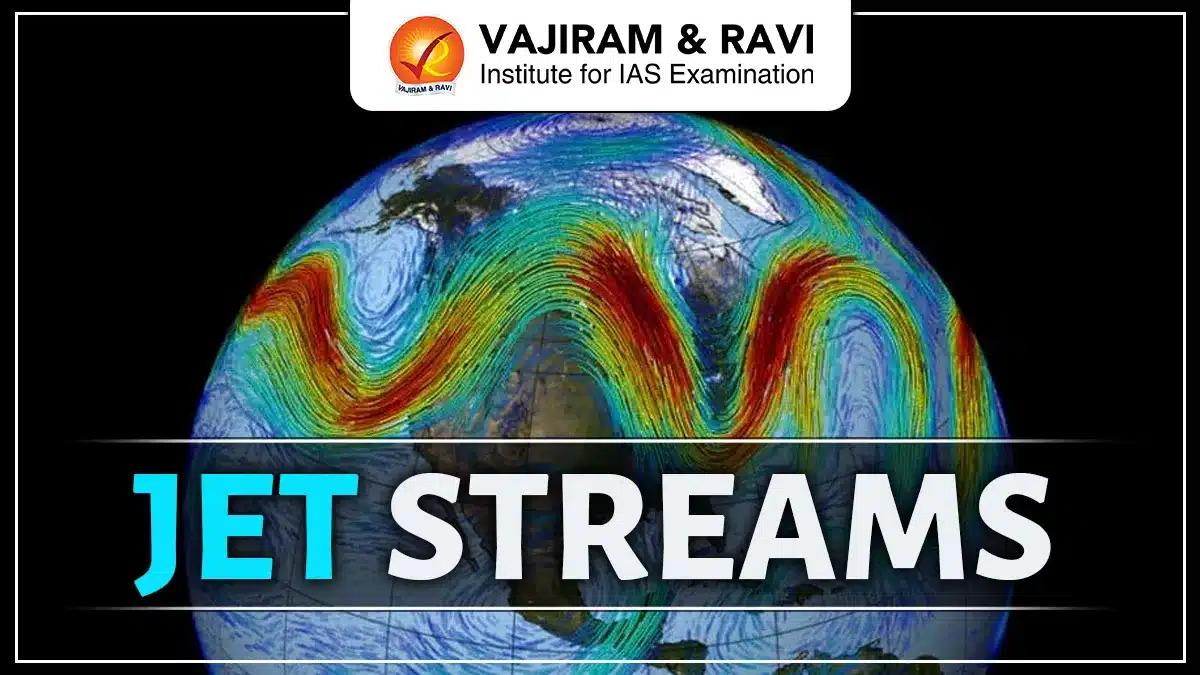
Jet Streams, Characteristics, Types, Formation, Impact

Jet Streams

Jet Streams are narrow, fast-moving air currents in the upper atmosphere that influence global weather and climate. They are found at high altitudes, flow mainly from west to east, and follow a wavy path called Rossby waves. Based on location and season, they are classified into Polar, Subtropical, Tropical Easterly, and Polar Night Jets, each affecting rainfall, storms, and monsoon patterns differently.

The detailed article on Jet Streams has been discussed below for a better understanding of the concepts.

Jet Streams

Jet streams are fast-flowing winds in the upper atmosphere that move mainly from west to east and influence weather patterns across the globe. They form due to the temperature difference between the equator and the poles and are strongest at high altitudes. Jet streams guide storms, cyclones, and rainfall, and their position shifts with the seasons. Changes in their strength or path can cause extreme weather events like heatwaves, floods, or cold waves.

Also Read: Environment

Jet Streams Characteristics

The characteristics of Jet Streams have been shared below.

  • Jet Streams are found at high altitudes in the upper troposphere and lower stratosphere, mainly between 20° latitude and the polar regions, at about 9–16 km height.
  • Blow primarily from west to east (westerlies) due to Earth’s rotation and pressure gradient forces.
  • Possess very high wind speeds, generally ranging from 150 to over 300 km/h, with maximum speed at the jet core.
  • Strength of jet streams increases in winter because of a greater temperature difference between polar and tropical air.
  • Follow a wavy path known as Rossby waves, instead of a straight flow, influencing weather systems.
  • Show seasonal shifting, moving northward in summer and southward in winter, extending closer to the equator during winter.
  • Form due to a strong thermal gradient between cold polar air and warm tropical air masses.
  • Exhibit strong vertical and horizontal wind shear, leading to clear-air turbulence that affects aircraft.
  • Are circumpolar in nature, encircling the Earth in both hemispheres, though their paths are irregular and dynamic.

Types of Jet Streams

Based on their location, altitude, and seasonal behavior, jet streams are broadly classified into permanent (zonal) jet streams and seasonal or temporary jet streams.

Permanent (Zonal) Jet Streams

  1. Polar Jet Stream (Polar Front Jet)

The Polar Jet Stream is located in the mid-latitudes, around 45°–60°, where cold polar air meets warm tropical air. It is strongest during winter, shows large meanders, and is a major driver of mid-latitude weather systems and storms.

  1. Subtropical Jet Stream

The Subtropical Jet Stream occurs near 30°–35° latitudes and is generally weaker and more stable than the polar jet. It is often associated with descending air and relatively stable or fair weather conditions in subtropical regions.

Seasonal and Temporary Jet Streams

  1. Tropical Easterly Jet (TEJ)

The Tropical Easterly Jet develops during summer over India and Africa due to intense heating of the Tibetan Plateau. It flows from east to west and is crucial for strengthening monsoon circulation and rainfall.

  1. Polar Night Jet

The Polar Night Jet forms in the stratosphere over polar regions during winter because of extreme temperature differences. It is distinct from the polar front jet and mainly influences upper-atmospheric circulation.

  1. Low-Level Jet Streams (e.g., Somali Jet)

Low-level jet streams occur in the lower troposphere, with the Somali Jet being a notable example. It transports large amounts of moisture towards the Indian subcontinent, playing an important role in monsoon rainfall.

Also Read: Western Disturbances

Formation of Jet Streams

Jet streams are formed due to the uneven heating of the Earth’s surface, which creates strong temperature and pressure differences between the equator and the poles. These differences, combined with Earth’s rotation, lead to the development of fast-moving winds in the upper atmosphere.

  • The equatorial region receives more solar energy than the polar regions, creating a thermal gradient between warm and cold air masses.
  • Warm air rises and moves poleward in the upper atmosphere, while cold air moves equatorward near the surface.
  • This movement of air generates pressure differences at higher altitudes.
  • Air flows from high-pressure to low-pressure zones, accelerating in the process.
  • Due to the Coriolis force, moving air is deflected, resulting in a dominant west-to-east flow.
  • Jet streams form near the tropopause, where temperature contrasts are strongest.
  • During winter, increased temperature differences make jet streams stronger and faster.

Latitudinal and Seasonal Shifting of Jet Streams

Jet Streams do not remain fixed at one location and shift both latitudinally and seasonally in response to changes in solar heating. Their position and strength vary throughout the year, strongly influencing weather and climate patterns.

  • Jet streams move northward during summer as the Sun’s direct rays shift toward higher latitudes.
  • In winter, they shift southward toward the equator due to the expansion of cold polar air.
  • Winter jet streams are stronger and more extensive because of a sharper temperature contrast between polar and tropical regions.
  • During summer, the temperature gradient weakens, causing jet streams to weaken and move poleward.
  • Seasonal shifting affects the paths of cyclones and storm systems.
  • Irregular or delayed shifting can lead to extreme weather events such as heatwaves, cold waves, or heavy rainfall.

Jet Streams and Cyclone Formation

Jet Streams play a crucial role in the formation, intensification, and movement of cyclones by controlling upper-air circulation. Their position and strength determine how cyclonic systems develop and travel.

  • Jet streams help in upper-level divergence, which removes air from the top of a developing cyclone and allows surface pressure to fall.
  • Strong jet streams provide the necessary energy and ventilation for cyclones to intensify.
  • Cyclones often move along the path guided by jet streams, which act as steering currents.
  • A fast-moving jet stream can cause cyclones to intensify rapidly and move quickly.
  • Weak or blocked jet streams may result in slow-moving cyclones, leading to prolonged rainfall and flooding.
  • Interaction between jet streams and low-pressure systems is essential for the development of temperate cyclones.

Influence of Jet Streams on Indian Monsoon

Jet Streams have a decisive influence on the onset, strength, and distribution of monsoon rainfall over the Indian subcontinent. Their seasonal shifting controls the large-scale atmospheric circulation associated with the monsoon.

  • During summer, the Subtropical Westerly Jet Stream shifts north of the Himalayas, allowing warm, moist monsoon winds to enter India.
  • The development of the Tropical Easterly Jet (TEJ) over India strengthens upper-level divergence and supports active monsoon conditions.
  • A strong TEJ is associated with good and widespread monsoon rainfall.
  • If the westerly jet fails to shift northward, it can delay the onset of the monsoon.
  • Variations in jet stream position and strength may cause breaks in monsoon rainfall or regional droughts.

Impact of Jet Streams on Aviation

Jet Streams play an important role in aviation by affecting flight speed, fuel use, and safety. Aircraft flying in the direction of jet streams can save time and fuel, while flying against them increases travel time. Strong jet streams often cause clear-air turbulence, which can be dangerous as it is hard to detect. Therefore, pilots carefully plan flight routes using jet stream forecasts to ensure safe and efficient air travel.

Changes in Jet Streams due to Global Warming

  • Global warming is causing faster warming of polar regions compared to the tropics, a phenomenon known as polar amplification.
  • This reduces the temperature (thermal) gradient between the equator and the poles, which is the main driving force of jet streams.
  • A weaker thermal gradient leads to weaker jet streams with reduced wind speeds.
  • Jet streams are becoming more wavy and irregular, showing larger Rossby wave amplitudes.
  • Increased waviness causes weather systems to move slowly or remain stationary over a region.
  • This results in prolonged extreme weather events such as heatwaves, cold spells, floods, and droughts.
  • Weaker and unstable jet streams can lead to frequent blocking patterns, disrupting normal weather flow.
  • Changes in jet stream behavior are affecting monsoon patterns and mid-latitude storm tracks.

Jet Streams UPSC Prelims PYQs

  1. Consider the following statements: (2020, UPSC CSE Prelims)
  1. Jet streams occur in the Northern Hemisphere only.
  2. Only some cyclones develop an eye.
  3. The temperature inside the eye of a cyclone is nearly 10°C lesser than that of the surroundings.

Which of the statements given above is/are correct?

(a) 1 and 2 only

(b) 2 and 3 only

(c) 3 only

(d) 1, 2 and 3

Answer: (b)

Jet Streams FAQs

Q1: What are jet streams?

Ans: Jet streams are narrow bands of very fast-moving winds found in the upper levels of the atmosphere that strongly influence weather and climate.

Q2: At what altitude do jet streams occur?

Ans: They usually occur at a height of about 9 to 16 km above sea level in the upper troposphere and lower stratosphere.

Q3: In which direction do jet streams flow?

Ans: Most jet streams flow from west to east due to Earth’s rotation and pressure differences.

Q4: Why are jet streams important?

Ans: They guide weather systems, influence rainfall and storms, affect monsoon behavior, and impact aviation.

Q5: Do jet streams change their position?

Ans: Yes, jet streams shift seasonally and latitudinally based on temperature changes and solar heating.

Objective Resolution, Background, Constituents, Reasons

Objective Resolution

The Objective Resolution was a statement of goals and guiding principles for the making of the Indian Constitution. It explained what kind of country India wanted to become after independence. It expressed the idea of India as a sovereign republic and promised justice, equality and freedom to all people. The Resolution later became the foundation of the Preamble of the Indian Constitution.

Objective Resolution Historical Background

  • In 1946, before the Constitution was written, Jawaharlal Nehru introduced the Objective Resolution in the Constituent Assembly. This Resolution explained the main aims and guiding principles for making the Constitution of India.
  • It declared that India would become an Independent and Sovereign Republic. It also promised important values like justice, equality, liberty and democracy for all citizens. The Resolution ensured that the rights of minorities, backward classes and weaker sections would be protected.
  • The Constituent Assembly accepted this Resolution on 22 January 1947. Later, its ideas were included in the Preamble of the Indian Constitution, which reflects the philosophy and basic spirit of the Constitution.

Objective Resolution Constituents

The Objective Resolution ideas reflect the basic values on which modern India is built. It clearly stated the vision for independent India. Its main points were:

  • Sovereign Republic: India would be an independent and sovereign republic.
  • Union of States: India would be a Union made up of former British Indian provinces, princely states and other areas willing to join.
  • Autonomy of Units: The states would have powers in their own areas, except those given to the Union (central government).
  • Power from the People: All authority of the government and the Constitution would come from the people of India.
  • Justice and Equality: Every citizen would get social, economic and political justice, equality before law and equal opportunities.
  • Fundamental Freedoms: People would enjoy freedoms like speech, belief, faith, worship, association and occupation, within the limits of law and morality.
  • Protection of Weaker Sections: Minorities, backward classes, tribal groups and disadvantaged sections would be given proper safeguards.
  • Unity and Integrity: India’s territorial integrity and sovereign rights over land, sea and air would be protected.
  • World Peace: India would work for international peace and the welfare of humanity.

Reasons Behind the Adoption of the Objectives Resolution

Jawaharlal Nehru, while introducing the Objectives Resolution in the Constituent Assembly, shared the main reasons for adopting it:

  • Unity in Diversity: India is a diverse country. The resolution was meant to show people the vision of the new Constitution and encourage them to take part in shaping the nation.
  • Guiding Force: It was intended to guide the Constitution-makers on the principles and values India should follow.
  • Explaining the Spirit: Since legal language can be technical, the resolution explained the spirit and purpose behind the Constitution in simple terms. Nehru said, “Laws are made of words, but this Resolution is something higher than the law.”
  • Inclusive Vision: The resolution reflected the hope of creating a Constitution that included and protected all sections of Indian society.
  • Moral Appeal: It was not legally binding but appealed to the conscience of the framers to uphold core values of justice, equality, and freedom.
  • Message to the World: It was a way to communicate India’s vision as an independent, modern, and responsible nation to both its citizens and the world.

Objectives Resolution Significance

The Objective Resolution is significant because it laid the foundation of India’s Constitution and defined the vision of India as a sovereign, democratic, and republic nation. It guaranteed social, economic, and political justice, ensured fundamental freedoms like speech, belief, worship, and association, and provided protection to minorities, backward classes and tribal communities. It also emphasized India’s unity and territorial integrity while serving as a guiding moral force for the Constitution-makers, reflecting the aspirations of an independent and modern India to its citizens and the world.

Objective Resolution FAQs

Q1: What is the Objective Resolution?

Ans: It was a statement of goals and guiding principles for drafting the Indian Constitution, laying down India’s vision as a sovereign republic ensuring justice, equality, and freedom.

Q2: Who introduced the Objectives Resolution and when?

Ans: Jawaharlal Nehru introduced it in the Constituent Assembly in 1946.

Q3: When was the Objectives Resolution adopted?

Ans: It was adopted by the Constituent Assembly on 22 January 1947.

Q4: How is the Objective Resolution related to the Preamble?

Ans: The Resolution formed the foundation of the Preamble, reflecting the Constitution’s philosophy and core values.

Q5: Was the Objectives Resolution legally binding?

Ans: It was not legally binding but served as a moral and guiding framework for the Constitution.

Geological Time Scale, Definition, Principles, Divisions

Geological Time Scale

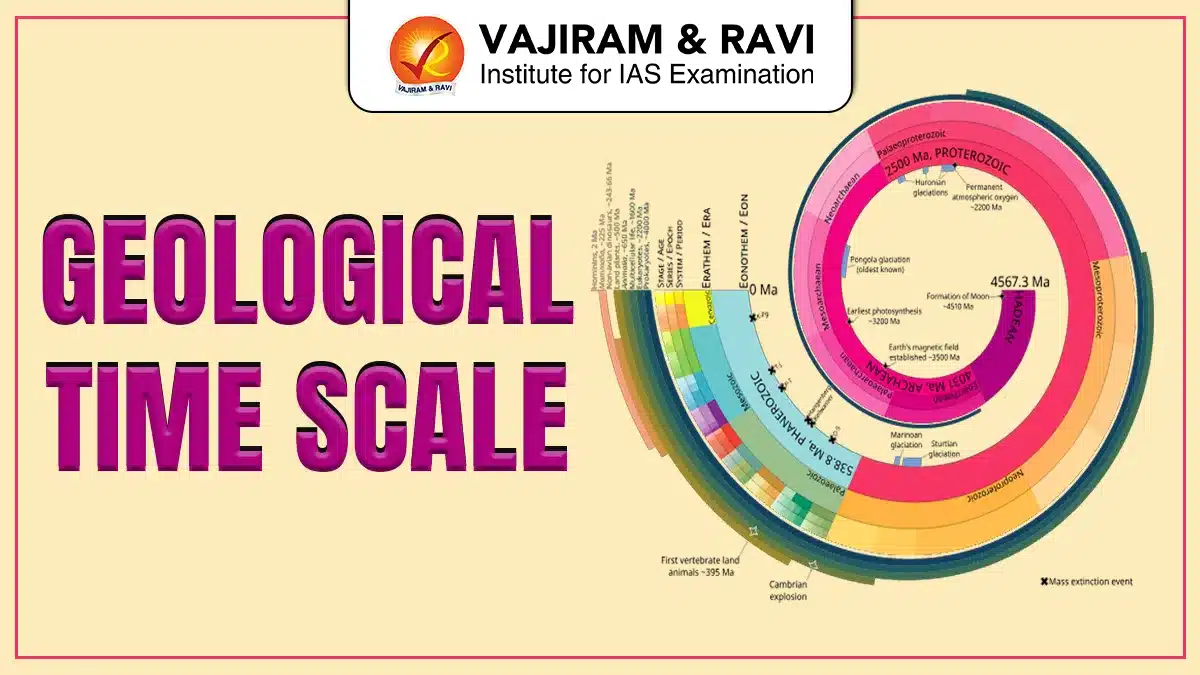
The Geological Time Scale is a scientifically developed framework that explains Earth’s history using evidence preserved in rocks, fossils, and geochemical signatures. It helps scientists understand when major changes occurred, including the formation of mountains, climate shifts, mass extinctions and the evolution of life. It is maintained by the International Commission on Stratigraphy under the International Union of Geological Sciences.

Geological Time Scale

The Geological Time Scale is based on chronostratigraphy, which relates rock strata to time intervals and geochronology and assigns numerical ages using methods such as radiometric dating, paleomagnetism and fossil correlation. The scale expresses deep time in ‘million years ago’ and provides a universal reference for Earth history studies. Geological ages are expressed in billion years (Ga), million years (Ma) and thousand years (ka).

Also Read: Solar System

Geological Time Scale Principles

The Geological Time Scale is built on fundamental stratigraphic principles that establish relative ages of rocks and events. The list of major principles involved in the determination of Geologic Time are:

  • Law of Superposition: In undisturbed sedimentary sequences, older rock layers occur below younger layers, forming the basic rule for determining relative ages of strata.
  • Principle of Original Horizontality: Sediments are originally deposited in horizontal layers, and any tilting or folding occurred after deposition due to tectonic forces.
  • Principle of Lateral Continuity: Sedimentary layers initially extend laterally until they thin out or encounter a barrier, allowing correlation of rock units across distances.
  • Principle of Faunal Succession: Fossil assemblages follow a consistent vertical order, enabling correlation of rock layers even across continents.
  • Chronostratigraphic Correlation: Rock units are matched globally using fossils, lithology, paleomagnetism, and isotope data to establish standardized time boundaries.

Geological Time Scale Divisions

The Geological Time Scale divides Earth’s 4.54 billion year history into hierarchical units that reflect major geological and biological changes documented in the rock record.

1. Eon (Largest Division)

Eons represent the broadest phases of Earth history, each marked by major changes in Earth’s crust, atmosphere, and life forms.

  • Hadean Eon (≈ 4.6 - 4.0 billion years ago): Formation of Earth and Moon, molten surface, intense meteorite bombardment, no confirmed life record.
  • Archean Eon (≈ 4.0 - 2.5 billion years ago): Stabilization of continental crust, formation of oceans, first prokaryotic life, stromatolites, oxygen poor atmosphere.
  • Proterozoic Eon (≈ 2.5 billion - 538.8 million years ago): Rise of atmospheric oxygen (Great Oxidation Event), eukaryotes, multicellular life, Snowball Earth glaciations.
  • Phanerozoic Eon (538.8 million years ago - Present): Abundant fossil record, complex plants and animals, major evolutionary radiations and extinctions.

2. Era (Subdivision of Eon)

Eras divide eons based on dominant life forms and major global events. Eras within the Phanerozoic Eon are: 

  • Paleozoic Era (538.8 - 251.9 million years ago): Explosion of marine life, first land plants and animals, formation of Pangaea, ends with largest mass extinction.
  • Mesozoic Era (251.9 - 66 million years ago): Age of reptiles and dinosaurs, breakup of Pangaea, origin of birds and flowering plants.
  • Cenozoic Era (66 million years ago - Present): Age of mammals, development of grasslands, cooling climate, evolution of humans.

3. Period (Subdivision of Era)

Periods mark significant geological, climatic, and biological transitions. Each period is defined by fossil assemblages, tectonic events, or mass extinctions. Major Periods of the Phanerozoic:

  • Paleozoic Periods: Cambrian, Ordovician, Silurian, Devonian, Carboniferous, Permian
  • Mesozoic Periods: Triassic, Jurassic, Cretaceous
  • Cenozoic Periods: Paleogene, Neogene, Quaternary

4. Epoch (Subdivision of Period)

Epochs capture finer scale changes, especially climate shifts and evolutionary developments. Example of Epoch under the Quaternary Period are:

  • Pleistocene Epoch (≈ 2.58 million - 11,700 years ago)- Ice ages, megafauna
  • Holocene Epoch (11,700 years ago - Present)- Stable climate, human civilization

5. Age (Smallest Formal Unit)

Ages represent the most precise divisions, often spanning thousands to a few million years. It is defined using climatic evidence of a global drought event. Example: Meghalayan Age (since ~4,200 years ago).

Also Read: Interior of the Earth

Extraterrestrial Geological Time Scale

Extraterrestrial Geological Time Scale classifies the geological evolution of solid celestial bodies using surface features, impact records, and volcanic history.

Lunar (Selenological) Time Scale

The lunar time scale is based on impact cratering, volcanism, and surface erosion without implying fundamental process changes.

  • Pre - Nectarian: Oldest crust formation and intense early bombardment.
  • Nectarian: Large basin forming impacts dominate surface evolution.
  • Imbrian: Major volcanism and extensive basaltic lava flows.
  • Eratosthenian: Marks the period fro 3.2 to 1.1 million years ago
  • Copernican: It defines the period after 1.1 million years till today with presence of craters.

Martian Geologic Time Scale

Mars’ geologic history is reconstructed using crater density and mineral alteration evidence.

  • Pre - Noachian: Earliest crust formation (~4,500 - 4,100 Ma).
  • Noachian: Heavy bombardment and widespread water related features.
  • Hesperian: Volcanism and surface drying (~3,700 - 3,000 Ma).
  • Amazonian: Cold, dry conditions continuing to the present.

Geological Time Scale FAQs

Q1: What is the Geological Time Scale?

Ans: The Geological Time Scale is a chronological framework that divides Earth’s 4.6-billion-year history based on rock layers and fossils.

Q2: Who developed the Geological Time Scale?

Ans: It was developed gradually by geologists in the 19th century using stratigraphy, fossil records, and later radiometric dating.

Q3: What are the main divisions of the Geological Time Scale?

Ans: The main divisions are eons, eras, periods, epochs, and ages, arranged from largest to smallest time units.

Q4: Which Eon are we currently living in?

Ans: We are living in the Phanerozoic Eon specifically in the Cenozoic Era and Quaternary Period.

Q5: Why is the Geological Time Scale important?

Ans: It helps scientists understand Earth’s evolution, mass extinctions, climate changes, and the development of life over time.

Types of Unemployment, Causes, Government Initiatives, Examples

Types of Unemployment

What is Unemployment?

Unemployment, according to the International Labour Organization (ILO), is when people of working age are ready and able to work but cannot find employment. They must be actively seeking jobs and available to start work. In simple terms, it happens when people want to work but have no job opportunities. It reflects the overall condition of the labour market and the economy.

Types of Unemployment

The main Types of Unemployment include Frictional, which occurs when individuals are temporarily between jobs while searching for new opportunities; Structural, arising from a mismatch between workers’ skills and job requirements or changes in industries; and Cyclical, which happens due to economic slowdowns or recessions. 

Here we have shared all the important types of unemployment along with one example for each type.

1. Cyclical Unemployment

Cyclical unemployment happens due to fluctuations in the business cycle. During economic downturns or recessions, production and demand fall, leading companies to lay off workers temporarily. It is usually short-term and linked to economic cycles.

Example: Auto workers losing jobs during a recession when car sales drop.

2. Disguised Unemployment

Disguised unemployment happens when more people are working than is actually required. Even if some workers are removed, production remains the same, and extra labour adds no real value. This is common in agriculture and the informal sector in India.

Example: Several family members working on a small farm where only a few are needed.

3. Seasonal Unemployment

Seasonal unemployment occurs when work is available only during certain periods of the year. Many industries like agriculture, tourism, and ice production operate seasonally, leaving workers idle during off-seasons.

Example: Farm labourers who are employed during sowing and harvest but remain unemployed during the rest of the year.

4. Structural Unemployment

Structural unemployment arises when there are long-term changes in the economy that reduce demand for certain skills or occupations. Rapid technological progress, industrial growth, or changes in production methods can make existing skills obsolete.

Example: A typewriter mechanic unable to find work after computers replaced typewriters.

5. Frictional Unemployment

Frictional unemployment occurs when people are temporarily unemployed while transitioning between jobs or searching for better opportunities. It is often voluntary and arises due to delays in matching workers with jobs.

Example: A software engineer quitting a job and taking a few months to find a better position.

6. Underemployment

Underemployment occurs when people work in jobs that do not utilize their full potential or skills. Individuals settle for lower-skilled or part-time work due to limited opportunities, leaving their capabilities untapped.

Example: A postgraduate working in a small retail shop because suitable jobs are not available.

7. Chronic Unemployment

Chronic unemployment refers to long-term, persistent joblessness. It is caused by population growth, low economic development, and structural poverty, making certain groups unemployed for extended periods.

Example: Rural workers who remain jobless for several years due to lack of industries in the region.

8. Casual Unemployment

Casual unemployment happens when people lose work on a short-term or daily basis due to temporary contracts, reduced demand, or seasonal changes. It affects labourers in unorganized sectors the most.

Example: Construction workers who become unemployed when a project ends or raw materials are unavailable.

9. Educated Unemployment

Educated unemployment occurs when individuals with qualifications are unable to find jobs matching their education or skills. Poor education systems, lack of employable skills, and high competition contribute to this problem.

Example: Engineering graduates working as delivery executives because no suitable jobs are available.

10. Voluntary Unemployment

Voluntary Unemployment occurs when individuals choose not to work despite available job opportunities. People may remain unemployed to pursue higher education, wait for better-paying jobs, or take time off for personal reasons. This type of unemployment reflects personal choice rather than a shortage of jobs.

unemployed despite job availability

Example: A person rejecting current job offers to wait for a higher-paying position

Causes of Unemplyoment

  • Rapid Population Growth: The labour force grows faster than the number of available jobs.
  • Slow Economic Development: Low industrialization and limited economic activities create fewer employment opportunities.
  • Lack of Skill and Education: Mismatch between workers’ skills and job requirements leads to unemployment.
  • Technological Changes: Automation and modern technology reduce the need for human labour.
  • Seasonal Nature of Work: Jobs available only in certain seasons, especially in agriculture and tourism.
  • Rural-Urban Migration: Movement to cities increases competition for limited urban jobs.
  • Poor Infrastructure: Lack of industries, transport, and communication in certain regions reduces job creation.
  • Underdeveloped Industrial Sector: Limited industries in rural and semi-urban areas lead to unemployment.
  • Economic Recession or Slowdown: Reduced demand for goods and services causes layoffs.
  • Voluntary Choices: Some individuals choose not to work, waiting for better opportunities.

Government Initiatives

The government of India has launched several schemes and programs to provide employment opportunities, skill development, and support for entrepreneurship. These initiatives aim to reduce both rural and urban unemployment and promote inclusive economic growth.

1. Mahatma Gandhi National Rural Employment Guarantee Act (MGNREGA), 2005

MGNREGA guarantees at least 100 days of wage employment per year to rural households. It provides a social safety net for rural workers while promoting the creation of durable assets and infrastructure in villages. This program mainly targets seasonal and rural unemployment.

2. Skill India Mission / Pradhan Mantri Kaushal Vikas Yojana (PMKVY)

The Skill India Mission aims to enhance the employability of youth by providing industry-relevant skill training. PMKVY offers structured training programs and certification to improve the ability of young people to secure formal employment and bridge the gap between education and industry requirements.

3. Start-up India Initiative

Start-up India encourages entrepreneurship by offering financial support, tax benefits, and simplified procedures for establishing new businesses. The program is designed to promote self-employment, stimulate innovation, and generate large-scale employment opportunities in various sectors.

4. National Rural Livelihood Mission (NRLM)

NRLM focuses on reducing rural poverty by providing skill development and livelihood support. It empowers rural households through self-employment opportunities, financial assistance, and the formation of community-based groups, helping people achieve sustainable income sources.

5. Prime Minister Employment Generation Programme (PMEGP)

PMEGP promotes entrepreneurship by providing financial assistance for establishing micro-enterprises in rural and urban areas. The initiative aims to create new job opportunities, encourage small-scale industries, and support economic growth through self-employment.

6. Deen Dayal Upadhyaya Grameen Kaushalya Yojana (DDU-GKY)

DDU-GKY targets rural youth and focuses on skill development linked to placement in formal employment. The program strengthens employability, facilitates income generation, and contributes to the reduction of rural unemployment by connecting trained youth with industry requirements.

7. National Urban Livelihoods Mission (NULM)

NULM aims to improve the livelihood opportunities for the urban poor through skill development, self-employment, and wage employment initiatives. The mission promotes sustainable livelihoods, enhances skill sets, and encourages entrepreneurship to reduce urban unemployment.

8. Atmanirbhar Bharat and Make in India

These initiatives focus on promoting domestic manufacturing, self-reliance, and entrepreneurship. By boosting industrial growth, innovation, and investment, the programs aim to create large-scale employment opportunities across multiple sectors of the economy.

Types of Unemployment FAQs

Q1: What is unemployment?

Ans: Unemployment occurs when people who are willing and able to work cannot find suitable jobs, despite actively seeking employment.

Q2: What are the main types of unemployment?

Ans: The main types include Frictional (temporary job search), Structural (skills mismatch or industry shifts), and Cyclical (economic downturns or recessions).

Q3: What is Frictional Unemployment?

Ans: Frictional unemployment happens when individuals are temporarily unemployed while moving between jobs or searching for better opportunities.

Q4: What is Structural Unemployment?

Ans: Structural unemployment occurs when there is a mismatch between workers’ skills and available jobs or when industries undergo significant changes.

Q5: What is Cyclical Unemployment?

Ans: Cyclical unemployment arises due to fluctuations in the business cycle, such as during recessions or periods of low economic activity.

Heat Budget of Earth, Definition, Components, Impact, Significance

Heat Budget of Earth

The Heat Budget of Earth, also called Energy or Radiation Budget, is the important balance between the incoming solar radiation (energy from the Sun) and the outgoing infrared radiation (heat energy leaving the Earth and Atmosphere). The dynamic equilibrium maintains the stability of the climate and average temperature of the earth (15° C). Without this balance, the earth would continuously heat or cool, making life difficult. Even a small imbalance of 0.5 to 1 W/m² can intensify global warming, as highlighted by IPCC AR6.

Heat Budget of Earth

The concept of the Heat Budget of Earth is governed by the First Law of Thermodynamics, which states that energy cannot be created or destroyed, only transformed. To maintain the thermal equilibrium of the Earth over a long duration, the total energy received must be equal to the total energy lost. The Sun is the primary source of energy for the Earth, supplying around 1,361 W/m² of solar radiation at the top of the atmosphere (Solar Constant). This energy undergoes reflection, scattering, absorption, and re-emission, creating this balance.

Heat Budget of Earth Components

The Heat Budget of Earth explains how incoming solar energy is balanced by outgoing heat, helping maintain the planet’s overall temperature and climatic stability. The major components are listed below:

  • Insolation: Solar energy reaching Earth’s surface from the Sun, influencing heating patterns and driving atmospheric processes that keep the planet’s thermal system regulated.
  • Reflection: A portion of sunlight bounces off clouds, land, or water back to space, preventing heat absorption and helping regulate Earth’s temperature naturally.
  • Absorption: Land, water, and atmospheric gases take in solar radiation, convert it into heat, and warm the surface and lower atmosphere effectively.
  • Scattering: Tiny particles and air molecules spread incoming sunlight in various directions, reducing direct solar intensity and affecting sky brightness and visibility.
  • Terrestrial Radiation: Earth’s surface releases longwave infrared heat back toward the atmosphere and space, maintaining balance between absorbed solar energy and outgoing heat.
  • Latent Heat Transfer: Heat energy moves during evaporation or condensation processes, carrying stored heat through atmospheric moisture and redistributing energy without temperature change.
  • Sensible Heat Transfer: Heat shifts between Earth’s surface and air when temperatures differ, warming or cooling the atmosphere without any change in physical state.
  • Emission by Vapour and Clouds: Water vapour and clouds release infrared radiation, contributing to Earth’s outgoing heat and helping moderate atmospheric temperatures day and night.

Heat Budget of Earth Mechanism

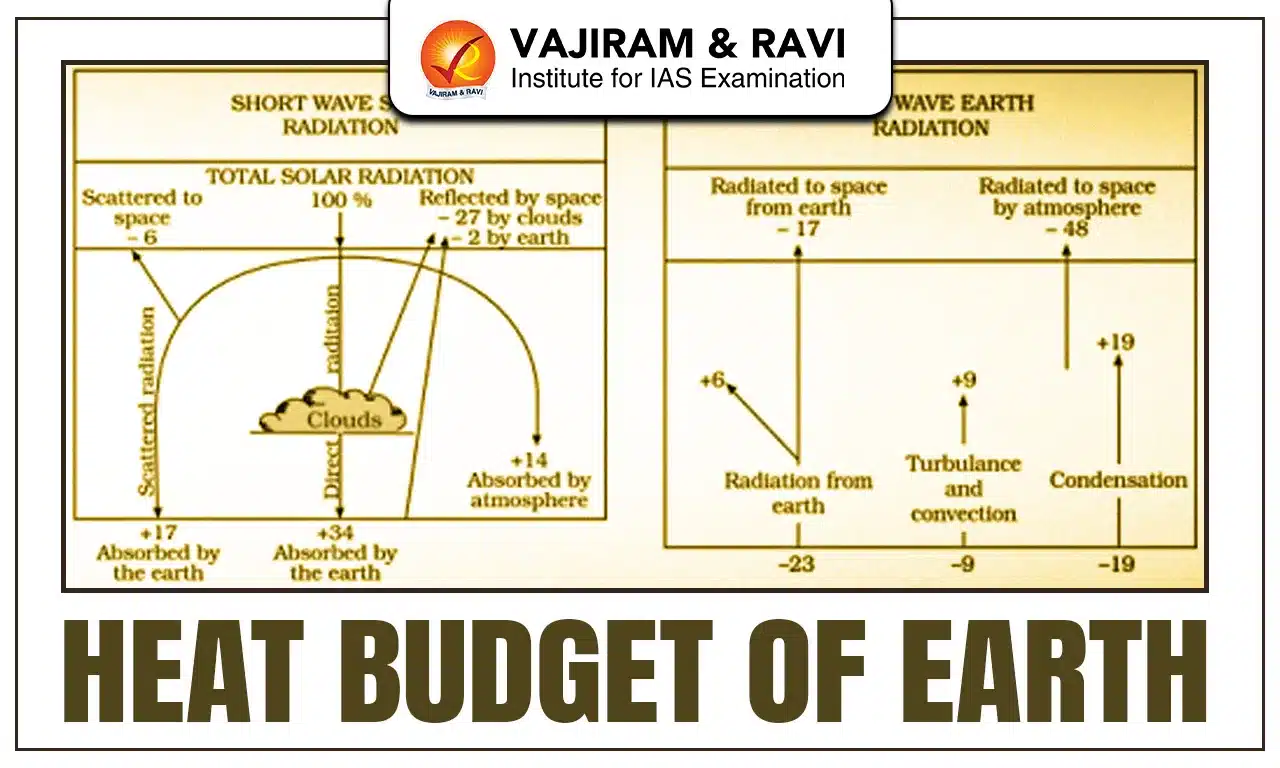
The balance is often expressed in terms of 100 units (as 100%) of incoming solar radiation to track how this energy is distributed. The total 100 units of incoming shortwave solar radiation are processed by the Earth and its atmosphere in the following manner:

  • Incoming Solar Radiation (Insolation)

The total solar radiation is 35 (reflected) + 14 (atmospheric absorption) + 51 (surface absorption) = 100 units.

  • Scattering and Reflection: Around 35 units of the Sun’s energy is lost to space due to reflection and scattering, forming the Earth’s overall albedo. 
      • Nearly 27 units are bounced back by cloud tops.
      • Close to 2 units are reflected from bright surfaces such as ice sheets, snowfields, and land.
      • About 6 units are scattered in different directions by atmospheric dust, aerosols, and air molecules.
  • Absorption: The remaining 65 units enter and warm the Earth system.
    • Roughly 14 units are taken up by atmospheric gases including water vapour, ozone, and clouds.
    • About 51 units are absorbed by the planet’s surface, mainly by oceans and landmasses.
  • Outgoing Terrestrial Radiation

The 51 units gained by the surface and 14 units absorbed by the atmosphere must eventually exit as longwave radiation to keep thermal balance. Overall Outgoing Budget:

35 (reflected solar) + 17 (surface radiation) + 48 (atmospheric radiation) = 100 units. Globally, the polar ice caps and fresh snow have the highest albedo (80-90%), while the ocean surface has the lowest (2-10%), making the oceans the primary heat sink.

  • Direct Radiation to Space: Roughly 17 units of heat from the surface escape straight to space through the atmospheric window.
  • Transfer from Surface to Atmosphere: The remaining 34 units held by the surface move upward to the atmosphere through:
  • 19 units of sensible heat carried upward by convection and turbulence.
  • 9 units of latent heat released when water vapour condenses into droplets.
  • 6 units of longwave radiation absorbed by greenhouse gases.
  • Transfer from Radiation to Space: The atmosphere releases 48 units of longwave energy to space after absorbing 14 units from sunlight and 34 units from the surface.

Heat Budget of Earth Calculation

The Heat Budget of Earth is calculated by observing how much solar energy enters the planet and how much heat leaves it. Satellites equipped with radiometers, such as those used in the ERBE mission and later programs, track incoming sunlight and outgoing infrared radiation. Scientists compare these energy flows to check whether Earth is gaining or losing heat. The Global Energy balance equation is:

Net Energy Flow = Incoming Solar Energy - Reflected Solar Energy - Outgoing Terrestrial Radiation

For a balanced budget, the Net Energy Flow should be zero. However, modern measurements show a small positive net energy flow, suggesting the Earth system is currently accumulating heat (evidence of global warming).

Heat Budget of Earth Significance

The significances of the heat budget of earth can be discussed below:

  • Climate Regulation: The heat budget controls global temperatures, influencing weather patterns, rainfall, and seasonal variations.
  • Ocean Currents: Imbalances in heat absorption and radiation drive ocean circulation, affecting marine ecosystems and coastal climates.
  • Glacial Melting: Excess heat accumulation leads to polar ice melting, causing sea-level rise and altering Earth’s albedo.
  • Extreme Weather: Changes in energy distribution can intensify storms, heatwaves, and other extreme weather events.
  • Ecosystem Balance: Proper heat distribution maintains habitats, plant growth, and animal survival across different regions.

Heat Budget of Earth Variations

The Earth’s heat budget varies regionally and seasonally due to factors like latitude, surface type, cloud cover, and solar angle:

  • Equatorial regions receive more solar energy, creating warmer climates than polar areas.
  • Seasonal changes shift sunlight intensity, affecting temperature and rainfall patterns.
  • Snow and ice increase reflection, reducing local heat absorption (high albedo).
  • Oceans store heat differently than land, causing regional temperature differences.
  • Volcanic eruptions or dust storms temporarily reduce incoming solar radiation, altering heat balance.
  • Greenhouse gases trap outgoing infrared radiation, disrupting the natural heat budget and causing global warming effects worldwide.

Heat Budget of Earth Impact on Climate

The Earth’s energy balance directly influences climate systems, regulating weather patterns, atmospheric circulation, and ocean currents globally.

  • Heat imbalances drive winds and jet streams across continents.
  • Ocean currents transport heat, stabilizing coastal climates and influencing monsoon systems.
  • Polar warming accelerates ice melting, altering global sea levels.
  • Regional energy variations affect precipitation patterns and drought frequency.
  • Persistent heat accumulation can intensify storms, hurricanes, and cyclones.

Heat Budget of Earth FAQs

Q1: What is the Heat Budget of Earth?

Ans: The Heat Budget of Earth is the balance between incoming solar radiation and outgoing heat, maintaining Earth’s average temperature at 15° C.

Q2: Why is the Earth’s Heat Budget important?

Ans: It regulates global climate, weather patterns, ocean currents, and ecosystems, keeping conditions suitable for life.

Q3: How is the Heat Budget calculated?

Ans: Satellites measure incoming solar energy and outgoing infrared radiation. The formula used is: Net Energy Flow = Incoming Solar Energy - Reflected Solar Energy - Outgoing Terrestrial Radiation

Q4: What are the main components of the Heat Budget?

Ans: Key components include insolation, reflection, absorption, scattering, terrestrial radiation, latent heat, sensible heat, and emission by clouds and water vapour.

Q5: How do greenhouse gases affect the Heat Budget?

Ans: Greenhouse gases trap outgoing infrared radiation, reduce heat loss, and cause global warming by disturbing Earth’s natural energy balance.

Important Economic Curves, Concepts, Uses, and Role

Important Economic Curves

Economic curves are graphical tools that represent relationships between key economic variables. They help economists, policymakers, and students visualize trends, understand economic behavior, and make policy decisions. The following are some of the most important economic curves for UPSC aspirants:

Phillips Curve

The Phillips Curve shows the inverse relationship between inflation and unemployment in an economy. It suggests that when unemployment is low, inflation tends to be high, and when unemployment is high, inflation is low.

Significance: It is crucial for monetary and fiscal policy decisions, especially when balancing inflation control and employment generation.

Laffer Curve

The Laffer Curve illustrates the relationship between tax rates and tax collection.

  • It shows that starting from a 0% tax rate, increasing taxes raises revenue, but beyond a certain point, higher tax rates discourage work, investment, and production, leading to lower revenue.
  • The curve is inverted-U shaped, and the point of maximum revenue is called the optimal tax rate.

Significance: It is used in fiscal policy to design tax rates that maximize revenue without reducing economic incentives.

Lorenz Curve

The Lorenz curve, is a graphical representation of income inequality or wealth inequality.

  • It plots the cumulative percentage of total income received by the cumulative percentage of population, starting from the poorest to the richest.
  • The line of equality is a 45-degree line indicating perfect equality. The further the Lorenz curve bends away from this line, the greater the inequality.

Significance: It helps measure economic inequality and is closely related to the Gini coefficient, a quantitative measure of income inequality.

Kuznets Curve

The Kuznets Curve depicts the relationship between economic growth and  inequality.

  • It is inverted-U shaped, suggesting that in the early stages of economic development, inequality increases, but as the economy matures, inequality tends to decrease.

Significance: It is important for understanding development economics and the trade-offs between growth and equity.

Engel Curve

The Engel Curve shows the relationship between income and consumption of a particular good.

  • For normal goods, consumption increases with income, resulting in an upward-sloping curve.
  • For inferior goods, consumption decreases as income rises, resulting in a downward-sloping curve.

Significance: It helps in analyzing consumer behavior, income distribution, and demand patterns, and is fundamental in microeconomics.

Rahn Curve

The Rahn Curve illustrates the relationship between government spending and economic growth.

Similar to the Laffer Curve, it is inverted-U shaped, suggesting that moderate government spending can stimulate growth, but excessive spending reduces growth due to inefficiencies or crowding out of private investment.

Significance: It is used in fiscal policy to determine the optimal size of government expenditure for promoting economic growth.

Beveridge Curve

The Beveridge Curve shows the relationship between unemployment and job vacancies in an economy.

  • It is downward sloping, indicating that when unemployment is high, job vacancies are low, and when unemployment is low, job vacancies are high.
  • Shifts in the curve can indicate structural changes in the labor market, such as mismatches between skills and jobs.

Significance: It helps in analyzing labor market efficiency, unemployment types (frictional, structural), and the effectiveness of employment policies.

J-Curve

The J-Curve is used in international trade to illustrate the effect of currency depreciation on a country’s trade balance.

  • Initially, a currency devaluation worsens the trade balance due to higher import costs.
  • Over time, exports increase and imports decrease, improving the trade balance → curve shaped like the letter “J”.

Significance: Important for exchange rate policy and trade strategy.

Important Economic Curves FAQs

Q1: What is the Phillips Curve?

Ans: It shows an inverse relationship between inflation and unemployment, guiding policymakers on the trade-off between price stability and employment.

Q2: What is the Laffer Curve?

Ans: It depicts the relationship between tax rates and revenue, showing that beyond a certain rate, higher taxes reduce revenue, helping design optimal tax policy.

Q3: What is the Lorenz Curve?

Ans: It represents income or wealth inequality, with deviation from the line of equality indicating the degree of inequality, and is linked to the Gini coefficient.

Q4: What is the Kuznets Curve?

Ans: It shows an inverted-U relationship between economic growth and inequality, suggesting inequality rises in early development stages and falls as the economy matures.

Q5: What is the Engel Curve?

Ans: It depicts how consumption of goods changes with income, rising for normal goods and falling for inferior goods, explaining consumer behavior patterns.

Koppen Climate Classification, Climate Zones, Subtypes, Examples

Koppen Climate Classification

The Koppen Climate Classification system is one of the most widely used methods for classifying the climates of the world. It was developed by the German botanist and climatologist Wladimir Koppen at the end of the nineteenth century. 

Basis of Koppen Climate Classification

The Koppen Climate Classification system classifies climate regions mainly on the basis of temperature, precipitation, and natural vegetation patterns. Koppen observed that vegetation is closely related to climate conditions, since the type of plants that grow in a region depends largely on the amount of rainfall and the prevailing temperature. Therefore, the distribution of vegetation provides a useful indicator for identifying different climate zones across the world.

  • Regions with high rainfall and warm temperatures usually support dense forests.
  • Regions with low rainfall tend to have grasslands or deserts. 
  • Seasonal variations in temperature and precipitation determine subtypes within each major climate group.

By analysing long-term temperature and precipitation data, Koppen divided the world into different climatic zones that correspond to major vegetation types

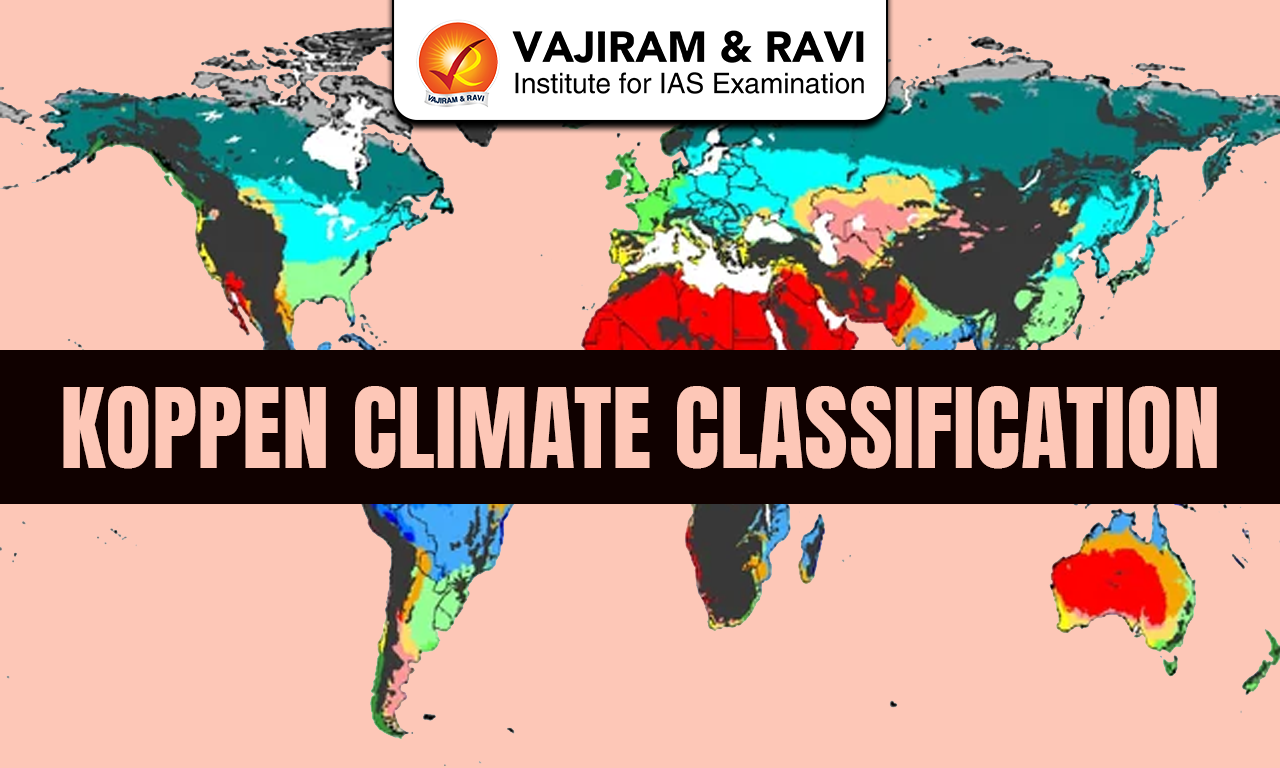
Koppen Climate Classification System Major Climate Zones

The Koppen Climate Classification divides the world into five major climate zones, each represented by a capital letter.

Tropical Climate (Zone A)

This climate zone occurs mainly near the equator and is characterized by high temperatures throughout the year and abundant rainfall. Dense forests and tropical vegetation dominate these regions. On climate maps, this zone is often represented by shades of blue.

Dry Climate (Zone B)

Dry climates are characterized by low precipitation and high evaporation, which limits vegetation growth. These areas include deserts and semi-arid regions where rainfall is scarce. On maps, this zone is usually shown in shades of red, pink, or orange.

Temperate Climate (Zone C)

Temperate climates are found mainly in the middle latitudes and are characterized by moderate temperatures with distinct seasonal variations. Summers are generally warm while winters are mild. These regions support forests and grasslands and are usually represented by green colors on climate maps.

Continental Climate (Zone D)

Continental climates occur mainly in the interior parts of large continents. These regions experience large seasonal temperature variations, with warm summers and cold winters. On koppen maps, these areas are often shown using purple, violet, or light blue colors.

Polar Climate (Zone E)

Polar climates occur in the high-latitude regions near the poles. These areas experience extremely low temperatures for most of the year and have very limited vegetation. On climate maps they are typically represented by grey shades.

Subdivisions of Climate Zones

Each major climate zone in the Koppen system is further divided into smaller subcategories based on temperature patterns and seasonal rainfall distribution. For example, 

Tropical Humid Climates (A)

  • Af – Tropical Wet (Rainforest Climate):
    • No dry season; rainfall occurs throughout the year.
    • High temperatures persist all year, with minimal variation.
    • Dense evergreen forests with large biodiversity dominate these regions.
    • Examples: Amazon Basin (South America), Western Africa, Andaman & Nicobar Islands (India).
  • Am – Tropical Monsoon Climate:
    • Short dry season; heavy rainfall mainly during the summer.
    • Annual temperature range is low; overall climate hot and humid.
    • Found in regions influenced by the monsoon system.
    • Examples: Indian subcontinent, Northeastern South America.
  • Aw – Tropical Wet and Dry (Savanna Climate):
    • Distinct winter dry season; summer is wet.
    • High temperatures throughout the year with a longer dry season than Af or Am.
    • Vegetation consists of deciduous forests and tree-shredded grasslands.
    • Examples: Parts of India (Odisha, Maharashtra), Central Africa, Brazil.

Dry Climates (B)

  • BSh – Subtropical Steppe:
    • Semi-arid climate with low and highly variable rainfall.
    • Supports sparse grasslands rather than dense forests.
    • Often experiences droughts due to irregular rainfall.
    • Examples: Gujarat, Haryana, interior Rajasthan (India).
  • BWh – Subtropical Desert:
    • Extremely low rainfall and very high temperatures.
    • Soil is often sandy or rocky; vegetation is scarce.
    • Receives occasional short intense thundershowers.
    • Examples: Thar Desert (India), Sahara Desert (Africa).
  • BSk – Mid-latitude Steppe:
    • Semi-arid climate in continental interiors.
    • Winters are cold, summers warm; rainfall insufficient for dense forests.
    • Examples: Central Asia, Great Plains (USA).
  • BWk – Mid-latitude Desert:
    • Cold desert climate with very low rainfall.
    • Large diurnal and seasonal temperature variations.
    • Vegetation is extremely sparse.
    • Examples: Ladakh (India), Gobi Desert (China/Mongolia).

Warm Temperate (Mid-latitude) Climates (C)

  • Cwa – Humid Subtropical Climate:
    • Hot summers, dry winters.
    • Found in areas influenced by summer monsoon winds.
    • Examples: North Indian plains, South China plains.
  • Cfa – Humid Subtropical Climate:
    • No dry season; rainfall occurs throughout the year.
    • Summers are warm and humid, winters mild.
    • Examples: Eastern USA, Southern China.
  • Cs – Mediterranean Climate:
    • Hot, dry summers and mild, rainy winters.
    • Occurs in subtropical western margins of continents.
    • Examples: California, Central Chile, Mediterranean coast.
  • Cfb – Marine West Coast Climate:
    • Mild summers and moderate winters.
    • Rainfall is evenly distributed throughout the year.
    • Examples: Western Europe, New Zealand.

Cold Snow-Forest (Continental) Climates (D)

  • Df – Cold Climate with Humid Winters:
    • Severe winters with snow; no dry season.
    • Large seasonal temperature variation.
    • Examples: Northern Europe, interior USA.
  • Dw – Cold Climate with Dry Winters:
    • Pronounced dryness in winter; monsoon-like reversal of winds in summer.
    • Winters are very severe; summers moderately warm.
    • Examples: Northeastern Asia.

Polar Climates (E)

  • ET – Tundra Climate:
    • Short summer season; permafrost present.
    • Vegetation consists of low-growing mosses, lichens, and some flowering plants.
    • Examples: High Arctic, very high Himalayas.
  • EF – Ice Cap Climate:
    • Permanent ice cover; temperatures below freezing throughout the year.
    • Minimal to no vegetation; glaciers dominate the landscape.
    • Examples: Greenland, Antarctica.

Highland Climate (Zone H)

Some modern revisions of the koppen system also include a sixth category known as Highland Climate (Zone H). This type of climate is found in mountainous regions where temperature and precipitation vary significantly with altitude. High mountain areas often have unique climatic conditions that differ from the surrounding lowlands.

Although Koppen first introduced his climate classification map in the early twentieth century, he continued to revise and improve it throughout his life until his death in 1940. Later climatologists, particularly Rudolf Geiger, further refined the system and updated the climate maps. Because of these improvements, the system is sometimes referred to as the Koppen-Geiger Climate Classification

Koppen Climate Classification System Significance

The Koppen Climate Classification remains highly important in geography, climatology, and environmental studies. 

  • It helps scientists understand global climate patterns, study vegetation distribution, and analyse ecological systems. 
  • The system is also useful in agriculture, environmental planning, and climate change research. 
  • Due to its clear structure and strong link between climate and vegetation, the koppen system continues to be widely used by researchers and geographers around the world.

Koppen Climate Classification FAQs

Q1: What is the Koppen Climate Classification?

Ans: The Koppen Climate Classification is a system used to divide the world’s climates based on temperature, rainfall, and natural vegetation. Developed by Wladimir Koppen, it helps show how climate affects plants and ecosystems in different regions.

Q2: What are the main groups in the Koppen Climate Classification?

Ans: The Koppen Climate Classification has six main groups: Tropical Humid (A), Dry (B), Warm Temperate or Mid-latitude (C), Cold Snow-Forest or Continental (D), Polar (E), and Highland (H) for mountainous areas.

Q3: How does the Koppen Climate Classification divide subtypes?

Ans: Within each group, the Koppen Climate Classification uses small letters to show seasonal rainfall and temperature differences. For example, f means no dry season, m means monsoon, w means winter dry, and s means summer dry. Dry climates also use S for steppe and W for desert.

Q4: Why is the Koppen Climate Classification important?

Ans: The Koppen Climate Classification helps understand global climate patterns, vegetation distribution, and ecological systems.

Q5: What are examples of climate types in India according to the Koppen Climate Classification?

Ans: Tropical Humid climates are found in the Andaman & Nicobar Islands, northeastern India, Odisha, and Maharashtra. Dry climates occur in Gujarat, Haryana, the Thar Desert, and Ladakh. Warm Temperate climates are in the North Indian plains and eastern India, Cold Snow-Forest climates in the Himalayas, and Highland climates in mountainous regions.

Citizen’s Charter in India, Features, Principles, Challenges, Importance

Citizen’s Charter in India

The Citizen’s Charter in India represents an important step toward ensuring transparent, accountable, and citizen-centric governance. It defines the commitments of public service organizations and provides a framework for delivering quality services efficiently and ethically. By fostering accountability and empowering citizens, the Citizen’s Charter plays an important role in building trust between the government and the people. In this article, we are going to cover Citizen's Charter in India, its features, principles, challenges and importance in promoting good governance.  

Transparency and Accountability in Governance

Transparency and accountability form the foundation of good governance. They ensure that administrative actions are conducted openly, and decision-makers are held responsible for their performance. In India, tools such as the Citizen’s Charter and the Right to Information (RTI) Act have become instrumental in realizing these ideals.

Transparency allows citizens to access information about government functioning, while accountability ensures that officials answer for their decisions and actions. In a democratic society, both are essential for curbing corruption, strengthening trust, and ensuring effective service delivery. With India’s rapid socio-economic transformation, transparency and accountability have become indispensable for efficient governance and citizen satisfaction.

Citizen’s Charter in India

The Citizen’s Charter is a formal document jointly prepared by citizens and the administration to improve the quality, efficiency, and responsiveness of public service delivery. It acts as a Memorandum of Understanding (MoU) between the government and its citizens, specifying the standards of service, timeframes, and mechanisms for grievance redressal.

Although the Citizen’s Charter is not legally enforceable, it serves as a powerful administrative tool that promotes transparency, accountability, and participatory governance. By defining clear service standards, it transforms public service delivery from being supply-driven to demand-driven, ensuring that governance remains people-centric.

Citizen’s Charter in India Evolution

  • The concept of the Citizen’s Charter originated in the United Kingdom in 1991 under Prime Minister John Major, who introduced it to make public services more responsive and efficient. Inspired by this model, India adopted the concept during the Chief Ministers’ Conference on “Responsive Administration” in 1997.
  • The Department of Administrative Reforms and Public Grievances (DARPG) took the lead in formulating guidelines and encouraging ministries and departments to develop their own charters. By the end of 1997, over 700 Citizen’s Charters had been introduced across various levels of government.
  • Over time, these charters have evolved to cover a wide range of sectors, including health, education, transport, taxation, and public utilities. They continue to serve as a mechanism for bridging the gap between the government and its citizens.

Citizen’s Charter in India Features

The Citizen’s Charter includes many important features designed to improve service delivery and accountability:

  • Standards of Service Delivery: Clearly outlines the nature, quality, and timeframes of services citizens can expect from government agencies.
  • Information and Openness: Ensures comprehensive dissemination of information about procedures, costs, and grievance redressal mechanisms.
  • Choice and Consultation: Incorporates citizen feedback and provides multiple options for availing services wherever possible.
  • Courtesy and Helpfulness: Promotes a culture of respect, responsiveness, and empathy among public servants.
  • Grievance Redressal Mechanisms: Establishes structured systems to handle complaints efficiently and identify recurring issues for systemic improvement. These features aim to transform the interaction between citizens and public institutions, making governance more responsive and citizen-oriented.

Citizen’s Charter in India Principles

The Citizen’s Charter is built on nine key principles of effective service delivery:

  1. Set Standards of Service: Define measurable and time-bound service benchmarks.
  2. Be Open and Provide Full Information: Ensure transparency and accessibility of information.
  3. Consult and Involve: Engage citizens in the formulation and monitoring of services.
  4. Encourage Access and Promote Choice: Provide multiple platforms and options for availing services.
  5. Treat All Fairly: Guarantee equitable treatment, especially for disadvantaged groups.
  6. Put Things Right When They Go Wrong: Establish mechanisms for timely grievance redressal.
  7. Use Resources Effectively: Optimize human and financial resources for better outcomes.
  8. Innovate and Improve: Continuously upgrade processes and integrate modern technologies.
  9. Work with Other Providers: Collaborate with other organizations for seamless and integrated service delivery.

These principles ensure that governance remains transparent, inclusive, and adaptable to evolving public needs.

Citizen’s Charter in India Implementation Challenges

Despite its conceptual strength, the implementation of the Citizen’s Charter in India faces several challenges:

  • Poor Design and Content: Many charters lack clarity, specificity, and measurable performance indicators.
  • Lack of Public Awareness: Citizens are often unaware of the commitments outlined in the charters, limiting their utility.
  • Inadequate Preparation: Agencies fail to reform internal processes to align with the promises made in the charter.
  • Resistance to Change: Bureaucratic inertia and vested interests often obstruct genuine implementation.
  • Exclusion of Marginalized Groups: The specific needs of vulnerable sections like senior citizens and persons with disabilities are often overlooked.
  • Lack of Updates: Many charters remain outdated and do not reflect current administrative realities.

These limitations have hindered the effectiveness of the Citizen’s Charter as a transformative governance tool.

Recommendations for Strengthening Citizen’s Charters

To improve the effectiveness of Citizen’s Charters, many measures can be adopted:

  • Inclusive Consultation: Engage both citizens and staff during the formulation and review process.
  • Training and Capacity Building: Conduct regular orientation programs on ethics, service delivery, and grievance handling.
  • Grievance Databases: Maintain detailed records of complaints for performance evaluation and policy improvement.
  • Public Awareness Campaigns: Use print, digital, and local media to increase awareness about citizens’ rights and service standards.
  • Institutional Support: Allocate dedicated resources for implementing and monitoring the charter.
  • Feedback and Continuous Improvement: Regularly update the charter based on citizen feedback and changing service dynamics.

These reforms can transform the Citizen’s Charter from a formal document into a living instrument of good governance.

Citizen’s Charter and the RTI Act

The Right to Information (RTI) Act, 2005 complements the Citizen’s Charter by providing a legal framework for enforcing transparency and accountability. While the Citizen’s Charter sets out the service standards and commitments, the RTI Act empowers citizens to demand information and hold officials accountable for non-performance.

For example:

  • Citizens can use RTI to obtain details about service standards promised in the Charter.
  • RTI queries can expose delays, inefficiencies, or violations of commitments.
  • The combined use of both instruments ensures that government functioning remains transparent, responsive, and citizen-focused.

Together, these mechanisms create a governance model that is accountable, participatory, and transparent.

Also Check Other Posts
Civil Society FCRA
India's Ranking in Different Indexes 1st ARC Report

Citizen’s Charter in India FAQs

Q1: What are the 6 principles of a Citizen’s Charter?

Ans: The six principles are: setting service standards, providing full information, consulting and involving citizens, ensuring access and choice, treating all fairly, and putting things right when they go wrong.

Q2: When did India adopt a Citizen’s Charter?

Ans: India adopted the Citizen’s Charter in 1997 during the Chief Ministers’ Conference on “Responsive Administration.”

Q3: What is a Citizen’s Charter?

Ans: A Citizen’s Charter is a formal document outlining the commitments of public service organizations to deliver transparent, accountable, and citizen-centric services.

Q4: What is the RTI Act?

Ans: The Right to Information (RTI) Act, 2005, empowers citizens to access information from public authorities, promoting transparency and accountability in governance.

Particularly Vulnerable Tribal Groups (PVTGs), List, Criteria, Location, Population

Particularly Vulnerable Tribal Groups

Particularly Vulnerable Tribal Groups (PVTGs) are the most disadvantaged sub-groups among India’s Scheduled Tribes. Identified for their extreme socio-economic backwardness, isolation, and fragile livelihoods, PVTGs require targeted, habitat-level interventions for survival and development. This article explains who PVTGs are, how they were identified, where they live, the scale of their deprivation, government responses, legal and programmatic safeguards, recent developments, and practical recommendations- all using authoritative, government and international sources.

Particularly Vulnerable Tribal Groups (PVTGs)

The Particularly Vulnerable Tribal Groups (PVTGs) category first emerged from the Dhebar (Tribal) Commission (1960-61) which recognised that some tribal communities were far more isolated and backward than others and needed special focus. In the Fifth Five-Year Plan (1974-79) the government officially listed 52 Primitive Tribal Groups; the category was renamed Particularly Vulnerable Tribal Groups (PVTGs) and expanded over time to 75 groups currently notified by the Government of India. The designation is meant to identify communities with features such as pre-agricultural technology, subsistence economy, stagnant or declining population, and very low literacy, so that special development measures can be designed. 

Particularly Vulnerable Tribal Groups (PVTGs) Identification Criteria

PVTGs are identified using a combination of socio-economic and demographic features. Typical criteria used by official bodies include:

  • Dependence on forest or pre-agricultural livelihood systems.
  • Low levels of literacy and health indicators.
  • Small, stagnant, or declining population.
  • Relative isolation and limited contact with mainstream services.

These criteria guided the original Dhebar recommendations and subsequent government notifications; they also underpin habitat-level development planning under the central Development of PVTGs scheme. 

Particularly Vulnerable Tribal Groups (PVTGs) Location

The Government of India recognises 75 PVTGs, spread across 18 States and the Union Territory of Andaman & Nicobar Islands. The official list and state-wise names are published by the Ministry of Tribal Affairs. PVTGs live in small, often remote habitations across many districts; some groups number only a few dozen persons while others run into hundreds of thousands. 

Particularly Vulnerable Tribal Groups (PVTGs) Population

Population estimates and concentration: recent habitation-level surveys and ministry data indicate an estimated population around 4.5-4.8 million (≈47-48 lakh) across the country. The largest PVTG populations are concentrated in states such as Madhya Pradesh, Maharashtra, Andhra Pradesh (including Telangana) and Odisha, while many island and forest groups are numerically tiny (for example the Sentinelese and other Andaman tribes). Official and press summaries provide state-wise breakdowns used for targeted planning.

Particularly Vulnerable Tribal Groups (PVTGs) List

The list of Particularly Vulnerable Tribal Groups (PVTGs) is tabulated below as per the details of the state it is located:

Particularly Vulnerable Tribal Groups (PVTGs) List
Sl. No. Name of PVTG Notified State / UT Population (2011)

1

Chenchu

Andhra Pradesh, Telangana

64,227

2

Bodo Gadaba

Andhra Pradesh, Telangana

38,081

3

Gutob Gadaba

Andhra Pradesh, Telangana

-

4

Dongria Khond

Andhra Pradesh, Telangana

1,03,290

5

Kultia Khond

Andhra Pradesh, Telangana

-

6

Kolam

Andhra Pradesh, Telangana

44,912

7

Konda Reddi

Andhra Pradesh, Telangana

1,07,747

8

Kondasavara

Andhra Pradesh, Telangana

1,39,424

9

Bondo Porja

Andhra Pradesh, Telangana

-

10

Khond Porja

Andhra Pradesh, Telangana

-

11

Parengi Proja

Andhra Pradesh, Telangana

36,502

12

Thoti

Andhra Pradesh, Telangana

4,811

13

Asur

Bihar, Jharkhand

4,129

14

Birhor

Bihar, Jharkhand

377

15

Birjia

Bihar, Jharkhand

208

16

Hill Kharia

Bihar, Jharkhand

11,569

17

Korwa

Bihar, Jharkhand

452

18

Mal Paharia

Bihar, Jharkhand

2,225

19

Parhaiya

Bihar, Jharkhand

647

20

Sauria Paharia

Bihar, Jharkhand

1,932

21

Savar

Bihar, Jharkhand

80

22

Kolgha

Gujarat

67,119

23

Kathodi

Gujarat

13,632

24

Kotwalia

Gujarat

24,249

25

Padhar

Gujarat

30,932

26

Siddi

Gujarat

8,661

27

Jenu Kuruba

Karnataka

36,076

28

Koraga

Karnataka

14,794

29

Cholanaikayan

Kerala

124

30

Kadar

Kerala

2,949

31

Kattunayakan

Kerala

18,199

32

Koraga

Kerala

1,582

33

Kurumba

Kerala

2,586

34

Abujh Maria

Madhya Pradesh, Chhattisgarh

50,93,124

35

Baiga

Madhya Pradesh, Chhattisgarh

4,14,526

36

Bharia

Madhya Pradesh, Chhattisgarh

1,93,230

37

Birhor

Madhya Pradesh, Chhattisgarh

52

38

Hill Korwa

Madhya Pradesh, Chhattisgarh

39

Kamar

Madhya Pradesh, Chhattisgarh

666

40

Sahariya

Madhya Pradesh, Chhattisgarh

165

41

Katkari/Kathodi

Maharashtra

2,85,334

42

Kolam

Maharashtra

1,94,671

43

Maria Gond

Maharashtra

16,18,090

44

Maram Naga

Manipur

27,524

45

Chuktia Bhunjia

Odisha

2,378

46

Birhor

Odisha

596

47

Bondo

Odisha

12,231

48

Didayi

Odisha

8,890

49

Dongria Khond

Odisha

6,306

50

Juang

Odisha

47,095

51

Kharia

Odisha

2,22,844

52

Kutia Khond

Odisha

7,232

53

Lanjia Saura

Odisha

5,960

54

Lodha

Odisha

9,785

55

Mankirdia

Odisha

2,222

56

Paudi Bhuya

Odisha

5,788

57

Saura

Odisha

5,34,751

58

Saharia

Rajasthan

1,11,377

59

Irular

Tamil Nadu

1,89,661

60

Kattunayakan

Tamil Nadu

46,672

61

Kota

Tamil Nadu

308

62

Korumba

Tamil Nadu

6,823

63

Paniyan

Tamil Nadu

10,134

64

Toda

Tamil Nadu

2,002

65

Raing

Tripura

1,88,220

66

Buksa

Uttar Pradesh, Uttarakhand

4,710

67

Raji

Uttar Pradesh, Uttarakhand

2,241

68

Birhor

West Bengal

2,241

69

Lodha

West Bengal

1,08,707

70

Toto

West Bengal

66,627

71

Great Andamanese

Andaman & Nicobar Islands

44

72

Jarawa

Andaman & Nicobar Islands

380

73

Onge

Andaman & Nicobar Islands

101

74

Sentinelese

Andaman & Nicobar Islands

15

75

Shompen

Andaman & Nicobar Islands

229

Particularly Vulnerable Tribal Groups (PVTGs) Demographic Profile

Authoritative reports (government and UN) consistently show PVTGs as lagging behind on almost all human-development indicators: very low literacy rates, poor nutrition and health metrics, inadequate housing, limited access to safe water and sanitation, and fragile livelihoods dependent on forest produce, hunting and gathering or marginal agriculture. Many PVTG villages are not fully covered by basic services (schools, health centres, roads) and have weak market and institutional linkages, a pattern documented in government scheme appraisals and international studies.

Particularly Vulnerable Tribal Groups (PVTGs) Challenges

Key challenges faced by Particularly Vulnerable Tribal Groups (PVTGs) are:

  1. Geographic isolation and service exclusion. Many PVTG habitations are remote, which makes regular delivery of health, education, and social protection services difficult.
  2. Fragile, subsistence livelihoods. Dependence on forest resources or primitive cultivation leaves PVTGs vulnerable to ecological change and market shocks.
  3. Low literacy and human capital deficits. Extremely low school completion rates limit opportunities for skilled employment and socio-economic mobility.
  4. Land, forest and habitat rights. Lack of secure land/forest rights and weak implementation of the Forest Rights Act undermines stability and livelihoods.
  5. Demographic fragility. Some groups have very small and vulnerable populations; mortality, out-migration and poor reproductive health further risk their survival.

Way Forward:

The Government of India and state governments operate a set of measures specifically for PVTGs:

  • Development of PVTGs Scheme (Ministry of Tribal Affairs): 100% central grants to states for habitat-level, comprehensive development plans (Conservation-cum-Development) addressing housing, health, education, livelihoods, and cultural preservation. States submit CCD plans and receive grants-in-aid.
  • Forest Rights & Habitat Rights: The Scheduled Tribes and Other Traditional Forest Dwellers (Recognition of Forest Rights) Act, 2006 (FRA) provides a process for recognition of individual and community rights. Special attention has been advised for PVTG habitats to secure land and grazing rights, though implementation varies across states. UNDP and ministry guidance highlight the need to process habitat rights for PVTGs under FRA.
  • Science & Technology interventions: Department of Science & Technology and other ministries run special calls and SEED projects to pilot appropriate technologies and livelihood solutions for PVTGs (for example, drought-resistant cropping, post-harvest solutions, micro-enterprises).
  • Integrated flagship initiatives: Recent national efforts such as PM-JANMAN (Pradhan Mantri Janjati Adivasi Nyaya Maha Abhiyan) target tribal districts and PVTG habitations with coordinated multi-departmental interventions (housing, water, health, education, livelihoods). Media reports and official releases describe pilots in districts such as Malkangiri (Odisha) addressing PVTG needs.

Particularly Vulnerable Tribal Groups (PVTGs) Recent developments

Policymakers have recognised the need for better data on Particularly Vulnerable Tribal Groups (PVTGs). The Ministry of Tribal Affairs has promoted habitation-level surveys to identify and enumerate PVTG families more accurately; this has produced updated population estimates (around 47-48 lakh) and detailed lists for planning. Parliamentary responses and ministry documents have also reiterated the total count of 75 PVTGs and the need for separate or focused enumeration to improve service delivery. Calls for a dedicated PVTG census/enumeration and strengthened monitoring have gained traction in recent years. Success stories and targeted interventions:

  • Habitat-level micro-planning: States that implement CCD plans with geo-tagging of houses, provision of identity documents, and targeted livelihood packages show measurable improvements in access to entitlements. The PIB and state schemes document examples of house construction, provisioning of essential documents, and livelihood inputs as outcomes of focused schemes.
  • PM-JANMAN pilots: Integrated, multi-departmental actions in PVTG clusters (water, roads, Anganwadi expansion, mobile health units, skill training) are improving access and reducing extreme vulnerability in identified villages. Early media reports show tangible outputs like houses, drinking water systems and connectivity in tribal blocks.

Particularly Vulnerable Tribal Groups (PVTGs) Misuse Risk

While special laws and schemes exist, implementation gaps remain: under-utilisation of funds, poor convergence between departments, weak monitoring, and bureaucratic delays. Parliamentary records also reveal issues such as incomplete CCD plans or slow processing of FRA claims. Concerns raised in policy reviews stress that without community participation and culturally sensitive delivery, programs may not reach intended beneficiaries; hence robust social audits and local ownership are essential. 

Particularly Vulnerable Tribal Groups (PVTGs) UPSC

Particularly Vulnerable Tribal Groups (PVTGs) are among India’s most vulnerable communities. The official identification of 75 PVTGs and recent habitation surveys give planners a clearer path to focused action. Effective change will hinge on secure habitat rights, culturally sensitive, convergent CCD plans, better data and monitoring, and PVTG leadership in development design. With measured, rights-based interventions and strong institutional commitment, it is possible to move from preservation to dignity and self-reliant development for PVTGs 

Practical recommendations policy and programmatic for the Particularly Vulnerable Tribal Groups (PVTGs) has been listed below:

  1. Dedicated enumeration & data systems: Conduct a separate, habitable-level PVTG enumeration to create an accurate baseline for planning and tracking outcomes.
  2. Strengthen habitat rights via FRA: Prioritise processing of individual and community rights for PVTG habitats with technical and legal support.
  3. Convergent, locally led CCD plans: Ensure CCD plans are co-created with PVTG communities, reflect cultural needs, and have measurable indicators and geo-tagged deliverables.
  4. Resilience and livelihoods: Invest in climate-resilient, culturally appropriate livelihoods and market linkages (Van Dhan, NTFP value chains, agro-forestry tech).
  5. Health, education & identity: Prioritise mobile health units, bridge education models, and ensure all families have Aadhaar, ration cards and documents to access entitlements.
  6. Participatory monitoring: Institutionalise social audits, local grievance redress, and third-party evaluations to reduce leakages and ensure accountability.

Particularly Vulnerable Tribal Groups (PVTGs) FAQs

Q1: Who are Particularly Vulnerable Tribal Groups (PVTGs) in India?

Ans: PVTGs are the most disadvantaged tribal communities identified by the Government of India based on features like low literacy, pre-agricultural livelihood, small population, and high vulnerability.

Q2: How many Particularly Vulnerable Tribal Groups (PVTGs) are there in India?

Ans: India has 75 officially notified PVTGs spread across 18 States and 1 UT (Andaman and Nicobar Islands).

Q3: What makes Particularly Vulnerable Tribal Groups (PVTGs) different from other Scheduled Tribes?

Ans: PVTGs have more severe socio-economic challenges such as declining population, extreme isolation, fragile livelihoods, and very low access to basic services.

Q4: Which scheme supports Particularly Vulnerable Tribal Groups (PVTGs) development?

Ans: The Development of PVTGs (CCD Plan) under the Ministry of Tribal Affairs provides 100 percent central funding for housing, health, education, and livelihood support.

Q5: What is the biggest challenge in improving Particularly Vulnerable Tribal Groups (PVTGs) conditions?

Ans: The biggest challenge is the remoteness and isolation of PVTG habitats, which affects delivery of health care, education, identity documents, and welfare schemes.

Dr. M.S. Swaminathan Award for Environment Protection 2026

Dr. M.S. Swaminathan Award for Environment Protection 2026

The Dr. M.S. Swaminathan Award for Environment Protection 2026 was presented to P. Pechiyammal of Ramanathapuram and Govindhammal of Villupuram for their grassroots contributions to marine conservation and sustainable agriculture, highlighting how community-led initiatives can protect the environment while strengthening local livelihoods.

About Dr. M.S. Swaminathan Award for Environment Protection

Dr. M.S. Swaminathan Award for Environment Protection 2026 recognises grassroots efforts that contribute to environmental protection, sustainable development and community welfare, reflecting Dr. M.S. Swaminathan’s emphasis on linking ecological sustainability with livelihoods.

  • Dr. M.S. Swaminathan Award for Environment Protection honours individuals who make meaningful contributions to environmental protection through practical and community-based initiatives.
  • The initiative has increasingly focused on recognising grassroots environmental workers who address local ecological challenges.
  • The 2026 recognition was supported by the M.S. Swaminathan Research Foundation, Rotary Club of Madras East and CavinKare.

Dr. M.S. Swaminathan Award for Environment Protection 2026 Awardees

The Dr. M.S. Swaminathan Award for Environment Protection 2026 recognised two women for their community-led efforts in marine conservation and sustainable agriculture.

  • P. Pechiyammal: A leader of the Neithal Self Help Group in Vedhalai, Ramanathapuram, she pioneered community-based ghost gear recovery along the Gulf of Mannar coastline by mobilising fishing communities to collect discarded fishing nets, nylon ropes and plastic waste.
  • Govindhammal: Former Director of the Nallavur Farmer Producer Company Limited in Villupuram, she promoted sustainable agriculture and helped small farmers access better seeds and markets through collective action.

Dr. M.S. Swaminathan Award for Environment Protection Significance

The Dr. M.S. Swaminathan Award for Environment Protection 2026 highlights the importance of grassroots participation in environmental protection. The recognition of P. Pechiyammal and Govindhammal shows how local initiatives can address challenges such as marine plastic pollution and unsustainable agricultural practices while also supporting livelihoods. It also highlights the important role of women in community-based conservation and reinforces the need to balance development with biodiversity protection and ecological sustainability.

About Dr. M.S. Swaminathan

Dr. Monkombu Sambasivan Swaminathan (1925–2023) was an eminent Indian agricultural scientist whose work played a central role in transforming Indian agriculture and strengthening food security.

  • He was a leading figure in India’s Green Revolution, particularly through the promotion of high-yielding varieties and modern agricultural practices.
  • He served as Director General of the Indian Council of Agricultural Research (ICAR) and contributed to strengthening agricultural research and policy.
  • He chaired the National Commission on Farmers, which examined issues concerning farmers, agricultural development and rural livelihoods.
  • He founded the M.S. Swaminathan Research Foundation (MSSRF) to promote sustainable development through science and technology.
  • He received the World Food Prize in 1987 for his contribution to agricultural transformation and food security.
  • He was awarded the Bharat Ratna posthumously in 2024, recognising his contribution to Indian agriculture and national development.
  • His later work strongly emphasised sustainable agriculture, ecological security and the integration of food security with environmental protection.

Dr. M.S. Swaminathan Award for Environment Protection 2026 FAQs

Q1: Who received the Dr. M.S. Swaminathan Award for Environment Protection 2026?

Ans: P. Pechiyammal of Ramanathapuram and Govindhammal of Villupuram received the Dr. M.S. Swaminathan Award for Environment Protection 2026 for their grassroots environmental contributions.

Q2: What did P. Pechiyammal do for environmental protection?

Ans: P. Pechiyammal pioneered the collection of ghost gear, including discarded fishing nets, nylon ropes and plastic waste, from the shores of Ramanathapuram, helping reduce marine pollution.

Q3: What was Govindhammal recognised for?

Ans: Govindhammal was recognised for promoting sustainable agriculture in Villupuram and helping farmers access better seeds and improved prices for their produce.

Q4: Why is the Dr. M.S. Swaminathan Award for Environment Protection 2026 significant?

Ans: Dr. M.S. Swaminathan Award for Environment Protection 2026 highlights how grassroots communities, particularly women, can contribute to environmental protection while strengthening local livelihoods through sustainable practices.

Q5: Who was Dr. M.S. Swaminathan?

Ans: Dr. M.S. Swaminathan was an eminent Indian agricultural scientist and a key architect of the Green Revolution in India. He also advocated combining food security with ecological sustainability, leaving a lasting impact on Indian agriculture and environmental policy.

Volcanism, Causes, Process, Effects, Distribution, Terminology 

Volcanism

Volcanism is a geological process in which magma, gases and volcanic materials erupt from beneath the Earth’s crust to its surface. Natural forces shape landforms, create new terrains and trigger ecological shifts, volcanism, likewise contributes to generating energy sources, enriching soils and offers clues to Earth’s internal activity. In this article, we are going to cover volcanism, its causes, process and effects. 

Volcanism 

Volcanism refers to processes where magma, gases, and volcanic materials rise from the Earth’s interior to the surface. Driven mainly by tectonic plate movement, it occurs at divergent boundaries, subduction zones, and hotspots. When magma erupts, it appears as lava, which cools to form igneous rocks. Volcanoes are surface expressions of volcanism including shield volcanoes, stratovolcanoes, and cinder cones, each with unique eruption styles.
Eruptions may be explosive, releasing ash, pyroclastic flows, and gases, or effusive, marked by steady lava outpour. Though often destructive causing deaths, property loss, and climatic shifts volcanism also matures soils, provides geothermal energy, and continuously reshapes Earth. Studying it helps predict eruptions, reduce hazards, and strengthen resilience.

Volcanism Important Terminology 

The following terms are important when it comes to terminology: 

  • Magma: Molten rock beneath Earth’s crust.
  • Lava: Magma reaching the surface.
  • Volcano: Landform from accumulated lava, ash, and pyroclasts.
  • Vent: Opening where magma and gases escape.
  • Crater: Bowl-shaped depression at the summit.
  • Caldera: Large depression from magma chamber collapse.
  • Pyroclastic Flow: Fast, hot current of ash, gases, and debris.
  • Tephra: Rock and ash fragments ejected.
  • Volcanic Ash: Fine material (<1 mm) dispersed widely.
  • Hotspot: Magma upwelling away from boundaries (e.g., Hawaii).
  • Fissure: Long crack releasing lava.
  • Pumice: Light, porous volcanic rock.
  • Basalt: Dense, dark volcanic rock from effusive eruptions.
  • Andesite/Rhyolite: Silica-rich volcanic rocks causing explosive activity.
  • Volcanic Dome: Steep mound of viscous lava.
  • Lahar: Mudflow of volcanic ash and water.
  • Plume: Vertical column of volcanic material.
  • Geyser: Periodic eruption of water/steam in volcanic regions.
  • Tuff: Rock from compacted volcanic ash.
  • Volcanic Arc: Chain of volcanoes along subduction zones.

Volcanism Causes

Following are the causes of volcanism: 

  • Tectonic Plates: Divergent ridges (e.g., Iceland) form new crust; convergent zones (Pacific Ring of Fire) drive subduction-related volcanism.
  • Hotspots: Mantle plumes form volcanic islands (Hawaii, Yellowstone).
  • Mantle Convection: Heat-driven movement generates magma.
  • Magma Pressure: Overfilled chambers fracture crust, causing eruptions.
  • Crustal Weaknesses: Faults and fractures act as magma pathways.
  • Volatile Gases: Expanding gases trigger explosive activity.
  • Thermal Anomalies: Radioactive heat fosters magma formation.
  • Asthenosphere Melting: Partial melting from pressure/temperature shifts fuels volcanism.

Volcanism Process

A volcano erupts by the following process: 

  1. Magma Generation: Melting in mantle/crust due to heat, pressure drop, or volatiles.
  2. Magma Accumulation: Rising magma collects in chambers.
  3. Pressure Build-Up: Expanding gases raise chamber pressure.
  4. Crustal Fracturing: Pressure fractures crust, opening paths.
  5. Eruption: Magma erupts as lava, effusive (steady flow) or explosive (violent).
  6. Landform Formation: Volcanoes, domes, calderas, plateaus take shape.
  7. Cooling: Lava solidifies, ash enriches soils.
  8. Post-Volcanic Activity: Geysers, fumaroles, hot springs may persist.

Volcanism Effects

The impact of volcanism are: 

  • Shapes landscapes, alters climate, enriches soils, impacts ecosystems.
  • Destroys property, endangers lives, displaces populations, causes health hazards.
  • Damages infrastructure, but supports tourism, mineral resources, and energy.
  • Geological/Hydrological impact that triggers landslides, tsunamis, and river changes.
  • Holds spiritual value, enables research and hazard prediction.
  • Super-eruptions may alter climate and agriculture worldwide.

Volcanism Distribution 

The volcanoes are divided into the following areas: 

  • Ring of Fire: Most active belt, with 75% of active volcanoes (Japan, Indonesia, US West Coast)
  • Mid-Ocean Ridges: Continuous volcanic activity along ocean ridges (Mid-Atlantic Ridge).
  • Hotspots: Intraplate volcanism forming islands (Hawaii, Iceland, Yellowstone).
  • Continental Boundaries: Tectonic collisions or separations drive volcanism (Himalayan region)
  • Rift Zones: Regions like East African Rift allow magma upwelling

Subduction Zones: Converging plates create explosive volcanoes (Mount Fuji, St. Helens)

Volcanism FAQs

Q1: What is the definition of volcanism?

Ans: Volcanism is the process of magma, gases, and volcanic materials erupting from beneath the Earth’s crust to its surface.

Q2: What are the processes of volcanism?

Ans: The processes include magma generation, accumulation, pressure build-up, crustal fracturing, eruption, landform formation, and post-volcanic activity.

Q3: What are the main causes of volcanism?

Ans: The main causes are tectonic plate movements, hotspots, mantle convection, magma pressure, crustal weaknesses, and volatile gases.

Q4: What are the three types of volcanism?

Ans: The three types are fissure volcanism, central/vent volcanism, and intrusive volcanism.

Q5: What are the effects of volcanoes?

Ans: Volcanoes cause landscape formation, soil fertility, climate change, natural hazards, destruction of life and property, and provide geothermal energy.

Liberalization, Meaning, Features, Benefits, Impact on Economy

Liberalization

Liberalization refers to the process of reducing government restrictions and controls in the economy to allow free participation of private businesses, both domestic and foreign. It aims to make the economy more open, competitive, and market-driven by minimizing regulations, licenses, and trade barriers.

Liberalization Background

India adopted liberalization reforms in 1991 due to a severe economic crisis. The government, under Prime Minister P.V. Narasimha Rao and Finance Minister Dr. Manmohan Singh, introduced major economic reforms to stabilize the economy and promote growth. These reforms were part of the broader LPG Reforms (Liberalization, Privatization, Globalization).

Liberalization Features

Liberalization focuses on creating a competitive and open market environment by minimizing controls and encouraging private and foreign participation.

  • Reduction in Government Control: The role of the government in economic activities is minimized, allowing market forces to operate freely.
  • Abolition of License System (License Raj): Industries are freed from the need to obtain licenses for production and expansion in most sectors.
  • Encouragement to Private Sector: Private enterprises are given greater opportunities to invest, expand, and compete.
  • Promotion of Foreign Direct Investment (FDI): Foreign companies are allowed to invest in the domestic economy, bringing capital and technology.
  • Reduction in Trade Barriers: Import duties, quotas, and tariffs are lowered to promote free trade and competition.
  • Financial Sector Reforms: Banking and financial systems are improved to increase efficiency, transparency, and competitiveness.
  • Market-Oriented Economy: Decisions regarding production, pricing, and investment are guided by market demand and supply rather than government control.
  • Increased Competition: Both domestic and international competition increases, leading to better quality products and services.
  • Improved Efficiency and Productivity: Businesses become more efficient due to competition and reduced regulatory burden.
  • Global Integration: The economy becomes more connected with the global market through trade and investment.

Liberalization Objectives

The liberalization's main goal is to promote economic growth by giving greater freedom to businesses and encouraging investment.

  • Promote Economic Growth: To increase the overall production and growth rate of the economy.
  • Enhance Efficiency and Productivity: To improve the performance of industries by reducing unnecessary regulations and encouraging competition.
  • Encourage Private Sector Participation: To give more opportunities to private enterprises to invest and expand in different sectors.
  • Attract Foreign Investment: To invite foreign companies to invest in the country, bringing capital, technology, and expertise.
  • Increase Competition in the Market: To create a competitive environment that leads to better quality goods and services at lower prices.
  • Improve Quality of Products and Services: To ensure consumers get better choices and higher-quality products.
  • Promote Global Integration: To connect the domestic economy with the global market through trade and investment.

Impact of Liberalization on the Indian Economy

Liberalization has significantly transformed the Indian economy by making it more open, competitive, and market-oriented. Since the 1991 reforms, it has accelerated growth, improved efficiency, and increased global integration.

Positive Impact

  • Higher Economic Growth: India’s GDP growth rate increased due to expansion in industries and services.
  • Rise in Foreign Investment: Increased inflow of FDI brought capital, technology, and global business practices.
  • Expansion of Industrial Sector: Sectors like IT, telecom, banking, and manufacturing grew rapidly.
  • Growth of Service Sector: IT and service industries became major contributors to India’s economy.
  • Increase in Exports and Imports: Trade liberalization boosted India’s participation in global trade.
  • Improved Infrastructure: Investments led to better roads, communication, and urban development.
  • Consumer Benefits: Availability of diverse products at competitive prices improved living standards.
  • Rise of Middle Class: Increased income and job opportunities strengthened the middle-income group.

Negative Impact

  • Income Inequality: Benefits of growth were uneven, increasing the gap between rich and poor.
  • Pressure on Agriculture: Farmers faced challenges due to global competition and price fluctuations.
  • Decline of Small-Scale Industries: Many small businesses struggled to survive against large firms.
  • Jobless Growth: Growth did not always translate into sufficient employment opportunities.
  • Regional Disparities: Development was concentrated in urban and developed regions.
  • Dependence on Global Economy: India became more vulnerable to global economic crises and fluctuations.
  • Environmental Concerns: Rapid industrialization led to pollution and resource depletion.

Liberalization FAQs

Q1: What is Liberalization?

Ans: Liberalization is the process of reducing government restrictions and giving more freedom to businesses to operate, invest, and grow in the economy.

Q2: When did Liberalization start in India?

Ans: Liberalization began in 1991 when India introduced major economic reforms to overcome a financial crisis.

Q3: What are LPG Reforms?

Ans: LPG stands for Liberalization, Privatization, and Globalization, introduced in 1991 to make the Indian economy more open and competitive.

Q4: What is the main aim of Liberalization?

Ans: The main aim is to promote economic growth by increasing efficiency, competition, and investment in the economy.

Q5: How does Liberalization help the economy?

Ans: It boosts growth, attracts foreign investment, improves product quality, and provides more choices to consumers.

Seismic Waves, Definition, Types, Formation, Shadow Zone

Seismic Waves

Seismic waves, also called Earthquake Waves, are energy waves generated by the sudden release of energy during an earthquake, volcanic activity, or explosion. They travel through the Earth’s layers, providing vital information about its internal structure. The study of seismic waves forms the foundation of seismology, which helps in understanding earthquakes, predicting hazards, and investigating the Earth’s crust, mantle, and core composition.

Seismic Waves

Seismic waves can be broadly classified into body waves and surface waves, depending on how they travel through the Earth. They are recorded using instruments called seismographs, which measure ground motion. These records, known as seismograms, help geologists locate the epicenter, determine the magnitude, and study the internal structure of the Earth through the analysis of wave speed and path variation.

Read About: Tsunami

Seismic Waves Classification

Seismic waves are categorized into two main types: Body Waves and Surface Waves, based on their mode of propagation through the Earth.

1. Body Waves

Body waves move through the interior of the Earth and are further divided into Primary (P) waves and Secondary (S) waves.

(a) Primary or P Waves

    • Also called compressional or longitudinal waves.
    • They are the fastest seismic waves, travelling at speeds between 5 to 14 km/s, depending on the medium.
    • Can travel through solids, liquids, and gases.
    • Cause particles to move parallel to the direction of wave propagation.
    • Recorded first on a seismogram, hence used to estimate the distance to the epicenter.
    • Types-
      • Pn Waves: Travel along the upper mantle and are refracted back to the surface.
      • Pg Waves: Move through the Earth’s crust, often recorded in near-surface seismic studies.
      • Pp Waves: Travel deeper through the mantle, providing insights into mantle structure.

(b) Secondary or S Waves

    • Also known as shear waves or transverse waves.
    • Travel slower than P waves, with speeds of 3-8 km/s.
    • Can move only through solid materials, not liquids or gases, because they require rigidity to propagate.
    • Cause particles to move perpendicular to the direction of wave propagation.
    • Their absence in the Earth’s outer core proved the liquid nature of the outer core.
    • Types-
      • Sn Waves: Travel through the upper mantle, refracted similarly to Pn waves.
      • Sg Waves: Move within the crust, detected in shallow seismic surveys.
      • ScS Waves: Reflect from the outer core, confirming its liquid nature since S-waves cannot pass through liquids.

2. Surface Waves

Surface waves travel along the Earth’s surface and are responsible for most of the destruction during earthquakes. They are slower than body waves but have higher amplitudes. Surface waves are typically last to arrive but cause maximum damage, especially in densely built urban areas.

(a) Love Waves

  • Move in a horizontal, side-to-side motion.
  • Cause ground shaking and structural damage to buildings.
  • Named after British mathematician A.E.H. Love (1911).

(b) Rayleigh Waves

  • Move in a rolling motion, similar to ocean waves.
  • Cause both vertical and horizontal ground movement.
  • Named after Lord Rayleigh, who first mathematically described them.

Seismic Waves Formation Process

Seismic waves are generated when energy stored in the Earth’s crust is suddenly released due to a rupture or displacement along a fault line. This energy release causes vibrations that propagate through the Earth’s layers in all directions. Stages in the Formation Process:

  1. Stress Accumulation: The tectonic plates of the Earth are in constant motion. Over time, immense stress builds up along faults due to plate interactions such as collision, subduction, or lateral movement.
  2. Elastic Deformation: Rocks near the fault zone deform elastically as stress increases, storing potential energy within the rock layers.
  3. Rupture and Energy Release: When the stress exceeds the elastic limit of rocks, they break suddenly, releasing the accumulated energy in the form of seismic or earthquake waves.
  4. Propagation of Seismic Waves: The released energy travels outward from the focus (hypocenter), where the rupture starts. The epicenter is the point directly above the focus on the Earth’s surface.
    • Body Waves (P and S) travel through the Earth’s interior.
    • Surface Waves (Love and Rayleigh) travel along the crust and cause maximum damage.

According to the Elastic Rebound Theory proposed by H.F. Reid (1911), earthquakes result from the elastic strain energy that is suddenly released when rocks fracture and return to their original shape.

Emergence of Shadow Zone

A shadow zone is a region on the Earth's surface where no direct seismic waves from a particular earthquake are detected. It occurs due to refraction, reflection, and absorption of seismic waves as they travel through layers of different densities within the Earth. The study of shadow zones was instrumental in discovering the liquid nature of the outer core and the solid inner core.

P-Wave Shadow Zone

  1. Nature of P-Waves: P-waves (Primary waves) can travel through both solids and liquids, but their speed and direction change when they pass through different mediums.
  2. Reason for Shadow Zone Formation:
    • When P-waves pass from the mantle (solid) to the outer core (liquid), they slow down and refract sharply due to a sudden drop in density and rigidity.
    • This refraction bends the waves away from a certain region on the opposite side of the Earth, creating a shadow zone.
  3. Shadow Zone Range:
    • Found between 103° and 142° angular distance from the earthquake’s epicenter.
    • Within this zone, no direct P-waves are recorded on seismographs.
  4. Scientific Significance: The existence of the P-wave shadow zone helped scientists confirm the liquid composition of the outer core and estimate its depth (~2,900 km).

S-Wave Shadow Zone

  1. Nature of S-Waves: S-waves (Secondary or shear waves) can only move through solid materials; they cannot propagate through liquids or gases.
  2. Reason for Shadow Zone Formation:
    • As S-waves reach the liquid outer core, they are completely absorbed or stopped because liquids do not support shear stress.
    • This creates a large zone where no S-waves are recorded.
  3. Shadow Zone Range:
    • Found beyond 103° from the epicenter on both sides of the globe.
    • Covers almost 40% of the Earth’s surface, making it larger than the P-wave shadow zone.
  4. Scientific Significance: This absence of S-waves provided conclusive proof that the outer core is in a liquid state.

Surface Wave Shadow Zone

  1. Nature of Surface Waves: Surface waves (Love and Rayleigh) travel only along the Earth’s crust and lose energy rapidly with depth.
  2. Reason for Shadow Zone Formation:
    • Since surface waves are confined to the outermost layer, they do not penetrate the Earth’s interior.
    • The curvature of the Earth and attenuation of energy with distance cause limited propagation around the globe.
  3. Shadow Zone Range:
    • Surface waves typically dissipate after traveling a few thousand kilometers.
    • Beyond this range, their amplitude drops below detectable levels, forming a practical shadow zone rather than a fixed angular one.
  4. Scientific Significance: Surface wave attenuation patterns are used to assess local crustal structure and earthquake intensity distribution, crucial for seismic hazard mapping.

Read About: Continental Drift Theory

Seismic Waves Properties

The major properties and features of the Seismic Wave has been discussed here:

  1. Velocity Variation: The speed of seismic waves depends on the density and elasticity of the medium.
    • Higher density and elasticity = higher velocity.
    • P-waves generally travel faster than S-waves.
  2. Refraction and Reflection: Seismic waves bend (refract) and bounce (reflect) at boundaries between layers of different densities, helping scientists study internal Earth layers.
  3. Attenuation: Wave energy decreases with distance due to absorption and scattering in the medium.
  4. Shadow Zones:
    • P-wave shadow zone: Between 103°-142° from the epicenter.
    • S-wave shadow zone: Beyond 103°, as S-waves cannot pass through the liquid outer core.
      These zones were crucial in discovering the layered structure of the Earth.

Seismic Waves in Earth’s Interior

The study of seismic waves has helped scientists understand the three major layers of the Earth- crust, mantle, and core.

  • Crust: The outermost layer where seismic waves first originate. P and S waves travel fastest through the continental crust.
  • Mantle: The layer below the crust, extending to about 2,900 km deep. Seismic wave velocity increases here due to higher density and rigidity.
  • Core: Divided into an outer liquid core (where S-waves disappear) and a solid inner core (where P-waves speed up).

This forms the basis of the seismic discontinuities, these are boundary layers inside the Earth where seismic wave velocity suddenly changes due to variations in composition and density. These discontinuities together reveal Earth’s layered internal structure and are essential for understanding plate tectonics and seismic behavior.

  • Mohorovičić Discontinuity (Moho): Discovered by Andrija Mohorovičić in 1909, it marks the boundary between the crust and mantle, found at depths of 30-50 km beneath continents and 5-10 km under oceans.
  • Gutenberg Discontinuity: Located at about 2,900 km depth, it separates the mantle and the liquid outer core. P-waves slow sharply, while S-waves disappear completely here, confirming the outer core’s liquid nature.
  • Lehmann Discontinuity: Identified by Inge Lehmann in 1936, it lies around 5,100 km deep, marking the boundary between the liquid outer core and the solid inner core, where P-wave velocity increases again.

Seismic Waves Measurement

The analysis and measurement of the Seismic Waves can be done by using the below listed instruments and methodologies:

  1. Seismograph: A seismograph is an instrument that records seismic waves. It consists of a mass-spring system that detects ground motion and produces a seismogram, showing the amplitude and frequency of waves.
  2. Richter Scale: Developed by Charles F. Richter (1935), it measures the magnitude of an earthquake based on the amplitude of seismic waves. It is logarithmic in nature, each whole number increase represents a tenfold increase in amplitude.
  3. Moment Magnitude Scale (Mw): Adopted by seismologists as a more accurate measure of total energy released, replacing the Richter scale for large quakes.
  4. Modified Mercalli Intensity (MMI) Scale: Assesses the intensity of shaking and damage caused by an earthquake, ranging from I (not felt) to XII (total destruction).

Seismic Waves Monitoring in India

India has set up various organizations and bodies for the monitoring of the Seismic Waves. According to NCS Annual Report 2023, India recorded 109 seismic events above magnitude 4.0, with the Himalayan region being the most active zone due to plate tectonics.

  1. National Center for Seismology (NCS)
  • Operates under the Ministry of Earth Sciences (MoES).
  • Maintains a network of 155 seismic stations across India.
  • Provides real-time earthquake monitoring and epicenter mapping.
  • Data from NCS is used for earthquake hazard zoning and early warning systems.
  1. Indian Meteorological Department (IMD)
  • Started earthquake observation in 1898.
  • Currently operates 115 digital broadband seismograph stations nationwide.
  • Issues alerts for seismic activity through its Earthquake Monitoring Network.
  1. Indian National Centre for Ocean Information Services (INCOIS)
  • Monitors undersea earthquakes and provides tsunami early warnings, especially for the Indian Ocean region.

Seismic Zones in India

India is divided into four seismic zones based on the frequency and intensity of earthquakes (as per Bureau of Indian Standards, IS 1893:2016). More than 58% of India’s land area is prone to moderate to severe seismic hazard, according to the National Disaster Management Authority (NDMA).

Seismic Zones in India
Seismic Zone Zone Factor (Z) Regions Covered Risk Level
Zone II 0.10 Peninsular India, Deccan Plateau Low
Zone III 0.16 Central India, Western Coast Moderate
Zone IV 0.24 Delhi, Northern Bihar High
Zone V 0.36 Kashmir, Northeast, Andaman-Nicobar, Uttarakhand Very High

Seismic Waves Applications

The various applications for analysis and measurement of the Seismic Waves has been given below

  1. Earthquake Prediction and Hazard Assessment: Seismic data help assess fault lines and potential earthquake-prone zones.
  2. Oil and Mineral Exploration: Reflection seismology is used by ONGC and GSI to locate oil, gas, and mineral deposits.
  3. Nuclear Test Monitoring: Seismic waves detect underground nuclear tests, monitored by Comprehensive Nuclear-Test-Ban Treaty Organization (CTBTO).
  4. Structural Engineering: Seismic designs are based on expected ground motion patterns from wave studies.
  5. Geophysical Research: Helps map subsurface structures for understanding plate tectonics and crustal deformation.

Seismic Waves Study Challenges

Despite numerous advancements, the study for Seismic Waves face several challenges and criticisms:

  • Lack of Dense Monitoring Networks: Sparse coverage in rural and hilly areas affects real-time data accuracy.
  • Unpredictable Nature: Despite advancements, precise earthquake prediction remains scientifically uncertain.
  • Data Sharing Barriers: Limited international collaboration restricts cross-border data exchange in seismically active regions.
  • Infrastructure Vulnerability: Non-compliance with building codes increases disaster risks.

Way Forward:

  • Strengthen Seismic Networks: Expand digital seismograph coverage in the Himalayas and northeast India.
  • Promote Research and Collaboration: Encourage partnerships with USGS, JMA, and European seismic agencies.
  • Integrate AI and Big Data: Use machine learning for real-time pattern recognition in seismic signals.
  • Public Awareness and Preparedness: Conduct earthquake drills, school education, and building code enforcement.
  • International Coordination: Engage in global seismic observation initiatives for data sharing and rapid response.

Seismic Waves UPSC

The Seismic Waves Study has elaborated through several recent advancements. These developments aim to make India a global leader in earthquake risk management and seismic resilience.

  • NCS and IIT Roorkee Collaboration (2023): Established an advanced Seismic Microzonation Framework for Himalayan urban centers.
  • NDMA’s 2024 Earthquake Risk Mitigation Project: Targets 50 high-risk cities with improved structural safety audits.
  • ISRO’s Remote Sensing Support: Provides satellite-based crustal deformation mapping.
  • India’s inclusion in the Global Seismographic Network (GSN): Strengthens international data cooperation.

Seismic Waves FAQs

Q1: What are Seismic Waves?

Ans: Seismic waves are energy waves generated by earthquakes or explosions that travel through the Earth’s layers.

Q2: Which Seismic Waves cause the most damage?

Ans: Surface waves, especially Love and Rayleigh waves, cause the most damage during earthquakes.

Q3: What is the speed of P and S waves?

Ans: P-waves travel between 5-14 km/s, while S-waves move between 3-8 km/s.

Q4: How do Seismic Waves help in understanding the Earth’s interior?

Ans: Their refraction and reflection reveal layer composition and boundaries like the Moho and Gutenberg discontinuities.

Q5: Which region in India is most earthquake-prone?

Ans: The Himalayan belt, including Kashmir, Himachal Pradesh, Uttarakhand, and Northeast India, lies in Zone V, the highest seismic risk zone.

Oil Reserves in India 2026, State Wise List, Location, Map, Unexplored

Oil Reserves in India

Oil Reserves in India 2026 play a crucial role in ensuring the country’s energy security, economic stability, and industrial growth. Petroleum oil is the backbone of transportation, manufacturing, power generation, and defence sectors. Despite being one of the largest consumers of crude oil in the world, India has limited domestic oil reserves, making it heavily dependent on imports.

Oil Reserves in India 2026

India has moderate proven oil reserves compared to global standards. These reserves are unevenly distributed and largely confined to specific geological regions. The country’s sedimentary basins cover nearly 3.36 million square kilometres, but only a portion has been explored so far. Domestic crude oil production meets only 15-18% of India’s total demand, while the rest is fulfilled through imports from West Asia, Russia, and Africa. This makes the development of Oil Reserves in India a strategic priority.

Also Read: Coal Mines In India

What is Mineral Oil?

Petroleum, also known as mineral oil, is a complex mixture of hydrocarbons along with small amounts of other organic compounds. It is formed over millions of years from decomposed organic matter under high pressure and temperature in sedimentary rocks. The constituents of the Mineral Oil include:

  • Hydrocarbons (90–95%) – Mainly compounds of hydrogen and carbon, forming alkanes, cycloalkanes, and aromatic hydrocarbons.
  • Organic compounds (5–10%) – Contain oxygen, nitrogen, sulphur, and other elements.
  • Trace organo-metallic compounds – Include metals like vanadium and nickel present in very small amounts.
  • Minor impurities – Influence refining processes and environmental emissions when combusted.

Formation of Petroleum and Mineral Oil

Petroleum or mineral oil is formed over millions of years through geological and biochemical processes in sedimentary rocks. Its formation requires specific conditions of organic matter accumulation, burial, pressure, and temperature.

  • Origin: Derived from the remains of microscopic plants and animals deposited in sediments millions of years ago.
  • Sedimentary Rock Requirement: Only occurs in porous and permeable sedimentary rocks capable of storing oil.
  • Porosity: Rocks must have tiny pores or gaps to accommodate sufficient quantities of oil.
  • Permeability: Pores must be interconnected to allow oil and gas to flow when wells are drilled.
  • Impervious Cap Rock: Porous rocks must be capped by impermeable layers to prevent oil from escaping.
    Accumulation in Traps: Oil generally accumulates in anticlines, fault traps, and other geological traps.
  • Favourable Geological Period: Most petroleum in India formed during the Tertiary period when conditions for organic deposition were ideal.
  • Transformation Process: Buried organic matter undergoes heat and pressure, converting it into hydrocarbons over millions of years.

Oil Reserves in India Distribution 2026

The Distribution of Petroleum and Mineral Oil in India 2026 is closely linked to sedimentary basins formed over millions of years. These basins contain organic matter that, under heat and pressure, transformed into hydrocarbons.

1. Assam (Brahmaputra Valley)

Assam is the oldest oil-producing region in India and holds a historic position in the country’s petroleum industry. Oil-bearing strata extend for nearly 320 km along the Brahmaputra Valley in Upper Assam. The oil occurs in Tertiary sedimentary rocks associated with anticlines and fault traps.

  • Oldest oil-producing state in India
  • Major oilfields: Digboi, Naharkatiya, Moran-Hugrijan
  • Digboi is the oldest oilfield in India
  • Oil is refined mainly at Digboi, Guwahati, Bongaigaon, and Barauni
  • Oilfields are relatively inaccessible and far from major consumption centres

2. Gujarat (Cambay Basin)

Gujarat is one of the most important on-shore oil-producing regions in western India. The oilfields are mainly located in the Cambay (Khambhat) Basin, which contains thick sedimentary deposits rich in hydrocarbons.

  • Major oilfields: Ankleshwar, Kalol, Mehsana, Nawgam, Kosamba, Kathana, Barkol, Sanand
  • Ankleshwar is the most productive oilfield of the state
  • Oil is transported to refineries at Trombay and Koyali
  • Well-developed pipeline network supports production and refining

3. Rajasthan (Barmer–Sanchor Basin)

Rajasthan has emerged as India’s largest on-shore oil-producing state due to major discoveries in the Barmer region. The basin contains significant reserves trapped in sandstone formations.

  • One of the largest inland oil discoveries in India
  • Major oilfields: Mangala, Saraswati, Rajeshwari
  • Contributes significantly to India’s domestic crude oil output
  • Modern extraction technology used for enhanced oil recovery

4. Mumbai High (Western Offshore Region)

Mumbai High is the largest and most productive oil-producing region in India. It is an off-shore oilfield located in the Arabian Sea, about 160 km west of Mumbai. Discovered in 1974, it lies in Miocene-age rock strata.

  • Largest contributor to India’s crude oil production
  • Located in the western off-shore basin
  • Supported by advanced offshore drilling platforms like Sagar Samrat
  • Includes nearby fields such as Bassein

5. Krishna–Godavari Basin (Eastern Offshore Region)

The Krishna–Godavari (KG) Basin along the eastern coast is an important emerging oil and gas-producing region. It holds substantial hydrocarbon potential in both on-shore and off-shore areas.

  • Located off the coast of Andhra Pradesh
  • Important off-shore oilfield: Rava
  • Significant reserves of both oil and natural gas
  • Considered one of India’s most promising future energy regions

6. Cauvery Basin (Tamil Nadu and Offshore Areas)

The Cauvery Basin is another important oil-producing region located in Tamil Nadu and adjoining offshore areas. The basin has both on-shore and off-shore oilfields.

  • Important oilfields: Narimanam, Kovilappal
  • Oil found in Tertiary sedimentary formations
  • Moderate but steady contribution to domestic production

Also Read: Silver Production in India

Unexplored Oil Reserves in India 2026

As of 2026, India has 75-90% Unexplored Oil Reserves. However the government of India has been prioritizing the domestic exploration of reserves since years with primary focus in Andaman, Mahanadi Basin and Kerala-konkan basin. Some previously explored proven reserves are expected to produce more potential including Krishna-Godavari (KG) Basin.

Oil Reserves in India Map

An Oil Reserves in India Map highlights the concentration of petroleum resources along the western coast and north-eastern region. Offshore areas dominate India’s oil production, while onshore reserves are relatively scattered.

Oil Reserves in India vs Global Oil Reserves

India’s oil reserves are very limited compared to global oil-rich nations, even though India is among the top crude oil consumers worldwide. While India holds less than 1% of global proven oil reserves, countries in the Middle East and Russia dominate global reserves, making India highly dependent on imports.

Indian Oil Reserves vs Global Oil Reserves
Oil Reserves in India Global Oil Reserves

Less than 1% share of proven oil reserves

Over 50% reserves concentrated in the Middle East

Domestic production meets only a small part of demand

Many countries have surplus production

Heavy import dependence (over 80%)

Major exporters of crude oil

Oilfields mainly in Mumbai High, Assam, Gujarat, Rajasthan

Large reserves in Saudi Arabia, Venezuela, Russia, Iran

Low reserve-to-production ratio

High reserve-to-production ratio

Vulnerable to global price and supply shocks

Greater energy and strategic stability

Oil Reserves in India Government Initiatives 2026

Government Initiatives for Oil Reserves in India and Oil Exploration are aimed at boosting domestic crude oil production, reducing import dependence, and encouraging private and foreign investment. These reforms focus on policy simplification, flexible licensing, and faster monetisation of oil and gas resources.

  • Hydrocarbon Exploration and Licensing Policy (HELP): Introduced a single licence for all hydrocarbons, replaced profit-sharing with a revenue-sharing model, and provided pricing and marketing freedom to explorers.
  • Open Acreage Licensing Policy (OALP): Allows companies to choose exploration blocks of interest through continuous bidding rounds, promoting exploration of unexplored and frontier areas.
  • New Exploration Licensing Policy (NELP): Earlier framework that opened the sector to private and foreign players, later replaced due to regulatory rigidity and delays.
  • Discovered Small Field Policy (DSF): Aimed at monetising small and marginal oilfields quickly by encouraging participation of smaller operators.
  • National Data Repository (NDR): Provides easy access to geological and geophysical data, improving transparency and informed investment decisions.

Oil Reserves in India Challenges

Environmental and ecological concerns related to oil exploration arise due to the intensive drilling, extraction, and transportation activities involved in the petroleum sector. These activities often take place in ecologically sensitive areas such as coastal regions, forests, wetlands, and offshore zones, posing serious risks to the environment.

  • Oil spills and leakages that contaminate marine and coastal ecosystems, affecting fisheries and coral reefs
  • Air pollution caused by gas flaring, drilling operations, and emissions of greenhouse gases
  • Water pollution due to contamination of surface and groundwater from drilling muds and chemical waste
  • Land degradation and deforestation during on-shore exploration and pipeline construction
  • Loss of biodiversity and disturbance to wildlife habitats, especially in sensitive regions
  • Climate change impacts due to increased carbon emissions from fossil fuel extraction and use

Also Read: Manganese Ore Distribution in India

Domestic Oil Production in India Challenges

Challenges in Enhancing Domestic Oil Production have been discussed below:

  • Limited proven reserves: India holds less than 1% of global proven crude oil reserves, which restricts large-scale expansion of domestic output.
  • High import dependence: Domestic production meets only 15–18% of India’s crude oil demand, making the country heavily reliant on imports.
  • Declining production from mature fields: Major fields such as Mumbai High and Assam have crossed peak production, leading to falling output despite enhanced recovery efforts.
  • High cost of offshore and deep-water exploration: Deep-sea drilling involves advanced technology and high capital investment, increasing financial risk for operators.
  • Technological constraints: Limited access to advanced technologies for enhanced oil recovery (EOR) and exploration of ultra-deep and unconventional resources.
  • Low exploration coverage: Out of India’s 26 sedimentary basins, several frontier and deep-water basins remain underexplored.
  • Long gestation period: Oil exploration projects take 10-15 years from exploration to commercial production, delaying output gains.
  • Regulatory and environmental hurdles: Multiple clearances and strict environmental norms often slow project execution.

Way Forward:

  • Accelerate exploration in unexplored and frontier basins, especially deep-water and offshore regions
  • Adopt advanced technologies such as enhanced oil recovery (EOR), seismic imaging, and digital oilfields
  • Improve recovery from mature fields through secondary and tertiary recovery techniques
  • Simplify regulatory and clearance processes to reduce project delays
  • Encourage private and foreign investment by ensuring policy stability and risk-sharing mechanisms
  • Expand Strategic Petroleum Reserves (SPR) to cushion against global supply disruptions
  • Strengthen overseas oil asset acquisitions to secure long-term crude supplies
  • Promote energy efficiency and conservation to moderate demand growth
  • Accelerate transition to renewable and alternative energy sources to reduce long-term oil dependence
Also Read
Critical Minerals Coal Mines in India
Mineral Resources in India Mining Sector in India
Natural Resources Gold Reserves in India
Silver Production in India Semiconductor Industry in India

Oil Reserves in India 2026 FAQs

Q1: Where are Oil Reserves mainly found in India 2026?

Ans: Oil reserves in India are mainly found in Mumbai High (offshore), Assam, Gujarat, and Rajasthan, along with emerging reserves in the Krishna–Godavari and Cauvery basins.

Q2: Which is the largest Oil Producing Region in India?

Ans: Mumbai High, located in the Arabian Sea off the western coast, is the largest and most productive oil-producing region in India.

Q3: Which state is the largest On-Shore Oil Producer in India 2026?

Ans: Rajasthan is currently the largest on-shore oil-producing state due to major discoveries in the Barmer basin.

Q4: Why does India import most of its crude oil?

Ans: India imports most of its crude oil because domestic production meets only about 15–18% of total demand, while consumption continues to rise rapidly.

Q5: How many sedimentary basins does India have 2026?

Ans: India has 26 sedimentary basins, covering both on-shore and off-shore areas with hydrocarbon potential.

Balance of Payments, Meaning, Formula, Components, Deficit, Examples

Balance of Payments

The Balance of Payments (BoP) is an important economic indicator that provides a comprehensive overview of a country’s economic transactions with the rest of the world. It serves as a vital tool for policymakers, economists, and financial analysts to assess the economic health of a nation, shape trade policies, and design strategies for sustainable growth. The BoP encompasses all transactions conducted between residents of a country and non-residents over a specific period, typically a year. These transactions include trade in goods and services, income from investments, transfers such as gifts and remittances, foreign investments, loans, and other financial exchanges. Essentially, the BoP reflects the interactions of a country with the global economy, offering insights into its financial stability, competitiveness, and currency position.

What is Balance of Payments?

The Balance of Payments, also referred to as the Balance of International Payments, is an accounting statement that summarizes all economic transactions between the residents of a country and the rest of the world during a given period. It captures imports and exports of goods and services, capital flows, foreign investments, loans, and transfers. Transactions are recorded from the perspective of the home country, including those undertaken by government bodies, private firms, and individuals. In essence, BoP acts as a mirror reflecting how much a nation owes to or is owed by the rest of the world, and whether it is a net lender or borrower globally.

Balance of Payments Components

The Balance of Payments is broadly divided into three main components: the Current Account, the Capital Account, and errors and omissions. These components collectively provide a holistic picture of a nation’s foreign transactions.

1. Current Account

The Current Account captures the flow of goods, services, income, and transfers between a country and the rest of the world. It reflects how a nation is performing in its international trade and is composed of the following sub-components:

  • Balance of Trade (BoT): This is the net difference between exports and imports of goods. A positive balance (more exports than imports) indicates a trade surplus, while a negative balance indicates a trade deficit.
  • Net Services: It includes services like tourism, banking, transportation, IT services, and royalties earned or paid internationally.
  • Net Primary Income (Factor Income): This represents earnings from foreign investments minus payments made to foreign investors.
  • Net Current Transfers: These are unilateral transfers such as foreign aid, remittances, and gifts received or sent abroad.

The Current Account balance is calculated as:

Current Account = Trade Balance + Net Services + Net Income + Net Transfers

A surplus in the current account indicates that a country is a net lender to the rest of the world, while a deficit indicates that it is a net borrower. Generally, the trade balance is the most influential component of the current account, significantly impacting whether the account records a surplus or deficit.

2. Capital Account

The Capital Account records transactions related to the buying and selling of assets such as stocks, bonds, real estate, and loans between residents and non-residents. It includes:

  • Foreign Direct Investment (FDI): Investments made by foreign entities to acquire ownership or control in domestic firms.
  • Portfolio Investments: Transactions in stocks, bonds, and other financial instruments.
  • Loans and Borrowings: International lending and borrowing activity, including assistance from foreign governments and institutions.

A capital account surplus indicates more money is flowing into the economy than leaving it, while a deficit shows the opposite. These movements often mirror investor confidence and the country’s attractiveness for foreign capital.

3. Errors and Omissions

Despite meticulous accounting, discrepancies can arise in recording all international transactions. These are captured under errors and omissions in the BoP, reflecting unrecorded or misreported transactions.

4. Changes in Foreign Exchange Reserves

Foreign exchange reserves, maintained by the central bank, include foreign currency holdings and Special Drawing Rights (SDRs). Changes in these reserves play a critical role in stabilizing the BoP. For instance, a deficit in the BoP can be corrected through foreign reserve adjustments, while a surplus can lead to accumulation of reserves.

Difference Between Balance of Trade and Balance of Payments 

Balance of Trade and Balance of Payments have the following differences: 

Dimension Balance of Trade (BoT) Balance of Payments (BoP)

Definition

Records exports and imports of goods only.

Records all economic transactions including goods, services, and capital.

Record

Goods transactions only.

Goods, services, income, and capital transactions.

Capital Transfers

Excluded

Included

Economic Status

Partial view of economy

Complete view of economy

Component

Part of Current Account of BoP

Comprises Current and Capital Accounts

Outcome

Favorable, Unfavorable, or Balanced

Both receipts and payments are reconciled

BoP and Foreign Reserves

In accounting terms, the central bank’s foreign reserves are considered part of the BoP’s capital account. Ideally, the BoP should balance to zero when all transactions are accounted for. The term “balance” in BoP thus reflects this theoretical equilibrium.

Disequilibrium in Balance of Payments

A disequilibrium occurs when the sum of the current account and the capital account, excluding central bank reserves, does not balance. For example, excessive imports over exports create a demand for foreign currency exceeding its supply. Such imbalances are counterbalanced by adjusting the country’s foreign exchange reserves. A BoP surplus or deficit thus correlates with accumulation or depletion of foreign reserves.

Causes of Disequilibrium

Disequilibrium in the BoP arises due to multiple factors:

Economic Factors:

  • Structural economic changes affecting exports and imports.
  • Large-scale development expenditure leading to higher imports.
  • High domestic prices reduce export competitiveness.
  • Business cycle fluctuations, inflation, or deflation.

Political Factors:

  • High population growth increasing import requirements.
  • Political instability, wars, and changes in diplomatic policy leading to capital outflows.

Social Factors:

  • Changes in consumer preferences influencing imports and exports.

Types of Disequilibrium

  • Temporary Disequilibrium: Short-term deficits or surpluses caused by factors like seasonal variations, crop failure, or temporary market shocks.
  • Fundamental Disequilibrium: Persistent, long-term deficits or surpluses indicating deep-rooted structural issues.
  • Cyclical Disequilibrium: Arising due to business cycle fluctuations, differing trade patterns, and varying stabilization policies across countries.
  • Structural Disequilibrium: Caused by long-term structural changes such as technological advancements or shifts in consumer preferences.

Measures to Overcome BoP Imbalances

Automatic Correction

Market forces and economic mechanisms adjust imbalances through changes in prices, interest rates, income levels, and capital flows without direct government intervention.

Deliberate Measures

Monetary Measures:

  • Monetary Contraction: Reducing money supply lowers domestic demand, decreases imports, and encourages exports.
  • Devaluation: Reduces the domestic currency’s official value to boost exports and curb imports.
  • Exchange Control: Government regulates the use of foreign currency to control imports and maintain BoP stability.

Trade Measures:

  • Export Promotion: Providing subsidies, incentives, and institutional support to enhance exports.
  • Import Control: Imposing tariffs, quotas, licensing, or restrictions to reduce non-essential imports.

Miscellaneous Measures:

  • Foreign Loans: Borrowing from foreign institutions to cover deficits.
  • Foreign Investments: Attracting FDI and portfolio investments to increase capital inflows.
  • Tourism Development: Enhancing tourism infrastructure to boost foreign exchange earnings.
  • Foreign Remittances: Incentivizing remittances from citizens working abroad.
  • Import Substitution: Encouraging domestic production of goods that were previously imported.

Balance of Payments Crisis

A BoP crisis, also known as a currency crisis, occurs when a country cannot pay for essential imports or service foreign debt. Such crises often follow a period of excessive capital inflows, leading to economic growth followed by sudden withdrawal of foreign investments. This triggers a rapid decline in the currency value, impacting firms reliant on domestic earnings to repay foreign-denominated debts. Governments may respond by increasing interest rates or seeking international assistance.

Role of Global Institutions in Balance of Payments

  • International Monetary Fund (IMF): Provides financial assistance to countries facing BoP deficits, allowing them to implement adjustment policies and reforms while stabilizing the economy.
  • BRICS Contingent Reserve Arrangement (CRA): Offers short-term liquidity support to member countries through currency swaps to mitigate potential BoP crises.

Balance of Payments Significance

The Balance of Payments is significant for several reasons:

  • Economic Health Indicator: It provides an overview of a country’s financial and economic status, indicating whether the economy is growing sustainably.
  • Currency Valuation: BoP data helps determine the direction of a country’s currency whether it is appreciating or depreciating relative to other currencies.
  • Policy Formulation: Governments and central banks use BoP statistics to shape fiscal, trade, and monetary policies, ensuring macroeconomic stability.
  • Investment Decisions: International investors and agencies rely on BoP data to assess the economic environment and investment potential of a country.
  • Understanding Trade Performance: BoP allows policymakers to analyze trade imbalances, capital flows, and international investment patterns.
Also Check Other Posts
Care Economy Mutual Funds
Alternative Investment Funds GDP Deflator

Balance of Payments FAQs

Q1: What do you mean by balance of payments?

Ans: Balance of Payments (BoP) is a statement that tracks a country’s imports, exports, capital flows, and financial transfers with other countries.

Q2: What are the three types of BoP?

Ans: The three types are: Current Account, Capital Account, and Financial Account.

Q3: What are the three components of a BoP?

Ans: The three components are: Current Account, Capital Account, and Errors & Omissions (or Reserve Account adjustments).

Q4: How many types of accounts are there in BoP?

Ans: There are mainly two types: Current Account and Capital & Financial Account.

Q5: What are the three types of payment systems?

Ans: The three types are: Real Time Gross Settlement (RTGS), National Electronic Funds Transfer (NEFT), and Immediate Payment Service (IMPS).

Agro Climatic Zones of India, Meaning, Classification & Key Benefits

Agro Climatic Zones of India

Agro Climatic Zones of India are regions classified based on similarities in climate, soil, and agricultural conditions. These zones help in understanding which types of crops can grow best in different parts of the country. By dividing India into such zones, it becomes easier for farmers and planners to use resources efficiently, improve crop production, and promote sustainable agriculture.

About Agro Climatic Zone of India

  • Meaning of Agro-Climatic Zones: Agro-climatic zones are regions divided based on similar climate, soil type, rainfall, and water availability. These factors help decide which crops can grow best in a particular area.
  • Number of Zones in India: India has been divided into 15 major agro-climatic zones, which are further divided into 72 smaller sub-zones for better planning and management.
  • Basis of Classification: These zones are formed by considering factors like:
    • Soil type
    • Rainfall pattern
    • Temperature
    • Water availability
    • Physical and socio-economic conditions
  • Introduction of the Concept: The classification of agro-climatic zones was introduced by the Planning Commission in 1989, with support from the National Remote Sensing Agency (NRSA).
  • Purpose of Agro-Climatic Zoning: The main aim is to ensure better use of natural resources and improve agricultural productivity without harming the environment.

Objectives of Agro Climatic Zoning

  • Increase Agricultural Production: Agro-climatic zoning helps in identifying the most suitable crops for a particular region based on climate and soil conditions. This ensures better crop growth, higher productivity, and efficient use of inputs like seeds and fertilizers.
  • Improve Farmers’ Income: By promoting the cultivation of crops that are best suited to local conditions, farmers can achieve better yields and reduce losses. This ultimately leads to higher profits and improved economic conditions for farmers.
  • Generate Rural Employment: Increased agricultural activities and diversification into allied sectors like horticulture, dairy, and fisheries create more job opportunities in rural areas, helping to reduce unemployment.
  • Efficient Use of Water Resources: Agro-climatic zoning encourages proper planning of irrigation based on rainfall and water availability. This helps in conserving water and using it more efficiently, especially in water-scarce regions.
  • Reduce Regional Imbalance in Agriculture: Different regions have varying levels of agricultural development. Agro-climatic planning helps in focusing on underdeveloped areas, ensuring balanced growth and reducing disparities between regions.

List of Agro Climatic Zones in India

  • Western Himalayan Region: Includes Jammu & Kashmir and nearby hilly areas
  • Eastern Himalayan Region: Covers Assam, Sikkim, West Bengal, and North-Eastern states
  • Lower Gangetic Plains: Mainly West Bengal
  • Middle Gangetic Plains: Uttar Pradesh and Bihar
  • Upper Gangetic Plains: Parts of Uttar Pradesh
  • Trans-Gangetic Plains: Punjab, Haryana, Delhi, and parts of Rajasthan
  • Eastern Plateau and Hills: Parts of Maharashtra, Odisha, and West Bengal
  • Central Plateau and Hills: Madhya Pradesh, Rajasthan, Uttar Pradesh
  • Western Plateau and Hills: Maharashtra, Madhya Pradesh, Rajasthan
  • Southern Plateau and Hills: Andhra Pradesh, Karnataka, Tamil Nadu
  • East Coast Plains and Hills: Odisha, Andhra Pradesh, Tamil Nadu
  • West Coast Plains and Ghats: Kerala, Goa, Karnataka, Maharashtra
  • Gujarat Plains and Hills: Gujarat region
  • Western Dry Region: Rajasthan (arid/desert area)
  • Islands Region: Andaman & Nicobar and Lakshadweep

Western Himalayan Region

  • Location and Coverage: The Western Himalayan Region includes Jammu & Kashmir, Himachal Pradesh, and the hilly areas of Uttarakhand. It is a mountainous region with great natural diversity.
  • Topography and Physical Features: This region has high mountains, deep valleys, steep slopes, and uneven landforms. Snow-covered peaks, river valleys, and forest-covered hills are common features. Soil is generally thin on slopes but fertile alluvial soil is found in valleys and duns.
  • Climate Conditions: The climate varies greatly due to differences in height.
    • Summers: Mild and pleasant (around 5°C to 30°C)
    • Winters: Very cold with snowfall (0°C to below freezing)
    • Harsh winters often affect farming activities.
  • Rainfall Pattern: The region receives moderate to high rainfall (75-150 cm annually). However, areas like Ladakh receive very low rainfall, making them dry and cold deserts.
  • Water Resources: Many perennial rivers such as the Ganga, Yamuna, Jhelum, Chenab, Satluj, and Beas flow through this region. These rivers provide irrigation water and support hydroelectric power generation.
  • Soil Type:
    • Valleys: Rich alluvial soil, suitable for farming
    • Hill slopes: Thin, brown, and less fertile soil
    • Soil erosion is a common issue due to steep slopes.
  • Agricultural Practices: Farming is mainly done in valleys, river terraces, and gentle slopes.
    • Kharif crops: Rice in valleys, maize in hilly areas
    • Rabi crops: Wheat, barley, oats, and peas
    • Farming is limited due to cold weather and difficult terrain.
  • Horticulture and Fruits: The region is famous for temperate fruits like apples, pears, peaches, plums, apricots, almonds, and walnuts.
    • Areas like Kashmir, Kullu-Manali, Shimla, and Almora are well known for orchards. High-quality saffron is also grown in some parts.
  • Vegetation: Vegetation varies with height, including evergreen forests, deciduous forests, and alpine pastures at higher altitudes.
  • Pastoral Activities: High-altitude grasslands called “Dhoks” or “Margs” are used by communities like Gujjars, Bakarwals, and Gaddis for grazing sheep, goats, and cattle.
  • Cropping and Land Use Pattern:
    • Gentle slopes: Suitable for terrace farming
    • Moderate slopes: Used for horticulture and grazing
    • Steep slopes: Covered with forests
  • Economic Conditions: The economy is mainly agriculture-based, with a large part of the population depending on farming and animal husbandry for their livelihood.
  • Major Problems:
    • Poor transport and connectivity
    • Soil erosion and landslides
    • Harsh weather conditions
    • Lack of storage and marketing facilities
    • Limited use of modern farming techniques

Eastern Himalayan Region

  • Location and Topography: This region includes states like Arunachal Pradesh, Sikkim, Nagaland, Manipur, Mizoram, Tripura, Meghalaya, the hill areas of Assam, and Darjeeling (West Bengal). The land here is mostly hilly and rugged, with steep slopes, dense forests, and fast-flowing rivers.
  • Climate: The climate is generally warm and humid. Summers are moderately warm (25°C to 30°C), while winters are mild (10°C to 20°C). The region receives heavy rainfall (200 cm to 400 cm annually).
  • Soil: The soil is mainly red-brown soil and found in thick layers, but it is less fertile, which affects agricultural productivity.
  • Agricultural Practices: A common farming method is shifting cultivation (jhum cultivation), where land is used temporarily and then left. This type of farming is mainly for subsistence agriculture.
  • Major Crops: Important crops include rice, maize, and potato. Tea is also widely grown. Fruits like orange, pineapple, litchi, and lime are cultivated in orchards.
  • Socio-Economic Conditions: The region lacks proper infrastructure like roads, markets, and storage facilities. Farmers mostly depend on traditional farming methods.
  • Problems: Major issues include soil erosion, deforestation, and the negative impact of shifting cultivation on soil and forests.

Lower Gangetic Plain Region

  • Location and Topography: This region includes West Bengal (except hilly areas), eastern Bihar, and parts of the Assam valley. The land is mostly flat with gentle slopes and is formed by river deposits (alluvial soil). Many areas also have oxbow lakes and low-lying lands.
  • Climate: The climate is generally hot and humid. The average annual rainfall is 100 cm to 200 cm. Summer temperatures range from 26°C to 41°C, while winter temperatures range from 9°C to 24°C.
  • Soil: The soil is mainly alluvial soil, which is fertile and suitable for agriculture. It is usually fine clay to silty clay in texture.
  • Water Resources: The region has a high water table and plenty of groundwater availability. Wells and canals are the main sources of irrigation. However, some areas face problems of waterlogging and marshy land.
  • Agricultural Practices: Farming is well developed due to good water availability and fertile soil. Multiple cropping is possible in many areas.
  • Major Crops: The main crop is rice, which is sometimes grown three times a year (Aman, Aus, and Boro). Other important crops include jute, maize, potato, and pulses. Wheat is also grown in the winter season.
  • Socio-Economic Conditions: Agriculture plays a major role in the economy of this region. However, issues like flooding, waterlogging, and lack of proper infrastructure affect farmers.

Middle Gangetic Plain Region

  • Location and Topography: This region includes eastern Uttar Pradesh and most parts of Bihar (except the Chotanagpur Plateau). It is a fertile alluvial plain formed by the Ganga River and its tributaries, with flat and gently sloping land, making it suitable for agriculture.
  • Climate: The climate is hot and humid in summers and mild in winters. Summer temperatures range from 26°C to 41°C, while winter temperatures range from 9°C to 24°C. The region receives moderate to high rainfall (100 cm to 200 cm annually).
  • Soil: The soil is mainly alluvial soil, which is very fertile and ideal for growing a variety of crops. However, in some areas, problems like alkaline and saline soils (usar land) are found.
  • Water Resources: The region has abundant groundwater and perennial rivers. Irrigation is done through tube wells, canals, and wells, making farming more reliable. The area has good irrigation potential and fairly high cropping intensity.
  • Agricultural Practices: Agriculture is the main occupation, with intensive farming and multiple cropping practiced widely. Both traditional and modern methods are used, but there is still scope for improvement.
  • Major Crops: In the Kharif season, crops like rice, maize, and millets are grown. In the Rabi season, important crops include wheat, gram, barley, peas, mustard, and potato. The region also grows fruits like mango, banana, litchi, and guava.
  • Socio-Economic Conditions: Most of the population depends on agriculture for livelihood. However, issues like small landholdings, poverty, and limited access to modern technology affect farmers’ income and productivity.
  • Problems: Major challenges include soil erosion, waterlogging, and salinity/alkalinity of soil. Zinc deficiency in soil, especially for rice, is also common. Fragmented landholdings make farming less efficient.

Upper Gangetic Plains Region

  • Location and Topography: This region includes the central and western parts of Uttar Pradesh and districts like Haridwar and Udham Singh Nagar in Uttarakhand. It is mostly a flat and fertile plain, part of the Ganga-Yamuna Doab, which is highly suitable for agriculture.
  • Climate: The climate is sub-humid continental. Summers are hot, with temperatures ranging from 26°C to 41°C, while winters are cool, with temperatures between 7°C and 23°C. The region receives moderate rainfall (75 cm to 150 cm annually).
  • Soil: The soil is mainly sandy loam to clayey loam, which is fertile and suitable for a variety of crops. However, in some areas, excessive irrigation has led to saline and alkaline soils.
  • Water Resources: The region has well-developed irrigation facilities. Canals, tube wells, and wells are the main sources of irrigation, ensuring a reliable water supply for farming.
  • Agricultural Practices: This is an intensive agricultural region with high cropping intensity. Modern farming methods are widely used, and the region has greatly benefited from the Green Revolution.
  • Major Crops: In the Kharif season, crops like rice, sugarcane, maize, pulses, and millets are grown. In the Rabi season, important crops include wheat, gram, barley, oilseeds, potato, and vegetables. Cotton is also grown in some areas. The region is also known for fruits like mango, guava, peach, and litchi.
  • Socio-Economic Conditions: Agriculture is the main source of livelihood. The region is relatively more developed due to better irrigation, infrastructure, and use of modern technology, but some farmers still face issues related to income and resources.
  • Problems: Major problems include fluctuation in sugarcane prices, lack of proper storage and marketing facilities, and soil degradation due to overuse of water. Excessive irrigation has led to salinity and alkalinity in soil.

Trans-Ganga Plains Region

  • Location and Topography: This region, also known as the Sutlej-Yamuna Plains, includes Punjab, Haryana, Delhi, Chandigarh, and the Ganganagar district of Rajasthan. The land is mostly flat and fertile, with alluvial soil, making it highly suitable for agriculture.
  • Climate: The climate is semi-arid with some continental features. Summers are hot (around 25°C to 40°C), while winters are cool (around 10°C to 20°C). The region receives moderate rainfall (65 cm to 125 cm annually), mainly from the southwest monsoon and some winter rainfall from western disturbances.
  • Soil: The soil is mainly alluvial soil, which is highly fertile and productive. However, in some areas, soil quality is affected by salinity and alkalinity due to over-irrigation.
  • Water Resources: The region has well-developed irrigation facilities. Canals, tube wells, and pumping sets are widely used by farmers, ensuring good water supply for crops.
  • Agricultural Practices: This is one of the most intensive agricultural regions in India with a high level of mechanisation. The region played a major role in the Green Revolution, with the use of HYV seeds, fertilizers, and modern techniques.
  • Major Crops: Important crops include wheat, rice, sugarcane, cotton, gram, maize, millets, pulses, and oilseeds. The region is also known for dairy farming as an important allied activity.
  • Socio-Economic Conditions: The region is relatively developed in agriculture, with good infrastructure and technology use. Farmers generally have better access to markets and irrigation, but sustainability issues are increasing.
  • Problems: Major problems include waterlogging, soil salinity and alkalinity, soil erosion, and a declining water table due to overuse of groundwater. Continuous cultivation of rice-wheat crops has also affected soil health.

Eastern Plateau and Hills Region

  • Location and Topography: This region includes the Chotanagpur Plateau, Rajmahal Hills, Chhattisgarh plains, and Dandakaranya. It covers areas of Jharkhand, Odisha, and Chhattisgarh. The land is mostly plateau and hilly, with uneven and rugged terrain.
  • Climate: The climate is generally warm. During summer (July), temperatures range from 26°C to 34°C, while in winter (January), they range from 10°C to 27°C. The region receives moderate rainfall (80 cm to 150 cm annually).
  • Soil: The soil is mainly red and yellow soil, with some areas having laterite and alluvial soil. Most soils are acidic and less fertile, so lime is often needed to improve soil quality.
  • Water Resources: The region faces shortage of water resources due to its plateau structure and non-perennial rivers. Groundwater availability is also limited, making irrigation difficult.
  • Agricultural Practices: Agriculture is mostly rainfed, depending on monsoon rains. A large part of farming is done in the kharif season, especially for rice cultivation.
  • Major Crops: Important crops include rice, millets, maize, ragi, oilseeds, gram, and potato. Rice is the dominant crop, especially during the kharif season.
  • Problems: Major issues include low soil fertility, nutrient loss due to leaching, water scarcity, and poor irrigation facilities. The rugged terrain also makes farming and development difficult.
  • Socio-Economic Conditions: Most people depend on agriculture and allied activities, but due to limited resources and poor infrastructure, the income levels are low and development is slow.

Central Plateau and Hills Region

  • Location and Topography: This region includes areas like Bundelkhand, Baghelkhand, Bhander Plateau, Malwa Plateau, and the Vindhyachal Hills. It covers parts of Madhya Pradesh, Uttar Pradesh, and Rajasthan. The land is mostly plateau and hilly, with uneven terrain.
  • Climate: The climate is mostly semi-arid, though some eastern parts are slightly more humid. Summer temperatures range from 26°C to 40°C, while winter temperatures range from 7°C to 24°C. The region receives low to moderate rainfall (50 cm to 100 cm annually).
  • Soil: The soil is a mix of red, yellow, and black soils. These soils vary in fertility but are generally suitable for certain types of crops.
  • Water Resources: The region faces a shortage of water resources. Groundwater availability is limited due to hard rock formations, and agriculture mostly depends on monsoon rainfall.
  • Agricultural Practices: Farming is mainly rainfed, and dry farming practices are important in this region due to low rainfall.
  • Major Crops: In the kharif season, crops like millets, maize, pulses, cotton, and soybean are grown. In the rabi season, crops include wheat, gram, lentil, oilseeds, and sunflower.
  • Problems: Major challenges include water scarcity, low groundwater levels, and dependence on rainfall. The region is also less developed agriculturally, and productivity is relatively low.
  • Socio-Economic Conditions: Most people depend on agriculture, but due to limited water and resources, income levels are not very high. Development is slower compared to more fertile regions.

Western Plateau and Hills Region

  • Location and Topography: This region includes the southern part of the Malwa Plateau and the Deccan Plateau (mainly in Maharashtra). It is known for its black soil (regur soil), which is suitable for crops like cotton.
  • Climate: The climate is generally semi-arid to hot. Summer temperatures (July) range from 24°C to 41°C, while winter temperatures (January) range from 6°C to 23°C. The region receives low rainfall (25 cm to 75 cm annually), mainly due to its location in the rain shadow area of the Western Ghats.
  • Soil: The soil is mainly black (regur) soil, which has good moisture retention but requires proper management for better productivity.
  • Water Resources: The region has limited water resources, and only about 12% of the area is irrigated. Most farming depends on rainfall, making agriculture vulnerable to drought.
  • Agricultural Practices: Agriculture is largely rainfed, and farmers grow drought-resistant crops. In irrigated areas, more water-demanding crops are cultivated.
  • Major Crops: In rainfed areas, crops like jowar, bajra, wheat, gram, pulses, cotton, groundnut, and oilseeds are grown. In irrigated areas, crops include sugarcane, rice, and wheat. The region is also known for fruits like oranges, grapes, and bananas.
  • Socio-Economic Conditions: Most people depend on agriculture and allied activities, but due to low rainfall and limited irrigation, income levels are moderate. The region has potential for improvement with better resource management.
  • Problems: Major issues include water scarcity, low irrigation coverage, and dependence on rainfall. Being a rain shadow region, drought conditions are common.

Southern Plateau and Hills Region

  • Location and Topography: This region includes parts of southern Maharashtra, Karnataka, Telangana, Andhra Pradesh, and northern Tamil Nadu. It lies in the interior Deccan Plateau, extending from Adilabad in the north to Madurai in the south. The land mainly consists of uplands and plateau areas.
  • Climate: The climate is mostly semi-arid with high temperatures. In July, temperatures range from 25°C to 40°C (sometimes up to 42°C), while in January they range between 10°C and 20°C (around 13°C-21°C). The region receives moderate rainfall of about 50 cm to 100 cm annually.
  • Rainfall and Farming Nature: Due to limited rainfall and high temperatures, farming here is mainly dry farming. About 81% of the agriculture is rainfed, making it dependent on monsoon rains.
  • Agricultural Practices: Only about 50% of the land is cultivated, and the cropping intensity is low (around 111%). Farmers mostly grow crops that can survive in dry conditions.
  • Major Crops: The main crops include low-value cereals and minor millets, along with pulses and oilseeds. In the hilly slopes of the Karnataka plateau, crops like coffee, tea, cardamom, and spices are grown.
  • Water Resources and Irrigation: There is a lack of proper irrigation facilities, which makes agriculture uncertain and less sustainable. Most crops depend on rainfall.
  • Socio-Economic Conditions: People mainly depend on agriculture, but due to dry conditions and low productivity, income levels are not very high. The region has scope for development with better planning.
  • Problems: Major issues include low rainfall, high dependence on dryland farming, limited irrigation, and low cropping intensity. These factors make agriculture less stable and risky.

Eastern Coastal Plains and Hills Region

  • Location and Topography: This region includes the Coromandel Coast and Northern Circar Coast of Andhra Pradesh and Odisha. It extends along the eastern coastline of India from Odisha to Kanyakumari. The region is formed by the deposition of rivers like Mahanadi, Godavari, Krishna, and Kaveri, which create large delta areas.
  • Climate: The climate is sub-humid maritime (coastal climate) with a small range of temperature. In summer (May/July), temperatures range from 25°C to 35°C (or 26°C-32°C), while in winter (January), they range from 20°C to 30°C (or 20°C-29°C).
  • Rainfall: The region receives moderate to high rainfall, ranging between 75 cm and 150 cm annually, which supports agriculture.
  • Soil: The soil is mainly alluvial, loamy, and clayey, which is generally fertile. However, a major problem in this region is soil alkalinity, which affects productivity.
  • Agricultural Importance: This region is very important for agriculture and contributes about 20.33% of India’s rice production and 17.05% of groundnut production.
  • Major Crops: The main crops grown here include rice, jute, tobacco, sugarcane, maize, millets, pulses, groundnut, and oilseeds. The region is also known for fruits and plantation crops like banana, coconut, cashew nut, areca nut, and citrus fruits.
  • Agricultural Practices: Farming is supported by fertile delta soils and good rainfall, but some areas face challenges due to soil conditions and over-dependence on certain crops.
  • Problems: The major issue is soil alkalinity, which reduces soil fertility. Another problem is mono-cropping of rice, which can reduce soil health over time.

Western Coastal Plains and Ghats Region

  • Location and Topography: This region stretches along the western coast of India from the Tapi estuary in the north to Kanyakumari in the south. It includes the Konkan coast (Maharashtra) in the north and the Malabar coast (Karnataka and Kerala) in the south, along with the Western Ghats (Sahyadris). The area consists of coastal plains and hilly slopes.
  • Climate: The climate is humid throughout the year. In July, temperatures range from 25°C to 30°C (around 26°C-32°C), while in January, they range from 18°C to 30°C (around 19°C-28°C).
  • Rainfall: This region receives very high rainfall, with an average of more than 200 cm annually, making it one of the wettest regions in India.
  • Soil: The soil is mainly laterite and coastal alluvial, which supports a variety of crops but requires proper management for better productivity.
  • Agricultural Practices: Due to heavy rainfall and humid conditions, agriculture is diverse and supports both food crops and plantation crops.
  • Major Crops: The main crops grown here include rice, coconut, oilseeds, sugarcane, millets, pulses, and cotton. The region is also well known for plantation crops and spices grown along the slopes of the Western Ghats.
  • Agricultural Importance: The region plays an important role in the production of spices and plantation crops, which are valuable for both domestic use and export.
  • Problems: Despite good rainfall, issues like poor drainage, soil erosion, and lack of proper infrastructure can affect agricultural productivity.

Gujarat Plains and Hills Region

  • Location and Topography: This region includes the plains and hills of Kathiawar and the fertile valleys of the Mahi and Sabarmati rivers. The land consists of a mix of hilly areas and flat plains, making it suitable for different types of agriculture.
  • Climate: The climate is arid to semi-arid, with generally high temperatures. The average temperature in July is around 30°C (sometimes up to 42°C), while in January it is about 25°C (or between 13°C-29°C).
  • Rainfall: The region receives moderate rainfall, ranging between 50 cm and 100 cm annually, which is not very high and makes agriculture somewhat dependent on water management.
  • Soil: Different types of soil are found here. The plateau region has black (regur) soil, the coastal plains have alluvial soil, and areas like Jamnagar have red and yellow soils.
  • Water Resources: Only about 22.5% of the area is irrigated, mainly through wells and tube wells. This makes proper water management very important for farming.
  • Agricultural Practices: Agriculture in this region includes both rainfed and irrigated farming. In irrigated areas, crops like wheat (main rabi crop) are grown more successfully.
  • Major Crops: The main crops grown in this region are groundnut, cotton, rice, millets, oilseeds, wheat, and tobacco. The region is especially known as an important producer of oilseeds.
  • Agricultural Importance: Gujarat Plains and Hills is one of the major oilseed producing regions in India, contributing significantly to the country’s agricultural output.
  • Problems: The region faces challenges like low rainfall, limited irrigation facilities, and water scarcity, which affect agricultural productivity.

Western Dry Region

  • Location and Topography: This region covers western Rajasthan, mainly the area west of the Aravalli Range. It is mostly a sandy desert region with very little vegetation.
  • Climate: The climate is hot and arid (desert type). Summers are extremely hot with temperatures between 28°C and 45°C, while winters can be quite cold, ranging from 5°C to 22°C.
  • Rainfall and Water Availability: Rainfall is uncertain and uneven, and there are no perennial rivers in most parts, with an average of less than 25 cm annually. Groundwater is very deep and often salty (brackish), making it difficult to use for farming.
  • Soil: The soil is mainly sandy, which has low water-holding capacity and is less fertile.
  • Agricultural Practices: Due to harsh conditions, agriculture is limited and mainly dependent on rainfall. Only about 44.4% of the land is cultivated, and irrigation covers only around 6.3% of the net sown area.
  • Major Crops: In the kharif season, crops like bajra, jowar, and moth are grown. In the rabi season, crops include wheat and gram.
  • Role of Livestock: Livestock rearing is very important in this region and plays a major role in the desert economy and ecology. Many people depend more on animals than on farming.
  • Problems: The region faces serious issues like frequent droughts and famine, low rainfall, and poor soil quality. There is a high land-man ratio, very low forest cover (about 1.2%), and low pasture land (around 4.3%). A large part of land (about 42%) is wasteland or fallow land, which reduces agricultural productivity.
  • Agricultural Changes: Projects like the Indira Gandhi Canal have helped improve irrigation in some areas, changing cropping patterns and increasing farmers’ income.

Island Region

  • Location and Topography: This region includes the Andaman and Nicobar Islands (in the Bay of Bengal) and the Lakshadweep Islands (in the Arabian Sea). These are island groups surrounded by water and covered with dense forests.
  • Climate: The climate is equatorial, which means it remains warm and humid throughout the year. Temperatures usually stay between 23°C and 31°C.
  • Rainfall: The region receives high rainfall, generally between 160 cm and 300 cm annually, which supports vegetation and agriculture.
  • Soil: Soil types vary across the region. Coastal areas have sandy soil, while valleys and lower slopes have clayey loam soil. In Lakshadweep, soils are calcareous and sandy, whereas in Andaman and Nicobar, soils are red, loamy and alluvial.
  • Agricultural Practices: Agriculture is still not highly developed (backward stage) due to thick forests and geographical challenges. However, farming is practiced in suitable areas.
  • Major Crops: The main crops include rice, maize, millets, pulses, areca nut, turmeric, and cassava. A large part of the cultivated land (almost half) is under coconut cultivation.
  • Natural Vegetation: The region is covered with dense forests, which limits the availability of land for agriculture but also provides opportunities for silviculture (forest-based activities).
  • Socio-Economic Conditions: People depend on agriculture, fishing, and forest resources. The region has good potential but needs better development in farming and infrastructure.
  • Problems: Agriculture is less developed, and challenges include limited cultivable land, dense forests, and lack of advanced infrastructure.

Agro Climatic Zone of India FAQs

Q1: What are Agro-Climatic Zones of India?

Ans: Agro-climatic zones are regions divided based on climate, soil, rainfall, and water availability. These zones help identify the most suitable crops for each region and improve agricultural planning.

Q2: How many Agro-Climatic Zones are there in India?

Ans: India has 15 major agro-climatic zones, which are further divided into 72 sub-zones for better agricultural planning and resource management.

Q3: Why are Agro-Climatic Zones important for agriculture?

Ans: These zones help in efficient use of resources, selecting the right crops, improving crop productivity, and promoting sustainable agriculture.

Q4: What factors are used to classify Agro-Climatic Zones?

Ans: The classification is based on factors like soil type, rainfall, temperature, water availability, and physical and socio-economic conditions.

Q5: Which crops are commonly grown in Agro-Climatic Zones of India?

Ans: Different zones grow different crops such as rice, wheat, millets, pulses, oilseeds, cotton, sugarcane, and plantation crops depending on climate and soil conditions.

Judicial Review, Definition, Evolution, Types, Constitutional Provisions

Judicial Review

Judicial Review is a process that courts use to review the laws made by the government to check whether they are made based on the basic structure of the Constitution. If any law is found to be inconsistent with the Constitution, the courts can cancel it or modify it, or ask the government to make better laws. This system of judicial review safeguards citizens' rights, upholds the rule of law in the country.

Judicial Review Evolution

The concept of Judicial Review evolved gradually through constitutional debates and landmark judgments. It originated from the U.S. case Marbury v. Madison (1803), which heavily influenced Indian constitutional framers.

In India, the Supreme Court expanded Judicial Review through cases such as Shankari Prasad (1951), Golaknath (1967), and the historic Kesavananda Bharati (1973) judgment.

  • 1950s: Courts upheld Parliament’s power to amend Fundamental Rights (Shankari Prasad, 1951).
  • 1960s: SC restricted this power, stating Parliament cannot amend Fundamental Rights (Golaknath, 1967).
  • 1970s: Judicial Review became part of the Basic Structure (Kesavananda Bharati, 1973).
  • 1980s-1990s: Review strengthened in areas like judicial appointments, environment, elections, and rights expansion.
  • 2000s-2020s: Courts expanded review over ordinances, privacy, Aadhaar, electoral bonds, and constitutional amendments.

Types of Judicial Review

Judicial Review in India operates at multiple levels. Each type helps check different types of governmental actions. Courts use these powers to strike down unconstitutional, arbitrary, or ultra vires decisions.

  • Constitutional Judicial Review: Courts examine whether legislative acts, executive orders, and administrative decisions are consistent with the Constitution. If any action violates constitutional provisions, courts can strike it down.
  • Statutory Judicial Review: Courts interpret and assess the validity of statutes, rules, and regulations. This ensures that laws are applied correctly and remain consistent with other legal provisions.
  • Administrative Judicial Review: Courts review decisions and actions taken by administrative or regulatory agencies. The review checks if agencies followed the law, maintained fairness, and stayed within their authority.
  • Procedural Judicial Review: It focuses on whether proper legal procedures and due process were followed while making decisions. It ensures fairness, transparency, and adherence to established rules.
  • Substantive Judicial Review: Courts examine the content, fairness, and reasonableness of laws or decisions. It goes beyond procedure and evaluates whether the decision is just and lawful in substance.

Judicial Review Constitutional Provisions

Judicial Review in India is supported by various constitutional provisions that empower the Supreme Court and High Courts to examine the constitutionality of laws, executive actions, and state-centred disputes.

Judicial Review Constitutional Provisions
Article Provision / Role in Judicial Review

Article 13

Declares that all laws inconsistent with Fundamental Rights are null and void.

Article 32

Guarantees the right to move the Supreme Court for the enforcement of Fundamental Rights and empowers SC to issue writs.

Article 131

Provides original jurisdiction of the Supreme Court in Centre-State and inter-state disputes.

Article 132

Provides appellate jurisdiction of the Supreme Court in constitutional cases.

Article 133

Provides appellate jurisdiction of the Supreme Court in civil cases.

Article 134

Provides appellate jurisdiction of the Supreme Court in criminal cases.

Article 134A

Deals with the certificate for appeal to the Supreme Court from High Courts.

Article 135

Empowers the Supreme Court to exercise powers of the Federal Court under any constitutional law.

Article 136

Authorizes the Supreme Court to grant special leave to appeal from any court or tribunal (except military courts).

Article 143

Authorizes the President to seek the Supreme Court’s opinion on any question of law or fact, including pre-constitution matters.

Article 226

Empowers High Courts to issue directions, orders, or writs for enforcement of Fundamental Rights or other legal purposes.

Article 227

Vests High Courts with power of superintendence over all courts and tribunals within their jurisdiction (except military courts).

Article 245

Deals with the territorial extent of laws made by Parliament and State Legislatures.

Article 246

Defines subjects of laws made by Parliament and State Legislatures (Union List, State List, Concurrent List).

Articles 251 & 254

Provide that in case of conflict between central and state laws, central law prevails; state law becomes void.

Article 372

Deals with continuance in force of pre-constitution laws.

Judicial Review and Basic Structure Doctrine

Judicial Review in India is closely linked with the Basic Structure Doctrine, which ensures that certain fundamental features of the Constitution cannot be altered by Parliament, even through constitutional amendments.

Features of the Basic Structure Doctrine

  • Introduced by the Supreme Court in Kesavananda Bharati v. State of Kerala (1973).
  • Parliament can amend the Constitution, but cannot alter its “basic structure”.
  • Protects fundamental elements like:
    • Supremacy of the Constitution
    • Rule of Law
    • Separation of Powers
    • Judicial Review
    • Fundamental Rights
    • Federalism
    • Democracy and Free Elections
  • Acts as a check on arbitrary amendments by Parliament.

Judicial Review in the Ninth Schedule

The Ninth Schedule of the Indian Constitution was added by the First Amendment (1951) to protect certain laws, primarily land reform and agrarian legislation, from judicial review.

  • Purpose: To ensure smooth implementation of socio-economic reforms, especially land redistribution, without being struck down by courts.
  • Scope of Judicial Review: Originally, laws in the Ninth Schedule could not be challenged under Articles 14, 19, or 31 (Fundamental Rights).
  • Judicial Intervention: In I.R. Coelho v. State of Tamil Nadu (2007), the Supreme Court ruled that even laws in the Ninth Schedule are subject to judicial review if they violate the basic structure of the Constitution.
  • Criteria for Review: Laws added after April 24, 1973 (Kesavananda Bharati case) are subject to judicial review and can be declared unconstitutional if they violate the basic structure of the Constitution.

Judicial Review vs Judicial Activism

Judicial Review is the power of courts to examine laws and government actions for constitutionality, while Judicial Activism involves proactive intervention by courts to protect rights, fill legal gaps, or address social issues. Here are the key differences between Judicial Review and Judicial Activism.

Judicial Review vs Judicial Activism
Aspect Judicial Review Judicial Activism

Nature

Reactive power to check constitutionality

Proactive judicial intervention

Scope

Limited to legality and constitutionality

Broader, can address policy, rights, and welfare

Initiation

Usually on petition by affected party

Can be suo motu or public interest litigation

Objective

Ensure laws and actions follow the Constitution

Protect rights, fill gaps, promote justice

Example

Kesavananda Bharati v. State of Kerala (1973) - Supreme Court struck down constitutional amendments that violated the Basic Structure.

Vishaka v. State of Rajasthan (1997) - Supreme Court laid down guidelines to prevent sexual harassment at workplace through proactive intervention (PIL)

Judicial Review in India vs USA

Judicial Review exists in both India and the USA, but its scope, origin, and application differ. In the USA, it originated through judicial precedent (Marbury v. Madison, 1803). 

In India, it is constitutionally embedded through Articles 13, 32, 226, and 368, and covers not only laws and executive actions but also constitutional amendments.

Judicial Review in India vs USA
Feature India USA

Scope

Narrower

Broader

Basis

"Procedure established by law"

"Due process of law"

Grounds for Review

Primarily substantive (e.g., unconstitutional)

Both substantive (e.g., illegal) and procedural (e.g., unreasonable)

Judicial Activism

Judiciary has used activism to broaden scope, sometimes adopting "due process" concept

"Due process" clause gives broad power to review laws for reasonableness and fairness

Judicial Review of Constitutional Amendments

Supreme Court and High Courts can review amendments on procedural and substantive grounds

Courts generally refrain from reviewing constitutional amendments on either ground

Judicial Review Importance

Judicial Review is important because it protects the Constitution and Fundamental Rights, ensures that laws and government actions follow the Constitution, and prevents misuse of power.

  • Protection of Fundamental Rights: Ensures that citizens’ rights are not violated by laws, executive actions, or policies.
  • Supremacy of the Constitution: Keeps all laws and government actions in line with constitutional provisions.
  • Check on Arbitrary Power: Prevents the legislature or executive from acting beyond their authority.
  • Ensures Justice and Fairness: Makes sure decisions are reasonable, fair, and follow the rule of law.
  • Maintains Federal Balance: Resolves conflicts between Centre and State laws, ensuring harmony in a federal system.
  • Promotes Accountability and Transparency: Holds government and public authorities responsible for their actions.
  • Safeguards Democracy: Acts as a guardian of democratic principles and prevents authoritarian misuse of power.

Contemporary Issues Related to Judicial Review

Judicial Review protects the Constitution and Fundamental Rights, but modern challenges affect its effectiveness in India.

  • Legitimacy vs Majority Rule: Unelected judges striking down laws can seem to undermine elected representatives. Judicial review ensures protection of Fundamental and minority rights against “tyranny of the majority.”
  • Activism vs Overreach: Courts act proactively to protect rights or fill gaps, but excessive intervention can be seen as overreach.
  • Intervention occurs mainly when the legislature or executive fail in their duties.
  • Separation of Powers: Judicial Review maintains checks and balances, but repeated or broad interventions can create conflicts with other government branches.
  • Policy and Economic Decisions: Courts review complex matters like infrastructure projects or economic reforms.
  • Appointments and Accountability: India’s collegium system ensures judicial independence but raises concerns about limited accountability and transparency.
  • Backlog and Access to Justice: Over 5 crore cases pending in India; 88,000+ in SC, 63 lakh in High Courts.

Conclusion

Judicial Review is a key part of India’s democracy that makes sure all laws and government actions follow the Constitution. It protects citizens’ Fundamental Rights, preserves the core principles of the Constitution, and keeps a balance between the legislature, executive, and judiciary. Despite challenges like case backlogs and judicial overreach, Judicial Review is essential for ensuring justice, democracy, and the rule of law in India.

Judicial Review FAQs

Q1: What is Judicial Review?

Ans: Judicial Review is the power of courts to examine laws, executive actions, and constitutional amendments to ensure they comply with the Constitution.

Q2: Which courts can exercise Judicial Review in India?

Ans: Both the Supreme Court (Articles 32, 136) and High Courts (Article 226) can exercise Judicial Review.

Q3: What is the Basic Structure Doctrine?

Ans: The Basic Structure Doctrine prevents Parliament from altering the core features of the Constitution, such as Fundamental Rights, separation of powers, and democracy, even through constitutional amendments.

Q4: Can laws in the Ninth Schedule be reviewed?

Ans: Yes. After I.R. Coelho v. State of Tamil Nadu (2007), laws in the Ninth Schedule can be reviewed if they violate the basic structure of the Constitution.

Q5: What is the difference between Judicial Review and Judicial Activism?

Ans: Judicial Review is the reactive power to check constitutionality of laws, while Judicial Activism is proactive intervention by courts to protect rights, fill gaps, or address social issues.

Indo-Gangetic Plains, Feature, Location, Formation, States

Indo-Gangetic Plains

The Indo-Gangetic Plain, spanning India, Bangladesh, and Nepal, faces recurrent floods due to heavy monsoon rains, glacial melt, deforestation, and urbanization. These floods damage lives, agriculture, and infrastructure. Effective management demands an integrated approach combining sustainable land use, afforestation, advanced forecasting technologies, and active community participation. Building resilience through coordinated planning and environmental conservation is essential to reduce flood impacts and safeguard livelihoods in this densely populated region. 

The Indo-Gangetic Plains are known by several other names such as North Indian Plain, the North Indian River Plain, the Indus-Ganga Plain, Indo-Gangetic-Brahmaputra Plain, Great Plains of Northern India, Northern Plains of India, etc.

What is the Indo-Gangetic Plain?

The Indo-Gangetic Plains are vast aggradational plains formed by alluvial deposits from the Indus, Ganga, Brahmaputra, and their tributaries. The Northern Plains of India are one of the five physiographic divisions of India and represent its youngest landform. Spanning a massive area, they hold the title of the world’s largest alluvial plain, supporting dense populations, fertile agriculture, and a rich cultural history shaped by these mighty river systems. 

Indo-Gangetic Plains Features

The Indo-Gangetic Plains has some unique geographical, climatic, and socio-economic characteristics. The table below includes the Indo-Gangetic Plains Features for better understanding:

Indo-Gangetic Plains Features

Aspect

Description

North-South Extension

They extend from the south of the Himalayas upto the edge of the Peninsular Plateau.

East-West Extension

They extend from the mouth of the Indus in the west to the mouth of the Ganga in the east.

Boundaries

They are bounded by the Shiwalik range to the north, the Desert to the west, the Peninsular Plateau to the south, and the Puruvachal Hills to the east.

Length

The total length of this tract is 3200 km, of which around 2400 km lies in India and the rest lies in Bangladesh.

Width

The average width of the Great Northern Plains is 150-300 km. They are widest in the west where their width goes up to 500 km, and narrow down towards the east where their width shrinks down to 60-100 km.

Area

They occupy an area of around 7.8 lakh sq. km, making it the largest alluvial plain in the world.

States Covered

The Great Northern Plains of India spread over the states- Punjab, Haryana, Delhi, Uttar Pradesh, Bihar, parts of Jharkhand and West Bengal, and Assam.

Extreme Horizontality

Extreme horizontality is an important feature of this plain. With an average elevation of around 200 m and the highest elevation of about 291 m above the mean sea level, its average gradient range is just 15-20 cm.

Soil Cover

The rivers coming from the northern mountain carry a huge load of sediments which get deposited over these plains. Thus, these plains have a rich and fertile soil cover.

Indo-Gangetic Plains Formation

The Indo-Gangetic Plains were formed by the deposition of sediments from the Indus, Ganga, and Brahmaputra river systems, which filled a vast depression between the Peninsular Plateau and the Himalayas. During the Tertiary Period, the collision of the Indo-Australian and Eurasian plates created the Himalayas and a large syncline to the south. Over time, rivers from the Himalayas deposited immense alluvial material into this depression, giving rise to the Northern Plains of India.

Indo-Gangetic Plains Regional Division

Regionally, the Indo-Gangetic Plains are divided into four major sections:

  1. Rajasthan Plain - Occupies the arid western part, largely desert with some fertile tracts along river channels.
  2. Punjab-Haryana Plain - Known for extensive alluvial deposits and intensive agriculture, supported by canal irrigation.
  3. Ganga Plain - The largest and most fertile stretch, spanning several states from Uttarakhand to West Bengal.
  4. Brahmaputra Plain - A flood-prone yet highly fertile region in Assam, shaped by the Brahmaputra River and its tributaries.

Rajasthan Plain

Forming the western edge of the Indo-Gangetic Plains, this region includes the Thar or Great Indian Desert, extending across western Rajasthan and into Pakistan. It has two main parts:

Marusthali 

The true desert area in the east covers much of the Marwar plain. While it appears as an aggradational plain, geologically it belongs to the Peninsular Plateau, evident from scattered outcrops of gneiss, schist, and granite. Its eastern side is rocky; the west is dominated by shifting sand dunes called Dhrian.

Rajasthan Bagar

A semi-arid tract between the Thar desert and the Aravalli Range. Seasonal streams from the Aravallis create fertile patches called Rohi. The Luni River, flowing southwest into the Rann of Kutch, is the main watercourse. North of the Luni lies the sandy plain called Thali. The region also has saline lakes such as Sambhar, Didwana, and Khatu.

Punjab-Haryana Plain

Located east and northeast of the Rajasthan Plain, this region stretches about 640 km from northwest to southeast, with an average width of 300 km. It slopes gently southwest, so rivers follow the same direction. The soil is mainly silty and porous.

Key subdivisions and features:

  • Bet - Floodplain areas near riverbanks formed by new alluvium.
  • Bhabar Plain - Foothill zone with boulders, gravel, sand, and clay that cannot retain water.
  • Punjab Plain - Formed by the alluvium of the Satluj, Beas, Ravi, Chenab, and Jhelum; hence called the Land of Five Rivers. Divided into five Doabs:
    1. Bist-Jalandhar Doab - Between Beas and Satluj
    2. Bari Doab - Between Beas and Ravi
    3. Rachna Doab - Between Ravi and Chenab
    4. Chaj Doab - Between Chenab and Jhelum
    5. Sind Sagar Doab - Between Jhelum-Chenab and the Indus

Other notable features:

  • Bet Lands - Khadar-rich fertile floodplains replenished annually.
  • Dhayas - Broad Khadar floodplains bordered by bluffs.
  • Chos - Eroded tracts in the north near the Shiwalik Hills caused by seasonal streams.

Ganga Plain

The largest unit of the Indo-Gangetic Plains, covering about 3.75 lakh sq. km, formed by the alluvium of the Ganga and its Himalayan and Peninsular tributaries. It stretches from Delhi to Kolkata across Uttar Pradesh, Bihar, and West Bengal, sloping east and southeast.

Upper Ganga Plain

  • Location: Westernmost part, bounded by the Shiwaliks (north), Peninsular boundary (south), Yamuna River (west). Eastern limit unclear.
  • Gradient: ~25 cm/km; sluggish rivers.
  • Features: River bluffs, meanders, oxbow lakes, levees, abandoned channels, sandy bhurs.
  • Major Units: Ganga-Yamuna Doab, Rohilkhand Plains, Avadh Plains.

Middle Ganga Plain

  • Location: East of the Upper Ganga Plain; covers eastern Uttar Pradesh and Bihar.
  • Boundaries: Himalayas (north), Peninsular edge (south).
  • Features: Levees, bluffs, oxbow lakes, marshes, tals, ravines; highly flood-prone due to shifting river courses—Kosi, the “Sorrow of Bihar,” is most notorious.
  • Major Units: Ganga-Ghaghara Doab, Ghaghara-Gandak Doab, Gandak-Kosi Doab (Mithila Plain).

Lower Ganga Plain

  • Location: Eastern Bihar, West Bengal, most of Bangladesh.
  • Boundaries: Darjeeling Himalaya (north), Bay of Bengal (south), Chotanagpur Highlands (west), Bangladesh (east).
  • Features: Dominated by deltaic landforms. The Ganga-Brahmaputra Delta, the world’s largest is rich in mangroves and home to the Royal Bengal Tiger.

Brahmaputra Plain

  • Location & Names: Northeastern India; also called Brahmaputra Valley or Assam Valley.
  • Boundaries: Eastern Himalayas of Arunachal Pradesh (north), Patkai Bum & Naga Hills (east), Garo-Khasi-Jaintia & Mikir Hills (south), Indo-Bangladesh border and lower Ganga Plain (west).
  • Formation: An aggradational plain formed by the depositional work of the Brahmaputra and its tributaries.
  • Riverine Features: Alluvial fans, sandbars, meanders, oxbow lakes formed as northern tributaries enter the valley abruptly.
  • Notable Facts: Majuli Island, the world’s largest riverine island, lies here. The valley is also famous for its tea plantations.

Indo-Gangetic Plains Geomorphology

The table of the distinctive geomorphological features of the Indo-Gangetic Plains is shared below:

Indo-Gangetic Plains Geomorphology
Feature Location & Extent Composition Key Characteristics Fertility / Use

Bhabar

8–16 km belt along Shiwalik foothills (Indus to Tista)

Unassorted gravel and pebbles

Streams disappear underground due to porous sediments

Poor for cultivation

Tarai

South of Bhabar; 15-30 km wide

Finer alluvium

Marshy, waterlogged; streams re-emerge

Fertile; much converted to farmland

Khadar

Along river floodplains

New alluvium

Renewed annually; no calcareous deposits

Very fertile; intensively cultivated

Bhangar

Terraces above floodplains

Older alluvium with kankar

Not renewed frequently; higher than Khadar

Less fertile

Reh / Kallar

Dry tracts of UP and Haryana

Saline/alkaline efflorescence

Generally barren

Unfit for cultivation

Bhur

Elevated sandy ridges along Ganga

Wind-blown sand

Formed in hot, dry months

Limited agricultural use

Indo-Gangetic Plains Significance

The major highlighting features and importance of the Indo-Gangetic Plains has been discussed below:

  • Although the Northern Plains of India cover less than one-third of India’s total area, they support over 40% of the country’s population.
  • Fertile alluvial soils, flat terrain, slow-moving perennial rivers, and a favorable climate enable intensive agriculture, earning the northern plains the title of Granary of India.
  • The flat relief supports a dense network of roads and railways, promoting rapid urbanization and industrial growth.
  • The banks of rivers like the Ganga and Yamuna host numerous pilgrimage sites, adding deep cultural and spiritual significance to the region.

Indo-Gangetic Plains FAQs

Q1: What are the Indo-Gangetic Plains?

Ans: The Indo-Gangetic Plains are a vast, fertile lowland region stretching across northern India, Pakistan, and Bangladesh, formed by the Indus, Ganga, and Brahmaputra rivers.

Q2: Where are the Indo-Gangetic Plains located?

Ans: They extend from Punjab in the west to Assam in the east, covering major states like Punjab, Haryana, Uttar Pradesh, Bihar, and West Bengal.

Q3: How were the Indo-Gangetic Plains formed?

Ans: They were formed by alluvial deposits brought by rivers from the Himalayas over millions of years, creating fertile soil ideal for agriculture.

Q4: Why are the Indo-Gangetic Plains important?

Ans: They are India’s agricultural heartland, supporting dense populations, rich biodiversity, and major cultural and historical centers.

Q5: What type of soil is found in the Indo-Gangetic Plains?

Ans: Primarily alluvial soil, which is highly fertile and suitable for crops like wheat, rice, sugarcane, and pulses.

Salient Features of Indian Constitution, Length, Source, Criticisms

Salient Features of Indian Constitution

The Salient Features of Indian Constitution highlight the unique principles, institutions and values that shape the democratic system of India. It combines elements of federalism, parliamentary government, fundamental rights, directive principles, secularism and an independent judiciary within a single constitutional framework. These features ensure political stability and national unity while addressing the diverse needs of the country’s people.

What are the Salient Features of Indian Constitution?

The Indian Constitution is the lengthiest in the world. The framers of the Constitution intentionally incorporated much details to avoid ambiguity, legal uncertainty, or future controversies. In contrast to the United States where a federal Constitution exists alongside individual state constitutions, India adopted a single, unified Constitution to address the country’s vast size, social and cultural diversity, and administrative complexity. This also led to the inclusion of several temporary and special provisions to modify the unique needs of different regions and communities.

The Salient Features of Indian Constitution include:

Major Salient Features of Constitution of India

The key Salient Features of Indian Constitution have been explained below:

Lengthiest Written Constitution in the World

The Constitution of India is the most detailed and lengthiest written constitution in the world. Constitutions are generally classified into two types: written and unwritten. The Constitution of the United States is an example of a written constitution, while the Constitution of the United Kingdom is largely unwritten. Its framework was significantly influenced by various constitutional sources and laws across world, which contributed many structural and administrative provisions. India also follows a single Constitution for both the Union and the states, unlike some federal countries, making it more comprehensive and detailed in nature. Initially it contained only 395 Articles given under 22 Parts and 8 Schedules. However after several amendments the constitution now consists of 448 Articles under 25 Parts and 12 Schedules.

The key factors contributing to the vast length Salient Features of Indian Constitution are:

  • Geographical and Social Diversity: India’s vast territory and diverse population required detailed constitutional provisions to address regional, cultural, linguistic and social differences effectively.
  • Influence of Government of India Act 1935: Many constitutional provisions were adapted from the Government of India Act that significantly increased constitutional content.
  • Single Constitution for Union and States: Unlike some federations, India adopted one Constitution for both the Centre and states, requiring extensive provisions covering all levels of government.
  • Detailed Centre-State Relations: The Constitution contains elaborate provisions on legislative and administrative relations between the Union and states, ensuring clarity in federal governance.
  • Safeguards and Welfare Objectives: Detailed Fundamental Rights and Directive Principles were included to protect minorities, Scheduled Castes, Scheduled Tribes, Backward Classes and promote social welfare.
  • Extensive Administrative Provisions: Matters relating to citizenship, official language, government services, electoral machinery and administration were incorporated to ensure smooth governance and avoid confusion.

Constitution Inspired by Various Global Sources

The Indian Constitution has borrowed several important features from the constitutions of different countries as well as from the Government of India Act 1935. Nearly 250 provisions of the Constitution were adapted from the Government of India Act alone. During the drafting process, Dr. B. R. Ambedkar noted that the Constituent Assembly carefully examined and studied various constitutions across the world to identify the best constitutional practices. These provisions were then modified to suit India’s social, political, and administrative requirements. The major sources from which different constitutional features were adopted are listed in the table below.

Drawn from Various Sources
Source Borrowed

Government of India Act, 1935

Federal Scheme, Office of Governor, Judiciary, Public Service Commissions, Emergency Provisions, Administrative Details

British Constitution

Parliamentary Government, Rule of Law, Legislative Procedure, Single Citizenship, Cabinet System, Prerogative Writs, Parliamentary Privileges, Bicameralism

US Constitution

Fundamental Rights, Independence of Judiciary, Judicial Review, Impeachment of President, Removal of Supreme Court and High Court Judges, Post of Vice-President

Irish Constitution

Directive Principles of State Policy, Nomination of Members to Rajya Sabha, Method of Election of President

Canadian Constitution

Federation with a Strong Centre, Vesting of Residuary Powers in the Centre, Appointment of State Governors by the Centre, Advisory Jurisdiction of Supreme Court

Australian Constitution

Concurrent List, Freedom of Trade, Commerce, and Inter-course, Joint Sitting of Two Houses of Parliament

Weimar Constitution of Germany

Suspension of Fundamental Rights During Emergency

Soviet Constitution (USSR, now Russia)

Fundamental Duties, Ideal of Justice (Social, Economic, and Political) in Preamble

French Constitution

Republic and Ideals of Liberty, Equality, and Fraternity in Preamble

South African Constitution

Procedure for Amendment of Constitution, Election of Members of Rajya Sabha

Japanese Constitution

Procedure Established by Law

Also Check- Sources of Indian Constitution

Balanced Mix of Rigidity and Flexibility

Constitutions are generally classified into two categories: rigid and flexible. A rigid constitution, such as that of the United States, can be amended only through a special and often complicated procedure, making constitutional changes more difficult. In contrast, a flexible constitution, like that of the United Kingdom, can be amended through the ordinary law making process of the legislature. The Indian Constitution combines features of both systems. Some of its provisions can be amended under Article 368 by a simple parliamentary majority, while others require a special majority and, in certain cases, approval from at least half of the state legislatures. This unique amendment process creates a balance between stability and adaptability, making the Indian Constitution both rigid and flexible in nature.

Federal Structure with a Strong Central Government

India follows a federal system that divides powers between the Union and States while maintaining a strong and effective central government.

  • The Constitution establishes a dual polity with separate governments at the Union and State levels, ensuring governance at both national and regional levels while maintaining constitutional balance.
  • It contains key federal features such as division of powers, written Constitution, constitutional supremacy, independent judiciary, bicameralism and a rigid amendment process for certain provisions.
  • Despite being federal, the Constitution grants greater authority to the Union Government, making the Centre stronger than the States in legislative, administrative and financial matters.
  • The term “Federation” is not used in the Constitution. Article 1 describes India as a “Union of States,” emphasizing national unity and constitutional integration.
  • The expression “Union of States” signifies that the Indian Federation was not created through an agreement among states and no state can secede from it.
  • India follows a single Constitution for the entire country, unlike federations such as the United States where individual states can have separate constitutions.
  • Emergency provisions enable the Centre to assume greater control over states during crises, allowing the federal system to function almost as a unitary system when required.
  • Article 312 empowers Parliament to create All India Services that serve both the Union and States, strengthening administrative coordination across the country.
  • State Governors are appointed by the President under Article 155, while constitutional authorities like the Election Commission and Comptroller and Auditor General also operate under central constitutional arrangements.
  • Due to its federal structure combined with strong centralising features, India is often described as “quasi federal,” “federal in form but unitary in spirit,” and a federation with a centralising tendency.

Parliamentary System of Governance

The Parliamentary System of Governance in India is based on the British model and operates at both Union and State levels.

  • India follows the Parliamentary System instead of the American Presidential System, ensuring democratic governance through elected representatives at both the Centre and the States.
  • The system is based on the presence of a nominal executive and a real executive, where actual governing powers are exercised by elected leaders.
  • The President at the Centre and the Governor in States act as constitutional heads, while real executive authority rests with the Prime Minister and Chief Minister.
  • The party or coalition securing a majority in the legislature forms the government and exercises executive powers according to constitutional provisions.
  • The Council of Ministers is collectively responsible to the legislature and remains in office only as long as it enjoys legislative confidence.
  • Ministers are generally members of the legislature, ensuring close coordination between law making and executive functions within the parliamentary framework.
  • Articles 74 and 75 establish the parliamentary system at the Centre, providing for a Council of Ministers headed by the Prime Minister.
  • Articles 163 and 164 provide for a Council of Ministers in States, headed by the Chief Minister to aid and advise the Governor.
  • The Lok Sabha and State Legislative Assemblies can be dissolved when necessary, enabling fresh elections and ensuring democratic accountability.
  • Unlike Britain’s sovereign Parliament and hereditary monarchy, India has a Constitution bound Parliament and an elected republican head of state.

Balance Between Parliamentary Authority and Judicial Review

India follows a balanced constitutional system that combines parliamentary authority with judicial review to protect democracy and constitutional governance.

  • The British system is based on parliamentary sovereignty, where Parliament is supreme and can make or change laws without judicial interference.
  • The American system follows judicial supremacy, where courts possess extensive powers to review laws and invalidate unconstitutional legislative actions.
  • The framers of the Indian Constitution carefully combined both models to create a balanced relationship between the legislature and judiciary.
  • The Supreme Court of India has the power of judicial review and can strike down laws that violate constitutional provisions.
  • Parliament enjoys constituent powers and can amend a major portion of the Constitution through the prescribed constitutional amendment procedure.
  • Unlike the United States, the Indian Supreme Court exercises comparatively limited judicial review powers within the constitutional framework.
  • Article 21 of the Indian Constitution follows the principle of “Procedure Established by Law” rather than the American concept of “Due Process of Law.”
  • This constitutional arrangement prevents excessive concentration of power in either Parliament or the judiciary, ensuring institutional balance.
  • The system enables Parliament to perform legislative functions effectively while allowing courts to safeguard constitutional values and citizens’ rights.

Also Check: Difference Between Procedure Established by Law and Due Process of Law

Supremacy of Rule of Law

Rule of Law is one of the most significant Salient Features of Indian Constitution that ensures that a country is governed by laws, guaranteeing justice, equality, accountability and protection against arbitrary authority.

  • Rule of Law establishes the supremacy of law, ensuring that no individual, public authority, institution or government body is above the legal framework of the country.
  • It is a fundamental feature of a democratic system that prevents arbitrary decision making and promotes fair, transparent and accountable governance at every level.
  • The concept reflects society’s values, customs and collective wisdom developed over generations, making it both a legal principle and a social ideal.
  • Rule of Law is rooted in the belief that people should be governed by established laws rather than the will or power of any individual.
  • It maintains a proper balance between rights and powers, protecting individual freedoms while ensuring that the State functions effectively for society’s welfare.

Integrated and Independent Judicial System

India has an integrated and independent judicial system that ensures uniform justice, protects constitutional values, safeguards rights and upholds law.

  • The Supreme Court stands at the apex of the judicial hierarchy, followed by High Courts, district courts and subordinate courts, creating a unified system across India.
  • A single judicial structure administers and enforces both Union and State laws, ensuring consistency, legal uniformity and equal access to justice throughout the country.
  • The judiciary interprets the Constitution and laws, ensuring that legislative, executive, administrative, judicial and quasi-judicial authorities function within constitutional limits and legal boundaries.
  • Indian courts possess the authority to examine governmental actions and determine whether they comply with constitutional provisions and the basic structure of governance.
  • The judiciary acts as the balance wheel of Indian federalism by resolving disputes between governments and maintaining harmony within the federal framework.
  • Protection of Fundamental Rights is a core responsibility of the judiciary, preventing unlawful encroachment by any organ of government and ensuring constitutional safeguards.
  • Citizens can directly approach the Supreme Court under Article 32 and High Courts under Article 226 for enforcement of Fundamental Rights through writ jurisdiction.
  • The Supreme Court functions as the highest court of appeal, guardian of the Constitution and protector of citizens’ rights, ensuring constitutional supremacy.
  • Judges of the Supreme Court and High Courts enjoy constitutional safeguards, including security of tenure, fixed service conditions and protection from arbitrary removal.
  • Articles 124 and 217 prescribe a special removal procedure for judges on grounds of incapacity or misbehaviour, strengthening judicial independence and impartiality.

Protection of Fundamental Rights 

Fundamental Rights are one of the most important features of the Indian Constitution and are provided to citizens under Part 3 of the Constitution of India. The Constitution guarantees six Fundamental Rights that form the foundation of democracy, individual freedom, equality, and justice in India. These rights protect the dignity, liberty, and autonomy of every citizen and cannot be taken away merely by public opinion or ordinary legislative action. By safeguarding essential freedoms and legal protections, Fundamental Rights help uphold the principles of constitutional democracy and ensure that citizens can live with equality, security, and respect under the law.

Fundamental Rights
Rights Articles

Right to Equality

14-18

Right to Freedom

19-22

Right against Exploitation

23-24

Right to Freedom of Religion

25-28

Cultural and Educational Rights

29-30

Right to Constitutional Remedies

32

Directive Principles of State Policy

Directive Principles of State Policy guide governments in creating laws and policies that promote welfare, justice, equality and development. Dr. Ambedkar referred to DPSP as the Novel Feature of the constitution of India.

  • Contained in Part 4 (Articles 36-51), DPSPs serve as constitutional directions for the Union and State governments while framing laws and public policies.
  • Inspired by the Instrument of Instructions in the Government of India Act 1935, these principles outline the vision of a welfare oriented social and economic order.
  • Article 36 defines “State” in DPSPs with the same meaning as Article 12, covering authorities responsible for implementing constitutional governance.
  • DPSPs are classified into Socialistic, Gandhian and Liberal Intellectual principles, reflecting the Constituent Assembly’s broad vision for national progress and public welfare.
  • Unlike Fundamental Rights, DPSPs are non justiciable and cannot be enforced by courts, yet they remain fundamental to governance and law making.
  • The Supreme Court in Kesavananda Bharati Case and Minerva Mills Case affirmed that DPSPs and Fundamental Rights are complementary, together advancing justice, dignity, equality and inclusive development.

Fundamental Duties of Citizens

The original Constitution of India did not contain any provision related to the Fundamental Duties of citizens. 

  • To strengthen civic responsibility and national commitment, the Fundamental Duties were incorporated through the 42nd Constitutional Amendment Act 1976, based on the recommendations of the Swaran Singh Committee
  • This amendment added 10 Fundamental Duties that every Indian citizen is expected to follow.
  • Later, the 86th Constitutional Amendment Act 2002 introduced an 11th Fundamental Duty. 
  • While Fundamental Rights provide citizens with guaranteed legal entitlements and protections, Fundamental Duties outline the moral, civic, and constitutional responsibilities that citizens are expected to perform for the welfare, unity and development of the nation.

Secularism of the Indian State

The Constitution of India establishes a Secular System of Government, which means the State does not favour, endorse or promote any particular religion. At the same time, Indian secularism is not anti-religion, as it recognises and respects the religious diversity of the country. The core principle of Secularism in India is to ensure equal respect, equal protection and equal treatment for all faiths under the law. It requires the government to remain neutral in religious matters while safeguarding the rights and freedoms of people belonging to every religion. Thus, secularism in the Indian Constitution is based on neutrality rather than indifference and on equality rather than preference for any specific faith.

Universal Adult Franchise

Universal Adult Franchise is a key feature of the Indian democratic system that grants every citizen aged 18 years and above the right to vote in Lok Sabha and State Assembly elections, irrespective of caste, race, religion, gender or economic status. This principle ensures political equality by giving all eligible citizens an equal voice in the electoral process. Initially, the voting age was 21 years, but it was reduced to 18 years through the 61st Constitutional Amendment Act, expanding electoral participation and strengthening democratic representation across the country.

Single Citizenship for All Indians

The Indian Constitution provides for a federal system of government with powers divided between the Union and the States, but it follows the principle of single citizenship. 

  • Under this system, every citizen is recognized solely as an Indian citizen, irrespective of the state or territory in which they are born or reside. 
  • As a result, all citizens enjoy equal political and civil rights throughout the country without any discrimination based on their place of residence. 
  • Single citizenship strengthens national unity by ensuring a common identity for all Indians. 
  • The Constitution also does not permit dual citizenship; and if an Indian citizen voluntarily acquires the citizenship of another country, their Indian citizenship is automatically terminated.

Constitutional Independent Institutions

The Constitution of India establishes several Independent Constitutional Bodies beyond the legislative, executive and judicial organs of the Union and State governments. 

  • These institutions act as important pillars of India’s democratic system by ensuring transparency, accountability, merit-based recruitment and free governance. 
  • The Election Commission is responsible for conducting free and fair elections across the country. 
  • The Comptroller and Auditor General (CAG) of India audits the accounts of the Central and State Governments to ensure financial accountability. 
  • The Union Public Service Commission (UPSC) conducts examinations for recruitment to All India Services and higher Central Services and advises the President on disciplinary matters. 
  • Similarly, a State Public Service Commission (SPSC) is established in every state to conduct recruitment examinations for state services and to advise the Governor on disciplinary matters, thereby strengthening the administrative framework of the country.

Emergency Powers and Provisions 

Emergency Provisions in the Indian Constitution enable the President and Central Government to respond effectively during extraordinary national situations.

  • Purpose of Emergency Provisions: The framers of the Constitution included emergency provisions to address situations where normal governance becomes ineffective, ensuring protection of India’s sovereignty, unity, integrity, security, democratic system and constitutional framework.
  • National Emergency (Article 352): A National Emergency can be proclaimed during war, external aggression, or armed rebellion, allowing the Central Government to exercise extensive powers for national security and governance.
  • State Emergency (Articles 356 and Article 365): President’s Rule can be imposed when constitutional machinery fails in a state or when a state fails to comply with directions issued by the Central Government.
  • Financial Emergency (Article 360): A Financial Emergency may be declared when India’s financial stability or credit is threatened, enabling the Centre to take necessary measures to restore economic control.
  • Constitutional Basis of Emergency Provisions: Emergency provisions are detailed under Articles 352, 354 and 360 of the Constitution, empowering the President to handle extraordinary situations through special constitutional mechanisms.
  • Impact on Federal Structure: During an emergency, India’s federal system temporarily shifts towards a more unitary structure, with the Central Government acquiring greater authority and control over state administration.

Three-Tier Democratic Governance System

The Indian Constitution initially provided a two-tier governance structure, defining the organisation, powers, functions and responsibilities of the Central Government and State Governments.

  • The 73rd and 74th Constitutional Amendment Acts 1992 introduced a third tier of government, namely local government, a feature rarely found in constitutions worldwide.
  • The 73rd Amendment granted constitutional status to Panchayats as rural local governments by inserting Part IX and the Eleventh Schedule into the Constitution.
  • Through Part IX and the Eleventh Schedule, Panchayats received formal constitutional recognition, strengthening democratic decentralisation and local self-governance in rural areas.
  • The 74th Amendment granted constitutional status to Municipalities as urban local governments by inserting Part IX A and the Twelfth Schedule into the Constitution.
  • Through Part IX-A and the Twelfth Schedule, Municipalities became constitutionally recognised urban local bodies, ensuring structured governance and administration in urban areas.

Constitutional Recognition of Co-operative Societies

The 97th Constitutional Amendment Act, passed in 2011, gave cooperative societies constitutional status and protection. It empowered Parliament to make laws for multi-state cooperatives, while state legislatures were given the authority to regulate those operating within their own states.

Judicial Review

Judicial Review is a fundamental feature of the Indian Constitution that ensures all laws and government actions remain consistent with constitutional principles and Fundamental Rights. 

  • Article 13 empowers courts to examine both past and future legislation and declare any law unconstitutional if it violates Fundamental Rights or the basic structure of the Constitution. 
  • The Supreme Court, through the landmark cases of Kesavananda Bharati vs. State of Kerala (1973) and Minerva Mills vs. Union of India (1980), affirmed that judicial review is part of the Constitution’s basic structure and cannot be removed through constitutional amendments. 
  • Judicial review is further protected under Articles 32, 136, 226 and 227. 
  • However, courts generally do not interfere in policy matters unless a decision is arbitrary, unreasonable, violates statutory provisions, or infringes legal rights, a principle reiterated in Monarch Infrastructure vs. Commissioner, Ulhasnagar Municipal Corporation (2000). 
  • Key judicial review judgments include Marbury vs. Madison (1803), which established judicial review in the United States and A.K. Gopalan vs. State of Madras (1950), which recognised limited judicial review of preventive detention laws.

Separation of Power

India follows the principle of Separation of Functions rather than a rigid Separation of Powers as seen in the United States. 

  • Although the Doctrine of Separation of Powers is not fully implemented, the Indian Constitutional System establishes an effective mechanism of Checks and Balances among the legislature, executive and judiciary. 
  • This framework prevents the concentration of power in any one organ of the government and helps maintain constitutional governance. 
  • A key feature of this arrangement is the Power of the Judiciary to review legislative actions and invalidate laws enacted by the legislature if they are found to be unconstitutional. 
  • Thus, the system of checks and balances safeguards the supremacy of the Constitution and ensures that all state institutions function within their prescribed constitutional limits.

Criticisms of Indian Constitution

The Indian Constitution is comprehensive and influential, yet scholars and critics have raised concerns regarding various Salient Features of Indian Constitution including structure, functioning, amendments, rights and governance provisions.

  • Length and Complexity: With approx. 450 Articles, numerous Parts, Schedules and amendments, the Constitution is among the world's lengthiest. Its detailed and intricate framework often makes understanding constitutional provisions challenging for ordinary citizens.
  • Rigidity and Frequent Amendments: Some provisions, especially those concerning the federal structure and Fundamental Rights, require a special parliamentary majority for amendment. Despite this rigidity, the Constitution has undergone more than one hundred amendments since adoption.
  • Federalism with Unitary Features: Although India follows a federal system, significant powers remain with the Union government. Article 356, central control over All India Services and other provisions have led critics to view Indian federalism as unitary in practice.
  • Parliamentary System Concerns: India adopted the Westminster style parliamentary model where the executive is accountable to the legislature. Critics argue that this arrangement has sometimes contributed to coalition politics, political instability and leadership changes at the national level.
  • Limitations on Fundamental Rights: The Constitution guarantees six Fundamental Rights, but these are subject to reasonable restrictions. Judicial interpretations and legislative actions have occasionally narrowed the practical scope of equality, freedom of expression and related rights.
  • Non Justiciable Directive Principles: The Directive Principles of State Policy seek to promote social and economic justice. However, because they are non justiciable and unenforceable in courts, their effectiveness and practical implementation are often questioned.
  • Emergency Provisions and Misuse Risks: Emergency provisions allow the Union government to exercise extraordinary powers, including suspension of Fundamental Rights and President’s Rule. Their potential misuse became evident during the 1975-77 Emergency when civil liberties were significantly restricted.
  • Criticism of Constitutional Origins: Critics have described the Constitution as borrowed, a copy of the Government of India Act 1935, un-Indian, anti-Indian or un-Gandhian. Supporters counter that borrowed features were carefully adapted, major innovations were added, Indian aspirations were reflected and several Gandhian principles were accommodated.
  • Legalistic Nature of the Constitution: The Constitution is sometimes called a “Paradise of the Lawyers” because of its detailed legal language. Defenders argue that such precision is necessary to ensure clarity, consistency, interpretation and effective constitutional enforcement.
Other Related Posts
Directive Principles of State Policy Federalism in Indian Polity
Uniform Civil Code Sarkaria Commission
Fundamental Duties Punchhi Commission
Ordinance Making Power of President Inter State Council
Prime Minister of India Fiscal Federalism
Fundamental Rights Rule of Law
Citizenship Emergency in India


Salient Features of Indian Constitution FAQs

Q1: What are the Salient Features of Indian Constitution?

Ans: The Indian Constitution is federal in structure, parliamentary in nature, with a written document, fundamental rights, directive principles, secularism, and an independent judiciary.

Q2: Who is considered the chief architect of the Indian Constitution?

Ans: Dr. B.R. Ambedkar, the Chairman of the Drafting Committee, is regarded as the chief architect of the Indian Constitution.

Q3: Is the Indian Constitution rigid or flexible?

Ans: It is a blend of rigidity and flexibility some parts require a special majority for amendment, while others can be changed by a simple majority.

Q4: How is the Indian Constitution federal in nature?

Ans: It divides powers between the Centre and States through three lists in the Seventh Schedule, ensuring a federal system with a strong central government.

Q5: Why is India called a secular country under the Constitution?

Ans: India has no official state religion, and the Constitution guarantees equal treatment of all religions by the state, promoting religious freedom and harmony.

Article 13 of Indian Constitution, Provisions, Clauses, Case Laws

Article 13 of Indian Constitution

Article 13 of Indian Constitution comes under Part III of the Constitution of India. The article is a foundational pillar that helps protect the fundamental rights of citizens of India. It says that any existing or future laws that violate these rights should be considered void to the extent of the violation. This article helps establish the supremacy of the Constitution and also makes sure that no authority including the executive and executive can surpass the fundamental rights of individuals. In this article, we are going to cover Article 13 of the Constitution of India, its interpretation and its significance. 

Article 13 of Indian Constitution

The Constitution of India has stated the following about Article 13: 

Laws inconsistent with or in derogation of the fundamental rights

  • All laws in force in the territory of India immediately before the commencement of this Constitution, in so far as they are inconsistent with the provisions of this Part, shall, to the extent of such inconsistency, be void.
  • The State shall not make any law which takes away or abridges the rights conferred by this Part, and any law made in contravention of this clause shall, to the extent of the contravention, be void.
  • In this article:
    • (a) "Law" includes any Ordinance, order, bye-law, rule, regulation, notification, custom, or usage having in the territory of India the force of law;
    • (b) "Laws in force" includes laws passed or made by a Legislature or other competent authority in the territory of India before the commencement of this Constitution and not previously repealed, notwithstanding that any such law or any part thereof may not be then in operation either at all or in particular areas.
  • Nothing in this article shall apply to any amendment of this Constitution made under Article 368. 

Article 13 of Indian Constitution Clauses

Article 13 of Indian Constitution can be interpreted in the following manner

  • Article 13(1) says that any laws that are existing even before the Constitution was constituted, and are now in conflict with fundamental rights will now become invalid in case of any conflict. 
  • Article 13(2) of the Indian Constitution says that the state is not allowed to make laws that violate the fundamental rights of citizens of India. Such laws will be considered to be void in case of violation. 
  • Article 13(3) of the Indian Constitution particularly defines “Law”  in the form of legal instruments and customs. 
  • Article 13(4) of the Indian Constitution states that the constitutional amendments under Article 368 does not come under the provisions mentioned under Article 13.

Article 13 of Indian Constitution Case Laws

Article 13 of Indian Constitution has always been in shaping India’s constitutional framework by ensuring that laws violating fundamental rights are struck down. Key Supreme Court judgments interpreting Article 13 include:

  • Kesavananda Bharati v. State of Kerala (1973): Establishing the Basic Structure Doctrine, limiting Parliament’s power to amend core constitutional principles, including fundamental rights.
  • I.C. Golaknath v. State of Punjab (1967): Ruled that Parliament cannot amend fundamental rights, treating amendments as “law” under Article 13.
  • Minerva Mills Ltd. v. Union of India (1980): Reaffirmed the Basic Structure Doctrine and held limited amending power as a basic feature.
  • L. Chandra Kumar v. Union of India (1997): Declared judicial review as a basic feature; tribunals cannot exclude High Court or Supreme Court jurisdiction.

Article 13 of the Indian Constitution Significance

Article 13 of the Constitution of India is important in the following manners: 

  • Make sure that the fundamental rights of citizens are protected by declaring any law that violates it void. 
  • Gives the power to the courts to review and nullify any unconstitutional laws.
  • Article 13(1) of the constitution can remove any pre-constitutional law that violates the fundamental rights. 
  • Article 13(2) of the Constitution of India makes sure that the state does not make any laws that violate the constitution in the future. 
  • Article 13 ensures all laws, whether past or present, must respect fundamental rights, and when read with Article 12 (defining "State"), it empowers citizens to hold the State accountable.
Also Check Related Articles
Article 167 of Indian Constitution Article 93 of Indian Constitution
Article 141 of Indian Constitution Article 47 of Indian Constitution
Article 84 of Indian Constitution Article 174 Of Indian Constitution
Article 128 of Indian Constitution Article 114 of Indian Constitution
Article 17 of Indian Constitution Article 32 of Indian Constitution
Article 21 of Indian Constitution Article 19 of indian constitution
Article 14 of indian constitution Article 18 of Indian Constitution
Article 23 of Indian Constitution Article 24 of Indian Constitution
Article 3 of Indian Constitution Article 38 of Indian Constitution
Article 43 of Indian Constitution Article 48 of Indian Constitution
Article 143 of Indian Constitution Article 326 of Indian Constitution
Article 124 of indian constitution Article 45 of Indian Constitution
Article 41 of Indian Constitution Article 160 of Indian Constitution
Article 340 of Indian Constitution Article 43b of Indian Constitution
Article 156 of Indian Constitution Article 144 of Indian Constitution
Article 365 of Indian Constitution
Article 201 of Indian Constitution
Article 140 of Indian Constitution Article 35 of Indian Constitution
Article 166 of Indian Constitution Article 102 of Indian Constitution
Article 83 of Indian Constitution Article 88 of Indian Constitution
Article 28 of Indian Constitution Article 103 of Indian Constitution
Article 36 of Indian Constitution Article 62 of Indian Constitution
Article 82 of Indian Constitution Article 97 of Indian Constitution
Article 224 of Indian Constitution Article 251 of Indian Constitution
Article 13 of Indian Constitution Article 29 & 30 of Indian Constitution
Article 15 of Indian Constitution Article 4 of Indian Constitution
Article 85 of Indian Constitution Article 27 of Indian Constitution
Article 238 of Indian Constitution Article 312 of Indian Constitution
Article 137 of Indian Constitution Article 118 of Indian Constitution
Article 353 of Indian Constitution Article 111 of Indian Constitution
Article 113 of Indian Constitution Article 76 of Indian Constitution
Article 44 of Indian Constitution Article 50 of Indian Constitution
Article 295 of Indian Constitution Article 194 of Indian Constitution
Article 39 of Indian Constitution Article 191 of Indian Constitution
Article 20 of Indian Constitution Article 16 of Indian Constitution
Article 67 of Indian Constitution Article 40 of Indian Constitution
Article 78 of Indian Constitution

Article 13 of Indian Constitution FAQs

Q1: What does Article 13 of Indian Constitution say?

Ans: Article 13 declares that any law violating fundamental rights shall be void and empowers courts to strike them down.

Q2: Is the word minority not defined in the Constitution of India?

Ans: Yes, the Constitution does not define "minority"; it leaves the term open to interpretation by the courts and legislature.

Q3: What is the main objective of Article 13 of Indian Constitution?

Ans: The main objective of Article 13 is to protect fundamental rights by invalidating laws that contravene them.

Q4: What is the Article 13 summary?

Ans: Article 13 ensures judicial review of laws, declaring pre- and post-Constitution laws void if they infringe fundamental rights.

Q5: What is the Article 13 agreement?

Ans: There is no "Article 13 agreement" in the Constitution; the term may refer to legal interpretations or applications of Article 13, but it is not an official constitutional clause.

Difference between 5th and 6th Schedule

Difference between 5th and 6th Schedule

The Difference between 5th and 6th Schedule of the Constitution of India is mainly about the level of autonomy given to tribal areas. The 5th Schedule applies to tribal areas in mainland India and gives special powers to the Governor for their administration. The 6th Schedule applies to certain tribal areas in Northeast India and provides Autonomous District Councils with legislative and financial powers. Thus, the 6th Schedule grants greater self-governance compared to the 5th Schedule.

Difference between 5th and 6th Schedule

The Difference Between 5th and 6th Schedule of the Constitution of India mainly lies in the level of autonomy, administrative structure, and legislative powers granted to tribal areas which has been discussed below.

Difference between 5th and 6th Schedule

Basis of Comparison

5th Schedule

6th Schedule

Constitutional Provision

Covered under Article 244(1).

Covered under Article 244(2) and Article 275(1).

Geographical Coverage

Applies to tribal areas in mainland India.

Applies to specific tribal areas in Northeast India.

States Covered

10 states including Jharkhand, Chhattisgarh, Odisha, etc.

4 states – Assam, Meghalaya, Tripura, and Mizoram.

Administrative Authority

Governor has special powers for administration of Scheduled Areas.

Autonomous District Councils (ADCs) administer tribal areas.

Autonomous Councils

No provision for Autonomous District Councils.

Provides for elected Autonomous District Councils and Regional Councils.

Legislative Powers

Governor can make regulations to restrict land transfer and money lending.

Councils can make laws on land, forest, agriculture, marriage, inheritance, and customs.

Judicial Powers

No separate judicial system; regular courts function.

ADCs can establish village courts for tribal dispute resolution.

Financial Powers

Limited financial autonomy; funds mainly through state government.

Councils can levy and collect taxes on land, markets, tolls, etc.

Tribes Advisory Council (TAC)

Mandatory TAC to advise on tribal welfare matters.

No Tribes Advisory Council; governance through ADCs.

Level of Autonomy

Moderate autonomy under state supervision.

High degree of autonomy with legislative and financial powers.

Objective

Protect tribal interests and prevent exploitation in Scheduled Areas.

Preserve tribal identity and ensure self-rule in Northeast India.

5th Schedule of Indian Constituion

The 5th Schedule of the Indian Constitution deals with the administration and control of Scheduled Areas and Scheduled Tribes in states other than the Northeast. It provides special powers to the Governor to ensure protection of tribal land, culture, and welfare under Article 244(1) of the Constitution of India.

  • Applies to tribal areas in mainland India (10 states which includes ).
  • President declares Scheduled Areas.
  • Governor has special powers to make regulations for peace and good governance.
  • Governor can restrict transfer of tribal land to non-tribals.
  • Governor can regulate money-lending activities in tribal areas.
  • Mandatory establishment of Tribes Advisory Council (TAC).
  • Governor submits annual report to the President regarding administration.
  • Provides moderate autonomy under state government supervision.
  • Aims to protect tribal communities from exploitation and displacement.

6th Schedule of Indian Constituion

The 6th Schedule of the Indian Constitution provides special autonomy to tribal areas in Northeast India. It ensures self-governance through Autonomous District Councils under Article 244(2) and Article 275(1) of the Constitution of India.

  • Applies to four states: Assam, Meghalaya, Tripura, and Mizoram.
  • Provides for Autonomous District Councils (ADCs) and Regional Councils.
  • Councils have legislative powers on land, forest, agriculture, customs, and marriage.
  • Councils can establish village courts for dispute resolution.
  • Councils have financial powers to levy and collect certain taxes.
  • Greater autonomy compared to the 5th Schedule.
  • Protects tribal identity, culture, and traditions.
  • Allows self-governance at district and regional levels.

Difference between 5th and 6th Schedule FAQs

Q1: Which Article of the Constitution deals with the 5th and 6th Schedule?

Ans: Both are covered under Article 244 of the Constitution of India; Article 244(1) for the 5th Schedule and Article 244(2) for the 6th Schedule.

Q2: What is the main difference between the 5th and 6th Schedule?

Ans: The 5th Schedule provides protection to tribal areas through the Governor’s powers, while the 6th Schedule grants greater autonomy through Autonomous District Councils (ADCs).

Q3: How many states are covered under the 6th Schedule?

Ans: Four states; Assam, Meghalaya, Tripura, and Mizoram are covered under the 6th Schedule.

Q4: Does the 5th Schedule provide Autonomous District Councils?

Ans: No, the 5th Schedule does not provide for Autonomous District Councils; it mainly relies on the Governor and Tribes Advisory Council.

Q5: Which Schedule provides more autonomy to tribal areas?

Ans: The 6th Schedule provides greater legislative, financial, and judicial autonomy compared to the 5th Schedule.

UPSC Daily Quiz 1 September 2026

UPSC Daily Quiz

[WpProQuiz 244]

UPSC Daily Quiz FAQs

Q1: What is the Daily UPSC Quiz?

Ans: The Daily UPSC Quiz is a set of practice questions based on current affairs, static subjects, and PYQs that help aspirants enhance retention and test conceptual clarity regularly.

Q2: How is the Daily Quiz useful for UPSC preparation?

Ans: Daily quizzes support learning, help in revision, improve time management, and boost accuracy for both UPSC Prelims and Mains through consistent practice.

Q3: Are the quiz questions based on the UPSC syllabus?

Ans: Yes, all questions are aligned with the UPSC Syllabus 2025, covering key areas like Polity, Economy, Environment, History, Geography, and Current Affairs.

Q4: Are solutions and explanations provided with the quiz?

Ans: Yes, each quiz includes detailed explanations and source references to enhance conceptual understanding and enable self-assessment.

Q5: Is the Daily UPSC Quiz suitable for both Prelims and Mains?

Ans: Primarily focused on Prelims (MCQ format), but it also indirectly helps in Mains by strengthening subject knowledge and factual clarity.

Aravalli Range, Map, Location, Highest Peak, Map, Drainage

Aravalli Range

The Aravalli Range is one of the oldest mountain systems in the world and stretches about 670 km from Delhi to Gujarat. It plays an important role in climate, rivers, groundwater, biodiversity, and mineral resources. The range also acts as a natural barrier against the eastward spread of the Thar Desert and supports many ecologically important landscapes.

Aravalli Range

The Aravalli Range, also called the Aravali Hills, is among the oldest surviving mountain systems on Earth and forms a major physiographic division of north-western India. Although heavily eroded over geological time, the range continues to exert a strong influence on climate, drainage, mineral resources, ecology, and human settlement patterns across Rajasthan, Haryana, Gujarat, and adjoining regions.

The Map of the Aravalli Range has been provided below:

[my_image src="https://vajiramias.sgp1.cdn.digitaloceanspaces.com/wp/current-affairs/2025/12/Aravalli-Range-Map.webp?v=2" size="full" align="none" width="auto" height="659px" alt="Aravalli Range Map" title="Aravalli Range Map"]

Aravalli Range Supreme Court Guidelines

The Guidelines and Definition of Aravalli Hills and Range has been laid down by the Supreme Court of India in November 2025 after the Aravalli Range Controversy as discussed below:

  • Aravalli Hills Definition: Any landform rising 100 metres or more above the surrounding local terrain. Local relief is measured using the lowest contour line encircling the hill. Protection applies to the entire hill system, including supporting slopes and associated landforms, regardless of height.
  • Aravalli Ranges Definition: Clusters of two or more such hills located within 500 metres of each other. The entire intervening area, including slopes and smaller hillocks, is considered part of the range.
  • SC Directions on Mining:
    • Temporary ban on issuing new mining leases in areas falling under the Aravalli definition.
    • Existing legal mining allowed but under strict regulation.
    • The ban remains until a Management Plan for Sustainable Mining (MPSM) is prepared by the Indian Council of Forestry Research and Education (ICFRE).
  • Requirements for the Management Plan (MPSM):
    • Identify no-mining zones and strictly regulated mining areas.
    • Map sensitive habitats and wildlife corridors.
    • Assess cumulative ecological impacts and carrying capacity.
    • Prescribe restoration and rehabilitation measures for mined areas.
  • SC Observations:
    • Recognized that blanket bans can fuel illegal mining.
    • Adopted a calibrated approach combining temporary pause on new mining, regulated continuation of existing legal mining, and permanent protection of ecologically sensitive areas.

Aravalli Range Location

The Location and extent of the Aravalli Range and Hills has been discussed below:

  • The Aravalli Range is located in north-western India, forming one of the most prominent physiographic features of the region.
  • The range extends in a south-west to north-east orientation, which is distinct from most other Indian mountain ranges.
  • Its northernmost extension begins near Delhi, where the hills appear as discontinuous ridges.
  • From Delhi, the range passes through southern Haryana, influencing the drainage and ecological conditions of the region.
  • It then traverses through central and southern Rajasthan, where it is most extensive and prominent in height and width.
  • The Aravalli Range finally terminates near Ahmedabad in Gujarat, gradually merging with the surrounding plains.

Drainage System of the Aravalli Range

The key rivers originating or crossing through the Aravalli Range has been discussed below:

  • The Aravalli Range is a major watershed, with rivers from western slopes draining into inland basins/Arabian Sea and eastern slopes feeding the Yamuna system.
  • Western-slope rivers like Luni, Sakhi, and Sabarmati flow through arid regions, ending in marshes such as the Rann of Kutch, and host historical Indus Valley sites.
  • The Sahibi River and tributaries (Dohan, Sota, Krishnavati) flow northwest into Yamuna, with paleochannels containing key wetlands like Bhindawas and Sultanpur.
  • Eastern-slope rivers like Chambal, Banas, and Berach drain northeast into the Yamuna, with tributaries such as Ahar River forming lakes like Pichola.
  • The drainage system features seasonal flows, wide sandy channels, and paleochannels, supporting biodiversity, wetlands, and human settlements.

[youtube url="https://www.youtube.com/watch?v=pXLfgAR6D6I" width="560" height="315"]

Aravalli Range Characteristics

The key highlighting features of the Aravalli Hills has been listed below:

  • Composed of discontinuous ridges, hills, and residual mountains, forming a rugged terrain rather than a continuous chain.
  • Width varies between 6 to 60 miles, with average elevations of 1,000–3,000 feet, and the highest peak Guru Shikhar at 5,650 feet.
  • The range stretches 670 km in a south-west to north-east orientation, from Delhi to Ahmedabad (Gujarat).
  • Divides Rajasthan into two distinct regions:
    • North-western arid zone dominated by sand dunes and sparse vegetation.
    • South-eastern fertile zone with better drainage and denser population.
  • Terrain features steep slopes, ridges, hillocks, and low plateaus, with local variations in relief contributing to diverse microclimates.
  • Acts as a climatic and hydrological barrier, influencing rainfall patterns and river courses.

Aravalli Range Formation

The Geological Formation and Evolution of the Aravalli Range has been discussed here:

  • Formed during the Proterozoic Era, making it one of the oldest fold mountain systems globally.
  • Part of the Aravalli–Delhi Orogenic Belt and integral to the Indian Shield, showcasing ancient cratonic collisions.
  • Initially consisted of very high fold mountains, which have been extensively worn down by weathering, denudation, and erosion over millions of years.
  • Displays gneiss, schist, quartzite, and marble formations, reflecting complex geological history.
  • Provides crucial evidence of ancient tectonic activity, plate movements, and early Earth processes.
  • The landscape contains paleochannels and river valleys, indicating former extensive drainage systems.

Mineral Resources of the Aravalli Range

The key highlighting mineral resources found in the Aravalli Range has been discussed below:

  • Recognized as one of India’s oldest mineral belts with continuous mining since ancient times.
  • Rich in economically important minerals:
    • Copper, zinc, and lead – mined historically and in modern times.
    • Marble and other building stones – extensively used in construction and handicrafts.
  • Mining has contributed to historical metallurgy, trade, and settlement development.
  • Current regulations emphasize sustainable mining, especially in ecologically sensitive areas.
  • Mineral-rich zones influence regional industrial growth, employment, and economic planning.

Aravalli Range Significance

The major economic and historical importance of the Aravalli Range has been listed below:

  • Serves as a natural barrier preventing the spread of the Thar Desert eastward, mitigating desertification.
  • Supports critical wetlands, lakes, and wildlife habitats, including bird sanctuaries and protected forests.
  • Influences river origin, groundwater recharge, and soil fertility, crucial for agriculture and settlements.
  • Holds archaeological and historical importance:
    • Sites along Luni, Sahibi, and Krishnavati rivers linked to Indus Valley Civilisation.
    • Ochre Coloured Pottery (OCP) culture sites indicate Late Harappan phase settlements.
  • The Aravalli ecosystem guides land use, conservation, and sustainable development policies.
  • Provides scenic and tourism value, with Mount Abu and Guru Shikhar being key hill-station and pilgrimage destinations.

Aravalli Range Challenges

The Aravalli Range faces increasing pressure from mining, urbanisation, deforestation, and ecological degradation, threatening its environmental stability.

  • Illegal and Excessive Mining: Large-scale extraction of marble, stone, copper, zinc, and other minerals damages hills, weakens ecosystems, and increases land degradation across Rajasthan, Haryana, and Gujarat.
  • Deforestation and Habitat Loss: Continuous removal of forest cover reduces biodiversity, destroys wildlife habitats, and weakens the Aravallis' role in preventing desertification and maintaining ecological balance.
  • Urbanisation and Encroachment: Rapid expansion of cities, roads, industries, and settlements has fragmented the hill system, reducing natural green cover and disrupting wildlife corridors.
  • Groundwater Depletion: Degradation of the Aravallis affects groundwater recharge capacity, leading to declining water tables and increasing water stress in surrounding regions.
  • Desertification Risk: Weakening of the natural mountain barrier can accelerate the eastward spread of the Thar Desert, affecting agriculture, soil quality, and local climate conditions.
  • Loss of Biodiversity: Wetlands, forests, river systems, and protected habitats linked to the Aravallis face increasing pressure from human activities, threatening several plant and animal species.
  • Sustainable Mining Challenges: Balancing economic benefits from mineral resources with conservation needs remains difficult, requiring strict implementation of sustainable mining and ecological restoration measures.

Aravalli Hills Conservation Government Measures

Government Conservation Measures for the Aravalli Range focus on scientific protection, sustainable mining, biodiversity conservation and preventing ecological degradation.

  • Ban on New Mining Leases: No new mining leases can be granted in Aravalli areas until a Management Plan for Sustainable Mining (MPSM) is prepared.
  • Scientific Mapping of Aravallis: Aravalli Hills and Ranges must be identified and marked using Survey of India maps to ensure transparent protection and enforcement.
  • Protection of Core Ecological Areas: Mining is prohibited in protected areas, tiger reserves, eco sensitive zones, wetlands, wildlife corridors and CAMPA plantation sites.
  • Sustainable Mining Framework: Existing legal mines can operate only under strict environmental conditions, regular inspections and continuous monitoring by authorities.
  • Preparation of MPSM: The Indian Council of Forestry Research and Education (ICFRE) has been directed to prepare a landscape wide sustainable mining plan.
  • Illegal Mining Control: Drones, CCTV cameras, weighbridges, district task forces and monitoring systems are being used to prevent illegal mining activities.
  • Restoration of Mined Areas: The government has directed post mining restoration, rehabilitation, afforestation and ecological recovery measures in affected regions.
  • Biodiversity and Water Conservation: Measures focus on protecting wildlife habitats, groundwater recharge zones, forests and ecological corridors across the Aravalli landscape.
  • Landscape Level Conservation: The entire Aravalli ridge from Gujarat to Delhi is being treated as one ecological unit to prevent fragmentation and desertification.

Aravalli Range FAQs

Q1: Where is the Aravalli Range located?

Ans: It stretches 670 km across Delhi, Haryana, Rajasthan, and Gujarat in north-western India.

Q2: What are the major characteristics of Aravalli Hills?

Ans: The range runs south-west to north-east, with widths from 6 to 60 miles and elevations of 1,000–3,000 feet.

Q3: What is the highest peak of Aravalli Range?

Ans: Guru Shikhar (5,650 feet) on Mount Abu is the highest peak.

Q4: How does Aravalli Range affect Rajasthan’s geography?

Ans: It divides Rajasthan into arid north-west and fertile south-east and acts as a barrier against desertification.

Q5: What is the geological significance of Aravalli Range?

Ans: Formed in the Proterozoic Era, it is one of the oldest fold mountain systems in the world.

Cooperative Banks, Structure, Functions, Regulation, Impact

Cooperative Banks

Cooperative banks form a vital part of India’s financial system, combining the goals of banking and social welfare. They operate on the principle of mutual assistance and democratic control, providing credit and banking services primarily to farmers, small businesses, and rural communities.

These banks are crucial for financial inclusion, especially where commercial banks have limited penetration. They not only promote savings and credit but also play a key role in agriculture, rural industries, and small-scale enterprises, thereby strengthening the rural economy.

Cooperative Banks

Cooperative banks are member-owned financial institutions registered under the Cooperative Societies Act and governed by banking regulations of the Reserve Bank of India (RBI). Their operations are guided by the principles of cooperation, self-help, and mutual benefit.

They accept deposits, provide loans, and extend banking services to members and the public. Unlike commercial banks, cooperative banks are non-profit entities, and their primary objective is to serve members rather than maximize profit.

Cooperative Banks Structure

The structure of Cooperative Banks in India is a well-defined multi-tiered network designed to serve both urban and rural populations. As of 2025, there are around 96,000 PACS, 370 DCCBs, and 33 SCBs operating under NABARD’s supervision. (Source: NABARD Annual Report 2024).

It is broadly divided into two main categories: Urban Cooperative Banks (UCBs) and Rural Cooperative Banks (RCBs).

1. Urban Cooperative Banks (UCBs)

  • Operates mainly in urban and semi-urban areas.
  • Provide services like housing finance, personal loans, MSME credit, and deposits to small borrowers, traders, and small-scale industries.
  • As of 2025, India has over 1,500 Urban Cooperative Banks, of which more than 90% operate under Core Banking Solutions (CBS). (Source: RBI & NABARD Reports, 2024-25)
  • Categorized as:
    • Scheduled UCBs- Listed under the Second Schedule of the RBI Act, 1934.
    • Non-Scheduled UCBs- Not included in the Schedule but regulated by the RBI.

2. Rural Cooperative Banks (RCBs)

These serve the agricultural and rural sectors and are further divided into:

(a) Short-Term Cooperative Credit Structure (3-Tier System)

  • State Cooperative Banks (SCBs)- Apex body at the state level; acts as a link between RBI/NABARD and DCCBs/PACS.
  • District Cooperative Central Banks (DCCBs)- Operate at the district level; finance PACS.
  • Primary Agricultural Credit Societies (PACS)- Base-level institutions at village/gram panchayat level providing short-term loans (1-3 years).

(b) Long-Term Cooperative Credit Structure (2-Tier System)

  • State Cooperative Agriculture and Rural Development Banks (SCARDBs)- Provide long-term credit (up to 25 years) for agricultural and rural development.
  • Primary Cooperative Agriculture and Rural Development Banks (PCARDBs)- Offer medium and long-term finance to small farmers and rural artisans.

Cooperative Banks Functions

Cooperative banks perform multiple economic and social functions in the Indian banking landscape. These functions make cooperative banks a pillar of the rural credit system, contributing directly to inclusive economic growth.

  • Credit Provision: Provide short-term and medium-term loans to farmers, artisans, traders, and small entrepreneurs.
  • Deposit Mobilization: Collect savings through current, savings, and fixed deposit schemes.
  • Rural Development: Promote agricultural and allied activities, self-employment, and cottage industries.
  • Implementation of Government Schemes: Channel credit for programs like PM-Kisan, KCC (Kisan Credit Card), and PMFME.
  • Financial Literacy & Inclusion: Spread awareness and provide financial services in remote and unbanked villages.

Cooperative Banks Regulation

Cooperative banks are regulated by multiple authorities, depending on their type and jurisdiction.

  • RBI: Oversees banking operations under the Banking Regulation Act, 1949.
  • NABARD: Supervises rural cooperative banks and provides refinance support.
  • Registrar of Cooperative Societies (RCS): Handles registration and administrative control at the state level.
  • Ministry of Cooperation (Government of India): Formed in 2021 to strengthen cooperative institutions across India.
  • Amendment to the Banking Regulation Act, 2020: Empowered RBI to exercise control over both urban and multi-state cooperative banks.
  • Digitization Drive (NABARD, 2024): All cooperative banks to be fully digitized by March 2025, including PACS under Core Banking Solution (CBS). (Source: Business Standard, Nov 2024)
  • Cooperative Policy Framework (2023): Proposed to streamline governance and accountability in cooperatives under a single code.

Cooperative Banks Challenges

Despite their outreach, cooperative banks face numerous systemic and operational challenges.

Challenges:

  • Governance and Political Interference: Frequent political influence in management and lending decisions reduces professionalism.
  • Dual Control Confusion: Shared oversight between RBI and state governments often delays corrective action.
  • Financial Weakness: Many banks suffer from low Capital Adequacy Ratio (CAR) and high Non-Performing Assets (NPAs).
  • Technological Backwardness: Lack of digital banking infrastructure and cybersecurity frameworks.
  • Frauds and Mismanagement: Scandals such as PMC Bank (2019) and New India Cooperative Bank (2025) damaged depositor trust.
  • Limited Profitability: Focus on social objectives and concessional lending reduces revenue margins.

Way Forward:

  • Strengthen governance and accountability with professional management.
  • Complete digitization under NABARD’s Core Banking Solutions initiative.
  • Promote mergers and consolidation to improve financial strength.
  • Enforce uniform audit and transparency standards.
  • Encourage capacity building and training for staff and directors.
  • Introduce a Cooperative Banks Credit Guarantee Scheme for depositor safety.

Cooperative Banks Impacts

Cooperative banks have a deep impact on rural development, credit availability, and economic equality, especially in rural India. Below are key impact areas:

  1. Expansion of Agricultural & Rural Credit
  • In FY 2024, NABARD’s short-term refinance to cooperative banks increased by 15 % over FY 2023, with 73.3 % of that amount directed to State Cooperative Banks (StCBs).
  • SCARDBs (long-term cooperative banks) remain heavily reliant on borrowings: as of 31 March 2023, borrowings made up 45.2 % of their liabilities; 83.6 % of those borrowings came from NABARD.
  1. Improved Profitability & Financial Health
  • According to NABARD key statistics, the consolidated operating profits of StCBs rose by 50.5 %, and for DCCBs by 24.8 % (year not specified, but recent reporting period).
  • In Uttar Pradesh, the UP Cooperative Bank (UPCB) saw its net profit tripling since 2017, with business at DCCBs crossing ₹41,234 crores credited to digital initiatives like “Sahkar Sarthi”.
  1. Strengthening Financial Inclusion Metrics
  • The RBI Financial Inclusion Index climbed from 64.2 in March 2024 to 67 in March 2025, registering a 4.3 % growth across segments. This reflects deeper reach of banking and cooperative services in underserved regions.
  • Cooperative banks now number 1,457 Urban Cooperative Banks, along with 34 State Cooperative Banks and 351 DCCBs, according to PIB (2025).
  1. Governance & Regulatory Oversight Impact
  • In FY 2024-25, RBI imposed 264 penalties on cooperative banks across India, higher in number than for any other banking category, with total fines amounting to ₹15.63 crore. This underscores the regulatory tightening and demand for better governance. 
  • RBI also recently imposed individual penalties on UCBs in Maharashtra and Karnataka (total ~ ₹9.20 lakh) for non-compliance, indicating granular supervisory action.

Cooperative Banks Significances

The significance of cooperative banks lies in their inclusive character, grass-root penetration, and socio-economic contribution.

  • Bridging the Rural-Urban Divide: They ensure flow of funds from surplus urban sectors to rural needs.
  • Supporting Agricultural Growth: By offering timely and affordable credit.
  • Empowering Local Economies: Encourage local savings and investment.
  • Reducing Income Inequality: By promoting equitable access to financial services.
  • Complementing Government Schemes: Facilitate the success of schemes like PM-KISAN and Atmanirbhar Bharat.
  • Strengthening Self-Reliance (Atmanirbharta): Promotes community-driven development and local entrepreneurship.

Cooperative Banks Legal Framework

Cooperative banks are governed by a mix of constitutional, legal, and policy provisions, reflecting their unique socio-economic role.

Constitutional Provisions

  • 97th Constitutional Amendment Act (2011):
    • Added Part IX-B (Articles 243-ZH to 243-ZT), granting constitutional status to cooperatives.
    • Ensured autonomous functioning, democratic management, and regular elections.
  • Entry 32, State List (Seventh Schedule): “Incorporation, regulation and winding up of cooperative societies” is a state subject.
  • Entry 43, Union List: Covers “Incorporation, regulation of cooperative societies operating in more than one state.”

Legal Provisions

  • Banking Regulation Act, 1949: Applicable to cooperative banks post-2020 amendments.
  • Multi-State Cooperative Societies Act, 2002: Governs cooperatives operating across states.
  • Cooperative Societies Acts (State-specific): Define structure, registration, and governance.
  • Deposit Insurance and Credit Guarantee Corporation (DICGC) Act, 1961: Provides deposit insurance up to ₹5 lakh per depositor.

Government Policies and Initiatives

  1. Ministry of Cooperation (2021): Created to strengthen cooperative institutions, improve oversight, and modernize governance.
  2. Computerization of PACS (NABARD, 2024): Project to digitize 63,000 PACS with ₹2,516 crore outlay.
  3. National Cooperative Policy (Proposed 2024): Aims to unify cooperative laws and promote efficiency.
  4. Formation of National Cooperative Export Society (NCES) and National Cooperative Organic Society (NCOS): To expand cooperatives’ market access.
  5. Financial Assistance through NABARD: Refinance and liquidity support to cooperative credit institutions.

Cooperative Banks UPSC

The cooperative banking sector is witnessing rapid modernization and regulatory tightening.

  1. Digitization Deadline: NABARD directed all cooperative banks to achieve 100% digital operations by March 2025.
  2. Merger of New India Cooperative Bank with Saraswat Bank (2025): Approved by RBI after governance failures to protect depositor interests.
  3. Deposit Growth: Cooperative banks’ deposits increased by 10.34%, reaching ₹4.47 lakh crore by Sept 2025. 
  4. New Cooperative Code: Several states (like Rajasthan and Maharashtra) initiated frameworks to improve transparency and governance in cooperatives. 
  5. Ministry of Cooperation Initiatives: Under the leadership of Amit Shah, projects like Computerization of 63,000 PACS and formation of multi-state cooperative societies for dairy and seeds were launched in 2024.
  6. Cooperative banks account for nearly 11% of India’s rural credit.
  7. There are over 1 lakh cooperative credit institutions operating under NABARD’s supervision.
  8. Deposits with cooperative banks grew by 10.3% in FY2024-25, surpassing commercial bank growth.

Cooperative Banks FAQs

Q1: What Are Cooperative Banks?

Ans: Cooperative Banks Are Member-Owned Financial Institutions Promoting Rural Credit, Savings, Financial Inclusion, And Supporting Agriculture, Small Businesses, And Local Economies.

Q2: How Are Cooperative Banks Regulated?

Ans: Cooperative Banks Are Regulated By RBI, NABARD, And State Registrars, Ensuring Compliance With Banking Laws, Governance, And Financial Stability.

Q3: What Is The Structure Of Cooperative Banks?

Ans: Cooperative Banks Structure Includes Urban Cooperative Banks, Rural Cooperative Banks, SCBs, DCCBs, PACS, SCARDBs, And PCARDBs For Inclusive Credit.

Q4: What Are Cooperative Banks Challenges?

Ans: Cooperative Banks Face Governance Issues, Political Interference, Financial Weakness, Technological Backwardness, Fraud Risk, And Low Profitability Hindering Growth.

Q5: How Do Cooperative Banks Promote Financial Inclusion?

Ans: Cooperative Banks Promote Financial Inclusion By Providing Rural Credit, Implementing Government Schemes, Digitizing Services, Encouraging Savings, And Supporting Local Economies.

Weathering, Types, Significance, Benefits, Process Challenges

Weathering

Weathering is the breakdown of rocks, minerals and other materials at or near the Earth’s surface due to natural forces. Unlike erosion, that is the removal and transportation of materials, weathering occurs in the same place. It is caused due to climate that is temperature, rainfall and humidity, topography, biological activity and time. This process is important to the Earth system because it contributes to the formation of soil, carbon balance. Weathering helps in the fertilisation of soil, agriculture practices and landscapes maintenance. 

Weathering 

Weathering is the process of transforming rocks into soil and sediments. It is the disintegration and decomposition of rocks through mechanical, chemical and biological agents. The process helps in maintaining: 

  • Geological role: helps shape Earth's surface and creating distinctive landforms. 
  • Ecological role: releasing minerals for soil fertility and sustaining ecosystems. 

Thus, weathering is the link between the solid rocks of the lithosphere and the life-supporting soil of the biosphere.

Weathering Types 

The process of weathering can be sub-divided into three types: 

1. Physical (Mechanical) Weathering

This type of weathering involves the fragmentation of rocks into smaller particles without altering their chemical composition. It is dominant in arid and cold climates, where temperature fluctuations and freeze-thaw cycles are common.

Processes include:

  • Frost Wedging : Water enters cracks, freezes, expands, and breaks rocks apart.
  • Thermal Expansion: Heating and cooling cause rock layers to expand and contract, leading to cracking.
  • Abrasion: Rocks are worn down by wind-blown sand, moving glaciers, or flowing rivers.
  • Exfoliation: Large sheets peel off due to pressure release from overlying rocks.

2. Chemical Weathering

Chemical weathering alters the mineral composition of rocks through reactions with water, oxygen, carbon dioxide, and acids. It is most effective in warm and humid climates.

Processes include:

  • Oxidation: Reaction of oxygen with minerals like iron, producing rust.
  • Hydrolysis: Reaction of water with minerals, forming new compounds (e.g., feldspar becomes clay).
  • Carbonation: Carbon dioxide dissolved in water forms weak carbonic acid that dissolves rocks like limestone.
  • Dissolution: Minerals dissolve completely in water (e.g., salts, gypsum).

3. Biological Weathering

This type of weathering is caused by the activities of plants, animals, and microorganisms. Living organisms break down rocks either mechanically or chemically.

Examples include:

  • Plant roots penetrating cracks and widening them.
  • Lichens and microbes release organic acids that dissolve minerals.
  • Burrowing animals (earthworms, rodents) exposing rocks to air and moisture.

Weathering Significance

The process of weathering has the following significance: 

  1. Soil Formation: Weathering is the primary source of soil particles. It releases minerals like potassium, magnesium, and calcium, enriching soil fertility.
  2. Landform Development: Weathering weakens rock structures, paving the way for erosion and the creation of valleys, cliffs, caves, and plateaus. Unique features such as spires, arches, and mushroom rocks arise from differential weathering.
  3. Nutrient Cycling: Weathering ensures continuous supply of minerals to ecosystems. Nutrients released enter rivers, lakes, and soils, sustaining life cycles.
  4. Erosion and Sedimentation: Weathering provides loose material that erosion transports to form deltas, floodplains, sand dunes, and beaches.
  5. Climate Regulation: Through chemical weathering of silicates, CO₂ is consumed and stored in rocks, reducing greenhouse gas levels and stabilizing Earth’s climate.

Factors Affecting Weathering 

There are many factors affecting weathering. These include: 

  1. Climate: Extreme temperature causes physical weathering and high rainfall and humidity cause chemical weathering. Biological weathering is caused due to tropical climate. 
  2. Rock Type and Composition: Hard rocks like granite don't get affected by weathering whereas soft rocks like limestone weather quickly. Rocks that have many joints and fractures disintegrate faster. 
  3. Surface Area: Cracked rocks or smaller fragments of rocks have more surface area exposed that causes faster weathering of rocks. 
  4. Topography: Steep slopes help in physical weathering and erosion and flat regions promote water accumulation and chemical weathering. 
  5. Time: Rocks exposed for a longer time causing a higher degree of rock breakdown. 
  6. Biological Activity: Roots, burrowing animals, and microbes enhance rock disintegration.
  7. Water Availability: Extremely important for frost action, hydrolysis, carbonation, and dissolution.

Weathering Benefits

The process of weathering has the following benefits: 

  • Helps create fertile soils essential for agriculture and vegetation.
  • The process of weathering helps supply vital minerals for ecosystems.
  • Shapes diverse landscapes with ecological and aesthetic value.
  • Provides sediments like clay, sand, and gravel for construction and industries.
  • Weathered soils act as filters for groundwater.
  • Helps regulate atmospheric CO₂ through chemical processes.

Weathering Process Challenges 

Weathering Process also possesses the following challenges: 

  • Weakens rocks, leading to landslides and building deterioration.
  • Accelerates soil erosion and desertification when vegetation is removed.
  • Contributes to infrastructure damage in regions of intense weathering.

Weathering FAQs

Q1: What do you mean by weathering?

Ans: Weathering is the natural process of breaking down rocks and minerals on Earth’s surface into smaller particles by physical, chemical, or biological means.

Q2: What are the three types of weathering?

Ans: The three types of weathering are Physical (Mechanical), Chemical, and Biological weathering.

Q3: What are the 4 causes of weathering?

Ans: The main causes of weathering are climate (temperature and rainfall), water, biological activity, and time.

Q4: What are the challenges caused due to weathering?

Ans: Weathering causes soil erosion, landslides, loss of fertile soil, and damage to infrastructure and monuments.

Q5: Which rocks get affected most by weathering?

Ans: Soft rocks like limestone, shale, and sandstone are most affected due to their solubility and weak structure.

Features of Indian Economy, Low Per Capita Income, Population Growth

Features of Indian Economy

The Indian economy is the fourth-largest and one of the fastest-growing economies in the world. It presents a unique blend of traditional and modern economic structures, shaped by its vast population, historical legacy, and policy reforms. Understanding the Features of Indian Economy is important for UPSC aspirants, economists, and policy analysts.

Nature of Indian Economy

The nature of the Indian economy can be understood through the following aspects:

  • Developing Economy: India is classified as a developing country with rising income levels but persistent poverty and inequality.
  • Mixed Economy: Both public and private sectors operate together to achieve growth with social welfare.
  • Agrarian Base with Industrial and Service Expansion: Agriculture supports livelihoods, while industry and services drive GDP growth.
  • Democratic and Welfare-Oriented: Economic policies focus on inclusive growth, poverty alleviation, and social justice.
  • Globally Integrated: India is increasingly connected to the global economy through trade, investment, and technology flows.

Features of Indian Economy

The Indian economy is a developing, mixed economy characterized by a unique blend of traditional sectors and modern industries. It reflects diversity in income levels, occupations, and regional development while striving for inclusive and sustainable growth.

(i) Low Per Capita Income

India is known as a country with low per capita income, which refers to the average income earned per person in a year. It is calculated by dividing national income by total population and gives a general idea of living standards, though it does not reflect individual earnings accurately.

In 2012–13, India’s per capita income was estimated at ₹39,168 per year (about ₹3,264 per month). Compared to developed and emerging economies, India lags behind significantly per capita income in the USA is nearly 15 times higher, while China’s is more than three times that of India.

(ii) Heavy Population Pressure

India is the second most populous country in the world, with a population exceeding 121 crore as per the 2011 Census. The rapid growth of population is mainly due to a sharp decline in the death rate, while the birth rate has declined relatively slowly.

In 2010, the birth rate was 22.1 per thousand population, whereas the death rate was only 7.2. A declining death rate reflects improvements in healthcare, but a persistently high birth rate has led to rapid population growth. Since 1921, this gap between birth and death rates has caused population explosion.

Heavy population pressure places a huge burden on government resources, making it difficult to provide adequate education, healthcare, housing, and infrastructure.

(iii) Dependence on Agriculture

A major feature of the Indian economy is its heavy dependence on agriculture. Around 58 percent of the working population was engaged in agriculture in 2011, even though the sector contributes only about 17 percent to GDP.

Agricultural productivity in India remains low due to several factors:

  • Excessive population pressure on land and small landholdings
  • Low per capita availability of cultivable land
  • Dependence on monsoons and inadequate irrigation
  • Limited use of modern technology
  • Engagement of untrained and less-educated workers

(iv) Poverty and Inequality

Poverty and inequality are major challenges facing the Indian economy. In 2011–12, about 269 million people (22% of the population) were living below the poverty line. Poverty is defined based on minimum calorie intake: 2400 calories in rural areas and 2100 calories in urban areas.

The poverty line income was estimated at ₹816 per month in rural areas and ₹1000 per month in urban areas, indicating extremely low living standards. Globally, in 2018, around 8% of workers lived on less than USD 1.90 per day.

Poverty in India is closely linked with income and wealth inequality. The top 5 percent of households own about 38 percent of total wealth, while the bottom 60 percent possess only 13 percent. This reflects a high concentration of economic power.

(v) Planned Economy

India has followed a planned development strategy since independence, beginning with the First Five-Year Plan (1951-56). Economic planning helps set priorities, allocate resources efficiently, and achieve balanced growth.

India has completed eleven Five-Year Plans, with periodic reviews to assess achievements and shortcomings. Planning has played a key role in industrial growth, infrastructure development, poverty reduction, and economic stability.

As a result, India is now recognized globally as a fast-growing economy and an emerging economic power with a large consumer market and rising per capita income.

(vi) Higher Rate of Capital Formation or Investment

At the time of independence, India suffered from a severe shortage of capital, including machinery, infrastructure, and savings. A large proportion of income was spent on basic consumption, leaving little scope for savings and investment.

However, in recent decades, the situation has improved significantly. To support economic growth and population needs, India requires around 14 percent of GDP as investment. In 2011, the saving rate reached 31.7 percent, while gross capital formation rose to 36.6 percent.

This improvement is due to higher incomes, better banking facilities, increased consumption of durable goods, and large-scale public investment in infrastructure.

(vii) Financial Market Development

The development of financial markets is an important feature of the Indian economy. India has a strong and well-regulated banking system, where both public and private sector banks play a vital role in mobilizing savings and providing credit.

India’s capital markets, led by institutions such as the Bombay Stock Exchange (BSE) and the National Stock Exchange (NSE), have expanded rapidly in terms of market size, participation, and technology. Financial sector liberalization has improved efficiency, attracted foreign investment, and enhanced the overall stability and growth of the Indian economy.

Features of Indian Economy FAQs

Q1: Why is India called a mixed economy?

Ans: India is called a mixed economy because both the government and private sector participate in economic activities.

Q2: What is the main feature of the Indian economy?

Ans: The main feature is its diversity, with agriculture-based livelihoods alongside modern industrial and service sectors.

Q3: Why is the services sector important in India?

Ans: The services sector contributes the highest share to GDP and plays a key role in employment and exports.

Q4: Is the Indian economy developing or developed?

Ans: India is a developing economy with emerging market characteristics and strong growth potential.

Q5: What is meant by the dualistic nature of the Indian economy?

Ans: It refers to the coexistence of modern, high-productivity sectors with traditional, low-productivity sectors within the same economy.

The Rajputs, History, Dynasties, Empire, Kings, Society & Governance

The Rajputs

The Rajputs were a powerful group of warrior clans who dominated large parts of northern, western, and central India during the early medieval period. The word Rajput is derived from Rajaputra, meaning “son of a king”, which reflects their claim to royal and warrior ancestry. Rajputs considered warfare as their primary occupation and followed a strict code of honor, bravery, and loyalty.

From the 6th century CE onwards, Rajput rulers established numerous kingdoms across Rajasthan, Gujarat, Madhya Pradesh, Uttar Pradesh, Delhi, Punjab, Himachal Pradesh, Uttarakhand, and parts of present-day Pakistan and Afghanistan. Even until the 20th century, many princely states of India were ruled by Rajput dynasties.

The Rajputs Historical Origin

The history and origin of the Rajputs is one of the most debated issues in early medieval Indian history because it combines legendary traditions, literary references, and historical processes. Rajputs did not emerge suddenly; they evolved over time as a distinct warrior aristocracy between the 6th and 9th centuries CE.

  • Kshatriya Lineage Theory
    • Many Rajputs claimed descent from the ancient Kshatriyas of Vedic age, emphasizing purity of blood and royal ancestry.
    • They associated themselves with the Solar (Suryavanshi) and Lunar (Chandravanshi) dynasties mentioned in the epics and Puranas.
    • The word Rajput comes from Rajaputra, meaning “son of a king”, a term used by Sanskrit writers like Bana for elite warriors.
    • The idea of thirty-six royal Rajput clans is found in Puranic and epic traditions, giving legitimacy to their ruling status.
    • Rajputs also recognized a third lineage, the Agnivanshi, which symbolized divine and ritual origin.
  • Agnikula (Fire-Origin) Theory
    • According to Chand Bardai’s Prithviraj Raso, four major Rajput clans, Parmar, Chauhan, Pratihara, and Chalukya, were born from a sacrificial fire pit (Agnikunda) at Mount Abu.
    • Sage Vashistha is said to have performed the ritual to create warriors to defend Hindu society.
    • This theory strengthened clan identity, social prestige, and political legitimacy among Rajputs.
    • Historians regard this theory as mythical and symbolic, rather than factual history.
  • Aryan-Kshatriya Cultural Continuity Theory
    • Ethnological and cultural practices of the Rajputs indicate strong roots in Aryan-Kshatriya traditions.
    • Rituals such as the Ashvamedha sacrifice, sun worship, and strict adherence to Kshatriya codes were central to Rajput life.
    • The practice of Sati reflected orthodox Hindu social values prevalent among upper castes.
    • Due to cultural continuity, this theory is widely accepted by modern historians.
  • Foreign Origin and Assimilation Theory
    • Some historians argue that certain Rajput clans descended from foreign tribes like the Sakas, Kushanas, Huns, and Gurjaras.
    • These groups entered India between the 2nd and 6th centuries CE and gradually settled in northern India.
    • Over time, they adopted Hindu religion, Sanskrit language, and local customs.
    • Through Brahmanical rituals and political power, they were absorbed into the Kshatriya fold and later identified as Rajputs.
  • Caste Reorganization Theory
    • The invasions of the Huns and allied tribes in the 5th–6th centuries CE caused major political and social disruption in northern India.
    • Old ruling families collapsed, leading to a rearrangement of castes and power structures.
    • Diverse warrior groups were merged into a single ruling class known as the Rajputs.

The Rajput Empire and Dynasties

List of major dynasties of the Rajput Empire has been provided below along with the detailed discussion of the kingdom, king and rulers:

1. Hindushahi Dynasty

  • The Hindushahi dynasty ruled over parts of Afghanistan and the Punjab region, serving as a major Hindu power on India’s north-western frontier.
  • Jayapala was the first Rajput ruler of the dynasty, succeeding the last Brahmin king Bhimdev, marking a shift from Brahmin to Rajput rule.
  • Jayapala strongly resisted the invasions of Mahmud of Ghazni but was defeated in 1001 AD.
  • Following his defeat, Jayapala immolated himself, reflecting the Rajput code of honor and sacrifice.
  • His successor Anandapala continued resistance but was defeated by Mahmud in the Battle of Waihind (1008 AD).
  • The dynasty declined thereafter, and its last ruler Bhimpala died in 1024 AD, ending Hindushahi rule by 1026 AD.

2. Chauhan (Chahamana) Dynasty

  • The Chauhan dynasty ruled from 956 to 1192 AD, mainly over eastern Rajasthan, with Ajmer as their capital.
  • The dynasty was founded by Simharaj, who is also credited with establishing the city of Ajmer.
  • Over time, Chauhan rulers expanded their territory to include Delhi, Haryana, Punjab, parts of Uttar Pradesh, and Bundelkhand.
  • Prithviraj Chauhan, the most prominent ruler, brought the dynasty to its greatest extent and military strength.
  • He defeated Muhammad of Ghori in the First Battle of Tarain (1191 AD), showcasing Rajput military power.
  • However, his defeat in the Second Battle of Tarain (1192 AD) marked the decline of Chauhan rule and opened the way for Turkish dominance in northern India.

3. Solanki Dynasty (Chalukya Dynasty of Gujarat)

  • The Solanki dynasty ruled Gujarat from 945 to 1297 AD, with their capital at Anhilwara (Patan).
  • The dynasty rose to prominence under Mulraj I, who consolidated Solanki power and laid a strong administrative foundation.
  • Solanki rulers strengthened trade and commerce, making Gujarat an important economic region.
  • They were great patrons of Hinduism and Jainism, encouraging religious harmony.
  • The period witnessed remarkable temple architecture, reflecting artistic and cultural prosperity.
  • Solanki rule declined towards the end of the 13th century due to internal weakness and external invasions.

4. Paramara Dynasty

  • The Paramara dynasty was founded by Upendra (Krishnaraja) and ruled the Malwa region with capitals at Dhar and Ujjain.
  • The greatest ruler of the dynasty was Raja Bhoja, under whom Malwa reached its peak of political and cultural glory.
  • Raja Bhoja founded the city of Bhojpur and established the Bhojshala, a renowned centre of Sanskrit learning.
  • The Paramaras were major patrons of Sanskrit scholars, poets, and scientists, and Bhoja himself was a celebrated scholar.
  • Most Paramara rulers followed Shaivism and built numerous Shiva temples, while also supporting Jain scholars and institutions.
  • Under Paramara rule, Malwa emerged as a leading centre of art, culture, and intellectual activity in early medieval India.

5. Chandela Dynasty

  • The Chandela dynasty was founded by Jayasakthi and ruled the Bundelkhand region of central India.
  • Their capital was Mahoba, which served as an important political and military center.
  • The Chandelas are best known for their outstanding contributions to art and architecture.
  • They constructed the famous Khajuraho temples, renowned for their intricate carvings and architectural excellence.
  • These temples reflect religious tolerance, as both Shaiva and Vaishnava themes are prominently represented.
  • The dynasty declined after repeated invasions and finally ended when Alauddin Khalji conquered Bundelkhand.

6. Gahadavala Dynasty

  • The Gahadavala dynasty ruled the kingdom of Kannauj for nearly a century, beginning in the late 11th century AD.
  • Kannauj emerged once again as an important political centre under Gahadavala rule.
  • Jayachandra was the most powerful and last significant ruler of the dynasty.
  • He faced invasions from the Ghurids, led by Qutb al-Din Aibak.
  • Jayachandra was defeated and killed in the Battle of Chandawar (1194 AD).
  • This defeat marked the end of Gahadavala rule and weakened Rajput dominance in the Gangetic plains.

7. Bundela Dynasty

  • The Bundela dynasty ruled the Bundelkhand region from the 16th century AD onwards, emerging as a major regional power.
  • Orchha, located in present-day Madhya Pradesh, served as their principal centre of administration and culture.
  • The dynasty was founded by the Rajput ruler Hemkaran around 1048 AD.
  • Bundela rulers frequently resisted Mughal authority but also formed alliances when politically necessary.
  • The dynasty played an important role in shaping the political history of central India.
  • Bundela rule declined after Orchha was captured by the Mughals under Aurangzeb, bringing their independence to an end.

8. Tomara Dynasty

  • The Tomara dynasty was one of the early medieval Rajput ruling houses of northern India, known mainly from limited literary and numismatic sources.
  • Puranic evidence suggests that their early settlements were located in the Himalayan region.
  • Bardic traditions identify the Tomaras as one of the thirty-six Rajput clans.
  • Anangapala, the most notable Tomara ruler, founded the city of Delhi (Dhillika) in the 11th century AD.
  • In 1164 AD, Delhi was incorporated into the Chauhan (Chahamana) kingdom, though Tomara rulers continued as feudatories.
  • Tomara authority finally ended with the Muslim conquest of Delhi in 1192–93 AD.

The Rajputs Society and Religion

The key highlights of the society and religion under the Rajputs has been discussed below:

  • The Rajputs were staunch followers of Hinduism, upholding traditional Vedic and Kshatriya religious practices.
  • They also patronized other religions like Buddhism and Jainism, supporting religious tolerance and cultural diversity.
  • The period saw the rise of the Bhakti movement, emphasizing devotion to deities such as Vishnu (Vaishnavism) and Shiva (Shaivism), which influenced both the common people and the elite.
  • Temples were not only centers of worship but also hubs for social, cultural, and educational activities.

The Rajputs Administration and Governance

The administration and governance under The Rajputs has been discussed below:

  • Rajput kingdoms had a feudal structure, with power decentralized across multiple estates and territories.
  • Each kingdom was divided into Jagirs, which were land grants held by Jagirdars (local feudal lords) responsible for administration, revenue collection, and military service.
  • The feudal setup created loyalty networks among clans, but also led to frequent inter-clan conflicts and limited central authority.
  • Governance was largely based on customs and traditions, with no codified laws for the entire kingdom.

The Rajputs Literary Contributions

The Rajput period was a golden age for literature, with contributions in poetry, prose, and scholarly works:

  • Kalhana’s Rajatarangini – Chronicles the history of Kashmir in Sanskrit verse, providing political, social, and cultural insights of rulers and battles.
  • Jayadeva’s Gita Govindam – Devotional Sanskrit poem celebrating Krishna and Radha, influencing the Bhakti movement, temple music, and dance.
  • Somadeva’s Kathasaritsagara – Extensive collection of folktales and legends reflecting society, customs, and moral values of the period.
  • Chand Bardai’s Prithviraj Raso – Epic poem depicting the life, bravery, and military exploits of Prithviraj Chauhan, highlighting Rajput ideals.
  • Bhaskara Charya’s Siddhanta Shiromani – Comprehensive work on mathematics and astronomy, including arithmetic, algebra, and planetary motion.
  • Rajasekhara’s Literary Works – Sanskrit texts like Karpuramanjari, Kavyamimamsa, and Balaramayana combining poetry, devotion, and literary theory.
Also Read
Prominent Rulers of India Chola Dynasty
Mughal Empire Slave Dynasty
Rulers of Maratha Empire Later Mughals


The Rajputs FAQs

Q1: Who were the Rajputs?

Ans: Rajputs were a warrior clan in India who claimed descent from ancient Kshatriya dynasties and ruled many regions of northern and western India.

Q2: What is the origin of Rajputs?

Ans: Rajputs trace their origin to the Kshatriya lineages, Agnikula legend, or assimilation of foreign tribes like Sakas, Huns, and Gurjaras.

Q3: Which were the major Rajput dynasties?

Ans: Major Rajput dynasties include Hindushahi, Chauhan, Solanki, Paramara, Chandela, Gahadavala, Bundela, and Tomara.

Q4: What was the social structure under the Rajputs?

Ans: Rajput society was feudal and clan-based with a rigid caste hierarchy dominated by Brahmins and Kshatriyas.

Q5: What religions did the Rajputs follow?

Ans: Rajputs primarily followed Hinduism while also patronizing Buddhism, Jainism, and the Bhakti movement.

New Mangalore Port, Location, River, History, Authority, Map

New Mangalore Port

New Mangalore Port is an all weather, deep inner harbour major port located at Panambur on Karnataka’s Arabian Sea coast. It is the only major port in Karnataka and serves the industrial hinterland of Karnataka and parts of Kerala. The port handles petroleum, coal, fertilizers, iron ore pellets, containers and agricultural cargo. It has emerged as an important gateway for regional trade, energy supplies and export led industrial growth.

New Mangalore Port

New Mangalore Port is situated north of the Gurupur (Phalguni) River estuary. It covers about 480 hectares and has strong road, rail and air connectivity. It is 170 nautical miles south of Mormugao Port and 191 nautical miles north of Kochi Port. The port has grown from handling less than one lakh tonnes to 46.01 million tonnes in 2024-25.

New Mangalore Port Historical Background

The modern New Mangalore Port developed because the Old Mangalore Port or Bunder could not meet growing maritime trade requirements.

  • Historical origin: Mangalore has ancient maritime links and appears in Roman, Greek and Ptolemaic records. Arab traders developed spice and silk trade connections with West Asia during the Vijayanagara Empire.
  • Port development: The Mangalore Harbour Project began in 1962. Maritime works started in 1968. New Mangalore Port became India’s ninth major port on 4 May 1974.
  • Formal inauguration: Prime Minister Indira Gandhi formally inaugurated the New Mangalore Port on 11 January 1975. The Major Port Trust Act 1963 applied from 1 April 1980.
  • Present Port Authority: New Mangalore Port Trust was renamed New Mangalore Port Authority on 3 November 2021 under the Major Port Authorities Act 2021.
  • Future roadmap: The Master Plan 2047 focuses on infrastructure expansion, capacity augmentation, better hinterland connectivity and cargo diversification. NMPA is also exploring a satellite port in Karnataka.

New Mangalore Port Features

New Mangalore Port combines deep water infrastructure, diversified cargo handling and multimodal connectivity to support Karnataka’s industries and regional supply chains.

  • Location: New Mangalore Port is located at Panambur in Mangaluru, Karnataka, on the Arabian Sea coast. It lies north of the Gurupur (Phalguni) River estuary.
  • Connectivity: The port is connected by NH-66, Konkan Railway and Mangaluru International Airport. Surathkal railway station is approximately 6 kilometres from the port.
  • Handling: Major exports include POL products, iron ore pellets, coffee, cashew, granite stones and containerized cargo. Imports include crude oil, coal, fertilizers, edible oil and liquid chemicals.
  • Port Authority: New Mangalore Port is operated and administered by the New Mangalore Port Authority (NMPA) under the Major Port Authorities Act 2021.
  • Industrial facilities: The port handles cargo for major industries and organisations including MRPL, ONGC, OMPL, KIOCL, TOTAL GAZ, MCF, HPCL, IOC and UPCL.
  • Operational capacity: Port mechanisation has reached 90% under Maritime India Vision 2030. It handled 46.01 million tonnes during 2024-25.
  • Cruise facilities: New Mangalore Port provides cruise berths and supports coastal tourism in Karnataka. A helicopter facility is also available for cruise tourists.
  • Recent Developments: Berth No. 9 is being redeveloped to increase draft from 10.5 metres to 14 metres, with provision for 19.8 metres and vessels up to two lakh DWT. The redevelopment is designed to raise liquid bulk handling capacity to 10.90 million tonnes per annum and accommodate Very Large Gas Carriers.

New Mangalore Port Significance

New Mangalore Port supports regional trade while advancing India’s maritime, logistics, renewable energy and sustainable port development objectives.

  • Solar energy: New Mangalore Port achieved 100% solar power integration by 2025. This places the port among important examples of renewable energy adoption in port operations.
  • Modernisation investment: The Government of India launched ₹1,500 crore of modernisation projects at New Mangalore Port during its Golden Jubilee celebrations in 2025.
  • Amrit Kaal Vision 2047: NMPA has started adopting autonomous technologies for transition towards a smart port. It is also working towards stronger maritime infrastructure and technology adoption.
  • Cargo milestone: On 30 June 2023, New Mangalore Port handled 2,689 TEUs in parcel traffic, comprising 1,210 import and 1,479 export TEUs.
  • Green recognition: NMPA received the Greentech Environment Award 2014, reflecting its efforts towards environmentally responsible port operations.

New Mangalore Port FAQs

Q1: Where is New Mangalore Port located?

Ans: New Mangalore Port is located at Panambur in Mangaluru, Karnataka, on the Arabian Sea coast.

Q2: When was New Mangalore Port inaugurated?

Ans: New Mangalore Port was formally inaugurated by Prime Minister Indira Gandhi on 11 January 1975.

Q3: Which river is near New Mangalore Port?

Ans: New Mangalore Port lies north of the Gurupur (Phalguni) River estuary, near its meeting with the Arabian Sea.

Q4: What is New Mangalore Port known for?

Ans: New Mangalore Port is known for handling petroleum products, crude oil, coal, fertilizers, iron ore pellets, containers and agricultural cargo.

Q5: Why is New Mangalore Port important?

Ans: New Mangalore Port is important because it is Karnataka’s only major port and supports regional trade, industries, energy supplies and export oriented growth.

John Rawls Theory of Justice, Equality Principle, Difference Principle

John Rawls Theory of Justice

John Rawls Theory of Justice is one of the most influential works in modern political philosophy. First published in 1971, the theory provides a moral framework for creating a fair and just society based on equality, liberty, and fairness. Rawls proposed this theory as an alternative to utilitarianism, which focuses on maximum happiness but often ignores individual rights and social justice. 

Who was John Rawls?

John Rawls (1921-2002) was an American moral and political philosopher and a long-time professor at Harvard University. He is considered one of the most important political philosophers of the 20th century. Rawls lived through World War II, an experience that deeply influenced his thinking on justice, fairness, and human dignity.

His most famous work, A Theory of Justice, laid the foundation for liberal egalitarianism, emphasizing that social and economic inequalities are justified only if they benefit the least advantaged members of society. Other notable works include Political Liberalism and The Law of Peoples.

John Rawls Theory of Justice

John Rawls’ Theory of Justice presents a moral framework for building a fair and equal society based on reason and impartiality. The theory challenges utilitarianism by prioritising individual rights and social justice. Rawls defines justice as fairness, where social institutions are arranged to benefit all members of society, especially the least advantaged.

1. Equality Principle (Principle of Equal Liberty)

  • John Rawls argued that every individual is entitled to the widest possible range of basic liberties, compatible with similar liberties for all.
  • These liberties include political freedom, freedom of speech and expression, liberty of conscience, freedom of thought, and freedom of association.
  • Rawls believed a just society must reconcile liberty with equality, rather than sacrificing one for the other.
  • He recognized that inequalities arise due to birth, social class, natural talents, motivation, and luck, which are beyond individual control.
  • To reduce such unfairness, Rawls emphasized fair equality of opportunity, ensuring that important positions are open to all.
  • Measures such as eliminating discrimination and providing equal access to education help achieve genuine equality.
  • Rawls introduced the Original Position, where individuals choose principles of justice behind a Veil of Ignorance, ensuring impartial decisions.
  • In this position, people would agree that everyone has equal basic freedoms and that inequalities must serve a just purpose.

2. Difference Principle

  • The Difference Principle allows social and economic inequalities only if they benefit the least-advantaged members of society.
  • Rawls did not oppose inequality itself but opposed inequality that worsens the condition of the weakest sections.
  • The principle supports policies such as minimum wages, social security, welfare schemes, and guaranteed income.
  • It aims to maximize the life prospects of the least advantaged, making justice outcome-oriented.
  • Rawls argued that morally rational individuals would accept this principle to protect their own interests under uncertainty.
  • Critics argue it gives unequal benefits to different groups, while supporters see it as essential for social justice and inclusive growth.

John Rawls' Veil of Ignorance

John Rawls’ Veil of Ignorance is a key concept in his Theory of Justice that ensures fairness and impartiality in the design of a just society. It is a thought experiment used in the Original Position, where individuals decide the principles of justice without knowing their own social or economic status.

  • The Veil of Ignorance means individuals are unaware of their caste, class, gender, religion, wealth, intelligence, talents, or social position.
  • Since no one knows whether they will be rich or poor, powerful or vulnerable, decisions are made impartially and rationally.
  • It prevents people from framing rules that favor their own group or interests.
  • Under this veil, individuals would choose equal basic liberties for all to safeguard themselves against possible disadvantage.
  • It also leads to acceptance of the Difference Principle, ensuring inequalities benefit the least advantaged.
  • The concept reflects moral values of fairness, equality, and justice rather than power or privilege.
  • Rawls used the veil to challenge utilitarianism, which may sacrifice minority rights for majority happiness.

Criticism of John Rawls’ Theory

  • Abstract Nature - Concepts like the Original Position and Veil of Ignorance are theoretical and lack practical applicability.
  • Individualistic Approach - Ignores the role of community, culture, and social identity (Communitarian critique).
  • Redistribution Objection - Nozick argues that redistribution under the Difference Principle violates property rights.
  • Status Quo Bias - Accepts capitalism and does not address structural economic exploitation (Marxist critique).
  • Vagueness of Difference Principle - Unclear criteria for defining the “least advantaged” or measuring benefit.
  • Limited Global Scope - Focuses mainly on domestic justice, offering weak guidance on global inequality.

John Rawls Theory of Justice FAQs

Q1: What is John Rawls’ Theory of Justice?

Ans: John Rawls’ Theory of Justice is a moral and political framework that explains how a fair society can be organized based on justice as fairness, equality, and liberty.

Q2: What is meant by “Justice as Fairness”?

Ans: Justice as fairness means that social institutions should distribute rights, duties, and resources in a way that is fair and acceptable to all members of society.

Q3: What is the Original Position in Rawls’ theory?

Ans: The Original Position is a hypothetical situation where individuals decide principles of justice without knowing their social or economic status.

Q4: What is the Veil of Ignorance?

Ans: The Veil of Ignorance ensures impartiality by preventing individuals from knowing their caste, class, gender, wealth, or abilities while framing rules of justice.

Q5: What are the two principles of justice proposed by Rawls?

Ans: The two principles are the Principle of Equal Liberty and the Difference Principle, which allows inequalities only if they benefit the least advantaged.

Forest Rights Act 2006, Objectives, Provisions, Constitutional, Legal Aspects

Forest Rights Act 2006

The Forest Rights Act, 2006 (FRA), officially known as the Scheduled Tribes and Other Traditional Forest Dwellers (Recognition of Forest Rights) Act, 2006, is one of India’s most significant social and environmental legislations. It aims to recognize and protect the traditional rights of forest-dwelling communities over forest land and resources. Before this Act, many forest dwellers lived in forests for generations but lacked legal ownership, often facing eviction and exploitation. FRA thus serves as a landmark step toward ensuring both social justice and sustainable forest management. The Act was passed in December 2006 and came into force on December 31st, 2007.

Forest Rights Act 2006

The Forest Rights Act, 2006 formally acknowledges that tribal people and other traditional forest dwellers (who have resided in forests for generations) possess customary rights over land and forest resources. It recognizes both individual rights (for cultivation and settlement) and community rights (for grazing, collection of minor forest produce, and management of community forest resources). The Act empowers Gram Sabhas (village assemblies) to initiate claims and play a central role in recognizing these rights. (Text and provisions: Ministry of Tribal Affairs / India Code).

Forest Rights Act 2006 Objectives

The main objective of the Forest Rights Act 2006 is to correct historical injustices faced by tribal and forest-dwelling communities. It provides them legal rights over forest land, access to forest produce, and the authority to manage and protect the forest resources they depend upon. The key objectives are:

  • To recognize the rights of forest dwellers over forest land and produce.
  • To ensure livelihood security for Scheduled Tribes (STs) and Other Traditional Forest Dwellers (OTFDs).
  • To empower local communities in forest governance.
  • To promote sustainable use and conservation of forests.
  • To strengthen the link between environmental protection and social justice.

Forest Rights Act 2006 Historical Background

For centuries, forest-dwelling communities lived in harmony with nature. However, colonial forest laws like the Indian Forest Act of 1878 and 1927 transferred control of forests from local people to the government. This alienated tribal populations and restricted their traditional practices.

Even after independence, post-1950 forest policies continued to prioritize commercial forestry over community rights. By the late 20th century, large-scale displacements caused by development projects and forest enclosures led to growing protests.

Recognizing this injustice, the government passed the Forest Rights Act in December 2006, which came into force on 1 January 2008. The law was a response to decades of neglect, aimed at returning legal rights and dignity to those who had been the natural custodians of forests.

Forest Rights Act 2006 Provisions

The FRA 2006 lays down several provisions to ensure that forest dwellers receive fair recognition and protection under the law. These provisions ensure that forest dwellers are legally empowered while promoting forest sustainability. The key provisions of the Forest Rights Act 2006 are:

  • Eligibility: Forest rights are recognised for forest-dwelling Scheduled Tribes and other traditional forest dwellers who had occupied and were dependent on forest land before 13 December 2005; while the ‘three generations/ 75-year’ yardstick is often used as guidance, the Ministry’s guidelines advise that it must not be applied as a rigid cutoff and claims should be assessed by the Gram Sabha on available local evidence.
  • Maximum Area of Land: Individual titles are confined to the area of actual occupation as on commencement of the Act and in no case shall exceed four hectares (Section 4(6)).
  • Authority: Rights are vested in individuals or communities based on recommendations of Gram Sabhas.
  • Gram Sabha: Implementation follows a bottom-up route: Gram Sabhas receive, consolidate and verify claims and forward recommendations to the Sub-Divisional Level Committee (SDLC) and the District Level Committee (DLC) for final approval, with State and Central monitoring thereafter.
  • Record of Rights: Titles issued are heritable but cannot be transferred or sold.
  • Protection from Eviction: Section 4(5) protects claimants from eviction, no member of a forest-dwelling community shall be evicted from forest land under occupation until recognition and verification procedures are complete.
  • Focus on Conservation: Recognizes rights to protect and conserve community forest resources.

Forest Rights Act 2006 Types of Rights

The Forest Rights Act 2006 provides a wide range of rights to forest-dwelling communities. These rights can be broadly divided into four categories:

  • Individual Forest Rights (IFR)
    • Ownership rights over forest land cultivated prior to December 13, 2005.
    • Limited to 4 hectares per family.
    • Heritable but non-transferable.
  • Community Forest Rights (CFR)
    • Rights to use and manage forest resources like timber, bamboo, medicinal plants, and minor forest produce (MFP).
    • Empower communities to conserve and protect forest areas.
  • Rights of Habitat and Settlement
    • Special rights for Particularly Vulnerable Tribal Groups (PVTGs) and pastoral communities to access traditional habitats.
  • Rights to Rehabilitation and Development
    • Protection from eviction without proper resettlement.
    • Rights to basic facilities such as schools, healthcare, and roads in forest areas.

Forest Rights Act 2006 Implementation Mechanism

The implementation of the Forest Rights Act 2006 follows a bottom-up approach. It ensures that decision-making begins at the grassroots level and passes through higher authorities for validation. As reported by States/ UTs, cumulatively till 31 May 2025, 51,23,104 claims have been filed at Gram Sabha level, of which 25,11,375 (49.02%) titles have been distributed (MoTA / PIB). States like Odisha, Chhattisgarh, and Madhya Pradesh have made notable progress, while others are still catching up.

Institutional Structure:

Forest Rights Act 2006 Implementation Mechanism
Level Authority/ Body Function

Village Level

Gram Sabha

Receives, verifies, and consolidates claims.

Sub-Divisional Level

Sub-Divisional Level Committee (SDLC)

Examines Gram Sabha recommendations.

District Level

District Level Committee (DLC)

Final authority to approve and issue titles.

State Level

State Monitoring Committee

Supervises implementation and reports to the Centre.

Forest Rights Act 2006 Constitutional Framework

The Forest Rights Act 2006 is supported by both constitutional directives and existing forest laws. Key Constitutional Provisions related to the FRA 2006 are:

  • Article 46: Directs the State to protect the interests of Scheduled Tribes and weaker sections.
  • Article 244: Provides for the administration of Scheduled Areas and Tribal Areas.
  • Fifth and Sixth Schedules: Empower local self-governance in tribal regions.
  • Article 48A & 51A(g): Mandate the State and citizens to protect forests and the environment.

Forest Rights Act 2006 Legal Provisions

The major legal support is provided to the Forest Rights Act 2006 through the following acts:

  • PESA Act, 1996 (Panchayats Extension to Scheduled Areas): Grants self-governing powers to Gram Sabhas in tribal areas.
  • Indian Forest Act, 1927: Defines forest classification and offences.
  • Forest Conservation Act, 1980: Regulates diversion of forest land for non-forest purposes.

Forest Rights Act 2006 Government Initiatives

Several government programs complement the Forest Rights Act 2006 to strengthen forest management and tribal welfare:

  1. Vanbandhu Kalyan Yojana (VKY): Promotes holistic tribal development, including land rights.
  2. Tribal Sub-Plan (TSP): Ensures dedicated budget allocation for tribal welfare schemes.
  3. Green India Mission (GIM): Enhances forest cover while involving local communities.
  4. Compensatory Afforestation Fund (CAMPA): Supports reforestation linked with FRA titles.
  5. Digital Forest Monitoring Portals (e-Green Watch, PARIVESH): Increase transparency in land record verification.
  6. Recognition of Community Forest Resource (CFR) Titles Programme: Promotes collective ownership of forests.
  7. Skill Development Schemes: Empower forest dwellers with alternative livelihoods like eco-tourism and forest produce processing.

Forest Rights Act 2006 Challenges

Despite its success, the Forest Rights Act 2006 faces several challenges in implementation. Addressing these through reform and awareness can strengthen its impact.

Challenges

  • Delay in Claim Settlement
  • Lack of Awareness
  • Bureaucratic Resistance
  • Conflicts with Forest Department
  • Political Interference
  • Gender Inequality in Rights Distribution
  • Weak Community Institutions
  • Overlapping Laws and Policies
  • Incomplete Demarcation of Forest Land
  • Climate and Development Pressures

Way Forward

  • Simplify procedures, use digital verification, and set strict deadlines for approvals.
  • Conduct awareness drives through NGOs and Gram Sabhas on rights and procedures.
  • Train forest officials and promote coordination between Tribal and Forest Departments.
  • Encourage joint forest management and participatory decision-making.
  • Ensure transparency through public access to claim data and reports.
  • Enforce mandatory inclusion of women’s names in joint titles.
  • Strengthen Gram Sabhas through training and local capacity-building.
  • Harmonize FRA with forest, wildlife, and environment laws for clarity.
  • Use GIS mapping and satellite data to avoid disputes and overlaps.
  • Balance ecological needs with livelihood rights through adaptive forest planning.

Forest Rights Act 2006 UPSC

The Forest Rights Act 2006 stands as a historic law that bridges social justice with environmental conservation. It recognizes that forest-dwelling communities are not threats to forests but their natural guardians. By giving them ownership and management rights, the Act restores balance between human rights and ecological sustainability.

However, for the FRA to achieve its full potential, it requires strong political will, administrative efficiency, and continuous participation from local communities. With better awareness, technology, and accountability, the Act can lead India toward a more inclusive and sustainable future, where forests and people coexist in harmony. Recent Developments as of 2025

  • Official progress update (May 31, 2025): As noted earlier, 51.23 lakh claims filed and 25.11 lakh titles distributed (cumulative). This is the latest consolidated national figure released by the Ministry of Tribal Affairs (PIB / MoTA).
  • District FRA Cells expanded: MoTA sanctioned 324 district-level FRA cells across 18 States/UTs under special tribal development drives to accelerate processing and outreach.
  • Focus on Community Forest Resource (CFR) rights: Several states have launched drives to recognise CFRs; for example, a large CFR push in Madhya Pradesh aims to cover thousands of villages. (State initiatives reported in national media and state portals).
  • International review & policy lessons: UNDP and other agencies published analyses (2024-25) highlighting best practices and recommending scaling up community governance to improve both rights and conservation outcomes. 
  • FRA implementation remains dynamic, for the most current state-wise figures and latest government orders, refer to the Ministry of Tribal Affairs monthly reports and the official FRA portal.

Forest Rights Act 2006 FAQs

Q1: What is the Forest Rights Act 2006?

Ans: The Forest Rights Act 2006 recognizes the rights of Scheduled Tribes and Other Traditional Forest Dwellers over forest land and resources, aiming to correct historical injustices.

Q2: Who is eligible under the Forest Rights Act?

Ans: Scheduled Tribes and Other Traditional Forest Dwellers who have lived in forest areas for at least three generations (75 years) before December 13, 2005, are eligible.

Q3: What types of rights are provided under FRA 2006?

Ans: The Act provides individual forest rights, community forest rights, habitat rights, and rights to rehabilitation and basic amenities.

Q4: How is the Forest Rights Act implemented?

Ans: Implementation begins at the Gram Sabha level, followed by verification and approval at the Sub-Divisional and District levels.

Q5: What is the significance of the Forest Rights Act?

Ans: The Act empowers forest communities, ensures livelihood security, and promotes participatory forest conservation, making it vital for social and environmental justice.

Solar System, Planets, Satellites, Components, Characteristics

Solar System

The universe consists of numerous planetary systems, each with planets rotating/revolving around a central star. Our planetary system is called the Solar System because the Sun is named "Sol," derived from the Latin word “sols.” As a result, anything related to the Sun is referred to as "solar." The Solar System comprises our star, the Sun, along with all celestial bodies bound to it by gravity. The Solar System includes eight planets, multiple asteroids, comets, meteoroids, dwarf planets like Pluto, and various moons. Located in one of the outer spiral arms of the Milky Way galaxy, the Solar System is a fascinating and dynamic system that continues to be a subject of extensive scientific exploration.

The Solar System

The Solar System consists of the Sun, eight planets (Mercury, Venus, Earth, Mars, Jupiter, Saturn, Uranus and Neptune), their satellites, asteroids, comets, meteoroids, and interplanetary dust. Pluto, once a part of the Solar System, is now classified as a dwarf planet.

The Sun makes up 99.85% of the Solar System’s mass and is primarily composed of hydrogen and helium. The Photosphere is the Sun’s visible surface, surrounded by the Chromosphere and the Corona (visible during eclipses). The Sun's surface is dynamic, with bright plages and dark sunspots that frequently form and disappear.

Sun

The Sun is a 4.5 billion-year-old star which is the center of the Solar System, located 93 million miles from Earth. It is composed mainly of hydrogen and helium, making life on Earth possible. Being the largest object in the solar system, it could fit 1.3 million Earths inside it. The Sun's gravitational pull keeps all celestial bodies in orbit, while its eruptions and charged particles influence the solar system. The core is the hottest part, reaching 15 million degrees Celsius. Space agencies like NASA study the Sun using spacecraft like Solar Orbiter, Parker Solar Probe, and STEREO.

Solar System Planets

The Solar System contains more planets than stars. The solar system has eight planets after Pluto's exclusion. Mercury, Venus, Earth, and Mars are rocky inner planets, while Jupiter and Saturn are gas giants. Uranus and Neptune are ice giants. Beyond Neptune, dwarf planets like Pluto exist. The list of Solar System Planets in Order has been provided below:

Mercury

Mercury is the closest planet to the Sun, and is also the smallest in the solar system. Its close proximity makes it hard to see due to the Sun’s glare. It completes one revolution in 88 days and has no satellites or atmosphere. One day on Mercury equals 90 Earth days, and its mass is 1/18 of Earth's mass. Mariner-10 was the only artificial satellite to survey its surface.

Venus

Venus is the closest planet to Earth, and is often called its twin planet due to their similar sizes. It is the brightest planet in the sky and is known as the "morning star" and "evening star" because it is visible just before sunrise and after sunset. Venus completes one revolution in 225 days and rotates in 243 days, making it the only planet with a rotation period longer than its revolution. It has no moons and, like Uranus, rotates from east to west, opposite to Earth's rotation. Venus is also the hottest planet in the solar system.

Earth

Earth is the only known planet that supports life due to its optimal distance from the Sun, moderate temperature, presence of water, life-supporting atmosphere, and ozone layer. About 71% of Earth’s surface is covered in water, giving it a blue-green appearance from space. The Moon is Earth's only satellite.

Earth’s 23.5° axial tilt causes seasonal changes. It is the 5th largest planet in the solar system. Its equatorial radius is 6,378 km, polar radius is 6,356 km, and its perimeter is approximately 40,000 km. The exoplanet Kepler-452b is considered Earth's closest cousin.

Mars

Mars, the first planet discovered outside Earth’s orbit, is known as the “Red Planet” due to its reddish appearance, caused by iron oxide (rust). It takes 687 days to complete one revolution around the Sun.

Mars has two small natural satellites, Phobos and Deimos, with Deimos being the smallest satellite in the universe. The highest point on Mars is Olympus Mons, the tallest volcano in the solar system.

India's ISRO launched Mangalyaan (Mars Orbiter Mission) on November 5, 2013, and it successfully entered Mars' orbit on September 24, 2014. India became the first nation to reach Mars on its first attempt.

Jupiter

Jupiter is the largest planet in the solar system, 1300 Earths could fit inside it. It rotates rapidly on its axis and is surrounded by faint rings. Jupiter takes 11.9 years to complete one revolution around the Sun and has 92 known satellites. Ganymede, the largest of them, is also the biggest satellite in the solar system. The planet's atmospheric pressure is 10 million times higher than Earth's. Jupiter's Great Red Spot is a continuous high-pressure storm, creating asymmetric storms on the planet.

Saturn

Saturn is considered the most beautiful planet in the Solar System and is the second-largest after Jupiter. It takes 29.5 years to complete one revolution around the Sun and has a yellowish appearance. Saturn is famous for its four stunning rings, which are not visible to the naked eye. It has 147 natural satellites, with Titan being the largest, nearly the size of Mercury. Saturn is the least dense planet in the solar system, with a density lower than water, meaning it would float if placed in a large enough water body.

Uranus

Uranus was discovered in 1791 by William Herschel. It is the third-largest planet in the solar system and is named after the Greek god of the sky.

Uranus takes 84 years to complete one revolution around the Sun and, like Venus, it rotates from East to West. Its bluish-green color is due to the presence of methane in its atmosphere. Through a telescope, it appears greenish. Uranus has five rings named Alpha, Beta, Gamma, Delta, and Epsilon and 27 known satellites.

Neptune

Neptune is named after the Roman God of the Sea and was discovered by German astronomer Johann Galle. It takes 165 years to complete one revolution around the Sun, making it the planet with the longest year in the solar system. Neptune is the 8th and farthest planet from the Sun and the 4th largest planet in the solar system. It has 14 known natural satellites, with Triton being the largest.

Moons

Moons are also known as natural satellites, are celestial bodies that orbit planets and asteroids. Our Solar System hosts over 200 moons, each varying in size, shape, and composition. While Mercury and Venus lack moons, other planets, including Earth, have one or more. Some moons, like Jupiter’s Ganymede and Saturn’s Titan, are larger than Mercury, while others are tiny, irregularly shaped bodies. 

Moons of Each Planets

Planets

Moons

Mercury

0

Venus

0

Earth

1

Mars

2

Jupiter

79 (53 confirmed, 26 provisional)

Saturn

82 (53 confirmed, 29 provisional)

Uranus

27

Neptune

14

Solar System Components

The Solar System in addition to the Sun, Planets, Moons also consist of the other components of celestial bodies. These leftover celestial bodies, including asteroids, comets, and meteors, are remains of the early solar system. While planets formed through accretion, billions of smaller fragments never merged into large planetary bodies. 

Asteroids, primarily found in the asteroid belt between Mars and Jupiter, are rocky objects that vary in size. Comets, composed of ice, dust, and rock, originate from the Kuiper Belt and Oort Cloud, developing bright tails when approaching the Sun. 

As of now, there are 1,113,527 known asteroids and 3,743 identified comets in our solar system, continuously providing insights into its formation and evolution.

Solar System Characteristics

The major highlighting features of the Solar System of the Earth has been tabulated below:

Facts related to Solar System
Aspect Name Description

Biggest Planet

Jupiter

Jupiter is the largest planet in the Solar System by size and mass.

Biggest Satellite

Ganymede

Ganymede, a moon of Jupiter, is the largest natural satellite in the Solar System.

Blue Planet

Earth

Earth is called the Blue Planet because about 71% of its surface is covered with water.

Green Planet

Uranus

Uranus is popularly known as the Green Planet due to the presence of methane in its atmosphere, which gives it a greenish-blue appearance.

Brightest Planet

Venus

Venus is the brightest planet visible from Earth because its thick clouds reflect most sunlight.

Brightest Star Outside the Solar System

Sirius

Sirius is the brightest star in the night sky outside our Solar System.

Closest Star to the Solar System

Proxima Centauri

Proxima Centauri is the nearest known star to the Solar System after the Sun.

Coldest Planet

Neptune

Neptune has some of the lowest atmospheric temperatures among the planets.

Evening Star

Venus

Venus is called the Evening Star when it appears in the western sky after sunset.

Farthest Planet from the Sun

Neptune

Neptune is the eighth and most distant recognised planet from the Sun.

Planet with Maximum Satellites

Saturn

Saturn currently has the highest number of confirmed natural satellites among all planets.

Fastest Revolution in the Solar System

Mercury

Mercury completes one orbit around the Sun in about 88 Earth days.

Hottest Planet

Venus

Venus is the hottest planet because its dense carbon dioxide atmosphere creates an extreme greenhouse effect.

Densest Planet

Earth

Earth has the highest average density among all planets in the Solar System.

Fastest Rotation in the Solar System

Jupiter

Jupiter rotates on its axis in about 10 hours, making it the fastest-spinning planet.

Morning Star

Venus

Venus is known as the Morning Star when visible in the eastern sky before sunrise.

Nearest Planet to Earth

Venus

Venus is generally regarded as Earth's nearest neighbouring planet.

Nearest Planet to the Sun

Mercury

Mercury is the closest planet to the Sun.

Red Planet

Mars

Mars is called the Red Planet because of iron oxide (rust) on its surface.

Slowest Revolution in the Solar System

Neptune

Neptune takes about 165 Earth years to complete one orbit around the Sun.

Slowest Rotation in the Solar System

Venus

Venus rotates very slowly, taking about 243 Earth days to complete one rotation.

Smallest Planet

Mercury

Mercury is the smallest planet in the Solar System.

Smallest Satellite

Deimos

Deimos, one of Mars' moons, is among the smallest known natural satellites in the Solar System.

Earth's Twin

Venus

Venus is often called Earth's Twin because of its similar size and mass.

Only Moon with a Dense Atmosphere Similar to Earth

Titan

Titan, Saturn's largest moon, is the only moon with a thick atmosphere similar in many ways to Earth's.


Solar System FAQs

Q1: What are 9 planets in order?

Ans: Mercury, Venus, Earth, Mars, Jupiter, Saturn, Uranus, and Neptune.

Q2: Are there 8 or 9 planets in the solar system?

Ans: The solar system has eight planets.

Q3: Why is Pluto no longer a planet?

Ans: Pluto is now classified as a dwarf planet because, while it is large enough to have become spherical, it is not big enough to exert its orbital dominance and clear the neighborhood surrounding its orbit.

Q4: Which is the hottest planet?

Ans: Venus is the hottest planet.

Q5: Which planet is the biggest?

Ans: Jupiter is the largest planet in the solar system.

Later Mughals (1707-1858), Decline, Rulers, Causes & Key Events

Later Mughals

The period of the Later Mughals (1707-1858) marks the gradual disintegration of one of India’s greatest empires. After the death of Aurangzeb in 1707 CE, the Mughal Empire entered a phase of political instability, weak leadership, and regional fragmentation. This era is often contrasted with the earlier “Great Mughals” and is characterized by declining central authority, rise of regional powers, and increasing interference of foreign invaders and European trading companies.

1. Bahadur Shah I / Shah Alam I / Muazzam (1707-1712)

  • Ascended the throne at the age of 63 after the death of Aurangzeb following a war of succession.
  • Adopted a liberal and conciliatory policy towards nobles by granting jagirs and promotions, which weakened the financial condition of the empire.
  • Real administrative power was largely exercised by his wazir Zulfiqar Khan, indicating declining imperial authority.
  • Followed a policy of religious tolerance, but did not abolish jizya, showing a balanced but cautious approach.
  • Recognized the independence of Marwar and Mewar, but failed to secure their full loyalty to the Mughal cause.
  • Adopted a half-hearted policy towards the Marathas:
    • Released Shahu but did not recognize him as the rightful ruler
    • Granted Sardeshmukhi but denied Chauth, leading to dissatisfaction
  • Continued conflicts with Marathas, who also fought among themselves
  • Allied with Jat chief Churaman and Chhatrasal against the Sikhs
  • Granted high mansab to Guru Gobind Singh
  • Faced rebellion from Banda Singh Bahadur
  • Died in 1712 during a campaign against Banda Bahadur
  • Nicknamed “Shah-i-Bekhabar” by historian Khafi Khan

2. Jahandar Shah (1712-1713)

  • First “puppet ruler” of the Mughal Empire, marking the rise of nobles as kingmakers
  • Dependent on wazir Zulfiqar Khan, who controlled administration
  • Zulfiqar Khan’s policies:
    • Established friendly relations with Marathas, Rajputs, and Hindu chiefs
    • Abolished jizya and promoted Hindu nobles
    • Granted titles:
      • “Maharaja” to Ajit Singh (Marwar)
      • “Mirza Raj Sawai” to Jai Singh of Amber
    • Granted Chauth and Sardeshmukhi to Marathas
  • Continued suppression of Sikhs under Banda Bahadur
  • Introduced Ijarah system (revenue farming), which led to peasant exploitation
  • Tried to improve finances by:
    • Controlling jagir grants
    • Enforcing troop quotas for mansabdars
  • Court dominated by his favourite Lal Kanwar, showing moral and political decline
  • Defeated by Farrukh Siyar

3. Farrukh Siyar (1713-1719)

  • Farrukh Siyar came to power with help of the Sayyid Brothers:
    • Abdullah Khan (Wazir)
    • Hussain Ali Khan (Mir Bakshi)
  • Sayyid Brothers became powerful “kingmakers”
  • Executed Zulfiqar Khan and dominated administration
  • Followed a policy of reconciliation:
    • Made peace with Marathas, Rajputs, Jats
    • Suppressed Sikh revolt; executed Banda Singh Bahadur
  • Issued 1717 Farman granting major trade privileges to East India Company:
    • Duty-free trade in Bengal
    • Strengthened British economic power
  • Abolished jizya and pilgrimage taxes
  • Conflict with Sayyid Brothers:
    • Attempted to overthrow them multiple times
    • Failed due to their military and political strength
  • In 1719, Sayyid Brothers allied with Balaji Vishwanath
  • Farrukh Siyar was killed by Sayyid Brothers

4. Rafi-ud-Darajat (1719)

  • Installed by Sayyid Brothers as a puppet ruler
  • One of the three short-lived emperors in 1719
  • Reign lasted only a few months
  • Faced rebellion by Nikusiyar, grandson of Aurangzeb
  • Died due to ill health

5. Rafi-ud-Daulah / Shah Jahan II (1719)

  • Rafi-ud-Daulah was the brother of Rafi-ud-Darajat
  • Also controlled by Sayyid Brothers
  • Hussain Ali Khan suppressed Nikusiyar’s revolt
  • Died shortly due to tuberculosis
  • Another example of political instability and puppet rule

6. Muhammad Shah (1719-1748)

  • Original name Roshan Akhtar, grandson of Bahadur Shah I, ascended the throne in 1719 during a period of political instability and puppet rulers.
  • Initially remained under the control of the Sayyid Brothers (kingmakers), who dominated Mughal administration and decision-making.
  • In 1720, he overthrew the Sayyid Brothers with the help of Nizam-ul-Mulk, Chin Qilich Khan, and Muhammad Amin Khan, and ended their dominance after the assassination of Hussain Ali Khan.
  • Known for his indulgence in music, dance (especially Kathak), and courtly pleasures, which earned him the title “Rangeela” (colourful).
  • The Mughal court became a centre of cultural activities, art, and literature, leading to a revival of Hindustani classical music, despite declining political strength.
  • Failed to manage powerful nobles, resulting in the rise of semi-independent regional states such as Hyderabad under Nizam-ul-Mulk, Awadh under Saadat Khan, and Bengal under Murshid Quli Khan.
  • These provinces remained nominally under Mughal authority but functioned independently in practice, weakening the empire’s unity.
  • The Mughal military became inefficient, undisciplined, and outdated, with a declining mansabdari system and lack of proper leadership and coordination.
  • The most significant event of his reign was the invasion of Nadir Shah in 1739, which marked a major turning point in Mughal decline.
  • Causes of invasion included breakdown of diplomatic relations, shelter given to Afghan rebels, detention of Persian envoys, and internal disunity among Mughal nobles.
  • Nadir Shah captured key regions like Kabul, Peshawar, and Lahore, and decisively defeated the Mughal army in the Battle of Karnal.
  • Muhammad Shah was forced to surrender and accompany Nadir Shah to Delhi, where a massive massacre and plunder took place.
  • The Persian army looted enormous wealth including the Kohinoor diamond and Peacock Throne, severely damaging the Mughal treasury.
  • The invasion resulted in huge economic loss, population suffering, and complete humiliation of the Mughal Empire.
  • He was compelled to cede territories west of the Indus River, reducing Mughal territorial control.
  • The invasion exposed the empire’s weaknesses to rising powers like the Marathas and foreign entities such as the East India Company.
  • Overall, his period accelerated the decline of centralized authority, couraged the rise of regional kingdoms, and paved the way for British political expansion in India.

7. Ahmad Shah (1748-1754)

  • Ascended throne (1748) as son of Muhammad Shah; lacked administrative and military ability.
  • Became a puppet ruler, with real power in hands of nobles, especially Imad-ul-Mulk (wazir).
  • Faced repeated invasions by Ahmad Shah Abdali, exposing Mughal military weakness.
  • Lost Punjab and Multan to Abdali, leading to major territorial decline.
  • Marathas expanded and captured Malwa and Bundelkhand, reducing Mughal influence further.
  • Marked by court intrigues, factionalism, and weak governance, causing administrative collapse.
  • Deposed, blinded, and imprisoned by Imad-ul-Mulk, symbol of complete decline of Mughal authority.

8. Alamgir II (1754-1759)

  • Ascended throne (1754) after the deposition of Ahmad Shah Bahadur; placed on throne by Imad-ul-Mulk (wazir), a puppet ruler.
  • Real authority remained with Imad-ul-Mulk, reflecting extreme decline of central power.
  • Faced repeated invasions by Ahmad Shah Abdali, further weakening the empire.
  • During his reign, the Battle of Plassey took place, enabling the East India Company to gain control over Bengal.
  • Mughal Empire suffered from political instability, foreign invasions, and loss of territories.
  • Emperor had no real administrative or military control, reduced to a symbolic figure.
  • Murdered by Imad-ul-Mulk (1759), highlights the dominance of nobles and collapse of imperial authority. 

9. Shah Alam II (1759-1806)

  • Ascended throne (1759) as Ali Gauhar during a period of extreme Mughal decline and instability.
  • Faced conflict with nobles; fled to Awadh (1761–1764) due to lack of control over Delhi.
  • His reign saw the Third Battle of Panipat between Marathas and Ahmad Shah Abdali.
  • Defeated in the Battle of Buxar against the East India Company.
  • Under the Treaty of Allahabad (1765), granted Diwani rights of Bengal, Bihar, and Orissa to the Company.
  • Became the first Mughal emperor to receive a pension from the East India Company, showing loss of sovereignty.
  • Mughal authority reduced to Delhi region only reflected in saying “Kingdom from Delhi to Palam”.

10. Akbar II (1806-1837)

  • Ascended the throne (1806) as the son of Shah Alam II, during a time when Mughal power was almost nominal.
  • Functioned under the protection and control of the East India Company, with no real political authority.
  • In 1835, the Company stopped issuing coins in the Mughal emperor’s name, symbolizing the end of Mughal sovereignty.
  • Conferred the title “Raja” on Raja Ram Mohan Roy and sent him as an ambassador to Britain.
  • Known for promoting Hindu-Muslim unity, associated with the Phool Walon Ki Sair festival.
  • A patron of poetry and culture, though politically weak.
  • His reign reflects the stage where the Mughal emperor was merely a symbolic figure under British dominance.

11. Bahadur Shah II (1837-1858)

  • Ascended the throne (1837) as the son of Akbar II; the last Mughal emperor with only nominal authority under the East India Company.
  • A distinguished poet, calligrapher, and patron of culture, wrote under the pen name “Zafar”.
  • Had no real political or military power; authority limited mainly to Red Fort (Delhi).
  • Became the symbolic leader of the Revolt of 1857, as rebels sought legitimacy under the Mughal name.
  • After suppression of the revolt, he was captured by the British, and his sons were executed.
  • Exiled to Rangoon (Myanmar) in 1858, marking the formal end of Mughal rule in India.
  • Died in 1862 in exile, symbolizing the complete collapse of the Mughal Empire.

Causes of Decline of Mughal Empire

The decline of the Mughal Empire began after the death of Aurangzeb in 1707, when strong centralized control weakened and internal conflicts intensified. Over time, administrative inefficiency, economic crisis, regional revolts, and foreign invasions led to the gradual collapse of imperial authority.

  • Responsibility of Aurangzeb’s Policies
    • Over-expansion of the empire made administration difficult.
    • Continuous Deccan campaigns drained treasury and resources.
    • Religious policies created discontent among Sikhs, Jats, and Rajputs.
  • Weak Successors
    • Later rulers lacked leadership and administrative ability.
    • Focus shifted to luxury and court pleasures instead of governance.
    • Central authority weakened rapidly.
  • Rise of Powerful Nobles
    • Nobles became “kingmakers” and controlled emperors.
    • Formation of factions and court intrigues destabilized administration.
    • Many nobles established independent states.
  • Military Weakness
    • Army became undisciplined, outdated, and inefficient.
    • Mansabdari system weakened loyalty to the emperor.
    • Lack of modern weapons and poor coordination.
  • Financial Crisis
    • Empty treasury due to wars and lavish lifestyle of rulers.
    • Decline in agriculture and trade revenue.
    • Excessive jagir grants reduced state income.
  • Rise of Regional Powers
    • Emergence of Marathas, Sikhs, Jats challenged Mughal authority.
    • Provinces like Hyderabad, Awadh, Bengal became independent.
  • Foreign Invasions
    • Invasion of Nadir Shah (1739) devastated Delhi and treasury.
    • Repeated invasions by Ahmad Shah Abdali weakened northern India.
  • Growth of European Powers
    • East India Company gained economic and political power.
    • Superior naval strength and trade control helped Europeans dominate India.
  • Administrative Weakness
    • Corruption, inefficiency, and lack of control over provinces.
    • Communication and coordination problems in a vast empire.

Rise of Regional Powers

The decline of the Mughal Empire after the death of Aurangzeb led to the weakening of central authority and inability to control distant provinces. This resulted in the emergence of powerful regional states that asserted independence while the Mughal emperor became only a nominal ruler.

States Formed by Former Mughal Nobles

  • These states were founded by powerful Mughal governors (subedars) and mansabdars who took advantage of imperial weakness.
  • They maintained nominal allegiance to the Mughal emperor but exercised complete administrative and military autonomy.
  • Developed efficient revenue systems and strong regional administration.
  • Controlled rich agricultural and trade regions, which strengthened their economic base.

Bengal (Murshid Quli Khan)

  • Founded by Murshid Quli Khan, originally a Mughal diwan.
  • Shifted capital from Dhaka to Murshidabad for better control.
  • Introduced strict revenue reforms and increased state income.
  • Became one of the richest provinces due to flourishing trade and agriculture.
  • Maintained internal stability but became vulnerable to the East India Company, leading to loss after the Battle of Plassey.

Awadh (Saadat Khan)

  • Founded by Saadat Khan Burhan-ul-Mulk.
  • Established a strong administrative and military system.
  • Controlled fertile Gangetic plains, ensuring high revenue.
  • Maintained a semi-independent status while recognizing Mughal authority.
  • Became a major political center and later came under British influence after the Battle of Buxar.

Hyderabad (Nizam-ul-Mulk)

  • Founded by Nizam-ul-Mulk in the Deccan.
  • Established Asaf Jahi dynasty with Hyderabad as capital.
  • Exercised complete independence in administration while maintaining formal ties with Mughals.
  • Built a powerful army and bureaucracy.
  • Frequently engaged in conflicts with Marathas and other regional powers. 

Watan Jagir States (Rajput States)

  • These were hereditary kingdoms that had accepted Mughal suzerainty earlier.
  • Enjoyed internal autonomy and governed their territories independently.
  • Provided military service to the Mughals when required.
  • Maintained strong regional identity and traditions.

Rajput States (Marwar, Mewar, Amber)

  • Ruled by powerful Rajput clans like Rathores and Sisodias.
  • Asserted independence during Mughal decline.
  • Maintained diplomatic relations and occasional alliances with Mughals.
  • Played a key role in regional politics of North India.

Rebellion-Based States

  • Emerged through armed resistance against Mughal authority.
  • Based on ethnic, regional, or religious unity.
  • Became powerful military forces challenging Mughal supremacy.

Marathas

  • Emerged as the strongest regional power under the Peshwas.
  • Followed expansionist policy aiming at a Hindu Empire.
  • Introduced systems like Chauth and Sardeshmukhi.
  • Extended control over large parts of India including Malwa, Bundelkhand, and Deccan.
  • Played a decisive role in weakening the Mughal Empire.

Sikhs

  • Organized under leaders after Guru Gobind Singh.
  • Strengthened by resistance against Mughal oppression.
  • Under leaders like Banda Bahadur, challenged Mughal authority in Punjab.
  • Later evolved into a powerful political force in North India.

Jats

  • Peasant-based uprising turned into a regional power.
  • Established control in areas around Bharatpur and Mathura.
  • Played an important role in weakening Mughal authority in North India. 

Later Mughals FAQs

Q1: Who were the Later Mughals?

Ans: The Later Mughals were the rulers of the Mughal Empire after the death of Aurangzeb in 1707, marking a period of decline, weak rulers, and loss of central authority.

Q2: Who was the first ruler of the Later Mughal period?

Ans: Bahadur Shah I was the first ruler of the Later Mughal period, ruling from 1707 to 1712.

Q3: Why did the Mughal Empire decline after 1707?

Ans: The decline was due to weak successors, rise of nobles, financial crisis, military weakness, regional revolts, and foreign invasions, which gradually weakened the empire.

Q4: Who were the Sayyid Brothers?

Ans: The Sayyid Brothers were powerful nobles who acted as “kingmakers”, controlling and appointing Mughal emperors in the early 18th century.

Q5: What was the impact of Nadir Shah’s invasion?

Ans: The invasion by Nadir Shah in 1739 led to the loot of Delhi, loss of treasury, and decline in Mughal prestige, exposing the empire’s weakness.

Landforms of the Earth, Types, Significance, Formation

Landforms of the Earth

Landforms of the Earth are the natural physical features found on the Earth’s surface, shaped over time by geomorphic processes such as tectonic movements, weathering, erosion, and deposition. They include a wide variety of features, from mountains, valleys, and plateaus to plains, deserts, and coastal formations. Landforms of the Earth not only reflect the geological history of the planet but also influence climate, biodiversity, resource availability, and patterns of human settlement. Studying them is essential for understanding Earth’s evolution, managing natural resources, and planning sustainable development.

Landforms of the Earth

Landforms of the Earth are the natural physical features of the Earth’s surface, shaped by the continuous interaction of internal and external forces. They range from vast plains, high mountain ranges, and extensive plateaus to smaller features like valleys, sand dunes, and coastal formations. Even the ocean floor hosts striking landforms such as ridges, trenches, and seamounts.

Endogenic forces, including tectonic plate movements and volcanic activity, create primary landforms like mountains, rift valleys, and volcanic islands. On the other hand, exogenic processes such as weathering, erosion, and deposition modify these features into secondary landforms like deltas, beaches, floodplains, and canyons.

Landforms directly influence climate, ecosystems, and human life. They determine soil fertility, water flow, vegetation cover, and settlement patterns, making them central to agriculture, infrastructure, and resource use. 

Landforms of the Earth Types

Landforms of the Earth are classified based on their origin, structure, and the processes that shape them. Broadly, they can be grouped into the following categories:

Landforms of the Earth Types

Category

Types

Examples

Major Landforms

Mountains, Plateaus, Plains

Himalayas, Deccan Plateau (India), Great Plains (USA)

Minor Landforms

Hills, Valleys, Canyons

Aravalli Hills (India), Rhine Valley (Europe), Grand Canyon (USA)

Fluvial Landforms (River Action)

Erosional: V-shaped valleys, waterfalls, gorges Depositional: Floodplains, deltas, levees

Nile Delta, Mississippi Floodplains

Aeolian Landforms (Wind Action)

Erosional: Deflation hollows, yardangs

Depositional: Sand dunes, loess deposits

Thar Desert dunes, Chinese Loess Plateau

Glacial Landforms (Ice Action)

Erosional: Cirques, U-shaped valleys, fjords Depositional: Moraines, drumlins, eskers

Fjords of Norway, Moraines in the Alps

Coastal Landforms (Wave Action)

Erosional: Sea cliffs, arches, stacks Depositional: Beaches, spits, barrier islands

White Cliffs of Dover (UK), Long Beach (USA)

Karst Landforms (Solution Action)

Sinkholes, caves, limestone pavements

Carlsbad Caverns (USA), Chocolate Hills (Philippines)

Volcanic Landforms

Extrusive: Lava plateaus, volcanic cones Intrusive: Batholiths, dykes

Mount Kilimanjaro (Tanzania), Deccan Traps (India), Sierra Nevada Batholiths

Man-Made Landforms

Terraces, dams, mines

Tehri Dam (India), Bingham Canyon Mine (USA)

Landforms of the Earth Significance

Landforms of the Earth are significant because they shape the environment, economy, and human life in multiple ways. 

  • They create diverse habitats that support a wide range of plant and animal species, and they influence climate by acting as barriers to winds and rainfall or by moderating temperatures in plains and plateaus. 
  • Fertile river valleys and plains provide the foundation for agriculture, while plateaus and flatlands serve as stable grounds for cities and infrastructure. Mountains and plateaus are rich in minerals, coal, and ores, while rivers and lakes supply vital water resources for drinking, farming, and hydropower. 
  • Landforms also contribute to economic activities, tourism thrives around unique landscapes like the Grand Canyon or Mount Everest, while forestry and fishing are supported by coastal and forested regions. 
  • Studying landforms helps in predicting and managing natural hazards such as floods, landslides, and earthquakes
  • Beyond practical uses, they serve as natural laboratories for scientific study, hold cultural and spiritual significance for many communities, and enhance the bond between humans and nature.

Landforms of the Earth Formation Process

Landforms of the Earth are shaped by a combination of internal and external processes that continuously modify the Earth’s surface. These geomorphic processes range from tectonic activity deep within the Earth to surface actions like weathering, erosion, and deposition. To understand them clearly, the following table summarizes the key processes, their mechanisms, and the landforms they produce.

Landforms of the Earth Process

Process Type

Sub-Process

Description

Examples of Resulting Landforms

Endogenic Processes (Internal forces)

Folding

Compression of Earth’s crust forms ridges and mountains.

Himalayas, Alps

Faulting

Movement of crustal blocks along fractures creates rift valleys or escarpments.

East African Rift, Narmada Rift Valley

Volcanism

Eruption of magma forms volcanic cones and lava plateaus.

Mount Fuji, Deccan Plateau

Isostatic Movements

Crust adjusts due to loading/unloading (e.g., glaciers).

Glacial rebound in Scandinavia

Exogenic Processes (External forces)

Weathering

Breakdown of rocks by physical, chemical, or biological means.

Limestone caves (chemical), frost-shattered rocks (physical)

Fluvial Processes

Rivers erode, transport, and deposit sediments.

Deltas (Nile Delta), floodplains, V-shaped valleys

Aeolian Processes

Wind action shapes landscapes in arid regions.

Sand dunes, yardangs, loess deposits

Glacial Processes

Ice erodes and deposits material, carving landscapes.

U-shaped valleys, fjords, moraines

Marine Processes

Waves erode and deposit material along coasts.

Sea cliffs, beaches, spits

Mass Wasting

Downslope movement of material due to gravity.

Landslides, talus slopes, debris flows

Biological & Human Influence

Biological Processes

Living organisms form or modify landforms.

Coral reefs, mangroves

Human Activities

Mining, deforestation, and construction reshape landscapes.

Terraces, reservoirs, mines

Also Check Other Posts
Geomorphology Major Dams in India
Composition and Structure of Atmosphere Major Ports in India
Types of Forests in India Coastal States of India
Ocean Acidification Migration in India
Deep Ocean Mission Natural Vegetation of India

Landforms of the Earth FAQs

Q1: What are the 5 landforms of the earth?

Ans: Mountains, plateaus, plains, valleys, and deserts are the five basic landforms.

Q2: What are the main major landforms?

Ans: The three major landforms are mountains, plateaus, and plains.

Q3: What are the 5 types of landforms class 6 answer?

Ans: Mountains, plateaus, plains, hills, and valleys are the five types.

Q4: What are the 1st, 2nd, and 3rd order landforms?

Ans: 1st: Continents and oceans. 2nd: Mountains, plateaus, plains. 3rd: Valleys, dunes, deltas, beaches.

Q5: How many landforms are there on Earth?

Ans: There are countless landforms, but geographers group them into major categories like mountains, plateaus, plains, hills, valleys, deserts, and coastal forms.

Folk Arts of Bihar, Madhubani, Manjusha, Tikuli, Crafts

Folk Arts of Bihar

Bihar has a rich and diverse cultural heritage, shaped by its long history and the influence of different dynasties, communities and traditions. The Folk Arts of Bihar beautifully reflect the region’s daily life, beliefs, festivals, customs and artistic traditions. Major forms include Madhubani, Manjusha, Tikuli and Patna Kalam, along with traditional crafts such as Sujni embroidery, Sikki grass craft and Khatwa applique

Major Folk Paintings of Bihar

Bihar is home to several distinctive folk-painting traditions, each reflecting the culture, beliefs and everyday life of its people. The major forms discussed below include Madhubani, Manjusha, Tikuli and Patna Kalam

  • Madhubani Painting
    • Also known as Mithila painting, it originated in the Mithila region of Bihar and is one of the state's most famous folk-art traditions. It was traditionally practiced mainly by women and reflects local customs, beliefs, social life and religious traditions.
    • Madhubani paintings commonly depict Hindu deities, wedding ceremonies, festivals, nature, social events and scenes from mythology
    • Traditional paintings were made on freshly plastered mud walls, while today they are also created on cloth, handmade paper and canvas.
    • The paintings are known for bold outlines, bright colours, geometric and floral borders and detailed patterns, with very little empty space. Traditionally, artists used natural dyes, fingers, twigs, matchsticks and other simple tools.
  • Manjusha Art
    • This traditional art form belongs to the Ang region, particularly Bhagalpur. It is also known as a scroll-painting tradition because a story is presented through a sequence of pictures.
    • Manjusha paintings are closely associated with the Bihula-Bishahari or Bihula-Mansa legend and traditionally depict stories connected with mythology and local religious traditions. The term Manjusha refers to a box used to keep ceremonial materials.
    • Traditionally, different communities were associated with different stages of Manjusha art. The Kumbhakar community was associated with the pots used in the ritual, while the Malakar community prepared and painted the Manjushas.
  • Tikuli Art
    • The word Tikuli refers to the traditional bindi worn on the forehead. Over time, Tikuli developed into a distinctive art form associated particularly with the Patna region.
    • Tikuli art is known for its fine designs, sharp black outlines, bright colours and decorative detailing. Traditional designs often include Krishna-related themes, Indian weddings, festivals and scenes from everyday life.
    • Earlier Tikulis were made using glass, natural colours, gold foil and decorative elements. Modern Tikuli paintings are commonly made on treated hardboard and other surfaces using fine brushes and enamel colours.
  • Patna Kalam: This painting style developed in Bihar through a fusion of Mughal and British miniature painting traditions. Unlike many religious folk paintings, it often focuses on daily life, local artisans, occupations, markets and bazaar scenes.

Also Read:- Tribes of Bihar

Traditional Crafts and Cultural Heritage of Bihar

  • Sujni Embroidery: Sujni is a traditional form of textile embroidery practiced mainly by rural artisans. Colourful threads are stitched onto layers of old or reused fabric to create social, religious and everyday-life themes.
  • Sikki Grass Craft: Sikki is a traditional craft made from golden-coloured grass. Artisans skillfully weave it into baskets, boxes, toys, decorative objects and household items.
  • Khatwa Applique: Khatwa is a textile craft in which pieces of coloured fabric are cut, arranged and stitched together to create decorative patterns. It is used for making tents, canopies, garments and other textile products.
  • These traditional arts and crafts are an important part of Bihar's cultural identity and artistic heritage. They also provide livelihood opportunities for local artisans, particularly women artists and rural craft communities.
  • The continued promotion and preservation of these traditions is important to ensure that Bihar's traditional knowledge, skills and artistic practices are passed on to future generations.

Also Read:- Festivals of Bihar

Significance of Folk Arts and Crafts of Bihar

  • Cultural Heritage: These art forms preserve Bihar’s rich cultural traditions, customs, beliefs and folklore passed down through generations.
  • Historical Significance: Paintings such as Madhubani, Manjusha, Tikuli and Patna Kalam reflect the influence of different historical periods, communities and traditions.
  • Expression of Local Life: These art forms depict religious beliefs, festivals, weddings, occupations, mythology, nature and everyday life of the people.
  • Women’s Empowerment: Many traditional art forms have been practiced by women artisans, providing them with opportunities for income, recognition and economic independence.
  • Livelihood Generation: Crafts such as Sujni embroidery, Sikki grass craft and Khatwa appliqué provide employment and income to rural artisans.
  • Tourism and Handicrafts: These traditional products attract visitors and contribute to the promotion of Bihar’s handicraft and cultural tourism.
  • Preservation of Traditional Skills: Supporting these art forms helps preserve indigenous techniques, traditional knowledge and craftsmanship for future generations.

Folk Arts of Bihar FAQs

Q1: What are the major Folk Arts of Bihar?

Ans: The major Folk Arts of Bihar include Madhubani, Manjusha, Tikuli, and Patna Kalam, along with crafts such as Sujni embroidery, Sikki grass craft, and Khatwa applique.

Q2: What is Madhubani Painting?

Ans: Madhubani Painting, also known as Mithila painting, is a traditional folk art of Bihar known for bold outlines, bright colours, intricate patterns, and themes from mythology, nature, and daily life.

Q3: Where did Madhubani Painting originate?

Ans: Madhubani Painting originated in the Mithila region of Bihar and was traditionally practiced mainly by women.

Q4: What is Manjusha Art of Bihar?

Ans: Manjusha Art is a traditional painting style from the Ang region, particularly Bhagalpur. It presents mythological stories through a sequence of pictures and is associated with the Bihula-Bishahari legend.

Q5: What is Tikuli Art?

Ans: Tikuli Art is a traditional art form associated particularly with the Patna region. It is recognised for fine designs, sharp outlines, bright colours, and decorative detailing.

Part 5 of Indian Constitution, The Union (Articles 52 to 151)

Part 5 of Indian Constitution

Part V of Indian Constitution deals with the Union Government of India. It explains the structure, powers, functions, and responsibilities of the Executive, Legislature, and Judiciary at the Union level. Articles 52 to 151 fall under this part, making it one of the most important sections of the Constitution for understanding how the Central Government works.

Part 5 of Indian Constitution Overview

The overview table of Part 5 of Indian Constitution is given below.

Part 5 of Indian Constitution Overview

Chapter

Subject

Articles

Chapter I

The Executive

52–78

Chapter II

Parliament

79–122

Chapter III

Legislative Powers of the President

123

Chapter IV

The Union Judiciary

124–147

Chapter V

Comptroller and Auditor-General of India

148–151

Chapter I The Union Executive (Articles 52-78)

This chapter establishes the executive branch of the Union Government. It defines the roles and powers of the President, Vice-President, Prime Minister, Council of Ministers, and Attorney General.

President of India (Articles 52-62)

  • Constitutional head of the Union.
  • Elected indirectly by an Electoral College.
  • Holds office for 5 years.
  • Can be removed through impeachment.
  • Exercises executive, legislative, judicial, diplomatic, and emergency powers.
  • Acts on the aid and advice of the Council of Ministers (Article 74).

Vice-President of India (Articles 63-71)

  • Ex-officio Chairman of Rajya Sabha.
  • Elected by both Houses of Parliament.
  • Term of 5 years.
  • Can act as President in case of vacancy.

Prime Minister and Council of Ministers (Articles 74-75)

  • Real executive authority lies with them.
  • Council of Ministers collectively responsible to Lok Sabha.
  • Prime Minister is head of government and policy leader.

Attorney General of India (Article 76)

  • Chief legal advisor to the Government of India.
  • Appointed by the President.
  • Has right to speak in Parliament but no voting right.

Chapter II Parliament (Articles 79-122)

This chapter deals with the Union Legislature and its structure, composition, powers, and procedures. It establishes a bicameral Parliament at the Centre.

Composition of Parliament (Article 79)

Consists of the President + Lok Sabha + Rajya Sabha.

Lok Sabha (House of the People)

  • Directly elected by citizens.
  • Maximum strength 552.
  • Tenure of 5 years (unless dissolved earlier).
  • Controls the executive through no-confidence motion.

Rajya Sabha (Council of States)

  • Permanent body; not dissolved.
  • Maximum strength 250.
  • One-third members retire every two years.

Legislative Procedures

  • Ordinary Bills passed by both Houses.
  • Money Bills introduced only in Lok Sabha (Article 110).
  • Joint sitting provision under Article 108.

Parliamentary Privileges (Article 105)

  • Freedom of speech in Parliament.
  • Protection from court proceedings for parliamentary acts.

Quorum (Article 100)

  • One-tenth of total membership required to conduct business.

Chapter III Legislative Powers of the President (Article 123)

This chapter provides the President with ordinance-making power when Parliament is not in session. It ensures urgent legislative action during emergencies or special situations.

  • President can promulgate an Ordinance when either House is not in session.
  • Ordinance has the same force as an Act of Parliament.
  • Must be approved within 6 weeks of reassembly of Parliament.
  • Can be withdrawn anytime by the President.
  • Subject to judicial review.

Chapter IV The Union Judiciary (Articles 124-147)

This chapter establishes the apex judicial body of India and defines its composition, powers, and jurisdiction.

Supreme Court of India

The Supreme Court is the guardian of the Constitution and protector of Fundamental Rights.

    • Established under Article 124.
    • Chief Justice of India + other judges (number decided by Parliament).
    • Judges appointed by the President.
    • Retirement age: 65 years.
    • Removal by impeachment on grounds of proved misbehavior or incapacity.
  • Jurisdictions:
  • Original Jurisdiction (Article 131) – Centre-State disputes.
  • Appellate Jurisdiction – Appeals from High Courts.
  • Advisory Jurisdiction (Article 143).
  • Writ Jurisdiction under Article 32.
  • Power of Judicial Review.
  • Court of Record (Article 129).

Chapter V Comptroller and Auditor-General of India (Articles 148-151)

This chapter ensures financial accountability of the Union Government. It provides for an independent constitutional authority to audit public expenditure. The CAG safeguards public funds and ensures transparency in government spending.

  • Appointed by the President.
  • Holds office for 6 years or until age 65 years.
  • Cannot be removed except like a Supreme Court judge.
  • Audits accounts of Union and State governments.
  • Submits reports to the President, who places them before Parliament.
  • Ensures financial discipline and accountability.

Part V of Indian Constitution lays down the complete framework of the Union Government. It ensures separation of powers among Executive, Legislature, and Judiciary while maintaining accountability through institutions like the CAG. This part forms the foundation of democratic governance at the national level.

Part of Indian Constitution
Part 1 of Indian Constitution Part 12 of Indian Constitution
Part 2 of Indian Constitution Part 13 of Indian Constitution
Part 3 of Indian Constitution Part 14 of Indian Constitution
Part 4 of Indian Constitution Part 14A of Indian Constitution
Part 5 of Indian Constitution Part 4A of Indian Constitution
Part 6 of Indian Constitution Part 15 of Indian Constitution
Part 7 of Indian Constitution Part 16 of Indian Constitution
Part 8 of Indian Constitution Part 17 of Indian Constitution
Part 9 of Indian Constitution Part 18 of Indian Constitution
Part 10 of Indian Constitution Part 19 of Indian Constitution
Part 11 of Indian Constitution
Part 20 of Indian Constitution
Part 21 of Indian Constitution
Part 22 of Indian Constitution
Part 9A of Indian Constitution
Part 9B of Indian Constitution

Part 5 of Indian Constitution FAQs

Q1: What does Part V of the Indian Constitution deal with?

Ans: Part V deals with the Union Government of India. It covers the Executive, Parliament, President’s legislative powers, Union Judiciary, and Comptroller and Auditor-General of India.

Q2: Which Articles are included in Part V of the Constitution?

Ans: Part V includes Articles 52 to 151.

Q3: Who is the head of the Union Executive under Part V?

Ans: The President of India is the constitutional head of the Union Executive under Article 52.

Q4: Who exercises the real executive powers at the Union level?

Ans: The Prime Minister and the Council of Ministers exercise the real executive authority. They are collectively responsible to the Lok Sabha (Article 75).

Q5: Which Article gives the President ordinance-making power?

Ans: Article 123 empowers the President to promulgate Ordinances when Parliament is not in session.

Dutch East India Company (1602-1799), Timeline, Settlement, Decline

Dutch East India Company

The Dutch East India Company was one of the most powerful trading corporations in world history and a defining force of early modern globalisation. It combined private capital with state authority, creating a corporate entity that could trade, wage wars, govern territories, mint coins and administer justice. It operated across Asia, Africa and the Asia-Pacific region as a result it dominated the spice trade and pioneered institutional innovations such as joint stock ownership, permanent capital and secondary share markets.

Dutch East India Company

The Dutch East India Company was founded on 20 March 1602 through a government directed merger of competing Dutch trading firms called voorcompagnieën. It was initiated by Johan van Oldenbarnevelt and authorised by the States General of the Dutch Republic (Netherlands). It was formally named the “Vereenigde Nederlandsche Geoctroyeerde Oostindische Compagnie”, popularly known as the “VOC”. Its Global Headquarter was at Amsterdam and Batavia was its Asian administrative centre. The company was granted a 21 year Trade Monopoly over Asia. It began administration with its own Flag from 1630, which bore a distinctive ‘V-O-C’ monogram that became one of the world’s earliest corporate symbols.

Dutch East India Company Timeline

The historical evolution and origin of the Dutch East India Company can be seen through the timeline given below:

  • Formation in 1602: The States General consolidated pre-companies into one chartered entity to end internal rivalry and strengthen Dutch overseas trade.
  • Asian expansion from 1605: The VOC established its first Asian factories and trading posts, beginning systematic penetration into Indian Ocean commerce.
  • Batavia founded in 1619: Jayakarta was seized and renamed Batavia, becoming the central headquarters of Dutch operations in Asia.
  • 17th Century Peak: During the 1600s, the VOC dominated spice monopolies and paid average annual dividends of around 18%.
  • Late 18th Century Crisis: Rising corruption, administrative costs and declining trade competitiveness weakened the company.
  • Dissolution in 1799: The VOC was formally dissolved on 31 December 1799 and its assets were nationalised as the Dutch East Indies.

Read about: British East India Company

Dutch East India Company Settlement

The settlements of Dutch East India Company functioned as fortified trading, administrative and military centres across multiple continents. Along with Amsterdam and Batavia, it had established various settlements across Java, Mauritius and various regions for trade ports in Japan,Taiwan, etc.
Dutch Settlements in India were primarily commercial in nature, designed to secure textiles, spices and strategic ports rather than territorial rule. The major Indian Settlements are listed below:

  • Masulipatnam Settlement: Established in 1605, it was the first Dutch factory in India and became a key centre for textile and spice procurement on the Coromandel Coast.
  • Pulicat Headquarters: Pulicat emerged as the capital of Dutch Coromandel, coordinating regional trade, warehouses, shipping and diplomatic relations with local rulers.
  • Surat Settlement: Founded in 1616, Surat connected the VOC to western Indian textile markets and Indo-Persian trade routes.
  • Bengal Settlements: Factories at Hugli, Chinsura, Patna, Dacca and Kasimbazar supported large scale trade in silk, saltpetre, rice and indigo.
  • Malabar Coast Bases: Nagapattinam, Cochin and other ports enabled Dutch control over black pepper exports after displacing the Portuguese.

Rise of Dutch East India Company in India

The rise of Dutch East India Company in India was driven by textile demand, spice trade routes and rivalry with other European powers.

  • Entry in 1605: The first Dutch factory was established at Masulipatnam, marking the start of sustained Dutch commercial presence.
  • Textile driven expansion: Indian cotton, silk and indigo became crucial for VOC re-export trade across Southeast Asia.
  • Bengal operations from 1627: Bengal emerged as a key centre for silk, saltpetre and textile procurement.
  • Malabar dominance: The Dutch displaced Portuguese control to monopolise black pepper and spice exports.
  • Defeat of Portuguese power: Strategic victories allowed the VOC to replace Portuguese trade networks in southern India.
  • Gradual retreat: Anglo Dutch Agreements and British military victories reduced Dutch influence after the mid-eighteenth century.

Dutch East India Company Administration

The Dutch East India Company operated as a corporate-state with extensive political, military and economic authority.

  • Heeren XVII leadership: The company was governed by the Lords Seventeen, representing six Dutch chambers.
  • Quasi Sovereign powers: The VOC could wage war, sign treaties, administer justice and establish colonies.
  • Governor General system: Batavia based Governors General supervised regional officials and enforced company policies.
  • Joint Stock structure: Permanent capital and limited liability applied to both investors and managing directors.
  • Diverse workforce: At its peak, over 25,000 employees worked in Asia and 11,000 were en route.
  • Slavery practices: The Company institutionalised slavery across its colonies, relying on forced labour in agriculture, trade and logistics.

Read about: British Rule in India

Dutch East India Company Factories

Factories were commercial and logistical centres that enabled regional trade coordination.

  • Masulipatnam factory: Established in 1605, it was the VOC’s first Indian trading post.
  • Pulicat centre: Pulicat became the capital of Dutch Coromandel and a major textile hub.
  • Surat factory: Opened in 1616, Surat facilitated cotton and silk trade from western India.
  • Bengal factories: Centres at Hugli, Chinsura, Patna and Dacca supported textile and saltpetre exports.
  • Malacca factory: Captured in 1641, Malacca controlled crucial Southeast Asian maritime routes.
  • Dejima post: The Japanese factory ensured exclusive European access to Japanese trade under strict regulation.

Dutch East India Company Economy

The Dutch East India Company built a complex global economy integrating trade, agriculture, shipping and finance.

  • Capitalisation scale: Initial capital worth reached over 6.4 million guilders, dwarfing European competitors.
  • Trade volume: Nearly one million Europeans were transported on 4785 Ships between 1602 and 1796.
  • Commodity diversity: Spices, silk, porcelain, tea, coffee, sugar, rice and metals formed core trade goods.
  • Spice monopoly profits: Control of nutmeg, cloves and pepper generated extraordinary 17th century revenues.
  • Dividend policy: Average annual dividends of about 18% attracted broad public investment.
  • Slave trade role: The Dutch East India Company enslaved labour supported plantations, shipping and colonial economies across VOC territories.

Anglo Dutch Rivalry

The rivalry between the Dutch East India Company and British East India Company reshaped global trade and colonial power balances.

  • Economic competition: Both powers competed intensely for spice, textile and maritime trade dominance.
  • Amboyna incident: In 1623, Dutch officials executed English traders in Ambon, permanently damaging trust and escalating hostility between the two companies.
  • First Anglo Dutch War: Fought between 1652 and 1654 over naval supremacy and commerce.
  • Second Anglo Dutch War: The 1665 to 1667 conflict ended with the Treaty of Breda.
  • Third Anglo Dutch War: From 1672 to 1674, conflicts extended to colonial possessions worldwide.
  • Battle of Colachel: In 1741, Travancore’s victory over the Dutch weakened VOC power in India.
  • Shift of priorities: After 1667, the Dutch gradually withdrew from India to focus on their more profitable Indonesian spice trade.
  • Final confrontations: British victories, including the Battle of Hooghly in 1759, effectively ended Dutch commercial ambitions in India.

Dutch East India Company Decline

Multiple internal and external pressures led to the gradual collapse of the Dutch East India Company. The reasons behind the decline of the company has been listed below:

  • Administrative corruption: Widespread graft reduced profitability and undermined central control.
  • Smuggling losses: Illegal private trade eroded official revenues and monopolies.
  • Rising costs: Military campaigns and colonial administration became increasingly expensive.
  • Competitive pressure: British and French companies outperformed the VOC in key markets.
  • Military defeats: Losses in India and Asia reduced strategic credibility.
  • Bankruptcy: By 1799, insolvency forced state takeover and dissolution.

Dutch East India Company Criticism

The legacy of Dutch East India Company is deeply controversial due to exploitation, violence and environmental damage.

  • Monopoly abuse: Enforced trade monopolies suppressed local economies and competitors.
  • Colonial violence: Mass killings occurred in Banda Islands, Ambon, Batavia and Taiwan.
  • Slave exploitation: Enslaved populations formed the backbone of VOC colonial labour systems.
  • High mortality: Disease, shipwrecks and conflict caused extreme employee death rates.
  • Environmental harm: Forced crop destruction and deforestation disrupted ecological systems.
  • Governance failures: Bureaucratic rigidity and secrecy undermined accountability and social responsibility.

Dutch East India Company FAQs

Q1: When was the Dutch East India Company established?

Ans: It was established in 1602 by the States General of the Dutch Republic to expand Asian maritime trade.

Q2: What was the main objective of the Dutch East India Company?

Ans: Its main objective was to control Asian trade, especially spices, through monopoly rights and overseas settlements.

Q3: Which was the headquarters of the Dutch East India Company in Asia?

Ans: The Global Headquarter of the Dutch East India Company was situated in Amsterdam while Batavia (present day Jakarta) served as the administrative and political headquarters of the VOC in Asia.

Q4: What were the major battles fought between the Dutch East India Company and British East India Company?

Ans: Major conflicts include the Battle of Colachel (1741), Battle of Hooghly (1759) and engagements during Anglo Dutch Wars affecting Indian settlements.

Q5: When and why did the Dutch East India Company decline?

Ans: It declined in the late eighteenth century due to corruption, rising costs, competition and was dissolved in 1799.

Part 1 of Indian Constitution, Article 1 to 4, Amendments, Case Laws

Part 1 of Indian Constitution

The Constitution of India is the supreme law of the country. It lays down the structure of government, division of powers, rights and duties. It is divided into 25 Parts and each Part deals with a specific subject. Part 1 of the Constitution of India deals with the provisions related to the Union and Territories (i.e. States). This Part forms the foundation of India’s federal structure and territorial identity.

Part 1 of Indian Constitution- “The Union and its Territory”

Part 1 of the Indian Constitution is titled as “The Union and its Territory.” It includes Articles 1 to 4 under which it declares India as a “Union of States” and explains the meaning of the territory of India. It also gives Parliament the authority to admit new States, establish new ones and alter the boundaries, areas or names of existing States. This Part reflects that India is federal in structure but indestructible in unity. It clarifies that States do not have the right to separate from the Union and that the country remains one integrated whole.

Article 1 of Part 1 of Indian Constitution

Article 1 of the Part 1 of Indian Constitution defines India’s name and territorial structure clearly and establishes its identity as a Union of States.

    • Article 1 (1): It declares that “India, that is Bharat, shall be a Union of States.” 
      • The use of both names, India and Bharat, was adopted after debate in the Constituent Assembly. 
      • The term “Union of States” was preferred instead of “Federation” to show that the Indian Union is not formed by agreement among States. 
      • The States do not have the right to secede. 
      • The Union is indestructible, though States can be reorganized. 
      • This reflects a strong Centre with a flexible federal structure while maintaining national unity.
    • Article 1 (2): The First Schedule lists the names and territorial extent of States and Union territories. At present, India has 28 States and 8 Union territories. The expression “Territory of India” is wider than “Union of India” because it includes States, Union territories and acquired territories.
  • Article 1 (3): It further explains that the territory of India includes three categories: 
    • Article 1 (3) (a): The territories of the States
    • Article 1 (3) (b): The Union territories specified in the First Schedule 
    • Article 1 (3) (c): Any other territories that may be acquired.

Article 2 of Part 1 of Indian Constitution

Article 2 of the Part 1 of Indian Constitution empowers Parliament to admit or establish new States into the Union on suitable terms.

  • Article 2 gives Parliament the authority to admit into the Union or establish new States on such terms and conditions as it thinks fit. Parliament may admit an already existing State into the Union or create a completely new State. 
  • Article 2A (Repealed): It was introduced by the 35th Constitutional Amendment Act, 1974, making Sikkim an associate State. However, this arrangement did not continue. Through the 36th Constitutional Amendment Act, 1975, Sikkim was made a full fledged State of the Indian Union. Later, Article 2A was repealed. This example shows how Parliament used its power to integrate new regions into the Union framework.

Article 3 of Part 1 of Indian Constitution

Article 3 of the Part 1 of Indian Constitution authorizes Parliament to form new States and alter areas, boundaries or names of existing States.

  • Article 3 (a): Allows Parliament to form a new State by separating Territory from any State or by uniting two or more States or parts of States or by uniting any territory to a part of any State.
    • Article 3 (b): It also permits Parliament to increase or decrease the area of a State.
  • Article 3 (c): Permits the Parliament to diminish the area of any State.
  • Article 3 (d): The Parliament can also change the boundaries and borders of the State.
  • Article 3 (e): Through this, the parliament is empowered to change the name of any State.
  • In clauses (a) to (e), the word “State” also includes Union territories. However, in the proviso regarding consultation, “State” does not include Union territories. 
  • This Article has been used for renaming States and creating new ones such as Uttarakhand, Jharkhand, Chhattisgarh and Telangana.
  • A Bill under Article 3 can be introduced in Parliament only on the recommendation of the President. 
  • If the proposal affects the area, boundary or name of a State, the President must refer the Bill to the concerned State Legislature for its views within a specified period. The President may extend this period. 
  • However, Parliament is not bound by the State Legislature’s opinion and may accept or reject it. 

Article 4 of Part 1 of Indian Constitution

Article 4 of the Part 1 of Indian Constitution deals with laws made under Articles 2 and 3 and their constitutional effect.

  • Article 4 (1): It states that any law made under Article 2 or Article 3 must include necessary changes in the First Schedule and the Fourth Schedule. 
    • The First Schedule contains the names and territorial extent of States and Union territories, while the Fourth Schedule deals with representation of States in the Council of States, that is Rajya Sabha
    • It also permits supplemental, incidental and consequential provisions, including changes in parliamentary and State legislative representation.
  • Article 4 (2): It clearly provides that laws made under Articles 2 and 3 shall not be considered constitutional amendments under Article 368. 
    • Therefore, such laws can be passed by a simple majority through the ordinary legislative process. 
    • This makes the process of reorganization more flexible and practical. 
    • It allows Parliament to respond to political and administrative needs without following the special amendment procedure under Article 368.

Amendments of the Part 1 of Indian Constitution 

Several constitutional amendments have influenced the operation and structure of Part I provisions. The major amendments include:

  • Seventh Constitutional Amendment Act 1956: 
    • This amendment, along with the States Reorganisation Act 1956, abolished the earlier classification of States into Part A, Part B, Part C and Part D. 
    • These categories were originally based on historical backgrounds such as Governor’s Provinces, princely States, Chief Commissioners’ Provinces and territories under a Lieutenant Governor. 
    • Through this amendment, India was reorganized into 14 States and 6 Union territories by reshaping the territorial structure under Part I.
  • Constitution (Application to Jammu and Kashmir) Order 2019 and Reorganisation Act 2019: 
    • On 5 August 2019, the President issued the order, which revoked the special status earlier given under Article 370. 
    • It superseded the 1954 Order that had added Article 35A. 
    • The Jammu and Kashmir Reorganisation Act 2019 bifurcated the State into two Union territories: Jammu and Kashmir with a legislature and Ladakh without a legislature. This action was carried out under the powers provided in Part I.

Case Laws of the Part 1 of Indian Constitution

Important judicial decisions have clarified the scope and limits of Articles 1 to 4 under the Part 1 of the Constitution of India.

  • Berubari Union Case (1960): 
    • In the Berubari Union Case, 1960, the Supreme Court held that Parliament’s power under Article 3 to diminish the area of a State does not include the power to cede Indian territory to a foreign country. 
    • Such cession requires a constitutional amendment under Article 368. 
    • This judgment clearly distinguished between internal reorganization and transfer of territory to another country, thereby limiting the scope of Article 3.
  • In Re: Article 370 of the Constitution (2023): 
    • In the 2023 decision relating to Article 370, the Supreme Court upheld the abrogation of Article 370 and Article 35A
    • The Court held that Parliament has the power to reorganize a State and carve out a Union territory from it. 
    • This judgment reinforced the authority of Parliament under Part I to alter the territorial and administrative structure of the country in accordance with constitutional provisions.
Part of Indian Constitution
Part 1 of Indian Constitution Part 12 of Indian Constitution
Part 2 of Indian Constitution Part 13 of Indian Constitution
Part 3 of Indian Constitution Part 14 of Indian Constitution
Part 4 of Indian Constitution Part 14A of Indian Constitution
Part 5 of Indian Constitution Part 4A of Indian Constitution
Part 6 of Indian Constitution Part 15 of Indian Constitution
Part 7 of Indian Constitution Part 16 of Indian Constitution
Part 8 of Indian Constitution Part 17 of Indian Constitution
Part 9 of Indian Constitution Part 18 of Indian Constitution
Part 10 of Indian Constitution Part 19 of Indian Constitution
Part 11 of Indian Constitution
Part 20 of Indian Constitution
Part 21 of Indian Constitution
Part 22 of Indian Constitution
Part 9A of Indian Constitution
Part 9B of Indian Constitution

Part 1 of Indian Constitution FAQs

Q1: What does Part 1 of Indian Constitution deal with?

Ans: Part 1 of the Indian Constitution contains Articles 1 to 4. It defines India as a Union of States and explains territorial structure and reorganization powers.

Q2: What is the significance of Article 1 of the Indian Constitution?

Ans: Article 1 declares India (Bharat) as a Union of States. It defines the territory of India and lists States and Union territories in the First Schedule.

Q3: What powers are granted to Parliament under Articles 2 and 3?

Ans: Article 2 allows Parliament to admit or establish new States. Article 3 empowers it to form new States and alter areas, boundaries or names of existing States.

Q4: Why are laws under Article 4 not considered constitutional amendments?

Ans: Article 4 states that laws made under Articles 2 and 3 are not amendments under Article 368. They can be passed by simple majority through ordinary legislative procedure.

Q5: What are the Case Laws related to the Part 1 of Indian Constitution?

Ans: The Berubari Union Case 1960 limited Parliament’s power to cede territory. In Re: Article 370 2023 upheld Parliament’s authority to reorganize States into Union territories.

Occupational Safety, Health and Working Conditions Code 2020

Occupational Safety Health and Working Conditions Code 2020

Occupational Safety, Health and Working Conditions Code 2020 (OSHWC Code) is one of India’s major labour law reforms. It aims to provide workers with safe and healthy working conditions while simplifying labour regulations for employers. The Code brings together provisions relating to occupational safety, health and working conditions under a common legal framework.

It seeks to balance the protection of workers’ rights with the need to create a simpler and business-friendly regulatory environment. The code also introduces provisions concerning migrant workers, women’s employment, contract labour, workplace safety committees and welfare officers.

Occupational Safety, Health and Working Conditions Code Aim

The main aim of the Occupational Safety, Health and Working Conditions Code 2020 is to ensure that workers receive adequate protection at their workplaces while making labour compliance easier for businesses.

Its key objectives include:

  • Protecting workers' health, safety and welfare at the workplace.
  • Establishing uniform occupational safety and health standards across sectors.
  • Simplifying the process of registration, licensing and compliance.
  • Improving transparency through electronic and online mechanisms.
  • Providing greater protection to inter-state migrant workers.
  • Expanding employment opportunities for women, including work during night hours subject to safety requirements.
  • Balancing worker welfare with ease of doing business.

Occupational Safety, Health and Working Conditions Code 2020 Key Provisions

Occupational Safety, Health and Working Conditions Code 2020 introduces a common framework to improve worker safety, health and welfare while simplifying labour compliance for employers.

  • Unified Registration: Establishes a uniform threshold of 10 employees for electronic registration.
  • Hazardous Work: Allows the government to extend the Code to establishments with even one worker engaged in hazardous or life-threatening occupations.
  • Migrant Workers: Broadens the definition of inter-state migrant workers to include those employed directly, through contractors, or who migrate independently.
  • Women’s Employment: Allows women to work in all establishments and night shifts, subject to consent and mandatory safety measures.
  • National Safety Board: Provides for a National Occupational Safety and Health Advisory Board to recommend uniform national safety and health standards.
  • Safety Committees: Requires safety committees in factories with 500+ workers, construction units with 250+ workers and mines with 100+ workers.
  • Welfare Officer: Requires appointment of a welfare officer in establishments employing 250 or more workers.
  • Contract Labour: Raises the applicable contractor threshold from 20 to 50 workers and permits contract labour in certain core activities, subject to conditions.
  • Working Hours: Provides for working hours generally capped at 8 hours per day and 48 hours per week, subject to applicable provisions.

Occupational Safety, Health and Working Conditions Code Merits

Occupational Safety, Health and Working Conditions Code 2020 offers several benefits by strengthening worker protection, improving workplace safety, and simplifying labour compliance for businesses.

  • Strengthens Worker Rights: Provides safeguards for working hours, workplace safety, health and welfare.
  • Improves Transparency: Makes appointment letters mandatory and promotes online registration and compliance.
  • Promotes Women’s Employment: Allows women to work in all types of establishments, including night shifts, subject to safety measures and consent.
  • Protects Migrant Workers: Expands the definition of inter-state migrant workers to cover more categories of workers.
  • Uniform Safety Standards: Aims to establish consistent occupational safety and health standards across sectors.
  • Simplifies Compliance: Consolidates multiple labour-related provisions into a single regulatory framework.
  • Encourages Worker Participation: Provides for safety committees with representatives of employers and workers.
  • Improves Worker Welfare: Requires welfare officers in establishments meeting the prescribed workforce threshold.

Demerits and Challenges of the OSHWC Code

OSHWC Code 2020 seeks to improve workplace safety and simplify labour regulations, but concerns remain regarding coverage, enforcement, worker protection and contract labour.

  • Narrowed Coverage: Higher factory thresholds may leave some smaller establishments outside certain safety and regulatory requirements.
  • Oversight Gaps: Greater reliance on self-certification may create risks of underreporting violations and weak enforcement.
  • Implementation Challenges: Effective implementation requires adequate inspections, monitoring and enforcement mechanisms.
  • Migrant Worker Protection: Ensuring benefits and protections reach inter-state migrant workers can be difficult due to their mobility and varied employment arrangements.
  • Contract Labour Concerns: Greater flexibility in using contract labour may raise concerns about job security and employment benefits.
  • Safety Compliance: Simplified compliance should not result in weaker occupational safety and health standards.
  • Awareness Gap: Workers may not fully understand their rights and protections, limiting the effectiveness of the Code.
  • Balancing Business and Worker Interests: The key challenge is to maintain ease of doing business without compromising worker rights and workplace safety.

Occupational Safety Health and Working Conditions Code 2020 FAQs

Q1: What is the Occupational Safety, Health and Working Conditions Code 2020?

Ans: The Occupational Safety, Health and Working Conditions Code 2020 (OSHWC Code) is a labour law that brings together provisions related to occupational safety, health and working conditions under a common framework.

Q2: What is the main aim of the OSHWC Code 2020?

Ans: Its main aim is to ensure safe and healthy working conditions for workers while simplifying labour compliance and creating a more business-friendly regulatory environment.

Q3: What are the major provisions of the OSHWC Code 2020?

Ans: Key provisions include electronic registration, protection for migrant workers, employment of women during night hours, safety committees, welfare officers, national safety standards and revised contract labour rules.

Q4: Who is considered an inter-state migrant worker?

Ans: The Code has a wider definition covering workers who are employed directly, through contractors, or who migrate on their own from one state to another for employment.

Q5: What are the major merits of the OSHWC Code?

Ans: The major benefits include stronger worker protection, improved workplace safety, mandatory appointment letters, greater opportunities for women, uniform safety standards and simplified compliance.

Rock Systems of India, Formation, Features, Locations, Significance

Rock Systems of India

The Rock System of India showcases the geological history of India. From the Archaean rock system to the modern Quaternary, the diverse rock system helps in understanding the rock system. In this article, we are going to cover the rock system in India, its formation, significance and location in the Indian landscape. 

Rock System in India

The rock system in India is very diverse and consists of a series of rocks that belong to different ages and periods. The rock system in India is divided into four categories: 

  • Archaean Rock System
  • The Purana Rock System
  • Dravidian Rock System 
  • The Aryan Rock System

1. Archaean Rock System in India 

The Archaean Rock System in India represents the oldest rock system in Indian geological history. These rocks are some of the oldest in the world and date back to four billion years. These rocks are formed when molten magma gets solidified into the earth’s crust. 

Archaean rock system in India features: 

  • Azoic (devoid of fossils)
  • Crystalline due to volcanic origin
  • Foliated, appearing in thin sheets
  • Extremely contorted, faulted, and often occurring as plutonic intrusions

Archaean Rock System in India Subdivisions 

Archaean Rock System in India can be sub-divided into two: Gneisses & Schists and Dharwar System

(a) The Archaean System – Gneisses & Schists

  • Rocks: Gneisses (banded structure, granite to gabbro composition) and Schists (crystalline).
  • Locations: Himalayas, Central & Southern Peninsula, Odisha, Jharkhand (Chotanagpur Plateau), Madhya Pradesh, Bundelkhand.
  • Significance: Rich in mica, talc, hornblende, and chlorite.

(b) The Dharwar System

  • Formation Period: Between 3100 to 1000 million years ago, formed in three cycles.
  • Features: Ancient metamorphosed sedimentary rocks derived from Archaean gneisses and schists.
  • Rocks: Hornblende, Quartzites, Phyllites, Slates, Crystalline Limestones, Dolomites.
  • Locations: Dharwar-Bellary-Mysore belt (Karnataka), Jharkhand, Chhattisgarh, Odisha, parts of Himalayas.
  • Significance: Economically vital with rich deposits of iron ore, manganese, copper, lead, and gold.

2. Purana Rock System in India (Proterozoic Rocks) 

The Purana Rock System was formed between 1400-600 million years ago and was sedimentary- metamorphic in nature. These rocks are largely unfossiliferous in nature and are important for their economic value. 

Purana Rock System in India Subdivisions 

The Purana Rock System in India can be sub-divided into two: cuddapah and the vindhyan system 

(a) Cuddapah System

  • Location: Cuddapah & Kurnool (Andhra Pradesh), parts of Chhattisgarh and Aravalli range.
  • Rocks: Clay, slates, sandstones, limestones.
  • Minerals: Iron, manganese, copper, cobalt, nickel.

(b) Vindhyan System

  • Location: Stretch from Sasaram (Bihar) to Chittorgarh (Rajasthan), covering ~1,00,000 sq. km.
  • Rocks: Ancient sedimentary deposits, ~4000 m thick.
  • Features: Devoid of fossils; important diamond-bearing regions (Panna & Golconda).
  • Minerals: Limestone, ornamental stones, glass-making sand.

3. Dravidian Rock System in India (Palaeozoic Era) 

The Dravidian rock system in India spans 600-300 million years ago, representing the palaeozoic age. These rocks are fossiliferous in nature and marks the beginning of coal formation. Contain shale, talc, dolomite, marble, and limited but valuable coal resources.

Dravidian Rock System in India Features 

  • Presence of fossil remains.
  • Initial coal deposits (Carboniferous period).
  • Rock types include shales, sandstones, quartzites, clays, salts, and slates.

Locations of Dravidian Rock System in India

  • Predominantly in Extra-Peninsular regions: Kashmir (Anantnag, Lider Valley), Himachal Pradesh (Spiti, Kangra, Shimla), Uttarakhand (Garhwal, Kumaon), Pir Panjal.

Dravidian Rock System in India Subdivisions 

Dravidian Rock System in India can be subdivided into the following types: 

  • Cambrian Rocks: NW Himalayas.
  • Ordovician Rocks: Quartzites, sandstones.
  • Silurian Rocks: Lahaul & Spiti (limestones, shales).
  • Devonian Rocks: Lacking fossil fuels.
  • Carboniferous Rocks: Coal-bearing, limestone, quartzite, and shales.

4. Aryan Rock System in India

The Aryan Rock System in India 

The Aryan rock system in India ranges from the upper carboniferous to the recent period and has many sub-divisions. 

(a) Gondwana System

  • Formation: 250 million years ago (Permian).
  • Location: Damodar Valley (Jharkhand), Mahanadi Valley (Odisha, Chhattisgarh), parts of Madhya Pradesh.
  • Features: Continental origin, laid down in synclinal troughs.
  • Significance: Contains 98% of India’s coal reserves, along with iron ore, copper, and uranium.

(b) Jurassic System

  • Formation: 201–145 million years ago.
  • Location: Rajasthan, Kachchh, Ladakh, Spiti, Nepal, Bhutan.
  • Rocks: Coral limestone, sandstones, conglomerates.
  • Significance: Yields coal, petroleum, and gold.

(c) Deccan Traps

  • Formation: End of Cretaceous to early Eocene (volcanic eruptions).
  • Extent: ~5 lakh sq. km across Maharashtra, Madhya Pradesh, Karnataka, Gujarat.
  • Rocks: Basalt; weathering produces regur (black cotton soil).
  • Significance: Fertile soil for cotton cultivation.

(d) Tertiary System

  • Formation: 60–7 million years ago.
  • Features: Period of Himalayan orogeny; known as the "Age of Mammals".
  • Rocks: Karewas of Kashmir, Bhangar & Khadar of Great Plains, coastal rocks of Konkan, Malabar, Nilgiris.
  • Significance: Petroleum and coal deposits.

(e) Shivalik System

  • Location: Shiwalik Hills (between Ganga & Yamuna).
  • Rocks: Sandstones, conglomerates, clays, silts.
  • Significance: Contains lignite, oil, bauxite, and clays.

(f) Quaternary System (Pleistocene & Recent)

  • Formation: Last 1 million years.
  • Features: Fossiliferous clays, sands, gravels, and extensive alluvium deposits in Indo-Gangetic Plains.
  • Classification:
    • Bhangar: Older alluvium.
    • Khadar: Younger alluvium, fertile and suitable for agriculture.

Rock Systems of India FAQs

Q1: What is the rock system of India?

Ans: The rock system of India refers to the classification of rocks based on their age, origin, and characteristics, ranging from the ancient Archaean to the recent Quaternary deposits.

Q2: What are rock systems?

Ans: Rock systems are geological groupings of rocks formed during specific time periods, showing distinct features, composition, and modes of formation.

Q3: Which is the oldest rock system of India?

Ans: The Archaean Rock System is the oldest in India, dating back about 4 billion years.

Q4: How many types can the Deccan Trap get subdivided?

Ans: The Deccan Trap is subdivided into three types – Upper Trap, Middle Trap, and Lower Trap.

Q5: The Aryan Rock System can be subdivided into how many types?

Ans: The Aryan Rock System is subdivided into six types – Gondwana System, Jurassic System, Deccan Trap, Tertiary System, Shivalik System, and Quaternary System.

Green Revolution in India, Father, Started, Impact

Green Revolution in india

The Green Revolution brought a major shift in the agriculture sector during the 1960s and 70s, especially in countries like India. It introduced high-yielding crop varieties, chemical fertilizers, improved irrigation, and machines like tractors. This helped in increasing the food production and reduced dependence on imports. Regions like Punjab and Haryana saw huge gains in production. Poorer farmers who weren’t financially stable were deprived of the benefits and over time, the heavy use of chemicals damaged soil and water though the Green Revolution helped prevent famines and made India self-sufficient in grains.

Green Revolution In India

The Green Revolution was a turning point for agriculture in many developing countries, especially during the 1960s and 70s. It focused on increasing food production using high-yielding seeds, chemical fertilizers, pesticides, and modern irrigation techniques. Tractors and other machines also replaced traditional farming tools in several regions. 

The Green Revolution Objectives were to avoid food shortages and make countries less dependent on imports. This initiative helped to increase the food production and reduce hunger crisis, it also created gaps, small farmers couldn’t always afford the new methods, and the overuse of chemicals harmed the environment and the soil.

Green Revolution In India History

The Green Revolution in India was introduced during the 1960s when food scarcity had become a serious national concern. To tackle this, scientists introduced high-yielding seeds for crops like wheat and rice, which were first developed in places like Mexico and the Philippines.

Dr. M.S. Swaminathan, the Father of Green Revolution played a key role in bringing these changes to India, with support from Norman Borlaug. Farmers in regions like Punjab, Haryana, and western Uttar Pradesh quickly adopted the new methods using chemical fertilizers, pesticides, and better irrigation. It helped India achieve food security, but over time, problems like soil damage and water overuse also came to light.

Green Revolution in India Components

Several key factors laid the foundation for the Green Revolution in India which includes:

  • High-Yielding Varieties (HYVs): The revolution focused on the use of HYV seeds mainly for wheat and rice. These were dwarf, high-output varieties that produced 2 to 3 times more than traditional crops. But they weren’t low-maintenance. These seeds needed more water, more fertiliser, and more protection from pests.
  • Irrigation Facilities: In 1960, only about 30 million hectares of land in India were irrigated. Expanding irrigation was essential to support the water-intensive HYVs. 
  • Credit and Financing: Farmers couldn’t afford modern seeds, fertilisers, or machinery on their own. A strong rural credit system, including co-operative banks and microfinance institutions, became important to fund the shift.
  • Commercialisation of Agriculture: For the first time, farming became market-driven. With the government introducing Minimum Support Prices (MSP), farmers now had guaranteed returns. This changed their approach from growing just enough for survival to growing for profit.
  • Farm Mechanisation: New technology like tractors, threshers, and harvesters became part of the farming landscape. Mechanisation saved time, reduced labour costs, and made large-scale farming feasible.
  • Command Area Development Programme (CADP) - 1974: The CADP pushed for infrastructure development in irrigated areas. It had two parts:
  • On-farm development like levelling land, building water channels, and preparing the soil.
  • Off-farm development, by improving the infrastructure such as roads, markets, and rural transport to move produce efficiently.
  • Chemical Fertilisers and Pesticides: Indian soils, especially in intensively farmed regions, lacked sufficient nitrogen. To address this, NPK (Nitrogen-Phosphorus-Potassium) fertilisers were recommended in a 4:2:1 ratio. Alongside, insecticides and herbicides were used to protect crops.

Also Read: Colour Revolution

Green Revolution in India Phases

The Green Revolution evolved in phases, each responding to the needs and challenges of the time. It started as a response to food shortages and gradually expanded to tackle regional differences, ecological concerns, and the diversification of agriculture.

Phase I (1965-66 to 1980)

India's first phase of the Green Revolution was driven by an urgent need for food security. The country was heavily dependent on food imports, and the threat of famine was high. This phase focused on wheat production and was largely limited to regions like Punjab, Haryana, and Western Uttar Pradesh, where irrigation and infrastructure were already in place, and natural hazards were minimal.

Programs like the Intensive Agriculture Development Program (IADP) and Intensive Agriculture Area Programme (IAAP) were launched. But the real game-changer was the High-Yielding Varieties (HYV) program introduced in 1965-66. By 1980, food grain production had around 100 million tonnes, up from just 33 MT in 1965 and 25 MT in 1950.

Phase II (1980-1991)

With wheat production stable, attention turned to rice production during the 6th and 7th Five-Year Plans. This phase aimed to replicate the success of Phase I in wetter regions like West Bengal, Bihar, Eastern UP, Assam, and coastal areas with over 100 cm of rainfall.

While areas like the Krishna-Godavari delta, Cauvery basin, and parts of West Bengal saw progress, the impact was uneven. In Bihar, only a few regions like Bhojpur benefitted.

Phase III (1991-2003)

By the 1990s, the revolution aimed to reach India's semi-arid and dryland regions. Crops like cotton, oilseeds, pulses, and millets were targeted under the 8th and 9th Five-Year Plans.

Efforts like the Integrated Watershed Management Programme tried to improve water usage in dry areas. A few regions like the Narmada-Tapi doab, Tungabhadra basin, and Bhima-Krishna basin showed success but overall, the results were limited.

Also Read: Blue Revolution

Green Revolution in India Impact

The Green Revolution may have solved India’s immediate food crisis, but it came with long-term impact. It mostly benefited a few regions like Punjab, Haryana, and western UP, leaving other parts of the country behind. Rich farmers grew richer; small ones lost land and became labourers. Heavy use of chemicals damaged soil and water, and mechanisation reduced rural jobs.

Economic Impact

The Green Revolution increased social and economic differences. As some regions like Punjab and western UP prospered, others like eastern UP and Bihar were left behind. This growth created interpersonal, inter-regional, and interstate disparities. People in high-yield areas earned more, invested more, and pulled further ahead. Meanwhile, farmers in left-out zones struggled to compete.

In regions including Punjab and Bihar during 1960, both had similar crop output. By 1990, Punjab was miles ahead by utilising early access to HYVs, irrigation, and capital. On the other hand, many small farmers took informal credit to keep up, falling into debt cycles.

Social Impact

Rural landlessness increased as small and marginal farmers, unable to purchase new technology instruments, sold their land. Many ended up working as agricultural labourers in wealthy owner’s fields. That shift increased poverty, worsened health conditions, and made rural communities more vulnerable.

Machines including tractors, harvesters, and threshers contributed to utilise less human capital needed in the field, so the lands became efficient yet the employment level declined Rural unemployment increased especially among the unskilled.

Ecological Impact

Initially soil degradation was a serious problem, the push for higher yields led to farming practices that ignored the land’s natural limits. Over-irrigation, poor drainage, and heavy chemical use resulted in salinisation, alkalisation, and the formation of unproductive soils like reh and kallar especially in regions like Punjab and Haryana.

Waterlogging became another side-effect. Excessive canal irrigation, without proper drainage systems which damaged soil structure over time. The chemical overload by the utilisation of synthetic fertilisers, pesticides, and weedicides poisoned the soil. Over time, soil microbes died off, fertility declined, and the land became dependent on chemical inputs to stay productive.

Rivers, ponds, tanks, and reservoirs in the Green Revolution started showing signs of pollution. There was large-scale deforestation. Forests in the Punjab, Tarai, and Bhabhar zones were cleared to make way for farmland. This wiped out biodiversity and weakened ecological balance in those regions.

Also Read: Pink Revolution

Green Revolution in India Advantages

The major advantages of the Green Revolution has been listed below:

  • The Green Revolution helped in tackling the chronic food shortage during a time of rapid population growth in India.
  • Eliminated recurring famines and brought food security to millions allowing farmers to generate surplus production, which led to agricultural commercialisation.
  • The government improved rural infrastructure including roads, irrigation, storage which became essential support systems for the producers.
  • The Green Revolution made India self-sufficient in food grain production which reduced the import dependence, freeing up funds for poverty alleviation schemes like IRDP and Tribal Area Development.
  • Rising farm wages increased rural cash flow which helped in promoting the agro and food-processing industries. It also enabled land reforms like land consolidation and ceiling implementation.

Also Read: Yellow Revolution

Green Revolution in India Challenges

The key highlighting challenges associated with the Green Revolution has been listed below:

  • Overuse of chemical fertilisers and pesticides degraded soil health and polluted water bodies like rivers and canals through disposals of the chemicals.
  • Intensive irrigation practices led to groundwater depletion and even the surface water sources such as wells.
  • Majorly wealthy farmers with the benefits of the initiatives introduced by the government with land and capital, leaving small and marginal farmers behind.
  • Economic inequality in rural areas increased, with resource-rich regions advancing while others stagnated.
  • Crop diversity declined due to the focus on a few high-yield varieties, increasing vulnerability to pests and diseases.

Also Read: White Revolution

Green Revolution in India FAQs

Q1: Who is the Father of the Green Revolution in India?

Ans: Dr. M. S. Swaminathan, supported by Norman Borlaug’s work on wheat HYVs, led the efforts.

Q2: What crops were central to the Green Revolution?

Ans: Primarily wheat and rice; later phases included jowar, bajra, maize, and dryland crops like pulses and oilseeds.

Q3: Why did the Green Revolution succeed only in parts of India?

Ans: Failure to implement irrigation, credit and land reforms limited adoption in rain‑fed and eastern regions.

Q4: What is meant by monoculture in this context?

Ans: Growing the same crop (wheat or rice) repeatedly over large areas leading to biodiversity loss and increased vulnerability to pests.

Q5: Can India feed itself indefinitely with Green Revolution methods?

Ans: Not sustainably. Groundwater depletion, soil degradation, and climate stress mean that India needs a new, eco‑sensitive model often called Green Revolution 2.0 or Evergreen Revolution.

Folk Arts of Gujarat

Folk Arts of Gujarat

The Folk Arts of Gujarat represent the traditional creative expressions of the state’s communities. They include folk theatre, dances, paintings, embroidery, textile traditions and handicrafts, many of which remain closely connected with festivals, religious practices, occupations and community life.

Major Folk Arts of Gujarat

The major Folk Arts of Gujarat can be understood through four broad groups: folk dances and theatre, paintings and visual arts, embroidery and textile arts, and traditional handicrafts. Important examples include Garba, Bhavai, Pithora, Mata Ni Pachedi, Lippan Kaam, Rogan Art, Patan Patola and Tangaliya.

Folk Dances and Theatre of Gujarat

Gujarat’s performing Folk Arts are closely linked with festivals, religious traditions, occupations and community celebrations.

  • Garba: A ritual and devotional dance performed during Navratri, traditionally around a perforated earthen pot containing a lamp or an image of Goddess Amba. Dancers move in a circle while singing and clapping. Garba of Gujarat was inscribed on UNESCO’s Representative List of Intangible Cultural Heritage in 2023. 
  • Dandiya Raas: A popular Gujarati folk dance performed with decorated wooden sticks called dandiyas. The dancers move rhythmically in pairs or groups, making it an important part of Navratri celebrations.
  • Bhavai: Gujarat’s traditional folk theatre, combining acting, music, dance and satire. It is generally performed in an open space and uses characters and stories to provide both entertainment and social commentary. It is particularly associated with the Nayak and Bhojak communities.
  • Tippani Nritya: An occupational folk dance associated with women of the Koli and Kharva communities of Saurashtra. Dancers use long wooden sticks called tippani in a rhythmic manner, reflecting its connection with traditional labour.
  • Siddi Dhamal: A high-energy folk dance of the Siddi community of Gujarat, particularly associated with the Saurashtra region. It is traditionally performed by men and accompanied by percussion instruments. 
  • Padhar Nritya: A folk dance associated with the Padhar community around Nal Sarovar. Its movements imitate rowing boats and movements on water, reflecting the community’s traditional association with the lake environment.

Also Read:- Tribes of Gujarat

Folk Paintings and Visual Arts

The visual Folk Arts of Gujarat often depict deities, nature, community beliefs and everyday life through walls, cloth and other surfaces.

  • Pithora Painting: A ritual wall-painting tradition mainly associated with the Rathwa community. It depicts Baba Pithora, horses, ancestors, animals and elements of nature and is closely connected with tribal religious practices.
  • Mata Ni Pachedi: A ritual textile art associated with the Vaghari community. It functions as a cloth shrine dedicated to Goddess Shakti, with the goddess generally placed at the centre and surrounded by other deities, animals and natural elements.
  • Lippan Kaam: A distinctive mud-and-mirror art of Kutch, traditionally used to decorate the walls of bhungas, the traditional mud houses of the region. Common designs include geometric patterns, animals and birds.
  • Warli Painting: A tribal painting tradition found mainly in the tribal belt of western India, using simple geometric forms to depict community life, nature and rituals. 

Traditional Textile and Embroidery Arts

Gujarat’s textile Folk Arts are particularly known for intricate embroidery, tie-and-dye techniques, block printing and traditional weaving.

  • Rogan Art: A textile-painting tradition associated with Nirona village in Kutch and traditionally practised by the Khatri community. A thick oil-based coloured paste is applied freehand to cloth, often creating symmetrical mirror-image designs.
  • Rabari Embroidery: A colourful embroidery tradition of the Rabari community, featuring motifs such as flowers, birds, animals and geometric designs. It reflects the community’s lifestyle and cultural identity.
  • Ahir Embroidery: An embroidery tradition associated with Ahir women, known for colourful floral and geometric patterns and the use of mirrors.
  • Soof Embroidery: A counted-thread embroidery tradition in which artisans create geometric designs through careful counting of the threads, generally without drawing the design beforehand.
  • Mutwa Embroidery: A highly detailed embroidery tradition associated with Muslim pastoral communities of the Banni region of Kutch, known for fine stitches and small mirror work.
  • Bandhani: A traditional tie-and-dye textile art in which small portions of fabric are tied before dyeing. The tied portions resist the dye and produce distinctive patterns. Kutch Bandhani and Jamnagari Bandhani are among Gujarat’s registered GI products. 
  • Patan Patola: A highly skilled double-ikat silk weaving tradition associated with Patan. Both the warp and weft are tie-dyed before weaving, allowing intricate patterns to emerge when they are precisely aligned.
  • Ajrakh: A traditional block-printing art associated with Kutch, historically linked with the Sindh region. It is known for repeated geometric patterns and the traditional use of colours such as indigo blue, red and white.
  • Bhujodi Weaving: A traditional weaving tradition associated with Bhujodi in Kutch, particularly known for products such as shawls, stoles and carpets.

Also Read:- Festivals of Gujarat

Traditional Handicrafts of Gujarat

The handicraft traditions within the Folk Arts of Gujarat use materials such as wood, stone, metal, wool and natural fibres and are often associated with specific craft centres.

  • Tangaliya Shawl: A traditional weaving craft associated with Surendranagar and the Dangasia community. Its distinctive feature is the use of small raised dot-like patterns called daana, created through extra-weft work. It is a registered GI product.
  • Sankheda Furniture: A traditional lacquered wooden furniture craft associated with Sankheda in Gujarat. It is a registered GI handicraft.
  • Agates of Cambay: A traditional stone-cutting and polishing craft associated with Khambhat (Cambay). Artisans work with agate and related stones to produce jewellery and decorative objects. It is a registered GI handicraft.
  • Pethapur Printing Blocks: A traditional craft of making wooden blocks used for textile printing, associated with Pethapur in Gujarat. It is a registered GI handicraft. 
  • Moti Bharat: Traditional beadwork using multicoloured beads to create decorative objects such as torans, jewellery and other household items.
  • Khavada Pottery: A traditional pottery tradition associated with Kutch, involving the making of clay vessels and decorative objects.
  • Namda Craft of Mundra: A traditional felted wool craft associated with the Mundra region of Kutch.

Folk Arts of Gujarat FAQs

Q1: What are the major Folk Arts of Gujarat?

Ans: The major Folk Arts of Gujarat include Garba, Dandiya Raas, Bhavai, Pithora Painting, Mata Ni Pachedi, Lippan Kaam, Rogan Art, Bandhani, Patan Patola, Ajrakh, Tangaliya and Sankheda Furniture.

Q2: Which Folk Art of Gujarat is associated with the Rathwa community?

Ans: Pithora Painting is a major Folk Art of Gujarat associated with the Rathwa community. It is a ritual wall painting depicting Baba Pithora, horses, ancestors and elements of nature.

Q3: Which Folk Art of Gujarat is associated with Navratri and UNESCO?

Ans: Garba is a major Folk Art of Gujarat associated with Navratri. It was inscribed on the UNESCO Representative List of the Intangible Cultural Heritage of Humanity in 2023.

Q4: Which Folk Art of Gujarat is known for double-ikat weaving?

Ans: Patan Patola is a major Folk Art of Gujarat associated with Patan. It uses the double-ikat technique, in which both the warp and weft are tie-dyed before weaving.

Q5: Which Folk Art of Gujarat is known for mud-and-mirror work?

Ans: Lippan Kaam is a major Folk Art of Gujarat known for mud-and-mirror decoration. It is traditionally used to decorate bhungas in Kutch.

Xaxa Committee on Tribal Communities of India, Objectives, Recommendations

Xaxa Committee on Tribal Communities of India

The Xaxa Committee on Tribal Communities of India was a High Level Committee constituted by the Prime Minister’s Office on 14 August 2013 under the chairmanship of Prof. Virginius Xaxa to comprehensively examine the socio-economic, educational and health status of Scheduled Tribes in India. The Committee was mandated to assess persistent development gaps, analyse constitutional and legal safeguards, study livelihood patterns, displacement, governance failures and public service delivery and to recommend concrete, outcome oriented measures. It submitted its detailed report on 29 May 2014 after extensive consultations, multiple meetings and sector wise analysis, highlighting why tribal communities, constituting 8.6% of India’s population as per Census 2011, remain among the most disadvantaged despite decades of planned development.

Xaxa Committee on Tribal Communities of India Organization Structure

The Xaxa Committee on Tribal Communities of India was structured as a multidisciplinary expert body combining academic, legal, health and administrative expertise to ensure a holistic assessment of tribal issues.

  • Chairmanship by Prof. Virginius Xaxa: Renowned sociologist and tribal studies scholar, he provided academic leadership and ensured sociological depth in analysing tribal marginalisation.
  • Academic and Legal Members: Dr. Usha Ramanathan and Dr. Kamal K. Misra contributed constitutional, legal and anthropological perspectives on tribal rights and governance.
  • Social and Development Experts: Dr. Joseph Bara and Ms. Sunila Basant added insights on development administration, social justice and policy implementation.
  • Public Health Expertise: Dr. Abhay Bang brought ground level understanding of tribal health challenges, malnutrition, mortality and healthcare delivery gaps.
  • Administrative Coordination: Secretary, Ministry of Tribal Affairs acted as Member Secretary, ensuring data access, inter-ministerial coordination and official facilitation.
  • Working Modality: The Committee conducted eleven formal meetings between September 2013 and May 2014, enabling sector wise discussions and consensus building.

Xaxa Committee on Tribal Communities of India Objectives

The objectives of Xaxa Committee on Tribal Communities of India focused on preparing an evidence based position paper and proposing actionable reforms for tribal development.

  • Assessment of Socio-Economic Status: To analyse livelihood patterns, poverty levels and employment conditions of Scheduled Tribes across regions.
  • Evaluation of Education and Health Indicators: To study literacy, dropout rates, fertility, mortality, disease burden and healthcare access among tribal populations.
  • Review of Legal and Constitutional Safeguards: To examine implementation gaps in Fifth Schedule, Sixth Schedule, PESA 1996 and Forest Rights Act 2006.
  • Analysis of Displacement and Migration: To assess the impact of mining, dams, industries and infrastructure on tribal land alienation and forced migration.
  • Strengthening Public Service Delivery: To suggest policy initiatives and institutional reforms for effective, participatory and outcome oriented governance.

Xaxa Committee on Tribal Communities of India Historical Background

The Xaxa Committee on Tribal Communities of India had emerged from a long history of tribal marginalisation rooted in colonial and post independence development trajectories.

  • Colonial Legacy: British policies such as Regulation XIII of 1833 and Inner Line Regulation 1873 isolated tribal areas while facilitating resource extraction.
  • Constitutional Recognition: After independence, tribes were reclassified as Scheduled Tribes under Article 342, with special protections under Fifth and Sixth Schedules.
  • Committee Based Reforms: Earlier bodies like Dhebar, Lokur and Bhuria Committees addressed land alienation, development and governance, with mixed outcomes.
  • Persistent Development Gaps: Despite Tribal Sub-Plan and welfare schemes, poverty, displacement and exclusion continued in tribal dominated regions.
  • Need for Reassessment: By 2013, rising conflicts, Left Wing Extremism and failure of service delivery necessitated a fresh, comprehensive review.

Xaxa Committee on Tribal Communities of India Observations

The Xaxa Committee on Tribal Communities of India made extensive observations across demographic, economic, social, legal and governance dimensions.

  • Demographic Profile: Scheduled Tribes numbered 10.42 crore in Census 2011, forming 8.6% of India’s population and living across 15% of land area.
  • Regional Concentration: Over 55% of tribals reside in central and eastern states like Madhya Pradesh, Maharashtra, Odisha, Jharkhand and Chhattisgarh.
  • Livelihood Dependence: More than 80% of tribal workers are engaged in the primary sector, compared to 53% of the general population.
  • Poverty Levels: In 2011-12, 45.3% of Scheduled Tribes lived below the poverty line, significantly higher than the national average.
  • Resource Rich but Poor Regions: States like Odisha and Jharkhand hold 60-80% of key minerals yet record the highest tribal poverty ratios.
  • Displacement Burden: Around 40% of people displaced by dams belong to Scheduled Tribes, despite forming only eight% of the population.
  • Forest Alienation: Nearly 60% of India’s forest cover lies in tribal areas, yet tribals were treated as encroachers before FRA 2006.
  • Education Deficits: Tribal literacy was just 3.46% in 1951 and dropout rates at secondary levels exceeded 70% by 2010-11.
  • Language Barriers: Less than one% of tribal children receive education in their mother tongue, affecting learning outcomes and retention.
  • Health Inequalities: Despite a favourable sex ratio of 990, tribals suffer higher malnutrition, IMR, malaria, tuberculosis and sickle cell prevalence.
  • PVTG Vulnerability: Seventy five PVTGs, including Sentinelese and Dongria Khond, face declining populations and extreme livelihood insecurity.
  • Governance Failures: Tribes Advisory Councils under Fifth Schedule function as advisory bodies without real decision making power or accountability.
  • Conflict and LWE: Forty two of 83 LWE affected districts fall in Scheduled Areas, reflecting neglect, displacement and trust deficit with the State.
  • Legal Subversion: Laws protecting tribal land and forests are frequently bypassed to facilitate corporate mining and infrastructure projects.
  • Assimilation over Integration: The State’s approach often erodes tribal identity instead of supporting constitutionally promised integration with safeguards.

Xaxa Committee on Tribal Communities of India Recommendations

The Xaxa Committee on Tribal Communities of India proposed detailed, rights based and participatory recommendations across sectors.

  • Livelihood Diversification: Establish agro-based training institutes and labour intensive processing units in tribal regions to reduce distress migration.
  • Forest Based Economy: Promote eco-forestry, organic farming and use of traditional knowledge to generate sustainable incomes for tribal households.
  • Land Protection: Strictly enforce land transfer laws, restore alienated land and ensure Gram Sabha consent under PESA and FRA provisions.
  • Displacement Minimisation: Adopt a rights based rehabilitation approach and return unutilised acquired land to original tribal owners.
  • Education Reform: Implement multilingual education, recruit local teachers and integrate tribal culture, folklore and history into curricula.
  • Residential School Oversight: Expand Ashram Schools and Eklavya Model Schools while enforcing strong safeguards against abuse and neglect.
  • Health Governance: Establish Tribal Health Assemblies and Councils from village to national level for participatory planning and monitoring.
  • Local Health Workforce: Recruit and train tribal youth as healthcare workers committed to serving Scheduled Areas for long durations.
  • PVTG Protection: Grant habitat rights under FRA, clarify procedures and extend Fifth Schedule protections to PVTG dominated regions.
  • Strengthening Gram Sabhas: Empower Gram Sabhas as core institutions for decision making, consent, monitoring and social accountability.
  • Autonomous Governance: Extend Sixth Schedule like autonomous councils to Fifth Schedule areas for genuine self governance.
  • Resource Allocation: Allocate at least 8.6% of health and development budgets proportionate to tribal population share.
  • Conflict Resolution: Address historical injustices, ensure justice delivery and rebuild trust to counter Left Wing Extremism sustainably.
  • Women’s Representation: Ensure effective participation of tribal women in Gram Sabhas, land decisions and forest governance.
  • Institutional Accountability: Strengthen monitoring mechanisms, independent evaluation and transparency in tribal development programmes.

Xaxa Committee on Tribal Communities of India FAQs

Q1: When was the Xaxa Committee on Tribal Communities of India constituted?

Ans: The Xaxa Committee was constituted on 14 August 2013 by the Prime Minister’s Office.

Q2: Who chaired the Xaxa Committee on Tribal Communities of India?

Ans: The Committee was chaired by Prof. Virginius Xaxa, a noted sociologist and tribal studies expert.

Q3: What was the main purpose of the Xaxa Committee on Tribal Communities of India?

Ans: Its main purpose was to assess socio-economic, educational and health conditions of Scheduled Tribes.

Q4: When did the Xaxa Committee on Tribal Communities of India submit its report?

Ans: The Committee submitted its report to the Government of India on 29 May 2014.

Q5: Why is the Xaxa Committee on Tribal Communities of India report important?

Ans: It highlights governance gaps and provides rights based recommendations for inclusive tribal development.

Moral Thinkers & Philosophers From India & World, Names, Works

Moral Thinkers & Philosophers From India & World

Moral Thinkers & Philosophers From India & World have played an important role in shaping ideas about ethics, duty, justice, and human values. Through their teachings and writings, they have provided different ways to understand right and wrong, helping individuals and societies make better decisions and lead a balanced and meaningful life. Some of the Major Thinkers and Philosophers from India and World, who have shaped society, human thoughts have been discussed in detail in this article.

Moral Thinkers and Philosophers From India

India has a rich tradition of Moral Thinkers, Philosophers and Teachers who have shared deep insights about life and values. Their ideas have greatly shaped the country’s culture, traditions and philosophical thought, and continue to guide people in leading a meaningful and ethical life. Some of the Prominent Thinkers and Philosophers from India are discussed below:

Chanakya

  • Chanakya (also known as Kautilya or Vishnugupta) was a great teacher, strategist, philosopher and royal advisor in ancient India. He is best known as the author of the “Arthashastra, an important text on politics, governance and economy.
  • He played a key role in assisting Chandragupta Maurya to rise to power and establish the Great Mauryan Empire and then later served as a chief advisor to both Chandragupta and Bindusara.
  • The Arthashastra is considered one of the earliest works on political economy and statecraft. It explains how a ruler should govern, manage resources and maintain law, order and stability in the state.
  • According to Chanakya, the king is the face of the state and is responsible for everything happening in society. The ruler should always work for the welfare and happiness of the people.
  • He emphasized that a good ruler must follow Dharma (righteousness), ensure justice, punish the guilty and protect the innocent. He also stressed that justice should be quick and should not be delayed.
  • Chanakya believed in a balance between material life and spirituality. While wealth is important, it should be earned through ethical means and should not become the sole purpose of life.
  • His ideas supported a welfare state, where the king is available to people, ensures fair taxation and avoids misuse of public resources.
  • Chanakya accepted that it is difficult to completely eliminate corruption, but it can be controlled through proper systems. He suggested four methods:
    • Saam (education and awareness) about ethics
    • Daam (incentives and rewards) for honest officials
    • Dand (punishment) to create fear against wrongdoing
    • Bhed (surveillance and intelligence) to detect corruption
  • The Saptang Theory of State given by Kautilya explains that a strong state depends on seven elements: Swami (ruler), Amatya (ministers), Janapada (people and territory), Durga (fort), Kosha (treasury), Danda (army), Mitra (allies).
  • His work “Chanakya Niti” provides practical guidance on leadership, ethics, decision-making and personal conduct, which focuses on wisdom, discipline and strategic thinking.
  • He also explained the key life goals: Dharma (righteousness), Artha (wealth), Kama (desires) and Moksha (liberation), focusing balance and moderation in life.
  • To this date, Chanakya’s ideas remain relevant in areas like governance, administration, leadership and ethics, making him one of the most influential thinkers in Indian history.

Mahatma Gandhi

  • Mahatma Gandhi strongly believed in the existence of God and felt that God can be experienced within oneself through faith and inner realization. His belief gave him strength to face challenges in life.
  • According to Mahatma Gandhi, Truth (Satya) was the same as God. He believed that truth should not be limited to speech but must be followed in thoughts, actions and behaviour in every aspect of life.
  • He emphasized three key principles: Truth, Ahimsa (non-violence) and Goodness, through which one can understand and experience God.
  • According to his philosophy, Truth and Ahimsa were inseparable. He explained that Ahimsa is the means and Truth is the ultimate goal.
  • Gandhi believed that non-violence is a powerful force, not a weakness. It involves love, patience, self-control, sacrifice and tolerance and helps overcome hatred and conflict.
  • He highlighted that violence disturbs social harmony, while non-violence promotes peace and moral strength in society.
  • In his book Hind Swaraj, he criticized Western materialism and stressed the need for spiritual and moral development over blind industrial growth.
  • His idea of Swaraj (self-rule) was not just political independence but also self-discipline and moral growth. He supported decentralization of power and supported the growth of India as a group of self-reliant villages.
  • Gandhi introduced the idea of Ram Rajya, meaning an ideal society based on justice, morality and equality, which starts from individual transformation.
  • His concept of Sarvodaya focused on the welfare of all, promoting equality, social justice and upliftment of every section of society.
  • He supported Swadeshi (use of local goods) and trusteeship, where wealth should be used for the benefit of society, not just for personal gain.
  • He gave value to ethical politics, that is, politics should be based on moral values (Dharmic politics) and should be used as a tool for service, not power.
  • His philosophy combined spiritual, moral, social, economic and political ideas, focusing on the overall development of individuals and society.
  • Gandhi also listed Seven Social Sins that harm society: Politics without principles, Wealth without work, Pleasure without conscience, Knowledge without character, Commerce without morality, Science without humanity, Worship without sacrifice.
  • His method of Satyagraha was a way of non-violent resistance, based on truth and moral force, aiming to change the opponent through understanding and self-suffering, not force.
  • Gandhi’s ideas are still relevant today in dealing with issues like violence, inequality, environmental problems, and moral decline, making his philosophy timeless and universal.

Swami Vivekananda

  • Swami Vivekananda, a disciple of Ramakrishna Paramahamsa, was a great philosopher, spiritual leader and reformer who played an important role in shaping modern Indian thought.
  • He was a strong follower of Vedanta Philosophy, especially Advaita Vedanta of Adi Shankaracharya, but he presented it in a practical way known as Practical Vedanta, which focuses on applying spiritual ideas in daily life.
  • He believed in combining Indian spirituality with Western scientific thinking and material progress to create a balanced and better life for mankind.
  • He advocated rational thinking and scientific temper and strongly opposed blind beliefs and superstitions, saying that they lead to ignorance and slow down progress.
  • Through the establishment of the Ramakrishna Mission and Ramakrishna Math, he contributed towards education, social service and upliftment of society, especially the poor and needy.
  • His famous speech at the World Parliament of Religions (1893) spread the message of universal brotherhood, tolerance, and unity, making him globally respected.
  • He also believed in the idea of a Universal Religion, where all religions are seen as different paths leading to the same truth, promoting religious harmony and acceptance.
  • He emphasized self-realisation, teaching that every individual has a divine nature, and the goal of life is to realise this inner potential through meditation, discipline and knowledge.
  • His concept of Karma Yoga encouraged people to do their duties with dedication and selflessness, without expecting rewards, and to serve society.
  • He strongly believed in service to humanity, expressed in the idea “Jiva is Shiva”, meaning serving people is equal to serving God.
  • Vivekananda saw education as a tool for character building and personality development, defining it as the “manifestation of perfection already within a person.”
  • He focused on developing self-confidence, discipline and moral values, rather than just gaining bookish knowledge.
  • He encouraged patriotism, national pride, and human dignity, inspiring people to work for the progress of the nation. Vivekananda supported women’s empowerment.
  • He believed that youth have the power to transform the country, which is why his birthday is celebrated as National Youth Day.
  • His ideas were influenced by the Upanishads, Bhagavad Gita and Vedanta and focused on the overall development of human life.

Buddha

  • Gautama Buddha was a great spiritual teacher and reformer who lived in ancient India and laid the foundation of Buddhism, focusing on practical ways to reduce human suffering.
  • He advised people to avoid extremes like luxury (indulgence) and severe austerity, and instead follow the Middle Path (Madhyam Marg), which promotes balance in life.
  • Buddha believed that each person is responsible for their own happiness and suffering, highlighting the significance of individual effort and self-discipline.
  • His core teachings are based on the Four Noble Truths, which explain the reality of life:
    • Dukkha (suffering) - Life involves suffering and dissatisfaction
    • Samudaya (cause of suffering) - Desire, attachment and ignorance cause suffering
    • Nirodha (end of suffering) - Suffering can be ended
    • Magga (path to end suffering) - There is a path to overcome suffering
  • To overcome the suffering, Buddha suggested the Eightfold Path (Ashtangika Marg), which includes: Right View, Right Intention, Right Speech, Right Action, Right Livelihood, Right Effort, Right Mindfulness and Right Concentration.
  • He also gave a simple code of conduct (Five Precepts / Panchsheel) for a moral life: abstain from violence, abstain from theft, abstain from sexual misconduct, abstain from falsehood, abstain from intoxicants.
  • Buddha emphasized the law of Karma, meaning our actions decide our future and good actions lead to good outcomes.
  • The final goal of life, according to Buddha, is Nirvana, a state where desires end, suffering stops, and one becomes free from the cycle of birth and death.
  • He introduced the idea of Non-self (Anatta), which means there is no permanent, unchanging soul; instead, life is made up of changing elements.
  • Buddha also explained dependent origination, meaning everything exists because of causes and conditions, and nothing exists independently.
  • He focused more on practical living and ethics rather than discussing complex questions about God or soul, encouraging people to improve their lives through actions.
  • Buddha stressed Ahimsa (non-violence) and compassion, asking people to show love and kindness to all living beings.
  • He believed that the world and society are shaped by human actions, so people must act with morality and responsibility.
  • The concept of Dhamma refers to his teachings and the right path of living, which leads to wisdom and peace.
  • He also spoke about the Three Jewels (Triratna): Buddha (the teacher), Dhamma (the teachings), Sangha (the community), which guide a person on the spiritual path.

Adi Shankaracharya

  • Adi Shankaracharya was a great Indian philosopher and spiritual teacher who lived in the 8th century and was born in Kaladi (Kerala) on the banks of the Periyar River.
  • He played a major role in reviving Hindu philosophy and strengthening faith in ancient texts like the Vedas and Upanishads.
  • His main philosophy is called Advaita Vedanta (Non-dualism), which teaches that there is only one ultimate reality, known as Brahman.
  • According to him, the individual soul (Atman) and the Supreme Reality (Brahman) are actually one and the same and any difference we see is not real.
  • He explained that the world we see around us appears different because of Maya (illusion), which creates false differences and confusion.
  • Shankaracharya believed that Brahman alone is real and eternal, while the world is temporary and ever-changing.
  • He described Brahman as something beyond words and understanding, using the idea of “Neti, Neti” (not this, not that) to show that it cannot be fully explained.
  • He also explained the concept of Avidya (ignorance), saying that lack of true knowledge makes people believe in separation and duality.
  • According to his philosophy, liberation (Moksha) can be achieved through true knowledge (Jnana) and realization of the unity between Atman and Brahman.
  • He explained the relationship between cause and effect (Karya-Karana) by saying that everything comes from Brahman, and all things are just its different forms.
  • Shankaracharya accepted different ways of gaining knowledge such as Pratyaksha (direct perception), Anumana (inference), Upamana (comparison), Shabda (scriptural testimony), Arthapatti (logical reasoning) and Anupalabdhi (non-existence/negation).
  • He also founded the Dashanami Sampradaya, encouraging a life of renunciation and spiritual discipline.
  • To spread his teachings, he established four major Mathas (monasteries) in Sringeri, Dwaraka, Puri, and Jyotirmath, each linked with a Veda and a Mahavakya (great saying) like “Aham Brahmasmi” and “Tat Tvam Asi.”
  • Shankaracharya wrote many important texts, including commentaries on the Brahma Sutras, Bhagavad Gita and Upanishads, along with works like Vivekachudamani, Bhaja Govindam, and Saundarya Lahari.
  • His teachings simplified complex spiritual ideas and made people understand that true reality is one, and realizing this truth leads to freedom from suffering and rebirth..

Moral Thinkers and Philosophers From World

Moral thinkers and philosophers from the world have played an important role in shaping ideas about ethics, justice, and human behaviour. Through their teachings, they have tried to explain what is right and wrong, how individuals should act in society, and how a just and moral life can be lived. Some of the Prominent Thinkers and Philosophers from the World are discussed below:

Socrates

  • Socrates (469-399 BCE) is known as the father of Western philosophy and one of the earliest moral philosophers. He focused on understanding human life, ethics and right conduct rather than nature or the physical world.
  • He believed that the main aim of life is to live a “good and virtuous life”, not just to gain power or success. According to him, what matters most is knowing what is right and wrong and acting accordingly.
  • His famous idea, “the unexamined life is not worth living,” highlights the importance of self-reflection and questioning our own thoughts, actions, and beliefs.
  • Socrates introduced the Socratic Method, a way of teaching through continuous questioning and dialogue. Instead of giving direct answers, he asked questions to help people think deeply and discover truth on their own.
  • He strongly believed in intellectual humility, meaning accepting that “one knows nothing.” According to him, recognizing our ignorance is the first step towards gaining true knowledge and wisdom.
  • For Socrates, knowledge and virtue are closely connected. He argued that “virtue is knowledge”, and if a person truly understands what is good, they will naturally do good actions.
  • He also believed that wrong actions happen due to ignorance, not intentionally. People do wrong because they do not fully understand what is right.
  • Socrates emphasized the idea of “care of the soul,” meaning that individuals should focus more on moral character, wisdom, and inner goodness rather than wealth, power, or physical pleasures.
  • He did not write any books; his ideas are known through the works of his students, especially Plato. His method of questioning and thinking has had a lasting influence on philosophy and ethical thought.

Plato

  • Plato (428-348 BCE) was a Greek philosopher, a student of Socrates and teacher of Aristotle, who made major contributions to ethics, politics and philosophy. He is often called the father of political philosophy.
  • He believed that the ultimate goal of life is human well-being (eudaimonia), which can be achieved through the practice of virtues like wisdom, courage, and self-control.
  • In his works like Apology, Crito, and Phaedo, he described the life and death of Socrates, while also discussing ethical living, simplicity and moral thinking.
  • Plato explained that philosophy is a way of life, where one should focus on the soul, truth and moral values rather than material things.
  • He believed in the idea of the immortality of the soul and explained that the soul has three parts - reason, spirit and appetite, which must be balanced for a just and happy life.
  • His famous idea, the “Theory of Forms”, states that the real world we see is only a shadow of a higher, perfect reality, where true concepts like justice, truth and beauty exist in their pure form.
  • Through the “Allegory of the Cave”, Plato showed that most people live in ignorance, mistaking illusion for reality, and that education helps in discovering truth.
  • Plato strongly believed that knowledge is essential for a good life, and that people should move from ignorance to true understanding through learning and reasoning.
  • His concept of the Philosopher King suggests that the best rulers are those who have wisdom and knowledge and who govern in the interest of society and not for personal gain.
  • According to him, justice means a state where everyone performs their proper role, and where reason controls desires, both in individuals and in society.
  • He emphasized that the state should provide education, as it helps in developing rational thinking, discipline, and responsible citizens.
  • Plato’s famous work “The Republic” discusses the idea of an ideal state, justice, education and the role of philosophers in governance.
  • Over time, his ideas evolved, moving from a focus on practical ethics to deeper discussions on reality, knowledge, and metaphysics, but he always stressed the importance of moral values and rational thinking.

Aristotle

  • Aristotle (384-322 BCE) was a Greek philosopher, a student of Plato, and one of the most influential thinkers in ethics, politics and science. He is often called the father of Political Science.
  • He focused on developing a virtuous character, and believed that virtues are habits formed through practice, which guide our actions and emotions in the right way.
  • According to Aristotle, a virtuous person maintains a balance (Golden Mean) between extremes. For example, too much anger and too little anger are both wrong; the right behaviour lies in moderation.
  • He explained that non-virtuous behaviour comes from excess or deficiency and such people often face inner conflict and dissatisfaction, while virtuous people feel inner satisfaction and happiness.
  • Aristotle gave one of the earliest and most systematic theories of ethics in works like Nicomachean Ethics, Eudemian Ethics and Politics, laying the foundation of normative ethics.
  • He believed that the ultimate goal of life is happiness, which is achieved through living a life of virtue and rational thinking, not just pleasure or wealth.
  • Unlike Plato, Aristotle took a more practical and realistic approach, focusing on real-life behaviour and experiences rather than abstract ideas.
  • His famous idea, “Man is a political animal,” means that humans naturally live in society and the state, and cannot exist in isolation.
  • Aristotle explained justice in a practical way and divided it into two types: Distributive Justice (fair distribution of resources based on contribution) and Rectificatory Justice (fair correction of wrongs through laws and courts).
  • He emphasized the importance of the Rule of Law, meaning that everyone, including rulers, must follow the law, and no one should act in an arbitrary manner.
  • Aristotle also contributed to the idea of good governance, highlighting concepts like deliberative democracy and fairness in decision-making.

Confucius

  • Confucius (551-479 BCE) was a Chinese philosopher, teacher and political thinker whose ideas deeply influenced Chinese and East Asian society. His teachings are known as Confucianism, which focuses more on moral values and ethical living than on religion.
  • He emphasized personal morality and good behaviour, teaching that a person should develop qualities like kindness, sincerity, honesty and respect in everyday life.
  • A key idea in his philosophy is self-cultivation, meaning individuals should constantly improve their character and conduct rather than just follow rules blindly.
  • Confucius believed that actions should come from inner goodness, not from fear of punishment. According to him, a truly moral person acts rightly because it is the right thing to do.
  • He highlighted the importance of human relationships, especially family relations, where values like respect, patience, and care are essential. Proper behaviour at home, according to him, forms the base of a well-ordered society.
  • His concept of “Ren” (humaneness) means showing compassion and empathy towards others, summed up in the idea: do not treat others the way you would not like to be treated.
  • Another important concept is “Li” (rituals or proper conduct), which includes manners, traditions and social behaviour that help maintain harmony in society.
  • Confucius believed that a good government should be based on moral example, not force. Leaders should guide people through their virtue and good character, not through punishment or strict laws.
  • He stressed that trust (Xin) is essential for governance. Without trust between rulers and people, no system can function properly.
  • His teachings also valued education, culture and arts (like poetry and music) as tools to develop a balanced and refined personality.
  • Confucius’s ideas were later compiled by his followers in a book called the “Analects”, which continues to guide ethical thinking even today.

Thomas Hobbes

  • Thomas Hobbes was a political philosopher who explained how society and government are formed to maintain order and security.
  • According to him, human beings are naturally self-interested and individualistic, meaning they think first about their own survival and benefit rather than others.
  • He believed that without any government or laws (called the State of Nature), there would be constant conflict and insecurity, where life would be “nasty, poor, brutish and short.”
  • In such a situation, there would be a “war of all against all”, because everyone would try to protect themselves and compete for resources.
  • To escape this chaos, people agree to a Social Contract, where they give up some of their freedom to a central authority in return for safety and protection.
  • This leads to the creation of a State or Commonwealth, whose main purpose is the protection of life, which Hobbes considered the most important right.
  • The State has absolute power and a monopoly over force, meaning only the government can use force to maintain law and order.
  • Hobbes supported a strong and absolute sovereign (ruler), because he believed that too much liberty leads to anarchy, which again threatens human life.
  • People must obey the laws of the State, as disobedience can lead society back into chaos and violence.
  • However, he also believed that if the State fails to protect life, people may lose their reason to obey it.

Jeremy Bentham

  • Jeremy Bentham was an English philosopher and legal reformer, best known as the founder of Utilitarianism, a theory that focuses on human happiness and well-being.
  • His main idea was the Principle of Utility, which means an action is right if it increases happiness and wrong if it causes pain or suffering.
  • According to Bentham, humans are guided by two forces, pleasure and pain and all decisions should aim to maximize pleasure and reduce pain.
  • He believed morality should be based on logic and reason, not religion, so he tried to give ethics a secular (non-religious) foundation.
  • Bentham emphasized that it is not just individual happiness that matters, but the happiness of everyone affected by an action.
  • This idea is summed up in his famous principle: “greatest happiness of the greatest number”, meaning the best action benefits the maximum number of people.
  • He rejected the idea of natural rights, calling them unrealistic, and argued that rights are created and enforced by the State.
  • Bentham supported many social reforms, such as equality, individual freedom, abolition of slavery and legal reforms, because they increase overall happiness.
  • He also designed the idea of the Panopticon, a model prison system based on constant observation, to improve discipline and efficiency.

John Stuart Mill

  • John Stuart Mill was a British philosopher, economist, and political thinker who further developed the idea of Utilitarianism and strongly supported individual freedom.
  • He agreed with Utilitarianism, but improved it by saying that not all pleasures are equal, some are higher (intellectual and moral) while others are lower (physical).
  • According to him, true happiness comes from quality pleasures, like knowledge and creativity, not just simple physical enjoyment.
  • He believed that an action is right if it increases happiness and wrong if it causes suffering, and importantly, everyone’s happiness matters equally.
  • J.S. Mill explained happiness as pleasure and absence of pain, and unhappiness as pain and lack of pleasure.
  • One of his most important ideas is the Harm Principle, which says that people are free to do whatever they want as long as their actions do not harm others.
  • He strongly supported individual liberty, arguing that a person should have control over their own life, body, and thoughts without unnecessary interference from the state.
  • Mill was a powerful supporter of freedom of speech, believing that even wrong opinions are useful, because they help in discovering truth and improving knowledge.
  • In his famous work On Liberty, he defended the idea that open discussion and disagreement are essential for a healthy society.
  • He also warned about the “tyranny of the majority”, where society can pressure individuals to conform, even without laws, which can harm individual creativity and freedom.
  • Mill supported social reforms, including women’s rights and equality, believing that society progresses when people are given equal opportunities.
  • He also believed in empiricism, meaning knowledge comes from experience and observation, and he contributed to methods of scientific reasoning.

John Rawls

  • John Rawls was an American political philosopher who focused on the idea of justice and fairness in society, and he strongly criticized Utilitarianism for ignoring the rights of minorities.
  • He believed that a good society should be based on fairness, where institutions work to benefit everyone, especially those who are less advantaged.
  • In his famous book A Theory of Justice, he explained that society should be well-ordered, meaning people accept common principles of justice and trust that these rules are followed by all.
  • Rawls explained that justice becomes important because of certain circumstances, such as limited resources and conflicts of interest among people.
  • He divided these into Objective Circumstances (like scarcity of resources and equal human capacity) and Subjective Circumstances (like different needs and competing interests), which make cooperation necessary.
  • One of his key ideas is the Original Position, where people imagine choosing rules for society without knowing their own status or identity.
  • This idea is linked to the Veil of Ignorance, where no one knows their caste, class, gender, wealth or abilities, so decisions are made in a fair and unbiased way.
  • According to Rawls, rational people in this situation would choose rules that protect everyone, especially in case they end up being disadvantaged.
  • He proposed the Principle of Equal Liberty, which says that every person should have basic freedoms like freedom of speech, thought, and expression, and these should not be violated.
  • His second idea is the Difference Principle, which allows inequality only if it benefits the poorest or weakest sections of society.
  • He also emphasized Fair Equality of Opportunity, meaning everyone should have an equal chance to achieve positions in life, supported by access to education and resources.
  • Rawls did not oppose inequality completely, but he insisted that it must be just and beneficial, not harmful to the weaker sections.

Immanuel Kant

  • Immanuel Kant was a German Enlightenment philosopher who made major contributions to ethics, political theory and philosophy, and is considered one of the most important thinkers in modern philosophy.
  • Kant believed that morality comes from reason, not from emotions or personal desires and that human beings are capable of deciding what is right through rational thinking.
  • His idea of freedom is different from simply doing whatever one wants; for Kant, true freedom means acting according to moral rules that we give ourselves, which is called autonomy.
  • According to him, morality and freedom are connected, because a person is truly free only when they act in a morally right way.
  • One of his most important ideas is the Categorical Imperative, which is a universal moral rule that applies to everyone in all situations.
  • It says that a person should act only in a way that their action can become a universal law, meaning something that everyone can follow. For example, lying is wrong because if everyone starts lying, trust in society would break down, making communication impossible.
  • Kant also said that we must treat every human being as an “end in themselves”, meaning we should respect their dignity and value, and never use people just as a means to achieve our goals.
  • In his political philosophy, Kant believed that a good government must be based on laws, rights, and respect for individual freedom, usually in the form of a constitutional state.
  • He opposed absolute power and warned that when power is concentrated, it can lead to despotism and misuse of authority.
  • Kant did not support revolution, as he believed people should follow laws but can still criticize the government using reason.
  • In terms of international relations, he supported the idea of “Perpetual Peace”, where countries cooperate, avoid wars, and follow republican systems and international rules.
  • He believed that trade and cooperation between countries can reduce conflicts, as war becomes harmful to mutual progress and prosperity.

Jean-Jacques Rousseau

  • Jean-Jacques Rousseau was an important thinker of the 18th century whose ideas shaped modern political and social thought, especially during the Enlightenment and events like the French Revolution.
  • He believed that in the state of nature (before society was formed), human beings were simple, peaceful, and mostly independent. People were naturally good, did not harm others, and lived freely without much conflict or competition.
  • According to him, morality, laws, and social rules did not exist in this early stage, so people were innocent rather than selfish or evil. Real problems began only when humans started living together in organised societies.
  • Rousseau argued that as society developed, especially with the growth of relationships and comparison among people, feelings like jealousy, pride, and competition increased. This led to inequality and moral decline.
  • He strongly criticised private property, saying that once people started claiming land and possessions, inequality grew. The rich became more powerful, while the poor became dependent and disadvantaged.
  • He explained that society and government were often created to protect property, which mainly benefited the rich. This made social inequality deeper and more permanent.
  • In his work Discourse on Inequality, he described how humans moved from a simple and equal life to a complex and unequal society, blaming social institutions rather than human nature for corruption.
  • To solve this problem, Rousseau proposed the idea of a social contract, where people come together and agree to form a society based on equality and common good.
  • In this ideal system, laws are made by the people themselves, and everyone follows them. This ensures that individuals remain free while living in a society.
  • His most important idea is the “general will,” which means the collective will of all people aiming at the common good. He believed that true laws should reflect this general will, not individual or group interests.
  • Rousseau said real freedom is not doing whatever one wants, but living under laws that one has helped create. This kind of freedom is more meaningful and stable.
  • He also believed that sometimes individuals may need to be guided or corrected by society if they act against the common good, as this ultimately helps maintain true freedom.
  • His famous works like The Social Contract, Emile, and Discourse on Inequality influenced politics, education, literature, and modern ideas of democracy and equality.

Moral Thinkers & Philosophers From India & World FAQs

Q1: Who are the major Moral Thinkers & Philosophers From India & World?

Ans: Major thinkers include Chanakya, Mahatma Gandhi, Swami Vivekananda, Gautama Buddha, Adi Shankaracharya, along with global thinkers like Socrates, Plato, Aristotle, Confucius, Immanuel Kant, and Jean-Jacques Rousseau.

Q2: What is the importance of Moral Thinkers & Philosophers From India & World in society?

Ans: Moral thinkers help shape ideas about ethics, justice, duty, and values, guiding individuals and societies to make better decisions and live a balanced and meaningful life.

Q3: What are Chanakya’s key teachings on governance and ethics?

Ans: Chanakya emphasized good governance, welfare of people, justice, and ethical leadership. His ideas like Saptang Theory of State and methods such as Saam, Daam, Dand, Bhed focus on effective administration and control of corruption.

Q4: What were Mahatma Gandhi’s main principles?

Ans: Mahatma Gandhi focused on Truth (Satya), Non-violence (Ahimsa), and Satyagraha. He promoted Sarvodaya, Swaraj, and ethical politics, aiming for peace, equality, and moral development.

Q5: What is the core philosophy of Buddha?

Ans: Gautama Buddha taught the Four Noble Truths and the Eightfold Path to overcome suffering. He emphasized the Middle Path, Karma, Nirvana, and compassion.

India-US Relations, Evolution, Challenges, Strategic Cooperation

India-US Relations

India-US Relations have evolved into a comprehensive strategic partnership, covering defence, trade, technology, and people-to-people ties. Over the years, both countries have strengthened political, economic, and security cooperation while collaborating on global and regional issues. Despite shared strategic interests, the relationship faces challenges in trade, technology, and foreign policy. Moving forward, sustained dialogue, mutual trust, and partnership in innovation and security can further deepen bilateral ties.

India-US Relations Evolution

  • Cold War Phase (1947-1991): Relations remained limited due to India’s non-aligned stance and closer ties with the Soviet Union, while the U.S. aligned with Pakistan during this period.
  • Post-Cold War Re-engagement (1991-2000): India’s economic liberalisation and the end of the Cold War opened new avenues for cooperation, particularly in trade and investment.
  • Strategic Breakthrough (2005-2008): The India-US Civil Nuclear Deal (2005) ended India’s nuclear isolation and symbolised mutual strategic trust.
  • Institutionalisation of Strategic Dialogue (2008-2015): Expansion of defence cooperation, regular strategic dialogues, and growing people-to-people ties strengthened bilateral engagement.
  • Major Defence Partner Status (2016): The U.S. designated India as a Major Defence Partner, enabling access to advanced defence technologies.
  • Foundational Agreements Era (2016-2020): Signing of LEMOA, COMCASA, and BECA enhanced interoperability, logistics support, and intelligence sharing.
  • Comprehensive Global Strategic Partnership (2020 onwards): Elevation of ties to a comprehensive partnership covering defence, technology, energy, climate change, and global issues.
  • Focus on Emerging Technologies & Indo-Pacific (Recent Years): Initiatives like iCET, Quad cooperation, and supply-chain resilience reflect the future-oriented nature of the partnership.

Read About: India China Relations

India-US Relations Political and Diplomatic

Political and diplomatic engagement forms the backbone of India-US relations, providing strategic direction and continuity to the partnership.

  • High-Level Political Visits: Frequent exchanges at the level of the Prime Minister of India and the U.S. President have strengthened mutual trust and delivered strategic outcomes. Leaders also interact regularly at G20 Summits, Quad Leaders’ Summits, and India-US-Japan Trilateral meetings.
  • Institutionalised Dialogue Mechanisms: A wide-ranging dialogue architecture provides long-term stability to the relationship, including:
    • India-US 2+2 Ministerial Dialogue (Foreign and Defence Ministers)
    • India-US Commercial Dialogue
    • Economic and Financial Partnership
    • Trade Policy Forum (TPF)
    • Strategic Energy Partnership
    • Homeland Security Dialogue
  • Strategic Coordination on Global Issues: India and the US closely consult on counter-terrorism, Indo-Pacific security, climate change, and global governance reforms, reflecting growing strategic convergence.
  • Multilateral and Minilateral Engagement: Both countries coordinate positions in forums such as the Quad, UN, G20, and WTO, enhancing their collective diplomatic influence.

India-US Relations Defence and Security Cooperation

Defence and security cooperation has emerged as a core pillar of the India-US strategic partnership, driven by shared security concerns, growing mutual trust, and convergence in the Indo-Pacific. Over the years, cooperation has expanded from limited engagement to deep military interoperability, defence trade, intelligence sharing, and joint operational coordination.

  • Defence Trade and Technology Cooperation: The United States has become one of India’s leading defence suppliers, with defence procurements exceeding USD 15 billion. The Defence Technology and Trade Initiative (DTTI) promotes co-development and co-production of advanced defence technologies, aligning with India’s Make in India and Atmanirbhar Bharat goals.
  • Major Defence Partner Status: In 2016, the US designated India as a Major Defence Partner, facilitating access to advanced technologies and placing India on par with Washington’s closest defence allies in terms of technology sharing.
  • Foundational Defence Agreements:The signing of four key agreements has institutionalised defence cooperation and enhanced interoperability:
    • GSOMIA (2002): Protection of classified military information
    • LEMOA (2016): Logistics support for refuelling and replenishment
    • COMCASA (2018): Secure and encrypted military communications
    • BECA (2020): Sharing of geospatial intelligence and satellite data
  • Joint Military Exercises and Interoperability: India conducts more military exercises with the US than with any other country. Major exercises include Yudh Abhyas, Vajra Prahar, Cope India, and the Malabar naval exercise under the Quad framework, enhancing combat readiness and interoperability.
  • Maritime Security and Indo-Pacific Cooperation: Both countries cooperate in maritime domain awareness, anti-piracy operations, freedom of navigation, and humanitarian assistance and disaster relief (HADR), reinforcing a free and open Indo-Pacific.

Read About: India Pakistan Relations

India-US Relations Economic and Trade Ties

Economic and trade engagement is a key pillar of India-US relations, underpinned by growing market complementarities, investment flows, and innovation-driven cooperation.

  • Trade Volume and Composition: The U.S. is India’s largest trading partner, with bilateral trade covering pharmaceuticals, gems and jewellery, machinery, electronics, textiles, chemicals, and agricultural products. In 2024, India exported goods worth about USD 87.3 billion to the U.S., reflecting deepening economic interdependence.
  • Investment and Corporate Linkages: American firms are among the top investors in India, particularly in technology, defence, manufacturing, financial services, and clean energy. At the same time, Indian companies in IT, pharmaceuticals, steel, and automotive sectors have invested heavily in the U.S., generating jobs and innovation.
  • Technology, Innovation, and Supply Chains: Economic ties increasingly focus on semiconductors, digital trade, AI, and critical minerals, strengthening supply chain resilience and reducing over-dependence on single sources.
  • Challenges in Trade Relations: Persistent issues include tariff disputes, absence of a Free Trade Agreement, IPR concerns, regulatory barriers, and differences over data localisation and visa policies.

India-US Relations Science, and Space Cooperation

Science, technology, and space cooperation is a future-defining pillar of India-US relations, reflecting shared innovation-driven growth objectives and strategic trust.

  • Institutional Framework for S&T Cooperation: India-US collaboration is anchored in the Science and Technology Cooperation Agreement (2005), renewed for ten years in 2019.
  • Emerging and Critical Technologies: Both countries prioritise cooperation in artificial intelligence, quantum computing, semiconductors, biotechnology, cybersecurity, and advanced materials. The Initiative on Critical and Emerging Technologies (iCET) provides a strategic framework for government-industry-academia collaboration.
  • Research, Innovation and Academic Linkages: Extensive partnerships between universities, research institutions, and startups support joint R&D, skill development, and innovation ecosystems, strengthening long-term technological competitiveness.
  • Space Cooperation (ISRO-NASA Partnership): India and the US have a long history of cooperation in earth observation, satellite navigation, space science, and planetary exploration. The India-US Joint Working Group on Civil Space Cooperation regularly reviews progress and identifies new collaboration areas.
  • Future-Oriented Space Collaboration: ISRO and NASA are working together on Mars exploration, heliophysics, space situational awareness, and human spaceflight-related research, enhancing scientific capability and strategic trust.

India-US Relations Cooperation in Multilateral Forums

India and the United States closely cooperate in multilateral and minilateral forums to address global governance challenges, regional security, and economic stability.

  • Quadrilateral Security Dialogue (Quad): India, the US, Japan, and Australia work together to ensure Indo-Pacific security, uphold freedom of navigation, and cooperate on critical areas such as climate action, critical technologies, resilient supply chains, and quality infrastructure development.
  • I2U2 Group (India-Israel-UAE-US): This emerging minilateral platform focuses on practical economic cooperation, particularly in clean energy, food security, advanced technology, and infrastructure, linking South Asia, the Middle East, and the US.
  • Indo-Pacific Economic Framework for Prosperity (IPEF): A US-led initiative aimed at deepening economic engagement in the Indo-Pacific, with India playing a key role in pillars related to supply chains, clean energy, and fair economic practices.
  • Global Multilateral Institutions (UN, G20, WTO, IMF, World Bank): India and the US coordinate positions to reform global governance, promote inclusive and sustainable growth, and address transnational challenges such as pandemics, trade disruptions, financial stability, and development financing.
  • Minerals Security Partnership (MSP): India’s participation enhances critical mineral supply chain resilience, reduces dependence on single-source suppliers, and supports energy transition and advanced manufacturing goals.
  • Artemis Accords: Cooperation under the Artemis Accords strengthens peaceful and transparent space exploration, enabling collaboration in lunar exploration, space science, and the responsible use of outer space.

People-to-People Ties and Indian Diaspora in the US

  • Largest Skilled Diaspora: The Indian diaspora, about 4.8 million strong, is one of the most educated and economically influential communities in the US.
  • Technology & Innovation Linkages: Indian-origin engineers and scientists play a key role in Silicon Valley, AI, and startup ecosystems, strengthening tech cooperation.
  • Political Influence: Indian-Americans have growing representation in the US Congress, administration, and local governance, shaping pro-India policies.
  • Education & Academic Exchanges: Over 200,000 Indian students in the US enhance educational ties, research collaboration, and knowledge exchange.
  • Business & Investment Bridge: Indian-origin CEOs and entrepreneurs promote two-way investments, startups, and global value chains.
  • Cultural Diplomacy: Festivals, yoga, cinema, and cultural institutions promote soft power, mutual understanding, and societal goodwill.

India-US Relations Areas of Divergence and Challenges

  • Tariff Escalation & Trade Barriers: The U.S. has doubled tariffs on Indian goods to 50%, including punitive duties linked to India’s Russian oil purchases, impacting exports in sectors like textiles, gems, and seafood. 
  • Trade Deficit & Market Access Issues: The U.S.-India trade deficit rose to ~$45.8 billion in 2024-25, with deep disagreements over agricultural access, dairy, and non-tariff barriers, complicating bilateral economic talks.
  • H-1B Visa Policy Tensions: The U.S. introduced a $100,000 fee on H-1B visa applications, increasing costs for Indian IT firms and creating uncertainty for thousands of professionals amid processing delays.
  • Technology & Data Regulation Friction: India’s data localisation and digital policy frameworks continue to clash with U.S. demands for open cross-border data flows and stronger IP protections, affecting tech and digital services cooperation. (based on ongoing policy debates)
  • Geopolitical Divergence - Russia & Energy: Continued Indian imports of Russian crude have drawn U.S. trade threats and tariff pressure, reflecting deeper strategic differences over the Russia-Ukraine conflict and sanctions policy.
  • Strategic Autonomy vs U.S. Policy Expectations: India’s multi-aligned approach balancing ties with Russia, Iran, and Western partners, often contrasts with U.S. geopolitical priorities, creating diplomatic friction despite shared Indo-Pacific goals.

Way Forward for India-US Relations

  • Deepen Strategic Trust: Enhance high-level political dialogue and defence cooperation to manage differences while strengthening the Indo-Pacific partnership.
  • Resolve Trade & Economic Frictions: Pursue a balanced trade framework by addressing tariffs, market access, digital trade, and mobility issues (H-1B visas) through institutional mechanisms.
  • Strengthen Technology & Innovation Ties: Expand cooperation in semiconductors, AI, defence tech, clean energy, and space, ensuring mutually acceptable data governance and IP regimes.
  • Respect Strategic Autonomy: Acknowledge India’s multi-alignment approach while aligning on shared interests such as maritime security, supply chains, and regional stability.
  • People-to-People & Talent Mobility: Facilitate smoother movement of students, researchers, and professionals to sustain innovation-led growth and soft power linkages.

Cooperate on Global Challenges: Work together on climate action, global health, supply chain resilience, and reform of multilateral institutions to promote inclusive global governance.

India-US Relations FAQs

Q1: Why are India-US relations important for India?

Ans: India-US relations are crucial for economic growth, defence modernization, technology access, and maintaining a balance of power in the Indo-Pacific region.

Q2: What is the strategic significance of India-US relations?

Ans: Strategically, the partnership helps counter regional security challenges, especially China’s assertiveness, and supports a free, open, and rules-based Indo-Pacific order.

Q3: What are the key areas of cooperation between India and the US?

Ans: Major areas include defence and security, trade and investment, science and technology, space cooperation, counter-terrorism, climate change, and people-to-people ties.

Q4: What defence agreements have strengthened India-US relations?

Ans: Key agreements include GSOMIA, LEMOA, COMCASA, and BECA, which enhance logistics support, intelligence sharing, and military interoperability.

Q5: What are the main challenges in India-US relations?

Ans: Challenges include trade disputes, technology and data policy differences, visa and immigration issues, and divergences over foreign policy and strategic autonomy.

Consumer Protection Act 2019, Features, Provisions, Government Initiatives

Consumer Protection Act 2019

The Consumer Protection Act 2019 is a landmark legislation enacted to strengthen consumer rights and provide a faster, simpler and more effective grievance redressal mechanism. It replaced the Consumer Protection Act 1986 to address emerging challenges such as misleading advertisements, e-commerce transactions, unfair trade practices and product liability. The Act came into force on 20 July 2020 and aims to empower consumers by ensuring access to justice that is affordable, speedy and technology driven. It reflects India’s commitment to consumer welfare in a rapidly evolving market economy.

Consumer Protection Act 2019

The Consumer Protection Act 2019 was enacted after recognising the limitations of the 1986 Act in handling modern consumer disputes. Earlier, consumers relied on a three tier redressal system that often became time consuming due to jurisdictional and procedural delays. With expanding markets, digital platforms and aggressive marketing practices, consumers became more vulnerable to exploitation. The 2019 Act introduced institutional reforms, stricter penalties and new mechanisms like mediation and product liability to protect consumers. It applies to all goods and services, including online and offline transactions, except free and personal services.

Read about: Immoral Traffic (Prevention) Act 1956

Consumer Protection Act 2019 Features

The Consumer Protection Act 2019 introduces several progressive features to modernise consumer protection law and ensure effective enforcement, such as:

  • Expansion of the definition of consumer to include online, e-commerce, teleshopping and direct selling transactions
  • Recognition of consumer rights such as safety, information, choice and redressal
  • Establishment of Central Consumer Protection Authority for enforcement and regulation
  • Introduction of product liability for manufacturers, sellers and service providers
  • Strong provisions against misleading advertisements
  • Three tier Consumer Disputes Redressal Commissions with revised pecuniary jurisdiction
  • Filing of complaints electronically and from place of residence
  • Provision for mediation as an alternate dispute resolution mechanism
  • Strict timelines for admission of complaints
  • Coverage of unfair contracts and unfair trade practices
  • This act is applicable to the State of Ladakh and Jammu and Kashmir after the replacement of the Consumer Protection Act 1986 and enactment of Jammu and Kashmir Reorganisation Act 2019.

Consumer Protection Act 2019 Provisions

The Consumer Protection Act 2019 provides a comprehensive legal framework covering consumer rights, enforcement authorities, dispute resolution, penalties and regulatory mechanisms. The major provisions laid through this act has been listed below:

Definition of Consumer

Under Section 2 of the act, consumers along with other terminologies have been defined. A consumer is defined as a person who buys goods or avails services for consideration. It excludes purchases made for resale or commercial purposes. The Act covers all transaction modes including offline, online, electronic platforms, teleshopping, multi level marketing and direct selling.

Consumer Rights

The Act legally recognises key consumer rights:

  • Protection against hazardous goods and services
  • Right to information regarding quality, quantity, purity, standard and price
  • Right to access goods and services at competitive prices
  • Right to seek redressal against unfair or restrictive trade practices

Consumer Protection Councils

The Act mandates the establishment of Consumer Protection Councils at the Central, State and District levels. These councils are advisory bodies aimed at promoting consumer awareness and rights.

  • Central Council is headed by the Union Minister of Consumer Affairs
  • State Councils are headed by State Consumer Affairs Ministers
  • District Councils are headed by the District Collector

Central Consumer Protection Authority (CCPA)

The Act establishes the Central Consumer Protection Authority to promote, protect and enforce consumer rights. It is empowered to:

  • Investigate violations of consumer rights
  • Order recall of unsafe goods and services
  • Discontinue unfair trade practices
  • Impose penalties for misleading advertisements
  • File complaints before Consumer Disputes Redressal Commissions
  • Issue safety notices to alert consumers

Misleading Advertisements

The Act imposes strict penalties for false and misleading advertisements.

  • Fine up to ₹10 lakh and imprisonment up to two years for first offence
  • Fine up to ₹50 lakh and imprisonment up to five years for subsequent offence
  • Endorsers can also be penalised and banned from endorsing products

Consumer Disputes Redressal Commissions (CDRCs)

The Act establishes a three tier redressal system in which the appeals lie from District to State Commission, State to National Commission and finally to the Supreme Court. The three tier of redressal system includes:

  • District Commission: claims up to ₹1 crore
  • State Commission: claims between ₹1 crore and ₹10 crore
  • National Commission: claims above ₹10 crore

Consumers can file complaints related to:

  • Unfair or restrictive trade practices
  • Defective goods or deficient services
  • Overcharging or deceptive pricing
  • Sale of hazardous goods or services

Adjudication Process

The act has simplified the process of adjudication as compared to the 1986 act by the below mentioned means:

  • Electronic filing of complaints allowed
  • Complaints can be filed where consumer resides or works
  • Video conferencing permitted for hearings
  • Complaint deemed admitted if not decided within 21 days
  • Power of review granted to all commissions
  • Mandatory pre-deposit of 50% for appeals

Mediation

The Act introduces mediation as an Alternate Dispute Resolution mechanism.

  • Mediation cells attached to consumer commissions
  • Cases referred for mediation with consent of parties
  • Faster and less adversarial settlement
  • No appeal against mediation settlement

Product Liability

Product liability is a major innovation under the Act. Manufacturers, sellers and service providers are liable for harm caused due to:

  • Manufacturing defects
  • Design defects
  • Deviation from specifications
  • Failure to meet express warranty
  • Lack of adequate usage instructions
  • Deficient or faulty services

E-commerce Rules

The Consumer Protection (E-commerce) Rules 2020 were added as the major provision of the 2019 act. It has the following regulations:

  • Mandatory disclosure of return, refund, warranty, delivery and grievance details
  • Appointment of grievance officer compulsory
  • Complaints must be acknowledged within 48 hours
  • Complaints must be resolved within one month
  • No refusal of refunds for defective or misrepresented goods
  • Prohibition on price manipulation and unjustified pricing

Offences and Penalties

The Act introduces criminal penalties for the first offence as:

  • Suspension or cancellation of licence for adulterated goods
  • Imprisonment and fines for spurious goods
  • Penalties for non-compliance with CCPA directions

Read about: Child Marriage Restraint Act, 1929

Consumer Rights under Consumer Protection Act 2019

The Consumer Protection Act 2019 has prevailed several rights to the consumers through the enactment. The consumer has the following rights:

  • Protection against goods and services hazardous to life, health or property.
  • Access to correct information on quality, quantity, price, ingredients and standards to prevent unfair trade practices.
  • Freedom to access a variety of goods and services at competitive prices without coercion or monopoly pressure.
  • Assurance that consumer interests will receive due consideration at appropriate forums and authorities.
  • Right to fair settlement of genuine grievances, including compensation for defective goods or deficient services.
  • Right to acquire knowledge and skills to make informed consumer choices and protect against exploitation.

Government Initiatives for Consumer Protection

The government has launched multiple initiatives to support the objectives of the Consumer Protection Act 2019. The major initiatives have been listed below:

  • National Consumer Helpline (NCH): Toll free number 1800114000 for grievance assistance
  • INGRAM Portal: Online platform for grievance registration and awareness
  • State Consumer Helplines: Promote dispute resolution at state level
  • Smart Consumer App: Barcode scanning for product information
  • GAMA Portal: Grievance registration against misleading advertisements
  • Online Consumer Mediation Centre: Established at NLSIU Bengaluru
  • Jaago Grahak Jaago: Nationwide consumer awareness campaign

Consumer Protection Act 2019 FAQs

Q1: When did the Consumer Protection Act 2019 come into force?

Ans: The Consumer Protection Act 2019 was passed in 2019 and came into force on 20 July 2020 across India.

Q2: Does the Consumer Protection Act 2019 apply to online purchases?

Ans: Yes, it covers e-commerce, online platforms, teleshopping and direct selling.

Q3: What is the role of CCPA under Consumer Protection Act 2019?

Ans: CCPA enforces consumer rights and penalises unfair trade practices and misleading advertisements.

Q4: What is product liability under the Consumer Protection Act 2019?

Ans: It holds manufacturers, sellers and service providers accountable for defective products or services.

Q5: Why is the Consumer Protection Act 2019 called the common man’s Civil Court?

Ans: Consumer Protection Act 2019 is called the common man’s Civil Court as it provides inexpensive, speedy and accessible justice without complex procedures.

Article 21 of Indian Constitution, List of Rights, Amendments

Article 21 of Indian Constitution

Article 21 of Indian Constitution is one of the most powerful provisions in Part III of the Constitution of India. It protects the core of human existence by guaranteeing life and personal liberty against arbitrary State action. Originally adopted as Draft Article 15 in 1948, it was debated on 6 and 13 December 1948 in the Constituent Assembly. 

The framers deliberately retained the phrase “procedure established by law” instead of “due process.” After adoption on 13 December 1948 without amendment, it became Article 21 in the Constitution of 1950.

Article 21 of Indian Constitution

Article 21 of Indian Constitution states: “No person shall be deprived of his life or personal liberty except according to procedure established by law.” It applies to citizens and non citizens alike. The right can be invoked only against the State as defined under Article 12. Initially interpreted narrowly in A.K. Gopalan, it later acquired expansive meaning through judicial interpretation. The Supreme Court transformed it from a procedural safeguard into a substantive guarantee by insisting that any law affecting life or liberty must follow a just, fair, and reasonable procedure consistent with natural justice.

Rights under Article 21 of Indian Constitution

Article 21 of Indian Constitution has evolved into a source of multiple derivative rights ensuring dignity and fairness.

  • Right to Live with Human Dignity: In Maneka Gandhi, the Court clarified that life means more than animal existence and includes living with dignity, fairness, and freedom from arbitrary or oppressive legal procedures.
  • Right to Livelihood: In Olga Tellis, pavement dwellers were held entitled to livelihood protection, as eviction without alternatives would destroy survival, linking livelihood inseparably with the right to life.
  • Right to Reputation: In Subramaniam Swamy v Union of India, reputation was declared an integral part of dignity under Article 21, and criminal defamation under Section 499 IPC was upheld to protect social value.
  • Right to Healthy Environment: The Court recognized that hygienic atmosphere, ecological balance, clean air, water, and sanitation are essential for meaningful life under Article 21.
  • Noise Free Environment: In Re Noise Pollution, sound at public boundaries cannot exceed 10 dB(A) above ambient standards or 75 dB(A), whichever is lower, protecting health.
  • Right against Custodial Violence: In D.K. Basu, detailed arrest guidelines were mandated, declaring torture or degrading treatment during detention unconstitutional under Article 21 safeguards.
  • Right to Speedy Trial: In Hussainara Khatoon, prolonged undertrial detention was held unconstitutional. Speedy trial applies to investigation, inquiry, appeal, revision, and retrial stages.
  • Right to Free Legal Aid: In M.H. Hoskot, the Court ruled that free legal assistance for indigent accused is a State duty and part of fair procedure.
  • Right to Fair Trial: Presumption of innocence, impartial judges, and unbiased proceedings were recognized as implicit requirements of just procedure under Article 21.
  • Right to Bail: Though bail is governed by CrPC Sections 436 to 450, arbitrary denial affecting liberty must satisfy fairness under Article 21 standards.
  • Right to Travel Abroad: In Satwant Singh and later Maneka Gandhi, impounding passports must follow reasonable procedure respecting personal liberty.
  • Right against Illegal Detention: Joginder Kumar required police to inform relatives of arrest, ensuring transparency and preventing secret detention abuses.
  • Prisoner Rights: Even convicts retain Article 21 protection. In Sunil Batra, prison conditions must respect dignity, health, and humane treatment.
  • Right to Privacy: In K.S. Puttaswamy 2017, privacy was declared intrinsic to life and liberty, subject to legislative backing, legitimate aim, and proportionality test.
  • Telephone Privacy: In PUCL, interception under Section 5(2) Telegraph Act requires procedural safeguards to prevent arbitrary intrusion into private conversations.
  • Reproductive Rights: In Devika Biswas, unsafe sterilization practices were held to endanger health and reproductive autonomy under Article 21 protections.
  • Sexual Orientation Protection: In Suresh Kumar Koushal and later developments, sexual orientation was linked to dignity and equality under Articles 14, 15, and 21.
  • Transgender Identity Rights: In NALSA 2014, self identified gender was recognized, ensuring dignity, medical care, and equality safeguards under Article 21.
  • Disclosure of Disease Exception: In Mr X v Hospital Z, privacy was balanced with partner’s right to health when HIV status disclosure served public interest.
  • Right to Shelter: The Court acknowledged shelter as part of meaningful life, ensuring existence with comfort, privacy, and minimum civic amenities.
  • Right to Die with Dignity: In Common Cause 2018, passive euthanasia and living wills were permitted under safeguards, recognizing dignity at terminal stages.
  • Suicide and Mental Health Protection: Section 309 IPC remains valid after Gian Kaur, but Mental Healthcare Act 2017 reduces criminal consequences and ensures dignity.
  • Death Penalty Safeguards: In Bachan Singh, death penalty limited to rarest of rare; expanded life imprisonment without remission emerged in Swami Shraddananda.
  • Protection from Public Execution: The Supreme Court stayed public hanging in 1985 Rajasthan case, holding barbaric methods violate Article 21 fairness.
  • Protection during Emergency: After the 44th Constitutional Amendment 1978, enforcement of Article 21 cannot be suspended even during Emergency under Article 359.

Case Laws related to Article 21 of Indian Constitution

Judicial interpretation transformed Article 21 into the Constitution’s living core.

  • A.K. Gopalan v State of Madras 1950: Adopted narrow view, treating personal liberty as physical freedom and accepting legislature enacted procedure without substantive fairness review.
  • R.C. Cooper v Union of India 1970: Overruled compartmental approach, holding that fundamental rights overlap, expanding personal liberty beyond isolated interpretation.
  • Kharak Singh v State of UP 1963: Struck down domiciliary visits as unconstitutional intrusion, broadening personal liberty against surveillance without valid law.
  • Maneka Gandhi v Union of India 1978: Introduced fairness doctrine, holding that procedure must be just, fair, reasonable, and consistent with Articles 14 and 19.
  • Hussainara Khatoon v State of Bihar 1979: Recognized speedy trial as essential element of liberty and allowed enforcement through Articles 32 and 226.
  • Sunil Batra v Delhi Administration: Affirmed that prisoners retain dignity and protection against inhuman treatment within correctional institutions.
  • Olga Tellis v Bombay Municipal Corporation 1985: Connected right to life with survival means, preventing arbitrary eviction of economically vulnerable citizens.
  • Vishaka v State of Rajasthan 1997: Held workplace sexual harassment violates dignity and life, issuing binding guidelines before statutory law existed.
  • K.S. Puttaswamy v Union of India 2017: Nine judge bench unanimously declared privacy fundamental, laying three fold test of legality, necessity, proportionality.
  • Common Cause v Union of India 2018: Recognized advance directives and passive euthanasia with medical board oversight and 48 hour decision requirement.
  • D.K. Basu v State of West Bengal: Framed arrest and detention safeguards, requiring documentation and accountability mechanisms.
  • Bachan Singh v State of Punjab: Upheld capital punishment constitutionality but confined it to exceptional circumstances guided by judicial discretion.

Amendments related to Article 21 of Indian Constitution

Constitutional amendments reinforced the protection of life and liberty under Article 21 of Indian Constitution.

  • 44th Constitutional Amendment Act 1978: Modified Article 359 to ensure that the right to life and personal liberty cannot be suspended during Emergency.
  • 86th Constitutional Amendment Act 2002: Inserted Article 21A, mandating free and compulsory education for children aged 6 to 14 years.
  • Right to Education Act 2009: Enacted pursuant to Article 21A, operationalizing State duty to provide elementary education nationwide.

Euthanasia

Euthanasia means intentionally ending a person’s life to relieve unbearable suffering, usually in cases of terminal illness. In India, passive euthanasia was permitted by the Supreme Court in Common Cause 2018 under Article 21, recognizing the right to die with dignity, subject to strict medical safeguards and advance directives.

Procedure Established by Law

Procedure established by law means that a person can be deprived of life or personal liberty only according to a law validly enacted by the legislature. The Constituent Assembly chose this phrase over due process to maintain parliamentary supremacy, while courts later required the procedure to be fair, just, and reasonable.

Due Process of Law

Due process of law means that a law must be substantively fair, reasonable, and just, not merely formally valid. Although not originally adopted in Article 21, the Supreme Court in Maneka Gandhi 1978 introduced due process principles, ensuring that any procedure affecting life or liberty must satisfy fairness and non arbitrariness.

Also Check Related Articles
Article 167 of Indian Constitution Article 93 of Indian Constitution
Article 141 of Indian Constitution Article 47 of Indian Constitution
Article 84 of Indian Constitution Article 174 Of Indian Constitution
Article 128 of Indian Constitution Article 114 of Indian Constitution
Article 17 of Indian Constitution Article 32 of Indian Constitution
Article 21 of Indian Constitution Article 19 of indian constitution
Article 14 of indian constitution Article 18 of Indian Constitution
Article 23 of Indian Constitution Article 24 of Indian Constitution
Article 3 of Indian Constitution Article 38 of Indian Constitution
Article 43 of Indian Constitution Article 48 of Indian Constitution
Article 143 of Indian Constitution Article 326 of Indian Constitution
Article 124 of indian constitution Article 45 of Indian Constitution
Article 41 of Indian Constitution Article 160 of Indian Constitution
Article 340 of Indian Constitution Article 43b of Indian Constitution
Article 156 of Indian Constitution Article 144 of Indian Constitution
Article 365 of Indian Constitution
Article 201 of Indian Constitution
Article 140 of Indian Constitution Article 35 of Indian Constitution
Article 166 of Indian Constitution Article 102 of Indian Constitution
Article 83 of Indian Constitution Article 88 of Indian Constitution
Article 28 of Indian Constitution Article 103 of Indian Constitution
Article 36 of Indian Constitution Article 62 of Indian Constitution
Article 82 of Indian Constitution Article 97 of Indian Constitution
Article 224 of Indian Constitution Article 251 of Indian Constitution
Article 13 of Indian Constitution Article 29 & 30 of Indian Constitution
Article 15 of Indian Constitution Article 4 of Indian Constitution
Article 85 of Indian Constitution Article 27 of Indian Constitution
Article 238 of Indian Constitution Article 312 of Indian Constitution
Article 137 of Indian Constitution Article 118 of Indian Constitution
Article 353 of Indian Constitution Article 111 of Indian Constitution
Article 113 of Indian Constitution Article 76 of Indian Constitution
Article 44 of Indian Constitution Article 50 of Indian Constitution
Article 295 of Indian Constitution Article 194 of Indian Constitution
Article 39 of Indian Constitution Article 191 of Indian Constitution
Article 20 of Indian Constitution Article 16 of Indian Constitution
Article 67 of Indian Constitution Article 40 of Indian Constitution
Article 78 of Indian Constitution

Article 21 of Indian Constitution FAQs

Q1: What does Article 21 of Indian Constitution guarantee?

Ans: Article 21 guarantees that no person shall be deprived of life or personal liberty except according to procedure established by law. It protects both citizens and non citizens against arbitrary State action.

Q2: Does Article 21 of Indian Constitution apply only to citizens?

Ans: No. Article 21 applies to every person within India, including foreigners. However, it can be enforced only against the State as defined under Article 12.

Q3: What is meant by ‘personal liberty’ under Article 21 of Indian Constitution?

Ans: Personal liberty includes freedom from unlawful detention and covers rights such as privacy, dignity, fair trial, and livelihood, as expanded by judicial interpretation.

Q4: Can the right under Article 21 of Indian Constitution be suspended during Emergency?

Ans: After the 44th Constitutional Amendment Act 1978, the right to life and personal liberty under Article 21 cannot be suspended even during a proclaimed Emergency.

Q5: Is the death penalty unconstitutional under Article 21 of Indian Constitution?

Ans: No. In Bachan Singh v State of Punjab, the Supreme Court upheld the death penalty but limited it to the rarest of rare cases, ensuring strict procedural safeguards.

Dalit Movements in India, List, Major Leaders, Contemporary Relevance

Dalit Movements in India

The Dalit movements in India represent one of the most powerful struggles for social justice, equality, and human dignity in modern Indian history. Emerging as a response to centuries of caste-based oppression, these movements aimed to dismantle untouchability, secure equal rights, and ensure access to education and public resources. From colonial-era reformist initiatives to post-independence political mobilization, the Dalit movement has continuously evolved, shaping India’s democratic and social discourse.

What is Dalit Movement in India?

The Dalit movements in India have been both social and political in nature, aimed at transforming India’s deeply entrenched caste hierarchy. The word Dalit, meaning “oppressed” or “broken”, became widely recognized during the 20th century to describe communities previously labeled as “untouchables.” Their struggle for dignity has been marked by protests, legal reforms, and social mobilization across regions and decades.

The Dalit movement draws its intellectual and moral foundation from leaders such as Dr. B.R. Ambedkar, Jyotirao Phule, and Periyar E.V. Ramasamy, who advocated for annihilation of caste and equal citizenship. The movement has taken various forms: religious reform, socio-political assertion, and constitutional activism, culminating in a continuous quest for justice.

Dalit Movements in India Historical Background

The Dalit Movement in India has evolved through centuries of struggle against caste-based discrimination, untouchability, and social exclusion. Its roots trace back to the 19th century when social reformers began challenging Brahmanical dominance and advocating for equality and dignity of marginalized castes. Major Events:

  • 1827-Mahatma Jyotirao Phule’s Reform Initiatives: Jyotirao Phule founded the Satyashodhak Samaj (Truth Seekers’ Society) in 1873, promoting education and social upliftment for the oppressed castes.
  • 1892- Adi Dharm Movement Begins in Punjab: Originating among the Chamars, it rejected the Brahmanical order and called for spiritual and cultural assertion of Dalits.
  • 1917- Non-Brahmin Movement in South India: Led by Periyar E.V. Ramasamy, this movement aimed to end caste hegemony and demanded reservation and self-respect for backward communities.
  • 1920s-1930s- Ambedkar’s Political Mobilization: Dr. B.R. Ambedkar led organizations like the Bahishkrit Hitakarini Sabha (1924) and Scheduled Castes Federation (1942) to secure political and social rights.
  • 1932- Poona Pact: Ambedkar and Gandhi signed the pact ensuring separate political representation through reserved seats for Dalits within the Hindu fold.
  • 1935: Government of India Act of 1935 provided separate electorates for depressed classes based on the ideals of Communal Award and Poona Pact, 1932.
  • 1956- Dalit Buddhist Movement: Ambedkar converted to Buddhism with over 5 lakh followers in Nagpur, symbolizing rejection of caste-based Hindu hierarchy.
  • 1972- Dalit Panthers Movement: Formed in Maharashtra, inspired by the Black Panthers of the U.S., this radical youth-led organization fought caste violence and oppression.
  • 1980s-1990s- Political Assertion: Rise of parties like the Bahujan Samaj Party (BSP) under Kanshi Ram and Mayawati strengthened Dalit representation in governance.
  • 2000s-Present- New-Age Dalit Movements: Movements like Bhim Army and Dalit Human Rights Campaigns now combine social media activism, education, and legal reform to assert equality.

Dalit Movements in India Leaders

The major activists and leaders who ignited the Dalit Movements in India are:

Jyotirao Phule

  • Founded Satyashodhak Samaj (1873) to challenge caste dominance.
  • Advocated for women’s education and widow remarriage.
  • His work inspired later anti-caste thinkers and influenced Ambedkar’s ideology.

Dr. B.R. Ambedkar

  • Led the Dalit political mobilization and founded the Independent Labour Party (1936) and Scheduled Castes Federation (1942).
  • Architect of the Indian Constitution, ensuring fundamental rights and affirmative action for Dalits.
  • Initiated the mass conversion to Buddhism in 1956, rejecting caste hierarchy within Hinduism.

Periyar E.V. Ramasamy

  • Leader of the Self-Respect Movement in Tamil Nadu, which fought Brahmanical patriarchy and caste discrimination.
  • Emphasized rationalism, social justice, and gender equality.

Babu Jagjivan Ram

  • Advocated for political representation of Dalits in post-independence India.
  • Served in multiple Union Cabinets and promoted constitutional safeguards for Scheduled Castes.

Mahatma Gandhi

  • Worked for Dalit rights, calling them Harijans. 
  • Fought untouchability, supported Dalit education, and promoted social equality. 
  • In 1932, he launched the Harijan Sevak Sangh to improve Dalit welfare, integrating them into India’s freedom movement.

Dalit Movements in India Phases

Scholars generally divide the Dalit movement into three major phases:

  • Reformist Phase (Pre-1920): Focused on education and religious reform by figures like Phule and Narayana Guru.
  • Pre-Independence/ Political Phase (1920-1950): Marked by Ambedkar’s leadership, the formation of independent Dalit political parties, and advocacy for constitutional rights.
  • Post-Independence Phase (1950-2010): Characterized by socio-political assertion through movements like the Dalit Panthers and Bahujan Samaj Party (BSP), focusing on power and representation.
  • Dalit Movements in Contemporary India (2010-Present): This phase is marked by digital, political and social development of activism in the contemporary modern era.

Dalit Movements in India Reformist Phase

The Reformist Phase of Dalit Movements in the 19th century marked the beginning of organized efforts against caste-based discrimination and social inequality.

  • Jyotirao Phule founded the Satyashodhak Samaj in 1873, opposing Brahmanical dominance and promoting education among lower castes and women.
  • He viewed caste hierarchy as an exploitative tool linked to Hindu society’s social and economic structures.
  • Sri Narayana Guru in Tamil Nadu and Kerala preached “One Caste, One Religion, One God for Man,” rejecting ritual purity and caste barriers.
  • His ideas inspired the Vaikom Satyagraha (1924-25), one of India’s first organized temple entry movements.
  • The colonial government, through the Hunter Commission (1882) and Government of India Act (1919), encouraged education and political participation among lower castes.
  • These reformist initiatives were largely social and religious but laid the foundation for political mobilization later led by Dr. B.R. Ambedkar.

Pre-Independence Dalit Movements in India

Before India’s independence, Dalit movements emerged across regions, driven by local leadership and social conditions to challenge caste-based discrimination and inequality.

  • Depressed Classes Conference (1917) and All India Depressed Classes Association (1920): United Dalit voices at the national level.
  • Ambedkar-Gandhi Conflict (1932): The Poona Pact replaced separate electorates with reserved seats, ensuring representation but limiting Dalit autonomy.
  • Adi Dravida and Adi Andhra Movements (Tamil Nadu and Andhra Pradesh): Promoted education and employment for social mobility and identity assertion.
  • Ad-Dharm Movement (Punjab, 1926): Led by Mangoo Ram Mugowalia, emphasized a distinct Dalit religious identity.
  • Justice Party (Madras Presidency): Advocated non-Brahmin representation and caste-based reservations in government jobs.

Post-Independence Dalit Movements in India

After India’s independence, Dalit activism shifted from social reform to political mobilization and identity assertion. Despite constitutional guarantees, caste violence, discrimination, and socio-economic marginalization persisted, prompting new organizations, ideologies, and forms of protest.

  • 1950s-1960s: Inspired by B.R. Ambedkar, groups like the Republican Party of India (RPI) were formed to consolidate Dalit political power, though internal divisions weakened their impact.
  • 1960s-1970s: Radical movements, notably the Dalit Panthers (1972) in Maharashtra, emerged. Influenced by the Black Power Movement in the US, they demanded cultural and political revolution, focusing on land rights, caste atrocities, and education.
  • Dalit Literature: Writers like Namdeo Dhasal, Omprakash Valmiki, and Bama used literature as resistance, exposing the harsh realities of caste oppression.
  • 1980-1990s: The Mandal Commission Report (1980) and its implementation in 1990 broadened the social justice debate. While targeting Other Backward Classes (OBCs), it reignited discussions on caste inequality and reservation policies.
  • North India Politics: In Uttar Pradesh, the Bahujan Samaj Party (BSP) led by Kanshi Ram and Mayawati reshaped Dalit politics. Their “Bahujan” ideology united Dalits, OBCs, and minorities, creating a powerful political force. Mayawati’s tenure as Chief Minister symbolized Dalit empowerment in governance.

Contemporary Relevance of Dalit Movements in India 2026

In post-liberalization India, Dalit movements entered a new phase characterized by political assertion, digital activism, and global solidarity. Dalit-led parties, civil society organizations, and social media advocacy transformed how caste issues are debated and addressed.

  • 21st Century Politics: Dalit identity became central to electoral politics and public discourse. Movements like the Una Dalit Uprising (2016) in Gujarat, protesting cow vigilante violence, and the Bhima Koregaon movement (2018) in Maharashtra highlighted renewed activism against caste atrocities. These events exposed the gap between constitutional ideals and ground realities.
  • Youth Engagement: Dalit youth increasingly participate in education, urban activism, and legal rights awareness. Social Platforms amplify voices often ignored by mainstream media. Activists like Jignesh Mevani and organizations such as the Ambedkar Students’ Association (ASA) exemplify this assertive generation.
  • Caste Atrocities and Legal Awareness: According to NCRB (2022), over 50,000 cases are registered annually under the SC/ ST (Prevention of Atrocities) Act, 1989, showing both increased reporting and continued discrimination. Despite affirmative action, Dalits remain underrepresented in higher bureaucracy and face high dropout rates in education.
  • Multifaceted Movements: Contemporary Dalit activism combines legal awareness, grassroots mobilization, and cultural assertion, reflecting an evolved approach to social justice and equality.

Major Dalit Movements in India List 2026

Major Dalit Movements in India include Adi-dharma movement, Dalit Buddhist Movement, etc as led by the significant Dalit Activists:

The Adi-Dharma Movement (Punjab, 1892)

The Adi Dharm Movement began in Punjab in 1892 among the Chamar community, emphasizing self-respect and rejection of caste-based inferiority. It emerged under the leadership of Mangoo Ram Mugowalia, drawing from Arya Samaj and reformist ideologies. According to colonial census records, Ad-Dharm followers reached nearly 4 lakh by 1931. It established schools and promoted Dalit identity as “original people” of India, asserting equality in religion and society.

The Temple Entry Movements

Movements like the Vaikom Satyagraha (1924-25) and Guruvayur Temple Movement in Kerala fought for Dalit access to temples and public spaces, symbolizing social equality.

The Mahad Satyagraha (1927)

Led by Ambedkar, this movement demanded Dalits’ right to access public water tanks in Mahad, Maharashtra. It became a symbol of equality and civil rights.

Non-Brahmin Movement (1917)

The Non-Brahmin Movement began in Madras Presidency led by Periyar E.V. Ramasamy and earlier by leaders like Dr. T.M. Nair and C. Natesa Mudaliar. It challenged Brahmanical monopoly over education and jobs, leading to the formation of the Justice Party (1916). The movement influenced future reservation policies under the Communal G.O. of 1921, ensuring fair representation for backward and Dalit communities in South India’s governance.

Harijan Sevak Sangh (1932)

The Harijan Sevak Sangh was founded by Mahatma Gandhi in 1932 to eliminate untouchability and uplift Dalits socially and economically. The organization focused on promoting education, healthcare, and social equality among marginalized communities. It ran schools, hostels, and vocational training centers for Dalits, empowering them to participate in mainstream society. Over decades, it has played a key role in fostering social justice, inclusion, and awareness against caste discrimination in India.

Dalit Buddhist Movement (1956)

Dr. B.R. Ambedkar launched the Dalit Buddhist Movement on October 14, 1956, at Deekshabhoomi, Nagpur, where lakhs of Dalits converted to Buddhism. This was a spiritual and political act against caste oppression within Hinduism. The movement revitalized Buddhist philosophy in India and led to formation of organizations like the Bharatiya Bauddha Mahasabha. Census data later reflected rising Buddhist populations in Maharashtra, symbolizing Dalit self-liberation.

Dalit Panthers Movement (1972)

Formed in Maharashtra in 1972 by Namdeo Dhasal and J.V. Pawar, the Dalit Panthers was inspired by the American Black Panther Party. It aimed to counter growing atrocities against Dalits, particularly in rural Maharashtra. The Panthers published a manifesto in 1973 calling for annihilation of caste and redistribution of wealth. Their activism influenced later Dalit literature, art, and political identity in post-Ambedkarite India.

Bahujan Samaj Movement (1980s-1990s)

The Bahujan Samaj Movement, founded by Kanshi Ram in 1984, led to the creation of the Bahujan Samaj Party (BSP). Its philosophy was based on Ambedkar’s “Bahujan Hitay, Bahujan Sukhay”- welfare for the majority. Under Mayawati’s leadership, the BSP formed governments in Uttar Pradesh multiple times. The movement redefined Dalit politics, emphasizing representation, education, and empowerment through electoral strength.

Bhim Army and Contemporary Dalit Activism (2015-Present)

Founded by Chandrashekhar Azad ‘Ravan’ in 2015 in Saharanpur, Uttar Pradesh, the Bhim Army represents modern Dalit assertion. Using social media, it promotes education, self-defense, and constitutional rights. According to NHRC (2023) data, crimes against Scheduled Castes increased by over 13% between 2019 and 2022, making Bhim Army’s grassroots activism vital for contemporary Dalit rights. It reflects the digital transformation of Ambedkarite mobilization.

Issues Addressed by Dalit Movements in India

Majors issues that were addressed by the activists and reformers that led to the revolutionary Dalit Movements in India were:

  • Untouchability and social exclusion in public places, education, and employment.
  • Denial of property rights and land ownership, leading to economic marginalization.
  • Discrimination in temples, schools, and workplaces, reinforcing social hierarchy.
  • Caste-based violence, including atrocities recorded under the Scheduled Castes and Scheduled Tribes (Prevention of Atrocities) Act, 1989.
  • Unequal access to education and resources, especially in rural India.

Dalit Movements in India Impact

Dalit movements have profoundly reshaped India’s social and political fabric.

  • Constitutional Democracy: These movements embedded social justice as a core constitutional value, influencing the Preamble and Directive Principles.
  • Political Empowerment: The rise of Dalit-led parties like BSP and leaders like Mayawati demonstrated that historically marginalized groups could hold power democratically.
  • Social Awareness: Campaigns for temple entry, land rights, and education dismantled social taboos and expanded the idea of equality.
  • Educational Progress: SC literacy rose from very low levels in the 1960s to around 66% by 2011 (Census), reflecting long-term gains of reform.
  • Legal Development: Progressive laws like the Prevention of Atrocities Act (1989) and constitutional amendments arose from decades of Dalit activism.
  • Cultural Assertion: Dalit literature, cinema, and art created new spaces for self-expression and historical reinterpretation.
  • Global Solidarity: The Dalit cause gained international recognition, with global forums like the UN Human Rights Council (UNHRC) addressing caste discrimination as a human rights issue.

Legal Safeguards for Dalits in India 2026

These safeguards encompass fundamental rights, directive principles, special laws, and affirmative action policies. The Government has enacted a series of special laws and schemes to prevent caste-based atrocities, promote social justice, ensure accountability for discrimination and to support the upliftment of the class.

Constitutional Provisions:

  • Article 14- Guarantees equality before law and equal protection to all citizens.
  • Article 15(4)- Permits special provisions for advancement of socially and educationally backward classes, including Scheduled Castes.
  • Article 16(4)- Enables reservation in public employment for Scheduled Castes and Scheduled Tribes.
  • Article 17- Abolishes untouchability and forbids its practice in any form; violation is a punishable offence under law.
  • Article 46- Directs the State to promote educational and economic interests of Scheduled Castes and protect them from exploitation.
  • Article 330-334- Provide for reservation of seats for Scheduled Castes in the Lok Sabha and State Legislative Assemblies.
  • Article 338- Establishes the National Commission for Scheduled Castes (NCSC) to investigate and monitor safeguards for Dalits.

Legal Frameworks for Protection of Dalits 2026

  • Protection of Civil Rights Act, 1955
    • Enacted to operationalize Article 17 (abolition of untouchability).
    • Punishes denial of access to public spaces, services, or institutions based on caste.
    • Administered by the Ministry of Social Justice and Empowerment.
  • Scheduled Castes and Scheduled Tribes (Prevention of Atrocities) Act, 1989
    • Known as the PoA Act, this law prevents atrocities against SCs and STs.
    • Provides for special courts, witness protection, and rehabilitation schemes for victims.
    • In 2018, following protests, Parliament restored key provisions that had been diluted by a Supreme Court ruling (Subhash Kashinath Mahajan vs. State of Maharashtra, 2018).
    • According to NCRB 2022 data, over 57,000 cases were registered under this Act.
  • Employment and Education Reservation Laws
    • Central and State Services (SC Reservation) Orders mandate 15% reservation for Scheduled Castes in public employment.
    • Central Educational Institutions (Reservation in Admission) Act, 2006 reserves 15% of seats for SC students.
  • SC/ ST (Prevention of Atrocities) Amendment Rules, 2016
    • Expanded the list of offences to 47 and introduced exclusive Special Courts for faster trial of caste-based crimes.
  • Legal Aid and Representation
    • National Legal Services Authority (NALSA) and SC/ ST Protection Cells ensure free legal aid and speedy justice to Dalit victims of violence.

Government Policies and Initiatives for Dalit Empowerment:

  • Scheduled Castes Sub-Plan (SCSP) (1979): Ensures earmarking of budgetary resources in proportion to the SC population in all ministries and states.
  • National Scheduled Castes Finance and Development Corporation (NSFDC) (1989): Provides concessional loans and training programs for entrepreneurship among SC youth.
  • Pradhan Mantri Adarsh Gram Yojana (PMAGY) (2009): Develops villages with over 50% SC population into model villages with better infrastructure and social amenities.
  • Stand-Up India Scheme (2016): Encourages entrepreneurship by providing bank loans between ₹10 lakh-₹1 crore to SC/ ST and women entrepreneurs.
  • Ambedkar Social Innovation and Incubation Mission (ASIIM) (2020): Promotes innovation and start-ups among SC students in higher education institutions.
  • National Action Plan for SCs (2022): Consolidates education, skill development, and entrepreneurship programs under a single monitoring framework by the Ministry of Social Justice & Empowerment.

Case Laws

  • State of Karnataka v. Appa Balu Ingale (1993): Recognized that untouchability is a grave social evil and a continuing constitutional violation of Article 17.
  • Indra Sawhney v. Union of India (1992): Upheld reservation policy and clarified the “creamy layer” concept, reinforcing equity principles.
  • State of Uttar Pradesh v. Rajesh Gautam (2020): Reaffirmed the need for strict enforcement of the PoA Act.

International Coordination and Global Commitments:

  • Universal Declaration of Human Rights (1948): Guarantees equality and dignity irrespective of birth or social status.
  • UN Convention on the Elimination of Racial Discrimination (CERD, 1965): Though caste is not explicitly mentioned, India reports to CERD regarding its anti-discrimination laws.
  • UN Special Rapporteur Reports (2011, 2016): Highlighted continued caste-based discrimination and recommended stronger enforcement of the PoA Act and equitable education access.
  • ILO Conventions on Equal Remuneration and Discrimination: India ratified key conventions promoting fair labor rights for marginalized communities, including Dalits engaged in manual or informal work.
  • Sustainable Development Goals (SDG-5 and SDG-10): India’s Dalit welfare policies directly support SDG targets on reducing inequality and ensuring gender justice among marginalized groups.

Misuse of Dalit Movements in India

While protective laws are essential, concerns have been raised about occasional misuse or overreach of these provisions. However, experts emphasize that the extent of misuse is minimal compared to the vast underreporting of genuine atrocities, and the need remains to strengthen justice delivery mechanisms rather than dilute protections.

  • The Supreme Court (2018) in Subhash Kashinath Mahajan vs. State of Maharashtra noted instances where false complaints were filed under the PoA Act for personal or political motives.
  • The judgment introduced preliminary inquiry before arrest, later nullified by Parliament through the 2018 Amendment to restore deterrence.
  • NCRB data (2022) shows a conviction rate of 32.4% under the PoA Act, indicating challenges in proving genuine cases due to poor investigation, fear among witnesses, and misuse concerns.
  • Political misuse: In some cases, provisions are invoked during local or electoral conflicts.
  • Administrative delays: Weak implementation of SCSP funds and low conviction rates hinder justice delivery.
  • Social stigma: Many genuine victims hesitate to file complaints due to social backlash.

Dalit Movements in India Ideologies

The ideological foundation of Dalit movements draws from multiple schools of thought- social reform, Marxism, Ambedkarite philosophy, and identity politics.

  • Ambedkarism: Central to Dalit ideology, Ambedkarism promotes education, rationalism, and constitutionalism. It emphasizes annihilating caste through social and moral reform rather than mere economic progress.
  • Phule-Ambedkar Legacy: Jyotirao Phule’s anti-Brahmanical ideology inspired Ambedkar’s political philosophy, linking caste with material exploitation.
  • Periyar’s Rationalism: In the South, E.V. Ramasamy Periyar’s Self-Respect Movement (1925) encouraged Dalits to reject Hindu orthodoxy and patriarchy.
  • Marxist Influence: In states like Kerala and West Bengal, Marxist frameworks connected caste oppression with class struggle, though with limited success in addressing caste-specific discrimination.
  • Dalit Feminism: Emerging in the 1990s, Dalit feminism addressed the intersectionality of caste, class, and gender oppression. Thinkers like Ruth Manorama and Gail Omvedt expanded the discourse beyond patriarchy, arguing that Dalit women face “triple discrimination.”

Dalit Movements in India Challenges 

Despite legal protections, Dalit empowerment remains incomplete due to deep-seated socio-economic barriers and institutional weaknesses.

Key Challenges:

  • Caste-Based Violence: Reports show rise in atrocities against SCs, highlighting persistent social hostility.
  • Economic Inequality: 71% of Dalits are landless laborers and that 58.4% of rural Dalit households own no land (Census 2011).
  • Educational Gaps: Dropout rates among SC students remain high at secondary level (Unified District Information System for Education).
  • Underrepresentation: Dalits hold less than 10% of top administrative posts despite reservation policies.
  • Cultural Marginalization: Dalit voices often remain excluded from mainstream media and academia.

Way Forward:

  • Effective Implementation: Strengthen monitoring of SC/ ST Sub-Plans and ensure accountability in fund utilization.
  • Educational Reforms: Enhance quality of education and ensure residential facilities for Dalit students.
  • Economic Empowerment: Expand land reforms and entrepreneurship opportunities through targeted credit schemes.
  • Legal Protection: Ensure faster investigation and trial under the PoA Act to curb atrocities.
  • Social Reconciliation: Promote inter-caste harmony through community engagement, media sensitization, and inclusive curriculum.
  • Digital Inclusion: Use technology to create awareness of rights and legal recourse mechanisms.
Also Read
Indian National Movements Social Movements in India
Revolutionary Movements in India Tribal Movements in India
Peasant Movements in India Socio-Religious Reform Movements in India
Working Class Movements in India Sikh Reform Movements in India


Dalit Movements in India FAQs

Q1: What are Dalit Movements In India 2026?

Ans: Dalit Movements In India are social justice struggles aiming to end caste discrimination and ensure equality, dignity, and constitutional rights.

Q2: Who Led The Dalit Movements In India?

Ans: Dalit Movements In India were led by Dr. B.R. Ambedkar, Jyotirao Phule, and Periyar E.V. Ramasamy promoting equality and education.

Q3: What Was The Purpose Of Dalit Movements In India?

Ans: Dalit Movements In India aimed to abolish untouchability, secure political representation, and achieve social, educational, and economic empowerment.

Q4: What Are Major Dalit Movements In India?

Ans: Major Dalit Movements In India include Satyashodhak Samaj, Dalit Panthers, Dalit Buddhist Movement, Adi-Dharm Movement, and Bahujan Samaj Movement.

Q5: What Is The Impact Of Dalit Movements In India?

Ans: Dalit Movements In India transformed social equality, increased literacy, political participation, and strengthened laws protecting Scheduled Castes’ rights.

Types of Deficit, Revenue, Fiscal, Primary, Budget and Trade Deficit

Types of Deficit

A deficit occurs when expenditure exceeds income or receipts. In public finance, deficits show the financial health of a government and help assess how well resources are being managed. Understanding the different types of deficits is essential for analysing government budgets, fiscal discipline, and economic stability.

In India, deficits are commonly discussed in the context of the Union Budget and are closely watched by economists, policymakers, and competitive exam aspirants.

Types of Deficit

Types of Deficit refer to different ways of measuring the gap between government income and expenditure. Each type of deficit highlights a specific aspect of fiscal or external imbalance in an economy. 

Commonly discussed deficits include revenue deficit, fiscal deficit, primary deficit, budget deficit, trade deficit, and current account deficit, all of which help assess economic stability and policy effectiveness.

1. Revenue Deficit

Revenue deficit arises when the government’s revenue expenditure exceeds its revenue receipts in a financial year. It indicates that the government is not able to meet its routine expenses from its regular income. A high revenue deficit reflects poor fiscal quality and increased dependence on borrowing.

Formula: Revenue Deficit = Revenue Expenditure - Revenue Receipts

  • Shows borrowing for consumption rather than asset creation
  • Includes expenses like salaries, subsidies, pensions, and interest
  • Leads to a reduction in capital expenditure
  • Increases public debt without productive returns
  • Negatively affects long-term economic growth

2. Fiscal Deficit

Fiscal deficit represents the total borrowing requirement of the government in a year. It shows the gap between total expenditure and total non-borrowed receipts. Fiscal deficit is the most important indicator of a government’s financial health.

Formula: Fiscal Deficit = Total Expenditure – (Revenue Receipts + Non-Debt Capital Receipts)

  • Reflects overall fiscal imbalance
  • High fiscal deficit increases inflationary pressure
  • Leads to higher interest burden in future
  • Affects investor confidence and credit rating
  • Indicates extent of government borrowing from market

3. Primary Deficit

Primary deficit is the fiscal deficit after excluding interest payments on past borrowings. It shows the current year’s fiscal position without the burden of old debt. It helps assess whether new borrowing is being controlled.

Formula: Primary Deficit = Fiscal Deficit – Interest Payments

  • Measures fresh borrowing needs
  • Zero primary deficit means borrowing only for interest
  • Indicates effectiveness of fiscal reforms
  • Lower primary deficit reflects better fiscal discipline
  • Useful for long-term debt sustainability analysis

4. Budget Deficit

Budget deficit occurs when total budget expenditure exceeds total budget receipts. It is a traditional measure of deficit used earlier in India. Due to its limited analytical value, it is no longer emphasized.

Formula: Budget Deficit = Total Expenditure – Total Receipts

  • Does not differentiate borrowing sources
  • Gives a broad picture of financial imbalance
  • Less useful for modern fiscal analysis
  • Replaced by fiscal deficit in budget documents
  • Has limited relevance in current policy decisions

5. Trade Deficit

Trade deficit arises when a country’s imports of goods are greater than its exports. It reflects imbalance in international trade of merchandise. A persistent trade deficit affects foreign exchange reserves.

Formula: Trade Deficit = Imports – Exports

  • Leads to outflow of foreign currency
  • Indicates dependence on imported goods
  • Can weaken domestic manufacturing
  • Not always harmful if imports support growth
  • Impacts balance of payments

6. Current Account Deficit (CAD)

Current Account Deficit occurs when a country’s current account payments exceed its current account receipts. It includes trade in goods, services, income, and transfers. CAD reflects the external sector vulnerability of an economy.

Formula: CAD = Current Account Payments – Current Account Receipts

Includes trade deficit and net service payments

  • High CAD increases dependence on foreign capital
  • Affects exchange rate stability
  • Makes economy vulnerable to global shocks
  • Closely monitored by policymakers

7. Effective Revenue Deficit

Effective revenue deficit is the revenue deficit after excluding grants for creation of capital assets. It shows the actual revenue gap without considering productive revenue expenditure. It highlights the true burden on government finances.

Formula: Effective Revenue Deficit = Revenue Deficit – Grants for Capital Assets

  • Gives clearer picture of fiscal quality
  • Encourages asset-creating expenditure
  • Improves budget transparency
  • Useful for evaluating developmental spending
  • Reduces overestimation of revenue deficit

Types of Deficit FAQs

Q1: What is meant by a deficit in public finance?

Ans: A deficit occurs when the government’s total expenditure exceeds its total receipts in a financial year, leading to borrowing or use of past savings.

Q2: What is revenue deficit?

Ans: Revenue deficit is the excess of revenue expenditure over revenue receipts, indicating that the government is borrowing to meet routine and consumption expenses.

Q3: Why is revenue deficit considered harmful?

Ans: Revenue deficit is harmful because it shows borrowing for non-asset-creating expenditure, reducing funds for capital formation and long-term growth.

Q4: What is fiscal deficit?

Ans: Fiscal deficit is the difference between total expenditure and total non-borrowed receipts, representing the government’s total borrowing requirement.

Q5: Why is fiscal deficit the most important deficit indicator?

Ans: Fiscal deficit reflects overall fiscal imbalance, affects inflation, interest rates, public debt, and is closely tracked by investors and rating agencies.

Harshavardhana, Early Life, Administration, Society, Economy

Harshavardhana

Harshavardhana was one of the most powerful rulers of early medieval India and the last great emperor of North India. After the fall of the Gupta Empire, King Harshavardhana was able to bring much of northern India under his control

Harshavardhana Sources 

  • Harshacharita by Banabhatta, the court poet of Harsha, provides detailed information about Harsha’s lineage, early life, military campaigns, court life, and administration.
  • Si-Yu-Ki by the Chinese pilgrim Xuanzang (Hiuen Tsang) gives an account of Harsha’s reign, administration, religious policy, and social conditions.
  • Sanskrit plays written by Harsha namely Ratnavali, Nagananda, and Priyadarshika, also provide useful information. 
  • Copper plate inscriptions issued during Harsha’s reign provide information about land grants and administrative practices. 
  • The Madhuben plate inscription and the Sonpat inscription are helpful in knowing the chronology of Harsha.
  • Banskhera inscription contains the signature of Harsha

Harshavardhana Early Life 

  • Harshavardhana, popularly known as Harsha, belonged to the Pushyabhuti (Vardhana) dynasty.
  • Pushyabhutis were the feudatories of the Guptas. They called themselves Vardhanas. After the Hun invasions they assumed independence. 
  • The first important king of Pushyabhuti dynasty was Prabhakaravardhana. His capital was Thaneswar, north of Delhi. He assumed the title Maharajadhiraja and Paramabhattaraka.
  • Harshavardhana was the son of Prabhakaravardhana, the Pushyabuti king of Thanesvar. Harsha’s mother was Yasomati. Harsha’s elder brother Rajyavardhana ruled over Thaneswar while Harsha’s sister Rajyasri was given in marriage to Grihavarman of Kannauj.
  • Following the murder of Grihavarman of Kannauj and Rajyasri’s confinement, Rajyavardhan attacked Kannauj and defeated the Malava ruler Devagupta but was killed by Sasanka, the ruler of Gauda through treachery. In these circumstances, Harsa ascended the throne at Kannauj in 606 AD and adopted the title of Rajaputra instead of maharaja and took another name Shiladitya.
  • Harshvardhana ruled large parts of North India from his capital at Thanesar initially and later Kannauj.
  • He maintained diplomatic relations with China. In 641 AD, he sent an envoy to Tai-Tsung, the Tang emperor of China. Hiuen-Tsang, a Chinese pilgrim visited India during Harsha’s reign. 

Harshavardhana Military Conquests

After the fall of the Gupta Empire, King Harshavardhana was able to bring much of northern India under his control. His rule spread over the present states of Punjab, Bengal, and Orissa and covered the entire Indo-Gangetic plain, with the Narmada River marking the southern boundary.

  • In his first expedition, Harsha drove out Sasanka from Kanauj. He made Kanauj his new capital. This made him the most powerful ruler of north India. 
  • Harsha fought against Dhuruvasena II of Valabhi and defeated him. Dhuruvasena II became a vassal.
  • The most important military campaign of Harsha was against the Western Chalukya ruler Pulakesin II. Harsha with an ambition to extend his kingdom south of the Narmada river marched against the Chalukya ruler. But the Aihole inscription of Pulakesin II mentions the defeat of Harsha by Pulakesin, who after this achievement assumed the title Paramesvara.
  • Harsha led another campaign against the ruler of Sindh, which was an independent kingdom. But, it is doubtful whether his Sind campaign was a successful one. 
  • Nepal had accepted Harsha’s overlordship. Harsha established his control over Kashmir and its ruler sent tributes to him.
  • He also maintained cordial relations with Bhaskaravarman, the ruler of Assam. 
  • Harsha’s last military campaign was against the kingdom of Kalinga in Orissa and it was a success.

Thus Harsha established his hold over the whole of north India. The regions of modern Rajasthan, Punjab, Uttar Pradesh, Bihar and Orissa were under his direct control. But his sphere of influence was much more extensive. The peripheral states such as Kashmir, Sind, Valabhi and Kamarupa acknowledged his sovereignty.

Harshavardhana map

Harshavardhana Administration

  • The administration of Harsha was organized on the same lines as the Guptas did.
  • The king was the supreme head of government. He ruled according to the ideals laid down in the Dharmashastras. He also kept in close touch with the common man through tours of inspection in which he travelled incognito.
  • He appointed the ministers and important officers of the state and led the armies in battle. 
  • The council of ministers played an important role in the selection of the king as well as framing the foreign policy of the empire. The prime minister was of the most important position. 
  • Some of the key officials of Harshvardhana administration were as follows: 
Key Official  Work 

Avanti 

Minister for Foreign Relations and War 

Simhananda

Commander in Chief 

Kuntala 

Chief Cavalry Officer 

Skandagupta

Chief Commandant of Elephant Forces

Dirghadhvajas 

Royal Messengers 

Banu

Keeper of Records

Mahaprathihara

Chief of the Palace Guard 

Sarvagata

Secret Service Department 

Provincial Administration

  • The empire was divided into several provinces. 
  • Each province was divided into Bhuktis and each Bhukti was divided into several Vishayas (districts). Each vishaya was further divided into Pathakas. Each such area was divided into several villages for the sake of administration convenience.

Revenue Administration

  • Land revenue was the main source of income, generally around one-sixth of produce.
  • The crown land was divided into four parts: 
    • Part I for carrying out affairs of the state
    • Part II for paying the ministers and officers of the crown 
    • Part III for rewarding men of letters
    • Part IV for charity to religious institutions
  • Bhaga: Land tax paid in kind. 
  • Hiranya: Tax paid by farmers and merchants in cash.

Judicial Administration

  • Mimamsakas were appointed to dispense justice. 
  • Banishment and the cutting of limbs of the body were the usual punishments.  
  • Trial by ordeals was in practice 
  • Life imprisonment for violations of laws and for plotting against the king.

Military Administration

  • Harsha paid great attention to discipline and strength of the Army. The Army consisted of elephants, cavalry, and infantry. Horses were imported 
  • Ordinary soldiers were known as Chatas and Bhatas. Cavalry officers were called Brihadisvaras. Infantry officers were known as Baladhikritas.

Society under Harshavardhana 

Both Bana and Hiuen Tsang portray the social life in the times of Harsha. 

  • The fourfold division of the society – Brahmin, Kshatriya, Vysya and Sudra – was prevalent. 
  • The Brahmins were the privileged section of the society and they were given land grants by the kings.
  • The Kshatriyas were the ruling class and the Vysyas were mainly traders. Hiuen Tsang mentions that the Sudras practiced agriculture. 
  • There existed many sub castes.
  • The position of women was not satisfactory. The institution of Swyamvara (the choice of choosing her husband) had declined. Remarriage of widows was not permitted, particularly among the higher castes. The system of dowry had also become common. The practice of sati was also prevalent.
  • Hiuen Tsang mentions three ways of disposal of the dead – cremation, water, burial and exposure in the woods.

Economy under Harshavardhana 

  • The economy became increasingly more feudal and self-sufficient.
  • Trade and commerce had declined during Harsha’s period. This is evident from the decline of trade centres, less number of coins, and slow activities of merchant guilds. 
  • The decline of trade in turn affected the handicrafts industry and agriculture.
  • Since there was no large-scale demand for goods, the farmers began to produce only in a limited way. This led to the rise of a self-sufficient village economy. 

Cultural Progress under Harshvardhana 

  • The art and architecture of Harsha’s period are very few and mostly followed the Gupta style. 
  • Hiuen Tsang describes the glory of the monastery with many storeys built by Harsha at Nalanda. He also speaks of a copper statue of Buddha with eight feet in height.
  • The brick temple of Lakshmana at Sirpur with its rich architecture is assigned to the period of Harsha.
  • Harsha was a great patron of learning. His biographer Banabhatta adorned his royal court. Besides Harshacharita, he wrote Kadambari. 
  • Other literary figures in Harsha’s court were Matanga Divakara and the famous Barthrihari, who was a poet, philosopher and grammarian. Harsha himself authored three plays - Ratnavali, Priyadarsika and Nagananda.
  • Nalanda University flourished during Harsha’s reign, attracting students from China, Korea, and Southeast Asia. Hiuen Tsang visited the Nalanda University and remained as a student for some time
  • Sanskrit was the primary language of learning, alongside Pali and Prakrit.

Religion under Harshvardhana 

  • Harsha was initially a Shaivite, but later became a follower of Mahayana Buddhism. Despite this shift, he continued to respect and patronise Brahmanical traditions.
  • He followed a policy of religious tolerance, supporting Buddhist, monasteries, Brahmanas and Jain institutions. Once in five years he convened a gathering of representatives of all religions and honoured them with gifts and costly presents.
  • He erected thousands of stupas and established travellers’ rests all over his kingdom. He also erected monasteries at the sacred places of Buddhists.
  • He prohibited animal slaughter on certain occasions, reflecting Buddhist influence.
  • During his reign, the famous religious festival called ‘Makamokshaparishad’ was organised every 5 years at Prayag, lasting for 4 days. On the first 3 days, Ganesh, Shiva, and Buddha were worshipped and the 4th day was reserved for charitable purposes.
  • Harsha organised grand religious assemblies at Kannauj and Prayaga. At the Prayaga Assembly, held every five years, he distributed accumulated wealth in charity, often ending as a pauper.

Decline of Harshavardhana empire

Aihole Inscription mentioned the defeat of Harshavardhana by the Chalukya king Pulakesin II in 637AD. He did not have any heirs; his empire collapsed and disintegrated rapidly into small states.

Harshavardhana FAQs

Q1: Harshavardhana belonged to which dynasty?

Ans: Harshavardhana belonged to the Pushyabhuti (Vardhana) dynasty.

Q2: What were the capitals of Harsha?

Ans: Thanesar (initial capital) and later Kannauj.

Q3: Which Chinese pilgrim visited Harsha’s court?

Ans: Xuanzang (Hiuen Tsang) visited Harsha’s court.

Q4: Which ruler defeated Harsha in the south?

Ans: Pulakesin II of the Chalukya dynasty at the Narmada River.

Q5: Which literary works are associated with Harsha?

Ans: Sanskrit plays such as Ratnavali, Nagananda, and Priyadarshika are associated with Harsha.

Sanyasi Revolt, History, Causes, Leaders, Impacts, Outcomes

Sanyasi Revolt

The Sanyasi Revolt was one of the earliest uprisings against British colonial rule in Bengal, occurring between 1770 and 1820. It was led primarily by Hindu ascetics, known as sanyasis, along with some Muslim fakirs, who resisted the oppressive taxation and economic exploitation imposed by the British East India Company following the Battle of Plassey (1757) and the Bengal Famine of 1770. This revolt marked one of the first organized movements of resistance against British authority in India.

Sanyasi Revolt

The Sanyasi Revolt was one of the earliest uprisings against British rule in India, taking place in Bengal during the late 18th century. It was led by Hindu monks known as Sanyasis, along with Muslim fakirs and local peasants, who protested against oppressive taxes and harsh policies imposed by the British. While it was not a highly organized political movement like the Revolt of 1857, it marked an early expression of Indian resistance.

The term “Sanyasi” refers to ascetics or monks who renounce worldly life. Many of these Sanyasis, primarily from northern India, traveled across Bengal collecting alms. When British authorities imposed strict controls and heavy taxation, the Sanyasis struggled to survive, prompting their resistance, which soon escalated into a widespread revolt.

Sanyasi Rebellion History

The Sanyasi Rebellion began around 1763 and continued into the early 1800s, primarily in Bengal and parts of North Bihar. The revolt gained momentum after the Battle of Buxar in 1764, when the British East India Company secured full control over Bengal. Following this, the British intensified revenue collection through local zamindars and imposed strict regulations on the population.

Before British rule, Sanyasis visited temples and collected religious offerings from landlords and farmers. However, under British policies, the heavy taxation and restrictions compounded the suffering caused by the Bengal famine of 1770, which claimed millions of lives. When the British barred Sanyasis from collecting alms and imprisoned many, the ascetics decided to resist, escalating their protests into a full-fledged revolt.

The Sanyasi Revolt is often described as both semi-religious and semi-political. While the rebels were not fighting for national independence, their opposition to economic exploitation laid the groundwork for future uprisings against colonial rule in India.

Sanyasi Revolt Causes

Several factors triggered the Sanyasi Revolt, primarily economic, religious, and political. The main causes include:

  • Economic Exploitation: The British imposed heavy taxes on farmers and zamindars. Many peasants could not meet these demands and lost their lands. Even religious groups like the Sanyasis were forced to pay taxes or were prohibited from collecting donations.
  • Famine of 1770: This catastrophic famine, one of the deadliest in Indian history, claimed nearly 10 million lives. Despite the widespread suffering, the British did not reduce taxes, which fueled resentment among the population.
  • Religious Restrictions: The British viewed Sanyasis with suspicion, fearing that large gatherings of monks could threaten their authority. Consequently, they restricted the movement of Sanyasis and arrested many.
  • Loss of Livelihood: Sanyasis relied on traveling and collecting alms for survival. British interference disrupted their traditional way of life, leaving them without a source of sustenance.
  • Local Support: Many peasants, small landlords, and displaced individuals joined the Sanyasis. This local backing strengthened the revolt and enabled it to spread across various districts.

Sanyasi Revolt Major Events

The Sanyasi Revolt was not a single event but a prolonged series of uprisings across Bengal and parts of Bihar, spanning nearly four decades. Key events include:

  • Early Clashes (1763-1770): The first signs of rebellion appeared in 1763 when Sanyasis clashed with Company officials. After the Battle of Buxar in 1764, their activities intensified, including looting treasuries and government offices.
  • Attacks in Rangpur and Dinajpur (1770s): These districts saw some of the most significant Sanyasi attacks, targeting British establishments, tax collectors, and collaborators.
  • Battle of 1771: In a major confrontation, the British army killed over 150 Sanyasis. This incident turned many locals against the Company and inspired additional Sanyasis to join the movement.
  • Skirmishes until the 1800s: The revolt lacked a central leader or organized army. Sanyasis operated in small groups, employing guerrilla tactics, striking suddenly and retreating into forests.

Sanyasi Revolt Leaders

The Sanyasi Revolt did not have a single central leader, but numerous local figures guided the uprising across different regions. Some prominent names recorded in British documents and local legends include:

  • Pandit Bhabani Charan Pathak: Also spelled Bhawani Sharan Pathak or Bhavanicharan Pathak, he was a Bhumihar from Jaso village in Buxar and is often regarded as the principal hero of the rebellion.
  • Manju Shah Fakir: A Muslim fakir (Sufi saint) who collaborated with Hindu Sanyasis, demonstrating that the revolt transcended religious boundaries.
  • Debi Chaudhurani: A legendary woman leader whose involvement highlights the role of women in early resistance against British rule.
  • Musa Shah and Chirag Ali: Other notable participants who played significant roles in the revolt.

Sanyasi Revolt Impact

The Sanyasi Revolt, though it did not succeed in overthrowing British rule, had a lasting impact on Indian society and future resistance movements.

  • Raised Consciousness: The revolt demonstrated that ordinary people including monks and farmers could rise against colonial exploitation.
  • Unity Among Communities: Hindu and Muslim ascetics joined forces, showing that solidarity across religion and caste was possible.
  • Inspiration for Literature: The rebellion influenced notable works such as Anandamath by Bankim Chandra Chatterjee, which introduced the iconic song Vande Mataram.
  • Early Sign of Resistance: It made clear that British authority was not fully accepted, paving the way for larger uprisings like the Revolt of 1857.
  • Changed British Policy: The colonial administration recognised that religious groups could pose political threats, leading to tighter controls over religious movements in Bengal and North India.

Sanyasi Revolt Outcomes

The Sanyasi Revolt was ultimately suppressed by the British, but its legacy endured.

  • Suppression by British Army: By 1800, the revolt was crushed through military action, arrests, and legal measures.
  • Inspired Later Revolts: The rebellion served as an inspiration for subsequent uprisings, including the Fakir Rebellion and various tribal revolts in eastern India.

Symbol of Resistance: Although it did not achieve victory, the revolt became a lasting symbol of protest against injustice and colonial exploitation.

Also Check Other Posts
Foundation of Indian National Congress Poona Sarvajanik Sabha
INC Sessions The Indian League (1875)
Moderate Phase of INC Important Leaders of the Revolt of 1857
British Indian Association Jhansi Rani Lakshmibai
Madras Mahajana Sabha Vedic Period
Bombay Presidency Association

Sanyasi Revolt FAQs

Q1: Who started the Sanyasi revolt?

Ans: The Sanyasi Revolt was led by Sanyasis and Fakirs in Bengal and Bihar in protest against British revenue policies.

Q2: What was the Sanyasi rebellion of 1763?

Ans: It was a series of uprisings by Hindu ascetics against the East India Company’s oppressive taxation and restrictions on pilgrimage and trade.

Q3: Where was the chief centre of the Sanyasi revolt started in 1770?

Ans: The revolt mainly concentrated around Bengal’s countryside, especially in Murshidabad, Dinajpur, and surrounding regions.

Q4: Who suppressed the Sanyasi revolt?

Ans: The revolt was suppressed by the East India Company using armed forces and local collaborators to restore control.

Q5: Was the Sanyasi Revolt successful?

Ans: No, the revolt was not successful in overthrowing British authority but highlighted local resentment and set the stage for later uprisings.

Article 12 of Indian Constitution, Definition, Case Laws

Article 12 of Indian Constitution

Article 12 of Indian Constitution is a foundational provision under Part 3 of the Indian Constitution which deals with Fundamental Rights. It defines the term “State” for the purpose of enforcing these rights against authorities that exercise power. Since Fundamental Rights are primarily enforceable against the State, understanding its scope becomes essential. 

The Definition of the State provided in Article 12 is inclusive and not exhaustive, allowing courts to expand its meaning through interpretation. This ensures that citizens are protected not only from direct actions of the government but also from indirect actions of bodies functioning under its control or authority.

Article 12 of Indian Constitution Provisions

Article 12 of Indian Constitution defines “State” broadly to ensure effective protection of Fundamental Rights against all relevant authorities and bodies.

  • Government and Parliament of India: This includes both executive and legislative organs of the Union. It covers the President, Parliament, ministries, departments and institutions functioning under government control, ensuring accountability for actions affecting Fundamental Rights.
  • Government and Legislature of States: It includes State Executive and State Legislatures such as Legislative Assembly and Council. All departments and authorities under state governments are covered, including Union Territories, ensuring rights protection at regional levels.
  • Local Authorities: Local bodies like municipalities, district boards and panchayats fall within this definition. These authorities manage local governance and public services and their actions are subject to Fundamental Rights enforcement under Article 12.
  • Other Authorities: This term is not defined but interpreted widely by courts. It includes statutory and non statutory bodies like LIC, ONGC and other agencies performing public functions or operating under government control.

Article 12 of Indian Constitution Features

The Article 12 of Indian Constitution has been evolved with time through various interpretations and judgements as highlighted below:

  • Inclusive Nature of Definition: The use of the word “includes” shows that the definition is not exhaustive. Courts have expanded its scope over time to include various bodies acting as instrumentalities of the State.
  • Interpretation of “Other Authorities”: Initially interpreted narrowly, it now includes bodies performing public duties even if not strictly governmental. This liberal interpretation ensures broader protection of Fundamental Rights.
  • Instrumentality of State Doctrine: This doctrine states that agencies through which the government functions are also considered State. Corporations and institutions performing public functions fall under Article 12.
  • R.D. Shetty Five Point Test: A body is considered State if it meets conditions like Government Funding, Deep Control, Public Function, Monopoly Status or Origin from a Government Department. This test is illustrative, not conclusive.
  • Local Authority Test (R.C. Jain Case): A body qualifies as a local authority if it has legal identity, defined area, financial powers, autonomy and performs functions similar to municipalities or public bodies.
  • Doctrine of Ejusdem Generis: Earlier courts applied this principle to restrict “other authorities,” but later judgments rejected it, stating that no common category exists among listed bodies, allowing broader interpretation.
  • Doctrine of Instrumentality: Courts have consistently held that bodies acting as agencies of the government fall within Article 12, ensuring accountability of modern governance structures.

Article 12 of Indian Constitution Applicability

Article 12 of Indian Constitution determines the scope of Fundamental Rights enforcement by identifying authorities against whom such rights can be claimed.

  • Control of Government: A body need not be completely controlled by the government. Even partial or indirect control, along with financial assistance, may bring it within the definition of State.
  • Statutory and Non Statutory Bodies: Both types of bodies can be considered State if they receive government support and perform public functions. Mere statutory status alone is not sufficient.
  • Judiciary Position: Judiciary is not explicitly mentioned in Article 12. When courts perform administrative tasks like conducting exams or appointments, they may be treated as State. However, judicial decisions cannot be challenged as violation of Fundamental Rights.
  • International Bodies: International organizations such as the United Nations are not considered State. Courts have clarified that such bodies are not under Indian constitutional jurisdiction.
  • Writ Jurisdiction under Article 226: Even if a body is not State under Article 12, courts may still issue Writs if the body performs public duties or violates legal provisions outside Part III of the Constitution of India.

Article 12 of Indian Constitution Case Laws

Judicial interpretation has played a major role in expanding the scope of Article 12 of Indian Constitution and clarifying its application.

  • University of Madras v. Shanta Bai (1950): The court applied the principle of ejusdem generis, limiting “other authorities” to those performing governmental functions. This restrictive interpretation was later rejected.
  • Ujjammabai v. State of UP (1961): The Supreme Court rejected the restrictive approach and held that ejusdem generis cannot be applied as Article 12 bodies do not share a common category.
  • Rajasthan Electricity Board v. Mohan Lal (1967): The Court held that statutory bodies performing public functions fall under “other authorities,” even if engaged in commercial activities.
  • R.D. Shetty v. Airport Authority of India (1979): The Court introduced a five point test to identify whether a body is an instrumentality or agency of the State.
  • Sukhdev Singh v. Bhagatram (1975): The Court held that statutory corporations like LIC and ONGC are State as they function under government control and perform public duties.
  • Ajay Hasia v. Khalid Mujib (1980): The Court emphasized that the nature of functions and government control are key factors in determining State status, not the form of the entity.
  • Zee Telefilms v. Union of India (2005): The Court held that BCCI is not a State as it lacks deep government control, though it performs public functions.
  • Rupa Ashok Hurra v. Ashok Hurra (2002): The Supreme Court ruled that judiciary is not State when performing judicial functions and such decisions cannot violate Fundamental Rights.
  • Union of India v. R.C. Jain (1981): The Court laid down criteria to determine local authorities, including legal status, autonomy and public function.
  • Sanjaya Bahel v. Union of India (2019): The Delhi High Court clarified that international organizations like the United Nations are not State under Article 12 and cannot be challenged under constitutional remedies.
Also Check Related Articles
Article 167 of Indian Constitution Article 93 of Indian Constitution
Article 141 of Indian Constitution Article 47 of Indian Constitution
Article 84 of Indian Constitution Article 174 Of Indian Constitution
Article 128 of Indian Constitution Article 114 of Indian Constitution
Article 17 of Indian Constitution Article 32 of Indian Constitution
Article 21 of Indian Constitution Article 19 of indian constitution
Article 14 of indian constitution Article 18 of Indian Constitution
Article 23 of Indian Constitution Article 24 of Indian Constitution
Article 3 of Indian Constitution Article 38 of Indian Constitution
Article 43 of Indian Constitution Article 48 of Indian Constitution
Article 143 of Indian Constitution Article 326 of Indian Constitution
Article 124 of indian constitution Article 45 of Indian Constitution
Article 41 of Indian Constitution Article 160 of Indian Constitution
Article 340 of Indian Constitution Article 43b of Indian Constitution
Article 156 of Indian Constitution Article 144 of Indian Constitution
Article 365 of Indian Constitution
Article 201 of Indian Constitution
Article 140 of Indian Constitution Article 35 of Indian Constitution
Article 166 of Indian Constitution Article 102 of Indian Constitution
Article 83 of Indian Constitution Article 88 of Indian Constitution
Article 28 of Indian Constitution Article 103 of Indian Constitution
Article 36 of Indian Constitution Article 62 of Indian Constitution
Article 82 of Indian Constitution Article 97 of Indian Constitution
Article 224 of Indian Constitution Article 251 of Indian Constitution
Article 13 of Indian Constitution Article 29 & 30 of Indian Constitution
Article 15 of Indian Constitution Article 4 of Indian Constitution
Article 85 of Indian Constitution Article 27 of Indian Constitution
Article 238 of Indian Constitution Article 312 of Indian Constitution
Article 137 of Indian Constitution Article 118 of Indian Constitution
Article 353 of Indian Constitution Article 111 of Indian Constitution
Article 113 of Indian Constitution Article 76 of Indian Constitution
Article 44 of Indian Constitution Article 50 of Indian Constitution
Article 295 of Indian Constitution Article 194 of Indian Constitution
Article 39 of Indian Constitution Article 191 of Indian Constitution
Article 20 of Indian Constitution Article 16 of Indian Constitution
Article 67 of Indian Constitution Article 40 of Indian Constitution
Article 78 of Indian Constitution

Article 12 of Indian Constitution FAQs

Q1: What is Article 12 of Indian Constitution?

Ans: Article 12 defines the term “State” for the purpose of Part III, which deals with Fundamental Rights and identifies authorities against whom these rights can be enforced.

Q2: Which bodies are included under “State” in Article 12 of Indian Constitution?

Ans: It includes the Government and Parliament of India, State Governments and Legislatures and all local and other authorities under government control.

Q3: What is meant by “other authorities” in Article 12 of Indian Constitution?

Ans: “Other authorities” refers to bodies performing public functions or operating under government control, including statutory corporations and government agencies.

Q4: Does Article 12 of Indian Constitution include the judiciary?

Ans: Judiciary is not fully included; it is considered State only when performing administrative functions, not while delivering judicial decisions.

Q5: What is the need of Article 12 of Indian Constitution?

Ans: Article 12 is important because it determines the scope of Fundamental Rights and ensures that they can be enforced against government bodies and their instrumentalities.

Dalit Panthers Movement, History, Causes, Methods, Decline and Legacy

Dalit Panthers Movement

The Dalit Panthers Movement emerged in Maharashtra as a powerful expression of Dalit assertion against caste violence, social discrimination and the failure of existing political institutions to secure substantive equality.

About the Dalit Panthers Movement

The Dalit Panthers Movement was founded in Bombay by young Ambedkarite writers and activists, particularly Namdeo Dhasal, J.V. Pawar and Raja Dhale, who sought a more assertive response to continuing caste oppression.

  • The movement emerged in 1972, although accounts differ on the exact founding date, with 29 May associated with the decision to establish the organisation and 9 July with its wider public emergence.
  • Its ideological roots lay in Ambedkarism, particularly the principles of annihilation of caste, equality, dignity and social justice.
  • The name “Dalit Panthers” was inspired by the Black Panther Party in the United States, which stood for self-respect, unity and resistance against oppression; the Dalit Panthers adopted the name to express similar resistance against caste-based oppression in India.
  • Its manifesto gave “Dalit” a broad political meaning, bringing SCs, STs, Neo-Buddhists, workers, landless peasants, women and other exploited groups within its vision of collective liberation.

The movement thus represented a generational shift in Dalit politics, as young activists sought to move beyond fragmented political leadership and confront caste oppression more directly.

Reasons for the Emergence of the Dalit Panthers Movement

The Dalit Panthers Movement emerged in Maharashtra in 1972 because Dalit communities continued to face discrimination and violence despite the constitutional promise of equality.

  • Article 17 had abolished untouchability, but Dalits continued to face social boycotts, physical violence, humiliation, landlessness and exclusion from public places.
  • Incidents in Bawda and Brahmangaon, along with other cases of violence against Dalits, showed that dominant-caste control remained strong in many parts of Maharashtra.
  • After B.R. Ambedkar’s death in 1956, the Republican Party of India split into different factions, weakening its ability to provide united leadership and respond effectively to caste atrocities.
  • Many educated Dalit-Buddhist youth in Bombay had grown up with Ambedkar’s ideas of equality, dignity and annihilation of caste. They were dissatisfied with established political organisations and wanted a more direct response to caste oppression.
  • Writers and poets began using literature to express experiences of caste discrimination, poverty and humiliation. This growing Dalit literary movement provided an important cultural base for the Panthers.

These developments created the conditions for the Dalit Panthers Movement, which brought together Ambedkarite ideas, Dalit assertion and a more militant approach to fighting caste oppression.

Dalit Panthers Movement Methods and Activities

The Dalit Panthers Movement used political protest, social mobilisation and literature to challenge caste oppression and bring the problems faced by Dalits into public debate.

  • Direct action against caste atrocities: The Panthers organised protests and visited places where Dalits faced violence, social boycott or other forms of discrimination.
  • Street protests and demonstrations: They organised rallies, marches and public meetings to demand justice and put pressure on the government to act against caste violence.
  • Election boycotts: The movement sometimes called for boycotting elections to protest against established political parties and their failure to address Dalit concerns.
  • Grassroots mobilisation: The Panthers established local organisational units called chavanies across Maharashtra to mobilise Dalit communities.
  • Use of literature as a tool of protest: Leaders such as Namdeo Dhasal and J.V. Pawar used poetry, essays and magazines to highlight caste discrimination and the everyday experiences of Dalits.
  • Promotion of Dalit literature: The movement gave strong support to Dalit Sahitya, which brought the experiences of poverty, humiliation, violence and social exclusion into Marathi literature.
  • Participation in the Namantar Andolan: The Panthers supported the demand to rename Marathwada University after B.R. Ambedkar, linking recognition of Ambedkar with the larger struggle for Dalit dignity.

Through these methods, the Dalit Panthers Movement combined street-level activism with cultural assertion, making caste discrimination a visible political and social issue in Maharashtra.

The most important outcome of the movement was therefore the creation of a new political and cultural vocabulary of Dalit assertion, even though the organisation itself did not survive for long.

Dalit Panthers Movement Decline

The Dalit Panthers Movement began to weaken from the mid-1970s as internal ideological differences, leadership conflicts and difficulties in sustaining a wider organisation reduced its unity.

  • The Worli riots of 1974 became a major turning point. A Dalit Panthers rally in Worli, Bombay, held in the context of rising caste tensions, was attacked, leading to clashes involving Panthers activists, local groups and the police. The violence exposed the hostility faced by Dalit activists and the Panthers’ growing confrontation with established political and social forces.
  • The riots also deepened differences within the movement. Namdeo Dhasal increasingly favoured a stronger Marxist orientation, while Raja Dhale emphasised Ambedkarite and Buddhist ideas. Their differences over the movement’s ideological direction became sharper after the Worli episode and eventually contributed to a major split in 1974.
  • Leadership conflicts weakened organisational unity. Differences among senior leaders and personality-based rivalries made it difficult for the Panthers to maintain a coordinated organisation across Maharashtra.
  • The movement struggled to expand its social base. Although it attracted strong support among urban Mahar and Neo-Buddhist youth, particularly in Bombay, its influence remained comparatively limited among rural Dalits and other Dalit communities.
  • State pressure further restricted mobilisation. Arrests, police action and political pressure made it difficult for the Panthers to sustain the intense street-level activism through which they had built their influence.

By 1977, the organisation had lost much of its earlier unity and organisational strength. Raja Dhale dissolved the central organisation, but several leaders and activists rejected the decision and continued the struggle through the Bharatiya Dalit Panther. Thus, the decline of the original organisation did not end Dalit Panther politics; rather, its organisational form weakened while its ideas continued to influence Dalit literature, anti-caste politics and later movements for social justice.

Dalit Panthers Movement Legacy

The Dalit Panthers Movement left a lasting impact on Dalit politics, literature and social mobilisation, even though the organisation itself declined within a few years.

  • The movement gave greater political voice to Dalit communities and encouraged them to assert equality, dignity and self-respect.
  • It made caste atrocities a major public and political issue, forcing political institutions and wider society to pay greater attention to violence and discrimination against Dalits.
  • The Panthers gave new strength to the Dalit Sahitya movement in Maharashtra, with writers such as Namdeo Dhasal and J.V. Pawar using literature to express the lived experiences of Dalits.
  • Their broader understanding of “Dalit” connected caste oppression with poverty, landlessness, labour exploitation and gender inequality.
  • The movement influenced the Namantar Andolan, which demanded the renaming of Marathwada University after Dr. B.R. Ambedkar. The university was eventually renamed Dr. Babasaheb Ambedkar Marathwada University in 1994.
  • The Panthers also influenced later Dalit political organisations and movements, including leaders who moved into electoral politics and continued the struggle for Dalit representation.
  • The movement gave anti-caste politics a stronger language of resistance, shifting attention from constitutional rights alone towards dignity, social equality and protection from caste violence.

The Dalit Panthers Movement therefore remains an important phase in post-independence Dalit assertion, showing how political mobilisation, literature and social protest could be combined to challenge the continuing reality of caste inequality.

Dalit Panthers Movement FAQs

Q1: When was the Dalit Panthers Movement founded?

Ans: The Dalit Panthers Movement was founded in Maharashtra in 1972, primarily by young Ambedkarite activists such as Namdeo Dhasal, J.V. Pawar and Raja Dhale.

Q2: Why was the Dalit Panthers Movement formed?

Ans: The Dalit Panthers Movement emerged in response to continuing caste atrocities, social discrimination, political marginalisation and the gap between constitutional equality and the lived reality of Dalits.

Q3: Why were they called the Dalit Panthers?

Ans: The name Dalit Panthers was inspired by the Black Panther Party of the United States, reflecting the Panthers’ emphasis on self-respect, collective mobilisation and resistance to oppression.

Q4: What was the ideology of the Dalit Panthers?

Ans: The movement drew primarily from Ambedkarite thought, while also incorporating ideas associated with Jyotirao Phule and Marxism. Its manifesto connected caste oppression with class exploitation, gender inequality and economic deprivation.

Q5: What was the major contribution of the Dalit Panthers Movement?

Ans: Its major contribution was to strengthen Dalit assertion and give caste oppression a powerful political and literary voice, while also energising the Dalit Sahitya movement in Maharashtra.

Taxation System in India, Types, GST, Provisions, Reforms

Taxation System in India

The Taxation System in India is a structured framework through which the Central Government, State Governments, and local bodies collect taxes to finance public expenditure and promote economic development. It includes both direct and indirect taxes, forming the backbone of the country’s revenue system. The system is guided by constitutional provisions that define the powers of different levels of government. Over the years, reforms like GST and digital tax administration have made it more transparent and efficient.

Taxation System in India Objectives

The Taxation System in India aims to generate government revenue, promote economic growth, reduce income inequalities, and support social welfare and public development programs.

  • Revenue Generation: Provides funds for government expenditure on infrastructure, defense, healthcare, and education.
  • Economic Development: Mobilizes resources for industrial growth, agricultural development, and public investment.
  • Income Redistribution: Reduces economic disparities through progressive taxation and welfare spending.
  • Price Stability: Helps control inflation and regulate demand in the economy through fiscal measures.
  • Employment Generation: Supports government schemes and investments that create job opportunities.
  • Social Welfare: Finances poverty alleviation programs, subsidies, and social security initiatives.
  • Encouraging Savings and Investment: Offers tax incentives to promote savings, entrepreneurship, and capital formation.
  • Discouraging Harmful Consumption: Imposes higher taxes on products such as tobacco and alcohol to protect public health.
  • Regional Development: Facilitates balanced growth by funding development projects in backward and underserved regions.

Constitutional Provisions Related to Taxation

The Constitution of India provides the legal and institutional framework for taxation by clearly defining the powers of the Union and State Governments to levy, collect, and distribute taxes.

  • Article 265: States that "No tax shall be levied or collected except by authority of law." This ensures that taxes can only be imposed through a valid law enacted by the legislature.
  • Article 246: Distributes legislative powers between Parliament and State Legislatures regarding taxation through the Union List, State List, and Concurrent List.
  • Seventh Schedule: Specifies the subjects on which the Union and States can levy taxes through the Union List and State List.
  • Article 268: Provides for taxes levied by the Union Government but collected and appropriated by the State Governments.
  • Article 269: Deals with taxes levied and collected by the Union but assigned to the States.
  • Article 269A: Governs the levy and collection of Goods and Services Tax (GST) on inter-State trade and commerce.
  • Article 270: Provides for the distribution of certain taxes collected by the Union between the Centre and the States.
  • Article 271: Authorizes Parliament to levy surcharges on certain taxes for Union purposes.
  • Article 275: Provides grants-in-aid from the Union Government to States in need of financial assistance.
  • Article 280: Establishes the Finance Commission, which recommends the distribution of tax revenues between the Centre and States.
  • Article 279A: Provides for the establishment of the GST Council, the constitutional body responsible for making recommendations on GST-related matters.
  • 101st Constitutional Amendment Act, 2016: Introduced the Goods and Services Tax (GST) and significantly reformed India's indirect taxation system by creating a unified national market.

Types of Taxes in India

Taxes in India are broadly classified into Direct Taxes and Indirect Taxes, depending on whether the burden of tax can be transferred to another person or is borne directly by the taxpayer.

Direct Tax

Direct taxes are imposed directly on the income, profits, or wealth of individuals and organizations and are paid straight to the government.

  • Income Tax: Levied on the income earned by individuals, HUFs, firms, and other taxpayers.
  • Corporate Tax: Imposed on the profits earned by domestic and foreign companies.
  • Capital Gains Tax: Charged on profits arising from the sale of capital assets such as property, shares, and securities.
  • Securities Transaction Tax (STT): Levied on the purchase and sale of securities traded on recognized stock exchanges.
  • Equalisation Levy: Imposed on certain digital transactions and e-commerce services.

Indirect Tax

Indirect taxes are collected by intermediaries such as businesses and are ultimately paid by consumers through the purchase of goods and services.

  • Goods and Services Tax (GST): The primary indirect tax levied on the supply of goods and services across India.
  • Customs Duty: Imposed on imports and exports to regulate international trade and generate revenue.
  • Excise Duty on Alcohol: Levied by State Governments on the manufacture and sale of alcoholic beverages.
  • Stamp Duty: Charged on legal documents, contracts, and property transactions.
  • Property Tax: Levied by local bodies on residential, commercial, and industrial properties.
  • Road and Vehicle Tax: Collected by State Governments on vehicle ownership and usage.
  • Entertainment and Betting Tax: Levied on betting, gambling, and certain entertainment-related activities.

Goods and Services Tax (GST)

The Goods and Services Tax (GST) is a comprehensive, destination-based indirect tax introduced in India on 1 July 2017. It replaced multiple Central and State taxes with a unified tax system, simplifying taxation and creating a common national market under the principle of "One Nation, One Tax."

  • Replaced taxes such as Excise Duty, Service Tax, VAT, Central Sales Tax, Entry Tax, Luxury Tax, and Entertainment Tax.
  • Levied on the supply of goods and services at each stage of the value chain.
  • Operates on the destination-based taxation principle, where tax revenue goes to the state where goods or services are consumed.
  • Eliminates the cascading effect of taxation through the Input Tax Credit (ITC) mechanism.
  • Consists of CGST, SGST, IGST, and UTGST for different types of transactions.
  • Promotes transparency, efficiency, and ease of doing business through a technology-driven tax system.
  • Facilitates seamless interstate trade by removing multiple checkpoints and tax barriers.
  • Improves tax compliance through online registration, return filing, and payment systems.
  • Helps broaden the tax base and increase government revenue collection.
  • Encourages the formalization of the economy by bringing more businesses under the tax network.
  • Governed by the GST Council, a constitutional body established under Article 279A.

Direct Tax Reforms in India

Direct Tax Reforms in India have been introduced to simplify tax administration, improve transparency, enhance taxpayer convenience, and increase voluntary compliance. These reforms focus on digitalization, reducing tax disputes, widening the tax base, and creating a more efficient and taxpayer-friendly taxation system.

Faceless Assessment Scheme

  • Introduced as the E-Assessment Scheme in 2019 and expanded into the Faceless Assessment Scheme in 2020.
  • Eliminates physical interaction between taxpayers and tax officials.
  • Aims to improve transparency, accountability, and efficiency in tax administration.
  • Around 58,322 scrutiny cases were initially selected under the faceless assessment framework.

Faceless Appeal System

  • Launched under the Transparent Taxation – Honouring the Honest platform in 2020.
  • Enables appeals to be handled electronically without face-to-face interaction.
  • Reduces discretion and promotes impartial decision-making.

Corporate Tax Rate Reduction (2019)

  • In September 2019, the government reduced the base corporate tax rate from 30% to 22% for existing domestic companies.
  • New manufacturing companies were offered a concessional tax rate of 15% (subject to conditions).
  • Intended to boost investment, manufacturing, and global competitiveness.

Digitalization of Tax Administration

  • Expansion of online tax filing, e-verification, and digital communication.
  • Simplifies compliance and minimizes paperwork.
  • Nearly 99% of income tax returns are now filed electronically, reflecting the success of digital reforms.

PAN-Aadhaar Integration

  • Strengthens taxpayer identification and reduces duplication.
  • Helps track financial transactions and curb tax evasion.
  • Improves the accuracy of taxpayer databases.

Taxpayer Charter

  • Introduced in 2020 as part of the transparent taxation initiative.
  • Defines the rights and responsibilities of taxpayers.
  • Promotes trust and accountability between taxpayers and the tax administration.

Simplification of Income Tax Return (ITR) Filing

  • Introduction of pre-filled return forms and simplified filing procedures.
  • Faster processing of returns and refunds.
  • Enhances taxpayer convenience and compliance.

Progressive, Proportional and Regressive Taxation

Progressive, Proportional, and Regressive Taxation are different methods of imposing taxes based on how the tax burden changes with the income level of taxpayers. These systems are used to achieve various economic and social objectives, including revenue generation, equity, and income redistribution.

Progressive Taxation

Progressive taxation is a system in which the tax rate increases as the taxpayer's income increases. Higher-income individuals pay a larger percentage of their income as tax compared to lower-income groups.

  • Tax burden rises with an increase in income.
  • Promotes social and economic equality.
  • Helps reduce income and wealth disparities.
  • Generates higher revenue from affluent sections of society.
  • Based on the principle of ability to pay.
  • Example: Income Tax in India, where higher income slabs are taxed at higher rates.

Proportional Taxation

Proportional taxation, also known as a flat tax system, applies the same tax rate to all taxpayers regardless of their income level.

  • Every taxpayer pays tax at a uniform rate.
  • Tax burden remains proportionate to income.
  • Simple and easy to administer.
  • Reduces complexity in tax calculations.
  • Does not significantly redistribute income.
  • Example: A hypothetical system where all taxpayers pay a fixed percentage of their income as tax.

Regressive Taxation

Regressive taxation is a system in which the tax burden falls more heavily on lower-income groups than on higher-income groups as a proportion of income.

  • Lower-income individuals spend a larger share of their income on taxes.
  • Tax rate effectively decreases as income rises.
  • May increase economic inequality.
  • Commonly associated with consumption-based taxes.
  • Easier to collect due to broad tax coverage.
  • Example: Certain indirect taxes where all consumers pay the same tax rate regardless of income.

Distribution of Taxes

The distribution of taxes in India refers to the constitutional division of taxation powers and revenue-sharing arrangements between the Union Government, State Governments, and local bodies to ensure fiscal federalism and balanced development across the country. 

  • The Constitution divides taxation powers between the Centre and States through the Union List, State List, and Concurrent List under the Seventh Schedule.
  • The Union Government collects major taxes such as Income Tax, Corporate Tax, Customs Duty, and IGST, which are used for national-level expenditure.
  • The State Governments collect taxes like SGST, stamp duty, land revenue, excise on alcohol, and motor vehicle tax for state-level development.
  • Some taxes are levied by the Centre but shared with States based on Finance Commission recommendations.
  • The Finance Commission (Article 280) plays a key role in recommending the distribution of net tax proceeds between Centre and States.
  • Taxes collected under Article 268 and Article 269 are either assigned or shared with State Governments.
  • The GST regime introduced a dual structure where both Centre (CGST) and States (SGST) share tax on intra-state transactions.
  • IGST is collected by the Centre on inter-state trade and later distributed between Centre and destination States.

Role of Finance Commission in Distribution of Taxes

The Finance Commission of India, established under Article 280 of the Constitution, plays a crucial role in ensuring fair and equitable distribution of tax revenues between the Union and the States to maintain fiscal balance and cooperative federalism.

  • The Finance Commission recommends the vertical distribution of taxes between the Centre and States, deciding how the divisible pool of taxes is shared.
  • It determines the horizontal distribution formula, which allocates resources among States based on criteria like population, income distance, area, and fiscal discipline.
  • It suggests the percentage share of States in the net proceeds of central taxes, which is periodically revised every five years.
  • The Commission recommends grants-in-aid to States under Article 275, especially for those with weaker financial capacity.
  • It aims to reduce regional imbalances by ensuring equitable distribution of financial resources among richer and poorer States.
  • It strengthens fiscal federalism by balancing the financial powers and responsibilities of the Centre and States.
  • It advises on measures to improve the financial health of local bodies, including Panchayats and Municipalities.

Major Challenges in India's Taxation System

India's taxation system has undergone significant reforms over the years, but several structural, administrative, and economic challenges continue to affect its efficiency, revenue collection, and taxpayer compliance.

  • Narrow Tax Base: A relatively small proportion of India's population pays direct taxes, limiting the government's revenue-generating capacity and increasing dependence on indirect taxes.
  • Tax Evasion and Black Money: Concealment of income, underreporting of transactions, and cash-based activities result in substantial revenue losses and weaken fiscal transparency.
  • Large Informal Economy: A significant portion of economic activity takes place in the unorganized sector, making it difficult for tax authorities to track income and ensure compliance.
  • Complex Tax Compliance: Frequent changes in tax laws, procedures, and filing requirements increase compliance costs, particularly for small businesses and individual taxpayers.
  • GST-Related Challenges: Issues such as multiple return filings, input tax credit disputes, technical glitches, and refund delays continue to create difficulties for businesses.
  • High Volume of Tax Litigation: Large numbers of pending tax disputes in tribunals and courts lead to uncertainty, delayed revenue realization, and increased compliance burdens.
  • Centre-State Fiscal Disputes: Differences regarding tax devolution, GST compensation, and revenue-sharing arrangements sometimes create challenges in fiscal federalism.
  • Administrative Inefficiencies: Despite digitization, delays in assessments, dispute resolution, and enforcement continue to affect the effectiveness of tax administration.
  • Taxation of the Digital Economy: Rapid growth of e-commerce, digital services, and multinational technology companies poses challenges for tax authorities in determining tax jurisdiction and liability.
  • Dependence on Indirect Taxes: A substantial share of government revenue comes from indirect taxes, which may disproportionately affect lower-income groups and raise concerns about tax equity.

Taxation System in India FAQs

Q1: What is the Taxation System in India?

Ans: The Taxation System in India is the framework through which the Central Government, State Governments, and local bodies levy and collect taxes to finance public expenditure and economic development.

Q2: What are the main types of taxes in India?

Ans: The two main types of taxes in India are Direct Taxes (such as Income Tax and Corporate Tax) and Indirect Taxes (such as GST and Customs Duty).

Q3: What is a Direct Tax?

Ans: A Direct Tax is a tax that is paid directly by the taxpayer to the government and cannot be transferred to another person. Examples include Income Tax and Corporate Tax.

Q4: What is an Indirect Tax?

Ans: An Indirect Tax is a tax collected by an intermediary and ultimately borne by the consumer. GST is the most prominent example of an indirect tax in India.

Q5: What is GST?

Ans: Goods and Services Tax (GST) is a destination-based indirect tax introduced on 1 July 2017 that replaced multiple Central and State taxes to create a unified tax system.

Difference Between Money Bill & Financial Bill, Articles, Key Points

Difference Between Money Bill & Financial Bill

Understanding the difference between Money Bills and Financial Bills is essential because these bills form the backbone of India’s budgeting and taxation process. While both deal with government revenue and expenditure, the Constitution lays down distinct procedures, powers, and limitations for each. Money Bills enjoy a special status under Article 109 and Article 110, whereas Financial Bills are governed by Article 117 with broader legislative implications. The Difference Between Money Bill & Financial Bill have been discussed below in detail.

What is Money Bill?

Money Bill refers to a special category of legislation that deals exclusively with financial matters such as taxation, borrowing, expenditure from the Consolidated Fund of India, and other related fiscal provisions. It is defined under Article 110, which clearly states what qualifies as a Money Bill. The unique feature of a Money Bill is that it can be introduced only in the Lok Sabha, and the Rajya Sabha has limited powers, as explained under Article 109, which allows the Upper House only to make recommendations but not to amend or reject it. 

What is Finance Bill?

A Finance Bill is a legislative proposal presented every year to implement the government’s financial measures announced in the Union Budget. It deals with taxation, alteration of existing tax laws, and other revenue-related provisions. Unlike a Money Bill, a Finance Bill can include both financial and non-financial matters depending on its category (Finance Bill I or II).

Types of Finance Bill

The Constitution classifies Finance Bills into two types, based on the nature of provisions they contain and the procedure required for their passage. All Finance Bills deal with taxation or revenue matters, but not all qualify as Money Bills.

1. Financial Bills (i): Article 117 (1)

This category contains all Money Bill provisions as defined under Article 110, but it also includes additional matters that do not strictly fall under the Money Bill definition. Since it contains non-Money Bill provisions, it is not treated as a Money Bill, even if a large part is financial.

  • Introduced under Article 117(1)
  • Requires President’s recommendation
  • Rajya Sabha can amend or reject (unlike a Money Bill)
    Must be passed in both Houses

2. Financial Bills (ii): Article 117 (3)

This category contains provisions related to taxation or expenditure, but none of the provisions fall under Article 110 (Money Bill definition). Therefore, it is simply an Ordinary Bill dealing with finances and follows the normal legislative procedure.

  • Introduced under Article 117(3)
  • the recommendation of the President is not required at the introduction stage but is required at the consideration stage
  • Must be passed by both Houses of Parliament
  • Rajya Sabha has full powers to amend, reject, or delay

Difference Between Money Bill & Financial Bill

The difference between a Money Bill and a Financial Bill lies in their scope and constitutional treatment: Money Bills contain only Article 110 matters, while Financial Bills may include additional legislative provisions.

Difference Between Money Bill & Financial Bill
Feature Money Bill Finance Bill – I Finance Bill – II

President’s Recommendation

Required before introduction.

Required before introduction.

the recommendation of the President is not required at

the introduction stage but is required at the consideration stage

Role of Rajya Sabha

Cannot amend or reject; can only recommend changes.

Can amend or reject the bill.

Can amend or reject the bill.

Speaker’s Certification

Speaker of Lok Sabha decides whether it is a Money Bill.

No certification from Speaker is needed.

No certification from Speaker is needed.

Place of Introduction

Can be introduced only in Lok Sabha.

Can be introduced only in Lok Sabha.

Can be introduced in Lok Sabha or Rajya Sabha.

Joint Sitting Provision

No joint sitting allowed for resolving deadlock.

Joint sitting can be summoned by the President.

Joint sitting can be summoned by the President.

Constitutional Article

Governed by Article 110.

Governed by Article 117(1).

Governed by Article 117(3).

Scope of Provisions

Contains only matters listed in Article 110.

Contains Article 110 provisions + general legislative matters.

Relates to expenditure from Consolidated Fund of India but not covered under Article 110.

Constitutional Provisions Related to Money and Financial Bills

The Constitution of India lays down a structured framework to regulate how Parliament introduces, debates, and passes Money Bills and Financial Bills. Articles 110 and 117 clearly define the nature, scope, and conditions attached to each category of financial legislation.

Constitutional Provisions Related to Money and Financial Bills
Articles Category What It Defines / Regulates Key Points

Article 110

Money Bill

Specifies which subjects qualify a bill as a Money Bill.

Covers taxation, government borrowings, appropriation of funds, Consolidated Fund withdrawals, and audit-related provisions.

Article 109

Money Bill

Outlines the special procedure in Rajya Sabha for Money Bills.

Rajya Sabha cannot amend or reject; may only recommend changes within 14 days.

Article 117(1)

Finance Bill - I

Financial Bills containing provisions of Article 110 plus other matters.

Requires President’s recommendation and can be introduced only in Lok Sabha.

Article 117(3)

Finance Bill - II

Financial Bills that involve expenditure from Consolidated Fund but do not fall under Article 110.

Can be introduced in either House; requires President’s recommendation if expenditure is involved.

Article 117(2)

General Financial Procedure

Restricts introduction of certain amendment bills without President’s recommendation.

Ensures executive oversight on proposals involving increased expenditure.

Article 111

Assent to Bills

Lays down the President’s power to give, withhold, or return a bill.

Money Bills cannot be returned for reconsideration.

Article 265

Taxation

States that no tax can be levied or collected without authority of law.

Forms constitutional basis for taxation powers exercised through these bills.

Article 114

Appropriation Bills

Deals with withdrawal of money from Consolidated Fund for government expenditure.

Appropriation Bills must follow the passage of the Budget.

Article 112

Annual Financial Statement

Presents the government's estimated receipts and expenditures (Union Budget).

Forms the foundation for subsequent Money and Financial Bills.

Similarities Between Money Bills and Financial Bills

Money Bills and Financial Bills share a common purpose in shaping India’s financial governance and ensuring that public revenue and expenditure follow constitutional norms. Both types of bills deal with subjects that affect the nation’s fiscal structure, such as taxation, spending, and usage of the Consolidated Fund of India.

Similarities Between Money Bills and Financial Bills
Similarity Explanation

Financial Nature

Both relate to financial matters such as taxation, government spending, borrowings, or fiscal administration.

Introduction During Budget Cycle

Both are commonly introduced as part of the government’s annual financial exercise and align with budget-related proposals.

Parliamentary Approval Required

Both must pass through parliamentary scrutiny and cannot become law without approval from Parliament.

Impact on Consolidated Fund of India

Both can include provisions that affect the Consolidated Fund, either by imposing charges or authorizing withdrawals.

President’s Assent Required

Both types of bills require the assent of the President before becoming law.

Can Be Government Bills

Both are introduced by the government, since financial legislation is primarily an executive responsibility.

Lok Sabha’s Primacy in Finance

In both cases, the Lok Sabha plays a central role because financial accountability is anchored in the directly elected House.

Cannot Be Ordinances Without Financial Justification

If promulgated as ordinances, both require clear financial justification and constitutional backing.

Difference Between Money Bill & Financial Bill FAQs

Q1: Can a Money Bill be introduced in the Rajya Sabha?

Ans: No. A Money Bill can be introduced only in the Lok Sabha.

Q2: Is every Finance Bill a Money Bill?

Ans: No. Only those Finance Bills that contain exclusively Article 110 provisions can be certified as Money Bills. The moment a bill includes even one clause outside Article 110, it becomes a Finance Bill Category I, not a Money Bill.

Q3: Who certifies a bill as a Money Bill?

Ans: The Speaker of the Lok Sabha certifies a bill as a Money Bill, and this decision is final and cannot be challenged in Parliament.

Q4: Can the Rajya Sabha amend a Money Bill?

Ans: No. Rajya Sabha can only make recommendations, which the Lok Sabha may accept or reject. For Finance Bills (Category I and II), Rajya Sabha can amend, reject or delay the bill like any ordinary bill.

Q5: What happens if the Rajya Sabha does not return a Money Bill within 14 days?

Ans: If Rajya Sabha does not return the Money Bill within 14 days, the bill is considered passed by both Houses, exactly in the form approved by the Lok Sabha.

Famous Temples in India 2026, State Wise List, Map, Pictures

Famous Temples in India

India is known for the world's oldest civilizations and a land rich in history, diverse traditions, and deep-rooted religious beliefs. As the birthplace of major religions like Hinduism, Jainism, Buddhism, and Sikhism, India is known for its cultural heritage and religious harmony. The country embraces a secular position in the world, where people of various faiths coexist in unity.

Famous Temples in India

Famous Temples in India serve as more than just places of worship, they are architectural and historical landmarks that reflect the country’s rich heritage. Since different historical eras, these temples provide insights into religious traditions, societal values, and artistic styles, depicting the evolution of faith and craftsmanship over centuries.

List of Famous Temples in India 2026

Below is a List of Famous Temples in India, showcasing their historical and spiritual significance. These temples, spread across various states, were built during different eras by ancient dynasties, rulers, and devotees, reflecting the rich cultural and architectural heritage of India. The following table provides details about these renowned temples, including their location.

List of Famous Temples in India
Temple Name Location

Kedarnath Temple

Rudraprayag, Uttarakhand

Somnath Temple

Somnath Gujarat

Vaishno Devi Temple

Katra, Jammu and Kashmir

Ramanathaswamy Temple

Rameshwaram, Tamil Nadu

Kashi Vishwanath Temple

Varanasi, Uttar Pradesh

Konarak Sun Temple

Konark, Odisha

Shri Jagannath Temple

Puri, Odisha

Yamunotri Temple

Uttarkashi, Uttarakhand

Meenakshi Temple

Madurai, Tamil Nadu

Amarnath Cave Temple

Jammu and Kashmir

Lingaraja Temple

Bhubaneswar, Odisha

Tirupati Balaji Temple

Tirumala, Andhra Pradesh

Kanchipuram Temples

Kanchipuram, Tamil Nadu

Ranakpur Temple

Pali, Rajasthan

Shirdi Sai Baba Temple

Shirdi, Maharashtra

Shri Padmanabhaswamy Temple

Trivandrum, Kerala

Dwarkadhish Temple

Dwarka, Gujarat

Laxminarayan Temple

Delhi

Siddhivinayak Temple

Mumbai, Maharashtra

Gangotri Temple

Uttarkashi, Uttarakhand

Iskcon Temple

Vrindavan, Uttar Pradesh

Mahabodhi Temple

Gaya, Bihar

Kamakhya Temple

Guwahati, Assam

Khajuraho Temple

Khajuraho, Madhya Pradesh

Virupaksha Temple

Hampi, Karnataka

Akshardham Temple

Delhi

Shri Digambar Jain Lal Mandir

Delhi

Sanchi Stupa

Sanchi, Madhya Pradesh

Golden Temple

Amritsar, Punjab

Top 20 Famous Temples in India 2026

India, known as the "Land of Temples," is home to some of the most sacred temples in the world. These Famous Temples in India are not just places of worship but also hold historical significance reflecting India’s rich heritage. The list of top 20 Famous Temples in India to visit 2026 has been provided below:

1. Khajuraho Temple, Madhya Pradesh

  • Built between the 9th and 12th centuries by the Chandela dynasty.
  • Famous for erotic sculptures and intricate carvings, depicting human emotions and celestial beings.
  • Originally, 85 temples existed, but only 25 remain today, classified into Hindu and Jain temples.
  • Recognized as a UNESCO World Heritage Site.

2. Siddhivinayak Temple, Maharashtra

  • Dedicated to Lord Ganesha, Siddhivinayak Temple was built in 1801 by Laxman Vithu and Dubai Patil.
  • One of the richest Temples in India, receiving donations from Bollywood celebrities and business tycoons.
  • The idol of Lord Ganesha is self-manifested (Swayambhu).

3. Lord Venkateswara Temple, Andhra Pradesh

  • Lord Venkateswara Temple is located in Tirumala Hills, also called Tirupati Balaji Temple.
  • One of the most visited pilgrimage sites in the world, attracting 50,000+ devotees daily.
  • Features Dravidian architecture with intricately carved gopurams (tower gateways).
  • The temple receives donations worth millions daily.

4. Kashi Vishwanath Temple, Uttar Pradesh

  • Kashi Vishwanath Temple is located in Varanasi and is dedicated to Lord Shiva.
  • One of the 12 Jyotirlingas, considered the most sacred Shiva shrines.
  • Originally built in ancient times, rebuilt in 1780 by Ahilyabai Holkar after being destroyed multiple times.
  • A golden dome donated by Maharaja Ranjit Singh covers the temple's sanctum.

Also Read: Holkar Dynasty

5. Mahabodhi Temple, Bihar

  • A UNESCO World Heritage Site, marking the spot where Gautama Buddha attained enlightenment.
  • One of the oldest brick structures in the world, built in the 3rd century BCE by Emperor Ashoka.
  • Mahabodhi Temple features a 50-meter-tall tower and a sacred Bodhi tree under which Buddha meditated.

6. Konark Sun Temple, Odisha

  • Konark Sun Temple was built in the 13th century by King Narasimhadeva I.
  • Shaped like a gigantic chariot of Lord Surya (Sun God), featuring 12 wheels and 7 horses.
  • Known for its Kalinga-style architecture and detailed stone carvings.

Also Read: Eastern Ganga Dynasty

7. Jagannath Temple, Odisha

  • Jagannath Temple is located in Puri, one of the Char Dham pilgrimage sites.
  • Famous for the Rath Yatra (Chariot Festival), where massive chariots carry deities namely Jagannath, Balabhadra, and Subhadra.
  • The idols of Lord Jagannath, Balabhadra, and Subhadra are made of wood and replaced every 12 years.

8. Padmanabhaswamy Temple, Kerala

  • One of the wealthiest temples in the world, holding a treasure worth over $22 billion.
  • Built in the Dravidian and Chera architectural style.
  • The main deity, Lord Padmanabhaswamy, is depicted in a reclining position on the serpent Ananta.

9. Vaishno Devi Temple, Jammu & Kashmir

  • A cave temple, situated at an altitude of 5200 feet in the Trikuta Hills.
  • Dedicated to Mata Vaishno Devi, an embodiment of Goddess Durga.
  • Devotees undertake a 13 km trek to reach the Vaishno Devi Temple.

10. Amarnath Temple, Jammu & Kashmir

  • Amarnath Temple is located at 3,888 meters above sea level, dedicated to Lord Shiva.
  • Home to the naturally occurring ice Shiva Lingam, which grows and shrinks according to the lunar cycle.
  • Amarnath Temple trek is open only during July-August which requires a challenging pilgrimage trek.

11. Ramanathaswamy Temple, Tamil Nadu

  • Ramanathaswamy Temple is one of the 12 Jyotirlinga shrines which features the longest corridor among Hindu temples, stretching 1,200 meters.

12. Brihadeeswara Temple, Tamil Nadu

  • Brihadeeswara Temple was built in 1010 AD by Raja Raja Chola I which was made entirely of granite, featuring a 216-feet-tall vimana (tower).
  • It is also recognised as a UNESCO World Heritage Site.

13. Meenakshi Temple, Tamil Nadu

  • Meenakshi Temple is dedicated to Goddess Meenakshi (Parvati) and Lord Sundareswarar (Shiva), featuring 985 intricately carved pillars in the Hall of Thousand Pillars.

14. Ranganathaswamy Temple, Tamil Nadu

  • Ranganathaswamy Temple is one of the largest functioning Hindu temples, covering 156 acres and serving as a home to Asia’s largest Gopuram (temple tower).

15. Somnath Temple, Gujarat

  • Somnath Temple is one of the 12 Jyotirlingas which was rebuilt multiple times due to invasions, last restored by Sardar Vallabhbhai Patel in 1951.

16. Dwarkadhish Temple, Gujarat

  • Dwarkadhish Temple is located in Dwarka, one of the Char Dham pilgrimage sites which is dedicated to Lord Krishna, featuring five-storied architecture.

17. Virupaksha Temple, Karnataka

  • The Virupaksha Temple is located in Hampi, Karnataka, is one of the oldest and most significant Hindu temples in India. 
  • Dedicated to Lord Shiva, it is a part of the Group of Monuments at Hampi, which has been designated as a UNESCO World Heritage Site. 
  • The temple was originally built in the 7th century, but it gained prominence under the Vijayanagara Empire, especially during the reign of Deva Raya II, when Lakkana Dandesha, a chieftain, after expansion.

18. Gomateshwara Temple, Karnataka

  • The Gomateshwara Temple, also known as the Bahubali Temple, is a renowned Jain pilgrimage site located in Shravanabelagola, Karnataka. 
  • The temple is most famous for its 57-foot-tall monolithic statue of Lord Bahubali (Gomateshwara), which is considered one of the largest free-standing statues in the world. 
  • The Bahubali statue represents the profound meditation of Lord Bahubali, the son of the first Jain Tirthankara, Rishabhanatha (Adinatha).

19. Badrinath Temple, Uttarakhand

  • The Badrinath Temple is dedicated to Lord Vishnu, situated on the banks of the Alaknanda River at an altitude of 3,133 meters
  • It is one of the Char Dham pilgrimage sites in India. 
  • The temple, believed to have been established by Adi Shankaracharya in the 8th century.
  • The idol of Badrinarayan, made of black stone, is worshipped in a meditative posture.
  • Open only for six months due to heavy winters, it attracts millions of devotees seeking moksha (liberation). 
  • The temple is deeply linked to Hindu mythology, including Vishnu’s meditation, Goddess Lakshmi’s Badri tree, and the Pandavas’ journey to heaven.

20. Kamakhya Temple

  • The Kamakhya Temple is located on Nilachal Hills in Guwahati, Assam, is one of the oldest and most revered centers of Tantric practices in India. 
  • Dedicated to Goddess Kamakhya, a form of Shakti, the temple symbolizes female power and fertility. 
  • According to legend, it marks the spot where Sati’s yoni (womb) fell after Lord Shiva’s tandava (dance of destruction). 
  • The temple is famous for the Ambubachi Mela, an annual festival celebrating the goddess's menstruation cycle, drawing thousands of devotees and Tantric practitioners.
 

Famous Temples in India FAQs

Q1: What are the four main temples of India?

Ans: Jagannath Temple, Golden Temple, Ramanathaswamy Temple are the main temples of India.

Q2: What is the biggest temple in India?

Ans: Thiru Ranganathaswamy Temple is the biggest temple in India.

Q3: Which is the richest temple in India?

Ans: Padmanabhaswamy Temple is widely considered the world's richest temple.

Q4: Which is the oldest temple of India?

Ans: Mundeshwari Temple is the oldest temple of India.

Q5: Which is the 1st tallest temple in India?

Ans: Ranganathaswamy Temple, Raja Gopuram is the 1st tallest temple in India.

Difference between Capital Receipt and Revenue Receipt

Difference between Capital Receipt and Revenue Receipt

In the government budget, receipts refers to the money received by the government. These receipts can be broadly classified into Capital Receipts and Revenue Receipts based on their nature and impact on government finances. The Difference between Capital Receipt and Revenue Receipt has been discussed below in detail in the article.

Difference Between Capital Receipts and Revenue Receipts

Capital receipts and revenue receipts are two different types of income received by a government or a business. They serve different purposes and affect financial accounts in different ways. The key differences between capital receipts and revenue receipts are discussed below:

Difference Between Capital Receipts and Revenue Receipts
Basis of Difference Capital Receipts Revenue Receipts

Meaning

Money received from selling assets or taking loans.

Money received from regular day-to-day activities.

Source

Sale of land, buildings, machinery, borrowings, disinvestment.

Taxes, sale of goods and services, fees, interest, dividends.

Nature

Non-recurring and occasional.

Recurring and regular.

Purpose

Used for long-term investment or repayment of long-term debt.

Used for meeting daily expenses like salaries, pensions, subsidies.

Effect on Assets/Liabilities

Creates liability (in case of loans) or reduces assets (in case of sale).

Does not create liability and does not reduce assets.

Accounting Treatment

Shown in the Balance Sheet.

Shown in the Revenue/Income Account (Profit and Loss Statement).

Impact on Financial Position

Affects the Balance Sheet of the government/company.

Affects the income and revenue position.

Tax Treatment

Generally not taxed regularly (except capital gains in some cases).

Normally subject to tax.

Examples

Borrowings, recovery of loans, disinvestment proceeds.

Tax revenue (GST, Income Tax), non-tax revenue (fees, interest).

Capital Receipt and Revenue Receipt

Capital receipts and revenue receipts are two types of income received by the government or a business. They are different in their nature, purpose, and effect on financial accounts. To understand public finance and budgeting clearly, their details are explained below:

Capital Receipt

  • Capital receipts are the money received by the government or a company from sources that have long-term effects on its finances.
  • These are not earned from regular or day-to-day activities. They are received occasionally.
  • They mainly arise from selling assets such as land, buildings, investments or from borrowing money, which creates a liability.
  • Since they are usually non-recurring, they cannot be treated as a regular source of income.
  • Capital receipts affect the assets or liabilities of the government and are recorded in the Balance Sheet, not in the income or profit statement.
  • Examples: borrowings, disinvestment proceeds and recovery of loans by the government.

Purpose of Capital Receipts

  • Capital receipts are mainly used to strengthen the financial position of the government or a company.
  • It helps in raising large funds for long-term purposes like building infrastructure, buying assets or expanding business activities.
  • These funds can also be used to repay old debts and reduce financial burden.
  • In India, the government sets disinvestment targets every year to earn capital receipts and manage the fiscal deficit.

Capital Receipts from Debt (Borrowings)

  • These receipts create a liability, meaning the amount has to be repaid in the future.
  • Loans - When money is borrowed from banks or financial institutions.
  • Bonds - Money raised from the public by promising repayment with interest.
  • Debentures - Long-term borrowing instruments issued at a fixed interest rate.

Capital Receipts not from Debt

  • Sale of Fixed Assets- When a company or government sells long-term assets like land, buildings or machinery that are no longer required, the money received is treated as a capital receipt. This increases cash but reduces the value of assets in the balance sheet.
  • Issue of Equity Shares- When a company raises money by selling shares to investors, it receives capital funds. This does not create a repayment burden like a loan, but it increases the company’s share capital.
  • Government Grants- If a company receives financial assistance from the government for specific long-term purposes such as research, development or expansion, it is treated as a capital receipt.

Advantages of Capital Receipts

  • Capital receipts provide large funds for long-term development and investment purposes.
  • They give financial flexibility, as the money can be used to repay debts or invest in infrastructure and new projects.
  • Sale of unused or non-essential assets helps in better utilisation of resources.
  • They help in reducing liabilities when the funds are used to repay old loans, improving financial stability.
  • Capital receipts improve the cash position and balance sheet of the government or company.
  • They support economic growth by financing major projects like roads, railways and public infrastructure.

Revenue Receipt

  • Revenue receipts are the money received by the government or a company from its regular day-to-day activities.
  • These receipts come from activities like sale of goods, providing services, taxes, fees, interest, etc.
  • They are recurring in nature, which means they are received regularly every year.
  • Revenue receipts do not create any liability (no repayment obligation) and do not reduce assets of the government or company.
  • They are shown in the Income Statement or Revenue Account, not in the Balance Sheet.
  • In the case of the Government of India, examples include tax revenue (Income Tax, GST, Customs Duty) and non-tax revenue (interest receipts, dividends from PSUs, fees and fines).

Purpose of Revenue Receipts

  • Revenue receipts are the main source of regular income for the government or a company.
  • They help in running daily activities smoothly and meeting routine expenses like salaries, pensions, subsidies and maintenance costs.
  • When businesses earn revenue from selling goods and services, they can expand production, improve quality and create more jobs.
  • When the government collects revenue through taxes and other sources, it can spend more on public services such as education, healthcare, infrastructure and welfare schemes.
  • Revenue receipts do not create any repayment burden and do not require selling assets.
  • Since they are received regularly, they provide financial stability and support economic growth.

Similarity Between Capital Receipts and Revenue Receipts

  • Both are sources of income for the government or a company.
  • Both result in an inflow of cash or funds.
  • Both are recorded in the accounting books and reflected in financial statements.
  • Both help in assessing the financial health and stability of the government or organisation.
  • Funds received from both can be used for development, growth and achieving economic objectives.
  • Both arise from financial transactions between economic entities.
Also Check Related Articles
Difference between NITI Aayog and Inter-State Council Difference Between Economic Survey and Union Budget
Difference Between Tropical Evergreen and Tropical Deciduous Forests Difference Between Ordinary Bill and Money Bill
Difference Between Legislative and Executive Difference between Himalayan and Peninsular Plateau
Difference Between Vedas and Upanishads Difference Between Scheduled and Non-Scheduled Banks
Difference Between Written and Unwritten Constitution Difference between NITI Aayog and Planning Commission
Difference between Colonialism and Imperialism Difference between Fundamental Rights and Directive Principles of State Policy
Difference between Procedure Established by Law and Due Process of Law Difference Between Democracy and Republic
Difference between Creamy Layer and Non-Creamy Layer of OBC Difference between Rajya Sabha and Vidhan Sabha
Difference Between Western Ghats and Eastern Ghats

Difference between Capital Receipt and Revenue Receipt FAQs

Q1: What are Capital Receipts?

Ans: Capital receipts are non-regular income received from borrowings or sale of assets, which affect assets or liabilities.

Q2: What are Revenue Receipts?

Ans: Revenue receipts are regular income earned from day-to-day activities like taxes and services.

Q3: What is the key difference between them?

Ans: Capital receipts are non-recurring and related to long-term finances, while revenue receipts are recurring and used for daily expenses.

Q4: Give examples of Capital Receipts.

Ans: Borrowings, recovery of loans and disinvestment proceeds.

Q5: Give examples of Revenue Receipts

Ans: Income Tax, GST, fees, interest and dividends.

Kautilya’s Arthashastra, Features, Administration, Importance

Kautilya's Arthashastra

Kautilya’s Arthashastra is one of the most important ancient Indian texts on governance, economics, politics, and strategy. It was written by Kautilya (also known as Chanakya or Vishnugupta), who was the chief advisor to Chandragupta Maurya, the founder of the Maurya Empire.

This text acts as a complete manual for ruling a state, covering administration, law, diplomacy, taxation, military strategy, and social order.

Kautilya's Arthashastra

The term Arthashastra comes from two Sanskrit words, Artha meaning wealth, prosperity, or material well-being, and Shastra, meaning science or treatise. Thus, Arthashastra means “The Science of Wealth and Statecraft.” It was written by Kautilya around the 4th century BCE and serves as a comprehensive guide for rulers. 

Kautilya's Arthashastra Key Features

Kautilya’s Arthashastra is a comprehensive and practical guide that explains governance, economy, diplomacy, and military strategy in a systematic way.

  • Comprehensive Treatise on Statecraft: Covers politics, administration, economics, military strategy, and social organization in a unified framework by Kautilya.
  • Role in Mauryan Establishment: Kautilya played a key role in establishing the rule of Chandragupta Maurya and shaping early imperial governance.
  • Saptanga Theory of State: Defines seven essential elements of a state: King, Ministers, Territory, Fort, Treasury, Army, and Allies.
  • Strong Administrative System: Emphasizes efficient governance through trained officials, proper hierarchy, and strict supervision.
  • Economic Management: Focuses on agriculture, trade, taxation, and state control over key industries to ensure economic stability.
  • Taxation Policy: Advocates fair and systematic tax collection without overburdening citizens.
  • Espionage System: Introduces a well-organized spy network to monitor internal administration and external threats.
  • Law and Justice: Promotes strict legal systems with defined punishments to maintain order and discipline.
  • Foreign Policy (Mandala Theory): Explains inter-state relations, alliances, and rivalries based on strategic interests.
  • Military Strategy: Highlights the importance of a strong army, planning, and use of tactics in warfare.
  • Public Welfare Focus: Encourages development of infrastructure, irrigation, trade routes, and citizen welfare.
  • Concept of Slavery: Mentions that individuals could become slaves through means such as judicial punishment. It also provided certain rights; if a female slave bore her master’s son, she could gain freedom, and the child was entitled to legal recognition.
  • Practical and Realistic Approach: Unlike idealistic texts, it focuses on real-world governance, power management, and decision-making.

Administration in Kautilya’s Arthashastra

  • Centralized Administration: Kautilya advocated a strong centralized system where the king was the supreme authority, but governance was carried out through a structured bureaucracy.
  • Role of the King: The king was the head of administration and responsible for law, order, security, and welfare of the people. He was expected to be disciplined, accessible, and guided by advisors.
  • Council of Ministers (Mantriparishad): A group of wise and experienced ministers assisted the king in decision-making. Policies were formed through consultation and collective wisdom.
  • Well-Defined Bureaucracy: Arthashastra describes a detailed administrative system with officials like:
    • Amatyas (Ministers)
    • Samaharta (Revenue Collector)
    • Sannidhata (Treasurer)
      Each official had clearly defined roles and responsibilities.
  • Departmental Administration: The state was divided into various departments such as:
    • Agriculture
    • Trade and commerce
    • Mining
    • Forests
    • Defense
      Each department was supervised by a superintendent (Adhyaksha).
  • Provincial and Local Administration: The empire was divided into provinces, districts, and villages for better governance. Local officers managed day-to-day administration and reported to higher authorities.
  • Revenue Administration: Efficient tax collection was a key feature. The state collected revenue from:
    • Agriculture
    • Trade
    • Customs duties
    • Mines and forests
  • Law and Order System: Strict laws and punishments were enforced to maintain discipline. Officials were responsible for preventing crime and ensuring justice.
  • Espionage and Intelligence System: A strong network of spies was used to monitor:
    • Officials
    • Public opinion
    • Enemy activities
      This helped in maintaining internal security and preventing corruption.
  • Anti-Corruption Measures: Kautilya emphasized strict supervision of officials. Regular audits and severe punishments were used to control corruption.
  • Record Keeping and Accountability: Detailed records of revenue, expenses, and administrative activities were maintained. Officials were held accountable for their performance.
  • Public Welfare Administration: The state was responsible for:
    • Building roads and irrigation systems
    • Supporting farmers and traders
    • Managing disasters and crises
  • Military Administration: A separate administrative system managed the army, including recruitment, training, and logistics.
  • Judicial Administration: Courts and judges were appointed to handle disputes. Justice was expected to be fair but strict.
  • Efficiency and Discipline: Overall administration focused on efficiency, discipline, and stability, ensuring smooth functioning of the state under rulers like Chandragupta Maurya.

Importance of Arthashastra

  • Foundation of Political Science in India: The Arthashastra by Kautilya is one of the earliest and most systematic works on governance, making it a cornerstone of ancient Indian political thought.
  • Practical Guide to Governance: Unlike purely philosophical texts, it provides real-world solutions on administration, law, taxation, and state management, helping rulers govern effectively.
  • Insight into Mauryan Administration: It offers a detailed understanding of how the Maurya Empire functioned under Chandragupta Maurya, including bureaucracy and decision-making.
  • Economic Planning and Resource Management: Arthashastra explains taxation, trade regulation, agriculture, and state control over resources, making it an early text on economic policy.
  • Development of Foreign Policy Concepts: Concepts like the Mandala Theory provide insights into diplomacy, alliances, and international relations, many of which are still relevant today.
  • Emphasis on Law and Order: It highlights the importance of a strong legal system with clear rules and punishments to maintain stability in society.
  • Focus on Public Welfare: The text stresses that the king’s duty is the welfare and happiness of his people, including infrastructure development and disaster management.
  • Use in Modern Administration and Strategy: Many ideas from Arthashastra are still applicable in public administration, management, and strategic planning.

About Kautilya (Chanakya)

  • Identity and Names: Kautilya was also known as Chanakya and Vishnugupta in ancient texts.
  • Time Period: Lived around the 4th century BCE, a crucial period in Indian history.
  • Author of Arthashastra: Wrote the famous Arthashastra, a detailed guide on governance, economics, and statecraft.
  • Advisor to Chandragupta Maurya: Served as the chief mentor and strategist to Chandragupta Maurya.
  • Role in Empire Building: Played a key role in the establishment of the Maurya Empire.
  • Political and Economic Thinker: Known for his deep understanding of administration, diplomacy, and economic policies.
  • Strategic Mindset: Famous for practical, result-oriented strategies rather than idealistic theories.
  • Association with Education: Believed Zto be linked with the ancient university of Takshashila.
  • Focus on Governance: Emphasized discipline, efficient administration, and welfare of the people.
  • Lasting Legacy: His ideas still influence modern governance, management, and political studies.

UPSC CSE Prelims PYQs

According to Kautilya’s Arthashastra, which of the following are correct?

  1. A person could be a slave as a result of a judicial punishment.
  2. If a female slave bore her master a son, she was legally free.
  3. If a son born to a female slave was fathered by her master, the son was entitled to the legal status of the master's son.

Which of the statements given above are correct?

  1. 1 and 2 only
  2. 2 and 3 only
  3. 1 and 3 only
  4. 1, 2 and 3

Kautilya's Arthashastra FAQs

Q1: Who wrote Kautilya’s Arthashastra?

Ans: It was written by Kautilya, also known as Chanakya or Vishnugupta.

Q2: What is Arthashastra about?

Ans: Arthashastra is a detailed text on governance, politics, economics, military strategy, law, and administration.

Q3: When was Arthashastra written?

Ans: It was written around the 4th century BCE during the time of Chandragupta Maurya.

Q4: Why is Arthashastra important?

Ans: It is one of the earliest and most comprehensive works on statecraft and public administration, still relevant today.

Q5: What is the main objective of Arthashastra?

Ans: Its main aim is to guide rulers on how to govern efficiently, maintain law and order, and ensure the welfare of the state.

Longest Highway in India, Top 10 List, Map, Name, Route

Longest Highway in India

Highways in India form the backbone of the country's road network, connecting various regions and facilitating trade and transportation. The Longest Highway in India is NH 44, spanning 3,745 km from Srinagar (Jammu & Kashmir) to Kanyakumari (Tamil Nadu). Other major highways include NH 6 (1,873 km), NH 53 (1,781 km), NH 16 (1,711 km), NH 66 (1,622 km), and NH 19 (1,435 km). These highways play an important role in economic growth, infrastructure development, and seamless transportation across the country, enhancing connectivity between states and regions.

Longest Highway In India

National Highway 44 (NH 44) is the Longest National Highway In India, connecting Srinagar (Jammu & Kashmir) to Kanyakumari (Tamil Nadu). It was previously known as National Highway 7. NH 44 is an important part of the North-South Corridor of the National Highways Development Project (NHDP). This highway was formed by merging seven major national highways from the old numbering system, including NH 1A, NH 1, NH 2, NH 3, NH 75, NH 26, and NH 7. NH 44 plays an important role in connecting the northernmost and southernmost parts of India, facilitating trade, travel, and economic growth across multiple states.

Route of Longest Highway of India

NH 44 serves as a crucial transportation corridor, linking Srinagar in Jammu & Kashmir to Kanyakumari in Tamil Nadu. Spanning the entire length of India, it provides a direct north-south route, enhancing connectivity across multiple states. The highway travels through Punjab, Haryana, Maharashtra, Telangana, Andhra Pradesh, and Karnataka, making it the best route for trade, travel, and economic activities. Its extensive reach ensures smooth movement of goods and people, significantly contributing to national integration and infrastructure development.

Also Read: Highest Peak in India

List of Longest Highway in India

India has an extensive network of national highways that connect various cities and states, facilitating smooth transportation and trade. These highways play a major role in India's infrastructure, ensuring efficient movement of goods and people. The National Highways Authority of India (NHAI) is responsible for their construction and maintenance, contributing significantly to economic growth and regional connectivity.

The list of the Top 10 Longest Highway in India has been tabulated below:

Longest Highway in India List
S. No National Highway Distance (in km) Route

1

NH 44 (old NH 7)

3,745

Srinagar to Kanyakumari

2

NH 27

3,507

Porbandar in Gujarat to Silchar in Assam

3

NH 48 (old NH 8)

2,807

Delhi to Chennai

4

NH 52

2,317

Sangrur, Punjab to Ankola, Karnataka

5

NH 30 (Old NH 221)

2,040

Sitarganj in Uttarakhand to Ibrahimpatnam in Andhra Pradesh.

6

NH 6

1,873

Jorabat in Meghalaya and terminates at Selling in Mizoram

7

NH 53

1,781

Hajira in Gujarat and Pradip port in Odisha.

8

NH 16 (Old NH 5)

1,711

East coast of West Bengal to Chennai in Tamil Nadu.

9

NH 66 (Old NH 17)

1,622

Panvel and terminates at Kanyakumari

10

NH 19 (Old NH 20)

1,435

Delhi to Kolkata

Also Read: Smallest State in India

Longest Highway in India Interesting Facts

India has an extensive road network, making it the second-largest in the world. With over 200 national highways covering 1,31,899 km, these roads play a crucial role in transportation. The development of national highways has significantly reduced traffic congestion by 40%. While NH 44 is the longest highway, the shortest ones include NH 118 and NH 548. NH 30 is considered one of the safest highways due to its simple connectivity. Highways are numbered systematically; two-digit numbers represent main highways, while three-digit numbers indicate branches of major routes.

Longest Highway In India FAQs

Q1: Which is longest, NH 7 or NH 44?

Ans: National Highway 44 (NH 44), formerly known as National Highway 7, is the longest national highway in India.

Q2: Why is NH 44 famous?

Ans: NH44 covers a total of 11 Indian states, making it famous according to the country's vastness and diversity.

Q3: What is the length of NH 27?

Ans: The overall length of the national highway 27 is 3507 kilometres.

Q4: What is the new name of NH 44?

Ans: NH44, also known as the Old NH 7, is the longest national highway in India.

Q5: What is NH 7 also known as?

Ans: The longest National highway in India is NH-7 which is now called NH 44.

Principle of Natural Justice, Meaning, Features, Case Laws

Principle of Natural Justice

The Principle of Natural Justice is a fundamental concept in law that ensures fairness, transparency, and equality in decision-making. It is not codified in a single statute but has evolved through judicial interpretations and is deeply embedded in administrative, constitutional, and procedural law systems. In India, it plays a crucial role in safeguarding individual rights against arbitrary actions of authorities. 

Principle of Natural Justice Background

The Principle of Natural Justice originates from ancient ideas of fairness, morality, and equity, and has evolved through different legal systems into a core component of modern administrative law in India. Today, it derives constitutional strength from the Constitution of India and judicial interpretations.

  • Ancient India: Concepts of Dharma emphasized fairness, impartiality, and justice in governance as seen in texts like Arthashastra
  • Roman Law: Introduced the idea of Jus Naturale (natural law), focusing on universal principles of justice
  • Medieval England: Development of common law principles ensuring fairness in judicial decisions
  • British India: Natural Justice principles were applied in colonial administration and courts
  • Post-Independence India: Expanded significantly through judicial activism and constitutional interpretation
  • Strengthened by landmark rulings of the Supreme Court of India
  • Integrated with Fundamental Rights, especially Articles 14 and 21
  • Now applicable to administrative, quasi-judicial, and judicial bodies to prevent arbitrariness and uphold rule of law

Principle of Natural Justice under Indian Constitution

Although Principle of Natural Justice is not explicitly mentioned in the Constitution, its principles are deeply embedded within various Fundamental Rights:

Article 14 – Equality Before Law

  • Ensures that every individual is treated equally and protects against arbitrary state action. Any violation of Natural Justice is often seen as a violation of equality.

Article 19 – Protection of Freedoms

  • Administrative actions restricting freedoms must follow fair procedures aligned with Natural Justice.

Article 21 – Right to Life and Personal Liberty

  • Expanded through judicial interpretation to include the right to a fair procedure. The landmark case of Maneka Gandhi v. Union of India established that any procedure affecting life or liberty must be “just, fair, and reasonable.”

Principle of Natural Justice Key Features

The Principle of Natural Justice is built on core rules that ensure fairness, transparency, and accountability in decision-making by authorities. These features are essential for maintaining the rule of law under the Constitution of India.

  • Rule Against Bias (Nemo Judex in Causa Sua): No person should act as a judge in their own case; ensures impartial and unbiased decisions
  • Right to Fair Hearing (Audi Alteram Partem): Every individual must be given a reasonable opportunity to present their case before a decision is made
  • Reasoned Decision (Speaking Order): Authorities must provide clear and logical reasons for their decisions to ensure transparency
  • Fair and Just Procedure: The process followed must be reasonable, non-arbitrary, and in line with principles of justice
  • Applicability to All Authorities: Extends to judicial, quasi-judicial, and administrative bodies
  • Protection of Fundamental Rights: Closely linked with Articles 14 and 21, safeguarding equality and personal liberty
  • Prevention of Arbitrary Power: Acts as a check against misuse or abuse of authority
  • Flexibility in Application: Not rigid; can be adapted based on the nature of the case and circumstances

Principle of Natural Justice Exceptions

Although the Principle of Natural Justice ensures fairness and due process, it is not absolute. Courts, including the Supreme Court of India, have recognized certain situations where these principles may be limited or excluded to serve larger public or legal interests.

  • Emergency Situations: In urgent cases requiring immediate action (e.g., preventive detention), prior hearing may not be feasible
  • Public Interest and National Security: Confidential matters involving state security or sensitive information may justify restricting a fair hearing
  • Impracticability: In cases involving a large number of people (e.g., mass cancellations or policy decisions), individual hearings may not be possible
  • Interim or Preventive Actions: Temporary decisions can be taken without prior hearing, but a post-decisional hearing is usually required
  • Confidentiality Concerns: Disclosure of certain information may be restricted to protect privacy or public interest
  • Academic and Administrative Decisions: Courts may limit interference in specialized domains like academic evaluations unless clear injustice is shown
  • Doctrine of Necessity: If no alternative authority is available, a biased authority may decide the matter to prevent failure of justice

Principle of Natural Justice Important Case Laws

The evolution of Natural Justice in India has been significantly shaped by judicial pronouncements of the Supreme Court of India and various High Courts.

  • Maneka Gandhi v. Union of India: A landmark judgment that expanded the scope of Article 21, stating that any procedure affecting life and liberty must be just, fair, and reasonable, firmly embedding Natural Justice into constitutional law.
  • Swadeshi Cotton Mills v. Union of India: The Supreme Court observed that the Principles of Natural Justice are fundamental in nature and are implicitly present in all decision-making functions unless expressly excluded by law.
  • Union of India v. W.N. Chadha: The Court clarified that while Natural Justice aims to ensure fairness and prevent miscarriage of justice, it is not applicable in situations where its enforcement may itself lead to injustice or hinder effective action.

Principle of Natural Justice vs Due Process of Law

The Principle of Natural Justice and Due Process of Law are doctrines aimed at ensuring fairness in legal and administrative actions. The key differences between the two have been highlighted below.

Principle of Natural Justice vs Due Process of Law

Basis

Principle of Natural Justice

Due Process of Law

Origin

Evolved from British common law principles

Originated in the U.S. Constitution

Meaning

Ensures fairness in procedure and decision-making

Ensures fairness in both law (substantive) and procedure

Scope

Narrower; mainly procedural safeguards

Wider; includes reasonableness of law itself

Core Elements

Rule against bias, fair hearing, reasoned decision

Fair procedure + fairness of the law

Application in India

Directly applied by courts and authorities

Indirectly applied through judicial interpretation

Constitutional Basis

Derived from Articles 14 and 21 of the Constitution of India

Not explicitly mentioned, but read into Article 21

Judicial Role

Ensures fair administrative action

Allows courts to examine validity of laws and procedures

Objective

Prevent arbitrary decisions

Ensure overall justice, both legal and procedural

Principle of Natural Justice FAQs

Q1: What is the Principle of Natural Justice?

Ans: It refers to the basic rules of fairness that must be followed in decision-making, ensuring that no one is judged unfairly and every person gets a fair opportunity to be heard.

Q2: What are the main principles of Natural Justice?

Ans: The core principles are: Rule against bias (Nemo Judex in Causa Sua), Right to fair hearing (Audi Alteram Partem) and Reasoned or speaking order

Q3: Is Natural Justice mentioned in the Constitution?

Ans: It is not explicitly mentioned but is derived from Articles 14 and 21 of the Constitution of India through judicial interpretation.

Q4: Where does Natural Justice apply?

Ans: It applies to judicial, quasi-judicial, and administrative actions, especially where decisions affect rights or have civil consequences.

Q5: Can Natural Justice be excluded?

Ans: Yes, in exceptional situations like emergencies, national security, or when a statute expressly excludes its application.

Forest Conservation Act 1980, Objectives, Provisions, Framework

Forest Conservation Act 1980

The Forest Conservation Act, 1980 is one of India’s most important environmental laws, enacted to prevent the large-scale diversion of forest land for non-forest purposes. It aims to balance ecological protection with the country’s developmental needs. By regulating deforestation and encouraging sustainable land use, the Act plays a crucial role in conserving India’s forest cover and biodiversity. This article explains the Forest Conservation Act 1980, its objectives, provisions, amendments, implementation, and impact on forest management in India.

Forest Conservation Act 1980

The Forest Conservation Act (FCA), 1980, was passed by the Indian Parliament to curb deforestation and protect India’s rapidly depleting forests. Before this law, states had unrestricted powers to divert forest land for agriculture, industries, or infrastructure. This led to large-scale loss of forest areas.

To stop this, the Central Government took charge of forest conservation under the 1980 Act, ensuring that any diversion of forest land for non-forest use requires prior approval from the Ministry of Environment, Forest and Climate Change (MoEFCC).

Forest Conservation Act 1980 Objectives

The main goals of the Forest Conservation Act 1980 are:

  • To restrict the diversion of forest land for non-forest purposes.
  • To preserve the ecological balance and protect wildlife habitats.
  • To ensure afforestation and compensatory forestation where diversion is unavoidable.
  • To centralize decision-making on forest land diversion under the Central Government.
  • To promote sustainable forest management and prevent exploitation of natural resources.

Forest Conservation Act 1980 Background

During the 1950s to 1970s, India experienced a massive decline in forest cover due to agriculture expansion, mining, and industrial development. The National Commission on Agriculture (1976) reported that the country was losing forests at an alarming rate.

To address this, the Government of India enacted the Forest Conservation Ordinance, 1980, which was later replaced by the Forest Conservation Act, 1980. This marked a shift in forest management from exploitation to conservation. The Act made it mandatory for states to seek prior approval from the Central Government before using forest land for any non-forest purpose.

Forest Conservation Act 1980 Provisions

The Forest Conservation Act, 1980, consists of a few concise yet powerful sections:

  1. Restriction on De-reservation of Forests (Section 2): No state government or authority can de-reserve any forest land or use it for non-forest purposes without the approval of the Central Government.
  2. Non-Forest Use (Definition): “Non-forest purpose” includes activities such as agriculture, construction, mining, or any purpose other than reforestation or forest management.
  3. Approval of Central Government: The Act centralizes power with the Union Government, making its approval mandatory for clearing or leasing forest lands.
  4. Advisory Committee (Section 3): The Central Government may constitute an Advisory Committee to advise on proposals for forest land diversion and to recommend measures for sustainable management.
  5. Rule-Making Power (Section 4): The Central Government has the authority to make rules for the implementation of the Act.

Forest Conservation Act 1980 Amendments

Over the years, the Act has been amended to address changing environmental and developmental needs.

  1. Forest Conservation (Amendment) Act, 1988
  • Strengthened the powers of the Central Government.
  • Introduced the concept of “compensatory afforestation.”
  • Mandated that equivalent non-forest land be afforested in case of forest diversion.
  1. Forest (Conservation) Rules, 2003
  • Established the Forest Advisory Committee (FAC) for examining forest diversion proposals.
  • Introduced clear guidelines for project clearance, afforestation, and monitoring.
  1. Forest Conservation (Amendment) Bill, 2023
  • Renamed the Act as the Van (Sanrakshan Evam Samvardhan) Adhiniyam, 1980.
  • Allowed the use of forest land for national security, defence projects, and public utilities near international borders.
  • Provided clarity on what constitutes “forest land” following the 1996 Supreme Court judgment in the T.N. Godavarman Thirumulpad case.

Forest Conservation Act 1980 Implementation

Implementation of the Act is overseen by the Ministry of Environment, Forest and Climate Change (MoEFCC) and respective State Forest Departments. The process involves:

  1. Submission of forest diversion proposals by project authorities.
  2. Scrutiny by the Forest Advisory Committee (FAC).
  3. Site inspection and review by regional offices.
  4. Approval or rejection based on environmental impact assessments (EIA).
  5. Monitoring and compliance through forest officers and remote sensing data.

Forest Conservation Act 1980 Case Laws

Several court rulings have strengthened the implementation of the Forest Conservation Act 1980:

  • T.N. Godavarman Thirumulpad v. Union of India (1996): The Supreme Court expanded the definition of “forest” to include all areas that match the dictionary meaning of the term, regardless of ownership.
  • Centre for Environmental Law v. Union of India (2013): The court emphasized that compensatory afforestation funds should be used strictly for ecological restoration.

Forest Conservation Act 1980 Impact

The Forest Conservation Act 1980 has had a significant positive impact on India’s forest cover:

  • Forest Cover Increase: According to the Forest Survey of India (FSI) Report 2023, India’s forest cover has increased to 21.71% of its geographical area, up from 19.45% in 1980.
  • Reduction in Illegal Diversion: Unregulated forest land use by industries and private projects has been curbed.
  • Strengthened Environmental Governance: The Central Government’s approval mechanism ensures national-level scrutiny.
  • Promotion of Compensatory Afforestation: Thousands of hectares of land have been afforested to compensate for diverted forest areas.

Forest Conservation Act 1980 Legal Framework

India has a strong legal structure to support the Forest Conservation Act 1980, ensuring the protection, management, and restoration of forests.

  • Indian Forest Act, 1927: Governs forest classification and regulates forest produce, offences, and rights.
  • Wildlife Protection Act, 1972: Protects forest fauna and establishes sanctuaries and national parks.
  • Environment Protection Act, 1986: Provides a broad legal framework for environmental safeguards.
  • Forest Rights Act, 2006: Recognizes the traditional rights of forest-dwelling Scheduled Tribes and other forest-dependent communities.
  • Biological Diversity Act, 2002: Conserves biological diversity and ensures sustainable use of biological resources.

Forest Conservation Act 1980 Constitutional Provisions

The Indian Constitution provides several directives and duties related to forest and environmental protection:

  • Article 48A (Directive Principles of State Policy): It directs the State to protect and improve the environment and to safeguard forests and wildlife.
  • Article 51A(g) (Fundamental Duty of Citizens): It makes it the duty of every citizen to protect and improve the natural environment, including forests, lakes, rivers, and wildlife.
  • Article 21 (Right to Life): The Supreme Court has interpreted the right to life to include the right to a healthy environment and clean air.
  • Seventh Schedule (Distribution of Powers): Forests and wildlife were moved from the State List to the Concurrent List by the 42nd Constitutional Amendment (1976), empowering both the Centre and States to make forest-related laws.

Forest Conservation Act 1980 Government Initiatives

India has launched several policies and programs that work alongside the Forest Conservation Act to promote afforestation, biodiversity protection, and sustainable forest management:

  1. National Forest Policy (1988): Emphasizes maintaining one-third of the country’s land under forest cover and encourages community participation.
  2. Green India Mission (GIM): Aims to increase forest cover by 5 million hectares and improve the quality of existing forests.
  3. Compensatory Afforestation Fund Management and Planning Authority (CAMPA): Utilizes funds collected from industries for compensatory afforestation and forest restoration projects.
  4. National Afforestation Programme (NAP): Focuses on regenerating degraded forest land through Joint Forest Management Committees (JFMCs).
  5. Van Mahotsav: Annual tree plantation drive celebrated across India to encourage public participation in reforestation.
  6. Integrated Development of Wildlife Habitats (IDWH): Supports the protection of endangered species and restoration of critical habitats.
  7. Eco-Task Forces (ETFs): Run by the Indian Army and Ministry of Environment, these units undertake ecological restoration in degraded forest areas.
  8. National Afforestation and Eco-Development Board (NAEB): Coordinates and funds afforestation programs at the national level.
  9. Digital Forest Monitoring (e-Green Watch & PARIVESH): Platforms for transparent monitoring of forest clearance proposals and plantation data.
  10. Sub-Mission on Agroforestry (SMAF): Encourages farmers to grow trees on agricultural land, combining productivity with environmental sustainability.

Forest Conservation Act 1980 Global Aspects

The Forest Conservation Act 1980 aligns with India’s commitments under several global environmental agreements, such as:

  • United Nations Framework Convention on Climate Change (UNFCCC)
  • Convention on Biological Diversity (CBD)
  • Paris Climate Agreement (2015)
  • India’s commitment to increase its green cover and reduce carbon emissions by 2070 is supported by the effective implementation of this Act.

Forest Conservation Act 1980 Challenges

The Forest Conservation Act 1980 has played a vital role in protecting India’s forests, but several challenges still limit its full potential. Addressing these gaps through technology, community participation, and stronger policies is essential for sustainable forest management. Below are the key challenges and possible ways forward.

  • Delays in Project Approvals: Many infrastructure and industrial projects face long delays in obtaining forest clearance, leading to financial losses and bottlenecks in development.
  • Encroachment on Forest Land: Illegal encroachment and conversion of forest areas for agriculture, mining, or settlements continue despite legal restrictions.
  • Conflict with Local Communities: Tribal and forest-dwelling communities often feel alienated when forest land is diverted for projects, leading to loss of livelihood and displacement.
  • Misuse of Compensatory Afforestation Funds: In several states, CAMPA funds meant for afforestation are either underutilized or diverted for unrelated projects.
  • Lack of Coordination Between Central and State Governments: Delays often occur due to poor coordination and conflicting priorities between the Central and State Governments.
  • Forest Fires and Degradation: According to FSI data (2023), over 36% of India’s forest cover is prone to fires, causing biodiversity loss and carbon emissions.
  • Pressure from Development and Mining Projects: Increasing industrialization, road projects, and mining in forest regions put pressure on biodiversity and local communities.
  • Lack of Awareness and Community Participation: Local communities are sometimes unaware of their rights and responsibilities in forest conservation, leading to poor participation.
  • Weak Monitoring and Data Transparency: There are gaps in real-time monitoring of forest diversion, afforestation progress, and biodiversity health.
  • Climate Change and Biodiversity Threats: Changing rainfall patterns, droughts, and rising temperatures threaten forest ecosystems and wildlife habitats.

Way Forward:

  • Digitizing the clearance process through portals like PARIVESH and using GIS-based monitoring can ensure faster, transparent approvals while maintaining environmental checks.
  • Strict enforcement through satellite mapping, eviction drives, and cooperation between the Forest Survey of India (FSI) and state authorities can reduce encroachment.
  • Implementing the Forest Rights Act (2006) effectively and involving Gram Sabhas in forest decisions can ensure inclusive and fair conservation practices.
  • Strengthen monitoring mechanisms, ensure independent audits, and link fund usage with measurable forest regeneration outcomes.
  • Regular joint reviews, inter-governmental committees, and online tracking systems can improve coordination and ensure smooth project execution.
  • Modern fire detection systems, drone surveillance, community-based firefighting training, and promoting fire-resistant species can reduce the impact.
  • Prioritize environmental impact assessments (EIA), promote sustainable mining practices, and ensure compensatory afforestation before project approval.
  • Awareness programs, eco-education in schools, and training through Joint Forest Management (JFM) committees can encourage community involvement.
  • Use satellite imagery, remote sensing, and AI-based analytics for real-time tracking of deforestation and compliance with the Act.
  • Adopt climate-resilient forest planning, promote indigenous species, and integrate forest conservation with India’s Nationally Determined Contributions (NDCs) under the Paris Agreement.

Forest Conservation Act 1980 UPSC

The Forest Conservation Act, 1980, stands as a landmark law in India’s environmental history. It brought about a paradigm shift in forest governance by emphasizing preservation over exploitation. While balancing development and conservation remains challenging, the Act continues to be a strong legal safeguard for India’s forests.

With new technologies, stricter monitoring, and community participation, India is moving toward achieving its global environmental goals. Strengthening implementation and addressing local concerns will ensure the Forest Conservation Act 1980 remains effective in protecting India’s green heritage for future generations.

  • In 2023, the government introduced the Van (Sanrakshan Evam Samvardhan) Adhiniyam, focusing on forest restoration, national security, and border development.
  • The use of geo-tagging and satellite monitoring has improved transparency in forest clearance processes.
  • Integration of CAMPA funds with local development projects has accelerated afforestation drives.
  • The National Afforestation Programme (NAP) and Green India Mission have been strengthened under this Act.

Forest Conservation Act 1980 FAQs

Q1: What is the main purpose of the Forest Conservation Act 1980?

Ans: The main purpose is to prevent deforestation and regulate the use of forest land for non-forest purposes through central government approval.

Q2: Who implements the Forest Conservation Act?

Ans: The Act is implemented by the Ministry of Environment, Forest and Climate Change (MoEFCC) in coordination with state forest departments.

Q3: What are the key amendments in the Forest Conservation Act?

Ans: The 1988 and 2023 amendments introduced compensatory afforestation, defined forest land more clearly, and allowed limited use for national projects.

Q4: What is compensatory afforestation under Forest Conservation Act 1980?

Ans: It means planting new trees on non-forest land or degraded forest land to compensate for forest areas diverted for other purposes.

Q5: Why is the Forest Conservation Act important?

Ans: It helps in preserving biodiversity, maintaining ecological balance, and ensuring sustainable development by controlling forest land diversion.

Rio Earth Summit 1992, Background, Objectives, Outcomes, Summary

Rio Earth Summit 1992

The Rio Earth Summit 1992 also known as the United Nations Conference on Environment and Development, marked a turning point in the history of international environmental diplomacy. In this conference, the global community came together not just to debate about environmental issues in isolation but to situate them within a larger framework of human development, economic growth and social equity. Also known as the Earth Summit, the conference laid the foundation for integrating environmental concerns into the developmental policies of nations and gave shape to the idea of sustainable development. In this article, we are going to cover Rio Earth Summit 1992, background, objectives and features.

Rio Earth Summit 1992

The Rio Summit 1992, or UNCED, was held in Rio de Janeiro, Brazil, from 3 to 14 June 1992. It was one of the largest gatherings of heads of state and government representatives at that time, involving leaders and officials from 178 countries, as well as representatives from international organisations and thousands of NGOs.

  • The Secretary-General of the Conference was Maurice Strong, who had earlier played a key role in the Stockholm Conference of 1972. He famously called Rio a “historic moment for humanity,” as it signified the global recognition that economic development and environmental protection are inseparable.
  • Unlike earlier summits that focused narrowly on environmental concerns, the Earth Summit adopted a broad and holistic approach, recognising that development, poverty eradication, and environmental protection must go hand in hand.

Rio Earth Summit 1992 Background

The history of the Rio Summit can be traced back to the 1972 United Nations Conference on the Human Environment held in Stockholm, Sweden. That conference was the first major global attempt to place environmental concerns on the international agenda. While Stockholm raised awareness, it did not lead to substantial binding commitments.

By the late 1980s, growing challenges such as climate change, ozone depletion, deforestation, desertification, and biodiversity loss pushed the world towards recognising the urgent need for collective action. The publication of the Brundtland Commission Report, “Our Common Future” (1987), which introduced the concept of sustainable development,defined as “development that meets the needs of the present without compromising the ability of future generations to meet their own needs” further laid the intellectual groundwork for Rio.

Thus, the Rio Summit of 1992 was conceived as a platform to address the linkages between environment and development, to reconcile economic aspirations with ecological sustainability, and to set the tone for global environmental governance in the 21st century.

Rio Earth Summit 1992 Objectives

The Rio Earth Summit 1992 was not just about a a single issue but sought to provide a comprehensive framework for global cooperation. Its primary objectives included:

  • Addressing urgent environmental issues such as climate change, deforestation, and biodiversity loss.
  • Promoting sustainable development as the guiding framework for future policies.
  • Drafting international agreements to tackle global environmental challenges.
  • Establishing norms and principles for integrating environmental concerns into development planning.
  • Strengthening the role of NGOs and civil society in environmental governance.

Rio Earth Summit 1992 Features

The Rio Earth Summit 1992 has the following features: 

  • Participation of 178 nations, making it one of the largest multilateral conferences of its time.
  • Adoption of legally binding treaties such as the UNFCCC and the Convention on Biological Diversity (CBD).
  • Introduction of soft law instruments like the Rio Declaration and Agenda 21, which though non-binding, influenced global policymaking.
  • Recognition of the principle of common but differentiated responsibilities (CBDR), acknowledging that while all states share responsibility for environmental protection, the obligations of developed and developing countries differ.
  • Active involvement of NGOs, civil society groups, and indigenous communities, reflecting a participatory approach to global governance.

Rio Earth Summit 1992 Outcomes 

Governments across the world adopted various initiatives in order to support environment conservation. These included: 

The Rio Declaration on Environment and Development

The Rio Declaration outlined 27 principles to guide sustainable development.

  • It reaffirmed the centrality of human beings in development (Principle 1).
  • It emphasised the principle of sovereign rights of states over natural resources while also stressing their responsibility to prevent environmental harm (Principle 2).
  • It introduced the principle of intergenerational equity, ensuring resources for future generations (Principle 3).
  • It highlighted the role of poverty eradication, women, youth, and indigenous knowledge in sustainable development.
  • It reinforced the principle of CBDR, placing a greater onus on developed countries to lead climate and sustainability efforts.

Agenda 21

Agenda 21 was an action plan for sustainable development in the 21st century. Though non-binding, it became a reference point for national and local policies.

  • It had four sections:
    1. Social and Economic Dimensions
    2. Conservation and Management of Resources
    3. Strengthening the Role of Major Groups
    4. Means of Implementation
  • It emphasised the role of local governments, encapsulated in the phrase “Think Globally, Act Locally.”
  • Follow-up conferences such as Rio+5 (1997) and Rio+10 (Johannesburg, 2002) assessed its progress.

Forest Principles

Forest Principles also called the Non-legally Binding Authoritative Statement of Principles, this document laid out guidelines for the sustainable management of forests.

  • It recognised the sovereign right of states over their forest resources.
  • It sought a balance between developmental needs and conservation.
  • Although non-binding, it became an important reference for forest policies worldwide.

Environmental Treaties

The Summit opened for signature two major treaties:

  • United Nations Framework Convention on Climate Change (UNFCCC): Aimed at stabilising greenhouse gas concentrations and laid the foundation for later agreements such as the Kyoto Protocol (1997) and the Paris Agreement (2015).
  • Convention on Biological Diversity (CBD): Focused on the conservation of biodiversity, sustainable use of its components, and equitable sharing of benefits from genetic resources.

Rio Earth Summit 1992 Importance

The Rio Summit was a landmark because it:

  • Brought sustainable development into mainstream global discourse.
  • Established a balance between economic, social, and environmental objectives.
  • Strengthened the idea of global environmental governance.
  • Highlighted the importance of inclusive participation by NGOs and civil society.
  • Institutionalised the concept of CBDR, shaping future negotiations.

Environmental Conventions and Protocols  of Rio Earth Summit

Various Environmental Conventions and Protocols have been taken up for protection of the environment. These conventions and protocols include: 

International Environmental Conventions

These are legally binding agreements between states to address global or regional environmental challenges. They are essential because:

  • They harmonise laws and standards across borders.
  • They prevent a “race to the bottom” in environmental regulations.
  • They create a framework for collective action.

The Kyoto Protocol (1997)

  • The Kyoto Protocol was adopted under the UNFCCC framework.
  • Entered into force in 2005.
  • Imposed legally binding emission reduction targets on developed countries.
  • Phase I (2005–2012): aimed at a 5% reduction in emissions.
  • Phase II (2013–2020): aimed at an 18% reduction.
  • Laid the groundwork for later negotiations culminating in the Paris Agreement (2015).

Rio Earth Summit 1992 Importance for India

For India, the Rio Summit was important due to several reasons. This included:

  • It provided a platform to articulate the developmental concerns of the Global South.
  • India supported the principle of CBDR, highlighting the historical responsibility of developed countries.
  • It enabled India to secure commitments for technology transfer and financial support from developed nations.
  • It influenced domestic policies such as the Environment Protection Act (1986) and later initiatives on climate change.
Also Check Other Posts
Coastal Regulation Zone Global Plastic Treaty
Nitrogen Cycle Carbon Cycle

Rio Earth Summit 1992 FAQs

Q1: What happened in 1992 Earth Summit in Rio?

Ans: In 1992, the Earth Summit in Rio brought together 178 nations to discuss sustainable development and environmental protection.

Q2: What are the major features of Rio Earth Summit 1992?

Ans: The Rio Summit featured the Rio Declaration, Agenda 21, Forest Principles, and treaties on climate change and biodiversity.

Q3: What were the outcomes of the Rio summit?

Ans: The summit produced Agenda 21, the Rio Declaration, Forest Principles, UNFCCC, and the Convention on Biological Diversity.

Q4: What was the Kyoto Protocol?

Ans: The Kyoto Protocol (1997) was a treaty under UNFCCC binding developed nations to reduce greenhouse gas emissions.

Q5: What was Agenda 21?

Ans: Agenda 21 was a non-binding global action plan for sustainable development adopted at the Rio Summit.

Sree Narayana Guru, Biography, Jayanthi 2026, Death, Samadhi

Sree Narayana Guru

Sree Narayana Guru (28 August 1856-20 September 1928) was a saint, philosopher, poet, spiritual leader and social reformer from Kerala. He challenged caste discrimination and promoted social equality, education, self respect and spiritual development. His central message was “One Caste, One Religion, One God for Mankind.” He worked to create inclusive institutions for communities facing social exclusion.

Sree Narayana Guru Jayanthi 2026

Sree Narayana Guru Jayanthi 2026 is observed on 28 August every year to mark his birth anniversary. In 2026, it will mark the 170th birth anniversary of Sree Narayana Guru. The occasion remembers his lifelong efforts against caste based inequality and his emphasis on education, organisation, economic progress and universal human dignity.

Sree Narayana Guru Biography

Sree Narayana Guru was born in Chempazhanthy near present day Thiruvananthapuram in an Ezhava family. He was known as Gurudevan among his followers. His early life combined Sanskrit learning, Ayurveda, yoga, meditation and Vedantic study.

  • Family Background: His parents were Madan Asan and Kuttiyamma. His Ezhava community faced severe caste restrictions in Kerala, including exclusion from temples and limited access to social institutions.
  • Early Education: He studied Malayalam, Tamil and Sanskrit and later learned the Vedas, Upanishads and Sanskrit literature under Raman Pillai Asan. He also received Ayurveda training from his uncle.
  • Spiritual Training: Chattampi Swamikal introduced him to Ayyavu Swamikal, from whom he learned yoga and meditation. Guru later spent eight years in meditation and ascetic practice at Maruthwamala.
  • Teaching and Ascetic Life: After returning to his village in 1881, he briefly worked as a teacher. He later left home and travelled through southern India as a wandering ascetic.
  • Aruvippuram Pratishta: In 1888, he consecrated a Shiva lingam at Aruvippuram. The act challenged caste based restrictions that prevented lower caste communities from establishing and accessing places of worship.
  • Spiritual Philosophy: Sree Narayana Guru stressed self purification, simplicity, compassion and universal love. He taught that liberation comes through knowledge and ethical living rather than blind faith.

Sree Narayana Guru Contributions

Sree Narayana Guru combined spiritual reform with social transformation. His institutions promoted education, organisation, economic development and dignity among marginalised communities.

  • Caste Equality: His famous principle, “One Caste, One Religion, One God for Mankind,” rejected caste hierarchy and promoted equality among all human beings.
  • Temple Reform: Guru established more than 40 temples across Kerala and Tamil Nadu. Several were open to people of different castes and challenged traditional restrictions on worship.
  • SNDP Yogam: In 1903, the Sri Narayana Dharma Paripalana Yogam was established with Guru as founder president and worked for educational, social and economic upliftment of the Ezhava community.
  • Education: Guru considered education essential for human progress. He promoted schools and free education for disadvantaged communities and supported access to knowledge irrespective of caste.
  • Advaita Ashram: He founded the Advaita Ashram at Aluva in 1913. It was associated with the principle “Om Sahodaryam Sarvatra,” meaning all human beings are equal in the eyes of God.
  • Sivagiri Institution: Guru established his ashram at Sivagiri in 1904. The Sivagiri movement later promoted education, cleanliness, devotion, organisation, agriculture, trade, handicrafts and technical training.
  • Vaikom Satyagraha: Sree Narayana Guru supported the Vaikom Satyagraha of 1924-25 against untouchability and caste discrimination. T. K. Madhavan, K. P. Kesava Menon and K. Kelappan were among its pioneering leaders.
  • Religious Harmony: In 1923, Guru organised an All Religions Conference at Aluva Advaita Ashram. Its objective was dialogue and mutual understanding rather than religious argument.
  • Literary Works: His important works include Atmopadesa Satakam, Daiva Dasakam, Anukampa Dasakam, Brahmavidya Panchakam, Advaitha Deepika, Bhadrakaliashtakam and Asramam.
  • Economic Empowerment: Guru promoted organisation and productive work alongside education. His approach connected social progress with agriculture, handicrafts, trade, industry and economic self reliance.

Sree Narayana Guru Death and Samadhi

Sree Narayana Guru died on 20 September 1928 at Sivagiri, Kerala, at the age of 72. His death anniversary is observed as Sree Narayana Guru Samadhi and is a public holiday in Kerala.

  • Final Years: Guru continued his social and spiritual activities despite declining health. His final public activities included work connected with the SNDP Yogam and the Sivagiri pilgrimage.
  • Sivagiri Samadhi: He was laid to rest at Sivagiri. The site later became an important centre associated with his teachings, institutions and continuing social legacy.

Sree Narayana Guru Recognitions and Honors

Sree Narayana Guru received lasting recognition through national commemorations, postage stamps, commemorative coins, statues and public observances.

  • Indian Postage Stamp: India issued a commemorative postage stamp featuring Sree Narayana Guru on 21 August 1967 with a denomination of 15 nP.
  • Sri Lanka Stamp: Sri Lanka Post issued another commemorative stamp honouring Sree Narayana Guru on 4 September 2009, recognising his wider spiritual influence.
  • Commemorative Coins: Commemorative ₹5 and ₹100 coins depicting Guru were issued for his 150th birth anniversary by the Reserve Bank of India and Security Printing and Minting Corporation of India.
  • National Recognition: President Droupadi Murmu inaugurated the observance of the Mahasamadhi centenary of Sree Narayana Guru at Sivagiri Mutt, Varkala, Kerala, on 23 October 2025.
  • Public Observance: Sree Narayana Jayanthi and Sree Narayana Guru Samadhi are observed as public holidays in Kerala. His legacy continues through educational, spiritual and social institutions.

Sree Narayana Guru FAQs

Q1: Who was Sree Narayana Guru?

Ans: Sree Narayana Guru was a Kerala based saint, philosopher, poet and social reformer who fought caste discrimination and promoted equality, education and spiritual development.

Q2: What was the main message of Sree Narayana Guru?

Ans: His central message was “One Caste, One Religion, One God for Mankind,” which promoted human equality beyond caste and religious divisions.

Q3: When is Sree Narayana Guru Jayanthi 2026?

Ans: Sree Narayana Guru Jayanthi 2026 will be observed on 28 August 2026, marking his 170th birth anniversary.

Q4: What was the Aruvippuram Pratishta?

Ans: In 1888, Sree Narayana Guru consecrated a Shiva lingam at Aruvippuram, challenging caste based restrictions on temple worship and asserting equal spiritual rights.

Q5: When did Sree Narayana Guru die?

Ans: Sree Narayana Guru died on 20 September 1928 at Sivagiri, Kerala, at the age of 72. His death anniversary is observed as Sree Narayana Guru Samadhi.

Portuguese in India, Rise, Decline, Timeline, First Factory

Portuguese in India

The Portuguese were the first Europeans to arrive in India at the end of the 15th century, establishing control over key maritime trade routes. Their arrival reshaped global trade patterns and opened the door for other European colonial powers to enter the Indian subcontinent.

Portuguese in India

Vasco da Gama reached Calicut in 1498, where he was welcomed by the Zamorin, the ruler of Calicut. On his return, the cargo he carried fetched profits almost sixty times the cost of his expedition. This marked the beginning of direct trade between India and Portugal, though the growth was gradual.

Francisco de Almeida arrived in 1505 as the first Portuguese viceroy in India. He is remembered for the ‘Blue Water Policy,’ which emphasized Portuguese naval supremacy in the Arabian Sea and the Indian Ocean. In 1510, Albuquerque captured Goa from the Sultan of Bijapur, making it the political and military base of the Portuguese. Over time, they also established trading centers at Cochin, Daman, and Diu.

The Portuguese extended their influence across the Asian coastline, stretching from Hormuz in the Persian Gulf to Malacca in Southeast Asia. For almost a century, they maintained a near monopoly over the higher Eastern trade.

Rise of Portuguese in India

  • As the first Europeans to arrive in India, the Portuguese quickly established dominance on the Malabar Coast. Within fifteen years, they dismantled Arab supremacy in Indian Ocean trade, securing Goa, Daman, Diu, and Cochin.
  • Spanish king Charles V gave up ambitions in the Indian Ocean, leaving Portugal a free hand to build its Eastern maritime empire.
  • During their formative years, the Mughals posed no threat to Portuguese expansion. Even later, Mughal rulers showed little interest in naval development since their core territories were landlocked and less engaged with southern maritime affairs.
  • The Portuguese navy enjoyed a decisive edge due to advanced navigational skills, superior shipbuilding, and the use of gunpowder weaponry.
  • Albuquerque’s conquest of Goa in 1510 gave the Portuguese a stronghold on India’s west coast, enabling them to dominate Malabar trade and keep watch over Deccan politics.
  • The introduction of the Cartaz (pass system) forced Asian and Arab traders to seek Portuguese permission to sail. This consolidated their control over sea-borne commerce.

First Factory of Portuguese in India

The First Factory of Portuguese in India was set up at Calicut (Kozhikode) on the Malabar Coast in 1500. It was established under the leadership of Pedro Álvares Cabral, who obtained permission from the Zamorin of Calicut to build a trading post. This factory became the starting point of direct European trade in India, mainly dealing in valuable spices such as pepper and ginger, which were in great demand in Europe.

Decline of Portuguese in India

  • In 1954, the United Front of Goans captured Daman, while Nagar Haveli was taken by the Azad Gomantak Dal. These actions challenged Portuguese control, and the International Court of Justice ruling granting access to Portuguese territories had little effect.
  • Local protests in Goa against Portuguese rule were met with violent suppression by the government of Dictator António de Oliveira Salazar. Repeated requests to hand over the territories were refused, as Portugal considered them integral parts of its domain.
  • Between 1951 and 1961, India adopted a “wait and watch” strategy, raising the decolonization issue internationally while also enforcing an economic prohibition against Portuguese territories.
  • Portugal, under Salazar, did not recognize India’s sovereignty until the 1970s. After his regime ended, diplomatic relations improved, leading to a more friendly relationship between India and Portugal.

Portuguese in India Timeline

To better understand the Portuguese in India Timeline, the following table highlights key events, locations, and rulers associated with the establishment of their trading factories.

Portuguese in India Timeline
Year Event

1498

Vasco-da-Gama lands at Calicut and is received by the Zamorins

1503

The first Portuguese fort was established at Cochin (now Kochi)

1505

The second Portuguese fort was built at Cannanore

1509

Portuguese defeated combined fleet at the Battle of Diu

1510

The capture of Goa from the Bijapur Sultanate by Alfonso Albuquerque

1530

Goa declared as the capital of Portuguese India

1535

Diu completely subjugated by the Portuguese

1539

Portuguese successfully defend Diu against the Ottoman-Mamluk fleet

1559

Daman was captured by the Portuguese

1596

Dutch establish a monopoly in the spice trade, displacing Portuguese

1612

Surat lost to the English

1661

Bombay handed over to the English

1663

Portuguese lose all their forts on the Malabar Coast to the Dutch

1779

Acquisition of Dadra and Nagar Haveli

1843

Panjim becomes the capital of Portuguese India

1961

The Portuguese lose Goa to the Indian army during the liberation operation

Portuguese in India FAQs

Q1: Did the Portuguese colonize India?

Ans: Yes. The Portuguese established colonies in Goa, Daman, Diu, Dadra and Nagar Haveli, controlling trade routes and coastal territories from 1510 until 1961.

Q2: Why did Portuguese leave Goa?

Ans: The Portuguese left Goa in 1961 after India launched Operation Vijay, a military action that ended 450 years of Portuguese colonial rule in the region.

Q3: Where do Portuguese live in India?

Ans: Today, Portuguese descendants mainly live in Goa, Daman, and Diu, where cultural influences like architecture, religion, and cuisine still reflect their colonial presence.

Q4: Who defeated the Portuguese in India?

Ans: The Marathas, Dutch, and later the British weakened Portuguese power. Finally, in 1961, the Indian Army decisively ended Portuguese rule in Goa and nearby areas.

Q5: Who stopped Portuguese in India?

Ans: Portuguese expansion was checked by local rulers like the Zamorin of Calicut, the Marathas, and later by British dominance, which marginalized their colonial influence.

Human Values, Meaning, Types, Sources, Role in Life and Society

Human Values

Human Values are the basic principles and beliefs that guide our behavior and help us understand what is right and wrong in life. They shape the way we think, act, and interact with others in society. Values like honesty, respect, kindness, and responsibility help in building good relationships and creating a peaceful and balanced life. In a general sense, human values are important because they help individuals become better people and contribute positively to society

Meaning and Concept of Human Values

  • Human Values play a major role in shaping our personality and character, as the values we follow influence the kind of person we become and how we deal with different situations.
  • Human values act like an inner guide or moral compass, helping us make the right decisions, especially in difficult or confusing situations where choices are not easy.
  • Values such as honesty, kindness, respect, and responsibility help us build strong relationships and live peacefully with others in society.
  • These values are essential for giving purpose and direction to life; without them, life can become confused, directionless, and lacking meaning.
  • Human values are not only important for individuals but also for society, as they promote harmony, cooperation, mutual respect, and social well-being.
  • They are considered universal in nature, meaning people across different cultures and backgrounds share similar core values, which helps in maintaining unity and understanding.
  • It is important for both individuals and institutions to promote and practice these values, so that society remains ethical, balanced, and progressive.

Also Read : Technology Ethics 

Types of Human Values

Human values can be classified in different ways based on their role, purpose, and importance in life, which helps us clearly understand how they influence our behavior and decisions at both personal and social levels. 

  • Terminal and Instrumental Values
    • Terminal values are the final goals or life objectives that a person wants to achieve, such as happiness, freedom, self-respect, inner peace, and a secure life. These values represent the end results of our efforts and often become a permanent part of our personality, making them difficult to change over time.
    • Instrumental values, on the other hand, are the means or ways of behaving that help us achieve these goals. Qualities like hard work, honesty, courage, patience, and discipline act as tools that guide our actions and help us move towards our desired goals.
    • In simple terms, terminal values tell us what we want in life, while instrumental values show us how to achieve it.
  • Intrinsic and Extrinsic Values
    • Intrinsic values are those that are valuable in themselves, meaning they are important regardless of any external benefit. Values like truth, happiness, peace, honesty, and love are considered good because they have their own worth and give meaning to life.
    • Extrinsic values are those that are valued because they help us achieve something else. For example, money, status, or fame are not ends in themselves but are useful in achieving goals like security, comfort, or success.
    • Thus, intrinsic values are ends, while extrinsic values are means that support those ends.
  • Individual and Institutional Values
    • Individual values are the personal beliefs and principles that guide a person’s own behavior, choices, and priorities, such as self-respect, ambition, or personal growth. These values differ from person to person depending on their experiences and background.
    • Institutional values are promoted by organizations and social systems like family, government, religion, or education. For example, liberty in a democratic system or loyalty in marriage are values encouraged by institutions to maintain order and stability.
    • Both types of values are important as they help balance personal development with social responsibility.
  • Personal and Social Values
    • Personal values focus on the well-being and development of an individual, including values like freedom, self-respect, comfort, and personal success. They help individuals grow and achieve their goals.
    • Social values focus on the well-being of society as a whole, including values like equality, justice, cooperation, and peace. These values ensure harmony and collective progress.
    • A balanced life requires maintaining both individual happiness and social responsibility.
  • Moral, Immoral, and Amoral Values
    • Moral values guide people towards right and ethical behavior, such as honesty, fairness, and kindness, which help build a just and responsible society.
    • Immoral values lead to wrong or harmful actions, such as greed, dishonesty, or corruption, which negatively affect both individuals and society.
    • Amoral values are those that are not related to morality, such as preferences for beauty, fitness, or style, and do not involve right or wrong judgments.
  • Other Important Types of Human Values
    • Personal values like honesty, discipline, and courage help in building strong character and self-control.
    • Social values like empathy, tolerance, and cooperation help individuals live peacefully and work together in society.
    • Moral and ethical values like integrity and non-violence help in making the right decisions and maintaining ethical standards.
    • Spiritual values like compassion, inner peace, and detachment help individuals find deeper meaning and emotional balance in life.

Also Read : Professional Ethics

Sources of Human Values

Sources of human values refer to the various foundations from which individuals learn and develop moral principles. These sources, discussed below, shape our attitudes, behavior, and understanding of right and wrong in society. 

  • Family as the primary source: Family is the first and most important place where values are learned. From childhood, parents shape a child’s thinking through their behavior, upbringing, and guidance. Values like honesty, respect, discipline, and responsibility are developed at this stage and often stay for life.
  • Society and social environment: After family, society plays a major role in shaping values. Schools, peer groups, and community interactions teach discipline, cooperation, equality, and social responsibility. A child learns how to behave in public and adjust to social norms.
  • Education system: Schools and teachers not only provide knowledge but also help build character. Through rules, activities, and interactions, children learn values like punctuality, teamwork, respect for others, and a sense of duty.
  • Culture and traditions: Cultural practices, customs, and beliefs influence how people think and behave. These values are passed from generation to generation and provide a sense of identity, discipline, and belonging in society.
  • Religion and spirituality: Religion teaches moral principles and helps individuals understand the difference between right and wrong. It encourages values like compassion, honesty, forgiveness, and self-control in daily life.
  • Personal factors and personality: Individual qualities like intelligence, education, and awareness also shape values. People with higher understanding and exposure tend to develop a more refined and balanced value system.
  • Life experiences: Real-life situations, challenges, and experiences strongly influence values. Lessons learned from success, failure, or hardships often stay longer and shape a person’s outlook and decisions.
  • Organizational and professional environment: At the workplace, individuals adapt to values like discipline, responsibility, teamwork, and accountability. Professional roles often shape behavior and decision-making patterns.
  • Role demands and responsibilities: Every individual plays multiple roles in life (student, employee, citizen, etc.). These roles influence behavior, and sometimes conflicts between roles help individuals refine and strengthen their values.
  • Constitution and legal framework: The values enshrined in laws and the Constitution, such as justice, liberty, equality, and fraternity, guide citizens’ behavior and promote fairness and harmony in society.

Also Read : Media Ethics

Significance of Human Values in Individual Life

The significance of human values in individual life can be understood through the following aspects, which highlight how they guide behavior, decisions, and personal development. 

  • Foundation of character and inner strength: Human values shape personality and guide actions, helping individuals achieve inner peace, clarity, and personal growth.
  • Support in decision-making: Values act as a moral compass, guiding individuals to make right and balanced choices in daily life.
  • Build strong relationships: Qualities like honesty, empathy, and respect foster trust and strengthen personal and professional relationships.
  • Promote resilience and emotional stability: Values such as patience and humility help individuals handle challenges positively and stay emotionally balanced.
  • Enhance professional and social life: Strong values build credibility, improve reputation, and contribute to a trustworthy and ethical environment.

Human Values in Public Administration

Human values in public administration are the ethical principles guiding the behavior of public officials. They ensure fairness, accountability, and trust in governance, as discussed below.

  • Guide discretionary power: Since laws cannot cover every situation, administrators often have to use their judgment. Values like fairness, objectivity, and justice act as an inner compass, helping them make unbiased decisions and preventing misuse of power or favoritism.
  • Help resolve ethical dilemmas: Officers frequently face situations where two good options conflict, such as efficiency vs accountability. Values help them prioritize what is more important in a given situation while maintaining transparency and public trust.
  • Shape organizational culture: The values followed by leaders influence the behavior of the entire administration. When senior officials show humility, respect, and accessibility, it encourages staff to act responsibly and treat citizens with dignity, creating a positive work culture.
  • Promote human-centric governance: Values like empathy and compassion ensure that decisions are not just technically correct but also sensitive to people’s needs, especially the poor and vulnerable sections.
  • Focus on welfare of the weakest (Antyodaya): A strong value system pushes administrators to prioritize marginalized groups. Decisions are made not just on efficiency but also on social justice and inclusiveness.
  • Ensure accountability and integrity: Values discourage corruption, bias, and misuse of public resources. They help build honesty and responsibility in administration, which strengthens public trust.
  • Improve quality of public service: Ethical values make governance more transparent, responsive, and citizen-oriented, leading to better delivery of services and increased satisfaction among people.
  • Balance efficiency with fairness: Values help maintain a balance between quick decision-making and justice, ensuring that urgency does not compromise fairness or due process.

Also Read : Business Ethics

Human Values and Professional Life

Human values in professional life guide ethical conduct, responsibility, and integrity at the workplace. They promote trust, teamwork, and accountability, ensuring long-term success and credibility, as discussed below. 

  • Human values connect our thoughts and actions: They are the basic beliefs like honesty, integrity, compassion, and humility that guide how we behave in everyday life. They help us choose what is right, even in difficult situations.
  • Act as an inner moral guide: In professional life, rules and codes may exist, but values act as an internal compass. They help us take ethical decisions, especially when rules are unclear or situations are complex.
  • Build trust and credibility: When a person consistently follows values like honesty and responsibility, it creates trust among colleagues, clients, and society. Over time, this builds a strong and reliable reputation.
  • Core Human Values at Work
    • Integrity and truthfulness: Doing the right thing with honesty and fairness, even when no one is watching. It means avoiding shortcuts and staying committed to duties and responsibilities.
    • Empathy and compassion: Understanding others’ feelings and showing kindness. This improves teamwork, reduces conflicts, and helps in handling criticism in a positive way.
    • Humility and respect: Being open to learning and valuing everyone’s contribution, regardless of position. It creates a healthy and inclusive work environment.
    • Self-discipline and emotional balance: Staying calm and focused, especially in stressful situations. It helps in making better decisions without anger or frustration.
  • Link Between Human Values and Professional Ethics
    • Foundation of professional ethics: While workplace rules tell us what to do, human values guide us on how to do it in the right way. They fill the gaps where rules cannot reach.
    • Encourage collaboration and teamwork: Respect for different opinions and backgrounds promotes inclusiveness and better cooperation in organizations.
    • Ensure fairness in decision-making: Values help avoid bias and ensure that decisions are just, transparent, and beneficial for all stakeholders.
    • Support long-term success: True success is not just about achievements but also about maintaining ethics, relationships, and social responsibility.
    • Promote accountability and responsibility: Value-based individuals take ownership of their actions and are willing to accept mistakes and improve.

Role of Family and Society in Inculcating Values

Family and society play a crucial role in shaping human values by instilling morals, traditions, and social norms. They nurture ethical behavior, responsibility, and empathy, as discussed below.

  • Family as the first source of values: A child’s earliest learning happens at home, where parents teach basic values like honesty, respect, and responsibility through both words and actions, shaping the child’s character from the beginning.
  • Learning through observation: Children naturally imitate what they see around them. When they observe elders behaving with kindness, discipline, and respect, they slowly adopt these values in their own behavior.
  • Emotional and moral development: A supportive and loving family environment helps children develop empathy, patience, and tolerance, which are essential for building strong moral character.
  • Role of elders and traditions: Elders act as role models and pass on cultural values, customs, and traditions, which help children understand discipline, respect, and a sense of belonging.
  • Society as a wider learning space: Schools, peer groups, and community interactions expose children to diversity and teach values like cooperation, equality, and social responsibility beyond the family.
  • Formation of right and wrong understanding: Continuous guidance from family and society helps children develop a clear sense of what is right and wrong, enabling them to make ethical choices in life.
  • Building strong and responsible individuals: A strong value system gives children confidence to resist negative influences and grow into responsible, ethical citizens who contribute positively to society.

Challenges to Human Values in Modern Society

Modern society faces several challenges that weaken human values due to rapid social and technological changes. The following points highlight key issues affecting ethics, empathy, and moral conduct, as discussed below. 

  • Materialism and Consumerism: Success is increasingly judged by wealth and status, which reduces the importance of values like honesty, simplicity, and contentment in everyday life.
  • Technological Overdependence: Excessive use of phones and social media limits real human interaction, weakening emotional bonds, empathy, and social understanding.
  • Self-Centered Attitude: People are becoming more focused on personal goals and rights, often ignoring responsibilities towards society and the needs of others.
  • Decline of Family and Cultural Values: Busy lifestyles and migration reduce family bonding, weakening the transfer of moral values and traditions to younger generations.
  • Unethical Practices in Work and Public Life: Intense competition encourages shortcuts like corruption and dishonesty, lowering the importance of integrity and fairness.
  • Rising Economic Inequality: The growing gap between rich and poor creates dissatisfaction and weakens trust in justice, equality, and social harmony.
  • Weak Community Bonds: Reduced social interaction and busy lives have weakened the sense of belonging, cooperation, and mutual support in society.

Human Values Learned from Inspirational Personalities

Human values learned from inspirational personalities reflect the principles of integrity, courage, and compassion demonstrated through their lives. These values guide individuals towards ethical living and responsible conduct, as discussed below. 

  • Mahatma Gandhi
    • Emphasized Truth (Satya) and Non-violence (Ahimsa) as guiding principles.
    • Showed that peaceful methods can bring major social and political change.
    • Lived a life of simplicity and integrity, proving values matter more than power.
    • Key lesson: Change begins with oneself.
  • Nelson Mandela
    • Example of Resilience and Forgiveness.
    • Chose reconciliation over revenge after long imprisonment.
    • Promoted unity and peace in a divided society.
    • Key lesson: Forgiveness is a powerful tool for healing.
  • Abraham Lincoln
    • Upheld Justice, Equality, and Democracy.
    • Played a key role in the abolition of slavery.
    • Demonstrated strong leadership during crisis.
    • Key lesson: Stand firm for what is right despite challenges.
  • Swami Vivekananda
    • Promoted Self-confidence and Service to humanity.
    • Key lesson: Believe in yourself and work for others.
  • Dalai Lama
    • Emphasizes Peace, Compassion, and Inner Happiness.
    • Key lesson: Kindness is essential for a better world.
  • A. P. J. Abdul Kalam
    • Inspired youth with values of Hard Work, Discipline, and Dreams.
    • Key lesson: Dream big and achieve through dedication.
  • Martin Luther King Jr.
    • Advocated Equality, Justice, and Non-violence.
    • Promoted the idea of unity in diversity.
    • Key lesson: Fight injustice with dignity and peaceful means.
  • Albert Einstein
    • Represented Curiosity and Scientific Temper.
    • Encouraged questioning, learning, and critical thinking.
    • Key lesson: Knowledge and curiosity drive progress.

Human Values FAQs

Q1: What are human values and why are they important?

Ans: Human values are basic principles like honesty, respect, and kindness that guide behavior. They are important because they shape personality, improve relationships, and ensure a balanced and ethical life.

Q2: What is the difference between terminal and instrumental values?

Ans: Terminal values are life goals like happiness and freedom, while instrumental values are the means (like honesty and hard work) used to achieve those goals.

Q3: How do human values influence decision-making?

Ans: Human values act as a moral compass, helping individuals choose what is right, especially in difficult or confusing situations.

Q4: What role do human values play in professional life?

Ans: In professional life, values like integrity, responsibility, and empathy help build trust, ensure ethical decisions, and promote long-term success.

Q5: What are the main sources of human values?

Ans: Human values are mainly learned from family, society, education, culture, religion, and life experiences, which shape a person’s behavior and thinking.

Classical Dances of India 2026, State Wise List, Recognition Criteria

Classical Dances of India

India’s classical dances are a rich embodiment of the country’s cultural, spiritual, and artistic heritage. Rooted in ancient texts like the Natyashastra and Abhinaya Darpana, these dance forms combine rhythm, expression, and storytelling to convey emotions, mythology, and devotion. Each dance is recognized for its codified technique, expressive gestures, music, and regional identity.

This article discusses the Classical Dances of India along with the criteria for recognition as a classical dance form and the elements of classical dance forms.

How Many Classical Dances in India 2026?

As of 2026, there are total 8 officially recognized Classical Dances of India. These Dance Forms are recognized by the Sangeet Natak Akademi based on their cultural and historical significances.

List of Classical Dances of India State Wise 2026

India has eight recognized classical dance forms, each deeply rooted in the cultural, spiritual, and artistic traditions of its region. These dances evolved through temple rituals, royal patronage, and codified training systems.

8 Classical Dances of India with States list 2026
S.No. Classical Dance State

1

Bharatanatyam

Tamil Nadu

2

Kathak

Uttar Pradesh

3

Kathakali

Kerala

4

Mohiniyattam

Kerala

5

Odissi

Odisha

6

Kuchipudi

Andhra Pradesh

7

Manipuri

Manipur

8

Sattriya

Assam

Also Read: Folk Dances of India

Criteria for Recognition of Classical Dance in India

The recognition of a dance form as classical is based on well-established artistic, theoretical, and cultural parameters that distinguish it from folk or contemporary styles. These criteria ensure that the dance form possesses depth, continuity, and a codified structure.

  • Textual Foundation: Rooted in Bharata Muni’s Natyashastra or allied classical dance treatises.
  • Threefold Structure: Presence of Nritta (pure dance), Nritya (expressive dance), and Natya (dramatic narration).
  • Rasa-Bhava Framework: Ability to evoke prescribed rasas through controlled emotional expression (bhava).
  • Lasya-Tandava Balance: Integration of graceful (Lasya) and vigorous (Tandava) movement styles.
  • Codified Technique: Fixed grammar of postures, footwork, gestures, and body movements.
  • Abhinaya System: Structured use of facial expressions, eye movements, and hand gestures (mudras).
  • Guru-Shishya Parampara: Transmission through an established teacher-disciple lineage.
  • Spiritual/Thematic Depth: Themes drawn from mythology, epics, or philosophical traditions.
  • Regional Character: Distinct identity reflected in music, costume, makeup, and instruments.
  • Historical Continuity: Sustained practice and evolution over a long period.
  • Institutional Recognition: Official acknowledgment by the Sangeet Natak Akademi.

8 Classical Dances of India 2026

India has eight classical dance forms, each reflecting a unique regional, cultural, and spiritual tradition. Though diverse in form and expression, all classical dances share a common foundation in ancient aesthetic principles, codified techniques, and devotional themes.

1. Bharatanatyam (Tamil Nadu)

  • Bharatanatyam is one of the oldest surviving classical dance forms, with origins in temple traditions of South India.
  • Based on the Natyashastra and Abhinaya Darpana of Nandikesvara, which define body movements, gestures, and expressions.
  • An Ekaharya style where a single dancer portrays multiple characters in one performance.
  • Strong emphasis on geometric precision, symmetry, and rhythmic footwork (adavus).
  • Uses expressive eye movements (drishti bheda) and codified hand gestures (hasta mudras).
  • Aims to evoke all Navarasas, with special emphasis on Shringara and Bhakti.
  • Accompanied by a Carnatic orchestra consisting of vocalist, mridangam, violin or veena, flute, and cymbals, led by the Nattuvanar.
  • The traditional margam includes Alarippu, Jatiswaram, Shabdam, Varnam, Padam, Tillana, and Sloka.
  • Sculptural evidence of Bharatanatyam poses is found on the gopurams of the Chidambaram Temple.
  • Revived and institutionalized in the modern period by E. Krishna Iyer and Rukmini Devi Arundale.
  • Important Personalities: Balasaraswati, Yamini Krishnamurthy, and Padma Subrahmanyam

2. Kathak (Uttar Pradesh)

  • The name Kathak is derived from Katha (story), reflecting its narrative foundation.
  • Originated as a temple and village performance where storytellers narrated episodes from epics and Puranas.
  • Evolved into a classical form during the Bhakti movement of the 15th-16th centuries.
  • Legends of Radha and Krishna were performed through Rasa Lila, blending folk and classical elements.
  • Received strong court patronage under Mughal rulers, leading to refinement in technique, costume, and musical accompaniment.
  • Reached artistic maturity under Wajid Ali Shah, the last Nawab of Awadh.
  • Characterized by intricate footwork (tatkar), rapid spins (chakkars), and rhythmic complexity.
  • Dancers wear heavy ankle bells (ghungroos) and perform with straight legs and controlled movements.
  • Unique among classical dances for its close association with Hindustani classical music.
  • Revived in the 20th century by Lady Leela Sokhey (Menaka); eminent exponents include Birju Maharaj, Sitara Devi, and Shambhu Maharaj.

3. Kathakali (Kerala)

  • The Kathakali Dance developed in Kerala under the influence of ritual theatre forms such as Chakiarkoothu, Koodiyattam, Krishnattam, and Ramanattam.
  • A highly stylized dance-drama combining dance, music, acting, and elaborate visual design.
  • Themes are primarily drawn from the Ramayana, Mahabharata, and Puranic legends.
  • Noted for its elaborate costumes, massive skirts, ornate headgear, and dramatic facial makeup.
  • Facial colors symbolize character traits: green for virtue and heroism, red for aggression, and black for evil.
  • Communication relies heavily on codified hand gestures, facial expressions, and intense eye movements.
  • The body posture places weight on the outer edges of bent feet, creating a powerful and grounded stance.
  • Musical accompaniment includes chenda, maddalam, cymbals, and vocal narration.
  • Renowned exponents include Ramankutty Nair and Kalamandalam Gopi.

4. Mohiniyattam (Kerala)

  • Mohiniyattam is a classical solo dance form of Kerala named after Mohini, the enchanting female avatar of Vishnu.
  • Literary references appear in Vyavaharamala (1709) and Ghoshayatra by Kunjan Nambiar.
  • Received royal patronage and formal structuring under Maharaja Kartika Tirunal and Maharaja Swati Tirunal.
  • Characterized by gentle, circular movements, soft footwork, and subtle facial expressions.
  • Movements draw influence from Nangiar Koothu and folk dances like Kaikottikali and Tiruvatirakali.
  • Combines the grace of Bharatanatyam with the vigor of Kathakali, yet remains predominantly Lasya-oriented.
  • Costume consists of the traditional white and gold Kasavu saree with minimal ornaments.
  • Lyrics are composed in Manipravala, blending Tamil-Malayalam and Sanskrit.
  • Notable exponents include Sunanda Nair, Kalamandalam Kalyanikutty Amma, and Pallavi Krishnan.

5. Odissi (Odisha)

  • Odissi is one of the oldest classical dance traditions, with origins in temple rituals of Odisha.
  • Themes focus on Vaishnavism, especially stories of Lord Krishna and verses from Jayadeva’s Gita Govinda.
  • A lyrical and graceful dance style supported by Odissi classical music.
  • Known as a “mobile sculpture” due to its sculptural poses and fluid torso movements.
  • Characterized by the Tribhanga posture and the Chowk stance.
  • Shares similarities with Bharatanatyam in mudras and expressive techniques but retains a distinct regional identity.
  • Emphasizes devotional storytelling and emotional depth.
  • Eminent performers include Kelucharan Mohapatra, Sanjukta Panigrahi, and Sonal Mansingh.

6. Kuchipudi (Andhra Pradesh)

  • The Dance Kuchipudi originated in Kuchipudi village of Krishna district and was earlier known as Yakshagaana.
  • Systematized in the 17th century by Siddhendra Yogi as a devotional dance-drama tradition.
  • Inspired by literary works such as Krishna-Leelatarangini by Tirtha Narayana Yogi.
  • Performed both as group dance-dramas and as solo presentations.
  • Known for brisk movements, expressive abhinaya, and dramatic storytelling.
  • Costumes are colorful and light, allowing flexibility and fast footwork.
  • Unique solo items include Manduka Shabdam, Balgopala Taranga, and Tala Chitra Nritya.
  • Musical accompaniment follows the Carnatic tradition.
  • Prominent dancers include Yamini Krishnamurthy, Raja Reddy, and Radha Reddy.

7. Manipuri (Manipur)

  • Manipuri is one of the most ancient dance traditions, with origins predating recorded history.
  • Closely associated with rituals, festivals, and mythological narratives of Manipur.
  • Lai Haraoba is the earliest form, symbolizing the creation of the universe through dance.
  • Performed by Maibas and Maibis, who reenact cosmic creation myths.
  • Ras Leela was systematized under King Bhagyachandra in the 18th century.
  • Major forms include Ras, Sankirtana, and Thang-Ta.
  • Sankirtana combines dance with devotional congregational singing.
  • Male dancers perform while playing the Pung (drum) and Kartal (cymbals).
  • Ankle bells are avoided to preserve the softness, fluidity, and delicacy of movements.

8. Sattriya (Assam)

  • Sattriya Dance was introduced in the 15th century by the Vaishnava saint and reformer Srimanta Sankaradeva.
  • Developed as a medium for propagating Vaishnavism through dance and drama.
  • Evolved within Sattras (Vaishnava monasteries), giving the dance its name.
  • Governed by strictly codified principles related to mudras, footwork, costume, and music.
  • Features two major streams: Bhaona-based dance-dramas and independent dance numbers.
  • Chali emphasizes grace and lyrical beauty, while Jhumura highlights vigor and majesty.
  • Music and rhythm play a central role in performance.
  • Recognized as a classical dance form in the modern period.

Elements of Classical Dance

  • Natyashastra-Based Framework: Classical dances follow the principles of Bharata Muni’s Natyashastra, which codifies technique, expression, rhythm, and aesthetics.
  • Trinity of Nritta-Nritya-Natya: Nritta focuses on pure rhythmic movement, Nritya on expressive interpretation through gestures and emotions, and Natya on dramatic storytelling.
  • Abhinaya (Modes of Expression): Expression is conveyed through Angika (body), Vachika (music/recitation), Aharya (costume and makeup), and Sattvika (inner emotion).
  • Rasa-Bhava Theory: Dancers express bhavas (emotions) to evoke rasas (aesthetic experience) in the audience, which is the ultimate goal of performance.
  • Rhythm and Musical Structure: Dance movements are synchronized with tala (rhythm) and raga (melody), integrating closely with Indian classical music traditions.
  • Lasya-Tandava and Codified Technique: Classical dance balances graceful (Lasya) and vigorous (Tandava) movements using structured postures, mudras, and footwork.

Role of Sangeet Natak Akademi in Promoting Classical Dances

  • Preservation and Recognition: Identifies and preserves classical dance forms and traditional techniques.
  • Training and Education: Conducts workshops, masterclasses, and supports the Guru-Shishya parampara.
  • Financial Support: Provides scholarships, grants, and fellowships to dancers and institutions.
  • Promotion of Performances: Organizes national and international festivals and dance tours.
  • Research and Documentation: Archives performances, publishes books, and supports scholarly research.
  • Awards and Incentives: Honors outstanding artists with awards and fellowships to encourage excellence.
Also Check Other Posts
Biosphere Reserves in India National Parks in India
Waterfalls in India Highest Peak in India
Ramsar Sites in India Wildlife Sanctuaries in India
Dams in India Tiger Reserves in India
Mountain Passes in India Longest Bridge in India

Classical Dances of India 2026 FAQs

Q1: How many classical dances are recognized in India?

Ans: India recognizes eight classical dance forms, each representing a distinct regional tradition.

Q2: Which is the oldest classical dance of India?

Ans: Bharatanatyam is considered one of the oldest surviving classical dance forms with ancient textual references.

Q3: Are classical dances only religious in nature?

Ans: While rooted in religious and spiritual traditions, classical dances also depict social themes, nature, and human emotions.

Q4: What is the importance of Natya Shastra in classical dance?

Ans: The Natya Shastra provides the theoretical foundation for movements, expressions, gestures, and aesthetics in classical dance.

Q5: Can classical dances be performed on modern themes?

Ans: Yes, many contemporary performers creatively adapt classical techniques to express modern ideas while maintaining traditional grammar.

Why Do We Need a Constitution? History. Importance, Purpose

Why Do We Need a Constitution?

Why Do We Need a Constitution? A Constitution is a document that helps in protecting individual rights, set up a framework for governance of the country, uphold the rule of law and provide stability, promote citizen participation and safeguard against tyranny. The constitution guarantees fundamental freedom, structure of the government and rules that govern the society. The constitution is the law of the land helping in establishing the rules of the society. It helps in avoiding the abuse of power, promotes justice and equality and allows citizens to take part in decision-making. In this article, we are going to cover all about why we need a constitution. 

Why Do We Need a Constitution?

A Constitution gives a foundational blueprint for a nation’s governance, defines the distribution of power, provides a protection of fundamental rights and guiding principles of the state. It makes sure of accountability, helps avoid abuse of authority, and frames a collective force for national identity, fostering stability and democracy. Its importance lies in establishing the structure that shapes the functioning of the government. It also helps set the powers and responsibilities of different branches, helps set the mechanism for citizen participation and provides transparency and accountability.  

Constitution of India Historical Importance 

The Constitution of India is shaped on the basis of history of historical events, and the vision of its leaders. The making of the Constitution of India can be traced back to the following historical importance: 

  • India came under British control in the 18th century, ushering in far-reaching political, social, and economic changes under a centralized administration. This governance system deeply influenced the lives of Indians.
  • By the 19th century, Indian intellectuals and reformers such as Raja Ram Mohan Roy, Dadabhai Naoroji, and Gopal Krishna Gokhale began demanding greater representation in governance. The formation of the Indian National Congress in 1885 marked a turning point, initially seeking reforms within the British framework but later transforming into a movement for self-rule and independence.
  • Struggle for Independence and the Constituent Assembly
    Mahatma Gandhi’s leadership brought non-violent civil disobedience to the forefront, mobilizing millions and uniting the country against British rule. As the independence movement strengthened, the demand for a Constituent Assembly to draft a constitution became central to the vision of self-governance.
  • The Cabinet Mission Plan of 1946 proposed the creation of such an assembly. Formed later that year, it included representatives from across regions and communities, with Dr. Rajendra Prasad as President and Dr. B.R. Ambedkar as Chairman of the Drafting Committee.
  • Drafting and Adoption of the Constitution
    The Drafting Committee, under Ambedkar’s leadership, sought to embed justice, liberty, equality, and fraternity into the constitutional framework. Drawing from global inspirations, such as the French Revolution, the British parliamentary system, and the Universal Declaration of Human Rights, the Assembly engaged in extensive debates on citizenship, fundamental rights, governance structure, and centre–state relations. After nearly three years of deliberations, the Constitution was adopted on 26 November 1949 and came into force on 26 January 1950, marking India’s transformation into a sovereign republic.

Constitution of India Purpose

A Constitution lays down the structure and guidelines for the country. It has the following purpose and significance: 

  • Protects Fundamental Rights and Liberties: The Constitution helps protect the fundamental rights and liberties of the citizens of the country. The Constitution is like a protecting shield against the abuse of power, and provides a legal framework to seek redress in case of violations. 
  • Separation of Powers: The Constitution helps separate the power of government into separate branches that are the executive, legislative and the Judiciary. This separation of power helps in decentralisation of power instead of concentrating it into the hands of a single entity and avoids tyranny and authoritarianism. 
  • Set up a system of Checks and Balances : The setting up of a system of checks and balances allows every branch of government to have an oversight of the functioning of others, making sure accountability is maintained and power doesn't get concentrated in the hands of one. 
  • Gives Stability and Predictability: The Constitution lays down the fundamental outline, principles and rules that governs a nation, provides a framework for decision making as well as policy implementation. This stability provides confidence among citizens, investors and international partners. 
  • Social Cohesion and National Identity: The Constitution includes provisions that recognise and protect the rights of all communities belonging to any ethnicity, cultural and religious background. 
  • Improves Democracy and popular participation: A constitution sets up a framework of democratic governance, including election procedure, representative and citizen participation. This facilitates active involvement in the decision-making process. 
  • Constitution as the Blueprint for Governance: Serving as the guiding framework, a constitution outlines the structure of government, the powers and limits of each branch, and the processes for policy-making and implementation. 
  • Safeguarding Minority Rights: In societies where majority dominance can threaten vulnerable groups, the constitution acts as a shield for minority rights. It guarantees equality, inclusivity, and non-discrimination, protecting the dignity and freedoms of all individuals, regardless of identity or belief.
  • A Living Document for Change: Far from being static, a constitution is designed to evolve. Through its amendment provisions, it adapts to new challenges and reflects social progress. This flexibility ensures it remains relevant to the aspirations and needs of its citizens over time.

Why Do We Need a Constitution FAQs

Q1: Why Do We Need a Constitution?

Ans: To provide a legal framework that defines governance, protects rights, and upholds the rule of law.

Q2: What are the benefits of having a constitution?

Ans: It ensures stability, safeguards liberties, prevents abuse of power, and promotes democratic governance.

Q3: What is the difference between a written and non-written constitution?

Ans: A written constitution is formally codified in a single document, while a non-written constitution is based on customs, precedents, and laws without a single codified text.

Q4: How does a constitution ensure accountability?

Ans: By defining powers, setting limits, and establishing checks and balances among government institutions.

Q5: What is the purpose of a constitution?

Ans: To outline the structure of government, protect citizens’ rights, and guide the nation’s political and legal system.

Article 14 of Indian Constitution, Equality Before Law, Rule of Law

Article 14 of Indian Constitution

Article 14 of Indian Constitution guarantees the Right to Equality. It states that all people are equal before the law and must be treated equally by the State. This means no person is above the law, and everyone gets the same legal protection. However, Article 14 also allows the government to make reasonable classifications to treat different groups differently when there is a valid reason. The main aim of Article 14 is to ensure fairness, justice and non-discrimination in governance.

Article 14 of Indian Constitution

It states that the State shall not deny to any person equality before the law or the equal protection of the laws within the territory of India.

Equality Before the Law

  • Equality Before the Law is a concept of British origin and is a negative concept, which means it mainly prevents special privileges. It says that the law must treat everyone equally and that similar cases should be treated in a similar manner.
  • This principle means that no person is given special advantages because of birth, religion, status, or position. All individuals, whether rich or poor, powerful or ordinary, government official or common citizen, are equally subject to the ordinary law of the land.
  • It also means that no one is above the law. Everyone must follow the same laws, and all are tried by the same ordinary courts. However, equality before law does not mean absolute equality, because complete equality among human beings is not practically possible. It simply ensures fairness and the absence of special privileges.

Rule of Law

  • The idea of equality before law is part of the broader concept of Rule of Law, which was explained by A.V. Dicey in England. Rule of Law means that the law is supreme and everyone must follow it. It ensures that the government also acts according to law and does not misuse its power.

  • Dicey gave three main elements of Rule of Law:
  1. Supremacy of Law (Absence of Arbitrary Power): This means that no person can be punished except for breaking a law. The government cannot act according to its own will or use power arbitrarily. Law is above everyone.
  2. Equality Before Law: This means all persons, rich or poor, powerful or ordinary, officials or common citizens, are equally subject to the ordinary law of the land and tried in ordinary courts.
  3. Primacy of Individual Rights: Dicey said that individual rights are protected by courts, and the Constitution is based on these rights.
  • However, in the Indian system, only the first two elements fully apply. In India, the Constitution is the source of individual rights, not the result of court decisions.
  • In Bachhan Singh v. State of Punjab, the Supreme Court stated that Rule of Law in India is based on three basic principles: law-making must be done by a democratically elected legislature; even the legislature cannot have unlimited power; and there must be an independent judiciary to protect citizens from misuse of power by the legislature and executive.

Equal Protection of the Laws

  • Equal Protection of the Laws is a positive concept of equality taken from the American Constitution. It means that the State must treat people equally in similar situations.
  • It ensures that people who are in the same circumstances are given the same rights and are subject to the same responsibilities. In simple words, equals should be treated equally, without discrimination. The same laws must apply in the same way to persons who are similarly placed.
  • However, this does not mean that everyone must be treated exactly the same. If people are different in their situation, they can be treated differently. The Supreme Court has held that Article 14 does not apply when equals and unequals are treated differently.
  • Article 14 does not allow class legislation (laws that unfairly favour a particular group), but it permits reasonable classification. This means the government can classify people, objects, or situations for valid reasons, as long as the classification is not arbitrary or unfair.
  • This right is available to all persons, including citizens, foreigners, and even legal persons like companies.

Exceptions to Rule of Law and Equality

  • Although Rule of Law and Article 14 of Indian Constitution guarantee equality before law, there are certain exceptions in the Indian system.
  • First, equality before law does not mean that private citizens and public officials have the same powers. For example, a police officer has the legal power to arrest a person, but an ordinary citizen generally does not have this power.
  • Second, the Rule of Law does not prevent some groups from being governed by special laws. For example, members of the armed forces are governed by military laws, and professionals like doctors and lawyers follow rules made by their respective professional bodies.
  • Third, ministers and executive authorities are sometimes given discretionary powers by law. This means they can act according to their judgment within the limits of the law.
  • Apart from these, the Constitution also provides certain specific exceptions to equality:
    • Under Article 361, the President of India and the Governor enjoy certain immunities from court proceedings while in office.
    • Under Article 361A, no person can be punished for publishing a true report of Parliamentary or State Legislature proceedings.
    • Under Articles 105 and 194, Members of Parliament and State Legislatures enjoy certain privileges for what they say or do inside the House or its committees.
    • Under Article 31C, laws made to implement certain Directive Principles (Article 39(b) and (c)) cannot be challenged on the ground that they violate Article 14.
  • Foreign diplomats and sovereigns also enjoy diplomatic immunity from civil and criminal proceedings. Similarly, the United Nations and its agencies have diplomatic immunity.

Thus, while equality and Rule of Law are fundamental principles, the Constitution allows reasonable exceptions in special situations.

Doctrine of Anti-Arbitrariness

  • The scope of Article 14 was greatly expanded by the Supreme Court through the doctrine of anti-arbitrariness. In the case of E.P. Royappa v. State of Tamil Nadu (1974), the Court held that Article 14 not only ensures equality before law but also protects people from arbitrary actions of the State.
  • Arbitrariness means acting according to personal will or without proper reason. The Court said that equality and arbitrariness cannot exist together. If a government action is arbitrary, it violates Article 14.

Thus, Article 14 acts as a safeguard against misuse of power by the executive and ensures that all State actions must be fair, reasonable, and non-arbitrary.

Classification Test

In Ram Krishna Dalmia v. Justice Tendolkar (1958), the Supreme Court laid down the Classification Test under Article 14. It held that the State can make reasonable classification if it satisfies two conditions: first, the classification must be based on an intelligible differentia that clearly distinguishes those included from those excluded; and second, this differentia must have a rational nexus with the objective of the law. If these conditions are met, the law does not violate equality before law.

Doctrine of Legitimate Expectation

  • The Doctrine of Legitimate Expectation means that a person can expect fair treatment from a public authority if there is a clear promise or a consistent past practice. This expectation must be reasonable, and it ensures that the government does not act arbitrarily.
  • In Vishaka v. State of Rajasthan, the Supreme Court issued guidelines to prevent sexual harassment at the workplace, linking Articles 14, 19(1)(g), and 21 to the right to a safe working environment.
  • In Javed v. State of Haryana, the Court upheld the two-child norm for Panchayat elections, stating that the classification was reasonable and did not violate Article 14.

Article 14 of Indian Constitution Case Laws

Over time, the Supreme Court has greatly expanded the scope of Article 14 of the Indian Constitution, making it one of the most powerful guarantees of equality in the Constitution.

  • State of U.P. v. Deoman Upadhyaya (1960): Justice Subba Rao stated that Article 14 has both negative and positive aspects. It includes equality before law and equal protection of laws.
  • S.G. Jaisinghani v. Union of India (1967): The Court held that absence of arbitrary power is essential to the Rule of Law. Executive discretion must have clear limits, otherwise it violates Article 14.
  • Maneka Gandhi v. Union of India (1978): The Supreme Court held that Articles 14, 19, and 21 are interconnected. Any law affecting personal liberty must be fair, reasonable, and non-arbitrary. This greatly expanded the scope of Article 14.
  • A.K. Kraipak v. Union of India (1969): The Court held that principles of Natural Justice, such as the rule against bias and the right to fair hearing, are part of Article 14. This ensured fairness in administrative actions.
  • Indra Sawhney v. Union of India (1993): The Court upheld reservations for backward classes and held that Article 16 is a part of Article 14. It said reasonable classification, including reservation, is allowed to achieve equality.
  • Vishaka v. State of Rajasthan (1997): The Court held that sexual harassment at the workplace violates Articles 14, 19, and 21. It laid down guidelines to protect working women until a law was made.
  • NALSA v. Union of India (2014): The Court recognized transgender persons as a “third gender” and held that Article 14 applies to all persons, including transgender individuals.
  • Shayara Bano v. Union of India (2017): The Supreme Court declared instant triple talaq unconstitutional, stating that it violates gender equality under Article 14.

Geographical Application of Law under Article 14 of Indian Constitution

  • The words “within the territory” in Article 14 of Indian Constitution do not mean that the same law must apply uniformly across the whole country. Different laws can apply to different States or even to different regions within a State, if there are valid reasons based on local conditions.
  • In Krishna Singh v. State of Rajasthan, the Supreme Court upheld the Marwar Land Revenue Act, 1949, which applied only to the Marwar region of Rajasthan. The Court held that it did not violate Article 14 because special local conditions justified a separate law for that area.
Also Check Related Articles
Article 167 of Indian Constitution Article 93 of Indian Constitution
Article 141 of Indian Constitution Article 47 of Indian Constitution
Article 84 of Indian Constitution Article 174 Of Indian Constitution
Article 128 of Indian Constitution Article 114 of Indian Constitution
Article 17 of Indian Constitution Article 32 of Indian Constitution
Article 21 of Indian Constitution Article 19 of indian constitution
Article 14 of indian constitution Article 18 of Indian Constitution
Article 23 of Indian Constitution Article 24 of Indian Constitution
Article 3 of Indian Constitution Article 38 of Indian Constitution
Article 43 of Indian Constitution Article 48 of Indian Constitution
Article 143 of Indian Constitution Article 326 of Indian Constitution
Article 124 of indian constitution Article 45 of Indian Constitution
Article 41 of Indian Constitution Article 160 of Indian Constitution
Article 340 of Indian Constitution Article 43b of Indian Constitution
Article 156 of Indian Constitution Article 144 of Indian Constitution
Article 365 of Indian Constitution
Article 201 of Indian Constitution
Article 140 of Indian Constitution Article 35 of Indian Constitution
Article 166 of Indian Constitution Article 102 of Indian Constitution
Article 83 of Indian Constitution Article 88 of Indian Constitution
Article 28 of Indian Constitution Article 103 of Indian Constitution
Article 36 of Indian Constitution Article 62 of Indian Constitution
Article 82 of Indian Constitution Article 97 of Indian Constitution
Article 224 of Indian Constitution Article 251 of Indian Constitution
Article 13 of Indian Constitution Article 29 & 30 of Indian Constitution
Article 15 of Indian Constitution Article 4 of Indian Constitution
Article 85 of Indian Constitution Article 27 of Indian Constitution
Article 238 of Indian Constitution Article 312 of Indian Constitution
Article 137 of Indian Constitution Article 118 of Indian Constitution
Article 353 of Indian Constitution Article 111 of Indian Constitution
Article 113 of Indian Constitution Article 76 of Indian Constitution
Article 44 of Indian Constitution Article 50 of Indian Constitution
Article 295 of Indian Constitution Article 194 of Indian Constitution
Article 39 of Indian Constitution Article 191 of Indian Constitution
Article 20 of Indian Constitution Article 16 of Indian Constitution
Article 67 of Indian Constitution Article 40 of Indian Constitution
Article 78 of Indian Constitution

Article 14 of Indian Constitution FAQs

Q1: What does Article 14 of Indian Constitution state?

Ans: Article 14 guarantees the Right to Equality. It states that the State shall not deny to any person equality before the law or equal protection of the laws within the territory of India.

Q2: What is Equality before Law?

Ans: It means no one is above the law and no special privileges are given to anyone.

Q3: What is Equal Protection of Laws?

Ans: It means people in similar situations must be treated equally.

Q4: What is the Classification Test?

Ans: In Ram Krishna Dalmia v. Justice Tendolkar, the Court held that classification is valid if based on intelligible differentia and has a rational nexus with the law’s objective.

Q5: What is the Doctrine of Anti-Arbitrariness?

Ans: In E.P. Royappa v. State of Tamil Nadu, the Court held that arbitrariness violates Article 14. Equality and arbitrariness cannot exist together.

Social Movements in India, Types, List, History, Leaders, Impact

Social Movements in India

Social movements in India have played a crucial role in shaping the nation’s democratic, social, and political identity. They are collective efforts by groups or communities to promote, resist, or undo social change. Rooted in the country’s struggle for freedom and equality, social movements address issues like caste discrimination, gender inequality, environmental degradation, labor rights, and economic justice. These movements highlight the dynamic relationship between state, society, and citizens, reflecting India’s evolving socio-political consciousness.

Social Movements in India

Social movements are organized efforts by people to bring about or resist social, political, or economic changes. According to sociologists like M.S.A. Rao and T.K. Oommen, they emerge when existing institutions fail to address the needs and aspirations of certain sections of society. In India, these movements often arise from social inequalities based on caste, class, religion, gender, and ethnicity, aiming to create a more inclusive and participatory democracy.

Social Movements in India Historical Background

The roots of social movements in India can be traced to the 19th century when reformers like Raja Ram Mohan Roy, Jyotiba Phule, and Ishwar Chandra Vidyasagar initiated struggles against social evils such as sati, child marriage, and caste discrimination. The Indian freedom movement itself was one of the largest social movements in world history, mobilizing millions for independence and equality.

Social Movements in India Types

Based on the nature and focus of the movements, the Social Movements in India have been classified as:

1. Reformist Movements

Reformist movements aim to change certain aspects of society without altering its fundamental structure. They seek to modernize traditions, religion, and customs. Examples include:

  • Brahmo Samaj (1828): Advocated for women’s education and opposed sati.
  • Arya Samaj (1875): Promoted Vedic values, women’s empowerment, and education.
  • Prarthana Samaj: Worked for widow remarriage and caste equality in Maharashtra.

2. Revolutionary Movements

These movements aim for complete transformation of the social and political order through radical means.

  • Indian Freedom Struggle: Revolutionary groups like Hindustan Socialist Republican Association (HSRA) and Indian National Army (INA) sought independence through armed resistance.
  • Naxalite Movement (1967): Originated in Naxalbari, West Bengal, demanding land redistribution and social justice through revolutionary methods.

3. Peasant Movements

Peasant movements emerged against the exploitation of farmers by landlords, colonial authorities, and moneylenders.

  • Indigo Revolt (1859-60): Farmers protested against forced indigo cultivation.
  • Tebhaga Movement (1946-47): Sharecroppers in Bengal demanded two-thirds of the produce.
  • Champaran Satyagraha (1917): Gandhi’s first major movement in India, fighting indigo plantation oppression.
  • Contemporary Movements: Farmers’ protests against land acquisition and the 2020 farm laws reflect ongoing agrarian distress.

4. Tribal Movements

Tribal movements have aimed to preserve identity, land rights, and autonomy against exploitation and displacement.

  • Santhal Rebellion (1855-56): Protested against British policies and moneylenders.
  • Munda Rebellion (1899-1900): Led by Birsa Munda demanding tribal self-rule.
  • Jharkhand and Chhattisgarh Movements: Sought separate statehood for tribal welfare, leading to the formation of new states in 2000.

5. Dalit Movements

Dalit movements aim to end caste-based discrimination and untouchability.

  • Adi Dharma Movement (Punjab, 1920s): Asserted equality for Dalits.
  • Dr. B.R. Ambedkar’s Movement: Fought for legal and political rights, leading to the formation of the Scheduled Castes Federation.
  • Dalit Panthers (1972): Inspired by Black Panthers, they fought caste oppression and social exclusion.

6. Women’s Movements

Women’s movements have focused on gender equality, legal rights, and social justice.

  • Pre-independence: Reformers like Savitribai Phule and Sarojini Naidu fought for education and political participation.
  • Post-independence: Movements like the Anti-Dowry Movement (1980s), Chipko Movement, Nirbhaya protests (2012) and #MeToo Movement (2017)  demanded systemic reforms.
  • Legislative Impacts: These movements led to laws like the Dowry Prohibition Act (1961), Domestic Violence Act (2005), and POSH Act (2013).

7. Environmental Movements

Environmental movements arose from ecological degradation, deforestation, and displacement due to industrial projects.

  • Chipko Movement (1973): Villagers in Uttarakhand hugged trees to prevent deforestation.
  • Narmada Bachao Andolan (1985): Protested displacement due to dam projects.
  • Silent Valley Movement (1978): Opposed hydroelectric projects threatening biodiversity in Kerala.
  • Contemporary Focus: Climate activism, clean air campaigns, and green urban initiatives.

8. Student Movements

Students have been an active force in India’s political and social change.

  • JP Movement (1974): Led by Jayaprakash Narayan demanding “Total Revolution.”
  • Assam Agitation (1979-85): Led by AASU against illegal immigration.
  • Contemporary Movements: Student protests in universities like JNU, Hyderabad University, and Jamia Millia Islamia for social justice and freedom of speech.

Social Movements in India Post-Independence

After 1947, social movements shifted focus from colonial resistance to democracy, equality, and welfare.

  1. Land Reform Movements: Targeted redistribution of land and rights for landless laborers.
  2. Anti-Caste Movements: Dr. Ambedkar’s and Kanshi Ram’s activism laid the foundation for Dalit political assertion.
  3. Women’s Liberation: Post-1970s feminist activism reshaped gender discourse.
  4. Tribal Rights Movements: The Forest Rights Act, 2006, emerged from sustained tribal struggles.
  5. Environmental Justice: Narmada Bachao Andolan influenced the global environmental justice movement.

New Social Movements in India

The major movements that ignited in the recent times and had a great influence on the large population of the India and world for various issues of the contemporary times are:

  • Farmers’ Protests (2020-21): Millions of farmers from Punjab, Haryana, and Uttar Pradesh protested against three agricultural laws, demanding minimum support prices and protection from corporatization. The movement was largely peaceful and resulted in the repeal of the laws in 2021.
  • Anti-CAA Protests (2019-20): Citizens protested against the Citizenship Amendment Act, alleging it violated secular principles. The Shaheen Bagh sit-in became a symbol of democratic resistance led by women.
  • Environmental and Climate Movements: Youth-led initiatives like “Fridays for Future India” and “Let India Breathe” highlight the growing awareness of climate change and ecological degradation.
  • Digital Movements and Social Media Activism: Social media has amplified social justice movements. Hashtags like #MeTooIndia, #DalitLivesMatter, and #SaveAarey have mobilized national and global support for social causes.

Social Movements in India Features

Key features of the Social Movements in India are:

  1. Mass Mobilization: Involvement of marginalized communities, farmers, workers, and women.
  2. Diverse Ideologies: Ranging from Gandhian non-violence to Marxist radicalism.
  3. Organizational Networks: NGOs, unions, and civil society play key roles.
  4. Issue-Based Focus: Movements often target single issues like environment, gender, or labor rights.
  5. Democratic Character: Peaceful protests and public participation define their methods.

Social Movements in India Leadership

Leadership determines the direction and success of movements. Historical leaders like Mahatma Gandhi inspired non-violent resistance, Dr. B.R. Ambedkar fought for social justice, and Jayaprakash Narayan mobilized youth for democratic reform. Contemporary figures like Medha Patkar (Narmada Bachao Andolan) and Anna Hazare (anti-corruption movement) continue to shape civic consciousness.

Social Movements in India Legal and Constitutional Framework

The Legal and Constitutional Framework Supporting Social Movements are:

  1. Article 19(1)(a) and 19(1)(b): Guarantee freedom of speech and peaceful assembly.
  2. Article 21: Protects right to life and dignity, forming the basis for social rights.
  3. Article 17: Abolishes untouchability, strengthening Dalit and anti-caste movements.
  4. Right to Information Act (2005): Empowered citizens to demand transparency.
  5. Environmental Laws: The Environment (Protection) Act, 1986, supports ecological movements.

Social Movements in India Government Initiatives

Various Government Policies and initiatives that pave a path for the initiation and implementation of the Social Movements in India are:

  • National Commission for Women (1992): Safeguards women’s rights.
  • National Commission for Scheduled Castes and Tribes: Ensures representation and protection of marginalized communities.
  • Forest Rights Act (2006): Recognizes tribal land rights.
  • MNREGA (2005): Addresses rural poverty through employment guarantees.

Social Movements in India Challenges

  • Political Co-option: 
    • Many movements lose autonomy when absorbed by political parties.
    • Way Forward: Safeguard movement independence through ethical frameworks
  • Fragmentation of Movements: 
    • Lack of unity among regional and ideological groups.
    • Way Forward: Encourage broader coalitions among issue-based groups for stronger impact
  • Media Misrepresentation:
    • Certain protests are portrayed negatively, diluting legitimacy.
    • Way Forward: Use community media and verified digital networks for authentic outreach.
  • Repression of Dissent:
    • Use of colonial-era laws to restrict protests.
    • Way Forward: Strengthen legal protection for peaceful protest under Article 19.
  • Urban Bias:
    • Rural and tribal issues often receive limited attention.
    • Way Forward: Promoting local visits and empowerment of local centres to address the issue at inaccessible levels.
  • Digital Divide:
    • Limits participation from marginalized rural populations.
    • Way Forward: Expand digital literacy and offline mobilization in rural India.
  • Leadership Crisis: 
    • Absence of strong and inclusive leadership.
    • Way Forward: Enhance transparency and accountability of movement leaders.
  • Suggested Reforms:
    • Gender Inclusion: Ensure leadership roles for women and marginalized groups.
    • Capacity Building: Training programs for grassroots leaders and civic educators.
    • Policy Linkages: Institutionalize dialogue between movements and policymakers for effective governance reforms.
    • Funding Constraints: Promote independent funding and NGO collaboration to sustain activism.

Social Movements in India Impact

Social movements in India have significantly shaped the country’s democracy, promoting justice, equality, and accountability across political, economic, social, and environmental spheres.

  1. Political Impact
    • Democratization of Politics: Movements like the JP Movement (1974) and Anti-Corruption Movement (2011) empowered citizens to question political authority, strengthening democratic participation.
    • Policy Reforms: The RTI Act (2005) and Lokpal Bill emerged due to sustained public mobilization.
    • Rise of New Political Forces: Movements such as the farmers’ and Dalit rights struggles gave birth to regional parties like the Bahujan Samaj Party (BSP) and Aam Aadmi Party (AAP).
  2. Social Impact
    • Caste and Gender Equality: Dalit and Women’s Movements challenged deep-rooted hierarchies, increasing representation in education and employment.
    • Legal Reforms: Anti-Dowry Act (1961), Domestic Violence Act (2005), and SC/ST (Prevention of Atrocities) Act (1989) were direct outcomes.
  3. Economic Impact
    • Labor and Peasant Movements: Strengthened rural bargaining power, influencing land reform laws and wage policies.
    • Inclusion in Development: Grassroots mobilization improved access to employment through schemes like MNREGA (2005).
  4. Environmental Impact
    • Sustainable Development Awareness: Movements like 'Chipko' and 'Narmada Bachao Andolan' promoted ecological balance, leading to environmental laws such as the EPA (1986).
  5. Cultural and Ideological Impact
    • Social Consciousness: Movements fostered inclusivity, secularism, and human rights awareness.
    • Media and Digital Influence: Online activism (#MeToo, #DalitLivesMatter) expanded civic engagement and global solidarity.

Social Movements in India UPSC

Social movements in India are vital instruments of democracy and social transformation. From the reformist zeal of the 19th century to digital activism of the 21st, they have shaped India’s social fabric, expanded civil rights, and strengthened accountability. While challenges persist, the evolving landscape of activism, rooted in equality, justice, and inclusivity, continues to redefine India’s journey toward a more equitable and participatory society.

Social Movements in India FAQs

Q1: What are Social Movements in India?

Ans: Social movements in India are collective actions by citizens to demand social, political, or economic change, often addressing inequality or injustice.

Q2: What are some examples of major Social Movements in India?

Ans: Notable movements include the Chipko Movement, Dalit Panthers, Women’s Liberation Movement, and the Farmers’ Protest (2020-21).

Q3: What role did Gandhi play in India’s Social Movements?

Ans: Mahatma Gandhi’s philosophy of non-violence and mass mobilization shaped major movements like the Non-Cooperation and Civil Disobedience Movements.

Q4: How do Social Movements impact democracy in India?

Ans: They strengthen democracy by ensuring citizen participation, accountability, and inclusive governance.

Q5: What are current Social Movements in India?

Ans: Contemporary movements include climate justice campaigns, digital activism for women’s safety, and farmers’ rights protests.

Types of Democracy, Meaning, List, Direct and Indirect Model

Types of Democracy

Types of Democracy explain different ways people exercise political power in a state system. Democracy as an idea has evolved from ancient republics to modern nation states with diverse structures. The concept focuses on participation, representation and accountability. Understanding Models of Democracy is essential to analyse governance systems, institutions and political processes across countries in a clear and factual manner.

Democracy

Democracy means rule by the people where authority ultimately lies with citizens. The term comes from Greek words ‘demos’ meaning people and ‘kratos’ meaning power. According to Abraham Lincoln, democracy is "Government of the people, by the people, for the people". Merriam Webster defines it as a system where people exercise power directly or through elected representatives via free elections. In Mohan Lal v. District Magistrate (1993), it was described as a political philosophy based on representative governance.

Types of Democracy List

Types of Democracy are classified based on participation, structure, authority and functioning of institutions in governance systems worldwide. The two major Types of Democracy include:

  • Direct Democracy (Deliberative and Participatory)
  • Representative Democracy (Presidential and Parliamentary)
  • Other Models of Democracy (Authoritarian, Constitutional, Monitory, Religious, Substantive, Procedural, Social, Cosmopolitan, etc.)

Direct Democracy

Direct Democracy is a system where citizens directly participate in decision making without intermediaries, historically seen in Athens and currently practiced partially in Switzerland and some regions globally.

  • Referendum: Public votes directly on laws or policies with yes or no options, widely used in Switzerland and New Zealand, including citizen initiated and government initiated referendums requiring significant voter participation thresholds.
  • Initiative: Citizens propose laws through petitions, either directly voted by people or reviewed by legislature, as seen in California’s high speed rail initiative and Argentina’s agenda initiative cases.
  • Recall: Voters remove elected officials before term completion, ensuring accountability and public control over governance decisions in democratic frameworks.
  • Sub types: Includes Deliberative Democracy focusing on rational debate and Participatory Democracy encouraging active citizen involvement in policy making processes.

Deliberative Democracy

Deliberative Democracy emphasizes decision making through discussion, debate and reasoned arguments among citizens and representatives.

  • Reason Based Decisions: Policies are justified through logical reasoning and public debate rather than majority dominance.
  • Inclusiveness: Ensures accessibility of arguments and participation for all citizens in decision making processes.
  • Binding Outcomes: Decisions reached through deliberation are accepted as legitimate and binding for a period.
  • Thinkers’ Contribution: Developed by scholars like John Rawls, Joshua Cohen and Amy Gutmann focusing on fairness and rational discourse.

Participatory Democracy

Participatory Democracy promotes active involvement of citizens in governance beyond voting, inspired by thinkers like Rousseau, J.S. Mill and G.D.H. Cole.

  • Active Participation: Citizens directly engage in policy making and implementation processes rather than passive voting.
  • Decentralization: Local governance systems like Panchayati Raj enhance grassroots participation and decision making.
  • Political Engagement: Encourages continuous interaction between government and citizens for accountability and responsiveness.
  • Challenges: Large population size and lack of motivation can limit effective participation.

Representative Democracy

Representative Democracy, also known as Indirect Democracy, involves elected officials making decisions on behalf of citizens, forming the most common system globally, including countries like India, USA, UK, Canada and Australia.

  • Elections: Representatives are chosen through universal adult franchise, ensuring equal voting rights regardless of caste, gender, religion, or region, forming the electorate base.
  • Institutional Structure: Governance operates through legislature, executive and judiciary under constitutional principles ensuring organized functioning and separation of powers.
  • Representation Types: Territorial representation divides regions into constituencies, while functional representation allows occupational groups to elect representatives based on interests.
  • Sub types: Includes Parliamentary and Presidential systems, both functioning under indirect Democracy principles with variations in executive authority and accountability.

Presidential Democracy

Presidential Democracy is a system where the President is both head of state and government, exercising significant executive powers independently of the legislature, seen in USA, Brazil and Sri Lanka.

  • Executive Authority: President holds real executive power, acting as both de jure and de facto leader of the state and government simultaneously.
  • Cabinet Formation: President appoints cabinet members independently, often selecting experts without legislative interference, enhancing administrative efficiency.
  • Legislative Relation: Executive is not directly accountable to legislature and cannot be removed through no confidence motions, ensuring stability in governance.
  • Policy Role: President plays a major role in policy formulation and governance direction, influencing legislative decisions significantly.

Parliamentary Democracy

Parliamentary Democracy is a system where the executive derives authority from the legislature and remains accountable to it, followed in India, UK, Canada, Netherlands and Italy.

  • Executive Accountability: Council of Ministers is responsible to Parliament and must maintain majority support to remain in power.
  • Head of State: President or monarch acts as nominal head, while the Prime Minister exercises real executive authority.
  • Collective Responsibility: Ministers function as a unified body, supporting majority decisions or resigning collectively in case of disagreement.
  • Legislative Dominance: Parliament holds greater authority in law making and can remove the government through no confidence motions.

Other Types of Democracy

The list of various other Models of Democracy has been explained here:

Authoritarian Democracy

Authoritarian Democracy is a system where elections exist but political power is concentrated among elite groups, limiting genuine public participation despite democratic structures.

  • Elite Dominance: Wealthy or influential groups dominate political representation, restricting competition to a limited pool of candidates.
  • Controlled Choice: Citizens vote among selected elites rather than having open democratic competition, reducing inclusiveness.
  • Structural Democracy: Maintains executive and legislative institutions but limits real democratic freedom and participation.
  • Efficiency: Decision making is faster due to fewer actors involved, reducing time and cost in elections and governance.

Constitutional Democracy

Constitutional Democracy emphasizes rule of law and protection of rights by limiting government power through constitutional provisions, followed in the USA, Germany, Japan and Israel.

  • Rule of Law: Government operates under constitutional limits ensuring legal accountability and structured governance.
  • Minority Protection: Focuses on safeguarding rights of minorities against majority dominance in decision making processes.
  • Separation of Powers: Divides authority among legislature, executive and judiciary with checks and balances to prevent misuse.
  • g: Guarantees fundamental rights like freedom of expression, equality and privacy under constitutional framework.

Monitory Democracy

Monitory Democracy refers to systems where multiple institutions continuously monitor government actions, a concept developed after World War II by John Keane.

  • Watchdog Bodies: Includes ombudsmen, audits, commissions and public inquiries ensuring accountability and transparency in governance processes.
  • Guide Institutions: Anti corruption agencies and regulatory bodies supervise government functioning and prevent misuse of power.
  • Civil Society Role: NGOs, think tanks and forums actively monitor policies and inform citizens, strengthening democratic accountability.
  • Expanded Oversight: Uses tools like petitions, media scrutiny and citizen forums to maintain constant checks on authorities.

Religious Democracy

Religious Democracy is a system where governance is based on religious principles or scriptures while maintaining elements of democratic representation.

  • Religious Basis: Laws and policies are framed according to religious doctrines, such as Islamic principles in Islamic democracies.
  • Representation: Elected representatives function within religious frameworks, aligning governance with faith based values.
  • Hybrid Structure: Combines democratic institutions with religious authority influencing political decisions.
  • Legal Framework: Secular laws often coexist but remain subordinate to religious guidelines in governance.

Substantive Democracy

Substantive Democracy focuses on actual outcomes and equality rather than just procedures, ensuring real participation and welfare of citizens.

  • Equality Focus: Ensures equal participation and benefits across social, economic and political spheres beyond formal rights.
  • Outcome Based: Evaluates Democracy based on results such as justice, fairness and welfare rather than electoral processes alone.
  • Public Interest: Government policies aim to reflect true will and needs of the people in decision making.
  • Thinkers’ Views: Scholars like Dahl emphasized collective decision making outcomes, while critics like Fareed Zakaria highlighted challenges in defining good governance.

Procedural Democracy

Procedural Democracy emphasizes processes like elections and institutional frameworks rather than outcomes, focusing on legality and structure of governance.

  • Electoral Process: Free and fair elections with universal suffrage form the core of procedural Democracy.
  • Institutional Focus: Emphasizes systems like legislatures, constitutions and political parties as essential democratic components.
  • Limitations: May ignore social inequalities affecting real participation despite formal equality.
  • Thinkers’ Perspective: Robert Dahl highlighted citizen control over leaders, while Schumpeter emphasized competition for votes.

Social Democracy

Social Democracy combines democratic governance with social justice, aiming to reduce inequalities and ensure welfare through state intervention.

  • Welfare Focus: Ensures economic and social rights along with political rights for citizens.
  • Equality Measures: Promotes redistribution policies to reduce income and opportunity disparities.
  • State Role: Government actively provides resources to make rights meaningful in real life.
  • Thinkers’ Ideas: Thomas Meyer emphasized combining liberal rights with social justice for effective Democracy.

Cosmopolitan Democracy

Cosmopolitan Democracy seeks to extend democratic principles beyond nation states to global governance and international institutions.

  • Global Governance: Focuses on democratic decision making at international level addressing global issues like human rights and peace.
  • Ethical Framework: Promotes moral obligations across borders ensuring justice beyond national boundaries.
  • Peace Objective: Aims to prevent conflicts through democratic cooperation among nations.
  • Thinkers’ Views: Supported by Immanuel Kant, David Held and Daniele Archibugi emphasizing global democratic expansion.

Types of Democracy FAQs

Q1: What are Types of Democracy?

Ans: Types of Democracy refer to different forms of governance based on how people participate and how power is exercised, such as direct, representative, parliamentary and presidential systems.

Q2: What is the Type of Democracy in India?

Ans: India follows a representative democracy with a parliamentary system. Citizens elect representatives through universal adult franchise, and the government is formed by the majority in Parliament, with the Prime Minister as the executive head.

Q3: What is the main difference between Direct and Indirect (Representative) Democracy?

Ans: In Direct Democracy, people take decisions themselves, while in Indirect or Representative Democracy, elected leaders make decisions for the people.

Q4: What is Constitutional Democracy?

Ans: Constitutional Democracy is a system where government powers are limited by a constitution that protects citizens' rights and ensures rule of law.

Q5: Can a country follow more than one Type of Democracy?

Ans: Yes, many countries combine different Types of Democracy, such as representatives with parliamentary or presidential features, depending on their political system.

North East Insurgency in India, Causes, Impacts, Insurgent Groups

North East Insurgency in India

The North East region of India, comprising eight states: Assam, Arunachal Pradesh, Manipur, Meghalaya, Mizoram, Nagaland, Tripura, and Sikkim, has long been affected by insurgency. These movements, rooted in ethnic, political, and economic grievances, have posed serious challenges to India’s security and development. Over the decades, various insurgent groups have operated in the region, demanding autonomy, independence, or special rights for their communities.

The article on North East Insurgency in India has been discussed below.

North East Insurgency in India

The North East Insurgency in India refers to armed movements by various ethnic and political groups seeking autonomy or separate statehood. It emerged due to factors such as ethnic diversity, economic backwardness, political alienation, and porous international borders. Over time, government measures like peace accords, development initiatives, and security operations have reduced insurgency, though challenges remain.

Causes of Insurgency in the North East

The insurgency in North East India has multiple overlapping causes:

  • Ethnic Diversity and Identity Politics – The region is home to more than 200 ethnic groups with distinct languages, cultures, and traditions. Many groups feel marginalized and demand recognition or autonomy.
  • Historical Neglect and Economic Backwardness – Lack of infrastructure, unemployment, and poor access to education and healthcare have fueled resentment among local populations.
  • Political Alienation – Some communities feel excluded from mainstream political processes, prompting demands for separate states or independence.
  • Illegal Migration – Migration from neighboring countries like Bangladesh has been a major flashpoint, particularly in Assam, leading to social tension and insurgent movements.
  • Cross-Border Support for Insurgents – Proximity to international borders with Myanmar, Bangladesh, and China has allowed insurgent groups to receive support and safe havens from across the border.
  • Exploitation of Natural Resources – Disputes over land, forests, and mineral resources have intensified conflicts between locals and the government.

Impact of Insurgency on Society and Economy

  • Loss of Lives and Displacement: Prolonged violence has resulted in civilian casualties, forced migration, and long-term displacement of local communities.
  • Economic Stagnation: Persistent instability discourages private investment, slows industrial growth, and limits tourism and trade in the region.
  • Unemployment and Poverty: Disruption of normal economic activities increases joblessness, making youth vulnerable to insurgent recruitment.
  • Damage to Infrastructure: Insurgent attacks on roads, bridges, railways, and public assets delay development and increase reconstruction costs.
  • Social Fragmentation: Ethnic tensions, mistrust, and fear weaken social cohesion and disrupt traditional community life.
  • Human Development Setbacks: Education and healthcare services are frequently interrupted, lowering literacy levels, health outcomes, and overall quality of life.

Government Policies and Counter-Insurgency Measures

  • Military Deployment: The Indian Army, Assam Rifles, and Central Armed Police Forces are actively deployed across insurgency-affected areas to maintain law and order and neutralize militant groups.
  • Key Counter-Insurgency Operations:
    • Operation All Clear successfully dismantled Assamese insurgent camps along the Indo-Bhutan border.
    • Operation Sunrise, conducted in coordination with Myanmar, targeted insurgent networks operating in Manipur and Nagaland, significantly weakening cross-border militant infrastructure.
  • Cross-Border Coordination: India has strengthened cooperation with Bangladesh and Myanmar to curb the movement of insurgents, dismantle ULFA camps, and prevent illegal arms trafficking.

Dialogue and Negotiation

  • Peace Accords: Landmark agreements such as the Mizo Peace Accord (1986) and the Bodo Peace Accord (2020) led to the surrender of over 1,500 militants and included a ₹1,500 crore development package for socio-economic upliftment.
  • Ceasefire Arrangements: Ceasefire agreements with groups like NSCN were extended up to 2023, helping sustain peace and facilitate political dialogue in Nagaland.
  • Community Rehabilitation:
    • The Bru Accord (2020) enabled the permanent resettlement of displaced Bru families.
    • The Karbi Anglong Peace Agreement (2021) ended decades-long insurgency in the region.
    • Rehabilitation schemes provide financial assistance, skill training, and livelihood support to surrendered militants.

Structural Autonomy

  • State Reorganization: States such as Meghalaya, Nagaland, and Mizoram were carved out of Assam, while Manipur and Tripura were upgraded from Union Territories to states, ensuring greater political autonomy.
  • Constitutional Safeguards:
    • Article 244(2) establishes Autonomous District and Regional Councils under the Sixth Schedule.
    • Article 371(A) grants special constitutional protections to Nagaland, preserving customary laws and practices.
  • Economic Autonomy: Special administrative and economic packages support decentralized governance and region-specific development.

Development Initiatives

  • Institutional Framework: The Ministry of Development of North Eastern Region (MDoNER) acts as the central nodal agency for coordinating socio-economic development.
  • Industrial & Trade Connectivity: The North-East Industrial Corridor, linking Dawki (Meghalaya) to Moreh (Manipur), aims to boost trade, investment, and regional integration.
  • Infrastructure Development: Strategic projects such as the Bogibeel Rail-cum-Road Bridge, Bhupen Hazarika Bridge, and Daporijo Bridge (Arunachal Pradesh) have significantly improved connectivity.
  • Social and Economic Programs:
    • NESIDS and World Bank-assisted NERLP focus on livelihood generation and infrastructure creation.
    • The UDAN scheme enhances air connectivity, reducing isolation of remote areas.
  • AFSPA Rationalisation: AFSPA has been fully withdrawn from Meghalaya and partially reduced in Arunachal Pradesh, reflecting improved security conditions and efforts to strengthen civil-military relations.

Challenges

  • Porous International Borders: The North East shares nearly 5,500 km of international borders with five countries, making it vulnerable to insurgent movement, illegal arms trafficking, and cross-border support networks.
  • Economic Backwardness: Despite being resource-rich, the region faces high unemployment, inadequate infrastructure, and low industrial growth, allowing insurgency to function as an alternative economic “industry” for marginalized youth.
  • Geographical Constraints: Mountainous terrain, dense forests, and poor connectivity restrict mobility of security forces and complicate sustained counter-insurgency operations.
  • Political Alienation: Perceptions of central neglect, delayed implementation of autonomy provisions, and ineffective execution of development schemes continue to fuel discontent.
  • Fragmentation of Insurgent Groups: The presence of multiple outfits such as NSCN, ULFA, and NDFB, often divided into rival factions, leads to inter-group violence and undermines peace processes.

Way Forward

  • Strengthen Border Management: Enhance border fencing, surveillance technologies (drones, sensors), and intelligence sharing with neighboring countries to curb cross-border movement of insurgents and arms.
  • Inclusive Economic Development: Promote region-specific industrialization, skill development, and employment generation to address economic backwardness and reduce the appeal of insurgency.
  • Effective Implementation of Autonomy Provisions: Ensure timely and transparent execution of Sixth Schedule and Article 371 safeguards to address political alienation and strengthen local self-governance.
  • Sustained Political Dialogue: Continue negotiations with all insurgent factions, including splinter groups, to achieve comprehensive and lasting peace settlements.
  • Infrastructure and Connectivity Push: Accelerate road, rail, digital, and air connectivity projects to integrate remote areas with national markets and administrative systems.

North East Insurgency in India FAQs

Q1: What is meant by insurgency in North East India?

Ans: Insurgency in North East India refers to armed movements by various groups seeking autonomy, separate statehood, or independence, driven by ethnic identity, political grievances, and economic neglect.

Q2: Which states of the North East are most affected by insurgency?

Ans: Assam, Manipur, Nagaland, and Tripura have historically been the most affected, though the intensity of insurgency has declined significantly in recent years.

Q3: What are the main causes of insurgency in the North East?

Ans: Key causes include ethnic diversity, political alienation, economic backwardness, porous international borders, illegal migration, and weak implementation of development policies.

Q4: How has the Indian government responded to North East insurgency?

Ans: The government has adopted a multi-pronged strategy involving security operations, peace accords, political dialogue, development initiatives, and selective application of AFSPA.

Q5: What is the role of AFSPA in countering insurgency?

Ans: AFSPA provides special powers to the armed forces in disturbed areas to maintain law and order, though its application has been gradually reduced as security conditions improve.

Ozone Layer Depletion, Definition, Causes, Effects, Solutions

Ozone Layer Depletion

Ozone Layer Depletion has become one of the prevailing environmental challenges which refers as the thinning of this protective shield has raised serious concerns about rising ultraviolet (UV) radiation and its impact on human health, ecosystems, and climate. Understanding the causes and consequences of Ozone Depletion is crucial for addressing its long-term risks. This article discusses it in detail, covering its major causes, harmful effects, and the measures adopted both in India and at the global level through agreements such as the Vienna Convention, the Montreal Protocol, and the Kigali Agreement.

What is Ozone Layer?

The Ozone Layer is a protective shield of naturally occurring gas located about 10-50 km above the Earth’s surface. Its primary function is to absorb harmful ultraviolet (UV) radiation, preventing it from reaching the ground. Nearly 90% of the atmosphere’s ozone lies in the stratosphere, while the remaining 10% is found in the troposphere. The stratospheric ozone is what we commonly refer to as the “ozone layer.”

The concentration of ozone is not constant; it varies by location and over different time scales, ranging from daily to seasonal. These fluctuations are influenced by stratospheric winds, chemical processes of ozone production and destruction, and natural atmospheric circulation. Due to seasonal wind patterns in the stratosphere, total ozone levels are generally lowest near the equator and highest toward the poles.

Ozone Layer Depletion

Ozone Layer Depletion refers to the gradual thinning of the ozone layer present in the Earth’s stratosphere. Ozone, being a thermodynamically unstable gas, readily decomposes into molecular oxygen. Under normal conditions, an equilibrium is maintained between the production and decomposition of ozone molecules. Depletion occurs when this balance is disturbed, leading to a higher rate of ozone destruction than its formation.

Ozone Layer Depletion Mechanism

  • The Ozone Layer is destroyed when it reacts with nitrogen, hydrogen, chlorine, or bromine molecules. Some of these Ozone Layer Depletion substances occur naturally, while others are of anthropogenic origin. 
  • Although natural phenomena may cause temporary ozone loss, the release of chlorine and bromine from synthetic compounds is widely recognized as the principal cause of the long-term depletion of stratospheric ozone across the globe. 
  • These gases tend to accumulate in the lower atmosphere, as they are chemically inert and resistant to dissolution in rain or snow. Over time, they are transported to the stratosphere, where they break down into more reactive forms and trigger a series of reactions that accelerate Ozone Layer Depletion.

Ozone Layer Depletion Causes

Ozone Layer Depletion occurs due to both natural and human-made factors:

  • Natural Causes: Some naturally occurring substances contribute to ozone depletion. These include hydrogen oxides (HOx), methane (CH4), hydrogen gas (H2), nitrogen oxides (NOx), chlorine monoxide (ClO), stratospheric aerosols, and gases released during volcanic eruptions.
  • Man-made Causes: Industrial activities and consumer products release halogen-based gases (such as CFCs, halons, and carbon tetrachloride) into the atmosphere. These synthetic compounds break down in the stratosphere, releasing chlorine and bromine that accelerate ozone destruction.

Also Read: Ozone Depleting Substances (Regulation and Control) Rules 2000

Ozone Depleting Substances

Ozone Depleting Substances (ODSs) are chemical compounds that break down ozone molecules in the stratosphere, leading to thinning of the ozone layer. These substances are either naturally occurring or synthetically produced, but human-made compounds, especially those containing chlorine and bromine, are the primary contributors to ozone depletion. Below is a table listing some of the most common ODSs, their sources, and uses:

Ozone Depleting Substances
ODS Chemical Composition Primary Sources/Uses

Chlorofluorocarbons (CFCs)

Compounds of chlorine, fluorine, and carbon

Refrigerants, aerosol propellants, foam-blowing agents

Halons

Compounds containing bromine, fluorine, and carbon

Fire extinguishers, especially for aircraft and computer systems

Carbon Tetrachloride (CCl₄)

Carbon and chlorine compound

Solvent, cleaning agent, feedstock for CFC production

Methyl Chloroform (CH₃CCl₃)

Carbon, hydrogen, and chlorine compound

Industrial cleaning, degreasing solvents

Hydrochlorofluorocarbons (HCFCs)

Compounds of hydrogen, chlorine, fluorine, and carbon

Transitional substitutes for CFCs in refrigeration and air-conditioning

Methyl Bromide (CH₃Br)

Compound of carbon, hydrogen, and bromine

Soil fumigant, pesticide, and pest control in agriculture

Ozone Layer Depletion Effects

While a small dose of UV-B radiation is beneficial for vitamin D synthesis and also serves as a natural germicide, excessive exposure caused by Ozone Layer Depletion has serious consequences for life on Earth. The weakening of the ozone shield allows harmful ultraviolet rays to penetrate the atmosphere, leading to multiple adverse effects:

Ozone Layer Depletion Effects
Domain Effects of Ozone Layer Depletion

Humans

Increased risk of skin cancer, eye cataracts, weakened immune system, and premature aging due to higher UV exposure.

Plants

Reduced crop yield, damage to plant tissues, stunted growth, and disruption of photosynthesis.

Aquatic Life

Phytoplankton decline, affecting the base of the marine food chain; UV damage to fish eggs and larvae.

Animals

Skin diseases, eye damage, weakened immunity, and disrupted ecosystems due to loss of food sources.

Environment

Disruption of ecological balance, reduced biodiversity, and degradation of natural habitats.

Ozone Layer Depletion Solutions

To safeguard the Ozone Layer and minimize its depletion, several international agreements, technological shifts, and lifestyle changes have been adopted. These measures focus on phasing out harmful chemicals, encouraging sustainable practices, and promoting global cooperation to restore and protect the ozone shield.

Measures to Reduce Ozone Layer Depletion
Agreement / Protocol Year Key Features Impact / Significance

Vienna Convention for the Protection of the Ozone Layer

1985 (effective 1988)

First global framework to protect the ozone layer. Did not set binding targets but allowed adoption of future protocols.

Created international consensus and laid the groundwork for the Montreal Protocol.

Montreal Protocol on Substances that Deplete the Ozone Layer

1987 (effective 1989)

Legally binding treaty to phase out ozone-depleting substances (ODSs). Includes schedules for reduction/elimination.

Considered one of the most successful environmental treaties. Universally ratified.

London Amendment

1990

Strengthened phase-out schedule and added financial mechanisms for developing countries.

Accelerated control of CFCs and halons.

Copenhagen Amendment

1992

Expanded list of controlled substances, stricter phase-out timelines.

Brought forward deadlines for ODS elimination.

Montreal Amendment

1997

Introduced new controls on trade and licensing of ODSs.

Improved compliance and monitoring.

Beijing Amendment

1999

Added bromochloromethane to controlled substances, tightened controls.

Closed loopholes in earlier agreements.

Kigali Amendment

2016 (effective 2019)

Phases down Hydrofluorocarbons (HFCs), which are ozone-safe but potent greenhouse gases. Targets >80% reduction in HFCs by 2047.

Extends the protocol’s role to climate change mitigation, making it a key global warming treaty.

India’s Efforts to Control Ozone Layer Depletion

India has actively participated in global initiatives to protect the ozone layer and has taken several measures to control harmful substances. Some of the key efforts include:

  • International Commitments: India signed the Vienna Convention in 1991 and the Montreal Protocol in 1992, marking its commitment to the global fight against ozone depletion.
  • Phase-Out of ODSs: The country has successfully phased out the production and consumption of chlorofluorocarbons (CFCs), carbon tetrachloride, and halons.
  • Kigali Amendment: In 2021, India ratified the Kigali Amendment to the Montreal Protocol. As per the agreement, India will begin phasing down hydrofluorocarbons (HFCs) by 2028 and aims to cut emissions by 15% of the 2024-26 baseline levels by 2047.
  • Industrial Shifts: Earlier, some large steel manufacturers relied on carbon tetrachloride, a harmful chemical. Today, many have shifted to using tetrachloroethane, which is considered less damaging to the ozone layer.
  • Institutional Support: A dedicated Ozone Cell under the Ministry of Environment, Forest and Climate Change coordinates national efforts in collaboration with the United Nations Development Programme (UNDP).

Ozone Layer Significance

The major significance of the Ozone Layer has been listed below:

  • The Ozone Layer plays a key role in maintaining the Earth’s temperature balance by influencing atmospheric circulation patterns.
  • It helps in preserving biodiversity by protecting both terrestrial and marine ecosystems from UV-induced disruptions.
  • The ozone layer reduces UV-related degradation of materials such as plastics and paints, thereby prolonging their lifespan.
  • It supports agricultural productivity by shielding crops from harmful UV radiation, which ensures better yields and food security.
  • The ozone layer safeguards human health by preventing overexposure to UV rays that can cause skin cancer, cataracts, and other health issues.
  • In this way, the Ozone Layer plays a crucial role in sustaining life and the environment on Earth
Related Articles
Environmental Pollution Greenhouse Effect
Air Pollution Mercury Pollution


Ozone Layer Depletion FAQs

Q1: What is ozone layer depletion?

Ans: Ozone layer depletion is the thinning of the stratospheric ozone layer due to harmful chemicals like CFCs, halons, and other ozone-depleting substances.

Q2: Why is the ozone layer important?

Ans: It protects Earth from harmful ultraviolet (UV) radiation, preventing skin cancer, cataracts, and ecosystem damage.

Q3: What causes ozone layer depletion?

Ans: Chlorofluorocarbons (CFCs), halons, carbon tetrachloride, and methyl chloroform break down ozone molecules in the stratosphere.

Q4: What is the ozone hole?

Ans: It refers to a severe seasonal thinning of the ozone layer, especially over Antarctica, observed since the 1980s.

Q5: What are the effects of ozone depletion?

Ans: Increased UV radiation, skin diseases, eye disorders, reduced crop yields, harm to marine life, and global climate imbalance.

Layers of Atmosphere, Five Layers, Features & Importance

Layers of Atmosphere

The Earth’s atmosphere is the blanket of gases surrounding our planet. It is held around the Earth by gravity and plays an important role in supporting life, regulating temperature, producing weather and protecting living organisms from harmful solar radiation. Based mainly on changes in temperature with altitude, the atmosphere is divided into five main layers: Troposphere, Stratosphere, Mesosphere, Thermosphere and Exosphere.

Layers of Atmosphere

The five layers of atmosphere differ in terms of altitude, temperature, composition and functions. The temperature does not change in the same way in all layers. It decreases in the troposphere, increases in the stratosphere, decreases again in the mesosphere and increases sharply in the thermosphere.

Layers of Atmosphere

Layer

Approximate Altitude

Temperature Trend

Major Features

Troposphere

Surface to 8–18 km

Decreases with altitude

Weather, clouds and life

Stratosphere

About 12–50 km

Increases with altitude

Ozone layer

Mesosphere

About 50–85 km

Decreases with altitude

Meteors burn up

Thermosphere

About 85–600+ km

Increases with altitude

Auroras and ionisation

Exosphere

About 600–10,000 km

Very high but difficult to define

Outermost layer, transition to space

1. Troposphere

The troposphere is the lowest layer of the atmosphere and is closest to the Earth’s surface. Its thickness varies with latitude and season. It extends roughly up to 8 km near the poles and 18 km near the equator, with an average height of about 12 km.

Key Features of Troposphere

  • It is the layer in which humans, animals and plants live.
  • Almost all weather phenomena, such as rainfall, thunderstorms, cyclones and winds, occur here.
  • It contains most of the atmosphere’s water vapour and dust particles.
  • Cloud formation and precipitation mainly take place in this layer.
  • Air pressure and density are highest near the Earth’s surface.
  • Temperature generally decreases with increasing altitude.
  • The average rate of temperature decrease is about 6.5°C per kilometre.

The upper boundary of the troposphere is called the tropopause.

2. Stratosphere

The stratosphere lies above the troposphere and extends from roughly 12 km to 50 km above the Earth’s surface.

Key Features of Stratosphere

  • It contains the important ozone layer, mainly concentrated between about 15 and 35 km.
  • Ozone absorbs a significant amount of the Sun’s harmful ultraviolet (UV) radiation.
  • Temperature increases with altitude because ozone absorbs ultraviolet radiation.
  • The air is relatively stable, with limited vertical mixing compared with the troposphere.
  • Some high-altitude aircraft operate in or near the lower stratosphere to avoid much of the turbulent weather found in the troposphere.

The upper boundary of the stratosphere is known as the stratopause.

3. Mesosphere

The mesosphere is located above the stratosphere and extends approximately from 50 km to 85 km above the Earth.

Key Features of Mesosphere

  • It is generally considered the coldest atmospheric layer.
  • Temperature decreases with increasing altitude.
  • Most meteoroids entering the atmosphere experience intense heating and burn up in the mesosphere, producing visible meteor trails.
  • Air density is extremely low compared with the lower atmosphere.
  • The upper boundary of the mesosphere is called the mesopause.

Temperatures near the mesopause can fall to around −90°C, making this region one of the coldest parts of the atmosphere.

4. Thermosphere

The thermosphere lies above the mesosphere and extends from roughly 85 km to several hundred kilometres above the Earth. Its upper boundary is not sharply defined because the atmosphere gradually becomes thinner with altitude.

Key Features of Thermosphere

  • Temperature increases significantly with altitude.
  • It absorbs much of the Sun’s high-energy ultraviolet and X-ray radiation.
  • The ionosphere overlaps a large part of the thermosphere and contains electrically charged particles.
  • Auroras, including the Northern and Southern Lights, occur mainly in the upper atmosphere in this region.
  • Some satellites and spacecraft operate within the thermosphere.
  • Despite extremely high measured temperatures, the air is so thin that it would not feel hot to a person in the same way as dense air near the surface.

The upper boundary is generally referred to as the thermopause.

5. Exosphere

The exosphere is the outermost layer of the Earth’s atmosphere. It begins above the thermosphere and gradually merges with outer space. It can extend to around 10,000 km above the Earth, although its exact outer boundary is not sharply defined.

Key Features of Exosphere

  • It contains extremely thin and sparse gases.
  • Hydrogen and helium are among the major gases found at these great altitudes.
  • Gas particles are so widely separated that they can travel long distances without colliding.
  • Some particles can escape the Earth’s gravitational influence and move into space.
  • The exosphere represents the gradual transition between the atmosphere and outer space.
  • Many high-altitude satellites operate in or pass through this region.

Temperature Changes in the Layers of Atmosphere

One of the easiest ways to understand the layers of atmosphere is to study how temperature changes with altitude.

Temperature Changes in the Layers of Atmosphere

Atmospheric Layer

Temperature Change with Altitude

Troposphere

Temperature decreases

Stratosphere

Temperature increases

Mesosphere

Temperature decreases

Thermosphere

Temperature increases

Exosphere

Temperature is difficult to define because of extremely low density

Why Are the Layers of Atmosphere Important?

The layers of atmosphere perform different functions that are essential for Earth and life.

  • Troposphere: Supports life and contains almost all weather systems.
  • Stratosphere: Contains the ozone layer, which helps protect life from harmful UV radiation.
  • Mesosphere: Helps destroy many incoming meteoroids before they reach the Earth’s surface.
  • Thermosphere: Absorbs high-energy solar radiation and is associated with auroras and ionospheric activity.
  • Exosphere: Forms the outermost transition between the Earth’s atmosphere and space.

Difference Between the Five Layers of Atmosphere

The five layers of atmosphere differ in their altitude, temperature pattern, air density and major functions, with each layer playing a distinct role in protecting and supporting life on Earth.

Difference Between the Five Layers of Atmosphere

Basis

Troposphere

Stratosphere

Mesosphere

Thermosphere

Exosphere

Position

Lowest layer

Above troposphere

Above stratosphere

Above mesosphere

Outermost layer

Altitude

Surface to about 8–18 km

About 12–50 km

About 50–85 km

About 85–600+ km

About 600–10,000 km

Temperature

Decreases with altitude

Increases with altitude

Decreases with altitude

Increases with altitude

Extremely variable; difficult to define

Air Density

Highest

Lower

Very low

Extremely low

Extremely thin

Major Feature

Weather and clouds

Ozone layer

Meteors burn up

Auroras and ionisation

Transition to outer space

Ozone

Very little

Main ozone layer

Very little

Very little

Negligible

Weather

Almost all weather occurs here

Very limited

No normal weather

No normal weather

No weather

Importance

Supports life and weather

Protects Earth from harmful UV radiation

Helps burn incoming meteoroids

Absorbs high-energy solar radiation

Gradual transition into space

Upper Boundary

Tropopause

Stratopause

Mesopause

Thermopause

No sharply defined boundary

What Is the Ozone Layer?

The ozone layer is a region of the stratosphere containing relatively high concentrations of ozone (O₃). It absorbs much of the Sun’s harmful ultraviolet radiation, particularly UV-B and UV-C, thereby helping protect living organisms from excessive UV exposure.

The ozone layer is therefore an important part of the stratosphere and plays a major role in maintaining conditions suitable for life on Earth.

What Is the Ionosphere?

The ionosphere is a region of the upper atmosphere where gases are ionised by solar radiation. It overlaps mainly with the thermosphere and extends into parts of the mesosphere and exosphere.

It is important for radio communication, auroras and interactions between the Earth’s atmosphere and solar activity.

Layers of Atmosphere FAQs

Q1: How many layers are there in the atmosphere?

Ans: The Earth’s atmosphere is commonly divided into five main layers: the Troposphere, Stratosphere, Mesosphere, Thermosphere and Exosphere.

Q2: Which is the lowest layer of the atmosphere?

Ans: The Troposphere is the lowest layer of the atmosphere. It is closest to the Earth’s surface and contains most of the air, water vapour and weather systems.

Q3: Which layer of the atmosphere is closest to Earth?

Ans: The Troposphere is the atmospheric layer closest to the Earth’s surface. Humans, animals and plants live within this layer.

Q4: Which layer contains the ozone layer?

Ans: The Stratosphere contains the ozone layer. Ozone absorbs a significant amount of the Sun’s harmful ultraviolet (UV) radiation.

Q5: Which is the coldest layer of the atmosphere?

Ans: The Mesosphere is generally the coldest layer of the atmosphere. Temperatures can fall to around −90°C near the mesopause.

Lok Adalats, Meaning, Types, Framework, Organizations, Powers

Lok Adalats

Lok Adalats represent one of India’s most people-centric justice delivery mechanisms as Alternative Dispute Redressal (ADR), designed to resolve disputes through mutual agreement rather than prolonged litigation. It is rooted in the constitutional mandate of access to justice under Article 39A. Lok Adalats aim to reduce judicial backlog while offering fast, affordable, and amicable dispute resolution. It operates across national, state, district, and taluk levels. They resolved over 10.5 crore cases in 2025 alone and 23.58 crore cases between 2022-25, according to the Ministry of Law and Justice.

Lok Adalats

Lok Adalats means “People’s Courts,” are informal forums where disputes are resolved through conciliation and consensus instead of adversarial proceedings. It is recognised statutorily under the Legal Services Authorities Act 1987. It ensures that settlements carry the legal status of a civil court decree. They function without rigid procedural laws, charge no court fees, and emphasise cooperative dialogue. Their expanding reach through National Lok Adalats, Permanent Lok Adalats, Mobile Lok Adalats, and E-Lok Adalats has significantly improved justice accessibility across India.

Also Read: Lok Sabha

Lok Adalats Framework

Lok Adalats operate under a clear statutory framework that ensures legality, uniformity, and enforceability of settlements nationwide. The major legal aspects governing the Lok Adalats have been listed below:

  1. Statutory Basis: Established under Legal Services Authorities Act 1987 for institutional dispute resolution.
  2. Constitutional Link: Strengthens Article 39A guaranteeing equal access to justice and free legal aid.
  3. Legal Status: Lok Adalat awards are deemed equivalent to civil court decree.
  4. Appeal Bar: No appeal allowed, ensuring finality and speedy closure.
  5. Court Fee: No court fee charged; paid fees refunded after settlement.

Lok Adalats Organizations

Multiple legal service institutions coordinate Lok Adalats to ensure nationwide reach and effective implementation. The major organizations regulating the Lok Adalats are:

  1. National Legal Services Authority (NALSA): Frames policy, issues calendars, monitors National Lok Adalats.
  2. State Legal Services Authorities: Organise state-level Lok Adalats headed by member secretary.
  3. High Court Legal Services Committee: Constitute benches of the Lok Adalat comprising Judges, Legal Professionals and Social workers.
  4. District Legal Services Authorities: Conduct district-level Lok Adalats and legal aid programmes.
  5. Taluk Legal Services Committees: Provide grassroots dispute resolution access.
  6. Judicial Leadership: Headed by Chief Justices or senior judicial officers.
  7. National Judicial Data Grid: Disposed off cases are updated on NJDG portal.

Also Read: Functions of Parliament

Lok Adalats Cases

Lok Adalats deal with a wide range of disputes while excluding serious non-compoundable offences. Annually it dispose off about 10 crore cases that are pending for various matters such as:

  1. Civil Disputes: Property, money recovery, and contractual matters.
  2. Family Matters: Matrimonial disputes and maintenance cases.
  3. Labour Issues: Workmen compensation and employment disputes.
  4. Criminal Cases: Only compoundable offences permitted.
  5. Excluded Matters: Non-compoundable criminal offences and constitutional cases are barred.

Lok Adalats Types

Lok Adalats have evolved into diverse formats to meet changing justice delivery needs. As of 2015, more than 14.15 Lok Adalats have been established in India, which includes:

    1. Regular Lok Adalat: Regular Lok Adalats are organized periodically by Legal Services Authorities to dispose of pending court cases and pre-litigation disputes through settlement. They function on the principle of mutual consent and cover civil cases, compoundable criminal cases, and public utility disputes. These Adalats help reduce court pendency and promote amicable dispute resolution without formal procedures.
      • Continuous Lok Adalat: Conducted at regular intervals throughout the year in court complexes to settle pending cases in a sustained manner.
      • Daily Lok Adalat: Held on a day-to-day basis in certain courts to resolve petty civil disputes and minor compoundable offences.
      • Mobile Lok Adalat: Organized in remote and rural areas using mobile units to provide legal services and dispute resolution at the doorstep of people.
      • Mega Lok Adalat: Conducted on a large scale at district or state levels, involving multiple benches to dispose of a high volume of cases in a single day.
    2. National Lok Adalat: National Lok Adalats are held across the country on a single day, usually once every quarter, under the guidance of the National Legal Services Authority. They focus on mass disposal of cases related to motor accident claims, bank recovery, matrimonial disputes, and cheque bounce cases, contributing significantly to reducing judicial backlog nationwide.
    3. Permanent Lok Adalat: Permanent Lok Adalats are statutory bodies established under Section 22B of the Legal Services Authorities Act 1987, for public utility services. They can adjudicate disputes even when parties fail to reach a settlement, provided the dispute value does not exceed the prescribed limit. They handle matters such as transport, electricity, water supply, postal services, and insurance.
    4. State Lok Adalat: State Lok Adalats are organized at the state level under the supervision of State Legal Services Authorities. They coordinate district-level Lok Adalats and focus on resolving cases involving state-level public institutions, government departments, and large-scale civil disputes.
    5. District Lok Adalat: District Lok Adalats are conducted by District Legal Services Authorities in district courts. They address civil disputes, family matters, land disputes, and compoundable criminal cases pending in district courts or at the pre-litigation stage.
    6. Taluk/ Tehsil Lok Adalat: Taluk or Tehsil Lok Adalats operate at the grassroots level under Taluk Legal Services Committees. They provide easy access to justice for rural populations by resolving local disputes, minor civil cases, and pre-litigation matters in a cost-free and informal manner.
    7. E-Lok Adalat: E-Lok Adalat is a digital dispute resolution mechanism where cases are settled through online platforms, enabling remote participation, faster disposal, reduced costs, and wider access to justice. It was established during 2019-20 amid COVID-19 pandemic.

Lok Adalats Jurisdictions

The jurisdiction of the Lok Adalats defines the scope, reach, and limits of Lok Adalats across India.

  1. Pending Court Cases: Matters already filed before any court.
  2. Pre-Litigation Disputes: Conflicts resolved before formal court filing.
  3. Territorial Reach: Jurisdiction aligned with organising authority’s area.
  4. Public Utility Services: Permanent Lok Adalats handle essential services disputes.
  5. Monetary Limit: Permanent Lok Adalats handle cases up to ₹1 Crore financial limits.

Lok Adalats Powers

Lok Adalats possess specific judicial and procedural powers ensuring enforceable outcomes. The main powers of the adalat are:

  1. Civil Court Powers: Equivalent powers under Code of Civil Procedure.
  2. Procedural Flexibility: Freedom to adopt informal settlement procedures.
  3. Judicial Proceedings Status: Proceedings treated as judicial in nature.
  4. Binding Nature: Decisions binding on all involved parties.
  5. Execution Authority: Awards executable like civil court decrees.

Also Read: Rajya Sabha

Lok Adalats Significance

Lok Adalats play a transformative role in strengthening India’s justice ecosystem through:

  1. Case Backlog Reduction: Crores of cases settled, easing court congestion.
  2. Cost Efficiency: Eliminates litigation expenses for common citizens.
  3. Speedy Justice: Disputes resolved in a single sitting.
  4. Social Harmony: Encourages amicable settlements and reconciliation.
  5. Access Expansion: Justice reaches rural and marginalised populations.

Lok Adalats Challenges

Several Challenges faced by the Lok Adalats has been discussed here:

  1. Limited Public Awareness: Many citizens, especially in rural areas, remain unaware of Lok Adalat procedures and legal validity of awards.
  2. Dependence on Mutual Consent: Cases cannot be decided unless both parties voluntarily agree, restricting dispute resolution outcomes.
  3. Exclusion of Serious Criminal Cases: Non-compoundable offences are outside jurisdiction, limiting scope in criminal justice.
  4. Inadequate Institutional Capacity: Shortage of trained conciliators and judges affects quality of settlements.
  5. Pressure for High Disposal Numbers: Emphasis on volume sometimes compromises depth of dispute resolution.
  6. Limited Suitability for Complex Cases: High-value, technical, or constitutional disputes are unsuitable for Lok Adalats.
  7. Uneven Performance Across States: Variation in infrastructure and administrative support impacts effectiveness.
  8. Digital Access Constraints: E-Lok Adalats face limitations due to internet access gaps and low digital literacy.

Way Forward

To address the challenges faced by Lok Adalats, several measures has been listed below:

  1. Legal Awareness Campaigns: Systematic outreach through Legal Services Authorities to improve citizen participation.
  2. Capacity Building: Regular training programmes for judges, lawyers, and mediators in conciliation techniques.
  3. Quality-Focused Evaluation: Shift performance metrics from case numbers to durability of settlements.
  4. Expansion of Permanent Lok Adalats: Increase coverage for public utility service disputes.
  5. Standardised Operating Procedures: Uniform guidelines to ensure consistency in settlement processes nationwide.
  6. Technology Integration: Strengthen digital platforms and hybrid models for E-Lok Adalats.
  7. Institutional Funding Support: Dedicated budgetary allocations for infrastructure and manpower.

Monitoring and Review Mechanism: Periodic assessment of awards to ensure fairness and compliance.

Lok Adalats FAQs

Q1: What are Lok Adalats?

Ans: A Lok Adalat is an alternative dispute resolution forum that settles cases through mutual consent, saving time and legal costs.

Q2: Are the decisions of Lok Adalats legally binding?

Ans: Yes, Lok Adalat awards are final, legally binding, and enforceable like a civil court decree.

Q3: Which cases can be taken up in Lok Adalats?

Ans: Civil cases, compoundable criminal cases, and disputes pending or pre-litigation stages can be resolved.

Q4: Can Lok Adalat awards be appealed?

Ans: No, there is no appeal against Lok Adalat awards, as settlements are reached with parties’ consent.

Q5: Who organizes Lok Adalats in India?

Ans: Lok Adalats are organized by Legal Services Authorities under the Legal Services Authorities Act 1987.

Ghepan Lake

Ghepan Lake

Ghepan Lake Latest News

Learning from the devastation caused by the flood resulting from a glacial burst in Nepal, the Lahaul-Spiti district administration recently decided to further strengthen monitoring and precautionary measures regarding the Ghepan Glacial Lake.

About Ghepan Lake

  • Ghepang Ghat glacial lake, known locally as Ghepan Lake, is a high-altitude glacial lake located in the Lahaul region of Himachal Pradesh.  
  • It is situated at an altitude of 4,070 meters.
  • Named after Ghepan, the protector deity of Lahaul, the lake has deep ties to local culture and faith.  
  • The lake is known for its enchanting turquoise blue waters and glacial surroundings. 
  • A total of three hanging glaciers feed Ghepan Lake. It is unusual to see this kind of setting of glaciers feeding alpine lakes at this height, as it happens deep in the Himalayas, above 15,000 feet. 
  • The lake is a popular but challenging trekking destination, with the trek generally beginning from Sissu in the Lahaul Valley. 
  • Over the past three decades, rapid glacier melt has expanded the lake at an alarming pace, turning it into a serious threat for communities living downstream. 
    • A sudden collapse could release a huge volume of water, rocks, and debris, a type of disaster known as a glacial lake outburst flood. 
    • The widening of this lake is not an isolated event; it reflects the wider impacts of climate change in the Western Himalaya.  

News: HT

Ghepan Lake FAQs

Q1: Where is Ghepan Lake located?

Ans: It is located in the Lahaul region of Himachal Pradesh.

Q2: At what altitude is Ghepan Lake situated?

Ans: Ghepan Lake is situated at an altitude of 4,070 metres.

Q3: What is the colour of the waters of Ghepan Lake?

Ans: Ghepan Lake is known for its turquoise blue waters.

Q4: What has happened to Ghepan Lake over the past three decades?

Ans: Rapid glacier melt has caused the lake to expand significantly over the past three decades.

List of Countries With the Most Time Zones, Country Wise Time zone

List of Countries With the Most Time Zones

Time Zones play a crucial role in maintaining global synchronisation, affecting everything from international trade to travel and communication. While most countries operate within one or two time zones, some nations span vast geographic areas or possess overseas territories, necessitating the management of multiple time zones. 

France leads the world with 12 Time Zones, primarily due to its numerous overseas departments and territories. Russia and the United States follow closely, each encompassing 11 Time Zones owing to their expansive mainland regions and distant holdings.

Why Time Zones Matter

A Time Zone is a geographic region that observes a uniform standard time for legal, commercial, and social purposes. Most time zones are defined by their offset from Coordinated Universal Time (UTC), such as UTC+5:30 for India. The global system of time zones ensures synchronisation across countries and continents, especially in sectors like aviation, international trade, and broadcasting.

Several factors contribute to a country having multiple time zones:

  • Large east-west landmass (e.g., Russia, USA)
  • Overseas territories scattered across the globe (e.g., France, UK)
  • Seasonal changes due to Daylight Saving Time (DST)
  • Administrative and political divisions

List of Countries With Most Time Zones 2026

Time Zones are established based on one or more deviations from Coordinated Universal Time (UTC). In certain regions, these deviations vary according to specific dates due to the implementation of daylight saving time (DST). As a result, such regions may alternate between time offsets throughout the year. The range of UTC offsets extends from UTC−12:00 to UTC+14:00, commonly measured in full-hour increments. However, a few regions, such as India (UTC+5:30), South Australia (UTC+9:30), and Nepal (UTC+5:45), follow non-standard offsets of 30 or 45 minutes.

The table below includes the List of Countries With Most Time Zones 2026:

List of Countries With Most Time Zones 2026
S. No. Countries No. of time zones Time zone

1

France

12

UTC−10:00 — Society Islands, Tuamotus, Austral Islands

UTC−09:30 — Marquesas Islands

UTC−09:00 — Gambier Islands

UTC−08:00 — Clipperton Island

UTC−04:00 (AST) — Guadeloupe, Martinique, Saint Barthélemy, Saint Martin

UTC−03:00 (PMST)— French Guiana, Saint Pierre and Miquelon

UTC+01:00 (CET) — metropolitan France

UTC+03:00 — Mayotte, Scattered Islands in the Indian Ocean

UTC+04:00 — Réunion, Crozet Islands

UTC+05:00 — Kerguelen Islands, Saint Paul and Amsterdam Islands

UTC+11:00 — New Caledonia

UTC+12:00 — Wallis and Futuna

2

Russia

11

UTC+02:00 (Kaliningrad Time) — Kaliningrad Oblast

UTC+03:00 (Moscow Time) — Most of European Russia

UTC+04:00 (Samara Time) — Astrakhan Oblast, Samara Oblast, Saratov Oblast, Udmurtia, and Ulyanovsk Oblast

UTC+05:00 (Yekaterinburg Time) — Bashkortostan, Chelyabinsk Oblast, Khanty–Mansia, Kurgan Oblast, Orenburg Oblast, Perm Krai, Sverdlovsk Oblast, Tyumen Oblast, and Yamalia

UTC+06:00 (Omsk Time) — Omsk Oblast

UTC+07:00 (Krasnoyarsk Time) — Altai Krai, Altai Republic, Kemerovo Oblast, Khakassia, Krasnoyarsk Krai, Novosibirsk Oblast, Tomsk Oblast, and Tuva

UTC+08:00 (Irkutsk Time) — Buryatia and Irkutsk Oblast

UTC+09:00 (Yakutsk Time) — Amur Oblast, western Sakha Republic, and Zabaykalsky Krai

UTC+10:00 (Vladivostok Time) — Jewish Autonomous Oblast, Khabarovsk Krai, Primorsky Krai, and central Sakha Republic

UTC+11:00 (Magadan Time) — Magadan Oblast, eastern Sakha, and Sakhalin Oblast

UTC+12:00 (Kamchatka Time) — Chukotka and Kamchatka Krai

3

United States

11

UTC−12:00 (AoE) — Baker Island and Howland Island

UTC−11:00 (ST) — American Samoa, Jarvis Island, Kingman Reef, Midway Atoll and Palmyra Atoll

UTC−10:00 (HT) — Hawaii, most of the Aleutian Islands, and Johnston Atoll

UTC−09:00 (AKT) — most of the state of Alaska

UTC−08:00 (PT) — Pacific Time zone: the Pacific coast states, the Idaho Panhandle and most of Nevada and Oregon

UTC−07:00 (MT) — Mountain Time zone: most of Idaho, part of Oregon, and the Mountain states plus western parts of some adjacent states

UTC−06:00 (CT) — Central Time zone: a large area spanning from the Gulf Coast to the Great Lakes

UTC−05:00 (ET) — Eastern Time zone: roughly a triangle covering all the states from the Great Lakes down to Florida and east to the Atlantic coast

UTC−04:00 (AST) — Puerto Rico, the U.S. Virgin Islands

UTC+10:00 (ChT) — Guam and the Northern Mariana Islands

UTC+12:00 (WAKT) — Wake Island

4

Antarctica

9

UTC−03:00 (ART) — Palmer Station, Rothera Station

UTC±00:00 (GMT) — Troll Station

UTC+03:00 — Syowa Station

UTC+05:00 — Mawson Station

UTC+06:00 — Vostok Station

UTC+07:00 — Davis Station

UTC+10:00 — Dumont-d'Urville Station

UTC+11:00 — Casey Station

UTC+12:00 — McMurdo Station, Amundsen–Scott South Pole Station

5

Australia

9

UTC+05:00 — Heard and McDonald Islands

UTC+06:30 — Cocos (Keeling) Islands

UTC+07:00 (CXT) — Christmas Island

UTC+08:00 (AWST) — Western Australia, Indian Pacific railway when travelling between Port Augusta, South Australia and Kalgoorlie, Western Australia)

UTC+08:45 (CWT) – South Australia (Border Village), Western Australia (Caiguna, Cocklebiddy, Eucla, Madura, Mundrabilla)

UTC+09:30 (ACST) — South Australia, Northern Territory, New South Wales (Yancowinna County)

UTC+10:00 (AEST) — Queensland, New South Wales, Australian Capital Territory, Victoria, Tasmania

UTC+10:30 — Lord Howe Island

UTC+11:00 (NFT) — Norfolk Island

6

United Kingdom

9

UTC−08:00 — Pitcairn Islands

UTC−05:00 — Cayman Islands, Turks and Caicos Islands

UTC−04:00 (AST) — Anguilla, Bermuda, British Virgin Islands, Montserrat

UTC−03:00 (FKST) — Falkland Islands

UTC−02:00 — South Georgia and the South Sandwich Islands

UTC±00:00 (GMT in winter/BST in summer) — main territory of the United Kingdom, Saint Helena, Ascension and Tristan da Cunha, Guernsey, Isle of Man, Jersey

UTC+01:00 (CET) — Gibraltar

UTC+02:00 (EET) — Akrotiri and Dhekelia

UTC+06:00 — British Indian Ocean Territory

7

Canada

6

UTC−08:00 (PT) — larger western part of British Columbia, Tungsten and the associated Cantung Mine in Northwest Territories, Yukon

UTC−07:00 (MT) — Alberta, some eastern parts of British Columbia, most of Northwest Territories, Nunavut (west of 102°W and all communities in the Kitikmeot Region), Lloydminster and the surrounding area in Saskatchewan

UTC−06:00 (CT)— Manitoba, Nunavut (between 85° West and 102°W except for western Southampton Island), Ontario (Northwestern Ontario west of 90°W with some exceptions and Big Trout Lake area east of 90°W), Saskatchewan except Lloydminster

UTC−05:00 (ET) — Nunavut east of 85°W and entire Southampton Island, Ontario east of 90°W (except Big Trout Lake area) plus several more western areas, Quebec (most of the province)

UTC−04:00 (AT) — Labrador (all but southeastern tip), New Brunswick, Nova Scotia, Prince Edward Island, eastern part of Quebec

UTC−03:30 (NT) — Labrador (southeastern), Newfoundland

8

Denmark

5

UTC−04:00 — Pituffik Space Base in Greenland

UTC−03:00 — most of Greenland, including inhabited south coast and west coast

UTC−01:00 — Ittoqqortoormiit and the surrounding area in Greenland's Tunu county

UTC±00:00 — Danmarkshavn weather station and surrounding area in Greenland's Tunu county, Faroe Islands

UTC+01:00 (CET) — main territory of Denmark

9

New Zealand

5

UTC−11:00 — Niue

UTC−10:00 — Cook Islands

UTC+12:00 — main territory of New Zealand

UTC+12:45 — Chatham Islands

UTC+13:00 — Tokelau

10

Brazil

4

UTC−05:00 (Brasília time −2) — Acre and Southwestern Amazonas

UTC−04:00 (Brasília time −1) — Most part of the Amazonas State, Mato Grosso, Mato Grosso do Sul, Rondônia, Roraima

UTC−03:00 (Brasília time) — the Southeast Region, the South Region, the Northeast Region (except some islands), Goiás, Distrito Federal, Tocantins, Pará, Amapá

UTC−02:00 (Brasília time +1) — A few islands on the east coast of Brazil (Fernando de Noronha, Trindade and Martim Vaz, Rocas Atoll, Saint Peter and Saint Paul Archipelago)

11

Mexico

4

UTC−08:00 (Zone 4 or Northwest Zone) — the state of Baja California

UTC−07:00 (Zone 3 or Pacific Zone) — the states of Baja California Sur, Chihuahua, Nayarit, Sinaloa and Sonora

UTC−06:00 (Zone 2 or Central Zone) — most of Mexico

UTC−05:00 (Zone 1 or Southeast Zone) — the state of Quintana Roo

12

Chile

3

UTC−06:00 — Easter Island

UTC−04:00 — main territory of Chile

UTC−03:00 — Magallanes and Chilean Antarctica

13

Indonesia

3

UTC+07:00 (Western Indonesian Standard Time) — islands of Sumatra, Java, Madura, provinces of Bangka Belitung Islands, Riau Islands, West Kalimantan and Central Kalimantan

UTC+08:00 (Central Indonesian Standard Time) — islands of Sulawesi, Bali, provinces of East Nusa Tenggara, West Nusa Tenggara, East Kalimantan, North Kalimantan and South Kalimantan

UTC+09:00 (Eastern Indonesian Standard Time) — islands of the Maluku Islands and Western New Guinea

14

Kiribati

3

UTC+12:00 — Gilbert Islands

UTC+13:00 — Phoenix Islands

UTC+14:00 — Line Islands

15

Democratic Republic of the Congo

2

UTC+01:00 (WAT) — provinces of Équateur, Kinshasa, Kongo Central, Kwango, Kwilu, Mai-Ndombe, Mongala, Nord-Ubangi, Sud-Ubangi and Tshuapa

UTC+02:00 (CAT) — provinces of Bas-Uele, Haut-Katanga, Haut-Lomami, Haut-Uele, Kasaï, Kasaï-Central, Kasaï Oriental, Lomami, Lualaba, Maniema, Nord-Kivu, Sankuru, Sud-Kivu, Tanganyika, Tshopo and Ituri Interim Administration

16

Ecuador

2

UTC−06:00 (GALT) — Galápagos Province

UTC−05:00 (Ecuador Time) — main territory of Ecuador

17

Federated States of Micronesia

2

UTC+10:00 — the states of Chuuk and Yap

UTC+11:00 — the states of Kosrae and Pohnpei

18

Kazakhstan

2

UTC+05:00 — western Kazakhstan (Aktobe, Atyrau, Kyzylorda, Mangystau and West Kazakhstan)

UTC+06:00 — eastern Kazakhstan

19

Kingdom of the Netherlands

2

UTC−04:00 (AST) — Caribbean municipalities and constituent countries

UTC+01:00 (CET) — main territory of the Netherlands

20

Mongolia

2

UTC+07:00 — the provinces of Khovd, Uvs and Bayan-Ölgii

UTC+08:00 — most of the country

21

Papua New Guinea

2

UTC+10:00 — most of the country

UTC+11:00 — Autonomous Region of Bougainville (Bougainville Standard Time)

22

Portugal

2

UTC−01:00 — Azores

UTC±00:00 (WET) — Madeira and the main territory of Portugal

23

South Africa

2

UTC+02:00 (South African Standard Time) — main territory of South Africa

UTC+03:00 — Prince Edward Islands

24

Spain

2

UTC±00:00 (WET) — Canary Islands

UTC+01:00 (CET) — main territory of Spain

Top Countries With the Most Time Zones (2026)

  • France - 12 Time Zones: France surprisingly tops the list, not due to the size of its mainland, but because of its numerous overseas departments and territories spread across the globe. These include territories in the Caribbean, Indian Ocean, Pacific Ocean, and even Antarctica.
  • Time zones: UTC−10:00 to UTC+12:00
  • Russia - 11 Time Zones: As the largest country in the world by area, Russia spans 11 time zones from its western exclave of Kaliningrad to the eastern edge of Kamchatka. Unlike France, all of Russia’s time zones exist within its mainland territory.
  • Time zones: UTC+02:00 to UTC+12:00
  • United States - 11 Time Zones: The United States covers a significant expanse and includes several unincorporated territories, which contribute to its 11 time zones.
  • Time zones: UTC−12:00 to UTC+12:00
  • Antarctica - 9 Time Zones: Antarctica is unique because it doesn't have a permanent population, yet hosts various research stations operated by different countries. Each station uses the time zone of the country that runs it or the supply base it connects with.
  • Time zones: UTC−03:00 to UTC+12:00
  • United Kingdom - 9 Time Zones: Despite being relatively small in size, the UK has numerous overseas territories that contribute to its broad time zone coverage.
  • Time zones: UTC−08:00 to UTC+06:00
  • Australia - 9 Time Zones: Australia itself covers three official time zones, but when its external territories are considered, the count rises to nine.
  • Time zones: UTC+05:00 to UTC+11:00
  • Canada - 6 Time Zones: Canada spans from the Atlantic Ocean to the Pacific, resulting in six different time zones. Unlike France or the UK, Canada does not have overseas territories, so all time zones are domestic.
  • Time zones: UTC−08:00 to UTC−03:30
  • Denmark - 5 Time Zones: Denmark's mainland may follow just one time zone, but its autonomous territories, including Greenland and the Faroe Islands, span several others.
  • Time zones: UTC−04:00 to UTC+01:00
  • New Zealand - 5 Time Zones: New Zealand includes several island dependencies, which extend its time zone reach.
  • Time zones: UTC−11:00 to UTC+13:00
  • Brazil - 4 Time Zones: Brazil spans four time zones across its continental mass and distant islands. It’s the largest country in South America and follows Brasília Time as the standard.
  • Time zones: UTC−05:00 to UTC−02:00

List of Countries With the Most Time Zones FAQs

Q1: Which country has the highest number of time zones in 2026?

Ans: France has the most with 12 official time zones, due to its widespread overseas territories.

Q2: How many time zones does India have?

Ans: India has only one official time zone (IST - UTC+5:30) despite spanning over 29 degrees longitude.

Q3: Why does Russia have so many time zones?

Ans: Due to its east-west expanse, Russia requires 11 time zones to align local time with the solar position.

Q4: Does the US observe all its time zones equally?

Ans: No, most mainland operations follow four time zones, while others apply to territories like Guam and Samoa.

Q5: Is there a country with UTC+14:00?

Ans: Yes, Kiribati’s Line Islands use UTC+14:00, making them among the first places to see each new day.

World Trade Organisation (WTO), Member Country, Headquarter, Logo

World Trade Organisation

The World Trade Organisation is responsible for managing global trade by ensuring fair and free trade, resolving related disputes and working towards ensuring economic growth. In this article, we are going to cover all details about the World Trade Organisation, its history, objectives, structure and other relevant information. 

World Trade Organisation (WTO)

The World Trade Organisation was established in 1995 as a global multilateral organisation that would make and implement rules for trading between nations of the world. The responsibility of the WTO is to promote and manage free trade. It acts as a forum for governments across the world to negotiate free trade agreements and manage trade disputes. Helps producers conduct international business smoothly. At present, the WTO consists of 164 Member Countries (including European Union) and 23 observer governments (like Iraq, Iran, Bhutan, Libya etc). The headquarter of World Trade Organization is located in Geneva, Switzerland.

World Trade Organisation (WTO) Objectives

The objectives of World Trade Organisation (WTO) are: 

  • To establish and uphold rules governing international trade, with the aim of promoting global economic growth and generating employment opportunities.
  • To serve as a platform for negotiations and oversight, facilitating further trade liberalisation by lowering trade barriers and ensuring fair, non-discriminatory practices.
  • To provide a structured mechanism for resolving trade disputes, thereby fostering global peace, economic predictability, and geopolitical stability.
  • To enhance the transparency of trade-related decision-making, empowering smaller and developing nations with a stronger voice in global trade governance.
  • To collaborate with other key international economic institutions, ensuring coordinated and effective management of the global economy.
  • To support developing countries in fully leveraging the benefits of the global trading system, thus reducing their operational costs and improving integration into global markets.
  • To promote good governance by minimising arbitrariness, encouraging the use of clear, consistent, and rules-based approaches in trade administration.

World Trade Organisation History

The World Trade Organisation’s history dates back to 1945 and officially came into existence in 1995. 

Idea of International Trade Organisation (ITO)

  • The idea behind creating the International Trade Organisation came through the western countries to manage the trade side of international economic cooperation. 
  • Apart from “Bretton woods” and UN specialised agency, WTO became the third international institution in the world. 
  • However, the major countries, including the USA, failed to get this treaty ratified in their respective legislatures.
    • Thus, this treaty became a dead letter.

General Agreement on Tariffs and Trade (GATT)

The General Agreement on Tariffs and Trade (GATT) was established in 1947 and came into effect on January 1, 1948, with the signing of 23 founding countries in Geneva. Its primary objective was to gradually eliminate import quotas and reduce tariffs on merchandise trade to promote freer and fairer global trade.

From 1948 to 1994, GATT served as the primary framework governing most of the world’s trade in goods. It laid the foundation for multilateral trade rules and negotiations across successive trade rounds.

Uruguay Round (1986–1994)

As international trade became more complex, GATT’s mechanisms proved inadequate to address emerging issues in services, intellectual property, and dispute resolution.

The Uruguay Round, held from 1986 to 1994, was the most comprehensive and ambitious of all GATT trade negotiations. It not only expanded the scope of trade talks but also led to the creation of a more robust global trade body—the World Trade Organization (WTO).

The WTO Era

The WTO was formally established through the Marrakesh Agreement in April 1994, during a ministerial conference held in Marrakesh, Morocco. This marked a transition from GATT to the WTO regime, which came into force on January 1, 1995.

The original GATT contracting parties automatically became members of the WTO. The agreement was subsequently opened for accession by other countries, making the WTO a truly global organisation for regulating international trade in goods, services, and intellectual property.

World Trade Organisation (WTO) India Role

India was a member of GATT since 1948 and also the founding member of the World Trade Organisation. 

World Trade Organisation (WTO) Organisational Structure

The organisational structure of WTO consists of the Ministerial Conference, General Council, director general, trade policy review body etc. 

Ministerial Council (MC)

  • The Ministerial Conference is the topmost structural organisation of WTO and acts as a supreme governing body that makes all the decisions. It consists of all ministers of trade of all countries who are also the members of WTO. 
  • The conference is conducted every 2 years.

General Council (GC) 

The WTO General Council is located in Geneva and is considered to the highest level decision making body. The council meets frequently to carry out the functions of World Trade Organisation. All the representatives are members of the council and they act on behalf of the Ministerial Conference. The Council is also responsible for acting as the Dispute Settlement Body as well as the Trade Policy Review Body. 

Three Councils of WTO 

The General Council has three WTO councils under it. These councils are: 

  • Council for Trade in Goods,
  • Council for Trade in Services, and
  • Council for Trade-Related Aspects of Intellectual Property Rights (TRIPS) 

Director General (DG)

  • The administration of the World Trade Organisation is conducted by the Secretariat, headed by the Director General (DG)
  • The Director General (DG) is appointed by the Ministerial Conference (MC) for a tenure of four years.
  • The Director General (DG) is assisted by the four Deputy Directors from different member countries.

Trade Policy Review Body (TPRB)

  • The General Council meets as the Trade Policy Review Body (TPRB) to undertake trade policy reviews of members under the Trade Policy Review Mechanism (TPRM) and to consider the Director-General’s regular reports on trade policy development.
  • Thus, the TPRB is open to all the members of the WTO.

Dispute Settlement Body (DSB)

  • The General Council convenes itself as the Dispute Settlement Body (DSB) to deliberate upon and resolve the disputes among the WTO members.
  • Such disputes may arise w.r.t. any agreement contained in the Final Act of the Uruguay Round that is subject to the Understanding of Rules and Procedures Governing the Settlement of Disputes (DSU).
  • The DSB has the authority to:
    • establish dispute settlement panels,
    • refer matters to arbitration,
    • adopt panel, Appellate Body and arbitration reports,
    • maintain surveillance over the implementation of recommendations and rulings contained in such reports, and
    • authorized suspension of concessions in the event of non-compliance with those recommendations and rulings.

Appellate Body

  • The Appellate Body was established in 1995 under Article 17 of the Understanding on Rules and Procedures Governing the Settlement of Disputes (DSU).
  • The DSB appoints persons to serve on the Appellate Body for a term of four years.
  • It is a standing (permanent) body of 7 persons that hears appeals from reports issued by panels in disputes brought by members of the World Trade Organisation.
  • The Appellate Body can uphold, reverse or modify the legal findings and conclusions of a panel.
  • Once adopted by the Dispute Settlement Body (DSB), the reports of the Appellate Body must be accepted by the parties to the dispute.
  • The seat of the Appellate Body is in Geneva, Switzerland.

World Trade Organization Principles 

The WTO is guided by a set of foundational principles that aim to ensure a fair, predictable, and transparent international trading system. These principles are enshrined in the WTO Agreement and serve as the bedrock for global trade governance.

1. Non-Discrimination

Non-discrimination lies at the heart of the WTO’s multilateral trading system. It is intended to prevent unfair treatment among trading partners and promote equal opportunity in global trade.

a. Most Favoured Nation (MFN)

  • Under the MFN principle, if a WTO member grants a trade advantage (like a reduced customs duty) to one country, it must extend the same benefit to all other WTO members.
  • This principle applies to trade in goods, services, and aspects of intellectual property.

Exceptions to MFN:

  • Formation of Free Trade Agreements (FTAs) and customs unions.
  • Special market access for developing and least developed countries (LDCs).
  • Anti-dumping and countervailing measures against unfair trade practices.
  • Limited discriminatory treatment in services under specific conditions.

b. National Treatment

  • Once goods have entered a country, they must be treated no less favourably than domestically-produced goods.
  • This applies equally to services and intellectual property (trademarks, patents, copyrights).
  • The principle ensures imported and local products compete on a level playing field after entry into the domestic market.

2. Free Trade and Market Access

One of the WTO’s primary objectives is to liberalise trade by reducing barriers to market entry.

a. Tariff Barriers

  • Countries commit to reducing and "binding" tariffs at agreed levels.
  • A bound tariff is a legally committed ceiling beyond which the tariff cannot be raised.
  • The Uruguay Round led to extensive tariff binding across sectors.

b. Non-Tariff Barriers

  • These include quotas, lack of transparency in trade policies, complex customs procedures, technical standards, and government procurement biases.
  • WTO rules discourage or prohibit such barriers unless justified under specific conditions.
  • Only duties, taxes, and safeguards are permitted under defined circumstances.

3. Promoting Fair Competition

WTO rules ensure that trade is conducted in a fair, predictable, and transparent manner.

  • Equal treatment is mandated through MFN and national treatment provisions.
  • The system guards against unfair trade practices such as dumping (selling goods at unfairly low prices) and the use of export subsidies that distort competition.
  • Members can impose anti-dumping duties or countervailing measures after due investigation and adherence to WTO norms.

4. Special and Differential Treatment for Developing Countries

Recognising disparities in economic development, WTO agreements provide flexibility and support to developing and least-developed countries.

Key Provisions Include:

  • Longer timelines for implementing commitments.
  • Preferential market access in developed countries.
  • Technical assistance and capacity-building measures.
  • Requirements for developed nations to consider the developmental impact of their trade policies on poorer countries.

World Trade Organisation Dispute Settlement Mechanism 

The World Trade Organisation (WTO) Dispute Settlement Mechanism  includes members of World Trade Organisation. The detailed process of Dispute Settlement by the World Trade Organisation is as follows:

  • First stage: Consultation up to 60 days, aimed at settling the trade disputes through conciliation.
  • Second stage (up to 1 year): In case the consultations fails to settle the dispute, the DSB forms a Dispute Panel.
    • The report of the Dispute Panel can be rejected only through consensus among the DSB members.
  • Appeal Stage: Either side can appeal the Dispute Panel’s ruling.
    • Each appeal is heard by three members of a permanent 7-membered Appellate Body.
    • The Appellate Body can uphold, reverse or modify the Dispte Panel’s rulings.
    • The Dispute Settlement Body has to accept or reject the report of the Appeallate Body; Rejection of its report is only possible by consensus.

Present Issue with Dispute Settlement Mechanism

  • The sanctioned strength of the Appellate Body (AB) is seven members.
  • The Appellate Body members are appointed through consensus among the member countries.
  • The AB must have a quorum of 3 judges to hear a particular case.
  • The US has been blocking appointments of members to the Appellate Body (AB) as it feels that the AB is “unfair” and biased against it.
  • Since December 10, 2019, the AB has been left with only 1 Judge and the quorum required to hear a case is minimum 3 judges. Hence, the Appellate Body has become dysfunctional.

World Trade Organization Member Countries

The World Trade Organization (WTO) has 166 member countries that work together to promote fair and rules based international trade worldwide.

  • As of 30 August 2024, the WTO has 166 members. Timor-Leste became the newest member on 30 August 2024, while Comoros joined on 21 August 2024.
  • India has been a founding WTO member since 1 January 1995. Other founding members include the United States, China (joined in 2001), Japan, Australia, Canada and all European Union members.
  • Several countries are still observer governments, including Algeria, Iran, Iraq, Ethiopia, Serbia, Sudan, South Sudan and Uzbekistan. They can participate in discussions before becoming full WTO members.
  • WTO membership allows countries to trade under common global rules, resolve trade disputes through the WTO system and negotiate agreements to improve international trade and economic cooperation.
Also Read
United Nations United Nations General Assembly
World Bank World Organisations and their Headquarters
International Environment Organisations World Health Organisation


World Trade Organisation FAQs

Q1: What is the World Trade Organization?

Ans: The World Trade Organization (WTO) is a global intergovernmental body that regulates international trade rules among member nations.

Q2: What are the 6 objectives of WTO?

Ans: The WTO aims to promote free trade, ensure non-discrimination, resolve trade disputes, enhance transparency, support developing countries, and cooperate with global economic institutions.

Q3: Who established the WTO?

Ans: The WTO was established by the participating countries of the Uruguay Round through the Marrakesh Agreement in 1994.

Q4: Is India a member of WTO?

Ans: Yes, India is a founding member of the WTO and has been part of the global trading system since its inception in 1995.

Q5: When was WTO established?

Ans: The WTO was officially established on 1st January 1995.

National Waterways in India, List, Types, Significance

National Waterways in India

National Waterways in India are officially declared rivers, canals, and backwaters developed for inland water transport and navigation. India currently has 111 National Waterways, including major ones like the Ganga (NW-1), Brahmaputra (NW-2), and West Coast Canal (NW-3). These waterways provide a cost-effective and eco-friendly mode of transport, especially for bulk goods and cargo movement. They also help reduce pressure on roads and railways, improve regional connectivity, and support trade, tourism, and economic development in the country.

Important National Waterways in India List

India has several strategically important National Waterways that strengthen inland water transport, reduce logistics costs, and improve regional connectivity. The Important National Waterways in India List is given below.

Important National Waterways in India List

National Waterway

River / Canal

Location / States Covered

Significance

National Waterway 1 (NW-1)

Ganga River

Uttar Pradesh, Bihar, Jharkhand, West Bengal

Longest National Waterway; connects northern India with eastern ports and supports bulk cargo and river tourism.

National Waterway 2 (NW-2)

Brahmaputra River

Assam

Lifeline of Northeast India; crucial for transport of tea, coal, petroleum products, and improving regional connectivity.

National Waterway 3 (NW-3)

West Coast Canal

Kerala

Supports passenger transport and cargo movement; promotes backwater tourism and coastal trade.

National Waterway 4 (NW-4)

Krishna–Godavari River System

Andhra Pradesh, Telangana, Tamil Nadu, Puducherry

Enhances agricultural and industrial transport; improves inland–coastal connectivity in South India.

National Waterway 5 (NW-5)

Brahmani River & Mahanadi Delta

Odisha, West Bengal

Important for coal, fertilizers, and industrial goods from mining and port-linked regions.

National Waterway 6 (NW-6)

Barak River

Assam

Improves connectivity in southern Assam and links remote regions with trade centers.

National Waterway 7 (NW-7)

Godavari River

Andhra Pradesh, Telangana

Supports inland cargo transport and regional economic development.

National Waterway 8 (NW-8)

Alappuzha–Changanassery Canal

Kerala

Important for passenger transport and local trade in Kerala’s backwater region.

National Waterway 10 (NW-10)

Amba River

Maharashtra

Facilitates movement of goods between ports and industrial zones near Mumbai.

National Waterway 16 (NW-16)

Barak–Kushiyara Stretch

Assam

Strengthens inland transport and cross-border connectivity with Bangladesh.

National Waterway 27 (NW-27)

Cumberjua Canal

Goa

Supports iron ore transport and boosts tourism-related water transport.

National Waterway 37 (NW-37)

Gandak River

Bihar, Uttar Pradesh

Supports agricultural trade and rural connectivity in the Ganga basin.

National Waterway 58 (NW-58)

River Mandovi

Goa

Promotes inland water tourism and transport of mining and local goods.

National Waterway 73 (NW-73)

River Narmada

Madhya Pradesh, Gujarat

Facilitates movement of agricultural and industrial goods; supports port connectivity.

National Waterway 97 (NW-97)

Sunderbans Waterways

West Bengal

Vital for eco-tourism, disaster relief, and connectivity in delta and island regions.

National Waterways Act 2016

The National Waterways Act, 2016 was enacted by the Government of India to promote inland water transport and develop waterways as an alternative mode of transportation.

  • It declared 106 new waterways as National Waterways.
  • With this Act, the total number of National Waterways increased from 5 to 111.
  • The Act aims to promote inland water transport (IWT) as a cost-effective and eco-friendly transport system.
  • It provides a legal framework for the development, regulation, and maintenance of waterways.
  • The Act allows the government to develop navigation infrastructure, including terminals and cargo facilities.
  • It supports private sector participation in water transport projects.
  • The implementation and development of waterways under this Act are mainly handled by the Inland Waterways Authority of India (IWAI).
  • The Act helps in improving logistics efficiency and trade connectivity across India.

Inland Waterways Authority of India

The Inland Waterways Authority of India (IWAI) was established in 1986 by the Government of India to regulate and develop inland waterways for shipping and navigation. It plays a key role in strengthening inland water transport by developing infrastructure on National Waterways across the country.

  • IWAI was created in 1986 under the Inland Waterways Authority of India Act.
  • It is responsible for the regulation, development, and maintenance of inland waterways used for navigation.
  • The authority mainly focuses on developing Inland Water Transport (IWT) infrastructure on National Waterways.
  • It undertakes projects such as dredging, construction of terminals, navigation aids, and river traffic management systems.
  • These development and maintenance projects are carried out using grants provided by the Ministry of Shipping.
  • The headquarters of IWAI is located in Noida, Uttar Pradesh.
  • IWAI also has regional offices in various cities and towns across India to oversee local waterway development and operations.

Jalvahak Scheme

The Jalvahak Scheme is a government initiative aimed at promoting cargo transportation through inland waterways in India.

  • The scheme is launched to increase cargo movement through National Waterways.
  • It encourages a modal shift from road and rail transport to inland water transport (IWT).
  • The scheme provides financial incentives and operational support to cargo operators and businesses.
  • It aims to reduce logistics costs for industries by promoting water-based transport.
  • The scheme helps in reducing fuel consumption and carbon emissions, making transport environmentally sustainable.
  • It supports the development of waterway infrastructure, including terminals and cargo handling facilities.
  • The scheme is implemented with support from the Inland Waterways Authority of India (IWAI).
  • It promotes efficient freight movement, especially for bulk goods like coal, cement, fertilizers, and agricultural products.
  • The scheme also helps in generating employment opportunities in transport and logistics sectors.

National Waterways in India Significance

National Waterways in India play a vital role in strengthening the country’s transport system by providing a cost-effective, energy-efficient, and environment-friendly mode of transportation.

  • Cost-Effective Transport: Inland water transport is cheaper than road and rail transport, especially for bulk and heavy goods.
  • Energy Efficient: Waterways consume less fuel per tonne-kilometre, making them an energy-saving mode of transport.
  • Eco-Friendly Mode: Inland water transport produces lower carbon emissions and causes less environmental pollution.
  • Reduced Traffic Congestion: Development of waterways eases pressure on highways and railway networks.
  • Boost to Trade and Industry: National Waterways support domestic trade by enabling smooth movement of raw materials and finished goods.
  • Improved Regional Connectivity: They connect remote and river-based regions with major markets and ports.
  • Support to North-Eastern States: Waterways like the Brahmaputra improve accessibility in areas where road and rail infrastructure is limited.
  • Employment Generation: Development of waterways creates jobs in transport, logistics, tourism, and infrastructure sectors.
  • Tourism Promotion: River cruises, ferries, and water tourism help promote local tourism and cultural exchange.
  • Disaster-Resilient Transport: During floods or natural disasters, waterways can serve as alternative transport and relief routes.

National Waterways in India FAQs

Q1: What are National Waterways in India?

Ans: National Waterways are officially declared inland water routes such as rivers, canals, backwaters, and creeks that are developed for transportation and navigation.

Q2: How many National Waterways are there in India?

Ans: India has 111 National Waterways, declared under the National Waterways Act, 2016.

Q3: Which is the longest National Waterway in India?

Ans: National Waterway 1 (Ganga River) from Prayagraj to Haldia is the longest National Waterway in India.

Q4: Which organization manages National Waterways in India?

Ans: The Inland Waterways Authority of India (IWAI) is responsible for the development, regulation, and maintenance of National Waterways.

Q5: What is the National Waterways Act, 2016?

Ans: It is a law that declared 106 new waterways as National Waterways, increasing the total number from 5 to 111 and promoting inland water transport.

Lily Thomas vs Union of India 2013, Background, SC Judgement

Lily Thomas vs Union of India

Lily Thomas vs Union of India (2013) is a landmark judgment that transformed the legal framework governing the disqualification of elected representatives in India. The case is widely discussed in the context of electoral reforms because it directly addressed whether convicted legislators should continue to hold office.

The Supreme Court’s ruling in this case strengthened democratic accountability and brought clarity to the provisions of the Representation of the People Act, 1951.

Lily Thomas vs Union of India Background

The case was filed by advocate Lily Thomas and NGO Lok Prahari challenging the constitutional validity of Section 8(4) of the Representation of the People Act (RPA), 1951. This provision allowed sitting MPs and MLAs to retain their seats even after being convicted of certain criminal offences, provided they filed an appeal within three months.

  • Section 8 of the RPA outlines offences that lead to disqualification.
  • Section 8(4) carved out an exception for sitting legislators, giving them immunity from immediate disqualification.
  • Petitioners argued that this was discriminatory because ordinary citizens faced immediate consequences, while elected representatives enjoyed special protection.
  • The case questioned whether Parliament had the authority to postpone the disqualification of convicted legislators.
  • The matter raised concerns about electoral integrity and the criminalisation of politics.

Supreme Court Judgement on Lily Thomas vs Union of India

The Supreme Court delivered its judgment on 10 July 2013, striking down Section 8(4) of the RPA, 1951 as unconstitutional.

  • The Court held that Parliament cannot defer the date of disqualification of a convicted representative through legislation.
  • Once convicted for offences listed under Section 8(1), 8(2), or 8(3), the MP or MLA stands immediately disqualified.
  • The Court clarified that Articles 101(3)(a) and 190(3)(a) of the Constitution provide for disqualification from the date of conviction.
  • The exception created for sitting legislators under Section 8(4) was held to violate the principle of equality.
  • The judgment emphasized the need for maintaining the purity of the legislative process.

Disqualification of MPs and MLAs under RPA, 1951

  • Section 8(3) of the Representation of the People Act, 1951 mandates that any MP or MLA convicted of an offence and sentenced to two years or more of imprisonment is automatically disqualified.
  • The disqualification under Section 8(3) continues for the entire duration of imprisonment and further extends for six additional years after the individual’s release.
  • After such a conviction, the individual cannot contest elections, hold legislative office, or continue as a sitting representative.
  • Even if the convicted individual is out on bail, the disqualification remains effective as long as the conviction stands.
  • Candidates who have filed an appeal against their conviction and are on bail are still ineligible to contest elections unless a court specifically stays the conviction, not just the sentence.
  • Before 2013, Section 8(4) created an exception for sitting MPs and MLAs, allowing them to continue in office if they filed an appeal against their conviction within three months.
  • This provision provided a legal shield to elected representatives, preventing immediate disqualification and creating an unequal advantage over ordinary citizens.

Representation of the People Act, 1951

The Representation of the People Act, 1951 lays down the legal framework for conducting elections to Parliament and state legislatures in India. It defines the qualifications, disqualifications, and procedures governing elected representatives.

  • Provides the rules and procedures for conducting elections to Lok Sabha and state assemblies.
  • Defines qualifications and disqualifications for candidates and elected members.
  • Regulates corrupt practices, electoral offences, and penalties.
  • Lays down the framework for election petitions and resolution of electoral disputes.
  • Empowers the Election Commission to ensure fair conduct of elections.
  • Includes provisions relating to vacancies, by-elections, and conduct of polls.
  • Contains mechanisms to address malpractices such as bribery, intimidation, and misuse of official machinery.
  • Provides for maintenance of electoral rolls and registration of voters.

Lily Thomas vs Union of India FAQs

Q1: What is the Lily Thomas vs Union of India case about?

Ans: It is a landmark 2013 Supreme Court case that challenged Section 8(4) of the Representation of the People Act, 1951, which allowed convicted legislators to continue in office if they filed an appeal.

Q2: What was Section 8(4) of the RPA, 1951?

Ans: Section 8(4) allowed sitting MPs and MLAs to avoid immediate disqualification after conviction by giving them three months to appeal, during which their membership remained intact.

Q3: Why was Section 8(4) declared unconstitutional?

Ans: The Court held that Parliament cannot postpone disqualification and that the special protection for sitting legislators violated the principle of equality before the law.

Q4: What happens to MPs/MLAs convicted for 2 or more years?

Ans: Under Section 8(3), they face immediate disqualification and remain disqualified for the duration of imprisonment plus six years after release.

Q5: Does filing an appeal stop the disqualification?

Ans: No. Only a stay on conviction from a higher court can stop disqualification; mere bail or suspension of sentence is not enough.

Rotenone

Rotenone

Rotenone Latest News

In a remote corner of Southcentral Alaska, state biologists carried out a dramatic restoration: they treated an entire lake with rotenone, a plant-derived piscicide, to wipe out an invasive population of northern pike.

About Rotenone

  • It is a naturally occurring compound derived from the roots of tropical plants in the genus Derris, Lonchocarpus, or Tephrosia.  
  • It is commonly used as an insecticide and a pesticide. 
  • It has been used for decades in fisheries management to remove unwanted fish from lakes and streams.
  • When applied at carefully calculated concentrations, it blocks oxygen uptake in fish gills, killing fish while leaving most other aquatic organisms unaffected.
  • The chemical breaks down relatively quickly in sunlight and warm water.
  • Currently, rotenone is commercially available as either a wettable powder or liquid.

Key Facts about Northern Pike 

  • It is a freshwater predatory fish belonging to the pike family (Esocidae). 
  • Scientific Name: Esox lucius 
  • Habitat and Distribution: 
    • They are native in all of the circumpolar regions.  
    • They can be found through much of the northern reaches of the USA, parts of Alaska, Canada, Europe, and Asia in both rivers and lakes as well as the brackish waters of the Baltic Sea.   
    • Unfortunately this hearty fish species is often found out of its northern native range, where they can become a nuisance because they devour other native fish such as trout, perch, and bass.  
  • Features:
    • Their elongated slender bodies help them hide in weeds and among logs and rocks to ambush prey half their size.  
    • They have a long head and flattened snout.  Their mouths are enormous, with a one-way road of teeth. 
    • These aggressive fish are striking in appearance, usually brownish green on top and sides covered with whitish bar-like spots.  
    • The fins are dashed with red and brown streaks and darker dots, and the belly is cream-colored and white. 
  • Conservation Status:
    • IUCN Red List: Least Concern

News: TOI

Rotenone FAQs

Q1: What is rotenone?

Ans: Rotenone is a naturally occurring compound derived from the roots of tropical plants belonging to the genera Derris, Lonchocarpus, and Tephrosia.

Q2: What is rotenone commonly used for?

Ans: Rotenone is commonly used as an insecticide and pesticide.

Q3: How has rotenone been used in fisheries management?

Ans: It has been used to remove unwanted fish from lakes and streams.

Q4: How does rotenone kill fish?

Ans: At carefully calculated concentrations, rotenone blocks oxygen uptake in fish gills, resulting in the death of fish.

Poverty Alleviation Programmes in India, Need, Trends, Impact & Challenges

poverty alleviation programmes in india

Poverty alleviation programmes in India are government efforts aimed at reducing poverty and improving the living conditions of people who struggle to meet their basic needs. These programmes focus on providing employment, financial support, food security, housing, education, and healthcare to the poor. Over time, India has introduced various schemes to create job opportunities, support rural and urban livelihoods, and promote inclusive growth.

Need for Poverty Alleviation Programmes in India

  • Reducing Rural-Urban Gap: Even though poverty has declined, there is still a big difference between rural and urban areas. Villages often lack proper jobs, infrastructure, and services, so targeted programmes are needed to uplift rural communities.
  • Creating Employment Opportunities: Many people in rural areas face seasonal or irregular work. Schemes like Viksit Bharat-Guarantee for Rozgar and Ajeevika Mission (Gramin) Act, 2025 (VB-G RAM G) provide guaranteed wage employment, helping families earn a stable income and reducing migration to cities.
  • Improving Infrastructure and Living Conditions: Government programmes such as Pradhan Mantri Awas Yojana (Gramin) and Pradhan Mantri Gram Sadak Yojana help build houses and roads, improving connectivity and overall quality of life.
  • Promoting Financial Inclusion and Self-Reliance: Initiatives like National Rural Livelihood Mission encourage Self-Help Groups (SHGs), especially among women, helping them start small businesses and become financially independent.
  • Ensuring Food and Social Security: Schemes such as Antyodaya Anna Yojana provide food at subsidized rates to the poorest families, while the National Social Assistance Programme offers pensions to the elderly, widows, and differently-abled people.
  • Reducing Economic Inequality: Economic growth alone does not benefit everyone equally. Poverty alleviation programmes ensure that weaker sections of society also get access to resources, opportunities, and basic services.
  • Encouraging Skill Development: Many programmes focus on training and skill development so that people can get better jobs or start their own work, leading to long-term improvement in their livelihoods.
  • Supporting Inclusive Growth: These programmes help ensure that development reaches all sections of society, especially marginalized and vulnerable groups, creating a more balanced and fair economy.

Poverty Trends in India and Global

  • The World Bank in its report “Poverty, Prosperity, and Planet: Pathways out of the Polycrisis” highlights that global poverty reduction has slowed significantly in recent years due to multiple overlapping crises like economic slowdown, climate change, and global uncertainties (polycrisis).
  • Globally, extreme poverty is expected to remain around 7.3% by 2030, which is much higher than the target of 3%, showing that the world is not on track to fully eliminate poverty.
  • In India, the NITI Aayog reports a strong decline in multidimensional poverty. The poverty rate has fallen from 29.17% in 2013-14 to 11.28% in 2022-23, with about 24.82 crore people moving out of poverty in the last decade.
  • Poorer states like Uttar Pradesh, Bihar, Madhya Pradesh, Odisha, and Rajasthan have shown faster progress, helping reduce regional inequalities.
  • India is also moving ahead towards achieving the Sustainable Development Goal 1.2 target of reducing poverty well before 2030.
  • Despite this progress, around 129 million Indians still live in extreme poverty (earning less than $2.15 per day), showing that challenges remain.
  • Rural areas have seen a sharper fall in poverty compared to urban areas, indicating that development efforts are increasingly reaching the rural poor.
  • Improvements in basic needs like nutrition, education, sanitation, and clean cooking fuel have played a major role in reducing poverty levels.

Major Poverty Alleviation Programmes in India

  • Viksit Bharat-Guarantee for Rozgar and Ajeevika Mission (Gramin) Act, 2025
    • The Viksit Bharat-Guarantee for Rozgar and Ajeevika Mission (Gramin) Act, 2025 replaces and upgrades the Mahatma Gandhi National Rural Employment Guarantee Act, focusing on employment along with long-term rural development.
    • Increased Employment Guarantee: Provides 125 days of wage employment per rural household, improving income security.
    • Balanced Support for Farmers and Workers: Includes a 60-day pause during peak farming seasons to ensure labour availability while maintaining employment guarantees.
    • Focus on Infrastructure Creation: Work is linked to asset creation in areas like water conservation, rural infrastructure, livelihood assets, and climate resilience.
    • Decentralized Planning: Gram Panchayat-level planning ensures development works match local needs.
    • Digital Monitoring and Transparency: Uses biometric attendance, GPS tracking, and real-time dashboards to reduce corruption and improve accountability.
    • Timely Wage Payments: Ensures wages are paid within a week or maximum 15 days through digital systems.
    • Unemployment Allowance: Workers receive allowance if employment is not provided on time.
    • Normative Funding System: Introduces planned funding allocation, improving budgeting and efficiency.
    • Centre-State Partnership: Follows a 60:40 cost-sharing model, strengthening coordination and responsibility.
  • Pradhan Mantri Jan Dhan Yojana (PMJDY) - 2014
    • Objective: To promote financial inclusion by connecting poor and marginalized people to the banking system.
    • Key Features:
    • Zero-balance bank accounts for low-income households.
    • Direct Benefit Transfer (DBT) ensures subsidies reach beneficiaries directly.
    • Provides RuPay debit cards, insurance cover, and pension options.
    • Encourages savings habits and reduces dependence on moneylenders.
    • Funding: Fully supported by the central government through banks.
  • National Rural Livelihood Mission (NRLM/Aajeevika) - 2011
    • Objective: To reduce rural poverty by promoting self-employment and strong community institutions.
    • Key Features:
    • Formation of Self-Help Groups (SHGs), especially for women.
    • Easy access to credit, savings, and insurance.
    • Skill training and entrepreneurship development.
    • Focus on long-term livelihood and income generation.
    • Funding: Central government with support from states.
  • Pradhan Mantri Awas Yojana (PMAY) - 2015
    • Objective: To provide affordable housing for all, especially poor families.
    • Key Features:
    • Financial assistance for building pucca houses.
    • Subsidy on home loans for EWS and LIG groups.
    • Priority given to women ownership of houses.
    • Focus on slum rehabilitation and basic facilities.
    • Funding: Shared by central and state governments.
  • Antyodaya Anna Yojana (AAY) - 2000
    • Objective: To ensure food security for the poorest of the poor.
    • Key Features:
    • Provides 35 kg of food grains monthly at very low prices.
    • Targets vulnerable groups like destitute, elderly, and disabled.
    • Strengthens nutrition and prevents hunger.
    • Funding: Fully funded by the central government.
  • Integrated Rural Development Programme (IRDP) - 1980
    • Objective: To improve income of rural poor through asset creation.
    • Key Features:
    • Provides loans and subsidies for agriculture and small businesses.
    • Supports purchase of livestock, tools, and equipment.
    • Encourages self-employment and rural entrepreneurship.
    • Funding: Jointly funded by central and state governments.
  • Deendayal Antyodaya Yojana (DAY-NRLM) - 2015
    • Objective: To empower rural poor, especially women, through sustainable livelihoods.
    • Key Features:
    • Promotes SHGs and community institutions.
    • Provides skill training and credit support.
    • Improves access to health, education, and housing services.
    • Funding: Central and state governments.
  • Mid-Day Meal Scheme (MDM) - 1995
    • Objective: To improve child nutrition and increase school attendance.
    • Key Features:
    • Free nutritious meals for school children.
    • Helps reduce malnutrition and dropout rates.
    • Encourages education among poor families.
    • Funding: Shared by central and state governments.
  • Skill India Mission - 2015
    • Objective: To enhance employability by providing skill training to youth.
    • Key Features:
    • Industry-relevant training under programs like PMKVY.
    • Development of training centres across India.
    • Encourages self-employment and entrepreneurship.
    • Funding: Ministry of Skill Development with private sector support.
  • National Food Security Act (NFSA) - 2013
    • Objective: To provide affordable food grains to poor households.
    • Key Features:
    • Subsidized rice, wheat, and coarse grains under PDS.
    • Covers a large section of the population.
    • Aims to improve nutrition and food security.
    • Funding: Shared by central and state governments.
  • Pradhan Mantri Ujjwala Yojana (PMUY) - 2016
    • Objective: To provide clean cooking fuel to poor households.
    • Key Features:
    • Free LPG connections to women from BPL families.
    • Reduces health risks from smoke and pollution.
    • Promotes clean and safe cooking practices.
    • Funding: Fully funded by the central government.
  • Atal Pension Yojana (APY) - 2015
    • Objective: To provide pension security to workers in the unorganized sector.
    • Key Features:
    • Regular contributions ensure fixed pension after 60 years.
    • Government co-contribution for eligible low-income groups.
    • Encourages long-term financial planning.
    • Funding: Supported by government contributions.
  • Deen Dayal Upadhyaya Grameen Kaushalya Yojana (DDU-GKY)
    • Objective: To provide skill training and jobs to rural youth.
    • Key Features:
    • Focus on placement-linked skill development.
    • Special focus on poor and disadvantaged groups.
    • Helps reduce unemployment and migration.
    • Funding: Central government under Ministry of Rural Development.
  • National Social Assistance Programme (NSAP)
    • Objective: To provide social security to vulnerable groups.
    • Key Features:
    • Pension schemes for elderly, widows, and disabled persons.
    • Provides basic financial support for survival.
    • Helps reduce extreme poverty and vulnerability.
    • Funding: Central government with state support.
  • Pradhan Mantri Gram Sadak Yojana (PMGSY)
    • Objective: To improve rural connectivity.
    • Key Features:
    • Construction of all-weather roads in rural areas.
    • Enhances access to markets, schools, and healthcare.
    • Supports overall rural development and economic growth.
    • Funding: Shared by central and state governments.

Impact of Poverty Alleviation Programmes in India

  • India has achieved a major milestone by lifting 171 million people out of extreme poverty in the past decade, showing strong progress in improving living conditions.
  • According to the World Bank, the share of people living below the extreme poverty line ($2.15/day) dropped sharply from 16.2% in 2011-12 to 2.3% in 2022-23.
  • This progress reflects India’s focus on inclusive development, supported by welfare schemes, economic reforms, and better access to essential services like healthcare, education, and housing.
  • The World Bank’s Poverty and Equity Briefs (PEBs) provide regular insights into poverty, inequality, and development trends across countries using both income and non-income indicators.
  • Poverty reduction has been broad-based:
    • In rural areas, extreme poverty declined from 18.4% to 2.8%.
    • In urban areas, it reduced from 10.7% to 1.1%.
    • The rural–urban gap narrowed significantly from 7.7% to 1.7%, showing balanced progress.
  • Strong improvement at the lower-middle-income level ($3.65/day):
    • Poverty reduced from 61.8% to 28.1%, helping 378 million people move out of poverty.
    • Rural poverty fell from 69% to 32.5%, while urban poverty declined from 43.5% to 17.2%.
    • The gap between rural and urban poverty also reduced steadily.
  • Key states played a major role:
    • States like Uttar Pradesh, Maharashtra, Bihar, West Bengal, and Madhya Pradesh contributed significantly to the overall reduction.
    • These states accounted for a large share of both poverty and its decline.
  • Multidimensional poverty also declined sharply:
    • It reduced from 53.8% (2005-06) to around 15-16% in recent years.
    • This shows improvements not just in income, but also in health, education, and living standards.
  • Inequality has decreased:
    • India’s Gini Index improved from 28.8 to 25.5, indicating a more balanced distribution of income.
  • Employment trends have improved:
    • Employment growth has increased, especially after 2021-22.
    • Urban unemployment dropped to 6.6%, the lowest in recent years.
    • Women’s participation in the workforce has risen, especially in rural areas.
    • Self-employment has also increased, boosting income opportunities.
    • Overall, India’s progress shows that consistent policy efforts, targeted schemes, and economic growth can significantly reduce poverty and improve quality of life for millions.

Challenges in Poverty Reduction in India

  • Lack of Awareness and Information: Many eligible people, especially in rural and remote areas, are not fully aware of different schemes or the process to apply, leading to low participation.
  • Poor Targeting of Beneficiaries: Errors in identifying beneficiaries due to outdated data or weak systems result in exclusion of deserving people and inclusion of ineligible ones.
  • Leakages and Corruption: Misuse of funds, involvement of middlemen, and corruption at various levels reduce the actual benefits reaching the poor.
  • Delays in Fund Release and Payments: Late disbursement of funds and delays in wage payments affect the efficiency of schemes and reduce trust among beneficiaries.
  • Weak Local Implementation and Coordination: Limited capacity, lack of training, and poor coordination among agencies at the ground level lead to ineffective execution of programmes.
  • Digital Divide and Accessibility Issues: Increasing dependence on digital platforms excludes people who lack internet access, digital literacy, or proper documentation, especially in rural areas.

Measures to Address Poverty More Effectively

  • Improve Access to Quality Education: Providing quality education, especially to poor and rural children, can break the poverty cycle. Strengthening Samagra Shiksha Abhiyan and focusing on digital and skill-based learning under National Education Policy 2020 is important.
  • Expand Livelihood Opportunities: Promoting small businesses and reducing dependence on agriculture can ensure stable incomes. Schemes like Viksit Bharat-Guarantee for Rozgar and Ajeevika Mission (Gramin) Act, 2025 and the Start-up Village Entrepreneurship Programme support this.
  • Strengthen Social Security: Expanding DBT, food support, and healthcare through Ayushman Bharat can protect poor families during crises.
  • Promote Financial Inclusion: Access to banking and credit through Pradhan Mantri Jan Dhan Yojana helps people save, invest, and grow financially.
  • Focus on Skills and Job Creation: Skill training via Pradhan Mantri Kaushal Vikas Yojana and job creation under Make in India can reduce unemployment.
  • Ensure Food and Nutrition Security: Strengthening Public Distribution System and POSHAN Abhiyaan helps tackle hunger and malnutrition.
  • Empower Women and Marginalized Groups: Supporting women through SHGs, credit, and entrepreneurship promotes inclusive growth and reduces poverty.
  • Promote Climate-Resilient Development: Schemes like Pradhan Mantri Fasal Bima Yojana and Jal Shakti Abhiyan help protect livelihoods from climate risks.
  • Support MSMEs: Strengthening small businesses improves employment and income opportunities for low-income groups.
  • Balanced Regional Development: Reducing regional gaps through One District One Product and Aspirational Districts Programme ensures inclusive growth.

Poverty Alleviation Programmes in India FAQs

Q1: What are poverty alleviation programmes in India?

Ans: Poverty alleviation programmes are government initiatives aimed at reducing poverty by providing jobs, food security, housing, education, healthcare, and financial support to improve the lives of poor and vulnerable people.

Q2: Why are poverty alleviation programmes important in India?

Ans: These programmes help reduce inequality, create employment, improve living conditions, and ensure that economic growth benefits all sections of society, especially the poor and marginalized.

Q3: What are some major poverty alleviation schemes in India?

Ans: Key schemes include Pradhan Mantri Jan Dhan Yojana, National Rural Livelihood Mission, Pradhan Mantri Awas Yojana, Antyodaya Anna Yojana, and National Food Security Act.

Q4: How has poverty reduced in India in recent years?

Ans: India has seen a major decline in poverty, with millions of people moving out of poverty due to government schemes, better access to basic services, and overall economic growth.

Q5: What are the biggest challenges in reducing poverty in India?

Ans: Major challenges include rising inequality, unemployment, dependence on agriculture, urban slums, poor healthcare and education, and climate-related risks.

Climate Change, Definition, Types, Causes, Effects, Efforts to Mitigate

Climate Change

Climate Change is one of the defining challenges of the 21st century, reshaping ecosystems, weather patterns, and human societies across the globe. Its far-reaching consequences make it not just an environmental issue but also a socio-economic one, with implications for health, agriculture, livelihoods, and global security. Understanding Climate Change requires looking at the scientific evidence, identifying its root causes, and assessing its wide-ranging impacts. This article explores these dimensions in detail, with a particular focus on its effects in India and the world, while also examining related concepts such as climate forcings.

What is Climate Change?

Climate Change refers to long-term shifts in climate patterns, including temperature, rainfall, and wind, that persist for decades or even longer. Throughout Earth’s history, the climate has naturally fluctuated, ranging from ice ages to extended warm periods. However, what makes the current trend different is its speed and cause. Since the mid-20th century, human activities, especially the burning of fossil fuels and large-scale deforestation, have become the primary drivers of global warming. Scientific evidence shows that today’s warming is happening at nearly ten times the pace of past natural warming cycles, making it one of the most critical challenges facing humanity.

Climate Change Types

Climate Change occurs in different forms across the globe, each carrying serious environmental and socio-economic consequences. The major Climate Change Types include:

  • Global Warming - This refers to the steady rise in Earth’s average surface temperature, mainly caused by human activities such as the burning of fossil fuels. The release of greenhouse gases like carbon dioxide (CO₂) and methane (CH₄) traps heat in the atmosphere, intensifying the warming effect.
  • Ocean Acidification - As oceans absorb excess CO₂ from the atmosphere, their pH levels drop, making them more acidic. This disrupts marine ecosystems, particularly affecting corals, shellfish, and other species that depend on calcium carbonate to build their shells and skeletons.
  • Extreme Weather Events - Climate change is linked to a higher frequency and severity of hurricanes, droughts, heatwaves, floods, and wildfires. These events not only harm ecosystems but also damage infrastructure, displace communities, and strain economies.
  • Changes in Precipitation Patterns - Shifts in rainfall distribution and intensity are becoming more evident. Some areas are experiencing heavier downpours and flooding, while others face prolonged dry spells and severe droughts, threatening agriculture and water resources.
  • Melting Polar Ice and Glaciers - Ice sheets in Greenland, Antarctica, and glaciers around the world are melting at unmatched rates. This contributes to global sea-level rise, endangering low-lying coastal regions and fragile ecosystems.

Climate Change Evidences

Advances in satellite monitoring and scientific technology have made it possible to study Earth’s climate on a global scale. The findings reveal unmistakable signs of Climate Change, which can be categorized into atmospheric, hydrospheric, and cryospheric evidence.

Atmospheric Evidences

  • Global Temperature Rise: Since 1900, the planet’s average surface air temperature has risen by about 0.8°C, with the sharpest increase occurring after the mid-1970s.
  • Increased Weather Extremities: More frequent and intense storms, heatwaves, and unpredictable rainfall patterns are being recorded worldwide.
  • Torrential Downpours: Heavy rainfall events have become more common, causing floods and soil erosion.
  • Acid Rain: Emissions of sulfur dioxide (SO₂) and nitrogen oxides (NOx) are leading to higher occurrences of acid rain, affecting crops, forests, and water bodies.
  • Air Quality: Rising concentrations of greenhouse gases and pollutants are contributing to smog, respiratory problems, and shifts in atmospheric composition.

Hydrospheric Evidences

  • Warming of Oceans: Oceans have absorbed much of the excess heat, with the top layers warming significantly.
  • Rising Sea Levels: Thermal expansion of seawater and melting glaciers are causing sea levels to rise, threatening coastal communities.
  • Ocean Salinity and Acidification: Excess CO₂ absorption is altering ocean chemistry and reducing salinity patterns, affecting marine biodiversity.
  • Changes in Major Current Systems: Disruptions in circulation patterns like the Gulf Stream are altering climate systems across continents.
  • Poleward Shifts of Species: Temperature-sensitive species of fish, mammals, and insects are moving toward the poles in search of suitable habitats.

Cryospheric Evidences

  • Shrinking Ice Sheets: The Arctic sea ice extent has been declining rapidly, particularly in summer months.
  • Decreased Snow Cover: Snow cover in the Northern Hemisphere has reduced, impacting water availability in snow-fed rivers.
  • Decreasing Glaciers: Glaciers across the Himalayas, Andes, and Alps are retreating, contributing to rising sea levels and water scarcity risks.

Climate Change Causes

Climate Change is driven by both natural factors and human activities. While natural forces have shaped Earth’s climate for millions of years, the rapid warming seen today is largely due to human intervention.

Natural Causes

  • Continental Drift: The movement of landmasses has altered Earth’s climate by changing the physical features of continents and the position of oceans. Shifts in land and sea positions modified ocean currents and wind patterns, leading to long-term climate variations.
  • Volcanic Activity: Volcanic eruptions release large amounts of sulfur dioxide (SO₂), dust, ash, and water vapor into the atmosphere. These particles can reach the upper atmosphere, partially blocking sunlight and cooling the Earth’s surface for years. SO₂ also reacts with water to form tiny droplets of sulfuric acid, contributing to acid rain.
  • Earth’s Tilt and Precession: Earth’s axis is tilted at 23.5°, which affects the intensity of seasons. A greater tilt produces hotter summers and colder winters, while a smaller tilt leads to milder seasonal variations. The Earth’s axis gradually shifts its orientation (a process called precession) at a rate of about half a degree per century, influencing long-term climate cycles.
  • Ocean Currents: Ocean currents redistribute heat across the globe, shaping regional climates. Heat escaping from oceans often takes the form of water vapor, Earth’s most abundant greenhouse gas, which directly affects global temperatures.

Human Causes

  • Industrial Revolution and Fossil Fuels: Since the Industrial Revolution, large-scale burning of coal, oil, and natural gas has significantly increased greenhouse gas emissions. This rise in carbon dioxide (CO₂), methane (CH₄), and nitrous oxide (N₂O) is the main driver of global warming.
  • Energy Sector Emissions: Power generation and industrial activity account for most of the emissions. Apart from greenhouse gases, the energy sector also releases nitrogen oxides (NOx) and carbon monoxide (CO), which, though not greenhouse gases, affect atmospheric chemical processes that control their formation or destruction.

Climate Change Effects

Climate Change is a global crisis, but its impacts are not uniform across regions. While the world at large is facing rising sea levels, biodiversity loss, and food insecurity, India’s vulnerabilities are amplified due to its reliance on monsoon-driven agriculture, long coastline, and dense population. The table below highlights the global impacts versus the specific challenges faced by India.

Climate Change Effects

Aspect

Global Effects

Effects on India

Agriculture

Reduced crop yields due to water stress, pests, and altered growth cycles

Rainfall-dependent farming hit by uncertain monsoons, droughts, floods, and desertification

Extreme Weather

More frequent storms, floods, droughts, and heatwaves worldwide

Increasing floods, cyclones, cold waves, and heatwaves causing heavy losses of life and property

Livestock

Decline in productivity due to rising temperatures and disease spread

Fodder shortages, water scarcity, and disease outbreaks affecting rural livelihoods

Water Resources

Shrinking rivers and lakes, warming oceans, and reduced freshwater

Melting Himalayan glaciers altering river flows, worsening water scarcity and quality

Sea-Level Rise

Projected rise of 30-100 cm by 2100, threatening coastal regions

Coastal flooding, salinization of arable land, and risks to marine food systems

Ecosystems & Biodiversity

Species extinction, habitat loss, and ocean acidification

Desertification, habitat shifts, and loss of biodiversity in forests, wetlands, and coastal areas

Human Health

More heat-related illnesses and vector-borne diseases; WHO projects 250,000 additional deaths/year (2030-2050)

Rising malaria, dengue, water-borne diseases, and heat stress cases in vulnerable populations

Efforts to Mitigate Climate Change

Addressing Climate Change requires a global response supported by international agreements, national policies, technological innovation, and public participation. While international bodies set the framework for cooperation, countries like India have also taken significant steps through policies, programs, and collaborations. The table below presents a clear comparison of International Efforts and India’s Initiatives.

Efforts to Mitigate Climate Change

Category

International Efforts

India’s Efforts

Organisations

UNFCCC - Negotiates climate agreements

IPCC - Provides scientific assessments

NAPCC - Eight missions for renewable energy, efficiency, resilience

Agreements

Paris Agreement (2015) - Limit warming <2°C

Kyoto Protocol (1997) - Binding emission cuts

INDCs - Reduce emission intensity by 33–35% of 2005 levels by 2030

Programs

REDD & REDD+ - Incentives for reducing deforestation

CDM - Projects in developing countries

SDG-13 - Climate action goal

National Solar Mission, Ethanol Blending Program, Energy Efficiency programs

Other Efforts

Technological advancements (renewables, CCS)

Public awareness campaigns (Earth Hour)

Afforestation & reforestation drives

National Electric Mobility Mission

International Cooperation

Global climate finance, technology sharing

Co-founder of International Solar Alliance (ISA), seeking climate finance

Way Forward

Deep decarbonisation, stronger monitoring systems, regional risk assessments

Climate-proofing development, scaling up green energy, securing funds & technology

Climate Change Performance Index 2026

The Climate Change Performance Index (CCPI) measures how countries perform in reducing emissions, promoting clean energy and strengthening climate action.

  • The Climate Change Performance Index has been published annually since 2005 by Germanwatch, the NewClimate Institute and Climate Action Network International.
  • The index evaluates countries using four indicators: greenhouse gas (GHG) emissions, renewable energy, energy use and climate policy.
  • In the CCPI 2026, Denmark, the United Kingdom and Morocco were the top performing countries, while China, Russia, the United States and Saudi Arabia ranked among the weakest performers.
  • India dropped 13 places from 10th to 23rd in CCPI 2026 with a score of 61.31. It was classified as a medium performer, scoring medium in emissions, climate policy and energy use, but low in renewable energy.
Also Check Other Posts
Coastal Regulation Zone Global Plastic Treaty
Nitrogen Cycle Carbon Cycle


Climate Change FAQs

Q1: What is Climate Change?

Ans: Climate change is the long-term alteration of Earth’s climate patterns, mainly due to human activities like burning fossil fuels, deforestation, and industrial emissions.

Q2: What are the 7 effects of Climate Change?

Ans: Seven effects include rising temperatures, melting glaciers, sea-level rise, extreme weather, biodiversity loss, food insecurity, and health risks.

Q3: What will happen if we don't stop Climate Change by 2050?

Ans: By 2050, unchecked climate change could cause severe heatwaves, flooded coastal cities, mass extinctions, crop failures, and widespread displacement.

Q4: What are the Causes of Climate Change?

Ans: It is caused by greenhouse gas emissions, deforestation, industrialization, and unsustainable energy use that trap heat and disrupt Earth’s natural climate balance.

Q5: Who is affected by Climate Change?

Ans: Everyone is affected, but vulnerable groups like farmers, coastal populations, the poor, and future generations face the greatest risks.

Rana Pratap Sagar Dam, Location, History, Features, Capacity

Rana Pratap Sagar Dam

The Rana Pratap Sagar Dam is an important multipurpose dam built across the Chambal River near Rawatbhata in Chittorgarh district, Rajasthan. It is a key part of the Chambal Valley Project, a joint development initiative of Rajasthan and Madhya Pradesh. The dam is mainly known for hydroelectric power generation, irrigation and flood management. It is also an important tourist attraction because of its scenic surroundings and proximity to historic sites. 

Rana Pratap Sagar Dam Location and History

  • The Rana Pratap Sagar Dam is located at Rawatbhata in Chittorgarh district of Rajasthan and is constructed across the Chambal River.
  • The dam is part of the integrated Chambal Valley Project, which was developed through a series of dams and other structures along the Chambal River in Rajasthan and Madhya Pradesh.
  • It is the second major dam in the Chambal cascade, situated downstream of the Gandhi Sagar Dam and upstream of the Jawahar Sagar Dam and Kota Barrage.
  • Gandhi Sagar Dam is located upstream in Madhya Pradesh, while Jawahar Sagar Dam and Kota Barrage are situated further downstream in Rajasthan. 
  • Together, these structures form an important system for water and power management.
  • The Rana Pratap Sagar Dam is a gravity masonry dam with a height of approximately 53.8 metres (177 feet).
  • The dam and its power station are named after Maharana Pratap, the renowned Rajput ruler of Rajasthan, reflecting the historical heritage associated with the region.
  • The power station was officially inaugurated on 9 February 1970 by Indira Gandhi, the then Prime Minister of India.

Rana Pratap Sagar Dam Features

  • The Rana Pratap Sagar Dam is primarily a masonry gravity structure designed to store and regulate water flowing through the Chambal River.
  • The dam receives water released from the Gandhi Sagar Dam and also benefits from the additional water collected from the catchment area between the two projects.
  • The dam forms an important part of the cascade development of the Chambal River, which helps in the coordinated use of water resources for different purposes.
  • Its location near Rawatbhata is also significant because the area is associated with the Rajasthan Atomic Power Station (RAPS).
  • Besides power generation, the dam's water resources support irrigation and agricultural activities in surrounding areas.
  • The dam also helps in flood management by regulating the flow of the Chambal River and controlling excess water during periods of heavy rainfall.

Rana Pratap Sagar Hydroelectric Power Project and Capacity

  • The main direct benefit of the Rana Pratap Sagar Dam is hydroelectric power generation. A powerhouse is located at the toe of the dam, adjoining the spillway.
  • The power station has an installed capacity of 172 MW, consisting of four generating units of 43 MW each.
  • The project had an estimated annual generation potential of around 473 GWh, and its actual generation has exceeded this estimate in many years since commissioning.
  • The hydroelectric project forms an important part of the Chambal Valley Project, which uses the river's water resources for both power generation and irrigation.
  • The electricity generated by the project has supported the development of Rajasthan's power infrastructure and strengthened the economic importance of the Chambal River basin.

Rana Pratap Sagar Dam Significance

  • The Rana Pratap Sagar Dam is important for Rajasthan because it combines hydroelectric power generation, irrigation and water management in a single multipurpose project.
  • Its role in the Chambal Valley Project makes it an important component of the coordinated development of the Chambal River between Rajasthan and Madhya Pradesh.
  • The dam provides water that supports agriculture and irrigation in the surrounding region, benefiting farmers and contributing to the local economy.
  • By regulating river flows, the dam also contributes to flood control and water management, particularly during periods of excessive rainfall.
  • The reservoir has added to the tourism potential of the region. Visitors are attracted by the scenic water body, boating opportunities and surrounding landscapes.
  • The nearby Bhainsrorgarh Fort adds historical value to the area and provides visitors with an opportunity to explore both Rajasthan's engineering achievements and its rich architectural heritage.

Rana Pratap Sagar Dam FAQs

Q1: Where is Rana Pratap Sagar Dam located?

Ans: The Rana Pratap Sagar Dam is located near Rawatbhata in Chittorgarh district, Rajasthan, on the Chambal River.

Q2: On which river is Rana Pratap Sagar Dam built?

Ans: The dam is built across the Chambal River and forms an important part of the Chambal Valley Project.

Q3: When was Rana Pratap Sagar Dam inaugurated?

Ans: The power station of the Rana Pratap Sagar Dam was inaugurated on 9 February 1970 by then Prime Minister Indira Gandhi.

Q4: What type of dam is Rana Pratap Sagar Dam?

Ans: Rana Pratap Sagar Dam is a gravity masonry dam with a height of approximately 53.8 metres or 177 feet.

Q5: What is the power generation capacity of Rana Pratap Sagar Dam?

Ans: The dam's hydroelectric power station has an installed capacity of 172 MW, consisting of four units of 43 MW each.

Rock Cut Architecture, Evolution, Types, Caves and Monuments in India

Rock Cut Architecture

Rock Cut Architecture represents one of the most remarkable achievements of ancient Indian engineering and artistic skill. This method produced caves, temples, monasteries, and sculptures without assembling separate building materials. In India, Rock Cut Architecture developed extensively and reflects remarkable achievements in ancient engineering, art, and religious expression. Many of these monuments were built between the 3rd century BCE and the medieval period.

What is Rock Cut Architecture?

Rock Cut Architecture is the practice of excavating and sculpting structures from a single solid rock mass. Instead of constructing buildings with bricks or stones, artisans removed unwanted rock portions to create interior spaces, pillars, halls, and sculptures. This technique demanded advanced craftsmanship and planning. In India, most rock cut structures were associated with religious activities such as monasteries, prayer halls, and temples.

Rock Cut Architecture Historical Evolution

Rock Cut Architecture in India evolved through several historical phases, reflecting religious developments, technological advancement, and artistic creativity across centuries.

  • Prehistoric Natural Cave Usage: Early humans used natural caves for shelter and ritual activities during the Palaeolithic and Mesolithic periods. Sites such as the Bhimbetka rock shelters contain paintings dating around 8000 BCE and represent early artistic expression on rock surfaces.
  • Early Religious Use of Natural Caves: During the time of Gautama Buddha in the 6th century BCE, monks began using natural caves for meditation and residence. The Saptaparni Cave near Rajgir in Bihar is believed to have hosted the first Buddhist council after Buddha’s death.
  • Mauryan Period Rock-Cut Caves: The earliest artificial rock-cut caves in India were built during the Mauryan Empire in the 3rd century BCE. The Barabar caves in Bihar were commissioned by Emperor Ashoka around 250 BCE and feature polished granite interiors with precise geometric designs.
  • Development of Advanced Cave Architecture: In the post-Mauryan period, cave construction expanded significantly. Religious communities began carving more elaborate caves containing pillars, halls, and decorative elements. These structures were largely funded by merchants, rulers, and religious followers.
  • Western Deccan Expansion: Between 100 BCE and 170 CE, cave architecture flourished in western India. Buddhist caves such as Bhaja, Karla, Bedse, Kanheri, and Ajanta developed along major trade routes where monks interacted with travelling merchants.
  • Influence of Wooden Architecture: Early rock-cut caves often imitated wooden structures. Craftsmen carved stone beams, arches, and pillars resembling timber architecture, preserving the style of earlier wooden buildings that had decayed over time.
  • Rise of Chaitya and Vihara Structures: During early centuries CE, Rock Cut Architecture evolved into two main types of religious spaces. Chaitya halls served as prayer halls with stupas, while Viharas functioned as monasteries where monks lived in small cells around central halls.
  • Second Phase of Construction: A major revival occurred during the 5th and 6th centuries CE with sites like Ajanta and Ellora. These complexes displayed advanced artistic decoration, sculptural reliefs, and intricate architectural planning.
  • Hindu and Jain Influence: Over time, Hindu and Jain rulers also began commissioning rock-cut temples. The Badami caves and Ellora complex include temples dedicated to Hindu gods and Jain Tirthankaras, showing religious diversity in rock-cut monuments.
  • Final Phase of Rock-Cut Monuments: Rock cut construction continued until the medieval period. Jain monuments around Gwalior Fort and other regions represent some of the last phases of rock carving before free-standing temples became dominant.

Also Read: Historical Monuments in India

Rock Cut Architecture Types

Rock Cut Architecture developed into multiple structural forms used for religious worship, residence, and artistic expression across different historical periods.

  • Rock-Cut Caves: These are excavated chambers carved into hillsides or cliffs. Many served as monasteries and meditation spaces for monks. Early examples include the Barabar caves and numerous Buddhist caves in western India.
  • Chaitya Halls: Chaityas were prayer halls containing a stupa at the end of an apsidal hall. They often featured columns forming a circumambulatory path. The Karla Chaitya Hall in Maharashtra is one of the largest examples built in the 1st century BCE.
  • Viharas (Monastic Residences): Viharas were residential complexes where monks lived and studied. They typically contained a large central hall surrounded by small individual cells carved into the rock for monks’ accommodation.
  • Rock-Cut Temples: Unlike caves, these temples were carved to resemble structural temples with decorative pillars, halls, and sculptures. They often depicted deities and mythological scenes from religious traditions.
  • Monolithic Temples: Monolithic structures were carved entirely from a single rock mass. The Kailash Temple at Ellora is the most famous example, excavated vertically from the top of a basalt hill during the 8th century CE.
  • Rock Relief Sculptures: Some monuments were created as large sculptures carved directly into rock faces. These reliefs often depicted mythological scenes and religious figures in large monumental compositions.
  • Rock-Cut Stepwells: Stepwells are deep wells with steps leading to water reservoirs. Some were carved directly into rock formations and used for water conservation during dry seasons in regions such as Gujarat and Rajasthan.
  • Rock-Cut Monastic Complexes: Large cave complexes often contained multiple structures including chaityas, viharas, shrines, and courtyards. These complexes functioned as religious centres for study, worship, and pilgrimage.

Rock Cut Architecture in India

India contains more than 1,500 Rock Cut Architecture representing the most extensive collection of such structures in the world.

  • Barabar Caves, Bihar: Built during the Mauryan period around 250 BCE, these caves were commissioned by Emperor Ashoka and his grandson Dasharatha. The caves feature extremely smooth granite walls polished to a mirror-like finish and are among the earliest artificial caves in India.
  • Bhaja Caves, Maharashtra: Dating from around the 2nd century BCE, these Buddhist caves contain chaitya halls and monasteries carved into basalt cliffs. The complex includes carved pillars and wooden-style architectural features preserved in stone.
  • Karla Caves, Maharashtra: The Karla cave complex contains one of the largest chaitya halls in India built during the 1st century BCE. The structure includes tall pillars, decorative facades, and a large stupa used for congregational worship.
  • Bedse Caves, Maharashtra: These Buddhist caves are known for their beautifully carved entrance arches and large prayer halls. The caves demonstrate advanced architectural planning and decorative carvings from the early centuries CE.
  • Kanheri Caves, Maharashtra: Located near Mumbai, this complex contains over 100 Buddhist caves dating from the 1st century BCE onwards. The site served as a major monastic centre with living quarters, prayer halls, and inscriptions from donors.
  • Ajanta Caves, Maharashtra: Ajanta consists of 30 rock-cut Buddhist caves built between the 2nd century BCE and 6th century CE. The caves include monasteries and chaitya halls famous for their murals, sculptures, and detailed carvings depicting Buddhist themes.
  • Ellora Caves, Maharashtra: Ellora is one of the largest rock-cut complexes with 34 caves built between the 5th and 11th centuries CE. The caves represent three religions with 12 Buddhist caves, 17 Hindu caves, and 5 Jain caves.
  • Kailash Temple, Ellora: The Kailash temple (Cave 16) is a massive monolithic structure carved from a single rock. Commissioned by Rashtrakuta king Krishna I in the 8th century CE, it required excavation more than 100 feet deep into basalt rock.
  • Elephanta Caves, Maharashtra: Located on Elephanta Island near Mumbai, these caves contain magnificent Hindu sculptures dedicated mainly to Lord Shiva. The central hall features massive stone pillars and the famous three-headed Shiva sculpture.
  • Badami Cave Temples, Karnataka: These caves were created in the 6th century CE during the Chalukya period. The complex includes four caves with elaborate carvings of Hindu deities and one Jain shrine.
  • Udayagiri and Khandagiri Caves, Odisha: Built during the reign of King Kharavela in the 2nd century BCE, these caves were mainly used by Jain monks. The complex contains 18 caves in Udayagiri and 15 caves in Khandagiri.
  • Bagh Caves, Madhya Pradesh: The Bagh caves consist of nine Buddhist caves built around the 6th century CE along the Bagh River. These caves resemble the architectural design and decoration style seen in Ajanta.
  • Udayagiri Caves, Madhya Pradesh: These Gupta period caves include around 20 rock-cut chambers. Cave 5 contains a large relief of the Varaha incarnation of Vishnu rescuing the Earth goddess.
  • Pandavleni Caves, Maharashtra: Also known as Nasik caves, this group contains 24 Buddhist caves built between the 1st century BCE and 3rd century CE. The caves include inscriptions from rulers and merchants.
  • Mahabalipuram Monuments, Tamil Nadu: This coastal site contains monolithic rock-cut temples and sculptures created by the Pallava dynasty in the 7th century CE. The Pancha Rathas are famous examples carved from single stone blocks.
  • Gwalior Rock-Cut Jain Monuments: These monuments near Gwalior Fort contain large statues of Jain Tirthankaras carved into rock cliffs between the 6th and 15th centuries CE, representing one of the final phases of rock-cut architecture.
  • Masroor Rock-Cut Temple, Himachal Pradesh: The Masroor temples are a group of monolithic rock-cut temples carved from sandstone. They display Nagara style architecture and represent a rare example of rock-cut Hindu temple design in northern India.
  • Undavalli Caves, Andhra Pradesh: These caves were built during the 4th to 5th centuries CE and contain large multi-storey structures with Buddhist and later Hindu sculptures carved into sandstone hills.

Rock Cut Architecture FAQs

Q1: What is Rock Cut Architecture?

Ans: Rock-cut architecture is a construction technique in which buildings, temples, or caves are created by carving and excavating solid natural rock instead of assembling materials like bricks or stones.

Q2: Where is the earliest Rock Cut Architecture found in India?

Ans: The earliest examples are the Barabar Caves in Bihar, built during the Mauryan period around the 3rd century BC under Emperor Ashoka.

Q3: How many Rock Cut structures are found in India?

Ans: India has more than 1,500 known rock-cut monuments, including caves, monasteries, temples, and sculptures built between the 3rd century BC and the medieval period.

Q4: What are the main types of Rock Cut structures in India?

Ans: The major types include rock-cut caves, chaitya halls (prayer halls), viharas (monasteries), monolithic temples, and rock relief sculptures.

Q5: Which is the most famous Rock Cut Temple in India?

Ans: The Kailash Temple at Ellora is considered the most remarkable rock-cut monument, carved from a single rock in the 8th century during the Rashtrakuta period.

MSME, Definition, Classification, Features, Government Initiatives

MSME

Micro, Small, and Medium Enterprises (MSMEs) form the backbone of India’s economy, contributing significantly to employment, production, and exports. They play a key role in promoting entrepreneurship and supporting local industries across urban and rural areas. MSMEs foster innovation, create livelihood opportunities, and help in reducing regional economic disparities. Recognizing their importance, the government has introduced various initiatives to support and strengthen this sector.

What is MSME?

MSME stands for Micro, Small, and Medium Enterprises. In India, it is a formal classification of businesses based on their investment in plant, machinery or equipment and their annual turnover, as defined under the Micro, Small and Medium Enterprises Development (MSMED) Act, 2006

The objective of this classification is to provide targeted policy support, regulation, and incentives to smaller businesses so that they can grow in a structured and sustainable manner.

Classification of MSME Sector

To enable MSMEs to expand their operations and gain access to improved financial and institutional support, the classification limits for investment have been raised by 2.5 times, while turnover limits have been increased by 2 times.

Classification of MSME Sector
Rs. in Crore Investment (₹ in crore) Turnover (₹ in crore)
 

Current

Revised

Current

Revised

Micro Enterprises

1

2.5

5

10

Small Enterprises

10

25

50

100

Medium Enterprises

50

125

250

500

Micro, Small and Medium Enterprises (MSME) Objectives

  • To promote entrepreneurship and self-employment by enabling individuals to start and grow small businesses with limited capital.
  • To generate large-scale employment opportunities, especially in rural and semi-urban areas, at a lower cost of investment.
  • To ensure inclusive and balanced regional development by spreading industrial growth beyond major urban centres.
  • To strengthen the manufacturing and service sectors through diversified production and flexible business models.
  • To encourage innovation, skill development, and technology adoption among small enterprises.
  • To enhance contribution to GDP, exports, and value addition, improving overall economic growth.
  • To support women, youth, and marginalized entrepreneurs through financial assistance, training, and policy incentives.

Contribution of MSMEs to GDP and Exports

MSMEs play an important role in strengthening India’s economy by supporting production, services, and overall economic activity. They help maintain economic stability by encouraging entrepreneurship, innovation, and balanced regional development. 

Contribution of MSMEs to GDP

  • MSMEs contribute 30.1% to India’s GDP (2022-23), making them a key pillar of the economy.
  • They account for nearly 35.4% of the total manufacturing output, supporting large industries with raw materials and components.
  • MSMEs help maintain economic stability due to their wide spread across sectors and regions.
  • The sector has shown strong resilience during economic crises, such as the COVID-19 pandemic, by continuing production and employment.
  • MSMEs support inclusive growth by promoting industrial activity in rural and semi-urban areas.

Contribution of MSMEs to Export

  • MSMEs contribute to 45.79% (2024-25) of India’s total exports, including goods and services.
  • They export a wide range of products such as textiles, engineering goods, pharmaceuticals, leather items, handicrafts, and food products.
  • Medium enterprises, though fewer in number, contribute nearly 40% of MSME exports due to better technology and scale.
  • MSMEs help diversify India’s export basket and reduce dependence on a few large exporters.
  • Their participation in global markets strengthens foreign exchange earnings and trade competitiveness.

Government Initiatives to Boost MSME Sector

The Government of India has implemented multiple strategic initiatives to strengthen the Micro, Small, and Medium Enterprises (MSME) sector, recognizing its critical role in employment generation, entrepreneurship promotion, and economic growth. The initiatives led by government includes:

1. PM Vishwakarma Scheme

  • Objective: To enhance the quality, market reach, and socio-economic status of artisans and craftspeople (“Vishwakarmas”) by integrating them into domestic and international value chains.
  • Launch & Funding: Announced in the 2023-24 Union Budget and launched in  September 2023, fully funded by the Government of India with an initial allocation of ₹13,000 crore for 2023-24 to 2027-28.
  • Features:
    • Provides artisans with basic skill training through a 5-day program.
    • Offers collateral-free credit for those opting for financial support.
    • Focuses on empowering artisans economically and improving their standard of living.
  1. Udyam Registration Portal
  • Objective: To formalize enterprises across India, replacing the earlier Udyog Aadhaar Memorandum and Entrepreneurship Memorandum-II, thereby enabling easier access to government benefits.
  • Launch: July 2020.
  • Features:
    • Free, paperless, self-declaration-based registration process.
    • No document upload required, simplifying formalization for micro, small, and medium enterprises.
    • Integration with the Udyam Assist Platform (launched in November 2023) to bring informal micro-enterprises under the formal economy.
  • Impact:
    • Total MSMEs registered: 5,93,38,604 (majority micro-enterprises).
    • Employment generated: 25.18 crore individuals, highlighting the sector’s critical role in job creation.
  • Additional Benefits: Access to Priority Sector Lending and other government schemes.
  1. Prime Minister’s Employment Generation Programme (PMEGP)
  • Objective: A credit-linked subsidy scheme promoting employment through establishment of micro-enterprises in the non-farm sector.
  • Project Limits:
    • Manufacturing sector: Max project cost ₹50 lakh.
    • Service sector: Max project cost ₹20 lakh.
  • Subsidy Structure:
    • Special Categories (SC, ST, OBC, Women, Minorities, Ex-Servicemen, Transgenders, Differently-abled, NER, Aspirational Districts, Hill & Border areas):
      • 25% in urban areas, 35% in rural areas.
    • General Category:
      • 15% in urban areas, 25% in rural areas.
  • Additional Support:
    • Free 2-day Entrepreneurship Development Programme (EDP) for prospective entrepreneurs.
    • Geo-tagging of units to facilitate market linkages.
  • Achievements (2023-24):
    • 89,118 enterprises supported.
    • Margin money subsidy disbursed: ₹3,093.87 crore.
    • Employment generated: 7,12,944 opportunities.
  1. Scheme of Fund for Regeneration of Traditional Industries (SFURTI)
  • Objective: To organize traditional artisans into clusters for better product development, value addition, and market access, thereby increasing sustainable income.
  • Launch & Revamp: Introduced in 2005-06, revamped in 2014-15 to improve efficiency and outreach.
  • Features:
    • Formation of artisan clusters for collective growth.
    • Promotes product diversification and competitiveness.
    • Facilitates employment creation for artisans.
  • Achievements:
    • 513 clusters approved, 376 functional.
    • Grants extended: ₹1,336 crore.
    • Employment generated: 2,20,800 artisans.
  1. Public Procurement Policy for Micro and Small Enterprises
  • Objective: To ensure preferential access for MSEs in government procurement, boosting their market presence.
  • Launch: 2012 by the Ministry of MSME.
  • Policy Highlights:
    • 25% of annual procurement by Central Ministries, Departments, and CPSEs must be sourced from MSEs.
    • Reservation within 25%:
      • 4% for SC/ST-owned MSEs.
      • 3% for women-owned MSEs.
    • 358 items exclusively reserved for procurement from MSEs, promoting sector-specific growth.

MSME and Women Empowerment

The MSME sector is a cornerstone for women’s empowerment, enabling entrepreneurship, financial independence, and skill development. Various government initiatives actively support women-led enterprises.

PMEGP (Prime Minister’s Employment Generation Programme):

  • Women entrepreneurs under PMEGP are included in the Special Category, receiving higher margin money subsidies: 35% in rural areas and 25% in urban areas.
  • Supports women in establishing micro-enterprises in manufacturing and service sectors, promoting self-employment.

Public Procurement Policy for MSEs:

  • 3% of total government procurement is reserved for women-owned MSMEs.
  • Encourages participation of women entrepreneurs in supply chains of Central Ministries, Departments, and CPSEs.

PM Vishwakarma Scheme:

  • Provides skill development, basic training, and collateral-free credit to women artisans.
  • Aims to integrate women artisans into domestic and international markets, improving income and socio-economic status.

SFURTI (Scheme of Fund for Regeneration of Traditional Industries):

  • Promotes formation of clusters where women artisans gain access to resources, skill development, and collective market opportunities.
  • Supports income generation for women through traditional and handicraft industries.

Financial Inclusion & Credit Access:

  • Integration with Stand Up India, PMJDY, MUDRA loans, and other MSME finance schemes ensures women have easier access to collateral-free loans and credit support.

Skill Development & Entrepreneurship Training:

  • Government programs provide Entrepreneurship Development Programs (EDP), workshops, and training specifically targeting women to enhance managerial and technical skills.

Market Linkages & Expo Opportunities:

  • Women-led enterprises are supported through government-organized exhibitions, e-commerce platforms, and international trade fairs, increasing visibility and sales opportunities.

Employment Generation:

  • Women entrepreneurs in MSMEs create both self-employment and employment opportunities for others, contributing to rural and urban economic growth.

Challenges Faced by MSMEs in India

  • Limited access to finance due to inadequate collateral or insufficient credit history.
  • Delays in payments from clients, including government departments and large corporations, impacting cash flow.
  • Low adoption of modern technology and digital tools, affecting productivity and competitiveness.
  • Shortage of skilled manpower and limited access to vocational training programs.
  • Intense competition from large enterprises and imported goods, particularly in traditional sectors.
  • Restricted market access, making it difficult for MSMEs to reach national and international customers.
  • Limited awareness of government schemes and support programs designed to facilitate growth and development.

Way Forward

  • Improving Access to Finance: Strengthen collateral-free loans and credit guarantee schemes. For example, MUDRA loans and PMEGP subsidies help small enterprises secure funding.
  • Timely Payment Mechanisms: Implement stricter enforcement of payment timelines under the MSME Development Act to ensure prompt payments from buyers and government departments.
  • Technology Upgradation: Encourage adoption of modern machinery, digital tools, and e-commerce platforms. Schemes like Technology Upgradation Fund Scheme (TUFS) for MSMEs can enhance efficiency and competitiveness.
  • Skill Development and Training: Expand vocational training and entrepreneurship programs. For instance, PM Vishwakarma Scheme provides skill development and capacity-building for artisans.
  • Market Access and Promotion: Facilitate participation in trade fairs, exhibitions, and e-commerce portals. The SFURTI scheme clusters artisans, helping them access domestic and international markets.
  • Policy Awareness and Outreach: Increase awareness about government schemes and benefits through campaigns, workshops, and digital platforms like the Udyam Registration Portal.
  • Sustainability and Innovation Support: Promote eco-friendly practices and research-driven innovations. Incentives for green manufacturing units and grants for R&D under MSME innovation programs.

MSME FAQs

Q1: What does MSME stand for?

Ans: MSME stands for Micro, Small and Medium Enterprises.

Q2: Who can register as an MSME?

Ans: Any manufacturing or service enterprise within the prescribed investment and turnover limits can register.

Q3: Is MSME registration mandatory?

Ans: No, but registration is required to access government schemes and benefits.

Q4: Can service enterprises be classified as MSMEs?

Ans: Yes, both manufacturing and service enterprises are included.

Q5: How do MSMEs help the economy?

Ans: They generate employment, promote exports, support inclusive growth, and encourage entrepreneurship.

Attunli Hydroelectric Project

Attunli Hydroelectric Project

Attunli Hydroelectric Project Latest News

The Expert Appraisal Committee (EAC) for River Valley and Hydroelectric Projects recently recommended environmental clearance for SJVN Limited’s 680 MW Attunli Hydroelectric Project in Dibang Valley district of Arunachal Pradesh.

About Attunli Hydroelectric Project

  • It is a 680 MW run-of-river hydropower project in the Dibang Valley district of Arunachal Pradesh.  
  • The project envisages an 85-metre concrete gravity dam across the Tangon (Talo) river, along with a 7.955 km head race tunnel, a 93-metre surge shaft, and twin pressure shafts.  
  • The underground powerhouse will be equipped with four 170 MW Francis turbines, while a tailrace tunnel will discharge water back into the river. 
  • It is expected to generate around 2,728 million units annually. 
  • The project was initially conceived by Attunli Hydro Electric Power Company Limited, a joint venture of Jindal Power and the Hydro Power Development Corporation of Arunachal Pradesh, before being allotted to Satluj Jal Vidyut Nigam (SJVN).
    • SJVN is a collaborative venture between the government of India and the state government of Himachal Pradesh.

News: PBD

Attunli Hydroelectric Project FAQs

Q1: Where is the Attunli Hydroelectric Project located?

Ans: It is located in Dibang Valley district of Arunachal Pradesh.

Q2: What is the installed capacity of the Attunli Hydroelectric Project?

Ans: The project has an installed capacity of 680 MW.

Q3: What type of hydropower project is the Attunli Hydroelectric Project?

Ans: It is a run-of-river hydropower project.

Q4: Which river will the Attunli Hydroelectric Project be constructed across?

Ans: It will be constructed across the Tangon (Talo) River.

Joint Parliamentary Committee (JPC), Features, Recent Developments

Joint Parliamentary Committee

The Joint Parliamentary Committee (JPC) is an important ad hoc committee of the Indian Parliament formed to examine a specific Bill or matter of national importance in detail. It brings together members from both the Lok Sabha and the Rajya Sabha to conduct wider consultations before submitting recommendations. Although its recommendations are not legally binding, they carry significant parliamentary value and often influence law making and public policy decisions.

What is a Joint Parliamentary Committee?

The Joint Parliamentary Committee is a temporary parliamentary committee constituted by Parliament to conduct a detailed examination of a specific Bill, policy issue, scam or matter requiring legislative scrutiny. It functions as a fact finding and consultative body before submitting its report to Parliament. It automatically ceases to exist after completing the assigned task and presenting its report to Parliament.

Joint Parliamentary Committee Features

The key highlighting features of the Joint Parliamentary Committee has been provided below:

  • Headquarters: The JPC functions from the Parliament House Complex in New Delhi and receives secretarial and administrative assistance through the Lok Sabha Secretariat during its tenure.
  • Legal Framework: The Constitution does not specifically provide for a Joint Parliamentary Committee. It is constituted through a motion adopted by one House of Parliament and agreed to by the other House under the parliamentary rules and procedures.
  • Purpose: Parliament forms a JPC when an issue requires detailed examination beyond normal parliamentary debates, particularly for complex Bills, financial irregularities, governance reforms or matters involving significant public interest.
  • Composition: Members are nominated from both the Lok Sabha and the Rajya Sabha. The strength of the committee is decided separately for every JPC and there is no fixed limit on the number of members.
  • Chairperson: The committee is chaired by a Lok Sabha Member of Parliament appointed by the Speaker of the Lok Sabha. Members are drawn from both the ruling alliance and opposition parties.
  • Decision making: The committee studies evidence, hears stakeholders, discusses issues in detail and prepares a report containing recommendations, observations and, where applicable, dissent notes submitted by members disagreeing with the majority view.
  • Advisory Status: The recommendations of a JPC are advisory rather than legally binding. However, governments frequently accept many recommendations because they emerge from detailed parliamentary examination involving members across political parties.
  • Representation: Members belong to different political parties, including both the ruling alliance and opposition, ensuring wider parliamentary participation in discussions and recommendations on national issues.
  • Evidence Collection Powers: The committee can summon experts, government departments, public authorities, associations, organisations, private individuals and other stakeholders to present evidence, opinions and relevant documents during its examination.
  • Public Consultation: The JPC may invite written suggestions and oral submissions from interested persons and institutions, allowing broader participation in the legislative examination process wherever considered necessary.
  • Report Submission: After completing deliberations, the committee submits a detailed report to Parliament containing findings, recommendations and, if required, separate dissent notes submitted by members holding different opinions.
  • Historical Examples: Major JPCs have examined the Bofors scandal (1987), Harshad Mehta Stock Market Scam (1992), Ketan Parekh Share Market Scam (2001), National Register of Citizens (2016) and the Personal Data Protection Bill (2019).
  • Dissolution: The committee automatically stands dissolved after completing the task assigned by Parliament or after submitting its final report, making it a temporary rather than a permanent parliamentary body.

Joint Parliamentary Committee Recent Developments 2026

During 2026, the Joint Parliamentary Committee remained in focus due to its examination of major constitutional reform proposals, especially the 129th Constitutional Amendment Bill on simultaneous elections and the proposed 130th Constitution Amendment Bill.

  • 130th Constitution Amendment Bill: The 31 member JPC chaired by BJP MP Aparajita Sarangi is examining the proposed amendment that seeks to provide for removal of the Prime Minister, Chief Ministers and Union or State Ministers from office if they remain in custody for 30 consecutive days in specified serious criminal cases.
  • Likely Recommendations: After multiple meetings held since December 2025, the committee is expected to recommend retaining the proposed provision while suggesting safeguards to ensure its fair implementation and prevent misuse, before submitting its report during the Monsoon Session 2026.
  • One Nation, One Election Bills: A separate 39 member JPC headed by BJP MP P. P. Chaudhary is examining the Constitution (129th Amendment) Bill, 2024 and the Union Territories Laws (Amendment) Bill, 2024, which aim to enable simultaneous elections to the Lok Sabha and State Legislative Assemblies.
  • Nationwide Consultations: The Lok Sabha has extended the tenure of the committee to allow wider consultations with states and stakeholders. The panel has already visited 10 states and continues to gather inputs before finalising its recommendations.
  • Significance of the Review: The committee's examination is focused on constitutional, legal and administrative aspects of the proposed reforms, including governance, electoral management and implementation challenges, before placing its recommendations before Parliament for further legislative consideration.

Joint Parliamentary Committee FAQs

Q1: What is the Joint Parliamentary Committee (JPC)?

Ans: The Joint Parliamentary Committee (JPC) is an ad hoc committee of Parliament formed to examine a specific Bill or important national issue in detail.

Q2: Is the Joint Parliamentary Committee a permanent committee?

Ans: No. The JPC is a temporary committee and is dissolved after completing its assigned work and submitting its report to Parliament.

Q3: Are the recommendations of the Joint Parliamentary Committee legally binding?

Ans: No. The recommendations of the JPC are advisory in nature, although they often influence government decisions and law making.

Q4: Who appoints the Chairperson of the Joint Parliamentary Committee?

Ans: The Speaker of the Lok Sabha appoints the Chairperson, who is always a Member of the Lok Sabha.

Q5: Why is the Joint Parliamentary Committee in the news in 2026?

Ans: The JPC is in the news for examining the 130th Constitution Amendment Bill and the One Nation, One Election Bills, along with discussions on major constitutional reforms.

Bimbisara, History, Reign, Achievements & Magadha & Buddha

Bimbisara

Bimbisara was one of the earliest and most important rulers of Magadha and a prominent king of the Haryanka dynasty. He played a key role in strengthening Magadha through military conquests, administrative reforms and marriage alliances. His conquest of Anga and friendly relations with Gautama Buddha made his reign significant in ancient Indian history. Bimbisara early life, rise & conquest, administration and achievements are discussed in detail in this article.

Bimbisara Early Life and Background

  • Bimbisara (c. 544-492 BCE) was a prominent ruler of Magadha and an important member of the Haryanka dynasty. He is credited with laying the foundation for Magadha’s rise as a major political power in ancient India.
  • He is traditionally associated with a 52-year reign, beginning at around the age of 15. His early accession allowed him to pursue policies that strengthened the kingdom’s political influence and territorial control.
  • He belonged to the Haryanka dynasty and ruled from Rajagriha (Rajgir), which was the capital of Magadha during his reign.
  • Bimbisara received military training and developed his skills as a ruler and general. His early focus was on strengthening Magadha and increasing its political influence.
  • His reign marked an important stage in the rise of Magadha as a powerful kingdom in northern India. He combined military campaigns with diplomacy and marriage alliances to strengthen his position.
  • Historical and religious sources provide different accounts of his life and background. Buddhist and Jain traditions particularly preserve several stories about Bimbisara, Buddha and Mahavira.

Also read : Magadha Empire

Rise of Bimbisara and Expansion of Magadha

  • Bimbisara began expanding Magadha soon after coming to the throne. His most important military achievement was the conquest of Anga, a prosperous kingdom located to the east of Magadha.
  • He defeated Brahmadatta, the ruler of Anga, and brought the kingdom under Magadhan control. The conquest gave Magadha access to important trade routes and commercial opportunities.
  • Bimbisara appointed his son Ajatashatru as the governor of Anga. This helped his son gain experience in administration while allowing Magadha to maintain control over the newly acquired territory.
  • Along with military expansion, Bimbisara used marriage alliances to improve Magadha’s political position. These alliances helped him maintain friendly relations with powerful neighbouring kingdoms.
  • His marriage with a princess of Kosala strengthened relations between Magadha and Kosala. He reportedly received Kashi as part of the marriage alliance, which also provided an important source of revenue.
  • Bimbisara also established a matrimonial relationship with the Licchavi clan of Vaishali through his marriage to Chellana. He is also traditionally associated with a marriage alliance with the Madra clan of Punjab.
  • When direct conflict with Avanti did not lead to a decisive result, Bimbisara adopted a diplomatic approach and maintained friendly relations with its ruler Pradyota.
  • These military and diplomatic policies helped Magadha emerge as one of the leading powers of the period and created favourable conditions for its later expansion.

Bimbisara Administration and Governance

  • Bimbisara worked to make the administration of Magadha more organised and effective. His policies helped strengthen the kingdom and provided a stable base for further expansion.
  • The administration included high-ranking officials responsible for different areas such as executive work, military affairs, justice and finance. Their performance was also monitored to maintain administrative efficiency.
  • At the village level, officials and village heads were responsible for local administration and tax collection. A chain of officers helped supervise the collection of revenue.
  • Bimbisara maintained a strong military, with different divisions including infantry, cavalry, chariots and elephants. His military strength helped him protect and expand the kingdom.
  • After the conquest of Anga, Magadha also gained greater access to eastern commercial routes, which supported the growth of trade and economic activity.
  • The natural resources of Magadha, including fertile agricultural land, forests and mineral resources, further strengthened the economic and military foundations of the kingdom.
  • Bimbisara also encouraged arts, crafts and cultural activities, contributing to the overall development of Magadha during his reign.

Bimbisara Relations with Other Kingdoms and Buddha

  • Bimbisara used diplomacy and marriage alliances to maintain relations with neighbouring kingdoms. His alliances with Kosala, the Licchavis and the Madras strengthened his political position.
  • He was a contemporary and supporter of Gautama Buddha. Buddhist traditions describe Bimbisara as a generous ruler who welcomed Buddha and his followers.
  • Bimbisara offered Veluvana, his pleasure garden near Rajagriha, to Buddha and his disciples. It became an important place associated with the early Buddhist community.
  • He is also said to have followed several practices connected with Buddhist teachings and supported the Sangha. His association with Buddha is frequently mentioned in Buddhist literature.
  • Bimbisara also had connections with Jainism. Jain traditions identify him with Shrenika of Rajgir and describe his association with Mahavira and Jain monks.
  • His interactions with both Buddhism and Jainism reflect the wider religious and intellectual activity of 6th-century BCE northern India, when several new religious ideas and movements were developing.
  • The First Buddhist Council is traditionally associated with Rajagriha, the capital of Magadha, after the death of Buddha, further highlighting the religious importance of the region.

Bimbisara Achievements and Historical Significance

  • One of Bimbisara’s major achievements was the expansion of Magadha, particularly through the conquest of Anga. This strengthened the kingdom economically and politically.
  • His combination of military power, diplomacy and marriage alliances provided Magadha with a strong position among the major kingdoms of ancient India.
  • Bimbisara is also remembered for developing an efficient administrative system and maintaining a well-organised army, which helped create a stable foundation for future rulers.
  • His reign contributed to the growing importance of Rajagriha as a political and cultural centre. Magadha’s prosperity was further supported by fertile lands, natural resources and expanding trade.
  • His close association with Gautama Buddha and his connection with Mahavira give his reign an important place in the religious history of ancient India.
  • Bimbisara was eventually imprisoned by his son Ajatashatru, who sought the throne. According to traditional accounts, Bimbisara died while in captivity.
  • His policies and achievements helped establish Magadha as a dominant power, creating the conditions for its continued expansion under later rulers and eventually contributing to the rise of the Mauryan Empire.

Bimbisara FAQs

Q1: Who was Bimbisara?

Ans: Bimbisara was an important ruler of the Haryanka dynasty and one of the early kings who strengthened the kingdom of Magadha. He is known for his military expansion, administrative measures and diplomatic alliances.

Q2: When did Bimbisara rule Magadha?

Ans: Bimbisara is generally believed to have ruled Magadha during the 6th century BCE. His reign marked an important phase in the rise of Magadha as a powerful kingdom in ancient India.

Q3: Which dynasty did Bimbisara belong to?

Ans: Bimbisara belonged to the Haryanka dynasty, which played an important role in the early political development and expansion of Magadha.

Q4: What was the capital of Bimbisara?

Ans: The capital of Bimbisara was Rajagriha (Rajgir). It served as an important political and cultural centre of Magadha during his reign.

Q5: Which kingdom was conquered by Bimbisara?

Ans: Bimbisara conquered Anga, an important kingdom to the east of Magadha. The conquest strengthened Magadha's economic position and provided access to important trade routes.

Liocheles gracilipalpus

Liocheles gracilipalpus

Liocheles gracilipalpus Latest News

A team of researchers recently discovered and formally described a new species of scorpion named liocheles gracilipalpus from the Shivalik Hills of Reasi district in Jammu and Kashmir.

About Liocheles gracilipalpus

  • It is a new species of scorpion belonging to the Hormuridae family.
  • It was discovered from the Shivalik Hills of the Reasi district in Jammu and Kashmir at an elevation of 1,655 metres above sea level. 
  • The name Liocheles gracilipalpus refers directly to its distinctive anatomy, with ‘’gracilis’’ meaning ‘’slender’’ and palpus referring to the pedipalp. 
  • It had unusually long and slender pedipalps — the pincer-like appendages characteristic of scorpions. 
  • It is relatively large for its genus, measuring between 34.8 and 43.2 mm in total length. 
  • Its body ranges from greyish brown to dark brown, while the legs and tail are lighter in colour. 
  • The researchers also observed marked sexual dimorphism, with differences between males and females particularly evident in the structure of the pedipalps. 
  • It was found beneath flat rocks near a man-made wall at the type locality. 
  • The species appeared to be relatively abundant there and was recorded across an elevation range extending from 1,655 metres down to Reasi town, located at around 600 metres.
  • Interestingly, the scorpion was not restricted to undisturbed natural habitats. Researchers observed individuals in human-inhabited areas, including wood-storage sheds.
  • Before the latest finding, L. australasiae, L. nigripes and L. schalleri were among the species of the genus recorded from India. 

News: TRIB

Liocheles gracilipalpus FAQs

Q1: What is Liocheles gracilipalpus?

Ans: It is a newly discovered species of scorpion belonging to the Hormuridae family.

Q2: Where was Liocheles gracilipalpus discovered?

Ans: It was discovered in the Shivalik Hills of Reasi district, Jammu and Kashmir.

Q3: What is the distinctive anatomical feature of Liocheles gracilipalpus?

Ans: It has unusually long and slender pedipalps.

Q4: What is the body colour of Liocheles gracilipalpus?

Ans: Its body ranges from greyish brown to dark brown, while its legs and tail are lighter.

Wood’s Dispatch, Objectives, Recommendation, Impact

Wood's Dispatch

Wood’s Dispatch was introduced by Sir Charles Wood in 1854. Sir Charles Wood was the president of the Board of Control of the East India Company and he addressed a letter to Lord Dalhousie, then Governor- General of India and proposed a blueprint for education in India. He focused on a three-tier language policy with vernacular languages at the primary level, anglo-vernacular at the secondary stage and English as the medium of higher education. This important document, informally called Wood’s dispatch, is called the “Magna Carta of English Education in India.” In this article, we are going to cover Wood's Dispatch, its objectives, its recommendation and its impact.  

Wood’s Dispatch

The Wood’s Dispatch was also known as the “Magna Carta of English Education in India” and was a significant landmark in shaping modern education. The act placed the responsibility of Indian Education on the company and focused on spreading European Literature, science and philosophy through English while promoting Indian language at the primary level. The Dispatch recommended the creation of a Department of Public Instruction in every province and setting up of a graded school system and introduction of a grant-in-aid system for private institutions. 

While the Dispatch gave a strong push to secondary and higher education and laid the foundation of an organized system, many of its provisions were delayed or implemented in a distorted form. Mass education and vernacular high schools were neglected, and universal literacy remained unrealized. After the 1857 Revolt, education took a backseat as the British Crown focused more on consolidating power than on reform.

Wood’s Dispatch Objectives 

The Wood’s Dispatch was introduced for the purpose of introducing bridging cultures and promoting growth. These objectives include: 

  • To provide western knowledge and cultural ideas to Indians. 
  • To prepare a class of Indians who serve as efficient government officials. 
  • To motivate intellectual and moral growth of Indian youth. 
  • Promotes vocational and practical skills and boosts indigenous industries and markets. 

Wood’s Dispatch Recommendation

The recommendations made by wood’s dispatch helped lay down foundations for modern learning. These recommendations include: 

  • Proposed departments of public instruction in Bengal, Bombay, Madras, Punjab and North-western provinces. 
  • Focused on mass education and expansion of primary, middle and high schools. 
  • Advocated universities in Calcutta, Bombay and Madras modeled on the University of London. 
  • Suggested the establishment of faculties for law, civil engineering, Arabic, Sanskrit and Persian. 
  • Introduced the grant-in-aid system to support private education. 
  • Stressed on the importance of dual vernaculars and English in instruction. 
  • Motivated women to seek education and teacher-training institutes in every province. 
  • Proposed a graded system of schools all over the country to provide uniform learning. 

Wood’s Dispatch Impact 

Introduced in 1854, by Charles Wood, the wood’s dispatch had an impact of shaping India’s educational future. This includes: 

  • Universities were established in Bombay, Madras and Calcutta in 1857. 
  • Provincial education departments were set up. 
  • Bethune School in Calcutta focused on women’s education. 
  • Agricultural and engineering institutes were set up at Pusa(Bihar)n and Roorkee. 
  • British India’s education was increasingly westernised with European faculty heading institutions.

Wood's Dispatch FAQs

Q1: What are the main objectives of Wood's Dispatch?

Ans: To spread Western education, promote Indian languages, expand mass education, train teachers, and create a class of educated Indians for administration.

Q2: What was the Wood's Dispatch 1857?

Ans: It led to the establishment of the first three universities in Calcutta, Bombay, and Madras in 1857.

Q3: What was Wood's Despatch 1854 called?

Ans: It was called the “Magna Carta of English Education in India”.

Q4: Why is Wood's Despatch called Magna Carta?

Ans: Because it laid the foundation of a systematic, organized, and comprehensive education policy in India.

Q5: Who founded Wood's Despatch?

Ans: It was authored by Sir Charles Wood, the President of the Board of Control of the East India Company.

Chalukya Dynasty, Origin, Rulers, Time Period, Founder

Chalukya Dynasty

The Chalukya Dynasty was one of the most influential dynasties in early medieval India, ruling large parts of the Deccan region between the 6th and 12th centuries. They laid the foundation for political stability, cultural development, and architectural innovation in South India. The Chalukyas are especially remembered for their powerful rulers, efficient administration, religious tolerance, and remarkable temple architecture.

Chalukya Dynasty Origin and Rise

The Chalukya Dynasty emerged in the 6th century in the Deccan region, with its base in present-day Karnataka. Under the leadership of Pulakesin I, the dynasty established a strong kingdom at Badami and gradually expanded into a powerful empire.

  • The dynasty was founded by Pulakesin I around 543 CE, marking the beginning of Chalukya rule.
  • He established his capital at Badami (ancient Vatapi), which became a major political and cultural center.
  • The early Chalukyas started as local chiefs under larger powers but gradually gained independence.
  • Strategic location in the Deccan plateau helped them control important trade and military routes.
  • The use of strong fortifications at Badami provided security and helped consolidate their rule.
  • The real expansion of the empire took place under Pulakeshin II, who turned the kingdom into a vast empire.
  • Pulakeshin II defeated Harsha, which established the Chalukyas as a major power in India.
  • Continuous conflicts with the Pallava dynasty further strengthened their military and political position.
  • The Chalukyas unified large parts of the Deccan, creating stability and encouraging cultural growth.

Branches of Chalukya Dynasty

The Chalukya Dynasty was divided into three major branches, each ruling different regions of the Deccan and contributing significantly to Indian history, culture, and architecture.

1. Badami Chalukyas (c. 543-753 CE)

  • Founded by Pulakesin I, who established Chalukya power in the Deccan.
  • Capital was Badami (ancient Vatapi), a strategically located and well-fortified city.
  • This branch marked the beginning of Chalukya political dominance in South India.
  • The greatest ruler, Pulakeshin II, expanded the empire across most of the Deccan plateau.
  • Pulakeshin II defeated Harsha, stopping northern expansion beyond the Narmada River.
  • Maintained long and intense conflicts with the Pallava dynasty, especially under Narasimhavarman I.
  • The Pallavas temporarily captured Badami, weakening Chalukya power.
  • The administration was well-structured with provinces, districts, and village-level governance.
  • Promoted early temple architecture at Aihole, Badami, and Pattadakal, laying the foundation of the Vesara style.
  • Encouraged both Sanskrit and Kannada languages in administration and literature.
  • Supported multiple religions, including Hinduism, Jainism, and Buddhism.
  • Their decline began due to continuous wars and internal weaknesses, leading to their defeat by the Rashtrakutas.

2. Eastern Chalukyas (c. 624-11th Century)

  • Founded by Kubja Vishnuvardhana, the brother of Pulakeshin II.
  • Established in the Vengi region with capital at Vengi.
  • Initially served as a subordinate branch of the Badami Chalukyas but later became independent.
  • Ruled for nearly four centuries, making them one of the longest-surviving branches.
  • Played a key role in the development and promotion of Telugu language and literature.
  • Maintained political stability in the eastern Deccan despite frequent conflicts.
  • Frequently involved in wars and alliances with the Chola dynasty.
  • Entered into matrimonial alliances with the Cholas, which strengthened political ties.
  • Acted as a cultural bridge between northern Sanskrit traditions and southern Dravidian culture.
  • Encouraged temple construction and religious activities in the region.
  • Their administration followed similar patterns to the Badami Chalukyas but adapted to local needs.
  • Eventually merged with the Chola Empire due to increasing political influence and alliances.

3. Western Chalukyas (c. 973-1189 CE)

  • Also known as the Kalyani Chalukyas, with capital at Basavakalyan.
  • Emerged after the decline of the Rashtrakuta Empire and revived Chalukya power in the Deccan.
  • Established a strong and stable kingdom in the later medieval period.
  • Known for efficient administration and decentralization of power to local authorities.
  • Introduced improved revenue systems and strengthened governance structures.
  • Played a key role in the transition of South Indian political and cultural systems.
  • Made significant contributions to temple architecture, especially using soapstone for detailed carvings.
  • Developed advanced features such as lathe-turned pillars and highly ornate temple designs.
  • Their architecture represents a transition between early Chalukya and Hoysala styles.
  • Encouraged Kannada and Sanskrit literature, supporting scholars and poets.
  • Engaged in conflicts with the Cholas and other regional powers for dominance in the Deccan.
  • Gradually declined due to the rise of powerful dynasties like the Hoysalas and Seunas (Yadavas). 

Chalukya of Badami

The Chalukyas emerged as a powerful force in the Deccan under the leadership of Pulakesin I (c. 533-566 CE), who transformed a small regional power into an independent kingdom. 

Pulakesin I (c. 533-566 CE)

  • Founder of the Badami Chalukya dynasty and first independent ruler.
  • Established Chalukya power in the Deccan region.
  • Made Badami (Vatapi) his capital due to its strong natural defenses of hills and rivers.
  • Built a strong hill-fort to secure his kingdom.
  • Performed the Ashvamedha sacrifice to declare sovereignty.
  • Adopted the title Vallabheshvara.
  • Laid the political and military foundation for future expansion. 

Kirtivarman I (566-597 CE)

  • Son and successor of Pulakesin I.
  • Expanded the kingdom through military conquests.
  • Defeated the Mauryas of North Konkan, the Nalas of Nalavadi, and the Kadambas of Banavasi.
  • Strengthened Chalukya control over Karnataka and surrounding regions.
  • Consolidated administrative structure and internal stability.

Mangalesa (597-609 CE)

  • Brother of Kirtivarman I; ruled as regent for his nephew.
  • Expanded the empire by defeating the Kalachuris of Chedi.
  • Established control over a vast region between the eastern and western seas.
  • Attempted to retain power instead of handing it to the rightful heir.
  • His actions led to a civil war with Pulakeshin II.

Pulakeshin II (609-642 CE)

  • One of the greatest rulers of the Chalukya dynasty.
  • Defeated Mangalesa in a civil war and ascended the throne.
  • Adopted the title Satyashraya.
  • Made the Chalukyas the paramount power in the Deccan.
  • Defeated southern powers like the Western Gangas and Alupas.
  • Northern rulers such as Latas, Malavas, and Gurjaras accepted his supremacy.
  • Successfully stopped the advance of Harshavardhana at the Narmada River.
  • Conquered the Vengi region and appointed his brother Kubja Vishnuvardhana as governor, leading to the rise of Eastern Chalukyas.
  • Initially defeated the Pallava dynasty and occupied northern territories.
  • Later defeated by Pallava ruler Narasimhavarman I, who captured Badami.
  • Maintained diplomatic relations with Persia; received an envoy from Khosrow II.
  • Visited by Chinese traveler Xuanzang.
  • Encouraged art, architecture, and learning; Aihole inscription written by Ravikirti.

Vikramaditya I (644-681 CE)

  • Son of Pulakeshin II who restored Chalukya power after decline.
  • Recovered territories lost to the Pallavas.
  • Formed alliances with the Pandyas.
  • Invaded and plundered Kanchipuram, avenging his father’s defeat.
  • Re-established stability and unity in the empire.

Vinayaditya (681-693 CE)

  • Ruled during a period of peace and prosperity.
  • Maintained stability and strong administration.
  • Focused on consolidation rather than expansion.

Vijayaditya (693-733 CE)

  • Had one of the longest and most peaceful reigns.
  • Period marked by economic growth and internal stability.
  • Encouraged large-scale temple construction and religious activities.
  • Strengthened administrative efficiency.

Vikramaditya II (733-745 CE)

  • Powerful ruler known for repeated victories over the Pallavas.
  • Invaded Kanchipuram multiple times and defeated the Pallavas decisively.
  • His victories ended Pallava dominance in the far south.
  • Successfully resisted Arab invasions in western India (especially Gujarat region).
  • Promoted art and temple architecture.

Kirtivarman II (744-745 CE)

  • Last ruler of the Badami Chalukya dynasty.
  • Faced internal weaknesses and external threats.
  • Defeated by Dantidurga.
  • Led to the rise of the Rashtrakuta dynasty.
  • Marked the end of the Badami Chalukya rule.

Eastern Chalukyas (c. 624 - 11th Century)

The Eastern Chalukyas were an important branch of the Chalukya dynasty that ruled the eastern Deccan region, particularly the fertile coastal plains of Andhra Pradesh. They were founded by Kubja Vishnuvardhana, the brother of Pulakeshin II, after the conquest of the Vengi region.

Political History and Struggles

  • Early rulers after Vishnuvardhana were mostly weak, leading to political instability.
  • Between 642 CE and 705 CE, frequent changes in rulers weakened the kingdom.
  • Internal family disputes and succession conflicts created instability.
  • The rise of the Rashtrakuta dynasty posed a serious threat.
  • Rashtrakutas repeatedly invaded and overran the Vengi region.
  • Stability was restored under Gunaga Vijayaditya III (848 CE), who resisted Rashtrakuta dominance.
  • He initially maintained friendly relations with Rashtrakuta ruler Amoghavarsha but later asserted independence.
  • Continuous conflicts with neighboring powers shaped the political structure of the kingdom.
  • Eventually, the Eastern Chalukyas were absorbed into the Chola Empire through alliances and succession.

Kubja Vishnuvardhana (624-641 CE)

  • Founder of the Eastern Chalukya dynasty.
  • Initially served as viceroy under Pulakeshin II.
  • Declared independence and established a separate kingdom in Vengi.
  • Known by the title Vishamasiddhi (conqueror of difficulties).
  • Likely died in battle during conflicts with the Pallavas.
  • Succeeded by his son Jayasimha I.

Mangi Yuvaraja (682–706 CE)

  • His reign marked the end of a series of weak rulers.
  • Faced increasing pressure from the Rashtrakuta dynasty.
  • Had to defend the kingdom against repeated invasions.
  • Began efforts to stabilize the kingdom.

Rajaraja Narendra (1019–1061 CE)

  • One of the most important rulers of the dynasty.
  • Established the city of Rajahmundry (Rajahmahendravaram).
  • His reign saw cultural and literary development.
  • Maintained close relations with the Cholas through marriage alliances.
  • Married Amangai Devi, daughter of Rajendra Chola I.
  • His son later became a ruler of the Chola Empire, leading to the merger of the two dynasties.

Administration under Eastern Chalukya

  • Early administration followed the model of Badami Chalukyas but later developed regional features.
  • Based on traditional Hindu political theory like Saptanga (seven elements of the state).
  • Important officials included ministers, priests, military commanders, and administrators.
  • Key administrative divisions were Vishaya (district) and Kottam (sub-division).
  • Royal orders were issued to local officers and village assemblies.
  • Land grants were common and often recorded in inscriptions.
  • Local chiefs and officers like Manneyas held land assignments.

Religion under Eastern Chalukya

  • Hinduism was the dominant religion, especially Shaivism.
  • Many rulers called themselves Parama Maheswara (devotees of Shiva).
  • Temples were built and religious festivals were organized.
  • Buddhism declined during this period.
  • Jainism continued to receive support and had strong public presence.
  • Jain temples and land grants are mentioned in inscriptions.
  • Ruler Vimaladitya was a follower of Jain teachings.

Architecture under Eastern Chalukya

  • Temple construction increased due to the popularity of Shaivism.
  • Vijayaditya II is said to have built 108 temples.
  • Yuddhamalla I built a Kartikeya temple at Vijayawada.
  • Bhima I constructed famous temples like:
    • Draksharama Temple
    • Samalkot Temple
  • Developed a distinct architectural style influenced by Pallava and Chalukya traditions.
  • Famous temple groups include:
    • Pancharama temples
    • Biccavolu temples
  • Golingeshvara Temple is known for sculptures of Shiva, Vishnu, Agni, and Surya.

Western Chalukyas (c. 973-1189 CE)

The Western Chalukyas, also known as the Kalyani Chalukyas, were a later branch of the Chalukya dynasty that ruled large parts of the Deccan from the late 10th to the 12th century. They revived Chalukya power after the decline of the Rashtrakutas and played a crucial role in the political and cultural history of South India. Their capital was at Basavakalyan (ancient Kalyani).

Origin and Establishment

  • Founded by Tailapa II in 973 CE after defeating the last Rashtrakuta ruler.
  • Re-established Chalukya authority nearly two centuries after the fall of the Badami Chalukyas.
  • Initially ruled from Manyakheta (former Rashtrakuta capital).
  • Later shifted capital to Basavakalyan (Kalyani), which became a major political and cultural center.
  • Claimed descent from the earlier Chalukyas to legitimize their rule.
  • Their rise marks the beginning of a new phase in Deccan politics.

Political Expansion and Conflicts

  • Controlled vast regions including Karnataka, parts of Maharashtra, Andhra Pradesh, and Telangana.
  • Constantly engaged in wars with the powerful Chola dynasty for control over the Vengi region.
  • The Tungabhadra River served as a natural boundary between Chalukya and Chola territories.
  • Fought against other regional powers like the Paramaras, Kalachuris, and Hoysalas.
  • Maintained a balance of power in the Deccan through both warfare and alliances.
  • Period marked by both military conflicts and political stability. 

Important Rulers and Their Contributions

We have described in brief all the important rulers of the Western Chalukyas along with their contributions to administration, society, religion, economy, art and architecture.

Tailapa II (973–997 CE)

  • Founder of the dynasty.
  • Defeated the Rashtrakutas and restored Chalukya prestige.
  • Consolidated control over the Deccan region.

Satyashraya (997–1008 CE)

  • Defended the kingdom against Chola invasions.
  • Maintained territorial integrity during external threats.

Someshvara I (1042–1068 CE)

  • One of the most capable rulers.
  • Strengthened administration and military organization.
  • Developed Basavakalyan as a prominent capital.
  • Continued conflicts with the Cholas for dominance in South India.

Vikramaditya VI (1076–1126 CE)

  • Greatest ruler of the Western Chalukyas.
  • His reign is considered the golden age of the dynasty.
  • Introduced the Chalukya-Vikrama Era in 1076 CE.
  • Defeated the Cholas and expanded political influence.
  • Ensured long-term peace, stability, and prosperity.
  • Patronized scholars like Bilhana and Vijnaneshwara.
  • Promoted literature, law, and culture.

Administration

  • Strong central monarchy supported by ministers and officials.
  • Kingdom divided into Mandalas (provinces), Nadus (districts), and villages.
  • Local self-government played an important role in administration.
  • Feudal system was prominent, with local chiefs (feudatories) controlling regions.
  • Land revenue was the main source of income.
  • Officers were appointed for tax collection, law enforcement, and justice.
  • Inscriptions mention grants to temples, Brahmins, and institutions.

Economy

  • Agriculture was the backbone of the economy, supported by irrigation tanks and canals.
  • Cultivation of crops like rice, millet, and pulses was common.
  • Trade flourished due to control over inland trade routes.
  • Trade links existed with other regions of India and possibly overseas.
  • Guilds of merchants and artisans played a significant role in economic life.
  • Use of coins and land grants facilitated economic transactions.

Religion and Society

  • Hinduism was dominant, especially Shaivism and Vaishnavism.
  • Rulers built temples and supported religious institutions.
  • Patronized Jainism, which had a strong presence in Karnataka.
  • Society was organized around temples, which acted as centers of social and economic activity.
  • Religious tolerance allowed multiple faiths to flourish.

Art and Architecture

  • Developed a unique architectural style known as the Later Chalukya or Kalyani style.
  • Used soapstone, which allowed detailed and intricate carvings.
  • Introduced lathe-turned pillars, a key architectural innovation.
  • Temples featured ornate doorways, sculpted ceilings, and detailed iconography.
  • Represent a transitional phase between early Chalukya and Hoysala architecture.

Important Temples

  • Mahadeva Temple – Known as the “Emperor among Temples”
  • Kashivisvesvara Temple – Famous for intricate carvings
  • Dodda Basappa Temple – Unique star-shaped structure

Decline

  • Continuous wars with the Cholas weakened the empire.
  • Rise of powerful regional dynasties like the Hoysalas and Seunas reduced their influence.
  • Internal rebellions and feudal fragmentation weakened central authority.
  • Gradual loss of territories led to decline by the late 12th century.

Chalukya Dynasty FAQs

Q1: What was the Chalukya Dynasty?

Ans: The Chalukya Dynasty was a powerful South Indian dynasty that ruled large parts of the Deccan from the 6th to 12th centuries, contributing significantly to politics, culture, and temple architecture.

Q2: Who founded the Chalukya Dynasty?

Ans: The dynasty was founded by Pulakesin I in the 6th century, with his capital at Badami.

Q3: Who was the greatest ruler of the Chalukyas?

Ans: Pulakeshin II is considered the greatest ruler due to his military achievements, including defeating Harsha and expanding the empire.

Q4: What were the main branches of the Chalukya Dynasty?

Ans: The dynasty had three main branches: Badami Chalukyas, Eastern Chalukyas (Vengi) and Western (Kalyani) Chalukyas

Q5: What was the capital of the Chalukyas?

Ans: The capitals varied by branch: Badami Chalukyas – Badami, Eastern Chalukyas – Vengi and Western Chalukyas – Basavakalyan

Sharp Tailed Sandpiper

Sharp Tailed Sandpiper

Sharp Tailed Sandpiper Latest News

Recently, a rare sharp-tailed sandpiper was spotted in Chandu village, Gurgaon.

About Sharp Tailed Sandpiper

  • The sharp-tailed sandpiper (Calidris acuminata ) is a small wader bird.
  • Appearance
    • It is a medium-sized sandpiper with a distinct cap.
    • Breeding adults are heavily marked with chevrons and spots on the underparts and have a rich chestnut cap and white eye-ring.
    • Nonbreeding adults are duller grayish-brown with a drab brown cap.
  • Habitat: It is found in freshwater marshes and coastal mudflats, sometimes inland.
  • Breeding: It breeds in northern Siberia, in an area that extends from the Lena river delta on the eastern Arctic Ocean southeastward to the Kolyma region.
  • It migrates south over East Asia to its main non-breeding grounds in Australia and New Zealand.
  • Diet: It feeds on seeds, worms, molluscs, crustaceans, and insects after rainfall, and often forages in agricultural pastures and in the shallow-water edges of wetlands.
  • Threats: Pollution, altered sediment flows, and rise in sea levels are major reasons for its population decline.
  • Conservation Status
    • IUCN Red List: Vulnerable

Source: TOI

Sharp Tailed Sandpiper FAQs

Q1: What is the scientific name of Sharp-tailed Sandpiper?

Ans: Calidris acuminata

Q2: What is the IUCN status of Sharp-tailed Sandpiper?

Ans: Vulnerable

Comparison of the Indian Constitution with Other Countries

Comparison of the Indian Constitution with Other Countries

The Indian Constitution is a unique blend of global constitutional ideas adapted to suit India’s diverse society and governance needs. It borrows features from countries like the United Kingdom, United States, France, Russia and Canada while maintaining its own identity. Unlike many nations, it combines federalism with a strong central authority and ensures detailed provisions for governance. The detailed comparison of the Indian Constitution with Other Countries is discussed below in the article.

Borrowed Features of the Indian Constitution

The framers drew inspiration from multiple countries to incorporate best practices. The table below provides a structured overview: 

Borrowed Features of the Indian Constitution

Source

Features Borrowed

Government of India Act, 1935

Federal Scheme, Office of Governor, Judiciary, Public Service Commissions, Emergency Provisions, Administrative Details

United Kingdom

Parliamentary Government, Rule of Law, Legislative Procedure, Single Citizenship, Cabinet System, Parliamentary Privileges, Bicameralism

United States

Fundamental Rights, Judicial Review, Independence of Judiciary, Impeachment of President, Vice-President Post

Ireland

Directive Principles of State Policy (DPSP), Election of President, Nomination to Rajya Sabha

Canada

Strong Centre, Residuary Powers with Centre, Appointment of Governors

Australia

Concurrent List, Freedom of Trade and Commerce, Joint Sitting

Germany (Weimar)

Emergency Provisions, Suspension of Fundamental Rights

Russia (USSR)

Fundamental Duties, Social Justice ideals

France

Republic system, Liberty, Equality, Fraternity

South Africa

Constitutional Amendment Procedure, Rajya Sabha Election

Japan

Procedure Established by Law

Comparison of the Indian Constitution with United States

The Indian Constitution and that of the United States are both written and federal in nature, with provisions for fundamental rights and judicial review. The similarities and differences between the indian Constitution and United States have been highlighted below.

Similarities between Indian Constitution and United States

  • Both India and the United States have written constitutions, where India’s is the most detailed and extensive, while the US Constitution is among the oldest and more concise in structure.
  • Both countries follow a federal system, where powers are divided between the central authority and states, with India specifying this division through the Seventh Schedule and the US through constitutional provisions.
  • Both provide constitutional protection of citizens’ rights, with India guaranteeing Fundamental Rights (Articles 12-35) and the US ensuring freedoms through the Bill of Rights.
  • In both systems, the judiciary has the power of judicial review, allowing courts to interpret the Constitution and invalidate laws that violate constitutional principles.
  • Both nations have a bicameral legislature, where India has Lok Sabha and Rajya Sabha, while the US has the House of Representatives and the Senate to ensure balanced law-making.
  • India and the US are republics, meaning the head of state is elected rather than hereditary, reflecting democratic governance.
  • Both constitutions begin with a Preamble, expressing core ideals and values, with the phrase “We the People” highlighting the principle of popular sovereignty.

Differences between Indian Constitution and United States

  • The Indian Constitution is extensive and highly detailed, containing numerous articles, parts, and schedules, whereas the US Constitution is brief and compact, with only a few articles and amendments.
  • The United States established its constitutional system in 1789, while India adopted its Constitution in 1950, defining itself as a sovereign, socialist, secular, and democratic republic.
  • The US follows a strict federal model, whereas India has a quasi-federal structure where the Centre can exercise overriding powers in certain situations.
  • The American federation was formed through an agreement among independent states, while India’s federation was created by the Constitution itself, not by state consent.
  • India provides for single citizenship, ensuring uniform national identity, while the US allows dual citizenship at both state and federal levels, and even internationally.
  • In India, representation in Parliament is largely population-based, whereas in the US, each state has equal representation in the Senate regardless of size.
  • The Indian Constitution divides legislative powers into Union, State, and Concurrent Lists, while in the US, powers are clearly separated between federal and state governments.
  • Indian states do not have the right to secede, whereas the US system historically emerged from a union where states had greater autonomy in theory.
  • Residuary powers lie with the Centre in India, whereas in the US, such powers are reserved for the states.
  • India operates under a single constitutional framework for both the Union and the states, while in the US, each state has its own constitution in addition to the federal Constitution.
  • India maintains uniformity in major laws, especially criminal laws, whereas in the US, laws vary significantly from state to state.
  • The Indian Parliament has the authority to alter state boundaries and names, while in the US, the federal government cannot unilaterally change state boundaries.
  • The Indian Constitution uses the term “Union of States”, while the US Constitution explicitly emphasizes the term “federal” structure.
  • India follows a parliamentary system, where the Prime Minister is the real executive, whereas the US follows a presidential system, where the President holds executive authority.
  • Judges in the US enjoy lifetime tenure, whereas in India, judges have fixed retirement ages, ensuring periodic judicial turnover.

Comparison of the Indian Constitution with United Kingdom

The Indian Constitution and that of the United Kingdom share features like a parliamentary system and rule of law, though their structural nature differs. The similarities and differences between the Indian Constitution and the United Kingdom have been highlighted below.

Similarities between Indian Constitution and United Kingdom

  • Both countries follow a cabinet form of government, where the Council of Ministers functions on the principle of collective responsibility to the lower house.
  • India and the United Kingdom adopt a parliamentary system, in which the executive is accountable to the legislature and remains in power only with majority support.
  • The presence of a nominal and real executive exists in both systems, with the President/Monarch as the ceremonial head and the Prime Minister as the real authority.
  • Both nations have a bicameral legislature, ensuring checks and balance in the law-making process through two houses.
  • The Prime Minister is typically the leader of the majority party in the lower house in both countries, and plays a central role in governance.
  • The Indian system has borrowed heavily from the British model in terms of the role and powers of the Prime Minister and cabinet functioning.
  • The civil services structure in India reflects the British system, emphasizing merit-based recruitment and neutrality in administration.
  • Judges in both countries enjoy security of tenure, with removal only through a formal parliamentary procedure.
  • Elections to the lower house in both India and the UK follow the first-past-the-post system, ensuring direct representation.

Differences between Indian Constitution and United Kingdom

  • India has a written and codified constitution, while the United Kingdom follows an uncodified constitution based on conventions and statutes.
  • The Indian Constitution was framed by a Constituent Assembly, whereas the British Constitution has evolved gradually over centuries.
  • India follows constitutional supremacy, while the UK is based on the principle of parliamentary sovereignty.
  • The amendment process in India is structured and partly rigid, while in the UK, the Constitution is highly flexible and can be changed through ordinary laws.
  • India is a republic with an elected President, whereas the UK is a constitutional monarchy with a hereditary ruler.
  • In India, the Prime Minister can be a member of either house, whereas in the UK, the Prime Minister is generally from the House of Commons.
  • India allows a non-member to become a minister temporarily, while in the UK, only elected members of Parliament can hold ministerial positions.
  • The scope of judicial review is extensive in India, whereas in the UK it is limited due to parliamentary supremacy.
  • The UK does not include Directive Principles or Fundamental Duties, whereas India incorporates both as guiding principles and citizen responsibilities.
  • The UK has a formal Shadow Cabinet system, while India does not have such an institutional arrangement.
  • The Speaker in the UK maintains strict neutrality and resigns from party affiliation, whereas in India such resignation is not compulsory.
  • In the UK, ministers may have legal obligations such as countersigning acts of the monarch, while this is not required in India.
  • The UK allows dual citizenship, whereas India follows a system of single citizenship.
  • Constitutional conventions play a dominant role in the UK, while in India, governance is largely guided by written provisions.

Comparison of the Indian Constitution with France

The Indian Constitution and that of France are both written and based on democratic principles, with provisions for rights and governance. The similarities and differences between the Indian Constitution and France have been highlighted below.

Similarities between Indian Constitution and France

  • Both India and France have written constitutions, providing a formal legal framework for governance, although France has witnessed multiple constitutional phases before establishing its present system in 1958.
  • Both countries follow a republican system, where the head of state is not hereditary but holds office under constitutional provisions.
  • India and France have a bicameral legislative structure, ensuring deliberation and balance in the law-making process.
  • Both constitutional systems provide for a structured amendment procedure, allowing adaptation to changing political and social needs.
  • The constitutions of both nations include emergency provisions, enabling the state to respond effectively to crises.
  • Both systems recognize the presence of a President and a Prime Minister, reflecting a dual executive framework in governance.

Differences between Indian Constitution and France

  • India follows a parliamentary system, whereas France operates under a semi-presidential system, where executive powers are shared between the President and the Prime Minister.
  • The Indian President performs a largely ceremonial role, while the French President exercises significant executive authority, including policy and administrative powers.
  • In India, the President is indirectly elected and can serve multiple terms, whereas in France, the President is directly elected by the people and is limited to two consecutive terms.
  • India has a federal structure with division of powers between Centre and States, whereas France follows a unitary system with centralized authority.
  • India practices inclusive secularism, allowing state interaction with all religions, while France follows strict secularism, maintaining a rigid separation between religion and the state.
  • India has an integrated judicial system, whereas France follows a dual judicial structure with separate administrative and civil courts.
  • France provides for institutional involvement of civil society through bodies like advisory councils, while India does not constitutionally mandate such structured participation.
  • France permits dual citizenship, whereas India follows a system of single citizenship.

Comparison of the Indian Constitution with Canada

The Indian Constitution and that of Canada are both written and federal in structure, with a strong central authority and parliamentary system of governance. The similarities and differences between the Indian Constitution and Canada have been highlighted below.

Similarities between Indian Constitution and Canada

  • Both countries follow a federal system with a strong central government, ensuring national unity while allowing regional governance
  • Both have a written constitution that clearly defines the structure and powers of government institutions
  • Both adopt a parliamentary form of government, where the executive is responsible to the legislature
  • Both maintain a bicameral legislature, ensuring checks and balance in law-making
  • Both provide for an independent judiciary to interpret the Constitution and safeguard rights
  • Both systems include a division of powers between the Centre and provinces/states
  • Both recognize the concept of constitutional supremacy, where laws must conform to the Constitution
  • Both allow for judicial interpretation and review of laws to maintain constitutional order
  • Both systems reflect a centralized federation, where the Centre has comparatively stronger powers
  • Both provide mechanisms to resolve Centre-State disputes through courts

Differences between Indian Constitution and Canada

  • India is a republic with an elected President, whereas Canada is a constitutional monarchy with the British monarch as the head of state
  • In Canada, the monarch is represented by the Governor General, while in India, the President is the constitutional head
  • India has a single, detailed constitutional document, whereas Canada’s Constitution is a combination of statutes, conventions, and legal documents
  • India has an integrated judicial system, while Canada follows a federal judicial structure with separate provincial courts
  • India provides single citizenship, whereas Canada allows dual citizenship
  • The Indian Parliament has the power to alter state boundaries, whereas such powers are limited in Canada
  • India includes Directive Principles of State Policy and Fundamental Duties, which are not present in the same form in Canada
  • Canada’s provinces enjoy greater practical autonomy, whereas India’s Centre is comparatively stronger
  • In India, Governors are appointed by the Centre, while in Canada, provincial arrangements function differently under federal principles
  • The Indian Constitution is more detailed and comprehensive, while Canada’s framework is relatively less elaborate

Comparison of the Indian Constitution with Other Countries FAQs

Q1: Why is the Indian Constitution compared with other countries?

Ans: The Indian Constitution is compared with other nations to understand its borrowed features, unique structure, and how it combines global best practices with Indian needs.

Q2: Which countries influenced the Indian Constitution the most?

Ans: Major influences came from the United Kingdom (parliamentary system), United States (Fundamental Rights, judicial review), Canada (federalism with strong centre), and Ireland (Directive Principles).

Q3: How is the Indian Constitution different from the US Constitution?

Ans: India follows a parliamentary system with a strong Centre and single citizenship, while the United States follows a presidential system with strict federalism and dual citizenship.

Q4: What similarities exist between India and the UK Constitution?

Ans: Both India and the United Kingdom follow a parliamentary system, cabinet responsibility, bicameral legislature, and rule of law.

Q5: How does the Indian Constitution differ from the UK Constitution?

Ans: India has a written and supreme Constitution, whereas the United Kingdom has an unwritten constitution based on parliamentary sovereignty and conventions.

Important Days in January 2026, National and International Days List

Important Days in January 2026

January is one of the most important months in the calendar year, especially for India. It marks new beginnings and includes major national festivals, international observances, and awareness days related to education, youth, technology, human rights, and public health. Important Days in January 2026 highlight Cultural Diversity of India through festivals like Lohri, Makar Sankranti, Pongal, and Magh Bihu, along with global observances such as World Braille Day and International Day of Education.

Important Days in January 2026

January 2026 includes several national and international days that are officially recognized for their historical, cultural, educational, and social importance. These days either have a strong impact on Indian society or are observed worldwide to spread awareness on global issues. They are crucial and help to understand history, values and social responsibilities.

List of Important Days in January 2026

The complete list of Important Days in January 2026 has been tabulated below:

Important Days in January 2026
Date Day Event Significance

January 1

Thursday

New Year’s Day, Global Family Day

Marks the beginning of the new year and promotes peace and family unity worldwide.

January 4

Sunday

World Braille Day

Raises awareness about Braille and the rights of visually impaired people.

January 6

Tuesday

World Day of War Orphans

Focuses on the challenges faced by children affected by war.

January 9

Friday

Pravasi Bharatiya Divas

Celebrates the contribution of Non-Resident Indians to India’s development.

January 10

Saturday

World Hindi Day

Promotes the global use and recognition of the Hindi language.

January 12

Monday

National Youth Day (India)

Birth anniversary of Swami Vivekananda, inspiring youth empowerment.

January 13

Tuesday

Lohri

Marks the end of winter and is celebrated mainly in Punjab.

January 14

Wednesday

Makar Sankranti, Pongal, Magh Bihu

Celebrates harvest and the sun’s northward movement.

January 15

Thursday

Indian Army Day

Honors the bravery and service of the Indian Army.

January 16

Friday

National Startup Day (India)

Recognizes innovation and startup culture in India.

January 18

Sunday

World Religion Day

Encourages unity and understanding among all religions.

January 23

Friday

Netaji Subhas Chandra Bose Jayanti

Birth anniversary of a great freedom fighter and leader.

January 24

Saturday

International Day of Education, National Girl Child Day (India)

Highlights education and the importance of the girl child.

January 25

Sunday

National Tourism Day, National Voters’ Day (India)

Promotes tourism and democratic participation.

January 25

Last Sunday

World Leprosy Day

Spreads awareness about leprosy and ending discrimination.

January 26

Monday

Republic Day (India), International Customs Day

Celebrates adoption of the Indian Constitution.

January 27

Tuesday

International Holocaust Remembrance Day

Remembers victims of the Holocaust.

January 28

Wednesday

Data Privacy Day

Raises awareness about personal data protection.

January 30

Friday

Martyr’s Day/ Shaheed Diwas

Observed in memory of Mahatma Gandhi.

Major Important Days in January 2026 Explained

The significance and relevance of the days that fall in the month of January 2026 has been described below:

January 1 - New Year’s Day and Global Family Day

New Year’s Day marks the beginning of a new calendar year and is celebrated across the world. People welcome the year with hope, new goals, and resolutions. The same day is also observed as Global Family Day, which promotes peace, unity, and love among families and communities worldwide.

January 4 - World Braille Day

World Braille Day highlights the importance of Braille as a communication tool for people who are blind or visually impaired. It reminds society that access to information is a basic human right and supports inclusive education.

January 9 - Pravasi Bharatiya Divas

Pravasi Bharatiya Divas honors the contribution of Indians living abroad. It is observed on this day because Mahatma Gandhi returned to India from South Africa on January 9, 1915. The day recognizes the role of the Indian diaspora in national growth.

January 12 - National Youth Day

National Youth Day is celebrated on the birth anniversary of Swami Vivekananda. The day inspires young people to follow his teachings on self confidence, discipline, and service to the nation. Schools and colleges organize motivational programs on this day.

January 13 - Lohri

Lohri is a popular winter festival in Punjab and northern India. It celebrates the harvest season and the end of cold winter days. People light bonfires, sing folk songs, and share traditional food.

January 14 - Makar Sankranti, Pongal, and Magh Bihu

This day marks the sun’s transition into the Makar rashi. It is celebrated across India under different names. Makar Sankranti symbolizes new beginnings, Pongal honors farmers in Tamil Nadu, and Magh Bihu marks the harvest festival in Assam.

January 15 - Indian Army Day

Indian Army Day pays tribute to the soldiers who protect the nation. It commemorates the day when Field Marshal K. M. Cariappa became the first Indian Commander-in-Chief of the Indian Army in 1949.

January 23 - Netaji Subhas Chandra Bose Jayanti

This day marks the birth anniversary of Netaji Subhas Chandra Bose, a fearless leader of India’s freedom struggle. He is remembered for his leadership of the Indian National Army and his slogan “Give me blood, and I will give you freedom.”

January 24 - International Day of Education and National Girl Child Day

The International Day of Education highlights the role of education in building a better future. National Girl Child Day in India focuses on girls’ rights, education, and equality.

January 26 - Republic Day

Republic Day is one of India’s most important national festivals. It celebrates the adoption of the Indian Constitution on January 26, 1950. The grand parade in New Delhi showcases India’s cultural diversity and military strength.

January 30 - Martyrs’ Day

Martyrs’ Day or Shaheed Diwas is observed on the death anniversary of Mahatma Gandhi. It honors all freedom fighters who sacrificed their lives for India’s independence. Silence is observed nationwide in remembrance.

Related Post
Important Days in January 2026 Important Days in 2026
Important Days in February 2026 Important Days in March 2026
Important Days in April 2026 Important Days in May 2026
Important Days in June 2026 Important Days in July 2026
Important Days in August 2026  

Important Days in January 2026 FAQs

Q1: Why is January an important month in India?

Ans: January includes Republic Day, harvest festivals and national observances related to youth, education, and national unity.

Q2: Which is the most important National Day in January?

Ans: Republic Day on January 26 is the most important National Day in January in India.

Q3: Why is National Youth Day celebrated on January 12?

Ans: It marks the birth anniversary of Swami Vivekananda and inspires youth empowerment.

Q4: What festivals are celebrated on January 14?

Ans: Makar Sankranti, Pongal, and Magh Bihu are celebrated on January 14 across India.

Q5: What is the purpose of World Braille Day?

Ans: World Braille Day promotes awareness about Braille and supports the rights of visually impaired individuals.

Germany

Germany

Germany Latest News

India and Germany are holding the 4th Indo-German Environment Forum, themed 'Together For More Resilience' in New Delhi. 

About Germany

  • Location: It is located in central Europe.
  • Bordering Countries: It shares its land border with Denmark (North), Poland and Czech Republic (East), Austria and Switzerland (South), and France, Luxemburg, Belgium and Netherlands (West).
  • Maritime Border: It is bounded by the North Sea in the northwest and by the Baltic Sea in the northeast.
  • Capital City: Berlin

Geographical Features of Germany

  • Climate: It is favored with a generally temperate climate.
  • Major mountain Ranges: Alps & Bavarian highlands
  • Major River: The most substantial rivers in Germany are the Rhine, the Elbe, and the Danube. 
  • Lake: Lake Constance is the largest freshwater lake, bordering Germany, Austria, and Switzerland.
  • Natural Resources: It majorly consists of lignite, coal, natural gas, iron ore, copper, nickel, potash, uranium.

Source: PIB

Germany FAQ's

Q1: What is the capital of Germany ?

Ans: Berlin

Q2: Germany borders with how many countries?

Ans: It shares border with 9 countries namely Denmark Poland, Czech Republic Austria, Switzerland, France, Luxemburg, Belgium and Netherlands.

Difference between Creamy Layer and Non-Creamy Layer of OBC

Difference between Creamy Layer and Non-Creamy Layer of OBC

The Indian Constitution provides special provisions for the upliftment of the Other Backward Classes (OBCs). However, not all OBCs are eligible for reservations and benefits under government schemes. This distinction is made through the classification of Creamy Layer and Non-Creamy Layer within the OBC category.

Creamy Layer of OBC

The Creamy Layer refers to the wealthier and better-educated segment within the OBC category. These individuals are considered socially advanced and thus not eligible for reservation benefits in jobs, education, or government schemes meant for socially and educationally backward classes.

Eligibility Criteria for Creamy Layer (As of 2026)

  • Annual family income exceeds ₹8 lakh.
  • Categories Included in the Creamy Layer - The guidelines identified several categories as creamy layer, including individuals holding constitutional posts, Group A/Class I and Group B/Class II government officers, PSU employees, Armed Forces officers, professionals, businesspersons, and property owners, along with those meeting the income/wealth criteria.
  • Service-Based Criteria for Government Employees – Under these rules, children of Group A officers or those promoted to Group A before the age of 40 are excluded from OBC reservation benefits. Similarly, if both parents are Group B direct recruits, their children fall under the creamy layer.
  • Criteria for Armed Forces Personnel – For the Armed Forces, officers up to the rank of Lieutenant Colonel remain eligible for OBC reservation benefits, while those holding higher ranks are classified under the creamy layer.

These individuals are excluded from reservation quotas under the OBC category.

Non-Creamy Layer of OBC

The Non-Creamy Layer refers to the economically and socially backward segment of OBCs. This group qualifies for reservation benefits in education, employment, and other government welfare schemes.

Eligibility Criteria for Non-Creamy Layer:

  • Annual family income is less than ₹8 lakh.
  • Parents are not in senior government posts or high-earning private positions.
  • Considered economically weaker and socially disadvantaged within the OBC category.

This classification enables the government to target affirmative action more effectively.

Difference Between Creamy Layer and Non-Creamy Layer of OBC

The classification of OBCs into Creamy Layer and Non-Creamy Layer is essential for equitable distribution of reservation benefits. It ensures that only the genuinely disadvantaged sections receive affirmative action support. The table below includes the Difference Between Creamy Layer and Non-Creamy Layer of OBC:

Difference between Creamy Layer and Non-Creamy Layer of OBC
Aspect Creamy Layer of OBC Non-Creamy Layer of OBC

Eligibility for Reservation

Not eligible

Eligible

Annual Income Limit

Above ₹8 lakh (as per current criteria)

Below ₹8 lakh

Social Status

Economically and socially advanced

Economically and socially backward

Government Job Criteria

Parents in Group A/Group B jobs

Parents in lower categories or unemployed

Purpose of Classification

To exclude affluent OBCs from reservation benefits

To provide benefits to the truly backward

Proof Required

No Non-Creamy Layer certificate needed

Must obtain a Non-Creamy Layer Certificate

Example

Doctor earning ₹15 lakh annually

Farmer with annual income of ₹4 lakh

Difference Between Creamy Layer and Non-Creamy Layer Key Points

  • The concept of the ‘creamy layer’ among OBCs was introduced by the Supreme Court in the 1992 Indra Sawhney vs Union of India (Mandal) judgment to ensure that the benefits of reservation reach the needy among OBCs.
  • Income and social status both play a role in determining whether an individual falls into the creamy or non-creamy category.
  • The Non-Creamy Layer Certificate is mandatory to avail of reservation in government jobs and educational institutions.
  • While SC/ST categories do not have a creamy layer criterion for reservation benefits, OBCs are divided into creamy and non-creamy layers.
Also Check Related Articles
Difference between NITI Aayog and Inter-State Council Difference Between Economic Survey and Union Budget
Difference Between Tropical Evergreen and Tropical Deciduous Forests Difference Between Ordinary Bill and Money Bill
Difference Between Legislative and Executive Difference between Himalayan and Peninsular Plateau
Difference Between Vedas and Upanishads Difference Between Scheduled and Non-Scheduled Banks
Difference Between Written and Unwritten Constitution Difference between NITI Aayog and Planning Commission
Difference between Colonialism and Imperialism Difference between Fundamental Rights and Directive Principles of State Policy
Difference between Procedure Established by Law and Due Process of Law Difference Between Democracy and Republic
Difference between Creamy Layer and Non-Creamy Layer of OBC Difference between Rajya Sabha and Vidhan Sabha
Difference Between Western Ghats and Eastern Ghats

Difference between Creamy Layer and Non-Creamy Layer of OBC FAQs

Q1: What is the income limit for determining the creamy layer of OBC?

Ans: As per current rules, the annual family income limit is ₹8 lakh. Above this, OBC individuals fall under the creamy layer and are not eligible for reservations.

Q2: Who issues the Non-Creamy Layer Certificate?

Ans: The Tahsildar or Revenue Officer of the concerned district issues the certificate after verifying the family’s income and occupational status.

Q3: Is the creamy layer concept applicable to SC/ST candidates?

Ans: No. The creamy layer criterion is only applicable to OBCs, not to Scheduled Castes (SC) or Scheduled Tribes (ST).

Q4: Is the income of siblings and spouses considered in determining the creamy layer?

Ans: No. Only the income of parents (mother and father) is considered, not of the individual, spouse, or siblings.

Q5: Can someone from the creamy layer apply under the general category?

Ans: Yes. Individuals belonging to the creamy layer of OBCs can apply under the general (unreserved) category in competitive exams or job recruitment.

Environment Protection Act 1986, Scope, History, Objectives

Environment Protection Act

The Environment Protection Act of 1986 is one of the most important environmental laws in India. It came at a time when the country needed a stronger framework to deal with pollution, especially after the Bhopal Gas Tragedy. The Act gave the central government broad powers to tackle environmental issues head-on. 

Environment Protection Act

The Environment Protection Act, 1986, was enacted under Article 253 of the Indian Constitution, which empowers Parliament to make laws for implementing international agreements. Its foundation can be traced back to India’s participation in the United Nations Conference on the Human Environment held in Stockholm in June 1972. At that conference, global leaders recognized the urgent need to address environmental degradation, and India pledged to take legislative steps toward environmental protection. 

Environment Protection Act Scope

The Environment Protection Act, 1986 applies across the entire territory of India. Section 2 of the Act lays out key definitions that form the foundation for interpreting the law. 

  • Environment: This includes water, air, land, and the interactions between them. It also covers human beings, all forms of life like plants and animals, microorganisms, and even property.
  • Environmental Pollutants: These are substances whether solid, liquid, or gas that are considered harmful to the health of living organisms.
  • Environmental Pollution: Refers to the presence of these harmful substances in the environment.
  • Hazardous Substance: Any substance or preparation that, due to its chemical or physical properties, can cause harm to humans, other living beings, or property.
  • Handling: Involves the processes related to manufacturing, processing, using, selling, collecting, or storing any substance, especially hazardous ones.
  • Occupier: Refers to a person who has control over the operations of a factory or premises essentially the individual responsible for day-to-day management.

Also Read: Fiscal Responsibility & Budget Management Act

Environment Protection Act History

  • Fragmented Environmental Laws Before 1986: Prior to EPA 1986, environmental issues in India were governed by scattered laws like the IPC, CrPC, Factories Act, Indian Forest Act, and Merchant Shipping Act, which lacked a unified and focused approach.
  • Stockholm Conference, 1972 as Catalyst: The 1972 UN Conference on the Human Environment held in Stockholm highlighted the need for uniform environmental legislation to tackle issues threatening public health and biodiversity.
  • India’s Constitutional Commitment: India became the first country to constitutionally mandate environmental protection through the 42nd Constitutional Amendment Act, 1976.
  • Directive Principle – Article 48-A: This provision directs the State to protect and improve the environment and safeguard forests and wildlife.
  • Fundamental Duty – Article 51-A(g): It obligates every citizen to protect and enhance the natural environment, including forests, lakes, rivers, and wildlife, and to show compassion towards living beings.
  • Limitations of Water and Air Acts: The Water Act (1974) and Air Act (1981), enacted before EPA 1986, dealt only with specific types of pollution and lacked a holistic framework.
  • Need for Comprehensive Legislation: Realizing the limitations of sectoral laws, Parliament passed the Environment (Protection) Act, 1986 as an umbrella legislation to comprehensively cover environmental issues.

Environment Protection Act Objectives

  • It led to the creation of central and state-level authorities with the power to take necessary measures for environmental protection and enforcement.
  • It aimed to ensure better coordination among existing regulatory bodies dealing with different aspects of environmental law.
  • The Act empowered the government to regulate the discharge of environmental pollutants and to control the handling, storage, and use of hazardous substances.
  • It provided for a prompt and effective response mechanism in case of environmental accidents, especially those involving toxic or hazardous materials.
  • The law introduced strong penalties and punishments to act as a deterrent against violations, including imprisonment and hefty fines.

Also Read: Vernacular Press Act

Environment Protection Act Features

  • The Environment (Protection) Act, 1986 gives the central government full authority to take any action necessary for protecting and improving environmental quality and controlling pollution.
  • This includes setting national standards for environmental quality, as well as emission and effluent discharge limits.
  • The government can regulate where industries can be located to avoid environmental harm.
  • It can lay down procedures for the safe handling and management of hazardous substances.
  • The Act also ensures safety by establishing safeguards to prevent environmental accidents and mandates the collection of pollution-related data.
  • Regulatory duties under this Act are largely assigned to agencies already operating under the Water Act of 1974.
  • Central and state governments, along with other relevant bodies, are responsible for enforcing specific rules depending on their jurisdiction and function.
  • The Act grants government officials the power to inspect, test equipment, and collect samples of air, water, soil, or any substance from any location.
  • It strictly prohibits handling hazardous substances unless done in compliance with prescribed safety standards.
  • Violators of the Act face up to five years in prison, a fine up to ₹1 lakh, or both. For continuous violations, the imprisonment term may extend to seven years.
  • A unique feature of this Act is that any person, not just government authorities, can approach a court and file a complaint against environmental offences.
  • Every rule framed under this Act must be placed before both Houses of Parliament after it is made.

Environment Protection Act Effectiveness

  • The Environment Protection Act gives the central government wide-ranging powers to safeguard the environment.
  • Despite this, many rivers have turned into open drains and the air in several cities remains dangerously polluted.
  • This reflects serious gaps between the law and its actual enforcement.
  • The Act mandates the collection and public sharing of pollution data, but the government has largely failed to do so.
  • Without this information, communities are often unaware of hazardous industries operating nearby.
  • While the Act allows the public to seek legal action, only government officials are permitted to collect samples needed as legal evidence.
  • This restriction weakens public participation in holding polluters accountable.
  • River pollution continues unchecked due to ineffective policies and mismanaged cleanup efforts.
  • These failures show that simply having a law is not enough without strong implementation and accountability.

Environment Protection Act Amendments

  • The Ministry of Environment, Forest and Climate Change has proposed amendments to the Environment Protection Act, 1986 to decriminalise certain provisions.
  • Currently, the Act prescribes imprisonment of up to five years or a fine of up to ₹1 lakh or both for environmental violations.
  • If the violation continues, an additional fine of ₹5,000 per day is imposed, and in some cases, jail terms can extend up to seven years.
  • The proposed amendment seeks to replace imprisonment with significantly higher monetary penalties.
  • These fines could now range between ₹5 lakh and ₹5 crore, depending on the nature and extent of the violation.
  • Violations that result in serious injury or death will be dealt with under the Indian Penal Code, read with Section 24 of the EPA.
  • The decriminalisation move will also apply to offences under the Air and Water Acts.
  • An adjudication officer will be appointed to assess and impose penalties for non-compliance, such as failure to submit information or reports.
  • All collected penalties will go into a designated “Environmental Protection Fund” for future use.

Environment Protection Act FAQs

Q1: What is the Environment Protection Act, 1986?

Ans: A comprehensive law enacted to protect and improve India’s environment after the Bhopal Gas Tragedy.

Q2: When was the Act enacted?

Ans: It was enacted on May 23, 1986, and came into force on November 19, 1986.

Q3: Why was the Environment Protection Act passed?

Ans: To provide a legal framework for environmental protection and implement decisions from the 1972 UN Conference on the Human Environment.

Q4: What is the scope of the Act?

Ans: It covers air, water, land, and biodiversity protection, including waste management and regulation of hazardous substances.

Q5: Who enforces the Environment Protection Act?

Ans: The Ministry of Environment, Forest and Climate Change and pollution control boards at central and state levels.

Parliamentary Form of Government, Meaning, History, Source

Parliamentary Form of Government

A Parliamentary Form of Government is a form of democracy in which the political party that wins the most seats in a national election forms the ruling government. In this system, the executive is drawn from the legislature and is accountable to it. India follows a parliamentary system similar to that of the United Kingdom.

In a parliamentary system, there is a close relationship between the executive and legislative branches, with the executive being dependent on the confidence of the legislature. This arrangement ensures greater accountability and makes the Parliament the central institution of governance.

What is Parliamentary Form of Government?

The key features explaining the concept of the Parliamentary Form of Government has been provided below:

  • Real and Nominal Executives: The President acts as the formal or nominal executive, while the Prime Minister serves as the actual (de facto) executive. In this arrangement, the President represents the State, whereas the Prime Minister runs the government’s day-to-day affairs.
  • Dual Membership: The executive (Prime Minister and Council of Ministers) is drawn from the legislature (Parliament). Members of Parliament elect the Prime Minister and other cabinet ministers, linking the executive and legislative branches closely.
  • Collective Responsibility: The Council of Ministers is collectively accountable to the legislature. This principle ensures that all ministers share responsibility for government policies and decisions, even if individual ministers are directly responsible for their departments.
  • Secret Procedure: Cabinet discussions and deliberations are conducted in private and are not disclosed publicly, allowing for open and candid decision-making among ministers.
  • Leadership under the Prime Minister: The Prime Minister heads the government and exercises leadership over the Council of Ministers, guiding policy and administration.
  • Majority Party Rule: The Prime Minister is usually the leader of the party that holds a majority in the lower house of the legislature, ensuring stability and alignment between the executive and legislative branches.
  • Bicameral Legislature: Most parliamentary democracies have a bicameral legislature, consisting of two chambers, typically an upper house and a lower house, which provide checks and balances on lawmaking.
  • Political Homogeneity: Members of the Council of Ministers usually share similar political ideologies, as they belong to the same party. In coalition governments, ministers are bound by coalition agreements to maintain unity.
  • No Fixed Term: The government’s tenure depends on maintaining the confidence of the lower house. If a motion of no-confidence succeeds, the Council of Ministers must resign, triggering elections and the formation of a new government.

Also Read: Salient Features of Indian Constitution

Parliamentary Form of Government History

Since ancient times, councils of headmen, whose decisions were guided by village elders, existed in tribal societies. These early consultative bodies gradually evolved into modern parliamentary institutions. In 1188, King Alfonso IX of León (Spain) convened the Cortes of León, considered one of Europe’s first parliaments. A proto-parliamentary system also emerged during the Dutch Revolt (1581), when the States-General assumed power from King Philip II of Spain. The modern parliamentary framework developed in the United Kingdom (1707-1800) and Sweden (1721-1772), gaining broader acceptance across Europe after World War I.

  • Adoption in the Indian Constitution: India adopted the parliamentary system from Britain after thorough deliberations. During the Constituent Assembly debates, different models including Presidential and Parliamentary systems were discussed. The parliamentary model was preferred for its capacity to provide strong leadership while ensuring accountability to the elected legislature.
  • Notable Opinions
    • Professor K. T. Shah emphasized that parliamentary government connects the Executive, Legislature, and Judiciary effectively.
    • Shri K. Hanumanthaiya argued that the parliamentary system was better suited to India’s needs than a Presidential system.

Parliamentary Form of Government Constitutional Provision

The Indian Constitution contains specific provisions that establish and support the parliamentary system of governance at both the central and state levels. The following table summarizes the key articles, their scope, and the way they define the roles, responsibilities, and accountability of the executive in relation to the legislature.

Parliamentary Form of Government Constitutional Provision

Article

Level

Provision

Key Features

Accountability

74

Central

Council of Ministers to aid and advise the President

President acts on advice of the Cabinet headed by PM; advice can be reconsidered but must be adopted

Not subject to judicial review

75

Central

Appointment and responsibility of the Council of Ministers

President appoints PM; PM recommends other ministers; ministers hold office during President’s pleasure

Council of Ministers is collectively responsible to Lok Sabha

163

State

State Council of Ministers to aid and advise the Governor

Governor acts on advice of Council headed by CM; discretionary powers in certain matters

Not subject to judicial review

164

State

Appointment and responsibility of State Ministers

Governor appoints CM; CM recommends other ministers; ministers hold office during Governor’s pleasure

Council of Ministers is collectively responsible to State Legislative Assembly

Parliamentary Form of Government Advantages

The Parliamentary Form of Government Advantages that contribute to effective governance and political stability. Its structure ensures cooperation between branches, accountability of the executive, prevention of despotism, and broad representation of diverse interests. The key merits are summarized below.

Parliamentary Form of Government Advantages

Merit

Description

Cooperation Between Legislative and Executive Branches

The parliamentary system fosters close coordination between the legislature and the executive, ensuring smooth policy-making and implementation.

Responsible Government

Ministers are accountable to Parliament, and their actions are scrutinized through tools such as question periods, debates, adjournment motions, and no-confidence motions.

Prevents Despotism

Executive power is vested in a council of ministers rather than a single individual, decentralizing authority and reducing the risk of authoritarianism.

Wide Representation

The council of ministers represents diverse regions, communities, and interests, enabling the government to reflect the country’s varied demographic and cultural composition.

Parliamentary Form of Government Disadvantages

While the Parliamentary Form of Government has several advantages, it is not without shortcomings. Certain structural and political factors can lead to instability, inefficiency, and limited accountability. The key demerits are summarized below.

Parliamentary Form of Government Disadvantages

Demerit

Description

No Separation of Powers

When the ruling party has a strong majority, the legislature may struggle to check the executive. Anti-defection laws further restrict MPs from voting independently, reducing legislative oversight.

Unqualified Lawmakers

Legislators often aim to join the executive rather than focus on lawmaking, resulting in a lack of expertise in drafting effective laws.

Instability

Governments depend on maintaining a parliamentary majority. Coalition governments can be short-lived and unstable, forcing the administration to prioritize staying in power over public welfare.

Ministers

Ministers are typically chosen from the ruling party, limiting the inclusion of subject-matter experts in governance.

Failure to Make Quick Decisions

The absence of fixed tenure can delay significant long-term policy decisions, as the Council of Ministers often prioritizes political considerations.

Party Politics

Parliamentary systems can accentuate party interests over national concerns, leading to partisan decision-making.

Bureaucratic Control

Civil servants wield significant influence over ministers and policy, yet they are not directly accountable to the legislature.

Parliamentary Form of Government vs Presidential Form of Government

The Parliamentary Form of Government and Presidential Form of Government are two prominent forms of democratic governance. While both aim to uphold democracy, they differ significantly in structure, powers, and functioning. The table below highlights the key Differences Between the Parliamentary Form of Government and the Presidential Form of Government in India.

Parliamentary Form of Government vs Presidential Form of Government

Feature

Parliamentary Form of Government

Presidential Form of Government

Head of State

President (formal executive)

President (both head of state and government)

Head of Government

Prime Minister (real executive)

President

Executive-Legislature Relationship

Executive is drawn from the legislature and is accountable to it

Executive and legislature are separate; President is not responsible to legislature

Collective Responsibility

Council of Ministers is collectively responsible to the legislature

No concept of collective responsibility; President acts independently

Tenure

Depends on parliamentary confidence; no fixed term for government

Fixed tenure for the President and government officials

Decision-Making

Cabinet decisions are made collectively

President can make independent decisions

Stability

Can be unstable if no clear parliamentary majority

Generally more stable due to fixed tenure

Political Homogeneity

Ministers usually belong to the majority party or coalition

Cabinet may include members from different political affiliations if allowed

Removal of Executive

By parliamentary vote of no-confidence

Impeachment through constitutional procedure

Role of Legislature

Strong oversight and accountability of executive

Legislature and executive function independently

Also Check Other Posts
Important Articles of Indian Constitution 9th Schedule
Schedules of Indian Constitution Anti Defection Law
5th Schedule Preamble of the Indian Constitution
6th Schedule


Parliamentary Form of Government FAQs

Q1: Which is the best definition of a parliamentary form of government?

Ans: A parliamentary government is a system where the executive (Prime Minister and Council of Ministers) is accountable to the legislature and derives authority from it.

Q2: Which country is a parliamentary form of government?

Ans: Countries like India, the United Kingdom, Canada, Australia, and Japan follow a parliamentary system, where the executive is responsible to the legislature.

Q3: What is the difference between parliamentary and presidential government?

Ans: In parliamentary systems, the executive is accountable to the legislature; in presidential systems, the executive is independent and directly elected by the people.

Q4: Why is India a parliamentary form of government?

Ans: India adopted a parliamentary system to ensure accountability of the executive, collective decision-making, and flexibility in governance, modeled on the British system.

Q5: What are the two types of parliamentary form of government?

Ans: The two types are Westminster (British) model, where the head of state is ceremonial, and European (continental) model, with more active head-of-state powers.

E-Governance in India, Objectives, Pillars, Govt Policies, Challenges

E-Governance in India

E-Governance in India refers to the use of information and communication technology (ICT) by the government to deliver services, share information, and ensure transparent administration. It aims to make governance faster, simpler, and more citizen-friendly. Through E-Governance, government functions are digitized to reduce manual intervention, minimize corruption, and improve accessibility. The idea reflects the broader national vision of “Minimum Government, Maximum Governance.” 

E-Governance in India

E-Governance in India began as an administrative reform, evolving into a comprehensive system of public service delivery using technology. It integrates departments, simplifies access to government benefits, and enables citizens to engage directly with the government. With major projects like Digital India (2015), India is transforming how citizens interact with the government at every level.

National E-Governance Plan 2006

The National e-Governance Plan (NeGP) launched in 2006, laid the foundation for digital public services. Later, the Digital India Mission (2015) expanded this vision by connecting villages, enabling digital transactions, and ensuring that every citizen could access government services online. According to the Ministry of Electronics and Information Technology (MeitY), E-Governance in India now covers more than 31 Mission Mode Projects (MMPs), including areas like income tax filing, land records, passports, pensions, and rural development.

E-Governance Objectives

The objectives of E-Governance are aimed at improving administrative efficiency, ensuring citizen-centric services, and promoting transparency. The Indian government views E-Governance not just as a technical reform but as a tool for good governance and inclusive development. Key Objectives of E-Governance:

  1. Transparency and Accountability: Make government functioning visible and open to citizens through online platforms and databases.
  2. Efficiency in Service Delivery: Reduce time, cost, and paperwork by digitizing processes and ensuring real-time service availability.
  3. Citizen Empowerment: Provide citizens easy access to services and platforms to voice feedback and participate in decision-making.
  4. Reduction of Corruption: Eliminate middlemen and ensure direct delivery of benefits through digital platforms like DBT (Direct Benefit Transfer).
  5. Inclusion and Accessibility: Bridge the digital divide between rural and urban India by promoting digital literacy and broadband penetration.
  6. Economic Development: Encourage innovation, start-ups, and e-commerce by building strong digital infrastructure.
  7. Policy Integration: Connect various government departments under a single digital framework for coherence and coordination.

Pillars of E-Governance

E-Governance in India rests on several pillars that provide the foundation for digital transformation. As per the Digital India Mission, nine pillars define the structure of e-Governance. Each one addresses a crucial part of the country’s digital ecosystem.

Pillars of E-Governance
Pillar Objective Major Initiatives / Achievements

Broadband Highways

Ensure internet connectivity across the country

As of January 2025, BharatNet has connected 2,14,323 Gram Panchayats.

Universal Access to Mobile Connectivity

Provide mobile connectivity to all citizens

Over 1.2 billion mobile users and 4G access to 99% population (TRAI 2024).

Public Internet Access Programme

Promote common service centers (CSCs) for rural services

More than 5 lakh CSCs operational across India.

e-Governance: Reforming Government through Technology

Simplify and digitize government procedures

e-Office, e-HRMS, and e-Procurement systems introduced.

e-Kranti: Electronic Delivery of Services

Transform all public services digitally

1,700+ services accessible through UMANG App.

Information for All

Promote transparency and citizen awareness

Open Government Data (OGD) platform for public access to datasets.

Electronics Manufacturing

Strengthen domestic production of electronic goods

Incentives under PLI Scheme (2020) increased electronics output by 76%.

IT for Jobs

Build digital skills and employment opportunities

Over 2 crore youth trained under PMGDISHA and Skill India programs.

Early Harvest Programmes

Implement short-term impactful projects

MyGov portal, e-Greetings, biometric attendance, and SMS-based governance alerts.

Major Government Policies on E-Governance

India’s progress in digital governance has been guided by multiple government policies and programs aimed at efficiency, inclusion, and security. These initiatives work in coordination with the Digital India Mission and the National e-Governance Plan.

Major Government Policies on E-Governance
Initiative / Policy Objective Impact Source

National e-Governance Plan (NeGP), 2006

Digitize government-to-citizen services

Laid foundation for e-governance with 31 MMPs

MeitY

Digital India Mission, 2015

Transform India into a digital society and knowledge economy

Improved service delivery and internet access nationwide

MeitY, 2024

Aadhaar (UIDAI)

Provide unique digital identity to citizens

Over 1.35 billion Aadhaar numbers issued

UIDAI, 2024

UMANG App

One-stop mobile access to government services

Offers 1,700+ services across departments

MeitY

DigiLocker

Secure cloud-based document repository

As of September 21, 2023, over 6.27 billion documents were issued.

digitalindia.gov.in

BharatNet Project

Provide broadband in rural India

Connected 2.8 lakh Gram Panchayats

DoT, 2024

MyGov Portal

Enable citizen participation in policymaking

25 million registered users by 2024

MeitY

National Cyber Security Policy, 2013

Secure government data and online infrastructure

Strengthened data protection across public systems

MeitY

National Data Governance Policy, 2023

Ensure transparent data management and access

Enhances accountability and open governance

MeitY, 2023

Impact of E-Governance in India

The digital transformation of government processes has had a deep impact on India’s socio-economic landscape. E-Governance has improved the speed, transparency, and inclusiveness of service delivery. Key Impacts:

  • Improved Transparency: Portals like RTI Online and MyGov promote open government and citizen feedback.
  • Financial Inclusion: Through Jan Dhan-Aadhaar-Mobile (JAM) Trinity, over 47 crore people have gained access to formal banking.
  • Ease of Doing Business: Online filing, e-Procurement, and GSTN systems have simplified compliance.
  • Social Inclusion: Schemes and subsidies reach citizens directly through DBT, reducing leakages.
  • Education and Health: Platforms like DIKSHA and Ayushman Bharat Digital Mission provide online access to essential services.
  • Rural Connectivity: BharatNet and CSCs ensure last-mile digital delivery.
  • Environmental Benefits: Paperless offices and e-documents reduce administrative waste.

According to the UN E-Government Survey 2022, India ranked 61st in e-participation, reflecting the growing trust in digital governance.

E-Governance in India Challenges

Despite notable achievements, E-Governance in India faces multiple structural and operational challenges that need policy attention and innovative solutions. Key Challenges:

  1. Digital Divide: Rural areas still suffer from limited internet access and digital literacy gaps.
  2. Cybersecurity and Privacy Concerns: Rising incidents of data breaches and lack of robust cybersecurity infrastructure.
  3. Low Awareness: Citizens, especially in remote regions, are often unaware of digital platforms.
  4. Inter-Departmental Coordination: Overlapping jurisdictions slow down policy implementation.
  5. Infrastructural Limitations: Poor connectivity and power shortages hinder ICT expansion.
  6. Resistance to Change: Traditional bureaucratic culture slows digital adoption among officials.

Way Forward:

By focusing on inclusion, transparency, and data protection, India can ensure that E-Governance becomes a bridge between citizens and a more responsive government.

  1. Strengthening Digital Infrastructure: Expand BharatNet Phase-II and promote 5G connectivity for rural areas.
  2. Cybersecurity Framework: Implement stronger data protection laws and centralized monitoring under CERT-In.
  3. Digital Literacy Programs: Expand Pradhan Mantri Gramin Digital Saksharta Abhiyan (PMGDISHA) to all panchayats.
  4. Public-Private Partnerships: Collaborate with tech firms and startups for scalable solutions.

  5. Regional Language Integration: Offer e-services in local languages to improve accessibility.
  6. Performance Audits: Conduct regular audits of e-Governance projects for accountability and efficiency.
  7. AI and Data Analytics: Integrate AI tools for predictive governance, grievance redressal, and real-time decision-making.

E-Governance in India UPSC

These achievements demonstrate how E-Governance has shifted India’s administrative framework toward inclusivity and efficiency.

  • As of October 2024, BharatNet connected 2,14,283 Gram Panchayats, falling short of the targeted 2,22,343. (PIB)
  • As of September 2023, DigiLocker had issued over 6.27 billion documents to over 196 million users
  • As of August 2025, the Pradhan Mantri Jan Dhan Yojana (PMJDY) had opened over 53 crore accounts.
  • In August 2025, UPI recorded 20.01 billion transactions amounting to ₹24.85 lakh crore.
  • India's E-Government Development Index (EGDI) rank is 97 out of 193 countries
  • As of October 2024, over 5.84 lakh Common Services Centres (CSCs) were operational across the country, including 4.63 lakh at the Gram Panchayat level.
  • Tripura's West Majlishpur Gram Panchayat: Awarded second place in the 2024-2025 e-Governance awards for grassroots-level service delivery. 

Suakati Panchayat, Odisha: Honored with the 'Jury Award' at the National Awards for e-Governance 2025 for leveraging technology in public service delivery.

Also Check Other Posts
Civil Society FCRA
India's Ranking in Different Indexes 1st ARC Report

E-Governance in India FAQs

Q1: What is E-Governance in India?

Ans: E-Governance in India uses ICT to deliver citizen-centric services, ensure transparency, reduce corruption, and simplify government processes nationwide.

Q2: What are the main objectives of E-Governance?

Ans: E-Governance aims to improve service efficiency, promote transparency, empower citizens, reduce corruption, enhance inclusion, and boost economic development.

Q3: What are the key pillars of E-Governance?

Ans: Key pillars include Broadband Highways, Mobile Connectivity, Public Internet Access, e-Governance reforms, e-Kranti, Information for All, IT for Jobs, and Electronics Manufacturing.

Q4: Which major policies support E-Governance in India?

Ans: Policies include the National e-Governance Plan, Digital India Mission, Aadhaar, UMANG App, DigiLocker, BharatNet, MyGov Portal, and National Cyber Security Policy.

Q5: What challenges does E-Governance face in India?

Ans: Challenges include the digital divide, low awareness, cybersecurity concerns, inter-departmental coordination issues, infrastructural limitations, and bureaucratic resistance to change.

Climate of India, Climatic Regions, Seasons, Factors Affecting

Climate of India

The Climate of India is extremely diverse due to its vast size, varied relief, latitude, and monsoon driven wind systems. From tropical coasts to alpine Himalayas, India experiences sharp contrasts in temperature, rainfall, and seasonal patterns, making it one of the world’s most climatically complex countries.

Climate of India

India largely experiences a tropical monsoon climate, but its climatic conditions vary significantly across regions due to altitude, distance from the sea, and other factors. According to the Köppen classification, India includes tropical wet, tropical savanna, arid desert, semi arid steppe, humid subtropical, montane, sub arctic, tundra, and ice cap climates. The Himalayas block cold Central Asian winds, while the Thar Desert intensifies monsoon circulation. Average annual temperatures range from below 20°C in Himalayan zones to above 27.5°C across most of peninsular India.

Climatic Regions of India

There are multiple Climatic Regions in India influenced by temperature, rainfall patterns, altitude variation, monsoon influence, humidity, etc. The major Climatic Regions of India are:

  • Tropical Monsoon Climate: Found along the Western Ghats, northeast India, and islands, this region receives over 2000 mm rainfall annually with year round temperatures above 18°C.
  • Tropical Savanna Climate: Dominant over peninsular interiors, it records 750 - 1500 mm rainfall, long dry seasons, and extreme summer temperatures often exceeding 40°C.
  • Arid Desert Climate: Western Rajasthan experiences less than 300 mm annual rainfall, large diurnal temperature range, and summer maxima crossing 50°C.
  • Semi Arid Steppe Climate: Covering parts of Maharashtra, Karnataka, Telangana, and Andhra Pradesh, this zone receives 400 - 750 mm rainfall and is drought prone.
  • Humid Subtropical Climate: Northern plains and northeast India receive 1000 - 2500 mm rainfall with hot summers, cool winters, and strong monsoon dependence.
  • Subtropical Highland Climate: Himalayan foothills show mild summers, cold winters, frequent fog, and rainfall influenced by monsoon and western disturbances.
  • Montane and Alpine Climate: High Himalayas experience sharp temperature fall with altitude, heavy snowfall above 1500 m, and tundra like conditions beyond snowline.

Seasons of India

Ancient Indian calendars divide the year into six ritus: Vasanta (Spring), Grishma (Summer), Varsha (Monsoon), Sharad (Autumn), Hemanta (Pre-winter) and Shishira (Winter). However, the India Meteorological Department recognizes four main seasons as given below:

  • Winter Season (December - February): Temperatures range from 10 - 15°C in northwest plains to 25°C in south; western disturbances cause rainfall and snowfall.
  • Summer Season (March - May): Temperatures exceed 40°C in interiors; Rajasthan recorded 51.0°C at Phalodi in May 2016, India’s highest verified temperature.
  • Southwest Monsoon Season (June - September): Supplies over 80% of annual rainfall; monsoon onset begins around June 1 in Kerala, covering India by July.
  • Post Monsoon Season (October - November): Northeast monsoon brings rainfall to Tamil Nadu, Puducherry, and coastal Andhra Pradesh after southwest monsoon withdrawal.
  • Additional Spring Phase: Himalayan and northern plains experience a short spring with mild temperatures before intense summer heating begins.

Climate of India Features

India’s climate shows distinct characteristics influenced by the monsoon reversal, rainfall concentration, temperature extremes, regional atmospheric variability, etc. The key features of the Climate of India are:

  • Monsoon Wind Reversal: Seasonal reversal of winds causes moist southwest monsoon in summer and dry northeast winds in winter.
  • Seasonal Rainfall Concentration: Over 75% to 80% rainfall occurs between June and September, creating flood - drought cycles across regions.
  • Extreme Temperature Range: Temperatures vary from -45°C at Dras, Ladakh, to over 51°C at Phalodi, Rajasthan.
  • High Regional Variability: Mawsynram receives over 11,800 mm rainfall annually, while Jaisalmer receives less than 100 mm.
  • Coastal Moderation: Coastal areas experience smaller diurnal temperature ranges due to maritime influence of the Indian Ocean.
  • Natural Disaster Proneness: Floods, cyclones, droughts, heatwaves, and landslides frequently occur due to climatic variability.

Factors Affecting Climate of India

The Climate of India is controlled by latitude, relief, pressure systems, wind patterns, oceanic influence, and large scale atmospheric circulation:

  • Latitude: Tropic of Cancer divides tropical south and subtropical north, influencing solar radiation and seasonal temperature variation.
  • Himalayas: Act as a barrier preventing cold Central Asian winds and forcing monsoon winds to release moisture over India.
  • Thar Desert: Helps attract southwest monsoon winds by creating intense low pressure zones during summer.
  • Distance from Sea: Coastal regions experience moderated temperatures, while interiors face extreme heat and cold.
  • Altitude: Temperature decreases with height, producing temperate and alpine climates in hill regions.
  • Jet Streams: Tropical easterly and subtropical westerly jets influence monsoon onset, withdrawal, and rainfall intensity.
  • Western Disturbances: Mediterranean origin storms bring winter rain and snow to northwest India and Himalayas.
  • Ocean Currents: Warm Indian Ocean waters enhance evaporation and monsoon moisture supply, and eventually leading to various phenomena such as El Nino, La Nina, etc.

Climate Change

Climate Change is intensifying temperature rise, glacier retreat, extreme events  and sea level risks across India’s diverse climatic regions.
  • Rising Temperatures: India’s mean temperature increased by about 0.7°C between 1901 and 2018, increasing heatwave frequency.
  • Glacier Retreat: Himalayan glaciers are shrinking, threatening long term flows of Ganga, Brahmaputra, and Indus rivers.
  • Extreme Rainfall: Cities like Mumbai have recorded single day rainfall above 900 mm, increasing flood risks.
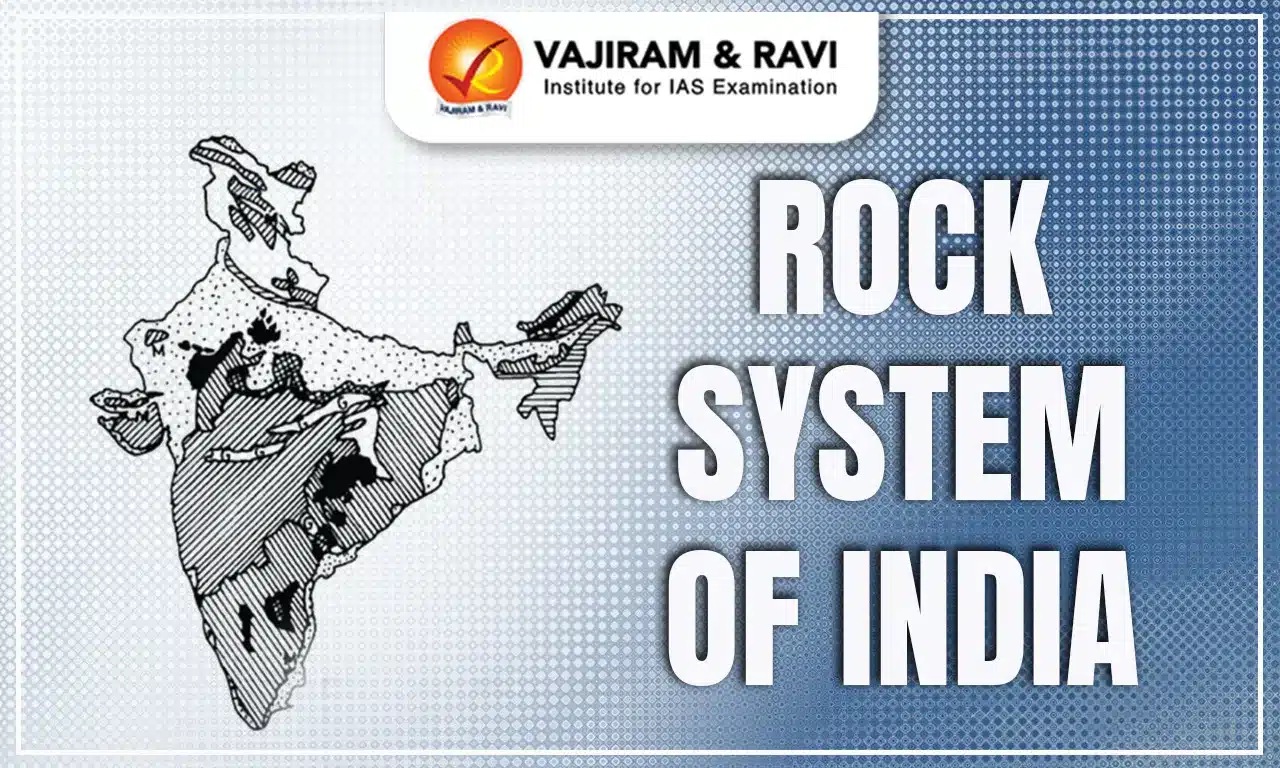
  • Sea Level Rise: Coastal zones face erosion and saline intrusion, affecting livelihoods and mangrove ecosystems.
  • Emissions Profile: India emits around 3 gigatonnes CO2 equivalent annually, about 7% of global emissions.
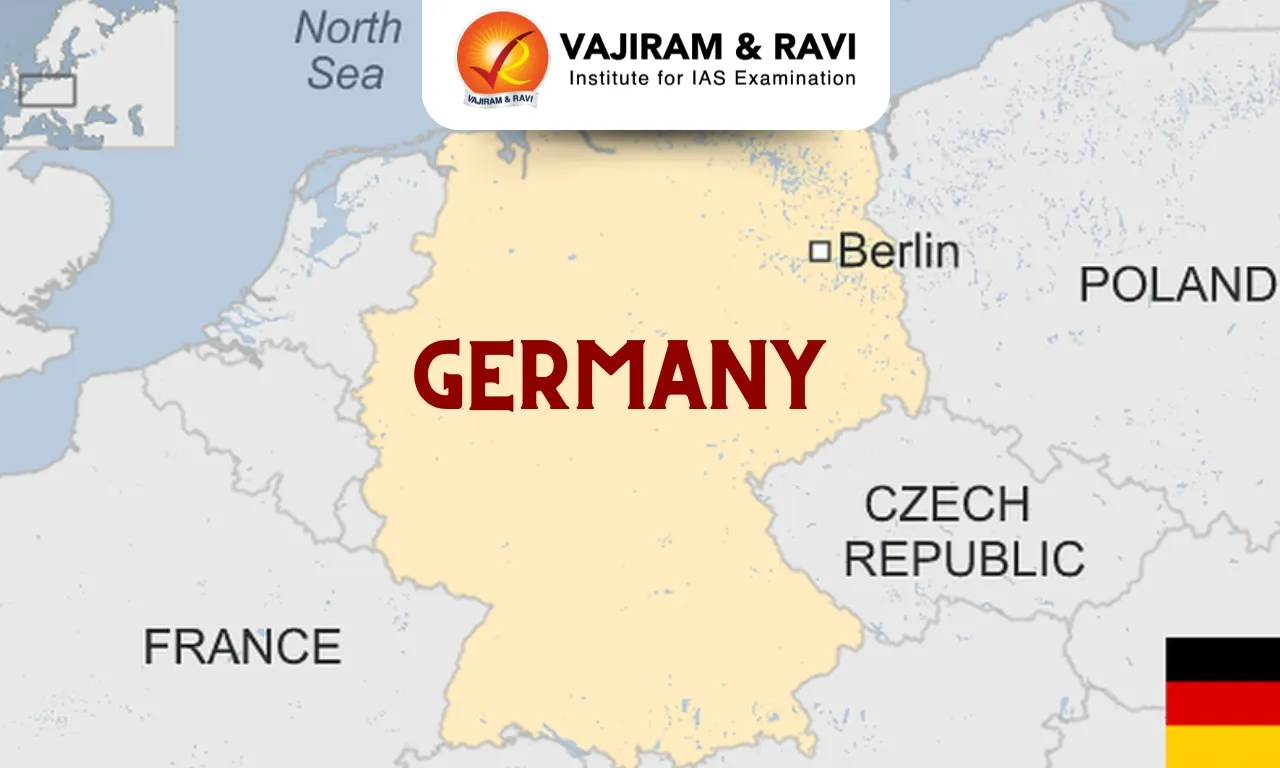
  • Vulnerability Ranking: India ranks among the most climate affected countries due to population exposure and economic dependence on monsoon.

Climate of India FAQs

Q1: What type of Climate does India have?

Ans: India has a monsoon type climate marked by seasonal reversal of winds and uneven rainfall distribution.

Q2: What controls the Climate of India?

Ans: Latitude, altitude, Himalayan barrier, pressure systems, jet streams, and monsoon winds control India’s climate.

Q3: How many Seasons are recognized in the Climate of India?

Ans: The India Meteorological Department identifies four seasons: winter, summer, southwest monsoon, and retreating monsoon.

Q4: Why is the Indian monsoon important?

Ans: Nearly 75% of India’s annual rainfall occurs during the southwest monsoon, crucial for agriculture and water security.

Q5: How does Climate variability affect India?

Ans: Climate variability increases extreme events like floods, droughts, heatwaves, and cyclones, impacting food production and livelihoods.

Enquire Now