Snow Leopard Trekking in Ladakh Ranks 4th on Wildlife Experience Index

Snow Leopard Trekking in Ladakh Ranks 4th on Wildlife Experience Index

Snow leopard trekking in Ladakh has been ranked 4th globally in the Wildlife Experience Index released by travel company Bailey Robinson, scoring 85.5 out of 100. The ranking highlights Ladakh’s importance as a high-altitude habitat for the elusive “Ghost of the Mountains.”

Wildlife Experience Index

The Wildlife Experience Index assessed 30 wildlife experiences using six criteria - rarity, remoteness, conservation importance, exclusivity, accessibility and encounter potential.

  • Mountain gorilla trekking in Rwanda/Uganda ranked first, followed by emperor penguin expeditions in Antarctica and saiga antelope trips in Kazakhstan.
  • Snow leopard tracking in Ladakh ranked fourth with a score of 85.5/100.
  • Eight of the top 10 experiences involve threatened species, highlighting the growing interest in wildlife experiences linked to rare species and conservation.

Snow Leopard Trekking in Ladakh

Snow leopard trekking in Ladakh is centred around the high-altitude valleys of Hemis National Park, particularly the Rumbak, Uley and Shang valleys.

  • November to March is considered the prime period for tracking as prey such as bharal (blue sheep) and Asiatic ibex move towards lower valleys during winter, increasing the chances of spotting snow leopards.
  • The landscape also supports Tibetan wolves, red foxes and lynx, making it an important high-altitude wildlife habitat.

Snow Leopard and Its Conservation

The snow leopard (Panthera uncia) is a high-altitude predator found across the mountains of Central and South Asia, including the Himalayan and Trans-Himalayan regions of India.

  • Distribution in India: Found mainly in Ladakh, Jammu and Kashmir, Himachal Pradesh, Uttarakhand, Sikkim and Arunachal Pradesh, in rugged high-altitude habitats.
  • Ecological role: As a top predator, it regulates prey populations and helps maintain the ecological balance of mountain ecosystems.
  • Key adaptations: Thick fur, broad furry paws, a long tail and specialised respiratory features help it survive cold, rocky and oxygen-deficient high-altitude environments.
  • Behaviour: It is largely solitary and elusive, with individuals occupying large home ranges and using scent marking for communication.
  • Diet: It mainly feeds on wild ungulates such as bharal and ibex, along with smaller mammals such as marmots, pikas and hares.
  • Population in India: The Snow Leopard Population Assessment in India (SPAI) estimated 718 snow leopards in the country, with the highest population in Ladakh (477). The assessment covered around 1.2 lakh sq. km of potential snow leopard habitat using field surveys, camera traps and occupancy-based methods.
  • Conservation status: The snow leopard is Vulnerable under the IUCN Red List, listed in Appendix I of CITESand placed under Schedule I of the Wildlife (Protection) Act, 1972 in India.
  • Major threats: Habitat degradation, declining natural prey, poaching, climate change, infrastructure development and human–wildlife conflict threaten its survival.
  • Conservation efforts: Project Snow Leopard, the Snow Leopard Population Assessment in India (SPAI), SECURE Himalaya and community-based measures such as predator-proof livestock corrals and compensation schemes support its conservation.

Snow Leopard Trekking in Ladakh Ranks 4th on Wildlife Experience Index FAQs

Q1: What is Snow Leopard Trekking in Ladakh?

Ans: Snow Leopard Trekking in Ladakh is a wildlife experience focused on tracking snow leopards in the high-altitude landscapes of Hemis National Park, particularly the Rumbak, Uley and Shang valleys.

Q2: Where does Snow Leopard Trekking in Ladakh rank globally?

Ans: Snow Leopard Trekking in Ladakh ranks 4th globally in the Wildlife Experience Index, with a score of 85.5 out of 100.

Q3: What is the best time for Snow Leopard Trekking in Ladakh?

Ans: November to March is considered the best period, as prey such as bharal and Asiatic ibex move to lower valleys during winter.

Q4: Which other wildlife can be spotted during Snow Leopard Trekking in Ladakh?

Ans: The region also supports bharal, Asiatic ibex, Tibetan wolves, red foxes and lynx.

Q5: What is the scientific name of the snow leopard?

Ans: The scientific name of the snow leopard is Panthera uncia.

Famous Musical Instruments and their Exponents, Instruments Types

Famous Musical Instruments and their Exponents

Musical instruments extensions of human expression that have shaped cultures across centuries. Over time, certain instruments have become closely tied to legendary musicians who created a legacy. India has given the world some legendary musicians including Pandit Ravi Shankar made the sitar internationally known, Ustad Zakir Hussain transformed the tabla into a global rhythm, and Dr. L. Subramaniam showcased the expressive power of the violin. Their mastery continues to inspire learners and listeners worldwide. Keep reading the article to get to know about the Famous Musical Instruments and their Exponents.

Famous Musical Instruments and their Exponents

From the sitar and tabla to the violin and flute, every instrument has had legends who've taken it to new heights. List of Famous Musical Instruments and their Exponents is discussed below.

Famous Wind Instruments and their Exponents

The table below includes the List of Famous Wind Instruments and their Exponents who mastered them. 

Famous Wind Instruments and their Exponents
Wind Instruments Exponents

Harmonium 

Shri Purushottam Walawalkar, Appa Jalgaonkar, Jnan Prakash Ghosh

Flute 

TR Mahalingam, Hariprasad Chaurasiya, N. Ramani, Pannalal Ghosh 

Shehnai 

Daya Shankar, Bismillah Khan, Ali Ahmad Hussain

Nadaswaram 

Rajaratanam Pillai, Sheikh Chinnamaula, Neeruswami Pillai

Famous Percussion Instruments and their Exponents

The table below includes the List of Famous Percussion Instruments and their Exponents who mastered them.

Famous Percussion Instruments and their Exponents
Percussion Instruments  Exponents

Ghatam 

TH Vinayakram, EM Subramaniam 

Kanjra 

Pudukottai Dakshinamurthy Pillai

Tabla 

Zakir Hussain, Sabir Khan, Allah Rakha, Pt Kishan Maharaj, Sandeep Das, Ustaad Shafaat Ahmad Khan, Pt Jnan Prakash Ghosh

Pakhawaj 

Totaram Sharma, Gopaldas, Ramshankar Pagaldas, Pt Ayodhya Prasad 

Mridangam

SV Rajarao, KV Prasad, Palghat Mani Iyer, Palghat Raghu, Karaikudi R Mani

Famous String Instruments and their Exponents

The table below includes the Famous String Instruments and their Exponents who mastered them.

Famous String Instruments and their Exponents
String Instruments Exponents

Guitar 

Braj Bhushan Kabra 

Mandolin

S Balamurali Krishna, Nagen Dey, Khagen Dey, U Srinivas

Rudra Veena 

Asad Ali Khan

Piano 

V Balsara 

Been 

Asad Ali Khan

Vichitra Veena 

Abdul Aziz Khan, Ahmed Raja Khan

Mohan Veena 

Pt Vishwa Mohan Bhat

Santoor 

Bhajan Sopori, Pt Shiv Kumar Sharma, Pt Tarun Bhattacharya 

Sarangi 

Abdul Latif Khan, Ustad Binda Khan, Ramesh Mishra, Sultan Khan, Pt Ram Narayan, Shakoor Khan

Sitar 

Ustad Vilayat Khan, Pt Ravi Shankar, Shujaat Hussain Khan, Shahid Parvez Khan, Anushka Shankar, Nikhil Banerjee, Mustaq Ali Khan, Budhaditya Mukherjee 

Sarod 

Ustad Amjad Ali Khan, Allaudin Khan, Bahadur Khan, Zarin S Sharma, Sharan Rani, Ustad Ali Akbar Khan

Violin 

Lalgudi Jayaram, VG Jog, M Chandrasekharan, NR Murlidharan, MS Gopalakrishnan 

Musical Instruments Types

Musical Instruments come in many forms, each with its own sound and style. To make things easier, they’re usually grouped into four main types which are discussed below in brief:

Percussion Instruments

Instruments that create sound when they are struck, shaken, or rubbed fall under the category of percussion instruments which are mentioned in the table below

Percussion Instruments
Instruments Name of the Instrument

Percussion Instrument

Mridangam

Drums

Xylophone

Snare Drum

Tabla

Triangle

Cymbal

Bass Drum

Maracas

Chimes

Tambourine

Timpani

Marimba

Keyboard Instruments

Keyboard Instruments produce sound through the pressing of keys, which trigger hammers, strings, air, or electronic signals depending on the instrument type. Some widely recognized keyboard instruments include:

Keyboard Instruments
Instruments Name of the Instrument

Keyboard Instruments

Harmonium 

Celeste 

Piano

Claviola 

Pipe organ

Accordion

Harpsichord

Organ

Harmonica 

Synthesiser

Brass/Wind Instruments

Brass/Wind Instruments produce sound when air is blown into a tube, creating vibrations that resonate through the body of the instrument. Here are some well-known examples:

Brass/Wind Instruments
Instruments Name of the Instrument

Brass/Wind Instruments

Flute

Mouth Organ

Piccolo

Trombone

Euphonium

Oboe

Bassoon

Trumpet

Saxophone

Tuba

Bassoon

French Horn

Cornet

Clarinet

String Instruments

String Instruments create sound when their strings are plucked, bowed, or struck, causing vibrations that resonate through the instrument’s body. Some of the most well-known String Instruments include:

String Instruments
Instruments Name of the Instrument

String Instruments

Guitar 

Violin

Cello

Harp

Sitar 

Veena

Mandolin

Viola

Lute

Banjo

Ukulele

Important Musical Instruments and their Exponents

From classical legends to cultural icons, the table below includes the List of Important Musical Instruments and their Exponents they’re known for.

Important Musical Instruments and their Exponents
Instrument Description Indian Exponents

Harmonium 

Harmonium is a keyboard instrument that blows sounds through reeds.

Shri Purushottam Walawalkar, Appa Jalgaonkar, Jnan Prakash Ghosh

Flute 

Flute is a wind instrument, and makes sound through air vibrations.

TR Mahalingam, Hariprasad Chaurasiya, N. Ramani, Pannalal Ghosh 

Tabla 

Similar to drums, Tabla is a common percussion instrument played in Asia. 

Zakir Hussain, Sabir Khan, Allah Rakha, Pt Kishan Maharaj, Sandeep Das, Ustaad Shafaat Ahmad Khan, Pt Jnan Prakash Ghosh

Sitar 

Used in Hindustani classical music, Sitar is a plucked string instrument.

Ustad Vilayat Khan, Pt Ravi Shankar, Shujaat Hussain Khan, Shahid Parvez Khan, Anushka Shankar, Nikhil Banerjee, Mustaq Ali Khan, Budhaditya Mukherjee 

Guitar 

A six-stringed fretted instrument, guitar is a famous international string instrument.

Braj Bhushan Kabra 

Famous Musical Instruments and their Exponents FAQs

Q1: Who is known for playing the sitar in India?

Ans: Pandit Ravi Shankar is world-renowned for popularizing the sitar globally through his classical performances and international collaborations.

Q2: Which artist is associated with the tabla?

Ans: Ustad Zakir Hussain is one of the most celebrated tabla maestros known for his rhythmic mastery and global performances.

Q3: Who is a famous exponent of the sarod?

Ans: Ustad Amjad Ali Khan is a legendary sarod player known for his soulful renditions and contributions to Indian classical music.

Q4: Which instrument is L. Subramaniam famous for?

Ans: L. Subramaniam is an acclaimed Indian violinist known for fusing Indian classical music with Western orchestration.

Q5: Who is the maestro of the shehnai?

Ans: Ustad Bismillah Khan was the shehnai legend, credited with elevating this traditional instrument to the classical music stage.

Environmental Conventions and Protocols, Objectives, Timelines

Environmental Conventions and Protocols

Environmental degradation, climate change, biodiversity loss, and pollution have emerged as some of the most critical global challenges of the 21st century. To address these concerns, nations across the world have come together under various international environmental conventions and protocols, creating legal, institutional, and cooperative mechanisms for environmental protection.

This article presents a comprehensive and updated overview of major international environmental conventions, protocols, and summits, their objectives, timelines, and relevance for India.

Major Environmental Conventions and Protocols

Environmental Conventions and Protocols are international agreements aimed at protecting the environment, biodiversity, and climate. All the Major Environmental Conventions and Protocols have been tabulated below.

Major Environmental Conventions and Protocols
Convention / Protocol Year Organisation / Framework

Ramsar Convention

1971

International Convention

CITES

1973

International Agreement

Bonn Convention (CMS)

1979

UNEP

Vienna Convention

1985 (in force 1988)

Multilateral Environmental Agreement

Montreal Protocol

1987

Multilateral Environmental Agreement

Basel Convention

1989

Multilateral Environmental Agreement

CBD

1992

Multilateral Treaty

UNFCCC

1992

Inter-governmental Treaty

Rio Earth Summit

1992

United Nations

UNCCD

1994

United Nations

Kyoto Protocol

1997

UNFCCC

Rotterdam Convention

1998

UN Treaty

Cartagena Protocol

2000

CBD Protocol

Stockholm Convention

2001

Global Treaty

UN-REDD

2008

UN Programme

Nagoya Protocol

2010

CBD Protocol

Minamata Convention

2013

International Treaty

Kigali Amendment

2016

Montreal Protocol

Ramsar Convention on Wetlands (1971)

  • The Ramsar Convention on Wetlands was adopted on 2 February 1971 at Ramsar, Iran, it is the first global treaty dedicated to the conservation and sustainable use of wetlands.
  • The Convention aims at the “wise use” of wetlands, ensuring ecological conservation while allowing sustainable human use.
  • Wetlands under Ramsar include natural and man-made ecosystems such as lakes, rivers, marshes, mangroves, coral reefs, reservoirs, and rice fields.
  • Member countries designate Ramsar Sites based on ecological importance, biodiversity value, and significance for waterfowl and aquatic species.
  • India became a contracting party in 1982 and currently has 96 Ramsar Sites, reflecting its commitment to wetland conservation.
  • The Convention promotes international cooperation, especially for transboundary wetlands and migratory species, and is supported by NGOs like WWF and IUCN.

Convention on International Trade in Endangered Species (CITES), 1973

  • CITES was adopted in 1973 at Washington D.C. and came into force in 1975 to regulate international trade in endangered wild fauna and flora.
  • Its primary objective is to ensure that international trade does not threaten the survival of species, covering live specimens, animal parts, and plant derivatives.
  • Species are listed under Appendix I (trade prohibited except in exceptional cases), Appendix II (regulated trade), and Appendix III (protected in at least one country).
  • CITES is a legally binding international agreement with over 180 member countries, including India, which joined in 1976.
  • Implementation is carried out through a permit and licensing system, monitored by Management and Scientific Authorities in each member country.
  • CITES focuses on trade regulation rather than habitat protection, making it a key convention for controlling wildlife trafficking and illegal trade.

Bonn Convention 1979

  • The Bonn Convention, officially called the Convention on the Conservation of Migratory Species of Wild Animals (CMS), was adopted in 1979 and came into force in 1983.
  • It is the only global treaty dedicated exclusively to the conservation of migratory species, their habitats, and migration routes across international boundaries.
  • Migratory species are protected through Appendix I (endangered migratory species - strict protection) and Appendix II (species requiring international cooperation).
  • The Convention brings together Range States, countries through which migratory species pass, to ensure coordinated conservation efforts.
  • The CMS Secretariat is headquartered in Bonn, Germany, and operates under the aegis of UNEP.
  • India has been a party since 1983, with notable migratory species including Amur Falcons, Bar-headed Geese, and marine turtles.

Vienna Convention (1985)

  • The Vienna Convention was adopted in 1985 and entered into force in 1988 to protect the Earth’s ozone layer from depletion.
  • It provides a framework for international cooperation rather than imposing legally binding emission-reduction targets.
  • The Convention promotes scientific research, systematic observation, and information exchange on ozone-depleting substances.
  • It laid the institutional and legal foundation for the Montreal Protocol (1987).
  • Parties commit to cooperate on technology transfer and policy coordination related to ozone protection.
  • India became a Party in 1991, aligning with global efforts to safeguard the ozone layer.

Montreal Protocol (1987)

  • Adopted in 1987 and enforced from 1989, the Montreal Protocol is a legally binding agreement under the Vienna Convention.
  • It aims to phase out production and consumption of ozone-depleting substances (ODS) such as CFCs, halons, and carbon tetrachloride.
  • The Protocol operates on the principle of common but differentiated responsibilities, granting developing countries extended timelines.
  • It has been revised multiple times (London, Copenhagen, Beijing, etc.) to include additional substances and stricter controls.
  • The Kigali Amendment (2016) further expanded its scope to phase down climate-warming HFCs.

Basel Convention (1989)

  • Adopted in 1989 and entered into force in 1992, the Basel Convention regulates cross-border movement of hazardous wastes.
  • It was framed in response to the dumping of toxic wastes in developing countries, particularly in Africa.
  • The Basel Convention aims to protect human health and the environment from adverse impacts of hazardous and other wastes.
  • It mandates prior informed consent (PIC) of importing countries before waste shipment.
  • The scope includes industrial hazardous waste, biomedical waste, household waste, and incinerator ash.

Convention on Biological Diversity (CBD)

  • CBD was adopted in 1992 at the Rio Earth Summit and entered into force in 1993.
  • It has three objectives: conservation of biodiversity, sustainable use, and fair benefit sharing.
  • It is a legally binding multilateral treaty with near-universal membership.
  • The United States is the only UN member not to have ratified CBD.
  • Cartagena Protocol and Nagoya Protocol are its supplementary agreements.
  • CBD promotes ecosystem, species, and genetic diversity conservation.

United Nations Framework Convention on Climate Change (UNFCCC)

  • UNFCCC was adopted in 1992 at Rio to address global climate change.
  • Its objective is to stabilize greenhouse gas concentrations to prevent dangerous climate change.
  • It operates on the principle of Common but Differentiated Responsibilities (CBDR).
  • It provides the framework for the Kyoto Protocol and Paris Agreement.
  • The UNFCCC Secretariat is headquartered in Bonn, Germany.
  • Annual Conference of Parties (COP) meetings guide global climate action.

Rio Earth Summit (1992)

  • The Rio Summit was held in Rio de Janeiro, Brazil (1992).
  • It marked a turning point in global environmental diplomacy.
  • Key outcomes included Agenda 21, Rio Declaration, UNFCCC, and CBD.
  • It emphasized sustainable development linking environment and development.
  • Participation included 179 countries and numerous NGOs.
  • It institutionalized the concept of global environmental cooperation.

United Nations Convention to Combat Desertification (UNCCD)

  • UNCCD was adopted in 1994 to combat desertification, land degradation, and drought, especially in dryland regions.
  • It is a legally binding convention linking environmental protection with sustainable development and poverty reduction.
  • The Convention focuses on arid, semi-arid, and dry sub-humid areas, which are ecologically fragile and highly vulnerable.
  • Member countries implement the Convention through National Action Programmes (NAPs) with community participation.
  • It promotes Land Degradation Neutrality (LDN) to balance land degradation with restoration efforts.
  • India is a Party to UNCCD and hosted COP-14 in New Delhi (2019), highlighting sustainable land management.

Kyoto Protocol

  • The Kyoto Protocol was adopted in 1997 under the UNFCCC and entered into force in 2005.
  • It imposed legally binding greenhouse gas emission reduction targets on developed (Annex-I) countries.
  • The Protocol operationalised the principle of Common but Differentiated Responsibilities (CBDR).
  • It introduced market-based mechanisms such as the Clean Development Mechanism (CDM), Joint Implementation, and Emissions Trading.
  • Developing countries, including India, had no mandatory emission reduction obligations.
  • The Protocol laid the foundation for global carbon markets and future climate agreements.

Rotterdam Convention

  • The Rotterdam Convention was adopted in 1998 and entered into force in 2004.
  • It regulates the international trade of certain hazardous chemicals and pesticides.
  • The Convention is based on the Prior Informed Consent (PIC) procedure, requiring importing countries’ approval.
  • Its objective is to protect human health and the environment from potential chemical hazards.
  • It promotes information exchange on risks and safe handling of hazardous chemicals.
  • The Convention covers industrial chemicals and pesticides that are banned or severely restricted.

Stockholm Convention

  • The Stockholm Convention was adopted in 2001 and entered into force in 2004.
  • It aims to eliminate or restrict persistent organic pollutants (POPs) globally.
  • POPs are toxic, bio-accumulative, long-lasting, and capable of long-range environmental transport.
  • The Convention applies the precautionary principle in managing chemical risks.
  • It seeks to protect human health and the environment, especially vulnerable populations.
  • Parties are required to reduce, restrict, or eliminate POPs through national action plans.

Cartagena Protocol on Biosafety

  • The Cartagena Protocol on Biosafety was adopted in 2000 under the Convention on Biological Diversity (CBD).
  • It entered into force in 2003 and is a legally binding international agreement.
  • The Protocol regulates the transboundary movement of Living Modified Organisms (LMOs) resulting from modern biotechnology.
  • It follows the precautionary approach, allowing countries to restrict LMOs even in the absence of full scientific certainty.
  • It mandates risk assessment and risk management before approval of LMOs.
  • The Protocol aims to protect biological diversity and human health from potential adverse effects of LMOs.

UN-REDD

  • The United Nations Collaborative Programme on Reducing Emissions from Deforestation and Forest Degradation (UN-REDD) was launched in 2008 as a United Nations collaborative programme.
  • It is jointly implemented by UNDP, UNEP, and FAO.
  • The programme supports developing countries in reducing emissions from deforestation and forest degradation.
  • It provides technical assistance, capacity building, and policy support for forest governance.
  • UN-REDD strengthens forest monitoring, measurement, reporting, and verification (MRV) systems.
  • It contributes to climate change mitigation, biodiversity conservation, and sustainable livelihoods.

REDD+

  • REDD+ is a climate change mitigation mechanism developed under the UNFCCC framework.
  • It aims to reduce emissions from deforestation and forest degradation in developing countries.
  • The “+” includes forest conservation, sustainable forest management, and enhancement of forest carbon stocks.
  • The framework was formally adopted as the Warsaw Framework for REDD+ at COP-19 (2013).
  • REDD+ is recognised under Article 5 of the Paris Agreement.
  • It encourages results-based finance and incentives for verified emission reductions.

Nagoya Protocol

  • The Nagoya Protocol was adopted in 2010 in Nagoya, Japan, as a supplementary agreement to the Convention on Biological Diversity (CBD).
  • It focuses on Access and Benefit Sharing (ABS) of genetic resources.
    The Protocol ensures fair and equitable sharing of benefits arising from the utilization of genetic resources.
  • It provides a legal framework for researchers and companies accessing genetic resources.
  • It strengthens sovereign rights of countries over their genetic resources.
  • Implementation supports biodiversity conservation and sustainable use through economic and scientific incentives.

Minamata Convention

  • The Minamata Convention was adopted in 2013 and entered into force in 2017 to address mercury pollution.
  • It aims to protect human health and the environment from the harmful effects of mercury.
  • The Convention bans new mercury mines and phases out existing ones.
  • It regulates mercury use in products, industrial processes, and artisanal small-scale gold mining (ASGM).
  • It establishes control measures for air emissions, waste disposal, and contaminated sites.

Kigali Amendment

  • The Kigali Amendment was adopted in 2016 under the Montreal Protocol to address hydrofluorocarbons (HFCs).
  • HFCs do not deplete the ozone layer but have a high global warming potential, contributing to climate change.
  • The Amendment mandates a gradual phase-down of HFC production and consumption.
  • India will implement the phase-down in four stages from 2032 to 2047.

Carbon Credit Trading Scheme (CCTS), 2022

  • The CCTS was enabled through the Energy Conservation (Amendment) Act, 2022, establishing a domestic carbon market in India.
  • It allows trading of Carbon Credit Certificates for verified greenhouse gas (GHG) emission reductions.
  • The scheme operates through two mechanisms:
    • Compliance Mechanism – for obligated entities to meet emission reduction targets.
    • Offset Mechanism – for non-obligated entities to earn credits by reducing/removing emissions.
  • The Bureau of Energy Efficiency (BEE) manages the scheme and ensures transparency via the Measurement, Reporting, and Verification (MRV) framework.
  • The National Steering Committee for Indian Carbon Market (NSCICM) provides strategic oversight.
  • CCTS supports India’s Nationally Determined Contributions (NDCs) and climate mitigation targets under the Paris Agreement.

Difference Between Conferences, Conventions and Protocols

Environmental agreements have different forms based on purpose and legal binding nature. The Difference Between Conferences, Conventions and Protocols has been highlighted below.

Difference Between Conferences, Conventions and Protocols
Aspect Conference Convention Protocol

Definition

A formal meeting or discussion on a topic.

A framework agreement establishing rules or principles.

A supplementary agreement specifying detailed targets or obligations.

Purpose

To discuss issues and plan future actions.

To set fundamental principles for cooperation.

To provide legally binding commitments under a Convention.

Legal Status

Usually non-binding.

Can be legally binding or framework-based.

Legally binding for signatory parties.

Participants

Representatives, experts, and stakeholders.

Member countries agreeing on a framework.

Signatory countries of the original Convention.

Example

Earth Summit meetings, COP meetings.

UNFCCC, CBD, Ramsar Convention.

Kyoto Protocol, Montreal Protocol, Nagoya Protocol.

Environmental Conventions and Protocols FAQs

Q1: What are Environmental Conventions and Protocols?

Ans: International agreements to protect biodiversity, ecosystems, and the climate through cooperation and legal frameworks.

Q2: Difference between Conference, Convention, and Protocol?

Ans: Conference – meeting; Convention – framework agreement; Protocol – specific obligations under a convention.

Q3: Why are they important for India?

Ans: To conserve biodiversity, combat climate change, manage wetlands, and fulfill international commitments.

Q4: What is REDD+?

Ans: A UNFCCC mechanism to reduce emissions from deforestation and enhance forest carbon stocks.

Q5: What is the Kigali Amendment?

Ans: A 2016 amendment to phase down HFCs to mitigate global warming.

Plato’s Theory of Justice, Concept, Principle and Criticism

Plato's Theory of Justice

Plato’s Theory of Justice is one of the most influential ideas in Western philosophy, forming the foundation of his political thought as presented in his famous work The Republic. According to Plato, justice is not just about laws or punishment but a moral and social order where everyone performs their proper role. He envisioned justice as harmony within both the individual soul and the state. For Plato, justice represents the highest virtue, ensuring balance and moral perfection in society

Plato's Theory of Justice

Plato’s Theory of Justice emerged from a period of social unrest and political chaos in Athens. He believed that moral decay and lack of virtue were the root causes of state instability. Unlike the conventional legal definitions of justice that focused on rights and retribution, Plato presented an unconventional moral and social theory of justice. He viewed justice as both an individual virtue and a virtue of social institutions, arguing that harmony within the individual and the state was essential for true justice. Thus, he shifted the focus from legal obligations to moral duties, emphasizing that justice concerns the duties individuals owe to society rather than the rights they claim from it.

Concept of Justice According to Plato

Plato believed that justice means “doing one’s own work and not meddling with what does not concern one.” He explained this idea through his concept of the ideal state, which mirrors the structure of the human soul. In both, justice is achieved when each part performs its function without interfering with others. Plato opposed the Sophists’ idea that justice is simply the interest of the stronger. Instead, he viewed it as a principle of balance and virtue that brings order to both individuals and the community. Plato explained that the human soul has three parts, and justice arises when these parts are in harmony:

  • Rational Part (Reason): Seeks truth and governs the soul with wisdom.
  • Spirited Part (Will): Represents courage and emotional drive, supporting reason in maintaining discipline.
  • Appetitive Part (Desire): Concerns physical needs and pleasures, which must be controlled by reason.

Traditional Theories of Justice

Before developing his own theory, Plato examined and rejected three existing notions of justice prevalent in his time:

(a) Cephalus and Polemarchus: Traditional Theory

  • Cephalus, a wealthy elder, defined justice as “doing one’s duty and paying one’s dues.” Plato accepted the idea of duty but rejected the mechanical repayment of dues. For instance, returning a weapon to a madman is not just, even if it’s owed.
  • Polemarchus defined justice as “doing good to friends and harm to enemies.”Plato refuted this, arguing that justice cannot cause harm to anyone and that identifying true friends or enemies is uncertain.

(b) Thrasymachus: Radical Theory

The sophist Thrasymachus claimed that “justice is the interest of the stronger.” In this view, might equals right, and rulers define justice to serve their power. Plato dismissed this, asserting that true justice is universal and moral, not relative to power or politics.

(c) Glaucon: Pragmatic Theory

Glaucon, Plato’s interlocutor, described justice as a social compromise, a way for the weak to protect themselves from the strong. Plato disagreed, saying justice is natural, eternal, and not man-made. It transcends conventions and benefits both individuals and the community equally.

Plato's Justice Theory

After rejecting these theories, Plato presented his own conception of justice, using his dialectical method in The Republic. He explained justice at two interrelated levels- the individual and the state. He believed the state is a magnified reflection of the individual soul. Therefore, justice in the individual and justice in the state are structurally similar, each dependent on harmony and order among their components.

(a) Justice in the State

According to Plato, the state has three classes, each representing a part of the human soul:

  1. Rulers (Philosopher Kings)- Represent reason and should govern with wisdom and truth.
  2. Soldiers (Guardians)- Represent spirit and are responsible for courage and defense.
  3. Producers (Farmers, Artisans, Traders)- Represent appetite and fulfill material needs.

Justice is achieved when each class performs its own function without interfering with others. Thus, justice is functional specialization and harmony, every class performing its natural role for the common good.

(b) Justice in the Individual

Plato extended this model to the human soul, which also has three parts:

  1. Rational Faculty- Seeks truth and knowledge; its virtue is wisdom.
  2. Spirited Faculty- Upholds courage and ambition; its virtue is courage.
  3. Appetitive Faculty- Desires pleasure and material needs; its virtue is temperance.

When these parts act in balance, with reason governing, spirit supporting, and desire obeying, justice arises in the individual.

Plato's Theory of Justice Principle

Plato’s theory is built on three fundamental principles:

  1. Functional Specialization- Each person performs tasks suited to their abilities.
  2. Non-Interference- No class or part of the soul intrudes into another’s domain.
  3. Harmony- Balance between wisdom, courage, and temperance results in justice.

Plato's Theory of Justice Features

The key features of the Plato’s theory for Justice has been listed below:

  • Justice as Virtue: It is both a personal and public virtue ensuring order and moral excellence.
  • Universal and Moral: Justice applies equally to all, not favoring rich or powerful individuals.
  • Social Harmony: Justice creates interdependence and unity among citizens.
  • Duties over Rights: Plato emphasizes responsibilities of individuals to the state over personal entitlements

Plato's Theory of Justice and Education

Plato viewed education as the cornerstone of justice. Through a rigorous educational system, the state identifies individuals’ natural aptitudes. This merit-based system ensures that everyone contributes according to capability, producing a balanced and just society, a principle comparable to modern administrative specialization in governance.

  • Those best in reasoning become Philosopher Kings.
  • The brave and loyal become Soldiers.
  • Others become Producers, fulfilling economic roles.

Plato’s The Allegory of the Cave and Justice

In The Republic, Plato’s Allegory of the Cave illustrates his idea of justice and knowledge. The cave symbolizes ignorance and illusion, while the journey out of the cave represents enlightenment through knowledge. A just ruler, according to Plato, is like the philosopher who escapes the cave and sees the truth. He must then return to guide others toward justice and wisdom, even if it is difficult.

Plato's Theory of Justice Criticism

Despite its philosophical depth, Plato’s theory has drawn significant criticism:

  1. Lack of Individual Freedom: It emphasizes duties, not rights, undermining liberty.
  2. Hierarchical Society: The class division creates inequality and subordination.
  3. Totalitarian Tendencies: Concentration of power in philosopher kings may lead to autocracy.
  4. Moral, Not Legal Justice: It lacks enforceable legal mechanisms.
  5. Privilege of the Elite: Critics like Karl Popper argued that Platonic justice justifies class privileges rather than abolishing them.
  6. Neglect of Democracy: Plato’s distrust of democracy contradicts modern egalitarian ideals.
  7. Popper called Plato’s ideal state a “closed society”, warning that such hierarchical justice could lead to totalitarianism.

Plato's Theory of Justice UPSC

Plato’s theory remains a cornerstone of political philosophy. It laid the groundwork for concepts of moral governance, ethical leadership, and institutional harmony. His idea that rulers should be wise and virtuous resonates with modern constitutionalism, where leaders are expected to act in public interest. Even John Rawls, in his modern theory of Justice as Fairness (1971), drew inspiration from Plato’s harmony-based model. In modern terms, Plato’s justice emphasizes rule of law, moral education, and public responsibility.

Plato's Theory of Justice FAQs

Q1: Who was Plato, and when was he born?

Ans: Plato was a Greek philosopher born in Athens around 427 BCE. He was a student of Socrates and teacher of Aristotle.

Q2: What is the main idea of Plato’s Theory of Justice?

Ans: Justice means harmony, each person performing their proper function without interfering in others’ roles.

Q3: What are the three classes in Plato’s ideal state?

Ans: Rulers (wisdom), soldiers (courage), and producers (temperance) together form a just and balanced state.

Q4: Why did Plato reject democracy?

Ans: Plato rejected Athenian democracy after witnessing Socrates’ execution, believing only wise rulers could ensure justice.

Q5: How is Plato’s Justice relevant today?

Ans: His emphasis on moral leadership, education, and ethical governance still shapes modern political and philosophical thought.

Bharatiya Nagarik Suraksha Sanhita (BNSS) 2023, Objectives, Provisions

Bharatiya Nagarik Suraksha Sanhita (BNSS) 2023

The Bharatiya Nagarik Suraksha Sanhita (BNSS), 2023 is one of India’s three new criminal laws that replaced the old colonial-era legislation. BNSS substitutes the Code of Criminal Procedure (CrPC), 1973 and aims to modernize India’s criminal justice system by introducing technology-driven processes, faster investigation, victim-centric mechanisms, and time-bound justice. 

It came into force alongside the Bharatiya Nyaya Sanhita (BNS), 2023 and the Bharatiya Sakshya Adhiniyam (BSA), 2023.

Bharatiya Nagarik Suraksha Sanhita (BNSS), 2023 Background

The Bharatiya Nagarik Suraksha Sanhita (BNSS), 2023 was introduced to replace the old CrPC, 1973, which was outdated and slow. The old law caused delays in investigations and court trials. BNSS aims to make the criminal justice system faster, simpler, and more transparent. It also focuses on protecting victims and ensuring better accountability of the police. Overall, it is designed to make justice more accessible and citizen-friendly.

Code of Criminal Procedures CrPC, 1973 and Need for Reform

The Code of Criminal Procedures CrPC, 1973 provided the primary framework for procedure in criminal cases. While effective in its time, several challenges emerged:

Why CrPC Needed Reforms?

  • CrPC, 1973 was rooted in the colonial CrPC 1898, designed for control, not citizen-centric justice, even after 75 years of independence.
  • Over 3.2 crore criminal cases were pending in courts (NCRB 2022), with nearly 75% being criminal cases, showing severe procedural delays.
  • 77% of India’s prison population are undertrials, one of the highest globally, mainly due to slow investigations and trials under CrPC.
  • Low conviction rates persisted: 57% overall, but only 27% in rape cases and 44% in murder cases, reflecting weak procedural support for evidence and investigation.
  • Cybercrimes rose by 24.4% in 2022, but CrPC lacked strong provisions for digital evidence, online offences, and modern crime patterns.
  • Over 50% of witnesses turned hostile in serious cases, but CrPC had no comprehensive witness protection or digital recording norms.
  • Police often took 60+ days for investigations in major IPC offences due to absence of strict timelines and technology-based procedures.

Bharatiya Nagarik Suraksha Sanhita (BNSS), 2023 Objectives

The Bharatiya Nagarik Suraksha Sanhita (BNSS), 2023 aims to modernize India’s criminal justice system by making investigations faster, transparent, and technology-driven.

  • To finish investigations and trials faster with fixed timelines.
  • To allow online processes like e-FIR and digital records.
  • To make forensic tests compulsory in serious crimes.
  • To give more rights and support to victims.
  • To ensure police follow rules properly with video recordings and documentation.
  • To reduce court delays and case backlog.
  • To make the justice system more transparent, modern, and fair.

Bharatiya Nagarik Suraksha Sanhita (BNSS), 2023 Salient Provisions

The BNSS, 2023 introduces major changes in criminal procedures to make investigations faster, transparent, and technology-based. It focuses on digital evidence, time-bound processes, police accountability, and stronger support for victims.

  • E-FIR Facility: Citizens can file FIRs online for many cognizable offences.
  • Zero FIR: FIR can be registered at any police station, regardless of jurisdiction.
  • Mandatory Audio-Visual Recording: Search, seizure, arrest, and witness statements must be recorded on camera.
  • Time-Bound Investigation: Police must complete investigations within 180 days, with limited extensions.
  • Time-Bound Judgments: Courts should deliver judgments within 30 days after the conclusion of arguments.
  • Mandatory Forensic Examination: For crimes with a punishment of 7 years or more, forensic tests are compulsory.
  • Community Service: Introduced as a new form of punishment for minor offences.
  • Digital Case Records: Chargesheets, evidence, and case files can be stored and shared electronically.
  • Trials in Absentia: Courts can conduct trials even when a proclaimed offender is not present.
  • Extended Police Custody: Police custody can be taken in parts up to 60 days for serious crimes.
  • Victim Rights Strengthened: Victims will receive regular updates on case progress and support services.
  • Witness Protection: Encourages video recording and better measures to prevent witness intimidation.
  • Use of Technology in Courts: Virtual hearings, online summons, and digital signatures are encouraged.
  • Public Order Measures: Updates preventive actions like detention, surveillance, and crowd management.

Difference Between CrPC and BNSS

The Bharatiya Nagarik Suraksha Sanhita (BNSS), 2023 was introduced to modernize and simplify the outdated CrPC, 1973. It focuses on faster trials, technology-driven processes, victim protection, and better police accountability.

Difference Between CrPC and BNSS
Feature CrPC, 1973 BNSS, 2023

Type of Law

Procedural law based on colonial-era system

Modern procedural law with citizen-friendly approach

Focus

Police and state control

Citizen protection, speed, and transparency

Investigation

No fixed timelines

Investigations must be completed within 180 days

Evidence

Traditional paper-based

Digital records, audio-visual recording, forensic tests mandatory

Victim Rights

Limited provisions

Strong victim protection, updates, and compensation

Trial Process

Can be slow and delayed

Time-bound trials, trials in absentia allowed

Police Accountability

Minimal accountability

Mandatory documentation, video recording, tech use

Technology Use

Limited

E-FIR, digital chargesheets, online hearings supported

Comparison of BNSS, BNS & BSA (Three New Criminal Laws)

The three new criminal laws: Bharatiya Nagarik Suraksha Sanhita (BNSS, 2023), Bharatiya Nyaya Sanhita (BNS, 2023), and Bharatiya Sakshya Adhiniyam (BSA, 2023) have replaced old colonial-era laws like CrPC, IPC, and the Indian Evidence Act. The detailed comparison is shared below.

Comparison of BNSS, BNS & BSA (Three New Criminal Laws)
Feature BNSS, 2023 BNS, 2023 BSA, 2023

Replaces

CrPC, 1973

IPC, 1860

Indian Evidence Act, 1872

Type of Law

Procedural law

Substantive criminal law

Law on evidence

Focus

Criminal procedure, investigation, trials

Defining crimes and punishments

Admissibility and management of evidence

Key Features

E-FIR, time-bound trials, digital evidence, victim rights

New definitions of crimes, updated punishments, community service

Digital evidence, witness testimony, modern evidence rules

Objective

Faster, transparent, citizen-friendly justice

Modernize offences and penalties

Strengthen proof and trial processes

Use of Technology

High - e-FIR, digital chargesheets, virtual hearings

Medium - legal definitions updated

High - digital evidence and recording accepted

Victim Rights

Strongly protected, updates on cases

Indirect - through punishments and compensation

Indirect - ensures evidence supports victim claims

Bharatiya Nagarik Suraksha Sanhita (BNSS), 2023 Issues

  • Some provisions give broader police powers, raising concerns about misuse, especially since India has 195 police personnel per 1 lakh population (BPRD 2022), below UN standard.
  • Terms like “reasonable grounds” are vague, which may lead to subjective interpretation by officials.
  • Implementation challenges exist as over 70% of police stations in rural India lack proper digital infrastructure (MHA Report 2022).
  • States may resist due to administrative differences and lack of trained staff for new procedures.
  • High reliance on digital records raises privacy and cybersecurity concerns, as India still lacks a uniform data protection framework.
  • Training gaps are significant: less than 30% of police personnel have formal digital investigation training (NCRB 2022).
  • Low public awareness may limit citizen use of e-FIRs and digital case tracking.
  • Overemphasis on technology without human oversight may lead to errors in investigations.
  • Additional documentation and digital compliance could increase police workload in already stretched departments.

Bharatiya Nagarik Suraksha Sanhita (BNSS), 2023 Way Forward

The Bharatiya Nagarik Suraksha Sanhita (BNSS), 2023 can be effective if digital tools, proper training, and citizen awareness are strengthened.

  • Improve digital tools and internet access in all police stations.
  • Give proper training to police, lawyers, and judges on the new law.
  • Make sure police follow rules properly to prevent misuse of power.
  • Protect citizens’ data and keep digital records safe.
  • Provide help and updates to victims during investigation and trial.
  • Increase awareness among people about e-FIRs and their rights.
  • Ensure the law is applied the same way in all states.
  • Use technology along with human checks to make investigations fair and accurate.

Bharatiya Nagarik Suraksha Sanhita (BNSS) 2023 FAQs

Q1: What is BNSS, 2023?

Ans: BNSS, 2023 is a new law that replaces the old CrPC, 1973 and modernizes criminal procedures in India.

Q2: What is the main objective of BNSS?

Ans: Its main goal is to make criminal justice faster, transparent, and citizen-friendly while protecting victims and improving police accountability.

Q3: Can FIRs be filed online under BNSS?

Ans: Yes, BNSS allows citizens to file e-FIRs for many cognizable offences.

Q4: Are forensic tests mandatory under BNSS?

Ans: Yes, for serious crimes punishable with 7 years or more, forensic examination is compulsory.

Q5: Can trials be conducted if the accused is absent?

Ans: Yes, BNSS allows trials in absentia for proclaimed offenders.

Karl Marx, Early Life, Major Works, Core Ideas, Contributions

Karl Marx

The 19th century witnessed massive social and economic transformation in Europe due to the Industrial Revolution. While industrialisation increased production and economic growth, it also created deep inequalities, exploitation of workers, poor living conditions, and concentration of wealth in the hands of industrial capitalists. In this historical context, Karl Marx emerged as one of the most influential thinkers of modern times.

About Karl Marx 

Karl Marx was a German philosopher, economist, historian, political theorist, and revolutionary socialist whose ideas profoundly shaped modern political thought, labour movements, socialism, and global debates on inequality and capitalism. 

His ideas, collectively known as Marxism, continue to influence discussions on economics, politics, class relations, labour rights, and social justice across the world.

Karl Marx Early Life and Background

  • Karl Marx was born on 5 May 1818 in Trier in the Kingdom of Prussia (present-day Germany). 
  • He belonged to a middle-class Jewish family. His father Heinrich Marx, a lawyer, converted to Lutheranism for professional reasons. 
  • He received higher education in law and philosophy. He initially studied at the University of Bonn and later at the University of Berlin.
  • During his education, he was deeply influenced by the philosophy of Georg Wilhelm Friedrich Hegel. Marx later criticised Hegel’s idealism and developed his own materialist interpretation of history.
  • He collaborated closely with Friedrich Engels, who became his lifelong intellectual partner and financial supporter.
  • He worked as a journalist and correspondent, most notably for the New-York Tribune (1851–1862), through which he published articles on European politics and India.
  • He was expelled from Germany, France, and Belgium due to his radical political writings; eventually settled permanently in London in 1849.
  • Marx also participated in international labour movements and helped establish the International Workingmen’s Association, also known as the First International, in 1864.
  • He died in London in 1883.

Major Works of Karl Marx

Karl Marx produced several influential works that shaped socialist and communist thought.

Major Work Significance

The Communist Manifesto (1848)

Written with Friedrich Engels; outlined the principles of communism and class struggle

Das Kapital (1867)

Detailed critique of capitalism and theory of surplus value

The German Ideology

Explained historical materialism

Economic and Philosophic Manuscripts

Discussed alienation under capitalism

A Contribution to the Critique of Political Economy

Explained the relationship between economic structure and society

Core Ideas and Contributions of Karl Marx

Karl Marx provided a systematic way to understand how societies function, how history changes, and how economic systems shape human life, especially under capitalism.

Historical Materialism

According to Marx, the economic and material conditions of society are the main forces that shape politics, law, culture, religion, and social institutions. He believed that the way people produce and distribute resources determines the nature of society.

Marx argued that human history progresses through different stages such as Primitive Communism, Slave Society, Feudalism, Capitalism, Socialism, and Communism. Each stage is defined by a particular economic system and class relationship.

He divided society into two parts:

  • Base: The economic structure, including production systems and labour relations
  • Superstructure: Political institutions, laws, religion, education, and culture

According to Marx, changes in the economic base eventually lead to changes in the superstructure, making economic forces the driving factor of historical change.

Dialectical Materialism

Dialectical Materialism is Karl Marx’s theory explaining how societies change and develop over time.

  • According to Marx, social change does not happen peacefully or automatically. Every society contains internal conflicts and contradictions, mainly related to economic interests and class relations. 
  • These conflicts gradually become stronger and eventually lead to the collapse of the old system and the rise of a new one.
  • For example, Marx believed that the conflict between the capitalist class and the working class within capitalism would eventually lead to the rise of socialism.

Thus, Dialectical Materialism explains that historical change occurs through conflict between opposing material forces and class interests.

Theory of Class Struggle

The Theory of Class Struggle is one of the central ideas of Karl Marx. According to Marx, human history is largely the history of conflicts between different social classes. In every society, one class controls economic resources and political power, while another class is exploited. Marx argued that different historical periods were characterised by conflict between opposing classes:

  • In slave society, the conflict existed between masters and slaves.
  • Under feudalism, landlords exploited peasants and serfs.
  • In capitalism, the struggle exists between the bourgeoisie and the proletariat.

The bourgeoisie refers to the capitalist class that owns factories, industries, and other means of production. The proletariat refers to workers who do not own productive resources and therefore sell their labour for wages.

According to Marx, capitalists earn profits by exploiting workers and paying them less than the value they produce. Over time, this exploitation creates inequality, dissatisfaction, and conflict between the two classes. Marx believed that this class struggle would eventually lead to the overthrow of capitalism and the establishment of a socialist society.

Theory of Surplus Value

The Theory of Surplus Value is Karl Marx’s explanation of how profit is generated under capitalism. 

  • According to Marx, workers produce more value through their labour than the wages they receive in return. The extra value created by workers is appropriated by the capitalist as profit, which Marx called “surplus value”.
  • Marx argued that labour is the real source of value in production. However, workers are paid only a portion of the value they create, while the remaining value is retained by factory owners and capitalists. In this way, capitalism is based on the exploitation of labour.
  • For example, if a worker produces goods worth much more than his daily wage, the difference between the value produced and the wage paid becomes the profit of the capitalist.
  • According to Marx, the continuous extraction of surplus value leads to concentration of wealth, economic inequality, and exploitation of the working class under capitalism.

Concept of Alienation

The Concept of Alienation explains how workers become disconnected from their work and their human potential under capitalism. According to Karl Marx, industrial capitalism reduces workers to mere tools of production and deprives them of creativity, satisfaction, and control over their labour.

Marx argued that workers become alienated in four major ways:

  • Alienation from the product of labour because the goods produced are owned by the capitalist, not by the worker.
  • Alienation from the process of work because labour becomes repetitive, mechanical, and forced rather than creative and meaningful.
  • Alienation from fellow workers because competition and industrial systems weaken human cooperation and social bonds.
  • Alienation from human potential because workers lose the opportunity to develop their creativity and individuality.

According to Marx, capitalism transforms labour from a source of self-development into a source of exploitation and dissatisfaction.

Karl Marx Critique of Capitalism

Karl Marx provided one of the most influential critiques of capitalism. According to Marx, capitalism contains inherent contradictions that generate instability and inequality.

  • Concentration of Wealth: Capitalism concentrates wealth and resources in the hands of a small capitalist class.
  • Exploitation of Labour: Workers receive wages lower than the value they produce.
  • Economic Crises: Capitalism periodically faces crises due to overproduction and underconsumption.
  • Unemployment and Insecurity: Capitalism creates a reserve army of labour to keep wages low.
  • Inequality: The gap between rich and poor continuously widens under capitalism.

Marx believed these contradictions would ultimately lead to the collapse of capitalism.

Karl Marx’s Vision of Socialism and Communism

Karl Marx believed that capitalism would eventually collapse because of exploitation, inequality, and continuous conflict between capitalists and workers. According to him, this would lead to the establishment of socialism, which would later develop into communism.

  • Marx viewed socialism as a transitional stage between capitalism and communism. In a socialist system, the working class would gain political power and the means of production such as industries, factories, and natural resources would come under collective or state ownership. Production would be organised for public welfare rather than private profit, and economic exploitation by capitalists would gradually end.
  • Marx considered communism the final stage of social development. He imagined communism as a classless and stateless society in which private ownership of the means of production would disappear completely. In such a society, there would be no exploitation, inequality, or class conflict. Resources would be distributed according to people’s needs, and individuals would contribute according to their abilities.
  • Marx summarised this vision through the principle: “From each according to his ability, to each according to his needs.” According to Marx, communism would create a society based on equality, cooperation, and collective welfare instead of competition and profit.

Karl Marx and India

Karl Marx’s engagement with India was primarily through his journalistic writings for the New-York Tribune between 1853 and 1858, where he analysed British colonial rule as a historically complex process that combined both destruction and transformation.

  • Marx argued that British colonialism had a deeply disruptive impact on India’s traditional economy, particularly by dismantling village-based production systems and severely weakening the handloom textile industry, especially in regions like Bengal. 
  • At the same time, he also observed that colonial rule unintentionally introduced certain modernising elements such as railways, a unified administrative system, modern communication networks, and an English-educated Indian class, which could later play a role in social and political transformation.

Influence of Marxism on India

In terms of influence on India, Marxist ideas entered Indian political thought through multiple channels. 

  • Leaders like M.N. Roy played a direct role in establishing the Communist Party of India in 1920 and integrating Marxist ideology into anti-colonial politics. 
  • Socialist currents within the Indian National Congress during the 1930s also drew from Marxist critiques of capitalism and colonial exploitation. 
  • Post-independence economic planning, emphasis on public sector development, and inclusion of socialist principles in the Constitution further reflect indirect Marxist influence.
  • Even thinkers like B.R. Ambedkar engaged critically with Marxist ideas while highlighting their limitations in addressing caste-based inequality.

Global Influence and Legacy of Karl Marx

Karl Marx’s ideas have had a profound and lasting impact on world history, shaping revolutions, state policies, and intellectual traditions across continents.

Revolutionary impact: 

  • Marxism inspired major political revolutions such as the Russian Revolution (1917) under Lenin, which led to the formation of the Soviet Union, and the Chinese Revolution (1949) under Mao Zedong.
  • It also influenced several anti-colonial and liberation movements in Asia, Africa, and Latin America by providing a framework to oppose imperialism and economic exploitation.

Influence on governance: 

  • In the post-Second World War period, even non-socialist countries adopted welfare-oriented policies such as labour rights, social security, progressive taxation, and public welfare systems, partly in response to Marxist critiques of inequality and capitalist exploitation.

Intellectual legacy: Marx laid the foundation for modern sociology and political economy and influenced several schools of thought:

  • Frankfurt School, which developed Critical Theory
  • Antonio Gramsci’s concept of cultural hegemony
  • Neo-Marxist analyses of global capitalism and inequality
  • Contemporary economists like Thomas Piketty, who revisit capital concentration and inequality

Contemporary relevance: Marxist frameworks continue to inform debates on wealth inequality, gig economy exploitation, globalisation, and ecological crises, particularly through eco-Marxist perspectives.

While Marxism inspired movements for equality and social justice, its application in several countries led to authoritarian regimes, raising concerns about political freedom and state power.

Karl Marx FAQs

Q1: What are the core ideas of Karl Marx?

Ans: The core ideas of Karl Marx include historical materialism, class struggle, surplus value, alienation, and a critique of capitalism, which together explain how Karl Marx understood society, economy, and historical change.

Q2: What is meant by historical materialism in Karl Marx’s theory?

Ans: Historical materialism in Karl Marx’s theory means that economic and material conditions form the foundation of society, and all political, legal, and cultural institutions develop from the mode of production.

Q3: What is the theory of class struggle in Karl Marx’s thought?

Ans: The theory of class struggle in Karl Marx’s thought explains that all historical societies are shaped by conflict between classes, such as the bourgeoisie and proletariat in capitalism, which drives social transformation.

Q4: What is alienation in Karl Marx’s philosophy?

Ans: Alienation in Karl Marx’s philosophy refers to the condition in which workers are separated from the products they create, the process of labour, other workers, and their own human potential under capitalism.

Q5: How does Karl Marx critique capitalism?

Ans: Karl Marx critiques capitalism by arguing that it leads to wealth concentration, exploitation of labour, inequality, periodic economic crises, and structural unemployment within the capitalist system.

Abhijit Banerjee, Early Life, Education, Career & Nobel Prize

Abhijit Banerjee

Abhijit Vinayak Banerjee is a renowned economist known for his research in development economics, poverty alleviation and evidence-based policymaking. He received the 2019 Nobel Memorial Prize in Economic Sciences jointly with Esther Duflo and Michael Kremer for their experimental approach to alleviating global poverty. His research uses real-world experiments to understand which policies can effectively improve education, healthcare and the economic conditions of poor communities.

Abhijit Banerjee Early Life

Abhijit Banerjee was born on 21 February 1961 in Mumbai, Maharashtra. He grew up in an academic environment, as both his parents were associated with economics and education. His father, Dipak Banerjee, was an economist and professor, while his mother, Nirmala Banerjee, was an economist and academic.

His early exposure to economics and social issues contributed to his interest in understanding poverty, inequality and economic development. These themes later became central to his academic research and professional career.

Abhijit Banerjee Education

Abhijit Banerjee pursued his education in economics in India before moving to the United States for higher studies. His academic journey provided him with a strong foundation in economic theory, research and development studies.

  • He completed his Bachelor's degree in Economics from Presidency College, Kolkata, which was then affiliated with the University of Calcutta.
  • He earned his Master's degree in Economics from Jawaharlal Nehru University (JNU), New Delhi.
  • He completed his PhD in Economics from Harvard University in 1988.
  • His doctoral research and subsequent academic work focused on areas related to development economics and economic behaviour.

Also Read:- Nobel Prize

Abhijit Banerjee Contributions to Economics

Abhijit Banerjee has made significant contributions to development economics, particularly through the use of experimental methods to study poverty and public policy. His work focuses on finding practical solutions to economic problems by testing policies in real-world situations.

  • Development Economics: He has contributed extensively to understanding the economic challenges faced by people in developing countries.
  • Experimental Approach: His research helped popularise the use of randomised controlled trials (RCTs) to evaluate development policies.
  • Evidence-Based Policy: He emphasised using measurable evidence to determine whether a government programme or social intervention is actually effective.
  • Education: His research examined ways to improve learning outcomes and educational opportunities for disadvantaged children.
  • Healthcare: He studied interventions aimed at improving access to healthcare and preventive medical services.
  • Poverty Alleviation: His work examined the causes and consequences of poverty and possible ways to improve the living standards of poor households.
  • Public Policy: His research has encouraged policymakers to evaluate programmes based on their actual outcomes rather than assumptions.

In 2003, Banerjee, Esther Duflo and Sendhil Mullainathan founded the Abdul Latif Jameel Poverty Action Lab (J-PAL) at MIT. The organisation uses research and evidence to identify effective approaches to reducing poverty.

Abhijit Banerjee Research on Poverty

Poverty alleviation is one of the central themes of Abhijit Banerjee's research. Rather than viewing poverty only in terms of low income, his work examines how poor households make decisions and how factors such as education, healthcare, credit, nutrition and access to public services affect their lives.

A major feature of his research is the use of Randomized Controlled Trials (RCTs). Through these experiments, researchers can compare groups receiving different interventions and measure their outcomes. This helps determine whether a particular policy is producing the intended results.

His research on poverty has contributed to a better understanding of:

  • Education and learning outcomes among disadvantaged children.
  • Healthcare access and utilisation in low-income communities.
  • Microcredit and financial services for poor households.
  • Nutrition and child welfare.
  • Public service delivery and its effectiveness.
  • Behavioural responses of poor households to economic policies.
  • Evidence-based poverty reduction programmes.

Abhijit Banerjee Nobel Prize in Economics 2019

Abhijit Banerjee received the Nobel Memorial Prize in Economic Sciences in 2019, jointly with Esther Duflo and Michael Kremer.

The award recognised their work on an experimental approach to alleviating global poverty. Their research demonstrated how complex problems related to poverty can be divided into smaller questions that can be studied through field experiments.

Their work helped identify effective interventions in areas such as education and healthcare. It also influenced governments, international organisations and development agencies in designing and evaluating anti-poverty programmes.

Abhijit Banerjee Awards & Achievements

Abhijit Banerjee has received several major academic honours for his contribution to economics and development studies.

  • 2019 Nobel Memorial Prize in Economic Sciences: Awarded jointly with Esther Duflo and Michael Kremer for their experimental approach to alleviating global poverty.
  • Infosys Prize: Banerjee received the Infosys Prize in Social Sciences for his contributions to development economics.
  • Fellow of the American Academy of Arts and Sciences: He has been recognised as a fellow for his academic contributions.
  • Fellow of the Econometric Society: His work has also received recognition from one of the leading international organisations in economics.
  • John Bates Clark Medal: He received this prestigious award from the American Economic Association in 2009 for his significant contribution to economic thought by an economist under the age of 40.
  • Global recognition in development economics: His research has had a major influence on the study and evaluation of poverty-reduction programmes worldwide.

Abhijit Banerjee Books

Abhijit Banerjee has co-authored several influential books that explain poverty, development economics and public policy using research, evidence and real-world examples.

  • Poor Economics: Co-authored with Esther Duflo, the book explores the lives, choices and economic challenges of people living in poverty.
  • Good Economics for Hard Times: Co-authored with Esther Duflo, it examines issues such as inequality, migration, trade, technology and economic growth.
  • Making Aid Work: Co-authored with Dilip Mookherjee, the book discusses development assistance and strategies for reducing poverty.
  • Handbook of Development Economics: Banerjee has contributed to academic work examining major themes and research methods in development economics.

Abhijit Banerjee FAQs

Q1: Who is Abhijit Banerjee?

Ans: Abhijit Banerjee is an Indian-American economist and a leading scholar of development economics. He is known for his research on poverty and evidence-based approaches to public policy.

Q2: When did Abhijit Banerjee win the Nobel Prize?

Ans: Abhijit Banerjee won the Nobel Memorial Prize in Economic Sciences in 2019, jointly with Esther Duflo and Michael Kremer.

Q3: Why did Abhijit Banerjee receive the Nobel Prize?

Ans: He received the award for his contribution to an experimental approach to alleviating global poverty, particularly through the use of field experiments and RCTs.

Q4: What is Abhijit Banerjee famous for?

Ans: He is particularly known for his research on poverty alleviation, development economics, education, healthcare and Randomized Controlled Trials.

Q5: Where did Abhijit Banerjee study?

Ans: He studied economics at Presidency College, University of Calcutta, and Jawaharlal Nehru University. He later completed his PhD in Economics from Harvard University.

Major Dhyan Chand Biography, Birth Date, Early Life, Legacy

Major Dhyan Chand

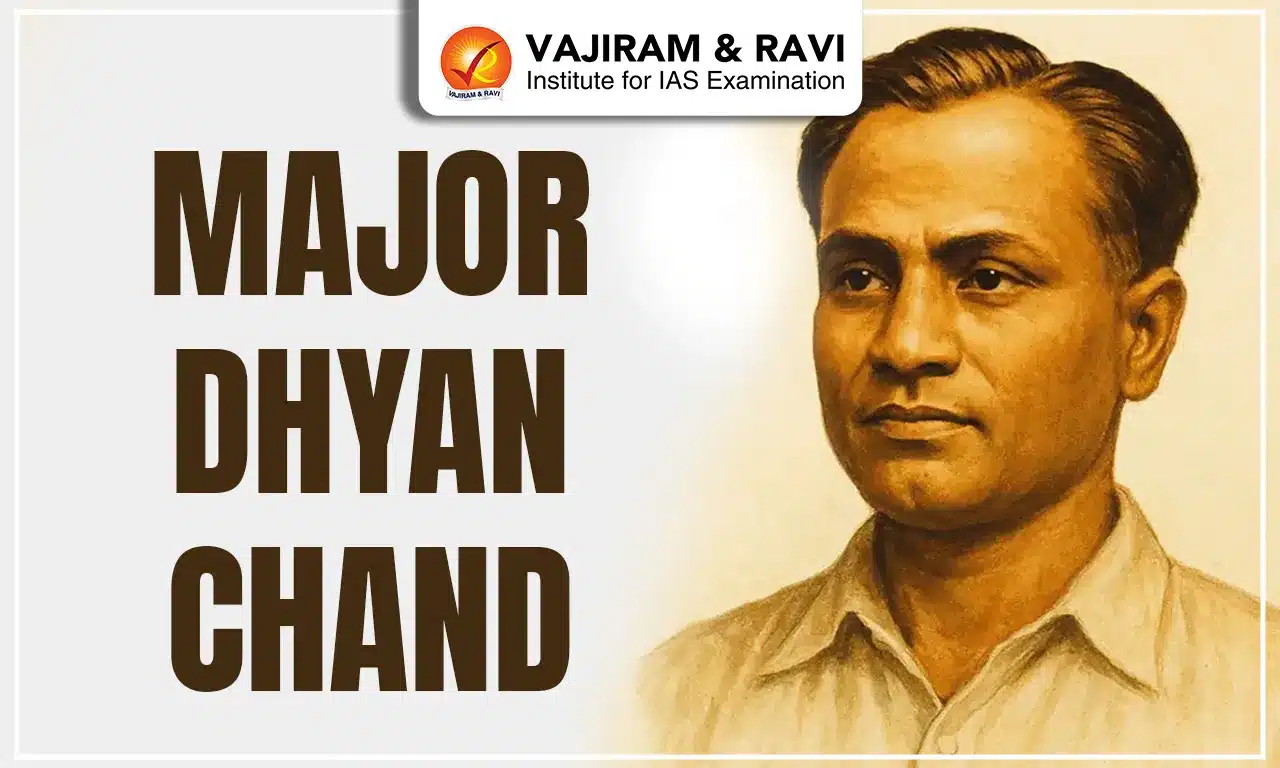
Major Dhyan Chand Singh Bais was an exceptional sportsman who was also remembered as the “Wizard of Hockey”. He was a team member of the Indian Hockey team and is remembered for his skill, discipline and sporting brilliance that defined Indian Hockey. He was born on 29 August 1905 in Allahabad, during the time of British India and his journey reflects his passion, discipline and perseverance. His contribution to Indian Hockey secured India’s dominance on the Olympic stage, making him a global icon. In this article, we are going to cover about Major Dhyan Chand, his early life, achievements and awards. 

Major Dhyan Chand Biography

 Major Dhyan Chand was not just a player but a phenomenon who revolutionised hockey, bringing India global prestige. With unmatched vision, discipline, and brilliance, he remains an eternal symbol of excellence and sportsmanship, inspiring generations to dream beyond boundaries. Here are some key Facts about Major Dhyan Chand: 

Attribute Details

Full Name

Major Dhyan Chand Singh Bais

Birth

29 August 1905, Allahabad (British India)

Family Background

Son of Sameshwar Dutt Singh Bais (Army man) & Shyama Singh (Bais Rajput)

Nickname

“Chand” (Moon) – for practising hockey under moonlight

Army Career

Joined the British Indian Army in 1922 as a sepoy

Position in Hockey

Centre Forward

International Debut

1926 – Indian Army tour of New Zealand

Olympic Achievements

Gold – 1928 (Amsterdam), 1932 (Los Angeles), 1936 (Berlin)

Notable Feat

14 goals in 1928 Olympics; 570 goals in career (unofficial count)

Retirement

1949

Death

3 December 1979, New Delhi

Honors

Padma Bhushan (1956), Dhyan Chand Award (2002), National Stadium & Sports Day named after him

Major Dhyan Chand Early Life

Born into a Rajput family, Dhyan Chand’s childhood was marked by frequent relocations due to his father’s postings in the British Indian Army. These movements nurtured adaptability and resilience in him. Initially more interested in wrestling, it was only after his family’s settlement in Jhansi that his natural genius for hockey surfaced, playing with makeshift equipment before destiny guided him to the army.

Major Dhyan Chand Entry into Army and Hockey

Major Dhyan Chand joined the British Indian Army at the age of 17 in 1922 as a sepoy. His discipline and exposure to structured training helped him improve his skills. He often practised hockey alone after duty, earning the nickname “Chand.” By 1926, his extraordinary control and instinctive scoring earned him a spot on the Army tour to New Zealand, where his performance marked the beginning of an international career.

Major Dhyan Chand’s Career Highlights

  • 1928 Amsterdam Olympics: India’s first Olympic hockey gold; scored 14 goals.
  • 1932 Los Angeles Olympics: Formed a legendary duo with brother Roop Singh; India beat USA 24-1.
  • 1936 Berlin Olympics: India defeated Germany 8-1 in the final before Adolf Hitler; Dhyan Chand’s brilliance left the world in awe.

Major Dhyan Chands Awards and Honours

  • Olympic Gold Medals Won: 1928, 1932, 1936.
  • Titles Abroad: Nicknamed “Wizard of Hockey”; Vienna erected a statue depicting him with four sticks to symbolise his magic. Hitler even offered him a post in the German Army, which he declined.
  • National Recognition: Padma Bhushan (1956). Posthumously, the Dhyan Chand Award (2002) and the naming of National Sports Day and National Stadium in his honour immortalised his contributions.

Major Dhyan Chand’s Legacy

Retiring in 1949 with 570 career goals, Dhyan Chand’s name became synonymous with hockey excellence. Admired for both his skill and humility, he set a standard of sportsmanship that remains unmatched. His autobiography Goal (1952) offers a window into his life and times. Today, his legacy endures through National Sports Day (29 August), awards in his name, and the inspiration he continues to provide athletes across generations.

Major Dhyan Chand FAQs

Q1: What is the biography of Dhyan Chand?

Ans: The biography of Dhyan Chand highlights his journey from a sepoy in the British Indian Army to becoming the “Wizard of Hockey,” winning three Olympic gold medals for India.

Q2: Which is the autobiography of Major Dhyan Chand?

Ans: His autobiography is titled Goal, published in 1952.

Q3: Why is Dhyan Chand known as Major?

Ans: He was promoted to the rank of Major in the Indian Army for his exceptional achievements in hockey.

Q4: How many Olympic gold medals were earned by Major Dhyan Chand?

Ans: He won three Olympic gold medals – 1928 (Amsterdam), 1932 (Los Angeles), and 1936 (Berlin).

Q5: Who was the first Indian to win an individual Olympic gold medal?

Ans: Abhinav Bindra became the first Indian to win an individual Olympic gold in Shooting (10m Air Rifle) at Beijing 2008.

Swaran Singh Committee, Recommendations, Key Details

Swaran Singh Committee

The Swaran Singh Committee was formed in 1976 to review the Indian Constitution and suggest ways to strengthen national unity and governance. It was headed by Sardar Swaran Singh and recommended the inclusion of Fundamental Duties for citizens. The committee emphasized that citizens should balance their rights with responsibilities toward the nation. Its suggestions were implemented through the 42nd Constitutional Amendment Act, 1976, which added Part IV-A (Article 51A) on Fundamental Duties. All the key recommendations of this committee have been discussed below in detail.

Recommendations of the Swaran Singh Committee

The Swaran Singh Committee made several landmark recommendations. Although not all were accepted by the government, many shaped constitutional reform, especially through the 42nd Constitutional Amendment Act, 1976.

I. System of Government

  • The Committee recommended retaining the Parliamentary system in India rather than adopting the Presidential or any other system.
  • It observed that, due to India’s vast size and regional diversity, the Parliamentary system best preserves national unity and integrity.
  • It ensures greater responsiveness to the voice of the people compared to other systems.

II. The Preamble

  • The Committee recommended that Secularism and Socialism be explicitly mentioned in the Constitution.
  • Proposed amendment to the Preamble: replace "Sovereign Democratic Republic" with "Sovereign, Democratic, Secular, Socialist Republic".
  • Suggested inserting the words "and integrity" after "unity" to emphasize the nation’s territorial and cultural integrity.

III. Amendment of the Constitution

  • Recommended that the constituent power of Parliament under Article 368 should be unquestionable.
  • Proposed a new clause stating that any amendment passed according to Article 368 cannot be challenged in any court.
  • Emphasized that the Constitution is the supreme law of the land, and amendments should have the same sanctity as the original text.

IV. Power of Judicial Review

  1. Constitutional Validity of Laws
    • Recommended that challenges to the validity of Central laws be made only in the Supreme Court, and challenges to State laws in the respective High Courts, with an appeal to the Supreme Court.
    • Bench composition:
      • Supreme Court: minimum 7 judges, decision supported by at least two-thirds.
      • High Court: minimum 5 judges, decision supported by at least two-thirds.
    • Emphasized that legislatures generally act within constitutional limits but judicial oversight is necessary.
  2. Article 226
    • Suggested deleting "and for any other purpose" from Article 226 to limit extraordinary powers of High Courts.
    • Recommended that High Courts continue issuing writs for fundamental rights and cases of substantial failure of justice.
    • Introduced conditions for interim orders, requiring prior notice to the respondent and opportunity to be heard.
  3. Service Matters
    • Recommended the establishment of Administrative Tribunals at both the State and Central levels to decide service-related disputes.
  4. Industrial and Labour Disputes
    • Recommended setting up an All-India Labour Appellate Tribunal to hear appeals from Labour and Industrial Courts.
  5. Revenue, Land Reforms, and Food Distribution
    • Suggested tribunals for disputes relating to:
      • Revenue collection
      • Land reforms and urban property ceilings
      • Procurement and distribution of foodgrains and other essential commodities
    • Writ jurisdiction of Supreme Court and High Courts over these matters to be excluded, but appeals under Article 136 remain.
  6. Election Matters
    • Recommended that no writs should lie in relation to election disputes.
  7. Article 227
    • Proposed omitting references to tribunals in Article 227.

V. Directive Principles

  • Recommended widening the scope of Article 31-C to include all Directive Principles in Part IV.
  • Laws implementing Directive Principles should not be challenged for contravening Fundamental Rights, except for protections for minorities, Scheduled Castes, Scheduled Tribes, and Other Backward Classes.

VI. Disqualification for Membership

  • Recommended creating a 9-member body to determine disqualification of MPs and MLAs.
  • Suggested amending Articles 102(1)(a) and 191(1)(a) to clarify disqualification for holding offices of profit, reducing ambiguity.

VII. Emergency: Article 352

  • Recommended clarifying that the President may declare emergency only for the specific part of India concerned.
  • Suggested provisions to lift emergency selectively in parts of the territory.

VIII. Centre-State Coordination

  1. Concurrent Subjects
    • Recommended including Agriculture and Education in the Concurrent List.
    • Clarified that administration remains with State Governments while policies are centrally coordinated.
  2. Deployment of Forces
    • Suggested empowering the Centre to deploy police or similar forces under its control in States during grave law and order situations.
    • Recommended that consultation with States should occur wherever possible.

Swaran Singh Committee on Fundamental Duties

Among all recommendations, the most enduring contribution is the concept of Fundamental Duties of Indian citizens. These duties were inserted into the Constitution as Part IV-A under Article 51A via the 42nd Amendment Act, 1976.

  • Based on its recommendation, Part IV-A (Article 51A) was added to the Constitution containing 10 Fundamental Duties, later increased to 11 by the 86th Amendment Act, 2002.
  • The committee emphasized that citizens must respect the Constitution, National Flag, and National Anthem, which was fully accepted and incorporated in Article 51A(a).
  • It recommended promoting unity, sovereignty, and integrity of India, which was accepted and included as a constitutional duty.
  • The suggestion to promote harmony, brotherhood, and renounce practices derogatory to the dignity of women was accepted and included among the duties.
  • The recommendation to protect the environment, forests, wildlife, and show compassion for living creatures was accepted and added under Article 51A(g).
  • The idea of developing scientific temper, humanism, and the spirit of inquiry was accepted and included to promote rational and progressive thinking in society.
  • The committee suggested safeguarding public property and abjuring violence, which was accepted and made part of the Fundamental Duties.
  • The recommendation that citizens should strive for excellence in all spheres of individual and collective activity was also accepted and included.
  • One of the major recommendations was that Fundamental Duties should be made legally enforceable, but this was not accepted because it could lead to excessive state control and misuse of power.
  • The committee proposed that violation of Fundamental Duties should attract punishment, but this was rejected to protect democratic freedoms and individual liberty.
  • It also recommended that laws made to enforce Fundamental Duties should be kept beyond judicial review, which was not accepted as it would weaken the basic structure of the Constitution.
  • The suggestion to make payment of taxes a Fundamental Duty was rejected since taxation is already governed by statutory law and enforcement mechanisms exist.
  • The committee supported stronger central authority and restrictions on Fundamental Rights, but many such ideas were later reversed by the 44th Constitutional Amendment Act, 1978 to restore democratic balance.

Swaran Singh Committee FAQs

Q1: When was the Swaran Singh Committee formed and why?

Ans: The Swaran Singh Committee was formed in 1976 to review the Constitution and recommend measures to strengthen national unity, governance, and citizens’ responsibilities.

Q2: What was the most important contribution of the Swaran Singh Committee?

Ans: Its most important contribution was the recommendation to include Fundamental Duties in the Constitution under Article 51A.

Q3: How many Fundamental Duties were recommended by the committee?

Ans: The committee initially recommended eight Fundamental Duties, but ten were adopted in 1976 and an eleventh was added in 2002.

Q4: Who headed the Swaran Singh Committee?

Ans: The committee was headed by Sardar Swaran Singh, a senior Indian politician and former Union Minister.

Q5: Are Fundamental Duties legally enforceable?

Ans: Fundamental Duties are moral obligations and are non-justiciable, meaning they cannot be enforced by law.

Code of Criminal Procedure (CrPC), Background, Features, Provisions

Code of Criminal Procedure

The Code of Criminal Procedure (CrPC), 1973, is the main law that explains how criminal cases should be handled in India. It tells the police, courts, and citizens what steps must be followed during investigation, arrest, bail, trial, and punishment. CrPC ensures that every person gets a fair process and justice is delivered in a systematic way. It is one of the most important laws that supports the entire criminal justice system.

Code of Criminal Procedure (CrPC) Historical Background

  • The origins of criminal procedure in India go back to the British era, when the first Criminal Procedure Code was introduced in 1861 after the 1857 revolt.
  • This was replaced by the Criminal Procedure Code of 1872, which brought more uniformity to criminal trials across British India.
  • Later, the Criminal Procedure Code of 1882 was introduced to address administrative issues and improve coordination between police and courts.
  • The Criminal Procedure Code of 1898 became the most stable and widely used law, governing criminal procedures for several decades.
  • This led to the drafting of a new law, and finally, the Criminal Procedure Code (CrPC), 1973 was enacted, replacing the 1898 Code.
  • The CrPC of 1973 came into force on 1 April 1974, standardizing arrest, investigation, trial, and appeal procedures across India.
  • Eventually, to modernize the system further, the Bharatiya Nagarik Suraksha Sanhita (BNSS), 2023 was introduced to replace CrPC.

Code of Criminal Procedure (CrPC) Objectives

  • To ensure fair, transparent, and speedy justice by providing a uniform procedure for handling criminal cases across the country.
  • To protect the rights of individuals, including both the accused and the victims, during investigation and trial.
  • To guide police, magistrates, and courts with clear rules for arrest, investigation, inquiry, bail, and trial.
  • To maintain public order and peace through defined powers for preventive actions and emergency measures.
  • To promote accountability and prevent misuse of power by setting legal safeguards and procedural checks at every stage of the criminal justice process.

Code of Criminal Procedure (CrPC) Features

  • Clear Classification of Offences: CrPC categorizes offences as cognizable/non-cognizable and bailable/non-bailable to decide how police and courts should act.
  • Detailed Procedure for Investigation and Trial: It lays down rules for FIR, arrest, evidence collection, charge framing, and different types of trials.
  • Rights of the Accused and Victims: Ensures fair treatment by providing rights like legal aid, protection from unlawful arrest, and victim compensation.
  • Defined Powers of Police and Magistrates: Specifies the roles, duties, and limits on authority to prevent misuse of power.
  • Appeals, Revisions, and Reviews: Offers a structured system for higher courts to correct errors and ensure justice through appellate mechanisms.

Types of Offences

Code of Criminal Procedure (CrPC) categorises offences to decide which authority handles them and what procedures must be followed. This classification helps ensure that serious crimes are treated differently from minor ones.

1. Cognizable and Non-Cognizable Offences

  • Cognizable: Police can arrest without a warrant; includes serious crimes like murder and rape.
  • Non-Cognizable: Police need a warrant; it includes minor offences like defamation.

2. Bailable and Non-Bailable Offences

  • Bailable: Bail is a right and must be granted.
  • Non-Bailable: Bail depends on the court’s approval.

3. Compoundable and Non-Compoundable Offences

  • Compoundable: Parties can settle or compromise.
  • Non-Compoundable: No compromise allowed due to the serious nature.

Code of Criminal Procedure (CrPC) Provisions

CrPC contains several important sections that govern how criminal cases progress. These provisions ensure fairness and prevent misuse of legal power. They include rules for lodging an FIR, conducting search and seizure, granting bail, and maintaining public order.

Code of Criminal Procedure (CrPC) Provisions
Category Section(s) Key Provisions

Arrest & Custody

Sections 41-60A

Police powers to arrest, rights of the arrested person, production before magistrate within 24 hours.

FIR & Investigation

Section 154

FIR registration for cognizable offences; police must start investigation after FIR.

Search & Seizure

Sections 93-105

Procedures for issuing warrants, conducting searches, and seizing evidence legally.

Bail Provisions

Sections 436-439

Rules for granting bail in bailable and non-bailable offences; court's power to impose conditions.

Anticipatory Bail

Section 438

Allows a person to seek bail in advance if they fear arrest in a non-bailable offence.

Classification of Trials

Sections 225-265

Defines different types of trials: Sessions Trial, Warrant Trial, Summons Trial, and Summary Trial.

Maintenance of Public Order

Sections 144-145

Authority to restrict activities for public safety; deals with disputes likely to cause violence.

Victim Compensation

Section 357

Court may order compensation to victims of crime for loss or injury.

Role of Magistrates

Sections 6-40

Defines the powers, functions, and hierarchy of magistrates in criminal matters.

Charge Framing

Sections 211-224

Rules for framing charges against the accused, amendments to charges, and communication of charges.

Recording Evidence

Sections 275-299

Procedures for recording witness statements and preserving evidence.

Judgment

Sections 353-371

Rules for delivering judgment, sentencing, and explaining decisions to the accused.

Appeals & Revisions

Sections 372-405

Provisions for filing appeals, revisions, and reviews before superior courts.

Maintenance Orders

Section 125

Provides monthly maintenance to wife, children, and parents who cannot support themselves.

Cognizable & Non-Cognizable Offences

First Schedule

Lists offences and clarifies which are cognizable, non-cognizable, bailable, or non-bailable.

Code of Criminal Procedure (CrPC) Limitations

  • Delay in Investigation and Trials: Many cases take years to complete due to slow procedures, lack of staff, and heavy workload on the police and courts.
  • Outdated Mechanisms: Several provisions of the CrPC do not match modern digital and forensic needs, making investigations less effective.
  • Misuse of Arrest Powers: Police sometimes misuse discretionary powers, leading to unnecessary or arbitrary arrests.
  • Weak Witness Protection: Witnesses often face threats or pressure, making them turn hostile and affecting the final judgment.
  • High Case Pendency: Courts are overloaded with lakhs of pending cases, leading to delays in justice.
  • Low Conviction Rates: Poor investigation quality, lack of coordination, and weak evidence collection lead to fewer convictions.
  • Limited Victim Support: Victim rights, compensation, and protection are not strong enough in many cases.
  • Inadequate Use of Technology: Lack of digital tools and slow adoption of modern systems affect efficiency.

Code of Criminal Procedure (CrPC) vs Bharatiya Nagarik Suraksha Sanhita (BNSS)

The CrPC, 1973 was India’s main criminal procedure law for several decades, but it gradually became outdated due to slow processes, limited use of technology, and weak victim protection. To modernize the system, the government introduced the Bharatiya Nagarik Suraksha Sanhita (BNSS), 2023, which focuses on digital procedures, forensic support, faster trials, and transparency.

Feature CrPC, 1973 BNSS, 2023

Total Sections

484 sections

531 sections

Overall Focus

Traditional and procedure-based

Digital, technology-driven, and victim-centric

FIR System

No mention of Zero FIR

Zero FIR explicitly recognized; e-FIR allowed in many cases

Digital Integration

Limited online procedures

E-records, digital case diaries, audio-video recording made compulsory

Forensic Support

Minimal use of forensics

Mandatory forensic investigation for offences punishable with 7+ years

Timeline for Investigation

No strict timelines

Time-bound investigation for serious offences; progress report required

Arrest Procedures

Conventional arrest rules

Added transparency using digital tracking, videography, and documentation

Trial Procedures

Physical court trials

Online, virtual hearings, and electronic evidence strongly supported

Victim Rights

Less emphasis

More victim-friendly: information rights, protection, compensation clarity

Bail Mechanism

Traditional rules

Simplified and structured bail provisions; safeguards against misuse

Public Order Sections

Sections like 144, 145 retained

Similar provisions but with clearer procedures and digital evidence support

Charge Sheet Submission

Mostly physical

Electronic charge sheet submission promoted

Search & Seizure

Traditional manual procedures

Mandatory audio-video recording for searches and raids

Maintenance Provisions

Section 125 included

Retained with clearer rules for dependents

Focus on Police Accountability

Basic safeguards

Strong monitoring through digital logs and mandatory documentation

Code of Criminal Procedure (CrPC) FAQs

Q1: What is the CrPC?

Ans: CrPC is the main law that guides how criminal cases are investigated, tried, and decided in India.

Q2: When was CrPC enacted?

Ans: It was enacted in 1973 and came into force in 1974.

Q3: What does CrPC deal with?

Ans: It covers investigations, arrests, FIRs, bail, court procedures, and appeals.

Q4: Has CrPC been replaced?

Ans: Yes, the Bharatiya Nagarik Suraksha Sanhita (BNSS), 2023 has replaced CrPC with updated and digital-friendly provisions.

Q5: Why is the CrPC important?

Ans: It ensures that every criminal case follows fair and uniform procedures, protecting the rights of both victims and accused persons.

NITI Aayog School Education Quality Index 2026, Punjab Secured 1st Rank

NITI Aayog School Education Quality Index 2026

The NITI Aayog School Education Quality Index 2026 assesses the performance of school education across Indian states and Union Territories based on factors such as learning outcomes, infrastructure, access, equity and governance. In the 2026 ranking, Punjab secured the top position, reflecting its reported progress in school infrastructure, foundational learning, teacher support and academic outcomes

NITI Aayog School Education Quality Index 2026

  • Punjab has claimed the first position in the NITI Aayog School Education Quality Index 2026, overtaking Kerala. 
  • Punjab showed a significant improvement in the reported ranking, moving from 27th position in 2020 to 1st position in 2026. The state also recorded 82% proficiency in Class III language skills and 78% proficiency in mathematics in the cited indicators. 
  • The achievement was highlighted by the state government as the result of improvements in school infrastructure, learning outcomes, foundational education and academic support.
  • Punjab’s education reforms have focused on improving government schools through better facilities, digital learning, teacher support and targeted programmes
  • The state has also reported a major rise in the number of government-school students qualifying for competitive examinations such as NEET.
  • According to the figures presented by the state government, 19,125 government schools have undergone infrastructure improvements, with around ₹2,638 crore spent on these works. Another ₹1,000 crore has reportedly been approved for further upgrades.
  • The state has also introduced measures to improve the learning environment, including timely textbook distribution, smart classrooms and modern teaching methods. Textbooks are now reported to reach district headquarters by 15 February and schools by 31 March.
  • Punjab’s reported improvement in the NITI Aayog School Education Quality Index 2026 reflects an effort to combine infrastructure development with learning improvement, technology and better academic support.

Major Education Reforms in Punjab

  • Mission Samarth has been used to strengthen foundational learning by grouping students according to their learning levels rather than only their class grades.
  • The programme focuses on basic reading, writing and mathematics and reportedly covers nearly 12 lakh students with more than 70,000 teachers.
  • The Punjab Academic Coaching for Excellence (PACE) initiative provides academic support to government-school students preparing for competitive examinations. The state reported that NEET-UG qualifiers from government schools increased from 80 in 2021 to 882 in 2026.
  • Punjab has also developed Schools of Eminence with the aim of providing students with better infrastructure, quality teaching, smart classrooms, career guidance and support for competitive examinations.
  • Another notable reform is the introduction of Artificial Intelligence as a core subject from Classes I to XII, which the state has described as a first-of-its-kind initiative in India. The move aims to familiarise students with emerging technologies and future skills.

NITI Aayog School Education Quality Index 2026 Key Findings

  • The School Education Quality Index (SEQI) assesses the performance of school education across States and Union Territories, covering areas such as learning outcomes, access, equity, infrastructure, governance and teacher-related indicators.
  • Punjab secured the top position in the NITI Aayog School Education Quality Index 2026, reflecting improvements in its school education system.
  • Punjab’s reforms include Mission Samarth for foundational learning and the Punjab Academic Coaching for Excellence (PACE) initiative for competitive examination support.
  • The state has also focused on improving school infrastructure, teacher participation, digital learning and academic support to strengthen the overall quality of education.
  • The rise in NEET-UG qualifiers from Punjab government schools indicates improved support for students preparing for higher-level competitive examinations.

NITI Aayog School Education Quality Index 2026 Significance

  • The NITI Aayog School Education Quality Index 2026 highlights the importance of combining quality learning with adequate infrastructure, teacher support and equal access to education.
  • Punjab’s progress shows how targeted interventions in foundational learning and school facilities can help address gaps in government school education.
  • The index provides a useful framework for comparing education performance across States and Union Territories and identifying areas that require further improvement.
  • It also reinforces the need to focus on learning outcomes rather than enrollment alone, ensuring that students gain the skills and knowledge needed for further education and employment.
  • The NITI Aayog School Education Quality Index 2026 is significant for strengthening India’s efforts towards a more inclusive, accessible and quality-oriented school education system.

NITI Aayog School Education Quality Index 2026 FAQs

Q1: What is the NITI Aayog School Education Quality Index 2026?

Ans: The NITI Aayog School Education Quality Index 2026 assesses the performance of school education in Indian states and Union Territories using indicators such as learning outcomes, infrastructure, access, equity and governance.

Q2: Which state topped the NITI Aayog School Education Quality Index 2026?

Ans: Punjab topped the NITI Aayog School Education Quality Index 2026, overtaking Kerala and emerging as the top-performing state in the reported ranking.

Q3: Why did Punjab top the School Education Quality Index 2026?

Ans: Punjab’s top ranking has been linked to improvements in school infrastructure, foundational learning, teacher support, digital education and academic performance.

Q4: What is Mission Samarth in Punjab?

Ans: Mission Samarth is a foundational learning programme that groups students according to their learning levels rather than only their class grades. It focuses mainly on improving basic reading, writing and mathematics skills.

Q5: What is the PACE initiative in Punjab?

Ans: Punjab Academic Coaching for Excellence (PACE) provides academic support to government-school students preparing for competitive examinations. Punjab reported an increase in government-school NEET-UG qualifiers from 80 in 2021 to 882 in 2026.

Part 4 of Indian Constitution, Article 36 to 51, DPSP, Amendments

Part 4 of Indian Constitution

The Constitution of India not only directs the provisions related to the functioning and governance of the Country but also lays down certain guiding principles. These principles are placed in Part IV of the Constitution and are known as the Directive Principles of State Policy. They provide a roadmap for establishing social, economic and political justice in the country. Although they are not enforceable in courts, they are fundamental in the governance of India. Part IV reflects the vision of building a welfare state based on equality, justice and human dignity.

Part 4 of Indian Constitution

Part 4 of Indian Constitution covers Articles 36 to 51. These principles guide both the Union and State governments while making laws and policies. The concept was inspired by the Irish Constitution and originally traced to the Spanish Constitution. The objective of Part IV is to establish an economic and social democracy by ensuring equitable distribution of resources, improving public health, promoting education, protecting the environment and encouraging international peace.

Articles under Part 4 of Indian Constitution

Part 4 of Indian Constitution includes Articles 36 to 51 that guide governance toward welfare and socio economic justice.

  • Article 36- Definition of State: This Article defines “State” for Part IV in the same manner as Part III. It includes the Government, Parliament of India, State governments, legislatures and all local or other authorities within Indian territory, ensuring uniform interpretation.
  • Article 37- Application of Principles: It declares that Directive Principles are not enforceable by courts. However, they are fundamental in governance and it is the duty of the State to apply them while framing laws and policies.
  • Article 38- Social Order for Welfare: The State must promote welfare by securing social, economic and political justice. Article 38(2), added later, directs reduction of inequalities in income, status, facilities and opportunities among individuals and groups.
  • Article 39- Principles of Policy: It directs policies ensuring adequate livelihood, fair distribution of resources, prevention of wealth concentration, equal pay for equal work, protection of workers’ health and safeguarding children from exploitation.
  • Article 39A- Equal Justice and Legal Aid: Added by the 42nd Amendment Act 1976, it mandates equal justice and free legal aid to ensure that opportunities for justice are not denied due to economic weakness.
  • Article 40- Village Panchayats: It directs the State to organise village panchayats and grant them authority to function as units of local self government, strengthening grassroots democracy.
  • Article 41- Right to Work and Assistance: The State should provide right to work, education and public assistance during unemployment, old age, sickness and disability, subject to its economic capacity and available resources.
  • Article 42- Humane Work Conditions: It directs provision of just and humane working conditions along with maternity relief, protecting workers and promoting dignity in labour practices.
  • Article 43- Living Wage for Workers: The State must strive to secure a living wage, decent working conditions and a standard of life allowing leisure and social opportunities, while promoting cottage industries.
  • Article 43A- Workers Participation: Introduced by the 42nd Amendment Act 1976, it ensures workers’ participation in management of industries, encouraging cooperative decision making in industrial undertakings.
  • Article 43B- Cooperative Societies: It promotes voluntary formation, democratic control and professional management of cooperative societies, strengthening collective economic activities in rural and urban sectors.
  • Article 44- Uniform Civil Code: It directs that the State shall endeavour to secure a Uniform Civil Code for all citizens throughout India, aiming at uniformity in civil matters.
  • Article 45- Early Childhood Care: It directs provision of early childhood care and education for children below six years, highlighting importance of foundational development.
  • Article 46- Interests of SCs, STs and Weaker Sections: The State must promote educational and economic interests of Scheduled Castes, Scheduled Tribes and other weaker sections and protect them from injustice and exploitation.
  • Article 47- Public Health and Nutrition: It makes improvement of nutrition levels, standard of living and public health a primary duty of the State, including prohibition of harmful intoxicants.
  • Article 48- Agriculture and Animal Husbandry: The State shall organise agriculture and animal husbandry on modern scientific lines and prohibit slaughter of cows, calves and other milch and draught cattle.
  • Article 48A- Environment Protection: Inserted by the 42nd Amendment Act 1976, it directs protection and improvement of environment and safeguarding of forests and wildlife.
  • Article 49- Protection of Monuments: It imposes duty on the State to protect monuments, places and objects of artistic or historic importance declared as national heritage.
  • Article 50- Separation of Judiciary: It mandates separation of judiciary from executive in public services to maintain independence and prevent interference in judicial functioning.
  • Article 51- International Peace and Security: It directs promotion of international peace, maintaining honourable relations, respecting international law and settling disputes through arbitration.

Amendments related to Part 4 of Indian Constitution

Several constitutional amendments strengthened and expanded the Part 4 of Indian Constitution over time. Major examples of amendments are:

  • 42nd Constitutional Amendment Act 1976: It introduced Articles 39A, 43A and 48A. These additions ensured free legal aid, workers’ participation in management and environmental protection within the Directive Principles framework.
  • 44th Constitutional Amendment Act 1978: It inserted clause (2) in Article 38 directing minimisation of economic inequalities among individuals and groups. It also removed the Right to Property from the list of Fundamental Rights.
  • 86th Constitutional Amendment Act 2002: It modified Article 45 and made elementary education a Fundamental Right under Article 21A, strengthening the commitment to education for children between six and fourteen years.

Case Laws related to Part 4 of Indian Constitution

Judicial decisions have several times interpreted the clarification of the articles under the Part 4 of Indian Constitution and their relations with other parts. Few examples include:

  • Champakam Dorairajan v State of Madras 1951: The Supreme Court held that in case of conflict, Fundamental Rights prevail over Directive Principles. It stated that DPSP must conform to and run subordinate to Fundamental Rights.
  • Golaknath v State of Punjab 1967: The Court ruled that Parliament could not amend Fundamental Rights even to implement Directive Principles, contradicting its earlier Shankari Prasad judgment.
  • Kesavananda Bharati v State of Kerala 1973: The Supreme Court held Parliament can amend any part of the Constitution but cannot alter its Basic Structure, balancing Fundamental Rights and Directive Principles.
  • Minerva Mills v Union of India 1980: The Court reaffirmed the Basic Structure doctrine and emphasised harmony between Fundamental Rights and Directive Principles as essential to constitutional balance.
  • Hussainara Khatoon v State of Bihar 1979: The Supreme Court declared that free legal aid under Article 39A is a fundamental right and directed the State to provide legal assistance to the poor.
Part of Indian Constitution
Part 1 of Indian Constitution Part 12 of Indian Constitution
Part 2 of Indian Constitution Part 13 of Indian Constitution
Part 3 of Indian Constitution Part 14 of Indian Constitution
Part 4 of Indian Constitution Part 14A of Indian Constitution
Part 5 of Indian Constitution Part 4A of Indian Constitution
Part 6 of Indian Constitution Part 15 of Indian Constitution
Part 7 of Indian Constitution Part 16 of Indian Constitution
Part 8 of Indian Constitution Part 17 of Indian Constitution
Part 9 of Indian Constitution Part 18 of Indian Constitution
Part 10 of Indian Constitution Part 19 of Indian Constitution
Part 11 of Indian Constitution
Part 20 of Indian Constitution
Part 21 of Indian Constitution
Part 22 of Indian Constitution
Part 9A of Indian Constitution
Part 9B of Indian Constitution

Part 4 of Indian Constitution FAQs

Q1: What are the Directive Principles of State Policy?

Ans: Directive Principles of State Policy are guidelines given in Part 4 of the Indian Constitution that direct the government to establish social and economic justice in India.

Q2: Are Directive Principles legally enforceable in courts?

Ans: No, Directive Principles are non justiciable. They cannot be enforced by courts but are fundamental in the governance of the country.

Q3: Which Articles are included under Part 4 of Indian Constitution?

Ans: Part IV includes Articles 36 to 51, covering principles related to welfare, justice, environment, village panchayats and international peace.

Q4: Which amendment added environmental protection under Directive Principles?

Ans: The 42nd Constitutional Amendment Act 1976 inserted Article 48A, which directs the State to protect and improve the environment.

Q5: How are Directive Principles different from Fundamental Rights?

Ans: Fundamental Rights are enforceable by courts, while Directive Principles are guidelines for the State to follow while making laws and policies.

Biodiversity Hotspots in India, List, Criteria, Importance, Threats

Biodiversity Hotspots in India

Biodiversity Hotspots in India are regions with exceptionally rich biodiversity and a high number of endemic plant and animal species that are under serious threat from habitat loss. India is home to four of the world's 36 biodiversity hotspots, making these areas crucial for ecological balance and wildlife conservation. Understanding their list, criteria, importance, and threats is essential for environmental awareness and competitive examinations.

What are Biodiversity Hotspots?

Biodiversity Hotspots are regions of the world that have an exceptionally high concentration of endemic plant and animal species and are under serious threat due to habitat loss and human activities. These areas are considered global priorities for conservation because they contain unique biodiversity that cannot be found anywhere else on Earth.

The concept of Biodiversity Hotspots was introduced by Norman Myers in 1988 and was later expanded by Conservation International to identify regions that require urgent protection.

Criteria for Biodiversity Hotspots

A region is recognized as a Biodiversity Hotspot only if it meets specific scientific criteria established by Conservation International. These criteria ensure that the area has both exceptional biodiversity and faces serious threats, making it a global conservation priority.

  • Must contain at least 1,500 endemic vascular plant species, representing 0.5% of the world's total.
  • Must have lost at least 70% of its original natural vegetation due to human activities or environmental changes.
  • Should have high species richness with a large number of unique and endemic plants and animals.
  • Must face significant threats, such as deforestation, habitat fragmentation, climate change, urbanization, and pollution.
  • Requires urgent conservation measures to protect its unique ecosystems and endangered species.
  • Plays a vital role in maintaining ecological balance, genetic diversity, and ecosystem services.

Biodiversity Hotspots in India

India is one of the 17 megadiverse countries in the world and is home to four of the world's 36 Biodiversity Hotspots. These hotspots support a rich variety of endemic flora and fauna, making them crucial for biodiversity conservation and ecological sustainability.

Biodiversity Hotspots in India

Biodiversity Hotspot

Location in India

Major States/UTs Covered

Key Features

Himalaya

Northern India

Jammu & Kashmir (UT), Ladakh (UT), Himachal Pradesh, Uttarakhand, Sikkim, Arunachal Pradesh, Northern West Bengal

Alpine meadows, temperate forests, glaciers, high endemism

Indo-Burma

Northeast India and Andaman Islands

Assam, Meghalaya, Manipur, Mizoram, Nagaland, Tripura, parts of Arunachal Pradesh, Andaman Islands

Tropical rainforests, wetlands, orchids, rich freshwater biodiversity

Western Ghats and Sri Lanka

Western Peninsular India

Maharashtra, Goa, Karnataka, Kerala, Tamil Nadu

Evergreen forests, UNESCO World Heritage Sites, numerous endemic species

Sundaland

Nicobar Islands

Nicobar Islands (Andaman & Nicobar Islands)

Tropical rainforests, mangroves, coral reefs, island endemism

1. Himalaya Biodiversity Hotspot

The Himalaya Biodiversity Hotspot is one of the world's most biologically diverse regions, covering the Indian Himalayan Region and supporting thousands of unique plant and animal species. Its varied climate, altitude, and ecosystems make it a global priority for biodiversity conservation.

  • Covers parts of Jammu & Kashmir (UT), Ladakh (UT), Himachal Pradesh, Uttarakhand, Sikkim, Arunachal Pradesh, and Northern West Bengal.
  • Extends across India, Nepal, Bhutan, China (Tibet), Pakistan, and Myanmar.
  • Characterized by alpine meadows, temperate forests, subtropical forests, glaciers, and snow-covered mountains.
  • Recognized for its high level of endemic flora and fauna due to diverse climatic and altitudinal zones.
  • Serves as the source of major rivers, including the Ganga, Brahmaputra, and Indus.
  • Rich in plant species such as Rhododendron, Himalayan Yew, Deodar Cedar, Oak, Pine, Fir, Juniper, Birch, and Bamboo.
  • Home to iconic wildlife including the Snow Leopard, Red Panda, Himalayan Musk Deer, Himalayan Tahr, Asiatic Black Bear, Blue Sheep (Bharal), Himalayan Monal, and Western Tragopan.
  • Includes important protected areas such as Great Himalayan National Park, Valley of Flowers National Park, Nanda Devi National Park, Khangchendzonga National Park, and Namdapha National Park.
  • Plays a crucial role in climate regulation, carbon storage, soil conservation, and freshwater supply.
  • Supports the livelihoods of millions through agriculture, forestry, medicinal plants, and ecotourism.

2. Indo-Burma Biodiversity Hotspot

The Indo-Burma Biodiversity Hotspot is one of the richest biodiversity regions in Asia, covering Northeast India and the Andaman Islands. It is renowned for its tropical forests, exceptional species diversity, and high level of endemism, making it a globally important conservation area.

  • Covers Northeast India and the Andaman Islands, along with parts of Myanmar, Thailand, Cambodia, Laos, Vietnam, southern China, and Bangladesh.
  • In India, it includes Assam, Meghalaya, Manipur, Mizoram, Nagaland, Tripura, parts of Arunachal Pradesh, and the Andaman Islands.
  • Characterized by tropical evergreen forests, moist deciduous forests, wetlands, grasslands, and extensive river systems.
  • Recognized for its rich freshwater biodiversity and one of the highest diversities of orchids in the world.
  • Home to thousands of endemic plant, bird, reptile, amphibian, and freshwater fish species.
  • Rich in flora such as Bamboo, Orchids, Dipterocarp trees, Cane, Ferns, Magnolia, and Wild Banana.
  • Supports iconic wildlife including the Hoolock Gibbon, Clouded Leopard, Asian Elephant, Bengal Tiger, Slow Loris, Hornbills, Gaur, and Bengal Florican.
  • Includes important protected areas such as Kaziranga National Park, Manas National Park, Namdapha National Park, Dibru-Saikhowa National Park, Nokrek National Park, and Keibul Lamjao National Park.
  • Provides vital ecosystem services such as water conservation, carbon storage, climate regulation, and pollination.
  • Supports the livelihoods of local and indigenous communities through forestry, agriculture, fisheries, and ecotourism.

3. Western Ghats Biodiversity Hotspot

The Western Ghats Biodiversity Hotspot is one of the world's eight "hottest hotspots" of biological diversity and stretches along the western coast of India. It is renowned for its exceptional endemism, evergreen forests, and diverse ecosystems, making it one of India's most important conservation regions.

  • Extends across Gujarat, Maharashtra, Goa, Karnataka, Kerala, Tamil Nadu, and parts of southern India.
  • Runs parallel to the Arabian Sea for about 1,600 km, covering approximately 160,000 sq. km.
  • Characterized by tropical evergreen forests, moist deciduous forests, montane grasslands, shola forests, and river valleys.
  • Recognized as a UNESCO World Heritage Site for its outstanding biodiversity and ecological significance.
  • Home to a large number of endemic plants, amphibians, reptiles, birds, and mammals.
  • Acts as the origin of major peninsular rivers such as the Godavari, Krishna, Kaveri, and Tungabhadra.
  • Rich in flora including Sandalwood, Rosewood, Ebony, Wild Pepper, Cardamom, Myristica, Bamboo, and Teak.
  • Supports iconic wildlife such as the Lion-tailed Macaque, Nilgiri Tahr, Nilgiri Langur, Malabar Giant Squirrel, Malabar Civet, Great Indian Hornbill, Purple Frog, Bengal Tiger, and Asian Elephant.
  • Includes major protected areas such as Silent Valley National Park, Periyar National Park, Eravikulam National Park, Bandipur National Park, Nagarhole National Park, Anamalai Tiger Reserve, and Kudremukh National Park.
  • Plays a vital role in water security, climate regulation, carbon sequestration, soil conservation, and hydropower generation.
  • Supports millions of people through agriculture, plantations, forestry, medicinal plants, and ecotourism.

4. Sundaland Biodiversity Hotspot

The Sundaland Biodiversity Hotspot is a globally important biodiversity region, with India's Nicobar Islands forming its only Indian component. It is known for its tropical rainforests, mangroves, coral reefs, and high level of island endemism, making it a critical area for biodiversity conservation.

  • In India, the hotspot is represented only by the Nicobar Islands of the Andaman and Nicobar Islands.
  • Extends beyond India to include Indonesia (Sumatra, Java, Borneo, Bali), Brunei, Malaysia, Singapore, and southern Thailand.
  • Characterized by tropical evergreen rainforests, mangrove forests, coastal ecosystems, coral reefs, and seagrass beds.
  • Supports a high number of endemic plant and animal species found only on the islands.
  • Rich in flora such as Pandanus, Mangroves, Coconut, Dipterocarp trees, Tropical hardwoods, and Coastal vegetation.
  • Home to unique wildlife including the Nicobar Megapode, Nicobar Tree Shrew, Crab-eating Macaque, Saltwater Crocodile, Leatherback Sea Turtle, Green Sea Turtle, Dugong, and Nicobar Pigeon.
  • Includes important protected areas such as Campbell Bay National Park, Galathea National Park, and the Great Nicobar Biosphere Reserve.
  • Plays a crucial role in marine biodiversity conservation, coastal protection, carbon storage, and climate regulation.
  • Provides habitat for several rare, endangered, and migratory species.
  • Supports the livelihoods of indigenous communities through fisheries, forest resources, and sustainable tourism.

Why are Biodiversity Hotspots Important?

Biodiversity Hotspots are among the most biologically rich regions on Earth and are essential for preserving endemic species, maintaining ecological balance, and supporting human well-being. Conserving these areas helps protect unique ecosystems while ensuring the sustainable use of natural resources.

  • Conserve Endemic Species: Protect thousands of plants and animals found nowhere else in the world.
  • Maintain Ecological Balance: Support healthy ecosystems by preserving food chains, pollination, and nutrient cycling.
  • Protect Endangered Wildlife: Provide safe habitats for many rare, threatened, and endangered species.
  • Climate Regulation: Forests in biodiversity hotspots act as carbon sinks, helping reduce the impacts of climate change.
  • Water Security: Protect watersheds, rivers, and groundwater sources, ensuring a continuous supply of freshwater.
  • Support Livelihoods: Provide food, timber, medicinal plants, fuelwood, and other forest resources to millions of people.
  • Promote Ecotourism: Attract tourists and researchers, generating employment and supporting local economies.
  • Preserve Genetic Diversity: Safeguard valuable genetic resources that are important for agriculture, medicine, and scientific research.
  • Reduce Natural Disasters: Healthy forests help prevent soil erosion, floods, landslides, and desertification.
  • Ensure Sustainable Development: Conserving biodiversity hotspots supports environmental sustainability and contributes to achieving the Sustainable Development Goals (SDGs).

Major Threats to Biodiversity Hotspots in India

India's Biodiversity Hotspots face increasing pressure from human activities, climate change, and unsustainable resource use, leading to habitat degradation and species decline. Addressing these threats is essential to protect the country's unique ecosystems and endemic biodiversity.

  • Deforestation: Large-scale clearing of forests for agriculture, infrastructure, and settlements destroys natural habitats.
  • Habitat Fragmentation: Construction of roads, dams, railways, and urban projects breaks continuous habitats into smaller patches, affecting wildlife movement.
  • Climate Change: Rising temperatures, changing rainfall patterns, and extreme weather events alter ecosystems and threaten sensitive species.
  • Urbanization: Rapid expansion of cities and towns leads to the loss of forests, wetlands, and other natural ecosystems.
  • Mining and Quarrying: Extraction of minerals and natural resources damages forests, pollutes water bodies, and disturbs wildlife habitats.
  • Illegal Wildlife Trade: Poaching and illegal trafficking of plants and animals threaten many endangered species.
  • Overexploitation of Natural Resources: Excessive harvesting of timber, fuelwood, medicinal plants, and non-timber forest products depletes biodiversity.
  • Invasive Alien Species: Non-native plants and animals compete with native species, disrupting ecological balance.
  • Pollution: Industrial waste, agricultural chemicals, plastic pollution, and untreated sewage degrade soil, water, and air quality.
  • Forest Fires: Frequent natural and human-induced fires destroy vegetation, reduce habitat quality, and threaten wildlife.
  • Unsustainable Tourism: Poorly managed tourism increases waste generation, habitat disturbance, and pressure on natural resources.
  • Human–Wildlife Conflict: Encroachment into forest areas results in increased conflicts between people and wild animals, threatening both livelihoods and wildlife conservation.

Conservation Efforts for Biodiversity Hotspots

Protecting Biodiversity Hotspots is essential for conserving endemic species, restoring ecosystems, and ensuring sustainable development. India has adopted several legal, institutional, and community-based conservation measures to safeguard these ecologically sensitive regions.

  • Establishment of National Parks, Wildlife Sanctuaries, Biosphere Reserves, and Conservation Reserves to protect critical habitats.
  • Implementation of the Wildlife (Protection) Act, 1972 to conserve endangered species and regulate hunting and wildlife trade.
  • Enforcement of the Biological Diversity Act, 2002 to promote biodiversity conservation and the sustainable use of biological resources.
  • Expansion of Protected Area Networks in ecologically important regions such as the Western Ghats, Himalayas, Northeast India, and Nicobar Islands.
  • Launch of species-specific conservation programmes such as Project Tiger, Project Elephant, Project Snow Leopard, and Project Dolphin.
  • Promotion of afforestation, reforestation, and habitat restoration to recover degraded ecosystems.
  • Creation of Eco-Sensitive Zones (ESZs) around protected areas to minimize developmental pressures.
  • Community participation through Joint Forest Management (JFM) and involvement of indigenous and local communities in conservation.
  • Strengthening measures to control illegal wildlife trade, poaching, and deforestation through improved monitoring and law enforcement.

Biodiversity Hotspots in India FAQs

Q1: What are Biodiversity Hotspots?

Ans: Biodiversity Hotspots are regions with exceptionally high biodiversity and a large number of endemic species that have lost at least 70% of their original natural vegetation, making them global conservation priorities.

Q2: How many Biodiversity Hotspots are there in India?

Ans: India is home to four global biodiversity hotspots: Himalaya, Indo-Burma, Western Ghats and Sri Lanka and Sundaland (Nicobar Islands).

Q3: Who introduced the concept of Biodiversity Hotspots?

Ans: The concept of Biodiversity Hotspots was introduced by Norman Myers in 1988 and was later adopted and expanded by Conservation International.

Q4: What are the criteria for a Biodiversity Hotspot?

Ans: A region must: Have at least 1,500 endemic vascular plant species. Have lost at least 70% of its original natural vegetation.

Q5: Which Biodiversity Hotspot covers the Western Ghats?

Ans: The Western Ghats and Sri Lanka Biodiversity Hotspot includes the Western Ghats of India and Sri Lanka and is one of the world's richest biodiversity regions.

Jog Falls, Location, Formation, Geographical Features, Significance

Jog Falls

Jog Falls is the second highest plunge waterfall in India, formed by the Sharavathi River in the Western Ghats of Karnataka. The river plunges from a height of about 253 metres (830 feet), creating one of India’s most spectacular waterfalls, especially during the southwest monsoon. Also known as Gersoppa Falls, Jog Falls is an excellent example of river erosion in the Western Ghats and is closely associated with the Sharavathi Hydroelectric Project, one of India’s earliest major hydroelectric projects.

Jog Falls Location

  • Jog Falls is located in Shivamogga district of Karnataka.
  • It is formed by the Sharavathi River, one of the major west-flowing rivers of Peninsular India.
  • The waterfall lies near Sagara town in the central Western Ghats.
  • It is situated along the western escarpment of the Western Ghats, where the elevated plateau descends sharply towards the Kanara (Karavali) Coast.
  • The surrounding region forms part of the Sharavathi Valley, known for its evergreen forests and rich biodiversity.

Jog Falls Formation

Jog Falls was formed by the combined action of tectonic uplift and river erosion. The Sharavathi River flows westwards from the Mysore (Deccan) Plateau towards the Arabian Sea. On reaching the steep western edge of the Western Ghats, the river suddenly drops about 253 metres, forming a plunge waterfall. Over thousands of years, the force of the falling water eroded the rocks at the base, creating a deep gorge, while the hard rocks of the Western Ghats helped preserve the steep cliff. This combination of a sharp escarpment and continuous river erosion gave rise to Jog Falls.

Jog Falls Geographical Features

Jog Falls exhibits several distinctive physical characteristics that make it one of India’s most remarkable waterfalls.

  • It has a vertical drop of about 253 metres, making it the second highest plunge waterfall in India.
  • The waterfall is divided into four distinct streams - Raja, Rani, Roarer and Rocket, each displaying a unique pattern of descent.
  • It is carved into the hard crystalline rocks of the Western Ghats, forming a steep cliff and a deep rocky gorge.
  • The surrounding landscape consists of rugged hills, dense evergreen forests and narrow valleys typical of the Western Ghats.
  • Seasonal variations in rainfall cause significant changes in the volume and appearance of the waterfall.

River and Hydroelectric Significance

Jog Falls is closely associated with the Sharavathi River Basin and hydroelectric power generation in Karnataka.

  • The Sharavathi River originates near Ambutirtha in Shivamogga district and drains into the Arabian Sea near Honnavar.
  • The Mahatma Gandhi Hydroelectric Station, commissioned in 1948, was among India’s earliest major hydroelectric power stations and utilised the river’s steep gradient near Jog Falls.
  • The Linganamakki Dam, constructed upstream in the 1960s, created a large reservoir that supplies water to the Sharavathi Hydroelectric Project, one of Karnataka’s largest hydroelectric power stations.
  • Today, water releases from the reservoir regulate the discharge over Jog Falls during the non-monsoon months, while the waterfall reaches its peak flow during the southwest monsoon.

Jog Falls FAQs

Q1: Jog Falls is formed by which river?

Ans: Jog Falls is formed by the Sharavathi River.

Q2: In which state is Jog Falls located?

Ans: Jog Falls is located in Karnataka.

Q3: What type of waterfall is Jog Falls?

Ans: Jog Falls is a plunge waterfall, where water falls almost vertically from a steep cliff.

Q4: Which hydroelectric project is associated with Jog Falls?

Ans: Jog Falls is associated with the Sharavathi Hydroelectric Project, which utilises water stored in the Linganamakki Reservoir.

Q5: What are the four segments of Jog Falls?

Ans: The four segments of Jog Falls are Raja, Rani, Roarer and Rocket.

North America, Geographical Features, International Relations

North America

North America is the third largest continent covering about 24.71 million sq. km area. It consists of 23 countries. The continent highlights major global discussions on climate, trade, security alliances, geopolitics, technology, migration, etc. concerns. The continent is located between 7°N to 85°N latitude and 20°W to 179°W longitude, consisting of five time zones. It has the United States, Canada and Mexico as the largest economies, eventually creating a high impact of North America at global level.

North America Geographical Features

The geography of North America includes few of the major physical features of the world that impact the population, climate and resources. Key geographical highlights of North America are:

  • Rocky Mountains: extend from Canada to the US (~4800 km); influence climate and water flow.
  • The Appalachian Mountains: one of the oldest fold mountains of the world.
  • Great Plains: crucial for global grain supply; forms one of the largest agricultural belts.
  • Mississippi-Missouri River System: 4th longest river system globally (6275 km) vital for US agricultural exports.
  • The Great Lakes: largest freshwater lake system on earth (21% of total surface freshwater); Lake Superior is the largest among them, forming the US-Canada Boundary.
  • 49° N: 49th Parallel line forms the US-Canada land border naturally established through the Oregon Treaty of 1846.
  • Arctic Control: Canada, the US (Alaska), and Denmark (Greenland) control North America's Arctic territories and adjacent maritime zones, a highly disputed concern.
  • Tectonic Activity: The San Andreas Fault creates a boundary between Pacific and North American Plate which makes California a major seismic hotspot.

North America Polity

The Politics of North America shapes the agreements for trade, technology, institutions, security alliances, etc. significantly. The major political trends are highlighted below:

  • The United States: It is the major political, economic and military power globally and has strong influence through NATO, G7 and multilateral bodies.
  • Canada: It is shaped through federal structure with multiculturalism. It focuses majorly on environmental and social policies.
  • Mexico: It is highly concerned for migration, drug trafficking, economic reforms and relations with the US.
  • The US-Mexico Border: It is highly concerned over illegal migration, drug trafficking and security issues.
  • NAFTA: The North American Free Trade Agreement (NAFTA) has been replaced with the United States Mexico Canada Agreement (USMCA) in 2020. It impacted supply chains, digital trade, labour standards, etc.

North America International Relations

North America is the central figure in the International System as it shapes the military, economic and technological developments globally. The major international aspects of North America are:

  • Global Alliances: North America (mainly US, Canada, Mexico) lead global alliances- NATO, NORAD, UN, OAS, USMCA, G7, G20, WTO, IMF, World Bank, etc. that collectively shape the security and trade of the continent.
  • Largest Trade Bloc: the US, Canada and Mexico region through USMCA forms a $28 trillion collective GDP.
  • Tech Leadership: It dominates the global tech leadership by controlling ~35-40% of Cloud Infrastructure and AI research investments.
  • Energy: US is largest producer of Oil and Gas, exports to Europe and Asia.
  • US-China Rivalry: The geopolitical competition has sparked the US CHIPS and Science Act ($ 52 billion) aiming to curb China’s tech and boost domestic supply chains.
  • US-Canada Mineral Strategy: Critical Mineral Strategy (Canada) promotes joint supply of minerals (Lithium, Cobalt, Graphite, etc.) with the US making it crucial for clean energy.
  •  Trade with Asia: IPEF is majorly driven by the US, impacting clean energy, digital trade and supply chain.

India-North America Relations

India and North America share a huge political, economic and technological relations with North American countries. The major areas of engagement are:

  • The trade between India and US reached $132.2 billion (2025) which makes US one of the top trading partners of India.
  • India has collaborated in several sectors including defense agreements, joint military exercises (e.g., YUDH ABHYAS-2024), semiconductor collaboration and space research with North America.
  • Canada hosts one of the largest Indian Diaspora with more than 1.8 million people belonging to India. It influences the bilateral ties between India and Canada.
  • In Latin America, Mexico is India’s second largest trading partner in Pharmaceuticals, IT, machinery, etc.

North America Environment

North America has been facing several environmental challenges linked to climate change, extreme events of weather, biodiversity loss, etc. The major debates in North America related to the climate change is around the following issues:

  • Arctic Melting: The regions of Canada, Alaska and Greenland have accelerated opening of new sea routes, the Northwest Passage ( Canada and Alaska) and the Northern Sea Route ( Russia and Norway), and have spiked geopolitical competition.
  • Extreme Weather Events are often faced by the US including Hurricanes, Wildfires, Tornadoes, Droughts, etc, signify increasing billion dollar disasters.
  • The Wildfire of Canada (2023) has marked a record of burning more than 15 million hectares.
  • Cities like Monterrey (Mexico) face chronic shortage of water, increasing tension around the area.

North America Economy

The economic features of North America are being one of the most advanced and productive. However it faces several structural disparities and sectoral transitions. The major economic insights of North America are:

  • Under USMCA, the United States, Canada and Mexico collectively form one of the largest Economic Regions of the world, accounting ~30% of GDP Globally.
  • The Largest Oil and Gas Producer (US), Major Automobile Exporter (Mexico) and Third Largest Oil Reserve (Canada) makes it a manufacturing and energy hub.
  • The continent accounts for ~25% of maize production globally, with the US as the largest exporter.
  • North America hosts ~50% of the top tech companies of the World including Meta, Microsoft, Apple, Alphabet (Google), IBM, etc. (US leading ~35% share in Global Digital Economy Value).

North America FAQs

Q1: How many countries are there in North America?

Ans: North America has 23 countries including the United States, Canada and Mexico as the leading powers globally.

Q2: Which is the largest economy of North America?

Ans: The United States is the largest Economy of North America that contributes ~$29 trillion GDP.

Q3: Which is the largest physical feature in North America?

Ans: The Rocky Mountains are the largest physical feature of the continent. They stretch over 4800 km from Canada to the United States (Southwestern).

Q4: What are the major Global Alliances of North America?

Ans: North America through the US, Mexico and Canada leads the alliances like NATO, WTO, UN, etc. impacting the image of North America Globally.

Q5: Which is the largest fresh water lake?

Ans: The Largest Surface Freshwater Lake system is- the Great Lakes (Lake Superior largest among them) is in North America.

Kyoto Protocol 1997, History, Principles, Targets, Member Countries

Kyoto Protocol 1997

The Kyoto Protocol was adopted on December 11, 1997, at the third session of the Conference of Parties (COP3) to the UNFCCC in Kyoto, Japan. However, it came into force only after a lengthy ratification process, officially taking effect on February 16, 2005. At present, 192 Parties are signatories to the protocol.

The primary aim of the Kyoto Protocol is to reduce carbon dioxide emissions and curb the concentration of greenhouse gases (GHGs) in the atmosphere. Its core principle rests on the idea that industrialized nations, being the largest historical contributors to emissions, bear greater responsibility for cutting down their GHG output.

Kyoto Protocol 1997

The Kyoto Protocol is a global agreement that gives effect to the United Nations Framework Convention on Climate Change (UNFCCC). The UNFCCC itself, adopted at the 1992 Earth Summit and enforced from March 21, 1994, was the first multilateral environmental treaty aimed at addressing climate change. Its primary objective was to stabilize atmospheric greenhouse gas (GHG) concentrations at a level that would prevent dangerous anthropogenic interference with the climate system.

The Kyoto Protocol builds on the UNFCCC’s annex-based framework, adhering to its rules and provisions. It recognizes that industrialized nations are historically responsible for the bulk of existing GHG emissions, and therefore places binding commitments on them in line with the principle of common but differentiated responsibilities and respective capabilities (CBDR-RC).

Through these commitments, the Kyoto Protocol became the key instrument for operationalizing the UNFCCC’s vision of reducing global warming by lowering greenhouse gas emissions. Today, 192 parties are part of the Protocol, reflecting near-universal participation.

Kyoto Protocol History

The Kyoto Protocol was adopted at the third Conference of Parties (COP3) to the United Nations Framework Convention on Climate Change (UNFCCC), held in Kyoto, Japan, in 1997. It was formally approved on December 11, 1997, but only came into force on February 16, 2005, after Russia ratified the agreement, ensuring it met the required threshold of global emissions for activation. The protocol takes its name from the city of Kyoto, where the negotiations were held, and has since become synonymous with international efforts to combat climate change.

Kyoto Protocol Principles

The Kyoto Protocol is built on the principle of Common But Differentiated Responsibilities (CBDR). This principle recognizes that while climate change is a global challenge, countries share different levels of responsibility based on their historical and present contributions to greenhouse gas (GHG) emissions. Industrialized nations, having contributed the most to the current high concentration of GHGs, are expected to take the lead in reducing emissions.

Under CBDR, responsibilities are categorized as:

  • Historical Polluters - Countries that have been emitting GHGs for a long time, primarily the developed, industrialized nations. They bear the greatest responsibility for addressing the problem.
  • Recent Polluters - Countries whose emissions have risen more significantly in recent decades, often the developing economies. While they are expected to contribute to mitigation efforts, their obligations are lighter compared to the historical polluters.
Kyoto Protocol Principles

Historical Polluter - Developed Countries

Recent Polluters - Developing Countries

Since the Industrial Revolution, developed nations such as the US, UK, France, Japan, and Russia have been the largest contributors to global emissions.

Developing countries like China, India, and Brazil have seen rapid growth in emissions, particularly since the 1950s.

Under CBDR, industrialized countries are required to make greater contributions to GHG reduction strategies.

These nations are encouraged to adopt measures to reduce emissions, but their commitments are voluntary rather than legally binding.

They must accept specific, legally binding caps on emissions.

They take action according to national capacity and developmental priorities.

They are also expected to provide financial and technological support to developing and least-developed nations for emission reduction projects.

Their role is to gradually shift toward cleaner growth pathways while addressing poverty and development needs.

Kyoto Protocol Targets and Responsibility

The Kyoto Protocol was designed to help nations confront the harmful effects of climate change by encouraging strategies that strengthen resilience and reduce vulnerabilities. A central feature of the agreement is its legally binding commitment requiring the European Union and 37 industrialized countries to cut down their greenhouse gas (GHG) emissions.

The protocol is rooted in the principle that nations historically responsible for high levels of emissions must take the lead in solving the problem. For this reason, it does not impose mandatory reduction targets on developing countries. At the same time, it acknowledges that rapidly growing economies, particularly China and India, will play an increasingly important role in shaping future global emissions trends.

Kyoto Protocol Member Countries

The Kyoto Protocol, approved by 184 countries, gained wide international support and created strong global momentum in the fight against climate change. Its broad acceptance highlighted a shared recognition that addressing rising greenhouse gas emissions required coordinated action across nations.

Member Countries of Kyoto Protocol

Particulars

Details

Annexe I

Includes countries as

  • Developed Countries (US, UK, Russia etc.)
  • Economies in Transition (Eastern European Countries, Turkey, Ukraine etc.)

Annexe II

  • Developed countries (Annex II is a subset of Annex I).
  • Required to provide financial and technical support to the EITs and developing countries to assist them in reducing their greenhouse gas emissions.

Annexe B

  • Annexe I Parties with first or second-round Kyoto protocol greenhouse gas emissions targets.
  • The first-round targets apply over the years 2008–2012, and the second-round Kyoto targets apply from 2013 to 2020.
  • Compulsory binding targets reduce GHG emissions.

Non-Annexe I

  • Parties to the UNFCCC are not listed in Annex I of the Convention (mostly low-income developing countries).
  • No binding targets to reduce GHG emissions.

Least Developed Countries

No binding targets to reduce GHG emissions.

Kyoto Protocol Mechanisms

The Kyoto Protocol offers flexible, market-based mechanisms to help countries meet their greenhouse gas (GHG) reduction targets. These mechanisms encourage sustainable development, promote investment in green technologies, and create economic incentives for emission reductions. The three main mechanisms are Clean Development Mechanism (CDM), Joint Implementation (JI), and International Emissions Trading (IET).

Kyoto Protocol Mechanisms

Mechanism

How It Works

Benefits

Clean Development Mechanism (CDM)

Developed countries invest in emission-reduction projects (solar, wind, etc.) in developing nations and earn carbon credits.

Supports sustainable energy in poorer nations; helps developed nations meet Kyoto targets.

Joint Implementation (JI)

A country with binding targets funds emission-reduction projects in another Annex B country and receives Emission Reduction Units (ERUs).

Lowers compliance costs; promotes technology transfer and infrastructure development.

International Emissions Trading (IET)

Countries with surplus emission units sell them to countries exceeding their limits.

Turns emission reductions into tradable assets; creates economic incentives to reduce emissions.

Kyoto Protocol Doha Amendment

The Doha Amendment to the Kyoto Protocol established a second commitment period from 2013 to 2020. It was adopted on December 8 in Doha, Qatar, and entered into force on December 31, 2020, after 147 Parties submitted their instruments of acceptance, exceeding the required threshold of 144.

During the first commitment period, 37 developed countries and economies in transition participated, with the European Community pledging an average reduction of 5% in GHG emissions compared to 1990 levels. For the second commitment period, Parties agreed to cut emissions by at least 18% below 1990 levels, reinforcing global efforts to combat climate change.

Kyoto Protocol and Paris Agreement

Both the Kyoto Protocol and the Paris Agreement aim to curb greenhouse gas emissions, but they differ in approach, obligations, and scope. While the Kyoto Protocol legally binds developed countries to reduce emissions based on scientific consensus, the Paris Agreement adopts a more flexible, inclusive framework under the UNFCCC, encouraging all nations to set voluntary targets and take climate action. The table below highlights the key differences between these two landmark agreements.

Kyoto Protocol and Paris Agreement

Aspect

Kyoto Protocol

Paris Agreement

Year Established

1997

2016

Targeted Nations

Primarily industrialized nations; developing nations were exempt

Both developed and developing nations are required to reduce emissions

Primary Objective

Reduce greenhouse gas emissions by 5.2% below 1990 levels

Prevent the average global temperature from rising more than 2°C above pre-industrial levels

Focus

Six major greenhouse gases: CO₂, methane, nitrous oxide, HFCs, PFCs, SF₆

All anthropogenic greenhouse gases

Duration/Timeline

First phase lasted until 2012

Goals to be achieved between 2025 and 2030

Also Check Other Posts
Coastal Regulation Zone Global Plastic Treaty
Nitrogen Cycle Carbon Cycle

Kyoto Protocol 1997 FAQs

Q1: What is the Kyoto Protocol?

Ans: The Kyoto Protocol is an international treaty (1997) under UNFCCC aiming to reduce greenhouse gas emissions and combat global climate change.

Q2: Who started the Kyoto Protocol?

Ans: The Protocol was adopted by 192 UNFCCC member countries in Kyoto, Japan, in 1997, following negotiations led by the United Nations Framework Convention on Climate Change.

Q3: Which country held the conference Kyoto Protocol?

Ans: The Kyoto Protocol conference was held in Kyoto, Japan, in December 1997, where countries agreed on binding emission reduction targets.

Q4: Is the Kyoto Protocol still active?

Ans: Yes, it is partially active, but largely replaced by the Paris Agreement (2015), which continues global efforts to limit greenhouse gas emissions.

Q5: What is Kyoto Protocol UPSC?

Ans: For UPSC, it is an international environmental treaty under UNFCCC, focused on binding emission reduction targets for developed countries to fight climate change.

Bharat Ratna 2026, Award List, Nominees, Winner Benefits, Medal

Bharat Ratna Award Winners

Bharat Ratna is India’s highest civilian honour, instituted in 1954 to recognize exceptional service or performance of the highest order. The term “Bharat Ratna” means “Jewel of India.” It is awarded to individuals who have made extraordinary contributions in any field of human endeavour. The award is not given every year and since its establishment, several years have passed without any Bharat Ratna announcement. It remains the most prestigious civilian recognition conferred by the Republic of India.

What is Bharat Ratna?

Bharat Ratna is the highest civilian award presented by the President of India to individuals for outstanding contributions to the nation and humanity. It originally recognized achievements in arts, literature, science and public services. In 2011, the eligibility was broadened to include any field of human endeavour. The award carries immense national prestige but does not include any monetary grant. Recipients receive a Medallion and a Sanad signed by the President of India.

Bharat Ratna History

The Bharat Ratna has several unique characteristics that distinguish it from all other civilian honours in India which has evolved throughout years.

  • Origin: The award was instituted by President Dr. Rajendra Prasad on 2 January 1954, creating a formal mechanism to recognize exceptional national service and achievement.
  • How Many Get the Bharat Ratna Awards: Normally, a maximum of three Bharat Ratna awards can be conferred in a year. However, exceptions occurred in 1999 when four individuals were honoured and in 2024 when five recipients were announced.
  • First Bharat Ratna Awardees: The inaugural recipients in 1954 were Dr. Sarvepalli Radhakrishnan, Sir C.V. Raman and Chakravarti Rajagopalachari, representing excellence in scholarship, science and public life.
  • Award Suspension Periods: Bharat Ratna was temporarily suspended between 1977 and 1980 and again between 1992 and 1995 due to political changes and legal challenges.
  • No Mandatory Annual Conferment: The government is not required to announce Bharat Ratna every year. The last two awards were announced in 2019 and 2024.
  • Restriction on Titles: Under Article 18(1) of the Constitution, recipients cannot use “Bharat Ratna” as a prefix or suffix to their names. However, they may mention the honour in official biographies and documents.
  • Notable Controversy: In 1992, Bharat Ratna was announced for Subhash Chandra Bose posthumously. However, due to the absence of conclusive evidence regarding his death, the award was later withdrawn after objections from his family and legal challenges.
  • Contributions Across Fields: Bharat Ratna awardees have included freedom fighters, social reformers, musicians, economists, scientists, engineers, filmmakers, educators, political leaders and sports personalities.

Famous Bharat Ratna Awardees & Nominees

The list of the Famous Bharat Ratna Awardees include:

  • Youngest Recipient: Sachin Tendulkar became the youngest Bharat Ratna awardee and the first sportsperson to receive the honour in 2014. He is also the only cricketer among the recipients.
  • Oldest Recipient: The Oldest Recipient of Bharat Ratna Award is Dhondo Keshav Karve, who was honoured in 1958 at the age of 100. A renowned social reformer and educator, Karve played a crucial role in women’s education and widow remarriage in India during the early 20th century. His lifetime of service to society earned him this prestigious recognition at a remarkably advanced age.
  • Distinguished Awardees: Recipients include leaders such as Jawaharlal Nehru, Indira Gandhi, Rajiv Gandhi, Vallabhbhai Patel, Atal Bihari Vajpayee, Pranab Mukherjee and scientists like A.P.J. Abdul Kalam and C.N.R. Rao.

List of Bharat Ratna Award Winners Year Wise 1954 to 2026

The Bharat Ratna, India’s highest civilian honour, has a rich history associated with its recipients and nominations. For instance, in 1992, the Government of India decided to present the award posthumously to Netaji Subhas Chandra Bose. However, his family and supporters opposed it, questioning the circumstances surrounding his death. Similarly, the legendary hockey player Major Dhyan Chand’s name has frequently surfaced for this honour, yet he has not been awarded to date.

No Bharat Ratna awards were presented in 2021 or 2022. Below is a List of Bharat Ratna Award Winners Year Wise from 1954 to 2026.

List of Bharat Ratna Award Winners Year Wise 1954 to 2026
Recipients (State/UT) Year     Key Notes

C. Rajagopalachari/ Rajaji 

(Tamil Nadu)

1954

He was the last Governor General of India and also founder of the Swatantra Party. He was the conscience keeper of MK Gandhi.

Sarvapalli Radhakrishnan 

(Tamil Nadu)

1954

He was the first Vice President of India and the country's second President. 

C. V. Raman 

(Tamil Nadu)

1954

He became the first Asian scientist to receive a Nobel Prize in any branch of science, also famous for his discoveries in physics like Raman Scattering.

Bhagwan Das 

(Uttar Pradesh)

1955

He co-founded the Mahatma Gandhi Kashi Vidyapith, also contributed to the foundation of Banaras Hindu University. 

M. Visvesvaraya 

(Karnataka)

1955

He was a civil engineer who contributed much to the country's dam development.

Jawaharlal Nehru 

(Uttar Pradesh)

1955

Jawaharlal Nehru became the first and longest tenure Prime Minister (PM) of India, He was PM at the time of receiving this award.

Govind Ballabh Pant 

(Uttarakhand)

1957

He was elected to be the first chief minister of the state of Uttar Pradesh who was a huge supporter of making Hindi a national language.

Dhondo Keshav Karve 

(Maharashtra)

1958

Dhondo Keshav Karve was a great social reformer and was famous for women's education, and widow remarriage also founded the Widow Marriage Association.

Bidhan Chandra Roy 

(West Bengal)

1961

Bidhan Chandra Roy is recognized as the Maker of Modern West Bengal. 

Purushottam Das Tandon 

(Uttar Pradesh)

1961

Purushottam Das Tandon was titled Rajarshi. He became the speaker in Uttar Pradesh Legislative Assembly. 

He supported the Hindi language making it the official language.

Rajendra Prasad 

(Bihar)

1962

Rajendra Prasad swore as the first President of India. 

He was actively involved in the non-cooperation movement with Mahatma Gandhi Ji. 

Zakir Husain 

(Andhra Pradesh)

1963

Zakir Husain was elected to be the second Vice President and third President of India. 

He became the Vice Chancellor of Aligarh Muslim University.

Pandurang Vaman Kane 

(Maharashtra)

1963

He was a great Indologist and Sanskrit scholar who was well known for his works like ‘History of Dharmasastra: Ancient and Mediaeval Religious and Civil Laws in India’.

Lal Bahadur Shastri 

(Uttar Pradesh) *

1966

Lal Bahadur Shastri became the first posthumous recipient of the Bharat Ratna Award, He was elected to be the second PM of India. He is popular in the country for his slogan ‘Jai Jawan Jai Kisan’.

Indira Gandhi 

(Uttar Pradesh)

1971

Indira Gandhi was the first female recipient of the Bharat Ratna Award, She was PM during the Indo-Pak War of 1971.

V. V. Giri 

(Odisha)

1975

V. V. Giri, 4th President of India, was a trade union leader and freedom fighter championing workers' rights and democracy.

K. Kamaraj 

(Tamil Nadu) *

1976

K. Kamaraj, "Kingmaker," played a pivotal role in Indian politics by supporting Lal Bahadur Shastri and Indira Gandhi as Prime Ministers.

Mother Teresa 

(West Bengal, born in North Macedonia)

1980

Mother Teresa, a Bharat Ratna recipient and Nobel Laureate, founded the Missionaries of Charity, dedicating her life to humanitarian service.

Vinoba Bhave 

(Maharashtra) *

1983

Vinoba Bhave, a Gandhian, is renowned for the Bhoodan Movement and received the Ramon Magsaysay Award for his humanitarian efforts.

Khan Abdul Ghaffar Khan 

(Pakistan) 

1987

Khan Abdul Ghaffar Khan, "Frontier Gandhi," founded the Red Shirt Movement and was the first non-citizen Bharat Ratna recipient.

M. G. Ramachandran 

(Tamil Nadu) *

1988

M. G. Ramachandran, the first actor to receive Bharat Ratna, founded AIADMK and became the first actor-turned-Chief Minister.

B.R. Ambedkar 

(Maharashtra) 

1990

B.R. Ambedkar, chief architect of the Indian Constitution and first Law Minister, strongly opposed the caste system in Hinduism.

Nelson Mandela

(South Africa)

1990

Nelson Mandela, known as the "Gandhi of South Africa," was the second non-citizen Bharat Ratna recipient and Nobel laureate.

Rajiv Gandhi 

(Uttar Pradesh) 

1991

Rajiv Gandhi, India’s youngest PM at 40, passed landmark laws like the Anti-defection Law during his tenure from 1984.

Vallabhbhai Patel 

(Gujarat) 

1991

Vallabhbhai Patel, the "Iron Man of India," served as Deputy Prime Minister and led the Bardoli Satyagraha and All India Services.

Morarji Desai (Gujarat)

1991

Morarji Desai, India's first non-Congress PM and oldest PM, is the only Indian awarded Pakistan's Nishan-e-Pakistan honour.

Abul Kalam Azad 

(West Bengal) 

1992

Maulana Abul Kalam Azad, India's first Education Minister, is honoured on his birth anniversary (11th November) as National Education Day. He declined the Bharat Ratna Award throughout his life.

J. R. D. Tata 

(Maharashtra)

1992

J. R. D. Tata, an industrialist and aviation pioneer, founded Air India and established institutes like TIFR, TCS, and Tata Motors.

Satyajit Ray 

(West Bengal)

1992

Satyajit Ray, renowned for bringing Indian cinema global recognition, directed Pather Panchali and received the Dadasaheb Phalke Award.

Gulzarilal Nanda 

(Punjab)

1997

Gulzarilal Nanda served twice as interim PM and deputy chairman of the Planning Commission, advocating labor issues nationally.

Aruna Asaf Ali

(West Bengal) 

1997

Aruna Asaf Ali, the first post-independence Mayor of Delhi, played a key role in the Quit India Movement of 1942.

A.P.J Abdul Kalam

(Tamil Nadu)

1997

A.P.J. Abdul Kalam, the "Missile Man of India," advanced missile technology, served as 11th President, and authored notable works.

M. S. Subbulakshmi 

(Tamil Nadu)

1998

M. S. Subbulakshmi, the Queen of Songs, was India's first musician awarded the Ramon Magsaysay for her charity work.

Chidambaram Subramaniam 

(Tamil Nadu)

1998

Chidambaram Subramaniam contributed to the Green Revolution in India and the International Rice Research Institute of Manila, Philippines. 

Jayaprakash Narayan 

(Bihar) 

1999

Jayaprakash Narayan, known as Loknayak, led the Total Revolution Movement against the Congress government, advocating for political and social reforms.

Amartya Sen 

(West Bengal)

1999

Amartya Sen, Nobel Laureate in Economics, contributed to welfare economics, social justice, and social choice theory, influencing global policies.

Gopinath Bordoloi 

(Assam) 

1999

Gopinath Bordoloi, Assam's first chief minister, is honored as Lokapriya for his dedication to Assam's development and progress.

Ravi Shankar 

(Uttar Pradesh)

1999

Ravi Shankar, the world’s leading Hindustani classical musician, is renowned for his mastery and received a Grammy Award for his work.

Lata Mangeshkar 

(Maharashtra)

2001

Lata Mangeshkar, the Nightingale of India, honoured with the Dadasaheb Phalke Award, is celebrated as the Queen of Melody.

Bismillah Khan 

(Uttar Pradesh)

2001

Bismillah Khan, a renowned shehnai virtuoso, popularised the instrument in Indian music and became the third classical musician honoured with Bharat Ratna.

Bhimsen Joshi 

(Karnataka)

2009

Bhimsen Joshi, a renowned Hindustani classical singer from Kirana Gharana, was celebrated for his mastery in the Khyal genre.

C. N. R. Rao 

(Karnataka)

2014

C. N. R. Rao, an eminent chemist, contributed to solid-state chemistry and received numerous prestigious awards, including the Marlow Medal.

Sachin Tendulkar 

(Maharashtra)

2014

Sachin Tendulkar is known as the Master Blaster in cricket history. He is the only batsman to score more than 30,000 runs in entire forms of international cricket matches. 

Madan Mohan Malaviya 

(Uttar Pradesh) 

2015

Madan Mohan Malaviya was the founder of the Banaras Hindu University and Akhil Bharatiya Hindu Mahasabha. 

Atal Bihari Bajpayee 

(Madhya Pradesh)

2015

Atal Bihari Vajpayee, a three-time PM and 1994 Best Parliamentarian, was also a renowned poet and statesman.

Pranab Mukherjee 

(West Bengal)

2019

Pranab Mukherjee, the 13th President of India and former Lok Sabha leader, passed away in 2020 due to COVID-19.

Nanaji Deshmukh 

(Maharashtra) 

2019

Nanaji Deshmukh, also known as Chandikadas Deshmukh, contributed to education, rural development, health, and led Bharatiya Jana Sangh.

Bhupen Hazarika 

(Assam) 

2019

Bhupen Hazarika, known as Sudhakantha, was an influential filmmaker, poet, lyricist, playback singer, and musician in India.

Karpoori Thakur

(Bihar)*

2024

Karpoori Thakur, Bihar's former CM and Jan Nayak, passed away on 17th February 1988; award recognized 35 years later. 

Lal Krishna Advani

2024

He served as Home Minister and later Deputy Prime Minister in Atal Bihari Vajpayee's cabinet from 1999 to 2004.

MS Swaminathan

(Thiruvananthapuram)

2024

Conferred with the Bharat Ratna - the country's highest civilian honour.

Chaudhary Charan Singh

(Uttar Pradesh)*

2024

He dedicated his life to farmers' welfare, opposed the Emergency, and inspired through his unwavering commitment to farmers.

PV Narasimha Rao

(Andhra Pradesh)

2024

Narasimha Rao led major economic reforms in the 1990s, transforming India's economy while heading a Congress government at Centre.

Note: Posthumous recipients have been marked by an asterisk (*)

First Bharat Ratna Award Winners

The Bharat Ratna, India’s highest civilian honour, was first awarded in 1954. Among the inaugural recipients were C. Rajagopalachari, C.V. Raman, and Dr. Sarvepalli Radhakrishnan, all from Tamil Nadu. 

  1. Rajagopalachari, a multifaceted leader, was a prominent activist, statesman, and lawyer. 
  2. Dr. Radhakrishnan, renowned for his contributions to education, served as India's first Vice-President and later became its second President. 
  3. C.V. Raman, a distinguished physicist and mathematician, is celebrated for his groundbreaking work in the field of physics, particularly for the discovery of Raman Scattering. His remarkable achievements led him to become the first Asian scientist to win a Nobel Prize in a scientific field.

Who was the First Bharat Ratna Award Winner Woman?

Former Prime Minister of India Indira Gandhi was the first Indian Woman to get Bharat Ratna Award in the year 1971. She was awardedin the honor for the contribution in leadership roles of India especially the 1971 Indo-Pakistani War and the liberation of Bangladesh. She was presented the award while serving the office as the Prime Minister of India by President V. V. Giri, which makes her count among the few Prime Ministers Who Got Awarded Bharat Ratna while being in Office.

Which Indian President Got Bharat Ratna?

Between 1954 and 2026, several Indian Presidents have been honoured with the Bharat Ratna Award. Out of the 48 individuals who have received this esteemed recognition, six of them have served as Presidents of India. Below is a table listing the names of these Presidents and the years they were awarded the Bharat Ratna.

List of President of India Who Got Bharat Ratna

Presidents of India

Year of Award

Sarvapalli Radhakrishnan

1954

Rajendra Prasad

1962

Zakir Hussain

1963

A. P. J. Abdul Kalam

1997

Dr. V V Giri

1975

Pranab Mukherjee

2019

Who can Get Bharat Ratna Award?

The Bharat Ratna recognizes extraordinary contributions across diverse fields without restricting eligibility to nationality or profession. The Bharat Ratna Eligibility has been discussed below:

  • Initially limited to arts, literature, science and public service, the award criteria were expanded in 2011 to cover exceptional achievements in any field of human endeavour, allowing recognition across wider disciplines.
  • The award can be granted irrespective of race, occupation, position, gender, or social background. There is no formal requirement that only Indian citizens can receive the Bharat Ratna.
  • Non Indians have also been honoured. Abdul Ghaffar Khan received the award in 1987, while Nelson Mandela was awarded Bharat Ratna in 1990 for his remarkable contributions to humanity.
  • The original 1954 statute did not allow posthumous awards. This provision was introduced in 1966, beginning with Lal Bahadur Shastri, making posthumous recognition possible in exceptional circumstances.
  • Formal public nominations are not required. Recommendations are made directly by the Prime Minister of India to the President for consideration and approval.
  • How to Get Bharat Ratna? No one can self nominate or apply for the Bharat Ratna award. It is solely directed by the Government of India for exceptional National Services.

Bharat Ratna Medal Design

The Bharat Ratna Medallion carries unique national symbols that reflect India’s heritage and constitutional values.

[my_image src="https://vajiramias.sgp1.cdn.digitaloceanspaces.com/wp/current-affairs/2026/08/02175647/Bharat-Ratna-Medal-Design.webp?v=1788352014" size="full" align="center" width="auto" height="334px" alt="Bharat Ratna Medal Design" title="Bharat Ratna Medal Design"]

  • Peepal Leaf Shape: The medal is designed in the form of a peepal leaf, a symbol deeply associated with Indian culture and civilization. This distinctive shape makes the award instantly recognizable.
  • Front Design: The obverse side features a prominent sunburst at the centre. Below the sun, the words “Bharat Ratna” are inscribed in Devanagari script, highlighting the award’s national identity.
  • Reverse Side Elements: The reverse displays the State Emblem of India. Beneath it appears the national motto “Satyameva Jayate” written in Devanagari script.
  • Material Composition: The medallion is primarily cast in bronze. The emblem, sunburst and rim are crafted using platinum elements, while inscriptions are finished in burnished bronze.
  • Certificate and Medal: Every awardee receives a Sanad signed by the President of India along with the Bharat Ratna medallion, making the honour both symbolic and official.
  • Manufacturing Location: The medals are produced at the Alipore Mint in Kolkata, a historic institution responsible for manufacturing several important national decorations.
  • No Cash Component: Unlike many international honours, Bharat Ratna does not carry any monetary reward. Its significance lies entirely in national recognition and prestige.

Bharat Ratna Award Process

The Bharat Ratna selection process is highly exclusive and involves the highest constitutional offices of India.

  • Prime Minister’s Recommendation: The process begins with recommendations made by the Prime Minister of India. No formal public nomination mechanism exists for the award.
  • Presidential Approval: The recommendations are submitted to the President of India, who formally confers the Bharat Ratna upon approved recipients.
  • Official Announcement: After presidential approval, the names of awardees are officially announced by the Government of India and the President’s office.
  • Presentation Ceremony: Recipients are honoured in a formal investiture ceremony where they receive the Bharat Ratna medallion and the Sanad signed by the President.
  • Exceptional Selection Standards: The award is reserved only for individuals whose contributions are considered of the highest order and have created a lasting impact on society, the nation, or humanity.

Who Refused To Take Bharat Ratna?

Some individuals and families declined the Bharat Ratna due to personal principles, objections to state honours, or concerns surrounding recognition and history.

  • Maulana Abul Kalam Azad: India’s first Education Minister declined the Bharat Ratna nomination in 1954, believing selection committee members should not receive national honours; he was awarded posthumously in 1992.
  • H. N. Kunzru: The freedom fighter and Constituent Assembly member refused the Bharat Ratna nomination in 1968, opposing the practice of granting title-like state honours within a republic.
  • Hanuman Prasad Poddar: The freedom fighter and spiritual writer declined the Bharat Ratna when nominated, explaining that he preferred avoiding public distinctions and circumstances that could create political discomfort.
  • Subhas Chandra Bose’s Family: His extended family and supporters declined the posthumous Bharat Ratna announced in 1992, citing delayed recognition and unresolved questions about his death; legal challenges led to cancellation.

What Are The Benefits For Bharat Ratna Award?

The key benefits of the Bharat Ratna Awards has been highlighted below:

  • Bharat Ratna awardees are placed at Position 7A in the Table of Precedence, alongside top dignitaries like Governors, Former Presidents, and the Deputy Prime Minister, ensuring high-level recognition during official events.
  • Awardees receive a diplomatic passport, granting them access to separate immigration counters, VIP lounges at airports, and other privileges reserved for top government officials.
  • Recipients enjoy lifetime free air travel in executive class across domestic routes, sponsored by the Government of India.
  • They receive the same treatment as senior government dignitaries during official travels, including protocol services and access to government guest houses.
  • The Bharat Ratna Award includes a bronze medallion shaped like a peepal leaf, a miniature replica, and a certificate signed by the President of India.
  • Bharat Ratna Prize Money is not usually designated by the official awarding authority.
  • Bharat Ratna recipients are revered across the country. Their names are often associated with public institutions, and they hold a permanent place of respect in Indian history and society.
  • Bharat Ratna Award Family Benefits are not officially provided to the families of the awardees including Posthumous awards.

Bharat Ratna FAQs

Q1: Who became the first Bharat Ratna Award winner?

Ans: The first recipients of the Bharat Ratna Award were C Rajagopalachari, CV Raman, and S Radhakrishnan in 1954. Interestingly all first recipients were from the state of Tamil Nadu.

Q2: Who became the youngest Bharat Ratna Awardee?

Ans: The youngest recipient of the Bharat Ratna award is Sachin Tendulkar who was awarded in 2014.

Q3: Who were the first three recipients of Bharat Ratna?

Ans: The first three recipients of Bharat Ratna were C Rajagopalachari, CV Raman, and S Radhakrishnan. All three were awarded with the Bharat Ratna award in 1954.

Q4: Who are the recipients of the Bharat Ratna Award 2026?

Ans: The Bharat Ratna 2026 has not been announced yet. The latest recipients of the Bharat Ratna Award in 2024 are Karpoori Thakur, Lal Krishna Advani, MS Swaminathan, Chaudhary Charan Singh and PV Narasimha Rao.

Q5: How many people have received the Bharat Ratna Award till now?

Ans: The total number of recipients of the Bharat Ratna Award is 48 as of now.

Rise of Nationalism in India, Reasons, Major Events, Significance

Rise of Nationalism in India

The Rise of Nationalism in India marked a turning point in the country’s history. It began taking shape in the late 19th century, when Indians started developing a shared sense of identity and purpose against British rule. What began as an awakening of collective unity soon grew into a powerful movement that challenged colonial domination. This spirit of nationalism not only inspired reforms and resistance but also laid the groundwork for the freedom struggle that contributed to independence in 1947.

Nationalism in India

Nationalism is the belief and movement that stresses loyalty and devotion to one’s nation. It calls on people to unite around shared identity, history, language, culture, and common aspirations. Often, nationalism grows stronger when a country faces domination or injustice at the hands of outside powers. At its core, it stands for self-rule and collective unity.

Nationalism in India took shape as a response to British colonial rule. The experience of foreign exploitation gradually made Indians recognize their shared past and common future. Literature, social reform, and cultural revival nurtured this collective spirit. Over time, this idea of unity transformed into a powerful movement that bound Indians together in the struggle for independence.

Main Reason for the Rise of Nationalism in India

Several developments in the 19th and early 20th centuries pushed Indians toward nationalism:

  • British Rule and Exploitation: Heavy taxation, economic drain, and racial discrimination bred deep resentment.
  • Western Education: Exposure to ideas of liberty, equality, and democracy from European revolutions inspired educated Indians to demand similar rights.
  • Economic Hardship: The collapse of Indian handicrafts, decline of industries, and suffering of farmers revealed the exploitative nature of colonial rule.
  • Social and Religious Reform Movements: Thinkers like Raja Ram Mohan Roy and Swami Vivekananda fought social evils and revived cultural pride, fostering unity.
  • Rise of the Press: Regional newspapers and journals spread nationalist thought, evaluate British policies, and mobilise public opinion.
  • Indian National Congress (1885): Provided a common political platform for Indians to voice grievances and demand reforms.
  • Racial Discrimination: Unequal treatment in jobs, education, and law reinforced the need for collective resistance.

Rise of Nationalism in India Major Events

The growth of nationalism in India was not sudden but shaped through a series of turning points. Each major event deepened the people’s resolve against colonial rule and brought India closer to freedom. The table below highlights Rise of Nationalism in India Major Events:

Rise of Nationalism in India Major Events
Event Year Significance

Formation of Indian National Congress

1885

Created a political platform for Indians; initially sought reforms but later led the independence struggle.

Partition of Bengal

1905

Sparked the Swadeshi Movement; promoted boycott of British goods and use of indigenous products.

Home Rule Movement

1916

Led by Tilak and Annie Besant, popularized the demand for self-rule across India.

Jallianwala Bagh Massacre

1919

Massacre of unarmed civilians by British troops in Amritsar; intensified anti-British sentiment.

Non-Cooperation Movement

1920-22

Gandhi’s nationwide movement; boycott of British institutions and goods; united masses in resistance.

Civil Disobedience Movement (Salt March)

1930-34

Gandhi’s Salt March challenged colonial salt laws; inspired widespread nonviolent protest.

Quit India Movement

1942

“Do or Die” call by Gandhi; demanded immediate independence; marked the final mass struggle before 1947.

Rise of Nationalism in India Significance

The Indian Nationalist Movement left behind more than just independence in 1947, it gave Indians a new sense of identity and purpose. Its impact can be seen in several ways:

  • Unity in Diversity: It brought together people across castes, religions, and regions, shaping a collective national identity.
  • Democratic Foundations: The values of liberty, justice, and democracy that guided the struggle later became pillars of the Indian Constitution.
  • Social Reform and Awareness: The movement raised awareness against caste discrimination, untouchability, and gender inequality.
  • Inspiration for Future Movements: It became a model for other colonies, proving that peaceful mass resistance could succeed.
  • Empowerment of Common People: Farmers, workers, students, and women actively participated, discovering their ability to drive change.

Rise of Nationalism in India FAQs

Q1: What is the rise of nationalism in India?

Ans: The rise of nationalism in India was the growing unity and political consciousness against British rule, leading to movements for independence and self-determination.

Q2: What was the main idea of the rise of nationalism?

Ans: The main idea was to unite Indians across regions, religions, and languages against colonial exploitation, demanding political rights, economic freedom, and ultimately self-rule and independence.

Q3: What are the main reason for the Nationalism in India?

Ans: The main reason for the Nationalism in India include several political, economic and cultural factors including World War I, Economic Drain, Heavy Taxation, Racial and Caste Discrimination, Literacy level, etc.

Q4: When was nationalism started in India?

Ans: Nationalism in India started in the late 19th century with the foundation of the Indian National Congress in 1885, slowly uniting Indians against British dominance.

Q5: Who is the father of nationalism?

Ans: Bal Gangadhar Tilak is regarded as the father of Indian nationalism for his assertive politics, inspiring slogan “Swaraj is my birthright,” and leadership in independence movements.

Veto Power of President, Meaning, Types, Article

Veto Power of President

As per Article 111 of the Indian Constitution, the President of India holds three types of Veto Power while approving bills. For any bill to become law, it must first be passed by both Houses of Parliament and then receive the President’s assent. If the President chooses to withhold approval, the bill cannot be enacted. The Veto Power of President serves as a constitutional safeguard to ensure that legislation is carefully examined and does not conflict with the principles and spirit of the Constitution.

Veto Power of President

In legislative terms, Veto Power of the President refers to the authority of an executive head, such as the President or a Governor, to withhold approval of a bill passed by the legislature. This power enables the executive to unilaterally reject or return legislation for reconsideration. It functions as a safeguard against one-sided legislative actions and ensures that proposed laws undergo a thorough review. By doing so, the Veto Power upholds the principle of checks and balances between the legislature and the executive.

The President of India, as the Head of State, holds a crucial position in the legislative framework of India. To ensure the effective exercise of this role, the Constitution of India confers upon the Veto Power of President. The Veto Power of the President of India refers to the constitutional authority to withhold assent to, or reject, legislation enacted by Parliament or State Legislatures. This power serves as an important instrument for maintaining checks and balances within the law-making process.

Veto Power of President Types

The Veto Power of President is generally divided into four types:

  • Absolute Veto - This refers to the complete rejection of a bill. The Executive withholds assent, and the bill fails to become law.
  • Qualified Veto - In this case, the Executive’s veto can be overturned if the legislature re-passes the bill with a higher majority than usual.
  • Suspensive Veto - Here, the Executive returns the bill for reconsideration. If the legislature passes it again with an ordinary majority, the veto is set aside.
  • Pocket Veto - This occurs when the Executive chooses not to take any action on the bill. By neither approving nor rejecting it, the bill remains pending indefinitely.

Veto Power of President Constitutional Articles

The Constitution of India lays down clear provisions regarding the Veto Power of President of India:

  • Article 111 - Grants the President veto power over bills passed by Parliament.
  • Article 201 - Grants the President veto power over bills passed by State Legislatures that are reserved for the President’s consideration.

Veto Power of President Objectives

The Veto Power of President serves several important purposes within the constitutional framework:

  • To prevent hasty or ill-conceived legislation passed by Parliament.
  • To check legislation that may be unconstitutional in nature.
  • To safeguard the Rule of Law by ensuring that all laws conform to the Constitution.
  • To provide a corrective mechanism against possible legislative errors during the law-making process.
  • To encourage more thorough deliberation and revision of bills within Parliament before they become law.

Absolute Veto Power of President

The Absolute Veto is the power of the President of India to withhold assent to a bill passed by Parliament. Once exercised, the bill lapses and does not become law. The President generally uses the Absolute Veto in two circumstances:

  • When the bill is a Private Member’s Bill, introduced by a Member of Parliament who is not a minister.
  • When it is a Government Bill, but the Cabinet that introduced and passed it resigns before it receives assent, and the succeeding Cabinet advises the President to withhold approval.

Suspensive Veto Power of President

The Suspensive Veto is the power of the President to return a bill to Parliament for reconsideration. If the bill is passed again whether with amendments or in its original form and presented to the President, he is bound to give his assent. This means the Presidential veto is overridden by a simple majority, unlike in the USA where a higher majority is needed.

However, this veto does not apply to Money Bills. In their case, the President must either give assent or withhold it but cannot return the bill. Usually, assent is given since a Money Bill can be introduced only with the President’s prior approval.

Pocket Veto Power of President

The Pocket Veto is the power of the President to keep a bill pending indefinitely without approving, rejecting, or returning it. Unlike the United States, where the President must act within 10 days, the Indian Constitution does not specify any time limit for the President to decide on a bill. This absence of a deadline effectively allows the Indian President to withhold a decision indefinitely. Hence, it is often said that the "pocket" of the Indian President is larger than that of the American President.

Veto Power of President over State Legislation

If a bill passed by a State Legislature is reserved by the Governor for the consideration of the President, it can become an Act only upon receiving the President’s assent. In this regard, the Veto Power of President in relation to State legislation as well.

According to Article 201 of the Indian Constitution, when a bill is reserved by the Governor for the President’s consideration, the President has three alternatives before him:

  • To give his assent to the bill
  • To withhold his assent to the bill - This reflects the President’s power of absolute veto over State legislation.
  • To direct the Governor to return the bill (if it is not a Money Bill) for reconsideration by the State Legislature - This reflects the President’s power of suspensive veto.

In the third case, if the State Legislature passes the bill again, with or without amendments, and resubmits it to the President, he is not bound to provide assent. Hence, the State Legislature cannot overrule the President’s veto power.

The Constitution does not prescribe any time limit within which the President must take a decision on such bills. Consequently, the President may also exercise a pocket veto with respect to State legislation.

Veto Power of President FAQs

Q1: What is the veto power of the President of India?

Ans: It is the authority of the President to withhold or refuse assent to bills passed by Parliament.

Q2: How many types of veto powers exist in India?

Ans: Three, Absolute Veto, Suspensive Veto, and Pocket Veto.

Q3: What is Absolute Veto?

Ans: The President rejects a bill completely; it does not become law.

Q4: What is Suspensive Veto?

Ans: The President returns a bill for reconsideration; if Parliament passes it again, he must give assent.

Q5: What is Pocket Veto?

Ans: The President takes no action on a bill indefinitely; the bill remains pending.

Noise Pollution, Definition, Sources, Impact, Preventive Measures

Noise Pollution

Noise pollution has emerged as a growing environmental concern in India as well as globally. It refers to the excessive and unwanted sound that disrupts normal life and causes harmful effects on human health, environment, and economy. According to the Noise Pollution (Regulation and Control) Rules, 2000, noise above 55 decibels (dB) during the day and 45 dB at night is harmful to human health. In India, with rapid urbanization, industrial growth, and increasing traffic, noise pollution has become one of the most pressing urban environmental issues.

Noise Pollution in India

India is among the world’s most affected countries in terms of urban noise levels. The Central Pollution Control Board (CPCB), under the Noise Pollution (Regulation and Control) Rules, 2000, sets permissible noise limits for different zones such as industrial, commercial, residential, and silence zones. However, major Indian cities like Delhi, Mumbai, Kolkata, and Bengaluru regularly exceed these limits. For example, the CPCB 2023 survey recorded average noise levels in Delhi ranging from 65-75 dB during the day, well above the permissible limit of 55 dB for residential areas.

Noise Pollution Sources

Noise pollution arises from a wide range of human and industrial activities. The major causes include:

  • Vehicular Traffic: Heavy use of cars, motorcycles, buses, and trucks. In cities like Delhi and Mumbai, traffic noise is the largest contributor.
  • Industrial Activities: Factories, construction sites, and power plants generate continuous high-decibel noise.
  • Urbanization and Construction: Roadwork, metro rail construction, flyovers, and housing projects significantly add to city noise.
  • Social and Cultural Activities: Use of loudspeakers in marriages, religious events, festivals, and political rallies.
  • Air Traffic: Airports near cities increase noise exposure for nearby residents. For example, areas around IGI Airport, Delhi experience noise levels above 70 dB.

Noise Pollution Impact

The Noise Pollution impacts the Human Beings as well as the wildlife and environment adversely. Below we have discussed the impact of noise pollution:

  1. Impact of Noise Pollution on Health

Excessive noise exposure has serious health effects. WHO identifies noise pollution as the second biggest environmental cause of health problems after air pollution in Europe. In India, similar concerns are rising.

  • Hearing Loss: Long exposure above 85 dB can lead to permanent hearing damage.
  • Sleep Disturbances: Night-time noise disrupts rest and reduces productivity.
  • Cardiovascular Diseases: High noise levels increase risk of hypertension, stress, and heart attacks.
  • Mental Health Issues: Anxiety, irritability, depression, and reduced concentration.
  • Child Development Issues: Studies show children exposed to noise near airports have lower reading comprehension and memory.
  1. Environmental and Social Impact of Noise Pollution

Noise pollution not only affects humans but also impacts the environment and animals.

  • Wildlife Disturbance: Animals in forests and urban areas face stress and habitat disturbance. Bird communication gets disrupted, affecting breeding.
  • Marine Noise Pollution: Increasing ship traffic and industrial activity harm whales and dolphins that rely on sound for communication.
  • Social Impact: Reduced quality of life in urban areas, increased complaints in residential colonies, and decline in property values in high-noise areas.

Permissible Noise Levels in India (CPCB)

According to the data released by CPCB, The Noise Pollution (Regulation and Control) Rules, 2000, the permissible limit for the Noise Levels based on the zones and areas is tabulated below:

Permissible Noise Levels in India (CPCB)
Zone/ Area Daytime Limit (6 am-10 pm) Night-time Limit (10 pm-6 am)

Industrial

75 dB

70 dB

Commercial

65 dB

55 dB

Residential

55 dB

45 dB

Silence Zone

50 dB

40 dB

Global Scenario of Noise Pollution

Noise is a worldwide challenge. According to WHO’s 2018 report, around 1.6 million healthy life years are lost annually in Western Europe due to environmental noise. The European Environment Agency (EEA) noted that more than 100 million people in Europe are exposed to harmful noise levels above 55 dB. In the United States, the EPA estimates that nearly 30 million workers are exposed to hazardous noise levels at workplaces.

Noise Pollution in Indian Cities

As per the latest data released by the CPCB Annual Report 2017 under “Status of Ambient Noise Level in India 2017”, the approximate level of Noise in major cities of the Indian States are listed below:

Noise Pollution in Indian Cities
City Average Day Noise (dB) Permissible Limit (dB) Status

Delhi

70-75

55

Above Limit

Mumbai

68-72

55

Above Limit

Kolkata

65-70

55

Above Limit

Bengaluru

66-71

55

Above Limit

Lucknow

64-70

55

Above Limit

Noise Pollution Legal Framework and Regulations

The Indian government and the Supreme Court of India has taken several steps to address noise pollution:

  • Noise Pollution (Regulation and Control) Rules, 2000 under the Environment Protection Act, 1986.
  • Motor Vehicles Act, 1988 to regulate use of horns and silencers.
  • Factories Act, 1948 for worker safety against occupational noise.
  • Role of National Green Tribunal (NGT) in hearing cases and imposing penalties on violators.
  • Supreme Court Judgments restricting use of loudspeakers and firecrackers beyond permissible limits.
  • Noise Monitoring Network: CPCB launched a National Ambient Noise Monitoring Network (NANMN) in 2011 covering 35 cities.
  • Silence Zone Enforcement: Strict regulations around hospitals, schools, and courts.
  • Smart City Mission: Integration of noise mapping for sustainable urban planning.
  • Public Awareness Campaigns: Use of “No Horn” campaigns in metro cities.

Preventive Measures for Noise Pollution

Solutions require both policy action and public participation.

  • Promotion of electric vehicles and improved public transport.
  • Use of sound barriers and green belts along highways.
  • Strict enforcement of permissible decibel limits in residential areas.
  • Adoption of silent generators and machines in industries.
  • Awareness campaigns to reduce honking and loudspeaker usage.
  • Urban planning to create noise buffer zones.

Challenges in Controlling Noise Pollution

Despite existing regulations, several challenges hinder effective control of noise pollution:

  • Non-Compliance: Many individuals and organizations flout noise norms, especially during festivals and public events.
  • Lack of Awareness: Public awareness about the health impacts of noise pollution is limited.
  • Inadequate Enforcement: Enforcement agencies often lack the resources and manpower to monitor and control noise pollution effectively.
  • Technological Limitations: Limited use of modern technology for real-time monitoring and data collection.

Way Forward:

To effectively address noise pollution, the following reforms are proposed:

  • Strengthening Enforcement: Enhance the capacity of enforcement agencies through training and provision of resources.
  • Public Awareness Programs: Launch nationwide campaigns to educate the public about the harmful effects of noise pollution.
  • Technological Integration: Implement real-time noise monitoring systems and mobile applications for public reporting.
  • Policy Revisions: Regularly update noise pollution norms to keep pace with urbanization and technological advancements.

Public and Institutional Responses to Noise Pollution

Various public and institutional responses have been initiated to combat noise pollution:

  • Judicial Interventions: Courts have actively intervened in noise pollution cases, issuing directives for stricter enforcement of noise regulations.
  • NGOs and Civil Society: Organizations like Awaaz Foundation and Legal Initiative for Forest and Environment (LIFE) have been at the forefront, filing Public Interest Litigations (PILs) and conducting awareness campaigns.
  • Local Authorities: Municipal corporations and local bodies have been empowered to take direct action against noise pollution under the amended Noise Pollution Rules.

Constitutional Framework and Case Laws Related to Noise Pollution

The Constitution of India provides a framework for addressing noise pollution:

  • Article 21: Guarantees the right to life and personal liberty, which includes the right to live in a pollution-free environment.
  • Article 51A: Enjoins every citizen to protect and improve the natural environment.

Case Laws:

  • In Re: Noise Pollution (2005): The Supreme Court recognized noise pollution as a violation of the right to life under Article 21 and directed the enforcement of noise regulations.
  • Forum for Prevention of Environment and Sound Pollution v. Union of India (2005): The Court issued directions for controlling noise pollution, including restrictions on the use of loudspeakers and firecrackers.
  • Balwant Singh v. Commissioner of Police (2015): The Court emphasized the need for strict enforcement of noise pollution norms and held that the right to peaceful enjoyment of life is a fundamental right under Article 21.

Noise Standard for Fire Crackers

According to the CPCB protocol the Noise Standards for Fire Crackers were released in 2006 under the Environment (Protection) Act, 1986. These standards are-

  • Prohibition in manufacturing and sale of fire-crackers generating noise above 125 dB at 4 meters distance from the point of bursting.
  • For the individual fire cracker constituting series, the above mentioned limit is reduced by 5 log10 (N) dB, here N= number of crackers joined together.
  • The Department of Explosives is responsible for the implementation of the rules.

Noise Pollution UPSC

Noise pollution is no longer just an urban nuisance; it is a public health crisis. With rising urbanization and industrialization, India needs urgent interventions to curb noise levels. Strict enforcement of CPCB rules, adoption of green infrastructure, use of technology for monitoring, and public cooperation are essential. Addressing this challenge will help India ensure a healthier, more sustainable, and peaceful future.

Also Check Other Posts
Coastal Regulation Zone Global Plastic Treaty
Nitrogen Cycle Carbon Cycle

Noise Pollution FAQs

Q1: What Are The Causes Of Noise Pollution?

Ans: Causes of Noise Pollution include Vehicular Traffic, Industrial Activities, Construction Work, Loudspeakers, and Air Traffic.

Q2: What Are The Noise Pollution Limits In India?

Ans: CPCB sets Noise Limits at 55 dB Day and 45 dB Night for Residential Areas under Noise Pollution Rules, 2000.

Q3: What Are The Measures To Control Noise Pollution?

Ans: Measures include Electric Vehicles, Sound Barriers, Silent Machines, Noise Buffer Zones, and Public Awareness.

Q4: What Are The Provisions On Noise Pollution In India?

Ans: Noise Pollution is regulated by Environment Protection Act, 1986, Noise Rules, 2000, Motor Vehicles Act, and Supreme Court Judgments.

Q5: What Are The Fire Cracker Noise Standards By CPCB?

Ans: CPCB Fire Cracker Standards restrict Noise Level to 125 dB at 4 Meters; Series Crackers have reduced limits.

91st Constitutional Amendment Act, Background, Provisions, Case Laws

91st Constitutional Amendment Act

The 91st Constitutional Amendment Act was enacted in 2003 to strengthen the anti-defection framework in India and to bring stability to governments. The amendment made important changes to the Constitution of India by modifying provisions related to political defections and the size of the Council of Ministers.

This amendment mainly strengthened the Tenth Schedule, which deals with the Anti-Defection Law, and also introduced limits on the number of ministers in the Union and State governments. The aim was to prevent political instability caused by frequent defections and to ensure responsible governance.

91st Constitutional Amendment Act Background

The 91st Constitutional Amendment Act was introduced to address the growing problem of political defections and instability in governments.

  • The 52nd Constitutional Amendment Act (1985) introduced the Anti-Defection Law but allowed one-third of legislators to split from a party, which created loopholes.
  • Frequent party switching by legislators caused political instability and misuse of ministerial positions.
  • To remove these loopholes and strengthen the law, Parliament enacted the 91st Constitutional Amendment Act in 2003.

91st Constitutional Amendment Act Provisions

The 91st Constitutional Amendment Act introduced important provisions to strengthen the Anti-Defection Law and to control the size of the Council of Ministers in the Union and State governments. The amendment made changes to the Constitution of India by modifying Article 75 and Article 164, and by adding new provisions to prevent political defections.

  • Limit on Council of Ministers: The total number of ministers, including the Prime Minister or Chief Minister, cannot exceed 15% of the total strength of the Lok Sabha or State Legislative Assembly.
  • Minimum Number of Ministers: In smaller states, the number of ministers in the Council of Ministers must not be less than 12.
  • Disqualification of Defectors from Ministerial Office: The amendment added Article 75(1B) and Article 164(1B), which state that a member disqualified under the Tenth Schedule cannot be appointed as a minister until they are re-elected.
  • Disqualification from Holding Political Posts: The amendment introduced Article 361B, which prevents a disqualified legislator from holding any remunerative political post until their term ends or they are re-elected.
  • Removal of Split Provision: The amendment removed the earlier rule that allowed one-third of legislators to split from a political party without disqualification. Now only a merger supported by two-thirds of legislators is permitted under the Anti-Defection Law.

91st Constitutional Amendment Act Case Laws

Several important judgments of the Supreme Court of India have interpreted the Anti-Defection Law and the provisions strengthened by the 91st Constitutional Amendment Act. These cases clarified how disqualification of legislators and party defections should be handled under the Tenth Schedule.

  1. Kihoto Hollohan v. Zachillhu: In this landmark judgment, the Supreme Court upheld the constitutional validity of the Tenth Schedule (Anti-Defection Law). The Court ruled that the Speaker or Chairman has the authority to decide disqualification cases, but their decisions are subject to judicial review by the courts.
  2. Ravi S. Naik v. Union of India: In this case, the Supreme Court clarified the meaning of “voluntarily giving up membership of a political party.” The Court held that a legislator may be disqualified even without formally resigning from the party if their actions clearly show that they have abandoned party loyalty.
  3. Rajendra Singh Rana v. Swami Prasad Maurya: This case involved defections in the Uttar Pradesh Legislative Assembly. The Supreme Court emphasized that the Speaker must act promptly while deciding disqualification petitions under the Anti-Defection Law to maintain the stability of democratic governments.

91st Constitutional Amendment Act FAQs

Q1: What is the 91st Constitutional Amendment Act?

Ans: The 91st Constitutional Amendment Act was enacted in 2003 to strengthen the Anti-Defection Law and to limit the size of the Council of Ministers in the Union and State governments.

Q2: What is the main objective of the 91st Amendment?

Ans: The main objective is to prevent political defections, ensure stable governments, and reduce the size of the Council of Ministers.

Q3: What is the maximum size of the Council of Ministers under this amendment?

Ans: The number of ministers cannot exceed 15% of the total strength of the Lok Sabha or State Legislative Assembly.

Q4: Which constitutional provisions were added by the 91st Amendment?

Ans: The amendment added Articles 75(1B), 164(1B), and 361B to the Constitution of India.

Q5: What change was made in the Anti-Defection Law?

Ans: The amendment removed the provision allowing one-third of legislators to split from a party without disqualification, thereby strengthening the Tenth Schedule.

Kailash Satyarthi, Biography, Nobel Prize, Achievements

Kailash Satyarthi

Kailash Satyarthi is an Indian child-rights activist who has devoted his life to ending child labour, child trafficking, slavery and exploitation and promoting the right of every child to education. He founded Bachpan Bachao Andolan (BBA) in 1980 and played an important role in building national and international movements against child labour. In 2014, he was jointly awarded the Nobel Peace Prize with Malala Yousafzai for their struggle against the suppression of children and young people and for the right of all children to education.

Kailash Satyarthi Early Life & Education

Kailash Satyarthi was born on 11 January 1954 in Vidisha, Madhya Pradesh, and developed an early concern for children deprived of education. As a young student, he was deeply affected by seeing children working instead of attending school. He studied Electrical Engineering and initially pursued a career in engineering. However, in 1980, he left his profession to dedicate his life to fighting child labour, exploitation and trafficking and promoting children's right to education.

Also Read:- Nobel Prize

Why Did Kailash Satyarthi Give Up His Engineering Career?

Kailash Satyarthi gave up his engineering career after becoming deeply concerned about the widespread child labour and exploitation he witnessed in society. He believed that children should be in schools rather than workplaces and that poverty should not deprive them of their childhood and education. In 1980, he left his engineering profession and dedicated his life to the fight against child labour, bonded labour, trafficking and exploitation, while promoting education and children's rights.

Bachpan Bachao Andolan

Bachpan Bachao Andolan (BBA) was founded by Kailash Satyarthi in 1980 to protect children from child labour, bonded labour, trafficking and exploitation. The movement works to rescue and rehabilitate children trapped in exploitative conditions and help them return to education and a safe childhood. It also uses legal action, public awareness and community mobilisation to strengthen child protection. Over the years, BBA has become an important grassroots movement advocating for children's rights, freedom, dignity and education

Kailash Satyarthi and the Fight Against Child Labour

Kailash Satyarthi has spent decades fighting child labour, bonded labour, trafficking and exploitation, working to ensure that children are freed from forced work and given access to education, dignity and a safe childhood. Through grassroots movements, rescue operations, legal advocacy and international campaigns, he helped make child labour a major global human-rights concern.

  • Bachpan Bachao Andolan: Founded the organisation in 1980 to combat child labour and child exploitation.
  • Child Rescue: Led efforts to rescue children from factories, workshops, mines, domestic servitude and other exploitative conditions.
  • Rehabilitation: Focused on providing rescued children with education, rehabilitation and opportunities for a better future.
  • Global March Against Child Labour: Led the 1998 Global March, which mobilised people across 103 countries against child labour.
  • International Action: His advocacy contributed to global momentum behind ILO Convention No. 182 on the worst forms of child labour.
  • Education as a Solution: Promoted universal and quality education as a key means of breaking the cycle of poverty and child labour.
  • Ethical Production: Promoted initiatives such as GoodWeave to encourage child-labour-free supply chains.

ILO Convention No. 182 and Worst Forms of Child Labour

The Worst Forms of Child Labour Convention, 1999 (No. 182) calls for immediate and effective measures to prohibit and eliminate the worst forms of child labour.

Satyarthi and the Global March Against Child Labour were important forces in building international support for such a convention.

The convention focuses on eliminating forms of child labour involving particularly severe exploitation, including slavery, trafficking, forced labour and hazardous work.

Kailash Satyarthi and the Right to Education in India

Satyarthi also played a role in mobilising public and political support for free and compulsory education.

In 2001, he led the Shiksha Yatra (Education March) to generate public support for making education a fundamental right. His advocacy contributed to the broader movement that eventually resulted in the 86th Constitutional Amendment Act 2002, which inserted Article 21A into the Constitution. Article 21A provides for free and compulsory education for children between 6 and 14 years of age.

The Right of Children to Free and Compulsory Education Act 2009 subsequently provided the legislative framework for implementing this constitutional guarantee. Thus, his work demonstrates how civil society activism can influence constitutional and legislative change.

Kailash Satyarthi FAQs

Q1: Who is Kailash Satyarthi?

Ans: Kailash Satyarthi is an Indian child-rights activist known for his campaign against child labour, child trafficking and exploitation and for promoting children's right to education.

Q2: When was Kailash Satyarthi born?

Ans: Kailash Satyarthi was born on 11 January 1954 in Vidisha, Madhya Pradesh.

Q3: Why is Kailash Satyarthi famous?

Ans: He is internationally known for his fight against child labour and child exploitation and for advocating the right of every child to education.

Q4: When did Kailash Satyarthi receive the Nobel Peace Prize?

Ans: He received the Nobel Peace Prize in 2014, jointly with Malala Yousafzai.

Q5: Why did Kailash Satyarthi receive the Nobel Peace Prize?

Ans: He was recognised for his struggle against the suppression of children and young people and for the right of all children to education.

Indian Council of Medical Research (ICMR), Objectives, Functions

Indian Council of Medical Research

The Indian Council of Medical Research (ICMR) is India’s apex body for the formulation, coordination, and promotion of biomedical research. It plays a crucial role in improving public health through scientific research, innovation, and evidence-based policy support.

About Indian Council of Medical Research

The Indian Council of Medical Research was established in 1911 as the Indian Research Fund Association (IRFA) and was later renamed in 1949. It functions under the Department of Health Research, Ministry of Health and Family Welfare, Government of India.

ICMR is responsible for conducting, coordinating, and funding medical research across the country. It focuses on addressing major health challenges such as infectious diseases, non-communicable diseases, nutrition, reproductive health, and emerging health threats.

Objectives of ICMR

ICMR works with a clear vision to improve the health standards of the Indian population. Its major objectives include:

  • Conducting advanced biomedical and health research
  • Developing strategies to prevent and control diseases
  • Supporting research in emerging health issues
  • Promoting innovation in diagnostics, vaccines, and drugs
  • Providing scientific evidence for policy-making

Indian Council of Medical Research Functions

The Indian Council of Medical Research performs a wide range of functions to improve public health and advance medical science in India. It focuses on research, disease control, policy support, and innovation to address national health challenges.

  • Conducts biomedical research on major diseases like tuberculosis, cancer, malaria, and viral infections
  • Develops vaccines, drugs, and diagnostic tools for prevention and treatment of diseases
  • Coordinates and funds research activities across medical colleges, universities, and institutes
  • Provides scientific data and evidence to support government health policies and programs
  • Plays a key role in controlling epidemics such as COVID-19 through testing, guidelines, and research
  • Promotes innovation in healthcare technologies and affordable medical solutions
  • Organizes training programs, workshops, and fellowships for researchers and healthcare professionals
  • Collaborates with international organizations like WHO for global health research initiatives
  • Conducts clinical trials and population-based health studies across India
  • Works on improving nutrition, maternal health, and child health outcomes
  • Establishes and manages a network of national research institutes and laboratories
  • Monitors emerging health threats and provides early warning and response strategies

Major Institutes Under ICMR

The Indian Council of Medical Research manages a wide network of specialized institutes across India that focus on different areas of biomedical and public health research. These institutes play a key role in disease control, healthcare innovation, and policy support.

  • National Institute of Virology (NIV), Pune: Focuses on research related to viruses and viral diseases such as dengue, influenza, and COVID-19.
  • National Institute for Research in Tuberculosis (NIRT), Chennai: Specializes in research, prevention, and treatment strategies for tuberculosis.
  • National Institute of Nutrition (NIN), Hyderabad: Works on nutrition research, dietary guidelines, and public health nutrition programs.
  • National Institute of Epidemiology (NIE), Chennai: Conducts studies on disease patterns, outbreaks, and public health surveillance.
  • National Institute of Malaria Research (NIMR), New Delhi: Focuses on malaria control, prevention, and vector research.
  • National Institute of Cholera and Enteric Diseases (NICED), Kolkata: Deals with research on diarrheal diseases, cholera, and gut infections.
  • National Institute for Research in Reproductive and Child Health (NIRRCH), Mumbai: Works on maternal health, child health, and reproductive biology.
  • National Institute of Cancer Prevention and Research (NICPR), Noida: Focuses on cancer prevention, screening, and early detection.
  • Vector Control Research Centre (VCRC), Puducherry: Specializes in controlling vector-borne diseases like dengue and filaria.
  • Regional Medical Research Centres (RMRCs): Located in different parts of India, these centers address region-specific health issues and diseases.

Role of ICMR in Public Health

The Indian Council of Medical Research plays a vital role in strengthening India’s public health system by providing scientific research, data, and policy support.

  • Leads research and response during health emergencies like COVID-19, including testing strategies and treatment guidelines
  • Provides scientific evidence for national health policies and programs
  • Conducts large-scale health surveys to understand disease patterns and risk factors
  • Supports prevention and control of infectious diseases such as tuberculosis, malaria, and HIV/AIDS
  • Promotes research on non-communicable diseases like cancer, diabetes, and cardiovascular disorders
  • Develops and standardizes diagnostic methods for accurate disease detection
  • Plays a key role in vaccine research, development, and implementation strategies
  • Improves maternal and child health through targeted research and interventions
  • Works on nutrition and public health awareness to reduce malnutrition
  • Monitors emerging and re-emerging diseases and provides early warning systems
  • Collaborates with global organizations like WHO for international public health initiatives

Indian Council of Medical Research FAQs

Q1: What is ICMR?

Ans: ICMR is India’s top organization for biomedical research that works to improve public health through scientific studies.

Q2: When was ICMR established?

Ans: It was established in 1911 as IRFA and renamed ICMR in 1949.

Q3: What is the main role of ICMR?

Ans: Its main role is to conduct and promote medical research to prevent diseases and improve healthcare.

Q4: Under which ministry does ICMR function?

Ans: ICMR functions under the Ministry of Health and Family Welfare, Government of India.

Q5: Where is the headquarters of ICMR?

Ans: The headquarters is located in New Delhi.

Pacific Ocean, Features, Depth, Countries, Deepest Point

Pacific Ocean

The Pacific Ocean is the Largest and Deepest Ocean on Earth, covering roughly one-third of the planet’s surface. Its average depth is around 7,300 meters, making it the most voluminous of all oceans. The ocean has a roughly triangular shape, with its apex in the north at the Bering Strait. Along its extensive boundaries, the Pacific is dotted with numerous marginal seas, bays, and gulfs, providing diverse marine environments. Nearly 20,000 islands are scattered across the Pacific, contributing to its rich geographical and ecological diversity.

Pacific Ocean

The Pacific Ocean spans both the Western and Southern Hemispheres and is the largest ocean in the world, covering approximately 329 million square kilometers. It is flanked by Asia on the west and the Americas on the east, holding more than half of Earth’s total water. The ocean hosts both warm and cold currents, shaped by the movement of major tectonic plates, including the Pacific Plate drifting northwest toward South America and the North American Plate moving southwest toward Asia. 

This tectonic activity creates regions of varying temperatures across the ocean. The Pacific Ocean is commonly divided into three main sections: the East China Sea, the South China Sea, and the Pacific portion adjoining the Indian Ocean, with the Bering Strait acting as a narrow separation between some of these regions.

Pacific Ocean Features

The Mariana Trench, situated near the Mariana Islands, is the deepest point on Earth, plunging to a depth of 11,034 meters, far deeper than the height of Mount Everest. The Pacific Ocean largely rests on the Pacific Plate, a massive section of the Earth’s crust that slowly moves over the mantle. Surrounding the Pacific Plate are numerous other tectonic plates, and their collisions trigger earthquakes and volcanic activity. This intense tectonic activity has created a ring of volcanoes encircling the Pacific Ocean, famously known as the “Ring of Fire.”

North Pacific Ocean

The North Pacific refers to the portion of the Pacific Ocean basin located north of the equator. It stretches from the eastern coastlines of Asia to the western coasts of North and South America and extends northward toward the Arctic region, encompassing a vast expanse of oceanic waters within the Northern Hemisphere.

South Pacific Ocean

The South Pacific is the largest marine region on Earth, situated in the Southern Hemisphere. It encompasses a vast area that includes Maritime Southeast Asia and the islands of Oceania, such as Melanesia, Micronesia, and Polynesia, and is home to numerous islands and archipelagos spread across its waters.

Pacific Ocean Depth

The Pacific Ocean has an average depth of about 4,280 metres, with its deepest point reaching 11,034 metres in the Mariana Trench, making it the deepest ocean on Earth.

Pacific Ocean Ring of Fire

The Ring of Fire stretches about 40,000 kilometers and is shaped by the movement of several tectonic plates, including the Pacific, Juan de Fuca, Cocos, Indian-Australian, Nazca, North American, and Philippine Plates. It forms a vast horseshoe-shaped zone that runs along the western coasts of North and South America, passes through the Aleutian Islands in Alaska, continues down the eastern coast of Asia, extends to New Zealand, and reaches the northern edge of Antarctica. 

Countries and regions within this zone include Bolivia, Chile, Ecuador, Peru, Costa Rica, Guatemala, Mexico, the United States, Canada, Russia, Japan, the Philippines, Australia, Papua New Guinea, Indonesia, New Zealand, and Antarctica. This area is highly active geologically, known for frequent earthquakes and volcanic eruptions.

Pacific Ocean Islands

The Pacific Ocean contains around 25,000 islands, making it the most island-rich ocean on Earth. These islands are spread across vast distances and are grouped into three major regions: Micronesia, Melanesia, and Polynesia. Micronesia consists of small islands in the western Pacific, Melanesia includes larger islands such as New Guinea, Fiji, and the Solomon Islands, while Polynesia stretches across the central and southern Pacific, covering a wide triangular area with Hawaii, New Zealand, and Easter Island as its corners. These island groups are not only geographically distinct but also culturally diverse.

Pacific Ocean Islands

Name

Region

Sub-region

New Guinea

Oceania

Melanesia

Honshu

Asia

East Asia

Sulawesi

Asia

Southeast Asia

South Island

Oceania

Australasia / Polynesia

North Island

Oceania

Australasia / Polynesia

Luzon

Asia

Southeast Asia

Mindanao

Asia

Southeast Asia

Tasmania

Oceania

Australasia

Hokkaido

Asia

East Asia

Sakhalin

Asia

North Asia

Taiwan Island (Formosa)

Asia

East Asia

Kyushu

Asia

East Asia

New Britain

Oceania

Melanesia

Vancouver Island

North America

Northern America

Shikoku

Asia

East Asia

Grande Terre

Oceania

Melanesia

Palawan

Asia

Southeast Asia

Hawaii

Oceania

Polynesia

Viti Levu

Oceania

Melanesia

Pacific Ocean Countries

The Pacific region is home to a diverse group of island nations and territories, many of which are independent states. Seventeen countries are recognized as part of this vast region: Australia, Fiji, Japan, Kiribati, Marshall Islands, Micronesia, Nauru, New Zealand, Palau, Papua New Guinea, the Philippines, Samoa, Solomon Islands, Taiwan (Republic of China), Tonga, Tuvalu, and Vanuatu. These nations are spread across the Pacific Ocean and are closely connected through their shared geography, maritime traditions, and cultural ties.

Pacific Ocean Deepest Point

The Challenger Deep, located at the southern end of the Mariana Trench, is the deepest known point on Earth. It lies several hundred kilometers southwest of the U.S.-owned island of Guam in the western Pacific Ocean. This part of the trench reaches an astonishing depth of about 10,935 meters (35,876 feet), making it the most extreme point in the world’s oceans and a site of great scientific interest.

Pacific Ocean Mariana Trench

The Mariana Trench, also called the Marianas Trench, is the deepest oceanic trench on Earth, located in the western Pacific Ocean about 200 kilometers east of the Mariana Islands. It is crescent-shaped, stretching about 2,550 kilometers in length and around 69 kilometers in width. This geological feature marks one of the most extreme environments on the planet, both in depth and scale.

Also Check Other Posts
Geomorphology Major Dams in India
Composition and Structure of Atmosphere Major Ports in India
Types of Forests in India Coastal States of India
Ocean Acidification Migration in India
Deep Ocean Mission Natural Vegetation of India

Pacific Ocean FAQs

Q1: In which country is the Pacific Ocean?

Ans: The Pacific Ocean is not in one country; it borders Australia, USA, Japan, China, Canada, Chile, Peru, Philippines, and many Pacific Island nations.

Q2: Where is the Pacific Ocean located?

Ans: The Pacific Ocean lies between Asia and Australia in the west and the Americas in the east, stretching from the Arctic in the north to Antarctica.

Q3: What are the 7 oceans of the world?

Ans: The seven oceans are: Pacific, Atlantic, Indian, Southern, Arctic, Coral, and Southern Indian Ocean (though generally only five are officially recognized).

Q4: Why is the Pacific Ocean so famous?

Ans: The Pacific is famous as the largest ocean, key for global trade, the Ring of Fire, World War history, rich biodiversity, and Pacific islands.

Q5: What is the biggest ocean?

Ans: The Pacific Ocean is the world’s largest, covering about 63 million square miles, holding more than 50% of Earth’s water, and influencing global climate.

Rana Sanga [1482-1528], Administration, Father Name, Alliance, Death

Rana Sanga

Rana Sanga, also known as Maharana Sangram Singh, was one of the most powerful Rajput rulers of medieval India. He ruled over Mewar during the early 16th century and became a symbol of Rajput valor and resistance against foreign powers. His reign is remembered for military achievements, political alliances, and fierce battles, particularly against the Delhi Sultanate and the Mughal forces. Rana Sanga’s legacy continues to inspire Indian historical memory.

Rana Sanga

Rana Sanga (1482-1528) was the king of Mewar and a leading figure among the Rajput rulers of his time. He expanded Mewar’s influence across North India and united several Rajput clans under his leadership. Despite being injured multiple times in battle, he displayed extraordinary courage and strategic brilliance. His defeat at the Battle of Khanwa against Babur in 1527 marked a turning point in Indian history, paving the way for Mughal dominance.

Rana Sanga Biography 

Rana Sanga’s life reflected both political ambition and heroic resistance. His biography is filled with stories of sacrifice, alliances, and power struggles. He was respected not only by his allies but also feared by his enemies. His leadership laid the foundation for Rajput unity during a period of immense political transformation in India.

Rana Sanga Biography
Aspect Description

Full Name

Maharana Sangram Singh I (Rana Sanga)

Birth

1482 CE

Dynasty

Sisodia Dynasty of Mewar

Capital

Chittorgarh

Reign

1508-1528 CE

Major Battle

Battle of Khanwa (1527 CE)

Death

1528 CE

Rana Sanga Physical Features

Rana Sanga was tall, strong, and had an imposing presence. During his early family disputes, his elder brother Prithviraj blinded one of his eyes to eliminate him from succession. Later, in battles against Delhi Sultanate and regional sultans, he lost an arm. Despite these injuries, Sanga continued to lead armies personally, displaying extraordinary courage. His scars became symbols of resilience and heroism in Rajput folklore and historical accounts.

Rana Sanga Family Dispute

Rana Sanga’s succession to the throne was not straightforward, as he faced disputes within his family. After the death of Rana Raimal (1473-1508 CE), a fierce struggle for the Mewar throne ensued. Prithviraj, the elder son, sought to secure power and even blinded Rana Sanga in one eye. Sanga fled to Ajmer for safety. Following Prithviraj’s death, Rana Sanga ascended the throne in 1508 CE, restoring Mewar’s power through military campaigns and uniting Rajput clans against neighboring sultans and emerging Mughal forces. Eventually, Rana Sanga overcame these rivalries with strong political maneuvering and military support. These disputes highlight the instability in Rajput families at the time, where succession wars were common.

Rana Sanga Mewar Dynasty

Rana Sanga belonged to the prestigious Sisodia Dynasty of Mewar, known for its valor and resistance against external powers. The dynasty had a long history of protecting Rajput honor and sovereignty. Under Sanga’s leadership, the Sisodias reached the height of their influence, commanding respect across North India. The dynasty’s traditions of bravery and sacrifice deeply influenced his policies, administration, and military campaigns, making him one of the most iconic rulers of Rajputana history.

Administration under Rana Sanga

Rana Sanga’s administration was based on Rajput traditions, emphasizing justice, loyalty, and protection of subjects. Agricultural reforms and fortification of cities like Chittorgarh strengthened his rule. Rana Sanga combined diplomacy and military strategy to protect and expand Mewar. During his rule, many neighboring kingdoms attempted to capture his territory, but he successfully defended it. Under his leadership, Mewar’s boundaries grew: North up to the Sutlej River (Punjab), South to the Narmada (after conquering Malwa), West to the Indus, and East to Bayana, Bharatpur, and Gwalior, reflecting his administrative and military acumen.

  • Reign: 1509 to 1527 CE
  • Expansion: Rajasthan, Punjab, Parts of Madhya Pradesh, Gujarat, Haryana and Uttar Pradesh
  • Capital: Chittorgarh
  • Alliance: Formed Confederacy Alliance by uniting 120 Rajputs

Military Conquest of Rana Sanga

Rana Sanga’s military campaigns expanded Mewar’s territory and influence significantly. He defeated the Delhi Sultanate’s armies under Ibrahim Lodi multiple times and established supremacy in Rajasthan and Malwa. His tactics involved alliance-building, guerrilla strikes, and large-scale open battles. Despite heavy injuries, he personally commanded his troops.

Military Conquest of Rana Sanga
Battle Year Opponent Outcome Significance

Khatoli

1518

Ibrahim Lodi (Delhi Sultanate)

Rajput victory; Sanga lost an arm and eye

Weakened Delhi Sultanate

Dholpur

1519

Ibrahim Lodi with Malwa support

Rajput victory

Expanded Rajput control in Rajasthan

Idar

1520

Malik Hussain (Gujarat)

Rajput victory, Malik’s Gujarat army defeated

Secured Rajputana borders, looted wealth

Gagron

1519-20

Mahmud Khilji II (Malwa) & Asaf Khan (Gujarat)

Rajput victory; Sultan captured

Enhanced Sanga’s prestige with crown and belt

Rana Sanga’s War against Mughals

The most decisive conflict of Rana Sanga’s life was against Babur, founder of the Mughal Empire. Initially, he seized Bayana Fort, challenging Babur’s growing influence. However, his most significant battle was fought at Khanwa in 1527, where his large Rajput confederacy clashed with Babur’s modern army. Despite Rajput bravery, Babur’s superior artillery and Afghan defection shifted the tide. Khanwa’s outcome marked the rise of Mughal supremacy and ended the dream of a united Rajput-led North India.

Rana Sanga’s War against Mughals
Battle Year Opponent Location Outcome & Significance

Bayana

~1526-27

Nizam Khan (Afghan chief) & Babur indirectly

Bayana Fort, Rajasthan

Rajput victory; displayed siege tactics and territorial expansion

Khanwa

March 1527

Babur (Mughal Empire)

Near Agra, Uttar Pradesh

Mughal victory; Babur’s Tulughma tactics, artillery, and Afghan betrayal led to Sanga’s defeat

Chanderi

1528

Babur vs Rajputs

Present Day Ashoknagar, Madhya Pradesh

Decline of Rajput power

Rana Sanga’s Army

Rana Sanga’s army was considered one of the strongest Rajput forces of its time. It comprised around 80,000 cavalry, 500 war elephants, and a large infantry. His soldiers were trained in traditional Rajput warfare, emphasizing valor and close combat. Though powerful, his forces lacked modern artillery, which became a major disadvantage against Babur’s gunpowder weapons. Despite this, Sanga’s disciplined army was admired for loyalty and courage in the face of overwhelming odds.

Economy during Rana Sanga Reign

The economy of Mewar under Rana Sanga was primarily agrarian, relying on fertile plains and irrigation systems. Revenue came from agriculture, trade routes, and tributes from allied states. Chittorgarh became a hub of commerce. However, constant wars strained resources and disrupted stability. Despite challenges, Rana Sanga managed to sustain his economy, funding large armies and fortification projects. His reign showed the balance between economic growth and the cost of continuous warfare.

Political Landscape during Sanga’s Reign

Rana Sanga’s era witnessed political fragmentation in North India. The Delhi Sultanate was declining, Afghan chiefs were struggling, and new powers like the Mughals were emerging. Regional rulers included Medini Rai in Malwa, Ibrahim Lodi in Delhi, and Bahadur Shah in Gujarat.

Political Landscape and Contemporary Rulers during Rana’s Reign
Year Region Ruler Significance

1517

Delhi

Ibrahim Lodi

Defeated by Babur in 1526

1520s

Malwa

Medini Rai

Ally of Rana Sanga

1526

Central Asia/ India

Babur

Established Mughal power

Historical Sources of Rana’s Life

The life of Rana Sanga is documented through a mix of Mughal records, Rajput traditions, and later historical works. The Baburnama offers first-hand Mughal perspectives on his battles. Persian texts like Tarikh-i-Firishta and Ain-i-Akbari also mention him. Rajput bardic chronicles such as Rajprashasti Mahakavyam and regional inscriptions glorify his valor. Modern historians like Satish Chandra and R.C. Majumdar further analyzed his reign, blending contemporary evidence with later Rajput accounts.

Rana Sanga’s Alliance

Rana Sanga formed a powerful Rajput Confederacy to strengthen Mewar and resist external threats. This alliance included 7 kings, 9 chieftains, and 104 nobles, uniting the Rajput states under his leadership. The confederacy enabled coordinated military campaigns, territorial expansion, and defense against the Delhi Sultanate and emerging Mughals. However, these alliances often faced internal distrust.

Few of the notable alliances of Rana Sanga are:

Rana Sanga’s Alliance
Year Alliance Partner Purpose Outcome

1519

Medini Rai (Malwa)

Strengthen Rajput unity and secure Malwa borders

Successful; enhanced Rajput influence in central India

1520

Marwar (Raja of Jodhpur)

Consolidate Rajput support for northern campaigns

Strengthened military coordination against Delhi Sultanate

1520-26

Amber (Raja of Jaipur) & Ajmer

Build Rajput confederacy to resist foreign invasions

Unified Rajput clans under Sanga’s leadership

1526-27

Afghan chiefs in Bayana & Northern India

Counter Ibrahim Lodi and Babur’s influence

Temporary military support; helped capture Bayana Fort

1527

Rajput Confederacy at Khanwa

Confront Babur and defend Rajput territories

Defeated due to artillery advantage of Mughals and betrayal by some allie

Death of Rana Sanga

Rana Sanga died in 1528 under contested circumstances. Some accounts suggest he was poisoned to death while others cite illness. Although mostly accepted reason states- during his final confrontation with Babur, Rana Sanga was severely injured and taken unconscious from the battlefield by Prithviraj Singh I Kachwaha and Maldeo Rathore of Marwar. After regaining consciousness, he vowed not to return to Chittor until he defeated Babur and captured Delhi. However, due to resistance from his nobles who opposed another war, he was poisoned by nobles. His death marked the end of an era of Rajput resistance.

Succession After Rana Sanga

Following Rana Sanga’s death, his son Ratan Singh II ascended the throne of Mewar in 1528. The transition occurred during a period of instability, as Babur consolidated Mughal power after victories at Khanwa and Chanderi. Sanga’s vassals, including Medini Rai, faced Mughal conquests, with Rajput resistance severely weakened.

Rana Sanga UPSC

A recent controversy emerged after a political remark referred to Rana Sanga as a “traitor” claiming that Sanga had invited Babur to India, sparking strong reactions from Rajput groups such as the Karni Sena. The statement was perceived as undermining Sanga’s historical legacy, leading to protests and subsequent clashes with police in Agra. Historians largely dismiss the claim, emphasizing his opposition to Babur, especially at the Battle of Khanwa (1527 CE).

Other Related Posts
Iqta System Mughal Emperor Akbar
Iltutmish Battle of Haldighati
Ghiyas Ud Din Balban Second Battle of Panipat
Khilji Dynasty Jagirdari System
Second Battle of Panipat Rajput Policy of Akbar
Sayyid Dynasty Religious Policy of Akbar
First Battle of Panipat Navratna of Akbar
Humayun Jahangir
Sher Shah Suri Dara Shikoh

Rana Sanga FAQs

Q1: Who was Rana Sanga?

Ans: Rana Sanga, also known as Maharana Sangram Singh, was a powerful Rajput ruler of Mewar (1482-1528 CE) renowned for uniting Rajput clans and resisting the Delhi Sultanate and Mughal invasions.

Q2: What were the major battles of Rana Sanga?

Ans: Rana Sanga fought key battles including Khatoli (1518), Dholpur (1519), Idar (1520), Gagron (1519-20), Bayana, and Khanwa (1527), showcasing Rajput valor and military strategy.

Q3: What were Rana Sanga’s Physical Features?

Ans: Rana Sanga, according to historical accounts, was tall, strong, and imposing, with one eye blinded by his brother and an arm lost in battle.

Q4: Who succeeded Rana Sanga?

Ans: After his death in 1528, Ratan Singh II became the ruler of Mewar, inheriting a kingdom weakened by battles against Babur and the Delhi Sultanate.

Q5: What were the political alliances of Rana Sanga?

Ans: Rana Sanga formed a Rajput confederacy with 7 kings, 9 chieftains, and 104 nobles, strengthening Mewar’s military and political position against neighboring sultans and the Mughal Empire.

Banking Sector Reforms, Evolution, Phases, Reforms

Banking Sector Reforms

A well-functioning banking system is essential for channelising savings into productive investment and supporting inclusive growth. In India, despite its developmental role, the sector has historically faced issues such as dominance of public sector banks, inefficiencies, rising non-performing assets, and governance gaps. These challenges have led to continuous reforms, especially since the economic reforms of 1991, to make the banking system more efficient, competitive, and resilient.

Evolution of Banking in India

  • Modern banking in India began during the colonial period with the establishment of agency houses and presidency banks such as the Bank of Bengal (1806), Bank of Bombay (1840), and Bank of Madras (1843).
  • These institutions were later merged in 1921 to form the Imperial Bank of India, which functioned both as a commercial bank and a quasi-central bank.
  • After Independence, concerns emerged that the banking system was largely serving the interests of urban and industrial elites, while neglecting agriculture and rural sectors.
  • To address this imbalance, the Imperial Bank was nationalised in 1955 and converted into the State Bank of India, marking the beginning of state intervention in banking.

Pre-Reform Phase: Nationalisation and State-led Banking (1969-1991)

The period between 1969 and 1991 is known as the era of nationalisation and state-controlled banking in India. During this phase, the government took direct control of the banking system with the objective of using banks as instruments of social and economic development rather than purely profit-making institutions.

Key Problems Before Nationalisation: 

  • Banking services were concentrated in urban areas only
  • Rural India had almost no access to banks
  • Moneylenders dominated rural credit markets and charged very high interest rates
  • Industrial loans were concentrated in a few big business groups
  • Financial inequality was increasing.

To solve these problems, government did Nationalisation of Banks, mainly in two phases: 

First Phase (1969): In 1969, the Government of India nationalised 14 major commercial banks. These were banks with deposits above ₹50 crore.

Second Phase (1980): In 1980, the government nationalised 6 more banks, expanding state control further. 

During this phase, several important policy measures were introduced:

  • Expansion of bank branches in rural and semi-urban areas to increase accessibility
  • Implementation of priority sector lending to ensure credit flow to agriculture, small-scale industries, and weaker sections
  • Regulation of interest rates by the government
  • Directed credit programmes to support targeted sectors

These measures succeeded in expanding the reach of banking services and improving access to credit. However, they also created several structural problems. 

  • The absence of competition, combined with excessive government control, led to inefficiencies in operations.
  •  Political interference in lending decisions weakened credit discipline. 
  • As a result, banks experienced declining profitability and a growing burden of non-performing assets.

Liberalisation Phase (1991-1998): Structural Reforms and Shift to Market-Oriented Banking

The banking sector reforms in India began in the backdrop of the balance of payments crisis of 1991, which exposed deep structural weaknesses in the economy, including the financial system. At that time, the banking sector was highly controlled, inefficient, and burdened with poor-quality assets.

  • To address these issues, the government initiated reforms based on the recommendations of the Narasimham Committee which was appointed in 1991. 
  • The objective was to transform the banking system from a state-controlled, regulation-heavy structure into a more efficient, competitive, and market-driven system.

Reduction in Statutory Pre-emptions (1991-1997)

Before reforms, banks were required to keep a large portion of their deposits with the government:

  • The Statutory Liquidity Ratio was as high as about 38.5 percent in 1991
  • The Cash Reserve Ratio was around 15 percent

This meant that nearly half of bank resources were locked and unavailable for lending. Reforms reduced these ratios gradually during the 1990s, which increased funds available for lending, improved profitability of banks and allowed more credit flow to the private sector. 

Deregulation of Interest Rates (1992-1997)

Earlier, interest rates on loans and deposits were fixed by the government, leaving little flexibility for banks.

  • Starting in 1992, interest rates were gradually deregulated
  • By the mid to late 1990s, most lending rates were market-determined

This enabled banks to:

  • Price loans based on risk and market conditions
  • Compete for customers
  • Improve efficiency in resource allocation

Entry of Private Sector Banks (1993 onwards)

Based on the recommendations of the Narasimham Committee, the Reserve Bank of India issued guidelines in January 1993 permitting the establishment of new private sector banks to introduce competition and improve efficiency.

  • Licences were granted in the mid-1990s, leading to the emergence of banks such as HDFC Bank (1994) and ICICI Bank (1994)
  • These banks brought technology-driven operations, improved risk management practices, and professional governance standards

Impact:

  • Public sector banks were compelled to enhance efficiency, service quality, and innovation
  • Competition increased across lending, deposits, and retail banking
  • The banking system became more market-oriented and customer-focused

Introduction of Prudential Norms (1992 onwards)

Based on the recommendations of the Narasimham Committee, prudential norms were introduced from 1992 to improve the transparency and financial health of banks.

Before these reforms, banks often overstated profits and concealed bad loans, as there were no strict rules for identifying or reporting stressed assets. To address this, the following norms were introduced:

  • Income Recognition Norms: Banks could recognise income only when interest was actually received, and not on loans that had stopped performing
  • Asset Classification Norms: Loans were classified into categories such as standard and non-performing based on repayment performance
  • Provisioning Norms: Banks were required to set aside a portion of their profits to cover potential losses from bad loans

Impact:

  • Bank balance sheets became more transparent and realistic
  • The actual level of non-performing assets became visible
  • Financial discipline and accountability in lending improved

Capital Adequacy Requirements (1992 onwards)

Based on the recommendations of the Narasimham Committee, India introduced capital adequacy norms from 1992 in line with international banking standards (Basel norms) to strengthen the financial stability of banks.

Before this reform, many banks operated with insufficient capital, making them vulnerable to losses and increasing the risk of failure.

  • Banks were required to maintain a minimum level of capital in proportion to their risk-weighted assets, meaning that riskier loans required higher capital backing
  • This requirement is known as the Capital to Risk-Weighted Assets Ratio, which ensures that banks have enough own funds relative to the risks they take

Impact:

  • Banks gained a financial cushion to absorb losses, reducing the risk of collapse
  • Lending became more prudent and risk-sensitive, as higher-risk loans required more capital
  • The Indian banking system became more aligned with global regulatory standards, improving credibility and stability

Second-Generation Banking Reforms (1998-2004)

The second phase of banking sector reforms was initiated following the recommendations of the Narasimham Committee II, submitted in April 1998. 

  • These reforms were implemented broadly between 1998 and the early 2000s, with the objective of consolidating the gains of the first phase (1991 onwards) and strengthening the institutional foundations of the banking system.
  • While the first phase focused on liberalisation, this phase emphasised prudential regulation, financial stability, and structural strengthening.

Strengthening Asset Quality and Prudential Norms (1998–2002): During this period, significant reforms were undertaken to improve the transparency and reliability of bank balance sheets:

  • By the late 1990s, stricter norms for income recognition, asset classification, and provisioning were enforced
  • The definition of non-performing assets was progressively tightened, and by March 2004, the norm was aligned to 90 days overdue, in line with international standards
  • Provisioning requirements were increased to ensure that banks maintained adequate buffers against bad loans

Strengthening Regulation and Supervision (1998 onwards): Following 1998, the regulatory role of the central bank was significantly enhanced:

  • Introduction of risk-based supervision around 1999–2000, moving beyond traditional inspection methods
  • Gradual implementation of Basel Capital Adequacy norms, with India moving toward Basel One compliance by the early 2000s
  • Strengthening of off-site monitoring systems for continuous supervision

These measures ensured that banks maintained sufficient capital and followed sound risk management practices, thereby improving systemic stability.

Banking Sector Consolidation and Structural Reorganisation (1998–early 2000s): The Narasimham Committee in 1998 recommended a three-tier banking structure, which influenced policy thinking in subsequent years:

  • Although large-scale mergers were not immediately executed, the period saw the beginning of voluntary consolidation efforts
  • Policy emphasis was placed on creating strong, well-capitalised banks capable of competing in a liberalised environment

This laid the groundwork for later consolidation phases, especially those undertaken after 2017.

Enhancing Autonomy and Governance of Public Sector Banks (1998–2003):Reforms during this period sought to reduce excessive government control:

  • Recommendations in 1998 emphasised granting operational autonomy to public sector banks
  • Steps were taken in the early 2000s to improve board-level professionalism and accountability
  • Efforts were made to delink routine banking decisions from direct government intervention

Although implementation remained partial, this phase marked the beginning of governance reforms in public sector banks.

Technological Modernisation (Late 1990s–Early 2000s): The period from 1999 to 2004 witnessed the early stages of banking technology adoption:

  • Introduction of core banking solutions in major banks
  • Computerisation of branches accelerated after 1999
  • Expansion of electronic payment systems such as Electronic Clearing Service

These developments improved operational efficiency, reduced transaction time, and enhanced customer experience.

Transparency and Market Discipline (1998 onwards): To improve accountability and public confidence

  • Disclosure norms were strengthened in the late 1990s and early 2000s
  • Banks were required to publish detailed financial statements, including asset quality indicators
  • Greater emphasis was placed on market discipline, allowing stakeholders to assess bank performance

Phase of Addressing Financial Stress and Non-Performing Assets

In the years following the global financial crisis of 2008, the Indian banking sector experienced a significant increase in stressed assets, particularly due to excessive lending to infrastructure and corporate sectors. To address this issue, a number of corrective measures were introduced:

  • The Reserve Bank of India conducted an Asset Quality Review to ensure transparent recognition of non-performing assets
  • The government undertook large-scale recapitalisation of public sector banks to strengthen their balance sheets
  • Institutional mechanisms were developed for the resolution of stressed assets

A major reform in this context was the enactment of the Insolvency and Bankruptcy Code, which provided a time-bound process for resolving insolvency and improving recovery rates for creditors. This marked a significant step toward strengthening credit discipline and improving the overall health of the banking system.

Recent Banking Sector Reforms (2014 onwards)

Since 2014, banking reforms in India have focused on bringing more people into the banking system, fixing bad loans, merging banks to make them stronger, improving how banks are run, and using technology to make services faster and easier.

Financial Inclusion 

A major breakthrough occurred with the launch of the Pradhan Mantri Jan Dhan Yojana in August 2014, which aimed to provide universal access to banking services.

  • Millions of previously unbanked individuals were brought into the formal financial system through zero-balance accounts

Digital Payments Revolution and Technological Transformation (2016 onwards)

The period after 2016 witnessed an unprecedented expansion in digital financial infrastructure.

  • The launch of the Unified Payments Interface in 2016 created a real-time, interoperable payment system
  • Rapid growth of mobile-based payments transformed transaction behaviour, especially after the demonetisation exercise in November 2016
  • Expansion of Aadhaar-enabled payment systems and digital identity infrastructure strengthened authentication and reduced transaction costs

This phase positioned India as a global leader in digital payments, while also improving transparency and formalisation of the economy.

Resolution of Stressed Assets and Creation of Institutional Mechanisms (2016 onwards)

The persistence of non-performing assets, particularly after the credit boom of the previous decade, required systemic intervention.

  • The enactment of the Insolvency and Bankruptcy Code in 2016 provided a time-bound framework for insolvency resolution
  • To complement this, the National Asset Reconstruction Company Limited was established in 2021 as a “bad bank” to aggregate and resolve stressed assets
  • The Reserve Bank of India introduced revised frameworks for stressed asset resolution in 2018 and subsequent years

These measures aimed to clean up bank balance sheets, improve credit discipline, and revive lending capacity.

Consolidation of Public Sector Banks (2017-2020)

Recognising the problem of fragmented and weak public sector banks, the government initiated a series of mergers:

  • The State Bank of India merged its associate banks in 2017, creating a larger and more efficient entity
  • In 2019–2020, a major consolidation exercise reduced the number of public sector banks significantly through mergers

Governance Reforms and Institutional Strengthening (2016 onwards)

Improving governance in public sector banks became a key priority:

  • The Bank Boards Bureau was established in 2016 to professionalise appointments and improve governance practices
  • The Prompt Corrective Action framework was strengthened to monitor weak banks and impose restrictions where necessary
  • Efforts were made to introduce performance-based evaluation and accountability mechanisms

Although progress has been gradual, these reforms represent an attempt to address structural governance weaknesses.

Recent Legislative Reform: Banking Laws (Amendment) Act, 2025

The Banking Laws (Amendment) Act, 2025 was enacted to update outdated provisions in banking laws, strengthen governance in public sector banks, and improve depositor convenience in a modern financial system. Key reforms include: 

  • Enhanced nomination facility: Depositors can now appoint up to four nominees (simultaneously or successively), addressing earlier limitations that created legal and procedural difficulties in transferring funds after death
  • Improved audit framework: Public sector banks are given greater flexibility in determining auditor-related matters, aiming to attract higher-quality auditors and improve scrutiny of financial statements
  • Co-operative bank reforms: Extension of director tenure and regulatory clarity aim to improve continuity, professionalism, and stability in co-operative banking institutions
  • Investor protection: Unclaimed deposits, shares, and financial assets can be transferred to a central fund, reducing idle funds and aligning banking practices with broader corporate governance standards.
  • Updated thresholds: The Act increases the limit for defining “substantial interest” (that is, the level of financial stake a director or their relative can hold in a company) from ₹5 lakh to ₹2 crore. If this stake crosses a certain limit, it is treated as a conflict of interest, and the bank is restricted from lending to that company. The earlier limit of ₹5 lakh had become outdated over time due to inflation and economic growth, causing even small and routine investments by bank directors to be classified as “substantial interest,” which in turn created unnecessary restrictions on lending despite the absence of any real conflict of interest.

Banking Sector Reforms FAQs

Q1: How have banking sector reforms in India evolved over time?

Ans: Banking reforms in India have moved through three stages: first, expanding banking through nationalisation; second, improving efficiency and competition after 1991; and third, focusing on inclusion, digital banking, and stronger financial systems in recent years.

Q2: Why were banking reforms started in 1991?

Ans: Reforms were started because banks were inefficient, controlled by the government, and burdened with bad loans. They were not able to support economic growth effectively, so changes were needed to make them more efficient and competitive.

Q3: What role did the Narasimham Committee play in reforms?

Ans: The committee suggested key changes like reducing government control, allowing private banks, improving transparency, and strengthening bank finances, which became the base of modern banking reforms in India.

Q4: What is the main focus of recent banking reforms in India?

Ans: Recent reforms focus on bringing more people into the banking system, reducing bad loans through laws like the Insolvency and Bankruptcy Code, improving bank management, and using digital technology to make banking faster and easier.

Q5: What are the main problems still faced by the banking sector?

Ans: Banks still face issues like bad loans, weak management in some public sector banks, slow credit growth, and limited financial awareness among people.

Enforcement Directorate, Headquarter, Establishment, Functions

Enforcement Directorate

The Enforcement Directorate, formally known as the Directorate of Enforcement, stands as one of India’s foremost financial investigation and economic intelligence agencies. Tasked with probing economic crimes, enforcing foreign exchange laws, and curbing money laundering, the ED plays an important role in safeguarding India’s financial integrity. With increasing globalization, complex financial transactions, and cross-border crimes, the importance of a robust regulatory and investigative mechanism like the ED has never been greater. In this article, we are going to cover the Enforcement Directorate, its origin, evolution, objectives, functions, organisational structure, jurisdiction, importance and reforms. 

Enforcement Directorate

The Enforcement Directorate is a specialized financial law enforcement and economic intelligence agency operating under the Department of Revenue, Ministry of Finance, Government of India. It primarily focuses on the enforcement of economic laws and combatting financial crimes, particularly violations under the Foreign Exchange Management Act (FEMA, 1999), Prevention of Money Laundering Act (PMLA, 2002), and Fugitive Economic Offenders Act (FEOA, 2018). Its role is important in investigating cases involving complex financial crimes, tracing illicit assets, and ensuring adherence to legal provisions concerning foreign exchange and money laundering. By acting as a deterrent against financial misconduct, the ED contributes significantly to economic stability and the enforcement of law in India.

Enforcement Directorate Establishment and Evolution 

The Enforcement Directorate traces its origins to 1956 when an Enforcement Unit was formed within the Department of Economic Affairs to address violations of the Foreign Exchange Regulation Act (FERA), 1947. The evolution can be traced through key milestones:

  • 1956: Creation of the Enforcement Unit in the Department of Economic Affairs to investigate cases of foreign exchange violations. It was headquartered in New Delhi and led by a Director of Enforcement.
  • 1957: The unit was officially renamed the Enforcement Directorate (ED), marking its emergence as a dedicated agency.
  • 1960: Administrative control shifted from DEA to the Department of Revenue (DoR), Ministry of Finance.
  • 1973-1977: For a brief period, the Directorate was placed under the Department of Personnel & Administrative Reforms.
  • 1977 onwards: The ED was reinstated under the Department of Revenue, where it continues to function to date.

This historical evolution reflects India’s response to growing complexities in financial crimes and the need for specialized institutions to enforce economic regulation.

Enforcement Directorate Organisational Structure

The ED operates with a hierarchical and multi-tiered organizational structure, ensuring effective administration and investigation across the country:

  1. Headquarters:
    • Located in New Delhi, the ED headquarters is led by the Director of ED, who oversees overall administration and strategic decision-making.
  2. Regional Offices:
    • There are five regional offices in Mumbai, Chennai, Chandigarh, Kolkata, and Delhi. Each office caters to specific regions and is headed by a Special Director.
  3. Zonal Offices:
    • Below the regional offices, the ED maintains 27 zonal offices in key cities like Hyderabad, Gurugram, and others. These offices are led by Joint Directors.
  4. Sub-Zonal Offices:
    • Supporting the zonal offices are around 12-13 sub-zonal offices, each managed by a Deputy Director, operating in cities such as Mangalore, Allahabad, and Indore.

The multi-layered structure ensures that the ED can maintain a strong presence across India while facilitating specialized, region-specific investigations.

Enforcement Directorate Composition and Recruitment

The ED comprises a mix of directly recruited officers and those drawn from established government services such as the Indian Revenue Service (IRS), Indian Police Service (IPS), and Indian Administrative Service (IAS).

  • Director of ED: The Director heads the ED and is appointed by the Central Government on the recommendation of a high-level committee including the Central Vigilance Commissioner (CVC), Vigilance Commissioners, and Secretaries of the Ministries of Home, Personnel, and Finance.
  • Tenure: Initially fixed at two years, the Delhi Special Police Establishment (Amendment) Act, 2021 allows extensions up to a maximum of five years, in one-year increments, in the public interest.
  • Other Ranks: Include Special Directors, Joint Directors, Deputy Directors, and investigative officers, ensuring a professional and skilled workforce for tackling complex financial crimes.

Enforcement Directorate Functions

The ED’s functions are multi-faceted, encompassing investigation, enforcement, and prosecution within its statutory framework:

  1. Enforcement of Economic Laws:
    Implements FEMA (1999), PMLA (2002), and FEOA (2018).
  2. Investigation of Financial Crimes:
    • Probes money laundering, bank fraud, foreign exchange violations, and other financial misconduct.
  3. Prosecution and Adjudication:
    • Powers include arrests, searches, seizures, and summoning individuals or records for investigation.
  4. Collaboration with Other Agencies:
    • Works alongside CBI, Income Tax Department, and Customs, ensuring coordinated enforcement.
  5. Financial Regulation and Monitoring:
    • Enhances the integrity of India’s financial system and deters economic offences.

ED Statutory Functions and Important Acts

The Enforcement Directorate has the following statutory functions and important acts: 

  1. Prevention of Money Laundering Act (PMLA), 2002:
    • Provides for investigation, provisional attachment of property, and prosecution of offenders. The ED ensures assets derived from proceeds of crime are confiscated through Special Courts.
  2. Foreign Exchange Management Act (FEMA), 1999:
    • A civil law focusing on external trade, payments, and the orderly development of India’s foreign exchange market. The ED investigates violations and imposes penalties.
  3. Fugitive Economic Offenders Act (FEOA), 2018:
    • Targets economic offenders evading Indian courts by fleeing abroad. The ED attaches and confiscates their properties.
  4. Conservation of Foreign Exchange and Prevention of Smuggling Activities Act (COFEPOSA), 1974:
    • Grants powers for preventive detention related to FEMA violations.

ED Territorial Jurisdiction and Powers 

The Enforcement Directorate has the following territorial jurisdiction and powers: 

  • Jurisdiction: The ED has nationwide jurisdiction over any person or legal entity involved in economic crimes.
  • Powers: While the ED cannot act suo motu, it may investigate upon receiving a complaint or referral. Once a case is registered, it can seize assets, make arrests, and initiate proceedings under FEMA and PMLA. Adjudication is conducted by Special Courts or PMLA Courts.

Enforcement Directorate Importance

Enforcement Directorate has the following importance: 

  1. Financial Stability: The ED deters economic crimes that could destabilize India’s financial system.
  2. Economic Growth: Protects legitimate businesses by ensuring a level playing field.
  3. Recovery of Stolen Funds: Confiscated assets can be utilized for public welfare.
  4. Maintaining Financial Integrity: Promotes transparency, accountability, and investor confidence.
  5. Global Cooperation: Collaborates internationally to combat cross-border financial crimes.
  6. Public Trust: High-profile investigations enhance citizen confidence in the legal and financial system.

Enforcement Directorate Criticism and Challenges

  1. Political Misuse: The ED has faced allegations of being used for political vendetta, particularly against opposition figures.
  2. Lack of Transparency: Investigations are often opaque, raising concerns about impartiality.
  3. Extended Detentions: Accused individuals may face prolonged interrogations without charges.
  4. Procedural Lapses: Instances of bypassing standard legal protocols have been challenged in courts.
  5. Low Conviction Rates: Despite numerous cases, convictions remain limited, raising questions about investigative effectiveness.
  6. Impact on Business Climate: Frequent raids may create fear among investors and entrepreneurs.

Enforcement Directorate Recommendations 

The Enforcement Directorate remains a cornerstone of India’s financial law enforcement architecture. By detecting, investigating, and prosecuting economic offences, the ED ensures the stability and integrity of India’s financial system. 

  1. Guarding Against Political Misuse: Strengthen oversight mechanisms to ensure independence.
  2. Balancing Swiftness and Fairness: Streamline investigations to avoid punitive actions while ensuring timely prosecutions.
  3. Coordination with Other Agencies: Clear delineation of responsibilities with CBI, Customs, and other agencies.
  4. Enhanced Legal Framework: Reform PMLA to clarify definitions of offences and powers of the ED.
  5. Transparency and Accountability: Open investigative processes and provide access to key documents like the Enforcement Case Information Report (ECIR).

Review of Powers: Supreme Court review of ED’s powers under PMLA can help safeguard due process.

Also Check Other Post
Directive Principles of State Policy Federalism in Indian Polity
Uniform Civil Code Sarkaria Commission
Fundamental Duties Punchhi Commission
Ordinance Making Power of President Inter State Council
Prime Minister of India Fiscal Federalism

Enforcement Directorate FAQs

Q1: What does an Enforcement Directorate do?

Ans: The Enforcement Directorate (ED) investigates economic crimes, enforces foreign exchange and money laundering laws, and prosecutes offenders under statutes like FEMA, PMLA, and FEOA.

Q2: Who controls ED in India?

Ans: The ED operates under the administrative control of the Department of Revenue, Ministry of Finance, Government of India.

Q3: What is the difference between ED and CBI?

Ans: The ED primarily deals with financial crimes, money laundering, and foreign exchange violations, whereas the CBI investigates broader criminal cases, including corruption, fraud.

Q4: Who appoints the ED director in UPSC?

Ans: The Central Government appoints the Director of ED based on recommendations from a high-level committee including the Central Vigilance Commissioner, Vigilance Commissioners, and Secretaries of key ministries.

Q5: Is ED more powerful than CBI?

Ans: ED has specialized powers under financial laws like PMLA and FEMA, but CBI has broader investigative jurisdiction; power depends on the context of enforcement, not absolute hierarchy.

SARFAESI Act 2002, History, Objectives, Provisions, Challenges

SARFAESI Act 2002

The Securitisation and Reconstruction of Financial Assets and Enforcement of Security Interest (SARFAESI) Act, 2002, is a landmark legislation enacted by the Parliament of India to empower banks and financial institutions to recover non-performing assets (NPAs) and manage distressed financial assets efficiently. The act provides a legal framework that enables creditors to enforce security interests without the intervention of courts, thereby accelerating the recovery of defaulted loans and enhancing the efficiency of the banking system. In this article, we are going to cover SARFAESI Act, 2002, its historical context, evolution, objectives, provisions, reforms and importance.

SARFAESI Act, 2002

The SARFAESI Act, 2002, empowers banks and financial institutions to take possession of secured assets, manage or sell them, and recover outstanding dues from defaulting borrowers. Unlike traditional recovery methods, which often involve prolonged litigation in civil courts, the SARFAESI Act provides a streamlined, time-bound process that allows financial institutions to enforce their security interests directly. This not only reduces the burden on courts but also strengthens the overall financial stability of the banking sector.

The act applies to all scheduled banks, cooperative banks, housing finance companies, and select non-banking financial companies (NBFCs) that meet specified thresholds. For instance, an NBFC must have assets worth ₹100 crore or more, and the loan extended must be at least ₹20 lakh for SARFAESI applicability. This inclusivity ensures that both large and medium-sized financial institutions can leverage the act for efficient asset recovery.

SARFAESI Act, 2002 Historical Background and Evolution

The genesis of the SARFAESI Act can be traced to recommendations made by the Narasimham Committee on the Financial System in 1991. The committee highlighted that borrowers often obtained stay orders from ordinary courts, delaying the recovery of non-performing assets and impeding banks’ financial stability. In response, Debt Recovery Tribunals (DRTs) were established in 1993 to fast-track loan recovery, moving cases beyond the purview of civil courts.

Later, the Narasimham Committee II in 1998 emphasized the need for a dedicated law to support these recovery mechanisms. Consequently, the SARFAESI Act was enacted in 2002, providing statutory backing to asset reconstruction and securitisation measures. Over time, the act has been amended to include cooperative banks, empower asset reconstruction companies (ARCs), and improve regulatory oversight by the Reserve Bank of India (RBI).

SARFAESI Act Objectives

The SARFAESI Act was enacted with the following key objectives:

  1. Efficient Recovery of Secured Assets: To provide a mechanism that allows banks and financial institutions to recover dues from defaulting borrowers quickly and effectively.
  2. Reduction of Recovery Costs: By bypassing the traditional litigation route, the act helps reduce the time and cost involved in recovering NPAs.
  3. Protection of Borrowers and Depositors: While ensuring creditor rights, the act also safeguards borrowers’ interests by providing notice periods and the right to appeal.
  4. Promotion of Financial Stability: Faster recovery of loans contributes to the stability of financial institutions, thereby strengthening the overall financial system.

SARFAESI Act Key Provisions

The SARFAESI Act, 2002 has the following important provisions: 

  1. Asset Reconstruction Companies (ARCs):
    The first ARC, ARCIL, was established in 2002 by four major banks: SBI, ICICI Bank, PNB, and IDBI Bank. ARCs play a critical role in managing distressed assets by purchasing NPAs from banks, restructuring them, and optimizing their recovery. The Sudarshan Sen Committee (2021) was constituted by RBI to evaluate the role of ARCs and enhance their efficiency in debt resolution.
  2. Secured Creditors’ Rights:
    Under Section 13 of the SARFAESI Act, secured creditors have the right to enforce security interests in the event of borrower default. This includes:
  • Seizing the collateral provided for the loan.
  • Selling or leasing the asset.
  • Selling or assigning the rights to ARCs.
  • Changing the management of the defaulting company.
  1. Applicability to Lenders:
    The SARFAESI Act covers all banks (public, private, foreign, cooperative), housing finance companies, and qualifying NBFCs.
  2. Protection Against Frivolous Appeals:
    Borrowers seeking to challenge recovery actions must approach DRTs, and subsequently DRATs, depositing at least 50% of the loan amount to prevent misuse of the legal process.

SARFAESI Act, 2002 Working Mechanism

The SARFAESI Act follows a structured process:

  1. Issuance of Notice: Banks issue a 60-day notice to the defaulting borrower demanding repayment of dues.
  2. Possession of Collateral: If the borrower fails to respond, the bank can take possession of the secured asset.
  3. Management and Sale: Banks may manage, lease, or sell the asset directly or appoint a designated manager.
  4. Borrower Rights: Borrowers are entitled to receive notices, object to actions, redeem the asset by paying dues, and seek compensation for wrongful actions.

SARFAESI Act, 2002 Methods of Recovery

The SARFAESI Act provides three primary mechanisms to recover NPAs:

  1. Securitisation: Financial assets are converted into tradable securities and sold to Qualified Institutional Buyers (QIBs), allowing banks to raise funds efficiently.
  2. Asset Reconstruction: ARCs or banks may manage the borrower’s business, sell assets, or restructure loans to optimize recovery.
  3. Enforcement of Security Without Court Intervention: Banks can issue notices and take direct action to recover dues without lengthy litigation.

SARFAESI Act, 2002 Recent Amendments

The SARFAESI Act, 2002 went through the following amendments and judicial developments: 

  1. 2013 Amendment: Cooperative banks were brought under the SARFAESI Act.
  2. 2016 Amendment:
  • Empowered RBI to audit and inspect ARCs and penalize non-compliance.
  • Authorized District Magistrates to seize collateral within 30 days to protect creditors.
  • Enabled DM assistance for taking over management if companies default.
  1. Supreme Court Ruling (May 2020): Multi-State cooperative societies are now included under the SARFAESI Act, expanding its applicability.

SARFAESI Act, 2002 Limitations and Challenges

Despite its effectiveness, the SARFAESI Act has limitations:

  1. Pending Cases in DRTs and DRATs: With over 1 lakh cases pending, recovery processes are delayed, leading to asset depreciation.
  2. Auction and Liquidation Limitations: Not all assets can be liquidated efficiently; some businesses, like remote hotels or niche industries, may not attract buyers.
  3. Lack of Flexibility in Loan Restructuring: The act does not provide a framework for negotiating interest rates, extending tenures, or restructuring debt to optimize recovery.

SARFAESI Act, 2002 Applicability and Scope

The SARFAESI Act, 2002 applies nationwide, including Jammu & Kashmir, with certain exclusions:

  • Agricultural loans are exempt.
  • Loans below ₹1 lakh are not covered.
  • Cases where 80% of the loan is repaid are excluded.

The act also empowers the central government to extend its provisions to non-banking financial companies and other entities, ensuring broad applicability in the financial sector.

SARFAESI Act, 2002 Role of Committees and Institutional Support

Several committees have shaped the SARFAESI framework:

  • Narasimham Committee I (1991): Highlighted the need for debt recovery reforms.
  • Narasimham Committee II (1998): Recommended the enactment of a dedicated law for securitisation and asset reconstruction.
  • Andhyarujina Committee (1998): Suggested further refinements to recovery mechanisms.

SARFAESI Act Importance

The act plays an important role in India’s financial sector by:

  1. Reducing NPAs: Ensures quicker recovery, improving banks’ financial health.
  2. Strengthening Financial Institutions: Facilitates efficient asset management and reconstruction.
  3. Promoting Investor Confidence: Transparent recovery mechanisms attract investors and reinforce trust in the banking system.
  4. Enhancing Economic Stability: Prevents systemic risks arising from prolonged NPAs and distressed assets.

SARFAESI and Modern Reforms

While the SARFAESI Act has streamlined asset recovery, persistent challenges led to the enactment of the Insolvency and Bankruptcy Code (IBC), 2016, which complements SARFAESI by providing a comprehensive framework for corporate insolvency and liquidation. The IBC addresses limitations such as lengthy DRT proceedings and limited restructuring options, ensuring faster resolution of stressed assets.

Also Check Other posts 
Indian Constitution Sources of Indian Constitution
Constituent Assembly Comparison of India-UK Constitution
Indian Constitution Amendments Constitutionalism
44th Constitutional Amendment Act Important Articles of Indian Constitution
103rd Constitutional Amendment Act Doctrine of Checks and Balances
Basic Structure Doctrine Separation of Powers in India

SARFAESI Act 2002 FAQs

Q1: What is the limit of SARFAESI Act 2002?

Ans: The Act applies to secured loans of ₹20 lakh or more and to NBFCs with assets of ₹100 crore or more.

Q2: What is the main objective of SARFAESI?

Ans: To facilitate speedy recovery of NPAs and strengthen financial stability by enforcing security interests.

Q3: What is the difference between SARFAESI and DRT?

Ans: SARFAESI allows banks to recover dues directly without court intervention, while Debt Recovery Tribunals (DRTs) are quasi-judicial forums where borrowers can appeal against recovery actions.

Q4: What is the limitation period under SARFAESI?

Ans: Banks can take recovery action within 2 years from the date of default or non-payment.

Q5: Which loans are not covered under the SARFAESI Act?

Ans: Agricultural loans, loans below ₹1 lakh, and loans where 80% of the principal has already been repaid.

Thailand’s Amnesty Act, Provisions, Beneficiaries, Shortcomings

Thailand’s Amnesty Act

Thailand’s Amnesty Act seeks to resolve two decades of political conflict by providing legal relief to thousands of people, but its selective exclusions have raised concerns about genuine reconciliation.

About Thailand’s Amnesty Act

Thailand’s Amnesty Act, officially called the Peaceful Society Promotion Act, is a law aimed at providing legal relief to people involved in political conflicts, protests and politically motivated offences in Thailand between January 1, 2005 and July 16, 2025. It came into force on August 24, 2026

Thailand’s Amnesty Act Provisions 

Major provisions of Thailand’s Amnesty Act are as follows:

  • Broad coverage: The Act covers more than 40 categories of offences connected with political conflicts. These include charges related to protests and political expression, as well as serious offences such as sedition, rebellion, cybercrimes and violations of emergency regulations.
  • Cases at different stages: The relief is not limited to people who have already been convicted. It can also apply to cases that are under investigation, under prosecution or pending before courts.
  • Termination of legal proceedings: Where a person is found eligible, ongoing investigations and prosecutions can be brought to an end, while pending court cases can be dismissed.
  • Release from imprisonment: People already serving sentences for eligible political offences can receive relief, including termination of their sentences and release from prison.
  • Removal of criminal records: The Act also allows the criminal records of eligible persons to be cleared, reducing the long-term consequences of politically related cases.
  • Committee-based implementation: A Peaceful Society Promotion Committee will examine the cases and determine who qualifies for amnesty. The committee is to be formed within one month of the Act coming into force and will be headed by the Prime Minister or a Deputy Prime Minister, with participation from Parliament, human rights experts and civil society representatives.
  • Case-by-case assessment: The amnesty is not an automatic blanket pardon. Each case must be examined according to the conditions of the Act before legal relief is granted.
  • Important exclusions: The Act does not cover lèse-majesté offences under Article 112, corruption, murder or offences causing serious bodily harm. Certain offences against private entities are also excluded depending on the circumstances.

What is Article 112?

Article 112 of Thailand’s Criminal Code is the country’s lese-majesté provision.

It criminalises defamation, insult or threats against the King, Queen, heir-apparent or regent.

The provision has become particularly controversial because pro-democracy activists have faced prosecution under it during recent political protests.

Thailand’s Amnesty Act Significance 

Thailand’s New Amnesty Act is significant because it seeks to address nearly two decades of political conflict by ending criminal proceedings, releasing eligible prisoners and clearing criminal records. It can help reduce political tensions, promote reconciliation and reintegrate people affected by past political conflicts into society. However, the exclusion of Article 112 cases limits its potential to achieve broad and inclusive reconciliation.

Thailand’s Amnesty Act Shortcomings 

  • Exclusion of Article 112: Thailand’s new Amnesty Act excludes Article 112, the lese-majesté provision that criminalises defamation, insult or threats against the King, Queen, heir-apparent or regent.
  • Impact on pro-democracy activists: Many activists prosecuted under Article 112, particularly those associated with recent pro-democracy protests, will remain outside the amnesty.
  • Exclusion of minors: A proposal to grant amnesty to people who were under 18 when they committed an Article 112 offence was rejected, raising concerns about juvenile justice and rehabilitation.
  • Selective reconciliation: Critics argue that the Act provides relief to several political groups while excluding people facing Article 112 charges, making reconciliation incomplete and selective.
  • Election-related offences: The inclusion of certain election-fraud offences has raised concerns that individuals involved in electoral collusion could also benefit from the amnesty.
  • Risk of impunity: A broad amnesty may help political reconciliation, but it can also weaken accountability if serious criminal or electoral offences are treated as political offences.

Thailand’s Amnesty Act FAQs

Q1: What is Thailand’s Amnesty Act?

Ans: Thailand’s Amnesty Act, officially known as the Peaceful Society Promotion Act, provides legal relief to people involved in political conflicts, protests and politically motivated offences committed between January 1, 2005 and July 16, 2025.

Q2: When did Thailand’s Amnesty Act come into force?

Ans: Thailand’s Amnesty Act came into force on August 24, 2026, after being published in Thailand’s Royal Gazette.

Q3: What offences are covered under Thailand’s Amnesty Act?

Ans: Thailand’s Amnesty Act covers more than 40 categories of offences linked to political conflicts, including sedition, rebellion, cybercrimes and violations of emergency regulations.

Q4: How will Thailand’s Amnesty Act be implemented?

Ans: A Peaceful Society Promotion Committee will examine individual cases and decide who qualifies for relief under Thailand’s New Amnesty Act. Therefore, the amnesty is not automatic.

Q5: What relief does Thailand’s Amnesty Act provide?

Ans: Eligible persons may receive termination of investigations and prosecutions, dismissal of pending cases, release from imprisonment and clearance of criminal records under Thailand’s New Amnesty Act.

UPSC Daily Quiz 2 September 2026

UPSC Daily Quiz

[WpProQuiz 245]

UPSC Daily Quiz FAQs

Q1: What is the Daily UPSC Quiz?

Ans: The Daily UPSC Quiz is a set of practice questions based on current affairs, static subjects, and PYQs that help aspirants enhance retention and test conceptual clarity regularly.

Q2: How is the Daily Quiz useful for UPSC preparation?

Ans: Daily quizzes support learning, help in revision, improve time management, and boost accuracy for both UPSC Prelims and Mains through consistent practice.

Q3: Are the quiz questions based on the UPSC syllabus?

Ans: Yes, all questions are aligned with the UPSC Syllabus 2025, covering key areas like Polity, Economy, Environment, History, Geography, and Current Affairs.

Q4: Are solutions and explanations provided with the quiz?

Ans: Yes, each quiz includes detailed explanations and source references to enhance conceptual understanding and enable self-assessment.

Q5: Is the Daily UPSC Quiz suitable for both Prelims and Mains?

Ans: Primarily focused on Prelims (MCQ format), but it also indirectly helps in Mains by strengthening subject knowledge and factual clarity.

International Literacy Day 2026, Theme, Date, History, Prize

International Literacy Day 2026

International Literacy Day 2026 will be observed on 8 September worldwide. The day highlights literacy as a fundamental human right and a foundation for education, equality, freedom and sustainable development. At least 739 million youth and adults lacked basic literacy skills in 2024. In 2023, 272 million children and adolescents were out of school, while four in ten children were not achieving minimum reading proficiency.

International Literacy Day 2026

International Literacy Day 2026 marks the 60th Anniversary of the global observance. UNESCO will hold the global celebration on 8-9 September 2026 in Mexico with the Government of Mexico. The programme will include the UNESCO International Literacy Prizes and discussions on future literacy policies. The event will be hybrid and livestreamed in English, French and Spanish.

International Literacy Day Theme 2026

The International Literacy Day Theme 2026 is “Literacy for people, the planet and prosperity.” It connects literacy with inclusion, sustainable development, livelihoods and economic opportunities. The theme also supports reflection on global progress since 2015. It highlights the need for effective policies, partnerships and practices to address persistent and emerging literacy challenges.

International Literacy Day History

International Literacy Day History began with the 1965 World Conference of Ministers of Education on the Eradication of Illiteracy in Tehran, Iran.

  • 1965 Conference: The World Conference of Ministers of Education on the Eradication of Illiteracy in Tehran created the idea of a dedicated global literacy observance.
  • UNESCO Proclamation: UNESCO proclaimed International Literacy Day on 26 October 1966 during its 14th General Conference session.
  • First Observance: The first International Literacy Day was observed on 8 September 1967 to underline literacy’s importance for individuals, communities and societies.
  • UN Recognition: Economic and Social Council resolution 1276(LIII) endorsed the observance in 1967, strengthening international attention towards literacy.
  • International Literacy Year (1990): The UN General Assembly declared 1990 as the “International Literacy Year” to strengthen worldwide action for literacy.
  • Literacy Decade (2003-2012): The United Nations Literacy Decade covered 2003-2012 and supported wider international efforts to improve literacy and education.
  • Earlier Themes: Themes included “Literacy and Health” in 2007-2008, “Literacy and Empowerment” in 2009-2010 and “Literacy and Peace” in 2011-2012, “Transforming Literacy Learning Spaces” was the 2022 theme, followed by themes on transition and sustainability in 2023 and multilingual education in 2024.
  • 2025 Theme: The International Literacy Day Theme 2025 was “Promoting literacy in the digital era,” focusing on technology enabled literacy and lifelong learning.

International Literacy Day Celebrations 2026

International Literacy Day Celebrations 2026 will focus on global progress, emerging challenges, partnerships and practical approaches that strengthen literacy for people and sustainable societies.

  • Global Event: UNESCO and the Government of Mexico will organise the main celebration on 8-9 September 2026, bringing education leaders, governments and literacy stakeholders together.
  • Mexico Programme: The international event will take place in Mexico, with the listed event programme scheduled in Chiapas and arranged in a hybrid format.
  • Global Participation: Ministers of Education, UNESCO Member State representatives, civil society organisations, NGOs, foundations, universities, researchers, educators and learners will participate.
  • International Literacy Day Activities: Activities will include discussions, experience sharing, recognition of effective literacy programmes and efforts to shape future literacy agendas.
  • Local Celebrations: Countries will conduct national, regional and local programmes to promote literacy. Activities will focus on learning opportunities, inclusion, community participation and lifelong education.
  • World Literacy Day 2026: International Literacy Day is also commonly referred to as world literacy day.

Also Read: Digital Education in India

UNESCO International Literacy Prizes 2026

The UNESCO International Literacy Prizes 2026 will recognise outstanding literacy programmes that demonstrate meaningful contributions to empowerment and sustainable development. The awards are distributed on the occasion of International Literacy Day 2026. Key highlights of the Prize are:

  • Six Awards: UNESCO will award six prizes annually. Since 1967, the International Literacy Prizes have recognised more than 500 exceptional programmes and initiatives worldwide.
  • UNESCO King Sejong Prize 2026: Three UNESCO King Sejong Literacy Prizes recognise mother tongue and multilingual literacy initiatives. Each laureate receives a medal, diploma and US$30,000.
  • UNESCO Confucius Prize 2026: Three UNESCO Confucius Prizes for Literacy recognise functional literacy programmes, particularly those serving rural communities and out of school youth through technology.
  • Eligibility: Individuals, non governmental organisations and government bodies involved in literacy promotion can apply when their programmes demonstrate measurable impact and align with the 2026 theme.
  • Selection: Applications require endorsement from a National Commission for UNESCO or an NGO in official partnership with UNESCO. A five member independent International Jury evaluates nominations.

National Literacy Day in India 2026

India does not have a separate National Literacy Day, however, India observes International celebrations of September 8th International Literacy Day 2026 each year. The Literacy Day in India 2026 highlights literacy as a pathway to informed citizenship, social inclusion, equality and lifelong learning. 

An important International Literacy Day Quote by Mahatma Gandhi states: 

"Literacy in itself is no education. Literacy is not the end of education or even the beginning. By education I mean an all round drawing out of the best in the child and man-body, mind and spirit." 

His view stresses that true education must develop the body, mind and spirit, making literacy a means of wider human development rather than an end in itself.

Literacy in India 2026

The International Literacy Day 2026 highlights the significance of India’s literacy progress with the national rate rising from about 18% in 1951 to more than 80% in recent times.

  • Literacy Definition: The National Sample Survey defines literacy as the ability to read, write and understand a simple message in any language.
  • Recent Literacy Rate in India: India’s literacy rate increased from 74% in 2011 to 80.9% in 2023-24, showing substantial progress over the period.
  • Fully Literate States: By July 2026, Mizoram, Goa, Tripura, Himachal Pradesh and Sikkim had been officially declared fully literate under ULLAS. Uttarakhand became India’s sixth fully literate state in 2026 after crossing 98% literacy and meeting adult literacy standards under NEP 2020 and ULLAS.
  • Ladakh Milestone: Ladakh became the first Union Territory to be declared fully literate on 24 June 2024.
  • Functional Literacy: India’s literacy approach now covers functional reading, writing and basic operations along with digital and financial literacy.
  • ULLAS Progress: ULLAS enrolled more than 3 crore learners and 42 lakh volunteers. Nearly 1.83 crore learners completed foundational literacy and numeracy assessments with a 90% success rate.
  • National Literacy Day Celebrations: India participates in the global 8 September observance through government programmes, volunteer efforts, literacy drives and awareness activities.

Government Initiatives for Literacy in India 2026

The International Literacy Day 2026 signifies and highlights several Government initiatives and measures associated with the development of Literacy and Education in India as given below:

  • ULLAS: Understanding of Lifelong Learning for All in Society promotes adult literacy, lifelong learning, digital literacy, financial literacy, life skills and continuing education. ULLAS provides learning materials in 26 Indian languages. This supports wider participation and recognises India’s linguistic diversity.
  • New India Literacy Programme: The programme supports adult learners aged 15 years and above through foundational literacy, numeracy and broader learning opportunities.
  • National Education Policy 2020: NEP 2020 provides the policy framework for universal foundational literacy and numeracy while promoting equitable, inclusive and lifelong education.
  • Saakshar Bharat Mission: Saakshar Bharat Mission was established to strengthen literacy efforts through organised programmes and community participation, contributing to India’s long term literacy expansion.
  • Sarva Shiksha Abhiyan: Sarva Shiksha Abhiyan focused on universal elementary education and improving access to schooling, helping strengthen the foundation for literacy among children.
  • PRAGYATA: PRAGYATA provides guidance for digital education and supports structured online learning, making technology an important part of continuing educational access.
  • National Programme on Technology Enhanced Learning: This initiative uses technology supported learning resources to expand access to educational content and strengthen learning opportunities.
  • Volunteer Participation: Government literacy efforts encourage literate citizens, students and volunteers to support non literate learners and strengthen community based literacy action.

International Literacy Day 2026 FAQs

Q1: When is International Literacy Day observed?

Ans: International Literacy Day is observed on 8 September every year to highlight the importance of literacy worldwide.

Q2: What is the theme of International Literacy Day 2026?

Ans: The International Literacy Day theme 2026 is “Literacy for people, the planet and prosperity.”

Q3: Why is International Literacy Day celebrated?

Ans: International Literacy Day is celebrated to promote literacy as a fundamental human right and highlight its role in education, equality, peace and development.

Q4: When was International Literacy Day first celebrated?

Ans: International Literacy Day was first observed on 8 September 1967, after UNESCO proclaimed it in 1966.

Q5: Where will International Literacy Day 2026 be celebrated globally?

Ans: The global International Literacy Day 2026 celebration will be held in Mexico on 8-9 September 2026, in collaboration with UNESCO and the Government of Mexico.

Speaker of Lok Sabha, Powers, Functions, Election, Removal

Speaker of Lok Sabha

The Speaker of Lok Sabha is the Presiding Officer of the Lower House of Parliament. The Speaker is responsible for conducting the proceedings of the Lok Sabha and ensuring that the House functions smoothly and efficiently. The office of the Speaker is one of the most important positions in India's parliamentary system because the Speaker acts as the guardian of the rights and privileges of members and maintains discipline during debates and discussions.

Speaker of Lok Sabha Constitutional Provisions

The Constitution of India provides detailed provisions regarding the election, tenure, powers, resignation, removal, and functioning of the Speaker of Lok Sabha to ensure the smooth and effective conduct of parliamentary proceedings.

Speaker of Lok Sabha Constitutional Provisions

Article

Constitutional Provision

Details

Article 93

Election of Speaker and Deputy Speaker

Mandates that the Lok Sabha shall choose two members as the Speaker and Deputy Speaker as soon as possible after its constitution.

Article 94

Vacation, Resignation and Removal of Speaker

The Speaker vacates office if they cease to be a member of Lok Sabha, resigns by writing to the Deputy Speaker, or is removed by a resolution passed by an effective majority of the House.

Article 95

Powers of Deputy Speaker

The Deputy Speaker performs the duties of the Speaker when the office is vacant or when the Speaker is absent from a sitting of the House.

Article 96

Speaker Not to Preside During Removal Motion

When a resolution for the removal of the Speaker is under consideration, the Speaker cannot preside over the proceedings but has the right to participate in the debate and vote.

Article 97

Salaries and Allowances

Provides that the salaries and allowances of the Speaker and Deputy Speaker shall be determined by Parliament and charged on the Consolidated Fund of India.

Article 100

Voting in the House

The Speaker does not ordinarily vote but can exercise a casting vote in case of a tie between votes for and against a motion.

Article 110

Certification of Money Bills

The Speaker has the authority to certify whether a Bill is a Money Bill, and this certification is crucial for the legislative process.

Article 118

Rules of Procedure

Parliament may make rules for regulating its procedure and conduct of business, which are interpreted and enforced by the Speaker.

Tenth Schedule

Anti-Defection Law

The Speaker decides disqualification cases of Members of Parliament under the Anti-Defection Law for defection from political parties.

Election of the Speaker of Lok Sabha

The Speaker of Lok Sabha is elected by the members of the Lok Sabha from among themselves soon after the constitution of a new House.

  • Election After Formation of Lok Sabha: The election of the Speaker takes place after a new Lok Sabha is constituted following General Elections.
  • Date Fixed by the President: The President of India fixes the date on which the election of the Speaker will be held.
  • Elected from Among Members: Only a sitting member of the Lok Sabha can be elected as the Speaker.
  • Nomination Process: A candidate's nomination must be moved and seconded by other members of the Lok Sabha and submitted before the prescribed deadline.
  • Consensus Candidate Preferred: Traditionally, political parties try to elect the Speaker through consensus to maintain the dignity and impartiality of the office.
  • Voting if Necessary: If more than one candidate contests the election, voting is conducted in the House and the candidate securing a majority of votes is elected.
  • Simple Majority Required: The Speaker is elected by a simple majority of members present and voting in the Lok Sabha.
  • Pro Tem Speaker Conducts Election: Before the election of the Speaker, the President appoints a Pro Tem Speaker who administers the oath to newly elected members and conducts the Speaker's election.

Removal of Speaker of Lok Sabha

The Speaker of Lok Sabha can be removed from office by the House through a resolution passed by an effective majority of all the then members of the Lok Sabha as provided under Article 94 of the Constitution.

  • Constitutional Provision: The removal of the Speaker is governed by Article 94 of the Constitution of India.
  • Removal by Lok Sabha: The Speaker can be removed only by the Lok Sabha, as the Speaker is elected by and accountable to the House.
  • Notice of Resolution: A minimum 14 days' notice must be given before moving a resolution for the removal of the Speaker.
  • Effective Majority Required: The resolution must be passed by an effective majority, i.e., a majority of all the then members of the Lok Sabha.
  • Discussion in the House: After the notice period, the resolution is taken up for discussion and debate in the Lok Sabha.
  • Speaker Cannot Preside: When a resolution for the removal of the Speaker is under consideration, the Speaker cannot preside over the sitting of the House.
  • Deputy Speaker Presides: During such proceedings, the Deputy Speaker or another member authorized by the House presides over the session.
  • Right to Participate: The Speaker has the right to participate in the debate on the removal resolution and can defend their position before the House.
  • Right to Vote: The Speaker can vote in the first instance on the resolution but cannot exercise a casting vote in such proceedings.
  • Vacates Office After Removal: If the resolution is passed by the required majority, the Speaker immediately vacates the office.

Powers and Functions of the Speaker of Lok Sabha

The Speaker of Lok Sabha is the Presiding Officer of the Lower House of Parliament and occupies a position of great authority and responsibility. The Speaker ensures the smooth conduct of parliamentary proceedings, maintains discipline in the House, protects the rights of members, and safeguards the dignity and independence of the Lok Sabha.

  • Presides over the sittings of the Lok Sabha and conducts debates, discussions, and legislative business while ensuring that parliamentary rules and procedures are followed.
  • Maintains order, discipline, and decorum in the House by regulating members' conduct, preventing disruptions, and taking disciplinary action against unruly members when necessary.
  • Interprets the Rules of Procedure and Conduct of Business and gives final rulings on procedural matters, points of order, and disputes arising during House proceedings.
  • Conducts the legislative business of the House by allowing the introduction of bills, motions, resolutions, amendments, and supervising voting on various matters.
  • Certifies whether a Bill is a Money Bill under Article 110, and this certification plays a crucial role in determining the legislative procedure to be followed.
  • Exercises administrative control over the Lok Sabha Secretariat, supervises parliamentary staff, and manages the day-to-day functioning of the House.
  • Protects the rights, privileges, and immunities of Members of Parliament and safeguards the dignity, authority, and independence of the Lok Sabha.
  • Appoints and supervises Parliamentary Committees, nominates members to committees, and refers bills and important matters for detailed examination.
  • Decides disqualification cases under the Anti-Defection Law (Tenth Schedule) and acts as a quasi-judicial authority in matters relating to party defections.
  • Exercises a Casting Vote in case of a tie, represents the Lok Sabha on national and international forums, and acts as the guardian of parliamentary traditions and democratic values.

Speakers of Lok Sabha from 1950-Till Now

Since the establishment of the Lok Sabha in 1952, several distinguished leaders have served as Speaker and played a vital role in maintaining the dignity, neutrality, and smooth functioning of India's parliamentary democracy.

Speakers of Lok Sabha from 1950-Till Now

S. No.

Speaker of Lok Sabha

Tenure

Key Highlights

1

Ganesh Vasudev Mavalankar

1952–1956

First Speaker of Lok Sabha, known as the "Father of the Lok Sabha".

2

M. Ananthasayanam Ayyangar

1956–1962

First Deputy Speaker to become Speaker of Lok Sabha.

3

Hukam Singh

1962–1967

First Sikh Speaker of Lok Sabha.

4

Neelam Sanjiva Reddy

1967–1969

Later became the sixth President of India.

5

Gurdial Singh Dhillon

1969–1971

First term as Speaker.

6

Gurdial Singh Dhillon

1971–1975

Re-elected Speaker for a second consecutive term.

7

Bali Ram Bhagat

1976–1977

Served during the Emergency period.

8

K. S. Hegde

1977–1980

Strengthened parliamentary accountability after the Emergency.

9

Balram Jakhar

1980–1985

First Speaker to complete a full five-year term.

10

Balram Jakhar

1985–1989

Longest-serving Speaker with two consecutive terms.

11

Rabi Ray

1989–1991

Known for encouraging parliamentary reforms.

12

Shivraj Patil

1991–1996

Presided over the House during major economic reforms.

13

P. A. Sangma

1996–1998

First Speaker from a tribal community.

14

G. M. C. Balayogi

1998–1999

Youngest Speaker of Lok Sabha.

15

G. M. C. Balayogi

1999–2002

First Dalit Speaker of Lok Sabha.

16

Manohar Joshi

2002–2004

Former Chief Minister of Maharashtra.

17

Somnath Chatterjee

2004–2009

Widely respected for impartiality and parliamentary discipline.

18

Meira Kumar

2009–2014

First woman Speaker of Lok Sabha.

19

Sumitra Mahajan

2014–2019

Second woman Speaker of Lok Sabha.

20

Om Birla

2019–2024

Presided over the 17th Lok Sabha and major legislative reforms.

21

Om Birla

2024–Present

Re-elected as Speaker of the 18th Lok Sabha.

Speaker of Lok Sabha FAQs

Q1: Who is the Speaker of Lok Sabha?

Ans: The Speaker of Lok Sabha is the Presiding Officer of the Lower House of Parliament who conducts House proceedings, maintains discipline, and ensures the smooth functioning of parliamentary business.

Q2: Which Article of the Constitution deals with the Speaker of Lok Sabha?

Ans: Article 93 of the Constitution provides for the election of the Speaker and Deputy Speaker of the Lok Sabha. Other related provisions are contained in Articles 94 to 97.

Q3: How is the Speaker of Lok Sabha elected?

Ans: The Speaker is elected by the members of the Lok Sabha from among themselves after the constitution of a new House. The election is conducted by a simple majority of members present and voting.

Q4: What is the tenure of the Speaker of Lok Sabha?

Ans: The Speaker remains in office from the date of election until immediately before the first meeting of the next Lok Sabha. Even after the dissolution of the House, the Speaker continues in office until a new Speaker is elected.

Q5: How can the Speaker of Lok Sabha be removed?

Ans: The Speaker can be removed by a resolution passed by an effective majority of all the then members of the Lok Sabha after giving a minimum notice of 14 days.

Public Distribution System (PDS), Objective, Evolution, Issues, Reforms

Public Distribution System

Public Distribution System (PDS) in India has evolved into a nationwide, rights-based food security network ensuring affordable access to essential food grains for vulnerable households. As of 2025, it caters to around 80.56 crore bevneficiaries under the National Food Security Act, making it one of the largest food distribution systems in the world. Over the years, PDS has expanded from a welfare-based setup to a more targeted and technology-driven system. It performs key functions such as procurement, storage, transportation, and subsidised distribution through a network of fair price shops. 

Public Distribution System (PDS) Objectives

The Public Distribution System (PDS) aims to ensure food security by providing essential commodities like rice, wheat, and coarse grains to vulnerable households at subsidised rates. It seeks to stabilise food prices, reduce hunger, and support the nutritional needs of economically weaker sections across the country.

  • Ensure Food Security: Provide essential food grains at subsidised prices to protect vulnerable households from hunger and malnutrition.
  • Price Stabilisation: Regulate market prices of essential commodities and shield poor families from inflation and volatility.
  • Nutritional Support: Supply adequate and nutritious food, especially to children, pregnant women, and economically weaker sections.
  • Buffer Stock Management: Maintain national food reserves to ensure the continuous availability of food grains during emergencies, droughts, and production shortfalls.
  • Equitable Distribution: Transfer food grains from surplus states to deficit regions to promote balanced access across the country.
  • Support to Farmers: Procure food grains at Minimum Support Prices (MSP) to provide remunerative prices and encourage stable agricultural production.

Public Distribution System (PDS) Evolution

Public Distribution System (PDS) Evolution has transitioned from a wartime rationing mechanism during the 1940s to a nationwide welfare-oriented food security system. Over time, it has undergone major reforms, shifting from a universal model to a targeted and digitalised system aimed at improving efficiency and transparency.

Origins of PDS (World War II Phase)

  • PDS began during World War II as a wartime rationing system to manage food scarcity.
  • Before the 1960s, the system depended heavily on imported food grains to meet distribution needs.

Expansion During Food Shortages (1960s)

  • PDS expanded significantly in the 1960s due to severe food shortages and rising population
  • needs.
  • The government established the Agriculture Prices Commission (now CACP) to ensure fair price policies for farmers.
  • The Food Corporation of India (FCI) was created to strengthen procurement, storage, and movement of food grains for PDS.

Universal PDS Phase (1970s-1992)

  • By the 1970s, PDS evolved into a universal system, offering subsidised food to all households, irrespective of income.
  • Until 1992, PDS remained a general entitlement scheme with no targeting of beneficiaries.

Revamped Public Distribution System - RPDS (1992)

  • Launched in June 1992 to improve reach in remote, hilly, tribal, and inaccessible regions.
  • Aimed to strengthen infrastructure, reduce shortages, and ensure regular supply in disadvantaged areas.
  • Focused on addressing the needs of underprivileged populations in difficult terrains.

Targeted Public Distribution System - TPDS (1997)

  • Introduced in June 1997 to direct subsidies towards the poor instead of universal coverage.
  • Beneficiaries classified into Below Poverty Line (BPL) and Above Poverty Line (APL) households.
  • Marked the shift from a universal to a targeted welfare approach to reduce fiscal burden and improve efficiency.

Antyodaya Anna Yojana - AAY (2000)

  • Launched in December 2000 for the poorest among BPL families, identified through NSS data showing 5% of people sleeping hungry.
  • One crore of the poorest households were initially targeted, later expanded in phases.
  • AAY provided highly subsidised grains: 35 kg per family per month, at very low issue prices.

National Food Security Act - NFSA (2013)

  • Enacted in September 2013, making food security a legal right for eligible households.
  • Built on the TPDS framework to provide subsidised food grains to 67% of the population.
  • Introduced legally enforceable entitlements and grievance redressal mechanisms.
  • Transformed access to food from a welfare provision into a justiciable right under law.

Overall Transformation of PDS

  • Evolved from colonial rationing → universal welfare scheme → targeted system → legal right under NFSA.
  • Gradual reforms aimed at improving coverage, efficiency, targeting, and food security outcomes, particularly for the most vulnerable.

Public Distribution System (PDS) Functions

The Public Distribution System (PDS) functions as India’s largest food security network, ensuring the procurement, storage, and distribution of essential food grains at subsidised rates to vulnerable households. The detailed functions of PDS have been listed below.

  • MSP Procurement: Procures food grains from farmers at Minimum Support Price to ensure stable and assured income for agricultural producers.
  • Buffer Stock Maintenance: Maintains national-level buffer stocks to manage emergencies like droughts, floods, and supply disruptions.
  • Storage Management: Stores food grains in FCI warehouses and state depots to ensure continuous, year-round availability.
  • Transportation & Movement: Transports grains from procurement states to deficit regions, reducing regional imbalance in food availability.
  • Subsidised Distribution: Provides essential commodities such as rice and wheat at subsidised rates through Fair Price Shops to eligible households.
  • Price Stabilisation: Helps control inflation by reducing pressure on open-market demand
  • through distribution of subsidised grains.
  • Food Security Assurance: Ensures food access for vulnerable groups under BPL, APL, AAY, and NFSA by providing legal food entitlements.
  • Support to Welfare Schemes: Supplies food grains to schemes like Mid-Day Meal, ICDS, and PM-POSHAN for children, lactating mothers, and poor families.
  • Hunger & Malnutrition Reduction: Ensures affordable access to cereals, reducing hunger, food deprivation, and undernutrition among poor households.
  • Social Equity Promotion: Provides equal access to subsidised grains, supporting weaker and marginalised communities across regions.
  • Crisis & Disaster Support: Acts as a safety net during natural disasters, pandemics, and economic crises by ensuring uninterrupted food supply.
  • Quality Control: Ensures quality checks, inspection, and maintenance standards for food grains before distribution to beneficiaries.
  • Transparency & Grievance Redressal: Provides accountability through NFSA grievance mechanisms, vigilance committees, and social audits.

Public Distribution System (PDS) Issues

The Public Distribution System (PDS), despite being one of the largest food security networks in the world, faces several systemic challenges that reduce its effectiveness and create significant financial and administrative burdens. These issues weaken the intended impact of welfare schemes, reduce access for genuine beneficiaries, and inflate government expenditure.

  1. Leakages and Diversions
    • Around 28% leakage in PDS results in an estimated ₹69,108 crore annual loss, reflecting major inefficiencies.
    • Grains are often diverted during transportation or sold illegally in the open market.
    • Example: Nearly one-third of grains lifted from FCI fail to reach Fair Price Shops, reducing actual availability for poor households.
  1. Targeting Errors
    • TPDS suffers from both inclusion and exclusion errors, limiting its effectiveness.
    • Non-poor households often obtain ration cards, while deserving poor households are left out.
    • Example: Many migrant labourers and informal workers struggle to get ration cards, whereas some urban middle-income families access subsidised food grains.
  1. Supply Chain Inefficiencies
    • Problems in storage, transportation, and inter-agency coordination cause delays and wastage.
    • Inadequate warehouse capacity leads to spoilage of food grains.
    • Example: Remote and hilly regions frequently receive delayed deliveries, creating periodic shortages at ration shops.
  1. Monocropping and Reduced Crop Diversity
    • MSP-driven procurement focuses heavily on rice and wheat, discouraging crop diversification.
    • Long-term nutritional outcomes and soil health are affected.
    • Example: Punjab and Haryana shifted to water-intensive rice cultivation, reducing production of millets and coarse grains.
  1. Rising Subsidy Burden
    • Food subsidy increased from ₹21,200 crore in 2002-03 to nearly ₹2 lakh crore in 2024-25.
    • High subsidy levels stress the Union Budget and burden FCI finances.
    • Example: Subsidy dues to FCI often accumulate due to the large fiscal requirement for maintaining PDS operations.
  1. Urban Bias
    • PDS works more efficiently in urban areas due to better infrastructure and monitoring.
    • Rural, tribal, and remote regions face irregular supply and weaker administrative oversight.
    • Example: Urban ration shops in Delhi or Mumbai receive regular stock, while tribal districts in Odisha and Jharkhand face stock-outs due to transport bottlenecks.

Public Distribution System (PDS) Reforms

  • Aadhaar Seeding of Beneficiaries: Ensures proper identification, removes duplicate/ghost ration cards, and reduces inclusion–exclusion errors in TPDS.
  • Digitisation of Ration Cards: Allows online verification of beneficiary data, tracking of monthly quotas, and real-time monitoring of entitlements.
  • End-to-End Computerisation of Supply Chain: Tracks food grains digitally from FCI procurement centres to state depots and finally to FPS, reducing diversion and leakage.
  • GPS Tracking of Food Grain Transport Vehicles: Monitors truck movement to prevent route diversion, delay, or pilferage during transportation.
  • Automation with e-PoS Machines: FPS shops use biometric Point of Sale devices to authenticate beneficiaries and record transactions, improving transparency.
  • Smart Ration Cards: Introduced as secure electronic cards storing beneficiary details and biometrics, preventing counterfeiting and fake entries.
  • SMS-Based Monitoring System: Beneficiaries receive SMS alerts when grain is dispatched or arrives at FPS, promoting public oversight and reducing corruption.
  • Online Grievance Redressal Mechanisms: State portals and toll-free helplines allow beneficiaries to lodge complaints and track resolutions, improving accountability.
  • Strengthening Transparency through Social Audits: Local communities, SHGs, and NGOs participate in monitoring FPS functioning and reporting irregularities.
  • Expansion of Food Basket: Some states distribute pulses, edible oils, iodised salt, and fortified foods through PDS to enhance nutritional security.
  • Universal PDS Models in Select States: States like Tamil Nadu and Kerala provide subsidised food grains to all households to minimise targeting errors.
  • Direct Benefit Transfer (DBT) Pilots: Cash transfer of the food subsidy directly to beneficiary bank accounts, reducing storage and transport-related leakages (implemented cautiously).

Public Distribution System (PDS) Way Forward

The Public Distribution System can be strengthened by enhancing transparency, reducing leakages, and ensuring better targeting through technology-driven reforms. Improving storage, transport, and procurement mechanisms will make food distribution more efficient and sustainable.

  • End-to-End Digitalisation: Complete computerisation, GPS tracking, and e-POS-based beneficiary authentication to minimise leakages.
  • Diversified Food Basket: Include millets, pulses, and fortified foods in PDS to improve nutrition and reduce dependence on rice and wheat.
  • Strengthening Storage & Logistics: Modernise warehouses, expand scientific silos, and improve last-mile delivery in remote regions.
  • Better Targeting & Inclusion: Regularly update beneficiary lists, integrate Aadhaar effectively, and ensure migrant portability through ONORC.

Public Distribution System (PDS) FAQs

Q1: What is the Public Distribution System (PDS)?

Ans: PDS is a government-run food security network that provides essential food grains like rice and wheat to eligible households at subsidised prices through Fair Price Shops (FPS).

Q2: Which ministry administers the PDS?

Ans: PDS is administered by the Ministry of Consumer Affairs, Food and Public Distribution.

Q3: What commodities are distributed under PDS?

Ans: Wheat, rice, sugar, and kerosene are the primary items. Some states also distribute pulses, edible oils, iodised salt, and fortified foods.

Q4: What is Targeted Public Distribution System (TPDS)?

Ans: Launched in 1997, TPDS divides beneficiaries into BPL and APL categories to ensure subsidies reach the poorest households more effectively.

Q5: What is Antyodaya Anna Yojana (AAY)?

Ans: AAY targets the poorest among BPL families. Each eligible household receives highly subsidised food grains (35 kg per month).

States and Capitals of India 2026, Name List of 28 States and 8 UT, Map

States and Capitals of India

India comprises 28 states and 8 Union Territories, each with its own administrative structure. Every state has a designated capital that functions as its administrative, political, and often cultural hub. Together, the states and Union Territories showcase India's vast geographical, linguistic, and cultural diversity. Knowing the states and their capitals is important for understanding the country's geography, governance, and regional identity. The article delves into the details related to the States and Capitals of India 2026 and Union Territories.

States and Capitals of India 2026

India is a vast country with diverse cultural and linguistic features. The States and Capitals of India represent one of the major political divisions indicating diversity in unity. At central level, New Delhi act as the National Capital Territory and the Capital of India which overlooks the functioning of overall country. In the similar way, states have also been designated a specified Capital for each which administers and overlooks the functions and management of the state as a center.

List of 28 States with their Capitals 2026

All 28 States of India represent its rich culture and geographical diversity. The cities of each state serve not only as administrative headquarters but also as important centers of culture, history, commerce, and development, highlighting the diverse contributions of each state to the nation as a whole. Here below we have provided a List of States and Capital of India:

List of States and Capitals of India 2026
S.No. State Capital Formation Date

1

Andhra Pradesh

Amaravati

1 November 1956

2

Arunachal Pradesh

Itanagar

20 February 1987

3

Assam

Dispur

1950

4

Bihar

Patna

1950

5

Chhattisgarh

Raipur

1 November 2020

6

Goa

Panaji

30 May 1987

7

Gujarat

Gandhinagar

1 May 1960

8

Haryana

Chandigarh

1 November 1966

9

Himachal Pradesh

Shimla

25 January 1971

10

Jharkhand

Ranchi

15 November 2000

11

Karnataka

Bengaluru

1 November 1956

12

Kerala

Thiruvananthapuram

1 November 1956

13

Madhya Pradesh

Bhopal

1 November 1956

14

Maharashtra

Mumbai

1 May 1960

15

Manipur

Imphal

21 January 1972

16

Meghalaya

Shillong

21 January 1972

17

Mizoram

Aizawl

20 February 1987

18

Nagaland

Kohima

1 December 1963

19

Odisha

Bhubaneswar

1950

20

Punjab

Chandigarh

1 November 1966

21

Rajasthan

Jaipur

30 March 1949

22

Sikkim

Gangtok

16 May 1975

23

Tamil Nadu

Chennai

1 November 1956

24

Telangana

Hyderabad

2 June 2014

25

Tripura

Agartala

21 January 1972

26

Uttar Pradesh

Lucknow

24 January, 1950

27

Uttarakhand

Dehradun

9 November 2000

28

West Bengal

Kolkata

1950

List of 8 Union Territories with their Capitals 2026

New Delhi is a Union Territory and holds the title of being the capital of India. Other Union Territories include, Andaman and Nicobar Islands, Chandigarh, Dadra and Nagar Haveli, Daman and Diu, Jammu and Kashmir, Ladakh, Lakshadweep and Puducherry. Below we have shared the List of Union Territory and Capitals in the table:

List of Union Territories and Capitals 2026
Name of the Union Territory Capital

Andaman and Nicobar Islands

Port Blair

Chandigarh

Chandigarh

Dadra & Nagar Haveli and Daman & Diu

Daman

Delhi

New Delhi

Jammu and Kashmir

Srinagar (Summer) / Jammu (Winter)

Lakshadweep

Kavaratti

Puducherry

Pondicherry

Ladakh

Leh

Difference Between States and Union Territories

India is the largest democracy in the world whose administration has been divided into States and Union Territories. Each state has their own federal government which is accountable to the union government, whereas Union Territories are directly governed by the central government, some of which have legislative assemblies. Below in the table the Difference Between States and Union Territories has been highlighted:

States vs Union Territories
State Union Territory

It has a large area.

It has a small area.

It is an independent unit.

It is not an independent unit.

It elects its Government.

It is ruled by the Central Government.

It has a larger population as compared to a union territory

It has a smaller population.

A state is administered by a Chief Minister.

A union territory is administered by the Lieutenant Governor.

The Chief Minister is elected through an election.

The Lieutenant Governor is appointed by the President.

The Governor is the head of the state.

The President is the head of the union territory.

A state has more powers than a union territory.

All the powers lie in the hands of the Central Government.

There are 28 states in India.

There are 8 union territories in India.

Examples: Maharashtra, Gujarat, Punjab, Haryana

Examples: Delhi, Chandigarh, Puducherry

Largest State of India 2026

Rajasthan is the Largest State of India by area, It covers approximately an area of 342,239 sq.km which is 10.4% total area of India. It is present in the northwest part of the county and is known for its desert landscapes and historical forts. Jaipur serves as the Capital of the State. The total population of  Rajasthan is about 68,548,43. 

Smallest State of India 2026

Goa is the Smallest State of India in terms of area, It covers approximately an area of 3,702 square kilometers and is located on the western coast of India, specifically in the Konkan region, bordering the Arabian Sea. It has a population of about 1,575,000. Panaji serves as the Capital of Goa. It is known for its beautiful beaches and rich Portuguese history.

Largest Union Territory of India 2026

The Largest Union Territory of India in terms of area is Jammu And Kashmir covering a total area of about 42,241 square kilometers, The population of Jammu and Kashmir, according to the census 2011, was 12,267,013. On August 5, 2019, the Indian government removed Article 370, which gave special status to this region. After this, the state of Jammu and Kashmir was split into two Union Territories, Jammu & Kashmir and Ladakh. This change officially took place on October 31, 2019.

Smallest Union Territory of India 2026

The Smallest Union Territory of India in terms of area and population is Lakshadweep covering a total area of only 32 sq.km and having a population of approximately 64,473.  It is basically just  a group of 36 islands located in the Arabian Sea, about 300-400 km off the Kerala coast.

Also Check Other Posts
Biosphere Reserves in India National Parks in India
Waterfalls in India Highest Peak in India
Ramsar Sites in India Wildlife Sanctuaries in India
Dams in India Tiger Reserves in India
Mountain Passes in India Longest Bridge in India

States and Capitals 2026 FAQs

Q1: What is the smallest state in India 2026?

Ans: The smallest state in India by area is Goa, with a total area of 3,702 square kilometers.

Q2: Which is the least populated state in India 2026?

Ans: The least populated state in India is Sikkim. According to the 2011 census, Sikkim had a population of approximately 610,577.

Q3: Which state has the highest population 2026?

Ans: Uttar Pradesh is the Indian state with the largest population. It is estimated to have over 240 million residents, accounting for about 17% of India's total population.

Q4: How many states are there in India 2026?

Ans: India has a total of 28 states. There are also 8 Union Territories in addition to the states.

Q5: Which is the oldest capital of India 2026?

Ans: The first capital of British India was Calcutta (now Kolkata), which served as the capital until 1911, when it was shifted to Delhi.

Mixed Economy, Definition, Examples, Features, Merits, Demerits

Mixed Economy

A Mixed Economy is an economic system that blends the features of both capitalism (free market) and socialism (command economy). In this system, economic decision-making is shared between the government and the private sector. The government regulates key industries, provides essential public goods and services such as education, healthcare, and infrastructure, and intervenes when markets fail. 

At the same time, individuals and businesses retain the right to own property, earn profits, and freely participate in market transactions. This balance allows a Mixed Economy to combine the efficiency and innovation of markets with the social welfare and stability provided by government oversight.

Mixed Economy

A Mixed Economy is a system where free markets and government intervention work side by side in allocating resources, conducting trade, and managing businesses. It aims to combine the advantages of capitalism and socialism while reducing their drawbacks.

In this system, both private corporations and state-owned enterprises own the means of production. Market forces like pricing, demand, and supply largely guide the economy, but the government steps in to prevent monopolies, ensure fairness, and protect vulnerable sections of society.

A Mixed Economy values private property, resource ownership, and individual freedom, while also acknowledging the risks of unchecked capitalism. Through regulation and economic planning, the government seeks to promote equity, safeguard public interest, and ensure that no group, especially the poor, faces discrimination.

Mixed Economy Features

A Mixed Economy is an economic system where both the government and private sector share responsibility for production, distribution, and decision-making. It blends the efficiency of capitalism with the equity of socialism, aiming to balance growth with social welfare.

Mixed Economy Features

Feature

Explanation

Coexistence of Public and Private Sectors

Both state-owned enterprises and private businesses operate side by side.

Economic Planning with Market Mechanism

Prices are shaped by demand and supply, but the government uses planning and regulation to guide development.

Government Regulation and Control

The state intervenes to prevent monopolies, ensure fair trade, and protect weaker sections.

Social Welfare Orientation

Government policies focus on reducing inequality and promoting welfare schemes.

Right to Private Property

Citizens and firms can own resources, though restrictions may apply for public interest.

Balanced Economic Growth

Seeks to achieve efficiency, innovation, and equity through joint participation of market and state.

Consumer and Worker Protection

Labour laws, wage regulations, and consumer rights safeguard against exploitation.

Mixed Economy in India

India is one of the most prominent examples of a Mixed Economy, where both the government and private sector shape economic activities.

Historically, the government had a strong presence in the economy through public sector undertakings (PSUs) and state-owned enterprises in key industries like energy, transportation, and telecommunications. Economic planning focused heavily on reducing inequality and promoting social welfare.

Since the 1990s, India has moved towards liberalization, adopting policies that encourage deregulation, privatization, and foreign investment. This shift boosted private sector participation and opened the economy to global markets.

Today, the Mixed Economy in India reflects a balance of public and private ownership. While the private sector drives growth in industries such as IT, manufacturing, and services, the government still plays a vital role in areas like banking, insurance, infrastructure, education, and healthcare. This dual structure ensures economic growth while addressing social needs.

Mixed Economy Examples

Many countries around the world operate under mixed economies, where both governments and private enterprises influence economic activity. These systems balance market freedom with state regulation and social welfare.

Mixed Economy Examples

Country

Key Features of its Mixed Economy

Canada

Blends private and public ownership; government plays a major role in healthcare and education; strong social welfare programs.

Germany

Follows a social market economy model; private enterprise thrives alongside government regulation; robust welfare schemes like pensions and healthcare.

Japan

Highly developed economy with a focus on innovation; government intervenes in strategic sectors like transport and energy; strong welfare system.

Sweden

Known for the Nordic model; combines a competitive private sector with universal welfare, innovation, and high social security standards.

United Kingdom

Maintains a balance between capitalism and socialism; state ensures healthcare and education while encouraging private enterprise and competition.

Mixed Economy Merits

Mixed Economy are widely adopted because they strike a balance between free markets and government regulation. This balance helps address social needs while still encouraging growth and innovation. Below are some key strengths:

Mixed Economy Merits

Strength

Explanation

Flexibility

Combines private enterprise with government intervention, allowing quick adaptation to changing economic and social conditions.

Innovation

Encourages entrepreneurship and competition while supporting research, infrastructure, and public goods that drive innovation.

Stability

Uses market mechanisms alongside government policies to reduce risks from business cycles and economic crises.

Social Welfare

Ensures that citizens’ basic needs such as healthcare, education, and housing are met through welfare programs.

Balanced Growth

Promotes sustainable and equitable development by ensuring that economic benefits are shared across different sections of society.

Mixed Economy Demerits

While the Mixed Economy offers a balance between markets and state intervention, they are not free from drawbacks. The constant tug-of-war between private and public interests creates unique challenges, as shown below:

Mixed Economy Demerits

Challenge

Explanation

Balancing Private Enterprise and Government Intervention

Too much government control can limit innovation, while too little can result in inequality and market failures.

Political Pressure

Policy decisions may be driven by political agendas rather than sound economics, creating inefficiencies.

Coordination

Requires strong cooperation between government, private sector, and institutions, which can be difficult in large economies.

Bureaucracy

Heavy government involvement often leads to red tape, slowing down decision-making and efficiency.

Fiscal Sustainability

High spending on welfare and infrastructure can strain public finances if not supported by sufficient revenue.

Difference Between Capitalist, Socialist and Mixed Economy

Some of the key points of Difference Between Capitalist, Socialist and Mixed Economy are outlined below:

Difference Between Capitalist, Socialist and Mixed Economy

Aspect

Capitalist Economy

Socialist Economy

Mixed Economy

Ownership of Resources

Mostly private ownership of land, industries, and capital

Entirely state or collective ownership

Combination of private and public ownership

Role of Government

Minimal intervention, limited to regulation

Complete control over production and distribution

Active role in regulation, planning, and providing public goods

Decision-Making

Market forces (demand and supply) decide allocation of resources

Centralized planning by the state

Both market forces and government planning

Profit Motive

Strong driving force of production and innovation

Profit motive absent, focus on welfare

Profit motive coexists with social welfare goals

Consumer Choice

Wide variety of goods and services driven by competition

Limited consumer choice, as production is planned

Moderate choice; variety exists but some industries regulated

Social Welfare

Limited; focus on individual success

High priority; welfare ensured by the state

Balanced approach with both welfare schemes and private opportunities

Economic Inequality

High, as wealth depends on ownership and success

Low, as wealth is redistributed by the state

Moderate, with measures to reduce inequality

Also Check Other Posts
Care Economy Mutual Funds
Alternative Investment Funds GDP Deflator

Mixed Economy in India FAQs

Q1: What do you mean by mixed economy?

Ans: A mixed economy combines private and public sector ownership of resources, allowing market forces and government intervention to coexist for economic stability and social welfare.

Q2: Why is India called a mixed economy?

Ans: India is called a mixed economy because it integrates private enterprise with government control, balancing profit motives with welfare-oriented policies for equitable growth.

Q3: What are the three characteristics of a mixed economy?

Ans: Key characteristics: coexistence of private and public sectors, government intervention for welfare, and market-driven allocation of resources alongside state regulation.

Q4: What is the best example of a mixed economy?

Ans: India is the best example, as it blends free-market principles with government policies to regulate sectors like agriculture, education, and healthcare.

Q5: What is another name for a mixed economy?

Ans: It is also called a dual economy or cooperative economy, reflecting the balance between private enterprise and government participation in economic activities.

India’s Current Account Deficit Widens to $4.2 Billion in Q1 FY27

India’s Current Account Deficit Widens to $4.2 Billion in Q1 FY27

According to the Reserve Bank of India (RBI), India’s Current Account Deficit (CAD) widened to $4.2 billion (0.5% of GDP) in Q1 FY27, from $3.4 billion (0.4% of GDP) in Q1 FY26, mainly due to a wider merchandise trade deficit. Strong services exports and higher remittances partly cushioned the deficit.

What is Current Account Deficit?

The Current Account is a part of a country’s Balance of Payments (BoP) that records transactions with the rest of the world involving goods, services, primary income and transfers.

  • Balance of Payments (BoP) is the overall record of a country’s economic transactions with the rest of the world during a given period.
  • Current Account is one major component of the BoP, along with the Capital and Financial Account.
  • Current Account Deficit (CAD) occurs when payments made by a country for goods, services, income and transfers exceed the receipts from these transactions.

What Does the Latest Data Show?

The Q1 FY27 data shows that the merchandise trade deficit widened sharply, while services and remittances strengthened.

Indicator Q1 FY26 Q1 FY27 What it shows

Current Account Deficit

$3.4 bn

$4.2 bn

CAD widened

CAD as % of GDP

0.4%

0.5%

Moderate increase

Merchandise Trade Deficit

$68.9 bn

$86.1 bn

Major source of pressure

Net Services Receipts

$47.9 bn

$51.6 bn

Provided a cushion

Net Primary Income Outgo

$13.3 bn

$10.5 bn

Lower outgo helped

Personal Transfer Receipts

$33.2 bn

$42.9 bn

Stronger remittance support

Net FDI Inflows

$5.2 bn

$6.1 bn

Increased

FPI Flows

+$1.6 bn

-$9.6 bn

Sharp reversal

Non-resident Deposits

$3.6 bn

$2.8 bn

Moderated

External Commercial Borrowings

$4.4 bn

$3.3 bn

Moderated

Change in Forex Reserves

+$4.5 bn

-$8.1 bn

Reserves declined

Why did the Current Account Deficit Widen?

The primary reason was the sharp increase in the merchandise trade deficit.

  • Merchandise trade deficit: It increased from $68.9 billion to $86.1 billion, reflecting a larger gap between merchandise imports and exports.
  • Import dependence: India’s dependence on imported energy, electronics, machinery and other inputs can increase the import bill.
  • External conditions: Global commodity prices, exchange-rate movements and weak external demand can influence India’s trade balance.

External-Sector Buffers and Financing

The wider merchandise trade deficit was partly cushioned by stronger services earnings, higher remittances and lower primary-income outgo, while financial flows helped finance the external gap.

  • Services exports: Net services receipts rose from $47.9 billion to $51.6 billion, led by computer services, business services and transportation.
  • Remittances: Personal transfer receipts increased sharply from $33.2 billion to $42.9 billion, providing a major source of foreign exchange.
  • Primary income: Net outgo declined from $13.3 billion to $10.5 billion, mainly due to lower investment-income payments.
  • FDI: Net inflows increased from $5.2 billion to $6.1 billion, indicating continued long-term investor interest.
  • FPI: Flows reversed sharply from a $1.6-billion inflow to a $9.6-billion outflow, highlighting the volatility of portfolio capital.
  • Other flows: Non-resident deposit inflows declined to $2.8 billion, while External Commercial Borrowings (ECBs) fell to $3.3 billion.
  • Foreign exchange reserves: India’s reserves declined by $8.1 billion on a balance-of-payments basis in Q1 FY27, compared with an accretion of $4.5 billion in Q1 FY26, reflecting the changing pattern of external financing.

Concerns and Implications

The current CAD remains manageable at 0.5% of GDP, but the latest data highlights some areas requiring attention.

  • Widening trade deficit: The sharp rise in the merchandise trade gap remains the biggest pressure on India’s external balance.
  • Volatile capital flows: The shift from FPI inflows to a $9.6-billion outflow can increase pressure on the rupee and external financing.
  • Declining forex reserves: The $8.1-billion fall in reserves reduces the external-sector buffer against sudden global shocks.
  • Import dependence: Continued dependence on critical imports can make the CAD vulnerable to global commodity-price and supply disruptions.
  • Dependence on services and remittances: Strong services exports and remittances are important cushions, but excessive reliance on them cannot substitute for improving merchandise export competitiveness.
  • Financing challenge: A persistently wider CAD could become more difficult to finance if stable capital inflows weaken.

India’s Current Account Deficit Widens to $4.2 Billion in Q1 FY27 FAQs

Q1: What is India’s Current Account Deficit (CAD)?

Ans: India’s Current Account Deficit (CAD) occurs when the country’s payments for goods, services, income and transfers exceed its receipts from these sources.

Q2: Why did India’s Current Account Deficit widen in Q1 FY27?

Ans: India’s Current Account Deficit widened to $4.2 billion mainly because the merchandise trade deficit increased sharply to $86.1 billion from $68.9 billion in Q1 FY26.

Q3: What cushioned India’s Current Account Deficit in Q1 FY27?

Ans: Strong services exports, higher remittances and lower primary-income outgo partly offset the wider merchandise trade deficit. Net services receipts rose to $51.6 billion, while personal transfer receipts reached $42.9 billion.

Q4: How did capital flows affect India’s Current Account Deficit?

Ans: FDI inflows increased to $6.1 billion, but FPI flows reversed sharply from a $1.6-billion inflow to a $9.6-billion outflow. This increased volatility in the financing of India’s external deficit.

Q5: Is India’s Current Account Deficit a concern?

Ans: India’s Current Account Deficit at 0.5% of GDP remains manageable, but a persistent rise in the merchandise trade deficit, volatile capital flows and declining foreign exchange reserves could create external-sector vulnerabilities.

Laxminarayan Temple, History, Architecture & Significance

Laxminarayan Temple

Laxminarayan Temple, also known as Birla Mandir, is one of the most famous Hindu temples in New Delhi. Dedicated to Goddess Laxmi and Lord Narayana, the temple is known for its beautiful architecture, peaceful surroundings and religious significance. It is known for its attractive architecture, detailed carvings, spacious gardens and peaceful atmosphere, the temple is visited by both devotees and tourists. 

Laxminarayan Temple History and Architecture

  • Laxminarayan Temple, popularly known as Birla Mandir, is one of the well-known Hindu temples in Delhi. It is dedicated to Goddess Laxmi, the goddess of prosperity, and Lord Narayana, the preserver of the universe.
  • The foundation stone of the temple was laid in 1933, and the temple was built by Baldeo Das Birla and his son Jugal Kishore Birla. It was completed and opened to devotees in 1939.
  • The temple was inaugurated by Mahatma Gandhi, who agreed to attend on the condition that people from all castes would be allowed to enter the temple.
  • The temple was designed by Sris Chandra Chatterjee, who was associated with the Modern Indian Architecture Movement. Its design combines traditional Hindu architectural ideas with elements of modern construction.
  • Birla Mandir follows the Nagara style of temple architecture, which is commonly found in northern India. The three-storey structure features a tall shikhara, detailed carvings and colourful decorations.
  • The temple complex covers around 3 hectares and includes shrines, gardens, fountains and artificial waterfalls. The walls and pillars feature carvings and artistic representations related to Hindu mythology.
  • The idols and other decorative elements were made using materials brought from places such as Jaipur, Makrana, Agra, Kota and Jaisalmer. Skilled artisans from Benares were involved in creating the temple's intricate artwork.
  • A 49-metre-high shikhara rises above the main sanctum, adding to the temple's impressive appearance. The complex also includes Geeta Bhawan, which is associated with Lord Krishna.

Laxminarayan Temple Location and Significance

  • Laxminarayan Temple is located in New Delhi, to the west of Connaught Place, making it easily accessible from several important parts of the city.
  • The temple is an important religious and tourist attraction in Delhi and is visited by devotees as well as travellers throughout the year.
  • Apart from the main shrine, the complex has other religious spaces, including a Buddhist shrine decorated with frescoes depicting important events from the life of Buddha.
  • Its combination of religious importance, traditional architecture and landscaped surroundings makes Birla Mandir an important cultural landmark of New Delhi.
  • The temple is also remembered for its connection with Mahatma Gandhi's principle of social equality, as its opening was linked to the condition that people of all castes could enter.
  • Beyond its religious role, Birla Mandir represents India's cultural and architectural heritage. Its artwork, mythology-based carvings and traditional design make it an important place for understanding modern temple architecture in Delhi.
  • The temple continues to serve as a place of worship, cultural gathering and spiritual reflection, while also remaining one of the notable heritage attractions of the capital.

Laxminarayan Temple FAQs

Q1: What is Laxminarayan Temple?

Ans: Laxminarayan Temple, also known as Birla Mandir, is a famous Hindu temple in New Delhi dedicated to Goddess Laxmi and Lord Narayana. It is also a popular religious and tourist attraction in Delhi.

Q2: Who built Laxminarayan Temple?

Ans: Laxminarayan Temple was built by Baldeo Das Birla and his son Jugal Kishore Birla. The foundation stone was laid in 1933, and the temple was opened to devotees in 1939.

Q3: Who inaugurated Laxminarayan Temple?

Ans: Mahatma Gandhi inaugurated the temple in 1939. He agreed to inaugurate it on the condition that people of all castes would be allowed to enter the temple.

Q4: Where is Laxminarayan Temple located?

Ans: Laxminarayan Temple is located in New Delhi, to the west of Connaught Place. Its central location makes it a popular place for both devotees and tourists.

Q5: What is the architectural style of Laxminarayan Temple?

Ans: Laxminarayan Temple mainly follows the Nagara style of Hindu temple architecture. It features a three-storey structure, a tall shikhara, colourful decorations and detailed carvings depicting themes from Hindu mythology.

Western Ghats, Geography, Mountains, Rivers, Environment

Western Ghats

The Western Ghats are one of the most significant ecological zones in India with exceptional biodiversity, strong influence on climate and major role in hydrological functions. It is spanned across six states- Gujarat, Maharashtra, Goa, Karnataka, Tamil Nadu and Kerala, stretching from Satpura Range to Kanyakumari, covering about 160,000 sq km of area. It has a major role in the regulation of monsoon and is the home to 300+ threatened species. It supports millions of people through water, forests, minerals and agriculture.

Western Ghats

The Western Ghats border the Deccan Plateau of India in the western region. It is sometimes called the "Great Escarpment of India" as they form a continuous chain of escarpments, steep valleys, high plateaus, and deep gorges. It is known as Sahyadri in Maharashtra and Sahya Parvatham in Kerala. These mountains influence climate by intercepting southwest monsoon winds. It supports evergreen, semi-evergreen, moist deciduous, and dry deciduous forests on different slopes.

Western Ghats Geography

The Western Ghats formed through tectonic events shaping the faulted edges of the Deccan Plateau. It is formed by the subduction of the Arabian basin and tilting of the eastern and north-eastern region.  

  • The Ghats are block mountains formed due to downwarping of land towards the Arabian Sea.
  • Scholars suggest they are not true mountains but represent the western faulted edge of the Deccan Plateau.
  • Their uplifted edges create steep western cliffs and gentler eastern slopes.
  • This ancient terrain influences drainage, monsoon interception, soil formation, and biodiversity across peninsular India.
  • The Ghats contain varied rock systems: basalt, charnockite, granite gneiss, metamorphic gneiss, khondalite and leptynite.
  • Several important passes cut across the Western Ghats, enabling connectivity between coastal and inland regions like: Thal Ghat, Amba Ghat, Bhor Ghat, etc.

Western Ghats Divisions

The Western Ghats are divided into northern, central, and southern sections with distinct geology, climate, and biodiversity. These divisions reflect sharp variations in elevation, rainfall, forest type, and species distribution.

  • Northern Western Ghats: Includes the Sahyadri in Maharashtra, Konkan Coast to the west, and Desh region to the east; marked by basaltic plateaus (lava covered). Important Peaks are: Kalsubai (highest), Salher, Mahabaleshwar, etc.
  • Middle/ Central Western Ghats: It is called Kanara and includes Karnataka’s Ghats, with high rainfall, dense evergreen forests, and key rivers like Sharavathi and Netravati; the region around Malanadu is prominent. Major peaks are Vavul Mala, Kudremukh, etc.
  • Southern Western Ghats: Includes Kerala and Tamil Nadu regions, Nilgiri malai, and high peaks like Anamudi, Annamalai, Cardamom; includes the Malabar Coast.

Western Ghats Mountain Ranges

The Western Ghats contain interconnected massifs, linking key southern hill systems and hosting the tallest peaks and major hill stations. These ancient highlands support deep valleys, steep escarpments, and plateaus shaping peninsular India’s physical diversity.

  • Nilgiri: It is located southeast of Mysore and links the Western Ghats to the Eastern Ghats through the Shevaroys and Tirumala range.
  • Anamudi: It is located in Kerala is the highest peak of the Western Ghats and the tallest mountain in India outside the Himalayas.
  • Hills: Major hill Stations include Matheran, Mahabaleshwar, Panchgani, Lonavala-Khandala, Amboli Ghat, Kodagu, and Kudremukh.

Western Ghats Rivers

The Western Ghats give rise to major west-flowing and east-flowing rivers that shape peninsular India’s water systems. Most peninsular states depend on Western Ghats rivers for agriculture, drinking water, and hydropower.

  • West Flowing Rivers:
    • West-flowing rivers include Periyar, Netravati, Sharavathi, Mandovi, and Bharathappuzha; they are fast-moving due to steep descent.
    • Their sharp gradients and short travel distances make them major hydropower sources, especially in Karnataka and Kerala.
  • East Flowing Rivers
    • East-flowing rivers include Godavari, Krishna, and Kaveri, along with tributaries like Tunga, Bhadra, Bhima, Malaprabha, Hemavathi, and Kabini.
    • These slower, longer rivers drain into the Bay of Bengal and support major irrigation systems.

Western Ghats Environment

The Western Ghats regulate monsoons and support diverse forest types across western and eastern slopes.

  • Western slopes host evergreen and moist broadleaf forests with rosewood, mahogany, and cedar; they remain green year-round.
  • Eastern slopes have dry and moist deciduous forests dominated by teak, sal, sandalwood, and shisham.
  • The Ghats intercept moisture containing monsoon winds which influence the rainfall patterns over peninsular India.
  • High montane forests strongly impact monsoon circulation.
  • The region hosts at least 325 globally threatened species of flora and fauna.

Western Ghats Biodiversity

The Western Ghats form a global biodiversity hotspot with high endemism, protected areas, and rare species.

  • It is recognised as a UNESCO World Heritage Site and one of the eight global biodiversity hotspots.
  • It is home to 325 globally threatened species (IUCN): 229 plants, 31 mammals, 15 birds, 43 amphibians, 5 reptiles, and 1 fish.
  • Endemic animals include Nilgiri tahr, lion-tailed macaque, and Nilgiri marten.
  • Protected areas include 2 biosphere reserves, 13 national parks, and numerous wildlife sanctuaries.
  • The Nilgiri Biosphere Reserve is the largest contiguous protected forest zone.
  • Silent Valley National Park protects the last tropical evergreen forest tracts in India

Western Ghats Significance

The Western Ghats are vital for hydrology, climate regulation, biodiversity, economy, and indigenous livelihoods.

  • Feed major rivers like Godavari, Krishna, and Kaveri; crucial for water supply in peninsular states.
  • Intercept monsoon winds and influence India's tropical climate.
  • Sequester nearly 4 million tonnes of carbon annually, about 10 percent of India’s forest-based carbon capture.
  • Host exceptional plant and animal diversity with high endemism.
  • Rich in iron, manganese, and bauxite; important for forest-based industries like paper, plywood, poly-fibres, and matchwood.
  • Indigenous communities depend on forests for non-timber forest produce.

Western Ghat Challenges

The Western Ghats face increasing threats from mining, deforestation, settlements, plantations, and climate change.

  • Mining violations in Goa and sand mining in Kerala degrade land and water sources.
  • Over-extraction of forest produce affects sustainability and biodiversity.
  • Grazing by dense livestock populations causes habitat loss.
  • Human-wildlife conflict is widespread in human-dominated landscapes.
  • Hunting using guns, snares, and traps threatens endemic species.
  • Monoculture plantations like tea, coffee, rubber, oil palm cause forest loss.
  • Encroachment by settlements fragments protected areas.
  • Hydropower projects disrupt ecosystems.
  • Deforestation and illegal logging worsen ecological decline.
  • Climate change increases rainfall variability and floods.

Western Ghats Conservation

India has taken several measures to conserve the Western Ghats through expert committees and protected area expansion.

  • Gadgil Committee (2011): Proposed declaring the entire Ghats as Ecologically Sensitive Areas with graded restrictions.
  • Kasturirangan Committee (2013): Recommended 37 percent of the Ghats be designated ESA with bans on mining and quarrying.
  • Protected areas expanded through biosphere reserves, national parks, and wildlife sanctuaries.
  • Conservation efforts focus on controlling mining, regulating plantations, restricting hydropower development, and managing human settlements.
  • Forest restoration and protection of endemic species remain central strategies.

Western Ghats FAQs

Q1: What are the Western Ghats?

Ans: The Western Ghats are a long mountain chain along India’s west coast, covering about 1,60,000 sq km of area. They are a UNESCO World Heritage Site and one of the eight global biodiversity hotspots.

Q2: Why are the Western Ghats important for biodiversity?

Ans: Western Ghats host over 325 globally threatened species (IUCN), including the lion-tailed macaque and Nilgiri tahr, with very high endemism in plants, amphibians and mammals.

Q3: Which major rivers originate in the Western Ghats?

Ans: Major rivers such as the Godavari, Krishna, Kaveri, Periyar, and Sharavathi originate in the Western Ghats, supporting water needs across peninsular India.

Q4: What are the major threats to the Western Ghats?

Ans: Key threats include mining, deforestation, plantation expansion, hydropower projects, illegal hunting, sand mining, climate-induced rainfall changes, and encroachment.

Q5: What conservation measures exist for the Western Ghats?

Ans: Major initiatives include the Gadgil Committee (2011) and Kasturirangan Committee (2013) recommendations to designate Ecologically Sensitive Areas and regulate mining, construction and large-scale development.

Bye Elections in India, Meaning, Legal Provisions, Importance

By-Elections in India

By Elections in India are conducted to fill vacant seats in the Lok Sabha, Rajya Sabha, State Legislative Assemblies, or Legislative Councils before the completion of their regular term. These elections ensure that every constituency continues to have elected representation even when a seat becomes vacant due to resignation, death, disqualification, or other reasons. Conducted by the Election Commission of India (ECI), by-elections play a crucial role in maintaining the continuity of India's democratic system.

Why Are Bye Elections Conducted?

By Elections in India are conducted to ensure that citizens continue to have representation in Parliament or State Legislatures whenever a seat falls vacant before the House completes its term.

The major objectives include:

  • Ensuring Representation: Every constituency continues to have an elected representative.
  • Maintaining Democratic Governance: Vacant seats are filled without waiting for the next general election.
  • Protecting Voters' Rights: Citizens retain their voice in legislative decision-making.
  • Strengthening Accountability: Political representatives remain accountable throughout the tenure.
  • Maintaining Legislative Strength: Prevents prolonged vacancies in Parliament and State Assemblies.

Constitutional and Legal Provisions for By-Elections

The legal framework governing By Elections in India is provided by the Constitution and the Representation of the People Act, 1951.

  • Article 324 empowers the Election Commission of India (ECI) to supervise, direct, and control elections.
  • Representation of the People Act, 1951 lays down the procedures for conducting elections, including by-elections.
  • Section 151A of the Representation of the People Act, 1951 provides that a by-election should ordinarily be conducted within six months of the vacancy.
  • A by-election may not be held if:
    • The remaining term of the House is less than one year, or
    • The Election Commission certifies that holding the election within six months is impractical due to exceptional circumstances.

Reasons for Holding Bye Elections

A legislative seat may become vacant before the completion of its term for several reasons. Common reasons include:

  • Death of an MP or MLA
  • Resignation from the legislature
  • Disqualification under constitutional or legal provisions
  • Election declared void by a competent court
  • Conviction resulting in disqualification
  • Acceptance of an office of profit or another incompatible constitutional office
  • Vacating one seat after being elected from multiple constituencies or Houses

Who Conducts Bye Elections?

By Elections in India are conducted by the Election Commission of India (ECI), an independent constitutional body established under Article 324 of the Constitution. The ECI is responsible for announcing the election schedule, supervising the entire polling process, and ensuring free and fair elections. It also works with state election officials to manage polling, vote counting, and the declaration of results.

Difference Between General Elections and Bye Elections

Both general elections and by-elections are essential to India's democratic system, but they differ in their purpose, timing, coverage, and the tenure of elected representatives.

Difference Between General Elections and By-Elections
Basis of Comparison General Elections By-Elections
Meaning Held to elect representatives for all constituencies after the completion of a legislative term. Held to fill a vacant seat in a specific constituency before the legislative term ends.
Purpose To constitute a new government or legislature. To fill an unexpected vacancy and ensure continued representation.
Coverage Conducted across the entire country or state. Conducted only in the constituency where the vacancy has occurred.
Timing Held at the end of the normal tenure of the House. Held whenever a seat becomes vacant during the tenure.
Number of Seats Covers all or most seats in the legislature. Usually involves one or a few vacant seats.
Tenure of the Elected Representative Serves a full legislative term. Serves only the remaining term of the previous member.
Reason for Conducting Scheduled as part of the regular electoral cycle. Triggered by death, resignation, disqualification, conviction, or other vacancy.
Government Formation May result in the formation of a new government. Does not usually change the government but fills a vacant seat.
Frequency Conducted at fixed intervals as per the Constitution. Conducted only when a vacancy arises before the end of the term.

Importance of Bye Elections in Indian Democracy

By-Elections in India play a vital role in ensuring uninterrupted democratic representation and the smooth functioning of legislative bodies. They fill vacant seats promptly, allowing citizens to continue having an elected representative in Parliament or State Legislatures.

  • Ensures Continuous Representation: Every constituency remains represented even if a seat becomes vacant.
  • Strengthens Democracy: Upholds the principle of representative government by filling vacancies without delay.
  • Protects Voters' Rights: Ensures citizens continue to have a voice in the legislative process.
  • Maintains Legislative Functioning: Prevents prolonged vacancies that could affect law-making and governance.
  • Promotes Political Accountability: Gives voters an opportunity to assess the performance of political parties between general elections.
  • Reflects Public Sentiment: By-election results often indicate changing political trends and voter preferences.
  • Encourages Democratic Participation: Enables eligible voters to exercise their voting rights whenever a vacancy arises.
  • Provides Opportunities for New Leaders: Allows emerging political leaders to enter Parliament or State Legislatures before the next general election.

Bye Elections in India FAQs

Q1: What are Bye Elections in India?

Ans: Bye Elections in India are elections held to fill a vacant seat in Parliament or a State Legislature before the completion of its regular term.

Q2: Why are Bye Elections conducted in India?

Ans: By-elections are conducted when a seat becomes vacant due to death, resignation, disqualification, conviction, or the election being declared void.

Q3: Who conducts By-Elections in India?

Ans: The Election Commission of India (ECI) conducts by-elections under the powers granted by Article 324 of the Constitution of India.

Q4: Within how much time are By-Elections held?

Ans: As per Section 151A of the Representation of the People Act, 1951, a by-election should generally be held within six months of the vacancy, subject to certain exceptions.

Q5: Does a candidate elected in a by-election serve a full term?

Ans: No. A candidate elected through a by-election serves only for the remaining tenure of the previous representative.

Banking System in India, Types, Structure, Related Concepts

Banking System in India

The Banking System in India forms the cornerstone of the country’s economic structure. It acts as the principal financial intermediary, channeling funds from savers to borrowers, facilitating capital formation, and ensuring the smooth flow of credit across all sectors of the economy. Beyond its traditional roles of accepting deposits and lending money, the Indian banking system also promotes financial inclusion, supports government policy implementation, and contributes to national development. Understanding the structure, classification, and working of India’s banking system is important for comprehending the broader Indian financial system. In this article, we are going to cover the Banking System in India, its components, regulatory framework, types of banks, and related concepts like Basel Norms, Development Banks, NBFCs and digital banking trends.

Banking System in India

The Banking System in India refers to the network of financial institutions that perform banking and allied functions. These institutions like the commercial banks, cooperative banks, and development banks handle deposits, provide loans, facilitate payments, and offer financial services to individuals, businesses, and governments.

Essentially, banks act as financial intermediaries, transferring surplus funds from households and institutions that save, to those that require funds for investment and consumption. This intermediation promotes productive use of money and stimulates economic activity.

The Indian banking sector not only supports private business and industry but also plays a crucial social role by implementing welfare-oriented schemes like Jan Dhan Yojana, MUDRA, and Priority Sector Lending, which ensure that credit reaches weaker sections of society.

Classification of Banks in India

Banks in India are classified into two main categories:

  1. Scheduled Banks
  2. Non-Scheduled Banks

This classification is based on their inclusion in the Second Schedule of the Reserve Bank of India Act, 1934

1. Scheduled Banks

Scheduled Banks are those institutions that appear in the Second Schedule of the RBI Act, 1934. Inclusion in the Schedule indicates that the bank fulfills certain conditions prescribed by the RBI and is therefore eligible for various facilities offered by it.

To qualify as a Scheduled Bank, an institution must:

  • Have a paid-up capital and reserves of at least ₹5 lakh.
  • Satisfy the RBI that its operations are not conducted in a manner detrimental to the interests of depositors. If a bank fails to maintain these standards, it can be de-listed from the Schedule.

Benefits of Being a Scheduled Bank

  • Access to borrowings from the RBI at the Bank Rate.
  • Membership of the Clearing House, enabling efficient settlement of interbank transactions.
  • Eligibility to rediscount first-class exchange bills with the RBI.
  • Enhanced public confidence, as inclusion in the Schedule signals stability and reliability.

2. Non-Scheduled Banks

Non-Scheduled Banks are institutions not listed in the Second Schedule of the RBI Act. They are usually small local banks that do not meet the RBI’s prescribed criteria. Though they function under the supervision of the RBI, they are subject to less stringent regulations.

These banks maintain their own cash reserves instead of depositing them with the RBI and usually operate on a smaller scale, focusing on local or regional needs.

Key Differences between Scheduled and Non-Scheduled Banks 

The Difference between Scheduled and Non-Scheduled Banks are:

Basis Scheduled Banks Non-Scheduled Banks

Inclusion

Listed in the Second Schedule of RBI Act, 1934.

Not listed in the Second Schedule.

Capital Requirement

Minimum paid-up capital of ₹5 lakh.

No specific requirement.

CRR Maintenance

Maintain Cash Reserve Ratio (CRR) with RBI.

Maintain CRR with themselves.

Borrowing from RBI

Can borrow funds from RBI.

Can borrow only in emergencies.

Clearing House Membership

Automatic membership.

Not eligible.

Supervision

Strictly regulated by RBI.

Lesser degree of regulation.

Examples

SBI, HDFC Bank, PNB.

Local Area Banks, small UCBs.

Most banks operating in India today fall under the category of Scheduled Banks.

Banking System in India Structure

The structure of the Indian Banking System is multi-layered and includes various institutions catering to different needs ranging from large-scale commercial banks to rural cooperative societies. At the top of this structure is the Reserve Bank of India (RBI), which acts as the regulator and guardian of the entire system.

1. Reserve Bank of India (RBI)

Established in 1935, the Reserve Bank of India is the central bank and monetary authority of the country. It regulates and supervises the functioning of all banks and financial institutions in India.

Functions of RBI

  • Formulation of monetary policy to ensure price stability and economic growth.
  • Regulation and supervision of banking operations.
  • Control of credit and liquidity in the economy.
  • Issuance and management of currency.
  • Acting as the banker to the government and banker’s bank.
  • Maintaining financial stability and promoting economic development. The RBI thus acts as the apex institution of the banking hierarchy in India.

2. Commercial Banks

Commercial Banks are profit-oriented institutions that provide financial services to the general public, businesses, and government. They form the backbone of India’s banking network.

  • Accept deposits and extend loans.
  • Provide investment, insurance, and payment services.
  • Operate on a profit motive while maintaining social obligations.
  • Regulated by the Banking Regulation Act, 1949.

Types of Commercial Banks

  1. Public Sector Banks: Majority owned by the government (e.g., SBI, Bank of Baroda).
  2. Private Sector Banks: Owned by private entities (e.g., HDFC Bank, Axis Bank).
  3. Foreign Banks: Branches of foreign institutions (e.g., Citi Bank, HSBC).
  4. Regional Rural Banks (RRBs) : Established to serve rural credit needs (e.g., Prathama Bank).

Commercial banks play a major role in mobilizing savings, facilitating trade, and ensuring capital formation in the economy.

3. Cooperative Banks

Cooperative Banks operate on the principle of cooperation, self-help, and mutual benefit. Owned and managed by their members, these banks aim to provide affordable credit, particularly to rural and semi-urban populations.

Structure of Cooperative Banks: 

  1. Primary Agricultural Credit Societies (PACS): Operate at the village level.
  2. District Central Cooperative Banks (DCCBs):  Operate at the district level.
  3. State Cooperative Banks (SCBs): Apex institutions at the state level.

Cooperative banks have been instrumental in promoting agricultural finance and rural development in India.

4. Development Banks

Development Banks, also known as Development Financial Institutions (DFIs) or Term-Lending Institutions (TLIs), provide long-term capital for industries and infrastructure projects.

Functions of Development Banks

  • Provide long-term loans to industries and infrastructure projects.
  • Promote entrepreneurship and industrialization.
  • Fill gaps left by commercial banks in providing long-term finance.

Examples

Development banks have been important in strengthening India’s industrial and rural sectors.

5. Differentiated Banks

To promote innovation and inclusion, the RBI introduced the concept of Differentiated Banks based on the Nachiket Mor Committee Report (2013).

Types of Differentiated Banks

  • Payments Banks: Focus on small savings, remittances, and payments; cannot lend. Examples:  Paytm Payments Bank, India Post Payments Bank.
  • Small Finance Banks (SFBs): Provide banking services to small businesses and low-income groups. Examples: AU Small Finance Bank, Ujjivan SFB.

These banks help in advancing the goal of financial inclusion by bringing underserved populations into the formal financial network.

6. Non-Banking Financial Companies (NBFCs)

NBFCs are financial institutions that perform similar functions to banks such as providing loans, advances, and investment services but do not possess a full banking license.

NBFCs Characteristics

  • Cannot accept demand deposits.
  • Not part of the payment and settlement system.
  • Do not issue cheques drawn on themselves.
  • Regulated under the Companies Act, 1956, and supervised by the RBI and other regulators.

NBFCs play an important role in financing small-scale industries, transport operators, and self-employed individuals segments often overlooked by commercial banks.

Difference between Banks and NBFCs 

Banks and NBFCs are different in the following ways: 

Basis Banks NBFCs

Demand Deposits

Can accept

Cannot accept

Cheque Facility

Available

Not available

Deposit Insurance

Covered under DICGC

Not covered

Reserve Ratios

Must maintain CRR, SLR

Not mandatory

Regulatory Act

Banking Regulation Act, 1949

Companies Act, 1956

FDI Limit

74%

100%

NBFCs complement traditional banks by serving niche sectors, thereby expanding financial access.

Banking System in India Basel Norms (Basel Accords)

The Basel Norms are international banking regulations developed by the Basel Committee on Banking Supervision (BCBS) under the Bank for International Settlements (BIS), Switzerland. They aim to strengthen the regulation, supervision, and risk management of banks globally.

These norms ensure that banks maintain sufficient capital to absorb losses and remain solvent even during economic stress.

Basel I (1988)

  • Focused on credit risk.
    Introduced the concept of Risk-Weighted Assets (RWA).
  • Minimum capital adequacy ratio fixed at 8% of RWA.

Basel II (2004)

  • Broadened the framework to include market risk and operational risk.
  • Based on three pillars:
    1. Minimum Capital Requirement
    2. Supervisory Review
    3. Market Discipline

Basel III (2010)

  • Introduced after the 2008 global financial crisis.
  • Aimed to enhance banks’ ability to absorb shocks.
  • Focused on capital adequacy, leverage, and liquidity.
  • Encourages banks to build capital buffers and maintain stronger risk management practices.

Capital-to-Risk Weighted Asset Ratio (CRAR)

The Capital Adequacy Ratio (CAR) or CRAR ensures that a bank maintains sufficient capital to meet its obligations and absorb potential losses. It is calculated as:

A higher CRAR shares a stronger and more stable bank. In India, the RBI mandates a minimum CRAR of 9%, higher than the global Basel requirement, reflecting the prudential approach of Indian regulators.

Banking System in India Related Concepts

Here are a few terms and concepts related to the Banking System in India:

Domestic Systemically Important Banks (D-SIBs)

D-SIBs are banks that are considered “Too Big to Fail” due to their size, interconnectedness, and importance in the financial system. Their failure could trigger wider instability.

  • Identified under RBI’s 2014 framework.
  • Banks with assets exceeding 2% of India’s GDP are classified as D-SIBs.
  • As of now, SBI, ICICI Bank, and HDFC Bank have been identified as D-SIBs.

These banks are required to maintain additional capital buffers to enhance resilience.

Neobanks

Neobanks are digital-only financial institutions with no physical branches. They leverage technology to offer banking services through mobile applications and websites.

Types in India: 

  1. Partnered Neobanks: Collaborate with traditional banks to offer services. (e.g., Jupiter, RazorpayX)
  2. Licensed Neobanks: Hold independent banking licenses (yet limited in India).

Neobanks aim to make banking more accessible, personalized, and cost-effective, especially for the tech-savvy generation.

Banking System in India UPSC

The Banking System in India is a vast, dynamic, and evolving network that underpins the country’s economic development. From the RBI at the apex to rural cooperative societies at the grassroots, every institution contributes to maintaining the flow of credit, ensuring stability, and fostering inclusive growth.

In recent years, the Indian banking sector has embraced digitalization, financial inclusion, and regulatory reforms, ensuring greater transparency and efficiency. Initiatives like Jan Dhan Yojana, UPI, and Digital Rupee signify the sector’s transformation toward a more inclusive, technology-driven future.

As India aspires to become a $5 trillion economy, the banking system will continue to play an important role not just as a financial intermediary but as a driver of sustainable and equitable growth.

Banking System in India FAQs

Q1: What are the 4 types of banks in India?

Ans: The four types of banks in India are Commercial Banks, Cooperative Banks, Development Banks, and Differentiated Banks.

Q2: How many types of banking systems are there in India?

Ans: There are two main types of banking systems in India: Scheduled Banks and Non-Scheduled Banks.

Q3: When was the banking system introduced in India?

Ans: The formal banking system in India began in 1770 with the establishment of the Bank of Hindustan.

Q4: What are the three phases of the banking system?

Ans: The three phases of the Indian banking system are Pre-Independence Phase (before 1947), Post-Independence Phase (1947–1991), and Liberalization Phase (1991 onwards).

Q5: What are the different types of bank accounts?

Ans: The main types of bank accounts are Savings Account, Current Account, Fixed Deposit Account, and Recurring Deposit Account.

World Coconut Day, Date, Theme, History and Significance

World Coconut Day

World Coconut Day is observed every year on 2 September to highlight the importance of coconut in agriculture, nutrition, livelihoods and the economy. The day raises awareness about the wide range of uses of coconut and encourages the sustainable cultivation and development of the coconut sector. It also recognises the contribution of coconut farmers and promotes the potential of coconut as an important agricultural resource. 

World Coconut Day History

  • World Coconut Day is observed every year on September 2 in several countries of the Asia-Pacific region, including India. The day highlights the importance of coconut and its wide range of uses.
  • The first World Coconut Day was celebrated on September 2, 2009. The date is observed to mark the foundation day of the Asian and Pacific Coconut Community (APCC).
  • The APCC is an intergovernmental organisation established in 1969 to support the sustainable development of the coconut sector in the Asia-Pacific region. Its headquarters is in Jakarta, Indonesia.
  • The main purpose of World Coconut Day is to create awareness about the economic, nutritional and industrial importance of coconut and encourage investment in the coconut sector.
  • Coconut cultivation provides livelihood opportunities to millions of farmers and workers. The industry also supports activities related to food processing, oil production, coir products and other value-added products.
  • Coconut is scientifically known as Cocos nucifera and is often called the “Tree of Life” because almost every part of the plant can be used in different ways.

World Coconut Day Theme and Importance

  • The theme of World Coconut Day 2026 is “Coconuts in Times of Uncertainty: Securing Food, Energy, and Livelihoods.”
  • The theme highlights the importance of coconut in ensuring food security, energy resources and sustainable livelihoods.
  • World Coconut Day aims to highlight the multiple benefits and uses of coconut in everyday life, agriculture, food, industry and rural livelihoods.
  • Coconut is a nutritious food containing minerals, fibre, protein and certain B vitamins. Coconut water, milk and oil are widely used in food and beverages.
  • Different parts of the coconut plant have many practical uses. Coir from the husk is used to make ropes, mats and other products, while coconut shells can be used for charcoal and other purposes.
  • The coconut tree is particularly important in tropical regions because it provides both food and income while supporting various small-scale industries.
  • For healthy coconut growth, a warm and humid tropical climate is preferred. An annual rainfall of around 1,300-2,300 mm and an average temperature of about 27°C are considered suitable conditions.

Coconut Sector in India

The Coconut Sector in India is important for farmers, rural livelihoods, agriculture and exports. The following sections cover its production, economic importance and government support

Livelihood and Cultural Importance

  • The coconut sector plays an important role in India’s rural economy, agriculture and cultural traditions. 
  • Around 30 million people, including nearly 10 million farmers, depend on coconut cultivation and related activities for their livelihood.
  • Coconut is traditionally known as “Kalpavriksha”, or the tree of life, because almost every part of the tree can be used. It provides food, drinking water, oil, fibre, timber, fuel and other raw materials.
  • Coconut cultivation in India has a history of nearly three thousand years and continues to support rural employment and income. 
  • Most coconut growers are small and marginal farmers, making the sector important for inclusive rural development.

  • Coconut is also finding new areas of cultivation. For example, farmers in Chhattisgarh have started adopting coconut cultivation as an alternative livelihood opportunity.
  • India has an important position in the global coconut economy. It ranks first in coconut production and third in cultivation area, accounting for about 31.24% of global production and 17.90% of the global area.
  • According to DA&FW data, India produced around 20,301.22 million coconuts in 2024-25 from nearly 2.19 million hectares, with an average productivity of 9,249 nuts per hectare.
  • Kerala has the largest area under coconut cultivation, covering around 7.54 lakh hectares and producing about 5,149.87 million nuts. Tamil Nadu leads in production, while Andhra Pradesh has the highest productivity, followed by West Bengal and Tamil Nadu.

Coconut Production, Exports and Value-Added Products

  • The coconut sector has become an important part of India’s agricultural export economy. Coconut products are now exported not only as traditional commodities but also as a wide range of value-added products.
  • India’s coconut product exports reached around ₹7,038.35 crore (USD 794.70 million) in 2025-26, registering a 62% increase from the previous year.
  • The growth is significant compared with 2001-02, when coconut product exports were only around ₹25.3 crore and were mainly limited to products such as coconut oil, coconut, desiccated coconut and coconut shell charcoal.
  • Over the years, India’s export basket has become more diverse. Major products now include virgin coconut oil, coconut milk, coconut water, activated carbon, copra, fresh or frozen coconut and desiccated coconut.
  • Activated carbon has remained one of the major products in India’s coconut export basket. Indian coconut products are now reaching markets across the Middle East, Europe, the Americas and Australia.
  • During the last five years, important trading partners have included the USA, UAE, Sri Lanka, Germany, Russia, Turkey, Belgium, the UK and the Netherlands.
  • The Government aims to strengthen India’s export capacity, with targets of USD 2 trillion in exports by 2030 and USD 21 trillion by 2047. The expanding coconut export sector can contribute to these broader goals.
  • The Government follows a multi-pronged approach to support the coconut sector. This includes Minimum Support Price (MSP) for copra, development schemes, skill-building programmes, enterprise promotion and support across the coconut value chain.

Government Schemes for Coconut Cultivation and Farmer Support

  • Copra, which is the dried kernel of coconut, is one of the 22 mandated agricultural crops covered under the MSP system. India mainly produces two types - milling copra and ball copra.
  • Milling copra is mainly used for oil extraction, while ball copra is used as an edible dry fruit and also for religious purposes.
  • NAFED and NCCF act as the Central Nodal Agencies for copra procurement, while suitable state-level agencies also support procurement.
  • The Coconut Development Board (CDB) implements several schemes to improve coconut cultivation, increase productivity, provide quality planting material, encourage technology adoption and strengthen markets.
  • Under the Demonstration Cum Seed Production Farm (DSPF) programme, new farms demonstrate scientific cultivation practices and produce quality coconut seedlings. During 2025-26, around 2.41 lakh quality seedlings were produced through 11 DSPFs.
  • The Nucleus Coconut Seed Garden scheme supports the production of improved and quality planting material. During 2025-26, ₹24 lakh was allocated, of which ₹20.29 lakh was utilised.
  • Under the Small Coconut Nursery scheme, assistance was given to establish 12 new nurseries with a combined annual capacity of around 1.06 lakh seedlings. Support was also provided for maintaining 6 existing nurseries.
  • The Accreditation and Rating of Coconut Nurseries initiative helps ensure that farmers receive genuine and quality planting material.
  • During 2025-26, ₹239.35 lakh was provided to eligible public-sector nurseries, including State Departments, State Agricultural Universities, PSUs, KVKs and CDB seed production farms. This supported the production of around 11.97 lakh quality planting materials, enough for new plantations over an estimated 6,850-7,500 hectares.
  • To expand coconut cultivation, the Government provides financial assistance and technical support for planting coconut in suitable new areas. The programme also aims to improve the productivity of existing coconut-growing regions.
  • Under the area expansion programme, financial assistance of ₹56,000 per hectare is provided for planting coconut seedlings in new areas. The amount is released in two equal annual installments.
  • The subsidy is available for a maximum of 2 hectares and a minimum of 0.08 hectares (20 cents) per beneficiary.
  • During 2025-26, around 2,175 hectares were brought under new coconut cultivation, while about 1,672 hectares were covered under rejuvenation.
  • The Coconut Promotion Scheme introduced in the Union Budget 2026-27 further aims to strengthen the sustainability of the sector, promote exports and improve farmers’ incomes.
  • Together, these measures are helping India’s coconut sector move beyond traditional cultivation towards higher productivity, value addition, stronger exports and better livelihood opportunities.

Also Read : Coir Board

World Coconut Day FAQs

Q1: When is World Coconut Day celebrated?

Ans: World Coconut Day is celebrated every year on 2 September to highlight the importance of coconut in agriculture, nutrition, industry and livelihoods.

Q2: What is the theme of World Coconut Day 2026?

Ans: The World Coconut Day 2026 theme is “Coconuts in Times of Uncertainty: Securing Food, Energy, and Livelihoods.”

Q3: When was the first World Coconut Day celebrated?

Ans: The first World Coconut Day was celebrated on 2 September 2009, marking the foundation day of the Asian and Pacific Coconut Community (APCC).

Q4: Why is World Coconut Day celebrated?

Ans: World Coconut Day is celebrated to create awareness about the economic, nutritional and industrial importance of coconut and promote the sustainable development of the coconut sector.

Q5: Why is coconut called the Tree of Life?

Ans: Coconut is called the “Tree of Life” because almost every part of the tree can be used for food, beverages, oil, fibre, fuel, timber and other products.

Atlantic Ocean, Countries, Location, Area, Deepest Point

Atlantic Ocean

The Atlantic Ocean, the second-largest ocean on Earth, extends from the Northern to the Southern Hemisphere, covering roughly one-fifth of the planet’s surface. Its ocean currents have a profound impact on global climate, particularly shaping the weather patterns of northwestern Europe and northwestern Africa. Beyond climate, these currents support rich marine ecosystems, such as the Grand Banks off Newfoundland, Canada, which remain among the most productive fishing grounds in the world.

Atlantic Ocean

The Atlantic Ocean, a vast body of saltwater covering roughly one-fifth of the Earth’s surface, separates Europe and Africa to the east from North and South America to the west. Its name, derived from Greek mythology, means the “Sea of Atlas.” As the world’s second-largest ocean, it spans about 106.46 million sq.km and has an average depth of 3,646 meters. 
Formed through the westward drift of the American continents due to plate tectonics, the Atlantic has a distinctive S-shaped outline. Its currents, influenced by wind, the Earth’s rotation, sunlight, and water density, play a key role in shaping the climate of northwestern Europe and Africa.

Atlantic Ocean

Size

Second largest Ocean  in the world

Location

Body of water between Africa, Europe, the Arctic Ocean, the Americas, and the Southern Ocean

Area

85.133 million sq km

Coastline Length

111,866 km

Ocean Volume

23.3% of the world

Atlantic Ocean Countries

The Atlantic Ocean comprises several important seas, each bordered by different countries. The table below lists these seas along with the nations that share their coastlines.

Atlantic Ocean Countries

Name of Sea 

Bordering Countries

Argentine Sea

Argentina, Uruguay, Antarctica

Baltic Sea

Sweden, Denmark, Germany, Poland, Lithuania, Latvia, Estonia, Russia, Finland

Black Sea

Bulgaria, Romania, Ukraine, Russia, Georgia, Turkey

Gulf of Mexico

US, Mexico, Cuba

Greenland Sea

Greenland, Iceland, Svalbard (Norway)

Caribbean Sea

Cuba, Jamaica, Dominican Rep, Puerto Rico, Costa Rica, Nicaragua, Guatemala, Honduras Belize, Venezuela, Columbia, Panama

Hudson Bay

Quebec, Ontario, Manitoba, and Nunavut provinces of Canada

Irminger Sea

Iceland, Greenland, Canada

James Bay

Quebec and Ontario provinces of Canada

Labrador Sea

Labrador peninsula of Canada, Greenland

Atlantic Ocean Deepest Point

The Milwaukee Depth is the Atlantic Ocean Deepest Point, reaching a depth of 8,380 meters. It is located approximately 100 miles (160 km) northwest of Puerto Rico and forms part of the Puerto Rico Trench, lying between the North Antillean Arc and the Puerto Rico Ridge.

Atlantic Ocean Water Circulation

The Atlantic Ocean, the World’s Second-Largest Ocean, covers roughly one-fifth of the Earth’s surface and is shaped by prevailing winds and surrounding landmasses. Its currents circulate vast amounts of water, playing a crucial role in regulating the climates of Northwestern Europe and Northwestern Africa. Beyond climate influence, these currents support some of the richest fishing grounds on the planet, such as the Grand Banks off Newfoundland, Canada.

Atlantic Ocean Currents

Atlantic Ocean Currents are continuous, directed movements of seawater influenced by several key factors. Solar heating warms the water, causing it to expand and drive motion. Winds blowing across the ocean surface push the water along, while gravity creates pressure differences that guide flow. 

The Coriolis effect also plays a crucial role, deflecting currents to the right in the Northern Hemisphere and to the left in the Southern Hemisphere. Together, these forces shape the patterns of currents in the Atlantic Ocean.

Equatorial Atlantic Ocean Currents

The equatorial region of the Atlantic Ocean features three major currents, all influenced by the Easterly Trade Winds and the sun’s heating, making them warm currents.

  • North Equatorial Current: This current flows between the equator and 10° N latitude, moving from east to west. It is formed when cold water rises along the west coast of Africa. Upon reaching the mid-Atlantic Ridge near 15° N, it turns north briefly before bending south. Near Brazil’s east coast, the current splits into the Antilles Current and the Caribbean Current.
  • South Atlantic Equatorial Current: Flowing from the west coast of Africa to the east coast of South America between the equator and 20° S, this warm current splits upon reaching Brazil. One branch moves north to join the North Equatorial Current near Trinidad, while the other flows south along South America’s east coast.
  • Counter-Equatorial Current: Situated between the north and south equatorial currents, this current flows eastward and is known as the Guinea Stream. It is warmer and less dense than the surrounding currents, making it a prominent feature of the equatorial Atlantic circulation.

North Atlantic Ocean Currents

In the Northern Hemisphere, the trade winds help maintain steady east-to-west currents, giving rise to several important oceanic flows in the Atlantic Ocean.

  • Gulf Stream: Originating in the Gulf of Mexico around 20° N latitude, the Gulf Stream is a system of interconnected currents flowing northeast along North America’s eastern coast and reaching Western Europe near 70° N. It consists of three main components: the Florida Current (from the Florida Strait to Cape Hatteras), the Gulf Stream proper (Cape Hatteras to Grand Banks), and the North Atlantic Drift (Grand Banks to Western Europe).
  • Canaries Current: This cold current flows southward along the coast of the Canary Islands after turning near Spain. It cools the warm waters off Western Africa between Madeira and Cape Verde and moves at an average speed of 8-30 nautical miles per day.
  • Labrador Current: Flowing from Baffin Bay and Davis Strait near Greenland, the Labrador Current is a cold current along the coasts of Newfoundland and the Grand Banks. It carries icebergs, posing navigation hazards, and meets the warm Gulf Stream near 50° W longitude, resulting in dense fog.

South Atlantic Ocean Currents

In the Southern Hemisphere, the South Atlantic Ocean features a set of major currents that generally mirror the Northern Hemisphere’s flows but in opposite directions.

  • Falkland Current: A cold current originating from the Antarctic Sea, it flows north along the east coast of South America, reaching Argentina. Around 30°S latitude, it is particularly strong and can carry icebergs from Antarctica to the coast.
  • Brazilian Current: Formed when the South Equatorial Current splits at Cape São Roque in Northeast Brazil, this warm current flows south along the east coast of South America up to 40°S latitude. The Westerlies and Earth’s rotation then push it eastward, where it meets the cold Falkland Current.
  • South Atlantic Drift: Also known as the Westerlies Drift or Antarctic Drift, this cold current is the eastward continuation of the Brazilian Current, driven by the Westerlies as it moves south toward the southern tip of Africa.

Benguela Current: When the South Atlantic Drift splits at Africa’s southern tip, the branch flowing up the west coast of South Africa is called the Benguela Current. This cold current eventually merges with the South Equatorial Current, completing the circuit of the South Atlantic currents.

Also Check Other Posts
Geomorphology Major Dams in India
Composition and Structure of Atmosphere Major Ports in India
Types of Forests in India Coastal States of India
Ocean Acidification Migration in India
Deep Ocean Mission Natural Vegetation of India

Atlantic Ocean FAQs

Q1: In which country is the Atlantic Ocean?

Ans: The Atlantic Ocean borders multiple countries, including the USA, UK, Spain, Portugal, Brazil, Argentina, Morocco, and Senegal, spanning North and South America, Europe, and Africa.

Q2: What are the 7 oceans of the world?

Ans: The seven oceans are: Pacific, Atlantic, Indian, Southern (Antarctic), Arctic, Coral, and Southern Indian Ocean. Commonly only five recognized officially.

Q3: Why is the Atlantic Ocean so famous?

Ans: The Atlantic Ocean is famous for trade routes, historical explorations, the Middle Passage, transatlantic shipping, climate influence, and connecting Europe, Africa, and the Americas.

Q4: What 8 countries border the Atlantic Ocean?

Ans: Eight countries bordering the Atlantic include USA, Canada, UK, Spain, Portugal, France, Brazil, and Argentina, among others in Europe, Africa, and South America.

Q5: What is the biggest ocean?

Ans: The Pacific Ocean is the largest, covering over 63 million square miles, connecting Asia, Oceania, and the Americas, and holding more than half of Earth’s water.

Major Mountain Ranges of the World, Type, Peak, Flora, Fauna

Major Mountain Ranges of the World

Mountain ranges are large groups of mountains that are connected by land. They are formed over millions of years due to movements in the Earth’s crust, volcanic activity, and erosion. These ranges play a crucial role in shaping climate, biodiversity, rivers, and human civilization. From the towering peaks of the Himalayas to the ancient hills of the Appalachian Mountains, mountain ranges are found on every continent. In this article, we have discussed all the Major Mountain Ranges of the World.

Formation of Mountain Ranges

Mountain ranges are formed over millions of years due to movements inside the Earth, especially the shifting of tectonic plates. These movements cause the land to rise, fold, or break, creating mountains. Different geological processes result in different types of mountain ranges across the world, such as the Himalayas and the Andes.

  • Tectonic Plate Movement: Mountain ranges mainly form when Earth’s plates collide, move apart, or slide past each other, creating pressure and uplift.
  • Fold Mountains Formation: When two plates collide, the crust folds and rises to form mountains like the Himalayas.
  • Faulting (Block Mountains): Cracks in the Earth’s crust cause some land blocks to rise and others to sink, forming ranges like the Sierra Nevada.
  • Volcanic Activity: Repeated volcanic eruptions build up mountains over time, seen in ranges like the Andes.
  • Erosion and Weathering: Wind, water, and ice gradually shape and modify mountains, forming residual ranges like the Aravalli Range.
  • Uplift and Subsidence: Parts of the Earth’s crust rise or sink due to internal forces, contributing to mountain formation.

Major Mountain Ranges of Asia

Asia is home to some of the highest and most extensive mountain ranges in the world. These ranges were mainly formed due to the collision of tectonic plates, especially the Indian and Eurasian plates. They play an important role in climate, rivers, biodiversity, and human life across the continent.

1. Himalayas

  • Type: Young Fold Mountains formed due to collision of Indian and Eurasian plates (still rising)
  • Length & Location: Extend about 2,400 km across India, Nepal, Bhutan, China, and Pakistan
  • Major Peaks: Mount Everest, Kanchenjunga, Nanda Devi, Annapurna, Dhaulagiri
  • Physiographic Divisions: Himadri (Greater Himalaya), Himachal (Lesser Himalaya), Shiwalik (Outer Himalaya)
  • Climate Role: Act as a barrier preventing cold Central Asian winds and help in monsoon rainfall in India
  • River Systems: Source of major perennial rivers like Ganga, Yamuna, Brahmaputra, and Indus
  • Glaciers: Contain large glaciers such as Gangotri, Yamunotri, Siachen (nearby region), Zemu Glacier
  • Flora: Tropical forests in foothills, temperate forests (oak, pine, deodar), alpine vegetation, medicinal plants
  • Fauna: Snow leopard, red panda, Himalayan black bear, musk deer, yak, Himalayan monal
  • Agriculture: Terrace farming is common; crops include rice, wheat, barley, and fruits

2. Karakoram Range

  • Type: Fold Mountains (young and highly rugged)
  • Location: Spread across India (Ladakh), Pakistan, and China
  • Major Peaks: K2, Gasherbrum I & II, Broad Peak
  • Glaciers: Home to some of the longest glaciers outside polar regions like Siachen Glacier and Baltoro Glacier
  • Climate: Extremely cold desert climate with heavy snowfall, strong winds, and low oxygen levels
  • Terrain: Very steep, rocky, and difficult terrain with deep valleys and sharp ridges
  • Flora: Very sparse vegetation; mainly mosses, lichens, and alpine grasses due to harsh climate
  • Fauna: Snow leopard, ibex, Himalayan brown bear, lynx, wild sheep
  • Water Resources: Glaciers feed important rivers like the Indus River
  • Human Settlement: Very low population due to extreme conditions; limited habitation
  • Strategic Importance: Highly sensitive border region (India-Pakistan-China), important for defense

3. Hindu Kush

  • Type: Fold Mountains
  • Location: Extend across Afghanistan and north-western Pakistan
  • Major Peaks: Tirich Mir (highest peak), Noshaq
  • Length: About 800 km long mountain range
  • Climate: Cold winters, dry conditions, and limited rainfall
  • Terrain: Rugged mountains with deep valleys and narrow passes
  • Flora: Dry forests, shrubs, juniper trees, and alpine grasses
  • Fauna: Snow leopard, markhor, wolves, foxes, mountain goats
  • Passes: Famous passes like Khyber Pass and Salang Pass (historically important)
  • Historical Importance: Served as a major route for trade, migration, and invasions between Central and South Asia

4. Tian Shan

  • Type: Fold Mountains
  • Location: Spread across China, Kyrgyzstan, Kazakhstan, and Uzbekistan
  • Length: Around 2,500 km long mountain system
  • Major Peaks: Jengish Chokusu (Victory Peak), Khan Tengri
  • Meaning: Known as “Heavenly Mountains” due to great height and scenic beauty
  • Climate: Cold continental climate with heavy snowfall and glaciers
  • Terrain: High rugged peaks, deep valleys, and extensive glaciated areas
  • Flora: Coniferous forests (spruce), alpine meadows, grasslands, and wild fruit trees (origin of apples)
  • Fauna: Snow leopard, ibex, lynx, wild sheep (argali), bears
  • Water Resources: Source of major rivers like Syr Darya; glaciers provide water to dry regions
  • Economic Importance: Supports agriculture through irrigation, pastoral activities, and mining

5. Altai Mountains

  • Type: Fold Mountains
  • Location: Spread across Russia, Mongolia, China, and Kazakhstan
  • Major Peaks: Belukha Mountain (highest peak)
  • Climate: Cold temperate climate with heavy snowfall and long winters
  • Terrain: Mountainous region with glaciers, rivers, valleys, and forested slopes
  • Flora: Dense forests of pine, fir, spruce, and birch; alpine grasslands and meadows
  • Fauna: Brown bear, snow leopard, elk, sable, lynx, wild sheep
  • Water Resources: Important watershed for rivers like Irtysh, Ob, and Yenisei
  • Biodiversity: Recognized as a biodiversity hotspot with many rare and endemic species
  • Cultural Importance: Home to nomadic tribes and ancient cultures; rich archaeological sites
  • Economic Importance: Rich in minerals such as gold, copper, and zinc
  • Human Activities: Animal grazing, forestry, mining, and traditional livelihoods
  • UNESCO Status: Parts of Altai region are UNESCO World Heritage Sites

6. Zagros Mountains

  • Type: Fold Mountains
  • Location: Mainly in Iran, extending into Iraq
  • Length: About 1,500 km long
  • Major Peaks: Zard Kuh, Dena
  • Formation: Formed due to collision of Arabian and Eurasian plates
  • Climate: Semi-arid to Mediterranean type climate
  • Terrain: Rugged mountains with folded structures and fertile valleys
  • Flora: Oak forests, pistachio trees, shrubs, grasslands
  • Fauna: Persian leopard, wild goat, hyena, fox, wolves
  • Natural Resources: Very rich in oil and natural gas reserves
  • Agriculture: Valleys suitable for farming (wheat, barley)
  • Human Settlement: Moderately populated with tribal communities
  • Economic Importance: Oil extraction, agriculture, and grazing

7. Ural Mountains

  • Type: Very Old Fold Mountains (highly eroded)
  • Location: Russia, extending from Arctic Ocean to Kazakhstan
  • Length: Around 2,500 km
  • Major Peaks: Mount Narodnaya
  • Significance: Natural boundary between Europe and Asia
  • Climate: Varies from tundra (north) to temperate (south)
  • Terrain: Low to moderate height due to long-term erosion
  • Flora: Taiga forests (pine, spruce, fir), tundra vegetation in north
  • Fauna: Reindeer, brown bear, wolf, arctic fox, lynx
  • Natural Resources: Rich in iron ore, coal, gold, platinum, and other minerals
  • Industrial Importance: Major mining and industrial region of Russia
  • Water Resources: Source of several rivers flowing to Europe and Asia
  • Human Settlement: Well-developed settlements and industrial cities

8. Aravalli Ranges

  • Type: Residual (Old Fold Mountains, highly eroded)
  • Location: Extends from Gujarat to Delhi in India
  • Length: Around 700-800 km
  • Major Peaks: Guru Shikhar (highest peak in Mount Abu)
  • Age: One of the oldest mountain ranges in the world
  • Climate Influence: Acts as a barrier influencing desert expansion and local climate
  • Terrain: Low hills, rocky ridges, and worn-down mountains
  • Flora: Dry deciduous forests, thorny bushes, grasses
  • Fauna: Leopard, hyena, jackal, nilgai, various birds
  • Natural Resources: Rich in minerals like copper, zinc, marble, and granite
  • Environmental Role: Helps prevent desertification of nearby regions like Rajasthan
  • Human Activities: Mining, agriculture, and urban development

Major Mountain Ranges of Europe

The major mountain ranges of Europe include the Alps, Pyrenees, Carpathian Mountains, and Scandinavian Mountains. These ranges vary in age and height and play an important role in shaping Europe’s climate, rivers, and biodiversity.

1. Alps

  • Type: Young Fold Mountains (formed during the Alpine orogeny due to collision of African and Eurasian plates)
  • Location: Stretch across 8 countries: France, Switzerland, Italy, Austria, Germany, Slovenia, Liechtenstein, and Monaco
  • Major Peaks: Mont Blanc, Matterhorn, Dufourspitze, Jungfrau
  • Highest Peak: Mont Blanc (approx. 4,808 m) located on the France-Italy border

Physical Features:

  • Consist of high rugged peaks, deep valleys, and extensive glaciated regions
  • Presence of famous glaciers like Aletsch Glacier (largest in the Alps)
  • Divided into Western Alps and Eastern Alps based on geography
  • Numerous passes like Brenner Pass and St. Gotthard Pass for transportation

Climate:

  • Alpine climate with long, cold winters and short, cool summers
  • Heavy snowfall in higher altitudes supports glaciers and winter sports
  • Strong influence on Europe’s weather patterns

Flora:

  • Lower slopes: Deciduous forests (oak, beech)
  • Middle slopes: Coniferous forests (pine, fir, spruce)
  • Higher regions: Alpine meadows with grasses and flowers
  • Snow line: Almost no vegetation

Fauna:

  • Mountain animals like ibex, chamois, marmots
  • Predators such as brown bear and lynx (in limited areas)
  • Rich birdlife including golden eagle

Rivers & Water Resources:

  • Source of major European rivers like Rhine, Rhone, Danube, and Po
  • Glaciers act as freshwater reservoirs for Europe
  • Important for hydroelectric power generation

2. Caucasus Mountains

  • Type: Fold Mountains
  • Location: Between the Black Sea and Caspian Sea
  • Countries Covered: Russia, Georgia, Armenia, Azerbaijan
  • Major Peaks: Mount Elbrus, Mount Kazbek
  • Climate: Varies from humid to alpine conditions
  • Terrain: High mountainous region with snow-covered peaks and deep valleys
  • Flora: Mixed forests, coniferous forests, alpine meadows
  • Fauna: Caucasian leopard, brown bear, mountain goats, lynx
  • Biodiversity: One of the world’s biodiversity hotspots with many endemic species
  • Cultural Diversity: Home to many ethnic groups, languages, and traditions
  • Economic Importance: Tourism, agriculture in valleys, and hydroelectric power

3. Scandinavian Mountains

  • Type: Old Fold Mountains (highly eroded)
  • Location: Norway and Sweden
  • Major Peaks: Glittertind
  • Physical Features: Rounded peaks, fjords, glacial valleys
  • Climate: Cold climate with heavy snowfall and tundra in north
  • Flora & Fauna: Coniferous forests; reindeer, elk, arctic fox
  • Importance: Hydroelectric power, tourism, mineral resources

4. Pyrenees

  • Type: Fold Mountains formed during Alpine orogeny
  • Location: Natural boundary between Spain and France (also includes Andorra)
  • Major Peaks: Aneto (highest), Posets, Monte Perdido
  • Physical Features: Rugged terrain, steep slopes, narrow valleys, limited passes
  • Climate: Mix of Atlantic (west) and Mediterranean (east) influences
  • Flora & Fauna: Oak, beech, pine forests; animals like brown bear, ibex, eagles
  • Importance: Natural barrier, tourism (trekking, skiing), biodiversity conservation

5. Balkan Mountains

  • Type: Fold Mountains
  • Location: Mainly in Bulgaria, extending into Serbia
  • Major Peaks: Botev Peak (highest)
  • Physical Features: Moderate height with forested slopes and valleys
  • Climate: Temperate with cold winters and warm summers
  • Flora & Fauna: Oak, beech forests; bears, wolves, deer
  • Importance: Influences climate, supports agriculture, tourism and biodiversity

Major Mountain Ranges of North America

North America has several important mountain ranges that extend across Canada, the United States, and Mexico. Most of these are fold mountains formed due to tectonic plate movements, while some are older and eroded. These ranges play a key role in climate, rivers, natural resources, and biodiversity.

1. Rocky Mountains

  • Type & Formation: Fold Mountains formed during the Laramide orogeny due to compression of tectonic plates
  • Location & Extent: Stretch from British Columbia (Canada) to New Mexico (USA), forming the western backbone of North America
  • Major Peaks: Mount Elbert, Mount Robson, Pikes Peak
  • Sub-Ranges: Includes Front Range, Wasatch Range, Bitterroot Range, and Canadian Rockies
  • Physical Features: Sharp peaks, high plateaus, intermontane basins, deep river valleys
  • Continental Divide: Forms a major watershed dividing rivers flowing to the Pacific and Atlantic Oceans
  • Climate: Varies widely, cold alpine climate in north, semi-arid in southern regions
  • Flora: Dense coniferous forests (pine, spruce, fir), alpine tundra at higher elevations
  • Fauna: Grizzly bear, elk, moose, mountain lion, bighorn sheep, wolves
  • Water Resources: Source of major rivers—Colorado, Columbia, Missouri, Rio Grande
  • Natural Resources: Rich in minerals like gold, silver, copper, and coal

2. Appalachian Mountains

  • Type & Age: Very old fold mountains formed over 300 million years ago; heavily eroded
  • Location: Extend from Newfoundland (Canada) to Alabama (USA)
  • Major Peaks: Mount Mitchell, Mount Washington
  • Sub-Ranges: Blue Ridge Mountains, Great Smoky Mountains, Allegheny Mountains
  • Physical Features: Rounded hills, broad valleys, low elevation compared to Rockies
  • Climate: Humid climate with abundant rainfall and seasonal variation
  • Flora: Rich deciduous forests (oak, maple, chestnut), mixed forests
  • Fauna: Black bear, white-tailed deer, fox, raccoon, diverse bird species
  • Natural Resources: Large reserves of coal, iron ore, natural gas
  • Economic Importance: Early center of industrial development in USA (coal mining, steel)
  • Agriculture: Suitable for farming in valleys (corn, wheat, fruits)

3. Sierra Nevada

  • Type & Formation: Block Mountains formed by faulting and uplift of Earth’s crust
  • Location: Eastern California and western Nevada (USA)
  • Major Peaks: Mount Whitney (highest in mainland USA), Mount Williamson
  • Physical Features: Steep eastern escarpment, gentle western slope, granite domes and cliffs
  • Famous Landforms: Yosemite Valley, Lake Tahoe, Sequoia groves
  • Climate: Mediterranean dry summers and wet winters with snowfall at higher altitudes
  • Flora: Giant sequoia trees, pine forests, mixed conifer forests
  • Fauna: Black bear, mule deer, mountain lion, bobcat, birds
  • Water Resources: Major source of water for California; rivers like Sacramento and San Joaquin
  • Economic Importance: Tourism, forestry, water supply, hydroelectric power

4. Cascade Range

  • Type & Formation: Volcanic Mountains formed due to subduction of the Pacific Plate beneath the North American Plate
  • Location: Extends from British Columbia (Canada) to northern California (USA)
  • Major Peaks: Mount Rainier, Mount St. Helens, Mount Hood, Mount Shasta
  • Volcanic Activity: Contains active and dormant volcanoes; Mount St. Helens erupted in 1980
  • Physical Features: Snow-covered peaks, lava plateaus, volcanic cones, deep valleys
  • Climate: Heavy rainfall on western slopes, creating dense forests; snowy winters
  • Flora: Evergreen forests (fir, cedar, hemlock), mosses, ferns
  • Fauna: Elk, black bear, cougar, deer, various bird species
  • Water Resources: Source of rivers and hydroelectric power generation
  • Economic Importance: Forestry, tourism, energy production

Major Mountain Ranges of South America

South America is dominated by one of the most impressive mountain systems in the world, along with a few smaller highland ranges. Most of these mountains are young fold mountains formed due to tectonic plate movements, especially the subduction of the Nazca Plate beneath the South American Plate.

1. Andes

  • Type: Young Fold Mountains (formed by subduction of Nazca Plate)
  • Location: Run along the western coast of South America across 7 countries: Venezuela, Colombia, Ecuador, Peru, Bolivia, Chile, Argentina
  • Length & Width: About 7,000 km long (longest continental mountain range in the world)
  • Major Peaks: Aconcagua, Ojos del Salado, Huascaran
  • Physical Features: High mountain chains, plateaus (Altiplano), deep valleys, volcanic peaks
  • Volcanic Activity: Contains many active and dormant volcanoes (part of the Pacific Ring of Fire)
  • Climate: Varies from tropical (north) to cold desert (Atacama region) and alpine climate in high altitudes
  • Flora: Tropical forests, grasslands, alpine vegetation depending on altitude
  • Fauna: Llama, alpaca, vicuna, condor, puma
  • Water Resources: Source of major rivers including Amazon tributaries
  • Natural Resources: Rich in minerals like copper, silver, gold, tin
  • Human Settlement: Dense population in valleys and plateaus (e.g., Andean civilizations)
  • Economic Importance: Mining, agriculture (terrace farming), tourism
  • Environmental Importance: Controls rainfall patterns and supports biodiversity

2. Brazilian Highlands

  • Type: Old Fold Mountains / Highlands (highly eroded plateau region)
  • Location: Eastern and central Brazil
  • Major Peaks: Pico da Bandeira
  • Physical Features: Rolling hills, plateaus, and escarpments
  • Climate: Tropical and subtropical climate
  • Flora: Tropical forests, savanna (Cerrado vegetation)
  • Fauna: Jaguar, tapir, monkeys, birds
  • Water Resources: Source of major rivers like Sao Francisco
  • Economic Importance: Agriculture (coffee, sugarcane), mining
  • Human Settlement: Densely populated region with major cities
  • Environmental Issues: Deforestation and land degradation

3. Guiana Highlands

  • Type: Old Plateau / Residual Mountains
  • Location: Northern South America (Venezuela, Guyana, Suriname, Brazil)
  • Major Peaks: Mount Roraima
  • Physical Features: Flat-topped mountains (tepuis), waterfalls, plateaus
  • Climate: Tropical climate with heavy rainfall
  • Flora: Dense tropical rainforests
  • Fauna: Jaguars, sloths, reptiles, diverse bird species
  • Famous Feature: Angel Falls (world’s highest waterfall)
  • Economic Importance: Mining (gold, bauxite), tourism

Major Mountain Ranges of Africa

Africa has several important mountain ranges and highlands, though it is not as mountainous as Asia or South America. These mountains are formed by a mix of folding, faulting, and volcanic activity. They play a key role in influencing climate, rivers, wildlife, and human settlements across the continent.

1. Atlas Mountains

  • Type: Fold Mountains (formed during Alpine orogeny)
  • Location: Stretch across Morocco, Algeria, and Tunisia
  • Length & Divisions: About 2,500 km; divided into High Atlas, Middle Atlas, and Anti-Atlas
  • Major Peaks: Mount Toubkal (highest in North Africa)
  • Physical Features: Rugged mountains, plateaus, deep valleys, and passes
  • Climate: Mediterranean climate in north; arid conditions towards Sahara Desert
  • Flora: Cedar, oak, pine forests in higher regions; shrubs in dry areas
  • Fauna: Barbary macaque, Atlas mountain goat, leopards (rare), birds
  • Water Resources: Source of rivers and seasonal streams supporting agriculture
  • Economic Importance: Farming (olives, fruits), mining (phosphates), tourism
  • Human Settlement: Berber communities living in valleys and mountains
  • Environmental Role: Acts as a barrier separating coastal climate from Sahara Desert

2. Drakensberg Mountains

  • Type: Fold Mountains with volcanic origins (basalt formations)
  • Location: South Africa and Lesotho
  • Major Peaks: Thabana Ntlenyana (highest peak in Southern Africa)
  • Physical Features: Steep escarpments, flat-topped plateaus, dramatic cliffs
  • Climate: Cooler and wetter than surrounding areas; snowfall in winter
  • Flora: Grasslands, alpine vegetation, shrubs
  • Fauna: Antelope, baboons, jackals, eagles, vultures
  • Water Resources: Source of important rivers like Orange and Tugela
  • Cultural Importance: Rock art of San (Bushmen) people found in caves
  • Economic Importance: Agriculture (grazing), tourism, water supply

3. Ethiopian Highlands

  • Type: Volcanic Highlands (formed by volcanic activity and uplift)
  • Location: Ethiopia (also extends into Eritrea)
  • Major Peaks: Ras Dashen (highest peak)
  • Physical Features: Large plateaus, deep gorges, volcanic mountains, Rift Valley edges
  • Climate: Cooler than surrounding lowlands; moderate rainfall
  • Flora: Grasslands, forests, crops like teff and barley
  • Fauna: Ethiopian wolf, gelada baboon, ibex, endemic bird species
  • Water Resources: Source of Blue Nile River (Lake Tana region)
  • Agriculture: Highly fertile volcanic soil supports farming
  • Human Settlement: Densely populated due to favorable climate and fertile land
  • Economic Importance: Agriculture, hydropower, and livestock

4. Tibesti Mountains

  • Type: Volcanic Mountains
  • Location: Northern Chad and southern Libya (Sahara Desert)
  • Major Peaks: Emi Koussi (highest peak in Sahara Desert)
  • Physical Features: Volcanic cones, lava plateaus, craters, rugged desert terrain
  • Climate: Extremely hot desert climate with very low rainfall
  • Flora: Sparse vegetation, mainly desert shrubs and grasses
  • Fauna: Camels, desert foxes, antelope, reptiles
  • Water Resources: Limited; some oases and seasonal streams
  • Human Settlement: Very sparse; inhabited by nomadic tribes (Toubou people)
  • Economic Importance: Limited due to harsh environment; some mineral resources
  • Environmental Role: Important highland region within the Sahara Desert

Major Mountain Ranges of Antarctica

Antarctica, the coldest and most remote continent, has several important mountain ranges hidden beneath thick ice sheets. Most of these are block and fold mountains, and many peaks are covered with glaciers.

1. Transantarctic Mountains

  • Type: Block Mountains (formed due to faulting and uplift)
  • Location: Divide East Antarctica and West Antarctica
  • Length: About 3,500 km (one of the longest ranges on Earth)
  • Major Peaks: Mount Kirkpatrick, Mount Markham
  • Physical Features: Long chain of rugged peaks, valleys, glaciers, and ice-covered slopes
  • Climate: Extremely cold, dry, and windy (polar desert conditions)
  • Flora: Very limited mainly mosses, lichens, and algae
  • Fauna: Penguins, seals, and seabirds near coastal regions
  • Importance: Acts as a natural barrier influencing movement of ice sheets

2. Ellsworth Mountains

  • Type: Fold Mountains formed due to tectonic compression
  • Location: Western Antarctica near the Ronne Ice Shelf
  • Extent: Around 360 km long mountain system
  • Major Peaks: Mount Vinson, Mount Tyree, Mount Shinn
  • Divisions: Consist of Sentinel Range (north) and Heritage Range (south)
  • Physical Features: High, rugged peaks with sharp ridges, deep glacial valleys, and nunataks rising above ice sheets
  • Climate: Extremely cold polar climate with temperatures often below -40°C, strong winds, and low precipitation
  • Flora: Almost no vegetation; only mosses, algae, and lichens in limited ice-free areas
  • Fauna: Very limited land fauna; nearby coastal areas have penguins, seals, and seabirds

Major Mountain Ranges of the World FAQs

Q1: What are mountain ranges?

Ans: Mountain ranges are long chains or groups of mountains formed by tectonic forces. Examples include the Himalayas and the Andes.

Q2: Which is the highest mountain range in the world?

Ans: The Himalayas are the highest mountain range, containing Mount Everest.

Q3: Which is the longest mountain range in the world?

Ans: The Andes are the longest continental mountain range in the world.

Q4: Which is the oldest mountain range in the world?

Ans: The Appalachian Mountains are among the oldest mountain ranges, heavily eroded over time.

Q5: Which mountain range separates Europe and Asia?

Ans: The Ural Mountains act as a natural boundary between Europe and Asia.

106th Constitutional Amendment Act 2023, Provisions, Concerns

106th Constitutional Amendment Act

The 106th Amendment Act, 2023 provided for one-third reservation of seats in the Lok Sabha and State assemblies. The goal was to increase women participation in politics and work on overcoming the challenges associated with the patriarchal political landscape. In this article, we are going to cover the 106th Constitutional Amendment Act 2023. 

106th Constitutional Amendment Act 2023

The key highlights of the 106th Constitutional Amendment Act has been listed below:

  • The Women’s reservation bill has faced many challenges since its introduction. 
  • The bill was introduced multiple times in both the parliament as well as the state assembly in 1996, 1998, 1999 and 2008. 
  • The bill lapsed the first three times due to dissolution of assemblies in the Lok Sabha
  • The bill finally got passed in 2008 in the Rajya Sabha but again got lapsed in the Lok Sabha due to dissolution. 
  • In 2023, the Women Reservation Bill, also known as the Nari Shakti Vandan Adhiniyam bill got strong support from both the Lok Sabha as well as the Rajya Sabha.
  • The bill makes sure that women receive one-third reservation in the Lok Sabha, state assemblies and the Legislative Assembly of Delhi. 
  • However, the bill will only be implemented after the completion of the decennial census and delimitation of seats.

Women Reservation Act 2023

The Women Reservation Act was introduced for the first time in 1996 in the Lok Sabha. The Bill can be traced on the following timeline: 

  • The bill has passed by the Parliament in India to provide one-third reservation for women in the Lok Sabha, State Assemblies and the Legislative Assembly of Delhi. 
  • The bill will be implemented after the delimitation has been conducted.  

106th Amendment Act Provisions

The 106th Constitutional Amendment Act has the following key provisions: 

  • Article 239AA – One-third reservation for women in Delhi Legislative Assembly.
  • Article 330A – One-third reservation for women in Lok Sabha, including SC/ST seats.
  • Article 332A – One-third reservation for women in State Assemblies, including SC/ST seats.
  • Article 334A – Implementation post-delimitation, 15-year sunset clause, with provisions for extension and rotation.

106th Constitutional Amendment Act Concerns

There have been a few concerns related to 106th Constitutional Amendment Act 2023: 

  • Equality vs. Reservation: Some critics argue that reserving seats for women may conflict with the principle of merit-based competition and equality, as enshrined in the Constitution.
  • Restriction on Voter Choice: By mandating the reservation of certain seats for women, the Act may limit the voters’ ability to choose candidates freely from the entire pool of eligible contestants.
  • Lack of Homogeneity: Women, unlike caste groups, do not form a homogeneous category. Therefore, a uniform reservation policy may not address the diverse challenges faced by women from different socio-economic backgrounds.
  • Risk of Proxy Representation: Without deeper political reforms, there is a possibility that women representatives might act as nominal heads, with real political power being exercised by male relatives, as seen in the Sarpanch Pati phenomenon at the Panchayat level.
  • Uneven State Impact: The rotation of reserved seats and differences in state-wise implementation could lead to uneven representation and unpredictable political outcomes.
  • Exclusion of Upper Houses: The Act does not provide for any reservation in the Rajya Sabha (Upper House of Parliament) or in State Legislative Councils, which means women’s representation will remain limited to directly elected lower houses.

106th Constitutional Amendment Act FAQs

Q1: What is the 106th amendment of the Indian Constitution?

Ans: It is the Constitutional (106th Amendment) Act, 2023, providing one-third reservation for women in the Lok Sabha, State Assemblies, and the Delhi Legislative Assembly.

Q2: What is the 107th Constitutional Amendment?

Ans: The 107th Amendment to the Constitution of India pertains to reorganization of the northeastern states, specifically Arunachal Pradesh, Nagaland, and Mizoram (enacted in 2003).

Q3: What is the 106th amendment Nari Shakti?

Ans: It refers to the Nari Shakti Vandan Adhiniyam, 2023, which reserves one-third of seats for women in Parliament and State Assemblies.

Q4: When was the 106th Constitutional Amendment Act implemented?

Ans: It was passed in September 2023, but will be implemented after the next delimitation exercise following a census.

Q5: What is the Women’s Reservation Bill 2023?

Ans: It is the bill that became the 106th Constitutional Amendment, ensuring one-third reservation for women in Parliament and State Assemblies.

Narasimham Committee, History, Recommendations, Importance

Narasimham Committee

The Narasimham Committee, established in 1991, marked a watershed moment in the evolution of India’s banking and financial sector. In the wake of economic liberalisation, India faced the dual challenge of reviving economic growth while improving the efficiency, competitiveness, and stability of its banking institutions. Recognising these imperatives, the then Finance Minister of India constituted a high-powered committee under the leadership of M. Narasimham, a former Governor of the Reserve Bank of India, to evaluate the financial sector and recommend reforms to make Indian banks more resilient, efficient, and globally competitive. In this article, we are going to cover Narasimhan Committee 1 & 2, its historical background, reforms, recommendations, challenges and importance. 

Narasimhan Committee

The Narasimham Committees of 1991 and 1998 were important in transforming India’s banking landscape. They addressed critical structural inefficiencies, strengthened regulation, and promoted professional management in banks. By introducing reforms in NPAs, capital adequacy, ownership structures, and regulatory frameworks, these committees laid the groundwork for a competitive, resilient, and globally aligned banking system.

A second Narasimham Committee was later formed in 1998 to address emerging challenges and ensure that India’s banking system remained robust amid evolving domestic and international economic conditions. Both committees have played an important role in shaping the modern Indian banking landscape, influencing regulatory frameworks, policy decisions, and banking practices.

Narasimhan Committee Historical Background

India underwent a big economic crisis in 1991, marked by a balance of payments deficit and dwindling foreign exchange reserves. The country faced an urgent need to stabilise its economy, liberalise trade, and improve industrial productivity. Amid this backdrop, the performance of the banking sector was identified as an important constraint. Public sector banks, which dominated the financial system, were inefficient, burdened with high non-performing assets (NPAs), and constrained by outdated regulatory mechanisms.

It became evident that the banking sector needed a comprehensive overhaul to support economic growth and strengthen financial intermediation. Banks were expected to play a more proactive role in funding industry, agriculture, and infrastructure, while also managing risks efficiently. Recognising this, Dr. Manmohan Singh, then Finance Minister, formed the Narasimham Committee in August 1991 to recommend reforms for a modern, competitive banking system.

Narasimham Committee I (1991)

The first Narasimham Committee consisted of nine members and was tasked with assessing the structure, functioning, and organisation of Indian banks. The committee submitted its report on November 16, 1991, which was subsequently reviewed by the Parliament on December 17, 1991. Its recommendations laid the foundation for liberalisation in banking and aimed at improving efficiency, competitiveness, and financial stability.

Key Recommendations of Narasimham Committee I:

  1. Phasing Out Directed Credit Programmes
    • The committee noted that directed credit schemes, introduced post-nationalisation, had outlived their utility. It recommended phasing out mandatory lending to specific sectors to allow market-driven allocation of credit.
  2. Creation of Asset Reconstruction Fund (ARF) Tribunal
    • With high levels of NPAs affecting bank balance sheets, the committee proposed the establishment of an ARF tribunal. The tribunal would take over a portion of bad debts to strengthen banks’ financial health and facilitate efficient recovery.
  3. Removal of Dual Control
    • The regulation of banks was under both the Ministry of Finance and the Reserve Bank of India, creating administrative inefficiencies. The committee recommended granting sole regulatory authority to the RBI, ensuring banks’ fundamentals remained robust.
  4. Reduction in Statutory Requirements (CRR and SLR)
    • High Cash Reserve Ratio (CRR) and Statutory Liquidity Ratio (SLR) imposed unnecessary burdens on banks. The committee suggested reducing SLR from 38.5% to 25% and CRR from 15% to 3-5% to free resources for productive lending.
  5. Market-Determined Interest Rates
    • The committee recommended phasing out government-controlled interest rates, allowing market forces of demand and supply to determine rates. This was intended to improve efficiency and better allocate credit resources.
  6. Greater Autonomy for Banks
    • It advocated granting more operational freedom to banks’ boards and managing directors to undertake necessary steps for improving efficiency, enhancing profitability, and managing risks.
  7. Reorganisation of the Banking Sector
    • Public sector banks were to be rationalised through mergers and acquisitions, private banks licensed under regulatory norms, and foreign banks allowed entry with Indian partners. The committee also suggested allowing banks to open new branches freely to improve outreach and competitiveness.

Narasimham Committee II (1998)

Following the partial success of the first committee’s recommendations, the government recognised the need for second-generation reforms in the banking sector. The Narasimham Committee II was formed in 1998 under M. Narasimham’s leadership, with a mandate to modernise banks, improve governance, and address emerging risks such as NPAs, capital adequacy, and technology adoption. This committee focused on creating a robust framework for banks to operate independently, adopt international best practices, and strengthen regulatory compliance.

Key Recommendations of Narasimham Committee II:

  1. Introduction of Narrow Banking
    • Public sector banks were heavily burdened with NPAs, sometimes as high as 20%. To mitigate this, the committee introduced the concept of narrow banking, where banks could park funds in risk-free assets to stabilize financial health and reduce exposure to bad loans.
  2. Government Ownership and Autonomy
    • The committee highlighted the conflict between government ownership and operational autonomy. It recommended divesting controlling stakes in public sector banks to allow professional management and greater independence.
  3. Strengthening Capital Adequacy
    • To absorb potential shocks, the committee suggested increasing the Capital Adequacy Ratio (CAR) for banks and financial institutions, ensuring they had sufficient capital buffers against risks.
  4. Creation of Strong Banks
    • The committee advocated merging weak banks with stronger counterparts to create resilient institutions capable of competing globally. However, it cautioned against merging strong and weak banks indiscriminately, as it could compromise reform objectives.
  5. Reform of RBI’s Role
    • The Reserve Bank of India was to focus on regulatory and supervisory functions rather than controlling operational aspects of banks. It should divest ownership stakes in financial institutions and concentrate on setting rules and ensuring compliance.
  6. Reduction of Non-Performing Assets
    • With rising NPAs threatening banking sustainability, the committee set a target to reduce gross NPAs to 3% by 2002. It recommended the establishment of asset reconstruction companies and the introduction of the SARFAESI Act (2002) to enable efficient recovery of stressed assets.
  7. Regulation of Foreign Banks
    • The committee suggested raising the minimum start-up capital for foreign banks from $10 million to $25 million, promoting stability and competitiveness within the Indian banking landscape.

Narasimhan Committee Government Actions and Implementation

Many recommendations of both Narasimhan Committees were accepted and gradually implemented over the years, leading to substantial changes in India’s financial sector:

  • Banking Sector Reforms: Mergers, licensing of private banks, and entry of foreign banks with defined capital requirements.
  • Capital Adequacy Norms: Adoption of Basel I and II norms for strengthening financial resilience.
  • Reduction in CRR and SLR: Enhanced liquidity and credit availability for productive sectors.
  • Autonomy of PSBs: Greater operational freedom and professionalism in management.
  • Non-Performing Assets: Establishment of asset reconstruction companies and the SARFAESI Act facilitated faster recovery of bad loans.
  • RBI’s Regulatory Role: Shifted to a supervisory and policy-oriented role, focusing on risk management, prudential norms, and regulatory compliance.

These measures collectively strengthened the Indian banking system, improved efficiency, and aligned it with global banking practices.

Narasimhan Committee Criticisms and Challenges

Despite the transformative impact, the Narasimham Committee faced criticisms:

  1. Opposition from Bank Employees’ Unions
    • The United Forum of Bank Unions (UFBU), representing around 1.3 million employees, protested the reforms, especially measures concerning autonomy, mergers, and divestment. They feared job losses and weakening of public sector banks.
  2. Perceived Anti-Poor Orientation
    • Critics argued that the committee’s recommendations focused on efficiency and profitability rather than inclusive growth, raising concerns about access to credit for small borrowers and micro-enterprises.
  3. Implementation Challenges
    • Some reforms, particularly in NPAs and capital adequacy, required significant time and coordination. Banks and regulators faced challenges in operationalising recommendations fully.

Narasimham Committees Importance

The Narasimham Committees are considered foundational in India’s journey toward a modern, robust, and globally competitive banking system:

  • Catalysts for Financial Liberalisation: They facilitated the transition from a highly controlled and inefficient banking system to a market-oriented, professionally managed sector.
  • Strengthened Banking Resilience: Capital adequacy norms, NPA reduction strategies, and asset reconstruction mechanisms enhanced banks’ capacity to withstand financial shocks.
  • Enhanced Regulatory Framework: The RBI emerged as an effective regulator, improving prudential norms and financial sector governance.

  • Encouraged Private and Foreign Participation: By licensing private banks and allowing foreign entry under controlled conditions, the committees increased competition and efficiency.
  • Foundation for Subsequent Reforms: Recommendations influenced further reforms in IT adoption, corporate governance, risk management, and financial inclusion.

While challenges remain in terms of financial inclusion and balancing efficiency with social objectives, the recommendations of the Narasimham Committees continue to serve as the cornerstone for policy-making in India’s banking sector. Their vision of strong, autonomous, and efficient banks has not only shaped regulatory reforms but also influenced India’s broader economic growth trajectory, ensuring that the banking sector contributes effectively to national development.

Also Check Other Posts
Care Economy Mutual Funds
Alternative Investment Funds GDP Deflator

Narasimham Committee FAQs

Q1: What is the Narasimham Committee famous for?

Ans: The Narasimham Committee is famous for recommending comprehensive banking sector reforms in India to improve efficiency, competitiveness, and financial stability.

Q2: Who was the chairman of the first Narasimham Committee?

Ans: M. Narasimham, a former Governor of the Reserve Bank of India, chaired the first Narasimham Committee in 1991.

Q3: What is the Narasimham Committee of 1974?

Ans: The Narasimham Committee of 1974 was an earlier committee that focused on reviewing India’s banking sector, particularly on credit allocation and rural banking, but it is less cited compared to the 1991 and 1998 committees.

Q4: What were the objectives of the Narasimham Committee?

Ans: Its objectives were to enhance banking efficiency, reduce non-performing assets, strengthen financial regulation, and make Indian banks globally competitive.

Q5: What were the benefits of the Narasimham Committee?

Ans: The committee’s benefits included improved banking autonomy, reduced NPAs, stronger capital adequacy, enhanced regulatory framework, and facilitation of private and foreign bank participation.

Lithium, Sources, Applications, Distribution in India and World

Lithium

Lithium is a strategic chemical element critical to modern technology, energy transition, and national security. The term is derived from the Greek word “lithos” meaning stone. It is the lightest metal and the least dense solid element under standard conditions. It does not occur freely in nature due to its high reactivity. With rising demand for electric vehicles, renewable energy storage, nuclear technology, and advanced electronics, it has become central to global industrial, geopolitical and environmental discussions and thus called “White Gold”.

Lithium

Lithium (symbol Li and atomic number 3) is a soft, silvery-white alkali metal known for its extremely low density, high reactivity, and strong electrochemical potential. It corrodes rapidly in air, is highly flammable and must be stored in inert conditions such as mineral oil or vacuum. Lithium occurs primarily in pegmatitic minerals like spodumene and petalite and in saline brines due to its high solubility. It is extracted mainly through electrolysis of Lithium Chloride and Potassium Chloride mixtures or through brine evaporation and emerging direct Lithium extraction technologies.

Lithium Sources

Lithium originates from pegmatitic crystallisation and brine enrichment, determining extraction technology, grade and environmental footprint. Major sources of the Lithium are given as below:

  1. Spodumene: The most commercially important Lithium mineral, containing high Lithium oxide content, widely mined in Australia, China and Africa.
  2. Petalite: A Lithium aluminium silicate mineral historically used for Lithium extraction, particularly in glass and ceramics industries.
  3. Lepidolite: A Lithium rich mica mineral containing Lithium within sheet silicate structures, now less preferred due to processing complexity.
  4. Hectorite Clay: A Lithium bearing clay mineral under development in the United States, representing non traditional Lithium resources.
  5. Brine Lithium: Dissolved Lithium ions in salt flats and geothermal brines extracted through evaporation or direct Lithium extraction processes.
  6. Geological Enrichment: Lithium concentrates in residual molten magma phases, making late stage pegmatites exceptionally Lithium rich.

Also Read: Silver Production in India

Lithium Applications

Lithium’s unique physical and chemical properties enable its use across energy, industry, medicine, defence and nuclear technologies. Its applications has been listed below:

  • Rechargeable Batteries: Over 75% of global Lithium is consumed by Lithium ion batteries used in electric vehicles, mobile devices, laptops and grid storage.
  • Energy Density Advantage: Lithium ion batteries deliver about 3 volts per cell, significantly higher than lead acid or zinc carbon alternatives.
  • Lightweight Alloys: Aluminium Lithium alloys reduce aircraft and train weight while improving strength, used in aerospace and high speed transport.
  • Ceramics and Glass: Lithium oxide lowers melting points, improves thermal shock resistance and enhances durability of glassware and ovenware.
  • Lubricating Greases: Lithium stearate based greases provide high temperature stability, accounting for the third largest Lithium application.
  • Nuclear Applications: Lithium 6 produces tritium for fusion reactions, while Lithium 7 is used in nuclear reactor coolants and molten salt reactors.
  • Medical Use: Lithium salts act as mood stabilisers in bipolar disorder treatment, though requiring controlled dosage due to toxicity risks.

Lithium Distribution in India

Lithium occurrence in India has historically been limited, but recent exploration has significantly altered India’s resource outlook.

The Map for the Distribution of Lithium across India has been attached below:

  • Reasi District Discovery: Geological Survey of India established inferred Lithium resources of 5.9 million tonnes in Salal Haimana area of Reasi district, Jammu and Kashmir, in 2023.
  • Exploration Status: The Reasi discovery is at preliminary G3 exploration stage, indicating geological potential but requiring detailed drilling and feasibility assessments.
  • Earlier Limited Finds: Small Lithium occurrences were earlier reported in Mandya district of Karnataka, but not at commercial scale.
  • Regulation: Lithium is notified as a critical and strategic mineral under the Mines and Minerals (Development and Regulation) Amendment Act, 2023.
  • Import Dependence Context: India imported Lithium and Lithium ion batteries worth ₹8,900 crore in FY21, rising to ₹13,800 crore in FY22, highlighting supply vulnerability.

Lithium Distribution in the World

Global Lithium resources are unevenly distributed, concentrated in select geological settings across continents. 

The Map for the Distribution of Lithium across the World has been attached below:

  • Global Reserves Scale: Identified global Lithium reserves are estimated around 30 million tonnes, with total resources exceeding 116 million tonnes.
  • Lithium Triangle Dominance: Argentina, Bolivia and Chile together host over 75% of known Lithium reserves, forming the Lithium Triangle.
  • Largest Reserve Holder: Chile possesses the largest confirmed reserves at approximately 9.3 million tonnes, followed by Australia, Argentina and China.
  • Production Leadership: Australia is the world’s largest Lithium producer, accounting for about 52% of global production, mainly from hard rock spodumene.
  • Major Brine Deposits: Salar de Uyuni in Bolivia holds about 5.4 million tonnes of Lithium, one of the largest single reserve bases globally.
  • Emerging Regions: Significant deposits are reported in Afghanistan, Cornwall (UK), Germany’s Altmark basin, Nevada’s McDermitt Caldera and Arkansas brines.

Also Read: Oil Reserves in India

Lithium Recent Developments

Recent years have transformed Lithium into a geopolitical, environmental and technological focal point worldwide.

  • Demand Projections: Lithium demand is projected to reach 1.5 million tonnes LCE by 2025 and over 3 million tonnes by 2030.
  • Extraction Innovation: Direct Lithium Extraction technologies are being developed to reduce land use, water consumption and processing time.
  • India’s Strategic Shift: India joined the Mineral Security Partnership and strengthened overseas exploration through KABIL to secure Lithium supply chains.
  • Environmental Concerns: Lithium extraction consumes about 1.9 million litres of water per tonne in arid regions, raising ecological sustainability issues.
  • Critical Mineral Status: Governments globally classify Lithium as critical due to supply concentration risks and its role in clean energy transition.

Lithium FAQs

Q1: What is Lithium?

Ans: Lithium is the lightest metal and an alkali metal used mainly in rechargeable batteries and clean energy technologies.

Q2: Why is Lithium important?

Ans: Lithium stores high energy, making it essential for electric vehicles, mobile phones, laptops and renewable energy storage.

Q3: Where is Lithium found in nature?

Ans: Lithium is found in hard rocks like spodumene and in underground salty water called brine.

Q4: Which countries have major Lithium reserves?

Ans: Chile, Australia, Argentina, Bolivia and China have the largest Lithium reserves and production.

Q5: Does India have Lithium resources?

Ans: Yes, India has identified Lithium resources in Jammu and Kashmir, mainly in the Reasi district, at an early exploration stage.

Repo Rate, Meaning, Importance, Impact, Current Rate, Latest News

Repo Rate

Repo Rate News

The Reserve Bank of India (RBI) conducted its first Monetary Policy Committee (MPC) meeting of 2026, during which RBI Governor Sanjay Malhotra announced that the key policy rate, known as the repo rate, will remain unchanged at 5.25%. The inflation for FY 2025-26 is at 2.1%.

Basis Points Meaning

  • Basis points (bps) are a standard financial unit used to measure small changes in interest rates, yields, or other percentage-based values.
  • They provide precision when expressing movements in financial indicators. For example, a 25 bps hike means a 0.25% increase.
  • Basis points are widely used to describe changes in interest rates on loans, savings, bonds, and other financial instruments, ensuring clarity where even minor shifts matter.

RBI Repo Rate

  • The repo rate is the interest rate at which the RBI lends short-term funds to commercial banks against government securities. 
  • It serves as a primary tool for the RBI to regulate liquidity, control inflation, and influence overall economic activity.
  • By adjusting the repo rate, RBI can either encourage banks to borrow more (by lowering the rate) or discourage borrowing (by raising the rate), thus influencing the money supply in the economy.
  • The reverse repo rate is the interest rate at which the central bank (such as the RBI) borrows surplus funds from commercial banks, thereby absorbing excess liquidity from the system. 
    • It is the opposite of the repo rate, where commercial banks borrow from the central bank.

Also Read: RBI Monetary Policy 2025

Impact of RBI Repo Rate Cut

  • Lower Borrowing Costs: Commercial banks benefit from reduced borrowing costs, enabling them to offer loans at more competitive interest rates.
  • Fixed Deposit (FD) Interest Rates: Banks likely lower FD rates after a repo rate cut, as their own cost of funds decreases. This means new FDs may offer lower returns, while existing FDs remain unaffected until maturity
  • Enhanced Credit Flow: Lower interest rates encourage increased borrowing by businesses and consumers, stimulating investment and consumption.
  • Boost to Real Estate and Infrastructure: Due to more affordable financing options, sectors like real estate and infrastructure may see heightened activity.
  • Support Amid Global Challenges: The RBI's accommodative stance aims to bolster the Indian economy against global uncertainties, such as increased U.S. tariffs impacting exports.

Repo Rate FAQs

Q1: What is the repo rate?

Ans: The repo rate is the interest rate at which commercial banks borrow money from the RBI by pledging government securities.

Q2: What is the current repo rate?

Ans: As of December 05, 2025, the RBI repo rate is 5.25%.

Q3: What is the repo rate of RBI in 2025?

Ans: In December 2025, the RBI reduced the repo rate to 5.25% during its December Monetary Policy Committee meeting.

Q4: What is the current reverse repo rate?

Ans: As of December 05, 2025, the reverse repo rate is 3.35%.

Cyclone Montha, Location, Named By, Affected Areas, Impact

Cyclone Montha

Cyclone Montha is a cyclonic system forming over the southeast Bay of Bengal in late October 2025, which is expected to make landfall on the east coast of India. The storm is raising significant concern for states such as Andhra Pradesh, Odisha and parts of Tamil Nadu. As preparations intensify and weather alerts are issued, understanding its trajectory, potential impact and the response measures is critical.

Cyclone Montha

Cyclone Montha emerged from a well-marked low-pressure area over the southeast Bay of Bengal on about 24 October 2025, according to the India Meteorological Department (IMD). By 26 October, it had intensified into a deep depression, with wind speeds rising to 80-100 km/h and the likelihood of developing into a severe cyclonic storm by 28 October. The IMD forecast it would make landfall near the coastal area between Machilipatnam and Kalingapatnam, close to Kakinada in Andhra Pradesh, possibly on the evening or night of 28 October. Wind gusts may reach up to about 110 km/h, while sea conditions are labelled “very rough to high”, with storm-surge risk along low-lying zones.

Cyclone Montha Location

As of 27 October 2025, Cyclone Montha was located over the west-central Bay of Bengal, approximately 350 km southeast of Kakinada, Andhra Pradesh. It is moving in a north-northwest direction at nearly 14 km/h and is expected to make landfall between Machilipatnam and Kalingapatnam, close to Kakinada, by the evening of 28 October. Its influence extends to Tamil Nadu, Odisha, and coastal Telangana, bringing widespread rainfall and gusty winds to these regions.

Cyclone Montha Formation

Cyclone Montha developed from a well-marked low-pressure area that formed over the southeast Bay of Bengal around 24 October 2025. The system gradually intensified into a deep depression by 26 October and further strengthened into a cyclonic storm under favourable conditions- warm sea surface temperatures above 28 °C, low vertical wind shear, and sufficient moisture inflow. IMD forecasts show the storm’s intensity could reach the Severe Cyclonic Storm category before landfall.

Cyclone Montha Named By

The name “Montha” was contributed by Thailand to the list of cyclones prepared by the World Meteorological Organization’s (WMO) regional committee. It means “a fragrant flower” or “beautiful flower” in Thai. Each member country in the region suggests cyclone names sequentially for future systems. This naming practice helps easy public identification, improves communication during warnings, and avoids confusion among multiple active storms in the same season.

Cyclone Montha Response Measures

Authorities are mobilising in full readiness to minimise loss of life and damage:

  • The government of Andhra Pradesh has activated a detailed action plan: stock-piling essential supplies, positioning Public Distribution System (PDS) items, monitoring power and telecom, evacuating pregnant women and preparing temporary shelters.
  • The IMD along with the National Disaster Response Force (NDRF), the Indian Coast Guard, Army and other agencies are on high alert; more than 900 fishing vessels have been shepherded ashore.
  • Coastal districts of Andhra Pradesh (including Kakinada, Konaseema, West Godavari, Krishna, Bapatla, Prakasam and Nellore) are under red alerts, while Tamil Nadu, Odisha and others are under orange/yellow alerts based on intensity forecasts.
  • Schools in high-risk districts have been closed till 31 October to restrict movement and ensure safety.
  • The public has been advised not to travel unnecessarily, fishing activities suspended, and constant updates issued via IMD bulletins and state disaster management cells.

Cyclone Montha Affected Areas

The coastal region of Andhra Pradesh including the Godavari delta, interior Rayalaseema and adjoining districts are highly vulnerable due to:

  • Dense population in low-lying areas prone to inundation
  • Agricultural land and fishing communities that depend on sea/ coastal ecosystem
  • Limited local infrastructure in remote mandals, making evacuation and relief logistics challenging
  • Past storms indicate that even moderate cyclonic storms can trigger heavy rainfall and flash floods in Rayalaseema (>210 mm in 24 hrs forecast) leading to landslips and distress.
  • The fisheries sector is deeply affected: the weather advisory for fishermen and sea-return indicates the concern for livelihood, as 985 fishing boats have been guided to safety.
  • In neighbouring states like Odisha, 30 districts have been alerted, emphasizing regional inter-state cooperation in disaster management.

Cyclone Montha Significance

Cyclone Montha is notable for the reasons listed below:

  • It is the first major land-falling cyclone of 2025 on the Indian mainland after earlier systems moved away.
    The event underscores the need for improved early warning, community preparedness, and resilient coastal infrastructure as India faces increasing frequency of extreme weather events due to climate change.
  • It tests the implementation of the national disaster management framework - from central agencies (NDMA) to state/ district disaster committees - and indicates the increasing role of military and paramilitary readiness in natural disasters.
  • It highlights the vulnerability of coastal ecology, agriculture and fisheries; and reminds of the importance of ecosystem-based adaptation and resilient infrastructure.

Cyclone Montha Impacts

The threat posed by Cyclone Montha is multi-dimensional. The Cyclone is expected to impact in below mentioned ways:

  • Heavy rainfall: The IMD has warned of heavy to extremely heavy rain (≥21 cm in 24 hrs) in isolated places, especially along coastal Andhra Pradesh, south Odisha and nearby states.
  • Strong winds: Sustained winds of 90-100 km/h with gusts up to 110 km/h are predicted during landfall, which could lead to uprooting of trees, damage to buildings and disruption of power/ communication.
  • Storm surge and coastal flooding: Low-lying coastal pockets around the landfall zone face the risk of storm-surge inundation of about 1 metre above astronomical tide, as per the IMD advisory.
  • Marine hazards: Fishing communities are especially at risk; advisories have been issued to avoid venturing into the sea between 26 - 29 October off Tamil Nadu, Andhra and Odisha coastlines
  • Wider weather effects: Rain and thunderstorms may also affect adjoining states such as Telangana, Chhattisgarh and parts of West Bengal, delaying relief and transportation.

Cyclone Montha FAQs

Q1: What is Cyclone Montha?

Ans: Cyclone Montha is a tropical cyclone formed over the southeast Bay of Bengal in October 2025, affecting India’s east coast.

Q2: Which country named the Cyclone Montha?

Ans: The name “Montha” was given by Thailand under the World Meteorological Organization’s regional cyclone naming system.

Q3: Where will Cyclone Montha make landfall?

Ans: IMD predicts Cyclone Montha will make landfall near Kakinada, Andhra Pradesh, between Machilipatnam and Kalingapatnam on 28 October 2025.

Q4: What are the expected wind speeds during Cyclone Montha?

Ans: According to IMD, Cyclone Montha may bring winds of 100-110 km/h with very heavy rainfall in coastal Andhra Pradesh and Odisha.

Q5: What measures has the government taken for Cyclone Montha?

Ans: NDRF teams, evacuation plans, and relief shelters have been deployed in Andhra Pradesh and Odisha for cyclone preparedness and safety.

Important Seas of the World, Location, Bordering Countries, Importance

Important Seas of the World

Important Seas of the World are vital components of the Earth. They regulate climate, sustain biodiversity, support trade and influence global geopolitics. From monsoon driven Arabian Sea to dispute prone South China Sea and resource rich Caspian Sea, each sea plays a distinct role. Increasing human pressure, climate change and geopolitical competition make the sustainable management of these seas critical for future global stability and environmental balance.

Important Seas of the World

A Sea is a part of the Ocean that is partly surrounded by land and connected to an ocean. Seas are generally shallower than oceans and are located where land meets water. In oceanography, many seas are classified as marginal seas because they are partially enclosed by islands, peninsulas, or archipelagos. Seas have major geographical, political and economic importance due to shipping routes, fisheries, mineral resources and climate influence. The map of Important Seas of the World is provided below.

Arabian Sea

The Arabian Sea lies in the northern Indian Ocean, bordered by India, Pakistan, Oman, Yemen and Somalia. It is strongly influenced by the monsoon winds.

  • Geographical Location: The Arabian Sea connects the Indian subcontinent with the Middle East and Africa, bordered by the Gulf of Oman and Gulf of Aden.
  • Monsoon Influence: Seasonal monsoon winds reverse ocean currents, influencing fisheries, navigation and nutrient upwelling.
  • Trade Importance: It historically supported spice trade routes linking India with Arabia and East Africa.
  • Strategic Chokepoints: Bab-el-Mandeb Strait connects it to the Red Sea and global shipping lanes.
  • Marine Productivity: High plankton productivity supports tuna, sardine and mackerel fisheries.

South China Sea

The South China Sea is a marginal sea of the western Pacific Ocean and one of the busiest maritime regions globally.

  • Strategic Location: It connects East Asia with the Indian Ocean via the Malacca Strait.
  • Territorial Disputes: Multiple countries contest islands such as Spratly, Paracel and Scarborough Shoal.
  • Trade Route: Nearly one-third of global maritime trade passes through this sea.
  • Natural Resources: Contains potential oil, gas reserves and rich fishing grounds.
  • Ecological Significance: Hosts coral reefs, mangroves and diverse marine biodiversity.

Bay of Bengal

The Bay of Bengal forms the northeastern part of the Indian Ocean. It is bordered by India, Bangladesh, Myanmar and Sri Lanka.

  • River Inflow: Major rivers like Ganga, Brahmaputra and Irrawaddy discharge freshwater and sediments.
  • Cyclone Formation: Warm waters make it one of the world’s most cyclone prone regions.
  • Monsoon System: Plays a key role in South Asian monsoon rainfall patterns.
  • Marine Ecosystem: Supports mangroves such as the Sundarbans and rich fisheries.
  • Economic Importance: Vital for ports, energy exploration and regional trade.

Mediterranean Sea

The Mediterranean Sea is almost completely enclosed by Europe, Asia and Africa, connected to the Atlantic by the Strait of Gibraltar.

  • Historical Role: Cradle of ancient civilizations including Roman, Greek and Egyptian societies.
  • Salinity Levels: High evaporation rates increase salinity compared to open oceans.
  • Climate Influence: Regulates Mediterranean climate with mild, wet winters and dry summers.
  • Trade Network: Remains a major maritime route between Europe, Asia and Africa.
  • Biodiversity Hotspot: Hosts endemic marine species and unique ecosystems.

Red Sea

The Red Sea is a seawater inlet of the Indian Ocean between Africa and the Arabian Peninsula.

  • Tectonic Origin: Formed due to the Red Sea Rift, part of the Great Rift Valley.
  • Salinity and Temperature: Among the warmest and saltiest seas globally.
  • Coral Reefs: Contains some of the world’s most resilient coral reef systems.
  • Shipping Route: Links the Indian Ocean to the Mediterranean via the Suez Canal.
  • Bordering Nations: Bordered by Egypt, Saudi Arabia, Sudan, Eritrea, Yemen and Djibouti.

Black Sea

The Black Sea is an inland sea between Eastern Europe and Western Asia.

  • Anoxic Layer: Deep waters lack oxygen, preventing decomposition of organic matter.
  • River Inputs: Receives freshwater from Danube, Dnieper and Don rivers.
  • Trade Route: Connects Europe to the Caucasus and Central Asia.
  • Strategic Importance: Linked to the Mediterranean through the Bosporus Strait.
  • Fisheries: Supports anchovy and other commercial fish species.

Caspian Sea

The Caspian Sea is the world’s largest enclosed inland body of water.

  • Geographical Status: Considered both a sea and a lake due to enclosure.
  • Energy Resources: Contains significant oil and natural gas reserves.
  • Bordering Countries: Russia, Iran, Kazakhstan, Azerbaijan and Turkmenistan.
  • Biodiversity: Home to sturgeon species producing most of the world’s caviar.
  • Legal Disputes: Ongoing debates over maritime boundaries and resource rights.

Caribbean Sea

The Caribbean Sea lies southeast of the Gulf of Mexico and is part of the Atlantic Ocean.

  • Island Chains: Bordered by Greater and Lesser Antilles.
  • Tourism Hub: Known for clear waters, coral reefs and tropical climate.
  • Marine Life: Rich in coral species and tropical fish.
  • Shipping Importance: Connects Panama Canal to Atlantic routes.
  • Hurricane Activity: Frequently affected by tropical cyclones.

North Sea

The North Sea lies between Great Britain and continental Europe.

  • Energy Production: Major offshore oil and gas extraction zone.
  • Wind Energy: Rapid expansion of offshore wind farms.
  • Fishing Grounds: Important for cod, herring and haddock.
  • Trade Routes: Connects major European ports.
  • Environmental Concerns: Pollution and overfishing pressures.

Sargasso Sea

The Sargasso Sea is the only sea defined by ocean currents rather than land boundaries.

  • Current Boundaries: Enclosed by North Atlantic Gyre currents.
  • No Coastline: Unique among seas with no land borders.
  • Sargassum Mats: Floating seaweed supports marine ecosystems.
  • Spawning Ground: Critical for eel reproduction.
  • Climate Role: Influences Atlantic weather systems.

Bering Sea

The Bering Sea lies between Alaska and Russia, connecting the Pacific and Arctic Oceans.

  • Marine Biodiversity: Supports large populations of fish, seals and seabirds.
  • Commercial Fisheries: Among the world’s most productive fishing zones.
  • Bering Strait: Narrow passage linking Arctic and Pacific waters.
  • Seasonal Ice: Extensive ice cover in winter.
  • Climate Sensitivity: Rapid warming affects ecosystems.

Baltic Sea

The Baltic Sea is a shallow inland sea in Northern Europe, surrounded by Scandinavia and mainland Europe.

  • Low Salinity: Limited connection with the Atlantic results in brackish water.
  • Glacial Origin: Formed due to post glacial processes.
  • Economic Role: Supports shipping, fisheries and offshore energy.
  • Environmental Stress: Suffers from eutrophication and pollution.
  • Bordering Nations: Sweden, Finland, Russia, Poland, Germany, Denmark.

Aegean Sea

The Aegean Sea lies between Greece and Turkey and is part of the Mediterranean region.

  • Island Dominated: Contains thousands of islands and archipelagos.
  • Historical Importance: Centre of ancient Greek civilization.
  • Tectonic Activity: Region prone to earthquakes and volcanism.
  • Maritime Disputes: Ongoing Greece - Turkey territorial issues.
  • Tourism Hub: Important for cruise routes and coastal tourism.

Adriatic Sea

The Adriatic Sea separates the Italian Peninsula from the Balkan Peninsula.

  • Elongated Shape: Narrow and long sea basin.
  • Shallow Northern Part: Suitable for fishing and ports.
  • Cultural History: Important during Roman and Venetian periods.
  • Marine Biodiversity: Rich coastal ecosystems.
  • Bordering Countries: Italy, Croatia, Montenegro, Albania.

Ionian Sea

The Ionian Sea is part of the Mediterranean Sea, south of the Adriatic Sea.

  • Deep Waters: Contains some of the deepest parts of the Mediterranean.
  • Seismic Zone: Lies in an active tectonic region.
  • Navigation Route: Connects Eastern and Western Mediterranean.
  • Fisheries: Supports tuna and sardine populations.
  • Coastal Nations: Italy, Greece, Albania.

Sea of Japan (East Sea)

The Sea of Japan lies between Japan, Korea and Russia.

  • Semi Enclosed Basin: Limited water exchange with the Pacific.
  • Cold and Warm Currents: Interaction influences climate and fisheries.
  • Economic Importance: Major fishing and shipping region.
  • Political Sensitivity: Naming dispute between Japan and Korea.
  • Seasonal Ice: Northern areas freeze in winter.

Sea of Okhotsk

The Sea of Okhotsk lies north of Japan in the northwest Pacific Ocean.

  • Cold Sea: Experiences heavy seasonal ice cover.
  • Rich Fisheries: Supports salmon and pollock fishing.
  • River Input: Receives freshwater from the Amur River.
  • Energy Potential: Offshore oil and gas reserves.
  • Strategic Location: Important for Russian maritime access.

East China Sea

The East China Sea lies between China, Japan and Taiwan.

  • Continental Shelf: Broad and shallow sea.
  • Fishing Grounds: One of Asia’s richest marine zones.
  • Territorial Disputes: Senkaku or Diaoyu Islands conflict.
  • Trade Route: Key passage for East Asian shipping.
  • River Sediments: Influenced by Yangtze River discharge.

Yellow Sea

The Yellow Sea is a marginal sea of the western Pacific Ocean.

  • Sediment Rich: Yellow color due to river borne loess sediments.
  • Shallow Basin: Average depth is low.
  • Tidal Flats: Extensive mudflats along coastlines.
  • Fishing Pressure: Overexploitation concerns.
  • Bordering Regions: China and the Korean Peninsula.

Sea of Azov

The Sea of Azov is connected to the Black Sea by the Kerch Strait.

  • Very Shallow: One of the shallowest seas in the world.
  • High Freshwater Input: Fed by Don and Kuban rivers.
  • Low Salinity: Due to river inflow.
  • Strategic Importance: Regional shipping and fisheries.
  • Bordering Countries: Russia and Ukraine.

Dead Sea

The Dead Sea is a salt lake bordered by Israel, Jordan and the West Bank.

  • Extreme Salinity: Nearly ten times saltier than oceans.
  • Lowest Elevation: Earth’s lowest land surface.
  • No Outlet: Water leaves only through evaporation.
  • Mineral Resources: Rich in potash and bromine.
  • Environmental Decline: Rapid shrinking due to water diversion.

Timor Sea

The Timor Sea lies between Australia and Southeast Asia.

  • Energy Resources: Major offshore oil and gas fields.
  • Continental Shelf: Part of Australia’s northern margin.
  • Maritime Boundaries: Subject to Australia - Timor-Leste agreements.
  • Marine Biodiversity: Coral reefs and deep sea habitats.
  • Trade Link: Connects Indian and Pacific Oceans.

Important Seas of the world FAQs

Q1: Why are Seas important for global trade?

Ans: Seas connect continents through shipping routes, supporting international trade and energy transport.

Q2: How are Seas different from Oceans?

Ans: Seas are smaller, shallower and often partially enclosed by land compared to oceans.

Q3: Which Sea has no coastline?

Ans: The Sargasso Sea is the only sea without a land boundary.

Q4: Which Sea is the saltiest?

Ans: The Dead Sea is one of the saltiest water bodies on Earth.

Q5: Which Sea is most affected by geopolitical disputes?

Ans: The South China Sea faces multiple territorial and maritime disputes.

Communism, Origin, Types, Characteristics, Advantages

Communism

Communism is a transformative ideology that seeks to restructure society by prioritizing equality and collective welfare over individual ownership. Emerging during the industrial era, it challenged the growing economic disparities and exploitation of labor. Over time, it developed into multiple forms with distinct approaches to governance and economic organization. Its principles, features, and impacts remain highly relevant in understanding modern political and economic debates.

What is Communism?

Communism is a political and economic system where all property and resources are owned collectively rather than by individuals. It was developed by Karl Marx and Friedrich Engels to promote equality in society. The main aim of communism is to create a classless society where there is no rich or poor. In this system, people contribute according to their ability and receive according to their needs. Over time, communism has influenced various countries and political movements across the world.

Communism Origin

Communism originated in the 19th century as a response to the inequalities created by industrial capitalism in Europe. The modern concept was systematically developed by Karl Marx and Friedrich Engels, especially through their work The Communist Manifesto. The ideology was influenced by earlier socialist thinkers and the harsh conditions faced by workers during the Industrial Revolution. It is based on the theory of class struggle between the bourgeoisie and the proletariat, aiming to establish equality. Communism later gained practical shape after events like the Russian Revolution, spreading to different parts of the world.

Communism Types

Communism has evolved into different forms based on how leaders and thinkers adapted its core ideas to real-world conditions. These variations reflect differences in strategy, leadership style, and the role of the state in achieving a classless society.

  • Marxism: The foundational theory by Karl Marx, which argues that no economic class should dominate another. It is based on the principle that individuals should contribute according to their ability and receive according to their needs, aiming for a classless society.
  • Marxism-Leninism: Developed by Vladimir Lenin, this became the dominant communist ideology in the 20th century. It adapts Marxism to practical governance, emphasizing a vanguard party and forming the ideological base of the Soviet Union.
  • Trotskyism: Proposed by Leon Trotsky, it advocates for permanent international revolution and criticizes centralized control under Stalin. It emphasizes a true proletarian dictatorship based on workers’ participation.
  • Luxemburgism: Based on the ideas of Rosa Luxemburg, it opposes the concept of strict centralization and promotes democratic participation of the working class in revolutionary movements.
  • Maoism: Developed by Mao Zedong, it emphasizes the role of peasants in revolution. It introduced concepts like the Mass Line, Cultural Revolution, and criticism of Soviet-style dominance.
  • Left Communism: A group of radical communist views that claim to be more strictly Marxist than Leninism. While supporting the Russian Revolution, they opposed the methods of the Bolsheviks.
  • Council Communism: Originating in countries like Germany and Netherlands, it promotes workers’ councils as the basis of governance rather than political parties.
  • Anarchist Communism: Led by thinkers like Mikhail Bakunin and Peter Kropotkin, it seeks the complete abolition of both the state and capitalism, favoring voluntary cooperation and decentralized systems.
  • Eurocommunism: A Western European adaptation that emerged in the 1970s–80s, focusing on democratic methods and distancing itself from Soviet-style authoritarianism.
  • Religious Communism: A form of communism inspired by religious teachings such as Christianity, Buddhism, or Hinduism, advocating equality, shared resources, and community-based living without private property.

Communism Characteristics

Communism is defined by a set of core features that aim to establish a classless and equal society by restructuring economic and social systems. These characteristics are largely derived from the ideas of Karl Marx and were later implemented in various forms across countries like the Soviet Union and China.

  • Collective Ownership of Means of Production: All major resources such as land, factories, and industries are owned collectively by the state or society, not by individuals.
  • Classless Society: Communism aims to eliminate divisions between rich and poor, creating a society where all individuals have equal status.
  • Abolition of Private Property: Private ownership of capital goods is removed to prevent wealth concentration and exploitation.
  • Planned Economy: Economic activities like production, distribution, and pricing are controlled by a central authority to ensure fairness and stability.
  • Focus on Social Welfare: Basic needs such as healthcare, education, housing, and employment are guaranteed by the state.
  • Elimination of Exploitation: Workers are not exploited for profit, as surplus value is shared collectively rather than owned by capitalists.
  • Centralized Political Control: Decision-making is often concentrated in a single party or central authority to maintain uniformity in policies.
  • Economic Equality: Income and wealth are distributed more evenly among citizens to reduce inequality.
  • Limited Consumer Choice: Since production is planned, individuals may have fewer options in goods and services compared to market economies.
  • Emphasis on Collective Good: The needs of society as a whole are prioritized over individual interests.
  • State Control Over Resources: Natural and economic resources are managed by the government to ensure equitable usage.
  • Ideological Uniformity: Often promotes a single political ideology, limiting opposition to maintain system stability.

Communism Advantages

Communism offers several potential benefits by focusing on equality, social welfare, and collective ownership of resources. 

  • Economic Equality: Reduces the gap between rich and poor by distributing wealth more evenly across society.
  • Basic Needs Guaranteed: Ensures access to essential services like food, housing, healthcare, and education for everyone.
  • Elimination of Exploitation: Workers are not exploited by private owners, as production is controlled collectively.
  • Full Employment: The state provides jobs to all, reducing unemployment and economic insecurity.
  • Social Welfare Focus: Greater emphasis on public welfare rather than profit-making.
  • Price Stability: Government control over prices helps prevent inflation and extreme market fluctuations.
  • Stronger Social Unity: Promotes cooperation and collective responsibility among citizens.

Communism Disadvantages

Despite its ideals, communism has several limitations, especially in practical implementation, as seen in countries like Russia and China.

  • Lack of Individual Freedom: People may have limited freedom in choosing jobs, businesses, or lifestyles.
  • No Incentive to Work Hard: Equal distribution of rewards can reduce motivation and productivity.
  • Centralized Power: Concentration of authority can lead to authoritarian rule and misuse of power.
  • Economic Inefficiency: Absence of competition may result in poor quality goods and lack of innovation.
  • Limited Consumer Choice: Planned production restricts variety and availability of goods.
  • Suppression of Innovation: Lack of personal rewards can discourage creativity and technological advancement.
  • Bureaucratic Delays: Decision-making through central planning can be slow and inefficient.
  • Historical Failures: Some communist systems have faced economic stagnation and political repression.

Communism FAQs

Q1: What is communism in simple terms?

Ans: Communism is a system where all property and resources are owned collectively, and wealth is distributed equally among people.

Q2: Who is known as the father of communism?

Ans: Karl Marx is known as the father of communism, along with Friedrich Engels who co-developed the theory.

Q3: What is the main goal of communism?

Ans: The main goal is to create a classless and stateless society where everyone has equal access to resources and opportunities.

Q4: Is communism the same as socialism?

Ans: No, socialism is considered a transitional phase, while communism is the final stage where complete equality and no state exist.

Q5: Which countries follow communism today?

Ans: Countries like China, Cuba, Vietnam, and North Korea follow forms of communism.

Engineer’s Day 2025, History, Theme, Significance, Purpose

Engineer's Day 2025

Engineer’s Day 2025 is a day dedicated to recognizing the innovation, effort, and vision of engineers who shape the way we live. From the bridges that connect cities and the buildings that shelter us, to the machines, gadgets, and digital systems we rely on every day, engineering touches every part of life. In India, this day is observed each year to highlight the vital role engineers play in nation-building and progress. It also serves to inspire the next generation to pursue engineering as a career while paying tribute to the legacy of Sir Mokshagundam Visvesvaraya, one of India’s most remarkable engineers and visionaries.

Engineer's Day 2025

Engineer’s Day 2025 celebrated on September 15 across India to honor the contributions of engineers in building and advancing the nation. The day also marks the birth anniversary of Sir Mokshagundam Visvesvaraya, one of India’s greatest engineers, known for his work in dams, irrigation systems, roads, and industrial development.

This occasion highlights how engineers improve lives through innovation and practical solutions. It also inspires students and young professionals to explore engineering as a career. The Engineer's Day 2025 Theme focuses on sustainable solutions, technology, and innovative ideas that can address modern challenges and strengthen systems for energy, water, and urban development.

Engineer’s Day Overview

Engineer’s Day 2025 in India celebrates the remarkable contributions of engineers who shape society through innovation and development. The day also marks the birth anniversary of Sir Mokshagundam Visvesvaraya, whose legacy in infrastructure, irrigation, and industrial projects continues to inspire generations. His vision and dedication laid the foundation for modern engineering in India, making this day both a tribute to his achievements and a reminder of the vital role engineers play in nation-building.

Engineer’s Day Overview

Attribute

Details

Occasion

Engineers Day 2025

Date

15 September 2025

Observed in

India (Schools, colleges, professional institutions)

Dedicated To

Sir Mokshagundam Visvesvaraya

Theme (2025)

Deep Tech & Engineering Excellence: Driving India’s Techade

Purpose

Recognize engineering contributions and inspire innovation

Key Activities

Workshops, seminars, competitions, public awareness campaigns

Engineer’s Day 2025 Theme

Every year, Engineer’s Day is celebrated around a theme that reflects the priorities of society and the rapid progress of technology. For this year, the expected Engineer’s Day 2025 Theme is “Deep Tech & Engineering Excellence: Driving India’s Techade.” This theme emphasizes the role of advanced technologies like artificial intelligence, robotics, quantum computing, and sustainable engineering in shaping India’s future. It underlines the need for innovation, problem-solving, and excellence, encouraging engineers to contribute towards building a stronger, more technologically empowered nation.

Engineer’s Day History

Engineer’s Day in India was first celebrated in 1967 to honor Sir Mokshagundam Visvesvaraya, born on September 15, 1861. He is regarded as one of India’s greatest engineers and visionaries. Apart from his engineering brilliance, he also served as the Diwan of Mysore, where he played a key role in modernizing the state.

In recognition of his immense contributions, Visvesvaraya was awarded the Bharat Ratna in 1955, India’s highest civilian honor. His works in irrigation, flood management, and industrial growth have left a lasting impact on the nation.

Engineer’s Day History

Contribution

Description

Krishna Raja Sagara Dam

Constructed in Mysore to store water for irrigation, provide drinking water, support agriculture, and regulate seasonal rainfall.

Flood Protection Systems

Designed for Hyderabad to control excess river water, prevent flooding, protect homes and farmland, and minimize damage during heavy rainfall.

Urban & Industrial Growth

Planned Mysore’s industrialization by developing factories, roads, and public services, fostering economic growth and organized urban development.

Engineer’s Day 2025 Significance

Engineer’s Day 2025 is more than just a celebration, it is a reminder of how engineering continues to shape society and the future. The key aspects of its significance include:

  • Recognize Contributions: The day honors engineers from both public and private sectors, highlighting their role in building infrastructure, advancing technology, and improving daily life.
  • Encourage Innovation: It inspires young minds to think creatively, fostering sustainable solutions that address modern challenges like urbanization, energy use, and climate change.
  • Promote Awareness: By showcasing how engineering impacts transport, communication, energy, and housing, the day helps people appreciate the value of engineering in raising living standards.
  • Support Professional Development: Events such as seminars, workshops, and panel discussions expose engineers to new technologies, encouraging skill enhancement, collaboration, and career growth.

Engineer's Day 2025 FAQs

Q1: What is the theme of Engineers Day 2025?

Ans: “Engineering Excellence Driving India Forward” is the official theme.

Q2: Which day is celebrated on 15 September 2025?

Ans: India celebrates Engineers’ Day on 15 September each year.

Q3: Which day is World Engineer Day?

Ans: World Engineering Day for Sustainable Development (by UNESCO) is observed on 4 March annually.

Q4: World Engineering Day for Sustainable Development (by UNESCO) is observed on 4 March annually.

Ans: The first woman engineer of India was Ayyalasomayajula Lalitha (1919-1979). She graduated in Electrical Engineering in 1943 from the College of Engineering, Guindy, becoming a pioneer for women in engineering.

Q5: Who declared Engineers Day in India?

Ans: Engineer’s Day in India is observed in honour of Sir Mokshagundam Visvesvaraya-his birth anniversary (15 September) was chosen.

Pottery Tradition in India, History, Types and Cultural Significance

Pottery Tradition in India

Pottery is one of the oldest crafts in India, practiced for thousands of years. It involves shaping clay into useful items like pots and utensils, as well as decorative pieces. Made by hand or on a wheel and then fired in a kiln, pottery reflects the creativity and traditions passed down through generations. Even today, it remains an important part of daily life and cultural heritage.

About Pottery Tradition in India

  • Pottery is one of the oldest and most continuous crafts in India. It began in prehistoric times when early humans started using clay to make vessels for storing food and water. Evidence from sites like Mehrgarh shows that pottery was practiced as early as the Neolithic period. Over time, pottery developed from simple handmade objects to highly refined and artistic creations.
  • Pottery is not only useful in daily life but also very important for understanding history. Different styles, shapes, and designs of pottery help historians and archaeologists learn about the lifestyle, economy, and culture of people in different periods, especially where written records are not available.

Evolution of Pottery Tradition in India

  • Prehistoric Period (Neolithic Age)
    • This is the earliest stage of pottery making in India.
    • Pottery was mostly handmade without the use of advanced tools.
    • The pots were simple, rough, and mainly used for daily purposes like cooking and storage.
    • In the later part of this period, the potter’s wheel (foot wheel) began to be used, which improved the shape and finishing of pots.
    • Firing techniques were basic, so pottery was not very strong.
  • Chalcolithic Age
    • Pottery became more advanced and diversified in this period.
    • Different pottery traditions developed, showing regional variations.
    • Common types included:
    • Black and Red Ware
    • Black-on-Red Ware
    • Ochre Coloured Pottery
    • Pottery began to be decorated with simple painted designs and patterns.
    • The quality of clay and firing techniques improved, making pottery stronger and more durable.
  • Indus Valley Civilization
    • Pottery reached a high level of development during the Indus Valley Civilization.
    • Pots were made using the wheel and were well-shaped, symmetrical, and finely finished.
    • Pottery was often decorated with geometric designs, animals, birds, and symbolic motifs.
    • Different types of pottery included:
    • Black-on-Red Ware
    • Painted Grey Ware
    • Polished and burnished wares
    • Pottery was used for various purposes such as storage, cooking, trade, and even burial practices.
    • The large-scale production of pottery shows organized craftsmanship and specialization of labour.
  • Vedic Period
    • New types of pottery appeared, such as:
    • Painted Grey Ware (PGW)
    • Northern Black Polished Ware (NBPW)
    • Pottery styles became more refined and region-specific.
    • These pottery types help historians understand the settlement patterns and lifestyle of people during this period.
  • Mauryan Period
    • Pottery techniques became more advanced and standardized.
    • The potter’s wheel was widely used across regions.
    • Northern Black Polished Ware (NBPW) became highly popular, known for its shiny, smooth, and glossy surface.
    • Pottery showed better finishing, uniformity, and high-quality firing techniques.
  • Post-Mauryan Period (Kushan Age)
    • During the Kushan Empire, pottery continued to develop.
    • Red polished ware with stamped or molded designs became common.
    • Both fine decorative pottery and sturdy everyday pottery were produced.
    • There was an increase in regional styles and artistic expression.
  • Gupta Period
    • Pottery during the Gupta Empire reached a high level of artistic excellence.
    • Red Ware became the most distinctive and widely used type.
    • Pots were well-fired, smooth, and often decorated.
    • Archaeological findings show advanced craftsmanship and aesthetic sense.
  • Kushan Period Pottery:
    • During the time of the Kushan Empire, pottery-making saw major development.
    • Important pottery sites are found in Bengal and North India.
    • This period introduced new styles and techniques in ceramic craft.
    • The most characteristic feature was red polished ware with stamped designs.
    • Pottery showed better finishing and decorative patterns.
    • Along with fine pottery, simple and sturdy red ware was also widely produced.
    • These were mainly used for daily household purposes.
  • Medieval Period
    • This period saw the development of regional pottery traditions across India.
    • Glazed pottery was introduced due to Persian and Islamic influence.
    • Pottery became more decorative along with its functional use.
    • Different regions developed their own unique styles, designs, and techniques.
  • Modern Period
    • Pottery continues to be an important craft in India today.
    • It exists in both traditional and modern forms.
    • Traditional pottery is still practiced in villages using simple tools and methods.
    • Modern pottery includes ceramics, studio pottery, and machine-made products.
    • Pottery is also promoted as a handicraft industry and plays a role in cultural tourism and art.

Elements of Pottery Analysis

To study and understand pottery, three main elements are considered:

  • Fabric
    • Fabric refers to the physical material and texture of pottery.
    • It depends on:
    • Type of clay used
    • Materials mixed with clay (like sand or grit)
    • Firing technique (oxidation or reduction)
    • It helps in identifying the origin and quality of pottery.
  • Form (Shape)
    • The structure or shape of pottery is very important.
    • A pot generally has four parts: Base, Body, Neck and Rim
    • The shape indicates its function, such as storage, cooking, or ritual use.
  • Decoration
    • Decoration includes designs, patterns, and surface finishing.
    • It can be: Painted, Carved, Polished or burnished
    • Decorative styles reflect the culture, beliefs, and artistic skills of the people.

Important Pottery Types in India

  • Black and Red Ware (BRW)
    • Meaning: Black and Red Ware is a type of pottery characterized by its dual colour appearance, where the inner surface and rim are black while the outer surface is red, produced through a special firing technique.
    • Features: It has a distinctive two-colour pattern, is generally wheel-made, medium to coarse in texture, and shows clear control over firing conditions, indicating improved craftsmanship.
    • Technique: This pottery was made using a controlled firing process in which oxygen was restricted inside the vessel (turning it black) and allowed outside (turning it red), showing an understanding of firing technology.
    • Distribution: It has been widely found across regions such as Rajasthan, Gujarat, Madhya Pradesh, and the Ganga valley, indicating its extensive use in ancient India.
    • Uses: It was mainly used for everyday purposes such as cooking, storage, and household activities, making it a functional type of pottery.
    • Significance: It reflects advancements in pottery-making techniques and represents a transition from simple handmade pottery to more developed and controlled production methods.
  • Black-on-Red Ware
    • Meaning: Black-on-Red Ware refers to pottery that has a red base surface decorated with black painted designs, combining both utility and artistic expression.
    • Features: It is well-fired, smooth, and decorated with black designs such as geometric patterns, lines, and sometimes animal figures, showing aesthetic development.
    • Technique: The pot was first shaped and fired, after which black mineral-based paint was applied to create decorative patterns on the red surface.
    • Distribution: This type of pottery is commonly found in Chalcolithic sites across western and central India, indicating regional cultural traditions.
    • Uses: It was used for both daily household purposes and decorative or ritual purposes, showing a blend of utility and art.
    • Significance: It highlights the development of artistic skills and cultural expression, reflecting the growing importance of decoration in pottery.
  • Ochre Coloured Pottery (OCP)
    • Meaning: Ochre Coloured Pottery is a type of pottery that has a light reddish-brown or ochre colour, often associated with early agricultural communities.
    • Features: It is generally fragile, poorly fired, and has a surface that sometimes leaves colour on touch, indicating less advanced firing techniques.
    • Technique: It was made using simple methods with low firing temperature and less control over the process, resulting in weaker pottery.
    • Distribution: It is mainly found in the Ganga-Yamuna Doab region, suggesting its association with early settlements in this area.
    • Uses: It was used for basic domestic purposes such as storage and daily household activities.
    • Significance: It helps in understanding early cultural phases before more advanced pottery traditions and provides insights into pre-Harappan and early Iron Age societies.
  • Painted Grey Ware (PGW)
    • Meaning: Painted Grey Ware is a fine quality grey pottery decorated with black painted designs, commonly associated with the later Vedic period.
    • Features: It has a smooth grey surface, is thin and well-fired, and is decorated with simple black designs such as lines, dots, and geometric patterns.
    • Technique: It was made using the potter’s wheel and fired at high temperatures in a controlled environment, resulting in fine and durable pottery.
    • Distribution: It is mainly found in the Ganga-Yamuna region, including areas of present-day Haryana, Uttar Pradesh, and Punjab.
    • Uses: It was primarily used as tableware such as bowls and dishes, and is often associated with higher sections of society.
    • Significance: It indicates technological advancement, improved living standards, and is closely linked with the later Vedic culture and early urban development.
  • Northern Black Polished Ware (NBPW)
    • Meaning: Northern Black Polished Ware is a highly refined pottery known for its shiny, glossy black surface and is considered one of the finest pottery types of ancient India.
    • Features: It is very fine, thin, and has a mirror-like polished surface, usually black or dark grey in colour, reflecting high craftsmanship.
    • Technique: It was produced using advanced firing and polishing techniques, requiring great skill and control, making it one of the most sophisticated pottery forms.
    • Distribution: It is mainly found in the northern parts of India, especially in the Ganga plains, associated with early historic urban centres.
    • Uses: It was used as luxury tableware and is often linked with elite and urban classes, indicating higher social status.
    • Significance: It represents a high level of technological and artistic development and is considered a marker of urbanization, economic growth, and the Mauryan period.

Pottery in India Significance

  • Cultural Significance: Pottery reflects the cultural traditions, beliefs, and artistic expressions of different regions, as its designs, shapes, and patterns represent local customs and heritage passed through generations.
  • Historical Significance: Pottery acts as a key source for understanding ancient history, especially in the absence of written records, helping historians reconstruct past societies, timelines, and ways of life.
  • Economic Significance: It indicates the level of economic development and trade, as large-scale production and variety of pottery suggest specialization of labour and organized economic activity.
  • Technological Significance: The evolution of pottery-making techniques, such as the use of the wheel, firing methods, and polishing, shows the advancement of skills and technology over time.
  • Archaeological Significance: Pottery is one of the most important materials found in excavations, helping in dating sites, identifying cultural phases, and understanding regional variations.

Pottery Tradition in India FAQs

Q1: What is pottery and why is it important in India?

Ans: Pottery is the craft of shaping clay into useful and decorative items, and it is important in India because it reflects cultural traditions and helps in understanding the history and lifestyle of ancient societies.

Q2: What is the earliest evidence of pottery in India?

Ans: The earliest evidence of pottery in India is found at Mehrgarh, dating back to the Neolithic period.

Q3: How did pottery evolve in India over time?

Ans: Pottery evolved from simple handmade vessels in the Neolithic age to advanced, wheel-made, well-fired, and decorated pottery in later periods like the Indus Valley, Mauryan, and Gupta periods.

Q4: What are the main types of pottery found in ancient India?

Ans: Important types include Black and Red Ware, Black-on-Red Ware, Ochre Coloured Pottery, Painted Grey Ware (PGW), and Northern Black Polished Ware (NBPW).

Q5: What are the key elements used to analyze pottery?

Ans: The three main elements are fabric (material and texture), form (shape and structure), and decoration (designs and surface treatment).

Autumn Season, Months, Features, Reasons, Regional Variations

Autumn Season

Seasons are natural divisions of the year based on climate, temperature and sunlight patterns caused by Earth’s revolution and axial tilt of about 23.5°. There are four main seasons- spring, summer, autumn and winter, each with distinct characteristics. These seasonal cycles regulate weather, ecosystems, agriculture and human activities across different regions of the world.

Autumn Season

The Autumn Season is also called Fall Season. It is the transitional season between summer and winter marked by cooling temperatures and shorter days. It usually occurs from September to November with regional variations depending on the latitudes. It represents maturity, harvest and preparation for winter dormancy in natural systems.

Autumn Season Features

Autumn Season shows visible environmental and climatic changes affecting temperature, vegetation, daylight duration and biological activities across different ecosystems globally. The key highlighting features of this season are:

  • Months of Autumn: In the Northern Hemisphere, autumn includes September, October and November, while in the Southern Hemisphere it occurs during March, April and May due to opposite seasonal cycles.
  • Temperature Decline: During autumn, solar radiation decreases gradually, leading to a steady drop in temperature. Early days remain mild, but conditions become colder as the season progresses toward winter.
  • Shorter Daylight Duration: Due to Earth’s axial tilt, daylight hours reduce and nights become longer. This shift continues until the winter solstice, affecting biological rhythms and daily temperature variation.
  • Autumnal Equinox: Autumn begins with the equinox when the Sun is directly above the equator, making day and night nearly equal across the globe.
  • Leaf Colour Transformation: Deciduous trees stop chlorophyll production, revealing pigments like carotenoids and anthocyanins. This causes leaves to turn yellow, orange, red and brown, creating distinct seasonal landscapes.
  • Leaf Shedding: Trees shed leaves to reduce water loss and conserve energy during upcoming cold months when soil moisture becomes limited and photosynthesis slows down significantly.
  • Stable Weather Conditions: Many regions experience clear skies, dry air and stable atmospheric conditions, making autumn one of the most comfortable and less extreme weather periods annually.
  • Increased Precipitation: In some regions, especially maritime and monsoon influenced areas, rainfall increases during autumn, helping recharge water sources before winter begins.

Reason behind Autumn Season

Autumn Season occurs due to Earth’s tilt and revolution, altering solar radiation distribution and causing seasonal climatic transitions between summer heat and winter cold.

  • Earth’s Axial Tilt: The Earth is tilted at about 23.5°, causing unequal sunlight distribution. During autumn, the hemisphere gradually tilts away from the Sun, reducing heat received.
  • Change in Solar Angle: Sun rays strike the Earth at a lower angle during autumn, spreading energy over a larger area and decreasing surface temperature significantly.
  • Shift in Solar Declination: The Sun’s apparent position moves from the Tropic of Cancer toward the equator, reducing solar intensity in the respective hemisphere.
  • Atmospheric Transition: Cooling of land and air leads to reorganization of atmospheric systems, marking the gradual shift from summer convection to winter stability.

Autumn Season Regional Variation

Autumn Season characteristics vary across regions depending on climate, latitude and environmental conditions as highlighted below:

  • Temperate Regions: Autumn is most distinct in regions like North America, Europe and East Asia, where clear leaf colour change, harvest cycles and moderate cooling are observed prominently.
  • Tropical Regions: In tropical areas, autumn is less defined and seasonal changes are mainly based on wet and dry cycles rather than temperature variations.
  • Polar Regions: In high latitudes, autumn is very short with rapid decrease in sunlight and temperature, quickly leading to long and harsh winter conditions.
  • Mediterranean Climate: Autumn marks the return of rainfall after dry summers, triggering new vegetation growth and restoring soil moisture levels.
  • Northern Hemisphere Pattern: Autumn occurs from September to November with clear cooling, shorter days and preparation for winter across continents.
  • Southern Hemisphere Pattern: In countries like Australia and South America, autumn occurs from March to May with similar features but reversed seasonal timing.

Autumn Season Significance

Autumn Season plays a vital role in ecosystems, agriculture and human activities by supporting nutrient cycles, harvest processes and seasonal economic and cultural practices.

  • Ecological Role: Falling leaves decompose and enrich soil with organic matter, supporting nutrient cycling and enhancing microbial activity essential for ecosystem sustainability.
  • Plant Adaptation: Plants reduce photosynthesis and store nutrients in roots, preparing for winter dormancy and ensuring survival during low temperature and limited sunlight conditions.
  • Animal Behaviour: Many animals migrate to warmer regions, while others hibernate or store food, adapting to reduced food availability and colder climate.
  • Agricultural Importance: Autumn is the main harvest season for crops like wheat, rice, maize, apples, grapes and root vegetables. It marks the end of the growing cycle.
  • Hydrological Impact: Increased rainfall and reduced evaporation help recharge groundwater and maintain water balance before winter season begins.
  • Climatic Transition: Autumn stabilizes atmospheric systems, with jet streams shifting and cyclonic activity increasing, preparing the climate for winter conditions.
  • Cultural Significance: Many festivals like Thanksgiving, Mid-Autumn Festival, Chuseok, Dussehra and Diwali are linked to harvest and seasonal transition.
  • Economic Activities: Tourism increases in regions known for autumn foliage, while agriculture driven economies benefit from harvest output and related trade activities.
  • Environmental Indicator: Changes in autumn timing and temperature patterns act as indicators of climate change, affecting ecosystems, crop cycles and seasonal biodiversity patterns.

Autumn Season FAQs

Q1: What is Autumn Season?

Ans: Autumn is the transition season between summer and winter marked by falling temperatures, shorter days, leaf shedding, crop harvesting and preparation of plants and animals for upcoming cold conditions.

Q2: When does Autumn Season occur?

Ans: In the Northern Hemisphere, autumn occurs from September to November, while in the Southern Hemisphere it occurs from March to May due to opposite seasonal patterns on Earth.

Q3: Why do leaves change colour in Autumn Season?

Ans: Leaves change colour because chlorophyll breaks down due to reduced sunlight, revealing pigments like carotenoids and anthocyanins, which produce yellow, orange and red shades.

Q4: What is the main cause of Autumn Season?

Ans: Autumn occurs due to Earth’s axial tilt of about 23.5°, which reduces sunlight intensity and duration as a hemisphere tilts away from the Sun.

Q5: Why is Autumn Season important for agriculture?

Ans: Autumn is important as it is the main harvest season when crops mature and are collected, marking the end of the growing cycle and supporting food supply.

POCSO Act, Objectives, Govt. Initiatives, Judgements, Criticism

POCSO Act

The Protection of Children from Sexual Offences (POCSO) Act, 2012 was enacted to create a gender-neutral, child-friendly legal framework to prevent, report, and punish sexual offences against minors. Its objectives include clear classification of offences, stringent punishments, mandatory reporting, Special Courts, and comprehensive victim protection. The government has strengthened implementation through POCSO Rules 2020, fast-track POCSO courts, support persons, awareness campaigns, and schemes like Beti Bachao Beti Padhao. The detailed article on the POCSO Act 2012 has been shared below for candidates appearing for UPSC and various other competitive exams.

POCSO Act Historical Background

Rising cases of child sexual abuse in the 1990s-2000s highlighted the limitations of vague IPC terms like “outraging modesty” and the absence of child-friendly procedures. India’s ratification of the UN Convention on the Rights of the Child (UNCRC) in 1992 created international obligations to strengthen child protection laws. These developments collectively led to the enactment of the Protection of Children from Sexual Offences (POCSO) Act, 2012, notified on 14 November 2012.

  • IPC Limitations: No clear definition of child sexual abuse; non-penetrative assault and child pornography were not recognised as separate offences.\
  • Increasing CSA Cases: NCRB and civil society reports in the 2000s exposed the gravity of sexual violence against children and underreporting.
  • UNCRC 1992 Obligations: India was required to create a specialised legal framework for child protection, investigation, and victim support.
  • Law Commission Reports: Multiple commissions (especially the 172nd Report) recommended a distinct law addressing sexual crimes against children.
  • Supreme Court Concerns: Courts repeatedly stressed the need for clearer legal provisions and better protection mechanisms for minors.
  • Parliamentary Action: After extensive consultation, the POCSO Bill was introduced and passed, creating a gender-neutral, child-centric framework.

POCSO Act Objectives

  • Ensure Protection: Safeguard children (below 18 years) from sexual assault, sexual harassment, and pornography.
  • Gender-Neutral Coverage: Protect both boys and girls equally, ensuring non-discriminatory legal treatment.
  • Child-Friendly Procedures: Provide safe reporting, medical examination, and trial environment to minimise trauma.
  • Clear Classification of Offences: Define sexual crimes in explicit terms for consistent interpretation and prosecution.
  • Mandatory Reporting: Make reporting of child sexual offences a legal duty for individuals and institutions.
  • Speedy Trial Mechanism: Establish Special Courts for timely disposal of cases within prescribed timelines.
  • Deterrence Through Strict Punishment: Prescribe enhanced penalties, including life imprisonment and death penalty (post-2019).
  • Institutional Accountability: Strengthen roles of police, medical professionals, CWCs, and support persons.

Amendments to the POCSO Act (2019 & Later)

The 2019 amendment strengthened the Protection of Children from Sexual Offences (POCSO) Act by enhancing punishments, expanding definitions, and tightening provisions related to pornography. It introduced the death penalty for the most heinous sexual crimes against children while ensuring faster investigation and child-centric procedures.

  • Introduced the death penalty for aggravated penetrative sexual assault.
  • Increased minimum sentences for penetrative and aggravated offences (10-20 years; 20-life).
  • Expanded definition of child pornography to include storage, browsing, and transmission.
  • Enhanced punishment for pornography-related offences (3-7 years; 5-10 years for repeat).
  • Strengthened victim protection through interim compensation and “support person” provisions under Rules 2020.

Government Initiatives for Child Protection

The Government of India has implemented multi-layered legal, institutional, and welfare mechanisms to prevent child abuse, trafficking, exploitation, and neglect. These initiatives strengthen reporting systems, improve rehabilitation support, enhance policing, and promote awareness across households and institutions.

  • POCSO Act (2012) & POCSO Rules (2020): Provide stringent punishment for sexual offences against children, interim compensation, support persons, and child-friendly reporting.
  • Integrated Child Protection Scheme (ICPS) / Child Protection Services (CPS) Scheme: Supports CWCs, JJBs, Special Homes, Child Care Institutions; provides rescue, rehabilitation, sponsorship, and foster care.
  • Beti Bachao Beti Padhao (BBBP): Focuses on preventing female foeticide, improving girl child survival, promoting education, and reducing vulnerability to exploitation.
  • National Commission for Protection of Child Rights (NCPCR): Monitors child rights, inspects institutions, conducts inquiries, and ensures implementation of child protection laws.
  • Juvenile Justice (Care and Protection of Children) Act, 2015: Governs adoption, foster care, rehabilitation, care services, and protection for children in need or conflict with law.
  • Child Marriage Prohibition Act (2006): Prevents early marriage, criminalizes failure to report, empowers Child Marriage Prohibition Officers.
  • Child Labour (Prohibition and Regulation) Amendment Act, 2016: Prohibits hazardous labour under 18; provides rescue and rehabilitation with financial assistance.
  • PM CARES for Children Scheme (2021): Provides financial support, education, health insurance, and welfare for children orphaned due to COVID-19.
  • Fast Track Special Courts (FTSCs) for POCSO cases: 758 FTSCs including 412 exclusive POCSO courts functional (as of May 2023) to speed up trials.
  • Cyber Crime Prevention Against Women & Children (CCPWC): Supports cyber forensic labs, training of police, and reporting portals for online child pornography.
  • National Cyber Crime Reporting Portal: Enables online reporting of child sexual abuse material (CSAM) and cyber exploitation.
  • Operation Smile & Operation Muskan (State Police): Nationwide drives to rescue missing and trafficked children.

POCSO E-Courts and Fast-track Mechanism

To address the rising number of child sexual abuse cases and reduce pendency, the government has set up Fast Track Special Courts (FTSCs) and exclusive POCSO courts integrated with e-Court systems. These courts aim to ensure time-bound trials, digital documentation, victim-friendly procedures, and easier monitoring of case progress.

Features

  • Centrally Sponsored Scheme (2019): Launched to establish 1023 Fast Track Special Courts, including 389 exclusive POCSO courts, to handle rape and POCSO cases.
  • Operational Performance (as of May 31, 2023): 758 FTSCs, including 412 exclusive POCSO courts, functional in 29 States/UTs.
  • Time-Bound Trial Mandate under POCSO Act: Investigation to be completed in 1 month and trial ideally within 1 year; FTSCs aim to ensure adherence.
  • Use of Digital Tools under e-Courts Project: Integration of e-filing, virtual hearings, digital evidence presentation, and online case status.
  • Child-Friendly Court Procedures: Special courtrooms with separate waiting areas, one-way mirrors, video testimony, and minimal direct interaction with the accused.

Data and Statistics (NCRB, Conviction Rate)

NCRB data shows that crimes against children, including POCSO-related offences, have steadily increased due to both rising incidents and improved reporting mechanisms. A significant proportion of perpetrators are known to the child, highlighting the challenge of familial and community-based abuse.

  • Over 1.6 lakh crimes against children registered in recent years, with POCSO cases forming a major share.
  • 94-96% of offenders in POCSO cases are known to the victim (family, neighbours, acquaintances).
  • High pendency: Over 85% of POCSO cases remain pending in courts.Increased reporting due to awareness, mandatory reporting, and institutional duty to report.
  • Majority victims are girls, but increasing cases against boys show gender-neutral applicability.
  • Conviction rate in POCSO cases remains low (approx. 30-35%), far below the desired level for deterrence.

International Conventions Related to Child Protection

International conventions provide the global framework for safeguarding children from exploitation and abuse, guiding national laws like the POCSO Act. India’s child protection laws are aligned with major UN treaties that mandate child rights, safety, and dignity.

  • UN Convention on the Rights of the Child (UNCRC), 1989: India ratified in 1992; it mandates protection from sexual abuse, exploitation, trafficking, and harmful practices.
  • Optional Protocol on the Sale of Children, Child Prostitution & Child Pornography (2000): Obligates States to criminalise sale, trafficking, online abuse, and pornography involving children.
  • ILO Convention No. 182 on Worst Forms of Child Labour (1999): Includes sexual exploitation as "worst form"; India ratified in 2017, aligning with POCSO and labour laws.
  • Convention on the Elimination of All Forms of Discrimination Against Women (CEDAW): Requires protection of girls from violence, abuse, and exploitation; influences national gender-protective laws.
  • SAARC Convention on Preventing and Combating Trafficking in Women and Children (2002): Promotes regional cooperation to prevent trafficking and protect cross-border victims.
  • Universal Declaration of Human Rights (UDHR), 1948: Recognises children's right to special protection and care, forming foundation for later binding treaties.

POCSO Act Landmark Judgements

Landmark judgements under the POCSO Act have shaped the interpretation of “sexual assault,” age determination, consent, mandatory reporting, and the child-friendly nature of trials. Courts have consistently emphasised the protection of minors while resolving ambiguities in the Act, especially in cases involving adolescents, digital abuse, and evidentiary standards.

  1. Attorney General of India vs Satish Ragde (2021) - “Skin-to-Skin” Doctrine Rejected

SC held that sexual intent, not direct skin contact, defines sexual assault under POCSO. Overturned Bombay HC’s narrow interpretation.

  1. Independent Thought vs Union of India (2017) - Marital Rape of Minors

SC criminalised sexual intercourse with a wife aged 15-18, reading it as rape, harmonising IPC with POCSO’s absolute child protection.

  1. Jarnail Singh vs State of Haryana (2013) - Age Determination Norms

SC ruled that JJ Act age-determination procedure applies to POCSO child victims too, ensuring uniform proof of age.

  1. Shafhi Mohammad vs State of Himachal Pradesh (2018) - Crime Scene Documentation

SC mandated photography and videography of crime scenes in serious offences, including POCSO, to strengthen evidence quality.

  1. Nipun Saxena vs Union of India (2018) - Identity Protection

SC barred any publication or disclosure of a child victim’s identity, ensuring strict confidentiality under POCSO.

Also Read: Forest Conservation Act 1980

POCSO Act Criticisms

Despite being one of India’s strongest child-protection laws, the POCSO Act faces criticism related to its implementation, procedural gaps, and unintended consequences. Courts have highlighted inconsistencies in age verification, consent issues among adolescents, and misuse of the law in elopement cases.

  • Criminalisation of Consensual Adolescent Relationships: Many cases involve romantic relationships (16-18 years), leading to criminal charges against boys despite the girl's consent, raising concerns of over-criminalisation.
  • Low Conviction Rates: NCRB data shows conviction rates remain low due to weak evidence collection, hostile witnesses, and procedural lapses, reducing the Act’s effectiveness.
  • Inadequate Age Verification Mechanism: No standard statutory procedure for victims under POCSO; courts rely on inconsistent school records, leading to disputes.
  • Delay in Trials Despite Fast-Track Courts: Despite mandated timelines, many cases exceed trial limits due to shortage of judges, forensic delays, and high pendency.
  • Misuse in Family or Custody Disputes: The Act is sometimes invoked in marital or property disputes to pressure the opposite party, burdening courts with false or exaggerated complaints.
  • Insufficient Rehabilitation Mechanisms: Compensation delays, lack of counsellors, and inconsistent support-person mechanisms weaken post-abuse care.
  • Harsh Punishments Like Death Penalty Debated: Critics argue the death penalty may lead to under-reporting, especially in cases where the perpetrator is known to the child (over 90% cases as per NCRB).
  • Inadequate Data & Monitoring: No centralised system to track investigation quality, pendency, or trial outcomes, limiting policy-level improvements.

Way Forward

Strengthening the POCSO framework requires faster investigations, specialised child-friendly systems, and stronger institutional coordination. Uniform training for police, doctors, teachers, and judiciary is essential to improve victim support and conviction rates.

  • Strengthen Investigation Capacity: Dedicated child protection units, timely forensic examination, and better use of DNA/FSL infrastructure.
  • Improve Fast-Track Court Efficiency: Increase number of POCSO courts, ensure vacancies are filled, and mandate completion within one year.
  • Standardised Training for Stakeholders: Mandatory specialised training for police, prosecutors, medical staff, counsellors, and CWC members.
  • Enhance Child-Friendly Procedures: More child-friendly courts, support persons, counselling facilities, separate waiting rooms, video-conferencing testimonies.
  • Reduce Underreporting: Community-based reporting mechanisms, school awareness programs, and sensitisation of parents/teachers.
  • Clear Guidelines for Consensual Adolescent Cases: Judicial and legislative clarity to prevent criminalisation of consensual relationships among teenagers.
  • Strengthen Rehabilitation: Timely compensation, long-term psychological care, safe shelter homes, and monitored reintegration.

POCSO Act FAQs

Q1: What is the POCSO Act?

Ans: The Protection of Children from Sexual Offences (POCSO) Act, 2012 is a special law to protect children (below 18 years) from sexual assault, harassment, and pornography.

Q2: What is the age definition of a child under POCSO?

Ans: Any person below 18 years is considered a child under the Act.

Q3: What types of offences are covered under POCSO?

Ans: Aggravated and non-aggravated penetrative assault, sexual assault, sexual harassment, child pornography, and abetment or attempt.

Q4: What is mandatory reporting under POCSO?

Ans: Any person aware of a child sexual offence must report it; non-reporting may attract punishment.

Q5: Who investigates POCSO cases?

Ans: Local police or special juvenile police units (SJPU) register and investigate cases under CrPC and POCSO provisions.

Minimum Support Price (MSP), Meaning, Crops List 2025-26

Minimum Support Price (MSP)

The Minimum Support Price (MSP) is a market intervention scheme where the government sets a predetermined price for 22 crops. If market prices drop below the MSP, the government steps in to purchase the crops. This ensures that farmers receive a guaranteed price, protecting them from market fluctuations and ensuring financial stability. Keep reading the article to know the details of MSP, the List of Crops Covered Under MSP and many more.

What is Minimum Support Price (MSP)?

The Minimum Support Price (MSP) is the minimum price set by the government to ensure farmers receive fair value for their crops, even when market prices fall. This concept was introduced in 1966-67 during the Green Revolution as part of agricultural reforms, MSP serves as a safety measure taken by the union government to protect farmers from financial losses and maintain food security.

The Indian government announces MSP twice a year, before the Kharif (monsoon) and Rabi (winter) sowing seasons. The Commission for Agricultural Costs and Prices (CACP) recommends the MSP, which is then approved by the Cabinet Committee on Economic Affairs (CCEA). This system encourages farmers to grow essential crops while ensuring financial stability.

Minimum Support Price Crops List

The government sets the Minimum Support Price (MSP) for 22 crops to provide financial support to farmers. This includes 14 Kharif crops, Rabi crops 6, and 2 commercial crops. MSP is also determined for Toria and de-husked coconut, based on the MSPs of rapeseed & mustard and copra. The MSP is revised annually by the government, considering the existing economic and agricultural conditions to ensure fair price for the crop to the farmers.

Kharif Crops

  1. Paddy
  2. Jowar
  3. Bajra
  4. Ragi
  5. Maize
  6. Tur (Arhar)
  7. Moong
  8. Urad
  9. Groundnut
  10. Sunflower Seed
  11. Soyabean (Yellow)
  12. Sesamum
  13. Nigerseed
  14. Cotton

Rabi Crops

  1. Wheat
  2. Barley
  3. Gram
  4. Masur (Lentil)
  5. Rapeseed & Mustard
  6. Safflower

Commercial Crops

  1. Copra
  2. Jute

How to Determine Minimum Support Price?

The Commission for Agricultural Costs and Prices (CACP) recommends the Minimum Support Price (MSP) based on various factors, ensuring fair prices for crops to farmers. Before announcing the MSP, the government considers:

  • Cost of Production: The primary factor includes expenses on seeds, fertilizers, irrigation, and labour. Farmers are assured a minimum margin of 50% over the production cost.
  • Demand and Supply: The government analyzes market trends and consumer demand to determine appropriate pricing.
  • Market Price Trends: Domestic and international price comparisons ensure that the MSP remains competitive.
  • Inter-Crop Price Parity: A balanced pricing structure across different crops encourages diversified farming.
  • Terms of Trade: The government assesses the relationship between agricultural and non-agricultural sectors to maintain fair trade conditions.

Also Read: Fertilizer Security

Other Considerations

  • Changes in Input Prices
  • Input-Output Price Parity
  • Industrial Cost Structure
  • Cost of Living
  • Impact on Subsidies
  • Farmer’s Income Parity

The government uses the A2+FL formula to calculate MSP, which includes:

  • A2: Actual paid-out costs incurred by the farmer.
  • FL: The imputed value of family labour.

Minimum Support Price Needs

The Minimum Support Price (MSP) is a minimum price set by the government of India for Indian agriculture, offering stability, security, and motivation for farmers to sustain crop production. The below mentioned are the needs for the Minimum Support Price:

  • It guarantees a minimum income for farmers, protecting them from financial losses.
  • By providing assured prices, it motivates farmers to grow more staple crops, contributing to food security.
  • MSP acts as a buffer against price fluctuations, especially during harvest season.
  • A strong agricultural sector, backed by MSP, uplifts rural livelihoods and strengthens the economy.
  • Farmers are protected from being forced to sell their produce at unfair prices by traders.

Latest Minimum Support Price 2025-26

According to the Directorate of Economics and Statistics, Ministry of Agriculture and Farmers Welfare, according to the latest Minimum Support Price (MSP) applicable for the 2025-26 is as follows (as of 22 January 2025):

Latest Minimum Support Price 2025-26

Commodity

Variety

2023-24

2024-25

Increase in MSP (2024-25 over 2023-24)

Kharif Crops

Paddy

Common

2183

2300

117 (5.4%)


Grade 'A'

2203

2320

117 (5.3%)

Jowar

Hybrid

3180

3371

191 (6.0%)


Maldandi

3225

3421

196 (6.1%)

Bajra


2500

2625

125 (5.0%)

Ragi


3846

4290

444 (11.5%)

Maize


2090

2225

135 (6.5%)

Tur (Arhar)


7000

7550

550 (7.9%)

Moong


8558

8682

124 (1.4%)

Urad


6950

7400

450 (6.5%)

Groundnut


6377

6783

406 (6.4%)

Sunflower Seed


6760

7280

520 (7.7%)

Soyabeen (Yellow)


4600

4892

292 (6.3%)

Sesamum


8635

9267

632 (7.3%)

Nigerseed


7734

8717

983 (12.7%)

Cotton

Medium Staple

6620

7121

501 (7.6%)


Long Staple

7020

7521

501 (7.1%)

Rabi Crops

Wheat


2275

2425

150 (6.6%)

Barley


1850

1980

130 (7.0%)

Gram


5440

5650

210 (3.9%)

Masur (Lentil)


6425

6700

275 (4.3%)

Rapeseed & Mustard


5650

5950

300 (5.3%)

Safflower


5800

5940

140 (2.4%)

Toria


5650

5950

300 (5.3%)

Commercial Crops

Copra 

Milling

10860

11160

300 (2.8%)


Ball

11750

12000

250 (2.1%)

De-Husked Coconut


2930

3013

83 (2.8%)

Jute


5050

5335

285 (5.6%)


Minimum Support Price FAQs

Q1: What is the meaning of Minimum Support Price?

Ans: The Minimum Support Price (MSP) is the price set by the government to ensure farmers receive a guaranteed price for their crops, protecting them from market fluctuations.

Q2: What is the Minimum Support Price for 2025-2026?

Ans: Economics, the minimum price refers to the Minimum Support Price (MSP) set by the government to ensure farmers get fair compensation for their crops.

Q3: What is state minimum support price?

Ans: The State Minimum Support Price (State MSP) is a price set by individual state governments for certain crops, often higher than the central MSP, to support local farmers.

Q4: Who introduced Minimum Support Price in India?

Ans: The Minimum Support Price (MSP) was introduced in 1966-67 by the Government of India during the Green Revolution to support farmers and ensure food security.

Q5: What is the purpose of Minimum Support Price?

Ans: The Minimum Support Price (MSP) ensures farmers receive a fair price for their crops, protecting them from market fluctuations and ensuring agricultural sustainability.

Soil Pollution, Definition, Causes, Effects, Sources, Control Measures

Soil Pollution

Soil Pollution has emerged as the most alarming environmental challenge. It is the degradation of the natural quality of soil due to the presence of harmful substances that alter its composition, reduce fertility and threaten human as well as ecological health. Soil frames the foundation of the terrestrial ecosystem, supporting agriculture, vegetation and human settlements. In this article, we are going to cover soil pollution, its causes, effects, sources and consequences. 

What is Soil Pollution?

Soil Pollution is caused by toxic substances that are either of natural origin or as a result of human activity. These substances accumulate in the soil at harmful levels that can impact all forms of living beings. The contaminants causing soil pollution include chemicals, heavy metals, pesticides, plastics and industrial wastes. Once polluted the soil loses its ability to perform its natural functions such as supporting plant growth, regulating water, recycling nutrients and sustaining biodiversity. 

Soil Pollution Causes

Soil Pollution can be caused by both natural as well as human-induced entities and elements. These causes include: 

  • Natural Causes: Like human causes, natural causes are equally responsible for causing soil pollution. These causes include: 
    • Weathering of rocks: Release of toxic elements such as fluorides and heavy metals into the soil.
    • Acid rain: Imbalances soil pH and dissolves essential nutrients, leaving behind harmful residues.
    • Natural disasters: Floods, cyclones, and tsunamis can deposit saline or polluted water into soil.
    • Volcanic eruptions: Introduce toxic ash and gases that seep into the land.
  • Human-Induced Causes: Human activity is the main cause of soil pollution. These causes include: 
    • Industrial activity: Factories release untreated effluents, chemicals, and heavy metals directly into soil.
    • Agriculture: Overuse of pesticides, insecticides, and chemical fertilisers contaminates farmland.
    • Deforestation and urbanisation: Remove vegetation cover, leading to soil erosion and exposure to pollutants.
    • Waste disposal: Unscientific dumping of municipal solid waste, plastics, e-waste, and biomedical waste contaminates soil.
    • Mining operations: Strip the topsoil and leave behind toxic residues.
    • Oil spills: During drilling, storage, or transport, oil percolates into the soil, reducing its fertility.
    • Vehicular emissions: Lead particulates and hydrocarbons deposit onto soil through air.

Also Check: Environmental Pollution

Soil Pollution Sources

Sources of Soil Pollution includes: 

  • Industrial waste: Industrial waste is one of the largest contributors to soil pollution, including heavy metals, dyes, acids, and hazardous residues.
  • Agricultural inputs: Pesticides, herbicides, and fertilisers alter soil chemistry and kill beneficial microbes.
  • Urban waste: Plastics, glass, and sewage released into open landfills seep into soil.
  • Mining and quarrying: Introduce radioactive elements and heavy metals into soil layers.
  • Construction activities: Use of chemicals like cement and paints pollute surrounding soil.
  • Oil industry: Frequent leaks and accidental spills degrade soil structure.

Also Read: Agrochemicals

Soil Pollution Effects

Soil Pollution has the following effects: 

  • On Human Health
    • Food crops grown in contaminated soil accumulate harmful chemicals, entering the food chain.
    • Leads to food poisoning, genetic disorders, cancers, and chronic diseases.
    • Toxic gases released from polluted landfills aggravate respiratory illnesses.
    • Long-term soil infertility can result in food scarcity and malnutrition.
  • On Agriculture and Plant Growth
    • Reduces soil fertility, making land unsuitable for cultivation.
    • Beneficial microorganisms perish, breaking down the soil’s natural nutrient cycle.
    • Accumulation of heavy metals and salts inhibits seed germination and plant growth.
  • On the Environment
    • Soil erosion and desertification accelerate due to loss of natural cover.
    • Pollutants seep into groundwater, contaminating water resources.
    • Biodiversity declines as polluted soil cannot sustain diverse plant and animal life.
    • Hazardous lands are created, unsuitable for agriculture or habitation.

Also Check: Types of Pollution

Soil Pollution Prevention and Control Measures

Soil Pollution can be controlled using the right preventive and controlled measures: 

  • Scientific waste management: Segregation and proper disposal of industrial and municipal waste.
  • Organic farming: Use of bio-pesticides, organic manure, and natural alternatives instead of chemical fertilisers.
  • Soil conservation practices: Afforestation, strip cropping, and contour farming to reduce erosion.
  • Public awareness campaigns: Educating communities about sustainable consumption and waste disposal.
  • Recycling and reuse: Reducing dependence on plastics, glass, and petroleum products.
  • Government regulations: Strict monitoring of industries, banning harmful pesticides like DDT, and enforcing environmental protection laws.
  • Sustainable land use planning: Balancing urbanisation and industrial growth with soil conservation.

Also Check: Water Pollution 

Soil Pollutants

The sources and health effects of various Soil Pollutants has been tabulated below:

Soil Pollutants
Soil Pollutant Effects Potential Sources

Lead

Lead is dangerous even at the tiniest levels, especially when these levels are sustained in time. It is highly toxic to young children, even in low doses, and in higher doses, it can be fatal for humans in general.

Lead paint, mining, foundry, vehicle exhaust, construction, and agriculture activities.

Mercury

Mercury can be present in many forms – metal, vapour or salt – and in many compounds, and we may not always be aware that contact has taken place. However, mercury can be inhaled or absorbed through the skin, and mercury poisoning is extremely dangerous.

Mining, incineration of coal, alkali and metal processing, medical waste, volcanoes and geologic deposits, accumulation in plants & vegetables grown on polluted soils.

Arsenic

It spreads through water, soil, and air. It’s useful in many ways but toxic in even more.

Mining, incineration of coal, alkali and metal processing, medical waste volcanoes and geologic deposits, and accumulation in plants & vegetables grown on polluted soils.

Copper

Excess exposure to copper can be extremely harmful. Copper wiring, insecticides, and other unprotected products rich in copper can also be contaminants.

Mining, foundry activities, construction activities.

Zinc

Zinc can easily contaminate the soil and water in areas where it is naturally present or mined. When ingested in excess, whether voluntarily through supplements or involuntarily through exposure to contaminated soil or water, zinc can cause various health problems.

Mining, foundry activities, construction activities.

Nickel

While nickel can be naturally found in water and soil, it is often encountered in areas with human pollution. In small quantities, it is eliminated through urine or the intestinal tract; in larger doses, however, it is toxic and may cause severe health conditions.

Mining, foundry activities, construction activities.

PAHS (Polyaromatic Hydrocarbons)

PAHs are among the most common pollutants throughout human history because they occur naturally as a result of many basic human activities. In older times, the most widely encountered PAH-producing activity was cooking on a wood-burning stove or grill and heating houses through wood-burning activities.

Coal burning, vehicle emissions, accumulation in plants & vegetables grown on polluted soils, cigarette smoke, wildfires, agricultural burning, wood burning, construction,

Herbicides/Insecticides

Herbicides and insecticides are known pollutants. They can be inhaled, ingested through food or water or become harmful through direct skin contact. Depending on the length of exposure and the concentration of the pollutants, they cause serious health concerns, particularly for children and adults in general.

Agricultural activities, gardening.

Also Check: Air Pollution

Related Post
Soil Pollution Black Soil
Soil Degradation Alluvial Soil
Soil Conservation Red Soil
Soil Erosion Mountain Soil
Laterite Soil Soil Fertility
Soils of India Western Disturbances
Geomorphology Coastal States of India
Soil Profile Loamy Soil
Khadar Soil Bhangar Soil


Soil Pollution FAQs

Q1: What is meant by soil pollution?

Ans: Soil pollution is the contamination of soil by toxic substances that reduce its fertility and harm ecosystems.

Q2: What are the effects of soil pollution?

Ans: Soil pollution leads to reduced crop yield, loss of soil fertility, groundwater contamination, and adverse health effects on humans and animals.

Q3: What are the 5 causes of soil pollution?

Ans: The five causes are industrial waste, pesticide and fertilizer overuse, deforestation, improper waste disposal, and mining activities.

Q4: What are the soil pollutants impacting soil health?

Ans: Heavy metals, plastics, pesticides, fertilizers, and industrial chemicals are the major soil pollutants.

Q5: What is bioaccumulation?

Ans: Bioaccumulation is the gradual buildup of harmful substances like pesticides or heavy metals in living organisms over time.

Khudiram Bose (1889-1908), Biography, Contributions, Death

Khudiram Bose

Khudiram Bose was a young Indian revolutionary from Bengal who opposed British colonial rule. He joined the freedom movement during the Swadeshi period and became associated with Anushilan Samiti. His revolutionary activities brought him into the Muzaffarpur Conspiracy Case of 1908. Khudiram Bose was executed on 11 August 1908 at only 18 years of age. His courage, sacrifice and early involvement made him an enduring figure in India’s freedom struggle.

Khudiram Bose Biography

Khudiram Bose was born on 3 December 1889 in Habibpur village of Midnapore, Bengal Presidency. His early life was shaped by personal loss and nationalist influences.

  • Birth and Family: Khudiram Bose was born into a Bengali Kayastha family. His parents were Trailokyanath Bose and Lakshmipriya Devi. His father served as a Tehsildar in Midnapore Town.
  • Early Life: He lost his mother at five and his father a year later. His elder sister Aparupa Roy then took responsibility for his upbringing and education.
  • Education: Aparupa Roy brought him to Hatgacha village. Her husband Amritalal Roy admitted him to Hamilton High School in Tamluk.
  • Nationalist Influence: Sri Aurobindo and Sister Nivedita visited Medinipur in 1902 and 1903. Their public speeches and revolutionary discussions strongly influenced the young Khudiram.
  • Early Revolutionary Activity: At 15, Khudiram became an active volunteer during the Partition of Bengal in 1905. He was arrested for distributing pamphlets opposing British rule.
  • Anushilan Samiti: Khudiram Bose joined Anushilan Samiti in 1908. He came into contact with revolutionary networks associated with Aurobindo Ghose and Barindra Ghose.
  • Revolutionary Training: Under revolutionary leadership, Khudiram became involved in anti British activities. He also learned bomb making techniques as part of the revolutionary campaign.

Khudiram Bose Contributions

Khudiram Bose contributed to the revolutionary movement through underground activities and opposition to British officials during the Swadeshi period.

  • Partition of Bengal Movement: Khudiram Bose actively participated in the anti Partition movement after Bengal was divided in 1905. His early activities included distributing nationalist pamphlets against British administration.
  • Targeting Kingsford: Douglas H. Kingsford was identified as a target because of his harsh treatment of nationalists. Khudiram Bose and Prafulla Kumar Chaki were selected for the mission.
  • Muzaffarpur Bomb Attack: On 30 April 1908, Khudiram and Prafulla threw bombs at a carriage they believed carried Kingsford near the European Club in Muzaffarpur, Bihar.
  • Tragic Outcome: Kingsford was travelling in another carriage. The bomb instead killed Mrs. Kennedy and Miss Kennedy, the wife and daughter of barrister Pringle Kennedy.
  • Escape and Capture: After the bombing, Khudiram Bose walked about 25 kilometres while attempting to escape. He was later captured at Waini station by armed constables.
  • Prafulla Chaki: Prafulla Kumar Chaki attempted to evade arrest after the bombing. When surrounded during his escape, he died by suicide rather than being captured.
  • Muzaffarpur Conspiracy Case: Khudiram Bose was tried for his role in the bombing. The case became one of the significant revolutionary trials associated with the anti British movement in Bengal.

Khudiram Bose Death

Khudiram Bose was sentenced to death after the trial and was executed at Muzaffarpur Central Jail on 11 August 1908.

  • Trial: The court convicted Khudiram Bose in connection with the Muzaffarpur bombing. His appeal was later dismissed by the High Court.
  • Execution: Khudiram Bose was hanged at approximately 6 AM on 11 August 1908. He was only 18 years old at the time of his execution.
  • Final Conduct: Contemporary newspaper accounts described Khudiram as cheerful and composed while approaching the gallows. His conduct strengthened his image as a young revolutionary martyr.
  • Public Response: Large crowds gathered around the prison and later followed his funeral procession. People carried flowers and publicly expressed admiration for his sacrifice.
  • Contemporary Debate: Mahatma Gandhi condemned the violent method and the deaths of the two women. Bal Gangadhar Tilak defended the young revolutionaries and demanded immediate swaraj.

Khudiram Bose Honors and Recognitions

Khudiram Bose became a lasting symbol of youthful courage and sacrifice, particularly in Bengal, where his memory entered popular culture and public institutions.

  • Popular Memory: Newspapers highlighted Khudiram Bose’s courage after his execution. His martyrdom quickly gained widespread public attention across Bengal and other parts of India.
  • Folk Legacy: Poet Pitambar Das immortalised Khudiram through the Bengali song “Ek Baar Bidaye De Ma”. The song helped preserve his memory in Bengal’s cultural tradition.
  • Memorial Institutions and Places: Several institutions and places bear his name, including Khudiram Bose Memorial Central Jail in Muzaffarpur, Khudiram Bose Pusa railway station, Shahid Khudiram Station in Kolkata, Khudiram Bose Hospital, Khudiram Anushilan Kendra, Sahid Khudiram Siksha Prangan, etc.
  • Postal Recognition: India issued a commemorative stamp featuring Khudiram Bose in 1990, formally recognising his place in the national freedom movement.
  • Cinematic Legacy: His life has been portrayed in films including Biplabi Kshudiram released in 1951, Main Khudiram Bose Hun released in 2017 and Khudiram Bose released in 2022.

Khudiram Bose FAQs

Q1: Who was Khudiram Bose?

Ans: Khudiram Bose was a young Indian revolutionary who opposed British rule and became one of the youngest martyrs of India’s freedom struggle.

Q2: When was Khudiram Bose born?

Ans: Khudiram Bose was born on 3 December 1889 in Habibpur village of Midnapore, Bengal Presidency, now in West Bengal.

Q3: Why is Khudiram Bose famous?

Ans: Khudiram Bose is famous for his revolutionary activities and his role in the 1908 Muzaffarpur bombing attempt targeting British magistrate Douglas H. Kingsford.

Q4: When did Khudiram Bose die?

Ans: Khudiram Bose was executed by hanging on 11 August 1908 at Muzaffarpur Central Jail when he was only 18 years old.

Q5: What was Khudiram Bose’s role in the Muzaffarpur Conspiracy Case?

Ans: Khudiram Bose and Prafulla Kumar Chaki attempted to attack Douglas H. Kingsford on 30 April 1908, but the bomb killed two British women instead.

Types of Pollution, Major Types, Air, Water, Noise Pollution

Types of Pollution

Pollution refers to the contamination of the environment by harmful substances that disturb natural balance and affect living organisms. The major types of pollution have been discussed below in the article. Air pollution contaminates the atmosphere with toxic gases and particulate matter, while water pollution degrades rivers, lakes, and oceans through waste and chemicals. Noise pollution involves excessive sound levels that harm human health and disrupt normal life, especially in urban areas.

Major Types of Pollution

The Major Types of Pollution are classified based on the part of the environment they primarily impact. These major types includes:

  1. Air Pollution
  2. Water Pollution
  3. Soil (Land) Pollution
  4. Noise Pollution
  5. Thermal Pollution
  6. Radioactive Pollution
  7. Light Pollution

1. Air Pollution

Air Pollution occurs when harmful gases, smoke, dust, and particulate matter contaminate the atmosphere. It is mainly caused by industrialization, vehicular emissions, and burning of fossil fuels. It directly affects human respiratory health and contributes to global climate change.

Air Pollution Causes

  • Burning of fossil fuels such as coal, petrol, and diesel in power plants and vehicles.
  • Emission of toxic gases (CO, SO₂, NOx) from industries and factories.
  • Rapid urbanization and increase in the number of motor vehicles.
  • Crop residue burning and forest fires.
  • Construction activities producing large amounts of dust (PM2.5 and PM10).
  • Use of traditional biomass fuels for cooking in rural areas.

Air Pollution Effects

  • Respiratory diseases like asthma, bronchitis, and lung cancer.
  • Increased risk of cardiovascular diseases and strokes.
  • Formation of smog reducing visibility in cities.
  • Acid rain damaging crops, soil, forests, and historical monuments.
  • Contribution to greenhouse effect and global warming.
  • Negative impact on wildlife and plant growth.

Air Pollution Prevention

  • Promotion of renewable energy sources such as solar and wind power.
  • Adoption of electric vehicles and public transportation systems.
  • Enforcement of strict emission norms (e.g., BS-VI standards).
  • Development of green belts and large-scale afforestation programs.
  • Use of cleaner fuels like CNG and LPG.
  • Public awareness campaigns to reduce pollution levels.

2. Water Pollution

Water Pollution occurs when harmful substances such as chemicals, sewage, plastics, and industrial waste contaminate water bodies. It affects rivers, lakes, groundwater, and oceans, making water unsafe for human consumption and aquatic life. Increasing industrialization and poor waste management practices are major contributors to water contamination.

Water Pollution Causes

  • Discharge of untreated industrial effluents into rivers and lakes.
  • Dumping of domestic sewage and wastewater.
  • Agricultural runoff containing fertilizers and pesticides.
  • Oil spills from ships and offshore drilling operations.
  • Plastic waste entering oceans and forming garbage patches.
  • Religious and cultural waste immersion practices.

Water Pollution Effects

  • Spread of water-borne diseases like cholera, dysentery, and typhoid.
  • Oxygen depletion leading to fish and aquatic organism deaths.
  • Eutrophication due to excessive nutrients causing algal blooms.
  • Contamination of groundwater sources.
  • Bioaccumulation of toxins in the aquatic food chain.
  • Reduction in availability of safe drinking water.

Water Pollution Prevention

  • Installation and proper functioning of sewage treatment plants (STPs).
  • Strict monitoring of industrial waste discharge.
  • Promotion of organic farming to reduce chemical runoff.
  • Reduction and recycling of plastic waste.
  • Public awareness about water conservation.
  • Implementation of strong water protection laws.

3. Soil Pollution

Soil pollution refers to the contamination of land due to hazardous chemicals, solid waste, and industrial activities. It degrades soil quality and reduces its fertility, directly affecting agriculture and food security. Toxic substances present in soil can also seep into groundwater and enter the food chain.

Soil Pollution Causes

  • Excessive use of chemical fertilizers and pesticides.
  • Dumping of industrial and municipal solid waste.
  • Plastic and electronic waste accumulation.
  • Mining and quarrying activities.
  • Oil spills and leakage from landfills.
  • Deforestation and improper land use practices.

Soil Pollution Effects

  • Decline in soil fertility and reduced agricultural productivity.
  • Contamination of crops with harmful chemicals.
  • Groundwater pollution through leaching of toxins.
  • Loss of soil biodiversity and beneficial microorganisms.
  • Increased risk of health issues through contaminated food.

Soil Pollution Prevention

  • Promotion of organic and sustainable farming practices.
  • Proper segregation and recycling of waste.
  • Safe disposal of hazardous industrial waste.
  • Reforestation and soil conservation techniques.
  • Minimizing the use of chemical pesticides.
  • Adoption of biodegradable products.

4. Noise Pollution

Noise Pollution refers to excessive and unwanted sound that disrupts daily activities and affects physical and mental health. It is most prevalent in urban areas due to heavy traffic, construction, and industrial operations. Continuous exposure to high noise levels can lead to long-term health complications.

Noise Pollution Causes

  • Traffic congestion and constant honking.
  • Industrial machinery and heavy equipment.
  • Construction and demolition work.
  • Loudspeakers during festivals and public gatherings.
  • Airports, railways, and metro operations.

Noise Pollution Effects

  • Hearing impairment and tinnitus.
  • Increased stress, anxiety, and irritability.
  • Sleep disturbances and insomnia.
  • High blood pressure and cardiovascular problems.
  • Reduced concentration and work productivity.

Noise Pollution Prevention

  • Enforcement of noise pollution control laws.
  • Use of soundproof materials in buildings.
  • Plantation of trees as natural sound barriers.
  • Maintenance of vehicles and machinery.
  • Limiting use of loudspeakers and firecrackers.

5. Thermal Pollution

Thermal Pollution occurs when industries and power plants discharge heated water into natural water bodies, increasing their temperature. This sudden temperature rise disturbs aquatic ecosystems and reduces dissolved oxygen levels necessary for marine life.

Thermal Pollution Causes

  • Thermal and nuclear power plants using water for cooling.
  • Industrial cooling processes.
  • Deforestation near rivers reducing natural shade.

Thermal Pollution Effects

  • Decrease in dissolved oxygen in water.
  • Fish mortality and migration changes.
  • Disturbance in breeding cycles of aquatic species.
  • Alteration of aquatic biodiversity.

Thermal Pollution Prevention

  • Use of cooling towers and cooling ponds.
  • Recycling and reuse of industrial water.
  • Strict environmental impact assessments (EIA).
  • Plantation along riverbanks.

6. Radioactive Pollution

Radioactive Pollution is caused by the release of radioactive substances into the environment due to nuclear accidents or improper waste disposal. It is highly hazardous because radioactive materials remain active for long durations and cause severe genetic damage.

Radioactive Pollution Causes

  • Nuclear power plant accidents leading to leakage of radioactive materials into air, water, and soil.
  • Improper disposal of nuclear waste without secure containment systems.
  • Atomic and hydrogen bomb testing releasing radioactive isotopes into the atmosphere.
  • Uranium mining and processing activities exposing radioactive elements.
  • Leakage during transportation of radioactive materials.

Radioactive Pollution Effects

  • Increased risk of cancer, especially leukemia and thyroid cancer.
  • Genetic mutations and hereditary defects in future generations.
  • Birth defects and developmental abnormalities in infants.
  • Long-term soil and water contamination, making areas uninhabitable.
  • Damage to plants and animals, affecting biodiversity.
  • Weakened immune system and radiation sickness in humans.

Radioactive Pollution Prevention

  • Strict nuclear safety standards in power plants and research facilities.
    Safe storage and deep geological disposal of radioactive waste.
  • Regular inspection and maintenance of nuclear reactors.
  • International treaties and monitoring to limit nuclear weapon testing.
  • Use of advanced containment technologies to prevent leaks.
  • Proper training and protective equipment for workers handling radioactive materials.

7. Light Pollution

Light Pollution refers to excessive artificial lighting that disrupts natural darkness and ecological systems. It is commonly observed in urban areas with bright streetlights and commercial lighting.

Light Pollution Causes

  • Excessive use of artificial lighting in urban and metropolitan areas.
  • Unshielded streetlights that scatter light upward and sideways instead of downward.
  • Commercial billboards and advertising boards with high-intensity illumination.
  • Stadium lights and event lighting operating for long hours at night.
  • Residential and office buildings leaving lights on unnecessarily.
  • Poor urban planning without proper lighting design standards.

Light Pollution Effects

  • Disruption of human sleep cycles (circadian rhythm) leading to insomnia and health issues.
  • Disturbance to nocturnal animals, affecting hunting and breeding patterns.
  • Disorientation of migratory birds due to bright city lights.
  • Reduced visibility of stars, impacting astronomical observations.
  • Increased energy consumption, contributing indirectly to air pollution and carbon emissions.
  • Glare and reduced night-time visibility, increasing road accident risks.

Light Pollution Prevention

  • Use of shielded and downward-facing lighting fixtures to minimize skyglow.
  • Installation of energy-efficient LED lights with appropriate brightness levels.
  • Adoption of smart lighting systems with timers and motion sensors.
  • Switching off unnecessary lights in homes, offices, and public places.
  • Implementation of dark-sky policies in urban planning.
  • Using warm-colored lights instead of blue-rich white lights.

Types of Pollution FAQs

Q1: What are the major types of pollution?

Ans: The major types of pollution are air pollution, water pollution, soil pollution, noise pollution, thermal pollution, radioactive pollution, and light pollution.

Q2: Which type of pollution is most harmful to human health?

Ans: Air pollution is considered the most harmful because it directly affects the respiratory and cardiovascular systems and contributes to climate change.

Q3: What causes pollution in the environment?

Ans: Pollution is mainly caused by industrial activities, vehicle emissions, improper waste disposal, burning of fossil fuels, excessive use of chemicals, and rapid urbanization.

Q4: How does water pollution affect human life?

Ans: Water pollution spreads water-borne diseases, contaminates drinking water sources, and disrupts aquatic ecosystems essential for food and livelihood.

Q5: What is the difference between air and water pollution?

Ans: Air pollution contaminates the atmosphere with harmful gases and particles, while water pollution contaminates rivers, lakes, oceans, and groundwater with chemicals and waste.

Interlinking of Rivers in India, Objectives, History, Challenges

Interlinking of Rivers in India

India faces extreme water stress due to its large population, uneven rainfall distribution, and seasonal variation in river flows. The Interlinking of Rivers (ILR) is an ambitious initiative aimed at transferring water from water-surplus regions to water-deficient areas to solve problems like droughts, floods, irrigation shortage, and energy scarcity.

This article provides an in-depth analysis of the interlinking of Rivers, its objectives, historical background, major projects, challenges, and the future way forward.

Interlinking of Rivers in India

The Interlinking of Rivers in India is an ambitious project to transfer water from rivers with surplus flow to drought-prone and water-scarce regions. It aims to improve irrigation, provide drinking water, generate hydropower, and control floods. Projects like the Ken-Betwa link demonstrate the plan’s potential to boost agriculture, support livelihoods, and promote regional development.

Interlinking of Rivers in India Objectives

The main objectives of Interlinking of Rivers in Indiainclude:

  • Equitable Water Distribution - Ensuring year-round availability of water in deficit regions.
  • Flood Control - Minimizing flood damage in rivers prone to seasonal flooding.
  • Drought Mitigation - Supplying water to drought-prone areas for irrigation and domestic use.
  • Irrigation Expansion - Bringing millions of hectares of additional agricultural land under reliable irrigation; ILR could benefit up to 35 million hectares.
  • Hydropower Generation - Creating up to 34,000 MW of renewable energy potential through reservoirs and canals.
  • Inland Navigation - Developing canals for transportation to reduce dependency on road and rail transport.
  • Socio-Economic Development - Reducing rural migration, improving livelihoods, and enhancing industrial development.

Read about: Indian River Systems

Interlinking of Rivers in India Historical Background

The idea of interlinking rivers in India has evolved over more than a century, shaped by visionary engineers, planners, and policymakers. Key milestones are:

  • The concept of river interlinking in India was first proposed by Sir Arthur Cotton around 130 years ago, who designed irrigation dams and canals in the Godavari and Krishna river valleys to improve water management and agricultural productivity in southern India.
  • In 1972, Dr. K.L. Rao suggested the idea of a National Water Grid to connect major rivers, linking the Ganga in the north with the Cauvery in the south. The proposal aimed to transfer surplus water to drought-prone areas but was criticized for its high cost and technical complexity.
  • Captain Dastur, in 1977, proposed the Garland Canal scheme, which sought to connect Himalayan rivers with Peninsular rivers to control floods, provide irrigation, and generate hydropower. However, it faced technical and logistical challenges that delayed its implementation.
  • The National Perspective Plan (NPP) was launched in 1980, identifying 30 river links for inter-basin water transfer, including 14 Himalayan links and 16 Peninsular links. The plan aimed at irrigation expansion, drought mitigation, flood control, and hydropower generation.
  • In 1982, the National Water Development Agency (NWDA) was established to conduct detailed feasibility studies, surveys, and technical evaluations for river linking projects, while also assessing environmental impacts and coordinating with states.
  • In 2002, the Supreme Court of India, through a Public Interest Litigation (PIL), directed the government to expedite river interlinking projects to address recurring floods and droughts, giving legal and administrative momentum to initiatives like the Ken-Betwa Project.

Ken-Betwa River Linking Project

The Ken-Betwa River Linking Project (KBLP) is the first national river interlinking initiative under India’s National Perspective Plan (NPP). It aims to transfer surplus water from the Ken River, a tributary of the Yamuna in Madhya Pradesh, to the Betwa River, which flows through both Madhya Pradesh and Uttar Pradesh, addressing water scarcity in the drought-prone Bundelkhand region.

  • The Union Cabinet approved Rs 44,605 crore for the Ken-Betwa Link Project (KBLP) in December 2021, making it the first major national river linking project to receive full government sanction.
  • A Special Purpose Vehicle (SPV), the Ken-Betwa Link Project Authority (KBLPA), has been established to oversee the planning, implementation, and management of the project.
  • The link canal of the project is 221 km long, which includes a 2-km tunnel, connecting the Ken and Betwa rivers for effective water transfer.
  • The project is divided into two phases.
    • Phase I includes the construction of the Daudhan Dam complex and its subsidiary units, such as the Low-Level Tunnel, High-Level Tunnel, the Ken-Betwa Link Canal, and associated powerhouses.
    • Phase II involves the development of Lower Orr Dam, Bina Complex Project, and the Kotha Barrage, completing the full river linking infrastructure.
  • In terms of irrigation benefits, the project is expected to provide annual irrigation to 10.62 lakh hectares of land, with 8.11 lakh hectares in Madhya Pradesh and 2.51 lakh hectares in Uttar Pradesh.
  • The project will also provide drinking water to approximately 62 lakh people, ensuring better water security for urban and rural communities across the region.
  • For power generation, the Ken-Betwa Project is designed to produce over 103 MW of hydropower along with 27 MW of solar energy, integrating renewable energy generation with water management.

About National Perspective Plan (NPP)

  • The National Perspective Plan (NPP) was formulated in 1980 by the Ministry of Irrigation (now Ministry of Jal Shakti) to provide a comprehensive roadmap for interlinking rivers across India and addressing regional water imbalances.
  • The plan identified 30 potential river links for inter-basin water transfer, including 14 Himalayan links (such as rivers from the Ganga and Brahmaputra basins) and 16 Peninsular links (including Godavari, Krishna, Mahanadi, and their tributaries).
  • The NPP aimed to maximise the use of India’s freshwater resources by transferring surplus water from water-rich basins to water-deficient areas, mitigating floods and droughts simultaneously.
  • One of the primary objectives of the NPP was to expand irrigation, targeting an additional 35 million hectares of farmland, particularly in drought-prone regions of western and southern India.
  • The plan also emphasised hydropower generation, with an estimated potential of 34,000 MW, along with improvements in drinking water supply, inland navigation, and industrial water availability.
  • To implement and study the NPP, the National Water Development Agency (NWDA) was established in 1982 to conduct feasibility studies, technical surveys, and environmental assessments for proposed river links.

Challenges Associated with Interlinking of Rivers in India

  • Large dams and canals can submerge forests and wildlife areas, including the Panna Tiger Reserve, affecting biodiversity.
  • Thousands of people may lose homes, farmland, and livelihoods, especially in rural and tribal areas.
  • The cost of national river linking projects can exceed ₹5 lakh crore, with long construction and maintenance periods.
  • Water sharing disputes can occur between states like Madhya Pradesh, Uttar Pradesh, Maharashtra, and Karnataka.
  • Difficult terrains require tunnels, long canals, and complex engineering, making construction challenging.
  • Transferring water can disturb ecosystems, sediment flow, and introduce invasive species.
  • Unpredictable rainfall, droughts, and glacier melt due to climate change may reduce water availability.
  • Legal and environmental approvals under forest, wildlife, and water laws can delay projects.

Way Forward

  • Pilot Projects First - Begin with smaller and manageable projects like the Ken-Betwa link, which covers 221 km of canals and tunnels and provides irrigation to 10.62 lakh hectares, to test technical, social, and environmental feasibility before scaling up nationally.
  • Use Advanced Technology - Employ hydrological modelling, GIS mapping, and satellite data to plan water transfers, monitor river flows, predict floods and droughts, and reduce project risks caused by climate variability.
  • Environmental Protection - Implement strict safeguards to protect forests, wildlife, and river ecosystems, such as compensatory afforestation, measures to safeguard the Panna Tiger Reserve, and monitoring of aquatic biodiversity during and after project construction.
  • Community Involvement - Include local communities, farmers, and tribal populations in project planning, rehabilitation, and monitoring to reduce displacement impacts and improve social acceptance.
  • Inter-State Coordination - Strengthen governance mechanisms to resolve water-sharing disputes between states like Madhya Pradesh, Uttar Pradesh, Maharashtra, Karnataka, and Andhra Pradesh, ensuring fair allocation and timely decision-making.
  • Cost and Resource Management - Optimise project costs through phased implementation, public-private partnerships, and efficient engineering, as national interlinking projects may cost over ₹5 lakh crore, making cost management essential for long-term sustainability.

Interlinking of Rivers in India FAQs

Q1: What is river interlinking?

Ans: Connecting rivers via canals and reservoirs to transfer water from surplus to deficit regions.

Q2: How will it help agriculture?

Ans: By providing reliable irrigation, it reduces dependence on monsoon rains and increases crop yields.

Q3: Which is the first operational river linking project?

Ans: Ken-Betwa Project, benefiting drought-prone Bundelkhand region.

Q4: What are the major concerns associated with interlinking of rivers in India?

Ans: Environmental damage, social displacement, high costs, and inter-state water conflicts.

Q5: Can it prevent floods and droughts?

Ans: Yes, it can significantly reduce extremes if properly planned with ecological safeguards.

Lunar Eclipse, Meaning, Types, Partial Lunar Eclipse 2026

Lunar Eclipse

An Eclipse occurs when one celestial body blocks sunlight from reaching another body. Earth experiences two main types- Solar and Lunar Eclipses. A Solar Eclipse occurs when the Moon blocks the Sun, while a Lunar Eclipse occurs when Earth’s shadow falls on the Moon. On August 28, 2026, a deep partial lunar eclipse will occur, with 96.3% of the Moon’s disk entering Earth’s umbra.

What is a Lunar Eclipse?

A Lunar Eclipse occurs when Earth comes between the Sun and Moon and casts its shadow on the Moon. It happens during a full Moon when the three bodies are nearly aligned. A lunar eclipse can last for several hours and is safe to watch with the naked eye.

Lunar Eclipse Types and Formation Process

A Lunar Eclipse is classified according to how much of the Moon enters Earth’s shadow. Earth’s shadow has two parts, the darker umbra and the lighter penumbra.

  • Total Lunar Eclipse: The entire Moon enters Earth’s umbra. Sunlight passing through Earth’s atmosphere can make the Moon appear reddish or copper coloured.
  • Partial Lunar Eclipse: Only a part of the Moon enters the umbra. The shadow gradually covers part of the lunar surface while the remaining portion stays illuminated.
  • Penumbral Lunar Eclipse: The Moon passes through Earth’s penumbra, the lighter outer part of its shadow. The Moon becomes slightly dimmer and the change can be difficult to notice.
  • When Does Lunar Eclipse Occur?: A lunar eclipse occurs only during a full Moon. The Moon’s orbit is tilted relative to Earth’s orbit around the Sun, so an eclipse does not occur during every full Moon.
  • Why Does the Moon Appear Red?: Earth’s atmosphere scatters shorter blue wavelengths more easily. Red and orange wavelengths pass through the atmosphere more effectively and can reach the Moon, producing its reddish or coppery appearance.

Also Read: Blood Moon

Lunar Eclipse 2026-27 List (Upcoming)

The upcoming Lunar Eclipse events in 2026 and 2027 include a deep partial eclipse on August 28, 2026 and a penumbral eclipse on February 20, 2027.

  • August 28, 2026: A partial lunar eclipse will occur across the East Pacific, Americas, Europe and Africa.
  • February 20, 2027: A penumbral lunar eclipse will be visible across the Americas, Europe, Africa, Asia and western Australia.

Also Read: Solar Eclipse

Partial Lunar Eclipse 2026 (28 August 2026)

The Partial Lunar Eclipse 2026 will occur on August 28 and will be one of the deepest partial lunar eclipses, with 96.3% of the Moon’s disk entering Earth’s umbra.

  • What is the Date of Lunar Eclipse 2026?: The partial lunar eclipse occurs on August 28, 2026 in UTC. In some parts of the Americas, the event begins during the evening of August 27.
  • Lunar Eclipse 2026 Timings in India: In IST, the penumbral phase begins at 6:54 am, the partial phase at 8:04 am, maximum eclipse at 9:43 am, partial phase ends at 11:21 am and the penumbral phase ends at 12:31 pm.
  • Will Lunar Eclipse 2026 be Visible in India?: No. The August 28, 2026 lunar eclipse will not be visible from India because the Moon will be below the horizon during the main eclipse phases.
  • Where is Lunar Eclipse 2026 Visible?: The entire eclipse will be visible across much of North and South America. Parts of Europe and Africa will also see the eclipse, but the complete sequence will not be visible from every location.
  • Is Lunar Eclipse Safe to Watch?: Yes. A lunar eclipse can be viewed safely with the naked eye. Special eclipse glasses or filters are not required, while binoculars and telescopes can also be used safely.
  • How Deep is the 2026 Lunar Eclipse?: At greatest eclipse, 96.3% of the Moon’s disk will be within Earth’s umbra. This makes the event a deep partial lunar eclipse rather than a total lunar eclipse.

Also Read: Total Solar Eclipse

Lunar Eclipse FAQs

Q1: What is a Lunar Eclipse?

Ans: A Lunar Eclipse occurs when Earth comes between the Sun and Moon, causing Earth’s shadow to fall on the Moon during a full Moon.

Q2: When is the Lunar Eclipse in 2026?

Ans: The Lunar Eclipse 2026 will occur on August 28, 2026. It will be a deep partial lunar eclipse.

Q3: Will the Partial Lunar Eclipse 2026 be visible in India?

Ans: No, the August 28, 2026 Lunar Eclipse will not be visible from India because the Moon will be below the horizon during the eclipse.

Q4: Why does the Moon appear red during a Lunar Eclipse?

Ans: The Moon can appear reddish or copper coloured because red and orange wavelengths of sunlight pass through Earth’s atmosphere and reach the lunar surface.

Q5: Is it safe to watch a Lunar Eclipse with naked eyes?

Ans: Yes, a Lunar Eclipse is safe to view with the naked eye. Special eclipse glasses or filters are not required.

Role of Civil Services in a Democracy, Significance, Issues, Reforms

Role of Civil Services in a Democracy

The Civil Services play an important role in the functioning of a democratic system. In a democracy like India, elected representatives make laws and policies, while civil servants help in implementing them effectively. They act as a link between the government and the people. Civil servants work to maintain administration, ensure delivery of public services, and support the implementation of the Constitution of India and government policies. The Role of Civil Services in Democracy has been discussed in detail in this article.

Significance and Role of Civil Services in a Democracy

The Civil Services play a very important role in public administration and democratic governance. They help the government run the country smoothly and ensure that policies and laws are properly implemented.

  • Steel Frame of Governance: The civil services are often called the “steel frame” of administration, a term used by Sardar Vallabhbhai Patel. This means that the entire system of governance depends on the efficiency and stability of civil servants.
  • Protecting Constitutional Values: Civil servants work to preserve the principles of the Constitution of India, such as democracy, rule of law, national unity and federalism.
  • Assisting the Political Executive: In a democracy, elected leaders make policies. Civil servants assist them by implementing these policies and ensuring that government programs reach the people.
  • Ensuring Free and Fair Elections: Civil servants help the Election Commission of India conduct free, fair and peaceful elections, which are essential for democracy.
  • Ensuring Smooth Transfer of Power: Civil services provide administrative continuity when governments change, ensuring that governance continues smoothly.
  • Handling Emergencies and Crises: During situations like National Emergency or President’s Rule, civil servants manage administration, maintain law and order, and ensure stability.

Role of Civil Services in Governance

  • Basis of Government: The Civil Services form the administrative foundation of governance. Every country requires civil servants to implement government policies and run administration.
  • Policy Making and Implementation: Civil servants assist the government in policy formulation by collecting data, analyzing issues and suggesting solutions. They also ensure that policies are implemented effectively in accordance with the Constitution of India and existing laws.
  • Providing Public Services: Civil servants deliver essential services such as maintaining law and order, protecting the environment, managing public enterprises, and implementing welfare programs for citizens.
  • Continuity in Administration: Civil services ensure stability in governance even when governments change. During situations like President’s Rule, civil servants help maintain administration.
  • Other Administrative Functions: Civil servants assist ministers in their work with the Parliament of India, manage government finances, improve administrative efficiency, and perform quasi-judicial functions in bodies like the Income Tax Appellate Tribunal.

Importance of Civil Services in Modern Day Democracy

The Civil Services play a crucial role in the functioning of a modern democratic state. As governance becomes more complex, civil servants help the government manage administration, implement development programs, and respond to the needs of citizens. They act as an important support system that ensures policies and laws are effectively carried out.

  • Ensuring Democratic Accountability: Civil servants work according to the laws and principles laid down in the Constitution of India. Through administrative procedures, audits, and oversight by institutions such as the Parliament of India, they help maintain accountability and transparency in governance.
  • Promoting Social Justice and Equality: Civil services play a key role in implementing welfare schemes related to education, healthcare, poverty alleviation, and social security. Through these programs, they help reduce social and economic inequalities and promote inclusive development.
  • Maintaining Continuity in Governance: In a democracy, governments may change after elections, but the administrative system continues to function. Civil servants provide stability and continuity by ensuring that policies and development programs are implemented consistently.
  • Crisis and Disaster Management: Civil servants play a leading role during emergencies such as natural disasters, health crises, and other national challenges. They coordinate relief operations, maintain law and order, and ensure quick delivery of assistance to affected people.
  • Efficient Implementation of Policies: Another important role of civil services is to convert government decisions into practical actions. By implementing policies and development projects effectively, they help achieve the goals of economic growth and public welfare.

Relationship between Civil Services and Democracy

The Civil Services play a vital role in supporting democratic governance. In a democracy, power belongs to the people and is exercised through their elected representatives. Civil servants help implement the decisions of these representatives and ensure that government policies benefit the public.

  • Impartiality and Political Neutrality: Civil servants are expected to remain neutral and impartial. They must serve the government of the day without being influenced by political parties or personal interests. This helps maintain fairness and stability in administration.
  • Accountability and Transparency: Civil services are accountable to democratic institutions such as the Parliament of India and state legislatures. Parliamentary committees, audits, and administrative rules ensure transparency and reduce corruption in governance.
  • Upholding the Rule of Law: Civil servants are responsible for implementing laws and policies according to the Constitution of India. By enforcing laws fairly, they help maintain order and protect citizens’ rights.
  • Responsiveness to Public Needs: Civil servants interact directly with citizens through government programs, grievance redressal systems, and public services. By collecting feedback and addressing public concerns, they help make governance more responsive and citizen-centric.
  • Link Between State and Society: Civil services act as a bridge between the government and the people. They communicate government policies to citizens and also convey public concerns to policymakers, which helps build trust in democratic institutions.

Evolution of Civil Services in India

  • Civil Services in Ancient India: The roots of civil administration in India go back to the time of the Mauryan Empire. During this period, administrative principles were clearly explained in Arthashastra written by Kautilya. The text discussed how officials should be selected, promoted, and evaluated, and also described the ethical conduct expected from government officials. This shows that a structured administrative system existed even in ancient India.
  • Civil Services in Medieval India: During the Mughal Empire, administration became more organized, especially in areas such as revenue collection and governance. Akbar strengthened the administrative system by introducing land revenue reforms and improving the functioning of officials. These arrangements later influenced the structure of administration and taxation in India.
  • Civil Services in the Colonial Period: The modern administrative system began to take shape under the East India Company. Initially, civil servants mainly looked after revenue collection and law and order. In 1771, Warren Hastings created the post of District Collector. Later, Lord Cornwallis reorganized the administration and introduced reforms in police, judiciary, and revenue services, which laid the foundation for modern civil services. Later developments such as the Charter Act of 1853 introduced competitive examinations for civil service recruitment, although Indians were allowed to participate fully only gradually.
  • Civil Services in Independent India: After independence, the role of civil services changed significantly. Instead of serving colonial interests, they became responsible for development, welfare, and nation-building. Civil servants helped in tasks such as refugee rehabilitation, maintaining internal security, and promoting economic and social development. Today, civil services in India include All India Services, Central Civil Services, and State Civil Services. They are also classified into different groups and categories based on their functions and responsibilities.

Issues with Civil Services in India

The Civil Services play a key role in governance, but civil servants also face many challenges while performing their duties.

  • Maintaining Political Neutrality: Civil servants are expected to remain neutral and work according to the law. However, they may sometimes face pressure from political leaders to take decisions that favour certain individuals or groups. This can create a conflict between professional duty and political expectations.
  • High Public Expectations and Pressure: Civil servants deal with many complex social and economic issues. People often expect quick solutions to problems such as poverty, unemployment, and poor infrastructure. Sometimes officers also face criticism from the public for strict or unpopular decisions that are necessary for effective administration.
  • Lack of Infrastructure and Resources: In many parts of India, especially rural and remote districts, there is a shortage of infrastructure, staff, and financial resources. This makes it difficult for officers to implement government schemes and deliver public services efficiently.
  • Problems in Performance Evaluation: The system of performance appraisal, such as the Annual Performance Assessment Report (APAR), may sometimes be affected by favoritism, personal conflicts, or political influence. This can reduce fairness and transparency in evaluating officers’ performance.
  • Difficulties in Promotion: Even after good performance, some officers may not be selected for higher positions like Joint Secretary. Often, they do not receive clear feedback about the reasons for not being promoted, which can affect morale.
  • Salary and Incentive Issues: Senior civil servants, such as Secretaries to the Government, hold responsibilities similar to top corporate executives. However, their salaries are much lower compared to the private sector, which may reduce motivation and sometimes create risks of corruption.
  • Work-Life Balance: Civil service jobs, especially in the early years for officers of services like the Indian Administrative Service and Indian Police Service, involve long working hours, heavy responsibilities, and frequent transfers. This can make it difficult to maintain a proper work-life balance.

Civil Services Reforms in India

Civil service reforms in India aim to make the Civil Services more efficient, transparent, accountable, and citizen-oriented. With increasing governance challenges and public expectations, reforms focus on improving skills, performance, and the overall functioning of civil servants.

  • Mission Karmayogi: The government launched Mission Karmayogi in 2020 under the National Programme for Civil Services Capacity Building. Its aim is to improve the skills and knowledge of civil servants through continuous learning. The digital platform iGOT Karmayogi provides online training to make officers more capable and future-ready.
  • Lateral Entry in Civil Services: To bring specialized knowledge into administration, the government introduced lateral entry, which allows experts from private sector, academia, and other fields to join senior positions such as Joint Secretary or Director.
  • Capacity Building and Skill Development: Modern governance requires knowledge of technology, data analysis, and new policy areas. Therefore, training programs are being redesigned to develop specific competencies and professional skills among civil servants.
  • Performance Management Reforms: Efforts are being made to improve the performance evaluation system so that promotions and career growth are more closely linked to merit and performance rather than seniority alone.
  • Promoting Transparency and Accountability: Reforms also focus on improving transparency in administration through digital governance, simplified procedures, and ethical conduct among public officials.
  • Strengthening Recruitment and Administration: Recruitment through the Union Public Service Commission and State Public Service Commissions continues to be strengthened to select capable candidates. Administrative reforms also aim to reduce red tape, improve service delivery, and create a citizen-centric administration.
  • Fixed Tenure and Administrative Stability: Some reforms propose fixed tenures for key administrative posts to reduce frequent transfers and political interference, which can help officers work more effectively.

Important Articles related to Civil Service

Here are the important articles related to the civil services in the Indian Constitution.

Article

Provision

Description

Article 308

Interpretation

Defines the scope of civil services and applies these provisions to Union and State civil services.

Article 309

Recruitment and Conditions of Service

Empowers Parliament and State Legislatures to make laws regarding recruitment and service conditions of civil servants.

Article 310

Doctrine of Pleasure

States that civil servants hold office during the pleasure of the President (Union) or the Governor (State).

Article 311

Protection to Civil Servants

Provides safeguards against arbitrary dismissal, removal, or reduction in rank without proper inquiry.

Article 312

All India Services

Allows Parliament to create All India Services such as Indian Administrative Service and Indian Police Service.

Article 312A

Power of Parliament

Allows Parliament to change or revoke service conditions of certain civil service officers.

Article 315

Public Service Commissions

Provides for the establishment of the Union Public Service Commission and State Public Service Commissions.

Articles 316–319

Appointment and Service Conditions of PSC Members

Deals with appointment, tenure, and conditions of service of members of UPSC and State PSCs.

Article 320

Functions of Public Service Commissions

Defines the functions of UPSC and State PSCs such as recruitment and advisory roles.

Article 323A

Administrative Tribunals

Allows Parliament to establish tribunals to resolve disputes related to service matters.

Role of Civil Services in a Democracy FAQs

Q1: What is the role of Civil Services in a democracy?

Ans: Civil services implement government laws and policies, deliver public services, and act as a link between citizens and the government under the Constitution of India.

Q2: Why are Civil Services called the “Steel Frame of Governance”?

Ans: They provide stability and continuity in administration; the term was used by Sardar Vallabhbhai Patel.

Q3: How do Civil Services help in policy making and implementation?

Ans: They collect data, analyze issues, advise the government, and implement policies and schemes.

Q4: What are the major challenges faced by Civil Servants in India?

Ans: Political pressure, high public expectations, limited resources, promotion issues, and work–life balance problems.

Q5: What are the major Civil Service reforms in India?

Ans: Reforms include Mission Karmayogi, lateral entry of experts, digital training through iGOT Karmayogi, and better performance evaluation.

Gandhi Jayanti, History, Significance, Facts, Date, Death

Gandhi Jayanti 2025

Gandhi Jayanti, observed annually on October 2, celebrates the birth of Mohandas Karamchand Gandhi, affectionately known as Mahatma Gandhi or the Father of the Nation. Gandhi Jayanti 2025 marks his 156th birth anniversary, a momentous occasion not just for India but across the world.

This day serves as a reminder of Gandhi's enduring legacy, particularly his commitment to non-violence, truth, and social justice values that remain highly relevant today amidst rising global conflict and violence.

For UPSC aspirants, understanding Gandhi's life and philosophy is essential, as his role in India's freedom struggle and his contributions to shaping modern India are key components of the exam. Dive deeper into Mahatma Gandhi's life and impact this Gandhi Jayanti 2025.

Mahatma Gandhi Birth Anniversary

Gandhi Jayanti 2025, observed on October 2, will honor Mahatma Gandhi's pivotal role in leading India to independence from British rule. His non-violent resistance, known as Satyagraha, united people from diverse backgrounds, making him a central figure in the freedom movement.

Mahatma Gandhi's 156th birth anniversary in 2025 also coincides with the International Day of Non-Violence, reflecting his enduring global impact. The day will be marked by prayer meetings, commemorations at Raj Ghat in New Delhi, and discussions on the relevance of Gandhian values in today’s world.

Gandhi Jayanti Biography of Mahatma Gandhi

Gandhi's evolution from a lawyer in London to a leader of a global non-violence movement is a testament to the transformative power of political thought and action. His life stands as a remarkable example of how a single individual can shape the course of history and continue to inspire future generations.

Mahatma Gandhi Biography Overview
Particular Details

Full Name

Mohandas Karamchand Gandhi

Birth

October 2, 1869, Porbandar, Gujarat, India

Family Background

Father: Karamchand Gandhi 

Mother: Putlibai.

Spouse

Kasturbai 

Education

University College London, Alfred High School

President of INC

Belgaum Session (1924)

Major Movements

Champaran Satyagraha, Kheda Satyagraha, Salt March, Quit India Movement

Death

January 30, 1948

Eepitaphs

Hey Ram

Posthumous Recognition

Commemorated globally; October 2 is observed as International Day of Non-Violence.

Gandhi’s Formative Years: Early Life and Education

Mohandas Gandhi was born on October 2, 1869, in Porbandar, Gujarat, into a Hindu Modh Baniya family. His father, Karamchand Gandhi, served as the Diwan of Porbandar, while his mother, Putlibai, was a devoutly religious woman, whose spiritual discipline deeply influenced young Gandhi.

Raised in a strict yet nurturing environment, Gandhi grew up with strong values of honesty and simplicity. At the age of 13, he married Kasturbai. In 1888, he left for London to study law at the Inner Temple, one of the four prestigious law schools. While initially uneasy with Western customs, Gandhi gradually adapted, and his time in England exposed him to diverse intellectual and ethical ideas that profoundly shaped his philosophy and approach to life.

Gandhi’s Time in London 

Despite his initial challenges with adjusting to Western life, Gandhi's time in London offered him valuable insights into European socio-political structures. He delved into the works of philosophers such as Tolstoy and John Ruskin, whose ideas on nonviolence and simplicity profoundly resonated with him.

Ruskin’s Unto This Last was especially impactful, shaping Gandhi’s vision of Sarvodaya—the welfare of all. These intellectual influences became the foundation of his philosophy of Satyagraha, which emphasized the power of truth and nonviolent resistance in the fight for justice.

The South African Chapter A Fight Against Racism

After completing his legal studies, Gandhi traveled to South Africa in 1893 to handle a legal case for Dada Abdullah Jhave. It was here that he first confronted institutionalized racism, a pivotal moment in his life. One defining incident occurred when he was forcibly removed from a train in Pietermaritzburg for refusing to vacate a "whites-only" compartment.

This act of discrimination ignited his determination to fight for justice and the dignity of the oppressed. His first major nonviolent resistance aimed to secure rights for Indian immigrants facing oppressive labor conditions and discriminatory laws. In response, he founded the Natal Indian Congress in 1894, launched Indian Opinion in 1903, and established the Phoenix Settlement in 1904.

South Africa became the proving ground for Gandhi’s philosophy of nonviolent resistance, laying the groundwork for the larger movements he would later lead against British colonialism in India.

Return to India Leading the Freedom Struggle

In 1915, Gandhi returned to India, bringing with him the principles of nonviolent civil disobedience he had developed in South Africa. He soon became deeply involved in the country's struggle for independence, championing the rights of the poorest and most marginalized communities. Gandhi's efforts centered on addressing their grievances and shedding light on the injustices of oppressive taxation and exploitative British policies.

Key Event Year Impact

Champaran Satyagraha

1917

First major victory for Gandhi’s nonviolent resistance

Kheda Satyagraha

1918

Farmers won tax relief from British authorities

Ahmedabad Mill Strike

1918

Highlighted workers’ rights and strengthened Gandhi’s leadership in the labor movement

Rowlatt Satyagraha

1919

Protest against repressive laws; led to widespread unrest and the Jallianwala Bagh massacre.

Non-Cooperation Movement

1920-22

Mobilized masses against British rule and marked a significant rise in nationalist sentiment.

Round Table Conference

1930-32

Provided a platform for Indian leaders to discuss constitutional reforms, though ultimately failed to yield significant change.

Salt March

1930

Sparked nationwide civil disobedience and brought global attention to India’s struggle

Civil Disobedience Movement

1930 to 1934

Marked a crucial phase of mass resistance, leading to widespread protests against British laws.

Poona Pact

1932

Improved representation for Dalits in legislatures and addressed social inequalities.

The Quit India Movement: The Final Struggle for Freedom

In 1942, Gandhi initiated the Quit India Movement, calling for an immediate end to British rule. This became the final major chapter in India's fight for independence. Gandhi's call for mass civil disobedience, encapsulated in the slogan "Do or Die," sparked widespread protests, strikes, and demonstrations across the nation.

Though the movement was suppressed, it significantly weakened British authority and amplified the demand for freedom. By 1947, these efforts culminated in India's independence, cementing Gandhi's legacy of unity and resistance.

Gandhi earned several honorary titles, such as "Mahatma," meaning "Great Soul," bestowed by Rabindranath Tagore, and "Father of the Nation," a tribute from Subhash Chandra Bose, underscoring the deep respect for his leadership.

The Final Years and Legacy of Gandhi

As India approached independence, tensions between Hindus and Muslims escalated, culminating in the partition of India in 1947. Deeply troubled by the ensuing communal violence, Gandhi traveled extensively to advocate for peace and reconciliation.

Tragically, on January 30, 1948, Gandhi was assassinated by Nathuram Godse, a shocking event that reverberated throughout the nation and the world. His death represented a significant loss for India and for those who embraced his vision of nonviolence and communal harmony.

Despite this, Gandhi's legacy as a champion of nonviolence and civil rights endures, continuing to inspire global movements for justice and equality. Influential leaders like Martin Luther King Jr. and Nelson Mandela drew upon his principles to further their own causes.

Relevance of Mahatma Gandhi’s Ideas in Present Times

Gandhi Jayanti 2025 serves as a poignant reminder of the enduring relevance of Mahatma Gandhi’s principles in today’s world. His teachings on non-violence (Ahimsa), truth (Satya), self-reliance (Swadeshi), and sustainable living continue to inspire us as we confront modern challenges.

Non-violence: In an age marked by global conflicts, terrorism, and political unrest, Gandhi’s advocacy for resolving disputes without violence remains a vital lesson for today’s leaders.

Truth and Integrity: Gandhi’s unwavering commitment to truth is especially crucial now, as misinformation and fake news proliferate.

Swadeshi and Self-reliance: The Atma Nirbhar Bharat (self-reliant India) initiative highlights the renewed significance of Gandhi’s emphasis on Swadeshi. His belief in local production and self-sufficiency resonates with contemporary economic strategies.

Sustainable Living: Amid growing environmental concerns and climate change, Gandhi’s promotion of simple living and responsible resource use offers valuable solutions.
 

Also Check About: Mahatma Gandhi's Movements

International Day of Non-Violence

Since 2007, October 2 has been recognized worldwide as the International Day of Non-Violence, a designation established by the United Nations. This day aims to "disseminate the message of non-violence through education and public awareness."

In 2025, the significance of this day is heightened amidst escalating global tensions, wars, and civil unrest in various regions. Events and discussions held around the world will concentrate on peace-building initiatives, conflict resolution, and fostering a culture of dialogue in place of warfare.

Gandhi Jayanti 2025 FAQs

Q1: Which is the birth anniversary of Mahatma Gandhi in 2025?

Ans: Mahatma Gandhi's birth anniversary in 2025 is celebrated on October 2, marking his 156th birthday.

Q2: Is 2nd October a compulsory holiday in India?

Ans: Yes, October 2nd is a compulsory holiday in India, observed as Gandhi Jayanti.

Q3: How many days are there between Independence Day and Gandhi Jayanti 2025?

Ans: There are 48 days between Independence Day (August 15) and Gandhi Jayanti (October 2) in 2025.

Q4: What are some of Mahatma Gandhi’s notable contributions to India’s freedom struggle?

Ans: Gandhi's notable contributions include the Non-Cooperation Movement, the Salt March, and the Quit India Movement. 

Q5: What lessons can we learn from Gandhi’s life today?

Ans: Gandhi’s life teaches us the importance of non-violence, truth, self-reliance, and sustainable living.

Oscar Award 2026, Winners List, Category, 98th Academy Awards

Oscar Award 2026

98th Academy Awards (Oscars) 2026 celebrated excellence in global cinema by honouring outstanding achievements in filmmaking across artistic and technical categories. Held on 15 March 2026 at the Dolby Theatre, Los Angeles, the ceremony recognised films released in 2025 and witnessed several historic milestones, including record-breaking nominations, the introduction of a new competitive award category, and remarkable first-time achievements. One Battle After Another emerged as the biggest winner of the evening, reflecting the evolving trends and growing diversity of world cinema.

About the Academy Awards (Oscars)

The Academy Awards, popularly known as the Oscars, are the world’s most prestigious film awards presented annually to recognise excellence in cinema.

  • They are presented by the Academy of Motion Picture Arts and Sciences (AMPAS), a professional honorary organisation based in the United States.
  • The awards honour outstanding achievements in acting, directing, writing, music, cinematography, animation, documentaries and technical filmmaking.
  • Winners receive the iconic Academy Award of Merit (Oscar Statuette), regarded as one of the highest honours in international cinema.
  • The ceremony is generally held annually at the Dolby Theatre, Los Angeles, California (USA).
  • The first Academy Awards ceremony was held in 1929, making it one of the oldest and most respected film award ceremonies in the world.
  • The Oscars are regarded as one of the highest global recognitions in the film industry and reflect emerging trends in world cinema.

98th Academy Awards (Oscars) 2026

The 98th Academy Awards 2026 recognised films released during 2025 and celebrated excellence across 24 competitive categories.

  • The 98th Academy Awards were held on 15 March 2026 at the Dolby Theatre, Los Angeles.
  • Conan O’Brien hosted the ceremony.

Oscar 2026 Major Award Winners 

Category Winner

Best Picture

One Battle After Another

Best Director

Paul Thomas Anderson (One Battle After Another)

Best Actor

Michael B. Jordan (Sinners)

Best Actress

Jessie Buckley (Hamnet)

Best Supporting Actor

Sean Penn (One Battle After Another)

Best Supporting Actress

Amy Madigan (Weapons)

Best Original Screenplay

Ryan Coogler (Sinners)

Best Adapted Screenplay

One Battle After Another

Best International Feature Film

Sentimental Value (Norway)

Best Animated Feature

KPop Demon Hunters

Best Documentary Feature

Mr Nobody Against Putin

Best Documentary Short Film

All the Empty Rooms

Technical Award Highlights

Category Winner

Best Cinematography

Sinners (Autumn Durald Arkapaw)

Best Film Editing

One Battle After Another

Best Original Score

Sinners (Ludwig Göransson)

Best Sound

F1

Best Visual Effects

Avatar: Fire and Ash

Best Production Design

Frankenstein

Best Costume Design

Frankenstein

Best Makeup & Hairstyling

Frankenstein

Best Original Song

Golden (KPop Demon Hunters)

Best Animated Short Film

The Girl Who Cried Pearls

Introduction of a New Award Category

One of the most significant developments at the 98th Academy Awards was the introduction of a new competitive category.

  • The Academy introduced Best Casting as its 24th competitive award category.
  • It became the first new competitive category introduced since Best Animated Feature in 2001.
  • Cassandra Kulukundis won the inaugural Best Casting award for One Battle After Another.

The new category recognises the vital role of casting professionals in selecting actors best suited for a film.

Oscar 2026 Major Highlights and Records

The 98th Academy Awards witnessed several historic milestones and notable achievements.

  • One Battle After Another won six Academy Awards, making it the most awarded film of the ceremony.
  • Sinners received 16 nominations, the highest ever earned by a single film in Oscar history, surpassing the previous record of 14 nominations.
  • Autumn Durald Arkapaw became the first woman of colour to win the Academy Award for Best Cinematography.
  • The song “Golden” from KPop Demon Hunters became the first K-pop song to win the Academy Award for Best Original Song.
  • The Best Live Action Short Film category resulted in a rare tie between The Singers and Two People Exchanging Saliva, only the seventh tie in the history of the Academy Awards.
  • For the first time, Academy members were required to watch all nominated films in a category before casting their votes, strengthening the credibility and transparency of the voting process.

India at the Oscars 2026

Although India did not receive any nominations in the final competitive categories:

  • Priyanka Chopra Jonas served as one of the official presenters and presented the Best International Feature Film award alongside Javier Bardem.
  • Indian-American filmmaker Geeta Gandbhir received two nominations:
    • Best Documentary Feature – The Perfect Neighbor
    • Best Documentary Short Film – The Devil Is Busy
  • Neither documentary won an Oscar.
  • Indian film Homebound, directed by Neeraj Ghaywan, was shortlisted (top 15) for Best International Feature Film but did not advance to the final five nominations

Oscar Award 2026 FAQs

Q1: Where are the Oscars held in 2025?

Ans: The 97th Academy Awards ceremony, presented by the Academy of Motion Picture Arts and Sciences (AMPAS), took place on March 2, 2025, at the Dolby Theatre in Hollywood, Los Angeles.

Q2: Who won the Oscars in 2025?

Ans: Sean Baker won four Oscars for Anora at the 97th Academy Awards, matching Walt Disney’s record for the most wins by one person in a year.

Q3: Which movies are up for Oscars in 2025?

Ans: The list includes, Anora, The Brutalist, A Complete Unknown, The Substance, Wicked,  Conclave, Dune: Part Two, Emilia Pérez, I’m Still Here, Nickel Boys.

Q4: What are the new Oscar rules for 2025?

Ans: up to three composers will be allowed to get individual statuettes. 

Q5: Who presents the Oscars in 2025?

Ans: Dave Bautista, Harrison Ford, Gal Gadot, Andrew Garfield, Samuel L.

VB-G RAM G Act 2025, Objectives, Features, Key Changes, Benefits

VB-G RAM G Act 2025

The VB-G RAM G Act, 2025 is a new rural employment guarantee law that replaces the Mahatma Gandhi National Rural Employment Guarantee Act (MGNREGA), 2005 after two decades. The Act aims to strengthen rural livelihoods, improve the quality of public assets, and introduce technology-driven implementation. Along with increasing the annual employment guarantee from 100 days to 125 days, the Act raises the minimum daily wage to ₹300, introduces a mandatory 60-day agricultural pause, and brings AI, GPS, and biometric-based monitoring into rural employment.

VB-G RAM G Act 2025 Objectives

The VB-G RAM G Act, 2025 aims to strengthen rural livelihoods by enhancing employment opportunities, supporting agriculture, and promoting sustainable rural development.

  • To provide guaranteed wage employment to eligible rural households.
  • To enhance livelihood security and reduce rural unemployment.
  • To improve the income and financial stability of rural families.
  • To support agricultural productivity by ensuring adequate labour availability during peak farming seasons.
  • To create durable rural infrastructure and productive community assets.
  • To promote sustainable management of natural resources, including water and forests.
  • To strengthen climate resilience through environmentally sustainable public works.
  • To ensure timely employment and protect workers' rights.
  • To increase transparency, accountability, and efficiency in programme implementation.
  • To encourage inclusive and equitable rural development across the country.

VB-G RAM G Act 2025 Key Features

The VB-G RAM G Act, 2025 introduces several reforms to strengthen rural employment, improve transparency, and promote sustainable rural development through technology-driven implementation.

  • 125 Days of Guaranteed Employment: Increases the statutory employment guarantee from 100 days to 125 days per rural household annually.
  • Minimum Daily Wage of ₹300: Raises the base daily wage to ₹300, with average earnings around ₹327.
  • 60-Day Agricultural Pause: Introduces a mandatory 60-day suspension of public works during peak sowing and harvesting seasons to ensure farm labour availability.
  • AI-Based Work Planning: Uses Artificial Intelligence (AI) for efficient project planning and prioritisation.
  • Real-Time GPS Monitoring: Tracks worksites through GPS-enabled monitoring to improve transparency and prevent irregularities.
  • Mandatory eKYC and Biometric Authentication: Requires eKYC and biometric verification to ensure genuine beneficiary identification and reduce fraud.
  • Unemployment Allowance: Makes it mandatory for State Governments to pay a daily unemployment allowance if work is not provided within 15 days of demand.
  • Centrally Sponsored Scheme: Operates with a 60:40 Centre-State funding ratio for most states and 90:10 for special category states.
  • Higher Administrative Expenditure: Increases the administrative expense limit to 9% for better implementation and monitoring.
  • Focus on Durable Assets: Prioritises projects related to water conservation, rural infrastructure, irrigation, roads, and renewable energy.
  • Climate Resilience Projects: Supports flood management, drought mitigation, forest fire prevention, afforestation, and watershed development.
  • Digital Governance: Promotes paperless administration, online record management, geo-tagging of assets, and real-time progress tracking for greater accountability.

Infrastructure and Asset Creation under VB-G RAM G Act 2025

The VB-G RAM G Act, 2025 focuses on creating durable and productive rural assets that improve infrastructure, strengthen livelihoods, conserve natural resources, and enhance climate resilience.

  • Water conservation projects such as check dams, farm ponds, rainwater harvesting structures, and watershed development.
  • Rural infrastructure development, including village roads, bridges, drainage systems, and community buildings.
  • Irrigation and agricultural support through canals, land development, soil conservation, and groundwater recharge works.
  • Livelihood enhancement projects related to horticulture, livestock, fisheries, and common property resources.
  • Climate resilience initiatives such as flood management, drought mitigation, afforestation, forest fire prevention, and wetland restoration.
  • Renewable energy and public utility infrastructure, including rural energy projects, drinking water facilities, and sanitation systems.
  • Community asset creation like Anganwadi centres, Panchayat buildings, village markets, and other public infrastructure to improve rural living standards.

VB-G RAM G Act 2025 Benefits

The VB-G RAM G Act, 2025 aims to improve rural livelihoods, strengthen agricultural productivity, and promote sustainable development through enhanced employment opportunities and better governance.

  • Increases rural employment by guaranteeing 125 days of wage employment to eligible rural households.
  • Enhances household income through a minimum daily wage of ₹300, improving financial security.
  • Supports agriculture by introducing a 60-day pause in public works during peak sowing and harvesting seasons.
  • Promotes transparency with AI-based planning, GPS monitoring, eKYC, and biometric authentication.
  • Creates durable rural assets, including water conservation structures, roads, irrigation facilities, and community infrastructure.
  • Strengthens climate resilience through projects focused on flood management, drought mitigation, afforestation, and natural resource conservation.
  • Protects workers' rights by ensuring a mandatory unemployment allowance if work is not provided within 15 days of demand.
  • Improves governance and accountability through digital monitoring, better fund utilisation, and efficient programme implementation.
  • Boosts rural infrastructure, leading to better connectivity, irrigation, and public services.
  • Encourages sustainable rural development by balancing employment generation with long-term economic and environmental growth.

VB-G RAM G Act 2025 vs MGNREGA 2005

The VB-G RAM G Act, 2025 replaces the MGNREGA, 2005 with several structural reforms aimed at increasing rural employment, improving transparency, integrating technology, and supporting agricultural productivity.

VB-G RAM G Act 2025 vs MGNREGA 2005

Parameter

MGNREGA, 2005

VB-G RAM G Act, 2025

Year of Enactment

2005

2025

Objective

Provide livelihood security through guaranteed rural employment

Strengthen rural livelihoods through enhanced employment, technology, sustainable development, and agricultural support

Employment Guarantee

100 days per rural household annually

125 days per rural household annually

Daily Wage

State-specific MGNREGA wage rates

Minimum base wage of ₹300, with average earnings around ₹327

Agricultural Labour Availability

No provision for seasonal work suspension

Mandatory 60-day pause during peak sowing and harvesting seasons

Work Planning

Manual and Panchayat-led planning

AI-based project planning and prioritisation

Monitoring System

Physical inspections and MIS

Real-time GPS monitoring, geo-tagging, and digital tracking

Worker Verification

Job card and Aadhaar (where applicable)

Mandatory eKYC and biometric authentication

Attendance System

Manual or digital attendance

Biometric and digital attendance

Unemployment Allowance

Payable if work is not provided within 15 days

Mandatory State-funded unemployment allowance if work is not provided within 15 days

Funding Pattern

Centrally Sponsored Scheme with Centre-State cost sharing

60:40 Centre-State funding (General States) and 90:10 for Special Category States

Administrative Expenditure

Lower administrative expenditure limit

Administrative expense limit increased to 9%

Major Focus Areas

Rural employment and basic asset creation

Rural employment, water conservation, climate resilience, agriculture, and digital governance

Infrastructure Creation

Roads, ponds, canals, land development, water conservation

Water conservation, irrigation, rural roads, renewable energy, climate adaptation, flood management, and community infrastructure

Technology Integration

Limited use of digital tools

AI, GPS, eKYC, biometric authentication, geo-tagging, and online monitoring

Transparency Measures

Social audits and Management Information System (MIS)

AI-enabled monitoring, digital compliance, biometric verification, and real-time reporting

VB-G RAM G Act 2025 FAQs

Q1: What is the VB-G RAM G Act, 2025?

Ans: The VB-G RAM G Act, 2025 is a rural employment guarantee law that replaces the MGNREGA, 2005 and provides 125 days of guaranteed wage employment to eligible rural households.

Q2: How many days of employment are guaranteed under the VB-G RAM G Act, 2025?

Ans: The Act guarantees 125 days of wage employment per rural household annually, compared to 100 days under MGNREGA.

Q3: What is the minimum daily wage under the VB-G RAM G Act, 2025?

Ans: The Act provides a minimum base daily wage of ₹300, with average daily earnings estimated at around ₹327.

Q4: What is the purpose of the 60-day agricultural pause?

Ans: The 60-day agricultural pause ensures that farm labour is available during peak sowing and harvesting seasons, helping improve agricultural productivity.

Q5: What happens if employment is not provided within 15 days?

Ans: If work is not provided within 15 days of demand, the State Government must pay a mandatory unemployment allowance to the eligible worker.

List of Anglo-Sikh Wars, Timeline, Treaty, Memorial, Year

Anglo-Sikh Wars

The Anglo-Sikh Wars were two significant battles fought between the Sikh Empire and the British East India Company in the mid-19th century. These wars led to the fall of the Sikh Empire and British control over Punjab. The Anglo-Sikh War 1 happened in 1845 whereas the Anglo-Sikh War 2 in 1848. The fall of the Sikh Empire marked the end of one of the last major independent Indian states before the Revolt of 1857.

Anglo-Sikh Wars

In the early 19th century, the British East India Company aimed to extend its dominance over Punjab, a region governed by the Sikh Empire under Maharaja Ranjit Singh. However, after Ranjit Singh’s death in 1839, internal conflicts and political instability weakened the empire. Utilising this opportunity, the Britishers increased their influence, escalating tensions that eventually led to open conflict. The Anglo-Sikh Wars, fought between 1845-1849, resulted in British control over the Sikh Empire, reshaping the political landscape of the region.

First Anglo-Sikh War

In the between 1845-1846, Maharaja Ranjit Singh expanded and consolidated the Sikh kingdom of Punjab, creating a powerful buffer state as British-controlled territories steadily advanced toward Punjab’s frontiers. To maintain balance, he pursued a cautious alliance with the British, even ceding territories south of the Sutlej River.

Ranjit Singh modernized his army by including Hindu and Muslim contingents and employing European and American officers to train Sikh forces on modern lines. While the British viewed this with suspicion, the deeper causes of conflict were more complex.

First Anglo-Sikh War Course

The British began with around 20,000-30,000 soldiers, while the Sikh army, under Lal Singh and Teja Singh, fielded nearly 50,000 troops. Despite their numerical advantage, the treachery of Lal Singh and Teja Singh weakened Sikh resistance. Major Battles includes:

  • Battle of Mudki (18 December 1845): The British won despite strong Sikh resistance.
  • Battle of Ferozeshah (21-22 December 1845): A battle where the British barely managed to secure victory.
  • Battle of Baddowal ( 21 January 1846):Ranjodh Singh Majithia led the battle and burned a portion of British cantonment. 
  • Battle of Aliwal (28 January 1846): The British gained the upper hand by defeating the Sikh army.
  • Battle of Sobraon (10 February 1846): This decisive battle led to the end of the First Anglo-Sikh War.

First Anglo-Sikh War Treaty

  • Treaty of Lahore (8 March 1846): The First Anglo-Sikh War concluded with the Treaty of Lahore, which imposed humiliating terms on the Sikhs. The strength of the Sikh army was reduced, and political control shifted to the British. Maharaja Duleep Singh was proclaimed ruler, with Rani Jindan as regent and Lal Singh as wazir. Since the Sikhs could not pay the full war indemnity, Kashmir (including Jammu) was transferred to Gulab Singh, who agreed to pay the Company ₹75 lakhs.
  • Treaty of Amritsar (16 March 1846): A follow-up treaty formally ceded Kashmir to Gulab Singh, establishing him as the independent ruler of Jammu and Kashmir.
  • Treaty of Bhairowal (December 1846): Dissatisfaction over the Kashmir settlement led to Sikh unrest. The Treaty of Bhairowal removed Rani Jindan from the regency. A Council of Regency, composed of eight Sikh sardars, was set up to govern Punjab under the supervision of Henry Lawrence, the British Resident

Second Anglo-Sikh War

Rising tensions between the British and the Sikhs following the Treaty of Lahore led to the Second Anglo-Sikh War in 1848. The treaty had significantly weakened the Sikh Empire by territorial losses and a weakened Sikh military. This led to uprisings in regions like Multan and Hazara, where the killing of two British officers escalated tensions into a full-scale conflict.

Second Anglo-Sikh War Course

Lord Dalhousie personally supervised the campaign in Punjab. The war was marked by three major battles that decided the fate of the Sikh kingdom:

  • Battle of Ramnagar (22 November 1848): The first clash took place at Ramnagar under Sir Hugh Gough, the British commander-in-chief. The battle ended inconclusively, with neither side gaining a decisive advantage.
  • Battle of Chillianwala (13 January 1849): The second major engagement occurred at Chillianwala. It was one of the bloodiest encounters of the Anglo-Sikh wars, with heavy losses on both sides. Although the British claimed success, the outcome was far from clear, and the Sikhs fought with great determination.
  • Battle of Gujarat (21 February 1849): The battle was fought near Gujarat, close to the Chenab River. The Sikh army suffered a crushing defeat. Their Afghan allies were expelled from India, and the Sikh resistance collapsed soon after.

Meanwhile, at Multan, the British secured victory after a long siege. Mulraj surrendered in January 1849, marking the end of his rebellion. Following the defeat at Gujarat, Sikh commanders like Sher Singh and Chattar Singh surrendered in March 1849.

Second Anglo-Sikh War Outcomes

The annexation of Punjab was formally completed in March 1849, following the conclusion of the Second Anglo-Sikh War. Under the terms imposed by Lord Dalhousie, the young Maharaja Duleep Singh, only eleven years old at the time, was deposed and later sent to England on a pension. His mother, Rani Jindan (Jind Kaur), was forcibly separated from him, confined at Firozpur, and stripped of her wealth and allowances.

To administer the newly acquired province, Sir John Lawrence was appointed as the first Chief Commissioner of Punjab. His tenure laid the foundation of British rule in the region, combining military control with administrative reorganisation. In recognition of his role in the conquest, Dalhousie was elevated to the rank of Marquis.

One of the most symbolic spoils of conquest was the Koh-i-Noor diamond, which the British appropriated. Originally part of the Sikh royal treasury, Maharaja Ranjit Singh had expressed in his will that the gem should be donated to the Jagannath Temple in Puri, Odisha. The British ignored this wish and instead claimed the diamond under the Treaty of Lahore (1849), transferring it to the British Crown.

Anglo-Sikh Wars Impact

The Anglo-Sikh Wars significantly shaped India’s history, leaving lasting political and social effects.

  • The wars led to the downfall of the Sikh Empire, bringing Punjab under British control.
  • The annexation of Punjab further strengthened British dominance in India.
  • The British administration introduced new policies, impacting governance, military structure, and society in Punjab.
  • The conflicts played a key role in shaping Sikh consciousness and promoting a spirit of resistance.
  • The Sikh defeat served as a reminder of colonial oppression, inspiring future uprisings against British rule.

Anglo Sikh War Memorial

The Anglo Sikh War Memorial located in Ferozeshah honours the bravery and sacrifice of Sikh soldiers who fought in the Anglo Sikh Wars.

  • The Punjab Government built the memorial at Ferozeshah to preserve the memory of Sikh soldiers who fought in the battles of Mudki, Ferozeshah, Sabhraon, and Chellianwala between 1845 and 1849.
  • The three storey memorial stands near the Rajasthan Canal and Sirhind Feeder on the Grand Trunk Road. It was designed by architect H. S. Chopra under the guidance of Dr. M. S. Randhawa.
  • The ground floor museum displays weapons used during the Anglo Sikh Wars. It also features bronze inscriptions from Wars of Shah Mohammad and History of the Sikhs by Cunningham.
Related Articles
Important Battles in Indian History Important Battles of Mughal Empire
Battle of Kannauj Battle of Khanwa
Battle of Purandar Battle of Longewala
Battle of Hydapses Battle of Wandiwash
Battle of Tarain Battle of Chengam
Battle of Porto Novo Battle of Pollilur
Battle of Salher Battle of Pavankhind
Battle of Kolhapur Battle of Bhupalgarh
Battle of Sinhagad Battle of Surat
Battle of Walong Battle of Saragarhi
Battle of Rezang La Maratha Wars List

Anglo-Sikh Wars FAQs

Q1: How many Anglo-Sikh wars are there?

Ans: There were two Anglo-Sikh Wars: the First (1845–1846) and the Second (1848–1849), both leading to the British annexation of Punjab and the fall of the Sikh Empire.

Q2: Who won the 2nd Anglo-Sikh war?

Ans: The British East India Company won the Second Anglo-Sikh War (1848–1849), defeating the Sikh forces and annexing Punjab, marking the complete end of Sikh sovereignty in India.

Q3: Who was the bravest Sikh warrior?

Ans: Hari Singh Nalwa (1791–1837), chief commander of the Sikh Khalsa Fauj, is renowned for leading conquests in Kasur, Sialkot, Attock, Multan, Kashmir, Peshawar, and Jamrud.

Q4: Who led First Anglo-Sikh War?

Ans: The First Anglo-Sikh War (1845–1846) was led by Governor-General Sir Henry Hardinge and Sir Hugh Gough for the British, while Lal Singh and Tej Singh led the Sikhs.

Q5: Which Treaty ended the First Anglo-Sikh War?

Ans: The First Anglo-Sikh War concluded with the Treaty of Lahore, signed on March 9, 1846.

Wheat Cultivation in India, Distribution, Map, Importance

Wheat Cultivation in India

Wheat, the second most important staple food crop in India after rice, plays an important role in the nation’s food security, nutrition, and agricultural economy. As a major cereal grain consumed across northern and northwestern India, wheat contributes substantially to both domestic food supply and the livelihood of millions of farmers. Its resilience, adaptability, and nutritional richness make it indispensable in the Indian agricultural system. In this article, we are going to cover Wheat Cultivation in India, its climatic conditions for growth, soil condition and production of wheat in India.

Wheat Cultivation in India

Wheat cultivation in India embodies the strength and challenges of Indian agriculture. With its vast agro-climatic diversity, fertile soils, and resilient farmers, India has secured its position as the second-largest wheat producer in the world. Regions like Punjab, Haryana, and Uttar Pradesh remain the heartlands of production, ensuring national food security.

However, to sustain and improve productivity, India must focus on resource-efficient technologies, improved seed varieties, integrated pest management, and water conservation. By promoting area-specific innovations and climate-smart agriculture, India can not only meet domestic needs but also emerge as a major player in global wheat exports.

Read About: Rice Cultivation in India

What is Wheat?

Wheat is one of the world’s oldest cultivated crops and a major source of carbohydrates and essential nutrients. In India, it is a primary staple food for people in states such as Punjab, Haryana, Uttar Pradesh, Madhya Pradesh, Rajasthan, and Bihar.

Nutritionally, wheat is a rich source of calcium, thiamine (Vitamin B1), riboflavin (Vitamin B2), and iron, which are vital for maintaining human health. It forms the basis of various food products such as chapatis, bread, biscuits, pasta, and noodles, making it a versatile and economically valuable crop.

Climatic Conditions for Wheat Cultivation

Wheat is a temperate crop that thrives in cool and dry climates, though it shows remarkable adaptability to tropical and subtropical regions as well. It is primarily grown as a Rabi crop, meaning it is sown in the winter season and harvested in spring.

Ideal conditions for Wheat Cultivation in India include:

  • Temperature: A cool temperature (10°C to 15°C) during sowing and 21°C to 26°C during ripening ensures optimum growth and grain quality.
  • Rainfall: Wheat requires 50-75 cm of well-distributed rainfall. Excessive rain or humidity during the ripening period can harm the crop, while drizzles brought by Western Disturbances in northwestern India during winter significantly improve yields.
  • Sunlight: Bright sunshine during ripening improves grain formation and quality.
  • Frost: Frost or hailstorms during the flowering stage can damage the crop severely.

The 100 cm isohyet line roughly separates wheat-growing regions from rice-growing areas. Regions receiving less than 100 cm rainfall are generally more suitable for wheat, while high-rainfall zones favour rice.

Wheat Cultivation in India Seasonal Calendar

The wheat crop cycle in India varies across agro-climatic zones:

Wheat Cultivation in India Seasonal Calendar
Region/State Sowing Months Harvesting Months

Karnataka, Maharashtra, Andhra Pradesh, Madhya Pradesh, West Bengal

September-  October

January- February

Bihar, Uttar Pradesh, Punjab, Haryana, Rajasthan

October-  November

February - March

Himachal Pradesh, Jammu & Kashmir

November-  December

April- May

This staggered calendar makes sure that wheat cultivation spans a long period across India, providing employment and food security throughout the year. 

Wheat Cultivation Soil Conditions 

Wheat grows best in well-drained, fertile, friable loam and clay loam soils that retain adequate moisture but do not become waterlogged. The alluvial soils of the Indo-Gangetic plains are considered ideal for high yields due to their nutrient richness and irrigation support.

Additionally, wheat performs well in black soils of the Deccan Plateau and red loamy soils of peninsular India under irrigated conditions. The crop tolerates a neutral to slightly alkaline pH (6.5-7.5), making it versatile across diverse soil types.

Unlike rice, which demands continuous standing water, wheat requires moderate moisture and hence is less water-intensive. Its flexibility allows cultivation under a range of mechanisation levels, from traditional ploughing to modern combine harvesting.

Read About: Silver Production in India

Wheat Production in India

India is the second-largest wheat producer in the world, following China. Wheat cultivation accounts for nearly 13% of India’s total cropped area and forms the backbone of the Green Revolution’s success in northwestern India.

The average wheat yield in India stands at 3.37 tonnes per hectare, which is close to the global average (around 3.5 tonnes/ha). However, it remains below that of developed nations such as France (6.8 tonnes/ha), Germany (6.6 tonnes/ha), and China (5.4 tonnes/ha), mainly due to climatic constraints, resource limitations, and small landholdings.

To further increase production, several measures can be adopted:

  • Area-specific technology such as micro-irrigation systems for dry regions.
  • Use of high-yielding and climate-resilient seed varieties.
  • Balanced use of fertilisers and organic inputs.
  • Efficient pest, weed, and disease control.
  • Expansion of irrigation and mechanisation.

Distribution of Wheat in India

Wheat cultivation is concentrated in northern and northwestern India, where climatic and soil conditions are most suitable. The Indo-Gangetic Plain, stretching across Punjab, Haryana, Uttar Pradesh, and Bihar, is known as the "Granary of India" due to its high productivity and dense irrigation networks.

Distribution of Wheat in India
State Rank Positive Factors Challenges

Uttar Pradesh

1st

Fertile alluvial soils of the Ganga-Yamuna doab; extensive canal and tube well irrigation network.

Declining productivity east of Varanasi due to excessive rainfall.

Madhya Pradesh

2nd

Cool winters ideal for wheat; rising area under cultivation.

Lower soil fertility, limited irrigation facilities, and moderate yields.

Punjab

3rd

Full impact of Green Revolution; abundant irrigation; use of HYV seeds; ideal winter rainfall from Western Disturbances.

Land degradation, soil salinity, and groundwater depletion.

Haryana

4th

Similar advantages as Punjab with excellent irrigation and mechanisation.

Facing soil fatigue and falling water tables.

Rajasthan

5th

Wheat cultivation enabled by the Indira Gandhi Canal; expanding irrigated area.

Desert soils, low rainfall, and limited irrigation in some regions.

Other important wheat-growing states include Bihar, Gujarat, Maharashtra, West Bengal, Uttarakhand, and Himachal Pradesh, though their production levels are lower due to varying climatic constraints.

Wheat Production Across World

On the global scale, China leads wheat production, followed by India, Russia, and the United States.

  • China: The world’s largest producer, with extensive cultivation in the North China Plain and Yangtze River Basin, supported by advanced technology.
  • Russia: Produces high-quality wheat in the Volga and southern Siberian regions, benefiting from vast arable land.
  • United States: Major wheat-growing states include Kansas, North Dakota, and Washington, known for mechanised large-scale farming.
    These global leaders demonstrate the importance of technological investment, large farm sizes, and efficient irrigation in boosting yields.

Wheat Cultivation in India Significance

The cultivation and consumption of wheat hold importance for India’s economy, nutrition, and food security.

  • Staple Food: Wheat is the second most important staple food in India, forming the dietary base for millions, particularly in northern and northwestern regions.
  • Nutritional Value: Wheat provides essential nutrients such as carbohydrates, proteins, iron, and vitamins B1 and B2, supporting balanced diets and reducing malnutrition.
  • Economic Contribution: Wheat farming sustains millions of rural households and contributes significantly to the Gross Value Added (GVA) in agriculture.
  • Food Security: As a key component of the Public Distribution System (PDS), wheat ensures stable food supply and price control.
  • Adaptability: Wheat’s flexibility in soil and climate requirements makes it a reliable crop across diverse agro-climatic zones.
  • Export Potential: India’s large wheat production base provides opportunities for export, especially to neighbouring and Middle Eastern countries, enhancing foreign exchange earnings.

Wheat Cultivation in India Challenges

Despite its success, wheat cultivation faces several challenges that can hinder productivity:

  • Groundwater depletion due to over-irrigation in Punjab and Haryana.
  • Soil degradation and salinity resulting from intensive monocropping.
  • Climate variability, including temperature rise during grain filling, leading to yield losses.
  • Small and fragmented landholdings, limiting mechanisation.
  • Need for diversification to maintain soil health and ecological balance.

Addressing these issues through sustainable agricultural practices, crop diversification, and technological innovation is critical for maintaining long-term productivity.

Also Check Other Posts
Geomorphology Major Dams in India
Composition and Structure of Atmosphere Major Ports in India
Types of Forests in India Coastal States of India
Ocean Acidification Migration in India
Deep Ocean Mission Natural Vegetation of India


Wheat Cultivation in India FAQs

Q1: Where is wheat mostly cultivated in India?

Ans: Wheat is mostly cultivated in the northern and northwestern states like Uttar Pradesh, Punjab, Haryana, Rajasthan, and Madhya Pradesh.

Q2: What is the history of wheat cultivation in India?

Ans: Wheat cultivation in India dates back to the Indus Valley Civilization, making it one of the country’s oldest cultivated crops.

Q3: What are the zones of wheat cultivation?

Ans: India’s wheat cultivation is divided into six zones—Northern Hills Zone, North Western Plains Zone, North Eastern Plains Zone, Central Zone, Peninsular Zone, and Southern Hills Zone.

Q4: What state is the biggest producer of wheat?

Ans: Uttar Pradesh is the largest producer of wheat in India.

Q5: Which state is rich in wheat?

Ans: Punjab is known for its high productivity and rich wheat output due to fertile soil and extensive irrigation.

Venkatraman Ramakrishnan, Biography, Education, Awards

Venkatraman Ramakrishnan

Venkatraman Ramakrishnan is an Indian-born American-British structural biologist who received the 2009 Nobel Prize in Chemistry jointly with Thomas A. Steitz and Ada E. Yonath for their studies on the structure and function of the ribosome. His scientific journey is notable for his transition from physics to biology and his pioneering work in understanding the ribosome at the atomic level.

Venkatraman Ramakrishnan Biography

Venkatraman Ramakrishnan was born in 1952 in Chidambaram, Tamil Nadu, an ancient temple town known for the Nataraja Temple. His father, C. V. Ramakrishnan, was a scientist, while his mother, R. Rajalakshmi, taught at Annamalai University. During his childhood, his family spent periods in India and abroad because of his parents' academic and research commitments.

Ramakrishnan initially pursued physics, but his scientific interests gradually shifted towards biology. This transition ultimately led him to the study of ribosomes, one of the most important molecular machines in living cells.

Venkatraman Ramakrishnan Education

Ramakrishnan completed his Bachelor's degree in Physics from Baroda University in 1971. He later moved to the United States and obtained a PhD in Physics from Ohio University in 1976.

After completing his doctorate, he recognised that he needed a stronger foundation in biology to pursue the questions that interested him. He therefore spent about two years studying biology at the University of California, San Diego.

This change in academic direction became an important turning point in his career. Rather than remaining confined to one discipline, he combined knowledge from physics, biology, biophysics and structural biology.

From Physics to the Study of Ribosomes

Ramakrishnan's interest in ribosomes began during his postdoctoral work at Yale University in the laboratory of Peter Moore in the late 1970s. He joined the ribosome research project in 1978, beginning a scientific journey that would eventually lead to the Nobel Prize.

At Yale, he learned specialised techniques for working with ribosomes, including their purification, reconstitution and analysis. These methods later became extremely valuable when his research group began attempting to determine the structure of the ribosomal subunit.

What Is a Ribosome?

A ribosome is a complex molecular structure found in all living cells that is responsible for protein synthesis. It reads the genetic information carried by messenger RNA (mRNA) and uses it to assemble amino acids into proteins. Ribosomes consist mainly of ribosomal RNA (rRNA) and proteins and have two subunits that work together during translation. They are also important targets for several antibiotics, which inhibit bacterial protein synthesis.

Venkatraman Ramakrishnan Major Achievements

Venkatraman Ramakrishnan has made major contributions to structural biology, particularly in understanding the structure and function of ribosomes and their role in protein synthesis.

  • Nobel Prize in Chemistry (2009) - Awarded jointly with Thomas A. Steitz and Ada E. Yonath for studies of the structure and function of the ribosome.
  • 30S Ribosomal Subunit - Determined the atomic structure of the 30S ribosomal subunit, providing insights into genetic decoding and protein synthesis.
  • Ribosome Research - Advanced understanding of the molecular mechanisms of translation and ribosomal function.
  • Antibiotic Research - Revealed how antibiotics interact with the ribosome, contributing to understanding their mechanism of action.
  • Royal Society - Served as President of the Royal Society from 2015 to 2020.
  • Louis-Jeantet Prize for Medicine - Received the prestigious Louis-Jeantet Prize for Medicine in 2007.

Venkatraman Ramakrishnan FAQs

Q1: Who is Venkatraman Ramakrishnan?

Ans: Venkatraman Ramakrishnan is a scientist known for his structural studies of the ribosome, particularly the 30S ribosomal subunit. He was born in 1952 in Chidambaram, Tamil Nadu.

Q2: When did Venkatraman Ramakrishnan receive the Nobel Prize?

Ans: He received the Nobel Prize in Chemistry in 2009, jointly with Thomas A. Steitz and Ada E. Yonath.

Q3: Why did Venkatraman Ramakrishnan receive the Nobel Prize?

Ans: He received the prize for studies of the structure and function of the ribosome.

Q4: Why are ribosomes important?

Ans: Ribosomes are responsible for producing proteins, which are essential for the functioning of living organisms. They are also important targets for many antibiotics.

Q5: What is the importance of Ramakrishnan's work?

Ans: His research helped explain the molecular mechanism of protein synthesis and provided structural information about how antibiotics interact with ribosomes, contributing to a better understanding of antibiotic action.

Technology Missions in Agriculture, Objectives, Schemes, Challenges

Technology Missions in Agriculture

Technology Missions in Agriculture are special government programmes designed to improve farming by using modern science and technology. These missions focus on increasing agricultural production, improving the quality of crops, and helping farmers earn better incomes. They promote the use of better seeds, irrigation methods, machinery, and advanced farming techniques. By doing so, Technology Missions aim to make agriculture more efficient, sustainable, and capable of meeting the growing food needs of the population.

Major Technology Missions in Agriculture

1. Technology Mission on Oilseeds, Pulses, and Maize (TMOPM)

  • Launched in 1986, this mission aimed to increase the production of oilseeds, pulses, and maize in India. It was mainly introduced to reduce the country’s dependence on imported edible oils and to meet the growing food demand.
  • Main objectives:
    • Increase production using improved seeds, fertilizers, and modern techniques
    • Ensure availability of quality inputs at reasonable prices
    • Reduce post-harvest losses through better storage and processing
    • Promote research to develop high-yielding and disease-resistant varieties

2. National Mission on Edible Oils (NMEO)

  • The National Mission on Edible Oils (NMEO) is a government initiative aimed at making India self-reliant in edible oil production under the vision of Atmanirbhar Bharat. It focuses on reducing the country’s dependence on imported edible oils by increasing domestic production of oilseeds and edible oils. Two Main Components of NMEO
  • NMEO - Oil Palm (NMEO-OP)
    • Focuses on increasing oil palm cultivation and production of crude palm oil.
    • Approved in 2021 as a Centrally Sponsored Scheme.
    • Aims to bring 6.5 lakh hectares under oil palm by 2025-26.
    • Targets 28 lakh tonnes of crude palm oil production by 2029-30.
    • Also promotes setting up nurseries and seed gardens for quality planting material.
  • NMEO - Oilseeds
    • Focuses on improving production of traditional oilseed crops like mustard, soybean, groundnut, sunflower, etc.
    • Approved in 2024 for 7 years (2024-25 to 2030-31).
    • Aims to increase production to 69.7 million tonnes.
    • Promotes better seeds, cluster-based farming, and improved processing and marketing.
    • Also works on extracting oil from secondary sources like cottonseed, coconut, and rice bran.

3. National Mission on Sustainable Agriculture (NMSA)

  • Started in 2010, National Mission on Sustainable Agriculture focuses on promoting sustainable agriculture and dealing with the challenges of climate change.
  • Main objectives:
    • Increase productivity while conserving soil, water, and other resources
    • Promote climate-resilient practices like drought-resistant crops
    • Improve soil health through organic and balanced nutrient use
    • Strengthen value chains to increase farmers’ income

4. National Livestock Mission

  • Launched in 2014, National Livestock Mission  aims to improve livestock productivity and support farmers who depend on animal husbandry.
  • Main objectives:
    • Improve breeding, feeding, and management of livestock
    • Strengthen animal health services like vaccination and treatment
    • Provide training to farmers in modern livestock practices
    • Improve market access and promote value-added livestock products

5. Mission for Integrated Development of Horticulture (MIDH)

  • Mission for Integrated Development of Horticulture was launched in 2014 to promote the growth of horticulture, including fruits, vegetables, and flowers.
  • Main objectives:
    • Increase production and productivity of horticultural crops
    • Encourage crop diversification to reduce risks
    • Reduce losses through better storage, cold chains, and processing
    • Promote exports and improve market linkages
    • Develop infrastructure and support farmer training

6. National Mission on Food Processing (NMFP)

  • This mission focuses on developing the food processing sector to add value to agricultural produce.
  • Main objectives:
    • Increase value addition to farm products
    • Create employment opportunities in rural areas
    • Develop infrastructure like cold storage and transport facilities
    • Improve food quality, safety, and export potential

7. Mission for Cotton Productivity 

  • The Mission for Cotton Productivity is a government initiative aimed at improving cotton production, quality, and sustainability in India. It also supports the textile industry and works towards making India self-reliant in the cotton sector. The mission follows the “5F vision” - Farm to Fibre to Factory to Fashion to Foreign, linking farming with global markets.
    • Improving Seeds and Productivity: Promotes high-yielding, pest-resistant, and climate-resilient cotton seeds to increase production.
    • Modern Farming Practices: Encourages techniques like high-density planting and better crop management to improve yields.
    • Focus on Better Quality Cotton: Special focus on producing high-quality and extra-long staple cotton to reduce imports.
    • Upgrading Processing Units: Modernisation of ginning and processing factories to improve cotton quality.
    • Reducing Contamination: Promotes better harvesting, storage, and processing to supply clean and high-quality cotton.
    • Better Quality Testing: Develops modern testing systems to ensure global standards and reliable quality checks.
    • Branding and Global Recognition: Promotes “Kasturi Cotton Bharat” to make Indian cotton a trusted global brand.
    • Digital Market Integration: Connects mandis digitally for transparent pricing and better market access.

8. Jute Technology Mission (JTM)

  • Started in 2015, this mission aims to develop the jute sector and promote eco-friendly products.
  • Main objectives:
    • Improve production and quality of raw jute.
    • Promote research for better jute products.
    • Provide training and skill development to farmers.
    • Encourage use of jute as a substitute for plastic and synthetic materials.

9. Technology Mission on Coconut

  • Launched in 2014, this mission supports coconut farmers and promotes better production practices.
  • Main objectives:
    • Increase productivity and income from coconut cultivation.
    • Promote sustainable and scientific farming methods.
    • Support research and development for better varieties.
    • Encourage entrepreneurship in coconut-based industries.

10. National Saffron Mission (NSM)

  • Launched in 2010, this mission focuses on improving saffron cultivation, mainly in suitable regions like Jammu & Kashmir.
  • Main objectives:
    • Increase saffron production and improve quality.
    • Promote modern cultivation techniques.
    • Conserve saffron genetic resources.
    • Support farmers through training and financial assistance.

11. National Agriculture Market (e-NAM)

  • The National Agriculture Market (e-NAM) is an online trading platform that connects different APMC mandis across India to create a single national market for agricultural produce. It is fully funded by the Central Government and implemented by the Small Farmers Agribusiness Consortium (SFAC) under the Ministry of Agriculture and Farmers’ Welfare.
  • The main aim of e-NAM is to help farmers get better prices by giving them access to more buyers and markets. It also makes the trading process more transparent, efficient, and farmer-friendly. Through this platform, farmers can check prices, sell their produce, and receive payments directly in their bank accounts.

Digital Agriculture Mission (DAM)

  • The Government of India approved the Digital Agriculture Mission in September 2024 to modernize the agriculture sector using digital technology.
  • The main aim of this mission is to create a strong Digital Public Infrastructure (DPI) for agriculture, which will help in building a connected and efficient digital ecosystem for farmers across the country.
  • It focuses on making farming more data-driven, transparent, and farmer-friendly, so that farmers can get timely and reliable information related to crops, weather, and government services. Key Components of Digital Agriculture Mission:

1. AgriStack (Digital Infrastructure for Agriculture)

  • AgriStack is the backbone of the mission and acts as a digital database system for agriculture.
  • It includes three main registries developed and managed by State Governments and Union Territories:
    • Farmer Registry
    • Crop Sown Registry
    • Geo-referenced Village Maps
  • These databases help in creating a complete digital record of farmers, their land, and crops, making it easier to deliver services and benefits.

2. Farmer Registry

  • It stores detailed information about farmers, such as personal details, land ownership, and crops grown.
  • Farmers get a digital identity, which helps them easily access services like:
    • Agricultural credit
    • Crop insurance
    • Government schemes and procurement systems
  • It also supports farmers in joining the digital economy, allowing them to buy inputs and sell produce online in a safe and reliable way.

3. Digital Crop Survey (DCS)

  • The Digital Crop Survey system collects real-time and accurate data about the crops grown on each agricultural plot.
  • It replaces traditional manual surveys, making the process faster, more reliable, and transparent.
  • This helps the government in better planning and decision-making related to agriculture.

4. Krishi Decision Support System (Krishi-DSS)

  • Krishi-DSS brings together different types of data such as:
    • Satellite images
    • Weather data
    • Soil information
    • Crop patterns
    • Water resources like reservoirs and groundwater
  • It provides useful outputs like:
    • Crop maps and soil maps
    • Automated crop yield estimation
    • Monitoring of droughts and floods
  • This system helps the government take better, evidence-based decisions and also supports research and innovation in the agriculture sector.

5. Soil Resource Mapping

  • A nationwide soil mapping project is being carried out by the Soil and Land Use Survey of India (SLUSI).
  • It uses high-resolution satellite images and field data to create detailed soil maps at the village level.
  • These maps help in:
    • Understanding soil health
    • Planning suitable crops
    • Promoting proper land use and sustainable farming
  • Per Drop More Crop (PDMC) Scheme
    • The Per Drop More Crop (PDMC) scheme has been implemented since 2015-16 to improve water use efficiency in agriculture.
    • It promotes micro-irrigation systems such as:
      • Drip irrigation
      • Sprinkler irrigation
    • These methods help in:
      • Saving water
      • Reducing fertilizer use (through fertigation)
      • Lowering labour and input costs
      • Increasing farmers’ overall income
  • Financial Assistance under PDMC
    • The Government provides financial support for installing micro-irrigation systems:
      • 55% subsidy for small and marginal farmers
      • 45% subsidy for other farmers
    • State Governments may also provide additional subsidies from their own budgets.
    • The assistance is given for a maximum area of up to 5 hectares per farmer.

National Mission on Agricultural Extension and Technology (NMAET)

  • The National Mission on Agricultural Extension and Technology (NMAET) was launched in 2014 by the Ministry of Agriculture & Farmers Welfare.
  • It is a Centrally Sponsored Scheme aimed at improving the agricultural extension system in India.
  • The mission focuses on making agricultural services more farmer-driven, practical, and accessible, so that farmers can easily learn and adopt new technologies and better farming practices.
  • It works under the framework of the Agriculture Technology Management Agency (ATMA), which helps in implementing extension activities at the local level.
  • The scheme mainly benefits farmers by providing them with knowledge, training, and access to modern tools and techniques. Key Components (Sub-Missions)

1. Sub Mission on Agricultural Extension (SMAE)

  • This component focuses on creating awareness among farmers about new and improved agricultural technologies.
  • It helps farmers adopt better farming practices in agriculture and allied sectors like horticulture and livestock.
  • It promotes training, demonstrations, and knowledge-sharing activities.

2. Sub Mission on Agricultural Mechanisation (SMAM)

  • This component promotes the use of modern machines and tools in farming.
  • It provides financial assistance to set up:
    • Custom Hiring Centres (CHCs), where farmers can rent machines at affordable rates
    • Hi-tech hubs with advanced agricultural equipment
  • It helps reduce labour costs and improves farming efficiency.

3. Sub Mission on Seed and Planting Material (SMSP)

  • This component ensures the availability of good quality seeds and planting materials to farmers.
  • It includes programmes like:
    • Seed Village Programme to produce seeds locally
    • Establishment of seed processing and storage facilities
    • Creation of a National Seed Reserve
  • It helps in improving crop productivity and quality.

4. Sub Mission on Plant Protection and Plant Quarantine (SMPP)

  • This component focuses on protecting crops from pests, diseases, and harmful organisms.
  • It includes monitoring, regulation, and capacity building to prevent the entry and spread of foreign pests (biosecurity threats).
  • It supports farmers in maintaining healthy crops and reducing losses.

Technology Missions in Agriculture Benefits

  • Increase in Agricultural Productivity
    • Technology missions have helped farmers use improved seeds, modern machines, and scientific farming methods.
    • Because of this, crop production has increased significantly across many regions of India.
    • Better irrigation, timely farming practices, and improved crop management have helped in achieving higher yields from the same land.
  • Improvement in Crop Quality and Farmer Income
    • These missions focus not only on producing more food but also on improving the quality of crops.
    • Better quality produce fetches higher market prices, which directly increases farmers’ income.
    • Improved quality has also helped Indian agricultural products become more competitive in international markets, increasing export potential.
  • Efficient Use of Natural Resources (Water, Soil, Inputs)
    • Modern tools like sensors, drones, and smart irrigation systems help farmers use resources more carefully.
    • Water, fertilizers, and pesticides are applied in the right amount at the right time, reducing waste. This leads to lower input costs and higher efficiency in farming.
    • It also helps in protecting soil fertility and water resources for the long term.
  • Digital and Technological Transformation of Farming
    • Initiatives like the Digital Agriculture Mission (AgriStack) have created a strong digital system for farmers.
    • Farmers can now access important services like government schemes, insurance, loans, and advisories more easily.
    • Technologies like AI, data analytics, and satellite monitoring help in better decision-making.
  • Better Market Access and Fair Prices
    • Platforms like e-NAM (electronic National Agriculture Market) allow farmers to sell produce online.
    • This reduces dependence on middlemen, who often take a large share of profits.
    • Farmers are able to connect directly with buyers and get better and more transparent prices.
  • Promotion of Sustainable and Eco-Friendly Farming
    • Technology missions encourage farmers to adopt environment-friendly agricultural practices.
    • There is less dependence on harmful chemicals and more focus on organic and balanced farming methods.
    • These practices help protect soil health, water quality, and biodiversity.
  • Protection from Climate Risks and Uncertainty
    • Modern technologies help monitor weather patterns, rainfall, droughts, and floods in advance.
    • Farmers receive early warnings and advisory messages, helping them prepare better.
    • This reduces crop damage and improves resilience against climate change and natural disasters.
  • Growth of Specialized Agricultural Sectors
    • Missions like MIDH (Mission for Integrated Development of Horticulture) have boosted production of fruits, vegetables, and flowers.
    • These crops often give higher profit compared to traditional grains.
    • This has encouraged farmers to diversify their farming and reduce risk.
  • Employment Generation and Skill Development
    • Technology missions have created new opportunities in areas like agri-tech services, food processing, and farm machinery services.
    • Farmers and rural youth are being trained through capacity-building programmes and skill development initiatives.
    • This has helped in generating rural employment and self-employment opportunities. It has also encouraged entrepreneurship in agriculture.
  • Increase in Agricultural Exports
    • Improved quality and better production systems have helped India expand its presence in global markets.
    • Products like spices, fruits, tea, and saffron are now widely exported.
    • Indian saffron, for example, has gained strong demand in West Asia and Europe.
    • This has strengthened India’s position in the global agricultural trade market.

Technology Missions in Agriculture Challenges

  • Digital Divide in Rural Areas: Many farmers in remote villages still lack access to smartphones, internet connectivity, and digital literacy, which limits the use of digital agriculture services.
  • Low Awareness and Training Gaps: A large number of farmers are not fully aware of new technologies or do not receive proper training to use modern tools effectively.
  • High Cost of Modern Technologies: Advanced tools like drones, sensors, and precision farming equipment are expensive, making them difficult for small and marginal farmers to afford.
  • Inadequate Infrastructure: Weak rural infrastructure such as poor storage facilities, limited irrigation systems, and insufficient cold chains reduces the full benefit of technology missions.
  • Fragmented Land Holdings: Small and scattered landholdings in India make it difficult to adopt large-scale mechanization and advanced farming technologies efficiently.
  • Data and Privacy Concerns: Digital systems like AgriStack require large amounts of farmer and land data, raising concerns about data security and privacy.
  • Implementation and Coordination Issues: Differences in implementation between central and state governments sometimes lead to delays and uneven progress across regions.
  • Resistance to Change: Some farmers still prefer traditional farming methods and are hesitant to adopt new technologies due to fear of risk or failure.
  • Climate and Environmental Uncertainty: Despite technology support, unpredictable weather patterns and climate change still create risks that are difficult to fully control.
  • Limited Access to Credit: Many farmers still struggle to get easy and affordable credit, which limits their ability to invest in modern agricultural technologies.
  • Maintenance and Technical Support Issues: Lack of proper technical support and maintenance services for advanced tools reduces their long-term usability in rural areas.

Measures to Improve Technology Missions in Agriculture

  • Improve Digital Infrastructure: Expand internet connectivity and mobile network coverage in rural areas so that farmers can easily access digital agriculture services.
  • Increase Farmer Awareness and Training: Conduct regular training programmes, workshops, and awareness campaigns to help farmers understand and use modern technologies effectively.
  • Provide Affordable Access to Technology: Increase subsidies and promote schemes like Custom Hiring Centres so that small and marginal farmers can use advanced tools at low cost.
  • Strengthen Rural Infrastructure: Develop better storage facilities, cold chains, irrigation systems, and transport networks to support modern agriculture.
  • Promote Farmer Producer Organizations (FPOs): Encourage farmers to form groups so they can share resources, adopt technology collectively, and improve their bargaining power in markets.
  • Ensure Data Security and Transparency: Create strong data protection systems to maintain farmers’ trust in digital platforms like AgriStack.
  • Improve Coordination Between Centre and States: Strengthen coordination and monitoring mechanisms to ensure smooth and uniform implementation of schemes across regions.
  • Encourage Research and Innovation: Invest more in agricultural research to develop region-specific technologies, climate-resilient crops, and cost-effective solutions.

Technology Missions in Agriculture FAQs

Q1: What are Technology Missions in Agriculture?

Ans: Technology Missions in Agriculture are government programmes that use modern technology and scientific methods to improve farming, increase crop production, and raise farmers’ income.

Q2: What is the main objective of Technology Missions in Agriculture?

Ans: The main objective is to increase productivity, improve crop quality, promote sustainable farming, and make agriculture more efficient using modern tools and techniques.

Q3: Which are the major Technology Missions in Agriculture in India?

Ans: Some major missions include NMSA, NMAET, MIDH, National Livestock Mission, Digital Agriculture Mission (DAM), Technology Mission on Cotton, and National Saffron Mission.

Q4: What is the Digital Agriculture Mission (DAM)?

Ans: Digital Agriculture Mission is a government initiative launched in 2024 to create a digital ecosystem in agriculture using tools like AgriStack, satellite data, and AI for better decision-making and service delivery.

Q5: How do Technology Missions benefit farmers?

Ans: They help farmers increase productivity, improve crop quality, access better markets, use resources efficiently, and adopt sustainable farming practices.

Minerva Mills v. Union of India Case 1980, Background, Judgement

Minerva Mills v. Union of India Case

The Minerva Mills v. Union of India Case is one of the most decisive constitutional judgments in India’s legal history. Delivered on 31 July 1980 by a Constitution Bench headed by Chief Justice Y.V. Chandrachud, the case clarified the limits of Parliament’s power to amend the Constitution under Article 368. The Supreme Court firmly ruled that Parliament’s amending power is not absolute and is constrained by the Constitution itself. By striking down key provisions of the 42nd Constitutional Amendment Act 1976, the judgment reinforced constitutional supremacy, judicial review and the balance between Fundamental Rights and Directive Principles of State Policy, forming a lasting safeguard against concentration of power.

Minerva Mills v. Union of India Case Background

The Minerva Mills v. Union of India Case arose from the nationalisation of a private textile company and a constitutional challenge to expansive amendment powers.

  • In 1971, Minerva Mills Ltd., a textile undertaking in Karnataka, was taken over by the Central Government.
  • Nationalisation occurred under laws addressing sick textile undertakings.
  • The company and its shareholders filed a writ petition challenging the takeover.
  • The petition questioned the constitutional validity of Articles 31B and 31C.
  • Sections 4 and 55 of the Constitution (42nd Amendment) Act, 1976 were specifically challenged.
  • These provisions aimed to give Parliament unlimited power to amend the Constitution.
  • The case questioned the removal of judicial review over constitutional amendments.

Minerva Mills v. Union of India Case Issues Involved

The Minerva Mills v. Union of India Case focused on whether constitutional amendments could override foundational constitutional principles. Major issues highlighted in this  case were:

  • Whether Parliament has unlimited power to amend the Constitution under Article 368.
  • Whether the 42nd Amendment violated the basic structure doctrine.
  • Whether judicial review of constitutional amendments could be excluded.
  • Whether amended Article 31C disturbed the balance between Fundamental Rights and Directive Principles.
  • Whether nationalisation laws were protected from challenge under Article 31B.

Minerva Mills v. Union of India Case Judgment

The Supreme Court decisively limited Parliament’s amending power and restored constitutional balance in the Minerva Mills v. Union of India Case.

  • Limited Amending Power Affirmed: The Court ruled that Parliament’s power under Article 368 is limited and cannot be exercised to destroy or alter the Constitution’s basic framework.
  • Invalidation of Article 368(4) and 368(5): Clauses excluding judicial review and declaring unlimited amending power were struck down as unconstitutional and violative of basic structure principles.
  • Judicial Review as Basic Feature: The judgment held that judicial review is an essential constitutional mechanism to prevent excesses by constitutional authorities and cannot be removed through amendments.
  • Basic Structure Doctrine Reaffirmed: The Court reaffirmed the doctrine evolved earlier, stating that Parliament cannot abrogate or repeal the Constitution under the guise of constitutional amendments.
  • Balance Between Parts III and IV: The Court emphasized that Fundamental Rights and Directive Principles are complementary and giving absolute primacy to either would destroy constitutional harmony.
  • Section 4 of 42nd Amendment Struck Down: The amendment extending Article 31C to all Directive Principles was invalidated for abrogating Articles 14 and 19 completely.
  • Original Article 31C Upheld: The Court upheld Article 31C in its original form, limiting protection only to laws implementing Articles 39(b) and 39(c).
  • Constitutional Supremacy Established: The judgment reinforced that the Constitution is supreme and Parliament’s constituent power remains subject to constitutional limitations.
  • Protection of Democratic Framework: The ruling ensured preservation of democracy by preventing concentration of unchecked power in Parliament through unlimited amendment authority

Minerva Mills v. Union of India Case Legal Aspects Involved

The judgment for the  Minerva Mills v. Union of India Case clarified core constitutional principles governing amendments and governance.

  • Article 368 (Amending Power of Parliament)
  • Doctrine of Basic Structure
  • Judicial Review
  • Article 31C (Directive Principles Protection)
  • Article 31B (Ninth Schedule Protection)
  • Articles 14, 19 and 21 (Golden Triangle)
  • Harmony Between Parts III and IV (Fundamental Rights and Directive Principles)
  • Article 13 (Limitation on State Action)
  • Constitutional Supremacy
  • 42nd Constitutional Amendment Act 1976 (Mini Constitution)

What is the Doctrine of Basic Structure?

The Doctrine of Basic Structure is a judicial principle developed by the Supreme Court to limit Parliament’s power to amend the Constitution. It was formally shaped in the Kesavananda Bharati case (1973) to prevent amendments that damage core constitutional features. The doctrine holds that while Article 368 allows amendments, it does not permit destruction of essentials like constitutional supremacy, separation of powers, judicial review, federalism and the balance between Fundamental Rights and Directive Principles. This doctrine preserves democratic governance and prevents concentration of unchecked power.

42nd Constitutional Amendment Act 1976

The 42nd Amendment attempted to expand Parliament’s amending power by removing judicial review and giving Directive Principles absolute primacy over Fundamental Rights. It inserted clauses (4) and (5) in Article 368 and expanded Article 31C, actions later invalidated for violating the Constitution’s basic structure.

Minerva Mills v. Union of India Case Dissent

Justice P.N. Bhagwati partly dissented while agreeing on limits to amending power.

  • Partial Agreement on Article 368: Justice P.N. Bhagwati agreed that clauses (4) and (5) of Article 368 were unconstitutional as they destroyed the basic structure.
  • Validity of Amended Article 31C: He dissented on Section 4, holding that giving primacy to Directive Principles over Fundamental Rights did not violate the Constitution’s basic structure.
  • Emphasis on Social Justice: The dissent viewed Directive Principles as instruments to achieve socio-economic justice and believed their expansion aligned with constitutional goals.
  • Flexible Interpretation of Balance: Justice Bhagwati argued that the balance between Parts III and IV need not be rigid and could evolve through constitutional amendments.
  • Limited Impact on Fundamental Rights: He maintained that not every infringement of Articles 14 or 19 necessarily damages the Constitution’s basic structure.
  • Deference to Legislative Wisdom: The dissent stressed judicial restraint, arguing that Parliament should be allowed wider discretion in pursuing socio-economic reforms.

Minerva Mills v. Union of India Case FAQs

Q1: What was the Minerva Mills v. Union of India Case?

Ans: The case examined whether Parliament has unlimited power to amend the Constitution and whether the 42nd Constitutional Amendment violated the Constitution’s basic structure.

Q2: When was the judgment for Minerva Mills v. Union of India Case delivered?

Ans: The Supreme Court delivered the judgment on 31 July 1980 through a Constitution Bench headed by Chief Justice Y.V. Chandrachud.

Q3: Which provisions of the 42nd Amendment were struck down in the Minerva Mills v. Union of India Case?

Ans: The Court struck down Sections 4 and 55 of the 42nd Amendment, which amended Article 31C and inserted clauses (4) and (5) in Article 368.

Q4: Who were the judges on the Constitution Bench in the Minerva Mills v. Union of India Case?

Ans: The Constitution Bench included Chief Justice Y.V. Chandrachud and Justices A.C. Gupta, N.L. Untwalia, P.N. Bhagwati and P.S. Kailasam.

Q5: What impact did the judgment of Minerva Mills v. Union of India Case have on constitutional amendments?

Ans: The judgment established that constitutional amendments are subject to judicial review and cannot remove limitations on Parliament’s amending power under Article 368.

World Lion Day 2026, Importance, Threats, Conservation Efforts

World Lion Day 2026

World Lion Day 2026 is observed every year on August 10 to raise awareness about the declining population of lions and the urgent need for their conservation. Known as the "King of the Jungle," the lion is one of the world's most iconic wild animals and plays a crucial role in maintaining ecological balance. However, habitat loss, poaching, climate change, and increasing human-wildlife conflict have pushed lion populations under serious threat.

World Lion Day 2026

World Lion Day 2026 will be celebrated on August 10, 2026, highlighting the importance of conserving one of the world's most majestic big cats. The day emphasizes the protection of both African lions (Panthera leo leo) and Asiatic lions (Panthera leo persica), whose populations continue to face numerous environmental and human-induced threats.

Why Are Lions Important to the Ecosystem?

Lions are apex predators that play a critical role in maintaining ecological balance, regulating prey populations, and protecting biodiversity. Their presence keeps ecosystems healthy by ensuring that plants, herbivores, and other wildlife remain in natural balance.

  • Maintain ecological balance by controlling populations of herbivores such as zebras, antelopes, and buffaloes.
  • Prevent overgrazing, allowing grasslands and forests to regenerate and remain healthy.
  • Support biodiversity by maintaining a balanced predator-prey relationship and protecting multiple species.
  • Remove weak and diseased animals, reducing the spread of diseases and improving the overall health of prey populations.
  • Sustain the food chain by providing food for scavengers such as vultures, hyenas, and jackals through leftover kills.
  • Protect natural habitats by influencing grazing patterns and preventing habitat degradation.
  • Serve as an indicator of ecosystem health, as healthy lion populations reflect thriving wildlife habitats.
  • Act as an umbrella species, where conserving lions also protects many other plants and animals sharing the same habitat.
  • Promote eco-tourism, generating income for local communities and funding wildlife conservation initiatives.
  • Strengthen ecosystem resilience, helping natural environments remain stable and adapt to environmental changes.

Major Threats Facing Lions in the Wild

Despite being one of the world's most powerful predators, lions face several human-induced and environmental threats that have caused their populations to decline significantly. Protecting lions requires addressing these challenges through effective conservation and sustainable wildlife management.

  • Habitat loss and fragmentation: Expansion of agriculture, urban development, mining, and infrastructure projects reduces and divides lion habitats, limiting their movement and breeding.
  • Human-wildlife conflict: As lions move closer to human settlements in search of food, attacks on livestock often lead to retaliatory killings by local communities.
  • Poaching and illegal wildlife trade: Lions are illegally hunted for their bones, skin, claws, teeth, and other body parts, which are traded in illegal international markets.
  • Declining prey population: Overhunting and habitat degradation reduce the availability of natural prey such as antelopes and buffaloes, forcing lions to hunt livestock.
  • Climate change: Rising temperatures, prolonged droughts, and changing rainfall patterns affect water availability, vegetation, and prey populations, impacting lion survival.
  • Disease outbreaks: Diseases such as canine distemper virus (CDV) and bovine tuberculosis (bTB) can spread among wild lion populations, especially in isolated habitats.
  • Small and isolated populations: Habitat fragmentation reduces genetic diversity, increasing the risk of inbreeding and making lions more vulnerable to diseases and environmental changes.
  • Expansion of human settlements: Encroachment into wildlife areas increases pressure on lion habitats and reduces the space available for hunting and reproduction.
  • Unsustainable tourism and disturbance: Poorly managed tourism activities can disrupt lion behavior, breeding patterns, and hunting activities in protected areas.

Lion Conservation Efforts in India and Across the World

Lion conservation aims to protect habitats, increase wild populations, prevent poaching, and promote human-wildlife coexistence through government initiatives, scientific research, and international collaboration.

Lion Conservation Efforts in India

  • Project Lion (2020): A Government of India initiative to strengthen Asiatic lion conservation through habitat management, AI-based monitoring, radio-collaring, and conflict mitigation.
  • Greater Gir Landscape: Expansion of lion habitats beyond Gir National Park into Girnar, Pania, Mitiyala, and coastal forest areas to create a larger, connected landscape.
  • Barda Wildlife Sanctuary: Being developed as the second wild habitat for Asiatic lions to reduce dependence on a single population.
  • Community participation: Compensation for livestock losses and awareness programs encourage Maldhari communities to coexist with lions and reduce retaliatory killings.
  • Modern wildlife monitoring: GPS collars, drones, camera traps, and periodic lion censuses help track population growth, movement, and health.

Lion Conservation Efforts Across the World

  • Protected landscapes: Expansion of national parks, wildlife reserves, and transboundary conservation areas safeguards lion habitats across Africa.
  • Anti-poaching enforcement: Increased wildlife patrols, intelligence-led operations, and stronger legal penalties help combat illegal hunting and wildlife trafficking.
  • International agreements: CITES restricts international trade in lion body parts, while the IUCN guides global conservation policies and assessments.
  • Habitat restoration: Restoration of savannas, wildlife corridors, and prey populations improves long-term lion survival.
  • Research and technology: Satellite tracking, camera traps, genetic analysis, and population surveys support evidence-based conservation planning.
  • Global partnerships: Organizations including Panthera, LionAid, the Born Free Foundation, and the International Big Cat Alliance (IBCA) collaborate with governments to fund research, strengthen conservation programs, and raise public awareness.

World Lion Day 2026 FAQs

Q1: When is World Lion Day 2026 celebrated?

Ans: World Lion Day 2026 will be observed on 10 August 2026 (Monday).

Q2: Why is World Lion Day celebrated?

Ans: It is celebrated to raise awareness about lion conservation, protect their habitats, and encourage global efforts to prevent the decline of wild lion populations.

Q3: Who started World Lion Day?

Ans: World Lion Day was founded in 2013 by wildlife conservationists Dereck and Beverly Joubert to promote lion conservation worldwide.

Q4: Where are Asiatic lions found?

Ans: Asiatic lions are found only in and around Gir National Park and Wildlife Sanctuary in Gujarat, India.

Q5: What are the biggest threats to lions?

Ans: The major threats include habitat loss, poaching, human-wildlife conflict, climate change, declining prey populations, diseases, and illegal wildlife trade.

Physiographic Divisions of India, Formation, Geographical Features, Map

Physiographic Divisions of India

The Physiographic Divisions of India have a great diversity of relief features. These physiographic divisions help in understanding the geography of the country, its ecology, agriculture and socio-economic development. In this article, we are going to cover the Physiography divisions of India, its formation, geomorphology and importance. 

What is Physiography?

Physiography is the study of the physical features of the earth’s surface and  its relations to the geological structure. The physiography of a place helps in the understanding of the physical characteristics of a place, including river, valleys, mountains, plains and plateaus. 

Physiographic Divisions of India

The Physiographic Divisions of India are sub-divided into 5 physiographic divisions: 

  • The Himalayas
  • The Indo-Gangetic Plains
  • The Peninsular Plateau of India
  • The Coastal Plains of India
  • The Indian Islands

A brief description of each of the 5 physiographic divisions of India is given in the sections that follow.

The Himalayas

The Himalayas are young fold mountains that were formed by the collision of the Indo-Australian Plate with the Eurasian Plate many years ago. They form a natural boundary in between the Tibetan Plateau in the north and the Indian Subcontinent in the south. This acts like a watershed in the indo-gangetic and tibetan river systems. 

  • Latitudinal Divisions of the Himalayas
    • Trans-Himalayas
    • The Himalayan Mountain Ranges
    • The Eastern Hills or Purvanchal
  • Longitudinal Divisions of the Himalayas
    • Punjab Himalayas
    • Kumaon Himalayas
    • Nepal Himalayas
    • Assam Himalayas

The Great Plains of North India

The Great Plains of North India are also known as the Indo-Gangetic Brahmaputra Plains and are present south of the Himalayas and stretch from the mouth of the Indus in the west to the mouth of Ganga in the east. Formed by alluvial deposits from the Indus, Ganga and Brahmaputra rivers as well as their tributaries, the great plains of North India occupy the depression between the Peninsular Plateau and the Himalayas

Regional Divisions of the Indo-Gangetic Plains:

  • The Rajasthan Plain
  • The Punjab-Haryana Plain
  • The Ganga Plain
  • The Brahmaputra Plain

The Peninsular Plateau of India 

The Peninsular Plateau happens to be the oldest and the largest physiographic divisions of India. Located in the southern part of the country, the plateau is covered by water on three sides. There are many small plateaus all separated by river valleys and hill ranges. 

Major Plateaus

The major Plateaus of India have been highlighted below:

Major Hill Ranges

The Coastal Plains of India

The Coastal Plains of India consists of a narrow stretch between the Peninsular Plateau and India’s coastline, extending about 6,000 km along the Arabian Sea and the Bay of Bengal

  • Western Coastal Plains
  • Eastern Coastal Plains

The Indian Islands

The Indian Islands are one of the major Physiographic Divisions of India. They are scattered in the Indian Ocean, Arabian Sea, and Bay of Bengal, and are classified into two main groups:

Also Read
Mountain Ranges of India Rivers of India
Lakes of India Waterfalls of India
Disappearing Lakes in India Mountain Passes in India
Transboundary Rivers of India Highest Peaks in India

Physiographic Divisions of India FAQs

Q1: What is the physiographic division of India?

Ans: India is divided into six major physiographic divisions - The Himalayas, The Indo-Gangetic Plains, The Peninsular Plateau, The Coastal Plains, The Indian Desert, and The Islands.

Q2: What is physiography in short notes?

Ans: Physiography is the study of the physical features, landforms, and terrain of the Earth’s surface.

Q3: Where are the Coastal Plains of India located?

Ans: The Coastal Plains lie between the Peninsular Plateau and the coastlines along the Arabian Sea (west) and Bay of Bengal (east).

Q4: Which states are covered by the Aravalli hill range?

Ans: The Aravalli Range passes through Rajasthan, Haryana, Gujarat, and Delhi.

Q5: What do you mean by physiographic divisions?

Ans: Physiographic divisions are distinct natural regions of land classified based on their physical features, geology, and relief.

World Sanskrit Day 2026, Date, History, Significance

World Sanskrit Day 2026

World Sanskrit Day 2026 is observed on Friday, August 28, 2026, to celebrate the rich heritage and continued relevance of the Sanskrit language. Also known as Sanskrit Diwas or Vishva Sanskrit Diwas, the day is observed on Shravana Purnima, the full-moon day of the Shravana month in the Hindu calendar. It focuses on promoting Sanskrit, preserving its literary and cultural heritage and encouraging younger generations to learn about the language. 

World Sanskrit Day 2026 Date and Significance

  • Date: World Sanskrit Day 2026 is observed on August 28, 2026, which falls on Shravana Purnima according to the Hindu lunar calendar.
  • The day is popularly known as Sanskrit Diwas and Vishva Sanskrit Diwas. It is dedicated to creating awareness about the importance of Sanskrit and its contribution to Indian culture and knowledge traditions.
  • Promotion of Sanskrit: The occasion encourages schools, colleges, universities and cultural institutions to organise activities such as shloka recitations, essay writing, debates, seminars and discussions on Sanskrit.
  • Cultural Significance: Sanskrit has played an important role in the development of Indian literature, philosophy, religion, science, arts and linguistic traditions. World Sanskrit Day provides an opportunity to recognise this long cultural and intellectual legacy.
  • Educational Importance: The day also encourages students and younger generations to understand Sanskrit and explore its connection with India's ancient texts, knowledge systems and classical literature.

History of World Sanskrit Day

  • Beginning of the Observance: The official observance of Sanskrit Day in India began in 1969, when the Union Ministry of Education issued notifications to the Central and State Governments to mark the occasion.
  • Date of Celebration: Sanskrit Day is observed on Shravana Purnima, which is traditionally associated with the annual renewal of Vedic studies or Upakarma. The connection gives the day an important place in India's traditional educational heritage.
  • Purpose: The main objective of the observance is to promote, preserve and encourage the learning of Sanskrit. It also seeks to increase awareness of the language among students and the wider public.
  • Continued Relevance: Although Sanskrit is not widely spoken as a daily language today, it continues to have importance in Indian philosophy, classical literature, religious texts, linguistics and traditional knowledge systems.
  • Promotion by Institutions: Organisations, educational institutions and cultural groups conduct various programmes on Sanskrit Day to encourage its study and highlight its contribution to India's intellectual and cultural history.

Sanskrit Language History and Importance

  • Ancient Classical Language: Sanskrit is one of the world's oldest classical languages and has a vast literary tradition. The Vedas, among India's oldest surviving texts, were composed in Vedic Sanskrit.
  • Pan-Indian Influence: During the ancient period, Sanskrit served as an important language of learning, literature and intellectual exchange across different parts of the Indian subcontinent. Several Indian languages have also been influenced by Sanskrit.
  • Panini and Grammar: The classical form of Sanskrit was systematically described by Panini in the Ashtadhyayi. His work is regarded as one of the most influential grammatical traditions in the history of linguistics.
  • Scripts: Sanskrit has been written in several scripts over time, including Devanagari, Bengali, Gujarati, Sharada and Grantha, reflecting its use across different regions of India.
  • Literary Heritage: Sanskrit literature includes major works such as the Ramayana, Mahabharata, Abhijnanashakuntalam, Raghuvamsha, Kumarasambhava and Mricchakatika. Important Sanskrit scholars and authors include Panini, Patanjali, Kalidasa, Bhavabhuti and Ashvaghosha.
  • Contribution to Knowledge: Sanskrit texts contain extensive discussions related to philosophy, grammar, mathematics, astronomy, medicine, literature and other fields of knowledge, making the language an important part of India's intellectual heritage.
  • Modern Presence: Sanskrit continues to be studied in educational and research institutions. The Sanskrit newspaper Sudharma, published from Mysuru, is also an example of its continuing presence in modern India.

Government Initiatives for Promotion of Sanskrit

  • National Education Policy 2020: The National Education Policy (NEP) 2020 emphasises the promotion of Sanskrit and provides for its teaching in schools, including as a language option under the three-language formula.
  • Higher Education: The policy also encourages Sanskrit universities to develop into multidisciplinary institutions, allowing Sanskrit studies to be connected with other areas of higher education.
  • Scholarships and Financial Support: Government initiatives include merit scholarships for Sanskrit students and financial assistance for Sanskrit institutions, research projects and programmes.
  • Support for Scholars: Schemes such as Shastra Chudamani support the teaching of traditional Sanskrit knowledge by engaging eminent scholars. Presidential awards are also given to recognise contributions to Sanskrit.
  • Preservation of Texts: Financial assistance is provided for the publication and reprinting of rare Sanskrit books, helping preserve valuable manuscripts and literary works.
  • Non-Formal Learning: Sanskrit is also promoted through non-formal education programmes and learning centres established in educational institutions and universities.
  • Cultural Awareness: Organisations such as Samskrita Bharati and various educational and cultural institutions contribute to the wider promotion and popularisation of Sanskrit through language-learning and awareness programmes.

World Sanskrit Day 2026 FAQs

Q1: When is World Sanskrit Day 2026 celebrated?

Ans: World Sanskrit Day 2026 will be observed on August 28, 2026, coinciding with Shravana Purnima in the Hindu lunar calendar.

Q2: What is World Sanskrit Day?

Ans: World Sanskrit Day is an annual observance dedicated to promoting the Sanskrit language and highlighting its contribution to Indian literature, philosophy, culture and knowledge traditions.

Q3: What is another name for World Sanskrit Day?

Ans: World Sanskrit Day is also known as Sanskrit Diwas and Vishva Sanskrit Diwas.

Q4: When did the celebration of Sanskrit Day begin?

Ans: The official observance of Sanskrit Day began in India in 1969, following notifications issued by the Union Ministry of Education.

Q5: Why is World Sanskrit Day celebrated?

Ans: The day is celebrated to promote, preserve and encourage the learning of Sanskrit and to create awareness about its rich literary, cultural and intellectual heritage.

Qutub Minar, Features, History, Complex, Protection, Controversy

Qutub Minar

Qutub Minar is the tallest brick minaret in the world. It is a victory tower located in Mehrauli, South Delhi. It was constructed mainly between 1199 and 1220 during the Delhi Sultanate after the defeat of Prithviraj Chauhan. It symbolised the establishment of new political authority in northern India. The tower forms the core of the UNESCO World Heritage listed Qutb Complex, recognised in 1993. With 379 internal steps and massive tapering walls, it remains one of Delhi’s most visited heritage monuments.

Qutub Minar Features

The monument displays distinct structural, artistic, and engineering characteristics unique in early Indo-Islamic architecture.

  • Height and Shape: The tower rises 72.5 metres, tapering from about 14.3 metres diameter at the base to nearly 2.7 metres at the top, creating a strong vertical visual impact.
  • Storeys: It consists of five clearly defined levels, each marked by projecting balconies supported on elaborately carved muqarnas brackets.
  • Building Material: The first three storeys use red sandstone, while the upper levels combine marble and sandstone, showing variation in construction phases.
  • Staircase System: A spiral staircase of 379 internal steps connects the levels, though public access is now restricted.
  • Design: The shaft carries continuous horizontal bands of Quranic inscriptions and Arabic calligraphy in naskh script. Alternating semicircular and angular flutings create rhythmic surface patterns across the lower storeys.
  • Structural Tilt: The tower leans slightly, about 65 centimetres from the vertical axis, but remains within safe structural limits.
  • Fusion Design: Scholars describe it as an early synthesis of Indic temple craftsmanship and Islamic structural planning.
  • UNESCO Recognition: The entire Qutub Minar Comlex was inscribed as a World Heritage Site in 1993 for its Outstanding Universal Value.

Qutub Minar History

Qutub Minar construction evolved over decades under multiple rulers of the Delhi Sultanate.

  • Qutb-ud-din Aibak began construction in 1199 after establishing rule in Delhi but completed only the first storey.
  • Shams-ud-din Iltutmish added three additional storeys, significantly increasing its height and architectural detailing.
  • In 1368, Firuz Shah Tughlaq repaired lightning damage, rebuilt upper sections, and added a cupola.
  • Damage from earthquakes in 1505 and 1803 led to restoration by Sikandar Lodi and later British officers.
  • Major Robert Smith added a sixth cupola in 1828, later removed in 1848 under orders of Viscount Hardinge; it now stands separately as “Smith’s Folly.”
  • The project was financed by the Ghurids, a Tajik clan from Ghur in Afghanistan, who expanded into Multan, Sindh, and Delhi during the late 12th century.
  • The tower commemorated victory over Rajput rulers and marked the consolidation of Ghurid authority in North India.
  • While named after Qutb-ud-din Aibak, some traditions link it to the 13th-century Sufi saint Khwaja Qutbuddin Bakhtiar Kaki.
  • The overall building activity spanned roughly 75 years across successive reigns.
  • The monument appears in Letitia Elizabeth Landon’s 1833 poem and in the 1960 comic “Tintin in Tibet,” where its height is noted as 238 feet.

Qutub Minar Complex

The Qutub Minar Complex is a monumental ensemble built around the minaret, representing early Sultanate architecture and later expansions. The major architecture and features under Qutub Complex include:

  • Quwwat-ul-Islam Mosque: Built in 1193, it is the earliest extant mosque of the Delhi Sultans, constructed using carved elements from 27 Jain and Hindu temples.
  • Arched Screen: Iltutmish and Alauddin Khalji enlarged the mosque and added a high arched façade of red sandstone.
  • Iron Pillar: A 7-metre iron pillar from the 4th century, inscribed in Sanskrit Brahmi script, stands in the mosque courtyard.
  • Alai Darwaza: Built in 1311 by Alauddin Khalji, this southern gateway is considered a masterpiece of Indo-Muslim art with true arches and marble inlay.
  • Alai Minar: An unfinished tower intended to be twice the height of Qutub Minar; only the first 25 metres were completed.
  • Tomb of Iltutmish: Constructed around 1235, this early mausoleum displays intricate geometric and calligraphic carvings.
  • Madrasa of Alauddin Khalji: Educational structure linked to the mosque complex, representing expansion under Khalji rule.
  • Smith’s Folly: The removed British cupola placed at ground level east of the tower, illustrating colonial restoration history.
  • Mehrauli Archaeological Park: Surrounding green area that supports visitor movement and preserves additional historical remains.

Qutub Minar Protection

The Qutub Minar is safeguarded under comprehensive legal and administrative frameworks.

  • Ownership: The Government of India owns the complex and manages it through the Archaeological Survey of India.
  • Legal Framework: Protection is ensured under the Ancient Monuments and Archaeological Sites and Remains Act, 1958 and its 2010 Amendment.
  • Additional Laws: Delhi Municipal Corporation Act 1957 and Environmental Pollution Control Act 1986 also apply.
  • Funding: Annual central government funds support conservation, monitoring, and visitor facilities.
  • Conservation Policy: Repairs respect original materials and remain reversible to maintain authenticity.
  • Accessibility Measures: Recent additions include ramps and improved stairways to assist elderly and disabled visitors.

Qutub Minar Controversy

Several historical, religious, and legal debates surround the Qutub Minar in recent times.

The monument has been part of legal and historical debates related to its origin, religious character, and conservation status.

  • Temple-Mosque Material Debate: Historical inscriptions mention that materials from 27 earlier temples were used in constructing parts of the Quwwat-ul-Islam Mosque. Different groups interpret this reference in different ways. The Archaeological Survey of India has stated in court records that temple elements were procured at a recorded cost of 2,00,000 Deliwals each, and available documents do not clearly state whether temples were demolished for this purpose.
  • Place of Worship Status: Authorities have clarified that when the site was officially protected in 1914, it was not recorded as an active place of worship, and its character is considered fixed from that date. Court discussions have referred to provisions of the Places of Worship (Special Provisions) Act, 1991, and the Ancient Monuments and Archaeological Sites and Remains Act, 1958, which regulate changes in religious character of protected monuments.

Qutub Minar FAQs

Q1: What is the height of Qutub Minar?

Ans: Qutub Minar is 72.5 metres high, making it the tallest brick minaret in the world. It tapers from about 14.3 metres at the base to 2.7 metres at the top and contains 379 internal steps.

Q2: Who built Qutub Minar?

Ans: Construction was started by Qutb-ud-din Aibak in 1199. His successor Iltutmish added three storeys, and Firuz Shah Tughlaq later repaired and modified the upper portion in 1368 after lightning damage.

Q3: Why was Qutub Minar built?

Ans: It was built as a victory tower after the defeat of Prithviraj Chauhan and symbolised the establishment of new rule in Delhi. It also functioned as a minaret for the nearby Quwwat-ul-Islam Mosque.

Q4: What is the Qutub Minar Complex?

Ans: The complex includes the Quwwat-ul-Islam Mosque, Iron Pillar, Alai Darwaza, Alai Minar, and Tomb of Iltutmish. It was declared a UNESCO World Heritage Site in 1993.

Q5: Is Qutub Minar a UNESCO World Heritage Site?

Ans: Yes, Qutub Minar and its surrounding monuments were declared a UNESCO World Heritage Site in 1993 because of their historical importance and early Indo-Islamic architectural features.

Mudaliar Commission (1952-53), Background, Objectives, Recommendations

Mudaliar Commission

The Secondary Education Commission, also called the Mudaliar Commission, was set up by the Government of India to improve the education system and make it more useful for the country. Dr. A. Lakshmanswami Mudaliar, who was the Vice-Chancellor of Madras University, served as the chairman of this commission.

Background and Need for the Mudaliar Commission

  • In the early years after independence, India’s education system was largely based on the British model. It mainly focused on rote learning and passing exams, with little attention to practical knowledge or overall development of students. This system was not suitable for the needs of a newly independent and democratic country.
  • To address these issues, the Government of India set up the Secondary Education Commission (1952-53) under the chairmanship of Dr. A. Lakshmanswami Mudaliar. The main purpose was to examine the condition of secondary education and suggest improvements.
  • The Commission aimed to make education more practical, skill-based, and relevant to real life. It also focused on preparing students to become responsible citizens and contribute to nation-building in a modern India.

Aim of Establishing the Mudaliar Commission

  • Develop Ideal Citizens: Education should foster patriotism, social responsibility, cooperation, and a sense of sacrifice. Students should take pride in India’s culture, reflect on their own strengths and weaknesses, and cultivate universal brotherhood.
  • Vocational Skills: Secondary education should equip students to earn a living, introducing vocational subjects for self-reliance.
  • Leadership Qualities: Schools should develop leadership skills to strengthen democracy and national development.
  • Human Values: Education must promote discipline, humility, kindness, cooperation, and brotherhood through subjects like science, arts, literature, and music.
  • Personality and Creativity: Students should explore creative skills and appreciate cultural heritage through music, dance, drama, and crafts.
  • Vocational Efficiency: Education should encourage productive work for self-sufficiency and national prosperity.

Mudaliar Commission Recommendations

  • Duration of Secondary Education:
    • Ages 11-17, divided into Junior High (3 years) and High School (4 years).
    • Suggested integration of 12th class into university degree to abolish intermediate colleges.
  • Curriculum Recommendations:
    • Multi-purpose schools to match student interests, near industrial institutions for practical learning.
    • Agriculture should be compulsory in rural schools; home science for girls; technical and commercial subjects in cities.
    • Lower Secondary Subjects: Mathematics, general science, languages, social studies, physical education, arts, handicraft, music.
    • Secondary Stage: Seven groups – Humanities, Sciences, Agriculture, Fine Arts, Industrial, Commercial, Home Science.
    • Core Curriculum: Common for all (languages, science, social studies, craft).
    • Students choose three subjects from the seven groups; optional additional subjects allowed.
  • Medium of Instruction:
    • Mother tongue or regional language.
    • At least two languages in junior stage; three languages in secondary stage (national, regional, foreign).
  • Textbooks and Resources:
    • Selection by a High-Power Committee based on quality, content, and utility.
    • Recommended stability in textbooks; supplementary reading for students and teachers encouraged.
  • Character and Health Education:
    • Focus on character formation as the foundation of national development.
    • Medical examinations twice a year; knowledge of health principles taught.
  • Teaching Methods and Teacher Improvement:
    • Trained teachers with proper qualifications and two-year training.
    • Better salaries, pension, medical benefits, and educational facilities for teachers.
    • Retirement at 60; restrictions on private tuition.
    • Central committee to improve teaching methods and encourage innovation.
  • School Management and Administration:
    • Education Director to advise the minister, organize boards for secondary education and teacher training.
    • Schools should be recognized only if conditions met; principals to have autonomy in management.
  • Finance:
    • Government support for vocational and technical education; financial aid from Centre to States.
    • No taxes on educational goods.
  • School Infrastructure and Session:
    • Schools in peaceful, ventilated locations; max 40 students per class.
    • Facilities include halls for assemblies, reading rooms with books and periodicals.
    • 200 days per year, 35 teaching hours per week; summer vacation two months.

Mudaliar Commission Highlighted the Defects in Secondary Education

  • Overemphasis on book learning; lack of critical thinking and expression.
  • Neglect of co-curricular activities due to heavy curriculum and limited resources.
  • One-sided education focusing on intellect, ignoring social, emotional, and moral development.
  • Lack of diversification; all students follow the same rigid track.
  • Outdated and ineffective teaching methods; insufficient research and dynamic teaching aids.
  • Overcrowded classrooms; weak teacher-student interaction.
  • Poor quality textbooks and teaching materials.
  • The examination system focused on rote learning, not skills or understanding.
  • Inadequate guidance and counseling for students.

Mudaliar Commission Significance

  • Brought focus from rote learning to practical and skill-based education.
  • Introduced the idea of structured stages in schooling.
  • Emphasized teacher training and improvement of teaching methods.
  • Encouraged regular evaluation and inspection of schools.
  • Influenced later policies like National Education Policy (1968).
  • Its ideas are still relevant in NEP 2020 (experiential learning, flexible curriculum).
  • Inspired schemes like Samagra Shiksha and DIKSHA for better education.
  • Overall, it made education more useful, student-centered, and linked to real life.

Mudaliar Commission FAQs

Q1: What was the Mudaliar Commission?

Ans: A commission set up to improve secondary education in India, chaired by Dr. A. L. Mudaliar.

Q2: What were its main objectives?

Ans: To develop ideal citizens, promote skills, leadership, values, and overall personality.

Q3: What structure of education was suggested?

Ans: Secondary education for ages 11-17, divided into 3 years (Junior) and 4 years (High School).

Q4: What were the key curriculum changes?

Ans: Introduction of multi-purpose schools, vocational subjects, and diversified subject choices.

Q5: What was suggested about language/medium?

Ans: Mother tongue as medium; learning 2-3 languages at different stages.

Prithviraj Chauhan, Biography, History, Battles, Death

Prithviraj Chauhan

Prithviraj Chauhan, one of the most prominent rulers of medieval India, reigned from 1178 to 1192 CE. He is remembered as a heroic figure in Rajput history for his courage, military prowess, and chivalry. His most notable adversary was Muhammad of Ghor, with whom he fought a series of decisive battles. The First Battle of Tarain in 1191 CE marked a major victory for Prithviraj, showcasing his strength and leadership. However, in the Second Battle of Tarain in 1192 CE, he was defeated, captured, and taken prisoner. Despite this tragic end, his bravery, pride, and spirit turned him into a legendary symbol of resistance in Indian history. Prithviraj Chauhan Jayanti is observed each year on May 16th to commemorate his contributions and valor.

Prithviraj Chauhan Biography

Prithviraj Chauhan was born on 16th May 1168 CE in Ajmer, Rajasthan. He was the son of Someshvara Chauhan and belonged to the Chauhan or Chahamana dynasty, which emerged after the decline of the Pratihara Empire.

  • Following the death of his father, he ascended the throne around 1177-1178 CE at a young age. Despite his age, he soon established himself as a capable ruler and military commander.
  • His capital was Ajmer, though Delhi also became an important centre of his rule. His kingdom stretched from Thanesar in the north to parts of Mewar in the south, covering regions of present day Rajasthan, Delhi, and Haryana.
  • From childhood, Prithviraj received education in warfare, archery, horsemanship, poetry, and music. Historical traditions describe him as an exceptional archer and a fearless cavalry commander.
  • He strengthened the Chauhan kingdom by defeating several neighbouring rulers and smaller Rajput states. His campaigns increased his political influence across northern India during the late twelfth century.
  • According to literary traditions, especially the Prithviraj Raso, his wife was Samyukta (Sanyogita), daughter of Jayachandra of Kannauj (Gahadavala Dynasty). Their story became one of the most famous narratives in medieval Indian literature.
  • Historical records about his son remain limited and debated among historians. Some later traditions mention Govindaraja in connection with the Chauhan lineage after Prithviraj's fall.
  • Prithviraj Chauhan is remembered as the last great Hindu ruler of Delhi before the establishment of Muslim rule in northern India. His courage, tragic fall, and legendary tales have secured him a lasting place in Indian history as a symbol of bravery and resistance.

Prithviraj Chauhan History

Prithviraj Chauhan, also known as Rai Pithora, was a prominent king of the Chauhan (Chahamana) Dynasty who ruled Sapadalaksha with his capital at Ajmer in present-day Rajasthan. He ascended the throne in 1177 CE as a minor, inheriting a kingdom stretching from Thanesar in the north to Jahazpur (Mewar) in the south. Prithviraj sought to expand his territory through military campaigns, most notably defeating the Chandelas.

  • Early in his reign, he faced a challenge from his cousin Nagarjuna, who claimed the throne. The rebellion was crushed, strengthening Prithviraj's authority over the kingdom.
  • Before 1182 CE, he defeated the Bhadanakas, who had long threatened Chauhan territories around Delhi. Their defeat removed a significant regional challenge.
  • Prithviraj defeated Parmardin Deva Chandela of Jejakabhukti, including regions around Mahoba and Khajuraho. This victory enhanced his prestige but increased hostility from neighbouring powers.
  • He launched campaigns against the Chalukyas of Gujarat. Although he demonstrated military ambition, he faced setbacks that limited his western expansion.
  • Political competition with Jayachandra of Kannauj became one of the major rivalries of the period. Literary traditions connect this conflict with the story of Samyukta.
  • In 1191 CE, during the first Battle of Tarain, Prithviraj led a Rajput coalition against Muhammad of Ghor near Tarain in present day Haryana. The Ghurid ruler was injured and forced to retreat after a decisive defeat.
  • In 1192 CE during the second Battle of Tarain, Muhammad of Ghor returned with a larger and strategically stronger force. The Rajput army was defeated, and Prithviraj was captured, marking a major turning point in Indian history.

Prithviraj Chauhan Battles and Conflicts

Military campaigns defined Prithviraj Chauhan's reign and shaped the political future of northern India during the twelfth century.

  • Campaign Against Nagarjuna: The suppression of Nagarjuna's rebellion secured internal stability and allowed Prithviraj to focus on territorial expansion and external military campaigns.
  • War Against Bhadanakas: His victory over the Bhadanakas eliminated a long-standing threat around Delhi and strengthened Chauhan control over strategic northern territories.
  • Chandela Campaign of 1182 CE: Defeating Parmardin Deva Chandela increased Prithviraj's influence in central India and demonstrated the military strength of the Chauhan kingdom.
  • Conflict with Chalukyas: Military engagements with the Chalukyas of Gujarat revealed the competitive nature of regional politics and highlighted the limits of Chauhan expansion toward western India.
  • Battle of Tarain: The battles were fought between Prithviraj Chauhan and Muhammad Ghori in two phases:
    • First Battle of Tarain (12 March 1191): Fought near present day Taraori, around 110 kilometres north of Delhi, this battle ended in a major Rajput victory. Muhammad of Ghor suffered defeat and retreated towards Afghanistan.
    • Second Battle of Tarain (17 November 1192): Muhammad of Ghor returned with Persians, Afghans, and Turks supported by mounted archers and heavy cavalry. Strategic mobility and Rajput disunity contributed to Prithviraj's defeat.
  • Historical Consequences: The wars between Prithviraj Chauhan and Muhammad of Ghor represented a watershed moment. They accelerated the decline of major Rajput dominance in northern India and facilitated subsequent Ghurid expansion.

Prithviraj Chauhan Sources of History

Knowledge about Prithviraj Chauhan comes from literary works, court chronicles, and later historical writings of different periods.

  • Prithviraja Vijaya: Written by Jayanaka, a Kashmiri poet associated with Prithviraj's court around 1191 CE, this Sanskrit mahakavya is considered the earliest and most valuable contemporary source.
  • Prithviraj Raso: Traditionally attributed to Chand Bardai and compiled in later centuries, this famous epic combines historical events with folklore, heroic narratives, and the popular story of Samyukta.
  • Ghurid Records: Persian chronicles related to Muhammad of Ghor provide important information about the Battles of Tarain, military campaigns, and the political situation of northern India.
  • Inscriptions and Epigraphy: Stone inscriptions issued by the Chauhans and neighbouring dynasties help historians reconstruct territorial boundaries, royal titles, and administrative developments during his reign.
  • British Historical Works: James Mill's The History of British India (1817) and James Tod's Annals and Antiquities of Rajasthan (1829) popularised the image of Prithviraj as the last great Hindu ruler before Muslim political dominance.
  • Folk Traditions: Ballads, poems, regional legends, and oral traditions preserved memories of his bravery, transforming him into a heroic cultural figure beyond documented history.

Prithviraj Chauhan Death

After the Second Battle of Tarain in 1192 CE, Prithviraj attempted to retreat but was captured shortly after the battlefield by the victorious Ghurid forces. Most historical sources state that Muhammad of Ghor ordered his execution after the battle. His death ended Chauhan resistance at the highest political level. 

The Prithviraj Raso presents a different narrative, claiming that he was taken to Ghazni, blinded, and later killed Muhammad of Ghor through archery before dying himself. Historians generally regard this as a literary legend. The death of Prithviraj Chauhan weakened organised resistance in northern India and contributed to the rise of new political structures under Ghurid authority.

Other Related Posts
Paramara Dynasty Ashtadiggajas 
Western Chalukyas Battle of Talikota
Hoysala Dynasty Bahmani Kingdom
Kakatiya Dynasty Deccan Sultanates
Vijayanagara Empire Muhammad Ghori
Krishnadevaraya Mahmud of Ghazni

Prithviraj Chauhan FAQs

Q1: What was the cause of death of Prithviraj Chauhan?

Ans: Prithviraj Chauhan was captured and executed by Muhammad Ghori after the Second Battle of Tarain in 1192 CE, though exact historical details are debated.

Q2: Who defeated Prithviraj Chauhan 17 times?

Ans: There is no historical evidence that Prithviraj Chauhan was defeated 17 times; his notable defeat was by Muhammad Ghori in the Second Battle of Tarain.

Q3: Why is Prithviraj Chauhan so famous?

Ans: He is famous as a valiant Rajput king and warrior, known for resisting invasions and his legendary battles against Muhammad Ghori.

Q4: Why did Prithviraj lose to Ghori?

Ans: Prithviraj lost due to strategic mistakes, Ghori’s superior tactics, and possible betrayal, which allowed the Ghurid forces to capture Delhi and Ajmer.

Q5: Did Prithviraj Chauhan marry his cousin?

Ans: Yes, according to historical accounts, Prithviraj married Sanyogita (or Samyukta), his cousin, daughter of Jaichand of Kannauj.

ISKCON Temple, History, Founder, Architecture, Teachings and Spiritual Significance

ISKCON Temple

ISKCON Temple is a popular spiritual and cultural centre dedicated to Lord Krishna and Radha. Founded through the International Society for Krishna Consciousness (ISKCON), these temples promote Bhakti Yoga, devotional practices, Vedic teachings and selfless service. Known for their beautiful architecture, peaceful atmosphere and cultural activities, ISKCON temples attract devotees and visitors from across India and the world. 

ISKCON History, Founder and Teachings

  • ISKCON, or the International Society for Krishna Consciousness, was founded in 1966 in New York City by A.C. Bhaktivedanta Swami Prabhupada. It is popularly known as the Hare Krishna movement.
  • The organisation focuses on spreading Krishna consciousness and Bhakti Yoga, which emphasises devotion, prayer, spiritual learning and service.
  • ISKCON has played an important role in making Bhagavad Gita and other Vedic literature accessible to people around the world. Its literature has been translated into many languages.
  • Srila Bhaktivedanta Swami Prabhupada, born as Abhay Charan De on 1 September 1896 in Calcutta, was the spiritual teacher who established ISKCON.
  • Prabhupada travelled extensively and introduced Gaudiya Vaishnava teachings and Bhakti Yoga to audiences in India and abroad. He also established numerous temples and wrote several books on Krishna consciousness.
  • ISKCON follows the tradition of Gaudiya Vaishnavism, which was inspired by Chaitanya Mahaprabhu. Its central focus is the devotional worship of Radha and Krishna.
  • The Hare Krishna Mahamantra is an important part of ISKCON's spiritual practice. Devotees commonly chant the names of Hare, Krishna and Rama through kirtan and devotional singing.

ISKCON Temple Architecture and Major Features

ISKCON temples combine traditional Indian architectural elements with modern design, creating spaces that reflect devotion, spirituality and Krishna consciousness. Their major features are discussed below: 

  • Blend of traditional and modern architecture: ISKCON temples generally combine elements of traditional Indian temple architecture with modern construction techniques and designs.
  • No fixed architectural style: There is no single design followed by all ISKCON temples. Their architecture varies depending on the location, available space, local traditions and the scale of the temple complex.
  • Main deity shrine: The central and most sacred part of the temple is the shrine where deities such as Radha-Krishna, Krishna-Balarama, Jagannath, Subhadra and Baladeva may be worshipped.
  • Shikhara or temple tower: Many ISKCON temples have a prominent shikhara, a traditional temple tower placed above the main shrine. It gives the temple a distinctive Indian architectural appearance.
  • Spacious prayer hall: Large halls are provided for kirtan, prayers, spiritual discourses and religious ceremonies. These spaces allow devotees to participate collectively in worship.
  • Decorative interiors: Temples are often decorated with carved pillars, arches, paintings, sculptures and traditional motifs depicting stories associated with Lord Krishna and Vaishnavism.
  • Colourful deity decoration: The deity area is usually decorated with flowers, colourful fabrics, jewellery and other ornaments, particularly during important festivals.
  • Festival-oriented design: Temple spaces are designed to accommodate large gatherings during festivals such as Janmashtami, Radhashtami and Gaura Purnima.
  • Community spaces: Many large ISKCON temple complexes include restaurants, prasadam halls, classrooms, libraries, guest houses, gardens and spaces for cultural programmes.
  • Spiritual and cultural centre: ISKCON temples function not only as places of worship but also as centres for Bhagavad Gita teachings, meditation, devotional music, cultural activities and spiritual education.
  • Use of traditional motifs: Lotus designs, floral patterns, religious symbols and other elements inspired by Indian artistic traditions are commonly incorporated into temple decoration.
  • Emphasis on openness: The architecture of many temples focuses on creating welcoming and spacious areas where devotees and visitors can gather comfortably.
  • Global adaptation: Since ISKCON has temples across different countries, its architecture often adapts to local building materials, climate and cultural surroundings while retaining important Indian religious elements.

ISKCON Temple Spiritual and Social Significance

  • ISKCON promotes the idea that devotion and service go together. Its activities extend beyond temple worship to areas such as education, food distribution, healthcare and environmental awareness.
  • The Food for Life initiative is one of its well-known community programmes, through which free vegetarian meals are distributed to people in need.
  • ISKCON has also developed educational institutions, rural communities and other social initiatives based on its spiritual principles.
  • The organisation works to spread values such as compassion, selfless service, peace and universal brotherhood through its teachings and activities.
  • ISKCON temples also contribute to cultural awareness and spiritual tourism by introducing visitors to Indian traditions, devotional music, Vedic literature and Krishna consciousness.

ISKCON Temple FAQs

Q1: What is ISKCON Temple?

Ans: ISKCON Temple is a spiritual centre dedicated mainly to Lord Krishna and Radha. It promotes Bhakti Yoga, devotional practices, Vedic teachings and selfless service.

Q2: What does ISKCON stand for?

Ans: ISKCON stands for the International Society for Krishna Consciousness. It is also popularly known as the Hare Krishna movement.

Q3: Who founded ISKCON?

Ans: A.C. Bhaktivedanta Swami Prabhupada founded ISKCON in 1966 in New York City to spread Krishna consciousness and the teachings of Bhakti Yoga.

Q4: What are the main teachings of ISKCON?

Ans: The main teachings of ISKCON focus on devotion to Lord Krishna, chanting the holy names, spiritual learning, Bhakti Yoga and service to others.

Q5: What is the role of Srila Prabhupada in ISKCON?

Ans: Srila Prabhupada established ISKCON and helped spread Gaudiya Vaishnava philosophy and Krishna consciousness across India and other parts of the world.

Lohit River

Lohit River

Lohit River Latest News

One person died, six were injured, and three others remained missing after a Delhi-registered vehicle carrying 10 people fell into the Lohit River recently.

About Lohit River

  • It is a major tributary of the Brahmaputra River in northeastern India.  
  • Course
    • It originates in eastern Tibet, in the Zayal Chu range, and surges through Arunachal Pradesh for 200 kilometers, joining the Brahmaputra in Assam. 
    • Entering India via the Anjaw district, it traverses deep valleys, dense forests, and remote tribal areas.
    • Some of the densest tropical jungles all over India are found in this area.  
    • The river is fast, fierce, and unpredictable, descending rapidly from the Tibetan plateau into narrow gorges. 
    • By the time it reaches India, it is a powerful force, crashing over boulders and carving through the Mishmi Hills. 
  • Why Is the Lohit Called the River of Blood?
    • Geologically, the Lohit Valley and Mishmi Hills are rich in laterite, an iron-heavy soil that gives the river a reddish hue during high flow after rainfall.  
  • Rivers Dau, Dalai, and Tidding are its major tributaries on the right bank, and river Lang is the major tributary on the left bank.  
  • Being the principal river of Arunachal Pradesh, it largely contributes towards the drinking water supply, agriculture, and energy needs. 
  • A Hindu pilgrimage known as Parshuram Kund is nestled on the lower reaches of Lohit.

News:ANI

Lohit River FAQs

Q1: Lohit River is a tributary of which major river?

Ans: It is a major tributary of the Brahmaputra River.

Q2: Where does the Lohit River originate?

Ans: It originates in eastern Tibet, in the Zayal Chu range.

Q3: Where does the Lohit River join the Brahmaputra?

Ans: It joins the Brahmaputra in Assam.

Q4: Through which Indian state does the Lohit River primarily flow?

Ans: Arunachal Pradesh.

Raja Mircha

Raja Mircha

Raja Mircha Latest News

In a recent post, Nagaland Tourism and Higher Education Minister shared a video of chillies and had a hilarious warning for anyone brave enough to try Raja Mircha.

About Raja Mircha

  • Raja Mircha, also known as Naga King Chilli or Bhut Jolokia, is a variety of chilli pepper cultivated mainly in Nagaland state.
  • Scientific name: Capsicum chinense 
  • It is counted among the world's hottest chillies and is known for its extraordinary pungency and intense, fruity aroma. 
  • It is significantly spicier than most common chillies, including jalapeños and habaneros. It ranks among the top 10 hottest chillies in the world. 
  • The chilli changes colour from green to a vibrant red as it matures. 
  • Famous for the heat it brings to the table, it has a subconical to conical shape, finely wrinkled skin, and thin flesh. 
  • The chilli is deeply connected to Nagaland's lifestyle and has been cultivated for generations by farmers in chilli-growing areas of the state. 
  • It became the first chilli variety from Nagaland and the first product of any kind from the state to receive a GI tag, in 2008. 
  • The GI tag makes the name "Naga Mircha" exclusive to chillies grown in the region.

News: NDTV

Raja Mircha FAQs

Q1: What is Raja Mircha?

Ans: Raja Mircha is a variety of chilli pepper cultivated mainly in Nagaland.

Q2: What are the other names of Raja Mircha?

Ans: It is also known as Naga King Chilli or Bhut Jolokia.

Q3: Why is Raja Mircha famous?

Ans: It is famous for its extraordinary pungency, intense fruity aroma, and extreme heat.

Q4: How is Raja Mircha ranked among the world’s hottest chillies?

Ans: It ranks among the top 10 hottest chillies in the world.

Dipturus dhritiae

Dipturus dhritiae

Dipturus dhritiae Latest News

Scientists from the Zoological Survey of India (ZSI), in collaboration with the ICAR-Central Marine Fisheries Research Institute (CMFRI) and international experts, recently discovered a new species of deep-sea skate named Dipturus dhritiae in the southeastern Arabian Sea.

About Dipturus dhritiae

  • Dipturus dhritiae, commonly called the Arabian skate, is a new species of deep-sea skate.
    • A deep-sea skate is a flat, shark-related fish that lives on the dark bed of the ocean. 
    • Deep-sea skates are particularly vulnerable to overfishing because they generally reproduce slowly, have few offspring, and take a long time to recover when their populations decline. 
  • Dipturus dhritiae was discovered in the Arabian Sea off India’s southwestern coast.
  • It can grow up to about 1.3 metres in length and was found at depths of 400 to 600 metres off the Kerala coast and in the Wadge Bank region. 
  • One of its most noticeable features is five rows of thorn-like structures along its tail.
  • It is named after Dr. Dhriti Banerjee, the first woman Director of the ZSI.

News: TOI

Dipturus dhritiae FAQs

Q1: What is Dipturus dhritiae?

Ans: Dipturus dhritiae is a new species of deep-sea skate, commonly called the Arabian skate.

Q2: Where was Dipturus dhritiae discovered?

Ans: It was discovered in the Arabian Sea off India’s southwestern coast.

Q3: What is a deep-sea skate?

Ans: It is a flat, shark-related fish that lives on the dark bed of the ocean.

Q4: What distinctive feature is found along the tail of Dipturus dhritiae?

Ans: It has five rows of thorn-like structures along its tail.

Mission Rangeen Machhli 2031

Mission Rangeen Machhli 2031

Mission Rangeen Machhli 2031 Latest News

Vice President C. P. Radhakrishnan recently released the ‘Mission Rangeen Machhli 2031’ Strategic Action Plan for Ornamental Fisheries Development at a Fisheries Outreach Programme in Agatti.

About Mission Rangeen Machhli 2031

  • It is a Strategic Action Plan for Ornamental Fisheries Development aimed at providing a more organised and scientific approach to India’s ornamental fisheries sector.
  • The initiative is under the Department of Fisheries, Ministry of Fisheries, Animal Husbandry & Dairying, Government of India. 
  • It will establish uniform operating procedures and management standards for the ornamental fish industry nationwide. 
  • The strategic action plan covers the entire supply chain, from breeding and hatchery work through to sale in aquariums and export.
    • Standard procedures for breeding, hatchery operations, and production systems.
    • Rules for quarantine, animal health checks, and disease management.
    • Quality assurance and biosecurity standards across all operations.
    • Certification and traceability systems to track fish from farm to market.
    • Guidelines for handling, transport, and trade of ornamental species.
  • The plan will also build skills among farmers and traders, improve product quality, help businesses get certified for international markets, and support the sector to grow in an organised and competitive way globally.
  • Focus Area: 
    • Lakshadweep has been identified as a dedicated seaweed cluster for cultivation and processing. 
    • The island’s marine resources, which account for roughly 17 percent of India’s total oceanic economic zone, are considered well-suited for ornamental fish farming and other high-value fisheries activities.

News: DD

Mission Rangeen Machhli 2031 FAQs

Q1: What is Mission Rangeen Machhli 2031?

Ans: It is a Strategic Action Plan for Ornamental Fisheries Development aimed at providing an organised and scientific approach to India’s ornamental fisheries sector.

Q2: Which ministry is implementing Mission Rangeen Machhli 2031?

Ans: The Ministry of Fisheries, Animal Husbandry & Dairying.

Q3: What will Mission Rangeen Machhli 2031 establish across India?

Ans: Uniform operating procedures and management standards for the ornamental fish industry.

Employees Provident Fund Organisation (EPFO), Objectives

Employees Provident Fund Organisation (EPFO)

The Employees Provident Fund Organisation (EPFO) is a statutory body established under the Employees Provident Funds and Miscellaneous Provisions Act, 1952. It is responsible for administering social security schemes aimed at providing financial stability to workers and their families.

Employees Provident Fund Organisation (EPFO) Objectives

The Employees’ Provident Fund Organisation (EPFO) aims to provide comprehensive social security to employees by ensuring financial stability during retirement and unforeseen circumstances. It promotes long-term savings, pension security, and insurance protection for workers and their families.

  • Ensure Retirement Security: EPFO helps employees accumulate a retirement corpus through regular contributions, ensuring financial independence after superannuation.
  • Provide Social Security Coverage: It offers financial protection in cases of retirement, disability, death, or unemployment, safeguarding employees and their dependents.
  • Promote Habit of Savings: By mandating contributions from both employers and employees, EPFO inculcates disciplined and long-term saving behavior.
  • Deliver Pension Benefits: Through pension schemes, EPFO ensures a steady post-retirement income and support for family members in case of the employee’s death.
  • Offer Life Insurance Protection: It provides insurance coverage to employees so that their families receive financial assistance in case of premature death.
  • Support During Emergencies: EPFO allows partial withdrawals for critical needs such as medical treatment, education, housing, and marriage.
  • Ensure Financial Inclusion: It brings a large workforce into the formal financial system, especially in the organized sector.
  • Facilitate Ease of Access and Transparency: Through digital initiatives like UAN and online services, EPFO ensures transparency and easy access to funds and services.

Employees Provident Fund Organisation (EPFO) Structure

The Employees Provident Fund Organisation (EPFO) has a tripartite administrative structure to ensure balanced representation of government, employers, and employees.

  • Central Board of Trustees (CBT): EPFO is administered by the CBT, which is the apex decision-making body under the Employees' Provident Funds and Miscellaneous Provisions Act, 1952.
  • Tripartite Representation: The board includes representatives from the Central Government, State Governments, employers, and employees to ensure inclusive governance.
  • Chairmanship: The CBT is chaired by the Union Minister of Labour and Employment, Government of India.
  • Administrative Control: EPFO functions under the Ministry of Labour and Employment, which oversees its operations and policy direction.

Schemes Administered by EPFO

The Employees Provident Fund Organisation (EPFO) administers three major social security schemes under the Employees' Provident Funds and Miscellaneous Provisions Act, 1952.

1. Employees’ Provident Fund Scheme, 1952 (EPF)

This is the primary savings scheme designed to help employees build a retirement corpus through regular monthly contributions.

  • Both employer and employee contribute 12% of wages
  • The employee’s full contribution goes into the EPF account
  • Provides a lump sum amount at retirement or resignation
  • Interest is credited annually by the government
  • Partial withdrawals are allowed for specific needs like housing, education, or medical emergencies

2. Employees’ Pension Scheme, 1995 (EPS)

The EPS provides a monthly pension to employees after retirement and ensures income security for their families.

  • Pension is payable after 58 years of age
  • Minimum 10 years of service required
  • Funded by 8.33% of employer’s contribution
  • Provides benefits to widow, children, and dependents
  • Includes provisions for early pension and disability pension

3. Employees’ Deposit Linked Insurance Scheme, 1976 (EDLI)

The EDLI scheme offers life insurance coverage to employees enrolled under EPFO.

  • Provides a lump sum insurance amount to the nominee in case of employee’s death during service
  • No direct contribution from employees
  • Premium is paid by the employer
  • Benefit amount is linked to the employee’s last drawn salary
  • Ensures financial protection for the employee’s family

Employees Provident Fund Organisation (EPFO) Functions

The Employees’ Provident Fund Organisation (EPFO) performs several important functions to ensure social security and financial protection for employees in the organized sector.

  • Management of Provident Fund Accounts: EPFO maintains individual provident fund accounts of employees and ensures that monthly contributions from employers and employees are properly credited.
  • Administration of Pension Scheme: It manages the Employees’ Pension Scheme (EPS) and provides monthly pension to retired employees, widows, children, and other eligible dependents.
  • Implementation of Insurance Benefits: EPFO administers the Employees’ Deposit Linked Insurance Scheme (EDLI) to provide financial assistance to the nominee in case of an employee’s death.
  • Settlement of Claims: It processes claims related to final settlement, pension withdrawal, transfer of accounts, and insurance benefits in a timely manner.
  • Ensuring Employer Compliance: EPFO monitors establishments to ensure employers deposit contributions regularly and comply with the provisions of the Employees' Provident Funds and Miscellaneous Provisions Act, 1952.
  • Investment of Funds: The organization invests provident fund collections in approved financial instruments to generate safe returns for members.
  • Digital Service Delivery: Through the UAN portal and online services, EPFO provides easy access to passbooks, claim tracking, e-nomination, and account updates.
  • Grievance Redressal: EPFO addresses complaints and disputes through online grievance portals and regional offices to protect employee interests.
  • Implementation of Social Security Agreements: It acts as the nodal agency for implementing bilateral social security agreements with other countries for international workers.

Employees Provident Fund Organisation (EPFO) FAQs

Q1: What is the Employees’ Provident Fund Organisation (EPFO)?

Ans: EPFO is a statutory body that manages provident fund, pension, and insurance schemes for employees under the Employees' Provident Funds and Miscellaneous Provisions Act, 1952.

Q2: Under which ministry does EPFO function?

Ans: EPFO works under the Ministry of Labour and Employment, Government of India.

Q3: What are the main schemes administered by EPFO?

Ans: EPFO administers three schemes: Employees’ Provident Fund Scheme, 1952 (EPF), Employees’ Pension Scheme, 1995 (EPS) and Employees’ Deposit Linked Insurance Scheme, 1976 (EDLI)

Q4: What is the contribution rate under EPF?

Ans: Both employer and employee contribute 12% of basic salary plus DA, with a part of the employer’s share allocated to pension (EPS).

Q5: What is the minimum service required for pension under EPS?

Ans: An employee must complete at least 10 years of service to be eligible for pension benefits.

Nepal Floods 2026, Causes, Map, Impact, Areas on Alert in India

Nepal Floods 2026

A Flash Flood is a sudden and rapid rise of water that can inundate areas within a short time. The Nepal Floods 2026 disaster occurred after an ice rock avalanche triggered a sudden surge in the Bhotekoshi River. The flood swept away villages, bridges and multi storey concrete buildings along the Nepal-Tibet border. The disaster caused extensive deaths, displacement, missing persons and infrastructure damage across affected areas.

Nepal Floods News 2026

The Nepal Flash Flood 2026 struck on Wednesday, August 26, after a glacial collapse and debris flow triggered catastrophic downstream flooding. The event affected parts of Nepal near the Tibet border. Initial reports linked the event to a 4.4 magnitude earthquake, but the U.S. Geological Survey later determined that no earthquake had occurred. The seismic event was revised to magnitude 5.2.

What is a Flash Flood?

A Flash Flood develops rapidly when a large volume of water reaches a river valley or low lying area within a short period. In the Himalayas, glacial events can intensify this hazard. It involves a sudden and powerful water surge that can destroy settlements, bridges, roads and other infrastructure with little warning.

Glacial Lake Outburst Flood (GLOF)

A Glacial Lake Outburst Flood occurs when water stored in or around a glacial lake is suddenly released, producing destructive downstream flooding. In the Nepal Flash Flood event, USGS identified a glacial collapse and debris flow rather than an earthquake as the trigger of the disaster.

Nepal Flood 2026 Highlights

The Nepal Flash Flood 2026 disaster originated in the Himalayan region near Tibet and rapidly affected downstream locations in Nepal, creating major human and infrastructure losses.

  • Location: The Flash Floods affected the Nepal-Tibet border region. 
  • Districts: Rasuwa and Dhading among the Nepalese districts reporting deaths and destruction. 
  • River: The Bhotekoshi River surged following the ice rock avalanche. Its floodwaters swept through villages and damaged critical infrastructure along the river corridor.
  • Death Toll: At least 165 people were confirmed killed in Nepal and China in the latest reported figures.
  • Missing Persons: Nepal’s disaster agency reported 823 people out of contact. The figure included at least 579 tourists, while China separately reported 558 people missing.
  • Indian Nationals: Nepal’s Foreign Minister Shishir Khanal said nearly 300 Indians were among those reported missing.
  • Foreign Tourists: Nepal reported 468 tourists and travellers out of contact, including 393 foreigners and 75 Nepalis. Australia separately reported limited information about 34 missing citizens.
  • Indian Tourist Groups: A 32 member Kolkata group travelling for the Kailash-Mansarovar Yatra became untraceable. The group included 30 tourists and two tour managers.
  • Infrastructure Damage: Floodwaters destroyed or damaged bridges, roads, hydropower projects, villages and multi storey concrete buildings. Around a dozen hydropower projects were also affected.
  • Humanitarian Impact: The disaster stranded tourists and pilgrims and disrupted communication and transport. Rescue operations faced difficulties because several remote affected areas remained difficult to access.
  • International Response: Chinese President Xi Jinping ordered an all out effort to rescue and evacuate affected people. India offered comprehensive assistance and prepared to send food and relief material.

Nepal Floods Map

Nepal Flash Flood Reasons

The main causes of the Nepal Flash Flood disaster was a glacial collapse that generated an ice rock avalanche and powerful downstream debris flow.

  • Glacial Collapse: Scientists initially believed that the lower portion of a Himalayan glacier collapsed and crashed into the valley. This triggered the destructive ice rock avalanche.
  • Seismic Misidentification: The event was initially reported as a 4.4 magnitude earthquake. USGS analysis of seismic waves and satellite imagery later established that the tremors came from glacial collapse and debris flow.
  • Avalanche Trigger: The ice rock avalanche rapidly displaced material and water into the valley. This created a sudden surge in the Bhotekoshi River and intensified downstream flooding.
  • Himalayan Setting: The affected area lies in a high mountain environment where glaciers, steep valleys and rivers can transmit large amounts of water and debris rapidly downstream.

Also Read:- Karnali River

Nepal Floods Implications and Response of India

The Nepal Floods 2026 disaster created cross border flood concerns because rivers originating in Nepal can carry increased flows into Indian territory, especially Bihar and Uttar Pradesh.

  • India’s Assistance: Prime Minister Narendra Modi spoke with Nepal’s Prime Minister Balen Shah and offered all possible assistance. India also planned military transport of food and relief material.
  • Search and Rescue: India indicated that it could join search and rescue operations. The immediate priority remained locating survivors and assisting stranded Indian nationals.
  • India’s Monitoring: India’s Ministry of Home Affairs closely monitored rising water levels because downstream flooding could affect border areas of Bihar and Uttar Pradesh.
  • Uttar Pradesh Alert: Maharajganj and Kushinagar were placed on alert. Local administrations were directed to maintain preparedness because of possible downstream effects from Nepal.
  • Bihar Alert: Bihar authorities anticipated increased Gandak River inflow and opened all 36 gates of the Gandak Barrage at Valmikinagar as a precaution.
  • Bihar Districts: West Champaran, East Champaran, Gopalganj, Saran, Muzaffarpur and Vaishali were identified as potentially affected. Sitamarhi and Sheohar were also treated as sensitive districts.
  • Gandak River: Nepal’s Gandak River is known as the Narayani. Its Devghat water level was 4.77 metres against a warning level of 7.30 metres and danger level of 9 metres.
  • Expected Inflow: Officials projected a possible inflow of around 250,000 cusecs through the Gandak Barrage, compared with the existing discharge of about 80,000 cusecs.
  • Evacuation: Around 5,000 people were moved from riverine areas of West Champaran. National and State Disaster Response Force teams were deployed in potentially affected locations.
  • Border Implications: The flood demonstrated how a high altitude glacial event in the Nepal-Tibet region can create rapid downstream risks across international boundaries.
  • Flood Comparison: Bihar recorded a maximum Gandak discharge of 224,000 cusecs on July 14, 2026. The discharge had reached 562,500 cusecs on September 28, 2024.

Also Read: Kosi River

List of Top 25 Worst Floods in India 2026

The list of Top 25 worst Floods in India as of 2026 has been tabulated below:

List of Top 25 Worst Floods in India 2026
S No Year Flood Region Highlights

1

2025

Uttarakhand

Heavy rainfall triggered flash floods and landslides in Uttarakhand. At least 5 people died and 50+ were reported missing.

2

2024

Wayanad, Kerala

Heavy rainfall triggered devastating floods and landslides in Wayanad, killing at least 123 people and causing extensive damage.

3

2024

Andhra Pradesh & Telangana

Heavy rainfall caused widespread flooding and landslides across parts of Andhra Pradesh and Telangana, resulting in 27 deaths.

4

2023

Chennai, Tamil Nadu

Cyclone Michaung caused heavy rainfall and severe flooding in Chennai in December 2023.

5

2022

Assam

Heavy rainfall caused severe flooding across Assam, affecting large areas of the state.

6

2021

Maharashtra

Exceptionally heavy rainfall caused widespread flooding, particularly around Mahad and Chiplun. More than 250 people were killed and over 100 went missing.

7

2021

Chamoli, Uttarakhand

An avalanche/glacier-related event from Ronti Peak triggered a devastating flood in the Rishi Ganga-Dhauliganga valley. 200+ people died or were reported missing.

8

2020

Hyderabad, Telangana

Intense rainfall triggered severe urban flash floods in Hyderabad in October, causing 98 deaths.

9

2019

Multiple States

Widespread floods affected more than nine states, with Kerala, Madhya Pradesh, Karnataka, Maharashtra and Gujarat among the worst affected.

10

2018

Kerala

Exceptionally heavy monsoon rainfall caused one of Kerala's worst floods. More than 445 people died, while about one million people were displaced.

11

2017

Gujarat

Heavy July rainfall caused severe flooding across Gujarat. Rainfall was around 40% above average, and more than 200 people died.

12

2015

Tamil Nadu & Chennai

Extremely heavy rainfall caused the Adyar and Cooum rivers to overflow, producing severe flooding. About 1.8 million people were affected, around 470 died and 40,000+ were displaced.

13

2014

Jammu & Kashmir

Continuous rainfall for more than a week triggered flash floods and landslides. More than 200 people died, while large parts of the region were submerged.

14

2013

Uttarakhand

Cloudburst, rapid melting of the Chorabari Glacier, Mandakini River flooding, flash floods and landslides combined to cause catastrophic destruction. More than 5,700 people were presumed dead.

15

2007

Bihar

Heavy rainfall and overflowing rivers caused one of Bihar's worst floods, submerging more than 40% of the state and killing over 1,200 people.

16

2006

Surat, Gujarat

Sudden release of a huge volume of water from Ukai Dam into the Tapi River submerged about 80% of Surat, causing 200+ deaths.

17

2005

Maharashtra & Mumbai

Exceptional 24-hour rainfall caused catastrophic flooding across Maharashtra. At least 1,094 people died, while more than 14,000 homes were destroyed; Mumbai came to a standstill.

18

1993

Multiple States

Flash floods affected seven to eight states across India and killed about 530 people.

19

1988

Punjab

All major rivers in Punjab overflowed, causing the state's first major recorded flood event of this type and widespread flooding.

210

1987

Bihar

Overflow of the Kosi River caused one of Bihar's worst floods at the time. 1,399 people died, along with 302 animals, while property losses were estimated at about ₹68 billion.

21

1979

Morbi, Gujarat

The Machchhu-2 Dam on the Machchhu River breached on 11 August, inundating Morbi. The death toll is estimated at 1,800-2,500 people.

22

1971

Lucknow, Uttar Pradesh

Two embankment breaches occurred along the Gomti River after heavy monsoon rainfall. About one-fourth of Lucknow was submerged, while 268 deaths were reported across Uttar Pradesh during the two-month period of rains and flooding.

23

1960

Lucknow, Uttar Pradesh

Heavy rainfall in the Himalayan region caused the Gomti River to overflow, submerging almost half of Lucknow. More than 16 people died, and thousands were left homeless.

24

1943

Madras (Chennai), Tamil Nadu

Excessive rainfall lasting six days caused the Cooum and Adyar rivers to overflow. It was described as the worst flood to hit Madras at the time; the death toll is not known, and thousands were left homeless.

25

1923

Lucknow, Uttar Pradesh

Heavy monsoon rainfall caused the Gomti River to overflow, inundating the old city, civil lines and cantonment areas. Property, crops and infrastructure were extensively damaged; a reliable death toll is not specified.


Nepal Flood 2026 FAQs

Q1: When did the Nepal Flood 2026 occur?

Ans: The flash flood struck at around 9:00 AM on 26 August 2026, surging down the Bhotekoshi river from the Nepal–Tibet border area.

Q2: Which districts were affected by the Nepal Flood 2026?

Ans: Rasuwa was the worst affected district, followed by Nuwakot and Dhading. Alerts were issued along the Bhotekoshi, Trishuli and Narayani rivers.

Q3: What caused the Nepal Floods in 2026?

Ans: The Nepal floods were caused by a glacial collapse and debris flow that triggered an ice-rock avalanche and a sudden surge in the Bhotekoshi River.

Q4: What is a Glacial Lake Outburst Flood?

Ans: A GLOF is the sudden release of water from a glacier-fed lake after the failure of its moraine or ice dam, producing a destructive flood far downstream.

Q5: How did the Nepal Flood 2026 affect Nepal's power supply?

Ans: Nepal's Ministry of Energy reported that around 430 MW of capacity was affected, roughly one-eighth of the country's installed capacity, with the Rasuwagadhi, Sanjen Khola and Upper Trishuli 3A projects among those damaged.

Top 10 Smallest Countries in the World by Area & Population

Smallest Countries in the World

Smallest Countries in the World: While size is often seen as a measure of importance, Vatican City is an exception. Located at the heart of Rome, this independent city-state holds the title of the Smallest Country in the World. Despite its modest dimensions, Vatican City’s influence, rich history, and cultural significance extend far beyond its borders.

The smallest Countries in the World, often referred to as ministates, are defined by their limited land area and population. Till today the List of Smallest Countries in the World include Vatican City, Monaco, Nauru, Tuvalu, and San Marino. At the top of this list, Vatican City remains the smallest of them all.

List of Top 10 Smallest Countries in the World By Area

The world is home to several tiny nations that may be small in size but are rich in history, culture, and global influence. These microstates are often located on islands or within larger nations and are famous for tourism, wealth, or unique governance systems. Below is the list of the Top 10 Smallest Countries in the World by Area along with their approximate land sizes.

Rank Country Name Area (in sq. km) Continent Capital
1 Vatican City 0.44 Europe Vatican City
2 Monaco 2.02 Europe Monaco
3 Nauru 21 Oceania Yaren District
4 Tuvalu 26 Oceania Funafuti
5 San Marino 61 Europe San Marino
6 Liechtenstein 160 Europe Vaduz
7 Marshall Islands 181 Oceania Majuro
8 Saint Kitts and Nevis 261 North America (Caribbean) Basseterre
9 Maldives 300 Asia (Indian Ocean) Malé
10 Malta 316 Europe Valletta

Also Read: Top 10 Most Populated Countries in the World

List of Top 10 Smallest Countries in the World By Population

When considering the List of Top 10 Smallest Countries in the World, another criteria apart from land area is population size. By this measure, Vatican City also ranks as the smallest country, with an estimated population of just 825 residents. Following closely are Tuvalu, Nauru, Palau, San Marino, Liechtenstein, Monaco, Saint Kitts and Nevis, Marshall Islands, and Dominica. Below is a table including the List of Top 10 Smallest Countries in the World by population.

List of Top 10 Smallest Countries in the World By Population
Rank Country Name Population (2025) Continent Capital
1 Vatican City 825 Europe Vatican City
2 Tuvalu 11,508 Oceania Funafuti
3 Nauru 12,704 Oceania Yaren District
4 Palau 17,907 Oceania Ngerulmud
5 San Marino 33,785 Europe San Marino
6 Liechtenstein 38,557 Europe Vaduz
7 Monaco 38,682 Europe Monaco
8 Saint Kitts and Nevis 52,441 North America (Caribbean) Basseterre
9 Marshall Islands 58,413 Oceania Majuro
10 Dominica 71,625 North America (Caribbean) Roseau

Also Read: Top 10 Economies in the World

Smallest Country in the World

The smallest country in the world is Vatican City, an independent city-state surrounded by Italy. It serves as the spiritual and administrative headquarters of the Roman Catholic Church and is the residence of the Pope Leo XIV. It houses the famous Vatican Museums and the Sistine Chapel, known for the artworks of Michelangelo.

Second Smallest Country in the World

Monaco is the second smallest country in the world, covering just 2.02 square kilometers. Located on the French Riviera in Western Europe, it is renowned for its luxury lifestyle, casinos, and the annual Formula One Grand Prix. Despite its small size, Monaco boasts one of the highest GDPs per capita in the world and is famous as a global hub for wealth, tourism, and glamour.

Smallest Countries in the World FAQs

Q1: Which is the smallest country in the world?

Ans: The Vatican City is the smallest country in the world.

Q2: Which is the smallest country in the world by population?

Ans: The Vatican City is the smallest country in the world by population.

Q3: Which is the second smallest country in the world?

Ans: Monaco is the second smallest country in the world.

Q4: Which is the smallest island country in the world?

Ans: Nauru is the smallest island country in the world.

Q5: What is the population of Vatican City?

Ans: 825 is the population of Vatican City.

Drought, Definition, Types, Causes, Drought Prone Areas, Impact

Drought

Drought is a prolonged period when rainfall is significantly below normal, leading to water shortage, crop failure, and stress on livelihoods. In India, nearly 51% of agricultural land depends on rainfall, making the country highly vulnerable. Unlike sudden disasters, drought develops slowly but affects large populations, disrupting food security, rural incomes, and the overall economy. Its effects can last for months or even years, depending on severity.

Drought Definition

The India Meteorological Department (IMD) defines meteorological drought as a situation when seasonal rainfall is less than 75% of the long-term average, indicating a significant shortage of moisture. 

The severity is classified into moderate drought (25-50% rainfall deficit) and severe drought (over 50% deficit). Such droughts have serious impacts on agriculture, water availability, and society.

Types of Drought

Drought can be classified based on its impact on rainfall, agriculture, water resources, and society. Each type develops differently and affects communities in various ways.

  • Meteorological Drought: Occurs when rainfall is 25% or more below normal, signaling a potential drought.
  • Agricultural Drought: Happens when soil moisture is insufficient for crops, reducing yields even if the rainfall deficit is moderate.
  • Hydrological Drought: Results from lower water levels in rivers, reservoirs, and groundwater due to prolonged dry conditions.
  • Socio-economic Drought: Arises when water scarcity starts affecting livelihoods, food supply, employment, and income.

Causes of Drought in India

Drought in India results from a combination of climatic, environmental, and human-induced factors.

1. Climatic Factors

These are natural causes related to weather and rainfall patterns:

  • Erratic Monsoon: About 75% of India’s annual rainfall comes from the southwest monsoon; delays or uneven distribution cause drought.
  • Low Rainfall Years: Periods with below-normal precipitation lead to water scarcity in agriculture and reservoirs.
  • High Temperature and Evaporation: Rising temperatures increase evaporation from soil and water bodies, reducing available moisture.
  • Extreme Weather Events: Heatwaves and prolonged dry spells exacerbate drought conditions.

2. Environmental Factors

These relate to natural land and ecosystem changes that reduce water availability:

  • Deforestation: Loss of forest cover reduces soil moisture retention and affects local rainfall patterns.
  • Land Degradation: Soil erosion, overgrazing, and poor land management decrease the soil’s water-holding capacity.
  • Reduced Groundwater Recharge: Changes in natural watercourses, siltation of rivers, and loss of wetlands reduce natural water storage.
  • Arid and Semi-Arid Geography: Regions like western Rajasthan and parts of Gujarat naturally receive low rainfall, making them prone to drought.

3. Human-Induced Factors

These are caused by human activity that worsens drought impacts:

  • Overexploitation of Groundwater: India extracts over 250 billion cubic meters of groundwater annually, leaving insufficient water during dry periods.
  • Poor Irrigation and Water Management: Inefficient flood irrigation and lack of water storage infrastructure increase water stress.
  • Urbanization and Industrialization: Cities and industries consume large amounts of water and prevent natural groundwater recharge.
  • Unsustainable Agriculture: Mono-cropping, water-intensive crops like sugarcane and rice, and overuse of chemical fertilizers deplete soil moisture.

Drought-Prone Areas of India

Some regions in India face drought more frequently due to climate, geography, and water resource limitations. Overall, about 68% of India’s net sown area is considered drought-prone, affecting millions of farmers.

  • Western India: Rajasthan and Gujarat experience frequent droughts due to arid climate.
  • Central India: Maharashtra and Madhya Pradesh face irregular rainfall and groundwater depletion.
  • Southern India: Karnataka, Telangana, Andhra Pradesh, and Tamil Nadu often suffer from monsoon failures.
  • Eastern Plateau: Jharkhand and parts of Odisha are vulnerable due to poor water retention.

Impact of Drought on Agriculture and Food Security

  • Crop Losses: Prolonged water scarcity reduces yields of major crops like rice, wheat, pulses, and oilseeds. Severe droughts can cause 10-40% reduction in crop production, affecting both domestic supply and exports.
  • Livestock Stress: Shortages of fodder and drinking water reduce livestock health and milk production, impacting rural income. For example, in 2016-17, drought in Maharashtra led to loss of 3.6 million livestock units.
  • Food Price Inflation: Lower crop production increases food prices, making staples like wheat, rice, and pulses less affordable for the poor.
  • Nutrition and Health Risks: Reduced food availability and income loss lead to malnutrition, especially among children and women. Surveys show malnutrition rates rise in drought-affected districts by 10-15%.
  • Seed and Input Scarcity: Farmers often struggle to access quality seeds, fertilizers, and irrigation inputs during droughts, reducing the capacity for recovery in the next season.

Economic and Social Impacts of Drought

Drought affects not only agriculture but also the broader economy and society, creating long-term challenges for communities. Severe drought years can even reduce India’s GDP growth by 0.5-1%, showing the economic scale of this problem.

  • Loss of Rural Employment - Reduced farm activity and crop failure lead to unemployment and distress migration.
  • Increased Poverty - Small and marginal farmers face income loss and rising debt, worsening poverty levels.
  • Decline in Livelihoods - Livestock rearing, dairying, and seasonal labor are affected due to water and fodder shortages.
  • Food Insecurity - Lower crop production and higher prices make food less affordable, impacting nutrition.
  • Health Risks - Water scarcity causes poor sanitation, malnutrition, and higher incidence of waterborne diseases.
  • Social Stress and Conflicts - Competition over scarce water resources increases tensions in affected communities.

NDMA Guidelines on Drought Management

The NDMA Guidelines (2010) provide a comprehensive framework to prepare for, mitigate, and manage drought in India, focusing on early warning, water conservation, agriculture, and community resilience.

  • Drought Monitoring - Set up state and district Drought Monitoring Cells, automatic weather stations, and soil moisture sensors for real-time assessment.
  • Early Warning Systems - Integrate ground-based and satellite data, and maintain ICT dashboards and web portals for timely alerts.
  • Water Management - Promote rainwater harvesting, watershed development, and micro-irrigation to conserve water.
  • Agricultural Support - Encourage drought-resistant crops, crop diversification, credit, insurance, and market support for farmers.
  • Community Awareness & Capacity Building - Train officials, local bodies, NGOs, and include drought mitigation in school and college curricula.
  • Livestock & Environmental Measures - Provide fodder, water for animals, promote afforestation and biodiesel plantations.
  • Integrated Planning & Implementation - Prepare drought management plans at all levels, allocate funds, and involve development programs and CSR initiatives.

Challenges in Drought Management

Drought management in India faces multiple structural and operational challenges that limit effective preparedness and response.

  • Fragmented Water Governance - Overlapping responsibilities among central, state, and local agencies create coordination gaps.
  • Delayed Relief Measures - Slow disbursement of aid and employment schemes reduces effectiveness and increases farmer distress.
  • Low Irrigation Coverage - Only about 52% of farmland is irrigated, making rain-fed regions highly vulnerable.
  • Limited Real-Time Data - Lack of localized, accurate information on rainfall, soil moisture, and crop conditions hampers early action.
  • Climate Uncertainty - Increasing variability of monsoon and extreme weather events makes drought prediction difficult.
  • Resource Constraints - Inadequate financial, technical, and human resources at state and district levels affect implementation of mitigation measures.

Way Forward

Effective drought management requires proactive, long-term, and sustainable strategies to reduce vulnerability and enhance resilience.

  • Promote Climate-Resilient Agriculture - Encourage drought-tolerant and less water-intensive crops.
  • Expand Efficient Irrigation - Increase use of micro-irrigation, drip, and sprinkler systems to save water.
  • Strengthen Groundwater Management - Recharge aquifers and regulate over-extraction.
  • Leverage Technology - Use satellites, GIS, weather forecasting, and mobile alerts for early warning and planning.
  • Community Participation - Involve local communities, Panchayati Raj Institutions, and NGOs in water conservation and drought preparedness.
  • Integrate Drought in Development Planning - Include drought risk mitigation in state and central developmental programs, budget allocations, and CSR initiatives.

Drought FAQs

Q1: What is drought?

Ans: Drought is a prolonged period of low rainfall that leads to water scarcity, crop failure, and livelihood stress.

Q2: Which regions in India are most drought-prone?

Ans: Rajasthan, Maharashtra, Karnataka, Telangana, Gujarat, and parts of central and eastern India are highly vulnerable.

Q3: How does drought affect food security?

Ans: It reduces crop output, raises food prices, and increases the risk of malnutrition.

Q4: Can droughts be predicted in advance?

Ans: Yes, to some extent, using satellite data, weather models, and early warning systems.

Q5: What is the most effective long-term solution to drought?

Ans: Sustainable water management, climate-resilient agriculture, technology use, and community involvement are key solutions.

Continents and Oceans, List, Names, Map, Area, Differences

7 Continents and 5 Oceans

The origin of Continents and Oceans goes back billions of years as Earth gradually formed and cooled. Earth is the only known planet with a unique combination of land and water that supports life. During the late Paleozoic and early Mesozoic eras, all landmasses were united into a supercontinent called Pangaea, which was surrounded by the vast ocean Panthalassa. Scientists believe the single large landmass slowly broke apart because of the movement of tectonic plates and created the present day 7 Continents. At the same time, water from Earth's interior and the atmosphere collected in huge basins, forming the oceans. This long geological process continues even today, as continents move slowly and ocean floors change over millions of years, constantly reshaping Earth's surface.

Continents and Oceans

Continents and Oceans are the two main natural divisions of Earth that shape its land and water surface. Continents are large, continuous landmasses, while oceans are vast bodies of salt water surrounding and separating them. Together, the 7 Continents and 5 Oceans cover the entire planet, with oceans occupying about 71% of Earth's surface and land making up the remaining 29%. These land and water regions influence climate, weather, ecosystems, trade and human life. Learning about Continents and Oceans helps us understand Earth's geography, natural features and how different parts of the world are connected.

7 Continents and 5 Oceans List

The Earth consists of 7 Continents and 5 Oceans. The continents include:

  1. Asia,
  2. Africa,
  3. North America,
  4. South America,
  5. Antarctica,
  6. Europe, and
  7. Australia.

Meanwhile, the oceans cover the globe are:

  1. Pacific,
  2. Atlantic,
  3. Indian,
  4. Southern (also known as Antarctic), and
  5. Arctic.

Each of these landmasses and bodies of water is crucial in influencing the planet's physical features, weather patterns, and ecological systems.

List of 7 Continents of the World

According to the Continental Drift Theory, the movement of tectonic plates resulted in the formation of 7 Continents of the world from which Asia being the largest one, in term of area as well as population and Antarctica being the smallest one in terms of population and Oceania/ Australia being the smallest one in terms of area. Check out the List of 7 Continents in the table below and the fantastic facts of each continent further the table.

List of 7 Continents

Name of Continent

Area (Km²)

Population (2022)

Countries

Asia 

44,579,000

4,723,918,410

48

Africa

30,370,000

1,408,085,198

54

Europe

10,180,000

748,593,065

44

North America

24,709,000

373,640,153

23

South America

17,840,000

438,234,538

12

Oceania/ Australia

8,486,460

43,826,590

14

Antarctica

14,200,000

1000-5000 (Seasonal)

0

1. Asia

Asia is the largest continent by both size and population, covering about 30% of the Earth's land area. It has 48 UN recognized countries, though other territories and islands are included. Key nations like Russia, the largest by area, China, the most populous, and India, the largest democracy, are found here. Russia spans both Asia and Europe, forming the region known as Eurasia.

Also Read: Asian Countries

Asia

Aspect

Description

Area (sq km)

44,579,000

Population (approx.)

4.64 billion

Countries

49

Highest Point

Mount Everest (Nepal/China)

Longest River

Yangtze River (6,300 km)

Largest Lake

Caspian Sea

Largest City

Tokyo, Japan

Dominant Language(s)

Mandarin, Hindi, Arabic

Main Biomes

Taiga, Gobi Desert, Himalayas, Rainforests

Economic Activities

Agriculture, manufacturing, technology

2. Africa

Africa is the second-largest continent by both land area and population. It acquires approximately 20% of the Earth's total landmass, with most of its territory situated in the Eastern Hemisphere. The continent is home to 54 countries, the most of any in the world. The Sahara Desert is the world’s largest desert, and the Nile is the longest river. The continent also hosts some of the hottest regions, including Ethiopia. Due to its location along the Equator, Africa experiences direct sunlight year-round. The largest country in Africa by area is Algeria, while Nigeria holds the title for the most populous country. Seychelles is the smallest country on the continent.

Africa
Aspect Description

Area (sq km)

30,370,000

Population (approx.)

1.34 billion

Countries

54

Highest Point

Mount Kilimanjaro (Tanzania)

Longest River

Nile River (6,650 km)

Largest Lake

Lake Victoria

Largest City

Lagos, Nigeria

Dominant Language(s)

Arabic, French, English

Main Biomes

Sahara Desert, Congo Rainforest, Savannah

Economic Activities

Agriculture, mining, tourism, oil and gas

3. Europe

Europe is the third largest continent in terms of the population and sixth in terms of the land area. It is bordered by the Arctic Ocean, Mediterranean Sea, Asia, and the Atlantic Ocean, with most of its land in the Eastern Hemisphere. Europe has no deserts. Historically, it was the centre of global power and the site of both world wars. Home to 44 countries, primarily Christian, it includes the smallest country, Vatican City. Major cities like London and Paris are renowned worldwide, and 27 nations form the European Union, using the common currency, the Euro.

Also Read: European Countries

Europe
Aspect Description

Area (sq km)

10,180,000

Population (approx.)

747 million

Countries

50

Highest Point

Mount Elbrus (Russia)

Longest River

Volga River (3,690 km)

Largest Lake

Lake Ladoga

Largest City

Istanbul, Turkey

Dominant Language(s)

Russian, German, French

Main Biomes

Mediterranean Forests, Taiga, Grasslands

Economic Activities

Manufacturing, tourism, finance, agriculture

4. Northern America

North America is the third-largest continent by area and ranks fifth in terms of population among the continents. Located primarily in the western hemisphere, it spans across five distinct time zones. The continent is home to 23 countries, with the United States of America (USA) hosting the world's largest economy. One of its natural wonders, Lake Superior, borders both the USA and Canada, making it the largest of the Great Lakes.

Northern America
Aspect Description

Area (sq km)

24,709,000

Population (approx.)

597 million

Countries

23

Highest Point

Denali/ Mount McKinley (USA)

Longest River

Mississippi River (6,275 km)

Largest Lake

Lake Superior

Largest City

Mexico City, Mexico

Dominant Language(s)

English, Spanish, French

Main Biomes

Temperate Deciduous Forests, Prairie, Tundra

Economic Activities

Agriculture, manufacturing, technology

5. Southern America

South America holds the fourth position in both size and population among the continents worldwide. Situated in the western hemisphere, it is connected to North America by the narrow Isthmus of Panama. The continent is home to two of the world's tallest volcanoes, Mount Chimborazo and Mount Cotopaxi. Brazil, the largest country in South America by land area, is renowned for its coffee production, leading the globe as the top coffee exporter. In addition to its 12 countries, South America is known for its diverse wildlife, including the massive Anaconda, the world's largest snake species.

Southern America
Aspect Description

Area

Approximately 17,840,000 square kilometers

Population

Around 430 million (as of 2022)

Countries

12 sovereign countries including Brazil, Argentina, Peru

Highest Point

Mount Aconcagua in Argentina (6,960 meters above sea level)

Longest River

Amazon River (Approximately 7,062 kilometers)

Largest City

São Paulo, Brazil (Population over 12 million)

Major Landmarks

Machu Picchu (Peru), Christ the Redeemer (Brazil)

Dominant Language

Spanish and Portuguese (with indigenous languages)

Main Biomes

Amazon Rainforest, Andes Mountains, Atacama Desert

Economic Activities

Agriculture, mining, tourism, oil and gas

6. Australia/ Oceania

Australia is ranked at the sixth position in terms or land area as well as in terms of population, Located primarily in the Eastern Hemisphere, Oceania is often referred to as the "Island Continent" due to many islands, with the Great Barrier Reef being a prominent feature as the largest coral reef system on Earth. According to United Nations data, Oceania is home to approximately 14 sovereign nations, including Australia, New Zealand, and Papua New Guinea. Australia, the largest country in Oceania, is also the world's sixth-largest country by land area. Due to its position in the Southern Hemisphere, Oceania is sometimes called the "Land Down Under."

Australia/ Oceania
Aspect Description

Area

Approximately 8.6 million square kilometers

Population

Around 40 million

Countries

Consists of a single country: Australia

Highest Point

Mount Kosciuszko (2,228 meters)

Longest River

Murray-Darling River (2,508 kilometers)

Largest Lake

Lake Eyre (when filled, covering 9,500 square kilometers)

Largest City

Sydney, Australia

Dominant Language(s)

English

Main Biomes

Outback, Rainforests, Great Barrier Reef

Economic Activities

Mining, agriculture, tourism, manufacturing

7. Antarctica

Antarctica, the fifth-largest continent, is the smallest in population and is located at the Earth's southernmost point, housing the South Pole. It is larger than Oceania and is primarily covered by polar deserts. The continent contains 75% of the world’s freshwater in glaciers. The Antarctic Treaty 1959, signed by 52 nations, ensures peaceful management by banning activities such as nuclear waste disposal, nuclear testing, and mining. These regulations help preserve its unique and delicate environment, making it one of the most protected regions on Earth.

Antarctica
Aspect Description

Area (sq km)

14,000,000

Population (approx.)

Minimal (Research)

Countries

None (Treaty System)

Highest Point

Vinson Massif (Antarctica)

Longest River

None (Glacial Ice)

Largest Lake

Lake Vostok

Largest City

McMurdo Station, Antarctica

Dominant Language(s)

Various

Main Biomes

Ice Sheets, Tundra, Mountains

Economic Activities

Research, exploration, fishing

List of 5 Oceans of the World

The total area of 71% of the Earth is covered with water from which 96% is salty and not ideal for drinking. Originally, the Panthalassa covered much of the Earth’s surface. However, after the breakdown of Pangea, the landmasses were separated, causing the formation of this large water body. As of now, Earth is home to five major oceans. The Pacific Ocean holds the title as the largest and deepest of these, while the Arctic Ocean is the smallest and shallowest. Below is a table having the names and key characteristics of the five oceans of the world, along with the fantastic facts about each of the oceans.

List of 5 Oceans

Names of Ocean

Area (Km²)

Share to Earth’s Water Surface Area (In %)

Pacific Ocean

165,200,000

>40%

Atlantic Ocean

106,400,000

>22%

Indian Ocean

73,556,000

20%

Antarctic/ Southern Ocean

20,327,000

15-16%

Arctic Ocean

13,986,000

3-4%

1. Pacific Ocean

The Pacific Ocean holds the title of being the largest ocean on Earth, surpassing all others in size. Its vast expanse covers more surface area than all the landmasses combined. Stretching from the western shores of the Americas to the eastern coasts of Asia and Oceania, it is bordered by the Arctic Ocean to the north and the Southern Ocean to the south. Interestingly, the Pacific is home to the Mariana Trench, which contains the deepest point on Earth, the Challenger Deep. The name "Pacific" was named upon this great body of water by the Portuguese explorer Ferdinand Magellan, reflecting its calm nature at the time of his discovery.

Pacific Ocean
Characteristic Description

Area

Approximately 168 million square kilometers

Average Depth

Around 4,280 meters

Deepest Point

Mariana Trench (Challenger Deep), about 10,994 meters

Location

Bounded by Asia and Australia to the west, the Americas to the east, the Arctic Ocean to the north, and the Southern Ocean to the south

Major Currents

North Pacific Gyre, South Pacific Gyre, Kuroshio Current, California Current, Humboldt Current, and the Equatorial Currents

Climate Influence

Significant impact on global climate patterns, including El Niño and La Niña phenomena

Marine Biodiversity

Home to a diverse range of marine life, including coral reefs, fish, mammals, and numerous other species

2. Atlantic Ocean

The Atlantic Ocean ranks as the second-largest ocean in the world. It spans the distance between the eastern coast of the Americas and the western coast of Europe and Africa. In addition to its main body, it encompasses significant bodies of water such as the Mediterranean Sea, the Gulf of Mexico, and the Caribbean Sea. Like the Pacific, the Atlantic also borders the Arctic and Southern Oceans. Known for its role in global trade, especially the spice trade, the Atlantic was a key route for early European explorers, such as Vasco da Gama, during the Age of Exploration.

Atlantic Ocean
Characteristic Description

Area

Approximately 85 million square kilometers

Average Depth

Around 3,646 meters

Deepest Point

Puerto Rico Trench (Milwaukee Deep), about 8,376 meters

Location

Bounded by the Americas to the west, Europe and Africa to the east, the Arctic Ocean to the north, and the Southern Ocean to the south

Major Currents

Gulf Stream, North Atlantic Drift, Canary Current, Brazil Current, Benguela Current, and the South Equatorial Current

Climate Influence

Influences weather patterns, including the Atlantic Meridional Overturning Circulation (AMOC) and the North Atlantic Oscillation (NAO)

Marine Biodiversity

Home to diverse marine life including fish, whales, dolphins, and important breeding grounds for many species

Economic Importance

Crucial for international shipping routes, fishing industries, and natural resources such as oil and gas

Islands

Includes islands and archipelagos such as the Caribbean islands, the Azores, Canary Islands, Cape Verde, and the British Isles

3. Indian Ocean

The Indian Ocean occupies third place in terms of size among the world's oceans. It stretches between the eastern coastline of Africa, the southern tip of the Indian subcontinent, and the western edges of Oceania. This ocean is also significant for including the Middle Eastern coastlines. Rich in biodiversity, it is home to unique species of plants and animals. Under the United Nations Convention on the Law of the Sea (UNCLOS), India has the exclusive rights to explore the polymetallic nodules in its waters.

Indian Ocean
Characteristic Description

Area

Approximately 70 million square kilometers

Average Depth

Around 3,741 meters

Deepest Point

Java Trench (Sunda Trench), about 7,258 meters

Location

Bounded by Africa to the west, Asia to the north, Australia to the east, and the Southern Ocean to the south

Major Currents

Indian Monsoon Current, Agulhas Current, Somali Current, and the South Equatorial Current

Climate Influence

Influences the monsoon weather patterns, critical for agriculture in surrounding regions

Marine Biodiversity

Rich in marine life including coral reefs, diverse fish species, marine mammals, and unique ecosystems

Economic Importance

Key shipping routes connecting the Middle East, Africa, and East Asia, with significant oil and gas resources and fisheries

Islands

Includes islands and archipelagos such as Madagascar, the Maldives, Seychelles, Sri Lanka, and the Andaman and Nicobar Islands

4. Antarctic (Southern) Ocean

Known as the Southern Ocean or Antarctic Ocean, this body of water is the fourth largest, and also considered as the second smallest ocean. It surrounds Antarctica and stretches into the Southern Hemisphere, linking with the Atlantic, Indian, and Pacific Oceans. The Southern Ocean was officially recognized in the early 21st century by the International Hydrographic Organization. Characterised by its cold waters and strong easterly currents, it is often regarded as the most frigid of all the oceans.

Antarctic Ocean (Southern Ocean)
Characteristic Description

Area

Approximately 20 million square kilometers

Average Depth

Around 3,000 to 4,000 meters

Deepest Point

Unknown

Location

Surrounds Antarctica

Major Currents

Antarctic Circumpolar Current

Climate Influence

Plays a significant role in global climate regulation and oceanic circulation

Marine Biodiversity

Supports diverse marine life adapted to extreme cold, including fish, seals, and whales

5. Arctic Ocean

The Arctic Ocean is the smallest and shallowest of the world's five oceans. Located within the Arctic Circle, it borders the northern parts of Europe, Asia, and North America, including regions like the Bay of Hudson. In the past, explorers have searched for a passage across this ocean to reach trade routes to Asia, seeking goods like spices, silk, and opium. 

Arctic Ocean
Characteristic Description

Area

Approximately 14 million square kilometers

Average Depth

Around 1,200 meters

Deepest Point

Fram Strait (around 5,450 meters)

Location

Centered around the North Pole

Major Currents

Transpolar Drift, Beaufort Gyre, East Greenland Current

Climate Influence

Plays a crucial role in regulating global climate, especially affecting polar regions

Marine Biodiversity

Supports unique marine life adapted to cold conditions, including polar bears and seals

Difference Between Continents and Oceans

The 7 Continents and 5 Oceans are the two major physical features of Earth. The major difference between Continents and Oceans has been provided below:

  • Nature: Continents are large continuous land areas made of rocks and soil. Oceans are huge bodies of salt water that fill deep ocean basins and surround the continents.
  • Earth's Surface Coverage: Continents cover about 29% of Earth's surface. Oceans cover nearly 71% of the planet, making water the dominant feature visible from space.
  • Formation: Continents are formed from ancient continental crust and have evolved over billions of years through tectonic activity. Oceans developed as water collected in large basins formed on Earth's surface.
  • Features: Continents include mountains, plains, plateaus, deserts, forests and rivers. Oceans contain deep trenches, continental shelves, underwater mountains, coral reefs and marine ecosystems.
  • Role in Climate and Life: Continents support human settlements, agriculture and most land based plants and animals. Oceans regulate global climate, drive the water cycle, store heat and support diverse marine life.
  • Resources: Continents provide minerals, forests, fertile land and freshwater resources. Oceans supply fish, salt, offshore minerals, energy resources and important international shipping routes.
Also Read
Bottom Topography of Indian Ocean Bottom Topography of Pacific Ocean
Major Mountain Ranges of the World Lakes in the World

Continents and Oceans FAQs

Q1: What are the 5 oceans in the world?

Ans: The 5 oceans are the Pacific, Atlantic, Indian, Antarctic/ Southern, Arctic Ocean.

Q2: Which is the largest ocean in the world?

Ans: The largest and deepest ocean in the world is the Pacific Ocean.

Q3: What are the 7 continents in the world?

Ans: The 7 continents in the world are Asia, Africa, Europe, North America, South America, Oceania/ Australia, and Antarctica.

Q4: How many continents were created by the theory of continental drift?

Ans: A total of seven continents were created as per the Continental Drift Theory

Q5: Which is the deepest point of Indian Ocean?

Ans: The deepest point of Indian Ocean is Java Trench (Sunda Trench).

Denmark

Key Facts about Denmark

Denmark Latest News

Recently, India and Denmark have held discussions to strengthen bilateral cooperation in the Micro, Small and Medium Enterprises (MSME) sector and also intellectual property (IP).

About Denmark

  • Location: It is located in north central Europe and it is part of the Scandinavian countries.
  • It also encompasses the Faroe Islands and the island of Greenland, both located in the North Atlantic Ocean.
  • Bordering Country:  It shares a land border with Germany in the south.
  • Water bodies: It is surrounded by bodies of water including the Baltic Sea, North Sea, Kattegat Bay and Kiel Bay.
  • Capital City: Copenhagen.

Geographical Features of Denmark

  • Topography: The most part Denmark consists of flat lands with very little elevation, except for the hilly central area on the Jutland Peninsula. 
    • Denmark occupies the Jutland Peninsula and an archipelago of more than 443 islands
    • The coastline of Denmark is indented by many fjords, with LimFjord (in the north) the largest.
  • Climate: It is moderated by the warm Gulf Stream and is therefore milder than surrounding Scandinavian countries.
  • Rivers: The most significant include the Guden (longest river), Odense and Skjern.
  • Natural resources: It mainly consists of Petroleum, natural gas, fish, salt, limestone, chalk stone.

Source: PIB

Denmark FAQs

Q1: What is the capital city of Denmark?

Ans: Copenhagen

Q2: Denmark shares its land border with which country?

Ans: It shares a land border with Germany in the south.

Ottoman Empire, History, Major Ruler, Timeline, Key Facts, Decline

Ottoman Empire

The Ottoman Empire was established in 1299 by Osman I, who brought together several independent Anatolian states under a single authority. By the mid-14th century, the Ottomans had expanded into former Byzantine lands, steadily building a powerful empire. For more than six centuries, they controlled vast regions across the Middle East and Eastern Europe. The Ottoman Empire eventually came to an end in 1922, paving the way for the modern nation of Turkey.

Ottoman Empire

By the late 13th century, Anatolia, caught between the weakening Byzantine Empire and the Mongol domains saw the rise of several small principalities. These frontier regions were dominated by ghazis, warriors devoted to fighting for Islam, and each principality was ruled by a local prince known as a bey.

Among them, Osman I, a leader of Turkmen nomads, established a principality that would later carry his name: the Ottoman state. What began as a modest frontier domain soon expanded into one of the most powerful empires in history, controlling vast stretches of Eastern Europe, the Middle East, and the Mediterranean. The Ottoman Empire sustained for centuries before finally giving way to modern-day Turkey in 1922.

Ottoman Empire History

  • In the mid-11th century, the Seljuk Turks, a nomadic people from Asia who had embraced Sunni Islam, migrated into Persia and surrounding regions before pushing westward into Anatolia.
  • Their victory over the Byzantine army at the Battle of Manzikert in 1071 opened the door for Turkic tribes to settle in the empire’s southeastern lands.
  • By the late 13th century, Anatolia had fragmented into numerous small principalities known as beyliks. Though nominally independent, these states often fought one another for dominance. 
  • One of their leaders, Osman I (1299-1326), a chieftain of Bithynia near the Sea of Marmara, began pressing against Byzantine frontiers. 
  • He expanded his territory through persistent campaigns and established Prusa (modern Bursa) as his stronghold.
  • Osman’s successors carried his vision forward, gradually conquering Byzantine lands in Anatolia and extending into southeastern Europe. 
  • By the end of the 14th century, the Ottomans had already made their presence felt in the Balkans. 
  • The turning point came in 1453, when Mehmed II captured Constantinople, transforming it into the Ottoman capital. 
  • From there, the empire expanded rapidly, bringing regions such as Serbia, Greece, and Bosnia under its influence.

Ottoman Empire Timeline

  • 1299 - Osman I declares independence from the Seljuk Sultan and establishes the foundation of the Ottoman Empire.
  • 1389 - Large parts of the Balkan Peninsula, including Serbia, fall under Ottoman control.
  • 1453 - Sultan Mehmed II captures Constantinople, ending the Byzantine Empire and making the city the Ottoman capital.
  • 1517 - The Ottomans conquer Egypt and annex it into their empire.
  • 1520 - Suleiman the Magnificent ascends the throne, ushering in the empire’s golden age.
  • 1529 - First Ottoman Siege of Vienna.
  • 1533 - Ottoman forces expand eastward, conquering Iraq.
  • 1551 - Libya is brought under Ottoman rule.
  • 1566 - Death of Suleiman the Magnificent.
  • 1569 - A massive fire devastates Istanbul, destroying nearly 36,000 houses.
  • 1683 - The Ottomans suffer defeat at the Second Siege of Vienna, marking the start of the empire’s long decline.
  • 1699 - Treaty of Karlowitz: the Ottomans lose Hungary and other territories to Austria.
  • 1718-1730 - The Tulip Period, a rare era of peace, cultural growth, and prosperity.
  • 1821 - The Greek War of Independence begins, challenging Ottoman control in Europe.
  • 1914 - The Ottoman Empire enters World War I on the side of the Central Powers.
  • 1922 - The Ottoman Empire is officially dissolved, replaced by the Republic of Turkey.

Ottoman Empire Religion

The Ottoman Empire Religion was Islam, but the empire did not force its conquered people to convert. Instead, Christians and Jews were allowed to continue practicing their faith without persecution. 

This policy of tolerance helped reduce resistance among the conquered populations and played a key role in the empire’s stability and longevity.

Ottoman Empire Key Facts

  • The Sultan resided in the Topkapi Palace, Istanbul, with several wives.
  • Janissaries were the elite soldiers of the Sultan, selected at a young age from Christian families of the Balkan states.
  • Though treated as slaves, Janissaries received regular salaries and allowances.
  • The Tulip Period marked a time of peace and prosperity when art and culture flourished in the Ottoman Empire.
  • Tulips symbolized perfection and beauty in Ottoman culture.
  • Documents from Bursa, the oldest economic source of the Empire, highlight commercial relations between India and the Ottoman Empire.
  • From the late 15th century, Sultan Mehmed II played a role in making the empire an outlet for Indian textiles.

Ottoman Empire Major Ruler

The Ottoman Empire Major Ruler always came from the Ottoman Dynasty (House of Osman). A total of 36 sultans ruled the empire. Their reign lasted from 1299 to 1922. The sultans are recorded in chronological order in the historical table.

Ottoman Empire Major Ruler

Ottoman Ruler Name

Tenure

Brief Description

Osman Gazi or Osman I

1299-1324 or 1326

Declared independence from the Anatolian Seljuk Empire in 1299.

Reigned until his death.

Orhan Gazi

1326-1362

Son of Osman I

Murad I or Sultan-i Azam

1362-1389

The most exalted sultan.

Reigned until his death.

On June 15, 1389, Killed on the battlefield at the battle of Kosovo.

Yildirim Bayazid I

1389-1402

Captured on the battlefield at the battle of Ankara and died in captivity in Aksehir on 8 March 1403).

Celebi Mehmet I

1413-1421

Note: Ottoman Empire Interregnum (From 20 July 1402 – 5 July 1413).

Bowstring maker for his support.

Reigned until his death.

Murad II

First reign- 1421-1444

Abdicated of his own free will in favour of his son Faith Mehmet II.

Fatih Mehmed II

First reign- 1444-1446

Surrendered the throne to his father due to increasing threats from Janissaries.

Murad II

Second reign- 1446-1451

Later, the following Janissary rebellion was forced to return the throne.

Reigned until his death.

Mehmed II

Second reign- 1451-1481

Kayser-i-rum (Caesar of the Roman Empire).

Conquered Constantinople in 1453.

Reigned until his death.

Bayezid II

1481-1512

Died near Didymoteicho on 26 May 1512.

Yavuz Selim I

1512-1520

Known as Hadim-ul Haramain-al-Sharifain (Servant of Mecca and Medina).

Reigned until his death.

Suleiman the magnificent or Suleiman I

1520-1566

Most powerful Ottoman Sultan.

Codified a central legal system for the Ottoman state.

Expanded both territory (Into Mecca-Medina, Yemen and took Persian territory) and revenue.

Built up Constantinople as the Ottoman empire’s capital.

Selim II

1566-1574

Son of Suleiman I.

His reign was considered a Less fortune against Russia.

In 1572, Before his death, the Ottomans regained control of Tunisia from Spain.

Murad III

1574-1595

His reign saw fighting with the Habsburg monarchy and some exhausting wars with the Safavids empire.

Reigned until his death.

Mehmed III

1595-1603

His reign saw the Ottoman forces defeat the Habsburgs and Transylvanians forces in the decisive battle of Keresztes in 1596.

He was buried in Hagia Sophia Mosque (Originally a Church, Present day- Turkey).

Ahmed I

1603-1617

Constructed the Blue Mosque (Present day- Istanbul, Turkey).

He led the wars against Safavid Persia.

Safavid offered a peace treaty

(Treaty of Nasuh Pasha in 1612) agreed to end the war.

Strengthened the Ottomans trade- signed a trade agreement with the Dutch republic.

Mustafa I

First reign- 1617-1618

Dismissed due to his non-syndromic mental retardation in favour of his young nephew Osman II.

Osman II

1618-1622

Dismissed from the throne in a Janissary riot on 19 May 1622.

Then, He was murdered on 20 May 1622 by the Grand Vizier Kara Davud Pasha.

Mustafa I

Second reign- 1622-1623

Return to the throne after the assassination of his nephew Osman II.

Later, Dismissed from the throne due to his poor mental health and confined until his death.

Murad IV

1623-1640

Baghdad was conquered by him.

Reigned until his death.

Ibrahim

1640-1648

The Conqueror of Crete.

Dismissed on 8 Aug 1648 in a coup led by the Sheikh ul-Islam.

Mehmed IV

1648-1687

Dismissed on 8 Nov 1687 following the Ottoman defeat at the second battle of Mohacs.

Suleiman II

1687-1691

Relations with the Mughal Empire, India:

In 1688, Sultan Suleiman II made an urgent request for assistance from the Mughal Emperor Aurangzeb against the Austrians during the Ottoman–Habsburg War.

Then, the Mughals were heavily engaged in the Deccan wars against the Marathas.

Ahmed II

1691-1695

He saw continued wars with the Holy League (Poland, Austria and Vence).

His reigned Ottomans suffered substantial territorial losses in Hungary.

Mustafa II

1695-1703

Dismissed on 22 Aug 1703 by a Janissary uprising known as the Edirne event.

Ahmed III

1703-1730

Dismissed as a result of the Janissary rebellion led by Patrona Halil.

Mahmud I

1730-1754

He assumed the throne after the Patrona Halil rebellion in 1730 and maintained good relations with the Safavid and Mughal empires.

Reigned until his death.

Osman III

1754-1757

25th Ottoman Sultan& 90th of the Islamic caliph.

He lived most of his life as a prisoner and succeeded to the throne at the age of 56.

Mustafa III

1757-1774

By removing Osman III from the throne, He became the next Sultan of the Ottoman Empire.

His reign saw the Russo-Turkish wars of 1768-1774.

Later, He was removed from the throne by his brother- Abdulhamid I.

Abdulhamid I

1774-1789

He tried to renovate the military system.

He installed new artillery troops.

Reigned until his death.

Selim III

1789-1807

Dismissed as a result of the Janissary revolt led by Kabakci Mustafa against his reforms.

Assassinated in Istanbul on 28 July 1808 at the behest of Mustafa IV.

Mustafa IV

1807-1808

Dismissed in an insurrection led by Alemdar Mustafa Pasha.

Executed in Istanbul by order of Sultan Mahmud II.

Mahmud II

1808-1839

Modernization of the Ottoman empire.

In 1826, The Janissaries were dissolved as a result of an auspicious event.

Abdulmejid I

1839-1861

Proclaimed the Hatt-i-Sharif (Imperial Edict).

Launched the Tanzimat period of reforms at the behest of reformist Grand Vizier Great Mustafa Rashid Pasha.

Abdulaziz I

1861-1876

Deposed by his ministers.

Mehmed Murad V

Between May – Aug 1876

Dismissed due to his efforts to implement democratic reforms in the empire.

Abdulhamid II

1876-1909

He ruled the Ottomans for 33 years (Known as the Hamidian Era).

Mehmed V

1909-1918

Dissolution of the Ottoman Empire.

Mehmed VI

1918-1922

The Sultanate was abolished.

Left Istanbul in Nov 1922.

Died in exile in Sanremo, Italy.

Abdulmejid II

1922-1924

Republican Caliphate.

Exiled after the abolition of the caliphate post.

Ottoman Empire Expansion

  • The Ottoman Empire was founded in 1299 after the fall of the Seljuk Turks in Anatolia (modern-day Turkey).
  • By the mid-15th century, the empire expanded rapidly, especially after the conquest of Constantinople.
  • Success was largely due to an efficient army and the elite Janissaries.
  • The Janissaries were Christian boys taken from Balkan regions (Serbia, Albania, Macedonia, Slovenia, etc.), converted to Islam, and trained as soldiers or administrators.
  • They became the Sultan’s personal bodyguards, administrators, and elite troops.
  • The Ottomans were among the first gunpowder empires, using weapons like the harquebus.
  • At its peak, the Ottoman Empire was one of the largest and longest-lasting empires in history.
  • The empire spanned three continents:
    • Southeast Europe (Balkans)
    • Central Asia, Anatolia, and Arabia
    • North Africa

Ottoman Empire Decline

In the 1600s, the Ottoman Empire started losing its military strength and economic dominance in Europe. Over the next century, the empire’s decline deepened, with major territories slipping from its control. In 1830, Greece successfully rebelled and gained independence. Later, the Congress of Berlin in 1878 recognized the independence of Serbia, Bulgaria, and Romania.

The Balkan Wars of 1912-1913 dealt another heavy blow, stripping the Ottomans of nearly all their remaining European lands. By the time World War I began in 1914, the empire was already fragile and in decline. The Ottomans joined the war on the side of the Central Powers, but their defeat in October 1918 sealed their fate.

In 1922, the Ottoman Empire was officially abolished, along with the title of Sultan. A year later, on October 29, 1923, Mustafa Kemal Atatürk, a military officer and visionary leader, proclaimed the Republic of Turkey, marking the final end of the Ottoman era and the birth of modern Turkey.

Ottoman Empire FAQs

Q1: Who destroyed the Ottoman Empire?

Ans: The Ottoman Empire collapsed after World War I, mainly due to Allied powers’ defeat of the Central Powers and internal nationalist uprisings.

Q2: What is the Ottoman Empire called today?

Ans: The modern Republic of Turkey, established in 1923 under Mustafa Kemal Atatürk, is considered the successor state of the former Ottoman Empire.

Q3: Who finally defeated the Ottoman Empire?

Ans: The Ottoman Empire was finally defeated in World War I by the Allied powers, followed by Turkish nationalists abolishing the Sultanate in 1922.

Q4: Which country is the Ottoman Empire?

Ans: The Ottoman Empire’s core was present-day Turkey, but at its height, it spanned Southeast Europe, West Asia, and North Africa.

Q5: What was the biggest empire in history?

Ans: The British Empire was the largest in history, covering about 35 million square kilometers and ruling over one-fourth of the world’s population.

Article 19 of Indian Constitution, Amendments, Case Laws

Article 19 of Indian Constitution

Article 19 of Indian Constitution guarantees certain important freedoms to citizens. It gives six basic rights: freedom of speech and expression, peaceful assembly, forming associations or unions, moving freely throughout India, residing and settling anywhere in India, and practicing any profession or business. These freedoms are essential for democracy and personal development. However, they are not absolute. The State can impose reasonable restrictions in the interest of security, public order, morality and sovereignty of India.

Article 19 of Indian Constitution

Article 19 guarantees six fundamental freedoms to every citizen of India. We have discussed below in brief.

Article 19(1)(a) Freedom of Speech and Expression

Article 19(1)(a) guarantees every Indian citizen the freedom to express thoughts, opinions, beliefs, and ideas through lawful means. It is the foundation of democracy, enabling citizens to participate in governance, hold authorities accountable, and exchange information freely.

  • Guarantees the right to express opinions through speech, writing, printing, painting, films, electronic media, and digital platforms.
  • Protects the freedom of the press, allowing the media to report news and criticize government policies within constitutional limits.
  • Includes the right to receive and disseminate information, which strengthens transparency and informed decision-making.
  • Recognizes the right to peaceful political dissent, criticism, debate, and discussion on public issues.
  • Covers commercial speech, artistic expression, academic freedom, and symbolic expression.
  • Includes the right to remain silent, as recognized by judicial interpretation.
  • Encourages free exchange of ideas, innovation, and democratic participation.

Reasonable Restrictions (Article 19(2))

The freedom of speech and expression is not absolute. The State may impose reasonable restrictions by law to protect larger public and national interests. Such restrictions can be imposed on the grounds of:

  • Sovereignty and Integrity of India
  • Security of the State
  • Friendly Relations with Foreign States
  • Public Order
  • Decency or Morality
  • Contempt of Court
  • Defamation
  • Incitement to an Offence

Article 19(1)(b) Freedom to Assemble Peaceably and Without Arms

Article 19(1)(b) gives every citizen the right to gather peacefully for meetings, rallies, demonstrations, protests, and public discussions without carrying weapons. It enables citizens to collectively express their opinions and participate in democratic activities.

  • Guarantees the right to peaceful assembly without arms.
  • Permits public meetings, demonstrations, rallies, protests, and processions.
  • Enables citizens to collectively voice their opinions on social, political, and economic issues.
  • Strengthens democratic participation and public engagement.
  • Protects peaceful gatherings organized for lawful purposes.
  • Does not protect violent gatherings or assemblies involving weapons.
  • Citizens may require prior permission from authorities for assemblies at public places as prescribed by law.

Reasonable Restrictions (Article 19(3))

The State may impose reasonable restrictions to maintain public peace and protect national interests. Restrictions can be imposed on the grounds of:

  • Sovereignty and Integrity of India
  • Public Order

Article 19(1)(c) Freedom to Form Associations, Unions or Cooperative Societies

Article 19(1)(c) guarantees citizens the right to form associations, unions, cooperative societies, political parties, clubs, and organizations for lawful purposes. It promotes collective action and protects organizational freedom in a democratic society.

  • Guarantees the right to form associations and unions voluntarily.
  • Includes the formation of political parties, trade unions, professional bodies, NGOs, clubs, and cooperative societies.
  • Enables citizens to work collectively for social, cultural, economic, educational, or political objectives.
  • Protects the autonomy and functioning of lawful organizations.
  • Supports collective bargaining and representation of workers and professionals.
  • Promotes democratic participation through organized groups.

Reasonable Restrictions (Article 19(4))

The State may regulate or restrict this freedom when necessary to safeguard constitutional values and public welfare. Restrictions may be imposed on the grounds of:

  • Sovereignty and Integrity of India
  • Public Order
  • Morality

Article 19(1)(d) Freedom to Move Freely Throughout the Territory of India

Article 19(1)(d) ensures that every Indian citizen can move freely throughout the territory of India without unnecessary interference. The freedom promotes national integration and equal opportunities across the country.

  • Guarantees free movement across all States and Union Territories.
  • Allows citizens to travel for employment, education, business, tourism, and personal reasons.
  • Promotes national unity by removing regional barriers.
  • Ensures equal access to opportunities throughout India.
  • Facilitates economic and social mobility.
  • Does not extend to unrestricted access to prohibited or protected areas notified by law.

Reasonable Restrictions (Article 19(5))

The State may impose restrictions where necessary for protecting public welfare and vulnerable communities. Restrictions may be imposed:

  • In the Interest of the General Public
  • For the Protection of the Interests of Scheduled Tribes
  • To regulate entry into protected, restricted, or environmentally sensitive areas
  • During emergencies, epidemics, or situations affecting public safety

Article 19(1)(e) Freedom to Reside and Settle in Any Part of India

Article 19(1)(e) guarantees every citizen the freedom to reside and permanently settle in any part of the country. It encourages national integration and provides equal opportunities irrespective of regional boundaries.

  • Guarantees the right to reside anywhere within India.
  • Allows citizens to permanently settle in any State or Union Territory.
  • Facilitates migration for employment, education, business, and better living conditions.
  • Promotes equality among citizens irrespective of their place of origin.
  • Prevents discrimination based solely on residence, except where permitted by law.
  • Supports economic development through free movement of labour and skills.

Reasonable Restrictions (Article 19(5))

This freedom is subject to reasonable restrictions to protect public interests and preserve the rights of vulnerable communities. Restrictions may be imposed:

  • In the Interest of the General Public
  • For the Protection of the Interests of Scheduled Tribes
  • To safeguard ecologically fragile or protected regions
  • To preserve the cultural identity and traditional rights of tribal communities

Article 19(1)(g) Freedom to Practice Any Profession or Carry on Any Occupation, Trade or Business

Article 19(1)(g) guarantees every citizen the freedom to choose and pursue any lawful profession, occupation, trade, or business. It forms the constitutional basis of economic freedom and the right to livelihood.

  • Guarantees the freedom to choose any lawful profession or occupation.
  • Allows citizens to establish and operate businesses, industries, and commercial enterprises.
  • Promotes entrepreneurship, innovation, and economic development.
  • Protects the right to earn a livelihood through lawful means.
  • Encourages fair competition and economic participation.
  • Covers self-employment, professional practice, trade, commerce, and business activities.
  • Subject to licensing, regulatory requirements, and professional standards where applicable.

Reasonable Restrictions (Article 19(6))

The State may regulate professional and commercial activities to protect public welfare and maintain standards. Reasonable restrictions include:

  • Prescribing professional or technical qualifications for certain professions.
  • Imposing reasonable restrictions in the interest of the general public.
  • Regulating or licensing businesses dealing with public health, safety, or essential services.
  • Creating a State monopoly in any trade, business, industry, or service where permitted by law.
  • Regulating hazardous, environmentally sensitive, or socially significant commercial activities.

Article 19 of Indian Constitution Case Laws

  • Romesh Thappar v. State of Madras (1950): The Supreme Court held that freedom of speech includes the right to circulate ideas, which is essential for democracy.
  • Bennett Coleman & Co. v. Union of India (1972): Freedom of the press is part of Article 19(1)(a); restrictions on newspaper circulation were declared unconstitutional.
  • Bijoe Emmanuel v. State of Kerala (1986): Upheld the right to remain silent; no citizen can be forced to express views against their beliefs.
  • Union of India v. Naveen Jindal (2004): Hoisting the national flag is a form of expression under Article 19(1)(a).
  • S.R. Bommai v. Union of India (1994): The right to form associations includes the right to form political parties.
  • Kharak Singh v. State of UP (1963): Police surveillance and domiciliary visits violate the right to free movement and privacy.
  • State of Gujarat v. Mirzapur Moti Kureshi (2005): Reasonable restrictions on trade, such as prohibiting cow slaughter for public welfare, are valid.
  • Shreya Singhal v. Union of India (2015): Struck down Section 66A of the IT Act, protecting online speech from arbitrary restrictions.

Article 19 of Indian Constitution Key Amendments

Article 19 of the Indian Constitution guarantees six fundamental freedoms, but over time, certain amendments have expanded the State’s power to impose reasonable restrictions or changed the rights themselves. The most important amendments are the 1st, 16th, 44th, and 97th.

  • 1st Amendment (1951): Introduced new grounds for restricting freedom of speech and expression, such as public order, friendly relations with other countries, and preventing incitement to an offence.
  • 16th Amendment (1963): Added “sovereignty and integrity of India” as a reason to impose restrictions on the freedoms of speech, assembly, and association.
  • 44th Amendment (1978): Removed the right to property (Article 19(1)(f)) from the list of fundamental rights, reducing the total freedoms under Article 19 from seven to six.
  • 97th Amendment (2011): Added the right to form cooperative societies under Article 19(1)(c).

These amendments balance individual freedoms with public interest and national security, shaping the way citizens can exercise their rights today.

Suspension of Article 19 during National Emergency

  • Article 19 of Indian Constitution, which guarantees six fundamental freedoms such as speech, assembly, and movement, is automatically suspended under Article 358 when a National Emergency is declared on the grounds of war or external aggression. This means the State can make laws or take actions that would otherwise violate these rights, and such actions cannot be challenged in court, as long as they are directly connected to the emergency.
  • The 44th Amendment Act (1978) clarified that this automatic suspension applies only to external emergencies (war or aggression) and not to internal disturbances like armed rebellion. The suspension remains in effect for the entire duration of the National Emergency.
Also Check Related Articles
Article 167 of Indian Constitution Article 93 of Indian Constitution
Article 141 of Indian Constitution Article 47 of Indian Constitution
Article 84 of Indian Constitution Article 174 Of Indian Constitution
Article 128 of Indian Constitution Article 114 of Indian Constitution
Article 17 of Indian Constitution Article 32 of Indian Constitution
Article 21 of Indian Constitution Article 19 of indian constitution
Article 14 of indian constitution Article 18 of Indian Constitution
Article 23 of Indian Constitution Article 24 of Indian Constitution
Article 3 of Indian Constitution Article 38 of Indian Constitution
Article 43 of Indian Constitution Article 48 of Indian Constitution
Article 143 of Indian Constitution Article 326 of Indian Constitution
Article 124 of indian constitution Article 45 of Indian Constitution
Article 41 of Indian Constitution Article 160 of Indian Constitution
Article 340 of Indian Constitution Article 43b of Indian Constitution
Article 156 of Indian Constitution Article 144 of Indian Constitution
Article 365 of Indian Constitution
Article 201 of Indian Constitution
Article 140 of Indian Constitution Article 35 of Indian Constitution
Article 166 of Indian Constitution Article 102 of Indian Constitution
Article 83 of Indian Constitution Article 88 of Indian Constitution
Article 28 of Indian Constitution Article 103 of Indian Constitution
Article 36 of Indian Constitution Article 62 of Indian Constitution
Article 82 of Indian Constitution Article 97 of Indian Constitution
Article 224 of Indian Constitution Article 251 of Indian Constitution
Article 13 of Indian Constitution Article 29 & 30 of Indian Constitution
Article 15 of Indian Constitution Article 4 of Indian Constitution
Article 85 of Indian Constitution Article 27 of Indian Constitution
Article 238 of Indian Constitution Article 312 of Indian Constitution
Article 137 of Indian Constitution Article 118 of Indian Constitution
Article 353 of Indian Constitution Article 111 of Indian Constitution
Article 113 of Indian Constitution Article 76 of Indian Constitution
Article 44 of Indian Constitution Article 50 of Indian Constitution
Article 295 of Indian Constitution Article 194 of Indian Constitution
Article 39 of Indian Constitution Article 191 of Indian Constitution
Article 20 of Indian Constitution Article 16 of Indian Constitution
Article 67 of Indian Constitution Article 40 of Indian Constitution
Article 78 of Indian Constitution

Article 19 of Indian Constitution FAQs

Q1: What does Article 19 guarantee?

Ans: Six fundamental freedoms for Indian citizens: speech and expression, assembly, association/unions/cooperatives, movement, residence, and profession/trade.

Q2: Can foreigners claim rights under Article 19?

Ans: The freedoms under Article 19 are available only to Indian citizens. Foreigners cannot claim these rights.

Q3: What are “reasonable restrictions” under Article 19?

Ans: The State can restrict these freedoms for public order, security, morality, sovereignty, integrity of India, or protection of others’ rights.

Q4: Is Article 19 suspended during an emergency?

Ans: Article 19 can be automatically suspended only during a national emergency caused by war or external aggression, while other Fundamental Rights (except Articles 20 and 21) can be suspended by the President through a written proclamation.

Q5: How are restrictions applied?

Ans: Each freedom has specific grounds for restriction, such as Articles 19(2) to 19(6), ensuring limits are reasonable, necessary, and constitutional, balancing rights with social welfare and public safety.

Global Warming, Definition, Causes, Effects, Adaptation Strategies

Global Warming

Global Warming is the most serious environmental problem of present times. It is the rise in Earth’s average temperature, caused due to human actions like burning of fossil fuels, destruction of forests and huge industrial operations. This impact creates a ripple effect on the ecosystem, human health and global economy. In this article, we are going to cover global warming, its causes, its effects and efforts to conserve the environment. 

What is Global Warming?

Global warming is defined as the long-term rise in Earth’s average surface temperature, which is mainly linked to human activities. It is closely associated with the phenomenon of climate change, as the emission of greenhouse gases (GHGs) into the atmosphere traps heat and disrupts natural climate systems. While global warming occurs due to natural reasons, such as solar cycles or volcanic eruptions, high temperature warming witnessed in recent centuries is primarily the result of human actions like excessive burning of coal, oil, and natural gas, widespread deforestation, and industrial pollution.

Global Warming Causes

The causes of global warming are divided into natural factors and human-induced factors. While natural causes have always influenced the Earth’s climate over thousands of years, human interference has accelerated the process at an unprecedented pace, leading to severe environmental consequences.

Global Warming due to Natural Causes

  • Solar Radiation Variations : The Sun’s energy output is not constant. It fluctuates, which leads to small changes in Earth’s temperature. Rare but stronger solar activity can slightly increase global temperatures.
  • Volcanic Activity Major volcanic eruptions release gases and ash into the atmosphere. While aerosols from eruptions temporarily cool the Earth by blocking sunlight, the carbon dioxide emitted contributes to long-term warming.
  • Earth’s Orbital Changes: The tilt and orbit of the Earth, also known as Milankovitch cycles, affect how much solar energy the Earth receives. Over thousands of years, these natural shifts can cause warming or cooling phases.

Global Warming Caused due to Human Activity

Although natural causes play a role, the main reason for global warming is human activity. Industrialization, urbanization, and unsustainable agricultural practices are releasing high amounts of GHGs into the atmosphere.

  • Burning of Fossil Fuels: Coal, oil, and natural gas used for electricity, transportation, and industries emit huge quantities of CO₂. Fossil fuel extraction and use also contribute to methane (CH₄) emissions.
  • Deforestation: Trees act as carbon sinks, absorbing CO₂. Cutting down forests for farming, urban settlements, or timber reduces this absorption capacity, increasing atmospheric CO₂ levels.
  • Industrial Activities: Manufacturing, cement production, and mining release CO₂ and more harmful gases like hydrofluorocarbons (HFCs) and sulphur hexafluoride (SF₆), which are far stronger than carbon dioxide in trapping heat.
  • Agriculture: Livestock farming produces methane, while the use of synthetic fertilizers releases nitrous oxide, another powerful greenhouse gas

Global Warming Potential

Global Warming Potential (GWP) helps measure how much heat one ton of a gas traps in the atmosphere compared to one ton of carbon dioxide, usually over a 100-year period. This measurement helps policymakers prioritize which gases to target for reduction.

Global Warming Potential
Greenhouse Gas (GHG) Atmospheric Lifetime (Years) Global Warming Potential (GWP) Primary Current Sources

Carbon Dioxide (CO₂)

50–200

1

Fossil fuel use, land use, cement

Methane (CH₄)

12 + 3

21

Fossil fuel use, agriculture

Nitrous Oxide (N₂O)

120

320

Agriculture, one-third anthropogenic

Hydrofluorocarbons

1.5–209

150–11,700

Alternatives to Ozone Depleting Substances

Perfluorocarbons

2,600–50,000

6,500–9,200

Aluminium production, semiconductors

Sulphur Hexafluoride (SF₆)

3,200

23,900

Electric power transmission, magnesium industry

Global Warming Effects 

Global Warming not only affects the natural environment but also human life, economy and health. The effects of global warming include:

  • Environmental Effects
    • Rising Global Temperatures: Earth’s average temperature has risen by about 1.1°C since pre-industrial times. If unchecked, it could rise further, leading to disrupted weather cycles and strained water resources.
    • Melting Ice and Rising Seas: Arctic and Antarctic ice is melting rapidly, causing sea levels to rise. By 2100, sea levels could increase by 0.6 to 1.1 meters, flooding coastal cities and contaminating freshwater sources.
    • Extreme Weather: Stronger hurricanes, more intense floods, severe droughts, and frequent heatwaves are all linked to warming. These events damage infrastructure, reduce food supplies, and increase disaster risks.
  • Effects on Ecosystems
    • Biodiversity Loss: Rising temperatures threaten species unable to adapt quickly. Coral reefs face bleaching, polar bears struggle with melting ice, and many amphibians and birds risk extinction.
    • Impact on Agriculture and Vegetation: Crops like wheat, maize, and rice are vulnerable to heat and unpredictable rainfall. Changing growing seasons and more frequent droughts pose food security risks.
  • Socio-Economic Effects
    • Food Security and Poverty: Reduced agricultural yields cause higher food prices, malnutrition, and poverty, especially in developing nations dependent on farming.
    • Economic Strain: Countries reliant on agriculture, fisheries, and tourism face financial losses. Climate disasters also damage infrastructure and burden government budgets.
  • Human Health Effects
    • Spread of Diseases: Warmer climates expand the reach of vector-borne diseases like malaria, dengue, and Zika. Waterborne diseases also increase due to poor water quality.
    • Heat-Related Illnesses: Heatwaves cause dehydration, strokes, and heart stress, particularly in elderly and vulnerable populations. Urban heat islands make city dwellers more exposed.

Global Warming Prevention and Control Measures

In order to control global warming, GHS emissions have to be reduced and adaptation measures have to be taken up. Tackling global warming requires global cooperation and local actions. Both mitigation (reducing GHG emissions) and adaptation (adjusting to unavoidable impacts) are necessary.

  • Reducing Greenhouse Gas Emissions
    • Renewable Energy: Shifting to solar, wind, and hydropower reduces dependence on coal and oil. Countries like Germany and China lead, while India is boosting solar capacity.
    • Energy Efficiency: Using energy-efficient appliances, better building insulation, and public transport helps cut emissions. Electric vehicles powered by renewables offer major potential.
    • Carbon Capture: Carbon Capture and Storage (CCS) technologies trap CO₂ from industries and store it underground. Projects in Norway and Canada showcase its possibilities.
  • Promoting Sustainable Agriculture and Reforestation
    • Sustainable Farming: Practices like organic farming, crop rotation, and precision agriculture reduce methane and nitrous oxide emissions.
    • Reforestation and Afforestation: Planting and restoring forests enhances carbon absorption. Initiatives like Pakistan’s Billion Tree Tsunami and India’s Green India Mission are examples.

International Efforts to Combat Global Warming

  • Paris Agreement (2015): Nearly 200 nations pledged to keep warming below 2°C and aim for 1.5°C. Countries submit and update climate action plans (NDCs) every five years.
  • Other Global Initiatives: The UNFCCC, Kyoto Protocol, COP meetings, and the Green Climate Fund are vital platforms for cooperation. Businesses also join through sustainability pledges like the Carbon Disclosure Project.

Global Warming Adaptation Strategies

  • Building Resilient Communities: Developing nations, most vulnerable to climate change, need disaster risk reduction programs, water management, and climate-smart farming. Bangladesh’s floating farms are an example.
  • Climate-Smart Infrastructure: Building flood barriers, sustainable transport systems, and green buildings reduces risks. Urban green spaces, permeable pavements, and rooftop gardens help fight heat and flooding.
Also Read
Climate Change Climate Resilient Infrastructure
El Nino La Nina


Global Warming FAQs

Q1: What is global warming?

Ans: Global warming is the long-term rise in Earth’s average temperature mainly due to human-induced greenhouse gas emissions like CO₂, CH₄, and N₂O.

Q2: What are the effects of global warming?

Ans: Global warming causes rising sea levels, melting glaciers, extreme weather events, biodiversity loss, agricultural decline, and health hazards.

Q3: What are 10 causes of global warming?

Ans: The 10 causes are burning of fossil fuels, deforestation, industrial pollution, agriculture, waste management, population growth, land-use changes, excessive energy consumption, transportation emissions, and urbanization.

Q4: What pollutants cause global warming?

Ans: The main pollutants are carbon dioxide (CO₂), methane (CH₄), nitrous oxide (N₂O), ozone (O₃), hydrofluorocarbons (HFCs), and sulphur hexafluoride (SF₆).

Q5: What is the Paris Agreement?

Ans: The Paris Agreement (2015) is a global treaty under UNFCCC where countries pledged to limit global warming to below 2°C and ideally to 1.5°C through climate action plans.

India’s Sugar Price Hike: Causes, Government Response and the Ethanol Debate

India's Sugar Price Surge

India's Sugar Price Surge Latest News

  • Retail sugar prices in India rose sharply from Rs 48.18/kg on July 20 to Rs 55.70/kg on August 20, 2026 — with the all-India modal price reportedly touching Rs 65/kg by late August. 
  • The government has rejected claims linking the surge to ethanol diversion, attributing it instead to a combination of production, demand, and market factors.

The Scale of the Price Surge

  • Retail sugar prices rose by roughly Rs 20/kg in just a month — from Rs 45/kg on July 21 to Rs 65/kg by late August.
  • Ex-factory prices (what mills realise after taxes) also jumped sharply: from Rs 44.95–46.7/kg (UP), Rs 46.2–46.9/kg (Maharashtra), and Rs 46.25–47/kg (Karnataka) on August 1, to Rs 57–64/kg across these states by August 20.

Government's Five Reasons for the Price Rise

  • The Ministry of Consumer Affairs, Food & Public Distribution cited five factors, explicitly rejecting the ethanol-diversion theory:
    • Lower domestic production: Sugar output for the current season is estimated at ~30.6 million tonnes, below the initial estimate of 34.3 million tonnes, due to Red Rot and Top Borer diseases and waterlogging from excess rainfall.
    • Festive-season demand: Rising demand ahead of Dussehra (October 20) and Diwali (November 8) has added pressure on prices.
    • Weather-related crop damage: Excess rainfall and waterlogging hit sugarcane output directly.
    • Tighter global supplies: International sugar prices rose over 16% (from $474/tonne on June 30 to $552/tonne on August 20), with a projected global sugar deficit of 3.3 million tonnes in 2026-27.
    • Speculation and hoarding: Certain industry sections were flagged for contributing to artificial price pressure.

Why the Government Says Ethanol Is Not to Blame

  • The share of sugar diverted for ethanol has actually declined — from about 12% in 2022-23 to around 9% in 2025-26.
  • Nearly three-fourths of India's ethanol now comes from grains (mainly maize), not sugarcane.
  • The ethanol programme has helped address India's structural sugar surplus — production typically runs at 32-34 million tonnes against consumption of 28-29 million tonnes — preventing excess inventory from locking up mill working capital.
  • It has also improved mill finances: 97% of sugarcane dues for 2025-26 had been paid as of August 20, and no sugar subsidy has been needed since 2021-22 (compared to Rs 14,600 crore given between 2014-2021).

The Real Story: Production Shortfall and Nine-Year-Low Stocks

  • Industry estimates show gross sugar production for 2025-26 at just 309 lakh tonnes, against an initial projection of 343.5 lakh tonnes — a shortfall of over 30 lakh tonnes, independent of ethanol diversion.
  • After diversion (~30 lt) and adjusting for consumption (280 lt) and exports (8 lt), closing stocks are projected at around 41 lakh tonnes — the lowest since 2016-17 (some estimates suggest it could be the lowest since 2008-09).
  • Root cause: Excess rainfall and delayed monsoon withdrawal in Maharashtra, Karnataka, and Gujarat during September-October 2025 waterlogged fields, reducing cane growth and sucrose accumulation. 
    • Uttar Pradesh's dominant Co-0238 cane variety was also hit by red rot disease and top shoot borer pests.
  • Market triggers: Liquidity-strapped mills had oversold beyond quotas, leaving little real stock despite paper declarations. Poor June 2026 monsoon in cane-growing states also fuelled speculative buying and mill-level stock-holding ahead of the festive season.

Government Measures to Control Prices

  • Stock limits: A cap of 400 tonnes on sugar dealers nationwide until November 30; bulk consumers barred from holding more than 15 days' consumption stock from September 1.
  • Duty-free imports: Approval for import of up to 10 lakh tonnes (with the news report separately citing 1 million tonnes) of raw sugar at zero duty till October 31, against the standard 100% tariff.
  • Export ban: All sugar exports banned till September 30, 2026 as a precautionary measure.
  • Stock verification: Joint central-state teams ordered to physically verify mill stocks to check hoarding and artificial scarcity.
  • Bulk consumer tracking: Mills directed to furnish details of large buyers (soft drink/confectionery makers, sweetmeat sellers) who purchased 500+ tonnes annually.
  • Boosting supply: States and mills advised to begin crushing from October 15, with October output expected to exceed 1 million tonnes (against the usual 3-4 lakh tonnes).
  • Industry sources suggest the government may also direct mills to halt ethanol production from direct cane juice and B-molasses in 2026-27 to prioritise domestic sugar supply.

Conclusion

  • While the government attributes the sugar price surge to production shortfalls, weather damage, festive demand, and hoarding rather than ethanol diversion, data shows gross production itself fell sharply due to climatic and pest-related factors — with ethanol's share actually declining. 
  • The episode highlights the delicate balance India must maintain between its ethanol-blending goals for energy security and ensuring stable, affordable sugar supplies for consumers.

Source: IE | LM

India's Sugar Price Surge FAQs

Q1: What caused India's Sugar Price Surge in 2026?

Ans: India's Sugar Price Surge was driven by lower production, excess rainfall, crop diseases, pest attacks, festive-season demand, tighter global supplies, speculation, and hoarding.

Q2: Why does the government reject ethanol diversion as the cause of India's Sugar Price Surge?

Ans: The government says India's Sugar Price Surge cannot primarily be blamed on ethanol because sugar diversion declined and most ethanol now comes from grains.

Q3: How did lower sugar production contribute to India's Sugar Price Surge?

Ans: India's Sugar Price Surge intensified after gross production fell sharply below initial estimates, leaving closing stocks at their lowest levels in several years.

Q4: What measures has the government taken to control India's Sugar Price Surge?

Ans: To address India's Sugar Price Surge, the government imposed stock limits, approved duty-free imports, banned exports, ordered stock verification, and accelerated crushing.

Q5: What does India's Sugar Price Surge reveal about the ethanol policy debate?

Ans: India's Sugar Price Surge highlights the need to balance ethanol-blending goals and energy security with adequate domestic sugar availability and stable consumer prices.

Five Year Plans in India, History, Objectives, Achievements, Failures

Five Year Plan in India

The Five Year Plan in India was a systematic approach to economic development introduced after Independence to ensure planned use of resources and balanced growth. India implemented twelve Five Year Plans between 1951 and 2017, covering agriculture, industry, infrastructure, education, and welfare sectors. The planning system was discontinued after the Twelfth Five-Year Plan, and a more flexible policy framework under NITI Aayog replaced it, as discussed in detail in the article below.

What is Five Year Plan in India?

The Five Year Plans in India was a centralized economic planning mechanism under which the government set specific economic, social, and developmental targets to be achieved over a period of five years.

The planning process was formulated and implemented by the Planning Commission of India, which was established in 1950. Each plan outlined sector-wise priorities such as agriculture, industry, education, health, infrastructure, and social justice, keeping in view the country’s developmental needs.

Five Year Plans in India Origin

The concept of Five Year Plans in India was inspired by the centralized planning model adopted by the Soviet Union. After gaining independence in 1947, India faced challenges such as poverty, unemployment, low agricultural productivity, and inadequate industrial development. To address these issues through systematic economic planning, the Government of India adopted the Five Year Plan model.

Five Year Plans in India History

India adopted the Five Year Plans model in 1951 to achieve planned economic development after Independence, inspired by the Soviet Union’s centralized planning system. The plans aimed to address poverty, low industrial base, and uneven development through systematic resource allocation.

  • Planning Commission was established in 1950 under the chairmanship of the Prime Minister
  • First Five Year Plan (1951-56) focused mainly on agriculture and irrigation
  • Early plans emphasized state-led industrialization and public sector growth
  • Plan Holiday (1966-69) occurred due to wars, droughts, and economic instability
  • Economic reforms in 1991 changed the planning approach toward liberalization
  • Twelfth Five Year Plan (2012-17) was the last plan before discontinuation
  • Planning Commission was replaced by NITI Aayog in 2015
  • Five Year Plans ended in 2017 to adopt a flexible and cooperative federal framework

Five Year Plans in India Objectives and Goals

The major objectives of the Five Year Plans in India were:

  • Economic Growth: Achieving rapid and sustained economic development by increasing national income and productivity.
  • Self-Reliance: Reducing dependence on imports and promoting domestic production, especially in key industries.
  • Social Justice: Reducing inequalities of income, wealth, and opportunities across regions and communities.
  • Poverty Alleviation: Addressing unemployment, poverty, and underdevelopment through targeted programs.
  • Balanced Regional Development: Ensuring equitable growth across states and backward regions.
  • Modernization: Promoting technological advancement, industrial diversification, and human capital development.

List of Five Year Plans in India

India implemented Twelve Five Year Plans between 1951 and 2017 to guide economic and social development in a planned manner. These plans were formulated by the Planning Commission and focused on areas such as agriculture, industrialisation, poverty reduction, and inclusive growth. The Twelfth Five-Year Plan (2012-17) was the last plan, after which the Planning Commission was replaced by NITI Aayog and the planning system was discontinued. 

The complete list of All Five Year Plans in India has been provided below:

First Five Year Plan (1951-56)

  • Marked the beginning of planned economic development in independent India, aiming to stabilise the economy after Partition.
  • Presented to Parliament by Jawaharlal Nehru, reflecting a mixed economy approach with state intervention.
  • K. N. Raj advocated a cautious growth path, arguing that India should “hasten slowly” to avoid inflation and instability.
  • Priority was given to agriculture, irrigation, and food security, as nearly 70% of the population depended on agriculture.
  • Large-scale investments were made in multipurpose river valley projects like Bhakra Nangal, Damodar Valley, and Hirakud.
  • Based on the Harrod-Domar Model, stressing capital formation through higher savings and investment.
  • Strengthened institutional framework by establishing five IITs to build technical manpower.
  • Target growth rate: 2.1% | Achieved growth rate: 3.6%, indicating strong early success.

Second Five Year Plan (1956-61)

  • Shifted focus from agriculture to rapid industrialisation, especially heavy and capital goods industries.
  • Planned under P. C. Mahalanobis, whose model prioritised long-term industrial capacity over short-term consumption.
  • Emphasised development of public sector enterprises in steel, power, and machine tools.
  • Established major steel plants at Bhilai, Rourkela, and Durgapur, laying the foundation of industrial India.
  • Introduced import substitution by imposing high tariffs to protect domestic industries.
  • Faced challenges of inflation, balance of payments pressure, and limited foreign exchange.
  • Target growth rate: 4.5% | Actual growth rate: 4.27%.

Third Five Year Plan (1961-66)

  • Aimed to make India a self-reliant economy with balanced growth of agriculture and industry.
  • Focused on wheat production, fertilisers, and agricultural expansion to reduce food imports.
  • Greater decentralisation, assigning states more responsibility for education and development.
  • Introduction of Panchayat elections strengthened democratic governance at the grassroots.
  • External shocks such as the 1962 China war, 1965 Pakistan war, and consecutive droughts disrupted the plan.
  • Severe fiscal stress and inflation led to poor outcomes.
  • Target growth rate: 5.6% | Actual growth rate: 2.4%, resulting in plan failure.

Plan Holidays (1966-69)

  • Implemented due to economic crisis following the failure of the Third Plan.
  • Consisted of three Annual Plans focusing on short-term stabilization.
  • Priority given to controlling inflation, food security, and restoring economic balance.

Fourth Five Year Plan (1969-74)

  • Introduced under Indira Gandhi with an emphasis on correcting earlier distortions.
  • Based on the Gadgil Formula, ensuring balanced regional development.
  • Core objectives were growth with stability and self-reliance.
  • Nationalisation of 14 banks expanded institutional credit to agriculture and small industries.
  • Green Revolution significantly increased food grain production, especially wheat.
  • Launch of Drought Prone Area Programme (DPAP) to address regional vulnerabilities.
  • Target growth rate: 5.6% | Actual growth rate: 3.3%.

Fifth Five Year Plan (1974-78)

  • Strongly focused on poverty alleviation and employment generation under the slogan Garibi Hatao.
  • Emphasised redistribution of income and reduction of inequalities.
  • Minimum Needs Programme (MNP) aimed at providing basic services like health, education, housing, and water.
  • Expansion of power sector after amendment of the Electricity Supply Act, 1975.
  • Development of the National Highway System to improve connectivity.
  • Target growth rate: 4.4% | Actual growth rate: 4.8%.
  • Discontinued in 1978 due to political change.

Rolling Plan (1978-80)

  • Introduced by the Janata Party government to ensure flexibility in planning.
  • Plans were revised annually based on performance evaluation.
  • Allowed adjustments in targets and resource allocation each year.
  • Abandoned after political transition in 1980.

Sixth Five Year Plan (1980-1985)

  • Marked a major shift in India’s economic strategy, moving gradually from strict state control toward economic liberalisation.
  • Considered the end of Nehruvian Socialism, as price controls, licensing, and excessive regulation were reduced.
  • Focused on modernisation of industries, efficiency improvement, and technological upgradation.
  • Introduced family planning and population control measures to address demographic pressure on resources.
  • Strengthened rural and agricultural credit by establishing the National Bank for Agriculture and Rural Development (NABARD) in 1982, based on the Shivaraman Committee’s recommendations.
  • Prioritised development of energy, transport, and communication infrastructure to support industrial growth.
  • Encouraged greater participation of the private sector while retaining a strong public sector presence.
  • Target growth rate: 5.2%
  • Actual growth rate: 5.7%, making it one of the more successful Five Year Plans.

Seventh Five Year Plan (1985-1990)

  • Implemented under the leadership of Prime Minister Rajiv Gandhi, focusing on technology-driven economic growth.
  • Emphasised modernisation of industries through the adoption of computers, electronics, and telecommunications.
  • Aimed to improve industrial productivity and efficiency, reducing reliance on outdated production methods.
  • Strengthened anti-poverty initiatives and welfare schemes to promote social justice.
  • Encouraged self-sustained economic growth, reducing long-term dependence on external assistance.
  • Laid emphasis on food grain production to ensure food security and price stability.
  • Promoted a shift towards a knowledge-based economy, laying groundwork for future IT sector growth.
  • Aimed to achieve the prerequisites for self-reliant growth by the year 2000.
  • Target growth rate: 5.0%
  • Actual growth rate: 6.01%, indicating robust economic performance.

Annual Plans (1990-1992)

  • The regular Five Year Plan framework was suspended due to political instability and severe economic crisis.
  • India faced an acute balance of payments and foreign exchange crisis, with reserves barely sufficient for a few weeks of imports.
  • High fiscal deficit, rising inflation, and declining industrial growth worsened economic conditions.
  • These years acted as a transition phase before comprehensive structural reforms.
  • Under Prime Minister P. V. Narasimha Rao, India initiated Liberalisation, Privatisation, and Globalisation (LPG) reforms.
  • Major measures included industrial delicensing, reduction in import tariffs, and encouragement of foreign investment.
  • The role of the private sector was expanded, while government control over the economy was reduced.

Eighth Five Year Plan (1992-1997)

  • The first Five Year Plan implemented after the 1991 economic reforms.
  • Marked a decisive shift from centralised planning to a market-driven growth strategy.
  • Focused on modernisation of industries, improving efficiency, and global competitiveness.
  • Emphasised human resource development, especially in education, health, and skill formation.
  • Aimed to control population growth, reduce poverty, and generate employment opportunities.
  • Gave high priority to the development of infrastructure sectors such as power, roads, and telecommunications.
  • Encouraged private sector participation and foreign direct investment (FDI).
  • India became a member of the World Trade Organisation (WTO) in 1995, integrating with the global economy.
  • Target growth rate: 5.6%
  • Actual growth rate: 6.8%, reflecting strong economic performance.

Ninth Five Year Plan (1997-2002)

  • Implemented during the period marking 50 years of Indian Independence.
  • Led under the Prime Ministership of Atal Bihari Vajpayee.
  • Theme of the plan was “Growth with Social Justice.”
  • Sought to balance rapid economic growth with improvement in quality of life.
  • Emphasised poverty eradication, human development, and social sector expansion.
  • Focused on empowering socially and economically backward classes.
  • Aimed to ensure universal access to primary education and improve health outcomes.
  • Encouraged public-private partnership (PPP) to accelerate economic development.
  • Target growth rate: 7.1%
  • Actual growth rate: 6.8%, slightly below expectations.

Tenth Five Year Plan (2002-2007)

  • The Tenth Plan marked a clear shift towards inclusive and equitable economic growth.
  • Aimed at achieving an average annual GDP growth of 8%, focusing on both growth and distribution.
  • One of its key objectives was to reduce poverty by half during the plan period.
  • Targeted creation of 80 million employment opportunities, especially in agriculture, manufacturing, and services.
  • Emphasised reduction of regional disparities by promoting balanced development across states.
  • Focused on strengthening education, health, and skill development to improve human capital.
  • Sought to reduce gender inequality, particularly in education and wage employment.
  • Target growth rate: 8.1%
  • Actual growth rate: 7.6%, slightly below the target but considered relatively strong.

Eleventh Five Year Plan (2007-2012)

  • The theme of the Eleventh Five Year Plan was “Faster and More Inclusive Growth.”
  • Placed strong emphasis on social sector development, especially education, health, and skill formation.
  • Aimed to expand access to higher education, including universities, distance learning, and IT institutes.
  • The Right to Education Act (2009) was enacted, making free and compulsory education for children aged 6-14 years.
  • Focused on employment generation, particularly for youth, through skill development initiatives.
  • Sought to reduce poverty, gender inequality, and regional imbalances.
  • Emphasised environmental sustainability and sustainable use of natural resources.
  • Prepared under the leadership of C. Rangarajan.
  • Targeted provision of safe and clean drinking water for all.
  • Target growth rate: 9%
  • Actual growth rate: 8%, affected partly by the global financial crisis (2008).

Twelfth Five Year Plan (2012-2017)

  • The Twelfth Plan was the last five-year plan implemented in India.
  • Its theme was “Faster, More Inclusive and Sustainable Growth.”
  • Focused on strengthening infrastructure, including power, roads, railways, and urban development.
  • Aimed to ensure electricity access to all villages and improve energy efficiency.
  • Emphasised reducing social and gender gaps in school and higher education enrolment.
  • Promoted skill development and employment generation, especially in non-farm sectors.
  • Stressed environmental sustainability, with a target to increase green cover by 1 million hectares annually.
  • Encouraged innovation, improved governance, and better delivery of public services.
  • Initially targeted 9% growth, later revised to 8% by the National Development Council.

Five Year Plans in India Achievements and Failures

The Five Year Plans played a crucial role in shaping India's economic development after independence. Introduced in 1951, these plans aimed to promote balanced growth, reduce poverty, strengthen infrastructure, and achieve self-reliance. Over six decades, the planning process has significantly influenced various sectors of the Indian economy.

Growth of Agriculture

  • The First Five Year Plan focused heavily on agricultural development and irrigation projects.
  • Initiatives such as the Green Revolution helped India achieve food security.
  • Agricultural productivity increased, reducing dependence on food imports.

Expansion of Industrial Base

  • The Second Five Year Plan emphasized rapid industrialization through the Mahalanobis Model.
  • Development of heavy industries, steel plants, and manufacturing units strengthened the industrial sector.
  • Public sector enterprises played a key role in economic growth.

Development of Infrastructure

  • Massive investments were made in roads, railways, power generation, dams, and communication networks.
  • Major multipurpose river valley projects such as Bhakra Nangal Dam and Hirakud Dam contributed to irrigation and electricity generation.
  • Improved infrastructure facilitated trade and industrial expansion.

Reduction in Poverty and Unemployment

  • Several plans introduced poverty alleviation and employment generation programmes.
  • Schemes targeting rural development improved living standards in many regions.
  • Employment opportunities increased through industrial and infrastructure projects.

Promotion of Self-Reliance

  • Five Year Plans encouraged domestic production and import substitution.
  • India developed capabilities in sectors such as steel, machinery, agriculture, and energy.
  • Dependence on foreign goods gradually declined in strategic sectors.

Growth of Education and Healthcare

  • Increased public expenditure on education, healthcare, and social welfare improved human development indicators.
  • Literacy rates and life expectancy witnessed substantial growth.
  • Expansion of schools, colleges, hospitals, and primary health centres benefited millions.

Balanced Regional Development

  • Special efforts were made to reduce disparities between developed and backward regions.
  • Investments in rural infrastructure and development projects helped integrate remote areas into the national economy.
  • Though regional inequalities persisted, significant progress was achieved in many states.

Increase in National Income

  • India's GDP and per capita income grew steadily over successive plans.
  • Economic planning laid the foundation for long-term development and modernization.
  • The economy transformed from a primarily agrarian system to a diversified one with strong industrial and service sectors.

Five Year Plans in India Failures and Challenges

  • Several plans failed to achieve their growth targets due to wars, droughts, political instability, and resource constraints.
  • Excessive government control sometimes reduced efficiency and competitiveness.
  • Poverty, unemployment, and regional disparities remained major challenges despite planning efforts.

Overall Impact

The Five Year Plans laid the foundation for India's economic transformation by promoting agriculture, industry, infrastructure, and social development. While the planning model faced limitations, it played a vital role in building a self-reliant economy and preparing India for the liberalization era that began in 1991.

Also Read: NITI Aayog

Five Year Plans in India FAQs

Q1: Who introduced the Five Year Plans in India?

Ans: The Five Year Plans were introduced by the Government of India with the establishment of the Planning Commission in 1950.

Q2: Which was the first Five Year Plan in India?

Ans: The First Five Year Plan was launched in 1951 under the leadership of Jawaharlal Nehru.

Q3: How many Five Year Plans were implemented in India?

Ans: India implemented 12 Five Year Plans between 1951 and 2017.

Q4: Why were Five Year Plans discontinued in India?

Ans: They were discontinued to adopt a more flexible, decentralized, and market-driven planning approach through NITI Aayog.

Q5: What replaced the Five Year Plans in India?

Ans: The NITI Aayog replaced the Planning Commission and introduced long-term vision documents and action agendas.

H-1B Visa, Eligibility, Features, Recent Changes

H1B Visa

H1B Visa is a non-immigrant Visa that allows US based companies to provide employment to foreign workers in speciality occupations that also requires theoretical and technical expertise for specified period. In this article, we are going to look at the features, eligibility and benefits of the H1B Visa and its impact on India. 

H1B Visa Overview

  • The H1B Visa is given to help employers obtain required business skills and abilities from the US workforce by authorizing temporary employment of qualified individuals who are not otherwise authorized to work in the United States.
  • Occupations that qualify for the H-1B visa are typically in fields such as technology, finance, engineering, architecture, or more.
  • A specialty occupation is one that requires the application of a body of highly specialized knowledge and the attainment of at least a bachelor’s degree or its equivalent.

H1B Visa Eligibility Criteria

In order to be eligible for the H1B visa, you will need:

  • A valid job offer from a U.S. employer for a role that requires specialty knowledge
  • Proof of a bachelor’s degree or equivalent experience in that field
  • The US employer must show that there is a lack of qualified U.S. applicants for the role. 

Also Read:- Global Passport Index

H1B Visa Features

The features of H1B Visa includes: 

  • The annual H-1B visa limit is 85,000. There are 65,000 regular H-1B visas each year, and an additional 20,000 visas are reserved for applicants with advanced degrees. 
  • Some exceptions to the H-1B visa cap include people entering the U.S. to work in higher education or affiliated research/non-profit organizations.
  • Applicants are selected for adjudication via lottery system.
  • The H-1B visa is valid for three years and can be extended one time for an additional three years. In general, the H-1B is valid for a maximum of six years.
  • There is no limit to the number of H1-B Visas that an individual can have in his or her lifetime.
  • H1-B holders can seek Green Card or Lawful Permanent Residency for themselves and their family.
  • If the H1-B holder is changing jobs, he or she must reapply for a new visa. 

Also Read:- India-US Relations

Recent Changes in H1B Visa 

Former President Donald Trump highlighted the importance of striking a balance in the H-1B visa program, emphasizing its role in attracting global talent while supporting American workers.

Key Points:

  • Balanced Approach: Trump recognized the need to bring in skilled professionals while also investing in training domestic talent, addressing concerns from both sides of the debate.
  • Beyond Engineering: He advocated for broadening the program’s scope to include skilled roles beyond engineers, such as maître d’s, wine experts, and high-caliber waitstaff, focusing on excellence across industries.
  • Support from Industry Leaders: Influential figures like Oracle’s Larry Ellison, Softbank’s Masayoshi Son, and OpenAI’s Sam Altman joined Trump in emphasizing the demand for skilled workers in tech and other fields.
  • Tech Sector's Demand: Trump acknowledged the critical need for skilled professionals, particularly in the technology industry, aligning with business leaders' priorities.
  • Quality-Driven Immigration: He stressed the importance of maintaining high standards in immigration to fuel economic growth and meet the evolving needs of diverse sectors.

This balanced perspective reflects a vision for immigration that fosters both innovation and domestic workforce development.

H1B Visa FAQs

Q1: Who is eligible for H1B visa?

Ans: Individuals with a job offer in the U.S. requiring specialized skills and at least a bachelor's degree or equivalent experience.

Q2: What does an H1B visa mean?

Ans: It is a non-immigrant visa allowing U.S. companies to employ foreign workers in specialized occupations.

Q3: How long is an H1B visa valid for?

Ans: Initially for 3 years, extendable up to a maximum of 6 years.

Q4: Does an H1B visa lead to a green card?

Ans: Yes, H1B visa holders can transition to a green card through employer sponsorship.

Q5: What happens after 6 years of H-1B visa?

Ans: Holders must leave the U.S. for at least one year or transition to another visa/status unless applying for a green card.

Gallantry Award Winners 2026, Category-Wise List, Name, Rank, Unit

Gallantry Award Winners 2026

Gallantry Awards 2026 honour exceptional courage, bravery, and self-sacrifice displayed by personnel of the Indian Armed Forces, other lawfully constituted forces, and even civilians. Instituted by the Government of India, these awards recognise acts of valour both in the face of the enemy and otherwise than in the face of the enemy (peacetime operations).

Gallantry Awards are announced twice every year, on the occasions of Republic Day (26 January) and Independence Day (15 August). Gallantry Award Winners 2026 list has been shared below in this article.

Indian Army Gallantry Awards 2026

The Indian Army forms a major share of the Gallantry Awards 2026 list. Officers and soldiers from elite units such as Para (SF), Assam Rifles, Rashtriya Rifles, and various infantry and artillery regiments were recognised for their courage during high-risk counter-terrorism and operational missions.

Indian Army personnel received honours in categories such as: 

  • Shaurya Chakra
  • Sena Medal (Gallantry)
  • Bar to Sena Medal (Gallantry)

Gallantry Award Winners 2026 List (Category-wise)

The category-wise Gallantry Award Winners 2026 List has been tabulated below.

Gallantry Award Winners 2026 List (Category-wise)

Award Category

Name

Rank

Unit / Service

Ashoka Chakra

Shubhanshu Shukla

Group Captain (Flying Pilot)

Indian Air Force

Kirti Chakra

Arshdeep Singh

Major

1 Assam Rifles – Army

Kirti Chakra

Doleshwar Subba

Naib Subedar

2 PARA (SF) – Army

Kirti Chakra

Prasanth Balakrishnan Nair

Group Captain (Flying Pilot)

Indian Air Force

Shaurya Chakra

Ghatage Aditya Shrikumar

Lieutenant Colonel

21 PARA (SF) – Army

Shaurya Chakra

Anshul Baltoo

Major

JAK LI, 32 Assam Rif – Army

Shaurya Chakra

Shivkant Yadav

Major

5 PARA (SF) – Army

Shaurya Chakra

Vivek

Major

MECH INF, 42 RR – Army

Shaurya Chakra

Leishangthem Deepak Singh

Major

11 PARA (SF) – Army

Shaurya Chakra

Yogender Singh Thakur

Captain

6 PARA (SF) – Army

Shaurya Chakra

P H Moses

Subedar

1 Assam Rifles – Army

Shaurya Chakra

Baldev Chand

Lance Dafadar

4 RR – Army (Posthumous)

Shaurya Chakra

Manglem Sang Vaiphei

Rifleman

3 Assam Rifles – Army

Shaurya Chakra

Dhurba Jyoti Dutta

Rifleman

33 Assam Rifles – Army

Shaurya Chakra

Dilna K

Lieutenant Commander

Indian Navy

Shaurya Chakra

Roopa A

Lieutenant Commander

Indian Navy

Shaurya Chakra

Vipin Wilson

Assistant Commandant

MHA

Bar to Sena Medal

Satya Pal Singh

Lance Havildar (SM)

6 Rajput – Army

Sena Medal (Gallantry)

Amit Dadhwal

Colonel

205 Army Aviation Sqn – Army

Sena Medal

Mudigere Rajagopal Suhas

Lieutenant Colonel

1 PARA (SF) – Army

Sena Medal

Pradeep Shoury Arya

Lieutenant Colonel

SC, VSM – Army

Sena Medal

Kulbir Singh Mohan

Major

PARA, HQ SFF – Army

Sena Medal

Aneesh Chandran C

Major

Kumaon, 1 Assam Rif – Army

Sena Medal

Charanjit Singh

Major

20 RR – Army

Sena Medal

Nagavignesh KA

Major

1831 Med Regt – Army

Sena Medal

Rohit Kumar

Major

12 PARA (SF) – Army

Sena Medal

Sivaprasad K

Major

Guards, 3 Assam Rif – Army

Sena Medal

Akshay Anand

Major

Arty, 36 Assam Rif – Army

Sena Medal

C Sai Vivek

Major

Arty, 33 Assam Rif – Army

Sena Medal

Vishwa Prakash Dubey

Major

Armd, 23 Assam Rif – Army

Sena Medal

Ravi Kumar Singh

Major

Armd, 46 Assam Rif – Army

Sena Medal

Tushar Nagraik

Major

Armd, 21 Assam Rif – Army

Sena Medal

Ajinkya Pandit Kanase

Captain

Assam, 42 RR – Army

Sena Medal

Jagdeep Narayan

Captain

1 PARA (SF) – Army

Sena Medal

Prabhat Kumar Singh

Captain

7 JAT – Army

Sena Medal

Gursharan Singh

Captain

11 PARA (SF) – Army

Sena Medal

Dharamveer

Subedar

Mahar, HQ 112 Mtn Bde (Posthumous)

Sena Medal

Raj Kumar Manjhi

Subedar

43 Assam Rif – Army

Sena Medal

Gopal Singh

Subedar

2 PARA (SF) – Army

Sena Medal

Kuldeep Chand

Subedar

9 Punjab (Posthumous)

Sena Medal

Shamas Din

Subedar

6 JAK LI – Army

Sena Medal

Mohmad Iqbal Teeli

Naib Subedar

12 PARA (SF) – Army

Sena Medal

Pawan Kumar

Naib Subedar

7 JAT – Army

Sena Medal

Sariful Mandal

Naib Subedar

41 FD Regt – Army

Sena Medal

Rana Pratap Singh

Naib Ris

President’s Bodyguard – Army

Sena Medal

Jhantu Ali Shaikh

Havildar

6 PARA (SF) (Posthumous)

Sena Medal

Anand Suman Rana

Havildar

6 JAK Rif – Army

Sena Medal

Maksood Deen

Havildar

1211 Med Regt – Army

Sena Medal

Puran Singh Kharayat

Havildar

4 Kumaon – Army

Sena Medal

Md Saroj Khan

Havildar

11 PARA (SF) – Army

Sena Medal

Yang Dorjee Lama

Havildar

12 PARA (SF) – Army

Sena Medal

Bharavad Mehulbhai Mepabhai

Lance Dafadar

24 RR (Posthumous)

Sena Medal

Ranjay Kumar

Naik

8 Bihar – Army

Sena Medal

Ashok Kumar Bhinchar

Lance Naik

Rajput, 44 RR – Army

Sena Medal

Shabir Ahmad

Sepoy

159 Inf BN (TA) – Army

Sena Medal

Gyakar Sandip Pandurang

Sepoy

Maratha LI, 17 RR (Posthumous)

Sena Medal

Kadaohum Bellai

Sepoy

Assam, 42 RR – Army

Sena Medal

Waikhom Mohan Singh

Rifleman

43 Assam Rif – Army

Sena Medal

Thanggoulun Singson

Rifleman

1 Assam Rif – Army

Sena Medal

Bringer HK

PTR

5 PARA (SF) – Army

Sena Medal

Deepchand Kargwal

PTR

21 PARA (SF) – Army

Nao Sena Medal

Nardeep Singh

Commander

Indian Navy

Nao Sena Medal

Rishabh Purbia

Lieutenant Commander

Indian Navy

Nao Sena Medal

Rajeshwar Kumar Sharma

Commander

Indian Navy

Nao Sena Medal

Prashant Raj

Lieutenant Commander

Indian Navy

Nao Sena Medal

Harpreet Singh

Commander

Indian Navy

Nao Sena Medal

Piyush Katiyar

Captain

Indian Navy

Vayu Sena Medal

Shobhit Vyas

Wing Commander (Pilot)

Indian Air Force

Vayu Sena Medal

Kirpal Singh Salaria

Junior Warrant Officer

Indian Air Force

Youngest Gallantry Award Winner

Yogendra Singh Yadav, who later rose to the rank of Subedar Major (Honorary Lieutenant), became the youngest recipient of India’s highest wartime gallantry award, the Param Vir Chakra, at just 19 years of age. He earned this honour for his extraordinary bravery and courage during combat operations, setting a historic record as the youngest Param Vir Chakra awardee in the country.

Importance of Gallantry Awards in India

Gallantry Awards in India recognise extraordinary courage, sacrifice, and devotion to duty shown by armed forces and security personnel in life-threatening situations.

  • Recognise acts of exceptional bravery during war and peacetime operations.
  • Honour supreme sacrifice, including posthumous recognition of martyrs.
  • Boost morale of the Armed Forces and motivate personnel to uphold highest standards of duty.
  • Inspire youth with real examples of courage and patriotism.
  • Preserve the legacy of national heroes through official records and ceremonies.
  • Strengthen citizens’ trust in the country’s defence and security forces.

Gallantry Award Winners 2026 FAQs

Q1: How many Gallantry Awards were announced in 2026?

Ans: A total of 70 Gallantry Awards were approved on the eve of the 77th Republic Day.

Q2: Who approves the Gallantry Awards in India?

Ans: Gallantry Awards are approved by the President of India based on recommendations from the Armed Forces and the Government of India.

Q3: When are Gallantry Awards announced?

Ans: Gallantry Awards are announced twice every year on Republic Day (26 January) and Independence Day (15 August).

Q4: Who received the Ashoka Chakra in 2026?

Ans: Group Captain Shubhanshu Shukla of the Indian Air Force received the Ashoka Chakra in 2026.

Q5: What are the two main categories of Gallantry Awards?

Ans: The two categories are Gallantry in the Face of the Enemy and Gallantry Other Than in the Face of the Enemy.

Sea Floor Spreading Theory (1962), History, Causes, Evidences, Impact

Sea Floor Spreading Theory

The Sea Floor Spreading Theory is a foundational concept in geology that explains the creation and lateral movement of the oceanic crust. Proposed by Harry Hess in 1962, this theory provided the missing mechanism for Alfred Wegener’s Continental Drift Theory. Sea floor spreading explains the widening of ocean basins, the formation of mid-ocean ridges, and recycling of crust at trenches. According to the US Geological Survey (USGS), mid-ocean ridges account for over 65,000 km of undersea mountain chains worldwide, making sea floor spreading a key driver of Earth’s tectonics.

Sea Floor Spreading Theory

Seafloor Spreading Theory is a geological concept that explains how new oceanic crust forms at mid-ocean ridges and moves laterally away from the ridge. As magma rises from the mantle and solidifies, it creates a new basaltic crust, which gradually pushes the older crust outward. The older crust is eventually recycled into the mantle at deep-sea trenches, driving plate tectonics, ocean basin expansion, and volcanic and seismic activity.

Sea Floor Spreading Theory Historical Development

The development of sea floor spreading theory addressed the lack of a mechanism in Continental Drift Theory. Global organizations like NOAA, USGS, and INCOIS have verified these observations, providing authentic evidence of sea floor spreading worldwide.

  • 1912: Alfred Wegener proposed continental drift, suggesting continents move over time. However, he could not explain the driving force.
  • 1950s: Detailed sonar mapping of the ocean floor revealed mid-ocean ridges, trenches, and fracture zones, highlighting the dynamic nature of the ocean floor.
  • 1962: Harry Hess proposed that new oceanic crust forms at ridges and moves outward, providing the missing mechanism for continental drift.
  • 1963: Frederick Vine and Drummond Matthews correlated magnetic anomalies with crust formation, showing symmetrical stripes along ridges corresponding to geomagnetic reversals.
  • Later, ocean drilling programs confirmed that oceanic crust near ridges is younger and gradually becomes older away from the ridge.

Sea Floor Spreading Causes

Sea floor spreading occurs due to movements in the Earth's mantle, forces at tectonic plate boundaries, and volcanic activity at ridges. Key Causes:

  • Mantle Convection Currents: Hot mantle material rises at mid-ocean ridges and cooler material sinks at trenches, driving crustal movement.
  • Ridge Push: Elevated mid-ocean ridges push the newly formed crust outward due to gravity.
  • Slab Pull: Dense, older oceanic crust sinks into subduction zones, pulling plates along.
  • Volcanic Activity: Rising magma at ridges forms new crust, promoting lateral displacement.
  • Tectonic Plate Interaction: Divergent boundaries allow plates to separate, facilitating spreading.
  • Earth’s Heat Flow: High heat at ridges reduces crust density, aiding upward magma movement.
  • Gravity and Lithospheric Dynamics: Buoyancy differences between new and old crust assist lateral motion.

Sea Floor Spreading Theory Mechanism

The mechanism of sea floor spreading can be understood as a continuous cycle of creation and recycling of oceanic crust:

  1. Magma Upwelling at Mid-Ocean Ridges: Mantle material rises through cracks at the ridges due to convection currents, forming magma chambers beneath the ridge axis.
  2. Formation of New Crust: The magma cools and solidifies as basaltic rock, forming a new oceanic crust. This newly formed crust is initially thin and hot.
  3. Lateral Movement: The new crust moves laterally away from the ridge due to gravitational forces, ridge push, and mantle convection. Older crust moves farther from the ridge over time.
  4. Subduction at Trenches: As the crust ages, it becomes denser and sinks into deep-sea trenches, recycling into the mantle. Subduction zones are often associated with deep-focus earthquakes and volcanic arcs.
  5. Expansion of Ocean Basins: The continuous creation and lateral movement of crust gradually widens oceans over millions of years, shaping global geography.
  6. Seismic and Volcanic Activity: The process generates shallow earthquakes at ridges and deep-focus earthquakes at trenches, while subduction and rising magma produce underwater and island volcanoes.

Sea Floor Spreading Evidence

Multiple lines of evidence confirm sea floor spreading:

  • Magnetic Anomalies: Basaltic rocks at mid-ocean ridges contain magnetic minerals that record Earth’s magnetic field at the time of formation. Symmetrical patterns of magnetic stripes on both sides of the ridge correspond to geomagnetic reversals, confirming the creation of new crust and lateral movement.
  • Age of Oceanic Crust: Radiometric dating shows that rocks at mid-ocean ridges are youngest, while those farther from the ridge are older. For example, the Atlantic Ocean crust ranges from 0-180 million years. This age gradient supports the continuous creation and outward movement of oceanic crust.
  • Sediment Thickness: Sediments accumulate over time on the ocean floor. Sediment layers are thinner near ridges and thicker farther away, indicating the progressive age of the oceanic crust and validating spreading rates.
  • Heat Flow: The flow of geothermal heat is highest at mid-ocean ridges (~200 mW/m²) and decreases with distance from the ridge. High heat flow indicates rising magma and active crust formation.
  • Seismic Activity: Shallow earthquakes occur along ridges due to crustal formation and movement. Deep-focus earthquakes occur at trenches where subduction recycles old crust.
  • Volcanic Activity: Mid-ocean ridges host underwater volcanoes, producing basaltic crust. Subduction zones along trenches create volcanic arcs, showing the link between spreading and tectonic activity.
  • Ocean Drilling Data: Deep-sea drilling programs show a systematic increase in crustal age with distance from ridges and confirm sediment accumulation patterns, providing direct verification of sea floor spreading.

Sea Floor Spreading Theory and Paleomagnetism

Paleomagnetism is the study of ancient magnetic fields preserved in rocks. INCOIS and NOAA surveys have mapped magnetic anomalies in Indian and global oceans, validating predicted spreading rates and directions. This evidence connects the Earth’s magnetic history with the dynamic movement of oceanic crust. It is crucial in validating sea floor spreading:

  • Basaltic rocks at ridges record the Earth’s magnetic polarity at the time of solidification.
  • Symmetrical magnetic stripes on either side of ridges correspond with periods of geomagnetic reversals.
  • Paleomagnetic data show that new crust forms at ridges and spreads outward symmetrically, confirming lateral movement of oceanic plates.

Role of Convection Currents in Sea Floor Spreading Theory

Mantle Convection Currents act as the engine of Sea Floor Spreading. Convection Currents explain variations in spreading rates. For example, the East Pacific Rise spreads at ~15 cm/year, whereas the Central Indian Ridge spreads at 2-4 cm/year, reflecting differences in mantle flow intensity. These currents also cause volcanic activity and influence the distribution of earthquakes globally.

  • Hot mantle material rises beneath ridges, forming a new crust.
  • Cooling and denser crust sinks at trenches, creating subduction zones.
  • The cyclical flow of mantle material drives lateral movement of oceanic plates.

Sea Floor Spreading Impact

Sea floor spreading has significant geological and environmental impacts:

  • Formation and Expansion of Ocean Basins: Continuous spreading widens oceans like the Atlantic, Indian, and Pacific over millions of years.
  • Plate Movements and Continental Drift: Drives the motion of tectonic plates, formation of rift valleys, mountain ranges, and ocean trenches.
  • Seismic Activity: Shallow earthquakes at ridges and deep earthquakes at subduction zones are a direct consequence of crustal movement.
  • Volcanism: Underwater and island volcanoes form at ridges and subduction zones, releasing basaltic magma.
  • Mineral Formation: Hydrothermal vents and oceanic crust are rich in copper, zinc, silver, and polymetallic nodules.
  • Long-Term Climate Influence: By altering ocean basin geometry and circulation patterns, sea floor spreading indirectly affects global climate over geological timescales.

Sea Floor Spreading Theory UPSC

In 2025, significant advancements in seafloor spreading research have emerged. These developments underscore the dynamic nature of seafloor spreading research and its evolving understanding in the scientific community.

  • Global Oceanic Asthenosphere Imaging: New imaging techniques reveal a global oceanic asthenosphere modulated by seafloor spreading, enhancing our understanding of mantle dynamics. 
  • Magmatic Pulses in Rifting: Studies identify three major magmatic pulses facilitating the transition from continental rifting to seafloor spreading, providing insights into crust formation processes. 

Hydrothermal Vent Eruption Observation: A rare seafloor eruption at the Tica hydrothermal vent along the East Pacific Rise offers critical insights into seafloor dynamics and crust formation.

Other Related Posts
Chota Nagpur Plateau Interior of the Earth
Malwa Plateau Continental Drift Theory
Soils of India Paleomagnetism
Largest State in India Convectional Current Theory
Godavari River System Tsunami
Big Bang Theory Western Disturbances in India
Latitude and Longitude The Universe
Asteroid

Sea Floor Spreading Theory FAQs

Q1: Who proposed the Sea Floor Spreading Theory?

Ans: The theory was introduced by Harry Hess in 1962.

Q2: Where is the new Oceanic Crust formed?

Ans: At mid-ocean ridges, where magma rises and solidifies.

Q3: What drives Sea Floor Spreading?

Ans: Mantle convection currents, ridge push, slab pull, and volcanic activity.

Q4: How does Paleomagnetism support the Sea Floor Spreading Theory?

Ans: Symmetrical magnetic stripes record geomagnetic reversals, confirming lateral movement of the new crust.

Q5: Why is Sea Floor Spreading important?

Ans: It explains plate tectonics, continental drift, earthquakes, volcanism, and ocean basin formation.

Government Budgeting, Meaning, Types, Components, Facts

Government Budgeting

Government Budgeting is the process by which the government plans, allocates and monitors the public fund. The process involves estimating revenues from taxes, fees, borrowings and planning the expenditures required to achieve policy objectives within a fixed fiscal period, generally one year.

Government Budgeting in India

The Government Budgeting in India is a comprehensive exercise undertaken by both the Central and the state levels. For the discussion, the focus is on the union budget, that is the annual financial statement of the Central Government. 

Union Budget of India

The Constitution of India has the following provisions when it comes to the Union Budget: 

  • According to Article 112 of the Indian Constitution, the Union Budget refers to the Annual Financial Statement of the Central Government. This statement provides details of estimated receipts and expenditures for the financial year. 
  • The Union Budget can be sub divided into three categories: 
    1. Budget Estimates (BE): Projections for the upcoming fiscal year.
    2. Revised Estimates (RE): Updated estimates for the current fiscal year.
    3. Provisional Actuals (PA): Actual receipts and expenditures of the previous fiscal year. 

Union Budget of India Important Facts

  • The Union Budget is presented in the Parliament on 1st February every year since 2017-18. 
  • Before this, the budget was always presented in the last week of February. 
  • The Railway Budget, earlier presented separately since 1924 (Acworth Committee recommendation), was merged with the General Budget in 2017–18 (Bibek Debroy Committee). 
  • The Nodal Agency managing the Union Budget is the Budget Division of the Department of Economic Affairs, Ministry of Finance. 

Government Budgeting Stages in India

Government Budgeting in India is divided into four phases: 

  1. Budget Formulation: Preparation of estimates of receipts and expenditures.
  2. Budget Enactment: Legislative approval through Finance Bill & Appropriation Bill.
  3. Budget Execution: Collection of revenues and spending as per approvals.
  4. Legislative Review: Post-budget audits and scrutiny by Parliament.

Procedure of Union Budget Enactment

The Union Budget is passed in the Parliament by by following procedure: 

  • The President fixes the date of the budget presentation. 
  • The Budget is laid down in the Lok Sabha by the Union Finance Minister, followed by  laying it before the Rajya Sabha
  • The Budget is then put up for debate on the basis of principles and priorities without voting. 
  • The Standing Committees examine Demands for Grants in detail and submit reports. 
  • Voting on Demands for Grants (Lok Sabha only):
    • Lok Sabha votes on expenditure demands, converting them into Grants.
    • Rajya Sabha can only discuss, not vote.
    • Cut Motions:
      • Policy Cut Motion – reduce demand to ₹1 (policy disapproval).
      • Economy Cut Motion – reduce demand by a specific amount (suggest savings).
      • Token Cut Motion – reduce demand by ₹100 (raise a grievance). 
  • The Appropriation Bill is passed after grants are approved. This bill authorises withdrawals from the Consolidated Funds of India. 
  • The Finance Bill legalises tax proposals and revenue measures. 
  • Finally with the Presidential assent to Appropriation and Finance Acts, the Budget is finally enforceable. 

Government Budget Components

The Government Budget is sub-divided into two main components- Revenue Budget and Capital Budget

1. Revenue Budget 

The Revenue Budget details the government’s revenue receipts and revenue expenditure. 

(a) Revenue Receipts

Income received by the government that is not repayable.

  • Tax Revenue includes: 
    • Direct Taxes: e.g., Income Tax, Corporation Tax
    • Indirect Taxes: e.g., Customs Duties, Excise Duties, Service Tax, GST
    • Other Direct Taxes: Wealth Tax, Gift Tax, etc.
  • Non-Tax Revenue
    • Interest receipts on loans
    • Dividends & profits from government investments
    • Fees & service charges
    • Spectrum revenue
    • Grants from foreign countries/institutions

(b) Revenue Expenditure 

Revenue Expenditure neither creates assets nor generates future returns.
Examples: Salaries, pensions, subsidies, interest payments, grants to states/UTs, and daily functioning of government departments.

2. Capital Budget 

The Capital Budget reflects the assets and liabilities of the government and funds required for long-term development. 

(a) Capital Receipts

Funds that either create liabilities or reduce assets.

  • Debt-Creating: Fresh loans and borrowings
  • Non-Debt Creating: Recovery of loans, disinvestment proceeds

(b) Capital Expenditure

Capital Expenditure is the spending that leads to creation of assets or investments.
Examples: Infrastructure (roads, schools, hospitals), equity in PSUs, loans to states/UTs, and repayment of loan principal.

Budget Types

The Union Budget is of the following types:

  • Balanced Budget – Receipts = Expenditure (rare in practice).
  • Surplus Budget – Receipts > Expenditure (used to control inflation).
  • Deficit Budget – Expenditure > Receipts (used during recession/depression). 

Budget Deficits 

The Deficits in Budget is of the following types: 

  • Budget Deficit = Total Expenditure – Total Receipts (rarely used now).
  • Revenue Deficit = Revenue Expenditure – Revenue Receipts (indicates non-asset spending).
  • Effective Revenue Deficit (ERD) = Revenue Deficit – Grants for Capital Assets (introduced in 2012–13).
  • Fiscal Deficit = Total Expenditure – (Revenue Receipts + Non-Debt Capital Receipts).
  • Primary Deficit = Fiscal Deficit – Interest Payments.
  • Monetized Deficit = Borrowings from RBI + Cash drawdown (leads to increase in money supply).

Government Budgeting Types

Government Budgeting is of the following types: 

  • Line-Item Budgeting : Lists expenditures by categories 
  • Performance Budgeting : Links spending to measurable performance.
  • Zero-Based Budgeting : Introduced in 1987-88 and every program reviewed afresh from "zero" each year.
  • Outcome Budgeting : Introduced in 2005 and consolidated in 2017-18, it focuses on results achieved rather than inputs.
  • Gender Budgeting : introduced in 2005-06, it examines budgets from a gender perspective to promote equality.
Also Read
Union Budget 2026 Economic Survey 2026
Monetary Policy in India Fiscal Policy in India

Government Budgeting FAQs

Q1: What does the government budget mean?

Ans: A government budget is an annual financial statement of estimated revenue and expenditure for a fiscal year.

Q2: What are the types of government budgets?

Ans: The three types are Balanced Budget, Surplus Budget, and Deficit Budget.

Q3: What are the 4 types of budgeting?

Ans: The four types are Line-Item Budgeting, Performance Budgeting, Zero-Based Budgeting, and Outcome Budgeting.

Q4: What is the revenue deficit?

Ans: Revenue deficit is the excess of revenue expenditure over revenue receipts.

Q5: How do you calculate the fiscal deficit?

Ans: Fiscal Deficit = Total Expenditure – (Revenue Receipts + Non-Debt Capital Receipts).

Middle East Countries, List, Map, Capital, Flag, War and Conflicts

List of Middle East Countries

The List of Middle East Countries includes the region around Western Asia as well as Northern Africa. This region has been the hub of international affairs over many years. It is known for its ancient civilizations, rich culture, and strategic location. The region is especially important because of its large oil reserves, major trade routes, and religious sites. For UPSC aspirants, understanding the Middle East is important because it affects India’s foreign policy, energy needs, and relationships with other countries. 

Middle East Countries Name

The Middle East Countries are culturally and strategically important region connecting Asia, Africa, and Europe through trade and history.

  • Saudi Arabia, Kuwait, Bahrain, Qatar, Oman, Yemen, and the United Arab Emirates form the Arabian Peninsula, a major part of the Middle East.
  • Iraq, Iran, Turkey, and Egypt are widely included in the Middle East because of their historical, political, and geographical importance.
  • Syria, Lebanon, Israel, Jordan, the West Bank, and the Gaza Strip are part of the Levant region of the Middle East.
  • Cyprus is sometimes included in Middle East country lists due to its strong historical and cultural links with the eastern Mediterranean region.
  • In broader definitions, countries such as Afghanistan, Pakistan, Azerbaijan, Kazakhstan, Uzbekistan, Tajikistan, Kyrgyzstan, and Turkmenistan may also be included.
  • Some studies use the term MENA (Middle East and North Africa), which additionally includes Morocco, Algeria, Tunisia, Libya, and Western Sahara.

Middle East Countries List and their Capitals

The List of Middle East Countries includes about 25 widely accepted countries including Israel, Iran and Iraq. All Middle East Countries have capital cities which act as an important centre of government. Some of these countries and their capitals are Tehran in Iran, Baghdad in Iraq, Jerusalem in Israel. Following below is the list of Middle East Countries along with their capitals: 

S.No Country Capital

1

United Arab Emirates

Abu Dhabi

2

Algeria

Algiers

3

Jordan

Amman

4

Turkey

Ankara

5

Greece

Athens

6

Iraq

Baghdad

7

Azerbaijan

Baku

8

Lebanon

Beirut

9

Egypt

Cairo

10

Syria

Damascus

11

Qatar

Doha

12

Pakistan

Islamabad

13

Afghanistan

Kabul

14

Sudan

Khartoum

15

Kuwait

Kuwait City

16

Bahrain

Manama

17

Oman

Muscat

18

Cyprus

Nicosia

19

Saudi Arabia

Riyadh

20

Morocco

Rabat

21

Yemen

Sanaa

22

Georgia

Tbilisi

23

Iran

Tehran

24

Libya

Tripoli

25

Tunisia

Tunis

Middle East Countries Geopolitical and Economic Importance

The Middle East Countries play an important economic and geopolitical role in international affairs across the globe. The Middle East Countries are important because: 

  • Location is Strategic: The Middle East regions cover major sea choke points including Suez Canal, Strait of Hormuz and Bab-el-Mandeb.
  • Energy Sources: 48% of the oil reserves of the world are held by the Middle East Nations, providing them a central role in energy security. 
  • Religious Importance: Mecca, Medina, Jerusalem and Bethlehem are some of the important places in the Middle East Countries. 

Middle East Countries War and Conflicts

Middle East Countries War and Conflicts have shaped regional politics and international relations for over a century. The origin, history and major developments of the conflict has been discussed below:

  • The roots of many Middle East conflicts lie in the period after World War I, when new national boundaries were created following the decline of the Ottoman Empire.
  • The creation of Israel in 1948 led to the first Arab-Israeli war and became a major turning point in the region’s political and security landscape.
  • The Six Day War of 1967 changed control over several territories and significantly influenced future disputes, diplomacy and regional security concerns.
  • The Islamic Revolution in Iran in 1979 transformed regional politics and increased geopolitical competition between Iran, Israel and several Arab countries.
  • Over time, conflicts shifted from direct wars between countries to disputes involving armed groups and regional alliances in areas such as Lebanon, Gaza, Syria and Yemen.
  • In recent years, tensions between Iran, Israel and their regional partners have led to missile attacks, drone operations and growing security concerns across West Asia.
  • Important maritime routes such as the Strait of Hormuz have become strategically significant because they handle a large share of global oil and energy trade.
  • Ongoing conflicts continue to affect global energy prices, trade routes, economic stability, humanitarian conditions and international diplomatic efforts in the Middle East.

Also Read: OPEC

India-Middle East-Europe Economic Corridor (IMEC)

The India-Middle East-Europe Economic Corridor (IMEC) is an ambitious initiative aimed at creating a seamless and secure transportation network that connects India with the Middle East and Europe. The corridor holds significant geopolitical and economic value, especially in strengthening India’s strategic positioning and integrating it more deeply into global value chains.

  • Components of the IMEC:
    • Railway Infrastructure: Establishing a modern rail network to link India and the Arabian Gulf with Europe, reducing both shipping costs and transit time.
    • Digital Connectivity: Laying high-speed internet cables to improve digital infrastructure and communication across the corridor.
    • Energy Infrastructure: Developing clean energy channels, such as green hydrogen pipelines, to support a sustainable energy exchange.
    • Sustainability Measures: Prioritising renewable energy usage and eco-friendly logistics to reduce carbon emissions and promote green trade practices.
  • Benefits of the IMEC: The benefits of India- Middle East Economic Corridor includes: 
    • Better Global Supply Chain: The corridor will help link India, Middle East and Europe through rail and sea links, enabling better movement of products. This will also bring down the dependency on ocean routes, for both energy and basic goods. 
    • Strategic Position: India having a central location, gets the benefit of connecting with Europe and West Asia, decreasing its dependency on China-predominant routes like the Belt and Road Initiative. 
    • Economic Growth: The convenience in movement will lead to more job opportunities in industries like infrastructure, energy, logistics and digital connectivity. 
    • Food Security: For developing nations, especially in Africa and Asia, the corridor offers a reliable and efficient logistics framework for transporting agricultural produce and essential goods—thereby strengthening food security and supply chain resilience.
    • Green Energy and Sustainability: The inclusion of clean hydrogen pipelines reflects a strong commitment to green energy. This focus on sustainability aligns with global climate action efforts, promoting environmentally responsible infrastructure and reducing carbon emissions across the corridor.

Middle East Countries FAQs

Q1: Is India part of Middle East Countries?

Ans: No, India is not considered Middle Eastern; India is part of South Asia.

Q2: What is the difference between the international and Middle East version?

Ans: The term "international version" often refers to a global standard, while the "Middle East version" may be tailored to regional preferences, laws, or cultural norms.

Q3: What are the names of Middle East Countries?

Ans: The Middle East typically includes countries like Saudi Arabia, Iran, Iraq, UAE, Israel, Jordan, Syria, Lebanon, Qatar, Oman, Yemen, Bahrain, Kuwait, Egypt, and Turkey.

Q4: Is Pakistan a Middle East Country?

Ans: Pakistan is generally not considered a core Middle East country. It is located in South Asia, though some broader definitions of the Middle East may include Pakistan due to cultural, religious, and geopolitical connections.

Q5: Who is classified as Middle Eastern?

Ans: People from countries located in Western Asia and parts of North Africa—such as Arabs, Persians, Turks, Kurds, and others—are generally classified as Middle Eastern.

Bhote Koshi River, Location, Origin, Significance, Flood Risks

Bhote Koshi River

The Bhote Koshi River recently came into focus after a flash flood struck Nepal’s Rasuwa district on 26 August 2026near the Nepal-China border. The event is significant for India because the river system ultimately connects with the Gandak and Ganga drainage systems, linking Himalayan hazards in Nepal with downstream regions of India.

About the Bhote Koshi River

The Bhote Koshi is a Himalayan river associated with the high-altitude regions of Tibet and Nepal and is part of the wider drainage network that connects the Himalayas with the Ganga basin.

  • The name Bhote Koshi is used for two different rivers in Nepal, each belonging to a different downstream river system.
    • The Rasuwa Bhote Koshi is part of the Trishuli-Narayani-Gandak system.
    • The Sindhupalchok Bhote Koshi is part of the Sun Koshi-Sapta Koshi-Kosi system.
  • The wider Kosi river system is around 720 km long and extends from Tibet through Nepal and India, eventually draining into the Ganga.

Bhote Koshi River Systems

The two rivers known as Bhote Koshi follow different courses after entering Nepal and therefore connect with different major river systems.

Rasuwa Bhote Koshi

The Rasuwa Bhote Koshi flows through northern Nepal and is connected to the Trishuli-Narayani-Gandak system.

  • It enters Nepal from the Tibet-Nepal border in Rasuwa district.
  • It flows through the Himalayan region and joins the Trishuli river system.
  • The Trishuli forms part of the Narayani system, which enters India as the Gandak River and eventually reaches the Ganga.
  • This is the Bhote Koshi associated with the 26 August 2026 flash flood.

Sindhupalchok Bhote Koshi

The Sindhupalchok Bhote Koshi follows a different route and forms part of the Sun Koshi-Sapta Koshi-Kosi system.

  • It originates near the Zhangzangbo Glacier in Tibet and is called Poiqu or Boqu on the Chinese side.
  • It flows into Sindhupalchok in Nepal and joins the Sun Koshi River.
  • The Sun Koshi, Arun Koshi and Tamur Koshi are the three principal rivers that converge at Triveni in Nepal to form the Sapta Koshi.
  • The Sapta Koshi passes through the Chatra Gorge and enters India through Bihar as the Kosi River.
  • The Kosi eventually joins the Ganga.

Bhote Koshi Features

The Bhote Koshi is part of a river system with a steep Himalayan course and a very high sediment load, which makes the wider river system highly dynamic.

  • The wider Kosi river system drops from about 8,000 metres to around 60 metres above sea level as it reaches the plains of India.
  • The young Himalayas are highly erodible, so large amounts of soil and rock enter the river system as sediment.
  • At Chatara in Nepal, the wider Kosi system carries around 100 million tonnes of sediment every year, according to the International Centre for Integrated Mountain Development (ICIMOD).
  • When the river reaches the flatter plains, its ability to carry this sediment decreases, causing sediment to accumulate in the riverbed and floodplains.
  • This accumulation can raise the riverbed and make the river channel unstable, increasing the possibility of the river changing its course.
  • The Kosi is an antecedent river, meaning its major rivers continued to follow their earlier courses even as the Himalayas rose around them.
  • Over time, repeated sediment deposition and changes in the river’s course have created the Kosi megafan, covering roughly 15,000 sq km.

Bhote Koshi River and Flood Risk

The flood risk in the Bhote Koshi region arises from sudden Himalayan hazards, while downstream flooding is also influenced by the large sediment load of the wider river system.

  • Avalanches and landslides can obstruct mountain streams and lead to sudden releases of water and debris.
  • Glacial Lake Outburst Floods (GLOFs) can release large volumes of water from high-altitude glacial lakes within a short period.
  • Cloudbursts and intense rainfall can rapidly increase river discharge in the Himalayan catchment.
  • The steep Himalayan terrain allows floodwaters to move rapidly through narrow valleys, increasing their destructive force.
  • Further downstream, the heavy sediment carried from the Himalayas is deposited as the river enters flatter areas. When sediment builds up and the river channel becomes unstable, the river can suddenly shift to a new course, a process known as avulsion.

The combination of sudden high-altitude hazards, heavy sediment deposition and unstable channels makes the wider river system highly vulnerable to flooding.

Bhote Koshi River and Major Flood Events

The wider Kosi system has experienced repeated and severe flooding over several decades.

  • Major floods occurred in 1954 and 1968, affecting large parts of the Kosi basin.
  • The 2008 Kusaha disaster affected around 3.3 million people in Bihar.
  • During the 2008 event, the Kosi breached its eastern embankment near Kusaha in Nepal and shifted around 120 km eastwards towards its earlier course.
  • The event demonstrated how changes in the river channel can produce large-scale flooding in the Bihar plains.
  • The 26 August 2026 flash flood in Rasuwa highlighted the vulnerability of the upper Himalayan reaches to sudden high-altitude flood events.

Bhote Koshi River Significance for India

The Bhote Koshi is important for India because it forms part of the wider Himalayan river systems that flow from Tibet and Nepal into India and eventually drain into the Ganga.

  • Water and sediment carried by these rivers from the Himalayas eventually reach the Indian plains, affecting downstream water flow and flood conditions.
  • The Sindhupalchok Bhote Koshi joins the Sun Koshi and becomes part of the Sapta Koshi-Kosi system, which enters India through Bihar.
  • The Kosi is particularly important for northern Bihar, where it is known for frequent flooding during the monsoon.
  • The Kosi carries a very large amount of sediment from the young Himalayas, which is deposited as the river enters the plains and contributes to unstable channels and changing river courses.
  • This makes flood prediction and management difficult in northern Bihar because the river can suddenly change its course and spread across large areas.
  • The 2008 Kusaha disaster demonstrated the downstream impact of such changes, when the Kosi changed its course and caused extensive flooding in Bihar, affecting around 3.3 million people.
  • These transboundary linkages make regular river monitoring, timely flood forecasting and India-Nepal cooperation important for reducing downstream flood risks.
  • The Kosi Agreement of 1954, revised in 1966, provides a framework for India-Nepal cooperation on the Kosi, particularly for flood control and water management.

Bhote Koshi River FAQs

Q1: How many rivers are known as Bhote Koshi in Nepal?

Ans: There are two rivers known as Bhote Koshi in Nepal: the Rasuwa Bhote Koshi and the Sindhupalchok Bhote Koshi.

Q2: Where does the Sindhupalchok Bhote Koshi River originate?

Ans: It originates near the Zhangzangbo Glacier in Tibet, where it is known as Poiqu or Boqu.

Q3: Which river system does the Rasuwa Bhote Koshi belong to?

Ans: The Rasuwa Bhote Koshi is part of the Trishuli-Narayani-Gandak river system.

Q4: Which river system does the Sindhupalchok Bhote Koshi belong to?

Ans: The Sindhupalchok Bhote Koshi joins the Sun Koshi River and becomes part of the Sapta Koshi-Kosi system.

Q5: Why is the Bhote Koshi river important for India?

Ans: Bhote Koshi River is part of transboundary Himalayan river systems that eventually drain into the Ganga basin, linking floods and water management in Nepal with downstream regions of India.

Functions of Judiciary, Roles, Powers & Constitutional Provisions

Functions of Judiciary

The judiciary is one of the most important pillars of a democratic system, alongside the legislature and executive. In countries like India, the judiciary ensures that the Constitution is upheld, laws are properly interpreted, and justice is delivered fairly to all citizens. The Indian judiciary, led by the Supreme Court of India, plays a crucial role in maintaining the rule of law, protecting fundamental rights, and resolving disputes.

Functions of Judiciary

The judiciary performs several crucial functions to ensure justice, uphold the Constitution, and maintain the rule of law in a democratic system.

1. Interpretation of Laws

The judiciary interprets laws to clarify meaning, resolve ambiguities, and ensure their proper implementation in real-life situations.

  • Provides authoritative interpretation of the Constitution and statutes
  • Clarifies ambiguous or vague provisions in laws passed by Parliament and State Legislatures
  • Harmonizes conflicting provisions between different laws or within the same law
  • Applies the doctrine of precedent (stare decisis) to ensure consistency in judgments
  • Uses principles like literal rule, golden rule, and mischief rule for interpretation
  • Ensures laws are interpreted in line with constitutional values and intent
  • Associated Articles: Articles 124-147, 214-231

2. Protection of Fundamental Rights

The judiciary acts as the guardian of Fundamental Rights and ensures that no authority violates them.

  • Citizens can directly approach courts for enforcement of rights
  • Courts issue writs such as Habeas Corpus, Mandamus, Certiorari, Prohibition, and Quo Warranto
  • Protects rights against state as well as private violations (in some cases)
  • Expands scope of rights through judicial activism and progressive interpretation
  • Ensures speedy remedy in case of rights violations
  • Acts as a shield against arbitrary laws and executive actions
  • Associated Articles: Article 32, Article 226

3. Judicial Review

Judicial review is the power to examine the constitutional validity of legislative and executive actions.

  • Declares laws void if they violate Fundamental Rights or Constitution
  • Reviews constitutional amendments to ensure they do not violate the Basic Structure
  • Maintains checks and balances among three organs of government
  • Prevents tyranny of majority by limiting legislative power
  • Ensures all actions follow the basic structure doctrine
  • Strengthens constitutional supremacy over parliamentary supremacy
  • Associated Articles: Articles 13, 32, 131–136, 226

4. Settlement of Disputes

The judiciary resolves disputes to maintain law, order, and harmony in society.

  • Adjudicates civil disputes like property, contracts, family matters
  • Handles criminal cases involving offenses and punishments
  • Resolves Centre-State and inter-state disputes in federal structure
  • Provides binding judgments enforceable by law
  • Ensures peaceful resolution instead of conflict or violence
  • Acts as a neutral and impartial arbiter between parties
  • Associated Articles: Article 131, Articles 132–136

5. Guardian of the Constitution

The judiciary ensures that the Constitution remains supreme and its provisions are protected.

  • Interprets Constitution as the final authority
  • Protects basic structure (e.g., democracy, secularism, federalism)
  • Prevents unconstitutional laws and amendments
  • Maintains balance of power between Centre and States
  • Ensures all branches act within their constitutional limits
  • The Supreme Court of India has the final say in constitutional matters
  • Associated Articles: Articles 32, 136, 141, 142

6. Advisory Jurisdiction

The judiciary advises the executive on important legal and constitutional matters when requested.

  • The President can seek opinion on questions of public importance
  • Provides legal clarity before implementation of policies
  • Helps avoid constitutional conflicts and disputes
  • Advisory opinion is not binding but carries strong authority
  • Used in complex or sensitive national issues
  • Strengthens coordination between executive and judiciary
  • Associated Articles: Article 143

7. Administration of Justice

The judiciary ensures justice through a structured legal process involving trials and judgments.

  • Conducts fair and impartial trials based on evidence
  • Ensures due process of law is followed
  • Protects rights of both accused and victims
  • Awards punishments, compensation, or relief as per law
  • Ensures transparency and accountability in legal proceedings
  • Promotes access to justice through legal aid and Lok Adalats
  • Associated Articles: Articles 21, 39A

8. Maintenance of Rule of Law

The judiciary ensures that law is supreme and applies equally to all individuals.

  • Upholds equality before law and equal protection of laws
  • Ensures no person is above the law, including government officials
  • Prevents arbitrary and discriminatory actions
  • Strengthens legal certainty and predictability
  • Promotes fair governance and justice delivery
  • Acts as a foundation for democratic governance
  • Associated Articles: Articles 14, 21

9. Protection Against Arbitrary Actions

The judiciary checks misuse of power by the executive and administrative authorities.

  • Reviews administrative decisions for legality and fairness
  • Ensures decisions follow principles of natural justice
  • Protects individuals from abuse of authority
  • Can quash illegal orders or actions
  • Ensures reasonableness and non-arbitrariness in governance
  • Strengthens accountability of public officials
  • Associated Articles: Articles 32, 226, 136

10. Public Interest Litigation (PIL)

PIL allows courts to address issues affecting the public at large, especially weaker sections.

  • Any person can file a petition for public welfare, even if not directly affected
  • Promotes social justice and human rights protection
  • Addresses issues like environment, corruption, bonded labor, etc.
  • Makes justice accessible to poor and marginalized sections
  • Encourages judicial activism in public matters
  • Expands scope of right to life and dignity under Article 21
  • Associated Articles: Articles 32, 226

Functions of Judiciary FAQs

Q1: What are the main functions of the judiciary?

Ans: The main functions include interpretation of laws, protection of Fundamental Rights, judicial review, settlement of disputes, and safeguarding the Constitution.

Q2: What is the primary role of the judiciary in India?

Ans: The primary role is to deliver justice and ensure that all laws and actions comply with the Constitution under the supervision of the Supreme Court of India.

Q3: What is judicial review in simple terms?

Ans: Judicial review is the power of courts to examine laws and government actions and declare them invalid if they violate the Constitution.

Q4: How does the judiciary protect Fundamental Rights?

Ans: It allows citizens to approach courts directly and provides remedies through writs like Habeas Corpus, Mandamus, and Certiorari.

Q5: What is the importance of Article 32?

Ans: Article 32 gives citizens the right to approach the Supreme Court of India directly for enforcement of Fundamental Rights.

Pakistan Occupied Kashmir (PoK), History, Map, Developments

Pakistan Occupied Kashmir (PoK)

Pakistan Occupied Kashmir (PoK), referred to by Pakistan as Azad Jammu & Kashmir (AJK) and Gilgit-Baltistan (GB), lies at the heart of the Kashmir dispute between India and Pakistan. PoK is administered by Pakistan and claimed in full by India, making it one of the most contested territories in South Asia. In 2025, especially after the tragic Pahalgam terror attack in April and escalating incidents along the Line of Control (LoC), renewed attention has fallen on PoK’s role as a terror hub, its strategic geography, and India’s ongoing stance on its reclamation. In this article, we are going to cover about Pakistan Occupied Kashmir, its historical background, India’s constitutional and legal position and strategic importance.

Pakistan Occupied Kashmir 

Pakistan Occupied Kashmir is the area of the princely state of Jammu and Kashmir that came under Pakistani control following the first India-Pakistan war of 1947-48. It includes two administrative regions under Pakistan:

  • Azad Jammu & Kashmir (AJK): The southern portion, with Muzaffarabad as its capital.
  • Gilgit-Baltistan (GB): The northern region, which is geographically larger and borders China and Afghanistan.

Though Pakistan administers both, India maintains that they remain integral parts of the Indian union, and their control by Pakistan is illegal.

Pakistan Occupied Kashmir Historical Background

The dispute over Pakistan Occupied Kashmir started during the time of partition period: 

  • In 1947, the princely state of Jammu & Kashmir agreed to join India.
  • Between 1947 and 1948, India and Pakistan fought the first war over Kashmir. A UN-brokered ceasefire led to the establishment of the Line of Control (LoC), effectively splitting the formerly unified princely state.
  • The Karachi Agreement (1949) between India and Pakistan formalized the ceasefire line.
  • Subsequent wars in 1965 and 1971 did not significantly alter the Kashmir boundary.
  • The eruption of insurgency in Indian-administered Kashmir since 1989 added complexity by inflaming separatist violence and cross-border militant activity.
  • The Kargil conflict of 1999 was fought across high-altitude terrain in Jammu & Kashmir, again showing the fragility of peace along contested zones. To this day, the region known as PoK remains under Pakistani administration, though contested by India.

Pakistan Occupied Kashmir PoK Constitutional and Legal Position in India

India firmly holds that:

  • Pakistan Occupied Kashmir is an important part of India, a position enshrined in Indian political declarations and constitutional claims.
  • In 1994, the Indian Parliament passed a unanimous resolution declaring PoK as sovereign Indian territory.
  • India does not recognize any “Azad Kashmir” government, and considers elections, institutions, or laws instituted there by Pakistan to be null and void.
  • Any Pakistani actions or developments in PoK are viewed by India as encroachments on its sovereignty.

Pakistan Occupied Kashmir Strategic Importance

Pakistan Occupied Kashmir importance in the India-Pakistan equation is multifaceted:

  • Gateway to China- CPEC: The China-Pakistan Economic Corridor (CPEC), a multibillion-dollar flagship project of China’s Belt and Road Initiative, passes through Gilgit-Baltistan. India has consistently objected, arguing that any infrastructure in PoK violates its sovereignty.
  • Terror Launchpads: PoK is frequently cited as a safe zone for militant groups like Lashkar-e-Taiba (LeT), Jaish-e-Mohammed (JeM), and Hizbul Mujahideen, who are believed to run training camps in PoK’s varied terrain (e.g. Neelum Valley, Kotli, Bhimber).
  • Geopolitical Leverage: Control over PoK gives Pakistan leverage in Kashmir, and its proximity to China gives strategic depth.
  • Resource and terrain control: The region’s rivers, mountain corridors, and high-altitude terrain also hold military and hydrological advantages. 

Pakistan Occupied Kashmir Map

Check out the Pakistan Occupied Kashmir map included here for a clear visual of the region and its boundaries.

Pakistan Occupied Kashmir (PoK) Recent Developments

On 22 April 2025, terrorists struck in the Baisaran Valley, Pahalgam, killing 26 people, most of them tourists. The assailants reportedly used AK-47s and M4 carbines, infiltrating through adjacent forests. Investigations pointed to militants crossing from PoK, and Indian authorities held Pakistan responsible for providing sanctuary and infrastructure support to such groups. The Resistance Front, believed to be an offshoot of LeT, initially claimed responsibility.

In the wake of the attack, India intensified surveillance, drone operations, and counter-militant strikes near the LoC. In May 2025, India launched Operation Sindoor, targeting terror infrastructure in PoK, making airstrikes across nine locations. Indian leadership also sternly reiterated the objective of recovering PoK. 

India summoned Pakistan’s High Commissioner and demanded dismantling of terrorist infrastructure. In response, Pakistan reportedly suspended key agreements, including aspects of the Shimla Accord, raising tensions at the diplomatic level. Pakistan, however, continues to portray PoK as a self-governing entity rather than an instrument of Pakistani control. Meanwhile, allegations of human rights suppression and lack of press freedom in Gilgit-Baltistan have drawn international criticism. 

Internationally, the UN continues to classify Jammu & Kashmir as a disputed territory, calling for peaceful resolution via bilateral dialogue. Yet, no significant country recognizes PoK as an independent or sovereign Pakistani territory. China’s active presence in Gilgit-Baltistan through the CPEC further complicates the issue.

Pakistan Occupied Kashmir (PoK) FAQs

Q1: How did Pakistan occupy part of Kashmir?

Ans: Pakistan occupied part of Kashmir during the 1947–48 war following tribal invasions backed by its army after the Maharaja of Jammu and Kashmir acceded to India.

Q2: What is the difference between Pak and PoK?

Ans: Pakistan is a sovereign country, while Pakistan-Occupied Kashmir (PoK) is the region of Jammu and Kashmir illegally occupied and administered by Pakistan.

Q3: Are Azad Kashmir and Pakistan-Occupied Kashmir the same?

Ans: Yes, “Azad Jammu and Kashmir” is the term Pakistan uses for the part of Jammu and Kashmir under its occupation, commonly known in India as Pakistan-Occupied Kashmir (PoK).

Important Supreme Court Judgements, Case Summaries, Constitutional Principles

Important Supreme Court Judgements

Supreme Court judgements are the backbone of constitutional interpretation in India. They explain the true meaning of constitutional provisions, resolve conflicts between organs of the state, and protect citizens’ rights.

Supreme Court judgements are not merely case-specific decisions; they lay down binding legal principles, doctrines, and interpretations that guide future legislation, executive action, and judicial reasoning. Concepts such as basic structure, judicial review, due process, federalism, secularism, equality, and dignity have evolved primarily through judicial pronouncements.

Important Supreme Court Judgements

The Supreme Court of India plays a vital role in interpreting the Constitution and safeguarding fundamental rights. Its landmark judgements have shaped the balance of power between the state and citizens, clarified constitutional ambiguities, and strengthened democracy.

We have listed all the Important Supreme Court Judgements for candidates to get a detailed insight into each important judgement.

A.K. Gopalan Case (1950)

This was one of the earliest constitutional cases interpreting the scope of Article 21 – Right to Life and Personal Liberty. The Supreme Court adopted a strict and literal interpretation of the Constitution and upheld the validity of preventive detention laws.

  • Article 21 was interpreted narrowly
  • “Procedure established by law” did not require fairness or reasonableness
  • Fundamental Rights were treated as isolated provisions
  • Later overruled by Maneka Gandhi judgement

Romesh Thapar Case (1950)

This case dealt with government restrictions on a political journal and examined the scope of free speech. The Court recognised that democracy depends on the free circulation of ideas and opinions. It significantly strengthened press freedom in the early years of the Constitution.

  • Freedom of speech includes freedom of circulation
  • Press recognised as essential to democracy
  • Restrictions must strictly fall within constitutional grounds
  • Executive censorship limited
  • Strengthened liberal interpretation of Article 19

Shankari Prasad Case (1951)

The case questioned whether Parliament could amend Fundamental Rights through constitutional amendments. The Supreme Court upheld Parliament’s power, giving wide scope to legislative authority in constitutional matters.

  • Parliament empowered to amend Fundamental Rights
  • Article 368 includes both power and procedure
  • Constitutional amendments not treated as ordinary law
  • Article 13 not applicable to amendments
  • Early preference for parliamentary supremacy

Berubari Union Case (1960)

This case concerned the transfer of Indian territory to Pakistan following an international agreement. The Supreme Court clarified that territorial integrity cannot be altered by ordinary legislation.

  • Article 3 insufficient for ceding territory
  • Constitutional amendment required for boundary changes
  • International agreements subject to constitutional limits
  • Sovereignty of territory protected
  • Strengthened federal constitutional process

Golaknath Case (1967)

In a major shift, the Supreme Court restricted Parliament’s amending power by protecting Fundamental Rights from alteration. This judgement placed individual liberties above legislative authority.

  • Fundamental Rights declared non-amendable
  • Constitutional amendments treated as law under Article 13
  • Parliament’s amending power curtailed
  • Judiciary asserted constitutional guardianship
  • Led to constitutional conflict

Kesavananda Bharati Case (1973)

This landmark judgement resolved the tension between parliamentary sovereignty and constitutional supremacy. The Court evolved the Basic Structure Doctrine to protect core constitutional principles.

  • Parliament can amend Constitution but not its basic structure
  • Judicial review of amendments established
  • Constitution declared supreme over Parliament
  • Balance between flexibility and rigidity achieved
  • Cornerstone of Indian constitutional law

Indira Nehru Gandhi v. Raj Narain Case (1975)

The case examined constitutional provisions that attempted to immunise election disputes from judicial scrutiny. The Court struck them down for violating democratic principles.

  • Free and fair elections recognised as basic feature
  • Judicial review reaffirmed
  • Equality before law upheld
  • Arbitrary constitutional amendments invalidated
  • Strengthened democratic accountability

Habeas Corpus Case (ADM Jabalpur) (1976)

Decided during the Emergency, this case tested the limits of state power over personal liberty. The majority judgement favoured executive authority, while the dissent defended constitutional morality.

  • Judicial remedy for life and liberty denied (majority view)
  • State power prioritised during Emergency
  • Rule of law weakened
  • Justice H.R. Khanna’s dissent upheld liberty
  • Later regarded as a constitutional failure

Maneka Gandhi Case (1978)

This judgement marked a transformative shift in constitutional interpretation. The Court expanded the meaning of personal liberty and rejected arbitrary state action.

  • Article 21 interpreted broadly
  • Procedure must be just, fair, and reasonable
  • Articles 14, 19, and 21 linked
  • Introduced substantive due process
  • Human dignity placed at the centre

Minerva Mills Case (1980)

The Supreme Court reinforced the Basic Structure Doctrine and limited Parliament’s power to amend the Constitution. It emphasised constitutional harmony and balance.

  • Limited amending power part of basic structure
  • Balance between Fundamental Rights and DPSPs
  • Parliamentary supremacy rejected
  • Constitution declared supreme
  • Strengthened democratic governance

Waman Rao Case (1981)

The Waman Rao case clarified the temporal application of the Basic Structure Doctrine laid down in the Kesavananda Bharati judgement. The Supreme Court sought to prevent legal uncertainty by distinguishing between constitutional amendments made before and after April 24, 1973.

  • Constitutional amendments after April 1973 are subject to judicial review
  • Amendments made before this date were largely protected from challenge
  • Prevented retrospective invalidation of constitutional changes
  • Reinforced the authority of the Kesavananda Bharati ruling
  • Ensured legal certainty and constitutional continuity

Shah Bano Begum Case (1985)

This case addressed the maintenance rights of a divorced Muslim woman and highlighted the tension between personal laws and constitutional principles. The Supreme Court upheld the right to maintenance under secular law, emphasising equality and dignity. The judgement triggered widespread legal and social debate across the country.

  • Maintenance granted under secular criminal law
  • Gender justice and women’s dignity prioritised
  • Equality before law reinforced
  • Personal laws made subject to constitutional values
  • Sparked nationwide debate on uniform civil rights

MC Mehta v. Union of India (1986)

This landmark judgement transformed environmental jurisprudence in India by expanding state and corporate responsibility. The Supreme Court evolved the doctrine of Absolute Liability for hazardous industries, ensuring stronger protection of public health. It recognised environmental safety as an essential component of the right to life.

  • Absolute Liability doctrine introduced for hazardous industries
  • Victims entitled to compensation without proof of negligence
  • Right to life includes a clean and healthy environment
  • Corporate accountability significantly strengthened
  • Environmental protection integrated into constitutional law

Indra Sawhney Case (1992)

Popularly known as the Mandal case, this judgement examined the constitutional validity of reservations for Other Backward Classes. The Supreme Court upheld affirmative action while laying down limits to maintain balance with equality. It provided a structured framework for social justice policies.

  • Reservation for OBCs upheld
  • Creamy layer concept introduced
  • 50% ceiling imposed on total reservations
  • Reservation in promotions disallowed
  • Balanced equality with social justice objectives

S.R. Bommai Case (1994)

The S.R. Bommai judgement strengthened Indian federalism by restricting the arbitrary use of President’s Rule. The Supreme Court subjected the exercise of Article 356 to judicial review, ensuring democratic accountability. It protected the autonomy of state governments against central overreach.

  • Proclamation under Article 356 made justiciable
  • Federalism recognised as a basic feature of the Constitution
  • Arbitrary dismissal of state governments curtailed
  • State autonomy safeguarded
  • Centre-State balance constitutionally reinforced

L. Chandra Kumar Case (1997)

This case clarified the role of tribunals within India’s constitutional framework. The Supreme Court reaffirmed the primacy of judicial review while allowing tribunals to function as supplementary bodies. It ensured that access to justice remains protected.

  • Judicial review declared part of the basic structure
  • High Courts retain supervisory jurisdiction over tribunals
  • Tribunal decisions subject to scrutiny by constitutional courts
  • Access to justice preserved
  • Judicial hierarchy maintained

Vishaka v. State of Rajasthan (1997)

In the absence of specific legislation, this judgement addressed sexual harassment at the workplace. The Supreme Court framed binding guidelines to protect women’s dignity and safety. It relied on constitutional guarantees and international conventions to fill the legal vacuum.

  • Vishaka Guidelines issued
  • Workplace dignity and gender equality upheld
  • Employer responsibility clearly defined
  • International norms incorporated
  • Foundation laid for later legislation

Samatha Case (1997)

This judgement protected tribal land rights in Scheduled Areas from commercial exploitation. The Supreme Court restricted mining leases to non-tribals and emphasised the state’s duty to protect indigenous communities. It linked social justice with environmental protection.

  • Mining leases to non-tribals declared invalid
  • Tribal land and resource rights safeguarded
  • Environmental concerns recognised
  • State’s protective responsibility emphasised
  • Social justice strengthened

Lily Thomas v. Union of India (2000)

This case dealt with the misuse of religious conversion to evade personal laws related to marriage. The Supreme Court upheld the sanctity of marriage and prevented circumvention of legal obligations. It reinforced women’s legal protection and equality.

  • Conversion does not dissolve an existing marriage
  • Second marriage during subsistence of first declared void
  • Misuse of personal laws prevented
  • Women’s rights strengthened
  • Equality principles reaffirmed

I.R. Coelho Case (2007)

The Court examined whether laws placed in the Ninth Schedule are immune from judicial scrutiny. It ruled that such laws cannot violate the Basic Structure of the Constitution. This judgement reinforced constitutional supremacy over legislative actions.

  • Ninth Schedule laws subject to judicial review
  • Basic Structure Doctrine made applicable
  • Legislative immunity limited
  • Judicial oversight strengthened
  • Supremacy of the Constitution upheld

Aruna Shanbaug Case (2011)

This case addressed passive euthanasia and the right to die with dignity. The Supreme Court allowed withdrawal of life support under strict safeguards. It balanced ethical considerations with constitutional values.

  • Passive euthanasia permitted
  • Right to die with dignity recognised
  • Strict procedural safeguards laid down
  • Medical ethics clarified
  • Article 21 expanded to include dignity in death

NOTA Judgement (2013)

This judgement strengthened electoral democracy by introducing the “None of the Above” option. It empowered voters to reject all candidates while maintaining secrecy. The ruling encouraged cleaner and more accountable elections.

  • NOTA option introduced
  • Voter choice and freedom enhanced
  • Electoral secrecy protected
  • Democratic participation strengthened
  • Electoral reforms encouraged

NALSA v. Union of India (2014)

This progressive judgement recognised transgender persons as a distinct legal category. The Supreme Court affirmed their rights to equality, dignity, and self-identification. It directed the state to implement welfare and inclusion measures.

  • Third gender legally recognised
  • Equality and dignity upheld
  • Welfare measures directed
  • Reservations encouraged
  • Social inclusion promoted

Right to Privacy - Puttaswamy Case (2017)

The Supreme Court unanimously declared the right to privacy as a fundamental right. It linked privacy with personal liberty, dignity, and autonomy. The judgement overruled earlier restrictive interpretations.

  • Privacy recognised as a Fundamental Right
  • Integral part of Article 21
  • Limits placed on state surveillance
  • Individual autonomy protected
  • Earlier rulings overruled

Triple Talaq Judgement (2017)

This judgement struck down the practice of instant triple talaq for being arbitrary and unconstitutional. The Supreme Court prioritised gender justice and constitutional morality. It strengthened women’s rights within personal laws.

  • Instant triple talaq declared unconstitutional
  • Equality and dignity upheld
  • Arbitrary religious practices rejected
  • Constitutional morality applied
  • Women’s rights reinforced

Section 377 Judgement (2018)

This historic ruling decriminalised consensual same-sex relations between adults. The Supreme Court affirmed personal liberty, dignity, and equality. It marked a significant advance in rights-based jurisprudence.

  • Consensual same-sex acts decriminalised
  • Personal autonomy recognised
  • Equality and dignity affirmed
  • Constitutional morality prioritised
  • Progressive interpretation of fundamental rights advanced

Important Supreme Court Judgements FAQs

Q1: What are landmark Supreme Court judgements?

Ans: Landmark judgements are decisions of the Supreme Court that have a profound impact on Indian law, governance, or society.

Q2: Why are Supreme Court judgements important?

Ans: These judgements shape the interpretation of the Constitution, limit arbitrary state power, ensure social justice, and protect civil liberties.

Q3: What is the Basic Structure Doctrine?

Ans: The Basic Structure Doctrine, established in the Kesavananda Bharati case (1973), holds that Parliament can amend the Constitution but cannot alter its core principles such as democracy, federalism, and fundamental rights.

Q4: Which case recognised the right to privacy as a Fundamental Right?

Ans: The Puttaswamy case (2017) declared the right to privacy as an intrinsic part of the Right to Life and Personal Liberty under Article 21.

Q5: Which judgement addressed gender justice for Muslim women?

Ans: The Shah Bano Begum case (1985) upheld a Muslim woman’s right to maintenance, emphasising equality and dignity over personal law practices.

Enquire Now