Important Battles of Mughal Empire, List, Outcomes, Rulers

Important Battles of Mughal Empire

The Mughal Empire ruled India from the 16th century until the mid-18th century, and experienced several important battles that influenced the fall. These conflicts played a major role in both the foundation and expansion of the dynasty. Starting with Babur’s conquest and extending to Aurangzeb’s military campaigns, every ruler engaged in wars that shaped the empire’s destiny. This article highlights the major Important Battles of Mughal Empire.

List of Important Battles of Mughal Empire

The Mughal army was renowned for its superior artillery, skilled cavalry, and innovative battle strategies. The table below outlines List of Important Battles of Mughal Empire, their key opponents, and the results.

Important Battles of Mughal Empire List
Battle Year Between Outcome

First Battle of Panipat

1526

Mughal Empire vs Delhi Sultanate

Mughal victory; establishment of Mughal Empire

Battle of Khanwa

1527

Mughal Empire vs Rajput Confederacy

Mughal victory; consolidated Babur's rule

Battle of Chanderi

1528

Mughal Empire vs Rajput

Mughal victory; annexation of Malwa

Battle of Ghaghra

1529

Mughal Empire vs Bengal Sultanate

Mughal victory; annexation of Bihar

Battle of Chausa

1539

Mughal Empire vs Sur Empire

Sher Shah Suri defeated Humayun

Second Battle of Panipat

1556

Mughal Empire vs Hemu (Suri Empire)

Mughal victory; Akbar established power

Battle of Tukaroi 

1575

Akbar vs. Sultanate of Bengal and Bihar

Akbar defeated the Sultanate, expanding Mughal influence in the east

Battle of Haldighati

1576

Mughal Empire vs Mewar Kingdom

Mughal victory; Maharana Pratap resisted

Siege of Chittorgarh

1567-1568

Mughal Empire vs Mewar Kingdom

Mughal victory; annexation of Chittorgarh

Battle of Samdhara

1616

Mughal Empire vs Ahom Kingdom

Ahom victory, beginning of conflict between the Ahoms and the Mughals

Battle of Kartarpur

1635

Mughals vs Sikhs

Sikh victory, conflict with Sikhs

Battle of Samugarh

1658

Aurangzeb vs Dara Shikoh

Aurangzeb's victory, led to his coronation

Battle of Jajau

1707

Mughal princes Bahadur Shah I and Muhammad Azam Shah

A war of succession after Aurangzeb’s death.

Battle of Bhopal

1737

Mughals, Nizam, Nawabs vs Marathas

Maratha victory, weakening of Mughals

Battle of Karnal

1739

Mughals, Nizam, Oudh vs Afsharid Dynasty

Afsharid victory; decline of the Mughals

Battle of Buxar

1764

Mughals, Awadh, Bengal vs British

British victory, collapse of Mughals

List of Famous Battles of Mughal Empire

Every Mughal ruler encountered distinct challenges, ranging from securing their throne to fighting against external invasions and suppressing internal revolts. These significant battles played a major role in both the expansion and stability of the Mughal Empire across the Indian subcontinent. Below is a List of Famous Mughal Battles by the emperors:

Major Battles Fought by Babur

Babur, the founder of the Mughal Empire, engaged in several battles that resulted in the foundation for the Mughal Empire in India.

  • First Battle of Panipat (1526): Babur's victory over Ibrahim Lodi marked the beginning of Mughal rule in India. His strategic use of gunpowder and field artillery revolutionized Indian warfare.
  • Battle of Khanwa (1527): Fighting against Rana Sanga, Babur secured victory with superior military tactics, including the use of cannons and muskets. This battle strengthened Mughal authority in North India.
  • Battle of Chanderi (1528): Babur captured the Chanderi fortress after defeating Medini Rai, an important ally of Rana Sanga.
  • Battle of Ghaghra (1529): Babur’s forces overcame Afghan chiefs and the Sultan of Bengal, securing control over the empire’s eastern territories.

Major Battles Fought by Humayun

Humayun faced significant struggles in preserving Mughal rule, encountering both internal and external threats.

  • Battle of Dohariya (1532): Humayun secured a victory over Mahmud Lodi, strengthening his position against Afghan forces.
  • Battle of Chausa (1539): Although tensions with Sher Khan began with the Battle of Chunar (1532), Humayun suffered a major defeat at Chausa, forcing him to retreat.
  • Battle of Kannauj (1540): Another loss against Sher Shah Suri led to the Mughal Empire’s temporary downfall, forcing Humayun into exile.
  • Battle of Sirhind (1555): After years of efforts, Humayun defeated Sikandar Suri and successfully reclaimed the Mughal throne.

Important Battles of Akbar

Akbar expanded the Mughal Empire through a combination of military campaigns and strategic diplomacy.

  • Second Battle of Panipat (1556): Under the leadership of Bairam Khan, Akbar defeated Hemu, securing Mughal dominance in India.
  • Battle of Thanesar (1567): Akbar declared his authority by defeating rival Sanyasi groups in the region.
  • Siege of Chittorgarh (1567-1568): After a prolonged four-month struggle, the Mughal forces captured Chittorgarh, marking a significant victory over the Rajputs.
  • Battle of Gujarat (1573): Akbar unified his control over western India by defeating Muzaffar Shah III and conquered Gujarat.
  • Battle of Haldighati (1576): Although Akbar’s forces overcame Maharana Pratap’s army, Rajput resistance against Mughal rule persisted.
  • Battle of Rakht-Talai (1576): The Mughals defeated Afghan forces, securing control over northern territories.
  • Battle of Lahore (1585-1598): Akbar successfully defended his empire against Afghan and Persian invasions in the northwest.

Important Battles of Jahangir

Jahangir, the fourth Mughal emperor, focused on strengthening internal administration, promoting art and culture, and handling political challenges. Despite his emphasis on governance, he faced multiple rebellions and conflicts.

  • Rebellion of Prince Khusrau (1606): Jahangir crushed the uprising led by his son, Prince Khusrau, who was later captured and executed.
  • Deccan Campaigns (1610s): The Mughal forces expanded their influence in the Deccan, securing victories such as the capture of Ahmednagar.
  • Mewar Campaign (1615): Jahangir successfully negotiated peace with Maharana Amar Singh of Mewar, marking the end of decades-long Mughal-Rajput conflicts.
  • Conflict with Mahabat Khan (1626): A powerful noble, Mahabat Khan, revolted against Jahangir, but the rebellion was suppressed with the help of Prince Khurram (later Shah Jahan).

Important Battles of Shah Jahan

Shah Jahan's rule was marked by territorial expansion and internal conflicts, though he rarely participated in battles directly. His military campaigns were crucial in consolidating Mughal power.

  • Siege of Kangra Fort (1620): The Mughals successfully captured the strategically important Kangra Fort from Rajput rulers, strengthening their hold in the region.
  • Battle of Bundelkhand (1628): Shah Jahan's forces defeated the Bundela Rajputs, further expanding Mughal influence in central India.
  • Deccan Campaigns (1630-1650): Under his rule, the Mughal Empire extended its dominance over Golconda and Bijapur, controlling over the Deccan.
  • Conflict with the Portuguese (1631-1632): The Mughals fought against the Portuguese over trade and territorial disputes, particularly in Bengal, leading to the decline of Portuguese influence in the region.

Important Battles of Aurangzeb

Aurangzeb, the last significant Mughal emperor, engaged in various military campaigns to expand and secure his empire. His reign was marked by prolonged conflicts and resistance from regional powers.

  • Battle of Samugarh (1658): Aurangzeb defeated his brother Dara Shikoh, gaining a decisive advantage in the Mughal succession struggle. He later crushed Dara’s remaining forces at the Battle of Deorai (1659).
  • Battle of Khajwa (1659): Aurangzeb overcame Shah Shuja, further solidifying his position as the undisputed Mughal ruler.
  • Maratha Wars (1660-1707): Aurangzeb spent decades fighting against Shivaji and, later, the Marathas, facing strong resistance throughout his reign.
  • Siege of Golconda (1687): The Mughal forces captured Golconda after defeating the Qutb Shahi rulers, bringing more of the Deccan under Aurangzeb’s control.
Related Articles
Important Battles in Indian History Important Battles of Mughal Empire
Battle of Kannauj Battle of Khanwa
Battle of Purandar Battle of Longewala
Battle of Hydapses Battle of Wandiwash
Battle of Tarain Battle of Chengam
Battle of Porto Novo Battle of Pollilur
Battle of Salher Battle of Pavankhind
Battle of Kolhapur Battle of Bhupalgarh
Battle of Sinhagad Battle of Surat
Battle of Walong Battle of Saragarhi
Battle of Rezang La Maratha Wars List

Important Battles of Mughal Empire FAQs

Q1: Who defeated Mughal 17 times?

Ans: The Ahom dynasty defeated the Mughals 17 times in a series of conflicts that lasted from 1615 to 1682.

Q2: What were the battles of the Mughal Empire?

Ans: Major battles fought by the Mughal Empire include the First Battle of Panipat (1526), the Battle of Khanwa (1527), the Battle of Ghaghra (1529), the Second Battle of Panipat (1556), and the Battle of Haldighati (1576).

Q3: what are the four battles of Babur?

Ans: First Battle of Panipat (1526), Battle of Khanwa (1527), Battle of Chanderi (1528, Battle of Ghaghra (1529).

Q4: Which Mughal emperor won most battles?

Ans: Akbar, the third Mughal emperor, won many battles and is known for his military conquests.

Q5: Who defeated Shivaji?

Ans: Raja Jai Singh I defeated Chhatrapati Shivaji Maharaj in the Battle of Purandar in 1665.

UPSC Daily Quiz 6 July 2026

UPSC Daily Quiz

[WpProQuiz 202]

UPSC Daily Quiz FAQs

Q1: What is the Daily UPSC Quiz?

Ans: The Daily UPSC Quiz is a set of practice questions based on current affairs, static subjects, and PYQs that help aspirants enhance retention and test conceptual clarity regularly.

Q2: How is the Daily Quiz useful for UPSC preparation?

Ans: Daily quizzes support learning, help in revision, improve time management, and boost accuracy for both UPSC Prelims and Mains through consistent practice.

Q3: Are the quiz questions based on the UPSC syllabus?

Ans: Yes, all questions are aligned with the UPSC Syllabus 2025, covering key areas like Polity, Economy, Environment, History, Geography, and Current Affairs.

Q4: Are solutions and explanations provided with the quiz?

Ans: Yes, each quiz includes detailed explanations and source references to enhance conceptual understanding and enable self-assessment.

Q5: Is the Daily UPSC Quiz suitable for both Prelims and Mains?

Ans: Primarily focused on Prelims (MCQ format), but it also indirectly helps in Mains by strengthening subject knowledge and factual clarity.

Battle of Tarain, Causes, Fought Between Events, Outcomes

Battle of Tarain

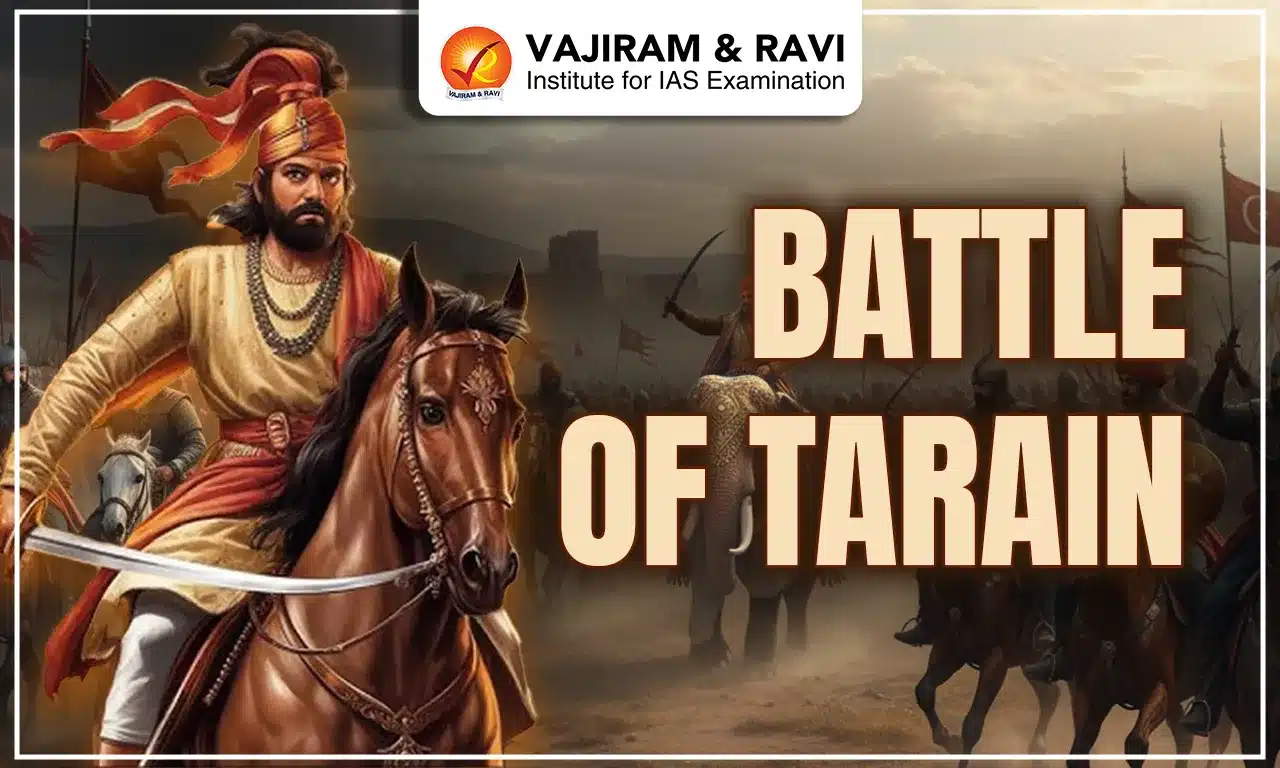
The Battle of Tarain is remembered as a turning point in medieval Indian history, fought in 1191 and 1192 between the Ghurid ruler Muizzuddin Muhammad Ghori and the Chauhan king Prithviraj Chauhan. These two clashes, fought near Tarain in present-day Haryana, reflected not just military strength but also the shifting political ambitions of the era. The first battle ended in victory for Prithviraj, but the second in 1192 saw Ghori decisively triumph, making the way for the establishment of Muslim rule in northern India. 

Battle of Tarain

The Battle of Tarain was fought two times in history of India. It was first fought in 1191 as the First Battle of Tarain between Prithviraj Chauhan and Muhammad of Ghor. Followed by the Second Battle of Tarain, which was fought in subsequent year in 1192 between the above mentioned rulers. This article delves into the reasons, events, history, highlights, outcomes and aftermath of the battles.

First Battle of Tarain

The First Battle of Tarain (1191 CE) was a turning point in medieval Indian history. It was fought between Prithviraj Chauhan, the powerful Rajput king of the Chauhan dynasty, and Muhammad of Ghor, the ruler of the Ghurid Empire. The battle took place near Tarain (modern-day Taraori in Haryana) and symbolized the resistance of the Rajputs against foreign invasions. The conflict is remembered as a decisive clash that shaped the political landscape of North India during the late 12th century.

First Battle of Tarain Background

  • The Rajputs and the Chauhan Dynasty: The Rajputs were a distinguished warrior class in medieval India, celebrated for their valor and code of honor. Among them, the Chauhan dynasty held considerable power in northwestern India. Prithviraj Chauhan, one of its most renowned rulers, governed the kingdoms of Delhi and Ajmer. He earned fame for his bravery, strategic acumen, and military skill.
  • The Ghurids and Muhammad of Ghor: The Ghurids, originating from present-day Afghanistan, sought to expand their dominion into the fertile plains of northern India. Muhammad of Ghor, a prominent leader of the Ghurid dynasty, aimed to establish a stronghold in the Indian subcontinent. His expansionist ambitions ultimately brought him into conflict with Prithviraj Chauhan, setting the stage for the First Battle of Tarain (1191 CE).
  • Initial Skirmishes: Rajputs, familiar with the terrain, launched surprise attacks on the Ghurid forces. They inflicted notable casualties, but Muhammad of Ghor successfully regrouped and countered these assaults.
  • Main Engagement:
    • Both armies clashed in the plains of Tarain.
    • Rajput cavalry executed fierce charges aimed at breaking the Ghurid lines.
    • Ghurid horse archers maintained distance attacks, causing heavy losses to the Rajputs and blunting their cavalry advantage.

First Battle of Tarain Causes

  • Territorial Ambitions: Both Prithviraj Chauhan and Muhammad of Ghor sought to expand their control over northern India.
  • Strategic Importance: Tarain’s location was crucial for trade routes and military operations, making it a highly contested region.
  • Dynastic Conflicts: Rivalries between ruling dynasties fueled power struggles and competition for dominance.
  • Resource Competition: Fertile land, water, and other vital resources intensified the conflict.
  • Leadership Rivalry: Both leaders aimed to assert their authority and supremacy over the region.
  • Prestige and Honor: Victory was tied to defending reputation and preserving the prestige of their respective dynasties.
  • Alliance Systems: Formation of alliances created a polarized environment, escalating tensions.
  • Historical Precedents: Lingering grievances and previous disputes influenced the decision to fight.
  • Economic Interests: Control over trade routes and economic advantages added to the stakes.
  • Social and Religious Factors: Differences in social and religious practices contributed to underlying tensions.

First Battle of Tarain Events

Muhammad Ghori captured the fort of Bathinda, prompting Prithviraj Chauhan to gather his allies and confront him at Tarain in 1191.

  • The Rajput army had around 50,000 soldiers, while the Ghurid forces were slightly smaller than the rumored 100,000.
  • The Ghurids relied on skilled cavalry archers, whereas the Rajputs had more infantry and elephants, favoring close combat.
  • The battle began with Ghurid archers attacking the Rajputs from a distance, but Chauhan launched a sudden charge that caught them off guard.
  • The Rajput infantry pursued the retreating archers to the Ghurid center, while their cavalry attacked from the flanks. Central Rajput elephants added to the chaos, disrupting the Ghurid ranks.
  • Muhammad Ghori attempted to rally his troops but was nearly killed by Rajput commander Govind Rai, and his bodyguard saved him.
  • Seeing Ghori retreat, Ghurid morale collapsed, and the army fled. The Rajputs chased them for 40 kilometers before returning to besiege Bathinda, which fell in 1192.

Turning Points of First Battle of Tarain

A major Turning Points of First Battle of Tarain was the capture of Muhammad of Ghor by the Rajput forces. He was injured, fell from his horse, and was temporarily captured, causing confusion in the Ghurid army. He was later rescued by his troops, and the incident strengthened the Ghurids’ determination to fight.

The leadership of Prithviraj Chauhan was crucial to the Rajput success. He effectively coordinated the different Rajput contingents, inspiring his warriors and maintaining high morale. Despite internal rivalries, the Rajput confederation fought as a unified force under his command.

First Battle of Tarain Outcomes

The First Battle of Tarain concluded with a decisive victory for the Rajput confederation. The Ghurid forces, unable to withstand the Rajput assaults, retreated, and Muhammad of Ghor had to withdraw and regroup.

This victory gave the Rajput kingdoms a temporary reprieve from Ghurid invasions and bolstered Prithviraj Chauhan’s reputation as a strong ruler. However, the success was short-lived, as the Ghurids returned in 1192 CE for the Second Battle of Tarain, which had a different outcome.

Second Battle of Tarain

The Second Battle of Tarain, fought in 1192 near Tarain (modern-day Taraori, Haryana), was a clash between the Ghurid forces and the Rajput confederacy. This time, the Ghurids emerged victorious, signaling a major shift in medieval Indian history. The defeat significantly weakened Rajput power in North India and paved the way for a lasting Muslim presence, ultimately leading to the foundation of the Delhi Sultanate.

Second Battle of Tarain Background

After his defeat at the First Battle of Tarain in 1191, Muhammad Ghori returned to Ghazni, publicly shaming commanders who had shown cowardice and vowing to forgo all luxuries until he avenged his loss. Determined, he rebuilt his army with a focus on firepower, mobility, and discipline. Meanwhile, Prithviraj Chauhan, buoyed by his victory, became overconfident and neglected to strengthen his borders. He did, however, send proposals to neighboring kingdoms to assemble reinforcements in case of another Ghurid attack.

In the summer of 1192, Muhammad Ghori marched with 52,000 cavalry, half of his total forces. Upon reaching Peshawar, he reinstated the previously dismissed commanders, who rejoined his army. Shortly after the Rajputs captured Bathinda fort, Ghori recaptured it and demanded that Prithviraj Chauhan accept him as suzerain, a demand that was refused.

Prithviraj marched to confront Ghori again, though his army was smaller than expected due to prior deployments of his commanders. While contemporary sources exaggerate his forces at 500,000 men and 3,000 elephants, modern estimates suggest around 100,000 men and 300 elephants. As they faced each other at Tarain, Prithviraj sent a warning message to Ghori, offering him a chance to retreat. Ghori feigned agreement, asking to retain Bathinda and Multan while consulting his co-ruler brother.

Meanwhile, the Ghurids conducted reconnaissance and prepared a surprise attack. This ruse lulled the Rajputs into a false sense of security, leading them to neglect proper scouting. At dawn, the Ghurid army launched a night-time raid, neutralizing several war elephants. The Rajputs, unaccustomed to night attacks, initially struggled but eventually repelled the raiding cavalry. Pursuing them, they found the Ghurid forces fully arrayed for battle, the Second Battle of Tarain was about to begin.

Second Battle of Tarain Events

After his defeat in the First Battle of Tarain in 1191, Muhammad Ghori returned to Ghazni and took strict measures. He publicly humiliated and dismissed commanders who had performed poorly. Determined to avenge his loss, he renounced all luxuries and restructured his army, focusing on firepower, mobility, and discipline.

Prithviraj Chauhan, confident after his victory, believed in the superiority of his forces. He should have fortified his borders and secured alliances with neighboring kingdoms, but he did not. In the summer of 1192, Muhammad Ghori marched with 52,000 cavalry, half of his total army. Upon reaching Peshawar, he reinstated the previously dismissed commanders, who rejoined his forces.

A month after the Rajputs had captured Bathinda fort, Muhammad Ghori recaptured it. He sent a demand to Prithviraj Chauhan to accept him as suzerain, but Chauhan refused. Chauhan prepared to confront Ghori again, though his army was smaller than expected due to earlier deployments of his commanders. Contemporary sources exaggerate his forces, but modern estimates suggest fewer troops.

On the Tarain fields, Chauhan warned Ghori that he could leave peacefully or face destruction. Ghori pretended to negotiate, asking to retain Bathinda, while secretly preparing his army. The Ghurid forces analyzed the Rajput positions and planned a surprise attack. Chauhan, deceived into a false sense of security, neglected proper scouting.

At dawn, the Ghurid army launched a night attack on the Rajput camp, catching them off guard. The Rajputs, unaccustomed to night fighting, were initially shocked but managed to repel the first Ghurid cavalry assault. Soon, however, they realized that the Ghurids had already arranged their forces for a full-scale battle, the Second Battle of Tarain was about to begin.

Second Battle of Tarain Results

Historical accounts differ on Prithviraj Chauhan’s fate. Some suggest he was captured and executed, while others indicate he was taken to Ajmer, where Muhammad Ghori planned to reinstate him as a Ghurid vassal. Ultimately, Prithviraj rebelled and was killed for treason. Regardless of the specifics, his kingdom fell to the Ghurid forces, who within a decade subjugated the entire Gangetic plain, extending as far as Bengal.

The Second Battle of Tarain holds great significance in the context of Turkish and Arab invasions of India. Though the Ghurid kingdom itself was short-lived, the Islamic presence it established left a lasting impact on the cultural and historical landscape of the Indian subcontinent.

Also Check Other Posts
Paramara Dynasty Ashtadiggajas 
Western Chalukyas Battle of Talikota
Hoysala Dynasty Bahmani Kingdom
Kakatiya Dynasty Deccan Sultanates
Vijayanagara Empire Muhammad Ghori
Krishnadevaraya Mahmud of Ghazni


Battle of Tarain FAQs

Q1: Who won the 2nd Battle of Tarain?

Ans: Muhammad Ghori defeated Prithviraj Chauhan in the Second Battle of Tarain (1192 CE), establishing Muslim dominance in northern India.

Q2: Who won the 3rd Battle of Tarain?

Ans: Historically, there were mainly two battles of Tarain; no widely recognized "third battle" exists in historical records.

Q3: Who won the First Battle of Tarain?

Ans: Prithviraj Chauhan defeated Muhammad Ghori in the First Battle of Tarain (1191 CE), temporarily halting Ghori’s invasion.

Q4: How many battles of Tarain are there?

Ans: There were two major battles: First (1191 CE, Chauhan victory) and Second (1192 CE, Ghori victory).

Q5: In which battle Muhammad Ghazni was defeated by Prithviraj Chauhan?

Ans: Muhammad Ghazni was not defeated by Prithviraj Chauhan; their encounters are largely separate. Prithviraj fought Muhammad Ghori, not Ghazni.

Mediterranean Sea, Map, Bordering Countries, Area, Connectivity

Mediterranean Sea

The Mediterranean Sea is one of the world's most important intercontinental seas, linking Europe, Asia and Africa. For thousands of years, it has supported trade, cultural exchange, agriculture, navigation and the rise of major civilizations. Its strategic location, rich biodiversity, busy shipping routes and historical importance make it a key geographical region with continuing economic, environmental and geopolitical relevance.

Mediterranean Sea

The Mediterranean Sea is an almost landlocked sea with unique physical features, strategic connections and diverse natural characteristics.

  • Location: The Mediterranean Sea lies between Europe in the north, Asia in the east and Africa in the south. 
  • Extent: It stretches between latitudes 30°-46° N and longitudes 5°50′ W-36° E, extending nearly 4,000 km from the Strait of Gibraltar to the Gulf of Iskenderun.
  • Area and Shape: The sea covers approximately 2.5 million sq km (about 970,000 sq miles). It is a deep, elongated basin that is almost completely surrounded by land, making it one of the world's largest enclosed seas.
  • Connectivity: The Mediterranean connects with the Atlantic Ocean through the Strait of Gibraltar, the Black Sea through the Dardanelles Strait, Sea of Marmara and Bosporus Strait and the Red Sea through the Suez Canal, giving it exceptional strategic importance.
  • Depth: The Mediterranean has an average depth of about 1,500 metres, while its deepest point is the Calypso Deep in the Ionian Sea, reaching 5,267 metres, making it one of the deepest enclosed seas globally.
  • Coastline: The sea possesses an extensive 46,000 km coastline, supporting numerous ports, cities, tourism centres, fisheries and agricultural regions across three continents.
  • Climate: The region experiences the famous Mediterranean climate, characterised by hot, dry summers and mild, wet winters, which supports olive cultivation, vineyards, citrus fruits and dense human settlements.
  • Salinity: Mediterranean waters are significantly more saline than the Atlantic Ocean because evaporation exceeds freshwater inflow. Surface salinity averages around 38 parts per thousand.
  • Water Circulation: Continuous water exchange occurs through the Strait of Gibraltar. Atlantic surface water flows into the Mediterranean, while denser, saltier Mediterranean water exits beneath the surface, maintaining its hydrological balance.
  • Major Rivers: Several important rivers discharge into the Mediterranean, including the Nile, Ebro, Rhône, Po and Tiber. These rivers provide freshwater, sediments and nutrients that support coastal ecosystems and agriculture.
  • Major Islands: Important islands include Sicily, Sardinia, Corsica, Crete, Cyprus, Rhodes, Mallorca, Lesbos, Chios and Euboea. Sicily is the largest island in the Mediterranean Sea.
  • Marginal Seas: Around 15 marginal seas form part of the Mediterranean system, including the Balearic Sea, Adriatic Sea, Tyrrhenian Sea, Ionian Sea, Libyan Sea, Levantine Sea, Aegean Sea, Sea of Sicily and Cilician Sea, each having distinct geographical characteristics.
  • Historical Importance: Often called the birthplace of Western civilization, the Mediterranean supported the rise of the Phoenicians, Ancient Greeks, Roman Empire, Ancient Egypt and Carthaginian civilization, becoming a centre of trade, navigation, culture and political power.
  • Geological Background: The Mediterranean originated from the ancient Tethys Ocean. Around 5-6 million years ago, major geological changes transformed the basin before Atlantic waters refilled it through the Strait of Gibraltar.

Mediterranean Sea Bordering Countries

The Mediterranean Sea is bordered by 22 countries and one territory, making it one of the world's most internationally shared marine regions.

  • European Countries: Eleven European countries border the Mediterranean: Spain, France, Italy, Malta, Monaco, Slovenia, Croatia, Bosnia and Herzegovina, Montenegro, Albania and Greece, forming much of the northern coastline.
  • West Asian Countries: The eastern Mediterranean touches Turkey, Syria, Lebanon, Israel, the Palestine Gaza Strip and the divided island of Cyprus, making the region strategically significant for West Asia.
  • North African Countries: The southern coastline includes Morocco, Algeria, Tunisia, Libya and Egypt, connecting North Africa with Europe through maritime trade and transportation.
  • British Overseas Territory: Gibraltar, located at the entrance of the Strait of Gibraltar, is the only British Overseas Territory on the Mediterranean and controls one of the world's busiest maritime gateways.
  • Three-Continent Interface: The Mediterranean directly links Europe, Asia and Africa, making it one of the world's most important geographical crossroads for commerce, migration, diplomacy and strategic maritime operations.

Mediterranean Sea Significance

The Mediterranean Sea remains globally important because of its economic, strategic, ecological, historical and geopolitical value.

  • Economic Importance: The Mediterranean supports major shipping routes, fisheries, ports, agriculture, offshore energy production and industries. Its coastline attracts more than 220 million tourists annually, making tourism a major contributor to regional economies.
  • Strategic Importance: The Strait of Gibraltar and Suez Canal connect the Mediterranean with the Atlantic Ocean and the Red Sea, making it a vital international maritime corridor between Europe, Asia and Africa.
  • Trade and Transportation: Since the opening of the Suez Canal in 1869, the Mediterranean has become one of the busiest global sea routes, supporting international trade, petroleum transport, container shipping and commercial connectivity.
  • Energy Importance: Offshore reserves of petroleum and natural gas are found mainly near Italy, Libya, Egypt, Algeria, Greece, Spain and Tunisia. The Bouri offshore oil field in Libya is among the region's most productive fields.
  • Ecological Importance: The Mediterranean supports thousands of marine species despite low nutrient availability. It also regulates regional climate, sustains fisheries and provides critical habitats for marine mammals, turtles, seabirds and coastal ecosystems.
  • Agricultural Importance: The Mediterranean climate favours cultivation of olives, grapes, citrus fruits, wheat and vegetables. This agricultural system has influenced food production and livelihoods across Southern Europe, North Africa and West Asia.
  • Environmental Challenges: Less than 1% of the Mediterranean Sea is protected, while nearly 85% of surrounding forests have disappeared. Pollution, overfishing, coastal urbanisation, invasive species and climate change remain major concerns.
  • Conservation Efforts: The Mediterranean Action Plan (1975), Barcelona Convention (1976) and Athens Protocol (1980) encourage regional cooperation for pollution control, marine conservation, sustainable development and environmental monitoring.
  • Contemporary Relevance: The Mediterranean remains central to issues including Western Disturbances, Bomb Cyclones, Grand Ethiopian Renaissance Dam (GERD) impacts on the Nile, maritime security, migration, offshore energy exploration and exercises such as the India-Algeria Maiden Navy Exercise.

Mediterranean Sea Biodiversity

The Mediterranean Sea supports exceptional biodiversity with many endemic species despite its relatively nutrient poor waters.

  • Biodiversity: The Mediterranean contains nearly 12,000 marine species and about one-third are endemic, meaning they occur nowhere else in the world, making it a globally recognised biodiversity hotspot.
  • Flora: Marine plant life mainly includes phytoplankton, seagrass meadows, algae and coastal vegetation. Surrounding landscapes support olive trees, cypress, cork oak and aromatic shrubs, all adapted to Mediterranean climatic conditions.
  • Marine Fish: Commercially important fish include bluefin tuna, sardines, anchovies, hake, sea bass, groupers, sea bream, red mullet, soles, flounders, mackerels, bonitos, croakers, gobies and sharks, supporting fisheries across coastal countries.
  • Marine Mammals and Reptiles: The sea is home to dolphins, whales, sea turtles and the endangered Mediterranean monk seal, all facing increasing threats from fishing activities, pollution, habitat degradation and accidental capture.
  • Shellfish and Corals: Coastal waters contain crabs, shrimps, prawns, sponges and corals, although natural stocks have declined because of pollution, excessive fishing and habitat destruction, increasing dependence on aquaculture.
  • Fisheries and Aquaculture: Fisheries remain economically valuable despite limited nutrients. Egypt's coastal lagoons support extensive aquaculture, while small scale fishing dominates many Mediterranean coastal communities.
  • Threats to Biodiversity: Overfishing, plastic pollution, invasive species entering through the Suez Canal, coastal development, reduced river inflow and rising salinity continue to threaten the Mediterranean's ecological balance and marine biodiversity.
  • Conservation Need: Protecting endemic species, expanding marine protected areas, promoting sustainable fisheries and reducing pollution remain essential for preserving the Mediterranean's unique marine ecosystems for future generations.

Mediterranean Sea FAQs

Q1: Which is the deepest point of the Mediterranean Sea?

Ans: The Calypso Deep in the Ionian Sea is the deepest point of the Mediterranean Sea, with a depth of 5,267 metres.

Q2: How many countries border the Mediterranean Sea?

Ans: The Mediterranean Sea is bordered by 22 countries and one territory (Gibraltar) across Europe, Asia and Africa.

Q3: Which is the largest island in the Mediterranean Sea?

Ans: Sicily is the largest island in the Mediterranean Sea.

Q4: Why is the Mediterranean Sea more saline than the Atlantic Ocean?

Ans: The Mediterranean Sea has higher salinity because evaporation is greater than freshwater inflow, increasing the concentration of dissolved salts.

Q5: Which major river drains into the Mediterranean Sea?

Ans: The Nile River is the largest river that drains into the Mediterranean Sea, flowing into it through the Nile Delta in Egypt.

Sri Venkateswara National Park, History, Flora, Fauna, Importance

Sri Venkateswara National Park

Sri Venkateswara National Park is one of the most important protected forests in southern India. Located in the Tirupati district of Andhra Pradesh, the national park is spread across the scenic Eastern Ghats and is known for its rich biodiversity, dense forests, picturesque waterfalls, and diverse wildlife. Covering an area of approximately 353 sq. km, the park forms part of the Seshachalam Hills, which are recognized as a UNESCO Biosphere Reserve due to their exceptional ecological significance.

Sri Venkateswara National Park History

Sri Venkateswara National Park was established in 1989 to protect the rich biodiversity of the Seshachalam Hills in Andhra Pradesh and is named after Lord Venkateswara of Tirumala, reflecting both its ecological and religious significance.

Established: 1989.

  • Location: Situated in the Seshachalam Hills of Tirupati district, Andhra Pradesh.
  • Named After: Lord Venkateswara, the presiding deity of the Tirumala Temple.
  • Primary Objective: To conserve the unique flora and fauna of the Eastern Ghats.
  • Red Sanders Conservation: Protects the world's largest natural habitat of the endemic Red Sanders (Pterocarpus santalinus).
  • UNESCO Recognition: Became part of the Seshachalam Hills Biosphere Reserve, recognized by UNESCO in 2010.
  • Ecological Importance: Conserves tropical deciduous forests, wildlife corridors, and important watershed ecosystems.
  • Conservation Efforts: Supports habitat protection, biodiversity research, anti-smuggling operations, and sustainable forest management.

Sri Venkateswara National Park Flora

Sri Venkateswara National Park is characterized by tropical dry deciduous, moist deciduous, and dry evergreen forests, with the endemic Red Sanders (Pterocarpus santalinus) as its most iconic species, along with numerous medicinal plants, bamboo, and valuable timber trees.

  • Red Sanders (Pterocarpus santalinus) – Endemic and endangered tree species for which the park is globally renowned.
  • Teak (Tectona grandis) – A valuable timber tree commonly found in deciduous forests.
  • Sandalwood (Santalum album) – Aromatic tree known for its medicinal and commercial value.
  • Neem (Azadirachta indica) – Widely distributed medicinal tree with antibacterial properties.
  • Indian Gooseberry (Amla) (Phyllanthus emblica) – Rich in Vitamin C and extensively used in traditional medicine.
  • Arjun (Terminalia arjuna) – Important tree growing along streams and valued for its medicinal bark.
  • Indian Laurel (Terminalia tomentosa) – A dominant deciduous tree contributing to forest cover.
  • Jamun (Syzygium cumini) – Fruit-bearing tree that provides food for birds and mammals.
  • Flame of the Forest (Butea monosperma) – Famous for its striking orange-red flowers during spring.
  • Bamboo (Bambusa bambos) – Forms dense thickets that provide habitat and food for wildlife.
  • Axlewood (Anogeissus latifolia) – Common dry deciduous tree important for maintaining forest ecology.
  • Tendu (Diospyros melanoxylon) – Economically important species whose leaves are traditionally used for making bidis.
  • Indian Kino Tree (Pterocarpus marsupium) – A medicinal tree valued for its therapeutic properties.
  • Indian Laburnum (Cassia fistula) – Popular for its bright yellow flowers and medicinal uses.
  • Mahua (Madhuca longifolia) – Produces edible flowers and seeds, supporting both wildlife and local communities.

Sri Venkateswara National Park Fauna

Sri Venkateswara National Park is home to a rich variety of mammals, birds, reptiles, and amphibians, making it one of the most important wildlife habitats in the Eastern Ghats and a key centre for biodiversity conservation.

  • Mammals: Leopard, Sloth Bear, Dhole (Indian Wild Dog), Sambar Deer, Spotted Deer (Chital), Barking Deer, Four-horned Antelope, Indian Giant Squirrel, Wild Boar, and Indian Hare are commonly found in the park.
  • Birds: More than 170 bird species have been recorded, including the Indian Peafowl, Grey Junglefowl, Crested Serpent Eagle, Changeable Hawk-Eagle, Indian Paradise Flycatcher, Yellow-footed Green Pigeon, Golden Oriole, and Indian Pitta.
  • Reptiles: The park supports reptiles such as the Indian Rock Python, Spectacled Cobra, Common Krait, Russell's Viper, Indian Rat Snake, Bengal Monitor Lizard, and Indian Star Tortoise.
  • Endangered Species: It provides a protected habitat for several threatened and vulnerable species, including the Dhole, Sloth Bear, Leopard, and the Four-horned Antelope, contributing significantly to wildlife conservation.
  • Other Wildlife: The forests also support numerous amphibians, butterflies, pollinating insects, and other invertebrates that play an essential role in maintaining the park's ecosystem.

Sri Venkateswara National Park Climate and Vegetation

Sri Venkateswara National Park experiences a tropical climate with hot summers, moderate monsoon rainfall, and pleasant winters, supporting diverse forest types across the Seshachalam Hills of the Eastern Ghats.

  • Climate: The park has a tropical climate, with summer temperatures ranging from 24°C to 42°C, while winter temperatures vary between 15°C and 28°C, making winters the most comfortable season.
  • Rainfall: The park receives moderate rainfall from both the Southwest and Northeast Monsoons, with an average annual rainfall of 900-1,200 mm, sustaining its rich biodiversity.
  • Tropical Dry Deciduous Forests: These forests dominate the landscape and are characterized by species such as Teak, Red Sanders, Neem, and Axlewood.
  • Moist Deciduous and Dry Evergreen Forests: Higher elevations and valleys support moist deciduous forests, dry evergreen vegetation, bamboo thickets, and a variety of medicinal plants.
  • Unique Vegetation: The park is globally renowned for its endemic Red Sanders (Pterocarpus santalinus), along with Sandalwood, Amla, Jamun, Arjun, and numerous shrubs, herbs, and climbers.
  • Ecological Role: The dense vegetation helps prevent soil erosion, recharge groundwater, regulate the local climate, provide habitat for wildlife, and maintain the ecological balance of the UNESCO-recognized Seshachalam Biosphere Reserve.

Sri Venkateswara National Park Importance

Sri Venkateswara National Park is one of the most ecologically significant protected areas in the Eastern Ghats, playing a crucial role in conserving biodiversity, protecting endemic species, and maintaining the ecological balance of the Seshachalam Hills.

  • Conserves Endemic Red Sanders: The park protects the world's largest natural population of Red Sanders (Pterocarpus santalinus), an endangered and highly valuable tree species endemic to the Eastern Ghats.
  • Protects Rich Biodiversity: It provides a safe habitat for numerous mammals, birds, reptiles, amphibians, and several threatened and vulnerable wildlife species, including the Leopard, Sloth Bear, and Dhole.
  • Part of the Seshachalam Biosphere Reserve: The national park forms an integral part of the UNESCO-recognized Seshachalam Biosphere Reserve, contributing to global biodiversity conservation.
  • Maintains Ecological Balance: Its forests help prevent soil erosion, recharge groundwater, regulate the regional climate, and protect important watershed ecosystems.
  • Supports Scientific Research and Eco-tourism: The park serves as an important centre for wildlife research, environmental education, nature conservation, and eco-tourism, attracting researchers, nature enthusiasts, and pilgrims visiting Tirumala.
  • Preserves Natural and Cultural Heritage: Located around the sacred Tirumala Hills, the park safeguards both the region's ecological wealth and its religious and cultural significance, ensuring sustainable conservation for future generations.

Sri Venkateswara National Park FAQs

Q1: Where is Sri Venkateswara National Park located?

Ans: Sri Venkateswara National Park is located in the Tirupati district of Andhra Pradesh, within the Seshachalam Hills of the Eastern Ghats.

Q2: When was Sri Venkateswara National Park established?

Ans: The park was established in 1989 to conserve the rich biodiversity and unique ecosystems of the Eastern Ghats.

Q3: Why is Sri Venkateswara National Park famous?

Ans: The park is famous for its Red Sanders forests, diverse wildlife, scenic waterfalls, and its location around the Tirumala Venkateswara Temple.

Q4: Which is the most famous plant found in Sri Venkateswara National Park?

Ans: The park is best known for Red Sanders (Pterocarpus santalinus), an endangered tree species endemic to the Eastern Ghats.

Q5: Which animals are found in Sri Venkateswara National Park?

Ans: Major wildlife includes the Leopard, Sloth Bear, Dhole (Indian Wild Dog), Sambar Deer, Spotted Deer, Indian Giant Squirrel, Wild Boar, and over 170 species of birds.

Finance Ministers of India, List from 1947 to 2026, Tenure

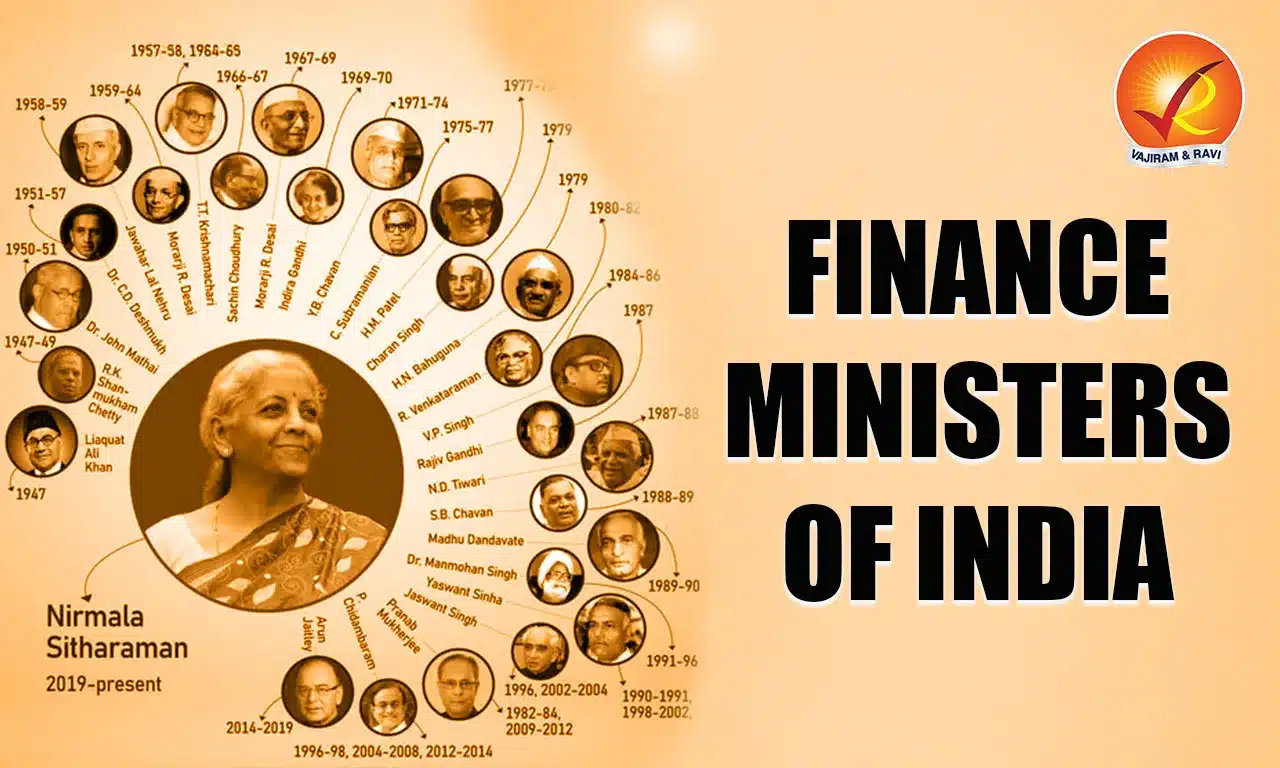
Finance Ministers of India

The Ministry of Finance, known in Hindi as Vitta Mantralaya, functions as the central authority for managing public finances and acts as the national treasury. Its core responsibilities include the formulation and implementation of tax policies, financial laws, and economic regulations. The Ministry supervises financial institutions, manages currency and capital markets, and oversees both central and state government finances. 

A key function of the Finance Ministers of India is the preparation and presentation of the Union Budget. It also serves as the cadre-controlling authority for major civil services such as the Indian Revenue Service, Indian Audit and Accounts Service, Indian Economic Service, and Indian Civil Accounts Service. It also administers the Indian Cost and Management Accounts Service, which plays a significant role in the country's commercial governance.

Finance Minister of India

Nirmala Sitharaman currently holds the position of Finance Minister of India, having taken charge of the Ministry of Finance and Corporate Affairs on May 31, 2019. She holds the distinction of being the country’s first woman to serve as a full-time Finance Minister. Her first Budget speech in Parliament was delivered on July 5, 2019. Between 2019 and 2024, she has tabled six Union Budgets, including the Interim Budget 2024. With the presentation of the Budget in February 2024, she became the First Finance Minister in India to present seven consecutive Union Budgets.

List of Finance Ministers of India

Sir Ramasamy Chetty Kandasamy Shanmukham Chetty, born on 17 October 1892, served as the independent First Finance Minister of India. He had the historic responsibility of presenting the nation’s first-ever Budget, which he delivered on 26 November 1947. His tenure marked the beginning of India's financial planning in the post-colonial era.

List of Finance Ministers of India

SNo

Name

Term of office

Political Party

Prime Minister

1.

Liaquat Ali Khan

29 October 1946

14 August 1947

All-India Muslim League

Jawaharlal Nehru
(Vice President of the interim Govt.)

2.

R. K. Shanmukham Chetty

15 August 1947

17 August 1948

Indian National Congress

Jawaharlal Nehru


3. John Mathai

22 September 1948

26 January 1950

26 January 1950

6 May 1950

6 May 1950

1 June 1950

4.

C. D. Deshmukh

1 June 1950

13 May 1952

13 May 1952

1 August 1956

5. 

Jawaharlal Nehru

1 August 1956

30 August 1956

6.


T. T. Krishnamachari


30 August 1956

17 April 1957

17 April 1957

14 February 1958

7.

Jawaharlal Nehru

14 February 1958

22 March 1958

8.


Morarji Desai


22 March 1958

10 April 1962

10 April 1962

31 August 1963

9.

T. T. Krishnamachari

31 August 1963

31 December 1965

Jawaharlal Nehru
Lal Bahadur Shastri

10.


Sachindra Chaudhuri


1 January 1966

11 January 1966

Lal Bahadur Shastri
Indira Gandhi


11 January 1966

24 January 1966

24 January 1966

13 March 1967

11.

Morarji Desai

13 March 1967

16 July 1969

Indira Gandhi

12.

Indira Gandhi

16 July 1969

27 June 1970

13.


Yashwantrao B. Chavan


27 June 1970

18 March 1971

18 March 1971

10 October 1974

14.

Chidambaram Subramaniam

10 October 1974

24 March 1977

15.

Haribhai M. Patel

26 March 1977

24 January 1979

Janata Party

Morarji Desai

16.

Charan Singh

24 January 1979

16 July 1979

17.

Hemvati Nandan Bahuguna

28 July 1979

19 October 1979

Janata Party (Secular)

Charan Singh

18.

R. Venkataraman

14 January 1980

15 January 1982

Indian National Congress

Indira Gandhi


19.


Pranab Mukherjee

15 January 1982

31 October 1984

31 October 1984

31 December 1984

20.


V. P. Singh


31 December 1984

14 January 1985

Rajiv Gandhi

14 January 1985

30 March 1985

30 March 1985

25 September 1985

25 September 1985

24 January 1987

21.

Rajiv Gandhi

24 January 1987

25 July 1987

22.

N. D. Tiwari

25 July 1987

25 June 1988

23.

Shankarrao B. Chavan

25 June 1988

2 December 1989

24.

Madhu Dandavate

5 December 1989

10 November 1990

Janata Dal

(National Front)

V. P. Singh

25.

Yashwant Sinha

21 November 1990

21 June 1991

Samajwadi Janata Party
(National Front)

Chandra Shekhar

26.

Manmohan Singh

21 June 1991

16 May 1996

Indian National Congress

P. V. Narasimha Rao

27.

Jaswant Singh

16 May 1996

1 June 1996

Bharatiya Janata Party

Atal Bihari Vajpayee

28.

P. Chidambaram

1 June 1996

21 April 1997

Tamil Maanila Congress
(United Front)

H. D. Deve Gowda

29.

I.K. Gujral

21 April 1997

1 May 1997

Janata Dal
(United Front)

I. K. Gujral

30.

P. Chidambaram

1 May 1997

19 March 1998

Tamil Maanila Congress

(United Front)

31.


Yashwant Sinha


19 March 1998

13 October 1999

Bharatiya Janata Party

(National Democratic Alliance)

Atal Bihari Vajpayee

13 October 1999

1 July 2002

32.

Jaswant Singh

1 July 2002

22 May 2004

33.

P. Chidambaram

23 May 2004

30 November 2008

Indian National Congress
(United Progressive Alliance)

Manmohan Singh

34.

Manmohan Singh

30 November 2008

24 January 2009

35.


Pranab Mukherjee


24 January 2009

22 May 2009

23 May 2009

26 June 2012

36.

Manmohan Singh

26 June 2012

31 July 2012

37.

P. Chidambaram

31 July 2012

26 May 2014

38.

Arun Jaitley

26 May 2014

30 May 2019

Bharatiya Janata Party

(National Democratic Alliance)

Narendra Modi

39. 


Nirmala Sitharaman

31 May 2019

Present

Bharatiya Janata Party

(National Democratic Alliance)

Narendra Modi

First Finance Minister of India

K. Shanmukham Chetty served as First Finance Minister of India from 1947 to 1948. He delivered the First Union Budget of India, which projected total expenditure at Rs. 171.15 crore and a fiscal deficit of Rs. 24.59 crore. A prominent figure in India’s early political and economic landscape, Chetty was not only an economist and lawyer but also held the position of President of the Central Legislative Assembly from 1933 to 1935. His contributions laid the groundwork for India's post-independence fiscal policy.

Female Finance Ministers of India

Nirmala Sitharaman holds the position of first full-time Female Finance Minister of India, a role that entrusts her with key responsibilities, including the presentation of the Union Budget. However, she is not the first woman to present a Union Budget. That milestone was achieved by Prime Minister Indira Gandhi, who assumed charge of the Finance Ministry following Morarji Desai’s resignation in July 1969. Gandhi went on to present the Union Budget for the financial year 1970-71.

Finance Ministers of India Roles and Responsibility

  • Holds a senior position in the Union Cabinet and leads the government’s fiscal policy and economic planning.
  • Prepares and presents the annual Union Budget in Parliament, detailing projected expenditures and revenue for the upcoming financial year.
  • Oversees the country’s public financial management system, ensuring effective financial control, transparency, and accountability.
  • Supervises the formulation and implementation of tax policies, including direct taxes, indirect taxes, tariffs, and other government duties.
  • Guides resource allocation across sectors in line with national development goals and financial priorities.
  • Manages government revenues and expenditures, aligning them with long-term financial and economic objectives.
  • Supports economic stability through policy decisions that influence inflation, growth, investment, and employment.
Also Check Related Post
Vice Presidents of India Education Ministers of India
Foreign Ministers of India Finance Ministers of India
Cabinet Ministers of India Prime Ministers of India
Deputy Prime Minister of India Presidents of India
Ministry of External Affairs

Finance Ministers of India FAQs

Q1: Who is the current Finance Minister of India (2026)?

Ans: As of 2026, Nirmala Sitharaman is the Finance Minister of India.

Q2: Who was the first Finance Minister of India?

Ans: R. K. Shanmukham Chetty was the first Finance Minister, presenting India’s first Union Budget in 1947.

Q3: How many Finance Ministers has India had?

Ans: India has had over 30 Finance Ministers since independence, including interim and full-term appointments.

Q4: Who presented the first Union Budget of India?

Ans: R. K. Shanmukham Chetty presented the first Union Budget of independent India on November 26, 1947.

Q5: Who was the longest-serving Finance Minister of India?

Ans: Morarji Desai served the longest, holding the Finance Ministry portfolio across multiple terms totaling over 7 years.

Physiographic Divisions of India, Formation, Geographical Features, Map

Physiographic Divisions of India

The Physiographic Divisions of India have a great diversity of relief features. These physiographic divisions help in understanding the geography of the country, its ecology, agriculture and socio-economic development. In this article, we are going to cover the Physiography divisions of India, its formation, geomorphology and importance. 

What is Physiography?

Physiography is the study of the physical features of the earth’s surface and  its relations to the geological structure. The physiography of a place helps in the understanding of the physical characteristics of a place, including river, valleys, mountains, plains and plateaus. 

Physiographic Divisions of India

The Physiographic Divisions of India are sub-divided into 5 physiographic divisions: 

  • The Himalayas
  • The Indo-Gangetic Plains
  • The Peninsular Plateau of India
  • The Coastal Plains of India
  • The Indian Islands

A brief description of each of the 5 physiographic divisions of India is given in the sections that follow.

The Himalayas

The Himalayas are young fold mountains that were formed by the collision of the Indo-Australian Plate with the Eurasian Plate many years ago. They form a natural boundary in between the Tibetan Plateau in the north and the Indian Subcontinent in the south. This acts like a watershed in the indo-gangetic and tibetan river systems. 

  • Latitudinal Divisions of the Himalayas
    • Trans-Himalayas
    • The Himalayan Mountain Ranges
    • The Eastern Hills or Purvanchal
  • Longitudinal Divisions of the Himalayas
    • Punjab Himalayas
    • Kumaon Himalayas
    • Nepal Himalayas
    • Assam Himalayas

The Great Plains of North India

The Great Plains of North India are also known as the Indo-Gangetic Brahmaputra Plains and are present south of the Himalayas and stretch from the mouth of the Indus in the west to the mouth of Ganga in the east. Formed by alluvial deposits from the Indus, Ganga and Brahmaputra rivers as well as their tributaries, the great plains of North India occupy the depression between the Peninsular Plateau and the Himalayas

Regional Divisions of the Indo-Gangetic Plains:

  • The Rajasthan Plain
  • The Punjab-Haryana Plain
  • The Ganga Plain
  • The Brahmaputra Plain

The Peninsular Plateau of India 

The Peninsular Plateau happens to be the oldest and the largest physiographic divisions of India. Located in the southern part of the country, the plateau is covered by water on three sides. There are many small plateaus all separated by river valleys and hill ranges. 

Major Plateaus

The major Plateaus of India have been highlighted below:

Major Hill Ranges

The Coastal Plains of India

The Coastal Plains of India consists of a narrow stretch between the Peninsular Plateau and India’s coastline, extending about 6,000 km along the Arabian Sea and the Bay of Bengal

  • Western Coastal Plains
  • Eastern Coastal Plains

The Indian Islands

The Indian Islands are one of the major Physiographic Divisions of India. They are scattered in the Indian Ocean, Arabian Sea, and Bay of Bengal, and are classified into two main groups:

Also Read
Mountain Ranges of India Rivers of India
Lakes of India Waterfalls of India
Disappearing Lakes in India Mountain Passes in India
Transboundary Rivers of India Highest Peaks in India

Physiographic Divisions of India FAQs

Q1: What is the physiographic division of India?

Ans: India is divided into six major physiographic divisions - The Himalayas, The Indo-Gangetic Plains, The Peninsular Plateau, The Coastal Plains, The Indian Desert, and The Islands.

Q2: What is physiography in short notes?

Ans: Physiography is the study of the physical features, landforms, and terrain of the Earth’s surface.

Q3: Where are the Coastal Plains of India located?

Ans: The Coastal Plains lie between the Peninsular Plateau and the coastlines along the Arabian Sea (west) and Bay of Bengal (east).

Q4: Which states are covered by the Aravalli hill range?

Ans: The Aravalli Range passes through Rajasthan, Haryana, Gujarat, and Delhi.

Q5: What do you mean by physiographic divisions?

Ans: Physiographic divisions are distinct natural regions of land classified based on their physical features, geology, and relief.

105th Constitutional Amendment Act, Important Dates, Significance

105th Constitutional Amendment Act

The 105th Constitutional Amendment Act 2021 officially titled the Constitution (One Hundred and Fifth Amendment) Act restored the authority of State governments to identify Socially and Educationally Backward Classes (SEBCs), including Other Backward Classes (OBCs). This amendment was introduced in response to a Supreme Court ruling in 2021, which interpreted the 102nd Amendment as having taken away this power from the States. To address the issue promptly, the amendment was passed by both Houses of Parliament and received Presidential assent on August 18, 2021.

105th Constitutional Amendment Act 2021

The Constitution (One Hundred and Fifth Amendment) Act 2021 reaffirmed the authority of state governments to identify and notify Socially and Educationally Backward Classes (SEBCs), which include communities such as Other Backward Classes (OBCs). This amendment clarified the state’s power to prepare and maintain their own list of SEBCs, following concerns raised after a Supreme Court judgment. It was enacted after receiving the assent of the President of India on August 18, 2021. As of September 28, 2023, the Indian Constitution has undergone a total of 106 amendments since it came into effect in 1950.

105 Constitutional Amendment Act 2021 Clauses

The 105th Constitutional Amendment Act, 2021 is the most recent amendment to the Indian Constitution. Its purpose is to restore the power of state governments to identify and list Other Backward Classes (OBCs) who are socially and educationally backward.

This amendment modifies clauses (1) and (2) of Article 342A and introduces a new clause (3). It also amends Articles 366(26C) and 338B. The key takeaway is that states retain the authority to maintain their own OBC lists.

The 102nd Amendment had created a Central List of OBCs controlled solely by the Centre, without affecting the state’s powers. However, confusion over its interpretation raised concerns that states might lose the right to identify backward communities.

It ensures that around 671 OBC communities can continue to access reservation benefits in state-run education and employment benefits they might have lost if the state lists were invalidated.

Also Check: 103rd Constitutional Amendment Act

Need for 105th Constitutional Amendment Act 2021

The 105th Constitutional Amendment Act was enacted to restore the authority of states and Union Territories to maintain their own lists of Other Backward Classes (OBCs). Under Articles 15(4), 15(5), and 16(4) of the Indian Constitution, states are empowered to identify and declare socially and educationally backward classes. In practice, both the Centre and individual states maintain separate OBC lists. The need for this amendment arose following the Supreme Court's judgment in the Maratha reservation case, which upheld the 102nd Constitutional Amendment Act. That amendment had introduced Articles 338B and 342A, placing the power to specify backward classes with the President, in consultation with Governors, thereby limiting the role of states. The 105th Amendment sought to clarify and reinstate the state’s legislative competence in this domain.

The table below includes the Important Dates & Events Directing to the 105th Amendment of the Indian Constitution:

Important Dates & Events Directing to the 105th Amendment of the Indian Constitution
Name of the Act/Report Year Effectiveness

Mandal Commission Report

1980

  • The Mandal Commission submitted its report in 1980. It was established in 1979.
  • Suggested reservations for OBCs for employment and education, impacting prospective amendments and lawful actions, including the 105th Amendment.

Supreme Court Judgment in Indra Sawhney Case

1992

  • On November 16, 1992, the Mandal recommendations introduced a 50% cap on reservations and excluded the "creamy layer" of OBCs.
  • Set legal precedents that influenced the 105th Amendment of the Indian Constitution.

Maharashtra SEBC Act


2018

  • On November 30, 2018, Maharashtra law provided reservations for Marathas under SEBC.
  • Highlighted a constitutional amendment to clarify states in determining SEBCs.

Supreme Court Judgment in Maratha Quota Case


2021

  • On May 5, 2021, the Maharashtra SEBC Act was struck down, stating that states couldn't identify SEBCs after the 102nd Amendment.
  • Demonstrated the need for the 105th Amendment of the Indian Constitution to restore states' powers.

Introduction of the 105th Amendment of the Indian Constitution Bill


2021

  • On August 9, 2021, introduced in the Lok Sabha.
  • Aimed to amend the Constitution to restore states' power to identify SEBCs.

Passage of the 105th Amendment of Indian Constitution Bill


2021

  • On August 10-11, 2021, Passed by Lok Sabha and Rajya Sabha.
  • Demonstrated broad consensus and urgency.

Presidential Assent


2021

  • The President gave assent on August 18, 2021, making it official.
  •  Restored states' power to identify and notify SEBCs.

105th Constitutional Amendment Significance

The 105th Constitutional Amendment Act 2021 is one of the most recent additions to the Indian Constitution. Its primary objective is to restore and clarify the authority of State Governments in identifying and notifying Other Backward Classes (OBCs) who are socially and educationally disadvantaged. Enacted on August 18, 2021, this Amendment marks a significant step in reinforcing the federal structure and the legislative process through which social justice is implemented across India.

  • The Act reinforces the State’s exclusive power to identify OBCs for their respective territories, ensuring the continuation of state-specific welfare measures.
  • It establishes that the Central List of OBCs will only be applicable to the Central Government and its institutions.
  • The Amendment does not interfere with State Lists or limit the State’s authority to recognize or notify backward communities.
  • Nearly 671 OBC communities stood to lose reservation benefits in education and employment if the State List had been abolished. This Amendment safeguards their rights.
  • It reflects the government's commitment to social justice, equality, and inclusive development, particularly for historically marginalised communities.

Also Check: 104th Constitutional Amendment Act

105th Constitutional Amendment Impact

The 105th Constitutional Amendment Act brought notable changes by amending Clauses (1) and (2) of Article 342A and inserting a new Clause (3). It made corresponding amendments to Articles 366 and 338B. The primary objective of this Amendment was to restore the authority of state governments to identify and notify Socially and Educationally Backward Classes (SEBCs) for their respective states.

By modifying the above-mentioned provisions, the Amendment reinstated the power of states to maintain their own list of SEBCs, an authority that had been reduced following the Supreme Court’s interpretation in the Maratha reservation judgment. This legislative intervention aimed to strike a balance between the centralised framework of backward class identification and the federal structure of governance.

The debate over reservations both in support and opposition has been ongoing for decades. Despite several decades of independence, India continues to grapple with socio-economic disparities. The 105th Amendment marks another legislative effort towards achieving social justice and equal opportunity by enabling states to better address the specific needs of underrepresented communities within their jurisdictions.

105th Constitutional Amendment Act FAQs

Q1: What is the 105th Constitutional Amendment Act, 2021?

Ans: The 105th Amendment restores state’s power to identify and notify socially and educationally backward classes (SEBCs) for their respective lists.

Q2: When was the 105th Constitutional Amendment enacted?

Ans: It received Presidential assent on 18 August 2021 and came into effect retrospectively from 15 August 2021.

Q3: Why was the 105th Amendment necessary?

Ans: It was enacted following the Supreme Court’s interpretation in the Maratha reservation case, which limited state powers on OBC identification.

Q4: Which Articles were amended by the 105th Amendment?

Ans: The amendment changed Articles 338B and 342A and added a new clause to Article 366 of the Constitution.

Q5: What does Article 342A deal with after the 105th Amendment?

Ans: Article 342A allows the President to notify the central list of SEBCs and empowers states to maintain their own SEBC lists.

National Commission for Men Bill 2025, Objectives, Provisions, Criticism

National Commission for Men Bill 2025

Rajya Sabha MP Ashok Kumar Mittal introduced the National Commission for Men Bill 2025, in Parliament, stating that the recent Pune Ketan Agarwal case underscored the urgent need for an institutional body to provide legal protection, address grievances, and ensure support for male victims facing harassment and discrimination. 

What is National Commission for Men Bill 2025?

The National Commission for Men Bill, 2025 is a Private Member's Bill introduced in Parliament to establish a dedicated statutory body for safeguarding the rights and welfare of men in India. The proposed commission aims to address issues such as false legal cases, domestic violence against men, mental health concerns, workplace harassment, and discrimination. It seeks to provide a platform for receiving complaints, conducting investigations, and recommending policy reforms related to men's welfare. The Bill also aims to promote gender-neutral justice while ensuring that the rights of all citizens are protected under the law.

National Commission for Men Bill 2025 Objectives

The National Commission for Men Bill 2025 aims to create a statutory institution to protect men’s rights and address systemic legal and social challenges.

  • Establish an independent National Commission for Men
  • Review laws that disproportionately impact men
  • Address mental health and suicide among men
  • Ensure gender-neutral access to justice
  • Promote fairness in family and criminal laws

National Commission for Men Bill 2025 Provisions

The National Commission for Men Bill 2025 introduces structural, legal, social, and financial reforms to address men’s welfare comprehensively.

  1. Institutional Structure
  • Statutory body under the Ministry of Law and Justice
  • Chairperson appointed by the President of India
  • Six members with gender balance (three men, three women)
  • Legal Advisor nominated by the Chief Justice of India
  • Powers similar to existing statutory commissions
  1. Section 498A IPC Safeguards
  • However replaced by- Section 85 (and 86) of the Bharatiya Nyaya Sanhita (BNS)
  • Mandatory preliminary police investigation within 30 days before arrest
  • Section 498A to be made bailable and compoundable
  • Penalties for proven false complaints:
    • Up to five years’ imprisonment
    • Fine up to ₹25 lakh
    • Compensation for reputational and career damage
  1. Gender-Neutral Legal Reforms
  • Extension of domestic violence protections to male victims
  • Gender-neutral framework for workplace sexual harassment
  • Gender-neutral sexual offence provisions
  • Punishment for false rape allegations:
    • Seven to ten years’ imprisonment
    • Fine up to ₹10 lakh
  1. Child Custody and Family Law Reforms
  • Shared parenting as the default arrangement after separation
  • Equal parental rights unless abuse or neglect is proven
  • Anti-parental alienation provisions:
    • Up to two years’ imprisonment
    • Fine up to ₹10 lakh
  • Continued focus on the welfare of the child
  1. Rapid Courts Jurisdictions
  • Special courts for false accusation cases and custody disputes
  • Mandatory disposal within six months
  • Faster relief for both genuine victims and falsely accused persons
  1. Media Regulation
  • Ban on declaring guilt before judicial determination
  • Penalties for prejudicial reporting:
    • ₹50 lakh fine for media houses
    • Mandatory public apology
  • Social media penalties for spreading unverified allegations:
    • Three years’ imprisonment
    • Fine up to ₹25 lakh
  • Platforms to remove defamatory content within 24 hours of court orders
  1. Financial Allocation
  • ₹3,650 crore allocated for 2025-2030

National Commission for Men Bill 2025 Significance

The National Commission for Men Bill 2025 seeks to address documented legal, mental health, and family law challenges affecting men through institutional reform.

  • Responds to rising male suicide rates
  • Codifies judicial safeguards into legislation
  • Promotes constitutional equality under Article 14
  • Addresses custody and parental alienation concerns
  • Fills the institutional gap in gender-focused policymaking

National Commission for Men Bill 2025 Criticism

The National Commission for Men Bill 2025 faces several criticisms, with debates that it may unintentionally weaken existing protections and overlook structural gender inequalities.

  • Fear of discouraging genuine complaints
  • Risk of counter-case intimidation
  • Concerns over dilution of women-centric laws
  • Mandatory shared parenting may endanger abuse victims
  • Private Member Bill faces low legislative success rate

National Commission for Men Bill 2025 FAQs

Q1: Who introduced the National Commission for Men Bill 2025?

Ans: The Bill was introduced by Rajya Sabha Member of Parliament Dr. Ashok Kumar Mittal as a private member bill.

Q2: Does the National Commission for Men Bill 2025 remove protections for women?

Ans: No, it proposes additional safeguards for men without repealing existing protections for women.

Q3: What is the proposed budget for the National Commission for Men Bill 2025?

Ans: A financial allocation of ₹3,650 crore is proposed for the period 2025-2030.

Q4: Why is Section 498A addressed in the National Commission for Men Bill 2025?

Ans: Due to high acquittal rates, misuse concerns, and repeated judicial calls for procedural safeguards under the Section 498A of IPC (85-86 of BNS).

Q5: What is the current status of the National Commission for Men Bill 2025?

Ans: It is a Private Member Bill introduced in the Rajya Sabha in Dec 2025 and requires broad parliamentary support to pass.

Doctrine of Per Incuriam

Doctrine of Per Incuriam

Doctrine of Per Incuriam Latest News

In a significant ruling, the Supreme Court recently clarified the circumstances under which a judicial decision can be declared per incuriam—a legal doctrine that allows courts to disregard a precedent rendered in ignorance of binding law or an earlier authoritative judgment. 

About Doctrine of Per Incuriam

  • The term "per incuriam," meaning 'through lack of care,' refers to judgments passed without reference to, or in ignorance of, a statute or an earlier judgement/precedent which would have been relevant and therefore affected the result of the case. 
  • As per legal principles, these judgments, which are decided based on incorrect interpretations of the law, may cause legal and practical issues.
  • Therefore, they are not treated as binding precedent, and the courts often take steps to correct them.
  • Since per incuriam decisions involve precedent, the doctrine bears a direct relation to the doctrine of “stare decisis” which translates to, ‘‘let the decision stand’’ or ‘‘to stand by that which is decided’’, and gives binding force to decisions of the courts. 
  • The doctrine is an exception to Article 141 of the Constitution of India, which embodies the precedents as a matter of law. However, this principle is applied only in exceptional cases. 
  • The present doctrine is strictly and rightly applicable to the maxim ratio decidendi, which is the point that determines the judgement and is binding in nature, and not to the obiter dicta i.e., a remark made during the course of the discussion having persuasive value. 
  • Case Laws: 
    • In the State of Assam v. Ripa Sarma, it was held that when a judgment is pronounced in such a manner that is ignorant of earlier judgments of the court by either similar or larger benches, it would be per incuriam.  
    • Recent Observations by the Supreme Court:
      • The Court held that a judgment may be treated as per incuriam when its ratio is irreconcilable with an earlier decision rendered by a bench of equal or larger strength or when a relevant statutory provision, rule, or regulation was not brought to the Court's attention. 
      • It is not the numerical strength of judges taking a particular view that is relevant, but it is instead the strength of the bench, which is the determinative factor of the binding nature of a particular view.
      • The doctrine applies only to the binding reasoning (ratio decidendi) of a judgment and not to its observations (obiter dicta). 
      • The judicial discipline requires a bench of co-equal strength that disagrees with an earlier decision to refer the matter to a larger bench rather than take a contrary view.
      • It also reiterated that a decision of a larger bench is binding on subsequent benches of equal or lesser strength. 
      • The Court clarified that a judgment cannot be declared per incuriam merely because it reached an incorrect conclusion after considering an earlier precedent or because an alternative interpretation may suggest a conflict with prior decisions.

News: LAW

Doctrine of Per Incuriam FAQs

Q1: What does the term "per incuriam" mean?

Ans: "Through lack of care."

Q2: What is the Doctrine of Per Incuriam?

Ans: It is a legal doctrine under which a judgment delivered in ignorance of a relevant statute or binding precedent is not treated as a binding precedent.

Q3: Are per incuriam judgments considered binding precedents?

Ans: No.

Q4: Why are per incuriam judgments not treated as binding?

Ans: Because they are based on an incorrect interpretation or ignorance of the applicable law or binding precedent.

Q5: According to the Supreme Court, when can a judgment be treated as per incuriam?

Ans: When its ratio is irreconcilable with an earlier decision of an equal or larger bench or when a relevant statutory provision was overlooked.

Sirsa Kinnow

Sirsa Kinnow

Sirsa Kinnow Latest News

Sirsa’s kinnow recently received its Geographical Indication (GI) tag, with the Registry in Chennai sealing the certificate of registration.

About Sirsa Kinnow

  • It is a variety of Kinnow grown in the Sirsa district of Haryana.
  • It is Haryana's first fruit to receive a Geographical Indication (GI) tag.

What is Kinnow?

  • Kinnow is a hybrid citrus fruit. 
  • It is a hybrid between two citrus cultivars, namely ‘King’ (Citrus nobilis) and ‘Willow Leaf’ mandarin (Citrus deliciosa).  
  • The hybrid was developed in 1915 by HB Frost at the University of California Citrus Experimentation Station.  
  • It is round, large, and has golden-orange skin similar to an orange. 
  • It has a sweet and sour taste. 
  • It comprises a high amount of juice content, making it ideal for extracting juice and pulp.
  • It is a rich source of Vitamin C and minerals like calcium and potassium, which are beneficial for health. 
  • It contains 0.2 to 0.3% pectin, which is anti-cancerous and also helps in lowering cholesterol.
  • The peel of the Kinnow fruit contains oil which is used in cosmetics.  
  • It is a largely cultivated fruit of North India, and Punjab holds the major share of the Kinnow-producing area of the country, with other states including Rajasthan, Haryana, Madhya Pradesh, Himachal Pradesh, Jammu, and Kashmir.
  • It is popularly known as the “king of fruits” in Punjab.  
  • It has the ability to withstand soaring temperatures as high as 40°C during summer and 0°C during winter.

News: TP

Sirsa Kinnow FAQs

Q1: What is Sirsa Kinnow?

Ans: It is a variety of Kinnow grown in the Sirsa district of Haryana.

Q2: Why was Sirsa Kinnow recently in the news?

Ans: It received a Geographical Indication (GI) tag.

Q3: What is Kinnow?

Ans: It is a hybrid citrus fruit.

Q4: Which Indian state has the largest area under Kinnow cultivation?

Ans: Punjab.

Garhwa Fort

Garhwa Fort

Garhwa Fort Latest News

The Central Bureau of Investigation (CBI) recently arrested the last remaining absconding accused in the 2002 Garhwa Fort idol theft, dacoity and murder case.

About Garhwa Fort

  • Garhwa Fort is a Hindu temple complex located in Garhwa Village in the Prayagraj District of Uttar Pradesh.
  • The fort was built in the year 1750, but the temples within the fort complex could be more than 1000 years old before the fort was constructed.  
  • The fort complex is protected as monuments of national importance by the central Archaeological Survey of India. 

Garhwa Fort History

  • The temple is believed to be built by the Guptas.
  • Seven inscriptions from the reigns of Chandra Gupta, Kumara Gupta, and Skanda Gupta have been found at this site. 
  • Garhwa was called Bhattagram/Bhattapraya during the Gupta period.
  • The fortifications around the temple were built in 1750 CE by the Baghel King Vikramaditya. 

Garhwa Fort Architecture

  • The fort complex spreads over a two-kilometer area. 
  • There are bastions on the four corners of the fort complex with easy access provided by a flight of steps.
  • The most important structure in the fort complex is the Gupta-era temple. It is situated in southwestern part of the fort.
    • The temple measures about 55 feet in length and 30 feet in width with an east entrance. 
    • The temple was built in the panchakona design. The temple consists of a sanctum and a pillared mandapa.
    • The sanctum is square on plan. The Shiva Linga enshrined in the temple was stolen by the British, but the Sakthi Pita can be seen among the recovered artefacts within the complex. 
  • There are two stepwells in the complex. It is said that the stepwells never go dry. 
  • The temple has many relics dating from the Gupta period till the British era. 
  • The most notable relic in the complex is a sculpture representing the ten incarnations (dasavathara) of Lord Vishnu, belonging to the 11th or 12th century.
  • Most of the sculptures have been shifted to the State Museum of Lucknow for safety reasons.
  • The sculptures of the Gupta period were carved from pink sandstone, while the sculptures of the medieval era were carved from grey sandstone.

News: DP

Garhwa Fort FAQs

Q1: Where is Garhwa Fort located?

Ans: Garhwa Village in Prayagraj district, Uttar Pradesh.

Q2: What is Garhwa Fort primarily known for?

Ans: It is a Hindu temple complex enclosed within a fort.

Q3: Which dynasty is believed to have built the temple at Garhwa?

Ans: The Gupta dynasty.

Q4: Which is the most important structure within Garhwa Fort?

Ans: The Gupta-era temple.

I-2SEA Submarine Cable System

I-2SEA Submarine Cable System

I-2SEA Submarine Cable System Latest News

Lightstorm, a Singaporean carrier-neutral infrastructure solutions provider, recently signed contracts with Microsoft, Singtel, and Tata Communications to launch the India- Southeast Asia (I-2SEA) submarine cable system.

About I-2SEA Submarine Cable System

  • India-Southeast Asia (I-2SEA) is a 3,600-kilometer optical fibre subsea cable system that will connect India’s east coast directly to Singapore and Malaysia.  
  • A consortium comprising Lightstorm, Microsoft, Singtel, and Tata Communications has commissioned the project. 
  • It is projected to be Ready-for-Service (RFS) by the fourth quarter of 2029
  • It has been specifically engineered to support the rapidly growing demand for AI infrastructure. 
  • It is being built for hyperscalers, GPU infrastructure providers, and enterprises that need high-capacity links for AI training and inference workloads between India and Southeast Asia. 
  • It will connect Singapore and Kuala Lumpur directly to India's east coast cities of Hyderabad and Chennai. 
  • The landing stations, to be operated by Lightstorm, will be located in Machilipatnam, providing the shortest subsea access to Hyderabad, and the other at a new landing location in South Chennai.
  • I-2SEA will use a deep cable burial strategy, targeting a depth of three metres across buried sections. 
    • The approach is meant to improve protection and uptime, a critical factor for cables that carry internet traffic, cloud services, and financial data across regions.

News: ET

I-2SEA Submarine Cable System FAQs

Q1: What is the I-2SEA Submarine Cable System?

Ans: A 3,600-kilometre optical fibre subsea cable system connecting India's east coast with Singapore and Malaysia.

Q2: What does I-2SEA stand for?

Ans: India–Southeast Asia.

Q3: Which countries will be directly connected by the I-2SEA Submarine Cable System?

Ans: India, Singapore, and Malaysia.

Q4: Who are the primary users targeted by the I-2SEA Submarine Cable System?

Ans: Hyperscalers, GPU infrastructure providers, and enterprises.

Q5: What types of data will the I-2SEA Submarine Cable System primarily carry?

Ans: Internet traffic, cloud services, and financial data.

Government Budgeting, Meaning, Types, Components, Facts

Government Budgeting

Government Budgeting is the process by which the government plans, allocates and monitors the public fund. The process involves estimating revenues from taxes, fees, borrowings and planning the expenditures required to achieve policy objectives within a fixed fiscal period, generally one year.

Government Budgeting in India

The Government Budgeting in India is a comprehensive exercise undertaken by both the Central and the state levels. For the discussion, the focus is on the union budget, that is the annual financial statement of the Central Government. 

Union Budget of India

The Constitution of India has the following provisions when it comes to the Union Budget: 

  • According to Article 112 of the Indian Constitution, the Union Budget refers to the Annual Financial Statement of the Central Government. This statement provides details of estimated receipts and expenditures for the financial year. 
  • The Union Budget can be sub divided into three categories: 
    1. Budget Estimates (BE): Projections for the upcoming fiscal year.
    2. Revised Estimates (RE): Updated estimates for the current fiscal year.
    3. Provisional Actuals (PA): Actual receipts and expenditures of the previous fiscal year. 

Union Budget of India Important Facts

  • The Union Budget is presented in the Parliament on 1st February every year since 2017-18. 
  • Before this, the budget was always presented in the last week of February. 
  • The Railway Budget, earlier presented separately since 1924 (Acworth Committee recommendation), was merged with the General Budget in 2017–18 (Bibek Debroy Committee). 
  • The Nodal Agency managing the Union Budget is the Budget Division of the Department of Economic Affairs, Ministry of Finance. 

Government Budgeting Stages in India

Government Budgeting in India is divided into four phases: 

  1. Budget Formulation: Preparation of estimates of receipts and expenditures.
  2. Budget Enactment: Legislative approval through Finance Bill & Appropriation Bill.
  3. Budget Execution: Collection of revenues and spending as per approvals.
  4. Legislative Review: Post-budget audits and scrutiny by Parliament.

Procedure of Union Budget Enactment

The Union Budget is passed in the Parliament by by following procedure: 

  • The President fixes the date of the budget presentation. 
  • The Budget is laid down in the Lok Sabha by the Union Finance Minister, followed by  laying it before the Rajya Sabha
  • The Budget is then put up for debate on the basis of principles and priorities without voting. 
  • The Standing Committees examine Demands for Grants in detail and submit reports. 
  • Voting on Demands for Grants (Lok Sabha only):
    • Lok Sabha votes on expenditure demands, converting them into Grants.
    • Rajya Sabha can only discuss, not vote.
    • Cut Motions:
      • Policy Cut Motion – reduce demand to ₹1 (policy disapproval).
      • Economy Cut Motion – reduce demand by a specific amount (suggest savings).
      • Token Cut Motion – reduce demand by ₹100 (raise a grievance). 
  • The Appropriation Bill is passed after grants are approved. This bill authorises withdrawals from the Consolidated Funds of India. 
  • The Finance Bill legalises tax proposals and revenue measures. 
  • Finally with the Presidential assent to Appropriation and Finance Acts, the Budget is finally enforceable. 

Government Budget Components

The Government Budget is sub-divided into two main components- Revenue Budget and Capital Budget

1. Revenue Budget 

The Revenue Budget details the government’s revenue receipts and revenue expenditure. 

(a) Revenue Receipts

Income received by the government that is not repayable.

  • Tax Revenue includes: 
    • Direct Taxes: e.g., Income Tax, Corporation Tax
    • Indirect Taxes: e.g., Customs Duties, Excise Duties, Service Tax, GST
    • Other Direct Taxes: Wealth Tax, Gift Tax, etc.
  • Non-Tax Revenue
    • Interest receipts on loans
    • Dividends & profits from government investments
    • Fees & service charges
    • Spectrum revenue
    • Grants from foreign countries/institutions

(b) Revenue Expenditure 

Revenue Expenditure neither creates assets nor generates future returns.
Examples: Salaries, pensions, subsidies, interest payments, grants to states/UTs, and daily functioning of government departments.

2. Capital Budget 

The Capital Budget reflects the assets and liabilities of the government and funds required for long-term development. 

(a) Capital Receipts

Funds that either create liabilities or reduce assets.

  • Debt-Creating: Fresh loans and borrowings
  • Non-Debt Creating: Recovery of loans, disinvestment proceeds

(b) Capital Expenditure

Capital Expenditure is the spending that leads to creation of assets or investments.
Examples: Infrastructure (roads, schools, hospitals), equity in PSUs, loans to states/UTs, and repayment of loan principal.

Budget Types

The Union Budget is of the following types:

  • Balanced Budget – Receipts = Expenditure (rare in practice).
  • Surplus Budget – Receipts > Expenditure (used to control inflation).
  • Deficit Budget – Expenditure > Receipts (used during recession/depression). 

Budget Deficits 

The Deficits in Budget is of the following types: 

  • Budget Deficit = Total Expenditure – Total Receipts (rarely used now).
  • Revenue Deficit = Revenue Expenditure – Revenue Receipts (indicates non-asset spending).
  • Effective Revenue Deficit (ERD) = Revenue Deficit – Grants for Capital Assets (introduced in 2012–13).
  • Fiscal Deficit = Total Expenditure – (Revenue Receipts + Non-Debt Capital Receipts).
  • Primary Deficit = Fiscal Deficit – Interest Payments.
  • Monetized Deficit = Borrowings from RBI + Cash drawdown (leads to increase in money supply).

Government Budgeting Types

Government Budgeting is of the following types: 

  • Line-Item Budgeting : Lists expenditures by categories 
  • Performance Budgeting : Links spending to measurable performance.
  • Zero-Based Budgeting : Introduced in 1987-88 and every program reviewed afresh from "zero" each year.
  • Outcome Budgeting : Introduced in 2005 and consolidated in 2017-18, it focuses on results achieved rather than inputs.
  • Gender Budgeting : introduced in 2005-06, it examines budgets from a gender perspective to promote equality.
Also Read
Union Budget 2026 Economic Survey 2026
Monetary Policy in India Fiscal Policy in India

Government Budgeting FAQs

Q1: What does the government budget mean?

Ans: A government budget is an annual financial statement of estimated revenue and expenditure for a fiscal year.

Q2: What are the types of government budgets?

Ans: The three types are Balanced Budget, Surplus Budget, and Deficit Budget.

Q3: What are the 4 types of budgeting?

Ans: The four types are Line-Item Budgeting, Performance Budgeting, Zero-Based Budgeting, and Outcome Budgeting.

Q4: What is the revenue deficit?

Ans: Revenue deficit is the excess of revenue expenditure over revenue receipts.

Q5: How do you calculate the fiscal deficit?

Ans: Fiscal Deficit = Total Expenditure – (Revenue Receipts + Non-Debt Capital Receipts).

Pandavani

Pandavani

Pandavani Latest News

Recently, the legendary Pandavani folk singer Teejan Bai who took Chhattisgarh's traditional storytelling art to audiences across the world passed away.

About Pandavani

  • Pandavani is one of India's most distinctive oral storytelling traditions, originating in the central state of Chhattisgarh.
  • The name literally means "the story of the Pandavas" and refers to a musical narration of episodes from the ancient Indian epic, the Mahabharata.

Features of Pandavani

  • Unlike classical theatre, Pandavani relies primarily on a single lead performer, who narrates the story while singing verses and acting out different characters.
  • The performance is accompanied by musicians playing traditional instruments such as the harmonium, tabla, manjira, and dholak.
  • The storyteller often carries a tambura or ektara, using it not just as a musical instrument but also as a prop that transforms into a weapon, chariot, mace, or bow depending on the scene being enacted.
  • There are two styles of narration in Pandavani
    • Vedamati: In the Vedamati style, the lead artist narrates the story in a simple manner, sitting on the floor throughout the performance.
    • Kapalik: In this narrator enacts the incidents and characters. Performers move around the stage, adopt different voices, enact battle scenes, and use dramatic gestures to bring the Mahabharata's characters to life.
  • Famous artists of Pandvani: Teejan Bai and Ritu Verma are renowned singers of Pandvani. 

Source: TH

Pandavani FAQs

Q1: Pandavani is a folk art form of which state?

Ans: Chhattisgarh

Q2: What does Pandavani literally mean & narrate?

Ans: Stories/songs of the Pandavas from Mahabharata

Sub-Orbital Launch Vehicle for Experiment

Sub-Orbital Launch Vehicle for Experiment

Sub-Orbital Launch Vehicle for Experiment Latest News

Recently, the Indian Space Research Organisation (ISRO) has successfully carried out the first ground test of the Sub-Orbital Launch Vehicle for Experiments (SOLVE) solid motor at the Static Test Facility, Satish Dhawan Space Centre, Sriharikota.

About Sub-Orbital Launch Vehicle for Experiment

  • It is a test platform to carry out Integrated Parachute Tests for validation of deceleration system of Gaganyaan Crew Module under various test conditions.
  • During these test missions, the Crew Module will be carried to an altitude of 10 - 17 km and separated from the vehicle.
  • A series of 10 parachutes will be deployed to reduce the velocity of the Crew Module before splashdown in the sea.
  • The solid stage of SOLVE is derived from the Polar Satellite Launch Vehicle (PSLV) Strap-on Motor with few modifications to meet the Gaganyaan test requirements.
    • It includes development of slow burn rate propellant and straight nozzle with secondary injection thrust vector control.

What is Gaganyaan mission?

  • It is India’s ongoing project to send a 3-day manned mission to the Low Earth Orbit (LEO) of 400 km with a crew of 3 members and bring them safely back to Earth.
  • Objectives
    • To undertake human space flights: Its immediate aim is to demonstrate indigenous capability to undertake human space flights.
    • Space exploration: In the long run, it will lay the foundation for a sustained Indian human space exploration programme.
    • Conduct Experiments: As part of the mission, Gaganyaan also encourages and supports micro-gravity experiments.

Source: TH

Sub-Orbital Launch Vehicle for Experiment FAQs

Q1: Which agency developed SOLVE and for which programme?

Ans: ISRO; developed as test platform for Gaganyaan human spaceflight programme

Q2: What is the primary use of SOLVE?

Ans: Integrated parachute tests to validate Gaganyaan Crew Module’s deceleration system before splashdown

Bandipur Tiger Reserve

Bandipur Tiger Reserve (BTR)

Bandipur Tiger Reserve Latest News

A team of Forest department personnel recently rescued a 12-year-old female Tigress and her five cubs along a thick canal on the fringes of Nugu forest range of the Bandipur Tiger Reserve in Mysuru.

About Bandipur Tiger Reserve

  • It is situated in the Mysore and Chamarajanagar revenue districts of southern Karnataka. 
  • It is located at the tri-junction area of the States of Karnataka, Tamil Nadu, and Kerala.
  • Geographically, it is an “ecological confluence” of the Western and Eastern Ghats.
  • It was once a hunting ground for the rulers of the neighbouring kingdom of Mysore.
  • It is part of the larger Nilgiri Biosphere Reserve, which is recognized as a UNESCO World Heritage Site.
  • BTR is surrounded by:
    • Nagarahole Tiger Reserve (Tamil Nadu) in the North West (Kabini Reservoir separates the two).
    • Mudumalai Tiger Reserve (Tamil Nadu) in the South.
    • Wayanad Wildlife Sanctuary (Kerala) in the South West.
  • Rivers
    • It is surrounded by River Kabini in its north and River Moyar in its south.
    • The Nugu River runs through the reserve. 
  • Himavad Gopalaswamy Betta Hill is the highest point in the park. 
  • Climate: It has a typical tropical climate with distinct wet and dry seasons.
  • Vegetation: The park has various biomes, including dry deciduous forests, moist deciduous forests, and shrublands. 
  • Flora
    • It supports a wide range of timber trees, including teak wood, rosewood, sandalwood, and a variety of bamboo. 
    • There are also several notable flowering and fruiting trees and shrubs including Indian gooseberry, kadam tree, golden shower tree. 
  • Fauna:
    • It comprises other mammals such as the Bengal tiger, gaur, sloth bear, golden jackal, dhole, four-horned antelope, etc.
    • It is a shelter for the largest population of wild Asian elephants in South Asia. 
    • It is home to over 200 species of birds in which peafowl is the most spotted here. 
    • Other species of birds include honey buzzards, redheaded vultures, Indian vultures , etc.

News: DH

Bandipur Tiger Reserve FAQs

Q1: Where is the Bandipur Tiger Reserve located?

Ans: In the Mysore and Chamarajanagar districts of Karnataka.

Q2: Bandipur Tiger Reserve is an ecological confluence of which two mountain ranges?

Ans: The Western Ghats and the Eastern Ghats.

Q3: Bandipur Tiger Reserve forms part of which biosphere reserve?

Ans: The Nilgiri Biosphere Reserve.

Q4: What is the highest point in Bandipur Tiger Reserve?

Ans: Himavad Gopalaswamy Betta Hill.

Q5: Which major forest types are found in Bandipur Tiger Reserve?

Ans: Dry deciduous forests, moist deciduous forests, and shrublands.

Bharatiya Jana Sangh, History, Founder, Ideology, Leaders

Bharatiya Jana Sangh

The Bharatiya Jana Sangh (BJSr) was one of the most influential political parties in post-independence India. Established in 1951 by Dr. Syama Prasad Mookerjee, the party promoted cultural nationalism, national unity, economic self-reliance, and strong governance. Although the Bharatiya Jana Sangh formally ceased to exist in 1977 after merging into the Janata Party, its political ideology and organizational framework continue to influence Indian politics through its successor, the Bharatiya Janata Party (BJP).

History of Bharatiya Jana Sangh

The Bharatiya Jana Sangh was founded in 1951 by Dr. Syama Prasad Mookerjee and emerged as a major opposition party that promoted nationalism, cultural identity, and democratic governance in post-independence India.

  • Founded on 21 October 1951 in New Delhi by Dr. Syama Prasad Mookerjee.
  • Established as a nationalist political alternative to the Indian National Congress.
  • Advocated cultural nationalism, national unity, and strong democratic institutions.
  • Opposed the special status of Jammu & Kashmir under Article 370 and demanded its complete integration with India.
  • Expanded its political presence during the 1950s and 1960s, becoming a significant opposition party in several northern states.
  • Played an active role in anti-corruption movements and campaigns for economic self-reliance through the Swadeshi approach.
  • Participated in the movement against the Emergency (1975–1977), with many leaders imprisoned for opposing authoritarian rule.
  • Merged with several opposition parties to form the Janata Party in 1977, ending its independent existence.

Objectives of Bharatiya Jana Sangh

The Bharatiya Jana Sangh aimed to build a strong, united, and self-reliant India by promoting national unity, cultural values, and democratic governance. Its objectives focused on ensuring national integration, economic development, and the protection of India's civilizational heritage.

  • Promote national unity and strengthen the integrity of India.
  • Preserve and promote Indian culture and civilizational values.
  • Ensure democratic governance and uphold the rule of law.
  • Achieve economic self-reliance (Swadeshi) through indigenous industries.
  • Strengthen national security and protect India's borders.
  • Advocate the complete integration of Jammu & Kashmir with India.
  • Protect the fundamental rights and equal opportunities of all citizens.
  • Encourage good governance, transparency, and accountability in public administration.

Ideology of Bharatiya Jana Sangh

The Bharatiya Jana Sangh was guided by the principles of cultural nationalism, national unity, democracy, and economic self-reliance. Its ideology emphasized preserving India's cultural heritage while promoting strong governance, national security, and inclusive development.

  • Cultural Nationalism: Promoted India's cultural heritage as the foundation of national identity.
  • National Integration: Advocated the complete integration of Jammu & Kashmir with the rest of India and opposed separate constitutional arrangements.
  • Democratic Governance: Supported parliamentary democracy, constitutional values, the rule of law, and an independent judiciary.
  • Economic Self-Reliance (Swadeshi): Encouraged indigenous industries, domestic manufacturing, and reduced dependence on imports.
  • Integral Humanism: Adopted the philosophy of Integral Humanism, articulated by Deendayal Upadhyaya, which emphasized balanced development of the individual and society.
  • Strong National Security: Favoured a robust defence system, secure borders, and a firm approach to safeguarding India's sovereignty.
  • Social Harmony: Sought to promote social cohesion and equal opportunities while emphasizing national unity.

Prominent Leaders of Bharatiya Jana Sangh

The Bharatiya Jana Sangh was led by several influential leaders who shaped its growth and strengthened its position as a major opposition party in India. Many of these leaders later played significant roles in national politics and contributed to the development of the Bharatiya Janata Party (BJP).

  • Dr. Syama Prasad Mookerjee – Founder of the Bharatiya Jana Sangh and its first president.
  • Deendayal Upadhyaya – Chief ideologue who propounded the philosophy of Integral Humanism.
  • Atal Bihari Vajpayee – Eminent parliamentarian and later served as the Prime Minister of India.
  • Lal Krishna Advani – Senior leader who helped strengthen the party's organization and later became Deputy Prime Minister.
  • Balraj Madhok – Prominent leader who expanded the party's influence, especially in northern India.

Major Movements Led by Bharatiya Jana Sangh

The Bharatiya Jana Sangh actively participated in several nationalist and democratic movements that shaped its political identity. These movements focused on national integration, anti-corruption, economic self-reliance, and the protection of democratic rights.

  • Jammu & Kashmir Integration Movement: Opposed the permit system and demanded the complete constitutional integration of Jammu & Kashmir with India.
  • Movement Against Article 370: Advocated the removal of special constitutional provisions that, according to the party, hindered national unity.
  • Swadeshi Movement: Promoted indigenous industries, domestic manufacturing, and reduced dependence on foreign goods.
  • Anti-Corruption Campaigns: Criticized corruption in public life and demanded greater transparency and accountability in governance.
  • Democratic Rights Movement During the Emergency (1975–77): Many Jana Sangh leaders participated in protests against the Emergency and were imprisoned for defending democratic freedoms.
  • Price Rise and Public Welfare Agitations: Organized protests on issues affecting common citizens, including inflation, unemployment, and governance failures.
  • National Security Campaigns: Raised concerns about border security and advocated a stronger defence policy.
  • Student and Youth Mobilization: Through allied organizations, the party encouraged political participation among students and young citizens.

Bharatiya Jana Sangh FAQs

Q1: What was the Bharatiya Jana Sangh?

Ans: The Bharatiya Jana Sangh was a political party founded in 1951 by Dr. Syama Prasad Mookerjee. It advocated cultural nationalism, national unity, democratic governance, and economic self-reliance.

Q2: Who founded the Bharatiya Jana Sangh?

Ans: The party was founded by Dr. Syama Prasad Mookerjee on 21 October 1951 in New Delhi.

Q3: What was the ideology of the Bharatiya Jana Sangh?

Ans: Its ideology emphasized cultural nationalism, democracy, strong national security, economic self-reliance (Swadeshi), and national integration.

Q4: When did the Bharatiya Jana Sangh merge into the Janata Party?

Ans: The Bharatiya Jana Sangh merged into the Janata Party in 1977 after the Emergency.

Q5: Which political party succeeded the Bharatiya Jana Sangh?

Ans: The Bharatiya Janata Party (BJP), established in 1980, is widely regarded as the political successor to the Bharatiya Jana Sangh.

Arrow-3 Missile Defence System

Arrow-3 Missile Defence System

 Arrow-3 Missile Defence System Latest News

Germany expands its missile defence network with a second Arrow-3 site planned in the southern province of Bavaria to complement the first operational battery near Berlin.

About Arrow-3 Missile Defence System

  • It is an exo-atmospheric anti-ballistic missile defence system for long-range threat engagement.
  • It is designed with the ability to neutralise ballistic missiles before they re-enter the atmosphere. 
  • Arrow 3 is the latest interceptor for the Arrow Weapon System (AWS) jointly developed by Israel and the United States. 
    • AWS is the world’s first national, operational, and stand-alone Anti Tactical Ballistic Missiles (ATBM) defense system. 

Arrow-3 Missile Defence System Features

  • It uses two-stage solid-fueled interceptors to engage short- and medium-range ballistic missiles and consists of a launcher, radar, and battle management system.
  • The missile fits in a 21-inch vertical launch tube and has an estimated flyout range of up to 2,400 km. 
  • It can be launched earlier after threat detection and engage threats at higher altitudes outside the Earth’s atmosphere than previous interceptors. 
  • It can intercept threats at an altitude of 100 km.
  • It is hypersonic, which travels five times the speed of sound. 
  • It has early warning and fire control radar. It provides extended-range acquisition as well as multi-target acquisition and tracking capabilities.

How does Arrow-3 Missile Defence System Work?

  • It uses hit-to-kill technology to destroy incoming missiles. 
  • The missile is launched vertically, and then the direction is changed towards the estimated interception point. 
  • The high-resolution electro-optical sensor acquires the target for the kill vehicle to hit the target and destroy the warhead.

News: IE

Arrow-3 Missile Defence System FAQs

Q1: What is the Arrow-3 Missile Defence System?

Ans: It is an exo-atmospheric anti-ballistic missile defence system designed to intercept long-range ballistic missiles.

Q2: What is the primary purpose of the Arrow-3 Missile Defence System?

Ans: To destroy ballistic missiles before they re-enter the Earth's atmosphere.

Q3: Which countries jointly developed the Arrow-3 Missile Defence System?

Ans: Israel and the United States.

Q4: What is the estimated flyout range of the Arrow-3 interceptor?

Ans: Up to 2,400 kilometres.

PLFS and ASUSE 2025 – Labour Market and Informal Enterprise Trends

PLFS and ASUSE

PLFS and ASUSE Latest News

  • The National Statistics Office (NSO) has released two new reports, Labour Market Dynamics in Million-plus Cities and Urban Unincorporated Enterprise Landscape: ASUSE 2025, providing the first comprehensive statistical profile of employment and informal enterprises across India's 46 million-plus cities.

Periodic Labour Force Survey (PLFS)

  • The Periodic Labour Force Survey (PLFS) is conducted by the National Statistics Office (NSO) under the Ministry of Statistics and Programme Implementation (MoSPI). 
  • Introduced in 2017, it replaced the earlier Employment-Unemployment Surveys to provide more frequent and reliable labour market data.
  • Objectives
    • Estimate employment and unemployment indicators
    • Measure labour force participation in rural and urban areas
    • Generate annual and quarterly labour market statistics
    • Support evidence-based policymaking on employment and skill development

Key Labour Market Indicators

  • PLFS measures several important indicators:
    • Labour Force Participation Rate (LFPR): Percentage of the population that is either employed or actively seeking work. 
    • Worker Population Ratio (WPR): Percentage of the population that is employed. 
    • Unemployment Rate (UR): Percentage of the labour force that is unemployed but actively seeking work. 
    • Current Weekly Status (CWS) and Usual Status (US): Two different reference periods used to estimate employment and unemployment. 
  • PLFS has become India's principal source of official labour market statistics.

Annual Survey of Unincorporated Sector Enterprises (ASUSE)

  • The Annual Survey of Unincorporated Sector Enterprises (ASUSE) is another flagship survey conducted by the NSO.
  • It covers unincorporated non-agricultural enterprises, excluding construction, and provides information on:
    • Employment generation
    • Number of enterprises
    • Gross Value Added (GVA)
    • Productivity
    • Wages and emoluments
    • Ownership patterns
  • ASUSE primarily includes Manufacturing units, Trade establishments and Service enterprises.
  • Since the informal sector contributes significantly to India's employment and urban economy, ASUSE serves as an important source of policy inputs for MSMEs, urban development, and labour reforms.

Key Findings from PLFS 2025

  • The report presents labour market estimates for persons aged 15 years and above across India's 46 cities with million-plus population.
  • Improving Labour Market Indicators
    • The survey indicates steady improvements in urban labour market conditions.
    • Labour Force Participation Rate (LFPR) in million-plus cities stood at 52.4%, slightly higher than 52.1% in other urban areas. 
    • Worker Population Ratio (WPR) reached 49.8%, compared to 49.6% in other urban centres. 
    • Unemployment Rate (UR) under the Usual Status declined to 4.9%, broadly comparable with the national urban average of 4.8%. 
    • The report notes that unemployment in million-plus cities has shown a steady decline since 2017-18, reflecting improving labour market conditions.
  • Higher Female Participation
    • One of the most notable findings is the improvement in women's participation.
    • The female Worker Population Ratio increased from 17.9% in 2017-18 to 25.5% in 2025, an increase of 7.6 percentage points, exceeding the improvement recorded for men.
    • The survey also reports that million-plus cities have a lower proportion of youth (15–29 years) who are Not in Employment, Education or Training (NEET) than other urban areas.
  • Nature of Employment
    • Employment in large cities is characterised by greater formalisation. According to the report:
    • 58.5% of workers were engaged in regular wage or salaried employment, compared to 42.9% in other urban areas. 
    • Casual labour accounted for only 6.3% of employment, indicating relatively stable employment opportunities in larger cities. 
    • Workers in million-plus cities also recorded higher average hours of work than workers in other urban areas.

Key Findings from ASUSE 2025

  • The ASUSE report provides the first city-level estimates for India's informal non-agricultural sector.
  • Scale of the Informal Economy
    • The survey estimates that India's 46 million-plus cities account for:
    • 39 lakh unincorporated establishments. 
    • 1.98 crore informal workers. 
    • Nearly 13% of all informal establishments in the country. 
    • Around 16% of total informal employment. 
    • Approximately 21% of Gross Value Added (GVA) generated by India's unincorporated non-agricultural sector. 
    • These cities span 17 States and 1 Union Territory, highlighting the growing importance of urban informal enterprises.
  • Cities with the Highest Informal Employment
    • Among million-plus cities:
    • Greater Hyderabad recorded the highest number of informal workers (15.7 lakh). 
    • Kolkata had the largest number of unincorporated enterprises (8.84 lakh). 
    • Delhi, Bengaluru, Surat, Jaipur and Greater Mumbai also emerged as major informal employment centres. 
    • Together, the six largest cities accounted for nearly 40% of all informal workers across the country's million-plus cities.
  • Women in the Informal Sector
    • Women constituted approximately 52 lakh workers, representing 26% of the informal workforce in these cities.
    • However, female participation varied significantly across cities:
    • Greater Visakhapatnam recorded the highest female workforce participation at 42.5%. 
    • Surat followed with 41.4%. 
    • Srinagar recorded the lowest female participation at 10.5%, followed by Varanasi (12.1%). 
    • These differences reflect variations in local economic structures, industrial composition, and social factors.
  • Productivity and Wages
    • Large cities also displayed higher productivity. According to ASUSE:
    • Pimpri-Chinchwad, Greater Hyderabad, and Delhi recorded the highest Gross Value Added (GVA) per worker. 
    • Jaipur reported the highest average annual emoluments per hired worker at Rs. 2.33 lakh, followed by Greater Hyderabad (Rs. 2.14 lakh). 
    • On average, hired workers across the 46 cities received annual emoluments of around Rs. 1.51 lakh. 
    • The findings indicate considerable differences in productivity and wage levels across urban India.

Policy Implications

  • The two reports offer valuable insights for policymaking. Key policy priorities include:
    • Promoting quality employment in urban areas
    • Strengthening MSMEs and informal enterprises
    • Increasing women's labour force participation
    • Enhancing urban skill development programmes
    • Improving access to formal finance and social security for informal workers
    • Supporting productivity enhancement in urban enterprises
  • The reports also provide an important statistical foundation for initiatives linked to Viksit Bharat, urban planning, and employment generation.

Source: MoSPI

PLFS and ASUSE FAQs

Q1: What is the objective of the Periodic Labour Force Survey (PLFS)?

Ans: PLFS measures employment, unemployment, labour force participation, and other labour market indicators across India.

Q2: What does ASUSE cover?

Ans: ASUSE covers unincorporated non-agricultural enterprises, excluding construction, and provides data on employment, productivity, and enterprise characteristics.

Q3: Which city recorded the highest number of informal workers in ASUSE 2025?

Ans: Greater Hyderabad, with approximately 15.7 lakh informal workers.

Q4: Which city had the largest number of unincorporated enterprises?

Ans: Kolkata, with around 8.84 lakh unincorporated enterprises.

Q5: What was the unemployment rate in India's million-plus cities according to PLFS 2025?

Ans: The unemployment rate (Usual Status) was 4.9%.

Agnipath Scheme – Armed Forces Seek Higher Retention of Agniveers to Strengthen Combat Readiness

Agnipath Scheme

Agnipath Scheme Latest News

  • As the first batch of Agniveers recruited under the Agnipath scheme completes its four-year tenure later in 2026, the Indian Armed Forces are considering increasing the proportion of Agniveers retained as regular personnel. 
  • While the approved retention rate remains 25% across the Army, Navy and Air Force, internal discussions are underway to revise this based on operational experience, manpower requirements and technological advancements.

The Agnipath Scheme

  • Overview:
    • It is the Indian government's short-term military recruitment model (launched in 2022) for personnel below officer ranks.
    • Under this scheme, recruits/ "Agniveers" (between 17.5 and 23 years) serve for 4 years (including a 6 month training period). 
    • It aims to lower the military's average age (from 32 currently to around 26) and reduce the ballooning pension bill, with only 25% retained for a permanent 15-year commission.
    • An attractive, tax-exempt severance (Seva Nidhi Package) of roughly ₹11.71 lakh is provided upon completion (no pension), funded by the recruit's contributions and matching government funds.
    • Compensation for disability (up to Rs 44 lakh, depending on the severity of the disability) and death on duty (a total of Rs 1 crore, including the Seva Nidhi package and the soldier's unserved salary). 
  • Current retention framework:
    • The 25% retention is based on merit and willingness to continue.
    • The first batches, inducted in early 2023, will complete their tenure later this year.
    • All Agniveers are initially released, and only the selected candidates are re-enrolled as regular soldiers, sailors or airmen.
  • Employment opportunities for Agniveers: After completion of 4 year service -
    • The Ministry of Home Affairs (MHA) has earmarked 10% of vacancies in the Central Armed Police Forces (CAPFs) and the Assam Rifles for eligible Agniveers.
    • The Ministry of Ports, Shipping and Waterways has introduced initiatives to facilitate the smooth induction of former Agniveers into the merchant navy.
    • The Ministry of Defence (MoD) will provide 10% reservation for former Agniveers in recruitment to the Indian Coast Guard, all 16 Defence Public Sector Undertakings (DPSUs), etc.
  • Ongoing evolution:
    • Training infrastructure across the services has expanded significantly.
    • Agniveers receive:
      • Pay and allowances comparable to regular personnel during service.
      • Leave and welfare benefits similar to regular soldiers.
      • Multiple support measures through MoUs signed with banks for financial security.

Proposal for Higher Retention

  • The three services are reportedly examining an increase in retention. For example,
    • Indian Navy: Around 75% retention.
    • Indian Army and Indian Air Force: Around 50% retention.
  • These proposals are expected to be discussed with the Department of Military Affairs (DMA).
  • Although similar proposals were submitted earlier, they were returned for further evaluation.

Why are the Armed Forces Seeking Higher Retention?

  • Need for experienced personnel:
    • Four years of service provides Agniveers with operational exposure, specialised training and familiarity with advanced weapon systems.
    • A larger pool of experienced personnel would improve combat effectiveness during crises and conflicts.
  • Lessons from Operation Sindoor:
    • Operational experience demonstrated that Agniveers performed effectively.
    • However, soldiers with longer service displayed faster decision-making and superior responses due to repeated field deployments and extensive training.
  • Technological modernisation:
    • The Armed Forces are inducting advanced platforms, modern weapon systems and emerging technologies.
    • Personnel operating sophisticated equipment, particularly in the Navy and Air Force, require longer training cycles and sustained experience.
    • Higher retention would preserve critical technical expertise.
  • Addressing manpower shortages:
    • The Army currently faces an estimated shortage of around 1.8 lakh personnel.
    • Recruitment is being expanded, with approximately 70,000 Agniveers trained during the previous training cycle, and 90,000 vacancies expected in the upcoming recruitment cycle.
    • Greater retention would ease manpower gaps until recruitment reaches desired levels.
  • Unit cohesion and professionalism: Longer service helps build camaraderie, leadership qualities and institutional knowledge. Experienced personnel contribute to better teamwork, discipline and operational efficiency.

Alternative Approach Under Consideration

  • Even if the overall retention ceiling remains at 25%, the services may adopt differential deployment.
  • For example,
    • Specialised units requiring higher technical expertise could have a greater proportion of retained Agniveers.
    • Regular infantry or conventional units could continue with larger numbers of Agniveers serving their initial four-year tenure.
    • Newly raised Bhairav battalions are cited as a possible example of such a model.

Significance for Defence Reforms

  • The debate reflects the challenge of balancing two objectives:
    • Maintaining a young military profile, one of the core goals of Agnipath.
    • Ensuring adequate availability of experienced, technically skilled and combat-ready personnel amid evolving security challenges and rapid military modernisation.
  • The eventual decision on retention percentages is likely to shape India's long-term military manpower policy, operational preparedness and defence reforms.

Conclusion

  • Former Army Chief General Upendra Dwivedi described Agnipath scheme as a transformative manpower reform intended to create a younger, technologically capable and future-ready military. 
  • He emphasised that the scheme remains an evolutionary process, and any modifications should be guided by operational experience, institutional assessment and feedback after completion of the first full cycle.

Source: IE | IE

Agnipath Scheme FAQs

Q1: What is the rationale behind the proposal to increase the retention percentage of Agniveers?

Ans: Higher retention is intended to preserve operational experience, strengthen combat readiness, address manpower shortages, etc.

Q2: How has Operation Sindoor influenced the debate on reforms to the Agnipath scheme?

Ans: Operational lessons highlighted the value of experienced personnel alongside Agniveers.

Q3: What are the challenges of balancing a youthful military profile with operational effectiveness?

Ans: While a younger force improves agility and reduces pension liabilities, adequate retention is essential for institutional memory.

Q4: Why is specialised training becoming increasingly important in India's Armed Forces?

Ans: Rapid induction of advanced weapon systems and modern military technologies requires longer training periods.

Q5: What is the significance of the Agnipath scheme as a military manpower reform in India?

Ans: It seeks to create a younger, technology-oriented and future-ready force while evolving through operational feedback.

India’s Fisheries Crisis: Why Inshore Ecosystems Matter More Than Fish Stock Numbers

India's Fisheries Crisis

India's Fisheries Crisis Latest News

  • In February 2026, the Government of India released its latest report on the country's ocean fisheries. The government claimed that most of India's marine fish stocks are sustainable. 
  • This sounded like good news. But experts argue that this claim hides a bigger, more serious problem — the continuing destruction of India's inshore fishing grounds, the waters closest to the coast.

What Does the Government Claim

  • The government's report relied on data from the Central Marine Fisheries Research Institute (CMFRI). 
  • It said that most commercial fish stocks in India "are in good health." More specifically, it claimed that 91.1% of the 135 fish stocks studied in 2022 were found to be sustainable.

Questioning the Official Picture

  • The Food and Agriculture Organization (FAO) tells a very different story. In its country profile on India, the FAO says India's marine fisheries have hit a plateau
  • Most major fish stocks are already fully exploited. It also points to unregulated access to fisheries, which has led to overcrowding of trawlers competing for shrinking fish resources.
  • There's also a technical problem with how India measures "sustainability." CMFRI mainly uses landing data — this means it looks at how much fish fishermen actually catch, and estimates fish stocks in the sea based on that. 
    • This is like counting shells found on a beach and assuming that tells you how many shells exist in the entire sea.
  • Other countries use a more reliable method called stock assessment. This involves directly measuring how much fish and marine life actually exists in the sea, rather than just counting catches. 
  • India hasn't yet adopted this costlier method. As per analysts, this gap may be creating a hidden bias, possibly linked to India's rush to compete with China's fishing industry.

The Real Problem: Inshore Waters Are Dying

  • Catches have been falling steadily, and many fish species once common are now gone.
  • But the bigger issue isn't overfishing itself — it's the destruction of the inshore benthic environment (the seabed and its ecosystem near the coast). Many fisheries scientists now describe this zone as "destroyed."
  • India has a narrow continental shelf around most of its coastline (except in Gujarat and parts of Maharashtra, where it's wider). 
  • This shelf area overlaps with what's called the territorial sea — the waters within 12 nautical miles (22 km) of the shore. 
  • This zone is naturally the most fertile, ideal for species like shrimp to breed and grow. But this ecosystem is now badly damaged.

What's Causing the Damage?

  • Several factors are responsible:
    • Dams on major rivers block nutrients from reaching the sea.
    • Mangrove destruction removes natural breeding grounds for fish.
    • Pollution from industries, agriculture, and growing cities is entering coastal waters.
  • All these factors hit inshore waters far harder than the deep sea.

The Trawling Problem

  • One major driver of this damage is mechanised trawling — a fishing method that was actually introduced to India from abroad, only around 1960. It has since grown massively.
  • According to the government's own report, India now has 64,414 mechanised fishing vessels. This number keeps growing because there are almost no restrictions on new boats entering the fishery. 
  • Existing boats are also being upgraded with more powerful Chinese engines, letting them catch even more fish.
  • These trawlers continuously scrape the inshore seabed. This destroys plant and animal life living there. 
  • It has also created serious conflict with small-scale, traditional fishers, whose livelihoods are threatened by this competition.

Why Aren't Rules Enough?

  • There is a rule that mechanised trawlers cannot fish within 5 nautical miles of the coast
  • But this rule is poorly enforced, for two reasons:
    • Coastal states don't have enough staff or patrol boats to monitor inshore waters properly.
    • Governments have kept fishers themselves out of the management process, even though they could help enforce rules.
  • As a result, the inshore ecosystem keeps degrading. This pushes both small-scale and mechanised fishers further out into offshore and deep-sea waters.

Is Deep-Sea Fishing the Solution?

  • The government is encouraging fishers to shift toward deep-sea fishing, seeing it as a solution. But the FAO is doubtful. 
  • It says that deep-sea fishing can offer, at best, only a marginal increase in output — not a real solution to the crisis.
  • This approach also adds a burden on fishers. They now need more fuel and better technology just to travel farther out to sea. 
  • Meanwhile, the real problem — a poorly managed inshore zone — remains unaddressed.

The Palk Bay Example

  • Experts point to Palk Bay, the waters between India and Sri Lanka. 
  • India's mechanised fishing fleet regularly fishes in Sri Lankan waters, harming small-scale Sri Lankan fishers on the other side. 
  • This happens regardless of who controls the island of Katchatheevu — showing how mechanised fishing's political and economic weight overrides proper management even across international boundaries.

The Way Forward

  • The core message here is this: better numbers for fish stocks don't mean fisheries are actually sustainable. What India truly needs is stronger governance of its coastal waters. 
  • This means:
    • Addressing marine pollution seriously
    • Better management and control of mechanised trawling
    • Involving small-scale fishers in decision-making
  • The FAO has echoed this, stating that India needs stronger efforts at both the federal and state level to properly manage its marine fisheries. 
  • Analysts also suggest that CMFRI should study the actual health of the seabed ecosystem itself, not just catch data — this would give India a much better foundation for future policy.

Source: TH | TH

India's Fisheries Crisis FAQs

Q1: What is the real cause of India's Fisheries Crisis?

Ans: India's Fisheries Crisis is driven by the destruction of inshore marine ecosystems through mechanised trawling, pollution, habitat degradation and weak fisheries governance.

Q2: Why do experts question official claims about India's Fisheries Crisis?

Ans: Experts argue India's Fisheries Crisis is underestimated because sustainability assessments rely mainly on fish landing data instead of comprehensive stock assessment methods.

Q3: How does mechanised trawling worsen India's Fisheries Crisis?

Ans: Mechanised trawling intensifies India's Fisheries Crisis by damaging seabed ecosystems, reducing fish breeding habitats and creating conflicts with traditional fishing communities.

Q4: Is deep-sea fishing a solution to India's Fisheries Crisis?

Ans: Deep-sea fishing offers only limited relief to India's Fisheries Crisis because it fails to address the degradation of productive inshore fishing grounds.

Q5: What reforms are needed to address India's Fisheries Crisis?

Ans: India's Fisheries Crisis requires stronger coastal governance, stricter trawling regulation, pollution control, scientific stock assessment and greater participation of traditional fishers.

IBC-PMLA Conflict: Understanding the Clash Between Insolvency and Anti-Money Laundering Laws

IBC-PMLA Conflict

IBC-PMLA Conflict Latest News

Background of the Case

  • Siddhi Vinayak Logistics Ltd. is at the centre of this dispute. Its promoters are accused of serious financial crimes — bank fraud, forgery, criminal conspiracy, and diverting loan funds worth more than ₹1,600 crore.
  • The Enforcement Directorate (ED) started action under the PMLA and provisionally attached the company's assets in 2017. This means the ED legally seized control of these assets on the suspicion they were linked to crime.
  • A few months later, the company entered the Corporate Insolvency Resolution Process (CIRP) under the IBC. This automatically triggered a moratorium under Section 14 of the IBC.
    • A moratorium is basically a "pause button." Once it kicks in, no one can start or continue legal proceedings to recover money, enforce security interests, sell company assets, or cancel important contracts against the company. 
    • The idea is simple: keep all the company's assets safe and intact while the insolvency process figures out how to fairly repay creditors.

What Happened Despite the Moratorium?

  • Even though the moratorium was in place, the ED still withdrew ₹2.29 crore from one of the company's bank accounts. 
  • Later, in 2019, while the company was going through liquidation, the ED provisionally attached more than 6,000 vehicles owned by the company.
  • The liquidator (the official managing the company's liquidation) challenged these ED actions before the National Company Law Tribunal (NCLT). 
  • The liquidator argued that these actions violated the IBC moratorium, since they reduced the assets available to repay creditors. 
  • The NCLT rejected this argument, so the matter went up to the NCLAT.

Why Do the IBC and PMLA Clash?

  • These two laws exist for very different purposes:
    • The IBC aims to resolve corporate insolvency in an orderly way. Its goal is to preserve a company's assets so that creditors can recover what they're owed.
    • The PMLA gives the ED power to identify, attach, and eventually confiscate any assets suspected to be "proceeds of crime."
  • The key legal question before the tribunal was this: does the protection given by the IBC moratorium also cover assets that are simultaneously under investigation by the ED under the PMLA?

What Did the NCLAT Decide?

  • The NCLAT framed this as a conflict between two laws, not between the liquidator and the ED as parties. It held that both laws operate in separate legal territories.
  • The tribunal's key reasoning was this: the IBC was designed to help creditors recover value from a company's legitimate assets
  • It was never meant to legalise or protect wealth that came from criminal activity. So, the Section 14 moratorium only protects assets that were acquired lawfully — it does not extend to assets alleged to be proceeds of crime under the PMLA.
  • The tribunal acknowledged that creditors often accept reduced recovery amounts during insolvency. 
  • But it said the national interest behind anti-money laundering law cannot be sacrificed just because a company happens to be going through insolvency.
  • This judgment settles an important question of law: insolvency proceedings under the IBC cannot be used as a shield to stop the ED from attaching or holding onto assets suspected to be proceeds of crime. 
    • In simple terms, going bankrupt does not offer any escape route from anti-money laundering action.

Can Insolvency Tribunals Question ED's Attachment Orders?

  • No. The NCLAT made this clear too. It said insolvency tribunals like the NCLT and NCLAT have no power to examine whether a PMLA attachment order is valid or not. 
  • Any challenge to such an attachment must go through the special legal process set up under the PMLA itself.
  • This part of the ruling relied on an earlier Supreme Court judgment — Embassy Property Developments Pvt. Ltd. v. State of Karnataka
  • The tribunal also pointed to a 2025 circular from the Insolvency and Bankruptcy Board of India (IBBI). 
  • This circular had already advised insolvency professionals to approach the Special Court under PMLA if they want attached assets returned.

Conclusion

  • This ruling draws a clear boundary between two important laws. The IBC protects legitimate business recovery, but it cannot be misused to shelter alleged criminal wealth. 
  • The judgment strengthens PMLA's reach, reaffirming that insolvency cannot become a route to escape accountability for financial crimes.

Source: TH | IE

IBC-PMLA Conflict FAQs

Q1: What is the IBC-PMLA Conflict in insolvency law?

Ans: The IBC-PMLA Conflict concerns whether the Insolvency and Bankruptcy Code's moratorium can prevent attachment of assets alleged to be proceeds of crime under the PMLA.

Q2: What did the NCLAT rule in the IBC-PMLA Conflict?

Ans: In the IBC-PMLA Conflict, the NCLAT held that the IBC moratorium does not protect assets suspected to be proceeds of crime from ED attachment.

Q3: Why does the IBC-PMLA Conflict arise between two special laws?

Ans: The IBC-PMLA Conflict arises because the IBC focuses on corporate insolvency resolution, while the PMLA targets confiscation of assets linked to money laundering.

Q4: Can insolvency tribunals decide issues under the IBC-PMLA Conflict?

Ans: Under the IBC-PMLA Conflict, insolvency tribunals cannot review the validity of ED attachment orders, which must be challenged through PMLA's statutory mechanism.

Q5: Why is the IBC-PMLA Conflict significant for creditors and enforcement agencies?

Ans: The IBC-PMLA Conflict confirms that insolvency cannot become a shield for alleged criminal assets, balancing creditor recovery with anti-money laundering objectives.

Birth Anniversary of Dr. Syama Prasad Mookerjee, Significance

Birth Anniversary of Dr. Syama Prasad Mookerjee

The Birth Anniversary of Dr. Syama Prasad Mookerjee is observed every year on 6 July to commemorate the birth of one of India's prominent nationalist leaders, educationist, lawyer, and parliamentarian. He played a significant role in India's political history, contributed to the development of higher education, and founded the Bharatiya Jana Sangh in 1951, the political party that later evolved into the Bharatiya Janata Party (BJP). His ideas on national unity, education, and economic development continue to influence Indian politics and public discourse.

About Dr. Syama Prasad Mookerjee

Dr. Syama Prasad Mookerjee (6 July 1901 – 23 June 1953) was a renowned Indian educationist, lawyer, parliamentarian, and nationalist leader who played a significant role in shaping India's political and educational landscape. He served as the first Minister for Industry and Supply in independent India and later founded the Bharatiya Jana Sangh in 1951.

  • Date of Birth: 6 July 1901
  • Place of Birth: Kolkata (then Calcutta), Bengal Presidency, British India
  • Parents: Son of Sir Ashutosh Mukherjee, a distinguished educationist and former Vice-Chancellor of the University of Calcutta, and Jogmaya Devi.
  • Profession: Educationist, Lawyer, Politician, Parliamentarian, and Author.
  • Education: Graduated from the University of Calcutta and earned a Bachelor of Law (LL.B.) degree. He was an outstanding student throughout his academic career.
  • Youngest Vice-Chancellor: Became one of the youngest Vice-Chancellors of the University of Calcutta in 1934 at the age of 33.
  • Political Career: Began his political journey as a member of the Bengal Legislative Council and later served as the Finance Minister of Bengal.
  • Role in Independent India: Joined the first Union Cabinet under Prime Minister Jawaharlal Nehru as the Minister for Industry and Supply after Independence.
  • Resignation from Cabinet: Resigned from the Union Cabinet in 1950 due to differences over the Nehru-Liaquat Pact and other national policy issues.
  • Founder of Bharatiya Jana Sangh: Established the Bharatiya Jana Sangh (BJS) on 21 October 1951, laying the foundation for a major political movement in India.
  • Advocate of National Integration: Strongly supported the idea of a unified India under one Constitution, one national flag, and one sovereign authority.
  • Contribution to Education: Promoted quality higher education, scientific research, Indian languages, and academic reforms during his tenure in academia.
  • Industrial Development: Played a key role in formulating policies for India's early industrial growth and self-reliance as the first Industry Minister.
  • Parliamentary Leader: Recognized as an effective parliamentarian who actively participated in debates on national policies and constitutional matters.
  • Death: Passed away on 23 June 1953 in Srinagar while in custody after being arrested during a protest related to the entry permit system in Jammu and Kashmir.
  • Legacy: Remembered as a visionary leader whose contributions to education, politics, governance, and national integration continue to influence India's public life and democratic institutions.

Awards, Honours and Memorials

Dr. Syama Prasad Mookerjee is remembered through various memorials, institutions, commemorative events, and government initiatives that honour his contributions to education, politics, and nation-building.

  • Annual Birth Anniversary Celebrations: His birth anniversary on 6 July is observed across India with tributes, seminars, exhibitions, and public events.
  • Educational Institutions: Schools, colleges, universities, and research institutions have been named after him in recognition of his contributions to education.
  • Syama Prasad Mookerjee Port, Kolkata: In 2020, the Kolkata Port Trust was renamed Syama Prasad Mookerjee Port, Kolkata in his honour.
  • Government Welfare Schemes: Several central and state government programmes have been named after him, including the Shyama Prasad Mukherji Rurban Mission, aimed at rural development.
  • Commemorative Postage Stamp: India Post has issued a commemorative postage stamp to honour his contributions to the nation.
  • Public Lectures and Seminars: Universities, educational institutions, and cultural organisations organise lectures and discussions on his life and ideas.
  • Museums and Exhibitions: Special exhibitions showcasing his life, writings, and political contributions are held on important occasions.

Birth Anniversary of Dr. Syama Prasad Mookerjee Significance

The Birth Anniversary of Dr. Syama Prasad Mookerjee is observed on 6 July to honour his lasting contributions to education, democratic politics, national integration, and India's development.

  • Honours His Legacy: Pays tribute to his contributions as an educationist, lawyer, and political leader.
  • Promotes National Integration: Highlights his vision of a united and strong India.
  • Recognises Educational Contributions: Celebrates his efforts to improve higher education and academic excellence.
  • Acknowledges Public Service: Remembers his role as India's first Minister for Industry and Supply.
  • Commemorates Political Contributions: Marks his role as the founder of the Bharatiya Jana Sangh.
  • Encourages Democratic Values: Inspires citizens to uphold democracy, constitutional principles, and responsible governance.
  • Inspires Young Leaders: Motivates youth to serve the nation with integrity and dedication.
  • Raises Historical Awareness: Encourages the study of his life and contributions to modern Indian history.
  • Promotes Civic Responsibility: Reinforces the values of patriotism, public service, and nation-building.
  • Observed Through Various Programmes: Marked by tributes, seminars, lectures, exhibitions, and educational events across the country.

Birth Anniversary of Dr. Syama Prasad Mookerjee FAQs

Q1: When is the Birth Anniversary of Dr. Syama Prasad Mookerjee celebrated?

Ans: It is observed every year on 6 July to commemorate his birth in 1901.

Q2: Who was Dr. Syama Prasad Mookerjee?

Ans: Dr. Syama Prasad Mookerjee was an Indian politician, educationist, lawyer, parliamentarian, and the founder of the Bharatiya Jana Sangh.

Q3: Why is Dr. Syama Prasad Mookerjee famous?

Ans: He is known for his contributions to higher education, his role as India's first Minister for Industry and Supply, the founding of the Bharatiya Jana Sangh, and his advocacy of national integration.

Q4: What was Dr. Syama Prasad Mookerjee's role in education?

Ans: He served as one of the youngest Vice-Chancellors of the University of Calcutta and worked to improve higher education, research, and university administration.

Q5: Which political party did Dr. Syama Prasad Mookerjee establish?

Ans: He founded the Bharatiya Jana Sangh on 21 October 1951, which later became the ideological predecessor of the Bharatiya Janata Party (BJP).

Galathea National Park, Location, Flora, Fauna, History, Climate

Galathea National Park

Galathea National Park is one of India's most ecologically rich protected areas, located on Great Nicobar Island in the Andaman and Nicobar Islands. The park is known for its dense tropical rainforests, pristine beaches, mangrove ecosystems, and rich marine biodiversity. It is home to many rare and endangered species, making it one of the country's most important biodiversity hotspots.

The Galathea National Park is named after the Galathea River, which flows through the region before meeting the sea. It forms an important part of the Great Nicobar Biosphere Reserve, a UNESCO-recognized biosphere reserve known for its exceptional biodiversity.

Galathea National Park History

Galathea National Park was established to protect the unique tropical rainforests, coastal ecosystems, and rich wildlife of Great Nicobar Island. Over the years, it has become one of India's most significant protected areas due to its exceptional biodiversity and globally important nesting beaches for the Giant Leatherback Turtle.

  • Establishment as a National Park (1992): Galathea National Park was officially established in 1992 by the Government of India to conserve the island's unique terrestrial and marine ecosystems.
  • Named After the Galathea River: The park derives its name from the Galathea River, which flows through the protected area before emptying into the Bay of Bengal.
  • Part of the Great Nicobar Biosphere Reserve: The park forms an important component of the 4, helping protect one of India's richest biodiversity hotspots.
  • UNESCO Recognition: The Great Nicobar Biosphere Reserve, which includes the park, became part of UNESCO's World Network of Biosphere Reserves in 2013, highlighting its global ecological significance.
  • Conservation of Endangered Species: The park was created to safeguard several endangered and endemic species, including the Giant Leatherback Turtle, Nicobar Megapode, Saltwater Crocodile, and numerous rare plants.
  • Marine and Coastal Protection: Galathea Bay within the park is internationally recognized as one of the world's most important nesting sites for the Giant Leatherback Turtle, making marine conservation a key management priority.
  • Scientific Research and Monitoring: Researchers regularly study the park's forests, coral reefs, mangroves, and wildlife to monitor ecosystem health and support conservation planning.

Galathea National Park Flora

Galathea National Park supports dense tropical rainforests with a rich variety of native and endemic plant species. Its warm, humid climate and heavy rainfall create ideal conditions for evergreen forests, mangroves, and coastal vegetation.

  • Tropical Evergreen Forests: The park is predominantly covered with dense tropical evergreen forests, featuring tall trees that remain green throughout the year.
  • Mangrove Vegetation: Mangrove forests grow along the coastal areas and estuaries, protecting the shoreline from erosion while serving as breeding grounds for fish and other marine life.
  • Littoral Forests: These coastal forests thrive near sandy beaches and help stabilize coastal ecosystems against strong winds and tidal waves.
  • Freshwater Swamp Forests: Low-lying areas with freshwater support swamp forests that provide habitat for amphibians, reptiles, and numerous bird species.
  • Bamboo and Cane Species: Various species of bamboo and cane are found in the park, contributing to forest structure and providing shelter for wildlife.
  • Orchids and Ferns: The humid rainforest environment supports a wide range of orchids, ferns, mosses, and other moisture-loving plants.
  • Wild Palms and Pandanus: Different species of wild palms and Pandanus are common, especially in coastal and lowland forest regions.
  • Medicinal Plants: The forests contain several medicinal plant species that are valuable for traditional knowledge and scientific research.
  • Climbers and Epiphytes: Numerous vines, lianas, and epiphytic plants grow on large trees, increasing the diversity and complexity of the rainforest ecosystem.

Galathea National Park Fauna

Galathea National Park is home to an extraordinary variety of terrestrial and marine wildlife, making it one of India's most important biodiversity hotspots.

  • Mammals: The park is home to species such as the Nicobar Long-tailed Macaque, Nicobar Tree Shrew, Wild Pig, Crab-eating Macaque, and Fruit Bats, many of which are endemic to the Nicobar Islands.
  • Birds: It supports a rich bird population, including the Nicobar Megapode, Nicobar Imperial Pigeon, White-bellied Sea Eagle, Kingfishers, Parakeets, Herons, and Egrets.
  • Reptiles: The park is internationally famous for the Giant Leatherback Turtle, while other reptiles include the Saltwater Crocodile, Water Monitor Lizard, Green Sea Turtle, Hawksbill Turtle, and Reticulated Python.
  • Marine Life: The surrounding waters contain vibrant coral reefs, reef fishes, dolphins, rays, reef sharks, sea cucumbers, starfish, crabs, and various molluscs.
  • Important Nesting Site: Galathea Bay is recognized as one of the world's most important nesting grounds for the Giant Leatherback Turtle, attracting global conservation attention. 

Great Nicobar Biosphere Reserve and Galathea National Park

The Great Nicobar Biosphere Reserve is one of India's most important protected areas and includes Galathea National Park as its core conservation zone. It conserves tropical rainforests, mangroves, coral reefs, and rich marine ecosystems. The reserve is home to many endangered and endemic species, including the Giant Leatherback Turtle and Nicobar Megapode. 

Galathea National Park Climate and Vegetation

Galathea National Park has a hot, humid tropical climate with heavy rainfall throughout the year, supporting dense evergreen forests, rich biodiversity, and indigenous tribal communities.

  • Tropical Climate: The park experiences warm temperatures, high humidity, and abundant rainfall from both the southwest and northeast monsoons.
  • Dense Evergreen Forests: Tropical evergreen forests dominate the landscape, along with semi-evergreen, littoral, mangrove, and freshwater swamp forests.
  • Rich Plant Diversity: The vegetation includes bamboo, cane, orchids, ferns, wild palms, medicinal plants, and many endemic species unique to the Andaman and Nicobar Islands.
  • Coastal and Marine Ecosystems: Mangroves, sandy beaches, estuaries, and coral reefs protect the coastline and support a wide variety of terrestrial and marine wildlife.
  • Shompen Tribe: The Shompen are a Particularly Vulnerable Tribal Group (PVTG) living in the interior forests of Great Nicobar Island. They traditionally depend on hunting, gathering, and forest resources for their livelihood.
  • Nicobarese Tribe: The Nicobarese mainly inhabit the coastal regions of Great Nicobar Island.

Galathea National Park FAQs

Q1: Where is Galathea National Park located?

Ans: Galathea National Park is located on Great Nicobar Island in the Andaman and Nicobar Islands of India.

Q2: When was Galathea National Park established?

Ans: The Galathea National Park was established in 1992 to conserve the unique tropical rainforest and coastal ecosystems of Great Nicobar Island.

Q3: Why is Galathea National Park famous?

Ans: It is famous for its rich biodiversity, tropical rainforests, and as one of the world's most important nesting sites for the Giant Leatherback Turtle.

Q4: Which biosphere reserve includes Galathea National Park?

Ans: Galathea National Park is a core part of the Great Nicobar Biosphere Reserve, a UNESCO World Network of Biosphere Reserves site.

Q5: Which tribes live around Galathea National Park?

Ans: The island is home to the Shompen (a Particularly Vulnerable Tribal Group) and the Nicobarese tribes.

South Button Island National Park, Location, Features, Biodiversity

South Button Island National Park

South Button Island National Park is a small but beautiful protected area located in the Andaman and Nicobar Islands of India. Surrounded by clear blue waters, it is known for its peaceful environment and rich marine life. The park is especially famous for its coral reefs, colorful fish, and diverse underwater ecosystem. Though small in size, it plays an important role in marine biodiversity conservation and maintaining the ecological balance of the region. 

South Button Island National Park Highlights

  • South Button Island National Park is a beautiful marine park known for its crystal-clear turquoise waters, colorful coral reefs, and rich marine life, making it a perfect spot for nature lovers and adventure seekers.
  • It was established in 1987 and is a part of the Rani Jhansi Marine National Park, located in the Andaman and Nicobar Islands near Swaraj Dweep (Havelock Island).
  • Despite covering a very small area (around 5 sq km), it is one of the smallest national parks in India, yet it holds great ecological importance due to its vibrant biodiversity.
  • The park is famous for its white sandy beaches, gentle waves, and peaceful environment.

South Button Island National Park Flora (Plant Life)

  • The island has dense tropical vegetation with a mix of trees, shrubs, and coastal plants, giving it a rich green cover despite its small size.
  • Important plant species include Rattan palm (Calamus palustris), Dinochloa andamanica (climbing bamboo), and trees like Dipterocarpus, Artocarpus, and Canarium.
  • Other notable species such as Hopea odorata, Caryota mitis, and Sideroxylon add to the island’s biodiversity.
  • The most significant feature is the presence of shallow-water coral reefs, which act as the main “underwater vegetation” supporting marine life.
  • These coral reefs are visible even at shallow depths, making the ecosystem unique and visually stunning.

South Button Island National Park Fauna (Animal Life)

  • Since the island is very small, large terrestrial mammals are absent, but it is extremely rich in marine biodiversity.
  • The surrounding waters are home to animals like Dugongs, Dolphins, Sea turtles, and even Blue whales, making it ecologically important.
  • A wide variety of colorful fishes such as Snappers, Butterflyfish, Lionfish, Angelfish, and Barracuda can be easily spotted.
  • Marine creatures like Octopuses, Nudibranchs, Shrimps, and Manta rays thrive in the coral reef ecosystem.
  • The island is also a breeding ground for Sea turtles, which adds to its conservation value.
  • In terms of birdlife, species like the White-bellied sea eagle and the Edible-nest swiftlet (endemic subspecies) are commonly found.

South Button Island National Park Climate

  • The park experiences a tropical oceanic climate, which keeps the weather pleasant for most of the year.
  • The average temperature ranges between 20°C to 30°C, making it comfortable for visitors.
  • The region receives heavy rainfall during the monsoon season (June to October), which may affect travel plans.

Significance of South Button Island National Park

  • South Button Island National Park holds great importance as a marine biodiversity hotspot, where rich coral reefs support a wide variety of fish, sea turtles, and other marine species.
  • It plays a key role in conservation of coral ecosystems, which are very sensitive and important for maintaining the ecological balance of ocean life.
  • The park is a part of the Rani Jhansi Marine National Park, making it an important component of a larger protected marine area in the Andaman and Nicobar Islands.
  • It is especially significant as a breeding and nesting ground for sea turtles and a habitat for rare species like the Dugong (sea cow) and White-bellied sea eagle.
  • Being one of the smallest national parks in India, it shows how even a small area can have high ecological and environmental value.
  • The park also promotes eco-tourism activities like snorkeling and scuba diving, helping people learn about and appreciate marine conservation.
  • Its clear waters and healthy coral reefs act as a natural indicator of a clean and well-preserved marine environment.

South Button Island National Park FAQs

Q1: What is South Button Island National Park famous for?

Ans: It is famous for its crystal-clear waters, colorful coral reefs, and rich marine biodiversity, making it ideal for snorkeling and scuba diving.

Q2: Where is South Button Island National Park located?

Ans: It is located in the Andaman and Nicobar Islands, near Swaraj Dweep (Havelock Island), and is part of the Rani Jhansi Marine National Park.

Q3: Why is South Button Island National Park important?

Ans: The park is important for marine biodiversity conservation, especially for protecting coral ecosystems and species like sea turtles and dugongs.

Q4: What type of climate does the park have?

Ans: The park has a tropical oceanic climate with temperatures ranging from 20°C to 30°C and heavy rains during monsoon (June-October).

Q5: What kind of animals can be seen in South Button Island National Park?

Ans: Visitors can spot Dugongs, Dolphins, Sea turtles, Blue whales, and fish like Barracuda, Snappers, and Butterflyfish.

Qatar

Qatar

Qatar Latest News

Recently, India’s External Affairs Minister met Qatar’s Prime Minister and reviewed several areas of bilateral cooperation.

About Qatar

  • Location: It is located on the west coast of the Persian Gulf. 
  • Bordering Countries: It shares a sole land border with Saudi Arabia to the south and is surrounded by the Persian Gulf on all other sides.
  • Capital City: Doha

Geographical Features of Qatar

  • It occupies the Qatar Peninsula on the northeastern coast of the Arabian Peninsula.
  • Terrain: The landscape of Qatar is primarily flat and barren desert. Sand dunes dominate the southern part of the country.
  • Highest Point: The highest point in the country is Qurain Abu al-Bawl.
  • Salt Flats: One of the most distinct geographical features of Qatar is its salt flats or sabkhas.
  • Water Bodies: Qatar has wadis, which are valleys that remain dry except during the rainy season when they can briefly turn into rivers.
  • Natural Resources: It has large reserves of oil and natural gas.

Source: TH

Qatar FAQs

Q1: What is the Capital city of Qatar?

Ans: Doha

Q2: Where is Qatar located & which country shares its only land border?

Ans: Northeastern coast of Arabian Peninsula; Saudi Arabia is the only land border, surrounded by Persian Gulf on other sides

Dr. Shyama Prasad Mukherjee, Biography, Political Career, Ideologies

Dr. Shyama Prasad Mukherjee

Dr. Shyama Prasad Mukherjee was a nationalist leader, educationist, barrister, and politician who played a crucial role in shaping India’s political discourse after independence. He is best known as the founder of the Bharatiya Jana Sangh, the predecessor of today’s Bharatiya Janata Party (BJP). A strong critic of the Nehruvian policies, Mukherjee emphasized cultural nationalism, national integration, and the importance of self-reliance.

Who was Dr. Shyama Prasad Mukherjee?

Dr. Shyama Prasad Mukherjee was the youngest Vice-Chancellor of Calcutta University (1934-38), where he worked to expand higher education in India. Entering politics during the pre-independence era, he initially worked with the Indian National Congress but later emerged as a strong leader within the Hindu Mahasabha. After independence, he became India’s first Industry and Supply Minister (1947-50) under Prime Minister Jawaharlal Nehru. However, ideological differences led him to resign and eventually form the Bharatiya Jana Sangh in 1951.

Dr. Shyama Prasad Mukherjee Biography

Dr. Shyama Prasad Mukherjee, also known as Dr. Syama Prasad Mookerjee was born on 6 July 1901 in Calcutta (Kolkata), hailed from a distinguished family of academicians and lawyers. This overview shows his personal information and contribution as both an intellectual and a political leader who laid the foundation of a nationalist alternative in Indian politics.

Dr. Shyama Prasad Mukherjee Biography
Aspects Details

Full Name

Dr. Shyama Prasad Mukherjee (Syama Prasad Mookerjee)

Born

6 July 1901, Calcutta (West Bengal)

Education

Barrister from Lincoln’s Inn, London

Profession

Politician, Educationist, Lawyer

Major Positions

Vice-Chancellor, Calcutta University (1934-38); Industry and Supply Minister (1947-50)

Contribution

Founder of Bharatiya Jana Sangh (1951)

Died

23 June 1953, Srinagar (Kashmir)

Dr. Shyama Prasad Mukherjee’s Early Life and Education

Mukherjee was born into an Educated Family. His father, Sir Ashutosh Mukherjee, was a renowned judge and educationist. Completing his BA and MA in English, Mukherjee pursued law and went on to study at Lincoln’s Inn in London, qualifying as a barrister in 1927. His academic excellence and leadership qualities soon brought him recognition, and by 1934, he was appointed as the youngest Vice-Chancellor of Calcutta University, at just 33 years of age.

Dr. Shyama Prasad Mukherjee’s Political Career

Mukherjee’s political journey began in the Bengal Legislative Council as an independent candidate in 1929. Later, he joined the Indian National Congress but distanced himself due to ideological differences. He became associated with the Hindu Mahasabha during the 1930s and opposed policies that he believed undermined Hindu interests.

After independence, he was inducted into Nehru’s cabinet as the first Industry and Supply Minister. He played a key role in laying the foundation of India’s industrial development by supporting small-scale industries, industrialization plans, and self-reliance. However, his disagreements with Nehru on issues such as Kashmir, Pakistan, and secularism led him to resign in 1950.

Dr. Shyama Prasad Mukherjee Bharatiya Jana Sangh

In 1951, Syama Prasad Mookerjee founded the Bharatiya Jana Sangh, which later evolved into the Bharatiya Janata Party (BJP). The Jana Sangh was built on the principles of cultural nationalism, economic self-reliance, and strong national unity. Under his leadership, the party emerged as an important opposition force, giving shape to a new direction in Indian politics. His vision provided the foundation for future political debates on nationalism, identity, and governance.

Shyama Prasad Mukherjee and Article 370

Dr. Shyama Prasad Mukherjee strongly opposed Article 370 and considered it harmful for India’s unity, constitutional integration and national identity.

  • Opposition to Separate Constitutional System: Mukherjee criticised the special constitutional arrangement of Jammu and Kashmir, arguing that a separate constitution and administrative structure weakened the idea of a united Indian nation and encouraged political division within the country.
  • Criticism of the Permit System in Kashmir: He opposed the rule requiring Indian citizens to obtain permits and carry identification cards for entering Jammu and Kashmir, considering it inconsistent with the principles of equal citizenship and free movement within India.
  • “Ek Desh Mein Do Vidhan” Slogan: Mukherjee popularised the slogan “Ek desh mein do Vidhan, do Pradhan aur do Nishan nahi chalenge,” expressing his belief that one nation should function under one constitution, one leadership system and one national symbol.
  • Satyagraha Against Special Status: Bharatiya Jana Sangh, along with Jammu Praja Parishad and Hindu Mahasabha, organised a large scale Satyagraha movement under Mukherjee’s leadership demanding removal of the special provisions granted to Jammu and Kashmir.

Shyama Prasad Mukherjee Contributions

Dr. Shyama Prasad Mukherjee contributed significantly to education, politics, nationalism, social reform and constitutional debates in post independence India.

  • Promotion of Indian Languages in Education: During his tenure at Calcutta University, Mukherjee encouraged the use of Indian vernacular languages in higher education and supported greater academic recognition for regional linguistic and cultural studies.
  • Support for Bengali Language in Academia: He played an important role in allowing Bengali to gain prominence in university academic activities, including convocation addresses, helping strengthen Indian linguistic identity within educational institutions.
  • Leadership in University Administration: Mukherjee introduced administrative and academic reforms at Calcutta University that enhanced institutional functioning and strengthened its reputation as one of India’s major centres of higher learning.
  • Contribution to Academic Recognition and Research: As an influential educationist, he promoted intellectual advancement, academic excellence and scholarly recognition through his active involvement with university bodies and educational organisations across India.
  • Role in Relief Activities During Crisis: After resigning from the Bengal government in 1942, Mukherjee supported relief operations for flood affected people with the assistance of organisations such as Ramakrishna Mission and Mahabodhi Society.
  • Participation in Constitution Making Process: Mukherjee became a member of the Constituent Assembly of India, contributing to debates and discussions during the crucial phase of framing the constitutional foundation of independent India.
  • Advocacy for Minority Protection in East Bengal: He strongly raised concerns regarding the condition of Hindus in East Bengal and criticised policies that, according to him, failed to provide adequate security and rehabilitation measures.
  • Contribution to Opposition Politics in Parliament: Mukherjee helped strengthen parliamentary opposition by creating the National Democratic Party group in Parliament, providing an organised political alternative during the early post independence years.
  • Contribution to Buddhist Cultural Heritage: As president of the Mahabodhi Society, Mukherjee participated in the return and preservation of sacred Buddhist relics brought back to India and later placed inside the Sanchi Stupa.
  • Advocacy for Bengali Hindu Homeland Movement: Mukherjee supported the movement demanding Partition of Bengal to safeguard Hindu majority regions and played a leading role in shaping the political demand for the creation of West Bengal within India.
  • Public Service During Bengal Political Crisis: While serving in Bengal politics, Mukherjee criticised administrative restrictions, raised public concerns regarding governance and remained active in legislative affairs during politically turbulent periods before independence.

Challenges Faced by Shyama Prasad Mukherjee

Despite his contributions, Syama Prasad Mookerjee faced several challenges:

  • Ideological conflicts with the ruling Congress Party.
  • Limited organizational strength of the newly formed Jana Sangh.
  • Resistance from political rivals regarding his stance on Kashmir and Hindu nationalism.
  • Lack of resources and grassroots support compared to the Congress.

Way Forward: Dr. Shyama Prasad Mukherjee’s vision still holds relevance in contemporary Indian politics. His emphasis on national unity, cultural identity, and self-reliance continues to guide political thought.

Dr. Shyama Prasad Mukherjee Legacy

Dr. Shyama Prasad Mukherjee remains one of India’s most significant nationalist leaders, whose ideas shaped post-independence politics. His opposition to Article 370, emphasis on self-reliance, and foundation of the Bharatiya Jana Sangh continue to influence Indian politics.

Dr. Shyama Prasad Mukherjee’s Ideologies

Dr. Shyama Prasad Mukherjee’s ideologies centered around cultural nationalism, economic self-reliance, and strong national unity. He believed that India’s progress depended on connecting its governance with cultural identity. He opposed excessive appeasement in politics and advocated for equal rights for all citizens. His vision of economic policy emphasized small-scale industries, indigenous enterprise, and reducing foreign dependence. His ideological foundation later shaped the Bharatiya Jana Sangh and continues to influence modern Indian politics through the Bharatiya Janata Party (BJP).

Shyama Prasad Mukherjee’s Death

Dr. Syama Prasad Mookerjee's life came to a sudden end on 23 June 1953 in Srinagar, Jammu and Kashmir. He had entered Kashmir without a permit to protest against Article 370 and was arrested by state authorities. While in custody, his health deteriorated, and he died under controversial circumstances. Many of his supporters believed negligence and political conspiracy were behind his death. His passing created a strong wave of protest across India and turned him into a martyr for the cause of national unity.

Also Check Other Posts
Battle of Plassey Robert Clive
Battle of Buxar Anglo Mysore Wars
Dual Government in Bengal Tipu Sultan
Anglo Maratha Wars Maratha Empire
Third Battle of Panipat Chhatrapati Shivaji Maharaj
Battle of Bhima Koregaon Anglo Burmese War
Maharaja Ranjit Singh Anglo Nepal War

Dr. Shyama Prasad Mukherjee FAQs

Q1: Who was Dr. Shyama Prasad Mukherjee?

Ans: He was a nationalist leader, educationist, barrister, and founder of Bharatiya Jana Sangh.

Q2: When and where was Dr. Shyama Prasad Mukherjee born?

Ans: He was born on 6 July 1901 in Calcutta (now Kolkata), West Bengal.

Q3: What was Dr. Shyama Prasad Mukherjee’s role in Indian politics?

Ans: He was India’s first Industry Minister and founder of Bharatiya Jana Sangh.

Q4: Why did Dr. Shyama Prasad Mukherjee oppose Article 370?

Ans: He believed Article 370 weakened India’s unity by giving Jammu and Kashmir special status.

Q5: When did Dr. Shyama Prasad Mukherjee die?

Ans: He died on 23 June 1953 in Srinagar under controversial circumstances.

Daily Editorial Analysis 6 July 2026

Daily-Editorial-Analysis

The Right to Belong Beyond Official Documentation

Context

  • The meaning of citizenship in India has come under renewed scrutiny following a June 24, 2026 statement by the Ministry of External Affairs (MEA) describing the Indian passport as a travel document rather than a citizenship document.
  • Since passports are ordinarily issued only to Indian citizens, this clarification raises important constitutional concerns about what constitutes valid proof of citizenship.
  • Against the backdrop of recent legal and administrative developments, the debate extends beyond documentation to the principles of equality, secularism, and constitutional democracy.

Citizenship under scrutiny

  • Administrative and Judicial Developments
    • Recent developments have significantly reshaped the discourse on citizenship.
    • The Special Intensive Revision (SIR) of electoral rolls by the Election Commission of India (ECI), recent Supreme Court judgments, and the implementation of the Citizenship (Amendment) Act, 2019, operationalised in 2024, have expanded official scrutiny over citizenship while increasing the responsibility of individuals to establish their legal status.
  • Passport as Evidence of Citizenship
    • Although a passport primarily facilitates international travel, it is issued almost exclusively to Indian citizens, except in exceptional cases permitted in the public interest.
    • Consequently, it serves as strong evidence of citizenship. Treating it merely as a travel document creates uncertainty regarding the documentary standards required to prove citizenship.

The foundations of citizenship

  • Constitutional Vision
    • The Constitution addressed citizenship through Articles 5–11, primarily to resolve issues arising from Partition.
    • While Article 11 empowers Parliament to legislate on citizenship, this authority is guided by the Constitution's foundational values of secularism, equality, and non-discrimination.
  • Constituent Assembly Debates
    • The Constituent Assembly rejected S. Deshmukh's proposal to grant citizenship exclusively to Hindus and Sikhs.
    • Jawaharlal Nehru and Alladi Krishnaswami Ayyar argued that a secular republic could not distinguish citizens on religious grounds, resulting in the adoption of R. Ambedkar's religion-neutral citizenship framework.
  • Evolution of Citizenship Law
    • India initially followed the principle of jus soli, granting citizenship primarily through birth and residence.
    • However, subsequent amendments altered this approach. The introduction of Section 6A under the Assam Accord and the 2003 amendment, which denied citizenship by birth where one parent was an illegal migrant, reflected a gradual shift towards more restrictive citizenship norms.
  • Judicial Interpretation
    • The Supreme Court upheld Section 6A in 2024, interpreting Parliament's powers under Article 11 broadly and recognising concerns over external aggression arising from migration into Assam.
    • In Association for Democratic Reforms v. Union of India (2026), the Court further upheld the ECI's authority to examine citizenship for electoral purposes and refer doubtful cases to the competent authority under the Citizenship Act.
  • Burden of Proof
    • Experiences from Assam demonstrate that individuals identified as doubtful voters may remain trapped in prolonged proceedings before Foreigners' Tribunals, leaving their rights in suspension.
    • Simultaneously, the burden of proof has shifted from the State to individuals.
    • Aadhaar is treated as proof of residence, Voter ID as evidence of electoral registration, and passports merely as travel documents, making it increasingly difficult to establish citizenship conclusively.

The primacy of personhood

  • Constitutional Protection
    • The Constitution places personhood before citizenship. Article 14 guarantees equality before the law to every person, while Article 21 protects the right to life and personal liberty.
    • Citizenship supplements these guarantees through Article 19, conferring freedoms such as speech, peaceful assembly, occupation, and the statutory right to vote.
  • Citizenship and Democratic Rights
    • Political philosopher Hannah Arendt described citizenship as the right to have rights.
    • Uncertainty over citizenship threatens meaningful participation in democracy and access to constitutional protections.
    • Citizenship must therefore rest not solely on documentation but on human dignity, equal protection, and the Constitution's commitment to justice and inclusion.

Conclusion

  • The evolving framework of citizenship in India reflects a growing tension between administrative verification and constitutional values.
  • While the State has the authority to regulate citizenship and prevent misuse, such powers must remain consistent with the principles of justice, equality, secularism, and human dignity.
  • A constitutional democracy cannot reduce citizenship to an endless documentary exercise; it must preserve the rights and equal status of every individual within the framework of the Constitution.

The Right to Belong Beyond Official Documentation FAQs

Q1. Why did the MEA's statement on the Indian passport create controversy?

Ans. The statement created controversy because it described the passport as only a travel document rather than proof of citizenship.

Q2. What constitutional principles guide India's citizenship framework?

Ans. India's citizenship framework is guided by the principles of equality, secularism, and non-discrimination.

Q3. How has the burden of proving citizenship changed?

Ans. The burden of proving citizenship has increasingly shifted from the State to individual citizens.

Q4. Which constitutional rights are available to every person in India?

Ans. Article 14 guarantees equality before the law, and Article 21 protects the right to life and personal liberty for every person.

Q5. Why is citizenship important in a democracy?

Ans. Citizenship is important because it enables people to exercise political rights, including the right to vote and participate in democratic governance.

Source: The Hindu


India Needs a Second Home for Asiatic Lions

Context

  • India's Asiatic lion conservation story is often praised as a success. Their population has grown from just a few dozen in the early 20th century to about 891 today.
  • But there is a hidden problem behind this success. All these lions live in just one place — the Gir forest landscape in Gujarat.
  • Scientists, government bodies, and even the Supreme Court have repeatedly warned that this makes the species dangerously vulnerable. A single disease outbreak or disaster could wipe out the entire population in one go.
  • This article highlights the ecological risks of confining the world's entire Asiatic lion population to the Gir landscape in Gujarat despite remarkable conservation success.
  • It examines the scientific, legal and governance arguments for establishing a second free-ranging population, the delay in implementing the Supreme Court's 2013 translocation order, and why long-term species survival depends on resilience through habitat diversification rather than population growth alone.

Why a Second Home Is Needed

  • The Wildlife Institute of India has studied this issue since the 1980s. Its reports have consistently said the same thing: keeping an entire species in one location is risky.
  • Threats like epidemics, forest fires, or other disasters could destroy the whole population if it stays concentrated in a single area.
  • This concern was formally accepted by the Supreme Court in a landmark judgment on April 15, 2013.
  • The Court ordered that Asiatic lions be moved from Gir (Gujarat) to Kuno National Park in Madhya Pradesh.
  • It said conservation decisions must be based on ecological science, not regional politics.
  • The judgment clearly stated that a second population was necessary for the species to survive long-term.

Why the Translocation Never Happened

  • Despite this clear court order, nothing has moved forward for over a decade.
  • Gujarat has resisted sending its lions to another state. It argues that it has done a good job conserving the species, and questions whether Kuno's habitat is even suitable for lions.
  • Interestingly, Kuno National Park was actually prepared for this move. Villages were relocated and habitat restoration work was done there.
  • Yet, no lions have ever been introduced to Kuno. This shows a clear gap between scientific recommendations, judicial orders, and political will at the state level.

The Growing Risk

  • While this delay continues, the danger to the lions has only grown. Since the entire global population of Asiatic lions lives in one place, they are extremely vulnerable to disease.
  • This danger became real in 2018, when a Canine Distemper Virus outbreak killed several lions and infected many more.
  • Diseases spread faster in populations that live close together and have low genetic diversity — exactly the situation with Gir's lions today.
  • Conservation science recommends what is called a "metapopulation approach." This means spreading a species across multiple habitats, so a single disaster cannot destroy the whole population at once.

Attempts at a Solution

  • The government launched Project Lion in 2020 to revive this discussion. One proposal was to develop Barda Wildlife Sanctuary, also in Gujarat, as an alternative lion habitat.
  • However, experts point out a key flaw: Barda is too close to Gir. A second home needs to be far enough away that a single disease or disaster cannot affect both populations together. Being close by defeats the very purpose of having a second home.

 A Bigger Governance Question

  • This delay reflects a larger tension in India's environmental governance. Wildlife is constitutionally a shared responsibility between the Centre and states.
  • But in practice, it often gets tangled in state pride and political interests. The Supreme Court has been clear that Asiatic lions are a national heritagenot the property of one state alone. Yet, this principle remains only partly implemented on the ground.

From Success to Security

  • The bigger question India faces is whether it can move beyond just counting numbers, to actually securing the species' future.
  • Right now, the situation is a paradox: a lion population that looks thriving on paper, but remains ecologically fragile in reality.
  • As the article stresses, mere numbers do not guarantee survival — resilience does.
  • Without a second home, decades of conservation work remain at risk of being undone by a single unfortunate event.

Conclusion

  • Asiatic lions symbolise conservation triumph, yet remain trapped in a single landscape's vulnerability.
  • True success demands resilience, not just rising numbers. Establishing a second home isn't optional — it's an ecological necessity.
  • Continued delay risks converting India's proudest wildlife achievement into an entirely preventable tragedy.

India Needs a Second Home for Asiatic Lions FAQs

Q1. Why is establishing a second home for Asiatic lions considered essential?

Ans: A second habitat reduces the risk of extinction from disease outbreaks, natural disasters or other catastrophic events affecting the entire Gir lion population.

Q2. What did the Supreme Court direct regarding Asiatic lion conservation?

Ans: In 2013, the Supreme Court ordered the translocation of Asiatic lions to Kuno National Park, stressing that conservation decisions should be guided by ecological science.

Q3. Why has the lion translocation project remained stalled?

Ans: Gujarat has opposed relocating lions, citing successful conservation efforts and questioning Kuno's suitability, resulting in prolonged delays despite judicial directions.

Q4. What is the metapopulation approach in wildlife conservation?

Ans: The metapopulation approach distributes a species across multiple connected habitats, improving genetic diversity and reducing extinction risk from localized catastrophes.

Q5. Why is Barda Wildlife Sanctuary not considered an ideal second home?

Ans: Barda is geographically too close to Gir, meaning a disease outbreak or disaster could threaten both lion populations simultaneously, defeating conservation objectives.

Source: TH

Daily Editorial Analysis 2026 FAQs

Q1: What is editorial analysis?

Ans: Editorial analysis is the critical examination and interpretation of newspaper editorials to extract key insights, arguments, and perspectives relevant to UPSC preparation.

Q2: What is an editorial analyst?

Ans: An editorial analyst is someone who studies and breaks down editorials to highlight their relevance, structure, and usefulness for competitive exams like the UPSC.

Q3: What is an editorial for UPSC?

Ans: For UPSC, an editorial refers to opinion-based articles in reputed newspapers that provide analysis on current affairs, governance, policy, and socio-economic issues.

Q4: What are the sources of UPSC Editorial Analysis?

Ans: Key sources include editorials from The Hindu and Indian Express.

Q5: Can Editorial Analysis help in Mains Answer Writing?

Ans: Yes, editorial analysis enhances content quality, analytical depth, and structure in Mains answer writing.

Panchagnaga River

Panchagnaga River

Panchganga River Latest News

Due to intense rainfall in its catchment areas, the Panchganga River, which flows through Kolhapur city, breached its banks, submerging 28 barrages in the basin.

About Panchganga River

  • It is a major tributary of the Krishna River, flowing through Maharashtra.
  • Course
    • It originates in the Sahyadri mountain ranges and is formed by the confluence of five rivers—Kasari, Kumbhi, Tulsi, Bhogawati, and Saraswati—at Prayag Sangam near Kolhapur.  
    • The confluence point is considered sacred, and it attracts a large number of devotees during the winter. 
    • From there, the river flows approximately 80 km before eventually joining the Krishna River at Kurundvad, Maharashtra.
  • The Panchganga River holds immense spiritual significance. The banks of the river are adorned with numerous temples and shrines.
  • The valley of the Panchaganga River is very fertile, and its sloping banks yield rich crops during the winter season.
  • The waters of all the streams which join to form the Panchaganga are much used for growing sugarcane.
  • Dams:
    • Radhanagari Dam
    • Kalammawadi Dam
    • Kode Budruk Dam
    • Tulashi Dam
  • Since the last decade, its pollution level has been increasing fast. The pollution of the Panchaganga River is due to the disposal of untreated municipal sewage from the Kolhapur town.

News: TOI

Panchganga River FAQs

Q1: Through which Indian state does the Panchganga River flow?

Ans: Maharashtra.

Q2: Which major river does the Panchganga River join?

Ans: The Krishna River.
Q3: Where does the Panchganga River originate?

Ans: In the Sahyadri mountain ranges.

Q4: How is the Panchganga River formed?

Ans: By the confluence of five rivers—Kasari, Kumbhi, Tulsi, Bhogawati, and Saraswati.

Q5: Approximately how long does the Panchganga River flow before joining the Krishna River?

Ans: About 80 kilometres.

Enquire Now