Folk Arts of Telangana 2026, Famous Art Forms List, Dance, Craft

Folk Arts of Telangana

Folk Arts of Telangana reflect the region’s diverse cultural history, community traditions, religious practices, storytelling, weaving and craftsmanship. These traditions developed through generations and remain closely linked with everyday social life. Major forms include Cheriyal scroll paintings, Pochampally Ikat, Gadwal and Narayanpet sarees, Nirmal paintings, Warangal durries, Pembarthi metal craft, Karimnagar silver filigree and several folk dance, music and storytelling traditions.

Folk Arts of Telangana 2026

Telangana has a rich tradition of folk arts shaped by local communities, historical kingdoms and regional cultural exchanges. Its artists use cotton, silk, metal, wood and natural colours to create distinctive textiles, paintings, crafts, dances, music and storytelling forms. The Kakatiya period, Deccan Sultanates and Asaf Jahi rule influenced several traditions. Folk Arts of Telangana also preserve mythology, religious beliefs, social customs and regional identity through visual and performing traditions.

List of Famous Folk Arts of Telangana 2026

The Famous Folk Arts of Telangana 2026 include traditional dances, music, storytelling, handlooms, paintings and metal crafts with strong regional and community connections.

Folk Dance of Telangana 2026

  • Perini Sivatandavam: Also called Perinin Thandavam, this ancient male dance is known as the Dance of Warriors. It flourished under the Kakatiyas of Warangal and is associated with Lord Shiva.
  • Bonalu: Bonalu celebrations feature female dancers carrying decorated pots dedicated to Mahakali. Male Pothurajus lead processions using whips and neem leaves with rhythmic performances near temples.
  • Chakka Bhajana: This rural dance is performed while moving from house to house. Artists use the Chakka musical instrument and ankle bells to maintain the rhythm.
  • Gangireddulata: This traditional performance involves a trained bull dancing under the direction of an artist. Sannayi and Dolu provide musical accompaniment and mark changes in dance movements.
  • Peddammalollu: Female folk artists from wandering communities perform this tradition. One performer carries a goddess statue on her head and plays the Dolu while another performs the dance.

Music and Devotional Performance of Telangana 2026

  • Telangana Folk Songs: Folk songs became important during the Telangana statehood movement. Artists including Gaddar, Belli Lalitha, Sai Chand, Vimalakka, Deshapati Srinivas and Rasamayi Balakishan contributed to this cultural expression.
  • Oggu Katha: Oggu Katha is a traditional ballad tradition of the Yadav and Kuruma Golla communities. Performers narrate stories of Mallanna, Beerappa and Yellamma through singing, dialogue and dramatization.
  • Dasarulu: Dasarulu follow Veera Vaishnavism and traditionally sustain themselves through devotional singing dedicated to Lord Vishnu and related religious practices.
  • Runjala Varu: The Runjala community performs devotional songs using the Runj. They follow Shaivism and are also known as Rudra Maheswaras or Rudrangas because of their devotion to Lord Shiva.
  • Asadhulu: Asadhulu perform religious ceremonies connected with goddess worship. Their traditions are associated with deities such as Yellamma, Maisamma and Peddamma and use Javika and Chedika instruments.

Folk Storytelling and Theatre of Telangana 2026

  • Sharada Stories: Veera Mushti and Jangam communities perform Sharada stories using the Tambura. Narratives cover historical, social and mythological subjects while combining entertainment with moral and educational messages.
  • Pichakuntla Stories: The Shaiva Pichakuntla community traditionally performs these stories in groups of three. Narratives focus mainly on caste gotras and include Palnati Veera Charitra and Kunti Malla Reddy Charitra.
  • Mandechu Artists: Mandechu artists associated with the Yadava or Golla community narrate the story of Katamaraju. They use 100 to 200 small figures stored in a Jeevasthalam Pette as storytelling props.
  • Pagati Veshalu: Meaning daytime disguises, this performance is presented during the day. Budige Jangam Shaivas use costumes, humour and satire to discuss social problems and superstitions.
  • Yanadi Bhagavatam: Also called Garudachala Bhagavatam, this tradition of the Yanadi community combines storytelling, music and dance. Chenchu Lakshmi is among its prominent emotional narratives.
  • Gante Bhagavatulu: This is a night performance in which artists carry bells called Ganta. A small lamp is used to illuminate performers’ faces so audiences can observe their expressions.
  • Vipra Vinodulu: Vipra Vinodulu are known for traditional magical acts and illusions. Their performances include producing vibhuthi and creating magical statues using controlled movements, timing and music.

Textiles and Weaving of Telangana 2026

  • Pochampally Ikat: Pochampally Ikat originates from Bhoodan Pochampally in Yadadri Bhuvanagiri district. Its double Ikat method tie-dyes warp and weft before weaving. The saree received GI status in 2005.
  • Gadwal Saree: Gadwal Sarees developed under Gadwal Samsthanam patronage during the 18th–19th centuries. Cotton bodies are interlocked with silk borders and pallus using kuttu or kupadam. GI registration came in 2010.
  • Narayanpet Saree: Narayanpet Sarees come from Narayanpet town and feature checks, contrasting pallus and zari borders. Their weaving tradition reflects Maharashtra influence and received GI registration in 2015.
  • Telia Rumal: Telia Rumal means oily handkerchief and originated in the early 19th century. Practised mainly in Puttapaka, it uses oil treated yarn in double Ikat weaving and received GI registration in 2020.
  • Siddipet Gollabhama Saree: Siddipet Gollabhama Sarees are known for figurative female motifs representing milkmaids or pastoral women. Kolatam, Bathukamma and Gollabhama designs are used, with GI registration granted in 2012.
  • Warangal Dhurries: Warangal Dhurries are traditional flat weave cotton floor coverings made on pit or frame looms. Their designs include geometric patterns and bold contrasts. GI registration was granted in 2018.

Painting and Visual Arts of Telangana 2026

  • Nirmal Painting: Nirmal Paintings developed in Nirmal under Deccan Sultanate and Asaf Jahi patronage. They commonly show Ramayana, Mahabharata and Puranic themes with bright colours and golden effects. GI status came in 2008.
  • Cheriyal Scroll Paintings: Cheriyal paintings are narrative cloth scrolls traditionally used by folk storytellers. They present mythological and folk stories in sequential scenes, usually with a red background. GI status was granted in 2008.
  • Golconda Painting Style: The Golconda style developed during the 16th century as a Deccan painting tradition. It shows foreign artistic influence and is recognised for luminous gold and white colours.
  • Hyderabad Painting Style: The Hyderabad style developed during the 17th century under the Nizams. Mughal influence is visible in its bright colours and depictions of regional landscapes, costumes, culture and jewellery.

Metal and Decorative Crafts of Telangana 2026

  • Pembarthi Metal Craft: Pembarthi Metal Craft developed in Pembarthi of Warangal district and gained prominence under the Kakatiyas. Craftsmen work with brass, bronze and copper sheet metal. GI recognition came in 2010.
  • Karimnagar Silver Filigree: Karimnagar Silver Filigree originated around the Elagandal region about 200 years ago. Vishwakarma goldsmiths create fine silver threads, loops and patterns. The craft received GI registration in 2007.

Ritual and Community Performance of Telangana 2026

  • Bonalu: Bonalu celebrations feature colourfully dressed women carrying decorated pots dedicated to Mahakali. Male Pothuraju performers traditionally precede them with whips and neem leaves during temple related festivities.
  • Pagati Veshalu: Pagati Veshalu means daytime disguises and is performed during the day. Budige Jangam Shaivas use costumes, humour and satire to address social problems and superstitions.
  • Asadhulu: Asadhulu are traditional priests associated with worship of goddesses such as Yellamma, Maisamma and Peddamma. They perform religious ceremonies using Javika and Chedika instruments.
  • Yanadi Bhagavatam: Yanadi Bhagavatam, also called Garudachala Bhagavatam, combines storytelling, music and dance. The Yanadi community presents narratives such as the story of Chenchu Lakshmi.
  • Vipra Vinodulu: Vipra Vinodulu are known for traditional magical performances and illusions. Their repertoire includes producing vibhuthi and creating apparently magical statues through coordinated movement, timing and music.
  • Gante Bhagavatulu: Gante Bhagavatulu is a night performance in which artists carry bells called Ganta. A small lamp is used to illuminate their faces so audiences can observe expressions.

Folk Arts of Telangana Significance

Folk Arts of Telangana preserve regional identity through traditional skills, community memory, religious practices, storytelling and economic activity. They also provide important evidence of the state’s historical cultural exchanges.

  • Cultural Heritage: These traditions preserve knowledge transmitted across generations. Pochampally, Gadwal, Cheriyal, Nirmal and Pembarthi represent distinctive regional craftsmanship and artistic practices.
  • Community Identity: Many performances remain closely linked with particular communities. Oggu Katha, Pichakuntla Stories, Sharada Stories and Mandechu performances show how communities preserve collective traditions.
  • Historical Continuity: Kakatiya, Deccan Sultanate, Mughal, Maratha and Asaf Jahi influences shaped different artistic forms. These interactions contributed new designs, techniques, themes and performance practices.
  • Economic Importance: Handloom and handicraft traditions support artisan livelihoods. Sarees, dhurries, paintings, metalware and silver filigree also connect traditional skills with contemporary markets.
  • Geographical Identity: GI recognition strengthens the regional identity of Telangana crafts. Pochampally Ikat, Gadwal Saree, Narayanpet Saree, Telia Rumal, Cheriyal, Pembarthi Metal Craft, Warangal Dhurries, Siddipet Gollabhama Saree, Nirmal Painting and Karimnagar Silver Filigree have received GI recognition.
  • Preservation of Folk Knowledge: Telangana’s folk arts preserve traditional designs, materials, instruments, narratives, rituals and performance methods. Their continuation helps maintain the state’s distinctive cultural heritage.

Folk Arts of Telangana FAQs

Q1: What are the Famous Folk Arts of Telangana?

Ans: Famous Folk Arts of Telangana include Pochampally Ikat, Gadwal Saree, Cheriyal paintings, Nirmal paintings, Pembarthi Metal Craft, Oggu Katha and Perini Sivatandavam.

Q2: Which is the Famous Folk Dance of Telangana?

Ans: Perini Sivatandavam is a famous folk dance of Telangana. It is traditionally performed by men and is known as the Dance of Warriors.

Q3: What is Cheriyal Painting of Telangana famous for?

Ans: Cheriyal painting is famous for narrative cloth scrolls that depict mythological and folk stories in sequential scenes, traditionally supporting storytelling performances.

Q4: What are the famous Textiles of Telangana?

Ans: Telangana is famous for Pochampally Ikat, Gadwal Saree, Narayanpet Saree, Telia Rumal and Siddipet Gollabhama Saree, each having distinctive weaving traditions.

Q5: What is Oggu Katha in Telangana?

Ans: Oggu Katha is a traditional folk storytelling form of Telangana. It combines singing, narration, dialogue and dramatization to present stories of Mallanna, Beerappa and Yellamma.

P J Nayak Committee, Recommendations, Objectives and Significance

P J Nayak Committee

The P J Nayak Committee examined the governance of bank boards in India, with a particular focus on the autonomy and functioning of Public Sector Banks (PSBs). It proposed changes in bank ownership, board composition, senior management appointments and regulatory arrangements to make PSBs more professional, autonomous and accountable.

About P J Nayak Committee

The P J Nayak Committee was constituted by the Reserve Bank of India (RBI) on 20 January 2014 to review the governance of bank boards in India, particularly the governance structure of Public Sector Banks (PSBs).

  • The Committee brought together experts from banking, financial regulation, law, management and academia.
  • The Committee was chaired by P J Nayak, former Chairman and Chief Executive Officer of Axis Bank.
  • It submitted its report, titled “Report of the Committee to Review Governance of Boards of Banks in India,” in May 2014.

P J Nayak Committee Need 

The P J Nayak Committee was constituted against the backdrop of concerns over the governance and ownership structure of Public Sector Banks (PSBs).

  • PSB boards were not sufficiently empowered to provide effective strategic direction and oversight.
  • Government involvement in bank affairs often constrained the autonomy of PSB boards.
  • The existing process for appointing directors and senior management needed to become more professional and merit-based.
  • Bank boards required greater banking, financial and managerial expertise to deal with increasingly complex operations.
  • Frequent changes in senior management made it difficult to maintain continuity in long-term strategy and decision-making.
  • The government's multiple roles as owner, policymaker and provider of directions to PSBs created potential conflicts of interest.
  • PSBs faced a different governance environment from private-sector banks, affecting their ability to compete on a level playing field.
  • Board oversight of risk management, financial reporting and compliance needed to be strengthened.
  • The existing ownership structure of PSBs raised questions about the extent to which government ownership should influence their governance.
  • There was a need to clearly distinguish the government's role as bank owner from the RBI's role as banking regulator.

Terms of Reference

The P J Nayak Committee was asked to examine whether the existing governance framework was adequate for ensuring effective, independent and professionally managed bank boards.

  • Review the regulatory compliance requirements applicable to bank boards and identify areas where they could be rationalised or strengthened.
  • Examine whether bank boards were devoting sufficient attention to strategy, growth, governance and risk management.
  • Review regulations relating to bank ownership, ownership concentration and representation on bank boards.
  • Examine whether bank boards had the appropriate mix of capabilities and independence required for effective governance.
  • Examine potential conflicts of interest involving owners, directors and regulators.
  • Review the fit-and-proper criteria and tenure requirements for bank directors.
  • Examine the existing framework for board compensation.

P J Nayak Committee Recommendations

The P J Nayak Committee proposed changes in the ownership and governance of banks to address the weak autonomy of Public Sector Banks (PSBs), improve board accountability and create a more professional banking system.

  • Create a Bank Investment Company (BIC): Transfer the government's shares in PSBs to an autonomous BIC to separate the government's role as a shareholder from the day-to-day governance of banks.
  • Make BIC a core investment company: The BIC should hold and manage government investments in banks while exercising ownership rights in a professional and commercially oriented manner.
  • Empower PSB boards: Give bank boards greater freedom to take decisions on strategy, management and operations, addressing the limited autonomy of PSB boards.
  • Establish a Bank Boards Bureau (BBB): Create a professional body to advise on the appointment of Chairmen, Executive Directors and other board members, improving the quality of leadership in PSBs.
  • Use BBB as a transition mechanism: The BBB was envisaged as an interim arrangement until the proposed BIC became operational and ownership functions were restructured.
  • Professionalise board composition: Ensure that bank boards have people with appropriate banking, financial, legal and managerial expertise, improving their ability to oversee complex banking operations.
  • Separate Chairman and CEO: Separate the positions of Non-Executive Chairman and Chief Executive Officer to distinguish board-level oversight from executive management and strengthen accountability.
  • Give senior management longer tenures: Provide a minimum five-year tenure for Chairmen and three-year tenure for Executive Directors to ensure continuity in implementing long-term strategies.
  • Make RBI the sole banking regulator: Remove the government's regulatory role over PSBs and place banks under a uniform regulatory framework administered by the RBI, addressing the problem of dual regulation.
  • Repeal banking-specific legislation: Repeal the Banking Companies (Acquisition and Transfer of Undertakings) Acts of 1970 and 1980, the State Bank of India Act 1955 and the State Bank of India (Subsidiary Banks) Act, 1959, and incorporate the affected banks under the Companies Act to create a more uniform governance framework.
  • Reduce government ownership: After restructuring ownership through the BIC, the government could consider reducing its shareholding below 50%, helping create a more level playing field between PSBs and private-sector banks.
  • Strengthen board-level risk oversight: Make risk management a central responsibility of bank boards to improve their ability to identify and manage financial risks.
  • Improve financial reporting: Give greater board attention to the integrity of financial reports, helping prevent weaknesses in reporting and recognition of stressed assets.
  • Strengthen compliance: Make compliance a key board responsibility to ensure that banks properly follow regulatory and statutory requirements.
  • Protect bank customers: Require boards to pay greater attention to customer protection, particularly in relation to the fair treatment of customers and financial products.
  • Promote financial inclusion: Make financial inclusion a board-level concern so that commercial banking reforms do not weaken the wider social role of banks.
  • Improve human-resource management: Give boards greater responsibility for recruitment, incentives, succession planning, training and skill development, helping PSBs attract and retain capable professionals.
  • Reform private-sector bank ownership: Strengthen rules governing ownership concentration, voting rights and board representation in private-sector banks to prevent excessive influence by individual investors or promoters.
  • Introduce Authorised Bank Investors: Allow professionally managed and diversified institutional investors meeting fit-and-proper requirements to hold larger stakes in banks, while maintaining safeguards against excessive control.
  • Strengthen board independence: Introduce safeguards against conflicts of interest and ensure that directors can exercise independent judgement in the interests of the bank.

P J Nayak Committee Criticism 

The recommendations faced criticism mainly over privatisation concerns, social banking objectives and implementation challenges.

  • Critics argued that the report could weaken the public-sector character of nationalised banks.
  • Reduced government control was seen as a possible threat to priority-sector lending and financial inclusion.
  • Questions were raised about the availability of a sufficient leadership talent pool for longer tenures.
  • Repealing nationalisation-era laws and reducing government ownership were considered politically difficult.

P J Nayak Committee FAQs

Q1: What is the P J Nayak Committee?

Ans: The P J Nayak Committee was constituted by the RBI to review the governance of bank boards in India, particularly Public Sector Banks (PSBs).

Q2: Who was the Chairman of the P J Nayak Committee?

Ans: The P J Nayak Committee was chaired by P J Nayak, former Chairman and Chief Executive Officer of Axis Bank.

Q3: When was the P J Nayak Committee constituted?

Ans: The P J Nayak Committee was constituted by the Reserve Bank of India on 20 January 2014.

Q4: When did the P J Nayak Committee submit its report?

Ans: The P J Nayak Committee submitted its Report of the Committee to Review Governance of Boards of Banks in India in May 2014.

Q5: What were the major recommendations of the P J Nayak Committee?

Ans: The P J Nayak Committee recommended greater autonomy for PSB boards, creation of a Bank Investment Company (BIC), establishment of the Bank Boards Bureau (BBB), professionalisation of boards and separation of the roles of Chairman and Chief Executive Officer.

Biosphere Reserves in India 2026, Definition, Total UNESCO List

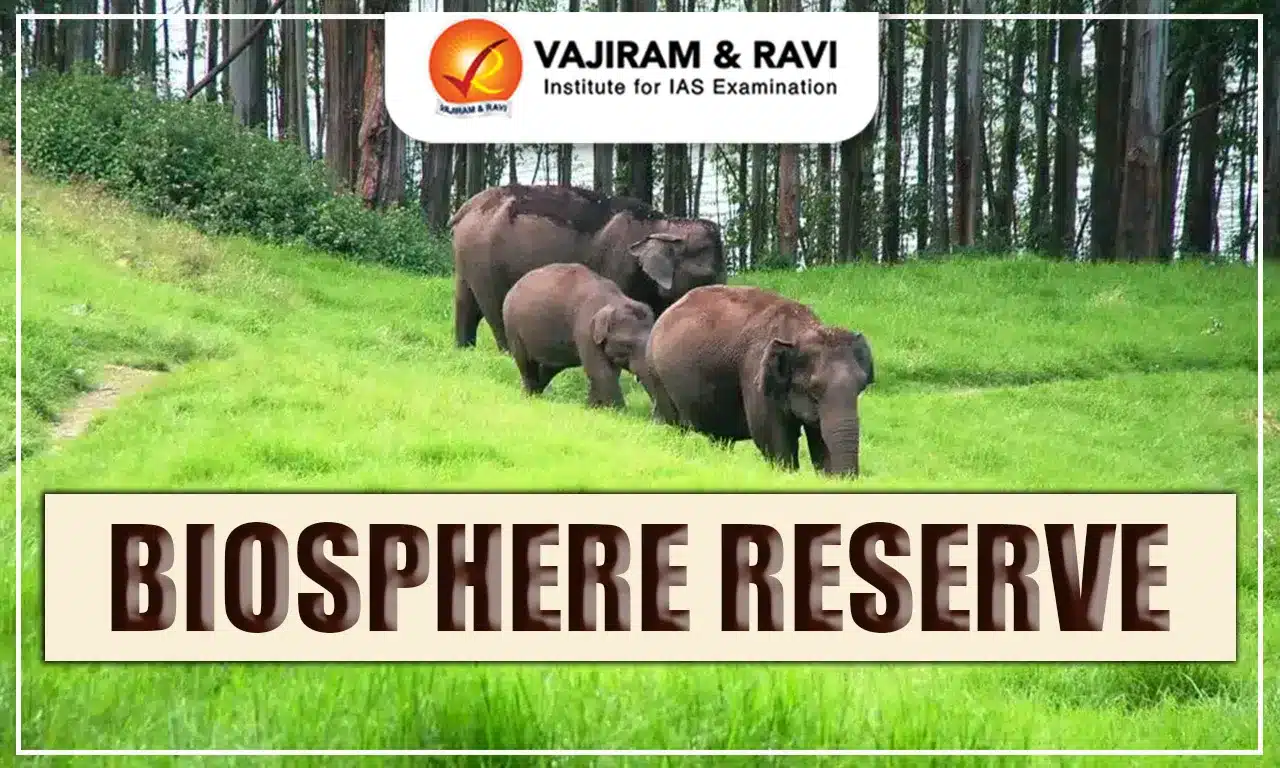
Biosphere Reserve in India

Biosphere Reserves in India 2026 are designated by UNESCO (United Nations Educational, Scientific and Cultural Organization) to protect representative parts of natural and cultural landscapes. These areas may cover large terrestrial, coastal, or marine ecosystems, or a combination of both. It protects and maintains the diversity of flora, fauna, and ecosystems and promotes economic and social development that aligns with ecological conservation. Biosphere Reserves serve as living examples of coexistence between humans and nature, demonstrating how development and conservation can progress together while respecting each other’s needs.

What are Biosphere Reserves?

Biosphere Reserves are declared by countries and recognized under UNESCO’s Man and the Biosphere (MAB) Programme. Their main goal is to promote sustainable development through local community involvement and scientific management.

  • These reserves encompass terrestrial, marine, and coastal ecosystems, conserving all forms of life in situ along with their support systems. They also act as reference sites for monitoring and evaluating ecological changes over time.
  • Part of UNESCO’s Man and Biosphere (MAB) framework since 1971, Biosphere Reserves are nominated by national governments. There are over 500 reserves across more than 100 countries, highlighting their importance in preserving ecosystems while supporting human development.
  • The Biosphere Reserves programme was initiated by UNESCO in 1971, with the first reserve established in 1979. Since then, the network has grown to 686 reserves across 122 countries, including 20 transboundary sites.
  • Biosphere Reserves are nominated by national governments and remain under the sovereign jurisdiction of the countries where they are located. Despite this, their status is internationally recognized, highlighting their global importance in biodiversity conservation and sustainable development.

Biosphere Reserves Structure

Biosphere Reserves are structured into three interconnected zones, each designed to balance conservation with sustainable use. These zones work together to protect biodiversity while supporting research, education, and local livelihoods.

Biosphere Reserve Structure
Zone Description Purpose/ Function

Core Area

Strictly protected ecosystem.

Conserves landscapes, ecosystems, species, and genetic variation.

Buffer Zone

Surrounds or adjoins the core area.

Supports ecological practices, scientific research, monitoring, training, and education.

Transition Area

Outermost zone with human settlements and activities.

Encourages sustainable economic and human development, blending ecological and socio-cultural needs.

Biosphere Reserves Declaration Criteria 2026

The core area of the Biosphere Reserves should represent a typical bio-geographical unit and be large enough to sustain viable populations across all trophic levels.

  • It must include an effectively protected and minimally disturbed core zone with significant value for nature conservation.
  • The site should have potential for preserving traditional tribal or rural lifestyles that reflect harmonious use of the environment.
  • The management authority must involve and cooperate with local communities to integrate biodiversity conservation with socio-economic development.
  • Efforts should focus on managing and containing conflicts while using community knowledge and experience for sustainable outcomes.

How Many Biosphere Reserves in India 2026?

There are currently 18 Biosphere Reserves in India as of 2026. Among these, 13 Reserves are officially recognized by UNESCO under MAB (Man and the Biosphere) Programme. According to the 2025 report of FAO, India ranks 9th globally in terms of Forest Area cover and 3rd globally in terms of annual gain through forests. Several Government initiatives promote the management and functioning of the Biosphere Reserves in India, such as- Project Tiger, Project Elephant, Green India Mission, etc.

List of 18 Biosphere Reserves of India with States 2026

India is home to a rich natural heritage, with ecosystems, to preserve this biodiversity and promote sustainable development, the country has established 18 Biosphere Reserves.  Below is the complete List of Biosphere Reserves in India 2026, along with their year of establishment, states covered, and key species protected.

List of 18 Biosphere Reserves in India State Wise 2026
S No Year Biosphere Reserves State(s) Key Species Area (km²)
1

1986

Nilgiri

Tamil Nadu, Karnataka, Kerala

Nilgiri Tahr, Tiger

5,520

2

1988

Nanda Devi

Uttarakhand

Snow Leopard, Musk Deer

5,860

3

1988

Nokrek

Meghalaya

Red Panda, Hoolock Gibbon

820

4

1989

Gulf of Mannar

Tamil Nadu

Dugong, Olive Ridley Turtle

10,500

5

1989

Sundarbans

West Bengal

Royal Bengal Tiger

9,630

6

1989

Manas

Assam

Asiatic Elephant, Golden Langur

2,837

7

1989

Great Nicobar

Andaman & Nicobar

Saltwater Crocodile, Nicobar Megapode

885

8

1994

Simlipal

Odisha

Gaur, Tiger, Elephant

4,374

9

1998

Dihang-Dibang

Arunachal Pradesh

Takin, Red Panda

5,112

10

1997

Dibru-Saikhowa

Assam

Gangetic Dolphin, Bengal Tiger

765

11

1999

Pachmarhi

Madhya Pradesh

Indian Giant Squirrel

4,981

12

2000

Khangchendzonga

Sikkim

Red Panda, Snow Leopard

2,620

13

2001

Agasthyamalai

Kerala, Tamil Nadu

Nilgiri Tahr, Elephant

3,500

14

2005

Achanakmar-Amarkantak

Madhya Pradesh, Chhattisgarh

Wild Dog, Sarus Crane

3,835

15

2008

Great Rann of Kutch

Gujarat

Indian Wild Ass

12,454

16

2009

Cold Desert

Himachal Pradesh

Snow Leopard

7,770

17

2010

Seshachalam Hills

Andhra Pradesh

Slender Loris

4,755

18

2011

Panna

Madhya Pradesh

Bengal Tiger, Chinkara

2,998

UNESCO Biosphere Reserves in India 2026

There are a total 13 Biosphere Reserves in India Recognized by UNESCO under MAB.  These include: Achanakmar-Amarkantak, Pachmarhi, Agasthyamala, Gulf of Mannar, Khangchendzonga, Nokrek, Cold Desert, Great Nicobar, Nilgiri, Panna, Similipal, Nanda Devi and Sunderban. These UNESCO Biosphere Reserves have been discussed in detail below:

1. Achanakmar-Amarkantak Biosphere Reserve

The Achanakmar-Amarkantak Biosphere Reserve is a biodiversity rich UNESCO Biosphere Reserve spread across Madhya Pradesh and Chhattisgarh with diverse forests and wildlife.

  • Location: The biosphere reserve covers about 3,83,551 hectares at the junction of major hill ranges in Madhya Pradesh and Chhattisgarh. Its landscape includes mountains, valleys, plains and dense forests, creating diverse natural habitats.
  • UNESCO Recognition: The reserve was included in the UNESCO World Network of Biosphere Reserves in 2012.
  • Biodiversity: About 63% of the reserve is covered by moist deciduous forests. It supports nearly 1,498 plant species and 327 animal species, including the four horned antelope, Indian wild dog, sarus crane, Asian white backed vulture and several rare and threatened species.
  • Ecological and Human Importance: The reserve has varied rocks and fertile soils that support forests, rivers and wildlife. Around 418 villages with tribal and non tribal communities depend on agriculture, medicinal plants, bamboo handicrafts and other non timber forest products for their livelihoods.

2. Pachmarhi Biosphere Reserve

Pachmarhi Biosphere Reserve is a UNESCO recognised protected area in central India, known for its rich forests, wildlife, unique landscapes and ecological importance.

  • Location: Pachmarhi Biosphere Reserve is located in Madhya Pradesh within the Satpura Range of the Deccan Peninsula. It covers about 4,981.72 sq km and includes Bori Sanctuary, Satpura National Park and Pachmarhi Sanctuary, together forming the Satpura Tiger Reserve.
  • UNESCO Recognition: It was recognised by UNESCO in 2009. The reserve is internationally recognised under UNESCO's World Network of Biosphere Reserves for conserving biodiversity while promoting sustainable development.
  • Biodiversity and Ecosystems: Tropical moist deciduous, tropical dry deciduous and subtropical hill forests dominate the reserve. Teak and sal are the major tree species. It also contains over 150 medicinal plant species, 50 mammal species, 254 bird species, 30 reptile species and 50 butterfly species.
  • Important Ecological and Cultural Features: The reserve includes valleys, waterfalls, marshes, streams and the Pachmarhi Plateau, often called the "Queen of Satpura." It provides habitat for gaur, tiger, leopard, giant squirrel and crested serpent eagle, while also preserving ancient rock paintings and supporting traditional tribal communities.

3. Agasthyamala Biosphere Reserve

Agasthyamala Biosphere Reserve is a UNESCO recognised biodiversity hotspot in the southern Western Ghats, known for its rich forests and endemic species.

  • Location: Agasthyamala Biosphere Reserve is located at the southern end of the Western Ghats across Kerala and Tamil Nadu. It covers about 3,500 sq. km., extends through Thiruvananthapuram, Kollam, Tirunelveli and Kanniyakumari and includes Agasthyamala Peak (1,868 m).
  • UNESCO Recognition: The reserve was recognised as a UNESCO Biosphere Reserve in 2016 for its exceptional biodiversity and conservation value. 
  • Other Protected Areas: It includes Shendurney, Peppara, Neyyar Wildlife Sanctuaries and the Kalakad Mundanthurai Tiger Reserve, strengthening ecosystem protection.
  • Biodiversity: The reserve supports 2,254 higher plant species (about 405 are endemic). It is home to mammals, birds, reptiles, amphibians and fish, and plant species including cardamom, pepper, nutmeg, jamun and plantain.
  • Communities and Cultural Significance: The Kani tribal community depends on forest resources for its livelihood while following traditional conservation practices.

4. Gulf of Mannar Biosphere Reserve

Gulf of Mannar is one of India's richest marine biodiversity regions, known for coral reefs, seagrass beds, mangroves and rare marine species.

  • Location: The Gulf of Mannar lies between the south-eastern coast of Tamil Nadu and Sri Lanka in the Indian Ocean. It covers about 10.5 lakh hectares and includes 21 islands, making it an important marine ecosystem and coastal conservation region.
  • UNESCO Recognition: The Gulf of Mannar Biosphere Reserve was recognised under UNESCO's Man and the Biosphere (MAB) Programme in 2001. It is India's first marine biosphere reserve and promotes biodiversity conservation, sustainable resource use and community participation.
  • Rich Marine Biodiversity: The Gulf supports over 4,200 species of plants and animals. Its coral reefs, seagrass beds and mangrove forests provide habitat for dugong (Dugong dugon), sea turtles, ornamental fishes, crustaceans, molluscs, echinoderms and the rare Balanoglossus living fossil.
  • Ecological and Cultural Importance: Seagrass beds act as breeding and feeding grounds for marine life, while coral reefs protect the coastline and support fisheries. The region also includes Rameswaram on Pamban Island, an important pilgrimage centre, making the Gulf significant for both ecology and cultural heritage.

5. Khangchendzonga Biosphere Reserve

Khangchendzonga Biosphere Reserve is a UNESCO recognised Himalayan biosphere reserve in Sikkim, known for its rich biodiversity, glaciers, alpine ecosystems and rare wildlife.

  • Location: Located in northern and western Sikkim along the borders of Nepal and Tibet (China), the biosphere reserve covers about 2,93,112 hectares.
  • UNESCO Recognition: Khangchendzonga Biosphere Reserve was included in the UNESCO World Network of Biosphere Reserves in 2018. It lies within one of the world's 34 global biodiversity hotspots and plays an important role in conserving the Himalayan ecosystem.
  • Biodiversity and Ecological Features: The reserve contains glaciers, alpine meadows, forests, deep valleys, rocky landscapes and important lakes spread across seven watersheds. 
  • Cultural and Conservation Importance: The biosphere reserve has great religious significance, with many sacred mountains, lakes, caves, hot springs and pilgrimage sites. Around 44 villages are located in the transition zone, where people mainly depend on agriculture, horticulture, animal husbandry and limited tourism for their livelihood.

6. Nokrek Biosphere Reserve

Nokrek Biosphere Reserve is a UNESCO Biosphere Reserve in Meghalaya, known for its rich biodiversity, evergreen forests, rare wildlife and unique wild citrus species.

  • Location: Nokrek Biosphere Reserve is located on the Tura Range of the Meghalaya Plateau in north-eastern India. It covers about 82,000 hectares and includes Nokrek Peak (1,412 m), the highest point in the Garo Hills. Major rivers such as the Simsang, Ganol and Dareng originate here.
  • UNESCO Recognition: Nokrek Biosphere Reserve was included in the UNESCO World Network of Biosphere Reserves in 2009.
  • Rich Biodiversity: Nearly 90% of the reserve is covered by evergreen forests. It is famous for the rare Indian wild orange (Citrus indica). Important plant species include cotton tree, hairy sterculia and golden shower tree. Wildlife includes tiger, leopard, Asian elephant, hoolock gibbon, slow loris, giant flying squirrel and pig tailed macaque.
  • Conservation Importance: The reserve protects important river catchments, supports groundwater recharge and helps maintain ecological balance in the Garo Hills. Sustainable livelihood programmes, including beekeeping, horticulture and freshwater pond development, are being promoted to reduce shifting cultivation and conserve biodiversity.

7. Cold Desert Biosphere Reserve

Cold Desert Biosphere Reserve is a high altitude UNESCO Biosphere Reserve in the Trans Himalayan region of Himachal Pradesh, known for its unique cold desert ecosystem and rich biodiversity.

  • Location: The Cold Desert Biosphere Reserve is located in the Lahaul and Spiti district of Himachal Pradesh. Spread over about 7.77 lakh hectares, it lies at elevations between 3,300 and 6,600 metres and includes Pin Valley National Park, Kibber Wildlife Sanctuary and Chandratal Wildlife Sanctuary.
  • UNESCO Status: India nominated the Cold Desert Biosphere Reserve to the UNESCO World Network of Biosphere Reserves in 2025. It represents one of the world's highest cold desert ecosystems.
  • Biodiversity: Important flora include Himalayan birch, willow leaved sea buckthorn and Persian juniper, while key wildlife includes the snow leopard, Himalayan ibex, blue sheep, Himalayan wolf, Himalayan snowcock and golden eagle.
  • People and Conservation Significance: Local communities mainly practice agro pastoralism, yak and goat rearing and cultivate barley and peas. Traditional Sowa Rigpa medicine, Buddhist culture and community based management help conserve the fragile alpine ecosystem while supporting sustainable livelihoods.

8. Great Nicobar Biosphere Reserve

Great Nicobar Biosphere Reserve is a biodiversity rich protected area in the southernmost Nicobar Islands, known for tropical forests, endemic wildlife and UNESCO recognition.

  • Location: Great Nicobar Biosphere Reserve is located on Great Nicobar Island, the southernmost island of the Nicobar archipelago in the Andaman and Nicobar Islands. It covers about 104,400 hectares with Mount Thullier (642 m) as its highest peak.
  • UNESCO Recognition: The reserve was included in the UNESCO World Network of Biosphere Reserves in 2013. 
  • Flora and Fauna: The reserve supports around 650 plant species, including rare Cyathea albosetacea (tree fern) and Phalaenopsis speciosa (orchid). It also records over 1,800 animal species, including the dugong, Nicobar megapode, saltwater crocodile, marine turtles, crab eating macaque and Nicobar tree shrew, many of which are endemic or threatened.
  • Indigenous Communities and Conservation: The reserve is home to the Shompen and Nicobarese communities. The Shompen mainly depend on forests for hunting and gathering, while the Nicobarese and other settlers rely on fishing, agriculture and horticulture, making conservation and sustainable resource use important for the region.

9. Nilgiri Biosphere Reserve

Nilgiri Biosphere Reserve is India's first biosphere reserve, located in the Western Ghats and known for its exceptional biodiversity, endemic species and diverse forest ecosystems.

  • Location: The Nilgiri Biosphere Reserve is spread across Tamil Nadu, Kerala and Karnataka in the Western Ghats. It includes hills, valleys, grasslands and forests.
  • UNESCO Status: India nominated the Nilgiri Biosphere Reserve under UNESCO's Man and the Biosphere (MAB) Programme in 2000.
  • Biodiversity: The reserve contains evergreen, semi evergreen, moist deciduous, dry deciduous, thorn forests, montane shola forests and grasslands.
  • Flora and Fauna: The reserve protects endangered wildlife such as the Bengal tiger, Asian elephant, lion tailed macaque, Nilgiri tahr, gaur, sambar, chital and barking deer. Notable endemic plants include Rhododendron arboreum, Michelia nilagirica, Garcinia gummi gutta and Actinodaphne malabarica, making it a globally important conservation landscape.

10. Panna Biosphere Reserve

Panna Biosphere Reserve in Madhya Pradesh protects forests, wetlands, rivers and endangered wildlife, including the Bengal tiger population.

  • Location: Located in the Central Highlands of Madhya Pradesh, the reserve covers about 2,99,898 hectares. It includes Panna National Park, parts of Gangau Sanctuary and surrounding reserved and protected forests, forming an important ecological landscape of north-central India.
  • UNESCO status: Panna Biosphere Reserve was nominated to UNESCO’s World Network of Biosphere Reserves in 2020. 
  • flora and fauna: The reserve supports dry deciduous forests, seasonal vegetation, aquatic habitats and marshy ecosystems. Important animals include the Bengal tiger, caracal, jungle cat and bird species including the Indian paradise flycatcher along the Ken River.
  • Conservation and human importance: Panna National Park is also a Tiger Reserve and contains a notified Critical Tiger Habitat. Nearly 300 villages depend on forest resources, while agriculture, ecotourism, medicinal plants and cultural tourism support sustainable development in the region.

11. Similipal Biosphere Reserve

Similipal Biosphere Reserve is a UNESCO recognised protected area in Odisha, known for rich biodiversity, dense sal forests, wildlife conservation and tribal heritage.

  • Location: Similipal Biosphere Reserve is located in the Mayurbhanj district of Odisha within the Mahanadian East Coastal and Chhotanagpur biogeographical regions. It has volcanic sedimentary rock formations, the Khairiburu peak (1,168 m) and many waterfalls and rivers, including the Budhabalang, Baitarani and Subarnarekha.
  • UNESCO Biosphere Reserve Status: Similipal was included in the UNESCO World Network of Biosphere Reserves in 2009. 
  • Flora and Fauna: The reserve contains India's largest sal (Shorea robusta) forest and supports plant species including orchid and medicinal plants. It is home to Bengal tigers, Asiatic elephants and several endangered plants and animals.
  • Tribal and Cultural Importance: Indigenous communities such as the Erenga Kharias, Mankirdias, Ho, Munda and Gonda maintain traditional livelihoods.

12. Nanda Devi Biosphere Reserve

Nanda Devi Biosphere Reserve is a UNESCO recognised Himalayan biosphere reserve in Uttarakhand, known for rich biodiversity, alpine ecosystems, glaciers and rare wildlife.

  • Location: Nanda Devi Biosphere Reserve is located in Uttarakhand in the western Himalayas. It includes the Nanda Devi National Park and Valley of Flowers National Park as its core protected areas. The reserve lies between the Zanskar and Great Himalaya mountain ranges.
  • UNESCO Recognition: The reserve was designated as a UNESCO Biosphere Reserve in 2004. Its core areas are also part of the UNESCO World Heritage Site in India.
  • Biodiversity: The reserve consists of diverse habitats such as alpine meadows (bugyals), forests, glaciers and snowfields. It supports Rhododendron campanulatum, Rhododendron anthopogon and Salix denticulata, with many native and endemic Himalayan species.
  • Important Wildlife and Communities: The reserve provides habitat to endangered animals such as the snow leopard, Himalayan black bear, brown bear, musk deer and bharal (blue sheep). Local communities, including the Bhotia people, depend on agriculture, medicinal plants, sheep rearing and ecotourism for their livelihoods.

13. Sunderban Biosphere Reserve

The Sunderban Biosphere Reserve is the world's largest mangrove ecosystem and an important biodiversity hotspot located in the Ganga Delta.

  • Location: The Sunderban Biosphere Reserve is situated in the Ganga Delta of West Bengal, bordering Bangladesh. It is bounded by the Muriganga River in the west and the Harinbhanga and Raimangal rivers in the east. 
  • UNESCO Status: It was designated as a UNESCO Biosphere Reserve in 2001. The core area of the reserve is the Sunderban National Park, which is also a UNESCO World Heritage Site.
  • Biodiversity: The reserve contains mangrove plant species and several animal species. It is the largest continuous habitat of the Royal Bengal Tiger and also supports saltwater crocodiles, hawk eagles, etc.
  • Significance: The Sunderban acts as a natural fish nursery, supports fisheries, protects coastal areas and helps maintain ecological balance. Local communities depend on forest products such as honey, wax, timber and fuelwood, while conservation programmes promote sustainable livelihoods.

Biosphere Reserves in India Not Recognized by UNESCO 2026

There are total 18 Biosphere Reserves in India out of which 13 have been recognized under MAB while remaining 5 Biosphere Reserves include:

1. Dihang-Dibang Biosphere Reserve

Established in 1998, Dihang-Dibang Biosphere Reserve protects one of the richest biodiversity zones of the Eastern Himalayas in Arunachal Pradesh.

  • Location: Situated across Dibang Valley, Upper Siang and West Siang districts of Arunachal Pradesh, it lies in the Eastern Himalayas and Mishmi Hills, named after the Dihang (Siang) and Dibang rivers, with elevations exceeding 5,000 metres.
  • Flora: Vegetation changes continuously from subtropical evergreen forests to temperate forests, conifer forests, alpine meadows and mountain tundra, supporting orchids, rhododendrons, oak, maple, fir, spruce, juniper, bamboo, medicinal plants, mosses and lichens.
  • Fauna: It shelters rare species including Red Panda, Mishmi Takin, Musk Deer, Red Goral, Gongshan Muntjac, Tiger, Clouded Leopard, Snow Leopard and Asiatic Black Bear, besides important birds such as Sclater's Monal and Blyth's Tragopan.
  • Key Features: The reserve includes Mouling National Park and Dibang Wildlife Sanctuary, forms a major ecological corridor of the Eastern Himalayas, protects Brahmaputra watershed systems and has recorded discoveries such as the Mechuka Giant Flying Squirrel.

2. Dibru-Saikhowa Biosphere Reserve

Located in Assam, Dibru-Saikhowa Biosphere Reserve protects floodplain forests, wetlands and river islands shaped by the Brahmaputra river system.

  • Location: Situated in Assam, the reserve is influenced by the Dibru and Brahmaputra rivers and experiences a tropical monsoon climate, creating extensive wetlands and floodplain ecosystems.
  • Flora: Major vegetation includes semi evergreen forests, tropical moist deciduous forests, swamp forests, bamboo, cane brakes and grasslands, with notable plants such as Rauvolfia (Sarpagandhi), Benteak and Livistona orchids.
  • Fauna: It provides habitat for endangered species including the White winged Wood Duck, Hoolock Gibbon and Wild Buffalo, besides supporting rich wetland birds and aquatic wildlife.
  • Key Features: The reserve contains Dibru-Saikhowa National Park, which was first declared a Wildlife Sanctuary in 1986 and is recognised for conserving Assam's riverine floodplain biodiversity.

3. Great Rann of Kutch Biosphere Reserve

The Great Rann of Kutch preserves India's vast seasonal salt desert and supports unique desert wildlife and traditional communities.

  • Location: Located in Gujarat, it is a vast seasonal salt marsh that was once connected to the Arabian Sea before geological changes transformed it into an inland salt desert.
  • Flora: Sparse shrub vegetation, saline grasslands and scattered wetland patches appear after the monsoon, supporting plant communities adapted to highly saline and dry conditions.
  • Fauna: The nearby Little Rann of Kutch Wild Ass Sanctuary, covering about 4,953 sq km, protects the world's last wild population of the Indian Wild Ass (Khur) along with Blackbuck, Chinkara and Nilgai.
  • Key Features: During the monsoon the marsh fills with water, while summer leaves a white salt crust. Wetlands attract Pink Flamingoes and surrounding villages are renowned for Kutchi embroidery, Rogan painting, pottery and leather crafts.

4. Seshachalam Hills Biosphere Reserve

Declared in September 2010, Seshachalam Hills became Andhra Pradesh's first Biosphere Reserve, conserving Eastern Ghats biodiversity and endemic Red Sanders forests.

  • Location: Spread across Chittoor and Kadapa districts of Andhra Pradesh, the reserve covers about 4,756 sq km within the Eastern Ghats, with rugged hills, deep valleys and elevations reaching nearly 1,000 metres.
  • Flora: Dominated by Tropical Southern Dry Mixed Deciduous forests, it is globally famous for the endangered Red Sanders (Pterocarpus santalinus) and also supports moist deciduous patches, semi evergreen vegetation and medicinal plants.
  • Fauna: The reserve supports wildlife such as the Slender Loris, numerous reptiles, birds and several other forest species adapted to the dry hill ecosystem.
  • Key Features: It includes Sri Venkateswara National Park, the Tirumala Natural Arch, seasonal streams of the Pennar basin and the culturally important seven Tirumala hills, combining ecological and religious significance.

5. Manas Biosphere Reserve

Manas Biosphere Reserve is among India's finest grassland forest ecosystems and an internationally important conservation landscape along the India-Bhutan border.

  • Location: Located in Assam at the foothills of the Eastern Himalayas, it shares a transboundary landscape with Royal Manas National Park in Bhutan, while the Manas River, a Brahmaputra tributary, shapes its fertile floodplains.
  • Flora: The reserve contains semi evergreen forests, moist deciduous forests, swamp forests and alluvial grasslands, supporting diverse trees, shrubs, herbs, orchids, climbers and grasses.
  • Fauna: It supports nearly 60 mammal species, over 500 bird species and more than 40 reptile species, including the Bengal Tiger, Indian Elephant, One horned Rhinoceros, Wild Water Buffalo, Clouded Leopard, Golden Langur, Pygmy Hog, Hispid Hare and Bengal Florican.
  • Key Features: Declared a Wildlife Sanctuary (1950), included under Project Tiger (1973), designated a UNESCO World Heritage Site (1985), notified as a Biosphere Reserve (1989) and upgraded to a National Park (1990), it remains a vital transboundary conservation landscape.

Which is the 18th Biosphere Reserve of India 2026

In September 2025, Cold Desert Biosphere Reserve was added as the latest Biosphere Reserve. It is the 18th Biosphere Reserve in India located in Himachal Pradesh.

First Biosphere Reserve of India

The Nilgiri Biosphere Reserve, established in 1986, holds the distinction of being the First Biosphere Reserve in India. Spread across Tamil Nadu, Karnataka, and Kerala, it forms part of the Western Ghats, a global biodiversity hotspot. This reserve shelters a wide range of unique flora and fauna, including the endangered Nilgiri Tahr, the Lion-tailed Macaque, and the Malabar Giant Squirrel. Its diverse landscapes, from montane forests to grasslands, make it a vital ecological region, balancing conservation with the livelihood needs of local communities.

Smallest Biosphere Reserve in India 2026

Nokrek Biosphere Reserve in Meghalaya is known as the Smallest Biosphere Reserve in India covering only 820 km². The location provides shelter to Red Panda, Hoolock Gibbon and unique citrus plant species.

Biosphere Reserves under MAB Importance

  • Conservation of Biodiversity - Protects endangered species, rare plants, animals, and ecosystems.
  • Sustainable Development - Encourages eco-tourism, organic farming, and traditional practices supporting local communities.
  • Climate Change Mitigation - Forests and wetlands act as carbon sinks, reducing global warming.
  • Research and Education - Provides opportunities for scientific research, wildlife studies, and conservation awareness.
  • Cultural Preservation - Safeguards indigenous tribes, their traditions, and sustainable lifestyles.

Biosphere Reserves Challenges

  • Human Encroachment - Expansion of agriculture, grazing, and settlements disrupts natural habitats.
  • Deforestation & Poaching - Illegal logging, hunting, and wildlife trade reduce biodiversity.
  • Climate Change - Alters rainfall, temperature, and ecosystem balance, affecting species survival.
  • Lack of Funding - Limited financial support weakens conservation and monitoring programs.
  • Tourism Pressure - Unregulated tourism leads to waste generation and habitat degradation.
  • Conflict with Locals - Restrictions on resource use often clash with community livelihood needs.

Difference Between Biosphere Reserves and National Parks/ Wildlife Sanctuaries

To understand conservation in India better, it’s important to know Difference Between Biosphere Reserve and National Park & Wildlife Sanctuaries. Both aim at protecting biodiversity, but their objectives, legal backing, and approach vary.

Difference Between Biosphere Reserves and National Park & Wildlife Sanctuaries

National Park/ Wildlife Sanctuary

Biosphere Reserves

National Parks, Wildlife Sanctuaries, Conservation Reserves, Community Reserves and Tiger Reserves are established as per provisions of the Wildlife Protection Act 1972

There is no law as such under which these Reserves are established.

No grazing or private tenurial rights land rights are allowed in National Parks.

Biosphere reserves serve as ‘living laboratories’ for testing out and demonstrating integrated management of land, water and biodiversity. Thus, limited economic activity (sand and stone mining) is permitted

Wildlife sanctuaries and national parks are set up for the protection of mammals normally

They envisage protection of plant species, Invertebrates and biotic community as a whole


Also Check Other Posts
Biosphere Reserves in India National Parks in India
Waterfalls in India Highest Peak in India
Ramsar Sites in India Wildlife Sanctuaries in India
Dams in India Tiger Reserves in India
Mountain Passes in India Longest Bridge in India

Biosphere Reserves in India FAQs

Q1: What is the definition of Biosphere Reserve?

Ans: A biosphere reserve is a protected area conserving biodiversity, supporting sustainable development, and prompting research and education for environmental protection.

Q2: How many Biosphere Reserve are in India 2026?

Ans: India has 18 biosphere reserves, of which 13 are part of UNESCO’s World Network of Biosphere Reserves under MAB.

Q3: How any UNESCO Biosphere Reserves in India 2026?

Ans: As of 2026, there are total 13 UNESCO Biosphere Reserves in India out of total 18 officially recognized Biosphere Reserves in India

Q4: What is the difference between a national park and a biosphere reserve?

Ans: A national park protects specific wildlife, while a biosphere reserve conserves biodiversity, includes human settlements, and promotes sustainable use.

Q5: Which is the Largest Biosphere Reserve in India?

Ans: The Gulf of Mannar Biosphere Reserve in Tamil Nadu is the largest in India.

Bhavantar Bhugtan Yojana, Objectives, Features, Eligibility

Bhavantar Bhugtan Yojana

The Bhavantar Bhugtan Yojana is a farmer-focused scheme aimed at protecting farmers from losses when the market price of their crops falls below the Minimum Support Price (MSP). It provides financial support to cover part of the price difference, helping farmers maintain a more stable income. The scheme is mainly designed to reduce the impact of market price fluctuations and provide greater financial security to farmers. 

Bhavantar Bhugtan Yojana Objectives

Bhavantar Bhugtan Yojana Objectives focus on protecting farmers from price fluctuations by providing compensation when market prices fall below the assured level, thereby supporting farm incomes and reducing financial risks.

  • Protect farmers from price crashes: The Bhavantar Bhugtan Yojana aims to protect farmers when the market price of their produce falls below the government-fixed Minimum Support Price (MSP).
  • Provide price-deficit compensation: Instead of purchasing the crop directly, the government provides a deficiency payment to cover the eligible gap between the assured price and the price received by the farmer.
  • Reduce income losses: The scheme helps farmers manage price risk and market volatility, especially for crops whose market prices can fluctuate sharply during the harvest season.
  • Support farmers in Madhya Pradesh: Madhya Pradesh was the first state to introduce the Bhavantar Bhugtan Yojana on a pilot basis in 2017, initially covering eight commodities, including soybean, groundnut, sesame, maize, moong, urad, tur and ramtil.
  • Improve farmers’ access to markets: The scheme allows farmers to sell their produce in notified markets rather than depending only on government procurement for price support.

Bhavantar Bhugtan Yojana Features and Benefits

Bhavantar Bhugtan Yojana Features and Benefits highlight the scheme’s role in protecting farmers from price fluctuations, ensuring income support, and reducing the financial risks associated with falling market prices.

  • Price Deficiency Payment Scheme: The Bhavantar Bhugtan Yojana is based on compensating farmers for the difference between the applicable MSP or government-set price and the price actually received in the market.
  • No physical procurement: Unlike conventional procurement-based support, the government does not need to physically purchase, store, or transport the entire crop under the scheme.
  • Direct Benefit Transfer (DBT): Eligible compensation is transferred directly into the farmer’s bank account, making the payment process more transparent and reducing the possibility of leakages.
  • Protection from market volatility: The scheme provides a degree of income protection when market prices fall below the assured level, helping farmers cope with sudden price declines.
  • Greater freedom to sell: Farmers can sell their produce to buyers in government-notified mandis, giving them greater flexibility while retaining price protection under the scheme.
  • Lower government expenditure: Since the government does not have to procure and maintain physical stocks, the scheme can reduce the costs related to procurement, storage, and transportation.
  • Support for selected crops: The scheme has mainly focused on selected oilseeds, pulses, and other notified crops, with the exact coverage depending on the government’s notification.

How Does Bhavantar Bhugtan Yojana Work?

  • Farmer registration: Farmers first register themselves and provide details such as their crop and cultivated area within the prescribed period before selling their produce.
  • Sale through notified mandis: Registered farmers are required to sell their eligible produce through government-notified agricultural markets, where the actual selling price is recorded.
  • Calculation of market price: A Modal Price is determined using the average market price of the commodity across relevant markets. It acts as an indicator of the prevailing market price.
  • Comparison with MSP: The farmer’s actual selling price is compared with the applicable MSP and Modal Price to determine whether a price deficiency has occurred.
  • Payment of the eligible difference: If the selling price is below the applicable support level, the government provides a price-deficiency payment according to the scheme’s prescribed formula.
  • Payment ceiling: If the farmer sells the crop at a price lower than both the MSP and Modal Price, the compensation may be capped at the difference between the MSP and Modal Price.
  • Example: If the MSP is higher than the farmer’s selling price, but the selling price is above the Modal Price, the farmer can receive the difference between the MSP and actual selling price. Where the selling price falls below the Modal Price, the eligible payment is generally limited to the prescribed MSP-Modal Price difference.

Bhavantar Bhugtan Yojana Eligibility and Application Process

  • Eligible farmers: The scheme is intended for farmers growing notified crops covered under the particular implementation of the scheme. Crop coverage may vary according to government notifications.
  • Prior registration: Farmers need to register within the specified registration period and provide details of their crop and cultivated area to become eligible for the benefit.
  • Sale at notified mandis: To receive compensation, the registered farmer must sell the eligible produce through the specified government-notified mandi system, where the transaction can be verified.
  • Application through designated platforms: Registration can be carried out through designated government platforms such as the MP Mandi Board portal, MP Online, or Common Service Centres (CSCs), as prescribed by the authorities.
  • Bank account details: Farmers must provide valid bank account details so that the eligible deficiency payment can be transferred through DBT.
  • Verification and payment: After registration and sale, the relevant crop and transaction details are verified. The eligible price-deficiency amount is then transferred directly to the farmer’s bank account.
  • Important condition: Registration alone does not guarantee payment. Farmers must meet the scheme’s crop, registration, market-sale, and other prescribed conditions applicable during the relevant season.

Bhavantar Bhugtan Yojana FAQs

Q1: What is Bhavantar Bhugtan Yojana?

Ans: The Bhavantar Bhugtan Yojana is a price-deficiency payment scheme that provides financial support to farmers when the market price of eligible crops falls below the applicable MSP.

Q2: What is the main objective of Bhavantar Bhugtan Yojana?

Ans: The main objective is to protect farmers from price fluctuations and market losses by providing compensation for the eligible difference between the assured price and the market price.

Q3: When was Bhavantar Bhugtan Yojana launched?

Ans: The Bhavantar Bhugtan Yojana was first introduced by Madhya Pradesh in 2017 on a pilot basis for selected agricultural commodities.

Q4: Does Bhavantar Bhugtan Yojana involve physical procurement?

Ans: No. Under the scheme, the government generally does not physically procure, store, or transport the entire crop. Instead, eligible farmers receive a price-deficiency payment.

Q5: How does Bhavantar Bhugtan Yojana work?

Ans: Farmers register their crops, sell the eligible produce through notified mandis, and the actual selling price is compared with the applicable MSP and Modal Price to calculate the eligible compensation.

Grass Mache Technique, Meaning, Process, Advantages, Applications

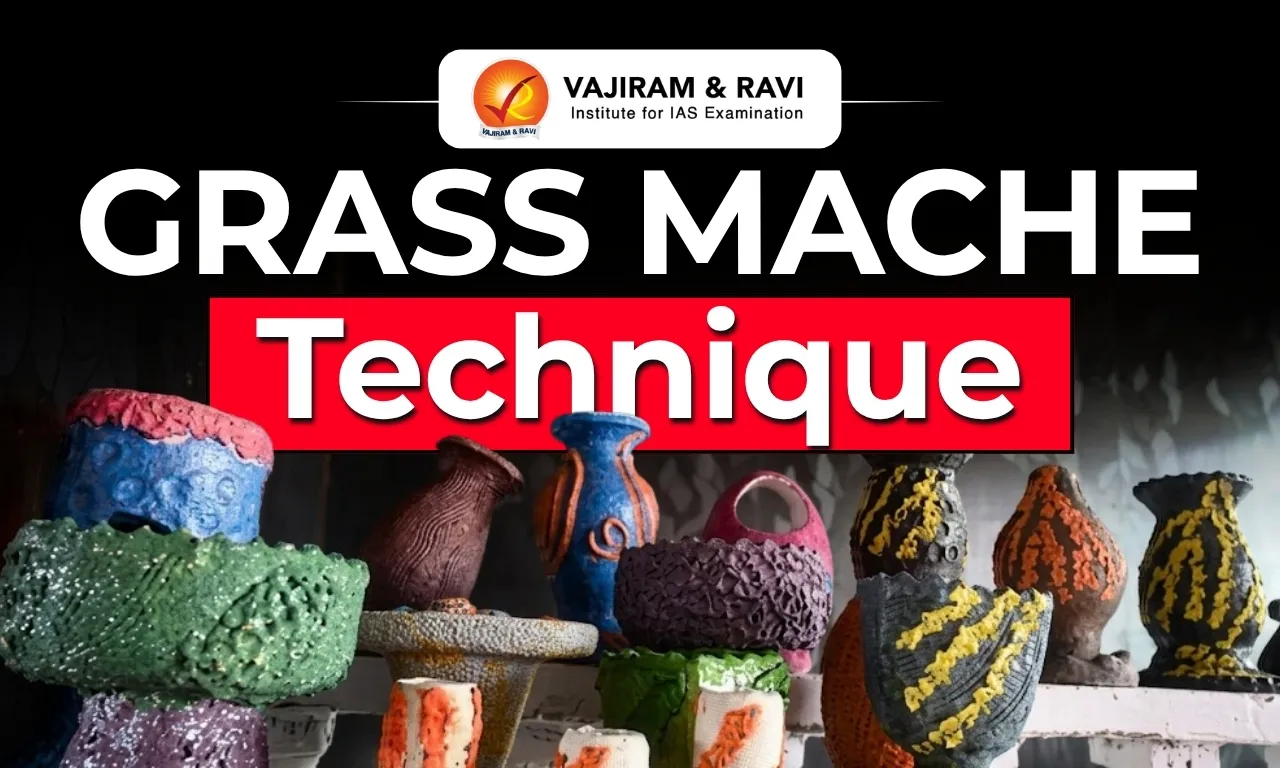
Grass Mache Technique

Grass Mache Technique is an innovative and eco-friendly craft approach that gives a useful purpose to discarded plant-based materials. It combines traditional craftsmanship with sustainable practices, turning natural waste into creative and functional products while supporting resource conservation and local livelihoods

What is Grass Mache Technique?

  • Innovative Craft Technique: Grass Mache is an eco-friendly craft technique developed by Srinagar-based artisans such as Simran Irshad, using discarded aquatic weeds and grasses removed from Dal Lake as raw material.
  • Link with Papier-Mâché: It adapts Kashmir’s centuries-old papier-mâché tradition (Sakhtsazi) by using lake weeds and grasses along with recycled paper pulp to create decorative and utility products.
  • Waste-to-Wealth Approach: The technique gives a productive use to unwanted aquatic vegetation while creating opportunities for sustainable craftsmanship and local livelihoods.

Grass Mache Technique Meaning and Process

  • Collection of Weeds: Artisans collect discarded weeds and grasses removed during the cleaning of Dal Lake and other water bodies.
  • Drying and Pulping: The collected plant material is dried and processed into a fine fibrous pulp suitable for further use.
  • Blending: The grass pulp is mixed with a binding material and a smaller portion of recycled paper pulp to provide strength and structure.
  • Moulding and Drying: The mixture is shaped using different moulds and then left to dry, after which it develops a distinctive natural, stone-like texture.
  • Finishing: The dried products are smoothed and can be hand-painted using traditional Naqashi techniques, connecting the new method with Kashmiri papier-mâché craftsmanship.
  • Experimentation: Developing the technique involved nearly two years of experimentation with different grasses, fibres, recycled paper pulp and binding materials to find suitable combinations.

Advantages of Grass Mache Technique

  • Environmental Sustainability: It gives discarded lake vegetation a productive second life, supporting waste reduction and creating greater awareness about keeping Dal Lake and other water bodies clean.
  • Supports Traditional Crafts: The technique gives a contemporary and eco-friendly application to Kashmir’s traditional papier-mâché skills, helping keep traditional knowledge relevant.
  • Reduces Use of Fresh Materials: Using aquatic weeds and recycled paper can reduce dependence on fresh plant and wood-based materials in craft production.
  • Economic Benefits: Locally available lake weeds provide an abundant raw material for artisans and can help reduce dependence on more expensive paper-based materials.
  • Women-Led Livelihoods: Grass Mache creates opportunities for women and girls to learn the craft, participate in sustainable handicrafts and develop livelihood opportunities.
  • Circular Use of Resources: The technique follows a waste-to-wealth and circular economy approach by converting unwanted lake biomass into useful and marketable products.

Applications of Grass Mache Technique in Agriculture

  • Eco-Friendly Craft Products: The technique is used to make flower vases, hanging decorations, Christmas ornaments and other home décor products from discarded aquatic vegetation.
  • Utility Products: Artisans are also experimenting with fireproof switchboards and panelling for homes using waste collected from Dal Lake.
  • Agricultural Waste Utilisation: The technique demonstrates how plant-based biological waste and unwanted vegetation can be converted into useful products instead of being treated only as waste.
  • Sustainable Livelihoods: It connects the productive use of plant biomass with local entrepreneurship and women-led employment opportunities, while also supporting environmental conservation.
  • Resource Recycling: By combining lake weeds with recycled paper pulp, Grass Mache shows how locally available biological resources can be reused for sustainable production.

Grass Mache Technique FAQs

Q1: What is the Grass Mache Technique?

Ans: The Grass Mache Technique is an eco-friendly craft method that uses discarded aquatic weeds and grasses to create useful and decorative products.

Q2: Who developed the Grass Mache Technique?

Ans: The technique was developed by Srinagar-based artisan Simran Irshad, who experimented with different grasses, fibres, recycled paper pulp and binding materials.

Q3: How is the Grass Mache Technique made?

Ans: The process involves collecting, drying and processing aquatic weeds into pulp, mixing them with recycled paper pulp and a binding material, followed by moulding, drying and Naqashi finishing.

Q4: What is the connection between Grass Mache and papier-mâché?

Ans: Grass Mache adapts Kashmir’s traditional papier-mâché craft, known as Sakhtsazi, by replacing a major part of conventional raw material with aquatic weeds and grasses.

Q5: What are the advantages of the Grass Mache Technique?

Ans: It promotes waste reduction, resource conservation, circular economy practices and sustainable livelihoods while also supporting traditional Kashmiri craftsmanship.

UPSC Daily Quiz 15 September 2026

UPSC Daily Quiz

[WpProQuiz 254]

UPSC Daily Quiz FAQs

Q1: What is the Daily UPSC Quiz?

Ans: The Daily UPSC Quiz is a set of practice questions based on current affairs, static subjects, and PYQs that help aspirants enhance retention and test conceptual clarity regularly.

Q2: How is the Daily Quiz useful for UPSC preparation?

Ans: Daily quizzes support learning, help in revision, improve time management, and boost accuracy for both UPSC Prelims and Mains through consistent practice.

Q3: Are the quiz questions based on the UPSC syllabus?

Ans: Yes, all questions are aligned with the UPSC Syllabus 2025, covering key areas like Polity, Economy, Environment, History, Geography, and Current Affairs.

Q4: Are solutions and explanations provided with the quiz?

Ans: Yes, each quiz includes detailed explanations and source references to enhance conceptual understanding and enable self-assessment.

Q5: Is the Daily UPSC Quiz suitable for both Prelims and Mains?

Ans: Primarily focused on Prelims (MCQ format), but it also indirectly helps in Mains by strengthening subject knowledge and factual clarity.

Wildlife Sanctuaries of India 2026, List, Map, Top 10 Largest & Smallest

Wildlife Sanctuaries of India

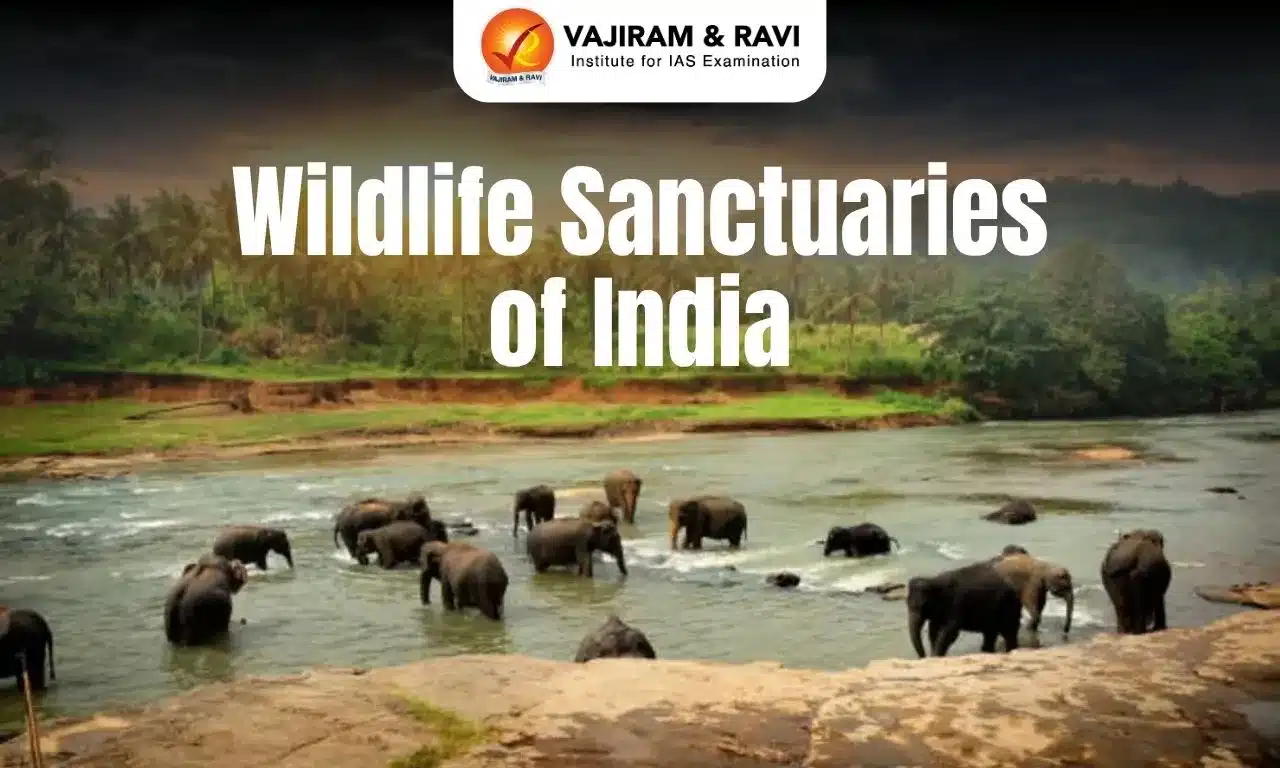
Wildlife Sanctuaries of India 2026 are special places where animals can live safely without human interference. These protected areas are designed to keep the natural habitats of animals safe, where activities like hunting, poaching, and trapping are strictly forbidden. India is home to a wide variety of these protected spaces, from lush forests and dense jungles to riverbanks and majestic mountains. Each sanctuary reflects the country’s commitment to preserving its incredible wildlife and diverse landscapes.

Wildlife Sanctuaries in India 2026

Wildlife Sanctuaries in India is a specially protected area dedicated to the preservation of both flora and fauna. These sanctuaries are established as natural habitats where tourism is typically restricted, focusing on undisturbed conservation. The inception of these protected zones began with the Wildlife Protection Act of 1947, with further reinforcements introduced through the Wildlife (Protection) Act of 1972, which empowered state governments to officially designate ecologically significant regions as sanctuaries.

Wildlife Sanctuaries in India Establishment

The legal framework for the establishment and management of the Wildlife Sanctuaries of India has been discussed below:

  • Wildlife Sanctuaries are notified by State Governments under the Wildlife (Protection) Act 1972 to conserve wild animals, habitats, and biodiversity.
  • Constitutional backing is provided through Article 48A and Article 51A(g), making wildlife protection a State duty and citizen responsibility.
  • Entry, hunting, exploitation of wildlife, forest produce removal, and setting fires are strictly regulated or prohibited.
  • Certain traditional rights of local communities may continue, and relocation is not compulsory.
  • Sanctuaries are managed by State Forest Departments under the Chief Wildlife Warden.
  • Eco-Sensitive Zones may be declared around sanctuaries to control developmental activities.
  • Violations attract penalties including imprisonment and fines, with stricter punishment for offences involving endangered species.

How many Wildlife Sanctuaries are there in India 2026?

As of 2026, India hosts approximately 573 wildlife sanctuaries that collectively cover a vast area of conservation. Among these, some are designated as tiger reserves, primarily serving as safe place for Bengal tigers. Classified under IUCN Category IV, these sanctuaries aim to safeguard ecosystems with high ecological, geomorphologic, and natural significance, reinforcing India's commitment to wildlife preservation.

Total Wildlife Sanctuaries in India 2026 List

The following table provides an updated List of Wildlife Sanctuaries of India, specifying their respective states and union territories along with the area they cover.

Total Wildlife Sanctuaries of India State Wise 2026

S.No.

State & UT

State Area (km²)

No. of Wildlife Sanctuary

Area (km²)

% of State Area

1.

Andhra Pradesh

160229

13

6771.40

4.23

2.

Arunachal Pradesh

83743

13

7614.56

9.09

3.

Assam

78438

17

1728.95

2.20

4.

Bihar

94163

12

2851.67

3.03

5.

Chhattisgarh

135191

11

3760.28

2.78

6.

Goa

3702

6

647.91

17.50

7.

Gujarat

196022

23

16618.42

8.48

8.

Haryana

44212

7

118.21

0.27

9.

Himachal Pradesh

55673

28

6115.97

10.99

10.

Jharkhand

79714

11

1955.82

2.45

11.

Karnataka

191791

38

8216.69

4.28

12.

Kerala

38863

18

2156.21

5.55

13.

Madhya Pradesh

308245

24

7046.19

2.29

14.

Maharashtra

307713

49

7861.70

2.55

15.

Manipur

22327

7

708.14

3.17

16.

Meghalaya

22429

4

94.11

0.42

17.

Mizoram

21081

9

1359.75

6.45

18.

Nagaland

16579

4

43.91

0.26

19.

Odisha

155707

19

7094.65

4.56

20.

Punjab

50362

13

326.60

0.65

21.

Rajasthan

342239

25

5592.38

1.63

22.

Sikkim

7096

7

399.10

5.62

23.

Tamil Nadu

130058

33

7096.54

5.46

24.

Telangana

114840

9

5672.70

4.94

25.

Tripura

10486

4

603.64

5.76

26.

Uttar Pradesh

240928

26

5822.20

2.42

27.

Uttarakhand

53483

7

2690.12

5.03

28.

West Bengal

88752

16

1440.18

1.62

29.

Andaman & Nicobar

8249

97

395.60

4.80

30.

Chandigarh

114

2

26.01

22.82

31.

Dadra & Nagar Haveli

491

1

92.17

18.77

32.

Daman & Diu

112

1

2.19

1.96

33.

Delhi

1483

1

19.61

1.32

34.

Jammu & Kashmir

163090

14

1815.04

1.11

35.

Ladakh

59146

2

9000.00

15.22

36.

Lakshadweep

32

1

0.01

0.03

37.

Puducherry

480

1

3.90

0.81


TOTAL

3287263

573

123762.56

3.76

Wildlife Sanctuaries in India Map

The Wildlife Sanctuaries of India Map highlights the locations of over 570 Wildlife Sanctuaries across India including deserts and wetlands to forests and mangroves. Major clusters are visible in states like Andhra Pradesh, Assam, Gujarat, Kerala, and Madhya Pradesh, as well as the Andaman & Nicobar Islands.

Top 10 Largest Wildlife Sanctuaries in India 2026

The Top 10 Wildlife Sanctuaries in India 2026 cover vast and diverse ecosystems, ranging from arid deserts to dense forests and mangrove wetlands. These sanctuaries play a crucial role in conserving endangered species, maintaining ecological balance, and protecting India’s rich biodiversity. The Kutch Desert Wildlife Sanctuary is considered as the Largest Wildlife Sanctuary in India as of 2026.

Top 10 Wildlife Sanctuaries in India 2026
Rank Wildlife Sanctuary Area (km²) Location
1 Kutch Desert Wildlife Sanctuary 7,506.22 Gujarat
2 Indian Wild Ass Sanctuary 4,954 Gujarat
3 Desert National Park 3,162 Rajasthan
4 Great Indian Bustard Sanctuary 1,222 Maharashtra
5 Achanakmar Wildlife Sanctuary 914.02 Chhattisgarh
6 Manas Wildlife Sanctuary 950 Assam
7 Koyna Wildlife Sanctuary 423.55 Maharashtra
8 Bhadra Wildlife Sanctuary 492.46 Karnataka
9 Nagarjunsagar–Srisailam Wildlife Sanctuary 3,568 Andhra Pradesh
10 Sundarbans Wildlife Sanctuary 362.4 West Bengal

Top 10 Smallest Wildlife Sanctuaries in India 2026

The Top 10 Smallest Wildlife Sanctuaries in India occupy limited geographical areas but play a vital role in protecting region-specific flora and fauna. Despite their small size, they significantly contribute to biodiversity conservation, bird protection, and local ecological balance. The Mayureshwar Wildlife Sanctuary is considered as the Smallest Wildlife Sanctuary in India as of 2026.

Top 10 Smallest Wildlife Sanctuaries in India 2026
Rank Wildlife Sanctuary Area (km²) Location
1 Mayureshwar Wildlife Sanctuary 5.14 Maharashtra
2 Bor Wildlife Sanctuary 61.1 Maharashtra
3 Chilika Wildlife Sanctuary 15.53 Odisha
4 Bondla Wildlife Sanctuary 7.98 Goa
5 Mahavir Swami Wildlife Sanctuary 5.4 Uttar Pradesh
6 Kinnerasani Wildlife Sanctuary 635.4 Telangana
7 Pobitora Wildlife Sanctuary 38.8 Assam
8 Kutch Bustard Sanctuary 2 Gujarat
9 Nangal Wildlife Sanctuary 3 Punjab
10 Thol Wildlife Sanctuary 7 Gujarat

List of Wildlife Sanctuaries of India 2026 State Wise

Below is the List of major famous Wildlife Sanctuaries in India according to the states:

Wildlife Sanctuaries of India State Wise List 2026

S No.

States

Wildlife Sanctuaries

1.

Assam

Nambor Wildlife Sanctuary

Dihing Patkai Wildlife Sanctuary

East Karbi Anglong Wildlife Sanctuary

Chakrashila Wildlife Sanctuary

Amchang Wildlife Sanctuary

2.

Bihar

Kaimur Wildlife Sanctuary

Gautam Budha Wildlife Sanctuary

Pant (Rajgir) Wildlife Sanctuary

Valmiki Wildlife Sanctuary

3.

Chhatisgarh

Bhairamgarh Wildlife Sanctuary

Badalkhol Wildlife Sanctuary

Bhoramdev Wildlife Sanctuary

Udanti Wild Buffalo Wildlife Sanctuary

4.

Goa

Bondla Wildlife Sanctuary

Madei Wildlife Sanctuary

5.

Gujarat

Kutch Desert Wildlife Sanctuary

Porbandar Lake Wildlife Sanctuary

Jambugodha Wildlife Sanctuary

Wild Ass Wildlife Sanctuary

Ratanmahal Wildlife Sanctuary

Thol Lake Wildlife Sanctuary

Sasan Gir Sanctuary

Mitiyala Wildlife Sanctuary

6.

Haryana

Bhindawas Wildlife Sanctuary

N Khaparwas Wildlife Sanctuary

Kalesar Wildlife Sanctuary

7.

Himachal Pradesh

Bandli Wildlife Sanctuary

Daranghati Wildlife Sanctuary

Dhauladhar Wildlife Sanctuary

Talra Wildlife Sanctuary

Pong Dam Lake Wildlife Sanctuary

Nargu Wildlife Sanctuary

9.

Jharkhand

Lawalong Wildlife Sanctuary

Parasnath Wildlife Sanctuary

Palkot Wildlife Sanctuary

10.

Karnataka

Someshwara Wildlife Sanctuary

Bhadra Wildlife Sanctuary

Bhimgad Wildlife Sanctuary

Brahmagiri Wildlife Sanctuary

Cauvery Wildlife Sanctuary

Pushpagiri Wildlife Sanctuary

Sharavathi Valley Wildlife Sanctuary

11.

Kerala

Periyar Wildlife Sanctuary

Chinnar Wildlife Sanctuary

Aralam Wildlife Sanctuary

Chimmony Wildlife Sanctuary

Idukki Wildlife Sanctuary

Malabar Wildlife Sanctuary

12.

Madhya Pradesh

Bori Wildlife Sanctuary

Gandhi Sagar Wildlife Sanctuary

Ken Gharial Wildlife Sanctuary

National Chambal Wildlife Sanctuary

Orcha Wildlife Sanctuary

13.

Maharashtra

Koyana Wildlife Sanctuary

Painganga Wildlife Sanctuary

Bhimashankar Wildlife Sanctuary

Tungareshwar Wildlife Sanctuary

Great Indian Bustard Wildlife Sanctuary

14.

Manipur

Yangoupokpi-Lokchao Wildlife Sanctuary

15.

Meghalaya

16.

Mizoram

Dampa Wildlife Sanctuary (TR)

Ngengpui Wildlife Sanctuary

Baghmara Pitcher Plant Wildlife Sanctuary

17.

Nagaland

Fakim Wildlife Sanctuary

Rangapahar Wildlife Sanctuary

18.

Odisha

Baisipalli Wildlife Sanctuary

Chilika (Nalaban) Wildlife Sanctuary

Hadgarh Wildlife Sanctuary

Satkosia Gorge Wildlife Sanctuary

19.

Punjab

Abohar Wildlife Sanctuary

Harike Lake Wildlife Sanctuary

Jhajjar Bacholi Wildlife Sanctuary

20.

Rajasthan

Keoladeo Bird Sanctuary

Jawahar Sagar Wildlife Sanctuary

Mount Abu Wildlife Sanctuary

Ramsagar Wildlife Sanctuary

Shergarh Wildlife Sanctuary

21.

Sikkim

Fambong Lho Wildlife Sanctuary

Kitam Wildlife Sanctuary (Bird)

Maenam Wildlife Sanctuary

22.

Tamil Nadu

Indira Gandhi (Annamalai) Wildlife Sanctuary

Karaivetti Wildlife Sanctuary

Pulicat Lake Wildlife Sanctuary

Vedanthangal Wildlife Sanctuary

Kalakad Wildlife Sanctuary

23.

Tripura

Gumti Wildlife Sanctuary

Rowa Wildlife Sanctuary

Trishna Wildlife Sanctuary

24.

Uttarakhand

Askot Musk Deer Wildlife Sanctuary

Binsar Wildlife Sanctuary

Govind Pashu Vihar Wildlife Sanctuary

Kedarnath Wildlife Sanctuary

Sonanadi Wildlife Sanctuary

25.

Uttar Pradesh

Hastinapur Wildlife Sanctuary

Ranipur Wildlife Sanctuary

Sohagibarwa Wildlife Sanctuary

Sur Sarovar Wildlife Sanctuary

Chandraprabha Wildlife Sanctuary

National Chambal Wildlife Sanctuary

26.

West Bengal

Sunderbans Wildlife Sanctuary

Chintamani Kar Bird Sanctuary

Haliday Island Wildlife Sanctuary

Ballavpur Wildlife Sanctuary

Lothian Island Wildlife Sanctuary

Mahananda Wildlife Sanctuary

List of Wildlife Sanctuaries in India UT Wise List 2026

Below is the List of important Wildlife Sanctuaries in India according to the Union Territory.

Wildlife Sanctuaries of India Union Territory List 2026

S No.

UTs

Wildlife Sanctuary

1.

Andaman and Nicobar Islands

Bamboo Island Wildlife Sanctuary

Barren Island Wildlife Sanctuary

Chanel Island Wildlife Sanctuary

Peacock Island Wildlife Sanctuary

Turtle Islands Wildlife Sanctuary

2.

Jammu & Kashmir

Gulmarg Wildlife Sanctuary

Limber Wildlife Sanctuary

Nandini Wildlife Sanctuary

3.

Lakshadweep

Pitti Wildlife Sanctuary (Bird)

4.

Dadra Nagar Haveli and Daman and Diu

Dadra & Nagar Haveli Wildlife Sanctuary

Fudam Wildlife Sanctuary

Wildlife Sanctuary in India Importance

Wildlife Sanctuaries of India serve as indispensable sanctuaries not only for animals but also for entire ecosystems. Acting as protected areas, these sanctuaries shield endangered species, natural landscapes, and even indigenous cultures from external threats. As vital resources for both nature and humanity, their conservation is crucial.

Protecting Endangered Species

Relocating endangered species is both costly and challenging, which is why preserving them in their natural habitat is essential. Sanctuaries enable these species to survive in an environment free from the risks of poaching and habitat destruction. Here, under the careful watch of sanctuary staff, species can breed, adapt, and grow their populations naturally. For researchers and biologists, sanctuaries provide a unique opportunity to study animal behaviors in a natural setting without disrupting their way of life.

Safeguarding Landscapes and Ecosystems

With urban expansion on the rise, natural forests are increasingly under threat. Wildlife Sanctuaries in India combat this trend by protecting forested areas and allowing natural landscapes to flourish. From dense forests to serene rivers, valleys, and waterfalls, these protected zones maintain essential features of our environment. 

Preserving Indigenous Cultures

For many indigenous tribes, sanctuaries represent both home and heritage. Certain tribes, such as Odisha’s Saara Adivasis, have coexisted with nature for centuries, sustaining forest ecosystems through traditional practices. Sanctuaries not only protect the biodiversity within them but also help preserve these communities' cultures and ways of life. Free from the pressures of urban development, these tribes can continue their customs, which, in turn, support forest conservation.

Conserving Biodiversity

Human activity has posed significant threats to global biodiversity. Sanctuaries offer a haven where ecosystems can exist without interference. Often described as in-situ conservation, sanctuaries maintain the natural balance, supporting ecosystems in their original configuration, thereby aiding species diversity and ecological health.

Promoting Ecotourism

Ecotourism has grown as more people seek meaningful travel experiences that support environmental conservation. Wildlife Sanctuaries in India provide a setting where people can observe animals in their natural, cage-free surroundings, often with their young, unhindered by the limitations of captivity. The revenue generated from ecotourism supports conservation efforts and aids in sanctuary development, creating a cycle where tourism funds the very habitats tourists come to appreciate.

Also Check Other Posts
Biosphere Reserves in India National Parks in India
Waterfalls in India Highest Peak in India
Ramsar Sites in India Wildlife Sanctuaries in India
Dams in India Tiger Reserves in India
Mountain Passes in India Longest Bridge in India


Wildlife Sanctuaries in India FAQs

Q1: How many wildlife sanctuaries are there in India as of 2026?

Ans: There are 573 existing wildlife sanctuaries in India covering an area of 123,762.56 km2, which is 3.76% of the geographical area of the country (National Wildlife Database Centre, Nov. 2023).

Q2: Which is the 1st wildlife sanctuary in India?

Ans: The first wildlife sanctuary established in India is Manas National Park, also known as Manas Wildlife Sanctuary.

Q3: Which is the largest wildlife sanctuary of India?

Ans: As of 2026, Kutch Desert Wildlife Sanctuary is the Largest Wildlife Sanctuary in the World.

Q4: Which is the famous wildlife sanctuary in India?

Ans: Corbett National Park, located in Uttarakhand, is widely regarded as the oldest wildlife sanctuary in India, established in 1936. It's famous for its Bengal tiger population and was named after Jim Corbett.

Q5: Which is the largest wildlife sanctuary in the world?

Ans: Northeast Greenland National Park is the largest terrestrial protected area in the world, encompassing a massive 972,000 sq.km. (375,000 sq mi) in eastern Greenland.

Hyderabad Liberation Day 2026, History, Significance and Operation Polo

Hyderabad Liberation Day

Hyderabad Liberation Day is in the news after the Telangana BJP demanded that 17 September be included in state textbooks. The demand has renewed attention to the significance of Hyderabad’s integration into the Indian Union in 1948.

What is Hyderabad Liberation Day?

Hyderabad Liberation Day is observed on 17 September every year to commemorate the integration of the erstwhile princely state of Hyderabad into the Indian Union in 1948. The day marks the end of the Nizam’s rule following Operation Polo, which began on 13 September 1948.

On 17 September 1948, the Hyderabad State Forces surrendered to the Indian Army, bringing the military operation to an end and paving the way for Hyderabad’s integration into the Indian Union. It marked an important step in the political integration of India after Independence.

Hyderabad Before Liberation

At the time of Independence, Hyderabad was the largest princely state in British India, ruled by Mir Osman Ali Khan, the seventh Nizam.

When British paramountcy ended in 1947, the Nizam did not accede to India and instead sought to maintain Hyderabad’s separate status. To avoid an immediate break in relations, India and Hyderabad signed a Standstill Agreement on 29 November 1947, which was intended to maintain existing administrative arrangements while negotiations continued.

The agreement, however, did not resolve the question of Hyderabad’s political status. Over the following months, relations between Hyderabad and the Indian government deteriorated, while political tensions and violence increased within the state.

The situation became more complicated with the activities of the Razakars, an armed organisation associated with the Majlis-e-Ittehadul Muslimeen and led by Qasim Razvi. The Razakars opposed Hyderabad’s integration with India.

At the same time, the Telangana peasant struggle, which had begun in 1946, challenged the feudal order under the Nizam. With political conflict and internal unrest intensifying, a negotiated settlement became increasingly difficult, eventually leading to Operation Polo in September 1948.

Operation Polo

As negotiations failed to resolve the Hyderabad question, the Government of India launched Operation Polo on 13 September 1948. It was a military operation to bring Hyderabad into the Indian Union, with Major General J.N. Chaudhuri leading the Indian forces.

The operation lasted for five days. On 17 September 1948, Major General Syed Ahmed El Edroos, who commanded the Hyderabad State Forces, surrendered to the Indian Army. The Nizam subsequently announced a ceasefire, bringing the operation to an end.

The surrender ended the Nizam’s rule as an independent princely authority and paved the way for the integration of Hyderabad into the Indian Union.

Hyderabad After Integration

Following its integration into the Indian Union in 1948, Hyderabad continued as a separate state. A major change came with the States Reorganisation Act, 1956, which reorganised states largely on linguistic lines.

The Telugu-speaking Telangana region of Hyderabad State was merged with Andhra State to form Andhra Pradesh. The Marathi-speaking and Kannada-speaking areas of the former Hyderabad State were merged with Bombay State and Mysore State respectively.

However, concerns over development, employment, education, public spending and the implementation of safeguards promised to Telangana contributed to a separate-state movement. The demand gained political momentum over several decades and eventually led to the creation of Telangana as a separate state on 2 June 2014.

Hyderabad Liberation Day and the Textbook Debate

The recent demand to include Hyderabad Liberation Day in Telangana textbooks has renewed discussion about how the events of 1948 should be presented to future generations.

The debate concerns not only the commemoration of 17 September, but also how the integration of Hyderabad, Operation Polo and the violence surrounding the episode should be represented in historical narratives.

Hyderabad Liberation Day FAQs

Q1: When is Hyderabad Liberation Day observed?

Ans: Hyderabad Liberation Day is observed on 17 September every year to commemorate the integration of the erstwhile princely state of Hyderabad into the Indian Union in 1948 following Operation Polo.

Q2: Why is Hyderabad Liberation Day celebrated on 17 September?

Ans: 17 September marks the day in 1948 when the Hyderabad State Forces surrendered to the Indian Army, bringing Operation Polo to an end and paving the way for Hyderabad’s integration into the Indian Union.

Q3: What was the Standstill Agreement signed between India and Hyderabad?

Ans: The Standstill Agreement was signed on 29 November 1947 to temporarily maintain existing administrative arrangements between India and Hyderabad while negotiations over Hyderabad’s political status continued.

Q4: What is the significance of Hyderabad Liberation Day?

Ans: Hyderabad Liberation Day marks the end of the Nizam’s rule and the integration of Hyderabad into the Indian Union following Operation Polo in 1948.

Q5: What was Operation Polo?

Ans: Operation Polo was the military operation launched by the Government of India on 13 September 1948 to bring Hyderabad into the Indian Union. It ended on 17 September 1948 with the surrender of the Hyderabad State Forces.

List of National Parks in India 2026, State-Wise, 107 Names

National Parks in India

National Parks in India 2026 are government-protected areas established to conserve wildlife, natural habitats, and ecological diversity. As of 2026, India currently has 107 National Parks and 573 Wildlife Sanctuaries. These protected areas serve as important centers for biodiversity conservation and wildlife protection. Madhya Pradesh and the Andaman & Nicobar Islands have the highest number of National Parks in India, with nine parks each.

National Parks in India 2026

National Parks in India play a vital role in protecting wildlife and their natural habitats. These areas have strict rules that ban hunting, poaching, industrial activities, and farming to keep the environment undisturbed. With secure boundaries, no outside activities are allowed near or within these parks. The main purpose of National Parks in India is to conserve India’s diverse wildlife. Below is a List of National Parks in India 2026, which is useful for competitive exams and general knowledge.

What is a National Park?

A National Park is a protected area established by the government under the Wildlife Protection Act 1972 to conserve wildlife, flora, and natural ecosystems. These parks aim to safeguard biodiversity and provide a secure habitat for endangered species. Human activities like hunting, poaching, and commercial use of resources are strictly prohibited within their boundaries. National Parks also promote eco-tourism, environmental education, and scientific research to maintain ecological balance and awareness.

List of National Parks in India 2026 State Wise

India proudly hosts around 107 national parks, each dedicated to preserving its remarkable biodiversity and distinctive landscapes. Here’s a List of National Parks in India 2026 State wise with Declaration/ Establishment Year and Famous Animals:

List of National Parks in India 2026 State wise

State/Union Territory

Total National Parks

National Parks Name

Declaration/ Establishment Year

Famous Animal

Andaman & Nicobar Islands

9

Campbell Bay National Park

1992

Nicobar Megapode, Giant Robber Crab

Galathea Bay National Park

1992

Giant Leatherback Turtle

Mahatama Gandhi Marine (Wandoor) National Park

1982

Dugong

Middle Button Island National Park

1987

Dugong

Mount Harriett National Park

1987

Andaman wild pig

North Button Island National Park

1987

Dugong, Dolphins

Rani Jhansi Marine National Park

1996

Dugong

Saddle Peak National Park

1987

Andaman wild pig, water monitor lizard, Andaman hill myna, Andaman imperial pigeon

South Button Island National Park

1987

Dugongs, sea turtles, blue whales, dolphins

Andhra Pradesh

3

Papikonda National Park

2008

Bengal Tiger

Rajiv Gandhi (Rameswaram) National Park

2005

Spotted deer (chital), Black-naped hare

Sri Venkateswara National Park

1989

Sloth Bear, Slender Loris, Indian Golden Gecko, Red Sanders 

Arunachal Pradesh

2

Mouling National Park

1986

Red Panda, Himalayan Takin

Namdapha National Park

1983

Namdapha Flying Squirrel, Hoolock Gibbon, Red Panda

Assam

8

Dibru-Saikhowa National Park

1999

White-winged Wood Duck, feral horses, Gangetic River Dolphin

Kaziranga National Park

1974

Great Indian One-Horned Rhinoceros

Manas National Park

1990

Bengal Tiger, Pygmy Hog

Nameri National Park

1998

Royal Bengal Tiger, Asian Elephant, White-winged Wood Duck

Rajiv Gandhi Orang National Park

1999

Great Indian One-Horned Rhinoceros, Royal Bengal Tiger, Wild Water Buffalo, Asian Elephant

Dehing Patkai National Park

2021

Royal Bengal Tiger, Indian Leopard, Hoolock Gibbon, White-Winged Wood Duck, Grey Peacock-Pheasant

Raimona National Park

2021

Gee's Golden Langur

Sikhna Jwhwlao National Park

2025

Gee's Golden Langur

Bihar

1

Valmiki National Park

1989

Royal Bengal Tiger

Chhattisgarh

3

Guru Ghasidas (Sanjay) National Park

1981

Royal Bengal Tiger

Indravati (Kutru) National Park

1982

Wild Water Buffalo

Kanger Valley National Park

1982

Bastar Hill Myna

Goa

1

Mollem National Park

1992

Bengal Tiger, Gaur

Gujarat

4

Vansda National Park

1979

Indian Leopard, Four-horned Antelope (Chausinga), Indian Giant Squirrel,

Blackbuck (Velavadar) National Park

1976

Indian blackbuck

Gir National Park

1975

Asiatic Lion

Marine (Gulf of Kachchh) National Park

1982

Dugong

Haryana

2

Kalesar National Park

2003

Indian Leopard

Sultanpur National Park

1989

Siberian Crane, Greater Flamingo, Bar-headed Goose

Himachal Pradesh

5

Great Himalayan National Park

1984

Snow Leopard

Inderkilla National Park

2010

Snow Leopard

Khirganga National Park

2010

Snow Leopard

Pin Valley National Park

1987

Snow Leopard

Simbalbara National Park

2010

Goral, Sambhar, Chittal

Jammu and Kashmir

4

City Forest (Salim Ali) National Park

1992

Hangul

Dachigam National Park

1981

Hangul

Kishtwar National Park

1981

Snow Leopard

Jharkhand

1

Betla National Park

1986

Bison, Elephant, Tiger, Leopard, and Axis-axis (Spotted Deer

Karnataka

5

Anshi National Park

1987

Black Panther

Bandipur National Park

1974

Bengal Tiger, Asian Elephant

Bannerghatta National Park

1974

Asian Elephant

Kudremukh National Park

1987

Lion-tailed Macaque

Nagarhole National Park

1988

Bengal tigers

Kerala

6

Anamudi Shola National Park

2003

Nilgiri Tahr, Asian Elephant

Eravikulam National Park

1978

Nilgiri Tahr

Mathikettan Shola National Park

2003

Asian Elephant

Pambadum Shola National Park

2003

Nilgiri marten

Periyar National Park

1982

Asian Elephant, Bengal Tiger 

Silent Valley National Park

1984

Lion-tailed Macaque

Madhya Pradesh

9

Bandhavgarh National Park

1968

Royal Bengal Tiger

Fossil National Park

1983

prehistoric plant and mollusk fossils

Pench National Park

1975

Royal Bengal Tiger

Kanha National Park

1955

Hard Ground Barasingha, Royal Bengal Tiger

Madhav National Park

1959

Royal Bengal Tiger

Panna National Park

1981

Royal Bengal Tiger

Sanjay National Park

1981

Royal Bengal Tiger

Satpura National Park

1981

Indian Giant Squirrel

Van Vihar National Park

1979

White tigers, Hard Ground Barasingha, Royal Bengal Tiger

Dinosaur Fossils National Park

2011

Sauropods, Abelisaurids, fossilized herbivorous dinosaur eggs

Kuno National Park

2018

Cheetah

Maharashtra

6

Chandoli National Park

2004

Bengal tiger

Gugamal National Park

1975

Bengal tiger

Nawegaon National Park

1975

Indian leopard, Bengal tiger 

Pench (Jawaharlal Nehru) National Park

1975

Bengal tiger 

Sanjay Gandhi (Borivali) National Park

1983

Leopard

Tadoba Andhari National Park

1955

Bengal tiger 

Manipur

1

Keibul-Lamjao National Park

1977

Sangai

Meghalaya

2

Balphakram National Park

1985

Asian elephant

Nokrek Ridge National Park

1986

Red Panda

Mizoram

2

Murlen National Park

1991

Hoolock Gibbon

Phawngpui Blue Mountain National Park

1992

Hoolock Gibbon

Nagaland

1

Intanki National Park

1993

Hoolock Gibbon

Odisha

2

Bhitarkanika National Park

1988

Saltwater Crocodile

Similipal National Park

2025

Royal Bengal Tiger, black tigers

Rajasthan

5

Mukundra Hills National Park

2006

Royal Bengal Tiger

Desert National Park

1992

Great Indian Bustard

Keoladeo Ghana National Park

1981

Siberian Crane

Ranthambhore National Park

1980

Royal Bengal Tiger

Sariska National Park

1992

Royal Bengal Tiger

Sikkim

1

Khangchendzonga National Park

1977

Snow Leopard

Tamil Nadu

5

Guindy National Park

1976

Blackbuck

Gulf of Mannar Marine National Park

1980

Dugong

Indira Gandhi (Annamalai) National Park

1989

Asian Elephant

Mudumalai National Park

1990

Bengal Tiger

Mukurthi National Park

1990

Nilgiri Tahr

Ladakh

1

Hemis National Park

1981

Snow Leopard

Telangana

3

Kasu Brahmananda Reddy National Park

1994

Indian Peafowl

Mahaveer Harina Vanasthali National Park

1994

Blackbuck

Mrugavani National Park

1994

Spotted Deer

Tripura

2

Clouded Leopard National Park

2007

Clouded Leopard

Bison (Rajbari) National Park

2007

Indian Gaur

Uttar Pradesh

1

Dudhwa National Park

1977

Swamp Deer (Barasingha)

Uttarakhand

6

Corbett National Park

1936

Royal Bengal Tiger

Gangotri National Park

1989

Snow Leopard

Govind National Park

1990

Snow Leopard

Nanda Devi National Park

1982

Snow Leopard, Bharal 

Rajaji National Park

1983

Asian Elephant

Valley of Flowers National Park

1982

Snow Leopard, Himalayan Musk Deer, Asiatic Black Bear

West Bengal

6

Buxa National Park

1992

Royal Bengal Tiger

Gorumara National Park

1992

Great Indian One-Horned Rhinoceros

Jaldapara National Park

2012

Great Indian One-Horned Rhinoceros

Neora Valley National Park

1986

Red Panda

Singalila National Park

1986

Red Panda

Sunderban National Park

1984

Royal Bengal Tiger

Total 107

How Many National Parks in India 2026?

With the addition of Sikhna Jwhwlao National Park and Similipal National Park in 2025, there are 107 Total National Parks in India as of 2026. 

National Parks in India 2026 Map

There are 107 National Parks in India as of 2026 covering around 44,403 km2 covering the diverse including the Himalayas to coastal regions. The First National Park in India is Jim Corbett National Park which was initially known as Hailey National Park established in 1936 in Uttarakhand where as South Button Island NP in the Andaman & Nicobar Islands, which is referred as the Smallest National Park in India about 5 km². 

National Park in India Features

  • Legal Protection: National Parks are legally protected; activities like hunting, grazing, and forestry are prohibited.
  • Wildlife Conservation: They serve as safe habitats for endangered and native species of animals and birds.
  • Ecological Balance: Helps in preserving ecosystems, biodiversity, and natural landscapes.
  • Public Access: Generally open to visitors for education and eco-tourism under strict rules.
  • Scientific Research: Provide opportunities for research, wildlife monitoring, and conservation studies.

Latest National Parks in India 2026

Similipal National Park is the Newest National Parks in India, established in 2025. The Top 3 Recently Added National Parks in India 2026 are:

Newest National Parks in India 2026
Rank National Parks  Location Year

1

Similipal National Park

Odisha

2025

2

Sikhna Jwhwlao National Park

Assam

2025

3

Dihing Patkai National Park

Assam

2021

4

Raimona National Park

Assam

2021

Oldest National Parks in India 2026

Corbett National Park, established in 1936, is the Oldest National Parks in India. Located in the Himalayas in Uttarakhand, it was initially named Hailey National Park. Renowned for its rich biodiversity, the park is especially famous for being the first area to come under the Project Tiger initiative in 1973. Jim Corbett Tiger Reserve is home to Bengal tigers, elephants, leopards, and hundreds of bird species, making it one of the most prominent wildlife sanctuaries in India.

Oldest National Parks in India 2026

S.No

National Parks in India

Location

Year

1

Corbett National Park

Uttrakhand

1936

2

Kanha National Park

Madhya Pradesh

1955

3

Tadoba National Park

Maharashtra

1955

Top 30 Largest National Parks in India 2026

Hemis National Park is the Largest National Parks in India in India by area. It is located in the eastern part of Ladakh (previously part of Jammu and Kashmir) in northern India and spans an area of approximately 4,400 square kilometers. Nestled in the trans-Himalayan region, this park is renowned for being the highest altitude national park in the country and serves as a vital sanctuary for the elusive snow leopard, along with other rare wildlife like the Tibetan wolf, red fox, and bharal (blue sheep).

Largest National Parks in India 2026

Rank

National Park

Location (State/UT)

Area (km²)

1

Hemis National Park

Ladakh

3,350

2

Desert National Park

Rajasthan

3,162

3

Gangotri National Park

Uttarakhand

2,390

4

Namdapha National Park

Arunachal Pradesh

1,808

5

Khangchendzonga National Park

Sikkim

1,784

6

Guru Ghasidas (Sanjay) National Park

Chhattisgarh

1,441

7

Sundarbans National Park

West Bengal

1,330

8

Indravati (Kutru) National Park

Chhattisgarh

1,258

9

Papikonda National Park

Andhra Pradesh

1,013

10

Kanha National Park

Madhya Pradesh

940

11

Bandipur National Park

Karnataka

874

12

Kaziranga National Park

Assam

859

13

Simlipal National Park

Odisha

846

14

Rajaji National Park

Uttarakhand

820

15

Great Himalayan National Park

Himachal Pradesh

754

16

Khirganga National Park

Himachal Pradesh

710

17

Pin Valley National Park

Himachal Pradesh

675

18

Nagarahole National Park

Karnataka

643

19

Nanda Devi National Park

Uttarakhand

625

20

Kudremukh National Park

Karnataka

600

21

Satpura National Park

Madhya Pradesh

585

22

Panna National Park

Madhya Pradesh

543

23

Corbett National Park

Uttarakhand

521

24

Manas National Park

Assam

500

25

Dudhwa National Park

Uttar Pradesh

490

26

Mouling National Park

Arunachal Pradesh

483

27

Govind National Park

Uttarakhand

472

28

Sanjay National Park

Madhya Pradesh

467

29

Bandhavgarh National Park

Madhya Pradesh

449

30

Campbell Bay National Park

Andaman & Nicobar Islands

426

Famous Top 10 National Parks in India 2026

India has 107 National Parks as of 2026, protecting diverse wildlife, natural habitats and ecosystems. Madhya Pradesh and Andaman & Nicobar Islands have the highest number of National Parks, with nine each. The famous Top 10 National Parks in India 2026 has been listed below:

1. Jim Corbett National Park

Established in 1936, Corbett National Park in Uttarakhand is the oldest National Park in India. Initially called Hailey National Park, it is famous for the Royal Bengal Tiger and rich biodiversity.

2. Kaziranga National Park

Established in 1974, Kaziranga National Park is located in Assam and is famous for the Great Indian One Horned Rhinoceros. It covers 859 km² and is among India’s largest National Parks.

3. Gir National Park

Gir National Park in Gujarat was established in 1975 and is famous for the Asiatic Lion. It is one of the important National Parks associated with the conservation of this distinctive wildlife species.

4. Kanha National Park

Established in 1955, Kanha National Park is located in Madhya Pradesh and covers 940 km². It is particularly known for the Hard Ground Barasingha and Royal Bengal Tiger.

5. Bandipur National Park

Bandipur National Park in Karnataka was established in 1974 and covers 874 km². It is known for the Bengal Tiger and Asian Elephant, making it an important wildlife conservation area.

6. Ranthambhore National Park

Ranthambhore National Park in Rajasthan was established in 1980. The park is prominently known for the Royal Bengal Tiger.

7. Sundarbans National Park

Sundarbans National Park in West Bengal was established in 1984 and covers 1,330 km². It is famous for the Royal Bengal Tiger and represents an important protected natural landscape.

8. Periyar National Park

Established in 1982, Periyar National Park is located in Kerala. It is known for the Asian Elephant and Bengal Tiger and forms an important protected area for wildlife and natural habitats.

9. Hemis National Park

Hemis National Park in Ladakh was established in 1981 and covers 3,350 km². It is the largest National Park and is famous for the Snow Leopard.

10. Dudhwa National Park

Dudhwa National Park in Uttar Pradesh was established in 1977. It is known for the Swamp Deer or Barasingha and is the only National Park listed for Uttar Pradesh.

Smallest National Parks in India 2026

South Button Island National Park is the Smallest National Parks in India covering an area of just 5 sq.km. It is located in the Andaman and Nicobar Islands, off the southeastern coast of the Indian mainland. Despite its small size, the park is rich in marine biodiversity, offering vibrant coral reefs, sea turtles, and exotic fish species. It forms part of the Rani Jhansi Marine National Park and is a popular site for scuba diving.

Smallest National Parks in India 2026

Rank

National Park

Location

Area (km^2)

1

South Button Island NP

Andaman and Nicobar Islands

0.03

2

Fossil National Park

Madhya Pradesh

0.3

4

North Button Island National Park

Andaman and Nicobar Islands

0.4

5

Middle Button Island National Park

Andaman and Nicobar Islands

0.9

7

Dinosaur Fossils National Park

Madhya Pradesh

1.4

8

Pambadum Shola National Park

Tamil Nadu

1.4

National Parks in India 2026 Facts

  • Hemis National Park (Jammu & Kashmir): The largest national park in India, famous for its snow leopard population.
  • South Button Island National Park (Andaman & Nicobar Islands): The smallest national park in India, known for its coral reefs and marine life.
  • Rann of Kutch (Gujarat): The largest wildlife sanctuary in India, home to the Indian wild ass and migratory birds.
  • Bor Tiger Reserve (Maharashtra): The smallest wildlife sanctuary in India, critical for tiger conservation.

Biodiversity Conservation in India 2026

India has established several constitutional, legal, and policy measures to protect its rich flora and fauna. These provisions aim to conserve biodiversity, protect endangered species, prevent illegal wildlife trade, and ensure sustainable management of natural resources.

Constitutional Provisions

  • Article 48A – Directs the State to protect and improve the environment and safeguard forests and wildlife.
  • Article 51A(g) – Makes it a Fundamental Duty of every citizen to protect and improve the natural environment, including forests, lakes, rivers, and wildlife.
  • Forests and Wildlife were transferred to the Concurrent List through the 42nd Constitutional Amendment Act, 1976, allowing both the Centre and States to make laws on these subjects.

Major Laws for Flora & Fauna Conservation

  • Wild Life (Protection) Act, 1972
    • Provides legal protection to wild animals, birds, and plants.
    • Regulates hunting and wildlife trade.
    • Establishes National Parks, Wildlife Sanctuaries, and Conservation Reserves.
    • Creates schedules for different levels of species protection.
  • Forest (Conservation) Act, 1980
    • Restricts the diversion of forest land for non-forest purposes without Central Government approval.
    • Helps prevent deforestation and habitat destruction.
  • Environment (Protection) Act, 1986
    • Provides a comprehensive framework for environmental protection.
    • Empowers the Central Government to take measures for protecting ecosystems and biodiversity.
  • Biological Diversity Act, 2002
    • Conserves biological diversity and promotes sustainable use of biological resources.
    • Ensures fair and equitable sharing of benefits arising from biological resources.
    • Established the National Biodiversity Authority (NBA).
  • Indian Forest Act, 1927
    • Regulates forest management and protection.
    • Controls forest produce and forest-related activities.

International Conventions Supported by India

  • Convention on Biological Diversity (CBD)
  • Convention on International Trade in Endangered Species of Wild Fauna and Flora (CITES)
  • Ramsar Convention
  • Convention on Migratory Species

Important Conservation Initiatives

  • Project Tiger (1973)
  • Project Elephant (1992)
  • Integrated Development of Wildlife Habitats
  • National Biodiversity Action Plan
  • Green India Mission

Importance of National Parks in India 2026

National Parks in India play a vital role in wildlife conservation, biodiversity protection, and the preservation of natural ecosystems. They help protect endangered species, maintain ecological balance, and ensure sustainable use of natural resources for future generations.

  • Conservation of Wildlife: National Parks provide a safe and protected habitat for various wildlife species, including endangered animals such as the Bengal Tiger, Asiatic Lion, and One-Horned Rhinoceros.
  • Protection of Biodiversity: These parks preserve a wide variety of flora and fauna, ensuring the survival of numerous plant, bird, reptile, and mammal species.
  • Maintenance of Ecological Balance: National Parks help maintain healthy ecosystems by protecting forests, grasslands, wetlands, and other natural habitats that support life.
  • Preservation of Natural Habitats: They prevent habitat destruction caused by deforestation, urbanization, and human encroachment, allowing wildlife to thrive in their natural environment.
  • Climate Change Mitigation: Forests within National Parks act as carbon sinks, absorbing carbon dioxide and helping reduce the effects of global warming and climate change.
  • Protection of Water Resources: Many National Parks safeguard rivers, lakes, wetlands, and watersheds, ensuring a continuous supply of clean water and supporting groundwater recharge.
  • Scientific Research and Conservation Studies: National Parks serve as important centers for wildlife research, ecological studies, and biodiversity monitoring, helping scientists understand environmental changes.
  • Promotion of Eco-Tourism: Parks attract millions of tourists every year, promoting sustainable tourism while creating awareness about wildlife conservation and environmental protection.
  • Environmental Education and Awareness: They provide opportunities for students, researchers, and visitors to learn about ecosystems, wildlife, and conservation practices.
  • Protection of Endangered Species: Several conservation programs are implemented within National Parks to protect species facing the risk of extinction and to increase their population.
  • Support for Ecosystem Services: National Parks contribute to essential ecosystem services such as pollination, soil conservation, water purification, and nutrient cycling.
  • Preservation of Genetic Diversity: They protect the genetic resources of plants and animals, which are important for future scientific research and species adaptation.
  • Control of Soil Erosion: Forest vegetation and natural landscapes in National Parks help prevent soil erosion and land degradation.
  • Boost to Local Economy: Eco-tourism and conservation-related activities generate employment opportunities for local communities, guides, forest staff, and tourism operators.
  • Protection of India's Natural Heritage: National Parks preserve India's unique wildlife and natural landscapes, ensuring that future generations can experience and benefit from this rich ecological heritage.
  • Support for National Conservation Programs: Many National Parks are part of initiatives such as Project Tiger and Project Elephant, which focus on protecting key wildlife species and their habitats.
  • Disaster Risk Reduction: Healthy ecosystems within National Parks help reduce the impact of floods, droughts, landslides, and other natural disasters by stabilizing the environment.
  • Contribution to Sustainable Development: National Parks support the goals of sustainable development by balancing environmental conservation with economic and social benefits.
  • Conservation of Rare and Medicinal Plants: Many National Parks protect valuable medicinal and endemic plant species that are important for healthcare, research, and biodiversity conservation.
Also Check Other Posts
Biosphere Reserves in India 2026 National Parks in India 2026
Waterfalls in India 2026 Highest Peak in India 2026
Ramsar Sites in India 2026 Wildlife Sanctuaries in India 2026
Dams in India 2026 Tiger Reserves in India 2026
Mountain Passes in India 2026 Longest Bridge in India 2026


National Parks in India 2026 FAQs

Q1: How many National Parks are there in India 2026?

Ans: As of 2026, There are a total of 107 National Parks in India.

Q2: Which is the Largest National Park in India 2026?

Ans: Hemis National Park, situated in the Leh district of Jammu and Kashmir, holds the distinction of being India's largest national park, covering an expansive area of approximately 4,400 square kilometers.

Q3: Which state has the maximum number of National Parks in India 2026?

Ans: Madhya Pradesh and Andaman and Nicobar Islands are the leaders in India when it comes to the number of National Parks, each boasting a total of nine parks.

Q4: Which is the First National Park in India?

Ans: India's inaugural national park was Hailey National Park, established in 1936. It is currently known as Jim Corbett National Park.

Ingerana aizawl

Ingerana aizawl

Ingerana aizawl Latest News

A small frog named Ingerana aizawl found along a stream on the Mizoram University campus in Aizawl has been formally recognised as a new species.

About Ingerana aizawl

  • It is a new species of frog.
  • It was discovered at Hratdawng Stream on the Mizoram University campus, about 15 km west of central Aizawl.  

Ingerana aizawl Features

  • The new frog is small and stout-bodied
  • Adult males measure 22–25.5 mm in snout-to-vent length, while females measure 24.4–26 mm. 
  • It has a distinct circular tympanum, a prominent supratympanic fold, small rounded discs at the tips of its fingers and toes, and a notably wrinkled dorsal surface. 
  • The frog is predominantly dark brown to reddish-brown, with darker lateral surfaces forming a diffuse band extending towards the groin. 
  • Its iris is dark brown to blackish with a faint coppery tint. 
  • The species is closely associated with water and forest habitats. 
  • Researchers found it around streams, wetlands, and marshes between 94 and 823 metres above sea level, with most individuals encountered at night on wet rocks in or beside trickling, fast-flowing, and cascading streams. 
  • During the day, the frogs shelter in rock crevices, moist leaf litter, and bushes. 
  • Its breeding season appears to coincide with the monsoon.  
  • The frog’s call consists generally of 12 notes, with the analysed call lasting about 1.42 seconds and having a dominant frequency of 3,359 Hz.

News: NEN

Ingerana aizawl FAQs

Q1: What is Ingerana aizawl?

Ans: It is a new species of frog.

Q2: Where was Ingerana aizawl discovered?

Ans: At Hratdawng Stream on the Mizoram University campus.

Q3: What is the predominant colour of Ingerana aizawl?

Ans: Dark brown to reddish-brown.

Q4: At what types of locations has Ingerana aizawl been found?

Ans: Around streams, wetlands and marshes.

SARAL AI

SARAL AI

SARAL AI Latest News

The CSIR-National Institute of Science Communication and Policy Research (CSIR-NIScPR) has taken a new step towards strengthening science communication by leveraging SARAL AI. 

About SARAL AI

  • It is an initiative of Anusandhan National Research Foundation (ANRF) New Delhi.
  • It converts research published in its journals into engaging and accessible videos.
  • It is an AI-based platform that demystifies and converts complex research publications and patents into podcasts, short videos, posters, business briefs.
  • Features
    • Researchers upload research papers via arXiv links or direct LaTeX files. The system automatically extracts content and figures.
    • AI Script Generation: System generates engaging presentation scripts using advanced AI models like Gemini and GPT for educational content.
    • Voice Synthesis: System converts scripts to natural-sounding audio narration with support for multiple Indian languages including Hindi.
    • Video Production: System automatically creates professional presentation videos combining slides, narration, and visual elements. The video can be shared on social media
    • Multilingual Support: It presents rich social media content in 18 Indian languages, enabling wider dissemination of scientific knowledge across the country.

Source: PIB

SARAL AI FAQs

Q1: What is SARAL AI?

Ans: It is an AI-based platform that demystifies and converts complex research publications and patents into podcasts, short videos, posters, business briefs.

Q2: Who initiated SARAL AI?

Ans: It is an initiative of Anusandhan National Research Foundation (ANRF) New Delhi.

Kawal Tiger Reserve

Kawal Tiger Reserve

Kawal Tiger Reserve Latest News

A 12-year study conducted between 2010 and 2022 confirmed that no tigers live permanently in Kawal tiger reserve.  

About Kawal Tiger Reserve

  • Location: It is located in the state of Telangana.
  • The reserve is nestled in the Sahyadri Mountain Ranges.
  • Geographically, the reserve is situated at the southernmost tip of the Central Indian Tiger Landscape, having linkages with the Tadoba-Andhari (Maharashtra) and Indravati (Chhattisgarh) tiger reserves.
  • Rivers: It is a major catchment of the river Godavari and local rivulets like Peddavagu and Kadam.
  • Habitat: It has diverse habitats comprising dense forests, grasslands, rivers, streams, and water bodies.
  • Vegetation: Southern Tropical Dry Deciduous Forest.
  • Flora: It consists of teak along with bamboo and other species like Anogeissus latifolia, Mitragyna parviflora, Terminalia crenulata, Terminalia arjuna, Boswellia serrata, etc.
  • Fauna:  The major wild animals include: tiger, nilgai, chousinga, chinkara, black buck, sambar, spotted deer, wild dog, wolf, jackal, fox, leopard,  and the jungle cat.

Source: Scroll

Kawal Tiger Reserve FAQs

Q1: Where is Kawal Tiger Reserve located?

Ans: Telangana

Q2: Which rivers drains the Kawal Tiger Reserve?

Ans: Godavari and Kadam

Kandaleru Dam

Kandaleru Dam

Kandaleru Dam Latest News

The Andhra Pradesh government recently stopped the release of Krishna River water to Chennai from the Kandaleru reservoir.

About Kandaleru Dam

  • It is a major irrigation and water-supply project located in the Nellore district of Andhra Pradesh. 
  • It is built across the Kandaleru River, a tributary of the Pennar (Penna) River. 
  • The construction began in the early 1980s and was completed in phases. 
  • The project became fully operational by the late 1990s, providing much-needed water resources to the region.
  • Key Construction Features:
    • Built using earthen materials (soil and rocks), making it one of the largest earthen dams in India.
    • Spanning 12 kilometers, it is one of the longest reservoirs in the country.
    • Connects with the Somasila Reservoir, ensuring smooth water distribution.
    • Designed to handle high water pressure, ensuring long-term durability.
  • It has a substantial storage capacity, with a maximum capacity of 68 TMC (Thousand Million Cubic feet) of water. 
  • This capacity ensures a reliable supply for irrigation, drinking, and industrial purposes.
  • It also helps in flood control during the monsoon season by regulating the flow of the Kandaleru River. 
  • This project is a key component of the Telugu Ganga project, which facilitates the supply of drinking water to Chennai city from the Srisailam Reservoir on the Krishna River.  
    • The Telugu Ganga Project was approved in 1977, after an agreement between Tamil Nadu and the states from where the Krishna River flows i.e. Andhra Pradesh, Maharashtra, and Karnataka.  
  • A network of canals and tunnels transports water to irrigation lands and Chennai (Kandaleru–Poondi canal).

News: NIE

Kandaleru Dam FAQs

Q1: Where is Kandaleru Dam located?

Ans: In Nellore district of Andhra Pradesh.

Q2: Across which river is Kandaleru Dam built?

Ans: It is built across the Kandaleru River, a tributary of the Pennar (Penna) River.

Q3: Which reservoir is connected with Kandaleru Dam?

Ans: The Somasila Reservoir.

Q4: Which major water project includes Kandaleru Dam?

Ans: The Telugu Ganga Project.

Q5: What is the main purpose of the Telugu Ganga Project?

Ans: To facilitate the supply of drinking water to Chennai.

Paniya Tribe

Paniya Tribe

Paniya Tribe Latest News

The Kerala State Human Rights Commission recently directed authorities to urgently rehabilitate Paniya tribal families living in makeshift tarpaulin shelters at Vaniyampuzha, across the Chaliyar River in Pothukal panchayat, Kerala.

About Paniya Tribe

  • The Paniya (Paniyan) tribe is one of the major Scheduled Tribes of Kerala. 
  • They are predominantly found in Wayanad and also in parts of the Kannur, Kozhikode, and Malappuram districts of Kerala. 
  • Some are found in the Gudalur and Pandalur areas of the Nilgiris District of Tamil Nadu and in the southern part of the Kodagu District of Karnataka
  • The Paniya community is the largest single scheduled tribe population in Kerala. 
  • The word "Paniyan" is derived from "pani" which is a Malayalam word, meaning work. 
  • The people of this tribal community are majorly labourers, and their past history also suggests the same.
  • In fact, these Paniyan are amongst those tribal people who have worked as bonded laborers in the ancient period. 
  • In the contemporary period, Paniyan tribes own their individual lands and also produce crops like rice and ragi.
  • The Paniya speak the Paniya language, which belongs to the Dravidian family, closely related to Malayalam.  
  • Thick lips, dark complexion, and curly hair are the physical appearance of the Paniyan people. 
  • There is a resemblance between the Paniya people with the people of Africa, and as per some scholars, the Paniya people are of African origin. 
  • According to some scholars, Kapiri (Africa or the Cape) is the land of origin of the Paniyan tribes. 
  • They have developed a unique style of making their houses. 
    • A Paniyan village comprises rows of huts all constructed from bamboo with thatched roofs
    • These houses of Paniyan tribes are either single- or double-storied. 
  • The Paniyas worship a deity called Kali and banyan tree. They hesitate to cut banyan trees and believe that if anyone attempts to cut the tree, they will fall sick.

News: TH

Paniya Tribe FAQs

Q1: Which state is home to the Paniya (Paniyan) tribe?

Ans: Kerala.

Q2: What is the meaning of the word “Paniyan”?

Ans: It is derived from the Malayalam word “pani,” meaning work.

Q3: What has traditionally been the major occupation of the Paniya people?

Ans: Labour work.

Q4: Which language is spoken by the Paniya community?

Ans: The Paniya speak the Paniya language, which belongs to the Dravidian family, closely related to Malayalam.

Q5: What origin have some scholars proposed for the Paniya people?

Ans: African origin.

World Circular Economy Forum 2026, Theme, Venue, Significance

World Circular Economy Forum 2026

World Circular Economy Forum (WCEF) 2026 is being held in Gandhinagar, Gujarat, from 15 to 18 September 2026. The tenth edition of the forum is being organised jointly by the Finnish Innovation Fund Sitra and the Central Pollution Control Board (CPCB), with support from the Ministry of Environment, Forest and Climate Change (MoEFCC) and other Indian and international partners.

The 2026 edition focuses on “Circular economy: Transition for people and prosperity” and aims to accelerate the adoption of circular solutions in a resource-constrained world.

What is World Circular Economy Forum?

World Circular Economy Forum (WCEF) is a global platform that brings together business leaders, policymakers, experts, innovators and other stakeholders to promote the transition towards a circular economy.

It was initiated by Finland and the Finnish Innovation Fund Sitra in 2017. The forum provides a platform for sharing knowledge, developing partnerships and showcasing practical circular economy solutions.

The forum also examines how circular economy models can create new businesses, jobs and economic opportunities while reducing pressure on natural resources and the environment.

World Circular Economy Forum 2026 Theme

The World Circular Economy Forum 2026 theme is “Circular economy: Transition for people and prosperity.” It focuses on using circular economy solutions to promote sustainable development, economic growth and better livelihoods. The theme highlights the need to make the transition to a circular economy inclusive, practical and beneficial for people and businesses.

World Circular Economy Forum 2026 Objectives

The main objective of WCEF 2026 is to accelerate the global transition towards a circular economy by promoting sustainable resource use, innovation, partnerships and inclusive economic growth.

  • Promote resource efficiency and reduce waste.
  • Encourage circular business models and sustainable production.
  • Support innovation and new technologies for circular solutions.
  • Create green jobs and new economic opportunities.
  • Reduce dependence on virgin raw materials.
  • Strengthen collaboration among governments, businesses, experts and innovators.
  • Share successful circular economy practices and solutions.
  • Support a transition towards sustainable and resilient economies.

World Circular Economy Forum History

World Circular Economy Forum (WCEF) was launched in 2017 as a global initiative of Finland and the Finnish Innovation Fund Sitra. Since then, it has brought together policymakers, businesses, experts and innovators to share circular economy solutions and promote the global transition towards a circular economy.

  • 2017: First WCEF was held in Helsinki, Finland.
  • 2018: Hosted in Yokohama, Japan, marking its expansion into Asia.
  • 2019: Held in Helsinki, Finland.
  • 2020: The forum was organised digitally due to the COVID-19 pandemic.
  • 2021: Held in Toronto, Canada, with a focus on accelerating the circular transition.
  • 2022: Hosted in Kigali, Rwanda, bringing greater focus to Africa and the Global South.
  • 2023: Held in Helsinki, Finland.
  • 2024: Hosted in Brussels, Belgium.
  • 2025: Held in São Paulo, Brazil, expanding the forum's reach in Latin America.
  • 2026: The 10th edition is being held in Gandhinagar, Gujarat, India, marking the forum's first edition in South Asia.

World Circular Economy Forum 2026 Significance

World Circular Economy Forum 2026 is significant as it provides a global platform to accelerate the shift towards a resource-efficient and sustainable economy, while creating economic opportunities and addressing environmental challenges.

  • Promotes resource efficiency: Encourages the efficient use of natural resources and reduction of material waste.
  • Supports sustainable growth: Shows how economic development can be combined with environmental sustainability.
  • Creates green jobs: Circular activities such as repair, recycling, reuse and remanufacturing can generate employment.
  • Encourages innovation: Promotes new technologies, products and business models based on circular principles.
  • Reduces waste: Supports better approaches to waste prevention, recycling and resource recovery.
  • Strengthens global cooperation: Brings together governments, businesses, experts and innovators to share solutions.
  • Benefits the Global South: Highlights opportunities for developing countries to create local value, industries and employment.
  • Important for India: Provides India an opportunity to showcase its circular economy initiatives and strengthen international partnerships.

What is a Circular Economy?

A circular economy is an economic model that aims to keep products, materials and resources in use for as long as possible while minimising waste and pollution. It moves away from the traditional “take–make–dispose” model by promoting efficient resource use and the reuse, repair and recycling of materials.

  • Reduce: Minimise the consumption of raw materials, energy and water during production and consumption.
  • Reuse: Use products and components multiple times instead of discarding them after one use.
  • Repair: Extend the useful life of products through maintenance and repair.
  • Refurbish: Restore used products or components to a functional condition.
  • Remanufacture: Rebuild used products or components to meet required performance standards.
  • Recycle: Process waste materials into raw materials that can be used again.
  • Recover: Extract useful materials or energy from waste that cannot be reused or recycled.
  • Eco-design: Design products to be durable, repairable, reusable and recyclable from the beginning.
  • Resource efficiency: Produce more value using fewer natural resources and generating less waste.
  • Sustainable consumption: Encourage consumers to prefer durable products, sharing, reuse and responsible disposal.

World Circular Economy Forum 2026 FAQs

Q1: What is the World Circular Economy Forum?

Ans: World Circular Economy Forum (WCEF) is a global forum that brings together policymakers, business leaders, experts and innovators to promote circular economy solutions.

Q2: When is WCEF 2026?

Ans: The forum is being held from 15 to 18 September 2026.

Q3: What is the theme of WCEF 2026?

Ans: The theme of WCEF 2026 is “Circular economy: Transition for people and prosperity.”

Q4: Where is WCEF 2026 being held?

Ans: WCEF 2026 is being held at the Mahatma Mandir Convention Centre in Gandhinagar, Gujarat.

Q5: Who organises the World Circular Economy Forum?

Ans: The forum is a global initiative of Finland and the Finnish Innovation Fund Sitra. WCEF 2026 is being organised jointly by Sitra and the Central Pollution Control Board (CPCB).

Asola-Bhatti Wildlife Sanctuary

Asola Bhatti Wildlife Sanctuary

Asola-Bhatti Wildlife Sanctuary Latest News

Abandoned mining areas in the Asola-Bhatti Wildlife Sanctuary have emerged as the most bird-rich habitat studied in the area, with researchers finding that former quarries now support a diverse mix of scrub, grassland, rocky patches and water pools.

About Asola-Bhatti Wildlife Sanctuary

  • It is strategically located in the southern part of Delhi, bordering the state of Haryana.
  • It lies on the Southern Delhi Ridge of the Aravalli hill range.
  • It covers an area of 32.71 sq.km.
  • The sanctuary's core area begins near the ancient Tughlaqabad Fort and extends southward, encompassing the abandoned mining pits of Bhatti that have now become wetlands attracting diverse birdlife.  
  • It is also a vital part of the Northern Aravalli leopard wildlife corridor that starts from the Sariska National Park in Rajasthan, passing through various districts of Haryana and finally meeting at the Delhi Ridge. 
  • In Delhi, Sanctuary passes through historical sites such as Chattarpur Temple, Tughlakabad, Surajkund, Anangpur Dam, and Adilabad Ruins.
  • The sanctuary's terrain is characterized by the typical Aravalli landscape - rocky hills with gentle slopes, deep valleys, and seasonal streams that flow during monsoon.  
  • The sanctuary's location in the Aravalli range is ecologically significant because these hills act as a barrier against desertification from the west and help moderate Delhi's climate. 
  • Flora
    • The semi-arid forest vegetation of the Aravali region provides homes to certain plant species. 
    • It includes dhak (flame of the forest), babool (Acacia), khejri, and various shrubs and grasses that are well-adapted to dry conditions.
  • Fauna
    • It is home to a wide variety of animals, including the Indian leopard, jackal, Indian blue bull, sambar deer, wild boar, and mongoose. 
    • It is also a birdwatcher’s paradise, with over 200 species of birds spotted here, including the Indian peafowl, crested serpent-eagle, and Indian roller.
    • Reptiles such as the monitor lizard, Indian cobra, and Russell’s viper can also be found here.

News: PTI

Asola-Bhatti Wildlife Sanctuary FAQs

Q1: Where is Asola-Bhatti Wildlife Sanctuary located?

Ans: In the southern part of Delhi, bordering Haryana.

Q2: On which hill range is Asola-Bhatti Wildlife Sanctuary located?

Ans: The Aravalli hill range.

Q3: What type of landscape characterizes Asola-Bhatti Wildlife Sanctuary?

Ans: A typical Aravalli landscape, with rocky hills, gentle slopes, deep valleys and seasonal streams.

Q4: What type of vegetation is found in Asola-Bhatti Wildlife Sanctuary?

Ans: Semi-arid forest vegetation characteristic of the Aravalli region.

Steneucyrtus wayanadensis

Steneucyrtus wayanadensis

Steneucyrtus wayanadensis Latest News

Recently, researchers have identified a new species of darkling beetle, named Steneucyrtus wayanadensis in Kerala. 

About Steneucyrtus wayanadensis

  • It is a new species of darkling beetle.
  • It belongs to the genus Steneucyrtus, was discovered during a scientific survey deep within the Wayanad Wildlife Sanctuary. 
  • The researchers have officially named it for paying permanent tribute to its type locality in the Wayanad Wildlife Sanctuary.
  • Features
    • It possesses a striking blackish body that gleams with a uniform golden-greenish metallic iridescence.
    • It has completely flat hard front wings, called elytra, without any rough, wrinkled texturing (rugosity).
    • It also has shallower puncture marks and a distinct impression at the base of the fifth striae in the humeral region.

Key Facts about Wayanad Wildlife Sanctuary

  • It is located in the state of Wayanad, Kerala.
  • It forms an integral part of the Nilgiri Biosphere Reserve, a UNESCO World Heritage Site.
  • It is bordered by the protected areas of Nagarhole and Bandipur in Karnataka on the northeastern side and Mudumalai in Tamil Nadu on the southeastern side.
  • Rivers: Rivers like the Kabini, Cherupuzha, and Bavali flow through the sanctuary.
  • Tribes living in these forests include some scheduled adivasis, such as Paniyas, Kattunaikkans, Kurumas, Ooralis, Adiyans, and Kurichiyas.
  • Vegetation: It is a mosaic of the Western Ghats’ significant vegetation types, ranging from moist deciduous to dry deciduous and semi-evergreen patches.
  • Flora: Teak, rosewood, eucalyptus, and silver oak.
  • Fauna: It is home to leopards, gaur (Indian bison), sambar deer, wild boars, sloth bears, and jungle cats

Source: RM

Steneucyrtus wayanadensis FAQs

Q1: What is Steneucyrtus wayanadensis?

Ans: It is a new species of darkling beetle

Q2: Where did Steneucyrtus wayanadensis find?

Ans: Kerala

Incentive Scheme for Promotion of Domestic PNG Connections

Incentive Scheme for Promotion of Domestic PNG Connections

Incentive Scheme for Promotion of Domestic PNG Connections Latest News

India has stepped up efforts to expand access to clean and affordable cooking fuel with the launch of the Incentive Scheme for Promotion of Domestic PNG Connections.

About Incentive Scheme for Promotion of Domestic PNG Connections

  • It is aimed at accelerating the growth of active domestic Piped Natural Gas (PNG) connections across the country.
  • It enables households to access clean, safe and affordable cooking gas through piped supply.
  • It provides incentives to City Gas Distribution (CGD) network entities for converting unbilled connections into active, billed connections.
  • It was launched in 2026, and seeks to encourage City Gas Distribution (CGD) entities to connect more households to piped natural gas.
  • CGD networks are developed by entities authorised by the Petroleum and Natural Gas Regulatory Board (PNGRB). 
  • Nodal ministry: Ministry of Petroleum and Natural Gas
  • Working
    • The scheme will be implemented in two tranches over a six-month period.
    • A minimum number of domestic connections has been fixed for every Geographical Area, with eligible CGD entities required to add billed domestic connections above the prescribed threshold during the performance period.
    • For each such incremental connection, the entity earns an additional allocation of 200 Standard Cubic Metres (SCM) of gas.

Source: PIB

Incentive Scheme for Promotion of Domestic PNG Connections FAQs

Q1: What is Incentive Scheme for Promotion of Domestic PNG Connections?

Ans: It is aimed at accelerating the growth of active domestic Piped Natural Gas (PNG) connections across the country.

Q2: Which ministry implements Incentive Scheme for Promotion of Domestic PNG Connections?

Ans: Ministry of Petroleum and Natural Gas

Mount Abu (Abu Raj), Location, Height, Biodiversity, Significance

Mount Abu

Mount Abu, officially referred to as Abu Raj, is a hill station in Sirohi district of southwestern Rajasthan. It lies on an isolated massif of the Aravalli Range and reaches 1,220 metres in the town area. The mountain forms a rocky plateau about 22 km long and 9 km wide. Its rivers, lakes, waterfalls and evergreen forests give Mount Abu its distinctive landscape.

Mount Abu

Mount Abu combines ancient traditions, geological features, historic monuments and important religious sites within Rajasthan’s only hill station.

  • Location: Mount Abu is located in Sirohi district, Rajasthan. 
  • Height: The town stands at 1,220 metres, while Guru Shikhar reaches 1,722 metres and is the highest point of the Aravallis.
  • Mountain Range: Mount Abu is situated in the Aravalli Range, one of India’s oldest mountain systems.
  • Name Evolution: The ancient name of Mount Abu was Arbuda and the Puranas called the region Arbudaranya, meaning the forest of Arbuda. Over time, Arbudaranya became Abu. In the present renaming, Mount Abu has been renamed Abu Raj, reflecting its historical association with Arbuda and its ancient regional identity.
  • Mythological Associations: Legends connect Mount Abu with sages Vashistha and Vishvamitra. Another tradition links its name with the serpent Arbuda, who saved Nandi, Lord Shiva’s bull.
  • Medieval History: Rao Lumba of the Deora-Chauhan dynasty conquered Mount Abu in 1311 CE. Rao Shasmal later established Sirohi as his headquarters after Chandravati was destroyed in 1405.
  • Colonial Period: The British leased Mount Abu from the Maharaja of Sirohi. It became the headquarters of the Rajputana Agency and later developed as an important administrative centre.
  • Lakes and Structures: Nakki Lake is a major landmark near Achalgarh Fort. The Toad Rock stands near the lake, while Achalgarh Fort was built in the 14th century by Kumbha of Mewar.
  • Religious Heritage: Mount Abu contains Hindu and Jain temples. The Dilwara complex has five marble temples, including Vimal Vasahi, Luna Vasahi, Pittalhar, Parshvanath and Mahavir Swami.

Mount Abu Biodiversity and Environment

Mount Abu supports an unusual subtropical ecosystem because its elevation and rainfall create greener conditions than surrounding Rajasthan landscapes.

  • Wildlife Sanctuary: The Mount Abu Wildlife Sanctuary was established in 1960 and covers 290 km². It surrounds the town and protects the region’s distinctive forest and wildlife resources.
  • Flora Diversity: Vegetation includes orchids, wild roses, ferns, bamboo and medicinal plant species.
  • Forest Vegetation: Vegetation changes from subtropical thorn forests around lower areas to dense subtropical evergreen forests and bamboo groves in higher valleys and southwestern sections.
  • Fauna: Important animals include Indian leopards, sloth bears, sambar deer, wild boars, chinkara, gray langurs, jungle cats, Indian pangolins and striped hyenas.
  • Bird Diversity: Notable birds include gray jungle fowl, green avadavat and the localized Aravalli red spurfowl.
  • Climate: Mount Abu receives about 1,554 mm annual rainfall. July and August are especially wet, while winter temperatures can fall to about 3°C and occasionally below zero.

Mount Abu Significance

Mount Abu is important for tourism, biodiversity, religious heritage, climate based recreation and the cultural history of the Aravalli region.

  • Tourism Importance: Mount Abu has long attracted visitors escaping the intense Rajasthan and Gujarat heat. Its lakes, forests, viewpoints, waterfalls, temples and pleasant winters support year round tourism.
  • Religious Tourism: Dilwara Jain Temples are a major pilgrimage destination. Brahma Kumaris also maintains its spiritual headquarters here, with a 50 acre campus and an estimated 2.5 million visitors annually.
  • Cultural Importance: Mount Abu appears in traditions associated with the Mahabharata, while its historic temples and inscriptions preserve links with ancient religious and literary traditions.
  • Environmental Value: The Mount Abu Wildlife Sanctuary protects an important green landscape within the Aravallis. Its diverse vegetation and wildlife make Mount Abu an important ecological area in Rajasthan.

Mount Abu FAQs

Q1: Where is Mount Abu located?

Ans: Mount Abu is located in Sirohi district of Rajasthan in southwestern India. It lies on an isolated massif of the Aravalli Range.

Q2: What is the height of Mount Abu?

Ans: Mount Abu town is situated at an elevation of 1,220 metres. Guru Shikhar, at 1,722 metres, is the highest point of the Aravalli Range.

Q3: What is the ancient name of Mount Abu?

Ans: The ancient name of Mount Abu was Arbuda. The Puranas referred to the region as Arbudaranya, meaning the forest of Arbuda.

Q4: What is Mount Abu famous for?

Ans: Mount Abu is famous for the Dilwara Jain Temples, Nakki Lake, Achalgarh Fort, scenic landscapes, religious heritage and Mount Abu Wildlife Sanctuary.

Q5: What is the present name of Mount Abu?

Ans: Mount Abu has been renamed Abu Raj in the recent renaming context. The name reflects its historical association with the ancient name Arbuda.

Vitamin D

Vitamin D

Vitamin D Latest News

Low vitamin D levels may make recovery from breast cancer surgery more painful, according to a study of 184 women undergoing mastectomy.

About Vitamin D

  • Vitamin D (also referred to as calciferol) is a fat-soluble vitamin that is naturally present in a few foods, added to others, and available as a dietary supplement.
  • Also known as the sunshine vitamin, it is produced endogenously when ultraviolet (UV) rays from sunlight strike the skin and trigger vitamin D synthesis.
  • During periods of sunlight, vitamin D is stored in fat and then released when sunlight is not available.
  • Very few foods naturally contain vitamin D. Most people get vitamin D in their diet from foods that are fortified. This means that vitamin D is added to the food. These foods may include milk, cereal, and yogurt. 
  • Foods that naturally have vitamin D include egg yolks, saltwater fish, and liver.
  • The amount of vitamin D you need each day depends on your age.
  • Why is Vitamin D So Important?
    • Vitamin D promotes calcium absorption and helps maintain adequate levels of calcium and phosphorus in the blood, which is necessary for healthy bones and teeth.
    • Without sufficient vitamin D, bones can become thin, brittle, or misshapen.
    • Vitamin D has other roles in the body, including reduction of inflammation as well as modulation of such processes as cell growth, neuromuscular and immune function, and glucose metabolism.
  • Vitamin D Deficiency:
    • In children, vitamin D deficiency causes rickets, a disease in which the bones become soft, weak, deformed, and painful
    • In teens and adults, vitamin D deficiency causes osteomalacia, a disorder that causes bone pain and muscle weakness.
    • Vitamin D deficiency may be more common in people with higher skin melanin content (darker skin) and who wear clothing with extensive skin coverage.
  • Can Vitamin D be Harmful?
    • Very high levels of vitamin D in your blood can cause nausea, vomiting, muscle weakness, confusion, pain, loss of appetite, dehydration, excessive urination and thirst, and kidney stones. 
    • Extremely high levels of vitamin D can cause kidney failure, irregular heartbeat, and even death.

News: SD

Vitamin D FAQs

Q1: What is Vitamin D also known as?

Ans: Calciferol.

Q2: What type of vitamin is Vitamin D?

Ans: A fat-soluble vitamin.

Q3: Why is Vitamin D known as the “sunshine vitamin”?

Ans: Because it is produced in the body when UV rays from sunlight strike the skin and trigger vitamin D synthesis.

Q4: Which minerals does Vitamin D help maintain at adequate levels in the blood?

Ans: Calcium and phosphorus.

Q5: What disease can Vitamin D deficiency cause in children?

Ans: Rickets

Hindi Diwas – How the Constituent Assembly Resolved the Language Question

Hindi Diwas

Hindi Diwas Latest News

  • Hindi Diwas is observed every year on September 14 to commemorate the decision of the Constituent Assembly on September 14, 1949, regarding the official language of the Union. 
  • After prolonged and contentious debates, the Assembly adopted the compromise commonly known as the Munshi-Ayyangar formula.

Background: The Language Question in the Constituent Assembly

  • At Independence, India was a highly multilingual country, with Hindi being the most widely spoken language while numerous regional languages were used across different parts of the country.
  • English, despite being spoken by less than 1% of Indians, remained the language of colonial administration, law and higher official communication.
  • The central questions before the Constituent Assembly were:
    • Whether English should be replaced by an Indian language?
    • Which language should receive official status at the Union level?
    • Whether Hindi should replace English immediately or through a transition?
    • How could linguistic diversity be reconciled with national unity?
  • The debate broadly divided members into Hindi-speaking representatives, representatives of non-Hindi-speaking regions and moderate Congress leaders.

Hindi versus Linguistic Diversity

  • Hindi-speaking representatives largely argued that Hindi should become India's national language and replace English.
  • Some members viewed a common language as essential for national integration. Seth Govind Das argued for one language and one script for the country.
  • However, representatives from non-Hindi-speaking regions opposed the idea that linguistic uniformity was necessary for national unity. Shankarrao Deo of Bombay emphasised the principle of “unity in diversity”.
  • Moderate leaders also recognised the practical difficulties involved in immediately replacing English. Concerns were raised regarding Hindi's limited vocabulary for modern administration, law and technical subjects.
  • Maulana Abul Kalam Azad argued that a language should develop organically and become capable of expressing complex technical subjects before being made the sole language of administration.

Majority Rule versus Consensus

  • The language controversy also raised an important constitutional question: Should the language issue be settled by a simple majority or through consensus?
  • Supporters of Hindi argued that democratic principles required the majority view to prevail.
  • Opponents warned that imposing a language through a majoritarian vote could alienate linguistic minorities. S.P. Mookerjee cautioned against using constitutional provisions to impose one language through coercion.
  • Constituent Assembly President Rajendra Prasad similarly stressed that any language decision had to be acceptable to the country as a whole. A decision passed by a majority but rejected by a considerable section of society, he argued, could make implementation of the Constitution difficult.

The Munshi-Ayyangar Formula

  • The eventual solution was the Munshi–Ayyangar formula, named after K.M. Munshi and N. Gopalaswamy Ayyangar, who were members of the seven-member Drafting Committee chaired by B.R. Ambedkar.
  • The compromise did not designate Hindi as India's “national language.” Instead, it designated Hindi in Devanagari script as the official language of the Union.
  • At the same time, English was permitted to continue for all official purposes for 15 years after the commencement of the Constitution.
  • This arrangement was subsequently incorporated into Articles 343-351 in Part XVII of the Constitution.

Evolution of Hindi and English

  • The constitutional arrangement envisaged a 15-year transition period, during which the Union could progressively increase the use of Hindi.
  • The Constitution also recognised 14 other languages in the Eighth Schedule at the time. 
  • States were permitted to select a regional language or English for their internal administration, while English continued to play an important role in communication between States.
  • However, when the 15-year transition period ended in 1965, Hindi had not become sufficiently widespread in Union government functioning.
  • The prospect of replacing English with Hindi generated strong opposition in several non-Hindi-speaking States, particularly in southern India. Protests and violent agitations during the 1960s demonstrated the political sensitivity of the language question.
  • Consequently, the original expectation of eventually replacing English with Hindi was modified.
  • The Official Languages Act, 1963, provided for the continued use of English alongside Hindi for official purposes. Thus, the constitutional framework evolved into a dual-language arrangement rather than establishing Hindi as the exclusive language of Union administration.

Constitutional Framework

  • The language provisions are primarily contained in Part XVII of the Constitution.
    • Article 343: Official language of the Union. 
    • Articles 344-345: Language-related arrangements involving the Union and States. 
    • Articles 346-347: Communication between States and recognition of languages. 
    • Article 348: Language used in the Supreme Court, High Courts and legislation. 
    • Article 350A: Facilities for instruction in the mother tongue at the primary stage. 
    • Article 350B: Special Officer for linguistic minorities. 
    • Article 351: Directive for development of Hindi. 
  • Thus, India's constitutional language policy seeks to balance Hindi's development with multilingualism and linguistic rights.

Significance

  • Hindi Diwas is significant not merely as a celebration of the Hindi language but as a reminder of the constitutional compromise that helped accommodate India's linguistic diversity.
  • The Constituent Assembly's experience demonstrates that linguistic policy in a diverse democracy requires consensus-building rather than simple majoritarianism.
  • It also illustrates the flexibility of the Indian constitutional system, where an initial transition plan could evolve in response to social and political realities.

Source: IE

Hindi Diwas FAQs

Q1: Why is Hindi Diwas observed on September 14?

Ans: Hindi Diwas is observed on September 14 because the Constituent Assembly adopted the language-related compromise on September 14, 1949.

Q2: Did the Constitution declare Hindi India's national language?

Ans: No, the Constitution designated Hindi as the official language of the Union and did not declare any language as India's national language.

Q3: What is the Munshi-Ayyangar formula?

Ans: The Munshi-Ayyangar formula was the compromise that designated Hindi as the Union's official language while allowing continued use of English for official purposes.

Q4: Which Constitutional Articles deal with official languages?

Ans: Official language provisions are primarily contained in Articles 343–351 under Part XVII of the Constitution.

Q5: Why did English continue after 1965?

Ans: English continued because strong opposition to the replacement of English with Hindi in non-Hindi-speaking regions made an exclusive Hindi-based system politically and administratively difficult.

Strengthening the Insolvency Framework for Personal Guarantors

Insolvency Framework

Insolvency Framework Latest News

  • The Insolvency and Bankruptcy Board of India (IBBI) has proposed four key amendments to the insolvency resolution framework for personal guarantors to corporate debtors. 
  • The objective is to strengthen safeguards available to banks and other creditors and bring the process closer to the protections provided under the Corporate Insolvency Resolution Process (CIRP).
  • The proposals have gained significance following the controversy surrounding the repayment plan approved in the Subhash Chandra case.
  • The case had raised questions over creditor protection, large haircuts and the effectiveness of the Insolvency and Bankruptcy Code (IBC), 2016.

Why the Subhash Chandra Case Matters

  • On August 25, a single bench of the National Company Law Tribunal (NCLT) approved a repayment plan involving personal guarantor and Essel Group founder Subhash Chandra.
  • Creditors with admitted claims of ₹22,006.57 crore were offered only around ₹6.25 crore.
  • Banks alleged that certain non-bank entities involved in the process were associates or related parties of the guarantor.
  • They alleged that these entities acted under Chandra’s influence to support a repayment plan involving an exceptionally large haircut. A special NCLT bench subsequently stayed the single-bench order.
  • The episode triggered concerns regarding the effectiveness of the IBC, which seeks to facilitate time-bound resolution of insolvency, maximise asset value and improve recovery for creditors.

Four Key Amendments Proposed by IBBI

  • Bar related parties from voting:
    • IBBI proposes that a related-party creditor of the personal guarantor should not have voting rights while approving a repayment plan.
    • Under CIRP, a related party of the corporate debtor is prohibited from voting in the Committee of Creditors (CoC). 
    • However, in personal-guarantor insolvency, the existing restriction applies to an “associate”, whose definition is narrower than “related party”.
    • For example, a company that habitually acts on the guarantor’s advice or instructions may qualify as a related party even if the guarantor does not own shares or formally control its board. 
      • Such an entity may nevertheless fall outside the narrower definition of an associate.
    • Significance: The change seeks to prevent conflict of interest, indirect influence and strategic voting by entities connected with the guarantor.
  • Scrutiny of avoidance transactions:
    • IBBI proposes that the resolution professional (RP) should examine, during the resolution process itself, whether the guarantor was involved in -
      • Preferential transactions
      • Undervalued transactions
      • Extortionate credit transactions
    • The RP would have to place the findings before creditors before they vote on the repayment plan and initiate legal proceedings with their approval.
    • At present, unlike CIRP, the personal-guarantor framework does not require the RP to undertake such an examination before the repayment plan is put to vote.
    • Significance: This would help identify possible asset diversion, preferential treatment of creditors and fraudulent or value-diminishing transactions before creditors decide on a repayment proposal.
  • Mandatory independent asset valuation:
    • The proposed framework requires the RP to appoint a registered valuer to determine fair value of the guarantor’s assets; and realisable value of those assets.
    • The valuation report would be provided to creditors along with the repayment plan.
    • This would enable creditors to assess - 
      • Adequacy of available security; 
      • Viability of the repayment plan; 
      • Potential recovery from the guarantor’s assets; and 
      • Whether accepting the repayment plan is commercially preferable to initiating bankruptcy proceedings.
  • Record creditors’ commercial rationale:
    • Currently, in personal-guarantor cases, resolution professionals primarily record voting tallies, without adequately documenting the reasoning behind creditors’ decisions.
    • IBBI proposes that minutes of creditors’ meetings should capture -
      • Detailed deliberations;
      • Objections and assessments;
      • Reasons for approving or rejecting the repayment plan; and
      • The commercial rationale behind the decision.
    • Where the proposed repayment is substantially lower than either the admitted claims or the estimated realisable value of assets, creditors would specifically have to explain why accepting the plan is preferable to commencing bankruptcy proceedings.

Significance of the Proposal

  • The proposals seek to reinforce the core principles of the IBC - Creditor protection → Transparency → Accountability → Value maximisation → Informed commercial decision-making.
  • They also seek to reduce the possibility of connected entities influencing insolvency outcomes -
    • Improving due diligence regarding the guarantor’s financial affairs, and 
    • Ensuring that creditors base decisions on objective recovery prospects.

Conclusion

  • The proposed amendments can strengthen the credibility of personal-guarantor insolvency proceedings by ensuring that voting is free from conflicts of interest, assets are independently valued, questionable transactions are scrutinised and creditors’ decisions are properly reasoned.
  • Overall, the reforms aim to ensure that a repayment plan represents a genuine and commercially justified resolution rather than a mechanism for disproportionately large haircuts at the expense of creditors.

Source: IE

Insolvency Framework FAQs

Q1: What are the key amendments proposed by IBBI for insolvency resolution of personal guarantors?

Ans: Barring related-party creditors from voting, scrutiny of avoidance transactions, mandatory independent asset valuation, etc.

Q2: Why does IBBI seek to replace the narrower ‘associate’ restriction with a broader ‘related party’ bar on voting?

Ans: To prevent entities influenced by or connected with the guarantor from exercising voting rights.

Q3: How will mandatory scrutiny of avoidance transactions strengthen insolvency proceedings?

Ans: It will enable early detection of preferential, undervalued and extortionate credit transactions.

Q4: What is the significance of independent valuation of a personal guarantor’s assets?

Ans: It will enable creditors to objectively compare the recovery offered under a repayment plan with potential recovery.

Q5: How can recording creditors’ commercial rationale improve transparency?

Ans: It will promote accountability, informed decision-making and greater confidence in the insolvency process.

MERCOSUR Group

MERCOSUR Group

MERCOSUR Group Latest News

Recently, India and MERCOSUR signed the First Additional Protocol to the India–MERCOSUR Preferential Trade Agreement (PTA) to facilitate acceptance of electronic Certificates of Origin. 

About MERCOSUR Group

  • The Southern Common Market (MERCOSUR for its Spanish initials) is a South American regional economic organization.
  • It is the fourth largest integrated market after the European Union (EU), North American Free Trade Agreement (NAFTA), and ASEAN.
  • It was created in 1991 by signing the Treaty of Asunción.
  • Objective: Free movement of goods, services, capital and people and it became a customs union in January 1995. 
  • Member countries
    • It originally comprised Argentina, Brazil, Paraguay, and Uruguay as its members. 
    • Bolivia and Venezuela joined it later. (Venezuela has been suspended since December 1, 2016).
    • Mercosur also counts Chile, Colombia, Ecuador, Guyana, Peru, and Suriname as associate members.
    • Headquarters: Montevideo, Uruguay.
    • Its official working languages are Spanish and Portuguese.
  • Governance of MERCOSUR Group
    • Common Market Council:  It is the bloc’s highest decision-making body, and provides a high-level forum for coordinating foreign and economic policy. 
    • The group consists of the foreign and economic ministers of each member state, or their equivalent, and decisions are made by consensus. 
    • The group’s presidency rotates every six months among its full members.

India and MERCOSUR

  • The India-MERCOSUR PTA was signed on 25 January 2004 and entered into force on 1 June 2009.
  • The Agreement provides preferential tariff concessions on 450 tariff lines by India and 452 tariff lines by the MERCOSUR side.

Source: PIB

MERCOSUR Group FAQs

Q1: When did MERCOSUR Group form?

Ans: It was created in 1991 by signing the Treaty of Asunción.

Q2: Where is MERCOSUR Group located?

Ans: Montevideo, Uruguay.

BRICS Open-Source AI: China’s Proposal and India’s Position

BRICS Open-Source AI

BRICS Open-Source AI Latest News

  • At the BRICS Summit in New Delhi, Chinese President Xi Jinping proposed setting up a BRICS open-source artificial intelligence (AI) community
  • China offered to support cooperation among member countries on developing and deploying large language models (LLMs), AI training and a common digital cloud platform. 
  • The initiative could widen Beijing's effort to position its AI technology as an alternative to proprietary systems controlled largely by American companies. 
  • The proposal has particular relevance for India, which has also pushed for wider access to compute, datasets and AI models for developing countries.

What Xi Proposed

  • Xi said China would take the lead in establishing a "BRICS AI open source community". The proposal has several components:
    • Cooperation on large language models.
    • Specialised AI seminars and training courses.
    • An open ecosystem for AI.
    • A separate BRICS digital ecosystem cloud platform.
    • Expanded cooperation on digital skills, technology exchanges and intelligent manufacturing.
  • This builds on China's growing outreach to developing countries. At the World Artificial Intelligence Conference in Shanghai in July 2026, Xi announced 5,000 AI training and seminar opportunities for developing countries over five years. 
  • He also proposed AI application cooperation centres with groupings including BRICS, ASEAN and the African Union.

What BRICS Actually Agreed To

  • Xi's proposal has not been adopted as a BRICS-wide programme. The New Delhi Declaration issued after the summit does not mention the open-source community or the cloud platform. 
  • Instead, it:
    • Commits BRICS countries more broadly to cooperation on improving access to AI resources.
    • Emphasises safety, security, reliability and inclusiveness.
    • Refers to an earlier BRICS statement on global AI governance and pledges continued cooperation in this area.
  • Since China takes over the BRICS chairship in 2027, it could place these proposals before the grouping again.

Why China Is Promoting Open AI Models

  • The proposal comes as Chinese companies release a growing number of open-weight AI models
  • DeepSeek and Alibaba's Qwen family of models can be downloaded and run by developers on their own infrastructure, subject to their licences. 
  • This differs from closed models, which are generally accessed through APIs controlled by companies such as OpenAI, Anthropic and Google.
  • China has increasingly linked open AI with access for developing countries. It argues that AI should be more affordable and accessible globally. 
  • The BRICS proposal would extend this approach into a multilateral grouping spanning large developing economies across Asia, Africa, Latin America and West Asia.

The US-China Divergence in AI

  • China's push to widen access to its AI ecosystem coincides with a debate in the United States about how Beijing's progress should shape efforts to regulate or slow advanced AI development. 
  • The American ecosystem views China as perhaps its biggest competitor.
  • As per the analysts:
    • Any US attempt to slow powerful AI systems must account for China's pace of progress.
    • If US companies slowed down while Chinese labs advanced, China could close or reverse the technological gap.
    • A long-term global slowdown of frontier AI would require some form of agreement with China.
    • Such an arrangement would resemble Cold War-era arms-control agreements, with verification being critical, since either side could gain by secretly continuing development.

Where India Fits

  • India and China both aspire to lead the Global South, though Beijing currently holds a clear edge in AI capabilities. 
  • India has repeatedly called for wider access to AI resources:
    • At the AI Impact Summit earlier this year, the government pushed for broader access to compute, datasets, models and AI infrastructure, especially for developing countries.
    • Through the IndiaAI Mission, India is investing public money in domestic AI capacity, including subsidised compute infrastructure and support for Indian foundation models and datasets.
  • Any BRICS initiative on shared models or cloud infrastructure would therefore sit alongside New Delhi's own effort to expand AI access without relying entirely on foreign technology providers.

Unanswered Questions

  • For now, there is no formal BRICS open-source AI platform. Xi's announcement remains a Chinese proposal. 
  • Neither the New Delhi Declaration nor other summit documents specify:
    • Which models would be used;
    • Where common cloud infrastructure would be hosted;
    • How data would be handled;
    • Which countries would participate
  • These details will determine how substantial the initiative becomes when China assumes the BRICS chairship in 2027.

Source: IE

BRICS Open-Source AI FAQ

Q1: What is China’s BRICS open-source AI proposal?

Ans: China’s BRICS open-source AI proposal seeks cooperation on large language models, AI training, digital skills, technology exchange and a common cloud platform.

Q2: Has BRICS adopted China’s open-source AI proposal?

Ans: BRICS open-source AI has not been formally adopted; the New Delhi Declaration supports broader AI-resource cooperation but excludes China’s proposed platform.

Q3: Why is China promoting open-source AI models?

Ans: China promotes BRICS open-source AI to expand affordable access to AI technologies and strengthen its ecosystem across developing countries and emerging markets.

Q4: How does India fit into the BRICS open-source AI initiative?

Ans: India’s BRICS open-source AI position aligns with its push for wider access to compute, datasets and models through the IndiaAI Mission.

Q5: What questions remain about BRICS open-source AI?

Ans: BRICS open-source AI still lacks clarity on participating countries, selected models, cloud hosting, data handling and implementation as China assumes the chairship.

El Niño and Food Inflation: Why Food Prices May Stay Elevated

El Niño and Food Inflation

El Niño and Food Inflation Latest News

  • India's southwest monsoon this year has been erratic and deficient, largely because of a strengthening El Niño
  • The combined effect of a weak monsoon, a likely very strong El Niño in the coming months, and escalating geopolitical tensions in West Asia and Russia-Ukraine could push up food inflation, which has so far remained relatively under control.

How the Monsoon Unfolded

  • The season's performance varied sharply month by month:
    • June: Normally sees about three low-pressure systems (LPS) covering around 11 days. This year, not a single LPS formed. Rainfall was 38 per cent below the long-period average (LPA).
    • July: Four LPSs formed, close to the climatological average. They persisted longer, giving 24 LPS days against the normal 13.56. Rainfall was 1 per cent above the LPA.
    • August: Six LPSs formed against the average of 5.38, with 26 LPS days against the normal 16.3. Yet rainfall was 16.3 per cent below the LPA. El Niño weakened the easterly trade winds, reducing the transport of moisture-laden air towards the subcontinent.
  • A low-pressure system brings rain when warm, moist air near the ground rises, cools and condenses into clouds.

Overall Monsoon Picture

  • Cumulative all-India rainfall was 14.7 per cent below the LPA as of September 13.
  • 24 of the country's 36 meteorological subdivisions recorded deficiency above 10 per cent.
  • The southern states, along with Marathwada and Vidarbha in Maharashtra, were worst affected.
  • Rainfall was largely confined to Odisha, Chhattisgarh, eastern Madhya Pradesh, Gangetic West Bengal, Jharkhand and Uttar Pradesh.

Impact on Kharif Crops

  • The headline sowing figure looks reassuring. Total kharif acreage stood at 1,096.5 lakh hectares as of September 11, only 1.4 per cent below the 1,112.5 lakh hectares of the same period in 2025. 
  • But three better indicators tell a more worrying story.
    • Fertiliser sales: Sales of di-ammonium phosphate, muriate of potash and complex fertilisers were significantly lower in April–July 2026 than a year earlier. Even urea sales fell 6.6 per cent, despite government efforts to ensure gas availability for domestic production and imports amid West Asia-induced supply shocks.
    • Market prices: Wholesale prices have risen sharply over last year, reflecting bullish trader expectations of a smaller crop.
    • Production forecasts: The US Department of Agriculture projects India's rice output falling to 147 million tonnes from last year's record 154 mt, and maize to 50 mt from 55.1 mt.
  • The uneven temporal distribution (long dry spells interspersed with heavy downpours) and spatial distribution of rainfall are likely to lower yields even where sowing has been completed.

El Niño Outlook

  • El Niño is currently in a strong state, with sea surface temperatures (SST) in the equatorial Pacific off Ecuador and Peru about 1.8°C above normal. 
  • The US National Oceanic and Atmospheric Administration projects:
    • Over 90 per cent chance of a very strong El Niño (SST more than 2°C above normal) from September to January.
    • Strong conditions (more than 1.5°C above normal) till March.
    • Weak-to-moderate conditions (0.5°C to 1.5°C above normal) till May.

Threat to the Rabi Season

  • El Niño suppresses rainfall and raises temperatures in India. A very strong event could produce a short, warm winter
  • The rabi crops most at risk include wheat, rapeseed-mustard, chana, masoor, matar, potato, onion, garlic, jeera, saunf and dhaniya.

Global Price Pressures Are Building

  • The West Asia conflict has not yet caused a dramatic spike in global food prices, unlike Russia's invasion of Ukraine in 2022. 
  • This is because back-to-back bumper crops in 2024-25 and 2025-26 produced record output of wheat, rice, maize, sugar, soyabean, rapeseed and palm oil. That cushion is now eroding:
  • The FAO Food Price Index stood at 133.3 points in August, the highest since November 2022, though below the all-time high of 160.2 in March 2022. 
    • The index is a weighted average of world food commodity prices against a 2014-16 base of 100.
  • The FAO vegetable oil index in August was the highest since June 2022; the cereals index touched a 27-month high.
  • Running down of stocks, disrupted trade logistics from geopolitical tensions and a strengthening El Niño could push global prices further upward.

Conclusion

  • A deficient and uneven monsoon, a strengthening El Niño threatening the rabi season, and tightening global markets for cereals and edible oils point in one direction: food inflation is set to return and stay elevated. 
  • Policymakers must prepare for supply management, buffer stock use and calibrated trade measures.

Source: IE | BS

El Niño and food inflation FAQs

Q1: How can El Niño and food inflation affect India?

Ans: El Niño and food inflation are linked because weak rainfall can reduce crop yields, raise commodity prices and increase pressure on household food budgets.

Q2: How has El Niño affected India’s monsoon?

Ans: El Niño and food inflation risks have increased as weakened trade winds reduced moisture transport, contributing to deficient and uneven rainfall across India.

Q3: Which crops face risks from El Niño?

Ans: El Niño and food inflation risks extend to wheat, mustard, chana, masoor, peas, potato, onion, garlic, cumin, fennel and coriander.

Q4: Why could global food prices rise further?

Ans: El Niño and food inflation pressures may intensify as food stocks decline, trade logistics face disruption and global prices for cereals and edible oils increase.

Q5: What measures can policymakers take against food inflation?

Ans: El Niño and food inflation require policymakers to prepare supply-management measures, use buffer stocks effectively and adopt calibrated trade policies to contain price pressures.

Flash Flood in India, Causes, Prone States, Impacts, Initiatives

Flash Floods in India

Flash floods are among the most dangerous natural disasters in India, causing sudden destruction to life, property, agriculture, and infrastructure. Unlike regular floods, flash floods develop within a few hours of intense rainfall or other triggering events, leaving very little time for evacuation. During the monsoon season, several states experience flash flood threats due to heavy rainfall, cloudbursts, overflowing rivers, and hilly terrain.

Why in News?

The India Meteorological Department (IMD) has issued red and orange alerts as the southwest monsoon has intensified across several parts of India. The weather agency has forecast extremely heavy rainfall over Gujarat, Konkan, and Madhya Maharashtra, with a flash flood risk in vulnerable districts.

Flash Flood In India

A flash flood is a sudden and rapid rise in water levels caused by intense rainfall, cloudbursts, dam failures, glacial lake outbursts, or blockage of natural drainage systems. These floods generally develop within six hours of heavy rainfall and can occur with little or no warning.

India experiences flash floods mainly during the southwest monsoon (June to September) when torrential rains fall over mountainous regions, river basins, and urban areas with poor drainage.

What Causes Flash Floods in India?

Flash floods in India occur due to a combination of natural factors and human activities that lead to the rapid accumulation of water within a short period.

  • Heavy Rainfall: Intense rainfall over a few hours overwhelms rivers and drainage systems, causing sudden flooding.
  • Cloudbursts: Extremely heavy rainfall concentrated over a small area, especially in Himalayan regions, triggers flash floods.
  • Glacial Lake Outburst Floods (GLOFs): Sudden bursting of glacial lakes releases massive volumes of water downstream.
  • Dam or Embankment Failure: Breach or sudden release of water from dams and reservoirs can inundate nearby areas.
  • Rapid Urbanization: Concrete surfaces, encroachment on wetlands, and poor drainage increase surface runoff.
  • Deforestation: Loss of forest cover reduces the land's ability to absorb rainwater, accelerating water flow.
  • Blocked Drainage Systems: Clogged drains and inadequate stormwater infrastructure lead to waterlogging and flash floods in urban areas.
  • Landslides: Landslide-induced blockage of rivers can create temporary dams that may suddenly collapse and cause flash floods.
  • Climate Change: Rising global temperatures have increased the frequency of extreme rainfall events and erratic monsoon patterns.

States Most Prone to Flash Floods in India

Several states in India are highly vulnerable to flash floods due to heavy monsoon rainfall, cloudbursts, glacial lakes, steep terrain, and overflowing rivers.

  • Uttarakhand: Frequent cloudbursts, glacial lake outburst floods (GLOFs), and steep Himalayan terrain make it highly vulnerable.
  • Himachal Pradesh: Heavy rainfall, landslides, and fast-flowing mountain rivers often trigger flash floods.
  • Jammu & Kashmir: Cloudbursts, snowmelt, and mountainous river systems increase flash flood risk.
  • Sikkim: Glacial lake outbursts, intense rainfall, and fragile mountain ecosystems contribute to frequent flooding.
  • Arunachal Pradesh: Receives heavy monsoon rainfall, causing sudden flooding in river valleys.
  • Assam: Overflowing rivers, intense rainfall, and low-lying floodplains make it one of the most flood-prone states.
  • Meghalaya: Among the highest rainfall-receiving regions in the world, making it susceptible to flash floods and landslides.
  • Kerala: Intense southwest monsoon rains, hilly terrain, and overflowing rivers frequently cause flash floods.
  • Maharashtra: Konkan and Western Ghats experience extremely heavy rainfall, leading to urban and riverine flash floods.
  • Gujarat: Heavy monsoon showers, low-lying coastal areas, and poor drainage increase the likelihood of flash flooding.
  • Nagaland: Mountainous terrain and prolonged monsoon rainfall contribute to sudden floods and landslides.
  • Manipur and Mizoram: Steep slopes, high rainfall, and river overflow make these northeastern states vulnerable to flash floods.

Difference Between Flash Floods and River Floods

Although both flash floods and river floods involve the overflow of water, they differ in their speed of occurrence, causes, duration, and the extent of damage caused.

Difference Between Flash Floods and River Floods

Flash Floods

River Floods

Occur suddenly, often within a few hours of intense rainfall or a cloudburst.

Develop gradually as rivers overflow after prolonged or continuous rainfall.

Triggered by heavy rainfall, cloudbursts, dam failures, or glacial lake outbursts.

Mainly caused by sustained rainfall, snowmelt, or excessive river discharge.

Provide little or no warning, making evacuation difficult.

Usually allow more time for warnings and evacuation.

Affect localized areas such as valleys, urban regions, and mountain streams.

Impact larger river basins, floodplains, and downstream regions.

Water flows rapidly with strong currents and debris.

Water generally rises and spreads more slowly over a wider area.

Usually last for a few hours.

Can persist for several days or even weeks.

Cause sudden and severe damage to life, property, roads, and infrastructure.

Cause widespread flooding, crop losses, and prolonged disruption over large areas.

Impact of Flash Floods on People, Infrastructure, and Agriculture

Flash floods have severe social, economic, and environmental impacts, causing loss of life, widespread damage to infrastructure, disruption of livelihoods, and significant losses to the agricultural sector.

  • Loss of Human Lives: Fast-rising floodwaters can lead to drowning, injuries, and missing persons with little time for evacuation.
  • Displacement of Communities: Families may be forced to leave their homes and take shelter in relief camps.
  • Damage to Houses and Property: Homes, vehicles, household belongings, and commercial establishments can be severely damaged or destroyed.
  • Destruction of Roads and Bridges: Floodwaters wash away roads, bridges, and culverts, disrupting transportation and connectivity.
  • Disruption of Essential Services: Electricity, drinking water supply, telecommunications, healthcare, and emergency services may be interrupted.
  • Crop Damage: Standing crops are submerged, leading to significant agricultural losses and reduced farm income.
  • Loss of Livestock: Animals may be swept away or die due to flooding, affecting rural livelihoods.
  • Soil Erosion and Land Degradation: Fertile topsoil is washed away, reducing agricultural productivity and increasing erosion.
  • Water Contamination: Floodwaters contaminate drinking water sources, increasing the risk of water-borne diseases such as cholera and diarrhoea.
  • Economic Losses: Damage to infrastructure, businesses, industries, and agriculture results in substantial financial losses and slows local economic activity.

Government Initiatives for Flash Flood Management in India

The Government of India has implemented several policies, early warning systems, and disaster management programmes to reduce the impact of flash floods through better forecasting, preparedness, mitigation, and emergency response.

  • National Disaster Management Authority (NDMA): Frames guidelines for flood risk reduction, disaster preparedness, response, and recovery across the country.
  • India Meteorological Department (IMD): Issues weather forecasts and Red, Orange, and Yellow alerts for heavy rainfall and potential flash flood events.
  • Central Water Commission (CWC): Monitors river water levels and provides flood forecasts and early warnings for vulnerable river basins.
  • Flash Flood Guidance Services (FFGS): Operated by IMD in collaboration with national and international agencies to provide district-level flash flood guidance based on rainfall and soil moisture conditions.
  • National Disaster Response Force (NDRF): Conducts search, rescue, evacuation, and relief operations during flood emergencies.
  • State Disaster Response Force (SDRF): Assists state governments in emergency response, rescue operations, and relief distribution.
  • Flood Forecasting Programme: The Central Water Commission operates flood forecasting stations across major river systems to provide advance warnings.
  • Dam Safety Measures: Continuous monitoring of reservoirs and regulated water releases help minimize downstream flood risks during heavy rainfall.
  • Integrated Flood Management (IFM): Promotes coordinated river basin management, floodplain zoning, drainage improvement, and sustainable land-use planning.
 

Flash Flood in India FAQs

Q1: What is a flash flood?

Ans: A flash flood is a sudden and rapid rise in water levels caused by intense rainfall, cloudbursts, dam failures, or glacial lake outburst floods (GLOFs). It usually develops within a few hours and leaves little time for evacuation.

Q2: What causes flash floods in India?

Ans: Flash floods in India are mainly caused by heavy rainfall, cloudbursts, glacial lake outburst floods (GLOFs), dam failures, poor urban drainage, deforestation, rapid urbanization, and climate change.

Q3: Which states are most prone to flash floods in India?

Ans: States highly vulnerable to flash floods include Uttarakhand, Himachal Pradesh, Jammu & Kashmir, Sikkim, Assam, Arunachal Pradesh, Meghalaya, Kerala, Maharashtra, Gujarat, Nagaland, Manipur, and Mizoram.

Q4: What is the difference between a flash flood and a river flood?

Ans: A flash flood occurs suddenly within a short period due to intense rainfall or cloudbursts, while a river flood develops gradually when rivers overflow after prolonged rainfall or snowmelt.

Q5: Which agency issues flash flood warnings in India?

Ans: The India Meteorological Department (IMD) issues weather alerts and flash flood warnings, while the Central Water Commission (CWC) provides river flood forecasts. The National Disaster Management Authority (NDMA) coordinates disaster preparedness and response.

International Day of Democracy 2026, Theme, Celebrations, History

International Day of Democracy 2026

International Day of Democracy is observed every year on 15 September to promote democratic principles, public participation, human rights and accountable governance. The United Nations General Assembly established the day in 2007 through a consensus resolution. The first observance took place in 2008. International Day of Democracy 2026 provides an opportunity to review democratic institutions, citizen participation, freedom of expression and the role of parliaments in peaceful and inclusive governance.

International Day of Democracy 2026

International Day of Democracy 2026 is observed on 15 September 2026. The 2026 focus highlights human rights and wider participation in decision making. UN Secretary General António Guterres has stressed bringing people from different sections of society together to improve decisions, build trust and create peaceful, inclusive and resilient societies. A UN Headquarters event will examine citizens’ assemblies, participation, dialogue and deliberative democracy.

International Day of Democracy Theme 2026

The theme for International Day of Democracy 2026 connects democratic participation with human rights, inclusion and accountable governance. It highlights the importance of ensuring that people can participate in decisions affecting their lives. The focus also supports discussion on freedom of expression, civic participation, equality and institutions that protect democratic values.

International Day of Democracy 2026 History

The International Day of Democracy 2026 developed from international efforts to strengthen democracy, parliamentary institutions and citizen participation across countries.

  • 1997 IPU Declaration: The Inter Parliamentary Union adopted the Universal Declaration on Democracy in September 1997, affirming democratic principles, government and international cooperation.
  • ICNRD Process: International conferences on new and restored democracies began in 1988 following the initiative of Philippine President Corazon C. Aquino after the People Power Revolution.
  • Doha Conference: The sixth ICNRD conference was held in Doha, Qatar, in 2006. Its declaration and Plan of Action reaffirmed fundamental democratic principles and values.
  • UN Resolution: Qatar led consultations and drafting efforts for a UN resolution. The General Assembly adopted it by consensus on 8 November 2007.
  • First Observance: The first International Day of Democracy was observed in 2008. Since then, parliamentary events have been organised across countries every year.

International Day of Democracy 2026 Celebration

International Day of Democracy 2026 includes discussions and activities focused on participation, dialogue, inclusion and responsive governance.

  • UN Headquarters Event: The United Nations Democracy Fund and United Nations Office for Partnerships will host an event on 15 September 2026 at UN Headquarters.
  • Citizens’ Assemblies: The event will examine experiences of citizens’ assemblies and how deliberative democracy can increase public ownership of decision making.
  • Parliamentary Activities: Member parliaments mark the day through workshops, debates, photo competitions, radio programmes, civil society meetings and other public activities.
  • Global Participation: Since 2008, hundreds of parliamentary events have been organised worldwide to increase awareness about democracy and citizen participation.

International Day of Democracy 2026 Significance

International Day of Democracy 2026 highlights democracy as both a governing system and a continuing process requiring participation, rights protection and public accountability.

  • Human Rights: The 2026 theme places human rights at the centre of democratic discussion and highlights their connection with participation, equality and dignity.
  • Freedom of Expression: Article 19 of the Universal Declaration of Human Rights protects freedom of opinion and expression, including the right to seek, receive and share information.
  • Role of Parliaments: Parliaments provide an important institutional space for representation, law making, accountability and public participation in democratic governance.
  • United Nations Democracy Fund: UNDEF has supported more than one thousand initiatives promoting civil society, inclusive participation, stronger institutions, gender equality and transparent governance.
  • Democratic Governance: The United Nations supports democracy through election assistance, good governance, constitutional development, civil society support and stronger accountability mechanisms.

International Day of Democracy 2026 FAQs

Q1: When is International Day of Democracy 2026 observed?

Ans: International Day of Democracy 2026 is observed on 15 September 2026 to promote democracy, human rights, public participation and accountable governance.

Q2: What is the theme of International Day of Democracy 2026?

Ans: The theme of International Day of Democracy 2026 highlights human rights in democratic participation and decision making.

Q3: When was International Day of Democracy established?

Ans: The United Nations General Assembly established International Day of Democracy in 2007 through a consensus resolution. The first observance was held in 2008.

Q4: Why is International Day of Democracy celebrated?

Ans: International Day of Democracy is celebrated to promote democratic principles, citizen participation, human rights, accountable governance and the important role of democratic institutions.

Q5: Who established International Day of Democracy?

Ans: The United Nations General Assembly established the International Day of Democracy in 2007 and designated 15 September for its annual observance.

Engineers’ Day 2026, History, Sir M. Visvesvaraya, Significance

Engineers’ Day 2026

Engineers’ Day 2026 is observed in India to recognise the contribution of engineers to the country’s development and honour the legacy of Sir M. Visvesvaraya. It highlights the role of engineering in infrastructure development, technology, industrialisation and public welfare.

When is Engineers’ Day 2026 Celebrated?

Engineers’ Day 2026 is celebrated in India on Tuesday, 15 September 2026.

  • The date marks the birth anniversary of Sir M. Visvesvaraya, who was born on 15 September 1861 at Muddenahalli in present-day Karnataka.
  • India has observed Engineers’ Day since 1968 in his honour.

Why is Engineers’ Day Celebrated?

Engineers’ Day 2026 highlights the important role of engineering in India's economic and technological development.

  • It recognises the contribution of engineers to infrastructure, industry, technology and public welfare.
  • It promotes innovation, scientific thinking and technical problem-solving.
  • It highlights the importance of engineering in addressing challenges related to sustainability, energy, water and emerging technologies.

About Sir M. Visvesvaraya

Sir Mokshagundam Visvesvaraya (1861-1962) was a renowned civil engineer, administrator and statesman who played an important role in India’s infrastructure and industrial development. He began his career in the Bombay Public Works Department in 1884 and later served as the Diwan of Mysore from 1912 to 1918, where he promoted industrialisation, technical education and economic development.

Sir M. Visvesvaraya Contributions 

His contributions covered water management, irrigation, flood control, industrialisation and economic development.

  • He developed and patented automatic water-control floodgates, first installed at Khadakvasla Reservoir in 1903.
  • He played a major role in the development of the Krishna Raja Sagara (KRS) Dam across the Cauvery River.
  • After the 1908 Musi floods, he provided technical advice for improving flood protection in Hyderabad.
  • As Diwan of Mysore, he promoted industries such as the Mysore Iron and Steel Works at Bhadravati and the Mysore Soap Factory.
  • Through his writings, including Reconstructing India and Planned Economy for India, he advocated industrialisation, technical education and planned development.
  • In recognition of his contribution to nation-building, he was awarded the Bharat Ratna in 1955.

Engineers’ Day 2026 FAQs

Q1: When will Engineers’ Day 2026 be celebrated in India?

Ans: Engineers’ Day 2026 is celebrated on Tuesday, 15 September 2026.

Q2: Why is Engineers’ Day celebrated in India?

Ans: Engineers’ Day is celebrated to recognise the contribution of engineers to infrastructure, technology, industry and public welfare.

Q3: Who was Sir M. Visvesvaraya?

Ans: Sir M. Visvesvaraya was a renowned civil engineer, administrator and statesman who contributed to India’s infrastructure, water management and industrial development.

Q4: What were the major contributions of Sir M. Visvesvaraya?

Ans: His major contributions included automatic floodgates, the Krishna Raja Sagara Dam, flood-control measures in Hyderabad, industrial development in Mysore and advocacy of planned economic development.

Q5: When did Sir M. Visvesvaraya receive the Bharat Ratna?

Ans: Sir M. Visvesvaraya was awarded the Bharat Ratna in 1955 in recognition of his outstanding contribution to engineering, nation-building and public service.

Enquire Now